EP2276558B1 - Membranes à polyamide pour l'osmose inverse et leurs préparation - Google Patents
Membranes à polyamide pour l'osmose inverse et leurs préparation Download PDFInfo
- Publication number
- EP2276558B1 EP2276558B1 EP09732803.3A EP09732803A EP2276558B1 EP 2276558 B1 EP2276558 B1 EP 2276558B1 EP 09732803 A EP09732803 A EP 09732803A EP 2276558 B1 EP2276558 B1 EP 2276558B1
- Authority
- EP
- European Patent Office
- Prior art keywords
- membrane
- tmc
- nanoparticles
- gfd
- mpd
- Prior art date
- Legal status (The legal status is an assumption and is not a legal conclusion. Google has not performed a legal analysis and makes no representation as to the accuracy of the status listed.)
- Active
Links
Images





Classifications
-
- B—PERFORMING OPERATIONS; TRANSPORTING
- B01—PHYSICAL OR CHEMICAL PROCESSES OR APPARATUS IN GENERAL
- B01D—SEPARATION
- B01D61/00—Processes of separation using semi-permeable membranes, e.g. dialysis, osmosis or ultrafiltration; Apparatus, accessories or auxiliary operations specially adapted therefor
- B01D61/02—Reverse osmosis; Hyperfiltration ; Nanofiltration
- B01D61/025—Reverse osmosis; Hyperfiltration
-
- B—PERFORMING OPERATIONS; TRANSPORTING
- B01—PHYSICAL OR CHEMICAL PROCESSES OR APPARATUS IN GENERAL
- B01D—SEPARATION
- B01D67/00—Processes specially adapted for manufacturing semi-permeable membranes for separation processes or apparatus
- B01D67/0079—Manufacture of membranes comprising organic and inorganic components
- B01D67/00793—Dispersing a component, e.g. as particles or powder, in another component
-
- B—PERFORMING OPERATIONS; TRANSPORTING
- B01—PHYSICAL OR CHEMICAL PROCESSES OR APPARATUS IN GENERAL
- B01D—SEPARATION
- B01D69/00—Semi-permeable membranes for separation processes or apparatus characterised by their form, structure or properties; Manufacturing processes specially adapted therefor
- B01D69/10—Supported membranes; Membrane supports
-
- B—PERFORMING OPERATIONS; TRANSPORTING
- B01—PHYSICAL OR CHEMICAL PROCESSES OR APPARATUS IN GENERAL
- B01D—SEPARATION
- B01D69/00—Semi-permeable membranes for separation processes or apparatus characterised by their form, structure or properties; Manufacturing processes specially adapted therefor
- B01D69/12—Composite membranes; Ultra-thin membranes
- B01D69/125—In situ manufacturing by polymerisation, polycondensation, cross-linking or chemical reaction
- B01D69/1251—In situ manufacturing by polymerisation, polycondensation, cross-linking or chemical reaction by interfacial polymerisation
-
- B—PERFORMING OPERATIONS; TRANSPORTING
- B01—PHYSICAL OR CHEMICAL PROCESSES OR APPARATUS IN GENERAL
- B01D—SEPARATION
- B01D69/00—Semi-permeable membranes for separation processes or apparatus characterised by their form, structure or properties; Manufacturing processes specially adapted therefor
- B01D69/14—Dynamic membranes
- B01D69/141—Heterogeneous membranes, e.g. containing dispersed material; Mixed matrix membranes
-
- B—PERFORMING OPERATIONS; TRANSPORTING
- B01—PHYSICAL OR CHEMICAL PROCESSES OR APPARATUS IN GENERAL
- B01D—SEPARATION
- B01D71/00—Semi-permeable membranes for separation processes or apparatus characterised by the material; Manufacturing processes specially adapted therefor
- B01D71/02—Inorganic material
- B01D71/0213—Silicon
-
- B—PERFORMING OPERATIONS; TRANSPORTING
- B01—PHYSICAL OR CHEMICAL PROCESSES OR APPARATUS IN GENERAL
- B01D—SEPARATION
- B01D71/00—Semi-permeable membranes for separation processes or apparatus characterised by the material; Manufacturing processes specially adapted therefor
- B01D71/02—Inorganic material
- B01D71/028—Molecular sieves
- B01D71/0281—Zeolites
-
- B—PERFORMING OPERATIONS; TRANSPORTING
- B01—PHYSICAL OR CHEMICAL PROCESSES OR APPARATUS IN GENERAL
- B01D—SEPARATION
- B01D2325/00—Details relating to properties of membranes
- B01D2325/48—Antimicrobial properties
-
- B—PERFORMING OPERATIONS; TRANSPORTING
- B01—PHYSICAL OR CHEMICAL PROCESSES OR APPARATUS IN GENERAL
- B01D—SEPARATION
- B01D71/00—Semi-permeable membranes for separation processes or apparatus characterised by the material; Manufacturing processes specially adapted therefor
- B01D71/06—Organic material
- B01D71/56—Polyamides, e.g. polyester-amides
-
- Y—GENERAL TAGGING OF NEW TECHNOLOGICAL DEVELOPMENTS; GENERAL TAGGING OF CROSS-SECTIONAL TECHNOLOGIES SPANNING OVER SEVERAL SECTIONS OF THE IPC; TECHNICAL SUBJECTS COVERED BY FORMER USPC CROSS-REFERENCE ART COLLECTIONS [XRACs] AND DIGESTS
- Y02—TECHNOLOGIES OR APPLICATIONS FOR MITIGATION OR ADAPTATION AGAINST CLIMATE CHANGE
- Y02A—TECHNOLOGIES FOR ADAPTATION TO CLIMATE CHANGE
- Y02A20/00—Water conservation; Efficient water supply; Efficient water use
- Y02A20/124—Water desalination
- Y02A20/131—Reverse-osmosis
Definitions
- Reverse osmosis membranes made by interfacial polymerization of a monomer in a nonpolar (e.g. organic) phase together with a monomer in a polar (e.g. aqueous) phase on a porous support membrane are known as TFC membranes and are used where flux and substantial rejection characteristics are required, for example in the purification of water.
- TFC membranes Various materials have been added to TFC membranes to increase flux without reducing rejection characteristics and have met with limited success.
- Such membranes are also subject to fouling resulting in reduced flux as contaminants, for example from the brackish or seawater to be purified, build up on the surface of the discrimination layer of the TFC membrane.
- WO 2006/098872 A2 identifies nanocomposite membranes and methods of making and using the same. Nanoparticles should increase the flux. Further, WO 01/78882 A2 refers to a composite membrane and method for making the same.
- Some additives may be used for the design and fabrication of high flux, rejection and anti-fouling TFC membranes. These membranes may also advantageously use the advantageous concentrations and ranges of TMC, MPD to TMC ratios and deflection points in the concentrations of additives to provide optimum characteristics for particular circumstances.
- an interfacial polymerization process for preparing a highly permeable RO membrane comprising:
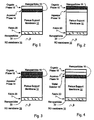
- RO membrane 10 is synthesized using a interfacial polymerization process on a porous support membrane 12. Two immiscible solvents are used, so that a monomer in one solvent reacts with a monomer in the other solvent. The reactions are very fast and relatively high molecular weights are obtained.
- fabric layer 20 may have nanoparticles 22 incorporated for added strength.
- Fabric layer 20 is preferably permeable to water, flat, and without stray fibers that could penetrate support 12 or thin film discrimination layer 24. It should be thin to decrease cost and to maximize membrane area, strong against extension, and mechanically resistant to deformation at high pressures. By adding nanoparticles 22 to the polymer fibers of fabric 20, more mechanically robust backings may be created that allow thinner, cheaper, and/or tougher supports to be manufactured.
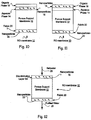
- nanoparticles may be selected for their ability to release metal species such as alkaline earth or aluminum ions. Such particles may be dispersed within either the aqueous layer 14 or the organic phase layer 18, or both. Additional nanoparticles may also be present to impact surface properties or further increase performance, for example to improve fouling resistance. Nanoparticles 22 may be the same or different from nanoparticles 16. Metal ions 16 may be dissolved within either the aqueous layer 14, as shown in Fig. 10 , or the organic phase layer 18, as shown in Fig. 11 , or in both layers. Metal ions 16 may be dissolved within the aqueous layer 14, as shown in Fig. 13 .
- nanoparticles 16 selected to release soluble metal species to introduce metal ions 17 into aqueous layer 14, during fabrication may be dispersed within or on porous support membrane 12. Nanoparticles 16 may also be introduced into aqueous layer 14 or organic phase layer 18 or both to introduce additional metal ions 17 into aqueous layer 14 during fabrication. Additional nanoparticles 17 may also be present to impact surface properties or further increase performance of membrane 10.
- the interfacial polymerization process at least one of solutions a) and b) contains nanoparticles that release at least 1 ppm of a soluble metal species per 5% (w/w) nanoparticles, based on the weight of the mixture, and wherein said nanoparticles have been processed to maximize the amount of said soluble metal species contributed to the interfacial polymerization mixture.
- RO membranes may be fabricated in which nanoparticles are included in the porous support membrane to release soluble metal ions for the interfacial polymerization process and/or improve flux flow decline by, perhaps, resisting compaction of the support membranes during reverse osmosis.
- the nanoparticles may be selected based on their ability to release 1 ppm or more of soluble metal species into the water contained in the support membrane. It may be advantageous to store the support membrane, for example for up to one hour, before interfacial polymerization on the support membrane between aqueous and organic phase solutions. It may also be advantageous to form the discrimination layer by contacting the aqueous phase solution to the organic phase solution on the support membrane for at least 10 seconds, preferably 2 minutes and more preferably 5 minutes after the organic phase solution is applied.
- Nanoparticles 16 may be incorporated into support membrane 12 by including nanoparticles 16 with casting solution 13 used to prepare support membrane 12, or by including nanoparticles 16 within the nonsolvent, e.g. DI water, used to induce phase inversion during fabrication of support membrane 12.
- nonsolvent e.g. DI water
- Nanoparticles in solution in aqueous solution 14 or organic solution 18 may release metal ions 17 before the polymerization.
- Dissolved metal ions 17 are thought to affect the polymerization reaction and ultimately membrane structure leading to improved performance. It is thought that the dissolved metal ions 17 may serve as a template to guide polymerization leaving spaces or channels for increased water transport.
- Nanoparticles 16 may be selected to release metal ions 17 which may enter the water or other solvent contained within or on support membrane 12.
- the amount of metal ions 17 available for the interfacial polymerization of aqueous phase 14 and organic phase 18 may in some cases be increased by storing support membrane 12, for example in roll form, for a suitable time period such as at least one hour before fabrication of RO membrane 10.
- Sonication processing nanoparticles 16 may include immersing a sonic probe directly into casting solution 13 from which support membrane 12 is formed or into organic or aqueous phases 14 and/or 18 and/or placing solutions with nanoparticles 16 in a vessel and immersing the vessel in a sonic bath. Solutions are subjected to sufficient sonic energy from 10 to 60 minutes to aid in the release of metal species, such as alkaline earth metal ions 17, into the solution. After sonication, the solution contains additional metal species. Additional sonication time may release additional metal species up to some limit equilibrium.
- Processing of selected nanoparticles 16 may also be accomplished using shear, cavitation, and impact forces generated by 1 to 60 minutes in a Microfluidizer (a trademark of the Microfluidics Corp.). After processing, the solution contains additional metal species that were dissolved from nanoparticles 16.
- the nanoparticles or other relatively insoluble carriers may have been calcined for at least 1 hour at 200°C or more.
- the processed carriers can have been shaken in aqueous solution on a shaker table for at least 1 minute.
- Carriers may have been processed by subjecting them to sonic energy in a vessel having a sonic probe within a solution, said energy sufficient to increase the soluble metal species or other molecular additives contributed by the processed carriers to the interfacial polymerization mixture, e.g., in a vessel suspended in a sonic bath for at least 5 minutes.
- the nanoparticles or other relatively insoluble carriers may have been processed in a solution at a pH lower than about 6 for at least 30 seconds or at a pH lower than about 5 for at least 30 seconds.
- the nanoparticles or other relatively insoluble carriers may have been processed in a solution at a pH greater than about 8 for at least 30 seconds or in a solution at a pH greater than about 9 for at least 30 seconds.
- Nanoparticles or other relatively insoluble carriers may have been processed with heat in a solution for at least 5 minutes at a temperature of 40 °C or more.
- Nanoparticles or other relatively insoluble carriers may have been processed with chelating agents in solution to bind soluble metal species or other molecular additives.
- the preparation of support membrane 12 may begin with the addition of N-methyl pyrrolidone (NMP) solvent (Acros Organics, USA) to a polysulfone polymer (M,-26,000 from Aldrich, USA) in transparent bead form in airtight glass bottles.
- NMP N-methyl pyrrolidone
- M polysulfone polymer
- DMF dimethylformamide
- Nanoparticles 16 may be dispersed in the NMP before its addition to the polysulfone polymer.
- the solution may then be agitated for several hours until complete dissolution is achieved, forming the dope or casting solution 13.
- Casting solution 13 may then be cast or spread over non-woven fabric 20 attached to glass plate 15 via a knife-edge.
- Glass plate 15 may then be immediately immersed into demineralized water, which had preferably been maintained at the desired temperature. Immediately, phase inversion begins and after several minutes, non-woven support fabric 20 supporting polysulfone membrane 12 may be separated from glass plate 15. Membrane 12 is then washed thoroughly with deionized water and stored in cold conditions until used. In a continuous coating process, glass plate 15 would not be required.
- nanoparticles or other relatively insoluble carriers 16 may be added to aqueous phase 14 to improve RO membrane characteristics such as flux without reducing rejection as much as adding nanoparticles 16 to the organic phase 18. Nanoparticles or other relatively insoluble carriers 16 may similarly be included in a layer between support membrane 12 and discrimination layer 24 as shown below in Fig. 6 .
- the rejection is at least 99.5% and the flux is at least 51, 59.5 or 68 l/m 2 /h (30, 35 or 40 GFD).
- Suitable zeolites for use as nanoparticles 16 include LTA, RHO, PAU, and KFI. Such synthetic zeolites have different Si/Al ratios, and exhibit different characteristic charge and hydrophilicity and may therefore be selected for RO membranes 10 in different circumstances. Nanoparticles 16 may also include zeolite precursors or amorphous aluminosilicates.
- aqueous phase 14 used during interfacial polymerization may also include one of the reactants, nanoparticles, or other relatively insoluble carriers, and processing aids such as surfactants, drying agents, catalysts, coreactants, cosolvents, etc.
- the polar mixture can typically be applied to microporous support membrane 12 by dipping, immersing, coating or other well known techniques. Once coated on porous support membrane 12, excess polar mixture can be optionally removed by evaporation, drainage, air knife, rubber wiper blade, nip roller, sponge, or other devices or processes.
- the porous support structure can be immersed in an aqueous solution containing a first reactant (e.g., 1,3-diaminobenzene or "MPD" monomer).
- a first reactant e.g., 1,3-diaminobenzene or "MPD” monomer
- the substrate can then be put in contact with an organic solution containing a second reactant (e.g., trimesoyl chloride or "TMC” monomer).
- TMC trimesoyl chloride
- the organic or apolar liquid is immiscible with the polar or aqueous liquid, so that the reaction occurs at the interface between the two solutions to form a dense polymer layer on the support membrane surface.
- hydrophilic polymer layer 30 may be applied to the surface of membrane 10.
- a solution of polyvinylalcohol in water may be applied to the surface of membrane 10 followed by a heat cure.
- membranes such as RO membrane 10 may be used to desalinate waters containing materials which tend to accumulate on the membrane surface, decreasing the apparent permeability.
- materials can include but are not limited to natural organic matter, partially insoluble inorganic materials, organic surfactants, silt, colloidal material, microbial species including biofilms, and organic materials either excreted or released from microbial species such as proteins, polysaccharides, nucleic acids, metabolites, and the like.
- This drop in permeability is often smaller for nanocomposite membranes as described herein than for membranes prepared by prior conventional techniques, due to a decreased amounts, density, viability, thickness and/or nature of the accumulated material,
- An additional processing step may then be performed to increase the number of nanoparticles 16 on the surface of support membrane 12.
- This step can include using pressure or vacuum to pull solution through membrane 10, causing nanoparticles 16 to build up at the surface of support membrane 12, or can include evaporation of the amine solution leading to deposition of nanoparticles 16 on the surface of support membrane 12. Since the final number of nanoparticles 16 on the surface of RO membrane 10 will often impact performance, the coating thickness of the solution evaporation and the concentration method are all important to control.
- nanoparticles 16 affect the polymer itself before and during the reaction and alter the film chemistry and/or morphology leading to improved properties without incorporation of nanoparticles 16 into RO membrane 10.
- nanoparticles 16 are often assisting, templating, and or altering the formation of the polymer itself, and it is the change in the final polymer membrane of discrimination layer 24 which gives the performance change.
- This heat may affect the aggregation of the forming polymer chains and may result in an altered structure that may have increased free volume potentially capable of taking in, and passing, more water.
- the ability to transport water through TFC membrane 10 may be thought of as a product of diffusion and the amount of water within membrane 10, this increased water uptake may result in increased permeability.
- the molecular additives can be made to work more efficiently. More specifically, the concentration of TMC has been found to alter the effectiveness of molecular additives. Using concentrations of TMC 50% to 500% higher than commonly used in the industry (for example 0.1 %) results in molecular additives giving a significantly larger increase in flux.
- the frame was taken off, and was left horizontally for at least 4 minutes at which point most of the surface water had evaporated.
- the membrane was then clamped with the glass plate in four corners. An air knife was used to finish drying of the membrane surface.
- the membrane was reframed using another clean and dry acrylic frame and kept horizontally for 1 minute.
- the frame was taken off, and was left horizontally for at least 4 minutes at which point most of the surface water had evaporated.
- the membrane was then clamped with the glass plate in four corners. An air knife was used to finish drying of the membrane surface.
- the membrane was reframed using another clean and dry acrylic frame and kept horizontally for 1 minute.
- Template-free zeolite LTA nanoparticles in an aqueous dispersion were found to have aluminum content after being subjected to impact, cavitation and shear forces in a microfluidizer.
- the dispersion contained approximately 39 weight percent LTA made with double distilled water. When measured using ICP analysis, the solution had an aluminum content of 130.9 parts per million (ppm). This aluminum content is likely related to aluminum dissolution in the aqueous dispersion based on the data shown in Example 5.
- a similar dispersion of templated zeolite LTA nanoparticles (5%) showed an aluminum content of 2.9 ppm.
- Table 1 Comparison of Zeolite LTA, Si:Al Ratio and Shaker Dissolution Material Framework Si:Al Ratio Shaker Dissolution Aluminum parts per million plateau in 500 ml DDI water solution Zeolite LTA (template-free) 1:1 35.90* Zeolite LTA (template) 1.5:1 ⁇ 0.1** Zeolite FAU ⁇ 2.5 ⁇ 0.1*** *Average of 77 to 160-day data; **Average of 1 to 84-day data; *** 2-day data
- An aqueous solution of 4.0 wt% MPD, 4.5 wt% TEACSA and 0.2 wt% SLS in DI water was prepared.
- An Isopar G solution with 0.3 wt% TMC and 0.25% Al (acac)3 was also prepared and sonicated for 60 minutes.
- Example K Aluminum citrate (reference):
- Tables I-XII in Section C provide 172 additional examples of various additives used solely and in combination to identify points within ranges of the use of such additives and combinations, concentrations and ranges.
- Hybrid nanocomposite membranes can be thought of as a subclass of thin film composite or TFC membranes, where the polymer phase of the discrimination layer both includes nanoparticles and has been modified through the use of one or more of these additives.
- Hybrid nanocomposite TFC membranes are interfacially prepared membranes formed in the presence of nanoparticles, and/or one or more additives, and yielding a mixed matrix membrane of the nanoparticles, and/or additives, together with polymer, nanoparticles and additives, supported by an underlying layer, typically an ultra or microfiltration membrane.
- This drop in permeability or membrane flux is often smaller for membranes prepared as disclosed herein than for membranes prepared by conventional techniques due to a decreased amount, density, viability, thickness and/or nature of accumulated material.
- Membrane surface properties such as hydrophilicity, charge, and roughness, often affect this accumulation and permeability change.
- membranes with highly hydrophilic, negatively charged, and smooth surfaces yield good permeability, rejection, and fouling behavior.
- nanoparticles such as zeolite LTA nanoparticles, have been shown to reduce roughness, increase negative charge without addition of carboxylate groups, and reduce contact angles.
- Nanoparticles can also be added to increase membrane permeability while maintaining good rejection, and/or to improve the mechanical strength of the thin film or support layer.
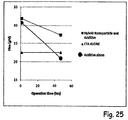
- Membranes were prepared using the method of example 12. Membranes were run on a feed solution of DI water with 32,000ppm of a salt blend formulated to simulate natural ocean water (Instant Ocean®). Temperature was maintained at 25° C and a pressure of 800 psi was used throughout testing. No filtration was used during this test allowing inorganic and organic colloids to recirculate through the system and biological material to grow. Performance data was taken 1 hr after testing began and again 47hrs later after continuous operation.
- Monohydrolyzed TMC 16 is a molecule of trimesoyl chloride or TMC in which one of the -Cl bonded groups has been replaced with a bonded OH group.
- Di-hydrolyzed trimesoyl chloride and tri-hydrolyzed trimesoyl chloride i.e., trimesic acid
- Tri-hydrolyzed trimesoyl chloride is believed to be a contaminant in that it appears to be insoluble in organic phase 18 and may serve to increase flux in TFC membrane 10 at the expense of rejection characteristics.
- the characteristics of di-hydrolyzed trimesoyl chloride are not clearly understood, but do not at this time appear to be substantially beneficial to the flux and rejection characteristics of TFC membranes which may explain why convention wisdom teaches the avoidance of contaminated TMC.
- trimesoyl chloride or mhTMC other partially hydrolyzed reactants may also be effective at improving flux.
- Tricarbonyl chloride subsititued cycloaliphatic rings, or bicycloaliphatics are also included.
- Carbonyl chlorides of higher substitution than three may also be di or higher hydrolyzed, as long as at least 2 carbonyl chloride groups remain allowing polymerization to occur.
- Preferred concentrations of the monohydrolyzed TMC 16 are from 0.005% to 5% by weight and more preferred from 0.025% to 0.25% in organic layer 18.
- the amount of monohydrolyzed TMC may also be compared in a ratio with the amount of TMC.
- Preferred TMC/monohydrolyzed TMC ratios are less than 50:1, 25:1, 15:1, 5:1, or 1:1. From this it can be seen that at high TMC concentrations more monohydrolyzed TMC may be needed to see a comparable flux increase. It may be beneficial to sonicate the solution. Sonication may serve to better disperse the monohydrolyzed TMC 16 in organic solution 18.
- the purity of the synthesized monohydrolyzed TMC may be estimated from NMR spectra. Crude and purified monohydrolyzed TMC is dissolved in deuterated acetone for the NMR experiment. The purity calculation may be performed by looking at the relative quantities of trimesic acid, 1,3,5-Benzenetricarbonyl trichloride, monohydrolyzed TMC and dihydrolyzed 1,3,5-Benzenetricarbonyl trichloride. These values may then be reduced by any extraneous NMR peaks which usually impurities from the synthesis.
- the filtering process substantially improved the salt rejection and only slightly reduced the flux.
- the remaining contamination seems to improve the flux flow when it's at low values without much damage to rejection, but at the point of interest, at about 99.5% salt rejection, further contamination hurts the rejection at a much greater rate and only slight improves flux.
- Another inflection point appears at about 0.020 % or 0.0215% where the flux climbs dramatically and the rejections drops dramatically. This may indicate holes or tearing or some other degrading of the membrane. These regions of the chart may be characterized as contamination-improved flux, contamination diminished-rejection, and contamination-damaged zones.
- nanotubes 16 When nanotubes 16 are included in the aqueous phase it may be preferable to include surfactants such as; Alkyl poly(ethylene oxide),Copolymers of poly(ethylene oxide) and poly(propylene oxide) (commercially called Poloxamers or Poloxamines), Alkyl polyglucosides including Octyl glucoside or Decyl maltoside, Fatty alcohols including Cetyl alcohol or Oleyl alcohol, Cocamide MEA, or cocamide DEA, to help disperse the nanotubes. These may also be chosen so as to help align nanotubes 16 in a specific arrangement. It will be obvious to one skilled in the art to use other nonionic, cationic, anionic, or zwitterionic surfactants to aid in dispersing or aligning the nanoparticles.
- surfactants such as; Alkyl poly(ethylene oxide),Copolymers of poly(ethylene oxide) and poly(propylene oxide) (commercially called Poloxamers or Poloxamines), Alkyl polyglu
- An aqueous of MPD, 4.5 wt% TEACSA and 0.06 wt% SLS in DI water was prepared.
- An Isopar G solution with TMC and nanoparticle was also prepared and sonicated for 30 minutes.
- To this solution was added a homogenous solution of the molecular additive dissolved in an aromatic cosolvent (xylene or mesitylene).
- Final concentration of the cosolvent was 4 wt% by weight and the concentration of MPD, Nanoparticle, TMC, and molecular additive are listed in the tables.
- Aqueous MPD solution (50 mL) prepared as described previously was poured onto the framed membrane surface and remained for 1 min. The solution was drained by tilting the frame till no solution dripped from the frame.
Landscapes
- Chemical & Material Sciences (AREA)
- Chemical Kinetics & Catalysis (AREA)
- Inorganic Chemistry (AREA)
- Engineering & Computer Science (AREA)
- Water Supply & Treatment (AREA)
- Manufacturing & Machinery (AREA)
- Life Sciences & Earth Sciences (AREA)
- Geology (AREA)
- Dispersion Chemistry (AREA)
- Nanotechnology (AREA)
- Separation Using Semi-Permeable Membranes (AREA)
Claims (12)
- Processus de polymérisation interfaciale destiné à préparer une membrane d'OI fortement perméable, comprenant les étapes consistant à
mettre en contact sur un support membranaire poreux,a) une première solution, contenant un monomère de polyamines, etb) une deuxième solution, contenant un monomère d'halogénure d'acide polyfonctionnel,avec un composé additif moléculaire d'un bêta-dicétonate combiné avec un métal, étant un élément choisi dans le groupe 2 du tableau périodique des éléments (UICPA), moyennant quoi le composé additif moléculaire est présent dans le paragraphe a) ou le b) ou dans les deux pendant la réaction de polymérisation, et récupérer une membrane d'OI fortement perméable. - Processus selon la revendication 1, dans lequel au moins l'une des solutions des paragraphes a) et b) contient des nanoparticules.
- Processus selon la revendication 1, dans lequel la polyamine est choisie dans le groupe constitué par le diaminobenzène, le triamino-benzène, le m-phénylène diamine, le p-phénylène diamine, l'acide 1,3,5-diaminobenzoïque, le 2,4-diaminotoluène, le 2,4-diaminoanisole, le xylylène-diamine, l'éthylène-diamine, le propylène-diamine, la pipérazine et la tris(2-diaminoéthyl)amine.
- Processus selon la revendication 1, dans lequel l'halogénure d'acide polyfonctionnel est choisi dans le groupe constitué par les : chlorure de trimésoyle, chlorure d'acide trimellitique, chlorure d'isophthaloyle et chlorure de téréphthaloyle.
- Processus selon la revendication 1, dans lequel le bêta-dicétonate est un acéto-acétonate.
- Processus selon la revendication 1, dans lequel le support membranaire poreux comprend des nanoparticules.
- Processus selon la revendication 1, dans lequel les nanoparticules comprennent des zéolites.
- Processus selon la revendication 1, dans lequel les nanoparticules comprennent des nanotubes de carbone.
- Processus selon la revendication 1, dans lequel les additifs moléculaires étant une combinaison d'un bêta-dicétonate combiné avec un atome de métal central, choisi dans le groupe constitué par les métaux alcalino-terreux, et d'un chlorure de trimésoyle mono-hydrolysé dissout dans la phase organique.
- Processus selon la revendication 9, dans lequel le bêta-dicétonate est un acéto-acétonate.
- Membrane d'osmose inverse préparée selon le processus de l'une quelconque des revendications 1 à 10.
- Procédé de purification d'eau saumâtre ou d'eau de mer comprenant la mise en contact de l'eau saumâtre ou de l'eau de mer avec une membrane d'osmose inverse selon la revendication 11.
Priority Applications (2)
| Application Number | Priority Date | Filing Date | Title |
|---|---|---|---|
| EP16188730.2A EP3144054B1 (fr) | 2008-04-15 | 2009-04-15 | Membranes tfc à polyamide préparées en utilisant du chloride trimesoylique mono-hydrolysé |
| EP16188716.1A EP3144052B1 (fr) | 2008-04-15 | 2009-04-15 | Membranes tfc à nanoparticules hybrides |
Applications Claiming Priority (28)
| Application Number | Priority Date | Filing Date | Title |
|---|---|---|---|
| US4523708P | 2008-04-15 | 2008-04-15 | |
| US4524708P | 2008-04-15 | 2008-04-15 | |
| US4524908P | 2008-04-15 | 2008-04-15 | |
| US4523408P | 2008-04-15 | 2008-04-15 | |
| US4525208P | 2008-04-15 | 2008-04-15 | |
| US4526208P | 2008-04-15 | 2008-04-15 | |
| US7979408P | 2008-07-10 | 2008-07-10 | |
| US8866608P | 2008-08-13 | 2008-08-13 | |
| US10490508P | 2008-10-13 | 2008-10-13 | |
| US12234308P | 2008-12-12 | 2008-12-12 | |
| US12234408P | 2008-12-12 | 2008-12-12 | |
| US12234108P | 2008-12-12 | 2008-12-12 | |
| US12235408P | 2008-12-12 | 2008-12-12 | |
| US12234208P | 2008-12-12 | 2008-12-12 | |
| US12234808P | 2008-12-12 | 2008-12-12 | |
| US12235208P | 2008-12-12 | 2008-12-12 | |
| US12235508P | 2008-12-12 | 2008-12-12 | |
| US12234608P | 2008-12-12 | 2008-12-12 | |
| US12234708P | 2008-12-12 | 2008-12-12 | |
| US12235008P | 2008-12-12 | 2008-12-12 | |
| US12235108P | 2008-12-12 | 2008-12-12 | |
| US12234508P | 2008-12-12 | 2008-12-12 | |
| US12235708P | 2008-12-13 | 2008-12-13 | |
| US12235808P | 2008-12-13 | 2008-12-13 | |
| US15638809P | 2009-02-27 | 2009-02-27 | |
| US15639409P | 2009-02-27 | 2009-02-27 | |
| US16403109P | 2009-03-27 | 2009-03-27 | |
| PCT/US2009/040732 WO2009129354A2 (fr) | 2008-04-15 | 2009-04-15 | Membranes tfc à nanoparticules hybrides |
Related Child Applications (4)
| Application Number | Title | Priority Date | Filing Date |
|---|---|---|---|
| EP16188730.2A Division EP3144054B1 (fr) | 2008-04-15 | 2009-04-15 | Membranes tfc à polyamide préparées en utilisant du chloride trimesoylique mono-hydrolysé |
| EP16188730.2A Division-Into EP3144054B1 (fr) | 2008-04-15 | 2009-04-15 | Membranes tfc à polyamide préparées en utilisant du chloride trimesoylique mono-hydrolysé |
| EP16188716.1A Division EP3144052B1 (fr) | 2008-04-15 | 2009-04-15 | Membranes tfc à nanoparticules hybrides |
| EP16188716.1A Division-Into EP3144052B1 (fr) | 2008-04-15 | 2009-04-15 | Membranes tfc à nanoparticules hybrides |
Publications (3)
| Publication Number | Publication Date |
|---|---|
| EP2276558A2 EP2276558A2 (fr) | 2011-01-26 |
| EP2276558A4 EP2276558A4 (fr) | 2012-12-12 |
| EP2276558B1 true EP2276558B1 (fr) | 2017-07-12 |
Family
ID=41199721
Family Applications (3)
| Application Number | Title | Priority Date | Filing Date |
|---|---|---|---|
| EP16188716.1A Active EP3144052B1 (fr) | 2008-04-15 | 2009-04-15 | Membranes tfc à nanoparticules hybrides |
| EP16188730.2A Active EP3144054B1 (fr) | 2008-04-15 | 2009-04-15 | Membranes tfc à polyamide préparées en utilisant du chloride trimesoylique mono-hydrolysé |
| EP09732803.3A Active EP2276558B1 (fr) | 2008-04-15 | 2009-04-15 | Membranes à polyamide pour l'osmose inverse et leurs préparation |
Family Applications Before (2)
| Application Number | Title | Priority Date | Filing Date |
|---|---|---|---|
| EP16188716.1A Active EP3144052B1 (fr) | 2008-04-15 | 2009-04-15 | Membranes tfc à nanoparticules hybrides |
| EP16188730.2A Active EP3144054B1 (fr) | 2008-04-15 | 2009-04-15 | Membranes tfc à polyamide préparées en utilisant du chloride trimesoylique mono-hydrolysé |
Country Status (8)
| Country | Link |
|---|---|
| EP (3) | EP3144052B1 (fr) |
| JP (2) | JP5856479B2 (fr) |
| KR (2) | KR101570028B1 (fr) |
| CN (2) | CN104906957A (fr) |
| AU (1) | AU2009236162B2 (fr) |
| CA (1) | CA2720673C (fr) |
| ES (1) | ES2639212T3 (fr) |
| WO (1) | WO2009129354A2 (fr) |
Cited By (2)
| Publication number | Priority date | Publication date | Assignee | Title |
|---|---|---|---|---|
| US11724234B2 (en) | 2016-08-31 | 2023-08-15 | South Dakota Board Of Regents | Multilayer thin film nanocomposite membranes prepared by molecular layer-by-layer assembly |
| EP3702020B1 (fr) * | 2018-07-09 | 2025-03-12 | Lg Chem, Ltd. | Membrane de séparation de traitement de l'eau, module de traitement de l'eau la comprenant et procédé de fabrication correspondant |
Families Citing this family (83)
| Publication number | Priority date | Publication date | Assignee | Title |
|---|---|---|---|---|
| US8567612B2 (en) | 2008-04-15 | 2013-10-29 | Nanoh2O, Inc. | Hybrid TFC RO membranes with nitrogen additives |
| US8177978B2 (en) | 2008-04-15 | 2012-05-15 | Nanoh20, Inc. | Reverse osmosis membranes |
| US8286803B2 (en) * | 2009-06-18 | 2012-10-16 | The Boeing Company | Methods and systems for incorporating carbon nanotubes into thin film composite reverse osmosis membranes |
| WO2011102124A1 (fr) * | 2010-02-16 | 2011-08-25 | 日東電工株式会社 | Membrane de séparation composite et élément membranaire de séparation l'utilisant |
| NO346294B1 (no) * | 2010-04-30 | 2022-05-30 | Toray Advanced Mat Korea Inc | Foroverrettet osmosemembran for sjøvannavsalting, og fremgangsmåte for produksjon av denne |
| CN103140278B (zh) * | 2010-09-30 | 2015-06-10 | 海绵股份有限公司 | 用于正向渗透的薄膜复合膜及其制备方法 |
| AU2011326483B2 (en) * | 2010-11-10 | 2017-02-23 | Nanoh2O, Inc. | Improved hybrid TFC RO membranes with non-metallic additives |
| CN103328082B (zh) | 2011-01-24 | 2016-08-10 | 陶氏环球技术有限责任公司 | 复合聚酰胺膜 |
| EP2632577B1 (fr) | 2011-01-24 | 2014-10-01 | Dow Global Technologies LLC | Procédé de préparation d'une membrane composite on polyamide |
| EP2632575B1 (fr) | 2011-01-24 | 2016-04-27 | Dow Global Technologies LLC | Procédé de fabrication d'une membrane composite en polyamide |
| US9216391B2 (en) | 2011-03-25 | 2015-12-22 | Porifera, Inc. | Membranes having aligned 1-D nanoparticles in a matrix layer for improved fluid separation |
| KR101440968B1 (ko) * | 2011-06-17 | 2014-09-17 | 주식회사 엘지화학 | 초친수성 보호층을 포함하는 역삼투막 및 이의 제조방법 |
| JP2014501614A (ja) * | 2011-06-20 | 2014-01-23 | エルジー・ケム・リミテッド | 塩除去率及び透過流量特性に優れた逆浸透分離膜及びその製造方法 |
| KR101401922B1 (ko) * | 2011-08-08 | 2014-06-02 | 고려대학교 산학협력단 | 해수담수화용 폴리에테르술폰계 역삼투막 제조용 코팅액 조성물 및 이를 이용한 폴리에테르술폰계 역삼투막의 제조방법 |
| JP6054968B2 (ja) | 2011-08-31 | 2016-12-27 | ダウ グローバル テクノロジーズ エルエルシー | アミン−反応性およびリン−含有官能基を含むモノマーから誘導された複合ポリアミド膜 |
| JP6027124B2 (ja) * | 2011-09-29 | 2016-11-16 | ダウ グローバル テクノロジーズ エルエルシー | ハロゲン化アシルモノマーを含有するカルボン酸由来の複合ポリアミド膜 |
| EP2627439B1 (fr) * | 2011-09-29 | 2016-12-14 | Dow Global Technologies LLC | Procédé de solubilisation d'un composé contenant de l'acide carboxylique dans un solvant hydrocarboné |
| WO2013059314A1 (fr) | 2011-10-17 | 2013-04-25 | Porifera, Inc. | Préparation de membranes à nanotubes alignés pour applications de séparation d'eau et de gaz |
| JP5692885B2 (ja) * | 2011-12-08 | 2015-04-01 | エルジー・ケム・リミテッド | 銀ナノワイヤ層を含む逆浸透膜及びその製造方法 |
| US20130146530A1 (en) * | 2011-12-08 | 2013-06-13 | General Electric Company | Membrane, water treatment system, and method of making |
| US9004293B2 (en) | 2011-12-16 | 2015-04-14 | Samsung Electronics Co., Ltd. | Semi-permeable film and separation membrane including nanoporous material, and method of manufacturing the same |
| ES2806675T3 (es) * | 2012-01-06 | 2021-02-18 | Ddp Specialty Electronic Mat Us Inc | Método de preparación de una membrana de poliamida de material compuesto |
| JP5879161B2 (ja) * | 2012-03-09 | 2016-03-08 | 旭化成ケミカルズ株式会社 | 水蒸気分離膜及びその製造方法 |
| CN103906561A (zh) * | 2012-06-08 | 2014-07-02 | Lg化学株式会社 | 包含经表面处理过的沸石的高渗透通量反渗透膜及其制备方法 |
| EP2858740B8 (fr) * | 2012-07-19 | 2020-04-29 | DDP Specialty Electronic Materials US, Inc. | Procede de preparation d'une membrane composite en polyamide par une association de différents monomères réactifs avec les amines polyfonctionnels |
| SG11201500210WA (en) * | 2012-08-15 | 2015-03-30 | Univ Nanyang Tech | Reinforced membranes for producing osmotic power in pressure retarded osmosis |
| JP6191102B2 (ja) * | 2012-08-23 | 2017-09-06 | 三菱ケミカル株式会社 | 正浸透膜複合体 |
| FR2996780B1 (fr) | 2012-10-16 | 2014-12-19 | Univ Claude Bernard Lyon | Procede et dispositif de production d'energie |
| EP2934727B1 (fr) | 2012-12-21 | 2024-05-01 | Porifera, Inc. | Systèmes de séparation utilisant des membranes et des dispositifs d'espacement empilés |
| SG11201506981SA (en) * | 2013-03-15 | 2015-10-29 | Oasys Water Inc | Membrane modules |
| WO2014144704A1 (fr) | 2013-03-15 | 2014-09-18 | Porifera, Inc. | Progrès dans des systèmes membranaires à entraînement osmotique comprenant un réglage de pression faible |
| US9051417B2 (en) | 2013-03-16 | 2015-06-09 | Dow Global Technologies Llc | Method for solubilizing carboxylic acid-containing compound in hydrocarbon solvent |
| US9051227B2 (en) | 2013-03-16 | 2015-06-09 | Dow Global Technologies Llc | In-situ method for preparing hydrolyzed acyl halide compound |
| US9289729B2 (en) | 2013-03-16 | 2016-03-22 | Dow Global Technologies Llc | Composite polyamide membrane derived from carboxylic acid containing acyl halide monomer |
| EP3074116A4 (fr) * | 2013-11-28 | 2017-12-20 | B.G. Negev Technologies and Applications Ltd. | Fabrication et modification de membranes polymères par utilisation d'une impression au jet d'encre |
| KR102213238B1 (ko) * | 2013-12-06 | 2021-02-05 | 동의대학교 산학협력단 | 반투막 및 그 제조 방법 |
| KR20160107206A (ko) * | 2014-01-13 | 2016-09-13 | 다우 글로벌 테크놀로지스 엘엘씨 | 고 팽창성 복합 폴리아마이드 멤브레인 |
| EP3132842A4 (fr) * | 2014-04-18 | 2017-04-05 | Mitsubishi Chemical Corporation | Complexe (support poreux) - (film de zéolite), et procédé de production du complexe (support poreux) - (film de zéolite) |
| CN106232214B (zh) * | 2014-05-14 | 2021-01-15 | 陶氏环球技术有限责任公司 | 用亚硝酸后处理的复合聚酰胺膜 |
| JP2016068019A (ja) * | 2014-09-30 | 2016-05-09 | 日東電工株式会社 | 複合半透膜及びその製造方法、スパイラル型分離膜エレメント |
| WO2016070103A1 (fr) | 2014-10-31 | 2016-05-06 | Porifera, Inc. | Membranes à nanotubes de carbone portés et leurs procédés de préparation |
| US9695065B2 (en) * | 2015-06-03 | 2017-07-04 | Lg Nanoh2O, Inc. | Combination of chemical additives for enhancement of water flux of a membrane |
| US9731985B2 (en) * | 2015-06-03 | 2017-08-15 | Lg Nanoh2O, Inc. | Chemical additives for enhancement of water flux of a membrane |
| KR102531484B1 (ko) | 2015-06-24 | 2023-05-10 | 포리페라 인코포레이티드 | 정삼투를 통한 알콜성 용액의 탈수 방법 및 관련 시스템 |
| US9861940B2 (en) | 2015-08-31 | 2018-01-09 | Lg Baboh2O, Inc. | Additives for salt rejection enhancement of a membrane |
| EP3345675A4 (fr) * | 2015-09-01 | 2019-04-24 | LG Chem, Ltd. | Procédé de production de membrane de traitement d'eau, membrane de traitement d'eau produite à l'aide de celui-ci, et module de traitement d'eau comprenant la membrane de traitement d'eau |
| KR102075181B1 (ko) * | 2015-12-23 | 2020-02-07 | 주식회사 엘지화학 | 폴리아미드 계면중합용 조성물, 이를 이용한 역삼투막의 제조방법 및 역삼투막 및 수처리 모듈 |
| KR101804026B1 (ko) * | 2015-12-31 | 2017-12-28 | 고려대학교 산학협력단 | 듀얼(이중층)-슬롯코팅 기술을 이용한 박막 복합 분리막의 단일 제조공정 |
| US9737859B2 (en) | 2016-01-11 | 2017-08-22 | Lg Nanoh2O, Inc. | Process for improved water flux through a TFC membrane |
| KR101950249B1 (ko) * | 2016-01-29 | 2019-02-21 | 가톨릭대학교 산학협력단 | 고차가지구조 고분자 나노입자 및 이의 제조방법 |
| US10155203B2 (en) | 2016-03-03 | 2018-12-18 | Lg Nanoh2O, Inc. | Methods of enhancing water flux of a TFC membrane using oxidizing and reducing agents |
| CN105797595A (zh) * | 2016-05-13 | 2016-07-27 | 高学理 | 一种高水稳定性金属有机框架化合物材料的制备方法及其应用 |
| CN106474944B (zh) * | 2016-11-08 | 2019-04-23 | 福建农林大学 | 一种抗菌纤维素平板纳滤膜的制备方法 |
| CN110290854A (zh) | 2016-12-23 | 2019-09-27 | 波里费拉公司 | 通过正向渗透除去醇溶液的组分和相关系统 |
| CN107349807B (zh) * | 2017-07-20 | 2020-05-22 | 浙江工业大学 | 一种Fe(BTC)镶嵌的大通量聚酰胺纳米复合膜及其制备方法和用途 |
| JP2018008270A (ja) * | 2017-08-08 | 2018-01-18 | 三菱ケミカル株式会社 | 正浸透膜 |
| CN107486028B (zh) * | 2017-09-21 | 2020-01-03 | 成都新柯力化工科技有限公司 | 一种用于废润滑油处理的高滤通膜及其制备方法 |
| CN108837712A (zh) * | 2018-07-11 | 2018-11-20 | 佛山市高明区爪和新材料科技有限公司 | 一种反渗透膜的制备方法 |
| CN108911250A (zh) * | 2018-08-01 | 2018-11-30 | 苏州艾吉克膜科技有限公司 | 含氨废水的回用装置和含氨废水的回用装置工艺 |
| CN109433029A (zh) * | 2018-11-15 | 2019-03-08 | 山东大学 | 一种抗污型掺杂氧化铈与银纳米颗粒的反渗透膜的制备方法 |
| US12097471B2 (en) | 2018-11-21 | 2024-09-24 | Evoqua Water Technologies Llc | Nanoparticles for use in membranes |
| CN109925895A (zh) * | 2019-04-08 | 2019-06-25 | 河北工业大学 | 一种抗污染聚酰胺薄膜复合膜的制备方法 |
| CN111408286A (zh) * | 2019-06-24 | 2020-07-14 | 江苏久吾高科技股份有限公司 | 一种纳米二氧化钛聚哌嗪酰胺纳滤膜的制备方法 |
| CN110180402B (zh) * | 2019-07-08 | 2020-08-04 | 清华大学 | 一种基于界面聚合制备松散纳滤膜的方法 |
| CN110960987B (zh) * | 2019-12-11 | 2022-05-03 | 恩泰环保科技(常州)有限公司 | 一种高性能纳米杂化反渗透膜及其制备方法 |
| WO2022030572A1 (fr) * | 2020-08-07 | 2022-02-10 | 東レ株式会社 | Membrane de séparation composite pour la séparation de gaz, élément de membrane de séparation composite pour la séparation de gaz, et procédé de production de gaz |
| CN114471183B (zh) * | 2020-11-11 | 2023-03-14 | 沃顿科技股份有限公司 | 分离膜的制备方法和由此制备的分离膜 |
| CN112717720B (zh) * | 2020-12-25 | 2022-05-20 | 湖南澳维科技股份有限公司 | 一种耐污染聚酰胺复合膜及其制备方法 |
| EP4278182A1 (fr) * | 2021-01-13 | 2023-11-22 | Institut National de la Recherche pour l'Agriculture, l'Alimentation et l'Environnement | Détection de particules virales par co-précipitation à médiation immunospécifique |
| CN112827369B (zh) * | 2021-01-18 | 2021-11-09 | 蓝星(杭州)膜工业有限公司 | 一种纳米杂化复合膜的制备方法 |
| CN112934006B (zh) * | 2021-02-10 | 2022-03-18 | 浙江工业大学 | 一种高通量黑滑石/金属有机框架复合抗菌纳滤膜 |
| CN113262650B (zh) * | 2021-04-23 | 2022-09-30 | 中国工程物理研究院材料研究所 | 用于氢同位素净化的二维mof膜及其制备方法和应用 |
| CN116216964B (zh) * | 2021-12-02 | 2024-07-02 | 中冶长天国际工程有限责任公司 | 一种膜生产工业废水的处理方法及处理系统 |
| CN115282792B (zh) * | 2022-01-21 | 2023-07-28 | 浙江师范大学 | 聚合物-磁性有机金属骨架化合物复合分离膜的制备方法 |
| CN114558143A (zh) * | 2022-02-28 | 2022-05-31 | 唐颐控股(深圳)有限公司 | 一种mRNA脂质纳米疫苗的制备方法 |
| CN114768559B (zh) * | 2022-05-19 | 2025-02-14 | 浙江工业大学 | 一种通过超交联制备耐强有机溶剂聚砜分离膜的方法 |
| CN115055064A (zh) * | 2022-08-17 | 2022-09-16 | 苏州苏瑞膜纳米科技有限公司 | 一种高性能聚酰胺复合反渗透膜的制备方法 |
| CN115518534B (zh) * | 2022-10-17 | 2025-09-26 | 沃顿科技股份有限公司 | 一种高强度聚酰胺反渗透膜及其制备方法 |
| CN116059852B (zh) * | 2023-02-22 | 2023-09-19 | 泰州南潇新材料科技有限公司 | 一种利于中空纤维有机滤膜界面聚合成聚酰胺膜的方法 |
| CN116764452B (zh) * | 2023-07-03 | 2025-12-05 | 天津华夏壹泰环境工程有限公司 | 一种复合型pvdf膜的制备方法 |
| CN117205765B (zh) * | 2023-09-14 | 2025-11-18 | 山东海化集团有限公司 | 一种制备高通量聚酰胺复合膜的方法 |
| CN117244414B (zh) * | 2023-09-21 | 2024-05-17 | 苏州苏瑞膜纳米科技有限公司 | 一种利用辐射固化实现快速干燥制备分离膜的制备方法 |
| CN117547974B (zh) * | 2024-01-12 | 2024-04-12 | 河南师范大学 | 一种具有高酸碱稳定性的聚哌嗪酰胺纳滤膜及其制备方法 |
Family Cites Families (13)
| Publication number | Priority date | Publication date | Assignee | Title |
|---|---|---|---|---|
| US4039440A (en) * | 1972-09-19 | 1977-08-02 | The United States Of America As Represented By The Secretary Of The Interior | Reverse osmosis membrane |
| JPS59199001A (ja) * | 1983-04-25 | 1984-11-12 | Asahi Chem Ind Co Ltd | 気体分離用複合膜及びその製造方法 |
| US4814082A (en) * | 1986-10-20 | 1989-03-21 | Memtec North America Corporation | Ultrafiltration thin film membranes |
| US5371166A (en) * | 1993-12-22 | 1994-12-06 | The B. F. Goodrich Company | Polyurethane composition for use as a dispersing binder |
| JPH08182921A (ja) * | 1994-12-28 | 1996-07-16 | Mitsubishi Rayon Co Ltd | ポリオレフィン複合微多孔質膜 |
| US5919522A (en) * | 1995-03-31 | 1999-07-06 | Advanced Technology Materials, Inc. | Growth of BaSrTiO3 using polyamine-based precursors |
| US6337018B1 (en) * | 2000-04-17 | 2002-01-08 | The Dow Chemical Company | Composite membrane and method for making the same |
| KR100527898B1 (ko) * | 2004-01-27 | 2005-11-15 | 한국해양연구원 | 나노 입자 토르마린을 포함한 역삼투 복합막 및 이의제조방법 |
| JP2006187731A (ja) * | 2005-01-06 | 2006-07-20 | Kurita Water Ind Ltd | 分離膜及び水処理装置 |
| JP2008535648A (ja) * | 2005-03-09 | 2008-09-04 | ザ リージェンツ オブ ザ ユニバーシティ オブ カリフォルニア | ナノ複合膜ならびにそれを作製および使用する方法 |
| JP5050335B2 (ja) * | 2005-10-21 | 2012-10-17 | 東レ株式会社 | 複合半透膜の製造方法 |
| EP2188044A4 (fr) * | 2006-10-27 | 2012-10-24 | Univ California | Structures de support micro- et nanocomposites pour membranes à couches minces d'osmose inverse |
| US8231013B2 (en) * | 2006-12-05 | 2012-07-31 | The Research Foundation Of State University Of New York | Articles comprising a fibrous support |
-
2009
- 2009-04-15 KR KR1020157019571A patent/KR101570028B1/ko active Active
- 2009-04-15 ES ES09732803.3T patent/ES2639212T3/es active Active
- 2009-04-15 CN CN201510111677.7A patent/CN104906957A/zh active Pending
- 2009-04-15 WO PCT/US2009/040732 patent/WO2009129354A2/fr not_active Ceased
- 2009-04-15 EP EP16188716.1A patent/EP3144052B1/fr active Active
- 2009-04-15 KR KR1020107025647A patent/KR101575385B1/ko active Active
- 2009-04-15 CA CA2720673A patent/CA2720673C/fr active Active
- 2009-04-15 EP EP16188730.2A patent/EP3144054B1/fr active Active
- 2009-04-15 EP EP09732803.3A patent/EP2276558B1/fr active Active
- 2009-04-15 JP JP2011505186A patent/JP5856479B2/ja active Active
- 2009-04-15 AU AU2009236162A patent/AU2009236162B2/en active Active
- 2009-04-15 CN CN201510711472.2A patent/CN105457508B/zh active Active
-
2014
- 2014-10-06 JP JP2014205405A patent/JP5974060B2/ja active Active
Cited By (2)
| Publication number | Priority date | Publication date | Assignee | Title |
|---|---|---|---|---|
| US11724234B2 (en) | 2016-08-31 | 2023-08-15 | South Dakota Board Of Regents | Multilayer thin film nanocomposite membranes prepared by molecular layer-by-layer assembly |
| EP3702020B1 (fr) * | 2018-07-09 | 2025-03-12 | Lg Chem, Ltd. | Membrane de séparation de traitement de l'eau, module de traitement de l'eau la comprenant et procédé de fabrication correspondant |
Also Published As
| Publication number | Publication date |
|---|---|
| KR101575385B1 (ko) | 2015-12-08 |
| CN105457508B (zh) | 2018-10-26 |
| EP3144052B1 (fr) | 2022-08-31 |
| WO2009129354A4 (fr) | 2010-04-01 |
| CA2720673C (fr) | 2017-08-08 |
| EP2276558A2 (fr) | 2011-01-26 |
| AU2009236162B2 (en) | 2013-10-31 |
| CA2720673A1 (fr) | 2009-10-22 |
| EP3144054B1 (fr) | 2022-11-02 |
| JP5856479B2 (ja) | 2016-02-09 |
| ES2639212T3 (es) | 2017-10-25 |
| CN104906957A (zh) | 2015-09-16 |
| ES2639212T8 (es) | 2021-02-11 |
| KR101570028B1 (ko) | 2015-11-17 |
| JP2011516264A (ja) | 2011-05-26 |
| CN105457508A (zh) | 2016-04-06 |
| KR20110011626A (ko) | 2011-02-08 |
| WO2009129354A3 (fr) | 2010-01-28 |
| JP5974060B2 (ja) | 2016-08-23 |
| WO2009129354A2 (fr) | 2009-10-22 |
| EP2276558A4 (fr) | 2012-12-12 |
| EP3144054A1 (fr) | 2017-03-22 |
| JP2015037788A (ja) | 2015-02-26 |
| AU2009236162A1 (en) | 2009-10-22 |
| KR20150099806A (ko) | 2015-09-01 |
| EP3144052A1 (fr) | 2017-03-22 |
Similar Documents
| Publication | Publication Date | Title |
|---|---|---|
| EP2276558B1 (fr) | Membranes à polyamide pour l'osmose inverse et leurs préparation | |
| US9744499B2 (en) | Hybrid nanoparticle TFC membranes | |
| EP2448657B1 (fr) | Membranes perfectionnées d'osmose inverse, composites à couches minces, hybrides, avec des additifs azotés | |
| CN101137427B (zh) | 纳米复合材料膜及其制备和使用方法 | |
| CN102089068A (zh) | 混杂的纳米粒子tfc膜 | |
| US9695065B2 (en) | Combination of chemical additives for enhancement of water flux of a membrane | |
| EP3303458B1 (fr) | Additifs chimiques pour l'amélioration du flux d'eau d'une membrane |
Legal Events
| Date | Code | Title | Description |
|---|---|---|---|
| PUAI | Public reference made under article 153(3) epc to a published international application that has entered the european phase |
Free format text: ORIGINAL CODE: 0009012 |
|
| 17P | Request for examination filed |
Effective date: 20101113 |
|
| AK | Designated contracting states |
Kind code of ref document: A2 Designated state(s): AT BE BG CH CY CZ DE DK EE ES FI FR GB GR HR HU IE IS IT LI LT LU LV MC MK MT NL NO PL PT RO SE SI SK TR |
|
| AX | Request for extension of the european patent |
Extension state: AL BA RS |
|
| RIN1 | Information on inventor provided before grant (corrected) |
Inventor name: KURTH, CHRISTOPHER, JAMES Inventor name: ZHOU, MEIJUAN Inventor name: KOEHLER, JEFFREY, ALAN Inventor name: HOLMBERG, BRETT, ANDERSON Inventor name: BURK, ROBERT, LEON |
|
| RAP1 | Party data changed (applicant data changed or rights of an application transferred) |
Owner name: NANOH2O, INC. |
|
| DAX | Request for extension of the european patent (deleted) | ||
| A4 | Supplementary search report drawn up and despatched |
Effective date: 20121114 |
|
| RIC1 | Information provided on ipc code assigned before grant |
Ipc: B01D 69/10 20060101ALI20121108BHEP Ipc: B01D 61/02 20060101ALI20121108BHEP Ipc: B01D 69/14 20060101ALI20121108BHEP Ipc: B01D 67/00 20060101ALI20121108BHEP Ipc: B01D 71/00 20060101AFI20121108BHEP Ipc: B01D 69/12 20060101ALI20121108BHEP |
|
| 17Q | First examination report despatched |
Effective date: 20140508 |
|
| STAA | Information on the status of an ep patent application or granted ep patent |
Free format text: STATUS: EXAMINATION IS IN PROGRESS |
|
| REG | Reference to a national code |
Ref country code: DE Ref legal event code: R079 Ref document number: 602009047077 Country of ref document: DE Free format text: PREVIOUS MAIN CLASS: B01D0071000000 Ipc: B01D0071560000 |
|
| RIC1 | Information provided on ipc code assigned before grant |
Ipc: B01D 71/56 20060101AFI20161123BHEP |
|
| GRAP | Despatch of communication of intention to grant a patent |
Free format text: ORIGINAL CODE: EPIDOSNIGR1 |
|
| STAA | Information on the status of an ep patent application or granted ep patent |
Free format text: STATUS: GRANT OF PATENT IS INTENDED |
|
| INTG | Intention to grant announced |
Effective date: 20170120 |
|
| RIN1 | Information on inventor provided before grant (corrected) |
Inventor name: KURTH, CHRISTOPHER, JAMES Inventor name: HOLMBERG, BRETT, ANDERSON Inventor name: BURK, ROBERT, LEON Inventor name: ZHOU, MEIJUAN Inventor name: KOEHLER, JEFFREY, ALAN |
|
| GRAS | Grant fee paid |
Free format text: ORIGINAL CODE: EPIDOSNIGR3 |
|
| GRAA | (expected) grant |
Free format text: ORIGINAL CODE: 0009210 |
|
| STAA | Information on the status of an ep patent application or granted ep patent |
Free format text: STATUS: THE PATENT HAS BEEN GRANTED |
|
| AK | Designated contracting states |
Kind code of ref document: B1 Designated state(s): AT BE BG CH CY CZ DE DK EE ES FI FR GB GR HR HU IE IS IT LI LT LU LV MC MK MT NL NO PL PT RO SE SI SK TR |
|
| REG | Reference to a national code |
Ref country code: GB Ref legal event code: FG4D |
|
| REG | Reference to a national code |
Ref country code: CH Ref legal event code: EP |
|
| REG | Reference to a national code |
Ref country code: AT Ref legal event code: REF Ref document number: 907817 Country of ref document: AT Kind code of ref document: T Effective date: 20170715 |
|
| REG | Reference to a national code |
Ref country code: IE Ref legal event code: FG4D |
|
| REG | Reference to a national code |
Ref country code: DE Ref legal event code: R096 Ref document number: 602009047077 Country of ref document: DE |
|
| REG | Reference to a national code |
Ref country code: ES Ref legal event code: FG2A Ref document number: 2639212 Country of ref document: ES Kind code of ref document: T3 Effective date: 20171025 |
|
| REG | Reference to a national code |
Ref country code: NL Ref legal event code: MP Effective date: 20170712 |
|
| REG | Reference to a national code |
Ref country code: LT Ref legal event code: MG4D |
|
| REG | Reference to a national code |
Ref country code: AT Ref legal event code: MK05 Ref document number: 907817 Country of ref document: AT Kind code of ref document: T Effective date: 20170712 |
|
| PG25 | Lapsed in a contracting state [announced via postgrant information from national office to epo] |
Ref country code: HR Free format text: LAPSE BECAUSE OF FAILURE TO SUBMIT A TRANSLATION OF THE DESCRIPTION OR TO PAY THE FEE WITHIN THE PRESCRIBED TIME-LIMIT Effective date: 20170712 Ref country code: FI Free format text: LAPSE BECAUSE OF FAILURE TO SUBMIT A TRANSLATION OF THE DESCRIPTION OR TO PAY THE FEE WITHIN THE PRESCRIBED TIME-LIMIT Effective date: 20170712 Ref country code: LT Free format text: LAPSE BECAUSE OF FAILURE TO SUBMIT A TRANSLATION OF THE DESCRIPTION OR TO PAY THE FEE WITHIN THE PRESCRIBED TIME-LIMIT Effective date: 20170712 Ref country code: NO Free format text: LAPSE BECAUSE OF FAILURE TO SUBMIT A TRANSLATION OF THE DESCRIPTION OR TO PAY THE FEE WITHIN THE PRESCRIBED TIME-LIMIT Effective date: 20171012 Ref country code: NL Free format text: LAPSE BECAUSE OF FAILURE TO SUBMIT A TRANSLATION OF THE DESCRIPTION OR TO PAY THE FEE WITHIN THE PRESCRIBED TIME-LIMIT Effective date: 20170712 Ref country code: SE Free format text: LAPSE BECAUSE OF FAILURE TO SUBMIT A TRANSLATION OF THE DESCRIPTION OR TO PAY THE FEE WITHIN THE PRESCRIBED TIME-LIMIT Effective date: 20170712 Ref country code: AT Free format text: LAPSE BECAUSE OF FAILURE TO SUBMIT A TRANSLATION OF THE DESCRIPTION OR TO PAY THE FEE WITHIN THE PRESCRIBED TIME-LIMIT Effective date: 20170712 |
|
| PG25 | Lapsed in a contracting state [announced via postgrant information from national office to epo] |
Ref country code: BG Free format text: LAPSE BECAUSE OF FAILURE TO SUBMIT A TRANSLATION OF THE DESCRIPTION OR TO PAY THE FEE WITHIN THE PRESCRIBED TIME-LIMIT Effective date: 20171012 Ref country code: IS Free format text: LAPSE BECAUSE OF FAILURE TO SUBMIT A TRANSLATION OF THE DESCRIPTION OR TO PAY THE FEE WITHIN THE PRESCRIBED TIME-LIMIT Effective date: 20171112 Ref country code: GR Free format text: LAPSE BECAUSE OF FAILURE TO SUBMIT A TRANSLATION OF THE DESCRIPTION OR TO PAY THE FEE WITHIN THE PRESCRIBED TIME-LIMIT Effective date: 20171013 Ref country code: LV Free format text: LAPSE BECAUSE OF FAILURE TO SUBMIT A TRANSLATION OF THE DESCRIPTION OR TO PAY THE FEE WITHIN THE PRESCRIBED TIME-LIMIT Effective date: 20170712 Ref country code: PL Free format text: LAPSE BECAUSE OF FAILURE TO SUBMIT A TRANSLATION OF THE DESCRIPTION OR TO PAY THE FEE WITHIN THE PRESCRIBED TIME-LIMIT Effective date: 20170712 |
|
| REG | Reference to a national code |
Ref country code: DE Ref legal event code: R097 Ref document number: 602009047077 Country of ref document: DE |
|
| REG | Reference to a national code |
Ref country code: FR Ref legal event code: PLFP Year of fee payment: 10 |
|
| PG25 | Lapsed in a contracting state [announced via postgrant information from national office to epo] |
Ref country code: CZ Free format text: LAPSE BECAUSE OF FAILURE TO SUBMIT A TRANSLATION OF THE DESCRIPTION OR TO PAY THE FEE WITHIN THE PRESCRIBED TIME-LIMIT Effective date: 20170712 Ref country code: DK Free format text: LAPSE BECAUSE OF FAILURE TO SUBMIT A TRANSLATION OF THE DESCRIPTION OR TO PAY THE FEE WITHIN THE PRESCRIBED TIME-LIMIT Effective date: 20170712 Ref country code: RO Free format text: LAPSE BECAUSE OF FAILURE TO SUBMIT A TRANSLATION OF THE DESCRIPTION OR TO PAY THE FEE WITHIN THE PRESCRIBED TIME-LIMIT Effective date: 20170712 |
|
| PLBE | No opposition filed within time limit |
Free format text: ORIGINAL CODE: 0009261 |
|
| STAA | Information on the status of an ep patent application or granted ep patent |
Free format text: STATUS: NO OPPOSITION FILED WITHIN TIME LIMIT |
|
| PG25 | Lapsed in a contracting state [announced via postgrant information from national office to epo] |
Ref country code: EE Free format text: LAPSE BECAUSE OF FAILURE TO SUBMIT A TRANSLATION OF THE DESCRIPTION OR TO PAY THE FEE WITHIN THE PRESCRIBED TIME-LIMIT Effective date: 20170712 Ref country code: IT Free format text: LAPSE BECAUSE OF FAILURE TO SUBMIT A TRANSLATION OF THE DESCRIPTION OR TO PAY THE FEE WITHIN THE PRESCRIBED TIME-LIMIT Effective date: 20170712 Ref country code: SK Free format text: LAPSE BECAUSE OF FAILURE TO SUBMIT A TRANSLATION OF THE DESCRIPTION OR TO PAY THE FEE WITHIN THE PRESCRIBED TIME-LIMIT Effective date: 20170712 |
|
| 26N | No opposition filed |
Effective date: 20180413 |
|
| PG25 | Lapsed in a contracting state [announced via postgrant information from national office to epo] |
Ref country code: SI Free format text: LAPSE BECAUSE OF FAILURE TO SUBMIT A TRANSLATION OF THE DESCRIPTION OR TO PAY THE FEE WITHIN THE PRESCRIBED TIME-LIMIT Effective date: 20170712 |
|
| PG25 | Lapsed in a contracting state [announced via postgrant information from national office to epo] |
Ref country code: MC Free format text: LAPSE BECAUSE OF FAILURE TO SUBMIT A TRANSLATION OF THE DESCRIPTION OR TO PAY THE FEE WITHIN THE PRESCRIBED TIME-LIMIT Effective date: 20170712 |
|
| REG | Reference to a national code |
Ref country code: CH Ref legal event code: PL |
|
| REG | Reference to a national code |
Ref country code: BE Ref legal event code: MM Effective date: 20180430 |
|
| REG | Reference to a national code |
Ref country code: IE Ref legal event code: MM4A |
|
| PG25 | Lapsed in a contracting state [announced via postgrant information from national office to epo] |
Ref country code: LU Free format text: LAPSE BECAUSE OF NON-PAYMENT OF DUE FEES Effective date: 20180415 |
|
| PG25 | Lapsed in a contracting state [announced via postgrant information from national office to epo] |
Ref country code: BE Free format text: LAPSE BECAUSE OF NON-PAYMENT OF DUE FEES Effective date: 20180430 Ref country code: CH Free format text: LAPSE BECAUSE OF NON-PAYMENT OF DUE FEES Effective date: 20180430 Ref country code: LI Free format text: LAPSE BECAUSE OF NON-PAYMENT OF DUE FEES Effective date: 20180430 |
|
| PG25 | Lapsed in a contracting state [announced via postgrant information from national office to epo] |
Ref country code: IE Free format text: LAPSE BECAUSE OF NON-PAYMENT OF DUE FEES Effective date: 20180415 |
|
| PG25 | Lapsed in a contracting state [announced via postgrant information from national office to epo] |
Ref country code: MT Free format text: LAPSE BECAUSE OF NON-PAYMENT OF DUE FEES Effective date: 20180415 |
|
| PG25 | Lapsed in a contracting state [announced via postgrant information from national office to epo] |
Ref country code: TR Free format text: LAPSE BECAUSE OF FAILURE TO SUBMIT A TRANSLATION OF THE DESCRIPTION OR TO PAY THE FEE WITHIN THE PRESCRIBED TIME-LIMIT Effective date: 20170712 |
|
| PG25 | Lapsed in a contracting state [announced via postgrant information from national office to epo] |
Ref country code: PT Free format text: LAPSE BECAUSE OF FAILURE TO SUBMIT A TRANSLATION OF THE DESCRIPTION OR TO PAY THE FEE WITHIN THE PRESCRIBED TIME-LIMIT Effective date: 20170712 Ref country code: HU Free format text: LAPSE BECAUSE OF FAILURE TO SUBMIT A TRANSLATION OF THE DESCRIPTION OR TO PAY THE FEE WITHIN THE PRESCRIBED TIME-LIMIT; INVALID AB INITIO Effective date: 20090415 |
|
| PG25 | Lapsed in a contracting state [announced via postgrant information from national office to epo] |
Ref country code: MK Free format text: LAPSE BECAUSE OF NON-PAYMENT OF DUE FEES Effective date: 20170712 Ref country code: CY Free format text: LAPSE BECAUSE OF FAILURE TO SUBMIT A TRANSLATION OF THE DESCRIPTION OR TO PAY THE FEE WITHIN THE PRESCRIBED TIME-LIMIT Effective date: 20170712 |
|
| PGFP | Annual fee paid to national office [announced via postgrant information from national office to epo] |
Ref country code: DE Payment date: 20250320 Year of fee payment: 17 |
|
| PGFP | Annual fee paid to national office [announced via postgrant information from national office to epo] |
Ref country code: ES Payment date: 20250516 Year of fee payment: 17 |
|
| PGFP | Annual fee paid to national office [announced via postgrant information from national office to epo] |
Ref country code: GB Payment date: 20260324 Year of fee payment: 18 |
|
| PGFP | Annual fee paid to national office [announced via postgrant information from national office to epo] |
Ref country code: FR Payment date: 20260323 Year of fee payment: 18 |