EP2277802A1 - Verpacktes, gefrorenes Fertiggericht - Google Patents
Verpacktes, gefrorenes Fertiggericht Download PDFInfo
- Publication number
- EP2277802A1 EP2277802A1 EP09425293A EP09425293A EP2277802A1 EP 2277802 A1 EP2277802 A1 EP 2277802A1 EP 09425293 A EP09425293 A EP 09425293A EP 09425293 A EP09425293 A EP 09425293A EP 2277802 A1 EP2277802 A1 EP 2277802A1
- Authority
- EP
- European Patent Office
- Prior art keywords
- receptacle
- ready
- packaged
- made meal
- frozen
- Prior art date
- Legal status (The legal status is an assumption and is not a legal conclusion. Google has not performed a legal analysis and makes no representation as to the accuracy of the status listed.)
- Withdrawn
Links
- 235000015504 ready meals Nutrition 0.000 title claims abstract description 77
- 239000005428 food component Substances 0.000 claims abstract description 59
- 239000000463 material Substances 0.000 claims abstract description 21
- 235000013611 frozen food Nutrition 0.000 claims abstract description 19
- 239000012530 fluid Substances 0.000 claims abstract description 7
- 235000012041 food component Nutrition 0.000 claims description 42
- 235000015927 pasta Nutrition 0.000 claims description 34
- 239000000306 component Substances 0.000 claims description 23
- 235000013409 condiments Nutrition 0.000 claims description 11
- 238000000034 method Methods 0.000 claims description 11
- 239000004033 plastic Substances 0.000 claims description 11
- 229920003023 plastic Polymers 0.000 claims description 11
- XLYOFNOQVPJJNP-UHFFFAOYSA-N water Substances O XLYOFNOQVPJJNP-UHFFFAOYSA-N 0.000 claims description 11
- 239000007864 aqueous solution Substances 0.000 claims description 10
- 235000007688 Lycopersicon esculentum Nutrition 0.000 claims description 9
- 240000003768 Solanum lycopersicum Species 0.000 claims description 9
- 238000004519 manufacturing process Methods 0.000 claims description 8
- 240000007594 Oryza sativa Species 0.000 claims description 7
- 235000007164 Oryza sativa Nutrition 0.000 claims description 7
- 235000009566 rice Nutrition 0.000 claims description 7
- 235000013339 cereals Nutrition 0.000 claims description 4
- 241000251468 Actinopterygii Species 0.000 claims description 3
- 240000005979 Hordeum vulgare Species 0.000 claims description 3
- 235000007340 Hordeum vulgare Nutrition 0.000 claims description 3
- 235000004240 Triticum spelta Nutrition 0.000 claims description 3
- 240000003834 Triticum spelta Species 0.000 claims description 3
- 235000013372 meat Nutrition 0.000 claims description 3
- 235000013311 vegetables Nutrition 0.000 claims description 3
- 230000008014 freezing Effects 0.000 claims description 2
- 238000007710 freezing Methods 0.000 claims description 2
- 238000010438 heat treatment Methods 0.000 description 41
- 235000015067 sauces Nutrition 0.000 description 23
- 239000000047 product Substances 0.000 description 14
- 238000002360 preparation method Methods 0.000 description 11
- 239000004743 Polypropylene Substances 0.000 description 9
- 229920001155 polypropylene Polymers 0.000 description 9
- 239000000243 solution Substances 0.000 description 8
- 235000012054 meals Nutrition 0.000 description 7
- 238000004806 packaging method and process Methods 0.000 description 7
- 229920000139 polyethylene terephthalate Polymers 0.000 description 7
- 239000005020 polyethylene terephthalate Substances 0.000 description 7
- 238000010257 thawing Methods 0.000 description 7
- -1 polypropylene Polymers 0.000 description 6
- 230000004888 barrier function Effects 0.000 description 5
- 238000010411 cooking Methods 0.000 description 5
- 235000013305 food Nutrition 0.000 description 5
- FAPWRFPIFSIZLT-UHFFFAOYSA-M Sodium chloride Chemical compound [Na+].[Cl-] FAPWRFPIFSIZLT-UHFFFAOYSA-M 0.000 description 4
- 238000002156 mixing Methods 0.000 description 4
- 235000012149 noodles Nutrition 0.000 description 4
- 239000004698 Polyethylene Substances 0.000 description 3
- 230000008901 benefit Effects 0.000 description 3
- 229920000573 polyethylene Polymers 0.000 description 3
- 238000000926 separation method Methods 0.000 description 3
- 239000004677 Nylon Substances 0.000 description 2
- 230000000052 comparative effect Effects 0.000 description 2
- 229920001577 copolymer Polymers 0.000 description 2
- 239000004715 ethylene vinyl alcohol Substances 0.000 description 2
- 239000000796 flavoring agent Substances 0.000 description 2
- 235000019634 flavors Nutrition 0.000 description 2
- 235000010610 frozen noodles Nutrition 0.000 description 2
- 239000007789 gas Substances 0.000 description 2
- 239000004615 ingredient Substances 0.000 description 2
- 239000007788 liquid Substances 0.000 description 2
- 238000012423 maintenance Methods 0.000 description 2
- 230000005012 migration Effects 0.000 description 2
- 238000013508 migration Methods 0.000 description 2
- 229920001778 nylon Polymers 0.000 description 2
- 229920000642 polymer Polymers 0.000 description 2
- 230000002035 prolonged effect Effects 0.000 description 2
- 230000000284 resting effect Effects 0.000 description 2
- 239000011780 sodium chloride Substances 0.000 description 2
- 238000010186 staining Methods 0.000 description 2
- 238000003860 storage Methods 0.000 description 2
- 244000291564 Allium cepa Species 0.000 description 1
- 235000002732 Allium cepa var. cepa Nutrition 0.000 description 1
- 240000002234 Allium sativum Species 0.000 description 1
- 235000008534 Capsicum annuum var annuum Nutrition 0.000 description 1
- 240000008574 Capsicum frutescens Species 0.000 description 1
- 229920000219 Ethylene vinyl alcohol Polymers 0.000 description 1
- 240000009164 Petroselinum crispum Species 0.000 description 1
- QVGXLLKOCUKJST-UHFFFAOYSA-N atomic oxygen Chemical compound [O] QVGXLLKOCUKJST-UHFFFAOYSA-N 0.000 description 1
- 230000015572 biosynthetic process Effects 0.000 description 1
- 239000004464 cereal grain Substances 0.000 description 1
- 239000007795 chemical reaction product Substances 0.000 description 1
- 230000007547 defect Effects 0.000 description 1
- 230000018044 dehydration Effects 0.000 description 1
- 238000006297 dehydration reaction Methods 0.000 description 1
- 230000006866 deterioration Effects 0.000 description 1
- 238000001035 drying Methods 0.000 description 1
- 238000001704 evaporation Methods 0.000 description 1
- 230000008020 evaporation Effects 0.000 description 1
- 230000001747 exhibiting effect Effects 0.000 description 1
- 239000010462 extra virgin olive oil Substances 0.000 description 1
- 235000021010 extra-virgin olive oil Nutrition 0.000 description 1
- 235000021456 frozen pasta Nutrition 0.000 description 1
- 235000004611 garlic Nutrition 0.000 description 1
- 230000005484 gravity Effects 0.000 description 1
- RZXDTJIXPSCHCI-UHFFFAOYSA-N hexa-1,5-diene-2,5-diol Chemical compound OC(=C)CCC(O)=C RZXDTJIXPSCHCI-UHFFFAOYSA-N 0.000 description 1
- 239000004922 lacquer Substances 0.000 description 1
- 229910052751 metal Inorganic materials 0.000 description 1
- 239000002184 metal Substances 0.000 description 1
- 150000002739 metals Chemical class 0.000 description 1
- 230000004048 modification Effects 0.000 description 1
- 238000012986 modification Methods 0.000 description 1
- 239000001301 oxygen Substances 0.000 description 1
- 229910052760 oxygen Inorganic materials 0.000 description 1
- 235000021485 packed food Nutrition 0.000 description 1
- 238000005192 partition Methods 0.000 description 1
- 235000011197 perejil Nutrition 0.000 description 1
- 239000005033 polyvinylidene chloride Substances 0.000 description 1
- 238000004321 preservation Methods 0.000 description 1
- 230000008569 process Effects 0.000 description 1
- 230000009467 reduction Effects 0.000 description 1
- 230000000717 retained effect Effects 0.000 description 1
- 150000003839 salts Chemical class 0.000 description 1
- 229910052710 silicon Inorganic materials 0.000 description 1
- 239000010703 silicon Substances 0.000 description 1
- 239000002689 soil Substances 0.000 description 1
- 239000007787 solid Substances 0.000 description 1
- 235000021055 solid food Nutrition 0.000 description 1
- 238000000638 solvent extraction Methods 0.000 description 1
- 238000003756 stirring Methods 0.000 description 1
- 235000015113 tomato pastes and purées Nutrition 0.000 description 1
- 238000012546 transfer Methods 0.000 description 1
- 239000002699 waste material Substances 0.000 description 1
Images


Classifications
-
- B—PERFORMING OPERATIONS; TRANSPORTING
- B65—CONVEYING; PACKING; STORING; HANDLING THIN OR FILAMENTARY MATERIAL
- B65D—CONTAINERS FOR STORAGE OR TRANSPORT OF ARTICLES OR MATERIALS, e.g. BAGS, BARRELS, BOTTLES, BOXES, CANS, CARTONS, CRATES, DRUMS, JARS, TANKS, HOPPERS, FORWARDING CONTAINERS; ACCESSORIES, CLOSURES, OR FITTINGS THEREFOR; PACKAGING ELEMENTS; PACKAGES
- B65D81/00—Containers, packaging elements, or packages, for contents presenting particular transport or storage problems, or adapted to be used for non-packaging purposes after removal of contents
- B65D81/34—Containers, packaging elements, or packages, for contents presenting particular transport or storage problems, or adapted to be used for non-packaging purposes after removal of contents for packaging foodstuffs or other articles intended to be cooked or heated within the package
- B65D81/3446—Containers, packaging elements, or packages, for contents presenting particular transport or storage problems, or adapted to be used for non-packaging purposes after removal of contents for packaging foodstuffs or other articles intended to be cooked or heated within the package specially adapted to be heated by microwaves
- B65D81/3453—Rigid containers, e.g. trays, bottles, boxes, cups
-
- B—PERFORMING OPERATIONS; TRANSPORTING
- B65—CONVEYING; PACKING; STORING; HANDLING THIN OR FILAMENTARY MATERIAL
- B65D—CONTAINERS FOR STORAGE OR TRANSPORT OF ARTICLES OR MATERIALS, e.g. BAGS, BARRELS, BOTTLES, BOXES, CANS, CARTONS, CRATES, DRUMS, JARS, TANKS, HOPPERS, FORWARDING CONTAINERS; ACCESSORIES, CLOSURES, OR FITTINGS THEREFOR; PACKAGING ELEMENTS; PACKAGES
- B65D81/00—Containers, packaging elements, or packages, for contents presenting particular transport or storage problems, or adapted to be used for non-packaging purposes after removal of contents
- B65D81/38—Containers, packaging elements, or packages, for contents presenting particular transport or storage problems, or adapted to be used for non-packaging purposes after removal of contents with thermal insulation
- B65D81/3837—Containers, packaging elements, or packages, for contents presenting particular transport or storage problems, or adapted to be used for non-packaging purposes after removal of contents with thermal insulation rigid container in the form of a bottle, jar or like container
- B65D81/3841—Containers, packaging elements, or packages, for contents presenting particular transport or storage problems, or adapted to be used for non-packaging purposes after removal of contents with thermal insulation rigid container in the form of a bottle, jar or like container formed with double walls, i.e. hollow
-
- B—PERFORMING OPERATIONS; TRANSPORTING
- B65—CONVEYING; PACKING; STORING; HANDLING THIN OR FILAMENTARY MATERIAL
- B65D—CONTAINERS FOR STORAGE OR TRANSPORT OF ARTICLES OR MATERIALS, e.g. BAGS, BARRELS, BOTTLES, BOXES, CANS, CARTONS, CRATES, DRUMS, JARS, TANKS, HOPPERS, FORWARDING CONTAINERS; ACCESSORIES, CLOSURES, OR FITTINGS THEREFOR; PACKAGING ELEMENTS; PACKAGES
- B65D2581/00—Containers, packaging elements, or packages, for contents presenting particular transport or storage problems, or adapted to be used for non-packaging purposes after removal of contents
- B65D2581/34—Containers, packaging elements, or packages, for contents presenting particular transport or storage problems, or adapted to be used for non-packaging purposes after removal of contents for packaging foodstuffs or other articles intended to be cooked or heated within
- B65D2581/3401—Cooking or heating method specially adapted to the contents of the package
- B65D2581/3429—Packages containing a secondary product to be cooked and discharged over the primary product
- B65D2581/3431—Packages containing a secondary product to be cooked and discharged over the primary product the secondary product, e.g. fudge, being heated over ice-cream
Definitions
- the present invention relates in general to the technical field of frozen ready-made meals.
- the present invention relates to a packaged frozen ready-made meal, suitable for heating in a microwave oven, comprising at least two food products intended to come into contact with one another at the time of consumption.
- the present invention also relates to a method for the production of the frozen ready-made meal of the invention.
- Such products are usually referred to as “ready-made meals” or “ready to heat”, “heat and go”, “ready meal”, etc.
- Such products are particularly suitable for meeting the needs of those who wish to eat a hot meal outside the home, such as for example at the workplace, and in general in places where there is no access to the use of a well-equipped kitchen. Such products are also suitable for home use in all those circumstances in which there is not the time, nor the possibility, of cooking a hot meal in a conventional manner.
- first course meals based on two food components: a main component, generally cereal-based, such as pasta or rice, mixed or to be mixed with a condiment, generally of a liquid or semi-liquid consistency.
- a main component generally cereal-based, such as pasta or rice
- a condiment generally of a liquid or semi-liquid consistency.
- ready-made meals can for example consist of pasta, rice, filled pasta, gnocchi , cereal grains, and a sauce as a condiment.
- This solution has the drawback, however, of producing a meal which is often disappointing from an organoleptic point of view, because the prolonged contact between the various components of the product during production of the ready-made meal and during its subsequent thawing and heating causes migration of the water from one component to the other, which causes a deterioration in its texture and flavour.
- the product may be unevenly heated, with certain parts of the product which are overcooked or too dry or even burnt, having been exposed to heat for an excessively long time, and with other parts having been exposed for too short a time, for example the innermost parts, which are still cold and in certain cases even still frozen at the time of consumption.
- the document JP 8332040 (Kiyuusai KK) describes packaged frozen noodles wherein a receptacle contains frozen noodles, (separately) packaged crushed ice, a (separately) concentrated and packaged sauce and a (separately) packaged condiment.
- a receptacle contains frozen noodles, (separately) packaged crushed ice, a (separately) concentrated and packaged sauce and a (separately) packaged condiment.
- sauce and condiment have to be removed from the receptacle and the receptacle with the noodles is then placed in a microwave oven until the noodles are heated.
- the receptacle is then removed from the oven, the ice is added to the noodles and mixing is performed to melt the ice.
- the sauce and condiment are then added and the noodles are cooked.
- a packaged frozen ready-made meal comprising a flared receptacle made of rigid material permeable to microwaves, containing a first frozen food component, at the bottom, a second frozen food component having a substantially plate-like shape, having a substantially fluid consistency at a temperature above 0°C, and a closure element, characterised in that said second frozen food component having a substantially plate-like shape engages in the manner of a plug with the internal wall of said receptacle, spaced apart from said first frozen food component.
- Such flared receptacle is preferably substantially cup-shaped.
- Such flared receptacle is preferably tapered.
- the flared receptacle has an overturned truncated conical shape and the second frozen food component having a substantially plate-like shape is discoidal in shape.
- the first food component is preferably a cereal-based frozen food chosen from the group consisting of: pasta, rice, spelt, barley, filled pasta, gnocchi, vegetables, preferably pasta.
- the second food component is preferably a tomato-, cheese-, oil-, béchamel-based condiment, optionally containing meat or fish, or the like, preferably tomato-based.
- the packaged frozen ready-made meal comprises at the bottom of the abovementioned receptacle a predetermined quantity of ice or frozen aqueous solution, generally 5% or lower based on the total weight of said first and second food components.
- Such aqueous solution can consist of a sodium chloride solution at a concentration of 1-2% in weight over volume.
- the receptacle preferably consists of a rigid plastic material suitable for use in a microwave oven and permeable to microwaves.
- the closure element comprises a film of plastic material sealed on the edges of the receptacle. Such film is preferably provided with perforations of adequate size for allowing the release of the steam generated during heating, when it exceeds a predetermined pressure, above atmospheric pressure.
- the holes of the closure film generally have a diameter of 0.2-0.4 mm and are found in a number comprised between 50 and 100, preferably arranged in parallel rows.
- a controlled maintenance of a slight excess pressure inside the receptacle accelerates the heating of the foods contained therein.
- the closure element may further comprise a lid, also made of a rigid plastic material.
- the abovementioned plastic material is preferably chosen from the group comprising polypropylene (PP), polyethylene (PE) and polyethylene terephthalate (PET).
- PP polypropylene
- PE polyethylene
- PET polyethylene terephthalate
- the closure element is preferably made of the same material as the receptacle.
- the abovementioned closure film preferably consists of coupled PP/PET, the side of the film facing the exterior of the packaged frozen ready-made meal consisting of PET.
- the closure film can also consist of a PE-based multilayer film, containing a layer having oxygen barrier properties.
- the material which makes up the gas barrier layer can be chosen from the group comprising polymers and copolymers of ethylene vinyl alcohol (EVOH), nylon, polyvinylidene chloride (PVDC), poly or copolyamides and their combinations, oxides of metals/silicon.
- EVOH ethylene vinyl alcohol
- PVDC polyvinylidene chloride
- the abovementioned material is preferably a polymer or copolymer of ethylene vinyl alcohol or nylon.
- the holes in the closure film are closed by a barrier label or barrier lacquer and they open up during heating thanks to the temperature and the pressure, allowing the release of steam.
- the packaged frozen ready-made meal according to the present invention further comprises a rigid cardboard container intended to receive and contain the abovementioned flared receptacle with such clearance as to create an interspace between the container and the receptacle, at the respective lateral walls and optionally also at the respective bottoms.
- a rigid cardboard container intended to receive and contain the abovementioned flared receptacle with such clearance as to create an interspace between the container and the receptacle, at the respective lateral walls and optionally also at the respective bottoms.
- the aforementioned closure element comprises, in addition to the closure film, also a lid of rigid plastic material, above all when such lid is placed above the closure film spaced apart therefrom, so as to create an interspace.
- the abovementioned lid exhibits on its outer upper surface a recess of circular shape suitable for receiving, once it has been removed, by press fit engagement, the bottom of the external cardboard container of the packaged frozen ready-made meal, thus constituting a convenient support stand for such container.
- the packaged frozen ready-made meal according to the invention preferably comprises a quantity of the two food components suitable for forming a single-portion ready-made meal.
- the present invention moreover refers to a method for the production of the packaged ready-made meal of the invention which comprises the steps of:
- flared receptacle is substantially cup-shaped.
- the flared receptacle has an overturned truncated conical shape and the second frozen food component having a substantially plate-like shape is discoidal.
- the first food component is preferably a cereal-based food chosen from the group consisting of: pasta, rice, spelt, barley, filled pasta, gnocchi, vegetables, preferably pasta, and may be ready-frozen.
- the second food component is preferably a tomato-, cheese-, oil-, bechamel-based condiment, optionally containing meat or fish, or the like, preferably tomato-based.
- the method comprises an additional step of introduction of a predetermined quantity of water or of an aqueous solution inside said flared receptacle before performing the abovementioned step a).
- the quantity of water or of aqueous solution is preferably 5% or lower based on the total weight of' said first and second food components.
- Such aqueous solution preferably consists of a sodium chloride solution at a concentration of 1-2% in weight over volume.
- the method preferably uses a receptacle consisting of a rigid plastic material suitable for use in a microwave oven and permeable to microwaves.
- the quantity of the two food components is preferably suitable for forming a single-portion ready-made meal.
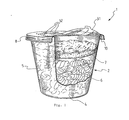
- reference numeral 1 identifies the overall packaged ready-made meal according to an embodiment.
- the receptacle 2 is of the type suitable for being used in a microwave oven and is provided with a closure element 3, consisting of a closure film 31 provided with perforations 32 and a lid 33, preferably of the same material as the receptacle.
- the materials used for making the receptacle 2 and the closure element 3 are all specifically permeable to microwaves and suitable for being exposed to the microwaves without spoiling the organoleptic qualities of the food products with which they come into contact. More particularly they are preferably made with plastic materials suitable for use in a microwave oven, for example polypropylene.
- the receptacle is rigid and flared and may be substantially cup-shaped. According to a preferred embodiment, shown in the drawings, the receptacle 2 has an overturned truncated conical shape and rests on its base 4, which corresponds to the smaller base of the truncated conical frustum. In this embodiment the receptacle is tapered along the entire lateral wall 5.
- the first food component 6, which, according to a preferred embodiment, consists of a portion of pasta. Such pasta is partially cooked and unseasoned and may have been frozen in a loose state.
- the second food component having a plate-like shape can also have other shapes, provided they are suitable for enabling a spacing apart from the first food component contained in the receptacle; for example, if a receptacle having an oval cross section is used, the second food component having a plate-like shape will also conveniently be oval-shaped.
- both food components 6 and 7 heat up.
- the first component 6, below heats up rapidly and evenly by virtue of its relatively large surface of exposure to the microwaves.
- the second component 7, engaged with the internal lateral surface in the manner of a plug passes from the solid state to the fluid state as it heats up, thus losing its engagement with such surface and sliding by gravity towards the base of the receptacle, and consequently onto the first component.
- the first 6 and the second 7 food components have all their respective external surfaces exposed to the microwaves. Thanks to this expedient, the heating time is optimised and the heating is therefore even and satisfactory.
- the reduction in the heating time and the evenness in heating result in a better preservation of the consistency of' the end product ready for consumption compared to the prior art, as no part of the food components is subjected to excessive and inadequate heat treatment and, at the same time, it does not occur that there are cold areas left when other areas have already been excessively heated.
- the heating will not spoil, therefore, the original organoleptic properties of the components which will be optimal and thus, for example, the pasta will be "al dente" and the rice will have the desired texture.
- the two food components will then come into contact at a fairly advanced stage of the heating, when the second component is thawed and in the fluid state.
- the first food component for example the pasta
- the second component for example a tomato-based sauce
- the food components do not come into contact one with the other throughout the entire production and storage time of the packaged ready-made meal and for most of its heating time.
- the second food component 7 is held in engagement with the internal wall of the receptacle thanks to the conicity of the same.
- the internal wall of the receptacle thanks to the conicity of the same.
- a sharp variation in the section can be made, at a point of the vertical axis, such that the variation in section forms a horizontal support, at the borders, for the second plate-like food component.
- Effective engaging with the internal wall of the receptacle can be obtained also, for example, with the creation of protrusions on the same.
- the receptacle contains, additionally, on the bottom, a layer of ice or of frozen aqueous solution.
- the frozen aqueous solution, or ice in fact, during heating, generates water vapour which pervades the receptacle, transporting heat and moisture through the first and the second food component.
- cooking is achieved in a steam atmosphere which is considerably more effective and faster in bringing the food components 6 and 7 to the desired temperature.
- this cooking method allows a more even result to be obtained in shorter times, and helps prevent the formation of excessively dry areas, typical, at times, of microwave cooking.
- the generation of steam from the ice or from the frozen solution which is found on the bottom of the receptacle compensates the evaporation of water from the food components contained in the receptacle and reduces general drying of the latter.
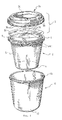
- the packaged ready-made meal comprises a rigid receptacle 2, for example in polypropylene, having an overturned truncated conical shape with a bottom 4 and an opposite opening, bordered by an edge 8.
- the edge 8 of the opening is folded outwards in a U shape so as to form a perimetrical flanging 9 and an underlying perimetrical grooving 10.
- the packaged ready-made meal also comprises a container 11, for example of cardboard, having an overturned truncated conical shape, having a bottom 12 and an opposite opening bordered by an edge 13; the container 11 receives in its interior the receptacle 2, which remains suitably centred and positioned thanks to the engaging of the edge 13 of the container 11 to the perimetrical grooving 10 of the receptacle 2 and thanks to the protrusions 81 of the folded edge 8 of the receptacle 2.
- a container 11 for example of cardboard, having an overturned truncated conical shape, having a bottom 12 and an opposite opening bordered by an edge 13; the container 11 receives in its interior the receptacle 2, which remains suitably centred and positioned thanks to the engaging of the edge 13 of the container 11 to the perimetrical grooving 10 of the receptacle 2 and thanks to the protrusions 81 of the folded edge 8 of the receptacle 2.
- the receptacle 2 must in fact be introduced in the container 11 by exerting a slight pressure in such a way that the protrusions 81 pass beyond the edge 13 of the container 11 and then engage it, thus preventing separation of the container 11 from the receptacle unless a certain force is applied.
- the closure element 3 of the packaged ready-made meal comprises a film 31, for example of coupled PP/PET, provided with perforations 32, sealed on the flanging 9 of the edge 8 of the receptacle. It also comprises a lid 33, made for example of the same material as the receptacle 2 and having on its upper surface a circular recess 34, having a diameter substantially corresponding - in practice slightly greater - to the diameter of the bottom 12 of the container 11. The lid 33 is placed on the opening of the receptacle 2 with a light pressure, so as to engage the folded edge 8 of such receptacle.
- Engaging is ensured thanks to a series of protrusions 35 arranged on the internal surface of the edge 36 of the lid 33, near its free rim, which, once pressed beyond the folded edge 8 of the receptacle 2, engage it and retain it firmly in position.
- the lid 3 thanks to the presence of the circular recess 34, once removed from the packaged ready-made meal ready for use, can receive, by press fit engagement, the bottom 12 of the container 11, so as to form a support stand for such container.
- the packaged ready-made meal according to the invention has the advantage of allowing a convenient and easy preparation of the ready-made meal. In fact, for its preparation for consumption by the end consumer, it is not necessary to use any kitchen tool or piece of crockery, just as it is not necessary to perform any step of decanting, transferring or mixing, before or during its heating in the oven.
- the end consumer in fact is only required to introduce the packaged ready-made meal as it is in the microwave oven, at a power setting between for example 750 and 1800 W, for a time comprised between 2 and 6 minutes.
- the consumer may open the packaged ready-made meal and consume the ready-made meal directly, for example, with a fork, straight from the receptacle, after optionally mixing, if desired.
- Another advantageous feature of the present invention is given by the fact that, by virtue of the special positioning of the second component in relation to the first, it is possible to detect any interruption of the cold chain which the packaged ready-made meal may have undergone during its storage and transport In fact, if it were to be detected, at the time of' purchase or of final preparation, that the second component is resting on the first component, this would be clear indication of the fact that the second component has undergone unexpected thawing.
- the receptacle of the present invention in fact, has a simple shape and, for the purposes of the invention, there is no need for any grooving, ribbing, partitioning or other similar means, as instead adopted in many cases by the prior art. Therefore the receptacle and the external container of' the packaging according to the present invention are economical to produce and easily stackable and therefore convenient for industrial use
- a rigid receptacle 2 in polypropylene was set up having an overturned truncated conical shape and a bottom 75 mm in diameter, an opening 105 mm in diameter, and 95 mm in height.
- the edge 8 of the opening is folded outwards in a U shape so as to create a perimetrical flanging 9 and an underlying perimetrical grooving 10.
- the maximum diameter at the flanging 9 is of about 115 mm.
- a tomato-based sauce was prepared, comprising the following ingredients, in weight percentages based on the total weight of the sauce: Tomato pulp 83 Double concentrated tomato paste 6 Onion 3.5 Extra-virgin olive oil 3.5 Salt 1.25 Garlic 1.33 Chilli pepper 0.12 Parsley 1.3
- Such sauce was then frozen in disc shapes 95 mm in diameter and about 10 mm thick, and 120g in weight.
- the disc remained engaged with the wall of the surface of the receptacle in the manner of a plug, spaced apart from the pasta.
- the distance between the sauce and pasta was of about 10 mm.
- the receptacle 2 was then closed with a film 31. of coupled PP/PET, provided with perforations 32, sealed on the flanging 9 of the edge 8 of the receptacle.
- the holes 32 were arranged, in a total number of 83, in three parallel rows spaced apart by 18 mm, one of which passing through the diameter of the opening of the receptacle 2. Each hole had a diameter of 0.3 mm and was spaced apart from the adjacent hole/holes by 3.7 mm. This configuration has been shown to allow the maintenance of a slight excess pressure inside the receptacle without the risk of creating tensions in the film such as to cause its detachment.
- the receptacle 2 was then placed inside a cardboard container 11 having an overturned truncated conical shape, whose bottom 12 has a diameter of about 83 mm and whose opening has a diameter of about 115 mm.
- the container 11 is about 100 mm in height and can receive in its interior the receptacle 2, which remains suitably centred and positioned thanks to the engaging of the edge 13 of the container 11 to the perimetrical grooving 10 of the receptacle 2 and thanks to the protrudings 81 found inside the edge 8 of the receptacle 2.
- Engaging is ensured thanks to a series of protrudings 35 arranged on the internal surface of the edge 36 of the lid 33, near its clear rim, which, once pressed beyond the folded edge 8 of the receptacle 2, engage it and retain it firmly in position.
- the packaged frozen ready-made meal completed in this way is then frozen and stored in the freezer at a temperature of -18°C or lower.
- the receptacle 2 was then closed with the same film of coupled PET/PP as per example 1, having the same perforations.
- the packaged frozen ready-made meal was completed by the same procedures as per example 1, using the same container 11 and the same lid 33, and was then frozen and finally stored in the freezer at a temperature of -18°C or lower.
- the packaged ready-made meals according to Examples 1 and 2 were prepared with a microwave oven to assess their organoleptic properties.
- the two packaged ready-made meals were placed in a microwave oven, still sealed with the lid, and a power of 900 W was applied.
- the time of treatment in the microwave oven was 4 minutes for the packaged ready-made meal according to example 1 and 5 minutes for the packaged ready-made meal according to example 2.
- the average temperature of the product contained in each of the two packaged ready-made meals was also measured and it was found that in both cases such average temperature was around 65°C.
- the pasta contained in the packaged ready-made meal as per example 1 has, in an even manner, the moisture content and the consistency typical of freshly cooked conventional pasta whereas the pasta contained in the packaged ready-made meal according to example 2 is uneven as regards moisture content and consistency, with single pieces of pasta being particularly dehydrated and occasionally burnt in the uppermost layers and above all near the wall of the receptacle.
- the frozen disc of sauce protects the underlying pasta from excessive dehydration, preventing the release from the container of the water vapour generated during heating.
- the steam retained below the sauce also contributes to the even and rapid heating of the pasta.
Landscapes
- Engineering & Computer Science (AREA)
- Mechanical Engineering (AREA)
- Life Sciences & Earth Sciences (AREA)
- Food Science & Technology (AREA)
- Package Specialized In Special Use (AREA)
- Noodles (AREA)
Priority Applications (3)
| Application Number | Priority Date | Filing Date | Title |
|---|---|---|---|
| EP09425293A EP2277802A1 (de) | 2009-07-21 | 2009-07-21 | Verpacktes, gefrorenes Fertiggericht |
| CA2710559A CA2710559A1 (en) | 2009-07-21 | 2010-07-20 | Packaged frozen ready-made meal |
| US12/840,841 US20110020506A1 (en) | 2009-07-21 | 2010-07-21 | Packaged Frozen Ready-Made Meal |
Applications Claiming Priority (1)
| Application Number | Priority Date | Filing Date | Title |
|---|---|---|---|
| EP09425293A EP2277802A1 (de) | 2009-07-21 | 2009-07-21 | Verpacktes, gefrorenes Fertiggericht |
Publications (1)
| Publication Number | Publication Date |
|---|---|
| EP2277802A1 true EP2277802A1 (de) | 2011-01-26 |
Family
ID=41203876
Family Applications (1)
| Application Number | Title | Priority Date | Filing Date |
|---|---|---|---|
| EP09425293A Withdrawn EP2277802A1 (de) | 2009-07-21 | 2009-07-21 | Verpacktes, gefrorenes Fertiggericht |
Country Status (3)
| Country | Link |
|---|---|
| US (1) | US20110020506A1 (de) |
| EP (1) | EP2277802A1 (de) |
| CA (1) | CA2710559A1 (de) |
Cited By (4)
| Publication number | Priority date | Publication date | Assignee | Title |
|---|---|---|---|---|
| EP2502846A1 (de) * | 2011-03-23 | 2012-09-26 | Industrie Rolli Alimentari S.p.A. | Verpacktes Lebensmittelprodukt für Kinder |
| WO2012143963A1 (en) * | 2011-04-20 | 2012-10-26 | Montinaro Massimiliano | Method for the production of pre-cooked and frozen food, to be heated in microwave or conventional oven |
| DE102013207644A1 (de) * | 2013-04-26 | 2014-10-30 | Santosh Ernst Gupta | Tiefkühlfertiggericht, Verfahren zu dessen Herstellung sowie Verfahren zur Zubereitung einer Fertigspeise mittels des Tiefkühlgerichts |
| WO2017042844A1 (en) * | 2015-09-11 | 2017-03-16 | Industrie Rolli Alimentari S.P.A. | Frozen packaged agricultural food product |
Families Citing this family (8)
| Publication number | Priority date | Publication date | Assignee | Title |
|---|---|---|---|---|
| USD645748S1 (en) | 2011-03-04 | 2011-09-27 | The Quaker Oats Company | Container |
| USD677162S1 (en) | 2011-03-04 | 2013-03-05 | The Quaker Oats Company | Lid |
| USD649054S1 (en) | 2011-03-04 | 2011-11-22 | The Quaker Oats Company | Container |
| USD656816S1 (en) * | 2011-09-21 | 2012-04-03 | Kfc Corporation | Food container |
| CN103652597A (zh) * | 2012-09-20 | 2014-03-26 | 日清富滋株式会社 | 微波烹调用包装冷冻面类 |
| ITUA20162015A1 (it) * | 2016-03-25 | 2017-09-25 | Emanuela Comparini | Procedimento per la preparazione di un alimento e kit per la preparazione di detto alimento mediante detto procedimento. |
| CN109649854B (zh) * | 2019-02-22 | 2024-01-12 | 中南粮油食品科学研究院有限公司 | 自热食品包装盒 |
| USD1057556S1 (en) | 2021-10-29 | 2025-01-14 | H. J. Heinz Company Brands Llc | Tray |
Citations (5)
| Publication number | Priority date | Publication date | Assignee | Title |
|---|---|---|---|---|
| JPH02296683A (ja) | 1989-02-02 | 1990-12-07 | Otsuka Chem Co Ltd | マイクロ波加熱用食品容器 |
| WO1996007604A1 (en) * | 1994-09-09 | 1996-03-14 | Deeley, Stephanie, Tamsin | Packaging for a comestible product |
| JPH08332040A (ja) | 1995-06-08 | 1996-12-17 | Kiyuusai Kk | 冷凍麺及びその調理方法 |
| DE10035059A1 (de) * | 2000-07-19 | 2002-01-31 | Yang Chun Tse | Behälteranordnung und Behältereinheit |
| US20040108313A1 (en) * | 2002-12-10 | 2004-06-10 | Mars Incorporated | Differential temperature microwavable container |
Family Cites Families (4)
| Publication number | Priority date | Publication date | Assignee | Title |
|---|---|---|---|---|
| US4872569A (en) * | 1984-01-31 | 1989-10-10 | Brown Bolte | Drinking vessels |
| US6168044B1 (en) * | 1998-06-25 | 2001-01-02 | S. C. Johnson Home Storage, Inc. | Container having a snap fit selectively detachable lid |
| FR2888225B1 (fr) * | 2005-07-05 | 2009-05-08 | Claude Sebban | Boite d'emballage pour le conditionnement, la conservation, la cuisson vapeur au four a micro-ondes et la consommation d'aliments |
| US20070262077A1 (en) * | 2006-05-11 | 2007-11-15 | Sonoco Development, Inc. | Dual function overcap for a container with a removable membrane |
-
2009
- 2009-07-21 EP EP09425293A patent/EP2277802A1/de not_active Withdrawn
-
2010
- 2010-07-20 CA CA2710559A patent/CA2710559A1/en not_active Abandoned
- 2010-07-21 US US12/840,841 patent/US20110020506A1/en not_active Abandoned
Patent Citations (5)
| Publication number | Priority date | Publication date | Assignee | Title |
|---|---|---|---|---|
| JPH02296683A (ja) | 1989-02-02 | 1990-12-07 | Otsuka Chem Co Ltd | マイクロ波加熱用食品容器 |
| WO1996007604A1 (en) * | 1994-09-09 | 1996-03-14 | Deeley, Stephanie, Tamsin | Packaging for a comestible product |
| JPH08332040A (ja) | 1995-06-08 | 1996-12-17 | Kiyuusai Kk | 冷凍麺及びその調理方法 |
| DE10035059A1 (de) * | 2000-07-19 | 2002-01-31 | Yang Chun Tse | Behälteranordnung und Behältereinheit |
| US20040108313A1 (en) * | 2002-12-10 | 2004-06-10 | Mars Incorporated | Differential temperature microwavable container |
Cited By (4)
| Publication number | Priority date | Publication date | Assignee | Title |
|---|---|---|---|---|
| EP2502846A1 (de) * | 2011-03-23 | 2012-09-26 | Industrie Rolli Alimentari S.p.A. | Verpacktes Lebensmittelprodukt für Kinder |
| WO2012143963A1 (en) * | 2011-04-20 | 2012-10-26 | Montinaro Massimiliano | Method for the production of pre-cooked and frozen food, to be heated in microwave or conventional oven |
| DE102013207644A1 (de) * | 2013-04-26 | 2014-10-30 | Santosh Ernst Gupta | Tiefkühlfertiggericht, Verfahren zu dessen Herstellung sowie Verfahren zur Zubereitung einer Fertigspeise mittels des Tiefkühlgerichts |
| WO2017042844A1 (en) * | 2015-09-11 | 2017-03-16 | Industrie Rolli Alimentari S.P.A. | Frozen packaged agricultural food product |
Also Published As
| Publication number | Publication date |
|---|---|
| CA2710559A1 (en) | 2011-01-21 |
| US20110020506A1 (en) | 2011-01-27 |
Similar Documents
| Publication | Publication Date | Title |
|---|---|---|
| EP2277802A1 (de) | Verpacktes, gefrorenes Fertiggericht | |
| US11634262B2 (en) | Cooking method and apparatus | |
| US6488973B1 (en) | Method of making a cooking pouch containing a raw protein portion, a raw or blanched vegetable portion and a sauce | |
| US9211030B2 (en) | Steam cooking apparatus | |
| US20190283952A1 (en) | Cooking method and apparatus | |
| US8784917B2 (en) | Food product | |
| US12297031B2 (en) | Cooking method and apparatus | |
| US20230144737A1 (en) | Food Products For Multifunction Pressure Cookers | |
| GB2295371A (en) | Packages containing food to be cooked therein | |
| US9242780B2 (en) | Frozen food package and method of use | |
| AU2013319538B2 (en) | Packaged frozen noodle for microwave cooking | |
| US20230286726A1 (en) | Colander addition to container | |
| EP2484604B1 (de) | Verpackung zum Konservieren und Kochen von Nahrungsmitteln und Verfahren zu deren Verwendung | |
| JPH10175680A (ja) | マイクロ波エネルギー透過量調整機能を有するシート及びそれからなるパッケージ | |
| CA2597125A1 (en) | Cooking method and apparatus | |
| US20240417159A1 (en) | Cooking Apparatus and Method | |
| CA2582835C (en) | Cooking method and apparatus | |
| JP5658915B2 (ja) | 電子レンジによる調理方法及び電子レンジ調理用調味液セット | |
| JPH0779636B2 (ja) | 電子レンジ用煮物調理容器 | |
| JP6860570B2 (ja) | 容器入り冷凍食品 | |
| JPH0237745Y2 (de) | ||
| JP2004268928A (ja) | 電子レンジ加熱に対応した固形物含有流動性食品 |
Legal Events
| Date | Code | Title | Description |
|---|---|---|---|
| PUAI | Public reference made under article 153(3) epc to a published international application that has entered the european phase |
Free format text: ORIGINAL CODE: 0009012 |
|
| AK | Designated contracting states |
Kind code of ref document: A1 Designated state(s): AT BE BG CH CY CZ DE DK EE ES FI FR GB GR HR HU IE IS IT LI LT LU LV MC MK MT NL NO PL PT RO SE SI SK SM TR |
|
| AX | Request for extension of the european patent |
Extension state: AL BA RS |
|
| 17P | Request for examination filed |
Effective date: 20110302 |
|
| 17Q | First examination report despatched |
Effective date: 20110412 |
|
| STAA | Information on the status of an ep patent application or granted ep patent |
Free format text: STATUS: THE APPLICATION IS DEEMED TO BE WITHDRAWN |
|
| 18D | Application deemed to be withdrawn |
Effective date: 20120918 |
|
| R18D | Application deemed to be withdrawn (corrected) |
Effective date: 20120817 |