EP2281299B1 - Recuit thermique de films de copolymère séquencé avec interface supérieure contrainte pour mouiller les deux séquences de façon identique - Google Patents
Recuit thermique de films de copolymère séquencé avec interface supérieure contrainte pour mouiller les deux séquences de façon identique Download PDFInfo
- Publication number
- EP2281299B1 EP2281299B1 EP09721942.2A EP09721942A EP2281299B1 EP 2281299 B1 EP2281299 B1 EP 2281299B1 EP 09721942 A EP09721942 A EP 09721942A EP 2281299 B1 EP2281299 B1 EP 2281299B1
- Authority
- EP
- European Patent Office
- Prior art keywords
- block copolymer
- copolymer material
- block
- substrate
- trench
- Prior art date
- Legal status (The legal status is an assumption and is not a legal conclusion. Google has not performed a legal analysis and makes no representation as to the accuracy of the status listed.)
- Active
Links
Images







Classifications
-
- B—PERFORMING OPERATIONS; TRANSPORTING
- B81—MICROSTRUCTURAL TECHNOLOGY
- B81C—PROCESSES OR APPARATUS SPECIALLY ADAPTED FOR THE MANUFACTURE OR TREATMENT OF MICROSTRUCTURAL DEVICES OR SYSTEMS
- B81C1/00—Manufacture or treatment of devices or systems in or on a substrate
- B81C1/00015—Manufacture or treatment of devices or systems in or on a substrate for manufacturing microsystems
- B81C1/00023—Manufacture or treatment of devices or systems in or on a substrate for manufacturing microsystems without movable or flexible elements
- B81C1/00031—Regular or irregular arrays of nanoscale structures, e.g. etch mask layer
-
- H—ELECTRICITY
- H10—SEMICONDUCTOR DEVICES; ELECTRIC SOLID-STATE DEVICES NOT OTHERWISE PROVIDED FOR
- H10W—GENERIC PACKAGES, INTERCONNECTIONS, CONNECTORS OR OTHER CONSTRUCTIONAL DETAILS OF DEVICES COVERED BY CLASS H10
- H10W20/00—Interconnections in chips, wafers or substrates
- H10W20/01—Manufacture or treatment
- H10W20/071—Manufacture or treatment of dielectric parts thereof
- H10W20/093—Manufacture or treatment of dielectric parts thereof by modifying materials of the dielectric parts
- H10W20/097—Manufacture or treatment of dielectric parts thereof by modifying materials of the dielectric parts by thermally treating
-
- B—PERFORMING OPERATIONS; TRANSPORTING
- B82—NANOTECHNOLOGY
- B82Y—SPECIFIC USES OR APPLICATIONS OF NANOSTRUCTURES; MEASUREMENT OR ANALYSIS OF NANOSTRUCTURES; MANUFACTURE OR TREATMENT OF NANOSTRUCTURES
- B82Y30/00—Nanotechnology for materials or surface science, e.g. nanocomposites
-
- C—CHEMISTRY; METALLURGY
- C08—ORGANIC MACROMOLECULAR COMPOUNDS; THEIR PREPARATION OR CHEMICAL WORKING-UP; COMPOSITIONS BASED THEREON
- C08F—MACROMOLECULAR COMPOUNDS OBTAINED BY REACTIONS ONLY INVOLVING CARBON-TO-CARBON UNSATURATED BONDS
- C08F299/00—Macromolecular compounds obtained by interreacting polymers involving only carbon-to-carbon unsaturated bond reactions, in the absence of non-macromolecular monomers
- C08F299/02—Macromolecular compounds obtained by interreacting polymers involving only carbon-to-carbon unsaturated bond reactions, in the absence of non-macromolecular monomers from unsaturated polycondensates
-
- C—CHEMISTRY; METALLURGY
- C08—ORGANIC MACROMOLECULAR COMPOUNDS; THEIR PREPARATION OR CHEMICAL WORKING-UP; COMPOSITIONS BASED THEREON
- C08F—MACROMOLECULAR COMPOUNDS OBTAINED BY REACTIONS ONLY INVOLVING CARBON-TO-CARBON UNSATURATED BONDS
- C08F299/00—Macromolecular compounds obtained by interreacting polymers involving only carbon-to-carbon unsaturated bond reactions, in the absence of non-macromolecular monomers
- C08F299/02—Macromolecular compounds obtained by interreacting polymers involving only carbon-to-carbon unsaturated bond reactions, in the absence of non-macromolecular monomers from unsaturated polycondensates
- C08F299/04—Macromolecular compounds obtained by interreacting polymers involving only carbon-to-carbon unsaturated bond reactions, in the absence of non-macromolecular monomers from unsaturated polycondensates from polyesters
- C08F299/0485—Macromolecular compounds obtained by interreacting polymers involving only carbon-to-carbon unsaturated bond reactions, in the absence of non-macromolecular monomers from unsaturated polycondensates from polyesters from polyesters with side or terminal unsaturations
- C08F299/0492—Macromolecular compounds obtained by interreacting polymers involving only carbon-to-carbon unsaturated bond reactions, in the absence of non-macromolecular monomers from unsaturated polycondensates from polyesters from polyesters with side or terminal unsaturations the unsaturation being in acrylic or methacrylic groups
-
- G—PHYSICS
- G03—PHOTOGRAPHY; CINEMATOGRAPHY; ANALOGOUS TECHNIQUES USING WAVES OTHER THAN OPTICAL WAVES; ELECTROGRAPHY; HOLOGRAPHY
- G03F—PHOTOMECHANICAL PRODUCTION OF TEXTURED OR PATTERNED SURFACES, e.g. FOR PRINTING, FOR PROCESSING OF SEMICONDUCTOR DEVICES; MATERIALS THEREFOR; ORIGINALS THEREFOR; APPARATUS SPECIALLY ADAPTED THEREFOR
- G03F7/00—Photomechanical, e.g. photolithographic, production of textured or patterned surfaces, e.g. printing surfaces; Materials therefor, e.g. comprising photoresists; Apparatus specially adapted therefor
- G03F7/0002—Lithographic processes using patterning methods other than those involving the exposure to radiation, e.g. by stamping
-
- H—ELECTRICITY
- H10—SEMICONDUCTOR DEVICES; ELECTRIC SOLID-STATE DEVICES NOT OTHERWISE PROVIDED FOR
- H10P—GENERIC PROCESSES OR APPARATUS FOR THE MANUFACTURE OR TREATMENT OF DEVICES COVERED BY CLASS H10
- H10P50/00—Etching of wafers, substrates or parts of devices
- H10P50/20—Dry etching; Plasma etching; Reactive-ion etching
- H10P50/28—Dry etching; Plasma etching; Reactive-ion etching of insulating materials
- H10P50/286—Dry etching; Plasma etching; Reactive-ion etching of insulating materials of organic materials
- H10P50/287—Dry etching; Plasma etching; Reactive-ion etching of insulating materials of organic materials by chemical means
-
- H—ELECTRICITY
- H10—SEMICONDUCTOR DEVICES; ELECTRIC SOLID-STATE DEVICES NOT OTHERWISE PROVIDED FOR
- H10P—GENERIC PROCESSES OR APPARATUS FOR THE MANUFACTURE OR TREATMENT OF DEVICES COVERED BY CLASS H10
- H10P76/00—Manufacture or treatment of masks on semiconductor bodies, e.g. by lithography or photolithography
- H10P76/20—Manufacture or treatment of masks on semiconductor bodies, e.g. by lithography or photolithography of masks comprising organic materials
- H10P76/204—Manufacture or treatment of masks on semiconductor bodies, e.g. by lithography or photolithography of masks comprising organic materials of organic photoresist masks
- H10P76/2041—Photolithographic processes
- H10P76/2042—Photolithographic processes using lasers
-
- H—ELECTRICITY
- H10—SEMICONDUCTOR DEVICES; ELECTRIC SOLID-STATE DEVICES NOT OTHERWISE PROVIDED FOR
- H10P—GENERIC PROCESSES OR APPARATUS FOR THE MANUFACTURE OR TREATMENT OF DEVICES COVERED BY CLASS H10
- H10P76/00—Manufacture or treatment of masks on semiconductor bodies, e.g. by lithography or photolithography
- H10P76/40—Manufacture or treatment of masks on semiconductor bodies, e.g. by lithography or photolithography of masks comprising inorganic materials
- H10P76/408—Manufacture or treatment of masks on semiconductor bodies, e.g. by lithography or photolithography of masks comprising inorganic materials characterised by their sizes, orientations, dispositions, behaviours or shapes
- H10P76/4085—Manufacture or treatment of masks on semiconductor bodies, e.g. by lithography or photolithography of masks comprising inorganic materials characterised by their sizes, orientations, dispositions, behaviours or shapes characterised by the processes involved to create the masks
-
- H—ELECTRICITY
- H10—SEMICONDUCTOR DEVICES; ELECTRIC SOLID-STATE DEVICES NOT OTHERWISE PROVIDED FOR
- H10P—GENERIC PROCESSES OR APPARATUS FOR THE MANUFACTURE OR TREATMENT OF DEVICES COVERED BY CLASS H10
- H10P76/00—Manufacture or treatment of masks on semiconductor bodies, e.g. by lithography or photolithography
- H10P76/40—Manufacture or treatment of masks on semiconductor bodies, e.g. by lithography or photolithography of masks comprising inorganic materials
- H10P76/408—Manufacture or treatment of masks on semiconductor bodies, e.g. by lithography or photolithography of masks comprising inorganic materials characterised by their sizes, orientations, dispositions, behaviours or shapes
- H10P76/4088—Processes for improving the resolution of the masks
-
- H—ELECTRICITY
- H10—SEMICONDUCTOR DEVICES; ELECTRIC SOLID-STATE DEVICES NOT OTHERWISE PROVIDED FOR
- H10W—GENERIC PACKAGES, INTERCONNECTIONS, CONNECTORS OR OTHER CONSTRUCTIONAL DETAILS OF DEVICES COVERED BY CLASS H10
- H10W20/00—Interconnections in chips, wafers or substrates
- H10W20/01—Manufacture or treatment
- H10W20/031—Manufacture or treatment of conductive parts of the interconnections
- H10W20/056—Manufacture or treatment of conductive parts of the interconnections by filling conductive material into holes, grooves or trenches
-
- H—ELECTRICITY
- H10—SEMICONDUCTOR DEVICES; ELECTRIC SOLID-STATE DEVICES NOT OTHERWISE PROVIDED FOR
- H10W—GENERIC PACKAGES, INTERCONNECTIONS, CONNECTORS OR OTHER CONSTRUCTIONAL DETAILS OF DEVICES COVERED BY CLASS H10
- H10W20/00—Interconnections in chips, wafers or substrates
- H10W20/01—Manufacture or treatment
- H10W20/071—Manufacture or treatment of dielectric parts thereof
- H10W20/081—Manufacture or treatment of dielectric parts thereof by forming openings in the dielectric parts
-
- H—ELECTRICITY
- H10—SEMICONDUCTOR DEVICES; ELECTRIC SOLID-STATE DEVICES NOT OTHERWISE PROVIDED FOR
- H10W—GENERIC PACKAGES, INTERCONNECTIONS, CONNECTORS OR OTHER CONSTRUCTIONAL DETAILS OF DEVICES COVERED BY CLASS H10
- H10W20/00—Interconnections in chips, wafers or substrates
- H10W20/01—Manufacture or treatment
- H10W20/071—Manufacture or treatment of dielectric parts thereof
- H10W20/081—Manufacture or treatment of dielectric parts thereof by forming openings in the dielectric parts
- H10W20/089—Manufacture or treatment of dielectric parts thereof by forming openings in the dielectric parts using processes for implementing desired shapes or dispositions of the openings, e.g. double patterning
-
- B—PERFORMING OPERATIONS; TRANSPORTING
- B81—MICROSTRUCTURAL TECHNOLOGY
- B81C—PROCESSES OR APPARATUS SPECIALLY ADAPTED FOR THE MANUFACTURE OR TREATMENT OF MICROSTRUCTURAL DEVICES OR SYSTEMS
- B81C2201/00—Manufacture or treatment of microstructural devices or systems
- B81C2201/01—Manufacture or treatment of microstructural devices or systems in or on a substrate
- B81C2201/0101—Shaping material; Structuring the bulk substrate or layers on the substrate; Film patterning
- B81C2201/0128—Processes for removing material
- B81C2201/013—Etching
-
- B—PERFORMING OPERATIONS; TRANSPORTING
- B81—MICROSTRUCTURAL TECHNOLOGY
- B81C—PROCESSES OR APPARATUS SPECIALLY ADAPTED FOR THE MANUFACTURE OR TREATMENT OF MICROSTRUCTURAL DEVICES OR SYSTEMS
- B81C2201/00—Manufacture or treatment of microstructural devices or systems
- B81C2201/01—Manufacture or treatment of microstructural devices or systems in or on a substrate
- B81C2201/0101—Shaping material; Structuring the bulk substrate or layers on the substrate; Film patterning
- B81C2201/0147—Film patterning
- B81C2201/0149—Forming nanoscale microstructures using auto-arranging or self-assembling material
-
- B—PERFORMING OPERATIONS; TRANSPORTING
- B81—MICROSTRUCTURAL TECHNOLOGY
- B81C—PROCESSES OR APPARATUS SPECIALLY ADAPTED FOR THE MANUFACTURE OR TREATMENT OF MICROSTRUCTURAL DEVICES OR SYSTEMS
- B81C2201/00—Manufacture or treatment of microstructural devices or systems
- B81C2201/01—Manufacture or treatment of microstructural devices or systems in or on a substrate
- B81C2201/0198—Manufacture or treatment of microstructural devices or systems in or on a substrate for making a masking layer
Definitions
- Embodiments of the invention relate to methods of fabricating thin films of self-assembling block copolymers.
- diblock copolymer films spontaneously assembly into periodic structures by microphase separation of the constituent polymer blocks after annealing, for example by thermal annealing above the glass transition temperature of the polymer or by solvent annealing, forming ordered domains at nanometer-scale dimensions.
- the film morphology including the size and shape of the microphase-separated domains, can be controlled by the molecular weight and volume fraction of the AB blocks of a diblock copolymer to produce lamellar, cylindrical, or spherical morphologies, among others.
- a block copolymer film will microphase separate and self-assemble into a periodic spherical domains with spheres of polymer B surrounded by a matrix of polymer A.
- the diblock copolymer For ratios of the two blocks between about 60:40 and 80:20, the diblock copolymer assembles into a periodic hexagonal close-packed or honeycomb array of cylinders of polymer B within a matrix of polymer A. For ratios between about 50:50 and 60:40, lamellar domains or alternating stripes of the blocks are formed. Domain size typically ranges from 5-50 nm.
- BCPs block copolymers
- thermal annealing of most BCPs e.g., PS-b-PVP, etc.
- a variant of thermal annealing called zone annealing can provide rapid self-assembly (e.g., on the order of minutes) but is only effective for a small number of BCPs (e.g., PS-b-PMMA, PS-b-PLA) with polymer domains that equally wet the air vapor interface.
- Solvent annealing of BCPs has been used to produce a perpendicular orientation of the self-assembled domains to the substrate, but is generally a very slow process, typically on the order of days, and can require large volumes of the solvent.
- a typical solvent anneal is conducted by exposing a BCP film to a saturated solvent atmosphere at 25°C for at least 12 hours (often longer).
- US 2007/175859 A1 discloses a method of forming a nanostructured polymer material on a substrate, comprising solvent vapor-assisted annealing of a block copolymer material either at or above room temperature.
- the invention is as described in claim 1.
- semiconductor substrate or “semiconductive substrate” or “semiconductive wafer fragment” or “wafer fragment” or “water” will be understood to mean any construction comprising semiconductor material, including bulk semiconductive materials such as a semiconductor wafer (either alone or in assemblies comprising other materials thereon), and semiconductive material layers (either alone or in assemblies comprising other materials).
- substrate refers to any supporting structure including, the semiconductive substrates, wafer fragments or wafers described above.
- L o as used herein is the inherent periodicity or pitch value (bulk period or repeat unit) of structures that self assemble upon annealing from a self-assembling (SA) block copolymer.
- L B as used herein is the periodicity or pitch value of a blend of a block copolymer with one or more of its constituent homopolymers.
- L is used herein to indicate the center-to-center cylinder pitch or spacing of cylinders of the block copolymer or blend, and is equivalent to “L o " for a pure block copolymer and "L B " for a copolymer blend.
- a polymer material e.g., film, layer
- a polymer material is prepared by guided self-assembly of block copolymers, with both polymer domains at the air interface.
- the block copolymer material spontaneously assembles into periodic structures by microphase separation of the constituent polymer blocks after annealing, forming ordered domains of perpendicular-oriented cylinders at nanometer-scale dimensions within a trench.
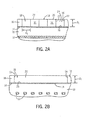
- a method for fabricating a self-assembled block copolymer material that defines a one-dimensional (1-D) array of nanometer-scale, perpendicular-oriented cylinders according to an embodiment of the invention is illustrated with reference to FIGS. 1-8 .
- the described embodiment involves a thermal anneal of a cylindrical-phase block copolymer under a solvent atmosphere.
- the anneal is conducted in combination with a graphoepitaxy technique that utilizes a lithographically defined trench as a guide with a floor composed of a material that is neutral wetting to both polymer blocks, and sidewalls and ends that are preferential wetting to one polymer block and function as constraints to induce the block copolymer to self-assemble into an ordered 1-D array of a single row of cylinders in a polymer matrix oriented perpendicular to the trench floor and registered to the trench sidewalls.
- two or more rows of perpendicular-oriented cylinders can be formed in each trench.
- a substrate 10 is provided, which can be silicon, silicon oxide, silicon nitride, silicon oxynitride, silicon oxycarbide, among other materials.
- conductive lines 12 or other active area, e.g., semiconducting regions are situated within the substrate 10.
- a single trench or multiple trenches is or are formed in the substrate, and can span the entire width of an array of lines (or other active area).
- the substrate 10 is provided with an array of conductive lines 12 (or other active areas) at a pitch of L .
- the trench or trenches are formed over the active areas 12 (e.g., lines) such that when the block copolymer material is annealed, each cylinder will be situated above a single active area 12 (e.g., conductive line).
- multiple trenches are formed with the ends (24) of each adjacent trench 18 aligned or slightly offset from each other at less than 5% of L such that cylinders in adjacent trenches are aligned and situated above the same line 12.
- a neutral wetting material 14 (e.g., random copolymer) has been formed over the substrate 10.
- a material layer 16 (or one or more material layers) can then be formed over the neutral wetting material and etched to form trenches 18 that are oriented perpendicular to the array of conductive lines 12, as shown in FIGS. 2-2 B. Portions of the material layer 16 form a spacer 20 outside and between the trenches.
- the trenches 18 are structured with opposing sidewalls 22, opposing ends 24, a floor 26, a width ( w t ), a length ( l t ) and a depth ( D t ).
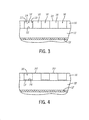
- the material layer 16' can be formed on the substrate 10 ', etched to form the trenches 18' as depicted in FIG. 3 , and a neutral wetting material 14' can then be formed on the trench floors 26' as shown in FIG. 4 .
- a random copolymer material can be deposited into the trenches 18' and crosslinked to form a neutral wetting material layer. Material on surfaces outside the trenches such as on the spacers 20' (e.g., non-crosslinked random copolymer) can be subsequently removed.
- Single or multiple trenches 18 can be formed using a lithographic tool having an exposure system capable of patterning at the scale of L (10-100 nm).
- exposure systems include, for example, extreme ultraviolet (EUV) lithography, proximity X-rays and electron beam (e-beam) lithography, as known and used in the art.
- EUV extreme ultraviolet
- e-beam electron beam
- Conventional photolithography can attain (at smallest) about 58 nm features.
- a method called "pitch doubling" or “pitch multiplication” can also be used for extending the capabilities of photolithographic techniques beyond their minimum pitch, as described, for example, in U.S. Pat. No. 5,328,810 (Lowrey et al. ), U.S. Pat. No. 7,115,525 (Abatchev, et al. ), US 2006/0281266 (Wells ) and US 2007/0023805 (Wells ).
- a pattern of lines is photolithographically formed in a photoresist material overlying a layer of an expendable material, which in turn overlies a substrate, the expendable material layer is etched to form placeholders or mandrels, the photoresist is stripped, spacers are formed on the sides of the mandrels, and the mandrels are then removed leaving behind the spacers as a mask for patterning the substrate.
- the initial photolithography formed a pattern defining one feature and one space
- the same width now defines two features and two spaces, with the spaces defined by the spacers.
- the smallest feature size possible with a photolithographic technique is effectively decreased down to about 30 nm or less.
- Factors in forming a single (1-D) array or layer of perpendicular-oriented nanocylinders within the trenches include the width ( w t ) and depth (D t ) of the trench, the formulation of the block copolymer or blend to achieve the desired pitch (L), and the thickness ( t ) of the block copolymer material within the trench.
- a block copolymer or blend having a pitch or L value of 35-nm deposited into a 75-nm wide trench having a neutral wetting floor will, upon annealing, result in a zigzag pattern of 17.5-nm diameter ( ⁇ 0.5* L ) perpendicular cylinders that are offset by about one-half the pitch distance (about 0.5* L ) for the length ( L t ) of the trench, rather than a single line row of perpendicular cylinders aligned with the sidewalls down the center of the trench.
- the trenches 18 are constructed with a width ( w t ) of about 1.5-2* L (or 1.5-2 X the pitch value) of the block copolymer such that a cast block copolymer material (or blend) of about L will self assemble upon annealing into a single row of perpendicular cylinders (diameter ⁇ 0.5* L ) with a center-to-center pitch distance ( p ) of adjacent cylinders at or about L.
- the width ( w t ) of the trenches 18 can be about 1.5-2*50 nm or about 75-100 nm.
- the length ( l t ) of the trenches is at or about n*L or an integer multiple of L, typically within a range of about n *10 to about n *100 nm (with n being the number of features or structures, e.g., cylinders).
- the depth ( D t ) of the trenches 18 is greater than or equal to L ( D t > L ).
- the width of the spacers 20 between adjacent trenches can vary and is generally about L to about n*L.
- the trench dimension is about 20-100 nm wide ( w t ) and about 100-25,000 nm in length ( l t ), with a depth ( D t ) of about 10-100 nm.
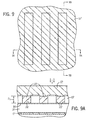
- a self-assembling, cylindrical-phase block copolymer material 28 having an inherent pitch at or about L o (or a ternary blend of block copolymer and homopolymers blended to have a pitch at or about L B ) is deposited into the trenches 18, typically as a film (as in FIGS. 5-5B ).
- the block copolymer (or blend) is constructed such that all of the polymer blocks will have equal preference for a neutral wetting material on the trench floor.
- the block copolymer material can be constructed to provide desired properties such as defect tolerance and ease of development and/or removal of one of the blocks.
- the block copolymer or blend is constructed such that the minor domain can be selectively removed.
- diblock copolymers include, for example, poly(styrene)-b-poly(vinylpyridine) (PS-b-PVP), poly(styrene)-b-poly(methylmethacrylate) (PS-b-PMMA) or other PS-b-poly(acrylate) or PS-b-poly(methacrylate), poly(styrene)-b-poly(lactide) (PS-b-PLA), poly(styrene)-b-poly(tert-butyl acrylate) (PS-b-PtBA), and poly(styrene)-b-poly(ethylene-co-butylene (PS-b-(PS-co-PB)), poly(styrene)-b-poly(ethylene oxide) (PS-b-PEO), poly(isoprene)-b-poly(ethyleneoxide) (PI-b-PEO), poly(isoprene)-b-poly(methylme
- PS-b-P2VP poly(styrene)-b-poly(2-vinylpyridine)
- PS-b-P2VP poly(styrene)-b-poly(2-vinylpyridine)
- PS-b-P2VP poly(styrene)-b-poly(2-vinylpyridine)
- PS-b-P2VP poly(styrene)-b-poly(2-vinyl
- triblock copolymers examples include ABC copolymers such as poly(styrene-b-methyl methacrylate-b-ethylene oxide) (PS-b-PMMA-b-PEO), and ABA copolymers such as PS-PMMA-PS, PMMA-PS-PMMA, and PS-b-PI-b-PS, among others.
- ABC copolymers such as poly(styrene-b-methyl methacrylate-b-ethylene oxide) (PS-b-PMMA-b-PEO)
- ABA copolymers such as PS-PMMA-PS, PMMA-PS-PMMA, and PS-b-PI-b-PS, among others.
- the film morphology including the domain sizes and periods ( L o ) of the microphase-separated domains, can be controlled by chain length of a block copolymer (molecular weight, MW) and volume fraction of the AB blocks of a diblock copolymer to produce cylindrical morphologies (among others).
- a block copolymer molecular weight, MW
- volume fraction of the AB blocks of a diblock copolymer to produce cylindrical morphologies (among others).
- the diblock copolymer will microphase separate and self-assemble into periodic cylindrical domains of polymer B within a matrix of polymer A.
- An example of a cylinder-forming PS-b-PVP copolymer material ( L o ⁇ 28 nm) to form about 14 nm diameter cylindrical PVP domains in a matrix of PS is composed of about 70 wt-% PS and 30 wt-% PVP with a total molecular weight (M n ) of 44.5 kg/mol.
- the L value of the block copolymer can be modified, for example, by adjusting the molecular weight of the block copolymer.
- the block copolymer material can also be formulated as a binary or ternary blend comprising a block copolymer and one or more homopolymers (HPs) of the same type of polymers as the polymer blocks in the block copolymer, to produce a blend that will swell the size of the polymer domains and increase the L value.
- the concentration of homopolymers in the blend can range from 0 to about 60 wt-%.
- a ternary diblock copolymer blend is a PS-b-P2VP/PS/P2VP blend, for example, 60 wt-% of 32.5 K/12 K PS-b-P2VP, 20 wt-% of 10 K PS, and 20 wt-% of 10 K P2VP.
- Another example of a ternary diblock copolymer blend is a PS-b-PMMA/PS/PMMA blend, for example, 60 wt-% of 46K/21K PS-b-PMMA, 20 wt-% of 20K polystyrene and 20 wt-% of 20K poly(methyl methacrylate).
- Yet another example is a blend of 60:20:20 (wt-%) of PS-b-PEO/PS/PEO, or a blend of about 85-90 wt-% PS-b-PEO and up to 10-15 wt-% PEO; it is believed that the added PEO homopolymer may function, at least in part, to lower the surface energy of the PEO domains to that of PS.
- the trench floors 26 are structured to be neutral wetting (equal affinity for both blocks of the copolymer) to induce formation of cylindrical polymer domains that are oriented perpendicular to the trench floors, and the trench sidewalls 22 and ends 24 are structured to be preferential wetting by one block of the block copolymer to induce registration of the cylinders to the sidewalls as the polymer blocks self-assemble.
- the preferred or minority block of the cylindrical-phase block copolymer will self-assemble to form a single row of cylindrical domains in the center of a polymer matrix for the length of the trench and segregate to the sidewalls and edges of the trench to form a thin interface brush or wetting layer (e.g., as in FIGS. 6-6B ).
- Entropic forces drive the wetting of a neutral wetting surface by both blocks, and enthalpic forces drive the wetting of a preferential-wetting surface by the preferred block (e.g., the minority block).
- the material layer 16 can be composed of silicon (with native oxide), oxide (e.g., silicon oxide, SiO x ), silicon nitride, silicon oxycarbide, indium tin oxide (ITO), silicon oxynitride, and resist materials such as methacrylate-based resists and polydimethyl glutarimide resists, among other materials, which exhibit preferential wetting toward the PVP (or PMMA, etc.) block.
- oxide e.g., silicon oxide, SiO x
- silicon nitride silicon oxycarbide
- ITO indium tin oxide
- resist materials such as methacrylate-based resists and polydimethyl glutarimide resists, among other materials, which exhibit preferential wetting toward the PVP (or PMMA, etc.) block.
- the block copolymer material will self assemble to form a thin interface layer and cylinders of PVP in a PS matrix.
- a preferential wetting material such as a polymethylmethacrylate (PMMA) polymer modified with an -OH containing moiety (e.g., hydroxyethylmethacrylate) can be applied onto the surfaces of the trenches, for example, by spin coating and then heating (e.g., to about 170°C) to allow the terminal OH groups to end-graft to oxide sidewalls 22 and ends 24 of the trenches.
- Non-grafted material can be removed by rinsing with an appropriate solvent (e.g., toluene). See, for example, Mansky et al., Science, 1997, 275, 1458-1460 , and In et al., Langmuir, 2006, 22, 7855-7860 .
- a neutral wetting trench floor 26 allows both blocks of the copolymer material to wet the floor of the trench.
- a neutral wetting material 14 can be provided by applying a neutral wetting polymer (e.g., a neutral wetting random copolymer) onto the substrate 10, forming the material layer 16 and then etching the trenches to expose the underlying neutral wetting material, as illustrated in FIGS. 2-2 B.
- a neutral wetting polymer e.g., a neutral wetting random copolymer
- a neutral wetting random copolymer material can be applied after forming the trenches 18', for example, as a blanket coat by casting or spin-coating into the trenches, as depicted in FIG. 4 .
- the random copolymer material can then be thermally processed to flow the material into the bottom of the trenches by capillary action, which results in a layer (mat) 14' composed of the crosslinked, neutral wetting random copolymer.
- the random copolymer material within the trenches can be photo-exposed (e.g., through a mask or reticle) to crosslink the random copolymer within the trenches to form the neutral wetting material 14'.
- Non-crosslinked random copolymer material outside the trenches e.g., on the spacers 20') can be subsequently removed.
- Neutral wetting surfaces can be specifically prepared by the application of random copolymers composed of monomers identical to those in the block copolymer and tailored such that the mole fraction of each monomer is appropriate to form a neutral wetting surface.
- a neutral wetting material 14 can be formed from a thin film of a photo-crosslinkable random PS-r-PVP that exhibits non-preferential or neutral wetting toward PS and PVP, which can be cast onto the substrate 10 (e.g., by spin coating).
- the random copolymer material can be fixed in place by chemical grafting (on an oxide substrate) or by thermally or photolytically crosslinking (any surface) to form a mat that is neutral wetting to PS and PVP and insoluble when the block copolymer material is cast onto it, due to the crosslinking.
- a photo-crosslinkable PS-r-PMMA random copolymer e.g., containing an about 0.6 mole fraction of styrene
- another neutral wetting surface for PS-b-PMMA can be provided by hydrogen-terminated silicon.
- the floors 26 of the trenches 18 can be etched, for example, with a hydrogen plasma, to remove the oxide material and form hydrogen-terminated silicon, which is neutral wetting with equal affinity for both blocks of a block copolymer material.
- H-terminated silicon can be prepared by a conventional process, for example, by a fluoride ion etch of a silicon substrate (with native oxide present, about 12-15 A) by exposure to an aqueous solution of hydrogen fluoride (HF) and buffered HF or ammonium fluoride (NH 4 F), by HF vapor treatment, or by a hydrogen plasma treatment (e.g., atomic hydrogen).
- a fluoride ion etch of a silicon substrate with native oxide present, about 12-15 A
- HF hydrogen fluoride
- NH 4 F buffered HF or ammonium fluoride
- HF vapor treatment e.g., atomic hydrogen
- An H-terminated silicon substrate can be further processed by grafting a random copolymer such as PS-r-PVP, PS-r-PMMA, etc. selectively onto the substrate resulting in a neutral wetting surface for the corresponding block copolymer (e.g, PS-b-PVP, PS-b-PMMA, etc.).
- a neutral wetting layer of a PS- r -PMMA random copolymer can be provided by an in situ free radical polymerization of styrene and methyl methacrylate using a di-olefinic linker such as divinyl benzene which links the polymer to the surface to produce about a 10-15 nm thick film.
- a neutral wetting random copolymer material 14' can be applied after formation of the material layer 16' and trenches 18', which reacts selectively with the trench floor 26' (composed of the substrate 10' material) and not the trench sidewalls 22' or ends 24' (composed of the material layer 16 ').
- a random copolymer (or appropriate blend of homopolymers with block copolymer surfactant) containing epoxide groups will react selectively to terminal amine functional groups (e.g. --NH- and -NH 2 ) on silicon nitride and silicon oxynitride surfaces relative to silicon oxide or silicon.
- the trench floor 26' is silicon or polysilicon and the sidewalls 22' are a material such as an oxide (e.g., SiO x ), the floor can be treated to form H-terminated silicon and a random copolymer material 14' (e.g., PS-r-PVP, PS-r-PMMA, etc.) can be formed in situ only at the floor surface.
- a random copolymer material 14' e.g., PS-r-PVP, PS-r-PMMA, etc.
- a neutral wetting surface (e.g., for PS-b-PMMA and PS-b-PEO) can be provided by grafting a self-assembled monolayer (SAM) of a trichlorosilane-base SAM such as 3-(para-methoxyphenyl)propyltrichorosilane grafted to oxide (e.g., SiO 2 ) as described for example, by D.H. Park, Nanotechnology 18 (2007), p. 355304 .
- SAM self-assembled monolayer
- oxide e.g., SiO 2
- a neutral wetting random copolymer of polystyrene (PS), polymethacrylate (PMMA) with hydroxyl group(s) e.g., 2-hydroxyethyl methacrylate (P(S-r-MMA-r-HEMA)) (e.g., about 58 wt-% PS)
- a substrate 10 e.g., an oxide
- a neutral wetting layer 14 about 5-10 nm thick by heating at about 160°C for about 48 hours. See, for example, In et al., Langmuir, 2006, 22, 7855-7860 .
- a blend of hydroxyl-terminated homopolymers and a corresponding low molecular weight block copolymer can be grafted (covalently bonded) to the substrate to form a neutral wetting interface layer (e.g., about 4-5 nm) for PS-b-PMMA. and PS-b-P2VP, among other block copolymers.
- the block copolymer can function to emulsify the homopolymer blend before grafting.
- an about 1 wt-% solution e.g., in toluene
- about 80-50 wt-% (or about 70-60 wt%) of a low molecular weight block copolymer e.g., 5K-5K
- a substrate 10 e.g., SiO 2
- heated (baked) e.g., at 160°C
- non-grafted (unbonded) polymer material removed, for example by a solvent rinse (e.g., toluene).
- a surface that is neutral wetting to PS-b-PMMA can also be prepared by spin coating a blanket layer of a photo- or thermally cross-linkable random copolymer such as a benzocyclobutene- or azidomethylstyrene-functionalized random copolymer of styrene and methyl methacrylate (e.g., poly(styrene-r-benzocyclobutene-r- methyl methacrylate (PS-r-PMMA-r-BCB)).
- a photo- or thermally cross-linkable random copolymer such as a benzocyclobutene- or azidomethylstyrene-functionalized random copolymer of styrene and methyl methacrylate (e.g., poly(styrene-r-benzocyclobutene-r- methyl methacrylate (PS-r-PMMA-r-BCB)).
- such a random copolymer can comprise about 42 wt-% PMMA, about (58- x ) wt-% PS and x wt-% (e.g., about 2-3 wt-%) of either polybenzocyclobutene or poly(para-azidomethylstyrene)).
- An azidomethylstyrene-functionalized random copolymer can be UV photo-crosslinked (e.g., 1-5 MW/cm ⁇ 2 exposure for about 15 seconds to about 30 minutes) or thermally crosslinked (e.g., at about 170°C for about 4 hours) to form a crosslinked polymer mat as a neutral wetting layer 14.
- a benzocyclobutene-functionalized random copolymer can be thermally cross-linked (e.g., at about 200°C for about 4 hours or at about 250°C for about 10 minutes).
- a self-assembling, cylindrical-phase block copolymer material 28 having an inherent pitch at or about L o (or a ternary blend of block copolymer and homopolymers blended to have a pitch at or about L B ) can be cast or deposited into the trenches 18 to a thickness (t 1 ) at or about the L value of the block copolymer material (e.g., about ⁇ 20% of L ) such that after annealing (e.g., FIGS.
- the thickness ( t 2 ) will be at or about the L value and the block copolymer material will self assemble to form a single layer of cylinders having a diameter of about 0.5* L (e.g., 5-50 nm, or about 20 nm, for example) within a polymer matrix in a single row within each trench 18.
- the thickness of the block copolymer material 28 can be measured, for example, by ellipsometry techniques.
- the block copolymer material can be deposited by spin casting (spin-coating) from a dilute solution (e.g., about 0.25-2 wt% solution) of the copolymer in an organic solvent such as dichloroethane (CH 2 Cl 2 ) or toluene, for example. Capillary forces pull excess block copolymer material 28 (e.g., greater than a monolayer) into the trenches 18. As shown, a thin layer or film 28a of the block copolymer material can be deposited onto the material layer 16 outside the trenches, e.g., on the spacers 20. Upon annealing, the thin film 28a will flow into the trenches leaving a structureless brush layer on the material layer 16 from a top-down perspective.
- a dilute solution e.g., about 0.25-2 wt% solution
- organic solvent such as dichloroethane (CH 2 Cl 2 ) or toluene, for example.
- Capillary forces pull
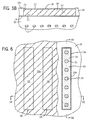
- the block copolymer (BCP) material 28 is then heated above its glass transition temperature under a vapor phase containing a partly-saturated concentration of an organic solvent to cause the polymer blocks to phase separate and self assemble according to the preferential and neutral wetting of the trench surfaces to form a self-assembled polymer material 30, as illustrated in FIGS. 6-6 B.
- the appropriate partial pressure of solvent vapor to achieve a neutral wetting vapor interface at a particular temperature depends, at least in part, on the block copolymer that is used and can be determined empirically.
- the block copolymer is heated at a thermal anneal temperature that is above its glass transition temperature (T g ) but below the decomposition or degradation temperature (T d ) of the block copolymer material.
- a PS-b-PVP block copolymer material can be annealed at a temperature of about 150-275°C in a solvent vapor atmosphere for about 1-24 hours to achieve a self-assembled morphology.
- a PS-b-PMMA block copolymer material can be annealed at a temperature of about 150-275°C in a solvent vapor atmosphere for about 1-24 hours to achieve a self-assembled morphology.
- the air interface is preferentially wetting to one of the polymer domains and the BCP material does not orient into perpendicular structures.
- the BCP material 28 is exposed to solvent vapors of a "good" solvent for both blocks, that is, a neutral organic solvent that solvates both the constituent blocks well.
- solvent annealing consists of two phases.
- a first phase the BCP material is exposed to a solvent vapor that acts to plasticize the film and increase chain mobility causing the domains to intermingle and the loss of order inherent from casting the polymer material.
- the organic solvent that is utilized is based at least in part on its solubility in the block copolymer material such that sufficient solvent molecules enter the block copolymer material to promote the order-disorder transition of the polymer domains and enable the required molecular rearrangement.
- solvents examples include aromatic solvents such as benzene, toluene, xylene, dimethoxyethane, ethyl acetate, cyclohexanone, etc., and chlorinated solvents such as chloroform, methylene chloride, a chloroform/octane mixture, etc., among others.
- aromatic solvents such as benzene, toluene, xylene, dimethoxyethane, ethyl acetate, cyclohexanone, etc.
- chlorinated solvents such as chloroform, methylene chloride, a chloroform/octane mixture, etc., among others.
- the evaporation of the solvent is highly directional and forms a solvent gradient from the "top" (surface) of the BCP material to the "bottom” of the BCP material at the trench floor that induces orientation and self-assembly of structures starting at the air-surface interface, which is neutral wetting due to the partial pressure of solvent at the interface, and driven downward to the floor of the trench, with formation of perpendicular-oriented cylindrical domains ( 34 ) guided by the trench sidewalls and extending completely from the air interface ( 46 ) to the substrate surface (trench floor).
- the substrate 10 and BCP material 28 are heated above the boiling point of the solvent such that swelling of the BCP material by the solvent is disallowed.
- the use of a partly-saturated solvent vapor phase above the block copolymer material provides a neutral wetting interface, similar to the second phase of solvent annealing.
- the concentration of solvent in the air immediate at the vapor interface with the BCP material is maintained at or under saturation to maintain a neutral wetting interface such that both (or all) polymer blocks will equally wet the vapor interface.
- both the air and trench floor are neutral wetting, the domains will orient perpendicular throughout the film layer, with the preferential wetting sidewalls inducing lateral order.
- the resulting morphology of the annealed copolymer material 30 can be examined, for example, using atomic force microscopy (AFM), transmission electron microscopy (TEM), scanning electron microscopy (SEM), among others.
- AFM atomic force microscopy
- TEM transmission electron microscopy
- SEM scanning electron microscopy
- the anneal is performed by globally heating the block copolymer within the trenches in a solvent atmosphere.
- a zone annealing is conducted to anneal portions or sections of the block copolymer material 28 in trenches on the substrate 10 by a localized application of thermal energy (e.g., heat). Zone annealing can provide rapid self-assembly of the block copolymer material (e.g., on the order of minutes).
- thermal energy e.g., heat
- the substrate 10 in a vapor atmosphere and a thermal or heat source 32 can be moved relative to each other (e.g., arrow ⁇ ) such that heat is applied above (or underneath) the substrate 10. Only a portion of the BCP material is initially heated above the glass transition temperature and the heated zone is then "pulled" across the substrate (or vice versa).
- a thermal source 32 can be moved across the substrate 10 at a translational set speed (e.g., about 0.05-10 ⁇ m/second using a mechanism such as a motorized translation stage (not shown). Pulling the heated zone across the substrate (or vice versa) can result in faster processing and better ordered structures relative to a global thermal anneal.
- a hot-to-cold temperature gradient can be provided over (or under) the substrate such that a certain portion of the substrate is heated and then cooled, which can be at a controlled rate.
- the substrate can be exposed to a cold-to-hot temperature gradient to anneal the BCP material, followed by cooling.
- the BCP material can be heated above and then cooled below the order-disorder temperature (but above the glass transition temperature), for example, to remove (melt out) defects and allow the material to recrystalize provided that the order-disorder temperature (T o-d ) is less than the decomposition temperature (T d ) of the block copolymer material.
- the order-disorder temperature is defined by the temperature dependence of the block copolymer, Chi value, the total number of monomers per chain, and the monomer composition.
- the block copolymer material within trench 18a can be heated and annealed to form a self-assembled material 30 while the unannealed block copolymer material 28 within trenches 18b, 18c remains disordered. Only those portions of the block copolymer material 28 that are heated above the glass transition temperature (T g ) will self-assemble.
- a next portion of the substrate can then be selectively heated, as shown in FIGS. 7-7A , resulting in the self assembly of the block copolymer material within trench 18b.
- a subsequent heating of the remaining areas of the substrate can then be conducted, e.g., as depicted in FIGS. 8-8A .
- the cylindrical-phase block copolymer material 28 Upon annealing, the cylindrical-phase block copolymer material 28 will self-assemble into a polymer material 30 (e.g. film) in response to the character of the block copolymer composition (e.g., PS-b-PVP having an inherent pitch at or about L) and the boundary conditions, including the constraints provided by the width ( w t ) of the trench 18 and the wetting properties of the trench surfaces including a trench floor 26 that exhibits neutral or non-preferential wetting toward both polymer blocks (e.g., a random graft copolymer), sidewalls 22 that are preferential wetting by the minority (preferred) block of the block copolymer (e.g., the PVP block), and the presence of a neutral or non-preferential solvent (or in some embodiments, a film or material that is neutral or non-preferential wetting) in contact with the surface of the block copolymer material 26 in the trenches.
- the anneal results in a row (or rows) of perpendicularly-oriented cylinders 34 of the minority polymer (preferred) block (e.g., PVP) within a matrix 36 of the majority polymer block (e.g., PS), with the cylinders registered and parallel to the sidewalls 22 of the trench.
- the diameter of the cylinders 34 will generally be at or about 0.5* L (e.g., about one-half of the center-to-center distance between cylinders).
- the minority (preferred) block e.g., PVP
- PVP minority (preferred) block
- the minority (preferred) block will segregate to and wet the preferential wetting sidewalls 22 and ends 24 of the trenches 18 to form a thin interface or wetting brush layer 34a having a thickness generally about one-fourth of the center-to-center distance between adjacent cylinders 34.
- a layer of the PVP block will wet oxide interfaces with attached PS domains directed outward from the oxide material.
- the self-assembled block copolymer material 30 is defined by a single layer of an array of cylindrical domains (cylinders) 34, each with a diameter at or about 0.5* L (e.g., about one-half of the center-to-center distance between cylinders), with the number (n) of cylinders in the row according to the length ( l t ) of the trench, and the center-to-center distance (pitch distance, p ) between each cylinder at or about L.
- L e.g., about one-half of the center-to-center distance between cylinders
- the copolymer material can be treated to crosslink the polymer segments (e.g., the PS segments) to fix and enhance the strength of the self-assembled polymer blocks.
- the polymers can be structured to inherently crosslink (e.g., upon exposure to ultraviolet (UV) radiation, including deep ultraviolet (DUV) radiation), or one of the polymer blocks of the copolymer material can be formulated to contain a crosslinking agent.
- the film 28a outside the trenches (e.g., on spacers 18) will not be thick enough to result in self-assembly.
- the unstructured thin film 28a can be removed, as illustrated in FIGS. 8-8A , for example, by an etch technique or a planarization process to provide an about uniformly flat surface.
- the trench regions can be selectively exposed through a reticle (not shown) to crosslink only the annealed and self-assembled polymer material 30 within the trenches 18, and a wash can then be applied with an appropriate solvent (e.g., toluene) to remove the non-crosslinked portions of the block copolymer material 28a (e.g., on the spacers 20 ), leaving the registered self-assembled polymer material within the trench and exposing the surface of the material layer 16 above/outside the trenches.
- an appropriate solvent e.g., toluene
- the annealed polymer material 30 can be crosslinked globally, a photoresist material can be applied to pattern and expose the areas of the polymer material 28a outside the trench regions, and the exposed portions of the polymer material 28a can be removed, for example by an oxygen (O 2 ) plasma treatment.
- O 2 oxygen
- a thermal anneal is conducted while applying a non-preferentially wetting material 37 ' to the surface of the block copolymer (BCP) material 28' in the trenches.
- the non-preferential wetting material 37 ' is composed of a solid material, which can be physically placed onto the BCP material 28 ', for example, a soft, flexible or rubbery solid material such as a cross-linked, poly(dimethylsiloxane) (PDMS) elastomer (e.g., Sylgard-184 by Dow-Corning) or other elastomeric polymer material (e.g., silicones, polyurethanes, etc.), which provides an external surface that is neutral wetting.
- PDMS poly(dimethylsiloxane)
- the solid material can be derivatized (e.g., by grafting a random copolymer) such that it presents a neutral wetting surface.
- a thermal annealing process is conducted (arrows ⁇ , FIGS. 9A-9B ) to cause the polymer blocks to phase separate in response to the preferential and neutral wetting of the trench surfaces and the non-preferential (neutral) wetting of the overlying material 37 ', and form a self-assembled polymer material 30' as illustrated in
- FIGS. 10A-10B are identical to FIGS. 10A-10B.
- the non-preferential wetting material 37 ' can be removed from contact with the annealed polymer material 30' (arrow ⁇ ) as depicted in FIG. 10A .
- a PDMS or other elastomeric material layer 37' can be removed, for example, by lifting or peeling the material from the surface of the annealed polymer material.
- a solvent such as water, alcohols, and the like, which is compatible with and does not dissolve the block copolymer material 30', can be applied (e.g., by soaking) to permeate and swell the elastomeric material (e.g., PDMS) to enhance physical removal.
- a dilute fluoride solution e.g., NH 4 F, HF, NaF, etc.
- the pattern of perpendicular-oriented cylinders that is formed on the substrate can then be further processed as desired, for example, to form an etch mask for patterning nanosized features into the underlying substrate 10 through selective removal of one block of the self-assembled block copolymer.
- domain sizes and periods ( L ) involved in this method are determined by the chain length of a block copolymer (MW)
- resolution can exceed other techniques such as conventional photolithography. Processing costs using the technique is significantly less than extreme ultraviolet (EUV) photolithography, which has comparable resolution.
- EUV extreme ultraviolet
- an etch mask 38 can be formed by selectively removing the cylindrical polymer domains 34 of the self-assembled polymer material 30 to produce openings 40 in the polymer matrix 36 (e.g., PS) to expose the underlying substrate 10 at the trench floors 26.
- the cylindrical domains 34 can be removed by a selective wet etch (e.g., PMMA and PLA by UV exposure/acetic acid development, PLA by aqueous methanol mixture containing sodium hydroxide, PEO by aqueous hydroiodic acid or water, etc.) or by a selective reactive ion etch (RIE) process.
- a selective wet etch e.g., PMMA and PLA by UV exposure/acetic acid development, PLA by aqueous methanol mixture containing sodium hydroxide, PEO by aqueous hydroiodic acid or water, etc.
- RIE selective reactive ion etch
- the film can be exposed to a solvent selective to the minor domain, for example, an alcohol for PVP, water for PEO or PLA, and acetic acid for PMMA, that contains a cleaving agent to remove (e.g., wash out) the minor domain.
- a solvent selective to the minor domain for example, an alcohol for PVP, water for PEO or PLA, and acetic acid for PMMA, that contains a cleaving agent to remove (e.g., wash out) the minor domain.
- the remaining porous polymer e.g.
- PS matrix 36 can then be used as a lithographic template or mask to etch (arrows ⁇ ) a series of cylindrical-shaped openings or contact holes 42 in the nanometer size range (e.g., about 10-100 nm) to the conductive lines 12 or other active area (e.g., semiconducting region, etc.) in the underlying substrate 10 (or an underlayer).
- the openings 42 can be formed, for example, using a selective reactive ion etching (RIE) process.
- the residual polymer matrix 36 can be removed (e.g., PS by an oxidation process such as a plasma O 2 etch) and the substrate openings 42 can be filled with a material 44 such as a metal or metal alloy such as Cu, Al, W, Si, and Ti 3 N 4 , among others, to form arrays of cylindrical contacts to the conductive lines 12.
- the cylindrical openings 42 in the substrate can also be filled with a metal-insulator-metal stack to form capacitors with an insulating material such as SiO 2 , Al 2 O 3 , HfO 2 , ZrO 2 , SrTiO 3 , and the like.
- Embodiments of the invention utilize a thermal anneal process in combination with solvent annealing, which can provide faster processing than with a solvent anneal alone and expands the types of block copolymers (BCPs) that can be processed to substantially all BCPs.
- BCPs block copolymers
- a wide range of block copolymers can be processed to form perpendicular-oriented nanostructures (e.g., cylinders) and at a rapid rate.
- methods of the disclosure provide a means of generating self-assembled diblock copolymer films composed of perpendicular-oriented cylinders in a polymer matrix.
- the methods provide ordered and registered elements on a nanometer scale that can be prepared more inexpensively than by electron beam lithography, EUV photolithography or conventional photolithography.
- the feature sizes produced and accessible by this invention cannot be easily prepared by conventional photolithography.
- the described methods and systems can be readily employed and incorporated into existing semiconductor manufacturing process flows and provide a low cost, high-throughput technique for fabricating small structures.
Landscapes
- Chemical & Material Sciences (AREA)
- Engineering & Computer Science (AREA)
- Nanotechnology (AREA)
- Manufacturing & Machinery (AREA)
- Physics & Mathematics (AREA)
- General Physics & Mathematics (AREA)
- Chemical Kinetics & Catalysis (AREA)
- Health & Medical Sciences (AREA)
- Medicinal Chemistry (AREA)
- Polymers & Plastics (AREA)
- Organic Chemistry (AREA)
- Microelectronics & Electronic Packaging (AREA)
- Analytical Chemistry (AREA)
- Composite Materials (AREA)
- Condensed Matter Physics & Semiconductors (AREA)
- Materials Engineering (AREA)
- Crystallography & Structural Chemistry (AREA)
- Exposure Of Semiconductors, Excluding Electron Or Ion Beam Exposure (AREA)
- General Chemical & Material Sciences (AREA)
- Treatments Of Macromolecular Shaped Articles (AREA)
- Manufacture Of Macromolecular Shaped Articles (AREA)
- Formation Of Insulating Films (AREA)
- Application Of Or Painting With Fluid Materials (AREA)
Claims (15)
- Procédé de formation d'un matériau de polymère nanostructuré sur un substrat, comprenant :le recuit d'un matériau de copolymère séquencé en phase cylindrique para) recuit du matériau de copolymère séquencé dans une vapeur d'un solvant qui est non préférentiel pour un bloc quelconque et à une température au-dessus de la température de transition vitreuse (Tg) du matériau de copolymère séquencé, oub) application d'un matériau qui est non préférentiel pour un bloc quelconque sur et en contact avec le matériau de copolymère séquencé en phase cylindrique, et recuit du matériau de copolymère séquencé à une température au-dessus de la température de transition vitreuse (Tg) du matériau de copolymère séquencé pendant qu'il est en contact avec ledit matériau non préférentiel ;
dans lequel le matériau de copolymère séquencé est situé dans une tranchée dans une couche de matériau sur le substrat, la tranchée ayant une largeur, une longueur, un fond de mouillage neutre, et des parois latérales et des extrémités opposées qui sont de préférence mouillantes pour un bloc minoritaire du copolymère séquencé ;
dans lequel ledit copolymère séquencé s'auto-assemble en domaines cylindriques du premier bloc du copolymère séquencé dans une matrice d'un deuxième bloc du copolymère séquencé, ledit matériau de copolymère séquencé auto-assemblé ayant une épaisseur, et les domaines de polymère cylindriques orientés perpendiculairement au fond de la tranchée et s'étendant à travers ladite épaisseur du matériau de copolymère séquencé auto-assemblé dans un agencement unique pour la longueur de la tranchée. - Procédé de la revendication 1, dans lequel le recuit du matériau de copolymère séquencé est à une concentration partiellement saturée du solvant, ledit solvant étant un solvant organique.
- Procédé de la revendication 1, dans lequel le recuit du matériau de copolymère séquencé comprend le chauffage du matériau de copolymère séquencé au point d'ébullition du solvant où sensiblement aucun gonflement du matériau de copolymère séquencé par le solvant ne se produit.
- Procédé de la revendication 1, dans lequel le matériau de copolymère séquencé est globalement chauffé.
- Procédé de la revendication 1, dans lequel 1e matériau de copolymère séquencé est recuit par zone.
- Procédé de la revendication 1, dans lequel le recuit comprend le chauffage d'une partie du matériau de copolymère séquencé de sorte que les domaines cylindriques auto-assemblés soient formés uniquement dans ladite partie chauffée du matériau de copolymère séquencé.
- Procédé de la revendication 6, comprenant en outre l'application de chaleur à une deuxième partie du matériau de copolymère séquencé de sorte que les domaines cylindriques auto-assemblés soient formés dans ladite deuxième partie du matériau de copolymère séquencé.
- Procédé de la revendication 1, dans lequel le recuit comprend l'exposition du matériau de copolymère séquencé à un gradient de température du chaud vers le froid.
- Procédé de la revendication 1, comprenant en outre la réticulation sélective de la matrice du deuxième bloc de polymère.
- Procédé de la revendication 9, comprenant en outre l'élimination sélective du premier bloc de polymère pour former des ouvertures cylindriques s'étendant à travers la matrice du deuxième bloc de polymère.
- Procédé de la revendication 10, comprenant en outre la gravure de parties non masquées du substrat par l'intermédiaire desdites ouvertures cylindriques pour former des ouvertures dans le substrat.
- Procédé de la revendication 11, comprenant en outre le remplissage des ouvertures dans le substrat avec un matériau de remplissage.
- Procédé de la revendication 1, dans lequel ladite application d'un matériau qui est non préférentiel comprend la mise en contact du matériau de copolymère séquencé avec un matériau élastomère solide ayant une surface non préférentielle.
- Procédé de la revendication 1, dans lequel le recuit comprend l'application dudit matériau non préférentiel, et le procédé comprend en outre le retrait du matériau non préférentiel pour exposer le matériau de copolymère séquencé recuit dans la tranchée.
- Procédé de la revendication 14, comprenant en outre l'application d'un solvant au matériau non préférentiel pour renforcer l'élimination.
Applications Claiming Priority (2)
| Application Number | Priority Date | Filing Date | Title |
|---|---|---|---|
| US12/052,956 US8426313B2 (en) | 2008-03-21 | 2008-03-21 | Thermal anneal of block copolymer films with top interface constrained to wet both blocks with equal preference |
| PCT/US2009/035861 WO2009117243A1 (fr) | 2008-03-21 | 2009-03-03 | Recuit thermique de films de copolymère séquencé avec interface supérieure contrainte pour mouiller les deux séquences de façon identique |
Publications (2)
| Publication Number | Publication Date |
|---|---|
| EP2281299A1 EP2281299A1 (fr) | 2011-02-09 |
| EP2281299B1 true EP2281299B1 (fr) | 2014-12-10 |
Family
ID=40612928
Family Applications (1)
| Application Number | Title | Priority Date | Filing Date |
|---|---|---|---|
| EP09721942.2A Active EP2281299B1 (fr) | 2008-03-21 | 2009-03-03 | Recuit thermique de films de copolymère séquencé avec interface supérieure contrainte pour mouiller les deux séquences de façon identique |
Country Status (7)
| Country | Link |
|---|---|
| US (5) | US8426313B2 (fr) |
| EP (1) | EP2281299B1 (fr) |
| JP (1) | JP5136869B2 (fr) |
| KR (1) | KR101121303B1 (fr) |
| CN (1) | CN101978469B (fr) |
| TW (1) | TWI391992B (fr) |
| WO (1) | WO2009117243A1 (fr) |
Families Citing this family (114)
| Publication number | Priority date | Publication date | Assignee | Title |
|---|---|---|---|---|
| US8394483B2 (en) | 2007-01-24 | 2013-03-12 | Micron Technology, Inc. | Two-dimensional arrays of holes with sub-lithographic diameters formed by block copolymer self-assembly |
| US8083953B2 (en) | 2007-03-06 | 2011-12-27 | Micron Technology, Inc. | Registered structure formation via the application of directed thermal energy to diblock copolymer films |
| US8557128B2 (en) | 2007-03-22 | 2013-10-15 | Micron Technology, Inc. | Sub-10 nm line features via rapid graphoepitaxial self-assembly of amphiphilic monolayers |
| US8294139B2 (en) | 2007-06-21 | 2012-10-23 | Micron Technology, Inc. | Multilayer antireflection coatings, structures and devices including the same and methods of making the same |
| US8097175B2 (en) | 2008-10-28 | 2012-01-17 | Micron Technology, Inc. | Method for selectively permeating a self-assembled block copolymer, method for forming metal oxide structures, method for forming a metal oxide pattern, and method for patterning a semiconductor structure |
| US7959975B2 (en) | 2007-04-18 | 2011-06-14 | Micron Technology, Inc. | Methods of patterning a substrate |
| US8372295B2 (en) | 2007-04-20 | 2013-02-12 | Micron Technology, Inc. | Extensions of self-assembled structures to increased dimensions via a “bootstrap” self-templating method |
| US8404124B2 (en) | 2007-06-12 | 2013-03-26 | Micron Technology, Inc. | Alternating self-assembling morphologies of diblock copolymers controlled by variations in surfaces |
| US8080615B2 (en) | 2007-06-19 | 2011-12-20 | Micron Technology, Inc. | Crosslinkable graft polymer non-preferentially wetted by polystyrene and polyethylene oxide |
| KR101355167B1 (ko) * | 2007-12-14 | 2014-01-28 | 삼성전자주식회사 | 적어도 세 개의 고분자 블록을 구비하는 블록 공중합체를이용한 미세 패턴 형성 방법 |
| US8999492B2 (en) | 2008-02-05 | 2015-04-07 | Micron Technology, Inc. | Method to produce nanometer-sized features with directed assembly of block copolymers |
| US8101261B2 (en) * | 2008-02-13 | 2012-01-24 | Micron Technology, Inc. | One-dimensional arrays of block copolymer cylinders and applications thereof |
| US8425982B2 (en) | 2008-03-21 | 2013-04-23 | Micron Technology, Inc. | Methods of improving long range order in self-assembly of block copolymer films with ionic liquids |
| US8426313B2 (en) | 2008-03-21 | 2013-04-23 | Micron Technology, Inc. | Thermal anneal of block copolymer films with top interface constrained to wet both blocks with equal preference |
| US8114300B2 (en) | 2008-04-21 | 2012-02-14 | Micron Technology, Inc. | Multi-layer method for formation of registered arrays of cylindrical pores in polymer films |
| US8114301B2 (en) | 2008-05-02 | 2012-02-14 | Micron Technology, Inc. | Graphoepitaxial self-assembly of arrays of downward facing half-cylinders |
| IT1392754B1 (it) * | 2008-12-18 | 2012-03-16 | St Microelectronics Srl | Nanoarray ad incrocio con strato organico attivo anisotropico |
| KR101101767B1 (ko) * | 2009-05-07 | 2012-01-05 | 한국과학기술원 | 코일―빗형 블록 공중합체 및 이를 이용한 나노 구조체의 제조방법 |
| US8398868B2 (en) * | 2009-05-19 | 2013-03-19 | International Business Machines Corporation | Directed self-assembly of block copolymers using segmented prepatterns |
| US8574950B2 (en) * | 2009-10-30 | 2013-11-05 | International Business Machines Corporation | Electrically contactable grids manufacture |
| US20120301674A1 (en) * | 2010-02-05 | 2012-11-29 | Jillian Buriak | Method for organizing a block copolymer |
| WO2011104045A1 (fr) * | 2010-02-26 | 2011-09-01 | Asml Netherlands B.V. | Procédé et équipement pour traiter des couches de polymère pouvant s'auto-assembler à utiliser en lithographie |
| US8696918B2 (en) | 2010-05-05 | 2014-04-15 | Micron Technology, Inc. | Methods of utilizing block copolymer to form patterns |
| CN102933628A (zh) | 2010-06-04 | 2013-02-13 | Asml荷兰有限公司 | 可自组装的聚合物和用于平版印刷术的方法 |
| US10753023B2 (en) | 2010-08-13 | 2020-08-25 | Kimberly-Clark Worldwide, Inc. | Toughened polylactic acid fibers |
| US8936740B2 (en) | 2010-08-13 | 2015-01-20 | Kimberly-Clark Worldwide, Inc. | Modified polylactic acid fibers |
| US8304493B2 (en) | 2010-08-20 | 2012-11-06 | Micron Technology, Inc. | Methods of forming block copolymers |
| JP5729537B2 (ja) * | 2010-09-14 | 2015-06-03 | 東京応化工業株式会社 | 下地剤 |
| TWI556958B (zh) | 2010-09-14 | 2016-11-11 | 東京應化工業股份有限公司 | 基質劑及含嵌段共聚物之層的圖型形成方法 |
| JP5721164B2 (ja) * | 2010-09-14 | 2015-05-20 | 東京応化工業株式会社 | ブロックコポリマーを含む層のパターン形成方法 |
| US8900963B2 (en) | 2011-11-02 | 2014-12-02 | Micron Technology, Inc. | Methods of forming semiconductor device structures, and related structures |
| JP5979660B2 (ja) * | 2012-02-09 | 2016-08-24 | 東京応化工業株式会社 | コンタクトホールパターンの形成方法 |
| US8961918B2 (en) | 2012-02-10 | 2015-02-24 | Rohm And Haas Electronic Materials Llc | Thermal annealing process |
| US9157008B2 (en) * | 2012-02-10 | 2015-10-13 | Board Of Regents, The University Of Texas System | Anhydride copolymer top coats for orientation control of thin film block copolymers |
| JP5891075B2 (ja) * | 2012-03-08 | 2016-03-22 | 東京応化工業株式会社 | ブロックコポリマー含有組成物及びパターンの縮小方法 |
| JP5993654B2 (ja) * | 2012-03-09 | 2016-09-14 | 東京応化工業株式会社 | ブロックコポリマーを含む層のパターン形成方法、及び下地剤 |
| JP6306810B2 (ja) | 2012-03-14 | 2018-04-04 | 東京応化工業株式会社 | 下地剤、ブロックコポリマーを含む層のパターン形成方法 |
| JP6118573B2 (ja) | 2012-03-14 | 2017-04-19 | 東京応化工業株式会社 | 下地剤、ブロックコポリマーを含む層のパターン形成方法 |
| JP5934565B2 (ja) * | 2012-04-20 | 2016-06-15 | 東京応化工業株式会社 | パターンの縮小方法、及び組成物 |
| JP5948129B2 (ja) * | 2012-04-26 | 2016-07-06 | 東京応化工業株式会社 | 2個以上の孤立ホールが並んでなるパターンの形成方法 |
| US9005877B2 (en) | 2012-05-15 | 2015-04-14 | Tokyo Electron Limited | Method of forming patterns using block copolymers and articles thereof |
| KR101412228B1 (ko) * | 2012-06-11 | 2014-07-02 | 한국과학기술원 | 혼합 블록공중합체 박막 제조방법, 혼합 블록공중합체 주형 제조방법 및 이에 의하여 제조된 혼합 블록공중합체 박막 및 주형 |
| CN104541357B (zh) * | 2012-07-10 | 2018-01-23 | 株式会社尼康 | 标记及其形成方法以及曝光装置 |
| JP6112314B2 (ja) * | 2012-07-10 | 2017-04-12 | 株式会社ニコン | マーク形成方法及びデバイス製造方法 |
| US8821739B2 (en) | 2012-07-12 | 2014-09-02 | Rohm And Haas Electronic Materials Llc | High temperature thermal annealing process |
| US8821738B2 (en) | 2012-07-12 | 2014-09-02 | Rohm And Haas Electronic Materials Llc | Thermal annealing process |
| JP6239813B2 (ja) * | 2012-07-18 | 2017-11-29 | 株式会社Screenセミコンダクターソリューションズ | 基板処理装置および基板処理方法 |
| CN103633029B (zh) * | 2012-08-28 | 2016-11-23 | 中国科学院微电子研究所 | 半导体结构及其制造方法 |
| US9087699B2 (en) | 2012-10-05 | 2015-07-21 | Micron Technology, Inc. | Methods of forming an array of openings in a substrate, and related methods of forming a semiconductor device structure |
| KR101993255B1 (ko) * | 2013-01-07 | 2019-06-26 | 삼성전자주식회사 | 콘택 홀 형성 방법 |
| FR3001306A1 (fr) * | 2013-01-18 | 2014-07-25 | Commissariat Energie Atomique | Procede de fabrication d'un reseau de conducteurs sur un substrat au moyen de copolymeres a blocs |
| US9050621B2 (en) * | 2013-01-24 | 2015-06-09 | Corning Incorporated | Surface nanofabrication methods using self-assembled polymer nanomasks |
| US9566609B2 (en) | 2013-01-24 | 2017-02-14 | Corning Incorporated | Surface nanoreplication using polymer nanomasks |
| JP6093590B2 (ja) * | 2013-02-20 | 2017-03-08 | 東京応化工業株式会社 | 相分離構造を含む構造体の製造方法、ガイドパターン形成方法 |
| US8859433B2 (en) * | 2013-03-11 | 2014-10-14 | International Business Machines Corporation | DSA grapho-epitaxy process with etch stop material |
| US20140273534A1 (en) | 2013-03-14 | 2014-09-18 | Tokyo Electron Limited | Integration of absorption based heating bake methods into a photolithography track system |
| US8975009B2 (en) | 2013-03-14 | 2015-03-10 | Tokyo Electron Limited | Track processing to remove organic films in directed self-assembly chemo-epitaxy applications |
| US8980538B2 (en) | 2013-03-14 | 2015-03-17 | Tokyo Electron Limited | Chemi-epitaxy in directed self-assembly applications using photo-decomposable agents |
| US9147574B2 (en) | 2013-03-14 | 2015-09-29 | Tokyo Electron Limited | Topography minimization of neutral layer overcoats in directed self-assembly applications |
| US9115255B2 (en) * | 2013-03-14 | 2015-08-25 | Wisconsin Alumni Research Foundation | Crosslinked random copolymer films for block copolymer domain orientation |
| US9209014B2 (en) * | 2013-03-15 | 2015-12-08 | Tokyo Electron Limited | Multi-step bake apparatus and method for directed self-assembly lithography control |
| US20140273290A1 (en) * | 2013-03-15 | 2014-09-18 | Tokyo Electron Limited | Solvent anneal processing for directed-self assembly applications |
| US20140291878A1 (en) * | 2013-03-29 | 2014-10-02 | Tokyo Electron Limited | Methods for controlling across-wafer directed self-assembly |
| US9229328B2 (en) | 2013-05-02 | 2016-01-05 | Micron Technology, Inc. | Methods of forming semiconductor device structures, and related semiconductor device structures |
| ITRM20130278A1 (it) | 2013-05-10 | 2014-11-11 | Consiglio Nazionale Ricerche | Procedimento di fabbricazione di film autoassemblati di copolimeri a blocchi |
| US10457088B2 (en) | 2013-05-13 | 2019-10-29 | Ridgefield Acquisition | Template for self assembly and method of making a self assembled pattern |
| TWI658055B (zh) * | 2013-06-19 | 2019-05-01 | 德州大學董事會 | 用於薄膜嵌段共聚物之定向控制之酸酐共聚物面塗層 |
| US20150179434A1 (en) * | 2013-07-25 | 2015-06-25 | SK Hynix Inc. | Nano-scale structures |
| FR3008986B1 (fr) * | 2013-07-25 | 2016-12-30 | Arkema France | Procede de controle de la periode caracterisant la morphologie obtenue a partir d'un melange de copolymere a blocs et de (co) polymeres de l'un des blocs |
| JP6452136B2 (ja) | 2013-09-04 | 2019-01-16 | 東京エレクトロン株式会社 | 誘導自己組織化用の化学テンプレートを形成するための硬化フォトレジストのuv支援剥離 |
| WO2015032588A1 (fr) * | 2013-09-06 | 2015-03-12 | Asml Netherlands B.V. | Méthodologie pour générer des modèles de guidage pour un auto-assemblage dirigé |
| US9625815B2 (en) * | 2013-09-27 | 2017-04-18 | Intel Corporation | Exposure activated chemically amplified directed self-assembly (DSA) for back end of line (BEOL) pattern cutting and plugging |
| US9177795B2 (en) | 2013-09-27 | 2015-11-03 | Micron Technology, Inc. | Methods of forming nanostructures including metal oxides |
| US9349604B2 (en) | 2013-10-20 | 2016-05-24 | Tokyo Electron Limited | Use of topography to direct assembly of block copolymers in grapho-epitaxial applications |
| US9793137B2 (en) | 2013-10-20 | 2017-10-17 | Tokyo Electron Limited | Use of grapho-epitaxial directed self-assembly applications to precisely cut logic lines |
| US9859118B2 (en) * | 2013-11-25 | 2018-01-02 | Tokyo Electron Limited | Pattern forming method and heating apparatus |
| KR102100767B1 (ko) * | 2013-11-26 | 2020-04-21 | 엘지디스플레이 주식회사 | 유기발광 표시장치 및 그 제조방법 |
| KR102166523B1 (ko) * | 2013-12-02 | 2020-10-16 | 에스케이하이닉스 주식회사 | 나노 스케일 형상 구조 및 형성 방법 |
| FR3014887B1 (fr) * | 2013-12-13 | 2017-05-26 | Arkema France | Procede permettant la creation de structures nanometriques par l'auto-assemblage de copolymeres a blocs |
| FR3017395B1 (fr) * | 2014-02-11 | 2017-11-03 | Arkema France | Procede de controle de l'energie de surface d'un substrat |
| JP2015159262A (ja) * | 2014-02-25 | 2015-09-03 | 東京エレクトロン株式会社 | 基板処理装置、基板処理方法、プログラム及びコンピュータ記憶媒体 |
| US9593218B2 (en) * | 2014-05-30 | 2017-03-14 | Pall Corporation | Self-assembled structure and membrane comprising block copolymer and process for producing the same by spin coating (IIIa) |
| US9616395B2 (en) * | 2014-05-30 | 2017-04-11 | Pall Corportaion | Membrane comprising self-assembled block copolymer and process for producing the same by spray coating (Ic) |
| US9592477B2 (en) | 2014-05-30 | 2017-03-14 | Pall Corporation | Membrane comprising self-assembled block copolymer and process for producing the same by hybrid casting (Ib) |
| US9592476B2 (en) | 2014-05-30 | 2017-03-14 | Pall Corporation | Membrane comprising self-assembled block copolymer and process for producing the same by hybrid casting (IIb) |
| US9598543B2 (en) * | 2014-05-30 | 2017-03-21 | Pall Corporation | Self-assembled structure and membrane comprising block copolymer and process for producing the same by spin coating (VIa) |
| US9765171B2 (en) * | 2014-05-30 | 2017-09-19 | Pall Corporation | Self-assembling polymers—V |
| US9469733B2 (en) | 2014-05-30 | 2016-10-18 | Pall Corporation | Self-assembled structure and membrane comprising block copolymer and process for producing the same by spin coating (IVa) |
| US9593217B2 (en) * | 2014-05-30 | 2017-03-14 | Pall Corporation | Self-assembled structure and membrane comprising block copolymer and process for producing the same by spin coating (Va) |
| US9593219B2 (en) * | 2014-05-30 | 2017-03-14 | Pall Corporation | Membrane comprising self-assembled block copolymer and process for producing the same by spin coating (IIa) |
| US9193835B1 (en) | 2014-05-30 | 2015-11-24 | Pall Corporation | Self-assembling polymers—IV |
| US9441078B2 (en) | 2014-05-30 | 2016-09-13 | Pall Corporation | Self-assembling polymers—I |
| US9328206B2 (en) | 2014-05-30 | 2016-05-03 | Pall Corporation | Self-assembling polymers—III |
| US9604181B2 (en) * | 2014-05-30 | 2017-03-28 | Pall Corporation | Membrane comprising self-assembled block copolymer and process for producing the same by spray coating (IIc) |
| US9448483B2 (en) * | 2014-07-31 | 2016-09-20 | Dow Global Technologies Llc | Pattern shrink methods |
| US9396958B2 (en) * | 2014-10-14 | 2016-07-19 | Tokyo Electron Limited | Self-aligned patterning using directed self-assembly of block copolymers |
| WO2016085712A1 (fr) | 2014-11-26 | 2016-06-02 | Kimberly-Clark Worldwide, Inc. | Matériau de polyoléfine poreux recuit |
| US10294359B2 (en) * | 2014-12-30 | 2019-05-21 | Rohm And Haas Electronic Materials Llc | Copolymer formulation for directed self assembly, methods of manufacture thereof and articles comprising the same |
| US11021630B2 (en) * | 2014-12-30 | 2021-06-01 | Rohm And Haas Electronic Materials Llc | Copolymer formulation for directed self assembly, methods of manufacture thereof and articles comprising the same |
| CN105047568B (zh) * | 2015-09-07 | 2018-01-09 | 京东方科技集团股份有限公司 | 薄膜晶体管及其制作方法、显示面板 |
| US9876075B2 (en) | 2015-10-16 | 2018-01-23 | International Business Machines Corporation | Method of forming dielectric with air gaps for use in semiconductor devices |
| US10950501B2 (en) * | 2015-12-21 | 2021-03-16 | Intel Corporation | Triblock copolymers for self-aligning vias or contacts |
| US9691654B1 (en) * | 2015-12-22 | 2017-06-27 | Globalfoundries Inc. | Methods and devices for back end of line via formation |
| US20170221701A1 (en) * | 2016-02-01 | 2017-08-03 | Applied Materials, Inc. | Rtp process for directed self-aligned patterns |
| WO2017138440A1 (fr) * | 2016-02-08 | 2017-08-17 | Jsr株式会社 | Procédé de formation d'un motif de trous de contact et composition |
| US10056265B2 (en) | 2016-03-18 | 2018-08-21 | Taiwan Semiconductor Manufacturing Co., Ltd. | Directed self-assembly process with size-restricted guiding patterns |
| KR102463922B1 (ko) * | 2016-03-21 | 2022-11-08 | 에스케이하이닉스 주식회사 | 미세 패턴 형성 방법 |
| US9947597B2 (en) | 2016-03-31 | 2018-04-17 | Tokyo Electron Limited | Defectivity metrology during DSA patterning |
| JP6802667B2 (ja) * | 2016-08-18 | 2020-12-16 | 株式会社Screenホールディングス | 熱処理装置、基板処理装置、熱処理方法および基板処理方法 |
| US11299596B2 (en) | 2016-11-30 | 2022-04-12 | Lg Chem, Ltd. | Laminate |
| CN109997219B (zh) * | 2016-12-23 | 2023-08-04 | 英特尔公司 | 用于调制电桶敏感度的差异化硬掩模 |
| JP6811638B2 (ja) | 2017-02-14 | 2021-01-13 | 株式会社Screenホールディングス | 基板処理方法及びその装置 |
| US10170301B2 (en) * | 2017-03-29 | 2019-01-01 | International Business Machines Corporation | Adhesion of polymers on silicon substrates |
| JP7110090B2 (ja) * | 2018-12-28 | 2022-08-01 | 東京エレクトロン株式会社 | 基板処理方法および基板処理システム |
Family Cites Families (328)
| Publication number | Priority date | Publication date | Assignee | Title |
|---|---|---|---|---|
| US4623674A (en) * | 1985-06-21 | 1986-11-18 | Union Carbide Corporation | Polymer/polyols of substituted styrenes and polyurethanes made therefrom |
| US4877647A (en) * | 1986-04-17 | 1989-10-31 | Kansas State University Research Foundation | Method of coating substrates with solvated clusters of metal particles |
| US4797357A (en) | 1986-05-30 | 1989-01-10 | Eastman Kodak Company | Light-stable reducible compounds and analytical compositions, elements and methods utilizing same |
| US4818713A (en) | 1987-10-20 | 1989-04-04 | American Telephone And Telegraph Company, At&T Bell Laboratories | Techniques useful in fabricating semiconductor devices having submicron features |
| WO1990007575A1 (fr) | 1988-12-30 | 1990-07-12 | Anderson David M | Substances microporeuses stabilisees et substances a base d'hydrogel |
| US5328810A (en) * | 1990-05-07 | 1994-07-12 | Micron Technology, Inc. | Method for reducing, by a factor or 2-N, the minimum masking pitch of a photolithographic process |
| US5354489A (en) * | 1990-08-30 | 1994-10-11 | Asahi Kasei Kogyo Kabushiki Kaisha | Method for changing the viscosity of a fluid comprising a liquid crystal compound |
| US5622668A (en) * | 1992-02-07 | 1997-04-22 | The United States Of America As Represented By The Secretary Of The Air Force | Method for preparing oriented polymer structures and said structures |
| EP0588482B1 (fr) * | 1992-08-07 | 1997-11-05 | Fujikura Kasei Co., Ltd. | Composition électrosensitive |
| US5382373A (en) * | 1992-10-30 | 1995-01-17 | Lord Corporation | Magnetorheological materials based on alloy particles |
| WO1994012912A1 (fr) | 1992-11-25 | 1994-06-09 | Hoechst Celanese Corporation | Reduction d'ions metal dans des revetements anti-reflecteurs de fond pour des photoreserves |
| US5482656A (en) * | 1993-03-04 | 1996-01-09 | Kabushiki Kaisha Toshiba | Non-linear optical devices employing a polysilane composition and a polysilane composition therefor |
| TW272976B (fr) * | 1993-08-06 | 1996-03-21 | Ciba Geigy Ag | |
| US5512131A (en) * | 1993-10-04 | 1996-04-30 | President And Fellows Of Harvard College | Formation of microstamped patterns on surfaces and derivative articles |
| US6776094B1 (en) * | 1993-10-04 | 2004-08-17 | President & Fellows Of Harvard College | Kit For Microcontact Printing |
| US5538655A (en) * | 1994-06-29 | 1996-07-23 | Arthur D. Little, Inc. | Molecular complexes for use as electrolyte components |
| US5607824A (en) | 1994-07-27 | 1997-03-04 | International Business Machines Corporation | Antireflective coating for microlithography |
| JPH0867893A (ja) * | 1994-08-19 | 1996-03-12 | Lubrizol Corp:The | 極性固体および有機半導体の電気流動性流体 |
| US5620850A (en) | 1994-09-26 | 1997-04-15 | President And Fellows Of Harvard College | Molecular recognition at surfaces derivatized with self-assembled monolayers |
| US5633117A (en) | 1995-04-27 | 1997-05-27 | Imation Corp. | Providing imagewise variation in glossiness to a receptor |
| US5700902A (en) * | 1995-07-27 | 1997-12-23 | Circe Biomedical, Inc. | Block copolymers |
| WO1997006013A1 (fr) | 1995-08-04 | 1997-02-20 | International Business Machines Corporation | Surface lithographique ou modification de couche mince |
| US6309580B1 (en) | 1995-11-15 | 2001-10-30 | Regents Of The University Of Minnesota | Release surfaces, particularly for use in nanoimprint lithography |
| US5772905A (en) | 1995-11-15 | 1998-06-30 | Regents Of The University Of Minnesota | Nanoimprint lithography |
| US5879853A (en) | 1996-01-18 | 1999-03-09 | Kabushiki Kaisha Toshiba | Top antireflective coating material and its process for DUV and VUV lithography systems |
| US6096636A (en) | 1996-02-06 | 2000-08-01 | Micron Technology, Inc. | Methods of forming conductive lines |
| EP1124158A1 (fr) | 1996-02-26 | 2001-08-16 | Matsushita Electric Industrial Co., Ltd. | Matériau pour la formation d' images et procédé de formation d' images |
| US6190949B1 (en) * | 1996-05-22 | 2001-02-20 | Sony Corporation | Silicon thin film, group of silicon single crystal grains and formation process thereof, and semiconductor device, flash memory cell and fabrication process thereof |
| US6143647A (en) * | 1997-07-24 | 2000-11-07 | Intel Corporation | Silicon-rich block copolymers to achieve unbalanced vias |
| JPH1081889A (ja) * | 1996-09-06 | 1998-03-31 | Bridgestone Corp | 電気粘性流体用粉体 |
| US5904824A (en) * | 1997-03-07 | 1999-05-18 | Beckman Instruments, Inc. | Microfluidic electrophoresis device |
| US5958704A (en) | 1997-03-12 | 1999-09-28 | Ddx, Inc. | Sensing system for specific substance and molecule detection |
| US5948470A (en) * | 1997-04-28 | 1999-09-07 | Harrison; Christopher | Method of nanoscale patterning and products made thereby |
| US6890624B1 (en) * | 2000-04-25 | 2005-05-10 | Nanogram Corporation | Self-assembled structures |
| US6368871B1 (en) * | 1997-08-13 | 2002-04-09 | Cepheid | Non-planar microstructures for manipulation of fluid samples |
| JP3321392B2 (ja) | 1997-08-29 | 2002-09-03 | 科学技術振興事業団 | 二重構造連続多孔体とその製造方法 |
| US6884842B2 (en) * | 1997-10-14 | 2005-04-26 | Alnis Biosciences, Inc. | Molecular compounds having complementary surfaces to targets |
| WO1999037705A1 (fr) | 1997-12-09 | 1999-07-29 | The Regents Of The University Of California | Traitement de polymeres blocs donnant des materiaux mesostructures d'oxydes inorganiques |
| US6111323A (en) * | 1997-12-30 | 2000-08-29 | International Business Machines Corporation | Reworkable thermoplastic encapsulant |
| PT1053019E (pt) | 1998-01-07 | 2004-04-30 | Debio Rech Pharma Sa | Acrilatos de poli(etileno-glicol) heterobifuncional degradaveis e geles e conjugados derivados dos mesmos |
| US6153495A (en) | 1998-03-09 | 2000-11-28 | Intersil Corporation | Advanced methods for making semiconductor devices by low temperature direct bonding |
| EP1064310A1 (fr) | 1998-03-18 | 2001-01-03 | University Of Rochester | Auto-assemblage macromolecuilaire de microstructures, nanostructures, objets et solides mesoporeux |
| US7282240B1 (en) | 1998-04-21 | 2007-10-16 | President And Fellows Of Harvard College | Elastomeric mask and use in fabrication of devices |
| KR100337679B1 (ko) * | 1998-06-05 | 2002-08-17 | 아사히 가세이 가부시키가이샤 | 수소첨가 블록 공중합체 및 이것을 함유한 폴리프로필렌계 수지 조성물 |
| US7074498B2 (en) * | 2002-03-22 | 2006-07-11 | Borealis Technical Limited | Influence of surface geometry on metal properties |
| AU4967499A (en) | 1998-07-02 | 2000-01-24 | Massachusetts Institute Of Technology | Periodic porous and relief nanostructured articles |
| US6897073B2 (en) | 1998-07-14 | 2005-05-24 | Zyomyx, Inc. | Non-specific binding resistant protein arrays and methods for making the same |
| US6423410B1 (en) * | 1998-09-04 | 2002-07-23 | Mds Proteomics, Inc. | Ultrasonically generated paramagnetic polymer particles |
| US6713238B1 (en) * | 1998-10-09 | 2004-03-30 | Stephen Y. Chou | Microscale patterning and articles formed thereby |
| ATE323132T1 (de) | 1998-11-24 | 2006-04-15 | Dow Global Technologies Inc | Eine zusammensetzung enthaltend einen vernetzbaren matrixpercursor und eine porenstruktur bildendes material und eine daraus hergestellte poröse matrix |
| EP1146968B1 (fr) * | 1998-12-08 | 2005-02-02 | Gene Logic, Inc. | Procede de fixation de molecules organiques au silicium |
| US6413587B1 (en) * | 1999-03-02 | 2002-07-02 | International Business Machines Corporation | Method for forming polymer brush pattern on a substrate surface |
| US6270946B1 (en) * | 1999-03-18 | 2001-08-07 | Luna Innovations, Inc. | Non-lithographic process for producing nanoscale features on a substrate |
| JP4012173B2 (ja) | 1999-06-07 | 2007-11-21 | 株式会社東芝 | 多孔質構造体の製造方法、多孔質構造体形成材料、パターン形成方法、パターン形成材料、電気化学セル、および中空糸フィルター |
| JP4127682B2 (ja) | 1999-06-07 | 2008-07-30 | 株式会社東芝 | パターン形成方法 |
| JP3940546B2 (ja) | 1999-06-07 | 2007-07-04 | 株式会社東芝 | パターン形成方法およびパターン形成材料 |
| AU782000B2 (en) | 1999-07-02 | 2005-06-23 | President And Fellows Of Harvard College | Nanoscopic wire-based devices, arrays, and methods of their manufacture |
| US6251791B1 (en) | 1999-07-20 | 2001-06-26 | United Microelectronics Corp. | Eliminating etching microloading effect by in situ deposition and etching |
| AU7094400A (en) * | 1999-08-31 | 2001-03-26 | E-Ink Corporation | A solvent annealing process for forming a thin semiconductor film with advantageous properties |
| JP2001110801A (ja) | 1999-10-05 | 2001-04-20 | Takeshi Yao | パターン形成方法、並びに電子素子、光学素子及び回路基板 |
| US6998152B2 (en) | 1999-12-20 | 2006-02-14 | Micron Technology, Inc. | Chemical vapor deposition methods utilizing ionic liquids |
| US6517933B1 (en) | 2000-01-18 | 2003-02-11 | Nano-Tex, Llc | Hybrid polymer materials |
| US6423465B1 (en) * | 2000-01-28 | 2002-07-23 | International Business Machines Corporation | Process for preparing a patterned continuous polymeric brush on a substrate surface |
| US6573030B1 (en) * | 2000-02-17 | 2003-06-03 | Applied Materials, Inc. | Method for depositing an amorphous carbon layer |
| US6284657B1 (en) | 2000-02-25 | 2001-09-04 | Chartered Semiconductor Manufacturing Ltd. | Non-metallic barrier formation for copper damascene type interconnects |
| US7163712B2 (en) | 2000-03-03 | 2007-01-16 | Duke University | Microstamping activated polymer surfaces |
| US6423474B1 (en) | 2000-03-21 | 2002-07-23 | Micron Technology, Inc. | Use of DARC and BARC in flash memory processing |
| JP2004502554A (ja) * | 2000-03-22 | 2004-01-29 | ユニバーシティー オブ マサチューセッツ | ナノシリンダー・アレイ |
| US7491286B2 (en) | 2000-04-21 | 2009-02-17 | International Business Machines Corporation | Patterning solution deposited thin films with self-assembled monolayers |
| US6887332B1 (en) | 2000-04-21 | 2005-05-03 | International Business Machines Corporation | Patterning solution deposited thin films with self-assembled monolayers |
| US7291284B2 (en) | 2000-05-26 | 2007-11-06 | Northwestern University | Fabrication of sub-50 nm solid-state nanostructures based on nanolithography |
| US6503841B1 (en) * | 2000-07-07 | 2003-01-07 | Agere Systems Inc. | Oxide etch |
| US6414164B1 (en) | 2000-07-12 | 2002-07-02 | International Business Machines Corporation | Synthesis of soluble derivatives of sexithiophene and their use as the semiconducting channels in thin-film filed-effect transistors |
| WO2002018080A1 (fr) | 2000-08-03 | 2002-03-07 | Upepo & Maji Inc. | Composition de solution colloidale metallique et conducteur ou encre destine a la formation d'un motif semi-conducteur la renfermant, et procede de formation d'un motif conducteur ou semi-conducteur |
| JP3591827B2 (ja) | 2000-08-11 | 2004-11-24 | 株式会社東芝 | 微細構造を有する成形体の製造方法 |
| JP2002083949A (ja) | 2000-09-07 | 2002-03-22 | Nec Corp | Cmosイメージセンサ及びその製造方法 |
| US20020084429A1 (en) | 2000-10-17 | 2002-07-04 | Craighead Harold G. | Electron-beam patterning of functionalized self-assembled monolayers |
| WO2002041043A2 (fr) | 2000-11-14 | 2002-05-23 | The Regents Of The University Of California | Composites inorganiques/copolymere sequence-colorants et matieres mesoporeuses dopees par des colorants pour applications optiques et de detection |
| US6358813B1 (en) * | 2000-11-15 | 2002-03-19 | International Business Machines Corporation | Method for increasing the capacitance of a semiconductor capacitors |
| NL1016779C2 (nl) * | 2000-12-02 | 2002-06-04 | Cornelis Johannes Maria V Rijn | Matrijs, werkwijze voor het vervaardigen van precisieproducten met behulp van een matrijs, alsmede precisieproducten, in het bijzonder microzeven en membraanfilters, vervaardigd met een dergelijke matrijs. |
| US6432811B1 (en) | 2000-12-20 | 2002-08-13 | Intel Corporation | Method of forming structural reinforcement of highly porous low k dielectric films by Cu diffusion barrier structures |
| FR2818650B1 (fr) | 2000-12-21 | 2003-02-07 | Atofina | Procede d'hydrogenation de copolymeres a blocs insatures et copolymeres a blocs hydrogenes |
| US6518194B2 (en) | 2000-12-28 | 2003-02-11 | Thomas Andrew Winningham | Intermediate transfer layers for nanoscale pattern transfer and nanostructure formation |
| WO2002056021A2 (fr) | 2001-01-10 | 2002-07-18 | Symyx Technologies Inc | Brosses polymeres destinees a immobiliser des molecules sur une surface ou un substrat ayant une stabilite amelioree |
| US6566248B1 (en) * | 2001-01-11 | 2003-05-20 | Advanced Micro Devices, Inc. | Graphoepitaxial conductor cores in integrated circuit interconnects |
| US6913697B2 (en) * | 2001-02-14 | 2005-07-05 | Science & Technology Corporation @ Unm | Nanostructured separation and analysis devices for biological membranes |
| WO2002073699A2 (fr) | 2001-03-14 | 2002-09-19 | University Of Massachusetts | Nanofabrication |
| US6537920B1 (en) | 2001-03-16 | 2003-03-25 | Advanced Micro Devices, Inc. | Formation of vertical transistors using block copolymer lithography |
| US6817293B2 (en) | 2001-03-28 | 2004-11-16 | Dainippon Printing Co., Ltd. | Patterning method with micro-contact printing and its printed product |
| WO2002079269A1 (fr) * | 2001-03-30 | 2002-10-10 | Uab Research Foundation | Formation de polymeres dans des liquides ioniques a temperature ambiante |
| ATE470647T1 (de) | 2001-04-06 | 2010-06-15 | Univ Carnegie Mellon | Verfahren zur herstellung von nanostrukturierten materialien |
| US20050120902A1 (en) | 2001-04-25 | 2005-06-09 | David Adams | Edge transfer lithography |
| US20020158432A1 (en) | 2001-04-30 | 2002-10-31 | Wain Amir Waheed | Infocart |
| US6809210B2 (en) * | 2001-06-12 | 2004-10-26 | Lucent Technologies Inc. | Method of solvating a metal in an aromatic organic liquid |
| KR100448170B1 (ko) * | 2001-06-23 | 2004-09-10 | 주식회사 태평양 | 폴리에틸렌이민을 친수성 블록으로 갖고 폴리에스테르계고분자를 소수성 블록으로 갖는 양친성 생분해성 블록공중합체 및 이를 이용한 수용액 상에서의 고분자자기조합 회합체 |
| US20040263739A1 (en) | 2001-07-09 | 2004-12-30 | Henning Sirringhaus | Progressive aligned deposition |
| US6444318B1 (en) * | 2001-07-17 | 2002-09-03 | Surmodics, Inc. | Self assembling monolayer compositions |
| DE10142691B4 (de) | 2001-08-31 | 2006-04-20 | Infineon Technologies Ag | Verfahren zum Nachweis biochemischer Reaktionen sowie eine Vorrichtung hierfür |
| US6751491B2 (en) * | 2001-09-01 | 2004-06-15 | M Biotech Inc | Analyte measuring biosensor chip using image scanning system |
| DE10145747A1 (de) | 2001-09-17 | 2003-04-03 | Solvent Innovation Gmbh | Ionische Flüssigkeiten |
| US6746825B2 (en) * | 2001-10-05 | 2004-06-08 | Wisconsin Alumni Research Foundation | Guided self-assembly of block copolymer films on interferometrically nanopatterned substrates |
| US20030108664A1 (en) | 2001-10-05 | 2003-06-12 | Kodas Toivo T. | Methods and compositions for the formation of recessed electrical features on a substrate |
| US20030080472A1 (en) | 2001-10-29 | 2003-05-01 | Chou Stephen Y. | Lithographic method with bonded release layer for molding small patterns |
| US20040058059A1 (en) | 2001-11-07 | 2004-03-25 | Linford Mathew Richard | Funtionalized patterned surfaces |
| EP1446356A4 (fr) | 2001-11-21 | 2005-04-06 | Univ Massachusetts | Materiaux mesoporeux et procedes de fabrication |
| JP3967114B2 (ja) | 2001-11-22 | 2007-08-29 | 株式会社東芝 | 加工方法 |
| US7087267B2 (en) | 2001-11-29 | 2006-08-08 | International Business Machines Corporation | Materials and methods for immobilization of catalysts on surfaces and for selective electroless metallization |
| JP3782357B2 (ja) | 2002-01-18 | 2006-06-07 | 株式会社東芝 | 半導体発光素子の製造方法 |
| US7115305B2 (en) | 2002-02-01 | 2006-10-03 | California Institute Of Technology | Method of producing regular arrays of nano-scale objects using nano-structured block-copolymeric materials |
| US6958572B2 (en) * | 2002-02-06 | 2005-10-25 | Ut-Battelle Llc | Controlled non-normal alignment of catalytically grown nanostructures in a large-scale synthesis process |
| CA2475790A1 (fr) | 2002-02-11 | 2003-08-21 | Rensselaer Polytechnic Institute | Assemblage dirige d'architectures de nanotubes de carbone d'organisation elevee |
| JP2004002702A (ja) | 2002-02-28 | 2004-01-08 | Merck Patent Gmbh | プレポリマー材料、ポリマー材料、インプリンティングプロセスおよびその使用 |
| US6890703B2 (en) | 2002-03-06 | 2005-05-10 | International Business Machines Corporation | Preparation of crosslinked particles from polymers having activatible crosslinking groups |
| US6946332B2 (en) * | 2002-03-15 | 2005-09-20 | Lucent Technologies Inc. | Forming nanoscale patterned thin film metal layers |
| US7807348B2 (en) * | 2002-03-20 | 2010-10-05 | Wisconsin Alumni Research Foundation | Optical imaging of nanostructured substrates |
| US20030178707A1 (en) * | 2002-03-21 | 2003-09-25 | Abbott Donald C. | Preplated stamped small outline no-lead leadframes having etched profiles |
| US6765030B2 (en) * | 2002-03-22 | 2004-07-20 | The University Of North Carolina At Chapel Hill | Methods of forming polymeric structures using carbon dioxide and polymeric structures formed therapy |
| JP4859333B2 (ja) | 2002-03-25 | 2012-01-25 | セイコーエプソン株式会社 | 電子デバイス用基板の製造方法 |
| US20040142578A1 (en) | 2002-03-28 | 2004-07-22 | Ulrich Wiesner | Thin film nanostructures |
| JP2004005923A (ja) | 2002-03-29 | 2004-01-08 | Fujitsu Ltd | 磁気ヘッドの製造方法および磁気ヘッド、パターン形成方法 |
| US6872645B2 (en) | 2002-04-02 | 2005-03-29 | Nanosys, Inc. | Methods of positioning and/or orienting nanostructures |
| US6656308B2 (en) | 2002-04-22 | 2003-12-02 | International Business Machines Corporation | Process of fabricating a precision microcontact printing stamp |
| US7135241B2 (en) | 2002-05-24 | 2006-11-14 | Board Of Regents, The University Of Texas System | Light-emitting block copolymers composition, process and use |
| US7307343B2 (en) | 2002-05-30 | 2007-12-11 | Air Products And Chemicals, Inc. | Low dielectric materials and methods for making same |
| US6753250B1 (en) | 2002-06-12 | 2004-06-22 | Novellus Systems, Inc. | Method of fabricating low dielectric constant dielectric films |
| US20030235930A1 (en) * | 2002-06-25 | 2003-12-25 | Lucent Technologies Inc. | Multi-impression nanofeature production |
| US6932934B2 (en) | 2002-07-11 | 2005-08-23 | Molecular Imprints, Inc. | Formation of discontinuous films during an imprint lithography process |
| US6908861B2 (en) * | 2002-07-11 | 2005-06-21 | Molecular Imprints, Inc. | Method for imprint lithography using an electric field |
| US7077992B2 (en) | 2002-07-11 | 2006-07-18 | Molecular Imprints, Inc. | Step and repeat imprint lithography processes |
| US7311943B2 (en) | 2002-07-17 | 2007-12-25 | Massachusetts Institute Of Technology | Templated monolayer polymerization and replication |
| US20050008828A1 (en) * | 2002-07-25 | 2005-01-13 | Trustees Of Stevens Institute Of Technology | Patterned polymer microgel and method of forming same |
| US6767693B1 (en) | 2002-07-30 | 2004-07-27 | Advanced Micro Devices, Inc. | Materials and methods for sub-lithographic patterning of contact, via, and trench structures in integrated circuit devices |
| US6957608B1 (en) * | 2002-08-02 | 2005-10-25 | Kovio, Inc. | Contact print methods |
| EP1387169B1 (fr) | 2002-08-02 | 2006-05-24 | Sony Deutschland GmbH | Procédé pour attacher des substances hydrophiles à des macromolécules hydrophiles, suivi par l'immobilisation des macromolécules hydrophiles sur des surfaces hydrophobes |
| EP1416303B8 (fr) | 2002-10-30 | 2010-10-13 | Hitachi, Ltd. | Procédé de fabrication de substrats fonctionnels comprenant des micro-piliers colonnaires |
| US6949456B2 (en) * | 2002-10-31 | 2005-09-27 | Asm Japan K.K. | Method for manufacturing semiconductor device having porous structure with air-gaps |
| US20040084298A1 (en) * | 2002-10-31 | 2004-05-06 | Y.D. Yao | Fabrication of nanocomposite thin films for high density magnetic recording media |
| TW584670B (en) | 2002-10-31 | 2004-04-21 | Academia Sinica | Fabrication of nanocomposite thin films for high density magnetic recording media |
| US6911400B2 (en) | 2002-11-05 | 2005-06-28 | International Business Machines Corporation | Nonlithographic method to produce self-aligned mask, articles produced by same and compositions for same |
| EP1558658B1 (fr) | 2002-11-07 | 2012-12-19 | Rhodia Chimie | Copolymere a structure controlee presentant une partie amphotere ou zwitterionique. |
| US6699797B1 (en) * | 2002-12-17 | 2004-03-02 | Intel Corporation | Method of fabrication of low dielectric constant porous metal silicate films |
| US6930034B2 (en) | 2002-12-27 | 2005-08-16 | International Business Machines Corporation | Robust ultra-low k interconnect structures using bridge-then-metallization fabrication sequence |
| US20040124092A1 (en) | 2002-12-30 | 2004-07-01 | Black Charles T. | Inorganic nanoporous membranes and methods to form same |
| US7078276B1 (en) | 2003-01-08 | 2006-07-18 | Kovio, Inc. | Nanoparticles and method for making the same |
| US6940485B2 (en) | 2003-01-15 | 2005-09-06 | Xerox Corporation | Flexible micron-thin display device |
| EP1593164B1 (fr) | 2003-02-12 | 2010-06-30 | Nantero, Inc. | Dispositifs comportant des articles en nanotissu disposes a la verticale et procedes de production correspondants |
| TWI323479B (en) | 2003-02-12 | 2010-04-11 | Nantero Inc | Devices having horizontally-disposed nanofabric articles and methods of making the same |
| US7066801B2 (en) | 2003-02-21 | 2006-06-27 | Dow Global Technologies, Inc. | Method of manufacturing a fixed abrasive material |
| US7001795B2 (en) | 2003-02-27 | 2006-02-21 | Micron Technology, Inc. | Total internal reflection (TIR) CMOS imager |
| TW582059B (en) | 2003-03-11 | 2004-04-01 | Ind Tech Res Inst | Organic component, method for forming organic semiconductor layer with aligned molecules, and method for forming organic component |
| US7326514B2 (en) | 2003-03-12 | 2008-02-05 | Cornell Research Foundation, Inc. | Organoelement resists for EUV lithography and methods of making the same |
| US7135523B2 (en) | 2003-03-14 | 2006-11-14 | Industrial Technology Research Institute | Nanoscale helical microstructures and channels from chiral poly(L-lactide) block containing block copolymers |
| US6812132B2 (en) | 2003-03-21 | 2004-11-02 | Intel Corporation | Filling small dimension vias using supercritical carbon dioxide |
| KR100618184B1 (ko) | 2003-03-31 | 2006-08-31 | 비오이 하이디스 테크놀로지 주식회사 | 결정화 방법 |
| US7112617B2 (en) | 2003-04-22 | 2006-09-26 | International Business Machines Corporation | Patterned substrate with hydrophilic/hydrophobic contrast, and method of use |
| JP2004335962A (ja) | 2003-05-12 | 2004-11-25 | Seiko Epson Corp | 薄膜パターン形成方法、デバイスとその製造方法及び電気光学装置並びに電子機器 |
| US20060124467A1 (en) | 2003-05-20 | 2006-06-15 | Industrial Technology Research Institute | Metal nanodot arrays and fabrication methods thereof |
| US7632544B2 (en) | 2003-05-20 | 2009-12-15 | Industrial Technology Research Institute | Nanopatterned templates from oriented degradable diblock copolymer thin films |
| EP1479738A1 (fr) | 2003-05-20 | 2004-11-24 | DSM IP Assets B.V. | Revêtement hydrophobe comprenant des nanoparticules réactives |
| US6989426B2 (en) | 2003-06-12 | 2006-01-24 | The Hong Kong Polytechnic University | Methods for producing di-block polymers |
| US7009227B2 (en) | 2003-06-16 | 2006-03-07 | Micron Technology, Inc. | Photodiode structure and image pixel structure |
| US7045851B2 (en) | 2003-06-20 | 2006-05-16 | International Business Machines Corporation | Nonvolatile memory device using semiconductor nanocrystals and method of forming same |
| GB2403847B (en) | 2003-07-01 | 2005-11-16 | Micron Technology Inc | Optical channels for multi-level metal optical imagers and method for manufacturing same |
| US20050238889A1 (en) | 2003-07-10 | 2005-10-27 | Nancy Iwamoto | Layered components, materials, methods of production and uses thereof |
| EP1511074B1 (fr) | 2003-08-01 | 2015-01-28 | Imec | Procédé de retrait sélectif d'un matériau à constante K élevée |
| GB0318817D0 (en) | 2003-08-11 | 2003-09-10 | Univ Cambridge Tech | Method of making a polymer device |
| US7361991B2 (en) | 2003-09-19 | 2008-04-22 | International Business Machines Corporation | Closed air gap interconnect structure |
| JP4668911B2 (ja) | 2003-09-23 | 2011-04-13 | ウィスコンシン アルムニ リサーチ ファンデイション | アフィニティー・マイクロコンタクトプリントされた生体分子を検出するための液晶の使用 |
| US7374867B2 (en) | 2003-10-06 | 2008-05-20 | Intel Corporation | Enhancing photoresist performance using electric fields |
| WO2005084175A2 (fr) | 2003-10-16 | 2005-09-15 | The Regents Of The University Of California | Nanostructures, nanosillons et nanofils |
| US7862849B2 (en) | 2003-10-17 | 2011-01-04 | Massachusetts Institute Of Technology | Nanocontact printing |
| US7122482B2 (en) * | 2003-10-27 | 2006-10-17 | Molecular Imprints, Inc. | Methods for fabricating patterned features utilizing imprint lithography |
| GB0325748D0 (en) | 2003-11-05 | 2003-12-10 | Koninkl Philips Electronics Nv | A method of forming a patterned layer on a substrate |
| US7056757B2 (en) * | 2003-11-25 | 2006-06-06 | Georgia Tech Research Corporation | Methods of forming oxide masks with submicron openings and microstructures formed thereby |
| US20050133697A1 (en) | 2003-12-23 | 2005-06-23 | Potyrailo Radislav A. | Sensor devices containing co-polymer substrates for analysis of chemical and biological species in water and air |
| US7423164B2 (en) | 2003-12-31 | 2008-09-09 | Ut-Battelle, Llc | Synthesis of ionic liquids |
| US6989324B2 (en) | 2004-01-15 | 2006-01-24 | The Regents Of The University Of California | Fabrication method for arranging ultra-fine particles |
| US7056849B2 (en) | 2004-01-16 | 2006-06-06 | General Electric Company | Nanoscale ordered composites of covalent ceramics for high-temperature structural applications via block-copolymer-assisted assembly and method of making |
| US7405147B2 (en) | 2004-01-30 | 2008-07-29 | International Business Machines Corporation | Device and methodology for reducing effective dielectric constant in semiconductor devices |
| DE102004006545B3 (de) | 2004-02-10 | 2005-08-11 | Infineon Technologies Ag | Verfahren zum Aufweiten eines Grabens in einer Halbleiterstruktur |
| US20060014083A1 (en) | 2004-03-01 | 2006-01-19 | University Of Washington | Methods and systems for fabricating electronic and/or microfluidic structures on elastomeric substrates |
| US7030495B2 (en) | 2004-03-19 | 2006-04-18 | International Business Machines Corporation | Method for fabricating a self-aligned nanocolumnar airbridge and structure produced thereby |
| CN100429142C (zh) | 2004-03-24 | 2008-10-29 | 哈尔滨工业大学 | 面向纳米微加工嵌段共聚物模板自组装形态调控方法 |
| US7015113B2 (en) | 2004-04-01 | 2006-03-21 | Micron Technology, Inc. | Methods of forming trench isolation regions |
| US20060013956A1 (en) * | 2004-04-20 | 2006-01-19 | Angelescu Dan E | Method and apparatus for providing shear-induced alignment of nanostructure in thin films |
| US7195733B2 (en) | 2004-04-27 | 2007-03-27 | The Board Of Trustees Of The University Of Illinois | Composite patterning devices for soft lithography |
| US7244665B2 (en) | 2004-04-29 | 2007-07-17 | Micron Technology, Inc. | Wafer edge ring structures and methods of formation |
| US7625694B2 (en) | 2004-05-06 | 2009-12-01 | Micron Technology, Inc. | Selective provision of a diblock copolymer material |
| TWI256110B (en) | 2004-05-18 | 2006-06-01 | Ind Tech Res Inst | Nanopatterned templates from oriented degradable diblock copolymer thin films |
| WO2006076016A2 (fr) | 2004-05-21 | 2006-07-20 | Krzysztof Matyjaszewski | Polymeres conducteurs |
| KR101260981B1 (ko) | 2004-06-04 | 2013-05-10 | 더 보오드 오브 트러스티스 오브 더 유니버시티 오브 일리노이즈 | 인쇄가능한 반도체소자들의 제조 및 조립방법과 장치 |
| EP1763704A2 (fr) | 2004-06-30 | 2007-03-21 | Koninklijke Philips Electronics N.V. | Tampon lithographique mou pourvu d'une surface marquee par voie chimique |
| WO2006003594A2 (fr) | 2004-06-30 | 2006-01-12 | Koninklijke Philips Electronics N.V. | Tampon lithographique mou pourvu d'une surface marquee par voie chimique |
| US7387939B2 (en) | 2004-07-19 | 2008-06-17 | Micron Technology, Inc. | Methods of forming semiconductor structures and capacitor devices |
| JP4389055B2 (ja) | 2004-07-27 | 2009-12-24 | 独立行政法人産業技術総合研究所 | ブロック共重合体−クレイナノコンポジットの高配向膜およびその製造方法 |
| US8088293B2 (en) | 2004-07-29 | 2012-01-03 | Micron Technology, Inc. | Methods of forming reticles configured for imprint lithography |
| US20060030495A1 (en) | 2004-08-06 | 2006-02-09 | Gregg George L Jr | Bullet lubrication formula |
| JP2006055982A (ja) | 2004-08-23 | 2006-03-02 | Ind Technol Res Inst | 組織化分解ジブロックコポリマー薄膜からのナノパターン化テンプレート |
| KR20060020830A (ko) | 2004-09-01 | 2006-03-07 | 삼성코닝 주식회사 | 계면활성제를 템플릿으로 이용한 저유전성 메조포러스박막의 제조방법 |
| US7115525B2 (en) | 2004-09-02 | 2006-10-03 | Micron Technology, Inc. | Method for integrated circuit fabrication using pitch multiplication |
| US20060057051A1 (en) | 2004-09-10 | 2006-03-16 | Sheng Dai | Highly ordered porous carbon materials having well defined nanostructures and method of synthesis |
| US20060060863A1 (en) | 2004-09-22 | 2006-03-23 | Jennifer Lu | System and method for controlling nanostructure growth |
| JP3926360B2 (ja) | 2004-10-13 | 2007-06-06 | 株式会社東芝 | パターン形成方法およびそれを用いた構造体の加工方法 |
| US7196314B2 (en) | 2004-11-09 | 2007-03-27 | Omnivision Technologies, Inc. | Image sensor and pixel having an anti-reflective coating over the photodiode |
| EP1657070B1 (fr) | 2004-11-10 | 2008-04-23 | Sony Deutschland GmbH | Tampon pour la lithographie douce, en particulier pour le procede d'impression par microcontact et procede de sa fabrication |
| US7323387B2 (en) | 2004-11-12 | 2008-01-29 | Seagate Technology Llc | Method to make nano structure below 25 nanometer with high uniformity on large scale |
| EP1827717A4 (fr) | 2004-11-22 | 2011-11-23 | Wisconsin Alumni Res Found | Procedes et compositions destines a la formation de films copolymeres a motif aperiodique |
| US20080032238A1 (en) * | 2004-11-23 | 2008-02-07 | Lu Jennifer Q | System and method for controlling the size and/or distribution of catalyst nanoparticles for nanostructure growth |
| US20060128165A1 (en) | 2004-12-13 | 2006-06-15 | 3M Innovative Properties Company | Method for patterning surface modification |
| US7666465B2 (en) | 2004-12-29 | 2010-02-23 | Intel Corporation | Introducing nanotubes in trenches and structures formed thereby |
| WO2006078952A1 (fr) | 2005-01-21 | 2006-07-27 | University Of California | Procedes de fabrication d'un reseau periodique ordonne a longue portee de nano-elements, et articles comprenant ce reseau |
| DE102005005325B4 (de) | 2005-02-04 | 2011-12-15 | Adesto Technology Corp., Inc. | Verfahren zur Herstellung einer resistiv schaltenden nicht-flüchtigen Speicherzelle |
| US7341788B2 (en) | 2005-03-11 | 2008-03-11 | International Business Machines Corporation | Materials having predefined morphologies and methods of formation thereof |
| US7514764B2 (en) | 2005-03-23 | 2009-04-07 | Wisconsin Alumni Research Foundation | Materials and methods for creating imaging layers |
| US7855046B2 (en) | 2005-04-07 | 2010-12-21 | The University Of North Carolina At Charlotte | Method and apparatus for fabricating shaped structures and shaped structures including one- , two- or three-dimensional patterns incorporated therein |
| KR100634327B1 (ko) | 2005-04-13 | 2006-10-13 | 한국기계연구원 | 롤-투-롤 윤전인쇄방식을 이용한 전자소자의 제조방법 및그 제조장치 |
| US20060257633A1 (en) | 2005-04-27 | 2006-11-16 | Hitachi Maxell, Ltd. | Method for modifying surface of polymer substrate, method for forming plated film on polymer substrate, method for producing polymer member, and coating member |
| US20060249784A1 (en) | 2005-05-06 | 2006-11-09 | International Business Machines Corporation | Field effect transistor device including an array of channel elements and methods for forming |
| US7767129B2 (en) | 2005-05-11 | 2010-08-03 | Micron Technology, Inc. | Imprint templates for imprint lithography, and methods of patterning a plurality of substrates |
| US7371684B2 (en) | 2005-05-16 | 2008-05-13 | International Business Machines Corporation | Process for preparing electronics structures using a sacrificial multilayer hardmask scheme |
| US8399057B2 (en) | 2005-06-08 | 2013-03-19 | The Regents Of The University Of California | Ordered vertically oriented porous inorganic films produced through solution processing |
| US7396781B2 (en) | 2005-06-09 | 2008-07-08 | Micron Technology, Inc. | Method and apparatus for adjusting feature size and position |
| KR100668846B1 (ko) | 2005-06-10 | 2007-01-16 | 주식회사 하이닉스반도체 | 상변환 기억 소자의 제조방법 |
| US7771917B2 (en) | 2005-06-17 | 2010-08-10 | Micron Technology, Inc. | Methods of making templates for use in imprint lithography |
| CN102016814B (zh) | 2005-06-17 | 2013-10-23 | 北卡罗来纳大学查珀尔希尔分校 | 纳米粒子制备方法、系统及材料 |
| US7118784B1 (en) | 2005-06-27 | 2006-10-10 | The Regents Of The University Of California | Method and apparatus for controlling nucleation in self-assembled films |
| US7507618B2 (en) | 2005-06-27 | 2009-03-24 | 3M Innovative Properties Company | Method for making electronic devices using metal oxide nanoparticles |
| US7776715B2 (en) | 2005-07-26 | 2010-08-17 | Micron Technology, Inc. | Reverse construction memory cell |
| US7306083B2 (en) | 2005-07-27 | 2007-12-11 | Gm Global Technology Operations, Inc. | Magnetorheological fluid device |
| CA2618404A1 (fr) | 2005-08-04 | 2007-02-15 | Angiotech International Ag | Compositions de copolymere sequence et utilisations de ces dernieres |
| US20070045642A1 (en) | 2005-08-25 | 2007-03-01 | Micron Technology, Inc. | Solid-state imager and formation method using anti-reflective film for optical crosstalk reduction |
| US7456928B2 (en) | 2005-08-29 | 2008-11-25 | Micron Technology, Inc. | Systems and methods for controlling ambient pressure during processing of microfeature workpieces, including during immersion lithography |
| EP1760527B1 (fr) | 2005-09-05 | 2012-06-06 | DWI an der RWTH Aachen e.V. | Méthode photochimique pour fabriquer des substrats surface-décorés à l'échelle nanométrique |
| JP4598639B2 (ja) | 2005-09-27 | 2010-12-15 | Okiセミコンダクタ株式会社 | 半導体装置の製造方法 |
| US8618221B2 (en) | 2005-10-14 | 2013-12-31 | Wisconsin Alumni Research Foundation | Directed assembly of triblock copolymers |
| US20070183025A1 (en) | 2005-10-31 | 2007-08-09 | Koji Asakawa | Short-wavelength polarizing elements and the manufacture and use thereof |
| JP5193454B2 (ja) * | 2005-10-31 | 2013-05-08 | 株式会社東芝 | 短波長用偏光素子及び偏光素子製造方法 |
| WO2007055041A1 (fr) | 2005-11-10 | 2007-05-18 | National University Corporation Kyoto Institute Of Technology | Membrane en copolymere sequence a structure cylindrique orientee et procede pour sa fabrication |
| US20070122749A1 (en) | 2005-11-30 | 2007-05-31 | Fu Peng F | Method of nanopatterning, a resist film for use therein, and an article including the resist film |
| ATE392696T1 (de) | 2006-01-18 | 2008-05-15 | Consiglio Nazionale Ricerche | Nanometervorrichtung zur messung der leitfähigkeit und quanteneffekte einzelner moleküle sowie verfahren zur herstellung und verwendung |
| EP1994079A4 (fr) | 2006-01-20 | 2009-12-30 | Plextronics Inc | Revêtements électrostatiques et articles contenant des polythiophènes |
| JP2007194175A (ja) | 2006-01-23 | 2007-08-02 | Seiko Epson Corp | 導体パターン用インク、導体パターン、配線基板及び電気光学装置並びに電子機器 |
| US7568603B2 (en) | 2006-01-31 | 2009-08-04 | Ethicon Endo-Surgery, Inc. | Motor-driven surgical cutting and fastening instrument with articulatable end effector |
| US7347953B2 (en) * | 2006-02-02 | 2008-03-25 | International Business Machines Corporation | Methods for forming improved self-assembled patterns of block copolymers |
| US20080073743A1 (en) | 2006-02-17 | 2008-03-27 | Lockheed Martin Corporation | Templated growth of semiconductor nanostructures, related devices and methods |
| US20070194403A1 (en) | 2006-02-23 | 2007-08-23 | International Business Machines Corporation | Methods for fabricating semiconductor device structures with reduced susceptibility to latch-up and semiconductor device structures formed by the methods |
| US20070208159A1 (en) | 2006-03-02 | 2007-09-06 | General Electric Company | Poly(arylene ether) block copolymer compositions, methods, and articles |
| US7579278B2 (en) * | 2006-03-23 | 2009-08-25 | Micron Technology, Inc. | Topography directed patterning |
| US20070222995A1 (en) | 2006-03-27 | 2007-09-27 | Jennifer Lu | Artifact having a textured metal surface with nanometer-scale features and method for fabricating same |
| KR100753542B1 (ko) | 2006-04-19 | 2007-08-30 | 삼성전자주식회사 | 수지 조성물, 이를 이용한 패턴 형성 방법 및 커패시터형성 방법 |
| JP5541918B2 (ja) | 2006-05-22 | 2014-07-09 | ナンヤン テクノロジカル ユニヴァーシティー | 有機薄膜トランジスタ用の溶液プロセスにより作製される無機膜 |
| US7723009B2 (en) | 2006-06-02 | 2010-05-25 | Micron Technology, Inc. | Topography based patterning |
| US20070289943A1 (en) | 2006-06-14 | 2007-12-20 | Jennifer Lu | Block copolymer mask for defining nanometer-scale structures |
| US7605081B2 (en) | 2006-06-19 | 2009-10-20 | International Business Machines Corporation | Sub-lithographic feature patterning using self-aligned self-assembly polymers |
| JP4673266B2 (ja) | 2006-08-03 | 2011-04-20 | 日本電信電話株式会社 | パターン形成方法及びモールド |
| US20080038467A1 (en) * | 2006-08-11 | 2008-02-14 | Eastman Kodak Company | Nanostructured pattern method of manufacture |
| JP4421582B2 (ja) | 2006-08-15 | 2010-02-24 | 株式会社東芝 | パターン形成方法 |
| US20080047930A1 (en) | 2006-08-23 | 2008-02-28 | Graciela Beatriz Blanchet | Method to form a pattern of functional material on a substrate |
| KR100739000B1 (ko) | 2006-09-11 | 2007-07-12 | 삼성전자주식회사 | 상변화 기억 소자의 형성 방법 |
| KR100771886B1 (ko) | 2006-09-27 | 2007-11-01 | 삼성전자주식회사 | 블럭 공중합체를 사용한 미세 콘택홀 형성 방법 및 반도체소자 제조 방법 |
| US7658773B2 (en) | 2006-09-29 | 2010-02-09 | Qimonda Ag | Method for fabricating a solid electrolyte memory device and solid electrolyte memory device |
| US7795607B2 (en) | 2006-09-29 | 2010-09-14 | Intel Corporation | Current focusing memory architecture for use in electrical probe-based memory storage |
| TWI311337B (en) | 2006-10-02 | 2009-06-21 | Au Optronics Corporatio | Multi-domain vertical alignment pixel structure and fabrication method thereof |
| US7592247B2 (en) | 2006-10-04 | 2009-09-22 | International Business Machines Corporation | Sub-lithographic local interconnects, and methods for forming same |
| US7553760B2 (en) * | 2006-10-19 | 2009-06-30 | International Business Machines Corporation | Sub-lithographic nano interconnect structures, and method for forming same |
| US8343578B2 (en) | 2006-10-30 | 2013-01-01 | International Business Machines Corporation | Self-assembled lamellar microdomains and method of alignment |
| US7560222B2 (en) | 2006-10-31 | 2009-07-14 | International Business Machines Corporation | Si-containing polymers for nano-pattern device fabrication |
| CN102393548A (zh) | 2006-10-31 | 2012-03-28 | 株式会社日本触媒 | 一种柔性光波导 |
| US7514339B2 (en) | 2007-01-09 | 2009-04-07 | International Business Machines Corporation | Method for fabricating shallow trench isolation structures using diblock copolymer patterning |
| KR20080069000A (ko) | 2007-01-22 | 2008-07-25 | 삼성전자주식회사 | 액정 표시 장치 |
| US8394483B2 (en) | 2007-01-24 | 2013-03-12 | Micron Technology, Inc. | Two-dimensional arrays of holes with sub-lithographic diameters formed by block copolymer self-assembly |
| US7767099B2 (en) | 2007-01-26 | 2010-08-03 | International Business Machines Corporaiton | Sub-lithographic interconnect patterning using self-assembling polymers |
| WO2008096335A2 (fr) | 2007-02-07 | 2008-08-14 | Yeda Research And Development Co. Ltd. | Fabrication d'un réseau de nanostructures sur une surface de substrat par l'intermédiaire d'un gabarit autoassemblé |
| US7964107B2 (en) | 2007-02-08 | 2011-06-21 | Micron Technology, Inc. | Methods using block copolymer self-assembly for sub-lithographic patterning |
| WO2008097300A2 (fr) | 2007-02-08 | 2008-08-14 | Regents Of The University Of Minnesota | Gels ioniques et dispositifs électroniques utilisant des gels ioniques |
| US20090020924A1 (en) | 2007-02-21 | 2009-01-22 | Iowa State University Research Foundation, Inc. | Drying-mediated self-assembly of ordered or hierarchically ordered micro- and sub-micro scale structures and their uses as multifunctional materials |
| US8431149B2 (en) | 2007-03-01 | 2013-04-30 | Boston Scientific Scimed, Inc. | Coated medical devices for abluminal drug delivery |
| US8083953B2 (en) | 2007-03-06 | 2011-12-27 | Micron Technology, Inc. | Registered structure formation via the application of directed thermal energy to diblock copolymer films |
| US8557128B2 (en) | 2007-03-22 | 2013-10-15 | Micron Technology, Inc. | Sub-10 nm line features via rapid graphoepitaxial self-assembly of amphiphilic monolayers |
| US20080233297A1 (en) | 2007-03-23 | 2008-09-25 | Xerox Corporation | Methods of forming a photoreceptor device having a self-assembled patterned binder layer |
| US7999160B2 (en) | 2007-03-23 | 2011-08-16 | International Business Machines Corporation | Orienting, positioning, and forming nanoscale structures |
| US7888228B2 (en) | 2007-04-05 | 2011-02-15 | Adesto Technology Corporation | Method of manufacturing an integrated circuit, an integrated circuit, and a memory module |
| US8097175B2 (en) | 2008-10-28 | 2012-01-17 | Micron Technology, Inc. | Method for selectively permeating a self-assembled block copolymer, method for forming metal oxide structures, method for forming a metal oxide pattern, and method for patterning a semiconductor structure |
| US8294139B2 (en) | 2007-06-21 | 2012-10-23 | Micron Technology, Inc. | Multilayer antireflection coatings, structures and devices including the same and methods of making the same |
| US7959975B2 (en) | 2007-04-18 | 2011-06-14 | Micron Technology, Inc. | Methods of patterning a substrate |
| US8372295B2 (en) | 2007-04-20 | 2013-02-12 | Micron Technology, Inc. | Extensions of self-assembled structures to increased dimensions via a “bootstrap” self-templating method |
| DE102007024653A1 (de) | 2007-05-26 | 2008-12-04 | Forschungszentrum Karlsruhe Gmbh | Stempel für das Mikrokontaktdrucken und Verfahren zu seiner Herstellung |
| US8404124B2 (en) | 2007-06-12 | 2013-03-26 | Micron Technology, Inc. | Alternating self-assembling morphologies of diblock copolymers controlled by variations in surfaces |
| US8080615B2 (en) | 2007-06-19 | 2011-12-20 | Micron Technology, Inc. | Crosslinkable graft polymer non-preferentially wetted by polystyrene and polyethylene oxide |
| KR101291223B1 (ko) | 2007-08-09 | 2013-07-31 | 한국과학기술원 | 블록 공중합체를 이용한 미세 패턴 형성 방법 |
| US7732533B2 (en) * | 2007-08-31 | 2010-06-08 | Micron Technology, Inc. | Zwitterionic block copolymers and methods |
| US8083958B2 (en) | 2007-12-05 | 2011-12-27 | International Business Machines Corporation | Patterning method using a combination of photolithography and copolymer self-assemblying lithography techniques |
| US9183870B2 (en) | 2007-12-07 | 2015-11-10 | Wisconsin Alumni Research Foundation | Density multiplication and improved lithography by directed block copolymer assembly |
| KR20090076408A (ko) | 2008-01-08 | 2009-07-13 | 삼성에스디아이 주식회사 | 이종상 백금 촉매 및 이를 이용한 태양전지 |
| US7989026B2 (en) | 2008-01-12 | 2011-08-02 | International Business Machines Corporation | Method of use of epoxy-containing cycloaliphatic acrylic polymers as orientation control layers for block copolymer thin films |
| US8999492B2 (en) | 2008-02-05 | 2015-04-07 | Micron Technology, Inc. | Method to produce nanometer-sized features with directed assembly of block copolymers |
| US8101261B2 (en) | 2008-02-13 | 2012-01-24 | Micron Technology, Inc. | One-dimensional arrays of block copolymer cylinders and applications thereof |
| US7696085B2 (en) * | 2008-02-20 | 2010-04-13 | International Business Machines Corporation | Dual damascene metal interconnect structure having a self-aligned via |
| US7906031B2 (en) | 2008-02-22 | 2011-03-15 | International Business Machines Corporation | Aligning polymer films |
| US8168468B2 (en) | 2008-02-29 | 2012-05-01 | Freescale Semiconductor, Inc. | Method of making a semiconductor device including a bridgeable material |
| US8426313B2 (en) | 2008-03-21 | 2013-04-23 | Micron Technology, Inc. | Thermal anneal of block copolymer films with top interface constrained to wet both blocks with equal preference |
| US8425982B2 (en) | 2008-03-21 | 2013-04-23 | Micron Technology, Inc. | Methods of improving long range order in self-assembly of block copolymer films with ionic liquids |
| US8114300B2 (en) | 2008-04-21 | 2012-02-14 | Micron Technology, Inc. | Multi-layer method for formation of registered arrays of cylindrical pores in polymer films |
| US8114301B2 (en) | 2008-05-02 | 2012-02-14 | Micron Technology, Inc. | Graphoepitaxial self-assembly of arrays of downward facing half-cylinders |
| US8114468B2 (en) | 2008-06-18 | 2012-02-14 | Boise Technology, Inc. | Methods of forming a non-volatile resistive oxide memory array |
| US8211737B2 (en) | 2008-09-19 | 2012-07-03 | The University Of Massachusetts | Method of producing nanopatterned articles, and articles produced thereby |
| US8088551B2 (en) * | 2008-10-09 | 2012-01-03 | Micron Technology, Inc. | Methods of utilizing block copolymer to form patterns |
| US8173034B2 (en) * | 2008-11-17 | 2012-05-08 | Micron Technology, Inc. | Methods of utilizing block copolymer to form patterns |
| US8314206B2 (en) * | 2008-12-02 | 2012-11-20 | Micron Technology, Inc. | Block copolymer-comprising compositions and methods of purifying PS-b-PXVP |
| JP5281386B2 (ja) | 2008-12-22 | 2013-09-04 | 株式会社日立製作所 | 高分子薄膜及びパターン媒体並びにこれらの製造方法 |
| US8114306B2 (en) | 2009-05-22 | 2012-02-14 | International Business Machines Corporation | Method of forming sub-lithographic features using directed self-assembly of polymers |
| US8834956B2 (en) * | 2009-06-22 | 2014-09-16 | Micron Technology, Inc. | Methods of utilizing block copolymer to form patterns |
| US8206601B2 (en) | 2009-12-18 | 2012-06-26 | Hitachi Global Storage Technologies Netherlands B.V. | Supporting membranes on nanometer-scale self-assembled films |
| KR20120091453A (ko) | 2010-02-19 | 2012-08-17 | 도쿄엘렉트론가부시키가이샤 | 반도체 장치의 제조 방법 |
| EP2585516B1 (fr) | 2010-06-25 | 2023-01-25 | Nanovis Inc. | Procédé de fabrication de nanosurfaces à structures nanométriques, micrométriques et/ou submicroniques sur polymère |
| JP5885143B2 (ja) | 2010-10-07 | 2016-03-15 | 東京応化工業株式会社 | ガイドパターン形成用ネガ型現像用レジスト組成物、ガイドパターン形成方法、ブロックコポリマーを含む層のパターン形成方法 |
| US20120135159A1 (en) | 2010-11-30 | 2012-05-31 | Seagate Technology Llc | System and method for imprint-guided block copolymer nano-patterning |
| US8734904B2 (en) | 2010-11-30 | 2014-05-27 | International Business Machines Corporation | Methods of forming topographical features using segregating polymer mixtures |
| US20120164389A1 (en) | 2010-12-28 | 2012-06-28 | Yang Xiaomin | Imprint template fabrication and repair based on directed block copolymer assembly |
| US9299381B2 (en) | 2011-02-07 | 2016-03-29 | Wisconsin Alumni Research Foundation | Solvent annealing block copolymers on patterned substrates |
| US8900963B2 (en) | 2011-11-02 | 2014-12-02 | Micron Technology, Inc. | Methods of forming semiconductor device structures, and related structures |
| EP2594995A1 (fr) | 2011-11-16 | 2013-05-22 | University College Cork | Procédé de fourniture d'un nano-motif de nanostructures d'oxyde métallique sur un substrat |
| US8835581B2 (en) | 2012-06-08 | 2014-09-16 | Az Electronic Materials (Luxembourg) S.A.R.L. | Neutral layer polymer composition for directed self assembly and processes thereof |
| US9087699B2 (en) | 2012-10-05 | 2015-07-21 | Micron Technology, Inc. | Methods of forming an array of openings in a substrate, and related methods of forming a semiconductor device structure |
| JP5758422B2 (ja) | 2013-02-19 | 2015-08-05 | 株式会社東芝 | パターン形成方法 |
| US8980538B2 (en) | 2013-03-14 | 2015-03-17 | Tokyo Electron Limited | Chemi-epitaxy in directed self-assembly applications using photo-decomposable agents |
| US9229328B2 (en) | 2013-05-02 | 2016-01-05 | Micron Technology, Inc. | Methods of forming semiconductor device structures, and related semiconductor device structures |
| US9177795B2 (en) | 2013-09-27 | 2015-11-03 | Micron Technology, Inc. | Methods of forming nanostructures including metal oxides |
-
2008
- 2008-03-21 US US12/052,956 patent/US8426313B2/en active Active
-
2009
- 2009-03-03 JP JP2011500852A patent/JP5136869B2/ja active Active
- 2009-03-03 WO PCT/US2009/035861 patent/WO2009117243A1/fr not_active Ceased
- 2009-03-03 CN CN2009801103820A patent/CN101978469B/zh active Active
- 2009-03-03 EP EP09721942.2A patent/EP2281299B1/fr active Active
- 2009-03-03 KR KR1020107023487A patent/KR101121303B1/ko active Active
- 2009-03-20 TW TW098109253A patent/TWI391992B/zh active
-
2012
- 2012-05-11 US US13/469,697 patent/US8633112B2/en active Active
-
2013
- 2013-12-12 US US14/104,304 patent/US9315609B2/en active Active
-
2016
- 2016-04-04 US US15/090,144 patent/US10153200B2/en active Active
-
2018
- 2018-12-10 US US16/215,242 patent/US11282741B2/en active Active
Also Published As
| Publication number | Publication date |
|---|---|
| US10153200B2 (en) | 2018-12-11 |
| US11282741B2 (en) | 2022-03-22 |
| CN101978469A (zh) | 2011-02-16 |
| KR20100128334A (ko) | 2010-12-07 |
| TWI391992B (zh) | 2013-04-01 |
| CN101978469B (zh) | 2012-11-21 |
| US20190115252A1 (en) | 2019-04-18 |
| EP2281299A1 (fr) | 2011-02-09 |
| US20140107296A1 (en) | 2014-04-17 |
| US8633112B2 (en) | 2014-01-21 |
| US20120223053A1 (en) | 2012-09-06 |
| JP5136869B2 (ja) | 2013-02-06 |
| US20160218032A1 (en) | 2016-07-28 |
| JP2011515537A (ja) | 2011-05-19 |
| US9315609B2 (en) | 2016-04-19 |
| US8426313B2 (en) | 2013-04-23 |
| TW201003741A (en) | 2010-01-16 |
| WO2009117243A1 (fr) | 2009-09-24 |
| US20090236309A1 (en) | 2009-09-24 |
| KR101121303B1 (ko) | 2012-03-22 |
Similar Documents
| Publication | Publication Date | Title |
|---|---|---|
| US11282741B2 (en) | Methods of forming a semiconductor device using block copolymer materials | |
| US8101261B2 (en) | One-dimensional arrays of block copolymer cylinders and applications thereof | |
| US8455082B2 (en) | Polymer materials for formation of registered arrays of cylindrical pores | |
| EP2146925B1 (fr) | Extensions de dimensions de structures autoassemblées par le biais d'un procédé d'autocréation de modèle d'amorçage | |
| EP2276690B1 (fr) | Auto-assemblage graphoépitaxial de réseaux de demi-cylindres face vers le bas | |
| US8512846B2 (en) | Two-dimensional arrays of holes with sub-lithographic diameters formed by block copolymer self-assembly | |
| US9257256B2 (en) | Templates including self-assembled block copolymer films |
Legal Events
| Date | Code | Title | Description |
|---|---|---|---|
| PUAI | Public reference made under article 153(3) epc to a published international application that has entered the european phase |
Free format text: ORIGINAL CODE: 0009012 |
|
| 17P | Request for examination filed |
Effective date: 20101004 |
|
| AK | Designated contracting states |
Kind code of ref document: A1 Designated state(s): AT BE BG CH CY CZ DE DK EE ES FI FR GB GR HR HU IE IS IT LI LT LU LV MC MK MT NL NO PL PT RO SE SI SK TR |
|
| AX | Request for extension of the european patent |
Extension state: AL BA RS |
|
| DAX | Request for extension of the european patent (deleted) | ||
| RIC1 | Information provided on ipc code assigned before grant |
Ipc: H01L 21/033 20060101AFI20140626BHEP Ipc: B82Y 30/00 20110101ALI20140626BHEP Ipc: B81C 1/00 20060101ALI20140626BHEP |
|
| GRAP | Despatch of communication of intention to grant a patent |
Free format text: ORIGINAL CODE: EPIDOSNIGR1 |
|
| INTG | Intention to grant announced |
Effective date: 20140730 |
|
| GRAS | Grant fee paid |
Free format text: ORIGINAL CODE: EPIDOSNIGR3 |
|
| GRAA | (expected) grant |
Free format text: ORIGINAL CODE: 0009210 |
|
| AK | Designated contracting states |
Kind code of ref document: B1 Designated state(s): AT BE BG CH CY CZ DE DK EE ES FI FR GB GR HR HU IE IS IT LI LT LU LV MC MK MT NL NO PL PT RO SE SI SK TR |
|
| REG | Reference to a national code |
Ref country code: GB Ref legal event code: FG4D |
|
| REG | Reference to a national code |
Ref country code: CH Ref legal event code: EP |
|
| REG | Reference to a national code |
Ref country code: IE Ref legal event code: FG4D |
|
| REG | Reference to a national code |
Ref country code: AT Ref legal event code: REF Ref document number: 701026 Country of ref document: AT Kind code of ref document: T Effective date: 20150115 |
|
| REG | Reference to a national code |
Ref country code: DE Ref legal event code: R096 Ref document number: 602009028242 Country of ref document: DE Effective date: 20150122 |
|
| REG | Reference to a national code |
Ref country code: AT Ref legal event code: MK05 Ref document number: 701026 Country of ref document: AT Kind code of ref document: T Effective date: 20141210 Ref country code: NL Ref legal event code: VDEP Effective date: 20141210 |
|
| REG | Reference to a national code |
Ref country code: NL Ref legal event code: VDEP Effective date: 20141210 |
|
| PG25 | Lapsed in a contracting state [announced via postgrant information from national office to epo] |
Ref country code: FI Free format text: LAPSE BECAUSE OF FAILURE TO SUBMIT A TRANSLATION OF THE DESCRIPTION OR TO PAY THE FEE WITHIN THE PRESCRIBED TIME-LIMIT Effective date: 20141210 Ref country code: NO Free format text: LAPSE BECAUSE OF FAILURE TO SUBMIT A TRANSLATION OF THE DESCRIPTION OR TO PAY THE FEE WITHIN THE PRESCRIBED TIME-LIMIT Effective date: 20150310 Ref country code: ES Free format text: LAPSE BECAUSE OF FAILURE TO SUBMIT A TRANSLATION OF THE DESCRIPTION OR TO PAY THE FEE WITHIN THE PRESCRIBED TIME-LIMIT Effective date: 20141210 Ref country code: LT Free format text: LAPSE BECAUSE OF FAILURE TO SUBMIT A TRANSLATION OF THE DESCRIPTION OR TO PAY THE FEE WITHIN THE PRESCRIBED TIME-LIMIT Effective date: 20141210 |
|
| REG | Reference to a national code |
Ref country code: LT Ref legal event code: MG4D |
|
| PG25 | Lapsed in a contracting state [announced via postgrant information from national office to epo] |
Ref country code: HR Free format text: LAPSE BECAUSE OF FAILURE TO SUBMIT A TRANSLATION OF THE DESCRIPTION OR TO PAY THE FEE WITHIN THE PRESCRIBED TIME-LIMIT Effective date: 20141210 Ref country code: GR Free format text: LAPSE BECAUSE OF FAILURE TO SUBMIT A TRANSLATION OF THE DESCRIPTION OR TO PAY THE FEE WITHIN THE PRESCRIBED TIME-LIMIT Effective date: 20150311 Ref country code: AT Free format text: LAPSE BECAUSE OF FAILURE TO SUBMIT A TRANSLATION OF THE DESCRIPTION OR TO PAY THE FEE WITHIN THE PRESCRIBED TIME-LIMIT Effective date: 20141210 Ref country code: LV Free format text: LAPSE BECAUSE OF FAILURE TO SUBMIT A TRANSLATION OF THE DESCRIPTION OR TO PAY THE FEE WITHIN THE PRESCRIBED TIME-LIMIT Effective date: 20141210 Ref country code: SE Free format text: LAPSE BECAUSE OF FAILURE TO SUBMIT A TRANSLATION OF THE DESCRIPTION OR TO PAY THE FEE WITHIN THE PRESCRIBED TIME-LIMIT Effective date: 20141210 |
|
| PG25 | Lapsed in a contracting state [announced via postgrant information from national office to epo] |
Ref country code: NL Free format text: LAPSE BECAUSE OF FAILURE TO SUBMIT A TRANSLATION OF THE DESCRIPTION OR TO PAY THE FEE WITHIN THE PRESCRIBED TIME-LIMIT Effective date: 20141210 |
|
| PG25 | Lapsed in a contracting state [announced via postgrant information from national office to epo] |
Ref country code: PT Free format text: LAPSE BECAUSE OF FAILURE TO SUBMIT A TRANSLATION OF THE DESCRIPTION OR TO PAY THE FEE WITHIN THE PRESCRIBED TIME-LIMIT Effective date: 20150410 Ref country code: CZ Free format text: LAPSE BECAUSE OF FAILURE TO SUBMIT A TRANSLATION OF THE DESCRIPTION OR TO PAY THE FEE WITHIN THE PRESCRIBED TIME-LIMIT Effective date: 20141210 Ref country code: SK Free format text: LAPSE BECAUSE OF FAILURE TO SUBMIT A TRANSLATION OF THE DESCRIPTION OR TO PAY THE FEE WITHIN THE PRESCRIBED TIME-LIMIT Effective date: 20141210 Ref country code: EE Free format text: LAPSE BECAUSE OF FAILURE TO SUBMIT A TRANSLATION OF THE DESCRIPTION OR TO PAY THE FEE WITHIN THE PRESCRIBED TIME-LIMIT Effective date: 20141210 Ref country code: RO Free format text: LAPSE BECAUSE OF FAILURE TO SUBMIT A TRANSLATION OF THE DESCRIPTION OR TO PAY THE FEE WITHIN THE PRESCRIBED TIME-LIMIT Effective date: 20141210 |
|
| PG25 | Lapsed in a contracting state [announced via postgrant information from national office to epo] |
Ref country code: PL Free format text: LAPSE BECAUSE OF FAILURE TO SUBMIT A TRANSLATION OF THE DESCRIPTION OR TO PAY THE FEE WITHIN THE PRESCRIBED TIME-LIMIT Effective date: 20141210 Ref country code: IS Free format text: LAPSE BECAUSE OF FAILURE TO SUBMIT A TRANSLATION OF THE DESCRIPTION OR TO PAY THE FEE WITHIN THE PRESCRIBED TIME-LIMIT Effective date: 20150410 |
|
| REG | Reference to a national code |
Ref country code: DE Ref legal event code: R097 Ref document number: 602009028242 Country of ref document: DE |
|
| PLBE | No opposition filed within time limit |
Free format text: ORIGINAL CODE: 0009261 |
|
| STAA | Information on the status of an ep patent application or granted ep patent |
Free format text: STATUS: NO OPPOSITION FILED WITHIN TIME LIMIT |
|
| PG25 | Lapsed in a contracting state [announced via postgrant information from national office to epo] |
Ref country code: DK Free format text: LAPSE BECAUSE OF FAILURE TO SUBMIT A TRANSLATION OF THE DESCRIPTION OR TO PAY THE FEE WITHIN THE PRESCRIBED TIME-LIMIT Effective date: 20141210 Ref country code: MC Free format text: LAPSE BECAUSE OF FAILURE TO SUBMIT A TRANSLATION OF THE DESCRIPTION OR TO PAY THE FEE WITHIN THE PRESCRIBED TIME-LIMIT Effective date: 20141210 Ref country code: LU Free format text: LAPSE BECAUSE OF FAILURE TO SUBMIT A TRANSLATION OF THE DESCRIPTION OR TO PAY THE FEE WITHIN THE PRESCRIBED TIME-LIMIT Effective date: 20150303 |
|
| REG | Reference to a national code |
Ref country code: CH Ref legal event code: PL |
|
| 26N | No opposition filed |
Effective date: 20150911 |
|
| PG25 | Lapsed in a contracting state [announced via postgrant information from national office to epo] |
Ref country code: IT Free format text: LAPSE BECAUSE OF FAILURE TO SUBMIT A TRANSLATION OF THE DESCRIPTION OR TO PAY THE FEE WITHIN THE PRESCRIBED TIME-LIMIT Effective date: 20141210 |
|
| REG | Reference to a national code |
Ref country code: FR Ref legal event code: ST Effective date: 20151130 |
|
| REG | Reference to a national code |
Ref country code: IE Ref legal event code: MM4A |
|
| PG25 | Lapsed in a contracting state [announced via postgrant information from national office to epo] |
Ref country code: LI Free format text: LAPSE BECAUSE OF NON-PAYMENT OF DUE FEES Effective date: 20150331 Ref country code: IE Free format text: LAPSE BECAUSE OF NON-PAYMENT OF DUE FEES Effective date: 20150303 Ref country code: CH Free format text: LAPSE BECAUSE OF NON-PAYMENT OF DUE FEES Effective date: 20150331 |
|
| PG25 | Lapsed in a contracting state [announced via postgrant information from national office to epo] |
Ref country code: SI Free format text: LAPSE BECAUSE OF FAILURE TO SUBMIT A TRANSLATION OF THE DESCRIPTION OR TO PAY THE FEE WITHIN THE PRESCRIBED TIME-LIMIT Effective date: 20141210 Ref country code: FR Free format text: LAPSE BECAUSE OF NON-PAYMENT OF DUE FEES Effective date: 20150331 |
|
| PG25 | Lapsed in a contracting state [announced via postgrant information from national office to epo] |
Ref country code: BE Free format text: LAPSE BECAUSE OF FAILURE TO SUBMIT A TRANSLATION OF THE DESCRIPTION OR TO PAY THE FEE WITHIN THE PRESCRIBED TIME-LIMIT Effective date: 20141210 |
|
| PG25 | Lapsed in a contracting state [announced via postgrant information from national office to epo] |
Ref country code: MT Free format text: LAPSE BECAUSE OF FAILURE TO SUBMIT A TRANSLATION OF THE DESCRIPTION OR TO PAY THE FEE WITHIN THE PRESCRIBED TIME-LIMIT Effective date: 20141210 |
|
| PG25 | Lapsed in a contracting state [announced via postgrant information from national office to epo] |
Ref country code: HU Free format text: LAPSE BECAUSE OF FAILURE TO SUBMIT A TRANSLATION OF THE DESCRIPTION OR TO PAY THE FEE WITHIN THE PRESCRIBED TIME-LIMIT; INVALID AB INITIO Effective date: 20090303 Ref country code: BG Free format text: LAPSE BECAUSE OF FAILURE TO SUBMIT A TRANSLATION OF THE DESCRIPTION OR TO PAY THE FEE WITHIN THE PRESCRIBED TIME-LIMIT Effective date: 20141210 |
|
| PG25 | Lapsed in a contracting state [announced via postgrant information from national office to epo] |
Ref country code: CY Free format text: LAPSE BECAUSE OF FAILURE TO SUBMIT A TRANSLATION OF THE DESCRIPTION OR TO PAY THE FEE WITHIN THE PRESCRIBED TIME-LIMIT Effective date: 20141210 |
|
| PG25 | Lapsed in a contracting state [announced via postgrant information from national office to epo] |
Ref country code: TR Free format text: LAPSE BECAUSE OF FAILURE TO SUBMIT A TRANSLATION OF THE DESCRIPTION OR TO PAY THE FEE WITHIN THE PRESCRIBED TIME-LIMIT Effective date: 20141210 |
|
| PG25 | Lapsed in a contracting state [announced via postgrant information from national office to epo] |
Ref country code: MK Free format text: LAPSE BECAUSE OF FAILURE TO SUBMIT A TRANSLATION OF THE DESCRIPTION OR TO PAY THE FEE WITHIN THE PRESCRIBED TIME-LIMIT Effective date: 20141210 |
|
| REG | Reference to a national code |
Ref country code: DE Ref legal event code: R079 Ref document number: 602009028242 Country of ref document: DE Free format text: PREVIOUS MAIN CLASS: H01L0021033000 Ipc: H10P0076400000 |
|
| PGFP | Annual fee paid to national office [announced via postgrant information from national office to epo] |
Ref country code: GB Payment date: 20260319 Year of fee payment: 18 |
|
| PGFP | Annual fee paid to national office [announced via postgrant information from national office to epo] |
Ref country code: DE Payment date: 20260320 Year of fee payment: 18 |