EP2283098B1 - Procédé de fabrication de stratifiés en forme de bandes - Google Patents
Procédé de fabrication de stratifiés en forme de bandes Download PDFInfo
- Publication number
- EP2283098B1 EP2283098B1 EP09781472.7A EP09781472A EP2283098B1 EP 2283098 B1 EP2283098 B1 EP 2283098B1 EP 09781472 A EP09781472 A EP 09781472A EP 2283098 B1 EP2283098 B1 EP 2283098B1
- Authority
- EP
- European Patent Office
- Prior art keywords
- carrier material
- adhesive layer
- auxiliary carrier
- tapelike
- roller
- Prior art date
- Legal status (The legal status is an assumption and is not a legal conclusion. Google has not performed a legal analysis and makes no representation as to the accuracy of the status listed.)
- Active
Links
Images




Classifications
-
- B—PERFORMING OPERATIONS; TRANSPORTING
- B32—LAYERED PRODUCTS
- B32B—LAYERED PRODUCTS, i.e. PRODUCTS BUILT-UP OF STRATA OF FLAT OR NON-FLAT, e.g. CELLULAR OR HONEYCOMB, FORM
- B32B37/00—Methods or apparatus for laminating, e.g. by curing or by ultrasonic bonding
- B32B37/02—Methods or apparatus for laminating, e.g. by curing or by ultrasonic bonding characterised by a sequence of laminating steps, e.g. by adding new layers at consecutive laminating stations
-
- B—PERFORMING OPERATIONS; TRANSPORTING
- B32—LAYERED PRODUCTS
- B32B—LAYERED PRODUCTS, i.e. PRODUCTS BUILT-UP OF STRATA OF FLAT OR NON-FLAT, e.g. CELLULAR OR HONEYCOMB, FORM
- B32B37/00—Methods or apparatus for laminating, e.g. by curing or by ultrasonic bonding
- B32B37/02—Methods or apparatus for laminating, e.g. by curing or by ultrasonic bonding characterised by a sequence of laminating steps, e.g. by adding new layers at consecutive laminating stations
- B32B37/025—Transfer laminating
-
- C—CHEMISTRY; METALLURGY
- C09—DYES; PAINTS; POLISHES; NATURAL RESINS; ADHESIVES; COMPOSITIONS NOT OTHERWISE PROVIDED FOR; APPLICATIONS OF MATERIALS NOT OTHERWISE PROVIDED FOR
- C09J—ADHESIVES; NON-MECHANICAL ASPECTS OF ADHESIVE PROCESSES IN GENERAL; ADHESIVE PROCESSES NOT PROVIDED FOR ELSEWHERE; USE OF MATERIALS AS ADHESIVES
- C09J7/00—Adhesives in the form of films or foils
- C09J7/20—Adhesives in the form of films or foils characterised by their carriers
- C09J7/22—Plastics; Metallised plastics
-
- C—CHEMISTRY; METALLURGY
- C09—DYES; PAINTS; POLISHES; NATURAL RESINS; ADHESIVES; COMPOSITIONS NOT OTHERWISE PROVIDED FOR; APPLICATIONS OF MATERIALS NOT OTHERWISE PROVIDED FOR
- C09J—ADHESIVES; NON-MECHANICAL ASPECTS OF ADHESIVE PROCESSES IN GENERAL; ADHESIVE PROCESSES NOT PROVIDED FOR ELSEWHERE; USE OF MATERIALS AS ADHESIVES
- C09J7/00—Adhesives in the form of films or foils
- C09J7/30—Adhesives in the form of films or foils characterised by the adhesive composition
-
- B—PERFORMING OPERATIONS; TRANSPORTING
- B32—LAYERED PRODUCTS
- B32B—LAYERED PRODUCTS, i.e. PRODUCTS BUILT-UP OF STRATA OF FLAT OR NON-FLAT, e.g. CELLULAR OR HONEYCOMB, FORM
- B32B2309/00—Parameters for the laminating or treatment process; Apparatus details
- B32B2309/14—Velocity, e.g. feed speeds
-
- C—CHEMISTRY; METALLURGY
- C09—DYES; PAINTS; POLISHES; NATURAL RESINS; ADHESIVES; COMPOSITIONS NOT OTHERWISE PROVIDED FOR; APPLICATIONS OF MATERIALS NOT OTHERWISE PROVIDED FOR
- C09J—ADHESIVES; NON-MECHANICAL ASPECTS OF ADHESIVE PROCESSES IN GENERAL; ADHESIVE PROCESSES NOT PROVIDED FOR ELSEWHERE; USE OF MATERIALS AS ADHESIVES
- C09J2203/00—Applications of adhesives in processes or use of adhesives in the form of films or foils
-
- C—CHEMISTRY; METALLURGY
- C09—DYES; PAINTS; POLISHES; NATURAL RESINS; ADHESIVES; COMPOSITIONS NOT OTHERWISE PROVIDED FOR; APPLICATIONS OF MATERIALS NOT OTHERWISE PROVIDED FOR
- C09J—ADHESIVES; NON-MECHANICAL ASPECTS OF ADHESIVE PROCESSES IN GENERAL; ADHESIVE PROCESSES NOT PROVIDED FOR ELSEWHERE; USE OF MATERIALS AS ADHESIVES
- C09J2301/00—Additional features of adhesives in the form of films or foils
- C09J2301/40—Additional features of adhesives in the form of films or foils characterized by the presence of essential components
-
- Y—GENERAL TAGGING OF NEW TECHNOLOGICAL DEVELOPMENTS; GENERAL TAGGING OF CROSS-SECTIONAL TECHNOLOGIES SPANNING OVER SEVERAL SECTIONS OF THE IPC; TECHNICAL SUBJECTS COVERED BY FORMER USPC CROSS-REFERENCE ART COLLECTIONS [XRACs] AND DIGESTS
- Y10—TECHNICAL SUBJECTS COVERED BY FORMER USPC
- Y10T—TECHNICAL SUBJECTS COVERED BY FORMER US CLASSIFICATION
- Y10T156/00—Adhesive bonding and miscellaneous chemical manufacture
- Y10T156/17—Surface bonding means and/or assemblymeans with work feeding or handling means
-
- Y—GENERAL TAGGING OF NEW TECHNOLOGICAL DEVELOPMENTS; GENERAL TAGGING OF CROSS-SECTIONAL TECHNOLOGIES SPANNING OVER SEVERAL SECTIONS OF THE IPC; TECHNICAL SUBJECTS COVERED BY FORMER USPC CROSS-REFERENCE ART COLLECTIONS [XRACs] AND DIGESTS
- Y10—TECHNICAL SUBJECTS COVERED BY FORMER USPC
- Y10T—TECHNICAL SUBJECTS COVERED BY FORMER US CLASSIFICATION
- Y10T156/00—Adhesive bonding and miscellaneous chemical manufacture
- Y10T156/17—Surface bonding means and/or assemblymeans with work feeding or handling means
- Y10T156/1702—For plural parts or plural areas of single part
Definitions
- the invention relates to a process for the production of band-shaped laminates.
- Ribbon-shaped laminates in particular adhesive tapes which are adhesive on one or both sides, are produced according to the prior art by means of a process which as a rule comprises three partial steps.
- a PSA is applied continuously to a band-shaped cover material moving in its longitudinal direction.
- the covering material coated with the pressure-sensitive adhesive passes through a drying apparatus in the second partial step, in which the pressure-sensitive adhesive is dried on the covering material.
- the upper side of the pressure-sensitive adhesive facing away from the covering material is laminated with a band-shaped carrier material, the carrier material being subjected to a corona treatment immediately before laminating.
- the three-layered laminate thus obtained which comprises the strip-shaped carrier material, on which the pressure-sensitive adhesive and on this, in turn, the covering material, is subsequently rolled up onto a roll.
- double-sided adhesive tapes can also be produced.
- the JP 07 324 182 A discloses an apparatus and method for making a double-sided adhesive tape. With this method, however, it is not possible to equip an uncoated carrier material in a single closed process sequence on top and bottom sides, each with an adhesive.
- the object of the invention is to eliminate the disadvantages of the prior art.
- a method for producing a tape-shaped laminate is to be specified, in which the speed of the lamination does not determine the speed of coating an adhesive on a belt-shaped carrier material and drying the laminated adhesive layer.
- a device for carrying out the method and uses of the device are to be specified.
- the method according to the invention separates the coating of the carrier material with the adhesive layer and its drying on the carrier layer of the lamination.
- step (a) i. the coating and drying process on the one hand and the steps (b) to (d), i. on the other hand, the lamination process is carried out separately from each other.
- the first adhesive layer can thus be laminated to a subcarrier material and then dried.
- the thus-coated auxiliary carrier material is then wound up on a roll.
- the production of the coated auxiliary carrier material can thus be carried out completely independently of how fast the lamination takes place in steps (b) to (d).
- the auxiliary carrier material generally has substantially longer run lengths than the carrier material, so that in the method according to the invention compared to the prior art in the coating and drying process, the individual band sections are much longer and thus the production devices for renewal of the strip material must be stopped less frequently. Thus, the efficiency of the process is increased.
- the auxiliary carrier material which is also referred to as process liner, can be reused. As a result, significant costs can be saved. Since the auxiliary carrier material does not become part of the final product, the carrier material used in the final product can be chosen independently of whether it is adversely affected by the coating and subsequent drying in the coating and drying process. In particular, dehydration of the carrier material and its possibly required rewetting are avoided. For example, temperatures of 40 ° to 180 ° C. prevail during the coating and drying process, while the lamination process can be carried out, for example, at room temperature. In the processes known from the prior art, the carrier material, in contrast to the present invention, exposed to the higher temperatures from the coating and drying process, so much higher demands are placed on the temperature resistance of the substrate.
- the material in the coating and drying process is exposed to irradiation (eg ESH irradiation) and higher mechanical loads than in the laminating process.
- irradiation eg ESH irradiation
- a material which is less resistant to radiation and pressure than the auxiliary carrier material can be used as carrier material.
- the material is not exposed to any chemical changes in the laminating process.
- the carrier material can be less robust than must be the case in the method according to the prior art.
- the subcarrier material coated with the adhesive is referred to herein as the coated subcarrier material.
- the auxiliary carrier material is preferably anti-both-sided adhesively coated, which facilitates the transfer of the adhesive layer on the band-shaped substrate.
- laying on is understood to mean laying a material on a roll. If there is already a first material on the roller, such as when applying a second material, the second material is laminated to the first material.
- laminated and “laminating” are used synonymously unless otherwise specified.
- delaminate and “decash” are used synonymously unless otherwise specified.
- a double-sided adhesive tape can be produced.
- Steps (a) and (e), both of which are related to the coating and drying process, may be carried out independently of each other prior to steps (b) to (f).
- the steps (c), (d), (g) and (f) may be carried out on a laminating roller or two laminating rollers.
- a band-shaped cover material is laminated to the first adhesive layer following step (d). This can be done for example on the first laminating.
- the belt-shaped carrier material is subjected to a corona treatment before it is laminated.
- the first adhesive layer and the second adhesive layer may be the same or different.
- the first auxiliary carrier material and the second auxiliary carrier material may be the same or different.
- the method according to the invention can be carried out with a device for producing a ribbon-shaped laminate.
- the device comprises a receiving device for the first roller, from which the coated first auxiliary carrier material is unwound; a laminating roller; a lay-on roller for laying the band-shaped carrier material and the coated first auxiliary carrier material on the laminating roller; and a first decasing means for delaminating the first sub-carrier material from the first adhesive layer.
- the device expediently also comprises a receiving device for the second roll, from which the coated second auxiliary carrier material is unwound; a lay-up roller for laying the coated second auxiliary carrier material and a second decasing device for delaminating the second auxiliary carrier material from the second adhesive layer.
- the delaminating means may comprise a roller, in particular with radii in the range of 5 mm to 100 mm and particularly preferably in the range of 10 mm to 50 mm, or a rounded wedge, in particular with radii of curvature of 1 mm to a radius equal to the roller, and particularly preferred with radii from 5 mm to 30 mm.
- the lay-up rollers are in contact with the laminating roller in such a way that the axes of the rollers are arranged in parallel, whereby the arrangement of the laying rollers is limited by the arrangement of the other rollers in contact with the laminating roller.
- the gap setting between a lay-up roller and the laminating roller should be variably adjustable, and the lamination can take place with line pressures of 0 N / mm to 50 N / mm, more preferably with line pressures of 2 N / mm to 10 N / mm.
- Roller pairs which are provided according to the invention, consist of two opposing rollers, wherein the gap setting should be variably adjustable and the lamination can be carried out with line pressures of 0 to 50 N / mm, more preferably with line lengths of 2 to 10 N / mm.
- All rolls are preferably cooled or heated with oil, water, steam, electric or other tempering media in a preferred range of -40 ° C to 200 ° C, further, the roll surfaces of steel, stainless steel, chromed steel, denosiv currentlystem Stahl or Stainless steel or made of elastic or elastic denosiv equipped material having a Shore hardness (A) of 20 to 100, in particular having a Shore hardness (A) of 60 to 80.
- the elastic roll cover may preferably consist of EPDM, VITON, silicone rubber or Dephasesiv equipped EPDM, VITON or silicone rubber.
- Non-wovens, papers, oriented PP, HDPE, LDPE, PVC and PET films and foams (eg PE foams or PVA foams) and woven fabrics can be used as strip-shaped carrier material, although this list is not exhaustive is.
- the carrier material is designed to be tear and stretch sensitive.
- non-stick carrier materials such as paper, especially coated paper, such as PE paper, oriented PP, HDPE, LDPE, PVC, MOPP, BOPP, PEN, PMP, PA and PET films used.
- Silicone-coated carrier materials and carrier materials which have silicone-free separating layers, such as, for example, paraffin, Teflon or waxes, are particularly preferred.
- composite materials such as PET / aluminum foil can be used.
- the auxiliary carrier material is formed wet-strength.
- the paper preferably has a weight per unit area of 40 g / m 2 to 200 g / m 2 .
- first auxiliary carrier material and / or the second auxiliary carrier material consist of oriented polypropylene (PP), this preferably has a thickness of 40 to 200 ⁇ m, more preferably 75 to 125 ⁇ m.
- auxiliary carrier materials consist of polyester carrier webs (PET), they preferably have a thickness of 20 to 200 ⁇ m, more preferably 40 to 80 ⁇ m.
- the carrier material may preferably be made thinner, for example with a thickness of 5 to 50 ⁇ m, in particular 6 to 15 ⁇ m. This is made possible by the fact that the carrier material is not exposed to chemical changes and lower mechanical loads than the auxiliary carrier material.
- auxiliary carrier materials having release forces, measured in accordance with BDF test method JOPMH003, test tape tesa 7475 1 to 60 cN / cm, test tape tesa 7476, between 3 to 100 cN / cm, more preferably with release forces less than 20 cN / cm, test tape tesa 7475, and smaller than 30 cN / cm, test tape tesa 7476 used.
- siliconized paper for example, siliconized paper, foil, z.
- MOPP metal-organic polymer
- PET or PE film, or coated paper can be used as a mounting material.
- Adhesives for the production of the adhesive layer may be adhesives based on solvent-borne natural rubber and acrylate adhesives as well as solvent-free adhesives.
- An example of solvent-containing adhesives are adhesives based on styrene-isoprene-styrene block copolymers.
- the application amount of the adhesive to the carrier material is preferably 15 to 150 g / m 2.
- the layer application of 20 to 90 g / m 2 is set.
- the coating and drying process can be carried out by known methods.
- An overview of common production methods can be found, for example, in " Donatas Satas in Handbook of Pressure Sensitive Adhesive Technology, second edition, edited by Donatas Satas, Van Nostrand Reinhold New York pp. 767-808 ,
- the known methods for drying and cutting the adhesive tapes are also in Handbook of Pressure Sensitive Adhesive Technology, pages 809-874 to find.
- an adhesive composition is suitable on Acrylathotmelt basis, which has a K value of at least 20, in particular greater than 30 (measured in each case in 1 wt .-% solution in toluene, 25 ° C), obtainable by concentrating a solution of such Mass to a hotmelt processable system.
- Such an adhesive is in the DE 43 13 008 C2 explained.
- benzoin derivatives may be copolymerized, for example benzoin acrylate or benzoin methacrylate, acrylic acid or methacrylic acid ester.
- benzoin derivatives are in the EP 0 578 151 A described.
- the acrylate-based adhesive can be UV-crosslinked.
- Other types of crosslinking are also possible, for example electron beam crosslinking.
- self-adhesive compositions of (meth) acrylic acid and esters thereof having 1 to 25 carbon atoms, maleic, fumaric and / or itaconic acid and / or their esters, substituted (meth) acrylamides, maleic anhydride and other vinyl compounds , used as vinyl esters, in particular vinyl acetate, vinyl alcohols and / or vinyl ethers.
- the residual solvent content should be below 1% by weight.
- an adhesive which consists of the group of natural rubbers or synthetic rubbers or of any blend of natural rubbers and / or synthetic rubbers, wherein the natural rubber or natural rubbers in principle from all available qualities such as crepe, RSS, ADS , TSR or CV types, depending on the required level of purity and viscosity, and the synthetic rubber or the synthetic rubbers from the group of random copolymerized styrene-butadiene rubbers (SBR), butadiene rubbers (BR), the synthetic polyisoprenes ( IR), butyl rubbers (IIR), halogenated butyl rubbers (XIIR), acrylate rubbers (ACM), ethylene-vinyl acetate copolymers (EVA) and polyurethanes and / or blends thereof.
- SBR random copolymerized styrene-butadiene rubbers
- BR butadiene rubbers
- IR butyl rubbers
- XIIR halogenated butyl rubbers
- thermoplastic elastomers having a weight proportion of 10 to 50% by weight, based on the total elastomer content.
- SIS styrene-isoprene-styrene
- SBS styrene-butadiene-styrene
- tackifying resins all previously known adhesive resins described in the literature can be used without exception. Mention may be made representative of the rosins, their disproportionated, hydrogenated, polymerized, esterified derivatives and salts, the aliphatic and aromatic hydrocarbon resins, terpene resins and terpene phenolic resins. Any combination of these and other resins can be used to adjust the properties of the resulting adhesive as desired. On the A description of the state of knowledge in the "Handbook of Pressure Sensitive Adhesive Technology" by Donatas Satas (von Nostrand, 1989) is expressly pointed out.
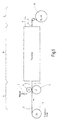
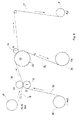
- Fig. 1 is a coating and drying process, which corresponds to the steps (a) and / or (e) of the inventive method shown.
- the first auxiliary carrier material 2 is unwound from a supply roll 1.
- An adhesive 3 is then applied to the first auxiliary carrier material 2, which is laminated by means of a roller pair 5, 6 as an adhesive layer 4 on the first auxiliary carrier material 2, whereby the coated first auxiliary carrier material 9 is obtained.
- the coated auxiliary carrier material is passed through a dryer 7 and finally wound up in section C onto a supply roll 8 for the coated first auxiliary carrier material 9.
- the preparation of the coated first auxiliary carrier material 9 and of the coated second auxiliary carrier material 10 is the same, whereby the materials used, such as the material of the auxiliary carrier material and the material of the adhesive layer, and the process conditions can vary.
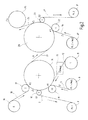
- the band-shaped substrate 12 is unwound from a supply roll 11, subjected to a corona treatment 13 and fed to the first laminating roller 14.
- the coated first auxiliary carrier material 9 is unwound from a supply roll 8 and guided to the laminating roller 14.
- the band-shaped carrier material and the coated first auxiliary carrier material are placed on the first laminating roller 14 by the application roller 15, the band-shaped carrier material 12 facing the first laminating roller 14 and the first adhesive layer 4 of the coated first auxiliary carrier material 9 facing the band-shaped carrier material 12 is.
- the band-shaped carrier material 12 coated with the first adhesive layer is guided on the first laminating roller to a second application roller 17.
- the thus obtained laminate precursor 21, which has the layer structure strip-shaped carrier material / first adhesive layer / Eindeckmaterial is now performed by the first laminating roller 14 to the second laminating roller 20, wherein now the Eindeckmaterial 18 of the second laminating roller faces.
- the second laminating roller 20 and the first laminating roller 14 are arranged parallel to each other at the same height.
- the third application roller 22 now adjoins the second laminating roller 20 in the web direction, with which the coated second auxiliary carrier material 10 is laminated onto the surface of the band-shaped carrier material 12 which does not carry the first adhesive layer.
- the second adhesive layer of the coated second auxiliary carrier material faces the band-shaped carrier material 12.
- the coated second auxiliary carrier material 10 is unwound from a supply roll 8 ".
- the second delamination roller 23 follows, with which the auxiliary carrier material 2" is delaminated from the second adhesive layer.
- the second adhesive layer remains on the band-shaped carrier material 12 and is carried on with it, while the delaminated second auxiliary carrier material 2 "is wound on a further supply roll 1" and the coating and drying process ( Fig.
- the laminate remaining on the second laminating roller has the structure of covering material / first adhesive layer / band-shaped carrier material / second adhesive layer and represents the finished band-shaped laminate, ie the final laminate product 24, which is wound onto a supply roll 25.
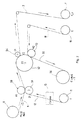
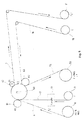
- Fig. 3 shows a second embodiment of the laminating step according to the invention, wherein only one laminating roller 31 is used.
- the coated first auxiliary carrier material 9 is unwound from a supply roll 8 and guided to the laminating roller 31.
- the band-shaped carrier material 12 is unwound from a supply roll 11 and guided to the laminating roller 31.
- the band-shaped carrier material 12 and the coated first auxiliary carrier material 9 is placed on the laminating roller 31 by means of the first application roller 32, wherein the coated first auxiliary carrier material 9 faces the laminating roller 31 and thereby the first adhesive layer of the laminating roller 31 faces away and the band-shaped carrier material 12 rests on the first adhesive layer 4.
- the second application roller 33 now adjoins, with which the coated second auxiliary carrier material 10 is laminated onto the surface of the band-shaped carrier material 12 which does not carry the first adhesive layer.
- the second adhesive layer of the coated second auxiliary carrier material 10 faces the band-shaped carrier material 12.
- the coated second auxiliary carrier material 10 is unwound from a supply roll 8 ".
- the first delamination roller 23 follows, with which the auxiliary carrier material 2" is delaminated from the second adhesive layer.
- the second adhesive layer remains on the band-shaped carrier material 12 and is carried on with it, while the delaminated second auxiliary carrier material 2 "is wound on a further supply roll 1" and the coating and drying process ( Fig. 1 ) can be supplied again.
- the laminate precursor having the structure of the first auxiliary carrier material / first adhesive layer / band-shaped carrier material / second adhesive layer / Eindeckmaterial is guided on the laminating roller 31 to a third application roller 35.
- the second delamination roller 36 now follows, with which the auxiliary carrier material 2 is delaminated from the first adhesive layer.
- the adhesive layer remains on the band-shaped carrier material 12 and is carried on with it, while the delaminated first auxiliary carrier material 2 is wound on a further supply roll 1 'and the coating and drying process ( Fig. 1 ) can be supplied again.
- the thus-obtained laminate 21 has the structure of the first adhesive layer / belt-shaped substrate / second adhesive layer / liner material, and constitutes the finished belt-shaped laminate, ie, the final laminate product 24, which is wound on a supply roll 25.
- Fig. 4 shows a third embodiment of the laminating process according to the invention.
- the band-shaped carrier material 12 which is unwound from its supply roll 11, first subjected to corona treatment and then laminated together with the coated first auxiliary carrier material 9 between a first pair of rollers 40, 41, so that the first adhesive layer between the first auxiliary carrier material 2 and the band-shaped substrate 1 is arranged.
- the coated second auxiliary carrier material 10 is laminated onto the uncoated side of the band-shaped carrier material 1 by means of a second roller pair 42, 43 following in the web direction, the second adhesive layer being arranged between the second auxiliary carrier material 2 "and the band-shaped carrier material 1.
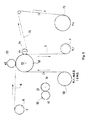
- Fig. 5 and 6 show a fourth embodiment of the laminating process according to the invention, which comprises two separate process sections.
- Fig. 5 showing the first process section is, by means of a pair of rollers 50, 51, the strip-shaped substrate 12, which is subjected to a corona treatment 13, laminated to the coated first auxiliary carrier material 9, in such a way that the first adhesive layer facing the band-shaped carrier material 12 .
- the adhesive layer in the upstream coating and drying process can be applied directly to the cover material (E & MaS), in which case the Eindeckmaterial instead of the auxiliary carrier material to the pair of rollers 50, 51 is supplied.
- the mounting material thus assumes the function of the auxiliary carrier material. There is therefore no need for a separate auxiliary carrier material.
- the resulting laminate precursor having the layer structure of ribbon-shaped carrier material / first adhesive layer / first auxiliary carrier material is then fed to a laminating roller 52, where by means of a lay-on roller 53, the coated second auxiliary carrier material 10 is laminated to the surface of the band-shaped carrier material 1, which does not carry the first adhesive layer, in such a way that the second adhesive layer facing the band-shaped carrier material 12.
- the laminating roller 52 is followed by a first delamination roller 54, with which the second auxiliary carrier material is delaminated by the second adhesive layer.
- the remaining laminate precursor 55 has the structure of first auxiliary carrier material / first adhesive layer / band-shaped carrier material / second adhesive layer and is wound onto a supply roll 56.
- the laminating roller 52, the platen roller 53, and the delaminating roller 56 are used to laminate the cap material 18 onto the second adhesive layer.
- the supply roll 56 is set with the laminate precursor 55 instead of the supply roll 8 used in the first process section. From there, the laminate precursor 55 is fed to the laminating roller 52.
- the coverslip material 18 supplied from the supply roll 19, which has been set in place of the supply roll 8 "for the coated second auxiliary carrier material 10 is laminated to the second adhesive layer 10.
- the first auxiliary carrier material 2 is delaminated
- the supply roll 1 ' has been replaced by the laminate pre-product supply roll and the resulting laminate has the structure of the first adhesive layer / belt-shaped substrate / second adhesive layer / cover material and constitutes the finished belt-shaped laminate, ie the laminate End product 24 is wound on a supply roll 25.
- Fig. 7 and 8th show a fifth embodiment of the lamination process according to the invention, which comprises two separate process sections.
- Fig. 7 showing the first process section is, by means of a pair of rollers 50, 51, the strip-shaped substrate 12, which is subjected to a corona treatment 13, laminated to the coated first auxiliary carrier material 9, in such a way that the first adhesive layer facing the band-shaped carrier material 12 ,
- the resulting laminate precursor having the layer structure of the strip-shaped carrier material / first adhesive layer / first auxiliary carrier material is then fed to a laminating roller 52, where the first auxiliary carrier material is delaminated by the first adhesive layer by means of a delamination roller 54.
- the obtained laminate precursor 55 has the construction cover material / first adhesive layer / band-shaped carrier material and is wound onto a supply roll 56.
- the laminating roller 52, the platen roller 53, and the delaminating roller 56 are utilized to laminate the coated second subcarrier material 10 to the surface of the belt-shaped substrate 12 which does not support the first adhesive layer.
- the coated first subcarrier material and the coated second subcarrier material have the same structure and the same composition.
- the supply roll 56 is set with the laminate precursor 55.
- the coated second auxiliary carrier material 10 (which in this case equals the coated first auxiliary carrier material 9) is laminated to the laminate precursor 55 by means of the roller pair 50, 51, in such a way that the second adhesive layer faces the band-shaped carrier material 12.
- the coated second auxiliary carrier material 10 is unwound from a supply roll 8 "which has been replaced by the supply roll 8. Since the coated second auxiliary carrier material 10 in this case equals the coated first auxiliary carrier material 9, replacement of the supply rolls is not necessary.
- the resulting laminate precursor with the layer structure second auxiliary carrier material / second adhesive layer / band-shaped carrier material / first adhesive layer / Eindeckmaterial is now the laminating roller 52 is supplied, where delaminated by the Delaminierwalze 54, the second auxiliary carrier material 2 "of the second adhesive layer and on the supply roll 1" , which was placed in place of the supply roll 1 ', which is here, however, because of the equality of the two coated auxiliary carrier materials is not required wound up.
- the resulting laminate has the construction of the first adhesive layer / tape-shaped substrate / second adhesive layer / liner material and provides the finished tape-like laminate, i. H. the final laminate product 24 which is wound on a supply roll 25.
- the Fig. 9 and 10 which represent a further embodiment of the laminating process, likewise represent two process sections.
- the band-shaped substrate 12, the corona treatment 13, and the coated first auxiliary carrier material 9 is placed on the laminating roller 60 by means of a support roller 61 in such a way that the band-shaped carrier material 12 faces the laminating roller 60 and the first adhesive layer faces the band-shaped carrier material 12.
- the delamination roller 62 now adjoins the laminating roller 60, with the aid of which the first auxiliary carrier material 2 is delaminated by the first adhesive layer.
- the obtained laminate precursor 55 has the construction cover material / first adhesive layer / band-shaped carrier material and is wound onto a supply roll 56.
- the laminating roller 60, the first platen roller 61, and the delaminating roller 62 are utilized to laminate the coated second auxiliary carrier material 10 to the surface of the belt-shaped substrate 12 which does not carry the first adhesive layer.
- the supply roll 56 is set with the laminate precursor 55. From there, the laminate precursor 55 is fed to the laminating roller 60.
- the coated second subcarrier material 10 supplied from the supply reel 8 ', which has been replaced by the supply reel 8 for the coated first subcarrier material 9 is laminated to the surface of the belt-shaped substrate 12 which does not support the first adhesive layer.
- the first auxiliary carrier material 2 is delaminated and wound onto the supply roll 1 ", the supply roll 1" being set at the location of the supply roll 1 '.
- the obtained laminate has the construction cover material / first adhesive layer / tape-shaped carrier material / second adhesive layer and represents the finished tape-shaped laminate, ie the final laminate product 24, which is wound onto a supply roll 25.
- Fig. 11 which shows a seventh embodiment of the invention, includes only one processing section.
- the band-shaped carrier material 12 is unwound from a supply roll 11, subjected to a corona treatment 13 and guided to the first laminating roller 70.
- the coated first auxiliary carrier material 9 is unwound from a supply roll 8 and guided to the laminating roller 70.
- the band-shaped carrier material 12 and the coated first auxiliary carrier material 9 are placed on the first laminating roller 70 by means of the first overlay roller 71, wherein the band-shaped carrier material 12 faces the first laminating roller 70 and the first adhesive layer of the coated first auxiliary carrier material 9 facing the band-shaped carrier material 12.
- the first delamination roller 72 now joins, with which the first auxiliary carrier material 2 is delaminated from the first adhesive layer.
- the first adhesive layer remains on the band-shaped carrier material 12 and is continued with it, while the delaminated first auxiliary carrier material 2 is wound onto a further supply roll 1 'and the coating and drying process ( Fig. 1 ) can be supplied again.
- the band-shaped carrier material 12 coated with the first adhesive layer is guided on the first laminating roller 70 to a second application roller 73.
- the thus obtained laminate precursor 21, which has the layer structure band-shaped carrier material / first adhesive layer / Eindeckmaterial is now guided by the first laminating roller 70 to the second laminating roller 74.
- the laminate precursor 21 is applied by means of a third application roller 75 on the third Auflegewalze 75 simultaneously supplied coated second auxiliary carrier material 10, wherein the coated second auxiliary carrier material 10 of the second laminating roller 74 faces and the second adhesive layer of the second laminating roller 74 and the band-shaped Carrier material 12 of the laminate precursor 21 faces.
- the second laminating roller 74 and the first laminating roller 70 are arranged parallel to one another but at different heights, namely laminating roller 70 above laminating roller 74.
- the second delamination roller 76 which delaminates the auxiliary carrier material 2 "from the second adhesive layer, now adjoins the second laminating roller 20.
- the second adhesive layer remains on the band-shaped carrier material 12 and is continued therewith, while the delaminated second auxiliary carrier material 2 "is wound on a further supply roll 1" and the coating and drying process ( Fig. 1 ) can be supplied again.
- the laminate remaining on the second laminating roller has the structure of covering material / first adhesive layer / band-shaped carrier material / second adhesive layer and represents the finished band-shaped laminate, ie the final laminate product 24, which is wound onto a supply roll 25.
- a 12 ⁇ m thick PET film is used as the carrier material.
- the PET film is first pretreated on both sides with corona.
- a first auxiliary carrier material is laminated to the carrier material by means of a pair of rollers.
- the auxiliary carrier material used is a double-sided siliconized MOPP film in a thickness of 100 ⁇ m, which has been coated on one side with an adhesive in the thickness of 100 g / m 2 .
- a second auxiliary carrier material which is identical to the first auxiliary carrier material, is laminated to the other side of the carrier material.
- the first auxiliary carrier material is delaminated from the first pressure-sensitive adhesive and then a covering material is laminated onto the delaminated side.
- a siliconized MOPP film with a thickness of 80 ⁇ m is used for the mounting material.
- the second auxiliary carrier material is now delaminated by means of a further pair of rollers, and at the same time the obtained laminate (double-sided adhesive tape) is wound onto a supply roll.
Landscapes
- Chemical & Material Sciences (AREA)
- Organic Chemistry (AREA)
- Laminated Bodies (AREA)
- Adhesive Tapes (AREA)
- Lining Or Joining Of Plastics Or The Like (AREA)
Claims (14)
- Procédé pour la fabrication d'un stratifié (24) en forme de bande, qui comprend un matériau support (12) en forme de bande et une première couche adhésive (4) sur au moins une des surfaces du matériau support (12) en forme de bande, le procédé comprenant les étapes consistant à(a) revêtir un premier matériau support auxiliaire (2) en forme de bande par au moins une première couche adhésive (4) et enrouler le premier matériau support auxiliaire (9) revêtu sur un premier rouleau (8) ;(b) dérouler le premier matériau support auxiliaire (9) en forme de bande, revêtu, du premier rouleau (8) et guider le premier matériau support auxiliaire (9) en forme de bande, revêtu, vers un premier cylindre de doublage (14) ;(c) stratifier le premier matériau support auxiliaire (9) en forme de bande, revêtu, sur le matériau support (1) en forme de bande de telle sorte que la première couche adhésive (4) est tournée vers le matériau support (12) en forme de bande ; et(d) délaminer le premier matériau support auxiliaire (2) de la première couche adhésive (4) ;(e) revêtir un deuxième matériau support auxiliaire (10) en forme de bande par au moins une deuxième couche adhésive et enrouler le deuxième matériau support auxiliaire (10) revêtu sur un deuxième rouleau (8") ;(f) dérouler le deuxième matériau support auxiliaire (10) en forme de bande, revêtu, du deuxième rouleau (8") et guider le deuxième matériau support auxiliaire (10) en forme de bande, revêtu, vers le premier cylindre de doublage (14) ou vers un deuxième cylindre de doublage (20) ;(g) stratifier le deuxième matériau support auxiliaire (10) en forme de bande, revêtu, sur le matériau support (12) en forme de bande de telle sorte que la deuxième couche adhésive est tournée vers le matériau support (12) en forme de bande ; et(h) délaminer le deuxième matériau support auxiliaire (2") de la deuxième couche adhésive.
- Procédé selon la revendication 1, caractérisé en ce que les étapes (a) et (e) sont réalisées indépendamment l'une de l'autre avant les étapes (b) à (f).
- Procédé selon la revendication 1 ou la revendication 2, caractérisé en ce que les étapes (c), (d), (g) et (h) sont réalisées sur un cylindre de doublage ou sur deux cylindres de doublage.
- Procédé selon l'une quelconque des revendications précédentes, caractérisé en ce qu'un matériau de couverture (18) en forme de bande est doublé sur la première couche adhésive (4) après l'étape (d).
- Procédé selon la revendication 4, caractérisé en ce que le matériau de couverture (19) en forme de bande est doublé sur la première couche adhésive (4) sur le premier cylindre de doublage (14).
- Procédé selon l'une quelconque des revendications 1 à 5, caractérisé en ce que- le matériau support (1) en forme de bande est appliqué au moyen d'un premier cylindre d'application (15) sur le premier cylindre de doublage (14) et le premier matériau support auxiliaire (9), revêtu, est appliqué sur le matériau support (12) en forme de bande, la première couche adhésive (4) étant tournée vers le matériau support (1) en forme de bande ;- le premier matériau support auxiliaire (2) est délaminé de la première couche adhésive (4) au moyen d'un premier dispositif (16) de décollement consécutif dans le sens de la bande ;- le matériau de couverture (18) est stratifié sur la première couche adhésive (4) au moyen d'un deuxième cylindre d'application (17) consécutif dans le sens de la bande ;- le matériau support (12) en forme de bande qui est stratifié sur une surface avec la couche adhésive (4) et, sur celle-ci, avec le matériau de couverture (17), est enlevé du premier cylindre de doublage (14) et appliqué sur un deuxième cylindre de doublage (20), le matériau de couverture (17) étant tourné vers le deuxième cylindre de doublage (20) ; et- le deuxième matériau support auxiliaire (10), revêtu, est appliqué sur le matériau support en forme de bande au moyen d'un troisième cylindre d'application (22) consécutif dans le sens de la bande, la deuxième couche adhésive étant tournée vers le matériau support (12) en forme de bande ; et- le deuxième matériau support auxiliaire (2") est délaminé de la deuxième couche adhésive au moyen d'un deuxième dispositif (23) de décollement consécutif dans le sens de la bande.
- Procédé selon l'une quelconque des revendications 1 à 5, caractérisé en ce que- le premier matériau support auxiliaire (9), revêtu, est appliqué au moyen d'un premier cylindre d'application (32) sur le premier cylindre de doublage (31) de telle sorte que la première couche adhésive (4) est à l'opposé du cylindre de doublage (31) et le matériau support (12) en forme de bande est appliqué sur la première couche adhésive (4) ;- le deuxième matériau support auxiliaire (10), revêtu, est appliqué sur le matériau support (12) en forme de bande au moyen d'un deuxième cylindre d'application (33) consécutif dans le sens de la bande, la deuxième couche adhésive étant tournée vers le matériau support (12) en forme de nappe ;- le deuxième matériau support auxiliaire (2") est délaminé de la deuxième couche adhésive au moyen d'un premier dispositif (34) de décollement consécutif dans le sens de la bande ;- le matériau de couverture (18) est stratifié sur la deuxième couche adhésive au moyen d'un troisième cylindre d'application (35) consécutif dans le sens de la bande ;- le premier matériau support auxiliaire (2) est délaminé de la première couche adhésive (4) au moyen d'un deuxième dispositif de décollement (36) consécutif dans le sens de la bande.
- Procédé selon l'une quelconque des revendications 1 à 5, caractérisé en ce que- le premier matériau support auxiliaire (9) revêtu et le matériau support (12) en forme de bande sont stratifiés entre une première paire de cylindres (40, 41) de manière telle que la première couche adhésive (4) est disposée entre le premier matériau support auxiliaire (2) et le matériau support (12) en forme de bande ;- le deuxième matériau support auxiliaire (10) revêtu est stratifié sur la surface non revêtue du matériau support (1) en forme de bande au moyen d'une deuxième paire de cylindres (42, 43) consécutive dans le sens de la bande, la deuxième couche adhésive étant disposée entre le deuxième matériau support auxiliaire (2") et le matériau support (1) en forme de bande ;- un des deux matériaux support auxiliaires (2, 2") est délaminé au moyen d'un premier dispositif de décollement (44, 45) consécutif dans le sens de la bande ;- le matériau de couverture (18) est stratifié sur la première ou la deuxième couche adhésive libre au moyen d'une troisième paire de cylindres (46, 47) consécutive dans le sens de la bande ; et- le matériau support auxiliaire (2", 2) qui reste est délaminé au moyen d'un deuxième dispositif de décollement (48, 49) consécutif dans le sens de la bande.
- Procédé selon l'une quelconque des revendications 1 à 5, caractérisé en ce que- dans une première section de procédé, on prépare un précurseur (55) de stratifié présentant l'ordre des couches premier matériau support auxiliaire/première couche adhésive/matériau support en forme de bande/deuxième couche adhésive et le précurseur (55) de stratifié est enroulé sur un rouleau (56) ; et- dans une deuxième étape de procédé, on déroule le précurseur (55) de stratifié du rouleau (56) et on stratifié le matériau de couverture (18) sur la deuxième couche adhésive avec obtention du produit fini (24) stratifié.
- Procédé selon l'une quelconque des revendications 1 à 5, caractérisé en ce que- dans une première section de procédé, on prépare un précurseur (55) de stratifié présentant l'ordre des couches matériau support en forme de bande/deuxième couche adhésive/matériau de couverture et le précurseur (55) de stratifié est enroulé sur un cylindre (56) ; et- dans une deuxième étape de procédé, on déroule le précurseur (55) de stratifié du cylindre (56) et on stratifié, sur la surface non revêtue du matériau support (12) en forme de bande, le premier matériau support auxiliaire (9) revêtu et on délamine la première couche adhésive (4) dans un dispositif de décollement consécutif dans le sens de la bande avec obtention du produit fini (24) stratifié.
- Procédé selon l'une quelconque des revendications précédentes, caractérisé en ce que le matériau support (12) en forme de bande est soumis à un traitement par corona (13) avant sa stratification.
- Procédé selon l'une quelconque des revendications précédentes, caractérisé en ce que la première couche adhésive (4) et la deuxième couche adhésive peuvent être identiques ou différentes.
- Procédé selon l'une quelconque des revendications précédentes, caractérisé en ce que le premier matériau support auxiliaire (2) et le deuxième matériau support auxiliaire (2") peuvent être identiques ou différents.
- Procédé selon l'une quelconque des revendications précédentes, caractérisé en ce que le premier est/ou le deuxième matériau support auxiliaire (2, 10) sont conçus de manière telle qu'ils peuvent être utilisés plusieurs fois, de préférence 5 à 10 fois, de manière particulièrement préférée 7 à 8 fois, pour le procédé.
Applications Claiming Priority (2)
| Application Number | Priority Date | Filing Date | Title |
|---|---|---|---|
| DE102008038595A DE102008038595A1 (de) | 2008-08-21 | 2008-08-21 | Verfahren zur Herstellung von bandförmigen Laminaten |
| PCT/EP2009/060095 WO2010020537A2 (fr) | 2008-08-21 | 2009-08-04 | Procédé de fabrication de stratifiés en forme de bandes |
Publications (2)
| Publication Number | Publication Date |
|---|---|
| EP2283098A2 EP2283098A2 (fr) | 2011-02-16 |
| EP2283098B1 true EP2283098B1 (fr) | 2016-09-28 |
Family
ID=41557453
Family Applications (1)
| Application Number | Title | Priority Date | Filing Date |
|---|---|---|---|
| EP09781472.7A Active EP2283098B1 (fr) | 2008-08-21 | 2009-08-04 | Procédé de fabrication de stratifiés en forme de bandes |
Country Status (9)
| Country | Link |
|---|---|
| US (1) | US20110094667A1 (fr) |
| EP (1) | EP2283098B1 (fr) |
| JP (1) | JP5620380B2 (fr) |
| KR (1) | KR101633452B1 (fr) |
| CN (2) | CN102057003A (fr) |
| CA (1) | CA2726255A1 (fr) |
| DE (1) | DE102008038595A1 (fr) |
| ES (1) | ES2605977T3 (fr) |
| WO (1) | WO2010020537A2 (fr) |
Families Citing this family (11)
| Publication number | Priority date | Publication date | Assignee | Title |
|---|---|---|---|---|
| US20160199316A1 (en) | 2013-06-14 | 2016-07-14 | Tesa Labtec Gmbh | Three-layer transdermal therapy system (tts) |
| WO2014198422A1 (fr) | 2013-06-14 | 2014-12-18 | Tesa Labtec Gmbh | Système thérapeutique transdermique (tts) doté de rotigotine |
| BR112016009986B1 (pt) | 2013-11-07 | 2020-12-29 | Bsn Medical Gmbh | emplastro médico e seu uso |
| DE102016202424A1 (de) * | 2016-02-17 | 2017-08-17 | Tesa Se | Verfahren zur Herstellung eines Klebebandes mittels Plasmalamination |
| US10442648B2 (en) * | 2017-05-24 | 2019-10-15 | Sandar Industries, Inc. | Dispenser apparatus and method of use for laminating and dispensing transfer tape in a paper web turn-up system |
| US20190031923A1 (en) | 2017-07-26 | 2019-01-31 | 3M Innovative Properties Company | Backing for adhesive tape with thermal resistance |
| CN111344371B (zh) * | 2017-09-18 | 2021-11-30 | 美商百美贴有限公司 | 用于形成和使用胶带的系统和方法 |
| CN108165185A (zh) * | 2017-12-28 | 2018-06-15 | 振德医疗用品股份有限公司 | 一种双面胶复合机构及其复合方法 |
| DE102020006970B4 (de) | 2020-11-07 | 2022-07-14 | Lohmann Gmbh & Co. Kg | Dekaschiervorrichtung zur Herstellung doppelseitiger Klebebänder |
| CN114506101A (zh) * | 2020-11-17 | 2022-05-17 | 臻鼎科技股份有限公司 | 聚酰亚胺厚膜及其制备方法 |
| CN114407495A (zh) * | 2022-03-17 | 2022-04-29 | 广州通泽机械有限公司 | 一种基于中间层双面涂布的无溶剂三合一复合设备 |
Citations (4)
| Publication number | Priority date | Publication date | Assignee | Title |
|---|---|---|---|---|
| JPH07224261A (ja) | 1994-02-08 | 1995-08-22 | Sekisui Chem Co Ltd | 両面粘着テープの製造方法 |
| JPH07324182A (ja) | 1994-05-31 | 1995-12-12 | Sekisui Chem Co Ltd | 両面粘着テープの製造方法 |
| EP1053793A1 (fr) * | 1999-05-17 | 2000-11-22 | Argotec Lacksysteme GmbH | Procédé pour l'application d' une peinture et d'un décor sur un objet et procédé et dispositif pour appliquer une peinture, un décor et un adhésif sur un film |
| JP2006002006A (ja) | 2004-06-16 | 2006-01-05 | Namu:Kk | 粘着テープ製造方法および粘着テープ |
Family Cites Families (23)
| Publication number | Priority date | Publication date | Assignee | Title |
|---|---|---|---|---|
| US3161554A (en) * | 1958-11-05 | 1964-12-15 | Johnson & Johnson | Adhesive tape |
| US3415706A (en) * | 1965-06-16 | 1968-12-10 | Vitta Corp | Machines for tape transfer |
| US3741786A (en) * | 1971-05-28 | 1973-06-26 | Avery Products Corp | Transfer tape having non-contiguous pressure sensitive adhesive patterns |
| US3876454A (en) * | 1973-03-28 | 1975-04-08 | Minnesota Mining & Mfg | Linerless pressure-sensitive adhesive tape having elastomeric backing |
| CA1106993A (fr) * | 1976-05-26 | 1981-08-11 | Martin M. Sackoff | Methode de fabrication d'un article lamellaire a enduit collant tenant a la pression |
| JPH0543850A (ja) * | 1991-08-21 | 1993-02-23 | Sekisui Chem Co Ltd | 両面粘着テープの製造方法 |
| CA2076278A1 (fr) * | 1991-08-22 | 1993-02-23 | Joseph T. Braun | Ruban auto-adhesif de silicone durcissable |
| DE4136706A1 (de) * | 1991-11-07 | 1993-05-13 | Hoechst Ag | Vorrichtung und verfahren zum herstellen einer anzahl von zwei- oder mehrlagigen einzelverbunden |
| DE4222334A1 (de) | 1992-07-08 | 1994-01-13 | Beiersdorf Ag | Schmelzhaftkleber für Medical-Produkte |
| JP3539742B2 (ja) * | 1992-08-03 | 2004-07-07 | ソニーケミカル株式会社 | 粘着剤 |
| JPH06145608A (ja) * | 1992-11-05 | 1994-05-27 | Sekisui Chem Co Ltd | 粘着性発泡シートの製造方法 |
| JPH06228513A (ja) * | 1993-02-05 | 1994-08-16 | Sekisui Chem Co Ltd | 両面粘着テープおよびその製造方法 |
| JPH0711208A (ja) * | 1993-06-23 | 1995-01-13 | Sekisui Chem Co Ltd | 印刷が施された粘着テープの製造方法 |
| US5397634A (en) * | 1993-07-22 | 1995-03-14 | Rexham Graphics Incorporated | Transferable protective cover layers |
| JPH0948958A (ja) * | 1995-08-07 | 1997-02-18 | Sekisui Chem Co Ltd | 両面粘着テープの製造方法 |
| DE19725948B4 (de) * | 1997-06-19 | 2007-04-26 | Roosen, Andreas, Prof. Dr.-Ing. | Verfahren zur Verbindung keramischer Grünkörper unter Verwendung eines Klebebandes |
| JP2000169800A (ja) * | 1998-12-11 | 2000-06-20 | Sekisui Chem Co Ltd | 両面粘着シートの製造方法 |
| US6521309B1 (en) * | 1999-11-11 | 2003-02-18 | Tyco Adhesives Lp | Double-sided single-liner pressure-sensitive adhesive tape |
| CA2317034C (fr) * | 2000-08-29 | 2007-03-13 | Custom Art Concepts Limited | Methode de lamination d'images pour mention elogieuse, commemoration, information ou prix |
| DE10147036A1 (de) | 2001-09-25 | 2003-04-30 | Tesa Ag | Verfahren zum Delaminieren einer zumindest einschichtigen ersten Bahn von einem Laminat und zum anschließenden Laminieren einer zumindest einschichtigen weiten Bahn auf das Restlaminat |
| US7709070B2 (en) * | 2001-12-20 | 2010-05-04 | The Procter & Gamble Company | Articles and methods for applying color on surfaces |
| US6866928B2 (en) * | 2002-04-08 | 2005-03-15 | 3M Innovative Properties Company | Cleanly removable tapes and methods for the manufacture thereof |
| US7645355B2 (en) * | 2006-11-17 | 2010-01-12 | 3M Innovative Properties Company | Method of making a microsphere transfer adhesive |
-
2008
- 2008-08-21 DE DE102008038595A patent/DE102008038595A1/de not_active Withdrawn
-
2009
- 2009-08-04 EP EP09781472.7A patent/EP2283098B1/fr active Active
- 2009-08-04 KR KR1020107027823A patent/KR101633452B1/ko active Active
- 2009-08-04 US US12/993,757 patent/US20110094667A1/en not_active Abandoned
- 2009-08-04 ES ES09781472.7T patent/ES2605977T3/es active Active
- 2009-08-04 CN CN2009801217427A patent/CN102057003A/zh active Pending
- 2009-08-04 WO PCT/EP2009/060095 patent/WO2010020537A2/fr not_active Ceased
- 2009-08-04 CA CA2726255A patent/CA2726255A1/fr not_active Abandoned
- 2009-08-04 JP JP2011523383A patent/JP5620380B2/ja not_active Expired - Fee Related
- 2009-08-04 CN CN201410491520.7A patent/CN104312468B/zh active Active
Patent Citations (4)
| Publication number | Priority date | Publication date | Assignee | Title |
|---|---|---|---|---|
| JPH07224261A (ja) | 1994-02-08 | 1995-08-22 | Sekisui Chem Co Ltd | 両面粘着テープの製造方法 |
| JPH07324182A (ja) | 1994-05-31 | 1995-12-12 | Sekisui Chem Co Ltd | 両面粘着テープの製造方法 |
| EP1053793A1 (fr) * | 1999-05-17 | 2000-11-22 | Argotec Lacksysteme GmbH | Procédé pour l'application d' une peinture et d'un décor sur un objet et procédé et dispositif pour appliquer une peinture, un décor et un adhésif sur un film |
| JP2006002006A (ja) | 2004-06-16 | 2006-01-05 | Namu:Kk | 粘着テープ製造方法および粘着テープ |
Also Published As
| Publication number | Publication date |
|---|---|
| JP5620380B2 (ja) | 2014-11-05 |
| WO2010020537A2 (fr) | 2010-02-25 |
| CA2726255A1 (fr) | 2010-02-25 |
| CN104312468A (zh) | 2015-01-28 |
| CN104312468B (zh) | 2019-08-16 |
| ES2605977T3 (es) | 2017-03-17 |
| EP2283098A2 (fr) | 2011-02-16 |
| KR101633452B1 (ko) | 2016-06-24 |
| WO2010020537A3 (fr) | 2010-04-15 |
| US20110094667A1 (en) | 2011-04-28 |
| DE102008038595A1 (de) | 2010-02-25 |
| KR20110044731A (ko) | 2011-04-29 |
| CN102057003A (zh) | 2011-05-11 |
| JP2012500314A (ja) | 2012-01-05 |
Similar Documents
| Publication | Publication Date | Title |
|---|---|---|
| EP2283098B1 (fr) | Procédé de fabrication de stratifiés en forme de bandes | |
| DE69917565T2 (de) | Verbesserter Sicherheitsfaden und Verfahren und Vorrichtung zum Aufbringen desselben auf ein Substrat | |
| DE69900817T2 (de) | Verbindungsstreifen, verbindungsverfahren und einheit, die diesen verbindungs-streifen beinhaltet | |
| EP2603567B1 (fr) | Procédé pour produire un ruban adhésif comportant un matériau de séparation saillant | |
| EP3113947A1 (fr) | Matériau en rouleau pour une couche submicrométrique ou pourvu d'une couche submicrométrique sur un support flexible et utilisation dudit matériau | |
| DE102011080760A1 (de) | Verfahren zur Herstellung eines Klebebands mit überstehendem Liner | |
| EP1429984B1 (fr) | Ruban adhesif con u pour le remplacement automatique de rouleaux | |
| EP3404156B1 (fr) | Procédé de fabrication pour une bande d'étanchéité | |
| EP1655079A2 (fr) | Procédé de revêtement de substrats en bande avec au moins deux colles, bande adhésive ainsi obtenue et son utilisation | |
| EP1278632A1 (fr) | Procede de fabrication d'un produit coextrude a plusieurs couches et structure en feuille obtenue selon ledit procede | |
| DE2527942A1 (de) | Verfahren und vorrichtung zur herstellung von selbstklebenden abdeck- und isolierfolien | |
| EP1436220B1 (fr) | Bande adhesive pour adherence continue sur une calandre | |
| DE60225882T2 (de) | Aufzeichnungspapierrolle | |
| WO2023217318A1 (fr) | Procédé de revêtement d'une bande de film électroconductrice avec un promoteur d'adhérence électroconducteur | |
| EP1018418B1 (fr) | Procédé pour la fabrication d'une bande transporteuse en élastomère | |
| DE102006018499A1 (de) | Verfahren zur Herstellung eines Klebebands | |
| DE10147036A1 (de) | Verfahren zum Delaminieren einer zumindest einschichtigen ersten Bahn von einem Laminat und zum anschließenden Laminieren einer zumindest einschichtigen weiten Bahn auf das Restlaminat | |
| DE102020006970B4 (de) | Dekaschiervorrichtung zur Herstellung doppelseitiger Klebebänder | |
| EP2821241A1 (fr) | Procédé de fabrication d'un cylindre porte-plaque | |
| DE10031909A1 (de) | Trennbare Schicht Klebstoff, Schichtstoff und Verfahren zu seiner Herstellung | |
| DE102020006911B4 (de) | Verfahren und Vorrichtung zum Zwischenspeichern von flexiblen Flachteilen | |
| EP3616897B1 (fr) | Procédé d'introduction d'un rail de matériau dans un dispositif égrugeoir | |
| EP1323543B1 (fr) | Procédé pour appliquer des éléments de sécurité minces sur des substrats sensibles à la chaleur et produits intermédiaires ainsi obtenus | |
| EP3323606B1 (fr) | Composite de séparation | |
| DE102010039299A1 (de) | Verfahren zur Herstellung eines Klebebands mit überstehendem Liner |
Legal Events
| Date | Code | Title | Description |
|---|---|---|---|
| PUAI | Public reference made under article 153(3) epc to a published international application that has entered the european phase |
Free format text: ORIGINAL CODE: 0009012 |
|
| 17P | Request for examination filed |
Effective date: 20101216 |
|
| AK | Designated contracting states |
Kind code of ref document: A2 Designated state(s): AT BE BG CH CY CZ DE DK EE ES FI FR GB GR HR HU IE IS IT LI LT LU LV MC MK MT NL NO PL PT RO SE SI SK SM TR |
|
| AX | Request for extension of the european patent |
Extension state: AL BA RS |
|
| DAX | Request for extension of the european patent (deleted) | ||
| 17Q | First examination report despatched |
Effective date: 20140923 |
|
| RAP1 | Party data changed (applicant data changed or rights of an application transferred) |
Owner name: TESA SE |
|
| GRAP | Despatch of communication of intention to grant a patent |
Free format text: ORIGINAL CODE: EPIDOSNIGR1 |
|
| INTG | Intention to grant announced |
Effective date: 20160331 |
|
| GRAS | Grant fee paid |
Free format text: ORIGINAL CODE: EPIDOSNIGR3 |
|
| RIN1 | Information on inventor provided before grant (corrected) |
Inventor name: EVERS, MICHAEL Inventor name: SCHULZE, RAINER Inventor name: CZERWONATIS, NILS |
|
| GRAA | (expected) grant |
Free format text: ORIGINAL CODE: 0009210 |
|
| AK | Designated contracting states |
Kind code of ref document: B1 Designated state(s): AT BE BG CH CY CZ DE DK EE ES FI FR GB GR HR HU IE IS IT LI LT LU LV MC MK MT NL NO PL PT RO SE SI SK SM TR |
|
| REG | Reference to a national code |
Ref country code: GB Ref legal event code: FG4D Free format text: NOT ENGLISH |
|
| REG | Reference to a national code |
Ref country code: CH Ref legal event code: EP |
|
| REG | Reference to a national code |
Ref country code: AT Ref legal event code: REF Ref document number: 832743 Country of ref document: AT Kind code of ref document: T Effective date: 20161015 |
|
| REG | Reference to a national code |
Ref country code: IE Ref legal event code: FG4D Free format text: LANGUAGE OF EP DOCUMENT: GERMAN |
|
| REG | Reference to a national code |
Ref country code: DE Ref legal event code: R096 Ref document number: 502009013151 Country of ref document: DE |
|
| REG | Reference to a national code |
Ref country code: LT Ref legal event code: MG4D |
|
| PG25 | Lapsed in a contracting state [announced via postgrant information from national office to epo] |
Ref country code: LT Free format text: LAPSE BECAUSE OF FAILURE TO SUBMIT A TRANSLATION OF THE DESCRIPTION OR TO PAY THE FEE WITHIN THE PRESCRIBED TIME-LIMIT Effective date: 20160928 Ref country code: FI Free format text: LAPSE BECAUSE OF FAILURE TO SUBMIT A TRANSLATION OF THE DESCRIPTION OR TO PAY THE FEE WITHIN THE PRESCRIBED TIME-LIMIT Effective date: 20160928 Ref country code: HR Free format text: LAPSE BECAUSE OF FAILURE TO SUBMIT A TRANSLATION OF THE DESCRIPTION OR TO PAY THE FEE WITHIN THE PRESCRIBED TIME-LIMIT Effective date: 20160928 Ref country code: NO Free format text: LAPSE BECAUSE OF FAILURE TO SUBMIT A TRANSLATION OF THE DESCRIPTION OR TO PAY THE FEE WITHIN THE PRESCRIBED TIME-LIMIT Effective date: 20161228 |
|
| REG | Reference to a national code |
Ref country code: NL Ref legal event code: MP Effective date: 20160928 |
|
| PG25 | Lapsed in a contracting state [announced via postgrant information from national office to epo] |
Ref country code: GR Free format text: LAPSE BECAUSE OF FAILURE TO SUBMIT A TRANSLATION OF THE DESCRIPTION OR TO PAY THE FEE WITHIN THE PRESCRIBED TIME-LIMIT Effective date: 20161229 Ref country code: NL Free format text: LAPSE BECAUSE OF FAILURE TO SUBMIT A TRANSLATION OF THE DESCRIPTION OR TO PAY THE FEE WITHIN THE PRESCRIBED TIME-LIMIT Effective date: 20160928 Ref country code: SE Free format text: LAPSE BECAUSE OF FAILURE TO SUBMIT A TRANSLATION OF THE DESCRIPTION OR TO PAY THE FEE WITHIN THE PRESCRIBED TIME-LIMIT Effective date: 20160928 Ref country code: LV Free format text: LAPSE BECAUSE OF FAILURE TO SUBMIT A TRANSLATION OF THE DESCRIPTION OR TO PAY THE FEE WITHIN THE PRESCRIBED TIME-LIMIT Effective date: 20160928 |
|
| REG | Reference to a national code |
Ref country code: ES Ref legal event code: FG2A Ref document number: 2605977 Country of ref document: ES Kind code of ref document: T3 Effective date: 20170317 |
|
| PG25 | Lapsed in a contracting state [announced via postgrant information from national office to epo] |
Ref country code: EE Free format text: LAPSE BECAUSE OF FAILURE TO SUBMIT A TRANSLATION OF THE DESCRIPTION OR TO PAY THE FEE WITHIN THE PRESCRIBED TIME-LIMIT Effective date: 20160928 Ref country code: RO Free format text: LAPSE BECAUSE OF FAILURE TO SUBMIT A TRANSLATION OF THE DESCRIPTION OR TO PAY THE FEE WITHIN THE PRESCRIBED TIME-LIMIT Effective date: 20160928 |
|
| PG25 | Lapsed in a contracting state [announced via postgrant information from national office to epo] |
Ref country code: PL Free format text: LAPSE BECAUSE OF FAILURE TO SUBMIT A TRANSLATION OF THE DESCRIPTION OR TO PAY THE FEE WITHIN THE PRESCRIBED TIME-LIMIT Effective date: 20160928 Ref country code: SM Free format text: LAPSE BECAUSE OF FAILURE TO SUBMIT A TRANSLATION OF THE DESCRIPTION OR TO PAY THE FEE WITHIN THE PRESCRIBED TIME-LIMIT Effective date: 20160928 Ref country code: PT Free format text: LAPSE BECAUSE OF FAILURE TO SUBMIT A TRANSLATION OF THE DESCRIPTION OR TO PAY THE FEE WITHIN THE PRESCRIBED TIME-LIMIT Effective date: 20170130 Ref country code: CZ Free format text: LAPSE BECAUSE OF FAILURE TO SUBMIT A TRANSLATION OF THE DESCRIPTION OR TO PAY THE FEE WITHIN THE PRESCRIBED TIME-LIMIT Effective date: 20160928 Ref country code: BG Free format text: LAPSE BECAUSE OF FAILURE TO SUBMIT A TRANSLATION OF THE DESCRIPTION OR TO PAY THE FEE WITHIN THE PRESCRIBED TIME-LIMIT Effective date: 20161228 Ref country code: IS Free format text: LAPSE BECAUSE OF FAILURE TO SUBMIT A TRANSLATION OF THE DESCRIPTION OR TO PAY THE FEE WITHIN THE PRESCRIBED TIME-LIMIT Effective date: 20170128 Ref country code: SK Free format text: LAPSE BECAUSE OF FAILURE TO SUBMIT A TRANSLATION OF THE DESCRIPTION OR TO PAY THE FEE WITHIN THE PRESCRIBED TIME-LIMIT Effective date: 20160928 |
|
| REG | Reference to a national code |
Ref country code: DE Ref legal event code: R026 Ref document number: 502009013151 Country of ref document: DE |
|
| PLBI | Opposition filed |
Free format text: ORIGINAL CODE: 0009260 |
|
| 26 | Opposition filed |
Opponent name: CERTOPLAST TECHNISCHE KLEBEBAENDER GMBH Effective date: 20170614 |
|
| PG25 | Lapsed in a contracting state [announced via postgrant information from national office to epo] |
Ref country code: DK Free format text: LAPSE BECAUSE OF FAILURE TO SUBMIT A TRANSLATION OF THE DESCRIPTION OR TO PAY THE FEE WITHIN THE PRESCRIBED TIME-LIMIT Effective date: 20160928 |
|
| PLAX | Notice of opposition and request to file observation + time limit sent |
Free format text: ORIGINAL CODE: EPIDOSNOBS2 |
|
| REG | Reference to a national code |
Ref country code: FR Ref legal event code: PLFP Year of fee payment: 9 |
|
| RIN2 | Information on inventor provided after grant (corrected) |
Inventor name: CZERWONATIS, NIELS Inventor name: EVERS, MICHAEL Inventor name: SCHULZE, RAINER |
|
| REG | Reference to a national code |
Ref country code: DE Ref legal event code: R079 Ref document number: 502009013151 Country of ref document: DE Free format text: PREVIOUS MAIN CLASS: C09J0007020000 Ipc: C09J0007200000 |
|
| PG25 | Lapsed in a contracting state [announced via postgrant information from national office to epo] |
Ref country code: SI Free format text: LAPSE BECAUSE OF FAILURE TO SUBMIT A TRANSLATION OF THE DESCRIPTION OR TO PAY THE FEE WITHIN THE PRESCRIBED TIME-LIMIT Effective date: 20160928 |
|
| PLBB | Reply of patent proprietor to notice(s) of opposition received |
Free format text: ORIGINAL CODE: EPIDOSNOBS3 |
|
| REG | Reference to a national code |
Ref country code: CH Ref legal event code: PL |
|
| PG25 | Lapsed in a contracting state [announced via postgrant information from national office to epo] |
Ref country code: MC Free format text: LAPSE BECAUSE OF FAILURE TO SUBMIT A TRANSLATION OF THE DESCRIPTION OR TO PAY THE FEE WITHIN THE PRESCRIBED TIME-LIMIT Effective date: 20160928 |
|
| PG25 | Lapsed in a contracting state [announced via postgrant information from national office to epo] |
Ref country code: CH Free format text: LAPSE BECAUSE OF NON-PAYMENT OF DUE FEES Effective date: 20170831 Ref country code: LI Free format text: LAPSE BECAUSE OF NON-PAYMENT OF DUE FEES Effective date: 20170831 |
|
| REG | Reference to a national code |
Ref country code: BE Ref legal event code: MM Effective date: 20170831 |
|
| REG | Reference to a national code |
Ref country code: IE Ref legal event code: MM4A |
|
| PG25 | Lapsed in a contracting state [announced via postgrant information from national office to epo] |
Ref country code: LU Free format text: LAPSE BECAUSE OF NON-PAYMENT OF DUE FEES Effective date: 20170804 |
|
| PG25 | Lapsed in a contracting state [announced via postgrant information from national office to epo] |
Ref country code: IE Free format text: LAPSE BECAUSE OF NON-PAYMENT OF DUE FEES Effective date: 20170804 |
|
| REG | Reference to a national code |
Ref country code: FR Ref legal event code: PLFP Year of fee payment: 10 |
|
| PG25 | Lapsed in a contracting state [announced via postgrant information from national office to epo] |
Ref country code: BE Free format text: LAPSE BECAUSE OF NON-PAYMENT OF DUE FEES Effective date: 20170831 |
|
| PG25 | Lapsed in a contracting state [announced via postgrant information from national office to epo] |
Ref country code: MT Free format text: LAPSE BECAUSE OF FAILURE TO SUBMIT A TRANSLATION OF THE DESCRIPTION OR TO PAY THE FEE WITHIN THE PRESCRIBED TIME-LIMIT Effective date: 20160928 |
|
| REG | Reference to a national code |
Ref country code: AT Ref legal event code: MM01 Ref document number: 832743 Country of ref document: AT Kind code of ref document: T Effective date: 20170804 |
|
| REG | Reference to a national code |
Ref country code: DE Ref legal event code: R100 Ref document number: 502009013151 Country of ref document: DE |
|
| PG25 | Lapsed in a contracting state [announced via postgrant information from national office to epo] |
Ref country code: AT Free format text: LAPSE BECAUSE OF NON-PAYMENT OF DUE FEES Effective date: 20170804 |
|
| PLCK | Communication despatched that opposition was rejected |
Free format text: ORIGINAL CODE: EPIDOSNREJ1 |
|
| STAA | Information on the status of an ep patent application or granted ep patent |
Free format text: STATUS: THE PATENT HAS BEEN GRANTED |
|
| PLBN | Opposition rejected |
Free format text: ORIGINAL CODE: 0009273 |
|
| STAA | Information on the status of an ep patent application or granted ep patent |
Free format text: STATUS: OPPOSITION REJECTED |
|
| 27O | Opposition rejected |
Effective date: 20181114 |
|
| PG25 | Lapsed in a contracting state [announced via postgrant information from national office to epo] |
Ref country code: HU Free format text: LAPSE BECAUSE OF FAILURE TO SUBMIT A TRANSLATION OF THE DESCRIPTION OR TO PAY THE FEE WITHIN THE PRESCRIBED TIME-LIMIT; INVALID AB INITIO Effective date: 20090804 |
|
| PG25 | Lapsed in a contracting state [announced via postgrant information from national office to epo] |
Ref country code: CY Free format text: LAPSE BECAUSE OF NON-PAYMENT OF DUE FEES Effective date: 20160928 |
|
| PG25 | Lapsed in a contracting state [announced via postgrant information from national office to epo] |
Ref country code: MK Free format text: LAPSE BECAUSE OF FAILURE TO SUBMIT A TRANSLATION OF THE DESCRIPTION OR TO PAY THE FEE WITHIN THE PRESCRIBED TIME-LIMIT Effective date: 20160928 |
|
| PG25 | Lapsed in a contracting state [announced via postgrant information from national office to epo] |
Ref country code: TR Free format text: LAPSE BECAUSE OF FAILURE TO SUBMIT A TRANSLATION OF THE DESCRIPTION OR TO PAY THE FEE WITHIN THE PRESCRIBED TIME-LIMIT Effective date: 20160928 |
|
| P01 | Opt-out of the competence of the unified patent court (upc) registered |
Effective date: 20230526 |
|
| PGFP | Annual fee paid to national office [announced via postgrant information from national office to epo] |
Ref country code: ES Payment date: 20250925 Year of fee payment: 17 |
|
| PGFP | Annual fee paid to national office [announced via postgrant information from national office to epo] |
Ref country code: DE Payment date: 20250820 Year of fee payment: 17 |
|
| PGFP | Annual fee paid to national office [announced via postgrant information from national office to epo] |
Ref country code: IT Payment date: 20250825 Year of fee payment: 17 |
|
| PGFP | Annual fee paid to national office [announced via postgrant information from national office to epo] |
Ref country code: GB Payment date: 20250820 Year of fee payment: 17 |
|
| PGFP | Annual fee paid to national office [announced via postgrant information from national office to epo] |
Ref country code: FR Payment date: 20250829 Year of fee payment: 17 |