EP2284096A1 - Emballage avec une ligne de faible résistance - Google Patents
Emballage avec une ligne de faible résistance Download PDFInfo
- Publication number
- EP2284096A1 EP2284096A1 EP10185377A EP10185377A EP2284096A1 EP 2284096 A1 EP2284096 A1 EP 2284096A1 EP 10185377 A EP10185377 A EP 10185377A EP 10185377 A EP10185377 A EP 10185377A EP 2284096 A1 EP2284096 A1 EP 2284096A1
- Authority
- EP
- European Patent Office
- Prior art keywords
- polypropylene
- polyester
- opa
- opp
- polyamide
- Prior art date
- Legal status (The legal status is an assumption and is not a legal conclusion. Google has not performed a legal analysis and makes no representation as to the accuracy of the status listed.)
- Withdrawn
Links
- 230000003313 weakening effect Effects 0.000 title claims abstract description 84
- 238000004806 packaging method and process Methods 0.000 title claims abstract description 55
- 238000007789 sealing Methods 0.000 claims abstract description 23
- 239000004743 Polypropylene Substances 0.000 claims description 143
- 229920001155 polypropylene Polymers 0.000 claims description 135
- 229920000728 polyester Polymers 0.000 claims description 131
- 239000004698 Polyethylene Substances 0.000 claims description 82
- 239000004952 Polyamide Substances 0.000 claims description 62
- 229920002647 polyamide Polymers 0.000 claims description 61
- 229920000573 polyethylene Polymers 0.000 claims description 60
- -1 polypropylene Polymers 0.000 claims description 42
- 239000004411 aluminium Substances 0.000 claims description 26
- XAGFODPZIPBFFR-UHFFFAOYSA-N aluminium Chemical compound [Al] XAGFODPZIPBFFR-UHFFFAOYSA-N 0.000 claims description 26
- 229910052782 aluminium Inorganic materials 0.000 claims description 26
- 238000011282 treatment Methods 0.000 claims description 20
- 230000000977 initiatory effect Effects 0.000 claims description 14
- 230000005855 radiation Effects 0.000 claims description 8
- 239000005025 cast polypropylene Substances 0.000 claims description 5
- 239000011159 matrix material Substances 0.000 claims description 3
- 239000010410 layer Substances 0.000 description 53
- 239000000047 product Substances 0.000 description 32
- 229920000642 polymer Polymers 0.000 description 8
- 239000011449 brick Substances 0.000 description 4
- 238000001125 extrusion Methods 0.000 description 4
- 239000003566 sealing material Substances 0.000 description 4
- 238000007639 printing Methods 0.000 description 3
- 239000000853 adhesive Substances 0.000 description 2
- 230000001070 adhesive effect Effects 0.000 description 2
- 239000012790 adhesive layer Substances 0.000 description 2
- 238000005452 bending Methods 0.000 description 2
- 235000019219 chocolate Nutrition 0.000 description 2
- 235000019504 cigarettes Nutrition 0.000 description 2
- 239000011248 coating agent Substances 0.000 description 2
- 238000000576 coating method Methods 0.000 description 2
- 235000013305 food Nutrition 0.000 description 2
- 229920006254 polymer film Polymers 0.000 description 2
- 239000007787 solid Substances 0.000 description 2
- 229920001634 Copolyester Polymers 0.000 description 1
- 239000005030 aluminium foil Substances 0.000 description 1
- 210000003323 beak Anatomy 0.000 description 1
- 239000000919 ceramic Substances 0.000 description 1
- 235000013339 cereals Nutrition 0.000 description 1
- 235000009508 confectionery Nutrition 0.000 description 1
- 230000001419 dependent effect Effects 0.000 description 1
- 239000011888 foil Substances 0.000 description 1
- 239000003292 glue Substances 0.000 description 1
- 229920001519 homopolymer Polymers 0.000 description 1
- 239000012943 hotmelt Substances 0.000 description 1
- 239000004922 lacquer Substances 0.000 description 1
- 239000005001 laminate film Substances 0.000 description 1
- 238000003475 lamination Methods 0.000 description 1
- 239000000463 material Substances 0.000 description 1
- 239000011347 resin Substances 0.000 description 1
- 229920005989 resin Polymers 0.000 description 1
- 239000002356 single layer Substances 0.000 description 1
- 239000012265 solid product Substances 0.000 description 1
- 239000002966 varnish Substances 0.000 description 1
- 238000003466 welding Methods 0.000 description 1
Images


Classifications
-
- B—PERFORMING OPERATIONS; TRANSPORTING
- B65—CONVEYING; PACKING; STORING; HANDLING THIN OR FILAMENTARY MATERIAL
- B65D—CONTAINERS FOR STORAGE OR TRANSPORT OF ARTICLES OR MATERIALS, e.g. BAGS, BARRELS, BOTTLES, BOXES, CANS, CARTONS, CRATES, DRUMS, JARS, TANKS, HOPPERS, FORWARDING CONTAINERS; ACCESSORIES, CLOSURES, OR FITTINGS THEREFOR; PACKAGING ELEMENTS; PACKAGES
- B65D75/00—Packages comprising articles or materials partially or wholly enclosed in strips, sheets, blanks, tubes or webs of flexible sheet material, e.g. in folded wrappers
- B65D75/52—Details
- B65D75/58—Opening or contents-removing devices added or incorporated during package manufacture
- B65D75/5827—Tear-lines provided in a wall portion
-
- B—PERFORMING OPERATIONS; TRANSPORTING
- B65—CONVEYING; PACKING; STORING; HANDLING THIN OR FILAMENTARY MATERIAL
- B65D—CONTAINERS FOR STORAGE OR TRANSPORT OF ARTICLES OR MATERIALS, e.g. BAGS, BARRELS, BOTTLES, BOXES, CANS, CARTONS, CRATES, DRUMS, JARS, TANKS, HOPPERS, FORWARDING CONTAINERS; ACCESSORIES, CLOSURES, OR FITTINGS THEREFOR; PACKAGING ELEMENTS; PACKAGES
- B65D75/00—Packages comprising articles or materials partially or wholly enclosed in strips, sheets, blanks, tubes or webs of flexible sheet material, e.g. in folded wrappers
- B65D75/52—Details
- B65D75/58—Opening or contents-removing devices added or incorporated during package manufacture
- B65D75/5827—Tear-lines provided in a wall portion
- B65D75/5833—Tear-lines provided in a wall portion for tearing out a portion of the wall
-
- B—PERFORMING OPERATIONS; TRANSPORTING
- B26—HAND CUTTING TOOLS; CUTTING; SEVERING
- B26D—CUTTING; DETAILS COMMON TO MACHINES FOR PERFORATING, PUNCHING, CUTTING-OUT, STAMPING-OUT OR SEVERING
- B26D3/00—Cutting work characterised by the nature of the cut made; Apparatus therefor
- B26D3/08—Making a superficial cut in the surface of the work without removal of material, e.g. scoring, incising
- B26D3/085—On sheet material
Definitions
- the present invention relates to a packaging comprising a flexible film wrapped around the product to be packaged, the longitudinal edges of the film being sealed along a longitudinal sealing seam, the package comprising a cross sealing seam at each end, and at least a transverse weakening line arranged between both ends of the package.
- the wrapping is formed by a polymer or laminate film having a transverse weakening line.
- the weakening line is often at the end of the long side of the wrapping. In order to reach the content of the packaging, the film must be torn off along the weakening line.
- the wrapping film has a slightly microporous transverse area which extends around the sheet.
- the user grasps the wrapping on each side of the weakening line and draws the film until the tearing of the wrapping film.
- the object of the invention is to propose a packaging which can be opened more easily.
- the invention relates to a packaging according to claim 1.
- the invention has one or more of the features of the dependent claims.
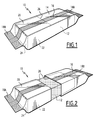
- Figure 1 shows a packaging 10 for the packaging of a solid elongated product 12 such as a flow wrapper or roll wrap for candy, cereal or chocolate bar. It is for example a stick pack.
- a packaging is especially suitable for a food product.
- the packaging 10 is constituted by a generally rectangular flexible film 14 which is wound and sealed around the product.
- the flexible film 14 is formed of one or more superposed layers, as disclosed in the following.
- the packaging 10 is a "flowpack" wrapping. If the packaging is longer, it is called a stick pack, or if the packaging is of a distinct rectangular shape it is called brick pack, e.g. for cigarette bundle packs.
- the film 14 is folded around the product 12 and the longitudinal edges of the film are connected together along a longitudinal sealing seam 16.
- the film defines a tubular pipe containing the product.
- a cross sealing seam 18A, 18B is provided at each end of the pipe for closing the packaging.
- the longitudinal sealing seam 16 extends over a back face 20 of the packaging which is opposite to a flat front face 22 with respect to the packaged product.
- the longitudinal sealing seam 16 and the cross sealing seams 18A, 18B are obtained by sealing or welding the film 14 as known per se.
- the sealing as made by ultra sonic waves.
- the longitudinal and the cross seals are joint together by means of glues, adhesives or hotmelts.
- the film 14 After heat-sealing, the film 14 defines a closed space 24 in which the product is contained.
- a transverse weakening line 26 is provided in the film 14 e.g. between or at the ends of the package, preferably in the middle part of the package.
- the tensile strength of the film 14 along the weakening line 26 is from 1 N/15 mm to 20 N/15 mm and preferably from 1 N/15 mm to 10 N/15 mm and more preferably from 3N/15 mm to 8N/15 mm.
- the strength for initiating the rupture is low and is advantageously in the range of 1 N to 20 N preferably between 3 and 8N and more preferably around of 5N for a package having a diameter between 3 mm and 150 mm.
- the weakening line 26 delimits a closed shape surrounding the product 14. It extends advantageously over a length of 10 to 950 mm. The whole of its trace is contained between the cross sealing seams 18A, 18B.
- the weakening line 26 extends in a transverse plane of the product in the intermediate part of the product which means between the ends of the product.
- the weakening line 26 delimits a generally peripherical profile.
- the film 14 has a visible marking identifying the position of the weakening line 26.
- that marking is constituted by a discontinuous black line printed on the film.
- the weakening line 26 is produced by treatment of the film constituting the film 14.
- the treatment is advantageously applied before the wrapping of the film around the product.
- the weakening line 26 is produced by the application of high-energy radiation, such as a laser, by application of a laser beam along the trace of the weakening line 26, before the film 14 is wrapped. Treatment by high-energy radiation is carried out on one or more layers of the film 14 when the latter comprises more than one layer.
- high-energy radiation such as a laser
- the weakening line 26 is formed by a mechanical weakening of the film which extends along the trace of the weakening line 26. That mechanical treatment is carried out on one or more layers of the film when the latter comprises more than one layer.
- a microporous weakening is provided along a strip of small width in order to form at least part of the weakening line 26.
- the width is between 2 mm and 10 mm.
- Such a microporous strip of a film is obtained, for example, by passing the film between two rollers, one of which rollers has been rendered abrasive along the trace of the weakening line.
- Such a treatment is described, for example, in document FR-2.717.449 .
- the mechanical weakening is formed by cutting the thickness of one or more layers of the film when the latter comprises more than one layer.
- the cuts are formed by a matrix of cutting elements when the film is being pressed between the matrix and a support, as it is known per se.
- the weakening line 26 is obtained by a line of micro-perforations which do not pass through the film, the micro-perforations being formed through one or more layers when the film comprises a plurality of layers.
- the weakening of the film along the weakening line is variable according to the position along the weakening line 26.
- the weakening is greater in the front face of the package.
- the longitudinal edges of the film intended to be connected to form the longitudinal sealing seam 16 are stronger and thus the weakening of the line is reduced at the longitudinal edges of the film.
- the weakening line does not extend to the longitudinal edges and ends in the vincinity of the edges.
- Such differences in weakening are obtained, for example, by locally combining several weakening treatments on one or more films constituting the film, or by carrying out a more or less deep or more or less dense weakening treatment along the regions of the weakening line 26.
- Such more or less dense or deep treatment is achieved in a particularly successful manner by subjecting the film to high-energy radiation.
- the weakening can also be of different shape, like waved or zigzagged pattern, as demonstrated in Fig. 5 and 6 .
- the film 14 is a monolayer and is formed by a base film of polymer or paper. Accordingly, the film 14 is a single-material film.
- the film of polymer or paper is advantageously coated on its inner surface with a sealing material which is applied, for example, by extrusion, co-extrusion or any other coating which also may be applied during printing of the base film.
- the base film is preferably formed by a bi-oriented polymer film, which may be co-extruded. It may also be a mono-oriented or a non-oriented film obtained by co-extrusion. That film is formed, for example, of polypropylene (OPP), polyester (PET) or polyamide (OPA).
- the thickness of the base film is generally from 5 to 100 microns and preferably from 12 microns to 50 microns.
- the sealing material is chosen in order to permit fused bonding. Typically, the thickness of the sealing material is from 10 to 40 microns, the amount of sealing material like a lacquer deposited being from 1 to 12 g/m 2 .
- the weakening is formed in the base layer.
- the film 14 is formed by two laminated layers. Accordingly, the film comprises a base layer formed of polymer or paper which is associated, along its inner face with a sealing layer of polymer, in order to permit fused bonding.
- the base layer and the sealing layer are bonded with one another by means of lamination with an adhesive or by resin extrusion.
- the base layer is advantageously formed of a bi-oriented polymer film. However, it may also be a cast film.
- the polymer forming the base layer is preferably polyester (PET), polyamide (OPA) or polypropylene (OPP), which furthermore can be metalized or ceramic coated.
- the sealing layer is formed, for example, of polyethylene (PE), which optionally may be blended with other polymers or co-extruded in admixture or non-oriented co-extruded with other polymers, e.g. polyester (PET)/polyethylene (PE), polyamide (OPA)/polyethylene (PE) or polypropylene (OPP)/polyethylene (PE).
- PET polyester
- OPA polyamide
- PE polypropylene
- the sealing layer is formed of polypropylene (PP), preferably cast polypropylene, homopolymers or copoly-mers, e.g. polyester (PET)/polypropylene (PP), polyamide (OPA)/polypropy-lene (PP) or polypropylene (OPP)/polypropylene (PP).
- the sealing layer is constituted by amorphous polyester or copolyester (PETG), e.g. polyester (PET)/polyester (PETG), polyamide (OPA)/polyester (PETG) or polypropylene (OPP)/polyester (PETG).
- PET polyester
- OPA polyamide
- POP polypropylene
- the inner layer is advantageously sealable.
- the weakening is affecting the outer layer and optionally the inner layer which may partially be treated or weakened as well.
- the outer layer is weakened by treatment with high-energy radiation
- the inner layer is weakened by mechanical treatment such as a microporous weakening, or vice versa.
- the same mechanical or high-energy radiation treatment is carried out on both layers.
- the film 14 is formed of a two-layer laminated film formed, for example, of polyester (PET)/polyester (PET), polyester (PET)/polypropylene (OPP), polyester (PET)/polyamide (OPA), polyamide (OPA)/polypropylene (OPP), polypropylene (OPP)/polypropylene (OPP), aluminium/polyester (PET), aluminium/polypropylene (OPP), aluminium/ polyamide (OPA) or paper/polypropylene (OPP), paper/polyester (PET) and of paper/polyamide (OPA).
- the film 14 is made of an outer layer of aluminium having a thickness of 9 ⁇ m which is laminated with an inner polyester (PET) layer having a thickness of 5 ⁇ m.
- PET polyester
- An adhesive layer is arranged between the aluminium layer and the polyester layer.
- Printing is arranged on the outer face of the aluminium layer and a cold seal layer is provided on the polyester layer.
- the weakening is formed in the polyester layer.
- the film 14 is made of an outer layer of polyester (PET) having thickness of 12 ⁇ m which is laminated with the inner aluminium layer having a thickness of 15 ⁇ m.
- An adhesive layer is arranged between the polyester and the aluminium layer. Printings are provided on the inner face of the polyester layer.
- a cold seal layer, or a varnish, or a coating is provided on the face of the aluminium layer.
- the film comprises three layers, of which the two outside layers are as defined above for a film formed of two layers, an intermediate layer being interposed between the two outside layers.
- the intermediate layer is formed, for example, of an aluminium foil from 6 to 45 ⁇ m and preferably from 7 to 15 ⁇ m.
- the aluminium is hard foil or annealed.
- the film is formed, for example, of polyester (PET)/aluminium/cast polypropylene (PP), or of polyester (PET)/aluminium/ polyethylene (PE), or of polyamide (OPA)/aluminium/polypropylene (PP), or of polyamide (OPA)/aluminium/polyethylene (PE), or of polypropylene (OPP)/aluminium/cast polypropylene (PP), or of polypropylene (OPP)/aluminium/polyethylene (PE).
- the intermediate layer is a bioriented film, for example a film of oriented polyamide, especially in a polyester (PET)/polyamide (OPA)/polypropylene (PP), polyester (PET)/polyamide (OPA)/polyethylene (PE), polyester (PET)/polypropylene (OPP)/polypropylene (PP), polyester (PET)/polypropylene (OPP)/polyethylene (PE), polyamide (OPA)/polyamide (OPA)/polypropylene (PP), polyamide (OPA)/polyamide (OPA)/polyethylene (PE), polyamide (OPA)/polypropylene (OPP)/polypropylene (PP), polyamide (OPA)/polypropylene (OPP)/polypropylene (PP), polyamide (OPA)/polypropylene (OPP)/polyethylene (PE), polyamide (OPA)/polyester (PET)/polypropylene (PP), poly
- the intermediate layer is advantageously weakened by treatment with high-energy radiation along the weakening line.
- the film is formed of three layers and is composed, for example, of polyester (PET)/polypropylene (PP)/polyester (PET), polyester (PET)/polyethylene (PE)/polyester (PET), polyester (PET)/polypropylene (PP)/polypropylene (OPP), polyester (PET)/polyethy-lene (PE)/polypropylene (OPP), polyester (PET)/polypropylene (PP)/polya-mide (OPA), polyester (PET)/polyethylene (PE)/polyamide (OPA), polyamide (OPA)/polypropylene (PP)/polyamide (OPA), polyamide (OPA)/polyethylene (PE)/polyamide (OPA), polyamide (OPA)/polypropylene (PP)/polypropylene (OPP), polyamide (OPA)/polyethylene (PE)/polypropylene (OPP), polyamide (OPA)/polyethylene
- Such a packaging is opened as follows.
- the packaging allows a clear and easy way of opening by hand without any additional tools and an easy access to the product.
- the force necessary to pop up one end of the packaging is low enough to enable an easy manual opening but the film is strong enough to be run on standard packaging equipment despite having a line of weakening.
- the weakening line 26 is arranged on the main face of the packaging and advantageously on the front 22 face opposite to the back face 20 having the longitudinal seal seam 16. It extends also partially on the lateral faces.
- the weakening line 26 extends at least partially over a sharp edge 28 of the packaged product in a tear initiation zone denoted 30.
- the tear initiation zone 30 extends over an end edge of the product when the product is elongated and is thus in the vicinity of a cross sealing seam 18A or/and 18B.
- the weakening line 26 is accurate along the tear initiation zone 30 and extends over the packaged product.
- the tear initiation zone 30 is sharp-curved with a low radius of curvature which is lower than the width of the packaged product.
- the radius of curvature is in the range of 0,5 cm to 3 cm.
- a weakening line 26 is provided on each end edge of the product.
- two weakening lines 26 are provided. Each line 26 extends on an end edge of the product.
- the packaged product is grasped in one hand and the free end where the cross seal of the packaging is located, is drawn away from the face of the packaging having the weakening line 26. Especially, the free end is drawn along a direction perpendicular to the plane of the weakening line 26.
- the tear initiation zone 30 When the free end of the packaging is drawn, the tear initiation zone 30 is pressed against the sharp edge of the product. Due to the force applied to the film along the tear initiation zone 30, because of the drawing action which is supported by bending at the product edge, the film 14 beaks in the tear initiation zone 30.
- FIG 4 is shown a variant of the package of figure 3 where the tear initiation zone 30 is provided with an angular point 32 which facilitates the initiation of the tearing of the film along the weakening line 26.
- a weakening line is provided at each end of the package or a similar weakening line is provided in the middle of the package, with the tear initiation zone being at the longitudinal product edges, allowing the same opening, but from the side of pack.
- the packaging can provide a waved or zigzagged weakening pattern in the centre of a brick pack as demonstrated in figures 5 and 6 .
- the resulting brick pack can be broken or opened at the zigzagged weakening line by twisting or tearing at both ends of the pack.
Landscapes
- Engineering & Computer Science (AREA)
- Mechanical Engineering (AREA)
- Packages (AREA)
- Wrappers (AREA)
- Auxiliary Devices For And Details Of Packaging Control (AREA)
- Bag Frames (AREA)
Applications Claiming Priority (1)
| Application Number | Priority Date | Filing Date | Title |
|---|---|---|---|
| EP04292495A EP1650137B1 (fr) | 2004-10-20 | 2004-10-20 | Emballage avec une ligne de faible résistance |
Related Parent Applications (1)
| Application Number | Title | Priority Date | Filing Date |
|---|---|---|---|
| EP04292495.1 Division | 2004-10-20 |
Publications (1)
| Publication Number | Publication Date |
|---|---|
| EP2284096A1 true EP2284096A1 (fr) | 2011-02-16 |
Family
ID=34931466
Family Applications (2)
| Application Number | Title | Priority Date | Filing Date |
|---|---|---|---|
| EP10185377A Withdrawn EP2284096A1 (fr) | 2004-10-20 | 2004-10-20 | Emballage avec une ligne de faible résistance |
| EP04292495A Expired - Lifetime EP1650137B1 (fr) | 2004-10-20 | 2004-10-20 | Emballage avec une ligne de faible résistance |
Family Applications After (1)
| Application Number | Title | Priority Date | Filing Date |
|---|---|---|---|
| EP04292495A Expired - Lifetime EP1650137B1 (fr) | 2004-10-20 | 2004-10-20 | Emballage avec une ligne de faible résistance |
Country Status (6)
| Country | Link |
|---|---|
| EP (2) | EP2284096A1 (fr) |
| AT (1) | ATE512086T1 (fr) |
| DK (1) | DK1650137T3 (fr) |
| ES (1) | ES2370892T3 (fr) |
| PL (1) | PL1650137T3 (fr) |
| WO (1) | WO2006045542A1 (fr) |
Cited By (1)
| Publication number | Priority date | Publication date | Assignee | Title |
|---|---|---|---|---|
| CN107074422A (zh) * | 2014-10-09 | 2017-08-18 | 洲际大品牌有限责任公司 | 包含食物产品的包装和打开的方法 |
Families Citing this family (12)
| Publication number | Priority date | Publication date | Assignee | Title |
|---|---|---|---|---|
| GB0818122D0 (en) * | 2008-10-03 | 2008-11-05 | Innovia Films Ltd | Overwrap film |
| US8814430B2 (en) | 2010-02-23 | 2014-08-26 | Kraft Foods R&D, Inc. | Food package having opening feature |
| EP2463214A1 (fr) * | 2010-12-09 | 2012-06-13 | Constantia Teich GmbH | Emballage enroulant |
| GB2488782A (en) * | 2011-03-07 | 2012-09-12 | L C S Tech Ltd | Stronger Breaking Line |
| GB2511307A (en) * | 2013-02-27 | 2014-09-03 | British American Tobacco Co | A blank of wrapping material |
| US20150144518A1 (en) * | 2013-11-27 | 2015-05-28 | Mcneil-Ppc, Inc. | Stick pack pouch packaging |
| US20150158628A1 (en) * | 2013-12-10 | 2015-06-11 | Graphic Packaging International, Inc. | Package With Opening Feature |
| US9251778B2 (en) | 2014-06-06 | 2016-02-02 | Industrial Technology Research Institute | Metal foil with microcracks, method of manufacturing the same, and sound-absorbing structure having the same |
| BE1025098B1 (nl) * | 2017-03-31 | 2018-10-31 | Imperial Meat Products, Vof | Vlees-, zuivel- of vleesvergangend product voorzien van een eenvoudig te openen verpakking |
| CN110740647A (zh) * | 2017-06-15 | 2020-01-31 | 荷兰联合利华有限公司 | 冷冻甜食产品包装 |
| WO2020070251A1 (fr) * | 2018-10-04 | 2020-04-09 | Unilever Plc | Emballage de confiserie congelée |
| CN114102736A (zh) * | 2021-11-13 | 2022-03-01 | 严德雪 | 一种包装膜加工工艺 |
Citations (6)
| Publication number | Priority date | Publication date | Assignee | Title |
|---|---|---|---|---|
| GB749182A (en) * | 1952-10-03 | 1956-05-23 | Rose Brothers Ltd | Improvements in ice cream packages |
| EP0540184A1 (fr) * | 1991-10-02 | 1993-05-05 | American National Can Company | Emballage entaillé avec un laser |
| EP0597446A1 (fr) * | 1992-11-09 | 1994-05-18 | McNEIL-PPC, INC. | Matériau d'emballage avec au moins une ligne d'affaiblissement et procédé et dispositif pour sa fabrication |
| FR2717449A1 (fr) | 1994-03-15 | 1995-09-22 | Cmb Flexible | Emballage formé à partir d'une feuille polymère, bande polymère pour sa réalisation, et procédé de traitement correspondant. |
| US6077551A (en) * | 1998-06-04 | 2000-06-20 | Hunt-Wesson, Inc. | Microwave popcorn preparation and serving package with releasably adhered lap seam |
| US20030231811A1 (en) * | 2002-06-07 | 2003-12-18 | Hodson Jay D. | Internally scored film, package and methods of making the same |
-
2004
- 2004-10-20 DK DK04292495.1T patent/DK1650137T3/da active
- 2004-10-20 AT AT04292495T patent/ATE512086T1/de active
- 2004-10-20 ES ES04292495T patent/ES2370892T3/es not_active Expired - Lifetime
- 2004-10-20 EP EP10185377A patent/EP2284096A1/fr not_active Withdrawn
- 2004-10-20 EP EP04292495A patent/EP1650137B1/fr not_active Expired - Lifetime
- 2004-10-20 PL PL04292495T patent/PL1650137T3/pl unknown
-
2005
- 2005-10-19 WO PCT/EP2005/011315 patent/WO2006045542A1/fr not_active Ceased
Patent Citations (6)
| Publication number | Priority date | Publication date | Assignee | Title |
|---|---|---|---|---|
| GB749182A (en) * | 1952-10-03 | 1956-05-23 | Rose Brothers Ltd | Improvements in ice cream packages |
| EP0540184A1 (fr) * | 1991-10-02 | 1993-05-05 | American National Can Company | Emballage entaillé avec un laser |
| EP0597446A1 (fr) * | 1992-11-09 | 1994-05-18 | McNEIL-PPC, INC. | Matériau d'emballage avec au moins une ligne d'affaiblissement et procédé et dispositif pour sa fabrication |
| FR2717449A1 (fr) | 1994-03-15 | 1995-09-22 | Cmb Flexible | Emballage formé à partir d'une feuille polymère, bande polymère pour sa réalisation, et procédé de traitement correspondant. |
| US6077551A (en) * | 1998-06-04 | 2000-06-20 | Hunt-Wesson, Inc. | Microwave popcorn preparation and serving package with releasably adhered lap seam |
| US20030231811A1 (en) * | 2002-06-07 | 2003-12-18 | Hodson Jay D. | Internally scored film, package and methods of making the same |
Cited By (4)
| Publication number | Priority date | Publication date | Assignee | Title |
|---|---|---|---|---|
| CN107074422A (zh) * | 2014-10-09 | 2017-08-18 | 洲际大品牌有限责任公司 | 包含食物产品的包装和打开的方法 |
| US10407229B2 (en) | 2014-10-09 | 2019-09-10 | Intercontinental Great Brands Llc | Packages containing a food product and methods of opening |
| CN107074422B (zh) * | 2014-10-09 | 2020-08-07 | 洲际大品牌有限责任公司 | 包含食物产品的包装和打开的方法 |
| US10865027B2 (en) | 2014-10-09 | 2020-12-15 | Intercontinental Great Brands Llc | Packages containing a food product and methods of opening |
Also Published As
| Publication number | Publication date |
|---|---|
| PL1650137T3 (pl) | 2012-01-31 |
| ES2370892T3 (es) | 2011-12-23 |
| ATE512086T1 (de) | 2011-06-15 |
| DK1650137T3 (da) | 2011-07-04 |
| WO2006045542A1 (fr) | 2006-05-04 |
| EP1650137B1 (fr) | 2011-06-08 |
| EP1650137A1 (fr) | 2006-04-26 |
Similar Documents
| Publication | Publication Date | Title |
|---|---|---|
| EP2571782B1 (fr) | Emballage souple facile a ouvrir et procede de fabrication | |
| EP3109172B1 (fr) | Produits d'emballage à film souple à ouverture et fermeture faciles et procédés de fabrication | |
| EP2059456B1 (fr) | Emballage amélioré pourvu de lignes d'affaiblissement | |
| CA2100573C (fr) | Contenant pour pate avec etiquette non pelable pre-affaiblie | |
| JP4927308B2 (ja) | 引裂可能なテープストリップを備えたプラスチックフィルムパッケージ | |
| EP2969836B1 (fr) | Fonctionnalité d'ouverture d'emballage et procédés de fabrication de celle-ci | |
| EP2650229B1 (fr) | Emballage en film à rompre enfermant des pièces empilées de produits de confiserie | |
| EP1650137B1 (fr) | Emballage avec une ligne de faible résistance | |
| EP0596747A1 (fr) | Emballage facile à ouvrir, film et procédé de fabrication | |
| US20130209003A1 (en) | Bag packaging | |
| US6541086B2 (en) | Easily tearable packing films | |
| WO2005102863A1 (fr) | Sachet pochette ameliore | |
| US20170233157A1 (en) | Film packaging and method of using same | |
| JP5659824B2 (ja) | 包装袋 | |
| US20050220377A1 (en) | Tear string opening system for flexible container | |
| JPH09132249A (ja) | 包装袋及びその製造方法 | |
| EP1626010A1 (fr) | Emballage avec zone d'affaiblissement | |
| JP3414943B2 (ja) | 包装袋 | |
| NZ615554B2 (en) | Reclosable flexible film packaging products and methods of manufacture |
Legal Events
| Date | Code | Title | Description |
|---|---|---|---|
| PUAI | Public reference made under article 153(3) epc to a published international application that has entered the european phase |
Free format text: ORIGINAL CODE: 0009012 |
|
| AC | Divisional application: reference to earlier application |
Ref document number: 1650137 Country of ref document: EP Kind code of ref document: P |
|
| AK | Designated contracting states |
Kind code of ref document: A1 Designated state(s): AT BE BG CH CY CZ DE DK EE ES FI FR GB GR HU IE IT LI LU MC NL PL PT RO SE SI SK TR |
|
| STAA | Information on the status of an ep patent application or granted ep patent |
Free format text: STATUS: THE APPLICATION IS DEEMED TO BE WITHDRAWN |
|
| 18D | Application deemed to be withdrawn |
Effective date: 20110817 |