EP2285024A2 - Rundfunkempfänger und Steuerungsverfahren dafür - Google Patents
Rundfunkempfänger und Steuerungsverfahren dafür Download PDFInfo
- Publication number
- EP2285024A2 EP2285024A2 EP20100251210 EP10251210A EP2285024A2 EP 2285024 A2 EP2285024 A2 EP 2285024A2 EP 20100251210 EP20100251210 EP 20100251210 EP 10251210 A EP10251210 A EP 10251210A EP 2285024 A2 EP2285024 A2 EP 2285024A2
- Authority
- EP
- European Patent Office
- Prior art keywords
- information
- unit
- list
- station
- tmc
- Prior art date
- Legal status (The legal status is an assumption and is not a legal conclusion. Google has not performed a legal analysis and makes no representation as to the accuracy of the status listed.)
- Granted
Links
- 238000000034 method Methods 0.000 title claims description 14
- 230000008859 change Effects 0.000 claims description 21
- 230000005684 electric field Effects 0.000 description 62
- 230000003247 decreasing effect Effects 0.000 description 10
- 230000008569 process Effects 0.000 description 7
- 238000010586 diagram Methods 0.000 description 4
- 239000002131 composite material Substances 0.000 description 3
- 230000004075 alteration Effects 0.000 description 2
- 230000005540 biological transmission Effects 0.000 description 2
- 230000004048 modification Effects 0.000 description 2
- 238000012986 modification Methods 0.000 description 2
- 230000002035 prolonged effect Effects 0.000 description 2
- 230000004044 response Effects 0.000 description 2
- 238000010276 construction Methods 0.000 description 1
- 230000001419 dependent effect Effects 0.000 description 1
- 230000006866 deterioration Effects 0.000 description 1
- 230000000694 effects Effects 0.000 description 1
- 238000001914 filtration Methods 0.000 description 1
- 230000009467 reduction Effects 0.000 description 1
- 230000001052 transient effect Effects 0.000 description 1
Images





Classifications
-
- H—ELECTRICITY
- H04—ELECTRIC COMMUNICATION TECHNIQUE
- H04H—BROADCAST COMMUNICATION
- H04H20/00—Arrangements for broadcast or for distribution combined with broadcast
- H04H20/53—Arrangements specially adapted for specific applications, e.g. for traffic information or for mobile receivers
- H04H20/55—Arrangements specially adapted for specific applications, e.g. for traffic information or for mobile receivers for traffic information
-
- H—ELECTRICITY
- H04—ELECTRIC COMMUNICATION TECHNIQUE
- H04H—BROADCAST COMMUNICATION
- H04H2201/00—Aspects of broadcast communication
- H04H2201/10—Aspects of broadcast communication characterised by the type of broadcast system
- H04H2201/13—Aspects of broadcast communication characterised by the type of broadcast system radio data system/radio broadcast data system [RDS/RBDS]
-
- H—ELECTRICITY
- H04—ELECTRIC COMMUNICATION TECHNIQUE
- H04H—BROADCAST COMMUNICATION
- H04H2201/00—Aspects of broadcast communication
- H04H2201/60—Aspects of broadcast communication characterised in that the receiver comprises more than one tuner
-
- H—ELECTRICITY
- H04—ELECTRIC COMMUNICATION TECHNIQUE
- H04H—BROADCAST COMMUNICATION
- H04H60/00—Arrangements for broadcast applications with a direct linking to broadcast information or broadcast space-time; Broadcast-related systems
- H04H60/35—Arrangements for identifying or recognising characteristics with a direct linkage to broadcast information or to broadcast space-time, e.g. for identifying broadcast stations or for identifying users
- H04H60/38—Arrangements for identifying or recognising characteristics with a direct linkage to broadcast information or to broadcast space-time, e.g. for identifying broadcast stations or for identifying users for identifying broadcast time or space
- H04H60/41—Arrangements for identifying or recognising characteristics with a direct linkage to broadcast information or to broadcast space-time, e.g. for identifying broadcast stations or for identifying users for identifying broadcast time or space for identifying broadcast space, i.e. broadcast channels, broadcast stations or broadcast areas
- H04H60/43—Arrangements for identifying or recognising characteristics with a direct linkage to broadcast information or to broadcast space-time, e.g. for identifying broadcast stations or for identifying users for identifying broadcast time or space for identifying broadcast space, i.e. broadcast channels, broadcast stations or broadcast areas for identifying broadcast channels
Definitions
- the invention relates to a radio receiver and a method of controlling the radio receiver.
- RDS-TMC Radio Data System-Traffic Message Channel
- the RDS which has been developed mainly in Europe where the main radio broadcast service is FM broadcasting, is a digital data multisystem standardized by the European Broadcasting Union.
- the RDS is particularly useful in regions where a large number of broadcast stations that form a network broadcast the same programs. More specifically, the RDS uses a frequency of 57kHz that is a third harmonic of a stereo pilot signal of 19kHz, as a subcarrier.
- the subcarrier is amplitude-modulated into a radio data signal, using a data signal indicating data, such as program-related information and traffic-related information, subjected to filtering and two-phase encoding.
- the subcarrier that has been amplitude-modulated is then frequency-modulated into a main carrier for use in broadcasting.
- the above-mentioned radio data signal is called "RDS data".
- FIG. 1 shows a basic baseband coding structure of the RDS data.
- the RDS data is composed of a series of groups each consisting of 104 bits. Each group is made up of four blocks (i.e., block A, block B, block C, and block D). Each block consists of 16-bit information (m0 - m15) and 10-bit checkword and offset (C'0 - C'9).
- the RDS data is transmitted at a rate of 1187.5 bits/sec.
- Block A includes program identification data (PI code: Program Identification code) indicating a network and comprising country data and program data.
- the PI code consists of three elements, i.e., 4-bit country data, 4-bit region data, and 8-bit program data.
- Block B includes traffic information broadcast station identification data (TP code: Traffic Program Identification code) indicating that the data is transmitted from a traffic information broadcast station that broadcasts a traffic information program, and traffic announcement identification data (TA code: Traffic Announcement code) indicating that a broadcast program related to traffic information will start.
- Block C includes data concerning frequencies of respective broadcast stations that constitute a broadcast station group that broadcasts the same program. In other words, block C includes alternative frequency data (AF code: Alternative Frequency code).
- Block D includes broadcast station name data (PS code: Program Service code) indicative of the name of the broadcast station or network from which the data is transmitted.
- PS code Program Service code
- the above-mentioned groups are classified, using four bits, into 16 types (type 0 - type 15) in accordance with the content of each group. Furthermore, two versions (A, B) are provided for each of the types (0 - 15). The identification code of the version is placed in block B. For the types defined as version A, the PI code is included in block A without exception. For the types defined as version B, the PI code is included in block C as well as block A.
- TMC is broadcast using, for example, 8A group of the RDS data, in other words, group 8 defined as version A.
- FIG. 2 shows a baseband coding structure of 8A group with which TMC is transmitted.
- Block A includes a PI code.
- Block B includes a 4-bit group type identification code for identifying the 8A group type, and also includes various codes concerning management of a message and an extended system.
- block B has a 1-bit short message code "S” indicating that there is a short message, a 1-bit group message identification code "G” indicating whether one message is a single-group message that is transmitted on one group data, or one message is transmitted over two or more items of group data, and a 3-bit traffic congestion time code "DP" indicating an approximate traffic congestion time.
- the traffic congestion time code DP is used for indicating one of 8-level congestion times (0 to 4 hours).
- Block C includes a detour identification code "D" indicating whether there is a detour or alternative path, a 3-bit “EXTENT” code including a location offset address, and an 11-bit “EVENT” code indicative of information, such as the weather, construction, and traffic congestion.
- Block D includes a 16-bit "LOCATION” code indicative of information on the location of the event.
- Radio receivers have an automatic tracking function. For example, when the signal reception level at which a radio receiver currently receives a signal from a certain broadcast station is lowered due to interference, such as multipath interference, the radio receiver selects another broadcast station (alternative station) that ensures a higher reception level, based on AF data. When there are a large number of broadcast stations from which the radio receiver can receive signals, the radio receiver makes a list of the broadcast stations from which signals can be received. The list of these broadcast stations will be called "station list" when appropriate. The radio receiver updates the station list at certain intervals. By selecting another broadcast station, the radio receiver can always provide the user with broadcastings of the same program at a high reception level, without being affected by the interference.
- the radio receiver identifies the currently selected traffic information broadcast station according to the TP code, and determines from the TA code that a traffic information program is going to be broadcast.
- the radio receiver displays the identified traffic information broadcast station and traffic information program on a display unit of the receiver. With these items of information appearing on the display unit, a driver who seeks traffic information is able to recognize the traffic information broadcast station and/or start of broadcasting of the program, which is very convenient to the driver.
- the radio receiver can receive the transmitted TMC data and sequentially store the TMC data. Since the TMC data is transmitted even if no broadcast program for traffic information is on the air, the receiver can obtain traffic information without interrupting a broadcast program that is being received.
- RDS receiver An example of RDS receiver is described in Japanese Patent Application Publication No. 2002-344340 ( JP-A-2002-344340 ).
- the radio receiver updates the station list while dividing the RDS-TMC reception time. Namely, the radio receiver updates the station list by fully scanning the PI codes and PS codes during intervals between receptions of TMC.
- the RDS-TMC reception time may also be called "TMC reception time”.
- FIG. 3 shows one example of time chart illustrating updating of the station list at an RDS-TMC tuner.
- the time chart shown in FIG. 3 shows switching between an FM-radio screen and a navigation (Navi) screen, which can be switched by operation of the user, and switching between TMC reception and station list search, which are carried out by the RDS-TMC tuner.
- FIG. 3 also shows transmission of TMC data.
- the TMC data is transmitted from a broadcast station.
- the RDS-TMC tuner performs given operations or functions irrespective of operations by the user and the transmission time (or period) of TMC data.
- the RDS-TMC tuner receives TMC during a period of t1, and conducts station-list search during a period of t2 following the reception of TMC.
- the above-indicated t1 is a period of time required to receive TMC.
- the above-indicated t2 is a period of time required to receive the PI codes and/or the PS codes, and is dependent on the number of broadcast stations that are located around the radio receiver.
- the length of TMC information is specified by standards, and the maximum length is 15 minutes. In other words, traffic information on the traffic around the vehicle equipped with the radio receiver cannot be acquired unless the receiver receives data for 15 minutes at the maximum.
- the receiver fails to receive a part of data where the TMC service provision time is 15 minutes, it is necessary to receive TMC for the current service provision time and the next service provision time. For example, if the receiver fails to receive data transmitted in a leading part of the service provision time, full scanning for updating of the station list will start about 30 minutes later. If the situation where the receiver fails to receive data transmitted in a leading part of the service provision time continues, the frequency of updating of the station list will be 30 minutes, namely, the station list will be updated at intervals of 30 minutes.
- the average TMC service provision time is around 5 minutes, and about 5-minute service is repeated three times during the 15-minute service provision time. If the receiver fails to receive a part of data where the average service provision time is 5 minutes, it is necessary to receive TMC for the average service provision time and the next average service provision time of 5 minutes. For example, if the receiver fails to receive data transmitted in a leading part of the average service provision time, full scanning for updating of the station list will start about 10 minutes later. If the situation where the receiver fails to receive data transmitted in a leading part of the average service provision time continues, the frequency of updating of the station list will be 10 minutes, namely, the station list will be updated at intervals of 10 minutes.
- the frequency of updating of the station list will be about 10 minutes to 30 minutes.
- the tuner In order to receive TMC, the tuner needs to be tuned to a broadcast station that is broadcasting TMC. In the meantime, RDS data is transmitted from each broadcast station; therefore, the tuner needs to be tuned to the broadcast station from which the RDS data is transmitted. While the tuner is tuned to the broadcast station that is broadcasting TMC so as to receive TMC, it cannot search for other broadcast stations.
- the station list In the case where the highest priority is given to full scanning for updating of the station list, it takes about 5 minutes to scan the PI codes and the PS codes. Accordingly, the updated station list will be provided 5 min. later at the minimum, or about 30 min. later at the maximum. Thus, in some cases, the station list thus provided may not reflect the actual situation.
- Full scanning is carried out when the station list is updated. In the full scanning, scanning for the PI codes and scanning for the PS codes are performed. Thus, once updating of the station list is started, it is not possible to select a broadcast station from the list for a while.
- the radio receiver installed on the vehicle needs to search for a broadcast station that broadcasts TMC. Since broadcast stations that broadcast TMC are included in the station list, the radio receiver updates the station list so as to search for a broadcast station that broadcasts TMC. Since the station list is updated, it is not possible to select a broadcast station from the list for a while after the vehicle passes the tunnel.
- the invention provides a radio receiver capable of changing the timing of updating the station list and the timing of receiving traffic information, and also provides a method of controlling the radio receiver.
- a radio receiver includes a receiving unit that receives broadcast station information and/or traffic information provided by a radio data system, and provides the traffic information to a vehicle-mounted system, a station list setting unit that sets a station list as a list of broadcast stations from which signals can be received, based on the broadcast station information received by the receiving unit, a status information obtaining unit that obtains status information indicative of a status of the vehicle-mounted system, from the vehicle-mounted system, an operating mode setting unit that makes a setting as to whether the station list is to be updated, or the traffic information is to be provided to the vehicle-mounted system, based on the status information obtained by the status information obtaining unit, and a receiving information changing unit that changes information to be received by the receiving unit, according to the setting made by the operating mode setting unit.
- a method of controlling a radio receiver includes a receiving step of receiving broadcast station information and/or traffic information provided by a radio data system, a traffic information providing step of providing the traffic information received in the receiving step to a vehicle-mounted system, a station list setting step of setting a station list as a list of broadcast stations from which signals can be received, based on the broadcast station information received in the receiving step, a status information obtaining step of obtaining status information indicative of a status of the vehicle-mounted system, from the vehicle-mounted system, an operating mode setting step of making a setting as to whether the station list is to be updated, or the traffic information is to be provided to the vehicle-mounted system, based on the status information obtained in the status information obtaining step, and a receiving information changing step of changing the information to be received in the receiving step, according to the setting made in the operating mode setting step.
- the timing of updating the station list and the timing of receiving traffic information can be changed according to the circumstances.
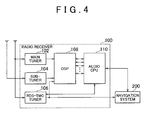
- FIG 4 illustrates a system according to this embodiment of the invention.
- the system has a radio receiver 100 and a navigation system 200.
- the radio receiver 100 dynamically changes the timing of updating the station list, according to the status of the navigation system 200 and the signal receiving environment. While the timing of updating the station list is dynamically changed according to the status of the navigation system 200 in this embodiment, the updating timing may be changed according to the status of, more generally, vehicle-mounted equipment.
- the vehicle-mounted equipment may include a system into which a navigation system and an audio system are integrated.
- the radio receiver 100 has a main tuner 102, sub-tuner 104, RDS-TMS tuner 106, DSP (Digital Signal Processor) 108, and an audio CPU (Central Processing Unit) 110.
- main tuner 102 sub-tuner 104
- RDS-TMS tuner 106 receives signals from the radio receiver 100
- DSP Digital Signal Processor
- audio CPU Central Processing Unit
- the main tuner 102 receives radio waves via an antenna.
- the main tuner 102 outputs the received voice signal to the DSP 108.
- the sub-tuner 104 receives radio waves via an antenna.
- the sub-tuner 104 outputs the received voice signal to the DSP 108.
- the sub-tuner 104 may scan conditions of other frequencies or alternative frequencies.
- the RDS-TMS tuner 106 receives RDS data and/or TMC via an antenna.
- the RDS-TMS tuner 106 receives RDS data and TMC from a broadcast station that transmits TMC.
- the RDS-TMC tuner 106 outputs a composite signal including the RDS data and/or TMC to the DSP 108 and the navigation system 200.
- textual information such as PI code and PS code, is contained in the RDS data
- traffic information is contained in TMC.
- the DSP 108 is connected to the main tuner 102, sub-tuner 104 and the RDS-TMC tuner 106. Based on a control by the audio CPU 110, the DSP 108 processes the voice signals received from the main tuner 102 and sub-tuner 104 to produce voice or sound, which is output to a loudspeaker (not shown). The DSP 108 combines the voice signal received from the main tuner 102 with the voice signal received from the sub-tuner 104, so as to keep the receiver in the optimum signal-receiving condition. Combining voice signals received from two or more tuners yields an effect of phase diversity.
- the DSP 108 obtains RDS data and/or TMC from the composite signal received from the RDS-TMC tuner 106, and outputs the RDS data and/or TMC to the audio CPU 110.
- the DSP 108 also outputs information (which will be called "alternative frequency information") on another frequency or frequencies on which the same program is broadcasted in the same region or adjacent regions, which information is received from the sub-tuner 104.
- the DSP 108 also conducts scanning of the electric field strength, obtains the relationship between the electric field strength and the frequency, and outputs information indicative of the relationship between the electric field strength and the frequency to the audio CPU 110.
- the audio CPU 110 is connected to the DSP 108 and the RDS-TMS tuner 106.
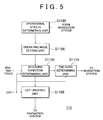
- FIG 5 is a functional block diagram showing the audio CPU 110.
- the audio CPU 110 has an operational status determining unit 1102, an operating mode setting unit 1104, a receiving condition determining unit 1106, a list updating unit 1108, and a TMC data determining unit 1110.
- the operational status determining unit 1102 is connected to the navigation system 200, and obtains information (which will be called "operational status information") indicating the operational status of the navigation system 200 from the navigation system 200.
- the operational status information may be information indicative of a display screen of the navigation system 200.
- the operational status determining unit 1102 determines an operation performed on the navigation system 200, based on the operational status information. For example, the operational status determining unit 1102 may determine whether an operation to control the radio is performed, or an operation other than radio control is performed. The operation other than radio control may be an operation associated with navigation for the vehicle.
- the operational status determining unit 1102 outputs information (which will be called "operation information”) indicating an operation performed on the navigation system 200 to the operating mode setting unit 1104.
- the operating mode setting unit 1104 is connected to the operational status determining unit 1102, and changes the operating mode of the radio receiver 100, based on the operation information received from the operational status determining unit 1102.
- the operating modes available to the radio receiver 100 include "station list search" and "RDS-TMC reception".
- the "station list search” is an operating mode in which the station list is updated by conducting RDS search.
- the AF list may also be updated during the "station list search”.
- the "RDS-TMC reception” is an operating mode in which TMC is received.
- updating of the station list is prioritized over TMC reception.
- TMC reception is prioritized over updating of the station list.
- the operating mode setting unit 1104 informs the receiving condition determining unit 1106 of the set operating mode.
- the receiving condition determining unit 1106 is connected to the DSP 108, operating mode setting unit 1104, and the RDS-TMC tuner 106, and controls the RDS-TMC tuner 106, based on the operating mode received from the operating mode setting unit 1104.
- the receiving condition determining unit 1106 determines whether a radio-wave environment is normal. For example, the receiving condition determining unit 1106 may determine whether RDS-TMC can be received, or may determine whether a radio signal can be received.
- the receiving condition determining unit 1106 may determine whether RDS-TMC and radio signal can be received. When the receiving condition determining unit 1106 receives the "station list search" as the operating mode, the unit 1106 notifies the list updating unit 1108 that the "station list search" is set as the operating mode. When the receiving condition determining unit 1106 receives the "station list search" as the operating mode, the unit 1106 may instruct the list updating unit 1108 to update the station list and/or the AF list. When the receiving condition determining unit 1106 receives the "RDS-TMC reception" as the operating mode, the unit 1106 notifies the TMC data determining unit 1110 that the "RDS-TMC reception” is set as the operating mode. When the receiving condition determining unit 1106 receives the "RDS-TMC reception” as the operating mode, the unit 1106 may instruct the TMC data determining unit 1110 to determine TMC data.
- the list updating unit 1108 is connected to the DSP 1108, receiving condition determining unit 1108, and the navigation system 200. In response to the notification from the receiving determining unit 1106, the list updating unit 1108 updates the station list, based on the RDS data received from the DSP 108. Also, the list updating unit 1108 updates the AF list, based on the alternative frequency information received from the DSP 108. Then, the list updating unit 1108 outputs the updated station list and/or AF list to the navigation system 200.
- the TMC data determining unit 1110 is connected to the DSP 108, receiving condition determining unit 1106, and the navigation system 200. In response to the notification from the receiving condition determining unit 1106, the TMC data determining unit 1110 performs control concerning reception of TMC, based on TMC data received from the DSP 108.
- the navigation system 200 obtains traffic information from the composite signal received from the RDS-TMC tuner 106, and sets the traffic information. Then, the navigation system 200 displays the set traffic information. The navigation system 200 may also perform navigating operations, based on the traffic information. Also, the navigation system 200 outputs operational status information indicative of the operational status of the navigation system 200 operated by the user to the audio CPU 110. The operational status information may be screen information displayed on a screen of the navigation system 200. Also, the navigation system 200 sets the station list and/or AF list received from the audio CPU 110.
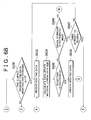
- FIGs. 6A to 6C are flowchart illustrating the operation of the radio receiver 100 of this embodiment.
- the radio receiver 100 places a higher priority on updating of the station list when the signal receiving condition deteriorates.
- the radio receiver 100 performs frequency scanning.
- the frequency scanning includes scanning of the electric field strength, scanning of the PI codes, and scanning of the PS codes, which will be collectively called "full scanning".
- the scanning of the electric field strength is performed in order to determine the relationship between the frequency and the electric field strength. It takes about 6 seconds to accomplish scanning of the electric field strength when the entire reception frequency band of the radio is scanned.
- the PI-code scanning is performed so as to obtain the PI codes. It takes about 2 minutes to accomplish the PI-code scanning when the number of broadcast stations is 100.
- the PS-code scanning is performed so as to obtain the PI codes and the PS codes.
- the PS-code scanning covers the entire frequency band. It takes about 4 minutes to accomplish the PS-code scanning when the number of broadcast stations is 100.
- the radio receiver 100 monitors a signal receiving condition by determining the relationship between the frequency and the electric field strength through the electric-field-strength scanning, and determines that the radio-wave environment has changed when it detects a significant change in the receiving condition.
- the radio receiver 100 may hold a table indicating the relationship between the frequency and the electronic field strength. For example, a list of the broadcast stations, frequencies, and electric field strengths may be given in decreasing order of the electric field strength.
- the processing time can be reduced by utilizing two or more types of scanning.
- the TMC service provision time is represented by "ta”. Namely, the TMC data is updated at time intervals of "ta”.
- the radio receiver 100 determines whether a radio control screen is displayed on the screen of the navigation system 200 (step S602). For example, the operational status determining unit 1102 determines whether the radio control screen is displayed on the screen of the navigation system 200, based on the operational status information received from the navigation system 200. The operational status determining unit 1102 may determine whether a screen other than a navigation screen appears on the display of the navigation system 200. In other words, the operational status determining unit 1102 may determine whether the screen that currently appears on the display of the navigation system 200 is a screen that is supposed to be displayed when the radio is in use. For example, it is determined that the radio is not in use when an audio control screen for use in control of CD (compact disc) or HD (hard disk) audio is displayed.
- CD compact disc
- HD hard disk
- the radio receiver 100 sets the "station list search" as a high-priority mode over the "RDS-TMC reception” (step S604).
- the operating mode setting unit 1104 sets the "station list search” as the high-priority mode.
- the station list search is updated to the latest one, which enables the radio receiver 100 to switch to another broadcast station that provides a better signal receiving condition.
- the radio receiver 100 determines whether an elapsed time from updating of RDS-TMC data is equal to or less than "ta" (step S606).
- the radio receiver 100 determines whether the radio wave environment is normal (step S608). For example, the receiving condition determining unit 1106 determines whether the radio wave environment is normal. For example, the receiving condition determining unit 1106 may determine whether RDS-TMC can be received, or may determine whether radio signals can be received. The receiving condition determining unit 1106 may also determine whether RDS-TMC and radio signals can be received. More specifically, the receiving condition determining unit 1106 determines whether TMC can be received, depending upon whether textual information indicating traffic information can be received. Also, the receiving condition determining unit 1106 may determine whether radio broadcasts can be received, based on the electric field strength, or may determine whether radio broadcasts can be received, depending upon whether the PI codes can be obtained.
- the radio receiver 100 carries out frequency scanning, and determines whether the relationship between the electric field strength and the frequency within the frequency range has changed (step S610). For example, the list updating unit 1108 causes the DSP 108 to carry out scanning of the electric field strength.
- the list updating unit 1108 obtains the relationship between the electric field strength and the frequency within the frequency range, and determines whether the relationship between the electric field strength and the frequency within the frequency range has changed. Since scanning is performed only with respect to the electric field strength, the scanning time can be reduced as compared with the above-mentioned full scanning.
- the radio receiver 100 holds channels of the preset number of frequencies in decreasing order of the radio-wave strength (step S612).
- the list updating unit 1108 holds channels of the preset number of frequencies in decreasing order of the radio-wave strength.
- the list updating unit 1108 may hold channels of 64 frequencies and reserve channels. The 64 frequencies is a mere example, and the number of frequencies may be changed as needed.
- the radio receiver 100 obtains the PI codes (step S614).
- the list updating unit 1108 obtains the PI codes, based on the information of the broadcast stations set in decreasing order of the electric field strength in step S612.
- the list updating unit 1108 may obtain the PI codes in decreasing order of the electric field strength.
- the radio receiver 100 compares the PI codes obtained in step S614, with PI-PS comparison data (step S616).
- the list updating unit 1108 compares the PI codes obtained in step S614, with the PI-PS comparison data stored in a database, for example.
- the radio receiver 100 determines whether each of the PI codes obtained in step S614 is included in the PI-PS comparison data (step S618).
- the list updating unit 1108 determines whether each of the PI codes obtained in step S614 is included in the PI-PS comparison data. By determining whether the obtained PI code is included in the PI-PS comparison data, it can be determined that the broadcast station corresponding to the obtained PI code is included in the currently set station list.
- the radio receiver 100 obtains a PS code corresponding to each of the PI codes obtained in step S614 (step S620). If it is determined that any of the PI codes obtained in step S614 is not included in the PI-PS comparison data, the list updating unit 1108 obtains a PS code corresponding to each of the PI codes that are not included in the PI-PS comparison data. Since only one or more PS codes corresponding to one or more PI codes that are not included in the PI-PS comparison data are obtained, it is not necessary to obtain PS codes corresponding to all of the PI codes. With this arrangement where the PS code(s) corresponding to the PI code(s) that is/are not included in the currently set PI-PS comparison data is/are obtained, only the differential information can be obtained, which leads to a reduction in the processing time.
- the radio receiver 100 updates a table of PI, PS data (step S622).
- the list updating unit 1108 updates the table of PI, PS data.
- step S618 If it is determined in step S618 that the PI codes obtained in step S614 are included in the PI-PS comparison data (YES in step S618), or after the table of PI, PS data is updated in step S622, the radio receiver 100 updates the station list (step S624). For example, if it is determined in step S618 that the obtained PI codes are included in the PI-PS comparison data, the station list is updated by rearranging the broadcast stations in decreasing order of the electric field strength. If the PS, PI data is updated in step S622, the station list is updated by rearranging the broadcast stations in decreasing order of the electric field strength, based on the PS, PI data.
- the radio receiver 100 sets a reception frequency to a selected one of the RDS-TMC stations (step S626).
- the receiving condition determining unit 1106 controls the RDS-TMC tuner 106, referring to the station list updated in step S624, so as to set the reception frequency to the selected RDS-TMC station. Since the station list is updated, it is presumed that the RDS-TMC stations included in the station list are also updated.
- the radio receiver 100 continues a radio reception sequence (step S628). More specifically, the audio CPU 110 continues the radio reception sequence. Then, the control returns to step S602.
- step S608 If it is determined in step S608 that the radio-wave environment is normal (YES in step S608), the radio receiver 100 determines whether the elapsed time from reception of TMC has exceeded ta ⁇ 2 (step S630). For example, the receiving condition determining unit 1106 determines whether the elapsed time from reception of TMC has exceeded ta ⁇ 2.
- step S630 If it is determined that the elapsed time from reception of TMC has not exceeded ta ⁇ 2 (NO in step S630), the current point in time is ahead of the time at which TMC should be received, and therefore, the control goes to step S610. This is because TMC is updated at intervals of "ta".
- the radio receiver 100 determines that a timeout occurs, and receives TMC data from the RDS-TMC station (step S632).
- the receiving condition determining unit 1106 controls the RDS-TMC tuner 106, so as to receive TMC.
- the radio receiver 100 calculates the data update interval "ta", based on the data size of TMC (step S634).
- the TMC data determining unit 1110 determines the data update interval "ta” by calculation, based on the data size of TMC.
- the data update interval "ta” may be the average service provision time of TMC, or may be the length of the TMC information. Since the data size of TMC transmitted from the broadcast station varies, the data update interval "ta" may be reset when TMC is received.
- the radio receiver 100 determines whether the receiver 100 succeeded in receiving TMC (step S636). For example, the TMC data determining unit 1110 determines that the receiver 100 succeeded in receiving TMC. For example, the TMC data determining unit 100 may make this determination based on the error rate.
- the radio receiver 100 instructs the navigation system 200 to update TMC data (step S638). For example, if the TMC data determining unit 1110 determines that the radio receiver 100 succeeded in receiving TMC, the unit 1110 notifies the navigation system 200 that the receiver 100 succeeded in receiving TMC. When the radio receiver 100 succeeded in receiving TMC, the TMC data determining unit 1110 may instruct the navigation system 200 to update TMC data. Then, the control returns to step S602. When it is determined that the radio receiver 100 succeeded in receiving TMC, the navigation system 200 is caused to update TMC data, so that traffic information used in the navigation system 200 can be set to the latest one.
- the radio receiver 100 determines whether the electric field strength of the TMC signal is sufficient (step S640). For example, the TMC data determining unit 1110 determines whether the electric field strength of the received TMC signal is sufficient. By determining whether the electric field strength of the received TMC signal is sufficient, it can be determined whether the radio receiver failed to receive TMC because of insufficient electric field strength, or the receiver failed to receive TMC since the electric field strength was temporarily reduced though the electric field strength was sufficient.
- step S640 it is determined whether the radio receiver 100 has made a third (or more) attempt to receive the TMC signal (step S642). For example, when the TMC data determining unit 1110 determines that the strength of the received TMC signal is sufficient, the unit 110 determines whether the radio receiver 100 has made the third attempt to receive the TMC signal.
- the third attempt is a mere example, and the number of attempts to receive TMC may be set as desired.
- step S642 If it is determined that the radio receiver has made the third attempt to receive TMC (YES in step S642), the control goes to step S610. If the radio receiver failed to receive TMC even if it made three attempts, it is presumed that the relationship between the electric field strength and the frequency within the frequency range has changed. Accordingly, scanning of the electric field strength is carried out (step S610).
- step S640 If it is determined in step S640 that the strength of the received TMC signal is not sufficient (NO in step S640), the control goes to step S610.
- the strength of the received TMC signal is not sufficient, it is presumed that the relationship between the electric field strength and the frequency within the frequency range has changed. Accordingly, scanning of the electric field strength is carried out.
- step S642 If it is determined in step S642 that the radio receiver 100 has not made the third attempt to receive TMC (NO in step S642), the control goes to step S632. If the radio receiver 100 has not made the third attempt to receive TMC, it is presumed that the receiver failed to receive TMC since the electric field strength of TMC was temporarily reduced. Accordingly, the radio receiver makes another attempt to receive TMC.
- step S602 If it is determined in step S602 that the radio control screen is not displayed on the screen of the navigation system 200 (NO in step S602), the radio receiver 100 sets the "RDS-TMC reception" as the high-priority mode, over the "station list search" (step S644). Then, the control proceeds to step S802 which will be described later.
- the radio receiver 100 of this embodiment is able to dynamically change the timing of updating the station list and the timing of updating TMC, according to the radio-wave environment. Accordingly, the station list used when the user selects a broadcast station can be updated to the latest one. Since the AF list can also be updated during the period in which updating of the station list is prioritized, the broadcast station can be easily switched to another station that can be received, according to changes in the radio-wave environment. Also, the broadcast station from which TMC is received may be switched to the latest one.
- a higher priority is placed on reception of RDS information when the user is listening to radio.
- the station list can be updated at early opportunities. Since the station list can be updated at early opportunities, the latest station list can be provided to the user even when the signal receiving condition deteriorates.
- a higher priority is placed on reception of TMC information, for example, when the user is not listening to radio. With the higher priority thus placed on reception of TMC information, traffic information can be updated at early opportunities. Since the traffic information is updated at early opportunities, it can be updated to the latest traffic information when road conditions change, and the latest traffic information can be provided to the user.
- FIG. 7 illustrates the flow or process of updating the station list.
- the radio receiver 100 can make the setting as to whether all of the broadcast stations on the station list are to be updated, or one or more broadcast stations as a part of the stations on the list are to be updated.
- the number of the stations to be updated can be set. For example, broadcast stations that can be displayed on the screen may be determined as a part of the stations to be updated.
- the number of broadcast stations that should be updated may be set in advance, or may be set by the user. In the following description, the number of the broadcast stations that should be updated will be called "threshold value".
- the radio receiver 100 determines whether it is set by the user to update all of the broadcast stations, or to update one or more broadcast stations as a part of the stations. For example, the list updating unit 1108 determines whether it is set to update all of the broadcast stations, or set to update a part of the stations. For example, the list updating unit 1108 may receive an operation signal corresponding to a user's operation relating to the station list.
- the radio receiver 100 determines whether the number of broadcast stations that should be replaced, out of the stations included in the station list, exceeds the threshold value (step S704). For example, the list updating unit 1108 compares the broadcast stations obtained by scanning, with the stations on the currently established station list, and determines the number of broadcast stations that should be replaced. Then, the list updating unit 1108 determines whether the number of the stations to be replaced exceeds the threshold value. For example, the list updating unit 1108 may determine the number of broadcast stations that are not included in the currently established station list, among the stations obtained. Then, it may be determined whether the number of the stations exceeds the threshold value.
- the radio receiver 100 clears the currently established station list, sorts or arranges the obtained broadcast stations in decreasing order of the signal receiving condition, and displays the stations in sequence (step S706). For example, when the list updating unit 1108 is set to update all of the broadcast stations, or when it is determined in step S704 that the number of the stations to be replaced exceeds the threshold value, the broadcast stations included in the currently established station list are cleared, and the station list is updated based on the obtained broadcast stations. Then, the list updating unit 1108 outputs the station list to the navigation system 200. The navigation system 200 sets the station list received from the list updating unit 1108.
- step S704 If it is determined in step S704 that the number of the broadcast stations to be replaced is equal to or smaller than the threshold value (NO in step S704), the radio receiver 100 does not clear the broadcast stations included in the current station list, but replaces the stations for which signal receiving conditions have changed, based on the respective receiving conditions, so as to rearrange the stations in decreasing order of the receiving condition (step S708).
- the list updating unit 1108 does not clear the broadcast stations included in the current station list, but replaces the stations for which signal receiving conditions have changed, based on the respective receiving conditions, so as to rearrange the stations in decreasing order of the receiving condition. For example, the order in which the stations are arranged on the list may be changed.
- step S706 or step S708 After completion of the operation of step S706 or step S708, the control returns to step S602 as described above with reference to FIG. 6A .
- a threshold value used for updating all of the broadcast stations on the station list may be set.
- the threshold value used for updating all of the stations thus set, when the number of broadcast stations to be replaced or rearranged exceeds the number of broadcast stations to be updated, but is equal to or smaller than the threshold value used for updating all of the stations, updating of all of the stations is not implemented. In some cases, it is not necessary to update all of the stations even when the number of the stations to be replaced exceeds the number of the stations to be updated. Thus, all of the stations can be updated only when it is necessary to update all of the stations.
- the radio receiver 100 can make the setting as to whether all of the broadcast stations are updated, or one or more stations as a part of the stations on the list are updated.
- the radio receiver 100 By setting the radio receiver 100 to the partial updating mode in which a part of the stations is updated, the time required to update the station list can be reduced.
- the radio receiver 100 when the radio receiver 100 is set to the partial updating mode in which a part of the broadcasting stations is updated, the number of the stations that should be updated can be set. By setting the number of the stations to be updated, it is possible to update the necessary number of stations. Also, even where the radio receiver 100 is set to the partial updating mode for updating a part of the stations, all of the stations are updated if the number of the stations to be replaced exceeds the number of the stations to be updated. The updating of all of the stations leads to enhanced accuracy of the station list.
- the broadcast stations included in the station list can be dynamically updated or changed in accordance with the reception environment represented by, for example, the number of the stations that should be replaced or rearranged.
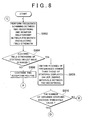
- FIG. 8 shows a process implemented when the "RDS-TMC reception" is set as a high-priority mode over the "station list search".
- the radio receiver 100 is set to be able to receive radio waves from the broadcast station.
- step S644 as described above with reference to FIG. 6A , the "RDS-TMC reception" is set as the high-priority mode over the "station list search".
- the radio receiver 100 performs frequency scanning during intervals between TMC receptions, so as to monitor the relationship between the frequency and the electric field strength (step S802).
- the list updating unit 1108 causes the DSP 108 to carry out frequency scanning during intervals between TMC receptions. Then, the list updating unit 1108 obtains the relationship between the electric field strength and the frequency within the frequency range, from the DSP 108, so as to monitor the relationship between the electric field strength and the frequency. For example, the list updating unit 1108 checks if the relationship between the electric field strength and the frequency has changed.
- the radio receiver 100 determines whether the strengths of the electric fields of signals transmitted from the broadcast stations included in the station list have changed, based on the relationship between the frequency and the electric field strength obtained in step S802 (step S804).
- the list updating unit 1108 determines whether the strengths of the electric fields of signals transmitted from the broadcast stations included in the station list have changed, based on the relationship between the frequency and the electric field strength obtained in step S802, or based on changes in the number of broadcast stations with respect to which the electric field strength has changed and/or the relationship between the frequency and the electric field strength.
- the radio receiver 100 continues to run a TMC receiving routine (step S806). For example, if the list updating unit 1108 determines that the strengths of the electric fields of signals transmitted from the broadcast stations included in the station list have not changed, the TMC data determining unit 1110 continues to run the TMC receiving routine. Then, the control returns to step S602 as described above with reference to FIG. 6A .
- the radio receiver 100 obtains the PI codes of frequencies other than those of the broadcast stations included in the station list, during intervals between TMC receptions (step S808). For example, if the list updating unit 1108 determines that the strengths of the electric fields of signals transmitted from the broadcast stations included in the station list have changed, the unit 1108 obtains the PI codes of frequencies other than those of the broadcast stations included in the station list, during intervals between TMC receptions.
- the radio receiver 100 determines whether the number of the broadcast stations that should be obtained exceeds a threshold value (step S810). For example, the list updating unit 1108 determines whether the number of the stations to be obtained exceeds the threshold value.
- step S810 If it is determined that the number of the broadcast stations to be obtained exceeds the threshold value (YES in step S810), the control proceeds to step S702 as described above with reference to FIG. 7 .
- the number of the stations to be obtained is large, all of the broadcast stations or a part of the stations are updated, according to the setting regarding updating of the station list.
- step S810 If it is determined that the number of the broadcast stations to be obtained is equal to or smaller than the threshold value (NO in step S810), the control proceeds to step S610 as described above with reference to FIG. 6A .
- the broadcast station is changed in the situation where the reception quality deteriorates. Since the broadcast station is changed in the situation where the reception quality deteriorates, the radio receiver 100 is able to receive TMC transmitted from a suitably selected broadcast station that provides a good reception quality.
- the TMC reception is not executed at preset time intervals, but the timing of receiving TMC can be dynamically changed based on changes in the radio-wave environment; therefore, the error rate of TMC can be reduced.
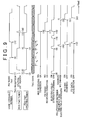
- FIG. 9 is a time chart (No. 1) showing the operation of the radio receiver 100 of this embodiment.
- the horizontal axis indicates time.
- the time chart of FIG. 9 shows the case where the user alternately switches the user-operable screen between the FM-radio control screen and the navigation screen.
- the user-operable screen e.g., the screen of the navigation system 200
- RDS-TMC tuner e.g., the screen of the navigation system 200
- RDS-TMC updating timer e.g., the time of the navigation system 200
- TMC data e.g., the screen of the navigation system 200
- RDS-TMC tuner e.g., the screen of the navigation system 200
- RDS-TMC updating timer e.g., the screen of the navigation system 200
- TMC data e.g., the screen of the navigation system 200
- RDS receiving condition e.g., the screen of the navigation system 200
- FM radio receiving condition e.g., FM radio receiving condition
- electric-field-strength scanning e.g., the time of the navigation system 200
- the radio receiver 100 switches the operating mode from the "TMC reception” to the "station list search” at time (2), and turns on the RDS-TMC updating timer at time (3). Then, the radio receiver 100 executes electric-field-strength scanning at time (4). Since there is no change in the relationship between the frequency and the electric field strength at this time, no PI-code scanning and PS data acquisition are carried out. Upon completion of the electric-field-strength scanning, the radio receiver 100 is switched to the "TMC reception" mode at time (5).
- the radio receiver 100 When the user switches the user-operable screen from the radio control screen to the navigation screen at time (6), the radio receiver 100 does not carry out electric-field-strength scanning during intervals between TMC receptions.
- the radio receiver 100 When the time set by the RDS-TMC timer expires at time (7), the radio receiver 100 is switched from the "TMC reception" mode to the "station list search” mode at time (8). Then, the radio receiver 100 carries out electric-field-strength scanning (9). As a result of the electric-field-strength scanning, a change in the relationship between the frequency and the electric field strength is detected at time (10). In the presence of the change in the relationship between the frequency and the electric field strength, the radio receiver 100 performs PI-code scanning at time (11), and obtains PS data corresponding to the newly detected PI code(s).
- the user switches the user-operable screen from the navigation screen to the radio control screen. Since the radio receiver 100 is in the "station list search" mode, the receiver 100 is kept in this operating mode and carries out electric-field-strength scanning at time (14). Since no change is observed in the relationship between the frequency and the electric field strength, the PI-code scanning and the PS data acquisition are not carried out. Upon completion of the electric-field-strength scanning, the radio receiver 100 is switched to the "TMC reception" mode at time (15).
- the radio-wave condition changes, and the radio receiver 100 becomes unable to receive any signal.
- the radio receiver 100 changes from OK to NG at time (16), and the FM radio receiving condition changes from OK to NG at time (17).
- the radio receiver 100 is switched from "TMC reception” mode to the "station list search” mode at time (18).
- the radio receiver 100 executes electric-field-strength scanning at time (19).
- a change in the relationship between the frequency and the electric field strength is detected at time (20).
- the radio receiver 100 executes PI-code scanning at time (21), and obtains PS data corresponding to the newly detected PI code(s) at time (22).
- the time required to obtain PS data is prolonged.
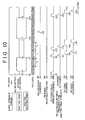
- FIG. 10 is a time chart (No. 2) showing the operation of the radio receiver 100 of this embodiment.
- the horizontal axis indicates time.
- the time chart of FIG 10 shows the case where the user keeps the FM-radio control screen displayed.
- the user-operable screen, RDS-TMC tuner, RDS-TMC updating timer, TMC data, RDS receiving condition, FM radio receiving condition, electric-field-strength scanning, change in the relationship between the frequency and the electric field strength, PI-code scanning, and PS data acquisition are indicated.
- the radio receiver 100 When the user switches the user-operable screen from the navigation screen to the radio control screen at time (1), the radio receiver 100 is switched from the "TMC reception” mode to the "station list search” mode at time (2), and turns on the RDS-TMC updating timer at time (3). Then, the radio receiver 100 executes electric-field-strength scanning at time (4). Since there is no change in the relationship between the frequency and the electric field strength at this time, the PI-code scanning and the PS data acquisition are not carried out. Upon completion of the electric-field-strength scanning, the radio receiver 100 is switched to the "TMC reception" mode at time (5).
- the radio receiver 100 When the TMC reception is completed, the radio receiver 100 is switched to the "station list search" mode at time (6), and turns on the RDS-TMC updating timer at time (7). Then, the radio receiver 100 executes electric-field-strength scanning at time (8). As a result of the electric-field-strength scanning, a change in the relationship between the frequency and the electric field strength is detected at time (9). In the presence of the change in the relationship between the frequency and the electric field strength, the radio receiver 100 executes PI-code scanning at time (10), and obtains PS data corresponding to the newly detected PI code(s) at time (11).
- the radio receiver 100 performs electric-field-strength scanning at time (12) while it is in the "station list search" mode. As a result of the electric-field-strength scanning, a change in the relationship between the frequency and the electric field strength is detected at time (13). In the presence of the change in the relationship between the frequency and the electric field strength, the radio receiver 100 executes PI-code scanning at time (14), and obtains PS data corresponding to the newly detected PI code(s) at time (15). As the number of the newly detected PI codes increases, the time required to obtain the corresponding PS data is prolonged.
- the radio receiver 100 is switched from the "station list search” mode to the "TMC reception” mode at time (17).
- the radio receiver 100 detects a transient deterioration (NG) in the RDS receiving condition at time (18).
- NG transient deterioration
- the radio receiver 100 is switched from the "TMC reception” mode to the "station list search” mode at time (19), and turns on the RDS-TMC updating timer at time (20). Then, the radio receiver 100 executes electric-field-strength scanning at time (21). As a result of the electric-field-strength scanning, a change in the relationship between the frequency and the electric field strength is detected at time (22). In the presence of the change in the relationship between the frequency and the electric field strength, the radio receiver 100 executes PI-code scanning at time (23), and obtains PS data corresponding to the newly detected PI code(s) at time (24).
- the operating mode or reception status of the RDS-TMC tuner is dynamically changed. Since the reception status of the RDS-TMC tuner can be dynamically changed, the latest station list and traffic information can be provided to the user.
- the radio receiver of this embodiment is able to dynamically change the reception status of the RDS-TMC tuner 106, based on changes in the surrounding environment and the operational status of the navigation system 200.
- the reception status of the RDS-TMC tuner 106 includes reception of signals for use in updating of the station list and reception of TMC data, and may include reception of signals for use in updating of the AF list by the sub-tuner.
- the processing time can be reduced by using two or more scanning methods.
- full scanning is carried out so as to update the station list when the radio receiver becomes able to receive radio signals from a condition where the receiver cannot receive radio signals; therefore, it takes about 5 minutes to update the station list.
- it takes about 6 seconds to perform electric-field-strength scanning, and it takes about 30 to 40 seconds to perform PI-code scanning; thus, the processing time can be reduced.
- the radio receiver as described below is provided according to this embodiment.
- the radio receiver includes a receiving unit in the form of the RDS-TMC tuner, which receives broadcast station information and/or traffic information provided by the radio data system (RDS), and provides the traffic information to a vehicle-mounted system, a station list setting unit in the form of the list updating unit, which sets a list of broadcast stations from which signals can be received, based on the broadcast station information received by the receiving unit, a status information obtaining unit in the form of the operational status determining unit, which obtains status information indicative of the status of the vehicle-mounted system, from the vehicle-mounted system, an operating mode setting unit that makes a setting as to whether the list of the broadcast stations is to be updated, or traffic information is to be provided to the vehicle-mounted system, based on the status information obtained by the status information obtaining unit, and a receiving information changing unit in the form of the receiving condition determining unit, which changes the information to be received by the receiving unit.
- a receiving unit in the form of the RDS-TMC tuner, which receives broadcast station information and/or traffic information provided by
- the timing of updating the station list and the timing of providing traffic information to the vehicle-mounted system can be changed according to the circumstances.
- the status information obtaining unit obtains screen information displayed on a screen of the vehicle-mounted system.
- the status of the vehicle-mounted system can be determined by obtaining the screen information displayed on the screen of the vehicle-mounted system. For example, it can be determined whether the user is listening to radio.
- the receiving information changing unit establishes a signal-receiving mode for receiving the broadcast station information when the screen information on the vehicle-mounted system, which is obtained by the status information obtaining unit, is a radio control screen.
- the list of broadcast stations is updated when the screen information on the vehicle-mounted system is the radio control screen, so that the station list as a list of broadcast stations from which one can be selected by the user is kept as being the latest one.
- the radio receiver further includes an alternative frequency list updating unit in the form of the sub-tuner, which updates an alternative frequency list when the receiving information changing unit establishes the receiving mode for receiving broadcast station information.
- the radio receiver can switch to a suitably selected one of the broadcast stations from which signals can be received, according to changes in the radio-wave environment.
- the radio receiver further includes a radio-wave environment determining unit in the form of the receiving condition determining unit, which determines the radio-wave environment.
- the receiving information changing unit controls the receiving unit to execute frequency scanning, and the station list setting unit updates the list of the broadcast stations from which signals can be received, based on the broadcast station information received by the receiving unit.
- the station list can be updated when the receiving condition deteriorates.
- the station list setting unit updates the station list.
- the list of broadcast stations can be updated when a new broadcast station or stations are detected.
- the radio receiver further includes an update interval calculating unit in the form of the TMC data determining unit, which calculates the update interval of traffic information, based on the traffic information received by the receiving unit.
- the radio-wave environment determining unit determines the radio-wave environment, depending on whether the update interval has elapsed.
- the data update interval of traffic information is calculated based on the traffic information, even when the data size of broadcasted TMC data changes, the data update interval can be set again when TMC data is received.
- the station list setting unit When updating the station list, the station list setting unit replaces one or more broadcast stations as a part of the stations on the list with another station or stations, based on broadcast station information received by the receiving unit.
- the processing time can be reduced.
- the receiving information changing unit establishes a signal-receiving mode for receiving the traffic information when the screen information on the vehicle-mounted system, which is obtained by the status information obtaining unit, is other than the radio control screen.
- the traffic information is provided to the vehicle-mounted system when the screen information on the vehicle-mounted system is other than the radio control screen
- updating of the traffic information can be prioritized over updating of the station list when the user is not listening to radio.
- the receiving information changing unit controls the receiving unit to carry out frequency scanning during intervals between receptions of traffic information by the receiving unit, and the station list setting unit updates the list of the broadcast stations from which signals can be received, based on the broadcast station information received by the receiving unit.
- the station list can be updated so as to include information on broadcast stations that transmit traffic information.
Landscapes
- Engineering & Computer Science (AREA)
- Signal Processing (AREA)
- Circuits Of Receivers In General (AREA)
Applications Claiming Priority (1)
| Application Number | Priority Date | Filing Date | Title |
|---|---|---|---|
| JP2009161653A JP4962537B2 (ja) | 2009-07-08 | 2009-07-08 | ラジオ受信機及び方法 |
Publications (3)
| Publication Number | Publication Date |
|---|---|
| EP2285024A2 true EP2285024A2 (de) | 2011-02-16 |
| EP2285024A3 EP2285024A3 (de) | 2011-08-31 |
| EP2285024B1 EP2285024B1 (de) | 2016-03-02 |
Family
ID=42813311
Family Applications (1)
| Application Number | Title | Priority Date | Filing Date |
|---|---|---|---|
| EP10251210.0A Not-in-force EP2285024B1 (de) | 2009-07-08 | 2010-07-06 | Rundfunkempfänger und Steuerungsverfahren dafür |
Country Status (2)
| Country | Link |
|---|---|
| EP (1) | EP2285024B1 (de) |
| JP (1) | JP4962537B2 (de) |
Cited By (9)
| Publication number | Priority date | Publication date | Assignee | Title |
|---|---|---|---|---|
| EP2493098A1 (de) * | 2011-02-28 | 2012-08-29 | Pioneer Corporation | Funkrundfunkempfänger |
| EP2802094A1 (de) * | 2013-05-09 | 2014-11-12 | Frontier Silicon Limited | Digitaler Radioempfänger System und Verfahren |
| EP2884680A1 (de) * | 2013-12-14 | 2015-06-17 | Alpine Electronics, Inc. | Rundfunkempfänger |
| US9065577B2 (en) | 2013-05-09 | 2015-06-23 | Frontier Silicon Limited | Digital radio receiver system and method |
| CN105846839A (zh) * | 2016-03-25 | 2016-08-10 | 乐视控股(北京)有限公司 | 收音机提示方法及装置 |
| EP3160064A1 (de) * | 2015-10-22 | 2017-04-26 | Alpine Electronics, Inc. | Rundfunkempfangsvorrichtung und alternatives rundfunkkanalprüfungsverfahren |
| US11272435B2 (en) * | 2017-09-05 | 2022-03-08 | Continental Automotive France | Method for updating a list of stations that can be received by a radio receiver system |
| EP3396876B1 (de) * | 2017-04-28 | 2023-06-28 | Clarion Co., Ltd. | Rundfunkempfänger und senderliste erzeugungsverfahren |
| EP3580932B1 (de) * | 2017-02-10 | 2024-04-03 | Hirschmann Car Communication GmbH | Sendererkennung bei fahrten von fahrzeugen durch tunnel |
Families Citing this family (4)
| Publication number | Priority date | Publication date | Assignee | Title |
|---|---|---|---|---|
| JP5999923B2 (ja) * | 2012-02-27 | 2016-09-28 | アルパイン株式会社 | 受信装置、放送局の表示方法および表示プログラム |
| JP5787788B2 (ja) * | 2012-02-27 | 2015-09-30 | アルパイン株式会社 | 受信装置、放送局の表示方法および表示プログラム |
| KR101905871B1 (ko) * | 2012-05-21 | 2018-10-08 | 현대모비스 주식회사 | Dab 방송 수신기 및 수신 방법 |
| JP6013689B2 (ja) * | 2012-12-06 | 2016-10-25 | アルパイン株式会社 | 車両用放送受信装置 |
Citations (1)
| Publication number | Priority date | Publication date | Assignee | Title |
|---|---|---|---|---|
| JP2002344340A (ja) | 2001-05-14 | 2002-11-29 | Kenwood Corp | Rds受信機及びその受信方法 |
Family Cites Families (8)
| Publication number | Priority date | Publication date | Assignee | Title |
|---|---|---|---|---|
| JPH09162817A (ja) * | 1995-10-06 | 1997-06-20 | Clarion Co Ltd | 多重放送用受信装置 |
| JP2006187043A (ja) * | 1995-10-06 | 2006-07-13 | Clarion Co Ltd | 多重放送用受信装置 |
| JP3782636B2 (ja) * | 2000-01-14 | 2006-06-07 | 株式会社ケンウッド | ラジオ受信機 |
| JP4181021B2 (ja) * | 2003-11-27 | 2008-11-12 | アルパイン株式会社 | 多重放送用受信装置および多重放送受信方法 |
| JP2007174304A (ja) * | 2005-12-22 | 2007-07-05 | Fujitsu Ten Ltd | Rdsデータ受信装置及びデータ受信装置 |
| JP4869021B2 (ja) * | 2006-10-27 | 2012-02-01 | 三洋電機株式会社 | 車載用ナビゲーション装置 |
| JP4775238B2 (ja) * | 2006-11-29 | 2011-09-21 | 株式会社デンソー | 車両用ラジオ受信装置 |
| EP2073410A1 (de) * | 2007-12-21 | 2009-06-24 | Fujitsu Ten Limited | Programmumschaltverfahren und Funkvorrichtung für die fahrzeuginterne Verwendung |
-
2009
- 2009-07-08 JP JP2009161653A patent/JP4962537B2/ja not_active Expired - Fee Related
-
2010
- 2010-07-06 EP EP10251210.0A patent/EP2285024B1/de not_active Not-in-force
Patent Citations (1)
| Publication number | Priority date | Publication date | Assignee | Title |
|---|---|---|---|---|
| JP2002344340A (ja) | 2001-05-14 | 2002-11-29 | Kenwood Corp | Rds受信機及びその受信方法 |
Cited By (11)
| Publication number | Priority date | Publication date | Assignee | Title |
|---|---|---|---|---|
| EP2493098A1 (de) * | 2011-02-28 | 2012-08-29 | Pioneer Corporation | Funkrundfunkempfänger |
| EP2802094A1 (de) * | 2013-05-09 | 2014-11-12 | Frontier Silicon Limited | Digitaler Radioempfänger System und Verfahren |
| US9065577B2 (en) | 2013-05-09 | 2015-06-23 | Frontier Silicon Limited | Digital radio receiver system and method |
| US9455793B2 (en) | 2013-05-09 | 2016-09-27 | Frontier Silicon Limited | Digital radio receiver system and method |
| EP2884680A1 (de) * | 2013-12-14 | 2015-06-17 | Alpine Electronics, Inc. | Rundfunkempfänger |
| JP2015115906A (ja) * | 2013-12-14 | 2015-06-22 | アルパイン株式会社 | 放送受信機 |
| EP3160064A1 (de) * | 2015-10-22 | 2017-04-26 | Alpine Electronics, Inc. | Rundfunkempfangsvorrichtung und alternatives rundfunkkanalprüfungsverfahren |
| CN105846839A (zh) * | 2016-03-25 | 2016-08-10 | 乐视控股(北京)有限公司 | 收音机提示方法及装置 |
| EP3580932B1 (de) * | 2017-02-10 | 2024-04-03 | Hirschmann Car Communication GmbH | Sendererkennung bei fahrten von fahrzeugen durch tunnel |
| EP3396876B1 (de) * | 2017-04-28 | 2023-06-28 | Clarion Co., Ltd. | Rundfunkempfänger und senderliste erzeugungsverfahren |
| US11272435B2 (en) * | 2017-09-05 | 2022-03-08 | Continental Automotive France | Method for updating a list of stations that can be received by a radio receiver system |
Also Published As
| Publication number | Publication date |
|---|---|
| EP2285024B1 (de) | 2016-03-02 |
| JP2011019041A (ja) | 2011-01-27 |
| EP2285024A3 (de) | 2011-08-31 |
| JP4962537B2 (ja) | 2012-06-27 |
Similar Documents
| Publication | Publication Date | Title |
|---|---|---|
| EP2285024B1 (de) | Rundfunkempfänger und Steuerungsverfahren dafür | |
| US7254378B2 (en) | Receiver system for decoding data embedded in an electromagnetic signal | |
| EP2012540A1 (de) | Vorrichtung zum empfang digitaler rundfunksendungen und deren empfangsverfahren | |
| US20080280576A1 (en) | Searching receiver | |
| JP4181021B2 (ja) | 多重放送用受信装置および多重放送受信方法 | |
| JP2007020165A (ja) | 放送用信号の拡張型受信方法 | |
| US20100159836A1 (en) | Automatic present tuning using rds protocol | |
| JP5144972B2 (ja) | デジタル放送受信装置 | |
| JP2978263B2 (ja) | Rds受信機 | |
| JP3606420B2 (ja) | 併設チューナを有するデータ多重放送受信機 | |
| EP1022873A2 (de) | Empfänger für den Empfang vom digitalen Hörfunk sowie von frequenzmodulierten Rundfunkübertragungen, die Zusatzdaten enthalten | |
| US8054923B2 (en) | Radio receiver | |
| EP2866363B1 (de) | Digitale Rundfunkempfangsvorrichtung und digitales Rundfunkempfangsverfahren | |
| EP1603258A2 (de) | Empfänger für digitalen Multimediarundfunk und Verfahren zur Anzeige der Kanäle | |
| EP2627017B1 (de) | Radioempfänger der das Aktualisieren von gespeicherten Frequenzlisten in einem Tunnel vermeidet | |
| EP2693668B1 (de) | Radioempfänger | |
| JP5363365B2 (ja) | ラジオ受信機及び方法 | |
| EP2521291A2 (de) | Rundfunkempfänger und digitales Rundfunkempfangsverfahren zum Verknüpfen von RDS und DAB | |
| JPH0758598A (ja) | チャンネルプリセット機能を有するrds受信機 | |
| JP2004336093A (ja) | 放送受信装置 | |
| EP1727362B1 (de) | Digitaler Multimedia Rundfunkempfänger und Verfahren zur Kanalverwaltung desselben | |
| EP0961433A2 (de) | Empfänger für den Empfang von digitalen Rundfunkprogrammen mit einer Vorrichtung zur Auswahl eines Programms aus einer Mehrzahl von vorgespeicherten Programmen | |
| JP3782636B2 (ja) | ラジオ受信機 | |
| JP2907293B2 (ja) | 受信装置 | |
| JP2000209071A (ja) | 車載用受信装置 |
Legal Events
| Date | Code | Title | Description |
|---|---|---|---|
| PUAI | Public reference made under article 153(3) epc to a published international application that has entered the european phase |
Free format text: ORIGINAL CODE: 0009012 |
|
| 17P | Request for examination filed |
Effective date: 20100726 |
|
| AK | Designated contracting states |
Kind code of ref document: A2 Designated state(s): AL AT BE BG CH CY CZ DE DK EE ES FI FR GB GR HR HU IE IS IT LI LT LU LV MC MK MT NL NO PL PT RO SE SI SK SM TR |
|
| AX | Request for extension of the european patent |
Extension state: BA ME RS |
|
| PUAL | Search report despatched |
Free format text: ORIGINAL CODE: 0009013 |
|
| AK | Designated contracting states |
Kind code of ref document: A3 Designated state(s): AL AT BE BG CH CY CZ DE DK EE ES FI FR GB GR HR HU IE IS IT LI LT LU LV MC MK MT NL NO PL PT RO SE SI SK SM TR |
|
| AX | Request for extension of the european patent |
Extension state: BA ME RS |
|
| RIC1 | Information provided on ipc code assigned before grant |
Ipc: H04H 20/55 20080101AFI20110722BHEP Ipc: H04H 60/25 20080101ALI20110722BHEP Ipc: H04H 20/62 20080101ALI20110722BHEP |
|
| RAP1 | Party data changed (applicant data changed or rights of an application transferred) |
Owner name: TOYOTA JIDOSHA KABUSHIKI KAISHA |
|
| 17Q | First examination report despatched |
Effective date: 20140107 |
|
| REG | Reference to a national code |
Ref country code: DE Ref legal event code: R079 Ref document number: 602010030851 Country of ref document: DE Free format text: PREVIOUS MAIN CLASS: H04H0020550000 Ipc: H04H0060430000 |
|
| RIC1 | Information provided on ipc code assigned before grant |
Ipc: H04H 60/43 20080101AFI20150730BHEP Ipc: H04H 20/55 20080101ALI20150730BHEP |
|
| GRAP | Despatch of communication of intention to grant a patent |
Free format text: ORIGINAL CODE: EPIDOSNIGR1 |
|
| INTG | Intention to grant announced |
Effective date: 20150908 |
|
| GRAS | Grant fee paid |
Free format text: ORIGINAL CODE: EPIDOSNIGR3 |
|
| GRAA | (expected) grant |
Free format text: ORIGINAL CODE: 0009210 |
|
| AK | Designated contracting states |
Kind code of ref document: B1 Designated state(s): AL AT BE BG CH CY CZ DE DK EE ES FI FR GB GR HR HU IE IS IT LI LT LU LV MC MK MT NL NO PL PT RO SE SI SK SM TR |
|
| REG | Reference to a national code |
Ref country code: GB Ref legal event code: FG4D |
|
| REG | Reference to a national code |
Ref country code: AT Ref legal event code: REF Ref document number: 778637 Country of ref document: AT Kind code of ref document: T Effective date: 20160315 Ref country code: CH Ref legal event code: EP |
|
| REG | Reference to a national code |
Ref country code: IE Ref legal event code: FG4D |
|
| REG | Reference to a national code |
Ref country code: DE Ref legal event code: R096 Ref document number: 602010030851 Country of ref document: DE |
|
| REG | Reference to a national code |
Ref country code: DE Ref legal event code: R084 Ref document number: 602010030851 Country of ref document: DE |
|
| REG | Reference to a national code |
Ref country code: NL Ref legal event code: MP Effective date: 20160302 |
|
| REG | Reference to a national code |
Ref country code: LT Ref legal event code: MG4D |
|
| REG | Reference to a national code |
Ref country code: AT Ref legal event code: MK05 Ref document number: 778637 Country of ref document: AT Kind code of ref document: T Effective date: 20160302 |
|
| PG25 | Lapsed in a contracting state [announced via postgrant information from national office to epo] |
Ref country code: FI Free format text: LAPSE BECAUSE OF FAILURE TO SUBMIT A TRANSLATION OF THE DESCRIPTION OR TO PAY THE FEE WITHIN THE PRESCRIBED TIME-LIMIT Effective date: 20160302 Ref country code: NO Free format text: LAPSE BECAUSE OF FAILURE TO SUBMIT A TRANSLATION OF THE DESCRIPTION OR TO PAY THE FEE WITHIN THE PRESCRIBED TIME-LIMIT Effective date: 20160602 Ref country code: ES Free format text: LAPSE BECAUSE OF FAILURE TO SUBMIT A TRANSLATION OF THE DESCRIPTION OR TO PAY THE FEE WITHIN THE PRESCRIBED TIME-LIMIT Effective date: 20160302 Ref country code: GR Free format text: LAPSE BECAUSE OF FAILURE TO SUBMIT A TRANSLATION OF THE DESCRIPTION OR TO PAY THE FEE WITHIN THE PRESCRIBED TIME-LIMIT Effective date: 20160603 Ref country code: HR Free format text: LAPSE BECAUSE OF FAILURE TO SUBMIT A TRANSLATION OF THE DESCRIPTION OR TO PAY THE FEE WITHIN THE PRESCRIBED TIME-LIMIT Effective date: 20160302 |
|
| PG25 | Lapsed in a contracting state [announced via postgrant information from national office to epo] |
Ref country code: PL Free format text: LAPSE BECAUSE OF FAILURE TO SUBMIT A TRANSLATION OF THE DESCRIPTION OR TO PAY THE FEE WITHIN THE PRESCRIBED TIME-LIMIT Effective date: 20160302 Ref country code: NL Free format text: LAPSE BECAUSE OF FAILURE TO SUBMIT A TRANSLATION OF THE DESCRIPTION OR TO PAY THE FEE WITHIN THE PRESCRIBED TIME-LIMIT Effective date: 20160302 Ref country code: LT Free format text: LAPSE BECAUSE OF FAILURE TO SUBMIT A TRANSLATION OF THE DESCRIPTION OR TO PAY THE FEE WITHIN THE PRESCRIBED TIME-LIMIT Effective date: 20160302 Ref country code: AT Free format text: LAPSE BECAUSE OF FAILURE TO SUBMIT A TRANSLATION OF THE DESCRIPTION OR TO PAY THE FEE WITHIN THE PRESCRIBED TIME-LIMIT Effective date: 20160302 Ref country code: SE Free format text: LAPSE BECAUSE OF FAILURE TO SUBMIT A TRANSLATION OF THE DESCRIPTION OR TO PAY THE FEE WITHIN THE PRESCRIBED TIME-LIMIT Effective date: 20160302 Ref country code: LV Free format text: LAPSE BECAUSE OF FAILURE TO SUBMIT A TRANSLATION OF THE DESCRIPTION OR TO PAY THE FEE WITHIN THE PRESCRIBED TIME-LIMIT Effective date: 20160302 |
|
| PG25 | Lapsed in a contracting state [announced via postgrant information from national office to epo] |
Ref country code: EE Free format text: LAPSE BECAUSE OF FAILURE TO SUBMIT A TRANSLATION OF THE DESCRIPTION OR TO PAY THE FEE WITHIN THE PRESCRIBED TIME-LIMIT Effective date: 20160302 Ref country code: IS Free format text: LAPSE BECAUSE OF FAILURE TO SUBMIT A TRANSLATION OF THE DESCRIPTION OR TO PAY THE FEE WITHIN THE PRESCRIBED TIME-LIMIT Effective date: 20160702 |
|
| PG25 | Lapsed in a contracting state [announced via postgrant information from national office to epo] |
Ref country code: SK Free format text: LAPSE BECAUSE OF FAILURE TO SUBMIT A TRANSLATION OF THE DESCRIPTION OR TO PAY THE FEE WITHIN THE PRESCRIBED TIME-LIMIT Effective date: 20160302 Ref country code: RO Free format text: LAPSE BECAUSE OF FAILURE TO SUBMIT A TRANSLATION OF THE DESCRIPTION OR TO PAY THE FEE WITHIN THE PRESCRIBED TIME-LIMIT Effective date: 20160302 Ref country code: PT Free format text: LAPSE BECAUSE OF FAILURE TO SUBMIT A TRANSLATION OF THE DESCRIPTION OR TO PAY THE FEE WITHIN THE PRESCRIBED TIME-LIMIT Effective date: 20160704 Ref country code: SM Free format text: LAPSE BECAUSE OF FAILURE TO SUBMIT A TRANSLATION OF THE DESCRIPTION OR TO PAY THE FEE WITHIN THE PRESCRIBED TIME-LIMIT Effective date: 20160302 Ref country code: CZ Free format text: LAPSE BECAUSE OF FAILURE TO SUBMIT A TRANSLATION OF THE DESCRIPTION OR TO PAY THE FEE WITHIN THE PRESCRIBED TIME-LIMIT Effective date: 20160302 |
|
| REG | Reference to a national code |
Ref country code: DE Ref legal event code: R097 Ref document number: 602010030851 Country of ref document: DE |
|
| PG25 | Lapsed in a contracting state [announced via postgrant information from national office to epo] |
Ref country code: BE Free format text: LAPSE BECAUSE OF FAILURE TO SUBMIT A TRANSLATION OF THE DESCRIPTION OR TO PAY THE FEE WITHIN THE PRESCRIBED TIME-LIMIT Effective date: 20160302 Ref country code: IT Free format text: LAPSE BECAUSE OF FAILURE TO SUBMIT A TRANSLATION OF THE DESCRIPTION OR TO PAY THE FEE WITHIN THE PRESCRIBED TIME-LIMIT Effective date: 20160302 |
|
| PLBE | No opposition filed within time limit |
Free format text: ORIGINAL CODE: 0009261 |
|
| STAA | Information on the status of an ep patent application or granted ep patent |
Free format text: STATUS: NO OPPOSITION FILED WITHIN TIME LIMIT |
|
| PG25 | Lapsed in a contracting state [announced via postgrant information from national office to epo] |
Ref country code: DK Free format text: LAPSE BECAUSE OF FAILURE TO SUBMIT A TRANSLATION OF THE DESCRIPTION OR TO PAY THE FEE WITHIN THE PRESCRIBED TIME-LIMIT Effective date: 20160302 |
|
| 26N | No opposition filed |
Effective date: 20161205 |
|
| PG25 | Lapsed in a contracting state [announced via postgrant information from national office to epo] |
Ref country code: SI Free format text: LAPSE BECAUSE OF FAILURE TO SUBMIT A TRANSLATION OF THE DESCRIPTION OR TO PAY THE FEE WITHIN THE PRESCRIBED TIME-LIMIT Effective date: 20160302 Ref country code: BG Free format text: LAPSE BECAUSE OF FAILURE TO SUBMIT A TRANSLATION OF THE DESCRIPTION OR TO PAY THE FEE WITHIN THE PRESCRIBED TIME-LIMIT Effective date: 20160602 |
|
| REG | Reference to a national code |
Ref country code: CH Ref legal event code: PL |
|
| GBPC | Gb: european patent ceased through non-payment of renewal fee |
Effective date: 20160706 |
|
| PG25 | Lapsed in a contracting state [announced via postgrant information from national office to epo] |
Ref country code: MC Free format text: LAPSE BECAUSE OF FAILURE TO SUBMIT A TRANSLATION OF THE DESCRIPTION OR TO PAY THE FEE WITHIN THE PRESCRIBED TIME-LIMIT Effective date: 20160302 |
|
| PG25 | Lapsed in a contracting state [announced via postgrant information from national office to epo] |
Ref country code: FR Free format text: LAPSE BECAUSE OF NON-PAYMENT OF DUE FEES Effective date: 20160801 Ref country code: LI Free format text: LAPSE BECAUSE OF NON-PAYMENT OF DUE FEES Effective date: 20160731 Ref country code: CH Free format text: LAPSE BECAUSE OF NON-PAYMENT OF DUE FEES Effective date: 20160731 |
|
| REG | Reference to a national code |
Ref country code: FR Ref legal event code: ST Effective date: 20170331 |
|
| REG | Reference to a national code |
Ref country code: IE Ref legal event code: MM4A |
|
| PG25 | Lapsed in a contracting state [announced via postgrant information from national office to epo] |
Ref country code: GB Free format text: LAPSE BECAUSE OF NON-PAYMENT OF DUE FEES Effective date: 20160706 |
|
| PG25 | Lapsed in a contracting state [announced via postgrant information from national office to epo] |
Ref country code: IE Free format text: LAPSE BECAUSE OF NON-PAYMENT OF DUE FEES Effective date: 20160706 |
|
| PG25 | Lapsed in a contracting state [announced via postgrant information from national office to epo] |
Ref country code: LU Free format text: LAPSE BECAUSE OF NON-PAYMENT OF DUE FEES Effective date: 20160706 |
|
| PG25 | Lapsed in a contracting state [announced via postgrant information from national office to epo] |
Ref country code: HU Free format text: LAPSE BECAUSE OF FAILURE TO SUBMIT A TRANSLATION OF THE DESCRIPTION OR TO PAY THE FEE WITHIN THE PRESCRIBED TIME-LIMIT; INVALID AB INITIO Effective date: 20100706 Ref country code: CY Free format text: LAPSE BECAUSE OF FAILURE TO SUBMIT A TRANSLATION OF THE DESCRIPTION OR TO PAY THE FEE WITHIN THE PRESCRIBED TIME-LIMIT Effective date: 20160302 |
|
| PG25 | Lapsed in a contracting state [announced via postgrant information from national office to epo] |
Ref country code: MT Free format text: LAPSE BECAUSE OF NON-PAYMENT OF DUE FEES Effective date: 20160731 Ref country code: TR Free format text: LAPSE BECAUSE OF FAILURE TO SUBMIT A TRANSLATION OF THE DESCRIPTION OR TO PAY THE FEE WITHIN THE PRESCRIBED TIME-LIMIT Effective date: 20160302 Ref country code: MK Free format text: LAPSE BECAUSE OF FAILURE TO SUBMIT A TRANSLATION OF THE DESCRIPTION OR TO PAY THE FEE WITHIN THE PRESCRIBED TIME-LIMIT Effective date: 20160302 |
|
| PG25 | Lapsed in a contracting state [announced via postgrant information from national office to epo] |
Ref country code: AL Free format text: LAPSE BECAUSE OF FAILURE TO SUBMIT A TRANSLATION OF THE DESCRIPTION OR TO PAY THE FEE WITHIN THE PRESCRIBED TIME-LIMIT Effective date: 20160302 |
|
| PGFP | Annual fee paid to national office [announced via postgrant information from national office to epo] |
Ref country code: DE Payment date: 20220511 Year of fee payment: 13 |
|
| P01 | Opt-out of the competence of the unified patent court (upc) registered |
Effective date: 20230427 |
|
| REG | Reference to a national code |
Ref country code: DE Ref legal event code: R119 Ref document number: 602010030851 Country of ref document: DE |
|
| PG25 | Lapsed in a contracting state [announced via postgrant information from national office to epo] |
Ref country code: DE Free format text: LAPSE BECAUSE OF NON-PAYMENT OF DUE FEES Effective date: 20240201 |