EP2286650A2 - Sol solide ensemencé, procédé de culture des plantes avec celui-ci et son procédé de fabrication - Google Patents
Sol solide ensemencé, procédé de culture des plantes avec celui-ci et son procédé de fabrication Download PDFInfo
- Publication number
- EP2286650A2 EP2286650A2 EP10173547A EP10173547A EP2286650A2 EP 2286650 A2 EP2286650 A2 EP 2286650A2 EP 10173547 A EP10173547 A EP 10173547A EP 10173547 A EP10173547 A EP 10173547A EP 2286650 A2 EP2286650 A2 EP 2286650A2
- Authority
- EP
- European Patent Office
- Prior art keywords
- solid soil
- coating layer
- seeds
- seed
- seeded
- Prior art date
- Legal status (The legal status is an assumption and is not a legal conclusion. Google has not performed a legal analysis and makes no representation as to the accuracy of the status listed.)
- Withdrawn
Links
- 239000002689 soil Substances 0.000 title claims abstract description 146
- 239000007787 solid Substances 0.000 title claims abstract description 132
- 238000000034 method Methods 0.000 title claims description 21
- 238000004519 manufacturing process Methods 0.000 title claims description 8
- 239000011247 coating layer Substances 0.000 claims abstract description 77
- XLYOFNOQVPJJNP-UHFFFAOYSA-N water Substances O XLYOFNOQVPJJNP-UHFFFAOYSA-N 0.000 claims description 46
- 230000035784 germination Effects 0.000 claims description 27
- 239000000463 material Substances 0.000 claims description 25
- 229920000642 polymer Polymers 0.000 claims description 23
- 239000002250 absorbent Substances 0.000 claims description 21
- 230000002745 absorbent Effects 0.000 claims description 20
- 238000001035 drying Methods 0.000 claims description 20
- 239000011248 coating agent Substances 0.000 claims description 17
- 238000000576 coating method Methods 0.000 claims description 17
- 239000003349 gelling agent Substances 0.000 claims description 13
- 239000000203 mixture Substances 0.000 claims description 9
- 239000004848 polyfunctional curative Substances 0.000 claims description 5
- 238000003825 pressing Methods 0.000 claims description 5
- 239000000499 gel Substances 0.000 description 17
- 241000196324 Embryophyta Species 0.000 description 15
- 229920002134 Carboxymethyl cellulose Polymers 0.000 description 11
- 235000010443 alginic acid Nutrition 0.000 description 11
- 229920000615 alginic acid Polymers 0.000 description 11
- 239000001768 carboxy methyl cellulose Substances 0.000 description 11
- 235000010948 carboxy methyl cellulose Nutrition 0.000 description 11
- 239000008112 carboxymethyl-cellulose Substances 0.000 description 11
- FHVDTGUDJYJELY-UHFFFAOYSA-N 6-{[2-carboxy-4,5-dihydroxy-6-(phosphanyloxy)oxan-3-yl]oxy}-4,5-dihydroxy-3-phosphanyloxane-2-carboxylic acid Chemical compound O1C(C(O)=O)C(P)C(O)C(O)C1OC1C(C(O)=O)OC(OP)C(O)C1O FHVDTGUDJYJELY-UHFFFAOYSA-N 0.000 description 10
- 229940072056 alginate Drugs 0.000 description 10
- 230000000052 comparative effect Effects 0.000 description 10
- 230000012010 growth Effects 0.000 description 7
- 239000008188 pellet Substances 0.000 description 7
- 238000009331 sowing Methods 0.000 description 7
- OKTJSMMVPCPJKN-UHFFFAOYSA-N Carbon Chemical compound [C] OKTJSMMVPCPJKN-UHFFFAOYSA-N 0.000 description 6
- 239000000853 adhesive Substances 0.000 description 5
- 230000001070 adhesive effect Effects 0.000 description 5
- 230000000903 blocking effect Effects 0.000 description 4
- 239000002994 raw material Substances 0.000 description 4
- 150000001447 alkali salts Chemical class 0.000 description 3
- 238000012364 cultivation method Methods 0.000 description 3
- 230000002401 inhibitory effect Effects 0.000 description 3
- 239000003415 peat Substances 0.000 description 3
- 230000008635 plant growth Effects 0.000 description 3
- 239000007864 aqueous solution Substances 0.000 description 2
- 239000002585 base Substances 0.000 description 2
- 238000000354 decomposition reaction Methods 0.000 description 2
- 238000009826 distribution Methods 0.000 description 2
- 230000036571 hydration Effects 0.000 description 2
- 238000006703 hydration reaction Methods 0.000 description 2
- 239000011368 organic material Substances 0.000 description 2
- 239000002245 particle Substances 0.000 description 2
- 239000000049 pigment Substances 0.000 description 2
- 238000003860 storage Methods 0.000 description 2
- 239000000126 substance Substances 0.000 description 2
- 239000000454 talc Substances 0.000 description 2
- 229910052623 talc Inorganic materials 0.000 description 2
- 235000013311 vegetables Nutrition 0.000 description 2
- 239000010455 vermiculite Substances 0.000 description 2
- 229910052902 vermiculite Inorganic materials 0.000 description 2
- 235000019354 vermiculite Nutrition 0.000 description 2
- LPLLVINFLBSFRP-UHFFFAOYSA-N 2-methylamino-1-phenylpropan-1-one Chemical compound CNC(C)C(=O)C1=CC=CC=C1 LPLLVINFLBSFRP-UHFFFAOYSA-N 0.000 description 1
- 229920001817 Agar Polymers 0.000 description 1
- 235000010149 Brassica rapa subsp chinensis Nutrition 0.000 description 1
- 235000000536 Brassica rapa subsp pekinensis Nutrition 0.000 description 1
- 241000499436 Brassica rapa subsp. pekinensis Species 0.000 description 1
- BHPQYMZQTOCNFJ-UHFFFAOYSA-N Calcium cation Chemical compound [Ca+2] BHPQYMZQTOCNFJ-UHFFFAOYSA-N 0.000 description 1
- UXVMQQNJUSDDNG-UHFFFAOYSA-L Calcium chloride Chemical compound [Cl-].[Cl-].[Ca+2] UXVMQQNJUSDDNG-UHFFFAOYSA-L 0.000 description 1
- 235000007516 Chrysanthemum Nutrition 0.000 description 1
- 244000189548 Chrysanthemum x morifolium Species 0.000 description 1
- 244000293323 Cosmos caudatus Species 0.000 description 1
- 235000005956 Cosmos caudatus Nutrition 0.000 description 1
- 108010010803 Gelatin Proteins 0.000 description 1
- 240000003824 Gypsophila paniculata Species 0.000 description 1
- 240000008415 Lactuca sativa Species 0.000 description 1
- 235000003228 Lactuca sativa Nutrition 0.000 description 1
- 229920002125 Sokalan® Polymers 0.000 description 1
- 229920002472 Starch Polymers 0.000 description 1
- 239000008272 agar Substances 0.000 description 1
- 235000010419 agar Nutrition 0.000 description 1
- 230000032683 aging Effects 0.000 description 1
- 239000000783 alginic acid Substances 0.000 description 1
- 229960001126 alginic acid Drugs 0.000 description 1
- 150000004781 alginic acids Chemical class 0.000 description 1
- 230000015572 biosynthetic process Effects 0.000 description 1
- 229910001424 calcium ion Inorganic materials 0.000 description 1
- 239000002775 capsule Substances 0.000 description 1
- 239000000679 carrageenan Substances 0.000 description 1
- 235000010418 carrageenan Nutrition 0.000 description 1
- 229920001525 carrageenan Polymers 0.000 description 1
- 229940113118 carrageenan Drugs 0.000 description 1
- 239000003795 chemical substances by application Substances 0.000 description 1
- 239000000645 desinfectant Substances 0.000 description 1
- 239000003085 diluting agent Substances 0.000 description 1
- 230000000694 effects Effects 0.000 description 1
- 230000007613 environmental effect Effects 0.000 description 1
- 239000012530 fluid Substances 0.000 description 1
- 238000010413 gardening Methods 0.000 description 1
- 239000008273 gelatin Substances 0.000 description 1
- 229920000159 gelatin Polymers 0.000 description 1
- 235000019322 gelatine Nutrition 0.000 description 1
- 235000011852 gelatine desserts Nutrition 0.000 description 1
- 230000005484 gravity Effects 0.000 description 1
- 239000011147 inorganic material Substances 0.000 description 1
- 238000009434 installation Methods 0.000 description 1
- 231100000252 nontoxic Toxicity 0.000 description 1
- 230000003000 nontoxic effect Effects 0.000 description 1
- 235000016709 nutrition Nutrition 0.000 description 1
- 229910001562 pearlite Inorganic materials 0.000 description 1
- 239000000575 pesticide Substances 0.000 description 1
- 238000007747 plating Methods 0.000 description 1
- 239000004584 polyacrylic acid Substances 0.000 description 1
- 230000000717 retained effect Effects 0.000 description 1
- 239000004576 sand Substances 0.000 description 1
- 239000000243 solution Substances 0.000 description 1
- 239000008107 starch Substances 0.000 description 1
- 235000019698 starch Nutrition 0.000 description 1
- 229920003179 starch-based polymer Polymers 0.000 description 1
- 239000004628 starch-based polymer Substances 0.000 description 1
- BDHFUVZGWQCTTF-UHFFFAOYSA-M sulfonate Chemical compound [O-]S(=O)=O BDHFUVZGWQCTTF-UHFFFAOYSA-M 0.000 description 1
- 239000008400 supply water Substances 0.000 description 1
- 238000003786 synthesis reaction Methods 0.000 description 1
- UHVMMEOXYDMDKI-JKYCWFKZSA-L zinc;1-(5-cyanopyridin-2-yl)-3-[(1s,2s)-2-(6-fluoro-2-hydroxy-3-propanoylphenyl)cyclopropyl]urea;diacetate Chemical compound [Zn+2].CC([O-])=O.CC([O-])=O.CCC(=O)C1=CC=C(F)C([C@H]2[C@H](C2)NC(=O)NC=2N=CC(=CC=2)C#N)=C1O UHVMMEOXYDMDKI-JKYCWFKZSA-L 0.000 description 1
Images


Classifications
-
- A—HUMAN NECESSITIES
- A01—AGRICULTURE; FORESTRY; ANIMAL HUSBANDRY; HUNTING; TRAPPING; FISHING
- A01C—PLANTING; SOWING; FERTILISING
- A01C1/00—Apparatus, or methods of use thereof, for testing or treating seed, roots, or the like, prior to sowing or planting
- A01C1/04—Arranging seed on carriers, e.g. on tapes, on cords ; Carrier compositions
Definitions
- the present invention relates to seeded solid soil in which seeds to be dispersed are previously sown on solid soil, a plant cultivation method using the same, and a method of manufacturing the seeded solid soil.
- the sowing has problems, as described above, in that the sowing work is hard and difficult, and that normal germination and growth cannot be expected because sown seeds may run off due to watering in many cases, for example.
- these problems including: a method of using coated seeds which are increased in size by being coated with a talc or gel material, and a method of using a soil capsule with seeds encapsulated therein.
- the entire size of such coated seeds is increased, so that the coated seeds can be sown very easily.
- the coating layer is decomposed slowly without a decomposition accelerator depending on the environment, and germination can be therefore inhibited in some cases.
- talc coating seeds it is known that the rate of germination is extremely low if the coating material has a large thickness compared to the size of the seeds.
- the size of the coated tiny seeds is just increased to about 0.3 mm at maximum, and accordingly the method of using the coated seeds is mostly employed for the purpose of sowing seeds of vegetable such as lettuces and Chinese cabbages with machinery.
- Japanese Unexamined Patent Application Publication No. Hei 8-154425 proposes a pellet which is formed of a mixture of a soil material and an organic material and which includes seeds attached with an adhesive to a recess in a top surface of the pellet.
- Japanese Unexamined Patent Application Publication No. 2008-220384 proposes a seed-attached material in which seeds and/or a seed detachment preventing material are attached to a base material with an adhesive to secure a high rate of germination.
- the pellet itself plays a role like a coating of seeds, and the seeds do not take root in the pellet as apparent from the fact that the seeds are laid on each other in the recess of the pellet.
- the pellet is configured to absorb water to be broken down, thus allowing seeds to be sown on soil.
- the pellet cannot provide satisfactory rates of germination and root establishment.
- the adhesive is used for attachment of seeds. Since the adhesive attaches seeds to the base material or the like to prevent the seeds from being detached, the adhesive has a poor water absorbing function and is easily dried up after watering. This inhibits germination of seeds and growth of roots, resulting in withering in some cases.
- the present invention has been made to solve the aforementioned problems, and an object of the present invention is to provide seeded solid soil facilitating sowing work and improving rates of germination and root establishment, a plant cultivation method using the same, and a method of manufacturing the seeded solid soil.
- a first aspect of the present invention is a seeded solid soil comprising: solid soil for root establishment of plants; a seed arranged in contact with a surface of the solid soil; and a coating layer formed to cover the seed entirely, wherein the coating layer has both adhesion properties and water retention properties.
- the coating layer may have adhesion properties to prevent the seed from being detached from the solid soil at watering and water retention properties to prevent the coating layer from drying and supply moisture to the seed after watering.
- the coating layer may include a mixture of an aqueous gelling agent and a water absorbent polymer.
- the coating layer may include no hardener.
- a second aspect of the present invention is a method for plant cultivation using a seeded solid soil including solid soil for root establishment of plants, a seed arranged in contact with a surface of the solid soil, and a coating layer formed to cover the seed entirely, the coating layer having both adhesion properties and water retention properties, the method comprising watering the seeded solid soil to promote germination of the seed.
- a third aspect of the present invention is a method for manufacturing a seeded solid soil, the method comprising: preparing a solid soil for root establishment of plants, a seed, and a coating material; applying the coating material to the solid soil to form a coating layer having both adhesion properties and water retention properties on the solid soil; arranging the seed on a surface of the coating layer; and pressing the seed into the coating layer to a position in contact with a surface of the solid soil to cover the seed entirely with the coating layer.
- the seed is arranged in contact with the surface of the solid soil, thus leading to an improvement in root establishment in the solid soil after watering.
- the coating layer covering the entire seed has both adhesion properties and water retention properties. Accordingly, it is possible to prevent the seed from being detached from the solid soil at watering and retain moisture in the coating layer.
- the coating layer can supply necessary moisture to the seed, thus improving the rates of germination and root establishment.
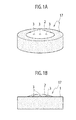
- Figs. 1A and 1B show a constitution of seeded solid soil according to an embodiment of the present invention: Fig. 1A showing a perspective view of a seeded solid soil 17, and Fig. 1B showing a cross-sectional view of Fig. 1A .
- Seeds 3 are arranged in contact with a surface of a solid soil 1.
- the number of the seeds 3 is three, as an example, but may be any number as long as the seeds can be arranged in contact with the surface of the solid soil 1.
- the seeds 3 are arranged at certain intervals so that adjacent ones of the seeds 3 do not come into contact with each other.
- the solid soil 1 does not need to be cylindrical as shown in Figs. 1A and 1B and may be rectangular as described later.
- the shape of the solid soil 1 is not particularly limited. However, the solid soil 1 desirably has a plate shape in some cases in the light of easy arrangement of the seeds 3 and stable installation of the solid soil 1.
- the solid soil 1 is composed of soil solidified in a solid form and includes solidified soil including a seedling soil solidified using a solidifying agent and soil compressed and solidified by pressure applied with a pressing machine or the like.
- the solid soil 1 is mainly composed of peat moss, coco peat, pearlite, vermiculite, or the like.
- the solid soil 1 may be a solid soil of hydration type.
- Known examples of the solid soil of hydration type are Jiffy plate (sold by SAKATA SEED CORPORATION) and Verdenite (sold by Ozeki Industrial Co., Ltd), both of which are mainly composed of peat moss.
- a coating layer 2 is formed so as to cover entire surfaces of the seeds 3.
- the coating layer 2 has adhesion properties to prevent the seeds 3 from being detached from the solid soil 1 when the seeded solid soil 17 is supplied with water, and also has water retention properties to make the rehydrated and restored coating layer 2 hard to dry and supply water to the seeds 3.
- the aqueous gelling agent is used, and in order to secure the water retention properties, water absorbent polymer is used.
- the coating layer 2 is composed of a mixture of the aqueous gelling agent and water absorbent polymer, for example.
- the aqueous gelling agent used herein only needs to be a uniform fluid having a high viscosity, and can be widely selected from natural gel, synthesis organic gel, inorganic gel, and the like, for example.
- the aqueous gelling agent is safe to use without affecting not only plant bodies but also human bodies.
- examples of the plants include an alkali salt of alginic acid, an alkali salt of carboxymethyl cellulose, an alkali salt of polyacrylic acid, carrageenan, gelatin and agar.
- the water absorbent polymer includes various types of water absorbent polymers such as sulfonate based polymers, starch based polymers, carboxymethyl cellulose-based polymers.
- Carboxymethyl cellulose-based water absorbent polymers are especially preferred because the carboxymethyl cellulose-based water absorbent polymers are nontoxic and are biodegradable, thus causing no environmental problem or the like.
- Figs. 2A to 2C show a method of manufacturing the seeded solid soil 17 of Figs. 1A and 1B .
- a proper amount of coating material 2a as a raw material of the coating layer 2 is dropped onto the solid soil 1.
- the seeds 3 are placed at proper positions on the surface of the coating layer 2 and then pressed down with a stick into the coating layer 2.
- the seeds 3 may be pressed using a pair of tweezers or the like or using a machine automatically pressing with a stick.
- the pressing is released when the seeds 3 are arranged in contact with the surface of the solid soil 1.
- the seeded solid soil 17 may be watered and used for waiting germination from the seeds 3.
- the seeded solid soil 17 is dried, and especially the coating layer 2 is dried.
- the drying is performed at such a temperature that does not damage the seeds 3 until moisture percentage of the coating layer 2 is reduced to the extent that the seeds 3 cannot germinate.
- drying is airflow drying at room temperature for about one or two hours.
- the coating material 2a as the raw material of the coating layer 2 is first dropped before the seeds 3 are arranged and pressed.
- the dropped coating material 2a can move the seeds 3, or the coating material 2a cannot be dropped to a proper amount. Accordingly, it is better that the seeded solid soil 17 is manufactured as shown in Figs. 2A to 2C .
- the seeds 3 are not pressed in Fig.
- the seeded solid soil 1 is dried with the seeds 3 left on the surface of the coating layer 2, the rehydrated seeded solid soil 17 is restored with the seeds 3 left on the surface of the coating layer 2. For this reason, the seeds 3 are separated from the solid soil 1 and hardly take root.
- Figs. 3A to 3C are views illustrating a method of rehydrating the seeded solid soil 17 manufactured as described above for cultivation.
- Fig. 3A shows the seeded solid soil 17 put in a container 15 with water poured to a dashed line L in the container 15.
- Reference numeral 16 of Fig. 3A indicates poured water.
- the poured water rehydrates and restores the seeded solid soil 17 into a state shown in Fig. 3B .
- the amount of water poured in the container 15 is desirably such an amount that the shape of the solid soil 1 does not collapse.
- a proper amount of water may be put in the container 15 in advance, and the seeded solid soil 17 is immersed into the water in the container 15.
- Fig. 3C shows seedling establishment after germination from the seeds 3.
- the solid soil 1 can retain moisture around the seeds 3, and as shown in Fig. 3C , the coating layer 2 is decomposed and removed when the seedlings are established.
- the container 15 has an effect on preventing the entire seeded solid soil 17 from drying after rehydration and restoration and therefore may be used in the state shown in Fig. 3C .
- Figs. 4A and 4B as well as Figs. 5A and 5B show results from drying the seeded solid soil 17 really manufactured, supplying water for rehydration and restoration, and germinating the seeds 3.
- Fig. 4A is a photograph of the seeded solid soil 17 just after manufactured but before dried.
- Fig. 4B is a photograph of the seeded solid soil 17 after airflow drying.
- Fig. 5A is a photograph showing a state just after the seeded solid soil 17 is dried as shown in Fig. 4B , then is moved to the container 15, and is supplied with water for rehydration and restoration.
- Fig. 5B is a photograph showing a state where the seeds 3 germinate and grow from the state shown in Fig. 5A .
- examples and comparative examples are shown in terms of how the rate of seedling establishment changes depending on the components of the coating layer 2.
- the examples and comparative examples both used Jiffy plates as the solid soil 1.
- the coating layer 2 uses only an aqueous gelling agent, and in the example, the coating layer 2 uses only a mixture of an aqueous gelling agent and a water absorbent polymer.
- Tests were performed using, as the seeds 3, three types of seeds: baby's breath, cosmos, and chrysanthemum.
- three types of seeds baby's breath, cosmos, and chrysanthemum.
- two pieces of the seeded solid soil 17 including ten seeds sowed in the solid soil 1 were used. Accordingly, 20 seeds were used for each type of seeds.
- an aqueous alginate-based gel was used as the aqueous gelling agent
- a carboxymethyl cellulose-based water absorbent polymer was used as the water absorbent polymer.
- the coating layer used in the comparative example was adjusted so that the aqueous alginate-based gel was 0.6 wt% of the aqueous solution.
- the coating layer 2 of the example was adjusted so that the aqueous alginate-based gel was 0.6 wt% of the water solution and the carboxymethyl cellulose-based water absorbent polymer was 0.96 wt% of the aqueous solution.
- the rates of seedling establishment were measured after rehydration and restoration as shown in Figs. 3A to 3C or 5A and 5B after the seeds 3 were attached to the solid soil 1 followed by airflow drying. The results thereof are shown in Fig. 6 .
- the rate of seedling establishment refers to a percentage (%) of the number of established seedlings to the number of all sowed seeds.
- the established seedlings refer to nondefective plant bodies with the first leaves developed completely after the seeds 3 sowed in the solid soil 1 germinate, then protrude from the coating layer, and moreover germinate out of the solid soil 1.
- the seed detachment rate was 0% after drying.
- the surface condition of the solid soil 1 after drying was good without a pile of soil.
- the rate of seedling establishment was 20% in the comparative example while the rate of seedling establishment was 56.7% in the example.
- the rates of seedling establishment thereof were different from each other by two-fold or more.
- seeded solid soil as shown in Figs. 1A and 1B was formed as a trial by forming the coating layer using only the water absorbent polymer and attaching the seeds 3 to the solid soil 1, followed by airflow drying. This seeded solid soil was rehydrated for restoration. Some of the seeds 3 were detached after drying, and there was a pile on the surface of the solid soil 1 after drying. Furthermore, some of the seeds 3 were detached and ran off after the rehydration and restoration.
- the coating material 2a as the raw material of the coating layer 2 includes an aqueous alginate-based gel, a carboxymethyl cellulose-based water absorbent polymer, and water.
- the restored coating layer including only the alginate-based gel is more likely to dry and repels water, so that the alginate-based aqueous gel is not decomposed and remains in a film form. In some cases, this inhibits the growth of roots and sprouts of plants, and the roots and sprouts cannot come out of the coating layer, thus resulting in death.
- the adhesion properties of the coating layer is low, and the seeds 3 are detached after drying or after rehydration for restoration.
- the aqueous alginate-based gel can prevent seeds from being detached during drying and thus prevent the seeds 3 from running off due to watering on the upper surface of the solid soil 1 (due to water pressure or the like) at the time of restoration.
- the carboxymethyl cellulose-based water absorbent polymer can retain moisture around the seeds 3 after restoration, thus supplying the seeds 3 with moisture necessary for germination.
- the aqueous alginate-based gel is gradually decomposed after restoration by the moisture retained by the carboxymethyl cellulose-based water absorbent polymer, thus not inhibiting the growth of plants.
- the percentage of the aqueous alginate-based gel in the coating layer 2 is desirably not more than 0.6 wt%. If the percentage thereof is more than 0.6 wt%, the coating material has too high viscosity to be uniformly distributed, and the coating layer is too dry after once dried and restored, thus inhibiting the growth of plants.
- the percentage of the carboxymethyl cellulose-based water absorbent polymer is desirably not more than 1 wit%. If the percentage thereof is more than 1 wt%, similarly to the aqueous alginate-based gel, the coating material has too high viscosity to be uniformly distributed and cannot be handled thereafter. The coating material is hardened after restored and dried, thus inhibiting the growth of plants.
- the coating material 2a as the raw material of the coating layer 2 may include starch or sugar as a nutritional substance necessary during the germination and initial growth of the seeds 3 and furthermore may include necessary amounts of known disinfectant, pesticides, animal repellant or the like if needed.
- the coating layer 2 does not include a hardener.
- a hardener such as calcium chloride solution to harden the coating layer, a coating layer insoluble to water is formed.
- part of the water absorbent polymer in contact with calcium ions absorb little water and is hardly restored, thus preventing the germination and growth of the seeds.
- the hardener is not used.
- the coating layer 2 in the case of light germinators (seeds requiring light for germination), the coating layer 2 is made clear and colorless. In the case of dark germinators (not requiring light for germination), a dispersive material having a light blocking effect is added to the coating layer 2. Thus, even when the seeds 3 are attached to the surface of the solid soil 1, the coating layer 2 can reduce incident light.
- the dispersive material are pigment having a light blocking effect, a dye having a light blocking effect, soil, fine vermiculite particles, sand and so on.
- examples of the pigments having a light blocking effect are charcoal, activated charcoal and so on. When dark germinators were cultivated for comparison using the colorless transparent coating layer 2 and using the coating layer 2 with activated charcoal added thereto, the coating layer 2 with activated charcoal added thereto provided better root establishment and improved the growth.
- a seeded solid soil 17A of Fig. 7 is different from the seeded solid soil 17 only in terms of the solid soil shape and basically has the same configuration as that of the seeded solid soil 17.
- the seeds 3 are arranged in contact with the surface of a solid soil 10 of the seeded solid soil 17A, and the coating layer 2 is formed so as to cover the entire seeds 3.
- the shape of the solid soil 10 is rectangular or cubic.
- the solid soil 10 may be reduced in size with the number of the seeds 3 reduced to one for use in distribution in a farm field instead of gel-coated seeds and the like.
- the shape of the solid soil 10 as shown in Fig. 7 has an advantage of being less likely to roll than the gel-coated seeds and the like when the seeded solid soil 17A is distributed.
- the seeded solid soil 17A of Fig. 7 is fixed to each of planting portions 20a of a planting unit 20, and the seeded solid soils 17A are two-dimensionally arranged to form an aggregate of the seeded solid soil.
- the planting portions 20a are recesses provided in the planting unit 20 and have the same shape as that of the solid soil 10.
- Fig. 8 schematically shows seedlings developed from germination by watering the planting portions 20a. As described above, in the case of cultivation using the seeded solid soil 17A installed in the plating unit 20, it is desirable to use solid soil which does not expand even if absorbing water after watering.
- the planting unit 20 having the seeded solid soils 17A two-dimensionally arranged can be used for roof greening of buildings, wall greening shown in Fig. 9 , and so on.
- the planting units 20 to which the seeded solid soils 17A are fixed are attached to wall surfaces of a building 30. With a watering device attached to the same, plants grow from the solid soils 10 installed in the planting units 20 by watering for wall greening.
- Each planting unit 20 may be composed of, for example, cell trays or seedling pots according to the intended use.
Landscapes
- Life Sciences & Earth Sciences (AREA)
- Environmental Sciences (AREA)
- Soil Sciences (AREA)
- Pretreatment Of Seeds And Plants (AREA)
- Health & Medical Sciences (AREA)
- Physiology (AREA)
- Botany (AREA)
- Developmental Biology & Embryology (AREA)
Applications Claiming Priority (1)
| Application Number | Priority Date | Filing Date | Title |
|---|---|---|---|
| JP2009192185A JP2011041519A (ja) | 2009-08-21 | 2009-08-21 | 播種済み固形培土及びこれを用いた植物の栽培方法 |
Publications (2)
| Publication Number | Publication Date |
|---|---|
| EP2286650A2 true EP2286650A2 (fr) | 2011-02-23 |
| EP2286650A3 EP2286650A3 (fr) | 2011-06-22 |
Family
ID=43334664
Family Applications (1)
| Application Number | Title | Priority Date | Filing Date |
|---|---|---|---|
| EP10173547A Withdrawn EP2286650A3 (fr) | 2009-08-21 | 2010-08-20 | Sol solide ensemencé, procédé de culture des plantes avec celui-ci et son procédé de fabrication |
Country Status (3)
| Country | Link |
|---|---|
| EP (1) | EP2286650A3 (fr) |
| JP (1) | JP2011041519A (fr) |
| KR (1) | KR20110020189A (fr) |
Cited By (4)
| Publication number | Priority date | Publication date | Assignee | Title |
|---|---|---|---|---|
| CN102754572A (zh) * | 2011-04-26 | 2012-10-31 | 北京化工大学 | 一种植物培育基体及其制造和应用 |
| CN103621353A (zh) * | 2013-11-26 | 2014-03-12 | 北京市京圃园生物工程有限公司 | 一种育苗基质及其制备方法 |
| WO2019018881A1 (fr) * | 2017-07-27 | 2019-01-31 | Smartgreens Pty Ltd | Procédés et appareils pour milieu de culture ensemencé |
| FR3107422A1 (fr) * | 2020-02-26 | 2021-08-27 | Nidoo | Composition pré-ensemencée, procédé de fabrication et utilisation. |
Families Citing this family (1)
| Publication number | Priority date | Publication date | Assignee | Title |
|---|---|---|---|---|
| CN114710992A (zh) * | 2022-05-19 | 2022-07-08 | 山西农业大学山西有机旱作农业研究院 | 一种基于旱地播种的种子保水播种方法 |
Citations (2)
| Publication number | Priority date | Publication date | Assignee | Title |
|---|---|---|---|---|
| JPH08154425A (ja) | 1994-12-05 | 1996-06-18 | Yoshinobu Toyomura | 散布用の種子入りペレット |
| JP2008220384A (ja) | 2008-05-20 | 2008-09-25 | Nippon Hiryo Kk | 種子付着資材および種子付着資材を用いた植物の栽培方法 |
Family Cites Families (8)
| Publication number | Priority date | Publication date | Assignee | Title |
|---|---|---|---|---|
| FR1579046A (fr) * | 1968-06-19 | 1969-08-22 | ||
| JPS5454809A (en) * | 1977-09-29 | 1979-05-01 | Nichiriyou Sangiyou Kk | Seedling growing method by soil covering mat |
| NL7800680A (en) * | 1978-01-19 | 1979-07-23 | Print Consultancy | Seed germination bed allowing supervision of growth - is a thin rectangular foam plate with hole for compost |
| JPS59179003A (ja) * | 1983-03-30 | 1984-10-11 | 三菱レイヨン株式会社 | 被覆種子 |
| JPH0455486Y2 (fr) * | 1986-09-18 | 1992-12-25 | ||
| JPH119015A (ja) * | 1997-06-27 | 1999-01-19 | Aguri Techno Yazaki Kk | 催芽種子を有する乾燥ゲル培地 |
| JPH11113390A (ja) * | 1997-10-14 | 1999-04-27 | Yamamoto Mfg Co Ltd | 育苗用培土 |
| US7661225B2 (en) * | 2004-12-14 | 2010-02-16 | James Lilly | Method for attaching seeds in an automated seeding system |
-
2009
- 2009-08-21 JP JP2009192185A patent/JP2011041519A/ja not_active Ceased
-
2010
- 2010-08-18 KR KR1020100079760A patent/KR20110020189A/ko not_active Withdrawn
- 2010-08-20 EP EP10173547A patent/EP2286650A3/fr not_active Withdrawn
Patent Citations (2)
| Publication number | Priority date | Publication date | Assignee | Title |
|---|---|---|---|---|
| JPH08154425A (ja) | 1994-12-05 | 1996-06-18 | Yoshinobu Toyomura | 散布用の種子入りペレット |
| JP2008220384A (ja) | 2008-05-20 | 2008-09-25 | Nippon Hiryo Kk | 種子付着資材および種子付着資材を用いた植物の栽培方法 |
Cited By (5)
| Publication number | Priority date | Publication date | Assignee | Title |
|---|---|---|---|---|
| CN102754572A (zh) * | 2011-04-26 | 2012-10-31 | 北京化工大学 | 一种植物培育基体及其制造和应用 |
| CN103621353A (zh) * | 2013-11-26 | 2014-03-12 | 北京市京圃园生物工程有限公司 | 一种育苗基质及其制备方法 |
| CN103621353B (zh) * | 2013-11-26 | 2016-04-13 | 北京市京圃园生物工程有限公司 | 一种育苗基质及其制备方法 |
| WO2019018881A1 (fr) * | 2017-07-27 | 2019-01-31 | Smartgreens Pty Ltd | Procédés et appareils pour milieu de culture ensemencé |
| FR3107422A1 (fr) * | 2020-02-26 | 2021-08-27 | Nidoo | Composition pré-ensemencée, procédé de fabrication et utilisation. |
Also Published As
| Publication number | Publication date |
|---|---|
| EP2286650A3 (fr) | 2011-06-22 |
| JP2011041519A (ja) | 2011-03-03 |
| KR20110020189A (ko) | 2011-03-02 |
Similar Documents
| Publication | Publication Date | Title |
|---|---|---|
| DE69630891T2 (de) | Unterstützungsvorrichtung für pflanzenkultur und anwendungsmethode zum pflanzenwuchs | |
| US8196346B2 (en) | Delayed-activation, hydration maintenance, apparatus and method | |
| CA2925775C (fr) | Dispositif de distribution de semences de plante | |
| CN102754572A (zh) | 一种植物培育基体及其制造和应用 | |
| EP2286650A2 (fr) | Sol solide ensemencé, procédé de culture des plantes avec celui-ci et son procédé de fabrication | |
| JPS58141709A (ja) | コ−テイング種子 | |
| EP0887004B1 (fr) | Methode d'enrobage de semences germinantes avec un gel | |
| CN114009308B (zh) | 一种蔬菜育苗基质及制备方法 | |
| CN117561914B (zh) | 一种基于半容器的育苗造林方法 | |
| JP3481439B2 (ja) | 覆土材 | |
| JPH10257820A (ja) | 育苗培土および育苗方法 | |
| JP3961143B2 (ja) | コート種子 | |
| CN109041969A (zh) | 一种水肥载体构建的育苗秧床及无盘育苗方法 | |
| KR101140312B1 (ko) | 흙톨볍씨 및 흙톨볍씨의 재배방법 | |
| CN115989784A (zh) | 一种提高丁香叶忍冬种子萌发率和幼苗存活率的方法 | |
| JP2005058036A (ja) | 人工種子及びその製造方法 | |
| CN108551952A (zh) | 一种水杉和二月兰的立体种植方法 | |
| JPH0714286B2 (ja) | ゲルコーティング種子の製造方法 | |
| CN1899019A (zh) | 一种催吐萝芙木的人工繁育方法 | |
| JPH06153619A (ja) | 種子パック | |
| CN103420638A (zh) | 一种模压的透气防渗毯及其应用 | |
| CN119699076B (zh) | 一种辅助胡杨种子在盐碱地萌发育苗方法 | |
| CN114041381B (zh) | 一种水土保持椰纤植生毯 | |
| JP2014171422A (ja) | 緑化基板 | |
| RU2269243C1 (ru) | Капсулированный посадочный материал с регулируемыми свойствами и способ его получения |
Legal Events
| Date | Code | Title | Description |
|---|---|---|---|
| PUAI | Public reference made under article 153(3) epc to a published international application that has entered the european phase |
Free format text: ORIGINAL CODE: 0009012 |
|
| AK | Designated contracting states |
Kind code of ref document: A2 Designated state(s): AL AT BE BG CH CY CZ DE DK EE ES FI FR GB GR HR HU IE IS IT LI LT LU LV MC MK MT NL NO PL PT RO SE SI SK SM TR |
|
| AX | Request for extension of the european patent |
Extension state: BA ME RS |
|
| PUAL | Search report despatched |
Free format text: ORIGINAL CODE: 0009013 |
|
| AK | Designated contracting states |
Kind code of ref document: A3 Designated state(s): AL AT BE BG CH CY CZ DE DK EE ES FI FR GB GR HR HU IE IS IT LI LT LU LV MC MK MT NL NO PL PT RO SE SI SK SM TR |
|
| AX | Request for extension of the european patent |
Extension state: BA ME RS |
|
| 17P | Request for examination filed |
Effective date: 20111221 |
|
| 17Q | First examination report despatched |
Effective date: 20120425 |
|
| STAA | Information on the status of an ep patent application or granted ep patent |
Free format text: STATUS: THE APPLICATION IS DEEMED TO BE WITHDRAWN |
|
| 18D | Application deemed to be withdrawn |
Effective date: 20140301 |