EP2287609B1 - Procédé de production de particule porteuse insoluble, particule porteuse insoluble, réactif de mesure, outil d'analyse d'échantillon et procédé turbidimétrique immunologique - Google Patents
Procédé de production de particule porteuse insoluble, particule porteuse insoluble, réactif de mesure, outil d'analyse d'échantillon et procédé turbidimétrique immunologique Download PDFInfo
- Publication number
- EP2287609B1 EP2287609B1 EP09742666.2A EP09742666A EP2287609B1 EP 2287609 B1 EP2287609 B1 EP 2287609B1 EP 09742666 A EP09742666 A EP 09742666A EP 2287609 B1 EP2287609 B1 EP 2287609B1
- Authority
- EP
- European Patent Office
- Prior art keywords
- insoluble carrier
- measurement
- carrier particle
- particle
- particles
- Prior art date
- Legal status (The legal status is an assumption and is not a legal conclusion. Google has not performed a legal analysis and makes no representation as to the accuracy of the status listed.)
- Not-in-force
Links
- 239000002245 particle Substances 0.000 title claims description 441
- 238000005259 measurement Methods 0.000 title claims description 309
- 239000003153 chemical reaction reagent Substances 0.000 title claims description 239
- 238000000034 method Methods 0.000 title claims description 90
- 238000004519 manufacturing process Methods 0.000 title description 2
- 238000006243 chemical reaction Methods 0.000 claims description 78
- 238000003556 assay Methods 0.000 claims description 67
- 239000000427 antigen Substances 0.000 claims description 48
- 102000036639 antigens Human genes 0.000 claims description 48
- 108091007433 antigens Proteins 0.000 claims description 48
- 150000001413 amino acids Chemical class 0.000 claims description 47
- 206010070834 Sensitisation Diseases 0.000 claims description 44
- 230000008313 sensitization Effects 0.000 claims description 44
- 239000004816 latex Substances 0.000 claims description 37
- 229920000126 latex Polymers 0.000 claims description 37
- 238000004220 aggregation Methods 0.000 claims description 35
- 230000002776 aggregation Effects 0.000 claims description 35
- 230000036046 immunoreaction Effects 0.000 claims description 32
- 230000008859 change Effects 0.000 claims description 31
- 230000008569 process Effects 0.000 claims description 13
- 239000000126 substance Substances 0.000 claims description 12
- 238000012360 testing method Methods 0.000 claims description 10
- 230000002378 acidificating effect Effects 0.000 claims description 5
- 239000000243 solution Substances 0.000 description 80
- 230000000052 comparative effect Effects 0.000 description 60
- 229940024606 amino acid Drugs 0.000 description 44
- 235000001014 amino acid Nutrition 0.000 description 44
- 238000011156 evaluation Methods 0.000 description 44
- VZSRBBMJRBPUNF-UHFFFAOYSA-N 2-(2,3-dihydro-1H-inden-2-ylamino)-N-[3-oxo-3-(2,4,6,7-tetrahydrotriazolo[4,5-c]pyridin-5-yl)propyl]pyrimidine-5-carboxamide Chemical compound C1C(CC2=CC=CC=C12)NC1=NC=C(C=N1)C(=O)NCCC(N1CC2=C(CC1)NN=N2)=O VZSRBBMJRBPUNF-UHFFFAOYSA-N 0.000 description 36
- 238000002835 absorbance Methods 0.000 description 34
- 108010074051 C-Reactive Protein Proteins 0.000 description 29
- 102100032752 C-reactive protein Human genes 0.000 description 29
- 239000000203 mixture Substances 0.000 description 25
- HMUNWXXNJPVALC-UHFFFAOYSA-N 1-[4-[2-(2,3-dihydro-1H-inden-2-ylamino)pyrimidin-5-yl]piperazin-1-yl]-2-(2,4,6,7-tetrahydrotriazolo[4,5-c]pyridin-5-yl)ethanone Chemical compound C1C(CC2=CC=CC=C12)NC1=NC=C(C=N1)N1CCN(CC1)C(CN1CC2=C(CC1)NN=N2)=O HMUNWXXNJPVALC-UHFFFAOYSA-N 0.000 description 24
- BVHLGVCQOALMSV-JEDNCBNOSA-N L-lysine hydrochloride Chemical compound Cl.NCCCC[C@H](N)C(O)=O BVHLGVCQOALMSV-JEDNCBNOSA-N 0.000 description 24
- 229960005337 lysine hydrochloride Drugs 0.000 description 22
- 230000000007 visual effect Effects 0.000 description 22
- WZFUQSJFWNHZHM-UHFFFAOYSA-N 2-[4-[2-(2,3-dihydro-1H-inden-2-ylamino)pyrimidin-5-yl]piperazin-1-yl]-1-(2,4,6,7-tetrahydrotriazolo[4,5-c]pyridin-5-yl)ethanone Chemical compound C1C(CC2=CC=CC=C12)NC1=NC=C(C=N1)N1CCN(CC1)CC(=O)N1CC2=C(CC1)NN=N2 WZFUQSJFWNHZHM-UHFFFAOYSA-N 0.000 description 19
- 239000006185 dispersion Substances 0.000 description 19
- 239000007788 liquid Substances 0.000 description 19
- 239000007987 MES buffer Substances 0.000 description 18
- 239000007853 buffer solution Substances 0.000 description 18
- 125000000524 functional group Chemical group 0.000 description 18
- 108091003079 Bovine Serum Albumin Proteins 0.000 description 17
- 229940098773 bovine serum albumin Drugs 0.000 description 17
- 239000000523 sample Substances 0.000 description 15
- WTWSHHITWMVLBX-DKWTVANSSA-M sodium;(2s)-2-aminobutanedioate;hydron Chemical compound [Na+].[O-]C(=O)[C@@H](N)CC(O)=O WTWSHHITWMVLBX-DKWTVANSSA-M 0.000 description 14
- 238000002360 preparation method Methods 0.000 description 13
- LMDZBCPBFSXMTL-UHFFFAOYSA-N 1-ethyl-3-(3-dimethylaminopropyl)carbodiimide Chemical compound CCN=C=NCCCN(C)C LMDZBCPBFSXMTL-UHFFFAOYSA-N 0.000 description 9
- 230000000903 blocking effect Effects 0.000 description 9
- 238000010790 dilution Methods 0.000 description 9
- 239000012895 dilution Substances 0.000 description 9
- 125000003178 carboxy group Chemical group [H]OC(*)=O 0.000 description 8
- 238000001994 activation Methods 0.000 description 7
- 230000003247 decreasing effect Effects 0.000 description 7
- 238000005406 washing Methods 0.000 description 7
- MKYBYDHXWVHEJW-UHFFFAOYSA-N N-[1-oxo-1-(2,4,6,7-tetrahydrotriazolo[4,5-c]pyridin-5-yl)propan-2-yl]-2-[[3-(trifluoromethoxy)phenyl]methylamino]pyrimidine-5-carboxamide Chemical compound O=C(C(C)NC(=O)C=1C=NC(=NC=1)NCC1=CC(=CC=C1)OC(F)(F)F)N1CC2=C(CC1)NN=N2 MKYBYDHXWVHEJW-UHFFFAOYSA-N 0.000 description 6
- NIPNSKYNPDTRPC-UHFFFAOYSA-N N-[2-oxo-2-(2,4,6,7-tetrahydrotriazolo[4,5-c]pyridin-5-yl)ethyl]-2-[[3-(trifluoromethoxy)phenyl]methylamino]pyrimidine-5-carboxamide Chemical compound O=C(CNC(=O)C=1C=NC(=NC=1)NCC1=CC(=CC=C1)OC(F)(F)F)N1CC2=C(CC1)NN=N2 NIPNSKYNPDTRPC-UHFFFAOYSA-N 0.000 description 6
- AFCARXCZXQIEQB-UHFFFAOYSA-N N-[3-oxo-3-(2,4,6,7-tetrahydrotriazolo[4,5-c]pyridin-5-yl)propyl]-2-[[3-(trifluoromethoxy)phenyl]methylamino]pyrimidine-5-carboxamide Chemical compound O=C(CCNC(=O)C=1C=NC(=NC=1)NCC1=CC(=CC=C1)OC(F)(F)F)N1CC2=C(CC1)NN=N2 AFCARXCZXQIEQB-UHFFFAOYSA-N 0.000 description 6
- 239000004793 Polystyrene Substances 0.000 description 6
- FAPWRFPIFSIZLT-UHFFFAOYSA-M Sodium chloride Chemical compound [Na+].[Cl-] FAPWRFPIFSIZLT-UHFFFAOYSA-M 0.000 description 6
- 229920002223 polystyrene Polymers 0.000 description 6
- 235000018102 proteins Nutrition 0.000 description 6
- 102000004169 proteins and genes Human genes 0.000 description 6
- 108090000623 proteins and genes Proteins 0.000 description 6
- 230000000717 retained effect Effects 0.000 description 6
- 238000000926 separation method Methods 0.000 description 6
- 239000000758 substrate Substances 0.000 description 6
- IHCCLXNEEPMSIO-UHFFFAOYSA-N 2-[4-[2-(2,3-dihydro-1H-inden-2-ylamino)pyrimidin-5-yl]piperidin-1-yl]-1-(2,4,6,7-tetrahydrotriazolo[4,5-c]pyridin-5-yl)ethanone Chemical compound C1C(CC2=CC=CC=C12)NC1=NC=C(C=N1)C1CCN(CC1)CC(=O)N1CC2=C(CC1)NN=N2 IHCCLXNEEPMSIO-UHFFFAOYSA-N 0.000 description 5
- NQTADLQHYWFPDB-UHFFFAOYSA-N N-Hydroxysuccinimide Chemical compound ON1C(=O)CCC1=O NQTADLQHYWFPDB-UHFFFAOYSA-N 0.000 description 5
- 150000003839 salts Chemical class 0.000 description 5
- 230000035945 sensitivity Effects 0.000 description 5
- LENZDBCJOHFCAS-UHFFFAOYSA-N tris Chemical compound OCC(N)(CO)CO LENZDBCJOHFCAS-UHFFFAOYSA-N 0.000 description 5
- XLYOFNOQVPJJNP-UHFFFAOYSA-N water Substances O XLYOFNOQVPJJNP-UHFFFAOYSA-N 0.000 description 5
- OHVLMTFVQDZYHP-UHFFFAOYSA-N 1-(2,4,6,7-tetrahydrotriazolo[4,5-c]pyridin-5-yl)-2-[4-[2-[[3-(trifluoromethoxy)phenyl]methylamino]pyrimidin-5-yl]piperazin-1-yl]ethanone Chemical compound N1N=NC=2CN(CCC=21)C(CN1CCN(CC1)C=1C=NC(=NC=1)NCC1=CC(=CC=C1)OC(F)(F)F)=O OHVLMTFVQDZYHP-UHFFFAOYSA-N 0.000 description 4
- 241000283973 Oryctolagus cuniculus Species 0.000 description 4
- 239000002202 Polyethylene glycol Substances 0.000 description 4
- PXIPVTKHYLBLMZ-UHFFFAOYSA-N Sodium azide Chemical compound [Na+].[N-]=[N+]=[N-] PXIPVTKHYLBLMZ-UHFFFAOYSA-N 0.000 description 4
- 239000007983 Tris buffer Substances 0.000 description 4
- 230000004913 activation Effects 0.000 description 4
- 239000003085 diluting agent Substances 0.000 description 4
- 238000009826 distribution Methods 0.000 description 4
- 239000010419 fine particle Substances 0.000 description 4
- HNDVDQJCIGZPNO-UHFFFAOYSA-N histidine Natural products OC(=O)C(N)CC1=CN=CN1 HNDVDQJCIGZPNO-UHFFFAOYSA-N 0.000 description 4
- 229960002885 histidine Drugs 0.000 description 4
- 238000009533 lab test Methods 0.000 description 4
- 239000000463 material Substances 0.000 description 4
- 230000003287 optical effect Effects 0.000 description 4
- 229920001223 polyethylene glycol Polymers 0.000 description 4
- 238000003756 stirring Methods 0.000 description 4
- LDXJRKWFNNFDSA-UHFFFAOYSA-N 2-(2,4,6,7-tetrahydrotriazolo[4,5-c]pyridin-5-yl)-1-[4-[2-[[3-(trifluoromethoxy)phenyl]methylamino]pyrimidin-5-yl]piperazin-1-yl]ethanone Chemical compound C1CN(CC2=NNN=C21)CC(=O)N3CCN(CC3)C4=CN=C(N=C4)NCC5=CC(=CC=C5)OC(F)(F)F LDXJRKWFNNFDSA-UHFFFAOYSA-N 0.000 description 3
- QKNYBSVHEMOAJP-UHFFFAOYSA-N 2-amino-2-(hydroxymethyl)propane-1,3-diol;hydron;chloride Chemical compound Cl.OCC(N)(CO)CO QKNYBSVHEMOAJP-UHFFFAOYSA-N 0.000 description 3
- YLZOPXRUQYQQID-UHFFFAOYSA-N 3-(2,4,6,7-tetrahydrotriazolo[4,5-c]pyridin-5-yl)-1-[4-[2-[[3-(trifluoromethoxy)phenyl]methylamino]pyrimidin-5-yl]piperazin-1-yl]propan-1-one Chemical compound N1N=NC=2CN(CCC=21)CCC(=O)N1CCN(CC1)C=1C=NC(=NC=1)NCC1=CC(=CC=C1)OC(F)(F)F YLZOPXRUQYQQID-UHFFFAOYSA-N 0.000 description 3
- DCXYFEDJOCDNAF-UHFFFAOYSA-N Asparagine Natural products OC(=O)C(N)CC(N)=O DCXYFEDJOCDNAF-UHFFFAOYSA-N 0.000 description 3
- ODKSFYDXXFIFQN-BYPYZUCNSA-N L-arginine Chemical compound OC(=O)[C@@H](N)CCCN=C(N)N ODKSFYDXXFIFQN-BYPYZUCNSA-N 0.000 description 3
- DCXYFEDJOCDNAF-REOHCLBHSA-N L-asparagine Chemical compound OC(=O)[C@@H](N)CC(N)=O DCXYFEDJOCDNAF-REOHCLBHSA-N 0.000 description 3
- OKKJLVBELUTLKV-UHFFFAOYSA-N Methanol Chemical group OC OKKJLVBELUTLKV-UHFFFAOYSA-N 0.000 description 3
- MTCFGRXMJLQNBG-UHFFFAOYSA-N Serine Natural products OCC(N)C(O)=O MTCFGRXMJLQNBG-UHFFFAOYSA-N 0.000 description 3
- AYFVYJQAPQTCCC-UHFFFAOYSA-N Threonine Natural products CC(O)C(N)C(O)=O AYFVYJQAPQTCCC-UHFFFAOYSA-N 0.000 description 3
- 239000004473 Threonine Substances 0.000 description 3
- 125000003277 amino group Chemical group 0.000 description 3
- 229960003589 arginine hydrochloride Drugs 0.000 description 3
- 229960001230 asparagine Drugs 0.000 description 3
- 235000009582 asparagine Nutrition 0.000 description 3
- 239000012472 biological sample Substances 0.000 description 3
- 238000011088 calibration curve Methods 0.000 description 3
- 229920001577 copolymer Polymers 0.000 description 3
- 238000001514 detection method Methods 0.000 description 3
- PXEDJBXQKAGXNJ-QTNFYWBSSA-L disodium L-glutamate Chemical compound [Na+].[Na+].[O-]C(=O)[C@@H](N)CCC([O-])=O PXEDJBXQKAGXNJ-QTNFYWBSSA-L 0.000 description 3
- 239000012153 distilled water Substances 0.000 description 3
- 230000002349 favourable effect Effects 0.000 description 3
- 235000013923 monosodium glutamate Nutrition 0.000 description 3
- 239000008055 phosphate buffer solution Substances 0.000 description 3
- 238000001556 precipitation Methods 0.000 description 3
- 239000000047 product Substances 0.000 description 3
- 239000011535 reaction buffer Substances 0.000 description 3
- 210000002966 serum Anatomy 0.000 description 3
- 239000011780 sodium chloride Substances 0.000 description 3
- 229940073490 sodium glutamate Drugs 0.000 description 3
- 239000006228 supernatant Substances 0.000 description 3
- 102100023635 Alpha-fetoprotein Human genes 0.000 description 2
- 108010022366 Carcinoembryonic Antigen Proteins 0.000 description 2
- 102100025475 Carcinoembryonic antigen-related cell adhesion molecule 5 Human genes 0.000 description 2
- 102000004190 Enzymes Human genes 0.000 description 2
- 108090000790 Enzymes Proteins 0.000 description 2
- 108010058861 Fibrin Fibrinogen Degradation Products Proteins 0.000 description 2
- 235000014676 Phragmites communis Nutrition 0.000 description 2
- 229920002873 Polyethylenimine Polymers 0.000 description 2
- 229930006000 Sucrose Natural products 0.000 description 2
- CZMRCDWAGMRECN-UGDNZRGBSA-N Sucrose Chemical compound O[C@H]1[C@H](O)[C@@H](CO)O[C@@]1(CO)O[C@@H]1[C@H](O)[C@@H](O)[C@H](O)[C@@H](CO)O1 CZMRCDWAGMRECN-UGDNZRGBSA-N 0.000 description 2
- 241000700605 Viruses Species 0.000 description 2
- -1 amino acid salt Chemical class 0.000 description 2
- 239000002981 blocking agent Substances 0.000 description 2
- 210000004369 blood Anatomy 0.000 description 2
- 239000008280 blood Substances 0.000 description 2
- 239000000872 buffer Substances 0.000 description 2
- 150000007942 carboxylates Chemical class 0.000 description 2
- 238000004891 communication Methods 0.000 description 2
- 150000001875 compounds Chemical class 0.000 description 2
- DDRJAANPRJIHGJ-UHFFFAOYSA-N creatinine Chemical compound CN1CC(=O)NC1=N DDRJAANPRJIHGJ-UHFFFAOYSA-N 0.000 description 2
- 208000037265 diseases, disorders, signs and symptoms Diseases 0.000 description 2
- 208000035475 disorder Diseases 0.000 description 2
- 239000000208 fibrin degradation product Substances 0.000 description 2
- 150000004676 glycans Chemical class 0.000 description 2
- 125000003827 glycol group Chemical group 0.000 description 2
- 229930182470 glycoside Natural products 0.000 description 2
- 150000002338 glycosides Chemical class 0.000 description 2
- 125000002887 hydroxy group Chemical group [H]O* 0.000 description 2
- 238000003018 immunoassay Methods 0.000 description 2
- 150000002484 inorganic compounds Chemical class 0.000 description 2
- 229910010272 inorganic material Inorganic materials 0.000 description 2
- 230000007246 mechanism Effects 0.000 description 2
- 229920001282 polysaccharide Polymers 0.000 description 2
- 239000005017 polysaccharide Substances 0.000 description 2
- 239000003755 preservative agent Substances 0.000 description 2
- 230000002335 preservative effect Effects 0.000 description 2
- 239000001397 quillaja saponaria molina bark Substances 0.000 description 2
- 230000009257 reactivity Effects 0.000 description 2
- 229930182490 saponin Natural products 0.000 description 2
- 150000007949 saponins Chemical class 0.000 description 2
- 238000012216 screening Methods 0.000 description 2
- 108010088201 squamous cell carcinoma-related antigen Proteins 0.000 description 2
- 229920003048 styrene butadiene rubber Polymers 0.000 description 2
- 239000005720 sucrose Substances 0.000 description 2
- 125000000020 sulfo group Chemical group O=S(=O)([*])O[H] 0.000 description 2
- 239000004094 surface-active agent Substances 0.000 description 2
- 229920001059 synthetic polymer Polymers 0.000 description 2
- OWEGMIWEEQEYGQ-UHFFFAOYSA-N 100676-05-9 Natural products OC1C(O)C(O)C(CO)OC1OCC1C(O)C(O)C(O)C(OC2C(OC(O)C(O)C2O)CO)O1 OWEGMIWEEQEYGQ-UHFFFAOYSA-N 0.000 description 1
- SXGZJKUKBWWHRA-UHFFFAOYSA-N 2-(N-morpholiniumyl)ethanesulfonate Chemical compound [O-]S(=O)(=O)CC[NH+]1CCOCC1 SXGZJKUKBWWHRA-UHFFFAOYSA-N 0.000 description 1
- KWTQSFXGGICVPE-UHFFFAOYSA-N 2-amino-5-(diaminomethylideneamino)pentanoic acid;hydron;chloride Chemical compound Cl.OC(=O)C(N)CCCN=C(N)N KWTQSFXGGICVPE-UHFFFAOYSA-N 0.000 description 1
- FPQQSJJWHUJYPU-UHFFFAOYSA-N 3-(dimethylamino)propyliminomethylidene-ethylazanium;chloride Chemical compound Cl.CCN=C=NCCCN(C)C FPQQSJJWHUJYPU-UHFFFAOYSA-N 0.000 description 1
- 229920000936 Agarose Polymers 0.000 description 1
- 239000004475 Arginine Substances 0.000 description 1
- 241000283707 Capra Species 0.000 description 1
- 241001481710 Cerambycidae Species 0.000 description 1
- 229920001661 Chitosan Polymers 0.000 description 1
- 229920002307 Dextran Polymers 0.000 description 1
- QRLVDLBMBULFAL-UHFFFAOYSA-N Digitonin Natural products CC1CCC2(OC1)OC3C(O)C4C5CCC6CC(OC7OC(CO)C(OC8OC(CO)C(O)C(OC9OCC(O)C(O)C9OC%10OC(CO)C(O)C(OC%11OC(CO)C(O)C(O)C%11O)C%10O)C8O)C(O)C7O)C(O)CC6(C)C5CCC4(C)C3C2C QRLVDLBMBULFAL-UHFFFAOYSA-N 0.000 description 1
- 108010049003 Fibrinogen Proteins 0.000 description 1
- 102000008946 Fibrinogen Human genes 0.000 description 1
- 241000287828 Gallus gallus Species 0.000 description 1
- 108010010803 Gelatin Proteins 0.000 description 1
- WQZGKKKJIJFFOK-GASJEMHNSA-N Glucose Natural products OC[C@H]1OC(O)[C@H](O)[C@@H](O)[C@@H]1O WQZGKKKJIJFFOK-GASJEMHNSA-N 0.000 description 1
- WHUUTDBJXJRKMK-UHFFFAOYSA-N Glutamic acid Natural products OC(=O)C(N)CCC(O)=O WHUUTDBJXJRKMK-UHFFFAOYSA-N 0.000 description 1
- 206010018910 Haemolysis Diseases 0.000 description 1
- 241000714260 Human T-lymphotropic virus 1 Species 0.000 description 1
- VEXZGXHMUGYJMC-UHFFFAOYSA-N Hydrochloric acid Chemical compound Cl VEXZGXHMUGYJMC-UHFFFAOYSA-N 0.000 description 1
- 108060003951 Immunoglobulin Proteins 0.000 description 1
- 102000008394 Immunoglobulin Fragments Human genes 0.000 description 1
- 108010021625 Immunoglobulin Fragments Proteins 0.000 description 1
- ODKSFYDXXFIFQN-BYPYZUCNSA-P L-argininium(2+) Chemical compound NC(=[NH2+])NCCC[C@H]([NH3+])C(O)=O ODKSFYDXXFIFQN-BYPYZUCNSA-P 0.000 description 1
- CKLJMWTZIZZHCS-REOHCLBHSA-N L-aspartic acid Chemical compound OC(=O)[C@@H](N)CC(O)=O CKLJMWTZIZZHCS-REOHCLBHSA-N 0.000 description 1
- HNDVDQJCIGZPNO-YFKPBYRVSA-N L-histidine Chemical compound OC(=O)[C@@H](N)CC1=CN=CN1 HNDVDQJCIGZPNO-YFKPBYRVSA-N 0.000 description 1
- KDXKERNSBIXSRK-YFKPBYRVSA-N L-lysine Chemical compound NCCCC[C@H](N)C(O)=O KDXKERNSBIXSRK-YFKPBYRVSA-N 0.000 description 1
- KDXKERNSBIXSRK-UHFFFAOYSA-N Lysine Natural products NCCCCC(N)C(O)=O KDXKERNSBIXSRK-UHFFFAOYSA-N 0.000 description 1
- 239000004472 Lysine Substances 0.000 description 1
- GUBGYTABKSRVRQ-PICCSMPSSA-N Maltose Natural products O[C@@H]1[C@@H](O)[C@H](O)[C@@H](CO)O[C@@H]1O[C@@H]1[C@@H](CO)OC(O)[C@H](O)[C@H]1O GUBGYTABKSRVRQ-PICCSMPSSA-N 0.000 description 1
- 241000699670 Mus sp. Species 0.000 description 1
- 229910019142 PO4 Inorganic materials 0.000 description 1
- 241001494479 Pecora Species 0.000 description 1
- 229920002845 Poly(methacrylic acid) Polymers 0.000 description 1
- VYPSYNLAJGMNEJ-UHFFFAOYSA-N Silicium dioxide Chemical compound O=[Si]=O VYPSYNLAJGMNEJ-UHFFFAOYSA-N 0.000 description 1
- 241000580858 Simian-Human immunodeficiency virus Species 0.000 description 1
- 229920002125 Sokalan® Polymers 0.000 description 1
- 230000003213 activating effect Effects 0.000 description 1
- 125000004442 acylamino group Chemical group 0.000 description 1
- 230000001476 alcoholic effect Effects 0.000 description 1
- 108010026331 alpha-Fetoproteins Proteins 0.000 description 1
- 229960003121 arginine Drugs 0.000 description 1
- ODKSFYDXXFIFQN-UHFFFAOYSA-N arginine Natural products OC(=O)C(N)CCCNC(N)=N ODKSFYDXXFIFQN-UHFFFAOYSA-N 0.000 description 1
- 238000000149 argon plasma sintering Methods 0.000 description 1
- 235000003704 aspartic acid Nutrition 0.000 description 1
- WQZGKKKJIJFFOK-VFUOTHLCSA-N beta-D-glucose Chemical compound OC[C@H]1O[C@@H](O)[C@H](O)[C@@H](O)[C@@H]1O WQZGKKKJIJFFOK-VFUOTHLCSA-N 0.000 description 1
- OQFSQFPPLPISGP-UHFFFAOYSA-N beta-carboxyaspartic acid Natural products OC(=O)C(N)C(C(O)=O)C(O)=O OQFSQFPPLPISGP-UHFFFAOYSA-N 0.000 description 1
- GUBGYTABKSRVRQ-QUYVBRFLSA-N beta-maltose Chemical compound OC[C@H]1O[C@H](O[C@H]2[C@H](O)[C@@H](O)[C@H](O)O[C@@H]2CO)[C@H](O)[C@@H](O)[C@@H]1O GUBGYTABKSRVRQ-QUYVBRFLSA-N 0.000 description 1
- 230000027455 binding Effects 0.000 description 1
- 210000000601 blood cell Anatomy 0.000 description 1
- 125000003917 carbamoyl group Chemical group [H]N([H])C(*)=O 0.000 description 1
- 235000013330 chicken meat Nutrition 0.000 description 1
- 238000004040 coloring Methods 0.000 description 1
- 229940109239 creatinine Drugs 0.000 description 1
- 238000002050 diffraction method Methods 0.000 description 1
- UVYVLBIGDKGWPX-KUAJCENISA-N digitonin Chemical compound O([C@@H]1[C@@H]([C@]2(CC[C@@H]3[C@@]4(C)C[C@@H](O)[C@H](O[C@H]5[C@@H]([C@@H](O)[C@@H](O[C@H]6[C@@H]([C@@H](O[C@H]7[C@@H]([C@@H](O)[C@H](O)CO7)O)[C@H](O)[C@@H](CO)O6)O[C@H]6[C@@H]([C@@H](O[C@H]7[C@@H]([C@@H](O)[C@H](O)[C@@H](CO)O7)O)[C@@H](O)[C@@H](CO)O6)O)[C@@H](CO)O5)O)C[C@@H]4CC[C@H]3[C@@H]2[C@@H]1O)C)[C@@H]1C)[C@]11CC[C@@H](C)CO1 UVYVLBIGDKGWPX-KUAJCENISA-N 0.000 description 1
- UVYVLBIGDKGWPX-UHFFFAOYSA-N digitonine Natural products CC1C(C2(CCC3C4(C)CC(O)C(OC5C(C(O)C(OC6C(C(OC7C(C(O)C(O)CO7)O)C(O)C(CO)O6)OC6C(C(OC7C(C(O)C(O)C(CO)O7)O)C(O)C(CO)O6)O)C(CO)O5)O)CC4CCC3C2C2O)C)C2OC11CCC(C)CO1 UVYVLBIGDKGWPX-UHFFFAOYSA-N 0.000 description 1
- 238000001035 drying Methods 0.000 description 1
- 239000000975 dye Substances 0.000 description 1
- 230000000694 effects Effects 0.000 description 1
- 229940012952 fibrinogen Drugs 0.000 description 1
- 238000001914 filtration Methods 0.000 description 1
- 239000007850 fluorescent dye Substances 0.000 description 1
- 229920000159 gelatin Polymers 0.000 description 1
- 239000008273 gelatin Substances 0.000 description 1
- 235000019322 gelatine Nutrition 0.000 description 1
- 235000011852 gelatine desserts Nutrition 0.000 description 1
- 239000008103 glucose Substances 0.000 description 1
- 235000013922 glutamic acid Nutrition 0.000 description 1
- 239000004220 glutamic acid Substances 0.000 description 1
- 238000010438 heat treatment Methods 0.000 description 1
- 230000008588 hemolysis Effects 0.000 description 1
- 208000006454 hepatitis Diseases 0.000 description 1
- 231100000283 hepatitis Toxicity 0.000 description 1
- 230000036571 hydration Effects 0.000 description 1
- 238000006703 hydration reaction Methods 0.000 description 1
- 102000018358 immunoglobulin Human genes 0.000 description 1
- 238000010324 immunological assay Methods 0.000 description 1
- 238000007689 inspection Methods 0.000 description 1
- 239000007791 liquid phase Substances 0.000 description 1
- 229960003646 lysine Drugs 0.000 description 1
- 238000000386 microscopy Methods 0.000 description 1
- 230000009871 nonspecific binding Effects 0.000 description 1
- JPMIIZHYYWMHDT-UHFFFAOYSA-N octhilinone Chemical compound CCCCCCCCN1SC=CC1=O JPMIIZHYYWMHDT-UHFFFAOYSA-N 0.000 description 1
- 125000002347 octyl group Chemical group [H]C([*])([H])C([H])([H])C([H])([H])C([H])([H])C([H])([H])C([H])([H])C([H])([H])C([H])([H])[H] 0.000 description 1
- ISWSIDIOOBJBQZ-UHFFFAOYSA-N phenol group Chemical group C1(=CC=CC=C1)O ISWSIDIOOBJBQZ-UHFFFAOYSA-N 0.000 description 1
- NBIIXXVUZAFLBC-UHFFFAOYSA-K phosphate Chemical compound [O-]P([O-])([O-])=O NBIIXXVUZAFLBC-UHFFFAOYSA-K 0.000 description 1
- 239000010452 phosphate Substances 0.000 description 1
- 239000002504 physiological saline solution Substances 0.000 description 1
- 210000002381 plasma Anatomy 0.000 description 1
- 229920000747 poly(lactic acid) Polymers 0.000 description 1
- 229920003229 poly(methyl methacrylate) Polymers 0.000 description 1
- 239000004584 polyacrylic acid Substances 0.000 description 1
- 239000004626 polylactic acid Substances 0.000 description 1
- 239000004926 polymethyl methacrylate Substances 0.000 description 1
- 229920000036 polyvinylpyrrolidone Polymers 0.000 description 1
- 235000013855 polyvinylpyrrolidone Nutrition 0.000 description 1
- 239000001267 polyvinylpyrrolidone Substances 0.000 description 1
- 239000005373 porous glass Substances 0.000 description 1
- XAEFZNCEHLXOMS-UHFFFAOYSA-M potassium benzoate Chemical compound [K+].[O-]C(=O)C1=CC=CC=C1 XAEFZNCEHLXOMS-UHFFFAOYSA-M 0.000 description 1
- 159000000000 sodium salts Chemical class 0.000 description 1
- 239000002904 solvent Substances 0.000 description 1
- 238000001179 sorption measurement Methods 0.000 description 1
- 230000000087 stabilizing effect Effects 0.000 description 1
- 125000004079 stearyl group Chemical group [H]C([*])([H])C([H])([H])C([H])([H])C([H])([H])C([H])([H])C([H])([H])C([H])([H])C([H])([H])C([H])([H])C([H])([H])C([H])([H])C([H])([H])C([H])([H])C([H])([H])C([H])([H])C([H])([H])C([H])([H])C([H])([H])[H] 0.000 description 1
- 230000001629 suppression Effects 0.000 description 1
- 239000000725 suspension Substances 0.000 description 1
- 125000000026 trimethylsilyl group Chemical group [H]C([H])([H])[Si]([*])(C([H])([H])[H])C([H])([H])[H] 0.000 description 1
- 210000002700 urine Anatomy 0.000 description 1
Images


Classifications
-
- G—PHYSICS
- G01—MEASURING; TESTING
- G01N—INVESTIGATING OR ANALYSING MATERIALS BY DETERMINING THEIR CHEMICAL OR PHYSICAL PROPERTIES
- G01N33/00—Investigating or analysing materials by specific methods not covered by groups G01N1/00 - G01N31/00
- G01N33/48—Biological material, e.g. blood, urine; Haemocytometers
- G01N33/50—Chemical analysis of biological material, e.g. blood, urine; Testing involving biospecific ligand binding methods; Immunological testing
- G01N33/53—Immunoassay; Biospecific binding assay; Materials therefor
- G01N33/543—Immunoassay; Biospecific binding assay; Materials therefor with an insoluble carrier for immobilising immunochemicals
- G01N33/54353—Immunoassay; Biospecific binding assay; Materials therefor with an insoluble carrier for immobilising immunochemicals with ligand attached to the carrier via a chemical coupling agent
-
- G—PHYSICS
- G01—MEASURING; TESTING
- G01N—INVESTIGATING OR ANALYSING MATERIALS BY DETERMINING THEIR CHEMICAL OR PHYSICAL PROPERTIES
- G01N33/00—Investigating or analysing materials by specific methods not covered by groups G01N1/00 - G01N31/00
- G01N33/48—Biological material, e.g. blood, urine; Haemocytometers
- G01N33/50—Chemical analysis of biological material, e.g. blood, urine; Testing involving biospecific ligand binding methods; Immunological testing
- G01N33/53—Immunoassay; Biospecific binding assay; Materials therefor
- G01N33/543—Immunoassay; Biospecific binding assay; Materials therefor with an insoluble carrier for immobilising immunochemicals
- G01N33/54313—Immunoassay; Biospecific binding assay; Materials therefor with an insoluble carrier for immobilising immunochemicals the carrier being characterised by its particulate form
Definitions
- the present invention relates to a method of producing insoluble carrier particles, insoluble carrier particles, a measurement reagent, a specimen analyzing tool, and an immunoturbidimetric assay.
- immunological assays enzyme immunoassays (EIA), immunoturbidimetric assays, and the like have been used.
- EIA enzyme immunoassays
- immunoturbidimetric assays using insoluble carrier particles have been used widely in laboratory tests and the like because they are applicable to autoanalyzers.
- the immunoturbidimetric assays usually use insoluble carrier particles carrying antigens or antibodies, which are measurement objects.
- the measurement objects are bound to the antigens or antibodies carried by the insoluble carrier particles, and the insoluble carrier particles thereby are aggregated. Therefore, measurement objects can be detected by measuring the level of the aggregation.
- disorders are diagnosed by measuring, for example, concentrations of antigens or antibodies contained in biological samples as diagnostic indices by the immunoturbidimetric assay. Since concentrations of antigens or antibodies contained in biological samples differ greatly depending on the presence or absence of disorders, for example, the inspection methods are required to be measurable over a wider range concentration.
- Immunoturbidimetric assays using insoluble carrier particles can, from their measurement principles, widen the measurement concentration ranges of measurement objects by raising the upper limit of the amount of antibody or antigen that is reactable. To achieve this, insoluble carrier particles are required to have larger amount of antibody or antigen.
- insoluble carrier particles used in immunoturbidimetric assays usually, when the insoluble carrier particles carry antibodies or antigens at functional groups on the surfaces of the particles, the electric charges of the surfaces thereof are decreased. This causes problems in which aggregation reactions of particles themselves and aggregation reactions (nonspecific aggregation) by substances other than antibodies or antigens occur easily, dispersibility is decreased, and measurement sensitivity is decreased.
- Patent document 4 discloses a method for producing a particle carrying an antigen or an antibody by addition of an amino acid with a charged polar side chain having a concentration of 0.05 to 0.1 M in a sensitization reaction solution.
- Patent document 5 discloses a method of producing a fine particle reagent in which another substance is bonded to a functional group on an antigen-carrying fine particle or an antibody-carrying fine particle by a chemical method after the antigen or antibody has been bound to the fine particle.
- Patent documents 6 to 8 disclose two particle groups each having different average particle size.
- an object of the present invention is to provide a method of producing insoluble carrier particles, insoluble carrier particles, a measurement reagent, a specimen analyzing tool, and an immunoturbidimetric assay capable of suppressing nonspecific aggregation even when the amount of antibody or antigen to be carried is increased.
- a method of producing an insoluble carrier particle of the present invention is a method of producing an insoluble carrier particle carrying an antibody or an antigen on a particle surface thereof.
- the method includes a sensitization reaction process: bringing the antibody or the antigen into contact with the insoluble carrier particle in the presence of an amino acid with a charged polar side chain in a sensitization reaction solution, wherein the concentration of the amino acid with a charged polar side chain in the sensitization reaction solution is more than 0.1 mol/L and is equal to or less than 1 mol/L.
- An insoluble carrier particle of the present invention is an insoluble carrier particle used in an immunoturbidimetric assay.
- the insoluble carrier particle is produced by the method of producing an insoluble carrier particle according to the present invention.
- a measurement reagent of the present invention is a measurement reagent used in an immunoturbidimetric assay.
- the measurement reagent contains the insoluble carrier particle according to the present invention.
- a specimen analyzing tool of the present invention is a specimen analyzing tool containing the measurement reagent according to the present invention.
- the method of producing an insoluble carrier particle of the present invention can produce insoluble carrier particles with suppressed nonspecific aggregation even when the amount of antibody or antigen carried by the insoluble carrier particles is increased. Further, the method of producing of the present invention is less affected by the type of antibody or antigen and the difference between the amount of antibody or antigen. Moreover, the method of producing of the present invention is applicable as long as a sensitization reaction is performed in the presence of an amino acid with a charged polar side chain at the stated concentration, and the process thereof is simple. Since the nonspecific aggregation of the insoluble carrier particles of the present invention due to an increase in the amount of antibody or antigen is suppressed, the insoluble carrier particles of the present invention can carry a sufficient amount of antibody or antigen.
- the mechanism of suppressing the nonspecific aggregation with respect to the insoluble carrier particles of the present invention can be estimated as follows, for example. That is, when the insoluble carrier particles are sensitized with the antibodies, the antibodies physically adsorb to the surfaces of the insoluble carrier particles, and then bind to functional groups (for example, a carboxyl group) which are in the vicinity on the surfaces of the insoluble carrier particles. Therefore, electric charges of the surfaces of the insoluble carrier particles are decreased. On the other hand, because of the steric hindrance due to the bound antibodies, some of the functional groups on the surfaces remain without being bound to the antibodies. During the sensitization reaction, antibodies or antigens are brought into contact with the insoluble carrier particles in the presence of the amino acid with a charged polar side chain.
- functional groups for example, a carboxyl group
- the amino acid with a charged polar side chain is preferably a basic amino acid or an acidic amino acid.
- the insoluble carrier particle is preferably a latex particle.
- the latex particle is preferably a latex particle for chemical bonding.
- the measurement reagent of the present invention contains an insoluble carrier particle group including a plurality of insoluble carrier particles, the insoluble carrier particle group includes two types of insoluble carrier particle groups having different average particle sizes, and at least one of the two types of insoluble carrier particle groups is an insoluble carrier particle group including a plurality of insoluble carrier particles according to the present invention.
- an insoluble carrier particle group having a larger average particle size out of the two types of insoluble carrier particle groups is preferably the insoluble carrier particle group including a plurality of insoluble carrier particles according to the present invention.
- the average particle size of the insoluble carrier particle according to the present invention is preferably in the range of 0.03 to 2.0 ⁇ m, more preferably in the range of 0.08 to 2.0 ⁇ m, and further preferably in the range of 0.12 to 0.5 ⁇ m.
- the specimen analyzing tool of the present invention may be any one of a test piece, a cartridge, and a microchip.
- an insoluble carrier particle group including a plurality of insoluble carrier particles is used.
- the insoluble carrier particle group includes two types of insoluble carrier particle groups having different average particle sizes, and at least one of the two types of insoluble carrier particle groups is an insoluble carrier particle group including a plurality of insoluble carrier particles according to the present invention.
- an insoluble carrier particle group having a larger average particle size out of the two types of insoluble carrier particle groups is preferably the insoluble carrier particle group including a plurality of insoluble carrier particles according to the present invention.
- the average particle size of the insoluble carrier particle according to the present invention is preferably in the range of 0.03 to 2.0 ⁇ m, more preferably in the range of 0.08 to 2.0 ⁇ m, and further preferably in the range of 0.12 to 0.5 ⁇ m.
- the producing method of the present invention is a method of producing insoluble carrier particles carrying antibodies or antigens on the particle surfaces thereof.
- the method includes a sensitization reaction process in which the antibodies or the antigens are brought into contact with the insoluble carrier particles in the presence of an amino acid with a charged polar side chain in a sensitization reaction solution at the concentration stated hereinbelow.
- the sensitization reaction solution contains the insoluble carrier particles carrying antibodies or antigens and the amino acid with a charged polar side chain.
- the amino acid with a charged polar side chain is an amino acid having a polar and a charged side chain. Therefore, the amino acid with a charged polar side chain is hydrophilic and is positively charged or negatively charged in a solution.
- an amino acid that is positively charged is a basic amino acid
- an amino acid that is negatively charged is an acidic amino acid.
- the basic amino acid include arginine, histidine, and lysine.
- the acidic amino acid include an aspartic acid and a glutamic acid.
- the amino acid with a charged polar side chain is applicable as long as it is positively charged or negatively charged in a solution.
- the amino acid with a charged polar side chain includes salts of the amino acid with a charged polar side chain.
- the salts are not particularly limited. Examples thereof include sodium salt and potassium salt, and a specific example thereof includes an acidic amino acid salt such as sodium aspartate.
- an example of the salts includes hydrochloride, and a specific example thereof includes a basic amino acid salt such as arginine hydrochloride and lysine hydrochloride.
- sodium aspartate and sodium glutamate are preferable.
- the concentration of the amino acid with a charged polar side chain in the sensitization reaction solution is more than 0.1 mol/L and is equal to or less than 1 mol/L as described above, and is preferably in the range of 0.2 mol/L to 0.8 mol/L.
- the insoluble carrier particle is not particularly limited, and examples thereof include synthetic polymer particles, inorganic compound particles, and polysaccharide particles.
- the synthetic polymer particle is not particularly limited, and examples thereof include latex particles and polylactic acid particles, and latex particles are preferable.
- the material of the latex particle is not particularly limited, and examples thereof include polystyrene, styrene-butadiene copolymer, styrene-acrylate copolymer, styrene-maleic acid copolymer, polyethylenimine, polyacrylic acid, polymethacrylic acid, and polymethylmethacrylate, and polystyrene is preferable.
- the inorganic compound particle is not particularly limited, and examples thereof include porous glass particles and silica particles.
- the polysaccharide particle is not particularly limited, and examples thereof include agarose particles, dextran particles, and chitosan particles.
- the insoluble carrier particle may be insoluble carrier particles for chemical bonding or insoluble carrier particles for physical adsorption.
- the insoluble carrier particle for chemical bonding is not particularly limited, and insoluble carrier particles with functional groups on the particle surfaces thereof can be used.
- the functional group is not particularly limited, and examples thereof include a carboxyl group, an amino group, a sulfo group, a carbinol group, a carbamoyl group, a trimethylamino group, a polyethylenimine group, a phenolic hydroxyl group, an alcoholic hydroxyl group such as a carbinol group, a polyethyleneglycol group, a polyethylene glycol group having a terminal carboxyl group, a polyethylene glycol group having a terminal carboxyl group, an octyl group, an octadecyl group, and a trimethylsilyl group, and a carboxyl group is preferable.
- the insoluble carrier particle may be the latex particle for chemical bonding described later.
- the aforementioned latex particles for chemical bonding may be used as the insoluble carrier particle.
- latex particles for chemical bonding latex particles with functional groups on the particle surfaces thereof can be used.
- the material of the latex particle is not particularly limited, and examples thereof include the same materials as those described above. Among them, polystyrene, styrene-butadiene copolymer, styrene-acrylate copolymer are preferable, and polystyrene is more preferable.
- the functional group is not particularly limited, and examples thereof include the same functional groups as those described above. Among them, a carboxyl group, an amino group, a sulfo group, a carbinol group, and an acylamino group are preferable, and a carboxyl group is more preferable.
- the average particle size of the insoluble carrier particle is not particularly limited, and is, for example, in the range of 0.03 ⁇ m to 2.0 ⁇ m, preferably in the range of 0.05 ⁇ m to 1.0 ⁇ m, and further preferably in the range of 0.07 ⁇ m to 0.5 ⁇ m.
- the concentration of the insoluble carrier particle in the sensitization reaction solution is not particularly limited, and is, for example, in the range of 0.1 w/v% to 10w/v%, preferably in the range of 0.3 w/v% to 8 w/v%, and more preferably in the range of 0.5 w/v% to 5 w/v%.
- the antigens carried by the insoluble carrier particles are not particularly limited, and can be determined suitably according to the objects to be analyzed. Specific examples thereof include CRP (C-reactive protein), ASO (antistreptolysin O), AFP ( ⁇ -fetoprotein), FDP (fibrin degradation product), CEA (carcinoembryonic antigen), HCGB (human chorionic gonadotropin- ⁇ ), SCC (squamous cell carcinoma-related antigen), a rheumatoid factor, HbA1c, creatinine, fibrinogen, various viruses (hepatitis virus, HTLV-1, HIV, HCV, HBs, HBe) antigens, and various enzymes.
- CRP C-reactive protein
- ASO antiistreptolysin O
- AFP ⁇ -fetoprotein
- FDP fibrn degradation product
- CEA carbcinoembryonic antigen
- HCGB human chorionic gonadotropin- ⁇
- SCC
- the antibodies carried by the insoluble carrier particles are not particularly limited, and can be determined suitably according to objects to be analyzed.
- the type of the antibody is not particularly limited, and examples thereof include immunoglobulin molecules such as IgG, IgA, IgM, IgD, and IgE; and antibody fragments such as Fab, Fab', F (ab') 2 .
- the antibodies may be prepared from serums derived from mice, rabbits, goats, sheep, and chickens by conventionally known methods, or various commercially available antibodies may be used, and it is not particularly limited.
- the antibodies are not particularly limited, and specific examples thereof include the antibodies for the aforementioned various antigens.
- the antibodies carried by the insoluble carrier particles may be polyclonal antibodies or monoclonal antibodies. In the sensitization reaction process, both antibodies may be carried by the insoluble carrier particles or one of the antibodies may be carried by the insoluble carrier particles.
- the concentration of the antibody in the sensitization reaction solution is not particularly limited, and is, for example, in the range of 0.01 mg/mL to 20 mg/mL, preferably in the range of 0.05 mg/mL to 10 mg/mL, and further preferably in the range of 0.1 mg/mL to 5 mg/mL.
- the concentration ratio between the polyclonal antibody and the monoclonal antibody is not particularly limited, and is, for example, in the range of 1 : 9 to 7 : 3, and preferably in the range of 1 : 9 to 5 : 5.
- the ratio between the polyclonal antibody and the monoclonal antibody in the sensitization reaction solution may be a ratio by weight or a ratio of the number of antibody molecules.
- the sensitization reaction solution contains the amino acid with a charged polar side chain, the antibodies or the antigens, and the insoluble carrier particles.
- the sensitization reaction solution may contain other components.
- the other components are not particularly limited, and examples thereof include a buffer solution and bovine serum albumin (BSA).
- the buffer solution is not particularly limited, and an MES (2-(N-Morpholino)ethanesulfonic acid) buffer solution, a phosphate buffer solution, and a Tris (tris(hydroxymethyl)aminomethane) buffer solution can be used, for example.
- the pH of the buffer solution is, for example in the range of 5 to 9, and preferably in the range of 6.0 to 7.5.
- the sensitization reaction process is not particularly limited, and can be performed suitably by conventionally known methods such as a chemical bonding method.
- the producing method of the present invention is not particularly limited as long as it includes the sensitization reaction process.
- the producing method further may include a functional group activation process, a washing process, and a blocking process.
- the functional group activation process is a process for activating the functional groups, such as an amino group and a carboxyl group, on the surfaces of the insoluble carrier particles in advance of the sensitization reaction process.
- the functional group activation process is not particularly limited.
- the insoluble carrier particles may react in a buffer solution containing NHS (N-hydroxysuccinimide) and EDAC (1-Ethyl-3-(3-dimethylaminopropyl)carbodiimide).
- the functional groups are not particularly limited, and examples thereof include the aforementioned functional groups.
- the washing process is a process for washing the insoluble carrier particles with a buffer solution or the like.
- the washing process is preferably performed after the sensitization reaction process, for example.
- the washing process is not particularly limited and can be performed by a conventionally known method.
- the buffer solution is not particularly limited, and examples thereof include the aforementioned MES buffer solution, phosphate buffer solution, and Tris buffer solution.
- the blocking process is preferably performed after the washing process, for example.
- the blocking process is a process for covering the surfaces of the insoluble carrier particles with BSA or the like in order to suppress nonspecific binding of antigens or antibodies that are measurement objects.
- the blocking process can be performed suitably by conventionally known methods, and the insoluble carrier particles may be left to stand overnight in a buffer solution containing a blocking agent, for example.
- the blocking agent is not particularly limited, and examples thereof include BSA.
- the buffer solution is not particularly limited, and examples thereof include the aforementioned buffer solutions.
- the insoluble carrier particles of the present invention are insoluble carrier particles used in immunoturbidimetric assays and are produced by the producing method of the present invention.
- the insoluble carrier particles of the present invention are not particularly limited as long as they are produced by the producing method of the present invention.
- examples of insoluble carrier particles carrying antibodies or antigens, and antibodies or antigens carried by the insoluble carrier particles are the same as those described above.
- the amino acid with a charged polar side chain is bound to the particle surfaces thereof, for example.
- the method of binding is not particularly limited and the amino acid with a charged polar side chain may be bound directly to the insoluble carrier particles as described above, or may be bound to the insoluble carrier particles indirectly. In the latter case, the residues of the amino acid with a charged polar side chain may be bound to functional groups chemically bound to the surfaces of the insoluble carrier particles.
- the measurement reagent of the present invention contains the insoluble carrier particles of the present invention.
- the insoluble carrier particles of the present invention are insoluble carrier particles produced by the producing method of the present invention.
- the insoluble carrier particles of the present invention may be combined with insoluble carrier particles produced by bringing the antibodies or antigens into contact with the insoluble carrier particles in the presence of an amino acid with a charged polar side chain in a sensitization reaction solution, wherein a latex particle for chemical bonding is used as the insoluble carrier particle.
- the measurement reagent of the present invention may contain an insoluble carrier particle group, for example.
- the insoluble carrier particle group is an insoluble carrier particle group including a plurality of insoluble carrier particles described above having certain performances and forms.
- the insoluble carrier particle group may include, for example, one type of insoluble carrier particle group or a plurality of types of insoluble carrier particle groups, and it is not particularly limited.
- the insoluble carrier particle group is an insoluble carrier particle group including a plurality of insoluble carrier particles of the present invention.
- the insoluble carrier particle group may include one type of or two or more types of insoluble carrier particle groups including a plurality of insoluble carrier particles of the present invention, for example.
- the insoluble carrier particle group includes two or more types of insoluble carrier particle groups having different average particle sizes, and out of these, at least one of the insoluble carrier particle groups is an insoluble carrier particle group including a plurality of insoluble carrier particles of the present invention, for example, although it is not particularly limited.
- the insoluble carrier particle group including a plurality of insoluble carrier particles of the present invention may be an insoluble carrier particle group having the largest average particle size out of the insoluble carrier particle groups having different average particle sizes.
- an insoluble carrier particle group includes two or more types of insoluble carrier particle groups having different average particle sizes
- the insoluble carrier particle group includes two or more types of insoluble carrier particle groups showing different average particle sizes when average particle sizes are measured by conventionally known predetermined methods; or that a histogram shows two or more peaks when the particle size distribution of the whole insoluble carrier particles to be used is measured.
- an insoluble carrier particle group including two or more types of insoluble carrier particle groups having different average particle sizes also can be described as "an insoluble carrier particle group including two or more peaks in its particle size distribution".
- Examples of a method of measuring the particle size distribution include microscopy using an optical microscope and an electron microscope, a light scattering method, a light blocking method, laser diffractometry, an electric resistance method, an electrozone sensing method, a screening method, a liquid phase precipitation method, a centrifugal precipitation method, and an inertial impaction method.
- the average particle size can be calculated also from a particle size distribution obtained by the aforementioned methods.
- the two or more types of insoluble carrier particle groups having different average particle sizes may be two or more types of insoluble carrier particle groups that can be classified with two or more types of screens having different mesh sizes.
- Two or more types of insoluble carrier particle groups having different average particle sizes included in the insoluble carrier particle group each may include particles with an average particle size of ⁇ 15%, and preferably include particles with ane average particle size of ⁇ 5%, with reference to each average particle size.
- the type of the insoluble carrier particle groups having different average particle sizes is not particularly limited as long as it is more than one.
- the insoluble carrier particle groups may be two to five types, preferably two to three types, and more preferably two types.
- the average particle size of the insoluble carrier particle having the larger average particle size is not particular limited, and is, for example in the range of 0.08 ⁇ m to 2.0 ⁇ m, preferably in the range of 0.1 ⁇ m to 1.0 ⁇ m, and more preferably in the range of 0.12 ⁇ m to 0.5 ⁇ m.
- the average particle size of the insoluble carrier particle having the smaller average particle size also is not particular limited, and is, for example in the range of 0.03 ⁇ m to 0.2 ⁇ m, preferably in the range of 0.05 ⁇ m to 0.15 ⁇ m, and more preferably in the range of 0.07 ⁇ m to 0.12 ⁇ m.
- the insoluble carrier particle group includes two insoluble carrier particle groups having different average particle sizes
- polyclonal antibodies and monoclonal antibodies are preferably supported on at least one of the larger particles and the smaller particles, although it is not limited.
- the measurement reagent carrying antibodies in this manner can measure measurement objects having concentrations from a lower level to a higher level with high sensitivity by use of a small amount of particle and antibody, and can set dilution rates of specimens at low levels, for example.
- the concentration of the larger particle in the measurement reagent is, for example, in the range of 0.001 w/v% to 5 w/v%, preferably in the range of 0.01 w/v% to 1 w/v%, and more preferably in the range of 0.05 w/v% to 0.5 w/v%.
- the measurement reagent of the present invention may contain a buffer solution, sugar, protein, glycoside, a high molecular compound, a preservative, and the like as components other than the insoluble carrier particles.
- the buffer solution is not particularly limited, and examples thereof include the aforementioned MES buffer solution, phosphate buffer solution, and Tris buffer solution.
- the sugar is not particularly limited, and examples thereof include sucrose, maltose, and glucose.
- the protein is not particularly limited, and examples thereof include bovine serum albumin (BSA) and gelatin.
- BSA bovine serum albumin
- the glycoside is not particularly limited, and examples thereof include saponin and digitonin.
- the high molecular compound is not particularly limited, and examples thereof include polyethylene glycol and polyvinylpyrrolidone.
- the preservative is not particularly limited, and examples thereof include sodium azide and Kathon®.
- the specimen analyzing tool of the present invention contains the measurement reagent of the present invention.
- the specimen analyzing tool is applicable as long as it contains the measurement reagent of the present invention, and structures and conditions other than this are not limited at all.
- the measurement reagent may be placed in a dried state or in a liquid state such as a dispersion liquid or suspension.
- the configuration of the specimen analyzing tool is not limited at all, and examples thereof include a cartridge, a test piece, and a microchip.
- these specimen analyzing tools are connectable to general-purpose measuring instruments for detecting the aggregation level due to an antigen-antibody reaction, for example.
- the cartridge is not particularly limited.
- the cartridge has a configuration in which a substrate is provided with a reagent bath in which the measurement reagent is placed.
- the cartridge include the one provided with a storing bath (reagent bath) filled with the reagent for immunoreaction and a reaction bath performing immunoreaction, and to be incorporated into an autoanalyzer to measure components contained in specimens; and the like.
- the storing bath (reagent bath) may be filled with the measurement reagent of the present invention or the reaction bath may be filled with the measurement reagent of the present invention, and it is not particularly limited.
- a measurement sample is introduced into the reagent bath in which the measurement reagent is placed, and the aggregation level in the reagent bath is measured with the measuring instrument after an antigen-antibody reaction.
- the substrate further may be provided with a reaction bath that is in communication with the reagent bath via a flow passage.
- the measurement sample is introduced into the reagent bath, the mixture of the measurement sample and the measurement reagent is transferred to the reaction bath via the flow passage, and the aggregation level in the reaction bath may be measured.
- the cartridge can measure the component contained in the specimen or the concentration thereof from the aggregation level.
- the measurement reagent of the present invention to be placed in the reagent bath of the cartridge may be in a liquid state (dispersion liquid) or a dried state.
- the test piece may have a configuration in which a reagent portion containing the measurement reagent of the present invention is placed on a substrate being a reed shape or the like.
- the material of the reagent portion include a filter paper and various polymeric porous bodies.
- the measurement sample is added to the reagent portion in which the measurement reagent is placed, and the aggregation level in the reagent portion is measured with the measuring instrument after an antigen-antibody reaction.
- the test piece include the one provided with a reagent layer containing the measurement reagent (reagent for immunoreaction) and a reagent for detection on a support having a reed shape; and the like.
- the measurement sample is added to the reagent layer containing the insoluble carrier particles of the present invention, and the aggregation level in the reagent portion is measured with the reagent for detection after an antigen-antibody reaction.
- the composition of the reagent for detection is not particularly limited, and examples thereof include a coloring dye, a fluorescent dye, and a buffer solution.
- the measurement reagent of the present invention is preferably placed in a dried state, for example. For example, before or after placing the porous body or the like to the substrate, the measurement reagent in the state of dispersion liquid is supplied to the porous body or the like, and then dried.
- a chip such as the microchip may have a configuration in which a substrate is provided with an inlet for samples, a reagent portion, and a flow passage, and the inlet and the reagent portion are in communication with each other via the flow passage.
- the measurement sample is introduced from the inlet, the measurement sample is transferred to the reagent portion via the flow passage, and an antigen-antibody reaction is performed in the reagent portion. After the antigen-antibody reaction, the aggregation level in the reagent portion is measured with the measuring instrument.
- the measurement reagent of the present invention to be placed in the reagent portion of the chip may be in a liquid state or a dried state.
- the chip such as the microchip may be the one provided with flow passages for introducing and separating samples and a reagent bath. With respect to such a chip, the flow passage for separation may contain the insoluble carrier particles of the present invention.
- the reagent portions and the reagent bathes further may contain reagents for detecting aggregates as required.
- the immunoturbidimetric assay of the present invention includes an aggregation reaction process immunoreacting insoluble carrier particles carrying antibodies or antigens on the particle surfaces thereof with measurement objects, which are antigens or antibodies, to aggregate the insoluble carrier particles in an immunoreaction solution; and a measurement process measuring change in turbidity of the immunoreaction solution due to the aggregation reaction.
- the immunoturbidimetric assay of the present invention is not limited as long as it includes the aforementioned processes and uses the insoluble carrier particles of the present invention.
- the immunoturbidimetric assay may be a latex immunoaggregation method.
- the measurement objects are not particularly limited, and examples thereof include the aforementioned antibodies or antigens.
- specimens containing the measurement object are not particularly limited and examples thereof include specimens common in laboratory tests.
- the specimens include biological samples such as whole blood, blood cells, serums, plasma, hemolysis samples, and urine.
- the specimens collected may be used directly as measurement samples.
- the specimens preliminarily subjected to a dilution treatment, a filtration treatment, and a heating treatment in advance of an antigen-antibody reaction may be used as measurement samples.
- the solvent used in the dilution treatment is not particularly limited, and examples thereof include water, physiological saline, and a buffer solution.
- the dilution rate of the specimen is not particularly limited.
- the dilution rate can be set at a lower level.
- a method of immunoreacting insoluble carrier particles carrying antibodies or antigens on the particle surfaces thereof with the measurement objects is not particularly limited, and known methods can be used.
- the reaction may be performed by adding a dispersion liquid, in which the insoluble carrier particle group is dispersed, to the measurement sample or by adding the measurement sample to the insoluble carrier particle group.
- the aforementioned measurement reagent is applicable.
- the insoluble carrier particle group may be in a dispersion liquid or in a dried state.
- the aforementioned specimen analyzing tools such as a test piece, a microchip, and a cartridge are applicable.
- immunoreaction may be performed as follows: the insoluble carrier particle group in a dried state or in a dispersion liquid is placed to a reagent portion of a substrate, and then the measurement sample is added to the reagent portion.
- the immunoreaction solution may contain, for example, the aforementioned buffer solutions, bovine serum albumin (BSA), and the like in addition to the insoluble carrier particles and the measurement objects.
- BSA bovine serum albumin
- the concentration of the insoluble carrier particle in the immunoreaction solution is not particularly limited, and is preferably in the range of 0.011 w/v% to 1 w/v%, more preferably in the range of 0.033 w/v% to 0.5 w/v%, and further preferably in the range of 0.055 w/v% to 0.3 w/v%.
- the concentration of the group of smaller particles is preferably in the range of 0.01 w/v% to 0.5 w/v%, more preferably in the range of 0.03 w/v% to 0.3 w/v%, and further preferably in the range of 0.05 w/v% to 0.2 w/v%.
- the concentration of the group of larger particles is preferably in the range of 0.001 w/v% to 0.05 w/v%, more preferably in the range of 0.003 w/v% to 0.04 w/v%, and further preferably in the range of 0.005 w/v% to 0.03 w/v%.
- the ratio between the particles of the smaller particle group and the particles of the larger particle group is not particularly limited.
- the weight ratio between the particles of the smaller particle group and the particles of the larger particle group is preferably in the range of 100 : 1 to 1 : 100, more preferably in the range of 10 : 1 to 1 : 10, and further preferably in the range of 5 : 1 to 1 : 5.
- the measurement process in which change in the turbidity of the immunoreaction solution is measured can be performed by measuring change in the absorbance of the immunoreaction solution.
- condition of the immunoreaction solution for detecting CRP by an immunoturbidimetric assay in the case where blood is used as specimens are as follows.
- present invention is not limited thereto.
- the concentration of the insoluble carrier particle in the immunoreaction solution is preferably in the range of 0.011 w/v% to 1 w/v%, more preferably in the range of 0.033 w/v% to 0.5 w/v%, and further preferably in the range of 0.055 w/v% to 0.3 w/v%, although it is not particularly limited.
- the concentration of the group of smaller particles is preferably in the range of 0.01 w/v% to 0.5 w/v%, more preferably in the range of 0.03 w/v% to 0.3 w/v%, and further preferably in the range of 0.05 w/v% to 0.2 w/v%.
- the concentration of the group of larger particles is preferably in the range of 0.001 w/v% to 0.05 w/v%, more preferably in the range of 0.003 w/v% to 0.04 w/v%, and further preferably in the range of 0.005 w/v% to 0.03 w/v%.
- the change in the turbidity due to the aggregation reaction is measured.
- the aggregation level of the insoluble carrier particle generated due to the immunoreaction is detected from the change in turbidity.
- the method of measuring the immunoreaction is not particularly limited, and an example thereof includes a method in which the absorbance and the scattering light of the immunoreaction solution after the immunoreaction are measured with optical means.
- optical means For example, general-purpose optical measuring instruments can be used as the optical means.
- the method of evaluating measurement results also is not particularly limited. For example, the amount of change in absorbance within a certain period of time after the start of the immunoreaction may be used as an index.
- the certain period of time after the start of the immunoreaction is not particularly limited, and is preferably in the range of 0 to 5 minutes after the start of the immunoreaction, more preferably in the range of 30 to 180 seconds after the start of the immunoreaction, and further preferably in the range of 30 to 150 seconds after the start of the immunoreaction.
- the quantitative determination can be performed based on a calibration curve of standard samples containing measurement objects of known concentrations. Specifically, first, multiple standard samples with concentrations set in a target concentration range are provided, the samples are immunoreacted under the same conditions, and the aggregation levels are detected from changes in turbidities. Then, the calibration curve is made from the known concentrations and the changes in the measurement values such as absorbance showing the turbidity, the measurement values of specimens are assigned to the calibration curve, and thereby quantitative determination of the measurement objects in the specimens can be performed.
- a measurement reagent is prepared by the following method using lysine hydrochloride as an amino acid with a charged polar side chain.
- Carboxylate modified polystyrene latex particles with an average particle size of 0.096 ⁇ m (10% solution (Seradyn Inc.)) were used as the smaller particles and carboxylate modified polystyrene latex particles with an average particle size of 0.213 ⁇ m (10% solution (Seradyn Inc.)) were used as the larger particles.
- the smaller particles were added to an activation solution of the composition shown in the following Table 1, reaction was performed at room temperature (25°C) for 1 hour, and functional groups on the surfaces of the smaller particles were activated.
- the activation solution was prepared as follows: to a 500 mmol/L MES buffer (pH 6.1), the composition other than the MES buffer was added, and then distilled water was added thereto so as to obtain the final concentrations shown in Table 1.
- the concentrations shown in the following composition are the final concentrations of each composition in the whole solution in which the smaller particles were mixed to the activation solution.
- the final concentration of the smaller particle in the whole solution was set at 1 w/v%.
- centrifugal separation (60000 rpm, 15 minutes) was performed to remove supernatant.
- the smaller particles whose functional groups were activated were suspended in a 50 mmol/L MES buffer (pH 6.1), and sonicated to wash them.
- the latex solution (smaller particle) was mixed into a sensitization reaction solution for the smaller particles having the composition shown in the following Table 2, reaction was performed at room temperature (25°C) for 1 hour, and the smaller particles were sensitized with polyclonal antibodies and monoclonal antibodies.
- the sensitization reaction solution for the smaller particles was prepared as follows: to a 500 mmol/L MES buffer (pH 6.1), the composition other than the MES buffer was added, and then distilled water was added thereto so as to obtain the concentrations shown in Table 2.
- the concentrations of the composition shown in Table 2 are the final concentrations of each composition in the whole solution in which the latex solution (smaller particle) was mixed into the sensitization reaction solution for the smaller particles.
- the final concentration of the smaller particle in the whole solution was set at 1 w/v%.
- the concentration ratio (weight ratio) between polyclonal antibodies and monoclonal antibodies, which were sensitized with the smaller particles was 1 : 9.
- Composition Concentration MES pH 6.1 (Dojindo Laboratories) 50 mmol/L BSA (Sigma Chemical Co.) 1 mg/mL Monoclonal antibody solution *1 0.36 mg/mL Polyclonal antibody solution *2 0.04 mg/mL *1 Rabbit-derived anti-human CRP monoclonal antibody solution (antibody concentration 10.5 mg/mL, clone No. 8 (Immuno Probe Co., Ltd.)) *2 Rabbit-derived anti-human CRP polyclonal antibody solution (protein concentration 12.2 mg/mL (Oriental Yeast Co., Ltd.))
- the sensitized smaller particles were suspended in a 50 mmol/L MES buffer (pH 6.1) after centrifugal separation (60000 rpm, 15 minutes), and then sonicated to wash them. Then, the centrifugal separation (60000 rpm, 15 minutes) was performed again to remove supernatant. Thereafter, the washed smaller particles were suspended in the MES buffer.
- the suspended smaller particles were mixed with a blocking buffer (50 mmol/L MES buffer (pH 6.1), 4 w/v% BSA) so that the concentration thereof became 1 w/v%. After sonicating the smaller particles, they were left to stand at 4°C overnight, and then a blocking treatment was performed.
- the sensitization reaction of the larger particles was performed in the same manner as the smaller particles except that a sensitization reaction solution for the larger particles of the composition shown in the following Table 4 was used, the final concentration of the larger particle in the whole solution in which the larger particles were mixed to the sensitization reaction solution for the larger particles was set at 0.5 w/v%, and monoclonal antibodies were not added. Further, larger particle dispersion liquid was prepared by dispersing the larger particles in the dispersion liquid in the same manner as the smaller particles except that the dispersion concentration of the larger particle was set at 1.67 w/v%.
- the concentration ratio (weight ratio) between polyclonal antibodies and monoclonal antibodies, which were sensitized with the larger particles was 10 : 0.
- the larger particle dispersion liquid was prepared as follows: to a 500 mmol/L MES buffer (pH 6.1), the composition other than the MES buffer was added, and then distilled water was added thereto so as to obtain the concentrations shown in Table 4.
- the concentrations of the composition shown in Table 4 are the final concentrations of each composition in the whole solution in which the latex solution (larger particle) was mixed into the sensitization reaction solution for the larger particles.
- the smaller particle dispersion liquid and the larger particle dispersion liquid were mixed, and then the dispersion liquid was added to prepare a measurement reagent of this example.
- the concentration of the smaller particle was 0.517 w/v% and the concentration of the larger particle was 0.117 w/v%.
- dispersibility was evaluated.
- the dispersibility was evaluated with three levels, namely, A, B, and C, as shown below.
- the dispersibility of the measurement reagent of this example was evaluated using a general purpose automatic measuring instrument (product name "Bio-majesty (BM-8)" (Japan Electron Optics Laboratory Co. Ltd.)).
- a reagent diluent (2 w/v% BSA solution) and a reaction buffer (50 mmol/L Tris-HCl (pH 7.5), 1.28 w/v% NaCl (Nacalai Tesque, Inc.), and 0.05% BSA) were prepared.
- CRP C-Reactive Protein Antigen, High Pure
- the CRP was diluted with a specimen diluent (50 mmol/L Tris-HCl (pH 7.5), 100 mmol/L NaCl (Nacalai Tesque, Inc.), 1 w/v% BSA) or CRP free serum (Oriental Yeast Co., Ltd.) to prepare CRP solutions (specimens) of predetermined concentrations (0, 0.1, 0.15, 1, 2.5, 5, 10, 20 mg/dL (mg/100mL)). Then, the CRP solutions of the predetermined concentrations further were diluted 1.666-fold with the specimen diluents to prepare measurement samples.
- a specimen diluent 50 mmol/L Tris-HCl (pH 7.5), 100 mmol/L NaCl (Nacalai Tesque, Inc.), 1 w/v% BSA) or CRP free serum (Oriental Yeast Co., Ltd.) to prepare CRP solutions (specimens) of predetermined concentrations (0, 0.1,
- the concentration of the smaller particle was 0.121 w/v% and the concentration of the larger particle was 0.027 w/v%, and the concentration of the whole latex particle was 0.148 w/v%.
- the measurement reagent of this example was prepared in the same manner as Example 1-1 except that histidine of a concentration of 0.5 mol/L was used instead of lysine hydrochloride. Further, with respect to the measurement reagent of this example, the visual and instrumental evaluations of dispersibility were performed in the same manner as Example 1-1. Moreover, measurement by an immunoturbidimetric assay was performed in the same manner as Example 1-1 using the measurement reagent of this example.
- the measurement reagent of this example was prepared in the same manner as Example 1-1 except that sodium aspartate of a concentration of 0.5 mol/L was used instead of lysine hydrochloride. Further, with respect to the measurement reagent of this example, the visual and instrumental evaluations of dispersibility were performed in the same manner as Example 1-1. Moreover, measurement by an immunoturbidimetric assay was performed in the same manner as Example 1-1 using the measurement reagent of this example.
- the measurement reagent of this example was prepared in the same manner as Example 1-1 except that lysine hydrochloride was not used. Further, with respect to the measurement reagent of this example, the visual and instrumental evaluations of dispersibility were performed in the same manner as Example 1-1. Moreover, measurement by an immunoturbidimetric assay was performed in the same manner as Example 1-1 using the measurement reagent of this example.
- the measurement reagent of this example was prepared in the same manner as Example 1-1 except that asparagine of a concentration of 0.5 mol/L was used instead of lysine hydrochloride. Further, with respect to the measurement reagent of this example, the visual and instrumental evaluations of dispersibility were performed in the same manner as Example 1-1. Moreover, measurement by an immunoturbidimetric assay was performed in the same manner as Example 1-1 using the measurement reagent of this example.
- the measurement reagent of this example was prepared in the same manner as Example 1-1 except that serine of a concentration of 0.5 mol/L was used instead of lysine hydrochloride. Further, with respect to the measurement reagent of this example, the visual and instrumental evaluations of dispersibility were performed in the same manner as Example 1-1. Moreover, measurement by an immunoturbidimetric assay was performed in the same manner as Example 1-1 using the measurement reagent of this example.
- the measurement reagent of this example was prepared in the same manner as Example 1-1 except that threonine of a concentration of 0.5 mol/L was used instead of lysine hydrochloride. Further, with respect to the measurement reagent of this example, the visual and instrumental evaluations of dispersibility were performed in the same manner as Example 1-1. Moreover, measurement by an immunoturbidimetric assay was performed in the same manner as Example 1-1 using the measurement reagent of this example.
- Example Amino acid Evaluation Example 1-1 0.5 mol/L Lysine hydrochloride A
- Example 1-2 0.5 mol/L Arginine hydrochloride A
- Example 1-3 0.5 mol/L Histidine A
- Example 1-4 0.5 mol/L Sodium aspartate A
- Comparative Example Amino acid Evaluation Comparative Example 1-1 Not added C
- Comparative Example 1-2 0.5 mol/L Asparagine C
- Comparative Example 1-3 0.5 mol/L Serine C
- Comparative Example 1-4 0.5 mol/L Threonine C
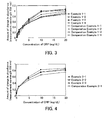
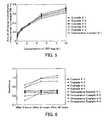
- the results of the dispersibility with respect to the measurement reagents each left to stand for the predetermined period of time measured from the absorbance at the start of the measurement are shown in the graph in FIG. 1 .
- the horizontal axis indicates the elapsed time after the preparation of the measurement reagent and the vertical axis indicates the absorbance at the start of the measurement.
- the graph in FIG. 1 the horizontal axis indicates the elapsed time after the preparation of the measurement reagent and the vertical axis indicates the absorbance at the start of the measurement.
- the plot of Example 1-1 is a black circle
- the plot of Example 1-2 is a black triangle
- the plot of Example 1-3 is a black square
- the plot of Example 1-4 is a black rhombus
- the plot of Comparative Example 1-1 is a white circle
- the plot of Comparative Example 1-2 is a white triangle
- the plot of Comparative Example 1-3 is a white square
- the plot of Comparative Example 1-4 is a white rhombus.
- the rate of change was increased with time elapsed after the preparation of the measurement reagent, and it showed that the nonspecific aggregation of the particles in the measurement reagents progressed.
- the rate of change was small at each predetermined time, and it showed that the particles in the measurement reagents were dispersed.
- the measurement results by the immunoturbidimetric assay with respect to the measurement reagents of Examples 1-1 to 1-4 and Comparative Examples 1-1 to 1-4 are shown in the graph in FIG. 3 .
- the horizontal axis indicates the concentration of CRP used as the measurement sample (mg/dL (mg/100mL)) and the vertical axis indicates the amount of change in the absorbance at each concentration.
- the plots in the graph in FIG. 3 are the same as those in the graph in FIG. 1 . As can be seen from the graph in FIG.
- the measurement reagents of Examples 1-1 to 1-4 retained the proportional relationship between increase in the concentration of CRP and increase in the absorbance in a wide range of CRP concentration, and showed higher measurement accuracy. Especially, in a moderate CRP concentration range of 5 to 10 mg/dL (5 to 10 mg/100mL), sensitivity was increased.
- the measurement reagent of this example was prepared in the same manner as Example 1-1 except that the concentration of lysine hydrochloride was changed from 0.5 mol/L to 0.17 mol/L, the concentration of the smaller particle in the measurement reagent was set at 0.5 w/v%, the concentration of the larger particle in the measurement reagent was set at 0.1 w/v%, and the concentration of the whole latex particle was set at 0.6 w/v%.
- Example 1-1 measurement by an immunoturbidimetric assay was performed in the same manner as Example 1-1 except that the measurement reagent of this example was used as the measurement reagent, and the concentration of the smaller particle was set at 0.117 w/v%, the concentration of the larger particle was set at 0.023 w/v%, and the concentration of the whole latex particle was set at 0.140 w/v% with respect to the concentration of the latex particle in the immunoreaction solution.
- the measurement reagent of this example was prepared in the same manner as Example 2-1 except that sodium glutamate of a concentration of 0.17 mol/L was used instead of lysine hydrochloride. Further, with respect to the measurement reagent of this example, the visual evaluation of dispersibility was performed in the same manner as Example 2-1. Moreover, measurement by an immunoturbidimetric assay was performed in the same manner as Example 2-1 using the measurement reagent of this example.
- the measurement reagent of this example was prepared in the same manner as Example 2-1 except that sodium aspartate of a concentration of 0.18 mol/L was used instead of lysine hydrochloride. Further, with respect to the measurement reagent of this example, the visual evaluation of dispersibility was performed in the same manner as Example 2-1. Moreover, measurement by an immunoturbidimetric assay was performed in the same manner as Example 2-1 using the measurement reagent of this example.
- the measurement reagent of this example was prepared in the same manner as Example 2-1 except that lysine hydrochloride was not used. Further, with respect to the measurement reagent of this example, the visual evaluation of dispersibility was performed in the same manner as Example 2-1. Moreover, measurement by an immunoturbidimetric assay was performed in the same manner as Example 2-1 using the measurement reagent of this example.
- the results of the visual evaluation of the dispersibility with respect to the measurement reagents of Examples 2-1 to 2-3 are shown in the following Table 7.
- the result of the visual evaluation of the dispersibility with respect to the measurement reagent of Comparative Example 2-1 is shown in the following Table 8.
- Table 7 the dispersibility evaluation of the measurement reagent of Example 2-1 was A and the dispersibility evaluation of the measurement reagents of Examples 2-2 to 2-3 was B.
- the measurement reagents of Examples 2-1 to 2-3 showed favorable dispersibility.
- the dispersibility evaluation of the measurement reagent of Comparative Example 2-1 was C and it showed inferior dispersibility.
- Example Amino acid Evaluation Example 2-1 0.17 mol/L Lysine hydrochloride A
- Example 2-2 0.17 mol/L Sodium glutamate B
- Example 2-3 0.18 mol/L Sodium aspartate B
- the measurement results by the immunoturbidimetric assay with respect to the measurement reagents of Examples 2-1 to 2-3 and Comparative Example 2-1 are shown in the graph in FIG. 4 .
- the horizontal axis indicates the concentration of CRP used as the measurement sample (mg/dL (mg/100mL)) and the vertical axis indicates the amount of change in the absorbance at each concentration.
- the plot of Example 2-1 is a black circle
- the plot of Example 2-2 is a black triangle
- the plot of Example 2-3 is a black square
- the plot of Comparative Example 2-1 is a white circle.
- the measurement reagents of Examples 2-1 to 2-3 retained the proportional relationship between increase in the concentration of CRP and increase in the absorbance in a wide range of CRP concentration, and showed higher measurement accuracy
- the measurement reagent of this example was prepared in the same manner as Example 1-1 except that sodium aspartate of a concentration of 0.075 mol/L was used instead of lysine hydrochloride, the concentration of the smaller particle in the measurement reagent was set at 0.533 w/v%, the concentration of the larger particle in the measurement reagent was set at 0.1 w/v%, and the concentration of the whole latex particle was set at 0.633 w/v%.
- Measurement by an immunoturbidimetric assay using the measurement reagent of this example was performed in the same manner as Example 1-1 except that the concentration of the smaller particle was set at 0.124 w/v%, the concentration of the larger particle was set at 0.023 w/v%, and the concentration of the whole latex particle was set at 0.148 w/v% with respect to the concentration of the latex particle in the immunoreaction solution, and the concentrations of the CRP solutions were set at 0,0.1, 0.15, 1, 2.5, 5, 10 mg/dL (mg/100mL).
- the measurement reagent of this example was prepared in the same manner as Example 3-1 except that the concentration of sodium aspartate was changed to 0.15 mol/L. Further, with respect to the measurement reagent of this example, the visual evaluation of dispersibility was performed in the same manner as Example 3-1. Moreover, measurement by an immunoturbidimetric assay was performed in the same manner as Example 3-1 using the measurement reagent of this example.
- the measurement reagent of this example was prepared in the same manner as Example 3-1 except that the concentration of sodium aspartate was changed to 0.6 mol/L. Further, with respect to the measurement reagent of this example, the visual evaluation of dispersibility was performed in the same manner as Example 3-1. Moreover, measurement by an immunoturbidimetric assay was performed in the same manner as Example 3-1 using the measurement reagent of this example.
- the measurement reagent of this example was prepared in the same manner as Example 3-1 except that the concentration of sodium aspartate was changed to 1.0 mol/L. Further, with respect to the measurement reagent of this example, the visual evaluation of dispersibility was performed in the same manner as Example 3-1. Moreover, measurement by an immunoturbidimetric assay was performed in the same manner as Example 3-1 using the measurement reagent of this example.
- the measurement reagent of this example was prepared in the same manner as Example 3-1 except that the concentration of sodium aspartate was changed to 2.0 mol/L. Further, with respect to the measurement reagent of this example, the visual evaluation of dispersibility was performed in the same manner as Example 3-1. Moreover, measurement by an immunoturbidimetric assay was performed in the same manner as Example 3-1 using the measurement reagent of this example.
- the measurement reagent of this example was prepared in the same manner as Example 3-1 except that sodium aspartate was not used. Further, with respect to the measurement reagent of this example, the visual evaluation of dispersibility was performed in the same manner as Example 3-1. Moreover, measurement by an immunoturbidimetric assay was performed in the same manner as Example 3-1 using the measurement reagent of this example.
- the measurement results by the immunoturbidimetric assay with respect to the measurement reagents of Examples 3-1 to 3-5 and Comparative Example 3-1 are shown in the graph in FIG. 5 .
- the horizontal axis indicates the concentration of CRP used as the measurement sample (mg/dL (mg/100mL)) and the vertical axis indicates the amount of change in the absorbance at each concentration.
- the plot of Example 3-1 is a black circle
- the plot of Example 3-2 is a black triangle
- the plot of Example 3-3 is a black square
- the plot of Example 3-4 is a black rhombus
- the plot of Example 3-5 is a white circle
- the plot of Comparative Example 3-1 is a white triangle.
- the measurement reagents of Examples 3-1 to 3-5 retained the proportional relationship between increase in the concentration of CRP and increase in the absorbance in a wide range of CRP concentration, and showed higher measurement accuracy.
- the measurement reagents of Examples 3-1 to 3-5 in which antibodies are brought into contact with latex particles in the presence of the amino acid with a charged polar side chain can be measured in a wide range of measurement concentration, and showed higher measurement accuracy Further, the measurement reagents of Examples 3-2 to 3-4 containing the amino acid with a charged polar side chain at the concentration of 0.15 mol/L to 1 mol/L in the sensitization reaction solution showed superior suppression of nonspecific aggregation.
- the measurement reagent of this example was prepared in the same manner as Example 1-1 except that the smaller particles were not used and only the larger particles were used as the insoluble carrier particle group, the concentration of the larger particle in the measurement reagent was set at 0.167 w/v% and the concentration of the whole latex particle was set at 0.167 w/v%.
- Example 1-1 With respect to the measurement reagent of this example, the instrumental evaluation of dispersibility was performed in the same manner as Example 1-1.
- Measurement by an immunoturbidimetric assay was performed in the same manner as Example 1-1 except that the measurement reagent of this example was used as the measurement reagent, the concentration of the smaller particle was set at 0 w/v%, the concentration of the larger particle was set at 0.039 w/v%, and the concentration of the whole latex particle was set at 0.039 w/v% with respect to the concentration of the latex particle in the immunoreaction solution, the concentrations of the CRP were set at 0, 0.1, 0.15, 1, 2.5, 5 mg/dL (mg/100mL), and the dilution rate of the CRP solutions was set at 6.66-fold.
- the measurement reagent of this example was prepared in the same manner as Example 4-1 except that arginine hydrochloride of a concentration of 0.5 mol/L was used instead of lysine hydrochloride. Further, the instrumental evaluation of dispersibility and the measurement by an immunoturbidimetric assay were performed in the same manner as Example 4-1 using the measurement reagent of this example.
- the measurement reagent of this example was prepared in the same manner as Example 4-1 except that histidine of a concentration of 0.5 mol/L was used instead of lysine hydrochloride. Further, the instrumental evaluation of dispersibility and the measurement by an immunoturbidimetric assay were performed in the same manner as Example 4-1 using the measurement reagent of this example.
- the measurement reagent of this example was prepared in the same manner as Example 4-1 except that sodium aspartate of a concentration of 0.5 mol/L was used instead of lysine hydrochloride. Further, the instrumental evaluation of dispersibility was performed in the same manner as Example 4-1 using the measurement reagent of this example.
- the measurement reagent of this example was prepared in the same manner as Example 4-1 except that lysine hydrochloride was not used. Further, the instrumental evaluation of dispersibility and the measurement by an immunoturbidimetric assay were performed in the same manner as Example 4-1 using the measurement reagent of this example.
- the measurement reagent of this example was prepared in the same manner as Example 4-1 except that asparagine of a concentration of 0.5 mol/L was used instead of lysine hydrochloride. Further, the instrumental evaluation of dispersibility was performed in the same manner as Example 4-1 using the measurement reagent of this example.
- the measurement reagent of this example was prepared in the same manner as Example 4-1 except that serine of a concentration of 0.5 mol/L was used instead of lysine hydrochloride. Further, the instrumental evaluation of dispersibility and the measurement by an immunoturbidimetric assay were performed in the same manner as Example 4-1 using the measurement reagent of this example.
- the measurement reagent of this example was prepared in the same manner as Example 4-1 except that threonine of a concentration of 0.5 mol/L was used instead of lysine hydrochloride. Further, the instrumental evaluation of dispersibility was performed in the same manner as Example 4-1 using the measurement reagent of this example.
- the absorbance at the start of the measurement at each predetermined time is shown in the graph in FIG. 6 .
- the horizontal axis indicates the elapsed time after the preparation of the measurement reagent and the vertical axis indicates the absorbance at the start of the measurement.
- the plot of Example 4-1 is a black circle
- the plot of Example 4-2 is a black triangle
- the plot of Example 4-3 is a black square
- the plot of Example 4-4 is a black rhombus
- the plot of Comparative Example 4-1 is a white circle
- the plot of Comparative Example 4-2 is a white triangle
- the plot of Comparative Example 4-3 is a white square
- the plot of Comparative Example 4-4 is a white rhombus.
- the absorbance was increased with time elapsed after the preparation, and the nonspecific aggregation of the particles in the measurement reagents was progressed.
- the absorbance was low soon after the preparation of the measurement reagent (0 hour), and the particles in the measurement reagents were dispersed.
- changes in the absorbance with time elapsed after the preparation were small, and it showed that the dispersibility was retained.
- the rate of change in the absorbance before and after the measurement at the predetermined time is shown in the graph in FIG. 7 .
- the horizontal axis indicates the elapsed time after the preparation of the measurement reagent and the vertical axis indicates the rate of change (%) in the absorbance.
- the plots in the graph in FIG. 7 are the same as those in the graph in FIG. 6 .
- the rate of change is increased when the particles in the measurement reagent are aggregated, and the rate of change is decreased when the particles in the measurement reagent are dispersed. As can be seen from the graph in FIG.
- the measurement results by the immunoturbidimetric assay with respect to the measurement reagents of Examples 4-1 to 4-3 and Comparative Examples 4-1 and 4-3 are shown in the graph in FIG. 8 .
- the horizontal axis indicates the concentration of CRP used as the measurement sample (mg/dL (mg/100mL)) and the vertical axis indicates the amount of change in the absorbance at each concentration.
- the plots in the graph in FIG. 8 are the same as those in the graphs in FIG. 6 and 7 except that there are no plots of Example 4-4 and Comparative Examples 4-2 and 4-4. As can be seen from FIG.
- the measurement reagents of Examples 4-1 to 4-3 retained the proportional relationship between increase in the concentration of CRP and increase in the absorbance in a wide range of CRP concentration, and showed higher measurement accuracy.
- a method of producing insoluble carrier particles, insoluble carrier particles, a measurement reagent, a specimen analyzing tool, an immunoturbidimetric assay, and an immunochromatograph method of the present invention can be used in laboratory tests, various screenings, and the like.
- the intended uses thereof are not limited and they are applicable to a wide range of fields such as medical science, pharmaceutical science, and biochemistry.
Landscapes
- Health & Medical Sciences (AREA)
- Immunology (AREA)
- Life Sciences & Earth Sciences (AREA)
- Engineering & Computer Science (AREA)
- Molecular Biology (AREA)
- Biomedical Technology (AREA)
- Chemical & Material Sciences (AREA)
- Hematology (AREA)
- Urology & Nephrology (AREA)
- Biotechnology (AREA)
- Microbiology (AREA)
- Cell Biology (AREA)
- Food Science & Technology (AREA)
- Medicinal Chemistry (AREA)
- Physics & Mathematics (AREA)
- Analytical Chemistry (AREA)
- Biochemistry (AREA)
- General Health & Medical Sciences (AREA)
- General Physics & Mathematics (AREA)
- Pathology (AREA)
- Peptides Or Proteins (AREA)
- Investigating Or Analysing Biological Materials (AREA)
Claims (19)
- Procédé de production d'une particule porteuse insoluble portant un anticorps ou un antigène sur sa surface de particule, comprenant un procédé de réaction de sensibilisation:la mise en contact de l'anticorps ou de l'antigène avec la particule porteuse insoluble en présence d'un acide aminé avec une chaîne latérale polaire chargée dans une solution de réaction de sensibilisation, où la concentration de l'acide aminé avec une chaîne latérale polaire chargée dans la solution de réaction de sensibilisation est supérieure à 0,1 mol/l et est inférieure ou égale à 1 mol/l.
- Procédé de production d'une particule porteuse insoluble selon la revendication 1, où l'acide aminé avec une chaîne latérale polaire chargée est un acide aminé basique ou un acide aminé acide.
- Procédé de production d'une particule porteuse insoluble selon la revendication 1, où dans le procédé de la réaction de sensibilisation, la particule porteuse insoluble est une particule de latex.
- Procédé de production d'une particule porteuse insoluble selon la revendication 3, où dans le procédé de la réaction de sensibilisation, la particule de latex est une particule de latex pour une liaison chimique.
- Particule porteuse insoluble utilisée dans un dosage immunoturbidimétrique, où la particule porteuse insoluble est produite par le procédé de production d'une particule porteuse insoluble selon la revendication 1.
- Réactif de mesure utilisé dans un dosage immunoturbidimétrique, où le réactif de mesure contient la particule porteuse insoluble selon la revendication 5.
- Réactif de mesure selon la revendication 6, où le réactif de mesure contient un groupe de particules porteuses insolubles comprenant une pluralité de particules porteuses insolubles,
le groupe de particules porteuses insolubles comprend deux types de groupes de particules porteuses insolubles ayant des tailles de particules moyennes différentes, et
au moins l'un des deux types de groupes de particules porteuses insolubles est un groupe de particules porteuses insolubles comprenant une pluralité de particules porteuses insolubles selon la revendication 5. - Réactif de mesure selon la revendication 7, où un groupe de particules porteuses insolubles ayant une taille de particule moyenne plus grosse parmi les deux types de groupes de particules porteuses insolubles est ledit groupe de particules porteuses insolubles comprenant une pluralité de particules porteuses insolubles selon la revendication 5.
- Réactif de mesure selon la revendication 6, où une taille de particule moyenne de la particule porteuse insoluble selon la revendication 5 se situe dans une plage de 0,03 à 2,0 µm.
- Réactif de mesure selon la revendication 6, où une taille de particule moyenne de la particule porteuse insoluble selon la revendication 5 se situe dans une plage de 0,08 à 2,0 µm.
- Réactif de mesure selon la revendication 6, où une taille de particule moyenne de la particule porteuse insoluble selon la revendication 5 se situe dans une plage de 0,12 à 0,5 µm.
- Outil d'analyse d'échantillons, contenant le réactif de mesure selon la revendication 6.
- Outil d'analyse d'échantillons selon la revendication 12, où l'outil d'analyse d'échantillons est l'un quelconque d'une pièce à tester, d'une cartouche, et d'une micropuce.
- Dosage immunoturbidimétrique, comprenant :un procédé de réaction d'agrégation faisant immunoréagir des particules porteuses insolubles portant des anticorps et des antigènes sur leurs surfaces de particules avec des objets de mesure, qui sont des antigènes ou des anticorps, pour agréger les particules porteuses insolubles dans une solution d'immunoréaction ; etun procédé de mesure mesurant le changement de turbidité de la solution d'immunoréaction dû à la réaction d'agrégation, où la particule porteuse insoluble selon la revendication 5 est utilisée comme particule porteuse insoluble.
- Dosage immunoturbidimétrique selon la revendication 14, où dans le procédé de la réaction d'agrégation,
un groupe de particules porteuses insolubles comprenant une pluralité de particules porteuses insolubles est utilisé, et où
le groupe de particules porteuses insolubles comprend deux types de groupes de particules porteuses insolubles ayant des tailles de particules moyennes différentes, et
au moins l'un des deux types de groupes de particules porteuses insolubles est un groupe de particules porteuses insolubles comprenant une pluralité de particules porteuses insolubles selon la revendication 5. - Dosage immunoturbidimétrique selon la revendication 15, dans lequel un groupe de particules porteuses insolubles ayant une taille de particule moyenne plus grosse parmi les deux types de groupes de particules porteuses insolubles est ledit groupe de particules porteuses insolubles comprenant une pluralité de particules porteuses insolubles selon la revendication 5.
- Dosage immunoturbidimétrique selon la revendication 14, dans lequel une taille de particule moyenne de la particule porteuse insoluble selon la revendication 5 se situe dans une plage de 0,03 à 2,0 µm.
- Dosage immunoturbidimétrique selon la revendication 14, dans lequel une taille de particule moyenne de la particule porteuse insoluble selon la revendication 5 se situe dans une plage de 0,08 à 2,0 µm.
- Dosage immunoturbidimétrique selon la revendication 14, dans lequel une taille de particule moyenne de la particule porteuse insoluble selon la revendication 5 se situe dans une plage de 0,12 à 0,5 µm.
Applications Claiming Priority (2)
| Application Number | Priority Date | Filing Date | Title |
|---|---|---|---|
| JP2008123971 | 2008-05-09 | ||
| PCT/JP2009/057903 WO2009136541A1 (fr) | 2008-05-09 | 2009-04-21 | Procédé de production de particule porteuse insoluble, particule porteuse insoluble, réactif de mesure, outil d'analyse d'échantillon et procédé turbidimétrique immunologique |
Publications (3)
| Publication Number | Publication Date |
|---|---|
| EP2287609A1 EP2287609A1 (fr) | 2011-02-23 |
| EP2287609A4 EP2287609A4 (fr) | 2011-05-04 |
| EP2287609B1 true EP2287609B1 (fr) | 2014-12-31 |
Family
ID=41264597
Family Applications (1)
| Application Number | Title | Priority Date | Filing Date |
|---|---|---|---|
| EP09742666.2A Not-in-force EP2287609B1 (fr) | 2008-05-09 | 2009-04-21 | Procédé de production de particule porteuse insoluble, particule porteuse insoluble, réactif de mesure, outil d'analyse d'échantillon et procédé turbidimétrique immunologique |
Country Status (5)
| Country | Link |
|---|---|
| US (1) | US9182391B2 (fr) |
| EP (1) | EP2287609B1 (fr) |
| JP (1) | JP5351054B2 (fr) |
| CN (1) | CN102007412A (fr) |
| WO (1) | WO2009136541A1 (fr) |
Families Citing this family (13)
| Publication number | Priority date | Publication date | Assignee | Title |
|---|---|---|---|---|
| CN101881777B (zh) * | 2010-06-30 | 2013-10-02 | 深圳市国赛生物技术有限公司 | 无需对全血样本进行预处理的超敏c反应蛋白检测方法及试剂盒 |
| CN102353770B (zh) * | 2011-06-03 | 2013-11-06 | 宁波美康生物科技股份有限公司 | 胱氨酸蛋白酶抑制剂c检测试剂盒 |
| JP2013054029A (ja) * | 2011-08-08 | 2013-03-21 | Arkray Inc | カルボキシメチルアルギニンの免疫測定方法 |
| CN102590524B (zh) * | 2011-12-30 | 2016-01-06 | 北京九强生物技术股份有限公司 | 中性粒细胞明胶酶相关脂质运载蛋白检测试剂盒 |
| CN102628865B (zh) * | 2011-12-30 | 2014-07-16 | 北京九强生物技术股份有限公司 | 检测肌红蛋白含量的胶乳增强免疫比浊试剂盒 |
| CN102636653A (zh) * | 2012-04-19 | 2012-08-15 | 上海蓝怡科技有限公司 | 复合胶乳粒子包被胱抑素c检测试剂盒 |
| CN103323596B (zh) * | 2012-10-31 | 2015-06-03 | 武汉生之源生物科技有限公司 | 髓过氧化物酶含量检测试剂盒及其制备方法 |
| JP6918808B2 (ja) * | 2016-08-31 | 2021-08-11 | 栄研化学株式会社 | 異なる方式で抗原を固定化した抗原担持不溶性担体粒子を用いる抗体測定法、抗体測定用試薬 |
| CN107490677A (zh) * | 2017-07-21 | 2017-12-19 | 王贤俊 | 一种羧基胶乳微球与糖化血红蛋白抗体的交联组合液及其交联方法 |
| JP6767452B2 (ja) * | 2017-10-06 | 2020-10-14 | 三洋化成工業株式会社 | 免疫測定用試薬、免疫測定用キット及び免疫測定方法 |
| JP7191913B2 (ja) * | 2019-10-29 | 2022-12-19 | 三洋化成工業株式会社 | 免疫測定方法及び免疫測定用キット |
| CN110806487A (zh) * | 2019-12-02 | 2020-02-18 | 深圳上泰生物工程有限公司 | 一种用于人肝素结合蛋白检测的试剂盒及其制备方法 |
| CN117330745A (zh) * | 2022-06-23 | 2024-01-02 | 深圳市帝迈生物技术有限公司 | 一种纤维蛋白或纤维蛋白原降解产物fdp测定试剂盒 |
Family Cites Families (20)
| Publication number | Priority date | Publication date | Assignee | Title |
|---|---|---|---|---|
| CA1045031A (fr) * | 1973-04-04 | 1978-12-26 | Akzona Incorporated | Epreuve serologique pour le depistage des anticorps de neisseria gonorrhocae |
| JPS6197568A (ja) | 1984-10-19 | 1986-05-16 | Chugai Pharmaceut Co Ltd | 免疫化学的診断用微粒子試薬および製造方法 |
| JPS6328069A (ja) * | 1986-07-22 | 1988-02-05 | Seiko Epson Corp | 半導体装置 |
| JPH0810223B2 (ja) | 1987-03-17 | 1996-01-31 | 日東電工株式会社 | 診断薬用ラテツクス、その製法および該ラテツクスを用いてなる診断薬 |
| JP3095478B2 (ja) | 1991-10-04 | 2000-10-03 | 株式会社トクヤマ | 免疫学的凝集反応粒子の製造方法 |
| JP3916189B2 (ja) | 1998-03-13 | 2007-05-16 | シスメックス株式会社 | イムノアッセイ用試薬及びイムノアッセイ |
| US6548310B1 (en) * | 1999-07-08 | 2003-04-15 | Jsr Corporation | Particle for diagnostic agent and turbidmetric immunoassay using the same |
| DE10046508A1 (de) * | 1999-09-14 | 2001-04-05 | Tridelta Bio Medical Gmbh | Magnetische Nanoteilchen mit biochemischer Wikrsamkeit und Verfahren zu ihrer Herstellung sowie ihre Verwendung |
| EP1351704B1 (fr) * | 2000-12-21 | 2007-03-07 | Nektar Therapeutics | Compositions de recepteur de l'interleukine 4 en poudre stables au stockage |
| EP1385001A4 (fr) | 2001-03-30 | 2007-07-25 | Mitsubishi Kagaku Iatron Inc | Reactif et procede pour l'immunoanalyse de l'elastase 1, et procede de detection de pathologie pancreatique |
| CN100396331C (zh) | 2001-07-02 | 2008-06-25 | 积水化学工业株式会社 | 用于分析试剂的载体颗粒胶乳和分析试剂 |
| US7223534B2 (en) * | 2002-05-03 | 2007-05-29 | Kimberly-Clark Worldwide, Inc. | Diffraction-based diagnostic devices |
| JP2004117068A (ja) | 2002-09-24 | 2004-04-15 | Sysmex Corp | 免疫測定試薬および免疫測定方法 |
| JP2004117022A (ja) | 2002-09-24 | 2004-04-15 | Sysmex Corp | 免疫測定における非特異反応抑制方法 |
| JP4241301B2 (ja) * | 2003-09-30 | 2009-03-18 | 和光純薬工業株式会社 | 免疫学的測定用試薬 |
| US20050186146A1 (en) * | 2004-02-12 | 2005-08-25 | Nektar Therapeutics | Interleukin-13 antagonist powders, spray-dried particles, and methods |
| KR20070102686A (ko) * | 2005-01-28 | 2007-10-19 | 교와 핫꼬 고교 가부시끼가이샤 | 피복 미립자의 제조 방법 |
| WO2007076295A2 (fr) * | 2005-12-16 | 2007-07-05 | University Of Kansas | Nanoagrégats pour l'administration de substances thérapeutiques |
| JP5217744B2 (ja) * | 2007-08-02 | 2013-06-19 | 大日本印刷株式会社 | 反射防止フィルム及び反射防止フィルムの製造方法 |
| WO2009104369A1 (fr) | 2008-02-22 | 2009-08-27 | パナソニック株式会社 | Procédé de détection d'un composant contenu dans le plasma et réactif et dispositif de détection destinés à être utilisés dans celui-ci |
-
2009
- 2009-04-21 CN CN2009801137850A patent/CN102007412A/zh active Pending
- 2009-04-21 WO PCT/JP2009/057903 patent/WO2009136541A1/fr not_active Ceased
- 2009-04-21 EP EP09742666.2A patent/EP2287609B1/fr not_active Not-in-force
- 2009-04-21 JP JP2009551905A patent/JP5351054B2/ja not_active Expired - Fee Related
- 2009-04-21 US US12/936,783 patent/US9182391B2/en not_active Expired - Fee Related
Also Published As
| Publication number | Publication date |
|---|---|
| US9182391B2 (en) | 2015-11-10 |
| JP5351054B2 (ja) | 2013-11-27 |
| US20110027915A1 (en) | 2011-02-03 |
| WO2009136541A1 (fr) | 2009-11-12 |
| EP2287609A4 (fr) | 2011-05-04 |
| JPWO2009136541A1 (ja) | 2011-09-08 |
| CN102007412A (zh) | 2011-04-06 |
| EP2287609A1 (fr) | 2011-02-23 |
Similar Documents
| Publication | Publication Date | Title |
|---|---|---|
| US9182391B2 (en) | Method of producing insoluble carrier particles, insoluble carrier particles, measurement reagent, specimen analyzing tool, and immunoturbidimetric assay | |
| EP2146207A1 (fr) | Reactif de mesure, immunonephelemetrie l'utilisant et outil d'analyse d'analytes | |
| CA2452766C (fr) | Latex a particules supports pour reactif d'essai, et reactif d'essai | |
| JP3623657B2 (ja) | 非特異反応抑制剤、免疫測定試薬及び免疫測定方法 | |
| JP6598681B2 (ja) | 表面に反応性官能基を有するシリカ粒子及びその製造方法 | |
| JP4668768B2 (ja) | 免疫測定方法及び非特異反応抑制方法 | |
| CN113125741A (zh) | 降钙素原的检测试剂、试剂盒、系统及检测方法 | |
| EP1801590B1 (fr) | Procédé d'analyse d'antigène et réactif correspondant | |
| CN101310186A (zh) | 测定抗原的方法和用于其的试剂盒 | |
| CN1404577A (zh) | 免疫分析试剂和分析方法 | |
| JPH04248465A (ja) | 結合可能なアナライトを測定するための免疫沈降法、およびこの方法を実施するための試薬 | |
| US4760030A (en) | Quantitative opaque particle agglutination assay | |
| JP2005283250A (ja) | 金コロイド凝集反応の測定方法 | |
| EP1637884A1 (fr) | Procede de mesure de substance a affinite | |
| US20150268234A1 (en) | Density Amplification in Magnetic Levitation to Detect Binding Events of Large Molecules | |
| JP4556605B2 (ja) | 標的物質の測定方法および測定試薬 | |
| JP2000046828A (ja) | 免疫学的測定試薬及び免疫学的測定試薬の製造方法 | |
| JP2000258419A (ja) | 免疫測定試薬及び免疫測定法 | |
| JP2004117068A (ja) | 免疫測定試薬および免疫測定方法 | |
| JP2001228153A (ja) | 免疫学的測定方法 | |
| CN118258994A (zh) | 免疫比浊检测增敏剂 | |
| JP2005241363A (ja) | 測定試薬用担体粒子及び測定試薬 | |
| JPH09304389A (ja) | 免疫測定試薬および免疫測定法 | |
| HK1130536A (en) | Immunological assay reagents and assay method | |
| JP2004347614A (ja) | 非特異反応抑制剤、免疫測定試薬及び免疫測定方法 |
Legal Events
| Date | Code | Title | Description |
|---|---|---|---|
| PUAI | Public reference made under article 153(3) epc to a published international application that has entered the european phase |
Free format text: ORIGINAL CODE: 0009012 |
|
| 17P | Request for examination filed |
Effective date: 20101203 |
|
| AK | Designated contracting states |
Kind code of ref document: A1 Designated state(s): AT BE BG CH CY CZ DE DK EE ES FI FR GB GR HR HU IE IS IT LI LT LU LV MC MK MT NL NO PL PT RO SE SI SK TR |
|
| AX | Request for extension of the european patent |
Extension state: AL BA RS |
|
| A4 | Supplementary search report drawn up and despatched |
Effective date: 20110405 |
|
| DAX | Request for extension of the european patent (deleted) | ||
| 17Q | First examination report despatched |
Effective date: 20140211 |
|
| GRAP | Despatch of communication of intention to grant a patent |
Free format text: ORIGINAL CODE: EPIDOSNIGR1 |
|
| RIN1 | Information on inventor provided before grant (corrected) |
Inventor name: TAKAGI, HIDENORI |
|
| INTG | Intention to grant announced |
Effective date: 20141010 |
|
| GRAS | Grant fee paid |
Free format text: ORIGINAL CODE: EPIDOSNIGR3 |
|
| GRAA | (expected) grant |
Free format text: ORIGINAL CODE: 0009210 |
|
| AK | Designated contracting states |
Kind code of ref document: B1 Designated state(s): AT BE BG CH CY CZ DE DK EE ES FI FR GB GR HR HU IE IS IT LI LT LU LV MC MK MT NL NO PL PT RO SE SI SK TR |
|
| REG | Reference to a national code |
Ref country code: CH Ref legal event code: EP Ref country code: GB Ref legal event code: FG4D |
|
| REG | Reference to a national code |
Ref country code: IE Ref legal event code: FG4D |
|
| REG | Reference to a national code |
Ref country code: AT Ref legal event code: REF Ref document number: 704704 Country of ref document: AT Kind code of ref document: T Effective date: 20150215 |
|
| REG | Reference to a national code |
Ref country code: DE Ref legal event code: R096 Ref document number: 602009028702 Country of ref document: DE Effective date: 20150219 |
|
| PG25 | Lapsed in a contracting state [announced via postgrant information from national office to epo] |
Ref country code: NO Free format text: LAPSE BECAUSE OF FAILURE TO SUBMIT A TRANSLATION OF THE DESCRIPTION OR TO PAY THE FEE WITHIN THE PRESCRIBED TIME-LIMIT Effective date: 20150331 Ref country code: FI Free format text: LAPSE BECAUSE OF FAILURE TO SUBMIT A TRANSLATION OF THE DESCRIPTION OR TO PAY THE FEE WITHIN THE PRESCRIBED TIME-LIMIT Effective date: 20141231 Ref country code: LT Free format text: LAPSE BECAUSE OF FAILURE TO SUBMIT A TRANSLATION OF THE DESCRIPTION OR TO PAY THE FEE WITHIN THE PRESCRIBED TIME-LIMIT Effective date: 20141231 |
|
| REG | Reference to a national code |
Ref country code: NL Ref legal event code: VDEP Effective date: 20141231 |
|
| REG | Reference to a national code |
Ref country code: LT Ref legal event code: MG4D |
|
| PG25 | Lapsed in a contracting state [announced via postgrant information from national office to epo] |
Ref country code: LV Free format text: LAPSE BECAUSE OF FAILURE TO SUBMIT A TRANSLATION OF THE DESCRIPTION OR TO PAY THE FEE WITHIN THE PRESCRIBED TIME-LIMIT Effective date: 20141231 Ref country code: HR Free format text: LAPSE BECAUSE OF FAILURE TO SUBMIT A TRANSLATION OF THE DESCRIPTION OR TO PAY THE FEE WITHIN THE PRESCRIBED TIME-LIMIT Effective date: 20141231 Ref country code: SE Free format text: LAPSE BECAUSE OF FAILURE TO SUBMIT A TRANSLATION OF THE DESCRIPTION OR TO PAY THE FEE WITHIN THE PRESCRIBED TIME-LIMIT Effective date: 20141231 Ref country code: GR Free format text: LAPSE BECAUSE OF FAILURE TO SUBMIT A TRANSLATION OF THE DESCRIPTION OR TO PAY THE FEE WITHIN THE PRESCRIBED TIME-LIMIT Effective date: 20150401 |
|
| REG | Reference to a national code |
Ref country code: AT Ref legal event code: MK05 Ref document number: 704704 Country of ref document: AT Kind code of ref document: T Effective date: 20141231 |
|
| PG25 | Lapsed in a contracting state [announced via postgrant information from national office to epo] |
Ref country code: NL Free format text: LAPSE BECAUSE OF FAILURE TO SUBMIT A TRANSLATION OF THE DESCRIPTION OR TO PAY THE FEE WITHIN THE PRESCRIBED TIME-LIMIT Effective date: 20141231 |
|
| PG25 | Lapsed in a contracting state [announced via postgrant information from national office to epo] |
Ref country code: SK Free format text: LAPSE BECAUSE OF FAILURE TO SUBMIT A TRANSLATION OF THE DESCRIPTION OR TO PAY THE FEE WITHIN THE PRESCRIBED TIME-LIMIT Effective date: 20141231 Ref country code: RO Free format text: LAPSE BECAUSE OF FAILURE TO SUBMIT A TRANSLATION OF THE DESCRIPTION OR TO PAY THE FEE WITHIN THE PRESCRIBED TIME-LIMIT Effective date: 20141231 Ref country code: ES Free format text: LAPSE BECAUSE OF FAILURE TO SUBMIT A TRANSLATION OF THE DESCRIPTION OR TO PAY THE FEE WITHIN THE PRESCRIBED TIME-LIMIT Effective date: 20141231 Ref country code: CZ Free format text: LAPSE BECAUSE OF FAILURE TO SUBMIT A TRANSLATION OF THE DESCRIPTION OR TO PAY THE FEE WITHIN THE PRESCRIBED TIME-LIMIT Effective date: 20141231 |
|
| PG25 | Lapsed in a contracting state [announced via postgrant information from national office to epo] |
Ref country code: IS Free format text: LAPSE BECAUSE OF FAILURE TO SUBMIT A TRANSLATION OF THE DESCRIPTION OR TO PAY THE FEE WITHIN THE PRESCRIBED TIME-LIMIT Effective date: 20150430 Ref country code: AT Free format text: LAPSE BECAUSE OF FAILURE TO SUBMIT A TRANSLATION OF THE DESCRIPTION OR TO PAY THE FEE WITHIN THE PRESCRIBED TIME-LIMIT Effective date: 20141231 Ref country code: PL Free format text: LAPSE BECAUSE OF FAILURE TO SUBMIT A TRANSLATION OF THE DESCRIPTION OR TO PAY THE FEE WITHIN THE PRESCRIBED TIME-LIMIT Effective date: 20141231 |
|
| REG | Reference to a national code |
Ref country code: DE Ref legal event code: R097 Ref document number: 602009028702 Country of ref document: DE |
|
| PG25 | Lapsed in a contracting state [announced via postgrant information from national office to epo] |
Ref country code: EE Free format text: LAPSE BECAUSE OF FAILURE TO SUBMIT A TRANSLATION OF THE DESCRIPTION OR TO PAY THE FEE WITHIN THE PRESCRIBED TIME-LIMIT Effective date: 20141231 Ref country code: DK Free format text: LAPSE BECAUSE OF FAILURE TO SUBMIT A TRANSLATION OF THE DESCRIPTION OR TO PAY THE FEE WITHIN THE PRESCRIBED TIME-LIMIT Effective date: 20141231 |
|
| PLBE | No opposition filed within time limit |
Free format text: ORIGINAL CODE: 0009261 |
|
| STAA | Information on the status of an ep patent application or granted ep patent |
Free format text: STATUS: NO OPPOSITION FILED WITHIN TIME LIMIT |
|
| PG25 | Lapsed in a contracting state [announced via postgrant information from national office to epo] |
Ref country code: LU Free format text: LAPSE BECAUSE OF FAILURE TO SUBMIT A TRANSLATION OF THE DESCRIPTION OR TO PAY THE FEE WITHIN THE PRESCRIBED TIME-LIMIT Effective date: 20150421 Ref country code: MC Free format text: LAPSE BECAUSE OF FAILURE TO SUBMIT A TRANSLATION OF THE DESCRIPTION OR TO PAY THE FEE WITHIN THE PRESCRIBED TIME-LIMIT Effective date: 20141231 |
|
| REG | Reference to a national code |
Ref country code: CH Ref legal event code: PL |
|
| 26N | No opposition filed |
Effective date: 20151001 |
|
| REG | Reference to a national code |
Ref country code: IE Ref legal event code: MM4A |
|
| PG25 | Lapsed in a contracting state [announced via postgrant information from national office to epo] |
Ref country code: CH Free format text: LAPSE BECAUSE OF NON-PAYMENT OF DUE FEES Effective date: 20150430 Ref country code: LI Free format text: LAPSE BECAUSE OF NON-PAYMENT OF DUE FEES Effective date: 20150430 |
|
| PG25 | Lapsed in a contracting state [announced via postgrant information from national office to epo] |
Ref country code: SI Free format text: LAPSE BECAUSE OF FAILURE TO SUBMIT A TRANSLATION OF THE DESCRIPTION OR TO PAY THE FEE WITHIN THE PRESCRIBED TIME-LIMIT Effective date: 20141231 |
|
| REG | Reference to a national code |
Ref country code: FR Ref legal event code: PLFP Year of fee payment: 8 |
|
| PG25 | Lapsed in a contracting state [announced via postgrant information from national office to epo] |
Ref country code: IE Free format text: LAPSE BECAUSE OF NON-PAYMENT OF DUE FEES Effective date: 20150421 |
|
| PG25 | Lapsed in a contracting state [announced via postgrant information from national office to epo] |
Ref country code: BE Free format text: LAPSE BECAUSE OF FAILURE TO SUBMIT A TRANSLATION OF THE DESCRIPTION OR TO PAY THE FEE WITHIN THE PRESCRIBED TIME-LIMIT Effective date: 20141231 |
|
| PGFP | Annual fee paid to national office [announced via postgrant information from national office to epo] |
Ref country code: DE Payment date: 20160421 Year of fee payment: 8 Ref country code: GB Payment date: 20160421 Year of fee payment: 8 |
|
| PGFP | Annual fee paid to national office [announced via postgrant information from national office to epo] |
Ref country code: FR Payment date: 20160421 Year of fee payment: 8 Ref country code: IT Payment date: 20160427 Year of fee payment: 8 |
|
| PG25 | Lapsed in a contracting state [announced via postgrant information from national office to epo] |
Ref country code: MT Free format text: LAPSE BECAUSE OF FAILURE TO SUBMIT A TRANSLATION OF THE DESCRIPTION OR TO PAY THE FEE WITHIN THE PRESCRIBED TIME-LIMIT Effective date: 20141231 |
|
| PG25 | Lapsed in a contracting state [announced via postgrant information from national office to epo] |
Ref country code: HU Free format text: LAPSE BECAUSE OF FAILURE TO SUBMIT A TRANSLATION OF THE DESCRIPTION OR TO PAY THE FEE WITHIN THE PRESCRIBED TIME-LIMIT; INVALID AB INITIO Effective date: 20090421 Ref country code: BG Free format text: LAPSE BECAUSE OF FAILURE TO SUBMIT A TRANSLATION OF THE DESCRIPTION OR TO PAY THE FEE WITHIN THE PRESCRIBED TIME-LIMIT Effective date: 20141231 |
|
| PG25 | Lapsed in a contracting state [announced via postgrant information from national office to epo] |
Ref country code: CY Free format text: LAPSE BECAUSE OF FAILURE TO SUBMIT A TRANSLATION OF THE DESCRIPTION OR TO PAY THE FEE WITHIN THE PRESCRIBED TIME-LIMIT Effective date: 20141231 |
|
| PG25 | Lapsed in a contracting state [announced via postgrant information from national office to epo] |
Ref country code: PT Free format text: LAPSE BECAUSE OF FAILURE TO SUBMIT A TRANSLATION OF THE DESCRIPTION OR TO PAY THE FEE WITHIN THE PRESCRIBED TIME-LIMIT Effective date: 20150501 |
|
| PG25 | Lapsed in a contracting state [announced via postgrant information from national office to epo] |
Ref country code: TR Free format text: LAPSE BECAUSE OF FAILURE TO SUBMIT A TRANSLATION OF THE DESCRIPTION OR TO PAY THE FEE WITHIN THE PRESCRIBED TIME-LIMIT Effective date: 20141231 |
|
| REG | Reference to a national code |
Ref country code: DE Ref legal event code: R119 Ref document number: 602009028702 Country of ref document: DE |
|
| GBPC | Gb: european patent ceased through non-payment of renewal fee |
Effective date: 20170421 |
|
| REG | Reference to a national code |
Ref country code: FR Ref legal event code: ST Effective date: 20171229 |
|
| PG25 | Lapsed in a contracting state [announced via postgrant information from national office to epo] |
Ref country code: DE Free format text: LAPSE BECAUSE OF NON-PAYMENT OF DUE FEES Effective date: 20171103 Ref country code: FR Free format text: LAPSE BECAUSE OF NON-PAYMENT OF DUE FEES Effective date: 20170502 |
|
| PG25 | Lapsed in a contracting state [announced via postgrant information from national office to epo] |
Ref country code: GB Free format text: LAPSE BECAUSE OF NON-PAYMENT OF DUE FEES Effective date: 20170421 |
|
| PG25 | Lapsed in a contracting state [announced via postgrant information from national office to epo] |
Ref country code: IT Free format text: LAPSE BECAUSE OF NON-PAYMENT OF DUE FEES Effective date: 20170421 |
|
| PG25 | Lapsed in a contracting state [announced via postgrant information from national office to epo] |
Ref country code: MK Free format text: LAPSE BECAUSE OF FAILURE TO SUBMIT A TRANSLATION OF THE DESCRIPTION OR TO PAY THE FEE WITHIN THE PRESCRIBED TIME-LIMIT Effective date: 20141231 |