EP2289848B1 - Therapeutische Malonsäure/essigsäure C60 Tri-Addukte von Buckminsterfulleren und mit deren zusammenhängende Verfahren - Google Patents
Therapeutische Malonsäure/essigsäure C60 Tri-Addukte von Buckminsterfulleren und mit deren zusammenhängende Verfahren Download PDFInfo
- Publication number
- EP2289848B1 EP2289848B1 EP10177722.5A EP10177722A EP2289848B1 EP 2289848 B1 EP2289848 B1 EP 2289848B1 EP 10177722 A EP10177722 A EP 10177722A EP 2289848 B1 EP2289848 B1 EP 2289848B1
- Authority
- EP
- European Patent Office
- Prior art keywords
- buckminsterfullerene
- penta
- derivative
- acetic acid
- malonic acid
- Prior art date
- Legal status (The legal status is an assumption and is not a legal conclusion. Google has not performed a legal analysis and makes no representation as to the accuracy of the status listed.)
- Expired - Lifetime
Links
- QTBSBXVTEAMEQO-UHFFFAOYSA-N Acetic acid Natural products CC(O)=O QTBSBXVTEAMEQO-UHFFFAOYSA-N 0.000 title claims description 163
- OFOBLEOULBTSOW-UHFFFAOYSA-N Malonic acid Chemical compound OC(=O)CC(O)=O OFOBLEOULBTSOW-UHFFFAOYSA-N 0.000 title claims description 126
- XMWRBQBLMFGWIX-UHFFFAOYSA-N C60 fullerene Chemical compound C12=C3C(C4=C56)=C7C8=C5C5=C9C%10=C6C6=C4C1=C1C4=C6C6=C%10C%10=C9C9=C%11C5=C8C5=C8C7=C3C3=C7C2=C1C1=C2C4=C6C4=C%10C6=C9C9=C%11C5=C5C8=C3C3=C7C1=C1C2=C4C6=C2C9=C5C3=C12 XMWRBQBLMFGWIX-UHFFFAOYSA-N 0.000 title claims description 63
- 238000000034 method Methods 0.000 title claims description 34
- 230000001225 therapeutic effect Effects 0.000 title description 3
- 150000001875 compounds Chemical class 0.000 claims description 51
- 241001465754 Metazoa Species 0.000 claims description 42
- 239000000203 mixture Substances 0.000 claims description 38
- 125000003184 C60 fullerene group Chemical group 0.000 claims description 31
- 150000002148 esters Chemical class 0.000 claims description 23
- MHAJPDPJQMAIIY-UHFFFAOYSA-N Hydrogen peroxide Chemical compound OO MHAJPDPJQMAIIY-UHFFFAOYSA-N 0.000 claims description 20
- 125000003178 carboxy group Chemical group [H]OC(*)=O 0.000 claims description 12
- 239000001257 hydrogen Substances 0.000 claims description 10
- 229910052739 hydrogen Inorganic materials 0.000 claims description 10
- 150000004702 methyl esters Chemical class 0.000 claims description 10
- 239000003642 reactive oxygen metabolite Substances 0.000 claims description 9
- 238000001990 intravenous administration Methods 0.000 claims description 8
- UFHFLCQGNIYNRP-UHFFFAOYSA-N Hydrogen Chemical compound [H][H] UFHFLCQGNIYNRP-UHFFFAOYSA-N 0.000 claims description 7
- OUUQCZGPVNCOIJ-UHFFFAOYSA-M Superoxide Chemical compound [O-][O] OUUQCZGPVNCOIJ-UHFFFAOYSA-M 0.000 claims description 6
- 239000002775 capsule Substances 0.000 claims description 6
- 150000003839 salts Chemical class 0.000 claims description 6
- 238000007920 subcutaneous administration Methods 0.000 claims description 6
- 241000124008 Mammalia Species 0.000 claims description 5
- 239000003937 drug carrier Substances 0.000 claims description 5
- 238000002347 injection Methods 0.000 claims description 5
- 239000007924 injection Substances 0.000 claims description 5
- 238000007918 intramuscular administration Methods 0.000 claims description 5
- 238000007912 intraperitoneal administration Methods 0.000 claims description 4
- 239000006186 oral dosage form Substances 0.000 claims description 4
- 239000000843 powder Substances 0.000 claims description 4
- 239000003826 tablet Substances 0.000 claims description 4
- 230000008030 elimination Effects 0.000 claims description 3
- 238000003379 elimination reaction Methods 0.000 claims description 3
- 239000008187 granular material Substances 0.000 claims description 3
- 239000006187 pill Substances 0.000 claims description 3
- 238000002560 therapeutic procedure Methods 0.000 claims description 3
- 238000007913 intrathecal administration Methods 0.000 claims description 2
- 230000000699 topical effect Effects 0.000 claims description 2
- 230000002035 prolonged effect Effects 0.000 claims 1
- YXFVVABEGXRONW-UHFFFAOYSA-N Toluene Chemical compound CC1=CC=CC=C1 YXFVVABEGXRONW-UHFFFAOYSA-N 0.000 description 137
- XEKOWRVHYACXOJ-UHFFFAOYSA-N Ethyl acetate Chemical compound CCOC(C)=O XEKOWRVHYACXOJ-UHFFFAOYSA-N 0.000 description 83
- OKKJLVBELUTLKV-UHFFFAOYSA-N Methanol Chemical compound OC OKKJLVBELUTLKV-UHFFFAOYSA-N 0.000 description 63
- XLYOFNOQVPJJNP-UHFFFAOYSA-N water Substances O XLYOFNOQVPJJNP-UHFFFAOYSA-N 0.000 description 60
- WEVYAHXRMPXWCK-UHFFFAOYSA-N Acetonitrile Chemical compound CC#N WEVYAHXRMPXWCK-UHFFFAOYSA-N 0.000 description 51
- 239000000243 solution Substances 0.000 description 50
- 238000004128 high performance liquid chromatography Methods 0.000 description 42
- HEMHJVSKTPXQMS-UHFFFAOYSA-M Sodium hydroxide Chemical compound [OH-].[Na+] HEMHJVSKTPXQMS-UHFFFAOYSA-M 0.000 description 41
- 239000002904 solvent Substances 0.000 description 33
- 235000019439 ethyl acetate Nutrition 0.000 description 29
- 241000699670 Mus sp. Species 0.000 description 27
- 239000010410 layer Substances 0.000 description 25
- CSCPPACGZOOCGX-UHFFFAOYSA-N Acetone Chemical compound CC(C)=O CSCPPACGZOOCGX-UHFFFAOYSA-N 0.000 description 24
- 239000007787 solid Substances 0.000 description 24
- DTQVDTLACAAQTR-UHFFFAOYSA-N Trifluoroacetic acid Chemical compound OC(=O)C(F)(F)F DTQVDTLACAAQTR-UHFFFAOYSA-N 0.000 description 19
- 239000007983 Tris buffer Substances 0.000 description 19
- 238000006243 chemical reaction Methods 0.000 description 17
- 239000000047 product Substances 0.000 description 17
- 238000011282 treatment Methods 0.000 description 15
- 238000004458 analytical method Methods 0.000 description 14
- 210000004027 cell Anatomy 0.000 description 14
- 230000001965 increasing effect Effects 0.000 description 14
- 108090000623 proteins and genes Proteins 0.000 description 14
- 238000009826 distribution Methods 0.000 description 13
- 238000010438 heat treatment Methods 0.000 description 13
- MEZLKOACVSPNER-GFCCVEGCSA-N selegiline Chemical compound C#CCN(C)[C@H](C)CC1=CC=CC=C1 MEZLKOACVSPNER-GFCCVEGCSA-N 0.000 description 13
- 241000700159 Rattus Species 0.000 description 12
- QAOWNCQODCNURD-UHFFFAOYSA-N Sulfuric acid Chemical compound OS(O)(=O)=O QAOWNCQODCNURD-UHFFFAOYSA-N 0.000 description 12
- 239000002253 acid Substances 0.000 description 12
- WQDUMFSSJAZKTM-UHFFFAOYSA-N Sodium methoxide Chemical compound [Na+].[O-]C WQDUMFSSJAZKTM-UHFFFAOYSA-N 0.000 description 11
- 230000004083 survival effect Effects 0.000 description 11
- 230000035772 mutation Effects 0.000 description 10
- 230000008569 process Effects 0.000 description 10
- VYPSYNLAJGMNEJ-UHFFFAOYSA-N Silicium dioxide Chemical compound O=[Si]=O VYPSYNLAJGMNEJ-UHFFFAOYSA-N 0.000 description 9
- 235000020827 calorie restriction Nutrition 0.000 description 9
- 239000002244 precipitate Substances 0.000 description 9
- 238000002360 preparation method Methods 0.000 description 9
- 238000003786 synthesis reaction Methods 0.000 description 9
- 241000282412 Homo Species 0.000 description 8
- 238000007792 addition Methods 0.000 description 8
- 230000015572 biosynthetic process Effects 0.000 description 8
- 230000006378 damage Effects 0.000 description 8
- 208000014674 injury Diseases 0.000 description 8
- 238000004949 mass spectrometry Methods 0.000 description 8
- 125000000896 monocarboxylic acid group Chemical group 0.000 description 8
- 210000002569 neuron Anatomy 0.000 description 8
- WMOVHXAZOJBABW-UHFFFAOYSA-N tert-butyl acetate Chemical compound CC(=O)OC(C)(C)C WMOVHXAZOJBABW-UHFFFAOYSA-N 0.000 description 8
- -1 Ben-Shlomo et al. Chemical compound 0.000 description 7
- 208000027418 Wounds and injury Diseases 0.000 description 7
- 239000003963 antioxidant agent Substances 0.000 description 7
- 235000006708 antioxidants Nutrition 0.000 description 7
- 239000003849 aromatic solvent Substances 0.000 description 7
- 239000003921 oil Substances 0.000 description 7
- 235000019198 oils Nutrition 0.000 description 7
- 239000011541 reaction mixture Substances 0.000 description 7
- 239000000741 silica gel Substances 0.000 description 7
- 229910002027 silica gel Inorganic materials 0.000 description 7
- 238000005160 1H NMR spectroscopy Methods 0.000 description 6
- 241000252505 Characidae Species 0.000 description 6
- 125000000218 acetic acid group Chemical group C(C)(=O)* 0.000 description 6
- 230000034994 death Effects 0.000 description 6
- 238000006114 decarboxylation reaction Methods 0.000 description 6
- 238000000354 decomposition reaction Methods 0.000 description 6
- 125000001160 methoxycarbonyl group Chemical group [H]C([H])([H])OC(*)=O 0.000 description 6
- 230000001537 neural effect Effects 0.000 description 6
- 231100000189 neurotoxic Toxicity 0.000 description 6
- 230000002887 neurotoxic effect Effects 0.000 description 6
- 150000003254 radicals Chemical class 0.000 description 6
- 239000000126 substance Substances 0.000 description 6
- GQHTUMJGOHRCHB-UHFFFAOYSA-N 2,3,4,6,7,8,9,10-octahydropyrimido[1,2-a]azepine Chemical compound C1CCCCN2CCCN=C21 GQHTUMJGOHRCHB-UHFFFAOYSA-N 0.000 description 5
- YMWUJEATGCHHMB-UHFFFAOYSA-N Dichloromethane Chemical compound ClCCl YMWUJEATGCHHMB-UHFFFAOYSA-N 0.000 description 5
- WHUUTDBJXJRKMK-VKHMYHEASA-N L-glutamic acid Chemical compound OC(=O)[C@@H](N)CCC(O)=O WHUUTDBJXJRKMK-VKHMYHEASA-N 0.000 description 5
- 241001103145 Pentas Species 0.000 description 5
- 230000032683 aging Effects 0.000 description 5
- 230000003078 antioxidant effect Effects 0.000 description 5
- 238000003556 assay Methods 0.000 description 5
- 239000003054 catalyst Substances 0.000 description 5
- 238000004113 cell culture Methods 0.000 description 5
- 230000030833 cell death Effects 0.000 description 5
- 239000003814 drug Substances 0.000 description 5
- 229940079593 drug Drugs 0.000 description 5
- 230000003492 excitotoxic effect Effects 0.000 description 5
- 229930195712 glutamate Natural products 0.000 description 5
- 239000000463 material Substances 0.000 description 5
- KJIFKLIQANRMOU-UHFFFAOYSA-N oxidanium;4-methylbenzenesulfonate Chemical compound O.CC1=CC=C(S(O)(=O)=O)C=C1 KJIFKLIQANRMOU-UHFFFAOYSA-N 0.000 description 5
- 239000008194 pharmaceutical composition Substances 0.000 description 5
- LENZDBCJOHFCAS-UHFFFAOYSA-N tris Chemical compound OCC(N)(CO)CO LENZDBCJOHFCAS-UHFFFAOYSA-N 0.000 description 5
- VRYALKFFQXWPIH-PBXRRBTRSA-N (3r,4s,5r)-3,4,5,6-tetrahydroxyhexanal Chemical compound OC[C@@H](O)[C@@H](O)[C@H](O)CC=O VRYALKFFQXWPIH-PBXRRBTRSA-N 0.000 description 4
- CIWBSHSKHKDKBQ-JLAZNSOCSA-N Ascorbic acid Chemical compound OC[C@H](O)[C@H]1OC(=O)C(O)=C1O CIWBSHSKHKDKBQ-JLAZNSOCSA-N 0.000 description 4
- IJGRMHOSHXDMSA-UHFFFAOYSA-N Atomic nitrogen Chemical compound N#N IJGRMHOSHXDMSA-UHFFFAOYSA-N 0.000 description 4
- 101100328957 Caenorhabditis elegans clk-1 gene Proteins 0.000 description 4
- 241000282693 Cercopithecidae Species 0.000 description 4
- LVZWSLJZHVFIQJ-UHFFFAOYSA-N Cyclopropane Chemical compound C1CC1 LVZWSLJZHVFIQJ-UHFFFAOYSA-N 0.000 description 4
- IAZDPXIOMUYVGZ-WFGJKAKNSA-N Dimethyl sulfoxide Chemical compound [2H]C([2H])([2H])S(=O)C([2H])([2H])[2H] IAZDPXIOMUYVGZ-WFGJKAKNSA-N 0.000 description 4
- 102000003855 L-lactate dehydrogenase Human genes 0.000 description 4
- 108700023483 L-lactate dehydrogenases Proteins 0.000 description 4
- 241000699666 Mus <mouse, genus> Species 0.000 description 4
- 241000283984 Rodentia Species 0.000 description 4
- 150000001242 acetic acid derivatives Chemical class 0.000 description 4
- 150000007513 acids Chemical class 0.000 description 4
- PMMURAAUARKVCB-UHFFFAOYSA-N alpha-D-ara-dHexp Natural products OCC1OC(O)CC(O)C1O PMMURAAUARKVCB-UHFFFAOYSA-N 0.000 description 4
- 230000006851 antioxidant defense Effects 0.000 description 4
- QVGXLLKOCUKJST-UHFFFAOYSA-N atomic oxygen Chemical compound [O] QVGXLLKOCUKJST-UHFFFAOYSA-N 0.000 description 4
- 229910052799 carbon Inorganic materials 0.000 description 4
- 230000003247 decreasing effect Effects 0.000 description 4
- 230000000694 effects Effects 0.000 description 4
- 231100000063 excitotoxicity Toxicity 0.000 description 4
- 239000003102 growth factor Substances 0.000 description 4
- 230000004112 neuroprotection Effects 0.000 description 4
- 239000001301 oxygen Substances 0.000 description 4
- 229910052760 oxygen Inorganic materials 0.000 description 4
- BWHMMNNQKKPAPP-UHFFFAOYSA-L potassium carbonate Chemical compound [K+].[K+].[O-]C([O-])=O BWHMMNNQKKPAPP-UHFFFAOYSA-L 0.000 description 4
- 238000012216 screening Methods 0.000 description 4
- 238000005979 thermal decomposition reaction Methods 0.000 description 4
- JOXIMZWYDAKGHI-UHFFFAOYSA-N toluene-4-sulfonic acid Chemical compound CC1=CC=C(S(O)(=O)=O)C=C1 JOXIMZWYDAKGHI-UHFFFAOYSA-N 0.000 description 4
- 231100000419 toxicity Toxicity 0.000 description 4
- 230000001988 toxicity Effects 0.000 description 4
- 231100000041 toxicology testing Toxicity 0.000 description 4
- MGRVRXRGTBOSHW-UHFFFAOYSA-N (aminomethyl)phosphonic acid Chemical compound NCP(O)(O)=O MGRVRXRGTBOSHW-UHFFFAOYSA-N 0.000 description 3
- UHOVQNZJYSORNB-UHFFFAOYSA-N Benzene Chemical compound C1=CC=CC=C1 UHOVQNZJYSORNB-UHFFFAOYSA-N 0.000 description 3
- 102000016938 Catalase Human genes 0.000 description 3
- 108010053835 Catalase Proteins 0.000 description 3
- 241000255581 Drosophila <fruit fly, genus> Species 0.000 description 3
- KFZMGEQAYNKOFK-UHFFFAOYSA-N Isopropanol Chemical compound CC(C)O KFZMGEQAYNKOFK-UHFFFAOYSA-N 0.000 description 3
- PWHULOQIROXLJO-UHFFFAOYSA-N Manganese Chemical compound [Mn] PWHULOQIROXLJO-UHFFFAOYSA-N 0.000 description 3
- HOKKHZGPKSLGJE-GSVOUGTGSA-N N-Methyl-D-aspartic acid Chemical compound CN[C@@H](C(O)=O)CC(O)=O HOKKHZGPKSLGJE-GSVOUGTGSA-N 0.000 description 3
- 241000251539 Vertebrata <Metazoa> Species 0.000 description 3
- 230000008901 benefit Effects 0.000 description 3
- 239000006227 byproduct Substances 0.000 description 3
- 239000003795 chemical substances by application Substances 0.000 description 3
- 230000001684 chronic effect Effects 0.000 description 3
- 239000000356 contaminant Substances 0.000 description 3
- 201000010099 disease Diseases 0.000 description 3
- 208000037265 diseases, disorders, signs and symptoms Diseases 0.000 description 3
- 239000002024 ethyl acetate extract Substances 0.000 description 3
- 238000000605 extraction Methods 0.000 description 3
- 229910003472 fullerene Inorganic materials 0.000 description 3
- 150000002395 hexacarboxylic acids Chemical class 0.000 description 3
- MNWFXJYAOYHMED-UHFFFAOYSA-N hexane carboxylic acid Natural products CCCCCCC(O)=O MNWFXJYAOYHMED-UHFFFAOYSA-N 0.000 description 3
- 239000012456 homogeneous solution Substances 0.000 description 3
- 150000002632 lipids Chemical class 0.000 description 3
- 210000004185 liver Anatomy 0.000 description 3
- 230000014759 maintenance of location Effects 0.000 description 3
- 229910052748 manganese Inorganic materials 0.000 description 3
- 230000004060 metabolic process Effects 0.000 description 3
- 230000016273 neuron death Effects 0.000 description 3
- 229940124606 potential therapeutic agent Drugs 0.000 description 3
- 230000001376 precipitating effect Effects 0.000 description 3
- 238000001556 precipitation Methods 0.000 description 3
- 239000003755 preservative agent Substances 0.000 description 3
- 230000004224 protection Effects 0.000 description 3
- 231100000331 toxic Toxicity 0.000 description 3
- 230000002588 toxic effect Effects 0.000 description 3
- 238000001644 13C nuclear magnetic resonance spectroscopy Methods 0.000 description 2
- KSFOVUSSGSKXFI-GAQDCDSVSA-N CC1=C/2NC(\C=C3/N=C(/C=C4\N\C(=C/C5=N/C(=C\2)/C(C=C)=C5C)C(C=C)=C4C)C(C)=C3CCC(O)=O)=C1CCC(O)=O Chemical class CC1=C/2NC(\C=C3/N=C(/C=C4\N\C(=C/C5=N/C(=C\2)/C(C=C)=C5C)C(C=C)=C4C)C(C)=C3CCC(O)=O)=C1CCC(O)=O KSFOVUSSGSKXFI-GAQDCDSVSA-N 0.000 description 2
- OKTJSMMVPCPJKN-UHFFFAOYSA-N Carbon Chemical compound [C] OKTJSMMVPCPJKN-UHFFFAOYSA-N 0.000 description 2
- ZZZCUOFIHGPKAK-UHFFFAOYSA-N D-erythro-ascorbic acid Natural products OCC1OC(=O)C(O)=C1O ZZZCUOFIHGPKAK-UHFFFAOYSA-N 0.000 description 2
- 206010013883 Dwarfism Diseases 0.000 description 2
- 108010010803 Gelatin Proteins 0.000 description 2
- XEEYBQQBJWHFJM-UHFFFAOYSA-N Iron Chemical compound [Fe] XEEYBQQBJWHFJM-UHFFFAOYSA-N 0.000 description 2
- 102000010909 Monoamine Oxidase Human genes 0.000 description 2
- 108010062431 Monoamine oxidase Proteins 0.000 description 2
- 102000004868 N-Methyl-D-Aspartate Receptors Human genes 0.000 description 2
- 108090001041 N-Methyl-D-Aspartate Receptors Proteins 0.000 description 2
- 206010029350 Neurotoxicity Diseases 0.000 description 2
- 102000019197 Superoxide Dismutase Human genes 0.000 description 2
- 108010012715 Superoxide dismutase Proteins 0.000 description 2
- 102100032891 Superoxide dismutase [Mn], mitochondrial Human genes 0.000 description 2
- 206010044221 Toxic encephalopathy Diseases 0.000 description 2
- HEDRZPFGACZZDS-MICDWDOJSA-N Trichloro(2H)methane Chemical compound [2H]C(Cl)(Cl)Cl HEDRZPFGACZZDS-MICDWDOJSA-N 0.000 description 2
- 229930003268 Vitamin C Natural products 0.000 description 2
- 239000000654 additive Substances 0.000 description 2
- YZXBAPSDXZZRGB-DOFZRALJSA-N arachidonic acid Chemical compound CCCCC\C=C/C\C=C/C\C=C/C\C=C/CCCC(O)=O YZXBAPSDXZZRGB-DOFZRALJSA-N 0.000 description 2
- 125000004429 atom Chemical group 0.000 description 2
- 230000008033 biological extinction Effects 0.000 description 2
- 210000004556 brain Anatomy 0.000 description 2
- 239000000872 buffer Substances 0.000 description 2
- 239000012876 carrier material Substances 0.000 description 2
- 239000012141 concentrate Substances 0.000 description 2
- 230000018109 developmental process Effects 0.000 description 2
- NEMOJKROKMMQBQ-UHFFFAOYSA-N dimethyl 2-bromopropanedioate Chemical compound COC(=O)C(Br)C(=O)OC NEMOJKROKMMQBQ-UHFFFAOYSA-N 0.000 description 2
- 231100000673 dose–response relationship Toxicity 0.000 description 2
- 239000003651 drinking water Substances 0.000 description 2
- 235000020188 drinking water Nutrition 0.000 description 2
- 238000001035 drying Methods 0.000 description 2
- 239000003995 emulsifying agent Substances 0.000 description 2
- 238000002474 experimental method Methods 0.000 description 2
- 239000000576 food coloring agent Substances 0.000 description 2
- 230000037406 food intake Effects 0.000 description 2
- 235000012631 food intake Nutrition 0.000 description 2
- 230000007760 free radical scavenging Effects 0.000 description 2
- 125000000524 functional group Chemical group 0.000 description 2
- 239000008273 gelatin Substances 0.000 description 2
- 229920000159 gelatin Polymers 0.000 description 2
- 235000019322 gelatine Nutrition 0.000 description 2
- 235000011852 gelatine desserts Nutrition 0.000 description 2
- RWSXRVCMGQZWBV-WDSKDSINSA-N glutathione Chemical compound OC(=O)[C@@H](N)CCC(=O)N[C@@H](CS)C(=O)NCC(O)=O RWSXRVCMGQZWBV-WDSKDSINSA-N 0.000 description 2
- 230000036541 health Effects 0.000 description 2
- 150000002431 hydrogen Chemical class 0.000 description 2
- 230000007062 hydrolysis Effects 0.000 description 2
- 238000006460 hydrolysis reaction Methods 0.000 description 2
- 238000003384 imaging method Methods 0.000 description 2
- 238000011534 incubation Methods 0.000 description 2
- NOESYZHRGYRDHS-UHFFFAOYSA-N insulin Chemical compound N1C(=O)C(NC(=O)C(CCC(N)=O)NC(=O)C(CCC(O)=O)NC(=O)C(C(C)C)NC(=O)C(NC(=O)CN)C(C)CC)CSSCC(C(NC(CO)C(=O)NC(CC(C)C)C(=O)NC(CC=2C=CC(O)=CC=2)C(=O)NC(CCC(N)=O)C(=O)NC(CC(C)C)C(=O)NC(CCC(O)=O)C(=O)NC(CC(N)=O)C(=O)NC(CC=2C=CC(O)=CC=2)C(=O)NC(CSSCC(NC(=O)C(C(C)C)NC(=O)C(CC(C)C)NC(=O)C(CC=2C=CC(O)=CC=2)NC(=O)C(CC(C)C)NC(=O)C(C)NC(=O)C(CCC(O)=O)NC(=O)C(C(C)C)NC(=O)C(CC(C)C)NC(=O)C(CC=2NC=NC=2)NC(=O)C(CO)NC(=O)CNC2=O)C(=O)NCC(=O)NC(CCC(O)=O)C(=O)NC(CCCNC(N)=N)C(=O)NCC(=O)NC(CC=3C=CC=CC=3)C(=O)NC(CC=3C=CC=CC=3)C(=O)NC(CC=3C=CC(O)=CC=3)C(=O)NC(C(C)O)C(=O)N3C(CCC3)C(=O)NC(CCCCN)C(=O)NC(C)C(O)=O)C(=O)NC(CC(N)=O)C(O)=O)=O)NC(=O)C(C(C)CC)NC(=O)C(CO)NC(=O)C(C(C)O)NC(=O)C1CSSCC2NC(=O)C(CC(C)C)NC(=O)C(NC(=O)C(CCC(N)=O)NC(=O)C(CC(N)=O)NC(=O)C(NC(=O)C(N)CC=1C=CC=CC=1)C(C)C)CC1=CN=CN1 NOESYZHRGYRDHS-UHFFFAOYSA-N 0.000 description 2
- 229910000765 intermetallic Inorganic materials 0.000 description 2
- 210000003734 kidney Anatomy 0.000 description 2
- 238000004768 lowest unoccupied molecular orbital Methods 0.000 description 2
- HQKMJHAJHXVSDF-UHFFFAOYSA-L magnesium stearate Chemical compound [Mg+2].CCCCCCCCCCCCCCCCCC([O-])=O.CCCCCCCCCCCCCCCCCC([O-])=O HQKMJHAJHXVSDF-UHFFFAOYSA-L 0.000 description 2
- 239000011572 manganese Substances 0.000 description 2
- 238000004519 manufacturing process Methods 0.000 description 2
- 230000007246 mechanism Effects 0.000 description 2
- 230000001404 mediated effect Effects 0.000 description 2
- 229910052751 metal Inorganic materials 0.000 description 2
- 239000002184 metal Substances 0.000 description 2
- 238000002156 mixing Methods 0.000 description 2
- 230000003961 neuronal insult Effects 0.000 description 2
- 231100000228 neurotoxicity Toxicity 0.000 description 2
- 230000007135 neurotoxicity Effects 0.000 description 2
- 229910052757 nitrogen Inorganic materials 0.000 description 2
- 239000012044 organic layer Substances 0.000 description 2
- 230000033116 oxidation-reduction process Effects 0.000 description 2
- 238000012856 packing Methods 0.000 description 2
- 238000002135 phase contrast microscopy Methods 0.000 description 2
- 230000036470 plasma concentration Effects 0.000 description 2
- 229910000027 potassium carbonate Inorganic materials 0.000 description 2
- 239000002243 precursor Substances 0.000 description 2
- 238000012342 propidium iodide staining Methods 0.000 description 2
- 238000011160 research Methods 0.000 description 2
- 239000013557 residual solvent Substances 0.000 description 2
- 230000003938 response to stress Effects 0.000 description 2
- 159000000000 sodium salts Chemical class 0.000 description 2
- 239000012265 solid product Substances 0.000 description 2
- 241000894007 species Species 0.000 description 2
- 238000001228 spectrum Methods 0.000 description 2
- 239000003381 stabilizer Substances 0.000 description 2
- 238000010561 standard procedure Methods 0.000 description 2
- 238000003756 stirring Methods 0.000 description 2
- 230000001502 supplementing effect Effects 0.000 description 2
- 125000000999 tert-butyl group Chemical group [H]C([H])([H])C(*)(C([H])([H])[H])C([H])([H])[H] 0.000 description 2
- 235000019154 vitamin C Nutrition 0.000 description 2
- 239000011718 vitamin C Substances 0.000 description 2
- 238000010626 work up procedure Methods 0.000 description 2
- ZIIUUSVHCHPIQD-UHFFFAOYSA-N 2,4,6-trimethyl-N-[3-(trifluoromethyl)phenyl]benzenesulfonamide Chemical compound CC1=CC(C)=CC(C)=C1S(=O)(=O)NC1=CC=CC(C(F)(F)F)=C1 ZIIUUSVHCHPIQD-UHFFFAOYSA-N 0.000 description 1
- VEUMANXWQDHAJV-UHFFFAOYSA-N 2-[2-[(2-hydroxyphenyl)methylideneamino]ethyliminomethyl]phenol Chemical class OC1=CC=CC=C1C=NCCN=CC1=CC=CC=C1O VEUMANXWQDHAJV-UHFFFAOYSA-N 0.000 description 1
- VBZOUUJVGADJBK-UHFFFAOYSA-N 2-bromopropanedioic acid Chemical compound OC(=O)C(Br)C(O)=O VBZOUUJVGADJBK-UHFFFAOYSA-N 0.000 description 1
- 208000030507 AIDS Diseases 0.000 description 1
- 102000003678 AMPA Receptors Human genes 0.000 description 1
- 108090000078 AMPA Receptors Proteins 0.000 description 1
- 244000215068 Acacia senegal Species 0.000 description 1
- 208000024827 Alzheimer disease Diseases 0.000 description 1
- 241000239290 Araneae Species 0.000 description 1
- XOLBXXZZQLVKRU-UHFFFAOYSA-N C1CC1.[C] Chemical group C1CC1.[C] XOLBXXZZQLVKRU-UHFFFAOYSA-N 0.000 description 1
- OYPRJOBELJOOCE-UHFFFAOYSA-N Calcium Chemical compound [Ca] OYPRJOBELJOOCE-UHFFFAOYSA-N 0.000 description 1
- 241000282472 Canis lupus familiaris Species 0.000 description 1
- 208000024172 Cardiovascular disease Diseases 0.000 description 1
- 241000255925 Diptera Species 0.000 description 1
- 102000004190 Enzymes Human genes 0.000 description 1
- 108090000790 Enzymes Proteins 0.000 description 1
- IYXGSMUGOJNHAZ-UHFFFAOYSA-N Ethyl malonate Chemical compound CCOC(=O)CC(=O)OCC IYXGSMUGOJNHAZ-UHFFFAOYSA-N 0.000 description 1
- 102000003688 G-Protein-Coupled Receptors Human genes 0.000 description 1
- 108090000045 G-Protein-Coupled Receptors Proteins 0.000 description 1
- 244000194101 Ginkgo biloba Species 0.000 description 1
- 108010024636 Glutathione Proteins 0.000 description 1
- 102000006587 Glutathione peroxidase Human genes 0.000 description 1
- 108700016172 Glutathione peroxidases Proteins 0.000 description 1
- 206010056438 Growth hormone deficiency Diseases 0.000 description 1
- 229920000084 Gum arabic Polymers 0.000 description 1
- 208000023105 Huntington disease Diseases 0.000 description 1
- 208000013016 Hypoglycemia Diseases 0.000 description 1
- 206010021143 Hypoxia Diseases 0.000 description 1
- 102000004877 Insulin Human genes 0.000 description 1
- 108090001061 Insulin Proteins 0.000 description 1
- 102000003746 Insulin Receptor Human genes 0.000 description 1
- 108010001127 Insulin Receptor Proteins 0.000 description 1
- WTDRDQBEARUVNC-LURJTMIESA-N L-DOPA Chemical compound OC(=O)[C@@H](N)CC1=CC=C(O)C(O)=C1 WTDRDQBEARUVNC-LURJTMIESA-N 0.000 description 1
- WTDRDQBEARUVNC-UHFFFAOYSA-N L-Dopa Natural products OC(=O)C(N)CC1=CC=C(O)C(O)=C1 WTDRDQBEARUVNC-UHFFFAOYSA-N 0.000 description 1
- 231100000111 LD50 Toxicity 0.000 description 1
- GUBGYTABKSRVRQ-QKKXKWKRSA-N Lactose Natural products OC[C@H]1O[C@@H](O[C@H]2[C@H](O)[C@@H](O)C(O)O[C@@H]2CO)[C@H](O)[C@@H](O)[C@H]1O GUBGYTABKSRVRQ-QKKXKWKRSA-N 0.000 description 1
- 102000003820 Lipoxygenases Human genes 0.000 description 1
- 108090000128 Lipoxygenases Proteins 0.000 description 1
- 241000282560 Macaca mulatta Species 0.000 description 1
- OFOBLEOULBTSOW-UHFFFAOYSA-L Malonate Chemical compound [O-]C(=O)CC([O-])=O OFOBLEOULBTSOW-UHFFFAOYSA-L 0.000 description 1
- 241001599018 Melanogaster Species 0.000 description 1
- 238000005481 NMR spectroscopy Methods 0.000 description 1
- 241000341511 Nematodes Species 0.000 description 1
- 206010028980 Neoplasm Diseases 0.000 description 1
- 244000131316 Panax pseudoginseng Species 0.000 description 1
- 235000005035 Panax pseudoginseng ssp. pseudoginseng Nutrition 0.000 description 1
- 235000003140 Panax quinquefolius Nutrition 0.000 description 1
- 208000018737 Parkinson disease Diseases 0.000 description 1
- 102000015439 Phospholipases Human genes 0.000 description 1
- 108010064785 Phospholipases Proteins 0.000 description 1
- 102000004005 Prostaglandin-endoperoxide synthases Human genes 0.000 description 1
- 108090000459 Prostaglandin-endoperoxide synthases Proteins 0.000 description 1
- 241000282695 Saimiri Species 0.000 description 1
- KEAYESYHFKHZAL-UHFFFAOYSA-N Sodium Chemical compound [Na] KEAYESYHFKHZAL-UHFFFAOYSA-N 0.000 description 1
- 229920002472 Starch Polymers 0.000 description 1
- 208000006011 Stroke Diseases 0.000 description 1
- 238000000692 Student's t-test Methods 0.000 description 1
- 108010021188 Superoxide Dismutase-1 Proteins 0.000 description 1
- 102000008221 Superoxide Dismutase-1 Human genes 0.000 description 1
- 101710119418 Superoxide dismutase [Mn] Proteins 0.000 description 1
- 101710202572 Superoxide dismutase [Mn], mitochondrial Proteins 0.000 description 1
- 241000255588 Tephritidae Species 0.000 description 1
- 238000002835 absorbance Methods 0.000 description 1
- 238000010521 absorption reaction Methods 0.000 description 1
- 238000000862 absorption spectrum Methods 0.000 description 1
- 239000000205 acacia gum Substances 0.000 description 1
- 235000010489 acacia gum Nutrition 0.000 description 1
- 238000009825 accumulation Methods 0.000 description 1
- CSCPPACGZOOCGX-WFGJKAKNSA-N acetone d6 Chemical compound [2H]C([2H])([2H])C(=O)C([2H])([2H])[2H] CSCPPACGZOOCGX-WFGJKAKNSA-N 0.000 description 1
- 239000003929 acidic solution Substances 0.000 description 1
- 239000013543 active substance Substances 0.000 description 1
- 230000001154 acute effect Effects 0.000 description 1
- 239000002671 adjuvant Substances 0.000 description 1
- 239000005557 antagonist Substances 0.000 description 1
- 239000003242 anti bacterial agent Substances 0.000 description 1
- 229940088710 antibiotic agent Drugs 0.000 description 1
- 239000012984 antibiotic solution Substances 0.000 description 1
- 239000007864 aqueous solution Substances 0.000 description 1
- 229940114079 arachidonic acid Drugs 0.000 description 1
- 235000021342 arachidonic acid Nutrition 0.000 description 1
- 239000012298 atmosphere Substances 0.000 description 1
- 230000003542 behavioural effect Effects 0.000 description 1
- 230000003851 biochemical process Effects 0.000 description 1
- 230000036760 body temperature Effects 0.000 description 1
- 238000009835 boiling Methods 0.000 description 1
- 239000008366 buffered solution Substances 0.000 description 1
- 239000011575 calcium Substances 0.000 description 1
- 229910052791 calcium Inorganic materials 0.000 description 1
- 230000009460 calcium influx Effects 0.000 description 1
- 238000004364 calculation method Methods 0.000 description 1
- 235000019577 caloric intake Nutrition 0.000 description 1
- 150000001721 carbon Chemical group 0.000 description 1
- 125000004432 carbon atom Chemical group C* 0.000 description 1
- 150000001735 carboxylic acids Chemical class 0.000 description 1
- 239000000969 carrier Substances 0.000 description 1
- 230000015556 catabolic process Effects 0.000 description 1
- 230000003197 catalytic effect Effects 0.000 description 1
- 230000005779 cell damage Effects 0.000 description 1
- 208000037887 cell injury Diseases 0.000 description 1
- 210000000170 cell membrane Anatomy 0.000 description 1
- 230000033077 cellular process Effects 0.000 description 1
- 230000008859 change Effects 0.000 description 1
- 239000003153 chemical reaction reagent Substances 0.000 description 1
- 235000017471 coenzyme Q10 Nutrition 0.000 description 1
- ACTIUHUUMQJHFO-UPTCCGCDSA-N coenzyme Q10 Chemical compound COC1=C(OC)C(=O)C(C\C=C(/C)CC\C=C(/C)CC\C=C(/C)CC\C=C(/C)CC\C=C(/C)CC\C=C(/C)CC\C=C(/C)CC\C=C(/C)CC\C=C(/C)CCC=C(C)C)=C(C)C1=O ACTIUHUUMQJHFO-UPTCCGCDSA-N 0.000 description 1
- 238000009838 combustion analysis Methods 0.000 description 1
- 229940125904 compound 1 Drugs 0.000 description 1
- 229940125782 compound 2 Drugs 0.000 description 1
- 229940126214 compound 3 Drugs 0.000 description 1
- 238000013329 compounding Methods 0.000 description 1
- 239000012050 conventional carrier Substances 0.000 description 1
- 229910052802 copper Inorganic materials 0.000 description 1
- 125000001559 cyclopropyl group Chemical group [H]C1([H])C([H])([H])C1([H])* 0.000 description 1
- 238000006731 degradation reaction Methods 0.000 description 1
- 230000001419 dependent effect Effects 0.000 description 1
- 238000011161 development Methods 0.000 description 1
- 235000005911 diet Nutrition 0.000 description 1
- 230000037213 diet Effects 0.000 description 1
- 239000003792 electrolyte Substances 0.000 description 1
- 230000002708 enhancing effect Effects 0.000 description 1
- 206010015037 epilepsy Diseases 0.000 description 1
- 238000003810 ethyl acetate extraction Methods 0.000 description 1
- 238000001704 evaporation Methods 0.000 description 1
- 230000008020 evaporation Effects 0.000 description 1
- 231100000318 excitotoxic Toxicity 0.000 description 1
- 230000029142 excretion Effects 0.000 description 1
- 235000019197 fats Nutrition 0.000 description 1
- 238000011049 filling Methods 0.000 description 1
- 239000012467 final product Substances 0.000 description 1
- 239000000796 flavoring agent Substances 0.000 description 1
- 239000012530 fluid Substances 0.000 description 1
- 235000013355 food flavoring agent Nutrition 0.000 description 1
- 239000012634 fragment Substances 0.000 description 1
- 230000006870 function Effects 0.000 description 1
- 210000001035 gastrointestinal tract Anatomy 0.000 description 1
- 238000003500 gene array Methods 0.000 description 1
- 238000012252 genetic analysis Methods 0.000 description 1
- 230000002068 genetic effect Effects 0.000 description 1
- 238000010353 genetic engineering Methods 0.000 description 1
- 235000008434 ginseng Nutrition 0.000 description 1
- 229960003180 glutathione Drugs 0.000 description 1
- 230000003370 grooming effect Effects 0.000 description 1
- 150000003278 haem Chemical class 0.000 description 1
- 230000036571 hydration Effects 0.000 description 1
- 238000006703 hydration reaction Methods 0.000 description 1
- 230000002218 hypoglycaemic effect Effects 0.000 description 1
- 230000007954 hypoxia Effects 0.000 description 1
- 230000001771 impaired effect Effects 0.000 description 1
- 230000006872 improvement Effects 0.000 description 1
- 238000001727 in vivo Methods 0.000 description 1
- 238000010348 incorporation Methods 0.000 description 1
- 230000001939 inductive effect Effects 0.000 description 1
- 239000011261 inert gas Substances 0.000 description 1
- 230000004941 influx Effects 0.000 description 1
- 239000003112 inhibitor Substances 0.000 description 1
- 230000000977 initiatory effect Effects 0.000 description 1
- 229940125396 insulin Drugs 0.000 description 1
- 230000010354 integration Effects 0.000 description 1
- 230000003993 interaction Effects 0.000 description 1
- 229910052742 iron Inorganic materials 0.000 description 1
- 208000028867 ischemia Diseases 0.000 description 1
- 239000008101 lactose Substances 0.000 description 1
- 201000010901 lateral sclerosis Diseases 0.000 description 1
- 231100000636 lethal dose Toxicity 0.000 description 1
- 230000000670 limiting effect Effects 0.000 description 1
- 239000007788 liquid Substances 0.000 description 1
- 238000004895 liquid chromatography mass spectrometry Methods 0.000 description 1
- 235000019359 magnesium stearate Nutrition 0.000 description 1
- 150000002690 malonic acid derivatives Chemical class 0.000 description 1
- 239000012528 membrane Substances 0.000 description 1
- LRPCLTPZMUIPFK-UHFFFAOYSA-N methane;sulfuric acid Chemical compound C.OS(O)(=O)=O LRPCLTPZMUIPFK-UHFFFAOYSA-N 0.000 description 1
- 229920000609 methyl cellulose Polymers 0.000 description 1
- 239000001923 methylcellulose Substances 0.000 description 1
- 208000005264 motor neuron disease Diseases 0.000 description 1
- SYSQUGFVNFXIIT-UHFFFAOYSA-N n-[4-(1,3-benzoxazol-2-yl)phenyl]-4-nitrobenzenesulfonamide Chemical class C1=CC([N+](=O)[O-])=CC=C1S(=O)(=O)NC1=CC=C(C=2OC3=CC=CC=C3N=2)C=C1 SYSQUGFVNFXIIT-UHFFFAOYSA-N 0.000 description 1
- 208000015122 neurodegenerative disease Diseases 0.000 description 1
- 230000000626 neurodegenerative effect Effects 0.000 description 1
- 230000000926 neurological effect Effects 0.000 description 1
- 230000000324 neuroprotective effect Effects 0.000 description 1
- 238000006386 neutralization reaction Methods 0.000 description 1
- 235000015097 nutrients Nutrition 0.000 description 1
- 238000011017 operating method Methods 0.000 description 1
- 230000003204 osmotic effect Effects 0.000 description 1
- 230000002018 overexpression Effects 0.000 description 1
- 230000003647 oxidation Effects 0.000 description 1
- 238000007254 oxidation reaction Methods 0.000 description 1
- FIKAKWIAUPDISJ-UHFFFAOYSA-L paraquat dichloride Chemical compound [Cl-].[Cl-].C1=C[N+](C)=CC=C1C1=CC=[N+](C)C=C1 FIKAKWIAUPDISJ-UHFFFAOYSA-L 0.000 description 1
- 230000036961 partial effect Effects 0.000 description 1
- 230000001575 pathological effect Effects 0.000 description 1
- 230000003617 peroxidasic effect Effects 0.000 description 1
- 150000002978 peroxides Chemical class 0.000 description 1
- 235000019271 petrolatum Nutrition 0.000 description 1
- 230000035790 physiological processes and functions Effects 0.000 description 1
- 229920001515 polyalkylene glycol Polymers 0.000 description 1
- 235000018102 proteins Nutrition 0.000 description 1
- 102000004169 proteins and genes Human genes 0.000 description 1
- 229950003776 protoporphyrin Drugs 0.000 description 1
- 238000000746 purification Methods 0.000 description 1
- 239000000376 reactant Substances 0.000 description 1
- 230000009257 reactivity Effects 0.000 description 1
- 230000009467 reduction Effects 0.000 description 1
- 230000002829 reductive effect Effects 0.000 description 1
- 230000004044 response Effects 0.000 description 1
- 239000012047 saturated solution Substances 0.000 description 1
- 235000016491 selenocysteine Nutrition 0.000 description 1
- 150000003345 selenocysteines Chemical class 0.000 description 1
- 238000000926 separation method Methods 0.000 description 1
- 150000003384 small molecules Chemical class 0.000 description 1
- 239000011734 sodium Substances 0.000 description 1
- 239000012312 sodium hydride Substances 0.000 description 1
- 229910000104 sodium hydride Inorganic materials 0.000 description 1
- 230000003381 solubilizing effect Effects 0.000 description 1
- 239000011877 solvent mixture Substances 0.000 description 1
- 230000003595 spectral effect Effects 0.000 description 1
- 230000002269 spontaneous effect Effects 0.000 description 1
- 238000012453 sprague-dawley rat model Methods 0.000 description 1
- 239000008107 starch Substances 0.000 description 1
- 235000019698 starch Nutrition 0.000 description 1
- 230000000638 stimulation Effects 0.000 description 1
- 108010045815 superoxide dismutase 2 Proteins 0.000 description 1
- 239000013589 supplement Substances 0.000 description 1
- 239000000725 suspension Substances 0.000 description 1
- 230000002194 synthesizing effect Effects 0.000 description 1
- 238000012353 t test Methods 0.000 description 1
- 239000000454 talc Substances 0.000 description 1
- 229910052623 talc Inorganic materials 0.000 description 1
- 235000012222 talc Nutrition 0.000 description 1
- 150000003512 tertiary amines Chemical class 0.000 description 1
- 238000012360 testing method Methods 0.000 description 1
- WROMPOXWARCANT-UHFFFAOYSA-N tfa trifluoroacetic acid Chemical compound OC(=O)C(F)(F)F.OC(=O)C(F)(F)F WROMPOXWARCANT-UHFFFAOYSA-N 0.000 description 1
- 230000036962 time dependent Effects 0.000 description 1
- 238000012549 training Methods 0.000 description 1
- 238000012546 transfer Methods 0.000 description 1
- 230000008733 trauma Effects 0.000 description 1
- 238000002371 ultraviolet--visible spectrum Methods 0.000 description 1
- 235000015112 vegetable and seed oil Nutrition 0.000 description 1
- 239000008158 vegetable oil Substances 0.000 description 1
- 239000003981 vehicle Substances 0.000 description 1
- 230000035899 viability Effects 0.000 description 1
- 230000003442 weekly effect Effects 0.000 description 1
- 239000000080 wetting agent Substances 0.000 description 1
Images







Classifications
-
- C—CHEMISTRY; METALLURGY
- C07—ORGANIC CHEMISTRY
- C07C—ACYCLIC OR CARBOCYCLIC COMPOUNDS
- C07C61/00—Compounds having carboxyl groups bound to carbon atoms of rings other than six-membered aromatic rings
- C07C61/16—Unsaturated compounds
- C07C61/39—Unsaturated compounds containing six-membered aromatic rings
-
- A—HUMAN NECESSITIES
- A61—MEDICAL OR VETERINARY SCIENCE; HYGIENE
- A61K—PREPARATIONS FOR MEDICAL, DENTAL OR TOILETRY PURPOSES
- A61K31/00—Medicinal preparations containing organic active ingredients
- A61K31/185—Acids; Anhydrides, halides or salts thereof, e.g. sulfur acids, imidic, hydrazonic or hydroximic acids
- A61K31/19—Carboxylic acids, e.g. valproic acid
-
- A—HUMAN NECESSITIES
- A61—MEDICAL OR VETERINARY SCIENCE; HYGIENE
- A61P—SPECIFIC THERAPEUTIC ACTIVITY OF CHEMICAL COMPOUNDS OR MEDICINAL PREPARATIONS
- A61P25/00—Drugs for disorders of the nervous system
-
- A—HUMAN NECESSITIES
- A61—MEDICAL OR VETERINARY SCIENCE; HYGIENE
- A61P—SPECIFIC THERAPEUTIC ACTIVITY OF CHEMICAL COMPOUNDS OR MEDICINAL PREPARATIONS
- A61P3/00—Drugs for disorders of the metabolism
- A61P3/02—Nutrients, e.g. vitamins, minerals
-
- A—HUMAN NECESSITIES
- A61—MEDICAL OR VETERINARY SCIENCE; HYGIENE
- A61P—SPECIFIC THERAPEUTIC ACTIVITY OF CHEMICAL COMPOUNDS OR MEDICINAL PREPARATIONS
- A61P39/00—General protective or antinoxious agents
- A61P39/06—Free radical scavengers or antioxidants
-
- A—HUMAN NECESSITIES
- A61—MEDICAL OR VETERINARY SCIENCE; HYGIENE
- A61P—SPECIFIC THERAPEUTIC ACTIVITY OF CHEMICAL COMPOUNDS OR MEDICINAL PREPARATIONS
- A61P43/00—Drugs for specific purposes, not provided for in groups A61P1/00-A61P41/00
-
- B—PERFORMING OPERATIONS; TRANSPORTING
- B82—NANOTECHNOLOGY
- B82Y—SPECIFIC USES OR APPLICATIONS OF NANOSTRUCTURES; MEASUREMENT OR ANALYSIS OF NANOSTRUCTURES; MANUFACTURE OR TREATMENT OF NANOSTRUCTURES
- B82Y30/00—Nanotechnology for materials or surface science, e.g. nanocomposites
-
- B—PERFORMING OPERATIONS; TRANSPORTING
- B82—NANOTECHNOLOGY
- B82Y—SPECIFIC USES OR APPLICATIONS OF NANOSTRUCTURES; MEASUREMENT OR ANALYSIS OF NANOSTRUCTURES; MANUFACTURE OR TREATMENT OF NANOSTRUCTURES
- B82Y40/00—Manufacture or treatment of nanostructures
-
- C—CHEMISTRY; METALLURGY
- C01—INORGANIC CHEMISTRY
- C01B—NON-METALLIC ELEMENTS; COMPOUNDS THEREOF; METALLOIDS OR COMPOUNDS THEREOF NOT COVERED BY SUBCLASS C01C
- C01B32/00—Carbon; Compounds thereof
- C01B32/15—Nano-sized carbon materials
-
- C—CHEMISTRY; METALLURGY
- C01—INORGANIC CHEMISTRY
- C01B—NON-METALLIC ELEMENTS; COMPOUNDS THEREOF; METALLOIDS OR COMPOUNDS THEREOF NOT COVERED BY SUBCLASS C01C
- C01B32/00—Carbon; Compounds thereof
- C01B32/15—Nano-sized carbon materials
- C01B32/152—Fullerenes
- C01B32/156—After-treatment
-
- C—CHEMISTRY; METALLURGY
- C07—ORGANIC CHEMISTRY
- C07C—ACYCLIC OR CARBOCYCLIC COMPOUNDS
- C07C69/00—Esters of carboxylic acids; Esters of carbonic or haloformic acids
- C07C69/74—Esters of carboxylic acids having an esterified carboxyl group bound to a carbon atom of a ring other than a six-membered aromatic ring
- C07C69/753—Esters of carboxylic acids having an esterified carboxyl group bound to a carbon atom of a ring other than a six-membered aromatic ring of polycyclic acids
-
- C—CHEMISTRY; METALLURGY
- C07—ORGANIC CHEMISTRY
- C07C—ACYCLIC OR CARBOCYCLIC COMPOUNDS
- C07C2604/00—Fullerenes, e.g. C60 buckminsterfullerene or C70
Definitions
- the present invention relates to the use of novel C 60 derivatives, in methods of treatment.
- novel e,e,e malonic acid/acetic acid tri-adducts of buckminsterfullerene in therapeutically effective amounts in methods for prolonging the length or duration of an expected lifespan (referred to alternately as "longevity") of metazoans.
- C.elegans have revealed several genes involved in lifespan determination. Mutations in Daf-2 (the insulin receptor) and Clk-1 ("Clock 1", a gene affecting many aspects of developmental and behavioral timing) have been shown to extend the lifespan of adults. However, Clk-1 mutants have a higher mortality rate in early life. At later stages of development, the Clk-1 mutants show an increase in longevity, perhaps by selecting for long-lived individuals in early life. The Clk-1 longevity phenotype is abolished by mutations in the gene encoding catalase, which is involved in superoxide/free radical metabolism. Additionally, elimination of coenzyme Q in C . elegans diet has been shown to extend lifespan.
- C. elegans harboring mutations in the Eat gene have also shown an increased longevity, but exhibit decreased food intake and slowed metabolism.
- the enhanced longevity associated with this mutation has been attributed to calorie restriction, which has been shown to also increase longevity in metazoans.
- Mth Methuselah gene
- Calorie restriction has been shown to increase lifespan by 25-35% in all animals studied to date (mice, rats, several species of monkeys, dogs, humans, as well as non-metazoan species such as spiders, Nematodes, and Drosophila). (NB: All animals are metazoans.)
- caloric intake needs to be reduced by as much as 30-40% to achieve robust effects on longevity.
- NIA National Institute of Aging
- Roth et al., Eur. J. Clin. Nutr. S:15, 2000 found biochemical changes in calorie restricted monkeys similar to changes reported in rodents thereby supporting the universal nature of calorie restriction on biochemical processes across vertebrate species.
- deprenyl a selective monoamine oxidase (MAO) B inhibitor used to treat Parkinson's disease
- MAO monoamine oxidase
- mice with mutations in these genes have greater mean lifespans relative to the expected lifespan of control mice.
- These genes include the Ames dwarf mutation, and the Snell dwarf mutation.
- these mutations result in small, frail mice which have difficulty feeding. It is believed that the longevity conferred by these mutations is essentially due to calorie restriction.
- Recent attempts to use gene array analysis, or other genetic screens for genes associated with longevity phenotypes in worms, flies, and rodents have come up with a number of candidate genes. In general, however, they are frequently "stress-response” genes.
- Vitamin C Many compounds, such as Gingko, Ginseng, Vitamin C, have been proposed to improve survival, but controlled and statistically significant survival studies reporting the benefit for these compounds are unknown. Vitamin C and a number of drugs reduce the incidence of certain disease conditions, e.g. cardiovascular disease, and so, presumably, would enhance overall longevity.
- Buckminsterfullerene, C 60 is a carbon sphere with 12 pentagons and 20 hexagons, soluble in aromatic solvents but not in water.
- a first embodiment is an e , e , e malonic acid/acetic acid tri-adduct of buckminsterfullerene of the general formula C 60 R 3 , wherein each R is independently selected from the groups of the formula -CR 1 R 2 wherein the C in said CR 1 R 2 group is directly bonded to two adjacent carbons of the C 60 moiety, and wherein each R 1 and R 2 is independently selected from the group consisting of -H and -COOH, provided, however, that at least one of the R 1' s and R 2' s is a hydrogen, for use in a therapeutic method of prolonging the lifespan of a metazoan.
- More particular embodiments comprise the use of the Penta Pair, Tetra quartet and C 3 -lite malonic acid/acetic acid tri-adducts of buckminsterfullerene (described in more detail below).
- An additional embodiment comprises the use of a methyl ester of these tri-adducts.
- each R is independently selected from groups of the formula -CR 1 R 2 wherein each R 1 and R 2 is independently selected from the group consisting of -H and -COOH, provided, however, that at least one of the R 1' s and R 2' s is a hydrogen, including the Penta Pair, Tetra Pair and C 3 -lite e,e,e malonic acid/acetic acid tri-adducts of buckminsterfullerene.
- carboxyfullerenes including e,e,e malonic acid/acetic acid tri-adducts of buckminsterfullerene
- carboxyfullerenes including e,e,e malonic acid/acetic acid tri-adducts of buckminsterfullerene
- novel e,e,e malonic acid/acetic acid tri-adducts of buckminsterfullerene have similar desirable properties to the C 3 tris malonic acid C 60 compound, but have longer half-lives in animals, thereby extending their effective period in vivo.
- e,e,e malonic acid/acetic acid tri-adducts of buckminsterfullerene including Penta-1, Penta-2, the Tetra quartet and C 3 -lite, are more lipophilic than C 3 , they can concentrate in lipid-rich tissues, such as brain.
- Figure 1a discloses an analysis of C 3 preparations by HPLC identifying three major components (> 99% of the total).
- Figures 1b , c indicate all three of the peaks had absorbance spectra characteristic of e,e,e ( C 3 ) additions to the C 60 nucleus indicating that the component peaks of C 3 represented e,e,e regioisomers with different headgroups attached to the cyclopropane carbons on C 60 .
- Figures 1c (1)-1c(3) show compounds 1-3, separated by HPLC, and then determined by mass spectrometry to be Hexacarboxylic acid C 3 ( 1 , 80%) and two isomeric Pentacarboxylic acids ( 2 and 3 , 10% each).
- Figures 1d (1)-1d(3) shows mass spectroscopy performed on the Hexa isomer ( 1 ), and each Pentacarboxylic acid ( 2 ), ( 3 ).
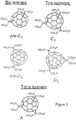
- Figure 2 depicts various carboxyfullerenes, including 2 bis isomers, 2 tris isomers and a tetra isomer.
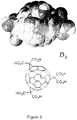
- Figure 3 depicts the e,e,e tris malonic acid regioisomer with C 3 symmetry (" C 3 ”) as both a space filling structure and a chemical structure.
- Weights (g) in treated and untreated mice were not different, e.g. at 19 mos, weights for females: ctrl 27 ⁇ 1, C 3 -treated 29 ⁇ 1; for males: ctrl 35 ⁇ 4, C 3 -treated 35 ⁇ 6, Mean ⁇ SD.
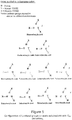
- Figure 5 details the configuration of functional groups on e,e,e malonic acid/acetic acid tri-adducts of buckminsterfullerene.
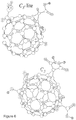
- FIG. 6 depicts structures of C 3 -lite ( e,e,e tris acetic acid C 60 ) and C 3 .
- C 3 -lite differs from C 3 in that one of the pair of carboxylic acids attached to each of the three cyclopropane carbons is replaced with a proton.
- Figure 7 depicts the structure of the Penta-1 compound. HOMO-LUMO energy distribution (top), and ball and stick (bottom).
- Penta-1 one of the malonic acid groups of C 3 has been replaced by an acetic acid group.
- Penta-1 the proton faces in towards the two malonic acid groups
- Figure 8 depicts the structure of the Penta-2 compound. HOMO-LUMO energy distribution (top), and ball and stick (bottom).
- Penta-2 one of the malonic acid groups of C 3 has been replaced by an acetic acid group.
- Penta-1 the proton faces away from the two malonic acid groups.
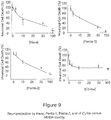
- Figure 9 depicts neuroprotection by the e,e,e malonic acid/acetic acid tri-adducts of buckminsterfullerene Hexa, Penta-1, Penta-2, and C 3 -lite in cerebrocortical cell cultures versus NMDA receptor-mediated excitotoxicity.
- Cultures were exposed to 200 ⁇ M NMDA for 10 minutes, with or without C 3 derivatives (0.5 -100 ⁇ M). All drugs were washed out after 10 minutes, and cells were returned to the cell culture incubator for 24 hours. Neuronal cell death was then assessed by measuring release of lactate dehydrogenase (LDH) by dying neurons.
- LDH lactate dehydrogenase
- Figure 10 depicts neuroprotection by the e,e,e malonic acid/acetic acid tri-adducts of buckminsterfullerene Hexa, Penta-1, Penta-2, and C 3 -lite in cerebrocortical cell cultures versus AMPA receptor-mediated excitotoxicity.
- Cultures were exposed to 6 ⁇ M AMPA for 24 hours, with or without C 3 derivatives (0.5 -100 ⁇ M).
- Neuronal cell death was assessed at 24 hours by measuring release of lactate dehydrogenase (LDH) by dying neurons. Cell death and protection was confirmed by imaging propidium iodide staining of dead neurons and by evaluating neuronal morphology using phase contrast microscopy. Dose response curves for each compound are shown. Values represent the % cell death observed in cultures exposed to AMPA alone (with no C 60 derivative).
- LDH lactate dehydrogenase
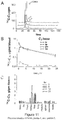
- Figure 11 depicts the plasma pharmacokinetics of Hexa, Penta-1, and Penta-2, (A-B) and tissue distribution of Hexa C 3 (C).
- Figure 11 (B) depicts plasma levels after iv, ip, sc and po administration of C 3 . The plasma T 1/2 for Hexa, Penta-1 and Penta-2 were all 8.2 hours.
- Figure 11 (C) depicts tissue levels of C 3 at various times after ip administration showing accumulation through the liver and kidney.
- Figure 12 depicts plasma pharmacokinetics and tissue distribution of C 3 -lite.
- Figure (A) shows the plasma pharmacokinetics of 14 C- C 3 -lite and demonstrates a T 1/2 of 15 h.
- Figure 12 (B) depicts the tissue distribution of C 3 -lite after ip administration.
- “Lifespan” or “expected lifespan,” is the average expected length of life (from birth to death) that a metazoan would be expected to live (i.e., “generic” expected lifespan) in a particular environment if that metazoan were not treated with carboxyfullerenes.
- “Malonic acid/acetic acid C 60 derivatives” are acetic acid derivatives of C 60 , malonic acid derivatives of C 60 and mixed malonic acid/acetic acid derivatives of C 60 .
- “Hexa” and C 3 represent C 3 (C 60 (C(COOH) 2 ) 3 , where the malonic acid groups are all at the e,e,e positions (compound 1, below).
- Pentas or “Penta Pair” means (C 60 (C(COOH) 2 ) 2 (C(CHCOOH)), where the R-groups are attached to cyclopropane carbons at the e,e,e positions.
- Penta-1 and Penta-2 Compound 2, below.
- Tetras or “Tetra Pair” means (C 60 (C(COOH) 2 )(C(CHCOOH)) 2 , wherein acetic acid/malonic acid groups are attached to cyclopropane carbons at the e,e,e positions.
- There are four stereoisomers (compound 3 , below).
- C 3 -lite means (C 60 (CHCOOH)) 3 wherein the acetic acid groups are attached to cyclopropane carbons at in the e,e,e positions. There are four stereoisomers (compound 4 , below).
- Carboxyfullerenes including e,e,e malonic acid/acetic acid tri-adducts of buckminsterfullerene, for prolonging the expected length or duration of a lifespan
- H 2 O 2 is removed by catalase, a heme iron containing metallo-enzyme, or glutathione peroxidase, a family of proteins which utilize selenocysteines in conjunction with glutathione to convert H 2 O 2 to O 2 and H 2 O.
- catalase a heme iron containing metallo-enzyme
- glutathione peroxidase a family of proteins which utilize selenocysteines in conjunction with glutathione to convert H 2 O 2 to O 2 and H 2 O.
- these endogenous antioxidant defense systems may be overwhelmed under pathological conditions. This has led to attempts to develop additional antioxidants (useful substances that inhibit oxidation or inhibit reactions promoted by oxygen or peroxides) as small molecules to supplement the antioxidant defenses of cells as potential therapeutic agents.
- a number of water-soluble C 60 derivatives retain the antioxidant properties of their parent fullerene molecule, allowing its free radical scavenging abilities to be exploited in biological systems and thereby act as agents which reduce cell damage and death.
- C 60 derivatives carboxyfullerenes
- MnTMPyp manganese-containing protoporphyrin compounds
- C 3 is a non-metallic compound, it too possesses similar catalytic properties. It is believed this compound is the first non-metallic compound to act in such a manner.
- antioxidant molecules capable of supplementing the antioxidant defenses of cells as potential therapeutic agents are therapeutically useful.
- carboxyfullerene compositions have antioxidant properties.
- carboxyfullerenes including e , e , e malonic acid/acetic acid tri-adducts of buckminsterfullerene are useful in the elimination of reactive oxygen species, especially reactive oxygen species that are physiologically relevant, such as hydrogen peroxide (H 2 O 2 ) and superoxide (O 2 o).
- reactive oxygen species especially reactive oxygen species that are physiologically relevant, such as hydrogen peroxide (H 2 O 2 ) and superoxide (O 2 o).
- compositions comprising the antioxidant carboxyfullerenes are used as treatments to increase the lifespan of metazoans or metazoan cells.
- the compounds described herein are thus carboxyfullerene compounds, their corresponding salts and esters having x pairs of adjacent carbon atoms of the C 60 fullerene bonded to at least one pendant carbon, wherein the pendant carbon atom is further bonded to two groups of the general formula -COOH and -R, wherein R is independently selected from the group consisting of -COOH and -H, and wherein x is at least 1. Examples of isomers of this general formula are shown in Figures 1-3 .
- each R is independently selected from groups of the formula -CR 1 R 2 wherein each R 1 and R 2 is independently selected from the group consisting of -H and -COOH, provided, however, that at least one of the R 1' s and R 2' s is a hydrogen.
- each R is independently selected from groups of the formula -CR 1 R 2 wherein each R 1 and R 2 is independently selected from the group consisting of -H and -COOH, provided, however, that at least one of the R 1' s and R 2' s is a hydrogen.
- carboxyfullerene compounds including the e,e,e malonic acid/acetic acid tri-adducts of buckminsterfullerene, can be administered systematically as a composition containing the active compound and a pharmaceutically acceptable carrier compatible with said compound.
- a pharmaceutically acceptable carrier compatible with said compound.
- any conventional pharmaceutically acceptable carrier may be utilized.
- the drug is administered orally, it is generally administered at regular intervals.
- e,e,e malonic acid/acetic acid tri-adducts of buckminsterfullerene may be administered by any route whereby drugs are conventionally administered.
- routes include intravenous, intramuscular, subcutaneous, intrathecal, intraperitoneal, topical, and oral.
- compositions comprising the e,e,e malonic acid/acetic acid tri-adducts of buckminsterfullerene can be made up in any conventional form, including a solid form for oral administration such as tablets, capsules, pills, powders, granules, and the like.
- These pharmaceutical compositions may be sterilized and/or may contain adjuvants such as preservatives, stabilizers, wetting agents, emulsifiers, salts for varying the osmotic pressure, and/or buffers.
- Typical preparations for intravenous administration would be sterile aqueous solutions including water/buffered solutions.
- Intravenous vehicles include fluid, nutrient and electrolyte replenishers. Preservatives and other additives may also be present such as antibiotics and antioxidants.
- the e,e,e malonic acid/acetic acid tri-adducts of buckminsterfullerene described herein are useful in pharmaceutically acceptable oral modes.
- These pharmaceutical compositions contain said compound in association with a compatible pharmaceutically acceptable carrier material.
- Any conventional carrier material can be utilized. Any conventional oral dosage form such as tablets, capsules, pills, powders, granules, and the like may be used.
- the carrier material can be an organic or inorganic inert carrier material suitable for oral administration. Suitable carriers include water, gelatin, gum arabic, lactose, starch, magnesium stearate, talc, vegetable oils, polyalkylene-glycols, petroleum jelly and the like.
- the pharmaceutical composition may contain other pharmaceutically active agents. Additional additives such as flavoring agents, preservatives, stabilizers, emulsifying agents, buffers and the like may be added in accordance with accepted practices of pharmaceutical compounding.
- An oral dosage form may comprise, for example, tablets, capsules of hard or soft gelatin, methylcellulose or of another suitable material easily dissolved in the digestive tract.
- the oral dosages contemplated will vary in accordance with the needs of the individual patient as determined by the prescribing physician.
- An example of this oral dosage form embodiment comprises capsules or tablets containing from 50 to 500 mg of e,e,e malonic acid/acetic acid tri-adducts of buckminsterfullerene.
- e,e,e malonic acid/acetic acid tri-adducts of buckminsterfullerene can generally be given to adults daily, preferably orally, intramuscularly, subcutaneously or intravenously. If intramuscularly, intravenously or subcutaneously, treatments should be given in an amount from as low as about 0.1 mg/kg to an amount as high as 3 mg/kg, with the precise dosage being varied depending upon the needs of the patient.
- the daily dose, if given orally, would be expected to be as little as 0.1 mg/kg to an amount as high as 15 mg/kg. In general, this therapy may be carried out prophylactically for an indefinite time.
- the e,e,e malonic acid/acetic acid tri-adducts of buckminsterfullerene may be administered chronically (e.g. daily) or frequently (e.g. once a week).
- the C 3 Hexa isomer, the Penta Pair, the Tetra quartet and C 3 -lite are expected to be the more effective agents.
- the expected daily dose of the C 3 isomer, if given by intravenous, intramuscular or subcutaneous delivery, would be about 0.1 mg/kg to about 3 mg/kg.
- the daily does if given orally would be expected to range between 0.1 mg/kg and 15 mg/kg.
- mice The above dosing information is based on a pharmokinetics study carried out in mice, toxicity testing in mice and toxicity testing in rats.
- the plasma half-lives of C 3 , Penta-1 and Penta-2 were calculated to be about 8 hours, while the plasma half-life of C 3 -lite was about 15 hours.
- the 50% lethal dose (LD50) for a single injection of the carboxyfullerenes was >70 mg/kg.
- C 3 , Penta-1 and Penta-2 were cleared from mice by excretion through both the liver and kidney while C 3 -lite was cleared through the liver and fat. Using calculations based on this pharmacokinetic data, the therapeutic plasma levels appear to be between 0.1 and 1 ⁇ g/ml.
- carboxyfullerenes Although equivalent amounts of carboxyfullerenes are absorbed if the compound is given by intravenous, intraperitoneal or subcutaneous administrations, only about 1/15 th of this dose is absorbed when given orally (e.g. in drinking water).
- the standard pharmaceutical formulations of carboxyfullerenes for oral delivery are expected to significantly increase the bioavailability of orally-administered carboxyfullerenes (e.g. incorporation of carboxyfullerenes into time-release tablets).
- e,e,e malonic acid/acetic acid tri-adducts of buckminsterfullerene are more lipophilic than C 3 , which allows them to concentrate in lipid-rich tissues, such as brain.
- the lifespan increased by carboxyfullerenes is the expected average length of time (from birth to death) that a metazoan would be expected to live, if that metazoan were not treated with carboxyfullerenes.
- mice subject to this treatment had an actual lifespan of 28.7 months, which corresponded to a lifespan that is about 20% greater than the control mouse's lifespan of 23.5 months.
- the lifespan of the control mouse used in this example represents the generic "expected lifespan.”
- Nonlimiting embodiments of compounds useful for extending the duration of life of a mammal comprise compounds such as e,e,e malonic acid/acetic acid tri-adducts of buckminsterfullerene of the general formula C 60 R 3 , wherein each R is independently selected from groups of the formula -CR 1 R 2 wherein each R 1 and R 2 is independently selected from the group consisting of -H and -COOH, provided, however, that at least one of the R 1' s and R 2' s is a hydrogen.
- Nonlimiting examples of e,e,e malonic acid/acetic acid tri-adducts of buckminsterfullerene include compounds selected from the group consisting of the Penta Pair, the Tetra quartet, C 3 -lite, their stereoisomers, mixtures thereof and the like.
- Also described is a process for extending the lifespan of a metazoan or metazoan cells comprising administering to said metazoan a composition comprising at least one e,e,e malonic acid/acetic acid tri-adduct of buckminsterfullerene of the general formula C 60 R 3 , wherein each R is independently selected from groups of the formula -CR 1 R 2 wherein each R 1 and R 2 is independently selected from the group consisting of -H and -COOH, provided, however, that at least one of the R 1' s and R 2' s is a hydrogen.
- Nonlimiting examples of e,e,e malonic acid/acetic acid tri-adducts of buckminsterfullerene include compounds selected from the group consisting of the Penta Pair, the Tetra quartet, C 3 -lite, their stereoisomers, mixtures thereof and the like. It is envisioned that said composition would comprise at least one e,e,e malonic acid/acetic acid tri-adduct of buckminsterfullerene, its pharmaceutically acceptable salts and pharmaceutically accepted esters, and a pharmaceutically acceptable carrier, wherein the components are in said composition in a therapeutically effective amount.
- the e,e,e malonic acid/acetic acid tri-adduct of buckminsterfullerene can be administered intravenously, intramuscularly, subcutaneously or orally. This process can be used with all metazoans, including but not limited to vertebrates, mammals and humans.
- C 60 e,e,e malonic acid/acetic acid tri-adducts display additional desirable qualities including increased water solubility.
- novel C 60 e,e,e malonic acid/acetic acid tri-adducts have been synthesized and characterized, including: 1) acetic acid derivatives of C 60 , and 2) e,e,e malonic acid/acetic acid tri-adducts of buckminsterfullerene.
- Two compounds ( 2 ), referred to as "Penta-1" ( Figure 7 ) and "Penta-2" ( Figure 8 ) are e,e,e derivatives of C 60 with two malonic acid groups, and one acetic acid group added to C 60 .
- Penta-1 and Penta-2 differ in whether the proton attached to the cyclopropane carbon of the acetic acid group faces in toward the two malonic acid groups, or away from them.
- a second set of four compounds "the Tetra-Quartet" ( 3 ) has one malonic acid group, and two acetic acid groups in the e,e,e positions.
- a third set of compounds are the e , e,e tris acetic acid derivative of C 60 ( C 3 -lite) ( 4 ) ( Figure 6 ).
- e,e,e malonic acid/acetic acid tri-adducts of buckminsterfullerene include Penta-1, Penta-2, the four Tetra's and the C 3 -lite compounds, their pharmaceutically acceptable salts and esters.
- a general formula for e,e,e malonic acid/acetic acid tri-adducts of buckminsterfullerene comprises C 60 R 3 , wherein each R is independently selected from groups of the formula -CR 1 R 2 wherein each R 1 and R 2 is independently selected from the group consisting of -H and -COOH, provided, however, that at least one of the R 1' s and R 2' s is a hydrogen.
- antioxidant molecules capable of supplementing the antioxidant defenses of cells as potential therapeutic agents are therapeutically useful.
- the e,e,e malonic acid/acetic acid tri-adducts of buckminsterfullerene derivatives described herein may be used to prevent, treat or ameliorate the progression of any disease condition caused by free radicals, especially when the free radicals are released as a result of glutamate neurotoxicity ("excitotoxicity").
- excitotoxic injury means reducing the extent of damage to central neurons which have been damaged by glutamate released from surrounding cells.
- Neurotoxic events such as excitotoxicity can occur during many types of acute neurological insults such as hypoxia/ischemia, such as occurs during stroke, hypoglycemia, epilepsy or trauma.
- Neurotoxic events may also be involved in chronic neuronal damage caused by neurodegenerative disorders such as Huntington's disease, Alzheimer's disease, amyotropic lateral sclerosis ("ALS”), and the neurodegenerative effects of AIDS.
- ALS amyotropic lateral sclerosis
- e,e,e malonic acid/acetic acid tri-adducts of buckminsterfullerene also are useful in methods of treating diseases in which a neurotoxic injury occurs.
- AA Arachidonic acid
- AA Arachidonic acid
- glutamate the glutamate having been released by neurons which were damaged by the neurotoxic event, itself.
- the excessive Ca 2+ influx activates phospholipase A 2 , a calcium-dependent enzyme which breaks down cell membranes liberating the AA.
- the metabolism of AA by endogenous lipoxygenases and cyclooxygenases leads to the production of the oxygen free radicals that trigger peroxidative degradation of neuronal lipid membranes which results in the neuronal damage or death.
- reducing oxygen-derived free radicals by administering a composition comprising a free radical scavenging e,e,e malonic acid/acetic acid tri-adduct of buckminsterfullerene provides an alternative mechanism by which glutamate-induced neurotoxicity is inhibited.
- compositions and methods for treating neurotoxic injury in a patient suffering a neurotoxic injury comprise administering to said patient a composition comprising a therapeutically effective amount of e,e,e malonic acid/acetic acid tri-adducts of buckminsterfullerene to that individual.
- these cases comprises the administration of at least one e,e,e malonic acid/acetic acid tri-adduct of buckminsterfullerene of the general formula C 60 R 3 , wherein each R is independently selected from groups of the formula -CR 1 R 2 wherein each R 1 and R 2 is independently selected from the group consisting of -H and -COOH, provided, however, that at least one of the R 1' s and R 2' s is a hydrogen.
- a further embodiment comprises the administration of C 3 -lite, Penta-1, Penta-2 and the Tetra Pair to the patient.
- Methods of treatment with these novel compounds can be intravenous, intramuscular, subcutaneous or through oral delivery.
- One such process involves preparing an initial solution of water, methanol and C 3 methyl ester in a solvent.
- the mole ratio of water to ester is between about 100:1 to about 20:1.
- Solvents useful for dissolving the C 3 methyl ester include aromatic solvents such as toluene, t-butyl acetate in toluene or the like.
- the initial solution is then mixed thoroughly (approximately 1 hour) and may appear cloudy at first.
- Sodium hydroxide, up to about 1M, in methanol is next added, after which the solution is stirred vigorously until no color remains in solution (up to about 2 hours). To ensure the reaction is complete, TLC could be used.
- aqueous layer which contains the product, is heated in an inert atmosphere (N 2 or the like) at about 60°C for about 1 to about 2 hours.
- the isomer distribution can be determined utilizing HPLC protocols 1 and 2 (below) and generally is above 90, 94 or 97%.
- the Penta Pair or the Tetra quartet are directly synthesized by initially adding an ester of bromomalonate (including, but not limited to dimethyl bromomalonate) to di-t-butylmalonyl C 60 (as prepared by Bingel, U.S. Patent No. 5,739,376 , incorporated herein by reference in its entirety) in an aromatic solvent chosen to maximize solubility, such as toluene or benzene, followed by a tertiary amine, including but not limited to 1,8-diazabicyclo (5,4,0) undec-7-ene (“DBU”) or sodium hydride (prepared as disclosed in Bingel '376 at Col. 4, lines 44-45) to form a reaction mixture.
- an aromatic solvent chosen to maximize solubility such as toluene or benzene
- DBU 1,8-diazabicyclo
- DBU 1,8-diazabicyclo
- sodium hydride prepared as disclosed in Bingel '376 at
- An acid miscible in the above solvent including but not limited to p-toluenesulfonic acid monohydrate, trifluoroacetic acid (TFA) or methane sulfuric acid, is next added to a solution of the C 3 ester fractions in an aromatic solvent (including but not limited to toluene) to dissolve the fractions.
- This solution is heated to about 88-89° C. Lower temperatures can be used, but the reaction will proceed at a slower rate. If TFA is used, room temperature should be sufficient.
- additional acid should be added. A precipitate will begin forming after about 10 minutes. Heating continues until the reaction is complete (about 90 minutes or determined by assay such as TLC or HPLC).
- the solvent is next removed from the precipitate.
- Water and ethyl acetate are added to the solids to form an ethyl acetate/water mixture.
- the ethyl acetate solution is separated and then washed with water to remove the catalyst acid. If necessary, the ethyl acetate should be washed multiple times.
- the ethyl acetate is then evaporated in vacuo to leave a solid.
- the solid is then dissolved in about a 1:1:2 acetonitrile: water: acetone mixture.
- Other ratios can be utilized to maximize solubilizing the material, including using acetone alone.
- the mixture is heated via an oil bath, heating mantle or the like to about 50°C, about 76.5° or about 100°C to complete the reaction. To ensure the reaction is complete, an assay could be run.
- a quantity of acetone is next added to sufficiently dissolve the precipitate. Heating is continued for about 5 hours to about 7.5 hours. Any volatile solvents are then removed (for example, in vacuo ) and ethyl acetate is then added to form a homogeneous solution. This solution is then evaporated in vacuo to produce a solid.
- This solid is next dissolved in aromatic solvents (such as toluene or 5% t-butyl acetate in toluene (1 mg/ml)) containing methanol and water.
- aromatic solvents such as toluene or 5% t-butyl acetate in toluene (1 mg/ml)
- Various ratios can be used (such as a 100 : 4.4 : 0.2); however, a limited quantity of water should be used to avoid producing two phases.
- This solution is then mixed well, with stirring for about an hour. After mixing, a 20 to 1 ratio of 1M sodium hydroxide in methanol is added. After complete precipitation (once the color completely drops out which could take about one hour to about two hours), water is added.
- the solvent layers are then thoroughly separated, ensuring any residual solvent is removed, The aqueous layer is heated at about 60°C to about 110°C for about two hours plus or minus half an hour. An assay could be run to determine that the reaction is completed
- a strong acid such as sulfuric acid
- a strong acid such as sulfuric acid
- the final product is extracted with ethyl acetate as described above.
- C 3 -lite can be directly synthesized by heating either dry or dissolved samples of C 3 derivatives of Hexa, Penta-1 and Penta-2. If dissolved samples are used, the derivatives should be dissolved in mixtures of acetonitrile : water. Any standard method of heating can be used, including but not limited to a heating mantel, oil bath or the like. The resulting solution/sample is heated for a sufficient time to produce C 3 -lite (less than about 24 hours) at about 60°C to about 70°C to about 81°C (the boiling point of acetonitrile). The solvents are then removed in vacuo to give a solid product.
- the sample is heated at about 150°C in a vacuum oven at about -30 mm Hg.
- a product comprising the Pentas, Tetras, or C 3 -lite is produced by dissolving a sample of C 3 derivatives, containing Hexa, Penta-1 and Penta-2 in a 1:1 ratio of acetonitrile : water. The resulting solution is heated to about 60°C. After about 1.5 hours of heating, the Penta concentration is near its maximum. The longer heat is applied (about 3.5 to about 5.5 hours), the Penta concentration will decrease while the concentration of C 3 -lite and Tetras will increase.
- Sodium methoxide or sodium hydroxide is added to a solution of e,e,e -tris dimethylmalonyl fullerene ("C 3 ester") in an aromatic solvent under an inert gas such as N 2 , to form an initial solution.
- the aromatic solvent can be selected from the group consisting of, but not limited to, toluene and t-butyl acetate in toluene.
- the sodium methoxide is in a 16-20:1 ratio with the C 3 ester. A red-orange precipitate will begin forming immediately. After a suitable time, about 1 to 2 hours, water is added to form an aqueous and nonaqueous layer. Any color will move into the aqueous layer. The layers are then separated.
- the aqueous layer is chilled to 0-5°C, in an ice bath or the like, then acidified with excess sulfuric acid to a pH of about 2.
- This acidic solution is then extracted with ethyl acetate to transfer all of the color to the ethyl acetate extracts.
- the combined ethyl acetate extracts are next washed with water to remove any yellow contaminants. This solution is then evaporated and dried in vacuo at about room temperature.
- Solutions for cell screening are prepared by dissolving the solid in 0.1 N sodium hydroxide. Sufficient base can be added to neutralize all carboxyls. The actual concentration can be determined by assay such as uv using 4400 for the extinction coefficient, determined on the ester precursor in toluene. HPLC protocol 1 can be used to determine percent of Hexa, Penta-1 and Penta-2. The three components can then be separated by HPLC.
- carboxyfullerenes are a novel class of antioxidants with the unique ability to decompose oxygen-derived free radicals, and that these compounds have unusual broad and powerful capabilities to extend the lifespan of individuals.
- Silica gel (Merck grade 9385, 260-400, 60 A) was obtained from Aldrich Chemicals (St. Louis, MO). Other reagents were purchased from Sigma Chemical Co. (St. Louis, MO) and other standard sources.
- the C 3 regioisomer of malonic acid C 60 (e,e,e C 60 [C(COOH) 2 ] 3 ) was synthesized by dissolving C 60 (720 mg, 1.00mmol) in toluene at a concentration of 1 mg/ml by stirring overnight.
- Dimethyl bromomalonate (632.4 mg, 2.69 mmol) was added, followed by 1,8-diazabicyclo (5.4.0) undee-7-ene (DBU, 493 mg, 3.24 mmol).
- DBU 1,8-diazabicyclo
- the reaction mixture was stirred for 2 hours, filtered through a pad of silica gel and concentrated in vacuo.
- the mixture was stirred at room temperature under nitrogen for one hour. Water (20 ml) was added and the mixture was stirred overnight. All colored products went into the water layer. The layers were separated, and the aqueous layer was chilled and acidified with 20% sulfuric acid (1.32 ml). The solution was extracted with EtOAc three times, resulting in all color going into the organic layer. The organic layer was washed several times with water to extract a yellow contaminant. The EtOAc layer was then evaporated, and the residue 223.2 mg (89% of theoretical) was freeze-dried.
- mice Twelve month old C57B6NIH male and female mice (equal numbers) were purchased from the National Institute on Aging (NIA) Aging Rodent Colony. Mice shipped from this colony were not selected in any way for health, tumors or other disabilities, and all mice obtained from the colony were subsequently enrolled in the study. Mice were randomly placed in same-sex numbered cages, two per cage, ear-punched for identification, and weighed. Mice were then trained on a rotorod twice per week for three sessions, and were then tested on the rotorod in three sessions to measure motor performance at baseline. Cages were then assigned to receive either treatment A or treatment B by an observer who was blind to what these treatments would be.
- NIA National Institute on Aging
- Treatment A was a solution of C 3 (28.75 ⁇ M) in water
- treatment B was commercial food coloring added to match the red C 3 solution.
- Solution A or solution B was placed in the water bottles, and solutions were topped-off twice weekly, and filtered to remove any particulates biweekly by an individual blind to the identity of the solutions.
- mice were weighed again, and underwent another round of rotorod training and testing. Mice were allowed to die spontaneously, and their date of death were recorded by the Animal Housing Facility staff as part of the normal operating procedure of the facility. Facility staff believed that animals were on an antibiotic solution, and did not know the purpose of the study. When animals died, the cage number, identity of the animal, and the date of death were recorded on the death notice, which was then sent to the laboratory, where the information was entered into the database.
- Rat toxicity testing of C 3 was also carried out with two strains of rats (Sprague-Dawley and Long-Evans) which received up to 10 mg/kg day for 30 days without showing any toxicity (i.e., decreased survival, impaired grooming or decreased feeding).
- buckminsterfullerene Major components from preparing C 3 Hexa include two isomeric pentacarboxylic acids in approximately equal abundance (the Penta Pair), minor products including four isomeric tetra acids (the Tetra quartet) and four isomeric tri-decarboxylation products ( C 3 -lite). These products are less soluble in water than C 3 (more lipophilic) which may increase these novel compounds absorption and retention in tissues.
- Protocol 1 Analysis of Hexa and Penta compounds.
- Solvents were 0.1% TFA in water (solvent A) and 0.1% TFA in 95% acetonitrile and 5% water (solvent B). Samples were eluted from the column using a gradient from 40:60; A:B, to 10:90; A:B, over 15 min., with an additional 15 minutes at 10:90; A:B. Compounds were monitored and identified by their UV-vis absorbance using an in-line diode array detector.
- Protocol 2 Alternative method to separate Hexa and Penta compounds.
- HPLC solvents were 0.1% TFA in water (solvent A) and 0.1% TFA in 95% 2-propanol and 5% water (solvent B).
- Compounds were eluted from (column A or B) using a gradient from 95:5; A:B, to 52:48; A:B over 10 minutes, the gradient progressed further to 51:49; A:B over 10 minutes then to 21:79; A:B over 5 minutes. After that it remained isocratic for an additional 2 minutes.
- Protocol 5 Analysis of t-butyl, methyl esters.
- the solvent was 50% acetonitrile and 50% dichloromethane (solvent A). Samples were eluted from (column A) with an isocratic program of 100% (solvent A) over 5 minutes.
- HPLC solvent was 0.1% TFA in 95% acetonitrile and 5% water (solvent A). Samples were eluted from (column A or B) in an isocratic 100% (solvent A) solution over 120 min.
- Example 4 NaOMe/MeOH method to synthesize a mixture of Hexa and Penta isomers.
- Example 5 Toluene, 6% MeOH, and equal amounts of water and NaOH to produce 95% Hexa.
- the toluene layer was separated and the aqueous layer was concentrated to remove methanol and toluene, then heated for 2 h at 60° under N 2 to complete the hydrolysis. Workup by extraction gave 490.8 mg (79.5 % theoretical yield).
- the UV-vis ⁇ max was 487 nm, and the max/min ratio (487/411 nm) was 3.10. Utilizing HPLC protocol 1, it was determined that the isomer distribution was 95.2 % Hexa, 1.7 % Penta-1 and 3.0 % Penta-2.
- Example 6 Method using equal amounts NaOH and water, and 2% MeOH mixed together before addition, with 5% t-butyl acetate in toluene to generate 88% Hexa, and the Penta isomers.
- Example 7 Method using t-butyl acetate w/ 5 water molecules to generate 96% Hexa.
- the UV-vis ⁇ max was 489 nm, and the max/min ration (489/412 nm) was 2.71. Utilizing HPLC protocol 1, it was determined that the isomer distribution was 96.7 % Hexa and 1.5 % of each Penta.
- the total methanol concentration is 6 %. If base is added immediately, or if base and all of the methanol are combined before addition to the ester, the isomer distribution shifts to lower Hexa content (see Example 6).
- Example 8 Alternative synthesis of 97% Hexa using toluene only.
- Example 12 Thermal decomposition of C 3 in solution to generate Pentas, Tetras, or C 3 -lite.
- Example 13 Neat decarboxylation of C 3 to C 3 -lite.
Landscapes
- Chemical & Material Sciences (AREA)
- Organic Chemistry (AREA)
- Engineering & Computer Science (AREA)
- Health & Medical Sciences (AREA)
- Nanotechnology (AREA)
- Life Sciences & Earth Sciences (AREA)
- Medicinal Chemistry (AREA)
- Veterinary Medicine (AREA)
- Public Health (AREA)
- Pharmacology & Pharmacy (AREA)
- Materials Engineering (AREA)
- Animal Behavior & Ethology (AREA)
- General Health & Medical Sciences (AREA)
- Physics & Mathematics (AREA)
- Condensed Matter Physics & Semiconductors (AREA)
- Crystallography & Structural Chemistry (AREA)
- General Physics & Mathematics (AREA)
- Nuclear Medicine, Radiotherapy & Molecular Imaging (AREA)
- Inorganic Chemistry (AREA)
- Chemical Kinetics & Catalysis (AREA)
- General Chemical & Material Sciences (AREA)
- Bioinformatics & Cheminformatics (AREA)
- Epidemiology (AREA)
- Manufacturing & Machinery (AREA)
- Composite Materials (AREA)
- Nutrition Science (AREA)
- Neurology (AREA)
- Neurosurgery (AREA)
- Diabetes (AREA)
- Biomedical Technology (AREA)
- Toxicology (AREA)
- Biochemistry (AREA)
- Obesity (AREA)
- Hematology (AREA)
- Acyclic And Carbocyclic Compounds In Medicinal Compositions (AREA)
- Organic Low-Molecular-Weight Compounds And Preparation Thereof (AREA)
Claims (11)
- E,e,e-Malonsäure/Essigsäure-Triaddukt von Buckminsterfulleren der allgemeinen Formel C60(R)3 oder ein Ester oder Salz davon, worin die R jeweils unabhängig aus Gruppen der Formel >CR1R2 ausgewählt sind, worin der C in der Gruppe >CR1R2 direkt an zwei benachbarte Kohlenstoffe der C60-Gruppierung gebunden ist und worin die R1 und R2 jeweils unabhängig aus der aus -H und -COOH bestehenden Gruppe ausgewählt sind, mit der Maßgabe, dass zumindest einer aller Reste R1 und R2 Wasserstoff ist, zur Verwendung in einem therapeutischen Verfahren zur Verlängerung der erwarteten Lebensdauer eines Metazoons.
- Derivat von Buckminsterfulleren zur Verwendung nach Anspruch 1, wobei die Verbindungen aus der aus C60(C(COOH)2)2(C(CHCOOH), C60(C(COOH)2)(C(CHCOOH))2 und C60(CHCOOH)3 bestehenden Gruppe ausgewählt sind.
- Derivat von Buckminsterfulleren zur Verwendung nach Anspruch 1, wobei das Derivat ein Methylester ist.
- Derivat von Buckminsterfulleren zur Verwendung nach Anspruch 1, wobei das Metazoon ein Säugetier, vorzugsweise eine Maus oder ein Mensch, ist.
- Derivat von Buckminsterfulleren zur Verwendung nach einem der Ansprüche 1 bis 4, wobei die Lebenserwartung durch das Eliminieren von reaktiven Sauerstoffspezies verlängert wird.
- Derivat von Buckminsterfulleren zur Verwendung nach Anspruch 5, wobei die reaktiven Sauerstoffspezies Wasserstoffperoxid und -superoxid sind.
- Derivat von Buckminsterfulleren zur Verwendung nach einem der Ansprüche 1 bis 6, wobei das Verfahren die Verabreichung einer Zusammensetzung umfasst, die das Buckminsterfulleren und einen pharmazeutisch annehmbaren Träger enthält.
- Derivat von Buckminsterfulleren zur Verwendung nach einem der Ansprüche 1 bis 7, wobei das Verfahren die Verabreichung über einen intravenösen, intramuskulären, subkutanen, intrathekalen, intraperitonealen, topischen oder oralen Weg umfasst.
- Derivat von Buckminsterfulleren zur Verwendung nach Anspruch 7, wobei die Zusammensetzung als Tablette, Kapsel, Pille, Pulver oder Granulat oder in injizierbarer Form formuliert ist.
- Derivat von Buckminsterfulleren zur Verwendung nach Anspruch 8 oder 9, wobei die orale Dosierungsform Kapseln oder Tabletten umfasst, die 50 bis 500 mg eines e,e,e-Malonsäure/Essigsäure-Triaddukts von Buckminsterfulleren enthalten.
- Derivat von Buckminsterfulleren zur Verwendung nach Anspruch 9, wobei die Verabreichung intramuskulär, intravenös oder subkutan und in einer Menge von 0,1 mg/kg bis 3 mg/kg erfolgt.
Applications Claiming Priority (3)
| Application Number | Priority Date | Filing Date | Title |
|---|---|---|---|
| US10/373,425 US7145032B2 (en) | 2002-02-23 | 2003-02-24 | Therapeutic malonic acid/acetic acid C60 tri-adducts of buckminsterfullerene and methods related thereto |
| PCT/US2004/005442 WO2004076349A1 (en) | 2003-02-24 | 2004-02-24 | Therapeutic malonic acid/acetic acid c60 tri-adducts of buckminsterfullerene and methods related thereto |
| EP04714163.5A EP1597199B1 (de) | 2003-02-24 | 2004-02-24 | Therapeutische malonsäure/essigsäure c60 tri-addukte von buckminsterfulleren und mit deren zusammenhängende verfahren |
Related Parent Applications (3)
| Application Number | Title | Priority Date | Filing Date |
|---|---|---|---|
| EP04714163.5 Division | 2004-02-24 | ||
| EP04714163.5A Division EP1597199B1 (de) | 2003-02-24 | 2004-02-24 | Therapeutische malonsäure/essigsäure c60 tri-addukte von buckminsterfulleren und mit deren zusammenhängende verfahren |
| EP04714163.5A Division-Into EP1597199B1 (de) | 2003-02-24 | 2004-02-24 | Therapeutische malonsäure/essigsäure c60 tri-addukte von buckminsterfulleren und mit deren zusammenhängende verfahren |
Publications (3)
| Publication Number | Publication Date |
|---|---|
| EP2289848A2 EP2289848A2 (de) | 2011-03-02 |
| EP2289848A3 EP2289848A3 (de) | 2013-07-31 |
| EP2289848B1 true EP2289848B1 (de) | 2020-02-19 |
Family
ID=32926236
Family Applications (2)
| Application Number | Title | Priority Date | Filing Date |
|---|---|---|---|
| EP10177722.5A Expired - Lifetime EP2289848B1 (de) | 2003-02-24 | 2004-02-24 | Therapeutische Malonsäure/essigsäure C60 Tri-Addukte von Buckminsterfulleren und mit deren zusammenhängende Verfahren |
| EP04714163.5A Expired - Lifetime EP1597199B1 (de) | 2003-02-24 | 2004-02-24 | Therapeutische malonsäure/essigsäure c60 tri-addukte von buckminsterfulleren und mit deren zusammenhängende verfahren |
Family Applications After (1)
| Application Number | Title | Priority Date | Filing Date |
|---|---|---|---|
| EP04714163.5A Expired - Lifetime EP1597199B1 (de) | 2003-02-24 | 2004-02-24 | Therapeutische malonsäure/essigsäure c60 tri-addukte von buckminsterfulleren und mit deren zusammenhängende verfahren |
Country Status (5)
| Country | Link |
|---|---|
| US (3) | US7145032B2 (de) |
| EP (2) | EP2289848B1 (de) |
| JP (1) | JP2006518760A (de) |
| CA (1) | CA2517007A1 (de) |
| WO (1) | WO2004076349A1 (de) |
Families Citing this family (15)
| Publication number | Priority date | Publication date | Assignee | Title |
|---|---|---|---|---|
| EP1205493A1 (de) * | 2000-11-14 | 2002-05-15 | ATOFINA Research | Polymerisationskatalysatorsysteme und deren Herstellung |
| US20030162837A1 (en) * | 2002-02-23 | 2003-08-28 | Dugan Laura L. | Carboxyfullerenes and methods of use thereof |
| US7145032B2 (en) | 2002-02-23 | 2006-12-05 | Washington University | Therapeutic malonic acid/acetic acid C60 tri-adducts of buckminsterfullerene and methods related thereto |
| US7163956B2 (en) * | 2003-10-10 | 2007-01-16 | C Sixty Inc. | Substituted fullerene compositions and their use as antioxidants |
| KR20070034591A (ko) * | 2004-06-17 | 2007-03-28 | 위스콘신 얼럼나이 리서어치 화운데이션 | 발작 및 발작병을 치료하기 위한 화합물 및 방법 |
| JP2006160664A (ja) * | 2004-12-07 | 2006-06-22 | Vitamin C60 Bioresearch Kk | フリーラジカル疾患予防治療用組成物 |
| WO2006078257A1 (en) * | 2005-01-19 | 2006-07-27 | C Sixty Inc. | Substituted fullerene compositions and their use in treatment of shock |
| US20100144868A1 (en) * | 2005-01-21 | 2010-06-10 | Ramot At Aviv University Ltd. | Novel Neuroprotective Compounds and Uses Thereof |
| US20060287253A1 (en) * | 2005-06-17 | 2006-12-21 | Kriegler Steven M | Compounds and methods for treating seizure disorders |
| US20080020977A1 (en) * | 2005-11-21 | 2008-01-24 | Russ Lebovitz | Use of Fullerenes to Oxidize Reduced Redox Proteins |
| CN107619315A (zh) * | 2017-03-29 | 2018-01-23 | 济南航晨生物科技有限公司 | 一种氨基酸高氮水溶肥料及其制备方法 |
| CN108053391B (zh) * | 2017-11-22 | 2020-06-23 | 华中科技大学 | 一种识别神经元重建错误的方法 |
| US20210145762A1 (en) * | 2019-11-15 | 2021-05-20 | Redox Balance Llc | Methods of treating oxidative stress to modulate redox balance, preventing oxidative stress induced cell damage and death |
| WO2022159332A1 (en) * | 2021-01-20 | 2022-07-28 | Sinapu Llc | Fullerenic ellagic luteolin and methods |
| WO2024043867A1 (en) * | 2022-08-20 | 2024-02-29 | Sinapu Llc | C60 histidine carnosine fumarates and use |
Family Cites Families (9)
| Publication number | Priority date | Publication date | Assignee | Title |
|---|---|---|---|---|
| US4705781A (en) * | 1986-10-08 | 1987-11-10 | Giba-Geigy Corporation | Method of treating cerebral ischemia using 4-(phosphono substituted lower alkyl or lower alkenyl)piperazine-2-carboxylic acids and salts, esters and amides thereof |
| DE4313481A1 (de) | 1993-04-24 | 1994-10-27 | Hoechst Ag | Fullerenderivate, Verfahren zur Herstellung und deren Verwendung |
| US5648523A (en) | 1995-10-26 | 1997-07-15 | Chiang Long Y | Fullerene derivatives as free-radical scavengers |
| JP2000514412A (ja) | 1996-06-03 | 2000-10-31 | エフ・ホフマン―ラ ロシュ アーゲー | 神経毒性損傷の処置のためのバックミンスターフラーレンの使用 |
| US6265443B1 (en) | 1996-06-03 | 2001-07-24 | Washington University | Method for treating neuronal injury with carboxyfullerene |
| TWI250874B (en) | 2000-03-24 | 2006-03-11 | Nat Health Research Institutes | Pharmaceutical compositions for preventing or treating disorders associated with bacterial or viral infection |
| US6538153B1 (en) | 2001-09-25 | 2003-03-25 | C Sixty Inc. | Method of synthesis of water soluble fullerene polyacids using a macrocyclic malonate reactant |
| US7145032B2 (en) | 2002-02-23 | 2006-12-05 | Washington University | Therapeutic malonic acid/acetic acid C60 tri-adducts of buckminsterfullerene and methods related thereto |
| US20030162837A1 (en) * | 2002-02-23 | 2003-08-28 | Dugan Laura L. | Carboxyfullerenes and methods of use thereof |
-
2003
- 2003-02-24 US US10/373,425 patent/US7145032B2/en not_active Expired - Lifetime
-
2004
- 2004-02-24 CA CA002517007A patent/CA2517007A1/en not_active Abandoned
- 2004-02-24 JP JP2006503837A patent/JP2006518760A/ja not_active Withdrawn
- 2004-02-24 EP EP10177722.5A patent/EP2289848B1/de not_active Expired - Lifetime
- 2004-02-24 EP EP04714163.5A patent/EP1597199B1/de not_active Expired - Lifetime
- 2004-02-24 WO PCT/US2004/005442 patent/WO2004076349A1/en not_active Ceased
-
2006
- 2006-06-14 US US11/424,175 patent/US7511075B2/en not_active Expired - Lifetime
-
2008
- 2008-03-07 US US12/044,634 patent/US20080214670A1/en not_active Abandoned
Non-Patent Citations (1)
| Title |
|---|
| None * |
Also Published As
| Publication number | Publication date |
|---|---|
| US20070106087A1 (en) | 2007-05-10 |
| WO2004076349B1 (en) | 2004-11-04 |
| US20080214670A1 (en) | 2008-09-04 |
| US7145032B2 (en) | 2006-12-05 |
| US7511075B2 (en) | 2009-03-31 |
| EP2289848A3 (de) | 2013-07-31 |
| WO2004076349A1 (en) | 2004-09-10 |
| EP2289848A2 (de) | 2011-03-02 |
| US20040034100A1 (en) | 2004-02-19 |
| EP1597199A1 (de) | 2005-11-23 |
| EP1597199B1 (de) | 2017-11-15 |
| JP2006518760A (ja) | 2006-08-17 |
| CA2517007A1 (en) | 2004-09-10 |
Similar Documents
| Publication | Publication Date | Title |
|---|---|---|
| US20080214670A1 (en) | Therapeutic Malonic Acid/Acetic Acid C60 Tri-Adducts of Buckminsterfullerene and Methods Related Thereto | |
| US20030162837A1 (en) | Carboxyfullerenes and methods of use thereof | |
| Nie et al. | Structurally oriented carbon dots as ROS nanomodulators for dynamic chronic inflammation and infection elimination | |
| JP6677688B2 (ja) | 安定化スルフォラファン | |
| Behera et al. | Metal nanoparticles in Alzheimer’s disease | |
| Chawla et al. | Fullerenes: from carbon to nanomedicine | |
| KR101493125B1 (ko) | 항산화성 캠토테신 유도체 및 이들의 항산화성 항종양성 나노구체 | |
| Viossat et al. | Low-temperature (180 K) crystal structure, electron paramagnetic resonance spectroscopy, and propitious anticonvulsant activities of CuII2 (aspirinate) 4 (DMF) 2 and other CuII2 (aspirinate) 4 chelates | |
| JP2007513870A (ja) | 置換フラーレン組成物及び酸化防止剤としてのその使用 | |
| JP2022512777A (ja) | カンナビノイドの共結晶の固体組成物 | |
| ES2886673T3 (es) | Un proceso para la preparación de curcumina blanca biodisponible, una mezcla única de curcuminoides hidrogenados | |
| PL185807B1 (pl) | Sposób otrzymywania jodowanego kwasu tłuszczowegoSposób otrzymywania jodowanego kwasu tłuszczowegolub jodowanego estru kwasu tłuszczowego lub ich jolub jodowanego estru kwasu tłuszczowego lub ich jodowanych pochodnych oraz ich zastosowanie do wytwadowanych pochodnych oraz ich zastosowanie do wytwarzania leków i do wytwarzania produktu kontrastowerzania leków i do wytwarzania produktu kontrastowegogo | |
| CN120919092A (zh) | 用于治疗线粒体病症的方法 | |
| Mohammadi et al. | Reproductive toxicity of nanoparticles: a comprehensive review | |
| WO2008095366A1 (fr) | Dérivés de porphyrine, leurs méthodes de préparation et leurs utilisations comme molécule antioxydante de petite taille | |
| AU720528B2 (en) | The use of buckminsterfullerene for treatment of neurotoxic injury | |
| JP4975631B2 (ja) | ジグリセリドおよびフィトステロールを含む、金属カチオンの送達用の逆ミセル組成物ならびに製造方法 | |
| JPH06507917A (ja) | 抗真菌剤 | |
| EP1870095A1 (de) | Zusammensetzung zur erhöhung der antioxidativen aktivität in blut | |
| US20090105207A1 (en) | Copper (1) Complex | |
| US11413254B2 (en) | Application for (2R, 4R)-1,2,4-trihydroxyheptadec-16-yne in preparation of pharmaceutical composition for preventing or treating hepatic injury | |
| Jadhav et al. | Synthesis and anti-inflammatory activity of fluorinated chalcone derivatives | |
| HK40115347A (zh) | 用於神经退行性疾病的化合物和组合物 | |
| US20110183951A1 (en) | Copper (1) Complex | |
| JP2005306794A (ja) | 運動神経細胞減少抑制剤 |
Legal Events
| Date | Code | Title | Description |
|---|---|---|---|
| PUAI | Public reference made under article 153(3) epc to a published international application that has entered the european phase |
Free format text: ORIGINAL CODE: 0009012 |
|
| AC | Divisional application: reference to earlier application |
Ref document number: 1597199 Country of ref document: EP Kind code of ref document: P |
|
| AK | Designated contracting states |
Kind code of ref document: A2 Designated state(s): DE FR GB |
|
| RIN1 | Information on inventor provided before grant (corrected) |
Inventor name: LOVETT, EVA, G. Inventor name: QUICK, KEVIN, L. Inventor name: DUGAN, LAURA, L. Inventor name: HARDT, JOSHUA, I. |
|
| PUAL | Search report despatched |
Free format text: ORIGINAL CODE: 0009013 |
|
| AK | Designated contracting states |
Kind code of ref document: A3 Designated state(s): DE FR GB |
|
| RIC1 | Information provided on ipc code assigned before grant |
Ipc: C01B 31/02 20060101AFI20130624BHEP Ipc: C07C 69/753 20060101ALI20130624BHEP Ipc: B82Y 40/00 20110101ALI20130624BHEP Ipc: A61K 31/19 20060101ALI20130624BHEP Ipc: C07C 61/39 20060101ALI20130624BHEP |
|
| 17P | Request for examination filed |
Effective date: 20140110 |
|
| RBV | Designated contracting states (corrected) |
Designated state(s): DE FR GB |
|
| 17Q | First examination report despatched |
Effective date: 20171204 |
|
| REG | Reference to a national code |
Ref country code: DE Ref legal event code: R079 Ref document number: 602004054529 Country of ref document: DE Free format text: PREVIOUS MAIN CLASS: C01B0031020000 Ipc: A61K0031190000 |
|
| GRAP | Despatch of communication of intention to grant a patent |
Free format text: ORIGINAL CODE: EPIDOSNIGR1 |
|
| RIC1 | Information provided on ipc code assigned before grant |
Ipc: B82Y 30/00 20110101ALI20190726BHEP Ipc: A61K 31/19 20060101AFI20190726BHEP Ipc: C01B 32/152 20170101ALI20190726BHEP Ipc: C07C 61/39 20060101ALI20190726BHEP Ipc: B82Y 40/00 20110101ALI20190726BHEP Ipc: C07C 69/753 20060101ALI20190726BHEP Ipc: C01B 32/15 20170101ALI20190726BHEP |
|
| INTG | Intention to grant announced |
Effective date: 20190904 |
|
| GRAS | Grant fee paid |
Free format text: ORIGINAL CODE: EPIDOSNIGR3 |
|
| GRAA | (expected) grant |
Free format text: ORIGINAL CODE: 0009210 |
|
| AC | Divisional application: reference to earlier application |
Ref document number: 1597199 Country of ref document: EP Kind code of ref document: P |
|
| AK | Designated contracting states |
Kind code of ref document: B1 Designated state(s): DE FR GB |
|
| REG | Reference to a national code |
Ref country code: GB Ref legal event code: FG4D |
|
| REG | Reference to a national code |
Ref country code: DE Ref legal event code: R096 Ref document number: 602004054529 Country of ref document: DE |
|
| REG | Reference to a national code |
Ref country code: DE Ref legal event code: R097 Ref document number: 602004054529 Country of ref document: DE |
|
| PLBE | No opposition filed within time limit |
Free format text: ORIGINAL CODE: 0009261 |
|
| STAA | Information on the status of an ep patent application or granted ep patent |
Free format text: STATUS: NO OPPOSITION FILED WITHIN TIME LIMIT |
|
| 26N | No opposition filed |
Effective date: 20201120 |
|
| PGFP | Annual fee paid to national office [announced via postgrant information from national office to epo] |
Ref country code: GB Payment date: 20220225 Year of fee payment: 19 Ref country code: DE Payment date: 20220225 Year of fee payment: 19 |
|
| PGFP | Annual fee paid to national office [announced via postgrant information from national office to epo] |
Ref country code: FR Payment date: 20220223 Year of fee payment: 19 |
|
| REG | Reference to a national code |
Ref country code: DE Ref legal event code: R119 Ref document number: 602004054529 Country of ref document: DE |
|
| GBPC | Gb: european patent ceased through non-payment of renewal fee |
Effective date: 20230224 |
|
| PG25 | Lapsed in a contracting state [announced via postgrant information from national office to epo] |
Ref country code: GB Free format text: LAPSE BECAUSE OF NON-PAYMENT OF DUE FEES Effective date: 20230224 |
|
| PG25 | Lapsed in a contracting state [announced via postgrant information from national office to epo] |
Ref country code: GB Free format text: LAPSE BECAUSE OF NON-PAYMENT OF DUE FEES Effective date: 20230224 Ref country code: FR Free format text: LAPSE BECAUSE OF NON-PAYMENT OF DUE FEES Effective date: 20230228 Ref country code: DE Free format text: LAPSE BECAUSE OF NON-PAYMENT OF DUE FEES Effective date: 20230901 |