EP2290977A1 - Server, kommunikationsverfahren und programm - Google Patents
Server, kommunikationsverfahren und programm Download PDFInfo
- Publication number
- EP2290977A1 EP2290977A1 EP09754801A EP09754801A EP2290977A1 EP 2290977 A1 EP2290977 A1 EP 2290977A1 EP 09754801 A EP09754801 A EP 09754801A EP 09754801 A EP09754801 A EP 09754801A EP 2290977 A1 EP2290977 A1 EP 2290977A1
- Authority
- EP
- European Patent Office
- Prior art keywords
- terminals
- stream
- packet
- terminal
- server apparatus
- Prior art date
- Legal status (The legal status is an assumption and is not a legal conclusion. Google has not performed a legal analysis and makes no representation as to the accuracy of the status listed.)
- Withdrawn
Links
- 238000000034 method Methods 0.000 title claims description 32
- 238000004891 communication Methods 0.000 title claims description 26
- 238000006243 chemical reaction Methods 0.000 claims abstract description 92
- 238000012545 processing Methods 0.000 claims description 25
- 230000002194 synthesizing effect Effects 0.000 claims description 14
- 230000006866 deterioration Effects 0.000 abstract description 8
- 230000005540 biological transmission Effects 0.000 description 15
- 238000010586 diagram Methods 0.000 description 8
- 230000000977 initiatory effect Effects 0.000 description 6
- 230000015572 biosynthetic process Effects 0.000 description 5
- 238000003786 synthesis reaction Methods 0.000 description 5
- 230000000694 effects Effects 0.000 description 4
- 238000007634 remodeling Methods 0.000 description 3
- 230000006835 compression Effects 0.000 description 2
- 238000007906 compression Methods 0.000 description 2
- 230000008901 benefit Effects 0.000 description 1
- 230000001413 cellular effect Effects 0.000 description 1
- 230000008859 change Effects 0.000 description 1
- 238000012937 correction Methods 0.000 description 1
- 238000001514 detection method Methods 0.000 description 1
- 239000000284 extract Substances 0.000 description 1
- 238000010295 mobile communication Methods 0.000 description 1
- 238000012986 modification Methods 0.000 description 1
- 230000004048 modification Effects 0.000 description 1
- 230000008520 organization Effects 0.000 description 1
- 230000000717 retained effect Effects 0.000 description 1
Images

Classifications
-
- H—ELECTRICITY
- H04—ELECTRIC COMMUNICATION TECHNIQUE
- H04N—PICTORIAL COMMUNICATION, e.g. TELEVISION
- H04N7/00—Television systems
- H04N7/16—Analogue secrecy systems; Analogue subscription systems
- H04N7/162—Authorising the user terminal, e.g. by paying; Registering the use of a subscription channel, e.g. billing
- H04N7/165—Centralised control of user terminal ; Registering at central
-
- H—ELECTRICITY
- H04—ELECTRIC COMMUNICATION TECHNIQUE
- H04N—PICTORIAL COMMUNICATION, e.g. TELEVISION
- H04N21/00—Selective content distribution, e.g. interactive television or video on demand [VOD]
- H04N21/20—Servers specifically adapted for the distribution of content, e.g. VOD servers; Operations thereof
- H04N21/21—Server components or server architectures
-
- H—ELECTRICITY
- H04—ELECTRIC COMMUNICATION TECHNIQUE
- H04N—PICTORIAL COMMUNICATION, e.g. TELEVISION
- H04N21/00—Selective content distribution, e.g. interactive television or video on demand [VOD]
- H04N21/20—Servers specifically adapted for the distribution of content, e.g. VOD servers; Operations thereof
- H04N21/23—Processing of content or additional data; Elementary server operations; Server middleware
-
- H—ELECTRICITY
- H04—ELECTRIC COMMUNICATION TECHNIQUE
- H04N—PICTORIAL COMMUNICATION, e.g. TELEVISION
- H04N21/00—Selective content distribution, e.g. interactive television or video on demand [VOD]
- H04N21/20—Servers specifically adapted for the distribution of content, e.g. VOD servers; Operations thereof
- H04N21/23—Processing of content or additional data; Elementary server operations; Server middleware
- H04N21/234—Processing of video elementary streams, e.g. splicing of video streams or manipulating encoded video stream scene graphs
- H04N21/2343—Processing of video elementary streams, e.g. splicing of video streams or manipulating encoded video stream scene graphs involving reformatting operations of video signals for distribution or compliance with end-user requests or end-user device requirements
-
- H—ELECTRICITY
- H04—ELECTRIC COMMUNICATION TECHNIQUE
- H04N—PICTORIAL COMMUNICATION, e.g. TELEVISION
- H04N21/00—Selective content distribution, e.g. interactive television or video on demand [VOD]
- H04N21/20—Servers specifically adapted for the distribution of content, e.g. VOD servers; Operations thereof
- H04N21/25—Management operations performed by the server for facilitating the content distribution or administrating data related to end-users or client devices, e.g. end-user or client device authentication, learning user preferences for recommending movies
- H04N21/258—Client or end-user data management, e.g. managing client capabilities, user preferences or demographics, processing of multiple end-users preferences to derive collaborative data
- H04N21/25808—Management of client data
- H04N21/25833—Management of client data involving client hardware characteristics, e.g. manufacturer, processing or storage capabilities
-
- H—ELECTRICITY
- H04—ELECTRIC COMMUNICATION TECHNIQUE
- H04N—PICTORIAL COMMUNICATION, e.g. TELEVISION
- H04N21/00—Selective content distribution, e.g. interactive television or video on demand [VOD]
- H04N21/40—Client devices specifically adapted for the reception of or interaction with content, e.g. set-top-box [STB]; Operations thereof
- H04N21/41—Structure of client; Structure of client peripherals
- H04N21/414—Specialised client platforms, e.g. receiver in car or embedded in a mobile appliance
- H04N21/41407—Specialised client platforms, e.g. receiver in car or embedded in a mobile appliance embedded in a portable device, e.g. video client on a mobile phone, PDA, laptop
-
- H—ELECTRICITY
- H04—ELECTRIC COMMUNICATION TECHNIQUE
- H04N—PICTORIAL COMMUNICATION, e.g. TELEVISION
- H04N21/00—Selective content distribution, e.g. interactive television or video on demand [VOD]
- H04N21/60—Network structure or processes for video distribution between server and client or between remote clients; Control signalling between clients, server and network components; Transmission of management data between server and client, e.g. sending from server to client commands for recording incoming content stream; Communication details between server and client
- H04N21/61—Network physical structure; Signal processing
- H04N21/6106—Network physical structure; Signal processing specially adapted to the downstream path of the transmission network
- H04N21/6131—Network physical structure; Signal processing specially adapted to the downstream path of the transmission network involving transmission via a mobile phone network
-
- H—ELECTRICITY
- H04—ELECTRIC COMMUNICATION TECHNIQUE
- H04N—PICTORIAL COMMUNICATION, e.g. TELEVISION
- H04N21/00—Selective content distribution, e.g. interactive television or video on demand [VOD]
- H04N21/60—Network structure or processes for video distribution between server and client or between remote clients; Control signalling between clients, server and network components; Transmission of management data between server and client, e.g. sending from server to client commands for recording incoming content stream; Communication details between server and client
- H04N21/63—Control signaling related to video distribution between client, server and network components; Network processes for video distribution between server and clients or between remote clients, e.g. transmitting basic layer and enhancement layers over different transmission paths, setting up a peer-to-peer communication via Internet between remote STB's; Communication protocols; Addressing
- H04N21/632—Control signaling related to video distribution between client, server and network components; Network processes for video distribution between server and clients or between remote clients, e.g. transmitting basic layer and enhancement layers over different transmission paths, setting up a peer-to-peer communication via Internet between remote STB's; Communication protocols; Addressing using a connection between clients on a wide area network, e.g. setting up a peer-to-peer communication via Internet for retrieving video segments from the hard-disk of other client devices
-
- H—ELECTRICITY
- H04—ELECTRIC COMMUNICATION TECHNIQUE
- H04N—PICTORIAL COMMUNICATION, e.g. TELEVISION
- H04N7/00—Television systems
- H04N7/14—Systems for two-way working
- H04N7/141—Systems for two-way working between two video terminals, e.g. videophone
- H04N7/148—Interfacing a video terminal to a particular transmission medium, e.g. ISDN
Definitions
- This application is based upon and claims the benefit of the priority of Japanese patent application No. 2008-142744, filed on May 30, 2008 , the disclosure of which is incorporated herein in its entirety by reference thereto.
- This invention relates to a server apparatus and a communication method. More particularly, it relates to a server apparatus, a communication method and a program in which at least two terminals take part to form a group of terminals and in which a stream or a packet containing a video signal is received from a first terminal, copied and sent to a terminal(s) other than the first terminal.
- a video signal is compression-encoded on a terminal side in order to transmit a signal with high efficiency at a low bit rate.
- known schemes include ITU-T (International Telecommunication Union Telecommunication Standardization Section) Recommendations H.263 and MPEG-4 (Moving Picture Experts Group phase 4) internationally standardized by ISO/IEC (International Organization for Standardization /International Electrotechnical Commission).
- a moving picture signal may be transmitted more efficiently than is possible with the aforementioned moving picture compression encoding scheme.
- Patent Document 1 As a system for media distribution, there is disclosed in Patent Document 1, a configuration in which a server, relaying multimedia communication data, converts multimedia communication data into an output video information, matched to the media reproduction capability of a receiving terminal, before transmitting the information to the receiving terminal.
- Patent Document 2 a configuration in which the encoded information in need of a larger display capability is converted into the encoded information capable of being displayed with a preset display capability, and both the original encoded information and the converted encoded information are provided by a data server apparatus on a local area network.
- a contents information reproduction terminal acquires the encoded information (multimedia data) matched to its own display level along with a decoding program for reproduction.
- Patent Document 3 a configuration of a multi-cast network in which, on detection of change f a channel request that specifies a requested channel corresponding to a multi-cast group, a retained intra-frame of the requested channel is transmitted by way of uni-cast communication.
- Patent Document 4 discloses a configuration in which, if a content requested is issued by a client, a server apparatus converts the format, by its self, responsive to the contents. If the server apparatus is unable to convert the format, but there is another server apparatus which is able to do so, the server apparatus may request another server apparatus to convert the format, and to transmit the converted format to the client.
- Patent Document 5 As a system for posting an advertisement, there is disclosed in Patent Document 5, a configuration in which an advertisement in a broadcast data stream is identified, and in which an advertisement in a broadcast program in a broadcast data stream, and an advertisement schedule, inclusive of the information for identifying the location of advertisement, are updated. In reproduction, an advertisement or an alternative advertisement is posted in the above location or in a further location in the program.
- Patent Documents 1 to 5 there are disclosed configurations completely different from the configuration of a server apparatus in which at least two terminals take part to form a group of terminals, a stream or a packet, containing a video signal, is received from a first one of the terminals and copied, and in which the stream or packet, thus copied, is transmitted to those terminals that are different from the first terminal.
- Patent Documents 1 to 5 are incorporated herein by reference thereto.
- the following is an analysis from the standpoint of the present invention.
- the video PoC or video sharing, dealing with the video signal, has the following problems:
- the video may be unable to be decoded or reproduced at a terminal or, if the video can be decoded or reproduced, it remains disturbed for some time duration, as a result of which the services rendered are out of order.
- a server apparatus which receives a stream or a packet transmitted from a first terminal of a plurality of terminals that take part to form a group of terminals, the stream or packet transmitted including at least a video signal.
- the server apparatus which copies part or all of the stream or packet received to form an as-copied stream or packet, and transmits the copied stream or packet to a remaining one or more of the terminals other than the first terminal, comprises a conversion unit which, in case other terminal takes part anew in the group of terminals, during a time of transmitting the copied stream or packet, converts a video frame to a non-predictive frame and transmits the non-predictive frame to the other terminal, the conversion unit transmitting a video frame following the non-predictive frame using an original non-converted stream or packet as it is.
- a server apparatus which receives a stream or a packet transmitted from a first terminal of a plurality of terminals that take part to form a group of terminals, the stream or packet transmitted including at least a video signal.
- the server apparatus which copies part or all of the stream or packet received to form an as-copied stream or packet, and transmits the copied stream or packet to a remaining one or more of the terminals other than the first terminal, comprises a conversion unit which, in case there is one or more terminals in the group of terminals that is or are not adapted to cope with a format of the stream or packet, converts the format to a file format capable of being coped with by the one or more terminals, the conversion unit transmitting the stream or packet of the so converted format.
- a server apparatus which receives a stream or a packet transmitted from a first terminal of a plurality of terminals that take part to form a group of terminals, the stream or packet transmitted including at least a video signal.
- the server apparatus which copies part or all of the stream or packet received to form an as-copied stream or packet, and transmits the copied stream or packet to a remaining one or more of the terminals other than the first terminal, comprises a conversion unit which receives information on capability of the terminals of the group of terminals, the conversion unit converting the video signal, in case the information on capability of one or more terminals other than the first terminal differs from the information on capability of the first terminal, so that the information on capability of the one or more terminals meets with the information on capability of the first terminal, the conversion unit then transmitting the converted video signal to the one or more terminals.
- a server apparatus which receives a stream or a packet transmitted from a first terminal of a plurality of terminals that take part to form a group of terminals, the stream or packet transmitted including at least a video signal.
- the server apparatus which copies part or all of the stream or packet received to form an as-copied stream or packet, and transmits the copied stream or packet to a remaining one or more of the terminals other than the first terminal, comprises a conversion unit performing at least one of:
- a server apparatus receives a stream or a packet transmitted from a first terminal of a plurality of terminals taking part to form a group of terminals, the stream or packet transmitted including at least a video signal, wherein the method comprises:
- a server apparatus receives a stream or a packet transmitted from a first terminal of a plurality of terminals taking part to form a group of terminals, the stream or packet transmitted including at least a video signal, wherein the method comprises:
- a server apparatus receives a stream or a packet transmitted from a first terminal of a plurality of terminals taking part to form a group of terminals, the stream or packet transmitted including at least a video signal, wherein the method comprises:
- a server apparatus receives a stream or a packet transmitted from a first terminal of a plurality of terminals taking part to form a group of terminals, the stream or packet transmitted including at least a video signal, wherein the method comprises:
- a program that causes a computer constituting a server apparatus to execute conversion processing, the server apparatus receiving a stream or a packet transmitted from a first terminal of a plurality of terminals taking part to form a group of terminals, the stream or packet transmitted including at least a video signal, the server apparatus copying part or all of the stream or packet received and transmitting the copied stream or packet to a remaining one or more of the terminals other than the first terminal, wherein the conversion processing comprises converting, in case another terminal newly takes part in the group of terminals, during the time the copied stream or packet is transmitted, and in case the server apparatus transmits the copied stream or packet to the other terminal, a video frame to a non-predictive frame, and transmitting the non-predictive frame to the other terminal; and transmitting a video frame following the non-predictive frame using an original non-converted stream or packet as it is.
- a program that causes a computer constituting a server apparatus to execute conversion processing, the server apparatus receiving a stream or a packet transmitted from a first terminal of a plurality of terminals taking part to form a group of terminals, the stream or packet transmitted including at least a video signal, the server apparatus copying part or all of the stream or packet received and transmitting the copied stream or packet to a remaining one or more of the terminals other than the first terminal, wherein the conversion processing comprises converting, in case there is one or more terminals in the group of terminals that is or are not adapted to cope with the format of the stream or packet, the format to a file format capable of being coped with by the one or more terminals, and transmitting the stream or packet of the so converted format to the one or more terminals.
- a program that causes a computer constituting a server apparatus to execute conversion processing, the server apparatus receiving a stream or a packet transmitted from a first terminal of a plurality of terminals taking part to form a group of terminals, the stream or packet transmitted including at least a video signal, the server apparatus copying part or all of the stream or packet received and transmitting the copied stream or packet to a remaining one or more of the terminals other than the first terminal, wherein the conversion processing comprises:
- a program that causes a computer constituting a server apparatus to execute conversion processing, the server apparatus receiving a stream or a packet transmitted from a first terminal of a plurality of terminals taking part to form a group of terminals, the stream or packet transmitted including at least a video signal, the server apparatus copying part or all of the stream or packet received and transmitting the copied stream or packet to a remaining one or more of the terminals other than the first terminal, the conversion processing comprising:
- the present invention if a new terminal has taken part in the group in the course of a session, no problem such as picture quality deterioration is produced on the terminal side, because the function for conversion is provided on the server side.
- the present invention provides for the above result without the need to remodel the terminal.
- the present invention provides for the above result without the need to remodel the terminal.
- new services may be rendered by providing the server side with the functions of conversion, such as the functions of introducing other pre-stored video contents at an optional timing to a video stream sent from a mobile terminal, synthesizing these to a sole picture image, or superimposing one or more characters.
- the present invention provides for the above result without the need to remodel the terminal.
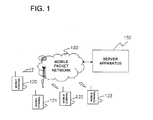
- Fig.1 shows an example of the connection configuration of a server apparatus and a plurality of mobile terminals in a mobile packet network.
- Fig.1 shows the case in which the number N of participant terminals of a group is four so that four mobile terminals 120 to 123 constitute a group of terminals and are connected to a mobile packet network 130.
- a server apparatus 150 is connected to the mobile packet network 130 to exchange video packets with the mobile terminals 120 to 123 via the mobile packet network 130.
- one of the mobile terminals 120 to 123 takes the initiative at a given timing.
- the mobile terminal that has so taken the initiative such as the terminal 120, transmits a video packet to the server apparatus 150.
- the server apparatus 150 determines, using a SIP (Session Initiation Protocol) signal or an RTCP (RTP Control Protocol) signal, which of the terminals of the same group has taken the initiative.
- the server apparatus 150 then receives a packet from the terminal that has taken the initiative, copies and transmits the packet to the other terminals, here the mobile terminals 121 to 123.
- SIP Session Initiation Protocol
- RTCP RTP Control Protocol
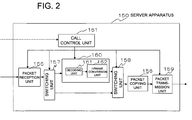
- Fig.2 is a block diagram showing a configuration of an exemplary embodiment 1 of the server apparatus 150 of Fig.1 .
- a terminal taking the initiative, transmits that effect to the server apparatus 150 using the SIP. It is however also possible for the terminal, taking the initiative, to transmit that effect to the server apparatus 150 using any suitable means other than SIP, such as RTCP.
- the server apparatus 150 includes a call control unit 151, a packet reception unit 155, a switching unit 157, a conversion unit 160, a switching unit 158, a packet copying unit 156 and a packet transmission unit 159.
- the conversion unit 160 includes a decoding unit 151 and an I-frame conversion unit 162.
- the call control unit 151 receives, from a mobile terminal by a SIP signal, information including the number (N) of mobile terminals belonging to the same group and an IP address (or a telephone number) of each mobile terminal; a terminal taking the initiative in the same group (an IP address or a telephone number); the timing of participation of each mobile terminal into the group; and a session initiation command and a session disconnection command.
- the call control unit 151 also receives the information on capability of each mobile terminal using the SDP (Session Description Protocol).
- SDP Session Description Protocol
- the call control unit 151 On receipt of a session initiation command by the SIP, the call control unit 151 instructs the packet reception unit 155 to receive an RTP packet from the mobile terminal (here the mobile terminal 120), which takes the initiative, and informs the packet reception unit 155 of a transmission source IP address of the mobile terminal 120.
- the packet reception unit 155 receives the RTP packet, transmitted from the IP address of the transmission source, and outputs the RTP packet to the switching unit 157.
- the call control unit 151 instructs the switching unit 157 to output all packets to the switching unit 158 in a through mode.
- the call control unit 151 also instructs the switching unit 158 to output all packets to the packet copying unit 156. So, the switching unit 158 outputs all packets to the packet copying unit 156.
- the packet copying unit 156 copies as many RTP packets received from the switching unit 158 as there are the terminals other than the terminal taking the initiative, that is, takes an (N-1)-number of copies, and outputs the resulting copies to the packet transmission unit 159.
- the packet transmission unit 159 is instructed by the call control unit 151 to initiate the session, at the same time as it is advised by the call controlle151 of the IP address of the mobile terminal of the transmission destination. Accordingly, the packet transmission unit 159 transmits (N-1) copies of the input RTP packets it has received to (N-1) mobile terminals.
- the call control unit 151 receives a SIP signal for connection from the mobile terminal to recognize that there is a terminal that takes part halfway in the group.
- the call control unit 151 On receipt of the SIP signal from the new terminal, the call control unit 151 transmits a command to the switching unit 157, conversion unit 160 and the switching unit 158.
- the switching unit 157 receiving the packets from the packet reception unit 155, changes over its operation so that it outputs an M-number of RTP packets, contained in a video frame directly following the reception of the command, to the conversion unit 160, while outputting the (M+1)st and subsequent RTP packets to the switching unit 158.
- the conversion unit 160 includes the decoding unit 161 and the I-frame conversion unit 162, as described above.
- the conversion unit inputs an M-number of RTP packets from the switching unit 157, and transforms the video frame in question into a non-predictive frame or an intra-frame (I-frame) to output the so generated I-frame.
- the decoding unit 161 reads and decodes a video frame from each of the M-number of the RTP packets contained in the video frame.
- the decoding unit 161 outputs the decoded video frame to the I-frame conversion unit 162.
- the I-frame conversion unit 162 stores the stream transformed into an I-stream, in an RTP packet to output the resulting RTP packet to the switching unit 158.
- the switching unit 158 receives the M-number of the RTP packets, directly after receipt of the command from the call control unit 151, from the conversion unit 160, while receiving the (M+1)st packet et seq. from the switching unit 157.
- the switching unit 157 output the packets to the packet copying unit 156.
- the packet copying unit 156 receives the RTP packets and copies an (N-1)-number of each of the RTP packets to output the resulting copies to the packet transmission unit 159.
- the packet transmission unit 159 is instructed by the call control unit 151 to initiate the session, while being informed of the IP addresses of the (N-1)-number of the mobile terminals as the transmission destination.
- the packet transmission unit 159 then delivers the input RTP packets to the (N-1)-number of the mobile terminals.
- the packet copying unit 156 is arranged on a succeeding stage of the switching unit 158.
- the packet copying unit 156 may be arranged on a preceding stage of the switching unit 157 to prepare an (N-1)-number of packet copies at the outset to cause part of each packet to pass through the conversion unit 160 for conversion to an I-frame.
- N-1-times the number of packets to be transformed into I-frames is increased by (N-1)-times.
- any suitable compression- encoding scheme such as H.263, MPED-4 or H.264, may be used.
- the present communication method includes a step of the server apparatus (150) receiving a stream or a packet which contains at least a video signal and which is transmitted from a first terminal of a plurality of terminals taking part in forming a group of terminals, such as a terminal (120); a step of the server apparatus (150) copying part or all of the streams or packets received and transmitting the so copied stream or packet to those of the multiple terminals that are different from the first terminal; and a step of the server apparatus (150) converting, when another terminal newly takes part in the group in the course of transmitting the copied stream or packet, a video frame into a non-predictive frame, in transmitting the copied stream or packet to the other terminal and transmitting video frames following the non-predictive frame, as non-converted original streams or packets.
- the conversion unit or other parts in Fig 2 , the conversion unit 150, the call control unit 151, packet reception unit 155, switching units 157 and 158, packet copying unit 156 and the packet transmission unit 159) of the server apparatus 150 may have their processing or functions implemented by a program executed on a computer that constitutes the server apparatus 150. The same applies for any of the following exemplary embodiments.
- Fig.3 shows a configuration of a second exemplary embodiment of the present invention.
- the same reference numerals are used to designate the same components as those of Fig.2 , and the corresponding description of these common components is dispensed with, because these perform the same operation.
- a packet copying unit 173 creates (N-1) copy packets for each of RTP packets, received by the packet reception unit 155, and provides the so generated copy packets to a switching unit 174.
- the switching unit 174 operates under a command from the call control unit 151 and is informed of the number P of terminals, out of the N-number of the terminals belonging to the same group, that are unable to receive streams contained in the RTP packet transmitted from the terminal taking the initiative.
- the switching unit 174 outputs a P-number of copy packets, out of the (N-1)-number of the copy packets, to a conversion unit 170.
- the switching unit 174 transmits the remaining (N-1-P)-number of the packets to a switching unit 175 in a through mode.
- a conversion unit 170 includes a control unit 171 and a format conversion unit 172.
- the control unit 171 receives the information on capability, stated in SDP and transmitted from each of the N-number of the terminals, and compares respective information contents to one another. By this comparison, the conversion unit 171 sorts the terminals into an (N-1-P)-number of the terminals that are capable of receiving the RTP streams and a P-number of the terminals that are not. As regards the P-number of the terminals that are incapable of receiving the RTP streams, the conversion unit 171 checks whether or not these terminals are capable of receiving the streams if these streams are converted from the RTP stream format to a file format, such as 3GP file format or a 3GP2 file format.
- a file format such as 3GP file format or a 3GP2 file format.
- a command is issued to the format conversion unit 172 by way of notification that the RTP stream format is to be converted to the 3GP file format, for instance.
- the format conversion unit 172 receives the format for conversion from the control unit 171 and performs the processing of converting the format of the RTP stream, received from the switching unit 174, into a 3GP file format.
- the stream of the 3GP file format is partitioned into predetermined sizes and stored in an RTP payload so as to be then output to the switching unit 175.
- the switching unit 175 receives the P-number of the RTP packets, output from the conversion unit 170, and the (N-1-P)-number of the RTP packets, output from the switching unit 174, to output the received packets as (N-1) packets to the packet transmission unit 159.
- this communication method includes a step of the server apparatus (150) receiving a stream or a packet which contains at least a video signal and is transmitted from a first terminal, such as a terminal (120), out of a plurality of terminals taking part in forming a group of terminals; a step of the server apparatus (150) copying part or all of the streams or packets received and transmitting the so copied stream or packet to those of the multiple terminals that are different from the first terminal; and a step of the server apparatus (150) converting, in case one or more terminals in the group is unable to receive the stream format or the packet format, the stream or the packet into a file format capable of being received by such terminal(s), and transmitting the so converted stream or packet.
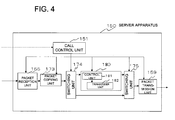
- Fig.4 shows a configuration of a third exemplary embodiment of the present invention.
- the same reference numerals are used to depict the same components as those of Fig.2 , and the corresponding description of these common components is dispensed with, because these perform the same operation.
- a conversion unit 180 is made up of a control unit 181 and a transcoder unit 182.
- the control unit 181 receives the information on capability from the call control unit 151.
- the information on capability has been stated in the SDP and sent in this state from each of the N-number of the terminals.
- the conversion unit 180 compares the information on capability A of the mobile terminal taking the initiative with that of the other (N-1) terminals to decide on the terminal(s) whose information on capability is not coincident with the information on capability A.
- the sorts of the information on capability may be exemplified by, for example, video compression-encoding scheme; bit rate; image size; frame rate and so forth.
- the conversion unit 180 further decides on a conversion scheme with which coincidence of each sort of the information on capability of the terminal whose information on capability is non-coincident with the information on capability A is assured. The conversion unit then notifies transcoder unit 182 of the so determined valid conversion scheme.
- the transcoder unit 182 is notified of the conversion scheme valid for the P-number of terminals the information on capability of which is non-coincident with the information on capability A.
- the transcoder unit extracts a stream from each of the P-number of RTP packets received from the switching unit 174.
- the transcoder unit 182 then carries out conversion in accordance with the above-described conversion scheme, and causes the converted stream to be stored in more or more RTP packets to output the resulting packets to the switching unit 175.
- the (N-1-P)-number of the RTP packets having the information on capability coincident with the information on capability A, are supplied to the switching unit 175 in a through mode.
- the present embodiment may cope with any video compression- encoding schemes, such as H.263, MPEG-4 or H.264.
- the information on capability may be of sorts other than those stated above.
- the present communication method includes:
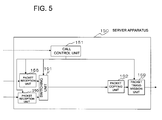
- Fig.5 shows a configuration of a fourth exemplary embodiment of the present invention.
- the same reference numerals are used to designate the same components as those of Figs.2 , 3 and 4 , and the corresponding description of these common components is dispensed with, because these perform the same operation.
- a packet reception unit 190 and a switching unit 191 receive commands from the call control unit 151, at a time of a session initiation; at an arbitrary timing during a session; or immediately before a session end.
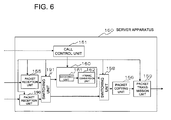
- Fig.6 shows a configuration of a fifth exemplary embodiment 5 of the present invention.
- a conversion unit 160 explained with reference to Fig.2 , is added to the configuration of Fig.5 .
- a moving picture which is free of deterioration and includes other video contents, may be displayed even on a mobile terminal that has newly taken part into the group in the course of a session.
- the conversion unit 170 or the conversion unit 180 may, of course, be used in place of the conversion unit 160. Telop characters may also be inserted in place of video contents.
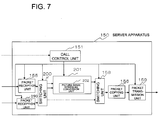
- Fig.7 shows a configuration of a sixth exemplary embodiment of the present invention.
- the present exemplary embodiment shows the configuration for a case where a video RTP packet, another RTP packet of video contents, an RTP packet of stored video contents, or an RTP packet of advertisement video contents, from a mobile terminal taking the initiative are synthesized together into one picture image and delivered as output.
- a switching unit 200 inputs RTP packets from a packet reception unit 155 and a packet reception unit 190, at a timing of receipt of an instruction for picture image synthesis from the call control unit 151, and outputs the so received packets to a conversion unit 201.
- the switching unit outputs the RTP packet from the packet reception unit 155 to the switching unit 158.
- a picture image synthesis conversion unit 202 of the conversion unit 201 proceeds to transcoding for synthesizing a plurality of, herein two, picture images into one picture image, and outputs the resulting picture image to the switching unit 158.
- This communication method includes:
- the call control unit, performing the C-Plane (Control-Plane) processing, on one hand, and the packet reception unit, conversion unit and the packet transmission unit, performing the U-Plane (User-Plane) processing, on the other hand are arranged in the server apparatus.
- the C-plane processing and the U-plane processing may separately be carried out on respective different apparatus, in which case it is possible to cause the C-Plane and the U-plane may each to have scalability, independently.
- Fig.6 shows the configuration corresponding to combination of the first exemplary embodiment of Fig.2 and the fourth exemplary embodiment of Fig.5 , it is also possible to provide for combination of Exa1 with at least one of Examples 2 and 3. In addition, it is of course possible to provide optional combinations of Examples 1 to 4.
- Such a server apparatus may be provided in which another terminal, newly taking part in a group of terminals halfway during the time of a given session, may be accommodated based on the function of conversion provided on the server side. It is possible to eliminate problems, such as picture quality deterioration, on the terminal side without the necessity of remodeling the terminal.
- These functions of conversion may include introducing pre-stored separate video contents at an optional timing to a video stream sent from a mobile terminal, synthesizing the video contents and the video stream in one picture image, synthesizing a plurality of video streams into one picture image, and overlaying characters on the picture image.
Landscapes
- Engineering & Computer Science (AREA)
- Multimedia (AREA)
- Signal Processing (AREA)
- Computer Networks & Wireless Communication (AREA)
- Databases & Information Systems (AREA)
- Computer Security & Cryptography (AREA)
- General Engineering & Computer Science (AREA)
- Computer Graphics (AREA)
- Two-Way Televisions, Distribution Of Moving Picture Or The Like (AREA)
- Telephonic Communication Services (AREA)
- Data Exchanges In Wide-Area Networks (AREA)
Applications Claiming Priority (2)
| Application Number | Priority Date | Filing Date | Title |
|---|---|---|---|
| JP2008142744 | 2008-05-30 | ||
| PCT/JP2009/059854 WO2009145293A1 (ja) | 2008-05-30 | 2009-05-29 | サーバ装置と通信方法ならびにプログラム |
Publications (1)
| Publication Number | Publication Date |
|---|---|
| EP2290977A1 true EP2290977A1 (de) | 2011-03-02 |
Family
ID=41377162
Family Applications (1)
| Application Number | Title | Priority Date | Filing Date |
|---|---|---|---|
| EP09754801A Withdrawn EP2290977A1 (de) | 2008-05-30 | 2009-05-29 | Server, kommunikationsverfahren und programm |
Country Status (5)
| Country | Link |
|---|---|
| US (1) | US8693536B2 (de) |
| EP (1) | EP2290977A1 (de) |
| JP (1) | JP5257448B2 (de) |
| CN (1) | CN102047676A (de) |
| WO (1) | WO2009145293A1 (de) |
Families Citing this family (4)
| Publication number | Priority date | Publication date | Assignee | Title |
|---|---|---|---|---|
| MX2008010961A (es) * | 2006-03-07 | 2008-09-08 | Nec Corp | Sistema dinamico de distribucion de imagenes y dispositivo de conversion. |
| KR20100031755A (ko) * | 2007-07-30 | 2010-03-24 | 닛본 덴끼 가부시끼가이샤 | 통신 단말기, 배신 시스템, 및 변환 방법 |
| US10933209B2 (en) * | 2013-11-01 | 2021-03-02 | Georama, Inc. | System to process data related to user interactions with and user feedback of a product while user finds, perceives, or uses the product |
| JP7342710B2 (ja) | 2020-01-16 | 2023-09-12 | 株式会社Jvcケンウッド | 無線通信装置、および無線通信方法 |
Family Cites Families (38)
| Publication number | Priority date | Publication date | Assignee | Title |
|---|---|---|---|---|
| JPH11285002A (ja) * | 1998-02-02 | 1999-10-15 | Sony Corp | 動画像符号化装置及び動画像符号化方法 |
| US6252873B1 (en) * | 1998-06-17 | 2001-06-26 | Gregory O. Vines | Method of ensuring a smooth transition between MPEG-2 transport streams |
| US6453175B2 (en) * | 1998-06-19 | 2002-09-17 | Nortel Networks Limited | Multi-function coding element and an associated telecommunications network |
| JP3579335B2 (ja) * | 2000-08-23 | 2004-10-20 | 日本電信電話株式会社 | ストリーム配信装置 |
| JP2002297496A (ja) | 2001-04-02 | 2002-10-11 | Hitachi Ltd | メディア配信システム及びマルチメディア変換サーバ |
| JP2002305733A (ja) | 2001-04-06 | 2002-10-18 | Matsushita Electric Ind Co Ltd | マルチキャスト会議装置、及びマルチキャスト会議プログラム |
| JP3788260B2 (ja) * | 2001-04-09 | 2006-06-21 | 日本電気株式会社 | 配信システムとその配信方法、及び配信プログラム |
| US7237033B2 (en) * | 2001-04-30 | 2007-06-26 | Aol Llc | Duplicating switch for streaming data units to a terminal |
| GB0303176D0 (en) | 2003-02-12 | 2003-03-19 | Video Networks Ltd | A system for capture and selective playback of broadcast programmes |
| JP2004272631A (ja) | 2003-03-10 | 2004-09-30 | Victor Co Of Japan Ltd | ローカルサーバのデータ処理方法、及びローカルサーバ装置 |
| US7562375B2 (en) | 2003-10-10 | 2009-07-14 | Microsoft Corporation | Fast channel change |
| JP2005303711A (ja) | 2004-04-13 | 2005-10-27 | Mitsubishi Electric Corp | 映像コンテンツ録画配信システム、サーバ装置、携帯電話、及び映像コンテンツ録画配信方法 |
| CN1691806A (zh) | 2004-04-28 | 2005-11-02 | 上海夏新电子开发有限公司 | 手机终端视频邮件传输功能模块 |
| JP2006031337A (ja) | 2004-07-15 | 2006-02-02 | Sony Corp | コンテンツダウンロードシステム、コンテンツダウンロード方法、プログラム |
| US7571246B2 (en) * | 2004-07-29 | 2009-08-04 | Microsoft Corporation | Media transrating over a bandwidth-limited network |
| JP4213183B2 (ja) * | 2004-07-30 | 2009-01-21 | シャープ株式会社 | 通信ネットワークの制御システム |
| US7606303B2 (en) * | 2004-09-28 | 2009-10-20 | General Instrument Corporation | Method and apparatus to detect anchor frames from digital video streams |
| US20060073843A1 (en) * | 2004-10-01 | 2006-04-06 | Naveen Aerrabotu | Content formatting and device configuration in group communication sessions |
| JP2006295586A (ja) | 2005-04-12 | 2006-10-26 | Hitachi Ltd | コンテンツ変換装置及びトランスコードシステム |
| CN101159928A (zh) | 2005-04-30 | 2008-04-09 | 华为技术有限公司 | 一种蜂窝系统中按键即说业务的通信资源分配方法 |
| CN1893427A (zh) * | 2005-07-07 | 2007-01-10 | 华为技术有限公司 | 一种进行业务支持能力协商的方法 |
| JP4650626B2 (ja) | 2005-08-16 | 2011-03-16 | 日本電気株式会社 | 発言権管理システム、発言権管理方法、及びプログラム |
| JP2007068078A (ja) | 2005-09-02 | 2007-03-15 | Sharp Corp | 通信システム、携帯端末、サーバおよび通信方法 |
| CN100512293C (zh) | 2005-09-07 | 2009-07-08 | 华为技术有限公司 | 一种会话初始化协议消息体内容处理方法及网络 |
| US7472197B2 (en) * | 2005-10-31 | 2008-12-30 | Ut Starcom, Inc. | Method and apparatus for automatic switching of multicast/unicast live TV streaming in a TV-over-IP environment |
| CN1960525B (zh) | 2005-11-02 | 2010-05-05 | 华为技术有限公司 | 一种多方通信业务的会话控制方法及系统 |
| US8713105B2 (en) * | 2006-01-03 | 2014-04-29 | Cisco Technology, Inc. | Method and apparatus for transcoding and transrating in distributed video systems |
| JP4154616B2 (ja) | 2006-03-14 | 2008-09-24 | 日本電気株式会社 | PoC及びPoC拡張コミュニケーションシステムへの広告挿入方法およびサーバ |
| CN101079720A (zh) * | 2006-05-26 | 2007-11-28 | 摩托罗拉公司 | 用于启用电话会议的方法和系统 |
| JP2008005254A (ja) | 2006-06-22 | 2008-01-10 | Sony Corp | サーバ装置、クライアント装置、コンテンツ再生システム、コンテンツ処理方法及びプログラム |
| JP2008079061A (ja) | 2006-09-22 | 2008-04-03 | Matsushita Electric Ind Co Ltd | 画像ストリーミングシステム |
| US20080100694A1 (en) * | 2006-10-27 | 2008-05-01 | Microsoft Corporation | Distributed caching for multimedia conference calls |
| CN101001371B (zh) * | 2007-01-19 | 2010-05-19 | 华为技术有限公司 | 视频转码的方法及其装置 |
| US8542705B2 (en) * | 2007-01-23 | 2013-09-24 | Mobitv, Inc. | Key frame detection and synchronization |
| CA2676705A1 (en) * | 2007-02-09 | 2008-08-21 | Novarra, Inc. | Method and system for transforming and delivering video file content for mobile devices |
| JP2008206039A (ja) | 2007-02-22 | 2008-09-04 | Sharp Corp | コンテンツ視聴装置 |
| JP2008294957A (ja) * | 2007-05-28 | 2008-12-04 | Oki Electric Ind Co Ltd | メディア変換システム、メディア変換方法、メディア変換プログラム、呼制御装置及びメディア変換装置 |
| US20090055540A1 (en) * | 2007-08-20 | 2009-02-26 | Telefonaktiebolaget Lm Ericsson (Publ) | Methods and Systems for Multicast Control and Channel Switching for Streaming Media in an IMS Environment |
-
2009
- 2009-05-29 CN CN2009801200958A patent/CN102047676A/zh active Pending
- 2009-05-29 EP EP09754801A patent/EP2290977A1/de not_active Withdrawn
- 2009-05-29 JP JP2010514548A patent/JP5257448B2/ja active Active
- 2009-05-29 WO PCT/JP2009/059854 patent/WO2009145293A1/ja not_active Ceased
- 2009-05-29 US US12/995,210 patent/US8693536B2/en active Active
Non-Patent Citations (1)
| Title |
|---|
| See references of WO2009145293A1 * |
Also Published As
| Publication number | Publication date |
|---|---|
| US8693536B2 (en) | 2014-04-08 |
| JPWO2009145293A1 (ja) | 2011-10-13 |
| US20110188568A1 (en) | 2011-08-04 |
| CN102047676A (zh) | 2011-05-04 |
| JP5257448B2 (ja) | 2013-08-07 |
| WO2009145293A1 (ja) | 2009-12-03 |
Similar Documents
| Publication | Publication Date | Title |
|---|---|---|
| RU2328086C2 (ru) | Переключение потока на основе постепенного восстановления при декодировании | |
| KR20100124811A (ko) | 서버 장치와 콘텐츠 배신 방법 | |
| EP2271097A1 (de) | Gateway-vorrichtung, verfahren und programm | |
| US20120120879A1 (en) | Gateway device, data converting method, and program | |
| EP2627082A2 (de) | Verfahren zum übertragen eines skalierbaren http-streams für natürliche reproduktion beim auftreten einer ausdrucksumschaltung während eines http-streamings | |
| US20120017249A1 (en) | Delivery system, delivery method, conversion apparatus, and program | |
| US8281350B2 (en) | Content distribution system, conversion device, and content distribution method for use therein | |
| US8693536B2 (en) | Server apparatus, communication method and program | |
| JP4771369B2 (ja) | シームレスハンドオーバにおけるメディアストリーム切替方法、システム及びプログラム | |
| JP2002152301A (ja) | データ通信システム、データ受信装置、データ通信方法、並びにプログラム記憶媒体 | |
| JP5013141B2 (ja) | コンテンツ配信システム、コンテンツ配信方法及びそれらに用いる変換装置 | |
| EP2290978A1 (de) | Server, kommunikationsverfahren und programm | |
| CN101273631B (zh) | 一种多方视频通讯媒体流控制系统和方法 | |
| JP2006013583A (ja) | 符号化ストリーム中継装置、その方法及びプログラム | |
| JP2005072973A (ja) | マルチメディア情報中継装置 |
Legal Events
| Date | Code | Title | Description |
|---|---|---|---|
| PUAI | Public reference made under article 153(3) epc to a published international application that has entered the european phase |
Free format text: ORIGINAL CODE: 0009012 |
|
| 17P | Request for examination filed |
Effective date: 20101129 |
|
| AK | Designated contracting states |
Kind code of ref document: A1 Designated state(s): AT BE BG CH CY CZ DE DK EE ES FI FR GB GR HR HU IE IS IT LI LT LU LV MC MK MT NL NO PL PT RO SE SI SK TR |
|
| AX | Request for extension of the european patent |
Extension state: AL BA RS |
|
| DAX | Request for extension of the european patent (deleted) | ||
| STAA | Information on the status of an ep patent application or granted ep patent |
Free format text: STATUS: THE APPLICATION HAS BEEN WITHDRAWN |
|
| 18W | Application withdrawn |
Effective date: 20121218 |