EP2292132A2 - Lave-vaisselle et procédé de commande correspondant - Google Patents
Lave-vaisselle et procédé de commande correspondant Download PDFInfo
- Publication number
- EP2292132A2 EP2292132A2 EP10173652A EP10173652A EP2292132A2 EP 2292132 A2 EP2292132 A2 EP 2292132A2 EP 10173652 A EP10173652 A EP 10173652A EP 10173652 A EP10173652 A EP 10173652A EP 2292132 A2 EP2292132 A2 EP 2292132A2
- Authority
- EP
- European Patent Office
- Prior art keywords
- cold water
- hot water
- water supply
- items
- dishwasher
- Prior art date
- Legal status (The legal status is an assumption and is not a legal conclusion. Google has not performed a legal analysis and makes no representation as to the accuracy of the status listed.)
- Withdrawn
Links
- 238000000034 method Methods 0.000 title claims abstract description 9
- XLYOFNOQVPJJNP-UHFFFAOYSA-N water Substances O XLYOFNOQVPJJNP-UHFFFAOYSA-N 0.000 claims abstract description 432
- 238000005406 washing Methods 0.000 claims abstract description 62
- 238000004140 cleaning Methods 0.000 claims abstract description 58
- 238000001179 sorption measurement Methods 0.000 claims description 62
- 238000003795 desorption Methods 0.000 claims description 37
- 239000000463 material Substances 0.000 claims description 31
- 239000002918 waste heat Substances 0.000 claims description 26
- 239000003599 detergent Substances 0.000 claims description 7
- 238000011068 loading method Methods 0.000 claims description 5
- 238000011144 upstream manufacturing Methods 0.000 claims description 5
- 238000002360 preparation method Methods 0.000 claims description 2
- 238000012163 sequencing technique Methods 0.000 abstract 1
- 238000001035 drying Methods 0.000 description 62
- 238000010438 heat treatment Methods 0.000 description 27
- 230000000694 effects Effects 0.000 description 12
- 238000009833 condensation Methods 0.000 description 9
- 230000005494 condensation Effects 0.000 description 9
- 238000011161 development Methods 0.000 description 9
- 230000018109 developmental process Effects 0.000 description 9
- 238000010586 diagram Methods 0.000 description 9
- 239000008186 active pharmaceutical agent Substances 0.000 description 7
- 230000008901 benefit Effects 0.000 description 7
- 239000007788 liquid Substances 0.000 description 6
- 239000000126 substance Substances 0.000 description 5
- 239000000356 contaminant Substances 0.000 description 4
- 230000008569 process Effects 0.000 description 4
- 239000010865 sewage Substances 0.000 description 4
- 235000008733 Citrus aurantifolia Nutrition 0.000 description 3
- 235000011941 Tilia x europaea Nutrition 0.000 description 3
- 238000010521 absorption reaction Methods 0.000 description 3
- 238000004851 dishwashing Methods 0.000 description 3
- 238000005265 energy consumption Methods 0.000 description 3
- 230000002349 favourable effect Effects 0.000 description 3
- 239000004571 lime Substances 0.000 description 3
- 238000005086 pumping Methods 0.000 description 3
- 150000003839 salts Chemical class 0.000 description 3
- 239000002351 wastewater Substances 0.000 description 3
- 229910021536 Zeolite Inorganic materials 0.000 description 2
- 230000009471 action Effects 0.000 description 2
- 239000000654 additive Substances 0.000 description 2
- 238000013461 design Methods 0.000 description 2
- HNPSIPDUKPIQMN-UHFFFAOYSA-N dioxosilane;oxo(oxoalumanyloxy)alumane Chemical compound O=[Si]=O.O=[Al]O[Al]=O HNPSIPDUKPIQMN-UHFFFAOYSA-N 0.000 description 2
- 238000005485 electric heating Methods 0.000 description 2
- 238000001704 evaporation Methods 0.000 description 2
- 230000008020 evaporation Effects 0.000 description 2
- 238000009434 installation Methods 0.000 description 2
- 238000013021 overheating Methods 0.000 description 2
- 238000004886 process control Methods 0.000 description 2
- 238000010926 purge Methods 0.000 description 2
- 238000003303 reheating Methods 0.000 description 2
- 238000004904 shortening Methods 0.000 description 2
- 239000002594 sorbent Substances 0.000 description 2
- 239000010457 zeolite Substances 0.000 description 2
- 241001507939 Cormus domestica Species 0.000 description 1
- 241000196324 Embryophyta Species 0.000 description 1
- 230000000712 assembly Effects 0.000 description 1
- 238000000429 assembly Methods 0.000 description 1
- 239000012459 cleaning agent Substances 0.000 description 1
- 238000004891 communication Methods 0.000 description 1
- 230000001419 dependent effect Effects 0.000 description 1
- 239000002274 desiccant Substances 0.000 description 1
- 238000007599 discharging Methods 0.000 description 1
- 230000005611 electricity Effects 0.000 description 1
- 230000007613 environmental effect Effects 0.000 description 1
- 238000011010 flushing procedure Methods 0.000 description 1
- 230000010354 integration Effects 0.000 description 1
- 230000002262 irrigation Effects 0.000 description 1
- 230000009467 reduction Effects 0.000 description 1
- 230000004044 response Effects 0.000 description 1
- 230000002441 reversible effect Effects 0.000 description 1
- 239000007921 spray Substances 0.000 description 1
- 238000005507 spraying Methods 0.000 description 1
- 238000003860 storage Methods 0.000 description 1
- 238000012549 training Methods 0.000 description 1
Images


Classifications
-
- A—HUMAN NECESSITIES
- A47—FURNITURE; DOMESTIC ARTICLES OR APPLIANCES; COFFEE MILLS; SPICE MILLS; SUCTION CLEANERS IN GENERAL
- A47L—DOMESTIC WASHING OR CLEANING; SUCTION CLEANERS IN GENERAL
- A47L15/00—Washing or rinsing machines for crockery or tableware
- A47L15/42—Details
- A47L15/48—Drying arrangements
- A47L15/481—Drying arrangements by using water absorbent materials, e.g. Zeolith
-
- A—HUMAN NECESSITIES
- A47—FURNITURE; DOMESTIC ARTICLES OR APPLIANCES; COFFEE MILLS; SPICE MILLS; SUCTION CLEANERS IN GENERAL
- A47L—DOMESTIC WASHING OR CLEANING; SUCTION CLEANERS IN GENERAL
- A47L15/00—Washing or rinsing machines for crockery or tableware
- A47L15/0002—Washing processes, i.e. machine working principles characterised by phases or operational steps
- A47L15/0005—Rinsing phases, e.g. pre-rinsing, intermediate rinsing, final rinsing
-
- A—HUMAN NECESSITIES
- A47—FURNITURE; DOMESTIC ARTICLES OR APPLIANCES; COFFEE MILLS; SPICE MILLS; SUCTION CLEANERS IN GENERAL
- A47L—DOMESTIC WASHING OR CLEANING; SUCTION CLEANERS IN GENERAL
- A47L15/00—Washing or rinsing machines for crockery or tableware
- A47L15/0002—Washing processes, i.e. machine working principles characterised by phases or operational steps
- A47L15/0007—Washing phases
-
- A—HUMAN NECESSITIES
- A47—FURNITURE; DOMESTIC ARTICLES OR APPLIANCES; COFFEE MILLS; SPICE MILLS; SUCTION CLEANERS IN GENERAL
- A47L—DOMESTIC WASHING OR CLEANING; SUCTION CLEANERS IN GENERAL
- A47L15/00—Washing or rinsing machines for crockery or tableware
- A47L15/0018—Controlling processes, i.e. processes to control the operation of the machine characterised by the purpose or target of the control
- A47L15/0047—Energy or water consumption, e.g. by saving energy or water
-
- A—HUMAN NECESSITIES
- A47—FURNITURE; DOMESTIC ARTICLES OR APPLIANCES; COFFEE MILLS; SPICE MILLS; SUCTION CLEANERS IN GENERAL
- A47L—DOMESTIC WASHING OR CLEANING; SUCTION CLEANERS IN GENERAL
- A47L15/00—Washing or rinsing machines for crockery or tableware
- A47L15/42—Details
- A47L15/4214—Water supply, recirculation or discharge arrangements; Devices therefor
- A47L15/4217—Fittings for water supply, e.g. valves or plumbing means to connect to cold or warm water lines, aquastops
-
- A—HUMAN NECESSITIES
- A47—FURNITURE; DOMESTIC ARTICLES OR APPLIANCES; COFFEE MILLS; SPICE MILLS; SUCTION CLEANERS IN GENERAL
- A47L—DOMESTIC WASHING OR CLEANING; SUCTION CLEANERS IN GENERAL
- A47L15/00—Washing or rinsing machines for crockery or tableware
- A47L15/42—Details
- A47L15/48—Drying arrangements
- A47L15/483—Drying arrangements by using condensers
-
- A—HUMAN NECESSITIES
- A47—FURNITURE; DOMESTIC ARTICLES OR APPLIANCES; COFFEE MILLS; SPICE MILLS; SUCTION CLEANERS IN GENERAL
- A47L—DOMESTIC WASHING OR CLEANING; SUCTION CLEANERS IN GENERAL
- A47L2601/00—Washing methods characterised by the use of a particular treatment
- A47L2601/02—Pressurised cleaning liquid delivered by a pump
Definitions
- the present invention relates to a dishwasher, in particular a domestic dishwasher, with a sequence control device, in which one or more wash programs for controlling at least one wash cycle for cleaning items to be stored, with a washing container for receiving items to be washed during the wash cycle and with a Sorptionstrockenvorraum, which Having sorption with a reversibly dehydratable material.
- the items to be washed are introduced into a washing container and are there cleaned in a rinsing process, which is also called a rinse, with the aid of water and then dried.
- the aim is to perform a rinse so that a predefined cleaning result and a predefined drying result are achieved as efficiently as possible.
- Demanded is a high overall efficiency, which preferably results from the cleaning efficiency and the drying efficiency.
- the cleaning efficiency corresponds in particular to the ratio of the cleaning result achieved by means of a rinse cycle and the effort required for this purpose, wherein the effort can comprise several dimensions, for example the energy requirement, the water requirement and / or the time requirement.
- the drying efficiency corresponds in particular to the ratio of the drying result achieved by means of a rinse cycle and the effort required for this purpose, wherein the effort here can also include several dimensions, for example the energy requirement and / or the time required.
- a flow control device in which one or more wash programs for controlling a wash cycle for cleaning items to be stored are stored.
- the sequence control device is designed such that it automatically controls a rinse cycle according to a rinse program usually selected by an operator.
- the water required for carrying out rinses can be taken up in known dishwashers via a water inlet device, which water For example, from a building-side installed water supply can accommodate.
- a wash program has several successive program steps for the treatment of the items to be washed, wherein the water is provided in the water-conducting program steps depending on the respective program step with cleaning and / or additives and brought to a favorable temperature for each program step.
- modern dishwashers usually have automatic dosing devices.
- dishwashers may have a conventional electric heater to bring the water intended for rinsing to the required temperatures.
- a typical washing program for cleaning the items to be washed in this time sequence comprises, in particular, a pre-rinsing step, a cleaning step, an intermediate rinsing step and a rinsing step in which the items to be washed are each supplied with water.
- a pre-rinsing step a cleaning step
- an intermediate rinsing step a rinsing step in which the items to be washed are each supplied with water.
- rinse programs are possible in which one or more of these program steps are repeated several times.
- a typical washing program includes an adjoining drying step for drying the cleaned items to be washed.
- a pre-rinse step serves primarily to remove coarse contaminants from the items to be washed.
- the purpose of a subsequent cleaning step is to completely remove contaminants from the dishes.
- a now performed intermediate rinsing step serves in particular for the removal of detergent residues which adhere to the items to be washed.
- a subsequent rinse step is intended in particular to avoid stains on the items to be washed, which could be caused by dissolved substances in the water, such as, for example, salt and / or lime. For this purpose, the water is added during the rinse step with rinse aid.
- another object of the rinsing step is to prepare the subsequent drying step.
- the items to be washed are heated to a high temperature during the rinse step.
- water droplets adhering to the hot items evaporate and are deposited on the inside of the rinse container due to the lower temperature prevailing there.
- a sorption drying device for drying the items to be washed, which comprises a sorption device with a reversibly dehydratable material.
- the operating principle of a sorption drying device is that, during the drying step, water vapor, in some cases another sorbable medium, is deposited by the reversibly dehydratable material, which may be zeolite, for example, whereby the reversibly dehydratable material heats up.
- An airflow generated, for example, by a fan is heated by the heat thus generated and introduced into the washing, where it absorbs moisture and thus dries the dishes.
- a moist air flow from the rinsing container is passed through the reversibly dehydratable material during the respective drying step, where it releases its absorbed moisture, which in turn releases heat which the air flow at least partially absorbs.
- a humid air flow is guided along a cooled condensing surface, whereby it is dried.
- the condensation surface can be located, for example, in the rinsing container or outside thereof in a tube, a conduit or the like which directs the air flow to the reversibly dehydratable material.
- the dried air stream is then passed past the reversibly dehydratable material, which further warms it.
- the condensation surface can be cooled by connecting a container, which is connected to the sorption device for exchanging a medium which can be sorbed by the sorption device, in a heat-conducting manner to the condensation surface.
- a reversible dehydratable material sorbable medium for example water, evaporated or sublimed.
- the resulting evaporation cold then cools the container and the condensation surface.
- the now gaseous medium is passed to the reversibly dehydratable material and sorbed there, whereby the reversibly dehydratable material, as already mentioned, is heated.
- the reversibly dehydratable material is desorbed at the latest when its absorption capacity for water vapor (or other medium) is exhausted.
- the reversibly dehydratable material is heated, so that the sorbed medium dissolves from the reversibly dehydratable material.
- the temperature to which the items to be washed are heated during the rinse step, chosen lower or can be completely dispensed with a heating of the dishes during the rinse step. This results in a higher drying efficiency compared to a dishwasher without Sorptionstrockenvorraum.
- a disadvantage of the known dishwasher equipped with a storage container is that it no longer meets the current need for efficiency.
- the object of the present invention is to provide a dishwashing machine equipped with a sorption drying device, which makes it possible to carry out rinse cycles more efficiently.
- a water inlet device which has a hot water inlet and a cold water inlet, wherein the hot water inlet for receiving hot water from an external hot water supply and the cold water inlet is provided for receiving cold water from an external cold water supply, at least one program step for rinsing items to be washed using hot water from the hot water supply and at least one program step for rinsing items to be washed using cold water from the cold water supply is.
- Dishwashers especially household dishwashers, are usually operated in locations where a hot water supply and a cold water supply is available.
- the temperature of the hot water typical fixed hot water supplies may for example be in a range of 40 ° C to 70 ° C.
- the temperature of the cold water of typical fixed cold water supplies is in the range of 5 ° C to 15 ° C.
- a water inlet device which has a hot water inlet and a cold water inlet, makes it possible to carry out a rinse cycle for cleaning and / or drying of dishes in a more efficient manner.
- rinsing programs for controlling a rinse are possible, which provide the implementation of individual program steps using hot water from an external hot water supply and the implementation of other program steps using cold water from an external cold water supply.
- known dishwashers which - as before common in Europe - are provided exclusively for connection to a cold water supply
- known dishwashers which are - as usual especially in North America - exclusively for connection to a hot water supply, a considerable increase in efficiency can be achieved.
- hot water can be taken from the external water supply for this program step.
- the hot water can be taken before or during the respective program step.
- cold water can be taken up from the external cold water supply. Again, the recording cold water before or during the respective program step.
- the dishwasher according to the invention realizes the mentioned advantages in that in at least one of the wash programs at least one program step for washing items to be washed using hot water from the hot water supply and at least one program step for washing items to be washed using cold water from the cold water supply are provided.
- the achievable cleaning effect depends on the temperature of the water used for rinsing. Therefore, in many cases it is desirable or even necessary to use water which has a higher temperature than water of a conventional cold water supply. Therefore, the use of hot water in such a program step, a significant amount of energy can be saved, which would have to be expended when using cold water to its heating.
- the reversibly dehydratable material in the desorption of the sorption the reversibly dehydratable material to very high temperatures, for example, to 300 ° C, heated.
- Some of the heat usually generated by means of an electric heater is used to overcome the binding forces between the sorbed medium and the reversibly dehydratable material.
- the other part is available in the form of waste heat for further use. It is provided to use the heat generated during a desorption of the sorption waste heat to heat at least the water required for a program step for rinsing items to be washed.
- a sufficiently large amount of waste heat is available to bring even low temperature water to a temperature required for a program step to wash dishes. This is true even for program steps where a higher temperature is required or desired. Therefore, at least for one program step cold water from the cold water supply can be used without this would have to be heated with higher electrical energy input. At the same time, the amount of heat withdrawn from the hot water supply can be reduced without the cleaning result being appreciably worsened.
- the cold water is heated by means of waste heat, which is formed at a desorption of the sorption in at least one program step for which is provided for rinsing wash ware cold water from the cold water supply.
- Another advantage of the use of cold water from the cold water supply in a program step for washing items, during which the sorption is desorbed results from the fact that when using cold water from the cold water supply compared to a use of hot water from a hot water supply at least set a lower temperature level at the beginning of the desorption in the washing container.
- the water intended for rinsing can absorb more of the waste heat generated during desorption. If, for example, an air flow is provided which is guided in a loop from the sorption device into the rinsing container and out of the rinsing container back to the sorption device, then this air flow cools more in the rinsing container and thus has a lower temperature when it reaches the sorption device reached again. In this way, overheating of the reversibly dehydratable material can be prevented.
- the sorption drying device has an air guidance system for generating an air flow from the sorption device into the washing container, wherein at least one of the washing programs is intended to generate the air flow during the desorption of the sorption device so as to flush To wash dishes provided cold water from the cold water supply by means of waste heat, which arises during desorption.
- an air guiding system for generating an air flow is provided to guide during the drying step relatively dry air in the washing compartment, so as to dry the dishes.
- This air guiding system which may include a fan as well as pipes, conduits or the like, during desorption, makes it possible in a simple manner to remove waste heat from the sorption device and to heat water in the washing compartment. This results in a simple structural design of the dishwasher.
- At least one of the washing programs at least one cleaning step for rinsing dishes provides, in which a loading of items to be washed with cold water from the cold water supply, which is heated by means arising during desorption waste heat takes place.
- a cleaning step is used to thoroughly clean the dishes.
- water is generally added to the detergent whose chemical cleaning action is best at a higher temperature. Usually, therefore, a temperature of about 50 ° C to 70 ° C is provided for a cleaning step.
- the device-internal, electrical heating device in the liquid circuit system of the dishwasher can possibly even be dispensed with altogether, ie omitted.
- At least one of the washing programs provides a pre-rinsing step for rinsing items to be washed in which, in preparation for a cleaning step, items of hot water are supplied from the hot-water supply.
- the pre-rinsing step serves to remove coarse contaminants from the dishes to prepare a cleaning step.
- no higher temperatures are required for this purpose.
- the removal of the coarser dirt by higher temperatures during the pre-rinse step can be accelerated in many cases.
- the required cleaning effect of the pre-rinse step can be achieved in a shorter time. In this case, by the use of hot water from the external hot water supply the electrical energy consumption of the dishwasher can be further reduced.
- At least one of the rinsing programs provides an intermediate rinsing step for rinsing items to be washed, in which, for removing detergent from the items to be washed, a loading of items to be washed with hot water from the hot water supply takes place after a cleaning step.
- An intermediate rinsing step serves in particular for the removal of detergent residues which adhere to the items to be washed after a cleaning step.
- the desired effect of the intermediate rinse step can be achieved in a shorter time if water with a higher temperature is used.
- At least one rinsing program provides a rinsing step for rinsing items to be rinsed, in which a load of items to be washed with cold water from the cold water supply takes place.
- a rinse step serves in particular to avoid stains on the dishes, which could be caused by dissolved substances in the water, such as salt and / or lime.
- the water is added during the rinse step with rinse aid.
- a dishwasher with a sorption drying device it is generally not necessary to heat the items to be washed during the rinse step to a higher temperature, but it is sufficient for the most part or even alone the waste heat in desorbing the sorbent material of the sorption.
- cold water from the cold water supply can be used without problems, in particular for the rinse cycle effected by the respective rinse step, without this having to be additionally heated or heated with higher electrical energy input.
- the amount of heat withdrawn from the hot water supply can be reduced and yet a satisfactory drying result can be achieved within a reasonable time.
- At least one rinsing program can be followed by a final rinse step Provide rinsing of items to be washed, in which a loading of items to be washed with hot water from the hot water supply.
- a drying step can be accelerated if the dishes are heated during the preceding rinse step.
- hot water which for example has a temperature of 60 ° C to 75 ° C, can be used.
- it is favorable to use hot water from the hot water supply for the final rinse step since this also ensures that the heat energy withdrawn from the hot water supply is used meaningfully.
- the hot water inlet device and / or the cold water inlet device can be assigned a free flow path.
- the free flow path or the free flow paths can be arranged for example in the reservoir.
- the free flow paths avoid sucking back of water in the direction of the hot water supply or the cold water supply, which could occur at a temporary negative pressure resulting from dynamic processes. In this way, in particular a too low water level in the reservoir and / or in the washing can be avoided.
- the hot water supply, a hot water valve and the cold water inlet include a cold water valve, wherein the hot water valve and the cold water valve independently be controlled by the flow control device.
- the hot water valve is arranged at an upstream end of a hot water hose and adapted to be fastened to a fitting of the external hot water supply, and / or that the cold water valve is arranged at an upstream end of a cold water hose and so is formed so that it is attachable to a connector of the external cold water supply.
- the hot water valve and / or the cold water valve can have, for example, connection threads which correspond to threads of domestic taps.
- Such valves can be designed in particular as Aquastop valves.
- the arrangement of the hot water valve and / or the cold water valve at the upstream end of the water inlet device has the advantage that practically no leakage water can escape from the dishwasher even in the event of damage, as long as the valves are closed. If the valves are designed to close when not energized, leaking of leakage water from a switched-off dishwasher is prevented in virtually all cases.
- the flow control device may be associated with a leak water sensor for detecting leakage water so that the flow control device can close the valves when leakage water occurs during operation of the dishwasher.
- a downstream end of the hot water hose and a downstream end of the cold water hose are connected via a connecting piece liquid-conducting jeweiwls with a supply hose, which with a housing-fixed connection piece the dishwasher is connected.
- a connecting piece liquid-conducting jeweiwls with a supply hose which with a housing-fixed connection piece the dishwasher is connected.
- the invention also relates to a method for controlling at least one rinse cycle for cleaning items to be washed by means of one or more rinse programs, which are stored in the flow control device of a dishwasher, in particular domestic dishwasher, wherein the dishwasher a rinse tank for receiving items to be cleaned during the rinse cycle and a Sorptionstrockenvoriques comprising a sorption with a reversibly dehydratable material, which is characterized in that in at least one program step of rinsing wash ware hot water from an external hot water supply and at least one program step for rinsing ware cold water from the cold water supply is used.
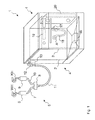
- FIG. 1 shows a schematic spatial representation of an advantageous embodiment of a dishwasher according to the invention 1.
- This has a washing container 2, which can be closed by a door 3, so that a rinsing cell for rinsing dishes.
- the rinsing container 2 is arranged in the interior of a housing 4 of the dishwasher 1, which has standard dimensions.
- the housing 4 for example, have a width of 45 cm or 60 cm, which allows integration of the dishwasher 1 in a standard designed kitchenette with a corresponding Einbaunische.
- the housing 4 can also be omitted, so that the dishwasher is better designed for installation in niches such as in kitchen cabinets built-in.
- a schematically illustrated water inlet device 5 On the back of the dishwasher 1, a schematically illustrated water inlet device 5 is arranged. This has a hot water inlet 6, 7 and a cold water inlet 8, 9, wherein the hot water inlet 6, 7 for receiving hot water from an external hot water supply WH and the cold water inlet 8, 9 is provided for receiving cold water from an external cold water supply KH.
- the hot water inlet 6, 7 comprises a controllable hot water valve 6 and the cold water inlet 8, 9 a controllable cold water valve 8.
- the hot water valve 6 and cold water valve 8 are basically constructed identically.
- both valves 6, 8 may be formed as a solenoid valve.
- the inlet sides of the valves 6, 8 are each formed so that they can be attached to fittings WH, KH a household water supply, for example, to faucets WH, KH, can be attached.
- the connection can be made in each case by means of a screw connection, a snap connection or the like.
- Such valves 6, 8 are in particular formed as a water stop or Aquastop valves 6, 8.
- these are closed when they are not activated, so that the dishwasher 1 is disconnected from the water supply in the off state. In this way, leakage of leakage water from the switched-off dishwasher 1 can be avoided in the event of a fault.
- FIG. 1 the input side of the hot water valve 6 to a hot water tap WH and the input side of the cold water valve 8 connected to a cold water tap KH.
- the output side of the hot water valve 6 is connected to a hot water hose 7 and the output side of the cold water valve 8 with a cold water hose 9, wherein the downstream ends of the hot water hose 7 and the cold water hose 9 are connected to an input side of a connecting piece 10.
- a common inlet hose 11 connects for hot water and cold water, which in turn is connected to a connector 12 on the housing 4 of the dishwasher 1.
- the water inlet device 5 By means of the water inlet device 5, it is therefore possible, hot water from an external hot water supply WH and / or cold water from an external cold water supply KH individually controlled to lead into the interior of the dishwasher 1.
- the common connector 10 on the device side as an attachment or built-in part, so that the hot water hose 7 and the cold water hose 9 are guided to the dishwasher.
- the hot water hose 7, the cold water hose 9 and / or the common inlet hose 11 may be formed as safety hoses with an inner water-carrying pressure hose and an outer Hüllschlauch, wherein between the pressure hose and Hüllschlauch each a leakage water channel for discharging any leak water may be provided.
- the connecting piece 10 may be formed so that the leak water channels of the hot water hose 7, the cold water hose 9 and the common inlet hose 11 are interconnected, so that leakage water, which occurs during operation of the dishwasher 1 in the water supply device 5, via the housing-fixed connector 12 is directed into the interior of the dishwasher 1.
- a leak water sensor not shown, so that appropriate measures, such as closing the hot water valve 6 and 8 cold water valve, can be initiated by the flow control device of the dishwasher.
- a free flow path 13 Downstream of the housing-fixed connection piece 12, a free flow path 13 is provided.
- a so-called pipe interruption which serves to prevent a sucking back of water from the dishwasher 1, if in the external water supply by dynamic processes, a negative pressure. This prevents in particular that already used water, which may be mixed with dirt, cleaning agents and / or cleaning aids, can get back into the building water supply
- the dishwasher 1 in the FIG. 1 not shown, which connect the free flow path 13 with the washing container 2 so that it can be filled with cold water from the cold water supply KH and / or hot water from the hot water supply WH.
- a pump pot 16 is provided in which a circulating pump is suitably provided for circulating water in the washing container 2 during a wash cycle.
- the circulation pump may have a heating device for heating the water located in the washing container 2, for example a water heater.
- a pump for pumping out water for example at the end of a rinse cycle, be provided.
- the various pumping functions can also be perceived by a single pump in conjunction with switchable valves.
- the sump 16 is usually connected to a waste water connection piece 17 via means not shown so that water from the washing compartment 2 via a connected to the waste water connection piece 17 sewage hose 18 in a building side installed wastewater A, such as a sewer pipe A, can be pumped.
- the dishwasher 1 also has a flow control device 19 for controlling the course of a washing program.
- various rinse programs can be stored, which can be selected by an operator.
- the flow control device 19 is arranged inside the door 3 of the washing container 2, but could also be arranged elsewhere in the dishwasher 1.
- the dishwasher 1 has a sorption drying device 20 which is arranged on a side wall of the washing container, here in the exemplary embodiment in particular between the washing container 2 and the housing 4.
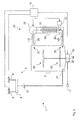
- FIG. 2 shows a functional diagram of the dishwasher of FIG. 1 ,
- the hot water valve 6 and the cold water valve 8 are each connected to the flow control device 19, that both are individually or specifically controlled. Downstream of the free flow path 13, an inlet 21 for charging the washing container 2 with water from the inlet device 5 is arranged. This makes it possible, the washing container 2 via the connecting piece 10, the free flow path 13 and the inlet 21 to fill depending on the selected wash program with hot water and / or cold water.
- a circulation pump 22 designed as a heating pump is arranged, which is in communication with a spray system 23 arranged in the interior of the washing compartment 2.
- a drain pump 24 is arranged in the sump, which makes it possible to pump out no longer needed water to the outside.
- both the heating function and the pumping function can be individually controlled by the sequence control device 19.
- the flow control device 19 is also connected to the drain pump 24 for the control thereof.
- the sorption drying device 20 has an air guidance system 25, 26, 28, which comprises a fan 25, a suction-side air line 26 and a pressure-side air line 28.
- the blower 25 is connected via the suction-side air line 26 to an air outlet 27 of the washing container 2 and via the pressure-side air line 28 to an air inlet 29 of the washing container 2.
- an air flow LS can thus be generated, which is guided by a sorption device 30 arranged in the pressure-side air line 28.
- the sorption device 30 could also be arranged in the suction-side air line 26. It contains a reversibly dehydratable material 31, which sorbs moisture in the air flow LS, which originates from the washing container 2, during the drying step.
- the air flow LS is dried, which then, when it is returned to the washing, can absorb more moisture, resulting in a drying of items to be washed in the washing.
- a preferably electric heater 32 is provided, which has a heating element, which in the Air control system 25, 26, 28 is arranged to heat the sorption 30.
- the reversibly dehydratable material is heated to very high temperatures, for example to 300 ° C.
- a portion of the heat typically generated by the electric heater 32 is used to overcome the bonding forces between the sorbed medium and the reversibly dehydratable material 31.
- the other part is introduced in the form of waste heat with the air flow LS in the washing compartment 2. It is provided to use the heat generated during a desorption of the sorption waste heat to heat at least the water required for a caused by a program step partial rinse for rinsing items to be washed.
- the control of the water inlet device 5, the heating pump 22, the drain pump 24, the Sorptionsstrockenvorraum 20 and other not explained here devices of the dishwasher 1 is carried out in response to a selected wash program, which is stored in the flow control device 19.
- the dishwasher 1 is provided at least one washing program, which is specifically selected for the efficient use of hot water from the hot water supply WH and cold water from the cold water supply KH. This means, in particular, that cold water is required for such a partial wash cycle, for which cold water is required or required, and for such a partial wash cycle, for which hot water is required, hot water is supplied specifically.
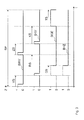
- FIG. 3 shows a functional diagram for explaining the function of the dishwasher 1 of the invention FIGS. 1 and 2 ,
- the course of a wash program SP is shown, which is intended to control a sequence of a wash cycle so that an efficient use of hot water from the hot water supply WH and cold water from the cold water supply KH is ensured.
- FIG. 3 the curves SWV, SKV, BGE and BHZ are shown on a common time axis t, which indicate switching or operating states of components of the dishwasher 1 on the vertical axis Z.
- the curve SWV represents the switching state of the hot water valve 6 of the dishwasher 1.
- the curve SKV shows the switching state of the cold water valve 8 of the dishwasher 1.
- the switching state "0" corresponds in each case a closed valve 6, 8, the switching state "1" an open Valve 6, 8.
- the curve BGE also represents the operating state of the blower 25, wherein the off state is symbolized by “0” and the on state by "1".
- the curve BHZ shows the operating state of the heating device 32 of the sorption drying device 20. Again, the off state is indicated by "0" and the on state by "1".
- an irrigation program SP is shown by way of example which comprises a pre-rinsing step VS, a cleaning step RS, an intermediate rinsing step ZS and a rinsing step KS for rinsing items to be washed using water in this order.
- These program steps are converted into corresponding liquid-carrying partial rinses, ie with each program step of a selected dishwasher program is accompanied by a General réellegang.
- This is followed by a drying step TS for drying the cleaned items in a drying cycle.
- Partial rinses can thus be both liquid-carrying partial rinses as well as drying cycles. In other examples, one or more of these steps might be hidden. Also examples would be possible in which one or more steps are repeated several times.
- a desorption DS of the sorption device 30 is provided, which is tuned in time to the program steps already mentioned.
- the first pre-rinsing step VS serves to remove coarse contaminants from the dishes so as to prepare the cleaning step RS.
- the hot water valve 6 is opened at the beginning of Vor Together suitss VS, so that hot water from the hot water supply WH via the inlet 21 into the washing container 2 passes.
- the hot water valve 6 is closed again.
- the hot water is in the washing container 2 by means of the heating pump 22 for a predetermined time, usually without - in exceptional cases with connection - their heating device, circulated so as to wash the dishes with hot water having a desired target temperature, to act on. Thereafter, the now polluted hot water is pumped out by means of the drain pump 24 to the outside.
- cold water from the cold water supply KH could be wholly or partially used during the pre-rinse step VS. This would lead to energy savings, but the pre-rinsing time would normally have to be increased in comparison with the above case of pre-rinsing with hot water, in order to achieve a predetermined cleaning effect.
- the subsequent cleaning step RS is used to thoroughly clean the dishes.
- a desorption DS of the sorption device 30 is carried out in order to remove water which has accumulated on the reversibly dehydratable material 31 in a drying step of a previously performed rinse cycle.
- the fan 25 and on the other hand, the heater 32 of the Sorptionstrocken worn 20 is turned on. In this way, the air flow LS, the waste heat of desorption DS is transported to the washing.
- the fan 25 and the heater 32 are usually turned off when the reversibly dehydratable material 31 is substantially freed from the sorbed water. This time can be reached before the completion of the cleaning step RS.
- the cleaning step RS it is usually necessary to apply water to the wash ware, which has a comparatively high temperature in order to achieve a high thermal cleaning effect.
- water is generally added to the detergent whose chemical cleaning action is best at a higher temperature.
- a target temperature of about 50 ° C to 70 ° C is provided for a cleaning step RS. Due to the introduced by the air flow LS in the washing 2 waste heat, this temperature can be easily achieved without switching the arranged in the sump 16 flow heater of the heating pump 22, even if at the beginning of the cleaning step low-temperature water is introduced into the washing compartment 2. Therefore, it is provided to perform the cleaning step RS using cold water from the cold water supply KH.
- the cold water valve 8 is temporarily opened at the beginning of the cleaning step RS.
- the filled in the washing container 2 cold water is now circulated by means of the circulation pump 22 for a predetermined time.
- the cold water is increasingly heated by the waste heat of desorption DS, so that the desired temperature for the cleaning step is achieved.
- the cleaning step RS can be carried out particularly efficiently.
- a high saving of electrical energy can be achieved here, since the cold water from the cold water supply KH usually not at all, in rare cases only to a small extent, must be reheated by the electric heating pump 22 of the dishwasher 1 to the desired temperature to reach.
- a removal of heat energy from the hot water supply WH is not required.
- Another advantage of the use of cold water from the cold water supply KH during the cleaning step RS results from the fact that when using cold water from the cold water supply KH compared to a use of hot water from a hot water supply WH at least at the beginning of desorption DS in the washing 2 sets a lower temperature level. As a result, more waste heat can be absorbed by the water provided for rinsing, which is generated during the desorption DS.
- the air flow LS which is guided in a circuit of the sorption 30 into the washing compartment 2 and from the washing tank 2 back to the sorption 30, therefore cools more in the washing compartment 2 and thus has a lower temperature when he the sorption 30 again reached. In this way, overheating of the reversibly dehydratable material 31 can be prevented.
- the device-internal heating device for Spülflottentellkeitser minimises the waste heat from the respective desorption of Sorptionstrockenvorraum and / or the heat energy of the supplied hot water supply from the external hot water supply to heat the required for each Opera Stationgang Spülbadmenge to a certain target temperature.
- the now polluted hot water is pumped out by means of the drain pump 24 (not shown) to the outside.
- the now performed intermediate rinse ZS for removing detergent from the items to be washed after the cleaning step RS provides a feed of the rinse tank 2 with hot water from the hot water supply WH, to be able to apply hot water to the ware can.
- the hot water valve 6 is first opened until the washing container 2 is charged with a sufficient amount of hot water for the intermediate rinse ZS.
- This hot water is circulated by means of the circulation pump 22 for a predetermined time, which usually can be omitted switching on their heating or more generally the heating of the liquid circulation system. Thereafter, the now polluted hot water is pumped out by means of the drain pump 24 to the outside.
- cold water from the cold water supply KH could be wholly or partially used during the intermediate rinse step ZS. This would lead to an energy saving, but the intermediate purging time would normally have to be extended in order to achieve a predetermined cleaning effect.
- the rinse step KS which now follows serves, in particular, to prevent stains on the items to be washed, which could be caused by dissolved substances in the water, such as, for example, salt and / or lime.
- the water is added during the rinse step KS with rinse aid.
- a dishwasher 1 with a sorption drying device 20 it is generally not necessary to heat the dishes to a higher temperature during the final rinse step KS. Because the drying of the dishes can be effected solely by means of the sorption of the sorbent in the sorption 30 Therefore cold water from the cold water supply KH can be used without this would have to be heated by higher energy use of electrical energy by means of the heating of the circulation pump 22. At the same time, the amount of heat removed from the hot water supply WH can be reduced, and yet a sufficient drying result can be achieved within a reasonable time.
- the cold water valve 8 is opened until the rinsing tank 2 is charged with a sufficient amount of cold water for the final rinse step ZS.
- This cold water is circulated by means of the circulating pump 22 for a predetermined time, which as a rule can be omitted switching on their associated heating device.
- the now polluted water is pumped out by means of the drain pump 24 to the outside.
- a feeding of the washing container 2 with water is not provided. Rather, the now cleaned items to be washed by the fan 25 is turned on and thus the air flow LS is generated. This takes up moisture in the washing container 2, which is then deposited in the reversibly dehydratable material 31.
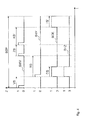
- FIG. 4 shows a further rinse program SSP, which for rinsing items to be washed using water in this order comprises a pre-rinse step VS, a cleaning step RS, an intermediate rinse step ZS and a rinse step KS '.
- a rinse-closing drying step TS ' follows to dry the cleaned items to be washed.
- the rinse program SSP is a rapid rinse program SSP with a shortened running time, whereby the shortening by one compared to the washing program SP of the FIG. 3 modified rinse step KS 'and a shortened drying step TS' is effected.
- FIG. 5 shows a block diagram of another embodiment of a dishwasher according to the invention.
- This has a modified Sorptionsstrockenvorraum 20 '.
- the sorption device 30 is arranged so that it does not flow through the air flow LS, but is flowed around.
- a container 33 is provided, which is connected to the sorption device 30 for exchanging a medium sorbable by the sorption device 30.
- the container 33 is also thermally conductively connected to a condensation surface 35, which is arranged in the washing compartment. However, it could also be arranged in the air guidance system 25, 26, 28.
- Container 33 and sorption device 30 are connected via a valve 36, which is controlled by the sequence control device 19 as a function of the respectively selected washing program.
- FIG. 6 shows a washing program SP 'for the dishwasher 1 of FIG. 5 , It essentially corresponds to the washing program SP of FIG. 2
- the additionally shown curve SVE shows the switching state of the valve 36.
- the valve 36 is opened.
- the medium 34 desorbed by the reversibly dehydratable material 31 passes into the container 33, where it liquefies and thus gives off heat to the condensation surface 35.
- the condensation surface 35 releases at least some of this heat to the water in the washing container 2.
- heat is introduced through the air flow LS in the washing, so that the cold water located there is heated by the cold water supply KH.
- the valve 36 is closed, so that the sorbable medium 34 is enclosed in the container 33.
- the valve 36 is opened again.
- the sorbable medium 34 evaporates, so that the condensation surface 35 is cooled which promotes condensation of water vapor in the purge vessel, resulting in an improved drying effect.
- FIG. 7 shows a quick wash program SSP 'for the dishwasher of the FIG. 5 which essentially corresponds to the rapid rinsing program SSP of FIG. 4 equivalent.
- the switching state SVE of the valve 36 is shown.
- the invention relates according to an advantageous embodiment, a dishwasher, in particular domestic dishwasher, with an adsorption drying system, which with an external hot water connection, in particular hot water solar connection, and a cold water connection, i. a bithermal water connection device.
- an external hot water connection in particular hot water solar connection
- a cold water connection i. a bithermal water connection device.
- the hot water connection is provided for the purchase of hot water from an external hot water supply device, in particular the purchase of warm, inexpensive solar water of a fully or partially operated by a solar thermal system hot water supply system, the other water connection for cold water from the mains. Both water connections can be individually selected via a control of the dishwasher.
- the dishwasher is equipped with an adsorption drying system, whereby the control unit has special programs designed for this purpose. If the customer chooses a special function, the machine can react to it.
- a rinsing program with a normal program running time ie normal program
- hot water from a solar-powered or solar-assisted hot water supply system is used for pre-rinsing and intermediate rinsing.
- this rinsing program for the purpose of cleaning, it is preferable to use cold water from a cold water supply in order to preserve the sorption material, in particular zeolite, of the sorption device. Due to the drying system, no higher temperature is required for rinsing in order to achieve a very good drying effect with normal running time. Therefore, cold water from a cold water supply is used for rinsing.
- a program with a shortened running time can be provided in which hot water from a solar system is used in contrast to the program for the rinse cycle described above. If the user selects this quick program, the result is a clear shortening of the drying time with a constant drying effect compared to the normal program. Because now, in addition, the self-heat drying of the dishes can be used.
Landscapes
- Engineering & Computer Science (AREA)
- Water Supply & Treatment (AREA)
- Washing And Drying Of Tableware (AREA)
Applications Claiming Priority (1)
| Application Number | Priority Date | Filing Date | Title |
|---|---|---|---|
| DE102009029149A DE102009029149A1 (de) | 2009-09-02 | 2009-09-02 | Geschirrspülmaschine sowie zugehöriges Steuerverfahren |
Publications (2)
| Publication Number | Publication Date |
|---|---|
| EP2292132A2 true EP2292132A2 (fr) | 2011-03-09 |
| EP2292132A3 EP2292132A3 (fr) | 2017-01-11 |
Family
ID=43415334
Family Applications (1)
| Application Number | Title | Priority Date | Filing Date |
|---|---|---|---|
| EP10173652.8A Withdrawn EP2292132A3 (fr) | 2009-09-02 | 2010-08-23 | Lave-vaisselle et procédé de commande correspondant |
Country Status (4)
| Country | Link |
|---|---|
| US (1) | US20110048464A1 (fr) |
| EP (1) | EP2292132A3 (fr) |
| CN (1) | CN101999876A (fr) |
| DE (1) | DE102009029149A1 (fr) |
Cited By (5)
| Publication number | Priority date | Publication date | Assignee | Title |
|---|---|---|---|---|
| EP2848181A1 (fr) * | 2013-09-12 | 2015-03-18 | Miele & Cie. KG | Automate de rinçage, notamment automate de nettoyage et/ou désinfection à but industriel |
| EP2848182A1 (fr) * | 2013-09-12 | 2015-03-18 | Miele & Cie. KG | Automate de rinçage, notamment automate de nettoyage et/ou désinfection à but industriel |
| EP2769662B1 (fr) * | 2013-02-20 | 2021-07-21 | Miele & Cie. KG | Lave-vaisselle et procédé de fonctionnement d'un lave-vaisselle |
| EP3932281A1 (fr) * | 2020-06-30 | 2022-01-05 | Arçelik Anonim Sirketi | Lave-vaisselle comprenant un dispositif de chauffage |
| WO2025045821A1 (fr) * | 2023-08-29 | 2025-03-06 | BSH Hausgeräte GmbH | Lave-vaisselle ménager comportant un système de séchage par sorption, et procédé associé pour réaliser un programme de lavage de vaisselle économe en énergie |
Families Citing this family (18)
| Publication number | Priority date | Publication date | Assignee | Title |
|---|---|---|---|---|
| EP2389853A1 (fr) * | 2010-05-24 | 2011-11-30 | Electrolux Home Products Corporation N.V. | Dispositif de séchage par sorption pour lave-vaisselle et procédé correspendant |
| EP2389854B1 (fr) | 2010-05-24 | 2016-08-24 | Electrolux Home Products Corporation N.V. | Dispositif et procédé pour lave-vaisselle |
| EP2740396A1 (fr) * | 2012-12-10 | 2014-06-11 | Candy S.p.A. | Procédé de fonctionnement d'un lave-vaisselle |
| US9433327B2 (en) * | 2013-02-20 | 2016-09-06 | Ecolab Usa Inc. | Global backflow prevention assembly |
| DE102013204003A1 (de) * | 2013-03-08 | 2014-09-11 | BSH Bosch und Siemens Hausgeräte GmbH | Geschirrspülmaschine mit einer Sorptionstrockenvorrichtung und einer Öffnungseinrichtung für ihre Tür |
| CN104905745B (zh) * | 2014-03-10 | 2019-07-23 | 杭州三花研究院有限公司 | 热泵洗碗机及其控制方法 |
| US20160192821A1 (en) * | 2015-01-07 | 2016-07-07 | General Electric Company | Dishwasher appliance having energy recovery features |
| CN107184170A (zh) * | 2016-03-15 | 2017-09-22 | 杭州三花家电热管理系统有限公司 | 洗碗机的加热控制方法 |
| CN106618417A (zh) * | 2016-11-09 | 2017-05-10 | 杭州三花家电热管理系统有限公司 | 洗碗机的控制方法 |
| EP3551027B8 (fr) * | 2016-12-06 | 2021-04-28 | Indelfab S.P.A. In Liquidazione | Machine de séchage de vaisselle ou assimilé et procédé de séchage de vaisselle ou assimilé avec ladite machine |
| WO2018215343A1 (fr) * | 2017-05-23 | 2018-11-29 | Miele & Cie. Kg | Appareil de nettoyage et procédé pour faire fonctionner un appareil de nettoyage |
| CN109998436B (zh) * | 2019-02-25 | 2020-08-18 | 佛山市百斯特电器科技有限公司 | 一种单按键操作的洗碗机及其控制方法 |
| IT201900014313A1 (it) * | 2019-08-07 | 2021-02-07 | Shabosh S R L | Apparato idro-pulitore per stoviglie |
| US12030096B2 (en) | 2019-11-08 | 2024-07-09 | Dr. Kakar Products, Llc | Automatic washer for continuous positive airway pressure equipment |
| CN110840351A (zh) * | 2019-11-11 | 2020-02-28 | 华帝股份有限公司 | 一种适用于洗碗机的水路系统及其控制方法 |
| CN113243867A (zh) * | 2020-02-11 | 2021-08-13 | 青岛海尔洗碗机有限公司 | 一种热泵式洗碗机及其控制方法 |
| CN114027762B (zh) * | 2021-11-09 | 2024-07-26 | 无棣亨立餐具有限公司 | 一种密胺模塑制餐具快速清洗方法及系统 |
| CN115104986A (zh) * | 2022-07-14 | 2022-09-27 | 中万恩科技有限公司 | 基于蓝牙通信的洗碗机控制方法、装置、设备、系统及介质 |
Citations (6)
| Publication number | Priority date | Publication date | Assignee | Title |
|---|---|---|---|---|
| JP2002291681A (ja) * | 2001-03-30 | 2002-10-08 | Tokyo Gas Co Ltd | 食器洗い乾燥機用給湯ユニット及びそれを用いた食器洗い乾燥システム |
| WO2005018409A1 (fr) * | 2003-07-30 | 2005-03-03 | BSH Bosch und Siemens Hausgeräte GmbH | Lave-vaisselle |
| US20050051199A1 (en) * | 2003-09-09 | 2005-03-10 | Drago Joann Kay | Multi-use kitchen appliance |
| CN200987659Y (zh) * | 2004-12-09 | 2007-12-12 | Bsh博施及西门子家用器具有限公司 | 洗碗机 |
| EP1902658A1 (fr) * | 2006-09-19 | 2008-03-26 | Silvano Gaiotto | Dispositif pour le lavage économique et écologique de vêtements ou de vaisselle |
| EP1990588A2 (fr) * | 2007-05-11 | 2008-11-12 | Mecoswiss Mechanische Componenten GmbH & Co. KG | Machine ménagère dotée d'un dispositif de refroidissement |
Family Cites Families (13)
| Publication number | Priority date | Publication date | Assignee | Title |
|---|---|---|---|---|
| US3807636A (en) * | 1972-05-30 | 1974-04-30 | Gen Electric | Water-powered dishwasher |
| US4070204A (en) * | 1976-01-22 | 1978-01-24 | General Electric Company | Low-energy dishwasher |
| DE3023355A1 (de) * | 1980-06-21 | 1982-01-14 | Willi Dipl.-Volksw. 7560 Gaggenau Bauer | Wasserversorgungseinrichtung, insbesondere fuer haushaltsgeraete |
| DE4041108A1 (de) * | 1990-12-21 | 1992-06-25 | Miele & Cie | Verfahren zum betrieb eines programmgesteuerten haushaltgeraetes insbesondere einer geschirrspuelmaschine |
| IT1250377B (it) * | 1991-02-06 | 1995-04-07 | Zanussi Elettrodomestici | Programma di lavaggio per macchina lavatrice automatica |
| JPH10165349A (ja) * | 1996-12-06 | 1998-06-23 | Matsushita Electric Ind Co Ltd | 食器洗浄機 |
| JP2001173044A (ja) * | 1999-12-20 | 2001-06-26 | Osaka Gas Co Ltd | 分岐器具及びそれを用いた食器洗浄機 |
| DE10046347A1 (de) * | 2000-09-19 | 2002-03-28 | Bsh Bosch Siemens Hausgeraete | Wasserzufuhreinrichtung für Haushaltgeräte |
| DE10356787A1 (de) * | 2003-12-04 | 2005-07-07 | BSH Bosch und Siemens Hausgeräte GmbH | Geschirrspülmaschine |
| DE102005058250A1 (de) * | 2004-12-10 | 2006-07-06 | Lg Electronics Inc. | Geschirrspüler und Steuerungsverfahren dafür |
| FR2879430B1 (fr) * | 2004-12-21 | 2008-12-05 | Brandt Ind Sas | Procede de mise en oeuvre de sechage de la vaisselle dans un lave-vaisselle |
| US20060260656A1 (en) * | 2005-05-20 | 2006-11-23 | Dietrich Berner | Commercial dishwasher, in particular glass washer |
| DE102005062481A1 (de) * | 2005-12-27 | 2007-07-05 | BSH Bosch und Siemens Hausgeräte GmbH | Reinigungsprogramm für eine Geschirrspülmaschine mit verkürzter Laufzeit bei konstanter Reinigungsleistung |
-
2009
- 2009-09-02 DE DE102009029149A patent/DE102009029149A1/de not_active Withdrawn
-
2010
- 2010-08-23 EP EP10173652.8A patent/EP2292132A3/fr not_active Withdrawn
- 2010-08-24 US US12/861,847 patent/US20110048464A1/en not_active Abandoned
- 2010-09-02 CN CN2010105200947A patent/CN101999876A/zh active Pending
Patent Citations (6)
| Publication number | Priority date | Publication date | Assignee | Title |
|---|---|---|---|---|
| JP2002291681A (ja) * | 2001-03-30 | 2002-10-08 | Tokyo Gas Co Ltd | 食器洗い乾燥機用給湯ユニット及びそれを用いた食器洗い乾燥システム |
| WO2005018409A1 (fr) * | 2003-07-30 | 2005-03-03 | BSH Bosch und Siemens Hausgeräte GmbH | Lave-vaisselle |
| US20050051199A1 (en) * | 2003-09-09 | 2005-03-10 | Drago Joann Kay | Multi-use kitchen appliance |
| CN200987659Y (zh) * | 2004-12-09 | 2007-12-12 | Bsh博施及西门子家用器具有限公司 | 洗碗机 |
| EP1902658A1 (fr) * | 2006-09-19 | 2008-03-26 | Silvano Gaiotto | Dispositif pour le lavage économique et écologique de vêtements ou de vaisselle |
| EP1990588A2 (fr) * | 2007-05-11 | 2008-11-12 | Mecoswiss Mechanische Componenten GmbH & Co. KG | Machine ménagère dotée d'un dispositif de refroidissement |
Cited By (5)
| Publication number | Priority date | Publication date | Assignee | Title |
|---|---|---|---|---|
| EP2769662B1 (fr) * | 2013-02-20 | 2021-07-21 | Miele & Cie. KG | Lave-vaisselle et procédé de fonctionnement d'un lave-vaisselle |
| EP2848181A1 (fr) * | 2013-09-12 | 2015-03-18 | Miele & Cie. KG | Automate de rinçage, notamment automate de nettoyage et/ou désinfection à but industriel |
| EP2848182A1 (fr) * | 2013-09-12 | 2015-03-18 | Miele & Cie. KG | Automate de rinçage, notamment automate de nettoyage et/ou désinfection à but industriel |
| EP3932281A1 (fr) * | 2020-06-30 | 2022-01-05 | Arçelik Anonim Sirketi | Lave-vaisselle comprenant un dispositif de chauffage |
| WO2025045821A1 (fr) * | 2023-08-29 | 2025-03-06 | BSH Hausgeräte GmbH | Lave-vaisselle ménager comportant un système de séchage par sorption, et procédé associé pour réaliser un programme de lavage de vaisselle économe en énergie |
Also Published As
| Publication number | Publication date |
|---|---|
| DE102009029149A1 (de) | 2011-03-03 |
| US20110048464A1 (en) | 2011-03-03 |
| CN101999876A (zh) | 2011-04-06 |
| EP2292132A3 (fr) | 2017-01-11 |
Similar Documents
| Publication | Publication Date | Title |
|---|---|---|
| EP2292132A2 (fr) | Lave-vaisselle et procédé de commande correspondant | |
| EP1737334B1 (fr) | Methode de lavage d'une lave vaiselle, et lave vaiselle | |
| EP2482702B1 (fr) | Lave-vaisselle doté d'un réservoir pour eau de lavage et procédé associé | |
| EP1696783B1 (fr) | Lave-vaisselle | |
| EP2440107A1 (fr) | Lave-vaisselle doté d'un échangeur thermique et procédé de commande associé | |
| EP2301409B1 (fr) | Lave vaisselle avec élément de sorption et l'introduction de l'air | |
| DE10353774A1 (de) | Geschirrspülmaschine | |
| EP2440104B1 (fr) | Lave-vaisselle doté de deux raccordements en eau et procédé de commande | |
| EP3021729B1 (fr) | Lave-vaisselle comprenant une section de conduite tubulaire d'évacuation intégrée dans un récipient d'eau | |
| DE102013204003A1 (de) | Geschirrspülmaschine mit einer Sorptionstrockenvorrichtung und einer Öffnungseinrichtung für ihre Tür | |
| DE102012207565A1 (de) | Verfahren zum Betreiben einer als Programmautomat ausgebildeten Spülmaschine sowie entsprechende Spülmaschine | |
| WO2015007609A1 (fr) | Lave-vaisselle comprenant une section de conduite tubulaire d'évacuation intégrée dans un récipient d'eau | |
| EP2328453B1 (fr) | Procédé pour faire fonctionner un lave-vaisselle | |
| EP2328455B1 (fr) | Procédé de fonctionnement d'un lave-vaisselle | |
| EP2289388B1 (fr) | Lave-vaisselle doté d'un réservoir à eau pour le séchage par condensation et procédé de remplissage correspondant | |
| DE102010043467B4 (de) | Geschirrspülmaschine, insbesondere Haushaltsgeschirrspülmaschine | |
| DE102020202940A1 (de) | Geschirrspülmaschine mit zumindest einem Trocknungssystem | |
| EP3021728A1 (fr) | Lave-vaisselle comprenant une partie de conduite tubulaire d'évacuation intégrée dans un récipient d'eau | |
| EP2440105B1 (fr) | Lave-vaisselle doté d'un dispositif adoucisseur d'eau et procédé de maintenance associé | |
| EP2352412A2 (fr) | Procédé pour faire fonctionner un lave-vaisselle | |
| EP1651092A1 (fr) | Procede pour faire fonctionner un appareil avec au moins une etape de sous-programme "sechage" | |
| WO2010142561A1 (fr) | Lave-vaisselle doté de deux raccordements en eau et procédé de commande | |
| DE102009026877A1 (de) | Geschirrspülmaschine mit zwei Wasseranschlüssen sowie Steuerungsverfahren | |
| DE102009026878A1 (de) | Geschirrspülmaschine mit automatischer oder manueller Anwahl von Warmwasserbezug sowie Steuerverfahren | |
| DE102009026879A1 (de) | Geschirrspülmaschine mit geräteseitiger Wassereinlasseinrichtung |
Legal Events
| Date | Code | Title | Description |
|---|---|---|---|
| PUAI | Public reference made under article 153(3) epc to a published international application that has entered the european phase |
Free format text: ORIGINAL CODE: 0009012 |
|
| AK | Designated contracting states |
Kind code of ref document: A2 Designated state(s): AL AT BE BG CH CY CZ DE DK EE ES FI FR GB GR HR HU IE IS IT LI LT LU LV MC MK MT NL NO PL PT RO SE SI SK SM TR |
|
| AX | Request for extension of the european patent |
Extension state: BA ME RS |
|
| RAP1 | Party data changed (applicant data changed or rights of an application transferred) |
Owner name: BSH HAUSGERAETE GMBH |
|
| PUAL | Search report despatched |
Free format text: ORIGINAL CODE: 0009013 |
|
| AK | Designated contracting states |
Kind code of ref document: A3 Designated state(s): AL AT BE BG CH CY CZ DE DK EE ES FI FR GB GR HR HU IE IS IT LI LT LU LV MC MK MT NL NO PL PT RO SE SI SK SM TR |
|
| AX | Request for extension of the european patent |
Extension state: BA ME RS |
|
| RIC1 | Information provided on ipc code assigned before grant |
Ipc: A47L 15/00 20060101AFI20161208BHEP Ipc: A47L 15/48 20060101ALI20161208BHEP Ipc: A47L 15/42 20060101ALI20161208BHEP |
|
| STAA | Information on the status of an ep patent application or granted ep patent |
Free format text: STATUS: REQUEST FOR EXAMINATION WAS MADE |
|
| 17P | Request for examination filed |
Effective date: 20170711 |
|
| RBV | Designated contracting states (corrected) |
Designated state(s): AL AT BE BG CH CY CZ DE DK EE ES FI FR GB GR HR HU IE IS IT LI LT LU LV MC MK MT NL NO PL PT RO SE SI SK SM TR |
|
| STAA | Information on the status of an ep patent application or granted ep patent |
Free format text: STATUS: EXAMINATION IS IN PROGRESS |
|
| 17Q | First examination report despatched |
Effective date: 20210416 |
|
| STAA | Information on the status of an ep patent application or granted ep patent |
Free format text: STATUS: THE APPLICATION HAS BEEN WITHDRAWN |
|
| 18W | Application withdrawn |
Effective date: 20210930 |