EP2769662B1 - Lave-vaisselle et procédé de fonctionnement d'un lave-vaisselle - Google Patents
Lave-vaisselle et procédé de fonctionnement d'un lave-vaisselle Download PDFInfo
- Publication number
- EP2769662B1 EP2769662B1 EP14154999.8A EP14154999A EP2769662B1 EP 2769662 B1 EP2769662 B1 EP 2769662B1 EP 14154999 A EP14154999 A EP 14154999A EP 2769662 B1 EP2769662 B1 EP 2769662B1
- Authority
- EP
- European Patent Office
- Prior art keywords
- dishwasher
- cleaning
- desorption
- program
- drying device
- Prior art date
- Legal status (The legal status is an assumption and is not a legal conclusion. Google has not performed a legal analysis and makes no representation as to the accuracy of the status listed.)
- Active
Links
Images


Classifications
-
- A—HUMAN NECESSITIES
- A47—FURNITURE; DOMESTIC ARTICLES OR APPLIANCES; COFFEE MILLS; SPICE MILLS; SUCTION CLEANERS IN GENERAL
- A47L—DOMESTIC WASHING OR CLEANING; SUCTION CLEANERS IN GENERAL
- A47L15/00—Washing or rinsing machines for crockery or tableware
- A47L15/0018—Controlling processes, i.e. processes to control the operation of the machine characterised by the purpose or target of the control
- A47L15/0021—Regulation of operational steps within the washing processes, e.g. optimisation or improvement of operational steps depending from the detergent nature or from the condition of the crockery
- A47L15/0042—Desorption phases of reversibly dehydrogenated drying material, e.g. zeolite in a sorption drying system
-
- F—MECHANICAL ENGINEERING; LIGHTING; HEATING; WEAPONS; BLASTING
- F26—DRYING
- F26B—DRYING SOLID MATERIALS OR OBJECTS BY REMOVING LIQUID THEREFROM
- F26B21/00—Arrangements for supplying or controlling air or other gases for drying solid materials or objects
- F26B21/30—Controlling, e.g. regulating, parameters of gas supply
- F26B21/33—Humidity
- F26B21/331—Humidity by using sorbent or hygroscopic materials, e.g. chemical substances or molecular sieves
-
- A—HUMAN NECESSITIES
- A47—FURNITURE; DOMESTIC ARTICLES OR APPLIANCES; COFFEE MILLS; SPICE MILLS; SUCTION CLEANERS IN GENERAL
- A47L—DOMESTIC WASHING OR CLEANING; SUCTION CLEANERS IN GENERAL
- A47L15/00—Washing or rinsing machines for crockery or tableware
- A47L15/0018—Controlling processes, i.e. processes to control the operation of the machine characterised by the purpose or target of the control
- A47L15/0047—Energy or water consumption, e.g. by saving energy or water
-
- A—HUMAN NECESSITIES
- A47—FURNITURE; DOMESTIC ARTICLES OR APPLIANCES; COFFEE MILLS; SPICE MILLS; SUCTION CLEANERS IN GENERAL
- A47L—DOMESTIC WASHING OR CLEANING; SUCTION CLEANERS IN GENERAL
- A47L15/00—Washing or rinsing machines for crockery or tableware
- A47L15/42—Details
- A47L15/4234—Steam generating arrangements
-
- A—HUMAN NECESSITIES
- A47—FURNITURE; DOMESTIC ARTICLES OR APPLIANCES; COFFEE MILLS; SPICE MILLS; SUCTION CLEANERS IN GENERAL
- A47L—DOMESTIC WASHING OR CLEANING; SUCTION CLEANERS IN GENERAL
- A47L15/00—Washing or rinsing machines for crockery or tableware
- A47L15/42—Details
- A47L15/48—Drying arrangements
- A47L15/481—Drying arrangements by using water absorbent materials, e.g. Zeolith
-
- A—HUMAN NECESSITIES
- A47—FURNITURE; DOMESTIC ARTICLES OR APPLIANCES; COFFEE MILLS; SPICE MILLS; SUCTION CLEANERS IN GENERAL
- A47L—DOMESTIC WASHING OR CLEANING; SUCTION CLEANERS IN GENERAL
- A47L2301/00—Manual input in controlling methods of washing or rinsing machines for crockery or tableware, i.e. information entered by a user
- A47L2301/04—Operation mode, e.g. delicate washing, economy washing, reduced time, sterilizing, water softener regenerating, odor eliminating or service
-
- A—HUMAN NECESSITIES
- A47—FURNITURE; DOMESTIC ARTICLES OR APPLIANCES; COFFEE MILLS; SPICE MILLS; SUCTION CLEANERS IN GENERAL
- A47L—DOMESTIC WASHING OR CLEANING; SUCTION CLEANERS IN GENERAL
- A47L2501/00—Output in controlling method of washing or rinsing machines for crockery or tableware, i.e. quantities or components controlled, or actions performed by the controlling device executing the controlling method
- A47L2501/11—Air heaters
-
- A—HUMAN NECESSITIES
- A47—FURNITURE; DOMESTIC ARTICLES OR APPLIANCES; COFFEE MILLS; SPICE MILLS; SUCTION CLEANERS IN GENERAL
- A47L—DOMESTIC WASHING OR CLEANING; SUCTION CLEANERS IN GENERAL
- A47L2501/00—Output in controlling method of washing or rinsing machines for crockery or tableware, i.e. quantities or components controlled, or actions performed by the controlling device executing the controlling method
- A47L2501/30—Regulation of machine operational steps within the washing process, e.g. performing an additional rinsing phase, shortening or stopping of the drying phase, washing at decreased noise operation conditions
Definitions
- the invention relates to a method for operating a dishwasher which has a sorption drying device.
- the invention also relates to a dishwasher suitable for carrying out the operating method.
- condensation drying of the items to be cleaned is used.
- the washing solution i.e. the water in the dishwasher
- the washing area above and the items to be washed are heated to temperatures between approx. 65 ° C ( Degrees Celsius) and 70 ° C, whereby the water vapor given off by the dishes condenses out on condensation surfaces, usually the inner walls of the wash cabinet, and flows into the wash liquor.
- This process requires a large amount of energy that is released into the environment and cannot be used further in the process.
- Dishwashers with sorption drying devices are known in which air circulating in the washing area is guided and dehumidified by a drying agent, also called sorbent, contained in the sorption drying device.
- Dehumidifying the air means that the items to be washed dry more quickly at lower temperatures, which saves energy in the drying process compared to condensation drying.
- the moisture absorbed by the sorbent during drying is removed from the sorption drying device in a desorption process and released into the washing area and thus returned with the washing liquor.
- the supply of energy in the form of heat is necessary for the desorption process, but the amount of energy supplied is less than the energy saved in the drying process compared to condensation drying. As a result, compared to the condensation drying process, a net energy saving is possible in the sorption drying process.
- the DE 10 2008 043 548 A1 describes a method for operating a dishwasher with a sorption drying device, in which the desorption takes place at an optimal point in time with regard to its efficiency, namely at least partially before or during the first of the program sections, during which the items to be washed are exposed to heated liquid.
- a method for operating a dishwasher with a sorption drying device is known in which parameters such as the air temperature and / or the water inlet temperature are used in order to determine the point in time for carrying out the desorption process.
- the specified method ensures that the most complete possible desorption of the moisture previously absorbed in the sorption drying device is achieved as quickly as possible and with the least possible additional expenditure of energy.
- a method for operating a dishwasher in which the energy used in the desorption process is used as profitably as possible for the quality of the cleaning process carried out.
- Another object is to specify a dishwasher suitable for carrying out the method. This object is achieved by a method for operating a dishwasher and a dishwasher with the features of the respective independent claim.
- a method according to the invention of the type mentioned at the outset is characterized in that a desorption process of the sorption drying device that is suitable for releasing moisture is carried out as a function of a selected cleaning program of the dishwasher. In this way, the moisture given off by the sorption drying device in the form of steam during the desorption process can be used to aid cleaning.
- the sorption drying device is thus advantageously used as a steam generator for cleaning items to be washed.
- the amount of heat supplied to the sorption drying device during the desorption process is selected as a function of the set cleaning program of the dishwasher.
- the amount of heat supplied can be set by specifying the duration and / or the supplied power.
- the amount of heat supplied is also selected as a function of a previously run through cleaning program of the dishwasher. In this way, the amount of moisture contained in the sorption drying device after a previous cleaning program can be taken into account in order to achieve a maximum cleaning effect in the current desorption process.
- a dishwasher according to the invention has a sorption drying device and a control device for controlling program sequences. It is characterized in that the control device is set up to carry out an operating method according to the invention.
- FIG. 1 shows schematically the structure of a dishwasher 1 set up to carry out the method according to the invention.
- the dishwasher 1 is embodied here as a domestic dishwasher, but the invention can also be used in connection with dishwashers for commercial and / or medical use.
- the dishwasher 1 has a washing area 2 in which there are crockery baskets 3 for receiving the items to be cleaned, for example crockery, cookware, cutlery. Furthermore, in the dishwasher 1, spray arms 4 are provided for wetting the items to be washed with a washing liquor 7, that is to say the cleaning liquid in the dishwasher 1.
- the floor of the washing area 2 carries a washing area pot 5 with a liquor heater 8 for heating the washing liquor 7 and a sieve 6 for filtering loosened dirt particles.
- a circulating pump (not shown here) and a drainage pump (also not shown) are present in the wash cabinet 5.
- a sorption drying device 10 is arranged, which usually has a relatively voluminous container with a volume of 2 to 3 liters made of metal, mostly stainless steel.
- the sorption drying device 10 is also referred to as a sorption unit 10 for the sake of simplicity.
- the sorption unit 10 is in direct connection with the washing chamber 2 via an outlet 15.
- the outlet 15 has a hat-shaped cover 16 which prevents washing liquor 7 from entering the sorption unit 10.
- sorbent 11 also called sorbent
- desorption heater 12 which is used to heat the sorbent 11 and thus to expel (desorb) absorbed moisture.
- a fan 13 is used to suck in moist process air 17 in a program section "drying" via an inlet 14 preferably located in the upper area of the washing area 2 and convey it through the sorption unit 10, in which moisture (water vapor) is removed from the Sorbent 11 is adsorbed.
- An exothermic reaction takes place in the sorbent 11, which heats the sorbent 11 to approximately 100 ° C. (degrees Celsius).
- the dehumidified and heated process air 18 passes through the outlet 15 back into the washing area 2 in order to again absorb water vapor there.
- the desorption takes place within a program section “cleaning” by means of the desorption heater 12, which heats the sorbent 11.
- the desorption heater 12 which heats the sorbent 11.
- the moisture bound in the sorbent 11 is conveyed into the washing chamber 2 as water vapor.
- the energy stored in the evacuated water vapor helps to heat the wash liquor 7, the wash cabinet 2 and the wash ware.
- the mineral zeolite for example, which requires a desorption temperature of up to 250 ° C., is used in the sorption unit 10.
- the sorbent 11 is generally arranged in the sorption unit 10 in the form of a loose ball bed.
- a contamination sensor 19 is present in the dishwasher 1, which is located within the washing circuit - in the exemplary embodiment of FIG Figure 1 the contamination sensor 19 is arranged schematically within the wash cabinet 5. With the help of the soiling sensor 19, the amount and in some cases also the type of dirt loosened from the items to be washed by the washing liquor 7 is detected and this information is passed on to a control device (not shown) of the dishwasher 1.
- the Contamination sensor 19 can be designed, for example, as an optically operating turbidity sensor.
- FIG 2 shows schematically the structure of a further embodiment of a sorption unit 10, again with sorbent 11, sorption heater 12 and an inlet 17 and an outlet 15, which is protected by a cover 16 from the entry of wash liquor 7.
- the fan 13 upstream of the inlet 17 (cf. Figure 1 ) switched off and the desorption heater 12 switched on.
- the sorbent 11 is heated and the moisture bound there escapes as water vapor 18 into the washing area 2
- Sorption unit 10 shown is located at the in Figure 2
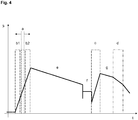
- FIG. 3 and 4th two exemplary embodiments of an operating method according to the invention for a dishwasher are presented.
- the figures each show a time-dependent course of the temperature of the washing liquor in different cleaning phases of a cleaning program.
- the operating methods shown can be used, for example, from the in Figure 1 dishwasher shown, possibly with the in Figure 2 shown sorption unit. They are therefore discussed below with reference to the Figures 1 and 2 and the reference numerals used there.
- Figure 3 shows schematically the dependence of the temperature ⁇ on the time t in a washing program with sorption drying as a first embodiment of an operating method according to the invention.
- the individual phases of the program run through one after the other are also identified by lowercase letters from a to f.
- a desorption process a is carried out in which moisture is expelled from the sorption unit 10.
- the desorption heater 12 is switched on and the liquor heater 8 is switched on during the heating phase b of cleaning.
- the liquor heater 8 heats the washing liquor 7 to the program-specific nominal temperature.
- the heating phase of cleaning b is followed by a holding time of cleaning e, in which the heated washing solution 7 is circulated.
- the rinsing liquor 7 is exchanged.
- the washing solution 7 is changed again.
- the liquor heater 8 heats the rinsing liquor 7 to the final rinse temperature before the final rinse g within a holding time Circulating pump only circulates the wash liquor 7.
- the sorption drying is activated and, by means of the switched-on fan 13, the moisture is removed from the washing area 2 and the items to be washed, passed through the sorbent 11 and stored there.
- the desorption phase has a constant duration, the desorption process usually being operated with a view to a minimal desorption time in order to keep the energy requirement for the desorption as low as possible. This applies in particular to the energy saving programs used as part of standard tests.
- the duration of the desorption process a is extended based on a minimum value or reference value, which is preferably assigned to the energy saving program or label program, with the same power supply by the desorption heater 12, for example if a washing program with a high cleaning temperature - preferably above 55 ° C - is selected by the operator.
- a washing program with a high cleaning temperature is the so-called intensive program, which has a cleaning temperature of 75 ° C, for example.
- the sorption unit 10 is used as a steam generator for cleaning purposes.
- the desorption time in the desorption process a is advantageously a maximum of about ten minutes. However, this method assumes that a sufficient amount of moisture is absorbed in the sorbent 11, which is the case as a rule.
- the absolute humidity entered in the wash cabinet 2 is higher in programs with a high average wash temperature than in wash programs with a low wash temperature.
- the sorbent 11 therefore absorbs more moisture again, for example in an intensive program in the drying phase d, which would be available again in a subsequent intensive program for the longer desorption process a.
- the sorbent 11 is not completely regenerated due to the shorter desorption duration of the desorption process a in the energy-saving program, so that a moisture retentivity from the intensive program in the sorbent 11 remains. This residual amount of moisture is then available later if required, for example in the desorption phase of a subsequent intensive program.
- its intensity can be varied, for example by operating the desorption heater 12 at a higher power.
- Figure 4 shows in an analogous way how Figure 3 a second embodiment of an operating method according to the invention.
- this embodiment in addition to the program-specific adaptation of the duration (or intensity) of the desorption process a, provision is made for this program section to be shifted to the cleaning heating phase.
- the heating phase of cleaning is thus divided into two partial heating phases of cleaning b1, b2, between which the desorption process a is carried out.
- This program adaptation is preferably carried out in the so-called automatic program in which the contamination sensor 19 is queried. Only when the soiling sensor 19 has determined the degree of soiling of the items to be washed, which can take place at the earliest some, for example ten minutes after the start of the heating phase of the cleaning b, can the control device of the dishwasher 1 decide up to what temperature & in the heating phase of the cleaning should be heated. As described in the first exemplary embodiment, the duration of the desorption phase a is then also dependent on the final value of the cleaning temperature. Since the automatic program is used quite frequently in practice, the advantages of the invention are particularly evident here. The desorption time here is advantageously between five and ten minutes.
- the invention is not limited to the two exemplary embodiments mentioned. It makes sense, for example, in programs for sensitive items to be washed, for example in the glass program, to considerably shorten the desorption in the so-called fine program relative to the reference value. Otherwise the released water vapor could promote glass corrosion. In all cases, however, the degree of desorption is determined depending on the cleaning program.
Landscapes
- Engineering & Computer Science (AREA)
- Mechanical Engineering (AREA)
- General Engineering & Computer Science (AREA)
- Washing And Drying Of Tableware (AREA)
- Chemical & Material Sciences (AREA)
- Chemical Kinetics & Catalysis (AREA)
- General Chemical & Material Sciences (AREA)
Claims (7)
- Procédé de fonctionnement d'un lave-vaisselle (1) qui présente un dispositif de séchage par sorption (10),
un processus de désorption (a) du dispositif de séchage par sorption (10) adapté pour évacuer l'humidité étant réalisé en fonction d'un programme de nettoyage sélectionné du lave-vaisselle (1),
caractérisé en ce que
la quantité de chaleur fournie au dispositif de séchage par sorption (10) pendant le processus de désorption (a) est sélectionnée en fonction du programme de nettoyage sélectionné du lave-vaisselle. - Procédé selon la revendication 1, dans lequel la quantité de chaleur fournie est réglée en spécifiant la durée et/ou la puissance fournies.
- Procédé selon l'une des revendications 1 à 2, dans lequel le dispositif de séchage par sorption (10) est utilisé pour nettoyer des articles à laver en tant que générateur de vapeur.
- Procédé selon l'une des revendications 1 à 3, dans lequel le processus de désorption (a) est réalisé au début d'une phase de chauffage de nettoyage (b).
- Procédé selon l'une des revendications 1 à 3, dans lequel le processus de désorption (a) est réalisé entre deux phases partielles de chauffage de nettoyage (b1, b2).
- Procédé selon l'une des revendications 1 à 5, dans lequel la quantité de chaleur fournie au dispositif de séchage par sorption (10) pendant le processus de désorption (a) est également sélectionnée en fonction d'un programme de nettoyage du lave-vaisselle exécuté précédemment.
- Lave-vaisselle (1) comportant un dispositif de séchage par sorption (10) et un dispositif de commande permettant de commander des séquences de programmes dans le lave-vaisselle (1), caractérisé en ce que le dispositif de commande est conçu pour réaliser un procédé selon l'une des revendications 1 à 6.
Priority Applications (1)
| Application Number | Priority Date | Filing Date | Title |
|---|---|---|---|
| PL14154999T PL2769662T3 (pl) | 2013-02-20 | 2014-02-13 | Zmywarka do naczyń i sposób obsługi zmywarki do naczyń |
Applications Claiming Priority (1)
| Application Number | Priority Date | Filing Date | Title |
|---|---|---|---|
| DE102013101673.1A DE102013101673A1 (de) | 2013-02-20 | 2013-02-20 | Geschirrspülmaschine und Verfahren zum Betreiben einer Geschirrspülmaschine |
Publications (2)
| Publication Number | Publication Date |
|---|---|
| EP2769662A1 EP2769662A1 (fr) | 2014-08-27 |
| EP2769662B1 true EP2769662B1 (fr) | 2021-07-21 |
Family
ID=50073052
Family Applications (1)
| Application Number | Title | Priority Date | Filing Date |
|---|---|---|---|
| EP14154999.8A Active EP2769662B1 (fr) | 2013-02-20 | 2014-02-13 | Lave-vaisselle et procédé de fonctionnement d'un lave-vaisselle |
Country Status (5)
| Country | Link |
|---|---|
| US (1) | US9810481B2 (fr) |
| EP (1) | EP2769662B1 (fr) |
| DE (1) | DE102013101673A1 (fr) |
| ES (1) | ES2880815T3 (fr) |
| PL (1) | PL2769662T3 (fr) |
Families Citing this family (2)
| Publication number | Priority date | Publication date | Assignee | Title |
|---|---|---|---|---|
| DE102017208440B4 (de) * | 2017-05-18 | 2019-05-02 | BSH Hausgeräte GmbH | Verfahren zum Betreiben einer Geschirrspülmaschine und Geschirrspülmaschine |
| DE102021207644A1 (de) * | 2021-07-19 | 2023-01-19 | BSH Hausgeräte GmbH | Haushaltsgeschirrspülmaschine mit einem Sorptionstrocknungssystem sowie zugehöriges Verfahren zum Durchführen eines Energiespar- Geschirrspülprogramms |
Citations (4)
| Publication number | Priority date | Publication date | Assignee | Title |
|---|---|---|---|---|
| US5960804A (en) * | 1995-04-12 | 1999-10-05 | Maytag Corporation | Cycle selection method and apparatus |
| EP2292132A2 (fr) * | 2009-09-02 | 2011-03-09 | BSH Bosch und Siemens Hausgeräte GmbH | Lave-vaisselle et procédé de commande correspondant |
| US20110126867A1 (en) * | 2008-07-28 | 2011-06-02 | BSH Bosch und Siemens Hausgeräte GmbH | Dishwasher machine comprising a sorption drying system |
| US20110197926A1 (en) * | 2008-11-07 | 2011-08-18 | BSH Bosch und Siemens Hausgeräte GmbH | Method for operating a dishwasher |
Family Cites Families (4)
| Publication number | Priority date | Publication date | Assignee | Title |
|---|---|---|---|---|
| US6434857B1 (en) * | 2000-07-05 | 2002-08-20 | Smartclean Jv | Combination closed-circuit washer and drier |
| DE102008038504A1 (de) | 2008-08-20 | 2010-02-25 | BSH Bosch und Siemens Hausgeräte GmbH | Geschirrspülmaschine mit Sorptionstrocknungsvorrichtung in Unterbaugruppe |
| EP2326231A1 (fr) * | 2008-07-28 | 2011-06-01 | BSH Bosch und Siemens Hausgeräte GmbH | Lave-vaisselle comprenant un dispositif de séchage par sorption dans un sous-module |
| DE102008043576A1 (de) | 2008-11-07 | 2010-05-12 | BSH Bosch und Siemens Hausgeräte GmbH | Verfahren zum Betreiben einer Geschirrspülmaschine |
-
2013
- 2013-02-20 DE DE102013101673.1A patent/DE102013101673A1/de not_active Withdrawn
-
2014
- 2014-02-13 PL PL14154999T patent/PL2769662T3/pl unknown
- 2014-02-13 ES ES14154999T patent/ES2880815T3/es active Active
- 2014-02-13 EP EP14154999.8A patent/EP2769662B1/fr active Active
- 2014-02-17 US US14/181,752 patent/US9810481B2/en active Active
Patent Citations (4)
| Publication number | Priority date | Publication date | Assignee | Title |
|---|---|---|---|---|
| US5960804A (en) * | 1995-04-12 | 1999-10-05 | Maytag Corporation | Cycle selection method and apparatus |
| US20110126867A1 (en) * | 2008-07-28 | 2011-06-02 | BSH Bosch und Siemens Hausgeräte GmbH | Dishwasher machine comprising a sorption drying system |
| US20110197926A1 (en) * | 2008-11-07 | 2011-08-18 | BSH Bosch und Siemens Hausgeräte GmbH | Method for operating a dishwasher |
| EP2292132A2 (fr) * | 2009-09-02 | 2011-03-09 | BSH Bosch und Siemens Hausgeräte GmbH | Lave-vaisselle et procédé de commande correspondant |
Also Published As
| Publication number | Publication date |
|---|---|
| PL2769662T3 (pl) | 2021-12-06 |
| US9810481B2 (en) | 2017-11-07 |
| US20140230268A1 (en) | 2014-08-21 |
| DE102013101673A1 (de) | 2014-08-21 |
| ES2880815T3 (es) | 2021-11-25 |
| EP2769662A1 (fr) | 2014-08-27 |
Similar Documents
| Publication | Publication Date | Title |
|---|---|---|
| DE102012207565B4 (de) | Verfahren zum Betreiben einer als Programmautomat ausgebildeten Spülmaschine sowie entsprechende Spülmaschine | |
| EP2301409B1 (fr) | Lave vaisselle avec élément de sorption et l'introduction de l'air | |
| EP2323533B1 (fr) | Procédé de lavage pour un appareil ménager à circulation d'eau, en particulier pour un lave-vaisselle | |
| DE10356786A1 (de) | Verfahren zum Trocknen in einem Haushaltgerät | |
| DE102004060947A1 (de) | Haushalts-Geschirrspülmaschine und Verfahren zum Betreiben derselben | |
| EP2328455B1 (fr) | Procédé de fonctionnement d'un lave-vaisselle | |
| EP2352411B1 (fr) | Procédé pour faire fonctionner un lave-vaisselle | |
| EP2328453B1 (fr) | Procédé pour faire fonctionner un lave-vaisselle | |
| WO2005015103A1 (fr) | Procede pour faire fonctionner un appareil ayant au moins une partie de programme 'sechage' | |
| EP2326230B1 (fr) | Procédé de rinçage pour un appareil ménager avec circuit d'eau | |
| EP2769662B1 (fr) | Lave-vaisselle et procédé de fonctionnement d'un lave-vaisselle | |
| EP2326234B1 (fr) | Procédé de fonctionnement d'un lave-vaisselle | |
| EP2868251B1 (fr) | Lave-vaisselle à démarrage différé | |
| DE102008043576A1 (de) | Verfahren zum Betreiben einer Geschirrspülmaschine | |
| EP2352410B1 (fr) | Lave-vaisselle et procédé pour chauffer le liquide | |
| DE102015206331A1 (de) | Als Programmautomat ausgeführte gewerbliche Spülmaschine sowie Verfahren zum Betreiben einer solchen Spülmaschine | |
| EP2618712B1 (fr) | Lave-vaisselle, en particulier lave-vaisselle ménager | |
| EP2848182B1 (fr) | Automate de rinçage, notamment automate de nettoyage et/ou désinfection à but industriel | |
| EP3087896B1 (fr) | Procede de rinçage de vaisselle | |
| EP2848181B1 (fr) | Automate de rinçage, notamment automate de nettoyage et/ou désinfection à but industriel | |
| DE102008040771A1 (de) | Verfahren zum Betreiben eines wasserführenden Haushaltsgeräts | |
| EP2352412A2 (fr) | Procédé pour faire fonctionner un lave-vaisselle | |
| EP1651092A1 (fr) | Procede pour faire fonctionner un appareil avec au moins une etape de sous-programme "sechage" | |
| EP2352414B1 (fr) | Procédé de fonctionnement d'un lave-vaisselle |
Legal Events
| Date | Code | Title | Description |
|---|---|---|---|
| PUAI | Public reference made under article 153(3) epc to a published international application that has entered the european phase |
Free format text: ORIGINAL CODE: 0009012 |
|
| 17P | Request for examination filed |
Effective date: 20140213 |
|
| AK | Designated contracting states |
Kind code of ref document: A1 Designated state(s): AL AT BE BG CH CY CZ DE DK EE ES FI FR GB GR HR HU IE IS IT LI LT LU LV MC MK MT NL NO PL PT RO RS SE SI SK SM TR |
|
| AX | Request for extension of the european patent |
Extension state: BA ME |
|
| R17P | Request for examination filed (corrected) |
Effective date: 20150227 |
|
| RBV | Designated contracting states (corrected) |
Designated state(s): AL AT BE BG CH CY CZ DE DK EE ES FI FR GB GR HR HU IE IS IT LI LT LU LV MC MK MT NL NO PL PT RO RS SE SI SK SM TR |
|
| GRAP | Despatch of communication of intention to grant a patent |
Free format text: ORIGINAL CODE: EPIDOSNIGR1 |
|
| STAA | Information on the status of an ep patent application or granted ep patent |
Free format text: STATUS: GRANT OF PATENT IS INTENDED |
|
| INTG | Intention to grant announced |
Effective date: 20210423 |
|
| GRAS | Grant fee paid |
Free format text: ORIGINAL CODE: EPIDOSNIGR3 |
|
| GRAA | (expected) grant |
Free format text: ORIGINAL CODE: 0009210 |
|
| STAA | Information on the status of an ep patent application or granted ep patent |
Free format text: STATUS: THE PATENT HAS BEEN GRANTED |
|
| AK | Designated contracting states |
Kind code of ref document: B1 Designated state(s): AL AT BE BG CH CY CZ DE DK EE ES FI FR GB GR HR HU IE IS IT LI LT LU LV MC MK MT NL NO PL PT RO RS SE SI SK SM TR |
|
| REG | Reference to a national code |
Ref country code: GB Ref legal event code: FG4D Free format text: NOT ENGLISH |
|
| REG | Reference to a national code |
Ref country code: CH Ref legal event code: EP |
|
| REG | Reference to a national code |
Ref country code: DE Ref legal event code: R096 Ref document number: 502014015752 Country of ref document: DE |
|
| REG | Reference to a national code |
Ref country code: AT Ref legal event code: REF Ref document number: 1411814 Country of ref document: AT Kind code of ref document: T Effective date: 20210815 |
|
| REG | Reference to a national code |
Ref country code: IE Ref legal event code: FG4D Free format text: LANGUAGE OF EP DOCUMENT: GERMAN |
|
| REG | Reference to a national code |
Ref country code: LT Ref legal event code: MG9D |
|
| REG | Reference to a national code |
Ref country code: NL Ref legal event code: MP Effective date: 20210721 |
|
| REG | Reference to a national code |
Ref country code: ES Ref legal event code: FG2A Ref document number: 2880815 Country of ref document: ES Kind code of ref document: T3 Effective date: 20211125 |
|
| PG25 | Lapsed in a contracting state [announced via postgrant information from national office to epo] |
Ref country code: FI Free format text: LAPSE BECAUSE OF FAILURE TO SUBMIT A TRANSLATION OF THE DESCRIPTION OR TO PAY THE FEE WITHIN THE PRESCRIBED TIME-LIMIT Effective date: 20210721 Ref country code: NO Free format text: LAPSE BECAUSE OF FAILURE TO SUBMIT A TRANSLATION OF THE DESCRIPTION OR TO PAY THE FEE WITHIN THE PRESCRIBED TIME-LIMIT Effective date: 20211021 Ref country code: PT Free format text: LAPSE BECAUSE OF FAILURE TO SUBMIT A TRANSLATION OF THE DESCRIPTION OR TO PAY THE FEE WITHIN THE PRESCRIBED TIME-LIMIT Effective date: 20211122 Ref country code: NL Free format text: LAPSE BECAUSE OF FAILURE TO SUBMIT A TRANSLATION OF THE DESCRIPTION OR TO PAY THE FEE WITHIN THE PRESCRIBED TIME-LIMIT Effective date: 20210721 Ref country code: BG Free format text: LAPSE BECAUSE OF FAILURE TO SUBMIT A TRANSLATION OF THE DESCRIPTION OR TO PAY THE FEE WITHIN THE PRESCRIBED TIME-LIMIT Effective date: 20211021 Ref country code: LT Free format text: LAPSE BECAUSE OF FAILURE TO SUBMIT A TRANSLATION OF THE DESCRIPTION OR TO PAY THE FEE WITHIN THE PRESCRIBED TIME-LIMIT Effective date: 20210721 Ref country code: SE Free format text: LAPSE BECAUSE OF FAILURE TO SUBMIT A TRANSLATION OF THE DESCRIPTION OR TO PAY THE FEE WITHIN THE PRESCRIBED TIME-LIMIT Effective date: 20210721 Ref country code: RS Free format text: LAPSE BECAUSE OF FAILURE TO SUBMIT A TRANSLATION OF THE DESCRIPTION OR TO PAY THE FEE WITHIN THE PRESCRIBED TIME-LIMIT Effective date: 20210721 Ref country code: HR Free format text: LAPSE BECAUSE OF FAILURE TO SUBMIT A TRANSLATION OF THE DESCRIPTION OR TO PAY THE FEE WITHIN THE PRESCRIBED TIME-LIMIT Effective date: 20210721 |
|
| PG25 | Lapsed in a contracting state [announced via postgrant information from national office to epo] |
Ref country code: LV Free format text: LAPSE BECAUSE OF FAILURE TO SUBMIT A TRANSLATION OF THE DESCRIPTION OR TO PAY THE FEE WITHIN THE PRESCRIBED TIME-LIMIT Effective date: 20210721 Ref country code: GR Free format text: LAPSE BECAUSE OF FAILURE TO SUBMIT A TRANSLATION OF THE DESCRIPTION OR TO PAY THE FEE WITHIN THE PRESCRIBED TIME-LIMIT Effective date: 20211022 |
|
| REG | Reference to a national code |
Ref country code: DE Ref legal event code: R097 Ref document number: 502014015752 Country of ref document: DE |
|
| PG25 | Lapsed in a contracting state [announced via postgrant information from national office to epo] |
Ref country code: DK Free format text: LAPSE BECAUSE OF FAILURE TO SUBMIT A TRANSLATION OF THE DESCRIPTION OR TO PAY THE FEE WITHIN THE PRESCRIBED TIME-LIMIT Effective date: 20210721 |
|
| PLBE | No opposition filed within time limit |
Free format text: ORIGINAL CODE: 0009261 |
|
| STAA | Information on the status of an ep patent application or granted ep patent |
Free format text: STATUS: NO OPPOSITION FILED WITHIN TIME LIMIT |
|
| PG25 | Lapsed in a contracting state [announced via postgrant information from national office to epo] |
Ref country code: SM Free format text: LAPSE BECAUSE OF FAILURE TO SUBMIT A TRANSLATION OF THE DESCRIPTION OR TO PAY THE FEE WITHIN THE PRESCRIBED TIME-LIMIT Effective date: 20210721 Ref country code: SK Free format text: LAPSE BECAUSE OF FAILURE TO SUBMIT A TRANSLATION OF THE DESCRIPTION OR TO PAY THE FEE WITHIN THE PRESCRIBED TIME-LIMIT Effective date: 20210721 Ref country code: RO Free format text: LAPSE BECAUSE OF FAILURE TO SUBMIT A TRANSLATION OF THE DESCRIPTION OR TO PAY THE FEE WITHIN THE PRESCRIBED TIME-LIMIT Effective date: 20210721 Ref country code: EE Free format text: LAPSE BECAUSE OF FAILURE TO SUBMIT A TRANSLATION OF THE DESCRIPTION OR TO PAY THE FEE WITHIN THE PRESCRIBED TIME-LIMIT Effective date: 20210721 Ref country code: CZ Free format text: LAPSE BECAUSE OF FAILURE TO SUBMIT A TRANSLATION OF THE DESCRIPTION OR TO PAY THE FEE WITHIN THE PRESCRIBED TIME-LIMIT Effective date: 20210721 Ref country code: AL Free format text: LAPSE BECAUSE OF FAILURE TO SUBMIT A TRANSLATION OF THE DESCRIPTION OR TO PAY THE FEE WITHIN THE PRESCRIBED TIME-LIMIT Effective date: 20210721 |
|
| PGFP | Annual fee paid to national office [announced via postgrant information from national office to epo] |
Ref country code: ES Payment date: 20220311 Year of fee payment: 9 |
|
| 26N | No opposition filed |
Effective date: 20220422 |
|
| PG25 | Lapsed in a contracting state [announced via postgrant information from national office to epo] |
Ref country code: MC Free format text: LAPSE BECAUSE OF FAILURE TO SUBMIT A TRANSLATION OF THE DESCRIPTION OR TO PAY THE FEE WITHIN THE PRESCRIBED TIME-LIMIT Effective date: 20210721 |
|
| REG | Reference to a national code |
Ref country code: CH Ref legal event code: PL |
|
| REG | Reference to a national code |
Ref country code: BE Ref legal event code: MM Effective date: 20220228 |
|
| PG25 | Lapsed in a contracting state [announced via postgrant information from national office to epo] |
Ref country code: LU Free format text: LAPSE BECAUSE OF NON-PAYMENT OF DUE FEES Effective date: 20220213 |
|
| PG25 | Lapsed in a contracting state [announced via postgrant information from national office to epo] |
Ref country code: LI Free format text: LAPSE BECAUSE OF NON-PAYMENT OF DUE FEES Effective date: 20220228 Ref country code: IE Free format text: LAPSE BECAUSE OF NON-PAYMENT OF DUE FEES Effective date: 20220213 Ref country code: CH Free format text: LAPSE BECAUSE OF NON-PAYMENT OF DUE FEES Effective date: 20220228 |
|
| PG25 | Lapsed in a contracting state [announced via postgrant information from national office to epo] |
Ref country code: BE Free format text: LAPSE BECAUSE OF NON-PAYMENT OF DUE FEES Effective date: 20220228 |
|
| REG | Reference to a national code |
Ref country code: AT Ref legal event code: MM01 Ref document number: 1411814 Country of ref document: AT Kind code of ref document: T Effective date: 20220213 |
|
| PG25 | Lapsed in a contracting state [announced via postgrant information from national office to epo] |
Ref country code: AT Free format text: LAPSE BECAUSE OF NON-PAYMENT OF DUE FEES Effective date: 20220213 |
|
| PGFP | Annual fee paid to national office [announced via postgrant information from national office to epo] |
Ref country code: TR Payment date: 20230201 Year of fee payment: 10 Ref country code: PL Payment date: 20230105 Year of fee payment: 10 Ref country code: IT Payment date: 20230220 Year of fee payment: 10 |
|
| P01 | Opt-out of the competence of the unified patent court (upc) registered |
Effective date: 20230529 |
|
| REG | Reference to a national code |
Ref country code: DE Ref legal event code: R084 Ref document number: 502014015752 Country of ref document: DE |
|
| PG25 | Lapsed in a contracting state [announced via postgrant information from national office to epo] |
Ref country code: HU Free format text: LAPSE BECAUSE OF FAILURE TO SUBMIT A TRANSLATION OF THE DESCRIPTION OR TO PAY THE FEE WITHIN THE PRESCRIBED TIME-LIMIT; INVALID AB INITIO Effective date: 20140213 |
|
| REG | Reference to a national code |
Ref country code: ES Ref legal event code: FD2A Effective date: 20240405 |
|
| PG25 | Lapsed in a contracting state [announced via postgrant information from national office to epo] |
Ref country code: ES Free format text: LAPSE BECAUSE OF NON-PAYMENT OF DUE FEES Effective date: 20230214 |
|
| PG25 | Lapsed in a contracting state [announced via postgrant information from national office to epo] |
Ref country code: MK Free format text: LAPSE BECAUSE OF FAILURE TO SUBMIT A TRANSLATION OF THE DESCRIPTION OR TO PAY THE FEE WITHIN THE PRESCRIBED TIME-LIMIT Effective date: 20210721 Ref country code: ES Free format text: LAPSE BECAUSE OF NON-PAYMENT OF DUE FEES Effective date: 20230214 Ref country code: CY Free format text: LAPSE BECAUSE OF FAILURE TO SUBMIT A TRANSLATION OF THE DESCRIPTION OR TO PAY THE FEE WITHIN THE PRESCRIBED TIME-LIMIT Effective date: 20210721 |
|
| PG25 | Lapsed in a contracting state [announced via postgrant information from national office to epo] |
Ref country code: MT Free format text: LAPSE BECAUSE OF FAILURE TO SUBMIT A TRANSLATION OF THE DESCRIPTION OR TO PAY THE FEE WITHIN THE PRESCRIBED TIME-LIMIT Effective date: 20210721 |
|
| PG25 | Lapsed in a contracting state [announced via postgrant information from national office to epo] |
Ref country code: IT Free format text: LAPSE BECAUSE OF NON-PAYMENT OF DUE FEES Effective date: 20240213 |
|
| PG25 | Lapsed in a contracting state [announced via postgrant information from national office to epo] |
Ref country code: PL Free format text: LAPSE BECAUSE OF NON-PAYMENT OF DUE FEES Effective date: 20240213 |
|
| PGFP | Annual fee paid to national office [announced via postgrant information from national office to epo] |
Ref country code: GB Payment date: 20260223 Year of fee payment: 13 |
|
| PGFP | Annual fee paid to national office [announced via postgrant information from national office to epo] |
Ref country code: DE Payment date: 20260228 Year of fee payment: 13 |
|
| PGFP | Annual fee paid to national office [announced via postgrant information from national office to epo] |
Ref country code: FR Payment date: 20260224 Year of fee payment: 13 |