EP2292201A1 - Absorbierender artikel und herstellungsverfahren dafür - Google Patents
Absorbierender artikel und herstellungsverfahren dafür Download PDFInfo
- Publication number
- EP2292201A1 EP2292201A1 EP09770186A EP09770186A EP2292201A1 EP 2292201 A1 EP2292201 A1 EP 2292201A1 EP 09770186 A EP09770186 A EP 09770186A EP 09770186 A EP09770186 A EP 09770186A EP 2292201 A1 EP2292201 A1 EP 2292201A1
- Authority
- EP
- European Patent Office
- Prior art keywords
- sheet
- absorbent article
- adhesive
- water
- decomposable
- Prior art date
- Legal status (The legal status is an assumption and is not a legal conclusion. Google has not performed a legal analysis and makes no representation as to the accuracy of the status listed.)
- Withdrawn
Links
Images




Classifications
-
- A—HUMAN NECESSITIES
- A61—MEDICAL OR VETERINARY SCIENCE; HYGIENE
- A61F—FILTERS IMPLANTABLE INTO BLOOD VESSELS; PROSTHESES; DEVICES PROVIDING PATENCY TO, OR PREVENTING COLLAPSING OF, TUBULAR STRUCTURES OF THE BODY, e.g. STENTS; ORTHOPAEDIC, NURSING OR CONTRACEPTIVE DEVICES; FOMENTATION; TREATMENT OR PROTECTION OF EYES OR EARS; BANDAGES, DRESSINGS OR ABSORBENT PADS; FIRST-AID KITS
- A61F13/00—Bandages or dressings; Absorbent pads
- A61F13/15—Absorbent pads, e.g. sanitary towels, swabs or tampons for external or internal application to the body; Supporting or fastening means therefor; Tampon applicators
- A61F13/15203—Properties of the article, e.g. stiffness or absorbency
- A61F13/15211—Properties of the article, e.g. stiffness or absorbency soluble or disintegratable in liquid
-
- A—HUMAN NECESSITIES
- A61—MEDICAL OR VETERINARY SCIENCE; HYGIENE
- A61F—FILTERS IMPLANTABLE INTO BLOOD VESSELS; PROSTHESES; DEVICES PROVIDING PATENCY TO, OR PREVENTING COLLAPSING OF, TUBULAR STRUCTURES OF THE BODY, e.g. STENTS; ORTHOPAEDIC, NURSING OR CONTRACEPTIVE DEVICES; FOMENTATION; TREATMENT OR PROTECTION OF EYES OR EARS; BANDAGES, DRESSINGS OR ABSORBENT PADS; FIRST-AID KITS
- A61F13/00—Bandages or dressings; Absorbent pads
- A61F13/15—Absorbent pads, e.g. sanitary towels, swabs or tampons for external or internal application to the body; Supporting or fastening means therefor; Tampon applicators
- A61F13/15577—Apparatus or processes for manufacturing
- A61F13/15804—Plant, e.g. involving several steps
-
- A—HUMAN NECESSITIES
- A61—MEDICAL OR VETERINARY SCIENCE; HYGIENE
- A61F—FILTERS IMPLANTABLE INTO BLOOD VESSELS; PROSTHESES; DEVICES PROVIDING PATENCY TO, OR PREVENTING COLLAPSING OF, TUBULAR STRUCTURES OF THE BODY, e.g. STENTS; ORTHOPAEDIC, NURSING OR CONTRACEPTIVE DEVICES; FOMENTATION; TREATMENT OR PROTECTION OF EYES OR EARS; BANDAGES, DRESSINGS OR ABSORBENT PADS; FIRST-AID KITS
- A61F13/00—Bandages or dressings; Absorbent pads
- A61F13/15—Absorbent pads, e.g. sanitary towels, swabs or tampons for external or internal application to the body; Supporting or fastening means therefor; Tampon applicators
- A61F13/51—Absorbent pads, e.g. sanitary towels, swabs or tampons for external or internal application to the body; Supporting or fastening means therefor; Tampon applicators characterised by the outer layers of the pads
- A61F13/514—Backsheet, i.e. the impermeable cover or layer furthest from the skin
- A61F13/51456—Backsheet, i.e. the impermeable cover or layer furthest from the skin characterised by its properties
-
- A—HUMAN NECESSITIES
- A61—MEDICAL OR VETERINARY SCIENCE; HYGIENE
- A61F—FILTERS IMPLANTABLE INTO BLOOD VESSELS; PROSTHESES; DEVICES PROVIDING PATENCY TO, OR PREVENTING COLLAPSING OF, TUBULAR STRUCTURES OF THE BODY, e.g. STENTS; ORTHOPAEDIC, NURSING OR CONTRACEPTIVE DEVICES; FOMENTATION; TREATMENT OR PROTECTION OF EYES OR EARS; BANDAGES, DRESSINGS OR ABSORBENT PADS; FIRST-AID KITS
- A61F13/00—Bandages or dressings; Absorbent pads
- A61F13/15—Absorbent pads, e.g. sanitary towels, swabs or tampons for external or internal application to the body; Supporting or fastening means therefor; Tampon applicators
- A61F13/51—Absorbent pads, e.g. sanitary towels, swabs or tampons for external or internal application to the body; Supporting or fastening means therefor; Tampon applicators characterised by the outer layers of the pads
- A61F13/514—Backsheet, i.e. the impermeable cover or layer furthest from the skin
- A61F13/51474—Backsheet, i.e. the impermeable cover or layer furthest from the skin characterised by its structure
- A61F13/51478—Backsheet, i.e. the impermeable cover or layer furthest from the skin characterised by its structure being a laminate, e.g. multi-layered or with several layers
-
- A—HUMAN NECESSITIES
- A61—MEDICAL OR VETERINARY SCIENCE; HYGIENE
- A61F—FILTERS IMPLANTABLE INTO BLOOD VESSELS; PROSTHESES; DEVICES PROVIDING PATENCY TO, OR PREVENTING COLLAPSING OF, TUBULAR STRUCTURES OF THE BODY, e.g. STENTS; ORTHOPAEDIC, NURSING OR CONTRACEPTIVE DEVICES; FOMENTATION; TREATMENT OR PROTECTION OF EYES OR EARS; BANDAGES, DRESSINGS OR ABSORBENT PADS; FIRST-AID KITS
- A61F13/00—Bandages or dressings; Absorbent pads
- A61F13/15—Absorbent pads, e.g. sanitary towels, swabs or tampons for external or internal application to the body; Supporting or fastening means therefor; Tampon applicators
- A61F13/15203—Properties of the article, e.g. stiffness or absorbency
- A61F13/15211—Properties of the article, e.g. stiffness or absorbency soluble or disintegratable in liquid
- A61F2013/15219—Properties of the article, e.g. stiffness or absorbency soluble or disintegratable in liquid by mechanical separation of water resistant parts
-
- Y—GENERAL TAGGING OF NEW TECHNOLOGICAL DEVELOPMENTS; GENERAL TAGGING OF CROSS-SECTIONAL TECHNOLOGIES SPANNING OVER SEVERAL SECTIONS OF THE IPC; TECHNICAL SUBJECTS COVERED BY FORMER USPC CROSS-REFERENCE ART COLLECTIONS [XRACs] AND DIGESTS
- Y10—TECHNICAL SUBJECTS COVERED BY FORMER USPC
- Y10T—TECHNICAL SUBJECTS COVERED BY FORMER US CLASSIFICATION
- Y10T156/00—Adhesive bonding and miscellaneous chemical manufacture
- Y10T156/10—Methods of surface bonding and/or assembly therefor
Definitions
- the present invention relates to an absorbent article including: a water-decomposable top sheet, a water-decomposable back sheet; and a water-decomposable absorber placed between the top sheet and the back sheet, and to a method of manufacturing such an absorbent article.
- Japanese Patent Literature #1 an absorbent article has been known in which a fastening piece for fastening the absorbent article to an undergarment is formed to protrude from both lateral sides of the main body.
- a wearer When putting on the absorbent article, a wearer fastens the absorbent article to his/her undergarment by winding the fastening piece around the crotch of the undergarment.
- the fastening piece is provided with a frangible portion for making the fastening piece easy to break, in order to facilitate removal of the absorbent article from the undergarment after use.
- the absorbent article is formed by water-decomposable materials so that the absorbent article can be dispersible at a higher speed in a drainage pipe or in a septic tank.
- the foregoing absorbent article relies solely on the fastening piece as means for fastening the absorbent article to an undergarment. Moreover, a region where the absorbent article is attached to the undergarment is located on a surface of the crotch of the undergarment to be in contact with wearer's clothes. Hence, the absorbent article has a problem that the absorbent article is liable to be separated away from the crotch as the wearer moves, and thus to be displaced from the undergarment.
- the present invention has therefore been made in consideration of the foregoing problems, and the present invention seeks to provide an absorbent article that has an improved fastening capability to an undergarment, and that is dispersible at a higher speed in a drainage pipe or in a septic tank, and to provide a method of manufacturing such an absorbent article.
- a first aspect of the present invention is summarized as an absorbent article including: a water-decomposable top sheet; a water-decomposable back sheet; and a water-decomposable absorber placed between the top sheet and the back sheet.
- the back sheet is formed of multiple sheet pieces each being smaller in size than a main body of the absorbent article, and each sheet piece at least partially overlaps with adjacent one or more of the sheet pieces, and an adhesive is applied to each overlapping region where adjacent two of the sheet pieces overlap each other.
- a second aspect of the present invention is summarized as a method of manufacturing an absorbent article that includes: a water-decomposable top sheet; a water-decomposable back sheet; and a water-decomposable absorber placed between the top sheet and the back sheet.
- the method of manufacturing an absorbent article includes the steps of: continuously conveying multiple continua of back sheets on a back sheet line; placing the continua of back sheets to extend in a moving direction of the back sheet line so that each continuum of back sheets can at least partially overlap adjacent one or more of the continua of back sheets; and applying an adhesive to each overlapping region where adjacent two of the continua of back sheets overlap each other.
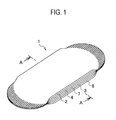
- Fig. 1 is a perspective view of an absorbent article 1 according to this embodiment viewed from the top surface thereof (from a surface to be in contact with a wearer's skin).
- a party-liner is described as a representative example of the absorbent article 1 according to the present invention.
- the present invention is not limited to this, but is applicable to an incontinence pad, a diaper, a sanitary napkin or the like.
- the absorbent article 1 has a water-decomposable top sheet 2, a water-decomposable back sheet 3 and a water-decomposable absorber 4 placed between the top sheet 2 and the back sheet 3.
- a peeling paper 6 for maintaining adhesive properties of an adhesive 5 is provided on the back side of the absorbent article 1, or more specifically, on the back side (a surface to be in contact with the wearer's undergarment) of the back sheet 3.
- the wearer exposes the adhesive 5 on the back side of the back sheet 3 by peeling off the peeling paper 6, and then attaches the absorbent article 1 to the crotch of his/her undergarment by bonding the absorbent article 1 thereto with the adhesive 5 thus exposed.
- a waterproof paper 7 is provided between the absorber 4 and the back sheet 3, in this embodiment.
- the waterproof paper 7 need not necessarily be provided. Accordingly, the waterproof paper 7 maybe appropriately provided in accordance with a performance required for the absorbent article 1.
- top sheet 2 and the absorber 4 are joined together with a water-soluble adhesive 10a
- the absorber 4 and the waterproof paper 7 are joined together with a water-soluble adhesive 10b.
- the top sheet 2 is liquid permeable, hydrophilic and non-irritating to the wearer's skin.
- the top sheet 2 may be made solely of a water-decomposable non-woven fabric, or made of a composite material including a water-decomposable non-woven fabric.
- the top sheet 2 While the wearer wears the absorbent article 1, the top sheet 2 might brush against the wearer's skin. This causes fibers of the top sheet 2 to fall out, and might eventually cause the top sheet 2 to wear out.
- the top sheet 2 may be alternatively made of a material based mainly on cellulose fibers, which are hydrophilic and, if contained in a sheet, increase the surface strength thereof.
- the top sheet 2 may be made of a wet spunlaced non-woven fabric whose mass per unit area is adjusted to 40 g/m 2 .
- This non-woven fabric may contain unbeaten pulp (for example, 30 mass%), split microfibers (for example, 20 mass%), and rayon, preferably having a fineness of 1.1 dtex and preferably having a fiber length of 9 mm.
- the absorber 4 is made of a liquid-retainable material such as water-decomposable non-woven fabric, water-decomposable air-laid pulp or water-decomposable paper.
- the absorber 4 may be made of water-decomposable air-laid pulp.
- This pulp may have a mass per unit area which is adjusted to 70 g/m 2 , and may contain pulp (for example, 80 mass%) and a water-decomposable binder (for example, 20 mass%).
- the back sheet 3 is designed to be broken into pieces and dispersed by the flow and pressure of water in a flush toilet or a septic tank when flushed in a toilet.
- the back sheet 3 consists of multiple sheet pieces 3A to 3C each smaller than the main body of the absorbent article 1.
- Each of the sheet pieces 3A to 3C at least partially overlaps adjacent one or more of the sheet pieces 3A to 3C.
- the sheet pieces 3A and 3B may overlap each other, and the sheet pieces 3B and 3C may overlap each other, as shown in Figs. 4 and 5 .
- Figs. 4 and 5 are each a cross-sectional view of the absorbent article 1 taken along the B-B' line in Fig. 3 .
- multiple sheet pieces 3A to 3C overlap in different manners.
- any one of the overlapping shown in Figs. 4 and 5 is applied.
- the adhesive 5 is applied to each overlapping region where adjacent two of the sheet pieces 3A to 3C overlap each other.
- the adhesive 5 is applied to an overlapping region 30x where the sheet pieces 3A and 3B overlap each other, as well as to an overlapping region 30y where the sheet pieces 3B and 3C overlap each other.
- the overlapping regions 30x and 30y are arranged to extend in the longitudinal direction of the absorbent article 1.
- the overlapping regions 30x and 30y are portions in which a part of multiple sheet pieces overlapping with the adjacent sheet piece each other. It is preferable that the peripheral portions of each sheet pieces overlaps so as to form the overlapping portions 30x and 30y, as shown in Figs. 4 and 5 .
- the overlapping portions 30x and 30y be set not more than 50% of the planar area of the sheet piece. It is more preferably that the overlapping portions 30x and 30y be set not more than 25% of the planar area of the sheet piece. Note that, a part of the sheet pieces need not necessarily overlap to form the overlapping portions 30x and 30y. Alternatively, for example, whole portion of the certain sheet piece may be formed to overlap with a part of other sheet piece. In other words, preferable range of the overlapping portions 30x and 30y is 10% to 25% of the planar area of the sheet piece.
- regions not coated with the adhesive 5 serve as entrances through which water enters the inside of the absorbent article 1 when the absorbent article 1 is disposed of in a flush toilet after use, and thus put into water.
- each of the sheet pieces 3A to 3C may be not more than 50 mm in length and width, or preferably be not more than 30 mm in length and width, so as not to entangle around a diffuser in a septic tank.
- the sheet pieces 3A to 3C may be made of a non-water-decomposable material. In other words, there is no problem even if the sheet pieces 3A to 3C are made of a non-water-decomposable material, since the sheet pieces 3A to 3C can flow to a settlement tank and sink therein, and will be collected when the settlement tank is cleaned.
- the sheet pieces 3A to 3C may be contiguously connected, or more specifically, the sheet pieces 3A to 3C may be caused to partially overlap and the adhesive 5 may be applied to the overlapping regions, by the following method for example.
- three sheet pieces 3A to 3C in total each being approximately 100 mm in length and approximately 20 mm in width are arranged in one line in the longitudinal direction and three lines in the width direction so as to partially overlap.
- the sheet pieces 3A to 3C are joined together and the adhesive 5 in a pattern of circles is applied to the overlapping portions.
- the back sheet 3 (sheet pieces 3A to 3C) is made of a water-decomposable non-woven fabric or a water-decomposable paper, for example.
- the back sheet 3 (the sheet pieces 3A to 3C) may be made of a material including: (1) a water-decomposable non-woven fabric formed by entangling water-dispersible fibers each having a relatively small fiber length with one another by the flow of water; (2) a water-decomposable paper shaped into a sheet, which is formed by water-dispersible fibers, such as pulp and rayon, blended with a water-soluble binder for binding the fibers; (3) a water-decomposable paper formed by shaping pulp into a sheet by utilizing hydrogen bonding among the constituent pulp fibers; (4) a water-decomposable paper formed by entangling water-dispersible fibers with one another and then by shaping the entangled fibers into a sheet; or the like.
- the surface thereof may be treated with a water repellant finish by applying a biodegradable resin, such as polylactate or polyvinyl alcohol, to the surface.
- a biodegradable resin such as polylactate or polyvinyl alcohol
- the back sheet 3 (the sheet pieces 3A to 3C) may be made of a wet spunlaced non-woven fabric, which may have a fiber length in the 1 mm to 20 mm range formed as follows. Fiber blend containing pulp fibers (for example, 30 to 70 mass%) and rayon fibers (for example, 30 to 70 mass%) is dispersed at an area density in the 20 g/m 2 to 50 g/m 2 range. After that, these constituent fibers are entangled with one another by hydro-entanglement and then dried. Lastly, the obtained web is adjusted to have a thickness which is preferably in the range of 0.1 mm to 1.0 mm range.
- the back sheet 3 (the sheet pieces 3A to 3C) is made of a wet spunlaced non-woven fabric whose mass per unit area is adjusted to 40 g/m 2 .
- This non-woven fabric may contain beaten pulp (for example, 30 %), unbeaten pulp (for example, 20 %), and rayon preferably having a fineness of 1.1 dtex and a fiber length of 7 mm.
- the adhesive 5 is applied so as to be exposed to both the side of the waterproof paper 7 (that is, the absorber 4 side) and the side of the peeling paper 6. This allows a wearer to bond the absorbent article 1 to the undergarment with the adhesive 5 used for joining the sheet pieces 3A to 3C when he/she attaches the absorbent article 1 to his/her undergarment.
- the adhesive 5 is discontinuously applied to each of the overlapping regions 30x and 30y. Specifically, the adhesive 5 is applied in a pattern, which is discontinuously arranged at certain intervals; for example, a pattern in which repeated circles as shown in Fig.3 or repeated rectangles are arranged at certain intervals.
- the adhesive 5 is applied to multiple areas spaced apart from one another in the back sheet 3 so as to join the sheet piece 3A to 3C together and to be exposed on the surface of the back sheet 3 to be in contact with a wearer's undergarment.
- the adhesive 5 may be applied in a pattern as described above by a method such as slot coating, spray coating, porous coating, using a roll coater, and gravure coating.
- a coating method using a roll coater is preferable, since it enables a pattern design of adhesive having certain intervals.
- a coating amount of the adhesive 5 for each pattern is preferably within the 10 g/m 2 to 250 g/m 2 range, and is most preferably within the 50 g/m 2 to 150 g/m 2 range.
- the coating amount of the adhesive 5 for each pattern is not more than 50 g/m 2 , adhesion strength between the absorbent article 1 and a wearer's undergarment tends to be too reduced. Because, most of the adhesive 5 is absorbed by and retained within the back sheet 3 (sheet pieces 3A to 3C) in this case, and thus only a small amount of the adhesive 5 is exposed on the surface of the back sheet 3 to be in contact with the undergarment.
- adhesion strength between the absorbent article 1 and a wearer's undergarment tends to be too increased. Because, a large amount of the adhesive 5 is left unabsorbed by and thus not retained within the back sheet 3 (sheet pieces 3A to 3C), and consequently exposed on the surface of the back sheet 3 to be in contact with the undergarment. The too-increased adhesion strength is likely to cause so-called material breakage, a phenomenon where the back sheet 3 and the absorber 4 are broken and thus partly left unpeeled from the undergarment when the absorbent article 1 is peeled off from the undergarment.
- Each shape in the pattern of the adhesive 5 is smaller than the sheet pieces 3A to 3C, and should preferably have a size in the order of 1 mm to 10 mm.
- the shape in the pattern of the adhesive 5 may be a circle having a diameter from 1 mm to 10 mm, a quadrangle whose side lengths are from 1 mm to 10 mm, or the like.
- the shape in the pattern of the adhesive 5 may be a circle, an ellipse, a gourd-like shape, a square, a rectangle, a drop-like shape or the like.
- coated region 50a and 50b which are coated with the adhesive 5(see Figs. 4 and 5 ), might be connected to one another with the constituent fibers.
- the width of a non-coated region 50c, which is not coated with the adhesive 5 is preferably greater than the length (fiber length) of the fibers forming the non-woven fabric used as the back sheet 3 (the sheet pieces 3A to 3C).
- directions of the fibers forming the non-woven fabric are arranged along the longitudinal direction of the absorbent article 1. It should be noted, however, the directions of the fibers forming the non-woven fabric are not necessarily arranged along the longitudinal direction of the absorbent article 1.
- the coated regions 50a and 50b may be scattered at random all over the back sheet 3. Alternatively, the coated regions 50a and 50b may be regularly arranged in the longitudinal and/or width and/or oblique directions.
- a pressure-sensitive adhesive or a thermal-sensitive adhesive may be used as the adhesive 5.
- the pressure-sensitive adhesive is mainly based on a synthetic rubber such as a styrene-ethylene-butadiene-styrene block copolymer (SEBS), a styrene-butadiene-styrene block copolymer (SBS) or styrene-isoprene-styrene block copolymer (SIS), while the thermal-sensitive adhesive is mainly based on a synthetic rubber such as EVA.
- SEBS styrene-ethylene-butadiene-styrene block copolymer
- SBS styrene-butadiene-styrene block copolymer
- SIS styrene-isoprene-styrene block copolymer
- the thermal-sensitive adhesive is mainly based on a synthetic rubber such as EVA.
- the back sheet 3 can be broken into pieces by the force of the flow of water entering through the non-coated region 50c with which the adhesive 5 is not coated.
- the coated regions 50a and 50b are provided to penetrate in the thickness direction from the surface 3x (one surface) of the back sheet 3 (the sheet pieces 3A to 3C) facing the waterproof paper 7 (the absorber 4 side) to the surface 3y(the other surface) of the back sheet 3 (the sheet pieces 3A to 3C) facing the peeling paper 6.
- the coated regions 50a and 50b are formed to penetrate across: the surface 3x of the back sheet 3 (the sheet pieces 3A to 3C) that faces the waterproof paper 7 ( the absorber 4 side) ; the inside of the back sheet 3 (the sheet pieces 3A to 3C); and the surface 3y of the back sheet 3 (the sheet pieces 3A to 3C) that faces the peeling paper 6.
- the coated regions 50a and 50b are formed to penetrate across: the surface 3x of the back sheet 3 that faces the absorber 4; the inside of the back sheet 3; and the surface 3y of the back sheet 3 that faces the peeling paper 6.
- the coated regions 50a and 50b are formed by causing the adhesive 5 to penetrate into gaps among the material pieces (into interfiber spaces in a non-woven fabric, for example) of the back sheet 3 (the sheet pieces 3A to 3C).
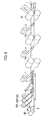
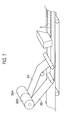
- continua of sheet pieces 3A to 3C are placed on a continuum of peeling paper sheets 6, while these continua are continuously conveyed on a line.
- the continuum of peeling papers 6 is fed from a peeling paper roll 60, while the continua of sheet pieces 3A to 3C are fed respectively from multiple back-sheet rolls 30A to 30C.
- a continuum of waterproof paper sheets 7 is placed on the continuum of back sheets 3, which is thus formed of the continua of sheet pieces 3A to 3C.
- the continuum of back sheets 3 are joined to the continuum of waterproof paper sheets 7 using the adhesive 5 exposed at the top side of the overlapping regions 30x and 30y.
- an adhesive 10b is applied onto the continuum of waterproof paper 7, and then a continuum of absorber 4 is placed on the continuum of waterproof paper 7 and joined thereto.
- an adhesive 10a is applied onto the continuum of absorber 4, and then a continuum of top sheets 2 is placed on the continuum of absorber 4 and joined thereto.
- the adhesive 5 which joins the sheet pieces 3A to 3C together is applied in a pattern of shapes arranged at certain intervals. Accordingly, when the absorbent article 1 is put into water, water enters the inside thereof through the regions not coated with the adhesive 5, which facilitates separation of the sheet pieces 3A to 3C from one another caused by the flow of water.
- the constituent fibers are previously cut at the peripheries of the sheet pieces 3A to 3C, and the coated region 50a and the non-coated region 50b,which are coated with the adhesive 5, are arranged at certain intervals. Accordingly, compared with a back sheet formed solely of a single sheet consisting of fibers entangled with one another, wherein the back sheet formed of a single sheet is broken as the fibers are untangled, the back sheet 3 can be broken at a higher speed than the back sheet formed of a single sheet.
- the fibers forming non-woven fabric are arranged to extend in the longitudinal direction of the absorbent article 1.
- each overlapping regions 30x and 30y where adjacent two of the sheet pieces 3A to 3C overlap each other is also arranged to extend in the longitudinal direction of the absorbent article 1.
- the back sheet 3 has no cut line extending in the width direction of the absorbent article 1. Accordingly, liquid that flows in the extending direction of the fibers is less likely to leak out of the absorbent article 1.
- each overlapping region where adjacent two of the sheet pieces 3A to 3C overlap each other is provided in the back sheet 3 so as to extend in the width direction of the absorbent article 1.
- the adhesive 5 in a pattern designed to disperse a force applied to the absorbent article 1 when it is peeled off from a wearer's undergarment.
- such an application pattern of the adhesive 5, specifically an application pattern formed by multiple coated regions coated with the adhesive 5, should preferably be formed of rectangles arranged so that the shorter sides of the rectangles can extend perpendicular to the peeling directions of the absorbent article 1.
- each of the sheet pieces 3A to 3D has the smallest size in length and width compared to the other embodiments shown in the figures and described herein. This provides the absorbent article 1 with improved dispersibility in water.
- the present invention provides an absorbent article that has an improved fastening capability to an undergarment, and that is dispersible at a higher speed in a drainage pipe or in a septic tank, and to provide a method of manufacturing such an absorbent article.
Landscapes
- Health & Medical Sciences (AREA)
- Engineering & Computer Science (AREA)
- Life Sciences & Earth Sciences (AREA)
- Vascular Medicine (AREA)
- Biomedical Technology (AREA)
- Heart & Thoracic Surgery (AREA)
- Epidemiology (AREA)
- Animal Behavior & Ethology (AREA)
- General Health & Medical Sciences (AREA)
- Public Health (AREA)
- Veterinary Medicine (AREA)
- Dermatology (AREA)
- Botany (AREA)
- Manufacturing & Machinery (AREA)
- Absorbent Articles And Supports Therefor (AREA)
Applications Claiming Priority (2)
| Application Number | Priority Date | Filing Date | Title |
|---|---|---|---|
| JP2008165153 | 2008-06-24 | ||
| PCT/JP2009/061479 WO2009157476A1 (ja) | 2008-06-24 | 2009-06-24 | 吸収性物品及び吸収性物品の製造方法 |
Publications (2)
| Publication Number | Publication Date |
|---|---|
| EP2292201A1 true EP2292201A1 (de) | 2011-03-09 |
| EP2292201A4 EP2292201A4 (de) | 2014-05-07 |
Family
ID=41444540
Family Applications (1)
| Application Number | Title | Priority Date | Filing Date |
|---|---|---|---|
| EP09770186.6A Withdrawn EP2292201A4 (de) | 2008-06-24 | 2009-06-24 | Absorbierender artikel und herstellungsverfahren dafür |
Country Status (7)
| Country | Link |
|---|---|
| US (1) | US8502011B2 (de) |
| EP (1) | EP2292201A4 (de) |
| JP (1) | JP5140729B2 (de) |
| KR (1) | KR20110030483A (de) |
| CN (1) | CN102076293B (de) |
| AU (1) | AU2009263351A1 (de) |
| WO (1) | WO2009157476A1 (de) |
Cited By (2)
| Publication number | Priority date | Publication date | Assignee | Title |
|---|---|---|---|---|
| EP2272477A4 (de) * | 2008-04-30 | 2014-04-02 | Unicharm Corp | Saugfähiger artikel und verfahren zur herstellung des saugfähigen artikels |
| US9439817B2 (en) | 2011-07-29 | 2016-09-13 | Unicharm Corporation | Absorbent article and method for producing the same |
Families Citing this family (3)
| Publication number | Priority date | Publication date | Assignee | Title |
|---|---|---|---|---|
| JP5693118B2 (ja) * | 2010-09-29 | 2015-04-01 | ユニ・チャーム株式会社 | 吸収性物品、及び当該吸収性物品の製造方法 |
| US9087777B2 (en) * | 2013-03-14 | 2015-07-21 | United Test And Assembly Center Ltd. | Semiconductor packages and methods of packaging semiconductor devices |
| JP7022504B2 (ja) * | 2016-12-07 | 2022-02-18 | 株式会社リブドゥコーポレーション | テープタイプ使い捨ておむつ |
Family Cites Families (16)
| Publication number | Priority date | Publication date | Assignee | Title |
|---|---|---|---|---|
| US3131693A (en) * | 1961-11-27 | 1964-05-05 | Riegel Textile Corp | Flushable diaper |
| DE8520621U1 (de) * | 1985-07-17 | 1985-08-22 | Wirths, Jürgen, 5441 St Johann | Höschenwindel mit einer Zelluloseeinlage zwischen Abdeckfolien |
| ZA927394B (en) * | 1991-09-27 | 1994-03-25 | Johnson & Johnson Inc | No-waste absorbent product |
| US5300358A (en) * | 1992-11-24 | 1994-04-05 | E. I. Du Pont De Nemours And Co. | Degradable absorbant structures |
| US6127593A (en) * | 1997-11-25 | 2000-10-03 | The Procter & Gamble Company | Flushable fibrous structures |
| JP3550053B2 (ja) * | 1999-06-30 | 2004-08-04 | ユニ・チャーム株式会社 | 使い捨ておむつ |
| JP3748022B2 (ja) * | 1999-11-19 | 2006-02-22 | ユニ・チャーム株式会社 | 水解性の吸収性物品およびその製造方法 |
| EP1149597A1 (de) * | 2000-04-25 | 2001-10-31 | The Procter & Gamble Company | Chitosanmaterial enthaltende atmungsaktive absorbierende Artikel |
| JP2002078733A (ja) * | 2000-06-28 | 2002-03-19 | Uni Charm Corp | 吸収性物品 |
| ATE454872T1 (de) * | 2001-05-22 | 2010-01-15 | Uni Charm Corp | Interlabial-polster |
| JP2004261230A (ja) * | 2003-02-18 | 2004-09-24 | Uni Charm Corp | 水洗可能な陰唇間パッド |
| JP2004298596A (ja) | 2003-03-31 | 2004-10-28 | Kobayashi Pharmaceut Co Ltd | 体液吸収具 |
| JP4212953B2 (ja) * | 2003-05-23 | 2009-01-21 | ユニ・チャーム株式会社 | 水解性の吸収性物品 |
| JP4218884B2 (ja) * | 2003-10-28 | 2009-02-04 | 日本製紙クレシア株式会社 | 吸収体製品 |
| JP3806128B2 (ja) * | 2004-09-09 | 2006-08-09 | 株式会社リブドゥコーポレーション | 使い捨ておむつ |
| JP2008165153A (ja) | 2007-01-05 | 2008-07-17 | Ricoh Printing Systems Ltd | 電子写真装置 |
-
2009
- 2009-06-24 AU AU2009263351A patent/AU2009263351A1/en not_active Abandoned
- 2009-06-24 US US13/000,669 patent/US8502011B2/en not_active Expired - Fee Related
- 2009-06-24 CN CN2009801238300A patent/CN102076293B/zh not_active Expired - Fee Related
- 2009-06-24 WO PCT/JP2009/061479 patent/WO2009157476A1/ja not_active Ceased
- 2009-06-24 JP JP2010518037A patent/JP5140729B2/ja not_active Expired - Fee Related
- 2009-06-24 EP EP09770186.6A patent/EP2292201A4/de not_active Withdrawn
- 2009-06-24 KR KR1020107028969A patent/KR20110030483A/ko not_active Withdrawn
Cited By (3)
| Publication number | Priority date | Publication date | Assignee | Title |
|---|---|---|---|---|
| EP2272477A4 (de) * | 2008-04-30 | 2014-04-02 | Unicharm Corp | Saugfähiger artikel und verfahren zur herstellung des saugfähigen artikels |
| US8791317B2 (en) | 2008-04-30 | 2014-07-29 | Unicharm Corporation | Absorbent article and method of manufacturing absorbent article |
| US9439817B2 (en) | 2011-07-29 | 2016-09-13 | Unicharm Corporation | Absorbent article and method for producing the same |
Also Published As
| Publication number | Publication date |
|---|---|
| JPWO2009157476A1 (ja) | 2011-12-15 |
| CN102076293B (zh) | 2013-07-03 |
| US8502011B2 (en) | 2013-08-06 |
| CN102076293A (zh) | 2011-05-25 |
| EP2292201A4 (de) | 2014-05-07 |
| US20110184363A1 (en) | 2011-07-28 |
| KR20110030483A (ko) | 2011-03-23 |
| JP5140729B2 (ja) | 2013-02-13 |
| WO2009157476A1 (ja) | 2009-12-30 |
| AU2009263351A1 (en) | 2009-12-30 |
Similar Documents
| Publication | Publication Date | Title |
|---|---|---|
| KR100971193B1 (ko) | 흡수체 및 상기 흡수체를 이용한 흡수성 물품 | |
| CN1200663C (zh) | 带有拆卸式护翼的吸收物品 | |
| EP2095802A1 (de) | Oberblatt eines absorbierenden Artikels | |
| US8791317B2 (en) | Absorbent article and method of manufacturing absorbent article | |
| EP1791507A1 (de) | Ausfahrbarer saugfähiger kern und saugfähiger artikel | |
| US8502011B2 (en) | Absorbent article and method of manufacturing the absorbent article | |
| WO2011040043A1 (en) | Absorbent article and manufacturing apparatus for absorbent article | |
| JP3748022B2 (ja) | 水解性の吸収性物品およびその製造方法 | |
| KR101166593B1 (ko) | 음순간 패드 | |
| US9119746B2 (en) | Absorbent article and method of producing absorbent article | |
| JP4275421B2 (ja) | 吸収性物品 | |
| US20090266481A1 (en) | Method for the manufacture of a disposable sanitary napkin with a pull-tab | |
| KR101164703B1 (ko) | 음순간 패드 | |
| WO2002094159A1 (en) | Interlabial pad and package thereof | |
| KR101013925B1 (ko) | 음순간 제품 및 이 음순간 제품용의 수붕괴성 표면측 시트 | |
| JP6203891B1 (ja) | 吸収性物品 | |
| JP2004261230A (ja) | 水洗可能な陰唇間パッド | |
| KR100339944B1 (ko) | 부직 팬티라이너 | |
| JP2018033684A (ja) | 吸収性物品 | |
| JP2021194256A (ja) | 後処理テープ | |
| SK67594A3 (en) | Non-woven insert of slip type, method of its manufacture and device for realization of this method |
Legal Events
| Date | Code | Title | Description |
|---|---|---|---|
| PUAI | Public reference made under article 153(3) epc to a published international application that has entered the european phase |
Free format text: ORIGINAL CODE: 0009012 |
|
| 17P | Request for examination filed |
Effective date: 20101224 |
|
| AK | Designated contracting states |
Kind code of ref document: A1 Designated state(s): AT BE BG CH CY CZ DE DK EE ES FI FR GB GR HR HU IE IS IT LI LT LU LV MC MK MT NL NO PL PT RO SE SI SK TR |
|
| AX | Request for extension of the european patent |
Extension state: AL BA RS |
|
| DAX | Request for extension of the european patent (deleted) | ||
| A4 | Supplementary search report drawn up and despatched |
Effective date: 20140404 |
|
| RIC1 | Information provided on ipc code assigned before grant |
Ipc: A61F 13/15 20060101AFI20140331BHEP Ipc: A61F 13/56 20060101ALI20140331BHEP Ipc: A61F 13/551 20060101ALI20140331BHEP Ipc: A61F 13/514 20060101ALI20140331BHEP Ipc: A61F 13/472 20060101ALI20140331BHEP |
|
| STAA | Information on the status of an ep patent application or granted ep patent |
Free format text: STATUS: THE APPLICATION HAS BEEN WITHDRAWN |
|
| 18W | Application withdrawn |
Effective date: 20140513 |