EP2292444A2 - Device for the paced processing of a printed product with a transfer device - Google Patents
Device for the paced processing of a printed product with a transfer device Download PDFInfo
- Publication number
- EP2292444A2 EP2292444A2 EP10173311A EP10173311A EP2292444A2 EP 2292444 A2 EP2292444 A2 EP 2292444A2 EP 10173311 A EP10173311 A EP 10173311A EP 10173311 A EP10173311 A EP 10173311A EP 2292444 A2 EP2292444 A2 EP 2292444A2
- Authority
- EP
- European Patent Office
- Prior art keywords
- book
- transfer
- book block
- translation
- transfer device
- Prior art date
- Legal status (The legal status is an assumption and is not a legal conclusion. Google has not performed a legal analysis and makes no representation as to the accuracy of the status listed.)
- Withdrawn
Links
- 238000012546 transfer Methods 0.000 title claims abstract description 132
- 238000012545 processing Methods 0.000 title claims abstract description 35
- 238000013519 translation Methods 0.000 claims abstract description 34
- 230000033001 locomotion Effects 0.000 claims description 55
- 238000007639 printing Methods 0.000 claims description 9
- 230000001133 acceleration Effects 0.000 claims description 8
- 239000000853 adhesive Substances 0.000 claims description 6
- 230000001070 adhesive effect Effects 0.000 claims description 6
- 239000011230 binding agent Substances 0.000 claims description 6
- 239000007853 buffer solution Substances 0.000 claims description 2
- 230000003247 decreasing effect Effects 0.000 claims description 2
- 230000001419 dependent effect Effects 0.000 claims description 2
- 239000011159 matrix material Substances 0.000 claims description 2
- 235000004522 Pentaglottis sempervirens Nutrition 0.000 claims 1
- 125000004122 cyclic group Chemical group 0.000 claims 1
- 238000007646 gravure printing Methods 0.000 claims 1
- 238000007645 offset printing Methods 0.000 claims 1
- 230000006641 stabilisation Effects 0.000 claims 1
- 238000011105 stabilization Methods 0.000 claims 1
- 230000014616 translation Effects 0.000 description 17
- 230000008901 benefit Effects 0.000 description 13
- 238000000034 method Methods 0.000 description 12
- 230000008569 process Effects 0.000 description 11
- 239000000047 product Substances 0.000 description 9
- 230000007246 mechanism Effects 0.000 description 7
- 230000008859 change Effects 0.000 description 5
- 230000003044 adaptive effect Effects 0.000 description 4
- 230000000694 effects Effects 0.000 description 4
- 238000005259 measurement Methods 0.000 description 4
- 230000009471 action Effects 0.000 description 3
- 238000013461 design Methods 0.000 description 3
- 230000008092 positive effect Effects 0.000 description 3
- 241000196324 Embryophyta Species 0.000 description 2
- 230000002411 adverse Effects 0.000 description 2
- 238000001514 detection method Methods 0.000 description 2
- 238000004519 manufacturing process Methods 0.000 description 2
- 230000002093 peripheral effect Effects 0.000 description 2
- 230000002688 persistence Effects 0.000 description 2
- 230000000087 stabilizing effect Effects 0.000 description 2
- 235000010678 Paulownia tomentosa Nutrition 0.000 description 1
- 240000002834 Paulownia tomentosa Species 0.000 description 1
- 238000009825 accumulation Methods 0.000 description 1
- 238000005452 bending Methods 0.000 description 1
- 229910052793 cadmium Inorganic materials 0.000 description 1
- BDOSMKKIYDKNTQ-UHFFFAOYSA-N cadmium atom Chemical compound [Cd] BDOSMKKIYDKNTQ-UHFFFAOYSA-N 0.000 description 1
- 239000011248 coating agent Substances 0.000 description 1
- 238000000576 coating method Methods 0.000 description 1
- 230000000295 complement effect Effects 0.000 description 1
- 230000001934 delay Effects 0.000 description 1
- 230000003111 delayed effect Effects 0.000 description 1
- 238000011161 development Methods 0.000 description 1
- 230000018109 developmental process Effects 0.000 description 1
- 238000011143 downstream manufacturing Methods 0.000 description 1
- 230000029142 excretion Effects 0.000 description 1
- 239000012467 final product Substances 0.000 description 1
- 230000006872 improvement Effects 0.000 description 1
- 238000009434 installation Methods 0.000 description 1
- 238000012423 maintenance Methods 0.000 description 1
- 238000007726 management method Methods 0.000 description 1
- 210000000056 organ Anatomy 0.000 description 1
- 230000036961 partial effect Effects 0.000 description 1
- 238000000275 quality assurance Methods 0.000 description 1
- 230000009467 reduction Effects 0.000 description 1
- 230000002829 reductive effect Effects 0.000 description 1
- 239000000243 solution Substances 0.000 description 1
- 230000003068 static effect Effects 0.000 description 1
- 238000011144 upstream manufacturing Methods 0.000 description 1
Images




Classifications
-
- B—PERFORMING OPERATIONS; TRANSPORTING
- B42—BOOKBINDING; ALBUMS; FILES; SPECIAL PRINTED MATTER
- B42C—BOOKBINDING
- B42C19/00—Multi-step processes for making books
- B42C19/08—Conveying between operating stations in machines
-
- B—PERFORMING OPERATIONS; TRANSPORTING
- B65—CONVEYING; PACKING; STORING; HANDLING THIN OR FILAMENTARY MATERIAL
- B65H—HANDLING THIN OR FILAMENTARY MATERIAL, e.g. SHEETS, WEBS, CABLES
- B65H2301/00—Handling processes for sheets or webs
- B65H2301/30—Orientation, displacement, position of the handled material
- B65H2301/31—Features of transport path
- B65H2301/312—Features of transport path for transport path involving at least two planes of transport forming an angle between each other
- B65H2301/3121—L-shaped
Definitions
- the present invention relates to a device according to the preamble of claim 1.
- EP 1 645 434 A1 has become known a device for the intermittent processing of book blocks formed from printed sheets, which are often composed of individual sheets or folded signatures.
- the feed member is assigned to a lifting device having the stop.
- a supplied book block is pivoted from a horizontal position to a vertical position, and by means of an adjustable driven stop this book block is transferred to the adhesive tongs of the binder.
- horizontally supplied book blocks can be transferred in a targeted manner and unhindered into an adhesive binder station while avoiding further transfer movements. It is by the lifting device the book block up and introduced from below in an adhesive tweezers.
- This lifting movement is initiated before the arrival of a book block at the stop, wherein the adjustability of the stop can also be used to adjust the format of the supplied book block.
- the cycle time it has been found in such a sequence that the cycle time, respectively.
- Cadmium is subject to a relatively strong limitation, so that an increase in the number of cycles is no longer achievable, because the underlying process is such that each first a return stroke has to be made before a new book block nachschoben, so can be accepted.
- the management level forming guide rails had to be assigned by far a guide, which supports the book block on the opposite side supporting and leading.
- the book blocks can each be pivoted from the lying position on the feed organ into a position vertical to the book block back by a drive-connected countershaft with the stop, this can only be achieved if corresponding additional guide rails are provided.
- the different book block thicknesses against tilting require adjusting the distance between the guide plane formed by the guide rails and the guide element. However, this can be done kinematically only properly if a traction mechanism is provided.
- the guide rails must be located below the slidably supported by support on the supports of the conveyor elements, so that friction of the book block can be avoided on the guide rails , which consequently leads to additional provisions.
- the invention aims to remedy the disadvantages of the prior art remedy and show advantageous new ways.
- the invention as characterized in the claims, the object is to process the book block with a maximized clock frequency in a device of the type mentioned.
- Another object of the invention is to propose provisions to remove the individual book blocks as quickly as possible from the book block feeder by the use of a transfer device, so that space for the next incoming book block is certainly created. This has a positive effect on the cycle times and allows a performance maximization.
- the book blocks are preferably produced with a digital printing press, such a digital printing machine allowing a book block or book to be printed in a sequence. If a book block is printed sequentially, it means that the digital press starts with the first sheet, and the subsequent spreads, which complete the book or book block, are added immediately. Digital printing machines work without a fixed printing form, and therefore can operate in the stated manner. Following the printing process, the sheets can then be stacked either as a single sheet into a book block, or folded into signatures using a suitable folding machine and stacked into book blocks.
- the book blocks which are transferred are preferably loose stacks of signatures and or folded signatures. But they can also be fixed in a way for safe transport, so that the individual sheets and / or signatures can not slip to each other. It may also be understood that such a named fixation is effected with respect to the position of the stacked printed sheets and / or signatures and / or temporarily, and that said fixations in the printed product finished to the final product, or that which is processed with the further processing device, have no system-relevant effect more unfolded. Thus, the compactness of the book block can be ensured during transport.
- the motion profiles can consist of various curve functions and also by dwell times or downtimes resp. be composed. In principle, it is therefore a matter of letting the movement speed follow a certain locomotion profile, which consists of one or more simple curve functions or superimposed one another, both in connection with the transfer process and with respect to the otherwise relevant speeds within the device, in particular also in terms of the movement speeds of the book block feeder and the book channel
- the book block is not fed directly into the pliers, but handed over to an upstream book channel.
- a book channel is known per se to those skilled in the art and is used, for example, in connection with a collating machine.
- Such a book channel is also known as gathering channel in collating machines, which can convey signatures, bound books and loose or fixed book blocks by means of catch fingers or other auxiliary mechanisms in the channel.
- the basic advantage of the invention is to be seen here in that one basically distances from a purely linear or quasi-linear feeding of the book blocks from one station to the next, and now proposes that the book blocks be based on a rotary or quasi-rotary translation be forwarded to the book channel before they are forwarded to a processing station, whereby the clock numbers can be increased sustainably, and at the same time gentle handling of the loose book block.
- translation is understood to mean a movement in which all points of the moving body move in the same direction.
- a quasi-rotary translation is basically understood a movement in which the book block is promoted under an arc-like movement.
- this movement can also be superimposed by at least one linear movement in one axis, or expand or superimpose the rotary movement at any point.
- Such movement can also be accomplished by an external engaging mechanism, such as a robotic arm.
- the linear motion sequence does not necessarily have to be implemented before or after the rotary movement, but it can also be done intermediately. Such combinations are always appropriate where the space or existing aggregates limit the spaces of freedom. It is also advantageous here that this linear movement can take place in a horizontal, vertical or even inclined position, which additionally ensures great flexibility of the device according to the invention.
- the rotational or at least the quasi-rotary translation during the transfer process is not necessarily limited solely to a two-dimensional acting movement, but during the supply, the said translational movements can readily take the third dimension in space as needed, in Considering the fact that the layers of each Falzbogen are to be handled optimally at least during the entire transfer process so that, for example, they can not slip in themselves, so able to maintain their compactness throughout the process assets.
- the rotary or quasi-rotary translations can assume any position per se, ie be horizontal or vertical or inclined, wherein intermediate combinations are also possible.
- Another significant advantage of the invention is the fact that the system is such that both a continuous and an intermittent feeding of the book blocks is possible, which in turn expands the applicability and flexibility of the system resp. increased. This may be necessary, for example, if measurement / control stations are provided in the processing stream which trigger qualitatively induced interventions without the product-related current cadence being adversely affected thereby. However, this does not always apply to conventional linear delivery: quality-induced interventions have a negative effect on product-related cadence.
- Another significant advantage of the invention is the fact that the system includes provisions whose geometry is chosen so that on the feeds an adjustment to the respective format of the book blocks basically unnecessary, which in turn has the advantage that even the smallest lots without the execution of large Umraumen can be processed.
- the system according to the invention behaves flexibly in relation to a strictly tact-related continuous feeding of the buck blocks to the transfer device belonging to the transfer process, it is possible to move in front of the rotary movements readily provide measuring / control stations, which are set to close tolerances, and which respond when exceeding a certain tolerance limit and activate appropriate Ausschleusungsmechanismen.
- the mass controls that are set out herein relate to the format of the book blocks, and are preferably aligned with the height, width, and thickness of the particular block of buckets, and also include a book block-related identification feature.
- the measurement / control stations can also forward measured data to the further processing station, for example, to obtain accurate settings of the subsequent processing machines.
- the measuring / control stations not only take over a mere static check of an actual state, but they pass on production-relevant information to the downstream processing machines.
- Another significant advantage of the invention is the fact that the position of the book block along the book block feeder can be done both transversely and longitudinally, without the cycle numbers would be adversely affected, for example, by making the best possible alignment of the book block before the perfect binder affects the not specified by the translation clock number.
- This high flexibility is causally related to the broad design possibilities of the translations used in the area of the transfer device, ie, the movement of the translation can control the transfer of the book block the book channel so that the subsequent processing processes, such as the attachment of the binder under continuous optimal Conditions can take place.
- the transfer device belonging to takeover element which can be used, for example in the form of a fork-like structure, during translation, the forwarding of the book block takes over, immediately before passing an inclination is subjected, which the book block in the takeover element a obliquely oblique position, so that the book block can slide targeted to a stop within this transfer element.
- Such an inclination causes, inter alia, a stabilizing effect on the mass of the book block, which effect is accompanied by an increase in the persistence of the body.
- this inclination can also be original and does not necessarily have to be created in the course of the process, ie especially in the course of the rotary or quasi-rotary movement, at a suitable location.
- Another important advantage of the system-related invention is the fact that this also gives advantages to the peripheral systems, which are responsible for the product streams.
- printed products can be forwarded from a plurality of product streams or from divided product streams, ie several feed stations can converge to the rotary or quasi-rotary translation of the operating transfer device so that, if required, parallel-operated transfer devices can also be provided.
- the impact is here For example, increased production, which is causally related to increased productivity of the inventive device.
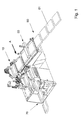
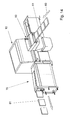
- Fig. 1 shows a plant A, which consists essentially of a supply means 60 for book block 61, an intermediary switched control device 50, a transfer device 10, a conveyor line 70, which the book blocks to a processing station not shown here (see Fig. 7 ) leads.
- the feeding device 60 will be referred to below as the “book block feeder” and the conveying path for the book blocks 70 after the transfer device as the "book channel”.
- Fig. 2 is a stylized representation of Fig. 1 and will show essentially only the main components of this Appendix A, namely the transfer device 10, the book block feeder 60, and the book channel 70. What emerges particularly well from this figure is the acquisition 62 of a book block 61 by a component of the transfer device 10.
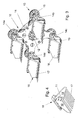
- Fig. 3 shows the detailed structure of the previously mentioned transfer device 10, which forms the central component, between the book block feeder 60 for the book block 61 and the book channel 70, which leads to the other processing stations.
- This main center axis 12 is in operative connection with a known planetary gear 13 which drives along a circular motion a quadrangular star-shaped rotor 14, wherein the four vertices this rotor 14 each carry a standing with a peripheral gear 15 of the planetary gear 13 operatively connected shaft 14a-14d, each of which form the starting point for receiving a transfer element 16, which in turn is console-like, and has a fork-like support plane 17 which the Support surface for the further transport of the book block 61 forms, said support plane 17 is preferably designed for receiving a single book block 61.
- each transfer element 16 together with the support plane 17 initially assumes a preferably quasi-horizontal position over a large part of the circumferential movement.
- the support planes 17 are not strictly in a horizontal position, but they already have an original inclination, which is in accordance with the inclination of the book channel 70.
- the support planes 17 can also have a parallel to the book block feed or horizontal position.
- the respective underlying situation is directly related to an optimal recording and subsequent delivery of the book block 61, so with the course of the book block 60 and the book 70 on the other hand. The goal is therefore here that brought up on the book block feeder 60 book block both gently on the support plane 17 are pushed, and can be passed from the book channel 70 gently.
- the support levels 17 initially retain their once assumed horizontal or quasi-horizontal position. Seen in this way, the circularly rotating transfer elements 16 have a sequence of movements which is similar to that of a ferris wheel equipped with free-floating cabins.
- the book blocks 61 are transported further on the support plane 17 and in the final phase of a cycle they are transferred to the book channel 70.
- this handover should be maximized, which is an essential aspect of quality assurance.
- the dynamics in this transfer can be designed so that the support plane 17 initially occupies an intermediate position above the book channel 70, then to initiate an acceleration in the direction of the book channel 70 from this intermediate position, then in the final phase of the course at decreasing and adapted speed approximates the book channel 70 quasi-symptomatically, thus ensuring the conditions for maximized smooth handover of the book block 61.
- Such an acceleration may e.g. be done gently when accelerating a lying on the intermediate plane driver fingers and conveys the book block in the book channel 70, wherein at product transfer to the book channel relative speed differences are kept low.
- the support plane 17 is delimited by two adjacent walls 18, 19, which are preferably perpendicular to each other. This squareness corresponds to the circumferential geometry of the book block 61, wherein the corner formed by the adjacent walls 18, 19 forms an optimum end stop for the book block 61, as will be discussed in more detail later.
- Fig. 4 shows the structure of a single transfer element 16. This has in the region of the wall 19 a slot 11, the width of which continues over the entire supporting plane 17. A driver finger (see FIGS. 5 and 6 ) is in operative connection with this slot 11, such that a gentle repulsion of the book block 61 from the said supporting plane 17 to the book channel 70 not shown here can take place.
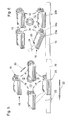
- Fig. 5 shows the transfer device 10 from Fig. 3 in a simplified representation, with the transfer elements 16, which are shown here in the poles. Again, it can be well established that the support plane 17 of each transfer element 16 assumes a quasi-horizontal position, as can be seen from the graphic representation. As further shown, takeover elements 16 rotate counterclockwise 20, and they are operatively connected to a lower side arranged Buchkanal 70, the running direction 12 is opposite to the direction of rotation 20 of the transfer device 10. In the direction of movement of the book channel 70 act fixedly spaced driver fingers 23, which take over the gentle repulsion of the respective book block of the supporting plane 7 of the transfer element 16 to the immediately underlying book channel 70. For this purpose, the transfer element 16 has a continuous slot 11 extending parallel to the running direction of the book channel 70 (see FIG Fig. 4 ), which is tuned to the thickness of the driving finger 23, and which is particularly good Fig. 4 evident.
- the underlying horizontal position of the individual support levels 17 to the underlying book channel 70 undergoes per revolution a time-related change in position, which is initiated by a gate 24, which detects the respective transfer element 16 immediately before reaching the lowermost buchkanal section, and the predominantly searchenden at this point takeover element 16 imposes an angularly changing part movement about the shaft 14c, as is apparent from Fig. 6 is apparent.
- a roller 25 connected to the transfer element 16 ensures that the link 24 is scanned faithfully.
- the introduction of the change in position with respect to the support plane 17 can also be done by a complementary drive element, for example by a motor or cam gear.
- the gate 24 can also be designed so that the respective transfer element 16, in addition to the described angular movement, can additionally assume a movement in an oblique or oblique position, which forms a diagonal to the corner formed by the adjacent walls 18, 19, so that the book block 61 against the right-angled corner of the two walls 18, 19 (see 3 and 4 ) can possibly slip and is caught there position stable.
- the gate 24 may also have a toothed or undulating surface, such that the movement of the supporting plane 17, which is in operative connection with the link 24, is subjected to a vibrating motion.
- the scanned surface may also be configured to transmit vibrations to the support plane 17 during scanning. In both cases, this has a positive effect on the position of the book blocks to be taken.
- this oblique stop position for the book block 61 can also be provided originally, so that this inclination does not have to be additionally introduced via a backdrop or by other auxiliary equipment. In any case, such an inclination triggers a stabilizing effect on the mass of the book block 61, which is associated with an increase in its persistence. This ensured compactness of the book block then has a later positive effect on the passage of the subsequent processing stations.
- the purpose-related inclination of the transfer element 16 by the action of the gate 24 can be replaced by the strategy described above is pursued by the transfer element 16 above the book channel 70 so long holds the height until the respective location-catching driver fingers 23 critical Has passed through the zone.
- the angle-related change in the position of the book block can also be done at any other place. Then another mechanism would be available, e.g. via a motor axis or a cam mechanism in the rotor, which can act superimposed over the ordinary translation of the transfer device.
- This transfer device 30 which is functionally arranged to and above the book block feeder 60 and the book channel 70, preferably has a rotating rotor 31 in the poles, and in these poles, a vertically downward clamping device 32 is arranged, each of which a book block 61 of the book block feeder 60 summarizes and preferably brings by a 90 ° angular movement in the plane of the book channel 70. In this plane, the clamping action is then released, so that the book block 61 can be conveyed via the book channel 70 to a further processing station 90.
- the clamping device 32 preferably performs a downward movement 33 in the direction of the book channel 70 during rotation in order to gently place the book block 61 in the book channel 70, whereby here the rotary movement of the rotor 31 is coupled to a linear component.
- FIG. 7 the processing station 90 is only hinted at.
- the transfer device 30 shown here thus operates according to another principle with respect to the previously described transfer device 10 (FIG. Fig. 3-6 ) out. On the execution possibilities of such a clamping device 32 is not entered here.
- the located at the poles clamping devices 32 can maintain the position of the book block with a planetary gear, which in the Fig.1 has been described. But it is also conceivable that if necessary during the 90 ° rotation - which may of course also have a different angular amount, the ancestral position of the book block is additionally rotated by an angular amount, for example by 90 °. This couples two rotary rotations together.
- this system B can be seen in the fact that it is readily possible to vary the number of acting clamping devices 32 and the angular velocity so that they take into account the given circumstances. In most cases, it will be preferable to use a 90 ° clock, ie 90 ° rotation angle. However, a skewed disposition of the transfer device 30 is also possible, and in particular recommended if the pre-entry and / or forwarding of the book block 61 must be made via inclined planes. In all cases, the book block is transferred gently and undergoes no internal bending and the given compactness or shape is maintained.
- the linear translation of the clamping device 32 can act up or down. This also applies to the clamping device in Fig. 8 ,
- FIG. 8 Another plant C goes out Fig. 8 in which a further transfer device 40 is shown.
- this transfer device 40 works in a similar manner to that according to Appendix A (see Fig. 3-6 ), ie, after the conditional by a clamping device 41 detection of the brought-book block 61 sets a rotary motion, which has the same technical characteristics, as already described in Appendix B ( Fig. 7 ) are.
- the transfer of the book block 61 the book channel 70 is here, however, a direct, because the opening of the clamping device 41 is sufficient to ensure the detection and further transport of the book block 61.
- the rotary movement of the transfer device 40 ensures that the book block 61 is transferred from a higher infeed level to a lower transfer level.
- a diametrically opposite configuration is possible in which the book block is transferred from a lower level to a higher level.
- Appendix C can also be designed so that the lowest position of the arms which form the clamping device 41, is equal to the book channel 70. If the direction of rotation of the transfer element is then introduced clockwise, the book block can be deposited in the direction of movement of the driver finger.
- the advantage of such konkondart movement is to be seen in the fact that the relative speed of the book block can be reduced to the driver finger or a stop bar to an optimum, such that the relative speed tends to zero, thus ensuring a safe smooth transfer of the book block is ensured.
- Fig. 8 See also the embodiment, according to which the transfer of the book block the book channel 70 not only at an angle of 90 ° with respect to the acquisition can take place, but is readily possible to provide this transfer even at 180 ° in relation to the transfer point, so diametrically opposed, that is, then, that the book channel 70 acts on the underside of the transfer device 40, which in turn can be operated with an optimized relative speed between the angular speed of the book block and the book speed of the book channel.
- the concordant movements between the direction of rotation of the transfer device and direction of the book channel is discussed in more detail in the previous section.
- the transfer device 80 shown here consists of a scoop-wheel-like inlet star 80, which individually receives the brought-Buck blocks 61 between the space created therefrom 81 and further promotes rotation in the same rotary plane. After a rotation angle of about 90 °, the book block 61 is ejected from the blade wheel-like inlet star 80 and taken from a substantially perpendicular to the book block feeder 60 arranged book channel 70 and passed on for further processing. Another angle of rotation is also possible.
- the structure of this system D is therefore designed so that the book block 61 already present vertically in the book channel 70, which has advantages for further processing, because the book block 61 must then, for example, in an adhesive binder station, no longer specifically transferred to a vertical position.
- transfer devices described In connection with the transfer devices described, it should be emphasized that these are particularly well suited for providing the highest output cadences.
- two or more transfer devices can operate on the same book channel, which can be loaded at full capacity corresponding to book block, and by which the cadence of the expulsion can be multiplied in a subsequent common book channel.
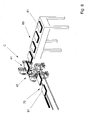
- Fig. 10 shows in a simplified representation the immediate area of a book block feeder 60 after a measuring / control station 50 (see Fig. 1 ), where it comes to a discharge of a book block 61 due to a detected shortage to accomplish.
- a discharge point 95 is provided, which works differently and can come into function.
- this Ausschleusstelle 95 in action by the conveyor belt along the book block guide 60 acts telescopically, ie by a part 91 of the conveyor belt inwardly back, thus freeing the space for the discharge.
- the book block feeder 60 consists of one of a rust-like plane 92, which may be variously constructed.
- the elements of the rust-like plane 92 consist of cantilevered and driven, rotating rollers 94, which are arranged with a mutual spacing 93 in order to manage the transport of the book block 61 gently.
- an adhesive surface coating of the rollers 94 offers to allow the friction between rollers and book block. With sufficient friction, the book block can be delayed shortly before the end position at the transfer position so that it does not rebound at the stop 18 respectively springs back and the consistency of the book block is not lost.
- FIG. 11 First, the delivery of the book block 61 to an unspecified here transfer device emerges. Before this transfer device, the book blocks 61 now pass through a measuring / control station 50, in which various quality checks are carried out, in particular with regard to thickness, width, length, etc., of the tested buck block 61.
- An identification of the book block 61 can also take place here, eg with barcode / data matrix code / transponder / RF ID or the like. This identification can but also after the measuring / control station 50 or before. If a book block 61 does not pass the qualitative examinations, it is logically rejected, as is the case for example FIGS. 12 and 13 is apparent, then what then arises a gap in the book block flow. However, this is not so bad, because the transfer devices operating according to a rotary translation are able to maintain the predetermined continuous cycle, which is not the case with a purely fixed supply.
- Adaptive accelerations or decelerations which can intervene within the rotary movement of a transfer device as well as in relation to the transport speeds within the book block feeders 60 or the book channels 70, which accelerations and decelerations in speed follow a certain curve function, can be interfered with Smooth the adoption or redirects of the book block 61 and affect the cadence in the transfer of the book block 61 to the next processing station.
- the curve function in one of the transfer devices described above can be influenced by a linear delivery in one direction, not shown in detail, especially if it is necessary to close a gap in the flow of the products, for example, if an accumulation of discharges should occur in connection with the measuring / control station 50, or if, upon acceptance or delivery of the book blocks, a slowing occurs within the speed of the acting curve function.
- the translation follows a motion profile consisting of different adaptive curve functions and / or dwell times.
- a characteristic of the proposed curve function according to the invention is that it can assume a uniform speed in its course as required.
- the discontinuities can be installed in such a way that the maintenance of the originally conceived cadence is ensured.
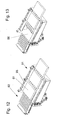
- FIGS. 12 and 13 therefore, to show how one out of the process according to Fig. 11 indexed excretion of a book block 61 may proceed from further processing.
- Fig. 12 the components Fig. 10
- a discharge point 95 is provided, which is shown here as a telescope-like conveyor belt.
- this Ausschleusstelle comes into operation, and so a faulty book block 61 is excluded from further transport.
- Fig. 13 shown interruption with respect to the original cadence arises due to the resulting interruption time, which is symbolically represented as a route 96 in this figure.
- Fig. 14 shows a single-acting book block feeder 60 of the book block 61 to a transfer device 10.
- book block 61 For the processing station not shown here in the normal case book block 61 are present, which are supplied to the further processing steps.
- coming from the book channel 70 book block 61 a have already been placed in a vertical position, which coincides with the subsequent processing operation.
- the installation of a measuring / control station 50 can be seen in this figure.
- the book block production machines may be formed of a digital printing press and a sheet stacker. These elements can also be preceded by a logistics system or a buffer system.
Landscapes
- Feeding Of Articles By Means Other Than Belts Or Rollers (AREA)
- Folding Of Thin Sheet-Like Materials, Special Discharging Devices, And Others (AREA)
- Discharge By Other Means (AREA)
Abstract
Description
Die vorliegende Erfindung betrifft eine Einrichtung gemäss Oberbegriff des Anspruchs 1.The present invention relates to a device according to the preamble of claim 1.
Aus
Grundsätzlich hat sich herausgestellt, dass eine Zuführung des Buchblocks entlang einer zustellbaren Ebene nur über mehrere Verarbeitungstakte möglich ist, wozu aber eine längere Zuführungsstrecke erforderlich ist.In principle, it has been found that feeding the book block along an deliverable plane is possible only over a plurality of processing cycles, but for which a longer feed path is required.
Um hiergegen Abhilfe zu schaffen, sind schon mehrere Vorschläge bekannt geworden, welche allerdings gesamthaft nicht zu befriedigen vermochten, denn eine Teilverbesserung konnte jeweils nur durch zusätzliche konstruktive Vorkehrungen erkauft werden, welche sich wiederum auf die Anfälligkeit des Systems teilweise negativ auswirkten.In order to remedy this, several proposals have become known, which, however, were not able to satisfy overall, because a partial improvement could only be paid for by additional constructive precautions, which in turn had a negative effect on the vulnerability of the system.
Beispielsweise gegen das einseitige mögliche Kippen des auf dem Anschlag stehenden Buckblocks musste den die Führungsebene bildenden Führungsleisten mit Abstand ein Leitorgan zugeordnet werden, welches den Buchblock an der gegenüberliegenden Seite stützend und führend begleitet.For example, against the one-sided possible tilting of the stop on the block Buckblocks the management level forming guide rails had to be assigned by far a guide, which supports the book block on the opposite side supporting and leading.
Zwar lassen sich durch ein mit dem Anschlag antriebsverbundenes Vorgelege die Buchblocks jeweils aus der liegenden Position auf dem Zuführorgan in eine auf dem Buchblockrücken vertikale Lage schwenken, indessen ist dies nur dann zu bewerkstelligen, wenn entsprechende zusätzliche Führungsleisten vorgesehen werden.Although the book blocks can each be pivoted from the lying position on the feed organ into a position vertical to the book block back by a drive-connected countershaft with the stop, this can only be achieved if corresponding additional guide rails are provided.
Dann verlangen die unterschiedlichen Buchblockdicken gegen das Kippen ein Verstellen des Abstandes zwischen der durch die Führungsleisten gebildeten Führungsebene und dem Leitorgan. Dies lässt sich aber kinematisch einwandfrei nur dann bewerkstelligen, wenn ein Zugmittelgetriebe vorgesehen wird.Then, the different book block thicknesses against tilting require adjusting the distance between the guide plane formed by the guide rails and the guide element. However, this can be done kinematically only properly if a traction mechanism is provided.
Auch muss bedacht werden, dass zum Zeitpunkt der Zuführung der Buchblocks, also in der Ausgangsstellung der genannten Hebevorrichtung, die Führungsleisten sich vorteilhaft unterhalb der durch die auf Auflagen gleitend abgestützten Förderzentrum der Förderelemente befinden müssen, damit eine Reibung der Buchblocks an der Führungsleisten vermieden werden kann, was demzufolge zu zusätzlichen Vorkehrungen führt.Also, it must be considered that at the time of feeding the book block, ie in the starting position of said lifting device, the guide rails must be located below the slidably supported by support on the supports of the conveyor elements, so that friction of the book block can be avoided on the guide rails , which consequently leads to additional provisions.
Auf Grund dieser punktuellen Betrachtungen lässt sich sagen, dass die bis anhin bekannt gewordenen Ausführungsvarianten jeweils mit einem relativ grossen Aufwand verbunden waren, nicht immer das gebracht haben, was man sich anfänglich vorgestellt hat, so dass es sich nunmehr aufdrängt, bei einer Einrichtung zur taktweisen Verarbeitung von aus wenigstens einen Druckbogen gebildeten Buchblocks neue Wege zu beschreiten und neue Vorschläge zu unterbreiten. Dabei ist zu berücksichtigen, dass der Buchblock vorzugsweise lose ausgebildet ist, d.h., dass die Druckbogen nicht miteinander fixiert sind. Es können natürlich auch vorfixierte Buchblocks verarbeitet werden.On the basis of these selective considerations, it can be said that the previously disclosed embodiments were each associated with a relatively great effort, did not always bring what one had initially imagined, so that it now imposes itself, in a device for intermittent Processing of book block formed from at least one printed sheet to break new ground and make new proposals. It should be noted that the book block is preferably formed loosely, that is, that the sheets are not fixed together. Of course, pre-fixed book blocks can also be processed.
Hier will die Erfindung gegenüber den aus dem Stand der Technik hervorgehenden Nachteilen Abhilfe schaffen und vorteilhafte neue Wege aufzeigen. Der Erfindung, wie sie in den Ansprüchen gekennzeichnet ist, liegt die Aufgabe zugrunde, bei einer Einrichtung der eingangs genannten Art die Buchblocks mit einer maximierten Taktfrequenz zu verarbeiten.Here, the invention aims to remedy the disadvantages of the prior art remedy and show advantageous new ways. The invention, as characterized in the claims, the object is to process the book block with a maximized clock frequency in a device of the type mentioned.
Zur Erfüllung dieser Aufgabe wird ein System und die dazu notwendige technische Infrastruktur vorgeschlagen, bei welchen die Art der Zuführung so gehalten ist, dass die massgebenden Geschwindigkeiten gleichmässig oder ungleichmässig erfolgen, eine Beschleunigung oder Verzögerung beinhalten, sich sowohl synchron als auch asynchron verhalten, mit adaptiven Beschleunigungen oder Verzögerungen erfolgen können. Der finale Zweck der erfindungsgemässen Vorkehrungen ist sonach darin zu sehen, eine Maximierung der Taktzahlen bei schonender Handhabung des Printmediums zu erzielen.To achieve this object, a system and the necessary technical infrastructure is proposed in which the type of supply is such that the decisive speeds are uniform or uneven, include an acceleration or deceleration, behave both synchronously and asynchronously, with adaptive Accelerations or delays can occur. The final purpose of the provisions according to the invention is therefore to be seen in achieving a maximization of the cycle numbers with gentle handling of the print medium.
Eine weitere Aufgabe der Erfindung besteht darin, Vorkehrungen vorzuschlagen, die die einzelnen Buchblocks möglichst schnell von der Buchblockzuführung durch den Einsatz einer Übergabevorrichtung zu entfernen, damit sicher Platz für den nächstankommenden Buchblock geschaffen wird. Das wirkt sich positiv auf die Zykluszeiten aus und erlaubt eine Leistungsmaximierung.Another object of the invention is to propose provisions to remove the individual book blocks as quickly as possible from the book block feeder by the use of a transfer device, so that space for the next incoming book block is certainly created. This has a positive effect on the cycle times and allows a performance maximization.
Des Weiteren ist es Aufgabe der Erfindung, die Buchblocks auf ihren Transportweg stets eine sanfte Übergabe zu sichern, beispielsweise von der Buchblockzuführung an die Übergabevorrichtung und von dieser an den Buchkanal.Furthermore, it is an object of the invention to always secure the book blocks on their transport a gentle handover, for example, from the book block feeder to the transfer device and from this to the book channel.
Die Buchblocks werden vorzugsweise mit einer Digitaldruckmaschine erzeugt, wobei eine solche Digitaldruckmaschine erlaubt, ein Buchblock respektive Buch, in einer Sequenz zu drucken. Wird ein Buchblock sequentiell gedruckt, heisst das, dass die Digitaldruckmaschine mit dem ersten Druckbogen beginnt, und die darauffolgenden Druckbogen, welche das Buch respektive den Buchblock komplettieren, gleich anfügt. Digitaldruckmaschinen arbeiten ohne eine feste Druckform, und können deswegen in der genannten Art operieren. Im Anschluss des Druckverfahrens können die Durchbogen dann entweder als Einzelbogen zu einem Buchblock gestapelt werden, oder mittels einer geeigneten Falzmaschine zu Signaturen gefalzt und zu Buchblocks gestapelt werden.The book blocks are preferably produced with a digital printing press, such a digital printing machine allowing a book block or book to be printed in a sequence. If a book block is printed sequentially, it means that the digital press starts with the first sheet, and the subsequent spreads, which complete the book or book block, are added immediately. Digital printing machines work without a fixed printing form, and therefore can operate in the stated manner. Following the printing process, the sheets can then be stacked either as a single sheet into a book block, or folded into signatures using a suitable folding machine and stacked into book blocks.
Die Buchblocks, welche überführt werden, sind vorzugsweise lose Stapel aus Druckbogen und oder gefalzte Signaturen. Sie können aber auch für den sicheren Transport in einer Art fixiert sein, so dass die einzelnen Druckbogen und/oder Signaturen zueinander nicht verrutschen können. Man kann darunter auch verstehen, dass eine solche genannte Fixierung lageintermediär hinsichtlich der gestapelten Druckbogen und/oder Signaturen und/oder temporär geschieht, und diese genannten Fixierungen im fertig zum Endprodukt verarbeiteten Druckerzeugnis, respektive dasjenige, das mit der Weiterverarbeitungseinrichtung verarbeitetet wird, keine systemrelevante Wirkung mehr entfaltet. Damit kann die Kompaktheit des Buchblocks während des Transports sichergestellt werden.The book blocks which are transferred are preferably loose stacks of signatures and or folded signatures. But they can also be fixed in a way for safe transport, so that the individual sheets and / or signatures can not slip to each other. It may also be understood that such a named fixation is effected with respect to the position of the stacked printed sheets and / or signatures and / or temporarily, and that said fixations in the printed product finished to the final product, or that which is processed with the further processing device, have no system-relevant effect more unfolded. Thus, the compactness of the book block can be ensured during transport.
Hinsichtlich der Übergabevorrichtung, bei der gewöhnlichen oder adaptiven Beschleunigung oder Verzögerung geht es darum, die translatorischen Geschwindigkeiten der Übergabevorrichtung innerhalb von implementierten Bewegungsprofilen zu beeinflussen. Die Bewegungsprofile können aus verschiedenen Kurvenfunktionen und auch durch Verweilzeiten respektive Stillstandszeiten bestehen resp. zusammengesetzt sein. Grundsätzlich geht es also hier darum, die Bewegungsgeschwindigkeit einem bestimmten Fortbewegungsprofil folgen zu lassen, das aus einem oder mehreren einfach verlaufenden oder zueinander übergelagerten Kurvenfunktionen besteht, und dies sowohl im Zusammenhang mit dem Übergabeprozess als auch hinsichtlich der sonst relevanten Geschwindigkeiten innerhalb der Einrichtung, insbesondere auch hinsichtlich der Bewegungsgeschwindigkeiten der Buchblockzuführung sowie des BuchkanalsWith regard to the transfer device, in the ordinary or adaptive acceleration or deceleration, it is important to influence the translational speeds of the transfer device within implemented motion profiles. The motion profiles can consist of various curve functions and also by dwell times or downtimes resp. be composed. In principle, it is therefore a matter of letting the movement speed follow a certain locomotion profile, which consists of one or more simple curve functions or superimposed one another, both in connection with the transfer process and with respect to the otherwise relevant speeds within the device, in particular also in terms of the movement speeds of the book block feeder and the book channel
Der Buchblock wird nicht direkt in die Zange zugeführt, sondern einem vorgelagerten Buchkanal übergeben. Ein solcher Buchkanal ist dem Fachmann an sich bekannt und wird beispielsweise im Zusammenhang mit einer Zusammentragmaschine eingesetzt. Ein solcher Buchkanal kennt man bei Zusammentragmaschinen auch als Zusammentragkanal, welche Signaturen, gebundene Bücher und lose oder fixierte Buchblocks mittels Mitnehmerfinger oder durch andere Hilfsmechanismen im Kanal fördern kann.The book block is not fed directly into the pliers, but handed over to an upstream book channel. Such a book channel is known per se to those skilled in the art and is used, for example, in connection with a collating machine. Such a book channel is also known as gathering channel in collating machines, which can convey signatures, bound books and loose or fixed book blocks by means of catch fingers or other auxiliary mechanisms in the channel.
Der grundlegende Vorteil der Erfindung ist aber hier darin zu sehen, dass man grundsätzlich von einer reinen linearen oder quasi-linearen Zuführung der Buchblocks von einer Station zur nächsten Abstand nimmt, und nun vorgeschlagen wird, dass die Buchblocks anhand einer rotativen oder quasi-rotativen Translation dem Buchkanal zugeleitet werden, bevor sie zu einer Verarbeitungsstation weitergeleitet werden, womit die Taktzahlen nachhaltig erhöht werden können, und dies bei gleichzeitiger schonender Handhabung des losen Buchblocks.The basic advantage of the invention, however, is to be seen here in that one basically distances from a purely linear or quasi-linear feeding of the book blocks from one station to the next, and now proposes that the book blocks be based on a rotary or quasi-rotary translation be forwarded to the book channel before they are forwarded to a processing station, whereby the clock numbers can be increased sustainably, and at the same time gentle handling of the loose book block.
Vorliegend wird unter der Translation eine Bewegung verstanden, bei welcher sich alle Punkte des bewegten Körpers in dieselbe Richtung bewegen.In the present case, translation is understood to mean a movement in which all points of the moving body move in the same direction.
Unter einer quasi-rotativen Translation wird grundsätzlich eine Bewegung verstanden, bei welcher der Buchblock unter einer bogenähnlichen Bewegung gefördert wird. Diese Bewegung kann indessen auch durch mindesten eine lineare Bewegung in einer Achse überlagert sein, oder die rotative Bewegung an beliebiger Stelle erweitern oder überlagern. Eine solche Bewegung kann auch durch einen von aussen eingreifenden Mechanismus bewerkstelligt werden, beispielsweise durch einen roboterähnlichen Arm. Demnach muss der lineare Bewegungsablauf nicht zwingend vor oder nach der rotativen Bewegung implementiert werden, sondern er kann auch intermediär erfolgen. Solche Kombinationen sind immer dort angebracht, wo die Platzverhältnisse oder bereits vorhandene Aggregate die Freiheitsräume einschränken. Vorteilhaft ist hier des Weiteren, dass diese lineare Bewegung in horizontaler, vertikaler oder auch geneigter Lage erfolgen kann, was zusätzlich für eine grosse Flexibilität der erfindungsgemässen Einrichtung sorgt.Under a quasi-rotary translation is basically understood a movement in which the book block is promoted under an arc-like movement. However, this movement can also be superimposed by at least one linear movement in one axis, or expand or superimpose the rotary movement at any point. Such movement can also be accomplished by an external engaging mechanism, such as a robotic arm. Accordingly, the linear motion sequence does not necessarily have to be implemented before or after the rotary movement, but it can also be done intermediately. Such combinations are always appropriate where the space or existing aggregates limit the spaces of freedom. It is also advantageous here that this linear movement can take place in a horizontal, vertical or even inclined position, which additionally ensures great flexibility of the device according to the invention.
Dabei ist zu berücksichtigen, dass die rotative oder allenfalls die quasi-rotative Translation beim Übergabeprozess nicht zwingend allein auf eine zweidimensionale wirkende Bewegung beschränkt ist, sondern während der Zuführung können die genannten Translationsbewegungen ohne weiteres nach Bedarf die dritte Dimension im Raum in Anspruch nehmen, in Anbetracht der Tatsache, dass die Lagen der einzelnen Falzbogen mindestens während des ganzen Übergabeprozesses optimal so zu handhaben sind, dass sie beispielsweise in sich nicht verrutschen können, also ihre Kompaktheit während des ganzen Prozesses beibehalten vermögen. Bezogen auf die Zuführungsebene zum Buchkanal können die rotativen oder quasi-rotativen Translationen an sich jede Lage einnehmen, also horizontal oder vertikal oder geneigt sein, wobei intermediäre Kombinationen auch möglich sind.It should be noted that the rotational or at least the quasi-rotary translation during the transfer process is not necessarily limited solely to a two-dimensional acting movement, but during the supply, the said translational movements can readily take the third dimension in space as needed, in Considering the fact that the layers of each Falzbogen are to be handled optimally at least during the entire transfer process so that, for example, they can not slip in themselves, so able to maintain their compactness throughout the process assets. With reference to the feed plane to the book channel, the rotary or quasi-rotary translations can assume any position per se, ie be horizontal or vertical or inclined, wherein intermediate combinations are also possible.
Ein weiterer wesentlicher Vorteil der Erfindung ist darin zu sehen, dass das System so beschaffen ist, dass sowohl eine kontinuierliche als auch eine intermittierende Zuführung der Buchblocks möglich ist, was wiederum die Anwendbarkeit und die Flexibilität des Systems erweitert resp. vergrössert. Dies kann beispielsweise erforderlich sein, wenn im Verarbeitungsstrom Mess/Kontrollstationen vorgesehen sind, welche qualitativ bedingte Eingriffe auslösen, ohne dass die produktbezogene Stromkadenz dadurch negativ beeinflusst würde. Dies trifft aber gerade bei einer konventionellen linearen Zuführung nicht immer zu: Qualitätsindizierte Eingriffe wirken sich hier auf die produktbezogene Kadenz meist negativ aus.Another significant advantage of the invention is the fact that the system is such that both a continuous and an intermittent feeding of the book blocks is possible, which in turn expands the applicability and flexibility of the system resp. increased. This may be necessary, for example, if measurement / control stations are provided in the processing stream which trigger qualitatively induced interventions without the product-related current cadence being adversely affected thereby. However, this does not always apply to conventional linear delivery: quality-induced interventions have a negative effect on product-related cadence.
Ein weiterer wesentlicher Vorteil der Erfindung ist darin zu sehen, dass das System Vorkehrungen beinhaltet, deren Geometrie so gewählt ist, dass sich an den Zuführungen eine Einstellung auf das jeweilige Format der Buchblocks grundsätzlich erübrigt, was wiederum den Vorteil hat, dass auch kleinste Lose ohne die Vornahme grosser Umrichtungen verarbeitet werden können.Another significant advantage of the invention is the fact that the system includes provisions whose geometry is chosen so that on the feeds an adjustment to the respective format of the book blocks basically unnecessary, which in turn has the advantage that even the smallest lots without the execution of large Umrichtungen can be processed.
Wie oben bereits erwähnt, lässt sich mit dem erfindungsgemässen System erstmals jene umfassende Qualität erzielen, welche bei den zum Stand der Technik gehörenden Systemen vielfach aus Kompromissgründen wegen einer zu starke Absenkung der Taktzahlen nicht konsequent umgesetzt wurden.As already mentioned above, with the system according to the invention, it is possible for the first time to achieve that comprehensive quality which, in the case of the systems belonging to the prior art, has often not been implemented consistently for reasons of compromise because of an excessive reduction of the cycle numbers.
Nachdem sich aber das erfindungsgemässe System gegenüber einer streng taktbezogenen kontinuierlichen Zuführung der Buckblocks an die zum Übergabeprozess gehörende Übergabevorrichtung flexibel verhält, lassen sich vor der rotativen Bewegungen ohne weiteres Mess/Kontrollstationen vorsehen, welche auf enge Toleranzen eingestellt sind, und welche bei Überschreitung einer bestimmten Toleranzgrenze ansprechen und entsprechende Ausschleusungsmechanismen aktivieren. Die hier vorgenommenen massbezogenen Kontrollen betreffen insbesondere das Format der Buchblocks, und sind vorzugsweise auf Höhe, Breite und Dicke des jeweiligen Buckblocks ausgerichtet, darüber hinaus umfassen sie auch ein buchblockbezogenes Identifikationsmerkmal.However, since the system according to the invention behaves flexibly in relation to a strictly tact-related continuous feeding of the buck blocks to the transfer device belonging to the transfer process, it is possible to move in front of the rotary movements readily provide measuring / control stations, which are set to close tolerances, and which respond when exceeding a certain tolerance limit and activate appropriate Ausschleusungsmechanismen. Specifically, the mass controls that are set out herein relate to the format of the book blocks, and are preferably aligned with the height, width, and thickness of the particular block of buckets, and also include a book block-related identification feature.
Die Mess/Kontrollstationen können auch gemessene Daten an die Weiterverarbeitungsstation weiterleiten, um beispielsweise genaue Einstellungen der nachfolgenden Verarbeitungsmaschinen zu erwirken. Damit übernehmen die Mess/Kontollstationen nicht nur eine reine statische Überprüfung eines Istzustandes, sondern sie leiten produktionsrelevante Informationen an die nachgeschalteten Verarbeitungsmaschinen weiter.The measurement / control stations can also forward measured data to the further processing station, for example, to obtain accurate settings of the subsequent processing machines. Thus, the measuring / control stations not only take over a mere static check of an actual state, but they pass on production-relevant information to the downstream processing machines.
Sowohl die rotative als auch die quasi-rotative Translation können gleichmässig oder ungleichmässig beschleunigt oder verzögert betrieben werden, wozu hier auf die oben bereits dargelegten Darlegungen hingewiesen wird, was die Inhalte einer solchen Geschwindigkeitsveränderung beinhalten.Both rotary and quasi-rotary translation can be accelerated or decelerated uniformly or unevenly, for which reference is made here to the statements already made above, which include the contents of such a speed change.
Ein weiterer wesentlicher Vorteil der Erfindung ist darin zu sehen, dass die Lage der Buchblocks entlang der Buchblockzuführung sowohl quer als auch längs erfolgen kann, ohne dass die Taktzahlen dadurch negativ beeinflusst würden, denn beispielsweise die Vornahme einer bestmöglichen Ausrichtung des Buchblocks vor dem Klebebinder beeinflusst die von der Translation vorgegebene Taktzahl nicht. Diese hohe Flexibilität hängt ursächlich mit der breiten Ausgestaltungsmöglichkeit der zum Einsatz kommenden Translationen im Bereich der Übergabevorrichtung zusammen, d.h., der Bewegungsablauf der Translation kann die Übergabe des Buchblocks dem Buchkanal so steuern, dass die nachfolgenden Verarbeitungsprozesse, beispielsweise das Anbringen des Binders, unter fortlaufenden optimalen Bedingungen stattfinden können.Another significant advantage of the invention is the fact that the position of the book block along the book block feeder can be done both transversely and longitudinally, without the cycle numbers would be adversely affected, for example, by making the best possible alignment of the book block before the perfect binder affects the not specified by the translation clock number. This high flexibility is causally related to the broad design possibilities of the translations used in the area of the transfer device, ie, the movement of the translation can control the transfer of the book block the book channel so that the subsequent processing processes, such as the attachment of the binder under continuous optimal Conditions can take place.
Hervorgehoben wird hier die Tatsache, dass die verschiedenen Ausgestaltung hinsichtlich der zum Einsatz gelangenden Übergabevorrichtungen allesamt eine kongruente Finalität aufweisen und demnach allesamt Gegenstände sind, welche einen einheitlichen Erfindungsgedanken repräsentieren.Emphasized here is the fact that the various design with respect to the transfer devices used are all in a congruent finality and therefore are all objects that represent a unified concept of the invention.
Durch die hohe Flexibilität der rotativen Translation können zudem zwischenzeitlich bis zur Übergabe des einzelnen Buchblocks weitere auf die Qualität wirksame Kontrollmechanismen vorgesehen werden, welche beispielsweise auf die Lage und die innere Konsistenz der Buchblocks fokussiert sind.Due to the high flexibility of the rotary translation, in addition to the transfer of the individual book block, further control mechanisms which are effective on the quality can be provided, which are focused, for example, on the position and the internal consistency of the book block.
So ist es vorteilhaft, wenn das zur Übergabevorrichtung gehörende Übernahmeelement, das zum Beispiel in Form einer gabelähnlichen Struktur zum Einsatz gelangen kann, während der Translation die Weiterleitung der Buchblocks übernimmt, unmittelbar vor der Weitergabe einer Neigung unterworfen ist, welche dem Buchblock in das Übernahmeelement eine schiefwinklige Lage aufzwingt, so dass der Buchblock gezielt bis zu einem Anschlag innerhalb dieses Übernahmeelementes rutschen kann. Eine solche Schrägstellung löst unter anderen eine stabilisierende Wirkung auf die Masse des Buchblocks aus, wobei diese Wirkung mit einer Erhöhung des Verharrungsvermögens des Körpers begleitet ist. Diese Schrägstellung kann indessen auch originär vorliegen und muss nicht zwingend im Verlaufe des Prozesses, also speziell im Verlaufe der rotativen oder quasi-rotativen Bewegung, an geeigneter Stelle erstellt werden.Thus, it is advantageous if the transfer device belonging to takeover element, which can be used, for example in the form of a fork-like structure, during translation, the forwarding of the book block takes over, immediately before passing an inclination is subjected, which the book block in the takeover element a obliquely oblique position, so that the book block can slide targeted to a stop within this transfer element. Such an inclination causes, inter alia, a stabilizing effect on the mass of the book block, which effect is accompanied by an increase in the persistence of the body. However, this inclination can also be original and does not necessarily have to be created in the course of the process, ie especially in the course of the rotary or quasi-rotary movement, at a suitable location.
Ein weiterer wesentlicher Vorteil der systembedingten Erfindung ist darin zu sehen, dass sich dadurch auch Vorteile auf die peripheren Systeme ergeben, welche für die Produktströme verantwortlich sind. Damit lassen sich Druckprodukte von mehreren Produktströmen oder von aufgeteilten Produktströmen weiterleiten, d.h., mehrere Zuführstationen können zu der rotativen oder quasi-rotativen Translation der operierenden Übergabevorrichtung konvergieren, so dass nach Bedarf auch parallel betriebene Übergabevorrichtungen vorgesehen werden können. Die Auswirkung ist hier beispielsweise eine erhöhte Produktion, welche ursächlich mit einer erhöhten Produktivität der erfindungsgemässen Einrichtung im Zusammenhang steht.Another important advantage of the system-related invention is the fact that this also gives advantages to the peripheral systems, which are responsible for the product streams. In this way, printed products can be forwarded from a plurality of product streams or from divided product streams, ie several feed stations can converge to the rotary or quasi-rotary translation of the operating transfer device so that, if required, parallel-operated transfer devices can also be provided. The impact is here For example, increased production, which is causally related to increased productivity of the inventive device.
Vorteilhafte und zweckmässige Weiterbildungen und Ausführungsvarianten der erfindungsgemässen Aufgabenlösung sind in den weiteren abhängigen Ansprüchen gekennzeichnet. Zudem wird auf die unterstehende Beschreibung der verschiedenen Figuren hingewiesen, wo bei Bedarf auf die sich ergebenden Vorteile ebenfalls hingewiesen wird, wobei diese Vorteile nicht nur im Zusammenhang mit den beschriebenen Beispielen verstanden werden dürfen, sondern erfindungsgemäss beschlagen sie auch jene Ausführungen, welche in den beanspruchten Schutzumfang fallen.Advantageous and expedient developments and variants of the inventive task solution are characterized in the further dependent claims. In addition, reference is made to the description below of the various figures, where appropriate, the resulting advantages are also indicated, these advantages may not only be understood in connection with the examples described, but according to the invention they also fog those embodiments, which claimed in the Scope of protection.
Im Folgenden wird anhand der Figuren Ausführungsbeispiele der Erfindung dargestellt. Alle für das unmittelbare Verständnis der Erfindung nicht wesentlichen Elemente sind fortgelassen worden. In den verschiedenen Figuren sind gleiche Element mit den gleichen Bezugszeichen versehen. Es zeigt:
- Fig. 1
- eine Zuführungseinrichtung für Buchblocks zu einer rotativ wirkenden Übergabevorrichtung, unter Einschluss einer Mess/Kontrollstation;
- Fig. 2
- eine stilisierte Darstellung der Zuführungseinrichtung nach
Fig. 1 ; - Fig. 3
- den gesamten Antrieb der rotativ wirkenden Übergabevorrichtung;
- Fig. 4
- die nähere Ausbildung eines Übernahmeelementes, worin die Schlitz- führung für den Mitnehmerfinger ersichtlich ist;
- Fig. 5
- die Übergabevorrichtung in einer bestimmte Umlaufposition, bei welcher sich die Übernahmeelemente in den Polen befinden;
- Fig. 6
- die Übergabevorrichtung in einer bestimmten Umlaufposition, bei wel- cher die eine Übergabegabel mit einer Kulisse in Wirkverbindung steht;
- Fig. 7
- eine weitere rotativ wirkende Übergabevorrichtung, deren Transportar- me senkrecht zu den Buchkanälen wirken, und die Übergabevorrich- tung selbst karussellartig dreht;
- Fig. 8
- eine weitere rotativ wirkende Übergabevorrichtung, welche waagrecht zu den Buchkanälen dreht, und mit Greifer ausgestattet ist;
- Fig. 9
- eine weitere Übergabevorrichtung, welche als schaufelradähnlicher Ein- laufstern ausgebildet ist;
- Fig. 10
- eine Transportstrecke zwischen Buchblockzuführung und Übergabe- element, wobei diese Strecke aus einem Transportband und einer nachgeschalteten Übergabeebene besteht, wobei letztere rollenange- trieben ist;
- Fig. 11
- eine detaillierte Ansicht der Mess/Kontrollstation, welche im Buchkanal vor der Übergabevorrichtung geschaltet ist und eine Ausschleusung be- inhaltet;
- Fig. 12
und 13 - einen Mechanismus, der die Dynamik einer Ausschleusung dar- stellt;
- Fig. 14
- eine einfach wirkende Übergabevorrichtung von Buchblocks zu einer Verarbeitungsstation, wobei die Übergabevorrichtung hier eingeschalt ist.
- Fig. 1
- a book block feeder to a rotary transfer device, including a measurement / control station;
- Fig. 2
- a stylized representation of the feeder after
Fig. 1 ; - Fig. 3
- the entire drive of the rotary acting transfer device;
- Fig. 4
- the detailed design of a transfer element, wherein the slot guide for the driver finger is visible;
- Fig. 5
- the transfer device in a certain circulation position, in which the transfer elements are in the poles;
- Fig. 6
- the transfer device in a certain circulating position, in which the one transfer fork is in operative connection with a link;
- Fig. 7
- another rotary transfer device, the transport arms of which act perpendicular to the book channels, and which rotates the transfer device itself like a carousel;
- Fig. 8
- another rotary-acting transfer device, which rotates horizontally to the book channels, and is equipped with grippers;
- Fig. 9
- a further transfer device, which is designed as a scoop wheel-like Einsternstern;
- Fig. 10
- a transport path between book block feed and transfer element, this route consisting of a conveyor belt and a downstream transfer plane, the latter being roller-driven;
- Fig. 11
- a detailed view of the measuring / control station, which is connected in the book channel in front of the transfer device and includes a discharge;
- FIGS. 12 and 13
- a mechanism that represents the dynamics of a discharge;
- Fig. 14
- a single-acting transfer device of book blocks to a processing station, wherein the transfer device is turned on here.
Zur Vereinheitlichung der Begriffe sollen im Folgenden die Zuführungseinrichtung 60 als "Buchblockzuführung" und die Förderstrecke für die Buchblocks 70 nach der Übergabevorrichtung als "Buchkanal" genannt werden.To standardize the terms, the
Diese Figur will nur die grundsätzlichen Komponenten einer solchen Anlage A darstellen, wobei die einzelnen Komponenten weiter unten in den nachfolgenden Figuren detailliert dargestellt und beschrieben werden. So wird die Übergabevorrichtung 10 unter den
Die hier in
Die jeweils zugrunde gelegte Lage steht im direkten Zusammenhang mit einer optimalen Aufnahme und anschliessender Abgabe der Buchblocks 61, also mit dem Verlauf einerseits der Buchblockzuführung 60 und andererseits des Buchkanals 70. Ziel ist also hier, dass die auf der Buchblockzuführung 60 herangeführten Buchblocks sowohl sanft auf die Tragebene 17 aufgeschoben werden, als auch sanft von dieser dem Buchkanal 70 übergeben werden können.The here in
The respective underlying situation is directly related to an optimal recording and subsequent delivery of the
Die Tragebenen 17 behalten zunächst ihre einmal eingenommene horizontale oder quasi-horizontale Lage ein. So gesehen, weisen die sich kreisförmig drehenden Übernahmeelemente 16 einen Bewegungsablauf auf, der sich ähnlich demjenigen eines mit freischwebenden Kabinen bestückten Riesenrades verhält.The
Die Buchblocks 61 werden auf der Tragebene 17 weiter transportiert und in der Endphase eines Zyklus werden sie dem Buchkanal 70 übergeben. Wie bereits erwähnt, soll diese Übergabe maximiert sanft erfolgen, was ein wesentlicher Aspekt der Qualitätssicherung darstellt. Zu diesem Zweck lässt sich die Dynamik bei dieser Übergabe so gestalten, dass die Tragebene 17 zunächst eine Zwischenposition oberhalb des Buchkanals 70 einnimmt, um dann von dieser Zwischenposition aus eine Beschleunigung in Richtung des Buchkanals 70 einzuleiten, wobei dann in der Endphase des Verlaufs bei abnehmender und angepasster Geschwindigkeit sich quasiasymptotisch dem Buchkanal 70 annähert, womit die Bedingungen für eine maximierte sanfte Übergabe des Buchblocks 61 gewährleistet sind. Eine solche Beschleunigung kann z.B. sanft erfolgen, wenn einer auf der Zwischenebene befindlicher Mitnehmerfinger beschleunigt wird und den Buchblock in den Buchkanal 70 befördert, wobei bei Produktübergabe zu dem Buchkanal relative Geschwindigkeitsdifferenzen gering gehalten werden.The book blocks 61 are transported further on the
Die Tragebene 17 ist durch zwei benachbarte Wände 18, 19 abgegrenzt, welche vorzugsweise rechtwinklig zueinander stehen. Diese Rechtwinkligkeit entspricht der umfangsmässigen Geometrie des Buchblocks 61, wobei die durch die benachbarten Wände 18, 19 gebildete Ecke eine optimale Endanschlagstelle für den Buchblock 61 bildet, wie später noch näher darauf eingegangen wird.The
Die zugrundegelegte horizontale Lage der einzelnen Tragebenen 17 zum darunter liegenden Buchkanal 70 erfährt pro Umdrehung eine zeitlich bedingte Lageveränderung, die durch eine Kulisse 24 eingeleitet wird, welche das jeweilige Übernahmeelement 16 unmittelbar vor Erreichen der untersten buchkanalseitigen Position erfasst, und dem an dieser Stelle vorbeidrehenden Übernahmeelement 16 eine sich um die Welle 14c winkelverändernde Teilbewegung aufzwingt, wie dies aus
Die Kulisse 24 kann darüber hinaus so ausgelegt werden, dass das jeweilige Übernahmeelement 16, nebst der beschrieben Winkelbewegung, zusätzlich eine Bewegung in schräge oder schrägere Lage einnehmen kann, welche eine Diagonale zu der von den benachbarten Wände 18, 19 gebildeten Ecke bildet, so dass der Buchblock 61 gegen die rechtwinklige Ecke der beiden Wände 18, 19 (siehe
The
In diesem Zusammenhang kann die zwecksbezogene Schrägstellung des Übernahmeelementes 16 mittels der Einwirkung der Kulisse 24 dadurch ersetzt werden, dass die oben beschriebene Strategie verfolgt wird, indem das Übernahmeelement 16 oberhalb des Buchkanals 70 so lange die Höhe hält, bis der jeweilige ortserfassende Mitnehmerfinger 23 die kritische Zone durchlaufen hat.In this context, the purpose-related inclination of the
Die winkelbezogene Veränderung der Lage des Buchblocks kann auch an einer beliebig anderen Stelle erfolgen. Dann würde sich ein anderer Mechanismus anbieten, z.B. über eine Motorachse oder einen Kurvenmechanismus im Rotor, welche überlagernd gegenüber der ordentlichen Translation der Übergabevorrichtung wirken kann.The angle-related change in the position of the book block can also be done at any other place. Then another mechanism would be available, e.g. via a motor axis or a cam mechanism in the rotor, which can act superimposed over the ordinary translation of the transfer device.
Die Konfiguration und der rotative Ablauf der Übergabevorrichtung gemäss den vorangehenden
In
Die an den Polen befindlichen Klemmvorrichtungen 32 können die Lage des Buchblocks beibehalten mit einem Planetengetriebe, welches in der
Die Vorteile dieser Anlage B sind darin zu sehen, dass es ohne Weiteres möglich ist, die Anzahl wirkender Klemmvorrichtungen 32 sowie die Winkelgeschwindigkeit so zu variieren, dass sie den gegebenen Umständen Rechnung tragen. In den meisten Fällen wird man vorzugsweise einen 90°-Takt, also 90° Drehwinkel, zugrunde legen. Eine schiefwinklige Disposition der Übergabevorrichtung 30 ist indessen auch möglich, und insbesondere dann zu empfehlen, wenn die Heranführung und/oder Weiterleitung der Buchblocks 61 über schiefe Ebenen erfolgen müssen. In allen Fällen wird der Buchblock schonend überführt und erfährt keine innere Biegung und die vorgegebene Kompaktheit oder Form beibehalten wird.The advantages of this system B can be seen in the fact that it is readily possible to vary the number of acting
An sich kann die lineare Translation der Klemmvorrichtung 32 nach oben oder nach unten wirken. Dies gilt auch für die Klemmvorrichtung in
Eine weitere Anlage C geht aus
Die in
Demnach lässt sich in
Eine weitere Übergabevorrichtung geht aus
Der Aufbau dieser Anlage D ist demnach so gestaltet, dass die Buchblocks 61 im Buchkanal 70 bereits senkrecht vorliegen, was für die Weiterbearbeitung Vorteile hat, denn die Buchblocks 61 müssen dann, beispielsweise in einer Klebebinderstation, nicht mehr speziell in eine senkrechte Lage überführt werden.Another transfer device goes out
The structure of this system D is therefore designed so that the
Im Zusammenhang mit den beschriebenen Übergabevorrichtungen sei noch hervorgehoben, dass sich diese besonders gut eignen, wenn es darum geht, höchste Ausstoss-Kadenzen bereitzustellen. Durch ihre ausserordentliche Kompaktheit lassen sich beispielsweise zwei oder mehrere Übergabevorrichtungen am selben Buchkanal betreiben, welche bei voller Auslastung entsprechend mit Buchblocks beschickt werden können, und durch welche die Kadenz des Ausstosses bei einem nachfolgenden gemeinsamen Buchkanal vervielfacht werden kann.In connection with the transfer devices described, it should be emphasized that these are particularly well suited for providing the highest output cadences. By their extraordinary compactness, for example, two or more transfer devices can operate on the same book channel, which can be loaded at full capacity corresponding to book block, and by which the cadence of the expulsion can be multiplied in a subsequent common book channel.
Hinsichtlich der gewürdigten Übergabevorrichtungen in den
Gemäss
Nach der Ausschleusstelle 95 besteht die Buchblockzuführung 60 aus einer aus einer rostähnlichen Ebene 92, welche verschiedentlich aufgebaut sein kann. Vorzugsweise bestehen die Elemente der rostähnlichen Ebene 92 aus einseitig gelagerten und angetriebenen, rotierenden Rollen 94, welche mit einer gegenseitigen Beabstandung 93 angeordnet sind, um den Transport des Buchblocks 61 schonend zu bewerkstelligen. Hier bietet sich eine haftende Oberflächenbeschichtung der Rollen 94 an, um die Friktion zwischen Rollen und Buchblocks zu gewähren. Mit genügender Friktion kann der Buchblock kurz vor der Endlage an der Übernahmeposition verzögert werden, damit er am Anschlag 18 nicht abprallt respektive zurückfedert und die Konsistenz des Buchblocks nicht verloren geht. Grundsätzlich besteht hier auch die Möglichkeit, die Rotation der Rohre 94 individuell zu gestalten, womit dann auf die Buchblocks 61 unterschiedliche Vektorkräfte wirken, welche auch eine gezielte Richtungsänderung bei deren Transport induzieren können.
According to
After the
Anhand der
Auch eine Identifikation des Buchblocks 61 kann hier erfolgen, z.B. mit Barcode / Data Matrix Code / Transponder / RF ID oder dergleichen. Diese Identifikation kann aber auch nach der Mess/Kontrollstation 50 oder davor erfolgen. Besteht nun ein Buchblock 61 die vorgenommenen qualitativen Prüfungen nicht, so wird er folgerichtig ausgeschleust, wie dies beispielsweise aus
Durch adaptive Beschleunigungen oder Verzögerungen, die sowohl innerhalb der rotativen Bewegung einer Übergabevorrichtung als auch in Relation zu den Transportgeschwindigkeiten innerhalb der Buchblockzuführungen 60 oder der Buchkanäle 70 eingreifen können, welche Beschleunigungen und Verzögerungen hinsichtlich ihrer Geschwindigkeit einer bestimmten Kurvenfunktion folgen, lassen sich Interferenzen im Zusammenhang mit der Übernahme oder Weiterleitungen der Buchblocks 61 glätten sowie die Kadenz bei der Weitergabe der Buchblocks 61 an die nächste Bearbeitungsstation beeinflussen. Auch ist es ohne Weiteres möglich, dass die Kurvenfunktion bei einer der vorne beschriebenen Übergabevorrichtungen durch eine nicht näher gezeigte lineare Zustellung in einer Richtung beeinflusst werden kann, dies insbesondere dann, wenn es gilt, eine Lücke im Stromfluss der Produkte zu schliessen, beispielsweise, wenn eine Häufung von Ausschleusungen im Zusammenhang mit der Mess/Kontrollstation 50 auftreten sollte, oder wenn bei der Annahme oder Abgabe der Buchblocks zu einer Verlangsamung innerhalb der Geschwindigkeit der wirkenden Kurvenfunktion kommt.Adaptive accelerations or decelerations, which can intervene within the rotary movement of a transfer device as well as in relation to the transport speeds within the
Was die Kurvenfunktionen betrifft, so ist zu vermerken, dass die Translation einem Bewegungsprofil folgt, das aus unterschiedlichen adaptiven Kurvenfunktionen und oder Verweilzeiten besteht. Ein Charakteristikum der erfindungsgemässen vorgesehenen Kurvenfunktion besteht darin, dass sie in ihrem Verlauf nach Bedarf eine gleichmässige Geschwindigkeit einnehmen kann. Die Diskontinuitäten können so eingebaut werden, dass die Aufrechterhaltung der ursprünglich konzipierten Kadenz gewährleistet ist.As far as the curve functions are concerned, it should be noted that the translation follows a motion profile consisting of different adaptive curve functions and / or dwell times. A characteristic of the proposed curve function according to the invention is that it can assume a uniform speed in its course as required. The discontinuities can be installed in such a way that the maintenance of the originally conceived cadence is ensured.
Wie bereits unter
Die Buchblockproduktionsmaschinen können aus einer Digitaldruckmaschine und einer Stapeleinrichtung für Druckbogen ausgebildet sein. Auch kann diesen Elementen ein Logistiksystem oder ein Puffersystem vorgeschaltet sein.The book block production machines may be formed of a digital printing press and a sheet stacker. These elements can also be preceded by a logistics system or a buffer system.
Claims (32)
Applications Claiming Priority (1)
| Application Number | Priority Date | Filing Date | Title |
|---|---|---|---|
| US12/553,321 US8210512B2 (en) | 2009-09-03 | 2009-09-03 | Arrangement for the timed processing of a printed product with the aid of a transfer device |
Publications (2)
| Publication Number | Publication Date |
|---|---|
| EP2292444A2 true EP2292444A2 (en) | 2011-03-09 |
| EP2292444A3 EP2292444A3 (en) | 2013-03-13 |
Family
ID=43413894
Family Applications (1)
| Application Number | Title | Priority Date | Filing Date |
|---|---|---|---|
| EP10173311A Withdrawn EP2292444A3 (en) | 2009-09-03 | 2010-08-18 | Device for the paced processing of a printed product with a transfer device |
Country Status (3)
| Country | Link |
|---|---|
| US (1) | US8210512B2 (en) |
| EP (1) | EP2292444A3 (en) |
| JP (1) | JP5898836B2 (en) |
Cited By (7)
| Publication number | Priority date | Publication date | Assignee | Title |
|---|---|---|---|---|
| CN103253026A (en) * | 2012-02-21 | 2013-08-21 | 柯尔布斯有限责任两合公司 | Device for feeding book blocks into a processing device infeed channel |
| EP2631084A3 (en) * | 2012-02-21 | 2014-03-26 | Kolbus GmbH & Co. KG | Device for feeding book blocks into a processing device feed channel |
| EP2803496A1 (en) * | 2013-05-17 | 2014-11-19 | Müller Martini Holding AG | Feeder for an adhesive binding machine |
| EP2810904A1 (en) | 2013-06-05 | 2014-12-10 | Müller Martini Holding AG | Feeding of loose stacks of sheets into a transport channel |
| WO2020109345A1 (en) | 2018-11-30 | 2020-06-04 | Muehlbauer GmbH & Co. KG | Device and method for folding and storing book documents |
| US20230136370A1 (en) * | 2020-02-11 | 2023-05-04 | Heidelberger Druckmaschinen Ag | Method of moving a stack of products by use of a robot |
| DE102024107043A1 (en) * | 2024-03-12 | 2025-09-18 | Manroland Goss Web Systems Gmbh | Device and method for the simultaneous processing of book blocks |
Families Citing this family (5)
| Publication number | Priority date | Publication date | Assignee | Title |
|---|---|---|---|---|
| EP2727709A1 (en) * | 2012-10-31 | 2014-05-07 | Nederlandse Organisatie voor toegepast -natuurwetenschappelijk onderzoek TNO | Method and apparatus for making tangible products by layerwise manufacturing |
| US10987868B2 (en) * | 2012-10-31 | 2021-04-27 | Nederlandse Organisatie Voor Toegepast-Natuurwetenschappelijk Onderzoek Tno | Production line for making tangible products by layerwise manufacturing |
| US11052696B2 (en) * | 2018-12-12 | 2021-07-06 | Canon Finetech Nisca Inc. | Sheet bundle discharging apparatus |
| CN112497950B (en) * | 2020-10-22 | 2021-06-11 | 中华商务联合印刷(广东)有限公司 | Book conveying device between cementing machine and front folding machine |
| CN118176114A (en) * | 2021-10-25 | 2024-06-11 | 洪克勒股份公司 | Sorting device for sorting book blocks |
Citations (1)
| Publication number | Priority date | Publication date | Assignee | Title |
|---|---|---|---|---|
| EP1645434A1 (en) | 2004-10-07 | 2006-04-12 | Müller Martini Holding AG | Apparatus for the sychronised processing of a book block made of at least one printed sheet |
Family Cites Families (10)
| Publication number | Priority date | Publication date | Assignee | Title |
|---|---|---|---|---|
| DE1786262B1 (en) * | 1968-09-07 | 1971-11-18 | Walter Sigloch Grossbuchbinder | METHOD AND DEVICE FOR CREATING A BOOK BLOCK ON A CUTTING MACHINE |
| GB1596173A (en) * | 1976-11-26 | 1981-08-19 | Womako Masch Konstr | Method and apparatus for preparing a pad of sheets for binding |
| DE3123406C2 (en) * | 1981-06-12 | 1985-12-12 | Albert-Frankenthal Ag, 6710 Frankenthal | Device for product alignment |
| US4500241A (en) * | 1982-01-28 | 1985-02-19 | E.C.H. Will (Gmbh & Co.) | Machine for making ruled pads or the like |
| DE3413222C2 (en) * | 1984-04-07 | 1995-02-09 | Kolbus Gmbh & Co Kg | Method for transferring book blocks into the transport means of a book binding machine and device for carrying out the method |
| JPH0698854B2 (en) * | 1988-08-24 | 1994-12-07 | 忠男 宇野 | Standing book supply method and device |
| JPH0299827U (en) * | 1989-01-30 | 1990-08-08 | ||
| US5522588A (en) * | 1995-03-07 | 1996-06-04 | Moore Business Forms, Inc. | Linerless label stacking |
| DE10210843A1 (en) * | 2002-03-12 | 2003-10-09 | Horst Rathert | Perfect binders for the production of blocks and brochures, especially for short runs |
| ATE399649T1 (en) * | 2004-03-11 | 2008-07-15 | Mueller Martini Holding Ag | CONVEYOR LINE FOR BOOK BLOCKS IN A FACILITY FOR PRODUCING BOUND PRINTED PRODUCTS |
-
2009
- 2009-09-03 US US12/553,321 patent/US8210512B2/en not_active Expired - Fee Related
-
2010
- 2010-08-18 EP EP10173311A patent/EP2292444A3/en not_active Withdrawn
- 2010-08-27 JP JP2010190320A patent/JP5898836B2/en not_active Expired - Fee Related
Patent Citations (1)
| Publication number | Priority date | Publication date | Assignee | Title |
|---|---|---|---|---|
| EP1645434A1 (en) | 2004-10-07 | 2006-04-12 | Müller Martini Holding AG | Apparatus for the sychronised processing of a book block made of at least one printed sheet |
Cited By (18)
| Publication number | Priority date | Publication date | Assignee | Title |
|---|---|---|---|---|
| CN103253026A (en) * | 2012-02-21 | 2013-08-21 | 柯尔布斯有限责任两合公司 | Device for feeding book blocks into a processing device infeed channel |
| DE102012003604A1 (en) * | 2012-02-21 | 2013-08-22 | Kolbus Gmbh & Co. Kg | Device for feeding book blocks in the import channel of a further processing device |
| EP2631084A3 (en) * | 2012-02-21 | 2014-03-26 | Kolbus GmbH & Co. KG | Device for feeding book blocks into a processing device feed channel |
| DE102012003604B4 (en) * | 2012-02-21 | 2025-04-30 | Müller Martini Holding AG | Device for feeding book blocks into the feed channel of a further processing device |
| US8915349B2 (en) | 2012-02-21 | 2014-12-23 | Kolbus Gmbh & Co. Kg | Device for feeding book blocks into the infeed channel of a subsequent processing arrangement |
| EP2803496A1 (en) * | 2013-05-17 | 2014-11-19 | Müller Martini Holding AG | Feeder for an adhesive binding machine |
| CN104163054A (en) * | 2013-05-17 | 2014-11-26 | 海德堡印刷机械股份公司 | Feeder for an adhesive binding machine |
| US9085423B2 (en) | 2013-06-05 | 2015-07-21 | Mueller Martini Holding Ag | Method and device for feeding loose stacks of sheets into a transport duct |
| CN104228393A (en) * | 2013-06-05 | 2014-12-24 | 米勒·马蒂尼控股公司 | Feeding loose stacks of sheets into a transport duct |
| EP2810904A1 (en) | 2013-06-05 | 2014-12-10 | Müller Martini Holding AG | Feeding of loose stacks of sheets into a transport channel |
| WO2020109345A1 (en) | 2018-11-30 | 2020-06-04 | Muehlbauer GmbH & Co. KG | Device and method for folding and storing book documents |
| DE102018009417A1 (en) * | 2018-11-30 | 2020-06-04 | Mühlbauer Gmbh & Co. Kg | Device and method for folding and storing book documents |
| DE102018009417B4 (en) | 2018-11-30 | 2024-01-18 | Mühlbauer Gmbh & Co. Kg | Device and method for folding and storing book documents |
| US11878890B2 (en) | 2018-11-30 | 2024-01-23 | Muehlbauer GmbH & Co. KG | Apparatus and method for folding and stocking book documents |
| US20230136370A1 (en) * | 2020-02-11 | 2023-05-04 | Heidelberger Druckmaschinen Ag | Method of moving a stack of products by use of a robot |
| US11952232B2 (en) * | 2020-02-11 | 2024-04-09 | Heidelberger Druckmaschinen Ag | Method of moving a stack of products by use of a robot |
| US12344495B2 (en) | 2020-02-11 | 2025-07-01 | Heidelberger Druckmaschinen Ag | Method of moving a stack of products by use of a robot |
| DE102024107043A1 (en) * | 2024-03-12 | 2025-09-18 | Manroland Goss Web Systems Gmbh | Device and method for the simultaneous processing of book blocks |
Also Published As
| Publication number | Publication date |
|---|---|
| US8210512B2 (en) | 2012-07-03 |
| JP5898836B2 (en) | 2016-04-06 |
| EP2292444A3 (en) | 2013-03-13 |
| US20110054672A1 (en) | 2011-03-03 |
| JP2011051343A (en) | 2011-03-17 |
Similar Documents
| Publication | Publication Date | Title |
|---|---|---|
| EP2292444A2 (en) | Device for the paced processing of a printed product with a transfer device | |
| EP2740695B1 (en) | Device for separating printed products out of a stack | |
| EP3182568B1 (en) | Shaft winding device | |
| DE19955819A1 (en) | Decceleration and guide device for folded paper sheets has main roller unit and pressure generating roller unit with projecting cam parts to slow-down sheets | |
| EP3492229A1 (en) | Device and method for cutting or perforating a sheet of paper | |
| EP2810904B1 (en) | Feeding of loose stacks of sheets into a transport channel | |
| DE102008049255B4 (en) | Device and method for attaching valve bags | |
| EP2147881A2 (en) | Depositing device for flat products | |
| EP2602220B1 (en) | Device and method for the assembly of flat products, especially printed products | |
| EP2297014B1 (en) | Insertion apparatus and insertion method | |
| EP2478782B1 (en) | Conveyor device for rod-shaped articles from the tobacco processing industry | |
| EP0225994B1 (en) | Method and device for slowing down and spreading sheets or parcels of sheets printed in a printing machine | |
| EP2133295B1 (en) | Device and method for removing flat print products from a pile and transferring the print products to a running transport device | |
| EP0718223B1 (en) | Transfer device for goods, especially for cans | |
| DE102007046777A1 (en) | Device for attaching bags to a filler neck of a packaging machine | |
| EP0514783B1 (en) | Device for the transport of stacks of paper sheets | |
| EP2055660B1 (en) | Device for metered redirection of flat objects | |
| DE1436064C3 (en) | Device for gathering folded sheets into a book block | |
| EP2265528B1 (en) | Method and device for conveying planar products | |
| EP1730063B1 (en) | System comprising alternative processing sections for the further processing of products, longitudinal folding device and method for the synchronous operation of a folding device | |
| CH701621A1 (en) | Device and method for storing products. | |
| EP1593633B1 (en) | Device for piling printing products | |
| EP1934124A1 (en) | Longitudinal folding machine, method for operating said machine and method for synchronising said machine | |
| EP2746204B1 (en) | Method and device for rotating flat objects | |
| EP1720786B1 (en) | Longitudinal folding device provided with a braking distance |
Legal Events
| Date | Code | Title | Description |
|---|---|---|---|
| PUAI | Public reference made under article 153(3) epc to a published international application that has entered the european phase |
Free format text: ORIGINAL CODE: 0009012 |
|
| AK | Designated contracting states |
Kind code of ref document: A2 Designated state(s): AL AT BE BG CH CY CZ DE DK EE ES FI FR GB GR HR HU IE IS IT LI LT LU LV MC MK MT NL NO PL PT RO SE SI SK SM TR |
|
| AX | Request for extension of the european patent |
Extension state: BA ME RS |
|
| PUAL | Search report despatched |
Free format text: ORIGINAL CODE: 0009013 |
|
| AK | Designated contracting states |
Kind code of ref document: A3 Designated state(s): AL AT BE BG CH CY CZ DE DK EE ES FI FR GB GR HR HU IE IS IT LI LT LU LV MC MK MT NL NO PL PT RO SE SI SK SM TR |
|
| AX | Request for extension of the european patent |
Extension state: BA ME RS |
|
| RIC1 | Information provided on ipc code assigned before grant |
Ipc: B42C 19/08 20060101AFI20130205BHEP |
|
| RBV | Designated contracting states (corrected) |
Designated state(s): AL AT BE BG CH CY CZ DE DK EE ES FI FR GB GR HR HU IE IS IT LI LT LU LV MC MK MT NL NO PL PT RO SE SI SK SM TR |
|
| 17P | Request for examination filed |
Effective date: 20130816 |
|
| 17Q | First examination report despatched |
Effective date: 20150915 |
|
| GRAP | Despatch of communication of intention to grant a patent |
Free format text: ORIGINAL CODE: EPIDOSNIGR1 |
|
| INTG | Intention to grant announced |
Effective date: 20180503 |
|
| STAA | Information on the status of an ep patent application or granted ep patent |
Free format text: STATUS: THE APPLICATION IS DEEMED TO BE WITHDRAWN |
|
| 18D | Application deemed to be withdrawn |
Effective date: 20180914 |