EP2292952A1 - Segment racleur d huile et piston pour moteur à combustion interne - Google Patents
Segment racleur d huile et piston pour moteur à combustion interne Download PDFInfo
- Publication number
- EP2292952A1 EP2292952A1 EP09770038A EP09770038A EP2292952A1 EP 2292952 A1 EP2292952 A1 EP 2292952A1 EP 09770038 A EP09770038 A EP 09770038A EP 09770038 A EP09770038 A EP 09770038A EP 2292952 A1 EP2292952 A1 EP 2292952A1
- Authority
- EP
- European Patent Office
- Prior art keywords
- oil ring
- ring
- piston
- internal combustion
- combustion engine
- Prior art date
- Legal status (The legal status is an assumption and is not a legal conclusion. Google has not performed a legal analysis and makes no representation as to the accuracy of the status listed.)
- Withdrawn
Links
Images


Classifications
-
- F—MECHANICAL ENGINEERING; LIGHTING; HEATING; WEAPONS; BLASTING
- F16—ENGINEERING ELEMENTS AND UNITS; GENERAL MEASURES FOR PRODUCING AND MAINTAINING EFFECTIVE FUNCTIONING OF MACHINES OR INSTALLATIONS; THERMAL INSULATION IN GENERAL
- F16J—PISTONS; CYLINDERS; SEALINGS
- F16J9/00—Piston-rings, e.g. non-metallic piston-rings, seats therefor; Ring sealings of similar construction
- F16J9/26—Piston-rings, e.g. non-metallic piston-rings, seats therefor; Ring sealings of similar construction characterised by the use of particular materials
-
- F—MECHANICAL ENGINEERING; LIGHTING; HEATING; WEAPONS; BLASTING
- F16—ENGINEERING ELEMENTS AND UNITS; GENERAL MEASURES FOR PRODUCING AND MAINTAINING EFFECTIVE FUNCTIONING OF MACHINES OR INSTALLATIONS; THERMAL INSULATION IN GENERAL
- F16J—PISTONS; CYLINDERS; SEALINGS
- F16J9/00—Piston-rings, e.g. non-metallic piston-rings, seats therefor; Ring sealings of similar construction
- F16J9/12—Details
- F16J9/20—Rings with special cross-section; Oil-scraping rings
Definitions
- the present invention relates to a piston ring attached around a piston for an internal combustion engine such as a vehicular engine, and particularly, relates to an oil ring disposed to scrape lubricating oil so as to prevent the oil from entering a combustion chamber. Further, the present invention relates to a piston provided with the oil ring and a compression ring.
- friction loss in the movement range between a piston and a cylinder bore in an internal combustion engine is considered to account for 20 to 30% of mechanical loss in the entire internal combustion engine.
- various suggestions to reduce piston ring tension have been proposed.
- Piston ring tension has a close relationship with a sealing property in a combustion chamber, and has an influence on engine oil consumption.
- a means of providing a surface treatment on a piston ring having a small fluctuation of piston ring tension having a rigid thin coating such as CrN and excellent abrasion resistance, and a means of reducing surface roughness of a piston ring have been proposed.
- Cr plating is commonly used.
- a treatment using a rigid thin coating, such as CrN, that has excellent abrasion resistance as described above is conventionally used in addition to a process of reducing piston ring tension.
- the thin coating such as CrN
- CrN Cr
- the thin coating is used only as a substitute for Cr plating in the conventional surface treatment.
- a frictional force between the piston ring and the cylinder bore is reduced as initial tension of the piston ring is reduced, the inventors confirmed that no further effect could be expected due to their analyses.
- abrasion on an outer periphery of a piston ring occurs due to a sliding action of the outer periphery of the piston ring and a cylinder bore.
- a convex configuration of the piston ring in cross-section is gradually flattened.
- oil scraping ring oil scraping ring, oil control ring
- a contact width of the oil ring is reduced compared to a compression ring (pressure ring) in order to improve oil scraping performance. Since such an oil ring is easily abraded, the surface treatment with a rigid coating as described above has great significance for the oil ring.
- the convex configuration of the outer periphery of the oil ring is preferably maintained since the convex configuration reduces the contact width between the oil ring and a surface of the cylinder bore. Accordingly, oil viscosity resistance during sliding is decreased.
- the convex configuration is considered to be desirable compared with the case where the oil ring is flattened due to abrasion.
- the present invention has been devised in view of such conventional issues. It is an object of the present invention to provide an oil ring for an internal combustion engine in which not only friction of the oil ring itself but also friction between the compression ring and cylinder bore can be reduced.
- an outermost portion of the oil ring preferably has a configuration sufficient to supply a certain amount of oil to the compression ring without necessarily having a convex configuration. Namely, this is a conclusion opposite to the conventional assumption.
- An oil ring for an internal combustion engine according to the present invention has an outer peripheral surface covered with at least one material selected from the group consisting of hard carbon, CrN and TiN.
- a radius of curvature R at an outermost portion of the oil ring in a sliding direction is 0.3 mm or more.
- a piston for an internal combustion engine includes at least one oil ring and one compression ring.
- the outer peripheral surface of the oil ring for an internal combustion engine is covered with at least one of hard carbon, CrN and TiN, and the radius of curvature R at the outermost portion of the oil ring in a sliding direction is 0.3 mm or more. Accordingly, lubricating oil is adequately applied to a sliding surface of the compression ring, and a frictional force between the piston for an internal combustion engine and the cylinder bore is reduced.
- a piston for an internal combustion engine of the present invention is provided with at least two piston rings, i.e., a compression ring and an oil ring.
- the present invention was achieved based on a finding that a frictional force between a piston ring and a cylinder bore is significantly reduced due to a tip curvature radius R of an outer periphery of the oil ring being 0.3 mm or more.
- radius of curvature R is less than 0.3 mm, lubricating oil remaining on the cylinder bore surface is too little to reduce the frictional force of the piston sufficiently.
- the frictional force of the entire piston is not increased even if the radius of curvature R is larger.
- the radius of curvature R is excessively large, contact resistance of the oil ring to a bore surface increases. As a result, the oil ring may not function adequately. Consequently, the radius of curvature R is preferably 6 mm or less, more preferably 3 mm or less.
- the "radius of curvature R" represents an average radius of curvature obtained by using the following formula (1).
- a radial difference Z of formula (1) is measured within a width of 200 ⁇ m in a sliding direction (thickness direction) centered on a maximum outer diameter point T.
- R Z / 2 + 2 ⁇ 10 4 / 8 ⁇ Z unit : ⁇ m
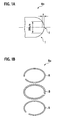
- An outer peripheral surface 1 of the oil ring Ro is covered with hard carbon, CrN or TiN. Therefore, a configuration change of the oil ring Ro due to friction can be significantly suppressed, which avoids an outermost configuration of the oil ring Ro being flattened. Accordingly, a frictional force between a cylinder bore surface and a compression ring Rc (refer to Fig. 2 ) can be reduced for a long period of time.
- the hard carbon coating diamond-like carbon (hereinafter, referred to as DLC) is preferably used.
- the tip curvature radius R of the outer periphery of the oil ring Ro is 6 mm or less, preferably 3 mm or less in the present invention. Accordingly, a frictional force between the oil ring Ro and the cylinder bore is much further reduced.
- the tip curvature radius R of the outer peripheral surface 1 of the oil ring Ro is between 0.3 mm or more and 6 mm or less, more preferably, between 0.3 mm or more and 3 mm or less.
- a hardness of the outer peripheral surface 1 of the oil ring Ro is 2000 Hv or more. Therefore, a configuration change of the oil ring Ro due to friction can be significantly suppressed, which avoids the outermost configuration of the oil ring Ro being flattened. Accordingly, a frictional force between the cylinder bore surface and the compression ring Rc can be reduced for a long period of time.
- the hardness of the outer peripheral surface 1 of the oil ring Ro is less than 2000 Hv, abrasion of the outer periphery of the oil ring Ro is increased in proportion to a travel distance of a vehicle even though an initial configuration of the outer periphery of the oil ring Ro is flattened to have the radius of curvature R of 0.3 mm or more. As a result, a frictional force is increased because the oil ring Ro is further flattened, which may increase oil consumption.
- a surface roughness of the outer peripheral surface 1 of the oil ring Ro is preferably 0.1 ⁇ m or less as a center line average roughness Ra, in view of certainty of an effect to reduce a frictional force.
- the outer peripheral surface 1 of the oil ring Ro is preferably covered with a DLC coating as the hard carbon coating.
- This DLC coating can be formed by a plasma CVD method, for example.
- the hydrogen content in the DLC coating is preferably 10 at% or less.
- the hydrogen content in the DLC coating is preferably 5 at% or less, more preferably 1 at% or less.
- Such a DLC coating with low hydrogen content can be manufactured by a physical vapor deposition (PVD) method such as a sputtering method and an ion plating method, namely a method without substantially using hydrogen and hydrogen-containing compounds.
- PVD physical vapor deposition
- the coating is preferably formed not only by using gas not containing hydrogen, but also by sufficiently baking a reaction container and a retainer for holding a substrate of the oil ring and cleaning a surface of the substrate as necessary.
- the surface roughness of the outer peripheral surface 1 approximately depends on a roughness of a coating formation surface of the substrate.
- a surface of the substrate is also required to finally have a surface roughness of 0.1 ⁇ m or less.
- a hardness and a roughness of an outer peripheral surface 2 of the compression ring Rc (refer to Fig. 2 ) used together with the oil ring Ro are also preferably 2000Hv or more and 0.1 ⁇ m or less, respectively, in view of abrasion resistance and friction property.
- the outer peripheral surface 2 of the compression ring Rc also preferably includes a diamond-like carbon (DLC) coating, and a hydrogen content contained in DLC is preferably 10 at%.
- DLC diamond-like carbon
- a plurality of wire rods were formed, in which one surface with a 0.4 mm width of a rectangular cross-section of 0.4 mm ⁇ 2.0 mm of each wire rod was processed to have a radius of curvature R (0.2 to 2 mm). Then, the wire rods were formed in a ring shape having an outer diameter (nominal size) of 93 mm, followed by cutting an abutment.
- each outer periphery was coated with a CrN coating or a DLC coating by an ion plating method.
- a hydrogen content of the DLC coating was adjusted by changing a hydrogen concentration in a raw material.
- a spacer B composed of SUS304 was interposed between two side rails A formed by the above-described procedure, so as to manufacture an oil ring Ro with a tension of 20N at an insertion into the cylinder liner.
- a Cr-V system heat-resistant spring material SWOSC-V standardized by JIS G 3561 (Oil tempered wire for valve spring) was subjected to a cold-drawn treatment, followed by quenching and tempering treatments. Wire rods having a rectangular cross-section of 1.2 mm ⁇ 2.5 mm were thus obtained.
- Each wire rod was formed in a ring shape to have tension of 10N at the insertion into the cylinder liner having an inner diameter of 93 mm, followed by cutting an abutment, so as to manufacture a compression ring Rc as shown in Fig. 2 .
- An outer periphery 2 of the compression ring Rc was coated with a CrN coating or a DLC coating by the similar method used in the oil ring Ro.
- Gray cast iron was processed to have a cross-section of 1.5 mm ⁇ 2.5 mm by cutting.
- the gray cast iron was formed in a ring shape to have a tension of 10N at the insertion into the cylinder liner having an inner diameter of 93 mm, followed by cutting an abutment.
- a piston P was prepared as a piston for a vehicular engine, a VQ30DE engine manufactured by NISSAN MOTOR CO., LTD.
- the two compression rings Rc manufactured by the above-described procedure were placed in a ring groove G1 and a ring groove G2 as a top ring and a second ring, respectively.
- One of the oil rings Ro manufactured by the above-described procedure was placed in a ring groove G3 below the ring groove G1 and the ring groove G2.
- the piston P provided with those rings was subjected to a sliding test in a cylinder bore using a friction and abrasion testing machine.
- the friction and abrasion testing machine has a mechanism in which a load cell attached to the piston detects a frictional force generated between the piston and the cylinder bore by vibrating the cylinder bore hydraulically.
- An average frictional force of each example was measured by applying 700 vibrations per minute during the test, by use of commercially available engine oil having a viscosity grade of 5W30.
- Example 3 2 CrN 2000 0.15 CrN 2000 0.15 28
- Example 4 0.5 CrN 2000 0.1 CrN 2000 0.1 23
- Example 5 0.5 CrN 2000 0.05 CrN 2000 0.05 23
- Example 6 0.5 CrN 2000 0.05 CrN 2000 0.05 22
- Example 7 0.5 DLC 3000 0.05 15 CrN 2000 0.05 22
- Example 8 0.5 CrN 2000 0.05 DLC 7000 0.05 0.5 19
- Example 9 0.5 DLC 4000 0.05 10 DLC 7000 0.05 0.5 19
- Example 10 0.5 DLC 5000 0.05 5 DLC 7000 0.05 0.5 18
- Example 11 0.5 DLC 7000 0.05 0.5 DLC 7000 0.05 0.5 17
- Example 12 0.5 CrN 2000 0.1 CrN 2000 0.15 24
- Example 13 0.5 DLC 5000 0.05 5 CrN 2000 0.15 21
- Example 14 0.5 DLC 7000 0.05 0.5 CrN 2000 0.15 20
- Example 15 1.4 CrN 2000 0.15 CrN 2000 0.15 26
- Example 16 6 CrN 2000 0.15
- Two compression rings Rc and an oil ring Ro were used together.
- the compression rings were covered on each outer peripheral surface with a CrN coating having a Vickers hardness of 2000 Hv, and had a surface roughness Ra of 0.15 ⁇ m.
- the oil ring Ro had a barrel-faced outer peripheral surface of which an average tip curvature radius R was 0.2 mm in a width of 200 ⁇ m in a sliding direction, and was covered with a CrN coating having a Vickers hardness of 2000 Hv and a surface roughness Ra of 0.15 ⁇ m identical to the compression rings Rc.
- An average frictional force between the piston P and the cylinder bore in this example was 35 N.
- an average frictional force between the piston P and the cylinder bore in this example was 36 N, which was slightly decreased compared to 37 N in Comparative Example 2.
- the oil ring Ro had a barrel-faced outer peripheral surface of which an average tip curvature radius R was 0.5 mm in a width of 200 ⁇ m in a sliding direction, and was covered with a CrN coating having a Vickers hardness of 2000 Hv and a surface roughness Ra of 0.1 ⁇ m identical to the compression rings Rc.
- An average frictional force between the piston P and the cylinder bore in this example was 23 N.
- Example 4 proved that the average frictional force in this example was slightly decreased compared to 24 N in Example 2.
- the oil ring Ro had a barrel-faced outer peripheral surface of which an average tip curvature radius R was 0.5 mm in a width of 200 ⁇ m in a sliding direction, and was covered with a CrN coating having a Vickers hardness of 2000 Hv and a surface roughness Ra of 0.05 ⁇ m identical to the compression rings Rc.
- An average frictional force between the piston P and the cylinder bore in this example was 23 N.
- Example 5 proved that the average frictional force in this example was slightly decreased compared to 24 N in Example 2. Moreover, the average frictional force in this example was significantly decreased compared to 36 N in Comparative Example 3, in which the oil ring Ro had the same surface roughness as this example.
- the oil ring Ro had a barrel-faced outer peripheral surface of which an average tip curvature radius R was 0.5 mm in a width of 200 ⁇ m in a sliding direction, and was covered with a CrN coating having a Vickers hardness of 2000 Hv and a surface roughness Ra of 0.05 ⁇ m identical to the compression rings Rc.
- An average frictional force between the piston P and the cylinder bore in this example was 22 N.
- Example 6 proved that the average frictional force in this example was further decreased compared to 23 N in Example 5.
- the oil ring Ro had a barrel-faced outer peripheral surface of which an average tip curvature radius R was 0.5 mm in a width of 200 ⁇ m in a sliding direction, and was covered with a DLC coating (hydrogen content: 15 at%) having a Vickers hardness of 3000 Hv and a surface roughness Ra of 0.05 ⁇ m.
- An average frictional force between the piston P and the cylinder bore in this example was 22 N.
- Example 7 proved that the average frictional force in this example was further decreased compared to 23 N in Example 5.
- the compression rings were covered on each outer peripheral surface with a DLC coating (hydrogen content: 0.5 at%) having a Vickers hardness of 7000 Hv, and had a surface roughness Ra of 0.05 ⁇ m.
- the oil ring Ro had a barrel-faced outer peripheral surface of which an average tip curvature radius R was 0.5 mm in a width of 200 ⁇ m in a sliding direction, and was covered with a CrN coating having a Vickers hardness of 2000 Hv and a surface roughness Ra of 0.05 ⁇ m.
- An average frictional force between the piston P and the cylinder bore in this example was 19 N, which was further decreased compared to 22 N in Example 6 and 22 N in Example 7.
- Two compression rings Rc and an oil ring Ro were used together.
- the compression rings were covered on each outer peripheral surface with a DLC coating (hydrogen content: 0.5 at%) having a Vickers hardness of 7000 Hv, and had a surface roughness Ra of 0.05 ⁇ m.
- the oil ring Ro had a barrel-faced outer peripheral surface of which an average tip curvature radius R was 0.5 mm in a width of 200 ⁇ m in a sliding direction, and was covered with a DLC coating (hydrogen content: 10 at%) having a Vickers hardness of 4000 Hv and a surface roughness Ra of 0.05 ⁇ m.
- An average frictional force between the piston P and the cylinder bore in this example was 19 N, which was further decreased compared to 22 N in Example 6 and 22 N in Example 7.
- Two compression rings Rc and an oil ring Ro were used together.
- the compression rings were covered on each outer peripheral surface with a DLC coating (hydrogen content: 0.5 at%) having a Vickers hardness of 7000 Hv, and had a surface roughness Ra of 0.05 ⁇ m.
- the oil ring Ro had a barrel-faced outer peripheral surface of which an average tip curvature radius R was 0.5 mm in a width of 200 ⁇ m in a sliding direction, and was covered with a DLC coating (hydrogen content: 5 at%) having a Vickers hardness of 5000 Hv and a surface roughness Ra of 0.05 ⁇ m.
- An average frictional force between the piston P and the cylinder bore in this example was 18 N, which was further decreased compared to 19 N in Example 9.
- Two compression rings Rc and an oil ring Ro were used together.
- the compression rings were covered on each outer peripheral surface with a DLC coating (hydrogen content: 0.5 at%) having a Vickers hardness of 7000 Hv, and had a surface roughness Ra of 0.05 ⁇ m.
- the oil ring Ro had a barrel-faced outer peripheral surface of which an average tip curvature radius R was 0.5 mm in a width of 200 ⁇ m in a sliding direction, and was covered with a DLC coating (hydrogen content: 0.5 at%) having a Vickers hardness of 7000 Hv and a surface roughness Ra of 0.05 ⁇ m.
- An average frictional force between the piston P and the cylinder bore in this example was 17 N, which was further decreased compared to 18 N in Example 10.
- Two compression rings Rc and an oil ring Ro were used together.
- the compression rings were covered on each outer peripheral surface with a CrN coating having a Vickers hardness of 2000 Hv and had a surface roughness Ra of 0.15 ⁇ m.
- the oil ring Ro had a barrel-faced outer peripheral surface of which an average tip curvature radius R was 0.5 mm in a width of 200 ⁇ m in a sliding direction, and was covered with a CrN coating having a Vickers hardness of 2000 Hv identical to the compression rings Rc and a surface roughness Ra of 0.1 ⁇ m.
- An average frictional force between the piston P and the cylinder bore in this example was 24 N.
- Example 12 proved that the average frictional force in this example was decreased compared to 30 N in Example 1.
- the oil ring Ro had a barrel-faced outer peripheral surface of which an average tip curvature radius R was 0.5 mm in a width of 200 ⁇ m in a sliding direction, and was covered with a DLC coating (hydrogen content: 5 at%) having a Vickers hardness of 5000 Hv and a surface roughness Ra of 0.05 ⁇ m.
- An average frictional force between the piston P and the cylinder bore in this example was 21 N, which was further decreased compared to 24 N in Example 12.
- the oil ring Ro had a barrel-faced outer peripheral surface of which an average tip curvature radius R was 0.5 mm in a width of 200 ⁇ m in a sliding direction, and was covered with a DLC coating (hydrogen content: 0.5 at%) having a Vickers hardness of 7000 Hv and a surface roughness Ra of 0.05 ⁇ m.
- An average frictional force between the piston P and the cylinder bore in this example was 20 N.
- Example 14 proved that the average frictional force in this example was further decreased compared to 24 N in Example 12 and 21 N in Example 13.
- the oil ring Ro had a barrel-faced outer peripheral surface of which an average tip curvature radius R was 1.4 mm in a width of 200 ⁇ m in a sliding direction, and was covered with a CrN coating having a Vickers hardness of 2000 Hv and a surface roughness Ra of 0.15 ⁇ m identical to the compression rings Rc.
- An average frictional force between the piston P and the cylinder bore in this example was 26 N.
- the oil ring Ro had a barrel-faced outer peripheral surface of which an average tip curvature radius R was 6 mm in a width of 200 ⁇ m in a sliding direction, and was covered with a CrN coating having a Vickers hardness of 2000 Hv and a surface roughness Ra of 0.15 ⁇ m identical to the compression rings Rc.
- An average frictional force between the piston P and the cylinder bore in this example was 31 N.
- Fig. 4 is a graph showing a test result obtained by the sliding tests based on Examples 1 to 3, 15, 16, and Comparative Examples 1 to 3.
- the graph illustrates influence of the radius of curvature R (mm) of the oil ring Ro exerted on the average frictional force (N).
- the average frictional force is significantly decreased when the average tip curvature radius R of the outer periphery 1 of the oil ring Ro in a width of 200 ⁇ m in a sliding direction is 0.3 mm or more (refer to Example 1).
- the entire contents of Japanese Patent Application No. P2008-163227 (filed on June 23, 2008 ), and Japanese Patent Application No. P2009-075849 (filed on March 26, 2009 ) are herein incorporated by reference, which protect the present application from mistranslations and omissions.
- the outer peripheral surface of the oil ring for an internal combustion engine is covered with at least one of hard carbon, CrN and TiN, and the radius of curvature R at the outermost portion of the piston ring in a sliding direction is 0.3 mm or more. Accordingly, lubricating oil is adequately applied to a sliding surface of the compression ring, and a frictional force between the piston for an internal combustion engine and the cylinder bore is reduced.
Landscapes
- Engineering & Computer Science (AREA)
- General Engineering & Computer Science (AREA)
- Mechanical Engineering (AREA)
- Pistons, Piston Rings, And Cylinders (AREA)
Applications Claiming Priority (3)
| Application Number | Priority Date | Filing Date | Title |
|---|---|---|---|
| JP2008163227 | 2008-06-23 | ||
| JP2009075849A JP2010031835A (ja) | 2008-06-23 | 2009-03-26 | 内燃機関用オイルリング及びピストン |
| PCT/JP2009/060830 WO2009157328A1 (fr) | 2008-06-23 | 2009-06-15 | Segment racleur d’huile et piston pour moteur à combustion interne |
Publications (2)
| Publication Number | Publication Date |
|---|---|
| EP2292952A1 true EP2292952A1 (fr) | 2011-03-09 |
| EP2292952A4 EP2292952A4 (fr) | 2013-11-13 |
Family
ID=41444396
Family Applications (1)
| Application Number | Title | Priority Date | Filing Date |
|---|---|---|---|
| EP09770038.9A Withdrawn EP2292952A4 (fr) | 2008-06-23 | 2009-06-15 | Segment racleur d huile et piston pour moteur à combustion interne |
Country Status (5)
| Country | Link |
|---|---|
| US (1) | US8739753B2 (fr) |
| EP (1) | EP2292952A4 (fr) |
| JP (1) | JP2010031835A (fr) |
| CN (1) | CN102066817A (fr) |
| WO (1) | WO2009157328A1 (fr) |
Families Citing this family (16)
| Publication number | Priority date | Publication date | Assignee | Title |
|---|---|---|---|---|
| DE102009052587A1 (de) * | 2009-11-10 | 2011-05-12 | Federal-Mogul Burscheid Gmbh | Kolbenring |
| EP2674645A1 (fr) * | 2012-06-15 | 2013-12-18 | Siemens Aktiengesellschaft | Anneau de bouchon d'huile |
| WO2015023002A1 (fr) * | 2013-08-12 | 2015-02-19 | 株式会社リケン | Anneau de pression |
| US10113643B2 (en) * | 2014-03-18 | 2018-10-30 | Ford Global Technologies, Llc | Compression piston ring for an internal combustion engine |
| DE102014209391A1 (de) * | 2014-05-19 | 2015-11-19 | Federal-Mogul Friedberg Gmbh | Kolbenring mit Nut in Umfangsrichtung |
| EP3163129B1 (fr) | 2014-06-27 | 2020-10-14 | Kabushiki Kaisha Riken | Segment de piston |
| JP5826958B1 (ja) * | 2014-07-29 | 2015-12-02 | 株式会社リケン | 内燃機関用ピストンリング |
| US9784369B2 (en) | 2014-09-12 | 2017-10-10 | Tpr Co., Ltd. | Combination oil ring |
| JP5981013B1 (ja) * | 2015-02-24 | 2016-08-31 | 株式会社リケン | 内燃機関用ピストンリング |
| JP6496578B2 (ja) * | 2015-03-12 | 2019-04-03 | 株式会社リケン | ピストンリング |
| JP6695663B2 (ja) * | 2015-07-09 | 2020-05-20 | 株式会社リケン | 内燃機関用のピストンリング |
| EP3199301A1 (fr) * | 2016-02-01 | 2017-08-02 | HILTI Aktiengesellschaft | Chambre de combustion et appareil d'enfoncement |
| DE102016104853B4 (de) * | 2016-03-16 | 2018-05-09 | Federal-Mogul Burscheid Gmbh | Mehrteiliger Ölabstreif-Kolbenring mit verringerter Reibung |
| CN109416124B (zh) | 2017-07-05 | 2020-04-14 | 帝伯爱尔株式会社 | 组合油环 |
| US11994219B2 (en) * | 2021-03-31 | 2024-05-28 | Kabushiki Kaisha Riken | Side rail and oil control ring comprising same |
| JP7579237B2 (ja) * | 2021-12-28 | 2024-11-07 | 株式会社リケン | ピストンリング及びピストンリングセット |
Family Cites Families (17)
| Publication number | Priority date | Publication date | Assignee | Title |
|---|---|---|---|---|
| JPS5322680Y2 (fr) * | 1973-03-13 | 1978-06-13 | ||
| JPS5681243A (en) * | 1979-12-04 | 1981-07-03 | Hitachi Metals Ltd | Pressure ring |
| US4612260A (en) * | 1984-08-09 | 1986-09-16 | Nippon Piston Ring Co., Ltd. | Piston ring member |
| JPH03144170A (ja) * | 1989-10-30 | 1991-06-19 | Isuzu Motors Ltd | ピストンリング |
| JP3359675B2 (ja) * | 1992-12-18 | 2002-12-24 | 本田技研工業株式会社 | ピストンリング |
| JP3346068B2 (ja) * | 1994-12-27 | 2002-11-18 | トヨタ自動車株式会社 | 内燃機関のピストン |
| JP3666052B2 (ja) * | 1995-04-26 | 2005-06-29 | 石川島播磨重工業株式会社 | ピストンリング |
| JP4382229B2 (ja) * | 2000-01-20 | 2009-12-09 | 帝国ピストンリング株式会社 | 組合せオイルリング |
| JP4165119B2 (ja) * | 2002-05-15 | 2008-10-15 | 日産自動車株式会社 | 内燃機関のピストンリング |
| KR100701812B1 (ko) * | 2002-07-01 | 2007-04-02 | 히타치 긴조쿠 가부시키가이샤 | 자기 윤활성을 갖는 슬라이딩 부품용 재료 및 피스톤 링용선재 |
| JP2004137535A (ja) * | 2002-10-16 | 2004-05-13 | Nissan Motor Co Ltd | 硬質炭素被膜摺動部材 |
| JP4101105B2 (ja) * | 2003-04-24 | 2008-06-18 | 株式会社リケン | オイルリング及びその製造方法並びにそれを用いたピストン構造 |
| EP1479946B1 (fr) * | 2003-05-23 | 2012-12-19 | Nissan Motor Co., Ltd. | Piston pour un moteur à combustion interne |
| JP2006275269A (ja) | 2005-03-30 | 2006-10-12 | Nippon Piston Ring Co Ltd | 組合せ摺動部材 |
| JP5030439B2 (ja) * | 2006-02-28 | 2012-09-19 | 株式会社リケン | 摺動部材 |
| JP2008163227A (ja) | 2006-12-28 | 2008-07-17 | Toray Ind Inc | ポリアミド組成物、ポリアミド繊維、およびそれらの製造方法 |
| JP2009075849A (ja) | 2007-09-20 | 2009-04-09 | Canon Inc | 情報処理装置、情報処理方法、そのプログラム及び記憶媒体 |
-
2009
- 2009-03-26 JP JP2009075849A patent/JP2010031835A/ja active Pending
- 2009-06-15 WO PCT/JP2009/060830 patent/WO2009157328A1/fr not_active Ceased
- 2009-06-15 CN CN2009801238705A patent/CN102066817A/zh active Pending
- 2009-06-15 EP EP09770038.9A patent/EP2292952A4/fr not_active Withdrawn
- 2009-06-15 US US13/000,453 patent/US8739753B2/en not_active Expired - Fee Related
Also Published As
| Publication number | Publication date |
|---|---|
| CN102066817A (zh) | 2011-05-18 |
| EP2292952A4 (fr) | 2013-11-13 |
| US8739753B2 (en) | 2014-06-03 |
| WO2009157328A1 (fr) | 2009-12-30 |
| JP2010031835A (ja) | 2010-02-12 |
| US20110100318A1 (en) | 2011-05-05 |
Similar Documents
| Publication | Publication Date | Title |
|---|---|---|
| US8739753B2 (en) | Oil ring and piston for an internal combustion engine | |
| EP2508740B1 (fr) | Segment de piston | |
| US8123227B2 (en) | Sliding member | |
| EP3056775B1 (fr) | Segment racleur d'huile combiné | |
| EP2578908B1 (fr) | Bague de lubrification pour moteur à combustion interne | |
| EP3453927A1 (fr) | Bague de graissage combinée | |
| KR101614050B1 (ko) | 내연 기관의 활주 요소, 특히 피스톤 링 | |
| US7572344B2 (en) | Method for the production of wear-resistant sides for a keystone ring for internal combustion engine | |
| KR101781618B1 (ko) | 적어도 피스톤 링의 내부 표면을 코팅하는 방법 및 피스톤 링 | |
| EP3604782B1 (fr) | Élément coulissant, segment de piston et procédé de fabrication d'un élément coulissant | |
| US8181968B2 (en) | Piston ring | |
| EP3663430B1 (fr) | Élément coulissant et garniture de piston | |
| EP3318656A1 (fr) | Élément coulissant et segment de piston | |
| US7156061B2 (en) | Valve lifter | |
| EP3163130B1 (fr) | Segment de piston | |
| EP2297373B1 (fr) | Segment de piston pour moteur à combustion interne | |
| JP7219776B2 (ja) | ピストンリング | |
| JP7298083B2 (ja) | ピストンリング及びその製造方法 | |
| EP3660180B1 (fr) | Élément coulissant et garniture de piston | |
| CN107035564B (zh) | 滑动元件 | |
| EP4080033A1 (fr) | Segment de piston, et procédé de fabrication de celui-ci | |
| EP4365433A1 (fr) | Bague de compression | |
| KR102155139B1 (ko) | 내연 기관 라이너 | |
| KR101797186B1 (ko) | 슬라이딩 요소 | |
| EP4332414B1 (fr) | Segment de piston |
Legal Events
| Date | Code | Title | Description |
|---|---|---|---|
| PUAI | Public reference made under article 153(3) epc to a published international application that has entered the european phase |
Free format text: ORIGINAL CODE: 0009012 |
|
| 17P | Request for examination filed |
Effective date: 20101215 |
|
| AK | Designated contracting states |
Kind code of ref document: A1 Designated state(s): AT BE BG CH CY CZ DE DK EE ES FI FR GB GR HR HU IE IS IT LI LT LU LV MC MK MT NL NO PL PT RO SE SI SK TR |
|
| AX | Request for extension of the european patent |
Extension state: AL BA RS |
|
| DAX | Request for extension of the european patent (deleted) | ||
| A4 | Supplementary search report drawn up and despatched |
Effective date: 20131015 |
|
| RIC1 | Information provided on ipc code assigned before grant |
Ipc: F02F 5/00 20060101ALI20131009BHEP Ipc: F16J 9/20 20060101AFI20131009BHEP Ipc: F16J 9/26 20060101ALI20131009BHEP |
|
| STAA | Information on the status of an ep patent application or granted ep patent |
Free format text: STATUS: THE APPLICATION HAS BEEN WITHDRAWN |
|
| 18W | Application withdrawn |
Effective date: 20141020 |