EP2293085B1 - Messinstrument - Google Patents
Messinstrument Download PDFInfo
- Publication number
- EP2293085B1 EP2293085B1 EP10009267.5A EP10009267A EP2293085B1 EP 2293085 B1 EP2293085 B1 EP 2293085B1 EP 10009267 A EP10009267 A EP 10009267A EP 2293085 B1 EP2293085 B1 EP 2293085B1
- Authority
- EP
- European Patent Office
- Prior art keywords
- locking unit
- measuring
- measuring instrument
- instrument according
- locking
- Prior art date
- Legal status (The legal status is an assumption and is not a legal conclusion. Google has not performed a legal analysis and makes no representation as to the accuracy of the status listed.)
- Not-in-force
Links
- 238000012360 testing method Methods 0.000 description 16
- 230000000903 blocking effect Effects 0.000 description 14
- 238000004146 energy storage Methods 0.000 description 3
- 238000010276 construction Methods 0.000 description 2
- 238000005516 engineering process Methods 0.000 description 2
- 238000003780 insertion Methods 0.000 description 2
- 230000037431 insertion Effects 0.000 description 2
- 238000005259 measurement Methods 0.000 description 2
- 238000011161 development Methods 0.000 description 1
- 230000018109 developmental process Effects 0.000 description 1
- 230000002349 favourable effect Effects 0.000 description 1
- 210000003746 feather Anatomy 0.000 description 1
- 238000002347 injection Methods 0.000 description 1
- 239000007924 injection Substances 0.000 description 1
- 230000003993 interaction Effects 0.000 description 1
- 238000004519 manufacturing process Methods 0.000 description 1
- 239000000155 melt Substances 0.000 description 1
- 238000000034 method Methods 0.000 description 1
Images
Classifications
-
- G—PHYSICS
- G01—MEASURING; TESTING
- G01R—MEASURING ELECTRIC VARIABLES; MEASURING MAGNETIC VARIABLES
- G01R1/00—Details of instruments or arrangements of the types included in groups G01R5/00 - G01R13/00 and G01R31/00
- G01R1/02—General constructional details
- G01R1/04—Housings; Supporting members; Arrangements of terminals
-
- G—PHYSICS
- G01—MEASURING; TESTING
- G01D—MEASURING NOT SPECIALLY ADAPTED FOR A SPECIFIC VARIABLE; ARRANGEMENTS FOR MEASURING TWO OR MORE VARIABLES NOT COVERED IN A SINGLE OTHER SUBCLASS; TARIFF METERING APPARATUS; MEASURING OR TESTING NOT OTHERWISE PROVIDED FOR
- G01D11/00—Component parts of measuring arrangements not specially adapted for a specific variable
- G01D11/24—Housings ; Casings for instruments
-
- G—PHYSICS
- G01—MEASURING; TESTING
- G01R—MEASURING ELECTRIC VARIABLES; MEASURING MAGNETIC VARIABLES
- G01R15/00—Details of measuring arrangements of the types provided for in groups G01R17/00 - G01R29/00, G01R33/00 - G01R33/26 or G01R35/00
- G01R15/12—Circuits for multi-testers, i.e. multimeters, e.g. for measuring voltage, current, or impedance at will
- G01R15/125—Circuits for multi-testers, i.e. multimeters, e.g. for measuring voltage, current, or impedance at will for digital multimeters
-
- G—PHYSICS
- G01—MEASURING; TESTING
- G01R—MEASURING ELECTRIC VARIABLES; MEASURING MAGNETIC VARIABLES
- G01R19/00—Arrangements for measuring currents or voltages or for indicating presence or sign thereof
- G01R19/25—Arrangements for measuring currents or voltages or for indicating presence or sign thereof using digital measurement techniques
- G01R19/2503—Arrangements for measuring currents or voltages or for indicating presence or sign thereof using digital measurement techniques for measuring voltage only, e.g. digital volt meters (DVM's)
-
- H—ELECTRICITY
- H01—ELECTRIC ELEMENTS
- H01M—PROCESSES OR MEANS, e.g. BATTERIES, FOR THE DIRECT CONVERSION OF CHEMICAL ENERGY INTO ELECTRICAL ENERGY
- H01M50/00—Constructional details or processes of manufacture of the non-active parts of electrochemical cells other than fuel cells, e.g. hybrid cells
- H01M50/20—Mountings; Secondary casings or frames; Racks, modules or packs; Suspension devices; Shock absorbers; Transport or carrying devices; Holders
- H01M50/204—Racks, modules or packs for multiple batteries or multiple cells
- H01M50/207—Racks, modules or packs for multiple batteries or multiple cells characterised by their shape
- H01M50/213—Racks, modules or packs for multiple batteries or multiple cells characterised by their shape adapted for cells having curved cross-section, e.g. round or elliptic
-
- G—PHYSICS
- G01—MEASURING; TESTING
- G01R—MEASURING ELECTRIC VARIABLES; MEASURING MAGNETIC VARIABLES
- G01R1/00—Details of instruments or arrangements of the types included in groups G01R5/00 - G01R13/00 and G01R31/00
- G01R1/02—General constructional details
- G01R1/04—Housings; Supporting members; Arrangements of terminals
- G01R1/0408—Test fixtures or contact fields; Connectors or connecting adaptors; Test clips; Test sockets
-
- Y—GENERAL TAGGING OF NEW TECHNOLOGICAL DEVELOPMENTS; GENERAL TAGGING OF CROSS-SECTIONAL TECHNOLOGIES SPANNING OVER SEVERAL SECTIONS OF THE IPC; TECHNICAL SUBJECTS COVERED BY FORMER USPC CROSS-REFERENCE ART COLLECTIONS [XRACs] AND DIGESTS
- Y02—TECHNOLOGIES OR APPLICATIONS FOR MITIGATION OR ADAPTATION AGAINST CLIMATE CHANGE
- Y02E—REDUCTION OF GREENHOUSE GAS [GHG] EMISSIONS, RELATED TO ENERGY GENERATION, TRANSMISSION OR DISTRIBUTION
- Y02E60/00—Enabling technologies; Technologies with a potential or indirect contribution to GHG emissions mitigation
- Y02E60/10—Energy storage using batteries
Definitions
- the invention relates to a measuring instrument according to the preamble of claim 1.
- Measuring instruments such as digital multimeters
- such measuring instruments require a battery, which must be replaced from time to time.
- a fuse is provided, which melts in case of overload of the instrument and then also must be replaced.
- Such interchangeable elements are usually housed in the measuring device in each case in a compartment which can be closed with a lid. If, during the course of a measurement, it becomes necessary to replace the battery or fuse, the measuring instrument should first be disconnected from the DUT for safety reasons. If this is forgotten and the meter is under tension, then you may get an electric shock during the replacement process.
- the DE 44 38 239 Cl describes a battery powered meter.
- the receptacle for the batteries is covered by an attachable to the device housing attachable adapter housing. Both the device housing and the adapter housing in the assembled state have aligned openings that allow insertion and removal of test leads. Test leads can therefore only be removed when the adapter housing is connected to the device housing.
- a measuring device is known in which openings are provided for connecting test leads in the device housing, which are aligned with provided in a removable battery compartment cover openings. Consequently, the battery compartment cover can only be removed if the test leads have been previously removed.
- the invention has for its object to provide a measuring instrument available, which avoids the above-mentioned disadvantages.
- the invention offers security in that access to the compartments for battery or fuse is only released by a movable blocking member when no measuring line is connected to the measuring instrument.
- This locking member is according to the invention either only the sockets of the measuring instrument for the test leads, but not the covers for the battery compartment or the fuse free or vice versa.
- the second position of the locking member so the position at which the test socket is locked, by means of an energy storage, such as a spring accumulator, biased.
- the blocking of the respective measuring bushing is effected by a blocking element of the blocking element, which engages in the blocking position in the annular plug-in space of the measuring bushing.
- the blocking element preferably extends as far as the end of the measuring bushing or even beyond it, in order to ensure that no contact with a plug is possible when the measuring instrument is locked.
- the locking member is designed as a rocker and therefore performs a pivoting movement.
- the cover has a first ramp which cooperates with a first stop of the locking member. In this case, the blocking element moves away from the measuring socket and releases the insertion space as a result.
- the cover has a second ramp which cooperates with a second stop of the locking member. The second ramp inhibits the movement of the cover with plugged plug. This prevents the cover from opening when the plug is plugged in. However, if the plug is removed, causes the energy storage of the Blocking member blocking the Aufsteckraums the test socket by pivoting movement of the locking member.
- the locking member is mounted on two sides in the interior of the housing of the measuring instrument, for example by laterally molded pivot pin. Appropriately, these are, as viewed in the longitudinal direction of the locking member, approximately in the region of the pivot pin.
- the locking member preferably comprises a plurality of locking elements, each locking element is associated with a separate measuring socket. This ensures that the cover can not be opened even if, for example, only one plug is still on a test socket.
- the locking member is formed in one piece, for example as an injection-molded part.
- the locking member allows the cover member to be located on the opposite side of the measuring instrument from the measuring sockets. This results in the advantage that large-area displays can be arranged on the side of the measuring sockets.
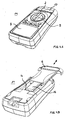
- FIG Fig. 4A denotes the measuring instrument according to the invention in its entirety. It comprises a single-part or multi-part housing 10, a large-area display 8, a rotary handle 9 for switching over the measuring range and a plurality of measuring sockets 2 for receiving measuring lines which are inserted into the measuring sockets via corresponding plugs. In the field of measuring sockets 2 circular recesses are provided in the housing 10. In addition, individual (in Fig. 4A not shown) keys can be provided.
- a receptacle 4 for a replaceable component in the present case, for example, two rod-shaped batteries 16.
- the receptacle 4 is closed by the longitudinally displaceable cover 6.
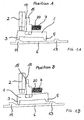
- Fig. 1A shows the claimed by the present invention fuse the measuring sockets 2, of which in Fig. 1A only one of them is shown for clarity. Wiring from the measuring socket 2 into the interior of the measuring instrument are not shown for reasons of clarity.
- the measuring instrument according to the invention comprises a locking member 1, which is mounted in the manner of a rocker pivotable within the housing 10 of the measuring instrument 14. It comprises a transverse part, at the respective end of which a first stop 3 and a second stop 5 are located.
- First and second stop 3 and 5 cooperate with a first ramp 11 and second ramp 13 of the cover 6. Each ramp 11 or 13 has a run-on slope. Likewise, the second stop 5 has a run-on slope.
- the locking member 1 is acted upon by a spring 7, in particular spiral spring, with pressure to the measuring socket 2 out.
- the Fig. 1A shows the locking member 1 in the release position (position A), in which the first stopper 3 with the first ramp 11 cooperates such that the locking member 1 is slightly pivoted in the clockwise direction.
- the lying at the top with its base approximately at the height of the pivot point blocking element 15 is spaced from the measuring socket 2 and thereby an annular Aufsteckraum 19 released.
- the release position corresponds to the state in which the receiving compartment 4 is closed by means of the cover 6. In this state, a plug of a measuring line can be plugged into the test socket 2.
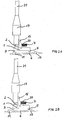
- FIGS. 2A and 2B show the effectiveness of the safety device with the plug 17 plugged into a measuring line 21.
- the cover 6 is closed.
- the plug 17 with its measuring line 21 can be removed in this state, since the locking element 15 does not protrude into the Aufsteckraum 19 due to the interaction of the first ramp 11 with the first stop 3 of the locking member 1.
- the second ramp 13 strikes with its perpendicular stop face against the likewise perpendicular end face or a corresponding stop of the blocking element 1 and prevents further opening movement of the cover 6. This results in the fact that in this state, neither a battery can be removed from the receptacle 4 nor used. This is only when the plug 17 is removed from the test socket 2.
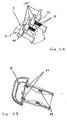
- the locking member 1 is equipped with a plurality of locking elements 15, wherein each locking element 15 is provided for an associated measuring socket 2.
- the entire locking member 1 is mounted on both sides arranged pivot pin 18 within the housing 10 of the measuring instrument 14 pivotally.
- two are each on a receptacle 20 arranged springs 7, in particular coil springs, to ensure an energy storage and thus provided for biasing the locking member 1.
- the first stopper 3 and second stopper 5 is formed on both sides of the locking member 1 and is in accordance with Fig. 3B with correspondingly arranged and formed first and second ramps 11 and 13 in conjunction.
- the locking member 1 is suitably designed as a one-piece part, preferably as a plastic injection molded part. During assembly, the locking member 1 only needs to be inserted into the respectively provided bearing recess on the housing 10 via the pivot pin 18.
- the construction ensures on the one hand a special security in the application of measuring instruments, on the other hand, the construction can be realized with simple structural means.
- the invention therefore represents a very special contribution in the relevant field of technology.
Landscapes
- Physics & Mathematics (AREA)
- General Physics & Mathematics (AREA)
- Chemical & Material Sciences (AREA)
- Chemical Kinetics & Catalysis (AREA)
- Electrochemistry (AREA)
- General Chemical & Material Sciences (AREA)
- Details Of Connecting Devices For Male And Female Coupling (AREA)
Description
- Die Erfindung betrifft ein Messinstrument gemäß dem Oberbegriff des Anspruchs 1.
- Messinstrumente, wie beispielsweise digitale Multimeter, lassen sich über Messschnüre mit einem Messobjekt verbinden, um die Werte bestimmter Parameter zu bestimmen. Zum Betrieb benötigen derartige Messinstrumente eine Batterie, die von Zeit zu Zeit ausgetauscht werden muss. Gelegentlich ist auch eine Sicherung vorgesehen, die bei Überlastung des Instrumentes durchschmilzt und dann ebenfalls ausgewechselt werden muss. Solche auswechselbaren Elemente sind im Messgerät üblicherweise jeweils in einem Fach untergebracht, das mit einem Deckel verschließbar ist. Stellt sich im Verlauf einer Messung die Notwendigkeit heraus, Batterie oder Sicherung auszuwechseln, dann sollte das Messinstrument zuvor aus Sicherheitsgründen vom Messobjekt abgetrennt werden. Wird dies vergessen und steht das Messinstrument unter Spannung, dann kann man beim Auswechselvorgang möglicherweise einen elektrischen Schlag bekommen.
- Die
DE 44 38 239 Cl beschreibt ein batteriebetriebenes Messgerät. Um zu erreichen, dass ein Batteriewechsel nur mit abgezogenen Messleitungen vorgenommen werden kann, ist die Aufnahme für die Batterien von einem an das Gerätegehäuse abnehmbar anbaubaren Adaptergehäuse abgedeckt. Sowohl das Gerätegehäuse als auch das Adaptergehäuse besitzen im zusammengebauten Zustand fluchtende Öffnungen, die ein Einstecken sowie ein Abziehen von Messleitungen ermöglichen. Messleitungen können daher nur abgezogen werden, wenn das Adaptergehäuse mit dem Gerätegehäuse verbunden ist. - Aus der
EP 0866 509 A2 ist ein Messgerät bekannt, bei dem Öffnungen für ein Anschliessen von Messleitungen im Gerätegehäuse vorgesehen sind, die mit in einer abnehmbaren Batteriefachabdeckung vorgesehenen Öffnungen fluchten. Die Batteriefachabdeckung kann folglich nur entfernt werden, wenn die Messleitungen vorher herausgezogen worden sind. - Der Erfindung liegt die Aufgabe zugrunde, ein Messinstrument zur Verfügung zu stellen, welches die vorgennanten Nachteile vermeidet.
- Dise Aufgabe wird durch di im Anspruch 1 angegebenen Merkmale gelöst. Weiterbildungen der Erfindung sind in den Unteransprüchen gekennzeichnet.
- Wenn also beispielweise bei einem Multimeter die Batterie oder eine Sicherung ausgetauscht werden soll und dazu das Gerät zumindest teilweise geöffnet werden muss, wird durch die Erfindung verhindert, dass es über seine Messleitungen noch an spannungsführenden Teilen des Messobjektes liegt, was zu Stromschlägen führen kann. Hiergegen bietet die Erfindung dadurch Sicherheit, dass ein Zugang zu den Fächern für Batterie bzw. Sicherung nur dann von einem beweglichen Sperrglied freigegeben wird, wenn keine Messleitung mehr mit dem Messinstrument verbunden ist. Dieses Sperrglied gibt erfindungsgemäß entweder nur die Anschlussbuchsen des Messinstrumentes für die Messleitungen, nicht aber die Abdeckungen für das Batteriefach bzw. das Sicherungsfach frei bzw. umgekehrt.
- Zweckmäßigerweise ist die zweite Position des Sperrglieds, also die Position, bei der die Messbuchse gesperrt ist, mittels eines Kraftspeichers, beispielsweise eines Federspeichers, vorgespannt.
- Gemäß einer Ausgestaltung der vorliegenden Erfindung erfolgt die Sperrung der jeweiligen Messbuchse durch ein Sperrelement des Sperrglieds, welches in der Sperrposition in den ringartigen Aufsteckraum der Messbuchse eingreift. Das Sperrelement erstreckt sich hierbei vorzugsweise bis an das Ende der Messbuchse oder sogar über dieses hinaus, damit gewährleistet ist, dass keinerlei Kontakt mit einem Stecker bei gesperrtem Messinstrument möglich ist.
- Zweckmäßigerweise ist das Sperrglied als Wippe ausgebildet und führt demzufolge eine Verschwenkbewegung durch. Zudem weist das Abdeckteil eine erste Rampe auf, die mit einem ersten Anschlag des Sperrglieds zusammenwirkt. Hierbei bewegt sich das Sperrelement von der Messbuchse weg und gibt den Einsteckraum hierdurch frei. Zudem weist das Abdeckteil eine zweite Rampe auf, die mit einem zweiten Anschlag des Sperrglieds zusammenwirkt. Die zweite Rampe hemmt die Bewegung des Abdeckteils bei aufgestecktem Stecker. Hierdurch wird verhindert, dass sich das Abdeckteil bei aufgestecktem Stecker öffnen lässt. Wird der Stecker allerdings abgezogen, bewirkt der Kraftspeicher des Sperrglieds eine Sperrung des Aufsteckraums der Messbuchse durch Verschwenkbewegung des Sperrglieds.
- Gemäß einer zweckmäßigen Ausgestaltung ist das Sperrglied im Inneren des Gehäuses des Messinstruments zweiseitig gelagert, und zwar beispielsweise durch seitlich angeformte Gelenkzapfen. Zweckmäßigerweise befinden sich diese, in Längsrichtung des Sperrglieds betrachtet, etwa im Bereich des Gelenkzapfens.
- Das Sperrglied umfasst vorzugsweise eine Mehrzahl von Sperrelementen, wobei jedem Sperrelement eine eigene Messbuchse zugeordnet ist. Hierdurch wird sichergestellt, dass das Abdeckteil auch dann nicht geöffnet werden kann, wenn beispielsweise nur noch ein Stecker auf einer Messbuchse sich befindet.
- Fertigungstechnisch günstig ist es, wenn das Sperrglied einstückig, beispielsweise als Spritzgussteil, ausgebildet ist.
- Das Sperrglied ermöglicht es, dass sich das Abdeckteil auf der den Messbuchsen gegenüberliegenden Seite des Messinstruments befindet. Daraus resultiert der Vorteil, dass auf Seiten der Messbuchsen großflächige Displays angeordnet werden können.
- Zudem kann ein konstruktiv einfaches, längsverschiebliches Abdeckteil zum Einsatz kommen.
- Die Erfindung sei nun anhand eines in den beiliegenden Figuren veranschaulichten Ausführungsbeispiels im Einzelnen erläutert.
- Es zeigen:
- Fig. 1
- eine stark vereinfachte schematische Darstellungsweise der Funktion des Sperrglieds in Freigabeposition (
Fig. 1A ) sowie in Sperrposition (Fig. 1B ); - Fig. 2
- eine stark vereinfachte schematische Darstellungsweise des Sperrglieds bei aufgestecktem Stecker einer Messleitung bei geschlossenem Abdeckteil (
Fig. 2A ) sowie beim Versuch, das Abdeckteil bei einem aufgesteckten Stecker zu öffnen (Fig. 2B ); - Fig. 3
- eine stark vereinfachte schematische Darstellungsweise des Sperrglieds (
Fig. 3A ) sowie des Abdeckteils (Fig. 3B ); sowie - Fig. 4
- eine perspektivische Darstellung des Messinstruments gemäß der vorliegenden Erfindung mit Blickrichtung der Vorderseite schräg von oben (
Fig. 4A ) sowie der Rückseite schräg von oben (Fig. 4B ). - Bezugszeichen 14 in
Fig. 4A bezeichnet das erfindungsgemäße Messinstrument in seiner Gesamtheit. Es umfasst ein ein- oder mehrteiliges Gehäuse 10, ein großflächiges Display 8, einen Drehgriff 9 zum Umschalten des Messbereichs sowie eine Mehrzahl von Messbuchsen 2 zur Aufnahme von Messleitungen, die über entsprechende Stecker in die Messbuchsen eingesteckt werden. Im Bereich der Messbuchsen 2 sind kreisförmige Aussparungen in dem Gehäuse 10 vorgesehen. Zudem können an der Oberseite noch einzelne (inFig. 4A nicht dargestellte) Tasten vorgesehen sein. - An der Rückseite des Messinstruments 14 befindet sich ein Aufnahmefach 4 für ein austauschbares Bauelement, im vorliegenden Fall beispielsweise für zwei stabförmige Batterien 16. Das Aufnahmefach 4 ist durch das längsverschiebliche Abdeckteil 6 verschließbar.
-
Fig. 1A zeigt die durch die vorliegende Erfindung beanspruchte Sicherung der Messbuchsen 2, von denen inFig. 1A lediglich eine davon der Übersichtlichkeit halber dargestellt ist. Verkabelungen von der Messbuchse 2 in das Innere des Messinstruments sind aus Übersichtlichkeitsgründen nicht dargestellt. Das erfindungsgemäße Messinstrument umfasst ein Sperrglied 1, welches nach Art einer Wippe verschwenkbar innerhalb des Gehäuses 10 des Messinstruments 14 gelagert ist. Es umfasst ein Querteil, an dessen jeweiligen Ende sich ein erster Anschlag 3 sowie ein zweiter Anschlag 5 befinden. - Erster und zweiter Anschlag 3 bzw. 5 wirken mit einer ersten Rampe 11 bzw. zweiten Rampe 13 des Abdeckteils 6 zusammen. Jede Rampe 11 bzw. 13 verfügt über eine Anlaufschräge. Ebenso verfügt auch der zweite Anschlag 5 über eine Anlaufschräge.
- Das Sperrglied 1 wird über eine Feder 7, insbesondere Spiralfeder, mit Druck zur Messbuchse 2 hin beaufschlagt.
- Die
Fig. 1A zeigt das Sperrglied 1 in der Freigabeposition (Position A), bei der der erste Anschlag 3 mit der ersten Rampe 11 zusammenwirkt derart, dass das Sperrglied 1 leicht im Uhrzeigersinn verschwenkt positioniert ist. Das an der Oberseite mit seiner Basis etwa in der Höhe des Schwenkpunkts liegende Sperrelement 15 ist zur Messbuchse 2 beabstandet und hierdurch ein ringförmiger Aufsteckraum 19 freigegeben. Die inFig. 1A dargestellte Freigabeposition entspricht dem Zustand, bei dem das Aufnahmefach 4 mittels des Abdeckteils 6 verschlossen ist. In diesem Zustand kann ein Stecker einer Messleitung in die Messbuchse 2 eingesteckt werden. - Wird, wie in
Fig. 1B dargestellt, das Abdeckteil 6 nach links verschoben und damit das Aufnahmefach 4 geöffnet, bewegt sich der erste Anschlag 3 des Sperrglieds 1 bedingt durch die Kraft der Feder 7 aufgrund einer Verschwenkbewegung nach unten. Gleichzeitig schwenkt das Sperrelement 15 leicht inFig. 1B nach links, also in den Aufsteckraum 19 der Messbuchse 2 hinein. In dieser Position B, oder auch Sperrposition genannt, kann somit bei geöffnetem Aufnahmefach, wie es inFig. 4B dargestellt ist, ein Stecker auf die Messbuchse 2 nicht aufgesteckt werden. - Die
Figuren 2A sowie 2B zeigen die Wirksamkeit der Sicherungseinrichtung bei aufgestecktem Stecker 17 einer Messleitung 21. Im Zustand derFig. 2A ist das Abdeckteil 6 verschlossen. Der Stecker 17 mit seiner Messleitung 21 kann in diesem Zustand abgezogen werden, da das Sperrelement 15 aufgrund des Zusammenwirkens der ersten Rampe 11 mit dem ersten Anschlag 3 des Sperrglieds 1 nicht in den Aufsteckraum 19 hineinragt. - Wird nun in diesem Zustand versucht, das Abdeckteil 6 durch lineare Bewegung zu verschieben, um das Aufnahmefach 4 des Messinstruments 14 zu öffnen, schlägt die zweite Rampe 13 mit ihrer senkrecht stehenden Anschlagfläche an die ebenfalls senkrecht stehende Stirnseite oder ein entsprechender Anschlag des Sperrglieds 1 an und verhindert eine weitere Öffnungsbewegung des Abdeckteils 6. Daraus resultiert die Tatsache, dass in diesem Zustand weder eine Batterie aus dem Aufnahmefach 4 herausgenommen noch eingesetzt werden kann. Dies geht erst, wenn der Stecker 17 von der Messbuchse 2 abgezogen wird.
- Gemäß
Fig. 3A ist das Sperrglied 1 mit einer Mehrzahl von Sperrelementen 15 ausgestattet, wobei jedes Sperrelement 15 für eine zugehörige Messbuchse 2 vorgesehen ist. Das gesamte Sperrglied 1 ist über beidseitig angeordnete Gelenkzapfen 18 innerhalb des Gehäuses 10 des Messinstruments 14 verschwenkbar gelagert. Zudem sind zwei jeweils an einer Aufnahme 20 angeordnete Federn 7, insbesondere Spiralfedern, zur Gewährleistung eines Kraftspeichers und damit zur Vorspannung des Sperrglieds 1 vorgesehen. Der erste Anschlag 3 sowie zweite Anschlag 5 ist jeweils beidseitig des Sperrglieds 1 angeformt und steht gemäßFig. 3B mit entsprechend angeordneten und ausgebildeten ersten und zweiten Rampen 11 bzw. 13 in Verbindung. - Das Sperrglied 1 ist zweckmäßigerweise als einstückiges Teil, vorzugsweise als Kunststoffspritzgussteil, ausgebildet. Bei der Montage braucht das Sperrglied 1 lediglich in die jeweils vorgesehene Lagerausnehmung am Gehäuse 10 über dessen Gelenkzapfen 18 eingesetzt werden.
- Die Konstruktion gewährleistet einerseits eine besondere Sicherheit bei der Anwendung von Messinstrumenten, andererseits ist die Konstruktion mit einfachen konstruktiven Mitteln zu realisieren. Die Erfindung stellt daher einen ganz besonderen Beitrag auf dem einschlägigen Gebiet der Technik dar.
-
- 1
- Sperrglied
- 2
- Messbuchsen
- 3
- erster Anschlag
- 4
- Aufnahmefach
- 5
- zweiter Anschlag
- 6
- Abdeckteil
- 7
- Feder
- 8
- Display
- 9
- Drehgriff
- 10
- Gehäuse
- 11
- erste Rampe
- 12
- Öffnungen
- 13
- zweite Rampe
- 14
- Messinstrument
- 15
- Sperrelement
- 16
- Batterie
- 17
- Stecker
- 18
- Gelenkzapfen
- 19
- Aufsteckraum
- 20
- Aufnahme
- 21
- Messleitung
Claims (10)
- Messinstrument mit
einem Gehäuse (8),
mindestens einem Aufnahmefach (4) für ein austauschbares Bauelement, insbesondere Batterie-, Akku- und/oder Sicherung, wobei das Aufnahmefach (4) mittels eines Abdeckteils (6) verschließbar ist,
mindestens einer Messbuchse (2) zur Verbindung des Messinstruments mit einem Messobjekt über eine Messleitung (21),
dadurch gekennzeichnet, dass
ein bewegliches Sperrglied (1) vorgesehen ist,
die Beweglichkeit des Sperrglieds (1) dergestalt festgelegt ist, dass das Sperrglied (1) in einer ersten Position A die Messbuchse (2) freigibt sowie in einer zweiten Position B die Messbuchse (2) sperrt und
die Bewegung des Sperrglieds (1) von der ersten Position in die zweite Position durch Bewegung, insbesondere durch Verschieben, des Abdeckteils (6) veranlasst wird. - Messinstrument nach Anspruch 1,
dadurch gekennzeichnet, dass
die zweite Position des Sperrglieds (1) mittels eines Kraftspeichers, insbesondere eines Federspeichers, vorgespannt ist. - Messinstrument nach Anspruch 1 oder 2,
dadurch gekennzeichnet, dass
das Sperrglied (1) mindestens ein Sperrelement (15) aufweist, welches in der zweiten Position in den Aufsteckraum (19) eingreift und hierdurch das Aufstecken eines Steckers (17) auf die Messbuchse (2) verhindert. - Messinstrument nach Anspruch 3,
dadurch gekennzeichnet, dass
das Sperrglied (1) als Wippe ausgebildet ist, indem das Sperrglied (1) zur Gewährleistung der ersten bzw. zweiten Position das Sperrelement (15) eine Verschwenkbewegung ausführt,
das Abdeckteil (6) eine erste Rampe (11) aufweist, die mit einem ersten Anschlag (3) des Sperrglieds (1) zusammenwirkt,
das Abdeckteil eine zweite Rampe (13) aufweist, die mit einem zweiten Anschlag (5) des Sperrglieds (1) zusammenwirkt und
die zweite Rampe (13) bei aufgestecktem Stecker (17) die Bewegung des Abdeckteils (6) hemmt. - Messinstrument nach Anspruch 4,
dadurch gekennzeichnet, dass
das Sperrglied (1) an jeder Seite desselben einen Gelenkzapfen (18) aufweist und sich das Sperrelement (15), in Längsrichtung des Sperrglieds (1) betrachtet, im Bereich des Gelenkzapfens (18) befindet. - Messinstrument nach einem der Ansprüche 3 bis 5,
dadurch gekennzeichnet, dass
das Sperrglied (1) eine Mehrzahl von Sperrelementen (15) umfasst, wobei jedes Sperrelement (15) einer Messbuchse (2) zugeordnet ist. - Messinstrument nach einem der vorhergehenden Ansprüche,
dadurch gekennzeichnet, dass
das Sperrglied (1) einstückig ausgebildet ist. - Messinstrument nach einem der vorhergehenden Ansprüche,
dadurch gekennzeichnet, dass
sich die Messbuchse (2) auf der dem Abdeckteil (6) gegenüberliegenden Seite des Messinstruments befindet. - Messinstrument nach einem der vorhergehenden Ansprüche,
dadurch gekennzeichnet, dass
das Abdeckteil (6) zum Öffnen bzw. Verschließen des Aufnahmefachs (4) nach Art eines Schlittens längsverschieblich ist. - Messinstrument nach einem der vorhergehenden Ansprüche,
dadurch gekennzeichnet, dass
als Kraftspeicher mindestens, vorzugsweise eine Mehrzahl von Federn (7) vorgesehen sind, die mittels einer Aufnahme (20) am Sperrglied (1) lagefixiert sind.
Applications Claiming Priority (1)
| Application Number | Priority Date | Filing Date | Title |
|---|---|---|---|
| DE202009012059U DE202009012059U1 (de) | 2009-09-07 | 2009-09-07 | Messinstrument |
Publications (2)
| Publication Number | Publication Date |
|---|---|
| EP2293085A1 EP2293085A1 (de) | 2011-03-09 |
| EP2293085B1 true EP2293085B1 (de) | 2014-01-01 |
Family
ID=43126922
Family Applications (1)
| Application Number | Title | Priority Date | Filing Date |
|---|---|---|---|
| EP10009267.5A Not-in-force EP2293085B1 (de) | 2009-09-07 | 2010-09-07 | Messinstrument |
Country Status (2)
| Country | Link |
|---|---|
| EP (1) | EP2293085B1 (de) |
| DE (1) | DE202009012059U1 (de) |
Families Citing this family (1)
| Publication number | Priority date | Publication date | Assignee | Title |
|---|---|---|---|---|
| CN112290136A (zh) * | 2020-11-07 | 2021-01-29 | 湖南宝特瑞能新能源有限责任公司 | 一种锂电池安装用自锁结构的连接件 |
Family Cites Families (4)
| Publication number | Priority date | Publication date | Assignee | Title |
|---|---|---|---|---|
| FR2637153B1 (fr) * | 1988-09-27 | 1993-03-26 | Itt Composants Instr | Appareil electrique a compartiment de pile perfectionne |
| DE4438239C1 (de) * | 1994-10-26 | 1996-06-05 | Mueller & Weigert | Batteriebetriebenes Meßgerät, insbesondere Zangenanlegegerät |
| US5834935A (en) * | 1997-03-18 | 1998-11-10 | Tektronix, Inc. | Hand held instrument with safety locked battery compartment |
| DE202004017714U1 (de) * | 2004-11-15 | 2005-05-12 | Conrad Electronic Gmbh | Elektrisches Messgerät |
-
2009
- 2009-09-07 DE DE202009012059U patent/DE202009012059U1/de not_active Expired - Lifetime
-
2010
- 2010-09-07 EP EP10009267.5A patent/EP2293085B1/de not_active Not-in-force
Also Published As
| Publication number | Publication date |
|---|---|
| EP2293085A1 (de) | 2011-03-09 |
| DE202009012059U1 (de) | 2011-02-03 |
Similar Documents
| Publication | Publication Date | Title |
|---|---|---|
| EP2055967B1 (de) | Batteriepack und Elektrogerät | |
| DE102009015570B4 (de) | Halter für ein elektrisches Bauteil, sowie Verbindungsanordnung hiermit | |
| DE102012105771B4 (de) | Stecker mit Kontaktbuchse und Schutzabdeckung | |
| DE102004038123A1 (de) | Elektrischer Stecker und elektrische Steckeraufnahme | |
| DE102008014176A1 (de) | Reihenklemme, insbesondere Trennklemme | |
| DE102011076568A1 (de) | Steckverbinder | |
| DE102005001515B4 (de) | Elektrischer Steckverbinder | |
| DE102018202542A1 (de) | Klemme | |
| DE102012104538A1 (de) | Werkzeug | |
| DE202013009038U1 (de) | Elektrisches Steckvorrichtungssystem mit Verschlusseinrichtung | |
| DE102019128821A1 (de) | Klemmeneinrichtung zum Anschließen eines elektrischen Leiters | |
| DE202010008488U1 (de) | Vorrichtung zum Verstellen von Bewegungsgegenständen | |
| DE10347668B4 (de) | Elektrische Klemme | |
| DE202007009240U1 (de) | Kurzschlussanzeiger für elektrische Leitungen zur Energieverteilung | |
| DE102012203250B4 (de) | Einschubrahmen für ein elektrisches Einschubschaltgerät sowie Einheit aus einem Einschubrahmen und einem elektrischen Einschubschaltgerät | |
| EP2293085A1 (de) | Messinstrument | |
| DE202008003720U1 (de) | Schwenkhebelbetätigung mit einer Sicherheitseinrichtung | |
| DE102015013012A1 (de) | Energiezähler-Anschlussklemmenblock mit Überbrückungsvorrichtung | |
| DE202018106082U1 (de) | Anschlussleiste | |
| DE10216209C1 (de) | Berührungsschutzvorrichtung mit Längsschieber für eine elektrische Steckdose | |
| DE202007007723U1 (de) | Sicherheitseinrichtung für einen Schwenkhebelstangenverschluss | |
| DE29916350U1 (de) | Sperrelement für ein Hörhilfegerät | |
| DE202010006202U1 (de) | Adapter für einen elektronischen Haushaltszähler | |
| DE102006046801A1 (de) | Elektrische Bedieneinheit für ein Fahrzeug mit einem Schacht zur Aufnahme eines Notschlüssels | |
| DE102023122046A1 (de) | Verschließeinrichtung für eine elektrische Ladedose, Ladesystem, Stecksystem und Wallbox sowie Verfahren zur Betätigung der Verschließeinrichtung |
Legal Events
| Date | Code | Title | Description |
|---|---|---|---|
| PUAI | Public reference made under article 153(3) epc to a published international application that has entered the european phase |
Free format text: ORIGINAL CODE: 0009012 |
|
| AK | Designated contracting states |
Kind code of ref document: A1 Designated state(s): AL AT BE BG CH CY CZ DE DK EE ES FI FR GB GR HR HU IE IS IT LI LT LU LV MC MK MT NL NO PL PT RO SE SI SK SM TR |
|
| AX | Request for extension of the european patent |
Extension state: BA ME RS |
|
| 17P | Request for examination filed |
Effective date: 20110817 |
|
| RIC1 | Information provided on ipc code assigned before grant |
Ipc: H05K 5/02 20060101ALI20130419BHEP Ipc: G01D 11/24 20060101ALI20130419BHEP Ipc: G01R 19/25 20060101ALI20130419BHEP Ipc: G01R 1/04 20060101AFI20130419BHEP Ipc: H01M 2/10 20060101ALI20130419BHEP Ipc: G01R 15/12 20060101ALI20130419BHEP Ipc: H05K 5/00 20060101ALI20130419BHEP |
|
| GRAP | Despatch of communication of intention to grant a patent |
Free format text: ORIGINAL CODE: EPIDOSNIGR1 |
|
| INTG | Intention to grant announced |
Effective date: 20130730 |
|
| GRAS | Grant fee paid |
Free format text: ORIGINAL CODE: EPIDOSNIGR3 |
|
| GRAA | (expected) grant |
Free format text: ORIGINAL CODE: 0009210 |
|
| AK | Designated contracting states |
Kind code of ref document: B1 Designated state(s): AL AT BE BG CH CY CZ DE DK EE ES FI FR GB GR HR HU IE IS IT LI LT LU LV MC MK MT NL NO PL PT RO SE SI SK SM TR |
|
| REG | Reference to a national code |
Ref country code: GB Ref legal event code: FG4D Free format text: NOT ENGLISH |
|
| REG | Reference to a national code |
Ref country code: CH Ref legal event code: EP |
|
| REG | Reference to a national code |
Ref country code: IE Ref legal event code: FG4D Free format text: LANGUAGE OF EP DOCUMENT: GERMAN |
|
| REG | Reference to a national code |
Ref country code: DE Ref legal event code: R096 Ref document number: 502010005804 Country of ref document: DE Effective date: 20140213 |
|
| REG | Reference to a national code |
Ref country code: AT Ref legal event code: REF Ref document number: 647813 Country of ref document: AT Kind code of ref document: T Effective date: 20140215 |
|
| REG | Reference to a national code |
Ref country code: CH Ref legal event code: NV Representative=s name: PATENTANWAELTE SCHAAD, BALASS, MENZL AND PARTN, CH |
|
| REG | Reference to a national code |
Ref country code: NL Ref legal event code: T3 |
|
| REG | Reference to a national code |
Ref country code: LT Ref legal event code: MG4D |
|
| PG25 | Lapsed in a contracting state [announced via postgrant information from national office to epo] |
Ref country code: IS Free format text: LAPSE BECAUSE OF FAILURE TO SUBMIT A TRANSLATION OF THE DESCRIPTION OR TO PAY THE FEE WITHIN THE PRESCRIBED TIME-LIMIT Effective date: 20140501 Ref country code: LT Free format text: LAPSE BECAUSE OF FAILURE TO SUBMIT A TRANSLATION OF THE DESCRIPTION OR TO PAY THE FEE WITHIN THE PRESCRIBED TIME-LIMIT Effective date: 20140101 |
|
| PG25 | Lapsed in a contracting state [announced via postgrant information from national office to epo] |
Ref country code: FI Free format text: LAPSE BECAUSE OF FAILURE TO SUBMIT A TRANSLATION OF THE DESCRIPTION OR TO PAY THE FEE WITHIN THE PRESCRIBED TIME-LIMIT Effective date: 20140101 Ref country code: ES Free format text: LAPSE BECAUSE OF FAILURE TO SUBMIT A TRANSLATION OF THE DESCRIPTION OR TO PAY THE FEE WITHIN THE PRESCRIBED TIME-LIMIT Effective date: 20140101 Ref country code: SE Free format text: LAPSE BECAUSE OF FAILURE TO SUBMIT A TRANSLATION OF THE DESCRIPTION OR TO PAY THE FEE WITHIN THE PRESCRIBED TIME-LIMIT Effective date: 20140101 Ref country code: CY Free format text: LAPSE BECAUSE OF FAILURE TO SUBMIT A TRANSLATION OF THE DESCRIPTION OR TO PAY THE FEE WITHIN THE PRESCRIBED TIME-LIMIT Effective date: 20140101 Ref country code: PT Free format text: LAPSE BECAUSE OF FAILURE TO SUBMIT A TRANSLATION OF THE DESCRIPTION OR TO PAY THE FEE WITHIN THE PRESCRIBED TIME-LIMIT Effective date: 20140502 |
|
| PG25 | Lapsed in a contracting state [announced via postgrant information from national office to epo] |
Ref country code: LV Free format text: LAPSE BECAUSE OF FAILURE TO SUBMIT A TRANSLATION OF THE DESCRIPTION OR TO PAY THE FEE WITHIN THE PRESCRIBED TIME-LIMIT Effective date: 20140101 Ref country code: HR Free format text: LAPSE BECAUSE OF FAILURE TO SUBMIT A TRANSLATION OF THE DESCRIPTION OR TO PAY THE FEE WITHIN THE PRESCRIBED TIME-LIMIT Effective date: 20140101 |
|
| REG | Reference to a national code |
Ref country code: DE Ref legal event code: R097 Ref document number: 502010005804 Country of ref document: DE |
|
| PG25 | Lapsed in a contracting state [announced via postgrant information from national office to epo] |
Ref country code: RO Free format text: LAPSE BECAUSE OF FAILURE TO SUBMIT A TRANSLATION OF THE DESCRIPTION OR TO PAY THE FEE WITHIN THE PRESCRIBED TIME-LIMIT Effective date: 20140101 Ref country code: DK Free format text: LAPSE BECAUSE OF FAILURE TO SUBMIT A TRANSLATION OF THE DESCRIPTION OR TO PAY THE FEE WITHIN THE PRESCRIBED TIME-LIMIT Effective date: 20140101 Ref country code: CZ Free format text: LAPSE BECAUSE OF FAILURE TO SUBMIT A TRANSLATION OF THE DESCRIPTION OR TO PAY THE FEE WITHIN THE PRESCRIBED TIME-LIMIT Effective date: 20140101 Ref country code: EE Free format text: LAPSE BECAUSE OF FAILURE TO SUBMIT A TRANSLATION OF THE DESCRIPTION OR TO PAY THE FEE WITHIN THE PRESCRIBED TIME-LIMIT Effective date: 20140101 |
|
| PLBE | No opposition filed within time limit |
Free format text: ORIGINAL CODE: 0009261 |
|
| STAA | Information on the status of an ep patent application or granted ep patent |
Free format text: STATUS: NO OPPOSITION FILED WITHIN TIME LIMIT |
|
| PG25 | Lapsed in a contracting state [announced via postgrant information from national office to epo] |
Ref country code: SK Free format text: LAPSE BECAUSE OF FAILURE TO SUBMIT A TRANSLATION OF THE DESCRIPTION OR TO PAY THE FEE WITHIN THE PRESCRIBED TIME-LIMIT Effective date: 20140101 Ref country code: PL Free format text: LAPSE BECAUSE OF FAILURE TO SUBMIT A TRANSLATION OF THE DESCRIPTION OR TO PAY THE FEE WITHIN THE PRESCRIBED TIME-LIMIT Effective date: 20140101 |
|
| 26N | No opposition filed |
Effective date: 20141002 |
|
| REG | Reference to a national code |
Ref country code: DE Ref legal event code: R097 Ref document number: 502010005804 Country of ref document: DE Effective date: 20141002 |
|
| PG25 | Lapsed in a contracting state [announced via postgrant information from national office to epo] |
Ref country code: LU Free format text: LAPSE BECAUSE OF FAILURE TO SUBMIT A TRANSLATION OF THE DESCRIPTION OR TO PAY THE FEE WITHIN THE PRESCRIBED TIME-LIMIT Effective date: 20140907 Ref country code: MC Free format text: LAPSE BECAUSE OF FAILURE TO SUBMIT A TRANSLATION OF THE DESCRIPTION OR TO PAY THE FEE WITHIN THE PRESCRIBED TIME-LIMIT Effective date: 20140101 |
|
| GBPC | Gb: european patent ceased through non-payment of renewal fee |
Effective date: 20140907 |
|
| PG25 | Lapsed in a contracting state [announced via postgrant information from national office to epo] |
Ref country code: SI Free format text: LAPSE BECAUSE OF FAILURE TO SUBMIT A TRANSLATION OF THE DESCRIPTION OR TO PAY THE FEE WITHIN THE PRESCRIBED TIME-LIMIT Effective date: 20140101 |
|
| REG | Reference to a national code |
Ref country code: IE Ref legal event code: MM4A |
|
| PG25 | Lapsed in a contracting state [announced via postgrant information from national office to epo] |
Ref country code: BE Free format text: LAPSE BECAUSE OF NON-PAYMENT OF DUE FEES Effective date: 20140930 |
|
| PG25 | Lapsed in a contracting state [announced via postgrant information from national office to epo] |
Ref country code: GB Free format text: LAPSE BECAUSE OF NON-PAYMENT OF DUE FEES Effective date: 20140907 |
|
| PG25 | Lapsed in a contracting state [announced via postgrant information from national office to epo] |
Ref country code: IE Free format text: LAPSE BECAUSE OF NON-PAYMENT OF DUE FEES Effective date: 20140907 |
|
| REG | Reference to a national code |
Ref country code: FR Ref legal event code: PLFP Year of fee payment: 6 |
|
| PGFP | Annual fee paid to national office [announced via postgrant information from national office to epo] |
Ref country code: CH Payment date: 20150922 Year of fee payment: 6 Ref country code: DE Payment date: 20150903 Year of fee payment: 6 |
|
| PGFP | Annual fee paid to national office [announced via postgrant information from national office to epo] |
Ref country code: AT Payment date: 20150921 Year of fee payment: 6 Ref country code: FR Payment date: 20150923 Year of fee payment: 6 |
|
| PGFP | Annual fee paid to national office [announced via postgrant information from national office to epo] |
Ref country code: NL Payment date: 20150923 Year of fee payment: 6 |
|
| PG25 | Lapsed in a contracting state [announced via postgrant information from national office to epo] |
Ref country code: NO Free format text: LAPSE BECAUSE OF FAILURE TO SUBMIT A TRANSLATION OF THE DESCRIPTION OR TO PAY THE FEE WITHIN THE PRESCRIBED TIME-LIMIT Effective date: 20140401 Ref country code: SM Free format text: LAPSE BECAUSE OF FAILURE TO SUBMIT A TRANSLATION OF THE DESCRIPTION OR TO PAY THE FEE WITHIN THE PRESCRIBED TIME-LIMIT Effective date: 20140101 |
|
| PG25 | Lapsed in a contracting state [announced via postgrant information from national office to epo] |
Ref country code: IT Free format text: LAPSE BECAUSE OF FAILURE TO SUBMIT A TRANSLATION OF THE DESCRIPTION OR TO PAY THE FEE WITHIN THE PRESCRIBED TIME-LIMIT Effective date: 20140101 Ref country code: MT Free format text: LAPSE BECAUSE OF FAILURE TO SUBMIT A TRANSLATION OF THE DESCRIPTION OR TO PAY THE FEE WITHIN THE PRESCRIBED TIME-LIMIT Effective date: 20140101 Ref country code: BG Free format text: LAPSE BECAUSE OF FAILURE TO SUBMIT A TRANSLATION OF THE DESCRIPTION OR TO PAY THE FEE WITHIN THE PRESCRIBED TIME-LIMIT Effective date: 20140101 Ref country code: GR Free format text: LAPSE BECAUSE OF FAILURE TO SUBMIT A TRANSLATION OF THE DESCRIPTION OR TO PAY THE FEE WITHIN THE PRESCRIBED TIME-LIMIT Effective date: 20140402 |
|
| PG25 | Lapsed in a contracting state [announced via postgrant information from national office to epo] |
Ref country code: TR Free format text: LAPSE BECAUSE OF FAILURE TO SUBMIT A TRANSLATION OF THE DESCRIPTION OR TO PAY THE FEE WITHIN THE PRESCRIBED TIME-LIMIT Effective date: 20140101 Ref country code: HU Free format text: LAPSE BECAUSE OF FAILURE TO SUBMIT A TRANSLATION OF THE DESCRIPTION OR TO PAY THE FEE WITHIN THE PRESCRIBED TIME-LIMIT; INVALID AB INITIO Effective date: 20100907 |
|
| REG | Reference to a national code |
Ref country code: DE Ref legal event code: R119 Ref document number: 502010005804 Country of ref document: DE |
|
| REG | Reference to a national code |
Ref country code: CH Ref legal event code: PL |
|
| REG | Reference to a national code |
Ref country code: NL Ref legal event code: MM Effective date: 20161001 |
|
| REG | Reference to a national code |
Ref country code: AT Ref legal event code: MM01 Ref document number: 647813 Country of ref document: AT Kind code of ref document: T Effective date: 20160907 |
|
| PG25 | Lapsed in a contracting state [announced via postgrant information from national office to epo] |
Ref country code: NL Free format text: LAPSE BECAUSE OF NON-PAYMENT OF DUE FEES Effective date: 20161001 |
|
| REG | Reference to a national code |
Ref country code: FR Ref legal event code: ST Effective date: 20170531 |
|
| PG25 | Lapsed in a contracting state [announced via postgrant information from national office to epo] |
Ref country code: CH Free format text: LAPSE BECAUSE OF NON-PAYMENT OF DUE FEES Effective date: 20160930 Ref country code: DE Free format text: LAPSE BECAUSE OF NON-PAYMENT OF DUE FEES Effective date: 20170401 Ref country code: LI Free format text: LAPSE BECAUSE OF NON-PAYMENT OF DUE FEES Effective date: 20160930 Ref country code: FR Free format text: LAPSE BECAUSE OF NON-PAYMENT OF DUE FEES Effective date: 20160930 |
|
| PG25 | Lapsed in a contracting state [announced via postgrant information from national office to epo] |
Ref country code: AT Free format text: LAPSE BECAUSE OF NON-PAYMENT OF DUE FEES Effective date: 20160907 |
|
| PG25 | Lapsed in a contracting state [announced via postgrant information from national office to epo] |
Ref country code: MK Free format text: LAPSE BECAUSE OF FAILURE TO SUBMIT A TRANSLATION OF THE DESCRIPTION OR TO PAY THE FEE WITHIN THE PRESCRIBED TIME-LIMIT Effective date: 20140101 |
|
| PG25 | Lapsed in a contracting state [announced via postgrant information from national office to epo] |
Ref country code: AL Free format text: LAPSE BECAUSE OF FAILURE TO SUBMIT A TRANSLATION OF THE DESCRIPTION OR TO PAY THE FEE WITHIN THE PRESCRIBED TIME-LIMIT Effective date: 20140101 |