EP2293324A1 - Verpackungsstruktur und verfahren zur herstellung einer verpackungsstruktur - Google Patents
Verpackungsstruktur und verfahren zur herstellung einer verpackungsstruktur Download PDFInfo
- Publication number
- EP2293324A1 EP2293324A1 EP09769870A EP09769870A EP2293324A1 EP 2293324 A1 EP2293324 A1 EP 2293324A1 EP 09769870 A EP09769870 A EP 09769870A EP 09769870 A EP09769870 A EP 09769870A EP 2293324 A1 EP2293324 A1 EP 2293324A1
- Authority
- EP
- European Patent Office
- Prior art keywords
- mounting structure
- electronic component
- paste material
- electrode
- substrate
- Prior art date
- Legal status (The legal status is an assumption and is not a legal conclusion. Google has not performed a legal analysis and makes no representation as to the accuracy of the status listed.)
- Granted
Links
Images






Classifications
-
- H—ELECTRICITY
- H10—SEMICONDUCTOR DEVICES; ELECTRIC SOLID-STATE DEVICES NOT OTHERWISE PROVIDED FOR
- H10H—INORGANIC LIGHT-EMITTING SEMICONDUCTOR DEVICES HAVING POTENTIAL BARRIERS
- H10H20/00—Individual inorganic light-emitting semiconductor devices having potential barriers, e.g. light-emitting diodes [LED]
- H10H20/80—Constructional details
- H10H20/85—Packages
- H10H20/857—Interconnections, e.g. lead-frames, bond wires or solder balls
-
- B—PERFORMING OPERATIONS; TRANSPORTING
- B23—MACHINE TOOLS; METAL-WORKING NOT OTHERWISE PROVIDED FOR
- B23K—SOLDERING OR UNSOLDERING; WELDING; CLADDING OR PLATING BY SOLDERING OR WELDING; CUTTING BY APPLYING HEAT LOCALLY, e.g. FLAME CUTTING; WORKING BY LASER BEAM
- B23K1/00—Soldering, e.g. brazing, or unsoldering
- B23K1/0008—Soldering, e.g. brazing, or unsoldering specially adapted for particular articles or work
- B23K1/0016—Soldering of electronic components
-
- B—PERFORMING OPERATIONS; TRANSPORTING
- B23—MACHINE TOOLS; METAL-WORKING NOT OTHERWISE PROVIDED FOR
- B23K—SOLDERING OR UNSOLDERING; WELDING; CLADDING OR PLATING BY SOLDERING OR WELDING; CUTTING BY APPLYING HEAT LOCALLY, e.g. FLAME CUTTING; WORKING BY LASER BEAM
- B23K35/00—Rods, electrodes, materials, or media, for use in soldering, welding, or cutting
- B23K35/02—Rods, electrodes, materials, or media, for use in soldering, welding, or cutting characterised by mechanical features, e.g. shape
- B23K35/0222—Rods, electrodes, materials, or media, for use in soldering, welding, or cutting characterised by mechanical features, e.g. shape for use in soldering or brazing
- B23K35/0244—Powders, particles or spheres; Preforms made therefrom
-
- B—PERFORMING OPERATIONS; TRANSPORTING
- B23—MACHINE TOOLS; METAL-WORKING NOT OTHERWISE PROVIDED FOR
- B23K—SOLDERING OR UNSOLDERING; WELDING; CLADDING OR PLATING BY SOLDERING OR WELDING; CUTTING BY APPLYING HEAT LOCALLY, e.g. FLAME CUTTING; WORKING BY LASER BEAM
- B23K35/00—Rods, electrodes, materials, or media, for use in soldering, welding, or cutting
- B23K35/02—Rods, electrodes, materials, or media, for use in soldering, welding, or cutting characterised by mechanical features, e.g. shape
- B23K35/0222—Rods, electrodes, materials, or media, for use in soldering, welding, or cutting characterised by mechanical features, e.g. shape for use in soldering or brazing
- B23K35/0244—Powders, particles or spheres; Preforms made therefrom
- B23K35/025—Pastes, creams or slurries
-
- H—ELECTRICITY
- H05—ELECTRIC TECHNIQUES NOT OTHERWISE PROVIDED FOR
- H05K—PRINTED CIRCUITS; CASINGS OR CONSTRUCTIONAL DETAILS OF ELECTRIC APPARATUS; MANUFACTURE OF ASSEMBLAGES OF ELECTRICAL COMPONENTS
- H05K3/00—Apparatus or processes for manufacturing printed circuits
- H05K3/30—Assembling printed circuits with electric components, e.g. with resistors
- H05K3/32—Assembling printed circuits with electric components, e.g. with resistors electrically connecting electric components or wires to printed circuits
- H05K3/321—Assembling printed circuits with electric components, e.g. with resistors electrically connecting electric components or wires to printed circuits by conductive adhesives
-
- H—ELECTRICITY
- H10—SEMICONDUCTOR DEVICES; ELECTRIC SOLID-STATE DEVICES NOT OTHERWISE PROVIDED FOR
- H10H—INORGANIC LIGHT-EMITTING SEMICONDUCTOR DEVICES HAVING POTENTIAL BARRIERS
- H10H20/00—Individual inorganic light-emitting semiconductor devices having potential barriers, e.g. light-emitting diodes [LED]
- H10H20/80—Constructional details
- H10H20/85—Packages
- H10H20/858—Means for heat extraction or cooling
- H10H20/8581—Means for heat extraction or cooling characterised by their material
-
- H—ELECTRICITY
- H05—ELECTRIC TECHNIQUES NOT OTHERWISE PROVIDED FOR
- H05K—PRINTED CIRCUITS; CASINGS OR CONSTRUCTIONAL DETAILS OF ELECTRIC APPARATUS; MANUFACTURE OF ASSEMBLAGES OF ELECTRICAL COMPONENTS
- H05K2201/00—Indexing scheme relating to printed circuits covered by H05K1/00
- H05K2201/03—Conductive materials
- H05K2201/0332—Structure of the conductor
- H05K2201/0364—Conductor shape
- H05K2201/0367—Metallic bump or raised conductor not used as solder bump
-
- H—ELECTRICITY
- H05—ELECTRIC TECHNIQUES NOT OTHERWISE PROVIDED FOR
- H05K—PRINTED CIRCUITS; CASINGS OR CONSTRUCTIONAL DETAILS OF ELECTRIC APPARATUS; MANUFACTURE OF ASSEMBLAGES OF ELECTRICAL COMPONENTS
- H05K2201/00—Indexing scheme relating to printed circuits covered by H05K1/00
- H05K2201/10—Details of components or other objects attached to or integrated in a printed circuit board
- H05K2201/10007—Types of components
- H05K2201/10106—Light emitting diode [LED]
-
- H—ELECTRICITY
- H05—ELECTRIC TECHNIQUES NOT OTHERWISE PROVIDED FOR
- H05K—PRINTED CIRCUITS; CASINGS OR CONSTRUCTIONAL DETAILS OF ELECTRIC APPARATUS; MANUFACTURE OF ASSEMBLAGES OF ELECTRICAL COMPONENTS
- H05K2201/00—Indexing scheme relating to printed circuits covered by H05K1/00
- H05K2201/10—Details of components or other objects attached to or integrated in a printed circuit board
- H05K2201/10007—Types of components
- H05K2201/10166—Transistor
-
- H—ELECTRICITY
- H05—ELECTRIC TECHNIQUES NOT OTHERWISE PROVIDED FOR
- H05K—PRINTED CIRCUITS; CASINGS OR CONSTRUCTIONAL DETAILS OF ELECTRIC APPARATUS; MANUFACTURE OF ASSEMBLAGES OF ELECTRICAL COMPONENTS
- H05K2201/00—Indexing scheme relating to printed circuits covered by H05K1/00
- H05K2201/20—Details of printed circuits not provided for in H05K2201/01 - H05K2201/10
- H05K2201/2036—Permanent spacer or stand-off in a printed circuit or printed circuit assembly
-
- H—ELECTRICITY
- H05—ELECTRIC TECHNIQUES NOT OTHERWISE PROVIDED FOR
- H05K—PRINTED CIRCUITS; CASINGS OR CONSTRUCTIONAL DETAILS OF ELECTRIC APPARATUS; MANUFACTURE OF ASSEMBLAGES OF ELECTRICAL COMPONENTS
- H05K2203/00—Indexing scheme relating to apparatus or processes for manufacturing printed circuits covered by H05K3/00
- H05K2203/11—Treatments characterised by their effect, e.g. heating, cooling, roughening
- H05K2203/1131—Sintering, i.e. fusing of metal particles to achieve or improve electrical conductivity
-
- H—ELECTRICITY
- H05—ELECTRIC TECHNIQUES NOT OTHERWISE PROVIDED FOR
- H05K—PRINTED CIRCUITS; CASINGS OR CONSTRUCTIONAL DETAILS OF ELECTRIC APPARATUS; MANUFACTURE OF ASSEMBLAGES OF ELECTRICAL COMPONENTS
- H05K2203/00—Indexing scheme relating to apparatus or processes for manufacturing printed circuits covered by H05K3/00
- H05K2203/11—Treatments characterised by their effect, e.g. heating, cooling, roughening
- H05K2203/1178—Means for venting or for letting gases escape
-
- H—ELECTRICITY
- H05—ELECTRIC TECHNIQUES NOT OTHERWISE PROVIDED FOR
- H05K—PRINTED CIRCUITS; CASINGS OR CONSTRUCTIONAL DETAILS OF ELECTRIC APPARATUS; MANUFACTURE OF ASSEMBLAGES OF ELECTRICAL COMPONENTS
- H05K3/00—Apparatus or processes for manufacturing printed circuits
- H05K3/40—Forming printed elements for providing electric connections to or between printed circuits
- H05K3/4007—Surface contacts, e.g. bumps
-
- H—ELECTRICITY
- H10—SEMICONDUCTOR DEVICES; ELECTRIC SOLID-STATE DEVICES NOT OTHERWISE PROVIDED FOR
- H10F—INORGANIC SEMICONDUCTOR DEVICES SENSITIVE TO INFRARED RADIATION, LIGHT, ELECTROMAGNETIC RADIATION OF SHORTER WAVELENGTH OR CORPUSCULAR RADIATION
- H10F77/00—Constructional details of devices covered by this subclass
- H10F77/60—Arrangements for cooling, heating, ventilating or compensating for temperature fluctuations
-
- H—ELECTRICITY
- H10—SEMICONDUCTOR DEVICES; ELECTRIC SOLID-STATE DEVICES NOT OTHERWISE PROVIDED FOR
- H10H—INORGANIC LIGHT-EMITTING SEMICONDUCTOR DEVICES HAVING POTENTIAL BARRIERS
- H10H20/00—Individual inorganic light-emitting semiconductor devices having potential barriers, e.g. light-emitting diodes [LED]
- H10H20/80—Constructional details
- H10H20/85—Packages
- H10H20/858—Means for heat extraction or cooling
- H10H20/8585—Means for heat extraction or cooling being an interconnection
-
- H—ELECTRICITY
- H10—SEMICONDUCTOR DEVICES; ELECTRIC SOLID-STATE DEVICES NOT OTHERWISE PROVIDED FOR
- H10W—GENERIC PACKAGES, INTERCONNECTIONS, CONNECTORS OR OTHER CONSTRUCTIONAL DETAILS OF DEVICES COVERED BY CLASS H10
- H10W72/00—Interconnections or connectors in packages
- H10W72/071—Connecting or disconnecting
- H10W72/073—Connecting or disconnecting of die-attach connectors
-
- H—ELECTRICITY
- H10—SEMICONDUCTOR DEVICES; ELECTRIC SOLID-STATE DEVICES NOT OTHERWISE PROVIDED FOR
- H10W—GENERIC PACKAGES, INTERCONNECTIONS, CONNECTORS OR OTHER CONSTRUCTIONAL DETAILS OF DEVICES COVERED BY CLASS H10
- H10W72/00—Interconnections or connectors in packages
- H10W72/071—Connecting or disconnecting
- H10W72/073—Connecting or disconnecting of die-attach connectors
- H10W72/07321—Aligning
- H10W72/07327—Aligning involving guiding structures, e.g. spacers or supporting members
-
- H—ELECTRICITY
- H10—SEMICONDUCTOR DEVICES; ELECTRIC SOLID-STATE DEVICES NOT OTHERWISE PROVIDED FOR
- H10W—GENERIC PACKAGES, INTERCONNECTIONS, CONNECTORS OR OTHER CONSTRUCTIONAL DETAILS OF DEVICES COVERED BY CLASS H10
- H10W72/00—Interconnections or connectors in packages
- H10W72/071—Connecting or disconnecting
- H10W72/073—Connecting or disconnecting of die-attach connectors
- H10W72/07331—Connecting techniques
-
- H—ELECTRICITY
- H10—SEMICONDUCTOR DEVICES; ELECTRIC SOLID-STATE DEVICES NOT OTHERWISE PROVIDED FOR
- H10W—GENERIC PACKAGES, INTERCONNECTIONS, CONNECTORS OR OTHER CONSTRUCTIONAL DETAILS OF DEVICES COVERED BY CLASS H10
- H10W72/00—Interconnections or connectors in packages
- H10W72/071—Connecting or disconnecting
- H10W72/073—Connecting or disconnecting of die-attach connectors
- H10W72/07331—Connecting techniques
- H10W72/07332—Compression bonding, e.g. thermocompression bonding
- H10W72/07333—Ultrasonic bonding, e.g. thermosonic bonding
-
- H—ELECTRICITY
- H10—SEMICONDUCTOR DEVICES; ELECTRIC SOLID-STATE DEVICES NOT OTHERWISE PROVIDED FOR
- H10W—GENERIC PACKAGES, INTERCONNECTIONS, CONNECTORS OR OTHER CONSTRUCTIONAL DETAILS OF DEVICES COVERED BY CLASS H10
- H10W72/00—Interconnections or connectors in packages
- H10W72/071—Connecting or disconnecting
- H10W72/074—Connecting or disconnecting of anisotropic conductive adhesives
-
- H—ELECTRICITY
- H10—SEMICONDUCTOR DEVICES; ELECTRIC SOLID-STATE DEVICES NOT OTHERWISE PROVIDED FOR
- H10W—GENERIC PACKAGES, INTERCONNECTIONS, CONNECTORS OR OTHER CONSTRUCTIONAL DETAILS OF DEVICES COVERED BY CLASS H10
- H10W72/00—Interconnections or connectors in packages
- H10W72/20—Bump connectors, e.g. solder bumps or copper pillars; Dummy bumps; Thermal bumps
- H10W72/29—Bond pads specially adapted therefor
-
- H—ELECTRICITY
- H10—SEMICONDUCTOR DEVICES; ELECTRIC SOLID-STATE DEVICES NOT OTHERWISE PROVIDED FOR
- H10W—GENERIC PACKAGES, INTERCONNECTIONS, CONNECTORS OR OTHER CONSTRUCTIONAL DETAILS OF DEVICES COVERED BY CLASS H10
- H10W72/00—Interconnections or connectors in packages
- H10W72/30—Die-attach connectors
- H10W72/321—Structures or relative sizes of die-attach connectors
-
- H—ELECTRICITY
- H10—SEMICONDUCTOR DEVICES; ELECTRIC SOLID-STATE DEVICES NOT OTHERWISE PROVIDED FOR
- H10W—GENERIC PACKAGES, INTERCONNECTIONS, CONNECTORS OR OTHER CONSTRUCTIONAL DETAILS OF DEVICES COVERED BY CLASS H10
- H10W72/00—Interconnections or connectors in packages
- H10W72/30—Die-attach connectors
- H10W72/321—Structures or relative sizes of die-attach connectors
- H10W72/325—Die-attach connectors having a filler embedded in a matrix
-
- H—ELECTRICITY
- H10—SEMICONDUCTOR DEVICES; ELECTRIC SOLID-STATE DEVICES NOT OTHERWISE PROVIDED FOR
- H10W—GENERIC PACKAGES, INTERCONNECTIONS, CONNECTORS OR OTHER CONSTRUCTIONAL DETAILS OF DEVICES COVERED BY CLASS H10
- H10W72/00—Interconnections or connectors in packages
- H10W72/30—Die-attach connectors
- H10W72/351—Materials of die-attach connectors
- H10W72/352—Materials of die-attach connectors comprising metals or metalloids, e.g. solders
-
- H—ELECTRICITY
- H10—SEMICONDUCTOR DEVICES; ELECTRIC SOLID-STATE DEVICES NOT OTHERWISE PROVIDED FOR
- H10W—GENERIC PACKAGES, INTERCONNECTIONS, CONNECTORS OR OTHER CONSTRUCTIONAL DETAILS OF DEVICES COVERED BY CLASS H10
- H10W72/00—Interconnections or connectors in packages
- H10W72/30—Die-attach connectors
- H10W72/351—Materials of die-attach connectors
- H10W72/353—Materials of die-attach connectors not comprising solid metals or solid metalloids, e.g. ceramics
- H10W72/354—Materials of die-attach connectors not comprising solid metals or solid metalloids, e.g. ceramics comprising polymers
-
- H—ELECTRICITY
- H10—SEMICONDUCTOR DEVICES; ELECTRIC SOLID-STATE DEVICES NOT OTHERWISE PROVIDED FOR
- H10W—GENERIC PACKAGES, INTERCONNECTIONS, CONNECTORS OR OTHER CONSTRUCTIONAL DETAILS OF DEVICES COVERED BY CLASS H10
- H10W72/00—Interconnections or connectors in packages
- H10W72/851—Dispositions of multiple connectors or interconnections
- H10W72/874—On different surfaces
- H10W72/884—Die-attach connectors and bond wires
-
- H—ELECTRICITY
- H10—SEMICONDUCTOR DEVICES; ELECTRIC SOLID-STATE DEVICES NOT OTHERWISE PROVIDED FOR
- H10W—GENERIC PACKAGES, INTERCONNECTIONS, CONNECTORS OR OTHER CONSTRUCTIONAL DETAILS OF DEVICES COVERED BY CLASS H10
- H10W72/00—Interconnections or connectors in packages
- H10W72/90—Bond pads, in general
- H10W72/921—Structures or relative sizes of bond pads
- H10W72/926—Multiple bond pads having different sizes
-
- H—ELECTRICITY
- H10—SEMICONDUCTOR DEVICES; ELECTRIC SOLID-STATE DEVICES NOT OTHERWISE PROVIDED FOR
- H10W—GENERIC PACKAGES, INTERCONNECTIONS, CONNECTORS OR OTHER CONSTRUCTIONAL DETAILS OF DEVICES COVERED BY CLASS H10
- H10W72/00—Interconnections or connectors in packages
- H10W72/90—Bond pads, in general
- H10W72/931—Shapes of bond pads
-
- H—ELECTRICITY
- H10—SEMICONDUCTOR DEVICES; ELECTRIC SOLID-STATE DEVICES NOT OTHERWISE PROVIDED FOR
- H10W—GENERIC PACKAGES, INTERCONNECTIONS, CONNECTORS OR OTHER CONSTRUCTIONAL DETAILS OF DEVICES COVERED BY CLASS H10
- H10W72/00—Interconnections or connectors in packages
- H10W72/90—Bond pads, in general
- H10W72/941—Dispositions of bond pads
- H10W72/944—Dispositions of multiple bond pads
-
- H—ELECTRICITY
- H10—SEMICONDUCTOR DEVICES; ELECTRIC SOLID-STATE DEVICES NOT OTHERWISE PROVIDED FOR
- H10W—GENERIC PACKAGES, INTERCONNECTIONS, CONNECTORS OR OTHER CONSTRUCTIONAL DETAILS OF DEVICES COVERED BY CLASS H10
- H10W74/00—Encapsulations, e.g. protective coatings
- H10W74/01—Manufacture or treatment
- H10W74/012—Manufacture or treatment of encapsulations on active surfaces of flip-chip devices, e.g. forming underfills
-
- H—ELECTRICITY
- H10—SEMICONDUCTOR DEVICES; ELECTRIC SOLID-STATE DEVICES NOT OTHERWISE PROVIDED FOR
- H10W—GENERIC PACKAGES, INTERCONNECTIONS, CONNECTORS OR OTHER CONSTRUCTIONAL DETAILS OF DEVICES COVERED BY CLASS H10
- H10W74/00—Encapsulations, e.g. protective coatings
- H10W74/10—Encapsulations, e.g. protective coatings characterised by their shape or disposition
- H10W74/15—Encapsulations, e.g. protective coatings characterised by their shape or disposition on active surfaces of flip-chip devices, e.g. underfills
-
- H—ELECTRICITY
- H10—SEMICONDUCTOR DEVICES; ELECTRIC SOLID-STATE DEVICES NOT OTHERWISE PROVIDED FOR
- H10W—GENERIC PACKAGES, INTERCONNECTIONS, CONNECTORS OR OTHER CONSTRUCTIONAL DETAILS OF DEVICES COVERED BY CLASS H10
- H10W90/00—Package configurations
- H10W90/701—Package configurations characterised by the relative positions of pads or connectors relative to package parts
- H10W90/721—Package configurations characterised by the relative positions of pads or connectors relative to package parts of bump connectors
- H10W90/724—Package configurations characterised by the relative positions of pads or connectors relative to package parts of bump connectors between a chip and a stacked insulating package substrate, interposer or RDL
-
- H—ELECTRICITY
- H10—SEMICONDUCTOR DEVICES; ELECTRIC SOLID-STATE DEVICES NOT OTHERWISE PROVIDED FOR
- H10W—GENERIC PACKAGES, INTERCONNECTIONS, CONNECTORS OR OTHER CONSTRUCTIONAL DETAILS OF DEVICES COVERED BY CLASS H10
- H10W90/00—Package configurations
- H10W90/701—Package configurations characterised by the relative positions of pads or connectors relative to package parts
- H10W90/731—Package configurations characterised by the relative positions of pads or connectors relative to package parts of die-attach connectors
- H10W90/734—Package configurations characterised by the relative positions of pads or connectors relative to package parts of die-attach connectors between a chip and a stacked insulating package substrate, interposer or RDL
-
- H—ELECTRICITY
- H10—SEMICONDUCTOR DEVICES; ELECTRIC SOLID-STATE DEVICES NOT OTHERWISE PROVIDED FOR
- H10W—GENERIC PACKAGES, INTERCONNECTIONS, CONNECTORS OR OTHER CONSTRUCTIONAL DETAILS OF DEVICES COVERED BY CLASS H10
- H10W90/00—Package configurations
- H10W90/701—Package configurations characterised by the relative positions of pads or connectors relative to package parts
- H10W90/751—Package configurations characterised by the relative positions of pads or connectors relative to package parts of bond wires
- H10W90/754—Package configurations characterised by the relative positions of pads or connectors relative to package parts of bond wires between a chip and a stacked insulating package substrate, interposer or RDL
Definitions
- the present invention relates to a mounting structure and a method of manufacturing the mounting structure.
- metal nanoparticles refers to metal particles of a size with a mean particle diameter that is less than 50 nm, such as Au, Ag, or Cu (hereunder, referred to as “metal nanoparticles”). Since the surface activity of such metal nanoparticles is high compared to a bulk material as the result of miniaturization, bonding is possible at a low temperature, and a high fusing point that is equivalent to a bulk material is obtained when bonding occurs and the size increases.
- Figure 16(a), Figure 17(a) , and Figure 18(a) are plan views that illustrate a substrate during a mounting step.
- Figure 16(b), Figure 17(b) , and Figure 18(b) are cross-sectional views that represent a section along a line GG' in Figure 16(a), Figure 17(a) , and Figure 18(a), respectively.
- a substrate 1001 is prepared in which conductor wiring 1002 is formed on a base material.
- a bonding material portion 1013 is formed at component mounting positions on the conductor wiring 1002 using a paste material that includes metal nanoparticles (hereunder, referred to as "metal nanoparticle paste material").
- electrodes 1014 of an electronic component 1003 are positioned facing the bonding material portion 1013, and the electronic component 1003 is mounted on the substrate 1001. Further, by applying energy such as heat to the bonding material portion 1013, the bonding material portion 1013 is bonded and cured to form joints 1015, and thereby bond the electrodes 1014 of the electronic component 1003 and the conductor wiring 1002 of the substrate 1001. As a result, as shown in Figures 18(a) and (b), a mounting structure is produced in which the electrodes 1014 of the electronic component 1003, the joints 1015, and the conductor wiring 1002 are connected in that order in a layered structure.
- the metal nanoparticle paste material is stabilized by means of a dispersing agent to prevent polymerization of the metal nanoparticles.
- a dispersing agent to prevent polymerization of the metal nanoparticles.
- Patent Document 1 A method has been proposed that uses this kind of metal nanoparticle paste material when mounting an LED as an electronic component (for example, see Patent Document 1).
- a metal nanoparticle paste is cured by applying ultrasonic vibrations thereto.
- ultrasonic vibrations when using ultrasonic vibrations, in some cases damage is caused to the electronic components or the bonding is insufficient.
- a method has also been proposed in which curing is performed by heating in the same way as described above together with the use of ultrasonic vibrations or instead of using ultrasonic vibrations.
- Patent Document 1 Japanese Patent Laid-Open No. 2005-136399
- Figures 19(a) to (f) are views that illustrate a method of manufacturing a mounting structure 100 when mounting an LED as an electronic component.
- the substrate electrodes include an electrode 2a and an electrode 2b of different sizes.
- a metal nanoparticle paste material is coated on the electrodes 2a and 2b, to form bonding material portions 13a and 13b.
- the electronic component 3 that is an LED has electrodes 21 a and 21 b that correspond to the electrodes 2a and 2b of a substrate 1.
- a face of the electronic component 3 on a side opposite the side on which the electrodes 21 a and 21 b are formed is held by suction by a mounting tool 16, and the electronic component 3 is placed on the bonding material portions 13a and 13b ( Figure 19(d) ).
- drying and a heat treatment is performed, so that the metal nanoparticle paste material of the bonding material portions 13a and 13b cures to form joints 15a and 15b, and thereby produce the mounting structure 100 ( Figure 19(e) ).
- the electrodes 2a and 21a of the LED are a size of an area of several mm square, as shown in the enlarged view of the bonding material portion 13a shown in Figure 19(f) , a peripheral portion 13e of the bonding material portion 13a is cured first, and thereafter the central portion is cured. Consequently, it is difficult to let a gas 22 that arises in the vicinity of the central portion escape to outside of the bonding material portion 13a. As a result, the gas is liable to remain inside the joint 15 after the heat treatment, and a bonding failure may occur.
- the bonding material portion 13a is made with a thin thickness, the area of a portion at which gas generated at the central portion escapes decreases. Consequently, the gas is more liable to remain after the heat treatment.
- the present invention has been made in view of the problems associated with the conventional mounting structure, and an object of the invention is to provide a mounting structure that can efficiently allow gaseous matter that is generated when performing a heat treatment to escape to outside, as well as a method of manufacturing the mounting structure.
- the 1 st aspect of the present invention is a mounting structure, comprising:
- the 2 nd aspect of the present invention is the mounting structure according to the 1 st aspect of the present invention, wherein the member is embedded at a central portion of the joint, and is made of a material with a higher thermal conductivity than the metal nanoparticle paste material.
- the 3 rd aspect of the present invention is the mounting structure according to the 1 st aspect of the present invention, wherein the member is a member which is embedded at a central portion of the joint, and which has supplied oxygen to the metal nanoparticle paste material.
- the 4 th aspect of the present invention is the mounting structure according to any of the 1 st to 3r d aspects of the present invention, wherein:
- the 5 th aspect of the present invention is the mounting structure according to the 4 th aspect of the present invention, wherein the member is formed by unevenness on a surface of the electrode of the substrate or the electrode of the electronic component.
- the 6 th aspect of the present invention is the mounting structure according to the 1 st aspect of the present invention, wherein the joint has a heat radiation function.
- the 7 th aspect of the present invention is the mounting structure according to any of the 1 st to 3 rd aspects of the present invention, wherein:
- the 8 th aspect of the present invention is the mounting structure according to the 4 th aspect of the present invention, wherein:
- the 9 th aspect of the present invention is the mounting structure according to the 1 st or 2 nd aspect of the present invention, wherein the member is formed by a bump.
- the 10 th aspect of the present invention is the mounting structure according to any of any of the 1 st to 3 rd aspects of the present invention, wherein the member is made using a paste material which includes a conductive substance.
- the 11 th aspect of the present invention is the mounting structure according to the 3 rd aspect of the present invention, wherein the member is made using a paste material in which a metal oxide and a resin are mixed.
- the 12 th aspect of the present invention is the mounting structure according to the 3 rd aspect of the present invention, wherein the member is made using a metal oxide.
- the 13 th aspect of the present invention is the mounting structure according to any of the 1 st to 3 rd aspects of the present invention, wherein the member is made of a material with a lower curing temperature than the metal nanoparticle paste material of which the joint is made.
- the 14 th aspect of the present invention is the mounting structure according to any of the 1 st to 3 rd aspects of the present invention, wherein the metal nanoparticle paste material includes metal particles of 50 nm or less.
- the 15 th aspect of the present invention is the mounting structure according to the 4 th aspect of the present invention, wherein a portion of either of the electrode of the substrate and the electrode of the electronic component, which corresponds to the central portion of the joint, is formed of a material which has supplied oxygen to the metal nanoparticle paste material.
- the 16 th aspect of the present invention is a method of manufacturing a mounting structure which comprises:
- the 17 th aspect of the present invention is the method of manufacturing a mounting structure according to the 16 th aspect of the present invention, wherein:
- the 18 th aspect of the present invention is the method of manufacturing a mounting structure according to the 16 th aspect of the present invention, wherein:
- a mounting structure can be provided which allows gaseous matter that is generated when performing a heat treatment to escape to outside efficiently, as well as a method of manufacturing the mounting structure.
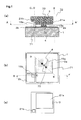
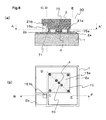
- Figure 1(a) is a cross-sectional configuration diagram illustrating a mounting structure according to Embodiment 1 of the present invention.
- a mounting structure 10 of the present embodiment includes a substrate 1 and an electronic component 3 that is mounted on the surface of the substrate 1. Electrodes 2a and 2b are formed on the surface of the substrate 1. An alumina substrate with favorable heat-radiating properties is used as the substrate 1.
- the electronic component 3 is an LED that has two electrodes 21 a and 21 b. The two electrodes 21a and 21b correspond to a p-electrode and an n-electrode.
- the electrode 2a and the electrode 21a of the electronic component, and the electrode 2b and the electrode 21b of the electronic component are joined at joints 15a and 15b, respectively.
- the joints 15a and 15b are created by subjecting a metal nanoparticle paste material to a heat treatment.
- a convex portion 4 that corresponds to an example of a member of the present invention is provided in the joint 15a.
- the convex portion 4 comes in contact with the electrode 2a of the substrate 1 and the electrode 21a of the electronic component 3, and functions as a spacer that maintains a fixed clearance between the electrode 2a of the substrate 1 and the electrode 21 a of the electronic component 3 at the time of manufacture.
- a material that increases in temperature faster than the metal nanoparticle paste material for producing the joint 15a is used as the material that forms the convex portion 4.
- Figure 1(b) is a plan view that illustrates the substrate 1, the joints 15a and 15b, and the convex portion 4 of the mounting structure 10.
- Figure 1 (c) is a plan view that illustrates the electronic component 3 of the mounting structure 10.
- Figure 1 (b) corresponds to a cross-sectional view of the mounting structure 10 at a position along a line AA' shown in Figure 1(a) .
- the cross-sectional position of Figure 1(a) is shown by a line BCDEF in Figure 1(b) .
- the joint 15a is formed at a portion at which the electrode 2a and the electrode 21a face each other
- the joint 15b is formed at a portion at which the electrode 2b and the electrode 21b face each other.
- three convex portions 4 are provided at a central portion 70 of the joint 15a.
- the term "central portion” refers to a portion that includes not only the center, but also an area in the vicinity of the center.
- reference numeral 71 denotes a peripheral portion of the joint 15a.
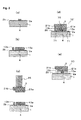
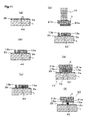
- Figures 2(a)to (e) are views for describing the method of manufacturing the mounting structure 10 of the present embodiment.
- convex portions 4 are formed on the electrode 2a that is formed on the surface of the substrate 1.
- the electrodes 2a and 2b, and the electrodes 21a and 21 b of the electronic component 3 are formed, for example, from gold.
- the electronic component 3 is, for example, an LED device with a sectional shape that is a 10-mm square area.
- the convex portions 4 are composed of gold bumps that are made with a wire bonding apparatus.
- One size of the convex portion 4 is, for example, a diameter of approximately 50 to 80 ⁇ m at a lower part and a diameter of approximately 20 to 30 ⁇ m at an upper part in Figure 2 , and the height thereof can be 30 ⁇ m.
- a step for forming the convex portion 4 corresponds to one example of a member forming step of the present invention.
- a metal nanoparticle paste material is coated on the electrodes 2a and 2b of the substrate 1 to form the bonding material portions 13a and 13b.
- the material used as the metal nanoparticle paste material can be one in which, for example, gold microparticles as metal nanoparticles that are conductive components are dispersed in a solvent.
- the metal nanoparticles are covered by the dispersing agent in the solvent.
- tetradecane can be used as the solvent.
- the dispersing agent for example, one or more kinds of chemical compounds that have a group capable of coordinated binding with a metallic element such as alkylamine can be used.
- the metal nanoparticle paste material can include, for example, 50 weight percent of gold microparticles with a mean particle diameter of 3 to 7 nm, and the density of the gold microparticles can be set to 1.6 g/cc.
- the viscosity of the metal nanoparticle paste material is set to 20 to 50 mPa ⁇ s.
- the metal nanoparticle paste material corresponds to one example of a material used for producing a joint of the present invention, and corresponds to an example of the bonding material of the present invention.
- an ink jet method or a spin coating method or dye coating method or the like can be used as the coating method.
- the bonding material portions 13a and 13b are formed so as to have a comparatively thick thickness.
- the metal nanoparticle paste material has a low viscosity, and therefore coating by an ink jet method can be easily utilized.
- the step of coating a metal nanoparticle paste material corresponds to an example of a coating step of the present invention.
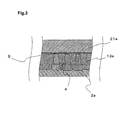
- the term "abut” refers to a state of resisting a pressing force of the electronic component 3 and includes not only a case in which the convex portions 4 are directly contacting the electrode 21a, but also a case as shown in the partially enlarged view in Figure 3 in which a small amount of metal nanoparticle paste material remains between the convex portions 4 and the electrode 21a.
- Figure 3 is a partially enlarged view of Figure 2(d) , in which a portion at which a small amount of metal nanoparticle paste material remains is denoted by reference character S.
- the conditions for curing include inserting a mounting structure 10' in the state shown in Figure 2(d) into a hot air circulating oven and, for example, increasing the temperature to 100°C at a rate of temperature increase of 5°C/min, and thereafter maintaining the temperature at 100°C for 10 minutes.
- This step corresponds to one example of a heat treatment step of the present invention.
- the convex portions 4 when placing the electronic component 3 on the bonding material portions 13a and 13b, the convex portions 4 function as spacers and thus a constant clearance can be maintained between the electrode 2a and the electrode 21 a of the electronic component. Consequently, when performing the heat treatment, it is possible for gas that is generated by heating a dispersing agent component in the bonding material portion 13a to escape to outside from the peripheral portion 71 (see Figure 2(d) ) of the bonding material portion 13a.
- the electrode 2a and the electrode 21 a of the electronic component will come closer than necessary to each other due to the flexibility of the metal nanoparticle paste material, and hence the thickness of the mounting structure will become thin and it will be difficult for gas to escape to outside from the peripheral portion 13e of the bonding material portion 13a. Therefore, air cavities may form in the joint 15a after heat treatment and the bonding strength between the substrate 1 and the electronic component 3 will weaken. Further, the joint may become unstable due to the effect of residual gas when operating the electronic component 3.
- the electrode 2a of the substrate 1 and the electrode 21 a of the electronic component 3 do not come closer to each other than necessary. It is thus possible to suppress the occurrence of a short circuit caused by the metal nanoparticle paste material that forms the bonding material portion 13a between the electrode 2a and the electrode 21 a being pushed out from between the electrodes and contacting the neighboring electrodes 2b and 21b and the metal nanoparticle paste material between the electrodes 2b and 21b. In this connection, pushing out of the metal nanoparticle paste material of the bonding material portion 13b on the electrode 2b and 21b side is also suppressed.
- the convex portions 4 are formed by metal bumps whose temperature rises faster than the temperature of the metal nanoparticle paste material, the convex portions 4 increase in temperature faster than the bonding material portions 13a and 13b during the heat treatment. Consequently, when performing the heat treatment, curing of the metal nanoparticle paste material begins from the metal nanoparticle paste material that is positioned at the central portion 70 and that surrounds the convex portions 4, and gaseous matter such as gas is generated accompanying the start of sintering, and heat is gradually conveyed to the peripheral portion 71 from the central portion 70 and sintering and gas generation occur. Hence, the generated gas can escape efficiently to the outside from the peripheral portion 71 of the bonding material portion 13a.
- each convex portion 4 is used as a spacer to secure a clearance of a fixed amount between the electrode 2a and electrode 21 a. Furthermore, the convex portions 4 are provided as the starting point of gas generation by heat transfer. As a result, it is possible to control the period and location of gas generation, and gas can be allowed to escape to the peripheral portion 71 efficiently from the central portion 70 of the bonding material portion during the heat treatment, so that the joint can be made more reliable.
- a configuration may also be adopted in which the convex portion 4 is used only as a spacer and is not used as a starting point of gas generation by heat transfer.
- a material material with a high thermal conductivity
- the metal nanoparticle paste material need not be used as the material that forms the convex portion 4.
- FIG. 4 is a cross-sectional configuration diagram of a mounting structure 20.
- components that are substantially the same as components of the mounting structure 10 are denoted by the same reference numbers. The same applies with respect to the drawings described hereunder.
- three convex portions 24 that touch the electrode 2a are formed at the central portion 70 of the joint 15a.
- the convex portions 24 are not in contact with the electrode 21 a of the electronic component 3, and do not function as spacers that maintain a clearance between the electrode 2a and the electrode 21 a.
- the convex portions 24 of the mounting structure 20 having this structure increase in temperature faster than the metal nanoparticle paste material, similarly to the present embodiment, and are formed using a material such as gold bumps.
- a gas is generated. The gas can escape from the peripheral portion 71 when the bonding material portion (state before hardening of the joint 15a) is being cured.
- the convex portions 24 do not contact the electrode 21 a of the electronic component 3, physical damage to the electronic component 3 at the time of manufacture can be decreased.
- the height of the convex portions 24 is too low, the proportion of the central portion 70 occupied by the convex portions 24 decreases and the proportion of the central portion 70 occupied by the metal nanoparticle paste material increases, and as a result the amount of gas generated in the central portion 70 will increase. Consequently, it is more preferable to make the height of the convex portions 24 as high as possible.
- the convex portions 4 are provided at the central portion 70 of the joint 15a according to Embodiment 1, in a case where the convex portions 4 are only used as spacers and are not used as the starting point of gas generation by heat transfer, the convex portions 4 may be provided at the peripheral portion 71 and not at the central portion 70 of the joint 15a.
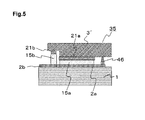
- the convex portion may be provided outside the joint 15a and not inside the joint 15a, as shown in the cross-sectional configuration diagram of a mounting structure 35 shown in Figure 5 .
- a convex portion 46 is provided outside the joint 15a.
- the convex portion 46 is provided on the electrode 2a, and the upper end of the convex portion 46 contacts an electronic component 3'.
- the convex portion 46 functions as a spacer, and since a fixed clearance can be maintained between the electrode 21a and the electrode 2a, a gas that is generated when performing a heat treatment can be allowed to escape efficiently to outside.
- the convex portion 46 may also be provided directly on the substrate 1 rather than on the electrode 2a.
- a configuration in which the convex portion 4 is provided at the central portion 70 of the joint 15a is more preferable since is it possible to suppress the generation of gas itself, because the amount of metal nanoparticle paste material at the central portion 70 is decreased.
- the rate of temperature increase is set to, for example, 5°C/min
- the rate of temperature increase may be appropriately changed depending on the components included in the metal nanoparticle paste material.
- the rate of temperature increase is too fast, bumping of the solvent in the bonding material portion will occur, and bubbles will be unable to escape smoothly from between the electrode 21a of the electronic component and the electrode 2a of the substrate.
- metal bumps are used as the convex portions 4 and the metal bumps have a high thermal conductivity, heat of the electronic component 3 is easily transferred to the substrate 1.
- the metal bumps can be prepared by plating or wire bonding or the like. Further, since the metal bumps have pointed tips, an increasing amount of space can be created towards the upper part of the bumps, and it is easy for the generated gas to escape to outside.
- the convex portions 4 can also be formed on the electronic component 3 side rather than the substrate 1 side, in such case the convex portions 4 may cause physical damage to the electronic component 3. It is therefore preferable to provide the convex portions 4 on the substrate 1 side.
- the electronic component 3 is a semiconductor, because the structure is one that is weak with respect to physical impact due to microfabrication of internal wiring rules, it is advantageous to provide the convex portions 4 on the substrate 1 side.
- the metal nanoparticle paste material is coated on the side of the substrate 1 on which the convex portions 4 are formed, the metal nanoparticle paste material may be coated on the electronic component 3.
- the structure is one that has a portion in which the electrodes 2a and 2b and the electrodes 21a and 21b are facing each other, respectively, a structure may be adopted in which the electrodes 2a and 2b and the electrodes 21a and 21b do not face each other at all.
- the joint 15 is formed only on an electrode, the joint 15 may be formed across a portion on which an electrode is not provided. More specifically, it is sufficient that a connection portion is formed so that an electrode of the substrate and an electrode of the electronic component are electrically connected and the electronic component can be fixed on the surface of the substrate.
- FIG. 6(a) is a cross-sectional configuration diagram of the mounting structure 30.
- Figure 6(b) is a cross-sectional view along a line AA' in (a). The cross-sectional position of Figure 6(a) is shown by a line BCDEF in Figure 6(b) .
- convex portions 4 comprising a metal bump are also formed at four corners at the peripheral portion 71 of the joint 15.
- a plurality of convex portions 4 are provided more densely at the central portion 70 of the joint 15 that at the peripheral portion 71.
- a clearance between the electrodes can be secured with greater stability, and it is possible for gas to escape to outside from the central portion 70 from which it is hardest for the gas to escape.
- the temperature of the bonding material portion 13a increases faster at the central portion 70 than at the peripheral portion 71 due to the difference in the density of the convex portions 4
- gas generated at the central portion 70 can be allowed to escape to outside efficiently, and the occurrence of air cavities in the joint 15 can be suppressed.
- the bumps are the same as those described in the above described embodiment.
- the number of convex portions 4 is not limited to the structure of the present embodiment, and only one convex portion 4 may be provided at the central portion 70 of the joint 15. However, arranging a further number of convex portions 4 at the periphery of the joint 15 is more preferable because the clearance between the electrode 2a and the electronic component electrode 21a can be maintained fixed overall, and gas can escape easily.
- the size of the convex portion 4 of the present embodiment is also not limited, and one large convex portion may be provided at the central portion 70 of the bonding material portion 13a.
- Figure 7(a) is a cross-sectional configuration diagram of a mounting structure 31
- Figure 7(b) is a cross-sectional view along a line AA' in Figure 7(a) .
- the cross-sectional position of Figure 7(a) is shown by a line BCDEF in Figure 7(b) .
- a single large convex portion 40 is formed at the central portion 70 of the joint 15a.
- the parallelism between the electrode 2a and the electrode 21 a of the electronic component is regulated and a fixed clearance is also secured therebetween, and gas generated during curing of the bonding material portion can be allowed to escape.
- the convex portion 40 can be made by plating. Further, it is necessary to make the upper surface of the convex portion 40 flat.
- the convex portion 40 in the mounting structure 31 shown in Figure 7 is used as a spacer that maintains a clearance between the electrode 2a and the electrode 21a and as a starting point of gas generation by heat transfer, when using the convex portion 40 only as a starting point of gas generation by heat transfer, the convex portion 40 need not contact with the electrode 21a.
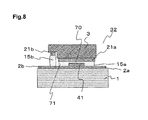
- FIG. 8 A cross-sectional view of the mounting structure 32 in this state is shown in Figure 8 .
- a convex portion 41 that does not contact with the electrode 21a is also shown.
- the cross-sectional position of Figure 8(a) is the same position as in Figure 7(a) .
- the convex portions are manufactured by plating.
- a convex portion is formed by a metal bump
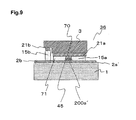
- a convex portion may be formed by fabricating a portion 200a' corresponding to the central portion 70 of the joint 15 of the surface of the electrode 2a in a concavo-convex shape.
- Figure 9 is a cross-sectional configuration diagram of a mounting structure 36.
- an electrode 2a' is provided in which unevenness is formed at the central portion 70.
- a convex portion 45 is composed by the unevenness.
- the convex portion 45 is formed by first performing fabrication to decrease the thickness of portions other than the portion 200a' of the electrode 2a'.
- the electrode 2a' is formed from, for example, gold, the thermal conductivity thereof is better than that of the metal nanoparticle paste material. Consequently, the convex portion 45 composed of unevenness of the electrode 2a' can be used as a starting point of gas generation by heat transfer, and curing of metal nanoparticle paste material at the periphery of the convex portion 45 provided at the central portion 70 can be promoted. When using the convex portion 45 only as a spacer, the convex portion 45 need not be formed at the central portion 70.
- the convex portion 45 is formed by processing the surface of the electrode 2a' of the substrate 1 as shown in Figure 9
- the convex portion may be formed by processing the surface of a substrate 21a of the electronic component 3.
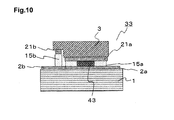
- FIG 10 is a cross-sectional configuration diagram of a mounting structure 33 according to Embodiment 2 of the present invention.
- the mounting structure 33 of Embodiment 2 differs from that of Embodiment 1 in the respect that a single convex portion 43 formed of a conductive paste material is provided at the center of the joint 15.
- components that are substantially the same as components in Embodiment 1 are denoted by the same reference numbers.
- Figure 10 is a cross-sectional view at the same position as in Figure 1(a) .
- the convex portion 43 corresponds to an example of a member of the present invention.
- Figures 11 (a) to (f) are cross-sectional configuration diagrams for describing a method of manufacturing the mounting structure 33.
- a conductive paste material portion 44 at which a conductive paste material is coated on the upper surface of the electrode 2a of the substrate 1 is formed.
- the conductive paste material corresponds to one example of a paste material including a conductive substance of the present invention.
- the conductive paste material is, for example, a silver paste material that includes silver, resin, and a curing agent, and a material is used that has a curing temperature that is equal to or less than the curing temperature of the metal nanoparticle paste material. It is not necessary for the conductive paste material to include metal particles with a mean particle diameter of 50 ⁇ m or less, as in the metal nanoparticle paste material.
- the metal nanoparticle paste material is coated on the electrodes 2a and 2b so as to cover the conductive paste material portion 44 and form the bonding material portions 13a and 13b.
- the step of coating the metal nanoparticle paste material to form the bonding material portions 13a and 13b corresponds to an example of a coating step of the present invention.
- curing of the convex portion 43' that is in a partially cured state and the bonding material portions 13a and 13b is performed by a heat treatment in a hot air circulating oven to form the joints 15a and 15b, and thereby produce the mounting structure 33 shown in Figure 11(f) .
- This step corresponds to one example of a heat treatment step of the present invention.
- the convex portion 43' in a partially cured state is cured prior to the bonding material portions 13a and 13b to form the convex portion 43.
- the conductive paste material portion 44 is cured to form the convex portion 43 prior to curing of the bonding material portions 13a and 13b, and the convex portion 43 is used as a spacer that maintains a clearance between the electrode 2a and the electrode 21 a of the electronic component 3. It is thereby possible to allow gas that is generated from the bonding material portion 13a to escape efficiently to the outside during the heat treatment step.
- the convex portion 43 is provided at the central portion 70 of the bonding material portion 13a, the amount of metal nanoparticle paste material present at the central portion 70 is decreased and generation of gas can itself be suppressed.
- the material used to produce the convex portion 43 is a conductive paste material that, in a partially cured state, increases in temperature faster than the metal nanoparticle paste material that is the material of the bonding material portions 13a and 13b.
- the convex portion serves as a starting point of gas generation by heat transfer, and because curing starts from the central portion 70 of the bonding material portion 13a, the gas can be allowed to escape efficiently to the outside.
- temperatures that are appropriately adjusted can be used for the partial curing temperature and the curing temperature of the conductive paste material that is the material used to produce the convex portion as well as the curing temperature of the metal nanoparticle paste material. Further, it is more preferable to set a difference between the curing temperature of the conductive paste material and the metal nanoparticle paste material to 5°C or more, on the basis of at least a rate of temperature increase of 5°C/minute.
- the convex portion 43' is flexible since it is in a partially cured state when the electrode 21a is pressed thereon. Consequently, as shown in Figure 11(e) , damage to the electrode 21a can be reduced as much as possible when pressing the electronic component 3 against the convex portions 43'.
- curing of the conductive paste material portion 44 may be performed before curing the bonding material portions 13a and 13b, or may be performed at the same time as curing the bonding material portions 13a and 13b.
- the metal nanoparticle paste material need not be coated so as to cover the conductive paste material portion 44 as shown in Figure 11(b) .
- the bonding material portion 13a may be formed in a manner that avoids the conductive paste material portion 44.
- the conductive paste material portion 44 is placed in a partially cured state after the metal nanoparticle paste material is coated so as to cover the conductive paste material portion 44, the conductive paste material portion 44 may be placed in a partially cured state before the metal nanoparticle paste material is coated.
- the conductive paste material portion 44 is in a partially cured state when placing the electronic component 3 thereon, the conductive paste material portion 44 may be in a completely cured state, and the conductive paste material need not be in a partially cured state.
- a conductive paste may be used with respect to which there is little difference between the curing temperature thereof and the curing temperature of the metal nanoparticle paste material, in such case it is not possible to cure only the conductive paste material after coating the metal nanoparticle paste material. Consequently, after coating the conductive paste material on the electrode 2a, it is necessary to cure the conductive paste material before applying the metal nanoparticle paste material. At this time, the conductive paste material may be placed in a partially cured state or in a completely cured state. However, from the point of view that damage to the electrode 21a can be reduced as much as possible, it is more preferable that the conductive paste material portion 44 is in a partially cured state when placing the electronic component thereon.
- the present invention can also be applied to an electronic component with a larger electrode area.
- the bonding material that is a metal nanoparticle paste material is applied using an ink jet method, a method such as printing or the like may be used.
- the conductive paste may be a paste other than a silver paste.
- the convex portion 43 of Embodiment 2 is not limited to the shape shown in Figures 10 and 11 , and may be any of the various shapes described in Embodiment 1.
- Figure 13 is a cross-sectional configuration diagram of a mounting structure 34 according to Embodiment 3 of the present invention.
- the mounting structure 34 according to Embodiment 3 of the present invention has the same basic structure as in Embodiment 1, the material of the convex portion is different.
- the description of Embodiment 3 centers on this point of difference.
- components that are substantially the same as components in Embodiment 1 are denoted by the same reference numbers.
- a convex portion 52 according to Embodiment 3 is produced using a material including an oxide, and is used as an oxygen-supplying material.
- the convex portion 52 corresponds to one example of a "member that has supplied oxygen" of the present invention. Copper oxide, aluminum oxide or the like can be used as the oxide.
- the convex portion can be formed using a paste material in which copper oxide or aluminum oxide powder that has a particle diameter of approximately 1 ⁇ m is mixed with an epoxy resin.
- the composition of the paste material can be such that, for example, the ratio of percentage by weight of oxide to resin is 80:20.
- Figures 14(a) to (f) are views for describing the method of manufacturing the mounting structure 34 of Embodiment 3.
- the above described paste material is coated on the upper portion of the electrode 2a to form an oxygen-supplying material portion 50.
- the material used as the paste material that is a mixture of an oxide and a resin as described above is a material (material with a high thermal conductivity) with a curing temperature that is equal to or less than the curing temperature of the metal nanoparticle paste material and which increases in temperature faster than the metal nanoparticle paste material after curing.
- the metal nanoparticle paste material is coated on the electrodes 2a and 2b so as to cover the oxygen-supplying material portion 50 and thereby form the bonding material portions 13a and 13b. This step of coating the metal nanoparticle paste material corresponds to an example of the coating step of the present invention.
- an oxide is used as a material for producing the convex portion 52
- the oxygen of the oxide contributes to decomposition of the dispersing agent that is present in the bonding material portion 13a, and gasification of the metal nanoparticle paste material around the periphery of the convex portion 52 that is formed using a material including an oxide can be promoted.
- the metal nanoparticle paste material is stabilized by a dispersing agent so that the metal nanoparticles do not polymerize, and polymerization is inhibited by the dispersing agent covering the metal nanoparticles.
- an oxide used in a material for producing the convex portion 52 decomposes the dispersing agent and enables the efficient generation and escape of gas.
- the convex portion 52 formed by a material including an oxide at the central portion 70 of the bonding material by disposing the convex portion 52 formed by a material including an oxide at the central portion 70 of the bonding material, sintering of the metal nanoparticle paste material of the central portion 70 can be promoted, and although curing starts from the central portion 70 of the bonding material portion 13a and gas is generated, because the peripheral portion 71 is not yet cured it is possible for the generated gas to escape to outside from inside the bonding material portion 13a.
- the convex portion is used as a spacer, a starting point of gas generation by heat transfer, as well as a starting point of gas generation by oxygen supply, gas generated inside the bonding material portion can be allowed to escape to outside more efficiently.
- the convex portion 52 contacts with the electrode 2a and the electrode 21 a
- the convex portion 52 may be disposed at the center of the bonding material portion in a condition in which the convex portion 52 does not contact with the electrodes 2a and 21a.
- the paste material when using the convex portion 52 only as an oxygen-supplying material, it is not necessary for the paste material to be a material (material with a high thermal conductivity) that increases in temperature faster than the metal nanoparticle paste material.
- the paste material of the present embodiment may be cured at the same time as the bonding material portions 13a and 13b.
- the paste material can be cured to form the convex portion 52 prior to applying the metal nanoparticle paste material.
- the convex portion 52 can be used as a spacer.
- a material to be used for producing the oxygen-supplying material portion 50 is a material (material with a high thermal conductivity) for which at least a partial curing temperature is equal to or less than a curing temperature of the metal nanoparticle paste material, and which increases in temperature faster than the metal nanoparticle paste material after being partially cured.
- the convex portion 52 of Embodiment 3 is not limited to this shape, and may be any of the various shapes described in Embodiment 1.
- Embodiment 3 oxygen is supplied to the metal nanoparticle paste material at the central portion 70 at the time of a heat treatment by providing the oxygen-supplying member 51, a configuration may also be adopted so as to supply oxygen to the metal nanoparticle paste material at the central portion 70 by placing a portion of either of the electrode 2a and the electrode 21 a that corresponds to the central portion 70 of the joint 15a in an oxidized state.
- a portion of the electrode 2a that corresponds to the central portion 70 corresponds to the portion 200a' shown in Figure 9 .
- a portion of the electrode 21a that corresponds to the central portion 70 corresponds to a portion facing the portion 200a' shown in Figure 9 .
- the convex portion 43 formed by a conductive paste material is provided according to Embodiment 2, by using a metal oxide as a conductive material in the conductive paste material it is possible to also use the convex portion 43 as a starting point of gas generation by oxygen supply.
- the convex portion 52 is produced using a paste material in which a copper oxide or aluminum oxide powder is mixed in a resin
- a structure may also be adopted in which a metal oxide such as copper oxide or aluminum oxide powder is simply placed on the electrode 21a.
- the bonding material portion 13a is formed by placing the metal oxide on the electrode 21a, and thereafter applying the metal nanoparticle paste material from the top thereof.
- the mounting structure is inserted into a hot air circulating oven and the bonding material portions 13a and 13b are cured
- curing of the bonding material portions 13a and 13b may also be performed by placing the mounting structure on a hot plate. At that time, heating from the side of the substrate 1 on which the convex portion is provided is more preferable because the temperature of the convex portion increases faster than the temperature of the bonding material portion 13a as the result of heat transfer from the substrate 1, and the convex portion functions as a starting point of gas generation by heat transfer.
- a convex portion is provided only at the joint 15a on the side of the electrode 2a that has a large area, a convex portion may also be formed at the joint 15b on the electrode 2b side.
- ultrasonic vibrations and not only heating, may be applied in order to cure the bonding material portions 13a and 13b.
- Embodiment 4 Although an LED is used as one example of the electronic component 3 in the foregoing Embodiments 1 to 3, according to Embodiment 4 an IGBT (insulated gate bipolar transistor) is used as the electronic component.
- IGBT insulated gate bipolar transistor
- Embodiment 4 the basic structure and manufacturing method of a joint and a convex portion are the same as in Embodiment 1.
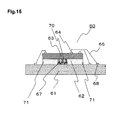
- Figure 15 is a cross-sectional configuration diagram of a mounting structure 60 according to Embodiment 4 of the present invention.
- the mounting structure 60 of Embodiment 4 includes a substrate 61 and an electronic component (IGBT) 63 that is arranged on the top side of the substrate 61 via a joint 62.
- the IGBT is used in a control system of a drive current to a driving device such as a motor, and is a semiconductor device for driving that requires a measure for heat radiation.
- An Si semiconductor may be mentioned as an example of a semiconductor used in an IGBT, and other examples include an SiC semiconductor and a GaN semiconductor.
- An electrode 64 is formed on the upper surface of the electronic component 63.
- the electrode 64 is electrically connected to the substrate 61 by a metal wire 65.
- the electronic component 63 is fixed on the substrate 61 by the joint 62 that is formed by the same metal nanoparticle paste material as in Embodiments 1 to 3. Heat radiation of the electronic component 63 is performed via the joint 62.
- a convex portion 67 that is the same as in Embodiment 1 is formed at a central portion 70 of the joint 62.
- Three convex portions 67 are provided at the central portion 70 of the joint 62. The upper edge of each convex portion 67 abuts against the electronic component 63.
- the joint 62 is not provided between electrodes.
- an example of a joint that has a heat radiation function of the present invention corresponds to the joint 62 of Embodiment 4
- an example of a member of the present invention corresponds to the convex portion 67 of Embodiment 4.
- the mounting structure 60 of Embodiment 4 is manufactured as described below.
- the convex portions 67 are formed by metal bumps on the substrate 1, and a metal nanoparticle paste material is coated on the substrate 1 so as to cover the convex portions 67.
- the electronic component 63 is placed on the metal nanoparticle paste material, and the electronic component 63 is pressed towards the substrate 1 until the electronic component 63 abuts against the convex portions 67.
- the metal nanoparticle paste material is cured by performing a heat treatment to form the joint 62 and fix the electronic component 63 to the substrate 1.
- the electrode 64 of the electronic component 63 and an electrode 68 of the substrate 61 are electrically connected by the metal wire 65 to thereby produce the mounting structure 60 of Embodiment 4.
- Embodiment 4 also, the convex portions 67 are used as spacers at the time of manufacture, and because gas generated at the central portion 70 can be allowed to escape to outside when performing a heat treatment, it is possible to prevent gas retention inside the joint 62. If a case is assumed in which gas remains inside the joint 62, the efficiency of heat radiation with respect to heat of the electronic component 63 being radiated to the substrate via the joint 62 will be poor. However, the heat radiation efficiency can be improved by suppressing gas retention as described in Embodiment 4.
- the convex portion 67 is formed by a metal bump that increases in temperature faster than the metal nanoparticle paste material, the convex portion 67 increases in temperature faster than the metal nanoparticle paste material at the time of a heat treatment. Consequently, when performing the heat treatment, curing of the metal nanoparticle paste material begins from the metal nanoparticle paste material that is positioned at the central portion 70 and that surrounds the convex portions 4, and gaseous matter such as a gas is generated accompanying the start of sintering, and the heat is gradually conveyed to the peripheral portion 71 from the central portion 70 and sintering and gas generation occur. Hence, it is possible to let the generated gas escape efficiently from the joint.
- the convex portion 67 may also be used as a starting point of gas generation by oxygen supply.
- Embodiments 1 to 3 and the modification examples described in each embodiment can be applied to the mounting structure 60 of Embodiment 4. Below, inventions rerated to the present invention will be described.
- the 1 st invention related to the present invention is a mounting structure, comprising:
- the 2 nd invention related to the present invention is a mounting structure, comprising:
- the 3 rd invention related to the present invention is the mounting structure according to the 1 st or 2 nd invention, wherein the member is provided so as to abut against the substrate and so as not to abut against the electronic component.
- the 4 th invention related to the present invention is a method of manufacturing a mounting structure which comprises:
- the 5 th invention related to the present invention is a method of manufacturing a mounting structure which comprises:
- the mounting structure of the present invention and the method of manufacturing the mounting structure are advantageous in that gaseous matter that is generated when performing a heat treatment can be allowed to escape efficiently to outside, and the mounting structure is useful for bonding a semiconductor device to a substrate and the like.
Landscapes
- Engineering & Computer Science (AREA)
- Mechanical Engineering (AREA)
- Manufacturing & Machinery (AREA)
- Microelectronics & Electronic Packaging (AREA)
- Wire Bonding (AREA)
- Electric Connection Of Electric Components To Printed Circuits (AREA)
- Die Bonding (AREA)
- Conductive Materials (AREA)
Applications Claiming Priority (2)
| Application Number | Priority Date | Filing Date | Title |
|---|---|---|---|
| JP2008166565 | 2008-06-25 | ||
| PCT/JP2009/002781 WO2009157160A1 (ja) | 2008-06-25 | 2009-06-18 | 実装構造体、及び実装構造体の製造方法 |
Publications (3)
| Publication Number | Publication Date |
|---|---|
| EP2293324A1 true EP2293324A1 (de) | 2011-03-09 |
| EP2293324A4 EP2293324A4 (de) | 2014-09-10 |
| EP2293324B1 EP2293324B1 (de) | 2019-05-15 |
Family
ID=41444233
Family Applications (1)
| Application Number | Title | Priority Date | Filing Date |
|---|---|---|---|
| EP09769870.8A Not-in-force EP2293324B1 (de) | 2008-06-25 | 2009-06-18 | Verpackungsstruktur und verfahren zur herstellung einer verpackungsstruktur |
Country Status (5)
| Country | Link |
|---|---|
| US (1) | US9246073B2 (de) |
| EP (1) | EP2293324B1 (de) |
| JP (1) | JP5331113B2 (de) |
| CN (1) | CN102067298B (de) |
| WO (1) | WO2009157160A1 (de) |
Cited By (3)
| Publication number | Priority date | Publication date | Assignee | Title |
|---|---|---|---|---|
| EP2355187A3 (de) * | 2010-02-08 | 2014-07-02 | LG Innotek Co., Ltd. | Lichtemittierende Vorrichtung und Beleuchtungssystem |
| US9246073B2 (en) | 2008-06-25 | 2016-01-26 | Panasonic Intellectual Property Management Co., Ltd. | Mounting structure, and method of manufacturing mounting structure |
| DE102014213083B4 (de) * | 2013-08-08 | 2020-12-10 | Mitsubishi Electric Corporation | Bondstruktur mit Metallnanopartikeln und Bondverfahren unter Verwendung von Metallnanopartikeln |
Families Citing this family (19)
| Publication number | Priority date | Publication date | Assignee | Title |
|---|---|---|---|---|
| AU2009317573A1 (en) * | 2008-11-19 | 2010-05-27 | Bayer Cropscience Nv | Expression cassettes for seed-enhanced expression in plants |
| US20100327300A1 (en) * | 2009-06-25 | 2010-12-30 | Koninklijke Philips Electronics N.V. | Contact for a semiconductor light emitting device |
| JP2012069545A (ja) * | 2010-09-21 | 2012-04-05 | Toyoda Gosei Co Ltd | 発光素子の搭載方法 |
| TWI434405B (zh) * | 2011-06-07 | 2014-04-11 | 國立交通大學 | 具有積體電路與發光二極體之異質整合結構及其製作方法 |
| US9224665B2 (en) | 2011-08-04 | 2015-12-29 | Mitsubishi Electric Corporation | Semiconductor device and method for producing the same |
| JP6017880B2 (ja) * | 2012-08-01 | 2016-11-02 | 京セラ株式会社 | 金属面同士の接合方法およびこれを用いた半導体素子実装体の製造方法 |
| TWI505380B (zh) * | 2013-12-31 | 2015-10-21 | 台灣嘉碩科技股份有限公司 | 導電封裝結構及其製造方法 |
| DE102014222818B4 (de) * | 2014-11-07 | 2019-01-03 | Danfoss Silicon Power Gmbh | Elektronik-Sandwichstruktur mit zwei mittels einer Sinterschicht zusammengesinterten Fügepartnern |
| JP2017005071A (ja) * | 2015-06-09 | 2017-01-05 | カルソニックカンセイ株式会社 | 接合構造 |
| JPWO2017203859A1 (ja) * | 2016-05-25 | 2019-02-14 | 日立オートモティブシステムズ株式会社 | 電子回路装置及び方法 |
| US10186548B2 (en) * | 2016-08-19 | 2019-01-22 | Innolux Corporation | Light emitting diode display device |
| CN107768498B (zh) * | 2016-08-19 | 2019-07-30 | 群创光电股份有限公司 | 发光二极管显示装置及其制作方法 |
| JP2018206788A (ja) * | 2017-05-30 | 2018-12-27 | 富士通株式会社 | 電子装置及び電子装置の製造方法 |
| WO2019097790A1 (ja) * | 2017-11-15 | 2019-05-23 | パナソニックIpマネジメント株式会社 | 半導体モジュールおよびその製造方法 |
| EP3806587B1 (de) * | 2018-05-29 | 2024-05-29 | Kyocera Corporation | Montagesubstrat für elektronisches element, elektronische vorrichtung und elektronisches modul |
| JP7263792B2 (ja) * | 2019-01-22 | 2023-04-25 | 三菱電機株式会社 | 半導体装置及びその製造方法 |
| EP3792962A1 (de) * | 2019-09-12 | 2021-03-17 | Infineon Technologies AG | Verfahren zur kontrolle eines prozesses zur herstellung einer sinterbaren verbindungsschicht mittels photometrischer messungen |
| JP7239051B2 (ja) * | 2020-03-04 | 2023-03-14 | 株式会社デンソー | 半導体装置およびその製造方法 |
| US12199059B2 (en) | 2021-02-18 | 2025-01-14 | International Business Machines Corporation | Sintering a nanoparticle paste for semiconductor chip join |
Family Cites Families (26)
| Publication number | Priority date | Publication date | Assignee | Title |
|---|---|---|---|---|
| JPH0513820A (ja) | 1991-07-02 | 1993-01-22 | Omron Corp | 半導体装置 |
| US5931371A (en) * | 1997-01-16 | 1999-08-03 | Ford Motor Company | Standoff controlled interconnection |
| JP3813797B2 (ja) * | 2000-07-07 | 2006-08-23 | 株式会社ルネサステクノロジ | 半導体装置の製造方法 |
| JP3995421B2 (ja) * | 2001-01-19 | 2007-10-24 | 株式会社ルネサステクノロジ | 半導体封止用エポキシ樹脂組成物及びそれを用いた半導体装置 |
| US6906425B2 (en) * | 2002-03-05 | 2005-06-14 | Resolution Performance Products Llc | Attachment of surface mount devices to printed circuit boards using a thermoplastic adhesive |
| US20050133808A1 (en) * | 2003-09-11 | 2005-06-23 | Kyocera Corporation | Package for housing light-emitting element, light-emitting apparatus and illumination apparatus |
| TW200520123A (en) * | 2003-10-07 | 2005-06-16 | Matsushita Electric Industrial Co Ltd | Method for mounting semiconductor chip and semiconductor chip-mounted board |
| JP4246134B2 (ja) | 2003-10-07 | 2009-04-02 | パナソニック株式会社 | 半導体素子の実装方法、及び半導体素子実装基板 |
| US20050253159A1 (en) * | 2004-04-28 | 2005-11-17 | Creswick Steven B | Semiconductor (LED) chip attachment |
| CN1737072B (zh) * | 2004-08-18 | 2011-06-08 | 播磨化成株式会社 | 导电粘合剂及使用该导电粘合剂制造物件的方法 |
| US7880313B2 (en) * | 2004-11-17 | 2011-02-01 | Chippac, Inc. | Semiconductor flip chip package having substantially non-collapsible spacer |
| JP2006202586A (ja) * | 2005-01-20 | 2006-08-03 | Nissan Motor Co Ltd | 接合方法及び接合構造 |
| US7153765B2 (en) * | 2005-03-31 | 2006-12-26 | Intel Corporation | Method of assembling soldered packages utilizing selective solder deposition by self-assembly of nano-sized solder particles |
| DE102005020059B3 (de) * | 2005-04-29 | 2006-10-05 | Advanced Micro Devices, Inc., Sunnyvale | Technik zur Verbesserung thermischer und mechanischer Eigenschaften eines Unterfütterungsmaterials einer Substrat/Chipanordnung |
| US20060255102A1 (en) * | 2005-05-11 | 2006-11-16 | Snyder Rick B | Technique for defining a wettable solder joint area for an electronic assembly substrate |
| US7615476B2 (en) * | 2005-06-30 | 2009-11-10 | Intel Corporation | Electromigration-resistant and compliant wire interconnects, nano-sized solder compositions, systems made thereof, and methods of assembling soldered packages |
| JP4770379B2 (ja) * | 2005-10-13 | 2011-09-14 | 富士電機株式会社 | 金属部材の接合方法およびその組立治具 |
| JP2007194383A (ja) * | 2006-01-19 | 2007-08-02 | Hitachi Lighting Ltd | 光学部材およびバックライト |
| EP2012352A4 (de) | 2006-04-24 | 2012-07-25 | Murata Manufacturing Co | Elektronische komponente, elektronische komponenteneinrichtung damit und herstellungsverfahren dafür |
| JP4715628B2 (ja) | 2006-05-11 | 2011-07-06 | トヨタ自動車株式会社 | 接合材料及び接合方法 |
| JP2008010703A (ja) * | 2006-06-30 | 2008-01-17 | Fuji Electric Holdings Co Ltd | 半導体装置の部品間接合方法 |
| CN101601131A (zh) * | 2007-02-15 | 2009-12-09 | 日本电气株式会社 | 用于安装半导体封装的结构 |
| JP2008226946A (ja) * | 2007-03-09 | 2008-09-25 | Nec Corp | 半導体装置およびその製造方法 |
| US8560387B2 (en) | 2007-06-07 | 2013-10-15 | Qurio Holdings, Inc. | Systems and methods of providing collaborative consumer-controlled advertising environments |
| JP2009054893A (ja) * | 2007-08-28 | 2009-03-12 | Panasonic Electric Works Co Ltd | 発光装置 |
| JP5331113B2 (ja) | 2008-06-25 | 2013-10-30 | パナソニック株式会社 | 実装構造体 |
-
2009
- 2009-06-18 JP JP2010517731A patent/JP5331113B2/ja not_active Expired - Fee Related
- 2009-06-18 US US13/000,784 patent/US9246073B2/en not_active Expired - Fee Related
- 2009-06-18 WO PCT/JP2009/002781 patent/WO2009157160A1/ja not_active Ceased
- 2009-06-18 EP EP09769870.8A patent/EP2293324B1/de not_active Not-in-force
- 2009-06-18 CN CN200980124643.4A patent/CN102067298B/zh not_active Expired - Fee Related
Cited By (3)
| Publication number | Priority date | Publication date | Assignee | Title |
|---|---|---|---|---|
| US9246073B2 (en) | 2008-06-25 | 2016-01-26 | Panasonic Intellectual Property Management Co., Ltd. | Mounting structure, and method of manufacturing mounting structure |
| EP2355187A3 (de) * | 2010-02-08 | 2014-07-02 | LG Innotek Co., Ltd. | Lichtemittierende Vorrichtung und Beleuchtungssystem |
| DE102014213083B4 (de) * | 2013-08-08 | 2020-12-10 | Mitsubishi Electric Corporation | Bondstruktur mit Metallnanopartikeln und Bondverfahren unter Verwendung von Metallnanopartikeln |
Also Published As
| Publication number | Publication date |
|---|---|
| JPWO2009157160A1 (ja) | 2011-12-08 |
| EP2293324B1 (de) | 2019-05-15 |
| CN102067298A (zh) | 2011-05-18 |
| EP2293324A4 (de) | 2014-09-10 |
| US20110114706A1 (en) | 2011-05-19 |
| JP5331113B2 (ja) | 2013-10-30 |
| CN102067298B (zh) | 2015-10-14 |
| WO2009157160A1 (ja) | 2009-12-30 |
| US9246073B2 (en) | 2016-01-26 |
Similar Documents
| Publication | Publication Date | Title |
|---|---|---|
| EP2293324B1 (de) | Verpackungsstruktur und verfahren zur herstellung einer verpackungsstruktur | |
| US7816780B2 (en) | Semiconductor apparatus and manufacturing method of semiconductor apparatus | |
| CN1266766C (zh) | 半导体器件及其制造方法 | |
| EP2012352A1 (de) | Elektronische komponente, elektronische komponenteneinrichtung damit und herstellungsverfahren dafür | |
| CN100541770C (zh) | 弹性导电树脂及电子装置 | |
| CN1543291A (zh) | 电子部件内置模块及其制造方法 | |
| CN1601729A (zh) | 半导体器件及其制造方法 | |
| CN1770441A (zh) | 半导体元件的连接结构、布线衬底及半导体装置 | |
| CN106169449A (zh) | 薄膜覆晶封装体及其散热方法 | |
| CN1521842A (zh) | 电子部件的安装体及其制造方法 | |
| JP4191567B2 (ja) | 導電性接着剤による接続構造体及びその製造方法 | |
| US6653171B2 (en) | Flip-chip type semiconductor device having split voids within under-fill layer and its manufacturing method | |
| US20150069600A1 (en) | Embedded Silver Nanomaterials into Die Backside to Enhance Package Performance and Reliability | |
| CN1294652C (zh) | 半导体器件及其制造方法 | |
| JP3966686B2 (ja) | 接続材料 | |
| CN1815733A (zh) | 半导体装置及其制造方法 | |
| US10153236B2 (en) | Semiconductor device and power electronics apparatus | |
| JP2010062504A (ja) | 圧着装置、圧着方法、実装体および押圧板 | |
| JP2008192984A (ja) | 半導体装置及びその製造方法 | |
| TW200529339A (en) | Semiconductor device, semiconductor chip, method for manufacturing semiconductor device, and electronic apparatus | |
| CN1674242A (zh) | 半导体芯片、半导体装置、半导体装置的制造方法 | |
| JP2011258794A (ja) | 電子装置およびその製造方法 | |
| CN1705099A (zh) | 半导体器件 | |
| JP5322774B2 (ja) | 実装構造体、およびその製造方法 | |
| JP2967080B1 (ja) | 半導体装置の実装体の製造方法 |
Legal Events
| Date | Code | Title | Description |
|---|---|---|---|
| PUAI | Public reference made under article 153(3) epc to a published international application that has entered the european phase |
Free format text: ORIGINAL CODE: 0009012 |
|
| 17P | Request for examination filed |
Effective date: 20101223 |
|
| AK | Designated contracting states |
Kind code of ref document: A1 Designated state(s): AT BE BG CH CY CZ DE DK EE ES FI FR GB GR HR HU IE IS IT LI LT LU LV MC MK MT NL NO PL PT RO SE SI SK TR |
|
| AX | Request for extension of the european patent |
Extension state: AL BA RS |
|
| DAX | Request for extension of the european patent (deleted) | ||
| A4 | Supplementary search report drawn up and despatched |
Effective date: 20140813 |
|
| RIC1 | Information provided on ipc code assigned before grant |
Ipc: H01L 33/62 20100101ALI20140807BHEP Ipc: H05K 3/32 20060101ALI20140807BHEP Ipc: H01B 1/22 20060101ALI20140807BHEP Ipc: H01L 33/64 20100101ALI20140807BHEP Ipc: H01L 33/00 20100101ALI20140807BHEP Ipc: H01L 21/56 20060101ALN20140807BHEP Ipc: H01L 23/00 20060101ALI20140807BHEP Ipc: H01L 21/52 20060101ALI20140807BHEP Ipc: H01L 31/024 20140101ALN20140807BHEP Ipc: H05K 3/40 20060101ALN20140807BHEP Ipc: H01L 21/60 20060101AFI20140807BHEP |
|
| RAP1 | Party data changed (applicant data changed or rights of an application transferred) |
Owner name: PANASONIC INTELLECTUAL PROPERTY MANAGEMENT CO., LT |
|
| STAA | Information on the status of an ep patent application or granted ep patent |
Free format text: STATUS: EXAMINATION IS IN PROGRESS |
|
| 17Q | First examination report despatched |
Effective date: 20170913 |
|
| GRAP | Despatch of communication of intention to grant a patent |
Free format text: ORIGINAL CODE: EPIDOSNIGR1 |
|
| STAA | Information on the status of an ep patent application or granted ep patent |
Free format text: STATUS: GRANT OF PATENT IS INTENDED |
|
| RIC1 | Information provided on ipc code assigned before grant |
Ipc: H01L 23/00 20060101ALI20181213BHEP Ipc: H05K 3/40 20060101ALN20181213BHEP Ipc: H01L 21/56 20060101ALN20181213BHEP Ipc: H01L 33/64 20100101ALI20181213BHEP Ipc: H01L 33/00 20100101ALI20181213BHEP Ipc: H01B 1/22 20060101ALI20181213BHEP Ipc: H01L 21/52 20060101ALI20181213BHEP Ipc: H01L 31/024 20140101ALN20181213BHEP Ipc: H01L 21/60 20060101AFI20181213BHEP Ipc: H01L 33/62 20100101ALI20181213BHEP Ipc: H05K 3/32 20060101ALI20181213BHEP |
|
| RIC1 | Information provided on ipc code assigned before grant |
Ipc: H05K 3/40 20060101ALN20181219BHEP Ipc: H01L 31/024 20140101ALN20181219BHEP Ipc: H01L 21/60 20060101AFI20181219BHEP Ipc: H05K 3/32 20060101ALI20181219BHEP Ipc: H01L 33/00 20100101ALI20181219BHEP Ipc: H01L 23/00 20060101ALI20181219BHEP Ipc: H01L 33/64 20100101ALI20181219BHEP Ipc: H01B 1/22 20060101ALI20181219BHEP Ipc: H01L 21/56 20060101ALN20181219BHEP Ipc: H01L 21/52 20060101ALI20181219BHEP Ipc: H01L 33/62 20100101ALI20181219BHEP |
|
| INTG | Intention to grant announced |
Effective date: 20190110 |
|
| GRAS | Grant fee paid |
Free format text: ORIGINAL CODE: EPIDOSNIGR3 |
|
| GRAA | (expected) grant |
Free format text: ORIGINAL CODE: 0009210 |
|
| STAA | Information on the status of an ep patent application or granted ep patent |
Free format text: STATUS: THE PATENT HAS BEEN GRANTED |
|
| AK | Designated contracting states |
Kind code of ref document: B1 Designated state(s): AT BE BG CH CY CZ DE DK EE ES FI FR GB GR HR HU IE IS IT LI LT LU LV MC MK MT NL NO PL PT RO SE SI SK TR |
|
| REG | Reference to a national code |
Ref country code: CH Ref legal event code: EP Ref country code: GB Ref legal event code: FG4D |
|
| REG | Reference to a national code |
Ref country code: DE Ref legal event code: R096 Ref document number: 602009058375 Country of ref document: DE |
|
| REG | Reference to a national code |
Ref country code: IE Ref legal event code: FG4D |
|
| REG | Reference to a national code |
Ref country code: NL Ref legal event code: MP Effective date: 20190515 |
|
| REG | Reference to a national code |
Ref country code: LT Ref legal event code: MG4D |
|
| PG25 | Lapsed in a contracting state [announced via postgrant information from national office to epo] |
Ref country code: ES Free format text: LAPSE BECAUSE OF FAILURE TO SUBMIT A TRANSLATION OF THE DESCRIPTION OR TO PAY THE FEE WITHIN THE PRESCRIBED TIME-LIMIT Effective date: 20190515 Ref country code: PT Free format text: LAPSE BECAUSE OF FAILURE TO SUBMIT A TRANSLATION OF THE DESCRIPTION OR TO PAY THE FEE WITHIN THE PRESCRIBED TIME-LIMIT Effective date: 20190915 Ref country code: LT Free format text: LAPSE BECAUSE OF FAILURE TO SUBMIT A TRANSLATION OF THE DESCRIPTION OR TO PAY THE FEE WITHIN THE PRESCRIBED TIME-LIMIT Effective date: 20190515 Ref country code: FI Free format text: LAPSE BECAUSE OF FAILURE TO SUBMIT A TRANSLATION OF THE DESCRIPTION OR TO PAY THE FEE WITHIN THE PRESCRIBED TIME-LIMIT Effective date: 20190515 Ref country code: NO Free format text: LAPSE BECAUSE OF FAILURE TO SUBMIT A TRANSLATION OF THE DESCRIPTION OR TO PAY THE FEE WITHIN THE PRESCRIBED TIME-LIMIT Effective date: 20190815 Ref country code: NL Free format text: LAPSE BECAUSE OF FAILURE TO SUBMIT A TRANSLATION OF THE DESCRIPTION OR TO PAY THE FEE WITHIN THE PRESCRIBED TIME-LIMIT Effective date: 20190515 Ref country code: SE Free format text: LAPSE BECAUSE OF FAILURE TO SUBMIT A TRANSLATION OF THE DESCRIPTION OR TO PAY THE FEE WITHIN THE PRESCRIBED TIME-LIMIT Effective date: 20190515 Ref country code: HR Free format text: LAPSE BECAUSE OF FAILURE TO SUBMIT A TRANSLATION OF THE DESCRIPTION OR TO PAY THE FEE WITHIN THE PRESCRIBED TIME-LIMIT Effective date: 20190515 |
|
| PG25 | Lapsed in a contracting state [announced via postgrant information from national office to epo] |
Ref country code: LV Free format text: LAPSE BECAUSE OF FAILURE TO SUBMIT A TRANSLATION OF THE DESCRIPTION OR TO PAY THE FEE WITHIN THE PRESCRIBED TIME-LIMIT Effective date: 20190515 Ref country code: BG Free format text: LAPSE BECAUSE OF FAILURE TO SUBMIT A TRANSLATION OF THE DESCRIPTION OR TO PAY THE FEE WITHIN THE PRESCRIBED TIME-LIMIT Effective date: 20190815 Ref country code: GR Free format text: LAPSE BECAUSE OF FAILURE TO SUBMIT A TRANSLATION OF THE DESCRIPTION OR TO PAY THE FEE WITHIN THE PRESCRIBED TIME-LIMIT Effective date: 20190816 |
|
| REG | Reference to a national code |
Ref country code: AT Ref legal event code: MK05 Ref document number: 1134420 Country of ref document: AT Kind code of ref document: T Effective date: 20190515 |
|
| PG25 | Lapsed in a contracting state [announced via postgrant information from national office to epo] |
Ref country code: DK Free format text: LAPSE BECAUSE OF FAILURE TO SUBMIT A TRANSLATION OF THE DESCRIPTION OR TO PAY THE FEE WITHIN THE PRESCRIBED TIME-LIMIT Effective date: 20190515 Ref country code: CZ Free format text: LAPSE BECAUSE OF FAILURE TO SUBMIT A TRANSLATION OF THE DESCRIPTION OR TO PAY THE FEE WITHIN THE PRESCRIBED TIME-LIMIT Effective date: 20190515 Ref country code: AT Free format text: LAPSE BECAUSE OF FAILURE TO SUBMIT A TRANSLATION OF THE DESCRIPTION OR TO PAY THE FEE WITHIN THE PRESCRIBED TIME-LIMIT Effective date: 20190515 Ref country code: EE Free format text: LAPSE BECAUSE OF FAILURE TO SUBMIT A TRANSLATION OF THE DESCRIPTION OR TO PAY THE FEE WITHIN THE PRESCRIBED TIME-LIMIT Effective date: 20190515 Ref country code: RO Free format text: LAPSE BECAUSE OF FAILURE TO SUBMIT A TRANSLATION OF THE DESCRIPTION OR TO PAY THE FEE WITHIN THE PRESCRIBED TIME-LIMIT Effective date: 20190515 Ref country code: SK Free format text: LAPSE BECAUSE OF FAILURE TO SUBMIT A TRANSLATION OF THE DESCRIPTION OR TO PAY THE FEE WITHIN THE PRESCRIBED TIME-LIMIT Effective date: 20190515 |
|
| REG | Reference to a national code |
Ref country code: CH Ref legal event code: PL |
|
| REG | Reference to a national code |
Ref country code: DE Ref legal event code: R097 Ref document number: 602009058375 Country of ref document: DE |
|
| PG25 | Lapsed in a contracting state [announced via postgrant information from national office to epo] |
Ref country code: MC Free format text: LAPSE BECAUSE OF FAILURE TO SUBMIT A TRANSLATION OF THE DESCRIPTION OR TO PAY THE FEE WITHIN THE PRESCRIBED TIME-LIMIT Effective date: 20190515 Ref country code: IT Free format text: LAPSE BECAUSE OF FAILURE TO SUBMIT A TRANSLATION OF THE DESCRIPTION OR TO PAY THE FEE WITHIN THE PRESCRIBED TIME-LIMIT Effective date: 20190515 |
|
| PLBE | No opposition filed within time limit |
Free format text: ORIGINAL CODE: 0009261 |
|
| STAA | Information on the status of an ep patent application or granted ep patent |
Free format text: STATUS: NO OPPOSITION FILED WITHIN TIME LIMIT |
|
| REG | Reference to a national code |
Ref country code: BE Ref legal event code: MM Effective date: 20190630 |
|
| PG25 | Lapsed in a contracting state [announced via postgrant information from national office to epo] |
Ref country code: TR Free format text: LAPSE BECAUSE OF FAILURE TO SUBMIT A TRANSLATION OF THE DESCRIPTION OR TO PAY THE FEE WITHIN THE PRESCRIBED TIME-LIMIT Effective date: 20190515 |
|
| 26N | No opposition filed |
Effective date: 20200218 |
|
| GBPC | Gb: european patent ceased through non-payment of renewal fee |
Effective date: 20190815 |
|
| PG25 | Lapsed in a contracting state [announced via postgrant information from national office to epo] |
Ref country code: IE Free format text: LAPSE BECAUSE OF NON-PAYMENT OF DUE FEES Effective date: 20190618 Ref country code: PL Free format text: LAPSE BECAUSE OF FAILURE TO SUBMIT A TRANSLATION OF THE DESCRIPTION OR TO PAY THE FEE WITHIN THE PRESCRIBED TIME-LIMIT Effective date: 20190515 |
|
| PG25 | Lapsed in a contracting state [announced via postgrant information from national office to epo] |
Ref country code: BE Free format text: LAPSE BECAUSE OF NON-PAYMENT OF DUE FEES Effective date: 20190630 Ref country code: SI Free format text: LAPSE BECAUSE OF FAILURE TO SUBMIT A TRANSLATION OF THE DESCRIPTION OR TO PAY THE FEE WITHIN THE PRESCRIBED TIME-LIMIT Effective date: 20190515 Ref country code: CH Free format text: LAPSE BECAUSE OF NON-PAYMENT OF DUE FEES Effective date: 20190630 Ref country code: LU Free format text: LAPSE BECAUSE OF NON-PAYMENT OF DUE FEES Effective date: 20190618 Ref country code: LI Free format text: LAPSE BECAUSE OF NON-PAYMENT OF DUE FEES Effective date: 20190630 |
|
| PG25 | Lapsed in a contracting state [announced via postgrant information from national office to epo] |
Ref country code: FR Free format text: LAPSE BECAUSE OF NON-PAYMENT OF DUE FEES Effective date: 20190715 |
|
| PG25 | Lapsed in a contracting state [announced via postgrant information from national office to epo] |
Ref country code: GB Free format text: LAPSE BECAUSE OF NON-PAYMENT OF DUE FEES Effective date: 20190815 |
|
| PG25 | Lapsed in a contracting state [announced via postgrant information from national office to epo] |
Ref country code: CY Free format text: LAPSE BECAUSE OF FAILURE TO SUBMIT A TRANSLATION OF THE DESCRIPTION OR TO PAY THE FEE WITHIN THE PRESCRIBED TIME-LIMIT Effective date: 20190515 |
|
| PG25 | Lapsed in a contracting state [announced via postgrant information from national office to epo] |
Ref country code: IS Free format text: LAPSE BECAUSE OF FAILURE TO SUBMIT A TRANSLATION OF THE DESCRIPTION OR TO PAY THE FEE WITHIN THE PRESCRIBED TIME-LIMIT Effective date: 20190915 |
|
| PG25 | Lapsed in a contracting state [announced via postgrant information from national office to epo] |
Ref country code: HU Free format text: LAPSE BECAUSE OF FAILURE TO SUBMIT A TRANSLATION OF THE DESCRIPTION OR TO PAY THE FEE WITHIN THE PRESCRIBED TIME-LIMIT; INVALID AB INITIO Effective date: 20090618 Ref country code: MT Free format text: LAPSE BECAUSE OF FAILURE TO SUBMIT A TRANSLATION OF THE DESCRIPTION OR TO PAY THE FEE WITHIN THE PRESCRIBED TIME-LIMIT Effective date: 20190515 |
|
| PGFP | Annual fee paid to national office [announced via postgrant information from national office to epo] |
Ref country code: DE Payment date: 20210618 Year of fee payment: 13 |
|
| PG25 | Lapsed in a contracting state [announced via postgrant information from national office to epo] |
Ref country code: MK Free format text: LAPSE BECAUSE OF FAILURE TO SUBMIT A TRANSLATION OF THE DESCRIPTION OR TO PAY THE FEE WITHIN THE PRESCRIBED TIME-LIMIT Effective date: 20190515 |
|
| REG | Reference to a national code |
Ref country code: DE Ref legal event code: R119 Ref document number: 602009058375 Country of ref document: DE |
|
| PG25 | Lapsed in a contracting state [announced via postgrant information from national office to epo] |
Ref country code: DE Free format text: LAPSE BECAUSE OF NON-PAYMENT OF DUE FEES Effective date: 20230103 |