EP2294441B1 - Verfahren zur erkennung eines objekts in einer szene mit artefakten - Google Patents
Verfahren zur erkennung eines objekts in einer szene mit artefakten Download PDFInfo
- Publication number
- EP2294441B1 EP2294441B1 EP09793898A EP09793898A EP2294441B1 EP 2294441 B1 EP2294441 B1 EP 2294441B1 EP 09793898 A EP09793898 A EP 09793898A EP 09793898 A EP09793898 A EP 09793898A EP 2294441 B1 EP2294441 B1 EP 2294441B1
- Authority
- EP
- European Patent Office
- Prior art keywords
- images
- pixel
- image
- pixels
- sector
- Prior art date
- Legal status (The legal status is an assumption and is not a legal conclusion. Google has not performed a legal analysis and makes no representation as to the accuracy of the status listed.)
- Active
Links
Images


Classifications
-
- G—PHYSICS
- G01—MEASURING; TESTING
- G01S—RADIO DIRECTION-FINDING; RADIO NAVIGATION; DETERMINING DISTANCE OR VELOCITY BY USE OF RADIO WAVES; LOCATING OR PRESENCE-DETECTING BY USE OF THE REFLECTION OR RERADIATION OF RADIO WAVES; ANALOGOUS ARRANGEMENTS USING OTHER WAVES
- G01S3/00—Direction-finders for determining the direction from which infrasonic, sonic, ultrasonic or electromagnetic waves, or particle emission, not having a directional significance, are being received
- G01S3/78—Direction-finders for determining the direction from which infrasonic, sonic, ultrasonic or electromagnetic waves, or particle emission, not having a directional significance, are being received using electromagnetic waves other than radio waves
- G01S3/782—Systems for determining direction or deviation from predetermined direction
- G01S3/785—Systems for determining direction or deviation from predetermined direction using adjustment of orientation of directivity characteristics of a detector or detector system to give a desired condition of signal derived from that detector or detector system
- G01S3/786—Systems for determining direction or deviation from predetermined direction using adjustment of orientation of directivity characteristics of a detector or detector system to give a desired condition of signal derived from that detector or detector system the desired condition being maintained automatically
- G01S3/7864—T.V. type tracking systems
-
- G—PHYSICS
- G06—COMPUTING OR CALCULATING; COUNTING
- G06T—IMAGE DATA PROCESSING OR GENERATION, IN GENERAL
- G06T7/00—Image analysis
- G06T7/0002—Inspection of images, e.g. flaw detection
- G06T7/0004—Industrial image inspection
-
- G—PHYSICS
- G06—COMPUTING OR CALCULATING; COUNTING
- G06V—IMAGE OR VIDEO RECOGNITION OR UNDERSTANDING
- G06V10/00—Arrangements for image or video recognition or understanding
- G06V10/20—Image preprocessing
- G06V10/30—Noise filtering
Definitions
- the field of the invention is that of optronic monitoring systems.
- An optronic surveillance system has the function of detecting and tracking targets entering a surveillance zone.
- detection criterion The crucial problem of target (or object) detection in a video sequence is to find a criterion designated “detection criterion" that makes it possible to decide for each image comprising pixels, which are the pixels of a target.
- detection criterion The choice of this criterion leads to detection performances defined as a function of the couple probability of detection - probability of false alarm.
- the probability of detection is the probability for a pixel of a target (or threatening object) to be considered as probably that of a target;
- the probability of false alarm is the probability for a pixel of a non-threatening object to be selected as probably that of a target.
- images acquired in infrared wavelengths are generally used because they provide a good detection criterion since most targets are propelled and thus provide a high IR signal. .
- detection consists of discriminating with a high probability of detection and a low probability of false alarm, a pixel that may have a low signal-to-noise ratio (SNR), such as a pixel whose "target" signal is weak compared to the signals of the background pixels.
- SNR signal-to-noise ratio
- the systems considered are more particularly low-frequency scanning systems operating with a high frequency acquisition device.
- these are the systems described in the document GB 2330028 which presents a system of identification of the trajectory of a target in parasitized images, and in the document US 5210798 which has a low SNR target detection system.
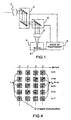
- the figure 1 illustrates an example of a known monitoring system, comprising scanning means for preferably repetitively analyzing a sector S of the space.
- This system comprises a front-end optics 1 of instantaneous field "axb” and scanning means 2 allowing observation of the sector S with a given total field "A x B".
- the scanning means are controlled by a processing unit, allowing the scanning of the sector.
- the monitoring system further comprises image forming means 3 on the pixels of the matrix detector 41 included in detection means 4. This is the image of a scene located in a given field area " axb ", located in the sector S.
- the system may also include counter-scanning means 6 to compensate for the movements of the image due to the scanning of the scene during the acquisition of the images.
- the processing unit 5 can synchronize the acquisition of the images with the scanning by counter-scanning means.
- the matrix detector 41 covers a strip of the space (dimension "A xb") by rotation of the scanning means 2.
- a point of the sector S is not observed permanently, but with a more or less short period depending on the time taken to return to this point after scanning the entire sector S.
- Counter-scanning means 6 allow: first, to ensure the stability of the line of sight during the integration time of the matrix detector 41 for each image, on the other hand, to observe the same "axb" zone of the space (of dimension substantially equal to the instantaneous field of the matrix detector 41, or possibly less than that -c) as the scanning means 2 of the sector do not require the passage to the next zone.
- the scanning / counter-scanning means 2, 6 provide a certain overlap between two consecutive zones observed, to eliminate the risk of formation of 'blind' zones due to errors in the mechanisms, and to treat without additional difficulty ie the case of targets moving in the reference of the matrix detector.
- angular width is not limited to an orientation in space.
- a point object O is therefore present in 40 consecutive images, numbered from n to n + 39. This object is not present in the previous 40 images (numbered from n-40 to n-1) nor in the following 40 images (numbered from n + 40 to n + 79).
- the problem is to optimize the use of these N images to detect the object with a high probability of detection and eliminate as much as possible false alarms due in particular to artifacts.
- the method also makes it possible to reject targets whose angular displacement is too fast, such as an object that does not pose a threat and can only be detected at short range, such as a bird. Indeed, the number of images of each group is determined in such a way that the object pixel does not present a change of pixel between the images of the group.
- the number of images of each group p is determined as a function of the supposed angular velocity of the target, the size ⁇ p of the angle of view of the pixel and the frame rate. f and possibly according to N.
- K is typically determined by the expected duration of artefact presence and frame rate f.
- P is determined as a function of N and the number of images of each group.
- a pixel is selected when RSB> predetermined threshold in this pixel.
- a neighboring pixel is determined according to the allowable displacements of the object, from one image I p to the other, and / or according to a permissible pixel trajectory.
- the method comprises, before the step of distributing the N images in P groups, a step for changing the pixel scale, that is to say that a block of qxq old pixels becomes a new pixel, q being an integer greater than or equal to 2, so that the image of an object only covers one pixel.
- a subsequent tracking is based on a temporal association of the targets detected with each scan of the sector. Because of the delay, which can be significant, between two consecutive observations of the same area during two successive analyzes of the sector S, a moving object presents an image (in fact of a group of accumulated images) to the other angular displacement which can be important and which therefore requires a large area of research to achieve the temporal association, which increases the risks of ambiguous association.
- the problem is therefore to optimize the use of N near-temporal images to detect the target with a high probability of detection and to eliminate as much as possible false alarms, in order to reduce the probability of bad associations for subsequent tracking.
- S artifact may be greater than S target, or in our example S 2/3 S >> 1.
- a known solution to solve this mobile target problem is to apply the method "track before detect” or “track before detect method” in English. For each pixel, are made M hypotheses of trajectories. For each of these assumptions, the positions of the target deducted over time are accumulated. The hypothesis adopted is the trajectory hypothesis that maximizes the accumulated signal.
- the method according to the invention describes in relation to the figures 4 and 5 is based on a distribution of N images in P groups of images.
- Q is determined so that the target does not exhibit a pixel change between the Q images.
- Q is determined so that the object pixel does not exhibit a pixel change between the Q images. Specifically, Q is determined as a function of the assumed angular velocity of the target, the size of the pixel at an angle, and the frame rate. If the matrix detector comprises C columns and L lines, the size ⁇ p of the angle of view of the pixel is equal to: at / VS ⁇ b / The .
- the set of neighboring pixels determined during a so-called association phase is defined by taking into account the permissible displacement of the target in the P groups of images. It is a question of determining from the pixel selected in the first group of images I p where the temporal confirmation step is carried out, which pixels are 'neighborhood candidates' for the following groups of images I p .
- the method described for defining all the neighboring pixels is an exemplary embodiment.
- Other embodiments are possible, either simpler (a priori selection of a zone Z sufficiently large around the pixel selected in the first group of images, zone valid for all the P groups of images), or more sophisticated, to deal with cases where two targets interfere in the same neighborhoods.
- the temporal confirmation criterion can be completed by a complementary step which consists in deciding whether the set of neighboring pixels thus defined corresponds to an object whose displacement in P groups of images is consistent with what is expected of a target.
- a 'path' criterion is applied to all the pixels retained during the association phase. Indeed, it can lead to an aberrant trajectory of the sudden change in direction of angular displacement of the target, corresponding to an acceleration that can not be that of a target.
- the applicable criterion is for example that the trajectory of the pixels retained is sufficiently close to a line.
- the method also makes it possible to reject targets whose angular displacement is too fast. Indeed, Q is determined so that the target does not have a pixel change between the Q images, as indicated above.
- FIG. 4 An example of temporal confirmation criterion is illustrated figure 4 considering 3 different cases, one case per line of the table.
- Each image I of this table results from an accumulation of Q images.
- the search area has a size equal to 3x3.
- the invention described so far performs the detection of targets that occupy only one pixel.
- a possible adaptation of the invention makes it possible to detect the targets of size greater than the pixel, by averaging by blocks of the image (called 'new pixels') to reduce the targets that one wants to detect to occupy only a new pixel.
Landscapes
- Engineering & Computer Science (AREA)
- Physics & Mathematics (AREA)
- General Physics & Mathematics (AREA)
- Theoretical Computer Science (AREA)
- Computer Vision & Pattern Recognition (AREA)
- Quality & Reliability (AREA)
- Multimedia (AREA)
- Electromagnetism (AREA)
- Radar, Positioning & Navigation (AREA)
- Remote Sensing (AREA)
- Image Analysis (AREA)
- Closed-Circuit Television Systems (AREA)
- Geophysics And Detection Of Objects (AREA)
- Apparatus For Radiation Diagnosis (AREA)
- Television Signal Processing For Recording (AREA)
Claims (12)
- Verfahren zum Erkennen eines Objekts in einer Szene, die sich in einem bestimmten Winkelsektor S befindet und dazu neigt, ein oder mehrere Artefakte zu umfassen, wobei das Verfahren einen Schritt des Abtastens des Sektors über seine Winkelbreite A mit einer Winkelgeschwindigkeit θ', einen Schritt des Erfassens aufeinander folgender digitaler Bilder der Szene mit einer Frequenz f beinhaltet, wobei diese Bilder Pixel umfassen und ein 'momentanes' Feld mit der Winkelbreite "a" abdecken, wobei das Verfahren die folgenden Schritte zum Verarbeiten der erfassten Bilder pro Satz von N Bildern beinhaltet:- Akkumulieren von Bildern, um ein akkumuliertes Bild zu erhalten,- Wählen der Pixel, die ein vorbestimmtes Erkennungskriterium erfüllen, für jedes akkumulierte Bild,dadurch gekennzeichnet, dass N = a f / θ' ist, und dadurch, dass das Verfahren vor dem Akkumulationsschritt den folgenden Schritt beinhaltet:Verteilen der N Bilder in P Gruppen von Bildern, wobei P eine ganze Zahl größer als 1 ist, und dadurch, dass das Akkumulieren für jede Gruppe p angewendet wird, wobei p zwischen 1 und P liegt, wobei das akkumulierte Bild mit Ip bezeichnet wird, und dadurch, dass das Verfahren nach dem Akkumulationsschritt den folgenden Schritt beinhaltet:- Ausführen eines Zeitbestätigungsschrittes für jedes Bestätigungsanfangsbild genannte Bild Ip, das wenigstens ein gewähltes Pixel beinhaltet, wobei der Schritt die folgenden Unterschritte beinhaltet:- Anwenden eines Zeitbestätigungskriteriums durch Vergleichen mit einer vorbestimmten Zahl K, wobei K<-P ist, der Anzahl k von Malen, dass dieses in dem Anfangsbild oder einem seiner Nachbarn gewählte Pixel in den folgenden Bildern Ip gewählt wird, wobei das in dem Anfangsbild gewählte Pixel in k gezählt wird, wobei dieses Pixel als das eines Objekts angesehen wird, wenn k ≥K ist,- Wiederholen dieses Zeitbestätigungskriteriums für alle gewählten Pixel dieses Anfangsbildes, sofern diese Pixel nicht bereits in einer Berechnung von k enthalten sind.
- Verfahren nach dem vorherigen Anspruch, dadurch gekennzeichnet, dass die Anzahl von Bildern jeder Gruppe p in Abhängigkeit von der angenommenen Winkelgeschwindigkeit des Objekts, der Größe des Betrachtungswinkels des Pixels und der Bildrate f des Detektors ermittelt wird.
- Verfahren nach dem vorherigen Anspruch, dadurch gekennzeichnet, dass die Anzahl von Bildern jeder Gruppe p ferner in Abhängigkeit von N ermittelt wird.
- Verfahren nach einem der vorherigen Ansprüche, dadurch gekennzeichnet, dass P in Abhängigkeit von N und von der Zahl von Bildern jeder Gruppe ermittelt wird.
- Verfahren nach einem der vorherigen Ansprüche, dadurch gekennzeichnet, dass K in Abhängigkeit von der angenommenen Dauer der Anwesenheit der Artefakte und der Bildrate f ermittelt wird.
- Verfahren nach einem der vorherigen Ansprüche, dadurch gekennzeichnet, dass ein Pixel dann gewählt wird, wenn RSB größer als ein vorbestimmter Schwellenwert ist.
- Verfahren nach einem der Ansprüche 1 bis 5, dadurch gekennzeichnet, dass ein Pixel dann gewählt wird, wenn das Signal des Pixels größer ist als ein vorbestimmter Schwellenwert.
- Verfahren nach einem der vorherigen Ansprüche, dadurch gekennzeichnet, dass ein Nachbarpixel in Abhängigkeit von den zulässigen Bewegungen des Objekts von einem Bild Ip zum anderen ermittelt wird.
- Verfahren nach einem der vorherigen Ansprüche, dadurch gekennzeichnet, dass ein Nachbarpixel in Abhängigkeit von einem Pfad von zulässigen Pixeln ermittelt wird.
- Verfahren nach einem der vorherigen Ansprüche, dadurch gekennzeichnet, dass das Verfahren, wenn das Bild eines Objekts mehr als ein Pixel abdeckt, vor dem Schritt des Verteilens der N Bilder auf P Gruppen einen Schritt des Änderns der Skala der Pixel beinhaltet, das heißt dass ein Block von q x q alten Pixeln zu einem neuen Pixel wird, wobei q eine ganze Zahl gleich oder größer als 2 ist, so dass das Bild eines Objekts nur ein Pixel abdeckt.
- Verfahren nach einem der vorherigen Ansprüche, dadurch gekennzeichnet, dass die Winkelgeschwindigkeit θ' konstant ist.
- System zum Überwachen eines Sektors S, das Folgendes umfasst:- Mittel (2) zum Abtasten des Sektors S, dessen Winkelbreite A mit einer Winkelgeschwindigkeit θ' abgetastet wird,- Mittel (3) zum Bilden von Bildern von Szenen, die sich in dem genannten Sektor S befinden und dazu neigen, Artefakte zu enthalten,- Mittel (4) zum Erkennen von digitalen Bildern einer Szene mit einer Rate f, die einen Matrixdetektor (41) mit einem Satz von Pixeln umfasst,- eine Einheit (5) zum Verarbeiten der erkannten Bilder,dadurch gekennzeichnet, dass die Verarbeitungseinheit (5) Mittel zum Implementieren des Verfahrens nach einem der vorherigen Ansprüche umfasst.
Applications Claiming Priority (2)
| Application Number | Priority Date | Filing Date | Title |
|---|---|---|---|
| FR0803167A FR2932278B1 (fr) | 2008-06-06 | 2008-06-06 | Procede de detection d'un objet dans une scene comportant des artefacts |
| PCT/EP2009/056908 WO2010003742A1 (fr) | 2008-06-06 | 2009-06-05 | Procede de detection d'un objet dans une scene comportant des artefacts |
Publications (2)
| Publication Number | Publication Date |
|---|---|
| EP2294441A1 EP2294441A1 (de) | 2011-03-16 |
| EP2294441B1 true EP2294441B1 (de) | 2012-02-22 |
Family
ID=40377160
Family Applications (1)
| Application Number | Title | Priority Date | Filing Date |
|---|---|---|---|
| EP09793898A Active EP2294441B1 (de) | 2008-06-06 | 2009-06-05 | Verfahren zur erkennung eines objekts in einer szene mit artefakten |
Country Status (7)
| Country | Link |
|---|---|
| US (1) | US8558891B2 (de) |
| EP (1) | EP2294441B1 (de) |
| AT (1) | ATE546742T1 (de) |
| ES (1) | ES2381987T3 (de) |
| FR (1) | FR2932278B1 (de) |
| IL (1) | IL209788A (de) |
| WO (1) | WO2010003742A1 (de) |
Families Citing this family (6)
| Publication number | Priority date | Publication date | Assignee | Title |
|---|---|---|---|---|
| CN102025626B (zh) * | 2010-12-09 | 2014-12-10 | 中兴通讯股份有限公司 | 转发组播数据报文的方法和提供商边缘设备 |
| RU2480780C1 (ru) * | 2011-10-28 | 2013-04-27 | Государственное образовательное учреждение высшего профессионального образования "Военная академия войсковой противовоздушной обороны Вооруженных Сил Российской Федерации" Министерства обороны Российской Федерации | Способ обнаружения точечных тепловых объектов на маскирующем атмосферном фоне |
| FR3112229B1 (fr) * | 2020-07-02 | 2022-07-15 | Thales Sa | Procede d'acquisition d'images d'une scene |
| RU2755075C1 (ru) * | 2020-11-23 | 2021-09-14 | Федеральное государственное унитарное предприятие "Всероссийский научно-исследовательский институт метрологии им. Д.И. Менделеева" | Способ загоризонтного обнаружения техногенных морских объектов |
| TR202019736A2 (tr) * | 2020-12-04 | 2022-06-21 | Aselsan Elektronik Sanayi Ve Ticaret As | Tespi̇t uygulamalari i̇çi̇n gürültü önleme metodu |
| CN114271791B (zh) * | 2022-01-12 | 2023-03-24 | 广州永士达医疗科技有限责任公司 | 一种oct成像系统的伪影检测方法及装置 |
Family Cites Families (7)
| Publication number | Priority date | Publication date | Assignee | Title |
|---|---|---|---|---|
| US4931868A (en) * | 1988-05-31 | 1990-06-05 | Grumman Aerospace Corporation | Method and apparatus for detecting innovations in a scene |
| US5210798A (en) * | 1990-07-19 | 1993-05-11 | Litton Systems, Inc. | Vector neural network for low signal-to-noise ratio detection of a target |
| US5379044A (en) * | 1993-12-23 | 1995-01-03 | Hughes Aircraft Company | Efficient multi-target tracking method |
| GB9720852D0 (en) * | 1997-10-02 | 1998-02-11 | Barr & Stroud Ltd | Method and apparatus for target track identification |
| FR2830339B1 (fr) * | 2001-10-02 | 2003-12-12 | Thales Sa | Dispositif optronique de veille passive |
| WO2003067884A1 (en) * | 2002-02-06 | 2003-08-14 | Nice Systems Ltd. | Method and apparatus for video frame sequence-based object tracking |
| FR2875626B1 (fr) * | 2004-09-21 | 2006-11-17 | Thales Sa | Procede de detection et de pistage de cibles ponctuelles, dans un systeme de surveillance optronique |
-
2008
- 2008-06-06 FR FR0803167A patent/FR2932278B1/fr not_active Expired - Fee Related
-
2009
- 2009-06-05 ES ES09793898T patent/ES2381987T3/es active Active
- 2009-06-05 WO PCT/EP2009/056908 patent/WO2010003742A1/fr not_active Ceased
- 2009-06-05 EP EP09793898A patent/EP2294441B1/de active Active
- 2009-06-05 AT AT09793898T patent/ATE546742T1/de active
- 2009-06-05 US US12/996,597 patent/US8558891B2/en not_active Expired - Fee Related
-
2010
- 2010-12-06 IL IL209788A patent/IL209788A/en active IP Right Grant
Also Published As
| Publication number | Publication date |
|---|---|
| IL209788A0 (en) | 2011-02-28 |
| ES2381987T3 (es) | 2012-06-04 |
| FR2932278B1 (fr) | 2010-06-11 |
| US8558891B2 (en) | 2013-10-15 |
| FR2932278A1 (fr) | 2009-12-11 |
| EP2294441A1 (de) | 2011-03-16 |
| IL209788A (en) | 2015-03-31 |
| WO2010003742A1 (fr) | 2010-01-14 |
| ATE546742T1 (de) | 2012-03-15 |
| US20110080480A1 (en) | 2011-04-07 |
Similar Documents
| Publication | Publication Date | Title |
|---|---|---|
| EP2294441B1 (de) | Verfahren zur erkennung eines objekts in einer szene mit artefakten | |
| EP3103102B1 (de) | Verfahren zur detektion und verfolgung von zielen | |
| EP3572976A1 (de) | Verarbeitungsverfahren eines videobilddatenflusses | |
| FR2674340A1 (fr) | Procede pour detecter et classifier des particularites dans des images sonar. | |
| EP3049822B1 (de) | Verfahren zur nichtüberwachten entschachtelung durch n-dimensionale anreicherung | |
| FR3047103A1 (fr) | Procede de detection de cibles au sol et en mouvement dans un flux video acquis par une camera aeroportee | |
| EP1433012B1 (de) | Passive optoelektronische überwachungseinrichtung | |
| EP3709049B1 (de) | Radardaten-verarbeitungssystem und entsprechendes verfahren zur geräuschdämpfung | |
| EP3216213B1 (de) | Verfahren zum erkennen von fehlerhaften bildpunkten | |
| EP3324361B1 (de) | Verfahren zur erkennung und verfolgung von zielen | |
| FR2916562A1 (fr) | Procede de detection d'un objet en mouvement dans un flux d'images | |
| FR3097973A1 (fr) | Dispositif radar pour la detection d'un comportement de reference de cibles pistees ; procede et produit programme d'ordinateur associes | |
| EP3959648B1 (de) | Verfahren zur detektion von zielen | |
| EP1792278B1 (de) | Verfahren zur detektion und nachverfolgung von punktuellen zielen in einem optoelektronischen überwachungssystem | |
| EP3718082B1 (de) | Verfahren zur detektion und verfolgung von zielen | |
| FR3050829A1 (fr) | Procede d'optimisation de la detection de cibles marines et radar aeroporte mettant en oeuvre un tel procede | |
| EP4176582B1 (de) | Verfahren zur erfassung von bildern einer szene | |
| EP2715668A1 (de) | Erkennung und verfolgung von zielen bei einer bilderreihe | |
| EP3397984B1 (de) | Telemetrieverfahren und -system unter verwendung eines bildgebers | |
| EP4293391B1 (de) | Flugzeitsensor und verfahren zur abstandsmessung | |
| FR3038760A1 (fr) | Detection d'objets par traitement d'images | |
| EP3674717B1 (de) | Vorrichtung zur bestimmung des spektrums eines signals über eine grosse frequenzbandbreite durch mehrfachabtastung, und entsprechendes verfahren | |
| EP3575822A1 (de) | Bestimmungsverfahren einer charakteristischen abmessung eines schiffs | |
| EP4025503B1 (de) | System und verfahren zum analysieren von einzelnen satellitenumlaufbahnen | |
| FR2769373A1 (fr) | Procede de detection doppler de cibles a vitesse radiale faible ou nulle |
Legal Events
| Date | Code | Title | Description |
|---|---|---|---|
| PUAI | Public reference made under article 153(3) epc to a published international application that has entered the european phase |
Free format text: ORIGINAL CODE: 0009012 |
|
| 17P | Request for examination filed |
Effective date: 20101206 |
|
| AK | Designated contracting states |
Kind code of ref document: A1 Designated state(s): AT BE BG CH CY CZ DE DK EE ES FI FR GB GR HR HU IE IS IT LI LT LU LV MC MK MT NL NO PL PT RO SE SI SK TR |
|
| AX | Request for extension of the european patent |
Extension state: AL BA RS |
|
| RIN1 | Information on inventor provided before grant (corrected) |
Inventor name: LEMPERIERE, NADEGE Inventor name: PRENAT, MICHEL Inventor name: DUFOUR, JEAN-YVES |
|
| GRAP | Despatch of communication of intention to grant a patent |
Free format text: ORIGINAL CODE: EPIDOSNIGR1 |
|
| DAX | Request for extension of the european patent (deleted) | ||
| GRAS | Grant fee paid |
Free format text: ORIGINAL CODE: EPIDOSNIGR3 |
|
| GRAA | (expected) grant |
Free format text: ORIGINAL CODE: 0009210 |
|
| AK | Designated contracting states |
Kind code of ref document: B1 Designated state(s): AT BE BG CH CY CZ DE DK EE ES FI FR GB GR HR HU IE IS IT LI LT LU LV MC MK MT NL NO PL PT RO SE SI SK TR |
|
| REG | Reference to a national code |
Ref country code: GB Ref legal event code: FG4D Free format text: NOT ENGLISH |
|
| REG | Reference to a national code |
Ref country code: CH Ref legal event code: EP |
|
| REG | Reference to a national code |
Ref country code: AT Ref legal event code: REF Ref document number: 546742 Country of ref document: AT Kind code of ref document: T Effective date: 20120315 |
|
| REG | Reference to a national code |
Ref country code: IE Ref legal event code: FG4D Free format text: LANGUAGE OF EP DOCUMENT: FRENCH |
|
| REG | Reference to a national code |
Ref country code: DE Ref legal event code: R096 Ref document number: 602009005541 Country of ref document: DE Effective date: 20120419 |
|
| REG | Reference to a national code |
Ref country code: ES Ref legal event code: FG2A Ref document number: 2381987 Country of ref document: ES Kind code of ref document: T3 Effective date: 20120604 |
|
| REG | Reference to a national code |
Ref country code: NL Ref legal event code: VDEP Effective date: 20120222 |
|
| LTIE | Lt: invalidation of european patent or patent extension |
Effective date: 20120222 |
|
| PG25 | Lapsed in a contracting state [announced via postgrant information from national office to epo] |
Ref country code: NO Free format text: LAPSE BECAUSE OF FAILURE TO SUBMIT A TRANSLATION OF THE DESCRIPTION OR TO PAY THE FEE WITHIN THE PRESCRIBED TIME-LIMIT Effective date: 20120522 Ref country code: IS Free format text: LAPSE BECAUSE OF FAILURE TO SUBMIT A TRANSLATION OF THE DESCRIPTION OR TO PAY THE FEE WITHIN THE PRESCRIBED TIME-LIMIT Effective date: 20120622 Ref country code: NL Free format text: LAPSE BECAUSE OF FAILURE TO SUBMIT A TRANSLATION OF THE DESCRIPTION OR TO PAY THE FEE WITHIN THE PRESCRIBED TIME-LIMIT Effective date: 20120222 Ref country code: LT Free format text: LAPSE BECAUSE OF FAILURE TO SUBMIT A TRANSLATION OF THE DESCRIPTION OR TO PAY THE FEE WITHIN THE PRESCRIBED TIME-LIMIT Effective date: 20120222 Ref country code: HR Free format text: LAPSE BECAUSE OF FAILURE TO SUBMIT A TRANSLATION OF THE DESCRIPTION OR TO PAY THE FEE WITHIN THE PRESCRIBED TIME-LIMIT Effective date: 20120222 |
|
| PG25 | Lapsed in a contracting state [announced via postgrant information from national office to epo] |
Ref country code: GR Free format text: LAPSE BECAUSE OF FAILURE TO SUBMIT A TRANSLATION OF THE DESCRIPTION OR TO PAY THE FEE WITHIN THE PRESCRIBED TIME-LIMIT Effective date: 20120523 Ref country code: LV Free format text: LAPSE BECAUSE OF FAILURE TO SUBMIT A TRANSLATION OF THE DESCRIPTION OR TO PAY THE FEE WITHIN THE PRESCRIBED TIME-LIMIT Effective date: 20120222 Ref country code: PT Free format text: LAPSE BECAUSE OF FAILURE TO SUBMIT A TRANSLATION OF THE DESCRIPTION OR TO PAY THE FEE WITHIN THE PRESCRIBED TIME-LIMIT Effective date: 20120622 Ref country code: FI Free format text: LAPSE BECAUSE OF FAILURE TO SUBMIT A TRANSLATION OF THE DESCRIPTION OR TO PAY THE FEE WITHIN THE PRESCRIBED TIME-LIMIT Effective date: 20120222 |
|
| REG | Reference to a national code |
Ref country code: IE Ref legal event code: FD4D |
|
| REG | Reference to a national code |
Ref country code: AT Ref legal event code: MK05 Ref document number: 546742 Country of ref document: AT Kind code of ref document: T Effective date: 20120222 |
|
| PG25 | Lapsed in a contracting state [announced via postgrant information from national office to epo] |
Ref country code: CY Free format text: LAPSE BECAUSE OF FAILURE TO SUBMIT A TRANSLATION OF THE DESCRIPTION OR TO PAY THE FEE WITHIN THE PRESCRIBED TIME-LIMIT Effective date: 20120222 |
|
| PG25 | Lapsed in a contracting state [announced via postgrant information from national office to epo] |
Ref country code: EE Free format text: LAPSE BECAUSE OF FAILURE TO SUBMIT A TRANSLATION OF THE DESCRIPTION OR TO PAY THE FEE WITHIN THE PRESCRIBED TIME-LIMIT Effective date: 20120222 Ref country code: PL Free format text: LAPSE BECAUSE OF FAILURE TO SUBMIT A TRANSLATION OF THE DESCRIPTION OR TO PAY THE FEE WITHIN THE PRESCRIBED TIME-LIMIT Effective date: 20120222 Ref country code: RO Free format text: LAPSE BECAUSE OF FAILURE TO SUBMIT A TRANSLATION OF THE DESCRIPTION OR TO PAY THE FEE WITHIN THE PRESCRIBED TIME-LIMIT Effective date: 20120222 Ref country code: SE Free format text: LAPSE BECAUSE OF FAILURE TO SUBMIT A TRANSLATION OF THE DESCRIPTION OR TO PAY THE FEE WITHIN THE PRESCRIBED TIME-LIMIT Effective date: 20120222 Ref country code: CZ Free format text: LAPSE BECAUSE OF FAILURE TO SUBMIT A TRANSLATION OF THE DESCRIPTION OR TO PAY THE FEE WITHIN THE PRESCRIBED TIME-LIMIT Effective date: 20120222 Ref country code: SI Free format text: LAPSE BECAUSE OF FAILURE TO SUBMIT A TRANSLATION OF THE DESCRIPTION OR TO PAY THE FEE WITHIN THE PRESCRIBED TIME-LIMIT Effective date: 20120222 Ref country code: IE Free format text: LAPSE BECAUSE OF FAILURE TO SUBMIT A TRANSLATION OF THE DESCRIPTION OR TO PAY THE FEE WITHIN THE PRESCRIBED TIME-LIMIT Effective date: 20120222 Ref country code: DK Free format text: LAPSE BECAUSE OF FAILURE TO SUBMIT A TRANSLATION OF THE DESCRIPTION OR TO PAY THE FEE WITHIN THE PRESCRIBED TIME-LIMIT Effective date: 20120222 |
|
| PG25 | Lapsed in a contracting state [announced via postgrant information from national office to epo] |
Ref country code: SK Free format text: LAPSE BECAUSE OF FAILURE TO SUBMIT A TRANSLATION OF THE DESCRIPTION OR TO PAY THE FEE WITHIN THE PRESCRIBED TIME-LIMIT Effective date: 20120222 |
|
| PLBE | No opposition filed within time limit |
Free format text: ORIGINAL CODE: 0009261 |
|
| STAA | Information on the status of an ep patent application or granted ep patent |
Free format text: STATUS: NO OPPOSITION FILED WITHIN TIME LIMIT |
|
| BERE | Be: lapsed |
Owner name: THALES Effective date: 20120630 |
|
| 26N | No opposition filed |
Effective date: 20121123 |
|
| PG25 | Lapsed in a contracting state [announced via postgrant information from national office to epo] |
Ref country code: AT Free format text: LAPSE BECAUSE OF FAILURE TO SUBMIT A TRANSLATION OF THE DESCRIPTION OR TO PAY THE FEE WITHIN THE PRESCRIBED TIME-LIMIT Effective date: 20120222 Ref country code: MC Free format text: LAPSE BECAUSE OF NON-PAYMENT OF DUE FEES Effective date: 20120630 |
|
| PG25 | Lapsed in a contracting state [announced via postgrant information from national office to epo] |
Ref country code: MK Free format text: LAPSE BECAUSE OF FAILURE TO SUBMIT A TRANSLATION OF THE DESCRIPTION OR TO PAY THE FEE WITHIN THE PRESCRIBED TIME-LIMIT Effective date: 20120222 |
|
| REG | Reference to a national code |
Ref country code: DE Ref legal event code: R097 Ref document number: 602009005541 Country of ref document: DE Effective date: 20121123 |
|
| PG25 | Lapsed in a contracting state [announced via postgrant information from national office to epo] |
Ref country code: BE Free format text: LAPSE BECAUSE OF NON-PAYMENT OF DUE FEES Effective date: 20120630 |
|
| PG25 | Lapsed in a contracting state [announced via postgrant information from national office to epo] |
Ref country code: BG Free format text: LAPSE BECAUSE OF FAILURE TO SUBMIT A TRANSLATION OF THE DESCRIPTION OR TO PAY THE FEE WITHIN THE PRESCRIBED TIME-LIMIT Effective date: 20120522 Ref country code: MT Free format text: LAPSE BECAUSE OF FAILURE TO SUBMIT A TRANSLATION OF THE DESCRIPTION OR TO PAY THE FEE WITHIN THE PRESCRIBED TIME-LIMIT Effective date: 20120222 |
|
| REG | Reference to a national code |
Ref country code: CH Ref legal event code: PL |
|
| PG25 | Lapsed in a contracting state [announced via postgrant information from national office to epo] |
Ref country code: LI Free format text: LAPSE BECAUSE OF NON-PAYMENT OF DUE FEES Effective date: 20130630 Ref country code: CH Free format text: LAPSE BECAUSE OF NON-PAYMENT OF DUE FEES Effective date: 20130630 Ref country code: TR Free format text: LAPSE BECAUSE OF FAILURE TO SUBMIT A TRANSLATION OF THE DESCRIPTION OR TO PAY THE FEE WITHIN THE PRESCRIBED TIME-LIMIT Effective date: 20120222 |
|
| PG25 | Lapsed in a contracting state [announced via postgrant information from national office to epo] |
Ref country code: LU Free format text: LAPSE BECAUSE OF NON-PAYMENT OF DUE FEES Effective date: 20120605 |
|
| PG25 | Lapsed in a contracting state [announced via postgrant information from national office to epo] |
Ref country code: HU Free format text: LAPSE BECAUSE OF FAILURE TO SUBMIT A TRANSLATION OF THE DESCRIPTION OR TO PAY THE FEE WITHIN THE PRESCRIBED TIME-LIMIT Effective date: 20090605 |
|
| REG | Reference to a national code |
Ref country code: FR Ref legal event code: PLFP Year of fee payment: 8 |
|
| REG | Reference to a national code |
Ref country code: FR Ref legal event code: PLFP Year of fee payment: 9 |
|
| REG | Reference to a national code |
Ref country code: FR Ref legal event code: PLFP Year of fee payment: 10 |
|
| P01 | Opt-out of the competence of the unified patent court (upc) registered |
Effective date: 20230529 |
|
| PGFP | Annual fee paid to national office [announced via postgrant information from national office to epo] |
Ref country code: GB Payment date: 20240516 Year of fee payment: 16 |
|
| PGFP | Annual fee paid to national office [announced via postgrant information from national office to epo] |
Ref country code: DE Payment date: 20240514 Year of fee payment: 16 |
|
| PGFP | Annual fee paid to national office [announced via postgrant information from national office to epo] |
Ref country code: FR Payment date: 20240524 Year of fee payment: 16 |
|
| PGFP | Annual fee paid to national office [announced via postgrant information from national office to epo] |
Ref country code: IT Payment date: 20240530 Year of fee payment: 16 |
|
| PGFP | Annual fee paid to national office [announced via postgrant information from national office to epo] |
Ref country code: ES Payment date: 20240704 Year of fee payment: 16 |
|
| REG | Reference to a national code |
Ref country code: DE Ref legal event code: R119 Ref document number: 602009005541 Country of ref document: DE |
|
| GBPC | Gb: european patent ceased through non-payment of renewal fee |
Effective date: 20250605 |
|
| PG25 | Lapsed in a contracting state [announced via postgrant information from national office to epo] |
Ref country code: GB Free format text: LAPSE BECAUSE OF NON-PAYMENT OF DUE FEES Effective date: 20250605 |
|
| PG25 | Lapsed in a contracting state [announced via postgrant information from national office to epo] |
Ref country code: DE Free format text: LAPSE BECAUSE OF NON-PAYMENT OF DUE FEES Effective date: 20260101 |
|
| PG25 | Lapsed in a contracting state [announced via postgrant information from national office to epo] |
Ref country code: IT Free format text: LAPSE BECAUSE OF NON-PAYMENT OF DUE FEES Effective date: 20250605 |
|
| PG25 | Lapsed in a contracting state [announced via postgrant information from national office to epo] |
Ref country code: FR Free format text: LAPSE BECAUSE OF NON-PAYMENT OF DUE FEES Effective date: 20250630 |