EP2295024A2 - Compositions servant de ciment pour prothese dentaire - Google Patents
Compositions servant de ciment pour prothese dentaire Download PDFInfo
- Publication number
- EP2295024A2 EP2295024A2 EP20100184864 EP10184864A EP2295024A2 EP 2295024 A2 EP2295024 A2 EP 2295024A2 EP 20100184864 EP20100184864 EP 20100184864 EP 10184864 A EP10184864 A EP 10184864A EP 2295024 A2 EP2295024 A2 EP 2295024A2
- Authority
- EP
- European Patent Office
- Prior art keywords
- composition
- denture
- ave
- mixtures
- another embodiment
- Prior art date
- Legal status (The legal status is an assumption and is not a legal conclusion. Google has not performed a legal analysis and makes no representation as to the accuracy of the status listed.)
- Granted
Links
Images
Classifications
-
- A—HUMAN NECESSITIES
- A61—MEDICAL OR VETERINARY SCIENCE; HYGIENE
- A61K—PREPARATIONS FOR MEDICAL, DENTAL OR TOILETRY PURPOSES
- A61K6/00—Preparations for dentistry
-
- A—HUMAN NECESSITIES
- A61—MEDICAL OR VETERINARY SCIENCE; HYGIENE
- A61K—PREPARATIONS FOR MEDICAL, DENTAL OR TOILETRY PURPOSES
- A61K6/00—Preparations for dentistry
- A61K6/30—Compositions for temporarily or permanently fixing teeth or palates, e.g. primers for dental adhesives
- A61K6/35—Preparations for stabilising dentures in the mouth
Definitions
- This invention relates to denture adhesive compositions and in particular to improved denture adhesive compositions comprising a normalized dislodgement force of about 1100 to about 12,000 grams per sq.cm., or dislodgement force ratio from about 1.1 to about 10.
- Denture adhesives are used to temporarily adhere the dentures to the surfaces of the oral cavity, in particular the oral mucosa. Denture adhesives are typically applied to either the denture or oral surface at the beginning of the day when the dentures are placed into the oral cavity, and the adhesives tend to bio-erode during the course of the day due to the action of saliva and chewing.
- Patent 5,073,604 Holeva et al., issued December 17, 1991 ; U.S. Patent 5,525,652, Clarke, issued June 11, 1996 ; U.S. Patent 5,340,918, Kittrell et al., issued Aug. 23, 1994 ; U.S. Patent 5,830,933, Synodis et al., issued Nov. 3, 1998 .
- Oozing may occur due to seeping of the denture adhesive from under the dental plate in the oral cavity caused by a variety of factors including a low viscosity denture adhesive, use of too much denture adhesive, improper application of the denture adhesive on the denture plate, etc.
- the denture adhesive composition is exposed to the oral cavity. Therefore, any negative taste, negative mouth-feel, or any other any other negative aesthetic associated with the denture adhesive composition may be more noticeable and objectionable to the consumer.
- Sources of such negative perception may include the denture adhesive polymer itself or salts of the denture adhesive polymer, including those crosslinked with zinc salts.
- denture adhesive compositions are used in the oral cavity for up to 6-7 hours or longer. Furthermore, consumers may stop using the adhesive or may tend to apply less adhesive the next time if they experience the negative perception of ooze. This may lead to decreased denture hold or decreased denture performance. This decrease in performance can mean less denture stability, denture retention, or an increase in food lodging itself under the denture prosthesis.
- the denture adhesive composition herein will provide these improved denture adhesive properties including improved hold, fit, ease of handling, ease of application, decreased ooze, and/or improved clean up under the varied conditions of the oral cavity.
- the present invention relates to a denture adhesive composition
- a denture adhesive composition comprising a safe and effective adhesive amount of a denture adhesive component; a safe and effective amount of a water insoluble component selected from the group consisting of a water insoluble thermoplastic component, a water insoluble liquid component, and mixtures thereof; wherein the composition has a normalized dislodgement force of from 1100 to 12,000 grams per sq.cm, or a dislodgement force ratio from 1.1 to 10.
- centimeter means centimeter.
- mm means millimeter.
- g means gram.
- denture and/or “denture prosthesis” as used herein refers to either the upper or lower denture, or both.
- denture adhesive article and/or “article” as used herein refers to articles designed to fit, conform and adhere to contoured surfaces, such as a denture, as well as the gums or the roof of the mouth.
- the articles herein are substantially solid prior to use and can be picked up manually in substantially one piece and positioned on the denture.
- flexible or “flexible article” as used herein means that a 0.67 mm thick piece of the article may be wrapped 180 degrees around a solid cylinder of 1 cm diameter without cracking upon visual observation.
- safe and effective adhesive amounts means an amount sufficient to provide adherence to the oral cavity and/or provide adherence of a denture to the oral cavity, without toxicity to the user or damage to oral tissue.
- safe and effective amount is meant an amount of an agent high enough to significantly (positively) modify the condition to be treated or positively modify the benefit sought, but low enough to avoid serious side effects (at a reasonable benefit/risk ratio), within the scope of sound medical/dental judgment.
- the safe and effective amount of an agent may vary with the particular condition being treated, the age and physical condition of the patient being treated, the severity of the condition, the duration of treatment, the nature of concurrent therapy, the specific form of the source employed, and the particular vehicle from which the agent is applied.
- AVE/MA refers to alkyl vinyl ether-maleic acid or anhydride copolymer.
- mixed polymer salts or “mixed salts”, as used herein, refers to salts of AVE/MA where at least 2 different cations are mixed on the same polymer with each other or with other salts.
- free acid refers either to the unreacted carboxyl groups (-COOH) of AVE/MA copolymer plus any other monovalent cations of carboxyl groups (e.g., COONa) of the polymer.
- Monovalent cations include Group IA cations, such as sodium, potassium, hydrogen, etc.
- the term “free acid” refers to the unreacted carboxyl groups (-COOH) of AVE/MA plus sodium and potassium cations.
- free acid refers only to the unreacted carboxyl groups (-COOH) of the AVE/MA.
- toxicologically-acceptable is used to describe materials that are suitable in their toxicity profile for administration to humans and/or animals.
- non-aqueous is meant that the composition does not contain added water but may contain water that is included in another component as supplied commercially by the manufacturer.
- water-insoluble refers to a material that, when exposed to an excess of water, does not dissolve, but may disperse to varying degrees. In some embodiments the term “water-insoluble” refers to a material that is less than 10%, 5%, 2%, or 1% soluble in water.
- thermoplastic refers to a material that melts, softens, and becomes more flexible, extrudable, deformable, shapable, moldable, flowable, processable, and/or changes rheology when exposed to heat.
- the material generally solidifies, hardens, and/or substantially returns to its original condition, when subsequently cooled.
- bioerodible means that the composition, when exposed to excess of water or saliva, will erode over time due to physical and/or chemical action.
- the time necessary to erode the composition can be any length of time from instantaneous to five days; in one embodiment the time to erode is from 1 to 3 days.
- the composition may erode completely or substantially, however ultimately the composition will lose its original form and/or integrity. For example, after application and use for at least 24 hours in the oral cavity the composition will not have sufficient product integrity to easily separate or peel, in its original form, from the denture or oral surface.
- the composition bioerodes such that no portion of the composition remains on the denture or mouth after the composition has been used in the oral cavity for about 24 hours.
- some portion or residue from the composition remains on the denture or oral surface after removing the denture from the oral cavity; however, this portion or residue from the composition can be cleaned by brushing away with a toothbrush, but not easily separated from the denture.
- the percentages used herein to describe the cationic salt function of the alkyl vinyl ether-maleic acid or anhydride copolymers are defined as the stoichiometric percent of the total initial carboxyl groups reacted on the polymer.
- the present invention relates to denture adhesive compositions designed to fit, conform and adhere to contoured surfaces such as a denture as well as the gums or the roof of the mouth.
- compositions described herein are selected from the group consisting of articles, creams, pastes, gels, liquids, wafers, strips, and mixtures thereof.
- the compositions can be extruded out of a nozzle of a container such as a tube, pump and/or syringe.
- the compositions herein are articles.
- the articles herein minimize or avoid the problem of premature sticking during application of the article to the denture. That is, with some prior art denture adhesive articles, before the article can be properly positioned over a target surface on the denture, inadvertent contact of the article with the denture may cause premature sticking at one or more locations on the denture. This may inhibit proper positioning of the article. Premature sticking may also cause contamination or degradation of the article prior to final positioning on the denture.
- dry tack means that present articles exhibit minimal and/or no adhesive or cling properties in the dry state until activated by pressure applied by a user. In one embodiment this characteristic permits the present articles to be stored and dispensed in any desired mode without encountering the difficulties of premature clinging or adhering to themselves, and without the need for separate release sheets, liners, spacers, or the like. At the same time, in one embodiment when pressure activated at the desired location and at the desired time, the articles can, in the dry state, exhibit sufficient adhesive properties to form a bond to most plastic surfaces including a denture surface, this bond being sufficiently strong to survive handling of the denture without bond failure.
- the articles herein in the dry state, adhere to a target denture surface only when pressed thereagainst, thereby minimizing or avoiding this problem of inadvertent adherence during positioning on the denture surface.
- the articles herein do not have to be moistened or wet prior to application to the denture, thus providing a simple and easy way to apply an article to the denture.
- dry tack means that present articles exhibit minimal and/or no adhesive or cling properties until activated by pressure applied by the user after the article has been warmed by the hands of the user, potentially during the course of application of the article to the denture surface.
- the articles herein are non-tacky to the touch prior to application to the denture.
- dry tack means articles herein in a dry and unwetted state, are capable of immediate bonding by surface attachment to a dry plastic, polymethyl methacrylate, and/or other denture prothesis substrate, upon subjecting the article to pressure.
- the dry article develops bonding by surface attachment to a dry denture prosthesis substrate upon the application of finger pressure whereby the article remains bonded under its own weight, and the article herein will not remain bonded to this dry substrate under its own weight without using finger pressure to apply the article to the substrate.
- the force or pressure may be generated by one or more fingers. This force or finger pressure, in one embodiment, may be applied for 1-10 seconds or longer.
- the bonding of the article to the substrate is maintained from about 10 seconds to about 3 minutes or longer, in another embodiment from about 30 seconds to about 1 minute or longer.
- the dry tack of the article is from 0.025, 0.1, 1, 10, 100, 1000 gram force/square centimeter to 10, 100, 1000, 10,000, 50,000, 100,000 gram force/square centimeter and any combination thereof.
- the dry tack of an article that can be repositioned is from 0.025 grams/force square centimeter to 0.30 grams/force square centimeter, and in another embodiment from 0.025 gram force/square centimeter to about 0.25 gram force/square centimeter.
- the article has a modulus greater than the 'Dahlquist criterion for tack' of about 3 x 10 6 dynes/cm 2 .
- the article has a shear storage modulus G' (measured in dynes/cm 2 at a frequency of 1 Hz at 25°C) greater than 5 x 10 6 ; in another embodiment greater than 1 x 10 7 ; in another embodiment greater than 5 x 10 7 ; and in another embodiment greater than 8 x 10 7 .
- the composition has a shear storage modulus G' (measured in dynes/cm 2 at a frequency of 1 Hz at 25°C) from about 1 x 10 6 , 3 x 10 6 , 5 x 10 6 , 1 x 10 7 , 5 x 10 7 , and 8 x 10 7 to about 5x 10 8 , 5 x 10 7 , 1 x 10 8 , 5 x 10 9 , 1 x 10 9 , and 1 x 10 10 and/or any combination thereof.
- G' shear storage modulus G' (measured in dynes/cm 2 at a frequency of 1 Hz at 25°C) from about 1 x 10 6 , 3 x 10 6 , 5 x 10 6 , 1 x 10 7 , 5 x 10 7 , and 8 x 10 7 to about 5x 10 8 , 5 x 10 7 , 1 x 10 8 , 5 x 10 9 , 1 x 10 9 , and 1 x 10 10 and/or any
- the composition is an article and has a flexural stiffness of less than about 10 grams/cm, in another embodiment less that about 5 grams/cm, in another embodiment less that about 3 grams/cm, in another embodiment less than 2 grams/cm and in yet another embodiment from 0.1, 0.5, 1, to 2, 3, 5, 10 grams/cm, in any combination, flexural stiffness as measured on a Handle-O-Meter, model #211-300, available from Thwing-Albert Instrument Company of Philadelphia, PA as per test method ASTM D2923-95.
- compositions herein have a normalized dislodgement force of from 1100 to 12,000 grams per sq.cm, in another embodiment from 1300 to 10,000 grams per sq.cm, in another embodiment from 1200 to 5000 grams per sq.cm, in another embodiment from 1400 to 5000 grams per sq.cm, in another embodiment from 1300 to 2500 grams per sq.cm, in another embodiment from 1750 to 2500 grams per sq.com.
- the normalized dislodgement force is from 1100, 1200, 1300, 1400, 1500, 1750 grams per sq.cm. to 12,000, 10,000, 7500, 5000, 2500, 2250 grams per sq.cm, and/or any combination thereof.
- the dislodgement force ratio is from 1.1, 1.2, 1.3, 1.4, 1.5, 1.6, 1.7, 1.8, 1.9, 2.0 to 1.3, 1.4, 1.5, 1.6, 1.7, 1.8, 1.9, 2.0, 3, 4, 5, 6, 8, 10, and/or any combination thereof.
- the dislodgement force ratio is from 1.1 to 10, from 1.1 to 8, from 1.3 to 4, and/or from 1.3 to 2.5.
- the articles herein are substantially solid prior to use and can be picked up manually, in substantially one piece, and positioned on the denture. Additionally, in one embodiment the articles are capable of being picked up manually, and positioned on the denture, resulting in little or no residue on the fingers. In another embodiment the articles comprise a single layer. In yet another embodiment the articles are laminates, and/or composites. In one embodiment the articles are pre-shaped and/or preformed. In another embodiment the articles herein may be dispensed by the consumer via a unit dose package, multi-dose package, pump, sachet, syringe, or tube, and shaped by the consumer; and in yet another embodiment the articles may be shaped by the consumer without leaving a substantial residue on their hands.
- the denture adhesive article is sufficiently flow-able to allow it to be applied from a tube and subsequently picked up and positioned on the denture. In one embodiment, the denture adhesive article is sufficiently flow-able to allow it to be applied from a tube and subsequently picked up, and positioned on the denture, with little/no residue on the fingers. In another embodiment the denture adhesive article comprises a solvent which results in an article that is sufficiently flow-able to be applied from a tube. The solvent may be subsequently dissipated, by evaporation, bio-absorption, dispersion, dissolution, etc. In another embodiment the above mentioned optional solvent is also miscible with the water insoluble component.
- the denture adhesive composition is sufficiently flow-able to allow it to be applied from a tube and only minimally ooze out from under the denture.
- the denture adhesive composition has a "normalized ooze amount" from 0%, 0.00001%, 0.001%, 5%, 10%, 15%, 20%, 25%, 30% to 15%, 20%, 25%, 30%, 40%, 50% and/or any combination thereof.
- the denture adhesive composition has an "ooze ratio" from 0, 0.00001, 0.001, 0.01, 0.1, 0.2, 0.3, 0.4, 0.5, 0.6 to 0.3, 0.4, 0.5, 0.6, 0.7, and/or any combination thereof.
- the articles are substantially solid prior to use and can be picked up manually.
- Denture adhesive articles that can be dispensed from a tube can be identified as articles by the following method (pPlease read all steps before starting test.)
- Some denture adhesive articles are pre-dosed and/or ready to use. A user may be able to identify these items visually as a denture adhesive article, as they are often in the form of a strip contained within a package. However, if not evident that these denture adhesive products are articles, these denture adhesive articles can be identified as articles by the following method:
- Substantially in one piece means, as used herein, that from 75, 80, 85, 90% to 100, 90, 85, 80, 75, 70% and/or any combination thereof of the denture adhesive composition remains in one piece when manually picked up from the denture surface.
- denture adhesive articles can also be identified as articles by the amount of ooze, as determined by the ooze method (as defined herein).
- a denture adhesive article has a normalized ooze amount of from 0, 3, 5, 10, 15, 20, 25% of the total composition to 30, 25, 20, 15, 10, 5, 3 % of the total composition and/or any combination thereof and/or the ooze ratio is from 0, 00001, 0.001, 0.01, 0.1, 0.2, 0.25, 0.3, to 0.1, 0.2, 0.25, 0.3, 0.4, 0.5 and/or any combination thereof.
- composition herein comprises ingredients of natural origin.
- composition herein comprises a homogeneous mixture of the denture adhesive component and the water insoluble thermo-plastic component.
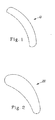
- the denture adhesive article can have a variety of shapes and sizes including but not limited to a concave shape which is either symmetrical or asymmetrical.
- Fig. 1 shows a symmetrical concave shaped denture adhesive article 10.
- Fig. 2 shows an asymmetrical concave shaped denture adhesive article 20, in particular Fig. 2 shows a kidney shaped denture adhesive article 20.
- the present invention comprises a safe and effective adhesive amount of a denture adhesive component, generally at a level of from 10% to 90%, in another embodiment from 15% to 70%, in another embodiment from 20% to 70%, in yet and in another embodiment from 25% to 65%, and in yet another embodiment from 30% to 65%, by weight of the composition.
- the composition of the present invention comprise from at least 20 percent by weight, and in another embodiment at least 30 percent by weight of the composition, of a denture adhesive component.
- the denture adhesive components herein are mucoadhesive, hydrophilic, water soluble, have the property of swelling upon exposure to moisture, and/or to form a mucilaginous mass when combined with moisture.
- the denture adhesive components are selected from the group consisting of natural gums, synthetic polymeric gums, AVE/MA, salts of AVE/MA, AVE/MA/IB, salts of AVE/MA/IB, copolymer of maleic acid or anhydride and ethylene and salts thereof, copolymer of maleic acid or anhydride and styrene and salts thereof, copolymer of maleic acid or anhydride and isobutylene and salts thereof, polyacrylic acid and polyacrylates thereof, polyitaconic acid and salts thereof, mucoadhesive polymers, water-soluble hydrophilic colloids, saccharide derivatives, cellulose derivatives, and mixtures thereof.
- Such materials include karaya gum, guar gum, gelatin, algin, sodium alginate, tragacanth, chitosan, acrylamide polymers, carbopol, polyvinyl alcohol, polyamines, polyquarternary compounds, polyvinylpyrrolidone, cationic polyacrylamide polymers, AVE/MA, AVE/MA/IB, mixed salts of AVE/MA, mixed salts of AVE/MA/IB, polymeric acids, polymeric salts, polyhydroxy compounds, and mixtures thereof.
- the denture adhesive components are selected from the group consisting of salts of AVE/MA, mixed salts of AVE/MA, cellulose derivatives (such as methylcellulose, carboxymethylcellulose, hydroxyethylcellulose, hydroxypropylcellulose, hydroxy-propylmethylcellulose, and mixtures thereof), polyethylene glycol, karaya gum, sodium alginate, chitosan, corn starch, and mixtures thereof.
- the adhesive component is selected from the group consisting of mixed salts of AVE/MA, cellulose derivatives, and mixtures thereof.
- the denture adhesive component is not thermoplastic and/or comprises only low levels of water soluble thermoplastic polymers, from 0.01 to 5% of water soluble thermoplastic polymer such as polyethylene oxide, hydroxypropyl cellulose, hydroxypropylmethylcellulose; polyethylene glycol; in another embodiment from 0.01 to 1% of water soluble thermoplastic polymer, or is essentially free of water soluble thermoplastic polymers.
- the denture adhesive component is AVE/MA or salts of AVE/MA.
- the alkyl vinyl ether-maleic acid co-polymer comprises or consists essentially of the repeated structural unit: wherein R represents an alkyl radical, in one embodiment a C 1 to C 5 alkyl radical, n is an integer greater than one representing the number of repeated occurrences of the structural unit in a molecule of the polymer.
- the adhesive component is AVE/MA and salts thereof, preferably mixed salts of AVE/MA, wherein the copolymer contains a cationic salt function comprising a cation selected from Group IA and Group 2A cations of the periodic table, yttrium, titanium, zirconium, vanadium, chromium, manganese, iron, nickel, copper, zinc, boron, aluminum, and mixtures thereof.
- the adhesive component is a mixed salt of AVE/MA containing a cationic salt function comprising a cation selected from strontium, zinc, iron, boron, aluminum, vanadium, chromium, manganese, nickel, copper, yttrium, titanium, magnesium, calcium, sodium, and mixtures thereof, and in yet another embodiment the cation is selected from strontium, zinc, iron, magnesium, calcium, sodium, and mixtures thereof.
- AVE/MA contains, in one embodiment, a cationic salt function comprising from 5% to 50%, in another embodiment, from 10% to 40%, in yet another embodiment, from 10% to 35% (of the total initial carboxyl groups reacted) zinc cations.
- These zinc cations can be mixed with other cations selected from the group consisting of: from 5% to 65%, preferably from 10% to 60%, strontium cations, from 0.001% to 2.5%, preferably from 0.01% to 2% of iron, boron, aluminum, vanadium, chromium, manganese, nickel, copper, yttrium, and/or titanium cations, from 5% to 65%, preferably from 15% to 50% of calcium and/or magnesium cations and/or sodium cations.
- the free acid level of the salts of the AVE/MA or AVE/MA/IB is at least 36%, in another embodiment is from 36% to 60%, and even in another embodiment is from 40% to 55%, of the total initial carboxyl groups of the copolymer.
- the specific viscosity of the starting copolymer acid or copolymer anhydride is from 1.2 to 14, when preferably measured in a 1% weight/volume solution in MEK (methyl ethyl ketone) at 25°C.
- MEK methyl ethyl ketone
- Other methods and solvents can be used to measure the specific viscosity such as a 1% weight/volume solution in DMF (dimethyl formamide) at 25°C and a 1% weight/volume solution in 2-butanone at 25°C.
- Suitable AVE/MA copolymers may be prepared by well-known methods of the prior art; see, for example, US 2,782,182 , and US 2,047,398 .
- the present composition comprises a safe and effective amount of a water insoluble component.
- this component is at a level from 2, 5, 10, 20, 25, 30, 35% to 45, 50, 60, 70, 90%, and/or any combination thereof to create ranges, by weight of the composition
- the water insoluble component level is from 20% to 70%, from 25% to 60%, or from 35% to 60% by weight of the composition.
- the water insoluble component is both water insoluble and substantially non-swellable in water.
- the water insoluble component is a water insoluble liquid component selected from the group consisting of mineral oil, natural and synthetic oils, fats, silicone, silicone derivatives, dimethicone, silicone resins, hydrocarbons,, hydrocarbon derivatives, essential oils, vegetable oils, polybutenes, caprylic/capric triglycerides, corn, soy bean, cottonseed, castor, palm oil, coconut oils, animal oils, fish oil, oleic acid, and mixtures thereof.
- the water insoluble component is a PDMS gum, or a mixture of PDMS gum with an MQ resin cast from a solvent such as volatile isoparrafin (see US Patent 6,074,654 ).
- the water insoluble component is a water insoluble thermoplastic component that is selected from rubber, elastomers, plastomers, natural wax, synthetic wax, polyvinyl chloride, nylon, fluorocarbon, polyurethane prepolymer, polyethylene, polystyrene, polypropylene, cellulosic resins, acrylic resins, petrolatum, and mixtures thereof.
- the water insoluble thermoplastic component is selected from natural wax, synthetic wax, petrolatum, polyethylene, and mixtures thereof.
- the water insoluble thermoplastic component is selected from polyethylene, petrolatum, paraffin wax, microcrystalline wax, polypropylene, polystyrene, and mixtures thereof; in another embodiment is selected from polyethylene, microcrystalline wax, and mixtures thereof.
- the water insoluble thermoplastic component comprises elastomers such as Ethylene-Ethylene-Propylene rubber, Ethylene-Propylene rubber, Styrene-Ethylene-Ethylene-Ethylene-Propylene-Styrene rubber, and combinations thereof; and these may optionally be further combined with waxes.
- elastomers such as Ethylene-Ethylene-Propylene rubber, Ethylene-Propylene rubber, Styrene-Ethylene-Ethylene-Ethylene-Propylene-Styrene rubber, and combinations thereof; and these may optionally be further combined with waxes.
- the composition herein has a water insoluble thermoplastic component having a penetration of 25 to 350; in another embodiment from 27 to 250 in another embodiment from 30 to 150, and in another embodiment from 40 to 150, and in another embodiment from 50 to 80, and in yet another embodiment from 60 to 80.
- the penetration values are from 25 to 250 when measured using the ASTM D1321 method and the penetration values are from 25 to 350 when measured using the ASTM D937 method, both are existing methods known in the art.
- ASTM D937 and ASTM D1321 generally are used to measure the penetration of petrolatum or petroleum waxes, respectively, these methods may be used to measure the penetration of waxes derived from petroleum and other types of water insoluble thermoplastic components with appropriate modifications, for example, these other components may need to be melted at higher temperature which will be apparent to one of skill in the art.
- water insoluble thermoplastic component that are outside of these penetration values may be mixed with another ingredient modifies the penetration of the thermoplastic component. Therefore the water insoluble thermoplastic component may be a single ingredient or may be a mixture of ingredients.
- Multiwax W 180 manufactured by Witco (Crompton, Sonneborn) having a penetration value of 15 to 20 may be mixed with petrolatum (at a 1:1 ratio) to raise the penetration value to above 25.
- the water insoluble thermoplastic component is a natural or synthetic wax.
- These waxes include natural waxes such as animal, vegetable, mineral wax.
- Animal waxes include beeswax, lanolin, shellac wax, Chinese wax, etc.
- Vegetable waxes include carnauba, candelilla, bayberry, sugar cane, etc.
- mineral waxes include fossil or earth waxes (ozocerite, ceresin, montan), and petroleum waxes such as paraffin, microcrystalline, etc.
- the waxes herein are natural waxes selected from the group consisting of beeswax, candelilla, candela, carnauba, paraffin, microcrystalline wax, Fischer-Tropsch waxes, and mixtures thereof.
- the wax is microcrystalline wax manufactured by Crompton, Sonneborn (Witco) and referred to and sold under the trademark MutiwaxW-835.
- This wax has a melt point ranging from about 73.9 °C to about 79.4 °C (ASTM D127), has a penetration at 25°C of from 60 to 80 (ASTM D1321), has a kinematic viscosity at 98.9°C, of from 75 to 90 (ASTM D2161), has a flash point, COC, of about 246°C Min. (ASTM D92), and has a congealing point, of about 77°C (ASTM D938).
- the paraffin waxes useful herein generally can have a melting point range of from 65°C to 80°C, in another embodiment 70°C to 75°C; the microcrystalline wax useful herein can have a melting point of from 65°C to 90°C, in another embodiment can have a melting point of from 80°C to 90°C; the beeswax useful herein can have a melting point of from 62° to 65°C with a flash point of 242°C; the candelilla wax useful herein can have a melting point of from 68° to 72°C; the carnauba wax useful herein can have a melting point of from 83° to 86°C; the Fischer-Tropsch wax useful herein can have a melting point of 95° to 120°C. Synthetic grades of beeswax, candelilla, and carnauba waxes are also available with similar properties as the natural grades.
- the water insoluble thermoplastic component is polyethylene such as A-C 1702 and A-C 6702 made by Honeywell, with a penetration value of 98.5 and 90.0, respectively, under ASTM D1321.
- the composition contains polyethylene oxide, then either the water insoluble component is thermoplastic or the article may not include a fibrous paper web or paper laminate.
- the composition herein is substantially free of honey mixed with alcohol.
- the article is substantially free of polyvinyl acetate resin in ethyl alcohol.
- compositions of the present invention may also optionally comprise a safe and effective amount of one or more toxicologically-acceptable plasticizers.
- level of the plasticizing agent ranges from 0.0% to 40%, in one embodiment from 0.01% to 40%, in another embodiment from 1% to 10%, in another embodiment from 2% to 5%, by weight of the composition.
- the denture adhesive composition does not comprise a plasticizer.
- Suitable plasticizing agents of the present invention include, but are not limited to, polyols (such as sorbitol); glycerin; propylene glycol; acetylated monoglyceride; hydrogenated starch hydrolysates; corn syrups; and derivatives thereof; xylitol, glycerol monoesters with fatty acids; triacetin; diacetin; and monoacetin; dimethyl phthalate; diethyl phthalate; dioctyl phthalate; diethylene glycol; triethylene glycol; tricresyl phosphate; dimethyl sebacate; ethyl glycolate; ethylphthalyl ethyl glycolate; o- and p-toluene ethyl sulfonamide; phthalic acid derivative, glycerol triacetate, citric acid derivative, phosphoric acid derivative, glycol, glycol derivative, paraffin wax, a pentaerythritol
- the denture adhesive composition when extruded thermoplastically, does not cure and set as a result of the action of the plasticizer component.
- the plasticizer component does not solidify the water insoluble component or the denture adhesive composition.
- the water insoluble thermoplastic component does not cure and set.
- the denture adhesive composition may be substantially free of plasticizers.
- the denture adhesive composition can be substantially free of polyethylmethacrylate, triacetin, phthalic acid derivative, glycerol triacetate, citric acid derivative, phosphoric acid derivative, glycol, glycol derivative, paraffin wax, a pentaerythritol ester of a fatty acid, stearic acid derivative, glycerol monostearate, polyethylene glycol, butyl phthalyl butyl glycolate, butyl phthalyl butyl glycolate, dimethyl phthalate, dibutyl phthalate, triacetin, triethyl citrate, acetyl triethyl citrate, acetyl tributyl citrate, triphenyl phosphate, diethylene glycol, caprylic triglyceride, capric triglyceride, propylene glycol dicaprylate/caprate and/or combinations thereof
- compositions of the present invention may also optionally comprise a safe and effective amount of one or more toxicologically-acceptable gellants.
- level of the gellant agent ranges from 0.01 % to 40%, in another embodiment from 1% to 10%, in another embodiment from 2% to 5%, by weight of the composition.
- Suitable gellant agents of the present invention include, but are not limited to, polyvinylpyrrolidone/eicosene copolymer sold under the tradename Ganex V-220F from ISP; tricontanyl polyvinylpyrrolidone sold under the tradename Ganex WP-660 from ISP; polyamide gallants including Sylvaclear, Sylvacote, Sylvagel, Uniclear all available from Arizona Chemical including Sylvaclear Lightwax; Sylvaclear PA 20; Sylvaclear PA 30; Sylvaclear PA 50; Sylvacote 2228; Sylvacote 2228E; Sylvagel 5000; Sylvagel 6000; Uniclear 100; Uniclear 100VG; Uniclear 80; Uniclear 80V; and mixtures thereof.
- compositions of the present invention may also include one or more components which provide flavor, fragrance, and/or sensate benefit (warming or cooling agents).
- Suitable components include menthol, wintergreen oil, peppermint oil, spearmint oil, leaf alcohol, clove bud oil, anethole, methyl salicylate, eucalyptol, cassia, 1-8 menthyl acetate, sage, eugenol, parsley oil, oxanone, alpha-irisone, marjoram, lemon, orange, propenyl guaethol, cinnamon, vanillin, thymol, linalool, cinnamaldehyde glycerol acetal known as CGA, and mixtures thereof, as well as coolants.
- the coolant can be any of a wide variety of materials. Included among such materials are carboxamides, menthol, ketals, diols, and mixtures thereof.
- the coolants in the present compositions are selected from the group consisting of the p-menthane carboxyamide agents such as N-ethyl-p-menthan-3-carboxamide, known commercially as "WS-3", N,2,3-trimethyl-2-isopropylbutanamide, known as "WS-23,” and mixtures thereof.
- Additional preferred coolants are selected from the group consisting of menthol, 3-1-menthoxypropane-1,2-diol known as TK-10 manufactured by Takasago, menthone glycerol acetal known as MGA manufactured by Haarmann and Reimer, and menthyl lactate known as Frescolat® manufactured by Haarmann and Reimer.
- menthol and menthyl as used herein include dextro- and levorotatory isomers of these compounds and racemic mixtures thereof.
- TK-10 is described in U.S. Pat. No. 4,459,425, Amano et al., issued 7/10/84 .
- WS-3 and other agents are described in U.S. Pat. No. 4,136,163, Watson, et al., issued Jan. 23, 1979 .
- These agents may be present at a level of from 0% to 40%, in another embodiment from 0.05 to 5%, and in another embodiment from 0.1 to 2%, by weight of the composition.
- the denture adhesive compositions may also comprise one or more therapeutic actives suitable for topical administration.
- Therapeutic actives may be present at a level of from 0% to 70%, by weight, and in one embodiment from 1% to 20% by weight.
- Therapeutic actives include antimicrobial agents such as iodine, triclosan, peroxides, sulfonamides, bisbiguanides, or phenolics; antibiotics such as tetracycline, neomycin, kanamycin, metronidazole, cetylpyridium chloride, domiphen bromide, or clindamycin; anti-inflammatory agents such as aspirin, acetaminophen, naproxen and its salts, ibuprofen, ketorolac, flurbiprofen, indomethacin, eugenol, or hydrocortisone; dentinal desensitizing agents such as potassium nitrate, strontium chloride or sodium fluoride; fluorides such
- colorants include colorants, preservatives (such as methyl and propyl parabens), thickeners such as silicon dioxide, and polyethylene glycol.
- Colorants, preservatives, thickeners may be present at levels of from 0% to 20%, by weight of the composition, in another embodiment from 0.1% to 10%, by weight.
- compositions may also comprise one or more solvents.
- solvents may be miscible with the water insoluble component and/or be capable of being dissipated in-situ.
- these solvents may be dissipated in-situ by evaporation, dissolution, dispersion, bio-absorption, or any other suitable means.
- these solvents may be dissipated in-situ to leave behind a denture adhesive composition.
- solvents may include materials with a viscosity ranging from 0.01, 0.1, 1, 5 centipoise at 20°C, to 5, 10, 100, 1000 centipoise at 20°C in any combination of these levels.
- these solvents may be silicones, hydrocarbons, iso-dodecane, iso-hexadecane, iso-eicosane, and/or polyisobutene.
- Suitable grades of solvents include the Permethyl series (sold by Prespers Inc., New Jersey) such as Permethyl 97A, 99A, 101 A, 102A, and mixtures thereof.
- the composition is an article that can be utilized in accordance with the invention and formed by processes conventional in the arts, e.g. the film making industries such as casting, coating, calendaring, and extrusion.
- the separate components of the article are melted and then blended in a mixing tank until a homogeneous mixture is achieved. Thereafter, the melted mixture may be cast to an acceptable thickness, on an appropriate substrate. Examples of such substrates include Mylar, continuous moving stainless steel belt (which may eventually entering a dryer section if needed), release paper and the like.
- the articles are then cooled.
- the articles may then be dried if needed, e.g. in a forced-air oven.
- the temperature of the drying air and length of drying time depend on the nature of the solvent utilized as is recognized in the art.
- the drying temperatures include a temperature between 25°C and 140°C, in another embodiment from 60° and 90° C for a duration of 20 minutes to 60 minutes, in another embodiment from 30 to 40 minutes.
- the article may then be cut into desired shapes with desired dimensions and then stacked and/or subsequently packaged.
- the article is then die-cut into desired shapes. These shapes may facilitate application of the article to the dentures.
- the present article is processed as follows: 1. melt the wax component; 2. mix the AVE/MA salt(s) with any other adhesive component; 3. add the adhesive mixture to the wax melt; 4. stir to made a homogeneous mixture; 5. pour the homogeneous mixture into mold or onto a suitable surface; 6. cool the mixture until it solidifies; 7. remove from substrate or mold or cut into the desired shape.
- extrusion Another conventional film-making process known in the art is extrusion. This method is possible with films wherein the film forming ingredient comprises a variety of extrudable materials.
- the mechanical particulars of the extrusion process e.g. the particular equipment utilized, the extruding force, the shape and temperature of the orifice and/or dies are considered to be within the skill of the art and can be varied in a known manner to achieve the physical characteristics of the articles described herein.
- the thickness of the articles herein is generally between 0.1 mm to 2.5 mm, in another embodiment is from 0.4 mm to 1.5 mm thick, in another embodiment is from 0.5 mm to 1mm thick.
- the article may be thicker or thinner depending on the degree of cushioning desired by the user or wearer.
- compositions herein may optionally be multiphase or have visually distinct phases.
- articles herein may optionally have a release liner.
- the composition is a cream, paste, liquid and/or gel formed by known processes. These include adding the denture adhesive components into the liquid and/or thermoplastic components and mixing with heat until a uniform product forms.
- the present compositions are generally applied to the denture prosthesis and thereafter the denture is secured to the oral cavity.
- the dentures are dried prior to application of the composition.
- the composition may be applied to any suitable location on the prosthesis.
- the denture wearer generally wears the composition from 1 hour to 3 days, in another embodiment from 6 hours to 24 hours. After usage the prosthesis is removed from the oral cavity, and any remaining composition may be cleaned from the prosthesis, for example by gentle scrubbing with water and a brush.
- the Microcrystalline Wax W-835 (or Polyethylene AC 1702 or A-C 6702) is melted, and the other ingredients are blended with it.
- the mixture is then made into sheets by any suitable means such as extrusion or rolling into sheets of suitable thickness such as 0.25mm, 0.45mm, 0.50mm, 0.67mm, 0.73mm, or 1.0mm.
- the sheet is then cut into shapes suitable for application to dentures.
- Example I all or part of the Ca/Zn AVE/MA salt may be substituted with Mg/Zn/Na AVE/MA Salts and/or Ca/Na AVE/MA salts; all or part of the CMC may be substituted with caraggeenan, and/or suitable cellulose derivatives; all or part of the Microcystalline Wax W-835 may be substituted with Polyethylene A-C 1702 (available from Honeywell), and/or Polyethylene A-C 6702 (available from Honeywell); and/or, the amount of each ingredient may also be increased or decreased by up to about 50%.
- Each of the above examples may be blended with each other prior to making into articles; and/or used in conjunction with each other to form multilayer articles.
- Multiwax W 835 manufactured by Witco (Crompton, Sonneborn) .
- the Multiwax W 835 may also be substituted with either Polyethylene A-C 1702 or Polyethylene A-C 6702.
- Example II the Microcrystalline Wax W-835 (or Polyethylene AC 1702 or A-C 6702) and Petrolatum are melted, and the other ingredients are blended with it.
- All or part of the Ca/Zn AVE/MA salt may be substituted with Mg/Zn/Na AVE/MA Salts and/or Ca/Na AVE/MA salts; all or part of the CMC may be substituted with caraggeenan, and/or suitable cellulose derivatives; all or part of the Microcystalline Wax W-835 may be substituted with Polyethylene A-C 1702 (available from Honeywell), and/or Polyethylene A-C 6702 (available from Honeywell); and/or, the amount of each ingredient may also be increased or decreased by up to about 50%.
- Each of the above examples may be blended with each other.
- the wax is melted at about 95C (in Examples A-D) and the other ingredients are blended with it in a heated vessel at about 65C under vacuum.
- the blended products can be filled into tubes.
- the product can be squeezed out of the tubes onto a denture in the form of ribbons.
- the ribbons from products III-A-C can be picked up, and say placed at the desired location, with little or no residue on the fingers.
- the ribbons from product III-E cannot be picked up and placed since they are adhered to the denture surface and leave substantial residue on the fingers.
- the bioerosion of the inventive compositions can be measured by the following method: run a water source on top of the sample specimen for about 30 minutes while the specimen sits atop a wire mesh as shown in Figure 1 .
- the water source is a laboratory faucet adjusted such that the temperature is 39 ⁇ 1 °C and the flow rate is 16 ⁇ 1 ml/sec.
- the wire mesh grid has square openings approximately 0.09 inches x 0.09 inches and is placed 2.5 inches below the tip of the funnel where it is clamped to a metal ring for support. Sample specimens weighing 0.025 g are placed on the mesh and images are taken at 0, 10 and 30 minutes to follow bio-erosion of the specimen.
- the composition is bioerodible if it does not leave behind visible residue, film, or sheet after about 30 minutes under these testing conditions., and/or if it cannot be easily separated or peeled away manually in one or more large pieces after 30 minutes under these testing conditions, and/or if it leaves behind less than 2, less than 4, less than 6, and/or less than 8% by weight of residue (of the original weight of the composition) after 30 minutes under these testing conditions.
- the above bio-erosion test may also be conducted at various time-points up to 8 hours.
- the dry tack can be measured by the following method: 1. remove the article from the package material; 2. place the article on the palate-portion of a dry, acrylic upper-denture with the teeth facing downward; 3. apply pressure with fingers for 3 to 10 seconds; 4. thereafter remove finger pressure; 5. then invert the denture with the teeth facing upward.
- the article demonstrates dry tack if: i. The article does not stick to fingers during steps 1-2, ii. leaves little or no residue on the fingers in steps 3-4, and iii. in step-5, the article does not fall off of the denture, once inverted, for at least 10-30 seconds, or at least 1 minute.
- the article demonstrates dry tack if: i. The article does not stick to fingers during steps 1-4, and ii. in step-5, the article does not fall off of the denture, once inverted, for at least 10-30 seconds, or at least 1 minute.
- the article demonstrates dry tack if in step-5, the article does not fall off of the denture, once inverted, for at least 10-30 seconds, or at least 1 minute.
- the dry tack of the inventive articles can also be measured by the following procedure:
- the above procedure is repeated with an applied force of 250 gram-force in step-a and the tack measured in steps b-d;
- the article has dry tack if the tack measured with a 250 gram-force applied force is less than 25, 50, 100, 200, or 500 grams/square-centimeter, and the tack measured with a 2000 gram-force applied force is greater than 200, 500, 1000, 2000, 5000, 10000, or 25000 grams/squarecentimeter, and any combination of these levels.
- the modulus G' of the inventive compositions can be measured by the following procedure:
- the normalized dislodgement force and dislodgement force ratio of the inventive article can be measured by the following method:
- the normalized dislodgement force and dislodgement force ratio can be measured by using the following parameters in the procedure: 0.25 gram adhesive; 1 inch diameter probe; hydration time of 20 minutes; and compression force of 7500 grams.
Landscapes
- Health & Medical Sciences (AREA)
- Oral & Maxillofacial Surgery (AREA)
- Epidemiology (AREA)
- Life Sciences & Earth Sciences (AREA)
- Animal Behavior & Ethology (AREA)
- General Health & Medical Sciences (AREA)
- Public Health (AREA)
- Veterinary Medicine (AREA)
- Dental Preparations (AREA)
- Adhesives Or Adhesive Processes (AREA)
- Chemical & Material Sciences (AREA)
- Chemical Kinetics & Catalysis (AREA)
- Medicinal Chemistry (AREA)
- Polymers & Plastics (AREA)
- Organic Chemistry (AREA)
- Packages (AREA)
- Dental Tools And Instruments Or Auxiliary Dental Instruments (AREA)
- Adhesive Tapes (AREA)
Priority Applications (1)
| Application Number | Priority Date | Filing Date | Title |
|---|---|---|---|
| PL10184864T PL2295024T3 (pl) | 2005-11-09 | 2006-11-09 | Kompozycje klejowe do protez dentystycznych |
Applications Claiming Priority (20)
| Application Number | Priority Date | Filing Date | Title |
|---|---|---|---|
| US73508805P | 2005-11-09 | 2005-11-09 | |
| US73513505P | 2005-11-09 | 2005-11-09 | |
| US73513605P | 2005-11-09 | 2005-11-09 | |
| US73524305P | 2005-11-09 | 2005-11-09 | |
| US73487405P | 2005-11-09 | 2005-11-09 | |
| US76066006P | 2006-01-20 | 2006-01-20 | |
| US76071106P | 2006-01-20 | 2006-01-20 | |
| US76051606P | 2006-01-20 | 2006-01-20 | |
| US76052806P | 2006-01-20 | 2006-01-20 | |
| US76052606P | 2006-01-20 | 2006-01-20 | |
| US76052706P | 2006-01-20 | 2006-01-20 | |
| US11/590,231 US20070185235A1 (en) | 2005-11-09 | 2006-10-31 | Denture adhesive compositions |
| US11/590,232 US20070185236A1 (en) | 2005-11-09 | 2006-10-31 | Denture adhesive compositions |
| US11/590,111 US20070185232A1 (en) | 2005-11-09 | 2006-10-31 | Denture adhesive articles |
| US11/590,233 US20070185237A1 (en) | 2005-11-09 | 2006-10-31 | Denture adhesive articles |
| US11/590,191 US20070129460A1 (en) | 2005-11-09 | 2006-10-31 | Denture adhesive articles |
| US11/590,224 US20070185233A1 (en) | 2005-11-09 | 2006-10-31 | Denture adhesive articles |
| US11/590,145 US20070134622A1 (en) | 2005-11-09 | 2006-10-31 | Denture adhesive article packaging |
| US11/590,225 US7834066B2 (en) | 2005-11-09 | 2006-10-31 | Denture adhesive articles |
| EP06827767.2A EP1945176B1 (fr) | 2005-11-09 | 2006-11-09 | Compositions servant de ciment pour prothese dentaire |
Related Parent Applications (3)
| Application Number | Title | Priority Date | Filing Date |
|---|---|---|---|
| EP06827767.2A Division-Into EP1945176B1 (fr) | 2005-11-09 | 2006-11-09 | Compositions servant de ciment pour prothese dentaire |
| EP06827767.2A Division EP1945176B1 (fr) | 2005-11-09 | 2006-11-09 | Compositions servant de ciment pour prothese dentaire |
| EP06827767.2 Division | 2006-11-09 |
Publications (3)
| Publication Number | Publication Date |
|---|---|
| EP2295024A2 true EP2295024A2 (fr) | 2011-03-16 |
| EP2295024A3 EP2295024A3 (fr) | 2011-09-14 |
| EP2295024B1 EP2295024B1 (fr) | 2016-01-06 |
Family
ID=37876955
Family Applications (9)
| Application Number | Title | Priority Date | Filing Date |
|---|---|---|---|
| EP06827768A Withdrawn EP1945177A1 (fr) | 2005-11-09 | 2006-11-09 | Articles servant de ciment pour prothese dentaire |
| EP06837467.7A Active EP1948115B1 (fr) | 2005-11-09 | 2006-11-09 | Articles adhesifs pour prothese dentaire |
| EP06827767.2A Active EP1945176B1 (fr) | 2005-11-09 | 2006-11-09 | Compositions servant de ciment pour prothese dentaire |
| EP06837468A Withdrawn EP1948116A1 (fr) | 2005-11-09 | 2006-11-09 | Compositions servant de ciment pour prothese dentaire |
| EP06827765.6A Active EP1945174B1 (fr) | 2005-11-09 | 2006-11-09 | Articles servant de ciment pour prothèse dentaire |
| EP06837470A Ceased EP1948118A2 (fr) | 2005-11-09 | 2006-11-09 | Articles servant de ciment pour prothese dentaire |
| EP10184864.6A Active EP2295024B1 (fr) | 2005-11-09 | 2006-11-09 | Compositions servant de ciment pour prothese dentaire |
| EP06827766.4A Active EP1945175B1 (fr) | 2005-11-09 | 2006-11-09 | Conditionnement d'article adhesif pour prothese dentaire |
| EP06837469A Withdrawn EP1948117A1 (fr) | 2005-11-09 | 2006-11-09 | Articles servant de ciment pour prothese dentaire |
Family Applications Before (6)
| Application Number | Title | Priority Date | Filing Date |
|---|---|---|---|
| EP06827768A Withdrawn EP1945177A1 (fr) | 2005-11-09 | 2006-11-09 | Articles servant de ciment pour prothese dentaire |
| EP06837467.7A Active EP1948115B1 (fr) | 2005-11-09 | 2006-11-09 | Articles adhesifs pour prothese dentaire |
| EP06827767.2A Active EP1945176B1 (fr) | 2005-11-09 | 2006-11-09 | Compositions servant de ciment pour prothese dentaire |
| EP06837468A Withdrawn EP1948116A1 (fr) | 2005-11-09 | 2006-11-09 | Compositions servant de ciment pour prothese dentaire |
| EP06827765.6A Active EP1945174B1 (fr) | 2005-11-09 | 2006-11-09 | Articles servant de ciment pour prothèse dentaire |
| EP06837470A Ceased EP1948118A2 (fr) | 2005-11-09 | 2006-11-09 | Articles servant de ciment pour prothese dentaire |
Family Applications After (2)
| Application Number | Title | Priority Date | Filing Date |
|---|---|---|---|
| EP06827766.4A Active EP1945175B1 (fr) | 2005-11-09 | 2006-11-09 | Conditionnement d'article adhesif pour prothese dentaire |
| EP06837469A Withdrawn EP1948117A1 (fr) | 2005-11-09 | 2006-11-09 | Articles servant de ciment pour prothese dentaire |
Country Status (9)
| Country | Link |
|---|---|
| EP (9) | EP1945177A1 (fr) |
| JP (8) | JP4920694B2 (fr) |
| KR (8) | KR20080055988A (fr) |
| AU (8) | AU2006311448A1 (fr) |
| BR (8) | BRPI0618481A2 (fr) |
| CA (8) | CA2627774A1 (fr) |
| ES (5) | ES2517419T3 (fr) |
| PL (2) | PL2295024T3 (fr) |
| WO (8) | WO2007056608A1 (fr) |
Families Citing this family (10)
| Publication number | Priority date | Publication date | Assignee | Title |
|---|---|---|---|---|
| CN101909582A (zh) * | 2008-01-11 | 2010-12-08 | 宝洁公司 | 含有微晶蜡的口腔护理递送体系 |
| WO2009149029A2 (fr) * | 2008-06-04 | 2009-12-10 | The Procter & Gamble Company | Compositions adhésives et procédés pour prothèses dentaires |
| BRPI0913610A2 (pt) * | 2008-06-04 | 2015-10-20 | Procter & Gamble | métodos e composições para tratamento bucal |
| CN107411973A (zh) | 2010-03-10 | 2017-12-01 | 宝洁公司 | 义齿粘合剂组合物 |
| DK2763647T3 (da) | 2013-01-03 | 2020-03-30 | Tripp Gmbh & Co Kg | Klæbepræparat til kæbeproteser |
| JP6526466B2 (ja) * | 2015-04-13 | 2019-06-05 | 大王製紙株式会社 | 芳香部材およびこれを備える芳香性物品 |
| JP2019199467A (ja) * | 2018-05-09 | 2019-11-21 | ライオン株式会社 | 義歯床用組成物及び義歯床の装着方法 |
| WO2021015556A1 (fr) * | 2019-07-23 | 2021-01-28 | 김두일 | Composition adhésive biodégradable respectueuse de l'environnement |
| US20220401395A1 (en) * | 2019-08-26 | 2022-12-22 | Isp Investments Llc | Mucoadhesive compositions and method of use thereof |
| EP3945123A1 (fr) * | 2020-07-31 | 2022-02-02 | Universitat Politècnica De Catalunya | Composition adhésive à base d'un copolymère anhydride maléique / éther de vinyle et des agents de réticulation d'origine naturelle et procédé pour sa préparation |
Citations (22)
| Publication number | Priority date | Publication date | Assignee | Title |
|---|---|---|---|---|
| US2047398A (en) | 1930-06-26 | 1936-07-14 | Ig Farbenindustrie Ag | Artificial resins and process of making them |
| US2782182A (en) | 1951-10-30 | 1957-02-19 | Gen Aniline & Film Corp | Process for interpolymerization of maleic anhydride with vinyl alkyl ethers |
| US3003988A (en) | 1958-10-16 | 1961-10-10 | Clark Cleveland Inc | Stabilizer for dentures |
| US4136163A (en) | 1971-02-04 | 1979-01-23 | Wilkinson Sword Limited | P-menthane carboxamides having a physiological cooling effect |
| US4459425A (en) | 1981-11-20 | 1984-07-10 | Takasago Perfumery Co., Ltd. | 3-Levo-Menthoxypropane-1,2-diol |
| US4758630A (en) | 1986-10-27 | 1988-07-19 | Richardson-Vicks Inc. | Denture stabilizing zinc and strontium salts of ave/ma copolymer |
| US4980391A (en) | 1988-10-27 | 1990-12-25 | Warner-Lambert Company | Denture adhesives and methods for preparing same |
| US5037924A (en) | 1990-07-25 | 1991-08-06 | Gaf Chemicals Corporation | Denture adhesive |
| US5073604A (en) | 1989-05-04 | 1991-12-17 | Richardson-Vicks, Inc. | Denture stabilizing compositions |
| US5082913A (en) | 1990-07-25 | 1992-01-21 | Isp Investments Inc. | Terpolymers of maleic anhydride, alkyl vinyl ethers and isobutylene and crosslinked products thereof |
| US5304616A (en) | 1991-06-10 | 1994-04-19 | The Procter & Gamble Company | Denture stabilizing compositions having improved hold |
| US5340918A (en) | 1992-06-23 | 1994-08-23 | Kse Inc. | Process for the stabilization of copolymers of maleic anhydride and alkyl vinyl ethers |
| US5424058A (en) | 1990-12-21 | 1995-06-13 | The Proctor & Gamble Company | Denture stabilizing compositions comprising a mixed partial salt of a lower alkyl vinyl ether-maleic acid copolymer |
| US5525652A (en) | 1994-08-10 | 1996-06-11 | Block Drug Company, Inc. | Denture adhesive |
| US5830933A (en) | 1994-08-10 | 1998-11-03 | Block Drug Company, Inc. | Denture adhesive composition |
| US5872161A (en) | 1997-03-27 | 1999-02-16 | The Procter & Gamble Company | Denture adhesive compositions |
| US5880172A (en) | 1994-10-28 | 1999-03-09 | The Procter & Gamble Company | Denture stabilizing compositions |
| US5900470A (en) | 1997-10-02 | 1999-05-04 | Isp Investments Inc. | Denture adhesive including a solvent-free, high molecular weight terpolymer of maleic anhydride, a C1 -C4 alkyl vinyl ether and isobutylene |
| US6025411A (en) | 1997-06-23 | 2000-02-15 | Block Drug Company, Inc. | Denture adhesive comprising a polymeric activator and methods of preparing the same |
| US6074654A (en) | 1995-11-07 | 2000-06-13 | The Procter & Gamble Company | Transfer resistant cosmetic compositions |
| US6355706B1 (en) | 1999-04-14 | 2002-03-12 | The Procter & Gamble Company | Denture adhesives with mixed salt copolymers of terpolymers |
| US6617374B1 (en) | 1999-04-14 | 2003-09-09 | The Procter & Gamble Company | Denture adhesives with mixed salts of alkyl vinyl ether-maleic copolymer or terpolymer |
Family Cites Families (24)
| Publication number | Priority date | Publication date | Assignee | Title |
|---|---|---|---|---|
| JPS5556611U (fr) * | 1978-10-13 | 1980-04-17 | ||
| JPS5816536Y2 (ja) * | 1979-10-30 | 1983-04-04 | 日東電工株式会社 | 入歯固定材の包装体 |
| JPS6121509U (ja) * | 1984-07-12 | 1986-02-07 | 大正製薬株式会社 | 入歯固定剤 |
| JPS6121511U (ja) * | 1984-07-12 | 1986-02-07 | 大正製薬株式会社 | 入歯固定剤収納ケ−ス |
| JPS6218116U (fr) * | 1985-07-16 | 1987-02-03 | ||
| JPH0436823Y2 (fr) * | 1989-02-14 | 1992-08-31 | ||
| JPH07178120A (ja) * | 1993-12-24 | 1995-07-18 | Nichiban Co Ltd | 補綴物固定用粘着シ−ト |
| WO1996025910A1 (fr) * | 1995-02-23 | 1996-08-29 | Cygnus, Inc. | Adhesif muqueux autocollant hydrosoluble |
| WO1997031614A1 (fr) * | 1996-03-01 | 1997-09-04 | Sunstar Kabushiki Kaisha | Composition de stabilisateur de prothese dentaire |
| JP2857690B2 (ja) * | 1996-04-18 | 1999-02-17 | 株式会社正和 | 義歯床安定化シート |
| JPH11178843A (ja) * | 1997-12-17 | 1999-07-06 | Sangi Co Ltd | 抗菌性義歯安定剤 |
| US6423762B1 (en) * | 1998-09-30 | 2002-07-23 | Block Drug Company, Inc. | Denture adhesive compositions comprising a polymeric activator |
| JP2000316883A (ja) * | 1999-05-10 | 2000-11-21 | Akira Okura | 義歯安定材 |
| JP4596578B2 (ja) * | 1999-06-29 | 2010-12-08 | 小林製薬株式会社 | 下顎用シート型義歯安定材 |
| JP4340820B2 (ja) * | 1999-06-29 | 2009-10-07 | 小林製薬株式会社 | 上顎用シート型義歯安定材 |
| AU7096900A (en) * | 1999-09-02 | 2001-03-26 | Procter & Gamble Company, The | Denture adhesive compositions |
| NL1013127C2 (nl) | 1999-09-24 | 2001-03-27 | Frederik Johan Govaert | Middel ten gebruike tussen een mondprothese en een kaak/verhemelte. |
| US6706781B2 (en) * | 1999-12-08 | 2004-03-16 | The Procter & Gamble Company | Denture adhesive compositions with antimicrobial agents |
| US6475498B1 (en) * | 1999-12-08 | 2002-11-05 | The Procter & Gamble Company | Method to inhibit tartar and stain using denture adhesive compositions |
| US6475497B1 (en) * | 1999-12-08 | 2002-11-05 | The Procter & Gamble Company | Tartar control denture adhesive compositions |
| AU2002211903B2 (en) * | 2000-10-10 | 2007-01-04 | Block Drug Company, Inc. | Film extruded denture adhesive liner |
| JP2002186633A (ja) * | 2000-12-21 | 2002-07-02 | Nagasaki Dental Service Kk | 有床義歯用安定無痛吸着シ−ト |
| EP1720483A2 (fr) * | 2004-02-23 | 2006-11-15 | Smithkline Beecham Corporation | Procede d'application d'un ciment pour prothese dentaire |
| JP2006130339A (ja) * | 2006-02-14 | 2006-05-25 | Fujitaro Higashiya | 入れ歯の固定接着シート |
-
2006
- 2006-11-09 KR KR1020087010972A patent/KR20080055988A/ko not_active Ceased
- 2006-11-09 EP EP06827768A patent/EP1945177A1/fr not_active Withdrawn
- 2006-11-09 BR BRPI0618481-2A patent/BRPI0618481A2/pt not_active IP Right Cessation
- 2006-11-09 JP JP2008540256A patent/JP4920694B2/ja not_active Expired - Fee Related
- 2006-11-09 ES ES06827765.6T patent/ES2517419T3/es active Active
- 2006-11-09 BR BRPI0618497-9A patent/BRPI0618497A2/pt not_active Application Discontinuation
- 2006-11-09 AU AU2006311448A patent/AU2006311448A1/en not_active Abandoned
- 2006-11-09 WO PCT/US2006/044031 patent/WO2007056608A1/fr not_active Ceased
- 2006-11-09 AU AU2006311445A patent/AU2006311445A1/en not_active Abandoned
- 2006-11-09 CA CA002627774A patent/CA2627774A1/fr not_active Abandoned
- 2006-11-09 ES ES06827767.2T patent/ES2609909T3/es active Active
- 2006-11-09 CA CA2628101A patent/CA2628101C/fr active Active
- 2006-11-09 AU AU2006311451A patent/AU2006311451A1/en not_active Abandoned
- 2006-11-09 AU AU2006311452A patent/AU2006311452A1/en not_active Abandoned
- 2006-11-09 JP JP2008539131A patent/JP2009513311A/ja active Pending
- 2006-11-09 CA CA002627754A patent/CA2627754A1/fr not_active Abandoned
- 2006-11-09 JP JP2008540257A patent/JP2009514649A/ja not_active Withdrawn
- 2006-11-09 ES ES10184864.6T patent/ES2566533T3/es active Active
- 2006-11-09 WO PCT/US2006/044035 patent/WO2007056612A2/fr not_active Ceased
- 2006-11-09 BR BRPI0618492-8A patent/BRPI0618492A2/pt not_active Application Discontinuation
- 2006-11-09 AU AU2006311449A patent/AU2006311449A1/en not_active Abandoned
- 2006-11-09 WO PCT/US2006/044033 patent/WO2007056610A1/fr not_active Ceased
- 2006-11-09 BR BRPI0618454-5A patent/BRPI0618454A2/pt not_active Application Discontinuation
- 2006-11-09 CA CA002628103A patent/CA2628103A1/fr not_active Abandoned
- 2006-11-09 ES ES06827766.4T patent/ES2489566T3/es active Active
- 2006-11-09 AU AU2006311447A patent/AU2006311447A1/en not_active Abandoned
- 2006-11-09 KR KR1020087011032A patent/KR20080055994A/ko not_active Ceased
- 2006-11-09 EP EP06837467.7A patent/EP1948115B1/fr active Active
- 2006-11-09 BR BRPI0618496A patent/BRPI0618496B1/pt active IP Right Grant
- 2006-11-09 AU AU2006311446A patent/AU2006311446A1/en not_active Abandoned
- 2006-11-09 WO PCT/US2006/044034 patent/WO2007056611A1/fr not_active Ceased
- 2006-11-09 JP JP2008540253A patent/JP4964895B2/ja not_active Expired - Fee Related
- 2006-11-09 CA CA002627922A patent/CA2627922A1/fr not_active Abandoned
- 2006-11-09 CA CA2627751A patent/CA2627751C/fr active Active
- 2006-11-09 EP EP06827767.2A patent/EP1945176B1/fr active Active
- 2006-11-09 KR KR1020087011001A patent/KR20080055993A/ko not_active Ceased
- 2006-11-09 JP JP2008540258A patent/JP2009514650A/ja not_active Withdrawn
- 2006-11-09 PL PL10184864T patent/PL2295024T3/pl unknown
- 2006-11-09 CA CA2627918A patent/CA2627918C/fr active Active
- 2006-11-09 WO PCT/US2006/044030 patent/WO2007056607A2/fr not_active Ceased
- 2006-11-09 ES ES06837467T patent/ES2425947T3/es active Active
- 2006-11-09 BR BRPI0618480-4A patent/BRPI0618480A2/pt not_active Application Discontinuation
- 2006-11-09 EP EP06837468A patent/EP1948116A1/fr not_active Withdrawn
- 2006-11-09 EP EP06827765.6A patent/EP1945174B1/fr active Active
- 2006-11-09 KR KR1020087011043A patent/KR20080055996A/ko not_active Ceased
- 2006-11-09 JP JP2008540254A patent/JP4987878B2/ja not_active Expired - Fee Related
- 2006-11-09 JP JP2008540259A patent/JP2009514983A/ja active Pending
- 2006-11-09 BR BRPI0618476-6A patent/BRPI0618476A2/pt not_active Application Discontinuation
- 2006-11-09 KR KR1020087011044A patent/KR20080055997A/ko not_active Ceased
- 2006-11-09 AU AU2006311450A patent/AU2006311450A1/en not_active Abandoned
- 2006-11-09 EP EP06837470A patent/EP1948118A2/fr not_active Ceased
- 2006-11-09 EP EP10184864.6A patent/EP2295024B1/fr active Active
- 2006-11-09 PL PL06827767T patent/PL1945176T3/pl unknown
- 2006-11-09 KR KR1020087011045A patent/KR20080055998A/ko not_active Ceased
- 2006-11-09 CA CA2628058A patent/CA2628058C/fr active Active
- 2006-11-09 WO PCT/US2006/044028 patent/WO2007056605A1/fr not_active Ceased
- 2006-11-09 KR KR1020087011040A patent/KR20080055995A/ko not_active Ceased
- 2006-11-09 EP EP06827766.4A patent/EP1945175B1/fr active Active
- 2006-11-09 EP EP06837469A patent/EP1948117A1/fr not_active Withdrawn
- 2006-11-09 JP JP2008540255A patent/JP2009514647A/ja active Pending
- 2006-11-09 WO PCT/US2006/044032 patent/WO2007056609A1/fr not_active Ceased
- 2006-11-09 WO PCT/US2006/044029 patent/WO2007056606A1/fr not_active Ceased
- 2006-11-09 KR KR1020087011047A patent/KR20080055999A/ko not_active Ceased
- 2006-11-09 BR BRPI0618478A patent/BRPI0618478B1/pt active IP Right Grant
Patent Citations (22)
| Publication number | Priority date | Publication date | Assignee | Title |
|---|---|---|---|---|
| US2047398A (en) | 1930-06-26 | 1936-07-14 | Ig Farbenindustrie Ag | Artificial resins and process of making them |
| US2782182A (en) | 1951-10-30 | 1957-02-19 | Gen Aniline & Film Corp | Process for interpolymerization of maleic anhydride with vinyl alkyl ethers |
| US3003988A (en) | 1958-10-16 | 1961-10-10 | Clark Cleveland Inc | Stabilizer for dentures |
| US4136163A (en) | 1971-02-04 | 1979-01-23 | Wilkinson Sword Limited | P-menthane carboxamides having a physiological cooling effect |
| US4459425A (en) | 1981-11-20 | 1984-07-10 | Takasago Perfumery Co., Ltd. | 3-Levo-Menthoxypropane-1,2-diol |
| US4758630A (en) | 1986-10-27 | 1988-07-19 | Richardson-Vicks Inc. | Denture stabilizing zinc and strontium salts of ave/ma copolymer |
| US4980391A (en) | 1988-10-27 | 1990-12-25 | Warner-Lambert Company | Denture adhesives and methods for preparing same |
| US5073604A (en) | 1989-05-04 | 1991-12-17 | Richardson-Vicks, Inc. | Denture stabilizing compositions |
| US5037924A (en) | 1990-07-25 | 1991-08-06 | Gaf Chemicals Corporation | Denture adhesive |
| US5082913A (en) | 1990-07-25 | 1992-01-21 | Isp Investments Inc. | Terpolymers of maleic anhydride, alkyl vinyl ethers and isobutylene and crosslinked products thereof |
| US5424058A (en) | 1990-12-21 | 1995-06-13 | The Proctor & Gamble Company | Denture stabilizing compositions comprising a mixed partial salt of a lower alkyl vinyl ether-maleic acid copolymer |
| US5304616A (en) | 1991-06-10 | 1994-04-19 | The Procter & Gamble Company | Denture stabilizing compositions having improved hold |
| US5340918A (en) | 1992-06-23 | 1994-08-23 | Kse Inc. | Process for the stabilization of copolymers of maleic anhydride and alkyl vinyl ethers |
| US5525652A (en) | 1994-08-10 | 1996-06-11 | Block Drug Company, Inc. | Denture adhesive |
| US5830933A (en) | 1994-08-10 | 1998-11-03 | Block Drug Company, Inc. | Denture adhesive composition |
| US5880172A (en) | 1994-10-28 | 1999-03-09 | The Procter & Gamble Company | Denture stabilizing compositions |
| US6074654A (en) | 1995-11-07 | 2000-06-13 | The Procter & Gamble Company | Transfer resistant cosmetic compositions |
| US5872161A (en) | 1997-03-27 | 1999-02-16 | The Procter & Gamble Company | Denture adhesive compositions |
| US6025411A (en) | 1997-06-23 | 2000-02-15 | Block Drug Company, Inc. | Denture adhesive comprising a polymeric activator and methods of preparing the same |
| US5900470A (en) | 1997-10-02 | 1999-05-04 | Isp Investments Inc. | Denture adhesive including a solvent-free, high molecular weight terpolymer of maleic anhydride, a C1 -C4 alkyl vinyl ether and isobutylene |
| US6355706B1 (en) | 1999-04-14 | 2002-03-12 | The Procter & Gamble Company | Denture adhesives with mixed salt copolymers of terpolymers |
| US6617374B1 (en) | 1999-04-14 | 2003-09-09 | The Procter & Gamble Company | Denture adhesives with mixed salts of alkyl vinyl ether-maleic copolymer or terpolymer |
Non-Patent Citations (1)
| Title |
|---|
| ALPHONSUS POCIUS: "Adhesion and Adhesives Technology", 2002, CARL HANSER VERLAG |
Also Published As
Similar Documents
| Publication | Publication Date | Title |
|---|---|---|
| US20070185237A1 (en) | Denture adhesive articles | |
| EP2295024B1 (fr) | Compositions servant de ciment pour prothese dentaire | |
| US20070185236A1 (en) | Denture adhesive compositions | |
| US20070185233A1 (en) | Denture adhesive articles | |
| US20070129460A1 (en) | Denture adhesive articles | |
| US20070134622A1 (en) | Denture adhesive article packaging | |
| US7834066B2 (en) | Denture adhesive articles | |
| US20070185235A1 (en) | Denture adhesive compositions |
Legal Events
| Date | Code | Title | Description |
|---|---|---|---|
| PUAI | Public reference made under article 153(3) epc to a published international application that has entered the european phase |
Free format text: ORIGINAL CODE: 0009012 |
|
| AC | Divisional application: reference to earlier application |
Ref document number: 1945176 Country of ref document: EP Kind code of ref document: P |
|
| AK | Designated contracting states |
Kind code of ref document: A2 Designated state(s): AT BE BG CH CY CZ DE DK EE ES FI FR GB GR HU IE IS IT LI LT LU LV MC NL PL PT RO SE SI SK TR |
|
| PUAL | Search report despatched |
Free format text: ORIGINAL CODE: 0009013 |
|
| AK | Designated contracting states |
Kind code of ref document: A3 Designated state(s): AT BE BG CH CY CZ DE DK EE ES FI FR GB GR HU IE IS IT LI LT LU LV MC NL PL PT RO SE SI SK TR |
|
| RIC1 | Information provided on ipc code assigned before grant |
Ipc: A61K 6/00 20060101AFI20110811BHEP |
|
| 17P | Request for examination filed |
Effective date: 20120314 |
|
| 17Q | First examination report despatched |
Effective date: 20120706 |
|
| GRAP | Despatch of communication of intention to grant a patent |
Free format text: ORIGINAL CODE: EPIDOSNIGR1 |
|
| INTG | Intention to grant announced |
Effective date: 20150723 |
|
| GRAS | Grant fee paid |
Free format text: ORIGINAL CODE: EPIDOSNIGR3 |
|
| GRAA | (expected) grant |
Free format text: ORIGINAL CODE: 0009210 |
|
| AC | Divisional application: reference to earlier application |
Ref document number: 1945176 Country of ref document: EP Kind code of ref document: P |
|
| AK | Designated contracting states |
Kind code of ref document: B1 Designated state(s): AT BE BG CH CY CZ DE DK EE ES FI FR GB GR HU IE IS IT LI LT LU LV MC NL PL PT RO SE SI SK TR |
|
| REG | Reference to a national code |
Ref country code: GB Ref legal event code: FG4D Ref country code: NL Ref legal event code: FP |
|
| REG | Reference to a national code |
Ref country code: CH Ref legal event code: EP |
|
| REG | Reference to a national code |
Ref country code: IE Ref legal event code: FG4D |
|
| REG | Reference to a national code |
Ref country code: AT Ref legal event code: REF Ref document number: 768223 Country of ref document: AT Kind code of ref document: T Effective date: 20160215 |
|
| REG | Reference to a national code |
Ref country code: DE Ref legal event code: R096 Ref document number: 602006047696 Country of ref document: DE |
|
| REG | Reference to a national code |
Ref country code: ES Ref legal event code: FG2A Ref document number: 2566533 Country of ref document: ES Kind code of ref document: T3 Effective date: 20160413 |
|
| REG | Reference to a national code |
Ref country code: LT Ref legal event code: MG4D |
|
| PG25 | Lapsed in a contracting state [announced via postgrant information from national office to epo] |
Ref country code: GR Free format text: LAPSE BECAUSE OF FAILURE TO SUBMIT A TRANSLATION OF THE DESCRIPTION OR TO PAY THE FEE WITHIN THE PRESCRIBED TIME-LIMIT Effective date: 20160407 Ref country code: FI Free format text: LAPSE BECAUSE OF FAILURE TO SUBMIT A TRANSLATION OF THE DESCRIPTION OR TO PAY THE FEE WITHIN THE PRESCRIBED TIME-LIMIT Effective date: 20160106 |
|
| PG25 | Lapsed in a contracting state [announced via postgrant information from national office to epo] |
Ref country code: LT Free format text: LAPSE BECAUSE OF FAILURE TO SUBMIT A TRANSLATION OF THE DESCRIPTION OR TO PAY THE FEE WITHIN THE PRESCRIBED TIME-LIMIT Effective date: 20160106 Ref country code: PT Free format text: LAPSE BECAUSE OF FAILURE TO SUBMIT A TRANSLATION OF THE DESCRIPTION OR TO PAY THE FEE WITHIN THE PRESCRIBED TIME-LIMIT Effective date: 20160506 Ref country code: SE Free format text: LAPSE BECAUSE OF FAILURE TO SUBMIT A TRANSLATION OF THE DESCRIPTION OR TO PAY THE FEE WITHIN THE PRESCRIBED TIME-LIMIT Effective date: 20160106 Ref country code: IS Free format text: LAPSE BECAUSE OF FAILURE TO SUBMIT A TRANSLATION OF THE DESCRIPTION OR TO PAY THE FEE WITHIN THE PRESCRIBED TIME-LIMIT Effective date: 20160506 Ref country code: LV Free format text: LAPSE BECAUSE OF FAILURE TO SUBMIT A TRANSLATION OF THE DESCRIPTION OR TO PAY THE FEE WITHIN THE PRESCRIBED TIME-LIMIT Effective date: 20160106 |
|
| REG | Reference to a national code |
Ref country code: DE Ref legal event code: R097 Ref document number: 602006047696 Country of ref document: DE |
|
| REG | Reference to a national code |
Ref country code: FR Ref legal event code: PLFP Year of fee payment: 11 |
|
| PG25 | Lapsed in a contracting state [announced via postgrant information from national office to epo] |
Ref country code: DK Free format text: LAPSE BECAUSE OF FAILURE TO SUBMIT A TRANSLATION OF THE DESCRIPTION OR TO PAY THE FEE WITHIN THE PRESCRIBED TIME-LIMIT Effective date: 20160106 Ref country code: EE Free format text: LAPSE BECAUSE OF FAILURE TO SUBMIT A TRANSLATION OF THE DESCRIPTION OR TO PAY THE FEE WITHIN THE PRESCRIBED TIME-LIMIT Effective date: 20160106 |
|
| PLBE | No opposition filed within time limit |
Free format text: ORIGINAL CODE: 0009261 |
|
| STAA | Information on the status of an ep patent application or granted ep patent |
Free format text: STATUS: NO OPPOSITION FILED WITHIN TIME LIMIT |
|
| PG25 | Lapsed in a contracting state [announced via postgrant information from national office to epo] |
Ref country code: CZ Free format text: LAPSE BECAUSE OF FAILURE TO SUBMIT A TRANSLATION OF THE DESCRIPTION OR TO PAY THE FEE WITHIN THE PRESCRIBED TIME-LIMIT Effective date: 20160106 Ref country code: RO Free format text: LAPSE BECAUSE OF FAILURE TO SUBMIT A TRANSLATION OF THE DESCRIPTION OR TO PAY THE FEE WITHIN THE PRESCRIBED TIME-LIMIT Effective date: 20160106 Ref country code: SK Free format text: LAPSE BECAUSE OF FAILURE TO SUBMIT A TRANSLATION OF THE DESCRIPTION OR TO PAY THE FEE WITHIN THE PRESCRIBED TIME-LIMIT Effective date: 20160106 |
|
| 26N | No opposition filed |
Effective date: 20161007 |
|
| PG25 | Lapsed in a contracting state [announced via postgrant information from national office to epo] |
Ref country code: BE Free format text: LAPSE BECAUSE OF FAILURE TO SUBMIT A TRANSLATION OF THE DESCRIPTION OR TO PAY THE FEE WITHIN THE PRESCRIBED TIME-LIMIT Effective date: 20160106 |
|
| PG25 | Lapsed in a contracting state [announced via postgrant information from national office to epo] |
Ref country code: SI Free format text: LAPSE BECAUSE OF FAILURE TO SUBMIT A TRANSLATION OF THE DESCRIPTION OR TO PAY THE FEE WITHIN THE PRESCRIBED TIME-LIMIT Effective date: 20160106 Ref country code: BG Free format text: LAPSE BECAUSE OF FAILURE TO SUBMIT A TRANSLATION OF THE DESCRIPTION OR TO PAY THE FEE WITHIN THE PRESCRIBED TIME-LIMIT Effective date: 20160406 |
|
| REG | Reference to a national code |
Ref country code: CH Ref legal event code: PL |
|
| PG25 | Lapsed in a contracting state [announced via postgrant information from national office to epo] |
Ref country code: LI Free format text: LAPSE BECAUSE OF NON-PAYMENT OF DUE FEES Effective date: 20161130 Ref country code: CH Free format text: LAPSE BECAUSE OF NON-PAYMENT OF DUE FEES Effective date: 20161130 |
|
| REG | Reference to a national code |
Ref country code: IE Ref legal event code: MM4A |
|
| PG25 | Lapsed in a contracting state [announced via postgrant information from national office to epo] |
Ref country code: LU Free format text: LAPSE BECAUSE OF NON-PAYMENT OF DUE FEES Effective date: 20161130 |
|
| REG | Reference to a national code |
Ref country code: FR Ref legal event code: PLFP Year of fee payment: 12 |
|
| PG25 | Lapsed in a contracting state [announced via postgrant information from national office to epo] |
Ref country code: IE Free format text: LAPSE BECAUSE OF NON-PAYMENT OF DUE FEES Effective date: 20161109 |
|
| PG25 | Lapsed in a contracting state [announced via postgrant information from national office to epo] |
Ref country code: HU Free format text: LAPSE BECAUSE OF FAILURE TO SUBMIT A TRANSLATION OF THE DESCRIPTION OR TO PAY THE FEE WITHIN THE PRESCRIBED TIME-LIMIT; INVALID AB INITIO Effective date: 20061109 Ref country code: CY Free format text: LAPSE BECAUSE OF FAILURE TO SUBMIT A TRANSLATION OF THE DESCRIPTION OR TO PAY THE FEE WITHIN THE PRESCRIBED TIME-LIMIT Effective date: 20160106 |
|
| PG25 | Lapsed in a contracting state [announced via postgrant information from national office to epo] |
Ref country code: TR Free format text: LAPSE BECAUSE OF FAILURE TO SUBMIT A TRANSLATION OF THE DESCRIPTION OR TO PAY THE FEE WITHIN THE PRESCRIBED TIME-LIMIT Effective date: 20160106 Ref country code: MC Free format text: LAPSE BECAUSE OF FAILURE TO SUBMIT A TRANSLATION OF THE DESCRIPTION OR TO PAY THE FEE WITHIN THE PRESCRIBED TIME-LIMIT Effective date: 20160106 |
|
| REG | Reference to a national code |
Ref country code: FR Ref legal event code: PLFP Year of fee payment: 13 |
|
| PGFP | Annual fee paid to national office [announced via postgrant information from national office to epo] |
Ref country code: ES Payment date: 20191202 Year of fee payment: 14 Ref country code: PL Payment date: 20191030 Year of fee payment: 14 |
|
| REG | Reference to a national code |
Ref country code: AT Ref legal event code: UEP Ref document number: 768223 Country of ref document: AT Kind code of ref document: T Effective date: 20160106 |
|
| PGFP | Annual fee paid to national office [announced via postgrant information from national office to epo] |
Ref country code: NL Payment date: 20201113 Year of fee payment: 15 |
|
| REG | Reference to a national code |
Ref country code: ES Ref legal event code: FD2A Effective date: 20220201 |
|
| PG25 | Lapsed in a contracting state [announced via postgrant information from national office to epo] |
Ref country code: ES Free format text: LAPSE BECAUSE OF NON-PAYMENT OF DUE FEES Effective date: 20201110 |
|
| REG | Reference to a national code |
Ref country code: NL Ref legal event code: MM Effective date: 20211201 |
|
| PG25 | Lapsed in a contracting state [announced via postgrant information from national office to epo] |
Ref country code: NL Free format text: LAPSE BECAUSE OF NON-PAYMENT OF DUE FEES Effective date: 20211201 |
|
| PG25 | Lapsed in a contracting state [announced via postgrant information from national office to epo] |
Ref country code: PL Free format text: LAPSE BECAUSE OF NON-PAYMENT OF DUE FEES Effective date: 20201109 |
|
| P01 | Opt-out of the competence of the unified patent court (upc) registered |
Effective date: 20230429 |
|
| PGFP | Annual fee paid to national office [announced via postgrant information from national office to epo] |
Ref country code: GB Payment date: 20250930 Year of fee payment: 20 |
|
| PGFP | Annual fee paid to national office [announced via postgrant information from national office to epo] |
Ref country code: FR Payment date: 20250930 Year of fee payment: 20 |
|
| PGFP | Annual fee paid to national office [announced via postgrant information from national office to epo] |
Ref country code: DE Payment date: 20250930 Year of fee payment: 20 |
|
| PGFP | Annual fee paid to national office [announced via postgrant information from national office to epo] |
Ref country code: AT Payment date: 20251027 Year of fee payment: 20 |
|
| PGFP | Annual fee paid to national office [announced via postgrant information from national office to epo] |
Ref country code: IT Payment date: 20251022 Year of fee payment: 20 |