EP2296764B1 - Solution aqueuse decontaminante et moussante - Google Patents
Solution aqueuse decontaminante et moussante Download PDFInfo
- Publication number
- EP2296764B1 EP2296764B1 EP09766057.5A EP09766057A EP2296764B1 EP 2296764 B1 EP2296764 B1 EP 2296764B1 EP 09766057 A EP09766057 A EP 09766057A EP 2296764 B1 EP2296764 B1 EP 2296764B1
- Authority
- EP
- European Patent Office
- Prior art keywords
- aqueous solution
- carbon atoms
- oxide
- water
- solution
- Prior art date
- Legal status (The legal status is an assumption and is not a legal conclusion. Google has not performed a legal analysis and makes no representation as to the accuracy of the status listed.)
- Active
Links
Classifications
-
- A—HUMAN NECESSITIES
- A62—LIFE-SAVING; FIRE-FIGHTING
- A62D—CHEMICAL MEANS FOR EXTINGUISHING FIRES OR FOR COMBATING OR PROTECTING AGAINST HARMFUL CHEMICAL AGENTS; CHEMICAL MATERIALS FOR USE IN BREATHING APPARATUS
- A62D3/00—Processes for making harmful chemical substances harmless or less harmful, by effecting a chemical change in the substances
- A62D3/30—Processes for making harmful chemical substances harmless or less harmful, by effecting a chemical change in the substances by reacting with chemical agents
- A62D3/38—Processes for making harmful chemical substances harmless or less harmful, by effecting a chemical change in the substances by reacting with chemical agents by oxidation; by combustion
-
- A—HUMAN NECESSITIES
- A01—AGRICULTURE; FORESTRY; ANIMAL HUSBANDRY; HUNTING; TRAPPING; FISHING
- A01N—PRESERVATION OF BODIES OF HUMANS OR ANIMALS OR PLANTS OR PARTS THEREOF; BIOCIDES, e.g. AS DISINFECTANTS, AS PESTICIDES OR AS HERBICIDES; PEST REPELLANTS OR ATTRACTANTS; PLANT GROWTH REGULATORS
- A01N25/00—Biocides, pest repellants or attractants, or plant growth regulators, characterised by their forms, or by their non-active ingredients or by their methods of application, e.g. seed treatment or sequential application; Substances for reducing the noxious effect of the active ingredients to organisms other than pests
- A01N25/16—Foams
-
- A—HUMAN NECESSITIES
- A01—AGRICULTURE; FORESTRY; ANIMAL HUSBANDRY; HUNTING; TRAPPING; FISHING
- A01N—PRESERVATION OF BODIES OF HUMANS OR ANIMALS OR PLANTS OR PARTS THEREOF; BIOCIDES, e.g. AS DISINFECTANTS, AS PESTICIDES OR AS HERBICIDES; PEST REPELLANTS OR ATTRACTANTS; PLANT GROWTH REGULATORS
- A01N25/00—Biocides, pest repellants or attractants, or plant growth regulators, characterised by their forms, or by their non-active ingredients or by their methods of application, e.g. seed treatment or sequential application; Substances for reducing the noxious effect of the active ingredients to organisms other than pests
- A01N25/22—Biocides, pest repellants or attractants, or plant growth regulators, characterised by their forms, or by their non-active ingredients or by their methods of application, e.g. seed treatment or sequential application; Substances for reducing the noxious effect of the active ingredients to organisms other than pests containing ingredients stabilising the active ingredients
-
- A—HUMAN NECESSITIES
- A01—AGRICULTURE; FORESTRY; ANIMAL HUSBANDRY; HUNTING; TRAPPING; FISHING
- A01N—PRESERVATION OF BODIES OF HUMANS OR ANIMALS OR PLANTS OR PARTS THEREOF; BIOCIDES, e.g. AS DISINFECTANTS, AS PESTICIDES OR AS HERBICIDES; PEST REPELLANTS OR ATTRACTANTS; PLANT GROWTH REGULATORS
- A01N25/00—Biocides, pest repellants or attractants, or plant growth regulators, characterised by their forms, or by their non-active ingredients or by their methods of application, e.g. seed treatment or sequential application; Substances for reducing the noxious effect of the active ingredients to organisms other than pests
- A01N25/30—Biocides, pest repellants or attractants, or plant growth regulators, characterised by their forms, or by their non-active ingredients or by their methods of application, e.g. seed treatment or sequential application; Substances for reducing the noxious effect of the active ingredients to organisms other than pests characterised by the surfactants
-
- A—HUMAN NECESSITIES
- A01—AGRICULTURE; FORESTRY; ANIMAL HUSBANDRY; HUNTING; TRAPPING; FISHING
- A01N—PRESERVATION OF BODIES OF HUMANS OR ANIMALS OR PLANTS OR PARTS THEREOF; BIOCIDES, e.g. AS DISINFECTANTS, AS PESTICIDES OR AS HERBICIDES; PEST REPELLANTS OR ATTRACTANTS; PLANT GROWTH REGULATORS
- A01N37/00—Biocides, pest repellants or attractants, or plant growth regulators containing organic compounds containing a carbon atom having three bonds to hetero atoms with at the most two bonds to halogen, e.g. carboxylic acids
- A01N37/16—Biocides, pest repellants or attractants, or plant growth regulators containing organic compounds containing a carbon atom having three bonds to hetero atoms with at the most two bonds to halogen, e.g. carboxylic acids containing the group; Thio analogues thereof
-
- C—CHEMISTRY; METALLURGY
- C06—EXPLOSIVES; MATCHES
- C06B—EXPLOSIVES OR THERMIC COMPOSITIONS; MANUFACTURE THEREOF; USE OF SINGLE SUBSTANCES AS EXPLOSIVES
- C06B21/00—Apparatus or methods for working-up explosives, e.g. forming, cutting, drying
- C06B21/0091—Elimination of undesirable or temporary components of an intermediate or finished product, e.g. making porous or low density products, purifying, stabilising, drying; Deactivating; Reclaiming
-
- A—HUMAN NECESSITIES
- A61—MEDICAL OR VETERINARY SCIENCE; HYGIENE
- A61L—METHODS OR APPARATUS FOR STERILISING MATERIALS OR OBJECTS IN GENERAL; DISINFECTION, STERILISATION OR DEODORISATION OF AIR; CHEMICAL ASPECTS OF BANDAGES, DRESSINGS, ABSORBENT PADS OR SURGICAL ARTICLES; MATERIALS FOR BANDAGES, DRESSINGS, ABSORBENT PADS OR SURGICAL ARTICLES
- A61L2/00—Disinfection or sterilisation of materials or objects, in general; Accessories therefor
- A61L2/16—Disinfection or sterilisation of materials or objects, in general; Accessories therefor using chemical substances
- A61L2/18—Liquid substances
-
- A—HUMAN NECESSITIES
- A62—LIFE-SAVING; FIRE-FIGHTING
- A62D—CHEMICAL MEANS FOR EXTINGUISHING FIRES OR FOR COMBATING OR PROTECTING AGAINST HARMFUL CHEMICAL AGENTS; CHEMICAL MATERIALS FOR USE IN BREATHING APPARATUS
- A62D2101/00—Harmful chemical substances made harmless, or less harmful, by effecting chemical change
- A62D2101/02—Chemical warfare substances, e.g. cholinesterase inhibitors
-
- A—HUMAN NECESSITIES
- A62—LIFE-SAVING; FIRE-FIGHTING
- A62D—CHEMICAL MEANS FOR EXTINGUISHING FIRES OR FOR COMBATING OR PROTECTING AGAINST HARMFUL CHEMICAL AGENTS; CHEMICAL MATERIALS FOR USE IN BREATHING APPARATUS
- A62D2101/00—Harmful chemical substances made harmless, or less harmful, by effecting chemical change
- A62D2101/04—Pesticides, e.g. insecticides, herbicides, fungicides or nematocides
Definitions
- the present invention relates to the decontamination of surfaces or the destruction of explosives capable of containing toxic chemical or bacteriological agents, in particular toxic agents and / or pollutants organophosphorus or organosoufrés, especially in the field of chemical warfare agents or in the field of agriculture, for example for the decontamination of insecticides.
- organophosphorus esters derived from phosphoric and phosphonic acids used as chemical warfare agents or toxic war agents such as toxic or G products: “Tabun”, “Sarin” or “Soman”, or as insecticides in agriculture, such as “paraoxon”, “diazinon” or toxic VX.
- organosulfur toxic products such as industrial sulphides or war agents of the family of vesicants, such as yperite (or toxic HD).
- the decontamination of toxic or bacteriological agents is carried out by reduction, oxidation or hydrolysis.
- alkaline solutions such as solutions of sodium hydroxide, alkanolamines or amines or solutions of hypochlorites, may be mentioned.
- solutions of sodium hydroxide, alkanolamines or amines or solutions of hypochlorites may be mentioned.
- solutions of sodium hydroxide, alkanolamines or amines or solutions of hypochlorites may be mentioned.
- compositions containing an organic or inorganic peroxidizing agent such as a peracid or a peroxide, have been recommended, optionally in combination with a quaternary ammonium surfactant.
- a peracid or a peroxide have been recommended, optionally in combination with a quaternary ammonium surfactant.
- a quaternary ammonium surfactant FR 2,651,133 and FR 2 676 368
- a sequestering agent FR 2,766,725
- a surfactant consisting of an amine oxide FR 2,766,724 .
- Decontaminant compositions containing chlorinated derivatives such as chloroisocyanurates have also been described ( WO 00/51687 and DE 1 005 899 ); biocides including quaternary ammonium compounds in combination with enzymes ( WO 01/0056380 ) or nanoparticles of hydroxides and metal oxides, especially of alkali metals, alkaline earth metals and transition metals ( US 6,827,766 ).
- a foam capable of absorbing the pressure generated by the shock wave of the explosion ( WO 94/00198 ).
- a mobile enclosure such as for example a Kevlar ® tent whose interior space is completely filled with a foam obtained in situ by diffusion of a gaseous stream in an aqueous solution of a composition containing a foaming agent, such as an agent surfactant ( WO 94/00198 ).
- foaming compositions are generally formulated based on anionic surfactants. Indeed, these anionic surfactants make it possible to obtain high expansion coefficients, excellent stability and a viscoelastic behavior of the foam favorable to the absorption of blast energy.
- foaming compositions that are also decontaminant so that the destruction of the explosive and the decontamination of the toxic agents that it may contain can be simultaneously achieved.
- the decontaminating agents are generally used in presence of cationic surfactants.
- the toxic agents are decomposed by a micellar catalysis reaction via microemulsions of the decontaminants which are formed in the presence of the cationic surfactant.
- the combination of cationic surfactants and peracids has a very broad spectrum of decontaminant efficacy on biological agents (bacteria, viruses, spores and toxins).
- cationic surfactants that have a high critical micelle concentration are not, by themselves, very good foaming agents.
- their presence in foaming compositions comprising anionic surfactants leads to the formation of a hydrophobic electro-neutral complex very sparingly soluble in aqueous media and the destabilization of the foam.
- the applicant has now found a new decontaminant solution free from cationic surfactants which makes it possible both to reduce the blast effect of an explosive device and to ensure the decontamination of the toxic and / or bacteriological agents contained in that -this.
- the subject of the invention is also the composition for the preparation of the decontaminating and foaming aqueous solution of the invention.
- composition contains all the constituents necessary for the preparation of the aqueous solution according to the invention, and possibly all or part of the water.
- Packaging II preferably contains the constituents other than the peroxidizing agent and its stabilizer in the form of concentrated solution, the concentration limit being the limit of solubility of the constituents contained in the packaging II.
- the packaging II is free of water or contains only the amount of water necessary to form a concentrated solution of the other constituents.
- the amount of water to be added can easily be determined by those skilled in the art, depending on the solubility of the other constituents.
- an anionic surfactant which reduces the surface tension of water at 20 ° C of at least 4,0.10 -2 N / m.
- the foaming power of the composition according to the invention is determined according to standard NF T 73404, also known as Ross-Miles test.
- the composition may contain from 0 to 10%, preferably from 0.5% to 4% of an amphoteric surfactant such as (C 8 -C 18 ) alkylbetaines; (C 8 -C 18 ) alkylsulfobetaines and (C 8 -C 18 ) alkylamphocarboxyglycinates or (C 8 -C 18 ) alkylamphocarboxypropionates or mixtures thereof.
- an amphoteric surfactant such as (C 8 -C 18 ) alkylbetaines; (C 8 -C 18 ) alkylsulfobetaines and (C 8 -C 18 ) alkylamphocarboxyglycinates or (C 8 -C 18 ) alkylamphocarboxypropionates or mixtures thereof.
- the amine oxide used in the decontaminating and foaming composition according to the invention is any amine oxide capable of ensuring micellar catalysis within the composition.
- the nucleophilic oxidation and substitution reactions are thus favored by increasing the exchange surface between the decontaminating and foaming composition of the invention and the toxicant.
- the function of the amine oxide in the composition according to the invention is totally different from the stabilization function described in GB 1089997 .
- Any alkaline buffer capable of adjusting the pH of the composition of the invention can be used between 7 and 11, preferably between 8.0 and 9.5.
- the alkaline buffer is preferably selected from carbonates, bicarbonates, borates, silicates, citrates, tartrates, phosphates of alkali or alkaline earth metals or mixtures thereof.
- Carbonate, borate, phosphate (ortho, pyro or triplyphosphate) and sodium or potassium citrate buffers are particularly preferred, in particular carbonates.
- the aqueous solution according to the invention may also comprise a nonionic surfactant of the family of fatty alcohols and ethoxylated fatty alcohols, ethoxylated-propoxylated fatty alcohols, fatty amides, ethoxylated fatty amides, especially diethanolamides. , alkyl polyglucosides, etc.
- the aqueous solution according to the invention may also include viscosity regulating agents, such as xanthan gums, carrageenan, gellan, guar gum, Laponite ® (colloidal clay: silicate of Mg, Na and Li), carboxymethylcellulose, methylcellulose, hydroxyethylcellulose , hydroxypropylcellulose, modified starch, polyethylene glycol, polyacrylic acid and polyacrylates (carbomers), etc., preferably of molecular weight between 400 and 400,000 Dalton.
- viscosity regulating agents such as xanthan gums, carrageenan, gellan, guar gum, Laponite ® (colloidal clay: silicate of Mg, Na and Li), carboxymethylcellulose, methylcellulose, hydroxyethylcellulose , hydroxypropylcellulose, modified starch, polyethylene glycol, polyacrylic acid and polyacrylates (carbomers), etc., preferably of molecular weight between 400 and 400,000 Dalton.
- the aqueous solution according to the invention may contain, still optionally, alcoholic or glycolic solvents, polyglycols, glycol ethers, hydrotropic agents (urea, ethoxylated phenol having 3-6 moles of ethylene oxide alkali metal or ammonium cumene sulphonates, toluene sulphonates or xylene sulphonates).
- alcoholic or glycolic solvents polyglycols
- glycol ethers glycol ethers
- hydrotropic agents urea, ethoxylated phenol having 3-6 moles of ethylene oxide alkali metal or ammonium cumene sulphonates, toluene sulphonates or xylene sulphonates.
- aqueous solutions according to the invention are obtained by extemporaneous addition of the peroxidizing agent in the aqueous solution containing the other constituents.
- the decontaminant efficiency and the foaming power of the aqueous solutions according to the invention on war toxicants was evaluated on similar toxic substances, namely the likes of the yperite of the VX and of the products G.
- reaction is monitored by gas phase / mass chromatography and thin layer chromatography.
- VX CH 3 CH 2 -OP (O) (CH 3 ) -S-CH 2 CH 2 -N (iPr) 2 , in particular because of the presence of the function ⁇ -aminothiol.
- the oxidation must indeed relate to sulfur and avoid the formation of N-oxide (very toxic).
- VX it is destroyed in a basic medium or in the presence of an oxidizing acid, giving either a disulfide or a sulfonic acid. The reaction is monitored over time by TLC (iodine revealing).
- the peroxidizing agent was mixed with the other constituents, and water, to obtain the aqueous solution below: - Peracetic acid (37%) 2.50% - N-lauryl dimethyl amine oxide (30%) 3.00% - Na 2 CO 3 3.50% - DTPMP Na (30%) 4.00% - Sodium lauryl sulphate 0.30% - Lauryl sulphosuccinate of fatty alcohol ether 0.20% - Water 83.00%
- the pH of the solution was 8.2.
- the peroxidizing agent was mixed with the other constituents, and water, to obtain the aqueous solution below: - Peracetic acid (37%) 3.00% - N-lauryl pyridine oxide 2.00% - Disilicate of Na 5.50% - Na HEDP (30%) 1.00% Lauryl ether sulphate Na (28%) 8.00% - Water 80.50%
- the pH of the solution was 9.
- the peroxidizing agent was mixed with the other constituents, and water, to obtain the aqueous solution below: - MPPM 12.00% - N-cetyl diethyl amine oxide 7.00% - K 2 CO 3 3.50% - Na Citrate 6.00% - triethanolamine lauryl sulphate 0.30% - Water 68.50%
- the pH of the solution was 8.5.
- the sovirel was then placed on a shaking plate with maximum stirring for 20 min.
- the sovirel was refilled and manually shaken for 10 seconds.
- the supernatant organic phase was immediately recovered in another 25 ml sovirel containing Na sulphate and injected into GC on OV1 glass column.
Landscapes
- Life Sciences & Earth Sciences (AREA)
- General Health & Medical Sciences (AREA)
- Health & Medical Sciences (AREA)
- Zoology (AREA)
- Environmental Sciences (AREA)
- Toxicology (AREA)
- Wood Science & Technology (AREA)
- Dentistry (AREA)
- Engineering & Computer Science (AREA)
- Agronomy & Crop Science (AREA)
- Pest Control & Pesticides (AREA)
- Plant Pathology (AREA)
- Chemical & Material Sciences (AREA)
- Emergency Management (AREA)
- Business, Economics & Management (AREA)
- General Chemical & Material Sciences (AREA)
- Chemical Kinetics & Catalysis (AREA)
- Organic Chemistry (AREA)
- Detergent Compositions (AREA)
- Agricultural Chemicals And Associated Chemicals (AREA)
Description
- La présente invention est relative à la décontamination de surfaces ou la destruction d'explosifs susceptibles de contenir des agents toxiques chimiques ou bactériologiques, en particulier des agents toxiques et/ou polluants organophosphorés ou organosoufrés, notamment dans le domaine des agents de guerre chimique ou dans le domaine de l'agriculture, par exemple pour la décontamination d'insecticides.
- Il existe actuellement de nombreux esters organophosphorés dérivés des acides phosphoriques et phosphoniques, utilisés comme agents de guerre chimique ou toxiques de guerre tels que les toxiques ou produits G : le "Tabun", le "Sarin" ou le "Soman", ou en tant qu'insecticides dans l'agriculture, comme par exemple le "paraoxon", le "diazinon" ou le toxique VX.
- Ces composés présentent une importante neurotoxicité du fait de leur pouvoir phosphorylant vis-à-vis des cholinestérases dont l'inhibition entraîne la mort par accumulation d'acétylcholine dans l'organisme.
- Par ailleurs, il existe également des produits toxiques organosoufrés, tels que les sulfures industriels ou les agents de guerre de la famille des vésicants, tels que l'ypérite (ou toxique HD).
- L'existence de stocks importants de munitions de guerre susceptibles de contenir des agents toxiques chimiques ou bactériologiques et la menace croissante d'actions terroristes utilisant des systèmes explosifs ou dispersants contenant de tels agents toxiques ont suscité des recherches de solutions efficaces de décontamination et/ou destruction.
- En règle générale, la décontamination des agents toxiques ou bactériologiques est effectuée par réduction, oxydation ou hydrolyse.
- Il existe plusieurs types de compositions décontaminantes. On peut citer par exemple les solutions alcalines, telles que les solutions de soude, d'alcanolamines ou d'amines ou les solutions d'hypochlorites. Ces solutions ont l'inconvénient d'être très agressives vis-à-vis des matériaux contaminés.
- D'autres compositions contenant un agent peroxydant organique ou minéral, tel qu'un peracide ou un peroxyde ont été préconisés, éventuellement en combinaison avec un agent tensio-actif de type ammonium quaternaire (
FR 2 651 133 FR 2 676 368 FR 2 766 725 FR 2 766 724 - On a également décrit des compositions décontaminantes contenant des dérivés chlorés tels que les chloroisocyanurates (
WO 00/51687 DE 1 005 899 ) ; des biocides incluant des dérivés d'ammonium quaternaire en combinaison avec des enzymes (WO 01/0056380 US 6 827 766 ). - Il a été proposé d'ajouter un agent moussant dans ces compositions décontaminantes (
US 6 376 436 etUS 2 392 936 ). - Dans de nombreux cas, il est hautement souhaitable de faire exploser sur place le système explosif ou dispersant en utilisant un détonateur ou une contre-charge.
- Afin de limiter les effets du souffle de l'explosion, on a déjà proposé d'utiliser une mousse capable d'absorber la pression générée par l'onde de choc de l'explosion (
WO 94/00198 WO 98/56465 WO 94/00198 - Ces compositions moussantes sont généralement formulées à base d'agents tensio-actifs anioniques. En effet, ces agents tensio-actifs anioniques permettent d'obtenir des coefficients de foisonnement élevés, une excellente stabilité et un comportement viscoélastique de la mousse favorables à l'absorption de l'énergie du souffle de l'explosion ou « blast ».
- Il est souhaitable de pouvoir disposer de compositions moussantes qui soient également décontaminantes afin de pouvoir assurer simultanément la destruction de l'explosif et la décontamination des agents toxiques qu'il est susceptible de contenir.
- Compte tenu de la nature des réactions chimiques mises en jeu pour assurer la décontamination des agents toxiques chimiques (oxydation ou substitution nucléophile), les agents décontaminants sont généralement mis en oeuvre en présence d'agents tensio-actifs cationiques. Les agents toxiques sont décomposés par une réaction de catalyse micellaire par l'intermédiaire de microémulsions des agents décontaminants qui se forment en présence de l'agent tensio-actif cationique. De plus, la combinaison d'agents tensio-actifs cationiques et de peracides présente un très large spectre d'efficacité décontaminante sur les agents biologiques (bactéries, virus, spores et toxines). Malheureusement, les agents tensio-actifs cationiques qui ont une concentration micellaire critique élevée ne sont pas, par eux-mêmes, de très bons agents moussants. De plus, leur présence dans des compositions moussantes comprenant des agents tensio-actifs anioniques conduit à la formation d'un complexe électro-neutre hydrophobe très peu soluble en milieux aqueux et à la déstabilisation de la mousse.
- Le demandeur a maintenant trouvé une nouvelle solution décontaminante exempte d'agents tensio-actifs cationiques qui permet à la fois de réduire l'effet de souffle d'un engin explosif et d'assurer la décontamination des agents toxiques et/ou bactériologiques contenus dans celui-ci.
- Ainsi, la présente invention a pour objet une solution aqueuse décontaminante et moussante qui comprend, en poids, par rapport au poids total de la composition :
- 0,1 à 20 %, de préférence 0,3 à 5 %, d'un agent peroxydant hydrosoluble organique ou minéral tel que défini ci-après ;
- 0,05 à 20 %, de préférence 0,1 à 5 %, d'un agent tensio-actif anionique ;
- 0,1 à 20%, de préférence 0,1 à 5 %, d'un oxyde d'amine ;
- 0 à 5%, de préférence 0,1 à 2%, d'un agent stabilisant de l'agent peroxydant ;
- 0 à 10%, de préférence 0,5 à 4%, d'un agent tensio-actif amphotère ;
- 0 à 15%, de préférence 0 à 10%, d'un tampon alcalin ;
- le complément à 100% étant de l'eau ;
- L'invention a également pour objet la composition pour la préparation de la solution aqueuse décontaminante et moussante de l'invention.
- Cette composition contient tous les constituants nécessaires pour la préparation de la solution aqueuse selon l'invention, et éventuellement, tout ou partie de l'eau.
- De préférence, dans la composition pour la préparation de la solution aqueuse décontaminante et moussante de l'invention, l'agent peroxydant, et éventuellement son agent stabilisateur, sont séparés des autres constituants. Ainsi, de manière préférée, ladite composition comprend dans des conditionnements séparés I et II :
- l'agent peroxydant hydrosoluble organique ou minéral et, éventuellement, un agent stabilisateur dudit agent peroxydant hydrosoluble dans le conditionnement I ;
- les autres constituants et éventuellement tout ou partie de l'eau nécessaire pour préparer la solution aqueuse de l'invention dans le conditionnement II.
- De préférence, le conditionnement II contient les constituants autres que l'agent peroxydant et son stabilisateur sous la forme de solution concentrée, la limite de concentration étant la limite de solubilité des constituants contenus dans le conditionnement II.
- Avantageusement, le conditionnement II est dépourvu d'eau ou contient seulement la quantité d'eau nécessaire pour former une solution concentrée des autres constituants. La quantité d'eau à ajouter pourra aisément être déterminée par l'homme du métier, en fonction de la solubilité des autres constituants.
- L'agent peroxydant hydrosoluble organique ou minéral est choisi parmi :
- les peracides organiques de formule générale R'-CO3H dans laquelle R' est un groupe alkyle, linéaire ou ramifié, ayant de 1 à 4 atomes de carbone, de préférence de 1 à 3 atomes de carbone et leurs sels de métaux alcalins, alcalinoterreux, d'ammonium ou d'hydroxylamines ;
- les peracides organiques de formule générale HO3C-R'-CO3H dans laquelle R' est un groupe alkylène, linéaire ou ramifié, de 1 à 4 atomes de carbone, de préférence de 1 à 3 atomes de carbone et leurs sels de métaux alcalins, alcalinoterreux, d'ammonium ou d'hydroxylamines ;
- les peracides organiques de formule générale R"-(Φ) (CO3H)n(CO2H)m dans laquelle R" est un hydrogène ou un groupe alkyle, linéaire ou ramifié de 1 à 4 atomes de carbone, (Φ) est un noyau benzénique, n=1 ou 2, m=0 ou 1 et leurs sels de métaux alcalins, alcalinoterreux, d'ammonium ou d'hydroxylamines ;
- les peroxydes minéraux choisis parmi les adduits de H2O2, les persels, les peracides minéraux et leurs sels alcalins, notamment les parcarbonates, persulfates de sodium tels que le caroate de sodium (ou oxone), de potassium et d'ammonium, le peroxyde d'urée. Ces peroxydes sont optionnellement activés par un activateur de peroxydation choisi parmi la tétraacétyléthylènediamine (TAED), le pentaacétylglucose (PAG), le tétraacétylglucoluryle (TAGU), l'acide tétraacétylcyanurique (TACA), l'α-acétoxy-α-méthyl N,N'-(diacétyl)malonamide, l'acide acétylsallicylique (ASA), le paraacétoxybenzène sulfonate de sodium (AOBS), la diacétyl diméthylglyoxime (DDG), l'éthylidènebenzoacétate (EBA), l'anhydride phtalique (PAN), le benzoylimidazole (BID), le parabenzoxybenzènesulfonate de sodium (BOBS), le nonanoyloxybenzènesulfonate de sodium (NOBS) et l'isononanoyloxybenzènesulfonate de sodium (ISONOBS) ;
- Les mélanges desdits agents peroxydants.
- A titre d'exemples d'agents peroxydants hydrosolubles préférés aux fins de l'invention, on peut citer notamment :
- l'acide peracétique, le peracétate de sodium, l'acide perpropionique, l'acide performique, le perpropionate de potassium ;
- le mono peroxyphtalate de magnésium hexahydraté (MPPM), l'acide perphtalique, l'acide perbenzoïque, etc.
- le caroate de sodium, le percarbonate de sodium, etc.
- L'agent tensio-actif anionique peut être choisi parmi les agents anioniques ci-après :
- les alkyl-benzène-sulfonates solubles dans l'eau dont les groupes alkyle, à chaîne droite ou ramifiée, contiennent environ 8 à 16 atomes de carbone ;
- les alkyl-éther-sulfates ou alcényl-éther-sulfates solubles dans l'eau dont les groupes alkyle ou alcényle, à chaîne droite ou ramifiée, contiennent environ 10 à 20, de préférence 12 à 18, atomes de carbone et en moyenne de 0,5 à 8 moles, de préférence 2 à 4 moles, d'oxyde d'alkylène en C2-C4, par exemple d'oxyde d'éthylène, de propylène, de butylène ou un mélange de ces oxydes d'alkylène ;
- les alkyl-sulfates ou alcényl-sulfates solubles dans l'eau dont les groupes alkyle ou alcényle, à chaîne droite ou ramifiée, ont environ 10 à 22 atomes de carbone, de préférence 12 à 18 atomes de carbone ;
- les mono- ou di-alkyl- ou alcényl-sulfosuccinates solubles dans l'eau, dont les groupes alkyle ou alcényle, à chaîne droite ou ramifiée, ont environ 8 à 22 atomes de carbone ;
- les alkyl- ou alcényl-phosphates linéaires ou ramifiés solubles dans l'eau comportant de 8 à 22 atomes de carbone ;
- les savons d'acides gras saturés ou insaturés solubles dans l'eau comprenant de 8 à 22 atomes de carbone ;
- les acides gras alpha-sulfonés solubles dans l'eau comprenant de 8 à 22 atomes de carbone et leurs esters résultant de la condensation avec un alcool saturé ou insaturé comprenant de 1 à 10 atomes de carbone ou un groupe oxyde d'alkylène résultant de la condensation de 1 à 10 unités d'oxyde d'éthylène ou de propylène ;
- Les alkyltaurates et alkyliséthionates solubles dans l'eau dont la chaîne alkyle comprend entre 8 et 22 atomes de carbone ;
- les sulfates ou sulfonates de N-alkyl amides d'acides gras solubles dans l'eau comprenant de 8 à 22 atomes de carbone, l'atome d'azote portant de 0 à 2 atomes d'hydrogène et de 0 à 2 groupes alkyle saturés ou insaturés comprenant de 1 à 6 atomes de carbone ou un groupe résultant de la condensation de 1 à 10 unités d'oxyde d'éthylène ou de propylène ;
- les benzoylsulfopropionates d'alkyle solubles dans l'eau dont les groupes alkyle, à chaîne droite ou ramifiée, contiennent de 8 à 22 atomes de carbone ;
- les sulfonates ou sulfates d'esters d'acides gras solubles dans l'eau répondant à l'une des formules ci-après :
R-C(=O)-O-R'-SO3-X et R-C(=O)-O-R'-SO4-X
dans lesquelles R est un groupe alkyle à chaîne droite ou ramifiée ayant environ 8 à 22 atomes de carbone, R' est un groupe alkylène saturé ou insaturé comprenant de 1 à 6 atomes de carbone et X est, un cation métalliques alcalin, NH4 + ou un cation d'alcanolamine en C1-C6 telle que la monoéthanolamine, la diéthanolamine, la triéthanolamine ou l'isopropanolamine ; - les alkyl éthers sulfonés solubles dans l'eau de formule générale :
R-O-R'-SO3-X
dans laquelle R est un groupe alkyle à chaîne droite ou ramifiée ayant environ 8 à 22 atomes de carbone, R' est un groupe alkylène saturé ou insaturé comprenant de 1 à 6 atomes de carbone et X est un cation métallique alcalin, NH4 + ou un cation d'alcanolamine en C1-C6 telle que la monoéthanolamine, la diéthanolamine, la triéthanolamine ou l'sopropanolamine - les mélanges desdits agents tensio-actifs anioniques.
- Les agents tensio-actifs anioniques ci-dessus sont des agents anioniques disponibles dans le commerce ou qui peuvent être préparés par les procédés classiques bien connus de l'homme du métier. A titre de référence concernant ces agents tensio-actifs anioniques on citera les ouvrages ci-après :
- * « Anionic surfactants » par M. LINFIELD (Coll. Surfactant Science Collection)
- Editeur Warner;
- * «Amphoteric Surfactants » par B.R. BLUESTEIN et al. (Coll. Surfactant Science Collection) - Editeur L. Hiltoy.
- De préférence, on choisira un agent tensio-actif anionique qui permet une réduction de la tension superficielle de l'eau à 20°C d'au moins 4,0.10-2N/m. Le pouvoir moussant de la composition selon l'invention est déterminée selon la norme NF T 73404, dite également test de Ross-Miles.
- La composition peut contenir de 0 à 10%, de préférence 0,5 % à 4% d'un agent tensio-actif amphotère tel que les (C8-C18)alkylbétaines; les (C8-C18) alkylsulfobétaines et les (C8-C18) alkylamphocarboxyglycinates ou les (C8-C18)alkylamphocarboxypropionates ou les mélanges de ceux-ci.
- L'oxyde d'amine mis en oeuvre dans la composition décontaminante et moussante selon l'invention est un oxyde d'amine quelconque capable d'assurer la catalyse micellaire au sein de la composition. Les réactions d'oxydation et de substitution nucléophiles sont ainsi favorisées par l'augmentation de la surface d'échange entre la composition décontaminante et moussante de l'invention et le toxique.
- La fonction de l'oxyde d'amine au sein de la composition selon l'invention est totalement différente de la fonction de stabilisation décrite dans
GB 1089997 - On a constaté que l'utilisation d'un oxyde d'amine en tant que catalyseur micellaire à la place d'un agent tensio-actif cationique ne réduit pas, mais au contraire, renforce considérablement le pouvoir moussant de la composition décontaminante.
- Avantageusement, l'oxyde d'amine sera choisi parmi :
- les oxydes d'amine répondant aux formules ci-après :


- R est un groupe alkyle ou alcényle, linéaire ou ramifié, contenant 8 à 22 atomes de carbone, éventuellement interrompu par un groupe -O-C(=O) ; -O- ; -O-NH2- ou -O-NR1R2- ;
- R3 et R4, identiques ou différents, représentent un alkyle en C1-C4 ou un groupe de formule [(CH2)m-O]n-H dans laquelle m et n sont compris entre 1 et 4.
-
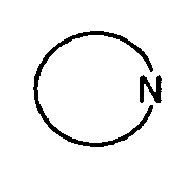
- Les mélanges desdits oxydes d'amine.
- Les oxydes d'amine ci-dessus sont des oxydes d'amine disponibles dans le commerce ou qui peuvent être par les procédés classiques bien connus de l'homme du métier, par exemple par réaction d'oxydation des amines tertiaires par les agents peroxydants, par exemple, le peroxyde d'hydrogène. Des exemples d'oxyde d'amine répondant à l'un ou l'autre des formules ci-dessus sont :
- l'oxyde de N-lauryl-diméthylamine ;
- l'oxyde de lauryl-pyridine ;
- l'oxyde de N-cétyl-diéthylamine ;
- l'oxyde d'octyl-pyridine ;
- l'oxyde de N-myristyl-di-(2-hydroxyéthyl)amine.
- On peut utiliser un tampon alcalin quelconque capable d'ajuster le pH de la composition de l'invention entre 7 et 11, de préférence entre 8,0 et 9,5.
- Le tampon alcalin est de préférence choisi parmi les carbonates, les bicarbonates, les borates, silicates, citrates, tartrates, phosphates de métaux alcalins ou alcalino-terreux ou leurs mélanges.
- Les tampons carbonate, borate, phosphate (ortho, pyro ou triplyphosphate), citrate de sodium ou de potassium sont particulièrement préférés en particulier les carbonates.
- De plus, la composition de l'invention peut éventuellement comprendre un ou plusieurs agents stabilisateurs de l'agent peroxydant tel que :
- les acides et sels de phosphonates organiques, tels que l'acide 1-hydroxyéthylène-1,1-diphosphonique (HEDP), l'éthylène-diamine-tétraméthylène-phosphonate (EDTMP), l'acide diéthylènetriamine-pentaméthylène phosphonique (DTPMP) ;
- les acides et sels d'aminopolycarbonates, tels que l'acide éthylène-diamine-tétraacétique (EDTA) et l'acide diéthylène-triamine-pentaacétique (DTPA) ;
- l'acide citrique et ses sels ;
- la 8-hydroxyquinoléine ;
- l'acide dipicolinique et ses sels ;
- les traces de sels d'argent colloïdaux ;
- l'acide tartrique et ses sels ;
- des agents séquestrants pour capter les métaux di- ou tri-valents.
- Optionnellement, la solution aqueuse selon l'invention peut également comprendre un agent tensio-actif non ionique de la famille des alcools gras et des alcools gras éthoxylés, des alcools gras éthoxylés-propoxylés, des amides gras, des amides gras éthoxylés, notamment les diéthanolamides, alkyle polyglucosides, etc ...
- La solution aqueuse selon l'invention peut également comprendre des agents régulateurs de viscosité, tels que les gommes xanthane, carraghénane, gellane, guar, la Laponite® (argile colloidale : silicate de Mg, Na et Li), les carboxyméthylcellulose, méthylcellulose, hydroxyéthylcellulose, hydroxypropylcellulose, l'amidon modifié, le polyéthylène glycol, l'acide polyacrylique et les polyacrylates (carbomers), etc ..., de préférence de masse moléculaire comprise entre 400 et 400 000 Dalton.
- Enfin, la solution aqueuse selon l'invention peut contenir, toujours à titre optionnel, des solvants alcooliques ou glycoliques, des polyglycols, des éthers de glycol, des agents hydrotropes (urée, phénol éthoxylé ayant 3-6 moles d'oxyde d'éthylène, cumène sulfonates, toluène sulfonates ou xylène sulfonates de métaux alcalins ou d'ammonium).
- Les solutions aqueuses selon l'invention sont obtenues par addition extemporanéé de l'agent peroxydant dans la solution aqueuse contenant les autres constituants.
- L'invention a également pour objet le procédé de décontamination des surfaces qui consiste à :
- 1) générer une mousse à partir de la solution aqueuse selon l'invention ;
- 2) mettre en contact ladite mousse avec la surface à décontaminer pendant quelques minutes ;
- 3) récupérer les effluents après liquéfaction de la mousse.
- L'invention a aussi pour objet le procédé de destruction d'explosifs susceptibles de contenir des agents toxiques chimiques ou bactériologiques qui consiste à :
- 1) générer une mousse à partir d'une solution aqueuse selon l'invention ;
- 2) confiner les explosifs à détruire dans une enceinte mobile ;
- 3) pulvériser dans ladite enceinte la mousse obtenue à l'étape 1) ;
- 4) mettre à feu lesdits explosifs à détruire ;
- 5) récupérer les effluents après liquéfaction de la mousse.
- L'efficacité décontaminante et le pouvoir moussant des solutions aqueuses selon l'invention sur des toxiques de guerre a été évaluée sur des similis de toxiques, à savoir les similis de l'ypérite du VX et des produits G.
- Ces similis de toxiques sont des molécules présentant un moindre degré de toxicité, mais une structure chimique et une réactivité démontrée comme équivalente à celle des toxiques réels.
-

- Ce produit proposé comme simili est le chloroéthylphényléthylsulfure (à comparer à l'ypérite : ClCH2CH2SCH2CH2Cl), et caractérisé par :
- la présence d'un atome de soufre
- la présence d'un Cl en β de l'atome de soufre pour mimer la formation d'un sulfonium intermédiaire.
- Comme l'ypérite, il se détruit généralement par oxydation; l'atome de soufre est oxydé en chlorosulfoxyde, puis en chlorosulfone; la vinylsulfone se forme en milieu basique selon le schéma réactionnel ci-après, dans lequel R=Phényléthyle:
[Oxydation] [Oxydation] [Base] RSCH2CH2Cl → RS(O)CH2CH2Cl → RS(O)2CH2CH2Cl → RS(O)2CH=CH2
- La réaction est suivie en chromatographie phase gazeuse/masse et chromatographie sur couche mince.
-

- Ce produit, comme son homologue parafluoré est un bon simili du VX : CH3CH2-O-P(O)(CH3)-S-CH2CH2-N(iPr)2, notamment du fait de la présence de la fonction β-aminothiol. L'oxydation doit en effet porter sur le soufre et éviter la formation de N-oxyde (très toxique).
Comme le VX, il est détruit en milieu basique ou en présence d'un acide oxydant en donnant soit un disulfure, soit un acide sulfonique.
La réaction est suivie au cours du temps en CCM (révélation à l'iode). -

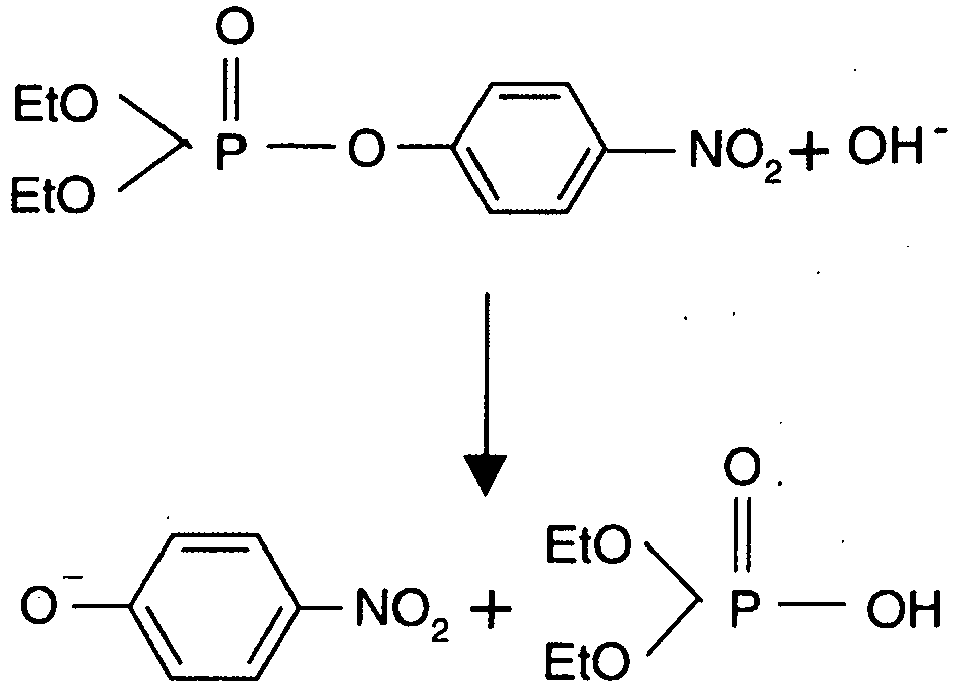
- Insecticide commercial ; excellent simili des produits G:
- Ces produits se détruisent généralement par une réaction de substitution nucléophile du fluor (sarin, soman) ou du groupe cyano (tabun)


-
- en chromatographie phase gazeuse (après extraction à l'acétate d'éthyle/hexane)
- L'invention va maintenant être décrite plus en détail par les exemples illustratifs, mais non limitatifs ci-après.
- Dans un récipient, on a mélangé l'agent peroxydant avec les autres constituants, et de l'eau, pour obtenir la solution aqueuse ci-après :
- Acide peracétique (37 %) 2,50 % - Oxyde de N-lauryl diméthyl amine (30 %) 3,00 % - Na2CO3 3,50 % - DTPMP de Na (30 %) 4,00 % - Laurylsulfate de sodium 0,30 % - Laurylsulfosuccinate d'éther d'alcool gras 0,20 % - Eau 83,00 % - Le pH de la solution était de 8,2.
- Dans un récipient, on a mélangé l'agent peroxydant avec les autres constituants, et de l'eau, pour obtenir la solution aqueuse ci-après :
- Acide peracétique (37 %) 3,00 % - Oxyde de N-lauryl pyridine 2,00 % - Disilicate de Na 5,50 % - HEDP de Na (30 %) 1,00 % - Lauryl éther sulfate de Na (28 %) 8,00 % - Eau 80,50 % - Le pH de la solution était de 9.
- Dans un récipient, on a mélangé l'agent peroxydant avec les autres constituants, et de l'eau, pour obtenir la solution aqueuse ci-après :
- MPPM 12,00 % - Oxyde de N-cétyl diéthyl amine 7,00 % - K2CO3 3,50 % - Citrate de Na 6,00 % - Laurylsulfate de triéthanolamine 0,30 % - Eau 68,50 % - Le pH de la solution était de 8,5.
- Dans ces tests on a comparé les solutions aqueuses selon l'invention décrites dans les exemples 1 à 3 avec la composition décontaminante classique A ci-après, dans laquelle on a ajouté la composition moussante B.
- 5 g de la solution aqueuse décontaminante et moussante de l'invention ont été déposés à l'aide d'une pipette sur une plaque de verre revêtue de similis de HD ou VX dans un sovirel.
- On a agité pendant 20 minutes le sovirel, puis on a bloqué la réaction d'oxydation par 2 ml de thiosulfate.
- On a procédé ensuite à l'extraction (simili et ses métabolites restant sur la plaque) par un mélange d'acétate d'éthyle/cyclohexane (50/50).
- L'analyse de l'agent chimique (simili+métabolites) résiduel a été réalisée par CPG (colonne Silicone SE) ainsi que par chromatographie sur couche mince.
- 5 g de la solution aqueuse décontaminantë et moussante ont été déposés sur le simili de produit G dans un sovirel.
- Le sovirel a ensuite été placé sur une plaque à secousse avec une agitation maximale pendant 20 min.
- Dans le sovirel on a ensuite introduit :
- 10,0 ml de solution d'étalon interne (dibutylsébaçate) à 0,1% dans un mélange d'acétate d'éthyle/hexane (50/50).
- Le sovirel a été rebouché et agité manuellement pendant 10 s.
- La phase organique surnageante a été récupérée aussitôt dans un autre sovirel de 25 ml contenant du sulfate de Na et injectée en CPG sur colonner verre OV1.
- Les résultats obtenus figurent dans le tableau I ci-après:
Tableau I Pouvoir moussant (Test de Ross Miles - ISO 696) Décontamination après 60 minutes Solution Temps (en min) Hauteur de mousse (en ml) Simili de HD Simili de VX Simili de produit G (paraoxon) 0 470 3 415 5 400 Exemple 1 10 400 20 400 30 390 60 100% 90% 80% 0 410 3 390 5 380 Exemple 2 10 380 20 380 30 380 60 100 % 90% 90% 0 440 3 415 5 400 Exemple 3 10 390 20 380 30 370 60 90% 80% 70% Solution décontaminante A (17%) + solution moussante B (4%) + eau déminéralisée : qsp 100% 0 320 3 290 5 270 10 260 20 150 30 60 60 30% 40% 40% Matière Fonction % en masse Solution décontaminante classique : A Monoperoxyphtallate de magnésium, 6 H2O (MPPM) Agent peroxydant 47,0 Chlorure de myristalkonium Catalyseur micellaire 8,0 Na2CO3 Tampon de pH 18,0 NaOH Alcalinisant 3,0 Gluconate de sodium Stabilisant 24,0 Solution moussante : B Lauryl sulfate de triéthanolamine Agent tensioactif anionique moussant 12,0
Claims (12)
- Solution aqueuse décontaminante et moussante, caractérisée en ce qu'elle comprend, en poids par rapport au poids total de la composition :- 0,1 à 20 % d'un agent peroxydant hydrosoluble organique ou minéral ;- 0,05 à 20 % d'un agent tensio-actif anionique ;- 0,1 à 20% d'un oxyde d'amine ;- 0 à 5 % d'un agent stabilisateur de l'agent peroxydant ;- 0 à 10 % d'un agent tensio actif amphotère ;- 0 à 15 % d'un tampon alcalin ; et- le complément à 100 % étant de l'eau ;ledit agent péroxydant hydrosoluble organique ou minéral étant choisi parmi :- les peracides organiques de formule générale R'-CO3H dans laquelle R' est un groupe alkyle, linéaire ou ramifié, ayant de 1 à 4 atomes de carbone, de préférence de 1 à 3 atomes de carbone et leurs sels de métaux alcalins, alcalinoterreux, d'ammonium ou d'hydroxylamines ;- les peracides organiques de formule générale HO3C-R'-CO3H dans laquelle R' est un groupe alkylène, linéaire ou ramifié, de 1 à 4, de préférence 1 à 3, atomes de carbone et leurs sels de métaux alcalins, alcalinoterreux, d'ammonium ou d'hydroxylamines ;- les peracides organiques de formule générale R"-(Φ) (CO3H)n(CO2H)m dans laquelle R" est un hydrogène ou un groupe alkyle, linéaire ou ramifié de 1 à 4 atomes de carbone, (Φ) est un noyau benzénique, n=1 ou 2, m=0 ou 1, et leurs sels de métaux alcalins, alcalinoterreux, d'ammonium ou d'hydroxylamines ;- les peroxydes minéraux choisis parmi les adduits de H2O2, les persels, les peracides minéraux et leurs sels alcalins ;- les mélanges desdits agents peroxydants.le pH de ladite solution aqueuse étant compris entre 7 et 11.
- Solution selon la revendication 1, caractérisée en ce que le pH est compris entre 8,0 et 9,5.
- Solution selon l'une des revendications 1 ou 2, caractérisée en ce qu'elle comprend, en poids par rapport au poids total de la composition :- 0,3 à 5 % d'un agent peroxydant hydrosoluble organique ou minéral ;- 0,1 à 5 % d'un agent tensio-actif anionique ;- 0,5 à 4 % d'un agent tensio-actif amphotère ;- 0,1 à 5 % d'un oxyde d'amine ;- 0,1 à 2 % d'un agent stabilisateur de l'agent peroxydant ;- 0 à 10 % d'un tampon alcalin ; et- le complément à 100 % étant de l'eau ;
- Solution selon l'une quelconque des revendications 1 à 3, caractérisée en ce que l'oxyde d'amine est choisi parmi :

 - R est un groupe alkyle ou alcényle, linéaire ou ramifié, contenant 8 à 22 atomes de carbone, éventullement interrompu par un groupe -O-C(=O) ; -O- -O-NH2- ou -O-NR1R2- ;- R3 et R4, identiques ou différents, représentent un alkyle en C1-C4 ou un groupe de formule [(CH2)m-O]n-H dans laquelle m et n sont compris entre 1 et 4.-
- Solution selon la revendication 4, caractérisée en ce que l'oxyde d'amine est :- l'oxyde de N-lauryl-diméthylamine ;- l'oxyde de lauryl-pyridine ;- l'oxyde de N-cétyl-diéthylamine ;- l'oxyde d'octyl-pyridine ;- l'oxyde de N-myristyl-di-(2-hydroxyéthyl)amine.
- Solution selon la revendication 1, caractérisée en ce que l'agent peroxydant est :- l'acide peracétique, le peracétate de sodium, l'acide perpropionique, l'acide performique, le perpropionate de potassium ;- le mono peroxyphtalate de magnésium hexahydraté (MPPM), l'acide perphtalique, l'acide perbenzoïque.- le caroate de sodium, le percarbonate de sodium.
- Solution selon l'une quelconque des revendications 1 à 6, caractérisée en ce que l'agent tensio-actif anionique est choisi parmi les (C12-C18)alkylsulfates, les (C12-C18)alkyl-éther-sulfates ayant 2 à 4 moles d'oxyde d'alkylène en (C2-C4) les alkylsulfosuccinates, les (C8-C16) alkylbenzènsulfonates.
- Composition pour la préparation d'une solution aqueuse décontaminante et moussante selon l'une quelconque des revendications 1 à 7.
- Composition selon la revendications 8, caractérisée en ce qu'elle comprend, dans des conditionnements I et II séparés :- l'agent peroxydant hydrosoluble organique ou minéral et, éventuellement, un agent stabilisateur de cet agent peroxydant hydrosoluble, dans le conditionnement I ;- les autres constituants dans le conditionnement II, et éventuellement tout ou partie de l'eau, nécessaire pour la préparation de la solution aqueuse selon l'une quelconque des revendication 1 à 7.
- Utilisation de la solution aqueuse selon l'une quelconque des revendications 1 à 7 pour la décontamination de systèmes dispersants et d'agents explosifs susceptibles de contenir des agents toxiques chimiques ou bactériologiques.
- Procédé de décontamination de surfaces, caractérisé en ce qu'il consiste à :1) générer une mousse à partir d'une solution aqueuse selon l'une quelconque des revendications 1 à 7 ;2) mettre en contact ladite mousse avec la surface à décontaminer pendant quelques minutes ;3) récupérer des effluents après liquéfaction de la mousse.
- Procédé de destruction d'explosifs susceptibles de contenir des agents toxiques chimiques ou bactériologiques, caractérisé en ce qu'il consisite à :1) générer une mousse à partir d'une solution aqueuse selon l'une quelconque des revendications 1 à 7 ;2) confiner les explosifs à détruire dans une enceinte mobile ;3) pulvériser dans ladite enceinte la mousse obtenue à l'étape 1) ;4) mettre à feu desdits explosifs à détruire ;5) récupérer des effluents après liquéfaction de la mousse.
Applications Claiming Priority (2)
| Application Number | Priority Date | Filing Date | Title |
|---|---|---|---|
| FR0853437A FR2931687B1 (fr) | 2008-05-27 | 2008-05-27 | Solution aqueuse decontaminante et moussante. |
| PCT/FR2009/050973 WO2009153495A2 (fr) | 2008-05-27 | 2009-05-26 | Solution aqueuse decontaminante et moussante |
Publications (2)
| Publication Number | Publication Date |
|---|---|
| EP2296764A2 EP2296764A2 (fr) | 2011-03-23 |
| EP2296764B1 true EP2296764B1 (fr) | 2016-08-10 |
Family
ID=40344575
Family Applications (1)
| Application Number | Title | Priority Date | Filing Date |
|---|---|---|---|
| EP09766057.5A Active EP2296764B1 (fr) | 2008-05-27 | 2009-05-26 | Solution aqueuse decontaminante et moussante |
Country Status (6)
| Country | Link |
|---|---|
| US (1) | US20110071334A1 (fr) |
| EP (1) | EP2296764B1 (fr) |
| CA (1) | CA2725293C (fr) |
| FR (1) | FR2931687B1 (fr) |
| IL (1) | IL209498A (fr) |
| WO (1) | WO2009153495A2 (fr) |
Families Citing this family (4)
| Publication number | Priority date | Publication date | Assignee | Title |
|---|---|---|---|---|
| FR3028516B1 (fr) * | 2014-11-18 | 2018-04-13 | Commissariat A L'energie Atomique Et Aux Energies Alternatives | Procede de fabrication d'une mousse aqueuse stable, mousse aqueuse stable obtenue par un tel procede et ses utilisations |
| MX2018000552A (es) * | 2015-07-14 | 2018-05-22 | Ecolab Usa Inc | Velocidad controlada de ruptura de espuma en limpiadores de superficies duras. |
| WO2017215932A1 (fr) | 2016-06-13 | 2017-12-21 | Unilever N.V. | Composition de nettoyage moussante contenant du peroxyde d'hydrogène |
| CN117229110B (zh) * | 2023-08-24 | 2025-05-13 | 西安近代化学研究所 | 一种基于含能负燃速催化剂提升炸药慢烤耐热性能的方法 |
Family Cites Families (19)
| Publication number | Priority date | Publication date | Assignee | Title |
|---|---|---|---|---|
| US2392936A (en) * | 1942-07-02 | 1946-01-15 | Mearl Corp | Oxidizing foam solution and method of using the same |
| US6110883A (en) * | 1996-11-13 | 2000-08-29 | The Procter & Gamble Company | Aqueous alkaline peroxygen bleach-containing compositions |
| US6114298A (en) * | 1996-11-13 | 2000-09-05 | The Procter & Gamble Company | Hard surface cleaning and disinfecting compositions comprising essential oils |
| US6235699B1 (en) * | 1997-02-03 | 2001-05-22 | The Procter & Gamble Company | Liquid aqueous cleaning compositions |
| FR2766724B1 (fr) * | 1997-07-31 | 1999-10-22 | Irdec Sa | Compositions decontaminantes non agressives |
| US6316400B1 (en) * | 1997-10-08 | 2001-11-13 | The Procter & Gamble Co. | Liquid bleaching composition with improved safety to fabrics and colors |
| US6448214B1 (en) * | 1997-10-08 | 2002-09-10 | The Proctor & Gamble Company | Liquid aqueous bleaching compositions |
| US20020177540A1 (en) * | 1998-04-08 | 2002-11-28 | The Procter And Gamble Company | Liquid compositions for sanitizing and cleaning carpets with reduced color damage to carpets |
| EP0962520A1 (fr) * | 1998-05-29 | 1999-12-08 | The Procter & Gamble Company | Compositions liquides de blanchiment |
| US6723890B2 (en) * | 1998-06-30 | 2004-04-20 | Sandia Corporation | Concentrated formulations and methods for neutralizing chemical and biological toxants |
| ATE267630T1 (de) * | 1999-02-26 | 2004-06-15 | H M The Queen In Right Of Cana | Schaumformulierung zur dispersion und decontaminationsunterdrückung |
| US6376436B1 (en) * | 2000-03-22 | 2002-04-23 | The United States Of America As Represented By The Secretary Of The Navy | Chemical warfare agent decontamination foaming composition and method |
| US20030036493A1 (en) * | 2001-05-01 | 2003-02-20 | The Procter & Gamble Company | Stable liquid or gel bleaching composition containing diacyl peroxide particles |
| US20030154556A1 (en) * | 2001-09-07 | 2003-08-21 | Valerio Del Duca | Bleaching composition comprising a dye maintenance agent |
| US20050239675A1 (en) * | 2002-04-01 | 2005-10-27 | Munzer Makansi | Carrier foam to enhance liquid functional performance |
| US6827766B2 (en) * | 2002-10-08 | 2004-12-07 | United States Air Force | Decontaminating systems containing reactive nanoparticles and biocides |
| DE10322269A1 (de) * | 2003-05-16 | 2004-12-02 | Clariant Gmbh | Flüssige Wasch- und Reinigungsmittel mit Konsistenzgebenden Polymeren |
| WO2005070205A1 (fr) * | 2004-01-09 | 2005-08-04 | Ecolab Inc. | Compositions d'acide peroxycarboxylique a chaine moyenne |
| JP4889955B2 (ja) * | 2005-03-18 | 2012-03-07 | 花王株式会社 | 漂白剤組成物 |
-
2008
- 2008-05-27 FR FR0853437A patent/FR2931687B1/fr active Active
-
2009
- 2009-05-26 CA CA2725293A patent/CA2725293C/fr not_active Expired - Fee Related
- 2009-05-26 WO PCT/FR2009/050973 patent/WO2009153495A2/fr not_active Ceased
- 2009-05-26 US US12/994,622 patent/US20110071334A1/en not_active Abandoned
- 2009-05-26 EP EP09766057.5A patent/EP2296764B1/fr active Active
-
2010
- 2010-11-22 IL IL209498A patent/IL209498A/en active IP Right Grant
Also Published As
| Publication number | Publication date |
|---|---|
| FR2931687B1 (fr) | 2017-11-24 |
| WO2009153495A2 (fr) | 2009-12-23 |
| IL209498A0 (en) | 2011-01-31 |
| RU2010153360A (ru) | 2012-07-10 |
| US20110071334A1 (en) | 2011-03-24 |
| IL209498A (en) | 2014-07-31 |
| CA2725293C (fr) | 2017-03-07 |
| FR2931687A1 (fr) | 2009-12-04 |
| WO2009153495A3 (fr) | 2010-05-27 |
| EP2296764A2 (fr) | 2011-03-23 |
| CA2725293A1 (fr) | 2009-12-23 |
Similar Documents
| Publication | Publication Date | Title |
|---|---|---|
| EP2271410B1 (fr) | Composition et procede pour la destruction de polluants organophosphores et/ou organosoufres | |
| CN1612766B (zh) | 用于中和化学,生物和工业毒物的增强制剂 | |
| US7064241B2 (en) | Chemical and biological warfare decontaminating solution using peracids and germinants in microemulsions, process and product thereof | |
| EP2296764B1 (fr) | Solution aqueuse decontaminante et moussante | |
| US7390432B2 (en) | Enhanced formulations for neutralization of chemical, biological and industrial toxants | |
| WO2005057588A2 (fr) | Formulations granulaires pour la decontamination | |
| AU2002341750A1 (en) | Enhanced formulations for neutralization of chemical, biological and industrial toxants | |
| FR2766724A1 (fr) | Compositions decontaminantes non agressives | |
| FR2766725A1 (fr) | Compositions decontaminantes stabilisees | |
| EP0848628B1 (fr) | Procede utilisant une composition a base de peracides pour la decontamination de materiaux souilles par des agents toxiques | |
| CA2389081C (fr) | Composition et procede pour la destruction de polluants organophosphores et/ou organosoufres | |
| RU2484869C2 (ru) | Деконтаминирующий и пенообразующий водный раствор | |
| FR3072391A1 (fr) | Composition extemporanee comprenant un melange de deux produits pour la destruction de polluants organophosphores et/ou organosoufres | |
| EP1214932A2 (fr) | Formulation décontaminante pour la décontamination d'agents toxiques épaissis | |
| TW200301104A (en) | Enhanced formulations for neutralization of chemical, biological and industrial toxants | |
| HK1073618B (en) | Enhanced formulations for neutralization of chemical, biological and industrial toxants |
Legal Events
| Date | Code | Title | Description |
|---|---|---|---|
| PUAI | Public reference made under article 153(3) epc to a published international application that has entered the european phase |
Free format text: ORIGINAL CODE: 0009012 |
|
| 17P | Request for examination filed |
Effective date: 20101221 |
|
| AK | Designated contracting states |
Kind code of ref document: A2 Designated state(s): AT BE BG CH CY CZ DE DK EE ES FI FR GB GR HR HU IE IS IT LI LT LU LV MC MK MT NL NO PL PT RO SE SI SK TR |
|
| DAX | Request for extension of the european patent (deleted) | ||
| REG | Reference to a national code |
Ref country code: DE Ref legal event code: R079 Ref document number: 602009040272 Country of ref document: DE Free format text: PREVIOUS MAIN CLASS: A62D0003380000 Ipc: A01N0025160000 |
|
| GRAJ | Information related to disapproval of communication of intention to grant by the applicant or resumption of examination proceedings by the epo deleted |
Free format text: ORIGINAL CODE: EPIDOSDIGR1 |
|
| GRAP | Despatch of communication of intention to grant a patent |
Free format text: ORIGINAL CODE: EPIDOSNIGR1 |
|
| RIC1 | Information provided on ipc code assigned before grant |
Ipc: A62D 3/38 20070101ALI20150914BHEP Ipc: A62D 101/02 20070101ALI20150914BHEP Ipc: A01N 25/22 20060101ALI20150914BHEP Ipc: C06B 21/00 20060101ALI20150914BHEP Ipc: A62D 101/04 20070101ALI20150914BHEP Ipc: A61L 2/18 20060101ALI20150914BHEP Ipc: A01N 25/16 20060101AFI20150914BHEP Ipc: A01N 37/16 20060101ALI20150914BHEP Ipc: A01N 25/30 20060101ALI20150914BHEP |
|
| GRAP | Despatch of communication of intention to grant a patent |
Free format text: ORIGINAL CODE: EPIDOSNIGR1 |
|
| INTG | Intention to grant announced |
Effective date: 20160418 |
|
| GRAS | Grant fee paid |
Free format text: ORIGINAL CODE: EPIDOSNIGR3 |
|
| GRAA | (expected) grant |
Free format text: ORIGINAL CODE: 0009210 |
|
| AK | Designated contracting states |
Kind code of ref document: B1 Designated state(s): AT BE BG CH CY CZ DE DK EE ES FI FR GB GR HR HU IE IS IT LI LT LU LV MC MK MT NL NO PL PT RO SE SI SK TR |
|
| REG | Reference to a national code |
Ref country code: GB Ref legal event code: FG4D Free format text: NOT ENGLISH |
|
| REG | Reference to a national code |
Ref country code: CH Ref legal event code: EP Ref country code: AT Ref legal event code: REF Ref document number: 818083 Country of ref document: AT Kind code of ref document: T Effective date: 20160815 |
|
| REG | Reference to a national code |
Ref country code: IE Ref legal event code: FG4D Free format text: LANGUAGE OF EP DOCUMENT: FRENCH |
|
| REG | Reference to a national code |
Ref country code: DE Ref legal event code: R096 Ref document number: 602009040272 Country of ref document: DE |
|
| REG | Reference to a national code |
Ref country code: LT Ref legal event code: MG4D |
|
| REG | Reference to a national code |
Ref country code: NL Ref legal event code: MP Effective date: 20160810 |
|
| REG | Reference to a national code |
Ref country code: AT Ref legal event code: MK05 Ref document number: 818083 Country of ref document: AT Kind code of ref document: T Effective date: 20160810 |
|
| PG25 | Lapsed in a contracting state [announced via postgrant information from national office to epo] |
Ref country code: NL Free format text: LAPSE BECAUSE OF FAILURE TO SUBMIT A TRANSLATION OF THE DESCRIPTION OR TO PAY THE FEE WITHIN THE PRESCRIBED TIME-LIMIT Effective date: 20160810 Ref country code: IS Free format text: LAPSE BECAUSE OF FAILURE TO SUBMIT A TRANSLATION OF THE DESCRIPTION OR TO PAY THE FEE WITHIN THE PRESCRIBED TIME-LIMIT Effective date: 20161210 Ref country code: NO Free format text: LAPSE BECAUSE OF FAILURE TO SUBMIT A TRANSLATION OF THE DESCRIPTION OR TO PAY THE FEE WITHIN THE PRESCRIBED TIME-LIMIT Effective date: 20161110 Ref country code: FI Free format text: LAPSE BECAUSE OF FAILURE TO SUBMIT A TRANSLATION OF THE DESCRIPTION OR TO PAY THE FEE WITHIN THE PRESCRIBED TIME-LIMIT Effective date: 20160810 Ref country code: HR Free format text: LAPSE BECAUSE OF FAILURE TO SUBMIT A TRANSLATION OF THE DESCRIPTION OR TO PAY THE FEE WITHIN THE PRESCRIBED TIME-LIMIT Effective date: 20160810 Ref country code: LT Free format text: LAPSE BECAUSE OF FAILURE TO SUBMIT A TRANSLATION OF THE DESCRIPTION OR TO PAY THE FEE WITHIN THE PRESCRIBED TIME-LIMIT Effective date: 20160810 |
|
| PG25 | Lapsed in a contracting state [announced via postgrant information from national office to epo] |
Ref country code: PL Free format text: LAPSE BECAUSE OF FAILURE TO SUBMIT A TRANSLATION OF THE DESCRIPTION OR TO PAY THE FEE WITHIN THE PRESCRIBED TIME-LIMIT Effective date: 20160810 Ref country code: LV Free format text: LAPSE BECAUSE OF FAILURE TO SUBMIT A TRANSLATION OF THE DESCRIPTION OR TO PAY THE FEE WITHIN THE PRESCRIBED TIME-LIMIT Effective date: 20160810 Ref country code: AT Free format text: LAPSE BECAUSE OF FAILURE TO SUBMIT A TRANSLATION OF THE DESCRIPTION OR TO PAY THE FEE WITHIN THE PRESCRIBED TIME-LIMIT Effective date: 20160810 Ref country code: ES Free format text: LAPSE BECAUSE OF FAILURE TO SUBMIT A TRANSLATION OF THE DESCRIPTION OR TO PAY THE FEE WITHIN THE PRESCRIBED TIME-LIMIT Effective date: 20160810 Ref country code: SE Free format text: LAPSE BECAUSE OF FAILURE TO SUBMIT A TRANSLATION OF THE DESCRIPTION OR TO PAY THE FEE WITHIN THE PRESCRIBED TIME-LIMIT Effective date: 20160810 Ref country code: GR Free format text: LAPSE BECAUSE OF FAILURE TO SUBMIT A TRANSLATION OF THE DESCRIPTION OR TO PAY THE FEE WITHIN THE PRESCRIBED TIME-LIMIT Effective date: 20161111 Ref country code: PT Free format text: LAPSE BECAUSE OF FAILURE TO SUBMIT A TRANSLATION OF THE DESCRIPTION OR TO PAY THE FEE WITHIN THE PRESCRIBED TIME-LIMIT Effective date: 20161212 |
|
| PG25 | Lapsed in a contracting state [announced via postgrant information from national office to epo] |
Ref country code: EE Free format text: LAPSE BECAUSE OF FAILURE TO SUBMIT A TRANSLATION OF THE DESCRIPTION OR TO PAY THE FEE WITHIN THE PRESCRIBED TIME-LIMIT Effective date: 20160810 Ref country code: RO Free format text: LAPSE BECAUSE OF FAILURE TO SUBMIT A TRANSLATION OF THE DESCRIPTION OR TO PAY THE FEE WITHIN THE PRESCRIBED TIME-LIMIT Effective date: 20160810 |
|
| REG | Reference to a national code |
Ref country code: DE Ref legal event code: R097 Ref document number: 602009040272 Country of ref document: DE |
|
| REG | Reference to a national code |
Ref country code: FR Ref legal event code: PLFP Year of fee payment: 9 |
|
| PG25 | Lapsed in a contracting state [announced via postgrant information from national office to epo] |
Ref country code: BG Free format text: LAPSE BECAUSE OF FAILURE TO SUBMIT A TRANSLATION OF THE DESCRIPTION OR TO PAY THE FEE WITHIN THE PRESCRIBED TIME-LIMIT Effective date: 20161110 Ref country code: DK Free format text: LAPSE BECAUSE OF FAILURE TO SUBMIT A TRANSLATION OF THE DESCRIPTION OR TO PAY THE FEE WITHIN THE PRESCRIBED TIME-LIMIT Effective date: 20160810 Ref country code: SK Free format text: LAPSE BECAUSE OF FAILURE TO SUBMIT A TRANSLATION OF THE DESCRIPTION OR TO PAY THE FEE WITHIN THE PRESCRIBED TIME-LIMIT Effective date: 20160810 Ref country code: CZ Free format text: LAPSE BECAUSE OF FAILURE TO SUBMIT A TRANSLATION OF THE DESCRIPTION OR TO PAY THE FEE WITHIN THE PRESCRIBED TIME-LIMIT Effective date: 20160810 |
|
| PLBE | No opposition filed within time limit |
Free format text: ORIGINAL CODE: 0009261 |
|
| STAA | Information on the status of an ep patent application or granted ep patent |
Free format text: STATUS: NO OPPOSITION FILED WITHIN TIME LIMIT |
|
| 26N | No opposition filed |
Effective date: 20170511 |
|
| PG25 | Lapsed in a contracting state [announced via postgrant information from national office to epo] |
Ref country code: LU Free format text: LAPSE BECAUSE OF NON-PAYMENT OF DUE FEES Effective date: 20170531 Ref country code: SI Free format text: LAPSE BECAUSE OF FAILURE TO SUBMIT A TRANSLATION OF THE DESCRIPTION OR TO PAY THE FEE WITHIN THE PRESCRIBED TIME-LIMIT Effective date: 20160810 |
|
| PGFP | Annual fee paid to national office [announced via postgrant information from national office to epo] |
Ref country code: IT Payment date: 20170519 Year of fee payment: 9 |
|
| REG | Reference to a national code |
Ref country code: CH Ref legal event code: PL |
|
| PG25 | Lapsed in a contracting state [announced via postgrant information from national office to epo] |
Ref country code: MC Free format text: LAPSE BECAUSE OF FAILURE TO SUBMIT A TRANSLATION OF THE DESCRIPTION OR TO PAY THE FEE WITHIN THE PRESCRIBED TIME-LIMIT Effective date: 20160810 |
|
| REG | Reference to a national code |
Ref country code: IE Ref legal event code: MM4A |
|
| PG25 | Lapsed in a contracting state [announced via postgrant information from national office to epo] |
Ref country code: CH Free format text: LAPSE BECAUSE OF NON-PAYMENT OF DUE FEES Effective date: 20170531 Ref country code: LI Free format text: LAPSE BECAUSE OF NON-PAYMENT OF DUE FEES Effective date: 20170531 |
|
| PG25 | Lapsed in a contracting state [announced via postgrant information from national office to epo] |
Ref country code: LU Free format text: LAPSE BECAUSE OF NON-PAYMENT OF DUE FEES Effective date: 20170526 |
|
| REG | Reference to a national code |
Ref country code: BE Ref legal event code: MM Effective date: 20170531 |
|
| PG25 | Lapsed in a contracting state [announced via postgrant information from national office to epo] |
Ref country code: IE Free format text: LAPSE BECAUSE OF NON-PAYMENT OF DUE FEES Effective date: 20170526 |
|
| REG | Reference to a national code |
Ref country code: FR Ref legal event code: PLFP Year of fee payment: 10 |
|
| PG25 | Lapsed in a contracting state [announced via postgrant information from national office to epo] |
Ref country code: BE Free format text: LAPSE BECAUSE OF NON-PAYMENT OF DUE FEES Effective date: 20170531 |
|
| PG25 | Lapsed in a contracting state [announced via postgrant information from national office to epo] |
Ref country code: MT Free format text: LAPSE BECAUSE OF FAILURE TO SUBMIT A TRANSLATION OF THE DESCRIPTION OR TO PAY THE FEE WITHIN THE PRESCRIBED TIME-LIMIT Effective date: 20160810 |
|
| PG25 | Lapsed in a contracting state [announced via postgrant information from national office to epo] |
Ref country code: IT Free format text: LAPSE BECAUSE OF NON-PAYMENT OF DUE FEES Effective date: 20180526 |
|
| PG25 | Lapsed in a contracting state [announced via postgrant information from national office to epo] |
Ref country code: HU Free format text: LAPSE BECAUSE OF FAILURE TO SUBMIT A TRANSLATION OF THE DESCRIPTION OR TO PAY THE FEE WITHIN THE PRESCRIBED TIME-LIMIT; INVALID AB INITIO Effective date: 20090526 |
|
| PG25 | Lapsed in a contracting state [announced via postgrant information from national office to epo] |
Ref country code: CY Free format text: LAPSE BECAUSE OF NON-PAYMENT OF DUE FEES Effective date: 20160810 |
|
| PG25 | Lapsed in a contracting state [announced via postgrant information from national office to epo] |
Ref country code: MK Free format text: LAPSE BECAUSE OF FAILURE TO SUBMIT A TRANSLATION OF THE DESCRIPTION OR TO PAY THE FEE WITHIN THE PRESCRIBED TIME-LIMIT Effective date: 20160810 |
|
| PG25 | Lapsed in a contracting state [announced via postgrant information from national office to epo] |
Ref country code: TR Free format text: LAPSE BECAUSE OF FAILURE TO SUBMIT A TRANSLATION OF THE DESCRIPTION OR TO PAY THE FEE WITHIN THE PRESCRIBED TIME-LIMIT Effective date: 20160810 |
|
| REG | Reference to a national code |
Ref country code: DE Ref legal event code: R082 Ref document number: 602009040272 Country of ref document: DE Representative=s name: CBDL PATENTANWAELTE GBR, DE Ref country code: DE Ref legal event code: R082 Ref document number: 602009040272 Country of ref document: DE Representative=s name: CBDL PATENTANWAELTE EGBR, DE |
|
| PGFP | Annual fee paid to national office [announced via postgrant information from national office to epo] |
Ref country code: DE Payment date: 20250513 Year of fee payment: 17 |
|
| PGFP | Annual fee paid to national office [announced via postgrant information from national office to epo] |
Ref country code: GB Payment date: 20250521 Year of fee payment: 17 |
|
| PGFP | Annual fee paid to national office [announced via postgrant information from national office to epo] |
Ref country code: FR Payment date: 20250520 Year of fee payment: 17 |