EP2299295A1 - Décompte de la multiplicité de neutrons - Google Patents
Décompte de la multiplicité de neutrons Download PDFInfo
- Publication number
- EP2299295A1 EP2299295A1 EP09170727A EP09170727A EP2299295A1 EP 2299295 A1 EP2299295 A1 EP 2299295A1 EP 09170727 A EP09170727 A EP 09170727A EP 09170727 A EP09170727 A EP 09170727A EP 2299295 A1 EP2299295 A1 EP 2299295A1
- Authority
- EP
- European Patent Office
- Prior art keywords
- distribution
- multiplicity
- pulse
- category
- pulses
- Prior art date
- Legal status (The legal status is an assumption and is not a legal conclusion. Google has not performed a legal analysis and makes no representation as to the accuracy of the status listed.)
- Withdrawn
Links
Images



Classifications
-
- G—PHYSICS
- G01—MEASURING; TESTING
- G01T—MEASUREMENT OF NUCLEAR OR X-RADIATION
- G01T3/00—Measuring neutron radiation
Definitions
- the present invention generally relates to a neutron counting, in particular a neutron multiplicity counting method.
- Neutron multiplicity counting is a technique used for non-destructively assaying the quantity of fissile material such as, e.g. uranium (U), plutonium (Pu), californium (Cf), etc.
- Neutron multiplicity counting is based upon the fact that neutrons from spontaneous or induced fission events are emitted substantially simultaneously. The probabilities of having a 0, 1, 3, etc. neutrons in a fission event (sometimes called the multiplicity distribution) provides a signature of the material under examination.
- Neutron multiplicity counting may be considered as a generalization of neutron coincidence counting, which looks for pairs of neutrons that are close together in time, to triples, quadruples and higher order multiples of neutrons.
- a neutron detector outputs a train of pulses, each of which represents one detected neutron.
- the distribution of the pulses in time or the distribution of the time intervals between the pulses, whichever is more convenient, is caused by an a priori unknown combination of spontaneous fission, induced fission ( ⁇ ,n)-reactions and external events. Whereas fission events yield multiple neutrons that are coincident in time, ( ⁇ ,n)-reactions and external events produce neutrons that are randomly distributed in time.
- a neutron detector typically comprises a body of polyethylene having a cavity in the middle to accommodate a sample during measurement.
- gas proportional counters often 3 He tubes, are embedded in the polyethylene body. If a neutron is emitted from the sample, there is a high probability that it will collide with hydrogen in the polyethylene. Neutrons thus lose energy until thermal equilibrium with the material is reached. A fraction of these thermalised neutrons eventually hit an atom of the gas in one of the gas proportionality counters. If a neutron hits a gas atom, a charge is released and collected at the electrode of the tube.
- the gas proportional counters are connected to preamplifiers, which receive the electric pulses from the gas proportional counters, process them and output them as a pulse train for further processing. Neutron detection can also be carried out using scintillation counters. It should be noted that the invention described herein can be applied neutron counting in general, irrespective of the physical principle used to detect the neutrons and convert the detection events into a pulse train.
- the time along a pulse train is continuous but in the following we will consider pulse trains as a sequence of discrete time intervals of uniform duration, called TICs. Each of these time intervals may be empty or contain a pulse. Depending on the instrument used, the pulse train may be provided on a single channel (the output of all preamplifiers being summed on this channel) or on a plurality of synchronized channels.
- the time along a pulse train is in principle continuous.
- the analyzing electronics is working with a certain clock speed (usually given in MHz), cutting this continuous time in a sequence of discrete time intervals of uniform duration (the duration determined by the clock speed), in the following called TICs.
- the analyzing electronics can only recognize whether there is a pulse within such a time interval on a given channel or not, in case there are more pulses within the same TIC on the same channel, only one pulse is recognized there by the electronics. This justifies to consider the pulse train as sequence of discrete time intervals, each TIC for each cannel containing one pulse or no pulse, even if the time along the pulse train in continuous. The loss of pulse recognition from the fact, that there may be more than one pulse within the same TIC at the same channel, is neglected.
- the analysis of a pulse train from a neutron detector is complex because neutron detectors have a detection efficiency of less than 1 (meaning that only a fraction of the neutrons from a sample is actually detected), many of the apparent coincidences are due to accidental overlaps (of background events, background and fission events or fission events) and neutrons stemming from a single event are not necessarily recorded at the same time (or with a fixed delay between them).
- the detection efficiency affects not only the overall count rate but also has a much higher impact on the detection of bursts of neutrons (i.e. pairs, triplets, etc. of neutrons from a common fission event).
- the observed pulse train from a neutron detector contains many "accidental" but relatively few "real" coincident events.
- the Rossi- ⁇ distribution is the distribution in time of events that follow after an arbitrary starting event.
- the Rossi- ⁇ distribution may be obtained by fixing an arbitrary pulse from the pulse train as the starting pulse and recording each subsequent pulse in a bin corresponding to the distance from the starting pulse to the subsequent pulse (up to a predetermined maximum distance).
- the terms “distance” and “interval” are used herein to designate the length of a time interval and are conveniently expressed in units of TICs.
- the next pulse of the pulse train is fixed as the starting pulse and the process is iterated.
- Each bin of the distribution thus indicates the count of pulses occurring at a particular distance from a starting pulse. If the pulse train contains only random events, the corresponding Rossi- ⁇ distribution is constant with time.
- the "dead time” designates the time during which pulses may get lost due to this effect and during which the true coincidence count rate cannot be measured.
- Each neutron detector has its characteristic dead time. Those skilled in the art are aware that the dead time effect is particularly detrimental to the detection of correlated events because these involve neutrons that are close together in time.
- the multiplicity i.e. the number
- the first gate (the "reals-plus-accidentals gate” or "R+A gate”) is positioned shortly after the triggering pulse whereas the second gate (the “accidentals gate” or “A gate”) is positioned a long delay (typically 1 to 4 ms) after that pulse. Doing this for all pulses of the pulse train, one obtains a distribution of multiplicities or "multiplicity vector" for the R+A gate and another such distribution or vector for the A gate.
- the R+A multiplicity distribution or vector indicates how many times in the pulse train each multiplicity was determined in the R+A gate.
- the A multiplicity distribution or vector indicates how many times in the pulse train each multiplicity was determined in the A gate.
- the long delay between each trigger pulse and the A gate is chosen to amount to many times the neutron lifetime in the detector, so that there is no residual correlation between the trigger pulse and the pulses in the corresponding A gate. Accordingly, the distribution of correlated events corresponds to the difference between the R+A multiplicity distribution and the A multiplicity distribution.
- R+A and A multiplicity distributions are used to calculate the "singles" (total count rate), the “doubles” (number of correlated pulse pairs in the pulse train), “triples” (number of sets of three correlated pulses in the pulse train) and higher order “moments”.
- a good overview of the multiplicity counting technique is given in " Application Guide to Multiplicity Counting" by Ensslin, Harper, Krick, Langner, Pickrell and Steward, LA-13422-M, 1998 .
- the dead time effect falsifies the number of pulses during the first TICs after each trigger pulse. These lost pulses have an impact on the multiplicity distributions determined.
- the R+A gate is normally not opened immediately after the triggering pulse but only after a short time interval (the so-called "pre-delay"). Nevertheless, when the singles, doubles, triples, etc. are calculated from the multiplicity distributions, corrections to account of the dead time are still necessary. Different dead time correction methods are currently used. The most popular one comprise semi-empirical correction for the singles and the doubles and a method by Dytlewski ( N.
- dead time correction should be based upon the collected data themselves, in order to reduce the workload in relation to detector characterization and calibration at the beginning of each measurement or after a change in detector configuration has occurred.
- the proposed neutron counting method starts with receiving a pulse sequence (e.g. a part of the pulse train) from a neutron detector.
- a pulse sequence e.g. a part of the pulse train
- the pulse sequence may be provided on the fly, i.e. with the pulses coming in as soon as a neutron has been detected by the neutron detector, or as a data file containing the pulse sequence from the neutron detector stored previously.
- Each pulse of the pulse sequence is set as a trigger pulse triggering a predefined gate (e.g. a "reals-plus-accidentals” gate or an “accidentals” gate), the multiplicity of pulses (i.e. the number of pulses) within this gate is determined, the pulse having triggered the gate is assigned to a multiplicity category corresponding to this multiplicity of pulses and the trigger-to-predecessor distances from the trigger pulse to pulses preceding the trigger pulse within a certain range in the pulse sequence are determined. The range within which one looks for predecessor pulses of each trigger pulse exceeds the dead time of the neutron detector.
- a predefined gate e.g. a "reals-plus-accidentals" gate or an “accidentals” gate
- the multiplicity of pulses i.e. the number of pulses
- the pulse having triggered the gate is assigned to a multiplicity category corresponding to this multiplicity of pulses
- the number of trigger pulses assigned thereto is determined; this yields the classical multiplicity distribution or multiplicity vector for the predefined gate under consideration.
- each multiplicity category For each multiplicity category, one builds, based upon the trigger-to-predecessor intervals determined, a distribution in time after an arbitrary preceding pulse of trigger pulses assigned to that specific multiplicity category.
- This distribution may be regarded as a kind of Rossi- ⁇ distribution of trigger pulses assigned to a particular multiplicity category. It should be noted that each of these multiplicity-specific distributions might be split into a plurality of "sub-distributions" (e.g. according to the channels on which the trigger pulses are received).
- a simple way of doing this would be to conjecture a theoretical distribution in time after an arbitrary preceding pulse of trigger pulses assigned to that multiplicity category and to derive the number of lost trigger pulses from the discrepancy between the actual and the theoretical distributions. More preferred ways to determine the number of lost trigger pulses for each multiplicity category are explained in more detail hereinafter.
- the number of trigger pulses assigned to each multiplicity category is accordingly corrected.
- the pulse sequence is received on at least two neutron detector channels. It is assumed that the presence of a pulse on one of the channels results in a dead time after that pulse only in the same channel.
- one builds, for each multiplicity category, the distribution in time after an arbitrary preceding pulse of trigger pulses assigned to that multiplicity category as a first sub-distribution and a second sub-distribution.
- the first sub-distribution is a distribution in time after an arbitrary preceding pulse of trigger pulses assigned to the multiplicity category that have been received on the same of the at least two channels as the preceding pulse.
- the second sub-distribution is a distribution in time after an arbitrary preceding pulse of trigger pulses assigned to the multiplicity category that have been received on another of the at least two channels as the preceding pulse. It should be noted that the sum of the first and second sub-distributions corresponds to a distribution in time after an arbitrary preceding pulse of trigger pulses assigned to the multiplicity category under consideration received on any of the at least two channels. It is thus possible to build the latter distribution (first sum sub-distribution) directly and to build the second sub-distribution by subtracting the first sub-distribution from the first sum sub-distribution.
- a distribution in time after an arbitrary preceding pulse of lost trigger pulses may then be calculated based upon the difference between the scaled second sub-distribution and the sum of the first and second sub-distributions; integrating this distribution of lost trigger pulses over time then yields the estimate of the number of lost trigger pulses.
- each multiplicity-specific distribution in time after an arbitrary preceding pulse of the trigger pulses is subdivided into a plurality of sub-distributions according to the channels on which the trigger pulses have been received. In other words, one also takes into account the channel on which each trigger pulse has been received.
- This variant has the advantage that the number of lost trigger pulses can be individually corrected for each channel. Summation over all channels then yields the estimate total number of lost trigger pulses.
- multiplicity- and channel-specific sub-distributions When the multiplicity- and channel-specific sub-distributions are built, one preferably takes into account again whether a trigger pulse has been received on the same or a different channel than the preceding pulse: for each multiplicity category and for each channel one thus may build
- the sum of the (channel-specific) first and second sub-distributions corresponds to a distribution in time after an arbitrary preceding pulse, received on any of the at least two channels, of trigger pulses assigned to the multiplicity category under consideration and received on the channel under consideration. It is thus possible to build the latter distribution (channel-specific first sum sub-distribution) directly and to build the channel-specific second sub-distribution by subtracting the channel-specific first sub-distribution from the channel-specific first sum sub-distribution.
- first and second sub-distributions Using the first and second sub-distributions, one may compute a channel-specific distribution in time after an arbitrary preceding pulse of lost trigger pulses by scaling the second channel-specific sub-distribution so that it fits to the sum of the channel-specific first and second sub-distributions (i.e. the first channel-specific sum sub-distribution) and computing the difference between the scaled second sub-distribution and the channel-specific sum of the first and second sub-distributions.
- the estimate number of lost trigger pulses may be computed by summing over all channels and integrating over time the channel-specific distributions in time after an arbitrary preceding pulse of lost trigger pulses.
- the neutron counting method preferably comprises steps, in which the number of trigger pulses wrongly assigned to each multiplicity category is estimated and the number of trigger pulses assigned to each multiplicity category is accordingly corrected.
- one preferably determines, for each pulse of the pulse sequence, when set as trigger pulse, and for each pulse within the gate triggered by that trigger pulse, pulse-to-predecessor intervals from the pulse in the gate to pulses preceding it within a certain range (preferably equal to the range mentioned above).
- pulse-to-predecessor intervals For each multiplicity category, one may now build, based upon the pulse-to-predecessor intervals determined, a distribution in time after an arbitrary preceding pulse of pulses situated in any gate triggered by a trigger pulse assigned to the multiplicity category under consideration. This distribution may also be regarded as a kind of Rossi- ⁇ distribution and it should be noted that this distribution might be split into a plurality of "sub-distributions".
- This distribution serves to estimate the number of trigger pulses wrongly assigned to the multiplicity category due to pulses lost within the gates triggered by them.
- a simple way of carrying out this estimation would be to conjecture a corresponding theoretical distribution and to derive the number of wrongly assigned trigger pulses from the discrepancy between the actual and the theoretical distributions.
- the building of the (multiplicity-specific) distribution in time after an arbitrary preceding pulse of pulses situated in any gate triggered by a trigger pulse assigned to the multiplicity category may comprise:
- the sum of the third and fourth sub-distributions corresponds to a distribution in time after an arbitrary preceding pulse of pulses situated in any gate triggered by a trigger pulse assigned to the multiplicity category under consideration and received on any of said at least two channels. It is thus possible to build the latter distribution (second sum sub-distribution) directly and to compute the second sub-distribution by subtracting the third sub-distribution from the second sum sub-distribution.
- the step last mentioned reflects that the correction for trigger pulses that have been wrongly assigned to their multiplicity category should not change the total number of trigger pulses (in contrast to the correction for lost trigger pulses). Indeed, if a pulse has been lost within a given gate, this causes the trigger pulse of that gate to be wrongly assigned to a lower than the correct multiplicity category - this wrongly assigned trigger pulse thus causes the number of pulses in the lower multiplicity category to be one unit higher whereas the number of pulses in the higher multiplicity category (which the trigger pulse failed to be assigned to) is by one unit lower than it should be. Accordingly, the distribution of the trigger pulses among the multiplicity categories needs to be corrected without this implying a change in the total number of assigned trigger pulses.
- each multiplicity-specific distribution in time after an arbitrary preceding pulse of pulses situated in any gate triggered by a trigger pulse assigned to the multiplicity category is subdivided into a plurality of sub-distributions according to the channels on which the trigger pulses have been received.
- the multiplicity- and channel-specific sub-distributions are built, one preferably takes into account again whether a trigger pulse has been received on the same or a different channel than the preceding pulse: for each multiplicity category and for each channel one thus may build
- the sum of the (channel-specific) third and fourth sub-distributions corresponds to a distribution in time after an arbitrary preceding pulse of pulses received on any of said at least two channels and situated in any gate triggered by a trigger pulse, where the trigger pulse is assigned to the multiplicity category under consideration and received on the channel under consideration. It is thus possible to build the latter distribution (channel-specific second sum sub-distribution) directly and to compute the channel-specific second sub-distribution by subtracting the channel-specific third sub-distribution from the channel-specific second sum sub-distribution.
- aspects of the present invention are therefore a computer program comprising program instructions for causing a computer to perform any of the methods disclosed herein and a carrier (such as, e.g. a record medium, a computer memory, a read-only memory, an electrical carrier signal, etc.) having therein or thereon computer executable instructions for causing a computer to perform any of the methods disclosed herein.
- a neutron multiplicity detector configured (e.g. by a suitable computer program) to perform the method as disclosed herein.
- a measurement instrument having the present method implemented therein, such that the instrument does the correction by itself, may greatly facilitate the measurement and evaluation procedures.
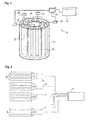
- the neutron multiplicity counter 10 shown in Fig. 1 comprises a big tube of polyethylene 12 with a middle cavity 14, into which the sample (not shown) is arranged for measurement.
- Gas proportional counters 16 often 3 He tubes, are disposed in smaller cavities in the polyethylene 12 around the middle cavity 14. If a neutron is emitted from the sample, there is a high probability that it collides with a hydrogen atom in the polyethylene (which serves as moderator). Through collisions with the hydrogen atoms, the fission neutrons thus lose energy until they reach thermal equilibrium with the material. Then they diffuse around the polyethylene until they are lost or captured. During this process of collisions with other atoms, the neutrons lose their information about their origin and original direction.
- a fraction of the thermalised neutrons eventually hits an atom of the gas contained in the counters 16. Due to the random path of each neutron in the polyethylene moderator 12, the counter tube 16 that finally detects the neutron is also random, although the probability of receiving a neutron is not equally distributed among the counter tubes.
- the preamplifier 18 connected to the electrodes receives a pulse, processes it and sends out a digital pulse. These pulses may be combined in an adder 20 by logical OR-operation onto a single line and sent to a multiplicity counter 22 for further analysis.
- Modern instruments offer the possibility of recording the pulse train from each preamplifier or each group of preamplifiers on a separate channel, as shown in Fig. 2 .
- the pulse trains on these channels are time-synchronized and may be input to a multi-channel list mode counter 24 and a computer for further analysis.
- the detecting 3 He tube After detection of a neutron, the detecting 3 He tube needs some time to recover (usually about a microsecond), during which no further pulse can be received from this tube, even if another neutron is captured within this tube.
- the electronics of the preamplifier also need some time to recover after treating a pulse from a 3 He tube.
- the combination of these effects is the above-mentioned "dead time effect", which lead to loss of pulses in a certain time (“dead time”) window after each detected pulse.
- an Epithermal Neutron Multiplicity Counter from Los Alamos was used for practical experiments (for reference, see e.g. " The Epithermal Neutron Multiplicity Counter Design and Performance Manual: More Rapid Plutonium and Uranium Inventory Verifications by Factors of 5-20", by Steward et al., LA-13743-M, 2000 ).
- This multiplicity counter uses 10-atm 3 He tubes and has an efficiency of 65% and a 22- ⁇ s die-away time.
- the effective dead time of this ENMC is of the order of 40 ns. If the total counting rate is 1 MHz, then the dead-time effect on the Singles is around 4%, on the Doubles 16% and higher on the higher moments.
- a Rossi- ⁇ distribution is a distribution in time of events that follow after an arbitrary starting event.
- Each bin is in fact a counter, which is being incremented each time a pulse is detected at the corresponding distance from a starting pulse.
- the time-intervals during which subsequent pulses are stored in bins partially overlap. This is in contrast to the classical Rossi- ⁇ distribution recording, where the process is restarted with the next pulse after the end of the counting interval.
- This distribution originally used for reactor noise analysis, is flat for a purely random source; if correlated events are present, the Rossi- ⁇ distribution follows a curve that may be described by equation 1.
- RoAl same a first Rossi- ⁇ distribution
- RoAl other indicating the number of pulses following an arbitrary starting pulse on any channel except the channel of the starting pulse as a function of the distance from the starting pulse.
- the sum of RoAl same and RoAl other yield the overall Rossi-Alpha distribution RoAl.
- Fig. 5 shows RoAl other (hatched area) and RoAl same (dark area on top of the hatched area) measured for a Cf source (6.14 x 10 4 neutrons/s emission rate) with the ENMC from Los Alamos, which has 27 channels for counting.
- RoAl same vanishes near the starting pulse but RoAl other exhibits no dead time effect.
- RoAl no-dead RoAl other , i totals - totals i ⁇ totals
- Fig. 6 shows this distribution for the Rossi- ⁇ distributions of Fig. 5 .
- every lost pulse appears (statistically) just one time in the distribution of lost pulses D lost .
- a lost pulse is lost because it is in the dead-time shadow of a detected pulse, which eventually becomes a starting pulse during the recording of the Rossi- ⁇ distribution - and every detected pulse becomes the starting pulse exactly one time.
- pulses may appear multiple times in the Rossi- ⁇ distributions (also in RoAl same ) because they may lie within the recording windows of several starting pulses, lost pulses are lost only once: as a channel cannot receive any pulse until it has sufficiently recovered from previous dead-time, a lost pulse may not appear as lost within dead-time in more than one recording window of a previous pulse on the same channel.
- a multiplicity vector indicates, for each multiplicity category, how many trigger pulses are assigned to this multiplicity category.
- LT m means the change in multiplicity category m that would result if the lost pulses had served as trigger pulses
- UG m means the change in multiplicity category m that would result if the lost pulses were accounted for in gates triggered by other pulses.
- the number of lost trigger pulses corresponds exactly to the total number of pulses lost since every lost pulse would eventually have been a trigger pulse in the computation of the multiplicity vector MD if it had not been lost.
- the correction for lost trigger pulses increases the sum over all multiplicity categories of trigger pulses assigned to the different multiplicity categories by an amount equal to the total number of lost pulses CL.
- the remaining question is how the lost triggers are distributed within the different components of the multiplicity vector MD (i.e. among the different multiplicity categories).
- the second, third, etc. neutron of such a burst is more likely subject to loss due to dead time than single emitted neutrons.
- the probability of a neutron to be lost due to dead time depends only on the number and the distance to its predecessors. Hence there is a clear correlation between the components MD m of the multiplicity vector MD , to which lost trigger pulses would contribute (if there were a way to record them) and the distance to their predecessors.
- the MD vector is determined by setting each pulse of the pulse sequence as a trigger pulse triggering the R+A gate, determining the multiplicity of pulses within this gate, and assigning this trigger pulse to the multiplicity category corresponding to the multiplicity of pulses within the gate by incrementing the appropriate vector component MD m by 1. Initialising the MD vector as the null vector (0,0,%) and going through the above steps for all pulses of the sequence, each multiplicity vector component MD m will finally contain the number of trigger pulses assigned to the corresponding multiplicity category m.
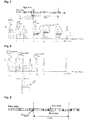
- Registering pulses in the ROAl j,i,t,m is illustrated in Fig. 7 , in which, however, indices j and i have been omitted in order to keep the illustration simple.
- Time index t is runs along the horizontal axis, while multiplicity index m increases from the bottom to the top along the vertical axis.
- Time index t runs from 1 to t max where t max is chosen greater than the dead-time-affected time interval. In the figures, t max is chosen equal to the classical pre-delay.
- Integration over time may be stopped at time point S, above which the distribution of lost trigger pulses is statistically zero for each channel. Conducting the integration further has no significant impact on the number of lost trigger pulses in each multiplicity category. Integration over time is illustrated in Fig. 8 . To ensure consistency with Fig. 7 , the channel index i has again been omitted.
- upgrading herein means the correction for lost pulses, which would have appeared in gates triggered by other pulses.
- Upgrading the multiplicity distribution does not increase the total number of pulse. In fact, the total number of pulses remains the same, since every pulse has already been accounted for, just as contributing to an incorrect multiplicity category.
- the gate triggered by the trigger pulse contains 3 pulses causing the trigger pulse to be assigned to multiplicity category "3". If the lost pulse had been present, the trigger would have been assigned to multiplicity category "4" instead of "3". The number of trigger pulses in multiplicity category "4" would in this case have to be increased by 1 and the number of trigger pulses in multiplicity category "3" would have to be decreased by 1, without a change in the total number of trigger pulses.
- a further multi-dimensional data array ( UG RoAl j,i,t,m ) j,i,t,m, which represents a set of Rossi- ⁇ -like distributions subdivided according to several criteria.
- Array ( UG RoAl j , i , t , m ) j , i , t , m is initialised as a null array (0,0,).
- Registering pulses in UG RoAl j,i,t,m is illustrated in Fig. 10 (indices j and i have again been omitted).
- Time index t runs along the horizontal axis
- multiplicity index m runs along the vertical axis.
- MD corr ⁇ is the corrected multiplicity vector.
- the method according to the invention may be applied for the correction of an R+A gate multiplicity vector (hereinafter denoted as " RA ”) as well as for the correction of an A gate multiplicity vector (hereinafter denoted A , by substituting RA and A for MD, respectively, in the above equations.
- RA R+A gate multiplicity vector
- A A gate multiplicity vector
- RoAl j 1,i1,t,m1
- the latter is, however, a less preferred alternative.
- a pulse train from a multi channel list mode counter was simulated by Monte Carlo simulation using a random number generator.
- the features of this simulated counter were:
- the dead-time-affected multiplicity distributions RA and A can be determined once according to the conventional method and once using the correction according to the present invention. This allows assessing the performance of the present method in comparison to the conventional one.
- Table 1 shows the "true” multiplicity vector RA tr ⁇ , the corrected multiplicity vector RA corr ⁇ , the difference between the "true” and the corrected multiplicity vector, the uncorrected multiplicity vector RA , as well as the difference between the "true” and the uncorrected multiplicity vector for the R+A gate.
- Table 2 shows the same for the A gate.
- Table 2 show a large difference between the true A tr ⁇ and the uncorrected multiplicity vector A in multiplicity category "0". This is due to the lost triggers, since in case of randomly selected gates the chance to find 0 pulses therein is high at this count-rate.
- the difference between the true RA tr ⁇ and the uncorrected RA multiplicity vector of ( R + A ⁇ RA tr ⁇ - RA ⁇ is close to 0 in multiplicity category "0".
- this lost pulse is in the dead time shadow of its trigger and therefore just a few TICs away from it. It would be a trigger itself (if it had not been lost) and because it is so close to the previous trigger the would-be-gate of the lost pulse and the gate of the previous trigger overlap to a large extent.
- This previous trigger originally showed 0 pulses in its gate, so the chance that the lost pulse had more than 0 pulses in its would-be-gate (which differs only by a few TICs form the previous gate) is extremely small.
- about the same number of "0"-gates that are lost due to upgrading to "1"-gates need to be regained (and in fact are regained) by lost the trigger correction. It should be noted that the use of a pre-delay in the classical sense would destroy this effect.
- Alternative extrapolation functions e.g. polynomial extrapolation; extrapolation using splines
- the gate follows after the trigger pulse. In a practical application, however, it may be the case that the gate precedes the trigger pulse.
- the method according to the invention may be applied whatever the position of the trigger pulse relative to the gate is.
Landscapes
- Physics & Mathematics (AREA)
- Health & Medical Sciences (AREA)
- Life Sciences & Earth Sciences (AREA)
- General Physics & Mathematics (AREA)
- High Energy & Nuclear Physics (AREA)
- Molecular Biology (AREA)
- Spectroscopy & Molecular Physics (AREA)
- Measurement Of Radiation (AREA)
Priority Applications (6)
| Application Number | Priority Date | Filing Date | Title |
|---|---|---|---|
| EP09170727A EP2299295A1 (fr) | 2009-09-18 | 2009-09-18 | Décompte de la multiplicité de neutrons |
| EP10729922.4A EP2478391B1 (fr) | 2009-09-18 | 2010-07-09 | Décompte de la multiplicité de neutrons |
| PCT/EP2010/059905 WO2011032743A1 (fr) | 2009-09-18 | 2010-07-09 | Comptage de multiplicités de neutrons |
| ES10729922.4T ES2441067T3 (es) | 2009-09-18 | 2010-07-09 | Recuento de multiplicidad neutrónica |
| PL10729922T PL2478391T3 (pl) | 2009-09-18 | 2010-07-09 | Zliczanie krotności neutronów |
| US13/394,598 US8884212B2 (en) | 2009-09-18 | 2010-07-09 | Neutron multiplicity counting |
Applications Claiming Priority (1)
| Application Number | Priority Date | Filing Date | Title |
|---|---|---|---|
| EP09170727A EP2299295A1 (fr) | 2009-09-18 | 2009-09-18 | Décompte de la multiplicité de neutrons |
Publications (1)
| Publication Number | Publication Date |
|---|---|
| EP2299295A1 true EP2299295A1 (fr) | 2011-03-23 |
Family
ID=42157842
Family Applications (2)
| Application Number | Title | Priority Date | Filing Date |
|---|---|---|---|
| EP09170727A Withdrawn EP2299295A1 (fr) | 2009-09-18 | 2009-09-18 | Décompte de la multiplicité de neutrons |
| EP10729922.4A Not-in-force EP2478391B1 (fr) | 2009-09-18 | 2010-07-09 | Décompte de la multiplicité de neutrons |
Family Applications After (1)
| Application Number | Title | Priority Date | Filing Date |
|---|---|---|---|
| EP10729922.4A Not-in-force EP2478391B1 (fr) | 2009-09-18 | 2010-07-09 | Décompte de la multiplicité de neutrons |
Country Status (5)
| Country | Link |
|---|---|
| US (1) | US8884212B2 (fr) |
| EP (2) | EP2299295A1 (fr) |
| ES (1) | ES2441067T3 (fr) |
| PL (1) | PL2478391T3 (fr) |
| WO (1) | WO2011032743A1 (fr) |
Cited By (2)
| Publication number | Priority date | Publication date | Assignee | Title |
|---|---|---|---|---|
| EP2891880A4 (fr) * | 2012-08-31 | 2016-04-27 | Univ Kyoto | Dispositif et procédé de détection de matière nucléaire |
| CN116013430A (zh) * | 2022-11-09 | 2023-04-25 | 中国人民解放军火箭军工程大学 | 一种中子多重性测量装置3He计数管适配方法 |
Families Citing this family (3)
| Publication number | Priority date | Publication date | Assignee | Title |
|---|---|---|---|---|
| US10422888B1 (en) | 2015-07-17 | 2019-09-24 | Triad National Security, Llc | Scintillation detectors |
| US10353088B1 (en) * | 2017-03-24 | 2019-07-16 | Triad National Security, Llc | Neutron multiplicity detector control circuitry and firmware |
| WO2019025479A1 (fr) * | 2017-08-02 | 2019-02-07 | The European Atomic Energy Community (Euratom), Represented By The European Commission | Procédé et système de comptage d'une multiplicité d'impulsions comprenant une correction du temps mort |
Citations (4)
| Publication number | Priority date | Publication date | Assignee | Title |
|---|---|---|---|---|
| GB960548A (en) * | 1961-08-11 | 1964-06-10 | Commissariat Energie Atomique | Process and device for determining the proportion of simultaneously emitted neutrons |
| US6333958B1 (en) * | 1999-09-21 | 2001-12-25 | James E. Stewart | Advanced electronics for faster time-correlation analysis of pulse sequences |
| US20060146977A1 (en) * | 2004-10-22 | 2006-07-06 | The Regents Of The University Of Ca | Real-time multiplicity counter |
| EP1707992A1 (fr) * | 2005-03-31 | 2006-10-04 | Bil Solutions Limited | Améliorations concernant la surveillance d'émissions radioactives |
Family Cites Families (4)
| Publication number | Priority date | Publication date | Assignee | Title |
|---|---|---|---|---|
| US8155258B2 (en) * | 2004-09-24 | 2012-04-10 | Lawrence Livermore National Security, Llc | Fission meter |
| US8194814B2 (en) * | 2004-09-24 | 2012-06-05 | Lawrence Livermore National Security, Llc | Detecting fission from special nuclear material sources |
| US8891720B2 (en) * | 2004-09-24 | 2014-11-18 | Lawrence Livermore National Security, Llc | Fission meter and neutron detection using poisson distribution comparison |
| US8044366B2 (en) * | 2006-07-13 | 2011-10-25 | Canberra Industries, Inc. | Method for the determination of the neutron multiplicity counter dead time parameter |
-
2009
- 2009-09-18 EP EP09170727A patent/EP2299295A1/fr not_active Withdrawn
-
2010
- 2010-07-09 EP EP10729922.4A patent/EP2478391B1/fr not_active Not-in-force
- 2010-07-09 WO PCT/EP2010/059905 patent/WO2011032743A1/fr not_active Ceased
- 2010-07-09 PL PL10729922T patent/PL2478391T3/pl unknown
- 2010-07-09 US US13/394,598 patent/US8884212B2/en not_active Expired - Fee Related
- 2010-07-09 ES ES10729922.4T patent/ES2441067T3/es active Active
Patent Citations (4)
| Publication number | Priority date | Publication date | Assignee | Title |
|---|---|---|---|---|
| GB960548A (en) * | 1961-08-11 | 1964-06-10 | Commissariat Energie Atomique | Process and device for determining the proportion of simultaneously emitted neutrons |
| US6333958B1 (en) * | 1999-09-21 | 2001-12-25 | James E. Stewart | Advanced electronics for faster time-correlation analysis of pulse sequences |
| US20060146977A1 (en) * | 2004-10-22 | 2006-07-06 | The Regents Of The University Of Ca | Real-time multiplicity counter |
| EP1707992A1 (fr) * | 2005-03-31 | 2006-10-04 | Bil Solutions Limited | Améliorations concernant la surveillance d'émissions radioactives |
Non-Patent Citations (5)
| Title |
|---|
| ENSSLIN ET AL.: "Application Guide to Multiplicity Counting", LA-13422-M, 1998 |
| HARKER; KRICK: "INCC Software Users Manual", LA- UR-01-6761, September 2003 (2003-09-01) |
| N. DYTLEWSKI ET AL.: "Measurement variances in thermal neutron coincidence counting", NUCLEAR INSTR. METHODS, vol. A327, 1993, pages 469 - 479 |
| REILLY; ENSSLIN; SMITH: "Passive Non-Destructive Assay of Nuclear Materials", NUREG/CR-5550 LA-UR-90-732, pages 457 - 488 |
| STEWARD ET AL.: "The Epithermal Neutron Multiplicity Counter Design and Performance Manual: More Rapid Plutonium and Uranium Inventory Verifications by Factors of 5-20", LA-13743-M, 2000 |
Cited By (3)
| Publication number | Priority date | Publication date | Assignee | Title |
|---|---|---|---|---|
| EP2891880A4 (fr) * | 2012-08-31 | 2016-04-27 | Univ Kyoto | Dispositif et procédé de détection de matière nucléaire |
| US10101283B2 (en) | 2012-08-31 | 2018-10-16 | Kyoto University | Nuclear material detection device and nuclear material detection method |
| CN116013430A (zh) * | 2022-11-09 | 2023-04-25 | 中国人民解放军火箭军工程大学 | 一种中子多重性测量装置3He计数管适配方法 |
Also Published As
| Publication number | Publication date |
|---|---|
| US20130043379A1 (en) | 2013-02-21 |
| ES2441067T3 (es) | 2014-01-31 |
| EP2478391A1 (fr) | 2012-07-25 |
| US8884212B2 (en) | 2014-11-11 |
| PL2478391T3 (pl) | 2014-03-31 |
| WO2011032743A1 (fr) | 2011-03-24 |
| EP2478391B1 (fr) | 2013-10-09 |
Similar Documents
| Publication | Publication Date | Title |
|---|---|---|
| EP3662307B1 (fr) | Procédé et système de décompte de la multiplicité d'impulsions avec correction de temps mort | |
| Ullmann et al. | Prompt γ-ray production in neutron-induced fission of 239 Pu | |
| CN104678425B (zh) | 一种基于液体闪烁探测器的快中子多重性测量分析方法 | |
| JP5963772B2 (ja) | 中性子問いかけ法による核物質の検出方法および検出システム。 | |
| EP2478391B1 (fr) | Décompte de la multiplicité de neutrons | |
| Pozzi et al. | Correlated neutron emissions from 252Cf | |
| US9188684B2 (en) | Count rate measurement device and associated fission chamber calibration device | |
| Diven et al. | Capture-to-Fission Ratios for Fast Neutrons in U 235 | |
| Thomas Jr et al. | Neutron production in Ag, Ta, Au, Pt, and Pb by the interaction of 7.5-14-MeV protons | |
| Holzleitner et al. | Dead-time correction for any multiplicity using list mode neutron multiplicity counters: A new approach–Low and medium count-rates | |
| Widgoff | The Multiplicity of Neutrons from the Interaction of μ− Mesons at Rest in Pb, Bi, Sn, and Al | |
| Swinhoe et al. | Principles of neutron coincidence counting | |
| Hollas et al. | Determination of neutron multiplication of subcritical HEU systems using delayed neutrons | |
| Croft et al. | The effect of deadtime and electronic transients on the predelay bias in neutron coincidence counting | |
| Simone et al. | A comparison of approaches to determine dead time parameters using a Boron-Coated-Straw high-level neutron coincidence counter | |
| Guan et al. | An effort to measure the reaction history of a low-flux density pulsed radiation field | |
| Shin et al. | Fast neutron multiplicity counter based on stilbene and EJ-309 scintillators for nuclear non-destructive assay | |
| McGinnis | PROMPT FISSION NEUTRON ENERGY SPECTRUM OF n+ 235 U | |
| Croft et al. | Estimating the Dieaway Time and its Precision from Shift Register Data | |
| Simon et al. | Measurements of the Time Structure of Hadronic Showers in a Scintillator-Tungsten HCAL | |
| Hollas et al. | Non destructive analysis of shielded highly enriched uranium | |
| Bai et al. | Experimental Measurement of Energy Correlations of Prompt Fission Neutrons from $^{252} $ Cf | |
| GÖÖK et al. | The energy dependence of fission-fragment characteristics for neutron-induced fission on Pu-239 | |
| Trainham et al. | Covariance spectroscopy applied to nuclear radiation detection | |
| Akyurek et al. | Department of Mining and Nuclear Engineering, Missouri University of Science & Technology, Rolla, MO, 65401, USA |
Legal Events
| Date | Code | Title | Description |
|---|---|---|---|
| PUAI | Public reference made under article 153(3) epc to a published international application that has entered the european phase |
Free format text: ORIGINAL CODE: 0009012 |
|
| AK | Designated contracting states |
Kind code of ref document: A1 Designated state(s): AT BE BG CH CY CZ DE DK EE ES FI FR GB GR HR HU IE IS IT LI LT LU LV MC MK MT NL NO PL PT RO SE SI SK SM TR |
|
| STAA | Information on the status of an ep patent application or granted ep patent |
Free format text: STATUS: THE APPLICATION IS DEEMED TO BE WITHDRAWN |
|
| 18D | Application deemed to be withdrawn |
Effective date: 20110924 |