EP2299601B1 - Système de communication à spectre étalé et station mobile correspondante - Google Patents
Système de communication à spectre étalé et station mobile correspondante Download PDFInfo
- Publication number
- EP2299601B1 EP2299601B1 EP20100180906 EP10180906A EP2299601B1 EP 2299601 B1 EP2299601 B1 EP 2299601B1 EP 20100180906 EP20100180906 EP 20100180906 EP 10180906 A EP10180906 A EP 10180906A EP 2299601 B1 EP2299601 B1 EP 2299601B1
- Authority
- EP
- European Patent Office
- Prior art keywords
- signal
- frequency
- circuit
- data
- value
- Prior art date
- Legal status (The legal status is an assumption and is not a legal conclusion. Google has not performed a legal analysis and makes no representation as to the accuracy of the status listed.)
- Expired - Lifetime
Links
Images








Classifications
-
- H—ELECTRICITY
- H04—ELECTRIC COMMUNICATION TECHNIQUE
- H04W—WIRELESS COMMUNICATION NETWORKS
- H04W48/00—Access restriction; Network selection; Access point selection
- H04W48/16—Discovering, processing access restriction or access information
-
- H—ELECTRICITY
- H04—ELECTRIC COMMUNICATION TECHNIQUE
- H04B—TRANSMISSION
- H04B1/00—Details of transmission systems, not covered by a single one of groups H04B3/00 - H04B13/00; Details of transmission systems not characterised by the medium used for transmission
- H04B1/69—Spread spectrum techniques
- H04B1/707—Spread spectrum techniques using direct sequence modulation
- H04B1/7073—Synchronisation aspects
- H04B1/7075—Synchronisation aspects with code phase acquisition
-
- H—ELECTRICITY
- H04—ELECTRIC COMMUNICATION TECHNIQUE
- H04B—TRANSMISSION
- H04B1/00—Details of transmission systems, not covered by a single one of groups H04B3/00 - H04B13/00; Details of transmission systems not characterised by the medium used for transmission
- H04B1/69—Spread spectrum techniques
- H04B1/707—Spread spectrum techniques using direct sequence modulation
- H04B1/7073—Synchronisation aspects
- H04B1/7083—Cell search, e.g. using a three-step approach
-
- H—ELECTRICITY
- H04—ELECTRIC COMMUNICATION TECHNIQUE
- H04W—WIRELESS COMMUNICATION NETWORKS
- H04W52/00—Power management, e.g. Transmission Power Control [TPC] or power classes
- H04W52/04—Transmission power control [TPC]
- H04W52/18—TPC being performed according to specific parameters
- H04W52/24—TPC being performed according to specific parameters using SIR [Signal to Interference Ratio] or other wireless path parameters
-
- H—ELECTRICITY
- H04—ELECTRIC COMMUNICATION TECHNIQUE
- H04W—WIRELESS COMMUNICATION NETWORKS
- H04W88/00—Devices specially adapted for wireless communication networks, e.g. terminals, base stations or access point devices
- H04W88/08—Access point devices
-
- H—ELECTRICITY
- H04—ELECTRIC COMMUNICATION TECHNIQUE
- H04W—WIRELESS COMMUNICATION NETWORKS
- H04W56/00—Synchronisation arrangements
Definitions
- long code Since which long code is used for a certain downstream channel (a channel used for a communication from a base station to a mobile station) cannot be identified, it must be identified by examining the long code of a particular (perch) channel. Additionally, also the phase of the long code (the despreading timing when the long code is used in a communication) must be identified.
- the base station can control the frequency which the mobile station subscribes by variably controlling the transmission power of a spread signal when transmitting the spread signal on a particular channel for establishing synchronization, and can suitably allocate mobile stations to a plurality of frequencies. Furthermore, a certain base station increases the transmission power more than that in a different base station, so that a mobile station accessing the different base station can be accommodated by the certain base station. As a result, mobile stations can be suitably distributed and allocated to respective base stations without imposing a heavy load on only one base station.
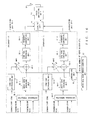
- the signal received by an antenna 7 is input to a receiving circuit 1.
- the receiving circuit 1 includes a frequency converting circuit and a local oscillator, which are not shown in this figure.
- the frequency converting circuit converts the cyclic signal output from the local oscillator into the frequency specified by an externally input digital signal, so that the locally oscillated signal that the receiving circuit 1 requires to receive a signal can be varied.
- the receiving circuit 1 is intended to convert the signal received by the antenna 7, four example, into a baseband signal, and to output the baseband signal.
- the signal received by the receiving circuit 1 is an analog signal, and is input to a rectifying circuit 2.
- the rectifying circuit 2 includes a switch.
- the controlling circuit 5 applies a Read signal to the storing circuit 6, reads the Nbf-bit frequency data candidate from the storing circuit 6, sets the read data in the receiving circuit 1, and makes a cell search.
- All of the outputs of the controlling circuit 5 and the frequency specification data may be stored in the storing circuit 6 without making the above described comparison with the threshold value. Additionally, the output of the rectifying circuit 2 is compared with the threshold value of an analog voltage by an analog comparator, so that the result of the comparison may be used as a Write signal to the storing circuit. Furthermore, the output of the A/D converter 3 is compared with a threshold value by a CPU, etc., so that a frequency candidate data may be selected.
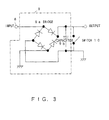
- Fig. 3 shows one example of the rectifying circuit shown in Fig. 2 .
- This rectifying circuit is implemented by adding a switch 10 to a general bridge-type full-wave rectifying circuit 9.
- the signal input from an input terminal 8 is rectified by a bridge 9a and a capacitor 9b.
- the switch 10 is arranged and turned off during the perch channel signal cyclic time period.
- the electric charge of the rectified signal is accumulating in the capacitor 9b during this time period.
- the operation for accumulating the electric charge of a rectified signal in the capacitor 9b corresponds to the above described signal integration.
- the rectifying circuit may be configured by using a half-wave rectifying circuit although Fig. 3 exemplifies the configuration using the full-wave rectifying circuit.
- Fig. 7 exemplifies the storage format of the data stored in the storing circuit 26 shown in Fig. 5 .
- the slot timing (the timing at which a common short code and a demodulation signal are multiplied), which corresponds to a correlational power value, can be known from the relationship between the operations of the matched filters 24-1 and 24-2 and the clock within the device by detecting in which order the correlation value is read out among the correlation values which are sequentially output from the matched filters 24-1 and 24-2.
- a maximum value determining circuit 31 reads the frequency specification data and the correlational power value, which are stored in the storing circuit 26, independently from a controlling unit 27, and determines the frequency specification data (frequency candidate) corresponding to the maximum correlational power value.
- a maximum value determining circuit 31 reads the frequency specification data and the correlational power value, which are stored in the storing circuit 26, independently from a controlling unit 27, and determines the frequency specification data (frequency candidate) corresponding to the maximum correlational power value.
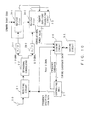
- Fig. 10 is a block diagram showing the configuration of a mobile station according to a sixth preferred embodiment of the present invention.
- a controlling unit 27 obtains a frequency and timing candidates sequentially from the data having a larger correlational power value from the storing circuit 26 where the data are rearranged as described above, and makes a cell search.
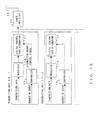
- the mobile station comprises a circuit for sorting the data of stored square amplitude calculation values, and a circuit for estimatingly classifying the data into respective base station data.
- the sorting and the estimatingly-classifying capabilities are implemented by software with a CPU 35. However, these capabilities may be configured by hardware.
- each record is assumed to be referred to as an entry in the storing circuit 36. Additionally, as shown in Fig. 13 , the entry address at which the first record of the storing circuit 36 is stored is assumed to be "DataStart", while the entry address at which the last record is stored is assumed to be "DataEnd”.
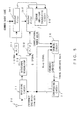
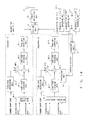
- the signal received by an antenna 20 is received by a receiving circuit 21.
- a controlling unit 27 provides frequency specification data to a receiving circuit 21 and converts a particular frequency signal into an IF band signal.
- the converted IF band signal is input to an orthogonal demodulator 22, which demodulates the signal into an I and Q signals.
- the I and Q signals are respectively converted into digital signals by A/D converters 23-1 and 23-2, they are input to matched filters 24-1 and 24-2.
- the correlation values between a common short code and the digital I and Q signals are calculated by the matched filters 24-1 and 24-2.
- the correlational power value based on the correlation values is calculated by a square amplitude calculating circuit 25.
- adders 59-1 and 59-2 perform an exclusive-OR operation.
- the time-multiplexed signal is spread with the long code by long code spreading units 60-1 and 60-2.
- a transmitting unit 55-1 frequency-converts the signal spread with the long code into a signal having a frequency "f1", and outputs the signal.
- a transmitting unit 55-2 frequency-converts the signal spread with the long code into a signal having a frequency "f2" and outputs the signal.
- the signals having the frequencies "f1" and "f2" are coupled by a coupling unit 54, and power-amplified by a power amplifier 53. Then, the amplified signal is transmitted from an antenna 52.
- the gains "g1" and “g2" of the weighting of the amplifiers AMP1 and AMP2 are determined according to the number of users within a cell in the controlling unit 62.
- the number of users within a cell is obtained from the notification from an intra-cell user number counting unit 63 arranged as a user monitoring capability of a CDMA cellular system.
- the measurement result of an upward signal-to-interference power ratio, a signal-to-(interference power+noise) ratio, an interference power, or an interference+noise power at a base station is averaged, and the averaged value is used to control the transmission power of a transmitting unit having each frequency in a CDMA cellular system.
- a mobile station can access the most suitable channel of a base station, and at the same time, the base station can control the channel that the mobile station accesses according to the allocation status of mobile stations in a spread communication system, whereby an efficient communication service can be provided while maintaining a communication quality.
- said receiving means orthogonally demodulates a reception spread signal over a single carrier frequency among the plurality of carrier frequencies; said measuring means generates timing-correlational square amplitude calculation value data by calculating square amplitude calculation values of correlation values measured for the orthogonal demodulated spread signals; and said comparing means compares the correlational square amplitude calculation value with the threshold value,
- the mobile station may comprise: classifying means for performing classification for a plurality of pieces of timing-correlational square amplitude calculation value data by recognizing the data to be transmitted from a same base station, if the plurality of timing-correlational square amplitude calculation value data indicating identical timing exist for each carrier frequency; and selecting means for selecting only data having a largest square amplitude calculation value from among timing and square amplitude calculation value data corresponding to spread signals of each base station, which are classified by said classifying means, wherein said synchronization establishing means uses only data selected by said selecting means so as to establish synchronization.
Landscapes
- Engineering & Computer Science (AREA)
- Computer Networks & Wireless Communication (AREA)
- Signal Processing (AREA)
- Computer Security & Cryptography (AREA)
- Mobile Radio Communication Systems (AREA)
- Circuits Of Receivers In General (AREA)
- Transceivers (AREA)
- Synchronisation In Digital Transmission Systems (AREA)
Claims (6)
- Procédé de recherche de cellule pour un terminal mobile utilisé dans un système de communication à spectre étalé possédant un canal particulier pour établir une synchronisation, le canal particulier pour établir une synchronisation existant sur une pluralité de fréquences porteuses, comportant :la réception de la pluralité de fréquences porteuses ;la mesure d'une valeur de corrélation ou de force d'un signal à spectre étalé sur le canal particulier pour chacune de la pluralité de fréquences porteuses ;la mémorisation de l'information concernant le canal particulier possédant une valeur de corrélation ou de force de signal pour chacune de la pluralité de fréquences porteuses ; etl'établissement d'une synchronisation sur l'une des fréquences porteuses de la pluralité de fréquences porteuses en fonction de l'information mémorisée.
- Procédé de recherche de cellule selon la revendication 1, dans lequel l'établissement comporte en outre la sélection, pour établir une synchronisation, d'une fréquence porteuse en fonction de l'information.
- Système de communication possédant un canal particulier pour établir une synchronisation, le canal particulier étant transmis sur une pluralité de fréquences porteuses, le système comportant :un moyen de réception pour recevoir la pluralité de fréquences porteuses ;un moyen de mesure pour mesurer une valeur de corrélation ou de force du signal étalé sur le canal particulier pour chacune de la pluralité de fréquences porteuses ; etun moyen d'établissement de synchronisation pour établir une synchronisation sur l'une des fréquences de la pluralité de fréquences porteuses en fonction de l'information mémorisée dans le moyen de mémorisation.
- Système de communication selon la revendication 3, dans lequel le moyen d'établissement de synchronisation sélectionne, pour établir une synchronisation, une fréquence porteuse en fonction de l'information mémorisée dans le moyen de mémorisation.
- Procédé de recherche de cellule utilisé dans un système de communication possédant un canal particulier pour établir une synchronisation, le canal particulier étant transmis sur une pluralité de porteuses de fréquence, le procédé comportant :la réception de la pluralité de fréquences porteuses ;la mesure d'une valeur de corrélation ou de force du signal étalé sur le canal particulier pour chacune de la pluralité de fréquences porteuses ;la mémorisation de l'information concernant le canal particulier possédant une valeur de corrélation ou de force de signal pour chacune de la pluralité de fréquences porteuses ; etl'établissement d'une synchronisation sur l'une des fréquences porteuses de la pluralité de fréquences porteuses en fonction de l'information mémorisée.
- Procédé de recherche de cellule selon la revendication 5, dans lequel l'établissement comporte en outre la sélection, pour établir une synchronisation, d'une fréquence porteuse en fonction de l'information mémorisée.
Applications Claiming Priority (3)
| Application Number | Priority Date | Filing Date | Title |
|---|---|---|---|
| JP212899A JP2000201101A (ja) | 1999-01-07 | 1999-01-07 | 拡散通信システムとその移動機 |
| EP20050017859 EP1599058B1 (fr) | 1999-01-07 | 1999-12-14 | Système de communication à spectre étalé et station mobile correspondante |
| EP99124819A EP1018845B1 (fr) | 1999-01-07 | 1999-12-14 | Dispositif et station mobile pour système de communication à spectre étalé |
Related Parent Applications (3)
| Application Number | Title | Priority Date | Filing Date |
|---|---|---|---|
| EP99124819.6 Division | 1999-12-14 | ||
| EP20050017859 Division-Into EP1599058B1 (fr) | 1999-01-07 | 1999-12-14 | Système de communication à spectre étalé et station mobile correspondante |
| EP05017859.9 Division | 2005-08-17 |
Publications (2)
| Publication Number | Publication Date |
|---|---|
| EP2299601A1 EP2299601A1 (fr) | 2011-03-23 |
| EP2299601B1 true EP2299601B1 (fr) | 2011-09-28 |
Family
ID=11520714
Family Applications (5)
| Application Number | Title | Priority Date | Filing Date |
|---|---|---|---|
| EP20100180903 Expired - Lifetime EP2296289B1 (fr) | 1999-01-07 | 1999-12-14 | Système de communication à spectre étalé et station mobile correspondante |
| EP20050017859 Expired - Lifetime EP1599058B1 (fr) | 1999-01-07 | 1999-12-14 | Système de communication à spectre étalé et station mobile correspondante |
| EP20100180911 Expired - Lifetime EP2372928B1 (fr) | 1999-01-07 | 1999-12-14 | Système de communication à dispersion et station mobile correspondante |
| EP20100180906 Expired - Lifetime EP2299601B1 (fr) | 1999-01-07 | 1999-12-14 | Système de communication à spectre étalé et station mobile correspondante |
| EP99124819A Expired - Lifetime EP1018845B1 (fr) | 1999-01-07 | 1999-12-14 | Dispositif et station mobile pour système de communication à spectre étalé |
Family Applications Before (3)
| Application Number | Title | Priority Date | Filing Date |
|---|---|---|---|
| EP20100180903 Expired - Lifetime EP2296289B1 (fr) | 1999-01-07 | 1999-12-14 | Système de communication à spectre étalé et station mobile correspondante |
| EP20050017859 Expired - Lifetime EP1599058B1 (fr) | 1999-01-07 | 1999-12-14 | Système de communication à spectre étalé et station mobile correspondante |
| EP20100180911 Expired - Lifetime EP2372928B1 (fr) | 1999-01-07 | 1999-12-14 | Système de communication à dispersion et station mobile correspondante |
Family Applications After (1)
| Application Number | Title | Priority Date | Filing Date |
|---|---|---|---|
| EP99124819A Expired - Lifetime EP1018845B1 (fr) | 1999-01-07 | 1999-12-14 | Dispositif et station mobile pour système de communication à spectre étalé |
Country Status (4)
| Country | Link |
|---|---|
| US (5) | US7436879B1 (fr) |
| EP (5) | EP2296289B1 (fr) |
| JP (1) | JP2000201101A (fr) |
| DE (1) | DE69928638T2 (fr) |
Families Citing this family (21)
| Publication number | Priority date | Publication date | Assignee | Title |
|---|---|---|---|---|
| US5841768A (en) * | 1996-06-27 | 1998-11-24 | Interdigital Technology Corporation | Method of controlling initial power ramp-up in CDMA systems by using short codes |
| US6879575B1 (en) | 1998-05-13 | 2005-04-12 | Hitachi, Ltd. | Code division multiple access mobile communication system |
| JP3690717B2 (ja) * | 1999-07-14 | 2005-08-31 | 株式会社エヌ・ティ・ティ・ドコモ | セルサーチ制御方法、移動局および移動通信システム |
| KR100429545B1 (ko) * | 1999-08-17 | 2004-04-28 | 삼성전자주식회사 | 이동통신 시스템의 스크램블링 부호의 식별자 통신방법 |
| JP3808280B2 (ja) * | 2000-04-28 | 2006-08-09 | 富士通株式会社 | 同期確立装置と同期確立方法及び受信機 |
| SE0004326D0 (sv) * | 2000-11-24 | 2000-11-24 | Ericsson Telefon Ab L M | Base station identification |
| JP2003218788A (ja) * | 2002-01-22 | 2003-07-31 | Matsushita Electric Ind Co Ltd | セルサーチにおける送信電力制御装置及び方法 |
| US20040203984A1 (en) * | 2002-06-11 | 2004-10-14 | Tai-Her Yang | Wireless information device with its transmission power lever adjustable |
| US7593367B2 (en) | 2002-06-14 | 2009-09-22 | Qualcomm Incorporated | Frequency scan for CDMA acquisition |
| CN1512794A (zh) * | 2002-12-30 | 2004-07-14 | �ʼҷ����ֵ��ӹɷ�����˾ | 一种tdd-cdma系统中用于移动终端的小区搜索方法及装置 |
| AU2004202550A1 (en) * | 2003-06-18 | 2005-01-13 | Nec Australia Pty Ltd | Cell search process for wireless communication system |
| AU2003903075A0 (en) * | 2003-06-18 | 2003-07-03 | Nec Australia Pty Ltd | Cell search process for wireless communication system |
| US8325591B2 (en) * | 2004-02-26 | 2012-12-04 | Qualcomm Incorporated | Suppressing cross-polarization interference in an orthogonal communication link |
| JP2005244763A (ja) * | 2004-02-27 | 2005-09-08 | Fujitsu Ltd | 移動体端末 |
| US8233907B1 (en) * | 2004-11-03 | 2012-07-31 | At&T Mobility Ii Llc | System and method for constructing a carrier to interference matrix based on subscriber calls |
| CN1848704B (zh) * | 2005-04-15 | 2010-10-13 | 展讯通信(上海)有限公司 | Wcdma系统中的小区搜索方法和装置 |
| JP2007013446A (ja) * | 2005-06-29 | 2007-01-18 | Nec Electronics Corp | 移動端末装置および移動端末装置の動作制御方法 |
| JP5145852B2 (ja) * | 2007-10-15 | 2013-02-20 | 日本電気株式会社 | 係数決定装置、無線通信システム、係数決定方法及び係数決定プログラム |
| JP5156498B2 (ja) * | 2008-06-18 | 2013-03-06 | 株式会社エヌ・ティ・ティ・ドコモ | 基地局及び移動通信方法 |
| KR102431314B1 (ko) * | 2015-10-01 | 2022-08-12 | 티씨엘 차이나 스타 옵토일렉트로닉스 테크놀로지 컴퍼니 리미티드 | 표시 장치 및 이의 구동 방법 |
| JP7667055B2 (ja) * | 2021-09-30 | 2025-04-22 | トヨタ自動車株式会社 | 送信制御方法、及び情報処理装置 |
Family Cites Families (31)
| Publication number | Priority date | Publication date | Assignee | Title |
|---|---|---|---|---|
| US27891A (en) * | 1860-04-17 | Louis dasek | ||
| US4943974A (en) * | 1988-10-21 | 1990-07-24 | Geostar Corporation | Detection of burst signal transmissions |
| TW306102B (fr) * | 1993-06-14 | 1997-05-21 | Ericsson Telefon Ab L M | |
| JPH07283773A (ja) * | 1994-04-06 | 1995-10-27 | Fujitsu Ltd | 移動局装置および基地局装置 |
| FI96154C (fi) * | 1994-05-30 | 1996-05-10 | Nokia Telecommunications Oy | Menetelmä tilaajapäätelaitteiden synkronisoimiseksi, tukiasema sekä tilaajapäätelaite |
| US5598429A (en) * | 1994-07-15 | 1997-01-28 | Marshall; Kenneth E. | Multi-level correlation system for synchronization detection in high noise and multi-path environments |
| US5732327A (en) * | 1994-12-28 | 1998-03-24 | Ntt Mobile Communications Network Inc. | Method for automatic creation of peripheral zone information |
| US5574747A (en) * | 1995-01-04 | 1996-11-12 | Interdigital Technology Corporation | Spread spectrum adaptive power control system and method |
| CN1080047C (zh) * | 1996-03-05 | 2002-02-27 | Ntt移动通信网株式会社 | 移动通信系统中的信号传输方法,发射机,接收机和扩展码同步法 |
| JP3392630B2 (ja) * | 1996-03-22 | 2003-03-31 | 松下電器産業株式会社 | スペクトル拡散通信装置 |
| SE507557C2 (sv) * | 1996-07-05 | 1998-06-22 | Ericsson Telefon Ab L M | Förfarande och anordning för kvalitetsbestämning i ett mobilt radiokommunikationssystem |
| US6028883A (en) * | 1996-07-12 | 2000-02-22 | General Electric Company | Low power signal processing for spread spectrum receivers |
| JP3358170B2 (ja) | 1996-07-24 | 2002-12-16 | 株式会社エヌ・ティ・ティ・ドコモ | Cdma無線通信の受信方法 |
| JP3376224B2 (ja) | 1996-10-23 | 2003-02-10 | 株式会社エヌ・ティ・ティ・ドコモ | Ds−cdma基地局間非同期セルラ方式における初期同期方法および受信機 |
| US5809059A (en) * | 1996-11-21 | 1998-09-15 | Motorola, Inc. | Method and apparatus for spread spectrum channel assignment |
| EP0845877A3 (fr) * | 1996-11-28 | 2002-03-27 | Oki Electric Industry Co., Ltd. | Système de communication mobile pour effectuer un transfert d'appel avec différence de phase et signaux de synchronisation de trame corrigés |
| JP2765574B2 (ja) * | 1996-12-13 | 1998-06-18 | 日本電気株式会社 | Cdmaチップ同期回路 |
| EP0856955A3 (fr) * | 1997-01-29 | 2000-09-06 | YRP Mobile Telecommunications Key Technology Research Laboratories Co., Ltd. | Régulation de puissance dans un système AMDC |
| US5999816A (en) * | 1997-02-18 | 1999-12-07 | Qualcomm Incorporated | Method and apparatus for performing mobile assisted hard handoff between communication systems |
| US6272121B1 (en) * | 1997-03-03 | 2001-08-07 | Omnipoint Corporation | Spread spectrum communication system using DECT protocol |
| JPH10322760A (ja) * | 1997-05-21 | 1998-12-04 | Toshiba Corp | セルラ無線システム |
| US6021314A (en) * | 1997-05-22 | 2000-02-01 | Advanced Micro Devices, Inc. | Free channel selector for selecting an optimal channel |
| CN1137590C (zh) * | 1997-06-04 | 2004-02-04 | Ntt移动通信网株式会社 | 移动通信系统、移动台和控制分集切换的方法 |
| US6163694A (en) * | 1997-08-22 | 2000-12-19 | Telefonaktiebolaget L M Ericsson (Publ) | Method and apparatus for standby state cell selection in a cellular telephone system |
| US6307849B1 (en) * | 1997-09-08 | 2001-10-23 | Qualcomm Incorporated | Method and system for changing forward traffic channel power allocation during soft handoff |
| US6144650A (en) * | 1997-09-25 | 2000-11-07 | Matsushita Electric Industrial Co., Ltd. | Mobile communication system |
| US6539009B1 (en) * | 1997-12-26 | 2003-03-25 | Yozan, Inc. | Signal reception apparatus for DS-CDMA cellular system |
| US6249539B1 (en) * | 1998-06-15 | 2001-06-19 | Qualcomm Incorporated | System and method for narrowing the range of frequency uncertainty of a doppler shifted signal |
| JP3395959B2 (ja) * | 1998-09-16 | 2003-04-14 | 沖電気工業株式会社 | 相関受信機 |
| JP3156783B2 (ja) * | 1999-01-21 | 2001-04-16 | 日本電気株式会社 | スペクトラム拡散通信システムにおける同期捕捉装置および同期捕捉方法 |
| US6617310B2 (en) | 2000-07-19 | 2003-09-09 | Bristol-Myers Squibb Pharma Company | Phosphate esters of bis-amino acid sulfonamides containing substituted benzyl amines |
-
1999
- 1999-01-07 JP JP212899A patent/JP2000201101A/ja active Pending
- 1999-12-02 US US09/453,276 patent/US7436879B1/en not_active Expired - Fee Related
- 1999-12-14 EP EP20100180903 patent/EP2296289B1/fr not_active Expired - Lifetime
- 1999-12-14 DE DE1999628638 patent/DE69928638T2/de not_active Expired - Lifetime
- 1999-12-14 EP EP20050017859 patent/EP1599058B1/fr not_active Expired - Lifetime
- 1999-12-14 EP EP20100180911 patent/EP2372928B1/fr not_active Expired - Lifetime
- 1999-12-14 EP EP20100180906 patent/EP2299601B1/fr not_active Expired - Lifetime
- 1999-12-14 EP EP99124819A patent/EP1018845B1/fr not_active Expired - Lifetime
-
2003
- 2003-01-27 US US10/351,960 patent/US20030128740A1/en not_active Abandoned
- 2003-01-27 US US10/351,969 patent/US20030112853A1/en not_active Abandoned
-
2005
- 2005-05-19 US US11/133,057 patent/US7197066B2/en not_active Expired - Lifetime
- 2005-05-19 US US11/133,058 patent/US7330498B2/en not_active Expired - Lifetime
Also Published As
| Publication number | Publication date |
|---|---|
| EP2372928A2 (fr) | 2011-10-05 |
| EP1018845A3 (fr) | 2002-10-09 |
| US20030112853A1 (en) | 2003-06-19 |
| EP1599058A2 (fr) | 2005-11-23 |
| EP2296289B1 (fr) | 2011-09-28 |
| US20050213644A1 (en) | 2005-09-29 |
| EP2372928B1 (fr) | 2012-12-19 |
| EP1599058A3 (fr) | 2011-05-11 |
| US7436879B1 (en) | 2008-10-14 |
| DE69928638D1 (de) | 2006-01-05 |
| DE69928638T2 (de) | 2006-08-10 |
| EP1018845A2 (fr) | 2000-07-12 |
| EP2372928A3 (fr) | 2011-10-19 |
| EP2296289A1 (fr) | 2011-03-16 |
| EP2299601A1 (fr) | 2011-03-23 |
| EP1018845B1 (fr) | 2005-11-30 |
| US7197066B2 (en) | 2007-03-27 |
| US20030128740A1 (en) | 2003-07-10 |
| JP2000201101A (ja) | 2000-07-18 |
| EP1599058B1 (fr) | 2015-04-01 |
| HK1161658A1 (en) | 2012-07-27 |
| US7330498B2 (en) | 2008-02-12 |
| US20050213643A1 (en) | 2005-09-29 |
Similar Documents
| Publication | Publication Date | Title |
|---|---|---|
| EP2296289B1 (fr) | Système de communication à spectre étalé et station mobile correspondante | |
| JP4260915B2 (ja) | Cdma受信機においてパイロット信号を捕捉する方法および装置 | |
| US6577617B1 (en) | Communication terminal apparatus, base station communication apparatus and radio communication method | |
| JP2001274748A (ja) | 送信電力制御装置及び送信電力制御方法 | |
| JP3764152B2 (ja) | 移動通信端末のハンドオフ制御方法及び移動通信端末 | |
| JP2003512758A (ja) | レイク受信機における相関タイミングを選択する装置及び方法 | |
| EP1104127A1 (fr) | §ispositif de communication | |
| US6529496B1 (en) | TSTD transmitter for limiting transmission power of antenna and controlling method thereof for base station in mobile communication system | |
| EP0862817B1 (fr) | Recepteur et procede de commande de celui-ci | |
| EP0942543B1 (fr) | Méthode et circuit de détection d'intervalle temporel | |
| JP3482931B2 (ja) | Ds/cdma移動体通信システムの無線通信装置およびサーチャ制御方法 | |
| GB2343331A (en) | Base station signals to switch mobile terminals out of a power saving mode to ensure that its own power budget is not exceeded | |
| HK1161658B (en) | Spread communication system and mobile station thereof | |
| JP3629028B2 (ja) | 拡散通信システムとその移動機 | |
| JP4567919B2 (ja) | 移動無線端末 | |
| US20040081231A1 (en) | Multipath searching device and method thereof | |
| KR100609505B1 (ko) | 이동통신장치 및 이동통신신호 수신방법 | |
| JP3315869B2 (ja) | Cdma移動通信システムにおけるセル選択方法 | |
| JPH10271549A (ja) | 移動無線基地局装置 | |
| JP2001267962A (ja) | 移動無線端末 | |
| JP2004159167A (ja) | セルサーチ方法および移動局 | |
| Burns et al. | A complexity cost function for the signal processing in a WCDMA base station for dimensioning of a software defined radio | |
| JP2003298472A (ja) | 移動無線端末装置 |
Legal Events
| Date | Code | Title | Description |
|---|---|---|---|
| PUAI | Public reference made under article 153(3) epc to a published international application that has entered the european phase |
Free format text: ORIGINAL CODE: 0009012 |
|
| AC | Divisional application: reference to earlier application |
Ref document number: 1018845 Country of ref document: EP Kind code of ref document: P Ref document number: 1599058 Country of ref document: EP Kind code of ref document: P |
|
| AK | Designated contracting states |
Kind code of ref document: A1 Designated state(s): DE FR GB |
|
| GRAP | Despatch of communication of intention to grant a patent |
Free format text: ORIGINAL CODE: EPIDOSNIGR1 |
|
| 17P | Request for examination filed |
Effective date: 20110218 |
|
| RIC1 | Information provided on ipc code assigned before grant |
Ipc: H04B 1/707 20110101AFI20110318BHEP |
|
| GRAS | Grant fee paid |
Free format text: ORIGINAL CODE: EPIDOSNIGR3 |
|
| GRAA | (expected) grant |
Free format text: ORIGINAL CODE: 0009210 |
|
| AC | Divisional application: reference to earlier application |
Ref document number: 1018845 Country of ref document: EP Kind code of ref document: P Ref document number: 1599058 Country of ref document: EP Kind code of ref document: P |
|
| AK | Designated contracting states |
Kind code of ref document: B1 Designated state(s): DE FR GB |
|
| REG | Reference to a national code |
Ref country code: GB Ref legal event code: FG4D |
|
| REG | Reference to a national code |
Ref country code: DE Ref legal event code: R096 Ref document number: 69943750 Country of ref document: DE Effective date: 20111215 |
|
| PLBE | No opposition filed within time limit |
Free format text: ORIGINAL CODE: 0009261 |
|
| STAA | Information on the status of an ep patent application or granted ep patent |
Free format text: STATUS: NO OPPOSITION FILED WITHIN TIME LIMIT |
|
| 26N | No opposition filed |
Effective date: 20120629 |
|
| REG | Reference to a national code |
Ref country code: DE Ref legal event code: R097 Ref document number: 69943750 Country of ref document: DE Effective date: 20120629 |
|
| REG | Reference to a national code |
Ref country code: FR Ref legal event code: PLFP Year of fee payment: 17 |
|
| REG | Reference to a national code |
Ref country code: FR Ref legal event code: PLFP Year of fee payment: 18 |
|
| REG | Reference to a national code |
Ref country code: FR Ref legal event code: PLFP Year of fee payment: 19 |
|
| PGFP | Annual fee paid to national office [announced via postgrant information from national office to epo] |
Ref country code: DE Payment date: 20181204 Year of fee payment: 20 |
|
| PGFP | Annual fee paid to national office [announced via postgrant information from national office to epo] |
Ref country code: GB Payment date: 20181212 Year of fee payment: 20 Ref country code: FR Payment date: 20181121 Year of fee payment: 20 |
|
| REG | Reference to a national code |
Ref country code: DE Ref legal event code: R071 Ref document number: 69943750 Country of ref document: DE |
|
| REG | Reference to a national code |
Ref country code: GB Ref legal event code: PE20 Expiry date: 20191213 |
|
| PG25 | Lapsed in a contracting state [announced via postgrant information from national office to epo] |
Ref country code: GB Free format text: LAPSE BECAUSE OF EXPIRATION OF PROTECTION Effective date: 20191213 |