EP2301917A1 - Élimination de l'urée et de l'ammoniac de gaz d'échappement - Google Patents
Élimination de l'urée et de l'ammoniac de gaz d'échappement Download PDFInfo
- Publication number
- EP2301917A1 EP2301917A1 EP09170447A EP09170447A EP2301917A1 EP 2301917 A1 EP2301917 A1 EP 2301917A1 EP 09170447 A EP09170447 A EP 09170447A EP 09170447 A EP09170447 A EP 09170447A EP 2301917 A1 EP2301917 A1 EP 2301917A1
- Authority
- EP
- European Patent Office
- Prior art keywords
- urea
- ammonium sulphate
- melt
- ammonia
- water
- Prior art date
- Legal status (The legal status is an assumption and is not a legal conclusion. Google has not performed a legal analysis and makes no representation as to the accuracy of the status listed.)
- Withdrawn
Links
- QGZKDVFQNNGYKY-UHFFFAOYSA-N Ammonia Chemical compound N QGZKDVFQNNGYKY-UHFFFAOYSA-N 0.000 title claims abstract description 45
- XSQUKJJJFZCRTK-UHFFFAOYSA-N Urea Chemical compound NC(N)=O XSQUKJJJFZCRTK-UHFFFAOYSA-N 0.000 title claims abstract description 41
- 239000004202 carbamide Substances 0.000 title claims abstract description 41
- 229910021529 ammonia Inorganic materials 0.000 title claims abstract description 22
- 239000007789 gas Substances 0.000 title description 11
- BFNBIHQBYMNNAN-UHFFFAOYSA-N ammonium sulfate Chemical compound N.N.OS(O)(=O)=O BFNBIHQBYMNNAN-UHFFFAOYSA-N 0.000 claims abstract description 36
- 229910052921 ammonium sulfate Inorganic materials 0.000 claims abstract description 36
- 239000001166 ammonium sulphate Substances 0.000 claims abstract description 36
- 235000011130 ammonium sulphate Nutrition 0.000 claims abstract description 36
- 238000000034 method Methods 0.000 claims abstract description 35
- XLYOFNOQVPJJNP-UHFFFAOYSA-N water Substances O XLYOFNOQVPJJNP-UHFFFAOYSA-N 0.000 claims abstract description 21
- 239000007787 solid Substances 0.000 claims abstract description 19
- 239000000155 melt Substances 0.000 claims abstract description 11
- 239000002253 acid Substances 0.000 claims abstract description 9
- 239000000428 dust Substances 0.000 claims abstract description 9
- QAOWNCQODCNURD-UHFFFAOYSA-N Sulfuric acid Chemical compound OS(O)(=O)=O QAOWNCQODCNURD-UHFFFAOYSA-N 0.000 claims abstract description 7
- 239000002245 particle Substances 0.000 claims abstract description 7
- 239000001117 sulphuric acid Substances 0.000 claims abstract description 7
- 235000011149 sulphuric acid Nutrition 0.000 claims abstract description 7
- 238000011084 recovery Methods 0.000 claims abstract description 3
- 239000007788 liquid Substances 0.000 claims description 6
- 238000009834 vaporization Methods 0.000 claims description 4
- 230000008016 vaporization Effects 0.000 claims description 4
- 239000008188 pellet Substances 0.000 claims description 2
- 239000000243 solution Substances 0.000 description 16
- 239000003337 fertilizer Substances 0.000 description 11
- 239000003929 acidic solution Substances 0.000 description 10
- 238000005453 pelletization Methods 0.000 description 6
- 239000000126 substance Substances 0.000 description 6
- 238000005469 granulation Methods 0.000 description 5
- 230000003179 granulation Effects 0.000 description 5
- 239000000047 product Substances 0.000 description 5
- 235000020030 perry Nutrition 0.000 description 4
- 238000007493 shaping process Methods 0.000 description 4
- VHUUQVKOLVNVRT-UHFFFAOYSA-N Ammonium hydroxide Chemical compound [NH4+].[OH-] VHUUQVKOLVNVRT-UHFFFAOYSA-N 0.000 description 3
- 239000002002 slurry Substances 0.000 description 3
- 230000032258 transport Effects 0.000 description 3
- IJGRMHOSHXDMSA-UHFFFAOYSA-N Atomic nitrogen Chemical compound N#N IJGRMHOSHXDMSA-UHFFFAOYSA-N 0.000 description 2
- NINIDFKCEFEMDL-UHFFFAOYSA-N Sulfur Chemical compound [S] NINIDFKCEFEMDL-UHFFFAOYSA-N 0.000 description 2
- 239000005864 Sulphur Substances 0.000 description 2
- 230000009418 agronomic effect Effects 0.000 description 2
- 235000011114 ammonium hydroxide Nutrition 0.000 description 2
- 238000001816 cooling Methods 0.000 description 2
- 238000000354 decomposition reaction Methods 0.000 description 2
- 239000012467 final product Substances 0.000 description 2
- 239000002184 metal Substances 0.000 description 2
- 238000002156 mixing Methods 0.000 description 2
- 230000003472 neutralizing effect Effects 0.000 description 2
- 239000002689 soil Substances 0.000 description 2
- 239000002699 waste material Substances 0.000 description 2
- 230000002378 acidificating effect Effects 0.000 description 1
- 238000013019 agitation Methods 0.000 description 1
- 230000015572 biosynthetic process Effects 0.000 description 1
- OHJMTUPIZMNBFR-UHFFFAOYSA-N biuret Chemical compound NC(=O)NC(N)=O OHJMTUPIZMNBFR-UHFFFAOYSA-N 0.000 description 1
- 239000012141 concentrate Substances 0.000 description 1
- 238000010276 construction Methods 0.000 description 1
- 239000000498 cooling water Substances 0.000 description 1
- 238000005260 corrosion Methods 0.000 description 1
- 230000007797 corrosion Effects 0.000 description 1
- 230000000694 effects Effects 0.000 description 1
- 239000011552 falling film Substances 0.000 description 1
- 239000007791 liquid phase Substances 0.000 description 1
- 238000004519 manufacturing process Methods 0.000 description 1
- 239000000463 material Substances 0.000 description 1
- 229910052757 nitrogen Inorganic materials 0.000 description 1
- QJGQUHMNIGDVPM-UHFFFAOYSA-N nitrogen group Chemical group [N] QJGQUHMNIGDVPM-UHFFFAOYSA-N 0.000 description 1
- 229910000069 nitrogen hydride Inorganic materials 0.000 description 1
- 239000012071 phase Substances 0.000 description 1
- 239000008247 solid mixture Substances 0.000 description 1
- 238000007711 solidification Methods 0.000 description 1
- 230000008023 solidification Effects 0.000 description 1
- 239000011345 viscous material Substances 0.000 description 1
Images


Classifications
-
- C—CHEMISTRY; METALLURGY
- C05—FERTILISERS; MANUFACTURE THEREOF
- C05C—NITROGENOUS FERTILISERS
- C05C3/00—Fertilisers containing other salts of ammonia or ammonia itself, e.g. gas liquor
-
- B—PERFORMING OPERATIONS; TRANSPORTING
- B01—PHYSICAL OR CHEMICAL PROCESSES OR APPARATUS IN GENERAL
- B01D—SEPARATION
- B01D53/00—Separation of gases or vapours; Recovering vapours of volatile solvents from gases; Chemical or biological purification of waste gases, e.g. engine exhaust gases, smoke, fumes, flue gases, aerosols
- B01D53/34—Chemical or biological purification of waste gases
- B01D53/46—Removing components of defined structure
- B01D53/54—Nitrogen compounds
-
- B—PERFORMING OPERATIONS; TRANSPORTING
- B01—PHYSICAL OR CHEMICAL PROCESSES OR APPARATUS IN GENERAL
- B01D—SEPARATION
- B01D53/00—Separation of gases or vapours; Recovering vapours of volatile solvents from gases; Chemical or biological purification of waste gases, e.g. engine exhaust gases, smoke, fumes, flue gases, aerosols
- B01D53/34—Chemical or biological purification of waste gases
- B01D53/46—Removing components of defined structure
- B01D53/54—Nitrogen compounds
- B01D53/58—Ammonia
-
- B—PERFORMING OPERATIONS; TRANSPORTING
- B01—PHYSICAL OR CHEMICAL PROCESSES OR APPARATUS IN GENERAL
- B01D—SEPARATION
- B01D53/00—Separation of gases or vapours; Recovering vapours of volatile solvents from gases; Chemical or biological purification of waste gases, e.g. engine exhaust gases, smoke, fumes, flue gases, aerosols
- B01D53/34—Chemical or biological purification of waste gases
- B01D53/74—General processes for purification of waste gases; Apparatus or devices specially adapted therefor
- B01D53/80—Semi-solid phase processes, i.e. by using slurries
-
- C—CHEMISTRY; METALLURGY
- C01—INORGANIC CHEMISTRY
- C01C—AMMONIA; CYANOGEN; COMPOUNDS THEREOF
- C01C1/00—Ammonia; Compounds thereof
- C01C1/02—Preparation, purification or separation of ammonia
- C01C1/12—Separation of ammonia from gases and vapours
-
- C—CHEMISTRY; METALLURGY
- C01—INORGANIC CHEMISTRY
- C01C—AMMONIA; CYANOGEN; COMPOUNDS THEREOF
- C01C1/00—Ammonia; Compounds thereof
- C01C1/22—Sulfites of ammonium
-
- C—CHEMISTRY; METALLURGY
- C05—FERTILISERS; MANUFACTURE THEREOF
- C05C—NITROGENOUS FERTILISERS
- C05C3/00—Fertilisers containing other salts of ammonia or ammonia itself, e.g. gas liquor
- C05C3/005—Post-treatment
-
- C—CHEMISTRY; METALLURGY
- C05—FERTILISERS; MANUFACTURE THEREOF
- C05C—NITROGENOUS FERTILISERS
- C05C9/00—Fertilisers containing urea or urea compounds
-
- C—CHEMISTRY; METALLURGY
- C07—ORGANIC CHEMISTRY
- C07C—ACYCLIC OR CARBOCYCLIC COMPOUNDS
- C07C273/00—Preparation of urea or its derivatives, i.e. compounds containing any of the groups, the nitrogen atoms not being part of nitro or nitroso groups
- C07C273/02—Preparation of urea or its derivatives, i.e. compounds containing any of the groups, the nitrogen atoms not being part of nitro or nitroso groups of urea, its salts, complexes or addition compounds
- C07C273/14—Separation; Purification; Stabilisation; Use of additives
- C07C273/16—Separation; Purification
-
- B—PERFORMING OPERATIONS; TRANSPORTING
- B01—PHYSICAL OR CHEMICAL PROCESSES OR APPARATUS IN GENERAL
- B01D—SEPARATION
- B01D2251/00—Reactants
- B01D2251/50—Inorganic acids
- B01D2251/506—Sulfuric acid
-
- B—PERFORMING OPERATIONS; TRANSPORTING
- B01—PHYSICAL OR CHEMICAL PROCESSES OR APPARATUS IN GENERAL
- B01D—SEPARATION
- B01D2257/00—Components to be removed
- B01D2257/40—Nitrogen compounds
- B01D2257/406—Ammonia
-
- B—PERFORMING OPERATIONS; TRANSPORTING
- B01—PHYSICAL OR CHEMICAL PROCESSES OR APPARATUS IN GENERAL
- B01D—SEPARATION
- B01D2257/00—Components to be removed
- B01D2257/70—Organic compounds not provided for in groups B01D2257/00 - B01D2257/602
Definitions
- Urea dust and ammonia are known to be present in exhaust gases from urea plants, urea granulation towers, urea prilling towers and chemical fertilizer plants. Such plants in particular release waste air streams that contain dust and ammonia resulting from various process steps. This air stream must be purified before being passed into the environment or recycled back into the process. Such waste air stream result in particular from granulation, prilling and product cooling process steps.
- JP9227493 describes a method for recovery of urea dust and ammonia from such a gas stream by contacting said gas stream with an aqueous sulphuric acid solution, thus forming an acid solution of ammonium sulphate and urea.
- a disadvantage of the known process is, that the resulting product is a solution, which can hardly be used as a fertilizer due to its high transport costs.
- JP9227493 Another problem of the method described in JP9227493 is that the resulting solution is an acidic solution, which is not only a disadvantage for the soil wherein it is used as a fertilizer, but it results in corrosion in metal equipment used to concentrate, handle and transport the acidic solution, unless special, high cost, materials of construction are used for such metal equipment.
- This problem can be solved, by adding ammonia to the acidic solution before the acidic solution is concentrated, thus forming a neutralized solution of ammonium sulphate and urea in water.
- the neutralized solution is concentrated by vaporization of at least part of the water phase, thus forming water vapor and a melt comprising less than 5 wt% of water.
- the vaporization is carried out in more than one step until the amount of water is less than 5 wt%. This allows reducing the amount of water in the melt to less than 1 wt%, and even to less than 0.3 wt%.
- the melt is transferred into urea and ammonium sulphate comprising solid particles.
- This process can be carried out in a granulator, or prilling tower. However this would reintroduce (on a smaller scale) the problem of ammonia and dust loaded air. Therefore this process is preferably carried out in a pelletizer, comprising a feeding device, a solidification/cooling belt and a device to remove the formed pellets from the belt, by feeding a urea-comprising liquid to the feeding device from which droplets of the urea-comprising liquid are dosed to the belt, whereon the urea- comprising droplets solidify, where after the formed urea-comprising particles are removed from the belt.
- the belt is cooled from the other side, preferably by means of cooling water.
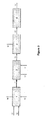
- FIG. 1 A system for implementing the method of the invention is shown in Fig. 1 .
- a gas stream comprising air, urea and ammonia (11) is contacted in a scrubber (1) with an aqueous sulphuric acid solution (12), thus forming an acidic solution of urea and ammonium sulphate.
- Scrubber (1) can be selected from any of the wet-type scrubbers well known in the industry. It may, for instance, be selected from the type of scrubbers as summarized in Chemical Engineers Handbook (Perry and Chilton), fifth edition, page 20-94 to 20-103 .
- Stream 11 usually has a relative high temperature (70 - 110 °C), and may be rather dry. As a result of this, quite some water may evaporate in the scrubber. In many cases it therefore will be required to add make-up water (15) to the scrubber in order to assure that the concentration of urea and ammonium sulphate in the liquid phase in the scrubber remains below the solubility limits.
- make-up water (15)
- circulation of acidic urea/ammonium sulphate (UAS) solution over the scrubber may be required for proper removal of ammonia and dust from the air stream.
- UAS acidic urea/ammonium sulphate
- the cleaned air leaves the scrubber via line 18.
- the acidic solution of urea and ammonium sulphate is passed through line (21) to concentration unit (2), which may comprise at least one concentrator Water vapor leaves the concentration unit (2) via line (16).
- concentration unit (2) the acidic solution of urea and ammonia is concentrated to a melt, comprising less than 5 wt% of water.
- the concentration unit (2) may consist of one or more evaporators in parallel or in series. These evaporators may be selected from evaporators, as they are well known in the process industry. They may, for instance, be selected from the evaporators as summarized in Chemical Engineers Handbook (Perry and Chilton), fifth edition, pages 11-27 to 11-38 . Urea is vulnerable for decomposition (e.g.
- the evaporators are usually selected from the types 'falling film' or 'Long tube vertical' (refer to fig 11-16 in Chemical Engineers Handbook (Perry and Chilton), fifth editi on) since they offer low residence time.
- the evaporators preferably are operated under vacuum, in order to minimize the required temperature.
- the vacuum in the evaporators can be maintained using a system of vacuum condensers and steam-jet ejectors (not shown in the figure), or other systems, that are well known in the industry.
- the concentrated UAS melt leaves the concentration unit via line (22) to mixer (3).
- Solid ammonium sulphate is also introduced into the mixer (3), in order to increase the ammonium sulphate to urea ratio to the desired value.
- the dosing of ammonium sulphate to mixer (3) is controlled in such a way that a stable ammonium sulphate to urea ratio is obtained in the final product (17).
- Mixer (3) may be selected from any of the solid/liquid mixers well known in the industry. It may e.g. be selected from the mixers as summarized in Chemical Engineers Handbook (Perry and Chilton), fifth edition, pages 19-3 to 19-25 . Selection of the mixer mainly is depending on the required ammonium sulphate to urea ratio.
- the solid shaping step (4) may consist of granulation, prilling or pelletizing. It is of special advantage to select pelletizing as solid shaping process, since such a pelletizing process does not result in dust and ammonia loaden offgas as is the case with prilling and granulation processes. An example of such a pelletizing process is described in WO 2006/111331 A1 .
- Fig. 2 shows a system for implementing the method of the invention, wherein ammonia or ammonia water (14) is added to the acid solution in a neutralizer (5) before the acidic solution (21) is concentrated, thus forming a neutralized solution of urea and ammonium sulphate in water that is passed through line (24) to the concentration unit (2).
- the neutralizing process (5) may be accommodated in a mixing vessel with agitator, as well known in the industry. Taking into account the strong chemical affinity between sulphuric acid and ammonia, the neutralizing process may even be accommodated in a much simpler way, e.g. by supplying turbulent flow and sufficient residence time in the process line that transports UAS solution 24 to the concentration unit (2). All other elements shown in figure 2 are similar to the elements in figure 1 and therefore are not further described here.
- Figure 3 shows a further embodiment of the invention.
- the embodiment as shown in figure 3 offers special advantages over those as shown in figures 1 and 2 , in case the required ammonium sulphate to urea ratio in the final UAS product is limited.
- a gas stream comprising air, urea and ammonia (11) is contacted in a scrubber (1) with an aqueous sulphuric acid solution (12), thus forming an acidic solution of urea and ammonium sulphate.
- the cleaned air leaves the scrubber via (18).
- Make-up water is introduced into the scrubber via (15), in such an amount that no solids are formed in the streams (21) and (24)
- the formed acidic solution of urea and ammonium sulphate leaves the scrubber via (21), to be introduced in mixer (3).
- NH 3 (or ammonia water) is introduced into mixer (3) via line (14) in such an amount that the excess sulphuric acid present in (21) is neutralized. Additional solid ammonium sulphate is added to mixer (3) via line (13).
- Mixer (3) is an agitated vessel, where proper agitation ensures that all of the solid ammonium sulphate that is added to the mixer is dissolved before the enriched UAS solution leaves the mixer via (24) to concentration unit (2).
- the UAS solution is concentrated to such an extend that the UAS melt leaving the concentration unit via (23) has a water content of less the 5% by weight.
- This concentrated melt is transformed into a solid UAS product in solid shaping unit (4) in the same way as described for figure 1 .
- figure 3 offers the advantage that the process steps (5, neutralizer) and (3, mixer) now are combined in one step (3, mixer). This offers the advantage of lower capital investment for the process as described under figure 3 .
- An advantage of the process as described under figure 2 as compared to the process as described under figure 3 is that the ammonium sulphate concentration in concentration step (2) can be higher without risking line blockage. Therefore the application of the process as described under figure 3 is limited to such cases, where the desired S/N ratio in product (17) is limited to such a value that the UAS + melt (23) contains no solid ammonium sulphate, or only such a limited quantity of solid ammonium sulphate that stream (23) remains a transportable slurry.
Landscapes
- Chemical & Material Sciences (AREA)
- Organic Chemistry (AREA)
- Engineering & Computer Science (AREA)
- Analytical Chemistry (AREA)
- Environmental & Geological Engineering (AREA)
- Health & Medical Sciences (AREA)
- General Chemical & Material Sciences (AREA)
- Oil, Petroleum & Natural Gas (AREA)
- Chemical Kinetics & Catalysis (AREA)
- Biomedical Technology (AREA)
- Inorganic Chemistry (AREA)
- Fertilizers (AREA)
- Treating Waste Gases (AREA)
- Organic Low-Molecular-Weight Compounds And Preparation Thereof (AREA)
Priority Applications (13)
| Application Number | Priority Date | Filing Date | Title |
|---|---|---|---|
| EP09170447A EP2301917A1 (fr) | 2009-09-16 | 2009-09-16 | Élimination de l'urée et de l'ammoniac de gaz d'échappement |
| EP10740669.6A EP2477961B2 (fr) | 2009-09-16 | 2010-08-10 | Élimination de l'urée et de l'ammoniac de gaz d'échappement |
| PL10740669.6T PL2477961T5 (pl) | 2009-09-16 | 2010-08-10 | Usuwanie mocznika i amoniaku z gazów odlotowych |
| CN2010800414897A CN102596901A (zh) | 2009-09-16 | 2010-08-10 | 从废气中去除尿素和氨的方法 |
| BR112012006029-5A BR112012006029B1 (pt) | 2009-09-16 | 2010-08-10 | Método para recuperar pó de ureia e amônia de uma corrente de gás |
| US13/496,192 US9464009B2 (en) | 2009-09-16 | 2010-08-10 | Removal of urea and ammonia from exhaust gases |
| MYPI2012001189A MY160240A (en) | 2009-09-16 | 2010-08-10 | Removal of urea and ammonia from exhaust gases |
| EA201270417A EA021089B1 (ru) | 2009-09-16 | 2010-08-10 | Удаление мочевины и аммиака из отработанных газов |
| CA2774246A CA2774246C (fr) | 2009-09-16 | 2010-08-10 | Elimination d'uree et d'ammoniac de gaz d'echappement |
| PCT/EP2010/061588 WO2011032786A1 (fr) | 2009-09-16 | 2010-08-10 | Élimination d'urée et d'ammoniac de gaz d'échappement |
| ARP100103370A AR079185A1 (es) | 2009-09-16 | 2010-09-16 | Eliminacion de urea y amoniaco de gases de escape |
| US14/098,496 US9556077B2 (en) | 2009-09-16 | 2013-12-05 | Removal of urea and ammonia from exhaust gases |
| US15/421,265 US10640428B2 (en) | 2009-09-16 | 2017-01-31 | Removal of urea and ammonia from exhaust gases |
Applications Claiming Priority (1)
| Application Number | Priority Date | Filing Date | Title |
|---|---|---|---|
| EP09170447A EP2301917A1 (fr) | 2009-09-16 | 2009-09-16 | Élimination de l'urée et de l'ammoniac de gaz d'échappement |
Publications (1)
| Publication Number | Publication Date |
|---|---|
| EP2301917A1 true EP2301917A1 (fr) | 2011-03-30 |
Family
ID=41171130
Family Applications (2)
| Application Number | Title | Priority Date | Filing Date |
|---|---|---|---|
| EP09170447A Withdrawn EP2301917A1 (fr) | 2009-09-16 | 2009-09-16 | Élimination de l'urée et de l'ammoniac de gaz d'échappement |
| EP10740669.6A Active EP2477961B2 (fr) | 2009-09-16 | 2010-08-10 | Élimination de l'urée et de l'ammoniac de gaz d'échappement |
Family Applications After (1)
| Application Number | Title | Priority Date | Filing Date |
|---|---|---|---|
| EP10740669.6A Active EP2477961B2 (fr) | 2009-09-16 | 2010-08-10 | Élimination de l'urée et de l'ammoniac de gaz d'échappement |
Country Status (10)
| Country | Link |
|---|---|
| US (3) | US9464009B2 (fr) |
| EP (2) | EP2301917A1 (fr) |
| CN (1) | CN102596901A (fr) |
| AR (1) | AR079185A1 (fr) |
| BR (1) | BR112012006029B1 (fr) |
| CA (1) | CA2774246C (fr) |
| EA (1) | EA021089B1 (fr) |
| MY (1) | MY160240A (fr) |
| PL (1) | PL2477961T5 (fr) |
| WO (1) | WO2011032786A1 (fr) |
Families Citing this family (16)
| Publication number | Priority date | Publication date | Assignee | Title |
|---|---|---|---|---|
| CN110003056A (zh) * | 2012-05-03 | 2019-07-12 | 斯塔米卡邦有限公司 | 尿素制备设备 |
| EP2746244A1 (fr) * | 2012-12-21 | 2014-06-25 | Uhde Fertilizer Technology B.V. | Procédé pour réduire l'opacité du panache détaché auto-orientable visible |
| ITMI20130847A1 (it) * | 2013-05-24 | 2014-11-25 | Saipem Spa | Metodo e sistema per il recupero di solfato di ammonio da un flusso gassoso di un impianto urea |
| EP3020702A1 (fr) * | 2014-11-12 | 2016-05-18 | Casale SA | Procédé de finition d'urée avec lavage à l'acide |
| CN107848903B (zh) | 2015-07-06 | 2021-09-21 | 斯塔米卡邦有限公司 | 尿素产品的制粒 |
| EP3526181A1 (fr) * | 2016-10-13 | 2019-08-21 | Koch Agronomic Services, LLC | Récupération et réutilisation de constituants à partir de flux de déchets de finition d'urée |
| WO2018122379A1 (fr) | 2016-12-30 | 2018-07-05 | Yara International Asa | Méthode de traitement d'un flux de gaz comprenant de la poussière d'urée et de l'ammoniac |
| EP3562783B1 (fr) | 2016-12-30 | 2021-03-24 | Yara International ASA | Traitement de gaz d'échappement provenant d'une installation de production d'urée |
| EP3366670A1 (fr) * | 2017-02-27 | 2018-08-29 | Casale Sa | Procédé et système de capture d'ammoniac à partir d'un gaz de purge d'une usine d'urea |
| DE102017203251A1 (de) | 2017-02-28 | 2018-08-30 | Thyssenkrupp Ag | Verfahren zur Reinigung der Abluft einer Granulierungsanlage zur Herstellung eines harnstoffhaltigen Granulats |
| CN107349872A (zh) * | 2017-03-16 | 2017-11-17 | 重庆宝禾复合肥有限公司 | 一种用于化肥生产的高效造粒设备 |
| JP6851869B2 (ja) * | 2017-03-17 | 2021-03-31 | 東洋エンジニアリング株式会社 | 尿素の造粒方法 |
| WO2019234816A1 (fr) * | 2018-06-05 | 2019-12-12 | 三菱重工エンジニアリング株式会社 | Usine de production d'engrais et procédé de production d'engrais |
| EP3639916A1 (fr) | 2018-10-18 | 2020-04-22 | Yara International ASA | Procédé et granulateur à lit fluidisé pour la production de granulés à partir d'une boue |
| CN113853248A (zh) | 2019-05-22 | 2021-12-28 | 斯塔米卡邦有限公司 | 对来自尿素精整的废气的处理 |
| DE102019216931A1 (de) * | 2019-11-04 | 2021-05-06 | Thyssenkrupp Ag | Verfahren und Anlage zur Herstellung von Harnstoffgranulat |
Citations (5)
| Publication number | Priority date | Publication date | Assignee | Title |
|---|---|---|---|---|
| US3928015A (en) * | 1974-10-29 | 1975-12-23 | Tennessee Valley Authority | Manufacture of urea-ammonium sulate from sulfuric acid, ammonia, and urea |
| JPH09227493A (ja) | 1996-02-27 | 1997-09-02 | Toyo Eng Corp | 排ガス中からの尿素ダスト及びアンモニアの回収方法 |
| WO2001051429A2 (fr) * | 2000-01-13 | 2001-07-19 | Skw Stickstoffwerke Piesteritz Gmbh | Procede de production d'une substance fertilisante a base de sulfate d'ammonium et d'uree |
| DE10133935A1 (de) | 2001-07-12 | 2003-01-30 | Piesteritz Stickstoff | Verfahren zur Herstellung eines Ammoniumsulfat und Harnstoff enthaltenden Düngemittels |
| WO2006111331A1 (fr) | 2005-04-18 | 2006-10-26 | Dsm Ip Assets B.V. | Procede de production de particules comprenant de l'uree |
Family Cites Families (26)
| Publication number | Priority date | Publication date | Assignee | Title |
|---|---|---|---|---|
| US2056283A (en) | 1933-09-13 | 1936-10-06 | Atmospherie Nitrogen Corp | Process for the production of urea and an ammonium salt |
| BE537817A (fr) | 1954-04-30 | |||
| US2902342A (en) | 1955-01-27 | 1959-09-01 | Jr Bernard J Kerley | Method and apparatus for producing ammonium salts |
| AT204054B (de) | 1956-08-03 | 1959-06-25 | Bergwerksgesellschaft Hibernia | Verfahren zur Herstellung eines Harnstoff und Ammonsulfat enthaltenden Düngemittels |
| CH369443A (de) | 1958-10-24 | 1963-05-31 | Inventa Ag | Verfahren zur Herstellung von stabilisiertem Harnstoff |
| NL106294C (fr) | 1957-11-21 | |||
| GB1217219A (en) | 1967-08-10 | 1970-12-31 | Mitsui Toatsu Chemicals | Process for recovering excess ammonia in urea synthesis |
| US3619160A (en) | 1968-06-17 | 1971-11-09 | Exxon Research Engineering Co | Process for granulating x-o-o and x-o-y grades of fertilizer |
| NL165712C (nl) | 1970-05-30 | 1981-05-15 | Stamicarbon | Werkwijze en inrichting voor het bij synthesedruk terug- winnen van ammoniak en kooldioxyde uit het spuigas van een ureumsynthese. |
| US3734707A (en) | 1970-10-22 | 1973-05-22 | Royster Co | Process for reducing emission of dust by granular fertilizer compositions |
| UST969002I4 (en) | 1977-07-25 | 1978-04-04 | Tennessee Valley Authority | Granular ammonium phosphate sulfate and urea-ammonium phosphate sulfate using a common pipe-cross reactor |
| UST101803I4 (en) | 1981-07-27 | 1982-05-04 | Jones Thomas M | Production of urea-ammonium sulfate suspension fertilizer |
| JPS58145685A (ja) | 1982-02-20 | 1983-08-30 | 東洋エンジニアリング株式会社 | 粒状複合肥料の製造法 |
| JPH0427493A (ja) * | 1990-05-21 | 1992-01-30 | Shoichi Yoshinaga | 水の浄化滅菌装置及び浄化滅菌水の利用法 |
| US5135561A (en) | 1991-08-22 | 1992-08-04 | Tennessee Valley Authority | Ammonium sulfate suspension intermediates for nitrogen-sulfur fluids |
| IT1264564B1 (it) | 1993-06-09 | 1996-10-04 | Snam Progetti | Procedimento per la riduzione del contenuto di ammoniaca presente in uno scarico gassoso degli impianti per la produzione di urea |
| JP2000001466A (ja) | 1998-06-12 | 2000-01-07 | Toyo Eng Corp | 排ガス中の尿素ダスト及びアンモニアの回収・利用方法 |
| JP2000279736A (ja) | 1999-03-29 | 2000-10-10 | Toyo Eng Corp | 尿素ダスト及びアンモニアを含有する流体の処理装置、それを用いた処理方法及びそれを付設した尿素製造装置 |
| DE10159734A1 (de) * | 2001-12-05 | 2003-06-18 | Jerzy Mackowiak | Verfahren und Vorrichtung zur Entfernung von Ammonium aus Abwässern und zur Wertstoffgewinnung |
| NL1020665C2 (nl) | 2002-05-23 | 2003-11-25 | Dsm Nv | Werkwijze voor het verwijderen van ammoniak uit een ammoniak-bevattende gasstroom. |
| DE10346519A1 (de) | 2003-10-02 | 2005-05-04 | Uhde Gmbh | Verfahren zur Entfernung von Ammoniak und Staub aus einem Abgas, das bei der Herstellung von Düngemitteln anfällt |
| NO326272B1 (no) * | 2004-07-01 | 2008-10-27 | Yara Int Asa | Fremgangsmate for produksjon av gjodningsmiddel som inneholder urea og ammoniumsulfat |
| EA013218B1 (ru) | 2004-12-08 | 2010-04-30 | ДСМ АйПи АССЕТС Б.В. | Способ извлечения аммиака из потока газа, содержащего аммиак |
| PL1861335T3 (pl) | 2005-03-02 | 2013-06-28 | Yara Int Asa | Reaktor rurowy i instalacja do wytwarzania zwłaszcza siarczanu mocznikowo-amonowego |
| EP2119489A1 (fr) | 2008-05-14 | 2009-11-18 | Uhde Fertilizer Technology B.V. | Procédé de réduction des émissions d'aérosol dans une installation de granulation |
| EP2192099A1 (fr) * | 2008-11-28 | 2010-06-02 | Uhde Fertilizer Technology B.V. | Processus de granulation d'urée avec un système d'épuration acide et intégration successive de sel d'ammonium dans des granules d'urée |
-
2009
- 2009-09-16 EP EP09170447A patent/EP2301917A1/fr not_active Withdrawn
-
2010
- 2010-08-10 EA EA201270417A patent/EA021089B1/ru not_active IP Right Cessation
- 2010-08-10 WO PCT/EP2010/061588 patent/WO2011032786A1/fr not_active Ceased
- 2010-08-10 EP EP10740669.6A patent/EP2477961B2/fr active Active
- 2010-08-10 PL PL10740669.6T patent/PL2477961T5/pl unknown
- 2010-08-10 BR BR112012006029-5A patent/BR112012006029B1/pt active IP Right Grant
- 2010-08-10 CA CA2774246A patent/CA2774246C/fr active Active
- 2010-08-10 CN CN2010800414897A patent/CN102596901A/zh active Pending
- 2010-08-10 US US13/496,192 patent/US9464009B2/en active Active
- 2010-08-10 MY MYPI2012001189A patent/MY160240A/en unknown
- 2010-09-16 AR ARP100103370A patent/AR079185A1/es active IP Right Grant
-
2013
- 2013-12-05 US US14/098,496 patent/US9556077B2/en active Active
-
2017
- 2017-01-31 US US15/421,265 patent/US10640428B2/en active Active
Patent Citations (5)
| Publication number | Priority date | Publication date | Assignee | Title |
|---|---|---|---|---|
| US3928015A (en) * | 1974-10-29 | 1975-12-23 | Tennessee Valley Authority | Manufacture of urea-ammonium sulate from sulfuric acid, ammonia, and urea |
| JPH09227493A (ja) | 1996-02-27 | 1997-09-02 | Toyo Eng Corp | 排ガス中からの尿素ダスト及びアンモニアの回収方法 |
| WO2001051429A2 (fr) * | 2000-01-13 | 2001-07-19 | Skw Stickstoffwerke Piesteritz Gmbh | Procede de production d'une substance fertilisante a base de sulfate d'ammonium et d'uree |
| DE10133935A1 (de) | 2001-07-12 | 2003-01-30 | Piesteritz Stickstoff | Verfahren zur Herstellung eines Ammoniumsulfat und Harnstoff enthaltenden Düngemittels |
| WO2006111331A1 (fr) | 2005-04-18 | 2006-10-26 | Dsm Ip Assets B.V. | Procede de production de particules comprenant de l'uree |
Non-Patent Citations (4)
| Title |
|---|
| DATABASE WPI Week 199745, Derwent World Patents Index; AN 1997-486394, XP002551720 * |
| PERRY; CHILTON: "Chemical Engineers Handbook", pages: 11 - 27 |
| PERRY; CHILTON: "Chemical Engineers Handbook", pages: 19 - 3 |
| PERRY; CHILTON: "Chemical Engineers Handbook", pages: 20 - 94 |
Also Published As
| Publication number | Publication date |
|---|---|
| EA201270417A1 (ru) | 2012-08-30 |
| US10640428B2 (en) | 2020-05-05 |
| WO2011032786A1 (fr) | 2011-03-24 |
| CN102596901A (zh) | 2012-07-18 |
| EP2477961A1 (fr) | 2012-07-25 |
| US20170137330A1 (en) | 2017-05-18 |
| US20140090433A1 (en) | 2014-04-03 |
| EP2477961B2 (fr) | 2023-12-06 |
| MY160240A (en) | 2017-02-28 |
| PL2477961T5 (pl) | 2024-03-11 |
| BR112012006029A2 (pt) | 2021-08-17 |
| CA2774246C (fr) | 2016-06-28 |
| US9556077B2 (en) | 2017-01-31 |
| PL2477961T3 (pl) | 2016-10-31 |
| US9464009B2 (en) | 2016-10-11 |
| EA021089B1 (ru) | 2015-04-30 |
| AR079185A1 (es) | 2012-01-04 |
| US20120240649A1 (en) | 2012-09-27 |
| BR112012006029B1 (pt) | 2022-03-22 |
| CA2774246A1 (fr) | 2011-03-24 |
| EP2477961B1 (fr) | 2016-04-20 |
Similar Documents
| Publication | Publication Date | Title |
|---|---|---|
| US10640428B2 (en) | Removal of urea and ammonia from exhaust gases | |
| CN101006011B (zh) | 含尿素和硫酸铵的肥料生产方法 | |
| CN102227392B (zh) | 使用酸洗涤系统的尿素成粒过程和氨盐到尿素颗粒中的相应集成 | |
| US10954186B2 (en) | Urea ammonium nitrate production comprising condensation | |
| JP6415544B2 (ja) | 尿素プラントのガス流から硫酸アンモニウムを回収する方法およびシステム | |
| EP3784639B1 (fr) | Installation de production d'urée et système d'épuration | |
| EP4015455B1 (fr) | Production intégrée d'urée pour fluide d'échappement diesel et nitrate d'ammonium d'urée | |
| CA3166402A1 (fr) | Elimination d'ammoniac au stade final de la production d'uree | |
| EP3562783B1 (fr) | Traitement de gaz d'échappement provenant d'une installation de production d'urée | |
| Steen et al. | The norsk hydro nitrophosphate process | |
| US20200002239A1 (en) | Urea ammonium nitrate production | |
| CN206705995U (zh) | 用于生产尿素和硝酸铵尿素的集成化系统 |
Legal Events
| Date | Code | Title | Description |
|---|---|---|---|
| PUAI | Public reference made under article 153(3) epc to a published international application that has entered the european phase |
Free format text: ORIGINAL CODE: 0009012 |
|
| AK | Designated contracting states |
Kind code of ref document: A1 Designated state(s): AT BE BG CH CY CZ DE DK EE ES FI FR GB GR HR HU IE IS IT LI LT LU LV MC MK MT NL NO PL PT RO SE SI SK SM TR |
|
| AX | Request for extension of the european patent |
Extension state: AL BA RS |
|
| 17P | Request for examination filed |
Effective date: 20110919 |
|
| 17Q | First examination report despatched |
Effective date: 20111013 |
|
| STAA | Information on the status of an ep patent application or granted ep patent |
Free format text: STATUS: THE APPLICATION IS DEEMED TO BE WITHDRAWN |
|
| 18D | Application deemed to be withdrawn |
Effective date: 20120224 |