EP2304423B1 - Vorrichtung mit einer trägen oberfläche und verfahren zu ihrer herstellung - Google Patents
Vorrichtung mit einer trägen oberfläche und verfahren zu ihrer herstellung Download PDFInfo
- Publication number
- EP2304423B1 EP2304423B1 EP09798747.3A EP09798747A EP2304423B1 EP 2304423 B1 EP2304423 B1 EP 2304423B1 EP 09798747 A EP09798747 A EP 09798747A EP 2304423 B1 EP2304423 B1 EP 2304423B1
- Authority
- EP
- European Patent Office
- Prior art keywords
- amino
- alkyl
- polysilazane
- hydrogen
- silane
- Prior art date
- Legal status (The legal status is an assumption and is not a legal conclusion. Google has not performed a legal analysis and makes no representation as to the accuracy of the status listed.)
- Active
Links
Images

Classifications
-
- G—PHYSICS
- G01—MEASURING; TESTING
- G01N—INVESTIGATING OR ANALYSING MATERIALS BY DETERMINING THEIR CHEMICAL OR PHYSICAL PROPERTIES
- G01N30/00—Investigating or analysing materials by separation into components using adsorption, absorption or similar phenomena or using ion-exchange, e.g. chromatography or field flow fractionation
- G01N30/02—Column chromatography
- G01N30/50—Conditioning of the sorbent material or stationary liquid
-
- B—PERFORMING OPERATIONS; TRANSPORTING
- B01—PHYSICAL OR CHEMICAL PROCESSES OR APPARATUS IN GENERAL
- B01D—SEPARATION
- B01D15/00—Separating processes involving the treatment of liquids with solid sorbents; Apparatus therefor
- B01D15/08—Selective adsorption, e.g. chromatography
- B01D15/10—Selective adsorption, e.g. chromatography characterised by constructional or operational features
- B01D15/20—Selective adsorption, e.g. chromatography characterised by constructional or operational features relating to the conditioning of the sorbent material
- B01D15/206—Packing or coating
-
- B—PERFORMING OPERATIONS; TRANSPORTING
- B01—PHYSICAL OR CHEMICAL PROCESSES OR APPARATUS IN GENERAL
- B01D—SEPARATION
- B01D15/00—Separating processes involving the treatment of liquids with solid sorbents; Apparatus therefor
- B01D15/08—Selective adsorption, e.g. chromatography
- B01D15/10—Selective adsorption, e.g. chromatography characterised by constructional or operational features
- B01D15/22—Selective adsorption, e.g. chromatography characterised by constructional or operational features relating to the construction of the column
-
- B—PERFORMING OPERATIONS; TRANSPORTING
- B01—PHYSICAL OR CHEMICAL PROCESSES OR APPARATUS IN GENERAL
- B01J—CHEMICAL OR PHYSICAL PROCESSES, e.g. CATALYSIS OR COLLOID CHEMISTRY; THEIR RELEVANT APPARATUS
- B01J2220/00—Aspects relating to sorbent materials
- B01J2220/80—Aspects related to sorbents specially adapted for preparative, analytical or investigative chromatography
- B01J2220/86—Sorbents applied to inner surfaces of columns or capillaries
-
- G—PHYSICS
- G01—MEASURING; TESTING
- G01N—INVESTIGATING OR ANALYSING MATERIALS BY DETERMINING THEIR CHEMICAL OR PHYSICAL PROPERTIES
- G01N30/00—Investigating or analysing materials by separation into components using adsorption, absorption or similar phenomena or using ion-exchange, e.g. chromatography or field flow fractionation
- G01N30/02—Column chromatography
- G01N30/50—Conditioning of the sorbent material or stationary liquid
- G01N30/56—Packing methods or coating methods
- G01N2030/567—Packing methods or coating methods coating
-
- G—PHYSICS
- G01—MEASURING; TESTING
- G01N—INVESTIGATING OR ANALYSING MATERIALS BY DETERMINING THEIR CHEMICAL OR PHYSICAL PROPERTIES
- G01N30/00—Investigating or analysing materials by separation into components using adsorption, absorption or similar phenomena or using ion-exchange, e.g. chromatography or field flow fractionation
- G01N30/02—Column chromatography
- G01N30/60—Construction of the column
- G01N30/6095—Micromachined or nanomachined, e.g. micro- or nanosize
Definitions
- This invention relates to apparatus having a surface comprising one or more coatings that are relatively inert and methods for making such surfaces.
- inert Materials used to make fluid conduits, flow cells, pumps, valves, separation devices and the like in apparatus used for diagnostic and analytical are preferably inert.
- inert means that the material in contact with the fluid carrying analytes does not add compounds to the fluid, does not absorb or adsorb compounds from the solution, and does not react with the compounds in the solution.
- several of the base materials which are used to transport or contain or power fluids through these devices are not sufficiently inert. This problem becomes more acute as the scale of the conduits and subparts of the device are reduced in scale.
- the small scale of microfluidic devices has forced the use of materials as a base substrate that have desirable features from a manufacturing view but are less than ideal for fluid conveyance.
- microfluidic refers to channels, conduits, capillaries, tubings, pipes and the like of approximately 1 - 500 micrometer in diameter.
- analyte refers to one or more compounds that it is desirable to detect or quantify.
- the term "solute” is used in a broad sense to denote a material in which a material is dissolved.
- Chromatography is a technology by which compounds in solution are separated. The compounds are separated by the unique affinity of a compound to a material that is in contact with the solute. Liquid chromatography uses liquid as a mobile phase. A stationary phase, such as a solid support, is used to adsorb the analyte.
- Chromatography methods often use dilute acidic and basic aqueous solutions, and water miscible solvents, such as acetonitrile and methanol. These solutions are often deleterious to the materials, which conduits, channels, tubings, pipes, solid support or components of the apparatus on which the chromatography is performed, are made of. Or, the materials, which conduits, channels, tubings, pipes or components of the apparatus on which the chromatography is performed, leach or absorb compounds into or from the solute.
- JP H10 206407 A relates to filler for liquid chromatography and a treatment method thereof. It teaches to coat the surface of silica gel used as a carrier in liquid chromatography with polysilazane that is a silicon nitride polymer.
- the silica gel is of 1-100 ⁇ in a particle diameter and perhydroxypolysilazane is used as polysilazane having a molecular weight of approximately 600-2,100. Methylpolysilazane with a molecular weight of approximately 350-700 can be used as well.
- the coating is provided by silicon nitride polymer which is subjected to heat treatment resulting in an amorphous SiO 2 film or a SiC ceramic film, which film prevents the adsorption and non- elution of a basic compound.
- US 2008/145276 A1 and US2008/159916 A1 relate to an amorphous non-glassy ceramic composition that is prepared by curing, calcining and/or pyrolyzing a precursor material comprising silicon, a Group III metal, a Group IVA metal, and/or a Group IVB metal.
- the present invention features a device for performing liquid chromatogrphy devices having at least one wetted surface as defined by claim 1.
- Such liquid chromatography device comprises components, channel devices, conduits, flow cells, valves, pumps, supports, columns, and column fittings and frits made of or coated with a polysilazane and polysilazane-like materials.
- silazane refers to a hydride of silicon and nitrogen.
- a preferred polysilazane or polysilazane-like material has the formula set forth below: -[A] x -[B] y - Formula 1.
- R 1 and R 2 each independently represent hydrogen, alkyl, alkenyl, alkynyl, aromatic, amino alkyl, amino alkenyl, amino alkynyl, pyridinyl, pyrridonyl, and carbonyl, alcohol and carboxylic acid derivatives thereof having one to twenty five atoms, and hydroxyl, amino, amide, carboxyl, ester, carbonyl, sulfhydryl, sulfonyl, phosphoral, bromo, iodo, chloro and fluoro derivatives; the silane is covalently linked to the nitrogen and the vacant valence of the silane is to a further A or B or terminal hydrogen or hydroxyl group or alkyl, alkene or alkyne or trace co-reactants;
- R 3 and R 4 each independently represent hydrogen, alkyl, alkenyl, alkynyl, aromatic, amino alkyl, amino alkenyl, amino alkynyl, pyridinyl, pyrridonyl, and carbonyl, alcohol and carboxylic acid derivatives thereof having one to twenty five atoms, and hydroxyl, amino, amide, carboxyl, ester, carbonyl, sulfhydryl, sulfonyl, phosphoral, bromo, iodo, chloro and fluoro derivatives; the silane is covalently linked to the nitrogen and the vacant valence of the silane is to a further A or B or terminal hydrogen or hydroxyl group or alkyl, alkene, alkyne, or W or trace co-reactants.
- W is represented by the formula -R 6 -Si-R 8 a - R 7 b .
- R 6 is as defined with respect to R 1 or R 2 .
- R 7 is hydrogen or C 1 -C 6 straight, cyclic or branched alkyl group.
- a preferred alkoxy group for R 8 is methoxy and a preferred alkyl for R 7 is methyl.
- X and Y represent relative amounts of A or B as decimals that together add to 1.0.
- the term "independently represent” means that the chemical groups may be the same or different. And, to the extent the formula above may deviate from established silazane chemistry definitions, the formulas are controlling.
- This paper uses the term “polysilazane” to denote materials conforming to Formula 1 and such materials which after curing to form ceramic type materials may not hold true to the formulas of the starting materials, due to polymerization, thermal decomposition or rearrangement.
- At least one of R 1 and R 2 is alkyl and at least one is alkenyl.
- at least one of R 3 and R 4 is alkyl and at least one is hydrogen.
- a preferred silazane is represented by the polysilazane formula set forth below:
- wetted surface refers to a surface of a solid material exposed or in contact with aqueous or organic solutions.
- Coatings, devices, components and apparatus made from compositions corresponding to Formula 1 are inert to typical chromatographic mobile phases, such as dilute acidic and basic aqueous solutions, and water miscible solvents, such as acetonitrile and methanol or have groups R 1 , R 2 , R 3 and R 4 selected for such inertness.
- Preferred materials and R 1 , R 2 , R 3 and R 4 groups, and coatings, devices, components and apparatus made thereof have non-porous wetted surfaces with low binding/low adsorption towards acidic, basic or hydrophobic analytes.
- Preferred materials and R 1 , R 2 , R 3 and R 4 groups, and coatings, devices, components and apparatus made thereof do not crack or shrink upon curing.
- Preferred materials and R 1 , R 2 , R 3 and R 4 groups, and coatings, devices, components and apparatus made thereof do not shrink or swell in typical chromatographic solvents.
- the coatings have a thermal expansion coefficient similar to that of the bulk material that is being coated. Coatings, devices, components and apparatus are suitable for use at typical HPLC/UPLC operating temperatures and pressures of 103 MPa (15,000 psi).
- Embodiments of the present invention in detail as liquid chromatogrphy devices has at least one wetted surface comprising a polysilazane as defined by claim 1.
- a polysilazane as defined by claim 1.
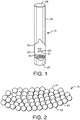
- Figures 1-4 depict liquid chromatography devices or components thereof having features of the present invention. These figures depict a column, shown in figure 1 , generally designated by the numeral 11; a frit, shown in figure 2 , generally designated by the numeral 13; and microfluidic devices, generally designated by the numerals 15 and 17, depicted in figures 3 and 4 .
- housing 21 is a cylindrical tube formed of at least one wall 25 and having a first end 27, a second end 29. Housing 21 may comprise cross-sectional shapes other than a circle, for example, rectangles, octagonal, and the like; however, such shapes are less conventional.
- the wall 25 has an interior surface 31 and an exterior surface 33.
- the interior surface 31 of wall 25 defines a chamber 35 for containing the media 23.
- the media 23 is a packed bed of particles, fibers, or a monolith structure.
- the first end 27 and second end 29 are generally similar in features. This paper will describe only the first end 27 as such details relate to the invention.
- the column 11 would normally comprise fittings for attachment to other conduits which have been omitted from the drawings for simplification.
- At least one of the housing 21, frit 13, media 23 or other components of the column or chromatography systems in general [not shown] are made of or have a coating of a polysilazane or polysilazane-like material.
- pump components and valves may be made of or be coated with a polysilazane or polysilazane-like material.
- FIG. 2 depicts frit 13 made with a polysilazane or polysilazane-like material, wherein the latter forms not part of the present invention.
- the frit 13 is a plug 41 of particles having interstitial spaces 43 through which fluids flow.
- the interstitial spaces 43 extend through the plug 41 to allow the flow of fluid through the frit 13 while substantially retaining the media 23 which is contained in the chamber 35.
- the particles have a underlying substrate 45, for example, without limitation , silica, or metal oxides.
- the particles bear a coating of a polysilazane or polysilazane-like material. This coating forms about the particles to form a plug of co-adhering particles.
- a polysilazane or polysilazane-like material This coating forms about the particles to form a plug of co-adhering particles.
- a microfluidic device 15 is depicted having a channel 51 for conveying fluids in a chromatography instrument [not shown].
- the channel 51 may further comprise detection sections [not shown], separation sections for performing chromatography [not shown], pumps [not shown], valves [not shown], connection sections [not shown] or any other component used in diagnostic or analytical equipment.
- the microfluidic device 15 is comprised of, or is made from, a polysilazane material.
- the material obviates problems associated with microfluidic devices made of materials which are not entirely inert.
- a microfluidic device 17 of similar design as the microfluidic device 15 of figure 3 is depicted.
- the microfluidic device 17 has a device substrate 61.
- some ceramic compositions are not stable at all hydrogen ion concentrations and solvents.
- LTCC Low Temperature Co-fired Ceramic
- Dupont 951 has a composition of: 48 wt% Al 2 O 3 , 31% SiO 2 , 0.03% TiO 2 , 1.99% B 2 O 3 , 0.03% BaO, 4.48% CaO, 0.86% K 2 O, 11.3% PbO.
- This material has excellent mechanical strength, and it is relatively easy to manufacture reproducibly. However, the material can adsorb various analytes and affect the chromatographic separation. Acidic mobile phases that are commonly employed in liquid chromatography are known to solubilize some of the heavy metals from the LTCC materials.
- a preferred substrate 61 is a ceramic such as LTCC materials.
- the microfluidic device 17 is depicted having a channel 63 for conveying fluids in a chromatography instrument [not shown].
- the channel 63 may further comprise detection sections [not shown], separation sections for performing chromatography [not shown], pumps [not shown], valves [not shown], connection sections [not shown] or any other component used in diagnostic or analytical equipment.
- the microfluidic device 17 has a layer 65 comprised of a polysilazane or a polysilazane-like material, wherein the latter forms not part of the present invention.
- the layer 65 is a cured polysilazane material.
- the layer 65 has at least one wetted surface 71 which is in direct contact with the fluids which flow through the device 17 by channel 63.
- the layer 65 seals the substrate 61 of microfluidic device 17 preventing the adsorption or absorption of analytes and preventing the leaching of metals into solutions flowing through channel 63.
- a silazane refers to a hydride of silicon and nitrogen.
- a polysilazane is a polymer of such a hydride of silicon and nitrogen.
- a preferred polysilazane has the formula of Formula 1 set forth below: -[A] x -[B] y - Formula 1
- A represents
- R 1 and R 2 independently represents alkyl, alkenyl, alkynyl, aromatic, amino alkyl, amino alkenyl, amino alkynyl, pyridinyl, pyrridonyl, and carbonyl, alcohol and carboxylic acid derivatives thereof having one to twenty five atoms, and hydroxyl, amino, amide, carboxyl, ester, carbonyl, sulfhydryl, sulfonyl, phosphoral, bromo, iodo, chloro and fluoro derivatives; the silane is covalently linked to the nitrogen and the vacant valence of the silane is to a further A or B or terminal hydrogen or hydroxyl group or alkyl, or trace co-reactants.
- B represents
- R 3 and R 4 independently represents hydrogen, alkyl, alkenyl, alkynyl, aromatic, amino alkyl, amino alkenyl, amino alkynyl, pyridinyl, pyrridonyl, and carbonyl, alcohol and carboxylic acid derivatives thereof having one to twenty five atoms, and hydroxyl, amino, amide, carboxyl, ester, carbonyl, sulfhydryl, sulfonyl, phosphoral, bromo, iodo, chloro and fluoro derivatives; the silane is covalently linked to the nitrogen and the vacant valence of the silane is to a further A or B or terminal hydrogen or hydroxyl group or alkyl, alkene or alkyne or trace co-reactants.
- W is represented by the formula -R 6 -Si-R 8 a - R 7 b .
- R 6 is as defined with respect to R 1 or R 2 .
- R 7 is hydrogen or C 1 -C 6 straight, cyclic or branched alkyl group.
- a preferred alkoxy group for R 8 is methoxy and a preferred alkyl for R 7 is methyl.
- X and Y represent relative amounts of A or B as decimals that together add to 1.0.
- a preferred silazane is represented by the polysilazane formula set forth below:
- Coatings, devices, components and apparatus made materials conforming generally to Formula 1 have R 1 , R 2 , R 3 and R 4 groups selected to be substantially inert.
- materials conforming generally to Formula 2 such as cured ceramics formed of such materials, are inert to typical chromatographic mobile phases, such as dilute acidic and basic aqueous solutions, and water miscible solvents, such as acetonitrile and methanol.
- Coatings, devices, components and apparatus made materials conforming generally to Formula 1 have R 1 , R 2 , R 3 and R 4 groups selected to exhibit non-porous wetted surfaces with low binding/low adsorption towards acidic, basic or hydrophobic analytes.
- Coatings, devices, components and apparatus made materials conforming generally to Formula 1 have R 1 , R 2 , R 3 and R 4 groups selected to exhibit resistance to cracking or shrinking upon curing.
- materials formed with Formula 2 do not shrink or swell in typical chromatographic solvents.
- the coatings preferrably have a thermal expansion coefficient similar to that of the bulk material that is being coated. Coatings, devices, components and apparatus are suitable for use at typical HPLC/UPLC operating temperatures and pressures of 15,000 psi.
- This example describes the making of a microfluidic device 17, depicted in figure 4 having a channel 63.
- the device has a LTCC substrate 61.
- the channel 63 will be coated with a layer 65 of a polysilazane to create a wetted surface 71.
- Channel 63 is coated filling the channel with liquid silazane hydrostatically, either by vacuum or pressure, followed by air or appropriate immiscible liquid.
- the solution can be first diluted with an appropriate solvent.
- Addition of a peroxide such as an organic peroxide can be used to reduce the curing temperature.
- Solvent can be driven off by initially heating to a temperature below the cure temperature. Curing can be achieved by increasing the temperature further to temperatures up to ⁇ 200C. An inert atmosphere may be preferred. In some instances, greater mechanical strength of the coating may be required. This can be achieved by addition of a filler material such as particles or fibers.
- the filler material may contain reactive groups on the surface that can polymerize with the pre-ceramic. Fillers may also be utilized to improve adhesion properties if the thermal expansion coefficient of the polysilazane differs substantially different from the LTCC material.
- the channel 63 having a layer 65 would be utilized as conduits or as regions where chromatographic sorbents would be filled and used as either trap columns or analytical columns. Or, in the alternative, the layer 65 would be placed on microfluidic sections used in detection, valve or fluid control, connections, and othe components.
- Example #2 Chromatographic frit fabrication.
- This example describes the fabrication of a frit by bonding particles held in a column or device.
- a channel of a microfluidic device is abutted to a porous frit, then packed with chromatographic particles hydrostatically using a slurry of packing media.
- the chip is disconnected from the frit, and a small amount of a polysilazane monomer solution is applied to the packed bed, in the manner of sodium silicate or PDMS solution and then cured.
- a microfluidic device such as a chip is made by creating a mold of the device and filling the mold with a monomer solution of silazanes and curing the silazane monomers to form a polysilazane substrate.
- a peroxide such as an organic peroxide can be used to reduce the curing temperature.
- Solvent can be driven off by initially heating to a temperature below the cure temperature. Curing can be achieved by increasing the temperature further to temperatures up to ⁇ 200C. In some instances, greater mechanical strength of the coating may be required. This can be achieved by addition of a filler material such as particles or fibers.
- the filler material may contain reactive groups on the surface that can polymerize with the pre-ceramic.
- the chips can be injection molded to the cured state. In this state, the pre-ceramic chips can be machined, laser cut, etc. Any electrical connections can be added to the pre-ceramic state chip. Two separate halves of the chip may be fabricated. The halves are then require aligned, and fired under pressure to fuse the halves together. A solution of liquid silazane may be utilized to improve bond strength. Microfluidic channel integrity may need to be maintained by addition of a sacrificial material that can be subsequently removed via solvent, heat, or other means. Bringing the material to the ceramic state (heating above 1200C) may be useful to further increase bond strength. Fillers may be used in the chip fabrication to further enhance mechanical strength. Alternatively, the ceramic may be housed within a hardened shell for further improvement in mechanical strength.
Landscapes
- Physics & Mathematics (AREA)
- Health & Medical Sciences (AREA)
- Life Sciences & Earth Sciences (AREA)
- Chemical & Material Sciences (AREA)
- Analytical Chemistry (AREA)
- Biochemistry (AREA)
- General Health & Medical Sciences (AREA)
- General Physics & Mathematics (AREA)
- Immunology (AREA)
- Pathology (AREA)
- Solid-Sorbent Or Filter-Aiding Compositions (AREA)
- Silicon Polymers (AREA)
- Physical Or Chemical Processes And Apparatus (AREA)
- Treatment Of Liquids With Adsorbents In General (AREA)
Claims (8)
- Vorrichtung zum Durchführen einer Flüssigkeitschromatographie mit zumindest einer benetzten Oberfläche mit einer Zusammensetzung aus einem Polysilan, wobei die benetzte Oberfläche Teil einer Fritte ist, die einen Stopfen von Partikeln umfasst, die mit gehärtetem Polysilazan beschichtet sind, wobei das gehärtete Polysilazan vernetzt, aber nicht mineralisiert oder kristallisiert ist.
- Vorrichtung nach Anspruch 1, wobei die benetzte Oberfläche eine Schicht aus der Zusammensetzung ist.
- Vorrichtung nach Anspruch 1, wobei die Vorrichtung aus der Zusammensetzung hergestellt ist.
- Vorrichtung nach Anspruch 1, wobei das Polysilazan die nachstehend angeführte Formel aufweist:
-[A]x-[B]y- Formel 1;
wie oben verwendet, A

- Vorrichtung nach Anspruch 1, wobei das Polysilazan eine nachstehend angeführte Formel aufweist:

- Verfahren zum Herstellen einer Vorrichtung zum Durchführen einer Flüssigkeitschromatographie mit zumindest einer benetzten Oberfläche, wobei die benetzte Oberfläche Teil einer Fritte ist, wobei das Verfahren umfasst:Bilden der Fritte durch Beschichten von Partikeln mit einer Zusammensetzung aus einem Polysilazan; undHärten der beschichteten Partikel bei einer Temperatur von bis zu 200 °C.
- Verfahren nach Anspruch 6, wobei das Polysilazan die nachstehend angeführte Formel aufweist:
-[A]x-[B]y- Formel 1;
wie oben verwendet, A

- Verfahren nach Anspruch 6, wobei das Polysilazan einer nachstehend angeführte Formel aufweist:

Applications Claiming Priority (2)
| Application Number | Priority Date | Filing Date | Title |
|---|---|---|---|
| US8184808P | 2008-07-18 | 2008-07-18 | |
| PCT/US2009/050845 WO2010009311A1 (en) | 2008-07-18 | 2009-07-16 | Devices having an inert surface and methods of making same |
Publications (3)
| Publication Number | Publication Date |
|---|---|
| EP2304423A1 EP2304423A1 (de) | 2011-04-06 |
| EP2304423A4 EP2304423A4 (de) | 2014-08-27 |
| EP2304423B1 true EP2304423B1 (de) | 2019-02-20 |
Family
ID=41550712
Family Applications (1)
| Application Number | Title | Priority Date | Filing Date |
|---|---|---|---|
| EP09798747.3A Active EP2304423B1 (de) | 2008-07-18 | 2009-07-16 | Vorrichtung mit einer trägen oberfläche und verfahren zu ihrer herstellung |
Country Status (4)
| Country | Link |
|---|---|
| US (1) | US20110259089A1 (de) |
| EP (1) | EP2304423B1 (de) |
| JP (2) | JP5723272B2 (de) |
| WO (1) | WO2010009311A1 (de) |
Families Citing this family (15)
| Publication number | Priority date | Publication date | Assignee | Title |
|---|---|---|---|---|
| WO2012039670A1 (en) * | 2010-09-24 | 2012-03-29 | Ge Healthcare Bio-Sciences Ab | Wetting of a plastic bed support for a chromatography column |
| US8796105B2 (en) * | 2012-07-25 | 2014-08-05 | Taiwan Semiconductor Manufacturing Company, Ltd. | Method and apparatus for preparing polysilazane on a semiconductor wafer |
| US20150024152A1 (en) | 2013-07-19 | 2015-01-22 | Agilent Technologies, Inc. | Metal components with inert vapor phase coating on internal surfaces |
| US10767259B2 (en) | 2013-07-19 | 2020-09-08 | Agilent Technologies, Inc. | Components with an atomic layer deposition coating and methods of producing the same |
| US9664598B2 (en) * | 2013-10-18 | 2017-05-30 | Agilent Technologies, Inc. | Microfluidic contaminant trap for trapping contaminants in gas chromatography |
| WO2016114850A1 (en) | 2015-01-14 | 2016-07-21 | Agilent Technologies, Inc. | Components with an atomic layer deposition coating and methods of producing the same |
| US12180581B2 (en) | 2017-09-18 | 2024-12-31 | Waters Technologies Corporation | Use of vapor deposition coated flow paths for improved chromatography of metal interacting analytes |
| US12181452B2 (en) | 2017-09-18 | 2024-12-31 | Waters Technologies Corporation | Use of vapor deposition coated flow paths for improved chromatography of metal interacting analytes |
| US11709155B2 (en) | 2017-09-18 | 2023-07-25 | Waters Technologies Corporation | Use of vapor deposition coated flow paths for improved chromatography of metal interacting analytes |
| US11709156B2 (en) | 2017-09-18 | 2023-07-25 | Waters Technologies Corporation | Use of vapor deposition coated flow paths for improved analytical analysis |
| US11959894B2 (en) * | 2018-02-23 | 2024-04-16 | Silcotek Corp | Liquid chromatography technique |
| CN113507972B (zh) * | 2019-02-27 | 2023-10-20 | 沃特世科技公司 | 用于色谱效应的经涂覆的流动路径部件 |
| CN113507971A (zh) * | 2019-02-27 | 2021-10-15 | 沃特世科技公司 | 用于最大程度减少分析物吸附的色谱密封件和经涂覆的流动路径 |
| US11918936B2 (en) | 2020-01-17 | 2024-03-05 | Waters Technologies Corporation | Performance and dynamic range for oligonucleotide bioanalysis through reduction of non specific binding |
| EP4628889A3 (de) | 2020-09-24 | 2025-12-10 | Waters Technologies Corporation | Verbesserungen der chromatographischen hardware zur trennung von reaktiven molekülen |
Citations (2)
| Publication number | Priority date | Publication date | Assignee | Title |
|---|---|---|---|---|
| US6329487B1 (en) * | 1999-11-12 | 2001-12-11 | Kion Corporation | Silazane and/or polysilazane compounds and methods of making |
| US6652978B2 (en) * | 2001-05-07 | 2003-11-25 | Kion Corporation | Thermally stable, moisture curable polysilazanes and polysiloxazanes |
Family Cites Families (6)
| Publication number | Priority date | Publication date | Assignee | Title |
|---|---|---|---|---|
| US5008422A (en) * | 1985-04-26 | 1991-04-16 | Sri International | Polysilazanes and related compositions, processes and uses |
| JP3691619B2 (ja) | 1997-01-20 | 2005-09-07 | ジーエルサイエンス株式会社 | 液体クロマトグラフィー用充填剤及びその処理方法 |
| US6638621B2 (en) * | 2000-08-16 | 2003-10-28 | Lyotropic Therapeutics, Inc. | Coated particles, methods of making and using |
| JP2004271522A (ja) * | 2003-02-18 | 2004-09-30 | Daiso Co Ltd | 液体クロマトグラフィー用充填剤、その製造方法および用途 |
| CA2945455C (en) * | 2003-11-20 | 2019-11-26 | Sigma-Aldrich Co. Llc | Polysilazane thermosetting polymers for use in chromatographic systems and applications |
| JP4965953B2 (ja) * | 2006-09-29 | 2012-07-04 | 株式会社東芝 | ポリシラザンまたはポリシラザン溶液の取り扱い方法、ポリシラザン溶液、半導体装置の製造方法 |
-
2009
- 2009-07-16 EP EP09798747.3A patent/EP2304423B1/de active Active
- 2009-07-16 WO PCT/US2009/050845 patent/WO2010009311A1/en not_active Ceased
- 2009-07-16 JP JP2011518911A patent/JP5723272B2/ja not_active Expired - Fee Related
- 2009-07-16 US US13/054,195 patent/US20110259089A1/en not_active Abandoned
-
2014
- 2014-12-25 JP JP2014261778A patent/JP2015096863A/ja not_active Withdrawn
Patent Citations (2)
| Publication number | Priority date | Publication date | Assignee | Title |
|---|---|---|---|---|
| US6329487B1 (en) * | 1999-11-12 | 2001-12-11 | Kion Corporation | Silazane and/or polysilazane compounds and methods of making |
| US6652978B2 (en) * | 2001-05-07 | 2003-11-25 | Kion Corporation | Thermally stable, moisture curable polysilazanes and polysiloxazanes |
Also Published As
| Publication number | Publication date |
|---|---|
| US20110259089A1 (en) | 2011-10-27 |
| JP2015096863A (ja) | 2015-05-21 |
| EP2304423A4 (de) | 2014-08-27 |
| JP2011528787A (ja) | 2011-11-24 |
| JP5723272B2 (ja) | 2015-05-27 |
| EP2304423A1 (de) | 2011-04-06 |
| WO2010009311A1 (en) | 2010-01-21 |
Similar Documents
| Publication | Publication Date | Title |
|---|---|---|
| US20110259089A1 (en) | Devices Having An Inert Surface And Methods Of Making Same | |
| US6210570B1 (en) | Monolithic silica column | |
| US7381471B2 (en) | Hybrid polymers for functional tuning of microfluidic device surfaces | |
| CA2581627C (en) | Ph stable chromatographic media using templated multilayer organic/inorganic grafting | |
| EP2011778B1 (de) | Keramischer Verbundstoffkörper, Herstellungsverfahren dafür und keramische Filteranordnung | |
| EP1066513B1 (de) | Kapillarsäulen | |
| AU765881B2 (en) | Capillary column and method of making | |
| US20100112208A1 (en) | Titania-Based Coating for Capillary Microextraction | |
| US6998040B2 (en) | Sol-gel open tubular ODS columns with charged inner surface for capillary electrochromatography | |
| Fujimoto | Preparation of fritless packed silica columns for capillary electrochromatography | |
| WO2009096044A1 (ja) | シリカモノリス体クラッド方法及び分離媒体 | |
| US8603833B2 (en) | Germania-silica-based sol-gel monolith and uses thereof | |
| CN103589387A (zh) | Led用高强度粘接性室温固化有机硅灌封胶及其制备方法 | |
| EP2703810B1 (de) | Integrierte Teilchenfallen für kapillare PLOT-Säulen | |
| Li et al. | Layer-by-layer self-assembly of polydopamine/gold nanoparticle/thiol coating as the stationary phase for open tubular capillary electrochromatography | |
| EP2152403B1 (de) | Trennmedien und vorrichtung | |
| JP2013510290A (ja) | ウェハ面上に製造された液体クロマトグラフィー用のチップ並びにその製造方法 | |
| Marshall et al. | Investigations into the preparation of glass open-tube gas chromatography columns | |
| US20060175238A1 (en) | Deactivated surfaces for chromatographic separations and methods of making and using the same | |
| JP5977889B2 (ja) | モノリス多孔体カラム | |
| Frolova et al. | Producing of monolithic layers of silica for thin-layer chromatography by sol-gel synthesis | |
| US20100151256A1 (en) | Method for Producing a Component from a Fiber Reinforced Ceramic, in particular, for Use as a Power Plant Component | |
| Muskovin | Research and development of optically transparent join with low processing temperatures | |
| VERZELE et al. | Laboratory of Organic Chemistry, State University of Ghent, Krijgslaan, 281 (S. 4), B-9000 GENT (Belgium) | |
| US20090324807A1 (en) | Method for forming a porous material |
Legal Events
| Date | Code | Title | Description |
|---|---|---|---|
| PUAI | Public reference made under article 153(3) epc to a published international application that has entered the european phase |
Free format text: ORIGINAL CODE: 0009012 |
|
| 17P | Request for examination filed |
Effective date: 20110117 |
|
| AK | Designated contracting states |
Kind code of ref document: A1 Designated state(s): AT BE BG CH CY CZ DE DK EE ES FI FR GB GR HR HU IE IS IT LI LT LU LV MC MK MT NL NO PL PT RO SE SI SK SM TR |
|
| AX | Request for extension of the european patent |
Extension state: AL BA RS |
|
| DAX | Request for extension of the european patent (deleted) | ||
| A4 | Supplementary search report drawn up and despatched |
Effective date: 20140725 |
|
| RIC1 | Information provided on ipc code assigned before grant |
Ipc: G01N 30/02 20060101AFI20140721BHEP |
|
| 17Q | First examination report despatched |
Effective date: 20160603 |
|
| STAA | Information on the status of an ep patent application or granted ep patent |
Free format text: STATUS: EXAMINATION IS IN PROGRESS |
|
| GRAP | Despatch of communication of intention to grant a patent |
Free format text: ORIGINAL CODE: EPIDOSNIGR1 |
|
| STAA | Information on the status of an ep patent application or granted ep patent |
Free format text: STATUS: GRANT OF PATENT IS INTENDED |
|
| INTG | Intention to grant announced |
Effective date: 20170922 |
|
| GRAJ | Information related to disapproval of communication of intention to grant by the applicant or resumption of examination proceedings by the epo deleted |
Free format text: ORIGINAL CODE: EPIDOSDIGR1 |
|
| STAA | Information on the status of an ep patent application or granted ep patent |
Free format text: STATUS: EXAMINATION IS IN PROGRESS |
|
| INTC | Intention to grant announced (deleted) | ||
| GRAP | Despatch of communication of intention to grant a patent |
Free format text: ORIGINAL CODE: EPIDOSNIGR1 |
|
| STAA | Information on the status of an ep patent application or granted ep patent |
Free format text: STATUS: GRANT OF PATENT IS INTENDED |
|
| INTG | Intention to grant announced |
Effective date: 20180913 |
|
| GRAS | Grant fee paid |
Free format text: ORIGINAL CODE: EPIDOSNIGR3 |
|
| GRAA | (expected) grant |
Free format text: ORIGINAL CODE: 0009210 |
|
| STAA | Information on the status of an ep patent application or granted ep patent |
Free format text: STATUS: THE PATENT HAS BEEN GRANTED |
|
| AK | Designated contracting states |
Kind code of ref document: B1 Designated state(s): AT BE BG CH CY CZ DE DK EE ES FI FR GB GR HR HU IE IS IT LI LT LU LV MC MK MT NL NO PL PT RO SE SI SK SM TR |
|
| REG | Reference to a national code |
Ref country code: GB Ref legal event code: FG4D |
|
| REG | Reference to a national code |
Ref country code: CH Ref legal event code: EP |
|
| REG | Reference to a national code |
Ref country code: DE Ref legal event code: R096 Ref document number: 602009057085 Country of ref document: DE |
|
| REG | Reference to a national code |
Ref country code: AT Ref legal event code: REF Ref document number: 1098878 Country of ref document: AT Kind code of ref document: T Effective date: 20190315 |
|
| REG | Reference to a national code |
Ref country code: IE Ref legal event code: FG4D |
|
| REG | Reference to a national code |
Ref country code: LT Ref legal event code: MG4D |
|
| REG | Reference to a national code |
Ref country code: NL Ref legal event code: MP Effective date: 20190220 |
|
| PG25 | Lapsed in a contracting state [announced via postgrant information from national office to epo] |
Ref country code: NO Free format text: LAPSE BECAUSE OF FAILURE TO SUBMIT A TRANSLATION OF THE DESCRIPTION OR TO PAY THE FEE WITHIN THE PRESCRIBED TIME-LIMIT Effective date: 20190520 Ref country code: LT Free format text: LAPSE BECAUSE OF FAILURE TO SUBMIT A TRANSLATION OF THE DESCRIPTION OR TO PAY THE FEE WITHIN THE PRESCRIBED TIME-LIMIT Effective date: 20190220 Ref country code: SE Free format text: LAPSE BECAUSE OF FAILURE TO SUBMIT A TRANSLATION OF THE DESCRIPTION OR TO PAY THE FEE WITHIN THE PRESCRIBED TIME-LIMIT Effective date: 20190220 Ref country code: PT Free format text: LAPSE BECAUSE OF FAILURE TO SUBMIT A TRANSLATION OF THE DESCRIPTION OR TO PAY THE FEE WITHIN THE PRESCRIBED TIME-LIMIT Effective date: 20190620 Ref country code: FI Free format text: LAPSE BECAUSE OF FAILURE TO SUBMIT A TRANSLATION OF THE DESCRIPTION OR TO PAY THE FEE WITHIN THE PRESCRIBED TIME-LIMIT Effective date: 20190220 |
|
| PG25 | Lapsed in a contracting state [announced via postgrant information from national office to epo] |
Ref country code: HR Free format text: LAPSE BECAUSE OF FAILURE TO SUBMIT A TRANSLATION OF THE DESCRIPTION OR TO PAY THE FEE WITHIN THE PRESCRIBED TIME-LIMIT Effective date: 20190220 Ref country code: NL Free format text: LAPSE BECAUSE OF FAILURE TO SUBMIT A TRANSLATION OF THE DESCRIPTION OR TO PAY THE FEE WITHIN THE PRESCRIBED TIME-LIMIT Effective date: 20190220 Ref country code: LV Free format text: LAPSE BECAUSE OF FAILURE TO SUBMIT A TRANSLATION OF THE DESCRIPTION OR TO PAY THE FEE WITHIN THE PRESCRIBED TIME-LIMIT Effective date: 20190220 Ref country code: BG Free format text: LAPSE BECAUSE OF FAILURE TO SUBMIT A TRANSLATION OF THE DESCRIPTION OR TO PAY THE FEE WITHIN THE PRESCRIBED TIME-LIMIT Effective date: 20190520 Ref country code: IS Free format text: LAPSE BECAUSE OF FAILURE TO SUBMIT A TRANSLATION OF THE DESCRIPTION OR TO PAY THE FEE WITHIN THE PRESCRIBED TIME-LIMIT Effective date: 20190620 Ref country code: GR Free format text: LAPSE BECAUSE OF FAILURE TO SUBMIT A TRANSLATION OF THE DESCRIPTION OR TO PAY THE FEE WITHIN THE PRESCRIBED TIME-LIMIT Effective date: 20190521 |
|
| REG | Reference to a national code |
Ref country code: AT Ref legal event code: MK05 Ref document number: 1098878 Country of ref document: AT Kind code of ref document: T Effective date: 20190220 |
|
| PG25 | Lapsed in a contracting state [announced via postgrant information from national office to epo] |
Ref country code: EE Free format text: LAPSE BECAUSE OF FAILURE TO SUBMIT A TRANSLATION OF THE DESCRIPTION OR TO PAY THE FEE WITHIN THE PRESCRIBED TIME-LIMIT Effective date: 20190220 Ref country code: DK Free format text: LAPSE BECAUSE OF FAILURE TO SUBMIT A TRANSLATION OF THE DESCRIPTION OR TO PAY THE FEE WITHIN THE PRESCRIBED TIME-LIMIT Effective date: 20190220 Ref country code: SK Free format text: LAPSE BECAUSE OF FAILURE TO SUBMIT A TRANSLATION OF THE DESCRIPTION OR TO PAY THE FEE WITHIN THE PRESCRIBED TIME-LIMIT Effective date: 20190220 Ref country code: ES Free format text: LAPSE BECAUSE OF FAILURE TO SUBMIT A TRANSLATION OF THE DESCRIPTION OR TO PAY THE FEE WITHIN THE PRESCRIBED TIME-LIMIT Effective date: 20190220 Ref country code: RO Free format text: LAPSE BECAUSE OF FAILURE TO SUBMIT A TRANSLATION OF THE DESCRIPTION OR TO PAY THE FEE WITHIN THE PRESCRIBED TIME-LIMIT Effective date: 20190220 Ref country code: IT Free format text: LAPSE BECAUSE OF FAILURE TO SUBMIT A TRANSLATION OF THE DESCRIPTION OR TO PAY THE FEE WITHIN THE PRESCRIBED TIME-LIMIT Effective date: 20190220 Ref country code: CZ Free format text: LAPSE BECAUSE OF FAILURE TO SUBMIT A TRANSLATION OF THE DESCRIPTION OR TO PAY THE FEE WITHIN THE PRESCRIBED TIME-LIMIT Effective date: 20190220 |
|
| REG | Reference to a national code |
Ref country code: DE Ref legal event code: R097 Ref document number: 602009057085 Country of ref document: DE |
|
| PG25 | Lapsed in a contracting state [announced via postgrant information from national office to epo] |
Ref country code: SM Free format text: LAPSE BECAUSE OF FAILURE TO SUBMIT A TRANSLATION OF THE DESCRIPTION OR TO PAY THE FEE WITHIN THE PRESCRIBED TIME-LIMIT Effective date: 20190220 Ref country code: PL Free format text: LAPSE BECAUSE OF FAILURE TO SUBMIT A TRANSLATION OF THE DESCRIPTION OR TO PAY THE FEE WITHIN THE PRESCRIBED TIME-LIMIT Effective date: 20190220 |
|
| PLBE | No opposition filed within time limit |
Free format text: ORIGINAL CODE: 0009261 |
|
| STAA | Information on the status of an ep patent application or granted ep patent |
Free format text: STATUS: NO OPPOSITION FILED WITHIN TIME LIMIT |
|
| PG25 | Lapsed in a contracting state [announced via postgrant information from national office to epo] |
Ref country code: AT Free format text: LAPSE BECAUSE OF FAILURE TO SUBMIT A TRANSLATION OF THE DESCRIPTION OR TO PAY THE FEE WITHIN THE PRESCRIBED TIME-LIMIT Effective date: 20190220 |
|
| 26N | No opposition filed |
Effective date: 20191121 |
|
| PG25 | Lapsed in a contracting state [announced via postgrant information from national office to epo] |
Ref country code: MC Free format text: LAPSE BECAUSE OF FAILURE TO SUBMIT A TRANSLATION OF THE DESCRIPTION OR TO PAY THE FEE WITHIN THE PRESCRIBED TIME-LIMIT Effective date: 20190220 Ref country code: SI Free format text: LAPSE BECAUSE OF FAILURE TO SUBMIT A TRANSLATION OF THE DESCRIPTION OR TO PAY THE FEE WITHIN THE PRESCRIBED TIME-LIMIT Effective date: 20190220 |
|
| REG | Reference to a national code |
Ref country code: CH Ref legal event code: PL |
|
| PG25 | Lapsed in a contracting state [announced via postgrant information from national office to epo] |
Ref country code: TR Free format text: LAPSE BECAUSE OF FAILURE TO SUBMIT A TRANSLATION OF THE DESCRIPTION OR TO PAY THE FEE WITHIN THE PRESCRIBED TIME-LIMIT Effective date: 20190220 |
|
| REG | Reference to a national code |
Ref country code: BE Ref legal event code: MM Effective date: 20190731 |
|
| PG25 | Lapsed in a contracting state [announced via postgrant information from national office to epo] |
Ref country code: LU Free format text: LAPSE BECAUSE OF NON-PAYMENT OF DUE FEES Effective date: 20190716 Ref country code: CH Free format text: LAPSE BECAUSE OF NON-PAYMENT OF DUE FEES Effective date: 20190731 Ref country code: BE Free format text: LAPSE BECAUSE OF NON-PAYMENT OF DUE FEES Effective date: 20190731 Ref country code: LI Free format text: LAPSE BECAUSE OF NON-PAYMENT OF DUE FEES Effective date: 20190731 |
|
| PG25 | Lapsed in a contracting state [announced via postgrant information from national office to epo] |
Ref country code: FR Free format text: LAPSE BECAUSE OF NON-PAYMENT OF DUE FEES Effective date: 20190731 |
|
| PG25 | Lapsed in a contracting state [announced via postgrant information from national office to epo] |
Ref country code: IE Free format text: LAPSE BECAUSE OF NON-PAYMENT OF DUE FEES Effective date: 20190716 |
|
| PG25 | Lapsed in a contracting state [announced via postgrant information from national office to epo] |
Ref country code: CY Free format text: LAPSE BECAUSE OF FAILURE TO SUBMIT A TRANSLATION OF THE DESCRIPTION OR TO PAY THE FEE WITHIN THE PRESCRIBED TIME-LIMIT Effective date: 20190220 |
|
| PG25 | Lapsed in a contracting state [announced via postgrant information from national office to epo] |
Ref country code: HU Free format text: LAPSE BECAUSE OF FAILURE TO SUBMIT A TRANSLATION OF THE DESCRIPTION OR TO PAY THE FEE WITHIN THE PRESCRIBED TIME-LIMIT; INVALID AB INITIO Effective date: 20090716 Ref country code: MT Free format text: LAPSE BECAUSE OF FAILURE TO SUBMIT A TRANSLATION OF THE DESCRIPTION OR TO PAY THE FEE WITHIN THE PRESCRIBED TIME-LIMIT Effective date: 20190220 |
|
| PG25 | Lapsed in a contracting state [announced via postgrant information from national office to epo] |
Ref country code: MK Free format text: LAPSE BECAUSE OF FAILURE TO SUBMIT A TRANSLATION OF THE DESCRIPTION OR TO PAY THE FEE WITHIN THE PRESCRIBED TIME-LIMIT Effective date: 20190220 |
|
| REG | Reference to a national code |
Ref country code: DE Ref legal event code: R082 Ref document number: 602009057085 Country of ref document: DE Representative=s name: FORRESTERS IP LLP, DE Ref country code: DE Ref legal event code: R082 Ref document number: 602009057085 Country of ref document: DE Representative=s name: KUEHR, VERA, DIPL.-BIOL., DE |
|
| P01 | Opt-out of the competence of the unified patent court (upc) registered |
Effective date: 20230612 |
|
| REG | Reference to a national code |
Ref country code: DE Ref legal event code: R082 Ref document number: 602009057085 Country of ref document: DE Representative=s name: FORRESTERS IP LLP, DE |
|
| PGFP | Annual fee paid to national office [announced via postgrant information from national office to epo] |
Ref country code: GB Payment date: 20250619 Year of fee payment: 17 |
|
| PGFP | Annual fee paid to national office [announced via postgrant information from national office to epo] |
Ref country code: DE Payment date: 20250620 Year of fee payment: 17 |