EP2305768B1 - Compositions photochromes, résines et articles obtenus à partir de ceux-ci - Google Patents
Compositions photochromes, résines et articles obtenus à partir de ceux-ci Download PDFInfo
- Publication number
- EP2305768B1 EP2305768B1 EP10177731.6A EP10177731A EP2305768B1 EP 2305768 B1 EP2305768 B1 EP 2305768B1 EP 10177731 A EP10177731 A EP 10177731A EP 2305768 B1 EP2305768 B1 EP 2305768B1
- Authority
- EP
- European Patent Office
- Prior art keywords
- group
- carbon atoms
- formula
- linear
- composition
- Prior art date
- Legal status (The legal status is an assumption and is not a legal conclusion. Google has not performed a legal analysis and makes no representation as to the accuracy of the status listed.)
- Not-in-force
Links
- 239000000203 mixture Substances 0.000 title claims description 162
- 239000011347 resin Substances 0.000 title claims description 51
- 229920005989 resin Polymers 0.000 title claims description 51
- 150000001875 compounds Chemical class 0.000 claims description 97
- 125000004432 carbon atom Chemical group C* 0.000 claims description 57
- 125000003118 aryl group Chemical group 0.000 claims description 37
- 125000000217 alkyl group Chemical group 0.000 claims description 36
- IJGRMHOSHXDMSA-UHFFFAOYSA-N Atomic nitrogen Chemical group N#N IJGRMHOSHXDMSA-UHFFFAOYSA-N 0.000 claims description 24
- 125000001072 heteroaryl group Chemical group 0.000 claims description 22
- 125000001424 substituent group Chemical group 0.000 claims description 21
- 125000003545 alkoxy group Chemical group 0.000 claims description 20
- -1 naphthoxy group Chemical group 0.000 claims description 19
- 229910052717 sulfur Inorganic materials 0.000 claims description 16
- NINIDFKCEFEMDL-UHFFFAOYSA-N Sulfur Chemical group [S] NINIDFKCEFEMDL-UHFFFAOYSA-N 0.000 claims description 15
- 239000011593 sulfur Substances 0.000 claims description 15
- MYRTYDVEIRVNKP-UHFFFAOYSA-N 1,2-Divinylbenzene Chemical compound C=CC1=CC=CC=C1C=C MYRTYDVEIRVNKP-UHFFFAOYSA-N 0.000 claims description 14
- 229910052757 nitrogen Chemical group 0.000 claims description 14
- 125000001997 phenyl group Chemical group [H]C1=C([H])C([H])=C(*)C([H])=C1[H] 0.000 claims description 14
- 125000000753 cycloalkyl group Chemical group 0.000 claims description 12
- QVGXLLKOCUKJST-UHFFFAOYSA-N atomic oxygen Chemical group [O] QVGXLLKOCUKJST-UHFFFAOYSA-N 0.000 claims description 10
- 125000005842 heteroatom Chemical group 0.000 claims description 10
- 229910052760 oxygen Inorganic materials 0.000 claims description 10
- 239000001301 oxygen Chemical group 0.000 claims description 10
- 238000006116 polymerization reaction Methods 0.000 claims description 9
- PPBRXRYQALVLMV-UHFFFAOYSA-N Styrene Chemical compound C=CC1=CC=CC=C1 PPBRXRYQALVLMV-UHFFFAOYSA-N 0.000 claims description 8
- 229910052799 carbon Inorganic materials 0.000 claims description 8
- VCMLCMCXCRBSQO-UHFFFAOYSA-N 3h-benzo[f]chromene Chemical group C1=CC=CC2=C(C=CCO3)C3=CC=C21 VCMLCMCXCRBSQO-UHFFFAOYSA-N 0.000 claims description 7
- OKTJSMMVPCPJKN-UHFFFAOYSA-N Carbon Chemical compound [C] OKTJSMMVPCPJKN-UHFFFAOYSA-N 0.000 claims description 7
- 150000001412 amines Chemical class 0.000 claims description 6
- KZTYYGOKRVBIMI-UHFFFAOYSA-N diphenyl sulfone Chemical compound C=1C=CC=CC=1S(=O)(=O)C1=CC=CC=C1 KZTYYGOKRVBIMI-UHFFFAOYSA-N 0.000 claims description 6
- 125000001188 haloalkyl group Chemical group 0.000 claims description 6
- 229910052736 halogen Inorganic materials 0.000 claims description 6
- 125000005843 halogen group Chemical group 0.000 claims description 6
- 150000002367 halogens Chemical class 0.000 claims description 6
- 125000000951 phenoxy group Chemical group [H]C1=C([H])C([H])=C(O*)C([H])=C1[H] 0.000 claims description 6
- 229920001223 polyethylene glycol Polymers 0.000 claims description 5
- 239000002202 Polyethylene glycol Substances 0.000 claims description 4
- 125000003277 amino group Chemical group 0.000 claims description 4
- 125000003710 aryl alkyl group Chemical group 0.000 claims description 4
- 125000001797 benzyl group Chemical group [H]C1=C([H])C([H])=C(C([H])=C1[H])C([H])([H])* 0.000 claims description 4
- 150000008371 chromenes Chemical class 0.000 claims description 4
- 125000004122 cyclic group Chemical group 0.000 claims description 4
- 125000004438 haloalkoxy group Chemical group 0.000 claims description 4
- 125000004475 heteroaralkyl group Chemical group 0.000 claims description 4
- 125000003647 acryloyl group Chemical group O=C([*])C([H])=C([H])[H] 0.000 claims description 3
- 229920005862 polyol Polymers 0.000 claims description 3
- 150000003077 polyols Chemical class 0.000 claims description 3
- 125000004400 (C1-C12) alkyl group Chemical group 0.000 claims description 2
- UGFAIRIUMAVXCW-UHFFFAOYSA-N Carbon monoxide Chemical compound [O+]#[C-] UGFAIRIUMAVXCW-UHFFFAOYSA-N 0.000 claims description 2
- 125000005073 adamantyl group Chemical group C12(CC3CC(CC(C1)C3)C2)* 0.000 claims description 2
- 125000003342 alkenyl group Chemical group 0.000 claims description 2
- 125000003368 amide group Chemical group 0.000 claims description 2
- 125000002915 carbonyl group Chemical group [*:2]C([*:1])=O 0.000 claims description 2
- LJJQENSFXLXPIV-UHFFFAOYSA-N fluorenylidene Chemical group C1=CC=C2[C]C3=CC=CC=C3C2=C1 LJJQENSFXLXPIV-UHFFFAOYSA-N 0.000 claims description 2
- 125000005347 halocycloalkyl group Chemical group 0.000 claims description 2
- 125000002887 hydroxy group Chemical group [H]O* 0.000 claims description 2
- 125000002816 methylsulfanyl group Chemical group [H]C([H])([H])S[*] 0.000 claims description 2
- 125000004433 nitrogen atom Chemical group N* 0.000 claims description 2
- 125000006574 non-aromatic ring group Chemical group 0.000 claims description 2
- 125000002868 norbornyl group Chemical group C12(CCC(CC1)C2)* 0.000 claims description 2
- 125000003003 spiro group Chemical group 0.000 claims description 2
- LMBFAGIMSUYTBN-MPZNNTNKSA-N teixobactin Chemical compound C([C@H](C(=O)N[C@@H]([C@@H](C)CC)C(=O)N[C@@H](CO)C(=O)N[C@H](CCC(N)=O)C(=O)N[C@H]([C@@H](C)CC)C(=O)N[C@@H]([C@@H](C)CC)C(=O)N[C@@H](CO)C(=O)N[C@H]1C(N[C@@H](C)C(=O)N[C@@H](C[C@@H]2NC(=N)NC2)C(=O)N[C@H](C(=O)O[C@H]1C)[C@@H](C)CC)=O)NC)C1=CC=CC=C1 LMBFAGIMSUYTBN-MPZNNTNKSA-N 0.000 claims 1
- 239000000178 monomer Substances 0.000 description 35
- NIXOWILDQLNWCW-UHFFFAOYSA-M Acrylate Chemical compound [O-]C(=O)C=C NIXOWILDQLNWCW-UHFFFAOYSA-M 0.000 description 20
- 230000000052 comparative effect Effects 0.000 description 13
- 239000003795 chemical substances by application Substances 0.000 description 11
- 230000007423 decrease Effects 0.000 description 11
- 230000005540 biological transmission Effects 0.000 description 10
- 230000003287 optical effect Effects 0.000 description 9
- 239000000463 material Substances 0.000 description 8
- 229920000642 polymer Polymers 0.000 description 8
- 238000000034 method Methods 0.000 description 7
- 239000003505 polymerization initiator Substances 0.000 description 7
- 150000003254 radicals Chemical class 0.000 description 7
- AVTLBBWTUPQRAY-UHFFFAOYSA-N 2-(2-cyanobutan-2-yldiazenyl)-2-methylbutanenitrile Chemical compound CCC(C)(C#N)N=NC(C)(CC)C#N AVTLBBWTUPQRAY-UHFFFAOYSA-N 0.000 description 5
- 239000003963 antioxidant agent Substances 0.000 description 5
- IISBACLAFKSPIT-UHFFFAOYSA-N bisphenol A Chemical compound C=1C=C(O)C=CC=1C(C)(C)C1=CC=C(O)C=C1 IISBACLAFKSPIT-UHFFFAOYSA-N 0.000 description 5
- 230000008859 change Effects 0.000 description 5
- 238000005259 measurement Methods 0.000 description 5
- WXZMFSXDPGVJKK-UHFFFAOYSA-N pentaerythritol Chemical compound OCC(CO)(CO)CO WXZMFSXDPGVJKK-UHFFFAOYSA-N 0.000 description 5
- OZAIFHULBGXAKX-UHFFFAOYSA-N 2-(2-cyanopropan-2-yldiazenyl)-2-methylpropanenitrile Chemical compound N#CC(C)(C)N=NC(C)(C)C#N OZAIFHULBGXAKX-UHFFFAOYSA-N 0.000 description 4
- WKBOTKDWSSQWDR-UHFFFAOYSA-N Bromine atom Chemical compound [Br] WKBOTKDWSSQWDR-UHFFFAOYSA-N 0.000 description 4
- ZAMOUSCENKQFHK-UHFFFAOYSA-N Chlorine atom Chemical compound [Cl] ZAMOUSCENKQFHK-UHFFFAOYSA-N 0.000 description 4
- PXGOKWXKJXAPGV-UHFFFAOYSA-N Fluorine Chemical compound FF PXGOKWXKJXAPGV-UHFFFAOYSA-N 0.000 description 4
- ZJCCRDAZUWHFQH-UHFFFAOYSA-N Trimethylolpropane Chemical compound CCC(CO)(CO)CO ZJCCRDAZUWHFQH-UHFFFAOYSA-N 0.000 description 4
- 239000006096 absorbing agent Substances 0.000 description 4
- GDTBXPJZTBHREO-UHFFFAOYSA-N bromine Substances BrBr GDTBXPJZTBHREO-UHFFFAOYSA-N 0.000 description 4
- 229910052794 bromium Inorganic materials 0.000 description 4
- 229910052801 chlorine Inorganic materials 0.000 description 4
- 239000000460 chlorine Substances 0.000 description 4
- 230000003247 decreasing effect Effects 0.000 description 4
- 238000005562 fading Methods 0.000 description 4
- 238000001914 filtration Methods 0.000 description 4
- 229910052731 fluorine Inorganic materials 0.000 description 4
- 239000011737 fluorine Substances 0.000 description 4
- 239000011521 glass Substances 0.000 description 4
- 239000011159 matrix material Substances 0.000 description 4
- 239000011368 organic material Substances 0.000 description 4
- 239000004033 plastic Substances 0.000 description 4
- 229920003023 plastic Polymers 0.000 description 4
- 239000002904 solvent Substances 0.000 description 4
- 125000006850 spacer group Chemical group 0.000 description 4
- 239000000126 substance Substances 0.000 description 4
- 102100040409 Ameloblastin Human genes 0.000 description 3
- PEDCQBHIVMGVHV-UHFFFAOYSA-N Glycerine Chemical compound OCC(O)CO PEDCQBHIVMGVHV-UHFFFAOYSA-N 0.000 description 3
- 101000891247 Homo sapiens Ameloblastin Proteins 0.000 description 3
- 238000002845 discoloration Methods 0.000 description 3
- 230000000694 effects Effects 0.000 description 3
- 238000004519 manufacturing process Methods 0.000 description 3
- 229940059574 pentaerithrityl Drugs 0.000 description 3
- 238000011179 visual inspection Methods 0.000 description 3
- DAAYLFXOWCKUHD-UHFFFAOYSA-N C(C[IH]1)c2cccc3c2c1ccc3 Chemical compound C(C[IH]1)c2cccc3c2c1ccc3 DAAYLFXOWCKUHD-UHFFFAOYSA-N 0.000 description 2
- RTZKZFJDLAIYFH-UHFFFAOYSA-N Diethyl ether Chemical compound CCOCC RTZKZFJDLAIYFH-UHFFFAOYSA-N 0.000 description 2
- CPELXLSAUQHCOX-UHFFFAOYSA-N Hydrogen bromide Chemical group Br CPELXLSAUQHCOX-UHFFFAOYSA-N 0.000 description 2
- 238000010521 absorption reaction Methods 0.000 description 2
- 238000000862 absorption spectrum Methods 0.000 description 2
- NIXOWILDQLNWCW-UHFFFAOYSA-N acrylic acid group Chemical group C(C=C)(=O)O NIXOWILDQLNWCW-UHFFFAOYSA-N 0.000 description 2
- 230000008901 benefit Effects 0.000 description 2
- 230000015572 biosynthetic process Effects 0.000 description 2
- PXKLMJQFEQBVLD-UHFFFAOYSA-N bisphenol F Chemical compound C1=CC(O)=CC=C1CC1=CC=C(O)C=C1 PXKLMJQFEQBVLD-UHFFFAOYSA-N 0.000 description 2
- 238000005266 casting Methods 0.000 description 2
- QZHPTGXQGDFGEN-UHFFFAOYSA-N chromene Chemical compound C1=CC=C2C=C[CH]OC2=C1 QZHPTGXQGDFGEN-UHFFFAOYSA-N 0.000 description 2
- 229920001577 copolymer Polymers 0.000 description 2
- 238000004132 cross linking Methods 0.000 description 2
- 150000008049 diazo compounds Chemical class 0.000 description 2
- 125000003709 fluoroalkyl group Chemical group 0.000 description 2
- 229910052740 iodine Inorganic materials 0.000 description 2
- 239000004611 light stabiliser Substances 0.000 description 2
- 230000002441 reversible effect Effects 0.000 description 2
- MWNQXXOSWHCCOZ-UHFFFAOYSA-L sodium;oxido carbonate Chemical class [Na+].[O-]OC([O-])=O MWNQXXOSWHCCOZ-UHFFFAOYSA-L 0.000 description 2
- 239000007787 solid Substances 0.000 description 2
- 238000001228 spectrum Methods 0.000 description 2
- 150000003457 sulfones Chemical group 0.000 description 2
- 238000012546 transfer Methods 0.000 description 2
- FVQMJJQUGGVLEP-UHFFFAOYSA-N (2-methylpropan-2-yl)oxy 2-ethylhexaneperoxoate Chemical compound CCCCC(CC)C(=O)OOOC(C)(C)C FVQMJJQUGGVLEP-UHFFFAOYSA-N 0.000 description 1
- QEQBMZQFDDDTPN-UHFFFAOYSA-N (2-methylpropan-2-yl)oxy benzenecarboperoxoate Chemical compound CC(C)(C)OOOC(=O)C1=CC=CC=C1 QEQBMZQFDDDTPN-UHFFFAOYSA-N 0.000 description 1
- BEQKKZICTDFVMG-UHFFFAOYSA-N 1,2,3,4,6-pentaoxepane-5,7-dione Chemical compound O=C1OOOOC(=O)O1 BEQKKZICTDFVMG-UHFFFAOYSA-N 0.000 description 1
- HIACAHMKXQESOV-UHFFFAOYSA-N 1,2-bis(prop-1-en-2-yl)benzene Chemical compound CC(=C)C1=CC=CC=C1C(C)=C HIACAHMKXQESOV-UHFFFAOYSA-N 0.000 description 1
- YIJYFLXQHDOQGW-UHFFFAOYSA-N 2-[2,4,6-trioxo-3,5-bis(2-prop-2-enoyloxyethyl)-1,3,5-triazinan-1-yl]ethyl prop-2-enoate Chemical compound C=CC(=O)OCCN1C(=O)N(CCOC(=O)C=C)C(=O)N(CCOC(=O)C=C)C1=O YIJYFLXQHDOQGW-UHFFFAOYSA-N 0.000 description 1
- AOBIOSPNXBMOAT-UHFFFAOYSA-N 2-[2-(oxiran-2-ylmethoxy)ethoxymethyl]oxirane Chemical compound C1OC1COCCOCC1CO1 AOBIOSPNXBMOAT-UHFFFAOYSA-N 0.000 description 1
- TXBCBTDQIULDIA-UHFFFAOYSA-N 2-[[3-hydroxy-2,2-bis(hydroxymethyl)propoxy]methyl]-2-(hydroxymethyl)propane-1,3-diol Chemical compound OCC(CO)(CO)COCC(CO)(CO)CO TXBCBTDQIULDIA-UHFFFAOYSA-N 0.000 description 1
- 125000003903 2-propenyl group Chemical group [H]C([*])([H])C([H])=C([H])[H] 0.000 description 1
- WGKYSFRFMQHMOF-UHFFFAOYSA-N 3-bromo-5-methylpyridine-2-carbonitrile Chemical compound CC1=CN=C(C#N)C(Br)=C1 WGKYSFRFMQHMOF-UHFFFAOYSA-N 0.000 description 1
- YPIFGDQKSSMYHQ-UHFFFAOYSA-M 7,7-dimethyloctanoate Chemical compound CC(C)(C)CCCCCC([O-])=O YPIFGDQKSSMYHQ-UHFFFAOYSA-M 0.000 description 1
- URPBQNUHTCJAPF-UHFFFAOYSA-N C(C[IH]C1)c2c1cccc2 Chemical compound C(C[IH]C1)c2c1cccc2 URPBQNUHTCJAPF-UHFFFAOYSA-N 0.000 description 1
- PACREASXMCJJJA-UUYOSTAYSA-N CC(C)Oc1ccc(C(C=C2)(c(cc3)ccc3OC(C)C)Oc(c(C)c3/C=C\C(OC)=C)c2c2c3-c3ccccc3CC2)cc1 Chemical compound CC(C)Oc1ccc(C(C=C2)(c(cc3)ccc3OC(C)C)Oc(c(C)c3/C=C\C(OC)=C)c2c2c3-c3ccccc3CC2)cc1 PACREASXMCJJJA-UUYOSTAYSA-N 0.000 description 1
- DLRJIFUOBPOJNS-UHFFFAOYSA-N CCOc1ccccc1 Chemical compound CCOc1ccccc1 DLRJIFUOBPOJNS-UHFFFAOYSA-N 0.000 description 1
- AVXURJPOCDRRFD-UHFFFAOYSA-N Hydroxylamine Chemical compound ON AVXURJPOCDRRFD-UHFFFAOYSA-N 0.000 description 1
- CERQOIWHTDAKMF-UHFFFAOYSA-M Methacrylate Chemical compound CC(=C)C([O-])=O CERQOIWHTDAKMF-UHFFFAOYSA-M 0.000 description 1
- OKKRPWIIYQTPQF-UHFFFAOYSA-N Trimethylolpropane trimethacrylate Chemical compound CC(=C)C(=O)OCC(CC)(COC(=O)C(C)=C)COC(=O)C(C)=C OKKRPWIIYQTPQF-UHFFFAOYSA-N 0.000 description 1
- HVVWZTWDBSEWIH-UHFFFAOYSA-N [2-(hydroxymethyl)-3-prop-2-enoyloxy-2-(prop-2-enoyloxymethyl)propyl] prop-2-enoate Chemical compound C=CC(=O)OCC(CO)(COC(=O)C=C)COC(=O)C=C HVVWZTWDBSEWIH-UHFFFAOYSA-N 0.000 description 1
- XRMBQHTWUBGQDN-UHFFFAOYSA-N [2-[2,2-bis(prop-2-enoyloxymethyl)butoxymethyl]-2-(prop-2-enoyloxymethyl)butyl] prop-2-enoate Chemical compound C=CC(=O)OCC(COC(=O)C=C)(CC)COCC(CC)(COC(=O)C=C)COC(=O)C=C XRMBQHTWUBGQDN-UHFFFAOYSA-N 0.000 description 1
- 150000001252 acrylic acid derivatives Chemical class 0.000 description 1
- XYLMUPLGERFSHI-UHFFFAOYSA-N alpha-Methylstyrene Chemical compound CC(=C)C1=CC=CC=C1 XYLMUPLGERFSHI-UHFFFAOYSA-N 0.000 description 1
- 230000003078 antioxidant effect Effects 0.000 description 1
- 230000009286 beneficial effect Effects 0.000 description 1
- 125000005605 benzo group Chemical group 0.000 description 1
- QUZSUMLPWDHKCJ-UHFFFAOYSA-N bisphenol A dimethacrylate Chemical class C1=CC(OC(=O)C(=C)C)=CC=C1C(C)(C)C1=CC=C(OC(=O)C(C)=C)C=C1 QUZSUMLPWDHKCJ-UHFFFAOYSA-N 0.000 description 1
- 238000006243 chemical reaction Methods 0.000 description 1
- 239000003086 colorant Substances 0.000 description 1
- 238000001816 cooling Methods 0.000 description 1
- 238000007334 copolymerization reaction Methods 0.000 description 1
- 238000012937 correction Methods 0.000 description 1
- 230000007547 defect Effects 0.000 description 1
- 238000009826 distribution Methods 0.000 description 1
- WNAHIZMDSQCWRP-UHFFFAOYSA-N dodecane-1-thiol Chemical compound CCCCCCCCCCCCS WNAHIZMDSQCWRP-UHFFFAOYSA-N 0.000 description 1
- MCPKSFINULVDNX-UHFFFAOYSA-N drometrizole Chemical compound CC1=CC=C(O)C(N2N=C3C=CC=CC3=N2)=C1 MCPKSFINULVDNX-UHFFFAOYSA-N 0.000 description 1
- 230000005670 electromagnetic radiation Effects 0.000 description 1
- 230000014509 gene expression Effects 0.000 description 1
- VOZRXNHHFUQHIL-UHFFFAOYSA-N glycidyl methacrylate Chemical compound CC(=C)C(=O)OCC1CO1 VOZRXNHHFUQHIL-UHFFFAOYSA-N 0.000 description 1
- 238000000227 grinding Methods 0.000 description 1
- 229920001519 homopolymer Polymers 0.000 description 1
- 239000003999 initiator Substances 0.000 description 1
- 230000003993 interaction Effects 0.000 description 1
- 239000007788 liquid Substances 0.000 description 1
- 238000012986 modification Methods 0.000 description 1
- 230000004048 modification Effects 0.000 description 1
- 238000000465 moulding Methods 0.000 description 1
- 229920000847 nonoxynol Polymers 0.000 description 1
- 150000002989 phenols Chemical class 0.000 description 1
- XNGIFLGASWRNHJ-UHFFFAOYSA-L phthalate(2-) Chemical compound [O-]C(=O)C1=CC=CC=C1C([O-])=O XNGIFLGASWRNHJ-UHFFFAOYSA-L 0.000 description 1
- 230000000704 physical effect Effects 0.000 description 1
- 239000004014 plasticizer Substances 0.000 description 1
- 238000005498 polishing Methods 0.000 description 1
- 229920001451 polypropylene glycol Polymers 0.000 description 1
- BWJUFXUULUEGMA-UHFFFAOYSA-N propan-2-yl propan-2-yloxycarbonyloxy carbonate Chemical compound CC(C)OC(=O)OOC(=O)OC(C)C BWJUFXUULUEGMA-UHFFFAOYSA-N 0.000 description 1
- 238000000746 purification Methods 0.000 description 1
- 150000004053 quinones Chemical class 0.000 description 1
- 239000007870 radical polymerization initiator Substances 0.000 description 1
- 238000011084 recovery Methods 0.000 description 1
- 230000004044 response Effects 0.000 description 1
- 238000007789 sealing Methods 0.000 description 1
- 239000000243 solution Substances 0.000 description 1
- 238000004611 spectroscopical analysis Methods 0.000 description 1
- 150000001629 stilbenes Chemical class 0.000 description 1
- 235000021286 stilbenes Nutrition 0.000 description 1
- 238000003756 stirring Methods 0.000 description 1
- 125000004434 sulfur atom Chemical group 0.000 description 1
- QBEPVEJZGLQKFA-UHFFFAOYSA-N tert-butylperoxy carboxy carbonate Chemical compound CC(C)(C)OOOC(=O)OC(O)=O QBEPVEJZGLQKFA-UHFFFAOYSA-N 0.000 description 1
- UWHCKJMYHZGTIT-UHFFFAOYSA-N tetraethylene glycol Chemical compound OCCOCCOCCOCCO UWHCKJMYHZGTIT-UHFFFAOYSA-N 0.000 description 1
- 230000009466 transformation Effects 0.000 description 1
- 230000007704 transition Effects 0.000 description 1
- ZIBGPFATKBEMQZ-UHFFFAOYSA-N triethylene glycol Chemical compound OCCOCCOCCO ZIBGPFATKBEMQZ-UHFFFAOYSA-N 0.000 description 1
- 125000000391 vinyl group Chemical group [H]C([*])=C([H])[H] 0.000 description 1
- 229910052724 xenon Inorganic materials 0.000 description 1
- FHNFHKCVQCLJFQ-UHFFFAOYSA-N xenon atom Chemical compound [Xe] FHNFHKCVQCLJFQ-UHFFFAOYSA-N 0.000 description 1
Classifications
-
- G—PHYSICS
- G03—PHOTOGRAPHY; CINEMATOGRAPHY; ANALOGOUS TECHNIQUES USING WAVES OTHER THAN OPTICAL WAVES; ELECTROGRAPHY; HOLOGRAPHY
- G03C—PHOTOSENSITIVE MATERIALS FOR PHOTOGRAPHIC PURPOSES; PHOTOGRAPHIC PROCESSES, e.g. CINE, X-RAY, COLOUR, STEREO-PHOTOGRAPHIC PROCESSES; AUXILIARY PROCESSES IN PHOTOGRAPHY
- G03C1/00—Photosensitive materials
- G03C1/72—Photosensitive compositions not covered by the groups G03C1/005 - G03C1/705
- G03C1/73—Photosensitive compositions not covered by the groups G03C1/005 - G03C1/705 containing organic compounds
-
- C—CHEMISTRY; METALLURGY
- C09—DYES; PAINTS; POLISHES; NATURAL RESINS; ADHESIVES; COMPOSITIONS NOT OTHERWISE PROVIDED FOR; APPLICATIONS OF MATERIALS NOT OTHERWISE PROVIDED FOR
- C09K—MATERIALS FOR MISCELLANEOUS APPLICATIONS, NOT PROVIDED FOR ELSEWHERE
- C09K9/00—Tenebrescent materials, i.e. materials for which the range of wavelengths for energy absorption is changed as a result of excitation by some form of energy
- C09K9/02—Organic tenebrescent materials
-
- C—CHEMISTRY; METALLURGY
- C09—DYES; PAINTS; POLISHES; NATURAL RESINS; ADHESIVES; COMPOSITIONS NOT OTHERWISE PROVIDED FOR; APPLICATIONS OF MATERIALS NOT OTHERWISE PROVIDED FOR
- C09K—MATERIALS FOR MISCELLANEOUS APPLICATIONS, NOT PROVIDED FOR ELSEWHERE
- C09K2211/00—Chemical nature of organic luminescent or tenebrescent compounds
- C09K2211/14—Macromolecular compounds
- C09K2211/1408—Carbocyclic compounds
- C09K2211/1425—Non-condensed systems
-
- C—CHEMISTRY; METALLURGY
- C09—DYES; PAINTS; POLISHES; NATURAL RESINS; ADHESIVES; COMPOSITIONS NOT OTHERWISE PROVIDED FOR; APPLICATIONS OF MATERIALS NOT OTHERWISE PROVIDED FOR
- C09K—MATERIALS FOR MISCELLANEOUS APPLICATIONS, NOT PROVIDED FOR ELSEWHERE
- C09K2211/00—Chemical nature of organic luminescent or tenebrescent compounds
- C09K2211/14—Macromolecular compounds
- C09K2211/1408—Carbocyclic compounds
- C09K2211/1433—Carbocyclic compounds bridged by heteroatoms, e.g. N, P, Si or B
Definitions
- Plastic ophthalmic lenses provide several advantages over inorganic glass lenses, including being lightweight and shatterproof. However, plastic lenses often suffer from low refractive indices. Materials with a low refractive index do not allow thin lenses with the necessary degree of correction to be made.
- Ophthalmic lenses can also be made to be photochromic, meaning that they can change color in response to changing light conditions.
- Plastic photochromic lenses also often suffer from relatively low refractive indices. Therefore, there remains a need for new compositions for plastic photochromic lenses that have relatively high refractive indices.
- US 5,973,039 A discloses photochromic transparent organic materials particularly useful for the production of photochromic organic ophthalmic lenses.
- the materials include an optical-quality polymer matrix and at least one coloring agent giving photochromic properties to the matrix.
- US 6,506,538 B1 discloses compounds of the naphthopyran type which have an annelated carbocycle in position 5,6, their application as photochromes and compositions and (co)polymer matrices comprising them.
- WO 98/16863 A1 discloses a photochromic organic material and photochromic articles constituted wholly or in part of said novel material.
- An intervening plasticizer advantageously a phthalate, is dispersed in the polymer matrix or chemically bound to the polymer matrix.
- US 6,221,284 B1 discloses transparent, photochromic or nonphotochromic organic materials, which have a refractive index higher than 1.55.
- the organic material is particularly useful for the production of ophthalmic lenses and glazings for such objects as vehicles and buildings.
- US 2005/092972 A1 discloses benzo-, naphtho- and phenanthrochromenes substituted by carbamated or ureated phenyls as well as photochromic compositions and articles containing them.
- US 2008/200582 A1 discloses sulfur-containing (meth)acrylic monomers and compositions thereof characterized by a high refractive index, for optical and industrial applications.
- the invention also relates to a method for preparing high refractive index polymeric materials and more specifically to a method for formation of ultraviolet cast optical lenses comprising the sulfur-containing (meth)acrylic monomers.
- JP 2001/172255 A1 discloses a method for producing the sulfur-containing acrylic compound by distilling off a solvent from a solution of the sulfur- containing acrylic compound in the presence of a hydroxylamine.
- compositions that include one or more compounds according to formula I: wherein Y is -S-, or -SO 2 -; R 1 and R 1 ' are independently chosen from H, -CH 3 , or a combination thereof; R 2 is H, -CH 3 , or, and m and n are independently chosen from 0, 1, 2, 3, and 4; and one or more photochromic compounds, the composition further comprising one or more compounds according to formula IV and/or formula V: wherein R 1 and R 1 ' are independently chosen from H, -CH 3 , or a combination thereof; R 2 is H, -CH 3 , m is an integer from 1 to 42; wherein R 3 is -CH 2 CH(CH 3 )O- or -CH 2 CH 2 O-; R 4 is H, or CH 3 ; Z is a monovalent, or polyvalent radical of a polyol; m is 0 or 1; and n is an integer from 1 to 6.
- Also disclosed herein is a resin obtainable by polymerization of such a composition.
- an article including a resin obtainable by polymerization of such a composition, wherein the article is an ophthalmic article and wherein it has a refractive index of between about 1.59 and 1.61.
- compositions Disclosed herein are compositions, resins formed from compositions and articles formed from the resins.
- Disclosed compositions can be referred to as photochromic compositions
- resins formed from the compositions can be referred to as photochromic resins
- articles formed from the resins can be referred to as photochromic articles.
- disclosed articles can be ophthalmic articles and in embodiments, disclosed articles can be ophthalmic lenses.
- compositions include at least one or more compounds according to formula I: (I); and one or more photochromic compounds.
- monomers Compounds of formula I can be referred to as monomers.
- the term "monomer” as used herein refers to a compound that may become chemically bonded to other monomers to form a polymer. Formation of the chemical bonds that form a polymer from monomers can also be referred to as polymerization.
- a compound of formula I can be described as having three distinct portions, as seen below. The three portions include those designated by the boxes A, B, and C below.
- the portion of the compound above designated as A can be referred to as the polymerizable portion.
- it can either be acryloyl group or a methacryloyl group.
- the compounds of formula I have two polymerizable portions in order to extend the polymer chain rather than terminating it.
- the portion of the compound above designated as B can be referred to as the spacer portion.
- the spacer portion can either increase or decrease the flexibility of the compound.
- the flexibility of the compound can be increased by selecting a higher number for m, n, or both m and n; and the flexibility of the compound can be decreased by selecting a lower number for m, n, or both m and n.
- Increased flexibility can be beneficial in that it can increase the free volume in a polymerized resin of the composition.
- Increased free volume can function to afford the photochromic compound in the composition an increased volume in which to undergo the conformation change that shifts it from colored to colorless and vice versa.
- Increased free volume can also function to decrease the mechanical properties of the polymerized product of the composition.
- the choice of the length of the spacer portions (the value of m and n) can be a compromise between the advantageous photochromic properties provided by higher values for m and n and the possibly disadvantageous mechanical properties provided by higher values for m and n.
- the portion of the compound above designated as C can be referred to as the high refractive index portion of the molecule.
- the aromatic structure (more specifically, the two phenyl groups) provides the final composition with a relatively high refractive index.
- This portion of the molecule can also contribute to the relatively high solubility of the photochromic compound in the composition. This effect on the solubility may be due to the ⁇ - ⁇ interactions between the aromatic parts of the photochromic compound and the aromatic portions of the molecule of formula I.
- This portion of the molecule can also contribute to the relatively high hardness of the compositions once polymerized.
- This portion of the molecule can also provide the composition with properties that are amenable to casting the composition.
- compositions as disclosed herein can have at least about 30% by weight of a compound of formula I.
- Compositions having at least about 30% by weight of compounds of formula I will generally provide polymerized compositions having desired properties, for example desired refractive indices.
- Such exemplary polymer compositions can advantageously have a refractive index of from about 1.55 to about 1.65; from about 1.575 to about 1.625; from about 1.58 to about 1.62; from about 1.59 to about 1.61, or about 1.60.
- Y can be -S-, or -SO 2 -.
- An exemplary set of compounds of formula I is given below in formula Ia: in which R 1 , R 1 ', R 2 , m and n are as defined below.
- Another exemplary set of compounds of formula I are given below in formula Ib: in which R 1 , R 1 ', R 2 , m and n are as defined below.
- Y can be -SO 2 -.
- R 1 and R 1 ' can independently be selected from H, or -CH 3 .
- R 1 and R 1 ' can both be -CH 3 .
- R 2 can independently be selected from H,-CH 3 , or, In embodiments, both R 2 substituents can be the same. In embodiments, R 2 can both be H.
- m and n can independently be selected from 0, 1, 2, 3, and 4. In embodiments, both m and n can be 1.
- compositions as disclosed herein can have at least about 40% by weight of a monomer or monomers of formula Ia. Compositions having this amount of formula Ia will generally produce polymerized resins having a refractive index that is acceptable for use in ophthalmic articles, for example, from about 1.55 to about 1.65; from about 1.575 to about 1.625; from about 1.58 to about 1.62; from about 1.59 to about 1.61, or about 1.60.
- compositions as disclosed herein can have at least 30% by weight of a monomer or monomers of formula Ib.
- Compositions having this amount of formula IB will generally produce polymerized resins having a refractive index that is acceptable for use in ophthalmic articles, for example, from about 1.55 to about 1.65; from about 1.575 to about 1.625; from about 1.58 to about 1.62; from about 1.59 to about 1.61, or about 1.60.
- the compound given below as formula Ic can be utilized:
- the compound of formula Ic can also be referred to as 4,4'- bis(methacryloyloxyethylthio) diphenylsulfone, or "BMOTDPS".
- BMOTDPS can be commercially obtained from Ciba Inc. (Basel, Switzerland) under the trade name CA45-0535.
- compositions also include at least one photochromic compound.
- Photochromism is the reversible transformation of a chemical compound between two forms by the absorption of electromagnetic radiation, where the two forms have different absorption spectra. The absorption spectra can be different based on an absorption band in the visible part of the spectrum changing in strength or wavelength. Practically, photochromism provides a reversible change of color upon exposure to light.
- Photochromic compounds that can be utilized herein include for example triarylmethanes, stilbenes, azastilbenes, nitrones, naphthopyrans, quinones, spiroxazines, spiropyrans, chromenes, fulgides, fulgimides, and combinations thereof.
- spiroxazines, spiropyrans, chromenes, fulgides, fulgimides, chromenes, or combinations thereof can be utilized in disclosed compositions.
- Numerous photochromic compounds are commercially available and can be utilized herein.
- Spiroxazine photochromic compounds which may be used in disclosed compositions include, for example those found in U.S. Pat. Nos. 3,562,172 , 4,634,767 , 4,637,968 , 4,720,547 , 4,756,973 , 4,785,097 , 4,792,224 , 4,816,584 , 4,831,142 , 4,909,963 , 4,931,219 , 4,936,995 , 4,986,934 , 5,114,621 , 5,139,707 , 5,233,038 , 4,215,010 , 4,342,668 , 4,699,473 , 4,851,530 , 4,913,544 , 5,171,636 , 5,180,524 , 5,166,345 , in the published European patent applications EP-A- 0 508 219 , 0 232 295 and 0 171 909 , and in the French patent application FR-A-2 738 248 .
- Spiropyran photochromic compounds which may be used in disclosed compositions include, for example those found in: PHOTOCHROMISM G. Brown, Editor--Techniques of Chemistry--Wiley Interscience--Vol. III--1971--Chapter III--Pages 45-294 -- R. C. Bertelson. PHOTOCHROMISM--Molecules & Systems--Edited by H. Durr--H. Bouas-Laurent--Elsevier 1990--Chapter 8: Spiropyrans--Pages 314-455--R, Gugliemetti
- Chromene photochromic compounds which may be used in disclosed compositions include, for example those found in U.S. Pat. Nos. 3,567,605 , 4,889,413 , 4,931,221 , 4,980,089 , 5,066,818 , 5,106,998 , 5,130,058 , 5,200,116 , 5,224,602 , 5,238,981 , 5,973,039 , 6,506,538 , and the published European patent application EP-A-0 562 915 .
- naphthopyran type chromene photochromic compounds may be used.
- naphthopyran compounds such as those found in commonly assigned U.S. Pat. No. 6,506,538 may be utilized.
- photochromic compounds of formula II can be utilized:
- R 1 and R 2 can be independently selected from (a) H, (b) a linear or branched alkyl group having from 1 to 12 carbon atoms, (c) a cycloalkyl group having from 3 to 12 carbon atoms, (d) an aryl or heteroaryl group having in its basic structure 6 to 24 carbon atoms or 4 to 24 carbon atoms, respectively, and at least one heteroatom selected from sulfur, oxygen and nitrogen; said basic structure being optionally substituted with at least one substituent selected from the whole of the substituents given below: (i) a halogen, (in embodiments, fluorine, chlorine or bromine), (ii) a hydroxy group, (iii) a linear or branched alkyl group having from 1 to 12 carbon atoms, (iv) a linear or branched alkoxy group having from 1 to 12 carbon atoms, (v) a haloalkyl or haloalkoxy group corresponding respectively to the (C 1 -C 12
- R 3 can independently be selected from (a) a halogen (in embodiments, fluorine, chlorine or bromine), (b) a linear or branched alkyl group having from 1 to 12 carbon atoms (in embodiments, from 1 to 6 carbon atoms), (c) a cycloalkyl group having from 3 to 12 carbon atoms, (d) a linear or branched alkoxy group having from 1 to 12 carbon atoms (in embodiments, from 1 to 6 carbon atoms), (e) a haloalkyl, halocycloalkyl, haloalkoxy group corresponding, respectively, to the alkyl, cycloalkyl, and alkoxy groups above, which are substituted with at least one halogen atom (in embodiments, fluorine, chlorine or bromine), (f) an aryl or heteroaryl group having the same definition as that given above for R 1 , R 2 , (g) an aralkyl or heteroaralkyl group,
- m is an integer from 0 to 4.
- A represents: in these annotated rings ((A 1 ) to (A 5 )) the dashed line represents the carbon C 5 -carbon C 6 bond of the naphthopyran ring of formula (II); the ⁇ bond of the annelated ring (A 4 ) or (A 5 ) can be linked indifferently to carbon C 5 or to carbon C 6 of the naphthopyran ring of formula (II);
- R 4 which are identical or different, represent, independently, (a) an OH, (b) an alkyl or alkoxy group which can be linear or branched and which can have from 1 to 6 carbon atoms or two of the R 4 form a carbonyl (CO);
- R 5 , R 6 and R 7 represent, independently: (a) a halogen (in embodiments fluorine, chlorine or bromine), (b) a linear or branched alkyl group having from 1 to 12 carbon atoms (in embodiments from 1 to 6 carbon atoms), (c) a
- n is an integer from 0 to 6
- o is an integer from 0 to 2
- p is an integer from 0 to 4
- q is an integer from 0 to 3; with the condition according to which in (A 1 ) and (A 2 ) n is zero only in the case in which at least two of the adjacent R 3 substituents form at least one aromatic or non-aromatic cyclic group having a single ring or two annelated rings, optionally including at least one heteroatom selected from oxygen, sulfur and nitrogen, this or these annelated rings being optionally substituted with at least one substituent selected from those having the definition given above for the aryl groups which can form R 1 and/or R 2 .
- the photochromic naphthopyran compound can have formula IIa below: which can be obtained from Corning Inc. (Corning, NY) under the product name CR-173.
- photochromic compounds can be included in the composition at a rate of about 0.01% to about 1% by weight with respect to the total weight of the monomers. In embodiments, photochromic compounds can be included in the composition at a rate of about 0.05% to about 0.5% by weight with respect to the total weight of the monomers.
- compositions can optionally include other monomers as well as that of formula I and at least one of the monomer of formula IV and/or formula V as defined in claim 1.
- Other monomers can be added to disclosed compositions in order to effect various properties of the compositions or various properties of resins and/or articles formed from the compositions.
- Properties that can be affected by monomer addition include, for example, the viscosity of the composition.
- the viscosity of the composition can affect the ease with which the composition can be processed and manufactured into articles, such as ophthalmic lenses.
- Mechanical stability of articles, such as ophthalmic lenses can also be affected by monomer addition. Generally, the more crosslinking a composition can undergo, the more mechanically strong an article formed from that composition will be; however excessive crosslinking can cause an article to be brittle.
- the refractive index of a resin and/or article formed from a composition can also be affected by monomer addition. In embodiments, it is desired to have the refractive index of the resin and/or article formed from a disclosed composition to be from about 1.55 to about 1.65. In embodiments, it is desired to have the refractive index of the resin and/or article formed from a disclosed composition to be from about 1.575 to about 1.625. In embodiments, it is desired to have the refractive index of the resin and/or article formed from a disclosed composition to be from about 1.58 to about 1.62. In embodiments, it is desired to have the refractive index of the resin and/or article formed from a disclosed composition to be from about 1.59 to about 1.61. In embodiments, it is desired to have the refractive index of the resin and/or article formed from a disclosed composition to be about 1.60.
- Addition of compounds according to formula III to disclosed compositions can function to make the composition and, more specifically, a resin formed from the polymerization thereof, more flexible. Addition of compounds according to formula III to disclosed compositions can also function to make the composition and, more specifically, a resin formed from the polymerization thereof, have a decreased refractive index.
- Compounds of formula III can generally have the effect of decreasing the refractive index even though they contain two phenyl groups (as compared to compounds of formula I) because the ether linkage (C-O-C) decreases the polarizability of the bond when compared with a sulfur atom (which is present in formula I), which tends to decrease the refractive index.
- Compounds of formula III, where Z is selected from -SO 2 -, -SO-, or -S will generally render a composition having a higher refractive index than when compounds of formula III with Z selected from -C(CH 3 ) 2 -, -(CH 2 ) a -.
- Selected monomer(s) of formula III can be added in quantities that will form a resin and/or article having a desired refractive index, for example, a refractive index of from about 1.55 to about 1.65; from about 1.575 to about 1.625; from about 1.58 to about 1.62; from about 1.59 to about 1.61, or about 1.60.
- Exemplary compounds of formula III that can be utilized herein include, bisphenol A di(meth)acrylate, bisphenol F di(meth)acrylate, and ethoxylated bisphenol A di(meth)acrylates such as 2,2-bis(methacryloyloxy, propoxylated bisphenol A di(meth)acrylate.
- a compound(s) of formula III can be included in the composition at a rate of about 0 to about 50 parts by weight with respect to the total weight of the composition. In embodiments, a compound(s) of formula III can be included in the composition at a rate of about 25 to about 40 parts by weight with respect to the total weight of the composition.
- R 1 and R 1 ' are independently chosen from H, and -CH 3 ;
- R 2 is H, or -CH 3 ;
- m is an integer from 1 to 42.
- m is an integer from 3 to 42.
- Addition of compounds according to formula IV to disclosed compositions can function to make the composition and, more specifically, a resin formed from the polymerization thereof, more flexible.
- Compounds of formula IV can also function to decrease the refractive index of disclosed compositions and more specifically, decrease the refractive index of resins formed from disclosed compositions.
- Compounds of formula IV can function to decrease the refractive index of the composition because there are no "high refractive index" portions of the molecules, such as for example, phenyl groups, bromide atoms, or sulfur containing groups such as thioether sulfides, sulfones, or thiourethanes.
- Monomers of formula IV can be added in quantities that will form a resin and/or article having a desired refractive index, for example a refractive index of from about 1.55 to about 1.65; from about 1.575 to about 1.625; from about 1.58 to about 1.62; from about 1.59 to about 1.61, or about 1.60.
- Exemplary compounds of formula IV that can be utilized herein include, triethylene glycol di(meth)acrylate, tetraethyleneglycol di(meth)acrylate, nonaethyleneglycol di(meth)acrylate, polyethylene glycol di(meth)acrylate, Polypropyleneglycol di(meth)acrylate, polytetramethyleneglycol di(meth)acrylate, and ethylene glycol bisglycidylether methacrylate.
- a compound(s) of formula IV can be included in the composition at a rate of about 0 to about 30 parts by weight with respect to the total weight of the composition. In embodiments, a compound(s) of formula IV can be included in the composition at a rate of about 10 to about 25 parts by weight with respect to the total weight of the composition.
- R 3 is -CH 2 CH(CH 3 )O- or -CH 2 CH 2 O-;
- R 4 is H, or CH 3 ;
- Z is a monovalent, or polyvalent radical of a polyol;
- m is 0 or 1;
- n is an integer from 1 to 6.
- n can be an integer from 1 to 4.
- Addition of compounds according to formula V to disclosed compositions can function to make the composition and, more specifically, a resin formed from the polymerization thereof mechanically stronger because the compounds of formula V function to crosslink a resin formed from a disclosed composition.
- Compounds of formula IV can also function to decrease the refractive index of disclosed compositions and, more specifically, decrease the refractive index of resins formed from disclosed compositions.
- Compounds of formula V can function to decrease the refractive index of the composition because there are no "high refractive index" portions of the molecules, such as for example, phenyl groups, bromide atoms, or sulfur containing groups such as thioether sulfides, sulfones, or thiourethanes.
- Monomers of formula V can be added in quantities that will form a resin and/or article having a desired refractive index, for example, a refractive index of from about 1.55 to about 1.65; from about 1.575 to about 1.625; from about 1.58 to about 1.62; from about 1.59 to about 1.61, or about 1.60.
- Exemplary compounds of formula V that can be utilized herein include, pentaerythritol tri(meth)acrylate, pentaerythritol tetra(meth)acrylate, propoxylated glycerol tri(meth)acrylate, trimethylolpropane tri(meth)acrylate, ethoxylated trimethylolpropane tri(meth)acrylate, tetramethylolmethane tri(meth)acrylate, ethoxylated pentaerythritol tri(meth)acrylate, ethoxylated pentaerythritol tetra(meth)acrylate dipentaerythritol penta/hexa(meth)acrylate, Tris[2-(acryloyloxy)ethyl] isocyanurate, and di(trimethylolpropane) tetraacrylate for example.
- a compound(s) of formula V can be included in the composition at a rate of about 0 to about 30 parts by weight with respect to the total weight of the composition. In embodiments, a compound(s) of formula V can be included in the composition at a rate of about 5 to about 25 parts by weight with respect to the total weight of the composition.
- R 7 is H, CH 3 , or -SCH 3 ;
- R 6 is -CH 3 or H;
- m is 0 or 1;
- n is 1 or 2; and
- o is 0, 1, or 2.
- Addition of compounds according to formula VI to disclosed compositions can function to make the composition and, more specifically, a resin formed from the polymerization thereof, mechanically stronger, because in instances where n ⁇ 2 the compounds of formula VI function to crosslink a resin formed from a disclosed composition.
- Compounds of formula VI can be used to decrease the viscosity of a disclosed composition without sacrificing the refractive index of the composition. The refractive index is not decreased substantially because homopolymers prepared from monomers of formula VI generally have refractive indices between about 1.57 and 1.61, which is relatively high.
- Monomers of formula IV can be added in quantities that will form a resin and/or article having a desired refractive index, for example, a refractive index of from about 1.55 to about 1.65; from about 1.575 to about 1.625; from about 1.58 to about 1.62; from about 1.59 to about 1.61, or about 1.60, a desired crosslink density (and thereby a desired mechanical strength), and desired viscosity of the composition.
- a refractive index of from about 1.55 to about 1.65; from about 1.575 to about 1.625; from about 1.58 to about 1.62; from about 1.59 to about 1.61, or about 1.60, a desired crosslink density (and thereby a desired mechanical strength), and desired viscosity of the composition.
- Exemplary compounds of formula VI that can be utilized herein include, styrene, divinyl benzene, isopropenyl benzene, diisopropenyl benzene, phenoxyethyl (meth)acrylate, and phenyl (meth)acrylate, for example.
- a compound(s) of formula VI can be included in the composition at a rate of about 0 to about 30 parts by weight with respect to the total weight of the composition. In embodiments, a compound(s) of formula VI can be included in the composition at a rate of about 10 to about 25 parts by weight with respect to the total weight of the composition.
- compositions can also optionally include other components.
- exemplary optional components include, for example, chain transfer agents or polymerization initiators, hindered amine light stabilizers, antioxidants, nucleophillic-compound trapping agents, UV absorbers, and UV filtering agents.
- compositions can also include chain transfer agents or polymerization initiators.
- a polymerization initiator that is inert towards the photochromic compound is selected.
- peroxide-type initiators are not utilized.
- radical polymerization initiator(s) selected from diazo compounds, peroxyester compounds, or percarbonate compounds can be utilized. These compounds are familiar to the person skilled in the art and are commercially available. Examples of diazo compounds that can be utilized include azobisisobutyronitrile (AIBN) and 2,2'-azobis(2-methylbutyronitrile)(AMBN).
- peroxyester compounds examples include t-butylperoxy-2 ethyl hexanoate, cumylperoxy neodecanoate, t-butylperoxy benzoate, or the like.
- percarbonate compounds examples include diisopropylperoxy dicarbonate, t-butylperoxy dicarbonate, di-2-ethylhexyl peroxy dicarbonate, or the like.
- the polymerization initiator can generally be used at about 0.01 to 1% by weight with respect to the weight of the monomers present in the composition. In embodiments, the polymerization initiator can be used at about 0.05 to 0.5% by weight, with respect to the weight of the monomers present in the composition.
- the amount of polymerization initiator is not sufficient, it can become necessary to carry out the copolymerization at a higher temperature, which can render the reaction difficult to control. If the amount of polymerization initiator is too high, an excess of free radicals may be generated, which can destroy the photochromic compound and cause fatigue in the final material.
- compositions can also optionally include other components.
- hindered amine light stabilizers also referred to as "HALs”
- HALs can function to increase the resistance to fatigue (to light) of a photochromic composition.
- Suitable HALs are known to those of skill in the art and are commercially available.
- disclosed compositions do not contain more than about 2% by weight of HALs based on the amount of monomers present. In embodiments, disclosed compositions do not contain more than about 0.5% by weight of HALs based on the amount of monomers present.
- Disclosed compositions can also optionally include antioxidants.
- An example of an antioxidant that can be utilized includes for example sterically hindered phenols.
- Disclosed compositions can also optionally include nucleophilic-compound trapping agents.
- An example of nucleophilic-compound trapping agents includes for example glycidyl methacrylate.
- Disclosed compositions can also contain UV absorbers, such as, for example 2-(2H-benzotriazol-2-yl)-4-methyl-phenol (commercially available as TINUVIN® P (Ciba Specialty Chemicals, Basel Switzerland).
- Disclosed composition can also contain UV filtering agents.
- compositions do not contain more than about 2% by weight af antioxidants, nucleophilic-compound trapping agents, UV absorbers or UV filtering agents based on the amount of monomers present, In embodiments, disclosed compositions do not contain more than about 0.5% by weight of antioxidants, nucleophilic-compound trapping agents, UV absorbers or UV filtering agents based on the amount of monomers present.
- Disclosed compositions can be provided as compositions containing the particular components and can be either solid or liquid. Disclosed compositions can be polymerized to form a polymer (or a copolymer depending on the addition of a second or subsequent type of monomer) or a resin, "Polymerized” as used herein refers to at least partially polymerized compositions, substantially polymerized compositions, and fully polymerized compositions. The resin, as formed can form an article, or can be further processed into an article.
- Articles formed using disclosed compositions can have advantageous properties.
- disclosed articles can have relatively high refractive index, in embodiments, of at least about 1.6 or higher.
- Disclosed articles can also have good photochromic properties.
- the articles can have high induced optical density, fast fading and darkening kinetics, and low thermal dependence.
- Disclosed compositions and resins can have good casting ability.
- the compositions and resins for example, can be casted without optical distortion.
- Disclosed articles can have good mechanical properties.
- the articles can have desired levels of hardness.
- Ophthalmic lenses formed using disclosed compositions can offer advantageous properties including, for example, a desired refractive index
- Compositions that form manufactured ophthalmic lenses advantageously have a refractive index of from about 1.55 to about 1.65; from about 1.575 to about 1.625; from about 1.58 to about 1.62; from about 1.59 to about 1.61, or about 1.60.
- Such refractive indices are advantageous because commercially available lens compositions currently in use have such a refractive index, and therefore a novel composition having such a refractive index can be used with limited modifications necessary on the part of lens manufacturers.
- the optical and photochromic properties of disclosed resins or articles can also be characterized.
- An exemplary optical property that can be measured is the yellow index.
- the yellow index is measured before any exposure of the resin/article to UV light (which would affect the photochromic state change).
- the yellow index can be determined spectroscopically and visually.
- a standardized method can be used to determine the yellow index by the spectroscopic method (ASTM D-1925-70).
- a disclosed composition produces a resin and/or article having a yellow index of not greater than about 6.
- a disclosed composition produces a resin and/or article having a yellow index of not greater than about 5.5.
- a disclosed composition produces a resin and/or article having a yellow index of not greater than about 5.
- Exemplary photochromic properties of resins and/or articles that can be measured are the transmission in the clear state and transmission in the dark state.
- the amount of transmission in the dark state versus the amount of transmission in the clear state can provide a measure of the extent of the photochromic transition.
- Transmission in the dark state after various lengths of light exposure can provide a measure of the rate at which the resin/article can affect the Photochromic change.
- Transmission after removing the light exposure can also be measured at various times post light exposure to determine the recovery time of the resin/article. Any one of these properties or a combination of these properties can be measured and utilized to evaluate photochromic resins and/or articles disclosed herein. Specific measurements that can be done and an exemplary method of performing such measurements can be found in the examples that follow herein.
- the refractive index was measured using a standard differential refractometer (Bouty) and a prism made by grinding and polishing the sample of interest.
- the yellow index was measured according to ASTM D-1925-70 using a ZEISS MCS 501 UV-NIR spectrometer (Carl Zeiss Jena GmbH, Jena, Germany) with a wavelength range of 215-1015 nm, 1024 pixels, detector photodiode array, wavelength accuracy ⁇ 0.3nm, and wavelength resolution 0.8 nm.
- the optical transmission between 190 and 900 nanometers (nm) was measured using a ZEISS MCS 501 UV-NIR spectrometer (Carl Zeiss Jena GmbH, Jena, Germany) for each sample in the light state (T0) and then in the dark state (TD15) after exposure for 15 minutes under a filtered xenon source (distribution near to 60% AM2) at 22° C. The light was then turned off and the transmission was measured after 5 and 60 minutes of fading; which transmission is referred to as TF5, and TF60, respectively.
- BMOTDPS (55 parts by weight) was mixed with 11 parts by weight of DVB, 14 parts by weight STYR, 10 parts by weight TMOPTMA, 10 parts by weight PEGDMA 550 and 0.10 wt% of CR173 with stirring at 50°C until a homogeneous clear mixture was obtained. The mixture was then cooled to room temperature. Next, 0.26 wt% of AMBN and 0.25 wt% NDM was added to the mixture and stirred. The mixture was polymerized in a lens mold (two glass plates having a 2 mm spacer between them) having a 2 mm thick molding cavity for about 16 hours at about 80°C. The obtained lens was then baked at about 90°C for about one hour and then for another hour at about 100°C. After cooling, the lenses were removed from the mold. The yellow index, the refractive index of the lens and the photochromic properties were measured as described above. The results are given in Table 1 below.
- Example 1 was followed except that 0.1 wt% of CR-173 was utilized.
- the yellow index, the refractive index of the lens and the photochromic properties were measured as described above. The results are given in Table 1 below.
- Example 1 was followed except that 0.05 wt% of CR-173 was utilized.
- the yellow index, the refractive index of the lens and the photochromic properties were measured as described above. The results are given in Table 1 below.
- Example 1 The composition of Example 1 was prepared and a 15 mm diameter x 20 mm length cylinder was prepared by pouring the composition in a siliconized glass mold after sealing.
- the mold was placed in an oven and the mixture was polymerized using the following program: holding overnight at 53° C, a linear temperature rise over about 2 hours from 53° C to about 93° C, and holding at 93° C for about 2 hours. After this cycle, the mold was cooled to room temperature and the solid high refractive index material was removed from the glass mold. The material was checked for defects. No striations were noted and no discoloration was observed in a visual inspection.
- BMOTDPS (55 parts by weight) was mixed with 10 parts by weight DVB, 5 parts by weight pentaerythritoltriacrylate, 25 parts by weight BA(4EO)DMA, 5 parts by weight PEGDMA 550 and 0.05 wt% of CR173. The mixture was then processed as described in Example 1 above. The yellow index, the refractive index of the lens and the photochromic properties were measured as described above. The results are given in Table 1 below.
- BMOTDPS 50 parts by weight was mixed with 10 parts by weight DVB, 40 parts by weight BA(4EO)DMA, and 0.05 wt% of CR173. The mixture was then processed as described in Example 1 above. The yellow index, the refractive index of the lens and the photochromic properties were measured as described above. The results are given in Table 1 below.
- BMOTDPS (63 parts by weight) was mixed with 10 parts by weight DVB, 27 parts by weight trimethylol propane ethoxylated (7/3 EO/OH), and 0.05 wt% of CR173. The mixture was then processed as described in Example 1 above. The yellow index, the refractive index of the lens and the photochromic properties were measured as described above. The results are given in Table 1 below.
- BMOTDPS 55 parts by weight BMOTDPS was mixed with 14 parts by weight STYR, 11 parts by weight DVB, 10 parts by weight trimethylol propane ethoxylated (7/3 EO/OH), 10 parts by weight TMOPTA, and 0.05 wt% CR173. The mixture was then processed as described in Example 1 above. The yellow index, the refractive index of the lens and the photochromic properties were measured as described above. The results are given in Table 1 below.
- Example 1 was followed except that 55 parts by weight TBBTDMA was used instead of BMOTDPS.
- the yellow index, the refractive index of the lens and the photochromic properties were measured as described above. The results are given in Table 1 below.
- Example 4 was followed except that 55 parts by weight TBBTDMA was used instead of BMOTDPS. Visual inspection of the cylinder showed neither striations nor optical distortion, but did reveal strong discoloration (brownish color).
- Example I was followed except that 55 parts by weight BA(4EO)DMA was used instead of BMOTDPS.
- the yellow index, the refractive index of the lens and the photochromic properties were measured as described above. The results are given in Table 1 below.
- Example 4 was followed except that 55 parts by weight of BA(4EO)DMA was used instead of BMOTDPS. Visual inspection of the cylinder showed neither striations nor optical distortion, and almost no discoloration.
Landscapes
- Chemical & Material Sciences (AREA)
- Engineering & Computer Science (AREA)
- Materials Engineering (AREA)
- Organic Chemistry (AREA)
- Physics & Mathematics (AREA)
- General Physics & Mathematics (AREA)
- Addition Polymer Or Copolymer, Post-Treatments, Or Chemical Modifications (AREA)
- Compositions Of Macromolecular Compounds (AREA)
- Eyeglasses (AREA)
- Pyrane Compounds (AREA)
Claims (12)
- Composition comprenant :a. un ou plusieurs composés selon la formule I

Y représente -S-, ou -SO2-
R1 et R1' sont indépendamment choisis parmi H, -CH3, ou une combinaison de ceux-ci ;
R2 représente H, -CH3, ou,
m et n sont indépendamment choisis parmi 1, 2, 3, et 4 ; etb. un ou plusieurs composés photochromes
la composition comprenant en outre un ou plusieurs composés selon la formule IV et/ou la formule V :
R2 représente H, -CH3,
m représente un nombre entier compris entre 1 et 42 ;
R4 représente H, ou CH3 ;
Z représente un radical monovalent, ou polyvalent d'un polyol ;
m vaut 0 ou 1 ; et
n représente un nombre entier compris entre 1 et 6. - Composition selon la revendication 1, dans laquelle m et n dans la formule I sont indépendamment choisis parmi 1 ou 2.
- Composition selon l'une quelconque des revendications 1 ou 2, dans laquelle le composé photochrome est choisi parmi des composés spiroxazine, des composés spiropyrane, des composés chromène, des composés fulgide, des composés fulgimide, ou des combinaisons de ceux-ci.
- Composition selon l'une quelconque des revendications 1 à 3, dans laquelle le composé photochrome inclut au moins un composé de formule II

R1 et R2 sont indépendamment choisis parmi(a) H, (b) un groupe alkyle linéaire ou ramifié qui comprend de 1 à 12 atomes de carbone, (c) un groupe cycloalkyle qui comprend de 3 à 12 atomes de carbone, (d) un groupe aryle ou hétéroaryle qui comprend dans sa structure basique de 6 à 24 atomes de carbone ou de 4 à 24 atomes de carbone respectivement et au moins un hétéroatome choisi parmi le soufre, l'oxygène et l'azote ; ladite structure basique étant éventuellement substituée avec au moins un substituant choisi parmi les substituants ci-dessous :(i) un halogène, (ii) un groupe hydroxy, (iii) un groupe alkyle linéaire ou ramifié qui comprend de 1 à 12 atomes de carbone, (iv) un groupe alcoxy linéaire ou ramifié qui comprend de 1 à 12 atomes de carbone, (v) un groupe halogénoalkyle ou halogénoalkyle correspondant respectivement aux groupes (C1-C12) alkyle ou alcoxy ci-dessus qui sont substitués avec au moins un atome d'halogène, (vi) un groupe phénoxy ou naphtoxy éventuellement substitué par au moins un groupe alkyle ou alcoxy linéaire ou ramifié qui comprend de 1 à 6 atomes de carbone, (vii) un groupe alcényle linéaire ou ramifié qui comprend de 2 à 12 atomes de carbone, (viii) un groupe --NH2, (ix) un groupe --NHR, R représentant un groupe alkyle linéaire ou ramifié qui comprend de 1 à 6 atomes de carbone, (x) un groupe (e) un groupe aralkyle ou hétéroaralkyle, le groupe alkyle, qui est linéaire ou ramifié, comprenant de 1 à 4 atomes de carbone, et les groupes aryle et hétéroaryle possédant les définitions données ci-dessus, ou (f) lesdits deux substituants R1 et R2 ensemble forment un groupe adamantyle, norbornyle, fluorénylidène, di(C1-C6)alkylanthracènylidène ou spiro(C5-C6)cycloalkylalkylanthracènylidène ; ledit groupe étant éventuellement substitué avec au moins un des substituants listés ci-dessus pour R1, R2 correspondant à un groupe aryle ou hétéroaryle ;
R3, qui sont identiques ou différents, représentent indépendamment (a) un halogène, (b) un groupe alkyle linéaire ou ramifié qui comprend de 1 à 12 atomes de carbone, (c) un groupe cycloalkyle qui comprend de 3 à 12 atomes de carbone, (d) un groupe alcoxy linéaire ou ramifié qui comprend de 1 à 12 atomes de carbone, (e) un groupe halogénoaalkyle, halogénocycloalkyle, halogénoalcoxy correspondant respectivement aux groupes alkyle, cycloalkyle, alcoxy ci-dessus, qui sont substitués avec au moins un atome d'halogène, un groupe aryle ou un hétéroaryle possédant la même définition que celle donnée pour R1, R2 supra, (f) un groupe aralkyle ou heteroaralkyle, le groupe alkyle, qui est linéaire ou ramifié, comprenant de 1 à 4 atomes de carbone et les groupes aryle ou hetéroaryle possédant les mêmes définitions qui celles données R1, R2 supra, (g) un groupe phénoxy ou naphtoxy éventuellement substitué par au moins un groupe alkyle ou alcoxy linéaire ou ramifié qui comprend de 1 à 6 atomes de carbone, (h) un groupe amine ou amide : --NH2, --NHR, --CONH2, --CONHR,
m représente un nombre entier compris entre 0 et 4 ;
A représente :


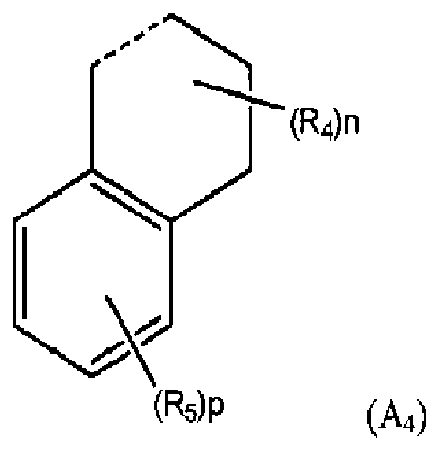
 (a) la ligne pointillée représente la liaison carbone C5 carbone C6 du cycle naphtopyrane de formule (I) ;(b) la liaison α du cycle annelé (A4) ou (A5) peut être liée indifféremment au carbone C5 ou au carbone C6 du cycle naphtopyrane de formule (I) ;(c) R4, qui sont identiques ou différents, représentent, indépendamment, un groupe OH, alkyle ou alcoxy qui est linéaire ou ramifié et qui comprend de 1 à 6 atomes de carbones ou deux R4 forment un carbonyle (CO) ;(d) R5, R6, et R7 représentent indépendamment :(i) un halogène, (ii) un groupe alkyle linéaire ou ramifié qui comprend de 1 à 12 atomes de carbone, (iii) un groupe halogénoaalkyle, correspondant aux groupe alkyle linéaire ou ramifié ci-dessus, qui est substitué avec au moins un atome d'halogène, un groupe cycloalkyle, qui comprend de 3 à 12 atomes de carbone, (iv) un groupe alcoxy linéaire ou ramifié qui comprend de 1 à 6 atomes de carbone, (v) un groupe phényle ou benzyle, éventuellement substitué avec au moins un des substituants listés ci-dessus dans les définitions des radicaux R1, R2 de formule (II) dans le cas dans lequel les radicaux correspondent indépendamment à un groupe aryle ou hétéroaryle, (vi) un groupe : --NH2, --NHR,
 (e) n représente un nombre entier compris entre 0 et 6 ;(f) f représente un nombre entier compris entre 0 et 2 ;(g) p représente un nombre entier compris entre 0 et 4 ; et(h) q représente un nombre entier compris entre 0 et 3 ;
à condition selon laquelle dans (A1) et (A2) n vaut zéro seulement dans le cas dans lequel au moins des substituants R3 adjacents forment au moins un groupe cyclique aromatique ou non aromatique possédant un cycle unique ou deux cycles annelés, comprenant éventuellement au moins un hétéroatome choisi parmi le groupe comprenant : oxygène, soufre et azote, ce ou ces cycles annelés évent éventuellement substitués avec au moins un substituant choisi ceux possédant la définition donnée ci-dessus pour les groupes aryle qui peuvent former R1 et/ou R2. - Composition selon l'une quelconque des revendications 1 à 4 possédant au moins environ 30% en poids d'au moins un composé de formule I.
- Composition selon l'une quelconque des revendications 1 à 5 comprenant en outre un ou plusieurs composés selon la formule III :


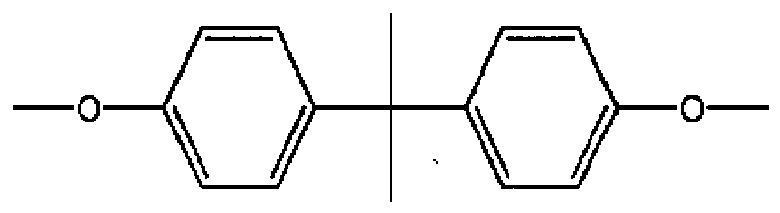
R1 et R1' sont indépendamment choisis parmi H, -CH3, ou une combinaison de ceux-ci ; et
R2 représente H, -CH3 ; et
m et n sont des nombres entiers et sont indépendamment choisis de sorte que (m + n) = 2 à 30. - Composition selon l'une quelconque des revendications 1 à 6 comprenant en outre un ou plusieurs composés selon la formule IV :

R6 représente -CH3, ou H ;
R5 représente -CH2OC(=O)-, ou -CH2SC(=O)- ;
m vaut 0 ou 1 ;
n vaut 1 ou 2 ; et
o vaut 0, 1, ou 2. - Composition selon l'une quelconque des revendications 1 à 7, dans laquelle le composé de formule I est 4,4'-bis(méthacryloyloxyéthylthio)diphénylsulfone, le composé photochrome est un compose naphtopyrane, et la composition comprend en outre du divinylbenzène, du styrène, du triméthacrylate de triméthylolylpropane et du diméthacrylate de polyéthylèneglycol.
- Résine pouvant être obtenue par polymérisation d'une composition selon l'une quelconque des revendications 1 à 8.
- Résine selon la revendication 9, dans laquelle la composition comprend au moins environ 30% en poids d'au moins un compose de formule I.
- Article comprenant une résine selon la revendication 9 ou la revendication 10, dans lequel l'article est un article ophtalmique et dans lequel il possède un indice de réfraction compris entre environ 1,59 et 1,61.
- Article selon la revendication 11 comprenant en outre du divinylbenzène, du styrène, du triméthacrylate de triméthylolylpropane et du diméthacrylate de polyéthylèneglycol.
Applications Claiming Priority (1)
| Application Number | Priority Date | Filing Date | Title |
|---|---|---|---|
| US12/564,412 US8188181B2 (en) | 2009-09-22 | 2009-09-22 | Photochromic compositions, resins and articles obtained therefrom |
Publications (2)
| Publication Number | Publication Date |
|---|---|
| EP2305768A1 EP2305768A1 (fr) | 2011-04-06 |
| EP2305768B1 true EP2305768B1 (fr) | 2015-11-11 |
Family
ID=42937423
Family Applications (1)
| Application Number | Title | Priority Date | Filing Date |
|---|---|---|---|
| EP10177731.6A Not-in-force EP2305768B1 (fr) | 2009-09-22 | 2010-09-20 | Compositions photochromes, résines et articles obtenus à partir de ceux-ci |
Country Status (2)
| Country | Link |
|---|---|
| US (1) | US8188181B2 (fr) |
| EP (1) | EP2305768B1 (fr) |
Families Citing this family (2)
| Publication number | Priority date | Publication date | Assignee | Title |
|---|---|---|---|---|
| JP6328751B2 (ja) * | 2013-06-17 | 2018-05-23 | ローデンシュトック ゲーエムベーハー | Uv硬化適合性フォトクロミック縮合ナフトピラン |
| WO2022051645A2 (fr) * | 2020-09-04 | 2022-03-10 | Corning Incorporated | Emballages pharmaceutiques revêtus bloquant la lumière ultraviolette |
Family Cites Families (62)
| Publication number | Priority date | Publication date | Assignee | Title |
|---|---|---|---|---|
| US3567605A (en) * | 1966-03-30 | 1971-03-02 | Ralph S Becker | Photochemical process |
| JPS4948631B1 (fr) * | 1968-10-28 | 1974-12-23 | ||
| JPS5817527B2 (ja) * | 1978-07-17 | 1983-04-07 | 株式会社保谷レンズ | 高屈折率レンズ用共重合体及びそれよりなるレンズ |
| US4215010A (en) * | 1978-09-08 | 1980-07-29 | American Optical Corporation | Photochromic compounds |
| US4342668A (en) | 1978-09-08 | 1982-08-03 | American Optical Corporation | Photochromic compounds |
| DE3011808A1 (de) * | 1980-03-27 | 1981-10-01 | Cassella Ag, 6000 Frankfurt | Verfahren zur herstellung von n-hydroxyalkylcarbazol |
| US4699473A (en) * | 1983-08-08 | 1987-10-13 | American Optical Corporation | Trifluoromethyl substituted spirooxazine photochromic dyes |
| DE3486476D1 (de) | 1983-12-16 | 2000-05-31 | Rodenstock Optik G | Photochrome Substanzen |
| CA1246565A (fr) | 1984-07-06 | 1988-12-13 | Shinichi Yamamoto | Composes a base de spiro-oxazine; leur preparation; articles mis en forme, photochromiques |
| US4720547A (en) * | 1984-07-30 | 1988-01-19 | Ppg Industries, Inc. | Photochromic compound and articles containing the same |
| JPS6172748A (ja) | 1984-09-19 | 1986-04-14 | Mitsubishi Petrochem Co Ltd | イオウ含有アクリル系化合物 |
| EP0176874A3 (fr) * | 1984-09-19 | 1988-02-10 | Toray Industries, Inc. | Lentille à grande réfraction plastique |
| JPS61263982A (ja) * | 1985-01-25 | 1986-11-21 | Mitsubishi Chem Ind Ltd | 3,3−ジメチル−スピロ〔インドリノ−2,3′−ナフト〔2,1−b〕(1,4)オキサジン〕系化合物 |
| AU564689B2 (en) * | 1985-07-09 | 1987-08-20 | Kureha Kagaku Kogyo K.K. | Photochromic lens |
| DE3525891A1 (de) | 1985-07-19 | 1987-01-22 | Rodenstock Optik G | Photochrome verbindungen (iii) |
| US4634767A (en) * | 1985-09-03 | 1987-01-06 | Ppg Industries, Inc. | Method for preparing spiro(indoline)-type photochromic compounds |
| US4637968A (en) * | 1986-03-07 | 1987-01-20 | Exxon Research And Engineering Company | Solid bromine complexers |
| GB8610709D0 (en) * | 1986-05-01 | 1986-06-04 | Plinkington Bros Plc | Photochromic lenses |
| US4831142A (en) * | 1986-09-26 | 1989-05-16 | Ppg Industries, Inc. | Spiro indoline-pyranobenzoxazinones |
| US4909963A (en) * | 1986-09-26 | 1990-03-20 | Ppg Industries, Inc. | Photochromic article |
| US4785097A (en) * | 1986-09-26 | 1988-11-15 | Ppg Industries, Inc. | Method for synthesizing spiro-oxazines |
| US4816584A (en) * | 1986-11-12 | 1989-03-28 | Ppg Industries, Inc. | Photochromic spiro(indoline)benzoxazines |
| GB8627859D0 (en) * | 1986-11-21 | 1986-12-31 | Pilkington Brothers Plc | Spiro-oxazine compounds |
| US4792224A (en) * | 1986-11-28 | 1988-12-20 | Ppg Industries, Inc. | Photochromic compound and articles containing the same |
| CA1340939C (fr) * | 1987-02-02 | 2000-03-28 | Ryojiro Akashi | Compose photochromique |
| GB8712210D0 (en) * | 1987-05-22 | 1987-06-24 | Pilkington Brothers Plc | Photochromic articles |
| US4931219A (en) * | 1987-07-27 | 1990-06-05 | Ppg Industries, Inc. | Photochromic compound and articles containing the same |
| US5180524A (en) * | 1987-11-05 | 1993-01-19 | Enichem Synthesis S.P.A. | Photochromatic composition and photochromatic articles which contain it |
| US4986934A (en) * | 1988-03-25 | 1991-01-22 | Ppg Industries, Inc. | Photochromic compound and articles containing the same |
| US4936995A (en) * | 1988-05-17 | 1990-06-26 | Ppg Industries, Inc. | Photochromic compound and articles containing the same |
| US5130058A (en) * | 1988-07-01 | 1992-07-14 | Tokuyama Soda Kabushiki Kaisha | Photochromic compound, process for production thereof, use thereof and composition containing said photochromic compound |
| US5270439A (en) * | 1988-10-20 | 1993-12-14 | Sumitomo Seika Chemicals Co., Ltd. | Method of producing a curable composition containing 4,4'-bis(methacryloylthio)diphenylsulfide |
| US4931221A (en) * | 1988-12-30 | 1990-06-05 | Ppg Industries, Inc. | Photochromic spiropyran compounds |
| FR2647790A1 (fr) * | 1989-06-05 | 1990-12-07 | Essilor Int | Composes photochromiques de type indolino-spiro-oxazine, leur procede de preparation, compositions et articles photochromiques contenant de tels composes |
| FR2647789B1 (fr) * | 1989-06-05 | 1994-07-22 | Essilor Int | Composes photochromiques de type indolino-spiro-oxazine, leur procede de preparation, compositions et articles photochromiques contenant de tels composes |
| EP0401958B1 (fr) * | 1989-06-05 | 1995-01-11 | Tokuyama Corporation | Composés photochromiques, leur composition et usage |
| US4980089A (en) * | 1989-07-12 | 1990-12-25 | Ppg Industries, Inc. | Photochromic spiropyran compounds |
| US5241075A (en) * | 1989-07-31 | 1993-08-31 | Matsushita Electric Industrial Co., Ltd. | Photochromic spiropyran compounds |
| US5171636A (en) * | 1989-12-12 | 1992-12-15 | Enichem Synthesis S.P.A. | Photochromatic and thermochromatic spiro-oxazepin-oxazine compounds and the process for their preparation |
| US5066818A (en) * | 1990-03-07 | 1991-11-19 | Ppg Industries, Inc. | Photochromic naphthopyran compounds |
| US5200116A (en) * | 1990-07-23 | 1993-04-06 | Ppg Industries, Inc. | Photochromic chromene compounds |
| FR2670210A1 (fr) * | 1990-12-06 | 1992-06-12 | Essilor Int | Nouveaux composes photochromiques de type indolino-spiro-benzoxazine et leur procede de preparation. |
| US5238981A (en) * | 1992-02-24 | 1993-08-24 | Transitions Optical, Inc. | Photochromic naphthopyrans |
| FR2688782A1 (fr) | 1992-03-19 | 1993-09-24 | Essilor Int | Nouveaux chromenes heterocycliques et leur utilisation dans le domaine de l'optique ophtalmique. |
| US5224602A (en) * | 1992-06-05 | 1993-07-06 | Bettles Christopher J | Combination baseball and bat carrying case, bat rack and ball dispenser |
| DE4234251A1 (de) * | 1992-10-10 | 1994-04-14 | Roehm Gmbh | Schwefelhaltige Poly(meth)acrylate |
| GB9225348D0 (en) * | 1992-12-03 | 1993-01-27 | Pilkington Plc | Bridged photochromics |
| US5973039A (en) * | 1994-12-12 | 1999-10-26 | Corning Incorporated | Temperature stable and sunlight protected photochromic articles |
| US5763511A (en) * | 1994-12-22 | 1998-06-09 | Corning Incorporated | Organic photochromic materials with high refractive index, their preparation and articles formed from these materials |
| FR2738248B1 (fr) | 1995-08-30 | 1997-11-28 | Corning Inc | Spiroxazines photochromiques, compositions et articles les contenant |
| AU1057397A (en) * | 1995-12-05 | 1997-06-27 | Corning Incorporated | New organic photochromic and non-photochromic materials |
| DE69717296D1 (de) | 1996-10-11 | 2003-01-02 | Corning Inc | Photochromes organisches material, dessen herstellung und dieses enthaltende photochrome artikel |
| FR2783249B1 (fr) * | 1998-09-11 | 2001-06-22 | Flamel Tech Sa | Naphtopyranes anneles en c5-c6, leur preparation et les compositions et matrices (co)polymeres les renfermant |
| US6222285B1 (en) * | 1999-09-07 | 2001-04-24 | Shop Vac Corporation | Intelligent switch control circuit |
| US7473754B1 (en) * | 2000-10-17 | 2009-01-06 | Ppg Industries Ohio, Inc. | Optical resin composition |
| JP2001172255A (ja) | 1999-12-21 | 2001-06-26 | Mitsubishi Chemicals Corp | 硫黄含有アクリル化合物の製造方法 |
| WO2001057106A1 (fr) * | 2000-02-04 | 2001-08-09 | Ppg Industries Ohio, Inc. | Articles a revetement photochrome |
| FR2809726A1 (fr) * | 2000-05-31 | 2001-12-07 | Corning Sa | Monomeres monofonctionnels, compositions polymerisables les renfermant, resines et articles ophtalmiques obtenus a partir de ceux-ci |
| US6973039B2 (en) * | 2000-12-08 | 2005-12-06 | Bbnt Solutions Llc | Mechanism for performing energy-based routing in wireless networks |
| FR2838746B1 (fr) * | 2002-04-17 | 2004-07-09 | Corning Inc | Compositions photochromiques reticulables, reticulees; preparation; substrats revetus desdites compositions, lentilles en lesdites compositions reticulees |
| ES2326215T3 (es) * | 2003-11-05 | 2009-10-05 | Corning Incorporated | Piranos condensados fotocromicos sustituidos con fenilo que porta un grupo carbamilo o urea. |
| KR20090115797A (ko) | 2007-02-20 | 2009-11-06 | 바스프 에스이 | 고굴절률 단량체, 이의 조성물 및 용도 |
-
2009
- 2009-09-22 US US12/564,412 patent/US8188181B2/en not_active Expired - Fee Related
-
2010
- 2010-09-20 EP EP10177731.6A patent/EP2305768B1/fr not_active Not-in-force
Also Published As
| Publication number | Publication date |
|---|---|
| EP2305768A1 (fr) | 2011-04-06 |
| US20110071257A1 (en) | 2011-03-24 |
| US8188181B2 (en) | 2012-05-29 |
Similar Documents
| Publication | Publication Date | Title |
|---|---|---|
| AU762577B2 (en) | Curable composition | |
| EP2408824B1 (fr) | Compositions de coulée liquide, procédés de production et éléments optiques photochromiques | |
| KR101449521B1 (ko) | 포토크로믹 경화성 조성물 및 경화체 | |
| US6698883B2 (en) | Curable composition and photochromic cured article | |
| AU777331B2 (en) | Curable composition comprising photochromic compound | |
| JPWO2001005854A1 (ja) | 硬化性組成物 | |
| US6174464B1 (en) | Organic photochromic contact lens compositions | |
| KR20140078613A (ko) | (메트)아크릴레이트 화합물, 및 이 (메트)아크릴레이트 화합물을 포함하는 포토크로믹 경화성 조성물 | |
| EP2305768B1 (fr) | Compositions photochromes, résines et articles obtenus à partir de ceux-ci | |
| US5888432A (en) | 2-Adamantyl benzopyrans the compositions and (co)polymer matrices containing them | |
| US8277700B2 (en) | Process for preparing a photochromic polymeric composition, thus obtained polymeric composition and use thereof | |
| WO1997041468A1 (fr) | Compositions pour lentilles de contact photochromiques organiques | |
| HK1160873A (en) | Process for preparing a photochromic polymeric composition, thus obtained polymeric composition and use thereof |
Legal Events
| Date | Code | Title | Description |
|---|---|---|---|
| PUAI | Public reference made under article 153(3) epc to a published international application that has entered the european phase |
Free format text: ORIGINAL CODE: 0009012 |
|
| AK | Designated contracting states |
Kind code of ref document: A1 Designated state(s): AL AT BE BG CH CY CZ DE DK EE ES FI FR GB GR HR HU IE IS IT LI LT LU LV MC MK MT NL NO PL PT RO SE SI SK SM TR |
|
| AX | Request for extension of the european patent |
Extension state: BA ME RS |
|
| 17P | Request for examination filed |
Effective date: 20111005 |
|
| 17Q | First examination report despatched |
Effective date: 20120912 |
|
| GRAP | Despatch of communication of intention to grant a patent |
Free format text: ORIGINAL CODE: EPIDOSNIGR1 |
|
| INTG | Intention to grant announced |
Effective date: 20150515 |
|
| GRAS | Grant fee paid |
Free format text: ORIGINAL CODE: EPIDOSNIGR3 |
|
| GRAA | (expected) grant |
Free format text: ORIGINAL CODE: 0009210 |
|
| AK | Designated contracting states |
Kind code of ref document: B1 Designated state(s): AL AT BE BG CH CY CZ DE DK EE ES FI FR GB GR HR HU IE IS IT LI LT LU LV MC MK MT NL NO PL PT RO SE SI SK SM TR |
|
| REG | Reference to a national code |
Ref country code: GB Ref legal event code: FG4D |
|
| REG | Reference to a national code |
Ref country code: CH Ref legal event code: EP |
|
| REG | Reference to a national code |
Ref country code: IE Ref legal event code: FG4D |
|
| REG | Reference to a national code |
Ref country code: AT Ref legal event code: REF Ref document number: 760459 Country of ref document: AT Kind code of ref document: T Effective date: 20151215 |
|
| REG | Reference to a national code |
Ref country code: DE Ref legal event code: R096 Ref document number: 602010028923 Country of ref document: DE |
|
| REG | Reference to a national code |
Ref country code: LT Ref legal event code: MG4D |
|
| REG | Reference to a national code |
Ref country code: NL Ref legal event code: MP Effective date: 20160211 |
|
| REG | Reference to a national code |
Ref country code: AT Ref legal event code: MK05 Ref document number: 760459 Country of ref document: AT Kind code of ref document: T Effective date: 20151111 |
|
| PG25 | Lapsed in a contracting state [announced via postgrant information from national office to epo] |
Ref country code: LT Free format text: LAPSE BECAUSE OF FAILURE TO SUBMIT A TRANSLATION OF THE DESCRIPTION OR TO PAY THE FEE WITHIN THE PRESCRIBED TIME-LIMIT Effective date: 20151111 Ref country code: NO Free format text: LAPSE BECAUSE OF FAILURE TO SUBMIT A TRANSLATION OF THE DESCRIPTION OR TO PAY THE FEE WITHIN THE PRESCRIBED TIME-LIMIT Effective date: 20160211 Ref country code: NL Free format text: LAPSE BECAUSE OF FAILURE TO SUBMIT A TRANSLATION OF THE DESCRIPTION OR TO PAY THE FEE WITHIN THE PRESCRIBED TIME-LIMIT Effective date: 20151111 Ref country code: HR Free format text: LAPSE BECAUSE OF FAILURE TO SUBMIT A TRANSLATION OF THE DESCRIPTION OR TO PAY THE FEE WITHIN THE PRESCRIBED TIME-LIMIT Effective date: 20151111 Ref country code: ES Free format text: LAPSE BECAUSE OF FAILURE TO SUBMIT A TRANSLATION OF THE DESCRIPTION OR TO PAY THE FEE WITHIN THE PRESCRIBED TIME-LIMIT Effective date: 20151111 Ref country code: IS Free format text: LAPSE BECAUSE OF FAILURE TO SUBMIT A TRANSLATION OF THE DESCRIPTION OR TO PAY THE FEE WITHIN THE PRESCRIBED TIME-LIMIT Effective date: 20160311 |
|
| REG | Reference to a national code |
Ref country code: DE Ref legal event code: R082 Ref document number: 602010028923 Country of ref document: DE Representative=s name: HERNANDEZ, YORCK, DIPL.-ING., DE |
|
| PG25 | Lapsed in a contracting state [announced via postgrant information from national office to epo] |
Ref country code: GR Free format text: LAPSE BECAUSE OF FAILURE TO SUBMIT A TRANSLATION OF THE DESCRIPTION OR TO PAY THE FEE WITHIN THE PRESCRIBED TIME-LIMIT Effective date: 20160212 Ref country code: AT Free format text: LAPSE BECAUSE OF FAILURE TO SUBMIT A TRANSLATION OF THE DESCRIPTION OR TO PAY THE FEE WITHIN THE PRESCRIBED TIME-LIMIT Effective date: 20151111 Ref country code: FI Free format text: LAPSE BECAUSE OF FAILURE TO SUBMIT A TRANSLATION OF THE DESCRIPTION OR TO PAY THE FEE WITHIN THE PRESCRIBED TIME-LIMIT Effective date: 20151111 Ref country code: PL Free format text: LAPSE BECAUSE OF FAILURE TO SUBMIT A TRANSLATION OF THE DESCRIPTION OR TO PAY THE FEE WITHIN THE PRESCRIBED TIME-LIMIT Effective date: 20151111 Ref country code: SE Free format text: LAPSE BECAUSE OF FAILURE TO SUBMIT A TRANSLATION OF THE DESCRIPTION OR TO PAY THE FEE WITHIN THE PRESCRIBED TIME-LIMIT Effective date: 20151111 Ref country code: LV Free format text: LAPSE BECAUSE OF FAILURE TO SUBMIT A TRANSLATION OF THE DESCRIPTION OR TO PAY THE FEE WITHIN THE PRESCRIBED TIME-LIMIT Effective date: 20151111 Ref country code: PT Free format text: LAPSE BECAUSE OF FAILURE TO SUBMIT A TRANSLATION OF THE DESCRIPTION OR TO PAY THE FEE WITHIN THE PRESCRIBED TIME-LIMIT Effective date: 20160311 |
|
| PG25 | Lapsed in a contracting state [announced via postgrant information from national office to epo] |
Ref country code: CZ Free format text: LAPSE BECAUSE OF FAILURE TO SUBMIT A TRANSLATION OF THE DESCRIPTION OR TO PAY THE FEE WITHIN THE PRESCRIBED TIME-LIMIT Effective date: 20151111 |
|
| REG | Reference to a national code |
Ref country code: DE Ref legal event code: R097 Ref document number: 602010028923 Country of ref document: DE |
|
| PG25 | Lapsed in a contracting state [announced via postgrant information from national office to epo] |
Ref country code: SM Free format text: LAPSE BECAUSE OF FAILURE TO SUBMIT A TRANSLATION OF THE DESCRIPTION OR TO PAY THE FEE WITHIN THE PRESCRIBED TIME-LIMIT Effective date: 20151111 Ref country code: EE Free format text: LAPSE BECAUSE OF FAILURE TO SUBMIT A TRANSLATION OF THE DESCRIPTION OR TO PAY THE FEE WITHIN THE PRESCRIBED TIME-LIMIT Effective date: 20151111 Ref country code: SK Free format text: LAPSE BECAUSE OF FAILURE TO SUBMIT A TRANSLATION OF THE DESCRIPTION OR TO PAY THE FEE WITHIN THE PRESCRIBED TIME-LIMIT Effective date: 20151111 Ref country code: DK Free format text: LAPSE BECAUSE OF FAILURE TO SUBMIT A TRANSLATION OF THE DESCRIPTION OR TO PAY THE FEE WITHIN THE PRESCRIBED TIME-LIMIT Effective date: 20151111 Ref country code: RO Free format text: LAPSE BECAUSE OF FAILURE TO SUBMIT A TRANSLATION OF THE DESCRIPTION OR TO PAY THE FEE WITHIN THE PRESCRIBED TIME-LIMIT Effective date: 20151111 |
|
| PLBE | No opposition filed within time limit |
Free format text: ORIGINAL CODE: 0009261 |
|
| STAA | Information on the status of an ep patent application or granted ep patent |
Free format text: STATUS: NO OPPOSITION FILED WITHIN TIME LIMIT |
|
| REG | Reference to a national code |
Ref country code: FR Ref legal event code: PLFP Year of fee payment: 7 |
|
| 26N | No opposition filed |
Effective date: 20160812 |
|
| PG25 | Lapsed in a contracting state [announced via postgrant information from national office to epo] |
Ref country code: SI Free format text: LAPSE BECAUSE OF FAILURE TO SUBMIT A TRANSLATION OF THE DESCRIPTION OR TO PAY THE FEE WITHIN THE PRESCRIBED TIME-LIMIT Effective date: 20151111 |
|
| PG25 | Lapsed in a contracting state [announced via postgrant information from national office to epo] |
Ref country code: BE Free format text: LAPSE BECAUSE OF FAILURE TO SUBMIT A TRANSLATION OF THE DESCRIPTION OR TO PAY THE FEE WITHIN THE PRESCRIBED TIME-LIMIT Effective date: 20151111 |
|
| PG25 | Lapsed in a contracting state [announced via postgrant information from national office to epo] |
Ref country code: MC Free format text: LAPSE BECAUSE OF FAILURE TO SUBMIT A TRANSLATION OF THE DESCRIPTION OR TO PAY THE FEE WITHIN THE PRESCRIBED TIME-LIMIT Effective date: 20151111 |
|
| REG | Reference to a national code |
Ref country code: CH Ref legal event code: PL |
|
| REG | Reference to a national code |
Ref country code: IE Ref legal event code: MM4A |
|
| PG25 | Lapsed in a contracting state [announced via postgrant information from national office to epo] |
Ref country code: IE Free format text: LAPSE BECAUSE OF NON-PAYMENT OF DUE FEES Effective date: 20160920 Ref country code: CH Free format text: LAPSE BECAUSE OF NON-PAYMENT OF DUE FEES Effective date: 20160930 Ref country code: LI Free format text: LAPSE BECAUSE OF NON-PAYMENT OF DUE FEES Effective date: 20160930 |
|
| PG25 | Lapsed in a contracting state [announced via postgrant information from national office to epo] |
Ref country code: LU Free format text: LAPSE BECAUSE OF NON-PAYMENT OF DUE FEES Effective date: 20160920 |
|
| REG | Reference to a national code |
Ref country code: FR Ref legal event code: PLFP Year of fee payment: 8 |
|
| PG25 | Lapsed in a contracting state [announced via postgrant information from national office to epo] |
Ref country code: HU Free format text: LAPSE BECAUSE OF FAILURE TO SUBMIT A TRANSLATION OF THE DESCRIPTION OR TO PAY THE FEE WITHIN THE PRESCRIBED TIME-LIMIT; INVALID AB INITIO Effective date: 20100920 Ref country code: CY Free format text: LAPSE BECAUSE OF FAILURE TO SUBMIT A TRANSLATION OF THE DESCRIPTION OR TO PAY THE FEE WITHIN THE PRESCRIBED TIME-LIMIT Effective date: 20151111 |
|
| PG25 | Lapsed in a contracting state [announced via postgrant information from national office to epo] |
Ref country code: MT Free format text: LAPSE BECAUSE OF NON-PAYMENT OF DUE FEES Effective date: 20160930 Ref country code: MK Free format text: LAPSE BECAUSE OF FAILURE TO SUBMIT A TRANSLATION OF THE DESCRIPTION OR TO PAY THE FEE WITHIN THE PRESCRIBED TIME-LIMIT Effective date: 20151111 Ref country code: TR Free format text: LAPSE BECAUSE OF FAILURE TO SUBMIT A TRANSLATION OF THE DESCRIPTION OR TO PAY THE FEE WITHIN THE PRESCRIBED TIME-LIMIT Effective date: 20151111 |
|
| PG25 | Lapsed in a contracting state [announced via postgrant information from national office to epo] |
Ref country code: BG Free format text: LAPSE BECAUSE OF FAILURE TO SUBMIT A TRANSLATION OF THE DESCRIPTION OR TO PAY THE FEE WITHIN THE PRESCRIBED TIME-LIMIT Effective date: 20151111 |
|
| REG | Reference to a national code |
Ref country code: FR Ref legal event code: PLFP Year of fee payment: 9 |
|
| PG25 | Lapsed in a contracting state [announced via postgrant information from national office to epo] |
Ref country code: AL Free format text: LAPSE BECAUSE OF FAILURE TO SUBMIT A TRANSLATION OF THE DESCRIPTION OR TO PAY THE FEE WITHIN THE PRESCRIBED TIME-LIMIT Effective date: 20151111 |
|
| PGFP | Annual fee paid to national office [announced via postgrant information from national office to epo] |
Ref country code: DE Payment date: 20190813 Year of fee payment: 10 Ref country code: IT Payment date: 20190924 Year of fee payment: 10 Ref country code: FR Payment date: 20190819 Year of fee payment: 10 |
|
| PGFP | Annual fee paid to national office [announced via postgrant information from national office to epo] |
Ref country code: GB Payment date: 20190827 Year of fee payment: 10 |
|
| REG | Reference to a national code |
Ref country code: DE Ref legal event code: R119 Ref document number: 602010028923 Country of ref document: DE |
|
| GBPC | Gb: european patent ceased through non-payment of renewal fee |
Effective date: 20200920 |
|
| PG25 | Lapsed in a contracting state [announced via postgrant information from national office to epo] |
Ref country code: DE Free format text: LAPSE BECAUSE OF NON-PAYMENT OF DUE FEES Effective date: 20210401 Ref country code: FR Free format text: LAPSE BECAUSE OF NON-PAYMENT OF DUE FEES Effective date: 20200930 |
|
| PG25 | Lapsed in a contracting state [announced via postgrant information from national office to epo] |
Ref country code: GB Free format text: LAPSE BECAUSE OF NON-PAYMENT OF DUE FEES Effective date: 20200920 |
|
| PG25 | Lapsed in a contracting state [announced via postgrant information from national office to epo] |
Ref country code: IT Free format text: LAPSE BECAUSE OF NON-PAYMENT OF DUE FEES Effective date: 20200920 |