EP0401958B1 - Composés photochromiques, leur composition et usage - Google Patents
Composés photochromiques, leur composition et usage Download PDFInfo
- Publication number
- EP0401958B1 EP0401958B1 EP90302299A EP90302299A EP0401958B1 EP 0401958 B1 EP0401958 B1 EP 0401958B1 EP 90302299 A EP90302299 A EP 90302299A EP 90302299 A EP90302299 A EP 90302299A EP 0401958 B1 EP0401958 B1 EP 0401958B1
- Authority
- EP
- European Patent Office
- Prior art keywords
- group
- carbon atoms
- compound
- ring
- general formula
- Prior art date
- Legal status (The legal status is an assumption and is not a legal conclusion. Google has not performed a legal analysis and makes no representation as to the accuracy of the status listed.)
- Expired - Lifetime
Links
- 0 CC*(*C*=C1)=*1O Chemical compound CC*(*C*=C1)=*1O 0.000 description 4
Images


Classifications
-
- C—CHEMISTRY; METALLURGY
- C07—ORGANIC CHEMISTRY
- C07D—HETEROCYCLIC COMPOUNDS
- C07D407/00—Heterocyclic compounds containing two or more hetero rings, at least one ring having oxygen atoms as the only ring hetero atoms, not provided for by group C07D405/00
- C07D407/02—Heterocyclic compounds containing two or more hetero rings, at least one ring having oxygen atoms as the only ring hetero atoms, not provided for by group C07D405/00 containing two hetero rings
- C07D407/04—Heterocyclic compounds containing two or more hetero rings, at least one ring having oxygen atoms as the only ring hetero atoms, not provided for by group C07D405/00 containing two hetero rings directly linked by a ring-member-to-ring-member bond
-
- C—CHEMISTRY; METALLURGY
- C07—ORGANIC CHEMISTRY
- C07D—HETEROCYCLIC COMPOUNDS
- C07D311/00—Heterocyclic compounds containing six-membered rings having one oxygen atom as the only hetero atom, condensed with other rings
- C07D311/96—Heterocyclic compounds containing six-membered rings having one oxygen atom as the only hetero atom, condensed with other rings spiro-condensed with carbocyclic rings or ring systems
-
- C—CHEMISTRY; METALLURGY
- C07—ORGANIC CHEMISTRY
- C07D—HETEROCYCLIC COMPOUNDS
- C07D409/00—Heterocyclic compounds containing two or more hetero rings, at least one ring having sulfur atoms as the only ring hetero atoms
- C07D409/02—Heterocyclic compounds containing two or more hetero rings, at least one ring having sulfur atoms as the only ring hetero atoms containing two hetero rings
- C07D409/04—Heterocyclic compounds containing two or more hetero rings, at least one ring having sulfur atoms as the only ring hetero atoms containing two hetero rings directly linked by a ring-member-to-ring-member bond
-
- C—CHEMISTRY; METALLURGY
- C07—ORGANIC CHEMISTRY
- C07D—HETEROCYCLIC COMPOUNDS
- C07D417/00—Heterocyclic compounds containing two or more hetero rings, at least one ring having nitrogen and sulfur atoms as the only ring hetero atoms, not provided for by group C07D415/00
- C07D417/02—Heterocyclic compounds containing two or more hetero rings, at least one ring having nitrogen and sulfur atoms as the only ring hetero atoms, not provided for by group C07D415/00 containing two hetero rings
- C07D417/04—Heterocyclic compounds containing two or more hetero rings, at least one ring having nitrogen and sulfur atoms as the only ring hetero atoms, not provided for by group C07D415/00 containing two hetero rings directly linked by a ring-member-to-ring-member bond
-
- C—CHEMISTRY; METALLURGY
- C07—ORGANIC CHEMISTRY
- C07D—HETEROCYCLIC COMPOUNDS
- C07D491/00—Heterocyclic compounds containing in the condensed ring system both one or more rings having oxygen atoms as the only ring hetero atoms and one or more rings having nitrogen atoms as the only ring hetero atoms, not provided for by groups C07D451/00 - C07D459/00, C07D463/00, C07D477/00 or C07D489/00
- C07D491/02—Heterocyclic compounds containing in the condensed ring system both one or more rings having oxygen atoms as the only ring hetero atoms and one or more rings having nitrogen atoms as the only ring hetero atoms, not provided for by groups C07D451/00 - C07D459/00, C07D463/00, C07D477/00 or C07D489/00 in which the condensed system contains two hetero rings
- C07D491/04—Ortho-condensed systems
-
- C—CHEMISTRY; METALLURGY
- C07—ORGANIC CHEMISTRY
- C07D—HETEROCYCLIC COMPOUNDS
- C07D495/00—Heterocyclic compounds containing in the condensed system at least one hetero ring having sulfur atoms as the only ring hetero atoms
- C07D495/02—Heterocyclic compounds containing in the condensed system at least one hetero ring having sulfur atoms as the only ring hetero atoms in which the condensed system contains two hetero rings
- C07D495/04—Ortho-condensed systems
-
- C—CHEMISTRY; METALLURGY
- C08—ORGANIC MACROMOLECULAR COMPOUNDS; THEIR PREPARATION OR CHEMICAL WORKING-UP; COMPOSITIONS BASED THEREON
- C08K—Use of inorganic or non-macromolecular organic substances as compounding ingredients
- C08K5/00—Use of organic ingredients
- C08K5/04—Oxygen-containing compounds
- C08K5/15—Heterocyclic compounds having oxygen in the ring
- C08K5/151—Heterocyclic compounds having oxygen in the ring having one oxygen atom in the ring
- C08K5/1545—Six-membered rings
-
- C—CHEMISTRY; METALLURGY
- C09—DYES; PAINTS; POLISHES; NATURAL RESINS; ADHESIVES; COMPOSITIONS NOT OTHERWISE PROVIDED FOR; APPLICATIONS OF MATERIALS NOT OTHERWISE PROVIDED FOR
- C09K—MATERIALS FOR MISCELLANEOUS APPLICATIONS, NOT PROVIDED FOR ELSEWHERE
- C09K9/00—Tenebrescent materials, i.e. materials for which the range of wavelengths for energy absorption is changed as a result of excitation by some form of energy
- C09K9/02—Organic tenebrescent materials
Definitions
- the present invention relates to a novel compound having a photochromic action, a composition comprising this compound, and a use thereof. More particularly, the present invention relates to a novel compound which is colored from the colorless state under irradiation of an ultraviolet ray-containing light such as sunlight or a light of a mercury lamp, this change is reversible and the color fading speed is high, a composition comprising this novel compound and a use thereof.
- an ultraviolet ray-containing light such as sunlight or a light of a mercury lamp
- the photochromism is the phenomenon which has attracted attention in these several years, and this phenomenon is a reversible phenomenon in which when a certain compound is irradiated with an ultraviolet ray-containing light such as sunlight or a light of a mercury lamp, the color of the compound is promptly changed and when the irradiation is stopped and the compound is placed in the dark place, the original color is manifested again.
- the compound having this property is called "photochromic compound”, and various photochromic compounds have been synthesized. However, a special common structure is not found among these compounds.
- spiroadamantane compounds represented by the following formulae (A) and (B):
- the compound (A) is poor in the practical utility because the coloration is caused only at temperatures lower than 10°C.
- the compound (B) shows a photochromic characteristic at temperatures close to normal temperature (10 to 40°C), and it is known that the compound is changed to a yellow or orange color from the colorless state.
- the spiroadamantane compound (B) the colored form is relatively stable and the color fading speed at the ambient temperature is not so high, presumably because of the presence of the bulky adamantylidene group. Therefore, when this compound is used for a photochromic lens, even by stopping irradiation with sunlight, a long time is required for restoring the lens to the colorless form from the colored form.
- Another object of the present invention is to provide a photochromic compound in which the color fading time required for restoring the compound to the colorless form from the colored form is short.
- Still another object of the present invention is to provide a photochromic compound having a practical utility.
- a further object of the present invention is to provide a polymer composition comprising a photochromic compound.
- a still further object of the present invention is to provide a photochromic lens having a practical utility.
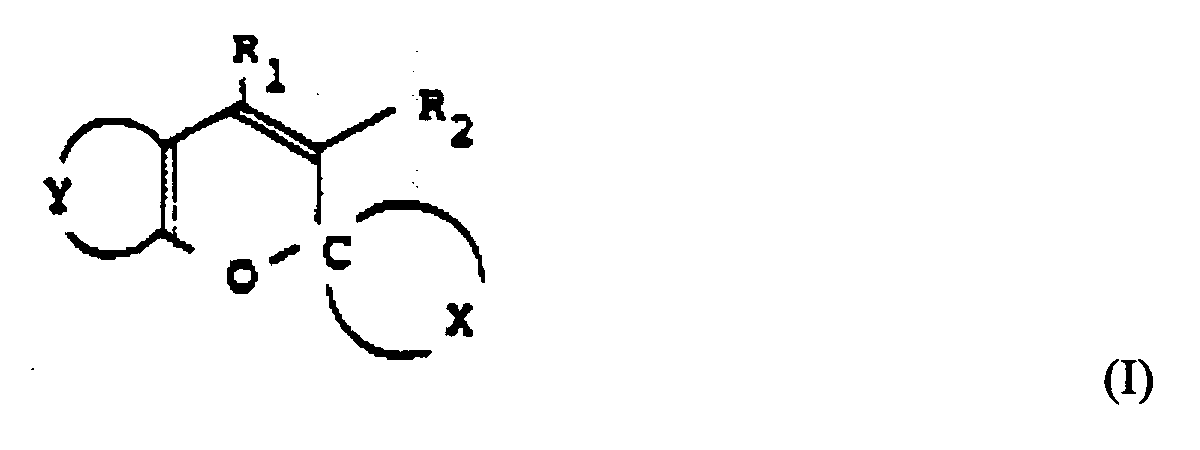
- R1 and R2 which may be the same or different, represent a hydrogen atom, an alkyl group, an aryl group, an aralkyl group or a substituted amino group, represents a norbornylidene group or a bicyclo[3,3,1] 9-nonylidene which may have a substituent, and represents a divalent aromatic hydrocarbon group or a divalent unsaturated heterocyclic group which may have a substituent.
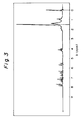
- Fig. 1, 2 and 3 are 1H-nuclear magnetic resonance spectrum charts of compounds obtained in Example 1, 31 and 121, respectively.
- R1 and R2 which may be the same or different, represent a hydrogen atom, an alkyl group, an aryl group, an aralkyl group or a substituted amino group.
- substituted amino group there can be mentioned an alkylamino group, a dialkylamino group and a monovalent group derived from a 4- to 7-membered monocyclic saturated heterocyclic ring containing at least one nitrogen atom, or a nitrogen atom and an oxygen atom or sulfur atom.
- the 4- to 7-membered monocyclic saturated heterocyclic ring is represented by the following formula: wherein R9 represents an alkylene group having 3 to 6 carbon atoms, an oxyalkylene group having 3 to 6 carbon atoms, a thioalkylene group having 3 to 6 carbon atoms or an azoalkylene group having 3 to 6 carbon atoms.
- alkylene group having 3 to 6 carbon atoms such as a tetramethylene group and a pentamethylene group
- oxyalkylene groups having 3 to 6 carbon atoms such as -CH2OCH2CH2-, -CH2CH2OCH2CH2- and -CH2O(CH2)3-
- thioalkylene groups having 3 to 6 carbon atoms such as -CH2SCH2CH2-, -CH2S(CH2)3- or -CH2CH2SCH2CH2-
- azoalkylene groups having 3 to 6 carbon atoms such as
- R1 and R2 there can be mentioned alkyl groups having 1 to 20 carbon atoms, such as a methyl group, an ethyl group, a propyl group, a butyl group, a pentyl group, an octyl group and a decyl group, aryl groups having 6 to 10 carbon atoms, such as a phenyl group, a tolyl group and a naphthyl group, and aralkyl groups having 7 to 10 carbon atoms, such as a benzyl group, a phenethyl group, a phenylpropyl group and a phenylbutyl group.
- alkyl groups having 1 to 20 carbon atoms such as a methyl group, an ethyl group, a propyl group, a butyl group, a pentyl group, an octyl group and a decyl group
- alkylamino groups having 1 to 4 carbon atoms such as a methylamino group an ethylamino group, dialkylamino groups having 2 to 8 carbon atoms, such as a dimethylamino group and a diethylamino group, and monovalent groups derived from 4- to 7-membered mono-cyclic saturated heterocylic rings containing at least one nitrogen atom, or a nitrogen atom and an oxygen atom or sulfur atom, such as a pyrrolidine ring, a piperidine ring, a piperazine ring, a morpholine ring and a thiazolidine ring.
- a hydrogen atom, an alkyl group having 1 to 20 carbon atoms, an aryl group having 6 to 10 carbon atoms, an aralkyl group having 7 to 10 carbon atoms and a monovalent group derived from a 5- or 6-membered monocyclic saturated heterocyclic ring containing up to 20 nitrogen atoms, or one nitrogen atom and one oxygen or sulfur atom are preferable as R1 and R2.
- the color fading speed of the compound of general formula [I] can be adjusted by selecting an appropriate group for R1 or R2.
- R1 and R2 represent an alkyl group
- a high color fading speed can be obtained, probably because it is difficult for the compound to take the trans form where the compound is in the colored state
- R1 is a substituted amino group
- the compound where both of R1 and R2 represent a hydrogen atom is characterized in that the compound is especially densely colored and the color fading speed is high.
- the norbornylidene group is represented by the following formula: and the bicyclo[3,3,1]9-nonylidene group is represented by the following formula:
- hydrogen atoms of the norbornylidene group and bicyclo [3,3,1]9-nonylidene group represented by the above formulae can be substituted with substituents.
- the number of substituents can be 1 or larger, preferably 1 to 3.
- the kind, number and position of the substituents are appropriately selected according to the intended object and use.
- these substituents may be the same or different.
- halogen atoms such as fluorine, chlorine and bromine, a hydroxyl group, a cyano group, a nitro group, a carboxyl group, alkyl groups having 1 to 4 carbon atoms, such as a methyl group, an ethyl group, a propyl group and a butyl group, alkoxy groups having 1 to 4 carbon atoms, such as a methoxy group, an ethoxy group, a propoxy group and a butoxy group, halogenoalkyl groups having 1 to 4 carbon atoms, such as a trifluoromethyl group, aryl groups having 6 to 10 carbon atoms, such as a phenyl group, a tolyl group and a naphthyl group, aryloxy groups having 6 to 10 carbon atoms, such as a phenyloxy group
- a halogen atom As preferable examples of the substituent, there can be mentioned a halogen atom, a cyano group, an alkyl group having 1 to 4 carbon atoms, an alkoxy group having 1 to 4 carbon atoms, a halogenoalkyl group having 1 to 4 carbon atoms, an aryl group having 6 to 10 carbon atoms, an aralkyl group having 7 to 10 carbon atoms and a dialkyl-amino group having 2 to 8 carbon atoms.
- a halogen atom As preferable examples of the substituent, there can be mentioned a halogen atom, a cyano group, an alkyl group having 1 to 4 carbon atoms, an alkoxy group having 1 to 4 carbon atoms, a halogenoalkyl group having 1 to 4 carbon atoms, an aryl group having 6 to 10 carbon atoms, an aralkyl group having 7 to 10 carbon atoms and a dialkyl-amino
- the aromatic hydrocarbon group represents a divalent aromatic hydrocarbon group or divalent unsaturated heteroyclic group which may have a substituent.
- the aromatic hydrocarbon group has 6 to 18 carbon atoms, preferably 6 to 14 carbon atoms, and a divalent group derived from one benzene ring or a fused ring comprising 2 to 4 benzene rings is especially preferable.
- the ring constituting the aromatic hydrocarbon group there can be mentioned a benzene ring, a naphthalene ring and a phenanthrene ring.
- the unsaturated heterocyclic group there can be mentioned a 5- or 6-membered monocylic heterocyclic group containing one or two of nitrogen, oxygen and sulfur atoms, or a fused heterocyclic group formed by fusing a benzene ring to the above-mentioned monocyclic heterocyclic group.
- the ring constituting the unsaturated heterocyclic group there can be mentioned nitrogen-containing rings such as a pyridine ring, a quinoline ring and a pyrrole ring, oxgen-containing rings such as a furan ring and a benzofuran ring, and sulfur-containing rings such as a thiophene ring and a benzothiophene ring.
- the aromatic hydrocarbon group or unsaturated hetero-cyclic group represented by may have up to 5 substituents, preferably up to 3 substituents.
- substituents there can be mentioned halogen atoms such as fluorine, chlorine and bromine, a hydroxyl group, a cyano group, a nitro group, aryl groups having 6 to 10 carbon atoms, such as a phenyl group, a tolyl group and a naphthyl group, alkylamino groups having 1 to 4 carbon atoms, such as a methylamino group and an ethylamino group, dialkylamino groups having 2 to 8 carbon atoms, such as a dimethylamino group and a diethylamino group, halogenoalkyl groups having 1 to 4 carbon atoms, such as a trifluoromethyl group, monovalent groups derived from 5- or 6-membered monocyclic heterocyclic groups having one or two of sulfur, oxygen and nitrogen atoms, such
- alkylene groups having 6 to 20 carbon atoms are preferable.
- the alkylene group there can be mentioned a methylene group, an ethylene group, a propylene group, a trimethylene group, a tetramethylene group, a pentamethylene group, a hexamethylene group, a heptamethylene group, an octamethylene group, a nonamethylene group, a decamethylene group, an undecamethylene group, a dodecamethylene group, a tridecamethylene group, a pentadecamethylene group, an octadecamethylene group and an eicosamethylene group.
- n can be a postive integer, but it is generally preferred that n be selected so that the carbon number of the chain represented by is 1 to 20, especially 6 to 20. Therefore, n is generally selected in the range of from 1 to 20.
- the carbon number is not particularly critical, but in view of the color fading speed of the obtained compound as the photochromic material, it is preferred that the carbon number be 1 to 4.
- a divalent aromatic hydrocarbon group or divalent unsaturated heterocyclic group which may have at least one substituent selected from a halogen atom, a hydroxyl group, a cyano group, a nitro group, an alkyl group having 1 to 4 carbon atoms, an alkoxy group having 1 to 4 carbon atoms, an aryl group having 6 to 10 carbon atoms, a dialkyl amino group having 2 to 8 carbon atoms, a halogenoalkyl group having 1 to 4 carbon atoms and a monocyclic heterocyclic group.
- a divalent group derived from a benzene ring or a fused ring comprising 2 to 4 benzene rings or a divalent group derived from a 5-membered or 6-membered monocyclic heterocyclic ring containing one or two of oxygen, sulfur and nitrogen atoms or a fused ring formed by fusion of a benzene ring to this monocyclic heterocylic ring, which may have 1 to 3 substituents selected from the above-mentioned substituents.
- preferably represents a benzene ring, naphthalene ring, phenanthrene ring, pyridine ring, quinoline ring, pyrrole ring, furan ring, benzofuran ring, thiophene ring or benzothiphene ring which may have 1 to 3 substituents selected from the above-mentioned substituents.
- the compound represented by the above-mentioned general formula (I) is a colorless or light yellow solid or viscous liquid at normal temperature under atmospheric pressure, and the compound can be identified, for example, by the following means (a) through (c).
- a compound of general formula (I) in which R1 and R2 represent a hydrogen atom or a substituted amino group, with the proviso that at least one of R1 and R2 is a substituted amino group can be prepared by reacting a compound represented by the following general formula (II): wherein is as defined in general formula (I), with a compound represented by the following general formula (III): wherein is as defined in general formula (I), in the presence of a primary amine or secondary amine.
- the reaction between the compound of general formula (II) and the compound of general formula (III) is carried out in the following manner.
- the reaction ratio between the two compounds can be selected from a broad range, but in general, this reaction ratio is in the range of from 1/10 to 10/1 (molar ratio).
- the reaction temperature is preferably 0 to 200°C.
- a polar nonprotonic solvent such as N-methylpyrrolidone, dimethylformamide or tetrahydrofuran is used as the reaction solvent.
- a condensing agent represented by a primary amine such as N-ethylamine or N-propylamine or a secondary amine such as pyrrolidine, piperidine or morpholine is used in an amount of 0.1 to 10 moles per mole of the compound of general formula (II), and the reaction can be completed by removing water formed during the reaction.
- a means for removing water there can be mentioned a method in which water is removed from the reaction system by using a Dean-Stark apparatus, and a method in which a dehydrating agent such as calcium chloride, calcium oxide or zinc chloride is added into the reaction system and water formed in the reaction system is removed by this dehydrating agent. Any of these methods can be adopted.
- a compound of general formula (I) in which at least one of R1 and R2 is a substituted amino group that is, a compound represented by the following general formula (V) : wherein are as defined in general formula (I), and R1 and R2, which may be the same or different, represent a hydrogen atom or a substituted amino group, with the proviso that at least one R1 and R2 is a substituted amino group, is obtained.
- a compound of the above-mentioned general formula (I) in which each of R1 and R2 is a hydrogen atom can be prepared in the following manner. Namely, a chromanone compound of general formula (IV) is reacted with a reducing agent such as sodium boron hydride or lithium aluminum hydride to form a chromanol compound represented by the following formula: wherein are as defined in general formula (I), and then, this compound is dehydrated with a dehydrating agent such as anhydrous copper sulfate to obtain a compound represented by the following general formula (VI):): wherein are as defined in general formula (I).
- a reducing agent such as sodium boron hydride or lithium aluminum hydride
- a dehydrating agent such as anhydrous copper sulfate
- a compound of general formula (I) in which R1 is an alkyl group, aralkyl group or aryl group can be prepared in the folllowing manner. Namely, a chromanone compound represented by the above-mentioned formula (IV) is reacted with an organic metal compound such as an alkyl magnesium halide or an alkyl lithium halide to form a chromanol compound represented by the following general formula (VII): wherein are as defined in general formula (I), and R1 represents an alkyl group, an aralkyl group or an aryl group, and then, this chromanol compound is dehydrated with a dehydrating agent such as anhydrous copper sulfate to obtain a compound represented by the following general formula (VIII): wherein are as defined in general formula (I), and R1 represents an alkyl group, an aralkyl group or an aryl group.
- a dehydrating agent such as anhydrous copper sulfate
- a compound of general formula (I) where R2 represents an alkyl group, an aralkyl group or an aryl group can be prepared in the following manner. Namely, a compound represented by general formula (V) is reacted with an alkyl halide, an aryl halide or an aralkyl halide to obtain a chromanone compound represented by the following general formula (IX): wherein are as defined in general formula (I), and R2 represents an alkyl group, an aralkyl group or an aryl group, and then, this chromanone compound is reduced in the same manner as described above and dehydrated with a dehydrating agent to obtain a compound represented by the following general formula (X): wherein are as defined in general formula (I), and R2 represents an alkyl group, an aralkyl group or an aryl group.
- a chromanone compound of general formula (IX) is reacted with an organic metal compound such as an alkyl magnesium halide in the same manner as described above and is then dehydrated with a dehydrating agent, a compound represented by the following general formula (I'): wherein are as defined in general formula (I), and R1 and R2, which may be the same or different, represent an alkyl group, an aralkyl group or an aryl group, is obtained.
- the compound of the above-mentioned general formula (I) according to the present invention is readily soluble in ordinary organic solvents such as toluene, chloroform and tetrahydrofuran. If the compound of general formula (I) is dissolved in such an organic solvent, the solution is generally colorless and transparent. When the solution is irradiated with sunlight or ultraviolet rays, the solution is promptly colored. If the solution is insulated from the light, the solution is promptly restored to the original colorless state. Thus, the compound of general formula (I) shows a good reversible photochromic action. This photochromic action of the compound of general formula (I) is also caused in a polymeric solid matrix.
- organic solvents such as toluene, chloroform and tetrahydrofuran.
- any of polymers in which the compound of general formula (I) according to the present invention is uniformly dispersed can be used as the polymer constituting the polymeric matrix.
- the compound of general formula (I) according to the present invention is dispersed in a polymer as mentioned above in an amount of 0.001 to 70 parts by weight, preferably 0.005 to 30 parts by weight, per 100 parts by weight of the polymer.
- the compound of the present invention is superior to the conventional spiroadamantane compounds especially in the color fading speed.
- the compound of the present invention can be widely used as the photochromic compound.
- the compound of the present invention can be used as various recording materials, for example, various memory materials, copying materials, printing photosensitive materials, cathode ray tube recording materials, laser photosensitive materials and holographic photosensitive materials instead of the conventional silver salt photosensitive materials.
- the photochromic material comprising the compound of the present invention can be used as a photochromic lens material, an optical filter material, a display material, an actinometer material and a decorative material.
- any method can be used without any particular limitation, so far as a uniform dimming performance is obtained.
- a homogeneous dispersion of the compound of the present invention in a polymer film is sandwiched in a lens
- a method in which the compound of the present invention is dissolved in, for example, a silicone oil, the surface of a lens is impregnated with the solution at 150 to 200°C over a period of 10 to 60 minutes and the impregnated surface is covered with a hardenable substance to form a photochromic lens can be considered a method in which the above-mentioned polymer film is coated on the surface of a lens and the surface is covered with a hardenable substance to form a photochromic lens.
- a photochromic material which is densely colored at a temperature close to normal temperature under irradiation with sunlight is preferably used for the photochromic lens.
- a compound of general formula (I) in which represents a divalent group derived from a naphthalene ring, a phenanthrene ring, a pyridine ring or a quinoline ring is especially preferably used for the photochromic lens.
- the compound of general formula (I) according to the present invention generally shows a colorless state stably in a polymeric solid matrix substantially irrespectively of the kind of the matrix, but if the compound is irradiated with ultraviolet rays, the compound is immediately colored, and when the irradiation is stopped, the compound is rendered colorless at a high color fading speed in the order of seconds, and the compound of the present invention is characterized in that this coloration-fading can be repeated with a good durability.
- a solution was prepared by dissolving 10 g (0.054 mole) of 1-hydroxy-2-acetonaphthone, 6.6 g (0.06 mole) of norcamphor and 8 g (0.113 mole) of pyrrolidine in 300 ml of toluene. The solution was boiled for 10 hours and water was separated. After termination of the reaction, toluene was removed under reduced pressure, and the remaining chromanone compound was crystallized with acetone. Then, the chromanone compound was dissolved in 200 ml of methanol, and sodium boron hydride was gradually added to the solution to form a chromanol compound.
- a solution was prepared by dissolving 10 g (0.054 mole) of 1-acetyl-2-naphthol, 6.6 g (0.06 mole) of norcamphor and 8.7 g (0.10 mole) of morpholine in 300 ml of toluene, and the solution was boiled for 5 hours and water was separated. After termination of the reaction, toluene was removed under reduced pressure, and the remaining chromanone compound was recrystallized from acetone, and the chromanon compound was dissolved in 200 ml of methanol and lithium aluminum hydride was added to the solution to form a chromanol compound.
- the obtained chromanol compound was heated at 200°C together with anhydrous copper sulfate in a carbon dioxide current for about 10 minutes, and the obtained brown viscous liquid was purified by the chromatography on silica gel to obtain 2.24 g of a chromene compound represented by the following formula:
- the elementary analysis, proton nuclear magnetic resonance measurement and 13C-nuclear magnetic resonance spectrum measurement were carried out in the same manner as described in Example 2. From the obtained results, it was confirmed that the obtained compound is the compound represented by the above-mentioned structural formula (3).
- the elementary analysis values of this compound and the theoretical values calculated from the composition of the compound (3) are shown in Table 2.
- a solution was prepared by dissolving 10 g (0.054 mole) of 1-hydroxy-2-acetonaphthone, 8.29 g (0.06 mole) of bicyclo[3,3,1]nonan-9-one and 8 g (0.113 mole) of pyrrolidine in 300 ml of toluene, and the solution was boiled for 10 hours and water was separated. After termination of the reaction, toluene was removed under reduced pressure, and the remaining chromanone compound was crystallized with acetone. Then, the chromanone compound was dissolved in 200 ml of methanol and sodium boron hydride was gradually added to the solution to form a chromanol compound.
- a solution was prepared by dissolving 10 g (0.054 mole) of 1-acetyl-2-naphthol, 8.29 g (0.06 mole) of bicyclo[3,3.1]nonan-9-one and 8.7 g (0.10 mole) of morpholine in 300 ml of toluene, and the solution was boiled for 5 hours and water was separated. After termination of the reaction, toluene was removed under reduced pressure and the remaining chromanone compound was recrystallized from acetone. Then, the chromanone compound was dissolved in 200 ml of methanol and lithium aluminum hydride was added to the solution to form a chromanol compound.
- Example 32 In 50 ml of anhydrous ether was dissolved 3.06 g (0.01 mole) of the chromanone compound obtained in Example 32, represented by the following formula: and the solution was cooled to 0°C and Grignard reagent CH3MgI (0.012 mole) newly prepared in 50 ml of anhydrous ether was dropped into the solution over a period of about 1 hour. After termination of the dropwise addition, the mixture was stirred at room temperature for 2 hours and quietly poured into cold water to extract the product with ether. The ether extract was dried on magnesium sulfate to form a chromanol compound from the chromanone compound.
- the chromanol compound was heated at 200°C together with anhydrous copper sulfate in a carbon dioxide current for about 10 minutes.
- the obtained brown viscous liquid was purified by the chromatography on silica gel to obtain 2.47 g of a chromene compound represented by the following formula:
- the elementary analysis, proton nuclear magnetic resonance spectrum measurement and 13C-nuclear magnetic resonance spectrum measurement were carried out in the same manner as described in Example 32. From the obtained results, it was confirmed that the obtained compound is the compound represented by the above-mentioned structural formula (33).
- the elementary analysis values of the obtained compound and the theoretical values calculated from the composition of the compound (33) are shown in Table 4.
- the structures of the obtained products were analyzed by the same structure-confirming means as adopted in Example 31. From the obtained results, it was confirmed that the obtained products are compounds represented by the structural formulae shown in Table 3. The elementary analysis values of the obtained compounds and the theoretical values calculated from the structural formulae of the compounds are shown in Table 4.
- Example 2 The compound synthesized in Example 1, which was respresented by the following formula: was disolved and dispersed in polymethyl methacrylate with the aid of benzene, and a cast film was formed on a slide glass sheet (11.2 cm x 3.7 cm) so that the concentration of the compound in the film was 1.0 x 10 ⁇ 4 mole/g and the thickness of the film was 0.1 mm.
- the photochromic film was irradiated with rays of mercury lamp (SHL-100 supplied by Toshiba) located 10 cm apart from the film at 25°C ⁇ 1°C for 60 seconds to effect colaration in the film, and the photochromic characteristics were examined with respect to items described below. The obtain results are shown in Table 5.
- Maximum absorption wavelength ( ⁇ max) The maximum absorption wavelength ⁇ max of the colored film was determined by using a spectrophotometer (220A supplied by Hitachi). ⁇ (60 seconds): After 60 seconds' irradiation under the above-mentioned conditions, the absorbance at the maximum absorption wavelength was measured. ⁇ (0 second): The absorbance at the maximum absorption wavelength of the unirradiated film was measured. Half-value period t 1/2 : After 60 second's irradiation, the time required for reduction of the absorbance of the film to 1/2 of [ ⁇ (60 seconds) - ⁇ (0 second)] was measured.
Landscapes
- Chemical & Material Sciences (AREA)
- Organic Chemistry (AREA)
- Engineering & Computer Science (AREA)
- Materials Engineering (AREA)
- Health & Medical Sciences (AREA)
- Chemical Kinetics & Catalysis (AREA)
- Medicinal Chemistry (AREA)
- Polymers & Plastics (AREA)
- Heterocyclic Carbon Compounds Containing A Hetero Ring Having Oxygen Or Sulfur (AREA)
- Plural Heterocyclic Compounds (AREA)
- Nitrogen Condensed Heterocyclic Rings (AREA)
Claims (12)
- Composé représenté par la formule générale (I) suivante :


- Composé selon la revendication 1, dans lequel

- Composé selon la revendication 1 ou 2 dans lequel,

- Composé selon l'une quelconque des revendications 1 à 3, dans lequel

- Composé selon l'une quelconque des revendications 1 à 3, dans lequel

- Composé selon la revendication 4, dans lequel le groupe hydrocarboné aromatique divalent est un groupe divalent provenant d'un noyau benzénique, d'un noyau naphtalénique ou d'un noyau de phénanthrène.
- Composé selon la revendication 5 dans lequel le groupe hétérocyclique insaturé est un groupe divalent provenant d'un noyau de pyridine, d'un noyau de quinoléine, d'un noyau de pyrrole, d'un noyau de furanne, d'un noyau de benzofuranne, d'un noyau de thiophène ou d'un noyau de benzothiophène.
- Composé selon l'une quelconque des revendications 1 à 7, dans lequel R₁ et R₂, qui peuvent être identiques ou différents, représentent chacun un atome d'hydrogène, un groupe alkyle ayant 1 à 20 atomes de carbone, un groupe aryle ayant 6 à 10 atomes de carbone, un groupe aralkyle ayant 7 à 10 atomes de carbone, un groupe alkylamino ayant 1 à 4 atomes, un groupe dialkylamino ayant 2 à 8 atomes de carbone ou un groupe monovalent provenant d'un noyau hétérocyclique saturé monocyclique tétragonal à heptagonal contenant au moins un atome d'azote ou un atome d'azote et un atome d'oxygène et un atome de soufre.
- Composé selon la revendication 8, dans lequel R₁ et/ou R₂ représente(nt) un groupe monovalent provenant d'un noyau hétérocyclique saturé monocyclique représenté par la formule suivante :

- Composition comprenant un composé représenté par la formule générale (I) suivante :


- Composition selon la revendication 10, dans laquelle la quantité du composé représenté par la formule générale (I) est de 0,001 à 70 parties en poids, pour 100 parties en poids du polymère,
- Lentille photochromique comprenant une composition selon la revendication 10 ou la revendication 11.
Applications Claiming Priority (4)
| Application Number | Priority Date | Filing Date | Title |
|---|---|---|---|
| JP1141206A JPH0684368B2 (ja) | 1989-06-05 | 1989-06-05 | スピロピラン化合物及びその製造方法 |
| JP141206/89 | 1989-06-05 | ||
| JP1143011A JP2711139B2 (ja) | 1989-06-07 | 1989-06-07 | クロメン化合物及びその製造方法 |
| JP143011/89 | 1989-06-07 |
Publications (3)
| Publication Number | Publication Date |
|---|---|
| EP0401958A2 EP0401958A2 (fr) | 1990-12-12 |
| EP0401958A3 EP0401958A3 (fr) | 1991-04-03 |
| EP0401958B1 true EP0401958B1 (fr) | 1995-01-11 |
Family
ID=26473493
Family Applications (1)
| Application Number | Title | Priority Date | Filing Date |
|---|---|---|---|
| EP90302299A Expired - Lifetime EP0401958B1 (fr) | 1989-06-05 | 1990-03-05 | Composés photochromiques, leur composition et usage |
Country Status (3)
| Country | Link |
|---|---|
| US (2) | US5106998A (fr) |
| EP (1) | EP0401958B1 (fr) |
| DE (1) | DE69015886T2 (fr) |
Cited By (3)
| Publication number | Priority date | Publication date | Assignee | Title |
|---|---|---|---|---|
| US7338962B2 (en) | 2003-10-01 | 2008-03-04 | Adolor Corporation | Spirocyclic heterocyclic derivatives and methods of their use |
| US7576207B2 (en) | 2006-04-06 | 2009-08-18 | Adolor Corporation | Spirocyclic heterocyclic derivatives and methods of their use |
| US7598261B2 (en) | 2005-03-31 | 2009-10-06 | Adolor Corporation | Spirocyclic heterocyclic derivatives and methods of their use |
Families Citing this family (64)
| Publication number | Priority date | Publication date | Assignee | Title |
|---|---|---|---|---|
| JP3016533B2 (ja) * | 1992-03-03 | 2000-03-06 | 株式会社トクヤマ | フォトクロミック組成物 |
| US5462698A (en) * | 1992-03-03 | 1995-10-31 | Tokuyama Corporation | Photochromic composition |
| FR2688782A1 (fr) * | 1992-03-19 | 1993-09-24 | Essilor Int | Nouveaux chromenes heterocycliques et leur utilisation dans le domaine de l'optique ophtalmique. |
| GB9306587D0 (en) * | 1993-03-30 | 1993-05-26 | Pilkington Plc | Photochromic compounds |
| DE59410026D1 (de) * | 1993-06-28 | 2002-02-14 | Rodenstock Optik G | Photochrome Spiropyran Verbindungen |
| GB9316858D0 (en) * | 1993-08-13 | 1993-09-29 | Pilkington Plc | Photochromic compounds |
| GB9316890D0 (en) * | 1993-08-13 | 1993-09-29 | Pilkington Plc | Photochromic compounds |
| GB9316857D0 (en) * | 1993-08-13 | 1993-09-29 | Pilkington Plc | Photochromic compounds |
| FR2712593B1 (fr) * | 1993-11-17 | 1996-01-05 | Essilor Int | Nouvelles spirooxazines et leur utilisation dans le domaine de l'optique ophtalmique. |
| US5651923A (en) * | 1993-12-09 | 1997-07-29 | Transitions Optical, Inc. | Substituted naphthopyrans |
| US5531940A (en) * | 1993-12-10 | 1996-07-02 | Innotech, Inc. | Method for manufacturing photochromic lenses |
| FR2718447B1 (fr) * | 1994-04-06 | 1996-05-24 | Essilor Int | Chromènes du type 2,2-diphényl hétéroannélés en 6,7 et leur utilisation dans le domaine de l'optique ophtalmique. |
| US5693830A (en) * | 1994-04-08 | 1997-12-02 | Tokuyama Corporation | Process for preparing the spiropyrone compounds |
| AU676536B2 (en) * | 1994-04-12 | 1997-03-13 | Tokuyama Corporation | Process for preparing the spiropyrone compounds |
| US6337409B1 (en) * | 1994-07-28 | 2002-01-08 | Vision-Ease Lens, Inc. | Photochromic naphthopyran compounds |
| US5759450A (en) * | 1994-07-28 | 1998-06-02 | Vision-Ease Lens, Inc. | Photochromic naphthopyran compounds |
| US5628935A (en) * | 1994-10-28 | 1997-05-13 | Vision-Ease Lens, Inc. | Photochromic spironaphthopyran compounds |
| FR2732019B1 (fr) | 1995-03-24 | 1997-06-13 | Flamel Tech Sa | Spiropyrannes photochromiques, compositions et articles les contenant |
| JPH08311441A (ja) * | 1995-05-24 | 1996-11-26 | Tokuyama Corp | フォトクロミック硬化体の製造方法 |
| JPH08320534A (ja) * | 1995-05-25 | 1996-12-03 | Tokuyama Corp | フォトクロミック硬化性組成物 |
| US5679805A (en) * | 1995-06-07 | 1997-10-21 | Vision-Ease Lens, Inc. | Photochromic spironaphthopyran compounds |
| US6113812A (en) * | 1995-06-07 | 2000-09-05 | Vision-Ease Lens, Inc. | Photochromic articles |
| US5869662A (en) * | 1995-06-07 | 1999-02-09 | Vision-Ease Lens, Inc. | Photochromic benzopyran compounds |
| US5840926A (en) * | 1995-06-07 | 1998-11-24 | Vision-Ease Lens, Inc. | Photochromic articles |
| US5656206A (en) * | 1995-06-14 | 1997-08-12 | Transitions Optical, Inc. | Substituted naphthopyrans |
| US6034193A (en) * | 1995-07-12 | 2000-03-07 | Corning Incorporated | Photochromic organic materials |
| US5702645A (en) * | 1995-10-30 | 1997-12-30 | Vision-Ease Lens, Inc. | Photochromic chromene derivatives |
| US5658502A (en) * | 1995-10-30 | 1997-08-19 | Vision-Ease Lens, Inc. | Photochromic articles |
| US5789015A (en) * | 1996-06-26 | 1998-08-04 | Innotech, Inc. | Impregnation of plastic substrates with photochromic additives |
| FR2751648B1 (fr) * | 1996-07-25 | 1998-09-25 | Corning Inc | Naphtopyranes photochromiques, compositions et articles les contenant |
| WO1998004937A1 (fr) * | 1996-07-25 | 1998-02-05 | Corning Incorporated | Naphtopyrans, compositions et articles les contenant |
| US5883043A (en) * | 1997-08-27 | 1999-03-16 | Ncr Corporation | Thermal paper with security features |
| US6770687B1 (en) | 1996-11-21 | 2004-08-03 | Ncr Corporation | Water-based dual security ink |
| US5914174A (en) * | 1996-12-05 | 1999-06-22 | Innotech, Inc. | Lens or semi-finished blank comprising photochromic resin compositions |
| EP0984929B1 (fr) | 1997-03-21 | 2002-09-11 | Corning S.A. | Derives de naphtopyranne, compositions, et matrices de (co)polymeres renfermant ces derives |
| US5998520A (en) * | 1997-07-02 | 1999-12-07 | Bayer Corporation | Photochromic compositions having improved fade rate |
| US5847168A (en) * | 1997-07-17 | 1998-12-08 | Vision-Ease Lens, Inc. | Photochromic compounds |
| US6106910A (en) * | 1998-06-30 | 2000-08-22 | Ncr Corporation | Print media with near infrared fluorescent sense mark and printer therefor |
| US6165937A (en) * | 1998-09-30 | 2000-12-26 | Ncr Corporation | Thermal paper with a near infrared radiation scannable data image |
| FR2792010B1 (fr) | 1999-04-08 | 2001-07-27 | Essilor Int | Procede de coloration d'un article transparent en polycarbonate et article obtenu |
| WO2001034609A1 (fr) * | 1999-11-10 | 2001-05-17 | Optische Werke G. Rodenstock | Derives indenochromes heterocycliquement anneles |
| US7077985B2 (en) * | 2000-05-30 | 2006-07-18 | Vision-Ease Lens | Injection molding of lens |
| US6572794B1 (en) | 2000-07-24 | 2003-06-03 | Essilor International Compagnie Generale D'optique | Method of manufacturing a photochromic molded article |
| FR2816950B1 (fr) | 2000-11-17 | 2003-02-14 | Essilor Int | Procede d'obtention d'un latex photochromique |
| US6863843B2 (en) * | 2000-12-21 | 2005-03-08 | Vision-Ease Lens, Inc. | Naphthopyran compounds, photoresponsive compositions and lenses |
| FR2819258B1 (fr) | 2001-01-11 | 2003-04-11 | Essilor Int | Procede d'obtention d'un latex photochromique stabilise, latex obtenu et application a l'optique ophtalmique |
| US6811727B2 (en) * | 2002-01-09 | 2004-11-02 | Corning Incorporated | Ophthalmic filter materials |
| US7858001B2 (en) * | 2003-09-09 | 2010-12-28 | Insight Equity A.P.X., L.P. | Photochromic lens |
| WO2005023529A2 (fr) | 2003-09-09 | 2005-03-17 | Vision-Ease Lens, Inc. | Stratifie de polyurethanne photochromique |
| JP2007505842A (ja) * | 2003-09-18 | 2007-03-15 | ローデンストック.ゲゼルシャフト.ミット.ベシュレンクテル.ハフツング | 置換されたフェナントロピラン |
| US7094368B2 (en) * | 2003-12-10 | 2006-08-22 | Transitions Optical, Inc. | Pyrano-quinolines, pyrano-quinolinones, combinations thereof, photochromic compositions and articles |
| US20050136333A1 (en) * | 2003-12-19 | 2005-06-23 | Lawrence Brian L. | Novel optical storage materials based on narrowband optical properties |
| US7897296B2 (en) * | 2004-09-30 | 2011-03-01 | General Electric Company | Method for holographic storage |
| US20060078802A1 (en) * | 2004-10-13 | 2006-04-13 | Chan Kwok P | Holographic storage medium |
| US7645719B2 (en) | 2004-10-13 | 2010-01-12 | Ncr Corporation | Thermal paper with security features |
| US8002935B2 (en) * | 2005-03-04 | 2011-08-23 | Insight Equity A.P.X., L.P. | Forming method for polymeric laminated wafers comprising different film materials |
| EP2399577A1 (fr) * | 2006-09-12 | 2011-12-28 | Adolor Corporation | Utilisation de composés spiro pour améliorer la fonction cognitive |
| EP2183115A2 (fr) * | 2007-08-02 | 2010-05-12 | Authentix, Inc. | Authentification d'un produit |
| EP2221325B1 (fr) | 2007-12-13 | 2014-04-16 | Tokuyama Corporation | Composition photochrome durcissable |
| US8188181B2 (en) * | 2009-09-22 | 2012-05-29 | Corning Incorporated | Photochromic compositions, resins and articles obtained therefrom |
| ES2523576T3 (es) | 2010-04-01 | 2014-11-27 | Tokuyama Corporation | Composición curable fotocrómica |
| CA2839250C (fr) | 2011-07-11 | 2018-11-27 | Tokuyama Corporation | Composition photochromique polymerisable |
| ES2612697T3 (es) | 2013-09-20 | 2017-05-18 | Essilor International (Compagnie Générale d'Optique) | Artículo óptico con fotocromatismo con gradiente |
| US20260086394A1 (en) | 2022-04-26 | 2026-03-26 | Essilor International | Photochromic optical article having a mirror coating |
Citations (1)
| Publication number | Priority date | Publication date | Assignee | Title |
|---|---|---|---|---|
| WO1991000861A2 (fr) * | 1989-07-12 | 1991-01-24 | Ppg Industries, Inc. | Composes spiropyraniques photochromiques |
Family Cites Families (6)
| Publication number | Priority date | Publication date | Assignee | Title |
|---|---|---|---|---|
| US4036842A (en) * | 1972-05-16 | 1977-07-19 | American Home Products Corporation | Process for preparing polycyclic heterocycles having a pyran ring |
| KR850002328A (ko) * | 1983-09-07 | 1985-05-10 | 알. 니콜슨 | 가변색 화합물과 그 제조방법 및 이를 이용한 가변색 렌즈 |
| US4637698A (en) * | 1983-11-04 | 1987-01-20 | Ppg Industries, Inc. | Photochromic compound and articles containing the same |
| GB8611837D0 (en) * | 1986-05-15 | 1986-06-25 | Plessey Co Plc | Photochromic spiropyran compounds |
| DE3823533A1 (de) * | 1988-07-12 | 1990-02-08 | Beiersdorf Ag | Substituierte 4-heterocyclyl-2h-benzo(b)pyrane, verfahren und 4-hydroxy-3-brom-, 3,4-oxiranyl-3,4-dehydro-2h-benzo(b)pyrane als zwischenprodukte zu ihrer herstellung, sowie sie enthaltende pharmazeutsche praeparate |
| US5061813A (en) * | 1990-04-02 | 1991-10-29 | E. R. Squibb & Sons, Inc. | Substituted cyanoimino benzopyranes |
-
1990
- 1990-03-05 EP EP90302299A patent/EP0401958B1/fr not_active Expired - Lifetime
- 1990-03-05 DE DE69015886T patent/DE69015886T2/de not_active Expired - Fee Related
- 1990-03-09 US US07/491,157 patent/US5106998A/en not_active Expired - Lifetime
-
1992
- 1992-11-17 US US07/977,882 patent/US5349065A/en not_active Expired - Lifetime
Patent Citations (1)
| Publication number | Priority date | Publication date | Assignee | Title |
|---|---|---|---|---|
| WO1991000861A2 (fr) * | 1989-07-12 | 1991-01-24 | Ppg Industries, Inc. | Composes spiropyraniques photochromiques |
Cited By (4)
| Publication number | Priority date | Publication date | Assignee | Title |
|---|---|---|---|---|
| US7338962B2 (en) | 2003-10-01 | 2008-03-04 | Adolor Corporation | Spirocyclic heterocyclic derivatives and methods of their use |
| US7598261B2 (en) | 2005-03-31 | 2009-10-06 | Adolor Corporation | Spirocyclic heterocyclic derivatives and methods of their use |
| US8022060B2 (en) | 2005-03-31 | 2011-09-20 | Adolor Corporation | Spirocyclic heterocyclic derivatives and methods of their use |
| US7576207B2 (en) | 2006-04-06 | 2009-08-18 | Adolor Corporation | Spirocyclic heterocyclic derivatives and methods of their use |
Also Published As
| Publication number | Publication date |
|---|---|
| DE69015886D1 (de) | 1995-02-23 |
| US5106998A (en) | 1992-04-21 |
| EP0401958A3 (fr) | 1991-04-03 |
| US5349065A (en) | 1994-09-20 |
| DE69015886T2 (de) | 1995-08-03 |
| EP0401958A2 (fr) | 1990-12-12 |
Similar Documents
| Publication | Publication Date | Title |
|---|---|---|
| EP0401958A2 (fr) | Composés photochromiques, leur composition et usage | |
| EP0351112B1 (fr) | Composé photochromique, procédé de préparation, son application et composition photochromique le contenant | |
| US5527911A (en) | Heterocyclic chromenes | |
| EP0316179A2 (fr) | Composés photochromiques | |
| EP0449669A1 (fr) | Composé photochromique, composition et son utilisation | |
| JP2001114775A (ja) | クロメン化合物 | |
| JP2000327676A (ja) | クロメン化合物 | |
| JP2000327675A (ja) | クロメン化合物 | |
| JP2000344761A (ja) | クロメン化合物 | |
| JP3522189B2 (ja) | クロメン化合物 | |
| EP0629626A2 (fr) | Composés spirophotochromiques substitués par le groupe cyclopropyl | |
| JPH0269471A (ja) | スピロピラン化合物及びその製造方法 | |
| JP3248768B2 (ja) | スピロピラン化合物及びフォトクロミック材 | |
| JP2856818B2 (ja) | スピロオキサジン化合物及びその製造方法 | |
| JP2711139B2 (ja) | クロメン化合物及びその製造方法 | |
| JPH0733508B2 (ja) | フォトクロミック組成物 | |
| JP2624343B2 (ja) | クロメン化合物及びその製造方法 | |
| JP2755444B2 (ja) | クロメン組成物 | |
| JPH07258245A (ja) | スピロピロン化合物の製造方法 | |
| JP2774830B2 (ja) | スピロオキサジン化合物及びその製造方法 | |
| JP2723303B2 (ja) | クロメン組成物 | |
| JPH07285931A (ja) | 新規化合物 | |
| JPH04112885A (ja) | スピロピラン化合物及びその製造方法 | |
| JP2905591B2 (ja) | スピロオキサジン化合物およびその製造方法 | |
| JP2807531B2 (ja) | フォトクロミック成形体 |
Legal Events
| Date | Code | Title | Description |
|---|---|---|---|
| PUAI | Public reference made under article 153(3) epc to a published international application that has entered the european phase |
Free format text: ORIGINAL CODE: 0009012 |
|
| AK | Designated contracting states |
Kind code of ref document: A2 Designated state(s): DE FR GB IT |
|
| PUAL | Search report despatched |
Free format text: ORIGINAL CODE: 0009013 |
|
| AK | Designated contracting states |
Kind code of ref document: A3 Designated state(s): DE FR GB IT |
|
| 17P | Request for examination filed |
Effective date: 19910429 |
|
| 17Q | First examination report despatched |
Effective date: 19930406 |
|
| RAP1 | Party data changed (applicant data changed or rights of an application transferred) |
Owner name: TOKUYAMA CORPORATION |
|
| GRAA | (expected) grant |
Free format text: ORIGINAL CODE: 0009210 |
|
| AK | Designated contracting states |
Kind code of ref document: B1 Designated state(s): DE FR GB IT |
|
| ITF | It: translation for a ep patent filed | ||
| ET | Fr: translation filed | ||
| REF | Corresponds to: |
Ref document number: 69015886 Country of ref document: DE Date of ref document: 19950223 |
|
| PLBE | No opposition filed within time limit |
Free format text: ORIGINAL CODE: 0009261 |
|
| STAA | Information on the status of an ep patent application or granted ep patent |
Free format text: STATUS: NO OPPOSITION FILED WITHIN TIME LIMIT |
|
| 26N | No opposition filed | ||
| REG | Reference to a national code |
Ref country code: GB Ref legal event code: IF02 |
|
| PGFP | Annual fee paid to national office [announced via postgrant information from national office to epo] |
Ref country code: GB Payment date: 20030305 Year of fee payment: 14 |
|
| PGFP | Annual fee paid to national office [announced via postgrant information from national office to epo] |
Ref country code: FR Payment date: 20030310 Year of fee payment: 14 |
|
| PG25 | Lapsed in a contracting state [announced via postgrant information from national office to epo] |
Ref country code: GB Free format text: LAPSE BECAUSE OF NON-PAYMENT OF DUE FEES Effective date: 20040305 |
|
| PGFP | Annual fee paid to national office [announced via postgrant information from national office to epo] |
Ref country code: DE Payment date: 20040318 Year of fee payment: 15 |
|
| GBPC | Gb: european patent ceased through non-payment of renewal fee | ||
| PG25 | Lapsed in a contracting state [announced via postgrant information from national office to epo] |
Ref country code: FR Free format text: LAPSE BECAUSE OF NON-PAYMENT OF DUE FEES Effective date: 20041130 |
|
| REG | Reference to a national code |
Ref country code: FR Ref legal event code: ST |
|
| PG25 | Lapsed in a contracting state [announced via postgrant information from national office to epo] |
Ref country code: IT Free format text: LAPSE BECAUSE OF NON-PAYMENT OF DUE FEES Effective date: 20050305 |
|
| PG25 | Lapsed in a contracting state [announced via postgrant information from national office to epo] |
Ref country code: DE Free format text: LAPSE BECAUSE OF NON-PAYMENT OF DUE FEES Effective date: 20051001 |