EP2311112B1 - Electronic devices comprising metal complexes having isonitrile ligands - Google Patents
Electronic devices comprising metal complexes having isonitrile ligands Download PDFInfo
- Publication number
- EP2311112B1 EP2311112B1 EP09777051A EP09777051A EP2311112B1 EP 2311112 B1 EP2311112 B1 EP 2311112B1 EP 09777051 A EP09777051 A EP 09777051A EP 09777051 A EP09777051 A EP 09777051A EP 2311112 B1 EP2311112 B1 EP 2311112B1
- Authority
- EP
- European Patent Office
- Prior art keywords
- atoms
- group
- organic
- formula
- radicals
- Prior art date
- Legal status (The legal status is an assumption and is not a legal conclusion. Google has not performed a legal analysis and makes no representation as to the accuracy of the status listed.)
- Not-in-force
Links
- 0 CCC(CC)(C#*c1c(C(C)C)cccc1C(C)C)O Chemical compound CCC(CC)(C#*c1c(C(C)C)cccc1C(C)C)O 0.000 description 10
- CTBCGPDGIWWKAV-UHFFFAOYSA-N Nc(cccc1)c1-c1cc(-c(cccc2)c2N)cc(-c(cccc2)c2N)c1 Chemical compound Nc(cccc1)c1-c1cc(-c(cccc2)c2N)cc(-c(cccc2)c2N)c1 CTBCGPDGIWWKAV-UHFFFAOYSA-N 0.000 description 2
- HCHLTNDFXIOVAQ-BCDXTJNWSA-N Nc1c([C@H](C[C@@H](C2)c3ccccc3N)C[C@H]2c(cccc2)c2N)cccc1 Chemical compound Nc1c([C@H](C[C@@H](C2)c3ccccc3N)C[C@H]2c(cccc2)c2N)cccc1 HCHLTNDFXIOVAQ-BCDXTJNWSA-N 0.000 description 2
- SPTNTFSSZUDXEG-AATRIKPKSA-N CC/C=[N+](\CC)/[O-] Chemical compound CC/C=[N+](\CC)/[O-] SPTNTFSSZUDXEG-AATRIKPKSA-N 0.000 description 1
Classifications
-
- C—CHEMISTRY; METALLURGY
- C09—DYES; PAINTS; POLISHES; NATURAL RESINS; ADHESIVES; COMPOSITIONS NOT OTHERWISE PROVIDED FOR; APPLICATIONS OF MATERIALS NOT OTHERWISE PROVIDED FOR
- C09K—MATERIALS FOR MISCELLANEOUS APPLICATIONS, NOT PROVIDED FOR ELSEWHERE
- C09K11/00—Luminescent materials, e.g. electroluminescent or chemiluminescent
- C09K11/06—Luminescent materials, e.g. electroluminescent or chemiluminescent containing organic luminescent materials
-
- C—CHEMISTRY; METALLURGY
- C09—DYES; PAINTS; POLISHES; NATURAL RESINS; ADHESIVES; COMPOSITIONS NOT OTHERWISE PROVIDED FOR; APPLICATIONS OF MATERIALS NOT OTHERWISE PROVIDED FOR
- C09B—ORGANIC DYES OR CLOSELY-RELATED COMPOUNDS FOR PRODUCING DYES, e.g. PIGMENTS; MORDANTS; LAKES
- C09B57/00—Other synthetic dyes of known constitution
- C09B57/10—Metal complexes of organic compounds not being dyes in uncomplexed form
-
- H—ELECTRICITY
- H10—SEMICONDUCTOR DEVICES; ELECTRIC SOLID-STATE DEVICES NOT OTHERWISE PROVIDED FOR
- H10K—ORGANIC ELECTRIC SOLID-STATE DEVICES
- H10K50/00—Organic light-emitting devices
- H10K50/10—OLEDs or polymer light-emitting diodes [PLED]
- H10K50/11—OLEDs or polymer light-emitting diodes [PLED] characterised by the electroluminescent [EL] layers
-
- H—ELECTRICITY
- H10—SEMICONDUCTOR DEVICES; ELECTRIC SOLID-STATE DEVICES NOT OTHERWISE PROVIDED FOR
- H10K—ORGANIC ELECTRIC SOLID-STATE DEVICES
- H10K85/00—Organic materials used in the body or electrodes of devices covered by this subclass
- H10K85/30—Coordination compounds
- H10K85/341—Transition metal complexes, e.g. Ru(II)polypyridine complexes
-
- H—ELECTRICITY
- H10—SEMICONDUCTOR DEVICES; ELECTRIC SOLID-STATE DEVICES NOT OTHERWISE PROVIDED FOR
- H10K—ORGANIC ELECTRIC SOLID-STATE DEVICES
- H10K85/00—Organic materials used in the body or electrodes of devices covered by this subclass
- H10K85/30—Coordination compounds
- H10K85/341—Transition metal complexes, e.g. Ru(II)polypyridine complexes
- H10K85/342—Transition metal complexes, e.g. Ru(II)polypyridine complexes comprising iridium
-
- H—ELECTRICITY
- H10—SEMICONDUCTOR DEVICES; ELECTRIC SOLID-STATE DEVICES NOT OTHERWISE PROVIDED FOR
- H10K—ORGANIC ELECTRIC SOLID-STATE DEVICES
- H10K85/00—Organic materials used in the body or electrodes of devices covered by this subclass
- H10K85/30—Coordination compounds
- H10K85/341—Transition metal complexes, e.g. Ru(II)polypyridine complexes
- H10K85/344—Transition metal complexes, e.g. Ru(II)polypyridine complexes comprising ruthenium
-
- H—ELECTRICITY
- H10—SEMICONDUCTOR DEVICES; ELECTRIC SOLID-STATE DEVICES NOT OTHERWISE PROVIDED FOR
- H10K—ORGANIC ELECTRIC SOLID-STATE DEVICES
- H10K85/00—Organic materials used in the body or electrodes of devices covered by this subclass
- H10K85/30—Coordination compounds
- H10K85/341—Transition metal complexes, e.g. Ru(II)polypyridine complexes
- H10K85/348—Transition metal complexes, e.g. Ru(II)polypyridine complexes comprising osmium
-
- H—ELECTRICITY
- H10—SEMICONDUCTOR DEVICES; ELECTRIC SOLID-STATE DEVICES NOT OTHERWISE PROVIDED FOR
- H10K—ORGANIC ELECTRIC SOLID-STATE DEVICES
- H10K85/00—Organic materials used in the body or electrodes of devices covered by this subclass
- H10K85/30—Coordination compounds
- H10K85/371—Metal complexes comprising a group IB metal element, e.g. comprising copper, gold or silver
-
- H—ELECTRICITY
- H10—SEMICONDUCTOR DEVICES; ELECTRIC SOLID-STATE DEVICES NOT OTHERWISE PROVIDED FOR
- H10K—ORGANIC ELECTRIC SOLID-STATE DEVICES
- H10K85/00—Organic materials used in the body or electrodes of devices covered by this subclass
- H10K85/30—Coordination compounds
- H10K85/381—Metal complexes comprising a group IIB metal element, e.g. comprising cadmium, mercury or zinc
-
- H—ELECTRICITY
- H10—SEMICONDUCTOR DEVICES; ELECTRIC SOLID-STATE DEVICES NOT OTHERWISE PROVIDED FOR
- H10K—ORGANIC ELECTRIC SOLID-STATE DEVICES
- H10K85/00—Organic materials used in the body or electrodes of devices covered by this subclass
- H10K85/60—Organic compounds having low molecular weight
- H10K85/631—Amine compounds having at least two aryl rest on at least one amine-nitrogen atom, e.g. triphenylamine
-
- H—ELECTRICITY
- H10—SEMICONDUCTOR DEVICES; ELECTRIC SOLID-STATE DEVICES NOT OTHERWISE PROVIDED FOR
- H10K—ORGANIC ELECTRIC SOLID-STATE DEVICES
- H10K85/00—Organic materials used in the body or electrodes of devices covered by this subclass
- H10K85/60—Organic compounds having low molecular weight
- H10K85/631—Amine compounds having at least two aryl rest on at least one amine-nitrogen atom, e.g. triphenylamine
- H10K85/633—Amine compounds having at least two aryl rest on at least one amine-nitrogen atom, e.g. triphenylamine comprising polycyclic condensed aromatic hydrocarbons as substituents on the nitrogen atom
-
- Y—GENERAL TAGGING OF NEW TECHNOLOGICAL DEVELOPMENTS; GENERAL TAGGING OF CROSS-SECTIONAL TECHNOLOGIES SPANNING OVER SEVERAL SECTIONS OF THE IPC; TECHNICAL SUBJECTS COVERED BY FORMER USPC CROSS-REFERENCE ART COLLECTIONS [XRACs] AND DIGESTS
- Y02—TECHNOLOGIES OR APPLICATIONS FOR MITIGATION OR ADAPTATION AGAINST CLIMATE CHANGE
- Y02E—REDUCTION OF GREENHOUSE GAS [GHG] EMISSIONS, RELATED TO ENERGY GENERATION, TRANSMISSION OR DISTRIBUTION
- Y02E10/00—Energy generation through renewable energy sources
- Y02E10/50—Photovoltaic [PV] energy
- Y02E10/549—Organic PV cells
Definitions
- OLEDs organic electroluminescent devices
- OLEDs organic electroluminescent devices
- US Pat US 4539507 US 5151629 .
- EP 0676461 and WO 98/27136 described.
- organometallic complexes that show phosphorescence instead of fluorescence MA Baldo et al., Appl. Phys. Lett. 1999, 75, 4-6 .
- organometallic compounds for quantum mechanical reasons, up to four times energy and power efficiency is possible using organometallic compounds as phosphorescence emitters. In general, however, there is still room for improvement in OLEDs that show triplet emission.
- iridium complexes or platinum complexes are usually used in phosphorescent OLEDs as triplet emitters.
- An improvement of these OLEDs could be achieved by using metal complexes with polypodal ligands or cryptates, whereby the complexes have a higher thermal stability, which leads to a longer lifetime of the OLEDs ( WO 04/081017 . WO 05/113563 . WO 06/008069 ).
- still further improvements of the complexes are required to achieve, in particular, improvements in the efficiency and lifetime of electroluminescent devices containing these complexes.
- the phosphorescence lifetimes of iridium complexes at room temperature are usually of the order of 0.5 to 5 .mu.s and of platinum complexes of the order of 3 to 30 .mu.s. This can lead to problems, in particular in the case of passive matrix control of organic electroluminescent devices, since saturation of the excited state is produced by the high brightnesses required thereby, so that the efficiency drops sharply when the brightness is high. Further improvements are needed in this area.
- the object of the present invention is therefore to provide novel electronic devices containing metal complexes as emitters, which phosphoresce red, orange, yellow, green or blue and which lead to improvements here.
- organic electroluminescent devices comprising the metal complexes described in more detail, which contain isonitrile ligands, achieve this object and lead to significant improvements in the organic electroluminescent device, in particular with regard to operating life and high-brightness efficiency.
- Organic electroluminescent devices containing these complexes are therefore the subject of the present invention.
- WO 2005/086251 neutral electron-rich metal complexes known as dopant for doping an organic semiconducting matrix material, in particular dinuclear complexes with metal-metal bond.
- the indices x and y are chosen such that the coordination number on the metal M as a whole is 5 or 6, depending on the metal. It is generally known that metal coordination compounds have different coordination numbers depending on the metal atom chosen and on the oxidation state of the metal atom, ie bind a different number of ligands. Since the preferred coordination numbers of metals or metal ions in different oxidation states belong to the general expertise of those skilled in the field of organometallic chemistry or coordination chemistry, it is easy for the skilled person, depending on the metal and its oxidation state and the exact structure of the ligand L to use an appropriate number of ligands and thus to choose the indexes x and y suitable.
- An electronic device is understood to mean a device which contains anode, cathode and at least one layer, this layer containing at least one organic or organometallic compound.
- the electronic device according to the invention thus contains anode, cathode and at least one layer which contains at least one compound of the above-mentioned formula (1).
- Laser containing in at least one layer at least one compound according to the above-mentioned formula (1). Particularly preferred are organic electroluminescent devices.
- the ligand is either monodentate when R represents a monovalent group, or it is bidentate when R represents a divalent group linking either two isonitrile groups or an isonitrile group and the ligand L, or it is tridentate when R is a trivalent group representing the isonitrile groups and optionally the ligand L linked together.
- Higher-rate ligands are also possible if L already represents, for example, a bidentate or tridentate ligand.
- An aryl group for the purposes of this invention contains 6 to 40 carbon atoms;
- a heteroaryl group contains 2 to 40 C atoms and at least one heteroatom, with the proviso that the sum of C atoms and heteroatoms gives at least 5.
- the heteroatoms are preferably selected from N, O and / or S.
- aryl group or heteroaryl either a simple aromatic cycle, ie benzene, or a simple heteroaromatic cycle, for example pyridine, pyrimidine, thiophene, etc., or a fused aryl or heteroaryl group, for example naphthalene, anthracene, phenanthrene, quinoline, isoquinoline, etc., understood.
- a cyclic carbene in the sense of this invention is a cyclic group which binds to the metal via a neutral carbon atom.
- the cyclic group may be saturated or unsaturated.
- Arduengo carbenes ie those carbenes, in which two nitrogen atoms are bonded to the carbene C atom, are preferred here.
- a five-membered arduengo carbene or another unsaturated five-membered carbene is also regarded as an aryl group in the context of this invention.
- An aromatic ring system in the sense of this invention contains 6 to 60 carbon atoms in the ring system.
- a heteroaromatic ring system in the sense of this invention contains 2 to 60 C atoms and at least one heteroatom in the ring system, with the proviso that the sum of C atoms and Heteroatoms at least 5 results.
- the heteroatoms are preferably selected from N, O and / or S.
- An aromatic or heteroaromatic ring system in the sense of this invention is to be understood as meaning a system which does not necessarily contain only aryl or heteroaryl groups but in which also several aryl or heteroaryl groups a non-aromatic moiety (preferably less than 10% of the atoms other than H), such as e.g. B.
- an sp 3 - or sp 2 -hybridized C, N or O atom or a carbonyl group may be interrupted.
- systems such as 9,9'-spirobifluorene, 9,9-diarylfluorene, triarylamine, diaryl ethers, stilbene, etc. are to be understood as aromatic ring systems in the context of this invention, and also systems in which two or more aryl groups, for example by a linear or cyclic alkyl, alkenyl or alkynyl group or interrupted by a silyl group.
- a cyclic alkyl, alkenyl, alkynyl, alkoxy or thioalkoxy group is understood as meaning a monocyclic, a bicyclic or a polycyclic group.
- a C 1 - to C 40 -alkoxy group is preferably understood as meaning methoxy, trifluoromethoxy, ethoxy, n- propoxy, i -propoxy, n- butoxy, i- butoxy, s- butoxy, t -butoxy or 2-methylbutoxy.
- M is a pentacoordinated or hexacoordinated transition metal, more preferably selected from the group consisting of chromium, molybdenum, tungsten, rhenium, ruthenium, osmium, rhodium, iridium, nickel, platinum, Copper, silver and gold, in particular molybdenum, tungsten, rhenium, ruthenium, osmium, iridium, platinum and gold.
- the metals can be present in different oxidation states.
- M is a pentacoordinated metal and the subscript x is 3 or 5. In another preferred embodiment of the invention, M is a hexacoordinated metal and the subscript x is 3, 4 or 6.
- one or more of the isonitrile ligands are monodentate ligands.
- the substituent R at each occurrence is identical or different and is a monovalent aromatic or heteroaromatic ring system having 5 to 20 aromatic ring atoms, which may be substituted by one or more radicals R 1 .
- Examples of monodentate isonitrile ligands are aliphatic isonitriles, such as. For example, methylisononitrile, trifluoromethylisonitrile, iso- propylisonitrile, tert-butylisonitrile, cyclohexylisonitrile or adamantyl isonitrile, or aromatic isonitriles, such as. Phenylisonitrile, mesitylisonitrile, 2,6-dimethylphenylisonitrile, 2,6-di-iso-propylphenylisonitrile or 2,6-di-tert-butylphenylisonitrile. Preference is given to aromatic isonitriles.
- R is an aromatic or heteroaromatic ring system
- this is preferably substituted at at least one position ortho to the isonitrile group, more preferably at both positions ortho to the isonitrile group by substituents R 1 other than H, in particular by alkyl groups.
- the radicals R on the isonitrile groups can also be linked to one another and thus together with the metal M form a ring system.
- two radicals R can be linked to one another, so that these are bidentate isonitrile ligands.
- three radicals R can be linked to one another, so that these are tridentate isonitrile ligands.
- the education is quite analogous tetradentate, pentadentate, and hexadentate ligands are possible.
- the ligand L can bind to the radical R on the isonitrile ligand and form a ring system together with the metal M, so that bidentate ligands are obtained which coordinate via one isonitrile group and another group.
- the formation of tri-, tetra-, pentadventic and hexadentate ligands from the radicals R 1 on the ligand L and the radicals R on the isonitrile is possible.
- the substituents R form together and / or together with the ligand L a chain-shaped, branched or mono- or polycyclic, aliphatic, aromatic and / or benzoannellated structure and thus have polydentate or polypodalen ligand character.
- the bridge length in the ligands of the formula (2) or (3) is preferably between 6 and 12 atoms.
- the bridge length is understood to be the number of atoms in the two groups Y and in the groups V and Z, respectively, which represent the direct connection between the isonitrile groups or between the isonitrile group and the ligand group L.
- the bridge length is between 7 and 10 atoms, very particularly preferably between 7 and 9 atoms.
- Suitable ligands are those in FE Hahn et al., J. Organomet. Chem. 1994, 467, 103-111 . FE Hahn et al., J. Organomet. Chem. 1991, 410, C9-C12 . FE Hahn et al., Angew. Chem. 1992, 104, 1218-1221 . FE Hahn et al., Angew. Chem. 1991, 103, 213-215 . FE Hahn et al., Organometallics 1994, 13, 3002-3008 and Hahn et al., Organometallics 1992, 11, 84-90 disclosed polypodal isonitrile ligands.
- Examples of particularly preferred ligands of the formula (2) and (3) are the ligands of the formulas (18) to (28) depicted below, which may each be substituted by one or more radicals R 1 :
- the metal M is pentacoordinated and the compound according to formula (1) contains a tridentate ligand of the formula (2) and a bidentate ligand of the formula (3).
- the metal M is hexacoordinated and the compound according to formula (1) contains either two tridentate ligands of the formula (2) or three bidentate ligands of the formula (3).
- ligand groups L are described as they occur in formula (1).
- the ligand groups L in the ligands of the formula (2) and (3) can also be selected, these then being bonded to the group Y.
- the ligands L are preferably neutral, monoanionic, dianionic or trianionic ligands, particularly preferably neutral or monoanionic ligands. They may be monodentate, but are preferably bidentate or tridentate, so preferably have two or three coordination sites.
- the ligands L can also be bonded to the radical R. Preferred embodiments are the ligands of the formula (2) and (3) listed above. In ligands of the formula (2) and (3), L is preferably a monodentate or bidentate ligand.
- Preferred neutral, monodentate ligands L are selected from carbon monoxide, nitric oxide, amines, such as.
- amines such as.
- trifluorophosphine trimethylphosphine, tricyclohexylphosphine, tri- tert- butylphosphine, triphenylphosphine, tris (pentafluorophenyl) phosphine, phosphites, such as.
- trimethyl phosphite, triethyl phosphite, arsines such as. Trifluorarsin, trimethylarsine, tricyclohexylarsine, tri- tert -butylarsine, triphenylarsine, tris (pentafluorophenyl) arsine, stibines, such as. Trifluorostibine, trimethylstibine, tricyclohexylstibine, tri-tert-butylstibine, triphenylstibine, tris (pentafluorophenyl) stibine, nitrogen-containing heterocycles, such as. As pyridine, pyridazine, pyrazine, pyrimidine, triazine, and carbenes, in particular Arduengo carbenes.
- Preferred monoanionic, monodentate ligands L are selected from hydride, deuteride, the halides F, Cl, Br and I, alkyl acetylides, such as. As methyl-C ⁇ C - , tert-butyl-C ⁇ C - , arylacetylidene, such as. B. Phenyl-C ⁇ C -, Cyanide, azide, cyanate, isocyanate, thiocyanate, isothiocyanate, aliphatic or aromatic alcoholates, such as.
- dimethylamide, diethylamide, di-iso -propylamid, morpholide, carboxylates such.
- Phenyl, naphthyl, and anionic nitrogen-containing heterocycles such as pyrrolidine, imidazolide, pyrazolide.
- the alkyl groups in these groups are preferably C 1 -C 20 -alkyl groups, particularly preferably C 1 -C 10 -alkyl groups, very particularly preferably C 1 -C 4 -alkyl groups.
- An aryl group is also understood to mean heteroaryl groups. These groups are as defined above.
- Preferred neutral or mono- or dianionic bidentate or higher-dendent ligands L are selected from diamines, such as. Ethylenediamine, N, N, N ', N'-tetramethylethylenediamine, propylenediamine, N, N, N', N'-tetramethylpropylenediamine, cis- or trans -diaminocyclohexane, cis- or trans-N, N, N ', N '-Tetramethyldiaminocyclohexan, imines, such as. B.
- diamines such as. Ethylenediamine, N, N, N ', N'-tetramethylethylenediamine, propylenediamine, N, N, N', N'-tetramethylpropylenediamine, cis- or trans -diaminocyclohexane, cis- or trans-N, N, N ', N
- B bis (diphenylphosphino) methane, bis (diphenylphosphino) ethane, bis (diphenylphosphino) propane, bis (diphenylphosphino) butane, bis (dimethylphosphino) methane, bis (dimethylphosphino) ethane, bis (dimethylphosphino) propane, bis (dimethylphosphino ) butane, bis (diethylphosphino) methane, bis (diethylphosphino) ethane, bis (diethylphosphino) propane, bis (diethylphosphino) butane, bis (di- tert- butylphosphino) methane, bis (di- tert- butylphosphino) ethane , Bis ( tert- butylphosphino) propane, bis ( di-tert- butylphosphino) butane,
- acetylacetone For example, acetylacetone, benzoylacetone, 1,5-diphenylacetylacetone, dibenzoylmethane, bis (1,1,1-trifluoroacetyl) methane, 3-ketonates derived from 3-keto esters, such as.
- ethyl acetoacetate carboxylates derived from aminocarboxylic acids, such as.
- pyridine-2-carboxylic acid quinoline-2-carboxylic acid, glycine, N, N-dimethylglycine, alanine, N, N-dimethylaminoalanine, salicyliminates derived from salicylimines, such as.
- dialcoholates derived from dialcohols, such as.
- ethylene glycol 1,3-propylene glycol and dithiolates derived from dithiols, such as. For example, 1,2-ethylenedithiol, 1,3-propylenedithiol.
- Preferred tridentate ligands are borates of nitrogen-containing heterocycles, such as. As tetrakis (1-imidazolyl) borate and tetrakis (1-pyrazolyl) borate.
- bidentate monoanionic ligands L which have a cyclometallated five-membered or six-membered ring with at least one metal-carbon bond with the metal, in particular a cyclometallated five-membered ring.
- ligands such as are generally used in the field of phosphorescent metal complexes for organic electroluminescent devices, ie ligands of the type phenylpyridine, naphthylpyridine, phenylquinoline, phenylisoquinoline, etc., which may each be substituted by one or more radicals R 1 .
- ligand L A number of such ligands are known to those skilled in the field of phosphorescent electroluminescent devices, and without further inventive step, they can select further such ligands as ligand L for compounds according to formula (1).
- the combination is particularly suitable for this two groups as represented by the following formulas (29) to (56), wherein one group bonds via a neutral nitrogen atom or a carbene atom and binds the other group via a negatively charged carbon atom or a negatively charged nitrogen atom.
- the ligand L can then be formed from the groups of formulas (29) to (56) by each of these groups bind to each other at the position indicated by #. The position at which the groups coordinate to the metal are indicated by *.
- ligands of the formula (2) or (3) it is also possible for some of these groups to be bonded as ligand L to the group Y of the ligand.
- X is the same or different every occurrence for CR 1 or N, provided that a maximum of three symbols X in each group stand for N.
- a maximum of two symbols X in each group stand for N more preferably, at most one symbol X in each group stands for N, very particularly preferably all symbols X stand for CR 1 .
- preferred ligands L are ⁇ 5 -cyclopentadienyl, ⁇ 5 -pentamethylcyclopentadienyl, ⁇ 6 -benzene or ⁇ 7 -cycloheptatrienyl, which in each case may be substituted by one or more radicals R 1 .
- Also preferred ligands L are 1,3,5-cis-cyclohexane derivatives, in particular of the formula (57), 1,1,1-tri (methylene) methane derivatives, in particular of the formula (58) and 1,1,1-trisubstituted methanes, in particular of the formulas (59) and (60), wherein in the formulas in each case the coordination to the metal M is represented, R 1 has the abovementioned meaning and A, identically or differently on each occurrence, stands for O -, P (R 1) 2 or N (-, S -, COO R 1 ) 2 stands.
- the representation of the isonitrile complexes may, for. B. by substitution reaction. Metal complexes with the isonitrile ligands, if appropriate in the presence of a catalyst, are converted to the desired isonitrile complexes. In this way, z. B. starting from molybdenum or tungsten hexacarbonyl or molybdenum or tungsten olefin-carbonyl complex tri-, tetra-, penta- and Hexaisonitril-molybdenum or tungsten compounds accessible. This type of reaction is suitable both for the reaction of monodentate and polydentate isonitrile ligands. As catalyst, palladium (II) oxide can be added ( Albers et al., J.
- metal salts with isonitrile ligands can be converted to isonitrile metal halides and the halide ligands in these subsequently replaced by other mono- or polydentate ligands.
- IrCl 3 (R-NC) 3 IrCl 3 + 3L - ⁇ (R-NC) 3 IrL 3 + 3Cl -
- Both the isonitrile ligand and the ligand L may be monodentate or polydentate.
- Examples of preferred compounds of the formula (1) are the structures (1) to (98) depicted below.
- Active components are generally the organic or inorganic materials incorporated between the anode and cathode, for example, charge injection, charge transport or charge blocking materials, but especially emission materials and matrix materials.
- the compounds according to the invention exhibit particularly good properties, in particular as emission material in organic electroluminescent devices.
- a preferred embodiment of the invention are therefore organic electroluminescent devices.
- the organic electroluminescent device includes cathode, anode and at least one emitting layer. In addition to these layers, they may also contain further layers, for example one or more hole injection layers, hole transport layers, hole blocking layers, electron transport layers, electron injection layers, exciton blocking layers, charge generation layers and / or organic or inorganic p / n junctions. Likewise, interlayers may be introduced between two emitting layers which, for example, have an exciton-blocking function and / or control the charge balance in the electroluminescent device. It should be noted, however, that not necessarily each of these layers must be present. In this case, the organic electroluminescent device may contain an emitting layer, or it may contain a plurality of emitting layers.
- emission layers are present, they preferably have a total of a plurality of emission maxima between 380 nm and 750 nm, so that overall white emission results, ie in the emitting layers different emitting compounds are used, which can fluoresce or phosphoresce.
- emission layers preferably have a total of a plurality of emission maxima between 380 nm and 750 nm, so that overall white emission results, ie in the emitting layers different emitting compounds are used, which can fluoresce or phosphoresce.
- Particular preference is given to three-layer systems, the three layers showing blue, green and orange or red emission (for the basic structure see, for example, US Pat. WO 05/011013 ) or systems which have more than three emitting layers.
- the organic electronic device contains the compound according to formula (1) or the above-mentioned preferred embodiments as an emitting compound in one or more emitting layers.
- the compound of the formula (1) When the compound of the formula (1) is used as an emitting compound in an emitting layer, it is preferably used in combination with one or more matrix materials.
- the mixture of the compound according to formula (1) and the matrix material contains between 1 and 99% by volume, preferably between 2 and 90% by volume, more preferably between 3 and 40% by volume, in particular between 5 and 15% by volume .-% of the compound according to formula (1) based on the total mixture of emitter and matrix material. Accordingly, the mixture contains between 99 and 1% by volume, preferably between 98 and 10% by volume, more preferably between 97 and 60% by volume, in particular between 95 and 85% by volume of the matrix material, based on the total mixture Emitter and matrix material.
- Preferred matrix materials are CBP (N, N-biscarbazolylbiphenyl), carbazole derivatives (e.g. WO 05/039246 . US 2005/0069729 . JP 2004/288381 . EP 1205527 or WO 08/086851 , Azacarbazoles (eg according to EP 1617710 . EP 1617711 . EP 1731584 .
- an organic electroluminescent device characterized in that one or more layers with a Sublimation method to be coated.
- the materials are vapor-deposited in vacuum sublimation systems at an initial pressure of less than 10 -5 mbar, preferably less than 10 -6 mbar.
- an organic electroluminescent device characterized in that one or more layers are coated with the OVPD (Organic Vapor Phase Deposition) method or with the aid of a carrier gas sublimation.
- the materials are applied at a pressure between 10 -5 mbar and 1 bar.
- OVJP Organic Vapor Jet Printing
- the materials are applied directly through a nozzle and thus structured (eg. MS Arnold et al., Appl. Phys. Lett. 2008, 92, 053301 ).
- an organic electroluminescent device characterized in that one or more layers of solution, such. B. by spin coating, or with any printing process, such. B. screen printing, flexographic printing or offset printing, but particularly preferably LITI (Light Induced Thermal Imaging, thermal transfer printing) or ink-jet printing (ink jet printing) can be produced.
- LITI Light Induced Thermal Imaging, thermal transfer printing
- ink-jet printing ink jet printing
- soluble compounds are necessary, which are obtained for example by suitable substitution.
- the organic electroluminescent device may also be fabricated as a hybrid system by applying one or more layers of solution and depositing one or more other layers. Since the compounds of the formula (1) generally have a high solubility in organic solvents, these compounds can be well processed from solution. Thus, for example, it is possible to apply an emitting layer containing a compound of formula (1) and a solution matrix material and then vacuum evaporate a hole blocking layer and / or an electron transport layer.
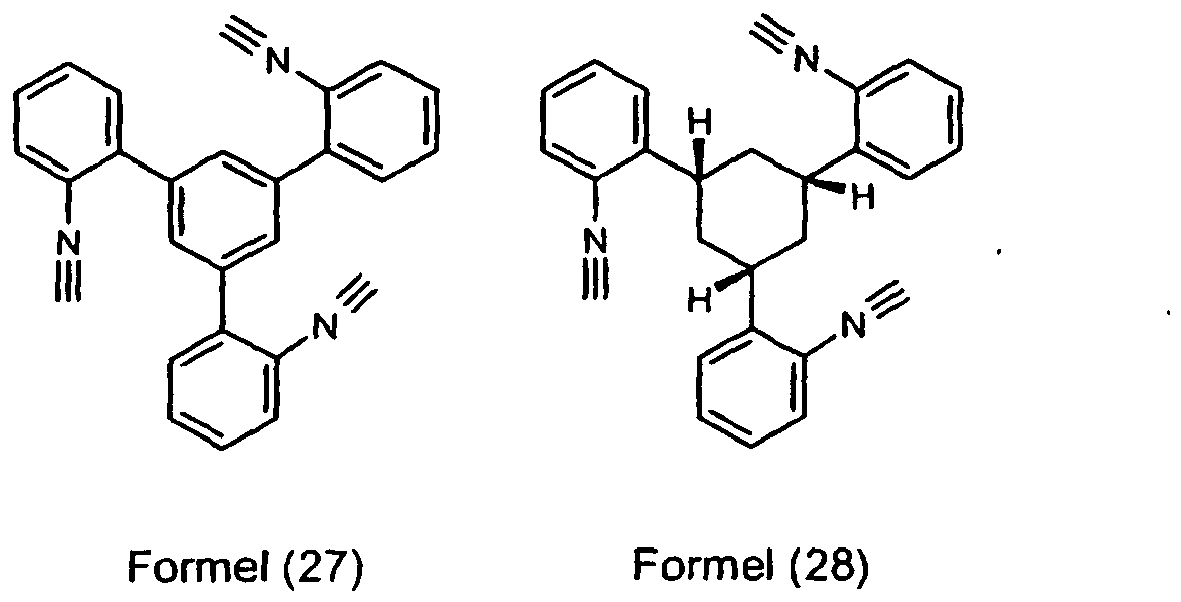
- Metal complexes containing the ligands of formula (27) and / or (28) listed above are novel and are therefore also an object of the present invention.
- Another object of the invention are therefore metal complexes of the formula (1 '), (L) y M- [C ⁇ NR] x formula (1 ') where the symbols and indices used have the abovementioned meanings and at least one of the isonitrile ligands is selected from ligands of the formula (27) or (28), which may in each case also be substituted by one or more radicals R 1 :
- solutions of the compounds of formula (1 ') are required.
- Another object of the invention are therefore solutions containing at least one compound of formula (1 ') and at least one organic solvent, preferably selected from the class of aromatic organic solvents, for. B. dimethylanisole.
- Yet another object of the invention are ligands of the above-depicted formulas (27) and (28), which may each be substituted by one or more radicals R 1 .
- Electroluminescent devices with passive matrix control are not accompanied by a deterioration of the other electronic properties.
- Hexakis (phenyl isonitrile) molybdenum (0) (Example 1), hexakis (phenyl isonitrile) tungsten (0) (Example 2) and hexakis (2,4,6-tri-tert-butylphenyl isonitrile) tungsten (0) (Example 3) can after Albers et al., J. Chem. Edu. 1986, 63 (5), 444 . Coville et al., Inorg. Chim. Acta 1982, 65, L7-L8 , respectively. Yamamoto et al., J. Organomet. Chem. 1985, 282, 191 getting produced. The compounds are recrystallized several times from toluene / ethanol (1: 2 - 1: 1). The purities thus obtained are typically> 99.8% by 1 H NMR.
- 1,3,5-tris (1-isocyano-phen-2-yl) benzene is obtained from 1,3,5-tris (1-amino-phen-2-yl) benzene [923027-14-9] FE Hahn et al., J. Organomet. Chem. 467, 130, 1994 shown.
- the metal complexes of the formula (1) with isonitrile ligands have a significantly lower luminescence lifetime than iridium or platinum complexes, as are generally used according to the prior art in OLEDs.
- these complexes are particularly suitable for use in electroluminescent devices with passive matrix control.
- LEDs are carried out according to the general method outlined below. Of course, this has to be adapted in individual cases to the respective circumstances (eg layer thickness variation in order to achieve optimum efficiency or color).
- PLEDs polymeric light-emitting diodes
- the compounds according to the invention are dissolved together with the listed matrix materials or Matrixmareialkombinationen in toluene or chlorobenzene.
- the typical solids content of such solutions is between 10 and 25 g / L, if, as here, the typical for a device layer thickness of 80 nm is to be achieved by spin coating.
- the matrix materials used are the following compounds:
- ITO substrates and the material for the so-called buffer layer are commercially available (ITO from Technoprint and others, PEDOT: PPS as aqueous dispersion Clevios Baytron P from H. C. Starck).
- the emission layer is spin-coated in an inert gas atmosphere, in this case argon, and baked at 120 ° C. for 10 minutes. Finally, a cathode of barium and aluminum is evaporated in vacuo.
- the solution-processed devices are characterized by default, the OLED examples mentioned were not optimized.
Landscapes
- Chemical & Material Sciences (AREA)
- Engineering & Computer Science (AREA)
- Materials Engineering (AREA)
- Inorganic Chemistry (AREA)
- Crystallography & Structural Chemistry (AREA)
- Organic Chemistry (AREA)
- Physics & Mathematics (AREA)
- Spectroscopy & Molecular Physics (AREA)
- Optics & Photonics (AREA)
- Electroluminescent Light Sources (AREA)
- Photovoltaic Devices (AREA)
Abstract
Description
Der Aufbau organischer Elektrolumineszenzvorrichtungen (OLEDs), in denen organische Halbleiter als funktionelle Materialien eingesetzt werden, ist beispielsweise in
Gemäß dem Stand der Technik werden in phosphoreszierenden OLEDs als Triplettemitter meist Iridiumkomplexe bzw. Platinkomplexe eingesetzt. Eine Verbesserung dieser OLEDs konnte dadurch erzielt werden, dass Metallkomplexe mit polypodalem Liganden bzw. Kryptate eingesetzt wurden, wodurch die Komplexe eine höhere thermische Stabilität aufweisen, was zu einer höheren Lebensdauer der OLEDs führt (
Auch die Verwendung von Wolframkomplexen in OLEDs wurde bereits in der Literatur beschrieben (
Eine Eigenschaft von phosphoreszierenden Metallkomplexen, wie sie gemäß dem Stand der Technik eingesetzt werden, sind die im Vergleich zu fluoreszierenden Verbindungen sehr langen Lumineszenzlebensdauern. So liegen die Phosphoreszenzlebensdauern von Iridiumkomplexen bei Raumtemperatur üblicherweise in der Größenordnung von 0.5 bis 5 µs und von Platinkomplexen in der Größenordnung von 3 bis 30 µs. Insbesondere bei Passiv-Matrix-Ansteuerung von organischen Elektrolumineszenzvorrichtungen kann dies zu Problemen führen, da durch die dabei benötigten hohen Helligkeiten eine Sättigung des angeregten Zustands erzeugt wird, so dass bei hoher Helligkeit die Effizienz stark abfällt. In diesem Bereich sind somit weitere Verbesserungen erforderlich.A property of phosphorescent metal complexes, as used in the prior art, are the very long luminescence lifetimes compared to fluorescent compounds. Thus, the phosphorescence lifetimes of iridium complexes at room temperature are usually of the order of 0.5 to 5 .mu.s and of platinum complexes of the order of 3 to 30 .mu.s. This can lead to problems, in particular in the case of passive matrix control of organic electroluminescent devices, since saturation of the excited state is produced by the high brightnesses required thereby, so that the efficiency drops sharply when the brightness is high. Further improvements are needed in this area.
Aufgabe der vorliegenden Erfindung ist daher die Bereitstellung neuer elektronischer Vorrichtungen enthaltend Metallkomplexe als Emitter, welche rot, orange, gelb, grün oder blau phosphoreszieren und welche hier zu Verbesserungen führen.The object of the present invention is therefore to provide novel electronic devices containing metal complexes as emitters, which phosphoresce red, orange, yellow, green or blue and which lead to improvements here.
Überraschend wurde gefunden, dass organische Elektrolumineszenzvorrichtungen enthaltend die näher beschriebenen Metallkomplexe, welche Isonitrilliganden enthalten, diese Aufgabe lösen und zu deutlichen Verbesserungen der organischen Elektrolumineszenzvorrichtung führen, insbesondere hinsichtlich der operativen Lebensdauer und der Effizienz bei hoher Helligkeit. Organische Elektrolumineszenzvorrichtungen, welche diese Komplexe enthalten, sind daher der Gegenstand der vorliegenden Erfindung.Surprisingly, it has been found that organic electroluminescent devices comprising the metal complexes described in more detail, which contain isonitrile ligands, achieve this object and lead to significant improvements in the organic electroluminescent device, in particular with regard to operating life and high-brightness efficiency. Organic electroluminescent devices containing these complexes are therefore the subject of the present invention.
Stand der Technik sind organische Elektrolumineszenzvorrichtungen, die tetrakoodinierte Metallkomplexe mit Isonitrilliganden enthalten (
Aus der
Die Synthese eines Wolfram-Hexaisonitrilkomplexes mit monodentaten Isonitrilliganden ist in
Auch hexakoordinierte Metallkomplexe mit polydentaten Isonitrilliganden sind in der Literatur bekannt (z.
Weiterhin sind Metallkomplexe mit tridentaten Cyanoliganden bekannt (
Gegenstand der Erfindung sind somit elektronische Vorrichtungen, enthaltend mindestens einen Metallkomplex gemäß Formel (1), 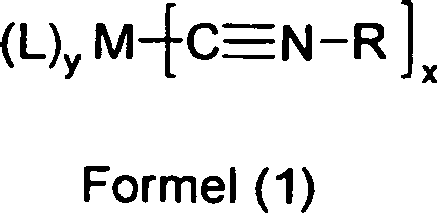
wobei für die verwendeten Symbole und Indizes gilt:
- M
- ist ein penta- oder hexakoordiniertes Übergangsmetall;
- L
- ist bei jedem Auftreten gleich oder verschieden ein mono-, bi- oder tridentater Ligand, der an das Metall M bindet und der durch einen oder mehrere Reste R1 substituiert sein kann; dabei kann der Ligand L auch an den Rest R der Isonitrilgruppe gebunden sein;
- R
- ist bei jedem Auftreten gleich oder verschieden ein organischer Substituent mit 1 bis 60 C-Atomen, der durch einen oder mehrere Substituenten R1 substituiert sein kann; dabei können mehrere Reste R auch miteinander verknüpft sein und dadurch einen mehrzähnigen Liganden bilden; außerdem kann der Rest R auch mit dem Liganden L verknüpft sein;
- R1
- ist bei jedem Auftreten gleich oder verschieden H, D, F, Cl, Br, I, N(R2)2, CN, NO2, Si(R2)3, B(OR2)2, C(=O)R2, P(=O)(R2)2, S(=O)R2, S(=O)2R2, OSO2R2, eine geradkettige Alkyl-, Alkoxy- oder Thioalkoxygruppe mit 1 bis 40 C-Atomen oder eine geradkettige Alkenyl- oder Alkinylgruppe mit 2 bis 40 C-Atomen oder eine verzweigte oder cyclische Alkyl-, Alkenyl-, Alkinyl-, Alkoxy- oder Thioalkoxygruppe mit 3 bis 40 C-Atomen, die jeweils mit einem oder mehreren Resten R2 substituiert sein kann, wobei eine oder mehrere bevorzugt nicht benachbarte CH2-Gruppen durch R2C=CR2, C=C, Si(R2)2 Ge(R2)2, Sn(R2)2, C=O, C=S, C=Se, C=NR2, P(=O)(R2), SO, SO2, NR2, O, S oder CONR2 ersetzt sein können und wobei ein oder mehrere H-Atome durch D, F, Cl, Br, I, CN oder NO2 ersetzt sein können, oder ein aromatisches oder heteroaromatisches Ringsystem mit 5 bis 60 aromatischen Ringatomen, das jeweils durch einen oder mehrere Reste R2 substituiert sein kann, oder eine Aryloxy- oder Heteroaryloxygruppe mit 5 bis 60 aromatischen Ringatomen, die durch einen oder mehrere Reste R2 substituiert sein kann, oder eine Diarylaminogruppe, Diheteroarylaminogruppe oder Arylheteroarylaminogruppe mit 10 bis 40 aromatischen Ringatomen, welche durch einen oder mehrere Reste R2 substituiert sein kann, oder eine Kombination dieser Systeme; dabei können zwei oder mehrere Substituenten R1 auch miteinander ein mono- oder polycyclisches aliphatisches, aromatisches und/oder benzoannelliertes Ringsystem bilden;
- R2
- ist bei jedem Auftreten gleich oder verschieden H, D, F oder ein aliphatischer, aromatischer und/oder heteroaromatischer Kohlenwasserstoffrest mit 1 bis 20 C-Atomen, in dem auch ein oder mehrere H-Atome durch D oder F ersetzt sein können; dabei können zwei oder mehrere Substituenten R2 auch miteinander ein mono- oder polycyclisches, aliphatisches oder aromatisches Ringsystem bilden;
- x
- ist 3, 4, 5 oder 6;
- y
- ist 0, 1, 2 oder 3 mit der Maßgabe, dass eine Koordinationszahl am Metall von 5 oder 6 erreicht wird.
where the symbols and indices used are:
- M
- is a penta- or hexacoordinated transition metal;
- L
- is identical or different at each occurrence, a mono-, bi- or tridentate ligand which binds to the metal M and which may be substituted by one or more radicals R 1 ; In this case, the ligand L may also be bonded to the radical R of the isonitrile group;
- R
- is identical or different at each occurrence, an organic substituent having 1 to 60 carbon atoms, which may be substituted by one or more substituents R 1 ; in this case, several radicals R can also be linked to one another and thereby form a polydentate ligand; In addition, the radical R can also be linked to the ligand L;
- R 1
- is identical or different at each occurrence H, D, F, Cl, Br, I, N (R 2 ) 2 , CN, NO 2 , Si (R 2 ) 3 , B (OR 2 ) 2 , C (= O) R 2 , P (= O) (R 2 ) 2 , S (= O) R 2 , S (= O) 2 R 2 , OSO 2 R 2 , a straight-chain alkyl, alkoxy or thioalkoxy group having 1 to 40 C. Atoms or a straight-chain alkenyl or alkynyl group having 2 to 40 C atoms or a branched or cyclic alkyl, alkenyl, alkynyl, alkoxy or thioalkoxy group having 3 to 40 C atoms, each containing one or more radicals R 2 may be substituted, wherein one or more preferably non-adjacent CH 2 groups by R 2 C = CR 2 , C = C, Si (R 2 ) 2 Ge (R 2 ) 2 , Sn (R 2 ) 2 , C = O, C = S, C = Se, C = NR 2 , P (= O) (R 2 ), SO, SO 2 , NR 2 , O, S or CONR 2 may be replaced and wherein one or more H atoms be replaced by D, F, Cl, Br, I, CN or NO 2 , or an aromatic or heteroaromatic ring system having 5 to 60 aromatic ring atoms, each of which may be substituted by one or more radicals R 2 , or an aryloxy or heteroaryloxy group having 5 to 60 aromatic ring atoms, which may be substituted by one or more radicals R 2 , or a Diarylaminogruppe, Diheteroarylaminogruppe or Arylheteroarylaminogruppe having 10 to 40 aromatic ring atoms, which may be substituted by one or more radicals R 2 , or a combination of these systems; two or more substituents R 1 may also together form a mono- or polycyclic aliphatic, aromatic and / or benzoannellated ring system;
- R 2
- is identical or different at each occurrence H, D, F or an aliphatic, aromatic and / or heteroaromatic hydrocarbon radical having 1 to 20 C atoms, in which also one or more H atoms may be replaced by D or F; there can be two or more substituents R 2 also together form a mono- or polycyclic, aliphatic or aromatic ring system;
- x
- is 3, 4, 5 or 6;
- y
- is 0, 1, 2 or 3 with the proviso that a coordination number on the metal of 5 or 6 is achieved.
Die Indizes x und y werden so gewählt, dass die Koordinationszahl am Metall M insgesamt, je nach Metall, 5 oder 6 beträgt. Es ist generell bekannt, dass Metallkoordinationsverbindungen abhängig vom gewählten Metallatom und von der Oxidationsstufe des Metallsatoms unterschiedliche Koordinationszahlen aufweisen, also eine unterschiedliche Anzahl von Liganden binden. Da die bevorzugten Koordinationszahlen von Metallen bzw. Metallionen in verschiedenen Oxidationsstufen zum allgemeinen Fachwissen des Fachmanns auf dem Gebiet der metallorganischen Chemie bzw. der Koordinationschemie gehören, ist es für den Fachmann ein Leichtes, je nach Metall und dessen Oxidationsstufe und je nach genauer Struktur des Liganden L eine geeignete Anzahl Liganden zu verwenden und somit die Indizes x und y geeignet zu wählen.The indices x and y are chosen such that the coordination number on the metal M as a whole is 5 or 6, depending on the metal. It is generally known that metal coordination compounds have different coordination numbers depending on the metal atom chosen and on the oxidation state of the metal atom, ie bind a different number of ligands. Since the preferred coordination numbers of metals or metal ions in different oxidation states belong to the general expertise of those skilled in the field of organometallic chemistry or coordination chemistry, it is easy for the skilled person, depending on the metal and its oxidation state and the exact structure of the ligand L to use an appropriate number of ligands and thus to choose the indexes x and y suitable.
Unter einer elektronischen Vorrichtung wird eine Vorrichtung verstanden, welche Anode, Kathode und mindestens eine Schicht enthält, wobei diese Schicht mindestens eine organische bzw. metallorganische Verbindung enthält. Die erfindungsgemäße elektronische Vorrichtung enthält also Anode, Kathode und mindestens eine Schicht, welche mindestens eine Verbindung der oben aufgeführten Formel (1) enthält. Dabei sind bevorzugte elektronische Vorrichtungen ausgewählt aus der Gruppe bestehend aus organischen Elektrolumineszenzvorrichtungen (= organischen Leuchtdioden, OLEDs, PLEDs), organischen integrierten Schaltungen (O-ICs), organischen Feld-Effekt-Transistoren (O-FETs), organischen Dünnfilmtransistoren (O-TFTs), organischen lichtemittierenden Transistoren (O-LETs), organischen Solarzellen (O-SCs), organischen optischen Detektoren, organischen Photorezeptoren, organischen Feld-Quench-Devices (O-FQDs), lichtemittierenden elektrochemischen Zellen (LECs) oder organischen Laserdioden (O-Laser), enthaltend in mindestens einer Schicht mindestens eine Verbindung gemäß der oben aufgeführten Formel (1). Besonders bevorzugt sind organische Elektrolumineszenzvorrichtungen.An electronic device is understood to mean a device which contains anode, cathode and at least one layer, this layer containing at least one organic or organometallic compound. The electronic device according to the invention thus contains anode, cathode and at least one layer which contains at least one compound of the above-mentioned formula (1). Here, preferred electronic devices are selected from the group consisting of organic electroluminescent devices (= organic light-emitting diodes, OLEDs, PLEDs), organic integrated circuits (O-ICs), organic field-effect transistors (O-FETs), organic thin-film transistors (O-TFTs ), organic light-emitting transistors (O-LETs), organic solar cells (O-SCs), organic optical detectors, organic photoreceptors, organic field quench devices (O-FQDs), light-emitting electrochemical cells (LECs) or organic laser diodes (O-SCs). Laser), containing in at least one layer at least one compound according to the above-mentioned formula (1). Particularly preferred are organic electroluminescent devices.
Die Liganden vom Typ C≡N-R sind Isonitrile (= Isocyanide), welche über ein Kohlenstoffatom an das Metall koordinieren. Dabei ist der Ligand entweder monodentat, wenn R eine monovalente Gruppe darstellt, oder er ist bidentat, wenn R eine bivalente Gruppe darstellt, die entweder zwei Isonitrilgruppen oder eine Isonitrilgruppe und den Liganden L miteinander verknüpft, oder er ist tridentat, wenn R eine trivalente Gruppe darstellt, die die Isonitrilgruppen und gegebenenfalls den Liganden L miteinander verknüpft. Höherdentate Liganden sind ebenfalls möglich, wenn L bereits beispielsweise einen bidentaten oder tridentaten Liganden darstellt.The ligands of type C≡N-R are isonitriles (= isocyanides), which coordinate to the metal via a carbon atom. In this case, the ligand is either monodentate when R represents a monovalent group, or it is bidentate when R represents a divalent group linking either two isonitrile groups or an isonitrile group and the ligand L, or it is tridentate when R is a trivalent group representing the isonitrile groups and optionally the ligand L linked together. Higher-rate ligands are also possible if L already represents, for example, a bidentate or tridentate ligand.
Eine Arylgruppe im Sinne dieser Erfindung enthält 6 bis 40 C-Atome; eine Heteroarylgruppe im Sinne dieser Erfindung enthält 2 bis 40 C-Atome und mindestens ein Heteroatom, mit der Maßgabe, dass die Summe aus C-Atomen und Heteroatomen mindestens 5 ergibt. Die Heteroatome sind bevorzugt ausgewählt aus N, O und/oder S. Dabei wird unter einer Arylgruppe bzw. Heteroarylgruppe entweder ein einfacher aromatischer Cyclus, also Benzol, bzw. ein einfacher heteroaromatischer Cyclus, beispielsweise Pyridin, Pyrimidin, Thiophen, etc., oder eine kondensierte Aryl- oder Heteroarylgruppe, beispielsweise Naphthalin, Anthracen, Phenanthren, Chinolin, Isochinolin, etc., verstanden. Ein cyclisches Carben im Sinne dieser Erfindung ist eine cyclische Gruppe, welche über ein neutrales C-Atom an das Metall bindet. Dabei kann die cyclische Gruppe gesättigt oder ungesättigt sein. Bevorzugt sind hierbei Arduengo-Carbene, also solche Carbene, bei welchen an das Carben-C-Atom zwei Stickstoffatome gebunden sind. Dabei wird ein Fünfring-Arduengo-Carben bzw. ein anderes ungesättigtes Fünfring-Carben ebenfalls als eine Arylgruppe im Sinne dieser Erfindung angesehen.An aryl group for the purposes of this invention contains 6 to 40 carbon atoms; For the purposes of this invention, a heteroaryl group contains 2 to 40 C atoms and at least one heteroatom, with the proviso that the sum of C atoms and heteroatoms gives at least 5. The heteroatoms are preferably selected from N, O and / or S. Here, under an aryl group or heteroaryl either a simple aromatic cycle, ie benzene, or a simple heteroaromatic cycle, for example pyridine, pyrimidine, thiophene, etc., or a fused aryl or heteroaryl group, for example naphthalene, anthracene, phenanthrene, quinoline, isoquinoline, etc., understood. A cyclic carbene in the sense of this invention is a cyclic group which binds to the metal via a neutral carbon atom. The cyclic group may be saturated or unsaturated. Arduengo carbenes, ie those carbenes, in which two nitrogen atoms are bonded to the carbene C atom, are preferred here. Here, a five-membered arduengo carbene or another unsaturated five-membered carbene is also regarded as an aryl group in the context of this invention.
Ein aromatisches Ringsystem im Sinne dieser Erfindung enthält 6 bis 60 C-Atome im Ringsystem. Ein heteroaromatisches Ringsystem im Sinne dieser Erfindung enthält 2 bis 60 C-Atome und mindestens ein Heteroatom im Ringsystem, mit der Maßgabe, dass die Summe aus C-Atomen und Heteroatomen mindestens 5 ergibt. Die Heteroatome sind bevorzugt ausgewählt aus N, O und/oder S. Unter einem aromatischen oder heteroaromatischen Ringsystem im Sinne dieser Erfindung soll ein System verstanden werden, das nicht notwendigerweise nur Aryl- oder Heteroarylgruppen enthält, sondern in dem auch mehrere Aryl- oder Heteroarylgruppen durch eine nicht-aromatische Einheit (bevorzugt weniger als 10 % der von H verschiedenen Atome), wie z. B. ein sp3- oder sp2-hybridisiertes C-, N- oder O-Atom oder eine Carbonylgruppe, unterbrochen sein können. So sollen beispielsweise auch Systeme wie 9,9'-Spirobifluoren, 9,9-Diarylfluoren, Triarylamin, Diarylether, Stilben, etc. als aromatische Ringsysteme im Sinne dieser Erfindung verstanden werden, und ebenso Systeme, in denen zwei oder mehrere Arylgruppen beispielsweise durch eine lineare oder cyclische Alkyl-, Alkenyl oder Alkinylgruppe oder durch eine Silylgruppe unterbrochen sind.An aromatic ring system in the sense of this invention contains 6 to 60 carbon atoms in the ring system. A heteroaromatic ring system in the sense of this invention contains 2 to 60 C atoms and at least one heteroatom in the ring system, with the proviso that the sum of C atoms and Heteroatoms at least 5 results. The heteroatoms are preferably selected from N, O and / or S. An aromatic or heteroaromatic ring system in the sense of this invention is to be understood as meaning a system which does not necessarily contain only aryl or heteroaryl groups but in which also several aryl or heteroaryl groups a non-aromatic moiety (preferably less than 10% of the atoms other than H), such as e.g. B. an sp 3 - or sp 2 -hybridized C, N or O atom or a carbonyl group, may be interrupted. For example, systems such as 9,9'-spirobifluorene, 9,9-diarylfluorene, triarylamine, diaryl ethers, stilbene, etc. are to be understood as aromatic ring systems in the context of this invention, and also systems in which two or more aryl groups, for example by a linear or cyclic alkyl, alkenyl or alkynyl group or interrupted by a silyl group.
Unter einer cyclischen Alkyl-, Alkenyl, Alkinyl, Alkoxy- oder Thioalkoxygruppe im Sinne dieser Erfindung wird eine monocyclische, eine bicyclische oder eine polycyclische Gruppe verstanden.For the purposes of this invention, a cyclic alkyl, alkenyl, alkynyl, alkoxy or thioalkoxy group is understood as meaning a monocyclic, a bicyclic or a polycyclic group.
Im Rahmen der vorliegenden Erfindung werden unter einer C1- bis C40-Alkylgruppe, in der auch einzelne H-Atome oder CH2-Gruppen durch die oben genannten Gruppen substituiert sein können, bevorzugt die Reste Methyl, Ethyl, n-Propyl, i-Propyl, n-Butyl, i-Butyl, s-Butyl, t-Butyl, 2-Methylbutyl, n-Pentyl, s-Pentyl, tert-Pentyl, 2-Pentyl, Cyclopentyl, n-Hexyl, s-Hexyl, tert-Hexyl, 2-Hexyl, 3-Hexyl, Cyclohexyl, 2-Methylpentyl, n-Heptyl, 2-Heptyl, 3-Heptyl, 4-Heptyl, Cycloheptyl, 1-Methylcyclohexyl, n-Octyl, 2-Ethylhexyl, Cyclooctyl, 1-Bicyclo[2,2,2]octyl, 2-Bicyclo[2,2,2]octyl, 2-(2,6-Dimethyl)octyl, 3-(3,7-Dimethyl)octyl, Trifluormethyl, Pentafluorethyl, 2,2,2-Trifluorethyl, Ethenyl, Propenyl, Butenyl, Pentenyl, Cyclopentenyl, Hexenyl, Cyclohexenyl, Heptenyl, Cycloheptenyl, Octenyl, Cyclooctenyl, Ethinyl, Propinyl, Butinyl, Pentinyl, Hexinyl, Heptinyl oder Octinyl verstanden. Unter einer C1- bis C40-Alkoxygruppe werden bevorzugt Methoxy, Trifluormethoxy, Ethoxy, n-Propoxy, i-Propoxy, n-Butoxy, i-Butoxy, s-Butoxy, t-Butoxy oder 2-Methylbutoxy verstanden. Unter einem aromatischen oder heteroaromatischen Ringsystem mit 5 - 60 aromatischen Ringatomen, welches noch jeweils mit den oben genannten Resten R substituiert sein kann und welches über beliebige Positionen am Aromaten bzw. Heteroaromaten verknüpft sein kann, werden insbesondere Gruppen verstanden, die abgeleitet sind von Benzol, Naphthalin, Anthracen, Phenanthren, Pyren, Chrysen, Perylen, Fluoranthen, Benzfluoranthen, Naphthacen, Pentacen, Benzpyren, Biphenyl, Biphenylen, Terphenyl, Terphenylen, Fluoren, Spirobifluoren, Dihydrophenanthren, Dihydropyren, Tetrahydropyren, cis- oder trans-Indenofluoren, cis- oder trans-Monobenzoindenofluoren, cis- oder trans-Dibenzoindenofluoren, Truxen, Isotruxen, Spirotruxen, Spiroisotruxen, Furan, Benzofuran, Isobenzofuran, Dibenzofuran, Thiophen, Benzothiophen, Isobenzothiophen, Dibenzothiophen, Pyrrol, Indol, Isoindol, Carbazol, Pyridin, Chinolin, Isochinolin, Acridin, Phenanthridin, Benzo-5,6-chinolin, Benzo-6,7-chinolin, Benzo-7,8-chinolin, Phenothiazin, Phenoxazin, Pyrazol, Indazol, Imidazol, Benzimidazol, Naphthimidazol, Phenanthrimidazol, Pyridimidazol, Pyrazinimidazol, Chinoxalinimidazol, Oxazol, Benzoxazol, Naphthoxazol, Anthroxazol, Phenanthroxazol, Isoxazol, 1,2-Thiazol, 1,3-Thiazol, Benzothiazol, Pyridazin, Benzopyridazin, Pyrimidin, Benzpyrimidin, Chinoxalin, 1,5-Diazaanthracen, 2,7-Diazapyren, 2,3-Diazapyren, 1,6-Diazapyren, 1,8-Diazapyren, 4, 5-Diazapyren, 4,5,9,10-Tetraazaperylen, Pyrazin, Phenazin, Phenoxazin, Phenothiazin, Fluorubin, Naphthyridin, Azacarbazol, Benzocarbolin, Phenanthrolin, 1,2,3-Triazol, 1,2,4-Triazol, Benzotriazol, 1,2,3-Oxadiazol, 1,2,4-Oxadiazol, 1,2,5-Oxadiazol, 1,3,4-Oxadiazol, 1,2,3-Thiadiazol, 1,2,4-Thiadiazol, 1,2,5-Thiadiazol, 1,3,4-Thiadiazol, 1,3,5-Triazin, 1,2,4-Triazin, 1,2,3-Triazin, Tetrazol, 1,2,4,5-Tetrazin, 1,2,3,4-Tetrazin, 1,2,3,5-Tetrazin, Purin, Pteridin, Indolizin und Benzothiadiazol.In the context of the present invention, under a C 1 to C 40 alkyl group in which individual H atoms or CH 2 groups may also be substituted by the abovementioned groups, the radicals methyl, ethyl, n- propyl, i -Propyl, n -butyl, i -butyl, s -butyl, t -butyl, 2-methylbutyl, n -pentyl, s -pentyl, tert- pentyl, 2-pentyl, cyclopentyl, n -hexyl, s -hexyl, tert Hexyl, 2-hexyl, 3-hexyl, cyclohexyl, 2-methylpentyl, n -heptyl, 2-heptyl, 3-heptyl, 4-heptyl, cycloheptyl, 1-methylcyclohexyl, n- octyl, 2-ethylhexyl, cyclooctyl, 1 Bicyclo [2,2,2] octyl, 2-bicyclo [2,2,2] octyl, 2- (2,6-dimethyl) octyl, 3- (3,7-dimethyl) octyl, trifluoromethyl, pentafluoroethyl, 2 , 2,2-trifluoroethyl, ethenyl, propenyl, butenyl, pentenyl, cyclopentenyl, hexenyl, cyclohexenyl, heptenyl, cycloheptenyl, octenyl, cyclooctenyl, ethynyl, propynyl, butynyl, pentynyl, hexynyl, heptynyl or octynyl. A C 1 - to C 40 -alkoxy group is preferably understood as meaning methoxy, trifluoromethoxy, ethoxy, n- propoxy, i -propoxy, n- butoxy, i- butoxy, s- butoxy, t -butoxy or 2-methylbutoxy. Under an aromatic or heteroaromatic ring system with 5-60 aromatic ring atoms, which still be substituted in each case with the above-mentioned R radicals and which can be linked via any position on the aromatic or heteroaromatic, are understood in particular groups which are derived from benzene, naphthalene, anthracene, phenanthrene, pyrene, chrysene, perylene, fluoranthene, benzfluoranthene, naphthacene, pentacene, benzpyrene, biphenyl, Biphenylene, terphenyl, terphenylene, fluorene, spirobifluorene, dihydrophenanthrene, dihydropyrene, tetrahydropyrene, cis- or trans-indenofluorene, cis- or trans-monobenzoindenofluorene, cis- or trans-dibenzoindenofluorene, truxene, isotruxene, spirotruxene, spiroisotruxene, furan, benzofuran, isobenzofuran , Dibenzofuran, thiophene, benzothiophene, isobenzothiophene, dibenzothiophene, pyrrole, indole, isoindole, carbazole, pyridine, quinoline, isoquinoline, acridine, phenanthridine, benzo-5,6-quinoline, benzo-6,7-quinoline, benzo-7,8 quinoline, phenothiazine, phenoxazine, pyrazole, indazole, imidazole, benzimidazole, naphthimidazole, phenanthrimidazole, pyridimidazole, pyrazine imidazole, quinoxaline imidazole, oxazole, benzo xazole, naphthoxazole, anthroxazole, phenanthroxazole, isoxazole, 1,2-thiazole, 1,3-thiazole, benzothiazole, pyridazine, benzopyridazine, pyrimidine, benzpyrimidine, quinoxaline, 1,5-diazaanthracene, 2,7-diazapyrene, 2,3- Diazapyrene, 1,6-diazapyrene, 1,8-diazapyrene, 4, 5-diazapyrene, 4,5,9,10-tetraazaperylene, pyrazine, phenazine, phenoxazine, phenothiazine, fluorubin, naphthyridine, azacarbazole, benzocarboline, phenanthroline, 1, 2,3-triazole, 1,2,4-triazole, benzotriazole, 1,2,3-oxadiazole, 1,2,4-oxadiazole, 1,2,5-oxadiazole, 1,3,4-oxadiazole, 1, 2,3-thiadiazole, 1,2,4-thiadiazole, 1,2,5-thiadiazole, 1,3,4-thiadiazole, 1,3,5-triazine, 1,2,4-triazine, 1,2, 3-triazine, tetrazole, 1,2,4,5-tetrazine, 1,2,3,4-tetrazine, 1,2,3,5-tetrazine, purine, pteridine, indolizine and benzothiadiazole.
Im Folgenden werden die Ausführungsformen der Verbindung gemäß Formel (1) beschrieben, wie sie bevorzugt in der elektronischen Vorrichtung verwendet werden.In the following, the embodiments of the compound according to formula (1) will be described, as they are preferably used in the electronic device.
Bevorzugt sind Verbindungen gemäß Formel (1), dadurch gekennzeichnet, dass diese nicht geladen, d. h. elektrisch neutral, sind. Dies wird auf einfache Weise dadurch erreicht, dass die Ladung der Liganden L und des Restes R am Isonitrilliganden so gewählt wird, dass sie die Ladung des komplexierten Metallatoms M kompensiert.Preference is given to compounds of the formula (1), characterized in that they are not charged, ie are electrically neutral. This is achieved in a simple way by selecting the charge of the ligands L and of the radical R on the isonitrile ligand in such a way that it compensates the charge of the complexed metal atom M.
Bevorzugt sind weiterhin Verbindungen gemäß Formel (1), dadurch gekennzeichnet, dass die Summe der Valenzelektronen um das Metallatom in fünfach koordinierten Komplexen 16 und in sechsfach koordinierten Komplexen 18 beträgt. Diese Bevorzugung ist durch die besondere Stabilität dieser Metallkomplexe begründet (siehe z. B.
Bevorzugt sind Verbindungen gemäß Formel (1), in denen M für ein pentakoordiniertes oder für ein hexakoordiniertes Übergangsmetall steht, besonders bevorzugt ausgewählt aus der Gruppe bestehend aus Chrom, Molybdän, Wolfram, Rhenium, Ruthenium, Osmium, Rhodium, Iridium, Nickel, Platin, Kupfer, Silber und Gold, insbesondere Molybdän, Wolfram, Rhenium, Ruthenium, Osmium, Iridium, Platin und Gold. Die Metalle können dabei in verschiedenen Oxidationsstufen vorliegen. Bevorzugt sind dabei die oben genannten Metalle in den Oxidationsstufen Cr(O), Cr(II), Cr(III), Cr(IV), Cr(VI), Mo(O), Mo(II), Mo(III), Mo(IV), W(O), W(II), W(III), W(IV), Re(I), Re(II), Re(III), Re(IV), Ru(II), Ru(III), Os(II), Os(III), Os(IV), Rh(I), Rh(III), Ir(I), Ir(III), Ir(IV), Ni(0), Ni(II), Ni(IV), Pt(IV), Cu(I), Cu(II), Cu(III), Ag(II), Au(III) und Au(V); ganz besonders bevorzugt sind Mo(0), W(0), Re(I), Ru(II), Os(II), Rh(III), Ir(III) und Pt(IV).Preference is given to compounds of the formula (1) in which M is a pentacoordinated or hexacoordinated transition metal, more preferably selected from the group consisting of chromium, molybdenum, tungsten, rhenium, ruthenium, osmium, rhodium, iridium, nickel, platinum, Copper, silver and gold, in particular molybdenum, tungsten, rhenium, ruthenium, osmium, iridium, platinum and gold. The metals can be present in different oxidation states. Preference is given to the abovementioned metals in the oxidation states Cr (O), Cr (II), Cr (III), Cr (IV), Cr (VI), Mo (O), Mo (II), Mo (III), Mo (IV), W (O), W (II), W (III), W (IV), Re (I), Re (II), Re (III), Re (IV), Ru (II) Ru (III), Os (II), Os (III), Os (IV), Rh (I), Rh (III), Ir (I), Ir (III), Ir (IV), Ni (0), Ni (II), Ni (IV), Pt (IV), Cu (I), Cu (II), Cu (III), Ag (II), Au (III) and Au (V); most preferred are Mo (0), W (0), Re (I), Ru (II), Os (II), Rh (III), Ir (III) and Pt (IV).
In einer bevorzugten Ausführungsform der Erfindung ist M ein pentakoordiniertes Metall und der Index x steht für 3 oder 5. In einer weiteren bevorzugten Ausführungsform der Erfindung ist M ein hexakoordiniertes Metall und der Index x steht für 3, 4 oder 6.In a preferred embodiment of the invention, M is a pentacoordinated metal and the subscript x is 3 or 5. In another preferred embodiment of the invention, M is a hexacoordinated metal and the subscript x is 3, 4 or 6.
In einer Ausführungsform der Erfindung sind ein oder mehrere der Isonitrilliganden monodentate Liganden. In diesem Fall steht der Substituent R bevorzugt gleich oder verschieden bei jedem Auftreten für eine geradkettige Alkylgruppe mit 1 bis 20 C-Atomen oder eine verzweigte oder cyclische Alkylgruppe mit 3 bis 20 C-Atomen, die jeweils mit einem oder mehreren Resten R1 substituiert sein kann, wobei eine oder mehrere nicht benachbarte CH2-Gruppen durch R1C=CR1, C=C, Si(R1)2, Ge(R1)2, Sn(R1)2, C=O, C=S, C=Se, C=NR1, P(=O)(R1), SO, SO2, NR1, O, S oder CONR1 ersetzt sein können und wobei ein oder mehrere H-Atome durch D, F, Cl, Br, I, CN oder NO2 ersetzt sein können, oder für ein monovalentes aromatisches oder heteroaromatisches Ringsystem mit 5 bis 40 aromatischen Ringatomen, das jeweils durch einen oder mehrere Reste R1 substituiert sein kann, oder für eine Kombination dieser Systeme. Besonders bevorzugt steht der Substituent R, wenn der Isonitrilligand ein monodentater Ligand ist, bei jedem Auftreten gleich oder verschieden für eine geradkettige Alkylgruppe mit 1 bis 10 C-Atomen oder eine verzweigte oder cyclische Alkylgruppe mit 3 bis 10 C-Atomen, die jeweils mit einem oder mehreren Resten R1 substituiert sein kann, wobei eine oder mehrere nicht benachbarte CH2-Gruppen durch R1C=CR1, C=C, C=O, C=S oder O ersetzt sein können und wobei ein oder mehrere H-Atome durch D, F oder CN ersetzt sein können, oder für ein monovalentes aromatisches oder heteroaromatisches Ringsystem mit 5 bis 20 aromatischen Ringatomen, das jeweils durch einen oder mehrere Reste R1 substituiert sein kann, oder für eine Kombination dieser Systeme. In einer ganz besonders bevorzugten Ausführungsform der Erfindung ist der Substituent R bei jedem Auftreten gleich oder verschieden ein monovalentes aromatisches oder heteroaromatisches Ringsystem mit 5 bis 20 aromatischen Ringatomen, das jeweils durch einen oder mehrere Reste R1 substituiert sein kann.In one embodiment of the invention, one or more of the isonitrile ligands are monodentate ligands. In this case, the substituent R is preferably the same or different each occurrence of a straight-chain alkyl group having 1 to 20 carbon atoms or a branched or cyclic alkyl group having 3 to 20 carbon atoms, each substituted by one or more R 1 radicals wherein one or more non-adjacent CH 2 groups can be replaced by R 1 C = CR 1 , C = C, Si (R 1 ) 2 , Ge (R 1 ) 2 , Sn (R 1 ) 2 , C = O, C = S, C = Se, C = NR 1 , P (= O) (R 1 ), SO, SO 2 , NR 1 , O, S or CONR 1 may be replaced and where one or more H atoms are represented by D, F, Cl, Br, I, CN or NO 2 may be replaced, or for a monovalent aromatic or heteroaromatic ring system having 5 to 40 aromatic ring atoms, each of which may be substituted by one or more radicals R 1 , or a combination of these systems. When the isonitrile ligand is a monodentate ligand, the substituent R is particularly preferably the same or different on each occurrence for a straight-chain alkyl group having 1 to 10 C atoms or a branched or cyclic alkyl group having 3 to 10 C atoms, each containing one may be substituted or more radicals R 1, where one or more non-adjacent CH 2 groups represented by R 1 C = CR 1, C = C, C = O, C = S or O can be substituted and wherein one or more H Atoms may be replaced by D, F or CN, or for a monovalent aromatic or heteroaromatic ring system having 5 to 20 aromatic ring atoms, which may be substituted by one or more radicals R 1 , or for a combination of these systems. In a very particularly preferred embodiment of the invention, the substituent R at each occurrence is identical or different and is a monovalent aromatic or heteroaromatic ring system having 5 to 20 aromatic ring atoms, which may be substituted by one or more radicals R 1 .
Beispiele für monodentate isonitrilliganden sind aliphatische Isonitrile, wie z. B. Methylisonitril, Trifluormethylisonitril, iso-Propylisonitril, tert-Butylisonitril, Cyclohexylisonitril oder Adamantylisonitril, oder aromatische Isonitrile, wie z. B. Phenylisonitril, Mesitylisonitril, 2,6-Dimethylphenylisonitril, 2,6-Di-iso-propylphenylisonitril oder 2,6-Di-tert-butylphenylisonitril. Bevorzugt sind aromatische Isonitrile. Wenn R für ein aromatisches oder heteroaromatisches Ringsystem steht, dann ist dieses bevorzugt an mindestens einer Position orthoständig zur Isonitrilgruppe, besonders bevorzugt an beiden Positionen orthoständig zur Isonitrilgruppe durch Substituenten R1 ungleich H substituiert, insbesondere durch Alkylgruppen.Examples of monodentate isonitrile ligands are aliphatic isonitriles, such as. For example, methylisononitrile, trifluoromethylisonitrile, iso- propylisonitrile, tert-butylisonitrile, cyclohexylisonitrile or adamantyl isonitrile, or aromatic isonitriles, such as. Phenylisonitrile, mesitylisonitrile, 2,6-dimethylphenylisonitrile, 2,6-di-iso-propylphenylisonitrile or 2,6-di-tert-butylphenylisonitrile. Preference is given to aromatic isonitriles. If R is an aromatic or heteroaromatic ring system, this is preferably substituted at at least one position ortho to the isonitrile group, more preferably at both positions ortho to the isonitrile group by substituents R 1 other than H, in particular by alkyl groups.
Die Reste R an den Isonitrilgruppen können auch miteinander verknüpft sein und so zusammen mit dem Metall M ein Ringsystem bilden. So können zwei Reste R miteinander verknüpft sein, so dass es sich hier um zweizähnige (bidentate) Isonitrilliganden handelt. Ebenso können drei Reste R miteinander verknüpft sein, so dass es sich hier um dreizähnige (tridentate) Isonitrilliganden handelt. Ebenso ist ganz analog die Bildung von vierzähnigen (tetradentaten), fünfzähnigen (pentadentaten) und sechszähnigen (hexadentaten) Liganden möglich. Ebenso kann der Ligand L an den Rest R am Isonitrilliganden binden und so zusammen mit dem Metall M ein Ringsystem bilden, so dass man zweizähnige Liganden erhält, welche über eine Isonitrilgruppe und eine weitere Gruppe koordinieren. Ganz analog ist die Bildung drei-, vier-, fünf- und sechszähniger Liganden aus den Resten R1 am Liganden L und den Resten R am Isonitril möglich.The radicals R on the isonitrile groups can also be linked to one another and thus together with the metal M form a ring system. Thus, two radicals R can be linked to one another, so that these are bidentate isonitrile ligands. Likewise, three radicals R can be linked to one another, so that these are tridentate isonitrile ligands. Similarly, the education is quite analogous tetradentate, pentadentate, and hexadentate ligands are possible. Likewise, the ligand L can bind to the radical R on the isonitrile ligand and form a ring system together with the metal M, so that bidentate ligands are obtained which coordinate via one isonitrile group and another group. Analogously, the formation of tri-, tetra-, pentadventic and hexadentate ligands from the radicals R 1 on the ligand L and the radicals R on the isonitrile is possible.
In einer bevorzugten Ausführungsform der Erfindung bilden die Substituenten R miteinander und/oder zusammen mit dem Liganden L eine kettenförmige, verzweigte oder mono- oder polycyclische, aliphatische, aromatische und/oder benzoannellierte Struktur und besitzen damit mehrzähnigen bzw. polypodalen Ligandencharakter.In a preferred embodiment of the invention, the substituents R form together and / or together with the ligand L a chain-shaped, branched or mono- or polycyclic, aliphatic, aromatic and / or benzoannellated structure and thus have polydentate or polypodalen ligand character.
Bevorzugte mehrzähnige Isonitrilliganden, wie sie in Komplexen der Formel (1) verwendet werden können, weisen eine Struktur gemäß Formel (2) oder Formel (3) auf,

- Y
- ist bei jedem Auftreten gleich oder verschieden eine Einfachbindung, O, S, N(R1), C=O, eine geradkettige Alkylengruppe mit 1 bis 6 C-Atomen oder eine verzweigte oder cyclische Alkylengruppe mit 3 bis 6 C-Atomen, die jeweils mit einem oder mehreren Resten R1 substituiert sein kann, wobei eine oder mehrere nicht benachbarte CH2-Gruppen durch R1C=CR1, NR1, Si(R1)2, O oder S ersetzt sein können und wobei ein oder mehrere H-Atome durch D, F, Cl, Br, I, CN oder NO2 ersetzt sein können, oder eine Arylen- oder Heteroarylengruppe mit 5 bis 20 aromatischen Ringatomen, welche mit einem oder mehreren Resten R1 substituiert sein kann, oder eine Kombination dieser Systeme;
- V
- ist B, B(R1), CR1, CO-, CN(R1)2, SiR1, N, NO, N(R1)+, P, P(R1)+, PO, PS, As, As(R1)+, AsO, S+, Se+, oder eine Einheit gemäß Formel (4) bis (7),

- Z
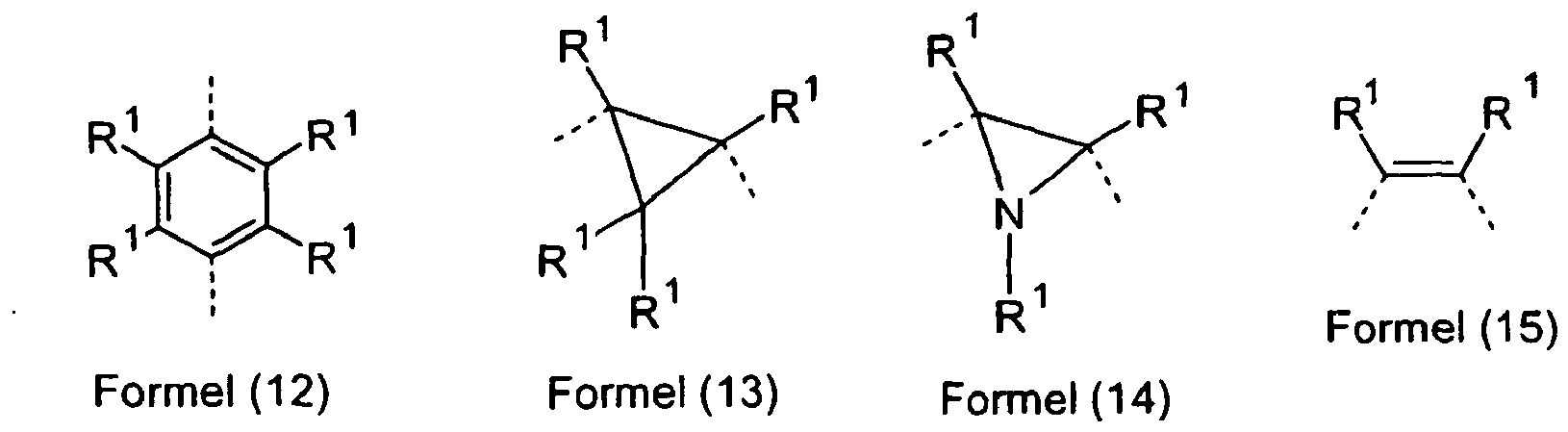
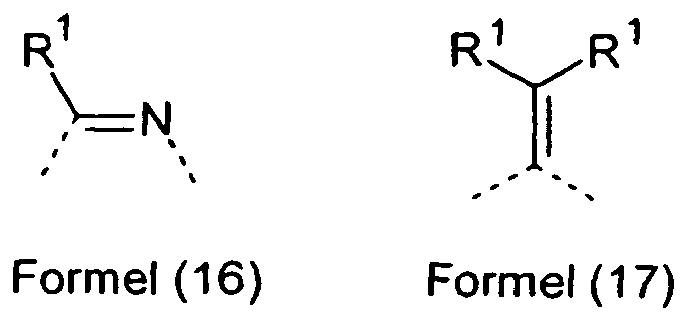
- ist BR1, B(R1)2 -, C(R1)2, C(=O), Si(R1)2, NR1, PR1, P(R1)2 +, PO(R1), PS(R1), AsR1, AsO(R1), AsS, O, S, Se, oder eine Einheit gemäß Formel (8) bis (17),

- n
- ist 1, 2 oder 3, bevorzugt 2 oder 3;
- m
- ist 1 oder 2, bevorzugt 2.
- Y
- is the same or different each occurrence as a single bond, O, S, N (R 1 ), C = O, a straight chain alkylene group having 1 to 6 C atoms or a branched or cyclic alkylene group having 3 to 6 C atoms, respectively may be substituted with one or more radicals R 1 , wherein one or more non-adjacent CH 2 groups may be replaced by R 1 C = CR 1 , NR 1 , Si (R 1 ) 2 , O or S and wherein one or more H atoms by D, F, Cl, Br, I, CN or NO 2 may be replaced, or an arylene or heteroarylene group having 5 to 20 aromatic ring atoms, which may be substituted by one or more radicals R 1 , or a combination of these systems;
- V
- is B, B (R 1), CR 1 CO -, CN (R 1) 2, SiR 1, N, NO, N (R 1) +, P, P (R 1) +, PO, PS, As , As (R 1 ) + , AsO, S + , Se + , or a unit according to formula (4) to (7),
- Z
- BR 1 , B (R 1 ) 2 - , C (R 1 ) 2 , C (= O), Si (R 1 ) 2 , NR 1 , PR 1 , P (R 1 ) 2 + , PO (R 1 ), PS (R 1 ), AsR 1 , AsO (R 1 ), AsS, O, S, Se, or a unit according to Formula (8) to (17),
- n
- is 1, 2 or 3, preferably 2 or 3;
- m
- is 1 or 2, preferably 2.
Dabei beträgt die Brückenlänge in den Liganden der Formel (2) bzw. (3) bevorzugt zwischen 6 und 12 Atomen. Unter der Brückenlänge wird die Anzahl der Atome in den beiden Gruppen Y und in der Gruppe V bzw. Z verstanden, die die direkte Verbindung zwischen den Isonitrilgruppen bzw. zwischen der Isonitrilgruppe und der Ligandengruppe L darstellen. Besonders bevorzugt beträgt die Brückenlänge zwischen 7 und 10 Atomen, ganz besonders bevorzugt zwischen 7 und 9 Atomen.The bridge length in the ligands of the formula (2) or (3) is preferably between 6 and 12 atoms. The bridge length is understood to be the number of atoms in the two groups Y and in the groups V and Z, respectively, which represent the direct connection between the isonitrile groups or between the isonitrile group and the ligand group L. Particularly preferably, the bridge length is between 7 and 10 atoms, very particularly preferably between 7 and 9 atoms.
Beispiele für geeignete Liganden sind die in
Beispiele für besonders bevorzugte Liganden der Formel (2) und (3) sind die im Folgenden abgebildeten Liganden der Formeln (18) bis (28), welche jeweils durch einen oder mehrere Reste R1 substituiert sein können:


In einer bevorzugten Ausführungsform der Erfindung ist das Metall M pentakoordiniert und die Verbindung gemäß Formel (1) enthält einen tridentaten Liganden der Formel (2) und einen bidentaten Liganden der Formel (3).In a preferred embodiment of the invention, the metal M is pentacoordinated and the compound according to formula (1) contains a tridentate ligand of the formula (2) and a bidentate ligand of the formula (3).
In einer weiteren bevorzugten Ausführungsform der Erfindung ist das Metall M hexakoordiniert und die Verbindung gemäß Formel (1) enthält entweder zwei tridentate Liganden der Formel (2) oder drei bidentate Liganden der Formel (3).In a further preferred embodiment of the invention, the metal M is hexacoordinated and the compound according to formula (1) contains either two tridentate ligands of the formula (2) or three bidentate ligands of the formula (3).
Im Folgenden werden bevorzugte Liganden L beschrieben, wie sie in Formel (1) vorkommen. Entsprechend können auch die Ligandengruppen L in den Liganden der Formel (2) und (3) gewählt sein, wobei diese dann an die Gruppe Y gebunden sind.In the following, preferred ligands L are described as they occur in formula (1). Correspondingly, the ligand groups L in the ligands of the formula (2) and (3) can also be selected, these then being bonded to the group Y.
Die Liganden L sind bevorzugt neutrale, monoanionische, dianionische oder trianionische Liganden, besonders bevorzugt neutrale oder monoanionische Liganden. Sie können monodentat sein, sind aber bevorzugt bidentat oder tridentat, weisen also bevorzugt zwei oder drei Koordinationsstellen auf. Die Liganden L können auch an den Rest R gebunden sein. Bevorzugte Ausführungsformen sind dabei die oben aufgeführten Liganden der Formel (2) und (3). In Liganden der Formel (2) und (3) ist L bevorzugt ein monodentater oder bidentater Ligand.The ligands L are preferably neutral, monoanionic, dianionic or trianionic ligands, particularly preferably neutral or monoanionic ligands. They may be monodentate, but are preferably bidentate or tridentate, so preferably have two or three coordination sites. The ligands L can also be bonded to the radical R. Preferred embodiments are the ligands of the formula (2) and (3) listed above. In ligands of the formula (2) and (3), L is preferably a monodentate or bidentate ligand.
Bevorzugte neutrale, monodentate Liganden L sind ausgewählt aus Kohlenmonoxid, Stickstoffmonoxid, Aminen, wie z. B. Trimethylamin, Triethylamin, Morpholin, Phosphinen, insbesondere Halogenphosphinen, Trialkylphophinen, Triarylphosphinen oder Alkylarylphosphinen, wie z. B. Trifluorphosphin, Trimethylphosphin, Tricyclohexylphosphin, Tri-tert-butylphosphin, Triphenylphosphin, Tris(pentafluorphenyl)phosphin, Phosphiten, wie z. B. Trimethylphosphit, Triethylphosphit, Arsinen, wie z. B. Trifluorarsin, Trimethylarsin, Tricyclohexylarsin, Tri-tert-butylarsin, Triphenylarsin, Tris(pentafluorphenyl)arsin, Stibinen, wie z. B. Trifluorstibin, Trimethylstibin, Tricyclohexylstibin, Tri-tert-butylstibin, Triphenylstibin, Tris(pentafluorphenyl)stibin, stickstoffhaltigen Heterocyclen, wie z. B. Pyridin, Pyridazin, Pyrazin, Pyrimidin, Triazin, und Carbenen, insbesondere Arduengo-Carbenen.Preferred neutral, monodentate ligands L are selected from carbon monoxide, nitric oxide, amines, such as. For example, trimethylamine, triethylamine, morpholine, phosphines, especially halogenophosphines, trialkylphosphines, triarylphosphines or alkylarylphosphines, such as. For example, trifluorophosphine, trimethylphosphine, tricyclohexylphosphine, tri- tert- butylphosphine, triphenylphosphine, tris (pentafluorophenyl) phosphine, phosphites, such as. For example, trimethyl phosphite, triethyl phosphite, arsines, such as. Trifluorarsin, trimethylarsine, tricyclohexylarsine, tri- tert -butylarsine, triphenylarsine, tris (pentafluorophenyl) arsine, stibines, such as. Trifluorostibine, trimethylstibine, tricyclohexylstibine, tri-tert-butylstibine, triphenylstibine, tris (pentafluorophenyl) stibine, nitrogen-containing heterocycles, such as. As pyridine, pyridazine, pyrazine, pyrimidine, triazine, and carbenes, in particular Arduengo carbenes.
Bevorzugte monoanionische, monodentate Liganden L sind ausgewählt aus Hydrid, Deuterid, den Halogeniden F, Cl, Br und I, Alkylacetyliden, wie z. B. Methyl-C≡C-, tert-Butyl-C≡C-, Arylacetyliden, wie z. B. Phenyl-C≡C-, Cyanid, Azid, Cyanat, Isocyanat, Thiocyanat, Isothiocyanat, aliphatischen oder aromatischen Alkoholaten, wie z. B. Methanolat, Ethanolat, Propanolat, iso-Propanolat, tert-Butylat, Phenolat, aliphatischen oder aromatischen Thioalkoholaten, wie z. B. Methanthiolat, Ethanthiolat, Propanthiolat, iso-Propanthiolat, tert-Thiobutylat, Thiophenolat, Amiden, wie z. B. Dimethylamid, Diethylamid, Di-iso-propylamid, Morpholid, Carboxylaten, wie z. B. Acetat, Trifluoracetat, Propionat, Benzoat, Arylgruppen, wie z. B. Phenyl, Naphthyl, und anionischen, stickstoffhaltigen Heterocyclen, wie Pyrrolid, Imidazolid, Pyrazolid. Dabei sind die Alkylgruppen in diesen Gruppen bevorzugt C1-C20-Alkylgruppen, besonders bevorzugt C1-C10-Alkylgruppen, ganz besonders bevorzugt C1-C4-Alkylgruppen. Unter einer Arylgruppe werden auch Heteroarylgruppen verstanden. Diese Gruppen sind wie oben definiert.Preferred monoanionic, monodentate ligands L are selected from hydride, deuteride, the halides F, Cl, Br and I, alkyl acetylides, such as. As methyl-C≡C - , tert-butyl-C≡C - , arylacetylidene, such as. B. Phenyl-C≡C -, Cyanide, azide, cyanate, isocyanate, thiocyanate, isothiocyanate, aliphatic or aromatic alcoholates, such as. For example, methanolate, ethanolate, propanolate, iso- propanolate, tert- butylate, phenolate, aliphatic or aromatic thioalcoholates, such as. As methanethiolate, ethanethiolate, propanethiolate, iso- propanethiolate, tert- thiobutylate, thiophenolate, amides, such as. As dimethylamide, diethylamide, di-iso -propylamid, morpholide, carboxylates such. For example, acetate, trifluoroacetate, propionate, benzoate, aryl groups, such as. Phenyl, naphthyl, and anionic nitrogen-containing heterocycles such as pyrrolidine, imidazolide, pyrazolide. The alkyl groups in these groups are preferably C 1 -C 20 -alkyl groups, particularly preferably C 1 -C 10 -alkyl groups, very particularly preferably C 1 -C 4 -alkyl groups. An aryl group is also understood to mean heteroaryl groups. These groups are as defined above.
Bevorzugte di- bzw. trianionische Liganden sind O2-, S2-, Carbide, welche zu einer Koordination der Form R-C≡M führen, und Nitrene, welche zu einer Koordination der Form R-N=M führen, wobei R allgemein für einen Substituenten steht, oder N3-.Preferred di- or trianionic ligands are O 2- , S 2- , carbides, which lead to a coordination of the form RC≡M, and nitrenes, which lead to a coordination of the form RN = M, wherein R is generally a substituent , or N 3- .
Bevorzugte neutrale oder mono- oder dianionische bidentate oder höherdentate Liganden L sind ausgewählt aus Diaminen, wie z. B. Ethylendiamin, N,N,N',N'-Tetramethylethylendiamin, Propylendiamin, N,N,N',N'-Tetramethylpropylendiamin, cis- oder trans-Diaminocyclohexan, cis- oder trans-N,N,N',N'-Tetramethyldiaminocyclohexan, Iminen, wie z. B. 2-[(1-(Phenylimino)ethyl]pyridin, 2-[1-(2-Methylphenylimino)ethyl]pyridin, 2-[1-(2,6-Di-iso-propylphenylimino)ethyl]pyridin, 2-[1-(Methylimino)ethyl]pyridin, 2-[1-(Ethylimino)ethyl]pyridin, 2-[1-(iso-Propylimino)ethyl]pyridin, 2-[1-(tert-Butylimino)ethyl]pyridin, Diiminen, wie z. B. 1,2-Bis(methylimino)ethan, 1,2-Bis(ethylimino)ethan, 1,2-Bis(iso-propylimino)ethan, 1,2-Bis(tert-butyl-imino)ethan, 2,3-Bis(methylimino)butan, 2,3-Bis(ethylimino)butan, 2,3-Bis-(iso-propylimino)butan, 2,3-Bis(tert-butylimino)butan, 1,2-Bis(phenylimino)-ethan, 1,2-Bis(2-methylphenylimino)ethan, 1,2-Bis(2,6-di-iso-propylphenyl-imino)ethan, 1,2-Bis(2,6-di-tert-butylphenylimino)ethan, 2,3-Bis(phenyl-imino)butan, 2,3-Bis(2-methylphenylimino)butan, 2,3-Bis(2,6-di-iso-propyl-phenylimino)butan, 2,3-Bis(2,6-di-tert-butylphenylimino)butan, Heterocyclen enthaltend zwei Stickstoffatome, wie z. B. 2,2'-Bipyridin, o-Phenanthrolin, Diphosphinen, wie z. B. Bis-(diphenylphosphino)methan, Bis-(diphenylphosphino)ethan, Bis(diphenylphosphino)propan, Bis-(diphenylphosphino)butan, Bis(dimethylphosphino)methan, Bis(dimethylphosphino)ethan, Bis(dimethylphosphino)propan, Bis(dimethylphosphino)butan, Bis(diethylphosphino)methan, Bis(diethylphosphino)ethan, Bis(diethylphosphino)propan, Bis(diethyl-phosphino)butan, Bis(di-tert-butylphosphino)methan, Bis(di-tert-butyl-phosphino)ethan, Bis(tert-butylphosphino)propan, Bis(di-tert-butylphosphino)butan, 1,3-Diketonaten abgeleitet von 1,3-Diketonen, wie z. B. Acetylaceton, Benzoylaceton, 1,5-Diphenylacetylaceton, Dibenzoylmethan, Bis(1,1,1-trifluoracetyl)methan, 3-Ketonaten abgeleitet von 3-Ketoestern, wie z. B. Acetessigsäureethylester, Carboxylate, abgeleitet von Aminocarbonsäuren, wie z. B. Pyridin-2-carbonsäure, Chinolin-2-carbonsäure, Glycin, N,N-Dimethylglycin, Alanin, N,N-Dimethylaminoalanin, Salicyliminaten abgeleitet von Salicyliminen, wie z. B. Methylsalicylimin, Ethylsalicylimin, Phenylsalicylimin, Dialkoholaten abgeleitet von Dialkoholen, wie z. B. Ethylenglykol, 1,3-Propylenglykol und Dithiolaten abgeleitet von Dithiolen, wie z. B. 1,2-Ethylendithiol, 1,3-Propylendithiol.Preferred neutral or mono- or dianionic bidentate or higher-dendent ligands L are selected from diamines, such as. Ethylenediamine, N, N, N ', N'-tetramethylethylenediamine, propylenediamine, N, N, N', N'-tetramethylpropylenediamine, cis- or trans -diaminocyclohexane, cis- or trans-N, N, N ', N '-Tetramethyldiaminocyclohexan, imines, such as. B. 2 - [(1- (phenylimino) ethyl] pyridine, 2- [1- (2-methylphenylimino) ethyl] pyridine, 2- pyridine [1- (2,6-di- iso -propylphenylimino) ethyl], 2 - [1- (methylimino) ethyl] pyridine, 2- [1- (ethylimino) ethyl] pyridine, 2- [1- ( iso -propylimino) ethyl] pyridine, 2- [1- ( tert- butylimino) ethyl] pyridine , Diimines, such as, for example, 1,2-bis (methylimino) ethane, 1,2-bis (ethylimino) ethane, 1,2-bis ( iso- propylimino) ethane, 1,2-bis ( tert-butyl ) imino) ethane, 2,3-bis (methylimino) butane, 2,3-bis (ethylimino) butane, 2,3-bis ( iso- propylimino) butane, 2,3-bis ( tert- butylimino) butane, 1 , 2-bis (phenylimino) ethane, 1,2-bis (2-methylphenylimino) ethane, 1,2-bis (2,6-di-iso propylphenyl-imino) ethane, 1,2-bis (2, 6-di- tert -butylphenylimino) ethane, 2,3-bis (phenyl-imino) butane, 2,3-bis (2-methylphenylimino) butane, 2,3-bis (2,6-di- iso propyl phenylimino) butane, 2,3-bis (2,6-di- tert- butylphenylimino) butane, heterocycles containing two nitrogen atoms, such as, for example, 2,2'-bipyridine, o-phenanthroline, diphosphines, such as. B. bis (diphenylphosphino) methane, bis (diphenylphosphino) ethane, bis (diphenylphosphino) propane, bis (diphenylphosphino) butane, bis (dimethylphosphino) methane, bis (dimethylphosphino) ethane, bis (dimethylphosphino) propane, bis (dimethylphosphino ) butane, bis (diethylphosphino) methane, bis (diethylphosphino) ethane, bis (diethylphosphino) propane, bis (diethylphosphino) butane, bis (di- tert- butylphosphino) methane, bis (di- tert- butylphosphino) ethane , Bis ( tert- butylphosphino) propane, bis ( di-tert- butylphosphino) butane, 1,3-diketonates derived from 1,3-diketones, such as. For example, acetylacetone, benzoylacetone, 1,5-diphenylacetylacetone, dibenzoylmethane, bis (1,1,1-trifluoroacetyl) methane, 3-ketonates derived from 3-keto esters, such as. For example, ethyl acetoacetate, carboxylates derived from aminocarboxylic acids, such as. As pyridine-2-carboxylic acid, quinoline-2-carboxylic acid, glycine, N, N-dimethylglycine, alanine, N, N-dimethylaminoalanine, salicyliminates derived from salicylimines, such as. As methylsalicylimine, ethylsalicylimine, phenylsalicylimine, dialcoholates derived from dialcohols, such as. As ethylene glycol, 1,3-propylene glycol and dithiolates derived from dithiols, such as. For example, 1,2-ethylenedithiol, 1,3-propylenedithiol.
Bevorzugte tridentate Liganden sind Borate stickstoffhaltiger Heterocyclen, wie z. B. Tetrakis(1-imidazolyl)borat und Tetrakis(1-pyrazolyl)borat.Preferred tridentate ligands are borates of nitrogen-containing heterocycles, such as. As tetrakis (1-imidazolyl) borate and tetrakis (1-pyrazolyl) borate.
Bevorzugt sind weiterhin bidentate monoanionische Liganden L, welche mit dem Metall einen cyclometallierten Fünfring oder Sechsring mit mindestens einer Metall-Kohlenstoff-Bindung aufweisen, insbesondere einen cyclometallierten Fünfring. Dies sind insbesondere Liganden, wie sie allgemein im Gebiet der phosphoreszierenden Metallkomplexe für organische Elektrolumineszenzvorrichtungen verwendet werden, also Liganden vom Typ Phenylpyridin, Naphthylpyridin, Phenylchinolin, Phenylisochinolin, etc., welche jeweils durch einen oder mehrere Reste R1 substituiert sein können. Dem Fachmann auf dem Gebiet der phosphoreszierenden Elektrolumineszenzvorrichtungen ist eine Vielzahl derartiger Liganden bekannt, und er kann ohne erfinderisches Zutun weitere derartige Liganden als Ligand L für Verbindungen gemäß Formel (1) auswählen. Generell eignet sich dafür besonders die Kombination aus zwei Gruppen, wie sie durch die folgenden Formeln (29) bis (56) dargestellt sind, wobei eine Gruppe über ein neutrales Stickstoffatom oder ein Carbenatom bindet und die andere Gruppe über ein negativ geladenes Kohlenstoffatom oder ein negativ geladenes Stickstoffatom bindet. Der Ligand L kann dann aus den Gruppen der Formeln (29) bis (56) gebildet werden, indem diese Gruppen jeweils an der durch # gekennzeichneten Position aneinander binden. Die Position, an der die Gruppen an das Metall koordinieren, sind durch * gekennzeichnet. In Liganden der Formel (2) oder (3) können auch einzelne dieser Gruppen als Ligand L an die Gruppe Y des Liganden gebunden sein.


Dabei haben die verwendeten Symbole dieselbe Bedeutung, wie oben beschrieben, und X steht gleich oder verschieden bei jedem Auftreten für CR1 oder N mit der Maßgabe, dass maximal drei Symbole X in jeder Gruppe für N stehen. Bevorzugt stehen maximal zwei Symbole X in jeder Gruppe für N, besonders bevorzugt steht maximal ein Symbol X in jeder Gruppe für N, ganz besonders bevorzugt stehen alle Symbole X für CR1.Here, the symbols used have the same meaning as described above, and X is the same or different every occurrence for CR 1 or N, provided that a maximum of three symbols X in each group stand for N. Preferably, a maximum of two symbols X in each group stand for N, more preferably, at most one symbol X in each group stands for N, very particularly preferably all symbols X stand for CR 1 .
Ebenfalls bevorzugte Liganden L sind η5-Cyclopentadienyl, η5-Pentamethylcyclopentadienyl, η6 -Benzol oder η7-Cycloheptatrienyl, welche jeweils durch einen oder mehrere Reste R1 substituiert sein können.Likewise preferred ligands L are η 5 -cyclopentadienyl, η 5 -pentamethylcyclopentadienyl, η 6 -benzene or η 7 -cycloheptatrienyl, which in each case may be substituted by one or more radicals R 1 .
Ebenfalls bevorzugte Liganden L sind 1,3,5-cis-Cyclohexanderivate, insbesondere der Formel (57), 1,1,1-Tri(methylen)methanderivate, insbesondere der Formel (58) und 1,1,1-trisubstituierte Methane, insbesondere der Formel (59) und (60),

Die Darstellung der Isonitrilkomplexe kann z. B. durch Substitutionsreaktion erfolgen. Dabei werden Metallkomplexe mit den Isonitrilliganden, gegebenenfalls in Gegenwart eines Katalysators, zu den gewünschten Isonitrilkomplexen umgesetzt. Auf diesem Wege sind z. B. ausgehend von Molybdän- bzw. Wolframhexacarbonyl oder Molybdän- bzw. Wolframolefin-carbonylkomplexen Tri-, Tetra-, Penta- und Hexaisonitril-Molybdän bzw. Wolfram-Verbindungen zugänglich. Dieser Reaktionstyp eignet sich sowohl zur Umsetzung von einzähnigen als auch mehrzähnigen Isonitrilliganden. Als Katalysator kann Palladium(II)oxid zugesetzt werden (
Daneben können Metallsalze mit Isonitrilliganden zu Isonitril-Metallhalogeniden umgesetzt werden und die Halogenidliganden in diesen anschließend gegen andere ein- oder mehrzähnige Liganden ausgetauscht werden.
IrCl3 + R-NC → (R-NC)3IrCl3
(R-NC)3IrCl3 + 3L- → (R-NC)3IrL3 + 3Cl-
In addition, metal salts with isonitrile ligands can be converted to isonitrile metal halides and the halide ligands in these subsequently replaced by other mono- or polydentate ligands.
IrCl 3 + R-NC → (R-NC) 3 IrCl 3
(R-NC) 3 IrCl 3 + 3L - → (R-NC) 3 IrL 3 + 3Cl -
Dabei können sowohl der Isonitrilligand als auch der Ligand L ein- oder mehrzähnig sein.Both the isonitrile ligand and the ligand L may be monodentate or polydentate.
Beispiele für bevorzugte Verbindungen gemäß Formel (1) sind die im Folgenden abgebildeten Strukturen (1) bis (98).
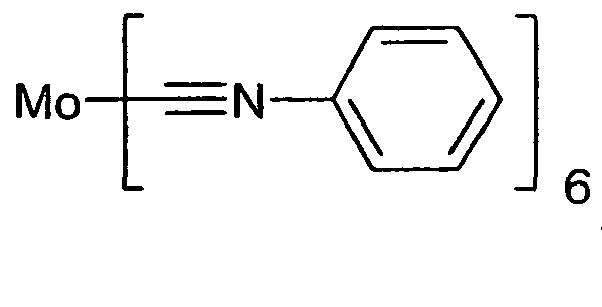


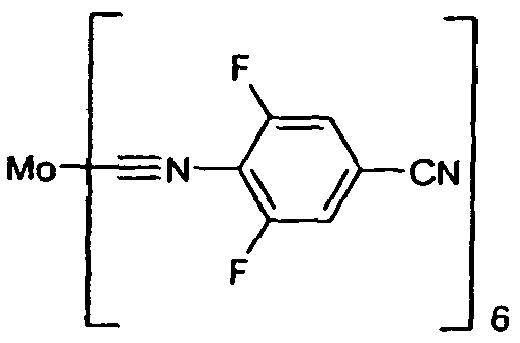


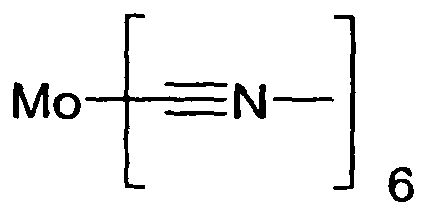


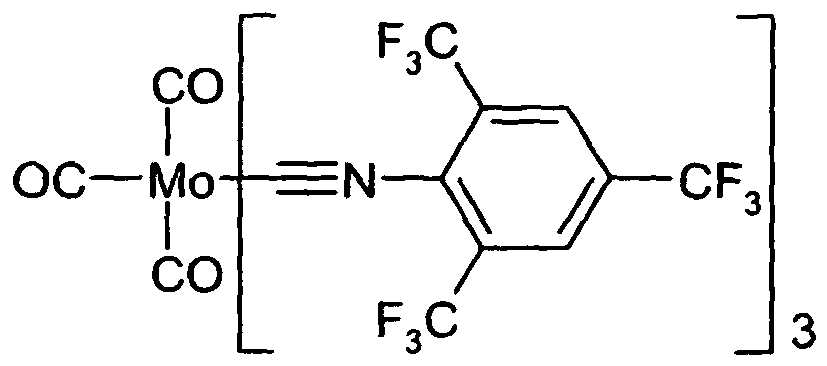


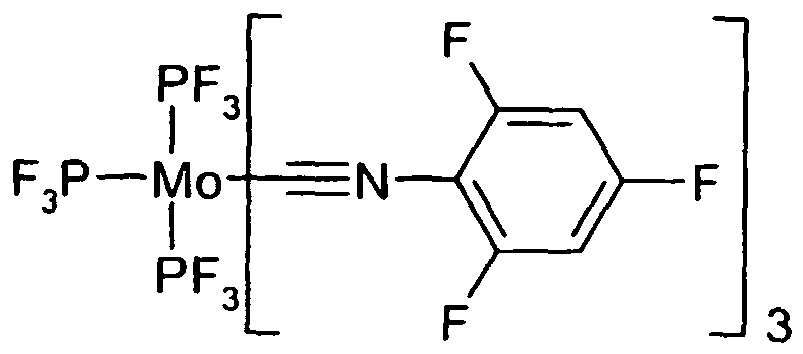


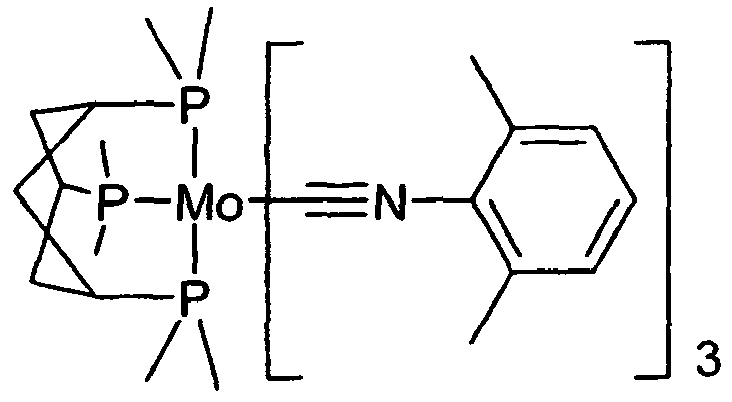


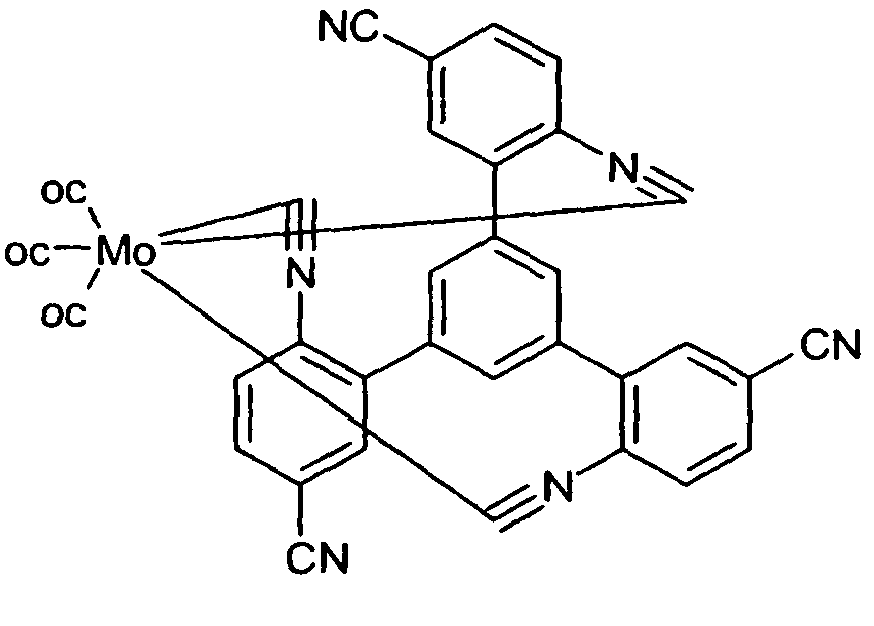


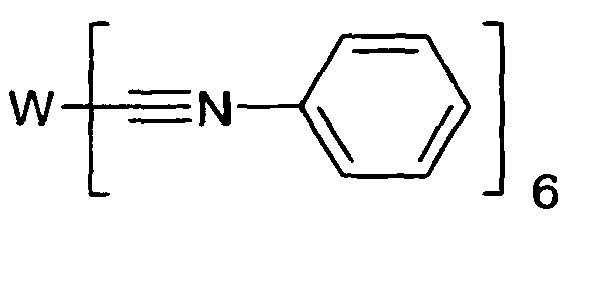


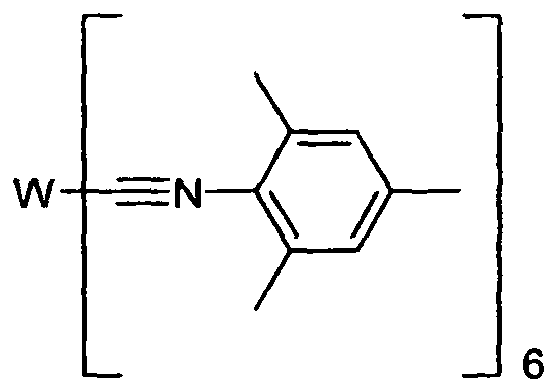


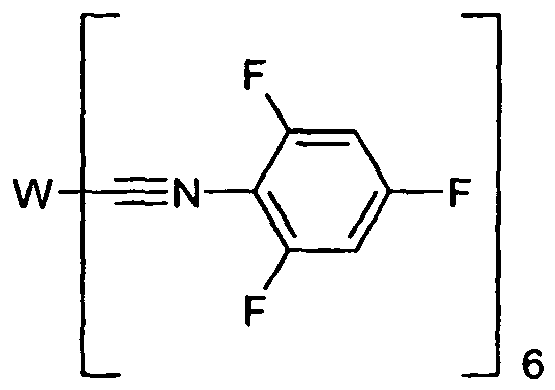


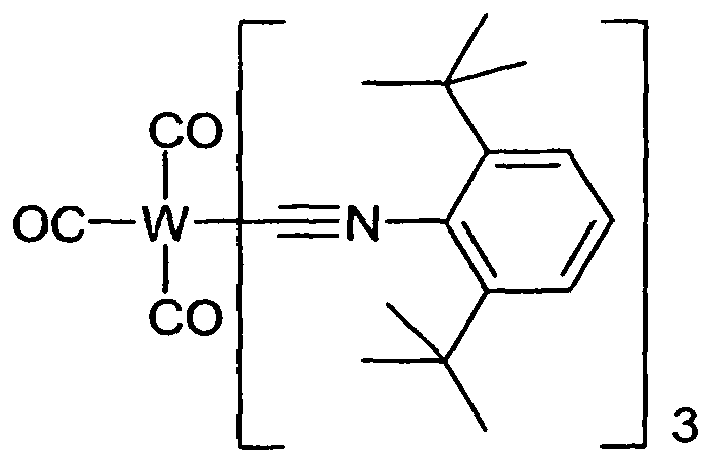
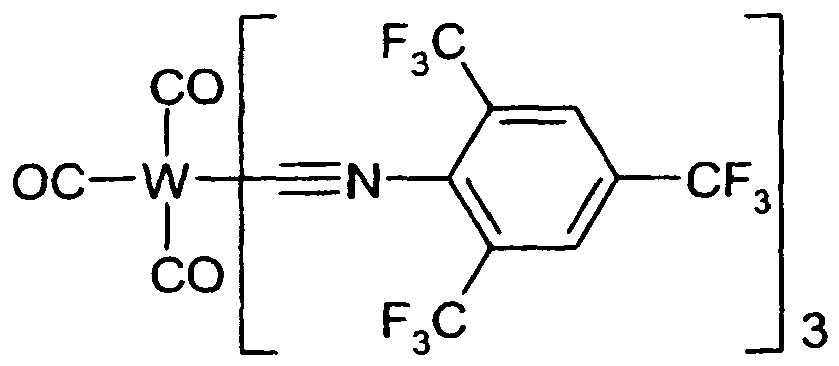

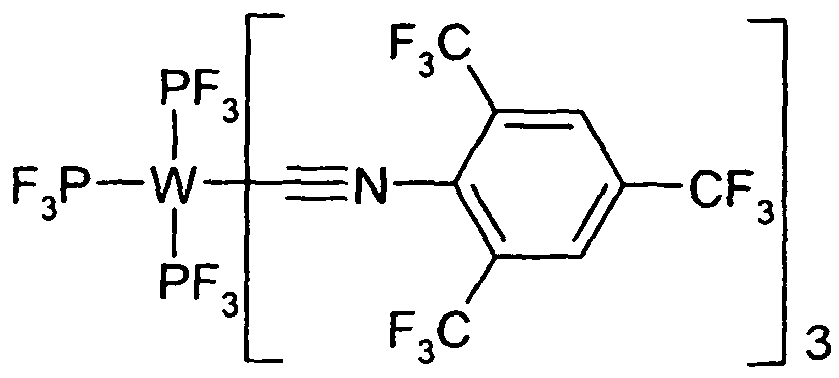


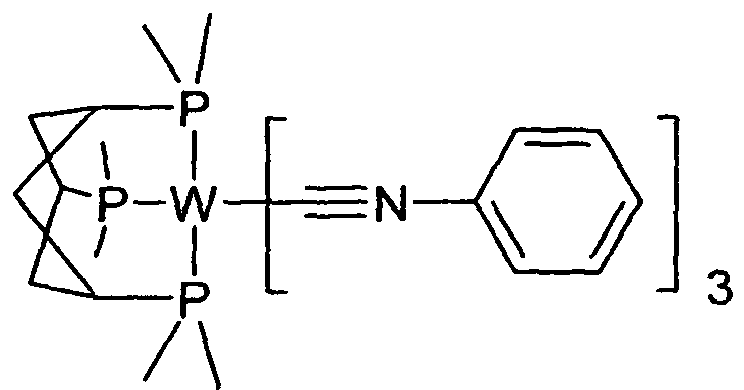

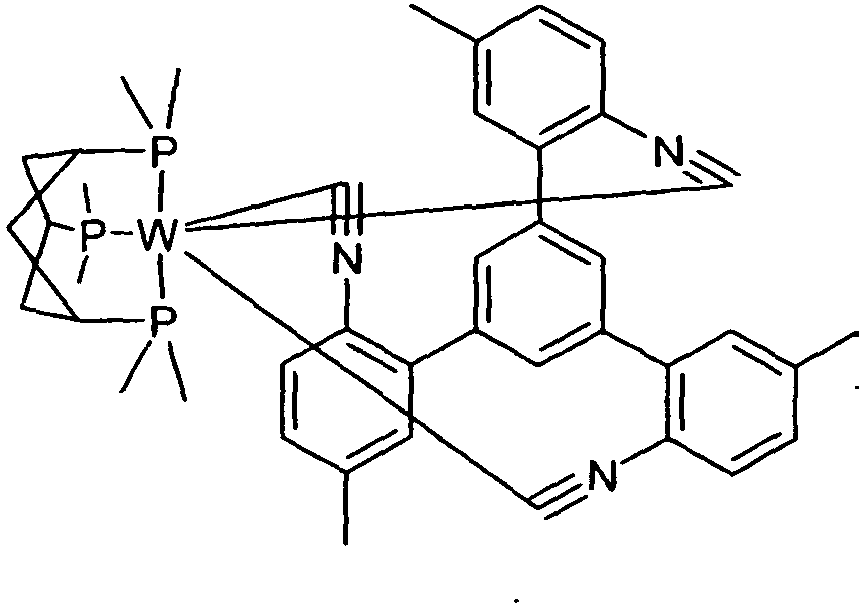


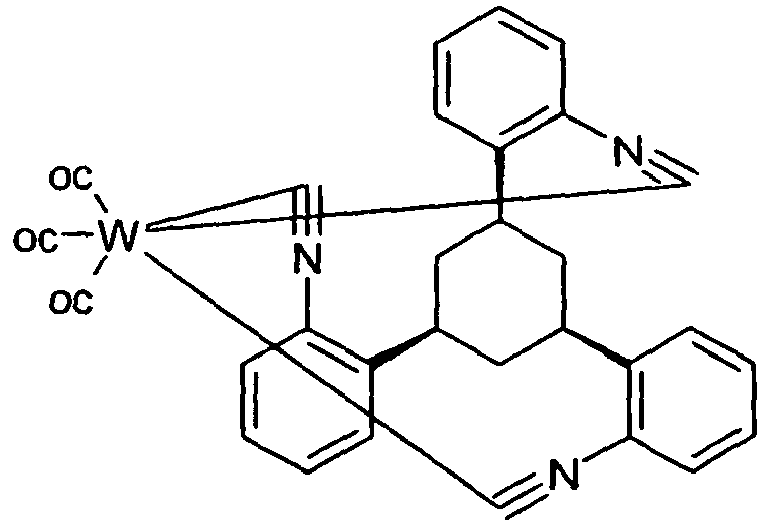

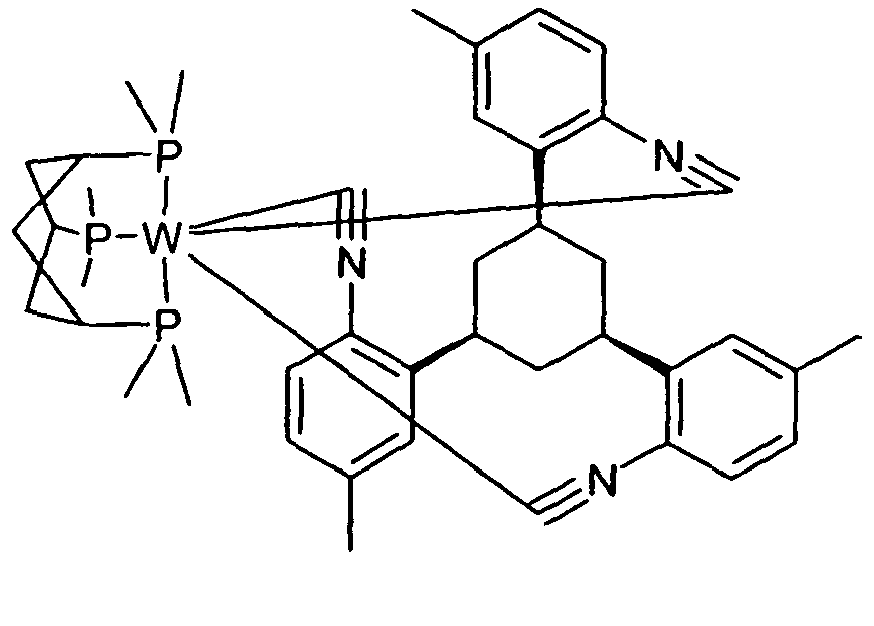


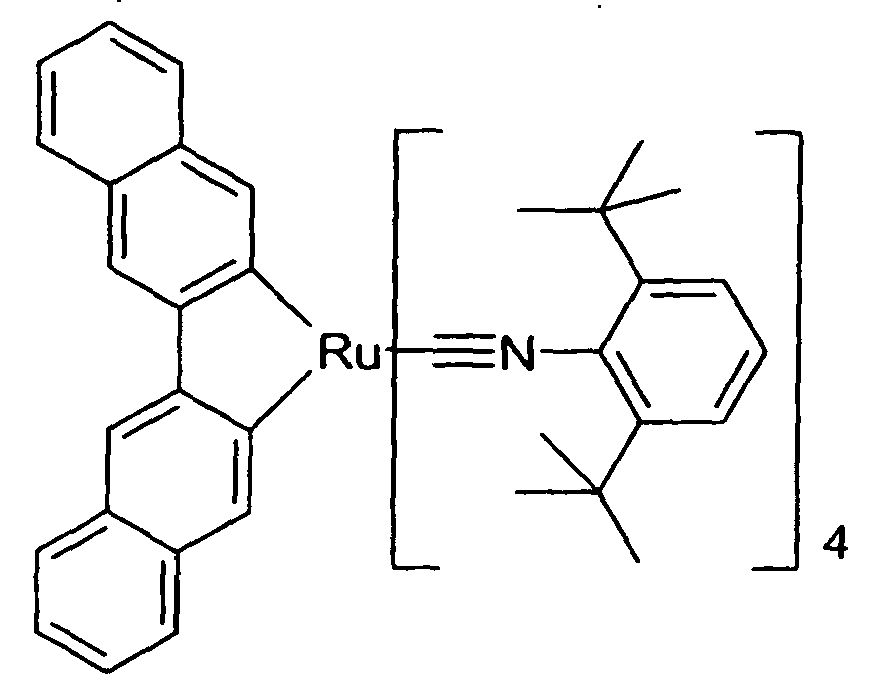
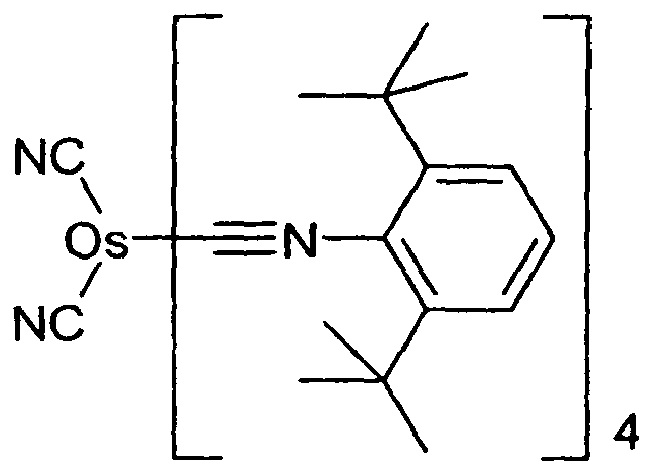


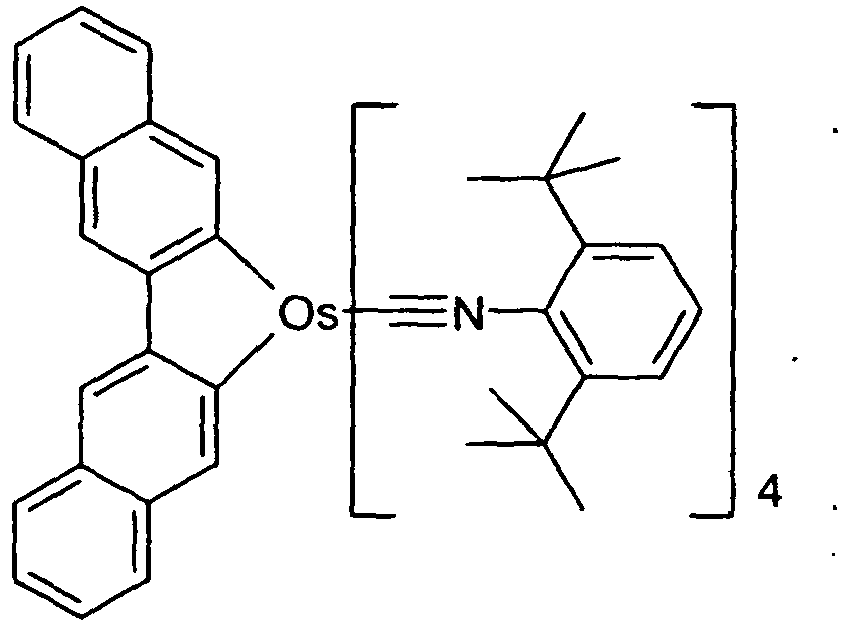
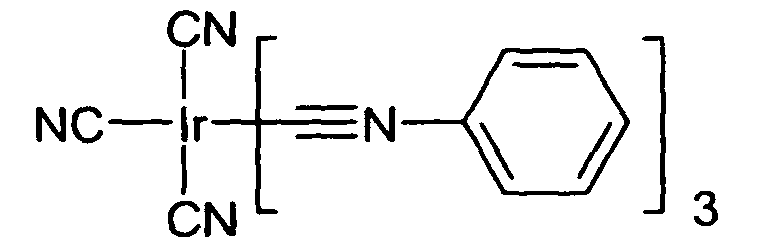
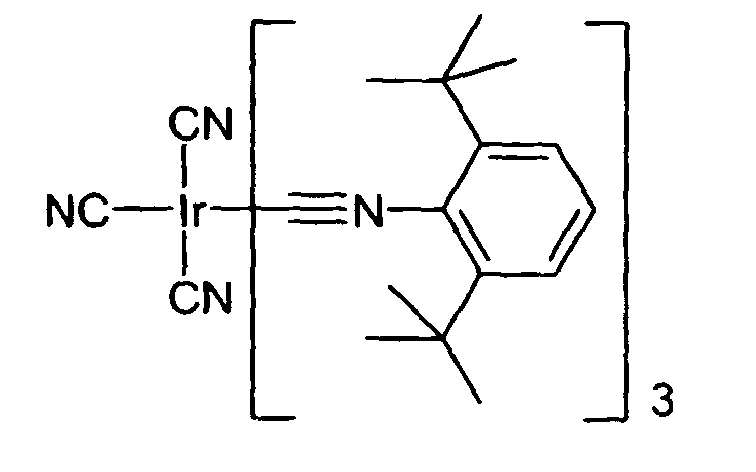


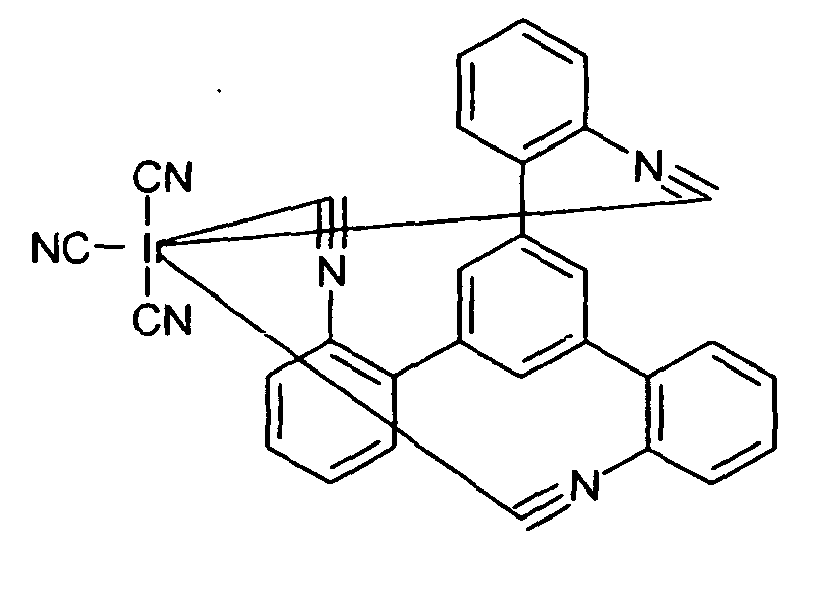


Die oben beschriebenen Komplexe gemäß Formel (1) bzw. die oben aufgeführten bevorzugten Ausführungsformen werden in der elektronischen Vorrichtung als aktive Komponente verwendet. Aktive Komponenten sind generell die organischen oder anorganischen Materialien, welche zwischen Anode und Kathode eingebracht sind, beispielsweise Ladungsinjektions-, Ladungstransport- oder Ladungsblockiermaterialien, insbesondere aber Emissionsmaterialien und Matrixmaterialien. Für diese Funktionen zeigen die erfindungsgemäßen Verbindungen besonders gute Eigenschaften, insbesondere als Emissionsmaterial in organischen Elektrolumineszenzvorrichtungen. Eine bevorzugte Ausführungsform der Erfindung sind daher organische Elektrolumineszenzvorrichtungen.The above-described complexes of the formula (1) and the above-mentioned preferred embodiments are used as the active component in the electronic device. Active components are generally the organic or inorganic materials incorporated between the anode and cathode, for example, charge injection, charge transport or charge blocking materials, but especially emission materials and matrix materials. For these functions, the compounds according to the invention exhibit particularly good properties, in particular as emission material in organic electroluminescent devices. A preferred embodiment of the invention are therefore organic electroluminescent devices.
Die organische Elektrolumineszenzvorrichtung enthält Kathode, Anode und mindestens eine emittierende Schicht. Außer diesen Schichten kann sie noch weitere Schichten enthalten, beispielsweise jeweils eine oder mehrere Lochinjektionsschichten, Lochtransportschichten, Lochblockierschichten, Elektronentransportschichten, Elektroneninjektionsschichten, Exzitonenblockierschichten, Ladungserzeugungsschichten und/oder organische oder anorganische p/n-Übergänge. Ebenso können zwischen zwei emittierende Schichten Interlayers eingebracht sein, welche beispielsweise eine Exzitonen-blockierende Funktion aufweisen und/oder die Ladungsbalance in der Elektrolumineszenzvorrichtung steuern. Es sei aber darauf hingewiesen, dass nicht notwendigerweise jede dieser Schichten vorhanden sein muss. Dabei kann die organische Elektrolumineszenzvorrichtung eine emittierende Schicht enthalten, oder sie kann mehrere emittierende Schichten enthalten. Wenn mehrere Emissionsschichten vorhanden sind, weisen diese bevorzugt insgesamt mehrere Emissionsmaxima zwischen 380 nm und 750 nm auf, so dass insgesamt weiße Emission resultiert, d. h. in den emittierenden Schichten werden verschiedene emittierende Verbindungen verwendet, die fluoreszieren oder phosphoreszieren können. Insbesondere bevorzugt sind Dreischichtsysteme, wobei die drei Schichten blaue, grüne und orange oder rote Emission zeigen (für den prinzipiellen Aufbau siehe z. B.
In einer bevorzugten Ausführungsform der Erfindung enthält die organische elektronische Vorrichtung die Verbindung gemäß Formel (1) bzw. die oben aufgeführten bevorzugten Ausführungsformen als emittierende Verbindung in einer oder mehreren emittierenden Schichten.In a preferred embodiment of the invention, the organic electronic device contains the compound according to formula (1) or the above-mentioned preferred embodiments as an emitting compound in one or more emitting layers.
Wenn die Verbindung gemäß Formel (1) als emittierende Verbindung in einer emittierenden Schicht eingesetzt wird, wird sie bevorzugt in Kombination mit einem oder mehreren Matrixmaterialien eingesetzt. Die Mischung aus der Verbindung gemäß Formel (1) und dem Matrixmaterial enthält zwischen 1 und 99 Vol.-%, vorzugsweise zwischen 2 und 90 Vol.-%, besonders bevorzugt zwischen 3 und 40 Vol.-%, insbesondere zwischen 5 und 15 Vol.-% der Verbindung gemäß Formel (1) bezogen auf die Gesamtmischung aus Emitter und Matrixmaterial. Entsprechend enthält die Mischung zwischen 99 und 1 Vol.-%, vorzugsweise zwischen 98 und 10 Vol.-%, besonders bevorzugt zwischen 97 und 60 Vol.-%, insbesondere zwischen 95 und 85 Vol.-% des Matrixmaterials bezogen auf die Gesamtmischung aus Emitter und Matrixmaterial.When the compound of the formula (1) is used as an emitting compound in an emitting layer, it is preferably used in combination with one or more matrix materials. The mixture of the compound according to formula (1) and the matrix material contains between 1 and 99% by volume, preferably between 2 and 90% by volume, more preferably between 3 and 40% by volume, in particular between 5 and 15% by volume .-% of the compound according to formula (1) based on the total mixture of emitter and matrix material. Accordingly, the mixture contains between 99 and 1% by volume, preferably between 98 and 10% by volume, more preferably between 97 and 60% by volume, in particular between 95 and 85% by volume of the matrix material, based on the total mixture Emitter and matrix material.
Bevorzugte Matrixmaterialien sind CBP (N,N-Biscarbazolylbiphenyl), Carbazolderivate (z. B. gemäß
Weiterhin bevorzugt ist eine organische Elektrolumineszenzvorrichtung, dadurch gekennzeichnet, dass eine oder mehrere Schichten mit einem Sublimationsverfahren beschichtet werden. Dabei werden die Materialien in Vakuum-Sublimationsanlagen bei einem Anfangsdruck kleiner 10-5 mbar, bevorzugt kleiner 10-6 mbar aufgedampft.Further preferred is an organic electroluminescent device, characterized in that one or more layers with a Sublimation method to be coated. The materials are vapor-deposited in vacuum sublimation systems at an initial pressure of less than 10 -5 mbar, preferably less than 10 -6 mbar.
Bevorzugt ist ebenfalls eine organische Elektrolumineszenzvorrichtung, dadurch gekennzeichnet, dass eine oder mehrere Schichten mit dem OVPD (Organic Vapour Phase Deposition) Verfahren oder mit Hilfe einer Trägergassublimation beschichtet werden. Dabei werden die Materialien bei einem Druck zwischen 10-5 mbar und 1 bar aufgebracht. Ein Spezialfall dieses Verfahrens ist das OVJP (Organic Vapour Jet Printing) Verfahren, bei dem die Materialien direkt durch eine Düse aufgebracht und so strukturiert werden (z. B.
Weiterhin bevorzugt ist eine organische Elektrolumineszenzvorrichtung, dadurch gekennzeichnet, dass eine oder mehrere Schichten aus Lösung, wie z. B. durch Spincoating, oder mit einem beliebigen Druckverfahren, wie z. B. Siebdruck, Flexodruck oder Offsetdruck, besonders bevorzugt aber LITI (Light Induced Thermal Imaging, Thermotransferdruck) oder Ink-Jet Druck (Tintenstrahldruck), hergestellt werden. Hierfür sind lösliche Verbindungen nötig, welche beispielsweise durch geeignete Substitution erhalten werden.Further preferred is an organic electroluminescent device, characterized in that one or more layers of solution, such. B. by spin coating, or with any printing process, such. B. screen printing, flexographic printing or offset printing, but particularly preferably LITI (Light Induced Thermal Imaging, thermal transfer printing) or ink-jet printing (ink jet printing) can be produced. For this purpose, soluble compounds are necessary, which are obtained for example by suitable substitution.
Die organische Elektrolumineszenzvorrichtung kann auch als Hybridsystem hergestellt werden, indem eine oder mehrere Schichten aus Lösung aufgebracht werden und eine oder mehrere andere Schichten aufgedampft werden. Da die Verbindungen gemäß Formel (1) im Allgemeinen eine hohe Löslichkeit in organischen Lösemitteln aufweisen, können diese Verbindungen gut aus Lösung verarbeitet werden. So ist es beispielsweise möglich, eine emittierende Schicht enthaltend eine Verbindung gemäß Formel (1) und ein Matrixmaterial aus Lösung aufzubringen und darauf eine Lochblockierschicht und/oder eine Elektronentransportschicht im Vakuum aufzudampfen.The organic electroluminescent device may also be fabricated as a hybrid system by applying one or more layers of solution and depositing one or more other layers. Since the compounds of the formula (1) generally have a high solubility in organic solvents, these compounds can be well processed from solution. Thus, for example, it is possible to apply an emitting layer containing a compound of formula (1) and a solution matrix material and then vacuum evaporate a hole blocking layer and / or an electron transport layer.
Diese Verfahren sind dem Fachmann generell bekannt und können von ihm ohne Probleme auf organische Elektrolumineszenzvorrichtungen enthaltend Verbindungen gemäß Formel (1) bzw. die oben aufgeführten bevorzugten Ausführungsformen angewandt werden.These methods are generally known to the person skilled in the art and can be applied without problems to organic electroluminescent devices containing compounds according to formula (1) or the above-mentioned preferred embodiments are used.
Metallkomplexe, welche die oben aufgeführten Liganden der Formel (27) und/oder (28) enthalten, sind neu und sind daher ebenfalls ein Gegenstand der vorliegenden Erfindung.Metal complexes containing the ligands of formula (27) and / or (28) listed above are novel and are therefore also an object of the present invention.
Ein weiterer Gegenstand der Erfindung sind daher Metallkomplexe der Formel (1'),
(L)y M-[C≡N-R]x Formel (1')
wobei die verwendeten Symbole und Indizes die oben genannten Bedeutungen haben und mindestens einer der Isonitrilliganden ausgewählt ist aus Liganden der Formel (27) oder (28), welcher jeweils auch durch einen oder mehrere Reste R1 substituiert sein kann:
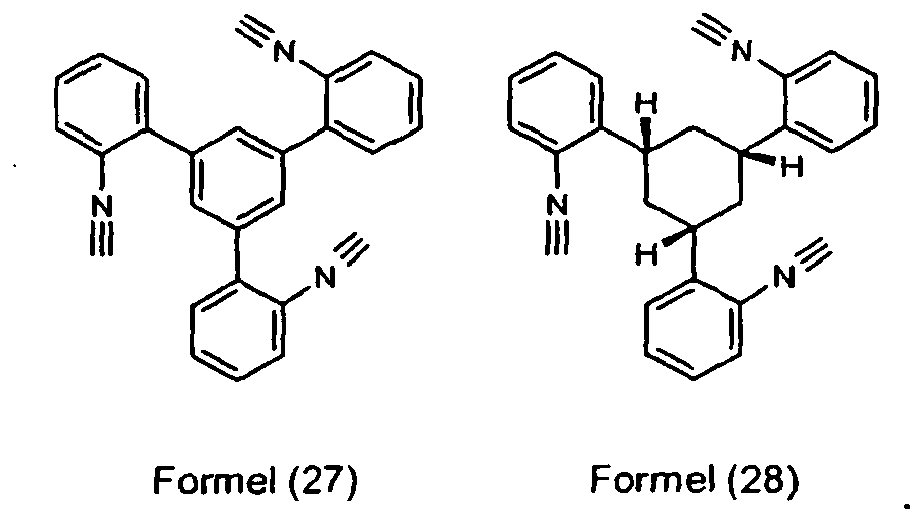
(L) y M- [C≡NR] x formula (1 ')
where the symbols and indices used have the abovementioned meanings and at least one of the isonitrile ligands is selected from ligands of the formula (27) or (28), which may in each case also be substituted by one or more radicals R 1 :
Dabei gelten in Komplexen der Formel (1') für die Auswahl der Metalle und gegebenenfalls vorhandener weiterer Liganden dieselben Bevorzugungen, wie oben beschrieben.In complexes of the formula (1 '), the same preferences apply to the selection of the metals and any further ligands present, as described above.
Für das Aufbringen aus Lösung sind Lösungen der Verbindungen gemäß Formel (1') erforderlich. Weiterer Gegenstand der Erfindung sind daher Lösungen enthaltend mindestens eine Verbindung gemäß Formel (1') und mindestens ein organisches Lösungsmittel, bevorzugt ausgewählt aus der Klasse der aromatischen organischen Lösungsmittel, z. B. Dimethylanisol. Nochmals ein weiterer Gegenstand der Erfindung sind Liganden der oben abgebildeten Formeln (27) und (28), welche jeweils durch einen oder mehrere Reste R1 substituiert sein können.For solution application, solutions of the compounds of formula (1 ') are required. Another object of the invention are therefore solutions containing at least one compound of formula (1 ') and at least one organic solvent, preferably selected from the class of aromatic organic solvents, for. B. dimethylanisole. Yet another object of the invention are ligands of the above-depicted formulas (27) and (28), which may each be substituted by one or more radicals R 1 .
Die erfindungsgemäßen elektronischen Vorrichtungen, insbesondere organische Elektrolumineszenzvorrichtungen, zeichnen sich durch folgende überraschende Vorteile gegenüber dem Stand der Technik aus:
- 1. Organische Elektrolumineszenzvorrichtungen enthaltend Verbindungen gemäß Formel (1) als emittierende Materialien weisen eine exzellente Lebensdauer auf.
- 2. Organische Elektrolumineszenzvorrichtungen enthaltend Verbindungen gemäß Formel (1) als emittierende Materialien weisen eine hervorragende Effizienz auf.
- 3. Die Lumineszenzlebensdauer vieler Verbindungen gemäß Formel (1) bei Raumtemperatur liegt im Bereich von weniger als 100 ns und ist damit um mehr als eine Größenordnung geringer als die Lumineszenzlebensdauer von Iridiumkomplexen oder Platinkomplexen, wie sie gemäß dem Stand der Technik in organischen Elektrolumineszenzvorrichtungen eingesetzt werden. Daher eignen sich die Verbindungen gemäß Formel (1) insbesondere auch zum Einsatz in organischen
- 1. Organic electroluminescent devices containing compounds according to formula (1) as emitting materials have an excellent lifetime.
- 2. Organic electroluminescent devices containing compounds according to formula (1) as emitting materials have excellent efficiency.
- 3. The luminescence lifetime of many compounds according to formula (1) at room temperature is in the range of less than 100 ns and is thus more than an order of magnitude lower than the luminescence lifetime of iridium complexes or platinum complexes, as used in the prior art in organic electroluminescent devices , Therefore, the compounds of formula (1) are particularly suitable for use in organic
Elektrolumineszenzvorrichtungen mit Passiv-Matrix-Ansteuerung. Diese oben genannten Vorteile gehen nicht mit einer Verschlechterung der weiteren elektronischen Eigenschaften einher.Electroluminescent devices with passive matrix control. These advantages mentioned above are not accompanied by a deterioration of the other electronic properties.
Die Erfindung wird durch die nachfolgenden Beispiele näher erläutert, ohne sie dadurch einschränken zu wollen. Der Fachmann kann aus den Schilderungen ohne erfinderisches Zutun weitere erfindungsgemäße elektronische Vorrichtungen herstellen.The invention is explained in more detail by the following examples without wishing to restrict them thereby. The person skilled in the art can produce further electronic devices according to the invention from the descriptions without inventive step.
Die nachfolgenden Synthesen werden, sofern nicht anders angegeben, unter einer Schutzgasatmosphäre in getrockneten Lösungsmitteln durchgeführt. Die Lösungsmittel und Reagenzien können von ALDRICH bzw. ABCR bezogen werden.Unless stated otherwise, the following syntheses are carried out under an inert gas atmosphere in dried solvents. The solvents and reagents can be purchased from ALDRICH or ABCR.
Hexakis(phenylisonitril)molybdän(0) (Beispiel 1), Hexakis(phenylisonitril)-wolfram(0) (Beispiel 2) und Hexakis(2,4,6-tri-tert-butylphenylisonitril)-wolfram(0) (Beispiel 3) können nach

Eine Suspension von 8,2 g [10 mmol] Tricarbonyl[cis,cis-1,3,5-cyclohexan-triyltris[diphenylphosphin]-P,P',P"]-molybdän (0), [156999-20-1] in 100 ml Toluol wird mit 3,6 g (35 mmol) Phenylisonitril und 50 mg Palladium(II)oxid versetzt und anschließend 60 h unter Rückfluss gerührt. Nach Erkalten wird vom Palladium(II)oxid über Kieselgel abfiltriert, die rote Lösung wird im Vakuum auf ca. 10 ml eingeengt und dann mit 50 ml Ethanol versetzt. Nach 12 h Rühren wird der FS abgesaugt, und zweimal aus Toluol / Ethanol umkristallisiert. Ausbeute: 4,3 g, (4,1 mmol), 41,3 %, Reinheit n. 1H-NMR ca. 99,7 %.A suspension of 8.2 g [10 mmol] of tricarbonyl [cis, cis-1,3,5-cyclohexanetriyltris [diphenylphosphine] -P, P ', P "] molybdenum (0), [156999-20-1 ] in 100 ml of toluene is added with 3.6 g (35 mmol) of phenyl isonitrile and 50 mg of palladium (II) oxide and then stirred under reflux for 60 h. After cooling, the palladium (II) oxide is filtered through silica gel, the red solution is concentrated in vacuo to about 10 ml and then treated with 50 ml of ethanol. After stirring for 12 h, the FS is filtered off with suction, and recrystallized twice from toluene / ethanol. Yield: 4.3 g, (4.1 mmol), 41.3%, purity n. 1 H-NMR about 99.7%.
Analog zu Beispiel 4 wurden die in Tabelle aufgeführten Komplexe aus den entsprechenden Vorstufen dargestellt.


1,3,5-Tris(1-isocyano-phen-2-yl)benzol wird aus 1,3,5-Tris(1-amino-phen-2-yl)benzol [923027-14-9] nach
Eine Lösung von 2,6 g [10 mmol] Molybdänhexacarbonyl in 100 ml Toluol wird mit 8,0 g (21 mmol) 1,3,5-Tris(1-isocyanophen-2-yl)benzol und 50 mg Palladium(II)oxid versetzt und anschließend 60 h unter Rückfluss gerührt. Nach Erkalten wird vom Palladium(II)oxid über Kieselgel abfiltriert, die rote Lösung wird im Vakuum auf ca. 10 ml eingeengt und dann mit 50 ml Ethanol versetzt. Nach 12 h Rühren wird der FS abgesaugt, und dann an Aluminiumoxid, neutral, Aktivitätsstufe 4, mit Dichlormethan - Diethylether 1:5 chromatographiert. Ausbeute: 6,1 g, (7.1 mmol), 71.0 %, Reinheit n. 1H-NMR ca. 99,9 %.A solution of 2.6 g [10 mmol] of molybdenum hexacarbonyl in 100 ml of toluene is treated with 8.0 g (21 mmol) of 1,3,5-tris (1-isocyanophen-2-yl) benzene and 50 mg of palladium (II). added oxide and then stirred under reflux for 60 h. After cooling, the palladium (II) oxide is filtered through silica gel, the red solution is concentrated in vacuo to about 10 ml and then treated with 50 ml of ethanol. After stirring for 12 h, the FS is filtered off with suction, and then to alumina, neutral, activity grade 4, with dichloromethane. Diethyl ether 1: 5 chromatographed. Yield: 6.1 g, (7.1 mmol), 71.0%, purity n. 1 H-NMR ca. 99.9%.

Eine Lösung von 3,6 g [10 mmol] Cycloheptatrienyl-wolfram-tricarbonyl in 100 ml Toluol wird mit 4,2 g (11 mmol) 1,3,5-Tris(1-isocyanophen-2-yl)benzol versetzt und anschließend 5 h unter Rückfluss gerührt. Nach Erkalten wird im Vakuum auf ca. 10 ml eingeengt und dann mit 50 ml Heptan versetzt, der ausgefallene Feststoff wird abgesaugt, dreimal mit 50 ml Heptan gewaschen und zweimal aus Chlorbenzol umkristallisiert. Ausbeute: 4,8 g, (7,4 mmol), 73,9 %, Reinheit n. 1H-NMR ca. 99,9 %.A solution of 3.6 g [10 mmol] of cycloheptatrienyl tungsten tricarbonyl in 100 ml toluene is treated with 4.2 g (11 mmol) of 1,3,5-tris (1-isocyanophen-2-yl) benzene and then Stirred under reflux for 5 h. After cooling, the mixture is concentrated in vacuo to about 10 ml and then treated with 50 ml of heptane, the precipitated solid is filtered off with suction, washed three times with 50 ml of heptane and recrystallized twice from chlorobenzene. Yield: 4.8 g, (7.4 mmol), 73.9%, purity n. 1 H-NMR ca. 99.9%.
Die Isonitrilkomplexe weisen die folgenden Lumineszenzlebensdauern bei Raumtemperatur auf (nach:
- Hexakis(phenylisonitril)molybdän(0) (Beispiel 1) = 43 ns;
- Hexakis(phenylisonitril)wolfram(0) (Beispiel 2) = 83 ns.
- Hexakis (phenylisonitrile) molybdenum (0) (Example 1) = 43 ns;
- Hexakis (phenylisonitrile) tungsten (0) (Example 2) = 83 ns.
Hieraus lässt sich deutlich erkennen, dass die Metallkomplexe der Formel (1) mit Isonitrilliganden eine deutlich geringere Lumineszenzlebensdauer aufweisen als Iridium- oder Platinkomplexe, wie sie gemäß dem Stand der Technik meist in OLEDs verwendet werden. Damit eignen sich diese Komplexe insbesondere auch zur Anwendung in Elektrolumineszenzvorrichtungen mit Passiv-Matrix-Ansteuerung.From this it can be clearly seen that the metal complexes of the formula (1) with isonitrile ligands have a significantly lower luminescence lifetime than iridium or platinum complexes, as are generally used according to the prior art in OLEDs. Thus, these complexes are particularly suitable for use in electroluminescent devices with passive matrix control.
Die Herstellung von LEDs erfolgt nach dem im Folgenden skizzierten allgemeinen Verfahren. Dieses muss natürlich im Einzelfall auf die jeweiligen Gegebenheiten (z. B. Schichtdickenvariation, um optimale Effizienz bzw. Farbe zu erreichen) angepasst werden.The production of LEDs is carried out according to the general method outlined below. Of course, this has to be adapted in individual cases to the respective circumstances (eg layer thickness variation in order to achieve optimum efficiency or color).
Die Herstellung solcher Bauteile lehnt sich an die Herstellung polymerer Leuchtdioden (PLEDs) an, die in der Literatur bereits vielfach beschrieben ist (z.B. in der
Als Matrixmaterialen werden folgende Verbindungen verwendet:
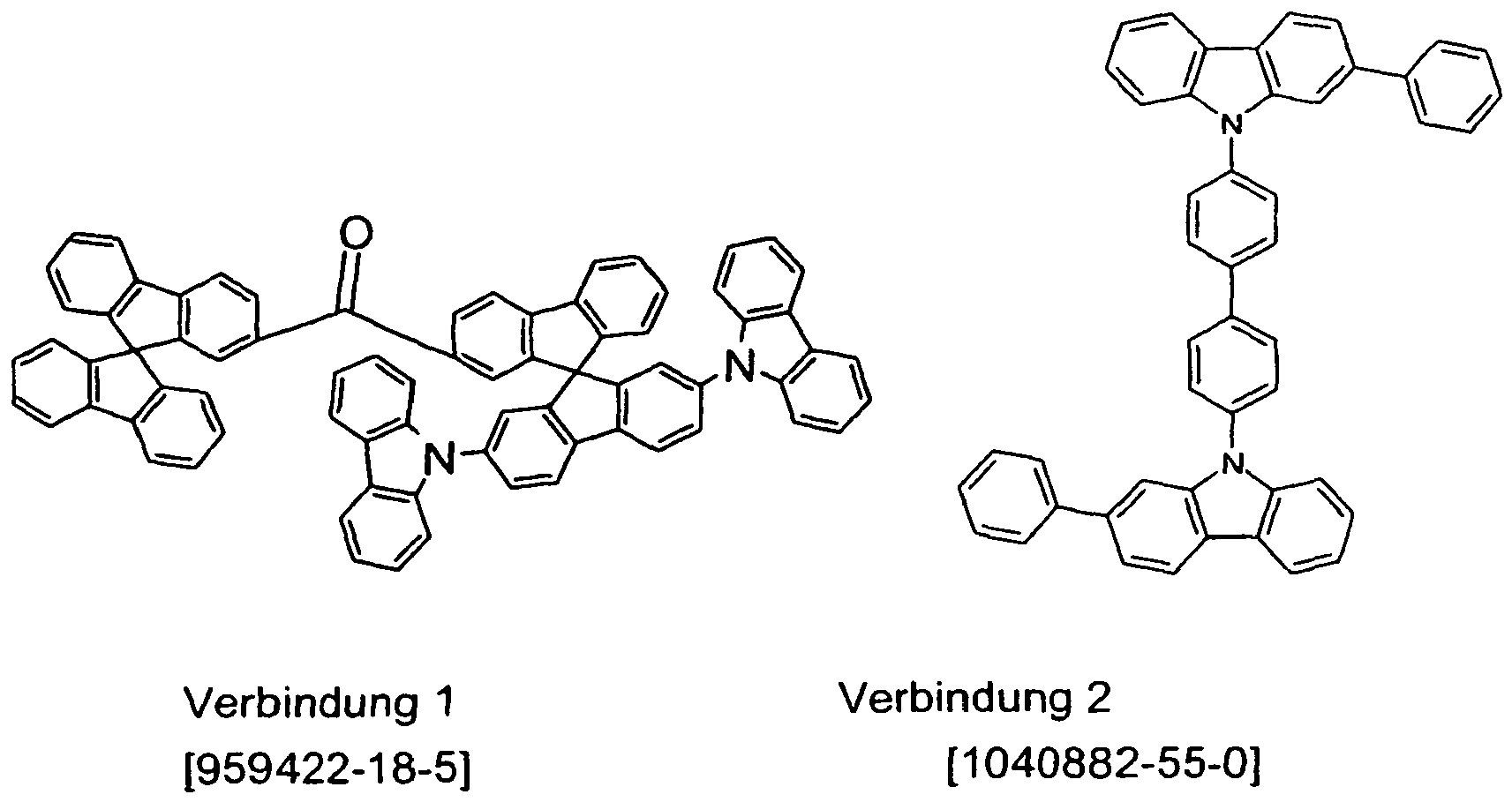

Analog dem o. g. allgemeinen Verfahren werden OLEDs mit folgendem Aufbau erzeugt:
- PEDOT
- 20 nm (aus Wasser aufgeschleudert; PEDOT bezogen von BAYER AG; Poly-[3,4-ethylendioxy-2,5-thiophen])
- Matrix + Emitter
- 80 nm, 5 Gew.-% Emitterkonzentration (aus Toluol oder Chlorbenzol aufgeschleudert),
- Ba / Ag
- 10 nm Ba / 150 nm Ag als Kathode.
- PEDOT
- 20 nm (spun from water, PEDOT supplied by BAYER AG; poly- [3,4-ethylenedioxy-2,5-thiophene])
- Matrix + emitter
- 80 nm, 5% by weight emitter concentration (spin-coated from toluene or chlorobenzene),
- Ba / Ag
- 10 nm Ba / 150 nm Ag as the cathode.
Strukturierte ITO-Substrate und das Material für die sogenannte Pufferschicht (PEDOT, eigentlich PEDOT:PSS) sind käuflich erhältlich (ITO von Technoprint und anderen, PEDOT:PPS als wässrige Dispersion Clevios Baytron P von H.C. Starck). Die Emissionsschicht wird in einer Inertgasatmosphäre, im vorliegenden Fall Argon, aufgeschleudert und 10 min bei 120°C ausgeheizt. Zuletzt wird eine Kathode aus Barium und Aluminium im Vakuum aufgedampft. Die lösungsprozessierten Devices werden standardmäßig charakterisiert, die genannten OLED-Beispiele wurden nicht optimiert.Structured ITO substrates and the material for the so-called buffer layer (PEDOT, actually PEDOT: PSS) are commercially available (ITO from Technoprint and others, PEDOT: PPS as aqueous dispersion Clevios Baytron P from H. C. Starck). The emission layer is spin-coated in an inert gas atmosphere, in this case argon, and baked at 120 ° C. for 10 minutes. Finally, a cathode of barium and aluminum is evaporated in vacuo. The solution-processed devices are characterized by default, the OLED examples mentioned were not optimized.
In Tabelle sind die Effizienz und die Spannung bei 500 cd / m2 sowie die Farbe aufgeführt.
Claims (16)
- Electronic device comprising at least one metal complex of the formula (1),
(L)y M-[C≡N-R]x formula (1)
where the following applies to the symbols and indices used:M is a penta- or hexacoordinated transition metal;L is on each occurrence, identically or differently, a mono-, bi- or tridentate ligand which bonds to the metal M and may be substituted by one or more radicals R1; the ligand L here may also be bonded to the radical R of the isonitrile group;R is on each occurrence, identically or differently, an organic substituent having 1 to 60 C atoms, which may be substituted by one or more substituents R1; a plurality of radicals R here may also be linked to one another and thus form a polydentate ligand; in addition, the radical R may also be linked to the ligand L;R1 is on each occurrence, identically or differently, H, D, F, Cl, Br, I, N(R2)2, CN, NO2, Si(R2)3, B(OR2)2, C(=O)R2 P(=O)(R2)2, S(=O)R2, S(=O)2R2, OSO2R2, a straight-chain alkyl, alkoxy or thioalkoxy group having 1 to 40 C atoms or a straight-chain alkenyl or alkynyl group having 2 to 40 C atoms or a branched or cyclic alkyl, alkenyl, alkynyl, alkoxy or thioalkoxy group having 3 to 40 C atoms, each of which may be substituted by one or more radicals R2, where one or more, preferably non-adjacent CH2 groups may be replaced by R2C=CR2, C=C, Si(R2)2, Ge(R2)2, Sn(R2)2, C=O, C=S, C=Se, C=NR2, P(=O)(R2),SO, SO2, NR2, O, S or CONR2 and where one or more H atoms may be replaced by D, F, Cl, Br, I, CN or NO2, or an aromatic or heteroaromatic ring system having 5 to 60 aromatic ring atoms, which may in each case be substituted by one or more radicals R2 or an aryloxy or heteroaryloxy group having 5 to 60 aromatic ring atoms, which may be substituted by one or more radicals R2, or a diarylamino group, diheteroarylamino group or aryl-heteroarylamino group having 10 to 40 aromatic ring atoms, which may be substituted by one or more radicals R2, or a combination of these systems; two or more substituents R1 here may also form a mono- or polycyclic aliphatic, aromatic and/or benzo-fused ring system with one another;R2 is on each occurrence, identically or differently, H, D, F or an aliphatic, aromatic and/or heteroaromatic hydrocarbon radical having 1 to 20 C atoms, in which, in addition, one or more H atoms may be replaced by D or F; two or more substituents R2 here may also form a mono- or polycyclic, aliphatic or aromatic ring system with one another;x is 3, 4, 5 or 6;y is 0, 1, 2 or 3, with the proviso that a coordination number on the metal of 5 or 6 is achieved. - Electronic device according to Claim 1, comprising anode, cathode and at least one layer, where this layer comprises at least one organic or organometallic compound, where the organic electronic device is selected from the group consisting of organic electroluminescent devices (= organic light-emitting diodes, OLEDs, PLEDs), organic integrated circuits (O-ICs), organic field-effect transistors (O-FETs), organic thin-film transistors (O-TFTs), organic light-emitting transistors (O-LETs), organic solar cells (O-SCs), organic optical detectors, organic photoreceptors, organic field-quench devices (O-FQDs), light-emitting electrochemical cells (LECs) and organic laser diodes (O-lasers), in particular organic electroluminescent devices.
- Electronic device according to Claim 1 or 2, characterised in that the compounds of the formula (1) are uncharged, i.e. are electrically neutral.
- Electronic device according to one or more of Claims 1 to 3, characterised in that M in compounds of the formula (1) stands for a penta-coordinated or hexacoordinated transition metal selected from the group consisting of chromium, molybdenum, tungsten, rhenium, ruthenium, osmium, rhodium, iridium, nickel, platinum, copper, silver and gold, in particular molybdenum, tungsten, rhenium, ruthenium, osmium, iridium, platinum and gold.
- Electronic device according to one or more of Claims 1 to 4, characterised in that one or more of the isonitrile ligands are monodentate ligands, where the substituent R stands, identically or differently on each occurrence, for a straight-chain alkyl group having 1 to 40 C atoms or a straight-chain alkenyl or alkynyl group having 2 to 40 C atoms or a branched or cyclic alkyl, alkenyl or alkynyl group having 3 to 40 C atoms, each of which may be substituted by one or more radicals R1, where one or more, preferably non-adjacent CH2 groups may be replaced by R1C=CR1, C=C, Si(R1)2, Ge(R1)2, Sn(R1)2, C=O, C=S, C=Se, C=NR1, P(=O)(R1), SO, SO2, NR1, O, S or CONR1 and where one or more H atoms may be replaced by D, F, Cl, Br, I, CN or NO2, or for a monovalent aromatic or heteroaromatic ring system having 5 to 60 aromatic ring atoms, which may in each case be substituted by one or more radicals R1, or for a combination of these systems.
- Electronic device according to one or more of Claims 1 to 5, characterised in that the substituents R form a chain-shaped, branched or mono- or polycyclic, aliphatic, aromatic and/or benzo-fused structure with one another and/or together with the ligand L, and the ligands thus have a polydentate or polypodal ligand character.
- Electronic device according to one or more of Claims 1 to 6, characterised in that the metal complex contains one or more isonitrile ligands having a structure of the formula (2) or formula (3),
 Y is on each occurrence, identically or differently, a single bond, O, S, N(R1), C=O, a straight-chain alkylene group having 1 to 6 C atoms or a branched or cyclic alkylene group having 3 to 6 C atoms, each of which may be substituted by one or more radicals R1, where one or more non-adjacent CH2 groups may be replaced by R1C=CR1, NR1, Si(R1)2, O or S and where one or more H atoms may be replaced by D, F, Cl, Br, I, CN or NO2, or an arylene or heteroarylene group having 5 to 20 aromatic ring atoms, which may be substituted by one or more radicals R1, or a combination of these systems;V is B, B(R1)-, CR1, CO-, CN(R1)2, SiR1, N, NO, N(R1)+, P, P(R1)+, PO, PS, As, As(R1)+, AsO, S+, Se+, or a unit of the formula (4), (5), (6) or (7),
 Z is BR1, B(R1)2 -, C(R1)2, C(=O), Si(R1)2, NR1, PR1, P(R1)2 +, PO(R1), PS(R1), AsR1, AsO(R1) AsS, O, S, Se, or a unit of the formulae (8) to (17),
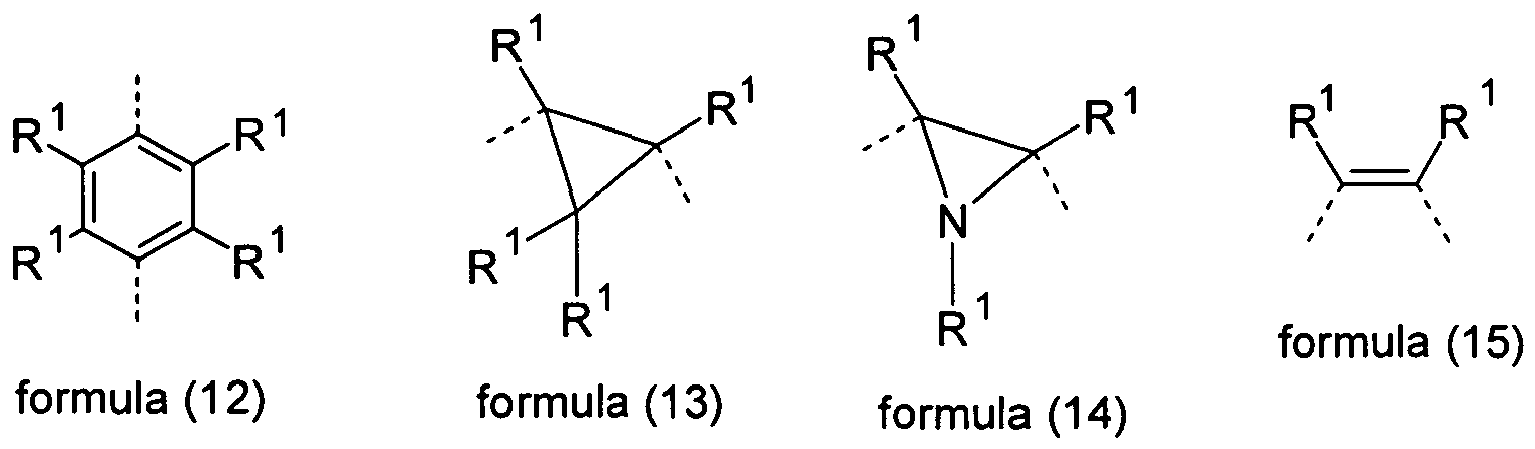
 n is 1, 2 or 3, preferably 2 or 3;m is 1 or 2, preferably 2.
 - Electronic device according to Claim 7, characterised in that the number of atoms in the two groups Y and in the group V or Z which represent the direct connection between the isonitrile groups or between the isonitrile group and the ligand group L is between 6 and 12 atoms, preferably between 7 and 10 atoms, particularly preferably between 7 and 9 atoms.
- Electronic device according to Claim 7 or 8, characterised in that the ligands are selected from ligands of the formulae (18) to (28), each of which may be substituted by one or more radicals R1:


- Electronic device according to one or more of Claims 1 to 9, characterised in that the ligands L are selected from carbon monoxide, nitrogen monoxide, amines, phosphines, phosphites, arsines, stibines, nitrogen-containing heterocycles, carbenes, hydride, deuteride, the halides F, Cl, Br and I, alkylacetylides, arylacetylides, cyanide, azide, cyanate, isocyanate, thiocyanate, isothiocyanate, aliphatic or aromatic alcoholates, aliphatic or aromatic thioalcoholates, amides, carboxylates, aryl groups, anionic, nitrogen-containing heterocycles, O2-, S2-, carbides, which result in coordination in the form R-C≡M, and nitrenes, which result in coordination in the form R-N=M, where R generally stands for a substituent, or N3-, diamines, imines, diimines, heterocycles containing two nitrogen atoms, diphosphines, 1,3-diketonates derived from 1,3-diketones, 3-ketonates derived from 3-ketoesters, carboxylates derived from aminocarboxylic acids, salicyliminates derived from salicylimines, dialcoholates derived from dialcohols, dithiolates derived from dithiols, borates of nitrogen-containing heterocycles, η5-cyclopentadienyl, η5-pentamethylcyclopentadienyl, η6-benzene or η7-cycloheptatrienyl, each of which may be substituted by one or more radicals R1, or in that the ligand L is a bidentate monoanionic ligand which, with the metal, forms a cyclometallated five- or six-membered ring with at least one metal-carbon bond, in particular a combination of two groups, as represented by the formulae (29) to (56), where one group is bonded via a neutral nitrogen atom or a carbene atom and the other group is bonded via a negatively charged carbon atom or a negatively charged nitrogen atom, where the ligand L is then formed from the groups of the formulae (29) to (56) through these groups bonding to one another in each case at the position denoted by #, and the position at which the groups coordinate to the metal is denoted by *:


or in that the ligand L is a 1,3,5-cis-cyclohexane derivative, in particular of the formula (57), a 1,1,1-tri(methylene)methane derivative, in particular of the formula (58), or a 1,1,1-trisubstituted methane, in particular of the formulae (59) and (60),
- Organic electroluminescent device according to one or more of Claims 1 to 10, comprising cathode, anode and one or more emitting layers and in addition optionally in each case one or more hole-injection layers, hole-transport layers, hole-blocking layers, electron-transport layers, electron-injection layers, exciton-blocking layers, charge-generation layers and/or organic or inorganic p/n junctions, characterised in that the compound of the formula (1) is employed as emission material in an emitting layer.
- Organic electroluminescent device according to one or more of Claims 1 to 11, characterised in that the compound of the formula (1) is employed in an emitting layer in combination with one or more matrix materials, in particular selected from CBP (N,N-biscarbazolyl-biphenyl), carbazole derivatives, azacarbazoles, ketones, phosphine oxides, sulfoxides, sulfones, oligophenylenes, aromatic amines, bipolar matrix materials, silanes, 9,9-diarylfluorene derivatives, azaboroles and boronic esters.
- Process for the production of an electronic device according to one or more of Claims 1 to 12, characterised in that one or more layers are applied by means of a sublimation process and/or in that one or more layers are applied by means of the OVPD (organic vapour phase deposition) process or with the aid of carrier-gas sublimation or by means of the OVJP (organic vapour jet printing) process and/or in that one or more layers are produced from solution or by means of a printing process.
- Compound of the formula (1'),
(L)y M-[C≡N-R]x formula (1')
where the symbols and indices used have the meanings mentioned in Claim 1, and at least one of the isonitrile ligands is selected from ligands of the formula (27) or (28), each of which may also be substituted by one or more radicals R1:
- Compound of the formula (27) or (28), each of which may be substituted by one or more radicals R1, where R1 has the meaning mentioned in Claim 1:

- Solution or formulation comprising at least one compound of the formula (1') and at least one organic solvent, preferably selected from the class of the aromatic organic solvents.
Applications Claiming Priority (2)
| Application Number | Priority Date | Filing Date | Title |
|---|---|---|---|
| DE102008036247A DE102008036247A1 (en) | 2008-08-04 | 2008-08-04 | Electronic devices containing metal complexes |
| PCT/EP2009/004955 WO2010015307A1 (en) | 2008-08-04 | 2009-07-08 | Electronic devices comprising metal complexes having isonitrile ligands |
Publications (2)
| Publication Number | Publication Date |
|---|---|
| EP2311112A1 EP2311112A1 (en) | 2011-04-20 |
| EP2311112B1 true EP2311112B1 (en) | 2012-03-14 |
Family
ID=41050415
Family Applications (1)
| Application Number | Title | Priority Date | Filing Date |
|---|---|---|---|
| EP09777051A Not-in-force EP2311112B1 (en) | 2008-08-04 | 2009-07-08 | Electronic devices comprising metal complexes having isonitrile ligands |
Country Status (9)
| Country | Link |
|---|---|
| US (1) | US8691400B2 (en) |
| EP (1) | EP2311112B1 (en) |
| JP (1) | JP5746028B2 (en) |
| KR (1) | KR101658679B1 (en) |
| CN (1) | CN102077380B (en) |
| AT (1) | ATE549752T1 (en) |
| DE (1) | DE102008036247A1 (en) |
| TW (1) | TW201022400A (en) |
| WO (1) | WO2010015307A1 (en) |
Families Citing this family (216)
| Publication number | Priority date | Publication date | Assignee | Title |
|---|---|---|---|---|
| DE102009053644B4 (en) | 2009-11-17 | 2019-07-04 | Merck Patent Gmbh | Materials for organic electroluminescent devices |
| DE102009053836A1 (en) | 2009-11-18 | 2011-05-26 | Merck Patent Gmbh | Materials for organic electroluminescent devices |
| DE102010004803A1 (en) | 2010-01-16 | 2011-07-21 | Merck Patent GmbH, 64293 | Materials for organic electroluminescent devices |
| KR101757016B1 (en) * | 2010-03-11 | 2017-07-11 | 메르크 파텐트 게엠베하 | Radiative fibers |
| DE102010024897A1 (en) | 2010-06-24 | 2011-12-29 | Merck Patent Gmbh | Materials for organic electroluminescent devices |
| DE102010027319A1 (en) | 2010-07-16 | 2012-01-19 | Merck Patent Gmbh | metal complexes |
| DE102010045405A1 (en) | 2010-09-15 | 2012-03-15 | Merck Patent Gmbh | Materials for organic electroluminescent devices |
| DE102010048497A1 (en) * | 2010-10-14 | 2012-04-19 | Merck Patent Gmbh | Formulations for organic electroluminescent devices |
| CN103228647B (en) | 2010-11-24 | 2017-02-15 | 默克专利有限公司 | Materials for organic electroluminescent devices |
| EP2699571B1 (en) | 2011-04-18 | 2018-09-05 | Merck Patent GmbH | Materials for organic electroluminescent devices |
| KR101934135B1 (en) | 2011-06-03 | 2019-04-05 | 메르크 파텐트 게엠베하 | Organic electroluminescence device |
| CN102336775B (en) * | 2011-07-15 | 2013-11-06 | 华中师范大学 | Preparation method and application of diisocyan bridge chain bimetallic compound |
| JP6174030B2 (en) | 2011-09-21 | 2017-08-02 | メルク パテント ゲーエムベーハー | Carbazole derivatives for organic electroluminescent devices |
| KR101903216B1 (en) | 2011-10-20 | 2018-10-01 | 메르크 파텐트 게엠베하 | Materials for organic electroluminescent devices |
| KR102015765B1 (en) | 2012-02-14 | 2019-10-21 | 메르크 파텐트 게엠베하 | Spirobifluorene compounds for organic electroluminescent devices |
| KR102161955B1 (en) | 2012-07-10 | 2020-10-06 | 메르크 파텐트 게엠베하 | Materials for organic electroluminescent devices |
| EP2875019B1 (en) | 2012-07-23 | 2017-03-29 | Merck Patent GmbH | Materials for organic electroluminescence devices |
| US8530685B1 (en) | 2012-07-30 | 2013-09-10 | General Electric Company | Monodentate gold ethynyl complexes |
| JP6271550B2 (en) | 2012-08-10 | 2018-01-31 | メルク パテント ゲーエムベーハー | Materials for organic electroluminescent devices |
| JP6407877B2 (en) | 2012-11-20 | 2018-10-17 | メルク パテント ゲーエムベーハー | Formulations in high purity solvents for the manufacture of electronic devices |
| SG11201607587YA (en) * | 2014-03-13 | 2016-10-28 | Sigma Aldrich Co Llc | Molybdenum silylcyclopentadienyl and silylallyl complexes and use thereof in thin film deposition |
| CN106459018B (en) | 2014-05-05 | 2022-01-25 | 默克专利有限公司 | Material for organic light emitting device |
| CN107004777B (en) | 2014-12-04 | 2019-03-26 | 广州华睿光电材料有限公司 | Polymers, mixtures, compositions, organic electronic devices containing the same, and monomers thereof |
| WO2016086885A1 (en) | 2014-12-04 | 2016-06-09 | 广州华睿光电材料有限公司 | Deuterated organic compound, mixture and composition containing said compound, and organic electronic device |
| WO2016091219A1 (en) | 2014-12-11 | 2016-06-16 | 广州华睿光电材料有限公司 | Organic compound, mixture comprising same, composite, and organic electronic component |
| EP3246347B1 (en) | 2015-01-13 | 2025-04-23 | Guangzhou Chinaray Optoelectronic Materials Ltd. | Conjugated polymer containing ethynyl crosslinking group, mixture, composition, organic electronic device containing the same and application thereof |
| KR102235612B1 (en) | 2015-01-29 | 2021-04-02 | 삼성전자주식회사 | Semiconductor device having work-function metal and method of forming the same |
| KR102660538B1 (en) | 2015-07-22 | 2024-04-24 | 메르크 파텐트 게엠베하 | Materials for organic electroluminescent devices |
| JP6983754B2 (en) | 2015-07-29 | 2021-12-17 | メルク パテント ゲーエムベーハー | Materials for organic electroluminescence devices |
| EP3334708B1 (en) | 2015-08-13 | 2020-08-19 | Merck Patent GmbH | Hexamethylindanes |
| WO2017080326A1 (en) | 2015-11-12 | 2017-05-18 | 广州华睿光电材料有限公司 | Printing composition, electronic device comprising same and preparation method for functional material thin film |
| CN108137634B (en) | 2015-12-04 | 2020-11-20 | 广州华睿光电材料有限公司 | A metal-organic complex and its application in electronic devices |
| KR102740106B1 (en) | 2016-03-03 | 2024-12-09 | 메르크 파텐트 게엠베하 | Materials for organic electroluminescent devices |
| TWI821807B (en) | 2016-03-17 | 2023-11-11 | 德商麥克專利有限公司 | Compounds having spirobifluorene structures |
| KR20250004078A (en) | 2016-04-11 | 2025-01-07 | 메르크 파텐트 게엠베하 | Heterocyclic compounds comprising dibenzofuran and/or dibenzothiophene structures |
| EP3448866B1 (en) | 2016-04-29 | 2020-06-17 | Merck Patent GmbH | Materials for organic electroluminescent devices |
| EP3464244B1 (en) | 2016-06-03 | 2021-11-17 | Merck Patent GmbH | Materials for organic electroluminescent devices |
| KR102459000B1 (en) | 2016-09-14 | 2022-10-26 | 메르크 파텐트 게엠베하 | Compounds having a carbazole structure |
| EP3512841B1 (en) | 2016-09-14 | 2023-04-26 | Merck Patent GmbH | Compounds with spirobifluorene-structures |
| KR102773142B1 (en) | 2016-09-30 | 2025-02-25 | 메르크 파텐트 게엠베하 | Carbazoles with diazadibenzofurane or diazadibenzothiophene structures |
| TWI766884B (en) | 2016-09-30 | 2022-06-11 | 德商麥克專利有限公司 | Compounds having diazadibenzofuran or diazadibenzothiophene structures, process for preparing the same and use thereof |
| JP7073388B2 (en) | 2016-11-08 | 2022-05-23 | メルク パテント ゲーエムベーハー | Compounds for electronic devices |
| JP7214633B2 (en) | 2016-11-09 | 2023-01-30 | メルク パテント ゲーエムベーハー | Materials for organic electroluminescent devices |
| TWI756292B (en) | 2016-11-14 | 2022-03-01 | 德商麥克專利有限公司 | Compounds having an acceptor group and a donor group |
| WO2018091435A1 (en) | 2016-11-17 | 2018-05-24 | Merck Patent Gmbh | Materials for organic electroluminescent devices |
| US11239428B2 (en) | 2016-11-23 | 2022-02-01 | Guangzhou Chinaray Optoelectronic Materials Ltd. | Boron-containing organic compound and applications thereof, organic mixture, and organic electronic device |
| US11634444B2 (en) | 2016-11-23 | 2023-04-25 | Guangzhou Chinaray Optoelectronic Materials Ltd. | Metal organic complex, high polymer, composition, and organic electronic component |
| US10804470B2 (en) | 2016-11-23 | 2020-10-13 | Guangzhou Chinaray Optoelectronic Materials Ltd | Organic compound |
| US11248138B2 (en) | 2016-11-23 | 2022-02-15 | Guangzhou Chinaray Optoelectronic Materials Ltd. | Printing ink formulations, preparation methods and uses thereof |
| CN109791993B (en) | 2016-11-23 | 2021-01-15 | 广州华睿光电材料有限公司 | Organic mixture, composition and organic electronic device |
| EP3547384B1 (en) | 2016-11-23 | 2022-10-05 | Guangzhou Chinaray Optoelectronic Materials Ltd. | High polymer, mixture containing same, composition, organic electronic component, and monomer for polymerization |
| CN109843837B (en) | 2016-11-23 | 2022-03-18 | 广州华睿光电材料有限公司 | Nitrogen-containing fused heterocyclic compound and application thereof |
| WO2018099846A1 (en) | 2016-11-30 | 2018-06-07 | Merck Patent Gmbh | Compounds having valerolactam structures |
| US11466021B2 (en) | 2016-12-05 | 2022-10-11 | Merck Patent Gmbh | Materials for organic electroluminescent devices |
| TW201831468A (en) | 2016-12-05 | 2018-09-01 | 德商麥克專利有限公司 | Nitrogen-containing heterocyclic compound |
| EP3548485B1 (en) | 2016-12-05 | 2021-01-20 | Merck Patent GmbH | Materials for organic electroluminescent devices |
| WO2018103744A1 (en) | 2016-12-08 | 2018-06-14 | 广州华睿光电材料有限公司 | Mixture, composition and organic electronic device |
| US11161933B2 (en) | 2016-12-13 | 2021-11-02 | Guangzhou Chinaray Optoelectronic Materials Ltd. | Conjugated polymer and use thereof in organic electronic device |
| KR102504432B1 (en) | 2016-12-22 | 2023-02-27 | 메르크 파텐트 게엠베하 | A mixture comprising at least two organo-functional compounds |
| CN109792003B (en) | 2016-12-22 | 2020-10-16 | 广州华睿光电材料有限公司 | Diels-Alder Reaction-Based Crosslinkable Polymers and Their Applications in Organic Electronic Devices |
| US11289654B2 (en) | 2016-12-22 | 2022-03-29 | Guangzhou Chinaray Optoelectronic Materials Ltd. | Polymers containing furanyl crosslinkable groups and uses thereof |
| JP2020504762A (en) | 2017-01-04 | 2020-02-13 | メルク パテント ゲーエムベーハー | Materials for organic electroluminescent devices |
| WO2018138039A1 (en) | 2017-01-25 | 2018-08-02 | Merck Patent Gmbh | Carbazole derivatives |
| US11407766B2 (en) | 2017-01-30 | 2022-08-09 | Merck Patent Gmbh | Materials for organic electroluminescent devices |
| TW201835075A (en) | 2017-02-14 | 2018-10-01 | 德商麥克專利有限公司 | Material for organic electroluminescent device |
| TW201843143A (en) | 2017-03-13 | 2018-12-16 | 德商麥克專利有限公司 | Compound containing an arylamine structure |
| US11296281B2 (en) | 2017-03-15 | 2022-04-05 | Merck Patent Gmbh | Materials for organic electroluminescent devices |
| US10672998B2 (en) * | 2017-03-23 | 2020-06-02 | Universal Display Corporation | Organic electroluminescent materials and devices |
| EP3609977B1 (en) | 2017-04-13 | 2024-05-29 | Merck Patent GmbH | Composition for organic electronic devices |
| EP3621970B1 (en) | 2017-05-11 | 2021-01-13 | Merck Patent GmbH | Organoboron complexes for organic electroluminescent devices |
| KR102592390B1 (en) | 2017-05-11 | 2023-10-20 | 메르크 파텐트 게엠베하 | Carbazole-based bodypiece for organic electroluminescent devices |
| US11535619B2 (en) | 2017-05-22 | 2022-12-27 | Merck Patent Gmbh | Hexacyclic heteroaromatic compounds for electronic devices |
| US11767299B2 (en) | 2017-06-23 | 2023-09-26 | Merck Patent Gmbh | Materials for organic electroluminescent devices |
| KR102616338B1 (en) | 2017-07-05 | 2023-12-20 | 메르크 파텐트 게엠베하 | Composition for organic electronic devices |
| JP7247121B2 (en) | 2017-07-05 | 2023-03-28 | メルク パテント ゲーエムベーハー | Compositions for organic electronic devices |
| TWI776926B (en) * | 2017-07-25 | 2022-09-11 | 德商麥克專利有限公司 | Metal complexes |
| US11370965B2 (en) | 2017-09-12 | 2022-06-28 | Merck Patent Gmbh | Materials for organic electroluminescent devices |
| WO2019068679A1 (en) | 2017-10-06 | 2019-04-11 | Merck Patent Gmbh | Materials for organic electroluminescent devices |
| EP3700909B1 (en) | 2017-10-24 | 2024-01-24 | Merck Patent GmbH | Materials for organic electroluminescent devices |
| TWI785142B (en) | 2017-11-14 | 2022-12-01 | 德商麥克專利有限公司 | Composition for organic electronic devices |
| US11594690B2 (en) | 2017-12-14 | 2023-02-28 | Guangzhou Chinaray Optoelectronic Materials Ltd. | Organometallic complex, and polymer, mixture and formulation comprising same, and use thereof in electronic device |
| CN111247658B (en) | 2017-12-14 | 2023-04-04 | 广州华睿光电材料有限公司 | Transition metal complexes, polymers, mixtures, compositions and uses thereof |
| CN111247159A (en) | 2017-12-14 | 2020-06-05 | 广州华睿光电材料有限公司 | A transition metal complex material and its application in electronic devices |
| TW201938562A (en) | 2017-12-19 | 2019-10-01 | 德商麥克專利有限公司 | Heterocyclic compounds |
| JP7402800B2 (en) | 2017-12-20 | 2023-12-21 | メルク パテント ゲゼルシャフト ミット ベシュレンクテル ハフツング | heteroaromatic compounds |
| US11680059B2 (en) | 2017-12-21 | 2023-06-20 | Guangzhou Chinaray Optoelectronic Materials Ltd. | Organic mixture and application thereof in organic electronic devices |
| TWI811290B (en) | 2018-01-25 | 2023-08-11 | 德商麥克專利有限公司 | Materials for organic electroluminescent devices |
| EP3765444B1 (en) | 2018-03-16 | 2026-01-14 | Merck Patent GmbH | Materials for organic electroluminescent devices |
| CN112166112A (en) | 2018-05-30 | 2021-01-01 | 默克专利有限公司 | Compositions for organic electronic devices |
| US12419192B2 (en) | 2018-06-07 | 2025-09-16 | Merck Patent Gmbh | Organic electroluminescence devices |
| WO2020011686A1 (en) | 2018-07-09 | 2020-01-16 | Merck Patent Gmbh | Materials for organic electroluminescent devices |
| CN112424169A (en) | 2018-07-20 | 2021-02-26 | 默克专利有限公司 | Material for organic electroluminescent device |
| KR102769406B1 (en) | 2018-09-12 | 2025-02-17 | 메르크 파텐트 게엠베하 | Materials for organic electroluminescent devices |
| TW202030902A (en) | 2018-09-12 | 2020-08-16 | 德商麥克專利有限公司 | Electroluminescent devices |
| TWI826522B (en) | 2018-09-12 | 2023-12-21 | 德商麥克專利有限公司 | Electroluminescent devices |
| CN112771024A (en) | 2018-09-27 | 2021-05-07 | 默克专利有限公司 | Process for preparing sterically hindered nitrogen-containing heteroaromatics |
| CN120025253A (en) | 2018-09-27 | 2025-05-23 | 默克专利有限公司 | Compounds useful as active compounds in organic electronic devices |
| CN112955437A (en) | 2018-11-05 | 2021-06-11 | 默克专利有限公司 | Compounds useful in organic electronic devices |
| US20220020934A1 (en) | 2018-11-06 | 2022-01-20 | Merck Patent Gmbh | 5,6-diphenyl-5,6-dihydro-dibenz[c,e][1,2]azaphosphorin and 6-phenyl-6h-dibenzo[c,e][1,2]thiazin-5,5-dioxide derivatives and similar compounds as organic electroluminescent materials for oleds |
| KR20210091769A (en) | 2018-11-14 | 2021-07-22 | 메르크 파텐트 게엠베하 | Compounds that can be used in the manufacture of organic electronic devices |
| CN113195500B (en) | 2018-11-15 | 2024-05-17 | 默克专利有限公司 | Material for organic electroluminescent device |
| TW202039493A (en) | 2018-12-19 | 2020-11-01 | 德商麥克專利有限公司 | Materials for organic electroluminescent devices |
| US12139500B2 (en) | 2019-01-16 | 2024-11-12 | Merck Patent Gmbh | Materials for organic electroluminescent devices |
| TW202035345A (en) | 2019-01-17 | 2020-10-01 | 德商麥克專利有限公司 | Materials for organic electroluminescent devices |
| WO2020169241A1 (en) | 2019-02-18 | 2020-08-27 | Merck Patent Gmbh | Composition for organic electronic devices |
| US20220127286A1 (en) | 2019-03-04 | 2022-04-28 | Merck Patent Gmbh | Ligands for nano-sized materials |
| WO2020182779A1 (en) | 2019-03-12 | 2020-09-17 | Merck Patent Gmbh | Materials for organic electroluminescent devices |
| WO2020187865A1 (en) | 2019-03-20 | 2020-09-24 | Merck Patent Gmbh | Materials for organic electroluminescent devices |
| CN113614082B (en) | 2019-03-25 | 2024-06-18 | 默克专利有限公司 | Materials for organic electroluminescent devices |
| JP7598873B2 (en) | 2019-04-11 | 2024-12-12 | メルク パテント ゲゼルシャフト ミット ベシュレンクテル ハフツング | Materials for organic electroluminescent devices |
| JP7625573B2 (en) | 2019-07-22 | 2025-02-03 | ユー・ディー・シー アイルランド リミテッド | Method for preparing orthometallated metal compounds |
| WO2021037401A1 (en) | 2019-08-26 | 2021-03-04 | Merck Patent Gmbh | Materials for organic electroluminescent devices |
| KR20220056223A (en) | 2019-09-02 | 2022-05-04 | 메르크 파텐트 게엠베하 | Materials for organic electroluminescent devices |
| TW202122558A (en) | 2019-09-03 | 2021-06-16 | 德商麥克專利有限公司 | Materials for organic electroluminescent devices |
| WO2021052924A1 (en) | 2019-09-16 | 2021-03-25 | Merck Patent Gmbh | Materials for organic electroluminescent devices |
| JP7693654B2 (en) | 2019-09-19 | 2025-06-17 | メルク パテント ゲーエムベーハー | Mixture of two host materials and organic electroluminescent device containing same |
| KR20220066324A (en) | 2019-09-20 | 2022-05-24 | 메르크 파텐트 게엠베하 | Materials for electronic devices |
| US20220416172A1 (en) | 2019-10-22 | 2022-12-29 | Merck Patent Gmbh | Materials for organic electroluminescent devices |
| KR20220090539A (en) | 2019-10-25 | 2022-06-29 | 메르크 파텐트 게엠베하 | Compounds that can be used in organic electronic devices |
| US12593607B2 (en) | 2019-11-04 | 2026-03-31 | Udc Ireland Limited | Materials for organic electroluminescent devices |
| TW202130783A (en) | 2019-11-04 | 2021-08-16 | 德商麥克專利有限公司 | Organic electroluminescent device |
| TW202134252A (en) | 2019-11-12 | 2021-09-16 | 德商麥克專利有限公司 | Materials for organic electroluminescent devices |
| TW202136181A (en) | 2019-12-04 | 2021-10-01 | 德商麥克專利有限公司 | Materials for organic electroluminescent devices |
| TW202136471A (en) | 2019-12-17 | 2021-10-01 | 德商麥克專利有限公司 | Materials for organic electroluminescent devices |
| JP7620631B2 (en) | 2019-12-18 | 2025-01-23 | メルク パテント ゲゼルシャフト ミット ベシュレンクテル ハフツング | Aromatic Compounds for Organic Electroluminescent Devices |
| CN114867729A (en) | 2019-12-19 | 2022-08-05 | 默克专利有限公司 | Polycyclic compound for organic electroluminescent device |
| US20230139809A1 (en) | 2020-01-29 | 2023-05-04 | Merck Patent Gmbh | Benzimidazole derivatives |
| CN115135741A (en) | 2020-02-25 | 2022-09-30 | 默克专利有限公司 | Use of heterocyclic compounds in organic electronic devices |
| WO2021175706A1 (en) | 2020-03-02 | 2021-09-10 | Merck Patent Gmbh | Use of sulfone compounds in an organic electronic device |
| WO2021180614A1 (en) | 2020-03-11 | 2021-09-16 | Merck Patent Gmbh | Organic electroluminescent apparatus |
| EP4118695B1 (en) | 2020-03-11 | 2024-05-01 | Merck Patent GmbH | Organic electroluminescent apparatus |
| CN115298187A (en) | 2020-03-17 | 2022-11-04 | 默克专利有限公司 | Heteroaromatic compounds for organic electroluminescent devices |
| EP4122028B1 (en) | 2020-03-17 | 2024-10-16 | Merck Patent GmbH | Heterocyclic compounds for organic electroluminescent devices |
| KR20220157456A (en) | 2020-03-23 | 2022-11-29 | 메르크 파텐트 게엠베하 | Materials for organic electroluminescent devices |
| US12342718B2 (en) | 2020-03-24 | 2025-06-24 | Merck Kgaa | Materials for electronic devices |
| EP4126880A1 (en) | 2020-03-26 | 2023-02-08 | Merck Patent GmbH | Cyclic compounds for organic electroluminescent devices |
| US20230151026A1 (en) | 2020-04-02 | 2023-05-18 | Merck Patent Gmbh | Multi-layer body for diffuse transillumination |
| EP4132939B1 (en) | 2020-04-06 | 2024-01-31 | Merck Patent GmbH | Polycyclic compounds for organic electroluminescent devices |
| CN115669281A (en) | 2020-05-29 | 2023-01-31 | 默克专利有限公司 | Organic electroluminescent device |
| WO2022002771A1 (en) | 2020-06-29 | 2022-01-06 | Merck Patent Gmbh | Heterocyclic compounds for organic electroluminescent devices |
| JP2023531470A (en) | 2020-06-29 | 2023-07-24 | メルク パテント ゲゼルシャフト ミット ベシュレンクテル ハフツング | Heteroaromatic compounds for organic electroluminescent devices |
| WO2022029096A1 (en) | 2020-08-06 | 2022-02-10 | Merck Patent Gmbh | Materials for organic electroluminescent devices |
| CN116134113B (en) | 2020-08-13 | 2025-12-26 | Udc爱尔兰有限公司 | Metal complexes |
| US12433160B2 (en) | 2020-08-18 | 2025-09-30 | Merck Patent Gmbh | Materials for organic electroluminescent devices |
| CN115956073A (en) | 2020-08-19 | 2023-04-11 | 默克专利有限公司 | Materials for Organic Electroluminescent Devices |
| CN116391456A (en) * | 2020-09-18 | 2023-07-04 | 三星显示有限公司 | Organic Electroluminescent Devices |
| TW202222748A (en) | 2020-09-30 | 2022-06-16 | 德商麥克專利有限公司 | Compounds usable for structuring of functional layers of organic electroluminescent devices |
| TW202229215A (en) | 2020-09-30 | 2022-08-01 | 德商麥克專利有限公司 | Compounds for structuring of functional layers of organic electroluminescent devices |
| EP4229064A1 (en) | 2020-10-16 | 2023-08-23 | Merck Patent GmbH | Heterocyclic compounds for organic electroluminescent devices |
| WO2022079067A1 (en) | 2020-10-16 | 2022-04-21 | Merck Patent Gmbh | Compounds comprising heteroatoms for organic electroluminescent devices |
| CN116601157A (en) | 2020-11-10 | 2023-08-15 | 默克专利有限公司 | Sulfur-containing compounds for organic electroluminescent devices |
| KR20230116023A (en) | 2020-12-02 | 2023-08-03 | 메르크 파텐트 게엠베하 | Heterocyclic compounds for organic electroluminescent devices |
| CN116568690A (en) | 2020-12-10 | 2023-08-08 | 默克专利有限公司 | Material for organic electroluminescent device |
| TW202241905A (en) | 2020-12-18 | 2022-11-01 | 德商麥克專利有限公司 | Nitrogen compounds for organic electroluminescent devices |
| US20240101560A1 (en) | 2020-12-18 | 2024-03-28 | Merck Patent Gmbh | Nitrogenous heteroaromatic compounds for organic electroluminescent devices |
| WO2022129116A1 (en) | 2020-12-18 | 2022-06-23 | Merck Patent Gmbh | Indolo[3.2.1-jk]carbazole-6-carbonitrile derivatives as blue fluorescent emitters for use in oleds |
| EP4274827A1 (en) | 2021-01-05 | 2023-11-15 | Merck Patent GmbH | Materials for organic electroluminescent devices |
| CN116745296A (en) | 2021-01-13 | 2023-09-12 | 浙江光昊光电科技有限公司 | An organic compound, composition and application in organic electronic devices |
| KR20230137375A (en) | 2021-01-25 | 2023-10-04 | 메르크 파텐트 게엠베하 | Nitrogen compounds for organic electroluminescent devices |
| EP4301757A1 (en) | 2021-03-02 | 2024-01-10 | Merck Patent GmbH | Compounds for organic electroluminescent devices |
| CN117043302A (en) | 2021-03-18 | 2023-11-10 | 默克专利有限公司 | Heteroaromatic compounds for organic electroluminescent devices |
| KR20240005782A (en) | 2021-04-29 | 2024-01-12 | 메르크 파텐트 게엠베하 | Materials for organic electroluminescent devices |
| CN117279902A (en) | 2021-04-29 | 2023-12-22 | 默克专利有限公司 | Materials for organic electroluminescent devices |
| WO2022229234A1 (en) | 2021-04-30 | 2022-11-03 | Merck Patent Gmbh | Nitrogenous heterocyclic compounds for organic electroluminescent devices |
| EP4340969A1 (en) | 2021-05-21 | 2024-03-27 | Merck Patent GmbH | Method for the continuous purification of at least one functional material and device for the continuous purification of at least one functional material |
| WO2022200638A1 (en) | 2021-07-06 | 2022-09-29 | Merck Patent Gmbh | Materials for organic electroluminescent devices |
| EP4402141A1 (en) | 2021-09-13 | 2024-07-24 | Merck Patent GmbH | Materials for organic electroluminescent devices |
| KR20240064697A (en) | 2021-09-14 | 2024-05-13 | 메르크 파텐트 게엠베하 | Boron heterocyclic compounds for organic electroluminescent devices |
| EP4410074B1 (en) | 2021-09-28 | 2025-05-21 | Merck Patent GmbH | Materials for electronic devices |
| WO2023052272A1 (en) | 2021-09-28 | 2023-04-06 | Merck Patent Gmbh | Materials for electronic devices |
| EP4410071A1 (en) | 2021-09-28 | 2024-08-07 | Merck Patent GmbH | Materials for electronic devices |
| CN118056486A (en) | 2021-09-28 | 2024-05-17 | 默克专利有限公司 | Materials for electronic devices |
| EP4423209B1 (en) | 2021-10-27 | 2025-05-07 | Merck Patent GmbH | Boronic and nitrogenous heterocyclic compounds for organic electroluminescent devices |
| EP4437814A1 (en) | 2021-11-25 | 2024-10-02 | Merck Patent GmbH | Materials for electronic devices |
| US20260123175A1 (en) | 2021-11-30 | 2026-04-30 | Merck Patent Gmbh | Compounds having fluorene structures |
| KR20240122858A (en) | 2021-12-13 | 2024-08-13 | 메르크 파텐트 게엠베하 | Materials for organic electroluminescent devices |
| WO2023117836A1 (en) | 2021-12-21 | 2023-06-29 | Merck Patent Gmbh | Electronic devices |
| KR20240128020A (en) | 2021-12-21 | 2024-08-23 | 메르크 파텐트 게엠베하 | Method for producing deuterated organic compounds |
| CN118434819A (en) | 2021-12-21 | 2024-08-02 | 默克专利有限公司 | Electronic Devices |
| KR20240146680A (en) | 2022-02-09 | 2024-10-08 | 메르크 파텐트 게엠베하 | Materials for organic electroluminescent devices |
| EP4479385A1 (en) | 2022-02-14 | 2024-12-25 | Merck Patent GmbH | Materials for electronic devices |
| WO2023161167A1 (en) | 2022-02-23 | 2023-08-31 | Merck Patent Gmbh | Nitrogenous heterocycles for organic electroluminescent devices |
| WO2023161168A1 (en) | 2022-02-23 | 2023-08-31 | Merck Patent Gmbh | Aromatic hetreocycles for organic electroluminescent devices |
| WO2023213837A1 (en) | 2022-05-06 | 2023-11-09 | Merck Patent Gmbh | Cyclic compounds for organic electroluminescent devices |
| CN119156361A (en) | 2022-05-18 | 2024-12-17 | 默克专利有限公司 | Process for the preparation of organic compounds for deuteration |
| KR20250027272A (en) | 2022-06-24 | 2025-02-25 | 메르크 파텐트 게엠베하 | Composition for organic electronic devices |
| WO2023247663A1 (en) | 2022-06-24 | 2023-12-28 | Merck Patent Gmbh | Composition for organic electronic devices |
| CN119452060A (en) | 2022-07-11 | 2025-02-14 | 默克专利有限公司 | Materials for electronic devices |
| EP4568964A1 (en) | 2022-08-09 | 2025-06-18 | Merck Patent GmbH | Materials for organic electroluminescent devices |
| EP4590653A1 (en) | 2022-09-22 | 2025-07-30 | Merck Patent GmbH | Nitrogen-containing heterocycles for organic electroluminescent devices |
| CN119894856A (en) | 2022-09-22 | 2025-04-25 | 默克专利有限公司 | Nitrogen-containing compounds for organic electroluminescent devices |
| CN120152954A (en) | 2022-11-01 | 2025-06-13 | 默克专利有限公司 | Nitrogen-containing heterocyclic compounds for organic electroluminescent devices |
| EP4619484A1 (en) | 2022-11-17 | 2025-09-24 | Merck Patent GmbH | Materials for organic electroluminescent devices |
| TW202438505A (en) | 2022-12-19 | 2024-10-01 | 德商麥克專利有限公司 | Materials for organic electroluminescent devices |
| EP4640022A1 (en) | 2022-12-19 | 2025-10-29 | Merck Patent GmbH | Materials for electronic devices |
| CN120379953A (en) | 2022-12-20 | 2025-07-25 | 默克专利有限公司 | Process for preparing deuterated aromatic compounds |
| KR20250137143A (en) | 2023-01-10 | 2025-09-17 | 메르크 파텐트 게엠베하 | Nitrogen-containing heterocycles for organic electroluminescent devices |
| EP4652169A1 (en) | 2023-01-17 | 2025-11-26 | Merck Patent GmbH | Heterocycles for organic electroluminescent devices |
| KR20250156170A (en) | 2023-03-07 | 2025-10-31 | 메르크 파텐트 게엠베하 | Cyclic nitrogen compounds for organic electroluminescent devices |
| EP4683925A1 (en) | 2023-03-20 | 2026-01-28 | Merck Patent GmbH | Materials for organic electroluminescent devices |
| KR20260015809A (en) | 2023-04-20 | 2026-02-03 | 메르크 파텐트 게엠베하 | Materials for electronic devices |
| EP4720070A1 (en) | 2023-05-25 | 2026-04-08 | Merck Patent GmbH | Tris[1,2,4]triazolo[1,5-a:1',5'-c:1'',5''-e][1,3,5]triazine derivatives for use in organic electroluminescent devices |
| EP4486099B1 (en) | 2023-06-30 | 2026-04-29 | UDC Ireland Limited | Compounds for organic electroluminescent devices |
| KR20260044229A (en) | 2023-07-27 | 2026-04-01 | 메르크 파텐트 게엠베하 | Materials for organic light-emitting devices and organic sensors |
| WO2025045842A1 (en) | 2023-08-30 | 2025-03-06 | Merck Patent Gmbh | Materials for organic light-emitting devices |
| CN121753521A (en) | 2023-08-30 | 2026-03-27 | 默克专利有限公司 | Material for organic light emitting device |
| CN121773745A (en) | 2023-08-30 | 2026-03-31 | 默克专利有限公司 | Material for organic light emitting device |
| WO2025109056A1 (en) | 2023-11-24 | 2025-05-30 | Merck Patent Gmbh | Oxygen-containing heterocycles for organic electroluminescent devices |
| WO2025132551A1 (en) | 2023-12-22 | 2025-06-26 | Merck Patent Gmbh | Materials for electronic devices |
| WO2025181044A1 (en) | 2024-02-29 | 2025-09-04 | Merck Patent Gmbh | Nitrogen-containing compounds for organic electroluminescent devices |
| WO2025181097A1 (en) | 2024-02-29 | 2025-09-04 | Merck Patent Gmbh | Nitrogen-containing hetreocycles for organic electroluminescent devices |
| WO2025181124A1 (en) | 2024-03-01 | 2025-09-04 | Merck Patent Gmbh | Materials for organic electroluminescent devices |
| WO2026008710A1 (en) | 2024-07-05 | 2026-01-08 | Merck Patent Gmbh | Cyclic silicon compounds for organic electroluminescent devices |
| WO2026022016A1 (en) | 2024-07-22 | 2026-01-29 | Merck Patent Gmbh | Materials for organic light-emitting devices |
| WO2026041632A1 (en) | 2024-08-21 | 2026-02-26 | Merck Patent Gmbh | Heterocyclic materials for organic light-emitting devices |
| WO2026073855A1 (en) | 2024-10-01 | 2026-04-09 | Merck Patent Gmbh | Silicon compounds for organic electroluminescent devices |
Family Cites Families (43)
| Publication number | Priority date | Publication date | Assignee | Title |
|---|---|---|---|---|
| US4539507A (en) | 1983-03-25 | 1985-09-03 | Eastman Kodak Company | Organic electroluminescent devices having improved power conversion efficiencies |
| CA1293729C (en) * | 1985-08-05 | 1991-12-31 | Alan Purdom Carpenter Jr | Metal-isonitrile adducts for preparing radionuclide complexes |
| US5151629A (en) | 1991-08-01 | 1992-09-29 | Eastman Kodak Company | Blue emitting internal junction organic electroluminescent device (I) |
| JPH07133483A (en) | 1993-11-09 | 1995-05-23 | Shinko Electric Ind Co Ltd | Organic light emitting material for EL device and EL device |
| EP0676461B1 (en) | 1994-04-07 | 2002-08-14 | Covion Organic Semiconductors GmbH | Spiro compounds and their application as electroluminescence materials |
| DE19652261A1 (en) | 1996-12-16 | 1998-06-18 | Hoechst Ag | Aryl-substituted poly (p-arylenevinylenes), process for their preparation and their use in electroluminescent devices |
| JP4352512B2 (en) * | 1998-12-10 | 2009-10-28 | 東ソー株式会社 | Ethylene trimerization catalyst and ethylene trimerization method using the same |
| US6660410B2 (en) | 2000-03-27 | 2003-12-09 | Idemitsu Kosan Co., Ltd. | Organic electroluminescence element |
| US6893743B2 (en) * | 2000-10-04 | 2005-05-17 | Mitsubishi Chemical Corporation | Organic electroluminescent device |
| JP3812730B2 (en) * | 2001-02-01 | 2006-08-23 | 富士写真フイルム株式会社 | Transition metal complex and light emitting device |
| JP3988915B2 (en) | 2001-02-09 | 2007-10-10 | 富士フイルム株式会社 | Transition metal complex, light emitting device material comprising the same, and light emitting device |
| JP4215145B2 (en) | 2001-02-21 | 2009-01-28 | 富士フイルム株式会社 | Light emitting device material and light emitting device |
| US7166368B2 (en) * | 2001-11-07 | 2007-01-23 | E. I. Du Pont De Nemours And Company | Electroluminescent platinum compounds and devices made with such compounds |
| DE10249723A1 (en) | 2002-10-25 | 2004-05-06 | Covion Organic Semiconductors Gmbh | Conjugated polymers containing arylamine units, their preparation and use |
| DE10310887A1 (en) * | 2003-03-11 | 2004-09-30 | Covion Organic Semiconductors Gmbh | Matallkomplexe |
| JP4411851B2 (en) | 2003-03-19 | 2010-02-10 | コニカミノルタホールディングス株式会社 | Organic electroluminescence device |
| EP1618170A2 (en) | 2003-04-15 | 2006-01-25 | Covion Organic Semiconductors GmbH | Mixtures of matrix materials and organic semiconductors capable of emission, use of the same and electronic components containing said mixtures |
| JP4635870B2 (en) | 2003-04-23 | 2011-02-23 | コニカミノルタホールディングス株式会社 | Organic electroluminescence element, lighting device and display device |
| JP4773346B2 (en) | 2003-07-07 | 2011-09-14 | メルク パテント ゲーエムベーハー | Mixtures of organic light emitting semiconductors and matrix materials, their use and electronic components comprising said materials. |
| DE10333232A1 (en) | 2003-07-21 | 2007-10-11 | Merck Patent Gmbh | Organic electroluminescent element |
| US7795801B2 (en) | 2003-09-30 | 2010-09-14 | Konica Minolta Holdings, Inc. | Organic electroluminescent element, illuminator, display and compound |
| DE102004010954A1 (en) * | 2004-03-03 | 2005-10-06 | Novaled Gmbh | Use of a metal complex as an n-dopant for an organic semiconductive matrix material, organic semiconductor material and electronic component |
| US7790890B2 (en) | 2004-03-31 | 2010-09-07 | Konica Minolta Holdings, Inc. | Organic electroluminescence element material, organic electroluminescence element, display device and illumination device |
| DE102004023277A1 (en) | 2004-05-11 | 2005-12-01 | Covion Organic Semiconductors Gmbh | New material mixtures for electroluminescence |
| WO2005113704A2 (en) * | 2004-05-18 | 2005-12-01 | The University Of Southern California | Luminescent compounds with carbene ligands |
| EP1749014B1 (en) | 2004-05-19 | 2010-07-07 | Merck Patent GmbH | Metal complexes |
| JP4862248B2 (en) | 2004-06-04 | 2012-01-25 | コニカミノルタホールディングス株式会社 | Organic electroluminescence element, lighting device and display device |
| DE102004034517A1 (en) | 2004-07-16 | 2006-02-16 | Covion Organic Semiconductors Gmbh | metal complexes |
| KR101030011B1 (en) * | 2004-08-28 | 2011-04-20 | 삼성모바일디스플레이주식회사 | Cyclometallated Transition Metal Complexes and Organic Electroluminescent Devices Using the Same |
| JP5124942B2 (en) * | 2005-01-14 | 2013-01-23 | 住友化学株式会社 | Metal complexes and devices |
| JP2006303315A (en) | 2005-04-22 | 2006-11-02 | Fuji Photo Film Co Ltd | Organic electroluminescence device |
| EP1888706B1 (en) | 2005-05-03 | 2017-03-01 | Merck Patent GmbH | Organic electroluminescent device and boric acid and borinic acid derivatives used therein |
| US20100219397A1 (en) | 2005-08-05 | 2010-09-02 | Idemitsu Kosan Co., Ltd. | Transition metal complex compound and organic electroluminescent device using same |
| WO2007063754A1 (en) | 2005-12-01 | 2007-06-07 | Nippon Steel Chemical Co., Ltd. | Compound for organic electroluminescent element and organic electroluminescent element |
| WO2007069542A1 (en) | 2005-12-15 | 2007-06-21 | Idemitsu Kosan Co., Ltd. | Transition metal complex compound and organic electroluminescence device making use of the same |
| DE102006025777A1 (en) | 2006-05-31 | 2007-12-06 | Merck Patent Gmbh | New materials for organic electroluminescent devices |
| DE102006030860A1 (en) | 2006-07-04 | 2008-01-10 | Universität Regensburg | Oligomers of isonitrile metal complexes as triplet emitters for OLED applications |
| US8062769B2 (en) | 2006-11-09 | 2011-11-22 | Nippon Steel Chemical Co., Ltd. | Indolocarbazole compound for use in organic electroluminescent device and organic electroluminescent device |
| DE102007002714A1 (en) | 2007-01-18 | 2008-07-31 | Merck Patent Gmbh | New materials for organic electroluminescent devices |
| DE102007053771A1 (en) | 2007-11-12 | 2009-05-14 | Merck Patent Gmbh | Organic electroluminescent devices |
| DE102008017591A1 (en) | 2008-04-07 | 2009-10-08 | Merck Patent Gmbh | New materials for organic electroluminescent devices |
| DE102008033943A1 (en) | 2008-07-18 | 2010-01-21 | Merck Patent Gmbh | New materials for organic electroluminescent devices |
| DE102008036982A1 (en) | 2008-08-08 | 2010-02-11 | Merck Patent Gmbh | Organic electroluminescent device |
-
2008
- 2008-08-04 DE DE102008036247A patent/DE102008036247A1/en not_active Withdrawn
-
2009
- 2009-07-08 CN CN200980125432.2A patent/CN102077380B/en active Active
- 2009-07-08 JP JP2011521449A patent/JP5746028B2/en not_active Expired - Fee Related
- 2009-07-08 WO PCT/EP2009/004955 patent/WO2010015307A1/en not_active Ceased
- 2009-07-08 AT AT09777051T patent/ATE549752T1/en active
- 2009-07-08 US US13/001,640 patent/US8691400B2/en not_active Expired - Fee Related
- 2009-07-08 EP EP09777051A patent/EP2311112B1/en not_active Not-in-force
- 2009-07-08 KR KR1020107028298A patent/KR101658679B1/en not_active Expired - Fee Related
- 2009-07-31 TW TW098125913A patent/TW201022400A/en unknown
Non-Patent Citations (1)
| Title |
|---|
| DANIEL T PLUMMER ET AL: "Synthesis of chelating bidentate and tridentate cyano ligands and their complexes with Group VII metal carbonyls", INORGANIC CHEMISTRY, vol. 22, no. 24, 1 November 1983 (1983-11-01), pages 3492 - 3497, XP055002921, DOI: 10.1021/ic00166a003 * |
Also Published As
| Publication number | Publication date |
|---|---|
| US8691400B2 (en) | 2014-04-08 |
| CN102077380A (en) | 2011-05-25 |
| TW201022400A (en) | 2010-06-16 |
| KR20110053924A (en) | 2011-05-24 |
| CN102077380B (en) | 2012-12-12 |
| ATE549752T1 (en) | 2012-03-15 |
| WO2010015307A1 (en) | 2010-02-11 |
| KR101658679B1 (en) | 2016-09-21 |
| US20110101327A1 (en) | 2011-05-05 |
| JP5746028B2 (en) | 2015-07-08 |
| DE102008036247A1 (en) | 2010-02-11 |
| EP2311112A1 (en) | 2011-04-20 |
| JP2011530180A (en) | 2011-12-15 |
Similar Documents
| Publication | Publication Date | Title |
|---|---|---|
| EP2311112B1 (en) | Electronic devices comprising metal complexes having isonitrile ligands | |
| EP2294160B1 (en) | Electronic device comprising metal complexes | |
| EP2297275B1 (en) | Organic electroluminescence device | |
| DE112011102366B4 (en) | Metal complexes | |
| EP3046927B1 (en) | Polycyclic phenylpyridine iridium complexes and derivatives thereof for oleds | |
| DE112010003663B4 (en) | Metal complexes | |
| EP2906575B1 (en) | Metal complexes | |
| DE112010004049B4 (en) | metal complexes | |
| EP2173757B1 (en) | Luminescent metal complexes for organic electronic devices | |
| DE102009007038A1 (en) | metal complexes | |
| WO2012007088A1 (en) | Metal complexes | |
| WO2010099852A1 (en) | Metal complexes having azaborol ligands and electronic device having the same | |
| DE102010027316A1 (en) | metal complexes | |
| EP3328872B1 (en) | Electroluminescent bridged metal complexes for use in electronic devices | |
| DE102012020167A1 (en) | metal complexes | |
| EP2984093B1 (en) | Metal complexes and use thereof in electronic devices | |
| WO2014044347A1 (en) | Metal complexes | |
| DE102012021650A1 (en) | metal complexes | |
| DE102015006708A1 (en) | metal complexes | |
| DE102012007810A1 (en) | Electronic device, preferably organic electroluminescent device comprises a transition metal compound exhibiting a transition metal-tin bond | |
| DE102014012818A1 (en) | metal complexes | |
| DE102015013381A1 (en) | metal complexes | |
| DE102015016016A1 (en) | metal complexes |
Legal Events
| Date | Code | Title | Description |
|---|---|---|---|
| PUAI | Public reference made under article 153(3) epc to a published international application that has entered the european phase |
Free format text: ORIGINAL CODE: 0009012 |
|
| 17P | Request for examination filed |
Effective date: 20101113 |
|
| AK | Designated contracting states |
Kind code of ref document: A1 Designated state(s): AT BE BG CH CY CZ DE DK EE ES FI FR GB GR HR HU IE IS IT LI LT LU LV MC MK MT NL NO PL PT RO SE SI SK SM TR |
|
| AX | Request for extension of the european patent |
Extension state: AL BA RS |
|
| 17Q | First examination report despatched |
Effective date: 20110721 |
|
| GRAP | Despatch of communication of intention to grant a patent |
Free format text: ORIGINAL CODE: EPIDOSNIGR1 |
|
| DAX | Request for extension of the european patent (deleted) | ||
| GRAS | Grant fee paid |
Free format text: ORIGINAL CODE: EPIDOSNIGR3 |
|
| GRAA | (expected) grant |
Free format text: ORIGINAL CODE: 0009210 |
|
| AK | Designated contracting states |
Kind code of ref document: B1 Designated state(s): AT BE BG CH CY CZ DE DK EE ES FI FR GB GR HR HU IE IS IT LI LT LU LV MC MK MT NL NO PL PT RO SE SI SK SM TR |
|
| REG | Reference to a national code |
Ref country code: GB Ref legal event code: FG4D Free format text: NOT ENGLISH |
|
| REG | Reference to a national code |
Ref country code: CH Ref legal event code: EP Ref country code: AT Ref legal event code: REF Ref document number: 549752 Country of ref document: AT Kind code of ref document: T Effective date: 20120315 |
|
| REG | Reference to a national code |
Ref country code: IE Ref legal event code: FG4D Free format text: LANGUAGE OF EP DOCUMENT: GERMAN |
|
| REG | Reference to a national code |
Ref country code: DE Ref legal event code: R096 Ref document number: 502009003039 Country of ref document: DE Effective date: 20120510 |
|
| REG | Reference to a national code |
Ref country code: NL Ref legal event code: VDEP Effective date: 20120314 |
|
| PG25 | Lapsed in a contracting state [announced via postgrant information from national office to epo] |
Ref country code: NO Free format text: LAPSE BECAUSE OF FAILURE TO SUBMIT A TRANSLATION OF THE DESCRIPTION OR TO PAY THE FEE WITHIN THE PRESCRIBED TIME-LIMIT Effective date: 20120614 Ref country code: HR Free format text: LAPSE BECAUSE OF FAILURE TO SUBMIT A TRANSLATION OF THE DESCRIPTION OR TO PAY THE FEE WITHIN THE PRESCRIBED TIME-LIMIT Effective date: 20120314 Ref country code: LT Free format text: LAPSE BECAUSE OF FAILURE TO SUBMIT A TRANSLATION OF THE DESCRIPTION OR TO PAY THE FEE WITHIN THE PRESCRIBED TIME-LIMIT Effective date: 20120314 |
|
| LTIE | Lt: invalidation of european patent or patent extension |
Effective date: 20120314 |
|
| PG25 | Lapsed in a contracting state [announced via postgrant information from national office to epo] |
Ref country code: GR Free format text: LAPSE BECAUSE OF FAILURE TO SUBMIT A TRANSLATION OF THE DESCRIPTION OR TO PAY THE FEE WITHIN THE PRESCRIBED TIME-LIMIT Effective date: 20120615 Ref country code: LV Free format text: LAPSE BECAUSE OF FAILURE TO SUBMIT A TRANSLATION OF THE DESCRIPTION OR TO PAY THE FEE WITHIN THE PRESCRIBED TIME-LIMIT Effective date: 20120314 Ref country code: FI Free format text: LAPSE BECAUSE OF FAILURE TO SUBMIT A TRANSLATION OF THE DESCRIPTION OR TO PAY THE FEE WITHIN THE PRESCRIBED TIME-LIMIT Effective date: 20120314 |
|
| PG25 | Lapsed in a contracting state [announced via postgrant information from national office to epo] |
Ref country code: CY Free format text: LAPSE BECAUSE OF FAILURE TO SUBMIT A TRANSLATION OF THE DESCRIPTION OR TO PAY THE FEE WITHIN THE PRESCRIBED TIME-LIMIT Effective date: 20120314 |
|
| PG25 | Lapsed in a contracting state [announced via postgrant information from national office to epo] |
Ref country code: PL Free format text: LAPSE BECAUSE OF FAILURE TO SUBMIT A TRANSLATION OF THE DESCRIPTION OR TO PAY THE FEE WITHIN THE PRESCRIBED TIME-LIMIT Effective date: 20120314 Ref country code: SE Free format text: LAPSE BECAUSE OF FAILURE TO SUBMIT A TRANSLATION OF THE DESCRIPTION OR TO PAY THE FEE WITHIN THE PRESCRIBED TIME-LIMIT Effective date: 20120314 Ref country code: SI Free format text: LAPSE BECAUSE OF FAILURE TO SUBMIT A TRANSLATION OF THE DESCRIPTION OR TO PAY THE FEE WITHIN THE PRESCRIBED TIME-LIMIT Effective date: 20120314 Ref country code: RO Free format text: LAPSE BECAUSE OF FAILURE TO SUBMIT A TRANSLATION OF THE DESCRIPTION OR TO PAY THE FEE WITHIN THE PRESCRIBED TIME-LIMIT Effective date: 20120314 Ref country code: EE Free format text: LAPSE BECAUSE OF FAILURE TO SUBMIT A TRANSLATION OF THE DESCRIPTION OR TO PAY THE FEE WITHIN THE PRESCRIBED TIME-LIMIT Effective date: 20120314 Ref country code: CZ Free format text: LAPSE BECAUSE OF FAILURE TO SUBMIT A TRANSLATION OF THE DESCRIPTION OR TO PAY THE FEE WITHIN THE PRESCRIBED TIME-LIMIT Effective date: 20120314 Ref country code: IS Free format text: LAPSE BECAUSE OF FAILURE TO SUBMIT A TRANSLATION OF THE DESCRIPTION OR TO PAY THE FEE WITHIN THE PRESCRIBED TIME-LIMIT Effective date: 20120714 |
|
| PG25 | Lapsed in a contracting state [announced via postgrant information from national office to epo] |
Ref country code: PT Free format text: LAPSE BECAUSE OF FAILURE TO SUBMIT A TRANSLATION OF THE DESCRIPTION OR TO PAY THE FEE WITHIN THE PRESCRIBED TIME-LIMIT Effective date: 20120716 Ref country code: SK Free format text: LAPSE BECAUSE OF FAILURE TO SUBMIT A TRANSLATION OF THE DESCRIPTION OR TO PAY THE FEE WITHIN THE PRESCRIBED TIME-LIMIT Effective date: 20120314 |
|
| PLBE | No opposition filed within time limit |
Free format text: ORIGINAL CODE: 0009261 |
|
| STAA | Information on the status of an ep patent application or granted ep patent |
Free format text: STATUS: NO OPPOSITION FILED WITHIN TIME LIMIT |
|
| BERE | Be: lapsed |
Owner name: MERCK PATENT G.M.B.H. Effective date: 20120731 |
|
| PG25 | Lapsed in a contracting state [announced via postgrant information from national office to epo] |
Ref country code: DK Free format text: LAPSE BECAUSE OF FAILURE TO SUBMIT A TRANSLATION OF THE DESCRIPTION OR TO PAY THE FEE WITHIN THE PRESCRIBED TIME-LIMIT Effective date: 20120314 Ref country code: NL Free format text: LAPSE BECAUSE OF FAILURE TO SUBMIT A TRANSLATION OF THE DESCRIPTION OR TO PAY THE FEE WITHIN THE PRESCRIBED TIME-LIMIT Effective date: 20120314 |
|
| 26N | No opposition filed |
Effective date: 20121217 |
|
| PG25 | Lapsed in a contracting state [announced via postgrant information from national office to epo] |
Ref country code: MC Free format text: LAPSE BECAUSE OF NON-PAYMENT OF DUE FEES Effective date: 20120731 Ref country code: MK Free format text: LAPSE BECAUSE OF FAILURE TO SUBMIT A TRANSLATION OF THE DESCRIPTION OR TO PAY THE FEE WITHIN THE PRESCRIBED TIME-LIMIT Effective date: 20120314 Ref country code: IT Free format text: LAPSE BECAUSE OF FAILURE TO SUBMIT A TRANSLATION OF THE DESCRIPTION OR TO PAY THE FEE WITHIN THE PRESCRIBED TIME-LIMIT Effective date: 20120314 |
|
| REG | Reference to a national code |
Ref country code: DE Ref legal event code: R097 Ref document number: 502009003039 Country of ref document: DE Effective date: 20121217 |
|
| REG | Reference to a national code |
Ref country code: FR Ref legal event code: ST Effective date: 20130329 |
|
| PG25 | Lapsed in a contracting state [announced via postgrant information from national office to epo] |
Ref country code: ES Free format text: LAPSE BECAUSE OF FAILURE TO SUBMIT A TRANSLATION OF THE DESCRIPTION OR TO PAY THE FEE WITHIN THE PRESCRIBED TIME-LIMIT Effective date: 20120625 Ref country code: FR Free format text: LAPSE BECAUSE OF NON-PAYMENT OF DUE FEES Effective date: 20120731 |
|
| REG | Reference to a national code |
Ref country code: IE Ref legal event code: MM4A |
|
| PG25 | Lapsed in a contracting state [announced via postgrant information from national office to epo] |
Ref country code: BE Free format text: LAPSE BECAUSE OF NON-PAYMENT OF DUE FEES Effective date: 20120731 |
|
| PG25 | Lapsed in a contracting state [announced via postgrant information from national office to epo] |
Ref country code: BG Free format text: LAPSE BECAUSE OF FAILURE TO SUBMIT A TRANSLATION OF THE DESCRIPTION OR TO PAY THE FEE WITHIN THE PRESCRIBED TIME-LIMIT Effective date: 20120614 Ref country code: MT Free format text: LAPSE BECAUSE OF FAILURE TO SUBMIT A TRANSLATION OF THE DESCRIPTION OR TO PAY THE FEE WITHIN THE PRESCRIBED TIME-LIMIT Effective date: 20120314 Ref country code: IE Free format text: LAPSE BECAUSE OF NON-PAYMENT OF DUE FEES Effective date: 20120708 |
|
| REG | Reference to a national code |
Ref country code: CH Ref legal event code: PL |
|
| GBPC | Gb: european patent ceased through non-payment of renewal fee |
Effective date: 20130708 |
|
| PG25 | Lapsed in a contracting state [announced via postgrant information from national office to epo] |
Ref country code: CH Free format text: LAPSE BECAUSE OF NON-PAYMENT OF DUE FEES Effective date: 20130731 Ref country code: LI Free format text: LAPSE BECAUSE OF NON-PAYMENT OF DUE FEES Effective date: 20130731 Ref country code: GB Free format text: LAPSE BECAUSE OF NON-PAYMENT OF DUE FEES Effective date: 20130708 Ref country code: TR Free format text: LAPSE BECAUSE OF FAILURE TO SUBMIT A TRANSLATION OF THE DESCRIPTION OR TO PAY THE FEE WITHIN THE PRESCRIBED TIME-LIMIT Effective date: 20120314 |
|
| PG25 | Lapsed in a contracting state [announced via postgrant information from national office to epo] |
Ref country code: SM Free format text: LAPSE BECAUSE OF FAILURE TO SUBMIT A TRANSLATION OF THE DESCRIPTION OR TO PAY THE FEE WITHIN THE PRESCRIBED TIME-LIMIT Effective date: 20120314 Ref country code: LU Free format text: LAPSE BECAUSE OF NON-PAYMENT OF DUE FEES Effective date: 20120708 |
|
| PG25 | Lapsed in a contracting state [announced via postgrant information from national office to epo] |
Ref country code: HU Free format text: LAPSE BECAUSE OF FAILURE TO SUBMIT A TRANSLATION OF THE DESCRIPTION OR TO PAY THE FEE WITHIN THE PRESCRIBED TIME-LIMIT Effective date: 20090708 |
|
| REG | Reference to a national code |
Ref country code: AT Ref legal event code: MM01 Ref document number: 549752 Country of ref document: AT Kind code of ref document: T Effective date: 20140708 |
|
| PG25 | Lapsed in a contracting state [announced via postgrant information from national office to epo] |
Ref country code: AT Free format text: LAPSE BECAUSE OF NON-PAYMENT OF DUE FEES Effective date: 20140708 |
|
| PGFP | Annual fee paid to national office [announced via postgrant information from national office to epo] |
Ref country code: DE Payment date: 20200624 Year of fee payment: 12 |
|
| REG | Reference to a national code |
Ref country code: DE Ref legal event code: R119 Ref document number: 502009003039 Country of ref document: DE |
|
| PG25 | Lapsed in a contracting state [announced via postgrant information from national office to epo] |
Ref country code: DE Free format text: LAPSE BECAUSE OF NON-PAYMENT OF DUE FEES Effective date: 20220201 |