EP2311112B1 - Dispositif électronique contenant des complexes métalliques avec des ligands isonitriles - Google Patents
Dispositif électronique contenant des complexes métalliques avec des ligands isonitriles Download PDFInfo
- Publication number
- EP2311112B1 EP2311112B1 EP09777051A EP09777051A EP2311112B1 EP 2311112 B1 EP2311112 B1 EP 2311112B1 EP 09777051 A EP09777051 A EP 09777051A EP 09777051 A EP09777051 A EP 09777051A EP 2311112 B1 EP2311112 B1 EP 2311112B1
- Authority
- EP
- European Patent Office
- Prior art keywords
- atoms
- group
- organic
- formula
- radicals
- Prior art date
- Legal status (The legal status is an assumption and is not a legal conclusion. Google has not performed a legal analysis and makes no representation as to the accuracy of the status listed.)
- Not-in-force
Links
- 0 CCC(CC)(C#*c1c(C(C)C)cccc1C(C)C)O Chemical compound CCC(CC)(C#*c1c(C(C)C)cccc1C(C)C)O 0.000 description 10
- CTBCGPDGIWWKAV-UHFFFAOYSA-N Nc(cccc1)c1-c1cc(-c(cccc2)c2N)cc(-c(cccc2)c2N)c1 Chemical compound Nc(cccc1)c1-c1cc(-c(cccc2)c2N)cc(-c(cccc2)c2N)c1 CTBCGPDGIWWKAV-UHFFFAOYSA-N 0.000 description 2
- HCHLTNDFXIOVAQ-BCDXTJNWSA-N Nc1c([C@H](C[C@@H](C2)c3ccccc3N)C[C@H]2c(cccc2)c2N)cccc1 Chemical compound Nc1c([C@H](C[C@@H](C2)c3ccccc3N)C[C@H]2c(cccc2)c2N)cccc1 HCHLTNDFXIOVAQ-BCDXTJNWSA-N 0.000 description 2
- SPTNTFSSZUDXEG-AATRIKPKSA-N CC/C=[N+](\CC)/[O-] Chemical compound CC/C=[N+](\CC)/[O-] SPTNTFSSZUDXEG-AATRIKPKSA-N 0.000 description 1
Classifications
-
- C—CHEMISTRY; METALLURGY
- C09—DYES; PAINTS; POLISHES; NATURAL RESINS; ADHESIVES; COMPOSITIONS NOT OTHERWISE PROVIDED FOR; APPLICATIONS OF MATERIALS NOT OTHERWISE PROVIDED FOR
- C09K—MATERIALS FOR MISCELLANEOUS APPLICATIONS, NOT PROVIDED FOR ELSEWHERE
- C09K11/00—Luminescent materials, e.g. electroluminescent or chemiluminescent
- C09K11/06—Luminescent materials, e.g. electroluminescent or chemiluminescent containing organic luminescent materials
-
- C—CHEMISTRY; METALLURGY
- C09—DYES; PAINTS; POLISHES; NATURAL RESINS; ADHESIVES; COMPOSITIONS NOT OTHERWISE PROVIDED FOR; APPLICATIONS OF MATERIALS NOT OTHERWISE PROVIDED FOR
- C09B—ORGANIC DYES OR CLOSELY-RELATED COMPOUNDS FOR PRODUCING DYES, e.g. PIGMENTS; MORDANTS; LAKES
- C09B57/00—Other synthetic dyes of known constitution
- C09B57/10—Metal complexes of organic compounds not being dyes in uncomplexed form
-
- H—ELECTRICITY
- H10—SEMICONDUCTOR DEVICES; ELECTRIC SOLID-STATE DEVICES NOT OTHERWISE PROVIDED FOR
- H10K—ORGANIC ELECTRIC SOLID-STATE DEVICES
- H10K50/00—Organic light-emitting devices
- H10K50/10—OLEDs or polymer light-emitting diodes [PLED]
- H10K50/11—OLEDs or polymer light-emitting diodes [PLED] characterised by the electroluminescent [EL] layers
-
- H—ELECTRICITY
- H10—SEMICONDUCTOR DEVICES; ELECTRIC SOLID-STATE DEVICES NOT OTHERWISE PROVIDED FOR
- H10K—ORGANIC ELECTRIC SOLID-STATE DEVICES
- H10K85/00—Organic materials used in the body or electrodes of devices covered by this subclass
- H10K85/30—Coordination compounds
- H10K85/341—Transition metal complexes, e.g. Ru(II)polypyridine complexes
-
- H—ELECTRICITY
- H10—SEMICONDUCTOR DEVICES; ELECTRIC SOLID-STATE DEVICES NOT OTHERWISE PROVIDED FOR
- H10K—ORGANIC ELECTRIC SOLID-STATE DEVICES
- H10K85/00—Organic materials used in the body or electrodes of devices covered by this subclass
- H10K85/30—Coordination compounds
- H10K85/341—Transition metal complexes, e.g. Ru(II)polypyridine complexes
- H10K85/342—Transition metal complexes, e.g. Ru(II)polypyridine complexes comprising iridium
-
- H—ELECTRICITY
- H10—SEMICONDUCTOR DEVICES; ELECTRIC SOLID-STATE DEVICES NOT OTHERWISE PROVIDED FOR
- H10K—ORGANIC ELECTRIC SOLID-STATE DEVICES
- H10K85/00—Organic materials used in the body or electrodes of devices covered by this subclass
- H10K85/30—Coordination compounds
- H10K85/341—Transition metal complexes, e.g. Ru(II)polypyridine complexes
- H10K85/344—Transition metal complexes, e.g. Ru(II)polypyridine complexes comprising ruthenium
-
- H—ELECTRICITY
- H10—SEMICONDUCTOR DEVICES; ELECTRIC SOLID-STATE DEVICES NOT OTHERWISE PROVIDED FOR
- H10K—ORGANIC ELECTRIC SOLID-STATE DEVICES
- H10K85/00—Organic materials used in the body or electrodes of devices covered by this subclass
- H10K85/30—Coordination compounds
- H10K85/341—Transition metal complexes, e.g. Ru(II)polypyridine complexes
- H10K85/348—Transition metal complexes, e.g. Ru(II)polypyridine complexes comprising osmium
-
- H—ELECTRICITY
- H10—SEMICONDUCTOR DEVICES; ELECTRIC SOLID-STATE DEVICES NOT OTHERWISE PROVIDED FOR
- H10K—ORGANIC ELECTRIC SOLID-STATE DEVICES
- H10K85/00—Organic materials used in the body or electrodes of devices covered by this subclass
- H10K85/30—Coordination compounds
- H10K85/371—Metal complexes comprising a group IB metal element, e.g. comprising copper, gold or silver
-
- H—ELECTRICITY
- H10—SEMICONDUCTOR DEVICES; ELECTRIC SOLID-STATE DEVICES NOT OTHERWISE PROVIDED FOR
- H10K—ORGANIC ELECTRIC SOLID-STATE DEVICES
- H10K85/00—Organic materials used in the body or electrodes of devices covered by this subclass
- H10K85/30—Coordination compounds
- H10K85/381—Metal complexes comprising a group IIB metal element, e.g. comprising cadmium, mercury or zinc
-
- H—ELECTRICITY
- H10—SEMICONDUCTOR DEVICES; ELECTRIC SOLID-STATE DEVICES NOT OTHERWISE PROVIDED FOR
- H10K—ORGANIC ELECTRIC SOLID-STATE DEVICES
- H10K85/00—Organic materials used in the body or electrodes of devices covered by this subclass
- H10K85/60—Organic compounds having low molecular weight
- H10K85/631—Amine compounds having at least two aryl rest on at least one amine-nitrogen atom, e.g. triphenylamine
-
- H—ELECTRICITY
- H10—SEMICONDUCTOR DEVICES; ELECTRIC SOLID-STATE DEVICES NOT OTHERWISE PROVIDED FOR
- H10K—ORGANIC ELECTRIC SOLID-STATE DEVICES
- H10K85/00—Organic materials used in the body or electrodes of devices covered by this subclass
- H10K85/60—Organic compounds having low molecular weight
- H10K85/631—Amine compounds having at least two aryl rest on at least one amine-nitrogen atom, e.g. triphenylamine
- H10K85/633—Amine compounds having at least two aryl rest on at least one amine-nitrogen atom, e.g. triphenylamine comprising polycyclic condensed aromatic hydrocarbons as substituents on the nitrogen atom
-
- Y—GENERAL TAGGING OF NEW TECHNOLOGICAL DEVELOPMENTS; GENERAL TAGGING OF CROSS-SECTIONAL TECHNOLOGIES SPANNING OVER SEVERAL SECTIONS OF THE IPC; TECHNICAL SUBJECTS COVERED BY FORMER USPC CROSS-REFERENCE ART COLLECTIONS [XRACs] AND DIGESTS
- Y02—TECHNOLOGIES OR APPLICATIONS FOR MITIGATION OR ADAPTATION AGAINST CLIMATE CHANGE
- Y02E—REDUCTION OF GREENHOUSE GAS [GHG] EMISSIONS, RELATED TO ENERGY GENERATION, TRANSMISSION OR DISTRIBUTION
- Y02E10/00—Energy generation through renewable energy sources
- Y02E10/50—Photovoltaic [PV] energy
- Y02E10/549—Organic PV cells
Definitions
- OLEDs organic electroluminescent devices
- OLEDs organic electroluminescent devices
- US Pat US 4539507 US 5151629 .
- EP 0676461 and WO 98/27136 described.
- organometallic complexes that show phosphorescence instead of fluorescence MA Baldo et al., Appl. Phys. Lett. 1999, 75, 4-6 .
- organometallic compounds for quantum mechanical reasons, up to four times energy and power efficiency is possible using organometallic compounds as phosphorescence emitters. In general, however, there is still room for improvement in OLEDs that show triplet emission.
- iridium complexes or platinum complexes are usually used in phosphorescent OLEDs as triplet emitters.
- An improvement of these OLEDs could be achieved by using metal complexes with polypodal ligands or cryptates, whereby the complexes have a higher thermal stability, which leads to a longer lifetime of the OLEDs ( WO 04/081017 . WO 05/113563 . WO 06/008069 ).
- still further improvements of the complexes are required to achieve, in particular, improvements in the efficiency and lifetime of electroluminescent devices containing these complexes.
- the phosphorescence lifetimes of iridium complexes at room temperature are usually of the order of 0.5 to 5 .mu.s and of platinum complexes of the order of 3 to 30 .mu.s. This can lead to problems, in particular in the case of passive matrix control of organic electroluminescent devices, since saturation of the excited state is produced by the high brightnesses required thereby, so that the efficiency drops sharply when the brightness is high. Further improvements are needed in this area.
- the object of the present invention is therefore to provide novel electronic devices containing metal complexes as emitters, which phosphoresce red, orange, yellow, green or blue and which lead to improvements here.
- organic electroluminescent devices comprising the metal complexes described in more detail, which contain isonitrile ligands, achieve this object and lead to significant improvements in the organic electroluminescent device, in particular with regard to operating life and high-brightness efficiency.
- Organic electroluminescent devices containing these complexes are therefore the subject of the present invention.
- WO 2005/086251 neutral electron-rich metal complexes known as dopant for doping an organic semiconducting matrix material, in particular dinuclear complexes with metal-metal bond.
- the indices x and y are chosen such that the coordination number on the metal M as a whole is 5 or 6, depending on the metal. It is generally known that metal coordination compounds have different coordination numbers depending on the metal atom chosen and on the oxidation state of the metal atom, ie bind a different number of ligands. Since the preferred coordination numbers of metals or metal ions in different oxidation states belong to the general expertise of those skilled in the field of organometallic chemistry or coordination chemistry, it is easy for the skilled person, depending on the metal and its oxidation state and the exact structure of the ligand L to use an appropriate number of ligands and thus to choose the indexes x and y suitable.
- An electronic device is understood to mean a device which contains anode, cathode and at least one layer, this layer containing at least one organic or organometallic compound.
- the electronic device according to the invention thus contains anode, cathode and at least one layer which contains at least one compound of the above-mentioned formula (1).
- Laser containing in at least one layer at least one compound according to the above-mentioned formula (1). Particularly preferred are organic electroluminescent devices.
- the ligand is either monodentate when R represents a monovalent group, or it is bidentate when R represents a divalent group linking either two isonitrile groups or an isonitrile group and the ligand L, or it is tridentate when R is a trivalent group representing the isonitrile groups and optionally the ligand L linked together.
- Higher-rate ligands are also possible if L already represents, for example, a bidentate or tridentate ligand.
- An aryl group for the purposes of this invention contains 6 to 40 carbon atoms;
- a heteroaryl group contains 2 to 40 C atoms and at least one heteroatom, with the proviso that the sum of C atoms and heteroatoms gives at least 5.
- the heteroatoms are preferably selected from N, O and / or S.
- aryl group or heteroaryl either a simple aromatic cycle, ie benzene, or a simple heteroaromatic cycle, for example pyridine, pyrimidine, thiophene, etc., or a fused aryl or heteroaryl group, for example naphthalene, anthracene, phenanthrene, quinoline, isoquinoline, etc., understood.
- a cyclic carbene in the sense of this invention is a cyclic group which binds to the metal via a neutral carbon atom.
- the cyclic group may be saturated or unsaturated.
- Arduengo carbenes ie those carbenes, in which two nitrogen atoms are bonded to the carbene C atom, are preferred here.
- a five-membered arduengo carbene or another unsaturated five-membered carbene is also regarded as an aryl group in the context of this invention.
- An aromatic ring system in the sense of this invention contains 6 to 60 carbon atoms in the ring system.
- a heteroaromatic ring system in the sense of this invention contains 2 to 60 C atoms and at least one heteroatom in the ring system, with the proviso that the sum of C atoms and Heteroatoms at least 5 results.
- the heteroatoms are preferably selected from N, O and / or S.
- An aromatic or heteroaromatic ring system in the sense of this invention is to be understood as meaning a system which does not necessarily contain only aryl or heteroaryl groups but in which also several aryl or heteroaryl groups a non-aromatic moiety (preferably less than 10% of the atoms other than H), such as e.g. B.
- an sp 3 - or sp 2 -hybridized C, N or O atom or a carbonyl group may be interrupted.
- systems such as 9,9'-spirobifluorene, 9,9-diarylfluorene, triarylamine, diaryl ethers, stilbene, etc. are to be understood as aromatic ring systems in the context of this invention, and also systems in which two or more aryl groups, for example by a linear or cyclic alkyl, alkenyl or alkynyl group or interrupted by a silyl group.
- a cyclic alkyl, alkenyl, alkynyl, alkoxy or thioalkoxy group is understood as meaning a monocyclic, a bicyclic or a polycyclic group.
- a C 1 - to C 40 -alkoxy group is preferably understood as meaning methoxy, trifluoromethoxy, ethoxy, n- propoxy, i -propoxy, n- butoxy, i- butoxy, s- butoxy, t -butoxy or 2-methylbutoxy.
- M is a pentacoordinated or hexacoordinated transition metal, more preferably selected from the group consisting of chromium, molybdenum, tungsten, rhenium, ruthenium, osmium, rhodium, iridium, nickel, platinum, Copper, silver and gold, in particular molybdenum, tungsten, rhenium, ruthenium, osmium, iridium, platinum and gold.
- the metals can be present in different oxidation states.
- M is a pentacoordinated metal and the subscript x is 3 or 5. In another preferred embodiment of the invention, M is a hexacoordinated metal and the subscript x is 3, 4 or 6.
- one or more of the isonitrile ligands are monodentate ligands.
- the substituent R at each occurrence is identical or different and is a monovalent aromatic or heteroaromatic ring system having 5 to 20 aromatic ring atoms, which may be substituted by one or more radicals R 1 .
- Examples of monodentate isonitrile ligands are aliphatic isonitriles, such as. For example, methylisononitrile, trifluoromethylisonitrile, iso- propylisonitrile, tert-butylisonitrile, cyclohexylisonitrile or adamantyl isonitrile, or aromatic isonitriles, such as. Phenylisonitrile, mesitylisonitrile, 2,6-dimethylphenylisonitrile, 2,6-di-iso-propylphenylisonitrile or 2,6-di-tert-butylphenylisonitrile. Preference is given to aromatic isonitriles.
- R is an aromatic or heteroaromatic ring system
- this is preferably substituted at at least one position ortho to the isonitrile group, more preferably at both positions ortho to the isonitrile group by substituents R 1 other than H, in particular by alkyl groups.
- the radicals R on the isonitrile groups can also be linked to one another and thus together with the metal M form a ring system.
- two radicals R can be linked to one another, so that these are bidentate isonitrile ligands.
- three radicals R can be linked to one another, so that these are tridentate isonitrile ligands.
- the education is quite analogous tetradentate, pentadentate, and hexadentate ligands are possible.
- the ligand L can bind to the radical R on the isonitrile ligand and form a ring system together with the metal M, so that bidentate ligands are obtained which coordinate via one isonitrile group and another group.
- the formation of tri-, tetra-, pentadventic and hexadentate ligands from the radicals R 1 on the ligand L and the radicals R on the isonitrile is possible.
- the substituents R form together and / or together with the ligand L a chain-shaped, branched or mono- or polycyclic, aliphatic, aromatic and / or benzoannellated structure and thus have polydentate or polypodalen ligand character.
- the bridge length in the ligands of the formula (2) or (3) is preferably between 6 and 12 atoms.
- the bridge length is understood to be the number of atoms in the two groups Y and in the groups V and Z, respectively, which represent the direct connection between the isonitrile groups or between the isonitrile group and the ligand group L.
- the bridge length is between 7 and 10 atoms, very particularly preferably between 7 and 9 atoms.
- Suitable ligands are those in FE Hahn et al., J. Organomet. Chem. 1994, 467, 103-111 . FE Hahn et al., J. Organomet. Chem. 1991, 410, C9-C12 . FE Hahn et al., Angew. Chem. 1992, 104, 1218-1221 . FE Hahn et al., Angew. Chem. 1991, 103, 213-215 . FE Hahn et al., Organometallics 1994, 13, 3002-3008 and Hahn et al., Organometallics 1992, 11, 84-90 disclosed polypodal isonitrile ligands.
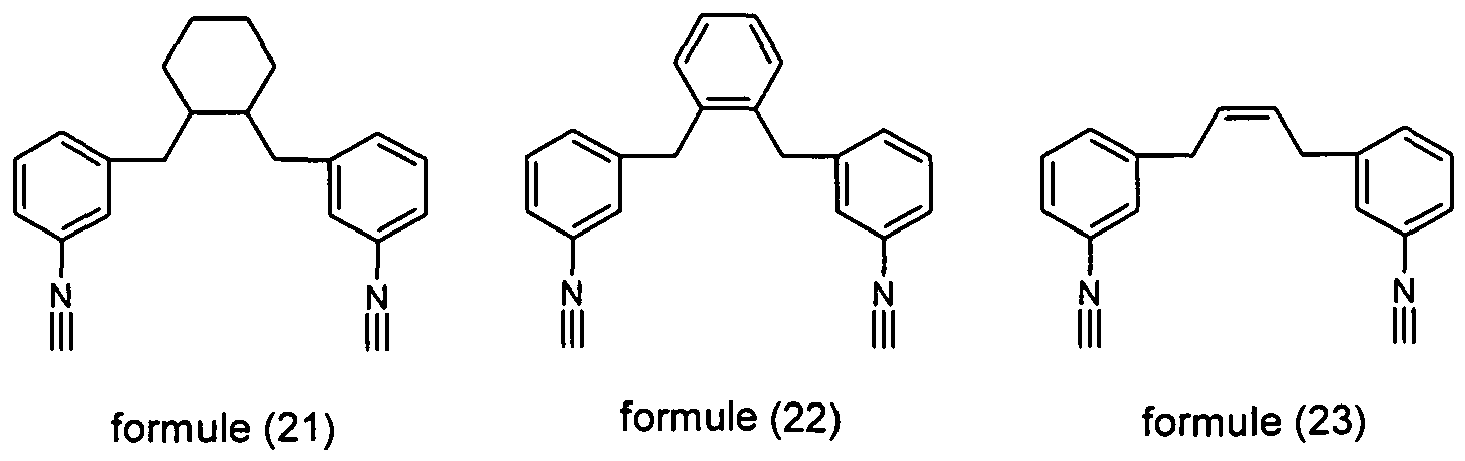
- Examples of particularly preferred ligands of the formula (2) and (3) are the ligands of the formulas (18) to (28) depicted below, which may each be substituted by one or more radicals R 1 :
- the metal M is pentacoordinated and the compound according to formula (1) contains a tridentate ligand of the formula (2) and a bidentate ligand of the formula (3).
- the metal M is hexacoordinated and the compound according to formula (1) contains either two tridentate ligands of the formula (2) or three bidentate ligands of the formula (3).
- ligand groups L are described as they occur in formula (1).
- the ligand groups L in the ligands of the formula (2) and (3) can also be selected, these then being bonded to the group Y.
- the ligands L are preferably neutral, monoanionic, dianionic or trianionic ligands, particularly preferably neutral or monoanionic ligands. They may be monodentate, but are preferably bidentate or tridentate, so preferably have two or three coordination sites.
- the ligands L can also be bonded to the radical R. Preferred embodiments are the ligands of the formula (2) and (3) listed above. In ligands of the formula (2) and (3), L is preferably a monodentate or bidentate ligand.
- Preferred neutral, monodentate ligands L are selected from carbon monoxide, nitric oxide, amines, such as.
- amines such as.
- trifluorophosphine trimethylphosphine, tricyclohexylphosphine, tri- tert- butylphosphine, triphenylphosphine, tris (pentafluorophenyl) phosphine, phosphites, such as.
- trimethyl phosphite, triethyl phosphite, arsines such as. Trifluorarsin, trimethylarsine, tricyclohexylarsine, tri- tert -butylarsine, triphenylarsine, tris (pentafluorophenyl) arsine, stibines, such as. Trifluorostibine, trimethylstibine, tricyclohexylstibine, tri-tert-butylstibine, triphenylstibine, tris (pentafluorophenyl) stibine, nitrogen-containing heterocycles, such as. As pyridine, pyridazine, pyrazine, pyrimidine, triazine, and carbenes, in particular Arduengo carbenes.
- Preferred monoanionic, monodentate ligands L are selected from hydride, deuteride, the halides F, Cl, Br and I, alkyl acetylides, such as. As methyl-C ⁇ C - , tert-butyl-C ⁇ C - , arylacetylidene, such as. B. Phenyl-C ⁇ C -, Cyanide, azide, cyanate, isocyanate, thiocyanate, isothiocyanate, aliphatic or aromatic alcoholates, such as.
- dimethylamide, diethylamide, di-iso -propylamid, morpholide, carboxylates such.
- Phenyl, naphthyl, and anionic nitrogen-containing heterocycles such as pyrrolidine, imidazolide, pyrazolide.
- the alkyl groups in these groups are preferably C 1 -C 20 -alkyl groups, particularly preferably C 1 -C 10 -alkyl groups, very particularly preferably C 1 -C 4 -alkyl groups.
- An aryl group is also understood to mean heteroaryl groups. These groups are as defined above.
- Preferred neutral or mono- or dianionic bidentate or higher-dendent ligands L are selected from diamines, such as. Ethylenediamine, N, N, N ', N'-tetramethylethylenediamine, propylenediamine, N, N, N', N'-tetramethylpropylenediamine, cis- or trans -diaminocyclohexane, cis- or trans-N, N, N ', N '-Tetramethyldiaminocyclohexan, imines, such as. B.
- diamines such as. Ethylenediamine, N, N, N ', N'-tetramethylethylenediamine, propylenediamine, N, N, N', N'-tetramethylpropylenediamine, cis- or trans -diaminocyclohexane, cis- or trans-N, N, N ', N
- B bis (diphenylphosphino) methane, bis (diphenylphosphino) ethane, bis (diphenylphosphino) propane, bis (diphenylphosphino) butane, bis (dimethylphosphino) methane, bis (dimethylphosphino) ethane, bis (dimethylphosphino) propane, bis (dimethylphosphino ) butane, bis (diethylphosphino) methane, bis (diethylphosphino) ethane, bis (diethylphosphino) propane, bis (diethylphosphino) butane, bis (di- tert- butylphosphino) methane, bis (di- tert- butylphosphino) ethane , Bis ( tert- butylphosphino) propane, bis ( di-tert- butylphosphino) butane,
- acetylacetone For example, acetylacetone, benzoylacetone, 1,5-diphenylacetylacetone, dibenzoylmethane, bis (1,1,1-trifluoroacetyl) methane, 3-ketonates derived from 3-keto esters, such as.
- ethyl acetoacetate carboxylates derived from aminocarboxylic acids, such as.
- pyridine-2-carboxylic acid quinoline-2-carboxylic acid, glycine, N, N-dimethylglycine, alanine, N, N-dimethylaminoalanine, salicyliminates derived from salicylimines, such as.
- dialcoholates derived from dialcohols, such as.
- ethylene glycol 1,3-propylene glycol and dithiolates derived from dithiols, such as. For example, 1,2-ethylenedithiol, 1,3-propylenedithiol.
- Preferred tridentate ligands are borates of nitrogen-containing heterocycles, such as. As tetrakis (1-imidazolyl) borate and tetrakis (1-pyrazolyl) borate.
- bidentate monoanionic ligands L which have a cyclometallated five-membered or six-membered ring with at least one metal-carbon bond with the metal, in particular a cyclometallated five-membered ring.
- ligands such as are generally used in the field of phosphorescent metal complexes for organic electroluminescent devices, ie ligands of the type phenylpyridine, naphthylpyridine, phenylquinoline, phenylisoquinoline, etc., which may each be substituted by one or more radicals R 1 .
- ligand L A number of such ligands are known to those skilled in the field of phosphorescent electroluminescent devices, and without further inventive step, they can select further such ligands as ligand L for compounds according to formula (1).
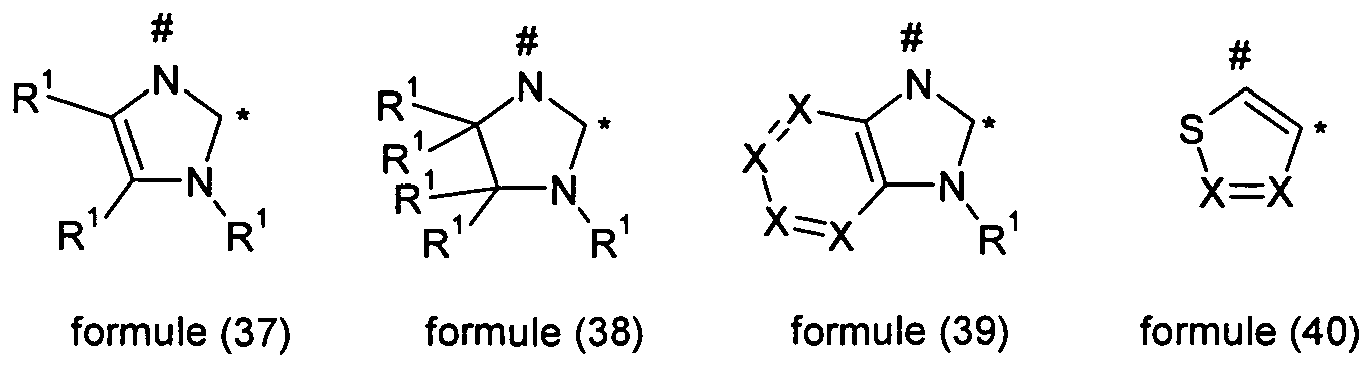
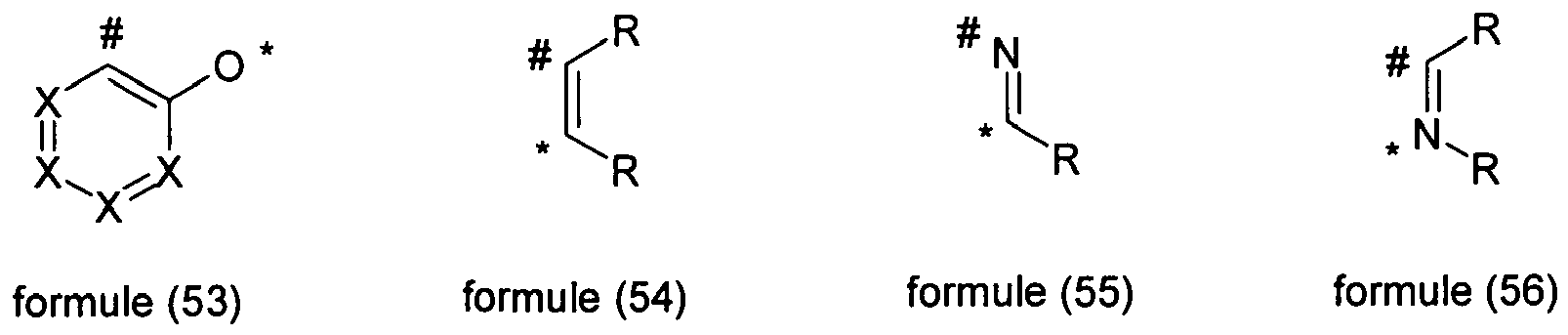
- the combination is particularly suitable for this two groups as represented by the following formulas (29) to (56), wherein one group bonds via a neutral nitrogen atom or a carbene atom and binds the other group via a negatively charged carbon atom or a negatively charged nitrogen atom.
- the ligand L can then be formed from the groups of formulas (29) to (56) by each of these groups bind to each other at the position indicated by #. The position at which the groups coordinate to the metal are indicated by *.
- ligands of the formula (2) or (3) it is also possible for some of these groups to be bonded as ligand L to the group Y of the ligand.
- X is the same or different every occurrence for CR 1 or N, provided that a maximum of three symbols X in each group stand for N.
- a maximum of two symbols X in each group stand for N more preferably, at most one symbol X in each group stands for N, very particularly preferably all symbols X stand for CR 1 .
- preferred ligands L are ⁇ 5 -cyclopentadienyl, ⁇ 5 -pentamethylcyclopentadienyl, ⁇ 6 -benzene or ⁇ 7 -cycloheptatrienyl, which in each case may be substituted by one or more radicals R 1 .
- Also preferred ligands L are 1,3,5-cis-cyclohexane derivatives, in particular of the formula (57), 1,1,1-tri (methylene) methane derivatives, in particular of the formula (58) and 1,1,1-trisubstituted methanes, in particular of the formulas (59) and (60), wherein in the formulas in each case the coordination to the metal M is represented, R 1 has the abovementioned meaning and A, identically or differently on each occurrence, stands for O -, P (R 1) 2 or N (-, S -, COO R 1 ) 2 stands.
- the representation of the isonitrile complexes may, for. B. by substitution reaction. Metal complexes with the isonitrile ligands, if appropriate in the presence of a catalyst, are converted to the desired isonitrile complexes. In this way, z. B. starting from molybdenum or tungsten hexacarbonyl or molybdenum or tungsten olefin-carbonyl complex tri-, tetra-, penta- and Hexaisonitril-molybdenum or tungsten compounds accessible. This type of reaction is suitable both for the reaction of monodentate and polydentate isonitrile ligands. As catalyst, palladium (II) oxide can be added ( Albers et al., J.
- metal salts with isonitrile ligands can be converted to isonitrile metal halides and the halide ligands in these subsequently replaced by other mono- or polydentate ligands.
- IrCl 3 (R-NC) 3 IrCl 3 + 3L - ⁇ (R-NC) 3 IrL 3 + 3Cl -
- Both the isonitrile ligand and the ligand L may be monodentate or polydentate.
- Examples of preferred compounds of the formula (1) are the structures (1) to (98) depicted below.
- Active components are generally the organic or inorganic materials incorporated between the anode and cathode, for example, charge injection, charge transport or charge blocking materials, but especially emission materials and matrix materials.
- the compounds according to the invention exhibit particularly good properties, in particular as emission material in organic electroluminescent devices.
- a preferred embodiment of the invention are therefore organic electroluminescent devices.
- the organic electroluminescent device includes cathode, anode and at least one emitting layer. In addition to these layers, they may also contain further layers, for example one or more hole injection layers, hole transport layers, hole blocking layers, electron transport layers, electron injection layers, exciton blocking layers, charge generation layers and / or organic or inorganic p / n junctions. Likewise, interlayers may be introduced between two emitting layers which, for example, have an exciton-blocking function and / or control the charge balance in the electroluminescent device. It should be noted, however, that not necessarily each of these layers must be present. In this case, the organic electroluminescent device may contain an emitting layer, or it may contain a plurality of emitting layers.
- emission layers are present, they preferably have a total of a plurality of emission maxima between 380 nm and 750 nm, so that overall white emission results, ie in the emitting layers different emitting compounds are used, which can fluoresce or phosphoresce.
- emission layers preferably have a total of a plurality of emission maxima between 380 nm and 750 nm, so that overall white emission results, ie in the emitting layers different emitting compounds are used, which can fluoresce or phosphoresce.
- Particular preference is given to three-layer systems, the three layers showing blue, green and orange or red emission (for the basic structure see, for example, US Pat. WO 05/011013 ) or systems which have more than three emitting layers.
- the organic electronic device contains the compound according to formula (1) or the above-mentioned preferred embodiments as an emitting compound in one or more emitting layers.
- the compound of the formula (1) When the compound of the formula (1) is used as an emitting compound in an emitting layer, it is preferably used in combination with one or more matrix materials.
- the mixture of the compound according to formula (1) and the matrix material contains between 1 and 99% by volume, preferably between 2 and 90% by volume, more preferably between 3 and 40% by volume, in particular between 5 and 15% by volume .-% of the compound according to formula (1) based on the total mixture of emitter and matrix material. Accordingly, the mixture contains between 99 and 1% by volume, preferably between 98 and 10% by volume, more preferably between 97 and 60% by volume, in particular between 95 and 85% by volume of the matrix material, based on the total mixture Emitter and matrix material.
- Preferred matrix materials are CBP (N, N-biscarbazolylbiphenyl), carbazole derivatives (e.g. WO 05/039246 . US 2005/0069729 . JP 2004/288381 . EP 1205527 or WO 08/086851 , Azacarbazoles (eg according to EP 1617710 . EP 1617711 . EP 1731584 .
- an organic electroluminescent device characterized in that one or more layers with a Sublimation method to be coated.
- the materials are vapor-deposited in vacuum sublimation systems at an initial pressure of less than 10 -5 mbar, preferably less than 10 -6 mbar.
- an organic electroluminescent device characterized in that one or more layers are coated with the OVPD (Organic Vapor Phase Deposition) method or with the aid of a carrier gas sublimation.
- the materials are applied at a pressure between 10 -5 mbar and 1 bar.
- OVJP Organic Vapor Jet Printing
- the materials are applied directly through a nozzle and thus structured (eg. MS Arnold et al., Appl. Phys. Lett. 2008, 92, 053301 ).
- an organic electroluminescent device characterized in that one or more layers of solution, such. B. by spin coating, or with any printing process, such. B. screen printing, flexographic printing or offset printing, but particularly preferably LITI (Light Induced Thermal Imaging, thermal transfer printing) or ink-jet printing (ink jet printing) can be produced.
- LITI Light Induced Thermal Imaging, thermal transfer printing
- ink-jet printing ink jet printing
- soluble compounds are necessary, which are obtained for example by suitable substitution.
- the organic electroluminescent device may also be fabricated as a hybrid system by applying one or more layers of solution and depositing one or more other layers. Since the compounds of the formula (1) generally have a high solubility in organic solvents, these compounds can be well processed from solution. Thus, for example, it is possible to apply an emitting layer containing a compound of formula (1) and a solution matrix material and then vacuum evaporate a hole blocking layer and / or an electron transport layer.
- Metal complexes containing the ligands of formula (27) and / or (28) listed above are novel and are therefore also an object of the present invention.
- Another object of the invention are therefore metal complexes of the formula (1 '), (L) y M- [C ⁇ NR] x formula (1 ') where the symbols and indices used have the abovementioned meanings and at least one of the isonitrile ligands is selected from ligands of the formula (27) or (28), which may in each case also be substituted by one or more radicals R 1 :
- solutions of the compounds of formula (1 ') are required.
- Another object of the invention are therefore solutions containing at least one compound of formula (1 ') and at least one organic solvent, preferably selected from the class of aromatic organic solvents, for. B. dimethylanisole.
- Yet another object of the invention are ligands of the above-depicted formulas (27) and (28), which may each be substituted by one or more radicals R 1 .
- Electroluminescent devices with passive matrix control are not accompanied by a deterioration of the other electronic properties.
- Hexakis (phenyl isonitrile) molybdenum (0) (Example 1), hexakis (phenyl isonitrile) tungsten (0) (Example 2) and hexakis (2,4,6-tri-tert-butylphenyl isonitrile) tungsten (0) (Example 3) can after Albers et al., J. Chem. Edu. 1986, 63 (5), 444 . Coville et al., Inorg. Chim. Acta 1982, 65, L7-L8 , respectively. Yamamoto et al., J. Organomet. Chem. 1985, 282, 191 getting produced. The compounds are recrystallized several times from toluene / ethanol (1: 2 - 1: 1). The purities thus obtained are typically> 99.8% by 1 H NMR.
- 1,3,5-tris (1-isocyano-phen-2-yl) benzene is obtained from 1,3,5-tris (1-amino-phen-2-yl) benzene [923027-14-9] FE Hahn et al., J. Organomet. Chem. 467, 130, 1994 shown.
- the metal complexes of the formula (1) with isonitrile ligands have a significantly lower luminescence lifetime than iridium or platinum complexes, as are generally used according to the prior art in OLEDs.
- these complexes are particularly suitable for use in electroluminescent devices with passive matrix control.
- LEDs are carried out according to the general method outlined below. Of course, this has to be adapted in individual cases to the respective circumstances (eg layer thickness variation in order to achieve optimum efficiency or color).
- PLEDs polymeric light-emitting diodes
- the compounds according to the invention are dissolved together with the listed matrix materials or Matrixmareialkombinationen in toluene or chlorobenzene.
- the typical solids content of such solutions is between 10 and 25 g / L, if, as here, the typical for a device layer thickness of 80 nm is to be achieved by spin coating.
- the matrix materials used are the following compounds:
- ITO substrates and the material for the so-called buffer layer are commercially available (ITO from Technoprint and others, PEDOT: PPS as aqueous dispersion Clevios Baytron P from H. C. Starck).
- the emission layer is spin-coated in an inert gas atmosphere, in this case argon, and baked at 120 ° C. for 10 minutes. Finally, a cathode of barium and aluminum is evaporated in vacuo.
- the solution-processed devices are characterized by default, the OLED examples mentioned were not optimized.
Landscapes
- Chemical & Material Sciences (AREA)
- Engineering & Computer Science (AREA)
- Materials Engineering (AREA)
- Inorganic Chemistry (AREA)
- Crystallography & Structural Chemistry (AREA)
- Organic Chemistry (AREA)
- Physics & Mathematics (AREA)
- Spectroscopy & Molecular Physics (AREA)
- Optics & Photonics (AREA)
- Electroluminescent Light Sources (AREA)
- Photovoltaic Devices (AREA)
Claims (16)
- Dispositif électronique comprenant au moins un complexe métallique de la formule (1),
(L)y M-[C≡N-R]x formule (1)
où ce qui suit s'applique aux symboles et indices utilisés :M est un métal de transition penta- ou hexacoordonné ;L est, pour chaque occurrence, de manière identique ou différente, un ligand mono-, bi- ou tridenté qui se lie sur le métal M et peut être substitué par un ou plusieurs radicaux R1 ; le ligand L ici peut également être lié au radical R du groupe isonitrile ;R est, pour chaque occurrence, de manière identique ou différente, un substituant organique comportant de 1 à 60 atomes de C, lesquels peuvent être substitués par un ou plusieurs substituants R1 ; une pluralité de radicaux R ici peuvent également être liés les uns aux autres et ainsi former un ligand polydenté ; en outre, le radical R peut également être lié au ligand L ;R1 est, pour chaque occurrence, de manière identique ou différente, H, D, F, Cl, Br, I, N(R2)2, CN, NO2, Si(R2)3, B(OR2)2, C(=O)R2, P(=O)(R2)2, S(=O)R2 S(=O)2R2, OSO2R2, un groupe alkyle, alcoxy ou thioalcoxy en chaîne droite comportant de 1 à 40 atomes de C ou un groupe alkényle ou alkynyle en chaîne droite comportant de 2 à 40 atomes de C ou un groupe alkyle, alkényle, alkynyle, alcoxy ou thioalcoxy ramifié ou cyclique comportant de 3 à 40 atomes de C, dont chacun peut être substitué par un ou plusieurs radicaux R2, où un ou plusieurs groupes CH2, de préférence non adjacents, peuvent être rem- placés par R2C=CR2, C≡C, Si(R2)2, Ge(R2)2, Sn(R2)2, C=O, C=S, C=Se, C=NR2, P(=O)(R2), SO, SO2, NR2, O, S ou CONR2 et où un ou plusieurs atomes de H peuvent être remplacés par D, F, Cl, Br, I, CN ou NO2, ou un système de cycle aromatique ou hétéroaromatique comportant de 5 à 60 atomes de cycle aromatique, lesquels peuvent dans chaque cas être substitués par un ou plusieurs radicaux R2, ou un groupe aryloxy ou hétéroaryloxy comportant de 5 à 60 atomes de cycle aromatique, lesquels peuvent être substitués par un ou plusieurs radicaux R2, ou un groupe diarylamino, un groupe dihétéroarylamino ou un groupe arylhétéroarylamino comportant 10 à 40 atomes de cycle aromatique, lesquels peuvent être substitués par un ou plusieurs radicaux R2 ou une combinaison de ces systèmes ; deux substituants R1 ou plus peuvent également ici former un système de cycle aliphatique, aromatique et/ou benzo-fusionné l'un avec l'autre;R2 est, pour chaque occurrence, de manière identique ou différente, H, D, F ou un radical hydrocarbone aliphatique, aromatique et/ou hétéroaromatique comportant de 1 à 20 atomes de C, où, en outre, un ou plusieurs atomes de H peuvent être remplacés par D ou F ; deux substituants R2 ou plus peuvent ici également former un système de cycle aliphatique ou aromatique monocyclique ou polycyclique l'un avec l'autre ;x est 3, 4, 5 ou 6 ;y est 0, 1, 2 ou 3, sour réserve qu'un numéro de coordination sur le métal de 5 ou 6 est réalisé. - Dispositif électronique selon la revendication 1, comprenant une anode, une cathode et au moins une couche, où cette couche comprend au moins un composé organique ou organométallique, où le dispositif électronique organique est choisi parmi le groupe constitué par des dispositifs électroluminescents organiques (= diodes émettrices de lumière organiques, OLED, PLED), des circuits intégrés organiques (O-IC), des transistors à effet de champ organiques (O-FET), des transistors à film mince organiques (O-TFT), des transistors émetteurs de lumière organiques (O-LET), des cellules solaires organiques (O-SC), des détecteurs optiques organiques, des photorécepteurs organiques, des dispositifs à extinction de champ organiques (O-FQD), des cellules électrochimiques émettrices de lumière (LEC) et des diodes laser organiques (O-laser), en particulier des dispositifs électroluminescents organiques.
- Dispositif électronique selon la revendication 1 ou 2, caractérisé en ce que les composés de la formule (1) sont non chargés, i.e. sont électriquement neutres.
- Dispositif électronique selon une ou plusieurs des revendications 1 à 3, caractérisé en ce que M dans les composés de la formule (1) représente un métal de transition pentacoordonné ou hexacoordonné choisi parmi le groupe constitué par chrome, molybdène, tungstène, rhénium, ruthénium, osmium, rhodium, iridium, nickel, platine, cuivre, argent et or, en particulier molybdène, tungstène, rhénium, ruthénium, osmium, iridium, platine et or.
- Dispositif électronique selon une ou plusieurs des revendications 1 à 4, caractérisé en ce qu'un ou plusieurs des ligands isonitrile sont des ligands monodentés, où le substituant R représente, de manière identique ou différente pour chaque occurrence, un groupe alkyle en chaîne droite comportant de 1 à 40 atomes de C ou un groupe alkényle ou alkynyle en chaîne droite comportant de 2 à 40 atomes de C ou un groupe alkyle, alkényle ou alkynyle ramifié ou cyclique comportant de 3 à 40 atomes de C, dont chacun peut être substitué par un ou plusieurs radicaux R1, où un ou plusieurs groupes CH2 non adjacents, de préférence deux, peuvent être remplacés par R1C=CR1, C=C, Si(R1)2, Ge(R1)2, Sn(R1)2, C=O, C=S, C=Se, C=NR1, P(=O)(R1), SO, SO2, NR1, O, S ou CONR1 et où un ou plusieurs atomes de H peuvent être remplacés par D, F, Cl, Br, I, CN ou NO2, ou un système de cycle aromatique ou hétéroaromatique monovalent comportant de 5 à 60 atomes de cycle aromatique, lesquels peuvent dans chaque cas être substitués par un ou plusieurs radicaux R1, ou une combinaison de ces systèmes.
- Dispositif électronique selon une ou plusieurs des revendications 1 à 5, caractérisé en ce que les substituants R forment une structure en forme de chaîne, ramifiée ou monocyclique ou polycyclique, aliphatique, aromatique et/ou benzo-fusionnée les uns avec les autres et/ou en association avec le ligand L, et les ligands présentent ainsi un caractère de ligand polydenté ou polypodal.
- Dispositif électronique selon une ou plusieurs des revendications 1 à 6, caractérisé en ce que le complexe métallique contient un ou plusieurs ligands isonitrile présentant une structure de la formule (2) ou de la formule (3),
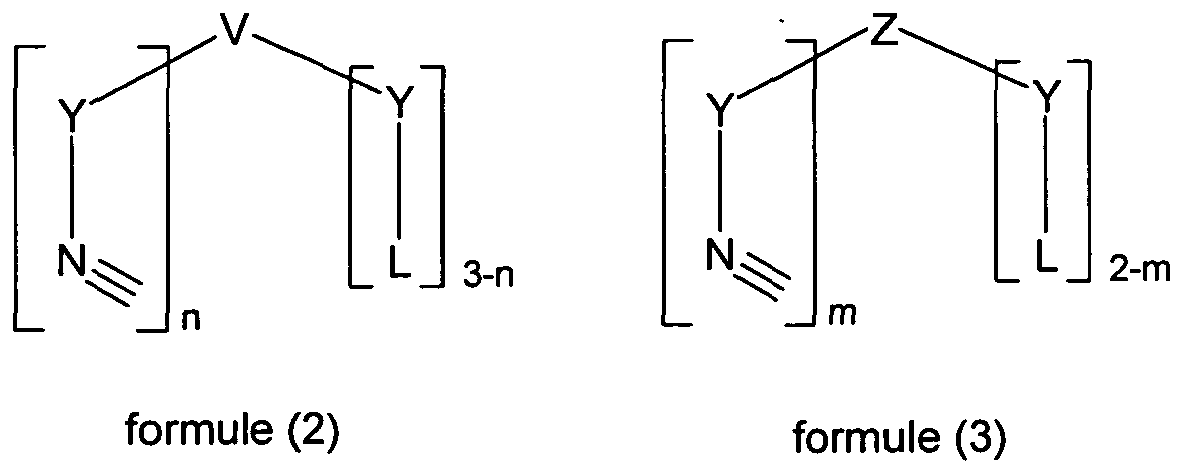 Y est, pour chaque occurrence, de manière identique ou différente, une liaison simple, O, S, N(R1), C=O, un groupe alkylène en chaîne droite comportant de 1 à 6 atomes de C ou un groupe alkylène ramifié ou cyclique comportant de 3 à 6 atomes de C, dont chacun peut être substitué par un ou plusieurs radicaux R1, où un ou plusieurs groupes CH2 non adjacents peuvent être remplacés par R1C=CR1, NR1, Si(R1)2, O ou S et où un ou plusieurs atomes de H peuvent être remplacés par D, F, CI, Br, I, CN ou NO2, ou un groupe arylène ou hétéroarylène comportant de 5 à 20 atomes de cycle aromatique, lesquels peuvent être substitués par un ou plusieurs radicaux R1, ou une combinaison de ces systèmes ;V est B, B(R1), CR1, CO-, CN(R1)2, SiR1, N, NO, N(R1)+, P, P(R1)+, PO, PS, As, As(R1)+, AsO, S+, Se+, ou une unité de la formule (4), (5), (6) ou (7),
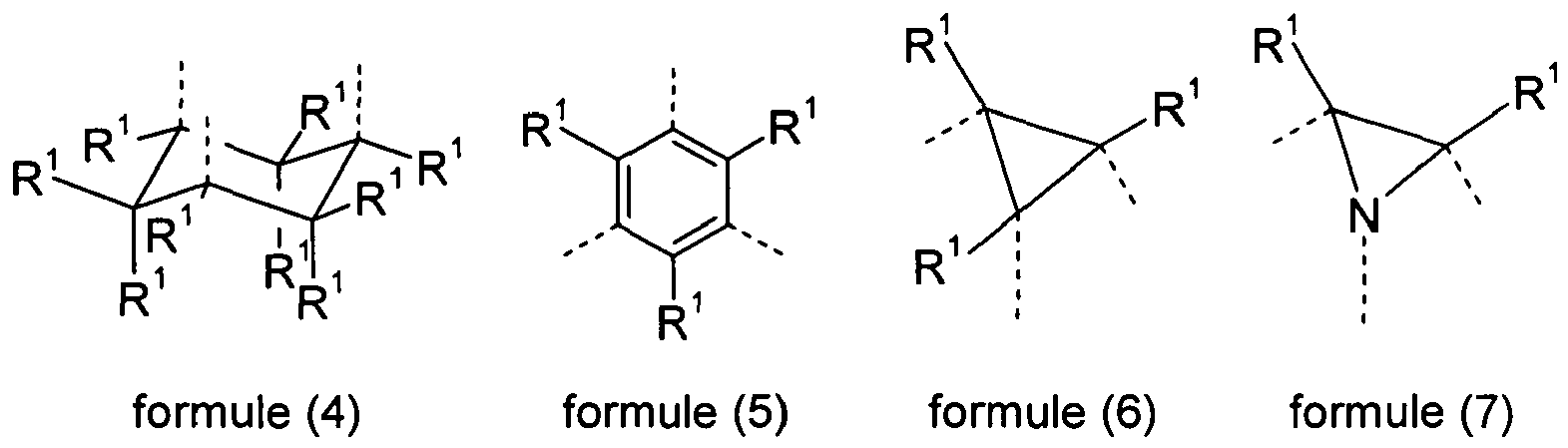 Z est BR1, B(R1)2 -, C(R1)2, C(=O), Si(R1)2, NR1, PR1, P(R1)2 +, PO(R1), PS(R1), AsR1, AsO(R1), AsS, O, S, Se, ou une unité des formules (8) à (17),

 n est 1, 2 ou 3, de préférence 2 ou 3 ;m est 1 ou 2, de préférence 2.
 - Dispositif électronique selon la revendication 7, caractérisé en ce que le nombre d'atomes dans les deux groupes Y et dans le groupe V ou Z qui représentent la connexion directe entre les groupes isonitrile ou entre le groupe isonitrile et le groupe de ligand L est entre 6 et 12 atomes, de préférence entre 7 et 10 atomes, de façon particulièrement préférable entre 7 et 9 atomes.
- Dispositif électronique selon la revendication 7 ou 8, caractérisé en ce que les ligands sont choisis parmi des ligands des formules (18) à (28), dont chacun peut être substitué par un ou plusieurs radicaux R1 :



- Dispositif électronique selon une ou plusieurs des revendications 1 à 9, caractérisé en ce que les ligands L sont choisis parmi le monoxyde de carbone, le monoxyde d'azote, les amines, les phosphines, les phosphites, les arsines, les stibines, les hétérocycles contenant de l'azote, les carbènes, hydrure, deutérure, les halogénures F, Cl, Br et I, les alkylacétylures, les arylacétylures, cyanure, azide, cyanate, isocyanate, thiocyanate, isothiocyanate, les alcoholates aliphatiques ou aromatiques, les thioalcoholates aliphatiques ou aromatiques, les amides, les carboxylates, des groupes aryle, des hétérocycles contenant de l'azote anioniques, O2-, S2-, les carbures, lesquels conduisent à une coordination sous la forme R-C≡M, et les nitrènes, lesquels conduisent à une coordination sous la forme R-N=M, où R représente de façon générale un substituant, ou N3-, les diamines, les imines, les diimines, les hétérocycles contenant deux atomes d'azote, les diphosphines, les 1,3-dicétonates dérivés des 1,3-dicétones, les 3-cétonates dérivés des 3-cétoesters, les carboxylates dérivés des acides aminocarboxyliques, les salicyliminates dérivés des salicylimines, les dialcoholates dérivés des dialcools, les dithiolates dérivés des dithiols, les borates d'hétérocycles contenant de l'azote, η5-cyclopentadiényle, η5-pentaméthylcyclopentadiényle, η6-benzène ou η7-cycloheptatriényle, dont chacun peut être substitué par un ou plusieurs radicaux R1, ou en ce que le ligand L est un ligand bidenté monoanionique qui, avec le métal, forme un cycle à cinq ou six éléments cyclométallaté avec au moins une liaison métal-carbone, en particulier une combinaison de deux groupes, comme représenté par les formules (29) à (56), où un groupe est lié via un atome d'azote neutre ou un atome de carbone et l'autre groupe est lié via un atome de carbone chargé négativement ou un atome d'azote chargé négativement, où le ligand L est alors formé à partir des groupes des formules (29) à (56) par l'intermédiaire de ces groupes se liant les uns aux autres dans chaque cas à la position indiquée par #, et la position au niveau de laquelle les groupes se coordonnent sur le métal est indiquée par *:





- Dispositif électroluminescent organique selon une ou plusieurs des revendications 1 à 10, comprenant une cathode, une anode et une ou plusieurs couches émettrice et en outre en option, dans chaque cas une ou plusieurs couches d'injection de trous, couches de transport de trous, couches de blocages de trous, couches de transport d'électrons, couches d'injection d'électrons, couches de blocage d'excitons, couches de génération de charges et/ou jonctions p/n organiques ou inorganiques, caractérisé en ce que le composé de la formule (1) est utilisé en tant que matériau d'émission dans une couche émettrice.
- Dispositif électroluminescent organique selon une ou plusieurs des revendications 1 à 11, caractérisé en ce que le composé de la formule (1) est utilisé dans une couche émettrice en combinaison avec un ou plusieurs matériaux de matrice, en particulier choisis parmi CBP (N,N-biscarbazolylbiphényle), les/des dérivés de carbazole, les azacarbazoles, les cétones, les oxydes de phosphine, les sulfoxydes, les sulfones, les oligophénylènes, les amines aromatiques, les matériaux de matrice bipolaires, les silanes, les dérivés de 9,9-diarylfluorène, les azaboroles et les esters boroniques.
- Procédé pour la fabrication d'un dispositif électronique selon une ou plusieurs des revendications 1 à 12, caractérisé en ce qu'une ou plusieurs couches sont appliquées au moyen d'un procédé de sublimation et/ou en ce qu'une ou plusieurs couches sont appliquées au moyen du procédé OVPD (dépôt d'organiques en phase vapeur) ou à l'aide d'une sublimation par gaz porteur ou au moyen du procédé OVJP (impression par jet de vapeur organique) et/ou en ce qu'une ou plusieurs couches sont produites à partir d'une solution ou au moyen d'un procédé d'impression.
- Composé de la formule (1'),
(L)y M[C≡N-R]x formule (1')
où les symboles et indices utilisés présentent les significations mentionnées dans la revendication 1, et au moins l'un des ligands d'isonitrile est choisi parmi les ligands de la formule (27) ou (28), chacun d'eux pouvant également être substitué par un ou plusieurs radicaux R1: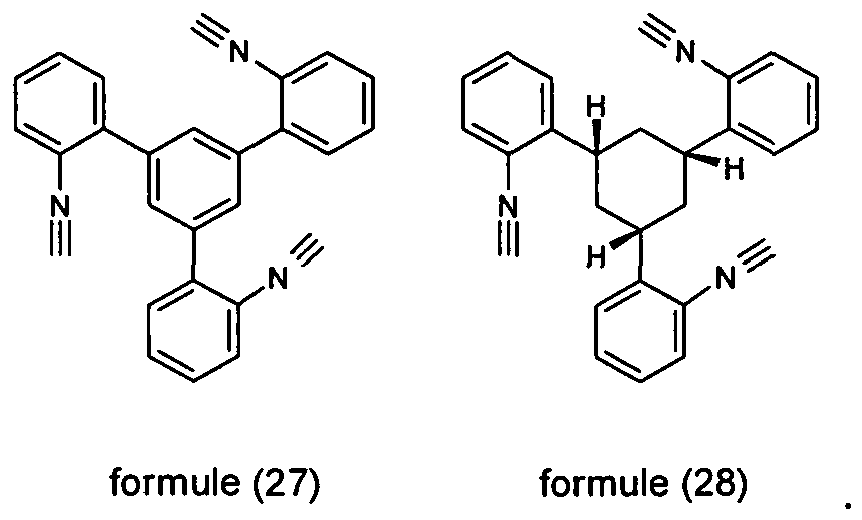
- Composé de la formule (27) ou (28), chacun pouvant être substitué par un ou plusieurs radicaux R1, où R1 présente la signification mentionnée dans la revendication 1 :

- Solution ou formulation comprenant au moins un composé de la formule (1') et au moins un solvant organique, de préférence choisi parmi la classe des solvants organiques aromatiques.
Applications Claiming Priority (2)
| Application Number | Priority Date | Filing Date | Title |
|---|---|---|---|
| DE102008036247A DE102008036247A1 (de) | 2008-08-04 | 2008-08-04 | Elektronische Vorrichtungen enthaltend Metallkomplexe |
| PCT/EP2009/004955 WO2010015307A1 (fr) | 2008-08-04 | 2009-07-08 | Dispositif électronique contenant des complexes métalliques avec des ligands isonitriles |
Publications (2)
| Publication Number | Publication Date |
|---|---|
| EP2311112A1 EP2311112A1 (fr) | 2011-04-20 |
| EP2311112B1 true EP2311112B1 (fr) | 2012-03-14 |
Family
ID=41050415
Family Applications (1)
| Application Number | Title | Priority Date | Filing Date |
|---|---|---|---|
| EP09777051A Not-in-force EP2311112B1 (fr) | 2008-08-04 | 2009-07-08 | Dispositif électronique contenant des complexes métalliques avec des ligands isonitriles |
Country Status (9)
| Country | Link |
|---|---|
| US (1) | US8691400B2 (fr) |
| EP (1) | EP2311112B1 (fr) |
| JP (1) | JP5746028B2 (fr) |
| KR (1) | KR101658679B1 (fr) |
| CN (1) | CN102077380B (fr) |
| AT (1) | ATE549752T1 (fr) |
| DE (1) | DE102008036247A1 (fr) |
| TW (1) | TW201022400A (fr) |
| WO (1) | WO2010015307A1 (fr) |
Families Citing this family (216)
| Publication number | Priority date | Publication date | Assignee | Title |
|---|---|---|---|---|
| DE102009053644B4 (de) | 2009-11-17 | 2019-07-04 | Merck Patent Gmbh | Materialien für organische Elektrolumineszenzvorrichtungen |
| DE102009053836A1 (de) | 2009-11-18 | 2011-05-26 | Merck Patent Gmbh | Materialien für organische Elektrolumineszenzvorrichtungen |
| DE102010004803A1 (de) | 2010-01-16 | 2011-07-21 | Merck Patent GmbH, 64293 | Materialien für organische Elektrolumineszenzvorrichtungen |
| JP2013522816A (ja) * | 2010-03-11 | 2013-06-13 | メルク パテント ゲーエムベーハー | 発光ファイバー |
| DE102010024897A1 (de) | 2010-06-24 | 2011-12-29 | Merck Patent Gmbh | Materialien für organische Elektrolumineszenzvorrichtungen |
| DE102010027319A1 (de) | 2010-07-16 | 2012-01-19 | Merck Patent Gmbh | Metallkomplexe |
| DE102010045405A1 (de) | 2010-09-15 | 2012-03-15 | Merck Patent Gmbh | Materialien für organische Elektrolumineszenzvorrichtungen |
| DE102010048497A1 (de) * | 2010-10-14 | 2012-04-19 | Merck Patent Gmbh | Formulierungen für organische Elektrolumineszenzvorrichtungen |
| KR20130130757A (ko) | 2010-11-24 | 2013-12-02 | 메르크 파텐트 게엠베하 | 유기 전계발광 소자용 재료 |
| KR101979469B1 (ko) | 2011-04-18 | 2019-05-16 | 메르크 파텐트 게엠베하 | 유기 전계발광 소자용 재료 |
| JP6092195B2 (ja) | 2011-06-03 | 2017-03-08 | メルク パテント ゲーエムベーハー | 有機エレクトロルミネッセンス素子 |
| CN102336775B (zh) * | 2011-07-15 | 2013-11-06 | 华中师范大学 | 双异氰桥链双金化合物的制造方法与应用 |
| CA2849087A1 (fr) | 2011-09-21 | 2013-03-28 | Merck Patent Gmbh | Derives de carbazole pour des dispositifs electroluminescents organiques |
| US9515266B2 (en) | 2011-10-20 | 2016-12-06 | Merck Patent Gmbh | Materials for organic electroluminescent devices |
| EP3101088B1 (fr) | 2012-02-14 | 2017-11-29 | Merck Patent GmbH | Matériaux pour dispositif électroluminescent organique |
| EP2872589B1 (fr) | 2012-07-10 | 2017-07-26 | Merck Patent GmbH | Matériaux conçus pour des dispositifs électroluminescents organiques |
| JP6339071B2 (ja) | 2012-07-23 | 2018-06-06 | メルク パテント ゲーエムベーハー | 有機エレクトロルミネッセンス素子のための材料 |
| US8530685B1 (en) | 2012-07-30 | 2013-09-10 | General Electric Company | Monodentate gold ethynyl complexes |
| KR102265997B1 (ko) | 2012-08-10 | 2021-06-16 | 메르크 파텐트 게엠베하 | 유기 전계발광 소자용 물질 |
| CN104756273B (zh) | 2012-11-20 | 2017-10-24 | 默克专利有限公司 | 用于制造电子器件的高纯度溶剂中的制剂 |
| SG11201607587YA (en) | 2014-03-13 | 2016-10-28 | Sigma Aldrich Co Llc | Molybdenum silylcyclopentadienyl and silylallyl complexes and use thereof in thin film deposition |
| EP3140302B1 (fr) | 2014-05-05 | 2019-08-21 | Merck Patent GmbH | Matières pour des dispositifs organiques électroluminescents |
| CN107004777B (zh) | 2014-12-04 | 2019-03-26 | 广州华睿光电材料有限公司 | 聚合物,包含其的混合物、组合物、有机电子器件,及其单体 |
| CN107406384B (zh) | 2014-12-04 | 2021-07-23 | 广州华睿光电材料有限公司 | 氘化的有机化合物、包含该化合物的混合物、组合物及有机电子器件 |
| CN107004779B (zh) | 2014-12-11 | 2019-03-08 | 广州华睿光电材料有限公司 | 有机化合物、包含其的混合物、组合物和有机电子器件 |
| WO2016112761A1 (fr) | 2015-01-13 | 2016-07-21 | 广州华睿光电材料有限公司 | Polymère conjugué contenant un groupe de réticulation éthynyle, mélange, composition, dispositif électronique organique le contenant et application associée |
| KR102235612B1 (ko) | 2015-01-29 | 2021-04-02 | 삼성전자주식회사 | 일-함수 금속을 갖는 반도체 소자 및 그 형성 방법 |
| CN114805091A (zh) | 2015-07-22 | 2022-07-29 | 默克专利有限公司 | 用于有机电致发光器件的材料 |
| CN107922312B (zh) | 2015-07-29 | 2021-05-25 | 默克专利有限公司 | 用于有机电致发光器件的材料 |
| CN107922335B (zh) | 2015-08-13 | 2021-06-04 | 默克专利有限公司 | 六甲基二氢化茚 |
| WO2017080326A1 (fr) | 2015-11-12 | 2017-05-18 | 广州华睿光电材料有限公司 | Composition d'impression, dispositif électronique la comprenant et procédé de préparation d'un film mince de matériau fonctionnel |
| WO2017092545A1 (fr) | 2015-12-04 | 2017-06-08 | 广州华睿光电材料有限公司 | Complexe organométallique et son application dans un dispositif électronique |
| KR102740106B1 (ko) | 2016-03-03 | 2024-12-09 | 메르크 파텐트 게엠베하 | 유기 전계 발광 장치용 재료 |
| TWI821807B (zh) | 2016-03-17 | 2023-11-11 | 德商麥克專利有限公司 | 具有螺聯茀結構之化合物 |
| KR20180133376A (ko) | 2016-04-11 | 2018-12-14 | 메르크 파텐트 게엠베하 | 디벤조푸란 및/또는 디벤조티오펜 구조를 포함하는 헤테로시클릭 화합물 |
| CN109071580B (zh) | 2016-04-29 | 2022-05-24 | 默克专利有限公司 | 用于有机电致发光器件的材料 |
| KR102487147B1 (ko) | 2016-06-03 | 2023-01-11 | 메르크 파텐트 게엠베하 | 유기 전계발광 소자용 재료 |
| JP2019530676A (ja) | 2016-09-14 | 2019-10-24 | メルク パテント ゲーエムベーハー | カルバゾール構造を有する化合物 |
| WO2018050584A1 (fr) | 2016-09-14 | 2018-03-22 | Merck Patent Gmbh | Composés à structures spirobifluorène |
| TWI766884B (zh) | 2016-09-30 | 2022-06-11 | 德商麥克專利有限公司 | 具有二氮雜二苯并呋喃或二氮雜二苯并噻吩結構的化合物、其製法及其用途 |
| JP7051832B2 (ja) | 2016-09-30 | 2022-04-11 | メルク パテント ゲゼルシャフト ミット ベシュレンクテル ハフツング | ジアザジベンゾフランまたはジアザジベンゾチオフェン構造を有するカルバゾール |
| CN110088112A (zh) | 2016-11-08 | 2019-08-02 | 默克专利有限公司 | 用于电子器件的化合物 |
| US11345687B2 (en) | 2016-11-09 | 2022-05-31 | Merck Patent Gmbh | Materials for organic electroluminescent devices |
| TWI756292B (zh) | 2016-11-14 | 2022-03-01 | 德商麥克專利有限公司 | 具有受體基團與供體基團之化合物 |
| KR102580980B1 (ko) | 2016-11-17 | 2023-09-20 | 메르크 파텐트 게엠베하 | 유기 전계발광 소자용 재료 |
| EP3547385B1 (fr) | 2016-11-23 | 2020-11-04 | Guangzhou Chinaray Optoelectronic Materials Ltd. | Mélange organique, composition et composant électronique organique |
| WO2018095395A1 (fr) | 2016-11-23 | 2018-05-31 | 广州华睿光电材料有限公司 | Haut polymère, mélange le contenant, composition, composant électronique organique, et monomère pour polymérisation |
| WO2018095379A1 (fr) | 2016-11-23 | 2018-05-31 | 广州华睿光电材料有限公司 | Complexe organique métallique, haut polymère, composition et composant électronique organique |
| WO2018095381A1 (fr) | 2016-11-23 | 2018-05-31 | 广州华睿光电材料有限公司 | Composition d'encre d'impression, son procédé de préparation et ses utilisations |
| US11239428B2 (en) | 2016-11-23 | 2022-02-01 | Guangzhou Chinaray Optoelectronic Materials Ltd. | Boron-containing organic compound and applications thereof, organic mixture, and organic electronic device |
| WO2018095388A1 (fr) | 2016-11-23 | 2018-05-31 | 广州华睿光电材料有限公司 | Composé organique |
| WO2018095389A1 (fr) | 2016-11-23 | 2018-05-31 | 广州华睿光电材料有限公司 | Composé cyclique hétérocyclique fusionné contenant de l'azote et son application |
| KR102539246B1 (ko) | 2016-11-30 | 2023-06-01 | 메르크 파텐트 게엠베하 | 발레로락탐 구조를 갖는 화합물 |
| KR20190086028A (ko) | 2016-12-05 | 2019-07-19 | 메르크 파텐트 게엠베하 | 유기 전계발광 디바이스용 재료 |
| US11466021B2 (en) | 2016-12-05 | 2022-10-11 | Merck Patent Gmbh | Materials for organic electroluminescent devices |
| TW201831468A (zh) | 2016-12-05 | 2018-09-01 | 德商麥克專利有限公司 | 含氮的雜環化合物 |
| CN109790461B (zh) | 2016-12-08 | 2022-08-12 | 广州华睿光电材料有限公司 | 混合物、组合物及有机电子器件 |
| CN109790118A (zh) | 2016-12-13 | 2019-05-21 | 广州华睿光电材料有限公司 | 共轭聚合物及其在有机电子器件的应用 |
| CN109792003B (zh) | 2016-12-22 | 2020-10-16 | 广州华睿光电材料有限公司 | 基于狄尔斯-阿尔德反应的可交联聚合物及其在有机电子器件中的应用 |
| KR102504432B1 (ko) | 2016-12-22 | 2023-02-27 | 메르크 파텐트 게엠베하 | 적어도 2종의 유기-기능성 화합물을 포함하는 혼합물 |
| CN109790136B (zh) | 2016-12-22 | 2024-01-12 | 广州华睿光电材料有限公司 | 含呋喃交联基团的聚合物及其应用 |
| US11495751B2 (en) | 2017-01-04 | 2022-11-08 | Merck Patent Gmbh | Materials for organic electroluminescent devices |
| EP3573973B1 (fr) | 2017-01-25 | 2023-12-06 | Merck Patent GmbH | Dérivés de carbazole |
| KR102559144B1 (ko) | 2017-01-30 | 2023-07-24 | 메르크 파텐트 게엠베하 | 유기 전계발광 디바이스용 재료 |
| TW201835075A (zh) | 2017-02-14 | 2018-10-01 | 德商麥克專利有限公司 | 用於有機電致發光裝置之材料 |
| TW201843143A (zh) | 2017-03-13 | 2018-12-16 | 德商麥克專利有限公司 | 含有芳基胺結構之化合物 |
| JP7155142B2 (ja) | 2017-03-15 | 2022-10-18 | メルク パテント ゲーエムベーハー | 有機エレクトロルミネッセントデバイス用の材料 |
| US10672998B2 (en) * | 2017-03-23 | 2020-06-02 | Universal Display Corporation | Organic electroluminescent materials and devices |
| US11778907B2 (en) | 2017-04-13 | 2023-10-03 | Merck Patent Gmbh | Composition for organic electronic devices |
| WO2018206526A1 (fr) | 2017-05-11 | 2018-11-15 | Merck Patent Gmbh | Complexes organoborés pour dispositifs électroluminescents organiques |
| KR102592390B1 (ko) | 2017-05-11 | 2023-10-20 | 메르크 파텐트 게엠베하 | 유기 전계발광 디바이스용 카르바졸계 바디피스 |
| CN110637017A (zh) | 2017-05-22 | 2019-12-31 | 默克专利有限公司 | 用于电子器件的六环杂芳族化合物 |
| CN110753685A (zh) | 2017-06-23 | 2020-02-04 | 默克专利有限公司 | 用于有机电致发光器件的材料 |
| CN110785415A (zh) | 2017-07-05 | 2020-02-11 | 默克专利有限公司 | 用于有机电子器件的组合物 |
| KR102653984B1 (ko) | 2017-07-05 | 2024-04-02 | 메르크 파텐트 게엠베하 | 유기 전자 디바이스용 조성물 |
| TWI776926B (zh) * | 2017-07-25 | 2022-09-11 | 德商麥克專利有限公司 | 金屬錯合物 |
| WO2019052933A1 (fr) | 2017-09-12 | 2019-03-21 | Merck Patent Gmbh | Matériaux pour dispositifs électroluminescents organiques |
| EP3692043B1 (fr) | 2017-10-06 | 2022-11-02 | Merck Patent GmbH | Matériaux pour dispositifs électroluminescents organiques |
| US11437588B2 (en) | 2017-10-24 | 2022-09-06 | Merck Patent Gmbh | Materials for organic electroluminescent devices |
| TWI785142B (zh) | 2017-11-14 | 2022-12-01 | 德商麥克專利有限公司 | 用於有機電子裝置之組成物 |
| CN111247658B (zh) | 2017-12-14 | 2023-04-04 | 广州华睿光电材料有限公司 | 过渡金属配合物、聚合物、混合物、组合物及其应用 |
| WO2019114764A1 (fr) | 2017-12-14 | 2019-06-20 | 广州华睿光电材料有限公司 | Complexe organométallique, polymère, mélange, composition le comprenant et leur utilisation dans un dispositif électronique |
| US11404651B2 (en) | 2017-12-14 | 2022-08-02 | Guangzhou Chinaray Optoelectronic Materials Ltd. | Transition metal complex material and application thereof in electronic devices |
| TW201938562A (zh) | 2017-12-19 | 2019-10-01 | 德商麥克專利有限公司 | 雜環化合物 |
| CN111479815A (zh) | 2017-12-20 | 2020-07-31 | 默克专利有限公司 | 杂芳族化合物 |
| WO2019120263A1 (fr) | 2017-12-21 | 2019-06-27 | 广州华睿光电材料有限公司 | Mélange organique et application de celui-ci dans des dispositifs électroniques organiques |
| TWI811290B (zh) | 2018-01-25 | 2023-08-11 | 德商麥克專利有限公司 | 用於有機電致發光裝置的材料 |
| KR20200132912A (ko) | 2018-03-16 | 2020-11-25 | 메르크 파텐트 게엠베하 | 유기 전계발광 디바이스용 재료 |
| KR102804818B1 (ko) | 2018-05-30 | 2025-05-09 | 메르크 파텐트 게엠베하 | 유기 전자 디바이스용 조성물 |
| KR102890506B1 (ko) | 2018-06-07 | 2025-11-25 | 메르크 파텐트 게엠베하 | 유기 전계 발광 디바이스 |
| WO2020011686A1 (fr) | 2018-07-09 | 2020-01-16 | Merck Patent Gmbh | Matériaux pour dispositifs électroluminescents organiques |
| US20220069231A1 (en) | 2018-07-20 | 2022-03-03 | Merck Patent Gmbh | Materials for organic electroluminescent devices |
| JP7459065B2 (ja) | 2018-09-12 | 2024-04-01 | メルク パテント ゲーエムベーハー | 有機エレクトロルミネッセンスデバイス用の材料 |
| TWI826522B (zh) | 2018-09-12 | 2023-12-21 | 德商麥克專利有限公司 | 電致發光裝置 |
| TW202030902A (zh) | 2018-09-12 | 2020-08-16 | 德商麥克專利有限公司 | 電致發光裝置 |
| EP3856868B1 (fr) | 2018-09-27 | 2023-01-25 | Merck Patent GmbH | Composés utilisables comme composés actifs dans un dispositif électronique organique |
| JP2022501400A (ja) | 2018-09-27 | 2022-01-06 | メルク パテント ゲゼルシャフト ミット ベシュレンクテル ハフツングMerck Patent Gesellschaft mit beschraenkter Haftung | 立体障害窒素含有ヘテロ芳香族化合物を製造する方法 |
| CN112955437A (zh) | 2018-11-05 | 2021-06-11 | 默克专利有限公司 | 可用于有机电子器件中的化合物 |
| CN112867709A (zh) | 2018-11-06 | 2021-05-28 | 默克专利有限公司 | 作为用于oled的有机电致发光材料的5,6-二苯基-5,6-二氢-二苯并[c,e][1,2]氮杂磷杂苯和6-苯基-6h-二苯并[c,e][1,2]噻嗪-5,5-二氧化物衍生物及类似化合物 |
| EP3880657A1 (fr) | 2018-11-14 | 2021-09-22 | Merck Patent GmbH | Composés pouvant être utilisés pour la fabrication d'un dispositif électronique organique |
| WO2020099307A1 (fr) | 2018-11-15 | 2020-05-22 | Merck Patent Gmbh | Matériaux pour dispositifs électroluminescents organiques |
| TW202039493A (zh) | 2018-12-19 | 2020-11-01 | 德商麥克專利有限公司 | 用於有機電致發光裝置之材料 |
| WO2020148243A1 (fr) | 2019-01-16 | 2020-07-23 | Merck Patent Gmbh | Matériaux pour dispositifs électroluminescents organiques |
| TW202035345A (zh) | 2019-01-17 | 2020-10-01 | 德商麥克專利有限公司 | 用於有機電致發光裝置之材料 |
| JP7621955B2 (ja) | 2019-02-18 | 2025-01-27 | メルク パテント ゲーエムベーハー | 有機電子デバイス用の組成物 |
| US20220127286A1 (en) | 2019-03-04 | 2022-04-28 | Merck Patent Gmbh | Ligands for nano-sized materials |
| EP3938367A1 (fr) | 2019-03-12 | 2022-01-19 | Merck Patent GmbH | Matériaux pour dispositifs électroluminescents organiques |
| WO2020187865A1 (fr) | 2019-03-20 | 2020-09-24 | Merck Patent Gmbh | Matériaux pour dispositifs électroluminescents organiques |
| KR20210143247A (ko) | 2019-03-25 | 2021-11-26 | 메르크 파텐트 게엠베하 | 유기 전계 발광 디바이스용 재료 |
| CN113646315A (zh) | 2019-04-11 | 2021-11-12 | 默克专利有限公司 | 用于有机电致发光器件的材料 |
| JP7625573B2 (ja) | 2019-07-22 | 2025-02-03 | ユー・ディー・シー アイルランド リミテッド | オルトメタル化金属化合物の調製方法 |
| CN114222738B (zh) | 2019-08-26 | 2024-05-17 | 默克专利有限公司 | 用于有机电致发光器件的材料 |
| WO2021043703A1 (fr) | 2019-09-02 | 2021-03-11 | Merck Patent Gmbh | Matériaux pour dispositifs électroluminescents organiques |
| TW202122558A (zh) | 2019-09-03 | 2021-06-16 | 德商麥克專利有限公司 | 用於有機電致發光裝置之材料 |
| WO2021052924A1 (fr) | 2019-09-16 | 2021-03-25 | Merck Patent Gmbh | Matériaux pour dispositifs électroluminescents organiques |
| WO2021052921A1 (fr) | 2019-09-19 | 2021-03-25 | Merck Patent Gmbh | Mélange de deux matériaux hôtes et dispositif électroluminescent organique l'utilisant |
| KR20220066324A (ko) | 2019-09-20 | 2022-05-24 | 메르크 파텐트 게엠베하 | 전자 디바이스용 재료 |
| US20220416172A1 (en) | 2019-10-22 | 2022-12-29 | Merck Patent Gmbh | Materials for organic electroluminescent devices |
| CN114630831A (zh) | 2019-10-25 | 2022-06-14 | 默克专利有限公司 | 可用于有机电子器件中的化合物 |
| TW202130783A (zh) | 2019-11-04 | 2021-08-16 | 德商麥克專利有限公司 | 有機電致發光裝置 |
| CN114641482A (zh) | 2019-11-04 | 2022-06-17 | 默克专利有限公司 | 用于有机电致发光器件的材料 |
| TW202134252A (zh) | 2019-11-12 | 2021-09-16 | 德商麥克專利有限公司 | 有機電致發光裝置用材料 |
| TW202136181A (zh) | 2019-12-04 | 2021-10-01 | 德商麥克專利有限公司 | 有機電致發光裝置用的材料 |
| TW202136471A (zh) | 2019-12-17 | 2021-10-01 | 德商麥克專利有限公司 | 有機電致發光裝置用的材料 |
| EP4077335A1 (fr) | 2019-12-18 | 2022-10-26 | Merck Patent GmbH | Composés aromatiques pour dispositifs électroluminescents organiques |
| EP4077336A1 (fr) | 2019-12-19 | 2022-10-26 | Merck Patent GmbH | Composés polycycliques pour dispositifs électroluminescents organiques |
| EP4097090A1 (fr) | 2020-01-29 | 2022-12-07 | Merck Patent GmbH | Dérivés de benzimidazole |
| CN115135741A (zh) | 2020-02-25 | 2022-09-30 | 默克专利有限公司 | 杂环化合物在有机电子器件中的用途 |
| CN115244728B (zh) | 2020-03-02 | 2026-01-16 | 默克专利有限公司 | 砜化合物在有机电子器件中的用途 |
| TW202200753A (zh) | 2020-03-11 | 2022-01-01 | 德商麥克專利有限公司 | 有機電致發光裝置 |
| KR102943498B1 (ko) | 2020-03-11 | 2026-03-24 | 메르크 파텐트 게엠베하 | 유기 전계 발광 장치 |
| US20230147279A1 (en) | 2020-03-17 | 2023-05-11 | Merck Patent Gmbh | Heterocyclic compounds for organic electroluminescent devices |
| KR20220154774A (ko) | 2020-03-17 | 2022-11-22 | 메르크 파텐트 게엠베하 | 유기 전계 발광 디바이스용 헤테로방향족 화합물 |
| WO2021191058A1 (fr) | 2020-03-23 | 2021-09-30 | Merck Patent Gmbh | Matériaux pour dispositifs électroluminescents organiques |
| EP4126868A1 (fr) | 2020-03-24 | 2023-02-08 | Merck Patent GmbH | Matériaux pour dispositifs électroniques |
| EP4126880A1 (fr) | 2020-03-26 | 2023-02-08 | Merck Patent GmbH | Composés cycliques pour dispositifs électroluminescents organiques |
| US20230151026A1 (en) | 2020-04-02 | 2023-05-18 | Merck Patent Gmbh | Multi-layer body for diffuse transillumination |
| KR20220164541A (ko) | 2020-04-06 | 2022-12-13 | 메르크 파텐트 게엠베하 | 유기 전계 발광 디바이스용 다환 화합물 |
| EP4158704B1 (fr) | 2020-05-29 | 2024-12-25 | Merck Patent GmbH | Appareil électroluminescent organique |
| US20230312612A1 (en) | 2020-06-29 | 2023-10-05 | Merck Patent Gmbh | Heteroaromatic compounds for organic electroluminescent devices |
| CN115916794A (zh) | 2020-06-29 | 2023-04-04 | 默克专利有限公司 | 用于有机电致发光器件的杂环化合物 |
| EP4192832A1 (fr) | 2020-08-06 | 2023-06-14 | Merck Patent GmbH | Matériaux destinés à des dispositifs électroluminescents organiques |
| US20230271989A1 (en) | 2020-08-13 | 2023-08-31 | Merck Patent Gmbh | Metal complexes |
| KR20230053629A (ko) | 2020-08-18 | 2023-04-21 | 메르크 파텐트 게엠베하 | 유기 전계 발광 디바이스용 재료 |
| KR20230053633A (ko) | 2020-08-19 | 2023-04-21 | 메르크 파텐트 게엠베하 | 유기 전계 발광 디바이스용 재료 |
| EP4672933A3 (fr) * | 2020-09-18 | 2026-03-11 | Samsung Display Co., Ltd. | Dispositif électroluminescent organique |
| TW202222748A (zh) | 2020-09-30 | 2022-06-16 | 德商麥克專利有限公司 | 用於結構化有機電致發光裝置的功能層之化合物 |
| TW202229215A (zh) | 2020-09-30 | 2022-08-01 | 德商麥克專利有限公司 | 用於有機電致發光裝置功能層之結構化的化合物 |
| EP4229064A1 (fr) | 2020-10-16 | 2023-08-23 | Merck Patent GmbH | Composés hétérocycliques pour dispositifs électroluminescents organiques |
| CN116406414A (zh) | 2020-10-16 | 2023-07-07 | 默克专利有限公司 | 用于有机电致发光器件的包含杂原子的化合物 |
| WO2022101171A1 (fr) | 2020-11-10 | 2022-05-19 | Merck Patent Gmbh | Composés sulfureux pour dispositifs électroluminescents organiques |
| US20230416264A1 (en) | 2020-12-02 | 2023-12-28 | Merck Patent Gmbh | Heterocyclic compounds for organic electroluminescent devices |
| KR20230118615A (ko) | 2020-12-10 | 2023-08-11 | 메르크 파텐트 게엠베하 | 유기 전계발광 디바이스용 재료 |
| CN116583522A (zh) | 2020-12-18 | 2023-08-11 | 默克专利有限公司 | 作为蓝色荧光发光体用于oled中的吲哚并[3.2.1-jk]咔唑-6-腈衍生物 |
| CN116649013A (zh) | 2020-12-18 | 2023-08-25 | 默克专利有限公司 | 用于有机电致发光器件的含氮杂芳族化合物 |
| KR20230122093A (ko) | 2020-12-18 | 2023-08-22 | 메르크 파텐트 게엠베하 | 유기 전계 발광 디바이스용 질소 함유 화합물 |
| CN116745287A (zh) | 2021-01-05 | 2023-09-12 | 默克专利有限公司 | 用于有机电致发光器件的材料 |
| WO2022152213A1 (fr) | 2021-01-13 | 2022-07-21 | 浙江光昊光电科技有限公司 | Composé organique, son utilisation dans un dispositif électronique organique et composition |
| EP4281455A1 (fr) | 2021-01-25 | 2023-11-29 | Merck Patent GmbH | Composés azotés pour dispositifs électroluminescents organiques |
| EP4301757A1 (fr) | 2021-03-02 | 2024-01-10 | Merck Patent GmbH | Composés pour dispositifs électroluminescents organiques |
| KR20230158657A (ko) | 2021-03-18 | 2023-11-21 | 메르크 파텐트 게엠베하 | 유기 전계 발광 디바이스용 헤테로방향족 화합물 |
| CN117203191A (zh) | 2021-04-29 | 2023-12-08 | 默克专利有限公司 | 用于有机电致发光器件的材料 |
| KR20240005806A (ko) | 2021-04-29 | 2024-01-12 | 메르크 파텐트 게엠베하 | 유기 전계발광 디바이스용 재료 |
| CN117425655A (zh) | 2021-04-30 | 2024-01-19 | 默克专利有限公司 | 用于有机电致发光器件的含氮杂环化合物 |
| WO2022243403A1 (fr) | 2021-05-21 | 2022-11-24 | Merck Patent Gmbh | Procédé de purification continue d'au moins un matériau fonctionnel et dispositif de purification continue d'au moins un matériau fonctionnel |
| WO2022200638A1 (fr) | 2021-07-06 | 2022-09-29 | Merck Patent Gmbh | Matériaux pour dispositifs électroluminescents organiques |
| EP4402141A1 (fr) | 2021-09-13 | 2024-07-24 | Merck Patent GmbH | Matériaux pour dispositifs électroluminescents organiques |
| KR20240064697A (ko) | 2021-09-14 | 2024-05-13 | 메르크 파텐트 게엠베하 | 유기 전계 발광 디바이스용 붕소 복소환 화합물 |
| WO2023052275A1 (fr) | 2021-09-28 | 2023-04-06 | Merck Patent Gmbh | Matériaux pour dispositifs électroniques |
| WO2023052313A1 (fr) | 2021-09-28 | 2023-04-06 | Merck Patent Gmbh | Matériaux pour dispositifs électroniques |
| KR20240075888A (ko) | 2021-09-28 | 2024-05-29 | 메르크 파텐트 게엠베하 | 전자 디바이스용 재료 |
| KR20240075872A (ko) | 2021-09-28 | 2024-05-29 | 메르크 파텐트 게엠베하 | 전자 디바이스용 재료 |
| KR20240091021A (ko) | 2021-10-27 | 2024-06-21 | 메르크 파텐트 게엠베하 | 유기 전계발광 디바이스용 붕소 및 질소 복소환 화합물 |
| WO2023094412A1 (fr) | 2021-11-25 | 2023-06-01 | Merck Patent Gmbh | Matériaux pour dispositifs électroniques |
| CN118303151A (zh) | 2021-11-30 | 2024-07-05 | 默克专利有限公司 | 具有芴结构的化合物 |
| CN118401524A (zh) | 2021-12-13 | 2024-07-26 | 默克专利有限公司 | 用于有机电致发光器件的材料 |
| WO2023117836A1 (fr) | 2021-12-21 | 2023-06-29 | Merck Patent Gmbh | Dispositifs électroniques |
| KR20240128020A (ko) | 2021-12-21 | 2024-08-23 | 메르크 파텐트 게엠베하 | 중수소화 유기 화합물의 제조 방법 |
| EP4453128A1 (fr) | 2021-12-21 | 2024-10-30 | Merck Patent GmbH | Dispositifs électroniques |
| CN118660882A (zh) | 2022-02-09 | 2024-09-17 | 默克专利有限公司 | 用于有机电致发光器件的材料 |
| KR20240150795A (ko) | 2022-02-14 | 2024-10-16 | 메르크 파텐트 게엠베하 | 전자 디바이스용 재료 |
| EP4482843A1 (fr) | 2022-02-23 | 2025-01-01 | Merck Patent GmbH | Hétérocycles aromatiques pour dispositifs électroluminescents organiques |
| EP4719022A3 (fr) | 2022-02-23 | 2026-04-15 | UDC Ireland Limited | Hétérocycles contenant de l'azote pour dispositifs électroluminescents organiques |
| KR20250008768A (ko) | 2022-05-06 | 2025-01-15 | 메르크 파텐트 게엠베하 | 유기 전계 발광 디바이스용 환형 화합물 |
| WO2023222559A1 (fr) | 2022-05-18 | 2023-11-23 | Merck Patent Gmbh | Procédé de préparation de composés organiques deutérés |
| CN118235543A (zh) | 2022-06-24 | 2024-06-21 | 默克专利有限公司 | 用于有机电子器件的组合物 |
| CN118202815A (zh) | 2022-06-24 | 2024-06-14 | 默克专利有限公司 | 用于有机电子器件的组合物 |
| WO2024013004A1 (fr) | 2022-07-11 | 2024-01-18 | Merck Patent Gmbh | Matériaux pour dispositifs électroniques |
| CN120379993A (zh) | 2022-08-09 | 2025-07-25 | 默克专利有限公司 | 用于有机电致发光器件的材料 |
| KR20250075641A (ko) | 2022-09-22 | 2025-05-28 | 메르크 파텐트 게엠베하 | 유기 전계발광 디바이스용 질소 함유 헤테로사이클 |
| EP4590652A1 (fr) | 2022-09-22 | 2025-07-30 | Merck Patent GmbH | Composés contenant de l'azote pour dispositifs électroluminescents organiques |
| CN120152954A (zh) | 2022-11-01 | 2025-06-13 | 默克专利有限公司 | 用于有机电致发光器件的含氮杂环化合物 |
| KR20250110873A (ko) | 2022-11-17 | 2025-07-21 | 메르크 파텐트 게엠베하 | 유기 전계발광 디바이스용 재료 |
| TW202438505A (zh) | 2022-12-19 | 2024-10-01 | 德商麥克專利有限公司 | 有機電致發光裝置之材料 |
| KR20250124370A (ko) | 2022-12-19 | 2025-08-19 | 메르크 파텐트 게엠베하 | 전자 디바이스용 재료 |
| CN120379953A (zh) | 2022-12-20 | 2025-07-25 | 默克专利有限公司 | 用于制备氘化芳族化合物的方法 |
| EP4649084A1 (fr) | 2023-01-10 | 2025-11-19 | Merck Patent GmbH | Hétérocycles azotés pour dispositifs électroluminescents organiques |
| EP4652169A1 (fr) | 2023-01-17 | 2025-11-26 | Merck Patent GmbH | Hétérocycles pour dispositifs électroluminescents organiques |
| KR20250156170A (ko) | 2023-03-07 | 2025-10-31 | 메르크 파텐트 게엠베하 | 유기 전계 발광 디바이스용 환형 질소 화합물 |
| CN120826409A (zh) | 2023-03-20 | 2025-10-21 | 默克专利有限公司 | 用于有机电致发光器件的材料 |
| KR20260015809A (ko) | 2023-04-20 | 2026-02-03 | 메르크 파텐트 게엠베하 | 전자 디바이스들을 위한 재료들 |
| WO2024240725A1 (fr) | 2023-05-25 | 2024-11-28 | Merck Patent Gmbh | Dérivés de tris[1,2,4]triazolo[1,5-a:1',5'-c:1'',5''-e][1,3,5]triazine destinés à être utilisés dans des dispositifs électroluminescents organiques |
| EP4486099B1 (fr) | 2023-06-30 | 2026-04-29 | UDC Ireland Limited | Composés pour dispositifs électroluminescents organiques |
| KR20260044229A (ko) | 2023-07-27 | 2026-04-01 | 메르크 파텐트 게엠베하 | 유기 발광 디바이스 및 유기 센서를 위한 재료 |
| CN121753521A (zh) | 2023-08-30 | 2026-03-27 | 默克专利有限公司 | 用于有机发光器件的材料 |
| CN121753522A (zh) | 2023-08-30 | 2026-03-27 | 默克专利有限公司 | 用于有机发光器件的材料 |
| CN121773745A (zh) | 2023-08-30 | 2026-03-31 | 默克专利有限公司 | 用于有机发光器件的材料 |
| WO2025109056A1 (fr) | 2023-11-24 | 2025-05-30 | Merck Patent Gmbh | Hétérocycles contenant de l'oxygène pour dispositifs électroluminescents organiques |
| WO2025132551A1 (fr) | 2023-12-22 | 2025-06-26 | Merck Patent Gmbh | Matériaux pour dispositifs électroniques |
| WO2025181097A1 (fr) | 2024-02-29 | 2025-09-04 | Merck Patent Gmbh | Hétérocycles contenant de l'azote pour dispositifs électroluminescents organiques |
| WO2025181044A1 (fr) | 2024-02-29 | 2025-09-04 | Merck Patent Gmbh | Composés contenant de l'azote pour dispositifs électroluminescents organiques |
| WO2025181124A1 (fr) | 2024-03-01 | 2025-09-04 | Merck Patent Gmbh | Matériaux pour dispositifs électroluminescents organiques |
| WO2026008710A1 (fr) | 2024-07-05 | 2026-01-08 | Merck Patent Gmbh | Composés de silicium cyclique pour dispositifs électroluminescents organiques |
| WO2026022016A1 (fr) | 2024-07-22 | 2026-01-29 | Merck Patent Gmbh | Matériaux pour dispositifs électroluminescents organiques |
| WO2026041632A1 (fr) | 2024-08-21 | 2026-02-26 | Merck Patent Gmbh | Matériaux hétérocycliques pour dispositifs électroluminescents organiques |
| WO2026073855A1 (fr) | 2024-10-01 | 2026-04-09 | Merck Patent Gmbh | Composés de silicium pour dispositifs électroluminescents organiques |
Family Cites Families (43)
| Publication number | Priority date | Publication date | Assignee | Title |
|---|---|---|---|---|
| US4539507A (en) | 1983-03-25 | 1985-09-03 | Eastman Kodak Company | Organic electroluminescent devices having improved power conversion efficiencies |
| CA1293729C (fr) * | 1985-08-05 | 1991-12-31 | Alan Purdom Carpenter Jr | Adduits metal-isonitrile pour la preparation de complexes de radionucleides |
| US5151629A (en) | 1991-08-01 | 1992-09-29 | Eastman Kodak Company | Blue emitting internal junction organic electroluminescent device (I) |
| JPH07133483A (ja) | 1993-11-09 | 1995-05-23 | Shinko Electric Ind Co Ltd | El素子用有機発光材料及びel素子 |
| EP0676461B1 (fr) | 1994-04-07 | 2002-08-14 | Covion Organic Semiconductors GmbH | Composés spiro et leur application comme matières électroluminescentes |
| DE19652261A1 (de) * | 1996-12-16 | 1998-06-18 | Hoechst Ag | Arylsubstituierte Poly(p-arylenvinylene), Verfahren zur Herstellung und deren Verwendung in Elektroluminszenzbauelementen |
| JP4352512B2 (ja) * | 1998-12-10 | 2009-10-28 | 東ソー株式会社 | エチレンの三量化触媒及びそれを用いたエチレンの三量化方法 |
| TW532048B (en) | 2000-03-27 | 2003-05-11 | Idemitsu Kosan Co | Organic electroluminescence element |
| US6893743B2 (en) * | 2000-10-04 | 2005-05-17 | Mitsubishi Chemical Corporation | Organic electroluminescent device |
| JP3812730B2 (ja) * | 2001-02-01 | 2006-08-23 | 富士写真フイルム株式会社 | 遷移金属錯体及び発光素子 |
| JP3988915B2 (ja) * | 2001-02-09 | 2007-10-10 | 富士フイルム株式会社 | 遷移金属錯体及びそれからなる発光素子用材料、並びに発光素子 |
| JP4215145B2 (ja) * | 2001-02-21 | 2009-01-28 | 富士フイルム株式会社 | 発光素子用材料及び発光素子 |
| US7166368B2 (en) * | 2001-11-07 | 2007-01-23 | E. I. Du Pont De Nemours And Company | Electroluminescent platinum compounds and devices made with such compounds |
| DE10249723A1 (de) * | 2002-10-25 | 2004-05-06 | Covion Organic Semiconductors Gmbh | Arylamin-Einheiten enthaltende konjugierte Polymere, deren Darstellung und Verwendung |
| DE10310887A1 (de) * | 2003-03-11 | 2004-09-30 | Covion Organic Semiconductors Gmbh | Matallkomplexe |
| JP4411851B2 (ja) | 2003-03-19 | 2010-02-10 | コニカミノルタホールディングス株式会社 | 有機エレクトロルミネッセンス素子 |
| US7345301B2 (en) * | 2003-04-15 | 2008-03-18 | Merck Patent Gmbh | Mixtures of matrix materials and organic semiconductors capable of emission, use of the same and electronic components containing said mixtures |
| JP4635870B2 (ja) | 2003-04-23 | 2011-02-23 | コニカミノルタホールディングス株式会社 | 有機エレクトロルミネッセンス素子、照明装置及び表示装置 |
| JP4773346B2 (ja) | 2003-07-07 | 2011-09-14 | メルク パテント ゲーエムベーハー | 有機発光半導体とマトリックス材料との混合物、それらの使用および前記材料を含む電子部品。 |
| DE10333232A1 (de) | 2003-07-21 | 2007-10-11 | Merck Patent Gmbh | Organisches Elektrolumineszenzelement |
| US7795801B2 (en) | 2003-09-30 | 2010-09-14 | Konica Minolta Holdings, Inc. | Organic electroluminescent element, illuminator, display and compound |
| DE102004010954A1 (de) | 2004-03-03 | 2005-10-06 | Novaled Gmbh | Verwendung eines Metallkomplexes als n-Dotand für ein organisches halbleitendes Matrixmaterial, organisches Halbleitermaterial und elektronisches Bauteil |
| US7790890B2 (en) | 2004-03-31 | 2010-09-07 | Konica Minolta Holdings, Inc. | Organic electroluminescence element material, organic electroluminescence element, display device and illumination device |
| DE102004023277A1 (de) * | 2004-05-11 | 2005-12-01 | Covion Organic Semiconductors Gmbh | Neue Materialmischungen für die Elektrolumineszenz |
| WO2005113704A2 (fr) * | 2004-05-18 | 2005-12-01 | The University Of Southern California | Composes luminescents a ligands carbene |
| JP5198856B2 (ja) * | 2004-05-19 | 2013-05-15 | メルク パテント ゲーエムベーハー | 金属錯体 |
| JP4862248B2 (ja) | 2004-06-04 | 2012-01-25 | コニカミノルタホールディングス株式会社 | 有機エレクトロルミネッセンス素子、照明装置及び表示装置 |
| DE102004034517A1 (de) * | 2004-07-16 | 2006-02-16 | Covion Organic Semiconductors Gmbh | Metallkomplexe |
| KR101030011B1 (ko) * | 2004-08-28 | 2011-04-20 | 삼성모바일디스플레이주식회사 | 시클로메탈화 전이금속 착물 및 이를 이용한 유기 전계발광 소자 |
| JP5124942B2 (ja) * | 2005-01-14 | 2013-01-23 | 住友化学株式会社 | 金属錯体および素子 |
| JP2006303315A (ja) | 2005-04-22 | 2006-11-02 | Fuji Photo Film Co Ltd | 有機電界発光素子 |
| WO2006117052A1 (fr) | 2005-05-03 | 2006-11-09 | Merck Patent Gmbh | Dispositif electroluminescent organique, et derives d'acide boronique et d'acide borinique utilises pour produire ce dispositif electroluminescent organique |
| JPWO2007018067A1 (ja) | 2005-08-05 | 2009-02-19 | 出光興産株式会社 | 遷移金属錯体化合物及びそれを用いた有機エレクトロルミネッセンス素子 |
| EP1956022B1 (fr) * | 2005-12-01 | 2012-07-25 | Nippon Steel Chemical Co., Ltd. | Compose pour element electroluminescent organique et element electroluminescent organique |
| WO2007069542A1 (fr) * | 2005-12-15 | 2007-06-21 | Idemitsu Kosan Co., Ltd. | Composé complexe de métaux de transition et dispositif électroluminescent organique l’utilisant |
| DE102006025777A1 (de) | 2006-05-31 | 2007-12-06 | Merck Patent Gmbh | Neue Materialien für organische Elektrolumineszenzvorrichtungen |
| DE102006030860A1 (de) | 2006-07-04 | 2008-01-10 | Universität Regensburg | Oligomere von Isonitril-Metallkomplexen als Triplett-Emitter für OLED-Anwendungen |
| EP2080762B1 (fr) * | 2006-11-09 | 2016-09-14 | Nippon Steel & Sumikin Chemical Co., Ltd. | Composé pour un dispositif électroluminescent organique et dispositif électroluminescent organique |
| DE102007002714A1 (de) * | 2007-01-18 | 2008-07-31 | Merck Patent Gmbh | Neue Materialien für organische Elektrolumineszenzvorrichtungen |
| DE102007053771A1 (de) * | 2007-11-12 | 2009-05-14 | Merck Patent Gmbh | Organische Elektrolumineszenzvorrichtungen |
| DE102008017591A1 (de) | 2008-04-07 | 2009-10-08 | Merck Patent Gmbh | Neue Materialien für organische Elektrolumineszenzvorrichtungen |
| DE102008033943A1 (de) | 2008-07-18 | 2010-01-21 | Merck Patent Gmbh | Neue Materialien für organische Elektrolumineszenzvorrichtungen |
| DE102008036982A1 (de) | 2008-08-08 | 2010-02-11 | Merck Patent Gmbh | Organische Elektrolumineszenzvorrichtung |
-
2008
- 2008-08-04 DE DE102008036247A patent/DE102008036247A1/de not_active Withdrawn
-
2009
- 2009-07-08 WO PCT/EP2009/004955 patent/WO2010015307A1/fr not_active Ceased
- 2009-07-08 EP EP09777051A patent/EP2311112B1/fr not_active Not-in-force
- 2009-07-08 US US13/001,640 patent/US8691400B2/en not_active Expired - Fee Related
- 2009-07-08 CN CN200980125432.2A patent/CN102077380B/zh active Active
- 2009-07-08 AT AT09777051T patent/ATE549752T1/de active
- 2009-07-08 JP JP2011521449A patent/JP5746028B2/ja not_active Expired - Fee Related
- 2009-07-08 KR KR1020107028298A patent/KR101658679B1/ko not_active Expired - Fee Related
- 2009-07-31 TW TW098125913A patent/TW201022400A/zh unknown
Non-Patent Citations (1)
| Title |
|---|
| DANIEL T PLUMMER ET AL: "Synthesis of chelating bidentate and tridentate cyano ligands and their complexes with Group VII metal carbonyls", INORGANIC CHEMISTRY, vol. 22, no. 24, 1 November 1983 (1983-11-01), pages 3492 - 3497, XP055002921, DOI: 10.1021/ic00166a003 * |
Also Published As
| Publication number | Publication date |
|---|---|
| US8691400B2 (en) | 2014-04-08 |
| JP5746028B2 (ja) | 2015-07-08 |
| WO2010015307A1 (fr) | 2010-02-11 |
| ATE549752T1 (de) | 2012-03-15 |
| DE102008036247A1 (de) | 2010-02-11 |
| KR20110053924A (ko) | 2011-05-24 |
| KR101658679B1 (ko) | 2016-09-21 |
| TW201022400A (en) | 2010-06-16 |
| CN102077380A (zh) | 2011-05-25 |
| CN102077380B (zh) | 2012-12-12 |
| JP2011530180A (ja) | 2011-12-15 |
| EP2311112A1 (fr) | 2011-04-20 |
| US20110101327A1 (en) | 2011-05-05 |
Similar Documents
| Publication | Publication Date | Title |
|---|---|---|
| EP2294160B1 (fr) | Dispositif électronique contenant des complexes métalliques | |
| EP2297275B1 (fr) | Dispositif électroluminescent organique | |
| DE112011102366B4 (de) | Metallkomplexe | |
| EP3046927B1 (fr) | Complexes d'iridium phényl-pyridine polycyclique et dérivés pour oled desdits complexes | |
| WO2010015307A1 (fr) | Dispositif électronique contenant des complexes métalliques avec des ligands isonitriles | |
| DE112010003663B4 (de) | Metallkomplexe | |
| EP2906575B1 (fr) | Complexes métalliques | |
| DE112010004049B4 (de) | Metallkomplexe | |
| EP2173757B1 (fr) | Complexes métalliques luminescents pour dispositifs électroniques organiques | |
| DE102009007038A1 (de) | Metallkomplexe | |
| WO2012007088A1 (fr) | Complexes métalliques | |
| WO2010099852A1 (fr) | Complexes métalliques avec des ligands azaborol, et dispositif électronique correspondant | |
| DE102010027316A1 (de) | Metallkomplexe | |
| EP3328872B1 (fr) | Complexes métalliques électroluminescents pontés destinés à être utilisés dans des dispositifs électroniques | |
| DE102012020167A1 (de) | Metallkomplexe | |
| EP2984093B1 (fr) | Complexes métalliques et leur utilisation dans des dispositifs électroniques | |
| WO2014044347A1 (fr) | Complexes métalliques | |
| DE102012021650A1 (de) | Metallkomplexe | |
| DE102015006708A1 (de) | Metallkomplexe | |
| DE102012007810A1 (de) | Organische Elektrolumineszenzvorrichtung | |
| DE102014012818A1 (de) | Metallkomplexe | |
| DE102015013381A1 (de) | Metallkomplexe | |
| DE102015016016A1 (de) | Metallkomplexe |
Legal Events
| Date | Code | Title | Description |
|---|---|---|---|
| PUAI | Public reference made under article 153(3) epc to a published international application that has entered the european phase |
Free format text: ORIGINAL CODE: 0009012 |
|
| 17P | Request for examination filed |
Effective date: 20101113 |
|
| AK | Designated contracting states |
Kind code of ref document: A1 Designated state(s): AT BE BG CH CY CZ DE DK EE ES FI FR GB GR HR HU IE IS IT LI LT LU LV MC MK MT NL NO PL PT RO SE SI SK SM TR |
|
| AX | Request for extension of the european patent |
Extension state: AL BA RS |
|
| 17Q | First examination report despatched |
Effective date: 20110721 |
|
| GRAP | Despatch of communication of intention to grant a patent |
Free format text: ORIGINAL CODE: EPIDOSNIGR1 |
|
| DAX | Request for extension of the european patent (deleted) | ||
| GRAS | Grant fee paid |
Free format text: ORIGINAL CODE: EPIDOSNIGR3 |
|
| GRAA | (expected) grant |
Free format text: ORIGINAL CODE: 0009210 |
|
| AK | Designated contracting states |
Kind code of ref document: B1 Designated state(s): AT BE BG CH CY CZ DE DK EE ES FI FR GB GR HR HU IE IS IT LI LT LU LV MC MK MT NL NO PL PT RO SE SI SK SM TR |
|
| REG | Reference to a national code |
Ref country code: GB Ref legal event code: FG4D Free format text: NOT ENGLISH |
|
| REG | Reference to a national code |
Ref country code: CH Ref legal event code: EP Ref country code: AT Ref legal event code: REF Ref document number: 549752 Country of ref document: AT Kind code of ref document: T Effective date: 20120315 |
|
| REG | Reference to a national code |
Ref country code: IE Ref legal event code: FG4D Free format text: LANGUAGE OF EP DOCUMENT: GERMAN |
|
| REG | Reference to a national code |
Ref country code: DE Ref legal event code: R096 Ref document number: 502009003039 Country of ref document: DE Effective date: 20120510 |
|
| REG | Reference to a national code |
Ref country code: NL Ref legal event code: VDEP Effective date: 20120314 |
|
| PG25 | Lapsed in a contracting state [announced via postgrant information from national office to epo] |
Ref country code: NO Free format text: LAPSE BECAUSE OF FAILURE TO SUBMIT A TRANSLATION OF THE DESCRIPTION OR TO PAY THE FEE WITHIN THE PRESCRIBED TIME-LIMIT Effective date: 20120614 Ref country code: HR Free format text: LAPSE BECAUSE OF FAILURE TO SUBMIT A TRANSLATION OF THE DESCRIPTION OR TO PAY THE FEE WITHIN THE PRESCRIBED TIME-LIMIT Effective date: 20120314 Ref country code: LT Free format text: LAPSE BECAUSE OF FAILURE TO SUBMIT A TRANSLATION OF THE DESCRIPTION OR TO PAY THE FEE WITHIN THE PRESCRIBED TIME-LIMIT Effective date: 20120314 |
|
| LTIE | Lt: invalidation of european patent or patent extension |
Effective date: 20120314 |
|
| PG25 | Lapsed in a contracting state [announced via postgrant information from national office to epo] |
Ref country code: GR Free format text: LAPSE BECAUSE OF FAILURE TO SUBMIT A TRANSLATION OF THE DESCRIPTION OR TO PAY THE FEE WITHIN THE PRESCRIBED TIME-LIMIT Effective date: 20120615 Ref country code: LV Free format text: LAPSE BECAUSE OF FAILURE TO SUBMIT A TRANSLATION OF THE DESCRIPTION OR TO PAY THE FEE WITHIN THE PRESCRIBED TIME-LIMIT Effective date: 20120314 Ref country code: FI Free format text: LAPSE BECAUSE OF FAILURE TO SUBMIT A TRANSLATION OF THE DESCRIPTION OR TO PAY THE FEE WITHIN THE PRESCRIBED TIME-LIMIT Effective date: 20120314 |
|
| PG25 | Lapsed in a contracting state [announced via postgrant information from national office to epo] |
Ref country code: CY Free format text: LAPSE BECAUSE OF FAILURE TO SUBMIT A TRANSLATION OF THE DESCRIPTION OR TO PAY THE FEE WITHIN THE PRESCRIBED TIME-LIMIT Effective date: 20120314 |
|
| PG25 | Lapsed in a contracting state [announced via postgrant information from national office to epo] |
Ref country code: PL Free format text: LAPSE BECAUSE OF FAILURE TO SUBMIT A TRANSLATION OF THE DESCRIPTION OR TO PAY THE FEE WITHIN THE PRESCRIBED TIME-LIMIT Effective date: 20120314 Ref country code: SE Free format text: LAPSE BECAUSE OF FAILURE TO SUBMIT A TRANSLATION OF THE DESCRIPTION OR TO PAY THE FEE WITHIN THE PRESCRIBED TIME-LIMIT Effective date: 20120314 Ref country code: SI Free format text: LAPSE BECAUSE OF FAILURE TO SUBMIT A TRANSLATION OF THE DESCRIPTION OR TO PAY THE FEE WITHIN THE PRESCRIBED TIME-LIMIT Effective date: 20120314 Ref country code: RO Free format text: LAPSE BECAUSE OF FAILURE TO SUBMIT A TRANSLATION OF THE DESCRIPTION OR TO PAY THE FEE WITHIN THE PRESCRIBED TIME-LIMIT Effective date: 20120314 Ref country code: EE Free format text: LAPSE BECAUSE OF FAILURE TO SUBMIT A TRANSLATION OF THE DESCRIPTION OR TO PAY THE FEE WITHIN THE PRESCRIBED TIME-LIMIT Effective date: 20120314 Ref country code: CZ Free format text: LAPSE BECAUSE OF FAILURE TO SUBMIT A TRANSLATION OF THE DESCRIPTION OR TO PAY THE FEE WITHIN THE PRESCRIBED TIME-LIMIT Effective date: 20120314 Ref country code: IS Free format text: LAPSE BECAUSE OF FAILURE TO SUBMIT A TRANSLATION OF THE DESCRIPTION OR TO PAY THE FEE WITHIN THE PRESCRIBED TIME-LIMIT Effective date: 20120714 |
|
| PG25 | Lapsed in a contracting state [announced via postgrant information from national office to epo] |
Ref country code: PT Free format text: LAPSE BECAUSE OF FAILURE TO SUBMIT A TRANSLATION OF THE DESCRIPTION OR TO PAY THE FEE WITHIN THE PRESCRIBED TIME-LIMIT Effective date: 20120716 Ref country code: SK Free format text: LAPSE BECAUSE OF FAILURE TO SUBMIT A TRANSLATION OF THE DESCRIPTION OR TO PAY THE FEE WITHIN THE PRESCRIBED TIME-LIMIT Effective date: 20120314 |
|
| PLBE | No opposition filed within time limit |
Free format text: ORIGINAL CODE: 0009261 |
|
| STAA | Information on the status of an ep patent application or granted ep patent |
Free format text: STATUS: NO OPPOSITION FILED WITHIN TIME LIMIT |
|
| BERE | Be: lapsed |
Owner name: MERCK PATENT G.M.B.H. Effective date: 20120731 |
|
| PG25 | Lapsed in a contracting state [announced via postgrant information from national office to epo] |
Ref country code: DK Free format text: LAPSE BECAUSE OF FAILURE TO SUBMIT A TRANSLATION OF THE DESCRIPTION OR TO PAY THE FEE WITHIN THE PRESCRIBED TIME-LIMIT Effective date: 20120314 Ref country code: NL Free format text: LAPSE BECAUSE OF FAILURE TO SUBMIT A TRANSLATION OF THE DESCRIPTION OR TO PAY THE FEE WITHIN THE PRESCRIBED TIME-LIMIT Effective date: 20120314 |
|
| 26N | No opposition filed |
Effective date: 20121217 |
|
| PG25 | Lapsed in a contracting state [announced via postgrant information from national office to epo] |
Ref country code: MC Free format text: LAPSE BECAUSE OF NON-PAYMENT OF DUE FEES Effective date: 20120731 Ref country code: MK Free format text: LAPSE BECAUSE OF FAILURE TO SUBMIT A TRANSLATION OF THE DESCRIPTION OR TO PAY THE FEE WITHIN THE PRESCRIBED TIME-LIMIT Effective date: 20120314 Ref country code: IT Free format text: LAPSE BECAUSE OF FAILURE TO SUBMIT A TRANSLATION OF THE DESCRIPTION OR TO PAY THE FEE WITHIN THE PRESCRIBED TIME-LIMIT Effective date: 20120314 |
|
| REG | Reference to a national code |
Ref country code: DE Ref legal event code: R097 Ref document number: 502009003039 Country of ref document: DE Effective date: 20121217 |
|
| REG | Reference to a national code |
Ref country code: FR Ref legal event code: ST Effective date: 20130329 |
|
| PG25 | Lapsed in a contracting state [announced via postgrant information from national office to epo] |
Ref country code: ES Free format text: LAPSE BECAUSE OF FAILURE TO SUBMIT A TRANSLATION OF THE DESCRIPTION OR TO PAY THE FEE WITHIN THE PRESCRIBED TIME-LIMIT Effective date: 20120625 Ref country code: FR Free format text: LAPSE BECAUSE OF NON-PAYMENT OF DUE FEES Effective date: 20120731 |
|
| REG | Reference to a national code |
Ref country code: IE Ref legal event code: MM4A |
|
| PG25 | Lapsed in a contracting state [announced via postgrant information from national office to epo] |
Ref country code: BE Free format text: LAPSE BECAUSE OF NON-PAYMENT OF DUE FEES Effective date: 20120731 |
|
| PG25 | Lapsed in a contracting state [announced via postgrant information from national office to epo] |
Ref country code: BG Free format text: LAPSE BECAUSE OF FAILURE TO SUBMIT A TRANSLATION OF THE DESCRIPTION OR TO PAY THE FEE WITHIN THE PRESCRIBED TIME-LIMIT Effective date: 20120614 Ref country code: MT Free format text: LAPSE BECAUSE OF FAILURE TO SUBMIT A TRANSLATION OF THE DESCRIPTION OR TO PAY THE FEE WITHIN THE PRESCRIBED TIME-LIMIT Effective date: 20120314 Ref country code: IE Free format text: LAPSE BECAUSE OF NON-PAYMENT OF DUE FEES Effective date: 20120708 |
|
| REG | Reference to a national code |
Ref country code: CH Ref legal event code: PL |
|
| GBPC | Gb: european patent ceased through non-payment of renewal fee |
Effective date: 20130708 |
|
| PG25 | Lapsed in a contracting state [announced via postgrant information from national office to epo] |
Ref country code: CH Free format text: LAPSE BECAUSE OF NON-PAYMENT OF DUE FEES Effective date: 20130731 Ref country code: LI Free format text: LAPSE BECAUSE OF NON-PAYMENT OF DUE FEES Effective date: 20130731 Ref country code: GB Free format text: LAPSE BECAUSE OF NON-PAYMENT OF DUE FEES Effective date: 20130708 Ref country code: TR Free format text: LAPSE BECAUSE OF FAILURE TO SUBMIT A TRANSLATION OF THE DESCRIPTION OR TO PAY THE FEE WITHIN THE PRESCRIBED TIME-LIMIT Effective date: 20120314 |
|
| PG25 | Lapsed in a contracting state [announced via postgrant information from national office to epo] |
Ref country code: SM Free format text: LAPSE BECAUSE OF FAILURE TO SUBMIT A TRANSLATION OF THE DESCRIPTION OR TO PAY THE FEE WITHIN THE PRESCRIBED TIME-LIMIT Effective date: 20120314 Ref country code: LU Free format text: LAPSE BECAUSE OF NON-PAYMENT OF DUE FEES Effective date: 20120708 |
|
| PG25 | Lapsed in a contracting state [announced via postgrant information from national office to epo] |
Ref country code: HU Free format text: LAPSE BECAUSE OF FAILURE TO SUBMIT A TRANSLATION OF THE DESCRIPTION OR TO PAY THE FEE WITHIN THE PRESCRIBED TIME-LIMIT Effective date: 20090708 |
|
| REG | Reference to a national code |
Ref country code: AT Ref legal event code: MM01 Ref document number: 549752 Country of ref document: AT Kind code of ref document: T Effective date: 20140708 |
|
| PG25 | Lapsed in a contracting state [announced via postgrant information from national office to epo] |
Ref country code: AT Free format text: LAPSE BECAUSE OF NON-PAYMENT OF DUE FEES Effective date: 20140708 |
|
| PGFP | Annual fee paid to national office [announced via postgrant information from national office to epo] |
Ref country code: DE Payment date: 20200624 Year of fee payment: 12 |
|
| REG | Reference to a national code |
Ref country code: DE Ref legal event code: R119 Ref document number: 502009003039 Country of ref document: DE |
|
| PG25 | Lapsed in a contracting state [announced via postgrant information from national office to epo] |
Ref country code: DE Free format text: LAPSE BECAUSE OF NON-PAYMENT OF DUE FEES Effective date: 20220201 |