EP2315500A1 - Procédé de fabrication de panneau électroluminescent organique - Google Patents
Procédé de fabrication de panneau électroluminescent organique Download PDFInfo
- Publication number
- EP2315500A1 EP2315500A1 EP09794151A EP09794151A EP2315500A1 EP 2315500 A1 EP2315500 A1 EP 2315500A1 EP 09794151 A EP09794151 A EP 09794151A EP 09794151 A EP09794151 A EP 09794151A EP 2315500 A1 EP2315500 A1 EP 2315500A1
- Authority
- EP
- European Patent Office
- Prior art keywords
- organic
- glass plate
- double
- ultrathin glass
- panel
- Prior art date
- Legal status (The legal status is an assumption and is not a legal conclusion. Google has not performed a legal analysis and makes no representation as to the accuracy of the status listed.)
- Withdrawn
Links
Images
Classifications
-
- H—ELECTRICITY
- H10—SEMICONDUCTOR DEVICES; ELECTRIC SOLID-STATE DEVICES NOT OTHERWISE PROVIDED FOR
- H10K—ORGANIC ELECTRIC SOLID-STATE DEVICES
- H10K71/00—Manufacture or treatment specially adapted for the organic devices covered by this subclass
- H10K71/60—Forming conductive regions or layers, e.g. electrodes
-
- C—CHEMISTRY; METALLURGY
- C09—DYES; PAINTS; POLISHES; NATURAL RESINS; ADHESIVES; COMPOSITIONS NOT OTHERWISE PROVIDED FOR; APPLICATIONS OF MATERIALS NOT OTHERWISE PROVIDED FOR
- C09J—ADHESIVES; NON-MECHANICAL ASPECTS OF ADHESIVE PROCESSES IN GENERAL; ADHESIVE PROCESSES NOT PROVIDED FOR ELSEWHERE; USE OF MATERIALS AS ADHESIVES
- C09J5/00—Adhesive processes in general; Adhesive processes not provided for elsewhere, e.g. relating to primers
- C09J5/06—Adhesive processes in general; Adhesive processes not provided for elsewhere, e.g. relating to primers involving heating of the applied adhesive
-
- C—CHEMISTRY; METALLURGY
- C08—ORGANIC MACROMOLECULAR COMPOUNDS; THEIR PREPARATION OR CHEMICAL WORKING-UP; COMPOSITIONS BASED THEREON
- C08K—Use of inorganic or non-macromolecular organic substances as compounding ingredients
- C08K7/00—Use of ingredients characterised by shape
- C08K7/22—Expanded, porous or hollow particles
-
- C—CHEMISTRY; METALLURGY
- C09—DYES; PAINTS; POLISHES; NATURAL RESINS; ADHESIVES; COMPOSITIONS NOT OTHERWISE PROVIDED FOR; APPLICATIONS OF MATERIALS NOT OTHERWISE PROVIDED FOR
- C09J—ADHESIVES; NON-MECHANICAL ASPECTS OF ADHESIVE PROCESSES IN GENERAL; ADHESIVE PROCESSES NOT PROVIDED FOR ELSEWHERE; USE OF MATERIALS AS ADHESIVES
- C09J5/00—Adhesive processes in general; Adhesive processes not provided for elsewhere, e.g. relating to primers
- C09J5/08—Adhesive processes in general; Adhesive processes not provided for elsewhere, e.g. relating to primers using foamed adhesives
-
- C—CHEMISTRY; METALLURGY
- C09—DYES; PAINTS; POLISHES; NATURAL RESINS; ADHESIVES; COMPOSITIONS NOT OTHERWISE PROVIDED FOR; APPLICATIONS OF MATERIALS NOT OTHERWISE PROVIDED FOR
- C09J—ADHESIVES; NON-MECHANICAL ASPECTS OF ADHESIVE PROCESSES IN GENERAL; ADHESIVE PROCESSES NOT PROVIDED FOR ELSEWHERE; USE OF MATERIALS AS ADHESIVES
- C09J7/00—Adhesives in the form of films or foils
- C09J7/30—Adhesives in the form of films or foils characterised by the adhesive composition
- C09J7/38—Pressure-sensitive adhesives [PSA]
-
- H—ELECTRICITY
- H10—SEMICONDUCTOR DEVICES; ELECTRIC SOLID-STATE DEVICES NOT OTHERWISE PROVIDED FOR
- H10K—ORGANIC ELECTRIC SOLID-STATE DEVICES
- H10K50/00—Organic light-emitting devices
-
- H—ELECTRICITY
- H10—SEMICONDUCTOR DEVICES; ELECTRIC SOLID-STATE DEVICES NOT OTHERWISE PROVIDED FOR
- H10K—ORGANIC ELECTRIC SOLID-STATE DEVICES
- H10K50/00—Organic light-emitting devices
- H10K50/80—Constructional details
- H10K50/84—Passivation; Containers; Encapsulations
- H10K50/842—Containers
- H10K50/8426—Peripheral sealing arrangements, e.g. adhesives, sealants
-
- H—ELECTRICITY
- H10—SEMICONDUCTOR DEVICES; ELECTRIC SOLID-STATE DEVICES NOT OTHERWISE PROVIDED FOR
- H10K—ORGANIC ELECTRIC SOLID-STATE DEVICES
- H10K59/00—Integrated devices, or assemblies of multiple devices, comprising at least one organic light-emitting element covered by group H10K50/00
- H10K59/10—OLED displays
- H10K59/12—Active-matrix OLED [AMOLED] displays
- H10K59/1201—Manufacture or treatment
-
- H—ELECTRICITY
- H10—SEMICONDUCTOR DEVICES; ELECTRIC SOLID-STATE DEVICES NOT OTHERWISE PROVIDED FOR
- H10K—ORGANIC ELECTRIC SOLID-STATE DEVICES
- H10K71/00—Manufacture or treatment specially adapted for the organic devices covered by this subclass
- H10K71/80—Manufacture or treatment specially adapted for the organic devices covered by this subclass using temporary substrates
-
- H—ELECTRICITY
- H10—SEMICONDUCTOR DEVICES; ELECTRIC SOLID-STATE DEVICES NOT OTHERWISE PROVIDED FOR
- H10K—ORGANIC ELECTRIC SOLID-STATE DEVICES
- H10K77/00—Constructional details of devices covered by this subclass and not covered by groups H10K10/80, H10K30/80, H10K50/80 or H10K59/80
- H10K77/10—Substrates, e.g. flexible substrates
-
- C—CHEMISTRY; METALLURGY
- C09—DYES; PAINTS; POLISHES; NATURAL RESINS; ADHESIVES; COMPOSITIONS NOT OTHERWISE PROVIDED FOR; APPLICATIONS OF MATERIALS NOT OTHERWISE PROVIDED FOR
- C09J—ADHESIVES; NON-MECHANICAL ASPECTS OF ADHESIVE PROCESSES IN GENERAL; ADHESIVE PROCESSES NOT PROVIDED FOR ELSEWHERE; USE OF MATERIALS AS ADHESIVES
- C09J2301/00—Additional features of adhesives in the form of films or foils
- C09J2301/10—Additional features of adhesives in the form of films or foils characterized by the structural features of the adhesive tape or sheet
- C09J2301/12—Additional features of adhesives in the form of films or foils characterized by the structural features of the adhesive tape or sheet by the arrangement of layers
- C09J2301/124—Additional features of adhesives in the form of films or foils characterized by the structural features of the adhesive tape or sheet by the arrangement of layers the adhesive layer being present on both sides of the carrier, e.g. double-sided adhesive tape
-
- C—CHEMISTRY; METALLURGY
- C09—DYES; PAINTS; POLISHES; NATURAL RESINS; ADHESIVES; COMPOSITIONS NOT OTHERWISE PROVIDED FOR; APPLICATIONS OF MATERIALS NOT OTHERWISE PROVIDED FOR
- C09J—ADHESIVES; NON-MECHANICAL ASPECTS OF ADHESIVE PROCESSES IN GENERAL; ADHESIVE PROCESSES NOT PROVIDED FOR ELSEWHERE; USE OF MATERIALS AS ADHESIVES
- C09J2301/00—Additional features of adhesives in the form of films or foils
- C09J2301/40—Additional features of adhesives in the form of films or foils characterized by the presence of essential components
- C09J2301/408—Additional features of adhesives in the form of films or foils characterized by the presence of essential components additives as essential feature of the adhesive layer
-
- C—CHEMISTRY; METALLURGY
- C09—DYES; PAINTS; POLISHES; NATURAL RESINS; ADHESIVES; COMPOSITIONS NOT OTHERWISE PROVIDED FOR; APPLICATIONS OF MATERIALS NOT OTHERWISE PROVIDED FOR
- C09J—ADHESIVES; NON-MECHANICAL ASPECTS OF ADHESIVE PROCESSES IN GENERAL; ADHESIVE PROCESSES NOT PROVIDED FOR ELSEWHERE; USE OF MATERIALS AS ADHESIVES
- C09J2301/00—Additional features of adhesives in the form of films or foils
- C09J2301/40—Additional features of adhesives in the form of films or foils characterized by the presence of essential components
- C09J2301/412—Additional features of adhesives in the form of films or foils characterized by the presence of essential components presence of microspheres
-
- C—CHEMISTRY; METALLURGY
- C09—DYES; PAINTS; POLISHES; NATURAL RESINS; ADHESIVES; COMPOSITIONS NOT OTHERWISE PROVIDED FOR; APPLICATIONS OF MATERIALS NOT OTHERWISE PROVIDED FOR
- C09J—ADHESIVES; NON-MECHANICAL ASPECTS OF ADHESIVE PROCESSES IN GENERAL; ADHESIVE PROCESSES NOT PROVIDED FOR ELSEWHERE; USE OF MATERIALS AS ADHESIVES
- C09J2301/00—Additional features of adhesives in the form of films or foils
- C09J2301/50—Additional features of adhesives in the form of films or foils characterized by process specific features
- C09J2301/502—Additional features of adhesives in the form of films or foils characterized by process specific features process for debonding adherents
-
- H—ELECTRICITY
- H10—SEMICONDUCTOR DEVICES; ELECTRIC SOLID-STATE DEVICES NOT OTHERWISE PROVIDED FOR
- H10K—ORGANIC ELECTRIC SOLID-STATE DEVICES
- H10K71/00—Manufacture or treatment specially adapted for the organic devices covered by this subclass
-
- H—ELECTRICITY
- H10—SEMICONDUCTOR DEVICES; ELECTRIC SOLID-STATE DEVICES NOT OTHERWISE PROVIDED FOR
- H10K—ORGANIC ELECTRIC SOLID-STATE DEVICES
- H10K71/00—Manufacture or treatment specially adapted for the organic devices covered by this subclass
- H10K71/10—Deposition of organic active material
- H10K71/16—Deposition of organic active material using physical vapour deposition [PVD], e.g. vacuum deposition or sputtering
- H10K71/164—Deposition of organic active material using physical vapour deposition [PVD], e.g. vacuum deposition or sputtering using vacuum deposition
-
- Y—GENERAL TAGGING OF NEW TECHNOLOGICAL DEVELOPMENTS; GENERAL TAGGING OF CROSS-SECTIONAL TECHNOLOGIES SPANNING OVER SEVERAL SECTIONS OF THE IPC; TECHNICAL SUBJECTS COVERED BY FORMER USPC CROSS-REFERENCE ART COLLECTIONS [XRACs] AND DIGESTS
- Y02—TECHNOLOGIES OR APPLICATIONS FOR MITIGATION OR ADAPTATION AGAINST CLIMATE CHANGE
- Y02E—REDUCTION OF GREENHOUSE GAS [GHG] EMISSIONS, RELATED TO ENERGY GENERATION, TRANSMISSION OR DISTRIBUTION
- Y02E10/00—Energy generation through renewable energy sources
- Y02E10/50—Photovoltaic [PV] energy
- Y02E10/549—Organic PV cells
-
- Y—GENERAL TAGGING OF NEW TECHNOLOGICAL DEVELOPMENTS; GENERAL TAGGING OF CROSS-SECTIONAL TECHNOLOGIES SPANNING OVER SEVERAL SECTIONS OF THE IPC; TECHNICAL SUBJECTS COVERED BY FORMER USPC CROSS-REFERENCE ART COLLECTIONS [XRACs] AND DIGESTS
- Y02—TECHNOLOGIES OR APPLICATIONS FOR MITIGATION OR ADAPTATION AGAINST CLIMATE CHANGE
- Y02P—CLIMATE CHANGE MITIGATION TECHNOLOGIES IN THE PRODUCTION OR PROCESSING OF GOODS
- Y02P70/00—Climate change mitigation technologies in the production process for final industrial or consumer products
- Y02P70/50—Manufacturing or production processes characterised by the final manufactured product
-
- Y—GENERAL TAGGING OF NEW TECHNOLOGICAL DEVELOPMENTS; GENERAL TAGGING OF CROSS-SECTIONAL TECHNOLOGIES SPANNING OVER SEVERAL SECTIONS OF THE IPC; TECHNICAL SUBJECTS COVERED BY FORMER USPC CROSS-REFERENCE ART COLLECTIONS [XRACs] AND DIGESTS
- Y10—TECHNICAL SUBJECTS COVERED BY FORMER USPC
- Y10T—TECHNICAL SUBJECTS COVERED BY FORMER US CLASSIFICATION
- Y10T156/00—Adhesive bonding and miscellaneous chemical manufacture
- Y10T156/11—Methods of delaminating, per se; i.e., separating at bonding face
- Y10T156/1153—Temperature change for delamination [e.g., heating during delaminating, etc.]
- Y10T156/1163—Sintering for delamination
-
- Y—GENERAL TAGGING OF NEW TECHNOLOGICAL DEVELOPMENTS; GENERAL TAGGING OF CROSS-SECTIONAL TECHNOLOGIES SPANNING OVER SEVERAL SECTIONS OF THE IPC; TECHNICAL SUBJECTS COVERED BY FORMER USPC CROSS-REFERENCE ART COLLECTIONS [XRACs] AND DIGESTS
- Y10—TECHNICAL SUBJECTS COVERED BY FORMER USPC
- Y10T—TECHNICAL SUBJECTS COVERED BY FORMER US CLASSIFICATION
- Y10T156/00—Adhesive bonding and miscellaneous chemical manufacture
- Y10T156/11—Methods of delaminating, per se; i.e., separating at bonding face
- Y10T156/1168—Gripping and pulling work apart during delaminating
- Y10T156/1195—Delaminating from release surface
Definitions
- the present invention relates to a process for producing an organic electroluminescent panel by using a double-sided adhesive tape.
- the organic electroluminescent panel according to the present invention is very useful as display devices, displays or as various kinds of emission light sources.
- Organic electroluminescent elements are light-emitting elements in a structure having a light-emitting layer containing a light-emitting compound held between negative and positive electrodes, in which excitons are generated by recombination of electrons and positive holes injected into the light-emitting layer and light (fluorescence or phosphorescence) is emitted when the excitons are inactivated.
- organic EL organic electroluminescent elements
- These elements are attracting attention recently, as they emit light even at a voltage approximately of several to several tens V, and are characteristic of wide view angel and high visibility because they are self-emitting type elements and also superior in size and portability because they are thin film-shaped completely solid-state elements.
- the organic EL panels which have such an organic EL element formed on a substrate, can be used as display devices, displays, and various emission light sources.
- organic EL elements such as light-emitting layer (organic emitter), electron, and positive hole transport materials
- organic solids used in organic EL elements had a problem that they are generally extremely unstable to water and oxygen, and degraded by water and oxygen present in organic EL element and also by water and oxygen penetrating into the element from outside, leading to growth of so-called dark spots, deterioration in light permeability and thus drastic decrease in luminous efficiency.
- the substrate should have high gas barrier properties. Use of an ultrathin glass plate as the substrate for that reason is known to satisfy the requirements both in flexibility and gas barrier properties (reference 1).
- the ultrathin glass plates are very brittle and, if an ultrathin glass plate is conveyed alone in the production process for forming an organic EL element on the ultrathin glass plate, there is a problem of decrease in yield caused by generation of "fractures” and "cuts" in the ultrathin glass plate during conveyance.
- jig-set method of conveying the ultrathin glass plate as it is temporarily fixed with a jig
- sheet-bonding method of conveying the ultrathin glass plate as it is temporarily bonded to an adhesive sheet
- substrate-bonding method of conveying the ultrathin glass plate as it is bonded to a support with a wax or bonding agent.
- a jig suitable for each treatment process should be selected and used, as residual of the chemical solution and unevenness of the treatment during WET treatment (chemical solution treatment) are taken into consideration.
- the method has a problem of low maintenance efficiency and low processability.
- the ultrathin glass plate may be fractured by the stress applied for separation of the adhesive sheet that became unneeded after production process.
- an additional step of removing the wax or bonding agent deposited on the rear face of the ultrathin glass plate with organic solvent should be installed after production process, which makes it difficult to improve productivity.
- Patent Document 2 describes an thermal release adhesive sheet (heat-peelable adhesive sheet) that is an adhesive sheet used for temporary fixing of a brittle bonding target, characterized in that even a brittle bonding target can be separated and recovered easily without damage by heat treatment and at least one face of the base substance has a heat-expanding adhesive layer containing heat-expandable microspheres.
- the heat-expandable microsphere contains hydrocarbon gas in a spherical rubber-like elastic body and has a property that the rubber-like elastic body expands and/or foams, as the hydrocarbon gas expands when heated at a temperature of more than a particular temperature.
- the hydrocarbon gas may be released externally as offgas at a temperature close to it.
- the thermal release adhesive sheet is used as a sheet for temporary fixation of the ultrathin glass plate
- hydrocarbon gas may be generated in a great amount in the vacuum chamber, causing decrease in the degree of vacuum and elongation of the period needed for the vacuum chamber to reach a desired degree of vacuum, causing a problem of drastic deterioration in film precision and productivity.
- an object of the present invention is to provide a process for producing an organic EL panel superior in flexibility and gas barrier properties by using an ultrathin glass plate, characterized in that it is possible thereby to protect the ultrathin glass plate from generation of "fractures” and “cuts” during conveyance in the production process, to produce the organic EL element efficiently by evacuating the system to a particular degree of vacuum rapidly when an organic EL element is formed by vacuum deposition, and to recover the organic EL panel obtained without damage of the ultrathin glass plate after production process, and there is no need for an additional cleaning step of removing the adhesive substance and others deposited on the rear face of the ultrathin glass plate.
- an organic EL element on an ultrathin glass plate, as the ultrathin glass plate is fixed temporarily to a supporting plate with a double-sided adhesive tape having a thermal release adhesive layer containing heat-expandable microspheres that start expansion and/or foaming at temperature higher than the vacuum deposition temperature at least on one face thereof, to protect the ultrathin glass plate from generation of "fractures” or "cuts" during conveyance, to form an organic EL element efficiently by evacuating the system to a particular degree of vacuum rapidly when an organic EL element is formed by vacuum deposition, and to decrease the adhesive power of the double-sided adhesive tape drastically after production process by heating it at a temperature not lower than a particular temperature, and thus, to separate the ultrathin glass plate of organic EL panel without fracture and cleanly without residual of the adhesive and that there is no need for installation of an additional cleaning step of cleaning the rear face of the ultrathin glass plate, and made the present invention.
- the present invention provides a process for producing an organic electroluminescent panel by forming an organic electroluminescent element on an ultrathin glass plate by vacuum deposition method, comprising the steps of temporarily fixing the ultrathin glass plate having a thickness of 10 to 150 ⁇ m to a supporting plate via a double-sided adhesive tape having a thermal release adhesive layer formed at least on one face of the base material layer, and containing heat-expandable microspheres that start expansion and/or foaming at temperature higher than the vacuum deposition temperature; and forming electrodes on the ultrathin glass plate.
- the double-sided adhesive tape preferably has a thermal release adhesive layer containing heat-expandable microspheres that start expansion and/or foaming at a temperature higher by 20°C or more than the vacuum deposition temperature.
- the double-sided adhesive tape includes double-sided adhesive tapes in which the adhesive layer on one face of the double-sided adhesive tape is a thermal release adhesive layer and the adhesive layer on the other face is a pressure-sensitive or active energy ray-curable adhesive layer and double-sided adhesive tapes in which the adhesive layers on both faces are thermal release adhesive layers.
- the process for producing an organic EL panel of the present invention there is no generation of "fractures” and “cuts” in the ultrathin glass plate, for example during conveyance in the production process, because the organic EL element is formed, as an ultrathin glass plate having a thickness of 10 to 150 ⁇ m is temporarily bonded to a supporting plate with a particular double-sided adhesive tape. Since the double-sided adhesive tape containing heat-expandable microspheres that starts expansion and/or foaming at a temperature higher than the vacuum deposition temperature is used as the double-sided adhesive tape, there is no offgas generated during production of the organic EL element by vacuum deposition method and it is possible to evacuate the system rapidly into vacuum state and thus to improve the film precision and productivity.
- the organic EL panel obtained by the process for producing an organic EL panel according to the present invention is higher in flexibility and superior in gas barrier properties, and is thus resistant significantly to growth of so-called dark spots, deterioration in light transmittance, and also drastic decrease in light-emitting efficiency over an extended period of time, and useful as a long-lasting flexible display.
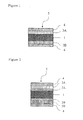
- Figure 1 is a schematic sectional view showing an example of the double-sided adhesive tape used in the process for producing an organic EL panel according to the present invention, in which adhesive layers 3A and 3B are formed on both faces of a base material layer 1 and separators 4 are laminated on the adhesive layers 3A and 3B.
- Figure 2 is a schematic sectional view showing another example of the double-sided adhesive tape used in the process for producing an organic EL panel according to the present invention, in which adhesive layers 3A and 3B are formed, respectively via rubber-like organic elastic layers 2A and 2B, on both faces of a base material layer 1 and separators 4 are laminated on the adhesive layers 3A and 3B.
- the process for producing an organic EL panel according to the present invention is a process for producing an organic electroluminescent panel by forming an organic electroluminescent element on an ultrathin glass plate having a thickness of 10 to 150 ⁇ m by vacuum deposition, comprising forming electrodes on the ultrathin glass plate, by temporarily fixing the ultrathin glass plate to a supporting plate, via a double-sided adhesive tape having a thermal release adhesive layer (heat-peelable adhesive layer) at least on one face of the base material layer, containing heat-expandable microspheres that start expansion and/or foaming at temperature higher than the vacuum deposition temperature.
- a thermal release adhesive layer heat-peelable adhesive layer
- the double-sided adhesive tape according to the present invention has a base material layer, which is formed from the viewpoints of handleability, processability and others, and a thermal release adhesive layer containing heat-expandable microspheres that start expansion and/or foaming at temperature higher than the vacuum deposition temperature formed at least on one face of the base material layer.
- the adhesive layer in the double-sided adhesive sheet according to the present invention may be protected before use, as it is bonded to a separator (release liner).
- the adhesive layer formed at least on one face of the double-sided adhesive tape is desirably a thermal release adhesive layer, and, for example, the adhesive layers on both faces of the double-sided adhesive tapes may be thermal release adhesive layers, or an adhesive layer (in particular, the layer having the surface bonding to the ultrathin glass plate) formed on one face of the double-sided adhesive tape may be a thermal release adhesive layer and the adhesive layer formed on the other face may be a pressure-sensitive or active energy ray-curable adhesive layer containing no heat-expandable microspheres.
- the double-sided adhesive tape according to the present invention preferably has thermal release adhesive layers containing heat-expandable microspheres on both faces of the double-sided adhesive tape, particularly because it is possible to reduce the tackiness of both faces of the double-sided adhesive tape in a heat treating step significantly and make the organic EL panel and the supporting plate separated easily from the double-sided adhesive tape. It is possible to reduce the energy cost of separation and simplify the separating operation by use of the double-sided adhesive tape.
- the thermal release adhesive layer according to the present invention contains heat-expandable microspheres and also an adhesive for giving tackiness.
- the thermal release adhesive layer containing heat-expandable microspheres starts, when heated, expansion and/or foaming of the heat-expandable microspheres therein, which leads significant drop of the adhesion area between the bonding target and the adhesive layer and thus to rapid decrease in adhesive power.
- the adhesive layer is highly adhesive in the state unheated, but can be separated easily under heat, when it is desirably separated. Microcapsulated foaming agents assure favorable releasability.
- the thermal release adhesive layer is preferably formed as the surface layer (outermost layer) of the double-sided adhesive tape, but may be formed as a layer beneath the surface layer. In such a case, another layer, such as anti-staining layer, is formed on the thermal release adhesive layer.
- the adhesive is preferably an adhesive that does not inhibit the expansion and/or foaming of the heat-expandable microsphere when heated as much as possible.
- the adhesive that may be used is, for example, one or more known adhesives selected from rubber-based adhesives, acrylic adhesives, vinyl alkylether-based adhesives, silicone-based adhesives, polyester-based adhesives, polyamine-based adhesives, urethane-based adhesives, styrene-diene block copolymer-based adhesives, and adhesives improved in creep properties in combination of the adhesive above with a hot-melt resin having a melting point of approximately 200°C or lower (see, for example, JP-A Nos. 56-61468 , 63-30205 , and 63-17981 and others).
- the adhesive may contain, in addition to the adhesive component (base polymer), suitable additives such as crosslinking agents (such as polyisocyanates or alkyletherified melamine compounds), tackifiers (such as rosin-derived resins, polyterpene resins, petroleum resins, or oil-soluble phenol resins), plasticizers, fillers, and aging inhibitors.
- suitable additives such as crosslinking agents (such as polyisocyanates or alkyletherified melamine compounds), tackifiers (such as rosin-derived resins, polyterpene resins, petroleum resins, or oil-soluble phenol resins), plasticizers, fillers, and aging inhibitors.
- the adhesives generally used include rubber-based adhesives containing natural rubber or synthetic rubber as the base polymer; acrylic adhesive having, as its base polymer, an acrylic polymer (homopolymer or copolymer) produced by using, as the monomer components, one or more alkyl(meth)acrylate esters (for example, C 1-20 alkyl esters such as methyl ester, ethylester, propyl ester, isopropyl ester, butyl ester, isobutyl ester, s-butyl ester, t-butyl ester, pentyl ester, hexyl ester, heptyl ester, octyl ester, 2-ethylhexylester, isooctyl ester, isodecyl ester, dodecyl ester, tridecyl ester, pentadecyl ester, hexadecyl ester, heptadecyl este
- the acrylic polymer may contain units corresponding to the other monomer components copolymerizable with the alkyl(meth)acrylate ester added for the purpose of modification of cohesive power, heat resistance, crosslinking efficiency, and others.
- monomer components include carboxyl group-containing monomers such as acrylic acid, methacrylic acid, carboxyethyl acrylate, carboxypentyl acrylate, itaconic acid, maleic acid, fumaric acid, and crotonic acid; acid anhydride monomers such as maleic anhydride and itaconic anhydride; hydroxyl group-containing monomers such as hydroxyethyl (meth)acrylate, hydroxypropyl (meth)acrylate, hydroxybutyl (meth)acrylate, hydroxyhexyl (meth)acrylate, hydroxyoctyl (meth)acrylate, hydroxydecyl (meth)acrylate, hydroxylauryl (meth)acrylate, and (4-hydroxymethylcyclohexyl
- the adhesive is more preferably a pressure-sensitive adhesive containing, as its base material, a polymer having a dynamic modulus in the range of 5000 to 1000,000 Pa at the temperature in the range of normal temperature to 150°C, from the points of the balance between favorable adhesive strength before heat treatment and deterioration in adhesive strength after heat treatment.
- the heat-expandable microsphere used in the thermal release adhesive layer is desirably, for example, a microsphere containing a substance that easily expands by vaporization under heat, such as isobutane, propane or pentane, as it is enclosed in an elastic shell.
- the shell is often made of a hot-melt substance or a substance that is broken by heat expansion.
- the shell-forming substances include vinylidene chloride-acrylonitrile copolymers, polyvinylalcohol, polyvinylbutyral, polymethyl methacrylate, polyacrylonitrile, polyvinylidene chloride, polysulfone, and the like.
- the heat-expandable microsphere can be prepared by a common method, for example by coacervation, interfacial polymerization or the like.
- Examples of the heat-expandable microspheres according to the present invention include commercially available products such as "Microspheres F30D and F50D” (R) produced by Matsumoto Yushi-Seiyaku Co., Ltd.
- the thermal release adhesive layers may contain heat-expandable microspheres that start expansion and/or foaming at the same temperature or heat-expandable microspheres that starts expansion and/or foaming at different temperatures, but in particular, heat-expandable microspheres that starts expansion and/or foaming at the same temperature are preferably contained. It is because it is possible to separate the organic EL panel and the supporting plate simultaneously from the double-sided adhesive tape by heat-treating the organic EL panel and the supporting plate when they are separated after the production process and thus, to reduce the energy cost.
- Heat-expandable microspheres having a suitable strength and thus prohibiting bursting at a volumetric expansion rate of up to 5 times or more, in particular of up to 7 times or more, particularly to up to 10 times or more are favorable, for efficient reduction of the adhesive strength of the adhesive layer by heat treatment.
- the blending amount of the heat-expandable microspheres can be determined properly, for example, according to the desired expansion rate and the desired rate of reduction in adhesive power (adhesive strength) of the adhesive layer, but is generally, for example, 1 to 150 wt parts, preferably 5 to 100 wt parts, with respect to the 100 wt parts of the base polymer forming the thermal release adhesive layer (for example, acrylic polymer in the case of acrylic adhesive).
- the blending amount of the heat-expandable microspheres is less than 1 wt part, it may not be possible to provide sufficient separation efficiency, while, when the blending amount is more than 150 wt parts, the adhesiveness of the adhesive layer surface may decline because of surface irregularity.
- the ultrathin glass plate is desirably separated easily without damage after production process.
- the thermal release adhesive layer is formed thinner, it is preferable that the blending amount of the heat-expandable microspheres is reduced to some extent to make to surface state stabilized. For the reason above, a blending amount (30 to 80 wt parts) of about half of the blending amount needed for complete separation (zero adhesive power) is most favorable.
- the thermal expansion-starting temperature of the thermal release adhesive layer according to the present invention is determined properly according to the vacuum deposition temperature when the organic EL element is formed, and the temperature at which expansion and/or foaming of the heat-expandable microsphere start is preferably a temperature of 20°C or higher (preferably, 50°C or higher, particularly preferably, 70°C or higher) than the vacuum deposition temperature.
- the thermal expansion-starting temperature is specifically 130 to 250°C, preferably 150 to 230°C.
- a thermal expansion-starting temperature of less than 130°C may result, for example, in release of offgas from the heat-expandable microspheres when heated for production of the organic EL element by vacuum deposition, which in turn leads to decrease in the degree of vacuum of vacuum chamber and elongation of the period needed to make it reach a desired degree of vacuum, and consequently to significant degrease in film precision and productivity.
- the thermal expansion-starting temperature is higher than 250°C, higher temperature is needed for improvement in the separation efficiency in the separation step, which occasionally leads to breakage of the organic EL panel by deformation caused by heat.
- thermo expansion-starting temperature is the temperature at which expansion and/or foaming of the heat-expandable microspheres starts, when the heat-expandable microsphere is analyzed in a thermal analyzer (trade name: "TMA/SS6100", manufactured by SII NanoTechnology Inc.) by an expansion method (load: 19.6 N, probe: 3 mm ⁇ ).
- the thermal expansion-starting temperature can be controlled properly, for example, by adjusting the kind and the particle diameter distribution of the heat-expandable microspheres. It is possible in particular to control the temperature easily by narrowing the particle diameter distribution of the heat-expandable microspheres by classification of the heat-expandable microspheres. Any known method, whether it is a dry or wet method, may be used as the classification method, and the classification apparatuses that can be used include known classification apparatuses such as gravity classifiers, inertia classifiers, and centrifugal classifiers.
- the thermal release adhesive layer can be prepared by a suitable method, for example, by preparing a coating solution containing an adhesive and heat-expandable microspheres by using a solvent as needed, and coating the solution on a base material layer or a rubber-like organic elastic layer (dry coating method), by preparing a thermal release adhesive layer by coating the coating agent on a suitable separator (such as release paper) and transferring the adhesive layer onto a base material layer or a rubber-like organic elastic layer (dry lamination method), or by coextruding a resin composition containing the constituent materials for the base material layer with a resin composition containing the materials for the thermal release adhesive layer (coextrusion method).
- the thermal release adhesive layer may be a single layer or a laminate layers.
- the thickness of the thermal release adhesive layer is preferably larger than the maximum diameter of the heat-expandable microspheres contained and, for example, 5 to 300 ⁇ m, preferably about 10 to 100 ⁇ m.
- the thickness is too large, cohesive failure may occur during separation after heat treatment, leaving the adhesive residue on the organic EL panel and thus, leading to deterioration in separation efficiency.
- the thickness is too small, the surface smoothness of the adhesive layer may be damaged by the irregularity of the heat-expandable microspheres, possibly leading to deterioration in adhesiveness and drop out during temporary fixation.
- the adhesion component contained in the pressure-sensitive adhesive layer is not particularly limited, and those exemplified for the thermal release adhesive layer may be used favorably.
- the pressure-sensitive adhesive layer can prepared by a suitable method, for example, by preparing a coating solution containing an adhesive, by using a solvent as needed, and coating the solution on a base material layer or a rubber-like organic elastic layer (dry coating method), by preparing a pressure-sensitive adhesive layer by coating the coating agent on a suitable separator (such as release paper) and transferring the adhesive layer onto a base material layer or a rubber-like organic elastic layer (dry lamination method), or by coextruding a resin composition containing the constituent materials for the base material layer with a resin composition containing the materials for the pressure-sensitive adhesive layer (coextrusion method).
- the pressure-sensitive adhesive layer may be a single layer or a laminate layers.
- the active energy ray-curable adhesive layer is characterized by having a property of being cured by irradiation of active energy ray.
- the layer preferably contains polymerizable carbon-carbon double bonds for expression of the active energy ray curability, and for example, a active energy ray-curable adhesive containing a polymer having polymerizable carbon-carbon double bonds in the branched chains and terminals as the base polymer may be used, or alternatively an addition-type active energy ray-cureble adhesive containing a monomer or oligomer component having side-chains having polymerizable carbon-carbon double bonds may be used as the adhesive agent.
- active energy ray means, for example, ultraviolet ray, visible ray, infrared ray or radiation ray.
- the active energy ray-curable adhesive containing a polymer having polymerizable carbon-carbon double bonds in the branched chains and terminals as the base polymer is a known adhesive or an adhesive in combination of one two or more known adhesives such as rubber-based adhesives, acrylic adhesives, vinyl alkylether-based adhesives, silicone-based adhesives, polyester-based adhesives, polyamine-based adhesives, urethane-based adhesives, styrene-diene block copolymer-based adhesives, adhesives improved in creep property in combination of the adhesive above and a hot-melt resin having a melting point of approximately 200°C or lower blended therewith (see, for example, JP-A Nos. 56-61468 and 63-17981 ).
- the adhesive may contain, in addition to the adhesive component (base polymer), suitable additives such as crosslinking agents (such as polyisocyanates and alkyletherified melamine compounds), tackifiers (such as rosin derivative resins, polyterpene resins, petroleum resins, and oil-soluble phenol resin), plasticizers, fillers, and aging inhibitors.
- suitable additives such as crosslinking agents (such as polyisocyanates and alkyletherified melamine compounds), tackifiers (such as rosin derivative resins, polyterpene resins, petroleum resins, and oil-soluble phenol resin), plasticizers, fillers, and aging inhibitors.
- the adhesive component can be obtained by introducing one or more polymerizable carbon-carbon double bonds into a basic skeleton acrylic copolymer.
- the base polymer has polymerizable carbon-carbon double bonds
- the active energy ray curable monomer or oligomer components may not be added separately.
- the acrylic polymer having polymerizable carbon-carbon double bonds may not contain the low-molecular weight oligomer components or the like or may contain them in lower amounts and thus, it is possible to form an adhesive layer in a stabilized layer structure without migration of the oligomer components and others in the adhesive layer over time.
- the method of introducing polymerizable carbon-carbon double bonds into the acrylic copolymer is not particularly limited, and various methods may be used.
- monomers having a functional group monomer are copolymerized previously for preparation of an acrylic copolymer and then, a compound having a functional group reactive with the functional group and having polymerizable carbon-carbon double bonds may be condensed with or added to the acrylic copolymer, while the active energy ray curability of the polymerizable carbon-carbon double bonds is preserved.
- Examples of the combinations of the high-reactivity functional groups include carboxylic and epoxy groups, carboxylic and aziridine groups, hydroxyl and isocyanate groups, and the like.
- the combination of hydroxyl and isocyanate groups is favorable from the point of easy traceability of the reaction.
- Each functional group may be present either in the acrylic copolymer or in the compound having a functional group and polymerizable carbon-carbon double bonds.
- the acrylic copolymer has hydroxyl groups and the compound having a functional group and polymerizable carbon-carbon double bonds has an isocyanate group.
- Examples of the compounds having a functional group and polymerizable carbon-carbon double bonds in this case include methacryloisocyanate, 2-methacryloyloxyethyl isocyanate, m-isopropenyl- ⁇ , ⁇ -dimethylbenzyl isocyanate and the like.
- copolymers of the hydroxyl group-containing monomer exemplified above and an ether compound such as 2-hydroxyethyl vinylether, 4-hydroxybutyl vinylether or diethylene glycol monovinylether are used as the acrylic copolymers.
- the acrylic copolymers containing polymerizable carbon-carbon double bonds may be used alone or in combination of two or more.
- the addition-type active energy ray-curable adhesive in combination of the adhesive and a monomer or oligomer component having a side chain containing polymerizable carbon-carbon double bonds blended thereto can be prepared by blending a active energy ray-curable monomer or oligomer component with an adhesive.
- the adhesive is preferably an acrylic adhesive.
- the active energy ray-curable monomer or oligomer component for use is, for example, a monomer or oligomer having a functional group, such as carbon-carbon double bond, that crosslinks by irradiation with active energy ray.
- a monomer or oligomer having averagely six or more carbon-carbon double bonds in the molecule is preferable.
- Examples of the monomers or oligomers include trimethylolpropane tri(meth)acrylate, pentaerythritol tri(meth)acrylate, dipentaerythritol hexa(meth)acrylate, tetraethylene glycol di(meth)acrylate, 1,6-hexanediol (meth)acrylate, neopentylglycol di(meth)acrylate, ester compound of (meth)acrylic esters and a polyvalent alcohol, acrylic ester oligomers, 2-propenyl-3-butenyl cyanurate, isocyanurate, isocyanurate compounds and the like.
- dipentaerythritol hexa(meth)acrylate is preferable.
- the active energy ray-curable monomer or oligomer components may be used alone or as a mixture of two or more.
- the active energy ray-curable adhesive layer is prepared by a suitable method, for example, by preparing a coating solution containing an adhesive, by using a solvent as needed, and coating the solution on a base material layer or a rubber-like organic elastic layer (dry coating method), by preparing a active energy ray-curable adhesive layer by coating the coating agent on a suitable separator (such as release paper) and transferring the adhesive layer onto a base material layer or a rubber-like organic elastic layer (dry lamination method), or by coextruding a resin composition containing the constituent materials for the base material layer with a resin composition containing the materials for the active energy ray-curable adhesive layer (coextrusion method).
- the active energy ray-curable adhesive layer may be a single layer or a laminate layers.
- the base material constituting the base material layer is not particularly limited and various base materials may be used, and examples thereof for use are suitable film-shaped materials including fiber based base materials such as woven and nonwoven fabrics, felts and nets; paper-based base materials such as various kinds of paper; metal-based base material such as metal foils and plates; plastic-based base materials such as various resin films and sheets; rubber-based base materials such as rubber sheets; foams such as foam sheets; laminated films thereof and the like.
- suitable film-shaped materials including fiber based base materials such as woven and nonwoven fabrics, felts and nets; paper-based base materials such as various kinds of paper; metal-based base material such as metal foils and plates; plastic-based base materials such as various resin films and sheets; rubber-based base materials such as rubber sheets; foams such as foam sheets; laminated films thereof and the like.
- polyesters such as polyethylene terephthalate, polyethylene naphthalate, polybutylene terephthalate, and polybutylene naphthalate
- polyolefins such as polyethylene, polypropylene, and ethylene-propylene copolymers
- polyvinylalcohol polyvinylidene chloride, polyvinyl chloride, vinyl chloride-vinyl acetate copolymers, polyvinyl acetate, polyamides, polyimides, celluloses, fluorine resins, polyether, polystyrene resins (such as polystyrene), polycarbonate, polyether sulfone and the like.
- the base material layer may have a shape of single layer or laminate layer.
- the thickness of the base material layer is not particularly limited, but preferably 500 ⁇ m or less, more preferably about 5 to 250 ⁇ m.
- the surface of the base material layer may be, as needed, subjected to a common surface treatment, for example to oxidation by a chemical or physical method, such as chromate treatment, ozone exposure, flame exposure, high-pressure electrical shock exposure or ionizing radiation treatment, for improvement of the adhesiveness for example with the thermal release adhesive layer.
- a chemical or physical method such as chromate treatment, ozone exposure, flame exposure, high-pressure electrical shock exposure or ionizing radiation treatment, for improvement of the adhesiveness for example with the thermal release adhesive layer.
- the double-sided adhesive tape according to the present invention preferably has a rubber-like organic elastic layer between the base material layer and the adhesive layers placed on both faces of the base material layer.
- the rubber-like organic elastic layer has a function to make the surface of the double-sided adhesive tape fit favorably to the surface shape of the ultrathin glass plate and increase the adhesion area between them when a double-sided adhesive tape is bonded to an ultrathin glass plate and also a function to help construction of a waving structure by three-dimensional structural transition of the thermal release adhesive layer during heated separation (thermal peeling).
- the rubber-like organic elastic layer which has the functions above, is preferably formed with a natural rubber, a synthetic rubber or a rubber elastic synthetic resin having a Shore D hardness, as determined according to ASTM D-2240, for example of 50 or less, particularly 40 or less.
- Examples of the synthetic rubbers or the rubber elastic synthetic resins include synthetic rubbers such as nitrile-, diene-, and acrylic-based rubbers; thermoplastic elastomers such as polyolefin- and polyester-based elastomers; rubber elastic synthetic resins such as ethyléne-vinyl acetate copolymers, polyurethane, polybutadiene, and soft polyvinyl chloride; and the like.
- Inherently hard polymers such as polyvinyl chloride can show rubber elasticity, when combined with a compounding agent such as plasticizer or softener, and thus, such a composition can also be used as the material constituting the rubber-like organic elastic layer.
- the adhesives constituting the thermal release adhesive layer described above can also be used favorably as the materials constituting the rubber-like organic elastic layer.
- the thickness of the rubber-like organic elastic layer is generally about 5 to 300 ⁇ m, preferably about 5 to 100 ⁇ m. When the thickness is too large, three-dimensional structural transition of the thermal release adhesive layer may be inhibited, leading to deterioration in separation efficiency in the separation step.
- the rubber-like organic elastic layer is formed, for example, by preparing a coating solution containing the materials for the rubber-like organic elastic layer such as the natural rubber, synthetic rubber or rubber elastic synthetic resin and coating the coating solution on a base material layer (coating method), by bonding the film of the rubber-like organic elastic layer or a laminate film of the layer of the materials for the rubber-like organic elastic layer formed previously one or more thermal release adhesive layers to the base material layer (dry lamination method), or by coextruding a resin composition containing the constituent materials for the base material layer with a resin composition containing the materials for the rubber-like organic elastic layer (coextrusion method).
- the material for forming the rubber-like organic elastic layer may contain, as needed, known additives such as fillers, flame retardants, aging inhibitors, antistatic agents, softening agents, ultraviolet absorbents, antioxidants, plasticizers, and surfactants.
- known additives such as fillers, flame retardants, aging inhibitors, antistatic agents, softening agents, ultraviolet absorbents, antioxidants, plasticizers, and surfactants.
- the double-sided adhesive tape according to the present invention may have a separator (release liner) formed on the adhesive layer surface for protection of the adhesive layer surface and prevention of blocking.
- the separator which is removed when the double-sided adhesive tape is bonded to the bonding target, may not be formed.
- the separator for use is not particularly limited, and any common known release liner may be used.
- release layer-containing base materials such as plastic films and paper surface-treated with a release agent such as a silicone-, long-chain alkyl-, fluorine- or molybdenum sulfide-based release agent; low-adhesiveness base materials of a fluorochemical polymer such as polytetrafluoroethylene, polychlorotrifluoroethylene, polyvinyl fluoride, polyvinylidene fluoride, tetrafluoroethylene-hexafluoropropylene copolymer or chlorofluoroethylene-vinylidene fluoride copolymer; low-adhesiveness base materials of a non-polar polymer such as olefinic resin (for example, polyethylene or polypropylene) and the like.
- a release agent such as a silicone-, long-chain alkyl-, fluorine- or molybdenum sulfide-based release agent
- the separator above may be formed on both faces of the double-sided adhesive tape according to the present invention, or a rear-face release layer may be formed on one adhesive face in such a manner that the layer of the separator becomes in contact with the opposite-sided adhesive face of the double-sided adhesive tape when the sheet is wound into a roll shape.
- the double-sided adhesive tape according to the present invention which has a thermal release adhesive layer containing heat-expandable microspheres at least on one face of the base material layer, has favorable adhesive strength before heat treatment and thus, permits support and temporary fixation of the ultrathin glass plate and smooth processing of the organic EL panel.
- Heat treatment of the double-sided adhesive tape at a temperature higher than a particular temperature leads to expansion and/or foaming of the heat-expandable microspheres contained and thus to three-dimensional structural transition of the thermal release adhesive layer into a waving structure. Therefore, the adhesion area with the organic EL panel decreases rapidly and the adhesive strength to the organic EL panel deteriorates drastically. It is possible in this way to separate the organic EL panel easily, without contamination for example with the adhesive residue.
- the double-sided adhesive tape according to the present invention can be used favorably as a temporary fixing tape in the production process for organic EL panels.
- the process for producing an organic EL panel according to the present invention is characterized by forming an organic EL element on an ultrathin glass plate, as the ultrathin glass plate is temporarily fixed to a supporting plate with the double-sided adhesive tape described above.
- the material constituting the supporting plate for temporary fixing of the ultrathin glass plate is not particularly limited, if it can support the ultrathin glass plate to be bonded.
- a material harder than the ultrathin glass plate is used favorably, and examples thereof include silicon, glass, SUS plates, copper plates, acrylic plates and the like.
- the thickness of the supporting plate is preferably, for example, 0.4 mm or more (for example, 0.4 to 5.0 mm).
- the method of bonding an ultrathin glass plate to the supporting plate via a double-sided adhesive tape is not particularly limited, if it can bond the ultrathin glass plate to the supporting plate, and these materials are bonded to each other, for example, by using a roller, a spatula or a pressing machine.
- the ultrathin glass plate is preferably a transparent and colorless glass and the thickness thereof is for example about 10 to 150 ⁇ m, preferably about 10 to 70 ⁇ m, and particularly preferably about 20 to 50 ⁇ m.
- An ultrathin glass plate having a thickness of more than 150 ⁇ m is not sufficiently flexible any more, while an ultrathin glass plate having a thickness of less than 10 ⁇ m is fundamentally harder to produce.
- the organic EL element has a configuration, for example, of positive electrode /positive hole injecting layer/positive hole transporting layer/light-emitting layer/positive hole-blocking layer /electron-transporting layer/cathode.
- a thin film of a positive electrode substance such as indium tin oxide: ITO
- a vacuum deposition method such as PVD (physical vapor deposition) or CVD (chemical vapor deposition)
- PVD physical vapor deposition
- CVD chemical vapor deposition
- the vapor deposition temperatures in the vacuum deposition method is, for example, about 70 to 250°C; the degree of vacuum is, for example, about 10 -2 to 10 -6 Pa; and the vapor deposition rate is, for example, about 0.01 to 30 nm/second.
- organic compound thin films of positive hole injecting layer, positive hole transporting layer, light-emitting layer, positive hole-blocking layer, and electron-transporting layer for an organic EL element material are formed thereon.
- the method of forming the organic compound thin films include wet processes (spin coating, casting, inkjet ejection, and printing) and the like, but vacuum deposition, spin coating, inkjet ejection, and printing processes are particularly preferable, because uniform films are easily obtained and pinholes are generated less frequently.
- a thin film of negative electrode substance is formed thereon at a film thickness adjusted to less than 1 ⁇ m, preferably in the range of 50 to 200 nm by a vacuum deposition method such as PVD (physical vapor deposition) or CVD (chemical vapor deposition), to give an organic EL element.
- a vacuum deposition method such as PVD (physical vapor deposition) or CVD (chemical vapor deposition)
- the heat-expandable microspheres contained in the thermal release adhesive layer constituting the double-sided adhesive tape are expanded and/or foamed by heat treatment, for drastic decrease of adhesive power and thus for separation of the organic EL panel from the supporting plate.
- the separated organic EL panel is recovered by a common known method.
- the heating means is not particularly limited, if it can heat the double-sided adhesive tape and expand and/or foam the heat-expandable microspheres contained therein rapidly, and for example, electric heating, induction heating, magnetic heating, near-infrared ray-, mid-infrared ray or far-infrared ray heating, or oven or hot plate heating can be used without any restriction.
- the heating temperature is not limited, if it is not lower than the temperature at which the heat-expandable microspheres contained in the double-sided adhesive tape start expansion and/or foaming, and it is for example 130 to 250°C, preferably about 150 to 230°C.
- ITO electrode was formed under the following condition:
- a toluene solution containing 100 wt parts of a pressure-sensitive adhesive based on a copolymer of 2-ethylhexyl acrylate/ethyl acrylate/methyl methacrylate /2-hydroxyethyl acrylate (30 wt parts/70 wt parts/5 wt parts/5 wt parts) and 1 wt part of an isocyanate-based crosslinking agent blended therein was coated and dried on both faces of a base substance polyester film (thickness: 100 ⁇ m) to a thickness of 20 ⁇ m after drying, to give rubber-like organic elastic layers A and B.
- the thermal release adhesive layers A and B obtained were laminated respectively onto the rubber-like organic elastic layers A and B, to give a double-sided adhesive tape 1 having thermal release adhesive layers on both faces of the base material.
- a glass plate (thickness: 1 mm, size: 10 cm ⁇ 10 cm) and an ultrathin glass plate (thickness: 50 ⁇ m) were laminated to each other via the double-sided adhesive tapes 1 without incorporation of air bubbles, to give a sample 1.
- ITO electrodes were then formed, by PVD method (110°C), on the ultrathin glass plate of the sample 1 obtained to give an organic EL panel 1 with glass plate.
- a sample 2 and an organic EL panel 2 were prepared in a manner similar to Example 1, except that the double-sided adhesive tape 1 was replaced with the double-sided adhesive tape 2.
- a double-sided adhesive tape 3 was prepared in a manner similar to Example 1, except that the heat-expandable microspheres A was replaced with a heat-expandable microspheres B (trade name: "Microsphere F50D", produced by Matsumoto Yushi-Seiyaku Co., Ltd., foaming-starting temperature: approximately 120°C).
- a glass plate (thickness: 1 mm, size: 10 cm ⁇ 10 cm) and an ultrathin glass plate (thickness: 50 ⁇ m) were laminated to each other via the double-sided adhesive tape 3 without incorporation of air bubbles, to give a sample 3.
- ITO electrodes were then formed, by PVD method (110°C), on the ultrathin glass plate of the sample 3 obtained to give an organic EL panel 3 with glass plate.
- a sample 4 was prepared in a manner similar to Example 1, except that the double-sided adhesive tape 1 used when the glass plate (thickness: 1 mm, size: 10 cm ⁇ 10 cm) and the ultrathin glass plate (thickness: 50 ⁇ m) were laminated to each other was replaced with a pressure-sensitive double-sided adhesive tape (trade name: "No.5000N", produced by Nitto Denko Corporation). ITO electrodes were then formed, by PVD method (110°C),on the ultrathin glass plate of the sample 4 obtained to give an organic EL panel 4 with glass plate.
- a sample 5 was prepared in a manner similar to Example 1, except that the double-sided adhesive tape 1 used when the glass plate (thickness: 1 mm, size: 10 cm ⁇ 10 cm) and the ultrathin glass plate (thickness: 50 ⁇ m) were laminated each other was replaced with a wax (trade name: "SLOT WAX", produced by Kokonoe Electric Co., Ltd.). ITO electrodes were then formed, by PVD method (110°C), on the ultrathin glass plate of the sample 5 obtained to give an organic EL panel 5 with glass plate.
- each of the samples 1 to 5 obtained in Examples and Comparative Examples was placed in a vacuum chamber heated at 110°C; the period needed for the degree of vacuum in the vacuum chamber reach 1x10 -5 Pa when the chamber was evacuated was determined; the amount of offgas generated from each sample in the vacuum chamber when heated at 110°C was estimated by measuring the degree of vacuum (Pa) when the sample was heated at 110°C in a vacuum chamber kept to a pressure of 6 ⁇ 10 -8 Pa.
- the organic EL panel was separated from the glass plate in the organic EL panel 1 or 2 with glass plate obtained in Example 1 or 2
- the organic EL panel was separated from the glass plate, after the organic EL panel 1 or 2 with glass plate was heat-treated with a hot plate previously adjusted to 170°C.
- the organic EL panel was separated form the glass plate in the organic EL panel 3 with glass plate obtained in Comparative Example 1
- the organic EL panel was separated from the glass plate, after the organic EL panel 3 with glass plate was heat-treated with a hot plate previously adjusted to 120°C.
- the organic EL panel was separated form the glass plate in the organic EL panel 4 with glass plate obtained in Comparative Example 2
- the organic EL panel was separated from the glass plate, after the organic EL panel 4 with glass plate was heated with a hot plate previously adjusted to 60°C and bent.
- the organic EL panel was separated form the glass plate in the organic EL panel 5 with glass plate obtained in Comparative Example 3, the organic EL panel was separated from the glass plate under a force applied in the shearing direction, after the organic EL panel 5 with glass plate was heated on a hot plate previously heated to approximately 80°C for softening the wax.
- the wax deposited on the organic EL panel separated from the glass plate was removed with a solvent (toluene).
- the organic EL panel obtained by the process for producing an organic EL panel according to the present invention is useful as a display device, a display or an emission light source in various kinds.
Landscapes
- Chemical & Material Sciences (AREA)
- Organic Chemistry (AREA)
- Engineering & Computer Science (AREA)
- Physics & Mathematics (AREA)
- Optics & Photonics (AREA)
- Manufacturing & Machinery (AREA)
- Health & Medical Sciences (AREA)
- Chemical Kinetics & Catalysis (AREA)
- Medicinal Chemistry (AREA)
- Polymers & Plastics (AREA)
- Microelectronics & Electronic Packaging (AREA)
- Electroluminescent Light Sources (AREA)
- Adhesives Or Adhesive Processes (AREA)
- Adhesive Tapes (AREA)
Applications Claiming Priority (2)
| Application Number | Priority Date | Filing Date | Title |
|---|---|---|---|
| JP2008178181 | 2008-07-08 | ||
| PCT/JP2009/003030 WO2010004703A1 (fr) | 2008-07-08 | 2009-06-30 | Procédé de fabrication de panneau électroluminescent organique |
Publications (2)
| Publication Number | Publication Date |
|---|---|
| EP2315500A1 true EP2315500A1 (fr) | 2011-04-27 |
| EP2315500A4 EP2315500A4 (fr) | 2011-12-28 |
Family
ID=41506831
Family Applications (1)
| Application Number | Title | Priority Date | Filing Date |
|---|---|---|---|
| EP09794151A Withdrawn EP2315500A4 (fr) | 2008-07-08 | 2009-06-30 | Procédé de fabrication de panneau électroluminescent organique |
Country Status (7)
| Country | Link |
|---|---|
| US (1) | US8409884B2 (fr) |
| EP (1) | EP2315500A4 (fr) |
| JP (1) | JPWO2010004703A1 (fr) |
| KR (1) | KR20110039248A (fr) |
| CN (1) | CN102077688A (fr) |
| TW (1) | TW201016071A (fr) |
| WO (1) | WO2010004703A1 (fr) |
Cited By (3)
| Publication number | Priority date | Publication date | Assignee | Title |
|---|---|---|---|---|
| GB2481187A (en) * | 2010-06-04 | 2011-12-21 | Plastic Logic Ltd | Processing flexible display substrates |
| CN105518896A (zh) * | 2013-07-16 | 2016-04-20 | 康宁精密素材株式会社 | 用于制造超薄有机发光装置的方法 |
| EP3330337A1 (fr) * | 2016-12-02 | 2018-06-06 | Samsung Display Co., Ltd. | Élément adhésif libérable thermiquement et appareil d'affichage le comprenant |
Families Citing this family (26)
| Publication number | Priority date | Publication date | Assignee | Title |
|---|---|---|---|---|
| EP2564240B1 (fr) | 2010-04-26 | 2019-06-12 | Koninklijke Philips N.V. | Détecteur de rayons x à uniformité et résolution spatiale de gain amélioré et procédé de fabrication d'un tel détecteur de rayons x |
| CN102674669B (zh) * | 2011-03-16 | 2014-12-03 | 京东方科技集团股份有限公司 | 一种玻璃基板的固定方法 |
| CN102690066B (zh) * | 2011-03-22 | 2015-02-25 | 京东方科技集团股份有限公司 | 一种玻璃基板的固定方法 |
| JP6000595B2 (ja) * | 2012-03-27 | 2016-09-28 | 日東電工株式会社 | 電子部品切断用加熱剥離型粘着シート及び電子部品加工方法 |
| CN103568443B (zh) * | 2012-07-19 | 2015-06-17 | 华映视讯(吴江)有限公司 | 玻璃贴合装置 |
| KR101913436B1 (ko) * | 2012-07-26 | 2018-10-30 | 도레이첨단소재 주식회사 | 열박리형 양면 점착 시트 및 이를 이용한 가공방법 |
| US20140287299A1 (en) * | 2013-03-25 | 2014-09-25 | Apple Inc. | Heat-Debonding Adhesives |
| CN104031571B (zh) * | 2014-05-17 | 2016-04-13 | 甘春丽 | 一种膨胀易剥离胶带 |
| JP6156443B2 (ja) * | 2014-08-13 | 2017-07-05 | Jsr株式会社 | 積層体および基材の処理方法 |
| JP6587811B2 (ja) * | 2015-02-24 | 2019-10-09 | 日東電工株式会社 | 熱剥離型粘着シート |
| CN105845845B (zh) * | 2016-04-14 | 2018-07-06 | 鄂尔多斯市源盛光电有限责任公司 | 一种粘接型阻隔膜的图形化方法、显示面板、显示装置 |
| JP2018028974A (ja) * | 2016-08-15 | 2018-02-22 | 日東電工株式会社 | 有機el表示装置用粘着剤組成物、有機el表示装置用粘着剤層、有機el表示装置用粘着剤層付偏光フィルム、及び有機el表示装置 |
| CN106875851A (zh) * | 2017-04-20 | 2017-06-20 | 京东方科技集团股份有限公司 | 显示装置及其制造方法 |
| TWI681232B (zh) * | 2017-09-26 | 2020-01-01 | 達邁科技股份有限公司 | 用於軟性顯示器之透明聚醯亞胺複合膜及其製造方法 |
| JP6790008B2 (ja) * | 2018-03-14 | 2020-11-25 | 株式会社東芝 | 検出素子および検出器 |
| US12038408B2 (en) * | 2018-10-03 | 2024-07-16 | The Regents Of The University Of Michigan | Integrated micro-photoionization detector with an ultrathin ultraviolet transmission window |
| JP7236466B2 (ja) * | 2018-12-26 | 2023-03-09 | Dic株式会社 | フレキシブルディスプレイ用発泡体粘着テープ及びフレキシブルディスプレイ積層物 |
| CN110112185A (zh) * | 2019-04-18 | 2019-08-09 | 武汉华星光电半导体显示技术有限公司 | 一种柔性显示面板及其制备方法 |
| CN110305599B (zh) * | 2019-07-03 | 2021-10-22 | 京东方科技集团股份有限公司 | 一种散热膜及显示装置 |
| CN114830018B (zh) * | 2019-12-17 | 2025-04-29 | 株式会社奥特康 | 光谐振器、光调制器及它们的制作方法、光频梳产生器、光振荡器 |
| US12393231B2 (en) | 2021-05-26 | 2025-08-19 | Boe Technology Group Co., Ltd. | Flexible display apparatus and support assembly |
| JP7108164B1 (ja) | 2021-05-27 | 2022-07-28 | 東洋インキScホールディングス株式会社 | 粘着剤、粘着シート、積層体、およびフレキシブルディスプレイ |
| JP7108165B1 (ja) | 2021-05-27 | 2022-07-28 | 東洋インキScホールディングス株式会社 | 粘着剤、粘着シート、積層体、およびフレキシブルディスプレイ |
| JP7739145B2 (ja) * | 2021-11-15 | 2025-09-16 | 三井化学Ictマテリア株式会社 | 加工薄ガラスの製造方法、粘着性フィルムおよび薄ガラス付き粘着性フィルム |
| CN114591002A (zh) * | 2022-04-11 | 2022-06-07 | 业泓科技(成都)有限公司 | 指纹辨识模组的减薄方法 |
| JP2023160308A (ja) * | 2022-04-22 | 2023-11-02 | 三井化学東セロ株式会社 | 機械加工済み薄ガラスの製造方法 |
Family Cites Families (20)
| Publication number | Priority date | Publication date | Assignee | Title |
|---|---|---|---|---|
| JPS5661468A (en) | 1979-10-23 | 1981-05-26 | Matsumoto Yushi Seiyaku Kk | Releasable adhesive |
| JPS6317981A (ja) | 1986-07-09 | 1988-01-25 | F S K Kk | 粘着シ−ト |
| JPS6330205A (ja) | 1986-07-25 | 1988-02-08 | 日東電工株式会社 | セラミツク板切断片の製造方法 |
| ZA876122B (en) * | 1986-08-21 | 1989-04-26 | Minnesota Mining & Mfg | Pressure-sensitive tape construction incorporating resilient polymeric microspheres |
| JP3503992B2 (ja) * | 1994-08-11 | 2004-03-08 | ソニーケミカル株式会社 | 粘着テープ及びその製造方法 |
| JPH09260058A (ja) * | 1996-03-19 | 1997-10-03 | Gunze Ltd | 分散型エレクトロルミネッセンスパネル |
| JP2001040300A (ja) * | 1999-07-28 | 2001-02-13 | Konishi Co Ltd | 戻りの少ない両面粘着テープ |
| JP2001265251A (ja) * | 2000-03-17 | 2001-09-28 | Minolta Co Ltd | 表示素子及び積層型表示素子 |
| JP2002069410A (ja) * | 2000-08-28 | 2002-03-08 | Fujimori Kogyo Co Ltd | 熱剥離性粘着剤及びそれを用いた粘着部材 |
| JP3628997B2 (ja) * | 2000-11-27 | 2005-03-16 | セイコーエプソン株式会社 | 有機エレクトロルミネッセンス装置の製造方法 |
| JP2002367778A (ja) * | 2001-06-08 | 2002-12-20 | Panac Co Ltd | 有機電界発光表示素子製造工程用積層シート |
| JP3880418B2 (ja) * | 2002-02-21 | 2007-02-14 | 日東電工株式会社 | 両面粘着シートおよびタッチパネルの表示装置への貼着固定方法 |
| JP4428908B2 (ja) | 2002-04-08 | 2010-03-10 | 日東電工株式会社 | 粘着シートを用いた被着体加工方法 |
| US7148624B2 (en) | 2002-05-07 | 2006-12-12 | Osram Opto Semiconductors (Malaysia) Sdn. Bhd | Uniform deposition of organic layer |
| JP2004079432A (ja) | 2002-08-21 | 2004-03-11 | Nitto Denko Corp | 透明ガスバリア性部材及びこれを用いた有機エレクトロルミネッセンス素子 |
| JP4259106B2 (ja) * | 2002-12-11 | 2009-04-30 | コニカミノルタホールディングス株式会社 | 有機エレクトロルミネッセンス素子用透明導電性基板、これを用いた有機エレクトロルミネッセンス素子および有機エレクトロルミネッセンス表示装置 |
| TWI277381B (en) * | 2005-04-12 | 2007-03-21 | Au Optronics Corp | Double-sided flexible printed circuit board |
| JP4846437B2 (ja) * | 2005-06-07 | 2011-12-28 | 富士フイルム株式会社 | 有機電界発光素子 |
| JP5008381B2 (ja) | 2006-11-15 | 2012-08-22 | 富士フイルム株式会社 | 可撓性基板を用いた有機エレクトロルミネッセンス発光パネルの製造方法、それにより製造された有機エレクトロルミネッセンス発光パネル、及びその製造に使用する支持基板 |
| JP2008144116A (ja) * | 2006-12-13 | 2008-06-26 | Nitto Denko Corp | 両面粘着シートおよび液晶表示装置 |
-
2009
- 2009-06-30 CN CN2009801250660A patent/CN102077688A/zh active Pending
- 2009-06-30 KR KR1020117000454A patent/KR20110039248A/ko not_active Withdrawn
- 2009-06-30 JP JP2010519631A patent/JPWO2010004703A1/ja active Pending
- 2009-06-30 US US13/003,269 patent/US8409884B2/en not_active Expired - Fee Related
- 2009-06-30 WO PCT/JP2009/003030 patent/WO2010004703A1/fr not_active Ceased
- 2009-06-30 EP EP09794151A patent/EP2315500A4/fr not_active Withdrawn
- 2009-07-08 TW TW098123131A patent/TW201016071A/zh unknown
Cited By (7)
| Publication number | Priority date | Publication date | Assignee | Title |
|---|---|---|---|---|
| GB2481187A (en) * | 2010-06-04 | 2011-12-21 | Plastic Logic Ltd | Processing flexible display substrates |
| GB2481187B (en) * | 2010-06-04 | 2014-10-29 | Plastic Logic Ltd | Processing substrates |
| US10361228B2 (en) | 2010-06-04 | 2019-07-23 | Flexenable Limited | Processing substrates using a temporary carrier |
| CN105518896A (zh) * | 2013-07-16 | 2016-04-20 | 康宁精密素材株式会社 | 用于制造超薄有机发光装置的方法 |
| EP3024046A4 (fr) * | 2013-07-16 | 2017-03-15 | Corning Precision Materials Co., Ltd. | Procédé de fabrication d'un dispositif électroluminescent organique ultramince |
| EP3330337A1 (fr) * | 2016-12-02 | 2018-06-06 | Samsung Display Co., Ltd. | Élément adhésif libérable thermiquement et appareil d'affichage le comprenant |
| US10316219B2 (en) | 2016-12-02 | 2019-06-11 | Samsung Display Co., Ltd. | Thermally releasable adhesive member and display apparatus including the same |
Also Published As
| Publication number | Publication date |
|---|---|
| EP2315500A4 (fr) | 2011-12-28 |
| US20110124136A1 (en) | 2011-05-26 |
| US8409884B2 (en) | 2013-04-02 |
| TW201016071A (en) | 2010-04-16 |
| JPWO2010004703A1 (ja) | 2011-12-22 |
| WO2010004703A1 (fr) | 2010-01-14 |
| KR20110039248A (ko) | 2011-04-15 |
| CN102077688A (zh) | 2011-05-25 |
Similar Documents
| Publication | Publication Date | Title |
|---|---|---|
| US8409884B2 (en) | Process for producing organic electroluminescent panel | |
| TWI405834B (zh) | 處理半導體晶圓或半導體基材之感壓黏著片及方法 | |
| US9120955B2 (en) | Double-sided adhesive tape or sheet, and adherend processing method | |
| EP1464688B1 (fr) | Feuille adhésive sensible à la pression thermo-pelable double face, procédé d'adhésion de matériau traité avec la feuille adhésive et composant électronique | |
| CN102959030B (zh) | 加热剥离型粘合片 | |
| EP1354925B1 (fr) | Feuille adhésive sensible à la pression pelable par chauffage, méthodes du traitement d' un composant électronique et d'un composant électronique | |
| CN101812274B (zh) | 用于切断层压陶瓷片的热剥离型压敏粘合片和用于切断加工层压陶瓷片的方法 | |
| CN112375506B (zh) | 热剥离型粘合片 | |
| EP1033393A2 (fr) | Feuille adhésive sensible à la pression pelable par chauffage | |
| EP2666835A1 (fr) | Ruban ou feuille adhésive double face et procédé de traitement de support | |
| EP2644669A1 (fr) | Feuille autocollante sensible à la pression thermo-détachable | |
| US20120237764A1 (en) | Pressure-sensitive adhesive tape for temporary fixing of electronic part | |
| US9905451B2 (en) | Sheet for semiconductor-related-member processing and method of manufacturing chips using the sheet | |
| KR20140061397A (ko) | 유리 에칭용 보호 시트 | |
| US7214424B2 (en) | Heat-peelable pressure-sensitive adhesive sheet | |
| KR20090026094A (ko) | 다이싱용 감압성 접착 시트 및 다이싱 방법 | |
| US20100119757A1 (en) | Heat-peelable double-sided pressure-sensitive adhesive sheet | |
| KR102526293B1 (ko) | 표면 보호 필름 및 이를 이용한 유기 발광 전자 장치 제조 방법 | |
| CN108243615A (zh) | 半导体加工片 |
Legal Events
| Date | Code | Title | Description |
|---|---|---|---|
| PUAI | Public reference made under article 153(3) epc to a published international application that has entered the european phase |
Free format text: ORIGINAL CODE: 0009012 |
|
| 17P | Request for examination filed |
Effective date: 20110207 |
|
| AK | Designated contracting states |
Kind code of ref document: A1 Designated state(s): AT BE BG CH CY CZ DE DK EE ES FI FR GB GR HR HU IE IS IT LI LT LU LV MC MK MT NL NO PL PT RO SE SI SK TR |
|
| AX | Request for extension of the european patent |
Extension state: AL BA RS |
|
| DAX | Request for extension of the european patent (deleted) | ||
| A4 | Supplementary search report drawn up and despatched |
Effective date: 20111124 |
|
| RIC1 | Information provided on ipc code assigned before grant |
Ipc: H01L 51/50 20060101ALI20111118BHEP Ipc: H01L 27/32 20060101ALI20111118BHEP Ipc: G09F 9/30 20060101ALI20111118BHEP Ipc: G09F 9/00 20060101ALI20111118BHEP Ipc: C09J 201/00 20060101ALI20111118BHEP Ipc: C09J 7/02 20060101ALI20111118BHEP Ipc: C09J 5/08 20060101ALI20111118BHEP Ipc: H05B 33/10 20060101AFI20111118BHEP |
|
| 17Q | First examination report despatched |
Effective date: 20120828 |
|
| STAA | Information on the status of an ep patent application or granted ep patent |
Free format text: STATUS: THE APPLICATION IS DEEMED TO BE WITHDRAWN |
|
| 18D | Application deemed to be withdrawn |
Effective date: 20141007 |