EP2320436B1 - Amorphe magnetische Legierungen sowie zugehörige Artikel und Verfahren - Google Patents
Amorphe magnetische Legierungen sowie zugehörige Artikel und Verfahren Download PDFInfo
- Publication number
- EP2320436B1 EP2320436B1 EP10173601A EP10173601A EP2320436B1 EP 2320436 B1 EP2320436 B1 EP 2320436B1 EP 10173601 A EP10173601 A EP 10173601A EP 10173601 A EP10173601 A EP 10173601A EP 2320436 B1 EP2320436 B1 EP 2320436B1
- Authority
- EP
- European Patent Office
- Prior art keywords
- alloy
- amorphous magnetic
- core
- magnetic alloy
- amorphous
- Prior art date
- Legal status (The legal status is an assumption and is not a legal conclusion. Google has not performed a legal analysis and makes no representation as to the accuracy of the status listed.)
- Active
Links
Images


Classifications
-
- H—ELECTRICITY
- H01—ELECTRIC ELEMENTS
- H01F—MAGNETS; INDUCTANCES; TRANSFORMERS; SELECTION OF MATERIALS FOR THEIR MAGNETIC PROPERTIES
- H01F1/00—Magnets or magnetic bodies characterised by the magnetic materials therefor; Selection of materials for their magnetic properties
- H01F1/01—Magnets or magnetic bodies characterised by the magnetic materials therefor; Selection of materials for their magnetic properties of inorganic materials
- H01F1/03—Magnets or magnetic bodies characterised by the magnetic materials therefor; Selection of materials for their magnetic properties of inorganic materials characterised by their coercivity
- H01F1/12—Magnets or magnetic bodies characterised by the magnetic materials therefor; Selection of materials for their magnetic properties of inorganic materials characterised by their coercivity of soft-magnetic materials
- H01F1/14—Magnets or magnetic bodies characterised by the magnetic materials therefor; Selection of materials for their magnetic properties of inorganic materials characterised by their coercivity of soft-magnetic materials metals or alloys
- H01F1/147—Alloys characterised by their composition
- H01F1/153—Amorphous metallic alloys, e.g. glassy metals
- H01F1/15308—Amorphous metallic alloys, e.g. glassy metals based on Fe/Ni
-
- C—CHEMISTRY; METALLURGY
- C22—METALLURGY; FERROUS OR NON-FERROUS ALLOYS; TREATMENT OF ALLOYS OR NON-FERROUS METALS
- C22C—ALLOYS
- C22C45/00—Amorphous alloys
- C22C45/02—Amorphous alloys with iron as the major constituent
-
- H—ELECTRICITY
- H01—ELECTRIC ELEMENTS
- H01F—MAGNETS; INDUCTANCES; TRANSFORMERS; SELECTION OF MATERIALS FOR THEIR MAGNETIC PROPERTIES
- H01F41/00—Apparatus or processes specially adapted for manufacturing or assembling magnets, inductances or transformers; Apparatus or processes specially adapted for manufacturing materials characterised by their magnetic properties
- H01F41/02—Apparatus or processes specially adapted for manufacturing or assembling magnets, inductances or transformers; Apparatus or processes specially adapted for manufacturing materials characterised by their magnetic properties for manufacturing cores, coils, or magnets
- H01F41/0206—Manufacturing of magnetic cores by mechanical means
- H01F41/0213—Manufacturing of magnetic circuits made from strip(s) or ribbon(s)
- H01F41/0226—Manufacturing of magnetic circuits made from strip(s) or ribbon(s) from amorphous ribbons
-
- H—ELECTRICITY
- H01—ELECTRIC ELEMENTS
- H01F—MAGNETS; INDUCTANCES; TRANSFORMERS; SELECTION OF MATERIALS FOR THEIR MAGNETIC PROPERTIES
- H01F41/00—Apparatus or processes specially adapted for manufacturing or assembling magnets, inductances or transformers; Apparatus or processes specially adapted for manufacturing materials characterised by their magnetic properties
- H01F41/02—Apparatus or processes specially adapted for manufacturing or assembling magnets, inductances or transformers; Apparatus or processes specially adapted for manufacturing materials characterised by their magnetic properties for manufacturing cores, coils, or magnets
- H01F41/0206—Manufacturing of magnetic cores by mechanical means
- H01F41/0246—Manufacturing of magnetic circuits by moulding or by pressing powder
Definitions
- the invention relates generally to amorphous magnetic alloys. More particularly, the invention relates to amorphous magnetic alloys with high saturation magnetization and good thermal stability. The invention further relates to a magnetic component using such alloys and methods for making the magnetic component.
- Amorphous magnetic materials used for applications such as a core of a transformer, an inductor, etc., are typically an iron-based or cobalt-based amorphous alloy (also referred to as metallic glasses).
- cores for electric devices are arranged to form a stack or a coil. These stacks or coils are then cut into desired shapes to be employed in the core.
- Conventional metallic glasses include Fe-P-C-based metallic glasses first produced in the 1960s, (Fe, Co, Ni)-P-B-based alloy, (Fe, Co, Ni)-Si-B-based alloy, (Fe, Co, Ni)-(Zr, Hf, Nb)-based alloy, and (Fe, Co, Ni)-(Zr, Hf, Nb)-B-based alloy, produced in the 1970s.
- Most of these alloys are typically subjected to a rapid solidification process, that is, cooling the molten alloy at a sufficient cooling rate to a temperature below a glass transition temperature to suppress crystallization and produce an amorphous alloy.
- Amorphous alloys generally are prepared with small dimensions. However, the currently employed processes, such as melt spinning, often are subject to process limitations that prevent producing articles with desired dimensions.
- the amorphous magnetic alloys exhibit a glass transition at a temperature below a crystallization temperature, with a supercooled liquid region defined as the temperature range between the glass transition temperature and the crystallization temperature.
- the supercooled liquid region is generally considered to be related to the stability of the amorphous phase. Accordingly, the alloys having a wide supercooled liquid region are considered to be excellent in glass-forming ability, which has been further related to good thermal stability of the amorphous phase.
- Glass-forming ability is required to produce articles with desired shape and dimension from the amorphous magnetic alloy.
- the temperature interval ⁇ Tx of supercooled liquid is ⁇ 40K
- the diameter or the thickness is 1.5-4 mm
- the volumetric ratio of glassy phase is 100%
- the coercive force (Hc) is 1.5-2.1 A/m
- the saturation magnetization (Is) is 1.14 T-1.39 T
- the initial permeability at 1 KHz and 1A/m is 18,600-20,920.
- a bar-material or platy material manufactured by a copper mold casting method can be used as magnetic core material
- US patent 7,223,310 and US patent 7,357,844 disclosed a soft magnetic Fe-B-Si-based metallic glass alloy composition exhibiting clear glass transition, wide supercooled liquid region, and having high glass-forming ability and saturation magnetization.
- magnetic properties of such alloys are typically, not stable when the alloys are subjected to thermal processing. Thermal processing may be required to form the alloys into desired geometric shapes.
- One embodiment of the present invention provides an amorphous magnetic alloy having the general formula: (Fe 1-x Co x ) n Mo a P b B c C d Si e , wherein n is the atomic percent of iron and cobalt; x is the fraction of n; a, b, c, d and e are the atomic percent of molybdenum, phosphorous, boron, carbon and silicon respectively, wherein n, x, a, b, c, d and e are defined by following relationship:
- Another embodiment is an article comprising a magnetic component made of the amorphous magnetic alloy of the present invention.
- Yet another embodiment of the present invention provides a method of making an article.
- the method includes the steps of providing the amorphous magnetic alloy of the present invention and processing the alloy within a supercooled liquid region of the alloy.
- embodiments of the present invention include amorphous magnetic alloys (also referred as alloys or alloy compositions) having a good balance of magnetic properties, and thermal stability, and an article (magnetic component) made of such amorphous magnetic alloys.
- Approximating language may be applied to modify any quantitative representation that could permissibly vary without resulting in a change in the basic function to which it is related. Accordingly, a value modified by a term or terms, such as “about” or “substantially,” may not be limited to the precise value specified, and may include values that differ from the specified value. In at least some instances, the approximating language may correspond to the precision of an instrument for measuring the value.
- an amorphous magnetic alloy (metallic glass alloy) is defined as a magnetic material, where a continuous matrix phase has an amorphous nature, i.e. a disordered atomic-scale structure that does not have long-range crystallographic order.
- the amorphous magnetic alloy may also include crystalline phases within the amorphous matrix.
- crystallization temperature refers to the transition temperature at which the alloy changes, upon heating, from the amorphous state to the crystallization state.
- the alloy may have crystallization temperature in a range from about 400 degrees Celsius to about 550 degrees Celsius.
- glass-transition temperature refers to the transition temperature at which the alloy transforms from viscous liquid into an amorphous phase. This transformation usually occurs upon rapid cooling.
- an amorphous alloy transforms to a crystalline alloy when heated to a crystallization temperature.
- a change in magnetic properties such as coercivity and initial permeability of the amorphous magnetic alloy occurs, however, when the alloy is subjected to elevated temperatures considerably lower than the crystallization temperature.
- the thermal stability of the magnetic properties of the amorphous magnetic alloy is generally very poor.
- the alloys are stable for only a few minutes when heated to a temperature in the supercooled liquid region, resulting in large changes in properties such as coercivity, and thus allowing very little time for processing the alloy into a desired shape or form.
- coercivity refers to the magnetic field required to reduce the external magnetization of a ferromagnetic substance to zero. Furthermore, a change in coercivity from the as-rapidly solidified alloy value can be used as a measure of thermal stability of the amorphous magnetic alloys. The change in coercivity of an alloy is measured as a function of time at an elevated temperature to determine thermal stability of the alloy.
- thermal stability of the amorphous magnetic alloy refers to the ability of the alloy to retain its magnetic properties, such as coercivity, during exposure to elevated temperatures. This stability in magnetic characteristics is believed to be attributable to the ability of the amorphous phase to persist in the alloy during elevated temperature exposure. Conventionally, the thermal stability has been, generally, correlated to the supercooled liquid region for such alloys. However, according to an embodiment of the invention, while performing research on various amorphous magnetic alloy compositions, it was found that the size of the supercooled liquid region is not necessarily a good measure of the thermal stability. Instead, “time to crystallize” or “crystallization time” is a more important alloy property.
- crystallization time may be determined by isothermally annealing the alloys in the supercooled liquid region and monitoring the time required for the amorphous phase to begin to develop long-range order, which can be evidenced by a combination of X-ray diffraction spectrum changes, onset of brittleness and increase in the coercivity of the alloy.
- the alloy composition comprises a selection of ferromagnetic transition metals (Fe and Co), non-magnetic transition metals (Mo) and metalloid elements (B, C, P and Si).
- the metalloid elements tend to promote the formation of an amorphous phase and are chosen to increase the number of equilibrium phases.
- the thermodynamic competition between the equilibrium crystalline phases slows down the crystallization kinetics, allowing the amorphous phase to be maintained during solidification.
- a consequence of the presence of the metalloid elements is that the saturation magnetization of the alloy is reduced.
- glass-forming ability of the alloy can be increased at the cost of magnetic properties.
- Table 1 shows the respective alloy compositions of inventive alloys 1 to 13 and comparative alloys 1 to 10, and their respective saturation magnetization (M s ), coercivity (H c ), supercooled liquid region ( ⁇ T x ) and crystallization time or time to crystallize (t). Ribbon samples of each composition were investigated for their magnetic properties and thermal behavior. A method of making ribbon samples is discussed below. X-ray diffraction measurements were employed to distinguish the amorphous and crystalline state of the alloy.
- these samples were annealed within the supercooled liquid region at a temperature 20 degree Celsius below the crystallization temperature of the corresponding alloy. Coercivity of each sample was measured as a function of annealing time at this annealing temperature.
- the alloys have a coercivity value the same or lower than the as-cast coercivity value for times in excess of 10 minutes.
- the ferromagnetic transition metals such as Fe, Co, and Ni, provide saturation magnetization and soft magnetic characteristics.
- the alloy composition includes an amount of the ferromagnetic transition metals (Fe and Co) (n) ranging from about 76 to about 85 atomic percent.
- the element Co is substituted for a fraction of Fe depending on desired saturation magnetization and thermal stability.
- a preferred ratio of Fe and Co to maximize saturation magnetization and thermal stability may, also, depend on the presence and concentration of the metalloid elements.
- the fraction of the element Co (x) in the ferromagnetic transition metal component is in a range from about 0.05 to about 0.50 of ferromagnetic elements. Moreover, the presence of Co in an amount greater than a fraction of about 0.10 of ferromagnetic elements substantially increases the thermal stability of the amorphous phase of the alloy. In one embodiment, depending on the ratios of the metalloid elements, the saturation magnetization of the alloy is a maximum for Co fraction (x) ranging from about 0.15 to about 0.35 of ferromagnetic elements.
- the non-magnetic transition metal, Mo is added as a glass former due to its relatively large atomic diameter.
- Mo may be substituted for both Fe and Si.
- the amount of Mo, (a) may be substituted in a range from about 0 to about 4 atomic percent.
- the amount of Mo may be substituted in a range from about 0 to about 2 atomic percent, and in particular embodiments, to about 1 atomic percent.
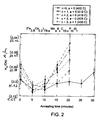
- inventive alloy 9 shows a good balance of magnetic properties and thermal stability as shown in Table 1. The inventive alloy 9 is stable for about 15 minutes as illustrated in graph of FIG. 2 .
- the ratios of the metalloid elements may be adjusted to optimize alloy properties, such as glass-forming ability and thermal stability. Substitution of B for C tends to increase the saturation magnetization (M s ), but tends to reduce the thermal stability. The significant effect of B is evidenced by change in coercivity with annealing time of the inventive alloys 5, 6, and 7 as shown in FIG. 2 .
- the alloy may or may not include B.
- the amount of B (c) is less than the amount of C (d).
- the addition of P tended to have a significant effect on the thermal stability of the alloy.
- the alloys with higher amount of P (b) are thermally stable for longer times.
- the addition of P promotes a large number of stable and metastable phases, which tend to retard the crystallization kinetics.
- the amount of P (b) is at least about 10 atomic percent.
- the amount of P (b) and amount of C (d) can be selected to provide a desired level of the metalloid elements.
- the combined amount of P and C, (b+d) is at least about 15 atomic percent.
- (b+d) varies from about 15 atomic percent to about 20 atomic percent.
- the ratio of the amount of P and the amount of C (b:d) can be helpful to balance magnetic properties and thermal stability.
- the ratio (b:d) varies from about 8:12 to about 12:8.
- the ratio (b:d) is 1:1.
- the inventive alloys 1, 2, 3, 4 having the ratio b:d of 10:10 exhibit a good balance of saturation magnetization and thermal stability as shown in Table 1 and FIG.
- comparative alloy 3 having the ratio of (b:d) of 4:14 showed lower saturation magnetization.
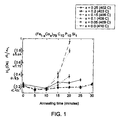
- a graph in FIG. 3 shows a comparative study of inventive alloy 3 and comparative alloy 3 with respect to their thermal stability. It is clear from the graph that change in coercivity of the comparative alloy 3 is relatively large on annealing even for 10 minutes and very large on annealing for about 15 minutes.
- the amount of Si (e) varies from about 0.1 to about 2.0 atomic percent. In certain embodiments, the amount of Si (e) varies from about 1.0 to about 1.5 atomic percent. Increasing the amount of Si (e) beyond about 1.5 atomic percent, the alloy shows further increase in the thermal stability but a decrease in the saturation magnetization as shown by inventive alloys 10 and 11 in Table 1.
- FIG. 5 illustrates a graph showing change in coercivity with annealing time of alloys ((Fe 0.8 Co 0.2 ) 80-e C 10 P 10 Si e ) with increasing amount of Si (e).
- comparative alloys 3 and 8 showed reduced thermal stability.
- the comparative alloy 3 is stable for less than about 10 minutes as evident from Table 1 and FIG. 3 .
- the amorphous magnetic alloys of the compositions described above have a very good balance of magnetic and thermal properties. Furthermore, it was observed from the above-discussed studies that crystallization kinetics is not coupled to the range of the supercooled liquid region of the alloy. For example, some of the comparative alloys have substantially similar large supercooled liquid regions ( ⁇ T x ) relative to those of the inventive alloys, while having crystallization times less than 10 minutes and thus exhibiting poor thermal stability as compared to the inventive alloys. On the other hand, some of the inventive alloys having a narrow supercooled liquid region exhibit very good thermal stability with increased crystallization time, relative to comparative alloys.
- Embodiments of the present invention provide an article including a magnetic component.
- the magnetic component is made of an amorphous magnetic alloy having the composition as described above.
- the amorphous magnetic alloy may be very suitable for magnetic components, such as a magnetic core, a magnetic head, a magnetic shield, an electromagnet, and the like.
- the magnetic component is a magnetic core.
- Various forms of the core include a ribbon or tape-wound core, a wire-wound core, or a powder core.
- a tape-wound core may be formed of an amorphous magnetic alloy ribbon or tape wrapped concentrically around a preform, such as a cylindrical bobbin.
- a wire wound core is formed of amorphous magnetic alloy wire wrapped around a preform.
- magnetic core refers to a piece of magnetic material with a high permeability used to confine and guide magnetic fields in electrical and electromechanical devices such as electromagnets, transformers, electric motors and inductors.
- the high permeability relative to the surrounding air, causes the magnetic field lines to be concentrated in the magnetic core.
- the magnetic field is, often, created by a coil around a core that carries a current.
- the presence of the core can increase the magnetic field of a coil by a factor of several thousand over what it would be without the core.
- each form of the magnetic component may be constructed in a variety of shapes selected from the group consisting of a toroidal core, a C-core, an E-core, a D-core, a pot core, a ring core, a planar core or a bar core.
- These magnetic components can be employed in a transformer, an inductor, a filter, a choke, a solenoid, a generator, a motor or a fluxgate.
- a method of making an article includes the steps of providing the amorphous magnetic alloy having the composition described previously, and processing the alloy within a supercooled liquid region of the alloy.
- the processing of the alloy may further include thermal treatment.
- providing the amorphous magnetic alloy includes forming the alloy by using a casting process.
- casting process include, but are not limited to, melt-spinning, melt extraction, injection casting, and die-casting.
- the amorphous magnetic alloy takes some time to crystallize. This "crystallization time” provides a time for processing the alloy to form desired geometrical shapes before magnetic properties of the alloy are degraded.
- thermo-mechanical techniques include forging, extruding, rolling, hot pressing, swaging, drawing and powder compaction.
- Amorphous magnetic alloy samples were made by initially producing ingots of about 10 g by arc-melting a mixture of pre-alloyed Fe 3 P, Fe 3 B, Fe 3 C together with the other elements - Co, Mo and Si, in their elemental form under a Ti-gettered Ar atmosphere in a water-cooled copper crucible. Ribbon samples of different compositions were made by the melt-spinning technique under a partial He atmosphere. The tangential wheel speed was approximately 40 m/s and produced ribbons of approximately 20 ⁇ m in thickness.
- the amorphous nature of the melt-spun ribbons was confirmed by X-ray diffraction with Cu K ⁇ radiation.
- Thermal behavior of the samples was investigated in a differential scanning calorimeter at a constant heating rate of 10°C/s. Magnetic properties were characterized using a vibrating sample magnetometer (VSM). The VSM had a maximum applied field of 1.8T and field resolution of 0.796 A/m(0.01 Oe). Typically, a magnetic field of -0.03 T was sufficient to reach saturation magnetization for the samples investigated.
- Thermal stability was investigated by determining crystallization time for each sample by isothermally annealing the alloys within their respective supercooled liquid region, about 20 degrees Celsius below the measured crystallization temperature (T x ) for each composition. Annealing temperatures for the compositions are represented in the corresponding graphs in parentheses.
- the saturation magnetization of each of the alloy compositions is shown in Table 1. These alloys were annealed for about 30 minutes at a temperature within their respective supercooled liquid region, about 20 degrees Celsius below the measured crystallization temperature (T x ) for each composition.
- T x crystallization temperature
- Amorphous magnetic alloy according to the present invention having the composition (Fe 0.8 Co 0.2 ) 78 Mo 1 B 3 C 7 P 10 Si 1 was produced by the above described procedure.
- the saturation magnetization the alloy composition is shown in Table 1.
- This composition was annealed at about 430 degrees Celsius for about 20 minutes.
- the change in coercivity of the alloy during annealing is shown in FIG. 2 .
- the alloy composition was found to be thermally stable for about 15 minutes at 430 degrees Celsius which is within the supercooled liquid region, about 20 degrees Celsius below the measured crystallization temperature (T x ) for this amorphous magnetic alloy composition.
- the saturation magnetization of each of the alloy compositions is shown in Table 1.
- These alloys were annealed at a temperature within their respective supercooled liquid region about 20 degrees below the measured crystallization temperature (T x ) for each composition.
- T x The change in coercivity of the alloys during annealing is shown in FIG. 2 .
- the saturation magnetization of each of the alloy compositions is shown in Table 1.
- These alloys were annealed at a temperature within their respective supercooled liquid region about 20 degrees below the measured crystallization temperature (T x ) for each composition.
- the change in coercivity of the alloys during annealing is shown in FIG. 5 .
- These alloy compositions were found to be thermally stable for more than about 25 minutes.
- the amorphous magnetic alloys according to the present invention having the compositions (Fe 0.8 Co 0.2 ) 78.5 C 10 P 10 Si 1.5 and (Fe 0.75 Co 0.25 ) 78.5 C 10 P 10 Si 1.5 were produced by the above-described procedure.
- the saturation magnetization of each of the alloy composition is shown in Table 1. These alloys were annealed at a temperature within their respective supercooled liquid region about 20 degrees below the measured crystallization temperature (T x ) for each composition. These alloy compositions were found to be thermally stable for more than about 20 minutes.
Landscapes
- Engineering & Computer Science (AREA)
- Power Engineering (AREA)
- Chemical & Material Sciences (AREA)
- Manufacturing & Machinery (AREA)
- Materials Engineering (AREA)
- Mechanical Engineering (AREA)
- Metallurgy (AREA)
- Organic Chemistry (AREA)
- Physics & Mathematics (AREA)
- Electromagnetism (AREA)
- Dispersion Chemistry (AREA)
- Soft Magnetic Materials (AREA)
Claims (14)
- Amorphe magnetische Legierung der allgemeinen Formel:
(Fe1-xCox)nMoaPbBcCdSie,
worin n die Atomprozent von Eisen und Kobalt sind,
x der Bruchteil von n ist,
a, b, c, d und e die Atomprozent von Molybdän, Phosphor, Bor, Kohlenstoff bzw. Silicium sind,
wobei n, x, a, b, c, d und e durch folgende Beziehung definiert sind:76 ≤ n ≤ 850,05 < x ≤ 0,50,0 ≤ a ≤ 4; b ≥ 10;0 ≤ c < d und0,1 ≤ e ≤ 2. - Amorphe magnetische Legierung nach Anspruch 1, worin d mindestens 5 ist.
- Amorphe magnetische Legierung nach Anspruch 1 oder Anspruch 2, worin b und d durch folgende Beziehung definiert sind:

- Amorphe magnetische Legierung nach irgendeinem vorhergehenden Anspruch, worin x durch die folgende Beziehung definiert ist:

- Amorphe magnetische Legierung nach irgendeinem vorhergehenden Anspruch, worin a durch folgende Beziehung definiert ist:

- Amorphe magnetische Legierung nach irgendeinem vorhergehenden Anspruch, worin e durch folgende Beziehung definiert ist:

- Amorphe magnetische Legierung nach irgendeinem vorhergehenden Anspruch, worin die amorphe magnetische Legierung einen unterkühlten Flüssigkeitsbereich und eine Kristallisationszeit von mehr als 10 Minuten aufweist, wenn sie bis auf eine Temperatur innerhalb des unterkühlten Flüssigkeitsbereiches erhitzt wird.
- Amorphe magnetische Legierung nach irgendeinem vorhergehenden Anspruch, worin die amorphe magnetische Legierung einen unterkühlten Flüssigkeitsbereich und eine Kristallisationszeit von mehr als 20 Minuten aufweist, wenn sie bis auf eine Temperatur innerhalb des unterkühlten Flüssigkeitsbereiches erhitzt wird.
- Gegenstand, umfassend eine magnetische Komponente, hergestellt aus einer amorphen magnetischen Legierung der allgemeinen Formel:
(Fe1-xCox)n MoaPbBcCdSie,
worin n die Atomprozent von Eisen und Kobalt sind,
x der Bruchteil von n ist,
a, b, c, d und e die Atomprozent von Molybdän, Phosphor, Bor, Kohlenstoff bzw. Silicium sind,
wobei n, x, a, b, c, d und e durch folgende Beziehung definiert sind:76 ≤ n ≤ 850,05 < x ≤ 0,50,0 ≤ a ≤ 4; b ≥ 10;0 ≤ c < d und0,1 ≤ e ≤ 2. - Gegenstand nach Anspruch 9, worin die magnetische Komponente in der Form eines bandgewickelten Kerns, eines drahtgewickelten Kerns oder eines Pulverkerns vorliegt.
- Gegenstand nach Anspruch 9 oder 10, worin die magnetische Komponente eine Gestalt aufweist, ausgewählt aus einem ringförmigen Kern, einem C-Kern, einem E-Kern, einem D-Kern, einem Topfkern, einem Ringkern, einem planaren Kern oder einem Stabkern.
- Gegenstand nach irgendeinem der Ansprüche 9 bis 11 in der Form eines Transformators, eines Induktors, eines Filters, einer Drossel, eines Solenoids, eines Generators, eines Motors oder eines Gaberelementes.
- Verfahren zum Herstellen eines Gegenstandes, umfassend die Stufen:Bereitstellen einer amorphen magnetischen Legierung der allgemeinen Formel: (Fe1-xCox) MoaPbBcCdSie, undBehandeln der Legierung innerhalb eines unterkühlten Flüssigkeitsbereiches der Legierung,worin n die Atomprozent von Eisen und Kobalt sind,x der Bruchteil von n ist,a, b, c, d und e die Atomprozent von Molybdän, Phosphor, Bor, Kohlenstoff bzw. Silicium sind,wobei n, x, a, b, c, d und e durch folgende Beziehung definiert sind:76 ≤ n ≤ 850,05 < x ≤ 0,50,0 ≤ a ≤ 4; b ≥ 10;0 ≤ c < d und0,1 ≤ e ≤ 2.
- Verfahren nach Anspruch 13, worin Techniken zum Behandeln Pulverprozess, thermomechanischen Prozess, Wärmebehandlung, Dampfabscheidungsprozess und eine Kombination davon einschließen.
Applications Claiming Priority (1)
| Application Number | Priority Date | Filing Date | Title |
|---|---|---|---|
| US12/609,391 US8313588B2 (en) | 2009-10-30 | 2009-10-30 | Amorphous magnetic alloys, associated articles and methods |
Publications (2)
| Publication Number | Publication Date |
|---|---|
| EP2320436A1 EP2320436A1 (de) | 2011-05-11 |
| EP2320436B1 true EP2320436B1 (de) | 2012-10-10 |
Family
ID=42831504
Family Applications (1)
| Application Number | Title | Priority Date | Filing Date |
|---|---|---|---|
| EP10173601A Active EP2320436B1 (de) | 2009-10-30 | 2010-08-20 | Amorphe magnetische Legierungen sowie zugehörige Artikel und Verfahren |
Country Status (4)
| Country | Link |
|---|---|
| US (1) | US8313588B2 (de) |
| EP (1) | EP2320436B1 (de) |
| JP (1) | JP5787499B2 (de) |
| CA (1) | CA2713518C (de) |
Families Citing this family (5)
| Publication number | Priority date | Publication date | Assignee | Title |
|---|---|---|---|---|
| WO2011016275A1 (ja) | 2009-08-07 | 2011-02-10 | アルプス・グリーンデバイス株式会社 | Fe基非晶質合金、及び前記Fe基非晶質合金を用いた圧粉コア、ならびにコイル封入圧粉コア |
| CN103981466B (zh) * | 2014-05-19 | 2016-08-31 | 辽宁科技大学 | 一种高耐蚀性铁基非晶合金材料 |
| JP7106919B2 (ja) * | 2018-03-23 | 2022-07-27 | Tdk株式会社 | 軟磁性薄膜、薄膜インダクタおよび磁性製品 |
| CN109652746A (zh) * | 2019-01-09 | 2019-04-19 | 王静然 | 一种非晶带材母合金及其制备方法 |
| EP4700497A1 (de) * | 2024-08-23 | 2026-02-25 | Rolex Sa | Verfahren zur herstellung einer uhrmacher-komponente |
Family Cites Families (10)
| Publication number | Priority date | Publication date | Assignee | Title |
|---|---|---|---|---|
| JPH09256122A (ja) * | 1996-03-19 | 1997-09-30 | Unitika Ltd | Fe系非晶質合金 |
| JP3929327B2 (ja) | 2002-03-01 | 2007-06-13 | 独立行政法人科学技術振興機構 | 軟磁性金属ガラス合金 |
| JP3560591B2 (ja) | 2002-04-10 | 2004-09-02 | 独立行政法人 科学技術振興機構 | 軟磁性Co基金属ガラス合金 |
| JP4562022B2 (ja) * | 2004-04-22 | 2010-10-13 | アルプス・グリーンデバイス株式会社 | 非晶質軟磁性合金粉末及びそれを用いた圧粉コアと電波吸収体 |
| JP4849545B2 (ja) * | 2006-02-02 | 2012-01-11 | Necトーキン株式会社 | 非晶質軟磁性合金、非晶質軟磁性合金部材、非晶質軟磁性合金薄帯、非晶質軟磁性合金粉末、及びそれを用いた磁芯ならびにインダクタンス部品 |
| JP4319206B2 (ja) | 2006-07-20 | 2009-08-26 | 独立行政法人科学技術振興機構 | 軟磁性Fe基金属ガラス合金 |
| CN101589169B (zh) * | 2007-02-28 | 2011-08-03 | 新日本制铁株式会社 | 软磁特性优异的Fe系非晶质合金 |
| KR101222127B1 (ko) * | 2007-02-28 | 2013-01-14 | 신닛테츠스미킨 카부시키카이샤 | 연자기 특성이 우수한 Fe계 비정질 합금 |
| JP5320764B2 (ja) | 2007-03-02 | 2013-10-23 | 新日鐵住金株式会社 | 軟磁気特性に優れたFe系非晶質合金 |
| CN101802240A (zh) * | 2007-09-18 | 2010-08-11 | Nec东金株式会社 | 软磁性非晶合金 |
-
2009
- 2009-10-30 US US12/609,391 patent/US8313588B2/en active Active
-
2010
- 2010-08-20 EP EP10173601A patent/EP2320436B1/de active Active
- 2010-08-23 JP JP2010185752A patent/JP5787499B2/ja active Active
- 2010-08-26 CA CA2713518A patent/CA2713518C/en not_active Expired - Fee Related
Also Published As
| Publication number | Publication date |
|---|---|
| CA2713518A1 (en) | 2011-04-30 |
| JP2011094229A (ja) | 2011-05-12 |
| US20120067468A1 (en) | 2012-03-22 |
| US8313588B2 (en) | 2012-11-20 |
| EP2320436A1 (de) | 2011-05-11 |
| CA2713518C (en) | 2017-01-10 |
| JP5787499B2 (ja) | 2015-09-30 |
Similar Documents
| Publication | Publication Date | Title |
|---|---|---|
| JP6849023B2 (ja) | ナノ結晶合金磁心の製造方法 | |
| JP4310480B2 (ja) | アモルファス合金組成物 | |
| US7935196B2 (en) | Soft magnetic ribbon, magnetic core, magnetic part and process for producing soft magnetic ribbon | |
| JP5316921B2 (ja) | Fe基軟磁性合金、およびこれを用いた磁性部品 | |
| JP5316920B2 (ja) | 軟磁性合金、アモルファス相を主相とする合金薄帯、および磁性部品 | |
| CN101351571B (zh) | 非晶合金薄带、纳米晶软磁合金以及由纳米晶软磁合金组成的磁芯 | |
| JP5339192B2 (ja) | 非晶質合金薄帯、ナノ結晶軟磁性合金、磁心、ならびにナノ結晶軟磁性合金の製造方法 | |
| JP5429613B2 (ja) | ナノ結晶軟磁性合金ならびに磁心 | |
| JP5916983B2 (ja) | 合金組成物、Fe基ナノ結晶合金及びその製造方法、並びに磁性部品 | |
| JP2007107095A (ja) | 磁性合金、アモルファス合金薄帯、および磁性部品 | |
| JP5445891B2 (ja) | 軟磁性薄帯、磁心、および磁性部品 | |
| EP2320436B1 (de) | Amorphe magnetische Legierungen sowie zugehörige Artikel und Verfahren | |
| JP2006040906A (ja) | 高透磁率かつ高飽和磁束密度の軟磁性成形体の製造方法 | |
| KR102231316B1 (ko) | Fe 기 합금 조성물, 연자성 재료, 자성 부재, 전기·전자 관련 부품 및 기기 | |
| JP5445924B2 (ja) | 軟磁性薄帯、磁心、磁性部品、および軟磁性薄帯の製造方法 | |
| JP2017078186A (ja) | 軟磁気特性に優れたFe系非晶質合金及びFe系非晶質合金薄帯 | |
| JP5069408B2 (ja) | 非晶質磁性合金 | |
| JP2016117929A (ja) | 軟磁気特性に優れたFe系非晶質合金及び非晶質合金薄帯 | |
| JP6443112B2 (ja) | 軟磁気特性に優れたFe系非晶質合金及び非晶質合金薄帯 | |
| JPH05132744A (ja) | 高飽和磁束密度非晶質合金薄帯および非晶質合金鉄心の製造方法 | |
| JP2008150637A (ja) | 磁性合金、アモルファス合金薄帯、および磁性部品 |
Legal Events
| Date | Code | Title | Description |
|---|---|---|---|
| PUAI | Public reference made under article 153(3) epc to a published international application that has entered the european phase |
Free format text: ORIGINAL CODE: 0009012 |
|
| AK | Designated contracting states |
Kind code of ref document: A1 Designated state(s): AL AT BE BG CH CY CZ DE DK EE ES FI FR GB GR HR HU IE IS IT LI LT LU LV MC MK MT NL NO PL PT RO SE SI SK SM TR |
|
| AX | Request for extension of the european patent |
Extension state: BA ME RS |
|
| 17P | Request for examination filed |
Effective date: 20111111 |
|
| GRAP | Despatch of communication of intention to grant a patent |
Free format text: ORIGINAL CODE: EPIDOSNIGR1 |
|
| RIC1 | Information provided on ipc code assigned before grant |
Ipc: H01F 41/02 20060101ALI20120314BHEP Ipc: H01F 1/153 20060101AFI20120314BHEP Ipc: C22C 45/02 20060101ALI20120314BHEP |
|
| GRAS | Grant fee paid |
Free format text: ORIGINAL CODE: EPIDOSNIGR3 |
|
| GRAA | (expected) grant |
Free format text: ORIGINAL CODE: 0009210 |
|
| AK | Designated contracting states |
Kind code of ref document: B1 Designated state(s): AL AT BE BG CH CY CZ DE DK EE ES FI FR GB GR HR HU IE IS IT LI LT LU LV MC MK MT NL NO PL PT RO SE SI SK SM TR |
|
| REG | Reference to a national code |
Ref country code: GB Ref legal event code: FG4D |
|
| REG | Reference to a national code |
Ref country code: AT Ref legal event code: REF Ref document number: 579285 Country of ref document: AT Kind code of ref document: T Effective date: 20121015 Ref country code: CH Ref legal event code: EP |
|
| REG | Reference to a national code |
Ref country code: IE Ref legal event code: FG4D |
|
| REG | Reference to a national code |
Ref country code: DE Ref legal event code: R096 Ref document number: 602010003136 Country of ref document: DE Effective date: 20121206 |
|
| PG25 | Lapsed in a contracting state [announced via postgrant information from national office to epo] |
Ref country code: SI Free format text: LAPSE BECAUSE OF FAILURE TO SUBMIT A TRANSLATION OF THE DESCRIPTION OR TO PAY THE FEE WITHIN THE PRESCRIBED TIME-LIMIT Effective date: 20121010 |
|
| REG | Reference to a national code |
Ref country code: NL Ref legal event code: VDEP Effective date: 20121010 |
|
| REG | Reference to a national code |
Ref country code: AT Ref legal event code: MK05 Ref document number: 579285 Country of ref document: AT Kind code of ref document: T Effective date: 20121010 |
|
| REG | Reference to a national code |
Ref country code: LT Ref legal event code: MG4D |
|
| PG25 | Lapsed in a contracting state [announced via postgrant information from national office to epo] |
Ref country code: NO Free format text: LAPSE BECAUSE OF FAILURE TO SUBMIT A TRANSLATION OF THE DESCRIPTION OR TO PAY THE FEE WITHIN THE PRESCRIBED TIME-LIMIT Effective date: 20130110 Ref country code: IS Free format text: LAPSE BECAUSE OF FAILURE TO SUBMIT A TRANSLATION OF THE DESCRIPTION OR TO PAY THE FEE WITHIN THE PRESCRIBED TIME-LIMIT Effective date: 20130210 Ref country code: ES Free format text: LAPSE BECAUSE OF FAILURE TO SUBMIT A TRANSLATION OF THE DESCRIPTION OR TO PAY THE FEE WITHIN THE PRESCRIBED TIME-LIMIT Effective date: 20130121 Ref country code: NL Free format text: LAPSE BECAUSE OF FAILURE TO SUBMIT A TRANSLATION OF THE DESCRIPTION OR TO PAY THE FEE WITHIN THE PRESCRIBED TIME-LIMIT Effective date: 20121010 Ref country code: FI Free format text: LAPSE BECAUSE OF FAILURE TO SUBMIT A TRANSLATION OF THE DESCRIPTION OR TO PAY THE FEE WITHIN THE PRESCRIBED TIME-LIMIT Effective date: 20121010 Ref country code: HR Free format text: LAPSE BECAUSE OF FAILURE TO SUBMIT A TRANSLATION OF THE DESCRIPTION OR TO PAY THE FEE WITHIN THE PRESCRIBED TIME-LIMIT Effective date: 20121010 Ref country code: LT Free format text: LAPSE BECAUSE OF FAILURE TO SUBMIT A TRANSLATION OF THE DESCRIPTION OR TO PAY THE FEE WITHIN THE PRESCRIBED TIME-LIMIT Effective date: 20121010 Ref country code: SE Free format text: LAPSE BECAUSE OF FAILURE TO SUBMIT A TRANSLATION OF THE DESCRIPTION OR TO PAY THE FEE WITHIN THE PRESCRIBED TIME-LIMIT Effective date: 20121010 |
|
| PG25 | Lapsed in a contracting state [announced via postgrant information from national office to epo] |
Ref country code: BE Free format text: LAPSE BECAUSE OF FAILURE TO SUBMIT A TRANSLATION OF THE DESCRIPTION OR TO PAY THE FEE WITHIN THE PRESCRIBED TIME-LIMIT Effective date: 20121010 Ref country code: PL Free format text: LAPSE BECAUSE OF FAILURE TO SUBMIT A TRANSLATION OF THE DESCRIPTION OR TO PAY THE FEE WITHIN THE PRESCRIBED TIME-LIMIT Effective date: 20121010 Ref country code: GR Free format text: LAPSE BECAUSE OF FAILURE TO SUBMIT A TRANSLATION OF THE DESCRIPTION OR TO PAY THE FEE WITHIN THE PRESCRIBED TIME-LIMIT Effective date: 20130111 Ref country code: PT Free format text: LAPSE BECAUSE OF FAILURE TO SUBMIT A TRANSLATION OF THE DESCRIPTION OR TO PAY THE FEE WITHIN THE PRESCRIBED TIME-LIMIT Effective date: 20130211 Ref country code: LV Free format text: LAPSE BECAUSE OF FAILURE TO SUBMIT A TRANSLATION OF THE DESCRIPTION OR TO PAY THE FEE WITHIN THE PRESCRIBED TIME-LIMIT Effective date: 20121010 |
|
| PG25 | Lapsed in a contracting state [announced via postgrant information from national office to epo] |
Ref country code: AT Free format text: LAPSE BECAUSE OF FAILURE TO SUBMIT A TRANSLATION OF THE DESCRIPTION OR TO PAY THE FEE WITHIN THE PRESCRIBED TIME-LIMIT Effective date: 20121010 |
|
| PG25 | Lapsed in a contracting state [announced via postgrant information from national office to epo] |
Ref country code: BG Free format text: LAPSE BECAUSE OF FAILURE TO SUBMIT A TRANSLATION OF THE DESCRIPTION OR TO PAY THE FEE WITHIN THE PRESCRIBED TIME-LIMIT Effective date: 20130110 Ref country code: CZ Free format text: LAPSE BECAUSE OF FAILURE TO SUBMIT A TRANSLATION OF THE DESCRIPTION OR TO PAY THE FEE WITHIN THE PRESCRIBED TIME-LIMIT Effective date: 20121010 Ref country code: EE Free format text: LAPSE BECAUSE OF FAILURE TO SUBMIT A TRANSLATION OF THE DESCRIPTION OR TO PAY THE FEE WITHIN THE PRESCRIBED TIME-LIMIT Effective date: 20121010 Ref country code: DK Free format text: LAPSE BECAUSE OF FAILURE TO SUBMIT A TRANSLATION OF THE DESCRIPTION OR TO PAY THE FEE WITHIN THE PRESCRIBED TIME-LIMIT Effective date: 20121010 Ref country code: SK Free format text: LAPSE BECAUSE OF FAILURE TO SUBMIT A TRANSLATION OF THE DESCRIPTION OR TO PAY THE FEE WITHIN THE PRESCRIBED TIME-LIMIT Effective date: 20121010 |
|
| PLBE | No opposition filed within time limit |
Free format text: ORIGINAL CODE: 0009261 |
|
| STAA | Information on the status of an ep patent application or granted ep patent |
Free format text: STATUS: NO OPPOSITION FILED WITHIN TIME LIMIT |
|
| PG25 | Lapsed in a contracting state [announced via postgrant information from national office to epo] |
Ref country code: RO Free format text: LAPSE BECAUSE OF FAILURE TO SUBMIT A TRANSLATION OF THE DESCRIPTION OR TO PAY THE FEE WITHIN THE PRESCRIBED TIME-LIMIT Effective date: 20121010 Ref country code: IT Free format text: LAPSE BECAUSE OF FAILURE TO SUBMIT A TRANSLATION OF THE DESCRIPTION OR TO PAY THE FEE WITHIN THE PRESCRIBED TIME-LIMIT Effective date: 20121010 |
|
| 26N | No opposition filed |
Effective date: 20130711 |
|
| REG | Reference to a national code |
Ref country code: DE Ref legal event code: R097 Ref document number: 602010003136 Country of ref document: DE Effective date: 20130711 |
|
| PG25 | Lapsed in a contracting state [announced via postgrant information from national office to epo] |
Ref country code: CY Free format text: LAPSE BECAUSE OF FAILURE TO SUBMIT A TRANSLATION OF THE DESCRIPTION OR TO PAY THE FEE WITHIN THE PRESCRIBED TIME-LIMIT Effective date: 20121010 |
|
| PG25 | Lapsed in a contracting state [announced via postgrant information from national office to epo] |
Ref country code: MC Free format text: LAPSE BECAUSE OF FAILURE TO SUBMIT A TRANSLATION OF THE DESCRIPTION OR TO PAY THE FEE WITHIN THE PRESCRIBED TIME-LIMIT Effective date: 20121010 |
|
| REG | Reference to a national code |
Ref country code: IE Ref legal event code: MM4A |
|
| PG25 | Lapsed in a contracting state [announced via postgrant information from national office to epo] |
Ref country code: IE Free format text: LAPSE BECAUSE OF NON-PAYMENT OF DUE FEES Effective date: 20130820 |
|
| REG | Reference to a national code |
Ref country code: CH Ref legal event code: PL |
|
| PG25 | Lapsed in a contracting state [announced via postgrant information from national office to epo] |
Ref country code: CH Free format text: LAPSE BECAUSE OF NON-PAYMENT OF DUE FEES Effective date: 20140831 Ref country code: LI Free format text: LAPSE BECAUSE OF NON-PAYMENT OF DUE FEES Effective date: 20140831 |
|
| PG25 | Lapsed in a contracting state [announced via postgrant information from national office to epo] |
Ref country code: SM Free format text: LAPSE BECAUSE OF FAILURE TO SUBMIT A TRANSLATION OF THE DESCRIPTION OR TO PAY THE FEE WITHIN THE PRESCRIBED TIME-LIMIT Effective date: 20121010 |
|
| PG25 | Lapsed in a contracting state [announced via postgrant information from national office to epo] |
Ref country code: TR Free format text: LAPSE BECAUSE OF FAILURE TO SUBMIT A TRANSLATION OF THE DESCRIPTION OR TO PAY THE FEE WITHIN THE PRESCRIBED TIME-LIMIT Effective date: 20121010 Ref country code: MT Free format text: LAPSE BECAUSE OF FAILURE TO SUBMIT A TRANSLATION OF THE DESCRIPTION OR TO PAY THE FEE WITHIN THE PRESCRIBED TIME-LIMIT Effective date: 20121010 |
|
| PG25 | Lapsed in a contracting state [announced via postgrant information from national office to epo] |
Ref country code: LU Free format text: LAPSE BECAUSE OF NON-PAYMENT OF DUE FEES Effective date: 20130820 Ref country code: HU Free format text: LAPSE BECAUSE OF FAILURE TO SUBMIT A TRANSLATION OF THE DESCRIPTION OR TO PAY THE FEE WITHIN THE PRESCRIBED TIME-LIMIT; INVALID AB INITIO Effective date: 20100820 Ref country code: MK Free format text: LAPSE BECAUSE OF FAILURE TO SUBMIT A TRANSLATION OF THE DESCRIPTION OR TO PAY THE FEE WITHIN THE PRESCRIBED TIME-LIMIT Effective date: 20121010 |
|
| REG | Reference to a national code |
Ref country code: FR Ref legal event code: PLFP Year of fee payment: 7 |
|
| REG | Reference to a national code |
Ref country code: FR Ref legal event code: PLFP Year of fee payment: 8 |
|
| REG | Reference to a national code |
Ref country code: FR Ref legal event code: PLFP Year of fee payment: 9 |
|
| PG25 | Lapsed in a contracting state [announced via postgrant information from national office to epo] |
Ref country code: AL Free format text: LAPSE BECAUSE OF FAILURE TO SUBMIT A TRANSLATION OF THE DESCRIPTION OR TO PAY THE FEE WITHIN THE PRESCRIBED TIME-LIMIT Effective date: 20121010 |
|
| P01 | Opt-out of the competence of the unified patent court (upc) registered |
Effective date: 20230609 |
|
| PGFP | Annual fee paid to national office [announced via postgrant information from national office to epo] |
Ref country code: DE Payment date: 20250724 Year of fee payment: 16 |
|
| PGFP | Annual fee paid to national office [announced via postgrant information from national office to epo] |
Ref country code: GB Payment date: 20250725 Year of fee payment: 16 |
|
| PGFP | Annual fee paid to national office [announced via postgrant information from national office to epo] |
Ref country code: FR Payment date: 20250725 Year of fee payment: 16 |