EP2321323B1 - Dimere artemisininderivate und ihre anwendung in der krebstherapie - Google Patents
Dimere artemisininderivate und ihre anwendung in der krebstherapie Download PDFInfo
- Publication number
- EP2321323B1 EP2321323B1 EP09802516.6A EP09802516A EP2321323B1 EP 2321323 B1 EP2321323 B1 EP 2321323B1 EP 09802516 A EP09802516 A EP 09802516A EP 2321323 B1 EP2321323 B1 EP 2321323B1
- Authority
- EP
- European Patent Office
- Prior art keywords
- alkyl
- group
- compound
- representing
- mmol
- Prior art date
- Legal status (The legal status is an assumption and is not a legal conclusion. Google has not performed a legal analysis and makes no representation as to the accuracy of the status listed.)
- Not-in-force
Links
- 0 C[C@](CC[C@]1[C@]([C@@](C)(*)OCC[n]2nnc(COCC([C@](CCC3)C4C3CCC(C)(OO)OC4)=C(C(F)(F)F)[O-])c2)N)C(CC[C@](C)OC2)[C@@]12OO Chemical compound C[C@](CC[C@]1[C@]([C@@](C)(*)OCC[n]2nnc(COCC([C@](CCC3)C4C3CCC(C)(OO)OC4)=C(C(F)(F)F)[O-])c2)N)C(CC[C@](C)OC2)[C@@]12OO 0.000 description 9
- RGNKARUQOGWXKH-BECOIOCFSA-N CC[C@@H](CCC1[C@H](C)CC[C@]2([C@H](C(C3)CC3C(F)(F)F)C#N)N)OC[C@@]12OO Chemical compound CC[C@@H](CCC1[C@H](C)CC[C@]2([C@H](C(C3)CC3C(F)(F)F)C#N)N)OC[C@@]12OO RGNKARUQOGWXKH-BECOIOCFSA-N 0.000 description 1
- RRSXFJASFHFOAY-BALTUNLNSA-N C[C@@H](C(O)OCCC(CC[O]=C)/C=C/CC=C=S)[C@](C)(CC[C@@H](C)C1CCC(C)OC2)[C@]12O[O]=C Chemical compound C[C@@H](C(O)OCCC(CC[O]=C)/C=C/CC=C=S)[C@](C)(CC[C@@H](C)C1CCC(C)OC2)[C@]12O[O]=C RRSXFJASFHFOAY-BALTUNLNSA-N 0.000 description 1
- VWJPPCOUPOJJIP-BJRPYKNLSA-N C[C@H](CC[C@H]1C(COCc2nc(CO)ccc2)=C(C(F)(F)F)O2)C(CC3)C1[C@H]2O[C@]3(C)OO Chemical compound C[C@H](CC[C@H]1C(COCc2nc(CO)ccc2)=C(C(F)(F)F)O2)C(CC3)C1[C@H]2O[C@]3(C)OO VWJPPCOUPOJJIP-BJRPYKNLSA-N 0.000 description 1
- KOANZEQTPNAHGN-XNQWLXPHSA-N C[C@H](CC[C@H]1C([C@@](CC(F)(F)F)(N)[O-2])C#N)C(CCC(C)[C@H](C)OC2)[C@@]12OO Chemical compound C[C@H](CC[C@H]1C([C@@](CC(F)(F)F)(N)[O-2])C#N)C(CCC(C)[C@H](C)OC2)[C@@]12OO KOANZEQTPNAHGN-XNQWLXPHSA-N 0.000 description 1
- MUBLNZJBMSEJRJ-KMOHPZDZSA-N C[C@H](CC[C@H]1[C@H]([C@@](C(F)(F)F)(OCC[n]2nncc2COCC([C@@H]2CC3)=C(C(F)(F)F)O[C@@H]4OC(CI)(CC5)OO[C@]24C5[C@@H]3C#N)O2)[ClH]I)C3[C@]1(C1O)[C@]21O[C@@H](C)CC3 Chemical compound C[C@H](CC[C@H]1[C@H]([C@@](C(F)(F)F)(OCC[n]2nncc2COCC([C@@H]2CC3)=C(C(F)(F)F)O[C@@H]4OC(CI)(CC5)OO[C@]24C5[C@@H]3C#N)O2)[ClH]I)C3[C@]1(C1O)[C@]21O[C@@H](C)CC3 MUBLNZJBMSEJRJ-KMOHPZDZSA-N 0.000 description 1
- NNGACZQBCDSXTG-OKRCBVLTSA-N C[C@H](CC[C@H]1[C@H]2C)C(CC3)[C@@]11OO[C@@]3(C)O[C@H]1O[C@]2(C(F)(F)F)OCC#CC(C1=C(C(F)(F)F)O[C@@H]2O[C@@](C)(CC3)OO[C@@]22C3[C@H](C)CC[C@@H]12)N=O Chemical compound C[C@H](CC[C@H]1[C@H]2C)C(CC3)[C@@]11OO[C@@]3(C)O[C@H]1O[C@]2(C(F)(F)F)OCC#CC(C1=C(C(F)(F)F)O[C@@H]2O[C@@](C)(CC3)OO[C@@]22C3[C@H](C)CC[C@@H]12)N=O NNGACZQBCDSXTG-OKRCBVLTSA-N 0.000 description 1
- NKRMZBVLPHLEFN-MLTCWCDCSA-N C[C@H]([C@H](CC[C@@H](C)C1CC[C@H](C)OC2)[C@]12OO)[C@](C(F)(F)F)([O-])OCCCCOCC([C@H](CC[C@@H](C)C1CC2)[C@]11OO3)=C(C(F)(F)F)O[C@@H]1OC23[ClH]C Chemical compound C[C@H]([C@H](CC[C@@H](C)C1CC[C@H](C)OC2)[C@]12OO)[C@](C(F)(F)F)([O-])OCCCCOCC([C@H](CC[C@@H](C)C1CC2)[C@]11OO3)=C(C(F)(F)F)O[C@@H]1OC23[ClH]C NKRMZBVLPHLEFN-MLTCWCDCSA-N 0.000 description 1
- WFCSWCVEJLETKA-UHFFFAOYSA-N OCCN1CCNCC1 Chemical compound OCCN1CCNCC1 WFCSWCVEJLETKA-UHFFFAOYSA-N 0.000 description 1
Classifications
-
- C—CHEMISTRY; METALLURGY
- C07—ORGANIC CHEMISTRY
- C07D—HETEROCYCLIC COMPOUNDS
- C07D493/00—Heterocyclic compounds containing oxygen atoms as the only ring hetero atoms in the condensed system
- C07D493/12—Heterocyclic compounds containing oxygen atoms as the only ring hetero atoms in the condensed system in which the condensed system contains three hetero rings
- C07D493/18—Bridged systems
-
- A—HUMAN NECESSITIES
- A61—MEDICAL OR VETERINARY SCIENCE; HYGIENE
- A61P—SPECIFIC THERAPEUTIC ACTIVITY OF CHEMICAL COMPOUNDS OR MEDICINAL PREPARATIONS
- A61P35/00—Antineoplastic agents
-
- C—CHEMISTRY; METALLURGY
- C07—ORGANIC CHEMISTRY
- C07D—HETEROCYCLIC COMPOUNDS
- C07D519/00—Heterocyclic compounds containing more than one system of two or more relevant hetero rings condensed among themselves or condensed with a common carbocyclic ring system not provided for in groups C07D453/00 or C07D455/00
Definitions
- the present invention relates to dimeric derivatives of 10-trifluoromethylartemisinin connected on the one hand by a carbon in position 10 and on the other hand by a carbon in position 16, as well as their use in the treatment against cancer.
- dimers at C-10 that is, bound by their carbon at the 10-position, of dihydroartemisinin ether derivatives [ Bioorg. Med. Chem., 5, 1257-65, (1997) )] or metabolically more stable non-ketal analogues, where the exocyclic oxygen of the ketal function has been replaced by a CH 2 group (group X in the diagram below) [ J. Med. Chem., 42, 4275-80, (1999) )].
- Dimers at C-16 have also been described [ J. Med. Chem., 44, 4688-95, (2001) )].
- Artemisinin and its derivatives such as arteemether or sodium artesunate, for the most known, are widely used in the treatment of malaria.
- the main limitation of these derivatives lies in the low bioavailability of the artemisinin nucleus, whose ketal function is rapidly hydrolysed in the body, thus leading to inactive metabolites [ J. Med. Chem., 47, 2945-64, (2004) )].
- the present invention relates more specifically to 10-trifluoromethylartemisinin dimers bound in the C10 position on one nucleus and C16 on the other nucleus, compounds which exhibit a better cytotoxicity than that of the dimers bound by their C16 carbon atoms as described in FR 07/60266 .
- the present invention also relates to 10-trifluoromethylartemisinin dimers in which only one of the endoperoxidic bridges is reduced in ether bridge, either on the C10 side or on the C16 side.
- the "mono-endoperoxide” type dimers retain remarkable cytotoxic properties, and more particularly the dimers in which the endoperoxide side C16 bridge has been reduced.
- the dimeric derivatives of the present invention thus have the advantages of the fluorinated monomers mentioned above while having good antitumor properties.
- the term "pharmaceutically acceptable” means that which is useful in the preparation of a pharmaceutical composition which is generally safe, non-toxic and neither biologically nor otherwise undesirable and which is acceptable for veterinary as well as pharmaceutical use. human.
- halogen refers to fluorine, bromine, chlorine or iodine. Preferably, it is a fluorine, a bromine or a chlorine, and more preferably a fluorine.
- (C 1 -C 6 ) alkyl group is meant, in the sense of the present invention, a saturated hydrocarbon chain, linear or branched, having from 1 to 6 carbon atoms, such as for example a methyl, ethyl, propyl, isopropyl, butyl, tert- butyl, pentyl or hexyl.
- this chain will be monovalent or bivalent.
- n represents an integer between 1 and 6, preferably equal to 1,2,3 or 4 .
- (C 2 -C 6 ) alkynyl group means a linear or branched unsaturated hydrocarbon-based chain containing from 1 to 6 carbon atoms and comprising at least one triple bond, and advantageously only one. These include an ethynyl or propynyl group. Depending on the case, this chain will be monovalent or bivalent. In the case of a bivalent chain, it will advantageously be a linear chain such as a chain of formula -CH 2 -C ⁇ C-.
- polyamino group is meant, in the sense of the present invention, a linear hydrocarbon chain comprising from 6 to 20 carbon atoms, and at least two of which are replaced by nitrogen atoms, two atoms. nitrogen can not be found on adjacent positions.
- Said polyamino group may respond in particular to the following formula: - [(CH 2 ) a -NH] d - [(CH 2 ) b -NH- (CH 2 ) c -NH] e -H with a, b and c representing, independently of each other, an integer from 1 to 5 and d and e each representing 0 or 1
- a spermidine chain that is to say of formula - (CH 2 ) 4 -NH- (CH 2 ) 3 -NH 2 or - (CH 2 ) 3 may be mentioned.
- -NH- (CH 2 ) 4 -NH 2 a spermine chain of formula - (CH 2 ) 3 -NH- (CH 2 ) 4 -NH- (CH 2 ) 3 -NH 2 or a chain of formula - (CH 2 ) 4 -NH- (CH 2 ) 4 -NH- (CH 2 ) 4 -NH 2 .
- This polyamino group may be optionally substituted, more particularly on the nitrogen atoms, in particular by an N-protecting group such as (C 1 -C 6 ) alkyl, (C 2 -C 6 ) alkenyl, -CO- (C 1 -C 6 ) alkyl, -CO- (C 2 -C 6 ) alkenyl, -CO 2 - (C 1 -C 6 ) alkyl or -CO 2 - (C 2 -C 6 ) alkenyl.
- an N-protecting group such as (C 1 -C 6 ) alkyl, (C 2 -C 6 ) alkenyl, -CO- (C 1 -C 6 ) alkyl, -CO- (C 2 -C 6 ) alkenyl, -CO 2 - (C 1 -C 6 ) alkyl or -CO 2 - (C 2 -C 6 ) alkenyl.
- Said optionally substituted polyamine group may then meet the following general formula: - [(CH 2 ) a -NA 1 ] d - [(CH 2 ) b -NA 2 - (CH 2 ) c -NA 3 ] e -H, with a, b, c, d and e as defined above and A 1 , A 2 and A 3 , different or preferably identical, representing a hydrogen atom or an N-protecting group such that (C 1 - C 6 ) alkyl, (C 2 -C 6 ) alkenyl, -CO- (C 1 -C 6 ) alkyl, -CO- (C 2 -C 6 ) alkenyl, -CO 2 - (C 1 -C 6 ) alkyl or -CO 2 - (C 2 -C 6 ) alkenyl.
- protecting group is intended to denote a group that selectively blocks a reactive site in a multifunctional compound so that a chemical reaction can be selectively carried out at another site.
- unprotected reagent in the meaning conventionally associated with it in synthetic chemistry.
- N-protecting group is intended to mean any substituent which protects the NH or NH 2 group against undesirable reactions such as the N-protecting groups described in Greene, "Protective Groups In Organic Synthesis", (John Wiley & Sons, New York (1981 )) and Harrison et al. Compendium of Synthetic Organic Methods, Vols. 1 to 8 (J. Wiley & sons, 1971 to 1996 ).
- N-protecting groups include carbamates (such as -CO 2 - (C 1 -C 6 ) alkyl or -CO 2 - (C 2 -C 6 ) alkenyl), amides (such as -CO- (C 1 - C 6 ) alkyl, -CO- (C 2 -C 6 ) alkenyl), N-alkylated or N-alkenyl derivatives, amino acetal derivatives, N-benzylated derivatives, imine derivatives, enamine derivatives and N-derivatives -hcherroatome.
- carbamates such as -CO 2 - (C 1 -C 6 ) alkyl or -CO 2 - (C 2 -C 6 ) alkenyl
- amides such as -CO- (C 1 - C 6 ) alkyl, -CO- (C 2 -C 6 ) alkenyl
- N-alkylated or N-alkenyl derivatives amino
- the N-protecting group includes formyl, acetyl, benzoyl, pivaloyl, phenylsulfonyl, benzyl (Bn), t-butyloxycarbonyl (Boc), benzyloxycarbonyl (Cbz), p-methoxybenzyloxycarbonyl, p-nitrobenzyloxycarbonyl, trichloroethoxycarbonyl (TROC), allyloxycarbonyl (Alloc), 9-fluorenylmethyloxycarbonyl (Fmoc), trifluoroacetyl, benzyl carbamates (substituted or unsubstituted) and the like. It may be in particular a group Boc.
- (C 3 -C 8 ) -cycloalkyl group is intended to mean a saturated hydrocarbon ring group comprising from 3 to 8, preferably 5 or 6, carbon atoms, for example a grouping cyclopropyl, cyclohexyl, cyclopentyl, etc. Depending on the case, this cycle will be monovalent or bivalent.
- aryl group is intended to mean an aromatic group, preferably comprising from 5 to 10 carbon atoms and comprising one or more contiguous rings, preferably 1 or 2 and more preferably one single ring. as for example a phenyl or naphthyl group.
- phenyl is phenyl.
- this group will be monovalent or bivalent.
- This aryl group may be optionally substituted, in particular with one or more groups chosen from a halogen atom and a (C 1 -C 6 ) -alkyl group as defined above, -OR, -NRR 'and -SO 2 R with R and R 'denoting a hydrogen atom or a (C 1 -C 6 ) -alkyl group as defined above.
- heteroaryl ring group is meant, within the meaning of the present invention, any aryl group as defined above in which one or more carbon atoms have been replaced by one or more heteroatoms, advantageously 1 to 4, and even more advantageously 1 to 3, such as, for example, sulfur, nitrogen or oxygen atoms.
- heteroaryl groups are furyl, thienyl, pyrrolyl, pyridinyl, pyrimidinyl, pyrazolyl, imidazolyl, triazolyl, tetrazolyl or indyl groups.
- it is a pyridinyl or triazolyl group such as 1,2,3-triazolyl. Depending on the case, this group will be monovalent or bivalent.
- This heteroaryl group may be optionally substituted, in particular with one or more groups chosen from a halogen atom and a (C 1 -C 6 ) -alkyl group as defined above, -OR, -NRR 'and -SO 2 R with R and R 'denoting a hydrogen atom or a (C 1 -C 6 ) -alkyl group as defined above.
- heterocycle is intended to mean a saturated, unsaturated or aromatic cyclic hydrocarbon compound, unless otherwise stated, comprising one or more contiguous rings, preferably 1 or 2 and more preferably one ring, and comprising 5 to 10 ring atoms, of which one or more cyclic carbon atoms have been replaced by one or more heteroatoms, preferably 1 to 4 and even more preferably 1 to 3, such as, for example, sulfur, nitrogen or oxygen atoms.
- It may be in particular a morpholinyl, piperazinyl, piperidinyl, furyl, thienyl, pyrrolyl, tetrazolyl or triazolyl group.
- it is a piperazinyl or triazolyl group such as a 1,2,3-triazolyl. Depending on the case, this group will be monovalent or bivalent.
- the heterocycle is saturated, it is advantageously a piperidine, a morpholine or a piperazine.
- aryl- (C 1 -C 6) alkyl is understood within the meaning of the present invention, an aryl group as defined above bound to the molecule via a (C 1 - C 6 ) alkyl as defined above. It is in particular a benzyl group.
- heteroaryl- (C 1 -C 6) akyle is meant within the meaning of the present invention, a heteroaryl group as defined above bound to the molecule via a (C 1 - C 6 ) alkyl as defined above. It is in particular a benzyl group.
- heterocycle- (C 1 -C 6 ) alkyl group is meant, in the sense of the present invention, a heterocycle as defined above bonded to the molecule through a (C 1 -C 6) 6 ) alkyl as defined above. It is in particular a benzyl group.
- R1 represents a hydrogen atom, a (C 1 -C 6 ) alkyl, (C 2 -C 6 ) alkenyl, (C 2 -C 6 ) alkynyl group, (C 3 -C 8 ) cycloalkyl, aryl- (C 1 -C 6 ) alkyl, heteroaryl- (C 1 -C 6 ) alkyl, heterocycle- (C 1 -C 6 ) alkyl, optionally substituted aryl, optionally substituted heteroaryl, -COR 2 , -CO 2 R2, or -SO 2 R2, with R2 representing a hydrogen atom or a (C 1 -C 6 ) alkyl, (C 3 -C 8 ) cycloalkyl, aryl- (C 1 -C 6 ) group alkyl, heteroaryl- (C 1 -C 6 ) alkyl, optionally substituted aryl or optionally substituted heteroary
- R1 may in particular represent a hydrogen atom.
- R 1 represents a hydrogen atom, a (C 1 -C 6 ) alkyl, (C 2 -C 6 ) alkenyl group, -CH 2 C (O) OR 2 or -CH 2 C (O) NR 2 R 2bis, with R 2 as defined above and advantageously representing a hydrogen atom or an optionally substituted polyamino group, and R2bis as defined above and advantageously representing a hydrogen atom.
- the carbon atom of these two groups is bonded to the artemisinin nucleus while the group Y is bonded to the group X in the formula General (I).
- R 1 and R 3 may more particularly each represent a hydrogen atom.
- the heterocycle will in particular be a heterocycle comprising a single 5- or 6-membered ring.
- it will comprise one or more, preferably 1 to 4, nitrogen atoms, such as a piperazinyl or triazolyl group such as 1,2,3-triazolyl.
- B represents a group -CH 2 -Y- with Y as defined above and preferably representing O, NR 1 or a heterocycle, R 1 being as defined above.
- A represents an oxygen or nitrogen atom.
- the nitrogen atom will preferably be substituted by a hydrogen atom.
- A will represent an oxygen atom.
- X represents a double bond and X represents a (C 1 -C 6 ) alkyl, (C 2 -C 6 ) alkenyl, (C 2 -C 6 ) alkynyl group, (C 3 -C 8 ) cycloalkyl, or-X 1 -O-X 2 - with X 1 and X 2 as defined above.
- X may represent a (C 1 -C 6 ) alkyl, (C 2 -C 6 ) alkenyl, (C 2 -C 6 ) alkynyl or (C 3 -C 8 ) cycloalkyl group, and preferably (C 1 -C 6 ) alkyl.
- the heteroaryl group will then advantageously be a heteroaryl comprising a single 5- or 6-membered ring and advantageously comprising one or more, preferably 1 to 3, nitrogen atoms.
- the heteroaryl group will then advantageously a heteroaryl having a single 5- or 6-membered ring and advantageously comprising one or more, preferably 1 to 3, nitrogen atoms.
- the compounds of the invention of formula (I) may be chosen more particularly from the following compounds:
- the present invention also relates to a compound of formula (I) as defined above for its use as a medicament, in particular for the treatment of cancer.
- the invention also relates to the use of a compound of the invention for the manufacture of a medicament for the treatment of cancer.
- the invention also relates to a compound of formula I for use in a method for treating cancer, comprising administering an effective amount of at least one compound of formula (I) as defined above to a patient in need.
- the present invention also relates to a pharmaceutical composition
- a pharmaceutical composition comprising at least one compound according to the invention and at least one pharmaceutically acceptable vehicle.
- the compounds according to the invention can be administered orally, sublingually, parenterally, subcutaneously, intramuscularly, intravenously, transdermally, locally or rectally, and preferably orally, intravenously or subcutaneously.
- the active ingredient may be administered in unit dosage forms, in admixture with conventional pharmaceutical carriers, animals or humans.
- suitable unit dosage forms include oral forms such as tablets, capsules, powders, granules and oral solutions or suspensions, sublingual and oral forms of administration, parenteral forms of administration, -cutaneous, intramuscular, intravenous, intranasal or intraocular and forms of rectal administration.
- the main active ingredient is mixed with a pharmaceutical carrier such as gelatin, starch, lactose, magnesium stearate, talc, gum arabic or the like.
- a pharmaceutical carrier such as gelatin, starch, lactose, magnesium stearate, talc, gum arabic or the like.
- the tablets may be coated with sucrose or other suitable materials or may be treated so that they have prolonged or delayed activity and continuously release a predetermined amount of active ingredient
- a preparation in capsules is obtained by mixing the active ingredient with a diluent and pouring the resulting mixture into soft or hard gelatin capsules.
- a syrup or elixir preparation may contain the active ingredient together with a sweetener, an antiseptic, as well as a flavoring agent and a suitable colorant.
- Water-dispersible powders or granules may contain the active ingredient in admixture with dispersants or wetting agents, or suspending agents, as well as with taste correctors or sweeteners.
- suppositories are used which are prepared with binders melting at the rectal temperature, for example cocoa butter or polyethylene glycols.
- aqueous suspensions for parenteral, intranasal or intraocular administration, aqueous suspensions, isotonic saline solutions or sterile and injectable solutions containing dispersing agents and / or pharmacologically compatible wetting agents are used.
- the active ingredient may also be formulated as microcapsules, optionally with one or more additive carriers.
- the compounds of the invention can be used at doses of between 0.01 mg and 1000 mg per day, given in a single dose once a day or administered in several doses throughout the day, for example twice per day. day in equal doses.
- the dose administered per day is advantageously between 5 mg and 500 mg, more advantageously between 10 mg and 200 mg. It may be necessary to use doses out of these ranges which the skilled person can realize himself.
- this composition may also comprise at least one other active ingredient, advantageously chosen from anticancer agents.
- Anti-cancer agents that may be mentioned in a non-limiting manner include 6-mercaptopurine, fludarabine, cladribine, pentostatin, cytarabine, 5-fluorouracil, gemcitabine, methotrexate, raltitrexed, irinotecan, topotecan, etoposide, daunorubicin, doxorubicin, epirubicin, idarubicin, pirarubicin, mitoxantrone, chlormethine, cyclophosphamide, ifosfamide, melphalan, chlorambucil, busulfan, carmustine, fotemustine , streptozocin, carboplatin, cisplatin, oxaliplatin, procarbazine, dacarbazine, bleomycin, vinblastine, vincristine, vindesine, vinorelbine, paclitaxel, docetaxel, L-asparagina
- active principle there may be mentioned in particular, without limitation, 6-mercaptopurine, fludarabine, cladribine, pentostatin, cytarabine, 5-fluorouracil, gemcitabine, methotrexate, raltitrexed, irinotecan topotecan, etoposide, daunorubicin, doxorubicin, epirubicin, idarubicin, pirarubicin, mitoxantrone, chlormethine, cyclophosphamide, ifosfamide, melphalan, chlorambucil, busulfan, carmustine, fotemustine, streptozocin, carboplatin, cisplatin, oxaliplatin, procarbazine, dacarbazine, bleomycin, vinblastine, vincristine, vindesine, vinorelbine, paclitaxel, docetaxel, L-asparaginase, flutamide
- the pharmaceutical composition as described above may be useful in particular for the treatment of cancer.
- the compounds of the invention may be prepared in particular from intermediates A , A 1 , B , C , D , E , F , G, G 1 and R described below.
- the compounds of the invention are obtained by coupling between the intermediate G , G 1 , or R and an intermediate A , A 1 , B , C , D , E or F , this coupling can be carried out in one or more steps.
- NMO N- methyl-morpholine oxide
- intermediate A (0.63 g, 2.5 mmol) in dimethylsulfoxide (DMSO) (10 mL) was added sodium azide (0.14 g, 2.25 mmol, 1.5 eq).
- DMSO dimethylsulfoxide
- the reaction mixture is stirred at room temperature for 1.5 hours. It is then poured into water and the extraction is carried out with ethyl acetate. The organic phase is dried over magnesium sulfate, filtered and the solvents are evaporated under reduced pressure.
- the intermediate azide E thus obtained (white powder, 0.56 g, 100%) is directly involved in the following reactions without an additional purification step.
- the intermediates A 1 and G 1 have a reduced endoperoxide bridge in the artemisinin nucleus.
- N-bromosuccinimide (290 mg, 1.62 mmol, 2 eq.).
- the reaction medium is refluxed instantly. After 1 h at this temperature, the reaction mixture is diluted with dichloromethane (5 mL), washed with saturated NaHCO 3 solution (2 ⁇ 5 mL) and then with saturated NaCl solution (5 mL). The organic phase is dried over MgSO 4 , filtered and concentrated under reduced pressure.
- the reaction crude is purified by chromatography on silica gel with a gradient of eluent (petroleum ether / diethyl ether: 100 to 90/10). Intermediate A 1 is obtained with 60% yield (186 mg).
- the subject of the present invention is thus a process for preparing a compound of formula (I) as defined above, characterized in that the compound of formula (I) is obtained by coupling of a compound of formula (II) ) next : for which a is as defined above and Z 1 represents a halogen atom, preferably a bromine atom, or a group -OH, -NH 2 or -NHR 1, R 1 being as defined above, preferably Z 1 representing a halogen atom or a group -OH or -NH 2 , with a compound of formula (III) below: for which b is as defined above and Z2 represents a group -CH 2 OH, -CHO, -COOH, -CH 2 N 3 , -CH 2 NH 2 or -CH 2 Hal, where Hal represents a halogen atom, preferably a bromine atom.
- the compound of formula (I) thus obtained may be separated from the reaction medium by methods well known to those skilled in the art, for example by extraction, evaporation of the solvent or by precipitation and filtration.
- the compound may be further purified if necessary by techniques well known to those skilled in the art, such as by recrystallization if the compound is crystalline, by distillation, by column chromatography on silica gel or by high performance liquid chromatography (HPLC ).
- the coupling may comprise one or more reaction steps carried out by techniques well known to those skilled in the art.
- the active function which will react in the coupling step will obviously be the intracyclic NH group.
- the heterocycle will preferably be 5- or 6-membered, such as morpholinyl, piperidinyl or piperazinyl.
- the compound of formula (I) is then obtained in two steps, on the one hand (1) by coupling of the Z1 function of the compound (II) with the Z3 function of the compound (IV), and on the other hand (2) by coupling the Z2 function of the compound (III) with the Z4 function of the compound (IV).
- the order of realization of these two steps (1) and (2) is indifferent, these two coupling steps being performed by techniques well known to those skilled in the art.
- the Z3 or Z4 function which must not react in the first step of the coupling, may be previously protected and deprotected once this step has been completed.
- a free NH 2 amine function is desired, it can be obtained from the halogenated derivative or an N 3 azide.
- An amine NH or NH 2 function may also be protected in the carbamate form, in particular by a Boc group.
- a halogen atom can be obtained by halogenation of an OH group (for example in the presence of N-bromosuccinimide to obtain a bromine atom).
- the compound of formula (IV) may be either commercial or prepared by methods well known to those skilled in the art.
- Z 3 represents a halogen atom, a heterocycle or a group -OH, -NHR 1, -SH or -N 3 , which makes it possible to access compounds of formula (I) for which represents a single link.
- This first particular embodiment of preparation of the compounds of the invention is illustrated in particular with the synthesis of compounds 1, 2, 3, 4, 10, 11, 12, 13, 14, 16, 17, 18, 19, 20, 22, 23, 24, 25, 26 and 29.
- acid hydrogen atom means a hydrogen atom that can be displaced by a base.
- acidic hydrogen atom can be in particular an acetylenic hydrogen atom.
- the active function which will react in the coupling step will obviously be the intracyclic NH group.
- the heterocycle will preferably be 5- or 6-membered, such as morpholinyl, piperidinyl or piperazinyl.
- organometallic base such as an alkylithium (as n-Bu-Li) or an alkyl magnesium bromide or chloride.
- a halogen-metal exchange can give access to the desired compound (VII) by reacting the compound (VI) with a metal such as lithium or magnesium.
- the compound of formula (V) may be either commercial or prepared by methods well known to those skilled in the art.
- Z5 represents a halogen atom, a heterocycle or a group -OH, -NHR1, -SH or -N 3 , which makes it possible to access compounds of formula (I) for which represents a single link.
- Z5 preferably represents a -OH, -NHR1 or -SH group and Z1 represents a halogen atom such as a bromine atom.
- the coupling is carried out by cross-metathesis of the alkenes or alkynes as illustrated with the preparation of the compounds 8 and 21.
- one or more preliminary steps will have to be carried out to introduce a bearing group. a double or a triple terminal bond instead of the groups Z1 and Z2 of the compounds (II) and (III).
- additional functionalization steps may be performed, including steps of functionalization of the double or triple bond formed during metathesis (see Examples 27 and 28).
- This reaction is conducted in the presence of a metathesis catalyst, such as Grubb catalyst 1 st or 2 nd generation.
- a metathesis catalyst such as Grubb catalyst 1 st or 2 nd generation.
- Compound (VIII) may be prepared by reaction of a compound of formula (II), for which Z1 preferably represents a halogen atom, with a compound of formula Z7- (CH 2 ) y -R, where Z7 and are as defined above and R represents an OH, NHR1 or SH group, R1 being as defined above.
- Compound (IX) may be prepared by reaction of a compound of formula (III), for which Z2 is preferably a halogen atom, with a compound of formula Z7- (CH 2 ) z -R ', where Z7 and z are as defined above and R 'represents an OH, NHR1 or SH group, R1 being as defined above.
- the coupling is carried out by a [4 + 2] or [3 + 2] cycloaddition reaction, as illustrated with the preparation of compounds 5, 6 and 7.
- suitable groups instead of the groups Z1 and Z2 of the compounds (II) and (III), such as an alkene or an alkyne for one of the two groups and a diene or a dipole 1,3 such than one group N 3 for the other grouping.
- this reaction is carried out in the presence of NaH as a base, especially in the presence of KI.
- Intermediate H 2 obtained with a yield of 71% in the form of a white powder from 1,2-ethanediol and the intermediate G (cyclohexane / ethyl acetate 90:10).
- Intermediate H 3 obtained with a yield of 25% in the form of a translucent oil from 1,4-butanediol and the intermediate G (cyclohexane / ethyl acetate 80:20).
- Intermediate H 4 obtained with a yield of 39% in the form of a translucent oil from 2,6-pyridinedimethanol and intermediate G (cyclohexane / ethyl acetate 95: 5 at 75:25).
- Intermediate H 5 obtained with a yield of 82% in the form of a colorless oil from 1,5-pentanediol and the intermediate G (cyclohexane / ethyl acetate 100 to 80:20).
- Intermediate H 6 obtained in 61% yield as a yellow oil from 1,6-hexanediol and intermediate G (cyclohexane / ethyl acetate 95: 5 at 80:20).
- Intermediate H 7 obtained with a yield of 49% in the form of a yellow foam from 1,4-bis (2-hydroxyethyl) piperazine and the intermediate G (dichloromethane / methanol 100: 0 at 90:10 ).
- the reaction medium is stirred at room temperature for 1 to 5 hours before dilution with ethyl acetate.
- the organic phase is washed with a solution of sodium hydrogen carbonate, dried over magnesium sulfate. After filtration, the solvents are evaporated under reduced pressure.
- the crude product obtained is purified by chromatography on silica gel (cyclohexane / ethyl acetate) to yield the expected dimer.
- Example 1 obtained with a yield of 45% in the form of a white powder from intermediate H 1 and intermediate A (cyclohexane / ethyl acetate 95: 5 at 70:30).
- Example 2 obtained with a yield of 40% in the form of a white powder from intermediate H 2 and intermediate A (cyclohexane / ethyl acetate 90:10).
- Example 3 obtained with a yield of 20% in the form of a white powder from intermediate H 3 and intermediate A (cyclohexane / ethyl acetate 95: 5).
- Example 4 obtained with a yield of 30% in the form of a white powder from intermediate H 4 and intermediate A (cyclohexane / ethyl acetate 95: 5 to 90:10).
- Example 16 obtained with a yield of 45% in the form of a white powder from intermediate H 5 and intermediate A (cyclohexane / ethyl acetate 85:15).
- Example 17 obtained with a yield of 40% in the form of a white powder from intermediate H 6 and intermediate A 1 (cyclohexane / ethyl acetate 75: 2).
- Example 18 obtained with a yield of 58% in the form of a white powder from intermediate H 7 and intermediate A (dichloromethane / methanol 97: 3).
- Example 19 obtained with a yield of 1% in the form of a colorless oil from intermediate H 8 and intermediate A (cyclohexane / ethyl acetate 98: 2 at 70:30).
- Step 1 To a solution of Intermediate G (0.83 g, 2.0 mol) in dichloromethane (14 mL) is added successively 2-bromoethanol (1.41 mL, 20.0 mmol, 10 eq.) And hexafluoroisopropanol ( 1.05 mL, 10.0 mmol, 5 eq.). The reaction mixture is then stirred at room temperature for 2 hours before dilution with dichloromethane. The organic phase is washed with sodium hydrogencarbonate solution and then dried over magnesium sulfate. After filtration, the solvents are evaporated under reduced pressure. The crude product obtained is purified by chromatography on silica gel (cyclohexane / ethyl acetate 95: 5); Intermediate I is isolated with a yield of 40% (pale yellow powder, 0.365 g).
- Step 2 To a solution of intermediate I (0.07 g, 0.15 mmol) in dimethylsulfoxide (2 mL) is added sodium azide (0.02 g, 0.3 mmol, 2 eq). The reaction mixture is stirred at room temperature for 1 hour. After dilution with ethyl acetate, the organic phase is washed with water and then dried over magnesium sulfate. After filtration, the solvents are evaporated under reduced pressure and the intermediate J obtained quantitatively, is engaged directly in the next step (white powder).
- Step 1 To a solution of Intermediate G (0.207 g, 0.5 mol) in dichloromethane (3.5 mL) are added successively propargyl alcohol (295 ⁇ L, 5.0 mmol, 10 eq.) And hexafluoroisopropanol (HFIP). (263 ⁇ L, 2.5 mmol, 5 eq.). The reaction mixture is then stirred at room temperature for 2 hours before dilution with dichloromethane. The organic phase is washed with a solution of sodium hydrogen carbonate, dried over magnesium sulfate. After filtration, the solvents are evaporated under reduced pressure. The crude product obtained is purified by chromatography on silica gel (cyclohexane / ethyl acetate 97: 3); intermediate L is isolated with a yield of 68% (white powder, 0.133 g).
- Step 2 A mixture of intermediate E (0.056 g, 0.15 mmol, 1 eq.) And intermediate L (0.058 g, 0.15 mmol, 1 eq.) Is heated at 90 ° C. for 16 hours in a tube. sealed. After returning to ambient temperature, the reaction medium is purified by chromatography on silica gel (cyclohexane / ethyl acetate 80:20); Compound 7 is isolated with an overall yield of 28% (white powder, 0.032 g).
- the crude product obtained is purified by chromatography on silica gel (cyclohexane / ethyl acetate 80:20).
- the expected compound isolated with a yield of 22% (white powder, 0.18 g), is dissolved in dichloromethane (2.0 ml) to which is added trifluoroacetic acid (TFA) (0.75 ml).
- TFA trifluoroacetic acid
- the reaction mixture is stirred for 30 minutes at room temperature and then concentrated under reduced pressure.
- the residue is diluted in dichloromethane.
- the organic phase is successively washed with a saturated solution of sodium hydrogencarbonate, and a saturated solution of sodium chloride, and then dried over sodium sulfate. After filtration, the solvents are evaporated under reduced pressure.
- the crude obtained is purified by chromatography on silica gel (dichloromethane / methanol / aqueous ammonia 95: 5: 0.5); the intermediate U is isolated with a yield of 61% (white powder, 0.095 g).
- Step 1 To a solution of intermediate G (1.0 g, 2.41 mmol) in dichloromethane (14 mL) is added successively 2-bromo-propanol (2.77 mL, 24.1 mmol, 10 eq.) And hexafluoroisopropanol (HFIP) (1.27 mL, 12.0 mmol, 5 eq.). The reaction mixture is then stirred at room temperature for 2.5 hours before dilution with dichloromethane. The organic phase is washed with sodium hydrogencarbonate solution and then dried over magnesium sulfate. After filtration, the solvents are evaporated under reduced pressure. The crude product obtained is purified by chromatography on silica gel (cyclohexane / ethyl acetate 95: 5); the brominated intermediate is isolated with a yield of 55% (clear oil, 0.63 g).
- Step 2 To a solution of the brominated intermediate (0.63 g, 1.38 mmol) in dimethylsulfoxide (12 mL) is added sodium azide (0.18 g, 2.75 mmol, 2 eq). The reaction mixture is stirred at room temperature for 2.5 hours. After dilution with ethyl acetate, the organic phase is washed with water and then dried over magnesium sulfate. After filtration, the solvents are evaporated under reduced pressure and the azide intermediate, obtained quantitatively, is directly engaged in the next step (white powder).
- Step 3 To a solution of the azide intermediate (0.60 g, 1.38 mmol) in tetrahydrofuran (6 mL) is added triphenylphosphine (0.36 g, 1.38 mmol, 1 eq.). After 24 hours at room temperature, 2 mL of water is added and stirring is continued for a further 24 hours. After evaporation of the solvents under reduced pressure, the crude obtained is purified by chromatography on silica gel (cyclohexane / ethyl acetate 100: 0 to 85:15 then dichloromethane / methanol 99: 1 to 70:30); intermediate Q is isolated with a yield of 62% (white powder, 0.35 g).
- Step 1 To a solution of intermediate G (1.0 g, 2.41 mmol) in acetonitrile (10 mL) are added succinic acid (2.84 g, 24.1 mmol, 10 eq.) And triethylamine (1.69 mL, 12.0 mmol, 5 eq.). The reaction mixture is stirred for 96 hours at room temperature. A solution of sodium hydrogencarbonate is added and the extraction is carried out with ethyl acetate. The organic phase is then washed with saturated sodium chloride solution, dried over magnesium sulphate, filtered and then condensed under reduced pressure. The crude product obtained is purified by chromatography on silica gel (cyclohexane / ethyl acetate 95: 5 to 90:10); intermediate R is isolated with a yield of 33% (beige powder, 0.28 g).
- Step 2 To a solution of intermediate R (0.1 g, 0.28 mmol) in dichloromethane (2.5 mL) are added acetoxyacetyl chloride (40 ⁇ L, 0.37 mmol, 1.3 eq.) And pyridine (30 ⁇ L, 0.37 mmol, 1.3 equiv). After 24 hours at room temperature, a further addition of acyl chloride (1.3 eq.) And pyridine (1.3 eq.) Is carried out and the reaction medium is stirred for a further 6 hours. A saturated solution of ammonium chloride is added and the mixture is extracted with dichloromethane. The organic phase is dried over magnesium sulfate, filtered and then condensed under reduced pressure.
- acetoxyacetyl chloride 40 ⁇ L, 0.37 mmol, 1.3 eq.
- pyridine 30 ⁇ L, 0.37 mmol, 1.3 equiv.
- acyl chloride 1.3 eq.
- the crude product obtained is purified by chromatography on silica gel (dichloromethane / ethyl acetate 95: 5 to 92.5: 7.5); the acetoxy intermediate is isolated with a yield of 44% (white powder, 0.055 g).
- Step 3 To a solution of the acetoxy intermediate (0.053 g, 0.117 mmol) in methanol (2 mL) at 0 ° C is added a solution of sodium methanolate (0.010 g, 0.176 mmol) in methanol (0.5 mL ). After stirring for 1 hour at 0 ° C., the medium is diluted with ethyl acetate and water. The organic phase is then dried over magnesium sulfate, filtered and condensed under reduced pressure. The crude product obtained is purified by chromatography on silica gel (dichloromethane / ethyl acetate 90:10 to 85:15); intermediate S is isolated with a yield of 94% (colorless oil, 0.045 g).
- Step 1 To a solution of intermediate V (250 mg, 0.635 mmol) in anhydrous dimethylformamide (DMF) (4 mL) is added at 0 ° C sodium hydride (76 mg, 1.9 mmol, 3 eq. ) then the allylic iodide (174 ⁇ L, 1.9 mmol, 3 eq.). The reaction medium is allowed to return to room temperature. After stirring for 4 hours, it is hydrolysed with saturated NaCl solution. The organic phase is dried over MgSO 4 , filtered and then evaporated under reduced pressure. O -allyl iminoether (277 mg, 80%) is obtained after purification by chromatography on silica gel with a gradient of eluent (petroleum ether / diethyl ether: 98/2 to 95/5).
- DMF dimethylformamide
- Step 2 To a solution of Intermediate N (131 mg, 0.335 mmol, 0.8 eq.) In dichloromethane (1.6 mL) is added O- allyl iminoether (174 mg, 0.401 mmol, 1 eq.) Isolated below. above, and then the 1st generation Grubb catalyst (33 mg, 0.043 mmol, 0.1 eq.). After stirring for 23 hours at room temperature, the reaction medium is filtered through silica and then concentrated under reduced pressure. Compound 21 (47 mg, 15%) is obtained after purification by chromatography on silica gel with an eluent gradient (cyclohexane / ethyl acetate: 100 to 85/15).
- the intermediate Wb is obtained by the same method with a yield of 47% by reaction of the intermediate A 1 with allylamine.
- Compound 23 is obtained in 18% yield by following the same procedure, by coupling intermediate Wa with intermediate Xb .
- the compound 24 is obtained with a yield of 76% by following the same procedure, by coupling the intermediate Wb with the intermediate Xc .
- Step 1 To a solution of compound 24 (0.4 g, 0.51 mmol) in tetrahydrofuran (20.0 mL) and water (5.0 mL) are added OsO 4 (0.98 mL, 0.15 mmol, 0.3 eq.) And oxide N-methylmorpholine (NMO) (78.1 mg, 0.67 mmol, 1.3 eq.). The reaction mixture is stirred at ambient temperature for 18 h. Water (15.0 mL) and NaIO 4 (0.55 g, 2.56 mmol, 10 eq) are added, and the reaction mixture is stirred for 1 hour at room temperature, before being diluted by addition of water and water. 'ethyl acetate. The organic phase is washed with a saturated solution of sodium thiosulfate, a saturated solution of sodium chloride, and is then dried over magnesium sulfate. After filtration, the solvents are evaporated under reduced pressure.
- OsO 4 0.98 mL, 0.15 mmol,
- Step 2 To a solution of the previously formed crude aldehyde (0.44 g, 0.57 mmol) in acetone (15.0 mL) and water (8.0 mL) are added sodium phosphate (0.23 g, 1.70 mmol, 3 eq.), amylene (0.27 mL, 2.55 mmol, 4.5 eq.) and sodium chlorite (0.15 g, 1.70 mmol, 3 eq.). The reaction mixture is stirred at room temperature for 18 hours before being diluted with water and ethyl acetate. The aqueous phase is extracted with ethyl acetate.
- Step 1 To a solution of 26 (0.07 g, 0.089 mmol) in N, N- dimethylformamide (1.0 mL) is added polyamine (0.045 g, 0.089 mmol, 1 eq.), 2- (1H-benzotriazole) 1-yl) -1,1,3,3-tetramethyluronium hexafluorophosphate (HBTU) (0.044 g, 0.12 mmol, 1.3 eq.) And diisopropylethylamine (DIEA) (0.04 mL, 0.22 mmol, 2.5 eq.). The reaction mixture is stirred for 6 hours at room temperature before being diluted with water and ethyl acetate.
- polyamine 0.045 g, 0.089 mmol, 1 eq.
- HBTU 2- (1H-benzotriazole) 1-yl) -1,1,3,3-tetramethyluronium hexafluorophosphate
- DIEA diiso
- the aqueous phase is extracted with ethyl acetate.
- the combined organic phases are washed with water and with a saturated solution of sodium chloride, and then dried over magnesium sulfate. After filtration, the solvents are evaporated under reduced pressure.
- the reaction crude is purified by chromatography on silica gel (dichloromethane / ethyl acetate 90:10 to 70:30); the expected product is obtained with a yield of 44% (0.050 g).
- Step 2 To a solution of the intermediate obtained above (0.05 g, 0.039 mmol) in isopropanol (3.0 mL) is added a solution of 5N hydrochloric acid in isopropanol (1.0 mL). The reaction mixture is stirred at ambient temperature for 18 hours and is then concentrated under reduced pressure. 26 is obtained with a yield of 39% in the form of hydrochloride (white solid, 0.015 g).
- the crude mixture is purified by chromatography on silica gel (cyclohexane / ethyl acetate 100: 0 to 70:30). 27 is obtained with a yield of 36% (beige foam, 0.041 g). 28 is obtained with a yield of 13% (beige foam, 0.015 g).
- Step 1 To a solution of N- Boc-piperidone (5.0 g, 0.025 mol) in methanol (85 mL) are added 2- N- methylaminoethanol (7.0 mL, 0.087 mol, 3.5 eq.) And Pd / C ( 0.7 g). The reaction mixture is stirred at room temperature under a hydrogen atmosphere for 18 h. The mixture is then filtered on celite, and the solvents are evaporated under reduced pressure. The crude is then purified by chromatography on silica gel (dichloromethane / methanol 85:15). The expected intermediate is obtained with 97% yield (yellow oil, 6.4 g).
- Step 2 A solution of intermediate G (1.0 g, 2.42 mmol), the intermediate previously formed (6.4 g, 25.6 mmol) and hexafluoroisopropanol (HFIP) (1.9 mL, 18.1 mmol) is stirred at room temperature for 14 days. The solvents are then evaporated under reduced pressure, and the crude reaction product is purified by chromatography on silica gel (dichloromethane / methanol 100: 0 to 97: 3). The expected intermediate is obtained with a yield of 15% (0.21 g).
- Step 3 To a solution of the previously formed intermediate (0.21 g, 0.36 mmol) in dichloromethane (2.0 mL) was added trifluoroacetic acid (TFA) (0.6 mL). The reaction mixture is stirred at room temperature for 3 hours and then basified by adding an aqueous solution of potassium carbonate. The aqueous phase is extracted with dichloromethane. The combined organic phases are dried over magnesium sulfate. After filtration, the solvent is evaporated under reduced pressure.
- TFA trifluoroacetic acid
- the cytotoxic activity of the compounds according to the invention was evaluated by measuring the inhibition of the cellular proliferation of tumor lines of human origin, such as the A549 line (lung) and the Namalwa line (lymphoma). This activity is expressed by the IC 50 concentration of tested product capable of inhibiting 50% cell proliferation.
- the method used is measured by luminescence of the residual ATP after 72 hours of incubation using the "ATPLite ®" kit marketed by Perkin Elmer, as described in the following publication: "Measurement of cytotoxicity by ATP - based luminescence assay in primary cell cultures and cell lines". IA Cree, PE Andreotti, Toxicology in Vitro, 11, 553-6, (1997) ).
- the compounds of the invention can be used in human therapy in the treatment of cancer pathology.
- the Pharmaceutical preparations containing these active ingredients can be formulated for administration including oral, intravenous or subcutaneous.
Landscapes
- Organic Chemistry (AREA)
- Chemical & Material Sciences (AREA)
- Health & Medical Sciences (AREA)
- Life Sciences & Earth Sciences (AREA)
- Medicinal Chemistry (AREA)
- Nuclear Medicine, Radiotherapy & Molecular Imaging (AREA)
- General Chemical & Material Sciences (AREA)
- Pharmacology & Pharmacy (AREA)
- Chemical Kinetics & Catalysis (AREA)
- Animal Behavior & Ethology (AREA)
- General Health & Medical Sciences (AREA)
- Public Health (AREA)
- Veterinary Medicine (AREA)
- Pharmaceuticals Containing Other Organic And Inorganic Compounds (AREA)
- Medicines That Contain Protein Lipid Enzymes And Other Medicines (AREA)
- Nitrogen And Oxygen Or Sulfur-Condensed Heterocyclic Ring Systems (AREA)
Claims (14)
- Dimeres Derivat von 10-Trifluormethylartemisinin der Formel (I):

bei dem:- a und b unabhängig voneinander 1 oder 2 darstellen, aber nicht gleichzeitig 1 darstellen können,- A darstellt:o ein Heteroatom, das aus einem Stickstoff-, Sauerstoff- und Schwefelatom ausgewählt ist, wobei das Stickstoffatom gegebenenfalls durch eine Rest R1 substituiert ist, der ausgewählt ist aus einem Wasserstoffatom, einer (C1-C6)-Alkyl-, (C2-C6)-Alkenyl-, (C2-C6)-Alkinyl-, (C3-C8)-Cycloalkyl-, Aryl-(C1-C6)-alkyl-, Heteroaryl-(C1-C6)-alkyl-, Heterocyclus-(C1-C6)-alkyl-, gegebenenfalls substituierten Aryl-, gegebenenfalls substituierten Heteroaryl-, -COR2-, -CO2R2-, C(O)NR2R2bis-, -SO2R2-, -CH2C(O)OR2-und -CH2C(O)NR2R2bis-Gruppe,
wobei R2 ein Wasserstoffatom oder eine (C1-C6)-Alkyl-, (C2-C6)-Alkenyl-, (C2-C6)-Alkinyl-, gegebenenfalls substituierte Polyamino-, (C3-C8)-Cycloalkyl-, Aryl-(C1-C6)-alkyl-, Heteroaryl-(C1-C6)-alkyl-, gegebenenfalls substituierte Aryl- oder gegebenenfalls substituierte Heteroaryl-Gruppe darstellt und R2bis ein Wasserstoffatom oder eine (C1-C6)-Alkylgruppe darstellt, odero einen gesättigten Heterocyclus, der ein oder mehrere Heteroatome umfasst, die aus Sauerstoff-, Schwefel-, Stickstoffatomen, darunter mindestens ein an den Kohlenstoff 10 gebundenes Stickstoffatom, ausgewählt sind,-eine Einfachbindung darstellt, wenn A ein Sauerstoff- oder Schwefelatom oder einen Heterocyclus darstellt, oder eine Einfachbindung oder eine Doppelbindung darstellt, wenn A ein Stickstoffatom darstellt, wobei das Stickstoffatom durch einen wie vorstehend definierten Rest R1 substituiert ist, wenn eine Einfachbindung darstellt,
 - B eine Gruppe -CH2-Y-, -C(=O)-Y- oder -CH(OR3)- darstellt,
wobei Y O, S, N-R1 oder einen Heterocyclus darstellt, wobei R1 wie vorstehend definiert ist,
und
R3 ein Wasserstoffatom oder eine (C1-C6)-Alkyl- oder Arylgruppe darstellt, und- X darstellt:● wenneine Doppelbindung darstellt: eine Gruppe =C(X1)-(O-X2)c-, wobei X1 und X2 unabhängig voneinander eine (C1-C6)-Alkyl- oder (C2-C6)-Alkenylgruppe darstellen und c 0 oder 1 darstellt, oder● wenneine Einfachbindung darstellt:
 o eine gegebenenfalls mit einer oder mehreren OH-Gruppen substituierte (C1-C6)-Alkyl-; (C2-C6)-Alkenyl-; (C2-C6)-Alkinyl-; [(C1-C6)Alkyl]n-(C3-C8)-cycloalkyl-[(C1-C6)-alkyl]p-; [(C1-C6)-Alkyl]n-heterocyclus-[(C1-C6)-alkyl]p-; [(C1-C6)-Alkyl]n-aryl-[(C1-C6)-alkyl]p-; [(C1-C6)-Alkyl]n-heteroaryl-[(C1-C6)-alkyl]p-Gruppe, wobei n und p unabhängig voneinander 0 oder 1 darstellen,o eine -CO-(CH2)q- oder -CO-(CH2)q-CO-Gruppe, bei der q eine ganze Zahl gleich 1, 2, 3 oder 4 darstellt, odero eine -COr-(CH2)s-Z-(CH2)t-COu-Gruppe, bei der r und u unabhängig voneinander eine ganze Zahl gleich 0 oder 1 darstellen,
s und t unabhängig voneinander eine ganze Zahl gleich 0, 1, 2, 3 oder 4 darstellen und
Z eine -S-, -S-S-, -SO-, -SO2-, -Se-Se-, -O-P(O)(OR3)-O-, -NR1-, (C3-C8)-Cycloalkyl-, Aryl- oder Heteroarylgruppe darstellt, wobei R1 und
R3 wie vorstehend definiert sind. - Dimeres Derivat nach Anspruch 1, dadurch gekennzeichnet, dass A ein Sauerstoff-oder Stickstoffatom darstellt.
- Dimeres Derivat nach irgendeinem der Ansprüche 1 und 2, dadurch gekennzeichnet, dass B eine -CH2O-, -CH2NR1-, -C(=O)NR1-, -CH(OR3)- und -CH2-(Heterocyclus)-Gruppe darstellt, wobei R1 und R3 wie in Anspruch 1 definiert sind.
- Dimeres Derivat nach irgendeinem der Ansprüche 1 bis 3, dadurch gekennzeichnet, dasseine Einfachbindung darstellt und X eine (C1-C6)-Alkyl-, (C2-C6)-Alkenyl-, (C2-C6)-Alkinyl-, (C1-C6)-Alkyl-heteroaryl-(C1-C6)-alkyl-, -(CH2)q-NR1- oder -CO-(CH2)q- Gruppe darstellt, wobei q wie in Anspruch 1 definiert ist.

- Dimeres Derivat nach irgendeinem der Ansprüche 1 bis 4, dadurch gekennzeichnet, dass es aus den folgenden Verbindungen ausgewählt ist:


- Dimeres Derivat nach irgendeinem der Ansprüche 1 bis 5 zur Verwendung als Medikament, das insbesondere für die Behandlung von Krebs bestimmt ist.
- Pharmazeutische Zusammensetzung, umfassend mindestens ein dimeres Derivat nach irgendeinem der Ansprüche 1 bis 5 und mindestens ein pharmazeutisch annehmbares Vehikel.
- Pharmazeutische Zusammensetzung nach Anspruch 7, dadurch gekennzeichnet, dass sie mindestens einen anderen Wirkstoff umfasst, der vorteilhaft aus Antikrebsmitteln ausgewählt ist, wie 6-Mercaptopurin, Fludarabin, Cladribin, Pentostatin, Cytarabin, 5-Fluoruracil, Gemcitabin, Methotrexat, Raltitrexed, Irinotecan, Topotecan, Etoposid, Daunorubicin, Doxorubicin, Epirubicin, Idarubicin, Pirarubicin, Mitoxantron, Chlormethin, Cyclophosphamid, Ifosfamid, Melphalan, Chlorambucil, Busulfan, Carmustin, Fotemustin, Streptozocin, Carboplatin, Cisplatin, Oxaliplatin, Procarbazin, Dacarbazin, Bleomycin, Vinblastin, Vincristin, Vindesin, Vinorelbin, Paclitaxel, Docetaxel, L-Asparaginase, Flutamid, Nilutamid, Bicalutamid, Cyproteronacetat, Triptorelin, Leuprorelin, Goserelin, Buserelin, Formestan, Aminoglutethimid, Anastrazol, Letrozol, Tamoxifen, Octreotid und Lanreotid.
- Pharmazeutische Zusammensetzung, umfassend:(i) mindestens eine Verbindung nach irgendeinem der Ansprüche 1 bis 5, und(ii) mindestens einen anderen Wirkstoff
als Kombinationsprodukte für eine gleichzeitige, getrennte oder zeitlich gestaffelte Verwendung. - Zusammensetzung nach Anspruch 9, dadurch gekennzeichnet, dass der oder Wirkstoff(e) aus Antikrebsmitteln ausgewählt ist/sind, wie 6-Mercaptopurin, Fludarabin, Cladribin, Pentostatin, Cytarabin, 5-Fluoruracil, Gemcitabin, Methotrexat, Raltitrexed, Irinotecan, Topotecan, Etoposid, Daunorubicin, Doxorubicin, Epirubicin, Idarubicin, Pirarubicin, Mitoxantron, Chlormethin, Cyclophosphamid, Ifosfamid, Melphalan, Chlorambucil, Busulfan, Carmustin, Fotemustin, Streptozocin, Carboplatin, Cisplatin, Oxaliplatin, Procarbazin, Dacarbazin, Bleomycin, Vinblastin, Vincristin, Vindesin, Vinorelbin, Paclitaxel, Docetaxel, L-Asparaginase, Flutamid, Nilutamid, Bicalutamid, Cyproteronacetat, Triptorelin, Leuprorelin, Goserelin, Buserelin, Formestan, Aminoglutethimid, Anastrazol, Letrozol, Tamoxifen, Octreotid oder Lanreotid.
- Zusammensetzung nach irgendeinem der Ansprüche 7 bis 10 für die Verwendung als Medikament, das zur Behandlung von Krebs bestimmt ist.
- Verfahren zur Herstellung einer Verbindung der Formel (I) nach irgendeinem der Ansprüche 1 bis 5, dadurch gekennzeichnet, dass die Verbindung der Formel (I) durch Kuppeln einer Verbindung der folgenden Formeln (II),

mit einer Verbindung der folgenden Formel (III):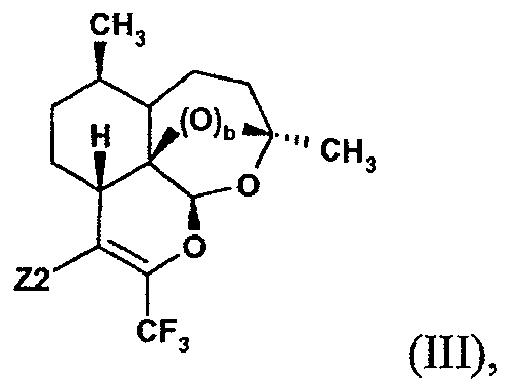
erhalten wird. - Verfahren nach Anspruch 12, dadurch gekennzeichnet, dass eine Verbindung der Formel (I), bei der B = -CH2Y- oder -C(=O)Y- ist, wobei Y wie in Anspruch 1 definiert ist, durch Kuppeln zwischen den Verbindungen (II) und (III) und einer Verbindung der folgenden Formel (IV) hergestellt wird:
Z3-X-Z4 (IV),
wobei:X wie in Anspruch 1 definiert ist,Z3 ein Halogenatom, wie ein Brom- oder Chlor-Atom, oder eine -OH-, -NHR1-, -SH-, -N3- oder -C(=O)R4-Gruppe darstellt, wobei R1 wie in Anspruch 1 definiert ist und R4 ein Wasserstoffatom oder eine (C1-C6)-Alkylgruppe darstellt undZ4 ein Halogenatom, wie ein Brom- oder Chloratom, oder eine -OH-, -NHR1-, -SH-, -N3-Gruppe oder einen Heterocyclus darstellt, der mindestens eine intracyclische NH-Gruppe umfasst, wobei R1 wie in Anspruch 1 definiert ist. - Verfahren nach Anspruch 12, dadurch gekennzeichnet, dass eine Verbindung der Formel (I), bei der B = -CH(OR3)- ist, wobei R3 wie in Anspruch 1 definiert ist, durch Kuppeln zwischen den Verbindungen (II) und (III), wobei Z2 = -CHO, und einer Verbindung der folgenden Formel (V) hergestellt wird:
Z5-X-Z6 (V),
wobei:X wie in Anspruch 1 definiert ist,Z5 ein Halogenatom, wie ein Chlor- oder Bromatom, oder eine -OH-, -NHR1-, -SH-, -N3-oder -C(=O)R4-Gruppe darstellt, wobei R1 wie in Anspruch 1 definiert ist und R4 ein Wasserstoffatom oder eine (C1-C6)-Alkylgruppe darstellt undZ6 ein saures Wasserstoffatom oder ein Halogenatom darstellt.
Priority Applications (1)
| Application Number | Priority Date | Filing Date | Title |
|---|---|---|---|
| PL09802516T PL2321323T3 (pl) | 2008-07-29 | 2009-07-29 | Dimeryczne pochodne artemizyniny i ich zastosowanie w terapii przeciwrakowej |
Applications Claiming Priority (2)
| Application Number | Priority Date | Filing Date | Title |
|---|---|---|---|
| FR0855201A FR2934593B1 (fr) | 2008-07-29 | 2008-07-29 | Derives dimeriques d'artemisinine et application en therapie anticancereuse |
| PCT/EP2009/059792 WO2010012761A1 (fr) | 2008-07-29 | 2009-07-29 | Derives dimeriques d'artemisinine et application en therapie anticancereuse |
Publications (3)
| Publication Number | Publication Date |
|---|---|
| EP2321323A1 EP2321323A1 (de) | 2011-05-18 |
| EP2321323B1 true EP2321323B1 (de) | 2013-05-29 |
| EP2321323B9 EP2321323B9 (de) | 2014-04-23 |
Family
ID=40291143
Family Applications (1)
| Application Number | Title | Priority Date | Filing Date |
|---|---|---|---|
| EP09802516.6A Not-in-force EP2321323B9 (de) | 2008-07-29 | 2009-07-29 | Dimere artemisininderivate und ihre anwendung in der krebstherapie |
Country Status (7)
| Country | Link |
|---|---|
| US (1) | US8614339B2 (de) |
| EP (1) | EP2321323B9 (de) |
| JP (1) | JP5602731B2 (de) |
| ES (1) | ES2424794T3 (de) |
| FR (1) | FR2934593B1 (de) |
| PL (1) | PL2321323T3 (de) |
| WO (1) | WO2010012761A1 (de) |
Families Citing this family (7)
| Publication number | Priority date | Publication date | Assignee | Title |
|---|---|---|---|---|
| US9006467B2 (en) | 2011-02-14 | 2015-04-14 | Councel of Scientific & Industrial Research | 1,2,3-triazole containing artemisinin compounds and process for preparation thereof |
| WO2014100486A1 (en) * | 2012-12-21 | 2014-06-26 | University Of Washington Through Its Center For Commercialization | Artemisinin compounds and synthesis and use thereof |
| US9918972B2 (en) * | 2014-12-23 | 2018-03-20 | The University Of Maryland, Baltimore | Treatment of leukemia with artemisinin derivatives and combinations with other antineoplastic agents |
| JOP20190024A1 (ar) | 2016-08-26 | 2019-02-19 | Gilead Sciences Inc | مركبات بيروليزين بها استبدال واستخداماتها |
| JP7050165B2 (ja) | 2018-02-26 | 2022-04-07 | ギリアード サイエンシーズ, インコーポレイテッド | Hbv複製阻害剤としての置換ピロリジン化合物 |
| CN109453156A (zh) * | 2018-11-22 | 2019-03-12 | 中国中医科学院中药研究所 | 一种抗肿瘤组合物及其应用、抗肿瘤药物 |
| CN112920198A (zh) * | 2021-01-28 | 2021-06-08 | 湖北德信辰科技有限公司 | 青蒿素-苯丁酸氮芥酯合成物及其制备方法 |
Family Cites Families (4)
| Publication number | Priority date | Publication date | Assignee | Title |
|---|---|---|---|---|
| FR760266A (fr) | 1933-09-02 | 1934-02-20 | Perfectionnements aux appareils de tirage photographique | |
| FR2831538B1 (fr) | 2001-10-26 | 2004-01-16 | Centre Nat Rech Scient | Nouveaux derives de l'artemisinine, et leurs utilisations dans le traitement du paludisme |
| US6790863B2 (en) * | 2002-10-15 | 2004-09-14 | University Of Mississippi | Dihydroartemisinin and dihydroartemisitene dimers as anti-cancer and anti-infective agents |
| FR2899586B1 (fr) * | 2006-04-11 | 2008-06-20 | Sanofi Aventis Sa | Dimeres de derives d'artemisinine, leur preparation et leur application en therapeutique |
-
2008
- 2008-07-29 FR FR0855201A patent/FR2934593B1/fr not_active Expired - Fee Related
-
2009
- 2009-07-29 ES ES09802516T patent/ES2424794T3/es active Active
- 2009-07-29 EP EP09802516.6A patent/EP2321323B9/de not_active Not-in-force
- 2009-07-29 WO PCT/EP2009/059792 patent/WO2010012761A1/fr not_active Ceased
- 2009-07-29 US US13/054,321 patent/US8614339B2/en not_active Expired - Fee Related
- 2009-07-29 PL PL09802516T patent/PL2321323T3/pl unknown
- 2009-07-29 JP JP2011520500A patent/JP5602731B2/ja not_active Expired - Fee Related
Also Published As
| Publication number | Publication date |
|---|---|
| EP2321323A1 (de) | 2011-05-18 |
| JP5602731B2 (ja) | 2014-10-08 |
| EP2321323B9 (de) | 2014-04-23 |
| WO2010012761A1 (fr) | 2010-02-04 |
| FR2934593B1 (fr) | 2010-09-10 |
| FR2934593A1 (fr) | 2010-02-05 |
| PL2321323T3 (pl) | 2013-12-31 |
| JP2011529472A (ja) | 2011-12-08 |
| US8614339B2 (en) | 2013-12-24 |
| ES2424794T3 (es) | 2013-10-08 |
| US20110152289A1 (en) | 2011-06-23 |
Similar Documents
| Publication | Publication Date | Title |
|---|---|---|
| EP2321323B9 (de) | Dimere artemisininderivate und ihre anwendung in der krebstherapie | |
| EP3164393B1 (de) | Flavagline derivate | |
| EP1355887B1 (de) | Pyrimidinische azyklonukleoside, verfahren zur ihrer herstellung und ihre verwendung | |
| EP2158194B1 (de) | Derivate von 7-alkynyl-1,8-naphthyridonen, verfahren zu ihrer herstellung und ihre verwendung in therapeutika | |
| FR2585019A1 (fr) | Derives de distamycine et leur procede de fabrication | |
| FR2934266A1 (fr) | Derives azotes de la pancratistatine | |
| EP1773835B1 (de) | Pyrido-pyrimidinderivate, deren herstellung und therapeutische verwendung zur behandlung von krebs | |
| WO2003082875A2 (fr) | Nouveaux derives de la podophyllotoxine, leur preparation e tleur application en therapeutique | |
| EP0021940B1 (de) | Aminoderivate von Benzothiazol, Verfahren zu ihrer Herstellung und ihre Anwendung in der Heilkunde | |
| FR2899586A1 (fr) | Dimeres de derives d'artemisinine, leur preparation et leur application en therapeutique | |
| EP1101765B1 (de) | Camptothecin Analoge Verbindungen, Verfahren zu ihrer Herstellung und diese enthaltende pharmazeutische Zubereitungen | |
| EP1664055B1 (de) | 9-aminopodophyllotoxinderivate, verfahren zu deren herstellung und pharmazeutische zusammensetzungen, die diese derivate enthalten | |
| MC1708A1 (fr) | Composes polycycliques biocides,procedes et intermediaires pour leur synthese et preparations pharmaceutiques les contenant | |
| FR2925495A1 (fr) | Derives dimeriques d'artemisinine et application en therapie anticancereuse | |
| FR2896246A1 (fr) | Derives de pyrido-pyrimidone, leur preparation, leur application en therapeutique. | |
| EP1387841B1 (de) | Azol- oder triazol-derivate, verfahren zu deren herstellung und ihre verwendung als fungizide | |
| EP0772630B1 (de) | Streptograminderivate, ihre herstellung und sie enthaltende pharmazeutische zubereitungen | |
| EP1720849B1 (de) | Zur behandlung von krebs geeignete pyranonderivate | |
| JP3009716B2 (ja) | 新規なカンプトテシン誘導体 | |
| EP3237015B1 (de) | Wasserlösliche bisphosphonische doxorubicinderivate | |
| CA2491989C (fr) | Composes a activite anti-parasitaire et medicaments les renfermant | |
| WO2000063160A1 (fr) | Derives de 2-alcoxy-cyclobutane-3,4-dione leur preparation et leur application en therapeutique | |
| FR2837202A1 (fr) | Nouveaux derives de porphyrines, leur procede de preparation compositions pharmaceutiques et utilisations | |
| LU85690A1 (fr) | Nouveaux derives de a pyrazolo (1,5-a) pyridine,leur preparation et les compositions therapeutiques qui les contiennent |
Legal Events
| Date | Code | Title | Description |
|---|---|---|---|
| PUAI | Public reference made under article 153(3) epc to a published international application that has entered the european phase |
Free format text: ORIGINAL CODE: 0009012 |
|
| 17P | Request for examination filed |
Effective date: 20110209 |
|
| AK | Designated contracting states |
Kind code of ref document: A1 Designated state(s): AT BE BG CH CY CZ DE DK EE ES FI FR GB GR HR HU IE IS IT LI LT LU LV MC MK MT NL NO PL PT RO SE SI SK SM TR |
|
| AX | Request for extension of the european patent |
Extension state: AL BA RS |
|
| DAX | Request for extension of the european patent (deleted) | ||
| GRAP | Despatch of communication of intention to grant a patent |
Free format text: ORIGINAL CODE: EPIDOSNIGR1 |
|
| GRAP | Despatch of communication of intention to grant a patent |
Free format text: ORIGINAL CODE: EPIDOSNIGR1 |
|
| GRAS | Grant fee paid |
Free format text: ORIGINAL CODE: EPIDOSNIGR3 |
|
| GRAA | (expected) grant |
Free format text: ORIGINAL CODE: 0009210 |
|
| AK | Designated contracting states |
Kind code of ref document: B1 Designated state(s): AT BE BG CH CY CZ DE DK EE ES FI FR GB GR HR HU IE IS IT LI LT LU LV MC MK MT NL NO PL PT RO SE SI SK SM TR |
|
| RAP1 | Party data changed (applicant data changed or rights of an application transferred) |
Owner name: UNIVERSITE PARIS-SUD 11 Owner name: CENTRE NATIONAL DE LA RECHERCHE SCIENTIFIQUE (CNRS Owner name: PIERRE FABRE MEDICAMENT |
|
| REG | Reference to a national code |
Ref country code: GB Ref legal event code: FG4D Free format text: NOT ENGLISH |
|
| REG | Reference to a national code |
Ref country code: CH Ref legal event code: EP |
|
| REG | Reference to a national code |
Ref country code: AT Ref legal event code: REF Ref document number: 614343 Country of ref document: AT Kind code of ref document: T Effective date: 20130615 |
|
| REG | Reference to a national code |
Ref country code: IE Ref legal event code: FG4D Free format text: LANGUAGE OF EP DOCUMENT: FRENCH |
|
| REG | Reference to a national code |
Ref country code: DE Ref legal event code: R096 Ref document number: 602009016107 Country of ref document: DE Effective date: 20130801 |
|
| REG | Reference to a national code |
Ref country code: CH Ref legal event code: NV Representative=s name: MICHELI AND CIE SA, CH |
|
| REG | Reference to a national code |
Ref country code: ES Ref legal event code: FG2A Ref document number: 2424794 Country of ref document: ES Kind code of ref document: T3 Effective date: 20131008 |
|
| REG | Reference to a national code |
Ref country code: AT Ref legal event code: MK05 Ref document number: 614343 Country of ref document: AT Kind code of ref document: T Effective date: 20130529 |
|
| REG | Reference to a national code |
Ref country code: LT Ref legal event code: MG4D |
|
| PG25 | Lapsed in a contracting state [announced via postgrant information from national office to epo] |
Ref country code: GR Free format text: LAPSE BECAUSE OF FAILURE TO SUBMIT A TRANSLATION OF THE DESCRIPTION OR TO PAY THE FEE WITHIN THE PRESCRIBED TIME-LIMIT Effective date: 20130830 Ref country code: LT Free format text: LAPSE BECAUSE OF FAILURE TO SUBMIT A TRANSLATION OF THE DESCRIPTION OR TO PAY THE FEE WITHIN THE PRESCRIBED TIME-LIMIT Effective date: 20130529 Ref country code: AT Free format text: LAPSE BECAUSE OF FAILURE TO SUBMIT A TRANSLATION OF THE DESCRIPTION OR TO PAY THE FEE WITHIN THE PRESCRIBED TIME-LIMIT Effective date: 20130529 Ref country code: FI Free format text: LAPSE BECAUSE OF FAILURE TO SUBMIT A TRANSLATION OF THE DESCRIPTION OR TO PAY THE FEE WITHIN THE PRESCRIBED TIME-LIMIT Effective date: 20130529 Ref country code: PT Free format text: LAPSE BECAUSE OF FAILURE TO SUBMIT A TRANSLATION OF THE DESCRIPTION OR TO PAY THE FEE WITHIN THE PRESCRIBED TIME-LIMIT Effective date: 20130930 Ref country code: IS Free format text: LAPSE BECAUSE OF FAILURE TO SUBMIT A TRANSLATION OF THE DESCRIPTION OR TO PAY THE FEE WITHIN THE PRESCRIBED TIME-LIMIT Effective date: 20130929 Ref country code: SI Free format text: LAPSE BECAUSE OF FAILURE TO SUBMIT A TRANSLATION OF THE DESCRIPTION OR TO PAY THE FEE WITHIN THE PRESCRIBED TIME-LIMIT Effective date: 20130529 Ref country code: NO Free format text: LAPSE BECAUSE OF FAILURE TO SUBMIT A TRANSLATION OF THE DESCRIPTION OR TO PAY THE FEE WITHIN THE PRESCRIBED TIME-LIMIT Effective date: 20130829 Ref country code: SE Free format text: LAPSE BECAUSE OF FAILURE TO SUBMIT A TRANSLATION OF THE DESCRIPTION OR TO PAY THE FEE WITHIN THE PRESCRIBED TIME-LIMIT Effective date: 20130529 |
|
| REG | Reference to a national code |
Ref country code: NL Ref legal event code: VDEP Effective date: 20130529 |
|
| PG25 | Lapsed in a contracting state [announced via postgrant information from national office to epo] |
Ref country code: HR Free format text: LAPSE BECAUSE OF FAILURE TO SUBMIT A TRANSLATION OF THE DESCRIPTION OR TO PAY THE FEE WITHIN THE PRESCRIBED TIME-LIMIT Effective date: 20130529 Ref country code: BG Free format text: LAPSE BECAUSE OF FAILURE TO SUBMIT A TRANSLATION OF THE DESCRIPTION OR TO PAY THE FEE WITHIN THE PRESCRIBED TIME-LIMIT Effective date: 20130829 |
|
| PG25 | Lapsed in a contracting state [announced via postgrant information from national office to epo] |
Ref country code: LV Free format text: LAPSE BECAUSE OF FAILURE TO SUBMIT A TRANSLATION OF THE DESCRIPTION OR TO PAY THE FEE WITHIN THE PRESCRIBED TIME-LIMIT Effective date: 20130529 |
|
| REG | Reference to a national code |
Ref country code: PL Ref legal event code: T3 |
|
| PG25 | Lapsed in a contracting state [announced via postgrant information from national office to epo] |
Ref country code: EE Free format text: LAPSE BECAUSE OF FAILURE TO SUBMIT A TRANSLATION OF THE DESCRIPTION OR TO PAY THE FEE WITHIN THE PRESCRIBED TIME-LIMIT Effective date: 20130529 Ref country code: SK Free format text: LAPSE BECAUSE OF FAILURE TO SUBMIT A TRANSLATION OF THE DESCRIPTION OR TO PAY THE FEE WITHIN THE PRESCRIBED TIME-LIMIT Effective date: 20130529 Ref country code: DK Free format text: LAPSE BECAUSE OF FAILURE TO SUBMIT A TRANSLATION OF THE DESCRIPTION OR TO PAY THE FEE WITHIN THE PRESCRIBED TIME-LIMIT Effective date: 20130529 Ref country code: CZ Free format text: LAPSE BECAUSE OF FAILURE TO SUBMIT A TRANSLATION OF THE DESCRIPTION OR TO PAY THE FEE WITHIN THE PRESCRIBED TIME-LIMIT Effective date: 20130529 |
|
| PG25 | Lapsed in a contracting state [announced via postgrant information from national office to epo] |
Ref country code: RO Free format text: LAPSE BECAUSE OF FAILURE TO SUBMIT A TRANSLATION OF THE DESCRIPTION OR TO PAY THE FEE WITHIN THE PRESCRIBED TIME-LIMIT Effective date: 20130529 Ref country code: MC Free format text: LAPSE BECAUSE OF FAILURE TO SUBMIT A TRANSLATION OF THE DESCRIPTION OR TO PAY THE FEE WITHIN THE PRESCRIBED TIME-LIMIT Effective date: 20130529 Ref country code: NL Free format text: LAPSE BECAUSE OF FAILURE TO SUBMIT A TRANSLATION OF THE DESCRIPTION OR TO PAY THE FEE WITHIN THE PRESCRIBED TIME-LIMIT Effective date: 20130529 |
|
| PLBE | No opposition filed within time limit |
Free format text: ORIGINAL CODE: 0009261 |
|
| STAA | Information on the status of an ep patent application or granted ep patent |
Free format text: STATUS: NO OPPOSITION FILED WITHIN TIME LIMIT |
|
| REG | Reference to a national code |
Ref country code: HU Ref legal event code: AG4A Ref document number: E019015 Country of ref document: HU |
|
| 26N | No opposition filed |
Effective date: 20140303 |
|
| REG | Reference to a national code |
Ref country code: DE Ref legal event code: R097 Ref document number: 602009016107 Country of ref document: DE Effective date: 20140303 |
|
| PG25 | Lapsed in a contracting state [announced via postgrant information from national office to epo] |
Ref country code: SM Free format text: LAPSE BECAUSE OF FAILURE TO SUBMIT A TRANSLATION OF THE DESCRIPTION OR TO PAY THE FEE WITHIN THE PRESCRIBED TIME-LIMIT Effective date: 20130529 |
|
| PG25 | Lapsed in a contracting state [announced via postgrant information from national office to epo] |
Ref country code: MT Free format text: LAPSE BECAUSE OF FAILURE TO SUBMIT A TRANSLATION OF THE DESCRIPTION OR TO PAY THE FEE WITHIN THE PRESCRIBED TIME-LIMIT Effective date: 20130529 Ref country code: CY Free format text: LAPSE BECAUSE OF FAILURE TO SUBMIT A TRANSLATION OF THE DESCRIPTION OR TO PAY THE FEE WITHIN THE PRESCRIBED TIME-LIMIT Effective date: 20130529 |
|
| PG25 | Lapsed in a contracting state [announced via postgrant information from national office to epo] |
Ref country code: MK Free format text: LAPSE BECAUSE OF FAILURE TO SUBMIT A TRANSLATION OF THE DESCRIPTION OR TO PAY THE FEE WITHIN THE PRESCRIBED TIME-LIMIT Effective date: 20130529 |
|
| REG | Reference to a national code |
Ref country code: FR Ref legal event code: PLFP Year of fee payment: 8 |
|
| REG | Reference to a national code |
Ref country code: FR Ref legal event code: PLFP Year of fee payment: 9 |
|
| REG | Reference to a national code |
Ref country code: FR Ref legal event code: PLFP Year of fee payment: 10 |
|
| PGFP | Annual fee paid to national office [announced via postgrant information from national office to epo] |
Ref country code: IE Payment date: 20180619 Year of fee payment: 10 Ref country code: LU Payment date: 20180615 Year of fee payment: 10 |
|
| PGFP | Annual fee paid to national office [announced via postgrant information from national office to epo] |
Ref country code: PL Payment date: 20180619 Year of fee payment: 10 |
|
| PGFP | Annual fee paid to national office [announced via postgrant information from national office to epo] |
Ref country code: ES Payment date: 20180830 Year of fee payment: 10 Ref country code: IT Payment date: 20180716 Year of fee payment: 10 Ref country code: FR Payment date: 20180727 Year of fee payment: 10 Ref country code: DE Payment date: 20180710 Year of fee payment: 10 |
|
| PGFP | Annual fee paid to national office [announced via postgrant information from national office to epo] |
Ref country code: GB Payment date: 20180718 Year of fee payment: 10 Ref country code: HU Payment date: 20180620 Year of fee payment: 10 Ref country code: BE Payment date: 20180725 Year of fee payment: 10 Ref country code: TR Payment date: 20180717 Year of fee payment: 10 Ref country code: CH Payment date: 20180719 Year of fee payment: 10 |
|
| REG | Reference to a national code |
Ref country code: DE Ref legal event code: R119 Ref document number: 602009016107 Country of ref document: DE |
|
| REG | Reference to a national code |
Ref country code: CH Ref legal event code: PL |
|
| GBPC | Gb: european patent ceased through non-payment of renewal fee |
Effective date: 20190729 |
|
| REG | Reference to a national code |
Ref country code: BE Ref legal event code: MM Effective date: 20190731 |
|
| PG25 | Lapsed in a contracting state [announced via postgrant information from national office to epo] |
Ref country code: GB Free format text: LAPSE BECAUSE OF NON-PAYMENT OF DUE FEES Effective date: 20190729 Ref country code: DE Free format text: LAPSE BECAUSE OF NON-PAYMENT OF DUE FEES Effective date: 20200201 Ref country code: HU Free format text: LAPSE BECAUSE OF NON-PAYMENT OF DUE FEES Effective date: 20190730 |
|
| PG25 | Lapsed in a contracting state [announced via postgrant information from national office to epo] |
Ref country code: LI Free format text: LAPSE BECAUSE OF NON-PAYMENT OF DUE FEES Effective date: 20190731 Ref country code: CH Free format text: LAPSE BECAUSE OF NON-PAYMENT OF DUE FEES Effective date: 20190731 Ref country code: LU Free format text: LAPSE BECAUSE OF NON-PAYMENT OF DUE FEES Effective date: 20190729 Ref country code: BE Free format text: LAPSE BECAUSE OF NON-PAYMENT OF DUE FEES Effective date: 20190731 |
|
| PG25 | Lapsed in a contracting state [announced via postgrant information from national office to epo] |
Ref country code: FR Free format text: LAPSE BECAUSE OF NON-PAYMENT OF DUE FEES Effective date: 20190731 |
|
| PG25 | Lapsed in a contracting state [announced via postgrant information from national office to epo] |
Ref country code: IE Free format text: LAPSE BECAUSE OF NON-PAYMENT OF DUE FEES Effective date: 20190729 |
|
| PG25 | Lapsed in a contracting state [announced via postgrant information from national office to epo] |
Ref country code: IT Free format text: LAPSE BECAUSE OF NON-PAYMENT OF DUE FEES Effective date: 20190729 |
|
| REG | Reference to a national code |
Ref country code: ES Ref legal event code: FD2A Effective date: 20201202 |
|
| PG25 | Lapsed in a contracting state [announced via postgrant information from national office to epo] |
Ref country code: ES Free format text: LAPSE BECAUSE OF NON-PAYMENT OF DUE FEES Effective date: 20190730 |
|
| PG25 | Lapsed in a contracting state [announced via postgrant information from national office to epo] |
Ref country code: PL Free format text: LAPSE BECAUSE OF NON-PAYMENT OF DUE FEES Effective date: 20190729 |
|
| PG25 | Lapsed in a contracting state [announced via postgrant information from national office to epo] |
Ref country code: TR Free format text: LAPSE BECAUSE OF NON-PAYMENT OF DUE FEES Effective date: 20190729 |