EP2321323B9 - Derives dimeriques d'artemisinine et application en therapie anticancereuse - Google Patents
Derives dimeriques d'artemisinine et application en therapie anticancereuse Download PDFInfo
- Publication number
- EP2321323B9 EP2321323B9 EP09802516.6A EP09802516A EP2321323B9 EP 2321323 B9 EP2321323 B9 EP 2321323B9 EP 09802516 A EP09802516 A EP 09802516A EP 2321323 B9 EP2321323 B9 EP 2321323B9
- Authority
- EP
- European Patent Office
- Prior art keywords
- alkyl
- group
- compound
- representing
- mmol
- Prior art date
- Legal status (The legal status is an assumption and is not a legal conclusion. Google has not performed a legal analysis and makes no representation as to the accuracy of the status listed.)
- Not-in-force
Links
- 0 C[C@](CC[C@]1[C@](*)[C@@](C(F)(F)F)(OC*CO)O2)C(CC3)[C@@]1[C@]2O[C@]3C#N Chemical compound C[C@](CC[C@]1[C@](*)[C@@](C(F)(F)F)(OC*CO)O2)C(CC3)[C@@]1[C@]2O[C@]3C#N 0.000 description 4
- IHBOOWVWHGECMR-VAQYVJSSSA-N CC/C(/[C@H](CC[C@@H](C)C1CC[C@H](C)OC2)[C@]12OO)=C(\C(F)(F)F)/[O]=C Chemical compound CC/C(/[C@H](CC[C@@H](C)C1CC[C@H](C)OC2)[C@]12OO)=C(\C(F)(F)F)/[O]=C IHBOOWVWHGECMR-VAQYVJSSSA-N 0.000 description 1
- SXSJIWJBEPANIP-IYEXOKHWSA-N CCCC([C@H](C)CC1)[C@]23OOC(C)O[C@H]2OC(C(F)(F)F)=C(CNCCO[C@@]([C@H](C)[C@](CC[C@@H](C)C2CC[C@H](C)OC4)([C@]24OO)N)(C(F)(F)F)O)[C@]13N Chemical compound CCCC([C@H](C)CC1)[C@]23OOC(C)O[C@H]2OC(C(F)(F)F)=C(CNCCO[C@@]([C@H](C)[C@](CC[C@@H](C)C2CC[C@H](C)OC4)([C@]24OO)N)(C(F)(F)F)O)[C@]13N SXSJIWJBEPANIP-IYEXOKHWSA-N 0.000 description 1
- IZCLGPIAIDMRDZ-JKDGFZLRSA-N CC[C@H]1C(CC2)[C@]34OOC2(C)O[C@H]3OC(C(F)(F)F)=C(COCCO[C@@]2(C(F)(F)F)O[C@@]3(C5)O[C@@H](C)CCC([C@H](C)CC6)[C@@]35[C@@H]6[C@H]2[ClH]C)[C@@H]4CC1 Chemical compound CC[C@H]1C(CC2)[C@]34OOC2(C)O[C@H]3OC(C(F)(F)F)=C(COCCO[C@@]2(C(F)(F)F)O[C@@]3(C5)O[C@@H](C)CCC([C@H](C)CC6)[C@@]35[C@@H]6[C@H]2[ClH]C)[C@@H]4CC1 IZCLGPIAIDMRDZ-JKDGFZLRSA-N 0.000 description 1
- XPPREIJPVDKNTO-UHFFFAOYSA-N CCc1c[n](CCC(C)C)nn1 Chemical compound CCc1c[n](CCC(C)C)nn1 XPPREIJPVDKNTO-UHFFFAOYSA-N 0.000 description 1
- MKBCTDHQSWRYBU-LCRITRMLSA-N C[C@H](CC[C@H]1C([C@](C(F)(F)F)(O)Br)C#N)C(CC2)[C@@]11OO[C@@]2(C)OC1 Chemical compound C[C@H](CC[C@H]1C([C@](C(F)(F)F)(O)Br)C#N)C(CC2)[C@@]11OO[C@@]2(C)OC1 MKBCTDHQSWRYBU-LCRITRMLSA-N 0.000 description 1
- GEURNTBKSDPLKX-LKJQTYBZSA-N C[C@H](CC[C@]1(C(C)[C@@](C(F)(F)F)(OCCN)O[C@@H]2O[C@@H](C)CC3)N)C3[C@@]12O[O]=C Chemical compound C[C@H](CC[C@]1(C(C)[C@@](C(F)(F)F)(OCCN)O[C@@H]2O[C@@H](C)CC3)N)C3[C@@]12O[O]=C GEURNTBKSDPLKX-LKJQTYBZSA-N 0.000 description 1
- MECBWJRQTXENMN-ZYMNJLNTSA-N C[C@H]([C@H](CC[C@@H](C)C1CC[C@H](C)OC2)[C@]12OO)[C@](C(F)(F)F)([O-])Br Chemical compound C[C@H]([C@H](CC[C@@H](C)C1CC[C@H](C)OC2)[C@]12OO)[C@](C(F)(F)F)([O-])Br MECBWJRQTXENMN-ZYMNJLNTSA-N 0.000 description 1
- ULXMTIVJEZFIAY-LUDLFVLJSA-N C[C@H]([C@H](CC[C@H](C1CC[C@H](C)OC2)C(I)=C)[C@]12OO)[C@@](C)(C(F)(F)F)OCCBr Chemical compound C[C@H]([C@H](CC[C@H](C1CC[C@H](C)OC2)C(I)=C)[C@]12OO)[C@@](C)(C(F)(F)F)OCCBr ULXMTIVJEZFIAY-LUDLFVLJSA-N 0.000 description 1
- MDUCVOJOVXCOMK-GQOJLTOUSA-N C[C@H]([C@H]1C(CO[C@@H](C)CC2)C2[C@H](C)CC1)[C@@](C(F)(F)F)(OCCN)[O]=C Chemical compound C[C@H]([C@H]1C(CO[C@@H](C)CC2)C2[C@H](C)CC1)[C@@](C(F)(F)F)(OCCN)[O]=C MDUCVOJOVXCOMK-GQOJLTOUSA-N 0.000 description 1
- HXILQLZWYSQMSJ-LSEGVVGDSA-N C[C@H]([C@H]1C2[C@H](O3)O[C@@H](C)[C@H](C)CCC2CCC1)[C@@]3(C(F)(F)F)Br Chemical compound C[C@H]([C@H]1C2[C@H](O3)O[C@@H](C)[C@H](C)CCC2CCC1)[C@@]3(C(F)(F)F)Br HXILQLZWYSQMSJ-LSEGVVGDSA-N 0.000 description 1
- ITRWRNLANUSZHZ-KWRWGJGLSA-N C[C@H]1C(CC2)[C@]34OOC2(C)O[C@H]3OC(C(F)(F)F)=C(CN2CCN(CCO[C@@](C[C@](CC[C@@H](C)C3CC5)([C@]33OO[C@@]5(C)OC3)N)(C(F)(F)F)[O-2])CC2)[C@@H]4CC1 Chemical compound C[C@H]1C(CC2)[C@]34OOC2(C)O[C@H]3OC(C(F)(F)F)=C(CN2CCN(CCO[C@@](C[C@](CC[C@@H](C)C3CC5)([C@]33OO[C@@]5(C)OC3)N)(C(F)(F)F)[O-2])CC2)[C@@H]4CC1 ITRWRNLANUSZHZ-KWRWGJGLSA-N 0.000 description 1
- AGCYSRYIJQKSJT-NRAXBURTSA-N C[C@H]1C(CC2)[C@]34OO[C@@]2(C)O[C@H]3OC(C(F)(F)F)=C(COCCCOC(C[C@H](C)[C@@H]2CC[C@H]3C)C(C(F)(F)F)O[C@@H]5O[C@@H](C)CCC3[C@@]25O[O]=C)[C@@H]4CC1 Chemical compound C[C@H]1C(CC2)[C@]34OO[C@@]2(C)O[C@H]3OC(C(F)(F)F)=C(COCCCOC(C[C@H](C)[C@@H]2CC[C@H]3C)C(C(F)(F)F)O[C@@H]5O[C@@H](C)CCC3[C@@]25O[O]=C)[C@@H]4CC1 AGCYSRYIJQKSJT-NRAXBURTSA-N 0.000 description 1
- OVOPVOMZBFRPTI-PLTVJLDESA-N C[C@](C([C@](C)(CC1)C(CO[C@](CC2)(N=[IH])O)C2[C@@H]1N)N)(N)O Chemical compound C[C@](C([C@](C)(CC1)C(CO[C@](CC2)(N=[IH])O)C2[C@@H]1N)N)(N)O OVOPVOMZBFRPTI-PLTVJLDESA-N 0.000 description 1
Classifications
-
- C—CHEMISTRY; METALLURGY
- C07—ORGANIC CHEMISTRY
- C07D—HETEROCYCLIC COMPOUNDS
- C07D493/00—Heterocyclic compounds containing oxygen atoms as the only ring hetero atoms in the condensed system
- C07D493/12—Heterocyclic compounds containing oxygen atoms as the only ring hetero atoms in the condensed system in which the condensed system contains three hetero rings
- C07D493/18—Bridged systems
-
- A—HUMAN NECESSITIES
- A61—MEDICAL OR VETERINARY SCIENCE; HYGIENE
- A61P—SPECIFIC THERAPEUTIC ACTIVITY OF CHEMICAL COMPOUNDS OR MEDICINAL PREPARATIONS
- A61P35/00—Antineoplastic agents
-
- C—CHEMISTRY; METALLURGY
- C07—ORGANIC CHEMISTRY
- C07D—HETEROCYCLIC COMPOUNDS
- C07D519/00—Heterocyclic compounds containing more than one system of two or more relevant hetero rings condensed among themselves or condensed with a common carbocyclic ring system not provided for in groups C07D453/00 or C07D455/00
Definitions
- the present invention relates to dimeric derivatives of 10-trifluoromethylartemisinin connected on the one hand by a carbon in position 10 and on the other hand by a carbon in position 16, as well as their use in the treatment against cancer.
- dimers at C-10 that is, bound by their carbon at the 10-position, of dihydroartemisinin ether derivatives [ Bioorg. Med. Chem., 5, 1257-65, (1997) )] or metabolically more stable non-ketal analogues, where the exocyclic oxygen of the ketal function has been replaced by a CH 2 group (group X in the diagram below) [ J. Med. Chem., 42, 4275-80, (1999) )].
- Dimers at C-16 have also been described [ J. Med. Chem., 44, 4688-95, (2001) )].
- Artemisinin and its derivatives such as arteemether or sodium artesunate, for the most known, are widely used in the treatment of malaria.
- the main limitation of these derivatives lies in the low bioavailability of the artemisinin nucleus, whose ketal function is rapidly hydrolysed in the body, thus leading to inactive metabolites [ J. Med. Chem., 47, 2945-64, (2004) )].
- the present invention relates more specifically to 10-trifluoromethylartemisinin dimers bound in the C10 position on one nucleus and C16 on the other nucleus, compounds which exhibit a better cytotoxicity than that of the dimers bound by their C16 carbon atoms as described in FR 07/60266 .
- the present invention also relates to 10-trifluoromethylartemisinin dimers in which only one of the endoperoxidic bridges is reduced in ether bridge, either on the C10 side or on the C16 side.
- the "mono-endoperoxide” type dimers retain remarkable cytotoxic properties, and more particularly the dimers in which the endoperoxide side C16 bridge has been reduced.
- the dimeric derivatives of the present invention thus have the advantages of the fluorinated monomers mentioned above while having good antitumor properties.
- the term "pharmaceutically acceptable” means that which is useful in the preparation of a pharmaceutical composition which is generally safe, non-toxic and neither biologically nor otherwise undesirable and which is acceptable for veterinary as well as pharmaceutical use. human.
- halogen refers to fluorine, bromine, chlorine or iodine. Preferably, it is a fluorine, a bromine or a chlorine, and more preferably a fluorine.
- (C 1 -C 6 ) alkyl group is meant, in the sense of the present invention, a saturated hydrocarbon chain, linear or branched, having from 1 to 6 carbon atoms, such as for example a methyl, ethyl, propyl, isopropyl, butyl, tert- butyl, pentyl or hexyl.
- this chain will be monovalent or bivalent.
- n represents an integer between 1 and 6, preferably equal to 1,2,3 or 4 .
- (C 2 -C 6 ) alkynyl group means a linear or branched unsaturated hydrocarbon-based chain containing from 1 to 6 carbon atoms and comprising at least one triple bond, and advantageously only one. These include an ethynyl or propynyl group. Depending on the case, this chain will be monovalent or bivalent. In the case of a bivalent chain, it will advantageously be a linear chain such as a chain of formula -CH 2 -C ⁇ C-.
- polyamino group is meant, in the sense of the present invention, a linear hydrocarbon chain comprising from 6 to 20 carbon atoms, and at least two of which are replaced by nitrogen atoms, two atoms. nitrogen can not be found on adjacent positions.
- Said polyamino group may respond in particular to the following formula: - [(CH 2 ) a -NH] d - [(CH 2 ) b -NH- (CH 2 ) c -NH] e -H with a, b and c representing, independently of each other, an integer from 1 to 5 and d and e each representing 0 or 1
- a spermidine chain that is to say of formula - (CH 2 ) 4 -NH- (CH 2 ) 3 -NH 2 or - (CH 2 ) 3 may be mentioned.
- -NH- (CH 2 ) 4 -NH 2 a spermine chain of formula - (CH 2 ) 3 -NH- (CH 2 ) 4 -NH- (CH 2 ) 3 -NH 2 or a chain of formula - (CH 2 ) 4 -NH- (CH 2 ) 4 -NH- (CH 2 ) 4 -NH 2 .
- This polyamino group may be optionally substituted, more particularly on the nitrogen atoms, in particular by an N-protecting group such as (C 1 -C 6 ) alkyl, (C 2 -C 6 ) alkenyl, -CO- (C 1 -C 6 ) alkyl, -CO- (C 2 -C 6 ) alkenyl, -CO 2 - (C 1 -C 6 ) alkyl or -CO 2 - (C 2 -C 6 ) alkenyl.
- an N-protecting group such as (C 1 -C 6 ) alkyl, (C 2 -C 6 ) alkenyl, -CO- (C 1 -C 6 ) alkyl, -CO- (C 2 -C 6 ) alkenyl, -CO 2 - (C 1 -C 6 ) alkyl or -CO 2 - (C 2 -C 6 ) alkenyl.
- Said optionally substituted polyamine group may then meet the following general formula: - [(CH 2 ) a -NA 1 ] d - [(CH 2 ) b -NA 2 - (CH 2 ) c -NA 3 ] e -H, with a, b, c, d and e as defined above and A 1 , A 2 and A 3 , different or preferably identical, representing a hydrogen atom or an N-protecting group such that (C 1 - C 6 ) alkyl, (C 2 -C 6 ) alkenyl, -CO- (C 1 -C 6 ) alkyl, -CO- (C 2 -C 6 ) alkenyl, -CO 2 - (C 1 -C 6 ) alkyl or -CO 2 - (C 2 -C 6 ) alkenyl.
- protecting group is intended to denote a group that selectively blocks a reactive site in a multifunctional compound so that a chemical reaction can be selectively carried out at another site.
- unprotected reagent in the meaning conventionally associated with it in synthetic chemistry.
- N-protecting group is intended to mean any substituent which protects the NH or NH 2 group against undesirable reactions such as the N-protecting groups described in Greene, "Protective Groups In Organic Synthesis", (John Wiley & Sons, New York (1981 )) and Harrison et al. Compendium of Synthetic Organic Methods, Vols. 1 to 8 (J. Wiley & sons, 1971 to 1996 ).
- N-protecting groups include carbamates (such as -CO 2 - (C 1 -C 6 ) alkyl or -CO 2 - (C 2 -C 6 ) alkenyl), amides (such as -CO- (C 1 - C 6 ) alkyl, -CO- (C 2 -C 6 ) alkenyl), N-alkylated or N-alkenyl derivatives, amino acetal derivatives, N-benzylated derivatives, imine derivatives, enamine derivatives and N-derivatives -hcherroatome.
- carbamates such as -CO 2 - (C 1 -C 6 ) alkyl or -CO 2 - (C 2 -C 6 ) alkenyl
- amides such as -CO- (C 1 - C 6 ) alkyl, -CO- (C 2 -C 6 ) alkenyl
- N-alkylated or N-alkenyl derivatives amino
- the N-protecting group includes formyl, acetyl, benzoyl, pivaloyl, phenylsulfonyl, benzyl (Bn), t-butyloxycarbonyl (Boc), benzyloxycarbonyl (Cbz), p-methoxybenzyloxycarbonyl, p-nitrobenzyloxycarbonyl, trichloroethoxycarbonyl (TROC), allyloxycarbonyl (Alloc), 9-fluorenylmethyloxycarbonyl (Fmoc), trifluoroacetyl, benzyl carbamates (substituted or unsubstituted) and the like. It may be in particular a group Boc.
- (C 3 -C 8 ) -cycloalkyl group is intended to mean a saturated hydrocarbon ring group comprising from 3 to 8, preferably 5 or 6, carbon atoms, for example a grouping cyclopropyl, cyclohexyl, cyclopentyl, etc. Depending on the case, this cycle will be monovalent or bivalent.
- aryl group is intended to mean an aromatic group, preferably comprising from 5 to 10 carbon atoms and comprising one or more contiguous rings, preferably 1 or 2 and more preferably one single ring. as for example a phenyl or naphthyl group.
- phenyl is phenyl.
- this group will be monovalent or bivalent.
- This aryl group may be optionally substituted, in particular with one or more groups chosen from a halogen atom and a (C 1 -C 6 ) -alkyl group as defined above, -OR, -NRR 'and -SO 2 R with R and R 'denoting a hydrogen atom or a (C 1 -C 6 ) -alkyl group as defined above.
- heteroaryl ring group is meant, within the meaning of the present invention, any aryl group as defined above in which one or more carbon atoms have been replaced by one or more heteroatoms, advantageously 1 to 4, and even more advantageously 1 to 3, such as, for example, sulfur, nitrogen or oxygen atoms.
- heteroaryl groups are furyl, thienyl, pyrrolyl, pyridinyl, pyrimidinyl, pyrazolyl, imidazolyl, triazolyl, tetrazolyl or indyl groups.
- it is a pyridinyl or triazolyl group such as 1,2,3-triazolyl. Depending on the case, this group will be monovalent or bivalent.
- This heteroaryl group may be optionally substituted, in particular with one or more groups chosen from a halogen atom and a (C 1 -C 6 ) -alkyl group as defined above, -OR, -NRR 'and -SO 2 R with R and R 'denoting a hydrogen atom or a (C 1 -C 6 ) -alkyl group as defined above.
- heterocycle is intended to mean a saturated, unsaturated or aromatic cyclic hydrocarbon compound, unless otherwise stated, comprising one or more contiguous rings, preferably 1 or 2 and more preferably one ring, and comprising 5 to 10 ring atoms, of which one or more cyclic carbon atoms have been replaced by one or more heteroatoms, preferably 1 to 4 and even more preferably 1 to 3, such as, for example, sulfur, nitrogen or oxygen atoms.
- It may be in particular a morpholinyl, piperazinyl, piperidinyl, furyl, thienyl, pyrrolyl, tetrazolyl or triazolyl group.
- it is a piperazinyl or triazolyl group such as a 1,2,3-triazolyl. Depending on the case, this group will be monovalent or bivalent.
- the heterocycle is saturated, it is advantageously a piperidine, a morpholine or a piperazine.
- aryl- (C 1 -C 6) alkyl is understood within the meaning of the present invention, an aryl group as defined above bound to the molecule via a (C 1 - C 6 ) alkyl as defined above. It is in particular a benzyl group.
- heteroaryl- (C 1 -C 6) akyle is meant within the meaning of the present invention, a heteroaryl group as defined above bound to the molecule via a (C 1 - C 6 ) alkyl as defined above. It is in particular a benzyl group.
- heterocycle- (C 1 -C 6 ) alkyl group is meant, in the sense of the present invention, a heterocycle as defined above bonded to the molecule through a (C 1 -C 6) 6 ) alkyl as defined above. It is in particular a benzyl group.
- R1 represents a hydrogen atom, a (C 1 -C 6 ) alkyl, (C 2 -C 6 ) alkenyl, (C 2 -C 6 ) alkynyl group, (C 3 -C 8 ) cycloalkyl, aryl- (C 1 -C 6 ) alkyl, heteroaryl- (C 1 -C 6 ) alkyl, heterocycle- (C 1 -C 6 ) alkyl, optionally substituted aryl, optionally substituted heteroaryl, -COR 2 , -CO 2 R2, or -SO 2 R2, with R2 representing a hydrogen atom or a (C 1 -C 6 ) alkyl, (C 3 -C 8 ) cycloalkyl, aryl- (C 1 -C 6 ) group alkyl, heteroaryl- (C 1 -C 6 ) alkyl, optionally substituted aryl or optionally substituted heteroary
- R1 may in particular represent a hydrogen atom.
- R 1 represents a hydrogen atom, a (C 1 -C 6 ) alkyl, (C 2 -C 6 ) alkenyl group, -CH 2 C (O) OR 2 or -CH 2 C (O) NR 2 R 2bis, with R 2 as defined above and advantageously representing a hydrogen atom or an optionally substituted polyamino group, and R2bis as defined above and advantageously representing a hydrogen atom.
- the carbon atom of these two groups is bonded to the artemisinin nucleus while the group Y is bonded to the group X in the formula General (I).
- R 1 and R 3 may more particularly each represent a hydrogen atom.
- the heterocycle will in particular be a heterocycle comprising a single 5- or 6-membered ring.
- it will comprise one or more, preferably 1 to 4, nitrogen atoms, such as a piperazinyl or triazolyl group such as 1,2,3-triazolyl.
- B represents a group -CH 2 -Y- with Y as defined above and preferably representing O, NR 1 or a heterocycle, R 1 being as defined above.
- A represents an oxygen or nitrogen atom.
- the nitrogen atom will preferably be substituted by a hydrogen atom.
- A will represent an oxygen atom.
- X represents a double bond and X represents a (C 1 -C 6 ) alkyl, (C 2 -C 6 ) alkenyl, (C 2 -C 6 ) alkynyl group, (C 3 -C 8 ) cycloalkyl, or-X 1 -O-X 2 - with X 1 and X 2 as defined above.
- X may represent a (C 1 -C 6 ) alkyl, (C 2 -C 6 ) alkenyl, (C 2 -C 6 ) alkynyl or (C 3 -C 8 ) cycloalkyl group, and preferably (C 1 -C 6 ) alkyl.
- the heteroaryl group will then advantageously be a heteroaryl comprising a single 5- or 6-membered ring and advantageously comprising one or more, preferably 1 to 3, nitrogen atoms.
- the heteroaryl group will then advantageously a heteroaryl having a single 5- or 6-membered ring and advantageously comprising one or more, preferably 1 to 3, nitrogen atoms.
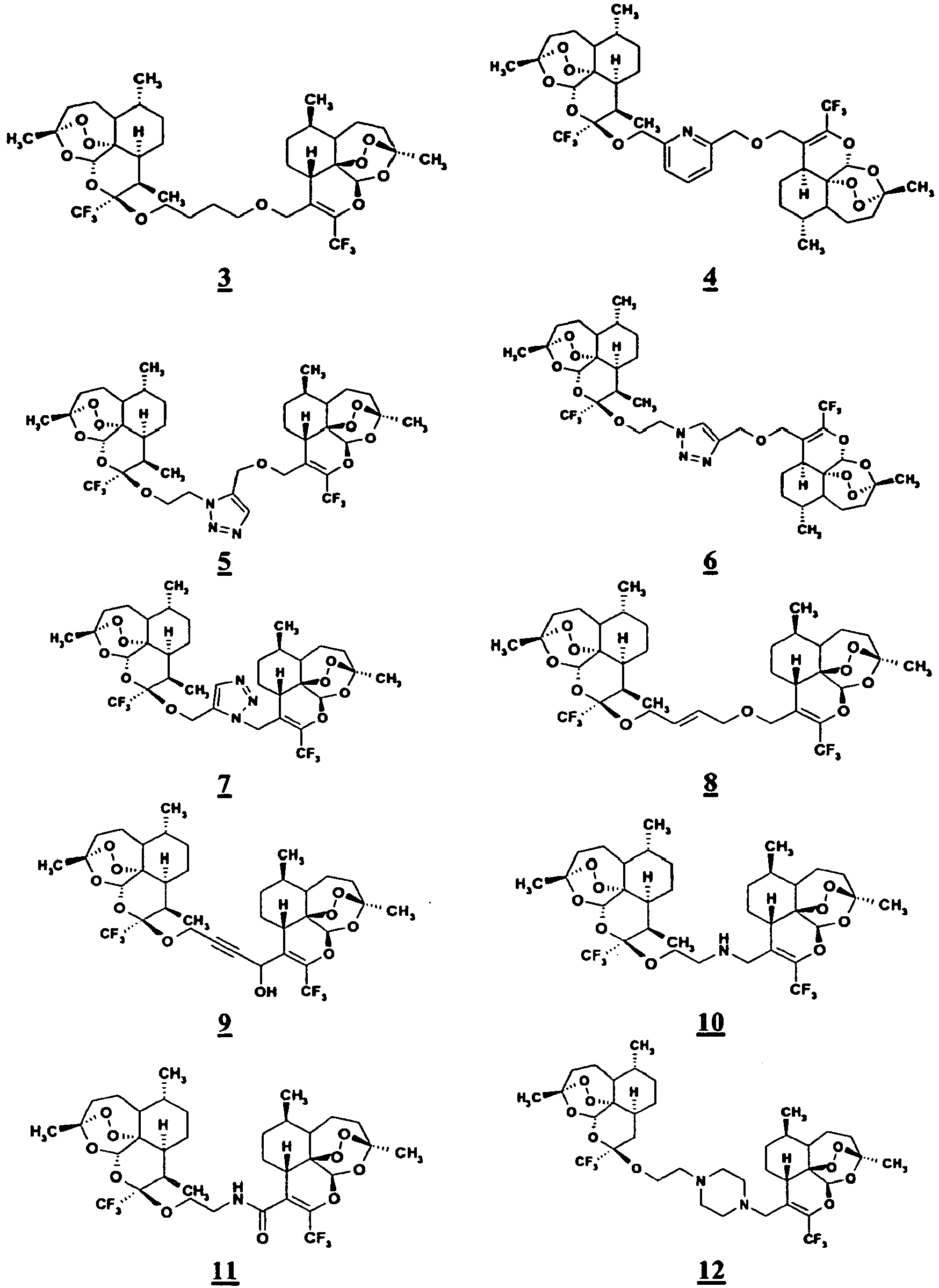
- the compounds of the invention of formula (I) may be chosen more particularly from the following compounds:
- the present invention also relates to a compound of formula (I) as defined above for its use as a medicament, in particular for the treatment of cancer.
- the invention also relates to the use of a compound of the invention for the manufacture of a medicament for the treatment of cancer.
- the invention also relates to a compound of formula I for use in a method for treating cancer, comprising administering an effective amount of at least one compound of formula (I) as defined above to a patient in need.
- the present invention also relates to a pharmaceutical composition
- a pharmaceutical composition comprising at least one compound according to the invention and at least one pharmaceutically acceptable vehicle.
- the compounds according to the invention can be administered orally, sublingually, parenterally, subcutaneously, intramuscularly, intravenously, transdermally, locally or rectally, and preferably orally, intravenously or subcutaneously.
- the active ingredient may be administered in unit dosage forms, in admixture with conventional pharmaceutical carriers, animals or humans.
- suitable unit dosage forms include oral forms such as tablets, capsules, powders, granules and oral solutions or suspensions, sublingual and oral forms of administration, parenteral forms of administration, -cutaneous, intramuscular, intravenous, intranasal or intraocular and forms of rectal administration.
- the main active ingredient is mixed with a pharmaceutical carrier such as gelatin, starch, lactose, magnesium stearate, talc, gum arabic or the like.
- a pharmaceutical carrier such as gelatin, starch, lactose, magnesium stearate, talc, gum arabic or the like.
- the tablets may be coated with sucrose or other suitable materials or may be treated so that they have prolonged or delayed activity and continuously release a predetermined amount of active ingredient
- a preparation in capsules is obtained by mixing the active ingredient with a diluent and pouring the resulting mixture into soft or hard gelatin capsules.
- a syrup or elixir preparation may contain the active ingredient together with a sweetener, an antiseptic, as well as a flavoring agent and a suitable colorant.
- Water-dispersible powders or granules may contain the active ingredient in admixture with dispersants or wetting agents, or suspending agents, as well as with taste correctors or sweeteners.
- suppositories are used which are prepared with binders melting at the rectal temperature, for example cocoa butter or polyethylene glycols.
- aqueous suspensions for parenteral, intranasal or intraocular administration, aqueous suspensions, isotonic saline solutions or sterile and injectable solutions containing dispersing agents and / or pharmacologically compatible wetting agents are used.
- the active ingredient may also be formulated as microcapsules, optionally with one or more additive carriers.
- the compounds of the invention can be used at doses of between 0.01 mg and 1000 mg per day, given in a single dose once a day or administered in several doses throughout the day, for example twice per day. day in equal doses.
- the dose administered per day is advantageously between 5 mg and 500 mg, more advantageously between 10 mg and 200 mg. It may be necessary to use doses out of these ranges which the skilled person can realize himself.
- this composition may also comprise at least one other active ingredient, advantageously chosen from anticancer agents.
- Anti-cancer agents that may be mentioned in a non-limiting manner include 6-mercaptopurine, fludarabine, cladribine, pentostatin, cytarabine, 5-fluorouracil, gemcitabine, methotrexate, raltitrexed, irinotecan, topotecan, etoposide, daunorubicin, doxorubicin, epirubicin, idarubicin, pirarubicin, mitoxantrone, chlormethine, cyclophosphamide, ifosfamide, melphalan, chlorambucil, busulfan, carmustine, fotemustine , streptozocin, carboplatin, cisplatin, oxaliplatin, procarbazine, dacarbazine, bleomycin, vinblastine, vincristine, vindesine, vinorelbine, paclitaxel, docetaxel, L-asparagina
- active principle there may be mentioned in particular, without limitation, 6-mercaptopurine, fludarabine, cladribine, pentostatin, cytarabine, 5-fluorouracil, gemcitabine, methotrexate, raltitrexed, irinotecan topotecan, etoposide, daunorubicin, doxorubicin, epirubicin, idarubicin, pirarubicin, mitoxantrone, chlormethine, cyclophosphamide, ifosfamide, melphalan, chlorambucil, busulfan, carmustine, fotemustine, streptozocin, carboplatin, cisplatin, oxaliplatin, procarbazine, dacarbazine, bleomycin, vinblastine, vincristine, vindesine, vinorelbine, paclitaxel, docetaxel, L-asparaginase, flutamide
- the pharmaceutical composition as described above may be useful in particular for the treatment of cancer.
- the compounds of the invention may be prepared in particular from intermediates A , A 1 , B , C , D , E , F , G, G 1 and R described below.
- the compounds of the invention are obtained by coupling between the intermediate G , G 1 , or R and an intermediate A , A 1 , B , C , D , E or F , this coupling can be carried out in one or more steps.
- NMO N- methyl-morpholine oxide
- intermediate A (0.63 g, 2.5 mmol) in dimethylsulfoxide (DMSO) (10 mL) was added sodium azide (0.14 g, 2.25 mmol, 1.5 eq).
- DMSO dimethylsulfoxide
- the reaction mixture is stirred at room temperature for 1.5 hours. It is then poured into water and the extraction is carried out with ethyl acetate. The organic phase is dried over magnesium sulfate, filtered and the solvents are evaporated under reduced pressure.
- the intermediate azide E thus obtained (white powder, 0.56 g, 100%) is directly involved in the following reactions without an additional purification step.
- the intermediates A 1 and G 1 have a reduced endoperoxide bridge in the artemisinin nucleus.
- N-bromosuccinimide (290 mg, 1.62 mmol, 2 eq.).
- the reaction medium is refluxed instantly. After 1 h at this temperature, the reaction mixture is diluted with dichloromethane (5 mL), washed with saturated NaHCO 3 solution (2 ⁇ 5 mL) and then with saturated NaCl solution (5 mL). The organic phase is dried over MgSO 4 , filtered and concentrated under reduced pressure.
- the reaction crude is purified by chromatography on silica gel with a gradient of eluent (petroleum ether / diethyl ether: 100 to 90/10). Intermediate A 1 is obtained with 60% yield (186 mg).
- the subject of the present invention is thus a process for preparing a compound of formula (I) as defined above, characterized in that the compound of formula (I) is obtained by coupling of a compound of formula (II) ) next : for which a is as defined above and Z 1 represents a halogen atom, preferably a bromine atom, or a group -OH, -NH 2 or -NHR 1, R 1 being as defined above, preferably Z 1 representing a halogen atom or a group -OH or -NH 2 , with a compound of formula (III) below: for which b is as defined above and Z2 represents a group -CH 2 OH, -CHO, -COOH, -CH 2 N 3 , -CH 2 NH 2 or -CH 2 Hal, where Hal represents a halogen atom, preferably a bromine atom.
- the compound of formula (I) thus obtained may be separated from the reaction medium by methods well known to those skilled in the art, for example by extraction, evaporation of the solvent or by precipitation and filtration.
- the compound may be further purified if necessary by techniques well known to those skilled in the art, such as by recrystallization if the compound is crystalline, by distillation, by column chromatography on silica gel or by high performance liquid chromatography (HPLC ).
- the coupling may comprise one or more reaction steps carried out by techniques well known to those skilled in the art.
- the active function which will react in the coupling step will obviously be the intracyclic NH group.
- the heterocycle will preferably be 5- or 6-membered, such as morpholinyl, piperidinyl or piperazinyl.
- the compound of formula (I) is then obtained in two steps, on the one hand (1) by coupling of the Z1 function of the compound (II) with the Z3 function of the compound (IV), and on the other hand (2) by coupling the Z2 function of the compound (III) with the Z4 function of the compound (IV).
- the order of realization of these two steps (1) and (2) is indifferent, these two coupling steps being performed by techniques well known to those skilled in the art.
- the Z3 or Z4 function which must not react in the first step of the coupling, may be previously protected and deprotected once this step has been completed.
- a free NH 2 amine function is desired, it can be obtained from the halogenated derivative or an N 3 azide.
- An amine NH or NH 2 function may also be protected in the carbamate form, in particular by a Boc group.
- a halogen atom can be obtained by halogenation of an OH group (for example in the presence of N-bromosuccinimide to obtain a bromine atom).
- the compound of formula (IV) may be either commercial or prepared by methods well known to those skilled in the art.
- Z 3 represents a halogen atom, a heterocycle or a group -OH, -NHR 1, -SH or -N 3 , which makes it possible to access compounds of formula (I) for which represents a single link.
- This first particular embodiment of preparation of the compounds of the invention is illustrated in particular with the synthesis of compounds 1, 2, 3, 4, 10, 11, 12, 13, 14, 16, 17, 18, 19, 20, 22, 23, 24, 25, 26 and 29.
- acid hydrogen atom means a hydrogen atom that can be displaced by a base.
- acidic hydrogen atom can be in particular an acetylenic hydrogen atom.
- the active function which will react in the coupling step will obviously be the intracyclic NH group.
- the heterocycle will preferably be 5- or 6-membered, such as morpholinyl, piperidinyl or piperazinyl.
- organometallic base such as an alkylithium (as n-Bu-Li) or an alkyl magnesium bromide or chloride.
- a halogen-metal exchange can give access to the desired compound (VII) by reacting the compound (VI) with a metal such as lithium or magnesium.
- the compound of formula (V) may be either commercial or prepared by methods well known to those skilled in the art.
- Z5 represents a halogen atom, a heterocycle or a group -OH, -NHR1, -SH or -N 3 , which makes it possible to access compounds of formula (I) for which represents a single link.
- Z5 preferably represents a -OH, -NHR1 or -SH group and Z1 represents a halogen atom such as a bromine atom.
- the coupling is carried out by cross-metathesis of the alkenes or alkynes as illustrated with the preparation of the compounds 8 and 21.
- one or more preliminary steps will have to be carried out to introduce a bearing group. a double or a triple terminal bond instead of the groups Z1 and Z2 of the compounds (II) and (III).
- additional functionalization steps may be performed, including steps of functionalization of the double or triple bond formed during metathesis (see Examples 27 and 28).
- This reaction is conducted in the presence of a metathesis catalyst, such as Grubb catalyst 1 st or 2 nd generation.
- a metathesis catalyst such as Grubb catalyst 1 st or 2 nd generation.
- Compound (VIII) may be prepared by reaction of a compound of formula (II), for which Z1 preferably represents a halogen atom, with a compound of formula Z7- (CH 2 ) y -R, where Z7 and are as defined above and R represents an OH, NHR1 or SH group, R1 being as defined above.
- Compound (IX) may be prepared by reaction of a compound of formula (III), for which Z2 is preferably a halogen atom, with a compound of formula Z7- (CH 2 ) z -R ', where Z7 and z are as defined above and R 'represents an OH, NHR1 or SH group, R1 being as defined above.
- the coupling is carried out by a [4 + 2] or [3 + 2] cycloaddition reaction, as illustrated with the preparation of compounds 5, 6 and 7.
- suitable groups instead of the groups Z1 and Z2 of the compounds (II) and (III), such as an alkene or an alkyne for one of the two groups and a diene or a dipole 1,3 such than one group N 3 for the other grouping.
- this reaction is carried out in the presence of NaH as a base, especially in the presence of KI.
- Intermediate H 2 obtained with a yield of 71% in the form of a white powder from 1,2-ethanediol and the intermediate G (cyclohexane / ethyl acetate 90:10).
- Intermediate H 3 obtained with a yield of 25% in the form of a translucent oil from 1,4-butanediol and the intermediate G (cyclohexane / ethyl acetate 80:20).
- Intermediate H 4 obtained with a yield of 39% in the form of a translucent oil from 2,6-pyridinedimethanol and intermediate G (cyclohexane / ethyl acetate 95: 5 at 75:25).
- Intermediate H 5 obtained with a yield of 82% in the form of a colorless oil from 1,5-pentanediol and the intermediate G (cyclohexane / ethyl acetate 100 to 80:20).
- Intermediate H 6 obtained in 61% yield as a yellow oil from 1,6-hexanediol and intermediate G (cyclohexane / ethyl acetate 95: 5 at 80:20).
- Intermediate H 7 obtained with a yield of 49% in the form of a yellow foam from 1,4-bis (2-hydroxyethyl) piperazine and the intermediate G (dichloromethane / methanol 100: 0 at 90:10 ).
- the reaction medium is stirred at room temperature for 1 to 5 hours before dilution with ethyl acetate.
- the organic phase is washed with a solution of sodium hydrogen carbonate, dried over magnesium sulfate. After filtration, the solvents are evaporated under reduced pressure.
- the crude product obtained is purified by chromatography on silica gel (cyclohexane / ethyl acetate) to yield the expected dimer.
- Example 1 obtained with a yield of 45% in the form of a white powder from intermediate H 1 and intermediate A (cyclohexane / ethyl acetate 95: 5 at 70:30).
- Example 2 obtained with a yield of 40% in the form of a white powder from intermediate H 2 and intermediate A (cyclohexane / ethyl acetate 90:10).
- Example 3 obtained with a yield of 20% in the form of a white powder from intermediate H 3 and intermediate A (cyclohexane / ethyl acetate 95: 5).
- Example 4 obtained with a yield of 30% in the form of a white powder from intermediate H 4 and intermediate A (cyclohexane / ethyl acetate 95: 5 to 90:10).
- Example 16 obtained with a yield of 45% in the form of a white powder from intermediate H 5 and intermediate A (cyclohexane / ethyl acetate 85:15).
- Example 17 obtained with a yield of 40% in the form of a white powder from intermediate H 6 and intermediate A 1 (cyclohexane / ethyl acetate 75: 2).
- Example 18 obtained with a yield of 58% in the form of a white powder from intermediate H 7 and intermediate A (dichloromethane / methanol 97: 3).
- Example 19 obtained with a yield of 1% in the form of a colorless oil from intermediate H 8 and intermediate A (cyclohexane / ethyl acetate 98: 2 at 70:30).
- Step 1 To a solution of Intermediate G (0.83 g, 2.0 mol) in dichloromethane (14 mL) is added successively 2-bromoethanol (1.41 mL, 20.0 mmol, 10 eq.) And hexafluoroisopropanol ( 1.05 mL, 10.0 mmol, 5 eq.). The reaction mixture is then stirred at room temperature for 2 hours before dilution with dichloromethane. The organic phase is washed with sodium hydrogencarbonate solution and then dried over magnesium sulfate. After filtration, the solvents are evaporated under reduced pressure. The crude product obtained is purified by chromatography on silica gel (cyclohexane / ethyl acetate 95: 5); Intermediate I is isolated with a yield of 40% (pale yellow powder, 0.365 g).
- Step 2 To a solution of intermediate I (0.07 g, 0.15 mmol) in dimethylsulfoxide (2 mL) is added sodium azide (0.02 g, 0.3 mmol, 2 eq). The reaction mixture is stirred at room temperature for 1 hour. After dilution with ethyl acetate, the organic phase is washed with water and then dried over magnesium sulfate. After filtration, the solvents are evaporated under reduced pressure and the intermediate J obtained quantitatively, is engaged directly in the next step (white powder).
- Step 1 To a solution of Intermediate G (0.207 g, 0.5 mol) in dichloromethane (3.5 mL) are added successively propargyl alcohol (295 ⁇ L, 5.0 mmol, 10 eq.) And hexafluoroisopropanol (HFIP). (263 ⁇ L, 2.5 mmol, 5 eq.). The reaction mixture is then stirred at room temperature for 2 hours before dilution with dichloromethane. The organic phase is washed with a solution of sodium hydrogen carbonate, dried over magnesium sulfate. After filtration, the solvents are evaporated under reduced pressure. The crude product obtained is purified by chromatography on silica gel (cyclohexane / ethyl acetate 97: 3); intermediate L is isolated with a yield of 68% (white powder, 0.133 g).
- Step 2 A mixture of intermediate E (0.056 g, 0.15 mmol, 1 eq.) And intermediate L (0.058 g, 0.15 mmol, 1 eq.) Is heated at 90 ° C. for 16 hours in a tube. sealed. After returning to ambient temperature, the reaction medium is purified by chromatography on silica gel (cyclohexane / ethyl acetate 80:20); Compound 7 is isolated with an overall yield of 28% (white powder, 0.032 g).
- the crude product obtained is purified by chromatography on silica gel (cyclohexane / ethyl acetate 80:20).
- the expected compound isolated with a yield of 22% (white powder, 0.18 g), is dissolved in dichloromethane (2.0 ml) to which is added trifluoroacetic acid (TFA) (0.75 ml).
- TFA trifluoroacetic acid
- the reaction mixture is stirred for 30 minutes at room temperature and then concentrated under reduced pressure.
- the residue is diluted in dichloromethane.
- the organic phase is successively washed with a saturated solution of sodium hydrogencarbonate, and a saturated solution of sodium chloride, and then dried over sodium sulfate. After filtration, the solvents are evaporated under reduced pressure.
- the crude obtained is purified by chromatography on silica gel (dichloromethane / methanol / aqueous ammonia 95: 5: 0.5); the intermediate U is isolated with a yield of 61% (white powder, 0.095 g).
- Step 1 To a solution of intermediate G (1.0 g, 2.41 mmol) in dichloromethane (14 mL) is added successively 2-bromo-propanol (2.77 mL, 24.1 mmol, 10 eq.) And hexafluoroisopropanol (HFIP) (1.27 mL, 12.0 mmol, 5 eq.). The reaction mixture is then stirred at room temperature for 2.5 hours before dilution with dichloromethane. The organic phase is washed with sodium hydrogencarbonate solution and then dried over magnesium sulfate. After filtration, the solvents are evaporated under reduced pressure. The crude product obtained is purified by chromatography on silica gel (cyclohexane / ethyl acetate 95: 5); the brominated intermediate is isolated with a yield of 55% (clear oil, 0.63 g).
- Step 2 To a solution of the brominated intermediate (0.63 g, 1.38 mmol) in dimethylsulfoxide (12 mL) is added sodium azide (0.18 g, 2.75 mmol, 2 eq). The reaction mixture is stirred at room temperature for 2.5 hours. After dilution with ethyl acetate, the organic phase is washed with water and then dried over magnesium sulfate. After filtration, the solvents are evaporated under reduced pressure and the azide intermediate, obtained quantitatively, is directly engaged in the next step (white powder).
- Step 3 To a solution of the azide intermediate (0.60 g, 1.38 mmol) in tetrahydrofuran (6 mL) is added triphenylphosphine (0.36 g, 1.38 mmol, 1 eq.). After 24 hours at room temperature, 2 mL of water is added and stirring is continued for a further 24 hours. After evaporation of the solvents under reduced pressure, the crude obtained is purified by chromatography on silica gel (cyclohexane / ethyl acetate 100: 0 to 85:15 then dichloromethane / methanol 99: 1 to 70:30); intermediate Q is isolated with a yield of 62% (white powder, 0.35 g).
- Step 1 To a solution of intermediate G (1.0 g, 2.41 mmol) in acetonitrile (10 mL) are added succinic acid (2.84 g, 24.1 mmol, 10 eq.) And triethylamine (1.69 mL, 12.0 mmol, 5 eq.). The reaction mixture is stirred for 96 hours at room temperature. A solution of sodium hydrogencarbonate is added and the extraction is carried out with ethyl acetate. The organic phase is then washed with saturated sodium chloride solution, dried over magnesium sulphate, filtered and then condensed under reduced pressure. The crude product obtained is purified by chromatography on silica gel (cyclohexane / ethyl acetate 95: 5 to 90:10); intermediate R is isolated with a yield of 33% (beige powder, 0.28 g).
- Step 2 To a solution of intermediate R (0.1 g, 0.28 mmol) in dichloromethane (2.5 mL) are added acetoxyacetyl chloride (40 ⁇ L, 0.37 mmol, 1.3 eq.) And pyridine (30 ⁇ L, 0.37 mmol, 1.3 equiv). After 24 hours at room temperature, a further addition of acyl chloride (1.3 eq.) And pyridine (1.3 eq.) Is carried out and the reaction medium is stirred for a further 6 hours. A saturated solution of ammonium chloride is added and the mixture is extracted with dichloromethane. The organic phase is dried over magnesium sulfate, filtered and then condensed under reduced pressure.
- acetoxyacetyl chloride 40 ⁇ L, 0.37 mmol, 1.3 eq.
- pyridine 30 ⁇ L, 0.37 mmol, 1.3 equiv.
- acyl chloride 1.3 eq.
- the crude product obtained is purified by chromatography on silica gel (dichloromethane / ethyl acetate 95: 5 to 92.5: 7.5); the acetoxy intermediate is isolated with a yield of 44% (white powder, 0.055 g).
- Step 3 To a solution of the acetoxy intermediate (0.053 g, 0.117 mmol) in methanol (2 mL) at 0 ° C is added a solution of sodium methanolate (0.010 g, 0.176 mmol) in methanol (0.5 mL ). After stirring for 1 hour at 0 ° C., the medium is diluted with ethyl acetate and water. The organic phase is then dried over magnesium sulfate, filtered and condensed under reduced pressure. The crude product obtained is purified by chromatography on silica gel (dichloromethane / ethyl acetate 90:10 to 85:15); intermediate S is isolated with a yield of 94% (colorless oil, 0.045 g).
- Step 1 To a solution of intermediate V (250 mg, 0.635 mmol) in anhydrous dimethylformamide (DMF) (4 mL) is added at 0 ° C sodium hydride (76 mg, 1.9 mmol, 3 eq. ) then the allylic iodide (174 ⁇ L, 1.9 mmol, 3 eq.). The reaction medium is allowed to return to room temperature. After stirring for 4 hours, it is hydrolysed with saturated NaCl solution. The organic phase is dried over MgSO 4 , filtered and then evaporated under reduced pressure. O -allyl iminoether (277 mg, 80%) is obtained after purification by chromatography on silica gel with a gradient of eluent (petroleum ether / diethyl ether: 98/2 to 95/5).
- DMF dimethylformamide
- Step 2 To a solution of Intermediate N (131 mg, 0.335 mmol, 0.8 eq.) In dichloromethane (1.6 mL) is added O- allyl iminoether (174 mg, 0.401 mmol, 1 eq.) Isolated below. above, and then the 1st generation Grubb catalyst (33 mg, 0.043 mmol, 0.1 eq.). After stirring for 23 hours at room temperature, the reaction medium is filtered through silica and then concentrated under reduced pressure. Compound 21 (47 mg, 15%) is obtained after purification by chromatography on silica gel with an eluent gradient (cyclohexane / ethyl acetate: 100 to 85/15).
- the intermediate Wb is obtained by the same method with a yield of 47% by reaction of the intermediate A 1 with allylamine.
- Compound 23 is obtained in 18% yield by following the same procedure, by coupling intermediate Wa with intermediate Xb .
- the compound 24 is obtained with a yield of 76% by following the same procedure, by coupling the intermediate Wb with the intermediate Xc .
- Step 1 To a solution of compound 24 (0.4 g, 0.51 mmol) in tetrahydrofuran (20.0 mL) and water (5.0 mL) are added OsO 4 (0.98 mL, 0.15 mmol, 0.3 eq.) And oxide N-methylmorpholine (NMO) (78.1 mg, 0.67 mmol, 1.3 eq.). The reaction mixture is stirred at ambient temperature for 18 h. Water (15.0 mL) and NaIO 4 (0.55 g, 2.56 mmol, 10 eq) are added, and the reaction mixture is stirred for 1 hour at room temperature, before being diluted by addition of water and water. 'ethyl acetate. The organic phase is washed with a saturated solution of sodium thiosulfate, a saturated solution of sodium chloride, and is then dried over magnesium sulfate. After filtration, the solvents are evaporated under reduced pressure.
- OsO 4 0.98 mL, 0.15 mmol,
- Step 2 To a solution of the previously formed crude aldehyde (0.44 g, 0.57 mmol) in acetone (15.0 mL) and water (8.0 mL) are added sodium phosphate (0.23 g, 1.70 mmol, 3 eq.), amylene (0.27 mL, 2.55 mmol, 4.5 eq.) and sodium chlorite (0.15 g, 1.70 mmol, 3 eq.). The reaction mixture is stirred at room temperature for 18 hours before being diluted with water and ethyl acetate. The aqueous phase is extracted with ethyl acetate.
- Step 1 To a solution of 26 (0.07 g, 0.089 mmol) in N, N- dimethylformamide (1.0 mL) is added polyamine (0.045 g, 0.089 mmol, 1 eq.), 2- (1H-benzotriazole) 1-yl) -1,1,3,3-tetramethyluronium hexafluorophosphate (HBTU) (0.044 g, 0.12 mmol, 1.3 eq.) And diisopropylethylamine (DIEA) (0.04 mL, 0.22 mmol, 2.5 eq.). The reaction mixture is stirred for 6 hours at room temperature before being diluted with water and ethyl acetate.
- polyamine 0.045 g, 0.089 mmol, 1 eq.
- HBTU 2- (1H-benzotriazole) 1-yl) -1,1,3,3-tetramethyluronium hexafluorophosphate
- DIEA diiso
- the aqueous phase is extracted with ethyl acetate.
- the combined organic phases are washed with water and with a saturated solution of sodium chloride, and then dried over magnesium sulfate. After filtration, the solvents are evaporated under reduced pressure.
- the reaction crude is purified by chromatography on silica gel (dichloromethane / ethyl acetate 90:10 to 70:30); the expected product is obtained with a yield of 44% (0.050 g).
- Step 2 To a solution of the intermediate obtained above (0.05 g, 0.039 mmol) in isopropanol (3.0 mL) is added a solution of 5N hydrochloric acid in isopropanol (1.0 mL). The reaction mixture is stirred at ambient temperature for 18 hours and is then concentrated under reduced pressure. 26 is obtained with a yield of 39% in the form of hydrochloride (white solid, 0.015 g).
- the crude mixture is purified by chromatography on silica gel (cyclohexane / ethyl acetate 100: 0 to 70:30). 27 is obtained with a yield of 36% (beige foam, 0.041 g). 28 is obtained with a yield of 13% (beige foam, 0.015 g).
- Step 1 To a solution of N- Boc-piperidone (5.0 g, 0.025 mol) in methanol (85 mL) are added 2- N- methylaminoethanol (7.0 mL, 0.087 mol, 3.5 eq.) And Pd / C ( 0.7 g). The reaction mixture is stirred at room temperature under a hydrogen atmosphere for 18 h. The mixture is then filtered on celite, and the solvents are evaporated under reduced pressure. The crude is then purified by chromatography on silica gel (dichloromethane / methanol 85:15). The expected intermediate is obtained with 97% yield (yellow oil, 6.4 g).
- Step 2 A solution of intermediate G (1.0 g, 2.42 mmol), the intermediate previously formed (6.4 g, 25.6 mmol) and hexafluoroisopropanol (HFIP) (1.9 mL, 18.1 mmol) is stirred at room temperature for 14 days. The solvents are then evaporated under reduced pressure, and the crude reaction product is purified by chromatography on silica gel (dichloromethane / methanol 100: 0 to 97: 3). The expected intermediate is obtained with a yield of 15% (0.21 g).
- Step 3 To a solution of the previously formed intermediate (0.21 g, 0.36 mmol) in dichloromethane (2.0 mL) was added trifluoroacetic acid (TFA) (0.6 mL). The reaction mixture is stirred at room temperature for 3 hours and then basified by adding an aqueous solution of potassium carbonate. The aqueous phase is extracted with dichloromethane. The combined organic phases are dried over magnesium sulfate. After filtration, the solvent is evaporated under reduced pressure.
- TFA trifluoroacetic acid
- the cytotoxic activity of the compounds according to the invention was evaluated by measuring the inhibition of the cellular proliferation of tumor lines of human origin, such as the A549 line (lung) and the Namalwa line (lymphoma). This activity is expressed by the IC 50 concentration of tested product capable of inhibiting 50% cell proliferation.
- the method used is measured by luminescence of the residual ATP after 72 hours of incubation using the "ATPLite ®" kit marketed by Perkin Elmer, as described in the following publication: "Measurement of cytotoxicity by ATP - based luminescence assay in primary cell cultures and cell lines". IA Cree, PE Andreotti, Toxicology in Vitro, 11, 553-6, (1997) ).
- the compounds of the invention can be used in human therapy in the treatment of cancer pathology.
- the Pharmaceutical preparations containing these active ingredients can be formulated for administration including oral, intravenous or subcutaneous.
Landscapes
- Organic Chemistry (AREA)
- Chemical & Material Sciences (AREA)
- Health & Medical Sciences (AREA)
- Life Sciences & Earth Sciences (AREA)
- Medicinal Chemistry (AREA)
- Nuclear Medicine, Radiotherapy & Molecular Imaging (AREA)
- General Chemical & Material Sciences (AREA)
- Pharmacology & Pharmacy (AREA)
- Chemical Kinetics & Catalysis (AREA)
- Animal Behavior & Ethology (AREA)
- General Health & Medical Sciences (AREA)
- Public Health (AREA)
- Veterinary Medicine (AREA)
- Pharmaceuticals Containing Other Organic And Inorganic Compounds (AREA)
- Medicines That Contain Protein Lipid Enzymes And Other Medicines (AREA)
- Nitrogen And Oxygen Or Sulfur-Condensed Heterocyclic Ring Systems (AREA)
Description
- La présente invention concerne des dérivés dimériques de la 10-trifluorométhylartémisinine reliés d'une part par un carbone en position 10 et d'autre part par un carbone en position 16, ainsi que leur utilisation dans le traitement contre le cancer.
- Les propriétés cytotoxiques des dérivés de l'artémisinine ont été mises en évidence en 1992 [Acta Pharmacol. Sin., 13, 541-3, (1992)], conférant ainsi à ces composés une utilisation potentielle en tant qu'anticancéreux. Il est ensuite apparu que les dérivés dimériques de l'artémisinine possédaient des activités cytotoxiques parfois supérieures à celle des monomères correspondants [J. Nat. Prod., 56, 849-56, (1993), J. Nat. Prod., 60, 325-30, (1997)].
- Par conséquent, de nombreux travaux visant à préparer de nouveaux dimères d'artémisinine ont été entrepris par plusieurs équipes de recherche à travers le monde. La plupart de ces dimères sont des dimères en C-10, c'est-à-dire reliés par leur carbone en position 10, de dérivés éthers de la dihydroartémisinine [ Bioorg. Med. Chem., 5, 1257-65, (1997)] ou d'analogues non cétaliques plus stables métaboliquement, où l'atome d'oxygène exocyclique de la fonction cétal a été remplacé par un groupement CH2 (groupement X sur le schéma ci-dessous) [ J. Med. Chem., 42, 4275-80, (1999)]. Des dimères en C-16 ont également été décrits [J. Med. Chem., 44, 4688-95, (2001)].
- Ces différentes familles sont schématisées ci-dessous :
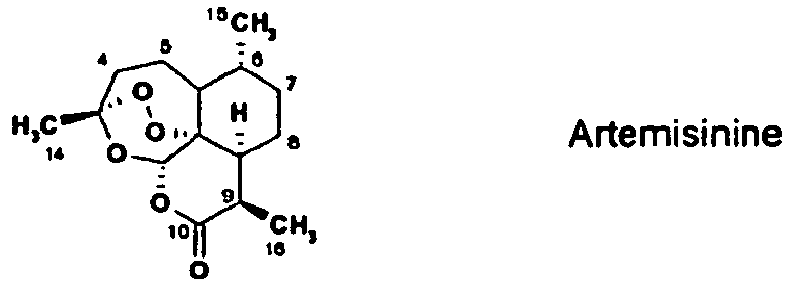


- L'artémisinine et ses dérivés tels que l'arthéméther ou l'artésunate de sodium, pour les plus connus, sont largement utilisés dans le traitement du paludisme. Toutefois, la principale limitation de ces dérivés réside dans la faible biodisponibilité du noyau artémisinine, dont la fonction cétal est rapidement hydrolysée dans l'organisme, conduisant alors à des métabolites inactifs [J. Med. Chem., 47, 2945-64, (2004)].

- Dans le cadre de la recherche de nouveaux dérivés stables d'artémisinine pour le traitement du paludisme, des études menées au Laboratoire BioCIS de la Faculté de Pharmacie de Chatenay-Malabry ont abouti à la synthèse de dérivés 10-trifluorométhylés de l'artémisinine (
WO 03/035651 - Une revue récente détaille avec précision les avantages des dérivés trifluorométhylés de l'artémisinine sur les plans chimiques et pharmacologiques [J.-P. Bégué, D. Bonnet-Delpon, ChemMedChem, 2, 608-24, (2007)].
- Une première série de dimères de 10-trifluorométhylartémisinine liés par leurs atomes de carbone en position C16 a été développée avec des profils d'activité anti-proliférative satisfaisants (demande
FR 07/60266 - La présente invention concerne plus spécifiquement des dimères de 10-trifluorométhylartémisinine liés en position C10 sur un noyau et C16 sur l'autre noyau, composés qui présentent une meilleure cytotoxicité que celle des dimères liés par leurs atomes de carbone en position C16 tels que décrits dans
FR 07/60266 - La présente invention concerne également des dimères de 10-trifluorométhylartémisinine dans lesquels un seul des ponts endoperoxydes est réduit en pont éther, soit du côté C10, soit du côté C16. En effet les dimères de type « mono-endoperoxyde » conservent des propriétés cytotoxiques remarquables, et plus particulièrement les dimères dans lesquels le pont endoperoxyde côté C16 a été réduit.
- La présente invention a plus particulièrement pour objet un dérivé dimérique de l'artémisinine 10-trifluorométhylée de formule (I) :

- a et b représentent, indépendamment l'un de l'autre, 1 ou 2 mais ne peuvent représenter en même temps 1,
- A représente :
- o un hétéroatome choisi parmi un atome d'azote, d'oxygène et de soufre, l'atome d'azote étant éventuellement substitué par un radical R1 choisi parmi un atome d'hydrogène, un groupement (C1-C6)alkyle, (C2-C6)alcényle, (C2-C6)alcynyle, (C3-C8)cycloalkyle, aryl-(C1-C6)alkyle, hétéroaryl-(C1-C6)alkyle, hétérocycle-(C1-C6)alkyle, aryle éventuellement substitué, hétéroaryle éventuellement substitué, -COR2, -CO2R2, - C(O)NR2R2bis, -SO2R2,-CH2C(O)OR2 et -CH2C(O)NR2R2bis,
avec R2 représentant un atome d'hydrogène ou un groupement (C1-C6)alkyle, (C2-C6)alcényle, (C2-C6)alcynyle, polyamino éventuellement substitué, (C3-C8)cycloalkyle, aryl-(C1-C6)alkyle, hétéroaryl-(C1-C6)alkyle, aryle éventuellement substitué ou hétéroaryle éventuellement substitué, et R2bis représentant un atome d'hydrogène ou un groupement (C1-C6)alkyle, ou - o un hétérocycle saturé comprenant un ou plusieurs hétéroatomes choisis parmi les atomes d'oxygène, de soufre et d'azote, dont au moins un atome d'azote lié au carbone 10,
- o un hétéroatome choisi parmi un atome d'azote, d'oxygène et de soufre, l'atome d'azote étant éventuellement substitué par un radical R1 choisi parmi un atome d'hydrogène, un groupement (C1-C6)alkyle, (C2-C6)alcényle, (C2-C6)alcynyle, (C3-C8)cycloalkyle, aryl-(C1-C6)alkyle, hétéroaryl-(C1-C6)alkyle, hétérocycle-(C1-C6)alkyle, aryle éventuellement substitué, hétéroaryle éventuellement substitué, -COR2, -CO2R2, - C(O)NR2R2bis, -SO2R2,-CH2C(O)OR2 et -CH2C(O)NR2R2bis,
- représente une liaison simple lorsque A représente un atome d'oxygène ou de soufre ou un hétérocycle, ou représente une liaison simple ou une liaison double lorsque A représente un atome d'azote, ledit atome d'azote étant substitué par un radical R1 tel que défini ci-dessus lorsque
 représente une liaison simple,
- B représente un groupe -CH2-Y-, -C(=O)-Y- ou -CH(OR3)-,
avec Y représentant O, S, N-R1 ou un hétérocycle, R1 étant tel que défini ci-dessus, et
R3 représentant un atome d'hydrogène ou un groupement (C1-C6)alkyle ou aryle, et - X représente :
- ■ lorsque représente une liaison double :

- un groupement =C(X1)-(O-X2)c- avec X1 et X2 représentant, indépendamment l'un de l'autre, un groupement (C1-C6)alkyle ou (C2-C6)alcényle et c représentant 0 ou 1, ou
- ■ lorsque représente une liaison simple :
- o un groupement (C1-C6)alkyle éventuellement substitué par un ou plusieurs groupes OH; (C2-C6)alcényle; (C2-C6)alcynyle; [(C1-C6)alkyl]n-(C3-C8)cycloalkyl-[(C1-C6)alkyle]p ; [(C1-C6)akyl]n-hétérocycle-[(C1-C6)alkyle]p ; [(C1-C6)alkyl]n-aryl-[(C1-C6)alkyle]p ; [(C1-C6)alkyl]n-hétéroaryl-[(C1-C6)alkyle]p ; avec n et p représentant, indépendamment l'un de l'autre, 0 ou 1,
- o un groupement -CO-(CH2)q- ou -CO-(CH2)q-CO- pour lequel q représente un nombre entier égal à 1, 2, 3 ou 4, ou
- o un groupement -COr-(CH2)s-Z-(CH2)t-COu- pour lequel r et u représentent, indépendamment l'un de l'autre, un nombre entier égal à 0 ou 1,
s et t représentent, indépendamment l'un de l'autre, un nombre entier égal à 0, 1, 2, 3 ou 4, et
Z représente un groupe -S-, -S-S-, -SO-, -SO2-, -Se-Se-, -O-P(O)(OR3)-O-, -NR1-, (C3-C8)-cycloalkyle, aryle ou hétéroaryle, avec R1 et R3 tels définis ci-dessus.
- ■ lorsque
- Les dérivés dimériques de la présente invention possèdent ainsi les avantages des monomères fluorés évoqués précédemment tout en présentant de bonnes propriétés antitumorales.
- Dans la présente invention, on entend par « pharmaceutiquement acceptable » ce qui est utile dans la préparation d'une composition pharmaceutique qui est généralement sûr, non toxique et ni biologiquement ni autrement non souhaitable et qui est acceptable pour une utilisation vétérinaire de même que pharmaceutique humaine.
- Par « sels pharmaceutiquement acceptables » d'un composé, on entend désigner dans la présente invention des sels qui sont pharmaceutiquement acceptables, comme défini ici, et qui possèdent l'activité pharmacologique souhaitée du composé parent. De tels sels comprennent :
- (1) les hydrates et les solvates,
- (2) les sels d'addition d'acide formés avec des acides inorganiques tels que l'acide chlorhydrique, l'acide bromhydrique, l'acide sulfurique, l'acide nitrique, l'acide phosphorique et similaires ; ou formés avec des acides organiques tels que l'acide acétique, l'acide benzènesulfonique, l'acide benzoïque, l'acide camphresulfonique, l'acide citrique, l'acide éthane-sulfonique, l'acide fumarique, l'acide glucoheptonique, l'acide gluconique, l'acide glutamique, l'acide glycolique, l'acide hydroxynaphtoïque, l'acide 2-hydroxyéthanesulfonique, l'acide lactique, l'acide maléique, l'acide malique, l'acide mandélique, l'acide méthanesulfonique, l'acide muconique, l'acide 2-naphtalènesulfonique, l'acide propionique, l'acide salicylique, l'acide succinique, l'acide dibenzoyl-L-tartrique, l'acide tartrique, l'acide p-toluènesulfonique, l'acide triméthylacétique, l'acide trifluoroacétique et similaires ; et
- (3) les sels formés lorsqu'un proton acide présent dans le composé parent soit est remplacé par un ion métallique, par exemple un ion de métal alcalin (Na+, K+ ou Li+ par exemple), un ion de métal alcalino-terreux (comme Ca2+ ou Mg2+) ou un ion d'aluminium ; soit se coordonne avec une base organique ou inorganique. Les bases organiques acceptables comprennent la diéthanolamine, l'éthanolamine, N-méthytgtucamine, la triéthanolamine, la trométhamine et similaires. Les bases inorganiques acceptables comprennent l'hydroxyde d'aluminium, l'hydroxyde de calcium, l'hydroxyde de potassium, le carbonate de sodium et l'hydroxyde de sodium.
- Le terme « halogène » désigne un fluor, un brome, un chlore ou un iode. De préférence, il s'agit d'un fluor, d'un brome ou d'un chlore, et encore de préférence d'un fluor.
- Par groupement « (C1-C6)alkyle », on entend, au sens de la présente invention, une chaîne hydrocarbonée saturée, linéaire ou ramifiée, comportant de 1 à 6 atomes de carbone, comme par exemple un groupement méthyle, éthyle, propyle, isopropyle, butyle, tertio-butyle, pentyle ou encore hexyle. Selon les cas, cette chaîne sera monovalente ou bivalente. Dans le cas d'une chaîne bivalente, il s'agira avantageusement d'une chaîne linéaire de formule -(CH2)n- où n représente un nombre entier compris entre 1 et 6 de préférence égal à 1,2,3 ou 4.
- Par groupement « (C2-C6)alcényle », on entend, au sens de la présente invention, une chaîne hydrocarbonée insaturée, linéaire ou ramifiée, comportant de 1 à 6 atomes de carbone, et comportant au moins une double liaison, et avantageusement une seule. Il s'agit notamment d'un groupe vinyle ou allyle. Selon les cas, cette chaîne sera monovalente ou bivalente. Dans le cas d'une chaîne bivalente, il s'agira avantageusement d'une chaîne linéaire telle qu'une chaîne de formule -CH2-CH=CH-CH2-.
- Par groupement « (C2-C6)alcynyle », on entend, au sens de la présente invention, une chaîne hydrocarbonée insaturée, linéaire ou ramifiée, comportant de 1 à 6 atomes de carbone, et comportant au moins une triple liaison, et avantageusement une seule. Il s'agit notamment d'un groupe éthynyle ou propynyle. Selon les cas, cette chaîne sera monovalente ou bivalente. Dans le cas d'une chaîne bivalente, il s'agira avantageusement d'une chaîne linéaire telle qu'une chaîne de formule -CH2-C≡C-.
- Par groupement « polyamino », on entend, au sens de la présente invention, une chaîne hydrocarbonée linéaire comprenant de 6 à 20 atomes de carbone, et dont au moins deux de ces atomes de carbone sont remplacés par des atomes d'azote, deux atomes d'azote ne pouvant se retrouver sur des positions adjacentes. Ledit groupe polyamino pourra répondre notamment à la formule suivante :
-[(CH2)a-NH]d-[(CH2)b-NH-(CH2)c-NH]e-H
avec a, b et c représentant, indépendamment les uns des autres, un nombre entier compris entre 1 et 5 et d et e représentant chacun 0 ou 1 - A titre d'exemple, il peut être cité une chaîne de type spermidine, c'est-à-dire de formule -(CH2)4-NH-(CH2)3-NH2 ou bien -(CH2)3-NH-(CH2)4-NH2, une chaîne de type spermine de formule -(CH2)3-NH-(CH2)4-NH-(CH2)3-NH2 ou encore une chaîne de formule -(CH2)4-NH-(CH2)4-NH-(CH2)4-NH2.
- Ce groupe polyamino peut être éventuellement substituée, plus particulièrement sur les atomes d'azote, notamment par un groupe N-protecteur tel que (C1-C6)alkyle, (C2-C6)alcényle, -CO-(C1-C6)alkyle, -CO-(C2-C6)alcényle, -CO2-(C1-C6)alkyle ou -CO2-(C2-C6)alcényle.
- Ledit groupe polyamine éventuellement substituée pourra alors répondre à la formule générale suivante :
-[(CH2)a-NA1]d-[(CH2)b-NA2-(CH2)c-NA3]e-H,
avec a, b, c, d et e tels que définis ci-dessus et A1, A2 et A3, différents ou de préférence identiques, représentant un atome d'hydrogène ou un groupe N-protecteur tel que (C1-C6)alkyle, (C2-C6)alcényle, -CO-(C1-C6)alkyle, -CO-(C2-C6)alcényle, -CO2-(C1-C6)alkyle ou -CO2-(C2-C6)alcényle. - Par « groupe protecteur », on entend désigner, au sens de la présente invention, un groupe qui bloque sélectivement un site réactif dans un composé multifonctionnel de telle sorte qu'une réaction chimique peut être effectuée sélectivement au niveau d'un autre site réactif non protégé dans la signification classiquement associée à celui-ci en chimie de synthèse.
- Par « groupe N-protecteur », on entend, au sens de la présente invention, tout substituant qui protège le groupe NH ou NH2 contre les réactions indésirables tels que les groupes N-protecteur décrits dans Greene, « Protective Groups In Organic synthesis », (John Wiley & Sons, New York (1981)) et Harrison et al. « Compendium of Synthetic Organic Methods », Vols. 1 à 8 (J. Wiley & sons, 1971 à 1996). Les groupes N-protecteur comprennent les carbamates (tel que -CO2-(C1-C6)alkyle ou -CO2-(C2-C6)alcényle), les amides (tel que -CO-(C1-C6)alkyle, -CO-(C2-C6)alcényle), les dérivés N-alkylés ou N-alcénylés, les dérivés amino acétale, les dérivés N-benzylés, les dérivés imine, les dérivés énamine et les dérivés N-hétéroatome. En particulier, le groupe N-protecteur comprend le formyle, l'acétyle, le benzoyle, le pivaloyle, le phénylsulfonyle, le benzyle (Bn), le t-butyloxycarbonyle (Boc), le benzyloxycarbonyle (Cbz), le p-méthoxybenzyloxycarbonyle, le p-nitrobenzyl-oxycarbonyle, le trichloroéthoxycarbonyle (TROC), l'allyloxycarbonyle (Alloc), le 9-fluorénylméthyloxycarbonyle (Fmoc), le trifluoro-acétyle, les carbamates de benzyle (substitués ou non) et similaires. Il pourra s'agir en particulier d'un groupement Boc.
- Par groupement « (C3-C8)-cycloalkyle », on entend, au sens de la présente invention, un groupement cyclique hydrocarboné saturé comportant de 3 à 8, de préférence 5 ou 6, atomes de carbone, comme par exemple un groupement cyclopropyle, cyclohexyle, cyclopentyle, etc. Selon les cas, ce cycle sera monovalent ou bivalent.
- Par groupement «aryle », on entend, au sens de la présente invention, un groupement aromatique, comportant de préférence de 5 à 10 atomes de carbone et comprenant un ou plusieurs cycles accolés, de préférence 1 ou 2 et encore de préférence un seul cycle, comme par exemple un groupement phényle ou naphtyle. Avantageusement, il s'agit du phényle. Selon les cas, ce groupe sera monovalent ou bivalent.
- Ce groupement aryle peut être éventuellement substitué, notamment par un ou plusieurs groupements choisis parmi un atome d'halogène et un groupement (C1-C6)-alkyle tel que défini précédemment, -OR, -NRR' et -SO2R avec R et R' désignant un atome d'hydrogène ou un groupement (C1-C6)-alkyle tel que défini précédemment.
- Par groupement « noyau hétéroaryle », on entend, au sens de la présente invention, tout groupe aryle tel que défini ci-dessus dans lequel un ou plusieurs atomes de carbone ont été remplacés par un ou plusieurs hétéroatomes avantageusement 1 à 4 et, encore plus avantageusement 1 à 3, tels que par exemple des atomes de soufre, azote ou oxygène. Des exemples de groupes hétéroaryle sont les groupes furyle, thiényle, pyrrolyle, pyridinyle, pyrimidinyle, pyrazolyle, imidazolyle, triazolyle, tétrazolyle ou encore indyle. Avantageusement, il s'agit d'un groupe pyridinyle ou triazolyle tel qu'un 1,2,3-triazolyle. Selon les cas, ce groupe sera monovalent ou bivalent.
- Ce groupe hétéroaryle peut être éventuellement substitué, notamment par un ou plusieurs groupements choisis parmi un atome d'halogène et un groupement (C1-C6)-alkyle tel que défini précédemment, -OR, -NRR' et -SO2R avec R et R' désignant un atome d'hydrogène ou un groupement (C1-C6)-alkyle tel que défini précédemment.
- Par « hétérocycle », on entend, au sens de la présente invention, un composé hydrocarboné cyclique saturé, insaturé ou aromatique, sauf mention contraire, comprenant un ou plusieurs cycles accolés, de préférence 1 ou 2 et encore de préférence un seul cycle, et comprenant 5 à 10 atomes cycliques, dont un ou plusieurs atomes de carbone cycliques ont été remplacés par un ou plusieurs hétéroatomes, avantageusement 1 à 4 et, encore plus avantageusement 1 à 3, tels que par exemple des atomes de soufre, azote ou oxygène. Il peut s'agir en particulier d'un groupement morpholinyle, pipérazinyle, pipéridinyle, furyle, thiényle, pyrrolyle, tétrazolyle ou encore triazolyle. Avantageusement, il s'agit d'un groupe pipérazinyle ou triazolyle tel qu'un 1,2,3-triazolyle. Selon les cas, ce groupe sera monovalent ou bivalent.
- Dans le cas où l'hétérocycle est saturé, il s'agit avantageusement d'une pipéridine, d'une morpholine ou d'une pipérazine.
- Par groupement « aryl-(C1-C6)alkyle », on entend, au sens de la présente invention, un groupement aryle tel que défini ci-dessus lié à la molécule par l'intermédiaire d'un groupement (C1-C6)alkyle tel que défini ci-dessus. Il s'agit en particulier d'un groupe benzyle.
- Par groupement « hétéroaryl-(C1-C6)akyle », on entend, au sens de la présente invention, un groupement hétéroaryle tel que défini ci-dessus lié à la molécule par l'intermédiaire d'un groupement (C1-C6)akyle tel que défini ci-dessus. Il s'agit en particulier d'un groupe benzyle.
- Par groupement « hétérocycle-(C1-C6)alkyle », on entend, au sens de la présente invention, un hétérocycle tel que défini ci-dessus lié à la molécule par l'intermédiaire d'un groupement (C1-C6)alkyle tel que défini ci-dessus. Il s'agit en particulier d'un groupe benzyle.
- De manière avantageuse, a = b = 2 ou a = 2 et b = 1. De manière encore avantageuse, a = b = 2.
- Selon un mode de réalisation particulier de l'invention, R1 représente un atome d'hydrogène, un groupement (C1-C6)alkyle, (C2-C6)alcényle, (C2-C6)alcynyle, (C3-C8)cycloalkyle, aryl-(C1-C6)alkyle, hétéroaryl-(C1-C6)alkyle, hétérocycle-(C1-C6)akyle, aryle éventuellement substitué, hétéroaryle éventuellement substitué, -COR2, -CO2R2, ou -SO2R2, avec R2 représentant un atome d'hydrogène ou un groupement (C1-C6)alkyle, (C3-C8)cycloalkyle, aryl-(C1-C6)alkyle, hétéroaryl-(C1-C6)alkyle, aryle éventuellement substitué ou hétéroaryle éventuellement substitué.
- R1 pourra en particulier représenter un atome d'hydrogène.
- Avantageusement, R1 représente un atome d'hydrogène, un groupement (C1-C6)alkyle, (C2-C6)alcényle, -CH2C(O)OR2 ou -CH2C(O)NR2R2bis, avec R2 tel que défini précédemment et représentant avantageusement un atome d'hydrogène ou un groupement, polyamino éventuellement substitué, et R2bis tel que défini précédemment et représentant avantageusement un atome d'hydrogène.
- Comme indiqué précédemment, B représente un groupement -CH2Y-, -C(=O)-Y-ou -CH(OR3)-, Y et R3 étant défini ci-dessus. Dans le cas des groupements -CH2Y- et - C(=O)-Y-, l'atome de carbone de ces deux groupements est lié au noyau d'artémisinine tandis que le groupement Y est lié au groupement X dans la formule générale (I).
- Lorsque Y représente un hétérocycle, celui-ci est lié au groupement CH2 ou C(=O) du radical B, de préférence, par un atome d'azote.
- De manière avantageuse, B représente un groupement -CH2Y-, -C(=O)-Y- ou - CH(OR3)-, avec Y représentant O, NR1 ou un hétérocycle, R1 et R3 étant tels que définis ci-dessus et de préférence représentant chacun un atome d'hydrogène.
- De préférence, B est choisi parmi les groupes -CH2O-, -CH2NR1-, -C(=O)NR1-, - CH(OR3)- et --CH2-(hétérocycle)-, avec R1 et R3 tels que défini ci-dessus, R3 représentant avantageusement un atome d'hydrogène et R1 représentant avantageusement un atome d'hydrogène, un groupe (C1-C6)alkyle, (C2-C6)alcényle, -CH2C(O)OR2 ou - CH2C(O)NR2R2bis avec R2 et R2bis tels que définis ci-dessus, R2 représentant de préférence un atome d'hydrogène ou une chaîne polyamine éventuellement substituée et R2bis représentant de préférence un atome d'hydrogène. Dans ce cas, R1 et R3 pourront plus particulièrement représenter chacun un atome d'hydrogène.
- L'hétérocycle sera en particulier, dans ce cas, un hétérocycle comportant un seul cycle de 5 ou 6 chaînons. De préférence, il comportera un ou plusieurs, de préférence 1 à 4, atomes d'azote, comme un groupement pipérazinyle ou triazolyle tel que 1,2,3-triazolyle.
- B pourra représenter en particulier un groupement -CH2O-, -CH2NH-, -CH(OH)-, - C(=O)NH-,


- Avantageusement, B représente un groupement -CH2-Y- avec Y tel que défini ci-dessus et de préférence représentant O, NR1 ou un hétérocycle, R1 étant tel que défini précédemment.
- De manière avantageuse, A représente un atome d'oxygène ou d'azote. Lorsque A est lié à X par une liaison simple et qu'il représente un atome d'azote, l'atome d'azote sera de préférence substitué par un atome d'hydrogène.
- Avantageusement, A représentera un atome d'oxygène.
- X pourra représenter en particulier, de préférence lorsquereprésente une liaison simple :

- o un groupement (C1-C6)alkyle, (C2-C6)alcényle, (C2-C6)alcynyle, [(C1-C6)alkyl]n-(C3-C8)cycloalkyl-[(C1-C6)alkyle]p, [(C1-C6)akyl]n-hétérocycle-[(C1-C6)akyle]p, [(C1-C6)alkyl]n-aryl-[(C1-C6)alkyle]p, [(C1-C6)alkyl]n-hétéroaryl-[(C1-C6)alkyle]p, avec n et p représentant, indépendamment l'un de l'autre, 0 ou 1,
- o un groupement -CO-(CH2)q- ou -CO-(CH2)q-CO- pour lequel q représente un nombre entier égal à 1, 2, 3 ou 4, ou
- o un groupement -COr-(CH2)s-Z-(CH2)t-COu- pour lequel r et u représentent, indépendamment l'un de l'autre, un nombre entier égal à 0 ou 1, s et t représentent, indépendamment l'un de l'autre, un nombre entier égal à 0, 1, 2, 3 ou 4, et
Z représente un groupe -S-, -S-S-, -SO-, -SO2-, -Se-Se-, -O-P(O)(OR3)-O-, -NR1-, (C3-C8)-cycloalkyle, aryle ou hétéroaryle, avec R1 et R3 tels définis ci-dessus. - Selon un premier mode de réalisation particulier,représente une liaison double et X représente un groupement (C1-C6)alkyle, (C2-C6)alcényle, (C2-C6)alcynyle, (C3-C8)cycloalkyle, ou-X1-O-X2- avec X1 et X2 tels que définis ci-dessus. En particulier, X pourra représenter un groupement (C1-C6)alkyle, (C2-C6)alcényle, (C2-C6)alcynyle ou (C3-C8)cycloalkyle, et de préférence (C1-C6)alkyle.

- Selon un second mode de réalisation particulier,représente une liaison simple et X représente :

- o un groupement (C1-C6)alkyle éventuellement substitué par un ou plusieurs groupes OH ; (C2-C6)alcényle ; (C2-C6)alcynyle ; [(C1-C6)alkyl]n-(C3-C8)cycloalkyl-[(C1-C6)alkyle]p; [(C1-C6)alkyl]n-hétérocycle-[(C1-C6)alkyle]p ; [(C1-C6)alkyl]n-aryl-[(C1-C6)alkyle]p ; [(C1-C6)alkyl]n-hétéroaryl-[(C1-C6)alkyle]p ; avec n et p représentant, indépendamment l'un de l'autre, 0 ou 1, ou
- o un groupement -CO-(CH2)q- ou -CO-(CH2)q-CO- pour lequel q représente un nombre entier égal à 1, 2, 3 ou 4, ou éventuellement
- o un groupe -(CH2)q-NR1- avec q représentant un nombre entier égal à 1, 2, 3 ou 4 et R1 tel que définis ci-dessus, R1 représentant avantageusement un groupe (C1-C6)alkyle, tel que méthyle.
- Dans ce cas, X représentera avantageusement un groupement (C1-C6)alkyle, (C2-C6)alcényle, (C2-C6)alcynyle, [(C1-C6)alkyl]n-hétéroaryl-[(C1-C6)alkyle]p, -(CH2)q-NR1- ou -CO-(CH2)q-, avec n, p et q tels que définis ci-dessus, et de préférence avec n = p = 1. Le groupement hétéroaryle sera alors avantageusement un hétéroaryle comportant un seul cycle à 5 ou 6 chaînons et comprenant avantageusement un ou plusieurs, de préférence 1 à 3, atomes d'azote.
- En particulier, X pourra représenter un groupement (C1-C6)alkyle, (C2-C6)alcényle, (C2-C6)alcynyle, [(C1-C6)alkyl]n-hétéroaryl-[(C1-C6)alkyle]p ou -CO-(CH2)q-, avec n, p et q tels que définis ci-dessus, et de préférence avec n = p = 1. Le groupement hétéroaryle sera alors avantageusement un hétéroaryle comportant un seul cycle à 5 ou 6 chaînons et comprenant avantageusement un ou plusieurs, de préférence 1 à 3, atomes d'azote.
- En particulier, X pourra être choisi parmi les groupements suivants : -(CH2)n- avec n représentant 1, 2, 3, 4, 5 ou 6, -CH2-CH(OH)-CH(OH)-CH2-, -CH2CH2NCH3-, -CO-CH2-, -CH2-CH=CH-CH2-, -CH2-C≡C-,


- Selon un mode de réalisation particulier de l'invention, les composés de l'invention correspondent à des composés de formule (I) pour lesquels :
- a, b et sont tels que définis précédemment,

- A représente un hétéroatome choisi parmi un atome d'azote ou d'oxygène, l'atome d'azote étant substitué par un atome d'hydrogène lorsque représente une liaison simple,

- B représente un groupe -CH2-Y-, -C(=O)-NH- ou -CH(OH)-, avec Y représentant O, N-R1 ou un hétérocycle, R1 étant choisi parmi un atome d'hydrogène, un groupement (C1-C6)alkyle, (C2-C6)alcényle, -CH2C(O)OR2 et -CH2C(O)NHR2, avec R2 représentant un atome d'hydrogène, ou un groupe polyamino éventuellement substitué, et
- X représente :
- ■ lorsque représente une liaison double :
- un groupement =C(X1)-(O-X2)c- avec X1 et X2 représentant, indépendamment l'un de l'autre, un groupement (C1-C6)alkyle ou (C2-C6)alcényle et c représentant 0 ou 1, ou
- ■ lorsque représente une liaison simple:
- un groupement (C1-C6)alkyle éventuellement substitué par un ou plusieurs groupes OH ; (C2-C6)alcényle ; (C2-C6)alcynyle ; [(C1-C6)alkyl]n-hétérocycle-[(C1-C6)alkyle]p ; [(C1-C6)alkyl]n-hétéroaryl-[(C1-C6)alkyle]p ; avec n et p représentant, indépendamment l'un de l'autre, 0 ou 1,
- un groupement -CO-(CH2)q- pour lequel q représente un nombre entier égal à 1, 2, 3 ou 4, ou
- un groupement -(CH2)q-NR4 pour lequel q représente un nombre entier égal à 1, 2, 3 ou 4 avec R4 représentant un atome d'hydrogène ou un groupe (C1-C6)akyle.
- ■ lorsque représente une liaison double :
- Selon un autre mode de réalisation particulier de l'invention, les composés de l'invention correspondent à des composés de formule (I) pour lesquels :
- a et b sont tels que définis précédemment,
- représente une liaison simple,
- A représente un atome d'oxygène,
- B représente un groupe -CH2-Y-, avec Y représentant O, N-R1 ou un hétérocycle, R1 étant tel que défini précédemment et représentant avantageusement un atome d'hydrogène, un groupement (C1-C6)alkyle, (C2-C6)alcényle, -CH2C(O)OR2 ou - CH2C(O)NR2R2bis,
avec R2 tel que défini précédemment et représentant avantageusement un atome d'hydrogène ou un groupement, polyamino éventuellement substitué, et
R2bis tel que défini précédemment et représentant avantageusement un atome d'hydrogène, et - X représente un groupement (C1-C6)alkyle, (C2-C6)alcényle, (C2-C6)alcynyle, [(C1-C6)alkyl]n-hétérocycle-[(C1-C6)alkyle]p, ou [(C1-C6)akyl]n-hétéroaryl-[(C1-C6)alkyle]p, avec n et p représentant, indépendamment l'un de l'autre, 0 ou 1.
- Les composés de l'invention de formule (I) pourront être choisis plus particulièrement parmi les composés suivants :


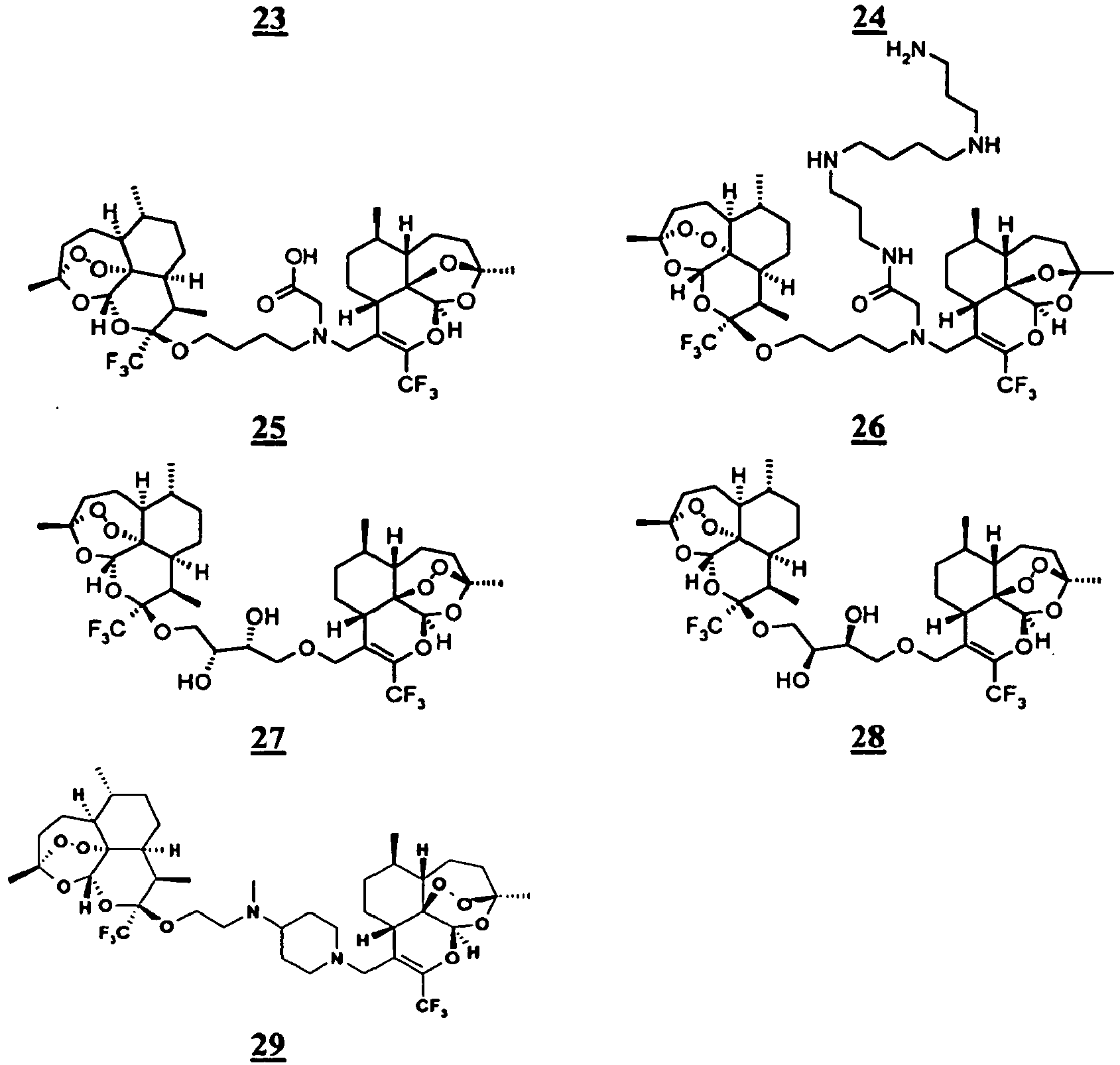
- La présente invention a également pour objet un composé de formule (I) tel que défini ci-dessus pour son utilisation en tant que médicament, notamment destiné au traitement du cancer.
- L'invention concerne également l'utilisation d'un composé de l'invention pour la fabrication d'un médicament destiné au traitement du cancer.
- L'invention concerne aussi un composé de formule I pour l'utilisation dans une méthode pour le traitement du cancer, comprenant l'administration d'une quantité efficace d'au moins un composé de formule (I) tel que défini ci-dessus à un patient en ayant besoin.
- La présente invention a également pour objet une composition pharmaceutique comprenant au moins un composé selon l'invention et au moins un véhicule pharmaceutiquement acceptable.
- Les composés selon l'invention peuvent être administrés par voie orale, sublinguale, parentérale, sous-cutanée, intramusculaire, intraveineuse, transdermique, locale ou rectale, et de préférence par voie orale, intraveineuse ou sous-cutanée.
- Dans les compositions pharmaceutiques de la présente invention pour l'administration orale, sublinguale, parentérale, sous-cutanée, intramusculaire, intraveineuse, transdermique, locale ou rectale, l'ingrédient actif peut être administré sous formes unitaires d'administration, en mélange avec des supports pharmaceutiques classiques, aux animaux ou aux êtres humains. Les formes unitaires d'administration appropriées comprennent les formes par voie orale telles que les comprimés, les gélules, les poudres, les granules et les solutions ou suspensions orales, les formes d'administration sublinguale et buccale, les formes d'administration parentérale, sous-cutanée, intramusculaire, intraveineuse, intranasale ou intraoculaire et les formes d'administration rectale.
- Lorsque l'on prépare une composition solide sous forme de comprimés, on mélange l'ingrédient actif principal avec un véhicule pharmaceutique tel que la gélatine, l'amidon, le lactose, le stéarate de magnésium, le talc, la gomme arabique ou analogues. On peut enrober les comprimés de saccharose ou d'autres matières appropriées ou encore on peut les traiter de telle sorte qu'ils aient une activité prolongée ou retardée et qu'ils libèrent d'une façon continue une quantité prédéterminée de principe actif
- On obtient une préparation en gélules en mélangeant l'ingrédient actif avec un diluant et en versant le mélange obtenu dans des gélules molles ou dures.
- Une préparation sous forme de sirop ou d'élixir peut contenir l'ingrédient actif conjointement avec un édulcorant, un antiseptique, ainsi qu'un agent donnant du goût et un colorant approprié.
- Les poudres ou les granules dispersibles dans l'eau peuvent contenir l'ingrédient actif en mélange avec des agents de dispersion ou des agents mouillants, ou des agents de mise en suspension, de même qu'avec des correcteurs de goût ou des édulcorants.
- Pour une administration rectale, on recourt à des suppositoires qui sont préparés avec des liants fondant à la température rectale, par exemple du beurre de cacao ou des polyéthylènes glycols.
- Pour une administration parentérale, intranasale ou intraoculaire, on utilise des suspensions aqueuses, des solutions salines isotoniques ou des solutions stériles et injectables qui contiennent des agents de dispersion et/ou des agents mouillants pharmacologiquement compatibles.
- Le principe actif peut être formulé également sous forme de microcapsules, éventuellement avec un ou plusieurs supports additifs.
- Les composés de l'invention peuvent être utilisés à des doses comprises entre 0,01 mg et 1000 mg par jour, donnés en une seule dose une fois par jour ou administrés en plusieurs doses tout au long de la journée, par exemple deux fois par jour en doses égales. La dose administrée par jour est avantageusement comprise entre 5 mg et 500 mg, encore plus avantageusement entre 10 mg et 200 mg. Il peut être nécessaire d'utiliser des doses sortant de ces gammes ce dont l'homme du métier pourra se rendre compte lui-même.
- Dans un mode de réalisation particulier, cette composition pourra comprendre en outre au moins un autre principe actif, avantageusement choisi parmi les agents anticancéreux.
- A titre d'agent anticancéreux, on peut citer de manière non limitative la 6-mercaptopurine, la fludarabine, la cladribine, la pentostatine, la cytarabine, le 5-fluorouracile, la gemcitabine, le méthotrexate, le raltitrexed, l'irinotécan, le topotécan, l'étoposide, la daunorubicine, la doxorubicine, l'épirubicine, l'idarubicine, la pirarubicine, la mitoxantrone, la chlorméthine, la cyclophosphamide, l'ifosfamide, le melphalan, le chlorambucil, le busulfan, la carmustine, la fotémustine, la streptozocine, le carboplatine, le cisplatine, l'oxaliplatine, la procarbazine, la dacarbazine, la bléomycine, la vinblastine, la vincristine, la vindésine, la vinorelbine, le paclitaxel, le docétaxel, la L-asparaginase, la flutamide, la nilutamide, la bicalutamide, l'acétate de cyprotérone, la triptoréline, la leuproréline, la goséréline, la buséréline, le formestane, l'aminoglutéthimide, l'anastrazole, le létrozole, le tamoxifène, l'octréotide et le lanréotide.
- La présente invention a également pour objet une composition pharmaceutique comprenant :
- (i) au moins un composé de formule (I) tel que défini ci-dessus, et
- (ii) au moins un autre principe actif, notamment utile pour le traitement du cancer,
- A titre de principe actif, on peut citer notamment, de façon non limitative, la 6-mercaptopurine, la fludarabine, la cladribine, la pentostatine, la cytarabine, le 5-fluorouracile, la gemcitabine, le méthotrexate, le raltitrexed, l'irinotécan, le topotécan, l'étoposide, la daunorubicine, la doxorubicine, l'épirubicine, l'idarubicine, la pirarubicine, la mitoxantrone, la chlorméthine, la cyclophosphamide, l'ifosfamide, le melphalan, le chlorambucil, le busulfan, la carmustine, la fotémustine, la streptozocine, le carboplatine, le cisplatine, l'oxaliplatine, la procarbazine, la dacarbazine, la bléomycine, la vinblastine, la vincristine, la vindésine, la vinorelbine, le paclitaxel, le docétaxel, la L-asparaginase, la flutamide, la nilutamide, la bicalutamide, l'acétate de cyprotérone, la triptoréline, la leuproréline, la goséréline, la buséréline, le formestane, l'aminoglutéthimide, l'anastrazole, le létrozole, le tamoxifene, l'octréotide ou le lanréotide.
- La composition pharmaceutique telle que décrite ci-dessus peut être utile en particulier pour le traitement du cancer.
- La présente invention concerne également l'utilisation d'une composition pharmaceutique comprenant :
- (i) au moins un composé de formule (I) tel que défini ci-dessus, et
- (ii) au moins un autre principe actif, notamment utile pour le traitement du cancer,
- Les composés de l'invention peuvent être préparés notamment à partir des intermédiaires A, A 1 , B, C, D, E, F, G, G 1 et R décrits ci-dessous. Ainsi, les composé de l'invention sont obtenus par couplage entre l'intermédiaire G, G 1 , ou R et un intermédiaire A, A 1 , B, C, D, E ou F, ce couplage pouvant être effectué en une ou plusieurs étapes.
- La synthèse de l'intermédiaire A bromo-trifluorométhylé de l'artémisinine et du dérivé hydroxylé B sont décrites dans J. Med. Chem., 47, 1423-33, (2004) et
WO 03/035 651 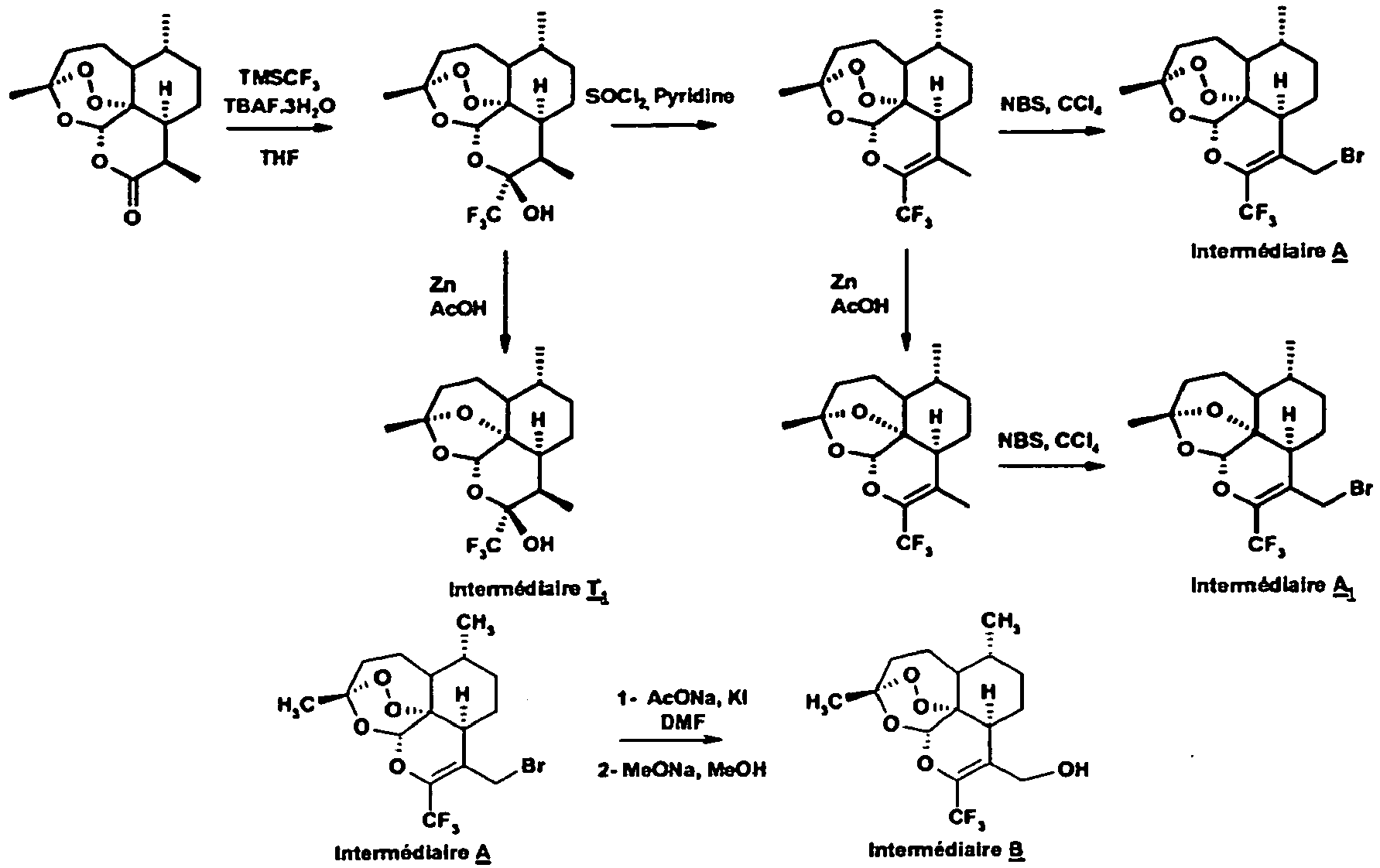
-

- A une solution de A (0.83 g, 2.0 mmol) dans l'acétonitrile (20 mL) est ajouté l'oxyde de N-méthyl-morpholine (NMO) (1.08 g, 8.0 mmol, 4 éq.). Le mélange réactionnel est agité 1 heure à température ambiante puis condensé sous pression réduite. Le résidu est repris dans le dichlorométhane et lavé à l'eau. La phase organique est ensuite séchée sur sulfate de magnésium, filtrée et évaporée sous pression réduite. L'aldéhyde intermédiaire C ainsi obtenu (poudre blanche, 0.68 g, 98%) est directement engagé dans les réactions suivantes sans étape de purification supplémentaire.
- A une solution de l'intermédiaire C (2.10 g, 6.0 mmol) dans un mélange acétone/eau (1.5/1, 75 mL) sont successivement additionnés le 2-méthyl-2-butène (3.2 mL, 30.1 mmol, 5 éq.), le phosphate de sodium monohydrate (2.50 g, 18.1 mmol, 3 éq.) puis le chlorite de sodium (1.64 g, 18.1 mmol, 3 éq.). Le mélange réactionnel est agité 18 heures à température ambiante puis condensé sous pression réduite. Après dilution à l'acétate d'éthyle, la phase organique est lavée à l'eau puis à l'aide d'une solution saturée de chlorure de sodium et séchée sur sulfate de magnésium. Après filtration, les solvants sont évaporés sous pression réduite. Le résidu est purifié par chromatographie sur gel de silice (cyclohexane/acétate d'éthyle 80:20) ; l'intermédiaire D est isolé avec un rendement de 54% (poudre blanche, 1.2 g).
-

- A une solution de l'intermédiaire A (0.63 g, 2.5 mmol) dans le diméthylsulfoxyde (DMSO) (10 mL) est additionné l'azoture de sodium (0.14 g, 2.25 mmol, 1.5 éq.). Le mélange réactionnel est agité à température ambiante pendant 1.5 heures. Il est ensuite versé dans l'eau et l'extraction est réalisée à l'acétate d'éthyle. La phase organique est séchée sur sulfate de magnésium, filtrée et les solvants sont évaporés sous pression réduite. L'azoture intermédiaire E ainsi obtenu (poudre blanche, 0.56 g, 100%) est directement engagé dans les réactions suivantes sans étape de purification supplémentaire.
- L'intermédiaire A (1.03 g, 2.5 mmol) est dissous dans une solution d'ammoniac dans le méthanol (7N, 10 mL). Le mélange réactionnel est agité à température ambiante pendant 3 heures puis évaporé sous pression réduite. Le résidu est purifié par chromatographie sur gel de silice (dichlorométhane/méthanol 95:5 puis 90:10) ; l'intermédiaire F est isolé avec un rendement de 59% (poudre jaune pâle, 0.52 g).
- La synthèse de l'intermédiaire G nécessaire à la préparation des composés de l'invention est décrite dans Org. Lett., 4, 757-759, (2002), dont le protocole est indiqué sur le schéma réactionnel ci-dessous.

- La synthèse de l'intermédiaire R à partir de l'intermédiaire G est décrite dans le procédé de synthèse du composé 14 ci-après.
- Les intermédiaires A 1 et G 1 possèdent un pont endoperoxyde réduit dans le noyau artémisinine.
-

- A une solution du dérivé trifluorométhylé décrit dans J. Med. Chem., 47, 1423-33, (2004) (300 mg, 0.897 mmol) dans l'acide acétique 100 % (8 mL) est ajouté du zinc en poudre (264 mg, 0.403 mmol, 4.5 éq.). Après 4h30 d'agitation à température ambiante, le milieu réactionnel est filtré sur silice puis concentré sous pression réduite. Le brut réactionnel est purifié par chromatographie sur gel de silice avec un gradient d'éluant (éther de pétrole/éther diéthylique : 100 à 90/10). Le dérivé au pont réduit est obtenu avec un rendement de 90 % (259 mg).
- A une solution de dérivé au pont réduit (259 mg, 0.813 mmol) dans le tétrachlorure de carbone (10 mL) est ajouté le N-bromosuccinimide (NBS) (290 mg, 1.62 mmol, 2 éq.). Le milieu réactionnel est porté au reflux instantanément. Après 1h à cette température, le mélange réactionnel est dilué avec du dichlorométhane (5 mL), lavé avec une solution saturée de NaHCO3 (2 x 5 mL) puis avec une solution de NaCl saturée (5 mL). La phase organique est séchée sur MgSO4, filtrée et concentrée sous pression réduite. Le brut réactionnel est purifié par chromatographie sur gel de silice avec un gradient d'éluant (éther de pétrole/éther diéthylique : 100 à 90/10). L'intermédiaire A 1 est obtenu avec 60% de rendement (186 mg).
-

- A une solution d'alcool trifluorométhylé décrit dans J. Med. Chem., 47, 1423-33, (2004) (1.5 g, 4.25 mol) dans l'acide acétique 100 % (37.5 mL) est ajouté du zinc en poudre (1.25 g, 19.15 mmol, 4.5 éq.). Après 4h30 d'agitation à température ambiante, le milieu réactionnel est filtré sur silice puis est concentré sous pression réduite. L'intermédiaire T 1 au pont réduit est obtenu avec un rendement quantitatif (1.42 g).
- Ce dernier (1.42 g, 4.23 mmol) est mis en solution dans le dichlorométhane (26 mL), dans lequel sont ajoutés, à 0°C et successivement : la pyridine (690 µL, 8.46 mmol, 2 éq.) puis le bromure de thionyle (972 µL, 8.46 mmol, 2 éq.). Le mélange réactionnel est laissé revenir à température ambiante et après 4h30 d'agitation est hydrolysé avec une solution de NaCl saturée. La phase organique est basifiée avec une solution saturée de NaHCO3 (2 x 10 mL), lavée avec une solution de NaCl saturée (10 mL), séchée sur MgSO4, filtrée et concentrée sous pression réduite. L'intermédiaire G 1 est obtenu avec 80 % de rendement (1.34 g).
- La présente invention a ainsi pour objet un procédé de préparation d'un composé de formule (I) tel que défini ci-dessus, caractérisé en ce que le composé de formule (I) est obtenu par couplage d'un composé de formule (II) suivante :


- Le composé de formule (I) ainsi obtenu pourra être séparé du milieu réactionnel par des méthodes bien connues de l'homme du métier, comme par exemple par extraction, évaporation du solvant ou encore par précipitation et filtration.
- Le composé pourra être par ailleurs purifié si nécessaire par des techniques bien connues de l'homme du métier, comme par recristallisation si le composé est cristallin, par distillation, par chromatographie sur colonne sur gel de silice ou encore par chromatographie liquide haute performance (HPLC).
- Le couplage pourra comprendre une ou plusieurs étapes réactionnelles réalisées par des techniques bien connues de l'homme du métier.
- Selon un premier mode de réalisation particulier, un composé de formule (I) pour lequel B = -CH2Y- ou -C(=O)Y-, avec Y tel que défini ci-dessus, peut être préparé par couplage entre les composés (II) et (III) et un composé de formule (IV) suivante :
Z3-X-Z4 (IV),
avec : - X tel que défini ci-dessus,
- Z3 représentant un atome d'halogène, tel qu'un atome de brome ou de chlore, ou un groupement -OH, -NHR1, -SH, -N3, -C(=O)R4 ou un hétérocycle comportant au moins un groupement NH intracyclique, R1 étant tel que défini ci-dessus et R4 représentant un atome d'hydrogène ou un groupement (C1-C6)alkyle, et
- Z4 représentant un atome d'halogène, tel qu'un atome de brome ou de chlore, ou un groupement -OH, -NHR1, -SH, -N3 ou un hétérocycle comportant au moins un groupement NH intracyclique, R1 étant tel que défini ci-dessus.
- Dans ce cas, la fonction Z2 portée par le composé de formule (III) sera de préférence un groupe -CH2OH, -CH2NH2 ou -CH2Hal (pour donner accès aux composé (I) avec B = -CH2O-, -CH2NR1- ou -CH2S- ou -COOH (pour donner accès aux composé (I) avec B = -C(=O)O-, -C(=O)NR1- ou -C(=O)S-, et encore de préférence sera un groupe - CH2Hal ou -COOH.
- Dans le cas où Z3 et/ou Z4 représente un hétérocycle, la fonction active qui réagira dans l'étape de couplage sera bien évidemment le groupement NH intracyclique. L'hétérocycle sera de préférence à 5 ou 6 chaînons, tel qu'un groupe morpholinyle, pipéridinyle ou pypérazinyle.
- Le composé de formule (I) est alors obtenu en deux étapes, d'une part (1) par couplage de la fonction Z1 du composé (II) avec la fonction Z3 du composé (IV), et d'autre part (2) par couplage de la fonction Z2 du composé (III) avec la fonction Z4 du composé (IV). L'ordre de réalisation de ces deux étapes (1) et (2) est indifférent, ces deux étapes de couplage étant réalisées par des techniques bien connues de l'homme du métier.
- Si nécessaire, la fonction Z3 ou Z4, qui ne doit pas réagir dans la première étape du couplage, pourra être préalablement protégée puis déprotégée une fois cette étape réalisée. Notamment, si une fonction amine libre NH2 est désirée, elle pourra être obtenue à partir du dérivé halogéné ou d'un azoture N3. Une fonction amine NH ou NH2 pourra être également protégée sous forme de carbamate, notamment par un groupement Boc. De même, un atome d'halogène pourra être obtenu par halogénation d'un groupe OH (par exemple en présence de N-bromosuccinimide pour obtenir un atome de brome).
- De même, il peut être nécessaire d'activer certaines fonctions intervenant dans le couplage (Z1, Z2, Z3 ou Z4). Notamment, dans le cas d'une fonction acide COOH, celle-ci peut être activée sous forme d'un chlorure d'acyle COCI.
- Des étapes supplémentaires de fonctionnalisation peuvent également être effectuées (voir exemples 25 et 26).
- Le composé de formule (IV) pourra être soit commercial, soit préparé par des procédés bien connus de l'homme du métier.
- Selon un premier aspect, Z3 représente un atome d'halogène, un hétérocycle ou un groupement -OH, -NHR1, -SH ou -N3, ce qui permet d'accéder à des composés de formule (I) pour lesquelsreprésente une liaison simple.
- Selon un second aspect, Z3 représente un groupement -C(=O)R4 et Z1 représente un groupement -NH2, ce qui permet d'accéder à des composés de formule (I) pour lesquelsreprésente une liaison double et donc A représente un atome d'azote.

- Ce premier mode de réalisation particulier de préparation des composés de l'invention est illustré notamment avec la synthèse des composés 1, 2, 3, 4, 10, 11, 12, 13, 14, 16, 17, 18, 19, 20, 22, 23, 24, 25, 26 et 29.
- Selon un deuxième mode de réalisation particulier, un composé de formule (I) pour lequel B = -CH(OR3)-, avec R3 tel que défini ci-dessus, peut être préparé par couplage entre les composés (II) et (III), avec Z2 = -CHO, et un composé de formule (V) suivante :
Z5-X-Z6 (V),
avec : - X tel que défini ci-dessus,
- Z5 représentant un atome d'halogène, tel qu'un atome de brome ou de chlore, ou un groupement -OH, -NHR1, -SH, -N3, -C(=O)R4 ou un hétérocycle comportant au moins un groupement NH intracyclique, R1 et R4 étant tel que défini ci-dessus, et
- Z6 représentant un atome d'hydrogène acide ou un atome d'halogène.
- Par « atome d'hydrogène acide », on entend, au sens de la présente invention, un atome d'hydrogène qui peut être déplacé par une base. Un tel atome d'hydrogène acide peut être en particulier un atome d'hydrogène acétylénique.
- Dans le cas où Z5 représente un hétérocycle, la fonction active qui réagira dans l'étape de couplage sera bien évidemment le groupement NH intracyclique. L'hétérocycle sera de préférence à 5 ou 6 chaînons, tel qu'un groupe morpholinyle, pipéridinyle ou pypérazinyle.
- Ce procédé comprendra en particulier les étapes successives suivantes :
- (i) mise en réaction du composé (V) avec le composé (II) pour donner le composé (VI) suivant :

- (ii) formation, à partir du composé (VI) obtenu à l'étape (i) précédente, du composé organométallique (VII) suivant :

- (iii) mise en réaction du composé (VII) obtenu à l'étape (ii) précédente avec un composé de formule (III) pour lequel Z2 = -CHO pour donner un composé de formule (I) pour lequel B = -CH(OH)-,
- (iv) éventuellement substitution de la fonction hydroxyle du composé de formule (I) obtenu à l'étape (iii) précédente pour donner un composé de formule (I) pour lequel B = - CH(OR3)- avec R3 ≠ H, et
- (v) séparation du milieu réactionnel du composé de formule (I) obtenu à l'étape (iv) ou (v).
- Le composé organométallique (VII) peut être formé à partir du composé (VI) pour lequel Z6 = H par réaction avec une base organométallique telle qu'un alkylithium (comme n-Bu-Li) ou un bromure ou un chlorure d'alkylmagnésium.
- Lorsque le composé (VI) comporte un groupement Z6 représentant un atome d'halogène tel qu'un atome de brome, un échange halogène-métal peut donner accès au composé (VII) souhaité par mise en réaction du composé (VI) avec un métal tel que le lithium ou le magnésium.
- Le composé de formule (V) pourra être soit commercial, soit préparé par des procédés bien connus de l'homme du métier.
- Selon un premier aspect, Z5 représente un atome d'halogène, un hétérocycle ou un groupement -OH, -NHR1, -SH ou -N3, ce qui permet d'accéder à des composés de formule (I) pour lesquelsreprésente une liaison simple. Dans ce cas, Z5 représente de préférence un groupement -OH, -NHR1 ou -SH et Z1 représente un atome d'halogène tel qu'un atome de brome.

- Selon un second aspect, Z5 représente un groupement -C(=O)R4 et Z1 représente un groupement -NH2, ce qui permet d'accéder à des composés de formule (I) pour lesquelsreprésente une liaison double et donc A représente un atome d'azote.

- Ce deuxième mode de réalisation particulier de préparation des composés de l'invention est illustré notamment avec la synthèse du composé 9.
- Selon un troisième mode de réalisation particulier, le couplage est réalisé par métathèse croisées des alcènes ou des alcynes comme cela est illustré avec la préparation des composés 8 et 21. Dans ce cas, une ou plusieurs étapes préalables devront être effectuées pour introduire un groupement portant une double ou une triple liaison terminale à la place des groupements Z1 et Z2 des composés (II) et (III).
- De plus, des étapes supplémentaires de fonctionnalisation peuvent être effectuées, notamment des étapes de fonctionnalisation de la double ou triple liaison formée au cours de la métathèse (voir exemples 27 et 28).
- Ainsi, un composé de formule (I) pour lequel :
- représente une liaison simple, A représente un hétéroatome, B = -CH2O-, - CH2NR1- ou -CH2S- et X = -(CH2)y-Z7-(CH2)z-, avec Z7 représentant le groupe -CH=CHou -C=C- et y et z représentant, indépendamment l'un de l'autre, un nombre entier compris entre 0 et 4, avec y + z ≤ 4, ou

- représente une liaison double, A représente N, B = -CH2O-, -CH2NR1- ou -CH2Set X représente =C((C1-C6)alkyle)-O-(CH2)y-Z7-(CH2)2-, avec Z7, y et z tels que définis ci-dessus,

- peut être obtenu par une réaction de métathèse croisée entre le composé de formule (VIII) suivante :

et le composé de formule (IX) suivante :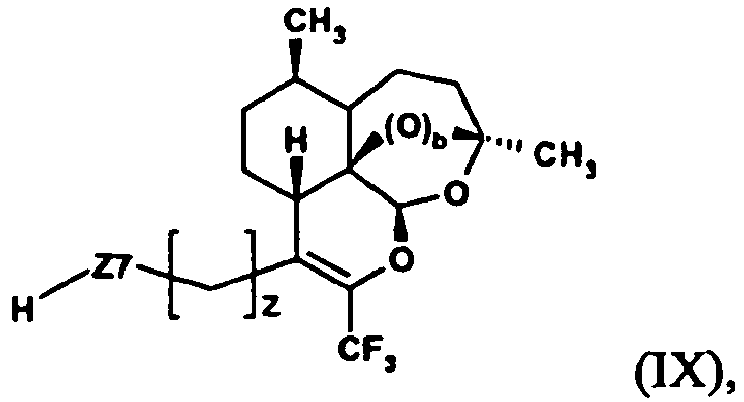
- Cette réaction sera réalisée en présence d'un catalyseur de métathèse tel que le catalyseur de Grubb de 1ère ou 2nde génération.
- De préférence, Z7 représente le groupement -CH=CH-.
- Le composé (VIII) pourra être préparé par réaction d'un composé de formule (II), pour lequel Z1 représente de préférence un atome d'halogène, avec un composé de formule Z7-(CH2)y-R, où Z7 et y sont tels que définis ci-dessus et R représente un groupement OH, NHR1 ou SH, R1 étant tel que défini ci-dessus.
- Le composé (IX) pourra être préparé par réaction d'un composé de formule (III), pour lequel Z2 représente de préférence un atome d'halogène, avec un composé de formule Z7-(CH2)z-R', où Z7 et z sont tels que définis ci-dessus et R' représente un groupement OH, NHR1 ou SH, R1 étant tel que défini ci-dessus.
- Selon un quatrième mode de réalisation particulier, le couplage est réalisé par une réaction de cycloaddition [4+2] ou [3+2], comme cela est illustré avec la préparation des composés 5, 6 et 7. Dans ce cas, une ou plusieurs étapes préalables devront être effectuées pour introduire des groupements adaptés à la place des groupements Z1 et Z2 des composés (II) et (III), comme un alcène ou un alcyne pour un des deux groupements et un diène ou un dipôle 1,3 tel qu'un groupe N3 pour l'autre groupement.
- Selon un cinquième mode de réalisation particulier, un composé de formule (I) pour lequel -A-X-B- représente -N=C((C1-C5)alkyle)-O-CH2- peut être préparé par couplage en milieu basique d'un composé de formule (III) pour lequel Z2 représente un atome d'halogène tel qu'une atome de brome avec un composé de formule (X) suivante :

- De préférence, cette réaction est réalisée en présence de NaH comme base, en présence notamment de KI.
- Le composé de formule (X) peut être préparé par acylation à partir d'un composé de formule(II) pour lequel Z1 = NH2 ou selon le protocole décrit pour la synthèse de l'intermédiaire V.
- Ce deuxième mode de réalisation particulier de préparation des composés de l'invention est illustré notamment avec la synthèse du composé 15.
- Dans tous les procédés décrits ci-dessus, des étapes supplémentaires de substitution et/ou activation et/ou protection/déprotection, bien connues de l'homme du métier, pourront être réalisées si nécessaire.
- La présente invention sera mieux comprise à la lumière des exemples non limitatifs qui suivent.
-


- 1 ère étape: A une solution de l'intermédiaire G ou G 1 (1 éq.) dans le dichlorométhane (c=0.14) sont ajoutés successivement le diol (HO-CH2-Z-CH2OH) (10 éq.) et l'hexafluoroisopropanol (HFIP) (5 éq.). Le mélange réactionnel est ensuite agité à température ambiante pendant 5 heures avant dilution au dichlorométhane. La phase organique est lavée avec une solution d'hydrogénocarbonate de sodium, séchée sur sulfate de magnésium. Après filtration, les solvants sont évaporés sous pression réduite. Le brut obtenu est purifié par chromatographie sur gel de silice (cyclohexane/acétate d'éthyle) pour conduire à l'intermédiaire H x .
- Intermédiaire H 1 : obtenu avec un rendement de 71% sous forme d'une poudre blanche à partir du 1,3-propanediol et l'intermédiaire G (cyclohexane/acétate d'éthyle 85:15 à 70:30).
- Intermédiaire H 2 : obtenu avec un rendement de 71 % sous forme d'une poudre blanche à partir du 1,2-éthanediol et l'intermédiaire G (cyclohexane/acétate d'éthyle 90:10). Intermédiaire H 3 : obtenu avec un rendement de 25% sous forme d'une huile translucide à partir du 1,4-butanediol et l'intermédiaire G (cyclohexane/acétate d'éthyle 80:20). Intermédiaire H 4 : obtenu avec un rendement de 39% sous forme d'une huile translucide à partir du 2,6-pyridinediméthanol et l'intermédiaire G (cyclohexane/acétate d'éthyle 95:5 à 75:25).
- Intermédiaire H 5 : obtenu avec un rendement de 82% sous forme d'une huile incolore à partir du 1,5-pentanediol et l'intermédiaire G (cyclohexane/acétate d'éthyle 100 à 80:20). Intermédiaire H 6 : obtenu avec un rendement de 61% sous forme d'une huile jaune à partir du 1,6-hexanediol et l'intermédiaire G (cyclohexane/acétate d'éthyle 95:5 à 80:20). Intermédiaire H 7 : obtenu avec un rendement de 49% sous forme d'une mousse jaune à partir de la 1,4-bis-(2-hydroxyéthyl)pipérazine et l'intermédiaire G (dichlorométhane/méthanol 100:0 à 90:10).
- Intermédiaire H 8 : obtenu avec un rendement de 22% sous forme d'une huile à partir de 1,5-pentanediol et l'intermédiaire G 1 (cyclohexane/acétate d'éthyle 100:0 à 60:40). 2 nde étape : A une suspension dans l'acétonitrile (ou dans le diméthylsulfoxyde) (c=0.1) de NaH (60% dans l'huile, 2.5 éq.) est ajouté l'intermédiaire H x (1 éq.) ; après 10 minutes d'agitation, est ajoutée à ce mélange, une solution dans l'acétonitrile (ou dans le diméthylsulfoxyde) (c=0.1) de l'intermédiaire A ou A 1 (1.25 éq.) et d'iodure de potassium (en quantité catalytique). Le milieu réactionnel est agité à température ambiante pendant 1 à 5 heures avant dilution à l'acétate d'éthyle. La phase organique est lavée avec une solution d'hydrogénocarbonate de sodium, séchée sur sulfate de magnésium. Après filtration, les solvants sont évaporés sous pression réduite. Le brut obtenu est purifié par chromatographie sur gel de silice (cyclohexane/acétate d'éthyle) pour conduire au dimère attendu.
- Exemple 1 : obtenu avec un rendement de 45% sous forme d'une poudre blanche à partir de l'intermédiaire H 1 et de l'intermédiaire A (cyclohexane/acétate d'éthyle 95:5 à 70:30). Exemple 2 : obtenu avec un rendement de 40% sous forme d'une poudre blanche à partir de l'intermédiaire H 2 et de l'intermédiaire A (cyclohexane/acétate d'éthyle 90:10). Exemple 3 : obtenu avec un rendement de 20% sous forme d'une poudre blanche à partir de l'intermédiaire H 3 et de l'intermédiaire A (cyclohexane/acétate d'éthyle 95:5). Exemple 4 : obtenu avec un rendement de 30% sous forme d'une poudre blanche à partir de l'intermédiaire H 4 et de l'intermédiaire A (cyclohexane/acétate d'éthyle 95:5 à 90:10). Exemple 16 : obtenu avec un rendement de 45% sous forme d'une poudre blanche à partir de l'intermédiaire H 5 et de l'intermédiaire A (cyclohexane/acétate d'éthyle 85:15). Exemple 17 : obtenu avec un rendement de 40% sous forme d'une poudre blanche à partir de l'intermédiaire H 6 et de l'intermédiaire A 1 (cyclohexane/acétate d'éthyle 75:2). Exemple 18 : obtenu avec un rendement de 58% sous forme d'une poudre blanche à partir de l'intermédiaire H 7 et de l'intermédiaire A (dichlorométhane/méthanol 97:3).
- Exemple 19 : obtenu avec un rendement de 1% sous forme d'une huile incolore à partir de l'intermédiaire H 8 et de l'intermédiaire A (cyclohexane/acétate d'éthyle 98:2 à 70:30).
-

- Etape 1 : A une solution de l'intermédiaire G (0.83 g, 2.0 mol) dans le dichlorométhane (14 mL) sont ajoutés successivement le 2-bromo-éthanol (1.41 mL, 20.0 mmol, 10 éq.) et l'hexafluoroisopropanol (1.05 mL, 10.0 mmol, 5 éq.). Le mélange réactionnel est ensuite agité à température ambiante pendant 2 heures avant dilution au dichlorométhane. La phase organique est lavée avec une solution d'hydrogénocarbonate de sodium puis séchée sur sulfate de magnésium. Après filtration, les solvants sont évaporés sous pression réduite. Le brut obtenu est purifié par chromatographie sur gel de silice (cyclohexane/acétate d'éthyle 95:5) ; l'intermédiaire I est isolé avec un rendement de 40% (poudre jaune pâle, 0.365 g).
- Etape 2: A une solution de l'intermédiaire I (0.07 g, 0.15 mmol) dans le diméthylsulfoxyde (2 mL) est ajouté de l'azoture de sodium (0.02 g, 0.3 mmol, 2 éq.). Le mélange réactionnel est agité à température ambiante pendant 1 heure. Après dilution à l'acétate d'éthyle, la phase organique est lavée à l'eau puis séchée sur sulfate de magnésium. Après filtration, les solvants sont évaporés sous pression réduite et l'intermédiaire J obtenu quantitativement, est engagé directement dans l'étape suivante (poudre blanche).
-

- A une suspension dans le diméthylsulfoxyde (DMSO) (4 mL) de NaH (60% dans l'huile, 0.04 g, 1.0 mmol, 1 éq.) est ajouté l'alcool propargylique (64 µL, 1.0 mmol, 1 éq.) ; après 5 minutes d'agitation, est ajoutée à ce mélange, une solution dans le diméthylsulfoxyde (2 mL) de l'intermédiaire A (0.41 g, 1.0 mmol). Le milieu réactionnel est agité à température ambiante pendant 1.5 heures avant dilution à l'acétate d'éthyle. La phase organique est lavée avec une solution d'hydrogénocarbonate de sodium puis séchée sur sulfate de magnésium. Après filtration, les solvants sont évaporés sous pression réduite. Le brut obtenu est purifié par chromatographie sur gel de silice (cyclohexane/acétate d'éthyle 95:5) ; l'intermédiaire K est isolé avec un rendement de 80% (huile incolore, 0.31 g).
-

- Un mélange de l'intermédiaire J (0.063 g, 0.15 mmol, 1 éq.) et de l'intermédiaire K (0.062 g, 0.15 mmol, 1 éq.) est chauffé à 90°C pendant 4 heures dans un tube scellé. Après retour à température ambiante, le milieu réactionnel est purifié par chromatographie sur gel de silice (cyclohexane/acétate d'éthyle 90:10 à 75:25) ; le composé 5 , moins polaire, et le composé 6 sont isolés avec un rendement global de 68% (poudre blanche, respectivement 0.035 g et 0.048 g).
-

- Etape 1 : A une solution de l'intermédiaire G (0.207 g, 0.5 mol) dans le dichlorométhane (3.5 mL) sont ajoutés successivement l'alcool propargylique (295 µL, 5.0 mmol, 10 éq.) et l'hexafluoroisopropanol (HFIP) (263 µL, 2.5 mmol, 5 éq.). Le mélange réactionnel est ensuite agité à température ambiante pendant 2 heures avant dilution au dichlorométhane. La phase organique est lavée avec une solution d'hydrogénocarbonate de sodium, séchée sur sulfate de magnésium. Après filtration, les solvants sont évaporés sous pression réduite. Le brut obtenu est purifié par chromatographie sur gel de silice (cyclohexane/acétate d'éthyle 97:3) ; l'intermédiaire L est isolé avec un rendement de 68% (poudre blanche, 0.133 g).
- Etape 2 : Un mélange de l'intermédiaire E (0.056 g, 0.15 mmol, 1 éq.) et de l'intermédiaire L (0.058 g, 0.15 mmol, 1 éq.) est chauffé à 90°C pendant 16 heures dans un tube scellé. Après retour à température ambiante, le milieu réactionnel est purifié par chromatographie sur gel de silice (cyclohexane/acétate d'éthyle 80:20) ; le composé 7 est isolé avec un rendement global de 28% (poudre blanche, 0.032 g).
-

- A une solution de l'intermédiaire G (0.5 g, 1.2 mmol) dans le dichlorométhane (7 mL) sont ajoutés successivement l'alcool allylique (823 µL, 12.0 mmol, 10 éq.) et l'hexafluoroisopropanol (634 µL, 6.0 mmol, 5 éq.). Le mélange réactionnel est ensuite agité à température ambiante pendant 4 heures avant dilution au dichlorométhane. La phase organique est lavée avec une solution d'hydrogénocarbonate de sodium, séchée sur sulfate de magnésium. Après filtration, les solvants sont évaporés sous pression réduite. Le brut obtenu est purifié par chromatographie sur gel de silice (cyclohexane/acétate d'éthyle 95:5) ; l'intermédiaire M est isolé avec un rendement quantitatif (poudre blanche, 0.47 g).
-

- A une suspension dans l'acétonitrile (2 mL) de NaH (60% dans l'huile, 0.11 g, 2.72 mmol, 2.5 éq.) est ajouté l'alcool allylique (60 µL, 0.87 mmol) ; après 5 minutes d'agitation, est ajoutée à ce mélange, une solution dans l'acétonitrile (2 mL) de l'intermédiaire A (0.45 g, 1.1 mmol, 1.25 éq.) et d'iodure de potassium (en quantité catalytique). Le milieu réactionnel est agité à température ambiante pendant 16 heures avant dilution à l'acétate d'éthyle. La phase organique est lavée avec une solution d'hydrogénocarbonate de sodium, séchée sur sulfate de magnésium. Après filtration, les solvants sont évaporés sous pression réduite. Le brut obtenu est purifié par chromatographie sur gel de silice (cyclohexane/acétate d'éthyle 95:5 à 90:10) ; l'intermédiaire N est isolé avec un rendement de 34% (poudre blanche, 0.15 g).
-

- A une solution dans le dichlorométhane (3 mL) des intermédiaires M (0.147 g, 0.37 mmol, 1 éq.) et N (0.146 g, 0.37 mmol, 1 éq.) est ajouté le catalyseur de Grubb de 1ère génération (cat. Grubb I) (0.031 g, 0.037 mmol, 0,1 éq.). Le mélange est agité à 40°C pendant 20 heures puis refroidi et filtré sur célite. Les solvants sont évaporés sous pression réduite. Le brut obtenu est purifié par chromatographie sur gel de silice (cyclohexane/acétate d'éthyle 95:5) ; le composé 8 est isolé avec un rendement de 15% (poudre blanche, 0.043 g).
-

- A une solution de l'intermédiaire L (0.047 g, 0.12 mmol) dans le tétrahydrofurane (1 mL) à -78°C est ajouté goutte à goutte le n-butyl-lithium (n-BuLi) (1.6 M dans l'hexane, 100 µL, 0.16 mmol, 1.3 éq.). Après 20 minutes d'agitation à -78°C, une solution de l'intermédiaire C (0.042 g, 0.12 mmol, 1 éq.) dans le tétrahydrofurane (1 mL) est additionnée. Le mélange réactionnel est ensuite remonté à température ambiante et agité 16 heures. Après addition d'une solution saturée de chlorure d'ammonium, le mélange est extrait au dichlorométhane. La phase organique est ensuite séchée sur sulfate de magnésium, filtrée et condensée sous pression réduite. Le brut obtenu est purifié par chromatographie sur gel de silice (cyclohexane/acétate d'éthyle 85:15) ; le composé 9 est isolé avec un rendement de 40% (poudre blanche, 0.035 g).
-

- A une solution de l'intermédiaire J (0.19 g, 0.45 mol) dans le tétrahydrofurane (4 mL) est ajoutée la triphénylphosphine (PPh3) (0.12 g, 0.45 mmol, 1 éq.). Après 24 heures à température ambiante, 2 mL d'eau sont ajoutés et l'agitation est maintenue 24 heures supplémentaires. Après évaporation des solvants sous pression réduite, le brut obtenu est purifié par chromatographie sur gel de silice (cyclohexane/acétate d'éthyle 100:0 à 94:6) ; l'intermédiaire O est isolé avec un rendement de 42% (poudre blanche, 0.075 g).
-

- A une solution de l'intermédiaire A (0.070 g, 0.17 mmol) dans le diméthylformamide (DMF) (0.5 mL) sont ajoutés le carbonate de potassium (0.052 g, 0.37 mmol, 2.2 éq.) et l'iodure de potassium (en quantité catalytique). Après 10 minutes d'agitation, une solution de l'intermédiaire O dans le diméthylformamide (0.5 mL) est additionnée. Le mélange réactionnel est alors chauffé à 70°C pendant 2.5 heures. Après retour à température ambiante, de l'eau et de l'acétate d'éthyle sont ajoutés au milieu. La phase organique est lavée avec une solution saturée de chlorure de sodium et séchée sur sulfate de magnésium. Après évaporation des solvants sous pression réduite, le brut obtenu est purifié par chromatographie sur gel de silice (dichlorométhane/acétate d'éthyle 100:0 à 85:15) ; le composé 10 est isolé avec un rendement de 34% (poudre jaune pâle, 0.042 g).
-

- A une solution de l'intermédiaire D (0.11 g, 0.30 mmol) dans le dichlorométhane (5 mL) sont ajoutés du chlorhydrate de 1-(3-diméthylaminopropyl)-3-éthylcarbodiimide (EDCI) (0.17 g, 0.91 mmol, 3 éq.) et du 1-hydroxybenzotriazole (HOBt) (0.12 g, 0.91 mmol, 3 éq.). Après 30 minutes d'agitation à température ambiante, une solution de l'intermédiaire O (0.12 g, 0.30 mmol, 1 éq.) dans le dichlorométhane (5 mL) est additionnée. Le mélange réactionnel est agité 2 heures à température ambiante. Après addition d'eau, le mélange est extrait au dichlorométhane. La phase organique est lavée avec une solution saturée de chlorure de sodium puis séchée sur sulfate de magnésium. Après filtration, les solvants sont évaporés sous pression réduite. Le brut obtenu est purifié par chromatographie sur gel de silice (dichlorométhane/acétate d'éthyle 99:1 à 97:3) ; le composé 11 est isolé avec un rendement de 7% (poudre blanche, 0.016 g).
-

- A une solution de l'intermédiaire A (1 g, 2.4 mmol) dans le tétrahydrofurane (15 mL) à 0°C est additionnée la N-(2-hydroxyéthyl)pipérazine (1.19 mL, 9.7 mmol, 4 éq.). Le milieu réactionnel est agité à 0°C pendant 4 heures. Après addition d'eau, le mélange est extrait à l'éther diéthylique. La phase organique est lavée avec une solution saturée de chlorure de sodium puis séchée sur sulfate de magnésium. Après filtration, les solvants sont évaporés sous pression réduite. Le brut obtenu est purifié par chromatographie sur gel de silice (dichlorométhane/méthanol 97:3 à 94:6) ; l'intermédiaire P est isolé avec un rendement de 84% (poudre jaune, 0.92 g).
-

- A une solution de l'intermédiaire G (0.60 g, 1.44 mmol) dans le dichlorométhane (6.0 mL) sont ajoutés successivement la N-Boc-4-(2-hydroxy-éthyl)-pipérazine (1.66 g, 7.22 mmol, 5 éq.) et l'hexafluoroisopropanol (HFIP) (0.76 mL, 7.22 mmol, 5 éq.). Le mélange réactionnel est agité à température ambiante pendant 18h. La phase organique est lavée avec une solution d'hydrogénocarbonate de sodium puis séchée sur sulfate de magnésium. Après filtration, les solvants sont évaporés sous pression réduite. Le brut obtenu est purifié par chromatographie sur gel de silice (cyclohexane/acétate d'éthyle 80:20). Le composé attendu, isolé avec un rendement de 22% (poudre blanche, 0.18 g), est mis en solution dans le dichlorométhane (2.0 mL) à laquelle est ajouté de l'acide trifluoroacétique (TFA) (0.75mL). Le mélange réactionnel est agité pendant 30 minutes à température ambiante puis concentré sous pression réduite. Le résidu est dilué dans du dichlorométhane. La phase organique est successivement lavée avec une solution saturée d'hydrogénocarbonate de sodium, et une solution saturée de chlorure de sodium, puis séchée sur sulfate de sodium. Après filtration, les solvants sont évaporés sous pression réduite. Le brut obtenu est purifié par chromatographie sur gel de silice (dichlorométhane/méthanol/ammoniaque aqueux 95:5:0.5); l'intermédiaire U est isolé avec un rendement de 61 % (poudre blanche, 0.095 g).
-

- A une solution de l'intermédiaire G (0.1 g, 0.24 mmol) dans le dichlorométhane (1.5 mL) sont ajoutés successivement l'intermédiaire P (0.22 g, 0.48 mmol, 2 éq.) et l'hexafluoroisopropanol (127 µL, 1.2 mmol, 5 éq.). Le mélange réactionnel est ensuite agité à température ambiante pendant 2 heures avant dilution au dichlorométhane. La phase organique est lavée avec une solution d'hydrogénocarbonate de sodium puis séchée sur sulfate de magnésium. Après filtration, les solvants sont évaporés sous pression réduite. Le brut obtenu est purifié par chromatographie sur gel de silice (cyclohexane/acétate d'éthyle 95:5 à 80:20); le composé 12 est isolé avec un rendement de 6% (poudre jaune pâle, 0.022 g).
-

- A une solution de l'intermédiaire U (0.35 g, 0.76 mmol) dans l'acétonitrile (5.0 mL) sont ajoutés du carbonate de potassium (0.21 g, 1.51 mmol, 2 éq.) et l'intermédiaire A 1 (0.30 g, 0.76 mmol, 1 éq.). Le mélange réactionnel est agité pendant 2 heures à température ambiante avant dilution dans l'eau et l'acétate d'éthyle. La phase aqueuse est extraite à l'acétate d'éthyle. Les phases organiques combinées sont lavées avec une solution saturée de chlorure de sodium, puis séchées sur sulfate de sodium. Après filtration, les solvants sont évaporés sous pression réduite. Le brut obtenu est purifié par chromatographie sur gel de silice (dichlorométhane/acétate d'éthyle 97.5:2.5 à 92:8) ; le composé 20 est isolé avec un rendement de 88% (mousse blanche, 0.52 g).
-

- Etape 1 : A une solution de l'intermédiaire G (1.0 g, 2.41 mmol) dans le dichlorométhane (14 mL) sont ajouté successivement le 2-bromo-propanol (2.77 mL, 24.1 mmol, 10 éq.) et l'hexafluoroisopropanol (HFIP)(1.27 mL, 12.0 mmol, 5 éq.). Le mélange réactionnel est ensuite agité à température ambiante pendant 2.5 heures avant dilution au dichlorométhane. La phase organique est lavée avec une solution d'hydrogénocarbonate de sodium puis séchée sur sulfate de magnésium. Après filtration, les solvants sont évaporés sous pression réduite. Le brut obtenu est purifié par chromatographie sur gel de silice (cyclohexane/acétate d'éthyle 95:5) ; l'intermédiaire bromé est isolé avec un rendement de 55% (huile claire, 0.63 g).
- Etape 2: A une solution de l'intermédiaire bromé (0.63 g, 1.38 mmol) dans le diméthylsulfoxyde (12 mL) est ajouté de l'azoture de sodium (0.18 g, 2.75 mmol, 2 éq.). Le mélange réactionnel est agité à température ambiante pendant 2.5 heures. Après dilution à l'acétate d'éthyle, la phase organique est lavée à l'eau puis séchée sur sulfate de magnésium. Après filtration, les solvants sont évaporés sous pression réduite et l'intermédiaire azoture, obtenu quantitativement, est engagé directement dans l'étape suivante (poudre blanche).
- Etape 3: A une solution de l'intermédiaire azoture (0.60 g, 1.38 mmol) dans le tétrahydrofurane (6 mL) est ajoutée la triphénylphosphine (0.36 g, 1.38 mmol, 1 éq.). Après 24 heures à température ambiante, 2 mL d'eau sont ajoutés et l'agitation est maintenue 24 heures supplémentaires. Après évaporation des solvants sous pression réduite, le brut obtenu est purifié par chromatographie sur gel de silice (cyclohexane/acétate d'éthyle 100:0 à 85:15 puis dichlorométhane/méthanol 99:1 à 70:30); l'intermédiaire Q est isolé avec un rendement de 62% (poudre blanche, 0.35 g).
-

- A une solution de l'intermédiaire D (0.27 g, 0.74 mmol) dans le dichlorométhane (10 mL) sont ajoutés EDCI (0.43 g, 2.24 mmol, 3 éq.) et HOBt (0.30 g, 2.24 mmol, 3 éq.). Après 30 minutes d'agitation à température ambiante, une solution de l'intermédiaire Q (0.30 g, 0.74 mmol, 1 éq.) dans le dichlorométhane (10 mL) est ajoutée. Le mélange réactionnel est agité 2 heures à température ambiante. Après addition d'eau, le mélange est extrait au dichlorométhane. La phase organique est lavée avec une solution saturée de chlorure de sodium puis séchée sur sulfate de magnésium. Après filtration, les solvants sont évaporés sous pression réduite. Le brut obtenu est purifié par chromatographie sur gel de silice (cyclohexane/acétate d'éthyle 90:10 à 80:20) ; le composé 13 est isolé avec un rendement de 59% (poudre blanche, 0.335 g).
-

- Etape 1 : A une solution de l'intermédiaire G (1.0 g, 2.41 mmol) dans l'acétonitrile (10 mL) sont additionnés l'acide succinique (2.84 g, 24.1 mmol, 10 éq.) et la triéthylamine (1.69 mL, 12.0 mmol, 5 éq.). Le mélange réactionnel est agité 96 heures à température ambiante. Une solution d'hydrogénocarbonate de sodium est ajoutée et l'extraction réalisée à l'acétate d'éthyle. La phase organique est ensuite lavée avec une solution saturée de chlorure de sodium, séchée sur sulfate de magnésium, filtrée puis condensée sous pression réduite. Le brut obtenu est purifié par chromatographie sur gel de silice (cyclohexane/acétate d'éthyle 95:5 à 90:10) ; l'intermédiaire R est isolé avec un rendement de 33% (poudre beige, 0.28 g).
- Etape 2 : A une solution de l'intermédiaire R (0.1 g, 0.28 mmol) dans le dichlorométhane (2.5 mL) sont ajoutés le chlorure d'acétoxyacétyle (40 µL, 0.37 mmol, 1.3 éq.) et la pyridine (30 µL, 0.37 mmol, 1.3 éq.). Après 24 heures à température ambiante, une nouvelle addition de chlorure d'acyle (1.3 éq.) et de pyridine (1.3 éq.) est réalisée et le milieu réactionnel est agité 6 heures supplémentaires. Une solution saturée de chlorure d'ammonium est ajoutée et le mélange extrait au dichlorométhane. La phase organique est séchée sur sulfate de magnésium, filtrée puis condensée sous pression réduite. Le brut obtenu est purifié par chromatographie sur gel de silice (dichlorométhane/acétate d'éthyle 95:5 à 92.5:7.5) ; l'intermédiaire acétoxy est isolé avec un rendement de 44% (poudre blanche, 0.055 g).
- Etape 3 : A une solution de l'intermédiaire acétoxy (0.053 g, 0.117 mmol) dans le méthanol (2 mL) à 0°C est additionnée une solution de méthanolate de sodium (0.010 g, 0.176 mmol) dans le méthanol (0.5 mL). Après 1 heure d'agitation à 0°C, le milieu est dilué avec de l'acétate d'éthyle et de l'eau. La phase organique est ensuite séchée sur sulfate de magnésium, filtrée puis condensée sous pression réduite. Le brut obtenu est purifié par chromatographie sur gel de silice (dichlorométhane/acétate d'éthyle 90:10 à 85:15) ; l'intermédiaire S est isolé avec un rendement de 94% (huile incolore, 0.045 g).
-
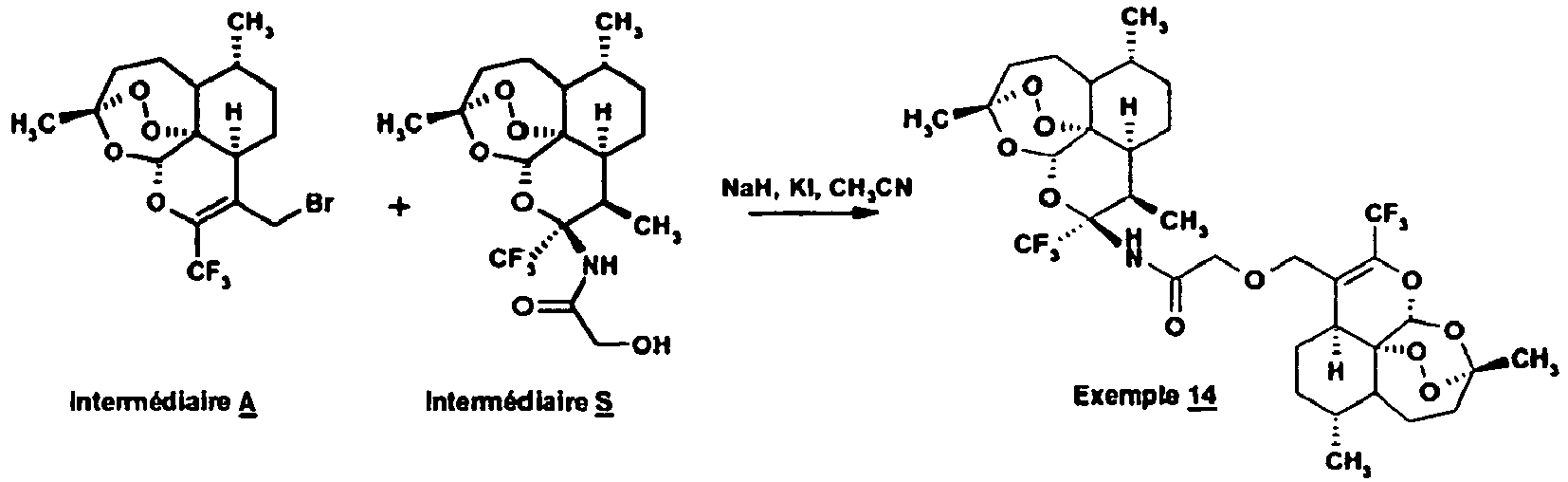
- A une solution de l'intermédiaire S (0.04 g, 0.1 mmol) dans l'acétonitrile (2 mL) est additionné l'hydrure de sodium (60% dans l'huile, 0.01 g, 0.25 mmol, 2.5 éq.). Après 5 minutes d'agitation, une solution de l'intermédiaire A (0.05 g, 0.12 mmol, 1.2 éq.) et d'iodure de potassium (en quantité catalytique) dans l'acétonitrile (1 mL) est ajoutée. Le mélange réactionnel est agité à température ambiante pendant 30 heures (additions renouvelées d'hydrure de sodium (2.5 éq.)). Après addition d'une solution saturée d'hydrogénocarbonate de sodium, l'extraction est réalisée à l'acétate d'éthyle. La phase organique est ensuite séchée sur sulfate de magnésium, filtrée et condensée sous pression réduite. Le brut obtenu est purifié par chromatographie sur gel de silice
- (cyclohexane/acétate d'éthyle 85:15 à 75:25) ; le composé 14 est isolé avec un rendement de 21% (poudre blanche, 0.016 g).
-

-
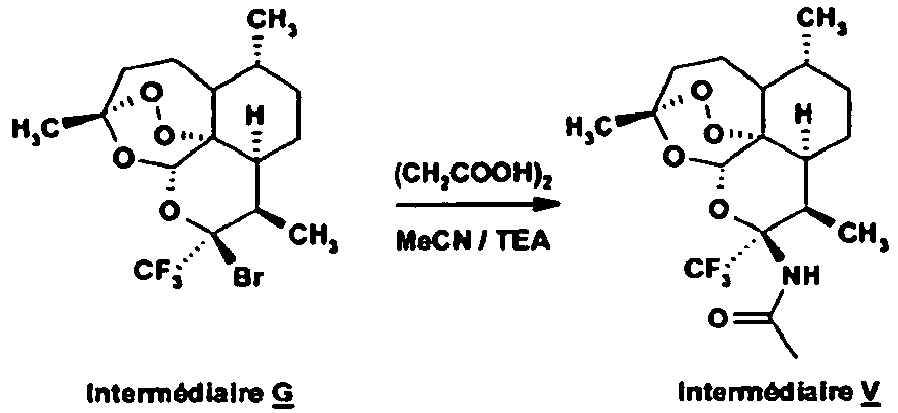
- A une solution de l'intermédiaire G (1.47 g, 3.5 mmol, 1 éq.) dans l'acétonitrile sont ajoutés successivement et à température ambiante, l'acide succinique (4.19 g, 35.5 mmol, 10 éq.) et la triéthylamine (1.80 g, 17.7 mmol, 5 éq.). Après 3 jours d'agitation à température ambiante, le milieu réactionnel est dilué avec de l'acétate d'éthyle (60 mL) et lavé avec une solution saturée de NaHCO3 (30 mL). La phase organique est séchée sur MgSO4, filtrée puis concentrée sous pression réduite. Le brut réactionnel est purifié par chromatographie sur colonne gel de silice avec un gradient d'éluant (cyclohexane/acétate d'éthyle: 100 à 40/60). L'intermédiaire V est obtenu avec un rendement de 30 % (401 mg).
- A une solution de l'intermédiaire V (0.1 g, 0.25 mmol) dans le diméthylformamide (1.2 mL) à 0°C, est additionné l'hydrure de sodium (60% dans l'huile, 0.02 g, 0.51 mmol, 2 éq.). Après 5 minutes d'agitation, l'intermédiaire A (0.21 g, 0.51 mmol, 2 éq.) et d'iodure de potassium (0.01 g, 0.05 mmol, 0.2 éq.) sont ajoutés. Le mélange réactionnel est agité à température ambiante pendant 2 heures. Après hydrolyse avec une solution saturée de chlorure de sodium, le mélange réactionnel est extrait au diéthyl éther puis la phase organique est séchée sur sulfate de magnésium, filtrée et condensée sous pression réduite. Le brut obtenu est purifié par chromatographie sur gel de silice (éther de pétrole/diéthyl éther 98:2 à 90: 10) ; le composé 15 est isolé avec un rendement de 40% (poudre blanche, 0.073 g).
-

- Etape 1 : A une solution de l'intermédiaire V (250 mg, 0.635 mmol) dans le diméthylformamide (DMF) anhydre (4 mL) est ajouté à 0 °C l'hydrure de sodium (76 mg, 1.9 mmol, 3 éq.) puis le iodure allylique (174 µL, 1.9 mmol, 3 éq.). Le milieu réactionnel est laissé revenir à température ambiante. Après 4h30 d'agitation, il est hydrolysé avec une solution de NaCl saturée. La phase organique est séchée sur MgSO4, filtrée puis évaporée sous pression réduite. Le O-allyl iminoéther (277 mg, 80%) est obtenu après purification par chromatographie sur gel de silice avec un gradient d'éluant (éther de pétrole/éther diéthylique : 98/2 à 95/5).
- Etape 2 : A une solution de l'intermédiaire N (131 mg, 0.335 mmol, 0.8 éq.) dans le dichlorométhane (1.6 mL) est ajouté le O-allyl iminoéther (174 mg, 0.401 mmol, 1 éq.) isolé ci-dessus, puis le catalyseur de Grubb de 1ère génération (33 mg, 0.043 mmol, 0.1 éq.). Après 23h d'agitation à température ambiante, le milieu réactionnel est filtré sur de la silice puis est concentré sous pression réduite. Le composé 21 (47 mg, 15 %) est obtenu après purification par chromatographie sur gel de silice avec un gradient d'éluant (cyclohexane/acétate d'éthyle : 100 à 85/15).
-
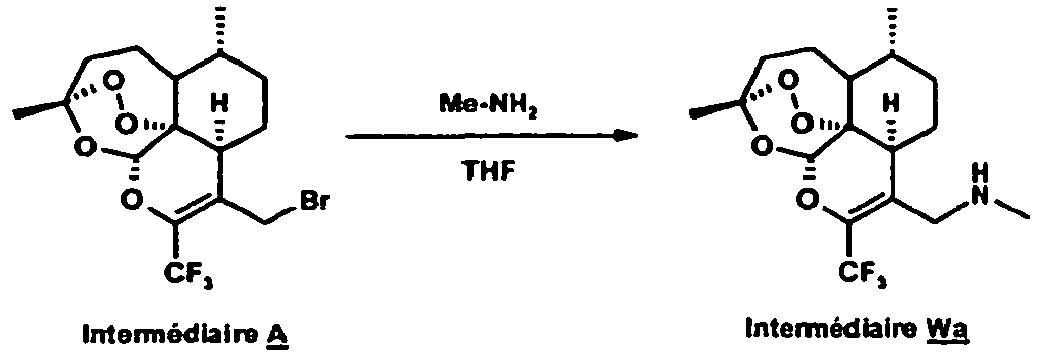
- Une solution de l'intermédiaire A (100 mg, 0.241 mmol) dans le THF anhydre (1.2 mL) est ajoutée pendant 45 minutes, à 0 °C et sous argon, à une solution de méthylamine [8.03 M dans l'éthanol (300 µL, 2.41 mmol, 10 éq.)] dans du tétrahydrofurane (THF) anhydre (12.5 mL). Après 2h d'agitation à température ambiante, la réaction est diluée dans de l'éther diéthylique et lavée avec une solution de NaCl saturée. La phase organique est séchée sur MgSO4, filtrée et concentrée sous pression réduite. Le brut réactionnel est purifié par chromatographie sur gel de silice avec un gradient d'éluant (cyclohexane/acétate d'éthyle : 80/20 à 10/90). L'intermédiaire Wa est obtenu avec 85 % de rendement (75 mg).
-

- L'intermédiaire Wb est obtenu suivant le même procédé avec un rendement de 47 % par réaction de l'intermédiaire A 1 avec l'allylamine.
-

-

- L'intermédiaire Xb est obtenu suivant le même procédé avec un rendement de 89% à partir de l'intermédiaire H 6 .
-

- L'intermédiaire Xc est obtenu suivant le même procédé avec un rendement de 86% à partir de l'intermédiaire H 3 .
-

- A une solution de l'intermédiaire Xa (93 mg, 0.186 mmol) dans le DMF anhydre (1.6 mL) est ajouté, à température ambiante et sous argon, l'iodure de potassium (34 mg, 0.204 mmol, 1.1 éq.), le carbonate de potassium (57 mg, 0.411 mmol, 2.2 éq.) puis l'intermédiaire Wa (74 mg, 0.203 mmol, 1.0 éq.) en solution dans le DMF anhydre (1.0 mL). Le milieu réactionnel est chauffé à 75 °C pendant 1h30. Une fois refroidi, le mélange réactionnel est dilué avec du dichlorométhane (5mL), lavé avec une solution de NaHCO3 saturée (5 mL) puis avec une solution de NaCl saturée (5 mL). La phase organique est séchée sur MgSO4, filtrée puis évaporée sous pression réduite. Le brut réactionnel est purifié par chromatographie sur gel de silice avec un gradient d'éluant (cyclohexane/acétate d'éthyle: 100 à 92/8). Le composé 22 est obtenu avec 70 % de rendement (105 mg).
- Le composé 23 est obtenu avec un rendement de 18% en suivant le même mode opératoire, par couplage de l'intermédiaire Wa avec l'intermédiaire Xb.
- Le composé 24 est obtenu avec un rendement de 76% en suivant le même mode opératoire, par couplage de l'intermédiaire Wb avec l'intermédiaire Xc .
-
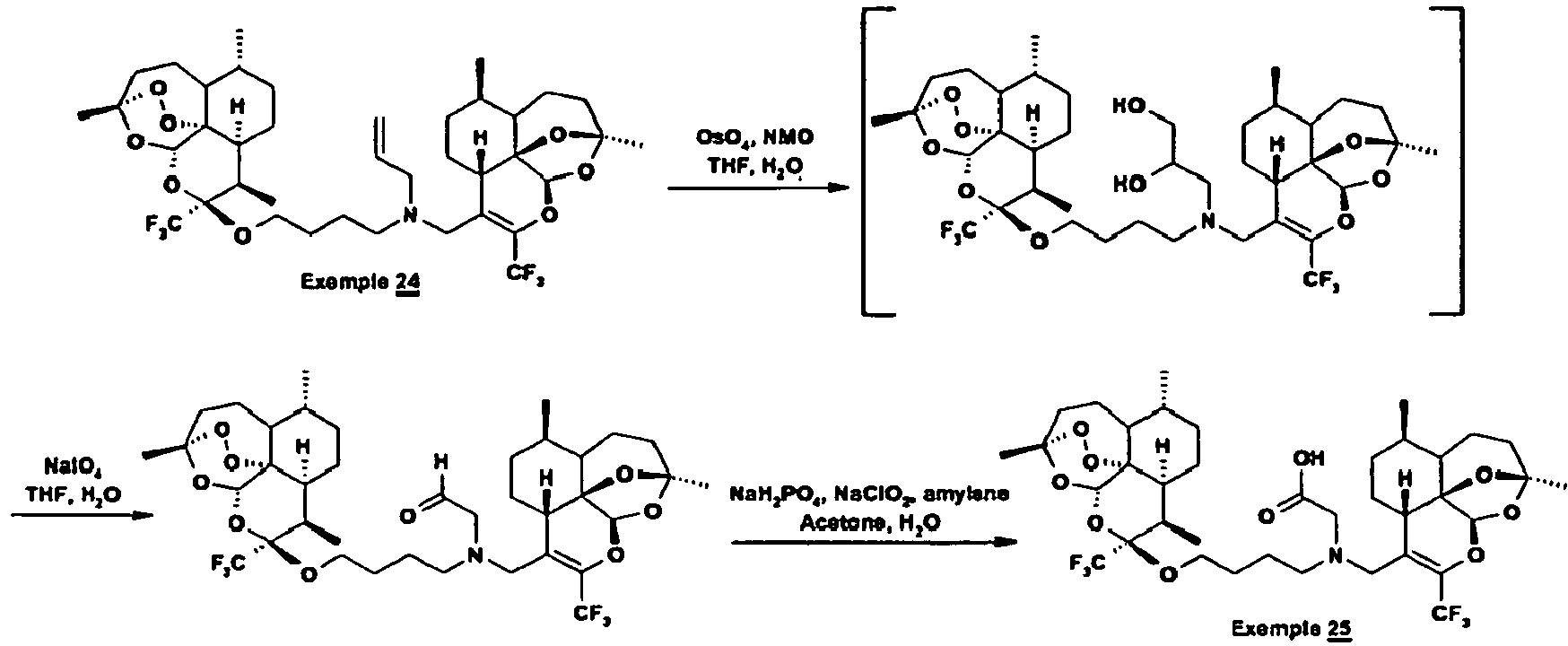
- Etap e 1 : A une solution du composé 24 (0.4 g, 0.51 mmol) dans du tétrahydrofurane (20.0 mL) et de l'eau (5.0 mL) sont ajoutés OsO4 (0.98 mL, 0.15 mmol, 0.3 éq.) et oxyde de N-méthylmorpholine (NMO) (78.1 mg, 0.67 mmol, 1.3 éq.). Le mélange réactionnel est agité à température ambiante pendant 18h. De l'eau (15.0 mL) et NaIO4 (0.55 g, 2.56 mmol, 10 éq.) sont ajoutés, et le mélange réactionnel est agité pendant 1 heure à température ambiante, avant d'être diluée par ajout d'eau et d'acétate d'éthyle. La phase organique est lavée avec une solution saturée de thiosulfate de sodium, une solution saturée de chlorure de sodium, puis est séchée sur sulfate de magnésium. Après filtration, les solvants sont évaporés sous pression réduite.
- Etape 2 : A une solution de l'aldéhyde brut précédemment formé (0.44 g, 0.57 mmol) dans l'acétone (15.0 mL) et l'eau (8.0 mL) sont ajoutés du phosphate de sodium (0.23 g, 1.70 mmol, 3 éq.), de l'amylène (0.27 mL, 2.55 mmol, 4.5 éq.) et du chlorite de sodium (0.15 g, 1.70 mmol, 3 éq.). Le mélange réactionnel est agité à température ambiante pendant 18 heures avant d'être diluée dans l'eau et l'acétate d'éthyle. La phase aqueuse est extraite à l'acétate d'éthyle. Les phases organiques combinées sont lavées à l'eau et avec une solution saturée de chlorure de sodium, puis séchée sur sulfate de magnésium. Après filtration, les solvants sont évaporés sous pression réduite. Le brut réactionnel est purifié par chromatographie sur gel de silice (acétate d'éthyle/méthanol 50:50). Le composé 25 est obtenu avec un rendement de 18% (gomme beige, 0.082 g).
-

- Etape 1 : A une solution de 26 (0.07 g, 0.089 mmol) dans du N,N-diméthylformamide (1.0 mL) sont ajoutés la polyamine (0.045 g, 0.089 mmol, 1 éq.), le 2-(1H-benzotriazole-1-yl)-1,1,3,3-tetraméthyluronium hexafluorophosphate (HBTU) (0.044 g, 0.12 mmol, 1.3 éq.) et de la diisopropyléthylamine (DIEA) (0.04 mL, 0.22 mmol, 2.5 éq.). Le mélange réactionnel est agité pendant 6 heures à température ambiante avant d'être diluée dans l'eau et l'acétate d'éthyle. La phase aqueuse est extraite à l'acétate d'éthyle. Les phases organiques combinées sont lavées à l'eau et avec une solution saturée de chlorure de sodium, puis séchée sur sulfate de magnésium. Après filtration, les solvants sont évaporés sous pression réduite. Le brut réactionnel est purifié par chromatographie sur gel de silice (dichlorométhane/acétate d'éthyle 90:10 à 70:30) ; le produit attendu est obtenu avec un rendement de 44% (0.050 g).
- Etape 2 : A une solution de l'intermédiaire obtenu précédemment (0.05 g, 0.039 mmol) dans l'isopropanol (3.0 mL) est ajouté une solution d'acide chlorhydrique 5N dans l'isopropanol (1.0 mL). Le mélange réactionnel est agité à température ambiante pendant 18 heures puis est concentré sous pression réduite. 26 est obtenu avec un rendement de 39% sous forme de chlorhydrate (solide blanc, 0.015 g).
-

- A une solution du composé 8 (0.11 g, 0.14 mmol) dans du tétrahydrofurane (3.5 mL) et de l'eau (0.9 mL) sont ajoutés OsO4 (0.36 mL, 0.042 mmol, 0.3 éq.) et NMO (25 mg, 0.2 mmol, 1.5 éq.). Le mélange réactionnel est agité à température ambiante pendant 18h. La phase organique est lavée avec une solution saturée de thiosulfate de sodium, une solution saturée de chlorure de sodium, puis est séchée sur sulfate de magnésium. Après filtration, les solvants sont évaporés sous pression réduite. Le mélange brut est purifié par chromatographie sur gel de silice (cyclohexane/acétate d'éthyle 100:0 à 70:30). 27 est obtenu avec un rendement de 36% (mousse beige, 0.041 g). 28 est obtenu avec un rendement de 13% (mousse beige, 0.015 g).
-

- Etape 1 : A une solution de N-Boc-pipéridone (5.0 g, 0.025 mol) dans du méthanol (85 mL) sont ajoutés du 2-N-méthylaminoéthanol (7.0 mL, 0.087 mol, 3.5 éq.) et Pd/C (0.7 g). Le mélange réactionnel est agité à température ambiante sous atmosphère d'hydrogène pendant 18h. Le mélange est alors filtré sur célite, et les solvants sont évaporés sous pression réduite. Le brut est alors purifié par chromatographie sur gel de silice (dichlorométhane/méthanol 85:15). L'intermédiaire attendu est obtenu avec 97% de rendement (huile jaune, 6.4 g).
- Etape 2: Une solution de l'intermédiaire G (1.0 g, 2.42 mmol), de l'intermédiaire précédemment formé (6.4 g, 25.6 mmol) et d'hexafluoroisopropanol (HFIP) (1.9 mL, 18.1 mmol) est agitée à température ambiante pendant 14 jours. Les solvants sont alors évaporés sous pression réduite, et le brut réactionnel est purifié par chromatographie sur gel de silice (dichlorométhane/méthanol 100:0 à 97:3). L'intermédiaire attendu est obtenu avec un rendement de 15% (0.21 g).
- Etape 3 : A une solution de l'intermédiaire précédemment formé (0.21 g, 0.36 mmol) dans le dichlorométhane (2.0 mL) est additionné de l'acide trifluoroacétique (TFA) (0.6 mL). Le mélange réactionnel est agité à température ambiante pendant 3 heures, puis basifié par ajout d'une solution aqueuse de carbonate de potassium. La phase aqueuse est extraite avec du dichlorométhane. Les phases organiques combinées sont séchées sur du sulfate de magnésium. Après filtration, le solvant est évaporé sous pression réduite. Le brut est purifié par chromatographie sur gel de silice (dichlorométhane/méthanol/ammoniaque aqueux 80:20:1 à 70:30:1) ; l'intermédiaire Y est obtenu avec un rendement de 42% (huile jaune, 0.074 g).
-

- A une solution d'intermédiaire Y (0.074 g, 0.15 mmol) dans l'acétonitrile (1.0 mL) sont ajoutés du carbonate de potassium (0.023 g, 0.16 mmol, 1.1 éq.) et l'intermédiaire A (0.068 g, 0.16 mmol, 1.1 éq.). Le mélange réactionnel est agité et chauffé à 90°C pendant 18h. Le mélange est alors refroidit à température ambiante et dilué dans de l'eau et de l'acétate d'éthyle. La phase aqueuse est extraite à l'acétate d'éthyle. Les phases organiques combinées sont lavées à l'eau et avec une solution saturée de chlorure de sodium, puis séchée sur sulfate de magnésium. Après filtration, les solvants sont évaporés sous pressions réduite. Le brut réactionnel est purifié par chromatographie sur gel de silice (cyclohexane/acétate d'éthyle 60:40 à 40:60) ; le composé 29 est obtenu avec un rendement de 7% (solide blanc, 0.008 g).
- L'activité cytotoxique des composés selon l'invention a été évaluée en mesurant l'inhibition de la prolifération cellulaire de lignées tumorales d'origine humaine, telle que la lignée A549 (poumon) et la lignée Namalwa (lymphome). Cette activité est exprimée par l'IC50, concentration de produit testé capable d'inhiber à 50% la prolifération cellulaire. La méthode employée est la mesure par luminescence de l'ATP résiduel après 72 heures d'incubation en utilisant le kit « ATPLite® » commercialisé par Perkin Elmer, comme décrit dans la publication suivante : « Measurement of cytotoxicity by ATP - based luminescence assay in primary cell cultures and cell lines ». I.A. Cree, P.E. Andreotti, Toxicology in Vitro, 11, 553-6, (1997).
- A titre d'exemple, les propriétés cytotoxiques de quelques composés de l'invention évalués sur les lignées A549 et Namalwa, sont reportées dans le tableau suivant :
Produit IC50 (exprimée en nM) A549 Namalwa 1 5.2 6.8 2 25 27 3 6.7 5.5 4 27 19 7 45 30 8 27 13 10 27 19 16 19 42 17 62 130 21 30 35 22 46 83 28 22 21 - Compte-tenu de ces propriétés cytotoxiques, les composés de l'invention peuvent être utilisés en thérapeutique humaine dans le traitement de la pathologie cancéreuse. Les préparations pharmaceutiques contenant ces principes actifs peuvent être mises en forme pour l'administration notamment par voie orale, intraveineuse ou sous-cutanée.
Claims (14)
- Dérivé dimérique de l'artémisinine 10-trifluorométhylée de formule (I) :

pour lequel :- a et b représentent, indépendamment l'un de l'autre, 1 ou 2 mais ne peuvent représenter en même temps 1,- A représente :o un hétéroatome choisi parmi un atome d'azote, d'oxygène et de soufre, l'atome d'azote étant éventuellement substitué par un radical R1 choisi parmi un atome d'hydrogène, un groupement (C1-C6)alkyle, (C2-C6)alcényle, (C2-C6)alcynyle, (C3-C8)cycloalkyle, aryl-(C1-C6)alkyle, hétéroaryl-(C1-C6)alkyle, hétérocycle-(C1-C6)alkyle, aryle éventuellement substitué, hétéroaryle éventuellement substitué, -COR2, -CO2R2, C(O)NR2R2bis, -SO2R2,-CH2C(O)OR2 et -CH2C(O)NR2R2bis,
avec R2 représentant un atome d'hydrogène ou un groupement (C1-C6)alkyle, (C2-C6)alcényle, (C2-C6)alcynyle, polyamino éventuellement substitué, (C3-C8)cycloalkyle, aryl-(C1-C6)alkyle, hétéroaryl-(C1-C6)alkyle, aryle éventuellement substitué ou hétéroaryle éventuellement substitué, et R2bis représentant un atome d'hydrogène ou un groupement (C1-C6)alkyle, ouo un hétérocycle saturé comprenant un ou plusieurs hétéroatomes choisis parmi les atomes d'oxygène, de soufre et d'azote, dont au moins un atome d'azote lié au carbone 10,-représente une liaison simple lorsque A représente un atome d'oxygène ou de soufre ou un hétérocycle, ou représente une liaison simple ou une liaison double lorsque A représente un atome d'azote, ledit atome d'azote étant substitué par un radical R1 tel que défini ci-dessus lorsque représente une liaison simple, - B représente un groupe -CH2-Y-, -C(=O)-Y- ou -CH(OR3)-,
avec Y représentant O, S, N-R1 ou un hétérocycle, R1 étant tel que défini ci-dessus, et
R3 représentant un atome d'hydrogène ou un groupement (C1-C6)alkyle ou aryle, et- X représente :■ lorsquereprésente une liaison double : un groupement =C(X1)-(O-X2)c- avec X1 et X2 représentant, indépendamment l'un de l'autre, un groupement (C1-C6)alkyle ou (C2-C6)alcényle et c représentant 0 ou 1, ou■ lorsquereprésente une liaison simple :
 o un groupement (C1-C6)alkyle éventuellement substitué par un ou plusieurs groupes OH; (C2-C6)alcényle; (C2-C6)alcynyle; [(C1-C6)alkyl]n-(C3-C8)cycloalkyl-[(C1-C6)alkyle]p ; [(C1-C6)alkyl]n-hétérocycle-[(C1-C6)alkyle]p ; [(C1-C6)alkyl]n-aryl-[(C1-C6)alkyle]p ; [(C1-C6)alkyl]n-hétéroaryl-[(C1-C6)alkyle]p ; avec n et p représentant, indépendamment l'un de l'autre, 0 ou 1,o un groupement -CO-(CH2)q- ou -CO-(CH2)q-CO- pour lequel q représente un nombre entier égal à 1, 2, 3 ou 4, ouo un groupement -COr-(CH2)s-Z-(CH2)t-COu- pour lequel r et u représentent, indépendamment l'un de l'autre, un nombre entier égal à 0 ou 1,
s et t représentent, indépendamment l'un de l'autre, un nombre entier égal à 0, 1, 2, 3 ou 4, et
Z représente un groupe -S-, -S-S-, -SO-, -SO2-, -Se-Se-, -O-P(O)(OR3)-O-, -NR1-, (C3-C8)-cycloalkyle, aryle ou hétéroaryle, avec R1 et R3 tels définis ci-dessus. - Dérivé dimérique selon la revendication 1, caractérisé en ce que A représente un atome d'oxygène ou d'azote.
- Dérivé dimérique selon l'une quelconque des revendications 1 et 2, caractérisé en ce que B représente un groupement -CH2O-, -CH2NR1-, -C(=O)NR1-, -CH(OR3)- et - CH2-(hétérocycle)-, avec R1 et R3 tels que défini à la revendication 1.
- Dérivé dimérique selon l'une quelconque des revendications 1 à 3, caractérisé en ce quereprésente une liaison simple et X représente un groupement (C1-C6)alkyle, (C2-C6)alcényle, (C2-C6)alcynyle, (C1-C6)akyl-hétéroaryl-(C1-C6)akyle, -(CH2)q-NR1- ou - CO-(CH2)q-, avec q tel que défini à la revendication 1.

- Dérivé dimérique selon l'une quelconque des revendications 1 à 4, caractérisé en ce qu'il est choisi parmi les composés suivants :

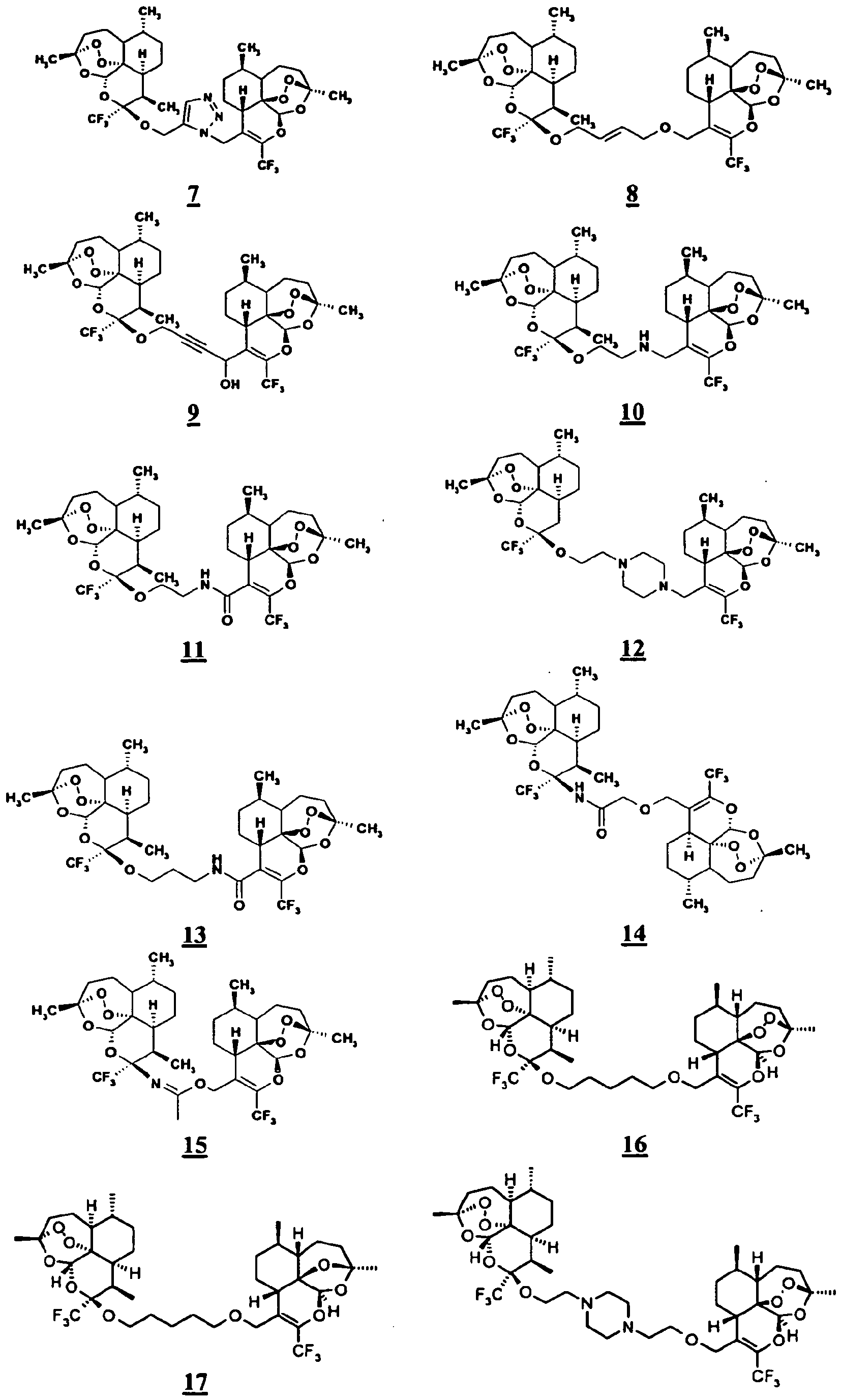


- Dérivé dimérique selon l'une quelconque des revendications 1 à 5 pour son utilisation en tant que médicament, notamment destiné au traitement du cancer.
- Composition pharmaceutique comprenant au moins un dérivé dimérique selon l'une quelconque des revendications 1 à 5 et au moins un véhicule pharmaceutiquement acceptable.
- Composition pharmaceutique selon la revendication 7, caractérisé en ce qu'elle comprend en outre au moins un autre principe actif, avantageusement choisi parmi les agents anticancéreux tels que la 6-mercaptopurine, la fludarabine, la cladribine, la pentostatine, la cytarabine, le 5-fluorouracile, la gemcitabine, le méthotrexate, le raltitrexed, l'irinotécan, le topotécan, l'étoposide, la daunorubicine, la doxorubicine, l'épirubicine, l'idarubicine, la pirarubicine, la mitoxantrone, la chlorméthine, la cyclophosphamide, l'ifosfamide, le melphalan, le chlorambucil, le busulfan, la carmustine, la fotémustine, la streptozocine, le carboplatine, le cisplatine, l'oxaliplatine, la procarbazine, la dacarbazine, la bléomycine, la vinblastine, la vincristine, la vindésine, la vinorelbine, le paclitaxel, le docétaxel, la L-asparaginase, la flutamide, la nilutamide, la bicalutamide, l'acétate de cyprotérone, la triptoréline, la leuproréline, la goséréline, la buséréline, le formestane, l'aminoglutéthimide, l'anastrazole, le létrozole, le tamoxifène, l'octréotide et le lanréotide.
- Composition pharmaceutique comprenant :(i) au moins un composé selon l'une quelconque des revendications 1 à 5, et(ii) au moins un autre principe actif,
en tant que produits de combinaison pour une utilisation simultanée, séparée ou étalée dans le temps. - Composition selon la revendication 9, caractérisée en ce que le(s) principe(s) actif(s) est(sont) choisi(s) parmi les agents anticancéreux tels que la 6-mercaptopurine, la fludarabine, la cladribine, la pentostatine, la cytarabine, le 5-fluorouracile, la gemcitabine, le méthotrexate, le raltitrexed, l'irinotécan, le topotécan, l'étoposide, la daunorubicine, la doxorubicine, l'épirubicine, l'idarubicine, la pirarubicine, la mitoxantrone, la chlorméthine, la cyclophosphamide, l'ifosfamide, le melphalan, le chlorambucil, le busulfan, la carmustine, la fotémustine, la streptozocine, le carboplatine, le cisplatine, l'oxaliplatine, la procarbazine, la dacarbazine, la bléomycine, la vinblastine, la vincristine, la vindésine, la vinorelbine, le paclitaxel, le docétaxel, la L-asparaginase, la flutamide, la nilutamide, la bicalutamide, l'acétate de cyprotérone, la triptoréline, la leuproréline, la goséréline, la buséréline, le formestane, l'aminoglutéthimide, l'anastrazole, le létrozole, le tamoxifène, l'octréotide ou le lanréotide.
- Composition selon l'une quelconque des revendications 7 à 10, pour son utilisation en tant que médicament destiné au traitement du cancer.
- Procédé de préparation d'un composé de formule (I) selon l'une quelconque des revendications 1 à 5, caractérisé en ce que le composé de formule (I) est obtenu par couplage d'un composé de formule (II) suivante :

avec un composé de formule (III) suivante :
- Procédé selon la revendication 12, caractérisé en ce qu'un composé de formule (I) pour lequel B = -CH2Y- -ou -C(=O)Y-, avec Y tel que défini à la revendication 1, est préparé par couplage entre les composés (II) et (III) et un composé de formule (IV) suivante :
Z3-X-Z4 (IV),
avec :X tel que défini à la revendication 1,Z3 représentant un atome d'halogène, tel qu'un atome de brome ou de chlore, ou un groupement -OH, -NHR1, -SH, -N3 ou -C(=O)R4, R1 étant tel que défini à la revendication 1 et R4 représentant un atome d'hydrogène ou un groupement (C1-C6)alkyle, etZ4 représentant un atome d'halogène, tel qu'un atome de brome ou de chlore, ou un groupement -OH, -NHR1, -SH, -N3 ou un hétérocycle comportant au moins un groupement NH intracyclique, R1 étant tel que défini à la revendication 1. - Procédé selon la revendication 12, caractérisé en ce qu'un composé de formule (I) pour lequel B = -CH(OR3)-, avec R3 tel que défini à la revendication 1, est préparé par couplage entre les composés (II) et (III), avec Z2 = -CHO, et un composé de formule (V) suivante :
Z5-X-Z6 (V),
avec :X tel que défini à la revendication 1,Z5 représentant un atome d'halogène, tel qu'un atome de brome ou de chlore, ou un groupement -OH, -NHR1, -SH, -N3 ou -C(=O)R4, R1 étant tel que défini à la revendication 1 et R4 représentant un atome d'hydrogène ou un groupement (C1-C6)alkyle, etZ6 représentant un atome d'hydrogène acide ou un atome d'halogène.
Priority Applications (1)
| Application Number | Priority Date | Filing Date | Title |
|---|---|---|---|
| PL09802516T PL2321323T3 (pl) | 2008-07-29 | 2009-07-29 | Dimeryczne pochodne artemizyniny i ich zastosowanie w terapii przeciwrakowej |
Applications Claiming Priority (2)
| Application Number | Priority Date | Filing Date | Title |
|---|---|---|---|
| FR0855201A FR2934593B1 (fr) | 2008-07-29 | 2008-07-29 | Derives dimeriques d'artemisinine et application en therapie anticancereuse |
| PCT/EP2009/059792 WO2010012761A1 (fr) | 2008-07-29 | 2009-07-29 | Derives dimeriques d'artemisinine et application en therapie anticancereuse |
Publications (3)
| Publication Number | Publication Date |
|---|---|
| EP2321323A1 EP2321323A1 (fr) | 2011-05-18 |
| EP2321323B1 EP2321323B1 (fr) | 2013-05-29 |
| EP2321323B9 true EP2321323B9 (fr) | 2014-04-23 |
Family
ID=40291143
Family Applications (1)
| Application Number | Title | Priority Date | Filing Date |
|---|---|---|---|
| EP09802516.6A Not-in-force EP2321323B9 (fr) | 2008-07-29 | 2009-07-29 | Derives dimeriques d'artemisinine et application en therapie anticancereuse |
Country Status (7)
| Country | Link |
|---|---|
| US (1) | US8614339B2 (fr) |
| EP (1) | EP2321323B9 (fr) |
| JP (1) | JP5602731B2 (fr) |
| ES (1) | ES2424794T3 (fr) |
| FR (1) | FR2934593B1 (fr) |
| PL (1) | PL2321323T3 (fr) |
| WO (1) | WO2010012761A1 (fr) |
Families Citing this family (7)
| Publication number | Priority date | Publication date | Assignee | Title |
|---|---|---|---|---|
| US9006467B2 (en) | 2011-02-14 | 2015-04-14 | Councel of Scientific & Industrial Research | 1,2,3-triazole containing artemisinin compounds and process for preparation thereof |
| WO2014100486A1 (fr) * | 2012-12-21 | 2014-06-26 | University Of Washington Through Its Center For Commercialization | Composés d'artémisine et leur synthèse et leur utilisation |
| US9918972B2 (en) * | 2014-12-23 | 2018-03-20 | The University Of Maryland, Baltimore | Treatment of leukemia with artemisinin derivatives and combinations with other antineoplastic agents |
| JOP20190024A1 (ar) | 2016-08-26 | 2019-02-19 | Gilead Sciences Inc | مركبات بيروليزين بها استبدال واستخداماتها |
| JP7050165B2 (ja) | 2018-02-26 | 2022-04-07 | ギリアード サイエンシーズ, インコーポレイテッド | Hbv複製阻害剤としての置換ピロリジン化合物 |
| CN109453156A (zh) * | 2018-11-22 | 2019-03-12 | 中国中医科学院中药研究所 | 一种抗肿瘤组合物及其应用、抗肿瘤药物 |
| CN112920198A (zh) * | 2021-01-28 | 2021-06-08 | 湖北德信辰科技有限公司 | 青蒿素-苯丁酸氮芥酯合成物及其制备方法 |
Family Cites Families (4)
| Publication number | Priority date | Publication date | Assignee | Title |
|---|---|---|---|---|
| FR760266A (fr) | 1933-09-02 | 1934-02-20 | Perfectionnements aux appareils de tirage photographique | |
| FR2831538B1 (fr) | 2001-10-26 | 2004-01-16 | Centre Nat Rech Scient | Nouveaux derives de l'artemisinine, et leurs utilisations dans le traitement du paludisme |
| US6790863B2 (en) * | 2002-10-15 | 2004-09-14 | University Of Mississippi | Dihydroartemisinin and dihydroartemisitene dimers as anti-cancer and anti-infective agents |
| FR2899586B1 (fr) * | 2006-04-11 | 2008-06-20 | Sanofi Aventis Sa | Dimeres de derives d'artemisinine, leur preparation et leur application en therapeutique |
-
2008
- 2008-07-29 FR FR0855201A patent/FR2934593B1/fr not_active Expired - Fee Related
-
2009
- 2009-07-29 ES ES09802516T patent/ES2424794T3/es active Active
- 2009-07-29 EP EP09802516.6A patent/EP2321323B9/fr not_active Not-in-force
- 2009-07-29 WO PCT/EP2009/059792 patent/WO2010012761A1/fr not_active Ceased
- 2009-07-29 US US13/054,321 patent/US8614339B2/en not_active Expired - Fee Related
- 2009-07-29 PL PL09802516T patent/PL2321323T3/pl unknown
- 2009-07-29 JP JP2011520500A patent/JP5602731B2/ja not_active Expired - Fee Related
Also Published As
| Publication number | Publication date |
|---|---|
| EP2321323A1 (fr) | 2011-05-18 |
| JP5602731B2 (ja) | 2014-10-08 |
| WO2010012761A1 (fr) | 2010-02-04 |
| FR2934593B1 (fr) | 2010-09-10 |
| FR2934593A1 (fr) | 2010-02-05 |
| PL2321323T3 (pl) | 2013-12-31 |
| JP2011529472A (ja) | 2011-12-08 |
| US8614339B2 (en) | 2013-12-24 |
| EP2321323B1 (fr) | 2013-05-29 |
| ES2424794T3 (es) | 2013-10-08 |
| US20110152289A1 (en) | 2011-06-23 |
Similar Documents
| Publication | Publication Date | Title |
|---|---|---|
| EP2321323B1 (fr) | Derives dimeriques d'artemisinine et application en therapie anticancereuse | |
| EP3164393B1 (fr) | Dérivés de flavaglines | |
| EP2158194B1 (fr) | Dérivés de 7 -alkynyl-1,8-naphthyridones, leur préparation et leur application en thérapeutique | |
| FR2585019A1 (fr) | Derives de distamycine et leur procede de fabrication | |
| EP1355887B1 (fr) | Derives d'acyclonucleosides pyrimidiniques, leur procede de preparation et leur utilisation | |
| FR2934266A1 (fr) | Derives azotes de la pancratistatine | |
| EP1773835B1 (fr) | Derives de pyrido-pyrido-pyrimidine, leur preparation, leur application dans le traitement du cancer | |
| WO2003082875A2 (fr) | Nouveaux derives de la podophyllotoxine, leur preparation e tleur application en therapeutique | |
| EP0021940B1 (fr) | Nouveaux dérivés aminés du benzothiazole, leur procédé de préparation et leur application en thérapeutique | |
| FR2899586A1 (fr) | Dimeres de derives d'artemisinine, leur preparation et leur application en therapeutique | |
| EP1101765B1 (fr) | Nouveaux composés analogues de la camptothécine, leur procédé de préparation et les compositions pharmaceutiques qui les contiennent | |
| MC1708A1 (fr) | Composes polycycliques biocides,procedes et intermediaires pour leur synthese et preparations pharmaceutiques les contenant | |
| FR2925495A1 (fr) | Derives dimeriques d'artemisinine et application en therapie anticancereuse | |
| FR2896246A1 (fr) | Derives de pyrido-pyrimidone, leur preparation, leur application en therapeutique. | |
| EP1387841B1 (fr) | Nouveaux derives d'azole ou de triazole, leur procede de preparation et leur application comme fongicides | |
| EP0772630B1 (fr) | Derives de streptogramine, leur preparation et les compositions pharmaceutiques qui les contiennent | |
| EP1720849B1 (fr) | Derives de pyranone utiles pour le traitement du cancer | |
| JP3009716B2 (ja) | 新規なカンプトテシン誘導体 | |
| EP3237015B1 (fr) | Derives hydroxybisphosphoniques hydrosolubles de la doxorubicine | |
| CA2491989C (fr) | Composes a activite anti-parasitaire et medicaments les renfermant | |
| WO2000063160A1 (fr) | Derives de 2-alcoxy-cyclobutane-3,4-dione leur preparation et leur application en therapeutique | |
| FR2837202A1 (fr) | Nouveaux derives de porphyrines, leur procede de preparation compositions pharmaceutiques et utilisations | |
| LU85690A1 (fr) | Nouveaux derives de a pyrazolo (1,5-a) pyridine,leur preparation et les compositions therapeutiques qui les contiennent |
Legal Events
| Date | Code | Title | Description |
|---|---|---|---|
| PUAI | Public reference made under article 153(3) epc to a published international application that has entered the european phase |
Free format text: ORIGINAL CODE: 0009012 |
|
| 17P | Request for examination filed |
Effective date: 20110209 |
|
| AK | Designated contracting states |
Kind code of ref document: A1 Designated state(s): AT BE BG CH CY CZ DE DK EE ES FI FR GB GR HR HU IE IS IT LI LT LU LV MC MK MT NL NO PL PT RO SE SI SK SM TR |
|
| AX | Request for extension of the european patent |
Extension state: AL BA RS |
|
| DAX | Request for extension of the european patent (deleted) | ||
| GRAP | Despatch of communication of intention to grant a patent |
Free format text: ORIGINAL CODE: EPIDOSNIGR1 |
|
| GRAP | Despatch of communication of intention to grant a patent |
Free format text: ORIGINAL CODE: EPIDOSNIGR1 |
|
| GRAS | Grant fee paid |
Free format text: ORIGINAL CODE: EPIDOSNIGR3 |
|
| GRAA | (expected) grant |
Free format text: ORIGINAL CODE: 0009210 |
|
| AK | Designated contracting states |
Kind code of ref document: B1 Designated state(s): AT BE BG CH CY CZ DE DK EE ES FI FR GB GR HR HU IE IS IT LI LT LU LV MC MK MT NL NO PL PT RO SE SI SK SM TR |
|
| RAP1 | Party data changed (applicant data changed or rights of an application transferred) |
Owner name: UNIVERSITE PARIS-SUD 11 Owner name: CENTRE NATIONAL DE LA RECHERCHE SCIENTIFIQUE (CNRS Owner name: PIERRE FABRE MEDICAMENT |
|
| REG | Reference to a national code |
Ref country code: GB Ref legal event code: FG4D Free format text: NOT ENGLISH |
|
| REG | Reference to a national code |
Ref country code: CH Ref legal event code: EP |
|
| REG | Reference to a national code |
Ref country code: AT Ref legal event code: REF Ref document number: 614343 Country of ref document: AT Kind code of ref document: T Effective date: 20130615 |
|
| REG | Reference to a national code |
Ref country code: IE Ref legal event code: FG4D Free format text: LANGUAGE OF EP DOCUMENT: FRENCH |
|
| REG | Reference to a national code |
Ref country code: DE Ref legal event code: R096 Ref document number: 602009016107 Country of ref document: DE Effective date: 20130801 |
|
| REG | Reference to a national code |
Ref country code: CH Ref legal event code: NV Representative=s name: MICHELI AND CIE SA, CH |
|
| REG | Reference to a national code |
Ref country code: ES Ref legal event code: FG2A Ref document number: 2424794 Country of ref document: ES Kind code of ref document: T3 Effective date: 20131008 |
|
| REG | Reference to a national code |
Ref country code: AT Ref legal event code: MK05 Ref document number: 614343 Country of ref document: AT Kind code of ref document: T Effective date: 20130529 |
|
| REG | Reference to a national code |
Ref country code: LT Ref legal event code: MG4D |
|
| PG25 | Lapsed in a contracting state [announced via postgrant information from national office to epo] |
Ref country code: GR Free format text: LAPSE BECAUSE OF FAILURE TO SUBMIT A TRANSLATION OF THE DESCRIPTION OR TO PAY THE FEE WITHIN THE PRESCRIBED TIME-LIMIT Effective date: 20130830 Ref country code: LT Free format text: LAPSE BECAUSE OF FAILURE TO SUBMIT A TRANSLATION OF THE DESCRIPTION OR TO PAY THE FEE WITHIN THE PRESCRIBED TIME-LIMIT Effective date: 20130529 Ref country code: AT Free format text: LAPSE BECAUSE OF FAILURE TO SUBMIT A TRANSLATION OF THE DESCRIPTION OR TO PAY THE FEE WITHIN THE PRESCRIBED TIME-LIMIT Effective date: 20130529 Ref country code: FI Free format text: LAPSE BECAUSE OF FAILURE TO SUBMIT A TRANSLATION OF THE DESCRIPTION OR TO PAY THE FEE WITHIN THE PRESCRIBED TIME-LIMIT Effective date: 20130529 Ref country code: PT Free format text: LAPSE BECAUSE OF FAILURE TO SUBMIT A TRANSLATION OF THE DESCRIPTION OR TO PAY THE FEE WITHIN THE PRESCRIBED TIME-LIMIT Effective date: 20130930 Ref country code: IS Free format text: LAPSE BECAUSE OF FAILURE TO SUBMIT A TRANSLATION OF THE DESCRIPTION OR TO PAY THE FEE WITHIN THE PRESCRIBED TIME-LIMIT Effective date: 20130929 Ref country code: SI Free format text: LAPSE BECAUSE OF FAILURE TO SUBMIT A TRANSLATION OF THE DESCRIPTION OR TO PAY THE FEE WITHIN THE PRESCRIBED TIME-LIMIT Effective date: 20130529 Ref country code: NO Free format text: LAPSE BECAUSE OF FAILURE TO SUBMIT A TRANSLATION OF THE DESCRIPTION OR TO PAY THE FEE WITHIN THE PRESCRIBED TIME-LIMIT Effective date: 20130829 Ref country code: SE Free format text: LAPSE BECAUSE OF FAILURE TO SUBMIT A TRANSLATION OF THE DESCRIPTION OR TO PAY THE FEE WITHIN THE PRESCRIBED TIME-LIMIT Effective date: 20130529 |
|
| REG | Reference to a national code |
Ref country code: NL Ref legal event code: VDEP Effective date: 20130529 |
|
| PG25 | Lapsed in a contracting state [announced via postgrant information from national office to epo] |
Ref country code: HR Free format text: LAPSE BECAUSE OF FAILURE TO SUBMIT A TRANSLATION OF THE DESCRIPTION OR TO PAY THE FEE WITHIN THE PRESCRIBED TIME-LIMIT Effective date: 20130529 Ref country code: BG Free format text: LAPSE BECAUSE OF FAILURE TO SUBMIT A TRANSLATION OF THE DESCRIPTION OR TO PAY THE FEE WITHIN THE PRESCRIBED TIME-LIMIT Effective date: 20130829 |
|
| PG25 | Lapsed in a contracting state [announced via postgrant information from national office to epo] |
Ref country code: LV Free format text: LAPSE BECAUSE OF FAILURE TO SUBMIT A TRANSLATION OF THE DESCRIPTION OR TO PAY THE FEE WITHIN THE PRESCRIBED TIME-LIMIT Effective date: 20130529 |
|
| REG | Reference to a national code |
Ref country code: PL Ref legal event code: T3 |
|
| PG25 | Lapsed in a contracting state [announced via postgrant information from national office to epo] |
Ref country code: EE Free format text: LAPSE BECAUSE OF FAILURE TO SUBMIT A TRANSLATION OF THE DESCRIPTION OR TO PAY THE FEE WITHIN THE PRESCRIBED TIME-LIMIT Effective date: 20130529 Ref country code: SK Free format text: LAPSE BECAUSE OF FAILURE TO SUBMIT A TRANSLATION OF THE DESCRIPTION OR TO PAY THE FEE WITHIN THE PRESCRIBED TIME-LIMIT Effective date: 20130529 Ref country code: DK Free format text: LAPSE BECAUSE OF FAILURE TO SUBMIT A TRANSLATION OF THE DESCRIPTION OR TO PAY THE FEE WITHIN THE PRESCRIBED TIME-LIMIT Effective date: 20130529 Ref country code: CZ Free format text: LAPSE BECAUSE OF FAILURE TO SUBMIT A TRANSLATION OF THE DESCRIPTION OR TO PAY THE FEE WITHIN THE PRESCRIBED TIME-LIMIT Effective date: 20130529 |
|
| PG25 | Lapsed in a contracting state [announced via postgrant information from national office to epo] |
Ref country code: RO Free format text: LAPSE BECAUSE OF FAILURE TO SUBMIT A TRANSLATION OF THE DESCRIPTION OR TO PAY THE FEE WITHIN THE PRESCRIBED TIME-LIMIT Effective date: 20130529 Ref country code: MC Free format text: LAPSE BECAUSE OF FAILURE TO SUBMIT A TRANSLATION OF THE DESCRIPTION OR TO PAY THE FEE WITHIN THE PRESCRIBED TIME-LIMIT Effective date: 20130529 Ref country code: NL Free format text: LAPSE BECAUSE OF FAILURE TO SUBMIT A TRANSLATION OF THE DESCRIPTION OR TO PAY THE FEE WITHIN THE PRESCRIBED TIME-LIMIT Effective date: 20130529 |
|
| PLBE | No opposition filed within time limit |
Free format text: ORIGINAL CODE: 0009261 |
|
| STAA | Information on the status of an ep patent application or granted ep patent |
Free format text: STATUS: NO OPPOSITION FILED WITHIN TIME LIMIT |
|
| REG | Reference to a national code |
Ref country code: HU Ref legal event code: AG4A Ref document number: E019015 Country of ref document: HU |
|
| 26N | No opposition filed |
Effective date: 20140303 |
|
| REG | Reference to a national code |
Ref country code: DE Ref legal event code: R097 Ref document number: 602009016107 Country of ref document: DE Effective date: 20140303 |
|
| PG25 | Lapsed in a contracting state [announced via postgrant information from national office to epo] |
Ref country code: SM Free format text: LAPSE BECAUSE OF FAILURE TO SUBMIT A TRANSLATION OF THE DESCRIPTION OR TO PAY THE FEE WITHIN THE PRESCRIBED TIME-LIMIT Effective date: 20130529 |
|
| PG25 | Lapsed in a contracting state [announced via postgrant information from national office to epo] |
Ref country code: MT Free format text: LAPSE BECAUSE OF FAILURE TO SUBMIT A TRANSLATION OF THE DESCRIPTION OR TO PAY THE FEE WITHIN THE PRESCRIBED TIME-LIMIT Effective date: 20130529 Ref country code: CY Free format text: LAPSE BECAUSE OF FAILURE TO SUBMIT A TRANSLATION OF THE DESCRIPTION OR TO PAY THE FEE WITHIN THE PRESCRIBED TIME-LIMIT Effective date: 20130529 |
|
| PG25 | Lapsed in a contracting state [announced via postgrant information from national office to epo] |
Ref country code: MK Free format text: LAPSE BECAUSE OF FAILURE TO SUBMIT A TRANSLATION OF THE DESCRIPTION OR TO PAY THE FEE WITHIN THE PRESCRIBED TIME-LIMIT Effective date: 20130529 |
|
| REG | Reference to a national code |
Ref country code: FR Ref legal event code: PLFP Year of fee payment: 8 |
|
| REG | Reference to a national code |
Ref country code: FR Ref legal event code: PLFP Year of fee payment: 9 |
|
| REG | Reference to a national code |
Ref country code: FR Ref legal event code: PLFP Year of fee payment: 10 |
|
| PGFP | Annual fee paid to national office [announced via postgrant information from national office to epo] |
Ref country code: IE Payment date: 20180619 Year of fee payment: 10 Ref country code: LU Payment date: 20180615 Year of fee payment: 10 |
|
| PGFP | Annual fee paid to national office [announced via postgrant information from national office to epo] |
Ref country code: PL Payment date: 20180619 Year of fee payment: 10 |
|
| PGFP | Annual fee paid to national office [announced via postgrant information from national office to epo] |
Ref country code: ES Payment date: 20180830 Year of fee payment: 10 Ref country code: IT Payment date: 20180716 Year of fee payment: 10 Ref country code: FR Payment date: 20180727 Year of fee payment: 10 Ref country code: DE Payment date: 20180710 Year of fee payment: 10 |
|
| PGFP | Annual fee paid to national office [announced via postgrant information from national office to epo] |
Ref country code: GB Payment date: 20180718 Year of fee payment: 10 Ref country code: HU Payment date: 20180620 Year of fee payment: 10 Ref country code: BE Payment date: 20180725 Year of fee payment: 10 Ref country code: TR Payment date: 20180717 Year of fee payment: 10 Ref country code: CH Payment date: 20180719 Year of fee payment: 10 |
|
| REG | Reference to a national code |
Ref country code: DE Ref legal event code: R119 Ref document number: 602009016107 Country of ref document: DE |
|
| REG | Reference to a national code |
Ref country code: CH Ref legal event code: PL |
|
| GBPC | Gb: european patent ceased through non-payment of renewal fee |
Effective date: 20190729 |
|
| REG | Reference to a national code |
Ref country code: BE Ref legal event code: MM Effective date: 20190731 |
|
| PG25 | Lapsed in a contracting state [announced via postgrant information from national office to epo] |
Ref country code: GB Free format text: LAPSE BECAUSE OF NON-PAYMENT OF DUE FEES Effective date: 20190729 Ref country code: DE Free format text: LAPSE BECAUSE OF NON-PAYMENT OF DUE FEES Effective date: 20200201 Ref country code: HU Free format text: LAPSE BECAUSE OF NON-PAYMENT OF DUE FEES Effective date: 20190730 |
|
| PG25 | Lapsed in a contracting state [announced via postgrant information from national office to epo] |
Ref country code: LI Free format text: LAPSE BECAUSE OF NON-PAYMENT OF DUE FEES Effective date: 20190731 Ref country code: CH Free format text: LAPSE BECAUSE OF NON-PAYMENT OF DUE FEES Effective date: 20190731 Ref country code: LU Free format text: LAPSE BECAUSE OF NON-PAYMENT OF DUE FEES Effective date: 20190729 Ref country code: BE Free format text: LAPSE BECAUSE OF NON-PAYMENT OF DUE FEES Effective date: 20190731 |
|
| PG25 | Lapsed in a contracting state [announced via postgrant information from national office to epo] |
Ref country code: FR Free format text: LAPSE BECAUSE OF NON-PAYMENT OF DUE FEES Effective date: 20190731 |
|
| PG25 | Lapsed in a contracting state [announced via postgrant information from national office to epo] |
Ref country code: IE Free format text: LAPSE BECAUSE OF NON-PAYMENT OF DUE FEES Effective date: 20190729 |
|
| PG25 | Lapsed in a contracting state [announced via postgrant information from national office to epo] |
Ref country code: IT Free format text: LAPSE BECAUSE OF NON-PAYMENT OF DUE FEES Effective date: 20190729 |
|
| REG | Reference to a national code |
Ref country code: ES Ref legal event code: FD2A Effective date: 20201202 |
|
| PG25 | Lapsed in a contracting state [announced via postgrant information from national office to epo] |
Ref country code: ES Free format text: LAPSE BECAUSE OF NON-PAYMENT OF DUE FEES Effective date: 20190730 |
|
| PG25 | Lapsed in a contracting state [announced via postgrant information from national office to epo] |
Ref country code: PL Free format text: LAPSE BECAUSE OF NON-PAYMENT OF DUE FEES Effective date: 20190729 |
|
| PG25 | Lapsed in a contracting state [announced via postgrant information from national office to epo] |
Ref country code: TR Free format text: LAPSE BECAUSE OF NON-PAYMENT OF DUE FEES Effective date: 20190729 |