EP2322713A1 - Procédé de fabrication de fibres de bambou et matières synthétiques en étant pourvues - Google Patents
Procédé de fabrication de fibres de bambou et matières synthétiques en étant pourvues Download PDFInfo
- Publication number
- EP2322713A1 EP2322713A1 EP09175707A EP09175707A EP2322713A1 EP 2322713 A1 EP2322713 A1 EP 2322713A1 EP 09175707 A EP09175707 A EP 09175707A EP 09175707 A EP09175707 A EP 09175707A EP 2322713 A1 EP2322713 A1 EP 2322713A1
- Authority
- EP
- European Patent Office
- Prior art keywords
- fibers
- bamboo
- bamboo fibers
- plastic
- nonwoven
- Prior art date
- Legal status (The legal status is an assumption and is not a legal conclusion. Google has not performed a legal analysis and makes no representation as to the accuracy of the status listed.)
- Withdrawn
Links
- 241001330002 Bambuseae Species 0.000 title claims abstract description 115
- 235000017166 Bambusa arundinacea Nutrition 0.000 title claims abstract description 114
- 235000017491 Bambusa tulda Nutrition 0.000 title claims abstract description 114
- 235000015334 Phyllostachys viridis Nutrition 0.000 title claims abstract description 114
- 239000011425 bamboo Substances 0.000 title claims abstract description 114
- 229920003023 plastic Polymers 0.000 title claims abstract description 39
- 239000004033 plastic Substances 0.000 title claims abstract description 39
- 238000004519 manufacturing process Methods 0.000 title claims abstract description 10
- 239000000835 fiber Substances 0.000 claims abstract description 150
- 238000000034 method Methods 0.000 claims abstract description 50
- 239000011151 fibre-reinforced plastic Substances 0.000 claims abstract description 26
- 229920002430 Fibre-reinforced plastic Polymers 0.000 claims abstract description 25
- 238000001035 drying Methods 0.000 claims description 8
- 239000004745 nonwoven fabric Substances 0.000 claims description 8
- 239000011230 binding agent Substances 0.000 claims description 4
- 239000002131 composite material Substances 0.000 claims description 4
- 239000002994 raw material Substances 0.000 claims description 4
- 238000003490 calendering Methods 0.000 claims description 3
- 238000004080 punching Methods 0.000 claims description 3
- 238000000137 annealing Methods 0.000 claims description 2
- 238000009435 building construction Methods 0.000 claims description 2
- 238000000748 compression moulding Methods 0.000 claims description 2
- 239000011265 semifinished product Substances 0.000 claims 1
- 239000000463 material Substances 0.000 abstract description 12
- 239000003677 Sheet moulding compound Substances 0.000 abstract 1
- 239000011888 foil Substances 0.000 abstract 1
- 239000011159 matrix material Substances 0.000 description 12
- 239000011152 fibreglass Substances 0.000 description 8
- -1 polybuthylenes Polymers 0.000 description 8
- 239000004743 Polypropylene Substances 0.000 description 7
- 239000003365 glass fiber Substances 0.000 description 7
- 239000010410 layer Substances 0.000 description 7
- 229920001169 thermoplastic Polymers 0.000 description 7
- 239000004416 thermosoftening plastic Substances 0.000 description 7
- XLYOFNOQVPJJNP-UHFFFAOYSA-N water Substances O XLYOFNOQVPJJNP-UHFFFAOYSA-N 0.000 description 7
- 239000004698 Polyethylene Substances 0.000 description 6
- 238000002844 melting Methods 0.000 description 6
- 230000008018 melting Effects 0.000 description 6
- 229920001155 polypropylene Polymers 0.000 description 6
- 244000198134 Agave sisalana Species 0.000 description 5
- 230000008901 benefit Effects 0.000 description 5
- 229920001187 thermosetting polymer Polymers 0.000 description 5
- 244000025254 Cannabis sativa Species 0.000 description 4
- 235000012766 Cannabis sativa ssp. sativa var. sativa Nutrition 0.000 description 4
- 235000012765 Cannabis sativa ssp. sativa var. spontanea Nutrition 0.000 description 4
- 240000006240 Linum usitatissimum Species 0.000 description 4
- 235000004431 Linum usitatissimum Nutrition 0.000 description 4
- 235000009120 camo Nutrition 0.000 description 4
- 235000005607 chanvre indien Nutrition 0.000 description 4
- 239000003063 flame retardant Substances 0.000 description 4
- 239000011487 hemp Substances 0.000 description 4
- 238000007711 solidification Methods 0.000 description 4
- 230000008023 solidification Effects 0.000 description 4
- 239000007858 starting material Substances 0.000 description 4
- 229920000049 Carbon (fiber) Polymers 0.000 description 3
- 240000000491 Corchorus aestuans Species 0.000 description 3
- 235000011777 Corchorus aestuans Nutrition 0.000 description 3
- 235000010862 Corchorus capsularis Nutrition 0.000 description 3
- 229910000831 Steel Inorganic materials 0.000 description 3
- 239000002318 adhesion promoter Substances 0.000 description 3
- 239000004760 aramid Substances 0.000 description 3
- 229920006231 aramid fiber Polymers 0.000 description 3
- 239000004917 carbon fiber Substances 0.000 description 3
- 238000010276 construction Methods 0.000 description 3
- 230000005484 gravity Effects 0.000 description 3
- 238000003825 pressing Methods 0.000 description 3
- 239000010959 steel Substances 0.000 description 3
- KKEYFWRCBNTPAC-UHFFFAOYSA-L terephthalate(2-) Chemical compound [O-]C(=O)C1=CC=C(C([O-])=O)C=C1 KKEYFWRCBNTPAC-UHFFFAOYSA-L 0.000 description 3
- 239000012815 thermoplastic material Substances 0.000 description 3
- RNFJDJUURJAICM-UHFFFAOYSA-N 2,2,4,4,6,6-hexaphenoxy-1,3,5-triaza-2$l^{5},4$l^{5},6$l^{5}-triphosphacyclohexa-1,3,5-triene Chemical compound N=1P(OC=2C=CC=CC=2)(OC=2C=CC=CC=2)=NP(OC=2C=CC=CC=2)(OC=2C=CC=CC=2)=NP=1(OC=1C=CC=CC=1)OC1=CC=CC=C1 RNFJDJUURJAICM-UHFFFAOYSA-N 0.000 description 2
- 244000060011 Cocos nucifera Species 0.000 description 2
- 235000013162 Cocos nucifera Nutrition 0.000 description 2
- 239000004606 Fillers/Extenders Substances 0.000 description 2
- VYPSYNLAJGMNEJ-UHFFFAOYSA-N Silicium dioxide Chemical compound O=[Si]=O VYPSYNLAJGMNEJ-UHFFFAOYSA-N 0.000 description 2
- 239000000654 additive Substances 0.000 description 2
- 238000009960 carding Methods 0.000 description 2
- 230000007613 environmental effect Effects 0.000 description 2
- 238000000227 grinding Methods 0.000 description 2
- 238000011835 investigation Methods 0.000 description 2
- 235000013379 molasses Nutrition 0.000 description 2
- 238000009952 needle felting Methods 0.000 description 2
- 230000002787 reinforcement Effects 0.000 description 2
- 239000012783 reinforcing fiber Substances 0.000 description 2
- 229920002994 synthetic fiber Polymers 0.000 description 2
- 239000012209 synthetic fiber Substances 0.000 description 2
- 238000005496 tempering Methods 0.000 description 2
- 229920000178 Acrylic resin Polymers 0.000 description 1
- 239000004925 Acrylic resin Substances 0.000 description 1
- 241001330024 Bambusoideae Species 0.000 description 1
- 240000008564 Boehmeria nivea Species 0.000 description 1
- 244000146553 Ceiba pentandra Species 0.000 description 1
- 235000003301 Ceiba pentandra Nutrition 0.000 description 1
- 229920001634 Copolyester Polymers 0.000 description 1
- 229920000742 Cotton Polymers 0.000 description 1
- 206010011906 Death Diseases 0.000 description 1
- 229920002943 EPDM rubber Polymers 0.000 description 1
- 229930091371 Fructose Natural products 0.000 description 1
- 239000005715 Fructose Substances 0.000 description 1
- RFSUNEUAIZKAJO-ARQDHWQXSA-N Fructose Chemical compound OC[C@H]1O[C@](O)(CO)[C@@H](O)[C@@H]1O RFSUNEUAIZKAJO-ARQDHWQXSA-N 0.000 description 1
- WQZGKKKJIJFFOK-GASJEMHNSA-N Glucose Natural products OC[C@H]1OC(O)[C@H](O)[C@@H](O)[C@@H]1O WQZGKKKJIJFFOK-GASJEMHNSA-N 0.000 description 1
- 241000219146 Gossypium Species 0.000 description 1
- 241000238631 Hexapoda Species 0.000 description 1
- 241000825107 Hierochloe Species 0.000 description 1
- 235000015466 Hierochloe odorata Nutrition 0.000 description 1
- 229920001410 Microfiber Polymers 0.000 description 1
- 240000008790 Musa x paradisiaca Species 0.000 description 1
- 235000018290 Musa x paradisiaca Nutrition 0.000 description 1
- 239000004677 Nylon Substances 0.000 description 1
- 241001330028 Panicoideae Species 0.000 description 1
- 241000209504 Poaceae Species 0.000 description 1
- 239000004952 Polyamide Substances 0.000 description 1
- 239000004793 Polystyrene Substances 0.000 description 1
- 240000000111 Saccharum officinarum Species 0.000 description 1
- 235000007201 Saccharum officinarum Nutrition 0.000 description 1
- CZMRCDWAGMRECN-UGDNZRGBSA-N Sucrose Chemical compound O[C@H]1[C@H](O)[C@@H](CO)O[C@@]1(CO)O[C@@H]1[C@H](O)[C@@H](O)[C@H](O)[C@@H](CO)O1 CZMRCDWAGMRECN-UGDNZRGBSA-N 0.000 description 1
- 229930006000 Sucrose Natural products 0.000 description 1
- 244000274883 Urtica dioica Species 0.000 description 1
- 235000009108 Urtica dioica Nutrition 0.000 description 1
- 241000607479 Yersinia pestis Species 0.000 description 1
- 238000010521 absorption reaction Methods 0.000 description 1
- NIXOWILDQLNWCW-UHFFFAOYSA-N acrylic acid group Chemical group C(C=C)(=O)O NIXOWILDQLNWCW-UHFFFAOYSA-N 0.000 description 1
- 229920000122 acrylonitrile butadiene styrene Polymers 0.000 description 1
- 239000004676 acrylonitrile butadiene styrene Substances 0.000 description 1
- 230000000844 anti-bacterial effect Effects 0.000 description 1
- 229920003235 aromatic polyamide Polymers 0.000 description 1
- 238000010923 batch production Methods 0.000 description 1
- WQZGKKKJIJFFOK-VFUOTHLCSA-N beta-D-glucose Chemical compound OC[C@H]1O[C@@H](O)[C@H](O)[C@@H](O)[C@@H]1O WQZGKKKJIJFFOK-VFUOTHLCSA-N 0.000 description 1
- 210000004027 cell Anatomy 0.000 description 1
- 238000005253 cladding Methods 0.000 description 1
- 239000003245 coal Substances 0.000 description 1
- 150000001875 compounds Chemical class 0.000 description 1
- 230000008094 contradictory effect Effects 0.000 description 1
- 230000007797 corrosion Effects 0.000 description 1
- 238000005260 corrosion Methods 0.000 description 1
- 230000003247 decreasing effect Effects 0.000 description 1
- 238000002845 discoloration Methods 0.000 description 1
- 229920001971 elastomer Polymers 0.000 description 1
- 239000000806 elastomer Substances 0.000 description 1
- 229920006351 engineering plastic Polymers 0.000 description 1
- 238000005516 engineering process Methods 0.000 description 1
- 230000003203 everyday effect Effects 0.000 description 1
- 238000002474 experimental method Methods 0.000 description 1
- 238000000605 extraction Methods 0.000 description 1
- 239000011521 glass Substances 0.000 description 1
- 239000008103 glucose Substances 0.000 description 1
- 239000008187 granular material Substances 0.000 description 1
- 239000002184 metal Substances 0.000 description 1
- VNWKTOKETHGBQD-UHFFFAOYSA-N methane Chemical compound C VNWKTOKETHGBQD-UHFFFAOYSA-N 0.000 description 1
- 239000003658 microfiber Substances 0.000 description 1
- 210000001724 microfibril Anatomy 0.000 description 1
- 238000000465 moulding Methods 0.000 description 1
- 229920001778 nylon Polymers 0.000 description 1
- 229920002647 polyamide Polymers 0.000 description 1
- 239000004417 polycarbonate Substances 0.000 description 1
- 229920000515 polycarbonate Polymers 0.000 description 1
- 229920000728 polyester Polymers 0.000 description 1
- 229920001225 polyester resin Polymers 0.000 description 1
- 239000004645 polyester resin Substances 0.000 description 1
- 229920000573 polyethylene Polymers 0.000 description 1
- 229920000098 polyolefin Polymers 0.000 description 1
- 229920006324 polyoxymethylene Polymers 0.000 description 1
- 229920002223 polystyrene Polymers 0.000 description 1
- 229920002635 polyurethane Polymers 0.000 description 1
- 239000004814 polyurethane Substances 0.000 description 1
- 229920000915 polyvinyl chloride Polymers 0.000 description 1
- 239000004800 polyvinyl chloride Substances 0.000 description 1
- 230000008092 positive effect Effects 0.000 description 1
- 238000012545 processing Methods 0.000 description 1
- 238000004064 recycling Methods 0.000 description 1
- 238000000926 separation method Methods 0.000 description 1
- 239000000377 silicon dioxide Substances 0.000 description 1
- 239000002356 single layer Substances 0.000 description 1
- 239000007787 solid Substances 0.000 description 1
- 230000003068 static effect Effects 0.000 description 1
- 239000000126 substance Substances 0.000 description 1
- 239000005720 sucrose Substances 0.000 description 1
- 238000009923 sugaring Methods 0.000 description 1
- 229920003002 synthetic resin Polymers 0.000 description 1
- 239000000057 synthetic resin Substances 0.000 description 1
- 230000008646 thermal stress Effects 0.000 description 1
- 238000007669 thermal treatment Methods 0.000 description 1
- 229920002725 thermoplastic elastomer Polymers 0.000 description 1
- 238000012546 transfer Methods 0.000 description 1
- 239000002759 woven fabric Substances 0.000 description 1
Images

Classifications
-
- D—TEXTILES; PAPER
- D21—PAPER-MAKING; PRODUCTION OF CELLULOSE
- D21B—FIBROUS RAW MATERIALS OR THEIR MECHANICAL TREATMENT
- D21B1/00—Fibrous raw materials or their mechanical treatment
- D21B1/04—Fibrous raw materials or their mechanical treatment by dividing raw materials into small particles, e.g. fibres
- D21B1/06—Fibrous raw materials or their mechanical treatment by dividing raw materials into small particles, e.g. fibres by dry methods
- D21B1/061—Fibrous raw materials or their mechanical treatment by dividing raw materials into small particles, e.g. fibres by dry methods using cutting devices
-
- D—TEXTILES; PAPER
- D04—BRAIDING; LACE-MAKING; KNITTING; TRIMMINGS; NON-WOVEN FABRICS
- D04H—MAKING TEXTILE FABRICS, e.g. FROM FIBRES OR FILAMENTARY MATERIAL; FABRICS MADE BY SUCH PROCESSES OR APPARATUS, e.g. FELTS, NON-WOVEN FABRICS; COTTON-WOOL; WADDING ; NON-WOVEN FABRICS FROM STAPLE FIBRES, FILAMENTS OR YARNS, BONDED WITH AT LEAST ONE WEB-LIKE MATERIAL DURING THEIR CONSOLIDATION
- D04H1/00—Non-woven fabrics formed wholly or mainly of staple fibres or like relatively short fibres
- D04H1/40—Non-woven fabrics formed wholly or mainly of staple fibres or like relatively short fibres from fleeces or layers composed of fibres without existing or potential cohesive properties
- D04H1/42—Non-woven fabrics formed wholly or mainly of staple fibres or like relatively short fibres from fleeces or layers composed of fibres without existing or potential cohesive properties characterised by the use of certain kinds of fibres insofar as this use has no preponderant influence on the consolidation of the fleece
- D04H1/4382—Stretched reticular film fibres; Composite fibres; Mixed fibres; Ultrafine fibres; Fibres for artificial leather
- D04H1/43835—Mixed fibres, e.g. at least two chemically different fibres or fibre blends
-
- D—TEXTILES; PAPER
- D01—NATURAL OR MAN-MADE THREADS OR FIBRES; SPINNING
- D01B—MECHANICAL TREATMENT OF NATURAL FIBROUS OR FILAMENTARY MATERIAL TO OBTAIN FIBRES OF FILAMENTS, e.g. FOR SPINNING
- D01B1/00—Mechanical separation of fibres from plant material, e.g. seeds, leaves, stalks
- D01B1/10—Separating vegetable fibres from stalks or leaves
-
- D—TEXTILES; PAPER
- D01—NATURAL OR MAN-MADE THREADS OR FIBRES; SPINNING
- D01B—MECHANICAL TREATMENT OF NATURAL FIBROUS OR FILAMENTARY MATERIAL TO OBTAIN FIBRES OF FILAMENTS, e.g. FOR SPINNING
- D01B1/00—Mechanical separation of fibres from plant material, e.g. seeds, leaves, stalks
- D01B1/50—Obtaining fibres from other specified vegetable matter, e.g. peat, Spanish moss
-
- D—TEXTILES; PAPER
- D04—BRAIDING; LACE-MAKING; KNITTING; TRIMMINGS; NON-WOVEN FABRICS
- D04H—MAKING TEXTILE FABRICS, e.g. FROM FIBRES OR FILAMENTARY MATERIAL; FABRICS MADE BY SUCH PROCESSES OR APPARATUS, e.g. FELTS, NON-WOVEN FABRICS; COTTON-WOOL; WADDING ; NON-WOVEN FABRICS FROM STAPLE FIBRES, FILAMENTS OR YARNS, BONDED WITH AT LEAST ONE WEB-LIKE MATERIAL DURING THEIR CONSOLIDATION
- D04H1/00—Non-woven fabrics formed wholly or mainly of staple fibres or like relatively short fibres
- D04H1/40—Non-woven fabrics formed wholly or mainly of staple fibres or like relatively short fibres from fleeces or layers composed of fibres without existing or potential cohesive properties
- D04H1/42—Non-woven fabrics formed wholly or mainly of staple fibres or like relatively short fibres from fleeces or layers composed of fibres without existing or potential cohesive properties characterised by the use of certain kinds of fibres insofar as this use has no preponderant influence on the consolidation of the fleece
- D04H1/425—Cellulose series
-
- D—TEXTILES; PAPER
- D04—BRAIDING; LACE-MAKING; KNITTING; TRIMMINGS; NON-WOVEN FABRICS
- D04H—MAKING TEXTILE FABRICS, e.g. FROM FIBRES OR FILAMENTARY MATERIAL; FABRICS MADE BY SUCH PROCESSES OR APPARATUS, e.g. FELTS, NON-WOVEN FABRICS; COTTON-WOOL; WADDING ; NON-WOVEN FABRICS FROM STAPLE FIBRES, FILAMENTS OR YARNS, BONDED WITH AT LEAST ONE WEB-LIKE MATERIAL DURING THEIR CONSOLIDATION
- D04H5/00—Non woven fabrics formed of mixtures of relatively short fibres and yarns or like filamentary material of substantial length
- D04H5/02—Non woven fabrics formed of mixtures of relatively short fibres and yarns or like filamentary material of substantial length strengthened or consolidated by mechanical methods, e.g. needling
-
- D—TEXTILES; PAPER
- D21—PAPER-MAKING; PRODUCTION OF CELLULOSE
- D21B—FIBROUS RAW MATERIALS OR THEIR MECHANICAL TREATMENT
- D21B1/00—Fibrous raw materials or their mechanical treatment
- D21B1/04—Fibrous raw materials or their mechanical treatment by dividing raw materials into small particles, e.g. fibres
- D21B1/12—Fibrous raw materials or their mechanical treatment by dividing raw materials into small particles, e.g. fibres by wet methods, by the use of steam
Definitions
- Fiber-reinforced plastics are used in the field of technology in many areas. Compared to other materials, they have high specific stiffness and strength at a low specific weight. These inherently contradictory properties are due to the fact that they consist of at least two components, namely a fiber component and a matrix component.
- the fibers of the fiber component have a high modulus of elasticity in the longitudinal direction and are therefore able to absorb strong tensile forces.
- the matrix component embeds and supports the fibers, protects them from kinking and other environmental influences, and moreover has a high breaking strength, so that it is able to absorb strong pressures and shear forces.
- the fiber component is usually glass or carbon fibers. Occasionally, steel fibers or fibers of aramid, nylon or PE are used.
- the matrix component is usually a thermoplastic, a thermoset or an elastomeric plastic.
- the latter are only occasionally used, for example with wedge or toothed belts.
- the former are particularly versatile and use processable, while the second-mentioned fiber-reinforced plastics with thermosetting matrix usually have the highest strengths.
- Fiber-reinforced plastics have prevailed in all the areas of application where high tensile strength and breaking strength at low specific weight are required, for example in body construction, in aircraft construction, in shipbuilding, in civil engineering and in articles of everyday life.
- fiber-reinforced plastics Due to the intimate connection between the fiber and matrix components, which is indispensable for the above-mentioned positive properties, fiber-reinforced plastics can generally only be recycled poorly or not at all. For example, although fiber-reinforced thermosets can be melted down, this does not facilitate the separation into the matrix and the fiber component. A chemical extraction of the fibers usually prohibits for environmental as well as cost reasons. At most, such plastics can be ground and reused as extender. However, the latter are of inferior quality compared to the starting materials.
- Fiber-reinforced thermoplastics may also be ground and reused as short-fiber reinforced plastics. However, reflowing substantially degrades the properties of the thermoplastic.
- glass fibers do not burn, glass-fiber reinforced plastics can not be burned or only badly burned for disposal purposes. Nor can they be ground, since the glass fibers have a high surface hardness, which would damage the grinding tools to be used, especially for example extruder. In addition, when grinding glass fibers, microfibers are released which are highly damaging to health. For this reason, glass fiber reinforced plastics must not be recycled according to German legislation, but must be disposed of.
- Fiber-reinforced plastics are known from the prior art, whose fiber component consists of renewable reinforcing fibers, such as flax, hemp or sisal.
- the above-mentioned natural fibers have a low mechanical resistance, in particular a small modulus of elasticity, compared with the conventionally used fibers such as glass fibers, carbon fibers, steel fibers or aramid fibers.
- these fibers are not used in structural components that need to absorb compressive and tensile forces, but only in cladding components. Moreover, they are used - in short cut - as an extender for plastics.
- Object of the present invention is to provide a fiber-reinforced plastic that is recyclable, while meeting the highest standards of specific gravity and tensile and breaking strength, and therefore also used for load-bearing structures, for example in vehicle construction, aircraft or shipbuilding can be.
- step a) can also be performed after step b) (see below).
- bamboo raw fibers suitable for use in fiber reinforced plastics In principle, it is difficult to produce bamboo raw fibers suitable for use in fiber reinforced plastics. Thus, bamboo cane has longitudinal growth accounts that are unsuitable for the production of raw fiber. Therefore, only the material located between the nodes can be used for the production of the raw fibers. This implies that the manufactured bamboo raw fibers can not be longer than the distance of the nodes of a pipe to each other.
- the nodes have distances of a maximum of 400 mm. In the preferred bamboo species used, the node spacing is in the range between 40 and 80 mm. As the distances of the nodes vary, it is difficult to machine the raw fibers. For this reason, fiber-reinforced plastics with bamboo raw fibers have not yet been produced.
- bamboo cane contains significant amounts of sugar. This is puzzling at first, but is understandable when one realizes that bamboo (subfamily: Bambusoideae) as well as sugar cane (subfamily: Panicoideae) belongs to the family of the sweet grasses (Poaceae).
- glucose, fructose and sucrose are present.
- contents of up to 1400 nmol of sugar per mg dry weight are measured.
- sugar content represents a major problem for the use of the bamboo fibers planned according to the invention.
- Sugar is known to have hygroscopic properties and therefore forms molasses. These can interfere with the manufactured, reinforced with bamboo fibers plastic. So they can e.g. Create cavities that affect the stability of the plastic.
- molasses can contain pests such as Attract insects, which then leave traces of eating on your part, and lead to undesirable discoloration, as they are e.g. due to caramelization.
- the inventor of the present invention first and surprisingly recognized this problem and addressed it accordingly.
- the starting material the bamboo tube
- the bamboo tube is therefore first desugared.
- the harvested bamboo cane is watered and then washed.
- the water temperature is in the range between 20 ° C and 30 ° C inclusive. Both in the batch and in the flow process, the water can preferably be waved.
- the desugarization takes place after the bamboo tube is subdivided transversely to its longitudinal axis into individual section elements and the section elements are divided along their longitudinal axis into gap elements (for example quarter), as will be described below.
- the actual node material should be removed. Only then does the further defibration take place.
- the bamboo is fed directly after hitting the above-described Entzuckerungsrea and only then subdivided transversely to its longitudinal axis into individual section elements.
- the de-sugared tubes are preferably cut into 2 m long sections.
- the drying can be done for example in a drying tunnel, the sections are stored on a conveyor belt.
- the drying oven can be solar powered, for example.
- the bamboo tube is divided transversely to its longitudinal axis into individual section elements by the bamboo tube is divided before and behind a growth-related node in the transverse direction.
- the resulting section elements represent the material of the bamboo tube located between the nodes.
- section elements are in a further processing step split along its longitudinal axis into a plurality of gap elements, for example quarter, which preferably have the same length as the section elements, but a smaller diameter.
- the defibration takes place as described below. After defibering, the fibers thus produced are dried again.
- the aim is a final water content of ⁇ 0.1% by weight.
- This drying step may preferably be carried out in an infrared dryer.
- bamboo fibers produced according to the invention no longer absorb water after drying. As a result, they can no longer be desugared at this time because the water required for de-sugaring no longer penetrates into the fibers. For this reason, the Entzuckerungs Colour preferably takes place at the beginning of the process. Conversely, the fact that once dried bamboo fibers no longer absorb water, a particular advantage of these fibers, which distinguishes them from other natural fibers (jute, sisal, kapok, etc.).
- bamboo fibers therefore have a much higher modulus of elasticity than other natural fibers. Investigations by the inventors have shown that bamboo raw fibers have an average tensile strength of 87.5 N mm -2 , an average elongation at break of 10.5% and an average tensile modulus of 3420 N mm -2 . This is one reason for the high tensile strength of the bamboo fiber reinforced plastics produced according to the invention
- the bamboo fibers produced in this way preferably have the following dimensions: prefers Especially preferred Thickness (mm) ⁇ 0.01 and ⁇ 1 mm ⁇ 0.2 and ⁇ 0.5 mm Length (mm) ⁇ 0.1 and ⁇ 400 mm 40 and ⁇ 80 mm
- Example 1 Example 2 Beat Beat desugar Dicing across the longitudinal axis Dicing across the longitudinal axis Columns along the longitudinal axis ("quarter") dry desugar Columns along the longitudinal axis dry ( "Quarters”) fray fray dry dry
- bamboo tubes are used for the inventive method, which are grown for at least 3 years before they were felled.
- bamboo sufficiently lignified (lignified), the water and sugar content sufficiently reduced and the silica content sufficiently high.
- the sugar content is then, for example, then already below 10 wt .-%. Therefore, these bamboo tubes are particularly suitable for the purposes mentioned, since they have a particularly high strength and durability are particularly preferably used for the production of bamboo tubes that have grown for at least 4, very preferably even 5, years before they were felled, since in In these cases, the benefits mentioned above are even greater.
- the method uses bamboo of the type "Mao bamboo”.
- bamboo tubes are used, which were stored lying down after felling.
- step e) takes place by means of a press.
- the gap elements are preferably clamped in a press and shredded by applying a preset pressure in a simple manner to individual fibers.
- bamboo fibers are also provided, which can be produced by the method according to the invention.
- Practically sugar-free bamboo fibers can be produced for the first time with the process according to the invention, which for the first time make it possible to use bamboo fibers as reinforcing fibers for plastics.
- a method for producing a nonwoven comprising the bamboo fibers referred to above, the method being a needle-punching method
- the fibers are laid in a card to a fleece.
- the clutter adds loose individual fibers to a batt and parallelises them.
- the nonwoven has a preferred direction, which is maintained during solidification.
- About a crosslapper several layers are placed on each other before needling in heavy grades.
- the solidification of the web is done with various types of needles z. B. crown needles. Such methods are for example in the DE 10215571 described.
- methods are provided for producing a fiber-reinforced plastic, plastic component or a semifinished plastic product, wherein the bamboo fibers referred to above are added to the plastic raw material.
- thermoplastics thermosets or elastomers are used as plastic raw material for the matrix component.
- plastic raw material e.g. Polyolefins, polybuthylenes, polyurethanes, acrylic resins, polycarbonates, thermoplastic elastomers polystyrenes, polyesters, polyacetals, polyamides, polyethylenes, polypropylenes, PVC, ABS and and compounds based on the materials listed above.
- PA engineering plastics
- PAG PAGG
- bamboo fibers as a fiber component in a fiber-reinforced plastic has a number of significant advantages: in contrast to glass-fiber reinforced plastics, such plastics can easily be shredded and can then be melted down and recycled. Just as well, they can also be thermally recycled, ie burned.
- bamboo fiber reinforced plastics have a much higher tensile strength, since the bamboo fibers according to the invention have a much higher modulus of elasticity than the former. Investigations by the inventors have shown that bamboo raw fibers have an average tensile strength of 87.5 N mn -2 , an average elongation at break of 10.5% and a mean tensile modulus of 3420 N mm -2 .
- a workpiece made of a plastic according to the invention consisting of polypropylene as matrix and bamboo fibers as a fiber component, has tensile and compressive properties which correspond to that of glass fiber reinforced plastics with 20% glass fiber content.
- bamboo fibers are - despite their fundamental flammability - in contrast to many other natural fibers relatively flame retardant, which already leads to an unfinished inventive plastic to a more difficult flammability. Nevertheless, the plastics according to the invention, as indicated above, can be burned for disposal purposes.
- bamboo fibers In contrast to coal, glass, steel or aramid fibers, bamboo fibers have a large surface area due to their rough structure. This leads to a particularly intimate connection with the plastic matrix.
- bamboo fibers are also a renewable raw material, which is very inexpensive compared to the conventionally used fibers, but also compared to other natural fibers.
- bamboo fibers have an antibacterial effect, making their use in fiber-reinforced plastics for the medical field conceivable.
- the said attachment can be used in many different ways.
- the fibers can be twisted or twisted into continuous fibers.
- These filaments can be coextruded with a plastic and then processed into granules, as in US Pat EP2060664 the applicant of the present application.
- bamboo fibers are added to a single-layer or multi-layer plastic nonwoven fabric, a prepreg or an SMC.
- the proportion of bamboo fibers is preferably in the range between> 0 and ⁇ 80% by weight. Particularly preferred is a range between ⁇ 10 and ⁇ 50 wt .-% provided.
- thermosetting plastics are preferably used for this process, but it is also possible to use thermosetting plastics.
- nonwoven e.g. Carded staple fibers with a staple length between 15 and 100 mm are used.
- Different fiber types may be used, e.g. the thermoplastic PE for a matrix fiber component and acrylic for a binder fiber component.
- suitable combinations are stretched PE terephthalate and undrawn PE terephthalate, and stretched PE terephthalate and copolyester. It is important that the binder fiber component has a lower melting point.
- nonwoven fabric may be preconsolidated prior to clogging of the bamboo fibers by needle treatment or areal heat.
- the bamboo fibers are added to a nonwoven, prepreg, a film, a web or an SMC by laying a layer of the nonwoven, prepreg, film, web or SMC on a layer of a composite comprising bamboo fibers.
- This fiber composite may be e.g. to be a woven fabric, a knit, a knit or a scrim, a mat, a roving or the like. Particularly preferred is a nonwoven containing bamboo fibers.
- bamboo fibers are added to the nonwoven, prepreg or SMC by applying loose bamboo fibers to a layer of the nonwoven, prepreg or SMC.
- bamboo fibers lay out disorderly on the nonwoven, prepreg, or SMC, while the latter tend to polarize because they static charge in contrast to the bamboo fibers.
- Wirrwar arrangement offers substantial advantages, since the material produced has an increased tensile strength in virtually all directions (anisotropic reinforcement), while in the polar orientation of the fibers in one direction there is a higher tensile strength than in the other directions (isotropic reinforcement).
- a hopper with metering device is preferably used.
- a mixed nonwoven comprising bamboo fibers and plastic fibers of at least one type is produced.
- Such a mixed nonwoven fabric is preferably produced by the needle-felting method already described above.
- the fibers are laid in a card to a fleece.
- the clutter adds loose individual fibers to a batt and parallelises them.
- the nonwoven has a preferred direction, which is maintained during solidification.
- About a crosslapper several layers are placed on each other before needling in heavy grades.
- the solidification of the web is done with various types of needles z. B. crown needles. Such methods are for example in the DE 10215571 described.
- an adhesion promoter is added to the starting materials.
- This contributes to a particularly intimate connection between bamboo fibers and the matrix component.
- Suitable adhesion promoters are e.g. MAH-PP, HC5, Polybond 3200, or MHA.
- exposing as many microfibrils as possible to the surface of the bamboo fiber, in particular the parenchyma cells creates the liability requirements for the connection with other connecting or bonding fibers.
- additives for increasing the impact strength or also flame retardants to the starting materials.
- the former it can be e.g. to EPDM, which is added in a proportion of 7-15 wt .-% and increases the impact resistance significantly.
- the latter can be all commercially available flame retardants.
- the bamboo fiber itself is already flame-retardant and can transfer this property to the composite plastic according to the invention.
- At least one layer of the nonwoven, prepreg or SMC is coated with a binder before the bamboo fibers are added. This may be e.g. to trade a polyester resin. This step is u.A. dispensable if two different fiber types are used, which are connected by thermal treatment.
- the nonwoven, prepreg or SMC mixed with the bamboo fibers is subjected to a compression molding process.
- the pressing temperature is preferably below the melting temperature of the plastic component.
- the pressing pressure can be in the range between 6 and 10 kg cm -2 , for example, and the pressing time can be, for example, 1.5-6 minutes.
- said workpiece is heated so that any containing thermoplastic materials melt and so can form an intimate connection with the bamboo fibers.
- a temperature is preferably used which is above the melting temperature of the relevant thermoplastic material. This may be, for example, a temperature in the range between 130 and 250 ° C, all numerical intermediate values should be regarded as revealed. For example, a temperature of 170 ° C. is used for a mixed nonwoven made of bamboo fibers and polypropylene. The advantage here is that any existing residual moisture is expelled from the bamboo fibers.
- the nonwoven fabric consists of two different fiber types, it may be advantageous to bring the temperature during the tempering step to a value above the melting point of one and below the melting point of the other fiber.
- nonwoven, prepreg or SMC stained with the bamboo fibers be calendered, for example, to give the material a desired thickness.
- the fleece, prepreg or SMC mixed with the bamboo fibers is subjected to an annealing step. It is provided, for example, that the temperature is not above the melting point of the thermoplastic material (for example, 170 ° C), so that the plastic does not melt, but only thermal stresses are eliminated.
- the invention further provides a fiber-reinforced plastic, which can be produced by a method according to the invention, and / or a fiber-reinforced plastic, comprising bamboo fibers produced according to the invention.
- the resulting web is heated to 140 ° C for 19 minutes. As a result, a softening of the thermoplastic fibers is achieved, so enter into a close bond with the natural fibers.
- the workpiece is then cooled and can be pressed into shape, if necessary.
- Fig. 1 shows practically anhydrous, produced by the process according to the invention bamboo fibers.
- the scale bar has a length of 100 mm.
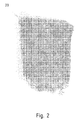
- Fig. 2 shows a mixed fleece comprising bamboo fibers and plastic fibers (polypropylene).
- a mixed nonwoven fabric is preferably produced by the needle-felting method already described above. Initially, practically sugar-free bamboo fibers with a length between 30 and 60 mm are produced. Subsequently, a mixed nonwoven with 50% by weight of bamboo fibers and 50% by weight of fine fiber polypropylene fibers is produced. The said mixed fleece can now be thermally pressed into a solid component.
Landscapes
- Engineering & Computer Science (AREA)
- Textile Engineering (AREA)
- Mechanical Engineering (AREA)
- Life Sciences & Earth Sciences (AREA)
- Wood Science & Technology (AREA)
- Nonwoven Fabrics (AREA)
Priority Applications (1)
| Application Number | Priority Date | Filing Date | Title |
|---|---|---|---|
| EP09175707A EP2322713A1 (fr) | 2009-11-11 | 2009-11-11 | Procédé de fabrication de fibres de bambou et matières synthétiques en étant pourvues |
Applications Claiming Priority (1)
| Application Number | Priority Date | Filing Date | Title |
|---|---|---|---|
| EP09175707A EP2322713A1 (fr) | 2009-11-11 | 2009-11-11 | Procédé de fabrication de fibres de bambou et matières synthétiques en étant pourvues |
Publications (1)
| Publication Number | Publication Date |
|---|---|
| EP2322713A1 true EP2322713A1 (fr) | 2011-05-18 |
Family
ID=42061999
Family Applications (1)
| Application Number | Title | Priority Date | Filing Date |
|---|---|---|---|
| EP09175707A Withdrawn EP2322713A1 (fr) | 2009-11-11 | 2009-11-11 | Procédé de fabrication de fibres de bambou et matières synthétiques en étant pourvues |
Country Status (1)
| Country | Link |
|---|---|
| EP (1) | EP2322713A1 (fr) |
Cited By (9)
| Publication number | Priority date | Publication date | Assignee | Title |
|---|---|---|---|---|
| EP2677073A1 (fr) * | 2012-06-19 | 2013-12-25 | Spengler Technology UG | Fibres de bambou adaptées à la fabrication d'étoffes |
| WO2014086975A1 (fr) * | 2012-12-07 | 2014-06-12 | Lothar Rauer | Matériau composite et procédé de production dudit matériau |
| WO2014096355A1 (fr) * | 2012-12-21 | 2014-06-26 | Lothar Rauer | Procédé de fabrication de fibres de renforcement |
| WO2014096350A1 (fr) * | 2012-12-21 | 2014-06-26 | Lothar Rauer | Matériau composite et procédé de fabrication d'un tel matériau |
| US20160288394A1 (en) * | 2013-12-03 | 2016-10-06 | Continental Structural Plastics, Inc. | Resin transfer molding with rapid cycle time |
| US20160311467A1 (en) * | 2013-12-10 | 2016-10-27 | Continental Structural Plastics Inc. | I-beam with reinforced skin |
| DE202016002946U1 (de) * | 2016-05-03 | 2017-08-04 | Spengler Technology GmbH | Verbundwerkstoff |
| US20200122413A1 (en) * | 2013-12-03 | 2020-04-23 | Continental Structural Plastics, Inc. | Resin transfer molding with rapid cycle time |
| US11407187B2 (en) * | 2016-12-27 | 2022-08-09 | Teijin Automotive Technologies, Inc. | Continuous channel resin transfer molding with rapid cycle time |
Citations (8)
| Publication number | Priority date | Publication date | Assignee | Title |
|---|---|---|---|---|
| DE4226988A1 (de) | 1992-08-14 | 1994-02-17 | Wulfram John Schmucker | Kunststofformteil und Verfahren zu dessen Herstellung |
| DE29720598U1 (de) | 1997-11-20 | 1998-02-05 | Christian Heinrich Sandler GmbH & Co. KG, 95126 Schwarzenbach a d Saale | Vliesstoff aus Naturfasern und Kunstfasern |
| EP0971065A2 (fr) * | 1998-07-06 | 2000-01-12 | Lothar Dr.-Ing. Rauer | Procédé et dispositif de préparation de fibres naturelles, en particulier de fibres de bambou, pour utilisation comme matière de renforcement |
| DE29916767U1 (de) * | 1999-09-23 | 2000-02-24 | SIEWERT GmbH für Kunststofftechnik, 75031 Eppingen | Extrudiertes Profil aus Kunststoff |
| DE10215571A1 (de) | 2002-04-09 | 2003-10-23 | Dilo Kg Maschf Oskar | Verfahren und Vorrichtung zum Herstellen eines strukturierten Nadelvlieses |
| WO2006115310A1 (fr) * | 2005-04-27 | 2006-11-02 | Kwon-Hyok Lee | Procede de production de pate a papier fibreuse a partir de bambou et pate ainsi obtenue |
| WO2008063014A1 (fr) * | 2006-11-22 | 2008-05-29 | I'big, Inc. | Procédé de fabrication de copeaux de bambou et procédé de fabrication d'une fibre de bambou utilisant les copeaux de bambou |
| EP2060664A1 (fr) | 2007-11-16 | 2009-05-20 | Transmare B.V. | Procédé de fabrication d'un matériau synthétique renforcé par des fibres naturelles |
-
2009
- 2009-11-11 EP EP09175707A patent/EP2322713A1/fr not_active Withdrawn
Patent Citations (8)
| Publication number | Priority date | Publication date | Assignee | Title |
|---|---|---|---|---|
| DE4226988A1 (de) | 1992-08-14 | 1994-02-17 | Wulfram John Schmucker | Kunststofformteil und Verfahren zu dessen Herstellung |
| DE29720598U1 (de) | 1997-11-20 | 1998-02-05 | Christian Heinrich Sandler GmbH & Co. KG, 95126 Schwarzenbach a d Saale | Vliesstoff aus Naturfasern und Kunstfasern |
| EP0971065A2 (fr) * | 1998-07-06 | 2000-01-12 | Lothar Dr.-Ing. Rauer | Procédé et dispositif de préparation de fibres naturelles, en particulier de fibres de bambou, pour utilisation comme matière de renforcement |
| DE29916767U1 (de) * | 1999-09-23 | 2000-02-24 | SIEWERT GmbH für Kunststofftechnik, 75031 Eppingen | Extrudiertes Profil aus Kunststoff |
| DE10215571A1 (de) | 2002-04-09 | 2003-10-23 | Dilo Kg Maschf Oskar | Verfahren und Vorrichtung zum Herstellen eines strukturierten Nadelvlieses |
| WO2006115310A1 (fr) * | 2005-04-27 | 2006-11-02 | Kwon-Hyok Lee | Procede de production de pate a papier fibreuse a partir de bambou et pate ainsi obtenue |
| WO2008063014A1 (fr) * | 2006-11-22 | 2008-05-29 | I'big, Inc. | Procédé de fabrication de copeaux de bambou et procédé de fabrication d'une fibre de bambou utilisant les copeaux de bambou |
| EP2060664A1 (fr) | 2007-11-16 | 2009-05-20 | Transmare B.V. | Procédé de fabrication d'un matériau synthétique renforcé par des fibres naturelles |
Cited By (11)
| Publication number | Priority date | Publication date | Assignee | Title |
|---|---|---|---|---|
| EP2677073A1 (fr) * | 2012-06-19 | 2013-12-25 | Spengler Technology UG | Fibres de bambou adaptées à la fabrication d'étoffes |
| WO2014086975A1 (fr) * | 2012-12-07 | 2014-06-12 | Lothar Rauer | Matériau composite et procédé de production dudit matériau |
| WO2014096355A1 (fr) * | 2012-12-21 | 2014-06-26 | Lothar Rauer | Procédé de fabrication de fibres de renforcement |
| WO2014096350A1 (fr) * | 2012-12-21 | 2014-06-26 | Lothar Rauer | Matériau composite et procédé de fabrication d'un tel matériau |
| US20160288394A1 (en) * | 2013-12-03 | 2016-10-06 | Continental Structural Plastics, Inc. | Resin transfer molding with rapid cycle time |
| US20200122413A1 (en) * | 2013-12-03 | 2020-04-23 | Continental Structural Plastics, Inc. | Resin transfer molding with rapid cycle time |
| US11247415B2 (en) * | 2013-12-03 | 2022-02-15 | Continental Structural Plastics, Inc. | Resin transfer molding with rapid cycle time |
| US20160311467A1 (en) * | 2013-12-10 | 2016-10-27 | Continental Structural Plastics Inc. | I-beam with reinforced skin |
| CN106103203A (zh) * | 2013-12-10 | 2016-11-09 | 大陆结构塑料有限公司 | 具有加强外皮的i形梁 |
| DE202016002946U1 (de) * | 2016-05-03 | 2017-08-04 | Spengler Technology GmbH | Verbundwerkstoff |
| US11407187B2 (en) * | 2016-12-27 | 2022-08-09 | Teijin Automotive Technologies, Inc. | Continuous channel resin transfer molding with rapid cycle time |
Similar Documents
| Publication | Publication Date | Title |
|---|---|---|
| EP2322713A1 (fr) | Procédé de fabrication de fibres de bambou et matières synthétiques en étant pourvues | |
| EP2536546B1 (fr) | Procédé de fabrication d'un produit semi-fini en forme de plaque constitué d'un matériau composite fibreux, et le produit fini ainsi obtenu | |
| EP2903794B1 (fr) | Procédé de réalisation d'un semi-produit destiné à la fabrication d'une pièce composite | |
| DE102010042349B4 (de) | Textiles Halbzeug, insbesondere Prepreg, auf Basis von aus Recyclingfasern zusammengesetztem Carbonfaservlies, Verfahren zur Herstellung und Verwendung des textilen Halbzeugs sowie Carbonfaserverstärkter Verbundwerkstoff | |
| DE102010008349A1 (de) | Verfahren zur Herstellung von Pellets aus Faserverbundwerkstoffen | |
| EP2646226A1 (fr) | Préforme fibreuse comprenant des rubans de fibres unidirectionnels et composée de faisceaux de fibres de renforcement, et élément en matériau composite | |
| EP2963167B1 (fr) | Procédé de fabrication de nattes en non tissé, notamment des nattes isolantes et nattes en non tissé obtenues selon ce procédé | |
| EP0687711B1 (fr) | Matériau composite fibreux et procédé pour le produire | |
| EP3030405A2 (fr) | Procédé permettant de produire une pièce moulée composite, pièce moulée composite, élément de construction sandwich et élément de pale de rotor et éolienne | |
| CH707147B1 (de) | Verfahren zum Herstellen eines Skikerns oder Snowboardkerns. | |
| EP0833729B1 (fr) | Constituant composite, notamment constituant composite de garnissage et son procede de production | |
| DE102020108728A1 (de) | Innenverkleidung für ein Kraftfahrzeug, die einen Dachhimmel und einen Versteifungsrahmen aufweist, und Verfahren zu ihrer Herstellung | |
| EP3009551B1 (fr) | Procede de formation d'un materiau textile a l'aide de chanvre et materiau en fibres composites fabrique a partir dudit materiau textile | |
| EP2060664A1 (fr) | Procédé de fabrication d'un matériau synthétique renforcé par des fibres naturelles | |
| DE68906863T2 (de) | Verbundmaterial aus Mineralfasern, Anlage für die Erzeugung und Verwendung des Verbundmaterials. | |
| EP2036701B1 (fr) | Structure stratifiée, ainsi que son procédé et dispositif de fabrication | |
| EP3461940B1 (fr) | Procédé de fabrication de matières fibreuses ainsi que matières fibreuses obtenues selon un tel procédé et leur utilisation | |
| DE102005060500A1 (de) | Faserverstärkter Kunststoff, enthaltend Bambusfasern, sowie Verfahren zu seiner Herstellung | |
| WO2015185573A1 (fr) | Élément composite renforcé par fibres et procédé pour le produire | |
| EP2886693A1 (fr) | Tissu non tissé en fibres de carbone et fibres thermoplastiques | |
| EP2871052B1 (fr) | Partie d'habillage intérieur de véhicule | |
| EP2732946B1 (fr) | Composite, composant fabriqué à partir de celui-ci et procédé de fabrication correspondant | |
| EP3461609B1 (fr) | Procédé de fabrication de matériaux fibreux | |
| EP3452651B1 (fr) | Produit plat non-tissé textile pouvant être enroulable | |
| WO2012107053A1 (fr) | Corps façonné à base de fibres de feuilles de typha présentant une surface très lisse |
Legal Events
| Date | Code | Title | Description |
|---|---|---|---|
| PUAI | Public reference made under article 153(3) epc to a published international application that has entered the european phase |
Free format text: ORIGINAL CODE: 0009012 |
|
| AK | Designated contracting states |
Kind code of ref document: A1 Designated state(s): AT BE BG CH CY CZ DE DK EE ES FI FR GB GR HR HU IE IS IT LI LT LU LV MC MK MT NL NO PL PT RO SE SI SK SM TR |
|
| AX | Request for extension of the european patent |
Extension state: AL BA RS |
|
| STAA | Information on the status of an ep patent application or granted ep patent |
Free format text: STATUS: THE APPLICATION IS DEEMED TO BE WITHDRAWN |
|
| 18D | Application deemed to be withdrawn |
Effective date: 20111119 |