EP2324716A2 - Verfahren zur Herstellung eines Halbhart- oder Hartkäses und damit erhaltener Käse - Google Patents
Verfahren zur Herstellung eines Halbhart- oder Hartkäses und damit erhaltener Käse Download PDFInfo
- Publication number
- EP2324716A2 EP2324716A2 EP11153315A EP11153315A EP2324716A2 EP 2324716 A2 EP2324716 A2 EP 2324716A2 EP 11153315 A EP11153315 A EP 11153315A EP 11153315 A EP11153315 A EP 11153315A EP 2324716 A2 EP2324716 A2 EP 2324716A2
- Authority
- EP
- European Patent Office
- Prior art keywords
- cheese
- starter
- adjunct
- ripening
- hard
- Prior art date
- Legal status (The legal status is an assumption and is not a legal conclusion. Google has not performed a legal analysis and makes no representation as to the accuracy of the status listed.)
- Withdrawn
Links
Images


Classifications
-
- A—HUMAN NECESSITIES
- A23—FOODS OR FOODSTUFFS; TREATMENT THEREOF, NOT COVERED BY OTHER CLASSES
- A23C—DAIRY PRODUCTS, e.g. MILK, BUTTER OR CHEESE; MILK OR CHEESE SUBSTITUTES; PREPARATION THEREOF
- A23C19/00—Cheese; Cheese preparations; Making thereof
- A23C19/06—Treating cheese curd after whey separation; Products obtained thereby
- A23C19/068—Particular types of cheese
- A23C19/0688—Hard cheese or semi-hard cheese with or without eyes
-
- A—HUMAN NECESSITIES
- A23—FOODS OR FOODSTUFFS; TREATMENT THEREOF, NOT COVERED BY OTHER CLASSES
- A23C—DAIRY PRODUCTS, e.g. MILK, BUTTER OR CHEESE; MILK OR CHEESE SUBSTITUTES; PREPARATION THEREOF
- A23C19/00—Cheese; Cheese preparations; Making thereof
- A23C19/02—Making cheese curd
- A23C19/032—Making cheese curd characterised by the use of specific microorganisms, or enzymes of microbial origin
- A23C19/0323—Making cheese curd characterised by the use of specific microorganisms, or enzymes of microbial origin using only lactic acid bacteria, e.g. Pediococcus and Leuconostoc species; Bifidobacteria; Microbial starters in general
-
- A—HUMAN NECESSITIES
- A23—FOODS OR FOODSTUFFS; TREATMENT THEREOF, NOT COVERED BY OTHER CLASSES
- A23C—DAIRY PRODUCTS, e.g. MILK, BUTTER OR CHEESE; MILK OR CHEESE SUBSTITUTES; PREPARATION THEREOF
- A23C19/00—Cheese; Cheese preparations; Making thereof
- A23C19/14—Treating cheese after having reached its definite form, e.g. ripening or smoking
- A23C19/16—Covering the cheese surface, e.g. with wax coating compositions
- A23C19/166—Covering the cheese surface, e.g. with wax coating compositions with non-edible preformed foils, films or bandages
-
- A—HUMAN NECESSITIES
- A23—FOODS OR FOODSTUFFS; TREATMENT THEREOF, NOT COVERED BY OTHER CLASSES
- A23V—INDEXING SCHEME RELATING TO FOODS, FOODSTUFFS OR NON-ALCOHOLIC BEVERAGES AND LACTIC OR PROPIONIC ACID BACTERIA USED IN FOODSTUFFS OR FOOD PREPARATION
- A23V2400/00—Lactic or propionic acid bacteria
- A23V2400/11—Lactobacillus
- A23V2400/165—Paracasei
Definitions
- the invention relates to a method for preparing a semi-hard or hard cheese, and preferably for preparing a cheese of the Gouda or Edam type, and a cheese thus obtained.
- the conventional method for preparing Gouda cheese comprises a ripening step, in which, after brining, the young cheese is ripened at 12-14° C minimally to an age of four weeks.
- the outside of the young cheese is provided with a conventional cheese covering means to protect the rind.
- this ripening referred to by the term “standard ripening” or also "natural ripening", the cheese loses moisture.
- Gouda cheeses and, for that matter, also other cheeses of the semi-hard or hard type - are also ripened as rindless cheese, with the young cheeses being in packaged in foil after brining and then being ripened at a temperature of 4-7° C.
- This technique is known as foil ripening.
- Cheese ripened in this manner does not lose moisture during the ripening, which is particularly economically advantageous.
- a practical advantage is that foil-ripened cheese, which often has a rectangular shape, results in no or hardly any cutting losses when cut up into slices or bars. In comparison, the cutting loss with standard ripened cheese, which is also referred to by the term "naturally ripened cheese” may run to up to as much as 15%.
- WO-97/38587 describes such a method for preparing Gouda cheese, where the packaged cheese is ripened at 7° C, utilizing a genetically modified Lactobacillus.
- a Bos starter culture and another microorganism culture of not genetically modified Lactobacillus is described.
- foil ripening due to the different conditions, the cheese is also subject to a different type of ripening. With this different type of ripening, the flavor development falls short. Increasing the ripening temperature to the 12-14° C conventional for standard ripening is no option, because the flavor then becomes deviant; in particular, the flavor deficiency "bitter" arises. In addition, at that temperature, foil-ripened cheese has a consistency which is not desired; thus, the structure or texture of the cheese may be too sandy or too soft.
- Dutch patent 1018856 contemplates obviating these drawbacks by providing a foil-ripened cheese of the hard or semi-hard type, which cheese is of the Gouda or Edam type, which can be obtained with a method in which to a cheese milk, in addition to a conventional amount of starter (for instance a customary amount of acid), an adjunct starter is added, which adjunct starter has a higher proteolytic and/or peptidolytic capacity compared to conventional starters. Then, in a conventional manner, a young cheese of the hard or semi-hard type is formed, which young cheese, after brining, is packaged in foil and vacuumized, and where the foil-packaged cheese is subjected to a ripening at a temperature in the range from 10 to 16° C. In preferred embodiments, thermophilic cultures are used.
- the present invention contemplates providing an improvement of the method known from NL 1018856 and the cheeses to be prepared therewith.
- improvements are found which result in a cheese with a riper flavor and/or where, during the ripening, the cheese becomes softer and smoother.
- a riper flavor is obtained, which flavor falls within a "Gouda profile”.
- This riper flavor is also found with continued ripening. Due to the use of thermophilic adjunct culture, cheese according to NL 1018856 has a somewhat sweetish flavor, particularly with continued ripening. Further, the cheese according to the invention is softer and smoother.
- the cheese prepared according to the present invention contains fewer crystals than the cheese according to NL 1018856 .
- the invention relates to a method for manufacturing a foil-ripened cheese of the hard or semi-hard type, where, to a cheese milk, in addition to a conventional amount of starter, an adjunct starter is added, which adjunct starter consists of a combination culture, which combination culture comprises at least the following three cultures: (i) ripening and/or debittering cultures; (ii) nisin-producing cultures; and (iii) non-starter lactic acid cultures; where then, in a conventional manner, a young cheese of the hard or semi-hard type is formed, which young cheese, after brining, is packaged in foil and vacuumized; and where the foil-packaged cheese is subjected to a ripening at a temperature in the range from 10 to 16° C.
- rennet for instance a (standard) abomasal rennet, but also other rennets, such as microbial rennet (for instance Fromage XL) may be used.
- microbial rennet for instance Fromage XL
- the foil-packaged cheese is subjected to a ripening at a temperature of at least 12° C and preferably from 12 to 14° C.
- Cheeses which have been subjected to a ripening at this minimum temperature meet the criterion of the Dutch Agricultural Quality Decree and are designated "natural ripened".
- the ripening step usually lasts at least 4 weeks, and preferably no longer than 6 months.
- Nisin-producing cultures are also commercially available, for instance culture BS-10 from Chr. Hansen, Denmark and culture TC 17-5 from CSK Food Enrichment, The Netherlands. Further, such cultures are described by O'Sullivan et al. in J. Appl. Microbiol. 95 (2003), 1235-1241 . These adjunct cultures provide lysis of starter bacteria, which releases enzymes, including ripening enzymes. The strain described in this publication is incorporated in the present specification by reference. When the cheese starter used is already a nisin-producing starter, no nisin-producing adjunct starter needs to be used.
- non-starter lactic acid bacteria are Lactobacillus paracasei strains. Such strains are described by, for instance, Thage et al. in Int. Dairy J. 15 (2005) 795-805 , which cultures are incorporated in this specification by reference. These cultures form flavorings from amino acids.
- the cultures are, for instance, available in DVS (Direct Vat Set) form, in which form they can be added directly to the cheese vat with the cheese milk and the standard cheese starter therein.
- DVS Direct Vat Set
- adjunct starters separately or not separately and then add them to the cheese vat. They have no direct effect on the actual cheese-making process.
- a foil-ripened cheese is obtained, where the flavor development can be controlled to a flavor and consistency which is still more similar to that of a standard ripened cheese than the cheese prepared according to NL-C-1018856 .
- the adjunct starter may comprise thermophilic and/or mesophilic lactic acid bacteria. Preferably, mesophilic cultures are used.
- the pH of this starter is preferably set to be neutral, for instance by adding a suitable amount of sodium hydroxide solution. This is done to prevent the cheese preparation process from being adversely affected.
- the combination adjunct starter may be introduced into the cheese milk simultaneously with, before or after the addition of the conventional starter.
- the adjunct starter is added simultaneously with or after the conventional starter.
- adjunct starter does not so much play a role in the acidification process as in the addition of a package of enzymes. Good results are obtained when, based on the weight of the total cheese milk, 0.2 to 5 wt.% and preferably at least 0.5 wt.% and preferably at most 2 wt.% of non-concentrated adjunct starter is added when it is cultivated in the cheese milk.
- deep-frozen and concentrated adjunct starters may be used as well, such as Direct to Vat Set Starter (DVS) cultures, of which the expert of course knows how many equivalents of these cultures are needed to obtain results similar to those obtained with the non-concentrated adjunct starters.
- DVDS Direct to Vat Set Starter
- the lactic acid bacteria in the adjunct cultures may be both mesophilic and thermophilic. It has been found according to the invention that, with thermophilic lactic acid bacteria, a somewhat sweet, nutty flavor is obtained. For the preparation of Gouda cheese, therefore mesophilic lactic acid bacteria are preferred. In addition, thermophilic lactic acid bacteria cause more crystallization in the adjunct starter.
- cheeses are obtained which become smoother during the ripening.
- the flavor and aftertaste are smoother and less bitter than those of the cheeses prepared according to NL-C-1018856 .
- the method according to the invention is very suitable for preparing foil-ripened cheeses of the Gouda or Edam type.
- it is has also been found possible to manufacture foil-ripened semi-hard and hard cheeses of a lower fat content than the standard conventional 48 + and 40 + for above-mentioned types, such as of the 30 + type.
- one of the main objects of the method according to the invention is to prepare foil-ripened cheese which has a flavor similar to standard ripened cheese, due to the variation of the type and the amount of adjunct starter, it is also possible to effect flavor differentiation.
- the expert has sufficient information available to realize such flavor differentiations.
- the invention also comprises foil-ripened cheese of the hard or semi-hard type obtainable using the method according to the invention. It will be clear to a skilled person that these differences are particularly manifest after a minimum duration of the ripening step, typically at least 4 weeks.
- the curd was drained and transferred into 4.5-kg square block molds. After pressing and brining, the cheese was packaged in foil and ripened at 13° C.
- the cheese had a fat content calculated on the dry matter of 51.2% and a moisture content of 43.8%.
- abomasal rennet ex CSK Food Enrichment B.V.; chymosin/pepsin ratio 75:25, strength 10,800
- the curd was drained and transferred into 4.5-kg square block molds. After pressing and brining, the cheese was packaged in foil and ripened at 13° C. After 14 days, the cheese had a fat content based on the dry matter of 51.0% and a moisture content of 40.2%.
- thermophilic adjunct starter embodiment had a sweet, nutty flavor which differed from the flavor of a Gouda cheese.
- the nisin-forming culture was found to be essential to the formation of the flavor of Gouda cheese in the sense that the results of the example without the nisin-forming culture clearly fell short of the example according to the invention.
- the cheese milk thus obtained was curdled at 30° C in an otherwise conventional manner and a (Gouda) cheese of the semi-hard type was prepared, while the post-heating temperature was set at 37° C.
- the moisture content of the cheese after brining was 40.7 wt.%.
- the cheeses were vacuum-packed in foil and stored at 14° C.
- the pH after 15 days of storage was 5.22; the moisture content was 39.9%; the fat-in-dry matter content was 51.2% and the salt-in-dry matter content was 3.1%.
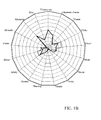
- Fig. 1A shows the results at 13 weeks (reference: naturally ripened Gouda) for the aspects smell/texture/mouthfeel;
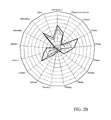
- Fig. 2A shows the same aspects after 16 weeks.
- Fig. 1B shows the flavor and aftertaste after 13 weeks; Fig. 2B after 16 weeks.
Landscapes
- Life Sciences & Earth Sciences (AREA)
- Chemical & Material Sciences (AREA)
- Engineering & Computer Science (AREA)
- Food Science & Technology (AREA)
- Polymers & Plastics (AREA)
- Microbiology (AREA)
- Dairy Products (AREA)
Applications Claiming Priority (2)
| Application Number | Priority Date | Filing Date | Title |
|---|---|---|---|
| NL1032678A NL1032678C2 (nl) | 2006-10-13 | 2006-10-13 | Werkwijze voor het bereiden van een half-harde of harde kaas en aldus verkregen kaas. |
| EP07118385.9A EP1915911B1 (de) | 2006-10-13 | 2007-10-12 | Verfahren zur Herstellung eines Halbhart- oder Hartkäses und damit erhaltener Käse |
Related Parent Applications (1)
| Application Number | Title | Priority Date | Filing Date |
|---|---|---|---|
| EP07118385.9 Division | 2007-10-12 |
Publications (2)
| Publication Number | Publication Date |
|---|---|
| EP2324716A2 true EP2324716A2 (de) | 2011-05-25 |
| EP2324716A3 EP2324716A3 (de) | 2011-07-20 |
Family
ID=38004348
Family Applications (2)
| Application Number | Title | Priority Date | Filing Date |
|---|---|---|---|
| EP07118385.9A Active EP1915911B1 (de) | 2006-10-13 | 2007-10-12 | Verfahren zur Herstellung eines Halbhart- oder Hartkäses und damit erhaltener Käse |
| EP11153315A Withdrawn EP2324716A3 (de) | 2006-10-13 | 2007-10-12 | Verfahren zur Herstellung eines Halbhart- oder Hartkäses und damit erhaltener Käse |
Family Applications Before (1)
| Application Number | Title | Priority Date | Filing Date |
|---|---|---|---|
| EP07118385.9A Active EP1915911B1 (de) | 2006-10-13 | 2007-10-12 | Verfahren zur Herstellung eines Halbhart- oder Hartkäses und damit erhaltener Käse |
Country Status (4)
| Country | Link |
|---|---|
| EP (2) | EP1915911B1 (de) |
| DK (1) | DK1915911T3 (de) |
| NL (1) | NL1032678C2 (de) |
| PL (1) | PL1915911T3 (de) |
Cited By (1)
| Publication number | Priority date | Publication date | Assignee | Title |
|---|---|---|---|---|
| CN111285925A (zh) * | 2019-12-24 | 2020-06-16 | 顾容铖 | 副干酪乳杆菌zfm54细菌素的分离纯化方法 |
Families Citing this family (3)
| Publication number | Priority date | Publication date | Assignee | Title |
|---|---|---|---|---|
| UA103177C2 (ru) | 2007-10-12 | 2013-09-25 | Дсм Іп Ассетс Б.В. | Способ созревания сыра в фольге |
| DK2165608T4 (da) * | 2008-09-22 | 2020-09-07 | Csk Food Enrichment Bv | Fremgangsmåde til fremstilling af ost under anvendelse af en nisinproducerende direkte-kar-startkultur |
| US9192175B2 (en) * | 2009-02-17 | 2015-11-24 | Dsm Ip Assets B.V. | Process for foil ripening of cheese |
Citations (2)
| Publication number | Priority date | Publication date | Assignee | Title |
|---|---|---|---|---|
| WO1997038587A1 (en) | 1996-04-15 | 1997-10-23 | Friesland Brands B.V. | Methods for producing dairy products, in particular cheese using lactic acid bacteria provided with additional neutral protease activity |
| NL1018856C2 (nl) | 2001-08-30 | 2003-03-03 | Friesland Brands Bv | Werkwijze voor het bereiden van een half-harde of harde kaas en aldus verkregen kaas. |
Family Cites Families (7)
| Publication number | Priority date | Publication date | Assignee | Title |
|---|---|---|---|---|
| GB713251A (en) * | 1951-03-07 | 1954-08-11 | Nat Res Dev | Improvements in or relating to the manufacture or preservation of cheese |
| IES70514B2 (en) * | 1995-04-12 | 1996-12-11 | Teagasc Agric Food Dev Authori | Bacteriocins |
| EP1082021B1 (de) * | 1998-05-29 | 2002-07-24 | Enterprise Ireland (trading as Bioresearch Ireland) | Verfahren zur herstellung von probiotischem käse |
| EP1196041B1 (de) * | 1999-07-06 | 2012-09-12 | Friesland Brands B.V. | Verfahren und mittel zur herstellung von verbesserten molkereiprodukten |
| SE0003100D0 (sv) * | 2000-09-01 | 2000-09-01 | Probi Ab | New strains |
| SE0003576D0 (sv) * | 2000-10-04 | 2000-10-04 | Probi Ab | New strain |
| EP1273237A1 (de) * | 2001-07-02 | 2003-01-08 | CSK Food Enrichment B.V. | Nisinbildende Starterkulturen für fermentierte Lebensmittel |
-
2006
- 2006-10-13 NL NL1032678A patent/NL1032678C2/nl not_active IP Right Cessation
-
2007
- 2007-10-12 DK DK07118385.9T patent/DK1915911T3/en active
- 2007-10-12 EP EP07118385.9A patent/EP1915911B1/de active Active
- 2007-10-12 EP EP11153315A patent/EP2324716A3/de not_active Withdrawn
- 2007-10-12 PL PL07118385T patent/PL1915911T3/pl unknown
Patent Citations (2)
| Publication number | Priority date | Publication date | Assignee | Title |
|---|---|---|---|---|
| WO1997038587A1 (en) | 1996-04-15 | 1997-10-23 | Friesland Brands B.V. | Methods for producing dairy products, in particular cheese using lactic acid bacteria provided with additional neutral protease activity |
| NL1018856C2 (nl) | 2001-08-30 | 2003-03-03 | Friesland Brands Bv | Werkwijze voor het bereiden van een half-harde of harde kaas en aldus verkregen kaas. |
Non-Patent Citations (2)
| Title |
|---|
| O'SULLIVAN ET AL., J. APPL. MICROBIOL., vol. 95, 2003, pages 1235 - 1241 |
| THAGE ET AL., INT. DAIRY J., vol. 15, 2005, pages 795 - 805 |
Cited By (1)
| Publication number | Priority date | Publication date | Assignee | Title |
|---|---|---|---|---|
| CN111285925A (zh) * | 2019-12-24 | 2020-06-16 | 顾容铖 | 副干酪乳杆菌zfm54细菌素的分离纯化方法 |
Also Published As
| Publication number | Publication date |
|---|---|
| PL1915911T3 (pl) | 2014-05-30 |
| NL1032678C2 (nl) | 2008-04-15 |
| DK1915911T3 (en) | 2014-03-03 |
| EP1915911B1 (de) | 2013-11-27 |
| EP1915911A1 (de) | 2008-04-30 |
| EP2324716A3 (de) | 2011-07-20 |
Similar Documents
| Publication | Publication Date | Title |
|---|---|---|
| Fox et al. | Factors that affect the quality of cheese | |
| Litopoulou-Tzanetaki et al. | Microbiological characteristics of Greek traditional cheeses | |
| US5681598A (en) | Process for producing cheese using transglutaminase | |
| US6495187B1 (en) | Method for the use of isolated soy protein in the production of fresh, unripened cheese analogs and cheese analogs | |
| US5080913A (en) | Process for preparing low fat cheese | |
| CA1074616A (en) | Method for rapidly producing cheese of uniform and superior aged flavor | |
| EP1287744B1 (de) | Verfahren zur Herstellung von Halbhart- oder Hartkäse und derart hergestellter Käse | |
| EP1915911B1 (de) | Verfahren zur Herstellung eines Halbhart- oder Hartkäses und damit erhaltener Käse | |
| Düsterhöft et al. | Dutch‐Type Cheeses | |
| Stanley | Microbiology of fermented milk products | |
| EP0666032A1 (de) | Verfahren zur Herstellung von Pasta Filata Käse mit reduziertem Fettgehalt | |
| EP0281167B1 (de) | Verfahren zur Herstellung von Käse vom Typ Gouda | |
| US5693349A (en) | Method for making a sweetened natural cheese | |
| Chandan et al. | Principles of cheese technology | |
| JPH0642814B2 (ja) | チーズ類の製造方法 | |
| EP1862076A1 (de) | Verfahren zur Herstellung von Käse mit einem mesophilen zusätzlichen Säurewecker; Käse und Molke erhältich nach diesem Verfahren | |
| EP0150743B1 (de) | Enzymenzusammensetzung zur Beschleunigung der Käsereifung | |
| US11702626B2 (en) | Strains of penicillium camemberti | |
| US20010033879A1 (en) | Cheese culture medium and method for making no fat and low fat cheese products | |
| Werner et al. | North European varieties of cheese | |
| EP3316695A1 (de) | Umgehung von molkewäsche in der festlandkäseherstellung | |
| Engels et al. | Gouda and Related Cheeses | |
| AU2006278583B2 (en) | Cheese with sodium gluconate to inhibit calcium lactate crystal formation | |
| Gudkov | Cheeses of the former USSR | |
| GUDKOV | Nitrate is used in the production of semi-hard cheeses. Hydrogen peroxide |
Legal Events
| Date | Code | Title | Description |
|---|---|---|---|
| PUAI | Public reference made under article 153(3) epc to a published international application that has entered the european phase |
Free format text: ORIGINAL CODE: 0009012 |
|
| 17P | Request for examination filed |
Effective date: 20110204 |
|
| AC | Divisional application: reference to earlier application |
Ref document number: 1915911 Country of ref document: EP Kind code of ref document: P |
|
| AK | Designated contracting states |
Kind code of ref document: A2 Designated state(s): AT BE BG CH CY CZ DE DK EE ES FI FR GB GR HU IE IS IT LI LT LU LV MC MT NL PL PT RO SE SI SK TR |
|
| PUAL | Search report despatched |
Free format text: ORIGINAL CODE: 0009013 |
|
| AK | Designated contracting states |
Kind code of ref document: A3 Designated state(s): AT BE BG CH CY CZ DE DK EE ES FI FR GB GR HU IE IS IT LI LT LU LV MC MT NL PL PT RO SE SI SK TR |
|
| RIN1 | Information on inventor provided before grant (corrected) |
Inventor name: BONESTROO, MARTIN HENDRIK Inventor name: KNIER, CORNELIS WYBEREN Inventor name: VAN AREM, EVERHARDUS JACOBUS FRANCISCUS |
|
| 17Q | First examination report despatched |
Effective date: 20120229 |
|
| STAA | Information on the status of an ep patent application or granted ep patent |
Free format text: STATUS: THE APPLICATION HAS BEEN WITHDRAWN |
|
| 18W | Application withdrawn |
Effective date: 20131120 |