EP2329257B1 - Vorrichtung und verfahren zur reinigung, isolierung, entsalzung oder zum puffer-/lösungsmittelaustausch von substanzen - Google Patents
Vorrichtung und verfahren zur reinigung, isolierung, entsalzung oder zum puffer-/lösungsmittelaustausch von substanzen Download PDFInfo
- Publication number
- EP2329257B1 EP2329257B1 EP09803694.0A EP09803694A EP2329257B1 EP 2329257 B1 EP2329257 B1 EP 2329257B1 EP 09803694 A EP09803694 A EP 09803694A EP 2329257 B1 EP2329257 B1 EP 2329257B1
- Authority
- EP
- European Patent Office
- Prior art keywords
- spin
- spin column
- column
- filter
- hgr
- Prior art date
- Legal status (The legal status is an assumption and is not a legal conclusion. Google has not performed a legal analysis and makes no representation as to the accuracy of the status listed.)
- Active
Links
Images




Classifications
-
- G—PHYSICS
- G01—MEASURING; TESTING
- G01N—INVESTIGATING OR ANALYSING MATERIALS BY DETERMINING THEIR CHEMICAL OR PHYSICAL PROPERTIES
- G01N30/00—Investigating or analysing materials by separation into components using adsorption, absorption or similar phenomena or using ion-exchange, e.g. chromatography or field flow fractionation
- G01N30/02—Column chromatography
- G01N30/60—Construction of the column
- G01N30/6091—Cartridges
-
- B—PERFORMING OPERATIONS; TRANSPORTING
- B01—PHYSICAL OR CHEMICAL PROCESSES OR APPARATUS IN GENERAL
- B01D—SEPARATION
- B01D15/00—Separating processes involving the treatment of liquids with solid sorbents; Apparatus therefor
- B01D15/08—Selective adsorption, e.g. chromatography
- B01D15/10—Selective adsorption, e.g. chromatography characterised by constructional or operational features
- B01D15/22—Selective adsorption, e.g. chromatography characterised by constructional or operational features relating to the construction of the column
-
- B—PERFORMING OPERATIONS; TRANSPORTING
- B01—PHYSICAL OR CHEMICAL PROCESSES OR APPARATUS IN GENERAL
- B01J—CHEMICAL OR PHYSICAL PROCESSES, e.g. CATALYSIS OR COLLOID CHEMISTRY; THEIR RELEVANT APPARATUS
- B01J20/00—Solid sorbent compositions or filter aid compositions; Sorbents for chromatography; Processes for preparing, regenerating or reactivating thereof
- B01J20/22—Solid sorbent compositions or filter aid compositions; Sorbents for chromatography; Processes for preparing, regenerating or reactivating thereof comprising organic material
- B01J20/26—Synthetic macromolecular compounds
- B01J20/265—Synthetic macromolecular compounds modified or post-treated polymers
- B01J20/267—Cross-linked polymers
-
- B—PERFORMING OPERATIONS; TRANSPORTING
- B01—PHYSICAL OR CHEMICAL PROCESSES OR APPARATUS IN GENERAL
- B01J—CHEMICAL OR PHYSICAL PROCESSES, e.g. CATALYSIS OR COLLOID CHEMISTRY; THEIR RELEVANT APPARATUS
- B01J20/00—Solid sorbent compositions or filter aid compositions; Sorbents for chromatography; Processes for preparing, regenerating or reactivating thereof
- B01J20/281—Sorbents specially adapted for preparative, analytical or investigative chromatography
- B01J20/282—Porous sorbents
- B01J20/283—Porous sorbents based on silica
-
- B—PERFORMING OPERATIONS; TRANSPORTING
- B01—PHYSICAL OR CHEMICAL PROCESSES OR APPARATUS IN GENERAL
- B01J—CHEMICAL OR PHYSICAL PROCESSES, e.g. CATALYSIS OR COLLOID CHEMISTRY; THEIR RELEVANT APPARATUS
- B01J20/00—Solid sorbent compositions or filter aid compositions; Sorbents for chromatography; Processes for preparing, regenerating or reactivating thereof
- B01J20/281—Sorbents specially adapted for preparative, analytical or investigative chromatography
- B01J20/282—Porous sorbents
- B01J20/285—Porous sorbents based on polymers
-
- B—PERFORMING OPERATIONS; TRANSPORTING
- B01—PHYSICAL OR CHEMICAL PROCESSES OR APPARATUS IN GENERAL
- B01J—CHEMICAL OR PHYSICAL PROCESSES, e.g. CATALYSIS OR COLLOID CHEMISTRY; THEIR RELEVANT APPARATUS
- B01J20/00—Solid sorbent compositions or filter aid compositions; Sorbents for chromatography; Processes for preparing, regenerating or reactivating thereof
- B01J20/281—Sorbents specially adapted for preparative, analytical or investigative chromatography
- B01J20/291—Gel sorbents
-
- B—PERFORMING OPERATIONS; TRANSPORTING
- B01—PHYSICAL OR CHEMICAL PROCESSES OR APPARATUS IN GENERAL
- B01L—CHEMICAL OR PHYSICAL LABORATORY APPARATUS FOR GENERAL USE
- B01L3/00—Containers or dishes for laboratory use, e.g. laboratory glassware; Droppers
- B01L3/50—Containers for the purpose of retaining a material to be analysed, e.g. test tubes
- B01L3/502—Containers for the purpose of retaining a material to be analysed, e.g. test tubes with fluid transport, e.g. in multi-compartment structures
- B01L3/5021—Test tubes specially adapted for centrifugation purposes
-
- G—PHYSICS
- G01—MEASURING; TESTING
- G01N—INVESTIGATING OR ANALYSING MATERIALS BY DETERMINING THEIR CHEMICAL OR PHYSICAL PROPERTIES
- G01N30/00—Investigating or analysing materials by separation into components using adsorption, absorption or similar phenomena or using ion-exchange, e.g. chromatography or field flow fractionation
- G01N30/02—Column chromatography
- G01N30/60—Construction of the column
- G01N30/6052—Construction of the column body
-
- B—PERFORMING OPERATIONS; TRANSPORTING
- B01—PHYSICAL OR CHEMICAL PROCESSES OR APPARATUS IN GENERAL
- B01J—CHEMICAL OR PHYSICAL PROCESSES, e.g. CATALYSIS OR COLLOID CHEMISTRY; THEIR RELEVANT APPARATUS
- B01J2220/00—Aspects relating to sorbent materials
- B01J2220/50—Aspects relating to the use of sorbent or filter aid materials
- B01J2220/58—Use in a single column
-
- B—PERFORMING OPERATIONS; TRANSPORTING
- B01—PHYSICAL OR CHEMICAL PROCESSES OR APPARATUS IN GENERAL
- B01L—CHEMICAL OR PHYSICAL LABORATORY APPARATUS FOR GENERAL USE
- B01L2300/00—Additional constructional details
- B01L2300/04—Closures and closing means
- B01L2300/041—Connecting closures to device or container
- B01L2300/042—Caps; Plugs
-
- B—PERFORMING OPERATIONS; TRANSPORTING
- B01—PHYSICAL OR CHEMICAL PROCESSES OR APPARATUS IN GENERAL
- B01L—CHEMICAL OR PHYSICAL LABORATORY APPARATUS FOR GENERAL USE
- B01L2300/00—Additional constructional details
- B01L2300/06—Auxiliary integrated devices, integrated components
- B01L2300/0681—Filter
-
- B—PERFORMING OPERATIONS; TRANSPORTING
- B01—PHYSICAL OR CHEMICAL PROCESSES OR APPARATUS IN GENERAL
- B01L—CHEMICAL OR PHYSICAL LABORATORY APPARATUS FOR GENERAL USE
- B01L2300/00—Additional constructional details
- B01L2300/08—Geometry, shape and general structure
- B01L2300/0832—Geometry, shape and general structure cylindrical, tube shaped
-
- G—PHYSICS
- G01—MEASURING; TESTING
- G01N—INVESTIGATING OR ANALYSING MATERIALS BY DETERMINING THEIR CHEMICAL OR PHYSICAL PROPERTIES
- G01N30/00—Investigating or analysing materials by separation into components using adsorption, absorption or similar phenomena or using ion-exchange, e.g. chromatography or field flow fractionation
- G01N30/02—Column chromatography
- G01N30/26—Conditioning of the fluid carrier; Flow patterns
- G01N30/38—Flow patterns
- G01N2030/381—Flow patterns centrifugal chromatography
-
- Y—GENERAL TAGGING OF NEW TECHNOLOGICAL DEVELOPMENTS; GENERAL TAGGING OF CROSS-SECTIONAL TECHNOLOGIES SPANNING OVER SEVERAL SECTIONS OF THE IPC; TECHNICAL SUBJECTS COVERED BY FORMER USPC CROSS-REFERENCE ART COLLECTIONS [XRACs] AND DIGESTS
- Y10—TECHNICAL SUBJECTS COVERED BY FORMER USPC
- Y10T—TECHNICAL SUBJECTS COVERED BY FORMER US CLASSIFICATION
- Y10T436/00—Chemistry: analytical and immunological testing
- Y10T436/25—Chemistry: analytical and immunological testing including sample preparation
- Y10T436/25375—Liberation or purification of sample or separation of material from a sample [e.g., filtering, centrifuging, etc.]
- Y10T436/255—Liberation or purification of sample or separation of material from a sample [e.g., filtering, centrifuging, etc.] including use of a solid sorbent, semipermeable membrane, or liquid extraction
Definitions
- spin-column chromatography is frequently employed to enrich for analytes, to reduce or remove interferences or combinations of these purposes.
- spin-columns are of simple design and usually contain a separation media such as cross-linked dextrans or polyacrylamides, ion-exchange resins or silica gels of various types.
- the spin-column devices are prepared by having the separation media suspended in a buffer or organic solvent within the spin-column. Before centrifugation the separation media has an essentially uniform distribution in the spin column and when viewed perpendicular to its surface has a circular cross section.
- the spin-column is pre-spun in a centrifuge, preferably equipped with a "swinging-bucket" rotor to keep the bulk mass of the separation media within the column from slanting and to maintain a uniform flow path for the suspension media and sample material that is parallel to the walls of the column.
- the separation media Following centrifugation in a "swinging bucket" rotor the separation media has an essentially uniform distribution in the spin column and when viewed perpendicular to its surface has a circular cross section. A fixed angle rotor is sometimes used, but the column media shifts and forms an angled surface. Following centrifugation in a "fixed angle” rotor the separation media has an uneven distribution in the spin column and when viewed perpendicular to its surface has an elliptical or ovoid cross section. Applied samples then flow at an angle through the separation media and not parallel to the column walls.
- the applied sample must preferably be loaded to the center of the media.
- the spin-column is pre-spun to force the liquid suspending the separation media through the column to remove excess liquid from the spin-column and compact the separation media.
- the sample is then carefully loaded onto the top center of the separation media in the spin-column and the spin-column is centrifuged in a collection tube and the desired material is collected in the collection tube.
- spin-columns have been pre-spun, care must be taken that the spin-column is in the identical orientation as it was during the pre-spin, otherwise the media and applied sample will be redistributed during centrifugation and the desired separation/filtration will be inadequate or compromised.
- the desired material is retained on the separation media within the spin-column and is subsequently eluted, sometimes after washes to remove undesired materials, with the desired material being displaced from the separation media within the spin-column by some alteration of conditions facilitating its release from the column separation media, and sometimes the desired material is not bound and interferences are bound to the separation media.
- spin-columns for example to accomplish buffer exchange of proteins, such as antibodies, or to separate unincorporated radioactive nucleotides from polynucleotides which have incorporated the radiolabel, for example, following radioactive phosphorylation of DNA for use as probes from ⁇ - 32 P-ATP.
- radioactive phosphorylation of DNA for use as probes from ⁇ - 32 P-ATP.
- CSH Protocols at http://www.cshprotocols.org/ or the Wikipedia location http://en.wikipedia.org/wiki/Minicolumn_purification on the world wide web for a description of minicolumn DNA preparation.
- the spin-column devices must be centrifuged in a swinging bucket type of rotor to keep the media from slanting and distorting the separation process.
- the separation media becomes distorted or becomes slanted and the applied sample material and liquids experience various separation path lengths or channeling through the column, with the sample material in the lower aspect of the slanted media experiencing a short separation path and the sample material at the high end of the slope experiencing longer separation paths. This behavior of the applied sample material is in conflict with good separation performance.
- the separation media should have similar effective separation paths across the diameter of the separation media and along the length or depth of the separation media; however, channeling or significant distortions of the separation path greatly compromises and significantly alters and adversely affects the performance of the separation process.
- spin column devices that overcome the problems of channeling, special centrifuge rotors, centered sample loading, and single purpose utility of present spin column
- HGR-filter a rigid porous filter or frit referred to herein as an HGR-filter (where HGR represents H eight G reater than or equal to the R adius), placed above the spin column separation or packing media and in close contact with the upper surface of the spin column separation media, enables a spin-column to be used in either rotors of a swinging bucket type or fixed angle type without the generation of slanted or other distortions of the separation media.
- a filter should be of a diameter equal to the inner diameter of the spin-column and of a height greater than half the inner column diameter or greater than the inner radius of the spin-column.
- the HGR-filter affords a flow of liquids through the separation media more parallel to the centrifugal forces than spin-columns without this HGR-filter or those with frits of shorter heights.
- such devices can be configured to accomplish sample disruption in the region above the HGR-filter set forth above, which for example can facilitate the isolation of polynucleotides or proteins from cells or tissues saving significant sample preparation time and expense and substantially reducing complicated manipulations, for example, in the preparation of samples for clinical, investigational research, quality control or other forms of analysis.
- the means of eluting the sample from the column may employ gravitation, pressure or application of vacuum in addition to centrifugation to capture, wash, elute or otherwise recover the desired sample material, from the HGR-devices disclosed herein, thereby providing a device of wider utility than either other spin-column devices or traditional columnar devices alone.
- Fig. 1 shows one embodiment of the present invention, referred to herein as a spin-column assembly.
- Spin-column assemblies constructed in accordance with this embodiment are comprised of several components, including: a device referred to as a spin-column device 10, comprising a column made of plastic, glass or treated papers, having an upper opening 11 and a lower end 18, the lower end having an effluent port 17, which retains or impedes the exit of solid or particulate matter, but allows the passage of effluent liquids.
- the device contains a media support 16, such as a frit, seated above the bottom end of the device to further prevent loss of separation media from the spin column device 10.
- the device also contains separation media 15 within the column loaded above the media support.
- the assembly can also include a cap for enclosing the upper opening and a closure for the effluent port 17 to prevent entry of contaminants or loss of materials from the spin-column device.
- the spin-column device is usually of a diameter sufficient to fit within a collection vessel 19, such as a 1.5-2 ml microfuge tube or 15-50 ml conical centrifuge tube, which acts as a collection vessel 19 in which to collect the effluent from the spin-column.
- a collection vessel 19 such as a 1.5-2 ml microfuge tube or 15-50 ml conical centrifuge tube, which acts as a collection vessel 19 in which to collect the effluent from the spin-column.
- HGR spin-column assembly The assembly of these components with an HGR-filter are referred to as an HGR spin-column assembly or as an HGR-device.
- the HGR-filter can function individually as a frit, filter or separation media or have functional combinations of these or other functionalities in either a single HGR-filter as combinations of HGR-filters.
- HGR-devices are configurable as single sample devices or as multi-well HGR-devices to process multiple samples in
- Fig. 2 shows a spin column assembly which can be used to release material from a sample, such as to lyse a cell to release its constituents.
- the spin column device 20 having an upper opening 21, a lower end 28 and an effluent port 27, the spin column device contains, bottom to top, a media support 26, separation or packing media 25 and an HGR-filter 24.
- the spin-column device 20 is usually of a diameter sufficient to fit within a collection vessel 29, such as a 1.5-2 ml microfuge tube or 15-50 ml conical centrifuge tube, which acts as a collection vessel 29 in which to collect the effluent from the spin-column.
- the region above the HGR-filter contains a grinding or pulverizing agent 22, like beads, such as those made of ceramics, glass or metals or combinations of such beads.
- a grinding or pulverizing agent 22 like beads, such as those made of ceramics, glass or metals or combinations of such beads.
- the upper portion of the HGR-filter 24 is covered by a thin protective frit 23 or other porous material resistant to the action of the pulverizing agent 22 employed to accomplish lysis and/or mechanical disruption of the sample.
- Suitable beads are well known in the art and may be selected from micron to millimeter sized borosilicate glass, soda lime glass, ceramics particles such as zirconia, silica, alumina and the like, or metal balls such as stainless steels of various alloy composition and tinsel strengths.
- the beads being in the size range of microns to millimeter in average size depending on the nature composition and sample composition sought to be disrupted. For example 0.5mm zirconia/silica particles are suitable for most cells and most soft tissues while 1-5mm stainless steel beads are more suitable for tougher materials like plant tissues, such as corn, wheat, soybeans and the like such selection being known in the art.
- Fig. 3 shows an alternative spin column assembly, where the spin column device 30, which has a lower end 38 and an effluent port 37, simply contains a media support 36, such as a frit, seated above the bottom end of the device and a rigid porous filter 34, i.e., the HGR-filter, sitting on top of the media support 36.
- This version of the spin column assembly also includes a cap 31 covering the top of the device and a closure 39 for plugging up and preventing leakage from the effluent port 37.
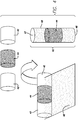
- FIG. 4 shows an example of monolithic HGR filter assembly, which can be inserted in a spin column device as described herein to provide a spin column assembly according to the invention.
- the monolithic HGR filter assembly 40 includes a plurality of cylindrical elements, e.g., a first filter element 42, a second filter element 46, and separation media element 44 situated between the first and second filter elements, which are held together and coated, such as by rolling as depicted in Fig. 4 , with a thin surface element consisting of a cellophane or polyvinyl chloride film to provide a casing 48.
- the casing 48 serves to hold the assembly together and is impermeable or only slightly impermeable to the liquid media contained in the sample to be captured by the separation media.
- the first and second filter elements 42, 46 are comprised of fiber or sintered filter material and the separation media element 44 is comprised of separation media or fiber impregnated with or coated with separation media, such as cross-linked dextrans, cellulose particles, ion exchange resins, silica particles or gels of various types or affinity chromatography media.
- separation media such as cross-linked dextrans, cellulose particles, ion exchange resins, silica particles or gels of various types or affinity chromatography media.
- Figure 5 shows a top view of a volume control device 50 for regulating the volume of fluid delivered to the upper surface and center of a spin column assembly.
- the volume control device can be placed within the upper opening of a spin control device on top of the rigid porous filter.
- the volume control device 50 is comprised of a larger outer column 51 and base 56 with a small hole or opening 52 in the base 56 that under normal gravity impedes or prevents the flow of fluid due to surface tension effects but under higher gravitational loading or other forces permits the flow of fluid through the opening 52.
- Attached to the base 56 and situated within this outer cylindrical column 51 is an inner hollow cylinder 53 whose height and inner diameter determine a fixed volume of fluid.
- the volume control device is composed of rigid, inert material impermeable to liquids, such as metal, glass, plastic or paper impregnated with polymer.
- the volume control device 50 is constructed of plastic by injection molding.
- spin-column devices are comprised of a column composed of plastic, often polymeric such as polyethylene, polypropylene, polycarbonate, polystyrene, glass and the like.
- the spin-column device is usually of a diameter sufficient to fit within a collection vessel, such as a 1.5-2 ml microfuge tube or 15-50 mil conical centrifuge tube, which acts as a collection vessel in which to collect the effluent from the spin-column.
- the diameter of the upper opening is usually of the same diameter over the length of the spin-column; however, the lower end of the spin-column usually has a passage that is substantially smaller than the diameter of the body of the spin-column which acts as an exit or discharge port for the fluid effluent from the spin-column.
- the lower end of the spin-column acts as a support for a porous frit, filter or other support that will allow effluent fluids to pass through it but has the ability to retain and impede or prevent the passage or exit of the particulate or gel separation media from the spin-column. Some columns have an upper frit, while many do not.
- HGR-devices suitable for use to produce HGR-devices in accordance with the present disclosure are commercially available from a variety of sources such as Thermo-Fisher Scientific (Waltham, MA), Sigma Aldrich (Saint Louis, MO), Axygen Biosciences (Union City, CA), BioRad (Hercules, CA), Pierce Chemical Co (Rockford, IL), and other suppliers.
- sources such as Thermo-Fisher Scientific (Waltham, MA), Sigma Aldrich (Saint Louis, MO), Axygen Biosciences (Union City, CA), BioRad (Hercules, CA), Pierce Chemical Co (Rockford, IL), and other suppliers.
- the spin-column devices can be selected from a variety of sizes, from about 200 ⁇ l to a few tens of milliliters of internal column volume.
- the effluent port of the spin-column device should have a snap off tab or some other end closure to prevent the inadvertent loss of liquids or materials from the effluent port at its base and should also have a cap or other closure for the upper aspect of the device to likewise prevent loss of materials from the column.
- Such tabs or closures also minimize inadvertent or other contamination of the devices.
- the lower part of the spin-column device may have a frit or other porous or semi-permeable supporting material, such as a semi-permeable membrane, mesh or filter paper, which acts to retain the separation or filtration media within the assembled spin-column while permitting the flow of liquids through it when the column is subjected to appropriate centrifugation forces, i.e., pressure or vacuum, to move the fluids through and out of the column and into a collection device.
- a frit or other porous or semi-permeable supporting material such as a semi-permeable membrane, mesh or filter paper, which acts to retain the separation or filtration media within the assembled spin-column while permitting the flow of liquids through it when the column is subjected to appropriate centrifugation forces, i.e., pressure or vacuum, to move the fluids through and out of the column and into a collection device.
- a frit or other porous or semi-permeable supporting material such as a semi-permeable membrane, mesh or filter paper
- the spin-column device is not a single tube as set forth above but is of a multi-well format adapted for use with a 96 well or 384 well plates as collection vessels.
- Such spin-filter plates are widely available which can accommodate small volumes in each plate well, such as 10 ⁇ l up to rather substantial volumes in the tens of milliliters.
- the wells may be of circular, square, rectangular or of other cross sectional shape. The forgoing selection aspects for spin-column devices also apply to such multi-well formats.
- the separation media can be selected from a variety of materials well known in the art and dependent upon the type of purification to be undertaken by the use of the device.
- such media can be comprised of cross-linked dextrans such as the series of Sephadex® (GE Health Care; Cambridge, United Kingdom), polyacrylamides such as the BioGel® series (BioRad), cellulose particles, ion exchange resins such as Amberlites® (Rhom and Haas Chemicals, LLC; Philadelphia, PA), Dowex® (Dow Chemical Company; Midland, MI) and others commercially available from a variety of distributors and resellers.
- silica particles or gels of various types or affinity chromatography media can be employed as separation or filtration media for the HGR-devices, such media and purposes being well known in the art.
- the media may be pre-swollen and added to the spin-column devices, or more preferably added dry to the columns and swollen in situ by addition of suitable swelling agent such as for example water for the Sephadex® materials, such procedures being known to those skilled in the art.
- the HGR-filter of the present disclosure should be porous and yet rigid enough to maintain its shape upon the application of whatever range of pressure, vacuum, centrifugal or gravitational force may be employed during the relevant purification, isolation, desalting or buffer/solvent exchange procedure.
- the rigid porous HGR-filter is sufficiently inflexible to retain its shape upon application of centrifugal force of about 1,000xg to about 12,000 x g or more.
- Suitable materials for the HGR-filter include fibers, comprised of cellulose, cellulose acetate, nitrocellulose, polyethylene, nylon, Teflon® and the like.
- the HGR-filter is comprised of sintered material, such as plastic, ceramic or metals and the like.
- the HGR-filters may be fabricated such that the fibers are aligned circularly, parallel, perpendicular, spiraled or randomly to the axis of the HGR-filter.
- the HGR-filter may be impregnated throughout its dimensions with separation media such as ion-exchange resins or particles, silica particles, affinity separation media such as for example streptavidin coated particles, gel permeation media such as Sephadex® and the like.
- the surface of the HGR-filter material is modified to provide separation functionality by, for example, coating or derivatization to impart such functionality, such as hydrophilic coatings or hydrophobic coatings, or attachment of affinity ligands, such as biotin or streptavidin to the surface of the HGR-filter material.
- the HGR-filter can be prepared from cellulose or cellulose acetate filters, usually used as cigarette filters and available under several brand names, such as Rayo, Escort, Joker or other brands offered by Imperial Tobacco and its subsidiaries, such as Robert Burton Associates Ltd. in the United States or other suppliers.
- Filrona has a broad offering of such filters and includes some with imbedded materials, such as activated charcoal, ion exchange particles and combinations thereof, being marketed as, for example, Cavatec® filters and the like.
- imbedded materials such as activated charcoal, ion exchange particles and combinations thereof, being marketed as, for example, Cavatec® filters and the like.
- the intended use of such filters has been to remove particulates and other undesirable substances from cigarette smoke in order to remove or reduce some of the many undesirable substances such as carcinogens from the smoke.
- the application of these filters in the present disclosure is a new use and unanticipated, to the best of the inventor's knowledge, by the manufacturer.
- surface activated fiber and plastic materials are also available from Filtrona or its subsidiaries or divisions as well as other vendors.
- Suitable materials for HGR-filter preparation such as sintered, woven or compressed materials of plastic composition and the like are also available from Filtrona or Porex Technologies (Fairburn, GA) and other venders.
- the dimensional characteristics of the HGR-filter for the production of HGR-devices are that the height of the HGR-filter is equal to or greater than the radial dimension of the interior dimensions of the selected spin-column device set forth above. Moreover, the diameter of the HGR-filter is only slightly smaller than the inner diameter of the selected spin-column device.
- the HGR-filters can be prepared such that their dimensions conform to a height greater than or equal to the internal radius of the selected spin-column device and are of a diameter approximately equal to the inner diameter of the spin-column device.
- the HGR-filter is to be used in a multi-well plate such as a 96 well or 384 well plate configuration
- the dimensional considerations for circular wells is identical to that for columns described above.
- the cross section of the wells of the multiplate is square, rectangular or hexagonal or the like
- the height of the HGR-filter is preferably equal to or greater than that of the shortest side of the cross sectional dimension of the well and the cross section of the HGR filter essentially matches or closely corresponds to the dimensions and shape to that of the well into which it is to be placed.
- HGR-filter should have a diameter approximately equal to the inner diameter of the spin-column. This HGR-filter should have a height or long axis of greater than 0.5 times the column inner diameter or equal to or greater than the inner radius of the spin-column device. In one embodiment HGR-filter acts to stabilize the underlying column packing or separation media especially when used in fixed angle centrifuge rotors preventing this media from sloping when spun in such devices.
- the HGR-filter acts as a pre-filter to remove particulates or other materials which can block the flow through the column packing/ separation media.
- the HGR-filter can be selected from a number of materials such as cellulose fibers, cellulose acetate fibers, plastic fibers, it may be prepared from sintered materials such as plastics, ceramics, glass or metals, in addition it may be of a mesh like material composed of materials set forth above.
- the HGR-filter may have the fibers in a fixed orientation such as parallel to the long axis, perpendicular to the long axis or as a spiral relative to the long axis or the fibers or material of the filter may be of a random orientation, such selection and configurations being chosen based on the intended use and purpose of the device.
- a spin column assembly containing a rigid porous HGR filter provides many advantages in chromatographic procedures used to isolate or purify a desired substance from other substances, particularly when the desired substance is a biological molecule, such as DNA, RNA, protein or glycoprotein, contained within cells or tissues.
- the rigidity of and the dimensions of the filter permits centrifugation procedures using fixed angle rotors.
- the ability of the filter to act as a pre-screen, trapping particulate matter permits sample preparation and subsequent chromatography steps to be performed in a single device, obviating the need for additional pre-treatment steps to prepare the sample before loading onto the separation media.
- embodiments of the spin filter assembly that include pulverizing agents, like glass beads, permit the disruption and or lysis of cells or tissues in the same device, eliminating additional time-consuming steps to prepare the sample for separation.
- One aspect of the present invention entails a method of separating a desired substance from other substances in a sample, including the steps of: a) providing a sample comprising a solution or suspension containing the desired substance; b) loading the sample onto the spin column assembly according to claim 1 c) placing the spin column assembly in a
- the desired substance is a biological molecule of interest, such as DNA, RNA, protein or glycoprotein.
- the sample comprises disrupted cells or tissues suspended in lysis buffer.
- sufficient force is applied to the spin column assembly and collection vessel by gravitation, pressure, vacuum or centrifugation.
- sufficient force is applied to the spin column assembly and collection vessel by centrifugation in a fixed angle rotor.
- Another aspect of the present invention entails a method of separating a biological molecule of interest from other substances in a sample, which includes the steps of: a) providing a sample comprising a solution or suspension containing the biological molecule of interest; b) obtaining a spin column assembly according to claim 2; c) mixing the sample with the grinding or pulverizing agent in the spin column assembly; d) placing the spin column assembly in a suitable collection vessel; e) applying sufficient force to the spin column assembly and collection vessel to drive fluids in the sample through the effluent port into the collection vessel; e) eluting the biomolecule of interest from the spin column assembly; and f) collecting the eluted biomolecule of interest in the collection vessel.
- the mixing step includes mechanical agitation of the spin column assembly before or after placing the spin column assembly in a suitable collection vessel.
- a suitable buffer or extraction fluid can include detergents such as 0.1% sodium dodecyl sulphate or Trition® X100, Zonal® fluoro-surfactants or similar; suitable buffering agents, such as Tris or MOPS or phosphate buffered saline; a pH adjustment agent providing a suitable pH from 0-14, such as 10-500mM NaOH; or, in some instances, strongly chaotropic agents, such as saturated or six molar guinidinium thiocyanate for disruption of cells such as plant matter, tissue or bacterial cultures, biopsy specimens or whole tissues, which may or may not have been preserved with agents such as formalin.
- lysis agents are known according to purpose by those skilled in the art.
- the lysis is accomplished by adding a closure to the column top to prevent the exit of materials from the column and the mechanical agitation of the column with sufficient force as to mix the sample and the lysing agent and beads with sufficient force to disrupt the sample releasing its constituent components to the surrounding media, thereby creating an essentially homogeneous mixed suspension of sample and media and beads.
- the mechanical agitation may be accomplished by vortexing, rocking, shaking or sonication or combinations of these, such means being well known to practitioners of the art.
- the lysed sample constituents are obtained by placing the HGR-device into a suitable receiver support device after removing the end cap or closure from the exit port of the device such as a test tube or other suitable collection device.
- the assembled HGR-device and collection device is inserted into the centrifuge rotor suitable to accommodate the dimensions of the assembled device and is centrifuged at speed suitable to force the fluids through the column to exit the column and enter the receiving device.
- the separation media in the HGR-device will determine which components of the lysate will be recovered from the process, for example if gel permeation separation media is used then usually small molecules will be retained by the HGR-device and the larger higher molecular weight contents which are soluble will be collected in the effluent discharged into the collection device.
- Affinity chromatography is frequently used to selectively isolate unique substances from very complex mixtures such as expressed or cloned proteins from cells in which they may be expressed and this practice and methods for purification are well known by practitioners in the art.
- affinity matrix an appropriate or suitable affinity matrix
- particular substances can be selected from other components of the mixture in which these substances may be found.
- the separation media may be comprised of protein A coated beads and the desired substance being IgG capable of being bound by the immobilized protein A within the described spin-column device set forth in this application.
- proteins can be selectively expressed with various tags or reporter groups to facilitate their purification. For example a protein coding sequence including a hexa-histidine tag motif can be cloned and expressed in cells.
- the expressed hexa-histidine tagged protein can the be captured by the described spin-column device containing hexa-histidine metal affinity resin beads and interfering or unbound materials washed away and the desired hexa-histidine tagged protein can then be eluted and collected in a highly enriched form.
- glycosylated proteins or carbohydrates or polysaccharides can similarly be obtained using affinity devices as described herein.
- HGR-devices were prepared as follows. Eight spin-columns, AxySpinTM Mini were obtained from Axygen (Union City, CA) and were packed using 666 ⁇ l of Sephadex® G-50 ( ⁇ 80% solids by volume in water with 0.1% sodium azide as preservative), which had been swollen overnight in water. The Sephadex® suspension was allowed to settle in each of the spin-columns for ⁇ 1hour and then an HGR-filter comprised of 0.5 cm of a Rayo cellulose acetate cigarette filter (Uptown's Smoke Shop; Nashville, TN) was placed in contact with the upper surface of the Sephadex® layer in each column.
- AxySpinTM Mini were obtained from Axygen (Union City, CA) and were packed using 666 ⁇ l of Sephadex® G-50 ( ⁇ 80% solids by volume in water with 0.1% sodium azide as preservative), which had been swollen overnight in water.
- the Sephadex® suspension was allowed to settle in each of the spin
- the filter absorbed the liquid above the Sephadex® and acted as an absorption and/or diffusion barrier to limit infiltration of liquids subsequently added to the spin-column prior to centrifugation.
- This device is useful, for example, for the isolation of plasmid DNA from cell cultures and is represented in Figure 1 .
- HGR-devices were prepared as follows. Spin-columns, AxySpinTM Mini columns were obtained from Axygen Biosciences (Union City, CA) and were packed using 400 ⁇ l of Sephadex® G-50 ( ⁇ 80% solids by volume in water with 0.1% sodium azide as preservative), which had been swollen overnight in water. The Sephadex® suspension was allowed to settle in each of the spin-columns for ⁇ 1hour and then an HGR-filter comprised of 0.5 cm of a Rayo cellulose acetate cigarette filter (Uptown's Smoke Shop; Nashville, TN) was placed in contact with the upper surface of the Sephadex® layer in each column.
- AxySpinTM Mini columns were obtained from Axygen Biosciences (Union City, CA) and were packed using 400 ⁇ l of Sephadex® G-50 ( ⁇ 80% solids by volume in water with 0.1% sodium azide as preservative), which had been swollen overnight in water.
- the Sephadex® suspension was allowed to settle
- the filter absorbed the liquid above the Sephadex® and acted as an absorption and/or diffusion barrier to limit infiltration of liquids subsequently added to the spin-column.
- 0.5 grams of 0.5 mm zirconia/silica beads BioSpec Products; Bartlesville, OK were added to the top of the HGR-filter in each spin-column to act as a mechanical lysis aid.
- HGR-devices were prepared as follows. Spin-columns, AxySpinTM Mini columns were obtained from Axygen Biosciences (Union City, CA) and then an HGR-filter comprised of 2.0 cm of a Rayo cellulose acetate cigarette filter (Uptown's Smoke Shop; Nashville, TN) was placed in contact with the upper surface of the lower frit in each column and appears in Figure 3 .
- Escherichia coli strain ATCC 8739 American Type Culture Collection; Manassas, VA
- Staphylococcus epidermidis strain ATCC12228 (American Type Culture Collection) were each grown to confluence (approximately 48 hours) in 100mls of TerrificTM broth (Invitrogen, Carlsbad, CA).
- HGR-devices were prepared as follows. Spin-columns were obtained from Axygen (Union City, CA) and were packed using 400 ⁇ l of Sephadex® G-50 ( ⁇ 80% solids by volume in water with 0.1% sodium azide as preservative) which had been swollen overnight in water.
- the Sephadex® suspension was allowed to settle in each of the spin-columns for ⁇ 1hour and then an HGR-filter comprised of a 0.5 cm of a Rayo cellulose acetate cigarette filter (Uptown's Smoke Shop; Nashville, TN) was placed in contact with the upper surface of the Sephadex® layer in each column.
- the filter absorbed the liquid above the Sephadex® and acts as a absorption and/or diffusion barrier to limit infiltration of liquids subsequently added to the spin-column.
- 0.5 grams of 0.5 mm zirconia/silica beads BioSpec Products; Bartlesville, OK
- Cell pellets were obtained from both overnight cultures above in duplicate by pipetting 2mls of the appropriate culture to a 2ml centrifuge tube and centrifuging at 2000 x g for 3 minutes. The supernatant media was discarded and each of the cell pellets was resuspended in 500 ⁇ L of lysis buffer comprised of 100mM MOPS (Sigma Aldrich, Saint Louis, MO), 10mM EDTA (EMD Chemicals; VWR; West Chester, PA) 1% SDS (EMD Chemicals; VWR), 5mM DTT (Amresco), 0.5% Antifoam A (Sigma Aldrich), 0.5% Antifoam Y (Sigma Aldrich), 50 ⁇ M aurinetricarboxylic acid (Sigma Aldrich) at a pH of ⁇ 7.0-7.2.
- MOPS Sigma Aldrich, Saint Louis, MO
- 10mM EDTA EMD Chemicals; VWR; West Chester, PA
- SDS EMD Chemicals; VWR
- 5mM DTT Amresco
- the cell suspensions in lysis buffer were then transferred to the upper reservoir region of the HGR-devices described above in this example and were each capped with the cap provided with the spin-columns leaving the effluent closure at the tip of the spin-columns intact.
- These loaded HGR-devices were then placed in a Pulsing Vortex Mixer (ThermoFisher Scientific; Waltham, MA) and were processed using the "Pulse" setting of 3000 for 10 minutes.
- caps were then removed and 50 ⁇ l of 400mM potassium acetate pH 5.2 buffer was added to each of the vortexed HGR-devices and the caps were reapplied and then the HGR-devices were briefly vortexed to mix and were placed at ambient temperature ( ⁇ 23°C) to incubate for three minutes.
- the effluent closure was broken from the tip of each HGR-device and then the devices were each inserted into 75mm polycarbonate collection tubes which were then loaded into a fixed angle rotor of an AllegraTM centrifuge equipped with a C1015 fixed angle rotor (Beckman Coulter; Fullerton, CA) and were centrifuged at 1500 x g for two minutes.
- the spun columns were then transferred to a fresh collection tube and 100 ⁇ l of 10 mM sodium citrate pH ⁇ 6.8 was added to each spin-column and then centrifuged at 3000 x g for five minutes resulting in recovery of essentially the entire 100 ⁇ l buffer volume applied to each column.
- Gel electrophoresis for the presence of ribosomal RNA was performed using 4 ⁇ l of each of the column effluents using a Lonza RNA flash gel system (Lonza; Rockland, ME) and following the manufacturer's recommendations. The electrophoresis clearly indicated the presence of ribosomal RNAs from each sample and also in the additional column wash.
- the media was discarded from the cell pellets and the pellets were resuspended in 200 ⁇ L S1 aqueous buffer comprised of 50mM Tris-HCl, 10mM EDTA, 100 ⁇ g/ml RNase A (Macherey-Nagel; Bethlehem, PA) and then 200 ⁇ L of S2 aqueous buffer comprised of 200mM NaOH, 1%SDS (Macherey-Nagel) was then added to the cell suspension. The mixture was incubated at ambient temperature ( ⁇ 23°C) for three minutes.
- the HGR-devices were prepared consisting of an Axygen Biosciences AxySpin with 400 ⁇ l of 80% solids suspension of Sephadex® G-50 (Sigma Aldrich) swollen in water with 0.1% sodium azide as preservative with an HGR-filter comprised of a 0.5cm Rayo cellulose acetate filter (Uptown's Smoke Shop; Nashville, TN) seated atop the G-50 gel to which 200 ⁇ l of S3 aqueous buffer comprised of 2.8M potassium acetate pH 5.1 (Macherey-Nagel) was added. The lysed solution of bacteria was applied to the treated spin-column and briefly mixed to allow precipitate to form.
- the spin column was then placed in a 75mm polystyrene tube (Sarstedt) and the assembly was centrifuged in an AllegraTM 21 equipped with a C1015 rotor (Beckman Coulter, Fullerton, CA) at 1000 x g for five minutes.
- the HGR-devices were discarded and the collected filtrates estimated to be ⁇ 500 ⁇ l each were analyzed for their A260 and A280 values to determine DNA concentration and estimate their purity using a Nanodrop® ND-1000 instrument (Thermo Scientific).
- the values obtained were ⁇ 143ng/ ⁇ l for the first duplicate and ⁇ 256ng/ ⁇ l for the second replicate with the respective A260/A280 ratios of 2.11 and 2.05 indicating excellent plasmid yields and purity.
- the recovered plasmid solutions were transferred to a 2ml Sarstedt centrifuge tube and were treated with 1ml of isopropanol. The DNA was observed to precipitate almost immediately on this addition. The DNA was pelleted following 5 minutes of incubation at room temperature by centrifugation in a MicroMax RF centrifuge with an 851 rotor (IEC; Thermo Scientific) at 12000 x g for 5 minutes.
- IEC Thermo Scientific
- the isopropanol phase was decanted and the pellets were each washed with 500 ⁇ l of 95% ethanol and then centrifuged for 1 minute at 12,000 x g in the MicroMax centrifuge. The ethanol was removed from the pellets and the pellets were dried under vacuum for five minutes in a SpeedVac® (Savant; Thermo Scientific). The pellets were each resuspended in 100 ⁇ l 0.1X TE, 2% acetonitrile buffer pH 8.0.
- the duplicate plasmid isolations clearly indicate essentially 100% cutting by Bam HI to yield a ⁇ 3Kb linear DNA based on the single Bam HI restriction site in the plasmids. Consequently, the isolated plasmids are useful for many downstream applications.
- E. coli was grown overnight to confluence in 25milliliters of sterile Letheen Broth at 31°C and 200 RPM in a shaker incubator.
- a suitable aliquot of the culture was processed by the method of Example 2 for the present spin filter device and also using a MoBio Ultra Clean Microbial RNA isolation kit following the manufacturer's protocol as well as a Qiagen RNeasy minikit following the manufacturer's protocol except omitting the DNase treatment. All procedures yielded rRNA and total RNA suitable for downstream analysis by electrophoretic analysis of the RNA obtained from the bacterial culture.
- the spin column device as employed per Example 2 required very little hands on time, being on the order of five minutes and a total time to recover the RNA of less than twenty minutes, including the hands on time involved in transfers and handling.
- the two commercial kits required in excess of forty minutes to perform and an additional five or so minutes of handling and manipulation time, with both being completed in about a total of forty-five minutes. Consequently, the method and device of the present application can be completed in half the time of two frequently used commercial RNA isolation kits.
- Example 2 requires a maximum of five steps: (1) Pelleting the cells, (2) resuspending the cell pellet with lysis buffer, (3) loading the cells on the lysis spin-column assembly, (4) lysing the cells in the spin-column, (5) centrifugation of the spin-column and collecting the filtrate in a suitable collection device (tube).
- the MoBio protocol requires at least 16 discrete steps and the Qiagen protocol even omitting the DNase digestion step still requires 18 discrete steps. Similar preparations were made from cultures of additional organisms with equally good comparable results.
Landscapes
- Chemical & Material Sciences (AREA)
- Analytical Chemistry (AREA)
- Chemical Kinetics & Catalysis (AREA)
- Health & Medical Sciences (AREA)
- Organic Chemistry (AREA)
- General Health & Medical Sciences (AREA)
- Pathology (AREA)
- Life Sciences & Earth Sciences (AREA)
- Biochemistry (AREA)
- Physics & Mathematics (AREA)
- General Physics & Mathematics (AREA)
- Immunology (AREA)
- Dispersion Chemistry (AREA)
- Hematology (AREA)
- Clinical Laboratory Science (AREA)
- Treatment Of Liquids With Adsorbents In General (AREA)
- Apparatus Associated With Microorganisms And Enzymes (AREA)
- Medicines Containing Material From Animals Or Micro-Organisms (AREA)
Claims (9)
- Drehständergruppe mit:a) einer Drehständervorrichtung, die Drehständervorrichtung schließt Folgendes ein:und ist dadurch gekennzeichnet, dass die Drehständergruppe außerdem Folgendes einschließt:1) einen Ständer, der Ständer hat einen Innendurchmesser und eine obere Öffnung; und2) ein unteres Ende, das eine Öffnung für Abwasser einschließt, die Öffnung für Abwasser schließt eine Öffnung ein, um den Durchfluss von Abwasser zu ermöglichen;b) eine monolithische HGR-Filtergruppe (40) (höhere oder gleiche Höhe wie der Radius), die in die Drehständervorrichtung über dem unteren Ende der Drehständergruppe eingesetzt wird, die Filtergruppe (40) enthält mehrere zylinderförmige Elemente (42, 44), jedes zylinderförmige Element (42, 44) hat eine krumme Außenfläche, die zylinderförmigen Elemente (42, 44) schließen Folgendes ein:in der die vielen zylinderförmigen Elemente (42, 44) nebeneinander ausgerichtet sind und durch eine Umhüllung (48) zusammengehalten werden, die die gesamte krumme Außenfläche aller ausgerichteten zylinderförmigen Elemente (42, 44) umkleidet, die Umhüllung (48) besteht aus einer Zellophanfolie oder einer Polyvinylchloridfolie.1) ein Element mit Trennvorrichtungen (44), die eine obere Fläche haben, das genannte Element mit Trennvorrichtungen (44) schließt Trennvorrichtungen oder eine durch Trennvorrichtungen durchtränkte oder mit diesen beschichtete Faser ein, die Trennvorrichtungen werden aus einer Gruppe gewählt, die aus vernetzten Dextranen, Polyacrilamiden, Zellulosepartikeln, Ionenaustauschharzen, Silicumoxidpartikeln, Kieselgel und Affinitätschromatographiemedien besteht; und2) ein erstes festes poröses HGR-Filterelement (42) in engem Kontakt mit der oberen Fläche des Elements mit Trennvorrichtungen (44), das Filterelement (42) hat einen Durchmesser, der etwa dem Innendurchmesser des Ständers entspricht, und eine höhere Höhe als die Hälfte des Innendurchmessers des Ständers, das genannte Filterelement (42) enthält Faser oder Sintermaterial, die Faser wurde aus der Gruppe gewählt, die aus Zellulose, Zelluloseacetat, Nitrozellulose, Polyäthylen, Nylon und Polytetrafluoräthylen(Teflon®) besteht, das Sintermaterial, das aus der Gruppe gewählt wurde, besteht aus Kunststoff, Keramik und Metall;
- Drehständergruppe gemäß Patentanspruch 1, die außerdem ein Mahl- oder Pulverisierungsmittel einschließt, das über dem digitalen porösen Filter angebracht ist, das Mahl- oder Pulverisierungsmittel enthält Tropfen aus Keramik, Glas oder Metall oder Kombinationen solcher Tropfen.
- Methode für die Trennung einer gewünschten Substanz aus anderen Substanzen in einer Probe, die folgende Phasen einschließt:a) Eine Probe vorsehen, die eine Lösung oder Suspension enthält, welche die gewünschte Substanz einschließt;b) Die Probe in die Drehständergruppe von Patentanspruch 1 füllen;c) Die Drehständergruppe in einen angemessenen Auffangbehälter stellen;d) Auf die Drehständergruppe und den Auffangbehälter eine ausreichende Kraft ausüben, um die Fluide in der Probe durch die Öffnung für Abwasser im Auffangbehälter zu leiten;e) Die gewünschte Substanz aus der Drehständergruppe eluiren; undf) die eluierte Substanz im Auffangbehälter auffangen.
- Methode gemäß Patentanspruch 3, in der die gewünschte Substanz ein interessierendes biologisches Molekül ist, das aus der Gruppe gewählt wird, die aus DNA, RNA, Proteinen, Glykoproteinen, Kohlenhydraten und Polysacchariden besteht.
- Methode gemäß Patentanspruch 3, in der die ausreichende Kraft der Phase (d) auf die Drehständergruppe und den Auffangbehälter durch Schwerkraft, Druck, Vakuum oder Zentrifugation angewendet wird, oder in der die ausreichende Kraft der Phase (d) auf die Drehständergruppe und den Auffangbehälter durch Zentrifugation in einem Rotor mit festem Winkel angewendet wird.
- Methode für die Trennung eines interessierenden biologischen Moleküls aus anderen Substanzen in einer Probe, die folgende Phasen einschließt:a) Eine Probe vorsehen, die eine Lösung oder Suspension enthält, welche das interessierende biologische Molekül einschließt;b) Die Drehständergruppe von Patentanspruch 2 vorsehen;c) Die Probe mit dem Mahl- und Pulverisierungsmittel in der Drehständergruppe mischen;d) Die Drehständergruppe in einen angemessenen Auffangbehälter stellen;e) Auf die Drehständergruppe und den Auffangbehälter eine ausreichende Kraft ausüben, um die Fluide in der Probe durch die Öffnung für Abwasser im Auffangbehälter zu leiten;f) Das interessierende Biomolekül aus der Drehständergruppe eluiren; undf) das eluierte interessierende Biomolekül im Auffangbehälter auffangen.
- Methode gemäß Patentanspruch 6, in der die Mischphase (c) das mechanische Schütteln der Drehständergruppe durch Wirbel, Geschaukel, Rühren oder Beschallen einschließt, bevor oder nachdem die Drehständergruppe in einen angemessenen Auffangbehälter gestellt wird bzw. wurde.
- Der Bausatz enthält:a) eine Drehständergruppe gemäß Patentanspruch 1; undb) mindestens ein oder mehrere Reaktionsmittel, die in einem Isolations- oder Reinigungsverfahren verwendet werden, das von der Gruppe gewählt wird, die aus einem Lysepuffer, einem Waschpuffer, einem Laufpuffer und Stocklösungen für die Vorbereitung der Puffer besteht.
- Der Bausatz enthält:1) eine Drehständervorrichtung, die einen Innendurchmesser und eine obere Öffnung hat; undb) eine monolithische HGR-Filtergruppe (40), die Filtergruppe hat einen Durchmesser, der etwa dem Innendurchmesser der Drehständergruppe entspricht, und eine höhere Höhe als die Hälfte des Durchmessers der Drehständergruppe;in der bei Einführung der genannten monolithischen HGR-Filtergruppe in die genannte Drehständergruppe eine Drehständergruppe gemäß Patentanspruch 1 geboten wird.
Priority Applications (1)
| Application Number | Priority Date | Filing Date | Title |
|---|---|---|---|
| EP15002788.6A EP3006934B1 (de) | 2008-08-01 | 2009-07-31 | Vorrichtung zur reinigung, isolierung, entsalzung oder zum puffer-/lösungsmittelaustausch von substanzen |
Applications Claiming Priority (2)
| Application Number | Priority Date | Filing Date | Title |
|---|---|---|---|
| US8559108P | 2008-08-01 | 2008-08-01 | |
| PCT/US2009/052517 WO2010014970A1 (en) | 2008-08-01 | 2009-07-31 | Devices and methods for the purification, isolation, desalting or buffer/solvent exchange of substances |
Related Child Applications (2)
| Application Number | Title | Priority Date | Filing Date |
|---|---|---|---|
| EP15002788.6A Division EP3006934B1 (de) | 2008-08-01 | 2009-07-31 | Vorrichtung zur reinigung, isolierung, entsalzung oder zum puffer-/lösungsmittelaustausch von substanzen |
| EP15002788.6A Division-Into EP3006934B1 (de) | 2008-08-01 | 2009-07-31 | Vorrichtung zur reinigung, isolierung, entsalzung oder zum puffer-/lösungsmittelaustausch von substanzen |
Publications (3)
| Publication Number | Publication Date |
|---|---|
| EP2329257A1 EP2329257A1 (de) | 2011-06-08 |
| EP2329257A4 EP2329257A4 (de) | 2014-03-05 |
| EP2329257B1 true EP2329257B1 (de) | 2018-03-07 |
Family
ID=41610765
Family Applications (2)
| Application Number | Title | Priority Date | Filing Date |
|---|---|---|---|
| EP15002788.6A Active EP3006934B1 (de) | 2008-08-01 | 2009-07-31 | Vorrichtung zur reinigung, isolierung, entsalzung oder zum puffer-/lösungsmittelaustausch von substanzen |
| EP09803694.0A Active EP2329257B1 (de) | 2008-08-01 | 2009-07-31 | Vorrichtung und verfahren zur reinigung, isolierung, entsalzung oder zum puffer-/lösungsmittelaustausch von substanzen |
Family Applications Before (1)
| Application Number | Title | Priority Date | Filing Date |
|---|---|---|---|
| EP15002788.6A Active EP3006934B1 (de) | 2008-08-01 | 2009-07-31 | Vorrichtung zur reinigung, isolierung, entsalzung oder zum puffer-/lösungsmittelaustausch von substanzen |
Country Status (5)
| Country | Link |
|---|---|
| US (3) | US8062533B2 (de) |
| EP (2) | EP3006934B1 (de) |
| CN (2) | CN103657145A (de) |
| CA (1) | CA2730312C (de) |
| WO (1) | WO2010014970A1 (de) |
Cited By (2)
| Publication number | Priority date | Publication date | Assignee | Title |
|---|---|---|---|---|
| US12202857B2 (en) | 2020-05-08 | 2025-01-21 | Waters Technologies Corporation | Methods for heat-assisted enzyme digestion |
| US12411064B2 (en) | 2020-05-08 | 2025-09-09 | Waters Technologies Corporation | Methods for heat-assisted enzyme digestion |
Families Citing this family (42)
| Publication number | Priority date | Publication date | Assignee | Title |
|---|---|---|---|---|
| US8357296B2 (en) | 2007-09-24 | 2013-01-22 | Emd Millipore Corporation | Centrifugal filter |
| CA2730312C (en) | 2008-08-01 | 2016-08-16 | Bioventures, Inc. | Devices and methods for the purification, isolation, desalting or buffer/solvent exchange of substances |
| US8906231B2 (en) * | 2009-09-10 | 2014-12-09 | Lonza Biologics Plc | Method and system for polypeptide purification |
| EP2593768B1 (de) * | 2010-07-14 | 2024-06-19 | Qiagen GmbH | Neue speicher-, sammel- oder isoliervorrichtung |
| WO2012016720A1 (en) * | 2010-08-05 | 2012-02-09 | Vibod Gmbh | New columns for incubation and isolation of chemical and/or biological samples |
| EP2638156B1 (de) * | 2010-11-09 | 2016-01-27 | Qiagen GmbH | Verfahren und vorrichtung zur isolierung und reinigung von doppelsträngigen nukleinsäuren |
| SG191186A1 (en) | 2010-12-15 | 2013-07-31 | Baxter Int | Eluate collection using conductivity gradient |
| CN104450680A (zh) * | 2011-05-12 | 2015-03-25 | 精密科学公司 | 核酸的分离 |
| US8808990B2 (en) | 2011-05-12 | 2014-08-19 | Exact Sciences Corporation | Serial isolation of multiple DNA targets from stool |
| US8993341B2 (en) | 2011-05-12 | 2015-03-31 | Exact Sciences Corporation | Removal of PCR inhibitors |
| US8980107B2 (en) | 2011-05-12 | 2015-03-17 | Exact Sciences Corporation | Spin filter |
| US9304070B2 (en) | 2011-07-13 | 2016-04-05 | Emd Millipore Corporation | All-in-one sample preparation device and method |
| WO2013101741A1 (en) * | 2011-12-30 | 2013-07-04 | Abbott Molecular, Inc. | Channels with cross-sectional thermal gradients |
| WO2013147515A1 (ko) * | 2012-03-30 | 2013-10-03 | (주)어핀텍 | 원심분리 키트 및 이를 이용한 원심분리 방법 |
| WO2014004509A1 (en) | 2012-06-27 | 2014-01-03 | Wake Forest University Health Sciences | Cell pathology tubes and associated cell processing methods |
| JP6118570B2 (ja) * | 2013-02-01 | 2017-04-19 | 株式会社ブリヂストン | 生タイヤ支持装置及び生タイヤからのドラムの取り外し方法 |
| CN103131628A (zh) * | 2013-02-04 | 2013-06-05 | 上海交通大学 | 植物基因组dna快速提取装置及其检测方法 |
| US9670479B2 (en) | 2013-03-15 | 2017-06-06 | F Cubed, LLC | Sample preparation device and methods of use |
| CN103320319B (zh) * | 2013-07-05 | 2015-06-24 | 博奥生物集团有限公司 | 一种可选择性高通量电穿孔装置 |
| CN103604684B (zh) * | 2013-11-22 | 2016-03-02 | 北京纳晶生物科技有限公司 | 样品分离装置及方法 |
| WO2015135575A1 (de) * | 2014-03-11 | 2015-09-17 | ChiPro GmbH | Chromatographiekartusche und chromatographievorrichtung |
| EP3117208B1 (de) * | 2014-03-13 | 2024-12-18 | Folim G. Halaka | Reinigungssäulen |
| CN106164270A (zh) * | 2014-04-11 | 2016-11-23 | 和光纯药工业株式会社 | 核酸纯化方法 |
| SG11201609008PA (en) * | 2014-04-29 | 2016-11-29 | Accudx Corp | A novel affinity matrix and devices for isolation and purification of rna and dna for point of care molecular devices |
| CN106662571B (zh) * | 2014-05-20 | 2020-04-07 | 帝肯样品制备股份有限公司 | 具有微洗脱床设计的样品提取装置 |
| US9976993B2 (en) | 2014-05-20 | 2018-05-22 | Tecan Sp, Inc. | Sample extraction apparatus with micro elution bed design |
| WO2016198748A1 (en) * | 2015-06-10 | 2016-12-15 | Thermo Fisher Scientific Oy | Extraction column |
| US9696284B2 (en) | 2015-06-10 | 2017-07-04 | Thermo Fisher Scientific Oy | Extraction column |
| CN106317166A (zh) * | 2015-07-02 | 2017-01-11 | 北京中原领先科技有限公司 | 高效过滤层析混合机制分离蛋白装置 |
| ES2858432T3 (es) * | 2016-10-26 | 2021-09-30 | Emd Millipore Corp | Reducción de los niveles de beta-glucano lixiviable de los materiales de filtro que contienen celulosa |
| CN107029452B (zh) * | 2017-03-29 | 2020-05-19 | 广西科技大学 | 一种从样品中移除平面刚性结构物质的方法 |
| GB201706680D0 (en) | 2017-04-27 | 2017-06-14 | Ge Healthcare Uk Ltd | Device and method for sample isolation |
| USD852375S1 (en) | 2017-10-25 | 2019-06-25 | Wake Forest University Health Sciences | Cell collection and centrifuge tube assembly |
| JP7170042B2 (ja) * | 2017-11-30 | 2022-11-11 | ヤンタイ・アウスビオ・ラボラトリーズ・カンパニー・リミテッド | 生体試料から粒子を単離するための方法、システムおよび濾過ユニット |
| CN109142600A (zh) * | 2018-10-18 | 2019-01-04 | 云南中烟工业有限责任公司 | 一种测定吸烟者尿液中4种巯基尿酸的方法 |
| CN110127888B (zh) * | 2019-06-18 | 2023-12-29 | 大连地拓环境科技有限公司 | 一种用于矿山修复选择性渗透排水系统 |
| CN110433552B (zh) * | 2019-08-09 | 2024-10-22 | 天津药明康德新药开发有限公司 | 用于分离设备的自动高压在线过滤装置及其使用方法 |
| CN110917659B (zh) * | 2019-12-11 | 2021-07-02 | 福建师范大学福清分校 | 一种分散固相萃取装置 |
| EP4323114A1 (de) * | 2021-04-14 | 2024-02-21 | Quantoom Biosciences France SAS | Rohrförmige reaktionseinheit |
| CN113798735B (zh) * | 2021-10-25 | 2023-04-25 | 浙江亚通新材料股份有限公司 | 一种焊片/焊环表面涂覆助焊剂的方法 |
| CN115200967B (zh) * | 2022-07-11 | 2026-02-03 | 中国食品药品检定研究院 | 一种样品提取液快速过滤净化装置 |
| KR102836558B1 (ko) * | 2022-12-29 | 2025-07-21 | 경북대학교병원 | 수율 상승과 불순물 제거 범위를 조절할 수 있는 나노입자 분리장치 |
Citations (4)
| Publication number | Priority date | Publication date | Assignee | Title |
|---|---|---|---|---|
| GB1169932A (en) * | 1965-10-22 | 1969-11-05 | Cigarette Components Ltd | Fibrous Rod |
| US6277648B1 (en) * | 1991-12-02 | 2001-08-21 | Qiagen Gmbh | Process and a device for the isolation of cell components such as nucleic acids from natural sources |
| US20070012327A1 (en) * | 2005-05-03 | 2007-01-18 | Philip Morris Usa Inc. | Cigarettes and filter subassemblies with squeezable flavor capsule and methods of manufacture |
| WO2008075032A1 (en) * | 2006-12-19 | 2008-06-26 | Filtrona International Limited | Tobacco smoke filter |
Family Cites Families (38)
| Publication number | Priority date | Publication date | Assignee | Title |
|---|---|---|---|---|
| US2062539A (en) * | 1934-05-03 | 1936-12-01 | Girdler Corp | Comestible package |
| US3347247A (en) * | 1964-05-14 | 1967-10-17 | Philip Morris Inc | Tobacco smoke filter |
| US3635226A (en) * | 1969-06-16 | 1972-01-18 | British American Tobacco Co | Tobacco-smoke filters |
| BE790146A (fr) * | 1971-10-27 | 1973-02-15 | British American Tobacco Co | Cigarette ventilee a bout filtre |
| US4018678A (en) * | 1974-08-09 | 1977-04-19 | Peniston Quintin P | Method of and apparatus for fluid filtration and the like with the aid of chitosan |
| US4174719A (en) * | 1977-06-29 | 1979-11-20 | Olin Corporation | Microperforated filter tip cigarette |
| DE2845342A1 (de) * | 1978-10-18 | 1980-04-30 | Hauni Werke Koerber & Co Kg | Verfahren zum beeinflussen der luftdurchlaessigkeit eines poroesen huellmaterials fuer stabfoermige rauchartikel sowie maschine zum herstellen derartiger rauchartikel |
| US4270921A (en) * | 1979-09-24 | 1981-06-02 | Graas Joseph E | Microchromatographic device and method for rapid determination of a desired substance |
| US4369117A (en) * | 1980-05-12 | 1983-01-18 | American Hospital Supply Corporation | Serum separating method and apparatus |
| DE3639949A1 (de) * | 1986-11-22 | 1988-06-09 | Diagen Inst Molekularbio | Verfahren zur trennung von langkettigen nukleinsaeuren |
| DE4034036C2 (de) * | 1990-10-26 | 1994-03-03 | Diagen Inst Molekularbio | Vorrichtung und Verfahren zur Isolierung von Nukleinsäuren aus Zellsuspensionen |
| US5187083A (en) * | 1990-11-13 | 1993-02-16 | Specialty Laboratories, Inc. | Rapid purification of DNA |
| US5242660A (en) * | 1992-02-28 | 1993-09-07 | Paul Hsei | Sample preparation device |
| US5419874A (en) * | 1992-07-06 | 1995-05-30 | Beckman Instruments, Inc. | Synthesis reaction column |
| US5876918A (en) * | 1993-03-08 | 1999-03-02 | Hydros, Inc. | Aligned fiber diagnostic chromatography with positive and negative controls |
| DE59502334D1 (de) * | 1994-01-07 | 1998-07-02 | Qiagen Gmbh | Verfahren zum zerkleinern von hochmolekularen strukturen |
| US5648271A (en) * | 1994-03-11 | 1997-07-15 | Barrskogen, Inc. | Method for evaporating solvent using filter |
| DE4420900A1 (de) * | 1994-06-15 | 1995-12-21 | Boehringer Mannheim Gmbh | Verfahren zur mehrmaligen Entnahme von Flüssigkeiten |
| US5660984A (en) * | 1994-12-09 | 1997-08-26 | Davis; Thomas E. | DNA isolating apparatus comprising a non-porous DNA binding, anion exchange resin and methods of use thereof |
| DE69625769T2 (de) * | 1995-10-20 | 2003-08-07 | Institut Francais Du Petrole, Rueil Malmaison | Verteiler zur unabhängigen Ein- und/oder Abführung von Fluiden |
| DE19609143C1 (de) * | 1996-03-08 | 1997-11-13 | Rhodia Ag Rhone Poulenc | Melt-blown-Vlies, Verfahren zu dessen Herstellung und dessen Verwendungen |
| US6207066B1 (en) * | 1996-07-23 | 2001-03-27 | Nuvue Technologies, L.L.C. | Method for purification of a blood component |
| US6103195A (en) * | 1997-08-08 | 2000-08-15 | Shukla; Ashok K. | Micro-volume spin columns for sample preparation |
| US6451260B1 (en) * | 1997-08-26 | 2002-09-17 | Dyax Corp. | Method for producing microporous elements, the microporous elements thus produced and uses thereof |
| AU9317198A (en) * | 1997-09-17 | 1999-04-05 | Gentra Systems, Inc. | Apparatuses and methods for isolating nucleic acid |
| US6221655B1 (en) * | 1998-08-01 | 2001-04-24 | Cytosignal | Spin filter assembly for isolation and analysis |
| WO2001007138A1 (en) * | 1999-07-26 | 2001-02-01 | Harvard Apparatus, Inc. | Filtration/separation container without an in-built filter |
| US6401552B1 (en) * | 2000-04-17 | 2002-06-11 | Carlos D. Elkins | Centrifuge tube and method for collecting and dispensing mixed concentrated fluid samples |
| US7749388B2 (en) * | 2001-06-15 | 2010-07-06 | Life Technologies Corporation | Low volume filtration column devices and methods of filtering therewith |
| US7556733B2 (en) * | 2001-06-15 | 2009-07-07 | Mds Analytical Technologies (Us) Inc. | Low volume filtration column devices and methods of filtering therewith |
| JP4017369B2 (ja) * | 2001-09-28 | 2007-12-05 | 株式会社ヤクルト本社 | 核酸抽出装置 |
| US6761855B1 (en) * | 2001-11-05 | 2004-07-13 | Biosearch Technologies, Inc. | Column for solid phase processing |
| US7722820B2 (en) * | 2004-11-19 | 2010-05-25 | Phynexus, Inc. | Method and device for sample preparation |
| WO2005021844A2 (en) * | 2003-08-21 | 2005-03-10 | Filtrona Richmond, Inc. | Polymeric fiber rods for separation applications |
| US20060118491A1 (en) * | 2004-12-03 | 2006-06-08 | Gjerde Douglas T | Method and device for desalting an analyte |
| JP2007240525A (ja) * | 2006-02-10 | 2007-09-20 | Hellermann Tyton Co Ltd | カラムキット |
| US7858363B2 (en) * | 2006-07-22 | 2010-12-28 | Zymo Research Corporation | Plasmid DNA isolation |
| CA2730312C (en) | 2008-08-01 | 2016-08-16 | Bioventures, Inc. | Devices and methods for the purification, isolation, desalting or buffer/solvent exchange of substances |
-
2009
- 2009-07-31 CA CA2730312A patent/CA2730312C/en active Active
- 2009-07-31 WO PCT/US2009/052517 patent/WO2010014970A1/en not_active Ceased
- 2009-07-31 CN CN201310606739.2A patent/CN103657145A/zh active Pending
- 2009-07-31 US US12/674,893 patent/US8062533B2/en active Active
- 2009-07-31 CN CN200980130547.0A patent/CN102132156B/zh not_active Expired - Fee Related
- 2009-07-31 EP EP15002788.6A patent/EP3006934B1/de active Active
- 2009-07-31 EP EP09803694.0A patent/EP2329257B1/de active Active
-
2011
- 2011-10-14 US US13/274,185 patent/US8187476B2/en active Active
-
2012
- 2012-05-02 US US13/462,310 patent/US8562840B2/en active Active
Patent Citations (4)
| Publication number | Priority date | Publication date | Assignee | Title |
|---|---|---|---|---|
| GB1169932A (en) * | 1965-10-22 | 1969-11-05 | Cigarette Components Ltd | Fibrous Rod |
| US6277648B1 (en) * | 1991-12-02 | 2001-08-21 | Qiagen Gmbh | Process and a device for the isolation of cell components such as nucleic acids from natural sources |
| US20070012327A1 (en) * | 2005-05-03 | 2007-01-18 | Philip Morris Usa Inc. | Cigarettes and filter subassemblies with squeezable flavor capsule and methods of manufacture |
| WO2008075032A1 (en) * | 2006-12-19 | 2008-06-26 | Filtrona International Limited | Tobacco smoke filter |
Cited By (2)
| Publication number | Priority date | Publication date | Assignee | Title |
|---|---|---|---|---|
| US12202857B2 (en) | 2020-05-08 | 2025-01-21 | Waters Technologies Corporation | Methods for heat-assisted enzyme digestion |
| US12411064B2 (en) | 2020-05-08 | 2025-09-09 | Waters Technologies Corporation | Methods for heat-assisted enzyme digestion |
Also Published As
| Publication number | Publication date |
|---|---|
| CA2730312A1 (en) | 2010-02-04 |
| EP3006934B1 (de) | 2017-02-01 |
| WO2010014970A1 (en) | 2010-02-04 |
| US20120031845A1 (en) | 2012-02-09 |
| US8562840B2 (en) | 2013-10-22 |
| US20120214974A1 (en) | 2012-08-23 |
| US8187476B2 (en) | 2012-05-29 |
| CN103657145A (zh) | 2014-03-26 |
| US8062533B2 (en) | 2011-11-22 |
| EP2329257A1 (de) | 2011-06-08 |
| CN102132156A (zh) | 2011-07-20 |
| CN102132156B (zh) | 2014-11-26 |
| CA2730312C (en) | 2016-08-16 |
| EP3006934A3 (de) | 2016-06-08 |
| US20100216220A1 (en) | 2010-08-26 |
| EP3006934A2 (de) | 2016-04-13 |
| EP2329257A4 (de) | 2014-03-05 |
Similar Documents
| Publication | Publication Date | Title |
|---|---|---|
| EP2329257B1 (de) | Vorrichtung und verfahren zur reinigung, isolierung, entsalzung oder zum puffer-/lösungsmittelaustausch von substanzen | |
| US8247545B1 (en) | Device and a process for the isolation of nucleic acids | |
| US8852929B2 (en) | Plasmid DNA isolation | |
| US9624252B2 (en) | Selective nucleic acid fragment recovery | |
| US8927261B2 (en) | Method and device for purifying nucleic acids | |
| US20080102493A1 (en) | Isolation of RNA and DNA from a biological sample | |
| EP2593770B1 (de) | Vorrichtung zur isolierung und/oder reinigung von biomolekülen | |
| US20150275198A1 (en) | Compositions, methods and kits for isolating nucleic acids from body fluids using anion exchange media | |
| US20170335313A1 (en) | System and method for collecting a sample of nucleic acid | |
| US20130030165A1 (en) | Chromatographic device and method for isolating and purifying nucleic acids | |
| US8685742B2 (en) | Apparatus and method for the more efficient isolation of nucleic acids | |
| HK1190661A (en) | Devices and methods for the purification, isolation, desalting or buffer/solvent exchange of substances |
Legal Events
| Date | Code | Title | Description |
|---|---|---|---|
| PUAI | Public reference made under article 153(3) epc to a published international application that has entered the european phase |
Free format text: ORIGINAL CODE: 0009012 |
|
| 17P | Request for examination filed |
Effective date: 20110128 |
|
| AK | Designated contracting states |
Kind code of ref document: A1 Designated state(s): AT BE BG CH CY CZ DE DK EE ES FI FR GB GR HR HU IE IS IT LI LT LU LV MC MK MT NL NO PL PT RO SE SI SK SM TR |
|
| AX | Request for extension of the european patent |
Extension state: AL BA RS |
|
| DAX | Request for extension of the european patent (deleted) | ||
| REG | Reference to a national code |
Ref country code: HK Ref legal event code: DE Ref document number: 1154657 Country of ref document: HK |
|
| A4 | Supplementary search report drawn up and despatched |
Effective date: 20140204 |
|
| RIC1 | Information provided on ipc code assigned before grant |
Ipc: B01J 20/28 20060101ALI20140129BHEP Ipc: G01N 30/60 20060101AFI20140129BHEP Ipc: B01L 3/00 20060101ALI20140129BHEP Ipc: G01N 30/38 20060101ALN20140129BHEP Ipc: C12N 15/10 20060101ALI20140129BHEP |
|
| 17Q | First examination report despatched |
Effective date: 20140218 |
|
| RIC1 | Information provided on ipc code assigned before grant |
Ipc: G01N 30/38 20060101ALN20140213BHEP Ipc: B01J 20/28 20060101ALI20140213BHEP Ipc: B01L 3/00 20060101ALI20140213BHEP Ipc: C12N 15/10 20060101ALI20140213BHEP Ipc: G01N 30/60 20060101AFI20140213BHEP |
|
| RIC1 | Information provided on ipc code assigned before grant |
Ipc: G01N 30/38 20060101ALN20170630BHEP Ipc: B01J 20/285 20060101ALI20170630BHEP Ipc: B01J 20/283 20060101ALI20170630BHEP Ipc: B01J 20/291 20060101ALI20170630BHEP Ipc: B01J 20/26 20060101ALI20170630BHEP Ipc: B01J 20/28 20060101ALI20170630BHEP Ipc: C12N 15/10 20060101ALI20170630BHEP Ipc: B01L 3/00 20060101ALI20170630BHEP Ipc: B01D 15/22 20060101ALI20170630BHEP Ipc: G01N 30/60 20060101AFI20170630BHEP |
|
| RIC1 | Information provided on ipc code assigned before grant |
Ipc: B01L 3/00 20060101ALI20170707BHEP Ipc: B01J 20/285 20060101ALI20170707BHEP Ipc: B01D 15/22 20060101ALI20170707BHEP Ipc: G01N 30/60 20060101AFI20170707BHEP Ipc: G01N 30/38 20060101ALN20170707BHEP Ipc: B01J 20/283 20060101ALI20170707BHEP Ipc: B01J 20/26 20060101ALI20170707BHEP Ipc: B01J 20/291 20060101ALI20170707BHEP Ipc: C12N 15/10 20060101ALI20170707BHEP Ipc: B01J 20/28 20060101ALI20170707BHEP |
|
| REG | Reference to a national code |
Ref country code: DE Ref legal event code: R079 Ref document number: 602009051146 Country of ref document: DE Free format text: PREVIOUS MAIN CLASS: G01N0030020000 Ipc: G01N0030600000 |
|
| GRAP | Despatch of communication of intention to grant a patent |
Free format text: ORIGINAL CODE: EPIDOSNIGR1 |
|
| RIC1 | Information provided on ipc code assigned before grant |
Ipc: B01J 20/291 20060101ALI20170908BHEP Ipc: B01L 3/00 20060101ALI20170908BHEP Ipc: B01J 20/285 20060101ALI20170908BHEP Ipc: B01J 20/28 20060101ALI20170908BHEP Ipc: C12N 15/10 20060101ALI20170908BHEP Ipc: G01N 30/60 20060101AFI20170908BHEP Ipc: G01N 30/38 20060101ALN20170908BHEP Ipc: B01J 20/283 20060101ALI20170908BHEP Ipc: B01D 15/22 20060101ALI20170908BHEP Ipc: B01J 20/26 20060101ALI20170908BHEP |
|
| INTG | Intention to grant announced |
Effective date: 20171011 |
|
| GRAS | Grant fee paid |
Free format text: ORIGINAL CODE: EPIDOSNIGR3 |
|
| GRAA | (expected) grant |
Free format text: ORIGINAL CODE: 0009210 |
|
| AK | Designated contracting states |
Kind code of ref document: B1 Designated state(s): AT BE BG CH CY CZ DE DK EE ES FI FR GB GR HR HU IE IS IT LI LT LU LV MC MK MT NL NO PL PT RO SE SI SK SM TR |
|
| REG | Reference to a national code |
Ref country code: GB Ref legal event code: FG4D |
|
| REG | Reference to a national code |
Ref country code: CH Ref legal event code: EP Ref country code: AT Ref legal event code: REF Ref document number: 977111 Country of ref document: AT Kind code of ref document: T Effective date: 20180315 |
|
| REG | Reference to a national code |
Ref country code: CH Ref legal event code: NV Representative=s name: MICHELI AND CIE SA, CH |
|
| REG | Reference to a national code |
Ref country code: IE Ref legal event code: FG4D |
|
| REG | Reference to a national code |
Ref country code: DE Ref legal event code: R096 Ref document number: 602009051146 Country of ref document: DE |
|
| REG | Reference to a national code |
Ref country code: NL Ref legal event code: MP Effective date: 20180307 |
|
| REG | Reference to a national code |
Ref country code: LT Ref legal event code: MG4D |
|
| REG | Reference to a national code |
Ref country code: FR Ref legal event code: PLFP Year of fee payment: 10 |
|
| PG25 | Lapsed in a contracting state [announced via postgrant information from national office to epo] |
Ref country code: NO Free format text: LAPSE BECAUSE OF FAILURE TO SUBMIT A TRANSLATION OF THE DESCRIPTION OR TO PAY THE FEE WITHIN THE PRESCRIBED TIME-LIMIT Effective date: 20180607 Ref country code: FI Free format text: LAPSE BECAUSE OF FAILURE TO SUBMIT A TRANSLATION OF THE DESCRIPTION OR TO PAY THE FEE WITHIN THE PRESCRIBED TIME-LIMIT Effective date: 20180307 Ref country code: LT Free format text: LAPSE BECAUSE OF FAILURE TO SUBMIT A TRANSLATION OF THE DESCRIPTION OR TO PAY THE FEE WITHIN THE PRESCRIBED TIME-LIMIT Effective date: 20180307 Ref country code: HR Free format text: LAPSE BECAUSE OF FAILURE TO SUBMIT A TRANSLATION OF THE DESCRIPTION OR TO PAY THE FEE WITHIN THE PRESCRIBED TIME-LIMIT Effective date: 20180307 Ref country code: ES Free format text: LAPSE BECAUSE OF FAILURE TO SUBMIT A TRANSLATION OF THE DESCRIPTION OR TO PAY THE FEE WITHIN THE PRESCRIBED TIME-LIMIT Effective date: 20180307 Ref country code: CY Free format text: LAPSE BECAUSE OF FAILURE TO SUBMIT A TRANSLATION OF THE DESCRIPTION OR TO PAY THE FEE WITHIN THE PRESCRIBED TIME-LIMIT Effective date: 20180307 |
|
| REG | Reference to a national code |
Ref country code: AT Ref legal event code: MK05 Ref document number: 977111 Country of ref document: AT Kind code of ref document: T Effective date: 20180307 |
|
| PG25 | Lapsed in a contracting state [announced via postgrant information from national office to epo] |
Ref country code: GR Free format text: LAPSE BECAUSE OF FAILURE TO SUBMIT A TRANSLATION OF THE DESCRIPTION OR TO PAY THE FEE WITHIN THE PRESCRIBED TIME-LIMIT Effective date: 20180608 Ref country code: BG Free format text: LAPSE BECAUSE OF FAILURE TO SUBMIT A TRANSLATION OF THE DESCRIPTION OR TO PAY THE FEE WITHIN THE PRESCRIBED TIME-LIMIT Effective date: 20180607 Ref country code: LV Free format text: LAPSE BECAUSE OF FAILURE TO SUBMIT A TRANSLATION OF THE DESCRIPTION OR TO PAY THE FEE WITHIN THE PRESCRIBED TIME-LIMIT Effective date: 20180307 Ref country code: SE Free format text: LAPSE BECAUSE OF FAILURE TO SUBMIT A TRANSLATION OF THE DESCRIPTION OR TO PAY THE FEE WITHIN THE PRESCRIBED TIME-LIMIT Effective date: 20180307 |
|
| PG25 | Lapsed in a contracting state [announced via postgrant information from national office to epo] |
Ref country code: PL Free format text: LAPSE BECAUSE OF FAILURE TO SUBMIT A TRANSLATION OF THE DESCRIPTION OR TO PAY THE FEE WITHIN THE PRESCRIBED TIME-LIMIT Effective date: 20180307 Ref country code: EE Free format text: LAPSE BECAUSE OF FAILURE TO SUBMIT A TRANSLATION OF THE DESCRIPTION OR TO PAY THE FEE WITHIN THE PRESCRIBED TIME-LIMIT Effective date: 20180307 Ref country code: IT Free format text: LAPSE BECAUSE OF FAILURE TO SUBMIT A TRANSLATION OF THE DESCRIPTION OR TO PAY THE FEE WITHIN THE PRESCRIBED TIME-LIMIT Effective date: 20180307 Ref country code: RO Free format text: LAPSE BECAUSE OF FAILURE TO SUBMIT A TRANSLATION OF THE DESCRIPTION OR TO PAY THE FEE WITHIN THE PRESCRIBED TIME-LIMIT Effective date: 20180307 Ref country code: NL Free format text: LAPSE BECAUSE OF FAILURE TO SUBMIT A TRANSLATION OF THE DESCRIPTION OR TO PAY THE FEE WITHIN THE PRESCRIBED TIME-LIMIT Effective date: 20180307 |
|
| PG25 | Lapsed in a contracting state [announced via postgrant information from national office to epo] |
Ref country code: CZ Free format text: LAPSE BECAUSE OF FAILURE TO SUBMIT A TRANSLATION OF THE DESCRIPTION OR TO PAY THE FEE WITHIN THE PRESCRIBED TIME-LIMIT Effective date: 20180307 Ref country code: SM Free format text: LAPSE BECAUSE OF FAILURE TO SUBMIT A TRANSLATION OF THE DESCRIPTION OR TO PAY THE FEE WITHIN THE PRESCRIBED TIME-LIMIT Effective date: 20180307 Ref country code: AT Free format text: LAPSE BECAUSE OF FAILURE TO SUBMIT A TRANSLATION OF THE DESCRIPTION OR TO PAY THE FEE WITHIN THE PRESCRIBED TIME-LIMIT Effective date: 20180307 Ref country code: SK Free format text: LAPSE BECAUSE OF FAILURE TO SUBMIT A TRANSLATION OF THE DESCRIPTION OR TO PAY THE FEE WITHIN THE PRESCRIBED TIME-LIMIT Effective date: 20180307 |
|
| REG | Reference to a national code |
Ref country code: DE Ref legal event code: R097 Ref document number: 602009051146 Country of ref document: DE |
|
| PG25 | Lapsed in a contracting state [announced via postgrant information from national office to epo] |
Ref country code: PT Free format text: LAPSE BECAUSE OF FAILURE TO SUBMIT A TRANSLATION OF THE DESCRIPTION OR TO PAY THE FEE WITHIN THE PRESCRIBED TIME-LIMIT Effective date: 20180709 |
|
| PLBE | No opposition filed within time limit |
Free format text: ORIGINAL CODE: 0009261 |
|
| STAA | Information on the status of an ep patent application or granted ep patent |
Free format text: STATUS: NO OPPOSITION FILED WITHIN TIME LIMIT |
|
| PG25 | Lapsed in a contracting state [announced via postgrant information from national office to epo] |
Ref country code: DK Free format text: LAPSE BECAUSE OF FAILURE TO SUBMIT A TRANSLATION OF THE DESCRIPTION OR TO PAY THE FEE WITHIN THE PRESCRIBED TIME-LIMIT Effective date: 20180307 |
|
| 26N | No opposition filed |
Effective date: 20181210 |
|
| PG25 | Lapsed in a contracting state [announced via postgrant information from national office to epo] |
Ref country code: SI Free format text: LAPSE BECAUSE OF FAILURE TO SUBMIT A TRANSLATION OF THE DESCRIPTION OR TO PAY THE FEE WITHIN THE PRESCRIBED TIME-LIMIT Effective date: 20180307 |
|
| REG | Reference to a national code |
Ref country code: HK Ref legal event code: WD Ref document number: 1154657 Country of ref document: HK |
|
| PG25 | Lapsed in a contracting state [announced via postgrant information from national office to epo] |
Ref country code: MC Free format text: LAPSE BECAUSE OF FAILURE TO SUBMIT A TRANSLATION OF THE DESCRIPTION OR TO PAY THE FEE WITHIN THE PRESCRIBED TIME-LIMIT Effective date: 20180307 Ref country code: LU Free format text: LAPSE BECAUSE OF NON-PAYMENT OF DUE FEES Effective date: 20180731 |
|
| REG | Reference to a national code |
Ref country code: BE Ref legal event code: MM Effective date: 20180731 |
|
| REG | Reference to a national code |
Ref country code: IE Ref legal event code: MM4A |
|
| PG25 | Lapsed in a contracting state [announced via postgrant information from national office to epo] |
Ref country code: BE Free format text: LAPSE BECAUSE OF NON-PAYMENT OF DUE FEES Effective date: 20180731 |
|
| PG25 | Lapsed in a contracting state [announced via postgrant information from national office to epo] |
Ref country code: IE Free format text: LAPSE BECAUSE OF NON-PAYMENT OF DUE FEES Effective date: 20180731 |
|
| PG25 | Lapsed in a contracting state [announced via postgrant information from national office to epo] |
Ref country code: MT Free format text: LAPSE BECAUSE OF NON-PAYMENT OF DUE FEES Effective date: 20180731 |
|
| PG25 | Lapsed in a contracting state [announced via postgrant information from national office to epo] |
Ref country code: TR Free format text: LAPSE BECAUSE OF FAILURE TO SUBMIT A TRANSLATION OF THE DESCRIPTION OR TO PAY THE FEE WITHIN THE PRESCRIBED TIME-LIMIT Effective date: 20180307 |
|
| PG25 | Lapsed in a contracting state [announced via postgrant information from national office to epo] |
Ref country code: HU Free format text: LAPSE BECAUSE OF FAILURE TO SUBMIT A TRANSLATION OF THE DESCRIPTION OR TO PAY THE FEE WITHIN THE PRESCRIBED TIME-LIMIT; INVALID AB INITIO Effective date: 20090731 |
|
| PG25 | Lapsed in a contracting state [announced via postgrant information from national office to epo] |
Ref country code: MK Free format text: LAPSE BECAUSE OF NON-PAYMENT OF DUE FEES Effective date: 20180307 |
|
| PG25 | Lapsed in a contracting state [announced via postgrant information from national office to epo] |
Ref country code: IS Free format text: LAPSE BECAUSE OF FAILURE TO SUBMIT A TRANSLATION OF THE DESCRIPTION OR TO PAY THE FEE WITHIN THE PRESCRIBED TIME-LIMIT Effective date: 20180707 |
|
| PGFP | Annual fee paid to national office [announced via postgrant information from national office to epo] |
Ref country code: DE Payment date: 20240729 Year of fee payment: 16 |
|
| PGFP | Annual fee paid to national office [announced via postgrant information from national office to epo] |
Ref country code: GB Payment date: 20240729 Year of fee payment: 16 |
|
| PGFP | Annual fee paid to national office [announced via postgrant information from national office to epo] |
Ref country code: FR Payment date: 20240725 Year of fee payment: 16 |
|
| PGFP | Annual fee paid to national office [announced via postgrant information from national office to epo] |
Ref country code: CH Payment date: 20240801 Year of fee payment: 16 |
|
| REG | Reference to a national code |
Ref country code: DE Ref legal event code: R119 Ref document number: 602009051146 Country of ref document: DE |
|
| REG | Reference to a national code |
Ref country code: CH Ref legal event code: H13 Free format text: ST27 STATUS EVENT CODE: U-0-0-H10-H13 (AS PROVIDED BY THE NATIONAL OFFICE) Effective date: 20260224 |
|
| GBPC | Gb: european patent ceased through non-payment of renewal fee |
Effective date: 20250731 |
|
| PG25 | Lapsed in a contracting state [announced via postgrant information from national office to epo] |
Ref country code: GB Free format text: LAPSE BECAUSE OF NON-PAYMENT OF DUE FEES Effective date: 20250731 |
|
| PG25 | Lapsed in a contracting state [announced via postgrant information from national office to epo] |
Ref country code: DE Free format text: LAPSE BECAUSE OF NON-PAYMENT OF DUE FEES Effective date: 20260203 |
|
| PG25 | Lapsed in a contracting state [announced via postgrant information from national office to epo] |
Ref country code: FR Free format text: LAPSE BECAUSE OF NON-PAYMENT OF DUE FEES Effective date: 20250731 |
|
| PG25 | Lapsed in a contracting state [announced via postgrant information from national office to epo] |
Ref country code: CH Free format text: LAPSE BECAUSE OF NON-PAYMENT OF DUE FEES Effective date: 20250731 |