EP2329954A1 - Procédé de fabrication de produits d'impression - Google Patents
Procédé de fabrication de produits d'impression Download PDFInfo
- Publication number
- EP2329954A1 EP2329954A1 EP10015118A EP10015118A EP2329954A1 EP 2329954 A1 EP2329954 A1 EP 2329954A1 EP 10015118 A EP10015118 A EP 10015118A EP 10015118 A EP10015118 A EP 10015118A EP 2329954 A1 EP2329954 A1 EP 2329954A1
- Authority
- EP
- European Patent Office
- Prior art keywords
- web
- printed
- film
- adhesive
- laminate
- Prior art date
- Legal status (The legal status is an assumption and is not a legal conclusion. Google has not performed a legal analysis and makes no representation as to the accuracy of the status listed.)
- Withdrawn
Links
- 238000000034 method Methods 0.000 title claims abstract description 27
- 238000004519 manufacturing process Methods 0.000 title description 11
- 239000012876 carrier material Substances 0.000 claims abstract description 26
- 239000000463 material Substances 0.000 claims abstract description 25
- 238000007641 inkjet printing Methods 0.000 claims abstract description 20
- 239000011111 cardboard Substances 0.000 claims abstract description 15
- 238000010030 laminating Methods 0.000 claims abstract description 15
- 239000002184 metal Substances 0.000 claims abstract description 13
- 229910052751 metal Inorganic materials 0.000 claims abstract description 13
- 239000002985 plastic film Substances 0.000 claims abstract description 10
- 229920006255 plastic film Polymers 0.000 claims abstract description 9
- 239000002131 composite material Substances 0.000 claims abstract description 7
- 239000011888 foil Substances 0.000 claims abstract description 5
- 229910052782 aluminium Inorganic materials 0.000 claims abstract description 3
- XAGFODPZIPBFFR-UHFFFAOYSA-N aluminium Chemical compound [Al] XAGFODPZIPBFFR-UHFFFAOYSA-N 0.000 claims abstract description 3
- 238000004080 punching Methods 0.000 claims abstract 4
- 238000000926 separation method Methods 0.000 claims abstract 3
- 239000000853 adhesive Substances 0.000 claims description 44
- 230000001070 adhesive effect Effects 0.000 claims description 44
- 238000007639 printing Methods 0.000 claims description 27
- 239000000758 substrate Substances 0.000 claims description 16
- 239000000123 paper Substances 0.000 claims description 12
- 239000002243 precursor Substances 0.000 claims description 12
- 239000002313 adhesive film Substances 0.000 claims description 7
- 238000005520 cutting process Methods 0.000 claims description 4
- 239000011521 glass Substances 0.000 claims description 4
- 238000004806 packaging method and process Methods 0.000 claims description 4
- 229920003023 plastic Polymers 0.000 claims description 3
- 239000011094 fiberboard Substances 0.000 claims description 2
- 239000004033 plastic Substances 0.000 claims description 2
- 239000002023 wood Substances 0.000 claims description 2
- 238000003475 lamination Methods 0.000 abstract description 10
- 239000011087 paperboard Substances 0.000 abstract description 5
- 239000010408 film Substances 0.000 description 43
- 239000000976 ink Substances 0.000 description 18
- 238000005516 engineering process Methods 0.000 description 11
- 239000010410 layer Substances 0.000 description 10
- 229920002635 polyurethane Polymers 0.000 description 10
- 239000004814 polyurethane Substances 0.000 description 10
- XLYOFNOQVPJJNP-UHFFFAOYSA-N water Substances O XLYOFNOQVPJJNP-UHFFFAOYSA-N 0.000 description 8
- 239000011248 coating agent Substances 0.000 description 7
- 238000000576 coating method Methods 0.000 description 7
- 125000002091 cationic group Chemical group 0.000 description 6
- 238000001723 curing Methods 0.000 description 6
- 150000003254 radicals Chemical class 0.000 description 5
- 239000012790 adhesive layer Substances 0.000 description 4
- 239000000049 pigment Substances 0.000 description 4
- 230000001681 protective effect Effects 0.000 description 4
- 229920000704 biodegradable plastic Polymers 0.000 description 3
- 238000004132 cross linking Methods 0.000 description 3
- 239000006185 dispersion Substances 0.000 description 3
- 239000000835 fiber Substances 0.000 description 3
- 238000003847 radiation curing Methods 0.000 description 3
- 238000003848 UV Light-Curing Methods 0.000 description 2
- 239000013078 crystal Substances 0.000 description 2
- 239000012943 hotmelt Substances 0.000 description 2
- 238000013008 moisture curing Methods 0.000 description 2
- 238000007645 offset printing Methods 0.000 description 2
- 239000003973 paint Substances 0.000 description 2
- 239000010893 paper waste Substances 0.000 description 2
- 230000005855 radiation Effects 0.000 description 2
- 230000035939 shock Effects 0.000 description 2
- 239000002904 solvent Substances 0.000 description 2
- QTBSBXVTEAMEQO-UHFFFAOYSA-M Acetate Chemical compound CC([O-])=O QTBSBXVTEAMEQO-UHFFFAOYSA-M 0.000 description 1
- 241000196324 Embryophyta Species 0.000 description 1
- 239000004831 Hot glue Substances 0.000 description 1
- 229920000881 Modified starch Polymers 0.000 description 1
- 239000004368 Modified starch Substances 0.000 description 1
- 239000004839 Moisture curing adhesive Substances 0.000 description 1
- 240000002853 Nelumbo nucifera Species 0.000 description 1
- 235000006508 Nelumbo nucifera Nutrition 0.000 description 1
- 235000006510 Nelumbo pentapetala Nutrition 0.000 description 1
- 240000007594 Oryza sativa Species 0.000 description 1
- 235000007164 Oryza sativa Nutrition 0.000 description 1
- 229920001131 Pulp (paper) Polymers 0.000 description 1
- 239000000654 additive Substances 0.000 description 1
- 238000007774 anilox coating Methods 0.000 description 1
- 230000015572 biosynthetic process Effects 0.000 description 1
- 229920002678 cellulose Polymers 0.000 description 1
- 239000001913 cellulose Substances 0.000 description 1
- 239000003795 chemical substances by application Substances 0.000 description 1
- 239000000470 constituent Substances 0.000 description 1
- 238000001816 cooling Methods 0.000 description 1
- 229910003460 diamond Inorganic materials 0.000 description 1
- 239000010432 diamond Substances 0.000 description 1
- 238000001035 drying Methods 0.000 description 1
- 238000005265 energy consumption Methods 0.000 description 1
- 230000002349 favourable effect Effects 0.000 description 1
- 238000007667 floating Methods 0.000 description 1
- 239000003292 glue Substances 0.000 description 1
- 238000007646 gravure printing Methods 0.000 description 1
- 238000003698 laser cutting Methods 0.000 description 1
- 230000007774 longterm Effects 0.000 description 1
- 239000011104 metalized film Substances 0.000 description 1
- 235000019426 modified starch Nutrition 0.000 description 1
- 239000002245 particle Substances 0.000 description 1
- 229920000728 polyester Polymers 0.000 description 1
- 239000004848 polyfunctional curative Substances 0.000 description 1
- 239000002994 raw material Substances 0.000 description 1
- 230000000717 retained effect Effects 0.000 description 1
- 235000009566 rice Nutrition 0.000 description 1
- 238000007650 screen-printing Methods 0.000 description 1
- 238000012216 screening Methods 0.000 description 1
- 239000007787 solid Substances 0.000 description 1
- 239000007921 spray Substances 0.000 description 1
- 238000010023 transfer printing Methods 0.000 description 1
- 235000013311 vegetables Nutrition 0.000 description 1
Images

Classifications
-
- B—PERFORMING OPERATIONS; TRANSPORTING
- B41—PRINTING; LINING MACHINES; TYPEWRITERS; STAMPS
- B41M—PRINTING, DUPLICATING, MARKING, OR COPYING PROCESSES; COLOUR PRINTING
- B41M5/00—Duplicating or marking methods; Sheet materials for use therein
-
- B—PERFORMING OPERATIONS; TRANSPORTING
- B32—LAYERED PRODUCTS
- B32B—LAYERED PRODUCTS, i.e. PRODUCTS BUILT-UP OF STRATA OF FLAT OR NON-FLAT, e.g. CELLULAR OR HONEYCOMB, FORM
- B32B37/00—Methods or apparatus for laminating, e.g. by curing or by ultrasonic bonding
- B32B37/14—Methods or apparatus for laminating, e.g. by curing or by ultrasonic bonding characterised by the properties of the layers
- B32B37/16—Methods or apparatus for laminating, e.g. by curing or by ultrasonic bonding characterised by the properties of the layers with all layers existing as coherent layers before laminating
- B32B37/20—Methods or apparatus for laminating, e.g. by curing or by ultrasonic bonding characterised by the properties of the layers with all layers existing as coherent layers before laminating involving the assembly of continuous webs only
- B32B37/203—One or more of the layers being plastic
-
- B—PERFORMING OPERATIONS; TRANSPORTING
- B32—LAYERED PRODUCTS
- B32B—LAYERED PRODUCTS, i.e. PRODUCTS BUILT-UP OF STRATA OF FLAT OR NON-FLAT, e.g. CELLULAR OR HONEYCOMB, FORM
- B32B37/00—Methods or apparatus for laminating, e.g. by curing or by ultrasonic bonding
- B32B37/14—Methods or apparatus for laminating, e.g. by curing or by ultrasonic bonding characterised by the properties of the layers
- B32B37/16—Methods or apparatus for laminating, e.g. by curing or by ultrasonic bonding characterised by the properties of the layers with all layers existing as coherent layers before laminating
- B32B37/22—Methods or apparatus for laminating, e.g. by curing or by ultrasonic bonding characterised by the properties of the layers with all layers existing as coherent layers before laminating involving the assembly of both discrete and continuous layers
- B32B37/223—One or more of the layers being plastic
-
- B—PERFORMING OPERATIONS; TRANSPORTING
- B41—PRINTING; LINING MACHINES; TYPEWRITERS; STAMPS
- B41J—TYPEWRITERS; SELECTIVE PRINTING MECHANISMS, i.e. MECHANISMS PRINTING OTHERWISE THAN FROM A FORME; CORRECTION OF TYPOGRAPHICAL ERRORS
- B41J11/00—Devices or arrangements of selective printing mechanisms, e.g. ink-jet printers or thermal printers, for supporting or handling copy material in sheet or web form
- B41J11/0015—Devices or arrangements of selective printing mechanisms, e.g. ink-jet printers or thermal printers, for supporting or handling copy material in sheet or web form for treating before, during or after printing or for uniform coating or laminating the copy material before or after printing
-
- B—PERFORMING OPERATIONS; TRANSPORTING
- B41—PRINTING; LINING MACHINES; TYPEWRITERS; STAMPS
- B41J—TYPEWRITERS; SELECTIVE PRINTING MECHANISMS, i.e. MECHANISMS PRINTING OTHERWISE THAN FROM A FORME; CORRECTION OF TYPOGRAPHICAL ERRORS
- B41J15/00—Devices or arrangements of selective printing mechanisms, e.g. ink-jet printers or thermal printers, specially adapted for supporting or handling copy material in continuous form, e.g. webs
- B41J15/04—Supporting, feeding, or guiding devices; Mountings for web rolls or spindles
-
- B—PERFORMING OPERATIONS; TRANSPORTING
- B41—PRINTING; LINING MACHINES; TYPEWRITERS; STAMPS
- B41J—TYPEWRITERS; SELECTIVE PRINTING MECHANISMS, i.e. MECHANISMS PRINTING OTHERWISE THAN FROM A FORME; CORRECTION OF TYPOGRAPHICAL ERRORS
- B41J3/00—Typewriters or selective printing or marking mechanisms characterised by the purpose for which they are constructed
- B41J3/407—Typewriters or selective printing or marking mechanisms characterised by the purpose for which they are constructed for marking on special material
-
- B—PERFORMING OPERATIONS; TRANSPORTING
- B41—PRINTING; LINING MACHINES; TYPEWRITERS; STAMPS
- B41M—PRINTING, DUPLICATING, MARKING, OR COPYING PROCESSES; COLOUR PRINTING
- B41M5/00—Duplicating or marking methods; Sheet materials for use therein
- B41M5/0041—Digital printing on surfaces other than ordinary paper
- B41M5/0047—Digital printing on surfaces other than ordinary paper by ink-jet printing
-
- B—PERFORMING OPERATIONS; TRANSPORTING
- B41—PRINTING; LINING MACHINES; TYPEWRITERS; STAMPS
- B41M—PRINTING, DUPLICATING, MARKING, OR COPYING PROCESSES; COLOUR PRINTING
- B41M5/00—Duplicating or marking methods; Sheet materials for use therein
- B41M5/0041—Digital printing on surfaces other than ordinary paper
- B41M5/0058—Digital printing on surfaces other than ordinary paper on metals and oxidised metal surfaces
-
- B—PERFORMING OPERATIONS; TRANSPORTING
- B41—PRINTING; LINING MACHINES; TYPEWRITERS; STAMPS
- B41M—PRINTING, DUPLICATING, MARKING, OR COPYING PROCESSES; COLOUR PRINTING
- B41M5/00—Duplicating or marking methods; Sheet materials for use therein
- B41M5/0041—Digital printing on surfaces other than ordinary paper
- B41M5/0064—Digital printing on surfaces other than ordinary paper on plastics, horn, rubber, or other organic polymers
-
- B—PERFORMING OPERATIONS; TRANSPORTING
- B32—LAYERED PRODUCTS
- B32B—LAYERED PRODUCTS, i.e. PRODUCTS BUILT-UP OF STRATA OF FLAT OR NON-FLAT, e.g. CELLULAR OR HONEYCOMB, FORM
- B32B37/00—Methods or apparatus for laminating, e.g. by curing or by ultrasonic bonding
- B32B37/12—Methods or apparatus for laminating, e.g. by curing or by ultrasonic bonding characterised by using adhesives
- B32B37/1207—Heat-activated adhesive
- B32B2037/1215—Hot-melt adhesive
- B32B2037/1223—Hot-melt adhesive film-shaped
-
- B—PERFORMING OPERATIONS; TRANSPORTING
- B32—LAYERED PRODUCTS
- B32B—LAYERED PRODUCTS, i.e. PRODUCTS BUILT-UP OF STRATA OF FLAT OR NON-FLAT, e.g. CELLULAR OR HONEYCOMB, FORM
- B32B37/00—Methods or apparatus for laminating, e.g. by curing or by ultrasonic bonding
- B32B37/12—Methods or apparatus for laminating, e.g. by curing or by ultrasonic bonding characterised by using adhesives
- B32B2037/1253—Methods or apparatus for laminating, e.g. by curing or by ultrasonic bonding characterised by using adhesives curable adhesive
- B32B2037/1261—Methods or apparatus for laminating, e.g. by curing or by ultrasonic bonding characterised by using adhesives curable adhesive moisture curable
-
- B—PERFORMING OPERATIONS; TRANSPORTING
- B32—LAYERED PRODUCTS
- B32B—LAYERED PRODUCTS, i.e. PRODUCTS BUILT-UP OF STRATA OF FLAT OR NON-FLAT, e.g. CELLULAR OR HONEYCOMB, FORM
- B32B37/00—Methods or apparatus for laminating, e.g. by curing or by ultrasonic bonding
- B32B37/12—Methods or apparatus for laminating, e.g. by curing or by ultrasonic bonding characterised by using adhesives
- B32B2037/1276—Methods or apparatus for laminating, e.g. by curing or by ultrasonic bonding characterised by using adhesives water-based adhesive
-
- B—PERFORMING OPERATIONS; TRANSPORTING
- B32—LAYERED PRODUCTS
- B32B—LAYERED PRODUCTS, i.e. PRODUCTS BUILT-UP OF STRATA OF FLAT OR NON-FLAT, e.g. CELLULAR OR HONEYCOMB, FORM
- B32B2310/00—Treatment by energy or chemical effects
- B32B2310/08—Treatment by energy or chemical effects by wave energy or particle radiation
- B32B2310/0806—Treatment by energy or chemical effects by wave energy or particle radiation using electromagnetic radiation
- B32B2310/0831—Treatment by energy or chemical effects by wave energy or particle radiation using electromagnetic radiation using UV radiation
-
- B—PERFORMING OPERATIONS; TRANSPORTING
- B32—LAYERED PRODUCTS
- B32B—LAYERED PRODUCTS, i.e. PRODUCTS BUILT-UP OF STRATA OF FLAT OR NON-FLAT, e.g. CELLULAR OR HONEYCOMB, FORM
- B32B37/00—Methods or apparatus for laminating, e.g. by curing or by ultrasonic bonding
- B32B37/12—Methods or apparatus for laminating, e.g. by curing or by ultrasonic bonding characterised by using adhesives
- B32B37/1284—Application of adhesive
-
- B—PERFORMING OPERATIONS; TRANSPORTING
- B32—LAYERED PRODUCTS
- B32B—LAYERED PRODUCTS, i.e. PRODUCTS BUILT-UP OF STRATA OF FLAT OR NON-FLAT, e.g. CELLULAR OR HONEYCOMB, FORM
- B32B38/00—Ancillary operations in connection with laminating processes
- B32B38/0004—Cutting, tearing or severing, e.g. bursting; Cutter details
-
- B—PERFORMING OPERATIONS; TRANSPORTING
- B32—LAYERED PRODUCTS
- B32B—LAYERED PRODUCTS, i.e. PRODUCTS BUILT-UP OF STRATA OF FLAT OR NON-FLAT, e.g. CELLULAR OR HONEYCOMB, FORM
- B32B38/00—Ancillary operations in connection with laminating processes
- B32B38/14—Printing or colouring
- B32B38/145—Printing
Definitions
- the present invention relates to a method according to the preamble of claim 1 and an ink jet printing apparatus according to claim 2, as well as a printed product according to claim 3.
- the adhesive is applied in most cases by means of a roll applicator to one or more substrate layers prior to assembly of the laminate.
- the dosage is carried out by the provision of two or more rollers to each other or with an anilox roller having wells and is doctored off on the surface.
- the application of the adhesive to the substrate layer or substrate layers takes place in all roll plants contacting, ie the applicator roll of the roll mill is in contact with the substrate layer.
- Water-based dispersion adhesives are used in the most common applications because they are inexpensive and environmentally friendly.
- the adhesive is diluted with relatively high proportions of water, so that the solids content is often only 40-50%. The rest forms the water plus some additives.
- a proportional to the introduced amount of water content of high energy consumption is after the transfer to the substrate layer necessary so that the applied adhesive gets its stickiness by a large amount of water and other solvent constituents is removed from the adhesive film.
- Polyurethane adhesives are tempered with a roller applied to the film before the formation of the laminate composite on the film or the substrate and react over a longer period of moisture-curing.
- the required moisture can be supplied. In most cases, the moisture present in paper or cardboard, if used as a carrier material, is sufficient.
- polyurethane hotmelts di e gain on the one hand on the cooling of bond strength and cure in the long term moisture curing.
- Polyurethane adhesives and other suitable adhesives can also be applied with slot dies as an alternative to the roll applicators.
- the UV adhesives use systems which are free-radically and according to the cationic mechanism.
- the radical crosslinking reaction essentially takes place only when the adhesive layer is exposed to UV radiation, at most a slight dark reaction takes place.
- the disadvantage of free-radically curing systems is that the hardening of the adhesive layer must take place through the film.
- a printed or coated film acts as a filter for the UV light, so that essentially only transparent films can be used.
- cationic curing adhesive systems for lamination are more favorable since they only require trigger irradiation and then cure completely without further irradiation (pronounced dark reaction).
- a cationic adhesive is about five times more expensive than corresponding free radical curing systems.
- the DE 103 21 365 A1 discloses a digital printing printed plastic film, in particular a self-adhesive film, which in turn is coated after printing with a thin protective film.
- the digital printing technique is used more and more often, because it requires no printing form and can therefore be used profitably and quickly for print runs from 1 to a few thousand.
- Digital printing technology is characterized by the fact that the print image is constructed from a digital dataset without using a printing form, such as an offset printing plate.
- Digital printing techniques also have the ability to rebuild and vary the printed image of the printed image. A feature missing from conventional printing methods using printing plates.
- Known digital printing methods are inkjet printing, xerographic or electrophotographic printing, thermal transfer printing and others.
- the object of the invention is to establish a simple, economical and standardized system for producing a printed product produced by digital printing.
- the printed product produced according to the invention is a laminate of a printed film and a carrier material, wherein film and carrier material are permanently connected to one another by means of an adhesive.
- Adhesion bonding bonding with moisture-curing adhesive (eg one-component polyurethane adhesive), two-component adhesive systems (eg two-component polyurethane adhesive) or radiation-curing adhesive systems (eg UV cationic or radical adhesive) are suitable for bonding two layers to form a laminate ) well known.
- moisture-curing adhesive eg one-component polyurethane adhesive
- two-component adhesive systems eg two-component polyurethane adhesive
- radiation-curing adhesive systems eg UV cationic or radical adhesive
- plastic films As a protective or laminating a variety of films can be used, such as polyester, OPP, acetate or other suitable plastic films. From the whole amount of plastic films almost every film can be used for protection purposes. In addition to plastic films, films made from bioplastics based on modified starch, cellulose or other renewable vegetable raw material bases are increasingly being used.
- the films can be high-gloss, matt, semi-matt or even provided with a surface structuring.
- the inkjet printing unit consists of a large number of adjacent and possibly successively arranged printheads, wherein each printhead can again have a large number of individual nozzles from which the ink or the coating material is sprayed onto the printing substrate.
- Inkjet printers can be based on valve technology (Valve technology).
- a printing system consists essentially of an ink system in which the ink or the coating material is kept under low pressure, an electronic controller and a print head, which is usually connected via flexible lines with the other parts.
- the ink or paint is transported from the ink system to the printhead where it supplies the nozzle (s).
- These nozzles are again equipped with simple valves that open and close. When a drop is needed, the electronics opens the valve and the ink is squeezed out under pressure.
- the other group of inkjet printers is based on impulse technology.
- the ink or coating material is introduced into the nozzle under low pressure so that the ink or coating material is retained only by the surface tension in the nozzle. If a drop is needed, voltage is applied to a piezocrystal in the nozzle. As a result, the crystal bends or deforms, reduces the volume of the cavity and a drop is thrown out of the nozzle. The piezo crystal then returns to its original shape. The surface tension forces more ink or coating material from the ink supply to replenish the nozzle.
- Inkjet prints on paper have the disadvantage that the printing ink and the pigments contained in it very tightly connect with the paper or cardboard fibers.
- the pigments in an inkjet printing ink must be chosen to be very small.
- the small pigment particle size means that these pigments can no longer be removed in the floating process from the pulp and thus agglomerate in the waste paper.
- films can be removed very well in screening from the waste paper pulp.
- the carrier material can be almost any paper, cardboard or other material, without the inkjet process must be tuned to it.
- the printed image is also protected because the printed image side is laminated against the substrate, and thus further finishing steps, such as a protective and / or glossy finish can be saved.
- a complete product can thus be created in a single operation, which has a high-quality appearance and good protection of the printed image.
- the complete production of a printed product in two steps (printing of the film, laminating the film against the substrate material) weighs in terms of cost completely the higher cost of a film lamination compared to a paint job.
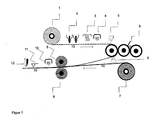
- a film web is unwound from a film roll (1) and printed with an inkjet device (2) with printed images and / or decorative elements and / or texts, the inkjet printing device comprising a continuous inkjet ink jet printing device or a drop-on Demand can be inkjet printing device.
- the print image is then dried if necessary (water or solvent based inks) or cured with UV radiation (UV curable inks).
- the film may also have an ink-receiving coating which, due to its porosity, absorbs the ink and therefore makes subsequent drying or curing superfluous.
- an adhesive is then applied with an adhesive applicator (6), which serves later to connect the film with the carrier material (7) to form a laminate (15).
- the adhesive application device (6) can be a roller applicator, an application nozzle, for example a slot die, a spray nozzle or any other suitable applicator.
- the invention is essentially based on the fact that a transparent plastic or bioplastic film, hereinafter simply subsumed under the term film, unwound from a film roll (1) and passed as an endless web under an ink jet printing station (2) and there with image and / or Text information is printed. The printed image is then, if necessary, dried with infrared (3) and optionally convection dryer (3) or hardened in the case of a radiation-curing printing ink with a UV dryer (4).
- the printed image page (5) is coated with a Klebstoffspeakingswerk (6) with a moisture-crosslinking adhesive (eg polyurethane or Polyurethanhotmelt) or a radically or cationically curing radiation-curing adhesive and with the printed image side (5) against a substrate (14) in a laminating gap, the is formed between a laminating roller (8) and counter-pressure roller (6), under the action of pressure and optionally heat to form a laminate (15).
- a moisture-crosslinking adhesive eg polyurethane or Polyurethanhotmelt
- the adhesive can also be applied to the carrier material with the applicator devices listed above.
- the adhesive may be a dispersion adhesive, a polyurethane adhesive, a hot melt adhesive (e.g., a polyurethane hot melt), a cationic or free radical curable UV adhesive, or an adhesive film applied by a dispenser to the film and / or substrate.
- a dispersion adhesive e.g., a polyurethane adhesive
- a hot melt adhesive e.g., a polyurethane hot melt
- a cationic or free radical curable UV adhesive e.g., a cationic or free radical curable UV adhesive
- the carrier material (15) and the printed film are fed to a laminating nip formed by a laminating roller (8) and a counterpressure roller (9), where the two layers are joined together under pressure to form a laminate.
- the printed film layer is deflected so that it is laminated with the printed image (5) and optionally the adhesive layer against the surface of the carrier material. The deflection can be done with any embodiment of a guide roller.
- the adhesive layer is still cured with a UV radiator (10).
- the printed image of the laminate is scanned with at least one sensor (11) which scans printed image components or printed marks.
- the signals obtained with the sensor (11) or the sensors are then used to control a separating device (12), which divides the web-shaped laminate back into individual sheets.
- the separating device (12) may be a rotating knife, a heated cutting knife hot knife, a laser cutting device, a water jet cutting device or a cutting bar, or any other suitable separating device that can re-form a sheet laminate.
- the second embodiment ( FIG. 2 ) differs from the first embodiment only in that instead of a web-shaped carrier material arcuate or tabular carrier materials are used.
- the sheet-like materials can be slightly overlapping, shock and shock or spaced from the laminating gap are supplied, which is formed from the laminating roller (8) and the counter-pressure roller (9). They are taken from a stack in a piecing device (18) and fed to the machine or placed as a single sheet on a conveyor.
- the composite (18) of the sheet-like film with the sheet material need not be completely severed. It is sufficient to separate the film at the contact points of the individual sheets. It can be used in addition to the listed in the embodiment of 1 separators still tear devices (rice roller). For this purpose, the film only has to be damaged at the contact points, for example with a diamond roller or a so-called beater knife.
- Web-shaped carrier materials may be paper, cardboard, plastic or bioplastic films, adhesive papers, metallized films, metal foils, metal sheets or laminates of various materials.
- Arched backing materials can be glass, metal sheets, paper, cardboard, corrugated cardboard, adhesive label paper, and plastic sheets.
- the printed product produced in the process may be a pre-product of a carton which is later punched or cut out of the web, cut or otherwise made in the production flow on the sheet or sheet.
- the precursor is a laminate of the printed film and one with a fiber-based board material.
- the printed product produced in the process may be a pre-product of an erecting or sales display that is later punched or cut out of the web, or cut in the production flow on the sheet or out of the web, or made in another form.
- the precursor is a laminate of the printed film and one with a fiber-based paperboard or corrugated board material.
- the printed product produced in the process may be a precursor of corrugated packaging which is later punched or cut out of the web, cut or otherwise made in the production flow on the sheet or sheet.
- the precursor is a laminate of the printed film and one with an open or closed corrugated board material.
- the printed product produced in the process may be a precursor of an adhesive label which is later punched or cut in the production flow on the sheet or from the web, cut out or made in another form.
- the precursor is a laminate of the printed film and an adhesive-coated adhesive label material.
- the printed product produced in the process may be a precursor of a metal package that is later punched, cut or otherwise made in the production flow on the sheet or out of the web.
- the precursor is a laminate of the printed film and a metal sheet.
- the printed product produced in the process may be a coated glass plate consisting of a laminate of the printed film and the glass plate.
- the printed product produced in the process may be a fibrous or wood board consisting of a laminate of the printed film and the fiberboard.
- the manufacturing process is not limited to the listed printed products, but universally applicable, provided that a laminate of a printed film and a carrier material is formed.
- the carrier material may be a sheet-like material made of paper, cardboard, plastic film, aluminum foil, composite material, a corrugated cardboard web or sheet metal. Schmid and Standvorraumen, as well as glue or inkjet printers must be set accordingly.
Landscapes
- Laminated Bodies (AREA)
- Ink Jet Recording Methods And Recording Media Thereof (AREA)
Applications Claiming Priority (1)
| Application Number | Priority Date | Filing Date | Title |
|---|---|---|---|
| DE200910056761 DE102009056761A1 (de) | 2009-12-03 | 2009-12-03 | Verfahren zur Herstellung von Druckprodukten |
Publications (1)
| Publication Number | Publication Date |
|---|---|
| EP2329954A1 true EP2329954A1 (fr) | 2011-06-08 |
Family
ID=43608597
Family Applications (1)
| Application Number | Title | Priority Date | Filing Date |
|---|---|---|---|
| EP10015118A Withdrawn EP2329954A1 (fr) | 2009-12-03 | 2010-11-30 | Procédé de fabrication de produits d'impression |
Country Status (2)
| Country | Link |
|---|---|
| EP (1) | EP2329954A1 (fr) |
| DE (1) | DE102009056761A1 (fr) |
Cited By (14)
| Publication number | Priority date | Publication date | Assignee | Title |
|---|---|---|---|---|
| DE102011105739A1 (de) | 2011-06-24 | 2012-12-27 | Baumer Hhs Gmbh | Verfahren zur Herstellung von Selbstklebeetiketten und dazu gehörige Vorrichtung |
| GB2493208A (en) * | 2011-07-28 | 2013-01-30 | Ds Smith Packaging Ltd | Apparatus and method for producing printed articles |
| EP3339027A1 (fr) * | 2016-12-22 | 2018-06-27 | Numan Sener | Procédé de fabrication d'une feuille composite en tant que matériau d'emballage pour aliments |
| JPWO2017175620A1 (ja) * | 2016-04-07 | 2019-01-31 | 株式会社シンク・ラボラトリー | インクジェット印刷ラミネート加工インラインシステム及び方法 |
| US10486368B2 (en) | 2015-12-28 | 2019-11-26 | The Procter & Gamble Company | Method for transferring material with adhesive onto articles with a difference in degree of curing between the material and adhesive |
| EP3441231A4 (fr) * | 2016-04-07 | 2019-11-27 | Think Laboratory Co., Ltd. | Système et procédé en ligne de stratification/impression à jet d'encre |
| US10752795B2 (en) | 2017-11-17 | 2020-08-25 | The Procter & Gamble Company | Compositions and methods for applying a material onto articles |
| US10940685B2 (en) | 2015-12-28 | 2021-03-09 | The Procter & Gamble Company | Method and apparatus for applying a material onto articles using a transfer component that deflects on both sides |
| US11141995B2 (en) | 2015-12-28 | 2021-10-12 | The Procter & Gamble Company | Method and apparatus for applying a material onto articles with a pre-distorted transfer component |
| EP3984741A1 (fr) * | 2020-10-16 | 2022-04-20 | Jesús Francisco Barberan Latorre | Système de fabrication d'un substrat avec un design décoratif |
| KR20220134438A (ko) * | 2021-03-26 | 2022-10-05 | 프란시스코 바베란 라또레 제수스 | 기재에 릴리프를 형성하는 방법 및 시스템 |
| US11491803B2 (en) | 2019-02-12 | 2022-11-08 | The Procter & Gamble Company | Method and apparatus for applying a material onto articles using a transfer component |
| US20230145850A1 (en) * | 2021-02-05 | 2023-05-11 | Lg Energy Solution, Ltd. | Sheet Cutting and Fusion Apparatus |
| US11752792B2 (en) | 2020-03-09 | 2023-09-12 | The Procter & Gamble Company | Method and apparatus for applying a material onto articles using a transfer component |
Families Citing this family (2)
| Publication number | Priority date | Publication date | Assignee | Title |
|---|---|---|---|---|
| DE102015107032A1 (de) | 2015-05-06 | 2016-11-10 | Ccl Design Gmbh | Verfahren zur Herstellung eines Stanzbauteils |
| EP3878652B1 (fr) * | 2020-03-09 | 2022-08-31 | Heidelberger Druckmaschinen AG | Procédé de fabrication de feuilles imprimées à partir d'une bande |
Citations (7)
| Publication number | Priority date | Publication date | Assignee | Title |
|---|---|---|---|---|
| DE2658201A1 (de) * | 1975-12-23 | 1977-07-07 | Hymmen Kg Theodor | Verfahren und maschine zum kaschieren von traegerwerkstoffen mittels einer verbundfolie |
| US20030203138A1 (en) * | 2002-04-29 | 2003-10-30 | Gargus James E. | Article with protected printing and method of manufacture |
| DE10321365A1 (de) | 2003-05-13 | 2004-12-16 | X-Film Selbstkebefolien Gmbh | Mit Digitaldrucktechnik bedruckbare Kunststoff-Folie und Herstellung einer bedruckten Kunststoff-Folie |
| DE102005036258A1 (de) * | 2005-08-02 | 2007-02-08 | Pierre Chappuis | Dekorfolien und Verfahren zu deren Herstellung |
| US20070087294A1 (en) * | 2005-10-14 | 2007-04-19 | 3M Innovative Properties Company | Imaged anti-copy film |
| DE602007000011T2 (de) | 2006-02-22 | 2009-07-02 | Fujifilm Corp. | Tintenstrahlaufzeichnungsmedium und Herstellungsverfahren dafür |
| WO2009120311A2 (fr) * | 2008-03-24 | 2009-10-01 | Michael Riebel | Ensemble composite biostratifié et procédés associés |
Family Cites Families (3)
| Publication number | Priority date | Publication date | Assignee | Title |
|---|---|---|---|---|
| US20050052516A1 (en) * | 2003-09-05 | 2005-03-10 | Wilde John C. | Laminate panel for use in structrual components |
| DE102005062396A1 (de) * | 2005-12-23 | 2007-06-28 | Atlantic Zeiser Gmbh | Verfahren und Vorrichtung zum Aufbringen einer Folie auf einen Träger |
| DE102007031051A1 (de) * | 2007-07-04 | 2009-01-08 | Manroland Ag | Kaschiertes Druckprodukt und Verfahren zur Herstellung desselben |
-
2009
- 2009-12-03 DE DE200910056761 patent/DE102009056761A1/de not_active Withdrawn
-
2010
- 2010-11-30 EP EP10015118A patent/EP2329954A1/fr not_active Withdrawn
Patent Citations (7)
| Publication number | Priority date | Publication date | Assignee | Title |
|---|---|---|---|---|
| DE2658201A1 (de) * | 1975-12-23 | 1977-07-07 | Hymmen Kg Theodor | Verfahren und maschine zum kaschieren von traegerwerkstoffen mittels einer verbundfolie |
| US20030203138A1 (en) * | 2002-04-29 | 2003-10-30 | Gargus James E. | Article with protected printing and method of manufacture |
| DE10321365A1 (de) | 2003-05-13 | 2004-12-16 | X-Film Selbstkebefolien Gmbh | Mit Digitaldrucktechnik bedruckbare Kunststoff-Folie und Herstellung einer bedruckten Kunststoff-Folie |
| DE102005036258A1 (de) * | 2005-08-02 | 2007-02-08 | Pierre Chappuis | Dekorfolien und Verfahren zu deren Herstellung |
| US20070087294A1 (en) * | 2005-10-14 | 2007-04-19 | 3M Innovative Properties Company | Imaged anti-copy film |
| DE602007000011T2 (de) | 2006-02-22 | 2009-07-02 | Fujifilm Corp. | Tintenstrahlaufzeichnungsmedium und Herstellungsverfahren dafür |
| WO2009120311A2 (fr) * | 2008-03-24 | 2009-10-01 | Michael Riebel | Ensemble composite biostratifié et procédés associés |
Cited By (22)
| Publication number | Priority date | Publication date | Assignee | Title |
|---|---|---|---|---|
| DE102011105739A1 (de) | 2011-06-24 | 2012-12-27 | Baumer Hhs Gmbh | Verfahren zur Herstellung von Selbstklebeetiketten und dazu gehörige Vorrichtung |
| GB2493208A (en) * | 2011-07-28 | 2013-01-30 | Ds Smith Packaging Ltd | Apparatus and method for producing printed articles |
| US10668667B2 (en) | 2015-12-28 | 2020-06-02 | The Procter & Gamble Company | Method for transferring material with adhesive onto articles with a difference in degree of curing between the material and adhesive |
| US11141995B2 (en) | 2015-12-28 | 2021-10-12 | The Procter & Gamble Company | Method and apparatus for applying a material onto articles with a pre-distorted transfer component |
| US10940685B2 (en) | 2015-12-28 | 2021-03-09 | The Procter & Gamble Company | Method and apparatus for applying a material onto articles using a transfer component that deflects on both sides |
| US10486368B2 (en) | 2015-12-28 | 2019-11-26 | The Procter & Gamble Company | Method for transferring material with adhesive onto articles with a difference in degree of curing between the material and adhesive |
| EP3441231A4 (fr) * | 2016-04-07 | 2019-11-27 | Think Laboratory Co., Ltd. | Système et procédé en ligne de stratification/impression à jet d'encre |
| US10744794B2 (en) | 2016-04-07 | 2020-08-18 | Think Laboratory Co., Ltd. | Inkjet printing-lamination inline system and method |
| JPWO2017175620A1 (ja) * | 2016-04-07 | 2019-01-31 | 株式会社シンク・ラボラトリー | インクジェット印刷ラミネート加工インラインシステム及び方法 |
| EP3441230A4 (fr) * | 2016-04-07 | 2019-11-27 | Think Laboratory Co., Ltd. | Système et procédé en ligne de stratification/impression à jet d'encre |
| EP3339027A1 (fr) * | 2016-12-22 | 2018-06-27 | Numan Sener | Procédé de fabrication d'une feuille composite en tant que matériau d'emballage pour aliments |
| US10752795B2 (en) | 2017-11-17 | 2020-08-25 | The Procter & Gamble Company | Compositions and methods for applying a material onto articles |
| US11491803B2 (en) | 2019-02-12 | 2022-11-08 | The Procter & Gamble Company | Method and apparatus for applying a material onto articles using a transfer component |
| US11752792B2 (en) | 2020-03-09 | 2023-09-12 | The Procter & Gamble Company | Method and apparatus for applying a material onto articles using a transfer component |
| CN114379255A (zh) * | 2020-10-16 | 2022-04-22 | J·F·巴伯兰拉托雷 | 用于制造具有装饰性设计的基底的系统 |
| JP2022066171A (ja) * | 2020-10-16 | 2022-04-28 | ラトーレ, イエズス フランシスコ バルベラン | 装飾デザインを備えた基材を製造するためのシステム |
| KR20220050775A (ko) * | 2020-10-16 | 2022-04-25 | 프란시스코 바베란 라또레 제수스 | 장식 디자인을 구비한 기판의 제조 시스템 |
| EP3984741A1 (fr) * | 2020-10-16 | 2022-04-20 | Jesús Francisco Barberan Latorre | Système de fabrication d'un substrat avec un design décoratif |
| US12384087B2 (en) | 2020-10-16 | 2025-08-12 | Jesus Francisco Barberan Latorre | System for manufacturing a substrate with a decorative design |
| US20230145850A1 (en) * | 2021-02-05 | 2023-05-11 | Lg Energy Solution, Ltd. | Sheet Cutting and Fusion Apparatus |
| KR20220134438A (ko) * | 2021-03-26 | 2022-10-05 | 프란시스코 바베란 라또레 제수스 | 기재에 릴리프를 형성하는 방법 및 시스템 |
| JP2022165912A (ja) * | 2021-03-26 | 2022-11-01 | ラトーレ, イエズス フランシスコ バルベラン | 基材表面に浮き彫りを生成するための方法及びシステム |
Also Published As
| Publication number | Publication date |
|---|---|
| DE102009056761A1 (de) | 2011-06-09 |
Similar Documents
| Publication | Publication Date | Title |
|---|---|---|
| DE102009056761A1 (de) | Verfahren zur Herstellung von Druckprodukten | |
| EP1839903B1 (fr) | Revêtement en relief d'imprégnation pour matière d'impression métallique | |
| EP3253575B1 (fr) | Ensemble machine et procédé de traitement séquentiel de substrats sous forme de feuilles | |
| EP2172347B1 (fr) | Film de transfert et procédé de transfert de films à froid | |
| DE102007031059B4 (de) | Verfahren zur flächigen Kaschierung oder Laminierung von Druckbogen | |
| DE69110811T2 (de) | Unterschriftsfeld und Verfahren zu dessen Herstellung. | |
| EP3459724B1 (fr) | Installation de carton ondulé | |
| DE102011054222A1 (de) | Folienprägeverfahren sowie Vorrichtung dafür | |
| DE102009053097A1 (de) | Laminierverfahren und Verfahren und Vorrichtung zum Trennen von Laminat | |
| DE102010048240B4 (de) | Druckträgerverbundmaterial für Mehrfarbendruckkarten | |
| DE102010037592A1 (de) | Verfahren zur Herstellung eines Laminats und dazu gehörige Bogenlaminiermaschine | |
| EP1736324B1 (fr) | Procédé pour appliquer un décor ou un élément de sécurité d'une feuille métallique ou métallisée sur un substrat | |
| EP2011642A2 (fr) | Produit d'impression laminé et son procédé de fabrication | |
| CN102555405A (zh) | 用箔进行局部涂覆 | |
| EP2285586B1 (fr) | Support d'impression composé d'au moins deux supports d'impression partiels assemblés de façon coplanaire, supports d'impression partiels et procédé de fabrication de ceux-ci | |
| DE102016203528A1 (de) | Verfahren und Vorrichtung zur Herstellung eines Dekorsubstrates sowie Verfahren zur Herstellung eines Laminats | |
| DE102013112275B4 (de) | Verfahren zur Herstellung eines dekorativen Laminates | |
| DE102016209456A1 (de) | Kontrollierter Silicon-Release beim xerographischen Drucken zur Erzeugung einer Haftklebstoff-Dehäsivschicht | |
| DE102007031001A1 (de) | Bogenrotationsdruckmaschine | |
| EP2848425A2 (fr) | Feuille sans fin en forme de bande et son utilisation | |
| WO2008043193A2 (fr) | Formulaire comprenant une carte pliable pouvant être produite au moyen de ce formulaire et matériaux multicouches servant à produire un tel formulaire | |
| EP3814149B1 (fr) | Procédé et dispositif d'amélioration de produits imprimés | |
| EP3878652B1 (fr) | Procédé de fabrication de feuilles imprimées à partir d'une bande | |
| US8133342B2 (en) | Method of fabricating ink jet label stock | |
| DE102020008117A1 (de) | Produktionssystem, Verfahren und Duftstoffmoduleinheit zur Verarbeitung und/oder Veredelung eines Druckträgers |
Legal Events
| Date | Code | Title | Description |
|---|---|---|---|
| PUAI | Public reference made under article 153(3) epc to a published international application that has entered the european phase |
Free format text: ORIGINAL CODE: 0009012 |
|
| AK | Designated contracting states |
Kind code of ref document: A1 Designated state(s): AL AT BE BG CH CY CZ DE DK EE ES FI FR GB GR HR HU IE IS IT LI LT LU LV MC MK MT NL NO PL PT RO RS SE SI SK SM TR |
|
| AX | Request for extension of the european patent |
Extension state: BA ME |
|
| 17P | Request for examination filed |
Effective date: 20111208 |
|
| 17Q | First examination report despatched |
Effective date: 20120814 |
|
| STAA | Information on the status of an ep patent application or granted ep patent |
Free format text: STATUS: THE APPLICATION IS DEEMED TO BE WITHDRAWN |
|
| 18D | Application deemed to be withdrawn |
Effective date: 20130103 |