EP2330407A1 - Procédé, outil et dispositif pour mesurer la concentration - Google Patents
Procédé, outil et dispositif pour mesurer la concentration Download PDFInfo
- Publication number
- EP2330407A1 EP2330407A1 EP10010432A EP10010432A EP2330407A1 EP 2330407 A1 EP2330407 A1 EP 2330407A1 EP 10010432 A EP10010432 A EP 10010432A EP 10010432 A EP10010432 A EP 10010432A EP 2330407 A1 EP2330407 A1 EP 2330407A1
- Authority
- EP
- European Patent Office
- Prior art keywords
- voltage
- glucose
- oxidation
- concentration
- current value
- Prior art date
- Legal status (The legal status is an assumption and is not a legal conclusion. Google has not performed a legal analysis and makes no representation as to the accuracy of the status listed.)
- Granted
Links
- 238000000034 method Methods 0.000 title claims abstract description 22
- 239000003153 chemical reaction reagent Substances 0.000 claims abstract description 73
- 102000004190 Enzymes Human genes 0.000 claims abstract description 46
- 108090000790 Enzymes Proteins 0.000 claims abstract description 46
- 230000033116 oxidation-reduction process Effects 0.000 claims abstract description 45
- 238000006243 chemical reaction Methods 0.000 claims abstract description 40
- 238000012360 testing method Methods 0.000 claims abstract description 32
- 150000001875 compounds Chemical class 0.000 claims abstract description 25
- 239000007788 liquid Substances 0.000 claims abstract description 20
- 239000000758 substrate Substances 0.000 claims abstract description 9
- 239000007791 liquid phase Substances 0.000 claims abstract description 8
- 239000007787 solid Substances 0.000 claims abstract description 5
- 230000008569 process Effects 0.000 claims abstract description 4
- WQZGKKKJIJFFOK-GASJEMHNSA-N Glucose Natural products OC[C@H]1OC(O)[C@H](O)[C@@H](O)[C@@H]1O WQZGKKKJIJFFOK-GASJEMHNSA-N 0.000 claims description 201
- 239000008103 glucose Substances 0.000 claims description 201
- 230000004044 response Effects 0.000 claims description 65
- 230000002829 reductive effect Effects 0.000 claims description 56
- 229940088598 enzyme Drugs 0.000 claims description 44
- 239000000126 substance Substances 0.000 claims description 34
- 230000001590 oxidative effect Effects 0.000 claims description 31
- 108010015776 Glucose oxidase Proteins 0.000 claims description 24
- 239000004366 Glucose oxidase Substances 0.000 claims description 24
- 235000019420 glucose oxidase Nutrition 0.000 claims description 24
- 229940116332 glucose oxidase Drugs 0.000 claims description 24
- 238000005259 measurement Methods 0.000 claims description 20
- -1 halogen ion Chemical class 0.000 claims description 17
- CIWBSHSKHKDKBQ-JLAZNSOCSA-N Ascorbic acid Chemical compound OC[C@H](O)[C@H]1OC(=O)C(O)=C1O CIWBSHSKHKDKBQ-JLAZNSOCSA-N 0.000 claims description 16
- 108010050375 Glucose 1-Dehydrogenase Proteins 0.000 claims description 13
- 239000003638 chemical reducing agent Substances 0.000 claims description 12
- 238000007254 oxidation reaction Methods 0.000 claims description 12
- JVTAAEKCZFNVCJ-UHFFFAOYSA-N lactic acid Chemical compound CC(O)C(O)=O JVTAAEKCZFNVCJ-UHFFFAOYSA-N 0.000 claims description 10
- 238000006722 reduction reaction Methods 0.000 claims description 9
- 101710088194 Dehydrogenase Proteins 0.000 claims description 8
- UFHFLCQGNIYNRP-UHFFFAOYSA-N Hydrogen Chemical compound [H][H] UFHFLCQGNIYNRP-UHFFFAOYSA-N 0.000 claims description 8
- 235000010323 ascorbic acid Nutrition 0.000 claims description 8
- 229960005070 ascorbic acid Drugs 0.000 claims description 8
- 239000011668 ascorbic acid Substances 0.000 claims description 8
- 229910052739 hydrogen Inorganic materials 0.000 claims description 8
- 239000001257 hydrogen Substances 0.000 claims description 8
- XLYOFNOQVPJJNP-UHFFFAOYSA-N water Chemical compound O XLYOFNOQVPJJNP-UHFFFAOYSA-N 0.000 claims description 7
- 108090000854 Oxidoreductases Proteins 0.000 claims description 6
- 102000004316 Oxidoreductases Human genes 0.000 claims description 6
- JUJWROOIHBZHMG-UHFFFAOYSA-N Pyridine Chemical compound C1=CC=NC=C1 JUJWROOIHBZHMG-UHFFFAOYSA-N 0.000 claims description 6
- HVYWMOMLDIMFJA-DPAQBDIFSA-N cholesterol Chemical compound C1C=C2C[C@@H](O)CC[C@]2(C)[C@@H]2[C@@H]1[C@@H]1CC[C@H]([C@H](C)CCCC(C)C)[C@@]1(C)CC2 HVYWMOMLDIMFJA-DPAQBDIFSA-N 0.000 claims description 6
- 235000014655 lactic acid Nutrition 0.000 claims description 6
- 239000004310 lactic acid Substances 0.000 claims description 6
- 230000001276 controlling effect Effects 0.000 claims description 5
- 229910052736 halogen Inorganic materials 0.000 claims description 5
- WHBMMWSBFZVSSR-UHFFFAOYSA-N 3-hydroxybutyric acid Chemical compound CC(O)CC(O)=O WHBMMWSBFZVSSR-UHFFFAOYSA-N 0.000 claims description 4
- 230000002596 correlated effect Effects 0.000 claims description 4
- 150000002500 ions Chemical class 0.000 claims description 4
- 239000007800 oxidant agent Substances 0.000 claims description 4
- 235000012000 cholesterol Nutrition 0.000 claims description 3
- UMJSCPRVCHMLSP-UHFFFAOYSA-N pyridine Natural products COC1=CC=CN=C1 UMJSCPRVCHMLSP-UHFFFAOYSA-N 0.000 claims description 3
- LJCNDNBULVLKSG-UHFFFAOYSA-N 2-aminoacetic acid;butane Chemical compound CCCC.CCCC.NCC(O)=O LJCNDNBULVLKSG-UHFFFAOYSA-N 0.000 claims description 2
- 102000007698 Alcohol dehydrogenase Human genes 0.000 claims description 2
- 108010021809 Alcohol dehydrogenase Proteins 0.000 claims description 2
- 108010025188 Alcohol oxidase Proteins 0.000 claims description 2
- 108010089254 Cholesterol oxidase Proteins 0.000 claims description 2
- 102000028526 Dihydrolipoamide Dehydrogenase Human genes 0.000 claims description 2
- 108010028127 Dihydrolipoamide Dehydrogenase Proteins 0.000 claims description 2
- 229930091371 Fructose Natural products 0.000 claims description 2
- RFSUNEUAIZKAJO-ARQDHWQXSA-N Fructose Chemical compound OC[C@H]1O[C@](O)(CO)[C@@H](O)[C@@H]1O RFSUNEUAIZKAJO-ARQDHWQXSA-N 0.000 claims description 2
- 239000005715 Fructose Substances 0.000 claims description 2
- 108010007843 NADH oxidase Proteins 0.000 claims description 2
- LCTONWCANYUPML-UHFFFAOYSA-N PYRUVIC-ACID Natural products CC(=O)C(O)=O LCTONWCANYUPML-UHFFFAOYSA-N 0.000 claims description 2
- 108010092464 Urate Oxidase Proteins 0.000 claims description 2
- 108010046334 Urease Proteins 0.000 claims description 2
- TVWHNULVHGKJHS-UHFFFAOYSA-N Uric acid Natural products N1C(=O)NC(=O)C2NC(=O)NC21 TVWHNULVHGKJHS-UHFFFAOYSA-N 0.000 claims description 2
- 108010023417 cholesterol dehydrogenase Proteins 0.000 claims description 2
- 235000001727 glucose Nutrition 0.000 claims description 2
- 229940107700 pyruvic acid Drugs 0.000 claims description 2
- 108010085346 steroid delta-isomerase Proteins 0.000 claims description 2
- 229940116269 uric acid Drugs 0.000 claims description 2
- DFPAKSUCGFBDDF-UHFFFAOYSA-N Nicotinamide Chemical compound NC(=O)C1=CC=CN=C1 DFPAKSUCGFBDDF-UHFFFAOYSA-N 0.000 claims 2
- 125000002791 glucosyl group Chemical group C1([C@H](O)[C@@H](O)[C@H](O)[C@H](O1)CO)* 0.000 claims 1
- 229960003966 nicotinamide Drugs 0.000 claims 1
- 235000005152 nicotinamide Nutrition 0.000 claims 1
- 239000011570 nicotinamide Substances 0.000 claims 1
- 238000005516 engineering process Methods 0.000 abstract description 4
- 239000008280 blood Substances 0.000 description 31
- 210000004369 blood Anatomy 0.000 description 31
- 239000000243 solution Substances 0.000 description 28
- 230000000052 comparative effect Effects 0.000 description 18
- 230000000694 effects Effects 0.000 description 18
- 239000000523 sample Substances 0.000 description 14
- 230000027756 respiratory electron transport chain Effects 0.000 description 11
- 238000006911 enzymatic reaction Methods 0.000 description 10
- 239000012086 standard solution Substances 0.000 description 10
- 230000003647 oxidation Effects 0.000 description 8
- 239000000276 potassium ferrocyanide Substances 0.000 description 7
- XOGGUFAVLNCTRS-UHFFFAOYSA-N tetrapotassium;iron(2+);hexacyanide Chemical compound [K+].[K+].[K+].[K+].[Fe+2].N#[C-].N#[C-].N#[C-].N#[C-].N#[C-].N#[C-] XOGGUFAVLNCTRS-UHFFFAOYSA-N 0.000 description 7
- IJGRMHOSHXDMSA-UHFFFAOYSA-N Atomic nitrogen Chemical compound N#N IJGRMHOSHXDMSA-UHFFFAOYSA-N 0.000 description 6
- 230000008859 change Effects 0.000 description 6
- 239000005515 coenzyme Substances 0.000 description 5
- 238000010586 diagram Methods 0.000 description 5
- 108090000623 proteins and genes Proteins 0.000 description 5
- 230000009467 reduction Effects 0.000 description 5
- AZQWKYJCGOJGHM-UHFFFAOYSA-N 1,4-benzoquinone Chemical compound O=C1C=CC(=O)C=C1 AZQWKYJCGOJGHM-UHFFFAOYSA-N 0.000 description 4
- 241000589513 Burkholderia cepacia Species 0.000 description 4
- YPZRHBJKEMOYQH-UYBVJOGSSA-L FADH2(2-) Chemical compound C1=NC2=C(N)N=CN=C2N1[C@@H]([C@H](O)[C@@H]1O)O[C@@H]1COP([O-])(=O)OP([O-])(=O)OC[C@@H](O)[C@@H](O)[C@@H](O)CN1C(NC(=O)NC2=O)=C2NC2=C1C=C(C)C(C)=C2 YPZRHBJKEMOYQH-UYBVJOGSSA-L 0.000 description 4
- VTLYFUHAOXGGBS-UHFFFAOYSA-N Fe3+ Chemical compound [Fe+3] VTLYFUHAOXGGBS-UHFFFAOYSA-N 0.000 description 4
- 238000004082 amperometric method Methods 0.000 description 4
- 230000008901 benefit Effects 0.000 description 4
- 238000009792 diffusion process Methods 0.000 description 4
- RWSXRVCMGQZWBV-WDSKDSINSA-N glutathione Chemical compound OC(=O)[C@@H](N)CCC(=O)N[C@@H](CS)C(=O)NCC(O)=O RWSXRVCMGQZWBV-WDSKDSINSA-N 0.000 description 4
- 238000004519 manufacturing process Methods 0.000 description 4
- 102000004169 proteins and genes Human genes 0.000 description 4
- 238000007670 refining Methods 0.000 description 4
- PHOQVHQSTUBQQK-SQOUGZDYSA-N D-glucono-1,5-lactone Chemical compound OC[C@H]1OC(=O)[C@H](O)[C@@H](O)[C@@H]1O PHOQVHQSTUBQQK-SQOUGZDYSA-N 0.000 description 3
- 229960003681 gluconolactone Drugs 0.000 description 3
- 239000003446 ligand Substances 0.000 description 3
- 229910052757 nitrogen Inorganic materials 0.000 description 3
- 238000006479 redox reaction Methods 0.000 description 3
- 102000018832 Cytochromes Human genes 0.000 description 2
- 108010052832 Cytochromes Proteins 0.000 description 2
- 108010024636 Glutathione Proteins 0.000 description 2
- BAWFJGJZGIEFAR-NNYOXOHSSA-N NAD zwitterion Chemical compound NC(=O)C1=CC=C[N+]([C@H]2[C@@H]([C@H](O)[C@@H](COP([O-])(=O)OP(O)(=O)OC[C@@H]3[C@H]([C@@H](O)[C@@H](O3)N3C4=NC=NC(N)=C4N=C3)O)O2)O)=C1 BAWFJGJZGIEFAR-NNYOXOHSSA-N 0.000 description 2
- XJLXINKUBYWONI-NNYOXOHSSA-O NADP(+) Chemical compound NC(=O)C1=CC=C[N+]([C@H]2[C@@H]([C@H](O)[C@@H](COP(O)(=O)OP(O)(=O)OC[C@@H]3[C@H]([C@@H](OP(O)(O)=O)[C@@H](O3)N3C4=NC=NC(N)=C4N=C3)O)O2)O)=C1 XJLXINKUBYWONI-NNYOXOHSSA-O 0.000 description 2
- DFPAKSUCGFBDDF-ZQBYOMGUSA-N [14c]-nicotinamide Chemical compound N[14C](=O)C1=CC=CN=C1 DFPAKSUCGFBDDF-ZQBYOMGUSA-N 0.000 description 2
- 230000009471 action Effects 0.000 description 2
- WQZGKKKJIJFFOK-VFUOTHLCSA-N beta-D-glucose Chemical compound OC[C@H]1O[C@@H](O)[C@H](O)[C@@H](O)[C@@H]1O WQZGKKKJIJFFOK-VFUOTHLCSA-N 0.000 description 2
- 238000011088 calibration curve Methods 0.000 description 2
- 230000015556 catabolic process Effects 0.000 description 2
- 239000011248 coating agent Substances 0.000 description 2
- 238000000576 coating method Methods 0.000 description 2
- 230000000875 corresponding effect Effects 0.000 description 2
- 238000006731 degradation reaction Methods 0.000 description 2
- 239000002270 dispersing agent Substances 0.000 description 2
- 238000001035 drying Methods 0.000 description 2
- 230000007613 environmental effect Effects 0.000 description 2
- 238000011156 evaluation Methods 0.000 description 2
- YAGKRVSRTSUGEY-UHFFFAOYSA-N ferricyanide Chemical compound [Fe+3].N#[C-].N#[C-].N#[C-].N#[C-].N#[C-].N#[C-] YAGKRVSRTSUGEY-UHFFFAOYSA-N 0.000 description 2
- 238000009472 formulation Methods 0.000 description 2
- 230000006870 function Effects 0.000 description 2
- 235000012209 glucono delta-lactone Nutrition 0.000 description 2
- 150000002303 glucose derivatives Chemical class 0.000 description 2
- 229960003180 glutathione Drugs 0.000 description 2
- 230000002045 lasting effect Effects 0.000 description 2
- 230000015654 memory Effects 0.000 description 2
- 239000000203 mixture Substances 0.000 description 2
- 229940101270 nicotinamide adenine dinucleotide (nad) Drugs 0.000 description 2
- 238000002415 sodium dodecyl sulfate polyacrylamide gel electrophoresis Methods 0.000 description 2
- 125000006850 spacer group Chemical group 0.000 description 2
- 229930024421 Adenine Natural products 0.000 description 1
- GFFGJBXGBJISGV-UHFFFAOYSA-N Adenine Chemical compound NC1=NC=NC2=C1N=CN2 GFFGJBXGBJISGV-UHFFFAOYSA-N 0.000 description 1
- OKTJSMMVPCPJKN-UHFFFAOYSA-N Carbon Chemical compound [C] OKTJSMMVPCPJKN-UHFFFAOYSA-N 0.000 description 1
- RGHNJXZEOKUKBD-UHFFFAOYSA-N D-gluconic acid Natural products OCC(O)C(O)C(O)C(O)C(O)=O RGHNJXZEOKUKBD-UHFFFAOYSA-N 0.000 description 1
- CWYNVVGOOAEACU-UHFFFAOYSA-N Fe2+ Chemical compound [Fe+2] CWYNVVGOOAEACU-UHFFFAOYSA-N 0.000 description 1
- RGHNJXZEOKUKBD-SQOUGZDYSA-N Gluconic acid Natural products OC[C@@H](O)[C@@H](O)[C@H](O)[C@@H](O)C(O)=O RGHNJXZEOKUKBD-SQOUGZDYSA-N 0.000 description 1
- 108010000445 Glycerate dehydrogenase Proteins 0.000 description 1
- ZLMJMSJWJFRBEC-UHFFFAOYSA-N Potassium Chemical compound [K] ZLMJMSJWJFRBEC-UHFFFAOYSA-N 0.000 description 1
- AUNGANRZJHBGPY-SCRDCRAPSA-N Riboflavin Chemical compound OC[C@@H](O)[C@@H](O)[C@@H](O)CN1C=2C=C(C)C(C)=CC=2N=C2C1=NC(=O)NC2=O AUNGANRZJHBGPY-SCRDCRAPSA-N 0.000 description 1
- 239000012327 Ruthenium complex Substances 0.000 description 1
- 108091006629 SLC13A2 Proteins 0.000 description 1
- 238000002835 absorbance Methods 0.000 description 1
- 229960000643 adenine Drugs 0.000 description 1
- 238000013459 approach Methods 0.000 description 1
- 239000012472 biological sample Substances 0.000 description 1
- 229910052799 carbon Inorganic materials 0.000 description 1
- 239000003054 catalyst Substances 0.000 description 1
- 238000006555 catalytic reaction Methods 0.000 description 1
- 230000003247 decreasing effect Effects 0.000 description 1
- 238000006356 dehydrogenation reaction Methods 0.000 description 1
- 230000001419 dependent effect Effects 0.000 description 1
- 239000002274 desiccant Substances 0.000 description 1
- 108010029645 galactitol 2-dehydrogenase Proteins 0.000 description 1
- 239000000174 gluconic acid Substances 0.000 description 1
- 235000012208 gluconic acid Nutrition 0.000 description 1
- 230000007774 longterm Effects 0.000 description 1
- 239000000463 material Substances 0.000 description 1
- 244000005700 microbiome Species 0.000 description 1
- 239000002808 molecular sieve Substances 0.000 description 1
- 230000003287 optical effect Effects 0.000 description 1
- 238000004806 packaging method and process Methods 0.000 description 1
- 239000003973 paint Substances 0.000 description 1
- 239000002504 physiological saline solution Substances 0.000 description 1
- 229910052700 potassium Inorganic materials 0.000 description 1
- 239000011591 potassium Substances 0.000 description 1
- NNFCIKHAZHQZJG-UHFFFAOYSA-N potassium cyanide Chemical compound [K+].N#[C-] NNFCIKHAZHQZJG-UHFFFAOYSA-N 0.000 description 1
- 239000008057 potassium phosphate buffer Substances 0.000 description 1
- 238000007650 screen-printing Methods 0.000 description 1
- URGAHOPLAPQHLN-UHFFFAOYSA-N sodium aluminosilicate Chemical compound [Na+].[Al+3].[O-][Si]([O-])=O.[O-][Si]([O-])=O URGAHOPLAPQHLN-UHFFFAOYSA-N 0.000 description 1
- 230000002459 sustained effect Effects 0.000 description 1
- 238000010408 sweeping Methods 0.000 description 1
Images





Classifications
-
- C—CHEMISTRY; METALLURGY
- C12—BIOCHEMISTRY; BEER; SPIRITS; WINE; VINEGAR; MICROBIOLOGY; ENZYMOLOGY; MUTATION OR GENETIC ENGINEERING
- C12Q—MEASURING OR TESTING PROCESSES INVOLVING ENZYMES, NUCLEIC ACIDS OR MICROORGANISMS; COMPOSITIONS OR TEST PAPERS THEREFOR; PROCESSES OF PREPARING SUCH COMPOSITIONS; CONDITION-RESPONSIVE CONTROL IN MICROBIOLOGICAL OR ENZYMOLOGICAL PROCESSES
- C12Q1/00—Measuring or testing processes involving enzymes, nucleic acids or microorganisms; Compositions therefor; Processes of preparing such compositions
- C12Q1/001—Enzyme electrodes
- C12Q1/004—Enzyme electrodes mediator-assisted
-
- C—CHEMISTRY; METALLURGY
- C12—BIOCHEMISTRY; BEER; SPIRITS; WINE; VINEGAR; MICROBIOLOGY; ENZYMOLOGY; MUTATION OR GENETIC ENGINEERING
- C12Q—MEASURING OR TESTING PROCESSES INVOLVING ENZYMES, NUCLEIC ACIDS OR MICROORGANISMS; COMPOSITIONS OR TEST PAPERS THEREFOR; PROCESSES OF PREPARING SUCH COMPOSITIONS; CONDITION-RESPONSIVE CONTROL IN MICROBIOLOGICAL OR ENZYMOLOGICAL PROCESSES
- C12Q1/00—Measuring or testing processes involving enzymes, nucleic acids or microorganisms; Compositions therefor; Processes of preparing such compositions
- C12Q1/001—Enzyme electrodes
-
- G—PHYSICS
- G01—MEASURING; TESTING
- G01N—INVESTIGATING OR ANALYSING MATERIALS BY DETERMINING THEIR CHEMICAL OR PHYSICAL PROPERTIES
- G01N27/00—Investigating or analysing materials by the use of electric, electrochemical, or magnetic means
- G01N27/26—Investigating or analysing materials by the use of electric, electrochemical, or magnetic means by investigating electrochemical variables; by using electrolysis or electrophoresis
- G01N27/28—Electrolytic cell components
- G01N27/30—Electrodes, e.g. test electrodes; Half-cells
- G01N27/327—Biochemical electrodes, e.g. electrical or mechanical details for in vitro measurements
- G01N27/3271—Amperometric enzyme electrodes for analytes in body fluids, e.g. glucose in blood
Definitions
- the present invention relates to technology for measuring a concentration of a test target (such as glucose or cholesterol) contained in a sample liquid (such as blood or another such biological sample, or a prepared liquid thereof).
- a test target such as glucose or cholesterol
- Enzyme reactions are used as a way to quantify glucose concentration.
- glucose oxidase GOD
- GOD is an enzyme which is linked to flavin adenine dinucloetide (FAD), which is a coenzyme.
- FAD flavin adenine dinucloetide
- the enzyme reaction of glucose when GOD is used proceeds according to the following chemical formula (in the formula, FADH 2 is the reduction type of the FAD) .
- glucose concentrations are sometimes quantified by measuring the change in absorbance, which corresponds to the change in glucose concentration.
- the most common method is to measure the glucose concentration by amperometry. Amperometry is widely employed as a method for measuring glucose concentration in portable blood sugar measurement devices.
- the oxidation current value attributable to voltage application is measured, and the glucose concentration is computed on the basis of this measured value.
- a glucose sensor When blood sugar is measured using a portable blood sugar measurement device, a glucose sensor is used in which a reagent layer containing an enzyme and a mediator is formed between electrodes, and a reaction system is constituted between the electrodes by supplying blood to the reagent layer.
- This glucose sensor is installed in a portable blood sugar device, voltage is applied between the electrodes, the oxidation current value is measured, and the glucose concentration in the blood is quantified on the basis of this oxidation current value.
- GOD is usually used as the enzyme, and potassium ferricyanide as the mediator. Nevertheless, in a reaction system combining GOD with potassium ferricyanide, the problems discussed below are encountered with a method for measuring glucose concentration by an electrochemical process, typified by amperometry.
- the first of these problems is the effect of reductive substances.
- reductive substances such as ascorbic acid, glutathione, and Fe(II) 2+
- reductive substances such as ascorbic acid, glutathione, and Fe(II) 2+
- the measured current value will include background current (noise) attributable to the electron transfer of the reductive substance. Accordingly, the measured glucose concentration will end up being greater than the actual glucose concentration.
- Another problem pertains to the storage stability of the glucose sensor when glucose concentration is measured with a portable blood sugar measurement device and a glucose sensor.
- Potassium ferricyanide is susceptible to the effects of light and water, and when exposed to these, receives electrons from sources other than glucose and turns into reductive potassium ferrocyanide. If this happens, then the reaction system will contain both potassium ferrocyanide that has been rendered reductive by enzyme reaction, and potassium ferrocyanide that has been rendered reductive by exposure.
- the oxidation current during voltage application includes background current originating in the potassium ferrocyanide resulting from exposure. Consequently, the measured glucose concentration ends up being greater than the actual glucose concentration.
- the glucose sensor must be sealed in a pouch made from a light-blocking material, for example, so that the reagent layer in the glucose sensor is not exposed. Furthermore, to extend the service life of the glucose sensor, it has to be sealed in a moisture-tight state by performing nitrogen replacement or other such treatment in order to avoid exposure to moisture, and this complicates manufacture and drives up the cost when the glucose sensor is mass-produced on an industrial scale.
- a method for measuring the concentration of a test target whereby a reaction system is constituted to include the test target, an oxidation-reduction enzyme and an electron mediator, and then the concentration of the test target is measured by utilizing an electrochemical process.
- a reaction system is constituted to include the test target, an oxidation-reduction enzyme and an electron mediator, and then the concentration of the test target is measured by utilizing an electrochemical process.
- an electron mediator use is made of a Ru compound.
- the above concentration measuring method may preferably comprise a first step of producing a reductant of the Ru compound in the reaction system, a second step of applying voltage to the reaction system to oxidize the reductant, and measuring the response current value correlated with the quantity of electrons released by the reductant at this time, and a third step of calculating the concentration of the test target on the basis of the response current value measured in the second step.
- the first step may be conducted with the reaction system in a voltage non-application state and the second step then conducted with the reaction system in a voltage application state, or the first and second steps may be conducted simultaneously with the reaction system in a voltage application state continuously from the time the sample liquid containing at least the test target is supplied.
- the voltage applied between the first and second electrodes in the second step is preferably a constant potential, and the value thereof is preferably at least a standard oxidation-reduction potential (versus a standard hydrogen electrode) between the reductive Ru(II) complex and the oxidative Ru(III) complex, and less than a standard oxidation-reduction potential (versus a standard hydrogen electrode) between ferrocyanide ions and ferricyanide ions.
- the constant voltage applied between the first and second electrodes may be 100 to 500 mV, for example, and more preferably 100 to 300 mV.
- the first step lasts from 0 to 10 seconds, and the current value measured after a specific amount of time has elapsed (at least 3 seconds) from the start of the second step is employed as a computational current value that serves as the basis for computation of the glucose concentration in the third step. Even more preferably, the first step lasts from 0 to 3 seconds, and the current value measured after a specific amount of time has elapsed (3 to 5 seconds) from the start of the second step is employed as the computational current value.
- a concentration test instrument comprising a substrate, first and second electrodes formed on the substrate, and a reagent layer formed as a solid.
- the reagent layer may comprise an oxidation-reduction enzyme and a Ru compound, and may be constituted so as to dissolve and construct a liquid phase reaction system when a sample liquid containing the test target is supplied.
- the reagent layer is constituted such that when the sample liquid is supplied, an oxidation-reduction enzyme and a Ru compound are both present in the liquid phase reaction system.
- the Ru compound is present in the reaction system as an oxidative Ru complex.
- an oxidative Ru complex There are no particular restrictions on the type of ligand in the Ru complex as long as the complex functions as a mediator (electron transfer medium), but it is preferable to use an oxidative type expressed by the following chemical formula. [Ru (NH 3 ) 5 X] n+
- X in the chemical formula examples include NH 3 , a halogen ion, CN, pyridine, nicotinamide, and H 2 O but NH 3 or a halogen ion is preferable.
- n + in the chemical formula is the valence of the oxidative Ru(III) complex as determined by the type of X.
- the electron transfer system is selected so that the reductive Ru (II) complex will be produced by only two reactions: an oxidation reaction of the measurement test target catalyzed by the oxidation-reduction enzyme, and a reduction reaction of the oxidative Ru (III) complex.
- the reaction system is constituted, for example, as a uniform or substantially uniform liquid phase reaction system in which a relatively small amount of the oxidation-reduction enzyme is dispersed uniformly or substantially uniformly with respect to a relatively large amount of the oxidative Ru (III) complex.
- the reductant is produced substantially uniformly in every location of the reaction system.
- test target examples include glucose, cholesterol, lactic acid, and ascorbic acid.
- the oxidation-reduction enzyme is selected according to the type of test target, but preferably is at least one type selected from the group consisting of glucose dehydrogenase (GDH) (including the ⁇ GDH and CyGDH discussed below), glucose oxidase (GOD), cholesterol dehydrogenase, cholesterol oxidase, lactic acid dehydrogenase, lactic acid oxidase, ascorbic acid dehydrogenase, ascorbic acid oxidase, alcohol dehydrogenase, alcohol oxidase, fructose dehydrogenase, 3-hydroxybutyric acid dehydrogenase, pyruvic acid oxidase, NADH oxidase, uric acid oxidase (uricase), urease, and dihydrolipoamide dehydrogenase (diaphorase).
- GDH glucose dehydrogenase
- GOD glucose oxidase
- cholesterol dehydrogenase cholesterol dehydrogenas
- examples of GDH that can be used include types in which pyrroquinoline quinone (PQQ), nicotinamide adenine dinucleotide (NAD), nicotinamide adenine dinucleotide phosphate (NADP), or another such compound serves as a coenzyme, as well as ⁇ GDH, CyGDH, and so forth. It is preferable for the GDH to be ⁇ GDH, CyGDH, or a compound in which PQQ serves as a coenzyme (PQQGDH).
- ⁇ GDH contains a GDH-active protein whose molecular weight is approximately 60 kDa in SDS-polyacrylamide gel electrophoresis under reduction conditions as subunits having glucose dehydrogenation activity.
- CyGDH contains as subunits the above-mentioned GDH-active protein and an electron mediator protein (cytochrome C) whose molecular weight in SDS-polyacrylamide gel electrophoresis under reduction conditions is approximately 43 kDa.
- the GDH can also be one further having subunits other than a GDH-active protein and cytochrome C.
- CyGDH can be obtained by refining an enzyme externally secreted by a microbe belonging to Burkholderia cepacia, or by refining an enzyme found internally in this microbe.
- ⁇ GDH meanwhile, can be obtained by forming a transformant implanted with a gene coding for the expression of ⁇ GDH collected from a microbe belonging to Burkholderia cepacia, for example, and refining an enzyme externally secreted from this transformant, or refining an enzyme found internally in this transformant.
- Burkholderia cepacia KS1 strain As for the microbe belonging to Burkholderia cepacia, for example, Burkholderia cepacia KS1 strain can be used.
- This KS1 strain deposited on September 25, 2000 as microorganism deposit number FERM BP-7306 with the Patent Organism Depositary of the National Institute of Advanced Industrial Science and Technology (Chuo No. 6, 1-1, Higashi 1-chome, Tsukuba-shi, Ibaraki, Japan, 305-8566).
- a concentration measuring apparatus which is used together with a concentration test instrument including a reagent layer a first electrode and a second electrode, where the reagent layer contains a Ru compound as an oxidation-reduction enzyme.
- the measuring apparatus includes a voltage applier for applying voltage between the first and second electrodes, a current value measurer for measuring the response current value when voltage has been applied between the first and second electrodes, and a computer for computing the concentration of the test target on the basis of the response current value.
- the concentration measuring apparatus may further comprise a controller for controlling the voltage application performed by the voltage applier, or for controlling the current value measurement performed by the current value measurer.
- the above controller is constituted, for example, such that the voltage applied by the voltage applier is controlled to be a constant voltage selected from a range of 100 to 500 mV, and preferably 100 to 300 mV.
- the controller may also be constituted such that the voltage applied by the voltage applier is controlled to be a constant voltage selected from a range of at least a standard oxidation-reduction potential (versus a standard hydrogen electrode) between the oxidant and reductant of the Ru compound, and less than a standard oxidation-reduction potential (versus a standard hydrogen electrode) between ferrocyanide ions and ferricyanide ions.
- the concentration measuring apparatus of the present invention may further comprise a detector for detecting that a sample liquid has been supplied to the reagent layer of the concentration test instrument.
- the controller is constituted, for example, so as to control the voltage applier such that no voltage is applied between the first and second electrodes during a first specific period of 0 to 10 seconds after the detector has detected that a sample liquid has been supplied to the reagent layer.
- the control means controls the voltage applier such that a specific potential is applied between the first and second electrodes by the voltage applier starting at the point when the first time period has elapsed.
- the control means is further constituted such that the response current value used for concentration computation by the computer is measured by the current value measurer at a point when a second specific time period of at least 3 seconds has elapsed after the start of the previous application of the specific potential.
- the first specific time period is 0 to 3 seconds
- the second specific time period is 3 to 5 seconds.
- a glucose concentration measuring apparatus 1 uses a glucose sensor 2 to measure the glucose concentration in a glucose solution such as blood.
- This glucose concentration measuring apparatus 1 comprises a voltage applier 3, a current measurer 4, a detector 5, a controller 6, a computer 7, and a display unit 8.
- the glucose sensor 2 includes a cover plate 20, a spacer 21, and a base plate 22.
- a channel 25 is created by these members.
- a hole 23 is made in the cover plate 20, and a slit 24 that communicates with the hole 23 and is open at its distal end 24a is provided to the spacer 21.
- the channel 25 communicates with the outside via the hole 23 and the open distal end 24a of the slit 24.
- the distal end 24a constitutes a sample liquid introduction opening 25a. Glucose solution supplied through this sample liquid introduction opening 25a moves by capillary action through the channel 25 toward the hole 23.
- a first electrode 26, a second electrode 27, and a reagent layer 28 are provided on the upper surface 22a of the base plate 22.
- the first and second electrodes 26 and 27 generally extend in the longitudinal direction of the base 22.
- the first and second electrodes 26 and 27 have at their ends 26A and 27A a working portion 26a and a counterpart portion 27a extending in parallel to the shorter sides of the base plate 22.
- the upper surface 22a of the base plate 22 is covered by an insulating film 29 so as to expose the working portion 26a of the first electrode 26, the counterpart portion 27a of the second electrode 27, and the opposite ends 26b and 27b of the first and second electrodes 26 and 27.
- the opposite ends 26b and 27b of the first and second electrodes 26 and 27 constitute terminals for providing contact with first and second contacts 3a and 3b (see Fig. 1 ) of the glucose concentration measuring apparatus 1.
- the reagent layer 28 is, for example, in solid form and provided so as to span the distance between the working portion 26a and the counterpart portion 27a.
- This reagent layer 28 includes, for example, a relatively large amount of mediator (electron transfer medium) and a relatively small amount of the oxidation-reduction enzyme.
- the reagent layer 28 is formed, for example, by applying a coating of paint, in which the mediator and the oxidation-reduction enzyme are substantially uniformly dispersed, so as to span the distance between the first and second electrodes 26 and 27, and then drying this coating.
- the reagent layer 28 When the reagent layer 28 is formed in this way, it becomes a single, solid layer in which the oxidation-reduction enzyme is substantially uniformly dispersed in the mediator, and is readily dissolved by the supply of the glucose solution.
- GDH glucose dehydrogenase
- GOD glucose oxidase
- the GDH can be a type in which such compounds as pyrroquinoline quinone (PQQ), nicotinamide adenine dinucleotide (NAD) or nicotinamide adenine dinucleotide phosphate (NADP) serve as a coenzyme, or can be ⁇ GDH. or CyGDH. Of these GDHs, it is preferable to use ⁇ GDH, CyGDH, or a compound in which PQQ serves as a coenzyme (i.e., PQQGDH).
- a Ru complex for example, is used as the mediator.
- the type of ligand in the Ru complex is used as long as the complex functions as an electron transfer medium, but it is preferable to use an oxidative type expressed by the following chemical formula. [Ru (NH 3 ) 5 X] n+
- X in the chemical formula examples include NH 3 , a halogen ion, CN, pyridine, nicotinamide, and H 2 O but NH 3 or a halogen ion is preferable.
- n + in the chemical formula is the valence of the oxidative Ru (III) complex, which is determined by the type of X.
- Ru complexes are usually in the form of an oxidative type (III) because reductive types (II) are unstable. Accordingly, the Ru complex will not readily undergo undesirable reduction even when exposed to light or water when mixed into the reagent layer 28 of the glucose sensor 2.
- Another characteristic of a Ru complex is that it does not readily crystallize and can be suitably maintained in the form of a micropowder.
- Another advantage, at least for combinations of Ru complex and PQQGDH, is fast electron transfer.
- the voltage applier 3 shown in Fig. 1 applies a constant voltage between the terminal 26b of the first electrode 26 and the terminal 27b of the second electrode 27.
- the voltage applier 3 is designed so that when the glucose sensor 2 is mounted in its mounting component (not shown) provided to the glucose concentration measuring apparatus 1, there is electrical continuity between the terminals 26b and 27b of the glucose sensor 2 via the first and second contacts 3a and 3b.
- a DC power supply such as a dry cell or a rechargeable cell is used as the voltage applier 3.
- the current measurer 4 measures the response current value correlated with the quantity of electrons released from the reductive Ru (II) complex of the reagent layer 28 when voltage is applied between the first and second electrodes 26 and 27.
- the detector 5 detects whether or not a glucose solution has been supplied to the reagent layer 28 and measurement of the glucose concentration is possible.
- the controller 6 controls the voltage applier 3 and selects between states in which voltage is applied (closed circuit) and is not applied (open circuit) between the first and second electrodes 26 and 27.
- the controller 6 also controls the current value measurement timing in' the current measurer 4.
- the computer 7 computes the glucose concentration in the glucose solution according to the response current value measured by the current measurer 4.
- the detector 5, the controller 6, and the computer 7 are each constituted by a CPU and a memory such as a ROM or RAM, for example, but it is also possible to constitute all of the detector 5, the controller 6, and the computer 7 by connecting a plurality of memories to a single CPU.
- the computation results of the computer 7 are displayed by the display unit 8.
- the display unit 8 is constituted by an LCD or the like.
- the glucose sensor 2 is installed in the glucose concentration measuring apparatus 1.
- the terminals 26b and 27b of the first and second electrodes 26 and 27 of the glucose sensor 2 come into contact with the first and second contracts 3a and 3b of the glucose measuring apparatus 1.
- a constant voltage is applied between the first and second electrodes 26 and 27 by the voltage applier 3 under the control of the controller 6 even before the glucose solution is supplied to the glucose sensor 2.
- the constant voltage applied between the first and second electrodes 26 and 27 is set to within a range of 100 to 500 mV, for instance.
- the constant voltage is at least a standard oxidation-reduction potential (versus a standard hydrogen electrode) between the reductive Ru (II) complex and the oxidative Ru (III) complex, and less than a standard oxidation-reduction potential (versus a standard hydrogen electrode) between ferrocyanide ions and ferricyanide ions.
- the standard oxidation-reduction potential of a Ru complex varies somewhat with the type of ligands, but is roughly +100 mV, while that of ferricyanide ions is +360 mV.
- the constant voltage applied between the first and second electrodes 26 and 27 by the voltage applier 3 is selected from a range of 100 to 350 mV, for example. It was discussed above that it is best for the Ru complex to be an oxidative type expressed by [Ru (NH 3 ) 8 ] 3+ (or a reductive type expressed by [Ru (NH 3 ) 6 ] 2+ ).
- the constant voltage is preferably 100 to 350 mV, and even more preferably 100 to 300 mV.
- a glucose solution such as blood is supplied through the sample liquid introduction opening 25a of the glucose sensor 2.
- the glucose solution moves by capillary action through the channel 25 of the glucose sensor 2.
- the glucose solution dissolves the reagent layer 28.
- a Ru complex does not readily crystallize and can be suitably maintained in the form of a micropowder, if a Ru complex is contained in the form of a micropowder in the reagent layer 28, the entire reagent layer 28 will readily and instantly dissolve when the glucose solution is supplied. Because the reagent layer 28 comprises a Ru complex dispersed in an oxidation-reduction enzyme, an enzyme reaction occurs uniformly at every location of the reagent layer 28, which allows the glucose concentration to be measured accurately in a short time.
- the glucose is oxidized into gluconolactone and the mediator is made into a reductive type by the oxidation-reduction enzyme. Since the mediator is substantially uniformly dispersed in the reagent layer 28, a reductive mediator is produced spontaneously, without any voltage being applied, substantially uniformly at every location of the reagent layer 28.
- the gluconolactone becomes gluconic acid without the help of the enzyme.
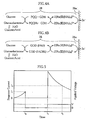
- Fig. 4A is a diagram of the electron transfer system when [Ru (III) (NH 3 ) 6 ] 3+ is used as the mediator and PQQGDH is used as the oxidation-reduction enzyme
- Fig. 4B is a diagram of the electron transfer system when [Ru (III) (NH 3 ) 6 ] 3+ is used as the mediator and GOD is used as the oxidation-reduction enzyme.
- the reductive Ru (II) complex present in the reagent layer 28 moves to the working portion 26a side of the first electrode 26, releases electrons to this working portion 26a, and creates an oxidative Ru (III) complex. Therefore, in a state in which constant voltage is applied between the first and second electrodes 26 and 27 by the voltage applier 3, the quantity of electrons given off by the reductive Ru (II) complex is measured as the response current value by the current measurer 4 via the first electrode 26 and the first contact 3a. This response current value is correlated with the quantity of electrons originating in the reductive Ru (III) complex that has moved through the reagent layer 28 as a result of voltage application, and is known as the diffusion current.
- the response current value measured by the current measurer 4 is monitored by the.detector 5, and as shown in Fig. 5 , the detector 5 detects that the glucose solution has been supplied to the reagent layer 28 and the reagent layer 28 has dissolved at the point to when the response current value exceeds a threshold I 1 (such as 2 to 3 ⁇ A).
- a threshold I 1 such as 2 to 3 ⁇ A
- a reductive Ru (III) complex releases electrons e - to become an oxidative Ru (II) complex.
- oxidative Ru (II) complex When other reductive substances are present in the glucose solution along with a reductive Ru (III) complex, these substances also release electrons in according to the type and amount of component corresponding to the applied voltage, and become oxidative.
- the electrons released by the reductive Ru (III) complex and any other reductive substances are supplied to the working portion 26a of the first electrode 26 and are measured as the response current value by the current measurer 4 via the first contact 3a. Therefore, the response current value that is actually measured includes that produced by electrons originating in the coexistent substances that became oxidative upon the application of voltage.
- the probability (proportion) at which the coexistent substances that were reductive release electrons and become oxidative is dependent on the amount of voltage applied to the first and second electrodes 26 and 27; the more voltage applied, the more types of the coexistent substances release electrons and the greater the total amount of electrons released by the individual substances.
- the reductive Ru (III) complex can include not only one that has been given electrons in the oxidation-reduction reaction with the oxidation-reduction enzyme, but also one that has been made into reductive Ru (III) through exposure to water or light. Accordingly, the response current value that is actually measured can include background current attributable to the reductive Ru (III) originating in electrodes from something other than an enzyme reaction, or background noise due to the coexistent substances that are present.
- the constant voltage V applied to the first and second electrodes 26 and 27 is the same as the constant voltage V applied up to the point when the detector 5 detects that the glucose solution has been supplied to the reagent layer 28.
- the reapplied constant voltage V is between 100 and 350 mV, and preferably 100 to 300 mV, which is less than the standard oxidation-reduction potential of a ferricyanide ion.
- the voltage applied to the first and second electrodes 26 and 27 is less than when a ferricyanide ion (potassium) is used as the mediator.
- an oxidative Ru (II) complex is far more stable than a reductive Ru (III) complex, this Ru complex is less apt to decompose in the presence of moisture or under optical irradiation, and most of it remains as oxidative Ru (II) until given electrons by an enzyme reaction. Therefore, the proportion of Ru (II) complex that has been rendered reductive by electrons from sources other than an enzyme reaction is far smaller, and this again allows background current to be reduced. Accordingly, there is no need to give much thought to the effect of moisture in the storage of the glucose sensor 2, so there is no need to reduce the amount of moisture by means of nitrogen replacement or the like. As a result, manufacturing is correspondingly easier when the glucose sensor 2 is mass-produced on an industrial scale, and this keeps the cost lower.
- diffusion current based on the reductive Ru (II) complex produced by the entire reagent layer 28 is measured as the response current.
- the glucose reaction is concluded as soon as the glucose solution is supplied. Accordingly, if the glucose concentration is about 600 mg/dL, the oxidative Ru (III) complex will be converted into reductive Ru (II) in an amount corresponding to the glucose concentration at the point when the response current value is measured, such as 5 seconds after the glucose is supplied.
- the response current value will be relatively large (on the ⁇ A level) even through the glucose concentration is on the 100 mg/dL level, and is therefore less affected by noise from electromagnetic waves and so forth.
- the glucose concentration can be measured with good precision without having to take such steps as ensuring a large electrode surface area.
- high concentration levels are difficult to measure when, for example, a mediator or enzyme is fixed to electrodes, the enzyme is subjected to a catalytic reaction on just the surface of the electrodes, electrons are exchanged between the mediator and the electrodes, and the amount of electron movement here (catalyst current) is measured.
- the glucose concentration is computed by converting the response current value into a voltage value, then checking this voltage value against a calibration curve which is produced ahead of time and expresses the relationship between voltage and glucose concentration.
- This calibration curve is, for example, converted into data and stored in a ROM along with the program for executing computation.
- the glucose concentration is computed by utilizing a CPU or RAM to execute the program stored in this ROM.
- glucose sensor 1 Two glucose sensors were compared in Examples 1 to 6. One of these is termed glucose sensor 1 and the other comparative glucose sensor 1. The difference between these glucose sensors was in the formulation of their reagent layers, as shown in Table 1 below. These reagent layers were formed by applying spots of 1 ⁇ L of reagent composed of an oxidation-reduction enzyme and a potassium phosphate buffer on a substrate, and then drying.
- Example 7 two glucose sensors 2 and 3 of the present invention comprising a different oxidation-reduction enzyme from that used in Examples 1 to 6 were used as indicated in Table 2 below. Other than the constitution of the reagent layer, these were the same as the glucose sensors in Examples 1 to 6. ⁇ GDH and CyGDH were as discussed previously.
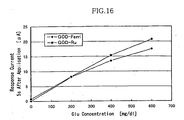
- a glucose sensor 4 of the present invention and a comparative glucose sensor 2 in which GOD was used as the oxidation-reduction enzyme as shown in Table 3 below were used in Example 8.
- GOD was used as the oxidation-reduction enzyme as shown in Table 3 below
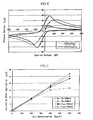
- the electrode response characteristics of glucose sensors were evaluated by examining CV waveforms.
- the CV waveform was examined by applying spots of glucose solution on the reagent layer of the glucose sensor, sweeping such that the sweep rate was 50 mV/sec and the applied voltage was 0 mV ⁇ +800 mV ⁇ 0 mv ⁇ -800 mV ⁇ 0 mV ⁇ +800 mV, and measuring the response current during the sweep.
- the glucose solution used here was a standard solution with a concentration of 200 mg/dL (prepared by dissolving glucose in physiological saline (0.9 wt% NaC1) ).
- the amount of spot application of the glucose solution on the reagent layer was 1 ⁇ L.
- Fig. 6 shows the CV waveforms.
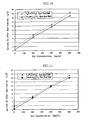
- the response current value was measured using four different standard solutions with glucose concentrations of 0 mg/dL, 200 mg/dL, 400 mg/dL, and 600 mg/dL and using the glucose sensor 1 of the present invention and the comparative glucose sensor 1, at applied voltages of 500 mV and 200 mV.
- the response current value was measured 5 seconds after the spot application of 1 ⁇ L of standard solution to the reagent layer, with the application of voltage held steady between the first and second electrodes.
- the glucose sensor 1 of the present invention exhibited good linearity for the group of plotted points, indicating that glucose sensor can be measured favorably even when the glucose concentration is high (400 mg/dL or higher).
- linearity was somewhat off when the glucose concentration was high (400 mg/dL or higher), although the overall linearity was excellent.
- the linearity of the glucose sensor 1 of the present invention was off somewhat when the glucose concentration was high (400 mg/dL or higher), but the group of plotted points did exhibit good linearity.
- the deviation in linearity at 200 mV with the glucose sensor 1 of the present invention was still smaller than that of the comparative glucose sensor 1 at 500 mV.
- the effect of reductive concomitants was examined.
- the response current value was measured using four different types of whole blood (with components other than glucose adjusted to their average concentration in human blood) with glucose concentrations of 0 mg/dL, 200 mg/dL, 400 mg/dL and 600 mg/dL, and using the glucose sensor 1 of the present invention and the comparative glucose sensor 1, at applied voltages of 500 mV and 250 mV. There was a voltage non-application state lasting 10 seconds after the spot application of 1 ⁇ L of whole blood to the reagent layer, after which the response current value was measured 5 seconds after the start of voltage application between the first and second electrodes. These results are given in Figs. 10 and 11 .
- the overall response current value was higher with the comparative glucose sensor 1 than with the glucose sensor 1 of the present invention.
- the reason for this seems to be that the comparative glucose sensor 1 is affected more by reductive concomitants in blood than is the glucose sensor 1 of the present invention, and that the background current from these substances raises the response current value.
- the response current is measured as a positive value even when the glucose concentration is 0 mg/dL.
- the effect of background current caused by reductive concomitants is suspected to be the reason for the higher response current value with the comparative glucose sensor 1.
- Fig. 12 is a bar graph of the response current value here when the glucose concentration was 0 mg/dL. It can be seen from this graph that with the comparative glucose sensor 1, a relatively large response current is measured even at a glucose concentration of 0 mg/dL, the reason for which is believed to be the greater effect of the reductive concomitants. In contrast, with the glucose sensor 1 of the present invention, the measured response current is small at a glucose concentration of 0 mg/dL, and it can be concluded that the effect of the reductive concomitants has been greatly reduced. Therefore, if a Ru complex is used as the mediator, concentration can be computed with good precision even without correcting for the effect of other reductive substances.
- Exposure resistance was evaluated in this example. This resistance to exposure was evaluated by leaving the glucose sensor 1 of the present invention and the comparative glucose sensor 1, which had both been produced at about the same time, in a thermo-hygro-static room kept at a relative humidity of 50% and a temperature of 25°C, and then using a standard solution with a glucose concentration of 0 mg/dL to measure the response current value. The application of voltage of 500 mV between the electrodes was started 10 seconds after the spot application of the standard solution to the reagent layer, and the response current value was measured 5 seconds after the start of voltage application. The glucose sensors were left 1 and 4 days inside the thermohygrostatic room.
- the response current value was measured under the same conditions both for a glucose sensor that had yet to be left in the thermohygrostatic room (initial), and for a glucose sensor that had been sealed in a desiccator (interior volume of 0.2 L, initial relative humidity setting of 50%, and temperature of 25°C) containing 6 g of molecular sieve (desiccant) and then left for 4 days in a thermohygrostatic room kept at a relative humidity of 50% and a temperature of 25°C (sealed 4 days).
- a desiccator internal volume of 0.2 L, initial relative humidity setting of 50%, and temperature of 25°C
- the glucose sensor 1 of the present invention had much smaller response current than the comparative glucose sensor 1, and the values thereof were about the same at all environmental settings. It is therefore surmised that when a Ru complex is used as the mediator, there is less degradation (reduction) of the reagent layer under the exposure environment, so storage stability is superior and long-term degradation is less likely to occur. Therefore, if a Ru complex is used as the mediator, there is no need to give much thought to the effect of exposure to moisture in the storage of the glucose sensor. This means that when glucose sensors are mass-produced and packaged on an industrial scale, there is no need to perform nitrogen replacement or other such treatment inside the packaging, which facilitates manufacture and reduces costs.
- the solubility of the reagent layer was examined in this example.
- the response current value was measured using four different types of standard solution with glucose concentrations of 0 mg/dL, 200 mg/dL, 400 mg/dL, and 600 mg/dL and using the glucose sensor 1 of the present invention and the comparative glucose sensor 1, at an applied voltage of 500 mV.
- Fig. 14 also shows the results for when an inorganic gel (used as a dispersant) was added in an amount of 1 weight part per 100 weight parts Fe complex in the comparative glucose sensor 1.
- the glucose sensor 1 of the present invention exhibited excellent linearity even at a high glucose concentration. This means that the reagent layer dissolves well within 15 seconds of the supply of the standard solution, regardless of the glucose concentration.
- the reagent layer will have excellent solubility, with the entire reagent layer forming a uniform reaction system, and as a result glucose concentrations can be measured in a short time and with good precision even with glucose solutions having a relatively high glucose concentration, without having to resort to the use of a dispersant or the like.
- the response current value was measured for the glucose sensors 2 and 3 of the present invention, which had a reagent layer formed as shown in Table 2 above, using four types of whole blood with different glucose concentrations of 0 mg/dL, 200 mg/dL, 400 mg/dL, and 600 mg/dL. These results are given in Fig. 15. Fig. 15 also shows the results for when the response current value was measured under the same conditions for the glucose sensor 1 of the present invention constituted as in Examples 1 to 6.
- Fig. 15 With glucose sensors 2 and 3 of the present invention, in which CyGDH or a GDH was used as the redox enzyme, concentration can be measured favorably from relatively low concentrations all the way up to high concentrations, under the application of a current of just 200 mV and only a short time of 5 seconds after the start of application. Fig. 15 also tells us that the background current is small with these glucose sensors. Therefore, by using a ruthenium complex as the mediator, the advantages described in Examples 1 to 6 can be achieved for various types of GDH.
- the response current value was measured in the same manner as in Example 7 for a glucose sensor 4 of the present invention, in which a Ru complex was used as the mediator and GOD was used as the oxidation-reduction enzyme, and a comparative glucose sensor 2, in which potassium ferricyanide was used as the mediator and GOD was used as the oxidation-reduction enzyme.
- the concentration of a test target in a sample liquid can be accurately measured, whether the concentration of the test target in the sample liquid is relatively low or relatively high, the measurement will be affected less by the coexistent reductive substances present in the sample liquid, and adequate solubility of the reagent layer can be ensured.
Landscapes
- Chemical & Material Sciences (AREA)
- Life Sciences & Earth Sciences (AREA)
- Health & Medical Sciences (AREA)
- Organic Chemistry (AREA)
- Zoology (AREA)
- Engineering & Computer Science (AREA)
- Proteomics, Peptides & Aminoacids (AREA)
- Wood Science & Technology (AREA)
- Physics & Mathematics (AREA)
- General Health & Medical Sciences (AREA)
- Immunology (AREA)
- Biochemistry (AREA)
- Molecular Biology (AREA)
- Analytical Chemistry (AREA)
- General Engineering & Computer Science (AREA)
- Microbiology (AREA)
- Bioinformatics & Cheminformatics (AREA)
- Biotechnology (AREA)
- Biophysics (AREA)
- Genetics & Genomics (AREA)
- Chemical Kinetics & Catalysis (AREA)
- Hematology (AREA)
- Electrochemistry (AREA)
- General Physics & Mathematics (AREA)
- Pathology (AREA)
- Investigating Or Analysing Biological Materials (AREA)
- Measuring Or Testing Involving Enzymes Or Micro-Organisms (AREA)
- Apparatus Associated With Microorganisms And Enzymes (AREA)
- Investigating, Analyzing Materials By Fluorescence Or Luminescence (AREA)
- Investigating Or Analysing Materials By Optical Means (AREA)
Applications Claiming Priority (2)
| Application Number | Priority Date | Filing Date | Title |
|---|---|---|---|
| JP2001278966 | 2001-09-14 | ||
| EP02760795A EP1426757B9 (fr) | 2001-09-14 | 2002-08-30 | Procede, outil et dispositif de mesure d'une concentration |
Related Parent Applications (2)
| Application Number | Title | Priority Date | Filing Date |
|---|---|---|---|
| EP02760795.1 Division | 2002-08-30 | ||
| WOPCT/JP02/08855 Previously-Filed-Application | 2002-08-30 |
Publications (2)
| Publication Number | Publication Date |
|---|---|
| EP2330407A1 true EP2330407A1 (fr) | 2011-06-08 |
| EP2330407B1 EP2330407B1 (fr) | 2013-05-29 |
Family
ID=19103242
Family Applications (2)
| Application Number | Title | Priority Date | Filing Date |
|---|---|---|---|
| EP02760795A Expired - Lifetime EP1426757B9 (fr) | 2001-09-14 | 2002-08-30 | Procede, outil et dispositif de mesure d'une concentration |
| EP10010432.2A Expired - Lifetime EP2330407B1 (fr) | 2001-09-14 | 2002-08-30 | Procédé, outil et dispositif pour mesurer la concentration |
Family Applications Before (1)
| Application Number | Title | Priority Date | Filing Date |
|---|---|---|---|
| EP02760795A Expired - Lifetime EP1426757B9 (fr) | 2001-09-14 | 2002-08-30 | Procede, outil et dispositif de mesure d'une concentration |
Country Status (10)
| Country | Link |
|---|---|
| US (3) | USRE44522E1 (fr) |
| EP (2) | EP1426757B9 (fr) |
| JP (1) | JP4385219B2 (fr) |
| CN (1) | CN1304838C (fr) |
| AT (1) | ATE505724T1 (fr) |
| DE (1) | DE60239748D1 (fr) |
| DK (1) | DK2330407T3 (fr) |
| ES (1) | ES2415932T3 (fr) |
| PT (1) | PT2330407E (fr) |
| WO (1) | WO2003025558A1 (fr) |
Families Citing this family (30)
| Publication number | Priority date | Publication date | Assignee | Title |
|---|---|---|---|---|
| CN1304838C (zh) | 2001-09-14 | 2007-03-14 | 爱科来株式会社 | 浓度测量方法、浓度测量用具以及浓度测量装置 |
| US7094585B2 (en) * | 2002-04-26 | 2006-08-22 | Koji Sode | Glucose dehydrogenase β-subunit and DNA encoding the same |
| DE60322708D1 (de) | 2002-06-17 | 2008-09-18 | Arkray Inc | Glucosesensor unter verwendung von glucosedehydrogenase |
| US20060231396A1 (en) * | 2002-12-20 | 2006-10-19 | Hideaki Yamaoka | Thin analyzing device |
| EP2213748B1 (fr) * | 2004-01-07 | 2014-03-19 | Arkray, Inc. | Instrument analytique à agencement amelioré de section de reactif et procédé analytique correspondant |
| BRPI0507376A (pt) | 2004-02-06 | 2007-07-10 | Bayer Healthcare Llc | espécie oxidável como uma referência interna para biossensores e método de uso |
| PL1698891T3 (pl) * | 2005-03-03 | 2008-02-29 | Apex Biotechnology Corp | Sposób redukcji pomiarowego napięcia wstępnego w amperometrycznych czujnikach biologicznych |
| JP5021183B2 (ja) | 2005-05-20 | 2012-09-05 | アークレイ株式会社 | タンパク質固定化膜および固定化方法、ならびにバイオセンサ |
| KR20130100022A (ko) * | 2005-09-30 | 2013-09-06 | 바이엘 헬스케어 엘엘씨 | 게이트형 전압 전류 측정 분석물 결정 방법 |
| US8617366B2 (en) * | 2005-12-12 | 2013-12-31 | Nova Biomedical Corporation | Disposable urea sensor and system for determining creatinine and urea nitrogen-to-creatinine ratio in a single device |
| US7955484B2 (en) * | 2005-12-14 | 2011-06-07 | Nova Biomedical Corporation | Glucose biosensor and method |
| WO2007120551A2 (fr) | 2006-04-10 | 2007-10-25 | Bayer Healthcare Llc | Correction de l'effet de l'oxygene dans un capteur d'essai a l'aide de reactifs |
| US9046480B2 (en) | 2006-10-05 | 2015-06-02 | Lifescan Scotland Limited | Method for determining hematocrit corrected analyte concentrations |
| EP2080023B1 (fr) | 2006-10-05 | 2011-11-23 | Lifescan Scotland Limited | Méthode de détermination de concentrations d'analytes corrigées de l'hématocrite |
| WO2008040998A2 (fr) | 2006-10-05 | 2008-04-10 | Lifescan Scotland Limited | Systèmes et méthodes permettant de déterminer une concentration d'analyte sensiblement indépendante de l'hématocrite |
| ES2544353T3 (es) | 2006-10-05 | 2015-08-28 | Lifescan Scotland Ltd | Métodos para determinar una concentración de analitos usando algoritmos de procesamiento de señales |
| ATE499450T1 (de) | 2006-10-05 | 2011-03-15 | Lifescan Scotland Ltd | Reagensformulierung mit rutheniumhexamin als vermittler für elektrochemische teststreifen |
| BRPI0717620A2 (pt) | 2006-10-24 | 2013-10-22 | Bayer Healthcare Llc | Amperometria de decaimento transitório |
| US7943022B2 (en) * | 2007-09-04 | 2011-05-17 | Lifescan, Inc. | Analyte test strip with improved reagent deposition |
| JP2010538292A (ja) * | 2007-09-06 | 2010-12-09 | コーニンクレッカ フィリップス エレクトロニクス エヌ ヴィ | 流体の化学分析に関する方法及び装置 |
| JP5405916B2 (ja) | 2008-06-24 | 2014-02-05 | パナソニック株式会社 | バイオセンサ、その製造方法、及びそれを備える検出システム |
| JP5584740B2 (ja) | 2011-09-26 | 2014-09-03 | アークレイ株式会社 | グルコースセンサ |
| US20130189769A1 (en) * | 2012-01-21 | 2013-07-25 | Rapha Bio Ltd. | Biochemical sensor |
| WO2014002999A1 (fr) * | 2012-06-25 | 2014-01-03 | 合同会社バイオエンジニアリング研究所 | Électrode enzymatique |
| EP3032250B1 (fr) * | 2013-08-07 | 2023-10-11 | ARKRAY, Inc. | Procédé de mesure de substance et dispositif de mesure employant un biocapteur électrochimique |
| CN104055525A (zh) * | 2014-06-20 | 2014-09-24 | 中国科学院苏州生物医学工程技术研究所 | 植入式低功耗无线血糖监测仪 |
| US10444208B2 (en) * | 2016-06-17 | 2019-10-15 | Myron L Company | Method for measuring the concentration of a chemical species using a reagent baseline |
| JP6713364B2 (ja) * | 2016-07-20 | 2020-06-24 | アークレイ株式会社 | アスコルビン酸応答電極およびバイオセンサ |
| WO2020225870A1 (fr) * | 2019-05-08 | 2020-11-12 | 日本電信電話株式会社 | Capteur vestimentaire et dispositif d'analyse de transpiration |
| US20250127428A1 (en) | 2023-10-19 | 2025-04-24 | Arkray, Inc. | Biosensor |
Citations (4)
| Publication number | Priority date | Publication date | Assignee | Title |
|---|---|---|---|---|
| US4545382A (en) * | 1981-10-23 | 1985-10-08 | Genetics International, Inc. | Sensor for components of a liquid mixture |
| JPH0358566B2 (fr) | 1986-06-20 | 1991-09-05 | Horiuretan Kasei Kk | |
| US5205920A (en) * | 1989-03-03 | 1993-04-27 | Noboru Oyama | Enzyme sensor and method of manufacturing the same |
| WO2001057510A2 (fr) * | 2000-02-02 | 2001-08-09 | Lifescan, Inc. | Procedes et dispositifs electrochimiques a utiliser dans la determination de concentrations d'analytes avec correction d'hematocrites |
Family Cites Families (51)
| Publication number | Priority date | Publication date | Assignee | Title |
|---|---|---|---|---|
| WO1985002627A1 (fr) | 1983-12-16 | 1985-06-20 | Genetics International, Inc. | Analyse d'acides nucleiques |
| GB8504522D0 (en) | 1985-02-21 | 1985-03-27 | Genetics Int Inc | Electrochemistry of mediators |
| US5185256A (en) | 1985-06-21 | 1993-02-09 | Matsushita Electric Industrial Co., Ltd. | Method for making a biosensor |
| US4759828A (en) | 1987-04-09 | 1988-07-26 | Nova Biomedical Corporation | Glucose electrode and method of determining glucose |
| JP2574347B2 (ja) | 1987-12-15 | 1997-01-22 | 松下電器産業株式会社 | バイオセンサ |
| JP2796983B2 (ja) * | 1989-03-03 | 1998-09-10 | テルモ株式会社 | グルコースセンサ |
| US5264104A (en) | 1989-08-02 | 1993-11-23 | Gregg Brian A | Enzyme electrodes |
| JP2517151B2 (ja) * | 1990-04-03 | 1996-07-24 | 松下電器産業株式会社 | バイオセンサによる基質濃度の測定方法 |
| WO1992012254A1 (fr) | 1991-01-10 | 1992-07-23 | Board Of Regents, The University Of Texas System | Electrodes a enzyme |
| US5262305A (en) | 1991-03-04 | 1993-11-16 | E. Heller & Company | Interferant eliminating biosensors |
| US5593852A (en) | 1993-12-02 | 1997-01-14 | Heller; Adam | Subcutaneous glucose electrode |
| US5281323A (en) * | 1991-03-20 | 1994-01-25 | Fujitsu Limited | Electrolyte composition for screen printing and miniaturized oxygen electrode and production process thereof |
| US5710011A (en) | 1992-06-05 | 1998-01-20 | Medisense, Inc. | Mediators to oxidoreductase enzymes |
| GB9325189D0 (en) | 1993-12-08 | 1994-02-09 | Unilever Plc | Methods and apparatus for electrochemical measurements |
| US5437999A (en) | 1994-02-22 | 1995-08-01 | Boehringer Mannheim Corporation | Electrochemical sensor |
| US5582697A (en) | 1995-03-17 | 1996-12-10 | Matsushita Electric Industrial Co., Ltd. | Biosensor, and a method and a device for quantifying a substrate in a sample liquid using the same |
| JP3102627B2 (ja) | 1995-03-17 | 2000-10-23 | 松下電器産業株式会社 | バイオセンサ、それを用いた定量法および定量装置 |
| JP3657651B2 (ja) | 1995-03-28 | 2005-06-08 | 征夫 軽部 | 酵素電極用組成物および酵素固定化電極 |
| US5620579A (en) | 1995-05-05 | 1997-04-15 | Bayer Corporation | Apparatus for reduction of bias in amperometric sensors |
| ES2103197B1 (es) | 1995-08-04 | 1998-01-16 | Univ Alcala Henares | Pasta conductora, electrodos y sensores electroquimicos que comprenden dicha pasta conductora, y su metodo de preparacion. |
| FR2744219B1 (fr) | 1996-01-31 | 1998-03-20 | Asulab Sa | Capteur electrochimique sans calibration |
| CA2257534A1 (fr) | 1996-06-07 | 1997-12-11 | California Institute Of Technology | Transfert d'electrons induit par des acides nucleiques |
| EP0970375A2 (fr) | 1997-02-06 | 2000-01-12 | The University of North Carolina at Chapel Hill | Sondes electrochimiques pour la detection d'interactions moleculaires et la mise au point de medicaments |
| JP3394262B2 (ja) | 1997-02-06 | 2003-04-07 | セラセンス、インク. | 小体積インビトロ被検体センサー |
| JPH10243786A (ja) * | 1997-03-03 | 1998-09-14 | Koji Hayade | 改変型グルコース脱水素酵素 |
| JP3528521B2 (ja) | 1997-06-20 | 2004-05-17 | Nok株式会社 | 酸化還元酵素を用いる測定方法 |
| US6103033A (en) | 1998-03-04 | 2000-08-15 | Therasense, Inc. | Process for producing an electrochemical biosensor |
| US6134461A (en) | 1998-03-04 | 2000-10-17 | E. Heller & Company | Electrochemical analyte |
| US6175752B1 (en) | 1998-04-30 | 2001-01-16 | Therasense, Inc. | Analyte monitoring device and methods of use |
| KR100349000B1 (ko) | 1998-07-09 | 2003-03-26 | 주식회사 아이센스 | 친수성폴리우레탄을사용한바이오센서의제조방법 |
| US6338790B1 (en) | 1998-10-08 | 2002-01-15 | Therasense, Inc. | Small volume in vitro analyte sensor with diffusible or non-leachable redox mediator |
| JP4352108B2 (ja) | 1998-12-15 | 2009-10-28 | アークレイ株式会社 | 基質の定量方法 |
| WO2000052457A1 (fr) | 1999-03-02 | 2000-09-08 | Helix Biopharma Corporation | Dispositif biocapteur a carte |
| JP4000708B2 (ja) | 1999-03-17 | 2007-10-31 | 東洋紡績株式会社 | 酵素固定化電極を用いる物質の測定方法 |
| TWI224136B (en) | 1999-04-30 | 2004-11-21 | Koji Sode | Glucose dehydrogenase |
| JP2000312588A (ja) * | 1999-04-30 | 2000-11-14 | Koji Hayade | グルコース脱水素酵素 |
| US6193873B1 (en) | 1999-06-15 | 2001-02-27 | Lifescan, Inc. | Sample detection to initiate timing of an electrochemical assay |
| US6616819B1 (en) | 1999-11-04 | 2003-09-09 | Therasense, Inc. | Small volume in vitro analyte sensor and methods |
| DE60035123T2 (de) | 1999-11-15 | 2008-01-31 | Therasense, Inc., Alameda | Übergangsmetallkomplexe, die über ein bewegliches zwischenglied an ein polymer gebunden sind |
| WO2001036954A1 (fr) | 1999-11-15 | 2001-05-25 | Arkray, Inc. | Biodetecteur |
| JP4050434B2 (ja) * | 1999-11-29 | 2008-02-20 | 松下電器産業株式会社 | サンプルの弁別方法 |
| KR20070073986A (ko) * | 2000-01-28 | 2007-07-10 | 마텍 바이오싸이언스스 코포레이션 | 발효기 내에서 진핵 미생물의 고밀도 배양에 의한고도불포화 지방산을 함유하는 지질의 증진된 생산 방법 |
| US20020092612A1 (en) * | 2000-03-28 | 2002-07-18 | Davies Oliver William Hardwicke | Rapid response glucose sensor |
| US6442413B1 (en) | 2000-05-15 | 2002-08-27 | James H. Silver | Implantable sensor |
| US6726818B2 (en) | 2000-07-21 | 2004-04-27 | I-Sens, Inc. | Biosensors with porous chromatographic membranes |
| JP4107386B2 (ja) | 2000-10-31 | 2008-06-25 | 広司 早出 | 新規グルコース脱水素酵素及び該脱水素酵素の製造方法 |
| US20030236448A1 (en) | 2001-03-27 | 2003-12-25 | Fang Lu | Oxidase-base sensors for selective analysis of analytes in aqueous samples |
| US20030036202A1 (en) | 2001-08-01 | 2003-02-20 | Maria Teodorcyzk | Methods and devices for use in analyte concentration determination assays |
| US20030028087A1 (en) | 2001-08-01 | 2003-02-06 | Yuzhakov Vadim Vladimirovich | Devices for analyte concentration determination and methods of using the same |
| CN1304838C (zh) | 2001-09-14 | 2007-03-14 | 爱科来株式会社 | 浓度测量方法、浓度测量用具以及浓度测量装置 |
| JP4537850B2 (ja) | 2002-08-30 | 2010-09-08 | アークレイ株式会社 | タンパク質およびグルコース脱水素酵素の精製方法 |
-
2002
- 2002-08-30 CN CNB028179544A patent/CN1304838C/zh not_active Expired - Lifetime
- 2002-08-30 WO PCT/JP2002/008855 patent/WO2003025558A1/fr not_active Ceased
- 2002-08-30 PT PT100104322T patent/PT2330407E/pt unknown
- 2002-08-30 DK DK10010432.2T patent/DK2330407T3/da active
- 2002-08-30 EP EP02760795A patent/EP1426757B9/fr not_active Expired - Lifetime
- 2002-08-30 JP JP2003529137A patent/JP4385219B2/ja not_active Expired - Lifetime
- 2002-08-30 US US12/822,869 patent/USRE44522E1/en not_active Expired - Lifetime
- 2002-08-30 US US14/012,158 patent/USRE45764E1/en not_active Expired - Lifetime
- 2002-08-30 US US10/489,488 patent/US7390391B2/en not_active Ceased
- 2002-08-30 ES ES10010432T patent/ES2415932T3/es not_active Expired - Lifetime
- 2002-08-30 DE DE60239748T patent/DE60239748D1/de not_active Expired - Lifetime
- 2002-08-30 EP EP10010432.2A patent/EP2330407B1/fr not_active Expired - Lifetime
- 2002-08-30 AT AT02760795T patent/ATE505724T1/de not_active IP Right Cessation
Patent Citations (4)
| Publication number | Priority date | Publication date | Assignee | Title |
|---|---|---|---|---|
| US4545382A (en) * | 1981-10-23 | 1985-10-08 | Genetics International, Inc. | Sensor for components of a liquid mixture |
| JPH0358566B2 (fr) | 1986-06-20 | 1991-09-05 | Horiuretan Kasei Kk | |
| US5205920A (en) * | 1989-03-03 | 1993-04-27 | Noboru Oyama | Enzyme sensor and method of manufacturing the same |
| WO2001057510A2 (fr) * | 2000-02-02 | 2001-08-09 | Lifescan, Inc. | Procedes et dispositifs electrochimiques a utiliser dans la determination de concentrations d'analytes avec correction d'hematocrites |
Non-Patent Citations (4)
| Title |
|---|
| CHUO, ORGANISM DEPOSITARY OF THE NATIONAL INSTITUTE OF ADVANCED INDUSTRIAL SCIENCE AND TECHNOLOGY, vol. 6, pages 1 - 1 |
| HABERMÜLLER K ET AL: "Electron-transfer mechanisms in amperometric biosensors", FRESENIUS JOURNAL OF ANALYTICAL CHEMISTRY, SPRINGER, BERLIN, DE, vol. 366, no. 6-7, March 2000 (2000-03-01), pages 560 - 568, XP002288122, ISSN: 0937-0633 * |
| MORRIS N A ET AL: "AN ELECTROCHEMICAL CAPILLARY FILL DEVICE FOR THE ANALYSIS OF GLUCOSE INCORPORATING GLUCOSE OXIDASE AND RUTHENIUM (III) HEXAMINE AS MEDIATOR", ELECTROANALYSIS, VHC PUBLISHERS, INC, US, vol. 4, no. 1, 1 January 1992 (1992-01-01), pages 1 - 09, XP002065769, ISSN: 1040-0397, DOI: 10.1002/ELAN.1140040104 * |
| OKUDA J ET AL: "The application of cytochrome as the interface molecule to facilitate the electron transfer for PQQ glucose dehydrogenase employing mediator type glucose sensor", ANALYTICAL LETTERS, NEW YORK, NY, US, vol. 35, no. 9, July 2002 (2002-07-01), pages 1465 - 1478, XP002973301, ISSN: 0003-2719 * |
Also Published As
| Publication number | Publication date |
|---|---|
| DE60239748D1 (de) | 2011-05-26 |
| ES2415932T3 (es) | 2013-07-29 |
| US7390391B2 (en) | 2008-06-24 |
| USRE45764E1 (en) | 2015-10-20 |
| EP2330407B1 (fr) | 2013-05-29 |
| PT2330407E (pt) | 2013-07-09 |
| DK2330407T3 (da) | 2013-06-24 |
| US20040245121A1 (en) | 2004-12-09 |
| EP1426757B1 (fr) | 2011-04-13 |
| USRE44522E1 (en) | 2013-10-08 |
| CN1571925A (zh) | 2005-01-26 |
| CN1304838C (zh) | 2007-03-14 |
| ATE505724T1 (de) | 2011-04-15 |
| JP4385219B2 (ja) | 2009-12-16 |
| EP1426757A1 (fr) | 2004-06-09 |
| JPWO2003025558A1 (ja) | 2004-12-24 |
| WO2003025558A1 (fr) | 2003-03-27 |
| EP1426757A4 (fr) | 2005-09-28 |
| EP1426757B9 (fr) | 2012-01-25 |
Similar Documents
| Publication | Publication Date | Title |
|---|---|---|
| EP2330407B1 (fr) | Procédé, outil et dispositif pour mesurer la concentration | |
| CN100487442C (zh) | 薄型分析用具 | |
| KR101387286B1 (ko) | 게이트형 전류 측정법 언더필 결정 방법 | |
| US8317988B2 (en) | Concentration determination in a diffusion barrier layer | |
| US7824881B2 (en) | Glucose level measuring method and glucose sensor utilizing glucose dehydrogenase | |
| JP5236824B2 (ja) | 電気化学的バイオセンサでの酵素活性の安定化 | |
| JP3965212B2 (ja) | フルクトサミンの電気化学的測定 | |
| TWI559001B (zh) | 生物感測器用之製劑組成物及具有該製劑組成物之生物感測器 | |
| EP3578665B1 (fr) | Procédé de biodétection | |
| JPS5816696B2 (ja) | 酵素電極 | |
| AU2005212396A1 (en) | Oxidizable species as an internal reference for biosensors and method of use | |
| Carducci et al. | Glucometers and Continuous Glucose Monitors | |
| JPH0560723A (ja) | 酵素電極の製造方法 | |
| HK1116220A (en) | Stabilizing the activity of pqq-dependent glucose dehydrogenase in electrochemical biosensors |
Legal Events
| Date | Code | Title | Description |
|---|---|---|---|
| PUAI | Public reference made under article 153(3) epc to a published international application that has entered the european phase |
Free format text: ORIGINAL CODE: 0009012 |
|
| AC | Divisional application: reference to earlier application |
Ref document number: 1426757 Country of ref document: EP Kind code of ref document: P |
|
| AK | Designated contracting states |
Kind code of ref document: A1 Designated state(s): AL AT BE BG CH CY CZ DE DK EE ES FI FR GB GR HR HU IE IS IT LI LT LU LV MC MK MT NL NO PL PT RO SE SI SK SM TR |
|
| AX | Request for extension of the european patent |
Extension state: BA ME RS |
|
| RBV | Designated contracting states (corrected) |
Designated state(s): AT BE BG CH CY CZ DE DK EE ES FI FR GB GR IE IT LI LU MC NL PT SE SK TR |
|
| 17P | Request for examination filed |
Effective date: 20111208 |
|
| 17Q | First examination report despatched |
Effective date: 20120424 |
|
| GRAP | Despatch of communication of intention to grant a patent |
Free format text: ORIGINAL CODE: EPIDOSNIGR1 |
|
| GRAS | Grant fee paid |
Free format text: ORIGINAL CODE: EPIDOSNIGR3 |
|
| GRAA | (expected) grant |
Free format text: ORIGINAL CODE: 0009210 |
|
| AC | Divisional application: reference to earlier application |
Ref document number: 1426757 Country of ref document: EP Kind code of ref document: P |
|
| AK | Designated contracting states |
Kind code of ref document: B1 Designated state(s): AT BE BG CH CY CZ DE DK EE ES FI FR GB GR IE IT LI LU MC NL PT SE SK TR |
|
| REG | Reference to a national code |
Ref country code: GB Ref legal event code: FG4D |
|
| REG | Reference to a national code |
Ref country code: CH Ref legal event code: EP |
|
| REG | Reference to a national code |
Ref country code: AT Ref legal event code: REF Ref document number: 614714 Country of ref document: AT Kind code of ref document: T Effective date: 20130615 |
|
| REG | Reference to a national code |
Ref country code: DK Ref legal event code: T3 |
|
| REG | Reference to a national code |
Ref country code: IE Ref legal event code: FG4D |
|
| REG | Reference to a national code |
Ref country code: PT Ref legal event code: SC4A Free format text: AVAILABILITY OF NATIONAL TRANSLATION Effective date: 20130628 |
|
| REG | Reference to a national code |
Ref country code: SE Ref legal event code: TRGR |
|
| REG | Reference to a national code |
Ref country code: DE Ref legal event code: R096 Ref document number: 60245048 Country of ref document: DE Effective date: 20130725 |
|
| REG | Reference to a national code |
Ref country code: ES Ref legal event code: FG2A Ref document number: 2415932 Country of ref document: ES Kind code of ref document: T3 Effective date: 20130729 |
|
| REG | Reference to a national code |
Ref country code: NL Ref legal event code: T3 |
|
| REG | Reference to a national code |
Ref country code: AT Ref legal event code: MK05 Ref document number: 614714 Country of ref document: AT Kind code of ref document: T Effective date: 20130529 |
|
| PG25 | Lapsed in a contracting state [announced via postgrant information from national office to epo] |
Ref country code: AT Free format text: LAPSE BECAUSE OF FAILURE TO SUBMIT A TRANSLATION OF THE DESCRIPTION OR TO PAY THE FEE WITHIN THE PRESCRIBED TIME-LIMIT Effective date: 20130529 Ref country code: GR Free format text: LAPSE BECAUSE OF FAILURE TO SUBMIT A TRANSLATION OF THE DESCRIPTION OR TO PAY THE FEE WITHIN THE PRESCRIBED TIME-LIMIT Effective date: 20130830 |
|
| PG25 | Lapsed in a contracting state [announced via postgrant information from national office to epo] |
Ref country code: BG Free format text: LAPSE BECAUSE OF FAILURE TO SUBMIT A TRANSLATION OF THE DESCRIPTION OR TO PAY THE FEE WITHIN THE PRESCRIBED TIME-LIMIT Effective date: 20130829 |
|
| PG25 | Lapsed in a contracting state [announced via postgrant information from national office to epo] |
Ref country code: EE Free format text: LAPSE BECAUSE OF FAILURE TO SUBMIT A TRANSLATION OF THE DESCRIPTION OR TO PAY THE FEE WITHIN THE PRESCRIBED TIME-LIMIT Effective date: 20130529 Ref country code: SK Free format text: LAPSE BECAUSE OF FAILURE TO SUBMIT A TRANSLATION OF THE DESCRIPTION OR TO PAY THE FEE WITHIN THE PRESCRIBED TIME-LIMIT Effective date: 20130529 |
|
| PLBE | No opposition filed within time limit |
Free format text: ORIGINAL CODE: 0009261 |
|
| STAA | Information on the status of an ep patent application or granted ep patent |
Free format text: STATUS: NO OPPOSITION FILED WITHIN TIME LIMIT |
|
| PG25 | Lapsed in a contracting state [announced via postgrant information from national office to epo] |
Ref country code: MC Free format text: LAPSE BECAUSE OF FAILURE TO SUBMIT A TRANSLATION OF THE DESCRIPTION OR TO PAY THE FEE WITHIN THE PRESCRIBED TIME-LIMIT Effective date: 20130529 |
|
| 26N | No opposition filed |
Effective date: 20140303 |
|
| REG | Reference to a national code |
Ref country code: IE Ref legal event code: MM4A |
|
| REG | Reference to a national code |
Ref country code: DE Ref legal event code: R097 Ref document number: 60245048 Country of ref document: DE Effective date: 20140303 |
|
| PG25 | Lapsed in a contracting state [announced via postgrant information from national office to epo] |
Ref country code: IE Free format text: LAPSE BECAUSE OF NON-PAYMENT OF DUE FEES Effective date: 20130830 |
|
| REG | Reference to a national code |
Ref country code: DE Ref legal event code: R039 Ref document number: 60245048 Country of ref document: DE Ref country code: DE Ref legal event code: R008 Ref document number: 60245048 Country of ref document: DE |
|
| REG | Reference to a national code |
Ref country code: DE Ref legal event code: R082 Ref document number: 60245048 Country of ref document: DE Representative=s name: HOFFMANN - EITLE PATENT- UND RECHTSANWAELTE PA, DE |
|
| REG | Reference to a national code |
Ref country code: DE Ref legal event code: R039 Ref document number: 60245048 Country of ref document: DE Effective date: 20150429 |
|
| PG25 | Lapsed in a contracting state [announced via postgrant information from national office to epo] |
Ref country code: CY Free format text: LAPSE BECAUSE OF FAILURE TO SUBMIT A TRANSLATION OF THE DESCRIPTION OR TO PAY THE FEE WITHIN THE PRESCRIBED TIME-LIMIT Effective date: 20130529 |
|
| PG25 | Lapsed in a contracting state [announced via postgrant information from national office to epo] |
Ref country code: LU Free format text: LAPSE BECAUSE OF NON-PAYMENT OF DUE FEES Effective date: 20130830 |
|
| REG | Reference to a national code |
Ref country code: FR Ref legal event code: PLFP Year of fee payment: 15 |
|
| REG | Reference to a national code |
Ref country code: FR Ref legal event code: PLFP Year of fee payment: 16 |
|
| REG | Reference to a national code |
Ref country code: FR Ref legal event code: PLFP Year of fee payment: 17 |
|
| PGFP | Annual fee paid to national office [announced via postgrant information from national office to epo] |
Ref country code: DE Payment date: 20190822 Year of fee payment: 18 |
|
| REG | Reference to a national code |
Ref country code: DE Ref legal event code: R042 Ref document number: 60245048 Country of ref document: DE |
|
| PG25 | Lapsed in a contracting state [announced via postgrant information from national office to epo] |
Ref country code: DE Free format text: THE PATENT HAS BEEN ANNULLED BY A DECISION OF A NATIONAL AUTHORITY Effective date: 20191105 |
|
| PGFP | Annual fee paid to national office [announced via postgrant information from national office to epo] |
Ref country code: NL Payment date: 20210819 Year of fee payment: 20 |
|
| PGFP | Annual fee paid to national office [announced via postgrant information from national office to epo] |
Ref country code: FI Payment date: 20210820 Year of fee payment: 20 Ref country code: CZ Payment date: 20210830 Year of fee payment: 20 Ref country code: FR Payment date: 20210819 Year of fee payment: 20 Ref country code: IT Payment date: 20210830 Year of fee payment: 20 |
|
| PGFP | Annual fee paid to national office [announced via postgrant information from national office to epo] |
Ref country code: DK Payment date: 20210823 Year of fee payment: 20 Ref country code: GB Payment date: 20210820 Year of fee payment: 20 Ref country code: BE Payment date: 20210819 Year of fee payment: 20 Ref country code: CH Payment date: 20210819 Year of fee payment: 20 Ref country code: TR Payment date: 20210826 Year of fee payment: 20 Ref country code: SE Payment date: 20210819 Year of fee payment: 20 |
|
| PGFP | Annual fee paid to national office [announced via postgrant information from national office to epo] |
Ref country code: PT Payment date: 20210819 Year of fee payment: 20 |
|
| PGFP | Annual fee paid to national office [announced via postgrant information from national office to epo] |
Ref country code: ES Payment date: 20211025 Year of fee payment: 20 |
|
| REG | Reference to a national code |
Ref country code: CH Ref legal event code: PL Ref country code: NL Ref legal event code: MK Effective date: 20220829 |
|
| REG | Reference to a national code |
Ref country code: DK Ref legal event code: EUP Expiry date: 20220830 |
|
| REG | Reference to a national code |
Ref country code: ES Ref legal event code: FD2A Effective date: 20220906 |
|
| REG | Reference to a national code |
Ref country code: GB Ref legal event code: PE20 Expiry date: 20220829 |
|
| REG | Reference to a national code |
Ref country code: BE Ref legal event code: MK Effective date: 20220830 |
|
| REG | Reference to a national code |
Ref country code: FI Ref legal event code: MAE |
|
| REG | Reference to a national code |
Ref country code: SE Ref legal event code: EUG |
|
| PG25 | Lapsed in a contracting state [announced via postgrant information from national office to epo] |
Ref country code: PT Free format text: LAPSE BECAUSE OF EXPIRATION OF PROTECTION Effective date: 20220907 Ref country code: GB Free format text: LAPSE BECAUSE OF EXPIRATION OF PROTECTION Effective date: 20220829 Ref country code: ES Free format text: LAPSE BECAUSE OF EXPIRATION OF PROTECTION Effective date: 20220831 Ref country code: CZ Free format text: LAPSE BECAUSE OF EXPIRATION OF PROTECTION Effective date: 20220830 |