WO2014002999A1 - Électrode enzymatique - Google Patents
Électrode enzymatique Download PDFInfo
- Publication number
- WO2014002999A1 WO2014002999A1 PCT/JP2013/067382 JP2013067382W WO2014002999A1 WO 2014002999 A1 WO2014002999 A1 WO 2014002999A1 JP 2013067382 W JP2013067382 W JP 2013067382W WO 2014002999 A1 WO2014002999 A1 WO 2014002999A1
- Authority
- WO
- WIPO (PCT)
- Prior art keywords
- enzyme
- electrode
- oxidoreductase
- enzyme electrode
- detection layer
- Prior art date
- Legal status (The legal status is an assumption and is not a legal conclusion. Google has not performed a legal analysis and makes no representation as to the accuracy of the status listed.)
- Ceased
Links
Images




Classifications
-
- C—CHEMISTRY; METALLURGY
- C12—BIOCHEMISTRY; BEER; SPIRITS; WINE; VINEGAR; MICROBIOLOGY; ENZYMOLOGY; MUTATION OR GENETIC ENGINEERING
- C12Q—MEASURING OR TESTING PROCESSES INVOLVING ENZYMES, NUCLEIC ACIDS OR MICROORGANISMS; COMPOSITIONS OR TEST PAPERS THEREFOR; PROCESSES OF PREPARING SUCH COMPOSITIONS; CONDITION-RESPONSIVE CONTROL IN MICROBIOLOGICAL OR ENZYMOLOGICAL PROCESSES
- C12Q1/00—Measuring or testing processes involving enzymes, nucleic acids or microorganisms; Compositions therefor; Processes of preparing such compositions
- C12Q1/001—Enzyme electrodes
- C12Q1/005—Enzyme electrodes involving specific analytes or enzymes
-
- G—PHYSICS
- G01—MEASURING; TESTING
- G01N—INVESTIGATING OR ANALYSING MATERIALS BY DETERMINING THEIR CHEMICAL OR PHYSICAL PROPERTIES
- G01N27/00—Investigating or analysing materials by the use of electric, electrochemical, or magnetic means
- G01N27/26—Investigating or analysing materials by the use of electric, electrochemical, or magnetic means by investigating electrochemical variables; by using electrolysis or electrophoresis
- G01N27/28—Electrolytic cell components
- G01N27/30—Electrodes, e.g. test electrodes; Half-cells
- G01N27/327—Biochemical electrodes, e.g. electrical or mechanical details for in vitro measurements
- G01N27/3271—Amperometric enzyme electrodes for analytes in body fluids, e.g. glucose in blood
- G01N27/3272—Test elements therefor, i.e. disposable laminated substrates with electrodes, reagent and channels
-
- C—CHEMISTRY; METALLURGY
- C12—BIOCHEMISTRY; BEER; SPIRITS; WINE; VINEGAR; MICROBIOLOGY; ENZYMOLOGY; MUTATION OR GENETIC ENGINEERING
- C12Q—MEASURING OR TESTING PROCESSES INVOLVING ENZYMES, NUCLEIC ACIDS OR MICROORGANISMS; COMPOSITIONS OR TEST PAPERS THEREFOR; PROCESSES OF PREPARING SUCH COMPOSITIONS; CONDITION-RESPONSIVE CONTROL IN MICROBIOLOGICAL OR ENZYMOLOGICAL PROCESSES
- C12Q1/00—Measuring or testing processes involving enzymes, nucleic acids or microorganisms; Compositions therefor; Processes of preparing such compositions
- C12Q1/001—Enzyme electrodes
- C12Q1/005—Enzyme electrodes involving specific analytes or enzymes
- C12Q1/006—Enzyme electrodes involving specific analytes or enzymes for glucose
-
- G—PHYSICS
- G01—MEASURING; TESTING
- G01N—INVESTIGATING OR ANALYSING MATERIALS BY DETERMINING THEIR CHEMICAL OR PHYSICAL PROPERTIES
- G01N27/00—Investigating or analysing materials by the use of electric, electrochemical, or magnetic means
- G01N27/26—Investigating or analysing materials by the use of electric, electrochemical, or magnetic means by investigating electrochemical variables; by using electrolysis or electrophoresis
- G01N27/28—Electrolytic cell components
- G01N27/30—Electrodes, e.g. test electrodes; Half-cells
- G01N27/327—Biochemical electrodes, e.g. electrical or mechanical details for in vitro measurements
- G01N27/3271—Amperometric enzyme electrodes for analytes in body fluids, e.g. glucose in blood
-
- G—PHYSICS
- G01—MEASURING; TESTING
- G01N—INVESTIGATING OR ANALYSING MATERIALS BY DETERMINING THEIR CHEMICAL OR PHYSICAL PROPERTIES
- G01N27/00—Investigating or analysing materials by the use of electric, electrochemical, or magnetic means
- G01N27/26—Investigating or analysing materials by the use of electric, electrochemical, or magnetic means by investigating electrochemical variables; by using electrolysis or electrophoresis
- G01N27/28—Electrolytic cell components
- G01N27/30—Electrodes, e.g. test electrodes; Half-cells
- G01N27/327—Biochemical electrodes, e.g. electrical or mechanical details for in vitro measurements
- G01N27/3271—Amperometric enzyme electrodes for analytes in body fluids, e.g. glucose in blood
- G01N27/3273—Devices therefor, e.g. test element readers, circuitry
Definitions
- the present invention relates to an enzyme electrode.
- the enzyme electrode provided with an electrode and a detection layer containing an enzyme formed on the electrode.
- the enzyme electrode has a structure for taking out electrons generated by the enzyme reaction from the electrode.
- the enzyme contained in the detection layer of the enzyme electrode becomes inactive, the function as the enzyme electrode is impaired.
- One of the factors that obstruct enzymes is inactivation by heat.
- heat may be applied even during use of the enzyme electrode.
- the enzyme electrode has a suitable heat resistance in the sense of extending the life of the enzyme electrode.
- An object of the present invention is to provide an enzyme electrode with improved heat resistance.
- one aspect of the present invention employs the following configuration in order to achieve the above-described object. That is, one aspect of the present invention is an enzyme electrode, which includes an electrode, a detection layer that is in contact with the electrode and includes an oxidoreductase, a water-soluble conductive polymer, and conductive particles. Electrons are exchanged between the enzyme and the electrode by direct electron transfer in the layer.
- the water-soluble conductive polymer is, for example, polyaniline sulfonic acid.
- the oxidoreductase in one aspect of the present invention can have a subunit containing cytochrome.
- the oxidoreductase can have a domain containing cytochrome.
- an oligomer enzyme composed of at least a catalytic subunit and a subunit containing cytochrome can be applied.
- an enzyme composed of at least a catalytic domain and a domain containing cytochrome can be applied.
- Each of the catalytic subunit and the catalytic domain may include at least one of pyrroloquinoline quinone and flavin adenine dinucleotide.
- the electroconductive particle in one side surface of this invention can contain carbon.
- the concentration of the polyaniline sulfonic acid is, for example, 0.01 to 5%.
- the functional group of the polyaniline sulfonic acid is a hydroxyl group or a sulfo group.
- At least one of the electrode and the detection layer in one aspect of the present invention preferably includes conductive particles.
- the enzyme electrode according to one aspect of the present invention is characterized by improved heat resistance.
- Another aspect of the present invention includes an electrode, a detection layer in contact with the electrode, and comprising a redox enzyme, polyaniline sulfonic acid, and conductive particles, and direct electron transfer in the detection layer Is a biosensor including an enzyme electrode in which electrons are transferred between the enzyme and the electrode.
- Another aspect of the present invention includes an electrode, a detection layer that is in contact with the electrode and includes oxidoreductase, polyaniline sulfonic acid, and conductive particles.
- An electronic device including an enzyme electrode that transfers electrons between the enzyme and the electrode by electron transfer.
- Another aspect of the present invention includes an electrode, a detection layer that is in contact with the electrode and includes oxidoreductase, polyaniline sulfonic acid, and conductive particles.
- the apparatus includes an enzyme electrode in which electrons are transferred between the enzyme and the electrode by electron transfer, and a supply unit that supplies current generated by an enzyme reaction at the enzyme electrode to a load.
- the other aspect of this invention can include the electronic device containing the said biosensor and the electronic device containing the said apparatus.
- another aspect of the present invention is a detection that includes an oxidoreductase, polyaniline sulfonic acid, and conductive particles on the electrode, and performs electron transfer between the enzyme and the electrode by direct electron transfer. And forming a layer.
- another aspect of the present invention is a reagent characterized in that it includes an oxidoreductase, polyaniline sulfonic acid, and conductive particles, and has improved heat resistance.
- an enzyme electrode with improved heat resistance can be provided.
- FIG. 1 is a figure showing typically the structure of the enzyme electrode concerning an embodiment.
- FIG. 2 is a diagram schematically showing the inside of the detection layer.
- FIG. 3 is a graph showing the relationship between the temperature during heat treatment and the response current when the heat treatment time is fixed.
- FIG. 4 is a graph showing the relationship between time and response current when the heat treatment temperature is fixed and the heat treatment time is varied.
- FIG. 5 is a graph showing the relationship between polyaniline sulfonic acid concentration and heat resistance.
- FIG. 6 is a graph showing the relationship between polyaniline sulfonic acid concentration and heat resistance.
- FIG. 7 is a graph showing the results of Test 4 (effect of polymer concentration added to the reagent).
- FIG. 8 is a graph showing the results of Test 5 (effect of heat treatment time).
- FIG. 1 is a figure showing typically the side of the enzyme electrode concerning an embodiment.
- an enzyme electrode 10 includes an electrode 1 and a detection layer 2 formed on the surface of the electrode 1 (the upper surface in FIG. 1).
- the electrode 1 is formed using a metal material such as gold (Au), platinum (Pt), silver (Ag), palladium, or a carbon material such as carbon.
- the electrode 1 is formed on, for example, an insulating substrate 3 as shown in FIG.
- the insulating substrate 3 is made of thermoplastic resin such as polyetherimide (PEI), polyethylene terephthalate (PET), polyethylene (PE), various resins (plastics) such as polyimide resin and epoxy resin, glass, ceramic, paper It is made of an insulating material such as Any known material can be applied as the electrode material forming the electrode 1 and the material of the insulating substrate 3.
- the size and thickness of the electrode 1 and the insulating substrate 3 can be set as appropriate.
- the combination of the insulating substrate 3 and the electrode 1 may be referred to as a “base material”.
- FIG. 2 schematically shows a state in the detection layer 2 shown in FIG. As shown in FIG. 2, the detection layer 2 is in contact with the electrode 1, and an oxidoreductase 4 (hereinafter sometimes simply referred to as “enzyme 4”) and a conductive polymer (polyaniline: for example, polyaniline sulfonic acid). ) 5 and no electron transfer mediator.
- enzyme 4 an oxidoreductase 4
- a conductive polymer polyaniline: for example, polyaniline sulfonic acid
- the molecule of the enzyme 4 has a structure intricately entangled with the conductive polymer 5. Electrons generated by the enzyme reaction can move to the electrode 1 directly or along the conductive polymer 5. That is, the enzyme electrode 10 according to the embodiment performs electron transfer between the enzyme 4 and the electrode 1 by direct electron transfer in the detection layer 2.
- the enzyme electrode 10 is a direct electron transfer type enzyme electrode.
- Direct electron transfer type enzyme electrode means that the electrons generated by the enzyme reaction in the detection layer are directly transferred to the electrode without involvement of redox substances such as electron transfer mediators. This is an enzyme electrode of the type in which electron exchange is performed.
- the “direct electron transfer type enzyme electrode” is such that hydrogen peroxide (H 2 O 2 ) generated by the enzyme reaction is oxidized on the electrode when glucose oxidase (GOD) is applied as an enzyme. It is also distinguished from the type of enzyme electrode in which electrons are transferred to the electrode through a substance generated by the enzyme reaction.
- the critical distance at which direct electron transfer occurs in a physiological reaction system is said to be 10-20 mm, and even longer in electron transfer in an electrochemical reaction system composed of an electrode and a biomolecule (enzyme). In this case, it is difficult to detect the transfer of electrons on the electrode unless mass transfer (for example, movement due to diffusion) of the enzyme or mediator is involved.
- the molecule of the enzyme 4 and the conductive polymer 5 are entangled with each other, so that the action (the structural change of the enzyme molecule) exerted on the enzyme 4 by the thermal energy from the outside acts. It is thought to do.
- electrons between the enzyme 4 and the electrode 1 are arranged by arranging a conductive site of the conductive polymer 5 in the vicinity of an electron transfer site of the enzyme 4 (a site where electrons are transferred in the enzyme reaction). It is easy to move. As an effect in one aspect of the present invention, it is considered that the enzyme 4 is surrounded by the conductive polymer 5 so that the environment is easy to maintain the higher order structure of the molecule. In addition, it is considered that the electrons generated from the enzyme 4 are in a state where a plurality of suitable electron transfer paths from the enzyme 4 to the electrode 1 are formed via the conductive portion of the conductive polymer 5.
- the enzyme electrode 10 can have suitable heat resistance.
- the influence of heat stress on the enzyme 4 is mitigated by the thermoelectric conversion characteristics due to the Seebeck effect of the conductive polymer (conductive polymer 5).
- the polyaniline sulfonic acid when polyaniline sulfonic acid is applied as the conductive polymer 5, the polyaniline sulfonic acid has a longer molecular chain showing a ⁇ -electron conjugated system and thus has a higher Seebeck effect, is not water-dispersible, and is water-soluble.
- the affinity (mixing) with the enzyme 4 is good and the enzyme 4 is structurally easily included in the detection layer 2. Therefore, it is considered that the effect of suppressing the thermal influence on the enzyme 4 at least during the production of the enzyme electrode 10 is improved.
- the oxidoreductase that can be applied as the enzyme 4 can include cytochrome.
- the oxidoreductase can also include an electron transfer subunit.
- Examples of the oxidoreductase having an electron transfer subunit include cytochrome-containing glucose dehydrogenase (CyGDH), pyrroloquinoline quinone glucose dehydrogenase (PQQGDH complex), sorbitol dehydrogenase (Sorbitol DH), D-fructose dehydrogenase (Fructose DH), At least one of Agrobacterium tumefasience-derived glucose-3-dehydrogenase (Glucose-3-Dehydrogenase) (G3DH from Agrobacterium tumefasience) and cellobiose dehydrogenase can be selected.
- a subunit containing cytochrome is preferably used.
- the oxidoreductase having a subunit containing cytochrome for example, the above-mentioned CyGDH or a fusion protein of PQQGDH and cytochrome can be applied.
- the oxidoreductase can also contain an electron transfer domain. Examples of the oxidoreductase having an electron transfer domain include cholesterol dehydrogenase (CDH), quinoheme ethanol dehydrogenase (QHEDH (PQQ Ethanol dh), “QHGDH” (fusion enzyme; GDH with heme domain of QHGDH)) One can be selected.
- the electron transfer domain is preferably a domain containing cytochrome. For example, it is preferable to apply the cytochrome domain of QHEDH described above.
- the above-mentioned fusion protein of PQQGDH and cytochrome which is an example of a subunit containing cytochrome
- the cytochrome domain of QHGDH which is an example of a domain containing cytochrome
- the oxidoreductase includes a catalytic subunit, and the catalytic subunit can further include an electron transfer subunit.
- An example of the catalytic subunit is the ⁇ subunit of glucose dehydrogenase containing cytochrome.
- the oxidoreductase it is preferable to apply an oligomeric enzyme composed of at least a catalytic subunit and a subunit containing cytochrome.
- an enzyme composed of at least a catalytic domain and a domain containing cytochrome is preferably applied.
- the oxidoreductase further includes a catalytic domain, and the catalytic domain can further have an electron transfer domain.
- An example of the catalytic domain is a flavin domain of cholesterol dehydrogenase.
- Each of the above-mentioned catalytic subunit and catalytic domain can contain at least one of pyrroloquinoline quinone (PQQ) and flavin adenine dinucleotide (FAD).
- Polyanilinesulfonic acid As polyaniline sulfonic acid that can be applied as the conductive polymer 5, polyaniline sulfonic acid having various attributes (for example, water solubility) can be applied.
- the concentration of polyaniline sulfonic acid 6 is, for example, 0.01 to 5%, preferably 0.01 to 2%.
- the functional group of polyaniline sulfonic acid is a hydroxyl group or a sulfo group.
- the detection layer 2 of the enzyme electrode 10 can further include conductive particles.
- the conductive particles can include, for example, carbon.
- the conductive particles may be metal particles such as gold, platinum, silver, and palladium, or higher-order structures using carbon as a material.
- the higher order structure may include carbon particles or carbon fine particles such as conductive carbon black, ketjen black, carbon nanotube (CNT), and fullerene.
- the conductive particles at least one of the metal and carbon as described above can be selected.
- the enzyme electrode 10 described above is produced, for example, as follows. That is, a metal layer that functions as the electrode 1 is formed on one surface of the insulating substrate 3. For example, by forming a metal material on one surface of a film-like insulating substrate 3 having a predetermined thickness (for example, about 100 ⁇ m) by physical vapor deposition (PVD, for example, sputtering) or chemical vapor deposition (CVD), a desired thickness is obtained. A metal layer having a thickness (for example, about 30 nm) is formed. Instead of the metal layer, an electrode layer made of a carbon material can be formed.
- PVD physical vapor deposition
- CVD chemical vapor deposition
- the detection layer 2 is formed on the electrode 1. That is, a solution (reagent) containing cytochrome-containing oxidoreductase 4 and polyaniline sulfonic acid as conductive polymer 5 is prepared. The solution (reagent) is dropped on the surface of the electrode 1. When the solution (reagent) is solidified on the electrode 1 by drying, the enzyme electrode 10 in which the detection layer 2 is formed on the electrode 1 can be obtained.
- Example 1 ⁇ Ketjen Black: 0.8% ⁇ Water-soluble polyaniline (trade name AquaPASS (hereinafter referred to as “AQP”)): 0.45% ⁇ Glucose dehydrogenase (Cy-GDH) containing cytochrome: 0.56% ⁇ Stabilizer (sucrose): 0.5% -Phosphate buffer (pH 5.8): 16 mM “%” Indicates the concentration by weight of the reagent contained in the reagent solution.
- AQP AquaPASS
- Example 1 and Comparative Example four types (total of eight types) of samples dried at each furnace temperature (drying temperature) of 30 ° C., 80 ° C., 100 ° C., and 120 ° C. were obtained.
- ⁇ Measurement of glucose concentration >> Next, the response current value for glucose 100 mg / dl of the sample after the heat treatment was measured.
- the sample was immersed in a phosphate buffer (pH 7.4) heated to 37 ° C., a platinum wire was used as the counter electrode, a silver / silver chloride electrode was used as the reference electrode, and the applied voltage to the working electrode was +0. 4 V (vs. Ag / AgCl).
- FIG. 3 is a graph showing the results of Test 1, that is, the relationship between the response current value ( ⁇ A) and the drying temperature (° C.) for the eight types of samples described above.
- the result of the sample according to Example 1 is shown by a white bar graph
- the result of the sample according to the comparative example is shown by a black bar graph.
- a measurement is performed twice using two samples for every kind, and the result shown in FIG. 4 shows the average value of two measurement results.
- the sample without AQP (Comparative Example) showed a clear decrease in response sensitivity as the drying temperature increased, whereas the sample with AQP added ( In Example 1), high response sensitivity was maintained as the drying temperature increased.
- the heat resistance of the electrode response was greatly improved, and the response sensitivity was also improved.
- Example 1 and Comparative Example Eight types of reagent solutions according to Example 1 and Comparative Example were prepared by the same method as in Test 1 described above, and each reagent solution was separated on an electrode on the same substrate as that used in Test 1. Noted. Thereafter, the reagent solution was dried in a low-humidity drying furnace (drying temperature 100 ° C.) to obtain an enzyme electrode (sample). However, in Test 2, the drying time (heat treatment time) in the furnace was changed to 10 minutes, 30 minutes, 60 minutes, and 120 minutes, and four types for each of Example 1 and Comparative Example (a total of eight types). An enzyme electrode (sample) was obtained. Then, the response current value with respect to glucose was measured by the same method (measurement method and measurement conditions) as in Test 1.
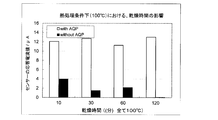
- FIG. 4 is a graph showing the result of Test 2, that is, the relationship between the response current value ( ⁇ A) and the drying time (min) for the eight types of samples described above.
- the result of the sample according to Example 1 is shown by a white bar graph
- the result of the sample according to the comparative example is shown by a black bar graph.
- a measurement is performed using two samples for every kind, and the result shown in FIG. 4 shows the average of two measurement results.
- the sample with no AQP added (Comparative Example) showed a tendency for the response sensitivity to decrease remarkably with an increase in the drying time, whereas AQP was added.
- the sample (Example 1) showed a tendency to maintain a suitable response sensitivity regardless of the change in the drying time (lengthening).
- the sample to which AQP is added can have a suitable heat resistance for a long time.
- ⁇ Test 3> four types of reagent solutions with different concentrations of AQP were prepared.
- the concentration (% by weight) of AQP was 0 (comparative example), 0.20%, 0.45% (Example 1), and 1%.
- the components in the reagent solution excluding AQP were prepared in the same manner as in Example 1.
- the reagent solution was dispensed on the electrodes in the same manner as in Test 1, and the drying temperature was 100 ° C. for 10 minutes, 30 minutes, 60 minutes, and 120 minutes. 16 types of enzyme electrodes (samples) dried at each drying temperature were obtained. And the response current value with respect to glucose was measured by the same method as Test 1.
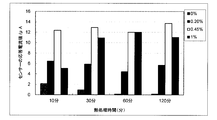
- FIG. 5 is a graph showing the results of Test 3, that is, the relationship between the drying time (heat treatment time) (minutes) and the response current value ( ⁇ A) for each sample.
- FIG. 5 four bar graphs are shown for each heat treatment time.
- the four bar graphs show response current values (response sensitivities) of AQP concentrations of 0, 0.20%, 0.45%, and 1% in order from the left.
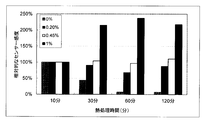
- FIG. 6 is a graph showing the relative response sensitivity (%) at heat treatment times of 30 minutes, 60 minutes, and 120 minutes when the response sensitivity at the heat treatment time of 10 minutes in Test 3 is 100%.
- four bar graphs are shown for each heat treatment time.
- the four bar graphs show relative response sensitivities of AQP concentrations of 0, 0.20%, 0.45%, and 1% in order from the left.
- Test 3 the measurement for one type of sample was performed twice using two samples of the same type.
- the results shown in FIGS. 5 and 6 show the average value of the two measurement results.
- the concentration of AQP is 1%
- the response sensitivity is more than twice as high as the response sensitivity when the heat treatment time is 10 minutes in any heat treatment time of 30 minutes, 60 minutes and 120 minutes.
- the upper limit concentration of polyaniline sulfonic acid for the enzyme electrode to obtain suitable heat resistance is 5% or less, preferably 1% or less, taking into account the ease of preparation of the enzyme electrode.
- the lower limit concentration for obtaining suitable heat resistance is 0.01% or more, preferably 0.2% or more, and more preferably 0.45% or more.
- the procedure for preparing the glucose sensor is as follows. That is, 0.1 ul of the mixed reagent was dropped on the electrode, allowed to stand at room temperature for 20 minutes, and then dried at a furnace temperature of 120 ° C. for 30 minutes using an oven.
- the glucose response current (response sensitivity) was measured by amperometry in a PBS (Phosphate Buffered Saline) solution. Specifically, the applied voltage is +0.4 V (vs. Ag / AgCl), and 2 M glucose aqueous solution is added so that the final concentration becomes 100 mg / dL after the background current reaches the plateau in the PBS solution. did.
- the response current value of the glucose sensor with respect to the addition of the aqueous glucose solution was recorded as the response current value after the addition, and the value obtained by subtracting the background current value was used as the response current value.
- FIG. 7 is a graph showing the results of Test 4 obtained by the above-described evaluation procedure.
- an appropriate response current value is obtained over a concentration of 0.1 to 2%.
- enzymes are inactivated at high temperatures.
- an appropriate response current value can be obtained even at a high temperature of 120 ° C., it can be seen that the enzyme is appropriately protected from heat by polyaniline sulfonic acid.
- the range that can be taken as the concentration of polyaniline sulfonic acid is 5% or less, preferably 2% or less, more preferably 1% or less, considering the ease of production of the enzyme electrode.
- the lower limit concentration for obtaining heat resistance is 0.01% or more, preferably 0.2% or more, and more preferably 0.45% or more, from the results shown in FIG. Can do.
- Test 5 the results of testing the influence of the heat treatment time of the glucose sensor will be described.
- a mixed reagent having the composition described with respect to test 4 was dropped onto a 0.1 ul electrode, allowed to stand at room temperature for 20 minutes, and then used in an oven at a predetermined furnace temperature (100 ° C.).
- a plurality of glucose sensors that had undergone heat treatment for a plurality of different drying times were used.
- the electrode configuration of the glucose sensor and the evaluation procedure in Test 5 are the same as in Test 4.
- FIG. 8 is a graph showing the results of Test 5.
- FIG. 8 shows four graphs showing the relationship between the polymer concentration and the response current value for four heat treatment times (10 minutes, 30 minutes, 60 minutes, and 120 minutes). It can be seen that at any polymer concentration, a response current value applicable as a glucose sensor is obtained without being affected by the heat treatment time. Therefore, it can be seen that a glucose sensor using polyaniline sulfonic acid is not significantly affected by response sensitivity even when kept at a high temperature for a long time (appropriate heat resistance can be exhibited).
- the enzyme electrode 10 can be applied to, for example, a biosensor or an electronic device (for example, a measuring device) that is applied to glucose measurement as described above.
- a power supply device that supplies current generated by an enzyme reaction (current due to electrons transmitted to the electrode) as power to the load through a supply unit that connects the electrode and the load.
- the electronic device can include an electronic device including the biosensor to which the enzyme electrode according to the embodiment is applied, and an electronic device including the device (power supply device) to which the enzyme electrode according to the embodiment is applied.
Landscapes
- Chemical & Material Sciences (AREA)
- Health & Medical Sciences (AREA)
- Life Sciences & Earth Sciences (AREA)
- Organic Chemistry (AREA)
- General Health & Medical Sciences (AREA)
- Molecular Biology (AREA)
- Immunology (AREA)
- Physics & Mathematics (AREA)
- Analytical Chemistry (AREA)
- Biochemistry (AREA)
- Wood Science & Technology (AREA)
- Zoology (AREA)
- Proteomics, Peptides & Aminoacids (AREA)
- Engineering & Computer Science (AREA)
- Chemical Kinetics & Catalysis (AREA)
- Electrochemistry (AREA)
- Pathology (AREA)
- Biophysics (AREA)
- Hematology (AREA)
- General Physics & Mathematics (AREA)
- Microbiology (AREA)
- Biotechnology (AREA)
- Bioinformatics & Cheminformatics (AREA)
- General Engineering & Computer Science (AREA)
- Genetics & Genomics (AREA)
- Emergency Medicine (AREA)
- Measuring Or Testing Involving Enzymes Or Micro-Organisms (AREA)
- Apparatus Associated With Microorganisms And Enzymes (AREA)
Priority Applications (5)
| Application Number | Priority Date | Filing Date | Title |
|---|---|---|---|
| CN201380033506.6A CN104520700B (zh) | 2012-06-25 | 2013-06-25 | 酶电极 |
| BR112014032201A BR112014032201A2 (pt) | 2012-06-25 | 2013-06-25 | eletrodo de enzima |
| US14/410,704 US20150129425A1 (en) | 2012-06-25 | 2013-06-25 | Enzyme Electrode |
| EP13808596.4A EP2866024B1 (fr) | 2012-06-25 | 2013-06-25 | Électrode enzymatique |
| JP2014522638A JP6186630B2 (ja) | 2012-06-25 | 2013-06-25 | 酵素電極 |
Applications Claiming Priority (2)
| Application Number | Priority Date | Filing Date | Title |
|---|---|---|---|
| JP2012142376 | 2012-06-25 | ||
| JP2012-142376 | 2012-06-25 |
Publications (1)
| Publication Number | Publication Date |
|---|---|
| WO2014002999A1 true WO2014002999A1 (fr) | 2014-01-03 |
Family
ID=49783145
Family Applications (1)
| Application Number | Title | Priority Date | Filing Date |
|---|---|---|---|
| PCT/JP2013/067382 Ceased WO2014002999A1 (fr) | 2012-06-25 | 2013-06-25 | Électrode enzymatique |
Country Status (6)
| Country | Link |
|---|---|
| US (1) | US20150129425A1 (fr) |
| EP (1) | EP2866024B1 (fr) |
| JP (1) | JP6186630B2 (fr) |
| CN (1) | CN104520700B (fr) |
| BR (1) | BR112014032201A2 (fr) |
| WO (1) | WO2014002999A1 (fr) |
Cited By (10)
| Publication number | Priority date | Publication date | Assignee | Title |
|---|---|---|---|---|
| WO2015148231A1 (fr) * | 2014-03-25 | 2015-10-01 | The Procter & Gamble Company | Appareil permettant de capter les changements de ph dans l'environnement |
| CN105492902A (zh) * | 2013-08-07 | 2016-04-13 | 爱科来株式会社 | 使用电化学式生物传感器的物质测量方法和测量装置 |
| EP3037812A1 (fr) * | 2014-12-24 | 2016-06-29 | ARKRAY, Inc. | Électrode à enzyme |
| JP2017075940A (ja) * | 2015-10-15 | 2017-04-20 | アークレイ株式会社 | バイオセンサ |
| JP2017173317A (ja) * | 2016-03-16 | 2017-09-28 | アークレイ株式会社 | 電気化学式バイオセンサを用いた物質の測定方法及び測定装置 |
| EP3447483A1 (fr) | 2017-08-25 | 2019-02-27 | ARKRAY, Inc. | Nouvelle biosensing technologie basée sur une mesure enzymatique électrochimique impedance |
| EP3572503A1 (fr) | 2018-05-22 | 2019-11-27 | ARKRAY, Inc. | Mutant de l'oxydase de glucose et son utilisation |
| JP2019203893A (ja) * | 2018-05-22 | 2019-11-28 | アークレイ株式会社 | 新規バイオセンシング法 |
| US11136612B2 (en) | 2016-08-29 | 2021-10-05 | National Institute Of Advanced Industrial Science And Technology | Reagent for glucose sensor, glucose sensor, method for manufacturing glucose sensor, and glucose measuring device |
| CN116528767A (zh) * | 2020-10-29 | 2023-08-01 | 美敦力迷你迈德公司 | 包含直接电子转移酶的葡萄糖生物传感器以及制备和使用它们的方法 |
Families Citing this family (10)
| Publication number | Priority date | Publication date | Assignee | Title |
|---|---|---|---|---|
| US10788439B2 (en) | 2014-03-25 | 2020-09-29 | The Procter & Gamble Company | Apparatus for sensing environmental moisture changes |
| US10914644B2 (en) | 2014-03-25 | 2021-02-09 | The Procter & Gamble Company | Apparatus for sensing material strain |
| US10788437B2 (en) | 2014-03-25 | 2020-09-29 | The Procter & Gamble Company | Apparatus for sensing environmental changes |
| US10782261B2 (en) | 2014-03-25 | 2020-09-22 | The Procter & Gamble Company | Apparatus for sensing environmental humidity changes |
| EP3156788B1 (fr) * | 2015-10-15 | 2018-12-26 | ARKRAY, Inc. | Biocapteur |
| JP6783108B2 (ja) * | 2015-10-15 | 2020-11-11 | アークレイ株式会社 | 酵素電極 |
| US10577637B2 (en) * | 2015-10-15 | 2020-03-03 | Arkray, Inc. | Enzyme electrode |
| EP3249050B1 (fr) * | 2016-05-23 | 2019-01-23 | ARKRAY, Inc. | Électrode à enzyme et biodétecteur l'utilisant |
| US10983087B2 (en) | 2016-05-26 | 2021-04-20 | Industrial Technology Research Institute | Structures and manufacture method of electrochemical units |
| TWI634698B (zh) * | 2016-05-26 | 2018-09-01 | 財團法人工業技術研究院 | 電化學單元結構及製法 |
Citations (10)
| Publication number | Priority date | Publication date | Assignee | Title |
|---|---|---|---|---|
| JPS6350748A (ja) | 1986-08-20 | 1988-03-03 | Sanyo Electric Co Ltd | 酵素電極システム |
| JPS6475956A (en) | 1987-09-18 | 1989-03-22 | Bridgestone Corp | Enzyme electrode |
| JPH0299849A (ja) * | 1988-07-28 | 1990-04-11 | Cambridge Life Sci Plc | 酵素電極およびその製造方法 |
| JPH04122849A (ja) * | 1990-09-14 | 1992-04-23 | Sumitomo Metal Ind Ltd | 酵素電極 |
| JPH09127041A (ja) * | 1995-10-30 | 1997-05-16 | Nippon Chibagaigii Kk | 酵素電極 |
| JPH10100306A (ja) | 1996-09-30 | 1998-04-21 | Kagaku Gijutsu Shinko Jigyodan | 機能性薄膜とその製造方法 |
| JP2004163385A (ja) * | 2002-09-17 | 2004-06-10 | Toto Ltd | バイオセンサおよびバイオセンサの製造方法 |
| WO2005030807A1 (fr) | 2003-09-30 | 2005-04-07 | Koji Sode | Protéine fusionnée glucose déhydrogénase/cytochrome |
| JP2006234788A (ja) | 2004-07-23 | 2006-09-07 | Canon Inc | 酵素電極、酵素電極を有するデバイス、センサ、燃料電池、電気化学的反応装置 |
| WO2009133679A1 (fr) * | 2008-04-30 | 2009-11-05 | 日本電気株式会社 | Procédé de fabrication d'une électrode pour biodétecteur et procédé de fabrication d'un biodétecteur |
Family Cites Families (10)
| Publication number | Priority date | Publication date | Assignee | Title |
|---|---|---|---|---|
| JP4721618B2 (ja) * | 2000-09-25 | 2011-07-13 | 旭化成株式会社 | 酵素電極 |
| ATE505724T1 (de) * | 2001-09-14 | 2011-04-15 | Arkray Inc | Verfahren, gerät und vorrichtung zur konzentrationsmessung |
| ATE403742T1 (de) * | 2002-06-17 | 2008-08-15 | Arkray Inc | Glucosesensor unter verwendung von glucosedehydrogenase |
| EP1577665B1 (fr) * | 2002-12-20 | 2013-06-26 | ARKRAY, Inc. | Bandalette de test mince |
| WO2005066638A1 (fr) * | 2004-01-07 | 2005-07-21 | Arkray, Inc. | Instrument analytique a agencement ameliore de section de reactif et procede analytique correspondant |
| US20080248354A1 (en) * | 2004-07-23 | 2008-10-09 | Canon Kabushiki Kaisha | Enzyme Electrode, and Device, Sensor, Fuel Cell and Electrochemical Reactor Employing the Enzyme Electrode |
| US8080385B2 (en) * | 2007-05-03 | 2011-12-20 | Abbott Diabetes Care Inc. | Crosslinked adduct of polyaniline and polymer acid containing redox enzyme for electrochemical sensor |
| JP5026873B2 (ja) * | 2007-07-04 | 2012-09-19 | 株式会社船井電機新応用技術研究所 | 酵素電極、酵素電極の製造方法及び酵素センサ |
| EP2395348B1 (fr) * | 2009-02-09 | 2014-01-22 | Arkray, Inc. | Capteur Électrochimique et son procédé de fabrication. |
| JP2014006155A (ja) * | 2012-06-25 | 2014-01-16 | Bioengineering Laboratories Llc | 酵素電極 |
-
2013
- 2013-06-25 BR BR112014032201A patent/BR112014032201A2/pt not_active Application Discontinuation
- 2013-06-25 US US14/410,704 patent/US20150129425A1/en not_active Abandoned
- 2013-06-25 JP JP2014522638A patent/JP6186630B2/ja active Active
- 2013-06-25 EP EP13808596.4A patent/EP2866024B1/fr active Active
- 2013-06-25 CN CN201380033506.6A patent/CN104520700B/zh active Active
- 2013-06-25 WO PCT/JP2013/067382 patent/WO2014002999A1/fr not_active Ceased
Patent Citations (10)
| Publication number | Priority date | Publication date | Assignee | Title |
|---|---|---|---|---|
| JPS6350748A (ja) | 1986-08-20 | 1988-03-03 | Sanyo Electric Co Ltd | 酵素電極システム |
| JPS6475956A (en) | 1987-09-18 | 1989-03-22 | Bridgestone Corp | Enzyme electrode |
| JPH0299849A (ja) * | 1988-07-28 | 1990-04-11 | Cambridge Life Sci Plc | 酵素電極およびその製造方法 |
| JPH04122849A (ja) * | 1990-09-14 | 1992-04-23 | Sumitomo Metal Ind Ltd | 酵素電極 |
| JPH09127041A (ja) * | 1995-10-30 | 1997-05-16 | Nippon Chibagaigii Kk | 酵素電極 |
| JPH10100306A (ja) | 1996-09-30 | 1998-04-21 | Kagaku Gijutsu Shinko Jigyodan | 機能性薄膜とその製造方法 |
| JP2004163385A (ja) * | 2002-09-17 | 2004-06-10 | Toto Ltd | バイオセンサおよびバイオセンサの製造方法 |
| WO2005030807A1 (fr) | 2003-09-30 | 2005-04-07 | Koji Sode | Protéine fusionnée glucose déhydrogénase/cytochrome |
| JP2006234788A (ja) | 2004-07-23 | 2006-09-07 | Canon Inc | 酵素電極、酵素電極を有するデバイス、センサ、燃料電池、電気化学的反応装置 |
| WO2009133679A1 (fr) * | 2008-04-30 | 2009-11-05 | 日本電気株式会社 | Procédé de fabrication d'une électrode pour biodétecteur et procédé de fabrication d'un biodétecteur |
Non-Patent Citations (5)
| Title |
|---|
| A. KROS ET AL.: "Poly(pyrrole) versus poly(3,4-ethylenedioxythiophene): implications for biosensor applications", SENSORS AND ACTUATORS B, vol. 106, 2005, pages 289 - 295 |
| A. KROS ET AL.: "Symposia Papers Presented Before the Division of Environmental Chemistry", 21 March 1999, AMERICAN CHEMICAL SOCIETY, article "Third generation Polyethylenedioxythiophene (PEDOT) based glucose sensor" |
| BRIANNA C. THOMPSON ET AL., MACROMOL. RAPID COMMUN, vol. 31, 2010, pages 1293 - 1297 |
| C. G. J. KOOPAL ET AL.: "Glucose sensor utilizing polypyrrole incorporated in track-etch membranes as the mediator", BIOSENSOR AND BIOELECTRONICS, vol. 7, 1992, pages 461 - 471 |
| See also references of EP2866024A4 |
Cited By (17)
| Publication number | Priority date | Publication date | Assignee | Title |
|---|---|---|---|---|
| CN105492902A (zh) * | 2013-08-07 | 2016-04-13 | 爱科来株式会社 | 使用电化学式生物传感器的物质测量方法和测量装置 |
| EP3032250A4 (fr) * | 2013-08-07 | 2017-04-26 | ARKRAY, Inc. | Procédé de mesure de substance et dispositif de mesure employant un biocapteur électrochimique |
| WO2015148231A1 (fr) * | 2014-03-25 | 2015-10-01 | The Procter & Gamble Company | Appareil permettant de capter les changements de ph dans l'environnement |
| CN106104263A (zh) * | 2014-03-25 | 2016-11-09 | 宝洁公司 | 用于感测环境pH变化的设备 |
| EP3037812A1 (fr) * | 2014-12-24 | 2016-06-29 | ARKRAY, Inc. | Électrode à enzyme |
| CN105738446A (zh) * | 2014-12-24 | 2016-07-06 | 爱科来株式会社 | 酶电极 |
| JP2016121989A (ja) * | 2014-12-24 | 2016-07-07 | アークレイ株式会社 | 酵素電極 |
| JP2017075940A (ja) * | 2015-10-15 | 2017-04-20 | アークレイ株式会社 | バイオセンサ |
| JP2017173317A (ja) * | 2016-03-16 | 2017-09-28 | アークレイ株式会社 | 電気化学式バイオセンサを用いた物質の測定方法及び測定装置 |
| US11136612B2 (en) | 2016-08-29 | 2021-10-05 | National Institute Of Advanced Industrial Science And Technology | Reagent for glucose sensor, glucose sensor, method for manufacturing glucose sensor, and glucose measuring device |
| EP3447483A1 (fr) | 2017-08-25 | 2019-02-27 | ARKRAY, Inc. | Nouvelle biosensing technologie basée sur une mesure enzymatique électrochimique impedance |
| EP3572503A1 (fr) | 2018-05-22 | 2019-11-27 | ARKRAY, Inc. | Mutant de l'oxydase de glucose et son utilisation |
| JP2019203893A (ja) * | 2018-05-22 | 2019-11-28 | アークレイ株式会社 | 新規バイオセンシング法 |
| EP3578665A1 (fr) | 2018-05-22 | 2019-12-11 | ARKRAY, Inc. | Procédé de biodétection |
| US11608515B2 (en) | 2018-05-22 | 2023-03-21 | Arkray, Inc. | Biosensing method |
| JP7278147B2 (ja) | 2018-05-22 | 2023-05-19 | アークレイ株式会社 | 新規バイオセンシング法 |
| CN116528767A (zh) * | 2020-10-29 | 2023-08-01 | 美敦力迷你迈德公司 | 包含直接电子转移酶的葡萄糖生物传感器以及制备和使用它们的方法 |
Also Published As
| Publication number | Publication date |
|---|---|
| EP2866024A4 (fr) | 2016-03-09 |
| JPWO2014002999A1 (ja) | 2016-06-02 |
| JP6186630B2 (ja) | 2017-08-30 |
| BR112014032201A2 (pt) | 2017-06-27 |
| CN104520700B (zh) | 2016-08-17 |
| US20150129425A1 (en) | 2015-05-14 |
| EP2866024A1 (fr) | 2015-04-29 |
| CN104520700A (zh) | 2015-04-15 |
| EP2866024B1 (fr) | 2020-03-18 |
Similar Documents
| Publication | Publication Date | Title |
|---|---|---|
| JP6186630B2 (ja) | 酵素電極 | |
| Graça et al. | Amperometric glucose biosensor based on layer-by-layer films of microperoxidase-11 and liposome-encapsulated glucose oxidase | |
| Wu et al. | Amperometric glucose biosensor based on multilayer films via layer-by-layer self-assembly of multi-wall carbon nanotubes, gold nanoparticles and glucose oxidase on the Pt electrode | |
| CN105492902B (zh) | 使用电化学式生物传感器的物质测量方法和测量装置 | |
| US9952197B2 (en) | Biosensor comprising electrode for measuring hematocrit value | |
| Sahin et al. | Electrooxidation of NADH on modified screen-printed electrodes: effects of conducting polymer and nanomaterials | |
| US10309888B2 (en) | Biosensor comprising electrode for measuring hematocrit value | |
| US20160186230A1 (en) | Enzyme Electrode | |
| JP2014006155A (ja) | 酵素電極 | |
| Azak et al. | Synthesis of an amine-functionalized naphthalene-containing conducting polymer as a matrix for biomolecule immobilization | |
| AU635432B2 (en) | Conductive sensors and their use in diagnostic assays | |
| Buber et al. | A bio-sensing platform utilizing a conjugated polymer, carbon nanotubes and PAMAM combination | |
| CN112042026A (zh) | 新型介体 | |
| Ramanavicius et al. | Potentiometric study of quinohemoprotein alcohol dehydrogenase immobilized on the carbon rod electrode | |
| Zor et al. | Amperometric glucose biosensor based on glucose oxidase, 1, 10-phenanthroline-5, 6-dione and carbon nanotubes | |
| EP3156788B1 (fr) | Biocapteur | |
| KR100824731B1 (ko) | 바이오센서 및 그 제조방법 | |
| Ekanayake et al. | An amperometric glucose biosensor with enhanced measurement stability and sensitivity using an artificially porous conducting polymer | |
| JP7522409B2 (ja) | Cnt及びフルクトースデヒドロゲナーゼの電極への利用 | |
| Xu et al. | An Au nanocomposite based biosensor for determination of cholesterol | |
| US10577637B2 (en) | Enzyme electrode | |
| JP2006275819A (ja) | バイオセンサ | |
| JP6783109B2 (ja) | バイオセンサ | |
| CN107037101B (zh) | 酶电极 | |
| JP4856697B2 (ja) | バイオセンサの製造方法、及びバイオセンサ |
Legal Events
| Date | Code | Title | Description |
|---|---|---|---|
| 121 | Ep: the epo has been informed by wipo that ep was designated in this application |
Ref document number: 13808596 Country of ref document: EP Kind code of ref document: A1 |
|
| ENP | Entry into the national phase |
Ref document number: 2014522638 Country of ref document: JP Kind code of ref document: A |
|
| WWE | Wipo information: entry into national phase |
Ref document number: 14410704 Country of ref document: US |
|
| NENP | Non-entry into the national phase |
Ref country code: DE |
|
| REG | Reference to national code |
Ref country code: BR Ref legal event code: B01A Ref document number: 112014032201 Country of ref document: BR |
|
| ENP | Entry into the national phase |
Ref document number: 112014032201 Country of ref document: BR Kind code of ref document: A2 Effective date: 20141222 |