EP2331536B1 - Insektizide verbindungen - Google Patents
Insektizide verbindungen Download PDFInfo
- Publication number
- EP2331536B1 EP2331536B1 EP09781037.8A EP09781037A EP2331536B1 EP 2331536 B1 EP2331536 B1 EP 2331536B1 EP 09781037 A EP09781037 A EP 09781037A EP 2331536 B1 EP2331536 B1 EP 2331536B1
- Authority
- EP
- European Patent Office
- Prior art keywords
- methyl
- trifluoromethyl
- alkyl
- dichloro
- phenyl
- Prior art date
- Legal status (The legal status is an assumption and is not a legal conclusion. Google has not performed a legal analysis and makes no representation as to the accuracy of the status listed.)
- Not-in-force
Links
- 0 *=C(C(C1)(c2cc(Cl)cc(Cl)c2)ON=C1c1n[o]c(C(NC2CSC2)=O)c1)F Chemical compound *=C(C(C1)(c2cc(Cl)cc(Cl)c2)ON=C1c1n[o]c(C(NC2CSC2)=O)c1)F 0.000 description 6
- WBZKPYIYBJKLDC-UHFFFAOYSA-N CC1(CSC1)NC(c(cc1)c(C)cc1C(C1)=NN(C)C1(C(F)(F)F)c1cc(Cl)cc(Cl)c1)=O Chemical compound CC1(CSC1)NC(c(cc1)c(C)cc1C(C1)=NN(C)C1(C(F)(F)F)c1cc(Cl)cc(Cl)c1)=O WBZKPYIYBJKLDC-UHFFFAOYSA-N 0.000 description 2
- PKBGXQDYBCCHLQ-UHFFFAOYSA-N Cc1cc(C2=NOC(C(F)(F)F)(c3cc(Cl)cc(Cl)c3)O2)ccc1C(NC1CSC1)=O Chemical compound Cc1cc(C2=NOC(C(F)(F)F)(c3cc(Cl)cc(Cl)c3)O2)ccc1C(NC1CSC1)=O PKBGXQDYBCCHLQ-UHFFFAOYSA-N 0.000 description 2
- YVQJYKOHUKAQMY-VCHYOVAHSA-N CC(C)(C)COC(c1c(cccc2/C=N/O)c2ccc1)=O Chemical compound CC(C)(C)COC(c1c(cccc2/C=N/O)c2ccc1)=O YVQJYKOHUKAQMY-VCHYOVAHSA-N 0.000 description 1
- VMBLIXPKLRBDTA-RIYZIHGNSA-M CC(C)(C)OC(c1ccc(/C=N/[O-])cc1C)=O Chemical compound CC(C)(C)OC(c1ccc(/C=N/[O-])cc1C)=O VMBLIXPKLRBDTA-RIYZIHGNSA-M 0.000 description 1
- GGIKLRFETONNAG-UHFFFAOYSA-N CC(C)(C)OC(c1ccc(C(C2)N(C)OC2(C(F)(F)F)c2cc(Cl)cc(Cl)c2)cc1C)=O Chemical compound CC(C)(C)OC(c1ccc(C(C2)N(C)OC2(C(F)(F)F)c2cc(Cl)cc(Cl)c2)cc1C)=O GGIKLRFETONNAG-UHFFFAOYSA-N 0.000 description 1
- AUBIZGDRTQAOGD-UHFFFAOYSA-N CC(C)(C)OC(c1ccc(C=O)cc1C)=O Chemical compound CC(C)(C)OC(c1ccc(C=O)cc1C)=O AUBIZGDRTQAOGD-UHFFFAOYSA-N 0.000 description 1
- WWICRGGMQIAAIU-IQAHWBOSSA-N CC1(CSC1)NC(C(/C(/C)=C\C(\C(/C1=N\O)=NOC1(C(F)(F)F)c1cc(Cl)cc(Cl)c1)=C/C)=C)=O Chemical compound CC1(CSC1)NC(C(/C(/C)=C\C(\C(/C1=N\O)=NOC1(C(F)(F)F)c1cc(Cl)cc(Cl)c1)=C/C)=C)=O WWICRGGMQIAAIU-IQAHWBOSSA-N 0.000 description 1
- ALHKDDATIKGNOH-UHFFFAOYSA-N CC1(CSC1)NC(c(c(C)c1)ccc1N(CC(C(F)(F)F)(c1cc(Cl)cc(Cl)c1)O1)C1=O)=O Chemical compound CC1(CSC1)NC(c(c(C)c1)ccc1N(CC(C(F)(F)F)(c1cc(Cl)cc(Cl)c1)O1)C1=O)=O ALHKDDATIKGNOH-UHFFFAOYSA-N 0.000 description 1
- AFHACZZILSPLIL-UHFFFAOYSA-N CC1(CSC1)NC(c(cc1)c(C)cc1C(C1O)=NOC1(C(F)(F)F)c1cc(Cl)cc(Cl)c1)=O Chemical compound CC1(CSC1)NC(c(cc1)c(C)cc1C(C1O)=NOC1(C(F)(F)F)c1cc(Cl)cc(Cl)c1)=O AFHACZZILSPLIL-UHFFFAOYSA-N 0.000 description 1
- ZDJGJUYOCXELAR-UHFFFAOYSA-N CC1(CSC1)NC(c(cc1)c(cccc2)c2c1C(C1)=NOC1(C(F)(F)F)c1cc(Cl)cc(Cl)c1)=O Chemical compound CC1(CSC1)NC(c(cc1)c(cccc2)c2c1C(C1)=NOC1(C(F)(F)F)c1cc(Cl)cc(Cl)c1)=O ZDJGJUYOCXELAR-UHFFFAOYSA-N 0.000 description 1
- IDMHCONZTCGTKW-UHFFFAOYSA-N CC1(CSC1)NC(c(cc1)c(cccc2)c2c1C(C1Br)=NOC1(C(F)(F)F)c1cc(Cl)cc(Cl)c1)=O Chemical compound CC1(CSC1)NC(c(cc1)c(cccc2)c2c1C(C1Br)=NOC1(C(F)(F)F)c1cc(Cl)cc(Cl)c1)=O IDMHCONZTCGTKW-UHFFFAOYSA-N 0.000 description 1
- UWVWMZJSJJWCAB-UHFFFAOYSA-N CC1C(c(cc2)cc(C)c2C(NC2CSC2)=O)=NOC1(C(F)(F)F)c1cc(Cl)cc(Cl)c1 Chemical compound CC1C(c(cc2)cc(C)c2C(NC2CSC2)=O)=NOC1(C(F)(F)F)c1cc(Cl)cc(Cl)c1 UWVWMZJSJJWCAB-UHFFFAOYSA-N 0.000 description 1
- WOIZZXRMBKVOAZ-UHFFFAOYSA-N CCOC(c1ccc(C(C2)N=CC2(C(F)(F)F)c2cc(Cl)cc(Cl)c2)cc1C)=O Chemical compound CCOC(c1ccc(C(C2)N=CC2(C(F)(F)F)c2cc(Cl)cc(Cl)c2)cc1C)=O WOIZZXRMBKVOAZ-UHFFFAOYSA-N 0.000 description 1
- FHCNMPYMCKHBTK-UHFFFAOYSA-N COC(c1cccc(O)c1[N+]([O-])=O)=O Chemical compound COC(c1cccc(O)c1[N+]([O-])=O)=O FHCNMPYMCKHBTK-UHFFFAOYSA-N 0.000 description 1
- ADFCNUZHJARRAE-UHFFFAOYSA-N C[n](c(C(NC(C1)CS1(=O)=O)=O)c1)nc1C(C1)=NOC1(C(F)(F)F)c1cc(Cl)cc(Cl)c1 Chemical compound C[n](c(C(NC(C1)CS1(=O)=O)=O)c1)nc1C(C1)=NOC1(C(F)(F)F)c1cc(Cl)cc(Cl)c1 ADFCNUZHJARRAE-UHFFFAOYSA-N 0.000 description 1
- BWOUZOYFGBHASY-UHFFFAOYSA-N C[n](c(C(NC(C1)CS1=O)=O)c1)nc1C(C1)=NOC1(C(F)(F)F)c1cc(Cl)cc(Cl)c1 Chemical compound C[n](c(C(NC(C1)CS1=O)=O)c1)nc1C(C1)=NOC1(C(F)(F)F)c1cc(Cl)cc(Cl)c1 BWOUZOYFGBHASY-UHFFFAOYSA-N 0.000 description 1
- ITJIZROHXGDDSY-UHFFFAOYSA-N C[n](c(C(NC1CSC1)=O)c1)nc1C(C1)=NOC1(C(F)(F)F)c1cc(Cl)cc(Cl)c1 Chemical compound C[n](c(C(NC1CSC1)=O)c1)nc1C(C1)=NOC1(C(F)(F)F)c1cc(Cl)cc(Cl)c1 ITJIZROHXGDDSY-UHFFFAOYSA-N 0.000 description 1
- DZSFJPBGEUUHFA-UHFFFAOYSA-N Cc([o]c1c(cc2)C(NC(C3)CS3(=O)=O)=O)nc1c2C(C1)=NOC1(C(F)(F)F)C1=CCC(CCl)C(Cl)=C1 Chemical compound Cc([o]c1c(cc2)C(NC(C3)CS3(=O)=O)=O)nc1c2C(C1)=NOC1(C(F)(F)F)C1=CCC(CCl)C(Cl)=C1 DZSFJPBGEUUHFA-UHFFFAOYSA-N 0.000 description 1
- BRXGVWLXKPBCHR-UHFFFAOYSA-N Cc(cc(C(C1)N(C)OC1(C(F)(F)F)c1cc(Cl)cc(Cl)c1)cc1)c1C(NC1CSC1)=O Chemical compound Cc(cc(C(C1)N(C)OC1(C(F)(F)F)c1cc(Cl)cc(Cl)c1)cc1)c1C(NC1CSC1)=O BRXGVWLXKPBCHR-UHFFFAOYSA-N 0.000 description 1
- HXMIDAMGOGIIAD-MTDXEUNCSA-N Cc(cc(cc1)C(/C2=N\O)=NOC2(C(F)(F)F)c2cc(Cl)cc(Cl)c2)c1C(NC(C1)CS1(=O)=O)=O Chemical compound Cc(cc(cc1)C(/C2=N\O)=NOC2(C(F)(F)F)c2cc(Cl)cc(Cl)c2)c1C(NC(C1)CS1(=O)=O)=O HXMIDAMGOGIIAD-MTDXEUNCSA-N 0.000 description 1
- AWRFXLWMNZOCKQ-MTDXEUNCSA-N Cc(cc(cc1)C(/C2=N\O)=NOC2(C(F)(F)F)c2cc(Cl)cc(Cl)c2)c1C(NC1CSC1)=O Chemical compound Cc(cc(cc1)C(/C2=N\O)=NOC2(C(F)(F)F)c2cc(Cl)cc(Cl)c2)c1C(NC1CSC1)=O AWRFXLWMNZOCKQ-MTDXEUNCSA-N 0.000 description 1
- PCAQBWLEFFQXDR-UHFFFAOYSA-N Cc(cc(cc1)C(C2F)=NOC2(C(F)(F)F)c2cc(Cl)cc(Cl)c2)c1C(NC(C1)CS1(=O)=O)=O Chemical compound Cc(cc(cc1)C(C2F)=NOC2(C(F)(F)F)c2cc(Cl)cc(Cl)c2)c1C(NC(C1)CS1(=O)=O)=O PCAQBWLEFFQXDR-UHFFFAOYSA-N 0.000 description 1
- XJEUQTBHMMZTGT-UHFFFAOYSA-N Cc(cc(cc1)C(C2SC)=NOC2(C(F)(F)F)c2cc(Cl)cc(Cl)c2)c1C(NC1CSC1)=O Chemical compound Cc(cc(cc1)C(C2SC)=NOC2(C(F)(F)F)c2cc(Cl)cc(Cl)c2)c1C(NC1CSC1)=O XJEUQTBHMMZTGT-UHFFFAOYSA-N 0.000 description 1
- RQVSXEGJGIDCFQ-UHFFFAOYSA-N Cc1cc(C(C2)N(C)OC2(C(F)(F)F)c2cc(Cl)cc(Cl)c2)ccc1C(O)=O Chemical compound Cc1cc(C(C2)N(C)OC2(C(F)(F)F)c2cc(Cl)cc(Cl)c2)ccc1C(O)=O RQVSXEGJGIDCFQ-UHFFFAOYSA-N 0.000 description 1
- QQEBJIOTQYZRQX-UHFFFAOYSA-N Cc1cc(C(C2)N=CC2(C(F)(F)F)c2cc(Cl)cc(Cl)c2)ccc1Br Chemical compound Cc1cc(C(C2)N=CC2(C(F)(F)F)c2cc(Cl)cc(Cl)c2)ccc1Br QQEBJIOTQYZRQX-UHFFFAOYSA-N 0.000 description 1
- AEASBMWGTSVHKT-UHFFFAOYSA-N Cc1cc(C)cc(CC(F)(F)F)c1 Chemical compound Cc1cc(C)cc(CC(F)(F)F)c1 AEASBMWGTSVHKT-UHFFFAOYSA-N 0.000 description 1
- NUWRMNDFKGVDBT-UHFFFAOYSA-N Cc1cc(CN)ccc1Br Chemical compound Cc1cc(CN)ccc1Br NUWRMNDFKGVDBT-UHFFFAOYSA-N 0.000 description 1
- XTDYEKYKOXMARU-UHFFFAOYSA-N Cc1cc(CNC=O)ccc1Br Chemical compound Cc1cc(CNC=O)ccc1Br XTDYEKYKOXMARU-UHFFFAOYSA-N 0.000 description 1
- ZPEXAEXLJDNZAK-UHFFFAOYSA-N O=C(c(cc1)c(cccc2)c2c1C(C1)=NOC1(C(F)(F)F)c1cc(Cl)cc(Cl)c1)NC(C1)CS1(=O)=O Chemical compound O=C(c(cc1)c(cccc2)c2c1C(C1)=NOC1(C(F)(F)F)c1cc(Cl)cc(Cl)c1)NC(C1)CS1(=O)=O ZPEXAEXLJDNZAK-UHFFFAOYSA-N 0.000 description 1
- XZYUONXFALRTOL-UHFFFAOYSA-N O=C(c(cc1)c(cccc2)c2c1C(C1)=NOC1(C(F)(F)F)c1cc(Cl)cc(Cl)c1)NC(C1)CS1=O Chemical compound O=C(c(cc1)c(cccc2)c2c1C(C1)=NOC1(C(F)(F)F)c1cc(Cl)cc(Cl)c1)NC(C1)CS1=O XZYUONXFALRTOL-UHFFFAOYSA-N 0.000 description 1
- XRMZDHUIHSNGGG-UHFFFAOYSA-N O=C(c(cc1)c(cccc2)c2c1C(C1)=NOC1(C(F)(F)F)c1cc(Cl)cc(Cl)c1)NC1CSC1 Chemical compound O=C(c(cc1)c(cccc2)c2c1C(C1)=NOC1(C(F)(F)F)c1cc(Cl)cc(Cl)c1)NC1CSC1 XRMZDHUIHSNGGG-UHFFFAOYSA-N 0.000 description 1
- IEMCMQKZPNCHEW-UHFFFAOYSA-N O=C(c1cc(C(C2)=NOC2(C(F)(F)F)c2cc(Cl)cc(Cl)c2)n[o]1)NC(C1)CS1(=O)=O Chemical compound O=C(c1cc(C(C2)=NOC2(C(F)(F)F)c2cc(Cl)cc(Cl)c2)n[o]1)NC(C1)CS1(=O)=O IEMCMQKZPNCHEW-UHFFFAOYSA-N 0.000 description 1
- JHWDBLQVRJTASQ-UHFFFAOYSA-N O=C(c1cccc2c1cccc2C(C1)=NOC1(C(F)(F)F)c1cc(Cl)cc(Cl)c1)NC(C1)CS1=O Chemical compound O=C(c1cccc2c1cccc2C(C1)=NOC1(C(F)(F)F)c1cc(Cl)cc(Cl)c1)NC(C1)CS1=O JHWDBLQVRJTASQ-UHFFFAOYSA-N 0.000 description 1
- XGQDLTGZMFFFLA-UHFFFAOYSA-N O=CC(C1)=NOC1(C(F)(F)F)c1cc(Cl)cc(Cl)c1 Chemical compound O=CC(C1)=NOC1(C(F)(F)F)c1cc(Cl)cc(Cl)c1 XGQDLTGZMFFFLA-UHFFFAOYSA-N 0.000 description 1
- CHXKOOKVHFXGLC-UHFFFAOYSA-N OCC(C1)=NOC1(C(F)(F)F)c1cc(Cl)cc(Cl)c1 Chemical compound OCC(C1)=NOC1(C(F)(F)F)c1cc(Cl)cc(Cl)c1 CHXKOOKVHFXGLC-UHFFFAOYSA-N 0.000 description 1
- KPDBKQKRDJPBRM-UHFFFAOYSA-N [O-][N+](c(c(O)ccc1)c1C(O)=O)=O Chemical compound [O-][N+](c(c(O)ccc1)c1C(O)=O)=O KPDBKQKRDJPBRM-UHFFFAOYSA-N 0.000 description 1
Classifications
-
- C—CHEMISTRY; METALLURGY
- C07—ORGANIC CHEMISTRY
- C07D—HETEROCYCLIC COMPOUNDS
- C07D413/00—Heterocyclic compounds containing two or more hetero rings, at least one ring having nitrogen and oxygen atoms as the only ring hetero atoms
- C07D413/02—Heterocyclic compounds containing two or more hetero rings, at least one ring having nitrogen and oxygen atoms as the only ring hetero atoms containing two hetero rings
- C07D413/12—Heterocyclic compounds containing two or more hetero rings, at least one ring having nitrogen and oxygen atoms as the only ring hetero atoms containing two hetero rings linked by a chain containing hetero atoms as chain links
-
- A—HUMAN NECESSITIES
- A01—AGRICULTURE; FORESTRY; ANIMAL HUSBANDRY; HUNTING; TRAPPING; FISHING
- A01N—PRESERVATION OF BODIES OF HUMANS OR ANIMALS OR PLANTS OR PARTS THEREOF; BIOCIDES, e.g. AS DISINFECTANTS, AS PESTICIDES OR AS HERBICIDES; PEST REPELLANTS OR ATTRACTANTS; PLANT GROWTH REGULATORS
- A01N43/00—Biocides, pest repellants or attractants, or plant growth regulators containing heterocyclic compounds
- A01N43/34—Biocides, pest repellants or attractants, or plant growth regulators containing heterocyclic compounds having rings with one nitrogen atom as the only ring hetero atom
- A01N43/36—Biocides, pest repellants or attractants, or plant growth regulators containing heterocyclic compounds having rings with one nitrogen atom as the only ring hetero atom five-membered rings
-
- A—HUMAN NECESSITIES
- A01—AGRICULTURE; FORESTRY; ANIMAL HUSBANDRY; HUNTING; TRAPPING; FISHING
- A01N—PRESERVATION OF BODIES OF HUMANS OR ANIMALS OR PLANTS OR PARTS THEREOF; BIOCIDES, e.g. AS DISINFECTANTS, AS PESTICIDES OR AS HERBICIDES; PEST REPELLANTS OR ATTRACTANTS; PLANT GROWTH REGULATORS
- A01N43/00—Biocides, pest repellants or attractants, or plant growth regulators containing heterocyclic compounds
- A01N43/34—Biocides, pest repellants or attractants, or plant growth regulators containing heterocyclic compounds having rings with one nitrogen atom as the only ring hetero atom
- A01N43/44—Biocides, pest repellants or attractants, or plant growth regulators containing heterocyclic compounds having rings with one nitrogen atom as the only ring hetero atom three- or four-membered rings
-
- A—HUMAN NECESSITIES
- A01—AGRICULTURE; FORESTRY; ANIMAL HUSBANDRY; HUNTING; TRAPPING; FISHING
- A01N—PRESERVATION OF BODIES OF HUMANS OR ANIMALS OR PLANTS OR PARTS THEREOF; BIOCIDES, e.g. AS DISINFECTANTS, AS PESTICIDES OR AS HERBICIDES; PEST REPELLANTS OR ATTRACTANTS; PLANT GROWTH REGULATORS
- A01N43/00—Biocides, pest repellants or attractants, or plant growth regulators containing heterocyclic compounds
- A01N43/48—Biocides, pest repellants or attractants, or plant growth regulators containing heterocyclic compounds having rings with two nitrogen atoms as the only ring hetero atoms
- A01N43/56—1,2-Diazoles; Hydrogenated 1,2-diazoles
-
- A—HUMAN NECESSITIES
- A01—AGRICULTURE; FORESTRY; ANIMAL HUSBANDRY; HUNTING; TRAPPING; FISHING
- A01N—PRESERVATION OF BODIES OF HUMANS OR ANIMALS OR PLANTS OR PARTS THEREOF; BIOCIDES, e.g. AS DISINFECTANTS, AS PESTICIDES OR AS HERBICIDES; PEST REPELLANTS OR ATTRACTANTS; PLANT GROWTH REGULATORS
- A01N43/00—Biocides, pest repellants or attractants, or plant growth regulators containing heterocyclic compounds
- A01N43/72—Biocides, pest repellants or attractants, or plant growth regulators containing heterocyclic compounds having rings with nitrogen atoms and oxygen or sulfur atoms as ring hetero atoms
- A01N43/74—Biocides, pest repellants or attractants, or plant growth regulators containing heterocyclic compounds having rings with nitrogen atoms and oxygen or sulfur atoms as ring hetero atoms five-membered rings with one nitrogen atom and either one oxygen atom or one sulfur atom in positions 1,3
- A01N43/76—1,3-Oxazoles; Hydrogenated 1,3-oxazoles
-
- A—HUMAN NECESSITIES
- A01—AGRICULTURE; FORESTRY; ANIMAL HUSBANDRY; HUNTING; TRAPPING; FISHING
- A01N—PRESERVATION OF BODIES OF HUMANS OR ANIMALS OR PLANTS OR PARTS THEREOF; BIOCIDES, e.g. AS DISINFECTANTS, AS PESTICIDES OR AS HERBICIDES; PEST REPELLANTS OR ATTRACTANTS; PLANT GROWTH REGULATORS
- A01N43/00—Biocides, pest repellants or attractants, or plant growth regulators containing heterocyclic compounds
- A01N43/72—Biocides, pest repellants or attractants, or plant growth regulators containing heterocyclic compounds having rings with nitrogen atoms and oxygen or sulfur atoms as ring hetero atoms
- A01N43/80—Biocides, pest repellants or attractants, or plant growth regulators containing heterocyclic compounds having rings with nitrogen atoms and oxygen or sulfur atoms as ring hetero atoms five-membered rings with one nitrogen atom and either one oxygen atom or one sulfur atom in positions 1,2
-
- A—HUMAN NECESSITIES
- A01—AGRICULTURE; FORESTRY; ANIMAL HUSBANDRY; HUNTING; TRAPPING; FISHING
- A01N—PRESERVATION OF BODIES OF HUMANS OR ANIMALS OR PLANTS OR PARTS THEREOF; BIOCIDES, e.g. AS DISINFECTANTS, AS PESTICIDES OR AS HERBICIDES; PEST REPELLANTS OR ATTRACTANTS; PLANT GROWTH REGULATORS
- A01N43/00—Biocides, pest repellants or attractants, or plant growth regulators containing heterocyclic compounds
- A01N43/72—Biocides, pest repellants or attractants, or plant growth regulators containing heterocyclic compounds having rings with nitrogen atoms and oxygen or sulfur atoms as ring hetero atoms
- A01N43/82—Biocides, pest repellants or attractants, or plant growth regulators containing heterocyclic compounds having rings with nitrogen atoms and oxygen or sulfur atoms as ring hetero atoms five-membered rings with three ring hetero atoms
-
- C—CHEMISTRY; METALLURGY
- C07—ORGANIC CHEMISTRY
- C07D—HETEROCYCLIC COMPOUNDS
- C07D409/00—Heterocyclic compounds containing two or more hetero rings, at least one ring having sulfur atoms as the only ring hetero atoms
- C07D409/02—Heterocyclic compounds containing two or more hetero rings, at least one ring having sulfur atoms as the only ring hetero atoms containing two hetero rings
- C07D409/12—Heterocyclic compounds containing two or more hetero rings, at least one ring having sulfur atoms as the only ring hetero atoms containing two hetero rings linked by a chain containing hetero atoms as chain links
-
- C—CHEMISTRY; METALLURGY
- C07—ORGANIC CHEMISTRY
- C07D—HETEROCYCLIC COMPOUNDS
- C07D413/00—Heterocyclic compounds containing two or more hetero rings, at least one ring having nitrogen and oxygen atoms as the only ring hetero atoms
- C07D413/14—Heterocyclic compounds containing two or more hetero rings, at least one ring having nitrogen and oxygen atoms as the only ring hetero atoms containing three or more hetero rings
-
- C—CHEMISTRY; METALLURGY
- C07—ORGANIC CHEMISTRY
- C07D—HETEROCYCLIC COMPOUNDS
- C07D417/00—Heterocyclic compounds containing two or more hetero rings, at least one ring having nitrogen and sulfur atoms as the only ring hetero atoms, not provided for by group C07D415/00
- C07D417/14—Heterocyclic compounds containing two or more hetero rings, at least one ring having nitrogen and sulfur atoms as the only ring hetero atoms, not provided for by group C07D415/00 containing three or more hetero rings
Definitions
- the present invention relates to certain tetracyclic derivatives with a sulfur-containing four-membered ring connected to the nitrogen atom of the amide group, to processes and intermediates for preparing these derivatives, to insecticidal, acaricidal, nematicidal and molluscicidal compositions comprising these derivatives and to methods of using these derivatives to control insect, acarine, nematode and mollusc pests.
- isoxazolines for controlling pests are disclosed in WO 2007/070606 and EP 1932 836 .
- Certain tetracyclic derivatives with a carbon only four-membered ring connected to the nitrogen atom of the amide group are disclosed in, for example, EP 1,731,512 and US 2007/066617 as having insecticidal properties.
- Certain tetracyclic derivatives with a sulfur-containing four-membered ring connected to the nitrogen atom of the amide group are disclosed in, for example, PCT/EP2008/010701 as having insecticidal properties.
- the compounds of PCT/EP2008/010701 have been excluded from the present invention.
- the present invention therefore provides a compound of formula (I) where A is aryl or heteroaryl; B is a saturated or partially unsaturated heterocyclyl; C is aryl or heteroaryl; G is oxygen or sulfur; m is 0, 1, 2, 3, 4 or 5; n is 0, 1, 2, 3, 4 or 5; o is 0, 1, 2, 3, 4 or 5; p is 1, 2, 3, 4 or 5; each R 1 is independently C 1 -C 8 alkyl; R 2 is hydrogen, C 1 -C 8 alkyl, C 1 -C 8 alkylcarbonyl-, or C 1 -C 8 alkoxycarbonyl-; each R 3 is independently halogen, cyano, nitro, C 1 -C 8 alkyl, C 1 -C 8 haloalkyl, C 2 -C 8 alkenyl, C 2 -C 8 haloalkenyl, C 2 -C 8 alkynyl, C 3 -C 10 cycloalkyl, C 1 -C 8 alk
- the compounds of formula (I) may exist in different geometric or optical isomers or tautomeric forms. This invention covers all such isomers and tautomers and mixtures thereof in all proportions as well as isotopic forms such as deuterated compounds.
- the compounds of the invention may contain one or more asymmetric carbon atoms, and may exist as enantiomers (or as pairs of diastereoisomers) or as mixtures of such.
- Alkyl groups can be in the form of a straight or branched chain and are, for example, methyl, ethyl, propyl, prop-2-yl, butyl, but-2-yl, 2-methyl-prop-1-yl or 2-methyl-prop-2-yl.
- the alkyl groups are, unless indicated to the contrary, preferably C 1 -C 6 , more preferably C 1 -C 4 , most preferably C 1 -C 3 alkyl groups.
- Alkylene groups can be in the form of a straight or branched chain and are, for example, -CH 2 -, -CH 2 -CH 2 -, -CH(CH 3 )-, -CH 2 -CH 2 -CH 2 -, -CH(CH 3 )-CH 2 -, or -CH(CH 2 CH 3 )-.
- the alkylene groups are, unless indicated to the contrary, preferably C 1 -C 3 , more preferably C 1 -C 2 , most preferably C 1 alkylene groups.
- Alkenyl groups can be in the form of straight or branched chains, and can be, where appropriate, of either the (E) or (Z) configuration. Examples are vinyl and allyl.
- the alkenyl groups are, unless indicated to the contrary, preferably C 2 -C 6 , more preferably C 2 -C 4 , most preferably C 2 -C 3 alkenyl groups.
- Alkynyl groups can be in the form of straight or branched chains. Examples are ethynyl and propargyl.
- the alkynyl groups are, unless indicated to the contrary, preferably C 2 -C 6 , more preferably C 2 -C 4 , most preferably C 2 -C 3 alkynyl groups.
- Halogen is fluorine, chlorine, bromine or iodine.
- Haloalkyl groups are alkyl groups which are substituted by one or more of the same or different halogen atoms and are, for example, difluoromethyl, trifluoromethyl, chlorodifluoromethyl or 2,2,2-trifluoro-ethyl.
- Haloalkenyl groups are alkenyl groups which are substituted by one or more of the same or different halogen atoms and are, for example, 2,2-difluoro-vinyl or 1,2-dichloro-2-fluoro-vinyl.
- Haloalkynyl groups are alkynyl groups which are substituted by one or more of the same or different halogen atoms and are, for example, 1-chloro-prop-2-ynyl.
- Cycloalkyl groups or carbocyclic rings can be in mono- or bi-cyclic form and are, for example, cyclopropyl, cyclobutyl, cyclohexyl and bicyclo[2.2. 1]heptan-2-yl.
- the cycloalkyl groups are preferably C 1 -C 8 , more preferably C 3 -C 6 cycloalkyl groups.
- Aryl groups are aromatic ring systems which can be in mono, bi or tricyclic form. Examples of such rings include phenyl, naphthyl, anthracenyl, indenyl or phenanthrenyl. Preferred aryl groups are phenyl and naphthyl, phenyl being most preferred. Where an aryl moiety is said to be substituted, the aryl moiety is, unless indicated to the contrary, preferably substituted by one to four substituents, most preferably by one to three substituents.
- Heteroaryl groups are aromatic ring system containing at least one heteroatom and consisting either of a single ring or of two or more fused rings.
- single rings will contain up to three heteroatoms and bicyclic systems up to four heteroatoms which will preferably be chosen from nitrogen, oxygen and sulfur.
- monocyclic groups include pyridyl, pyridazinyl, pyrimidinyl, pyrazinyl, pyrrolyl, pyrazolyl, imidazolyl, triazolyl, furanyl, thiophenyl, oxazolyl, isoxazolyl, oxadiazolyl, thiazolyl, isothiazolyl and thiadiazolyl.
- bicyclic groups include quinolinyl, cinnolinyl, quinoxalinyl, indolyl, indazolyl, benzimidazolyl, benzothiophenyl and benzothiazolyl.
- Monocyclic heteroaryl groups are preferred, pyridyl being most preferred.
- the heteroaryl moiety is, unless indicated to the contrary, preferably substituted by one to four substituents, most preferably by one to three substituents.
- Heterocyclyl groups or heterocyclic rings are defined to include heteroaryl groups and in addition their unsaturated or partially unsaturated analogues.
- monocyclic groups include thietanyl, pyrrolidinyl, tetrahydrofuranyl, [1,3]dioxolanyl, piperidinyl, piperazinyl, [1,4]dioxanyl, and morpholinyl or their oxidised versions such as 1-oxo-thietanyl and 1,1-dioxo-thietanyl.
- bicyclic groups examples include 2,3-dihydro-benzofuranyl, benzo[1,3]dioxolanyl, and 2,3-dihydro-benzo[1,4]dioxinyl.
- a heterocyclyl moiety is said to be substituted, the heterocyclyl moiety is, unless indicated to the contrary, preferably substituted by one to four substituents, most preferably by one to three substituents.
- Preferred values for A, A 1 , A 2 , A 3 , A 4 , A 5 , A 6 , B, C, G, m, n, o, p, R 1 , R 2 , R 3 , R 4 , R 5 , R 6 , X, R 7 , R 8 , R 9 , R 10 and R 11 are, in any combination, as set out below.
- A is a group of formula (A.I), (A.VI), (A.VII) or (A.VIII) where A 1 , A 2 , A 3 , A 4 , A 5 and A 6 are independently of each other C-H or nitrogen; n is 0, 1, 2, 3, 4 or 5, and each R 3 is independently halogen, cyano, nitro, C 1 -C 8 alkyl, C 1 -C 8 haloalkyl, C 2 -C 8 alkenyl, C 2 -C 8 haloalkenyl, C 2 -C 8 alkynyl, C 3 -C 10 cycloalkyl, C 1 -C 8 alkoxy-, C 1 -C 8 haloalkoxy-, or C 1 -C 8 alkoxycarbonyl-.
- a 1 , A 2 , A 3 , A 4 , A 5 and A 6 are nitrogen.
- a 1 is C-H.
- a 2 is C-H.
- a 3 is C-H.
- a 4 is C-H.
- a 5 is C-H.
- a 6 is C-H.
- A is a group of formula (A.Ia), (A.VIa), (A.VIIa) or (A.VIIIa)
- R 4a , R 4b , R 4c and R ad are independently of each other hydrogen, halogen, cyano, C 1 -C 8 alkyl, C 1 -C 8 haloalkyl, hydroxy, C 1 -C 8 alkoxy-, C 1 -C 8 haloakoxy-, C 1 -C 8 alkylthio-, C 1 -C 8 haloalkylthio-, C 1 -C 8 alkylsulfinyl-, C 1 -C 8 haloalkylsulfinyl-, C 1 -C 8 alkylsulfonyl-, or C 1 -C 8 haloalkylsulfonyl-, or R 4a and R 4b and/or R 4c and R 4d when attached to the
- B is a group of formula (B.Ia), (B.IIa), (B.IIIa), (B.IVa), (B.Va), (B.VIa) or (B.VIIa) where R 12 is halogen.
- C is a group of formula (C.I) where pis 1, 2, 3, 4 or 5; and each R 6 is independently halogen, cyano, nitro, C 1 -C 8 alkyl, C 1 -C 8 haloalkyl, C 1 -C 8 alkoxy-, C 1 -C 8 haloalkoxy-, C 1 -C 8 alkoxycarbonyl-, C 1 -C 8 alkylthio-, C 1 -C 8 haloalkylthio-, C 1 -C 8 alkylsulfinyl-, C 1 -C 8 haloalkylsulfinyl-, C 1 -C 8 alkylsulfonyl- or C 1 -C 8 haloalkylsulfonyl.
- C is a group of formula (C.Ia)
- G is oxygen
- n 0, 1, 2, 3 or 4.
- n 0, 1 or 2.
- o is 0, 1 or 2.
- p is 1, 2 or 3.
- each R 1 is independently methyl.
- R 2 is hydrogen, methyl, ethyl, methylcarbonyl- or methoxycarbonyl-, more preferably hydrogen, methyl or ethyl, most preferably hydrogen.
- each R 3 is independently halogen, cyano, C 1 -C 8 alkyl, C 2 -C 8 alkenyl or C 1 -C 8 alkoxy-, more preferably each R 3 is independently methyl.
- R 5 is chlorodifluoromethyl or trifluoromethyl, most preferably trifluoromethyl.
- each R 6 is independently halogen, cyano, nitro, C1-C 8 alkyl, C 1 -C 8 haloalkyl, C 1 -C 8 alkoxy-, 1 -C 8 alkylthio-, C 1 -C 8 alkylsulfinyl- or C 1 -C 8 alkylsulfonyl-.
- X is S, SO or SO 2 .
- R 7 is hydrogen
- R 8 and R 9 are independently of each other hydrogen or methyl.
- R 10 is hydrogen or cyano, more preferably hydrogen.
- each R 11 is independently fluoro, chloro, cyano, nitro, methyl, trifluoromethyl, methoxy or trifluoromethoxy.
- the compounds of the invention may be made by a variety of methods, for example, as shown in Scheme 1.
- the compounds of formula (I) can be used to control infestations of insect pests such as Lepidoptera, Diptera, Hemiptera, Thysanoptera, Orthoptera, Dictyoptera, Coleoptera, Siphonaptera, Hymenoptera and Isoptera and also other invertebrate pests, for example, acarine, nematode and mollusc pests. Insects, acarines, nematodes and molluscs are hereinafter collectively referred to as pests.
- the pests which may be controlled by the use of the invention compounds include those pests associated with agriculture (which term includes the growing of crops for food and fiber products), horticulture and animal husbandry, companion animals, forestry and the storage of products of vegetable origin (such as fruit, grain and timber); those pests associated with the damage of man-made structures and the transmission of diseases of man and animals; and also nuisance pests (such as flies).
- pest species which may be controlled by the compounds of formula (I) include: Myzus persicae (aphid), Aphis gossypii (aphid), Aphis fabae (aphid), Lygus spp. (capsids), Dysdercus spp. (capsids), Nilaparvata lugens (planthopper), Nephotettixc incticeps (leafhopper), Nezara spp. (stinkbugs), Euschistus spp. (stinkbugs), Leptocorisa spp. (stinkbugs), Frankliniella occidentalis (thrip), Thrips spp.
- the invention therefore provides a method of controlling insects, acarines, nematodes or molluscs which comprises applying an insecticidally, acaricidally, nematicidally or molluscicidally effective amount of a compound of formula (I), or a composition containing a compound of formula (I), to a pest, a locus of pest, preferably a plant, or to a plant susceptible to attack by a pest.
- the compounds of formula (I) are preferably used against insects or acarines.
- plant as used herein includes seedlings, bushes and trees.
- Crops are to be understood as also including those crops which have been rendered tolerant to herbicides or classes of herbicides (e.g. ALS-, GS-, EPSPS-, PPO- and HPPD-inhibitors) by conventional methods of breeding or by genetic engineering.
- herbicides or classes of herbicides e.g. ALS-, GS-, EPSPS-, PPO- and HPPD-inhibitors
- An example of a crop that has been rendered tolerant to imidazolinones, e.g. imazamox, by conventional methods of breeding is Clearfield® summer rape (canola).
- crops that have been rendered tolerant to herbicides by genetic engineering methods include e.g. glyphosate- and glufosinate-resistant maize varieties commercially available under the trade names RoundupReady® and LibertyLink®.
- Crops are also to be understood as being those which have been rendered resistant to harmful insects by genetic engineering methods, for example Bt maize (resistant to European corn borer), Bt cotton (resistant to cotton boll weevil) and also Bt potatoes (resistant to Colorado beetle).
- Bt maize are the Bt 176 maize hybrids of NK® (Syngenta Seeds).
- Examples of transgenic plants comprising one or more genes that code for an insecticidal resistance and express one or more toxins are KnockOut® (maize), Yield Gard® (maize), NuCOTIN33B® (cotton), Bollgard® (cotton), NewLeat® (potatoes), NatureGard® and Protexcta®.
- Plant crops or seed material thereof can be both resistant to herbicides and, at the same time, resistant to insect feeding ("stacked" transgenic events).
- seed can have the ability to express an insecticidal Cry3 protein while at the same time being tolerant to glyphosate.
- Crops are also to be understood as being those which are obtained by conventional methods of breeding or genetic engineering and contain so-called output traits (e.g. improved storage stability, higher nutritional value and improved flavor).
- output traits e.g. improved storage stability, higher nutritional value and improved flavor.
- a compound of formula (I) is usually formulated into a composition which includes, in addition to the compound of formula (I), a suitable inert diluent or carrier and, optionally, a surface active agent (SFA).
- SFAs are chemicals which are able to modify the properties of an interface (for example, liquid/solid, liquid/air or liquid/liquid interfaces) by lowering the interfacial tension and thereby leading to changes in other properties (for example dispersion, emulsification and wetting).
- compositions both solid and liquid formulations
- the composition is generally used for the control of pests such that a compound of formula (I) is applied at a rate of from 0. 1g to 1 0kg per hectare, preferably from I g to 6kg per hectare, more preferably from 1g to 1kg per hectare.
- a compound of formula (I) When used in a seed dressing, a compound of formula (I) is used at a rate of 0.0001 g to 10g (for example 0.001 g or 0.05g), preferably 0.005g to 10g, more preferably 0.005g to 4g, per kilogram of seed.
- the present invention provides an insecticidal, acaricidal, nematicidal or molluscicidal composition
- an insecticidal, acaricidal, nematicidal or molluscicidal composition comprising an insecticidally, acaricidally, nematicidally or molluscicidally effective amount of a compound of formula (I) and a suitable carrier or diluent therefor.
- the composition is preferably an insecticidal or acaricidal composition.
- compositions can be chosen from a number of formulation types, including dustable powders (DP), soluble powders (SP), water soluble granules (SG), water dispersible granules (WG), wettable powders (WP), granules (GR) (slow or fast release), soluble concentrates (SL), oil miscible liquids (OL), ultra low volume liquids (UL), emulsifiable concentrates (EC), dispersible concentrates (DC), emulsions (both oil in water (EW) and water in oil (EO)), micro-emulsions (ME), suspension concentrates (SC), aerosols, fogging/smoke formulations, capsule suspensions (CS) and seed treatment formulations.
- the formulation type chosen in any instance will depend upon the particular purpose envisaged and the physical, chemical and biological properties of the compound of formula (I).
- Dustable powders may be prepared by mixing a compound of formula (I) with one or more solid diluents (for example natural clays, kaolin, pyrophyllite, bentonite, alumina, montmorillonite, kieselguhr, chalk, diatomaceous earths, calcium phosphates, calcium and magnesium carbonates, sulfur, lime, flours, talc and other organic and inorganic solid carriers) and mechanically grinding the mixture to a fine powder.
- solid diluents for example natural clays, kaolin, pyrophyllite, bentonite, alumina, montmorillonite, kieselguhr, chalk, diatomaceous earths, calcium phosphates, calcium and magnesium carbonates, sulfur, lime, flours, talc and other organic and inorganic solid carriers
- Soluble powders may be prepared by mixing a compound of formula (I) with one or more water-soluble inorganic salts (such as sodium bicarbonate, sodium carbonate or magnesium sulfate) or one or more water-soluble organic solids (such as a polysaccharide) and, optionally, one or more wetting agents, one or more dispersing agents or a mixture of said agents to improve water dispersibility/solubility. The mixture is then ground to a fine powder. Similar compositions may also be granulated to form water soluble granules (SG).
- water-soluble inorganic salts such as sodium bicarbonate, sodium carbonate or magnesium sulfate
- water-soluble organic solids such as a polysaccharide
- WP Wettable powders
- WG Water dispersible granules
- Granules may be formed either by granulating a mixture of a compound of formula (I) and one or more powdered solid diluents or carriers, or from pre-formed blank granules by absorbing a compound of formula (I) (or a solution thereof, in a suitable agent) in a porous granular material (such as pumice, attapulgite clays, fuller's earth, kieselguhr, diatomaceous earths or ground corn cobs) or by adsorbing a compound of formula (I) (or a solution thereof, in a suitable agent) on to a hard core material (such as sands, silicates, mineral carbonates, sulfates or phosphates) and drying if necessary.
- a hard core material such as sands, silicates, mineral carbonates, sulfates or phosphates
- Agents which are commonly used to aid absorption or adsorption include solvents (such as aliphatic and aromatic petroleum solvents, alcohols, ethers, ketones and esters) and sticking agents (such as polyvinyl acetates, polyvinyl alcohols, dextrins, sugars and vegetable oils).
- solvents such as aliphatic and aromatic petroleum solvents, alcohols, ethers, ketones and esters
- sticking agents such as polyvinyl acetates, polyvinyl alcohols, dextrins, sugars and vegetable oils.
- One or more other additives may also be included in granules (for example an emulsifying agent, wetting agent or dispersing agent).
- DC Dispersible Concentrates
- a compound of formula (I) may be prepared by dissolving a compound of formula (I) in water or an organic solvent, such as a ketone, alcohol or glycol ether.
- organic solvent such as a ketone, alcohol or glycol ether.
- surface active agent for example to improve water dilution or prevent crystallization in a spray tank.
- Emulsifiable concentrates or oil-in-water emulsions (EW) may be prepared by dissolving a compound of formula (I) in an organic solvent (optionally containing one or more wetting agents, one or more emulsifying agents or a mixture of said agents).
- Suitable organic solvents for use in ECs include aromatic hydrocarbons (such as alkylbenzenes or alkylnaphthalenes, exemplified by SOLVESSO 100, SOLVESSO 150 and SOLVESSO 200; SOLVESSO is a Registered Trade Mark), ketones (such as cyclohexanone or methylcyclohexanone) and alcohols (such as benzyl alcohol, furfuryl alcohol or butanol), N -alkylpyrrolidones (such as N -methylpyrrolidone or N -octylpyrrolidone), dimethyl amides of fatty acids (such as C 8 -C 10 fatty acid dimethylamide) and chlorinated hydrocarbons.
- aromatic hydrocarbons such as alkylbenzenes or alkylnaphthalenes, exemplified by SOLVESSO 100, SOLVESSO 150 and SOLVESSO 200; SOLVESSO is a Registered Trade Mark
- ketones such
- An EC product may spontaneously emulsify on addition to water, to produce an emulsion with sufficient stability to allow spray application through appropriate equipment.
- Preparation of an EW involves obtaining a compound of formula (I) either as a liquid (if it is not a liquid at room temperature, it may be melted at a reasonable temperature, typically below 70°C) or in solution (by dissolving it in an appropriate solvent) and then emulsifiying the resultant liquid or solution into water containing one or more SFAs, under high shear, to produce an emulsion.
- Suitable solvents for use in EWs include vegetable oils, chlorinated hydrocarbons (such as chlorobenzenes), aromatic solvents (such as alkylbenzenes or alkylnaphthalenes) and other appropriate organic solvents which have a low solubility in water.
- Microemulsions may be prepared by mixing water with a blend of one or more solvents with one or more SFAs, to produce spontaneously a thermodynamically stable isotropic liquid formulation.
- a compound of formula (I) is present initially in either the water or the solvent/SFA blend.
- Suitable solvents for use in MEs include those hereinbefore described for use in ECs or in EWs.
- An ME may be either an oil-in-water or a water-in-oil system (which system is present may be determined by conductivity measurements) and may be suitable for mixing water-soluble and oil-soluble pesticides in the same formulation.
- An ME is suitable for dilution into water, either remaining as a microemulsion or forming a conventional oil-in-water emulsion.
- SC Suspension concentrates
- SCs may comprise aqueous or non-aqueous suspensions of finely divided insoluble solid particles of a compound of formula (I).
- SCs may be prepared by ball or bead milling the solid compound of formula (I) in a suitable medium, optionally with one or more dispersing agents, to produce a fine particle suspension of the compound.
- One or more wetting agents may be included in the composition and a suspending agent may be included to reduce the rate at which the particles settle.
- a compound of formula (I) may be dry milled and added to water, containing agents hereinbefore described, to produce the desired end product.
- Aerosol formulations comprise a compound of formula (I) and a suitable propellant (for example n -butane).
- a compound of formula (I) may also be dissolved or dispersed in a suitable medium (for example water or a water miscible liquid, such as n- propanol) to provide compositions for use in non-pressurized, hand-actuated spray pumps.
- a compound of formula (I) may be mixed in the dry state with a pyrotechnic mixture to form a composition suitable for generating, in an enclosed space, a smoke containing the compound.
- Capsule suspensions may be prepared in a manner similar to the preparation of EW formulations but with an additional polymerization stage such that an aqueous dispersion of oil droplets is obtained, in which each oil droplet is encapsulated by a polymeric shell and contains a compound of formula (I) and, optionally, a carrier or diluent therefor.
- the polymeric shell may be produced by either an interfacial polycondensation reaction or by a coacervation procedure.
- the compositions may provide for controlled release of the compound of formula (I) and they may be used for seed treatment.
- a compound of formula (I) may also be formulated in a biodegradable polymeric matrix to provide a slow, controlled release of the compound.
- a composition may include one or more additives to improve the biological performance of the composition (for example by improving wetting, retention or distribution on surfaces; resistance to rain on treated surfaces; or uptake or mobility of a compound of formula (I)).
- additives include surface active agents, spray additives based on oils, for example certain mineral oils or natural plant oils (such as soy bean and rape seed oil), and blends of these with other bio-enhancing adjuvants (ingredients which may aid or modify the action of a compound of formula (I)).
- a compound of formula (I) may also be formulated for use as a seed treatment, for example as a powder composition, including a powder for dry seed treatment (DS), a water soluble powder (SS) or a water dispersible powder for slurry treatment (WS), or as a liquid composition, including a flowable concentrate (FS), a solution (LS) or a capsule suspension (CS).
- DS powder for dry seed treatment
- SS water soluble powder
- WS water dispersible powder for slurry treatment
- CS capsule suspension
- the preparations of DS, SS, WS, FS and LS compositions are very similar to those of, respectively, DP, SP, WP, SC and DC compositions described above.
- Compositions for treating seed may include an agent for assisting the adhesion of the composition to the seed (for example a mineral oil or a film-forming barrier).
- Wetting agents, dispersing agents and emulsifying agents may be surface SFAs of the cationic, anionic, amphoteric or non-ionic type.
- Suitable SFAs of the cationic type include quaternary ammonium compounds (for example cetyltrimethyl ammonium bromide), imidazolines and amine salts.
- Suitable anionic SFAs include alkali metals salts of fatty acids, salts of aliphatic monoesters of sulfuric acid (for example sodium lauryl sulfate), salts of sulfonated aromatic compounds (for example sodium dodecylbenzenesulfonate, calcium dodecylbenzenesulfonate, butylnaphthalene sulfonate and mixtures of sodium di- iso propyl- and tri- iso propyl-naphthalene sulfonates), ether sulfates, alcohol ether sulfates (for example sodium laureth-3-sulfate), ether carboxylates (for example sodium laureth-3-carboxylate), phosphate esters (products from the reaction between one or more fatty alcohols and phosphoric acid (predominately mono-esters) or phosphorus pentoxide (predominately di-esters), for example the reaction between lauryl alcohol and te
- Suitable SFAs of the amphoteric type include betaines, propionates and glycinates.
- Suitable SFAs of the non-ionic type include condensation products of alkylene oxides, such as ethylene oxide, propylene oxide, butylene oxide or mixtures thereof, with fatty alcohols (such as oleyl alcohol or cetyl alcohol) or with alkylphenols (such as octylphenol, nonylphenol or octylcresol); partial esters derived from long chain fatty acids or hexitol anhydrides; condensation products of said partial esters with ethylene oxide; block polymers (comprising ethylene oxide and propylene oxide); alkanolamides; simple esters (for example fatty acid polyethylene glycol esters); amine oxides (for example lauryl dimethyl amine oxide); and lecithins.
- alkylene oxides such as ethylene oxide, propylene oxide, butylene oxide or mixtures thereof
- fatty alcohols such as oleyl alcohol or cetyl alcohol
- alkylphenols such as octylphenol, nonyl
- Suitable suspending agents include hydrophilic colloids (such as polysaccharides, polyvinylpyrrolidone or sodium carboxymethylcellulose) and swelling clays (such as bentonite or attapulgite).
- hydrophilic colloids such as polysaccharides, polyvinylpyrrolidone or sodium carboxymethylcellulose
- swelling clays such as bentonite or attapulgite
- a compound of formula (I) may be applied by any of the known means of applying pesticidal compounds. For example, it may be applied, formulated or unformulated, to the pests or to a locus of the pests (such as a habitat of the pests, or a growing plant liable to infestation by the pests) or to any part of the plant, including the foliage, stems, branches or roots, to the seed before it is planted or to other media in which plants are growing or are to be planted (such as soil surrounding the roots, the soil generally, paddy water or hydroponic culture systems), directly or it may be sprayed on, dusted on, applied by dipping, applied as a cream or paste formulation, applied as a vapor or applied through distribution or incorporation of a composition (such as a granular composition or a composition packed in a water-soluble bag) in soil or an aqueous environment.
- a locus of the pests such as a habitat of the pests, or a growing plant liable to infestation by the pests
- a compound of formula (I) may also be injected into plants or sprayed onto vegetation using electrodynamic spraying techniques or other low volume methods, or applied by land or aerial irrigation systems.
- compositions for use as aqueous preparations are generally supplied in the form of a concentrate containing a high proportion of the active ingredient, the concentrate being added to water before use.
- These concentrates which may include DCs, SCs, ECs, EWs, MEs, SGs, SPs, WPs, WGs and CSs, are often required to withstand storage for prolonged periods and, after such storage, to be capable of addition to water to form aqueous preparations which remain homogeneous for a sufficient time to enable them to be applied by conventional spray equipment.
- Such aqueous preparations may contain varying amounts of a compound of formula (I) (for example 0.0001 to 10%, by weight) depending upon the purpose for which they are to be used.
- a compound of formula (I) may be used in mixtures with fertilizers (for example nitrogen-, potassium- or phosphorus-containing fertilizers). Suitable formulation types include granules of fertilizer. The mixtures preferably contain up to 25% by weight of the compound of formula (I).
- fertilizers for example nitrogen-, potassium- or phosphorus-containing fertilizers.
- Suitable formulation types include granules of fertilizer.
- the mixtures preferably contain up to 25% by weight of the compound of formula (I).
- the invention therefore also provides a fertilizer composition comprising a fertilizer and a compound of formula (I).
- compositions of this invention may contain other compounds having biological activity, for example micronutrients or compounds having fungicidal activity or which possess plant growth regulating, herbicidal, insecticidal, nematicidal or acaricidal activity.
- the compound of formula (I) may be the sole active ingredient of the composition or it may be admixed with one or more additional active ingredients such as a pesticide, fungicide, synergist, herbicide or plant growth regulator where appropriate.
- An additional active ingredient may: provide a composition having a broader spectrum of activity or increased persistence at a locus; synergize the activity or complement the activity (for example by increasing the speed of effect or overcoming repellency) of the compound of formula (I); or help to overcome or prevent the development of resistance to individual components.
- suitable pesticides include the following:
- pesticides having particular targets may be employed in the composition, if appropriate for the intended utility of the composition.
- selective insecticides for particular crops for example stemborer specific insecticides (such as cartap) or hopper specific insecticides (such as buprofezin) for use in rice may be employed.
- insecticides or acaricides specific for particular insect species/stages may also be included in the compositions (for example acaricidal ovo-larvicides, such as clofentezine, flubenzimine, hexythiazox or tetradifon; acaricidal motilicides, such as dicofol or propargite; acaricides, such as bromopropylate or chlorobenzilate; or growth regulators, such as hydramethylnon, cyromazine, methoprene, chlorfluazuron or diflubenzuron).
- acaricidal ovo-larvicides such as clofentezine, flubenzimine, hexythiazox or tetradifon
- acaricidal motilicides such as dicofol or propargite
- acaricides such as bromopropylate or chlorobenzilate
- growth regulators such
- fungicidal compounds which may be included in the composition of the invention are ( E )- N -methyl-2-[2-(2,5-dimethylphenoxymethyl)phenyl]-2-methoxy-iminoacetamide (SSF-129), 4-bromo-2-cyano- N,N -dimethyl-6-trifluoromethyl-benzimidazole-1-sulfonamide, ⁇ -[ N -(3-chloro-2,6-xylyl)-2-methoxyacetamido]- ⁇ -butyrolactone, 4-chloro-2-cyano- N,N -dimethyl-5- p -tolylimidazole-1-sulfonamide (IKF-916, cyamidazosulfamid), 3-5-dichloro- N -(3-chloro-1-ethyl-1-methyl-2-oxopropyl)-4-methylbenzamide (RH-7281, zoxamide),
- the compounds of formula (I) may be mixed with soil, peat or other rooting media for the protection of plants against seed-borne, soil-borne or foliar fungal diseases.
- synergists for use in the compositions include piperonyl butoxide, sesamex, safroxan and dodecyl imidazole.
- Suitable herbicides and plant-growth regulators for inclusion in the compositions will depend upon the intended target and the effect required.
- An example of a rice selective herbicide which may be included is propanil.
- An example of a plant growth regulator for use in cotton is PIXTM.
- Some mixtures may comprise active ingredients which have significantly different physical, chemical or biological properties such that they do not easily lend themselves to the same conventional formulation type.
- other formulation types may be prepared.
- one active ingredient is a water insoluble solid and the other a water insoluble liquid
- the resultant composition is a suspoemulsion (SE) formulation.
- MS ZQ Mass Spectrometer from Waters single quadrupole mass spectrometer
- ionization method electrospray, polarity: positive ionization, capillary (kV) 3.00, cone (V) 30.00, source temperature (°C) 100, desolvation temperature (°C) 250, cone gas flow (L/Hr) 50, desolvation gas flow (L/Hr) 400, mass range: 150 to 1000 Da.
- MS ZMD Mass Spectrometer from Waters single quadrupole mass spectrometer
- ionization method electrospray, polarity: positive ionization, capillary (kV) 3.00, cone (V) 30.00, extractor (V) 3.00, source temperature (°C) 150, desolvation temperature (°C) 320, cone gas flow (L/Hr) 50, desolvation gas flow (L/Hr) 400, mass range: 150 to 800 Da.
- MS ZQ Mass Spectrometer from Waters single quadrupole mass spectrometer
- ionization method electrospray, polarity: positive ionization, capillary (kV) 3.00, cone (V) 30.00, extractor (V) 3.00, source temperature (°C) 100, desolvation temperature (°C) 200, cone gas flow (L/Hr) 200, desolvation gas flow (L/Hr) 250, mass range: 150 to 800 Da.
- MS ZMD Mass Spectrometer from Waters single quadrupole mass spectrometer
- ionization method electrospray, polarity: positive ionization, capillary (kV) 3.00, cone (V) 30.00, extractor (V) 3.00, source temperature (°C) 150, desolvation temperature (°C) 320, cone gas flow (L/Hr) 50, desolvation gas flow (L/Hr) 400, mass range: 150 to 800 Da.
- MS ZQ Mass Spectrometer from Waters single quadrupole mass spectrometer
- ionization method electrospray, polarity: positive ionization, capillary (kV) 3.00, cone (V) 30.00, extractor (V) 3.00, source temperature (°C) 100, desolvation temperature (°C) 200, cone gas flow (L/Hr) 200, desolvation gas flow (L/Hr) 250, mass range: 150 to 800 Da.
- MS ZQ Mass Spectrometer from Waters single quadrupole mass spectrometer
- ionization method electrospray, polarity: negative ionization, capillary (kV) 3.00, cone (V) 45.00, source temperature (°C) 100, desolvation temperature (°C) 250, cone gas flow (L/Hr) 50, desolvation gas flow (L/Hr) 400, mass range: 150 to 1000 Da.
- Example 1.1 Method A for preparing the compounds of the invention from a carboxylic acid
- Example 1.2 Method B for preparing the compounds of the invention from a carboxylic acid
- Triethylamine (0.175 ml) and the appropriate amine, for example, 3-methyl-thietan-3-ylamine (117 mg) (preparation as described in, for example, WO 2007/080131 ) were added to a solution of the acid chloride residue in dichloromethane (2 ml). The reaction mixture was stirred at ambient temperature for 16 hours. The reaction mixture was diluted with water and ethyl acetate and the phases were separated. The organic phase was washed successively with saturated aqueous hydrogen carbonate (1M) and brine, dried over sodium sulfate and concentrated.
- 1M saturated aqueous hydrogen carbonate
- reaction mixture was concentrated and the residue purified by column chromatography on silica gel (eluent: 3% v/v ethyl acetate in hexane) to give 4-[4-(3,5-dichloro-phenyl)-4-trifluoromethyl-4,5-dihydro-[1,2,3]triazol-1-yl]-2-methyl-benzoic acid methyl ester as a gummy oil (200 mg).
- the aqueous layer was extracted twice with dichloromethane and then acidified to pH 1 by addition of aqueous hydrochloric acid (concentrated).
- the aqueous layer was extracted three times with dichloromethane.
- the combined organic extracts were dried over sodium sulfate and concentrated.
- the residue was purified by column chromatography on silica gel (eluent: cyclohexane / ethyl acetate, then methanol) to afford a mixture of isomers.
- NCS N -chlorosuccinimide
- Triethylamine (7.8 ml) and methanol (72 ml) were added at ambient temperature to a solution of 4-bromo-7-[5-(3,5-dichloro-phenyl)-5-trifluoromethyl-4,5-dihydro-isoxazol-3-yl]-benzo[1,2,5]thiadiazole (Example 5.6) (7.96 g) in dimethylformamide (72 ml).
- the residue was purified by column chromatography on silica gel (eluent: cyclohexane / ethyl acetate) to give 5-(chloroxime-methyl)-1-naphtoic acid tert -butyl ester.
- the 5-(chloroxime-methyl)-1-naphtoic acid tert -butyl ester was dissolved in dimethyl-formamide (2 ml) and a solution of 1,3-dichloro-5-(1-trifluoromethyl-vinyl)-benzene (preparation described in, for example, EP 1,731,512 ) (1.7 g) and triethylamine in dimethylformamide (2 ml) was added dropwise.
- reaction mixture was stirred at ambient temperature for 16 hours.
- the reaction mixture was diluted with water and extracted with ethyl acetate.
- the combined organic extracts were dried over sodium sulfate and concentrated.
- the residue was purified by column chromatography on silica gel (eluent: cyclohexane / ethyl acetate) to give 5-[5-(3,5-dichloro-phenyl)-5-trifluoromethyl-4,5-dihydro-isoxazol-3-yl]-naphthalene-1-carboxylic acid tert-butyl ester.
- LiHMDS lithium bis(trimethylsilyl)amide
- Example 14.1 Preparation of 4-[5-(3,5-dichloro-phenyl)-4-fluoro-5-trifluoromethyl-4,5-dihydro-isoxazol-3-yl]-2-methyl-benzoic acid tert -butyl ester
- N -fluorobenzenesulfonimide (433 mg) was added quickly and the reaction mixture was stirred at -78°C for 2 hours. The reaction was quenched by addition of aqueous ammonium chloride (saturated) at -78°C. tert -Butyl methyl ether (“TBME”) was added and the phases were separated. The organic layer was washed successively with aqueous ammonium chloride (saturated) and brine, dried over magnesium sulfate and concentrated.
- NFSI N -fluorobenzenesulfonimide
- Lithiumborohydride (0.86g, 39.7mmol) was added in portions at ambient temperature to a solution of 5-(3,5-dichloro-phenyl)-5-trifluoromethyl-4,5-dihydro-isoxazole-3-carboxylic acid ethyl ester (8.8g, 24.8mmol) in tetrahydrofuran (100ml) and a small amount of methanol (1.5ml). After stirring for 2h at 40°C the reaction mixture was cooled to 20°C, made acidic with 2N hydrochloric acid and stirred for 1h. Solid potassium carbonate was added until the reaction mixture was slightly alkaline.
- Example 17.3 1-[5-(3,5-Dichloro-phenyl)-5-trifluoromethyl-4,5-dihydro-isoxazol-3-yl]-3-methyl-1H-pyrazole-4-carboxylic acid ethyl ester
- Example 19.3 Method C for preparing the compounds of the invention from a carboxylic acid
Landscapes
- Life Sciences & Earth Sciences (AREA)
- Chemical & Material Sciences (AREA)
- Organic Chemistry (AREA)
- Dentistry (AREA)
- Pest Control & Pesticides (AREA)
- Plant Pathology (AREA)
- Health & Medical Sciences (AREA)
- Engineering & Computer Science (AREA)
- Agronomy & Crop Science (AREA)
- General Health & Medical Sciences (AREA)
- Wood Science & Technology (AREA)
- Zoology (AREA)
- Environmental Sciences (AREA)
- Agricultural Chemicals And Associated Chemicals (AREA)
- Plural Heterocyclic Compounds (AREA)
- Heterocyclic Carbon Compounds Containing A Hetero Ring Having Nitrogen And Oxygen As The Only Ring Hetero Atoms (AREA)
Claims (15)
- Verbindung der Formel (I),

A Aryl oder Heteroaryl bedeutet;
B ein gesättigtes oder teilweise ungesättigtes Heterocyclyl bedeutet;
C Aryl oder Heteroaryl bedeutet;
G Sauerstoff oder Schwefel bedeutet;
m 0, 1, 2, 3, 4 oder 5 bedeutet;
n 0, 1, 2, 3, 4 oder 5 bedeutet;
o 0, 1, 2, 3, 4 oder 5 bedeutet;
p 1, 2, 3, 4 oder 5 bedeutet;
R1 jeweils unabhängig C1-C8Alkyl bedeutet;
R2 Wasserstoff, C1-C8Alkyl, C1-C8Alkylcarbonyl- oder C1-C8Alkoxycarbonyl- bedeutet;
R3 jeweils unabhängig Halogen, Cyano, Nitro, C1-C8Alkyl, C1-C8Halogenalkyl, C2-C8Alkenyl, C2-C8Halogenalkenyl, C2-C8Alkinyl, C3-C10Cycloalkyl, C1-C8Alkoxy-, C1-C8Halogenalkoxy- oder C1-C8Alkoxycarbonyl- bedeutet;
R4 jeweils unabhängig Halogen, Cyano, C1-C8Alkyl, C1-C8Halogenalkyl, Hydroxy, C1-C8Alkoxy-, C1-C8Halogenalkoxy-, C1-C8Alkylthio-, C1-C8Halogenalkyl-thio-, C1-C8Alkylsulfinyl-, C1-C8Halogenalkylsulfinyl-, C1-C8Alkylsulfonyl- oder C1-C8Halogenalkylsulfonyl-bedeutet, oder,
wenn zwei R4 an dasselbe Kohlenstoffatom gebunden sind, die beiden R4 gemeinsam =O, =N-OR7 oder =CR8R9 bilden;
R5 C1-C8Halogenalkyl bedeutet;
R6 jeweils unabhängig Halogen, Cyano, Nitro, C1-C8Alkyl, C1-C8Halogenalkyl, C1-C8Alkoxy-, C1-C8Halogenalkoxy-, C1-C8Alkoxycarbonyl-, C1-C8Alkylthio-, C1-C8Halogenalkylthio-, C1-C8Alkylsulfinyl-, C1-C8Halogenalkylsulfinyl-, C1-C8Alkylsulfonyl- oder C1-C8Halogenalkylsulfonyl- bedeutet;
X S, SO, SO2, S(NR10) oder SO(NR10) bedeutet;
R7 Hydrogen oder C1-C4Alkyl bedeutet;
R8 und R9 jeweils unabhängig voneinander Wasserstoff oder C1-C4Alkyl bedeuten;
R10 Wasserstoff, Cyano, Nitro, C1-C8Alkyl, C1-C8Halogenalkyl, C1-C8Alkylcarbonyl-, C1-C8Halogenalkylcarbonyl-, C1-C8Alkoxycarbonyl-, C1-C8Halogenalkoxycarbonyl-, C1-C8Alkylsulfonyl-, C1-C8Halogenalkylsulfonyl-, Aryl-C1-C4alkylen- oder Aryl-C1-C4alkylen-, worin der Arylrest durch ein bis drei R11 substituiert ist, oder Heteroaryl-C1-C4alkylen- oder Heteroaryl-C1-C4alkylen-, worin der Heteroarylrest durch ein bis drei R11 substituiert ist, Aryl oder Aryl, das durch ein bis fünf R11 substituiert ist, oder Heteroaryl oder Heteroaryl, das durch ein bis fünf R11 substituiert ist, bedeutet; und
R11 jeweils unabhängig Halogen, Cyano, Nitro, C1-C8Alkyl, C1-C8Halogenalkyl, C1-C8Alkoxy oder C1-C8Halogenalkoxy, oder C1-C8Alkoxycarbonyl- bedeutet;
oder ein Salz oder N-Oxid davon;
mit der Maßgabe, dass, wenn A eine Gruppe der Formel (A.I), (A.II), (A.III), (A.IV) oder (A.V)
A1, A2, A3 und A4 unabhängig voneinander C-H oder Stickstoff bedeuten;
n 0, 1, 2, 3, 4 oder 5 bedeutet und
R3 jeweils unabhängig Halogen, Cyano, Nitro, C1-C8Alkyl, C1-C8Halogenalkyl, C2-C8Alkenyl, C2-C8Halogenalkenyl, C2-C8Alkinyl, C3-C10Cycloalkyl, C1-C8Alkoxy-, C1-C8Halogenalkoxy- oder C1-C8Alkoxycarbonyl- bedeutet, dann
B nicht eine Gruppe der Formel (B.VI) bedeutet
worin A eine Gruppe der Formel (A.I), (A.VI), (A.VII) oder (A.VIII)
A1, A2, A3, A4, A5 und A6 unabhängig voneinander C-H oder Stickstoff bedeuten;
n 0, 1, 2, 3, 4 oder 5 bedeutet und
R3 jeweils unabhängig Halogen, Cyano, Nitro, C1-C8Alkyl, C1-C8Halogenalkyl, C2-C8Alkenyl, C2-C8Halogenalkenyl, C2-C8Alkinyl, C3-C10Cycloalkyl, C1-C8Alkoxy-, C1-C8Halogenalkoxy- oder C1-C8Alkoxycarbonyl- bedeutet;
worin B eine Gruppe der Formel (B.I), (B.II), (B.III), (B.IV), (B.V), (B.VI) oder (B.VII)

R4a, R4b, R4c und R4d jeweils unabhängig voneinander Wasserstoff, Halogen, Cyano, C1-C8Alkyl, C1-C8Halogenalkyl, Hydroxy, C1-C8Alkoxy-, C1-C8Halogenalkoxy-, C1-C8Alkylthio-, C1-C8Halogenalkylthio, C1-C8Alkylsulfinyl-, C1-C8Halogenalkylsulfinyl-, C1-C8Alkylsulfonyl- oder C1-C8Halogenalkylsulfonyl-bedeuten, oder
R4a und R4b und/oder R4c und R4d, wenn sie an dasselbe Kohlenstoff gebunden sind, gemeinsam =O, =N-OR7 oder =CR8R9 bedeuten;
worin C eine Gruppe der Formel (C.I)
p 1, 2, 3, 4 oder 5 bedeutet; und
R6 jeweils unabhängig Halogen, Cyano, Nitro, C1-C8Alkyl, C1-C8Halogenalkyl, C1-C8Alkoxy-, C1-C8Halogenalkoxy-, C1-C8Alkoxycarbonyl-, C1-C8Alkylthio-, C1-C8Halogenalkylthio-, C1-C8Alkylsulfinyl-, C1-C8Halogenalkylsulfinyl-, C1-C8Alkylsulfonyl- oder C1-C8Halogenalkylsulfonyl- bedeutet. - Verbindung nach Anspruch 1, worin G Sauerstoff bedeutet.
- Verbindung nach Anspruch 1, worin R1 jeweils unabhängig Methyl bedeutet.
- Verbindung nach Anspruch 1, worin R2 Wasserstoff, Methyl, Ethyl, Methylcarbonyl- oder Methoxycarbonylbedeutet.
- Verbindung nach Anspruch 1, worin R3 unabhängig Halogen, Cyano, C1-C8Alkyl, C2-C8Alkenyl oder C1-C8Alkoxy- bedeutet.
- Verbindung nach Anspruch 1, worin R5 Chlordifluormethyl oder Trifluormethyl bedeutet.
- Verbindung nach Anspruch 1, worin R6 jeweils unabhängig Halogen, Cyano, Nitro, C1-C8Alkyl, C1-C8Halogenalkyl, C1-C8Alkoxy-, C1-C8Alkylthio-, C1-C8Alkylsulfinyl- oder C1-C8Alkylsulfonyl- bedeutet.
- Verbindung nach Anspruch 1, worin X, S, SO oder SO2 bedeutet.
- Verbindung nach Anspruch 1, worin R11 jeweils unabhängig Fluor, Chlor, Cyano, Nitro, Methyl, Trifluormethyl, Methoxy oder Trifluormethoxy bedeutet.
- Verbindung nach Anspruch 1, worin p 1, 2 oder 3 bedeutet.
- Verbindung nach Anspruch 1, worin n 0, 1 oder 2 bedeutet.
- Verbindung, ausgewählt aus der Reihe A1 bis A6, A8 bis A25, A30 bis A35, A37 bis A55, A57 bis A70 und B1 bis B4:
Verb. Nr. Struktur A1 
A2 
A3 
A4 
A5 
A6 
A8 
A9 
A10 
A11 
A12 
A13 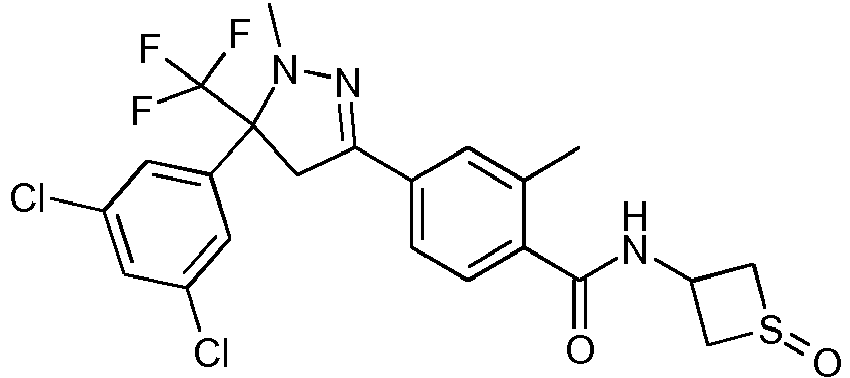
A14 
A15 
A16 
A17 
A18 
A19 
A20 
A21 
A22 
A23 
A24 
A25 
A30 
A31 
A32 
A33 
A34 
A35 
A36 
A37 
A38 
A39 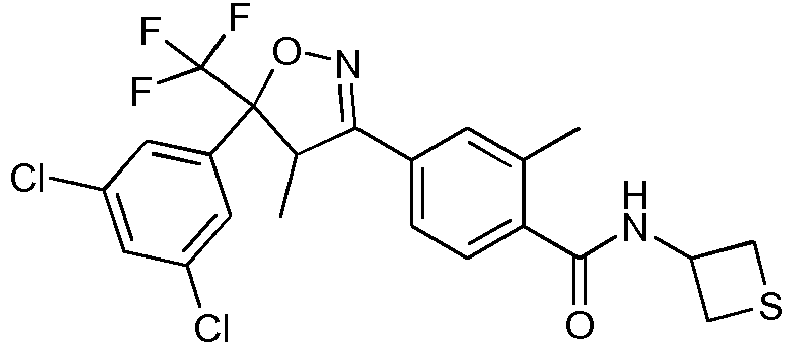
A40 
A41 
A42 
A43 
A44 
A45 
A50 
A51 
A52 
A53 
A54 
A55 
A56 
A57 
A58 
A59 
A60 
A61 
A62 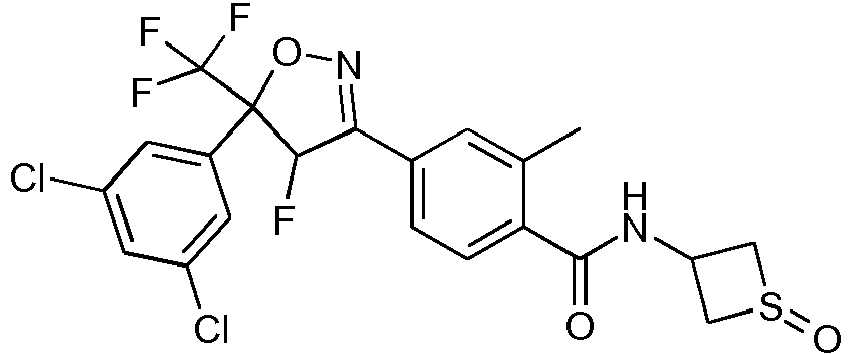
A63 
A64 
A65 
A66 
A67 
A68 
A69 
A70 
B1 
B2 
B3 
B4 
- Verfahren zum Bekämpfen von Insekten, Spinnentieren, Nematoden oder Mollusken, bei dem man eine insektizid, acarizid, nematizid oder molluskizid wirksame Menge einer Verbindung der Formel (I) wie in einem der Ansprüche 1 bis 12 definiert auf einen Schädling, auf einen Ort eines Schädlings oder auf eine Pflanze, die durch Befall durch einen Schädling gefährdet ist, appliziert und wobei es sich bei dem Verfahren nicht um ein therapeutisches Verfahren zur Behandlung des menschlichen oder tierischen Körpers handelt.
- Insektizide, acarizide, nematizide oder molluskizide Zusammensetzung, die eine insektizid, acarizid, nematizid oder molluskizid wirksame Menge einer Verbindung der Formel (I) wie in einem der Ansprüche 1 bis 12 definiert, gegebenenfalls in Abmischung mit einem oder mehreren weiteren Wirkstoffen, umfasst.
- Verbindung nach einem der Ansprüche 1 bis 12 zur Verwendung in der Behandlung von Insekten und/oder wirbellosen Schädlingen in oder an Tieren.
Applications Claiming Priority (13)
| Application Number | Priority Date | Filing Date | Title |
|---|---|---|---|
| GB0815437A GB0815437D0 (en) | 2008-08-22 | 2008-08-22 | Insecticidal compunds |
| GB0816133A GB0816133D0 (en) | 2008-09-04 | 2008-09-04 | Insecticidal compounds |
| GB0900561A GB0900561D0 (en) | 2009-01-14 | 2009-01-14 | Insecticidal compounds |
| IN127DE2009 | 2009-01-22 | ||
| GB0901508A GB0901508D0 (en) | 2009-01-29 | 2009-01-29 | Insecticidal compounds |
| GB0904868A GB0904868D0 (en) | 2009-03-20 | 2009-03-20 | Insecticidal compounds |
| GB0905239A GB0905239D0 (en) | 2009-03-26 | 2009-03-26 | Insecticidal compounds |
| GB0907122A GB0907122D0 (en) | 2009-04-24 | 2009-04-24 | Insecticidal compounds |
| GB0910769A GB0910769D0 (en) | 2009-06-22 | 2009-06-22 | Insecticidal compounds |
| GB0910768A GB0910768D0 (en) | 2009-06-22 | 2009-06-22 | Insecticidal compounds |
| GB0910771A GB0910771D0 (en) | 2009-06-22 | 2009-06-22 | Insecticidal compounds |
| GB0910767A GB0910767D0 (en) | 2009-06-22 | 2009-06-22 | Insecticidal compounds |
| PCT/EP2009/059563 WO2010020522A1 (en) | 2008-08-22 | 2009-07-24 | Insecticidal compounds |
Publications (2)
| Publication Number | Publication Date |
|---|---|
| EP2331536A1 EP2331536A1 (de) | 2011-06-15 |
| EP2331536B1 true EP2331536B1 (de) | 2013-08-21 |
Family
ID=41078008
Family Applications (1)
| Application Number | Title | Priority Date | Filing Date |
|---|---|---|---|
| EP09781037.8A Not-in-force EP2331536B1 (de) | 2008-08-22 | 2009-07-24 | Insektizide verbindungen |
Country Status (7)
| Country | Link |
|---|---|
| US (2) | US20110269804A1 (de) |
| EP (1) | EP2331536B1 (de) |
| CN (1) | CN102131804B (de) |
| AR (1) | AR073114A1 (de) |
| BR (1) | BRPI0917369A2 (de) |
| ES (1) | ES2434734T3 (de) |
| WO (1) | WO2010020522A1 (de) |
Families Citing this family (90)
| Publication number | Priority date | Publication date | Assignee | Title |
|---|---|---|---|---|
| WO2009005015A1 (ja) | 2007-06-29 | 2009-01-08 | Nissan Chemical Industries, Ltd. | 置換イソキサゾリン又はエノンオキシム化合物および有害生物防除剤 |
| CN102088857A (zh) | 2008-07-09 | 2011-06-08 | 巴斯夫欧洲公司 | 包含异噁唑啉化合物的杀虫活性混合物ⅱ |
| CN102088856B (zh) | 2008-07-09 | 2015-11-25 | 巴斯夫欧洲公司 | 包含异*唑啉化合物的杀虫活性混合物i |
| CN102131789A (zh) | 2008-08-22 | 2011-07-20 | 先正达参股股份有限公司 | 杀虫化合物 |
| WO2010025998A1 (en) | 2008-09-04 | 2010-03-11 | Syngenta Participations Ag | Insecticidal compounds |
| CA2747986A1 (en) | 2008-12-23 | 2010-07-01 | Basf Se | Substituted amidine compounds for combating animal pests |
| TW201029997A (en) | 2008-12-23 | 2010-08-16 | Basf Se | Imine compounds for combating invertebrate pests |
| US20110288089A1 (en) * | 2009-01-22 | 2011-11-24 | Syngenta Crop Protection Llc | Insecticidal compounds |
| US8859592B2 (en) | 2009-01-22 | 2014-10-14 | Syngenta Corp Protection Llc | Insecticidal compounds |
| CN102300864A (zh) * | 2009-01-29 | 2011-12-28 | 先正达参股股份有限公司 | 杀虫化合物 |
| CN102365278B (zh) * | 2009-03-26 | 2015-05-06 | 先正达参股股份有限公司 | 杀虫化合物 |
| EP2414353A1 (de) * | 2009-04-01 | 2012-02-08 | Basf Se | Isoxazolinverbindungen zur bekämpfung von wirbellosen schädlingen |
| JP5684802B2 (ja) * | 2009-06-22 | 2015-03-18 | シンジェンタ パーティシペーションズ アクチェンゲゼルシャフト | 殺虫性化合物 |
| CN102725286A (zh) | 2009-11-06 | 2012-10-10 | 拜耳作物科学公司 | 杀虫用芳基吡咯啉化合物 |
| TWI487486B (zh) | 2009-12-01 | 2015-06-11 | Syngenta Participations Ag | 以異唑啉衍生物為主之殺蟲化合物 |
| EP3078664B1 (de) | 2009-12-17 | 2019-02-20 | Merial Inc. | Antiparasitäre dihydroazol zusammensetzungen |
| JP2013518084A (ja) | 2010-02-01 | 2013-05-20 | ビーエーエスエフ ソシエタス・ヨーロピア | 有害動物を駆除するための置換されたケトン性イソオキサゾリン化合物および誘導体 |
| EA201201171A1 (ru) * | 2010-02-22 | 2013-03-29 | Зингента Партисипейшнс Аг | Дигидрофурановые производные в качестве инсектицидных соединений |
| WO2011141414A1 (en) | 2010-05-11 | 2011-11-17 | Bayer Cropscience Ag | Process for the preparation of 5-substituted 3-aryl-3-(trifluoromethyl)-3,4-dihydro-2h-pyrroles |
| TW201211057A (en) * | 2010-06-11 | 2012-03-16 | Syngenta Participations Ag | Process for the preparation of dihydropyrrole derivatives |
| MX2012014958A (es) * | 2010-06-15 | 2013-02-12 | Bayer Ip Gmbh | Derivados de diamida antranilica. |
| ES2682303T3 (es) | 2010-08-05 | 2018-09-19 | Zoetis Services Llc | Derivados de isoxazolina como agentes antiparasitarios |
| JP2012082186A (ja) * | 2010-09-15 | 2012-04-26 | Bayer Cropscience Ag | 殺虫性アリールピロリジン類 |
| KR20130143047A (ko) * | 2010-10-01 | 2013-12-30 | 바스프 에스이 | 살충제로서의 이민 치환된 2,4-디아릴-피롤린 유도체 |
| CN103237789A (zh) | 2010-10-01 | 2013-08-07 | 巴斯夫欧洲公司 | 亚胺化合物 |
| CN103153949A (zh) * | 2010-10-05 | 2013-06-12 | 先正达参股股份有限公司 | 杀虫的吡咯烷-基-芳基-甲酰胺 |
| WO2012049327A2 (en) | 2010-10-15 | 2012-04-19 | Syngenta Participations Ag | Pesticidal mixtures |
| JP2014028758A (ja) * | 2010-11-19 | 2014-02-13 | Nissan Chem Ind Ltd | 寄生虫及び衛生害虫防除剤 |
| WO2012080419A1 (en) | 2010-12-15 | 2012-06-21 | Syngenta Participations Ag | Pesticidal mixtures |
| EP2651220A1 (de) | 2010-12-15 | 2013-10-23 | Syngenta Participations AG | Pestizidgemische |
| DE102010063691A1 (de) | 2010-12-21 | 2012-06-21 | Bayer Animal Health Gmbh | Ektoparasitizide Wirkstoffkombinationen |
| UY33887A (es) | 2011-02-03 | 2012-09-28 | Syngenta Ltd | Métodos de control de plagas en la soja |
| CN103562190A (zh) * | 2011-03-22 | 2014-02-05 | 佐蒂斯有限责任公司 | 作为抗寄生虫药的异噁唑啉衍生物 |
| JP2012232910A (ja) | 2011-04-28 | 2012-11-29 | Bayer Cropscience Ag | 殺虫性アリルヘテロサイクル誘導体 |
| AR086113A1 (es) | 2011-04-30 | 2013-11-20 | Abbott Lab | Isoxazolinas como agentes terapeuticos |
| TW201311677A (zh) | 2011-05-31 | 2013-03-16 | Syngenta Participations Ag | 殺蟲化合物 |
| US20140343049A1 (en) * | 2011-08-22 | 2014-11-20 | Syngenta Participations Ag | Dihydrofuran derivatives as insecticidal compounds |
| EP2748137A1 (de) * | 2011-08-22 | 2014-07-02 | Syngenta Participations AG | Dihydrofuranderivate als insektizidverbindungen |
| KR20140054302A (ko) * | 2011-08-25 | 2014-05-08 | 신젠타 파티서페이션즈 아게 | 살곤충 화합물로서의 이속사졸린 유도체 |
| WO2013026939A1 (en) | 2011-08-25 | 2013-02-28 | Syngenta Participations Ag | Methods for the control of termites and ants |
| WO2013026929A1 (en) * | 2011-08-25 | 2013-02-28 | Syngenta Participations Ag | Dihydropyrrole derivatives as insecticidal compounds |
| US9307766B2 (en) | 2011-08-25 | 2016-04-12 | Syngenta Participations Ag | Isoxazoline derivatives as insecticidal compounds |
| WO2013092943A1 (en) | 2011-12-23 | 2013-06-27 | Basf Se | Isothiazoline compounds for combating invertebrate pests |
| WO2013116230A1 (en) * | 2012-02-03 | 2013-08-08 | Zoetis Llc | Dihydrofuran azetidine derivatives as antiparasitic agents |
| EP2825532A1 (de) | 2012-03-14 | 2015-01-21 | Bayer Intellectual Property GmbH | Arylpyrrolidine als pestizide |
| AR091513A1 (es) * | 2012-06-21 | 2015-02-11 | Syngenta Participations Ag | Metodos de control de plagas del suelo |
| WO2013190050A1 (en) * | 2012-06-21 | 2013-12-27 | Syngenta Participations Ag | Methods of controlling insects |
| US9867375B2 (en) | 2012-07-31 | 2018-01-16 | Syngenta Participations Ag | Methods of pest control in soybean |
| CN104520287A (zh) | 2012-08-03 | 2015-04-15 | 先正达参股股份有限公司 | 控制昆虫的方法 |
| US20150152070A1 (en) | 2012-08-03 | 2015-06-04 | Syngenta Paricipations Ag | Methods of pest control in soybean |
| WO2014019950A1 (en) | 2012-08-03 | 2014-02-06 | Syngenta Participations Ag | Methods of pest control in soybean |
| RU2636978C2 (ru) | 2012-08-24 | 2017-11-29 | Зингента Партисипейшнс Аг | Способы борьбы с почвенными вредителями |
| JP6238987B2 (ja) | 2012-08-24 | 2017-11-29 | シンジェンタ パーティシペーションズ アーゲー | 昆虫を防除する方法 |
| WO2014029709A1 (en) | 2012-08-24 | 2014-02-27 | Syngenta Participations Ag | Methods of controlling insects |
| WO2014114250A1 (en) * | 2013-01-23 | 2014-07-31 | Syngenta Participations Ag | Pyrazoline derivatives as insecticidal compounds |
| PL2953942T3 (pl) | 2013-02-06 | 2018-03-30 | Bayer Cropscience Aktiengesellschaft | Podstawione halogenem pochodne pirazolu jako środki do zwalczania szkodników |
| EP2964025A4 (de) * | 2013-03-06 | 2016-10-26 | Syngenta Participations Ag | Dihydrobenzofuranderivate als insektizidverbindungen |
| WO2014159630A1 (en) * | 2013-03-14 | 2014-10-02 | Dow Agrosciences Llc | Canola seed treatment composition and method |
| WO2014159636A1 (en) * | 2013-03-14 | 2014-10-02 | Dow Agrosciences Llc | Canola seed treatment composition and method |
| DK3063144T3 (da) | 2013-11-01 | 2021-10-25 | Boehringer Ingelheim Animal Health Usa Inc | Antiparasitære og pesticid-isoxazolinforbindelser |
| MX2016008653A (es) | 2014-01-03 | 2016-09-26 | Bayer Animal Health Gmbh | Nuevas pirazolil-heteroarilamidas como agentes plaguicidas. |
| PE20161068A1 (es) | 2014-02-26 | 2016-10-21 | Basf Se | Compuestos de azolina |
| GB2523811A (en) * | 2014-03-06 | 2015-09-09 | Norbrook Lab Ltd | Novel Isoxazolines and their uses |
| JP2017521441A (ja) | 2014-07-15 | 2017-08-03 | バイエル・アニマル・ヘルス・ゲゼルシャフト・ミット・ベシュレンクテル・ハフツングBayer Animal Health Gmbh | 有害生物防除剤としてのアリール−トリアゾリルピリジン類 |
| BR112017013334A2 (pt) | 2014-12-22 | 2018-03-06 | Basf Se | compostos de azolina, composto, composição agrícola ou veterinária, uso de um composto, e, método de proteção de material de propagação de plantas e/ou das plantas que crescem a partir das mesmas do ataque ou infestação por pragas invertebradas |
| US10093662B2 (en) | 2014-12-22 | 2018-10-09 | Basf Se | Azoline compounds substituted by a condensed ring system |
| US11104671B2 (en) | 2017-03-23 | 2021-08-31 | Syngenta Participations Ag | Insecticidal compounds |
| WO2018192793A1 (en) | 2017-04-20 | 2018-10-25 | Basf Se | Substituted rhodanine derivatives |
| AU2018260098A1 (en) | 2017-04-26 | 2019-10-31 | Basf Se | Substituted succinimide derivatives as pesticides |
| JP7307079B2 (ja) * | 2018-01-30 | 2023-07-11 | ピーアイ インダストリーズ リミテッド | 新規アントラニルアミド、殺虫剤としてのその使用およびその製造方法 |
| TWI812673B (zh) * | 2018-02-12 | 2023-08-21 | 美商富曼西公司 | 用於防治無脊椎害蟲之萘異噁唑啉化合物 |
| EP3613736A1 (de) | 2018-08-22 | 2020-02-26 | Basf Se | Substituierte glutarimidderivate |
| WO2020114813A1 (en) | 2018-12-04 | 2020-06-11 | Basf Se | Process for preparation of 5-bromo-1,3-dichloro-2-fluoro-benzene |
| CN111362931B (zh) * | 2018-12-26 | 2021-09-17 | 浙江省化工研究院有限公司 | 一种异噁唑啉连吡唑酰胺类化合物、其制备方法及应用 |
| AR118443A1 (es) * | 2019-03-19 | 2021-10-06 | Bayer Cropscience Lp | Proteínas de fusión, bacterias recombinantes y fragmentos de exosporas para control de plagas y salud de las plantas |
| CN112794845B (zh) * | 2019-11-13 | 2023-02-14 | 浙江省化工研究院有限公司 | 一类异噁唑啉连吡唑酰胺类化合物、其制备方法及应用 |
| CA3164924A1 (en) | 2019-12-18 | 2021-06-24 | Elanco Tiergesundheit Ag | Isoxazoline derivatives as pesticides |
| BR112022023476A2 (pt) * | 2020-06-08 | 2022-12-20 | Nippon Soda Co | Método para reduzir ou prevenir uma influência de um estresse abiótico em uma planta |
| AR122854A1 (es) | 2020-07-02 | 2022-10-12 | Pi Industries Ltd | Compuestos de isoxazolina y su uso como agentes para el control de plagas |
| CN114605399B (zh) * | 2020-12-04 | 2023-11-03 | 浙江省化工研究院有限公司 | 一种含三氟甲基的异噁唑啉类化合物、其制备方法及应用 |
| EP4043444A1 (de) | 2021-02-11 | 2022-08-17 | Basf Se | Substituierte isoxazolinderivate |
| AU2022219182A1 (en) | 2021-02-11 | 2023-08-24 | Basf Se | Substituted isoxazoline derivatives |
| WO2023037253A1 (en) | 2021-09-08 | 2023-03-16 | Pi Industries Ltd | Isoxazoline compounds and their use as pest control agents |
| US20250163037A1 (en) | 2022-03-02 | 2025-05-22 | Basf Se | Substituted isoxazoline derivatives |
| EP4238971A1 (de) | 2022-03-02 | 2023-09-06 | Basf Se | Substituierte isoxazolinderivate |
| CN114591259B (zh) * | 2022-03-22 | 2024-10-22 | 江苏慧聚药业股份有限公司 | 异噁唑化合物的制备 |
| AU2023267071B2 (en) * | 2022-05-13 | 2026-04-09 | Qingdao Kingagroot Chemical Compound Co., Ltd. | Heterocycle-substituted aromatic compound, method for preparing same, herbicidal composition, and use thereof |
| EP4590665A1 (de) | 2022-09-20 | 2025-07-30 | Basf Se | N-(3-(aminomethyl)-phenyl)-5-(4-phenyl)-5-(trifluormethyl)-4,5-dihydroisoxazol-3-amin-derivate und ähnliche verbindungen als schädlingsbekämpfungsmittel |
| EP4342885A1 (de) | 2022-09-20 | 2024-03-27 | Basf Se | N-(3-(aminomethyl)-phenyl)-5-(4-phenyl)-5-(trifluoromethyl)-4,5-dihydroisoxazol-3-amin-derivate und ähnliche verbindungen als pestizide |
| CN120774881A (zh) * | 2024-04-01 | 2025-10-14 | 山东康乔生物科技有限公司 | 一种含砜五元杂环基的异噁唑啉类化合物的制备方法 |
Family Cites Families (38)
| Publication number | Priority date | Publication date | Assignee | Title |
|---|---|---|---|---|
| EP1538138A4 (de) * | 2002-08-26 | 2007-07-25 | Nissan Chemical Ind Ltd | SUBSTITUIERTE BENZANILIDVERBINDUNG UND SCHûDLINGSBEKûMPFUNGSMITTEL |
| AU2005219788B2 (en) | 2004-03-05 | 2010-06-03 | Nissan Chemical Corporation | Isoxazoline-substituted benzamide compound and noxious organism control agent |
| JP5007788B2 (ja) | 2005-05-16 | 2012-08-22 | 日産化学工業株式会社 | ジヒドロアゾール置換ベンズアミド化合物及び有害生物防除剤 |
| WO2007026965A1 (ja) * | 2005-09-02 | 2007-03-08 | Nissan Chemical Industries, Ltd. | イソキサゾリン置換ベンズアミド化合物及び有害生物防除剤 |
| JP2009519937A (ja) * | 2005-12-14 | 2009-05-21 | イー・アイ・デュポン・ドウ・ヌムール・アンド・カンパニー | 無脊椎有害生物防除用イソオキサゾリン |
| TW200803740A (en) | 2005-12-16 | 2008-01-16 | Du Pont | 5-aryl isoxazolines for controlling invertebrate pests |
| TWI412322B (zh) * | 2005-12-30 | 2013-10-21 | Du Pont | 控制無脊椎害蟲之異唑啉 |
| UY30090A1 (es) * | 2006-01-16 | 2007-08-31 | Syngenta Participations Ag | Insecticidas novedosos |
| US8658801B2 (en) * | 2006-02-16 | 2014-02-25 | Syngenta Crop Protection, Llc | Pesticides containing a bicyclic bisamide structure |
| JP5164525B2 (ja) | 2006-11-01 | 2013-03-21 | 日本曹達株式会社 | 含窒素へテロ環化合物および有害生物防除剤 |
| JP2008239611A (ja) | 2007-02-27 | 2008-10-09 | Nissan Chem Ind Ltd | イソキサゾリン置換ベンズアミド化合物及び有害生物防除剤 |
| EP2151437A4 (de) | 2007-03-07 | 2012-05-02 | Nissan Chemical Ind Ltd | Isoxazolinsubstituierte benzamidverbindung und schädlingsbekämpfungsmittel |
| JP2010116389A (ja) | 2008-10-17 | 2010-05-27 | Bayer Cropscience Ag | 殺虫性アリールピロリジン類 |
| AU2008261793A1 (en) * | 2007-06-13 | 2008-12-18 | E. I. Du Pont De Nemours And Company | Isoxazoline insecticides |
| TWI430995B (zh) | 2007-06-26 | 2014-03-21 | Du Pont | 萘異唑啉無脊椎有害動物控制劑 |
| ES2549731T3 (es) | 2007-06-27 | 2015-11-02 | E. I. Du Pont De Nemours And Company | Método para el control de plagas en animales |
| US8952175B2 (en) | 2007-06-27 | 2015-02-10 | Nissan Chemical Industries, Ltd. | Method for production of 3-hydroxypropan-1-one compound, method for production of 2-propen-1-one compound and method for production of isoxazoline compound |
| WO2009005015A1 (ja) | 2007-06-29 | 2009-01-08 | Nissan Chemical Industries, Ltd. | 置換イソキサゾリン又はエノンオキシム化合物および有害生物防除剤 |
| TWI649303B (zh) | 2007-08-17 | 2019-02-01 | 杜邦股份有限公司 | 製備4-乙醯基-n-〔2-側氧基-2-〔(2,2,2-三氟乙基)胺基〕乙基〕-1-萘甲醯胺之化合物及方法 |
| TWI556741B (zh) | 2007-08-17 | 2016-11-11 | 英特威特國際股份有限公司 | 異唑啉組成物及其作為抗寄生蟲藥上的應用 |
| JP2009108046A (ja) | 2007-10-10 | 2009-05-21 | Nissan Chem Ind Ltd | 殺虫、殺ダニ、殺線虫、殺軟体動物、殺菌又は殺バクテリア組成物及び病害虫の防除方法 |
| WO2009063910A1 (ja) | 2007-11-12 | 2009-05-22 | Nissan Chemical Industries, Ltd. | 光学活性イソキサゾリン化合物の触媒的不斉合成方法 |
| TWI411395B (zh) * | 2007-12-24 | 2013-10-11 | Syngenta Participations Ag | 殺蟲化合物 |
| US8391912B2 (en) | 2008-06-19 | 2013-03-05 | Telefonaktiebolaget Lm Ericsson (Publ) | Bit-rate prediction |
| KR101608456B1 (ko) | 2008-07-09 | 2016-04-01 | 닛산 가가쿠 고교 가부시키 가이샤 | 이속사졸린 치환 안식향산 아미드 화합물의 제조 방법 |
| CN102088857A (zh) | 2008-07-09 | 2011-06-08 | 巴斯夫欧洲公司 | 包含异噁唑啉化合物的杀虫活性混合物ⅱ |
| CN102088856B (zh) | 2008-07-09 | 2015-11-25 | 巴斯夫欧洲公司 | 包含异*唑啉化合物的杀虫活性混合物i |
| AU2009281457A1 (en) | 2008-08-14 | 2010-02-18 | Bayer Cropscience Ag | Insecticidal 4-phenyl-1H-pyrazoles |
| CN102131789A (zh) | 2008-08-22 | 2011-07-20 | 先正达参股股份有限公司 | 杀虫化合物 |
| WO2010025998A1 (en) | 2008-09-04 | 2010-03-11 | Syngenta Participations Ag | Insecticidal compounds |
| JP2010083883A (ja) | 2008-09-08 | 2010-04-15 | Nissan Chem Ind Ltd | イソキサゾリン置換ベンズアミド化合物及び有害生物防除剤 |
| ES2442342T3 (es) | 2008-12-18 | 2014-02-11 | Novartis Ag | Derivados de las isoxazolinas y su uso como pesticida |
| JP2010168367A (ja) | 2008-12-25 | 2010-08-05 | Nissan Chem Ind Ltd | 置換イソキサゾリン化合物又は置換エノンオキシム化合物及び有害生物防除剤 |
| US20110288089A1 (en) | 2009-01-22 | 2011-11-24 | Syngenta Crop Protection Llc | Insecticidal compounds |
| CN102300864A (zh) | 2009-01-29 | 2011-12-28 | 先正达参股股份有限公司 | 杀虫化合物 |
| CN102365278B (zh) | 2009-03-26 | 2015-05-06 | 先正达参股股份有限公司 | 杀虫化合物 |
| ES2524970T3 (es) | 2009-04-30 | 2014-12-16 | Basf Se | Procedimiento de preparación de compuestos de isoxazolina sustituidos y sus precursores |
| JP5684802B2 (ja) | 2009-06-22 | 2015-03-18 | シンジェンタ パーティシペーションズ アクチェンゲゼルシャフト | 殺虫性化合物 |
-
2009
- 2009-07-24 EP EP09781037.8A patent/EP2331536B1/de not_active Not-in-force
- 2009-07-24 WO PCT/EP2009/059563 patent/WO2010020522A1/en not_active Ceased
- 2009-07-24 BR BRPI0917369-2A patent/BRPI0917369A2/pt not_active IP Right Cessation
- 2009-07-24 US US13/060,219 patent/US20110269804A1/en not_active Abandoned
- 2009-07-24 ES ES09781037T patent/ES2434734T3/es active Active
- 2009-07-24 CN CN200980132720.0A patent/CN102131804B/zh not_active Expired - Fee Related
- 2009-08-21 AR ARP090103231A patent/AR073114A1/es unknown
-
2013
- 2013-02-20 US US13/771,829 patent/US9216973B2/en not_active Expired - Fee Related
Non-Patent Citations (2)
| Title |
|---|
| DATABASE MEDLINE [online] US NATIONAL LIBRARY OF MEDICINE (NLM), BETHESDA, MD, US; August 2006 (2006-08-01), NAUEN RALF: "Insecticide mode of action: return of the ryanodine receptor.", Database accession no. NLM16770834 * |
| NAUEN RALF: "Insecticide mode of action: return of the ryanodine receptor.", PEST MANAGEMENT SCIENCE AUG 2006, vol. 62, no. 8, August 2006 (2006-08-01), pages 690 - 692, ISSN: 1526-498X * |
Also Published As
| Publication number | Publication date |
|---|---|
| WO2010020522A1 (en) | 2010-02-25 |
| BRPI0917369A2 (pt) | 2015-08-04 |
| ES2434734T3 (es) | 2013-12-17 |
| US20130165485A1 (en) | 2013-06-27 |
| US9216973B2 (en) | 2015-12-22 |
| US20110269804A1 (en) | 2011-11-03 |
| AR073114A1 (es) | 2010-10-13 |
| EP2331536A1 (de) | 2011-06-15 |
| CN102131804B (zh) | 2014-12-03 |
| CN102131804A (zh) | 2011-07-20 |
Similar Documents
| Publication | Publication Date | Title |
|---|---|---|
| EP2331536B1 (de) | Insektizide verbindungen | |
| US10364235B2 (en) | Insecticidal compounds | |
| EP2331515B1 (de) | Insektizide verbindungen | |
| EP2238132B1 (de) | Insektizide verbindungen | |
| EP2411384B1 (de) | Insektizide verbindungen | |
| EP2331535B1 (de) | Insektizide verbindungen | |
| US20110288089A1 (en) | Insecticidal compounds | |
| US20110288131A1 (en) | Insecticidal compounds | |
| EP2427439B1 (de) | N-(4-perfluoroalkyl-phenyl)-4-triazolyl-benzamide als insektizide | |
| US8859592B2 (en) | Insecticidal compounds | |
| HK1163694B (en) | Insecticidal compounds | |
| HK1144430B (en) | Insecticidal compounds | |
| EP2382208A1 (de) | Insektizidverbindungen | |
| EP2379541A2 (de) | Insektizide verbindungen |
Legal Events
| Date | Code | Title | Description |
|---|---|---|---|
| PUAI | Public reference made under article 153(3) epc to a published international application that has entered the european phase |
Free format text: ORIGINAL CODE: 0009012 |
|
| 17P | Request for examination filed |
Effective date: 20110310 |
|
| AK | Designated contracting states |
Kind code of ref document: A1 Designated state(s): AT BE BG CH CY CZ DE DK EE ES FI FR GB GR HR HU IE IS IT LI LT LU LV MC MK MT NL NO PL PT RO SE SI SK SM TR |
|
| AX | Request for extension of the european patent |
Extension state: AL BA RS |
|
| RIN1 | Information on inventor provided before grant (corrected) |
Inventor name: EL QACEMI, MYRIEM Inventor name: ZAMBACH, WERNER Inventor name: CASSAYRE, JEROME YVES Inventor name: RENOLD, PETER Inventor name: PITTERNA, THOMAS Inventor name: DALENCON, ANNE, JACQUELINE Inventor name: BOBOSIK, VLADIMIR Inventor name: PABBA, JAGADISH Inventor name: GODFREY, CHRISTOPHER, RICHARD, AYLES Inventor name: JUNG, PIERRE, JOSEPH, MARCEL |
|
| RIN1 | Information on inventor provided before grant (corrected) |
Inventor name: DALENCON, ANNE, JACQUELINE Inventor name: PITTERNA, THOMAS Inventor name: BOBOSIK, VLADIMIR Inventor name: GODFREY, CHRISTOPHER, RICHARD, AYLES Inventor name: CASSAYRE, JEROME YVES Inventor name: JUNG, PIERRE, JOSEPH, MARCEL Inventor name: ZAMBACH, WERNER Inventor name: PABBA, JAGADISH Inventor name: RENOLD, PETER Inventor name: EL QACEMI, MYRIEM |
|
| DAX | Request for extension of the european patent (deleted) | ||
| GRAP | Despatch of communication of intention to grant a patent |
Free format text: ORIGINAL CODE: EPIDOSNIGR1 |
|
| INTG | Intention to grant announced |
Effective date: 20130412 |
|
| GRAS | Grant fee paid |
Free format text: ORIGINAL CODE: EPIDOSNIGR3 |
|
| GRAP | Despatch of communication of intention to grant a patent |
Free format text: ORIGINAL CODE: EPIDOSNIGR1 |
|
| INTG | Intention to grant announced |
Effective date: 20130624 |
|
| GRAA | (expected) grant |
Free format text: ORIGINAL CODE: 0009210 |
|
| AK | Designated contracting states |
Kind code of ref document: B1 Designated state(s): AT BE BG CH CY CZ DE DK EE ES FI FR GB GR HR HU IE IS IT LI LT LU LV MC MK MT NL NO PL PT RO SE SI SK SM TR |
|
| REG | Reference to a national code |
Ref country code: GB Ref legal event code: FG4D |
|
| REG | Reference to a national code |
Ref country code: CH Ref legal event code: EP |
|
| REG | Reference to a national code |
Ref country code: AT Ref legal event code: REF Ref document number: 628015 Country of ref document: AT Kind code of ref document: T Effective date: 20130915 |
|
| REG | Reference to a national code |
Ref country code: IE Ref legal event code: FG4D |
|
| REG | Reference to a national code |
Ref country code: DE Ref legal event code: R096 Ref document number: 602009018231 Country of ref document: DE Effective date: 20131017 |
|
| REG | Reference to a national code |
Ref country code: ES Ref legal event code: FG2A Ref document number: 2434734 Country of ref document: ES Kind code of ref document: T3 Effective date: 20131217 |
|
| REG | Reference to a national code |
Ref country code: AT Ref legal event code: MK05 Ref document number: 628015 Country of ref document: AT Kind code of ref document: T Effective date: 20130821 Ref country code: NL Ref legal event code: VDEP Effective date: 20130821 |
|
| REG | Reference to a national code |
Ref country code: LT Ref legal event code: MG4D |
|
| PG25 | Lapsed in a contracting state [announced via postgrant information from national office to epo] |
Ref country code: HR Free format text: LAPSE BECAUSE OF FAILURE TO SUBMIT A TRANSLATION OF THE DESCRIPTION OR TO PAY THE FEE WITHIN THE PRESCRIBED TIME-LIMIT Effective date: 20130821 Ref country code: AT Free format text: LAPSE BECAUSE OF FAILURE TO SUBMIT A TRANSLATION OF THE DESCRIPTION OR TO PAY THE FEE WITHIN THE PRESCRIBED TIME-LIMIT Effective date: 20130821 Ref country code: CY Free format text: LAPSE BECAUSE OF FAILURE TO SUBMIT A TRANSLATION OF THE DESCRIPTION OR TO PAY THE FEE WITHIN THE PRESCRIBED TIME-LIMIT Effective date: 20130717 Ref country code: NO Free format text: LAPSE BECAUSE OF FAILURE TO SUBMIT A TRANSLATION OF THE DESCRIPTION OR TO PAY THE FEE WITHIN THE PRESCRIBED TIME-LIMIT Effective date: 20131121 Ref country code: PT Free format text: LAPSE BECAUSE OF FAILURE TO SUBMIT A TRANSLATION OF THE DESCRIPTION OR TO PAY THE FEE WITHIN THE PRESCRIBED TIME-LIMIT Effective date: 20131223 Ref country code: SE Free format text: LAPSE BECAUSE OF FAILURE TO SUBMIT A TRANSLATION OF THE DESCRIPTION OR TO PAY THE FEE WITHIN THE PRESCRIBED TIME-LIMIT Effective date: 20130821 Ref country code: IS Free format text: LAPSE BECAUSE OF FAILURE TO SUBMIT A TRANSLATION OF THE DESCRIPTION OR TO PAY THE FEE WITHIN THE PRESCRIBED TIME-LIMIT Effective date: 20131221 Ref country code: LT Free format text: LAPSE BECAUSE OF FAILURE TO SUBMIT A TRANSLATION OF THE DESCRIPTION OR TO PAY THE FEE WITHIN THE PRESCRIBED TIME-LIMIT Effective date: 20130821 |
|
| PG25 | Lapsed in a contracting state [announced via postgrant information from national office to epo] |
Ref country code: FI Free format text: LAPSE BECAUSE OF FAILURE TO SUBMIT A TRANSLATION OF THE DESCRIPTION OR TO PAY THE FEE WITHIN THE PRESCRIBED TIME-LIMIT Effective date: 20130821 Ref country code: GR Free format text: LAPSE BECAUSE OF FAILURE TO SUBMIT A TRANSLATION OF THE DESCRIPTION OR TO PAY THE FEE WITHIN THE PRESCRIBED TIME-LIMIT Effective date: 20131122 Ref country code: LV Free format text: LAPSE BECAUSE OF FAILURE TO SUBMIT A TRANSLATION OF THE DESCRIPTION OR TO PAY THE FEE WITHIN THE PRESCRIBED TIME-LIMIT Effective date: 20130821 Ref country code: BE Free format text: LAPSE BECAUSE OF FAILURE TO SUBMIT A TRANSLATION OF THE DESCRIPTION OR TO PAY THE FEE WITHIN THE PRESCRIBED TIME-LIMIT Effective date: 20130821 Ref country code: PL Free format text: LAPSE BECAUSE OF FAILURE TO SUBMIT A TRANSLATION OF THE DESCRIPTION OR TO PAY THE FEE WITHIN THE PRESCRIBED TIME-LIMIT Effective date: 20130821 Ref country code: SI Free format text: LAPSE BECAUSE OF FAILURE TO SUBMIT A TRANSLATION OF THE DESCRIPTION OR TO PAY THE FEE WITHIN THE PRESCRIBED TIME-LIMIT Effective date: 20130821 |
|
| PG25 | Lapsed in a contracting state [announced via postgrant information from national office to epo] |
Ref country code: CY Free format text: LAPSE BECAUSE OF FAILURE TO SUBMIT A TRANSLATION OF THE DESCRIPTION OR TO PAY THE FEE WITHIN THE PRESCRIBED TIME-LIMIT Effective date: 20130821 |
|
| PG25 | Lapsed in a contracting state [announced via postgrant information from national office to epo] |
Ref country code: CZ Free format text: LAPSE BECAUSE OF FAILURE TO SUBMIT A TRANSLATION OF THE DESCRIPTION OR TO PAY THE FEE WITHIN THE PRESCRIBED TIME-LIMIT Effective date: 20130821 Ref country code: SK Free format text: LAPSE BECAUSE OF FAILURE TO SUBMIT A TRANSLATION OF THE DESCRIPTION OR TO PAY THE FEE WITHIN THE PRESCRIBED TIME-LIMIT Effective date: 20130821 Ref country code: DK Free format text: LAPSE BECAUSE OF FAILURE TO SUBMIT A TRANSLATION OF THE DESCRIPTION OR TO PAY THE FEE WITHIN THE PRESCRIBED TIME-LIMIT Effective date: 20130821 Ref country code: NL Free format text: LAPSE BECAUSE OF FAILURE TO SUBMIT A TRANSLATION OF THE DESCRIPTION OR TO PAY THE FEE WITHIN THE PRESCRIBED TIME-LIMIT Effective date: 20130821 Ref country code: EE Free format text: LAPSE BECAUSE OF FAILURE TO SUBMIT A TRANSLATION OF THE DESCRIPTION OR TO PAY THE FEE WITHIN THE PRESCRIBED TIME-LIMIT Effective date: 20130821 Ref country code: RO Free format text: LAPSE BECAUSE OF FAILURE TO SUBMIT A TRANSLATION OF THE DESCRIPTION OR TO PAY THE FEE WITHIN THE PRESCRIBED TIME-LIMIT Effective date: 20130821 |
|
| PLBE | No opposition filed within time limit |
Free format text: ORIGINAL CODE: 0009261 |
|
| STAA | Information on the status of an ep patent application or granted ep patent |
Free format text: STATUS: NO OPPOSITION FILED WITHIN TIME LIMIT |
|
| 26N | No opposition filed |
Effective date: 20140522 |
|
| REG | Reference to a national code |
Ref country code: DE Ref legal event code: R097 Ref document number: 602009018231 Country of ref document: DE Effective date: 20140522 |
|
| PG25 | Lapsed in a contracting state [announced via postgrant information from national office to epo] |
Ref country code: LU Free format text: LAPSE BECAUSE OF FAILURE TO SUBMIT A TRANSLATION OF THE DESCRIPTION OR TO PAY THE FEE WITHIN THE PRESCRIBED TIME-LIMIT Effective date: 20140724 |
|
| REG | Reference to a national code |
Ref country code: CH Ref legal event code: PL |
|
| REG | Reference to a national code |
Ref country code: IE Ref legal event code: MM4A |
|
| PG25 | Lapsed in a contracting state [announced via postgrant information from national office to epo] |
Ref country code: LI Free format text: LAPSE BECAUSE OF NON-PAYMENT OF DUE FEES Effective date: 20140731 Ref country code: CH Free format text: LAPSE BECAUSE OF NON-PAYMENT OF DUE FEES Effective date: 20140731 |
|
| REG | Reference to a national code |
Ref country code: FR Ref legal event code: PLFP Year of fee payment: 7 |
|
| PG25 | Lapsed in a contracting state [announced via postgrant information from national office to epo] |
Ref country code: IE Free format text: LAPSE BECAUSE OF NON-PAYMENT OF DUE FEES Effective date: 20140724 |
|
| PG25 | Lapsed in a contracting state [announced via postgrant information from national office to epo] |
Ref country code: SM Free format text: LAPSE BECAUSE OF FAILURE TO SUBMIT A TRANSLATION OF THE DESCRIPTION OR TO PAY THE FEE WITHIN THE PRESCRIBED TIME-LIMIT Effective date: 20130821 Ref country code: MC Free format text: LAPSE BECAUSE OF FAILURE TO SUBMIT A TRANSLATION OF THE DESCRIPTION OR TO PAY THE FEE WITHIN THE PRESCRIBED TIME-LIMIT Effective date: 20130821 |
|
| REG | Reference to a national code |
Ref country code: FR Ref legal event code: PLFP Year of fee payment: 8 |
|
| PG25 | Lapsed in a contracting state [announced via postgrant information from national office to epo] |
Ref country code: MT Free format text: LAPSE BECAUSE OF FAILURE TO SUBMIT A TRANSLATION OF THE DESCRIPTION OR TO PAY THE FEE WITHIN THE PRESCRIBED TIME-LIMIT Effective date: 20130821 Ref country code: BG Free format text: LAPSE BECAUSE OF FAILURE TO SUBMIT A TRANSLATION OF THE DESCRIPTION OR TO PAY THE FEE WITHIN THE PRESCRIBED TIME-LIMIT Effective date: 20130821 |
|
| PG25 | Lapsed in a contracting state [announced via postgrant information from national office to epo] |
Ref country code: TR Free format text: LAPSE BECAUSE OF FAILURE TO SUBMIT A TRANSLATION OF THE DESCRIPTION OR TO PAY THE FEE WITHIN THE PRESCRIBED TIME-LIMIT Effective date: 20130821 Ref country code: HU Free format text: LAPSE BECAUSE OF FAILURE TO SUBMIT A TRANSLATION OF THE DESCRIPTION OR TO PAY THE FEE WITHIN THE PRESCRIBED TIME-LIMIT; INVALID AB INITIO Effective date: 20090724 |
|
| REG | Reference to a national code |
Ref country code: FR Ref legal event code: PLFP Year of fee payment: 9 |
|
| PGFP | Annual fee paid to national office [announced via postgrant information from national office to epo] |
Ref country code: FR Payment date: 20170621 Year of fee payment: 9 Ref country code: GB Payment date: 20170626 Year of fee payment: 9 |
|
| PGFP | Annual fee paid to national office [announced via postgrant information from national office to epo] |
Ref country code: ES Payment date: 20170808 Year of fee payment: 9 Ref country code: IT Payment date: 20170718 Year of fee payment: 9 Ref country code: DE Payment date: 20170726 Year of fee payment: 9 |
|
| PG25 | Lapsed in a contracting state [announced via postgrant information from national office to epo] |
Ref country code: MK Free format text: LAPSE BECAUSE OF FAILURE TO SUBMIT A TRANSLATION OF THE DESCRIPTION OR TO PAY THE FEE WITHIN THE PRESCRIBED TIME-LIMIT Effective date: 20130821 |
|
| REG | Reference to a national code |
Ref country code: DE Ref legal event code: R119 Ref document number: 602009018231 Country of ref document: DE |
|
| GBPC | Gb: european patent ceased through non-payment of renewal fee |
Effective date: 20180724 |
|
| PG25 | Lapsed in a contracting state [announced via postgrant information from national office to epo] |
Ref country code: FR Free format text: LAPSE BECAUSE OF NON-PAYMENT OF DUE FEES Effective date: 20180731 Ref country code: GB Free format text: LAPSE BECAUSE OF NON-PAYMENT OF DUE FEES Effective date: 20180724 Ref country code: DE Free format text: LAPSE BECAUSE OF NON-PAYMENT OF DUE FEES Effective date: 20190201 |
|
| PG25 | Lapsed in a contracting state [announced via postgrant information from national office to epo] |
Ref country code: IT Free format text: LAPSE BECAUSE OF NON-PAYMENT OF DUE FEES Effective date: 20180724 |
|
| REG | Reference to a national code |
Ref country code: ES Ref legal event code: FD2A Effective date: 20190917 |
|
| PG25 | Lapsed in a contracting state [announced via postgrant information from national office to epo] |
Ref country code: ES Free format text: LAPSE BECAUSE OF NON-PAYMENT OF DUE FEES Effective date: 20180725 |