EP2411384B1 - Insektizide verbindungen - Google Patents
Insektizide verbindungen Download PDFInfo
- Publication number
- EP2411384B1 EP2411384B1 EP10704155A EP10704155A EP2411384B1 EP 2411384 B1 EP2411384 B1 EP 2411384B1 EP 10704155 A EP10704155 A EP 10704155A EP 10704155 A EP10704155 A EP 10704155A EP 2411384 B1 EP2411384 B1 EP 2411384B1
- Authority
- EP
- European Patent Office
- Prior art keywords
- substituted
- alkylene
- phenyl
- aryl
- methyl
- Prior art date
- Legal status (The legal status is an assumption and is not a legal conclusion. Google has not performed a legal analysis and makes no representation as to the accuracy of the status listed.)
- Not-in-force
Links
- 0 CC(*)(C1(*)*)ON(*)C1c1ccc(C(N(*)*)=I)c(*)c1 Chemical compound CC(*)(C1(*)*)ON(*)C1c1ccc(C(N(*)*)=I)c(*)c1 0.000 description 1
Classifications
-
- C—CHEMISTRY; METALLURGY
- C07—ORGANIC CHEMISTRY
- C07D—HETEROCYCLIC COMPOUNDS
- C07D413/00—Heterocyclic compounds containing two or more hetero rings, at least one ring having nitrogen and oxygen atoms as the only ring hetero atoms
- C07D413/02—Heterocyclic compounds containing two or more hetero rings, at least one ring having nitrogen and oxygen atoms as the only ring hetero atoms containing two hetero rings
- C07D413/12—Heterocyclic compounds containing two or more hetero rings, at least one ring having nitrogen and oxygen atoms as the only ring hetero atoms containing two hetero rings linked by a chain containing hetero atoms as chain links
-
- A—HUMAN NECESSITIES
- A01—AGRICULTURE; FORESTRY; ANIMAL HUSBANDRY; HUNTING; TRAPPING; FISHING
- A01N—PRESERVATION OF BODIES OF HUMANS OR ANIMALS OR PLANTS OR PARTS THEREOF; BIOCIDES, e.g. AS DISINFECTANTS, AS PESTICIDES OR AS HERBICIDES; PEST REPELLANTS OR ATTRACTANTS; PLANT GROWTH REGULATORS
- A01N43/00—Biocides, pest repellants or attractants, or plant growth regulators containing heterocyclic compounds
- A01N43/72—Biocides, pest repellants or attractants, or plant growth regulators containing heterocyclic compounds having rings with nitrogen atoms and oxygen or sulfur atoms as ring hetero atoms
- A01N43/80—Biocides, pest repellants or attractants, or plant growth regulators containing heterocyclic compounds having rings with nitrogen atoms and oxygen or sulfur atoms as ring hetero atoms five-membered rings with one nitrogen atom and either one oxygen atom or one sulfur atom in positions 1,2
-
- A—HUMAN NECESSITIES
- A01—AGRICULTURE; FORESTRY; ANIMAL HUSBANDRY; HUNTING; TRAPPING; FISHING
- A01N—PRESERVATION OF BODIES OF HUMANS OR ANIMALS OR PLANTS OR PARTS THEREOF; BIOCIDES, e.g. AS DISINFECTANTS, AS PESTICIDES OR AS HERBICIDES; PEST REPELLANTS OR ATTRACTANTS; PLANT GROWTH REGULATORS
- A01N43/00—Biocides, pest repellants or attractants, or plant growth regulators containing heterocyclic compounds
- A01N43/72—Biocides, pest repellants or attractants, or plant growth regulators containing heterocyclic compounds having rings with nitrogen atoms and oxygen or sulfur atoms as ring hetero atoms
- A01N43/82—Biocides, pest repellants or attractants, or plant growth regulators containing heterocyclic compounds having rings with nitrogen atoms and oxygen or sulfur atoms as ring hetero atoms five-membered rings with three ring hetero atoms
-
- A—HUMAN NECESSITIES
- A01—AGRICULTURE; FORESTRY; ANIMAL HUSBANDRY; HUNTING; TRAPPING; FISHING
- A01N—PRESERVATION OF BODIES OF HUMANS OR ANIMALS OR PLANTS OR PARTS THEREOF; BIOCIDES, e.g. AS DISINFECTANTS, AS PESTICIDES OR AS HERBICIDES; PEST REPELLANTS OR ATTRACTANTS; PLANT GROWTH REGULATORS
- A01N43/00—Biocides, pest repellants or attractants, or plant growth regulators containing heterocyclic compounds
- A01N43/72—Biocides, pest repellants or attractants, or plant growth regulators containing heterocyclic compounds having rings with nitrogen atoms and oxygen or sulfur atoms as ring hetero atoms
- A01N43/84—Biocides, pest repellants or attractants, or plant growth regulators containing heterocyclic compounds having rings with nitrogen atoms and oxygen or sulfur atoms as ring hetero atoms six-membered rings with one nitrogen atom and either one oxygen atom or one sulfur atom in positions 1,4
-
- C—CHEMISTRY; METALLURGY
- C07—ORGANIC CHEMISTRY
- C07D—HETEROCYCLIC COMPOUNDS
- C07D261/00—Heterocyclic compounds containing 1,2-oxazole or hydrogenated 1,2-oxazole rings
- C07D261/02—Heterocyclic compounds containing 1,2-oxazole or hydrogenated 1,2-oxazole rings not condensed with other rings
-
- C—CHEMISTRY; METALLURGY
- C07—ORGANIC CHEMISTRY
- C07D—HETEROCYCLIC COMPOUNDS
- C07D417/00—Heterocyclic compounds containing two or more hetero rings, at least one ring having nitrogen and sulfur atoms as the only ring hetero atoms, not provided for by group C07D415/00
- C07D417/02—Heterocyclic compounds containing two or more hetero rings, at least one ring having nitrogen and sulfur atoms as the only ring hetero atoms, not provided for by group C07D415/00 containing two hetero rings
- C07D417/12—Heterocyclic compounds containing two or more hetero rings, at least one ring having nitrogen and sulfur atoms as the only ring hetero atoms, not provided for by group C07D415/00 containing two hetero rings linked by a chain containing hetero atoms as chain links
Definitions
- the present invention relates to certain isoxazolidine derivatives, to processes and intermediates for preparing these derivatives, to insecticidal, acaricidal, nematicidal and molluscicidal compositions comprising these derivatives and to methods of using these derivatives to control insect, acarine, nematode and mollusc pests.
- EP 0,162,383 discloses biologically active agent containing substituted isoxazolidines. isoxazolidines and their preparation.
- U S2009270407 discloses fungicidal isoxazolines.
- WO 2010/020522 discloses certain insecticidal tetracyclic derivatives with a sulfur-containing four-membered ring connected to the nitrogen atom of the amide group.
- the present invention therefore provides a compound of formula (I) wherein A 1 , A 2 , A 3 and A 4 are independently of each other C-H, C-R 7 , or nitrogen; G 1 is oxygen or sulfur; R 1 is hydrogen, C 1 -C 8 alkyl, C 1 -C 8 alkoxy-, C 1 -C 8 alkylcarbonyl-, or C 1 -C 8 alkoxycarbonyl-; R 2 is C 1 -C 8 alkyl or C 1 -C 8 alkyl substituted by one to five R 8 , C 3 -C 10 cycloalkyl or C 3 -C 10 cycloalkyl substituted by one to five R 9 , aryl-C 1 -C 4 alkylene- or aryl-C 1 -C 4 alkylene-wherein the aryl moiety is substituted by one to five R 10 , heterocylyl-C 1 -C 4 alkylene- or heterocyclyl-C 1 -C 4 alkylene
- the compounds of formula (I) may exist in different geometric or optical isomers or tautomeric forms. This invention covers all such isomers and tautomers and mixtures thereof in all proportions as well as isotopic forms such as deuterated compounds.
- the compounds of the invention may contain one or more asymmetric carbon atoms, for example, at the -CR 3 R 4 - group and at the -CR 5a R 5a - group, and may exist as enantiomers (or as pairs of diastereoisomers) or as mixtures of such.
- Alkyl groups can be in the form of a straight or branched chain and are, for example, methyl, ethyl, propyl, prop-2-yl, butyl, but-2-yl, 2-methyl-prop-1-yl or 2-methyl-prop-2-yl.
- the alkyl groups are preferably C 1 -C 6 , more preferably C 1 -C 4 , most preferably C 1 -C 3 alkyl groups. Where an alkyl moiety is said to be substituted, the alkyl moiety is preferably substituted by one to four substituents, most preferably by one to three substituents.
- Alkylene groups can be in the form of a straight or branched chain and are, for example, -CH 2 -, -CH 2 -CH 2 -, -CH(CH 3 )-, -CH 2 -CH 2 -CH 2 -, -CH(CH 3 )-CH 2 -, or -CH(CH 2 CH 3 )-.
- the alkylene groups are preferably C 1 -C 3 , more preferably C 1 -C 2 , most preferably C 1 alkylene groups.
- Alkenyl groups can be in the form of straight or branched chains, and can be, where appropriate, of either the ( E )- or ( Z )-configuration. Examples are vinyl and allyl.
- the alkenyl groups are preferably C 2 -C 6 , more preferably C 2 -C 4 , most preferably C 2 -C 3 alkenyl groups.
- Alkynyl groups can be in the form of straight or branched chains. Examples are ethynyl and propargyl.
- the alkynyl groups are preferably C 2 -C 6 , more preferably C 2 -C 4 , most preferably C 2 -C 3 alkynyl groups.
- Halogen is fluorine, chlorine, bromine or iodine.
- Haloalkyl groups are alkyl groups which are substituted by one or more of the same or different halogen atoms and are, for example, difluoromethyl, trifluoromethyl, chlorodifluoromethyl or 2,2,2-trifluoro-ethyl.
- Haloalkenyl groups are alkenyl groups which are substituted by one or more of the same or different halogen atoms and are, for example, 2,2-difluoro-vinyl or 1,2-dichloro-2-fluoro-vinyl.
- Haloalkynyl groups are alkynyl groups which are substituted by one or more of the same or different halogen atoms and are, for example, 1-chloro-prop-2-ynyl.
- Cycloalkyl groups or carbocyclic rings can be in mono- or bi-cyclic form and are, for example, cyclopropyl, cyclobutyl, cyclohexyl and bicyclo[2.2.1]heptan-2-yl.
- the cycloalkyl groups are preferably C 3 -C 8 , more preferably C 3 -C 6 cycloalkyl groups.
- the cycloalkyl moiety is preferably substituted by one to four substituents, most preferably by one to three substituents.
- Aryl groups are aromatic ring systems which can be in mono-, bi- or tricyclic form. Examples of such rings include phenyl, naphthyl, anthracenyl, indenyl or phenanthrenyl. Preferred aryl groups are phenyl and naphthyl, phenyl being most preferred. Where an aryl moiety is said to be substituted, the aryl moiety is preferably substituted by one to four substituents, most preferably by one to three substituents.
- Heteroaryl groups are aromatic ring system containing at least one heteroatom and consisting either of a single ring or of two or more fused rings.
- single rings will contain up to three heteroatoms and bicyclic systems up to four heteroatoms which will preferably be chosen from nitrogen, oxygen and sulfur.
- Examples of monocyclic groups include pyridyl, pyridazinyl, pyrimidinyl, pyrazinyl, pyrrolyl, pyrazolyl, imidazolyl, triazolyl, furanyl, thiophenyl, oxazolyl, isoxazolyl, oxadiazolyl, thiazolyl, isothiazolyl and thiadiazolyl.
- Examples of bicyclic groups include quinolinyl, cinnolinyl, quinoxalinyl, indolyl, indazolyl, benzimidazolyl, benzothiophenyl and benzothiazolyl.
- heteroaryl groups are preferred, pyridyl being most preferred.
- the heteroaryl moiety is preferably substituted by one to four substituents, most preferably by one to three substituents.
- Heterocyclyl groups or heterocyclic rings are defined to include heteroaryl groups and in addition their unsaturated or partially unsaturated analogues.
- monocyclic groups include thietanyl, pyrrolidinyl, tetrahydrofuranyl, [1,3]dioxolanyl, piperidinyl, piperazinyl, [1,4]dioxanyl, and morpholinyl or their oxidised versions such as 1-oxo-thietanyl and 1,1-dioxo-thietanyl.
- bicyclic groups examples include 2,3-dihydro-benzofuranyl, benzo[1,3]dioxolanyl, and 2,3-dihydro-benzo[1,4]dioxinyl.
- a heterocyclyl moiety is said to be substituted, the heterocyclyl moiety is preferably substituted by one to four substituents, most preferably by one to three substituents.
- Preferred values of A 1 , A 2 , A 3 , A 4 , G 1 , R 1 , R 2 , R 3 , R 4 , R 6 , R 7 , R 8 , R 9 , R 10 , R 11 , R 12 , R 13 , R 14 and R 15 are, in any combination, as set out below.
- a 1 , A 2 , A 3 and A 4 are nitrogen.
- a 1 is C-H or C-R 7 , most preferably A 1 is C-R 7 .
- a 2 is C-H or C-R 7 , most preferably A 2 is C-H.
- a 3 is C-H or C-R 7 , most preferably A 3 is C-H.
- a 4 is C-H or C-R 7 , most preferably A 4 is C-H.
- a 1 is C-R 7 , A 2 is C-H, A 3 is C-H or nitrogen and A 4 is C-H or nitrogen.
- a 1 is C-R 7 , A 2 is C-H, A 3 is C-H and A 4 is C-H.
- G 1 is oxygen
- R 1 is hydrogen, methyl, ethyl, methylcarbonyl-, or methoxycarbonyl-, more preferably hydrogen, methyl or ethyl, most preferably hydrogen.
- R 2 is C 1 -C 8 alkyl or C 1 -C 8 alkyl substituted by one to five R 8 , C 3 -C 10 cycloalkyl or C 3 -C 10 cycloalkyl substituted by one to five R 9 , aryl-C 1 -C 4 alkylene- or aryl-C 1 -C 4 alkylene- wherein the aryl moiety is substituted by one to five R 10 , heterocyclyl-C 1 -C 4 alkylene- or heterocyclyl-C 1 -C 4 alkylene- wherein the heterocyclyl moiety is substituted by one to five R 10 , aryl or aryl substituted by one to five R 10 , heterocyclyl or heterocyclyl substituted by one to five R 10 , C 1 -C 8 alkylaminocarbonyl-C 1 -C 4 alkylene, C 1 -C 8 haloalkylaminocarbonyl-C 1 -C 4 alkylene
- R 2 is C 1 -C 8 alkyl or C 1 -C 8 alkyl substituted by one to five R 8 , C 3 -C 10 cycloalkyl or C 3 -C 10 cycloalkyl substituted by one to five R 9 , aryl-C 1 -C 4 alkylene- or aryl-C 1 -C 4 alkylene- wherein the aryl moiety is substituted by one to five R 10 , heterocyclyl-C 1 -C 4 alkylene- or heterocyclyl-C 1 -C 4 alkylene- wherein the heterocyclyl moiety is substituted by one to five R 10 , aryl or aryl substituted by one to five R 10 , heterocyclyl or heterocyclyl substituted by one to five R 10 , C 1 -C 8 alkylaminocarbonyl-C 1 -C 4 alkylene, C 1 -C 8 haloalkylaminocarbonyl-C 1 -C 4 alkylene
- R 2 is C 1 -C 8 alkyl or C 1 -C 8 alkyl substituted by one to five R 8 , C 3 -C 10 cycloalkyl or C 3 -C 10 cycloalkyl substituted by one to five R 9 , aryl-C 1 -C 4 alkylene- or aryl-C 1 -C 4 alkylene- wherein the aryl moiety is substituted by one to five R 10 , heterocyclyl-C 1 -C 4 alkylene- or heterocyclyl-C 1 -C 4 alkylene- wherein the heterocyclyl moiety is substituted by one to five R 10 , aryl or aryl substituted by one to five R 10 , heterocyclyl or heterocyclyl substituted by one to five R 10 , C 1 -C 8 alkylaminocarbonyl-C 1 -C 4 alkylene, C 1 -C 8 haloalkylaminocarbonyl-C 1 -C 4
- R 2 is C 1 -C 8 alkyl or C 1 -C 8 alkyl substituted by one to five R 8 , C 3 -C 10 cycloalkyl or C 3 -C 10 cycloalkyl substituted by one to five R 9 , phenyl-C 1 -C 4 alkylene- or phenyl-C 1 -C 4 alkylene- wherein the phenyl moiety is substituted by one to five R 10 , pyridyl-C 1 -C 4 alkylene- or pyridyl-C 1 -C 4 alkylene- wherein the pyridyl moiety is substituted by one to four R 10 , tetrahydrofuranyl-C 1 -C 4 alkylene- or tetrahydrofuranyl-C 1 -C 4 alkylene- wherein the tetrahydrofuranyl moiety is substituted by one to five R 10 , imidazolyl-C 1 -
- R 2 is C 1 -C 8 alkyl or C 1 -C 8 alkyl substituted by one to five R 8 , C 3 -C 10 cycloalkyl or C 3 -C 10 cycloalkyl substituted by one to five R 9 , phenyl-C 1 -C 4 alkylene- or phenyl-C 1 -C 4 alkylene- wherein the phenyl moiety is substituted by one to five R 10 , pyridyl-C 1 -C 4 alkylene- or pyridyl-C 1 -C 4 alkylene- wherein the pyridyl moiety is substituted by one to four R 10 , oxetanyl or oxetanyl substituted by one to five R 10 , thietanyl or thietanyl substituted by one to five R 10 , oxo-thietanyl or oxo-thietanyl substituted by one to five R 10 ,
- R 2 is C 1 -C 6 alkyl or C 1 -C 6 alkyl substituted by one to five R 8 , for example ethyl-, butyl-, but-2-yl-, 3-bromo-propyl-, 2,2,2-trifluoro-ethyl-, 3,3,3-trifluoro-propyl-, 2-methoxy-ethyl-, and 1-methoxy-prop-2-yl-.
- a group of preferred compounds are those wherein R 2 is C 3 -C 8 cycloalkyl or C 3 -C 8 cycloalkyl substituted by one to five R 9 , for example cyclobutyl-, and 2-methyl-cyclohex-1-yl-.
- R 2 is aryl-C 1 -C 2 alkylene- or aryl-C 1 -C 2 alkylene- wherein the aryl moiety is substituted by one to five R 10 , for example phenyl-methyl-, 1-phenyl-eth-1-yl-, 2-phenyl-eth-1-yl-, (3-chloro-phenyl)-methyl-, (2-fluoro-phenyl)-methyl-, (4-methoxy-phenyl)-methyl-, (2-trifluoromethyl-phenyl)-methyl-, and (2-trifluoromethoxy-phenyl)-methyl-.
- a group of preferred compounds are those wherein R 2 is heterocyclyl-C 1 -C 2 alkylene-or heterocyclyl-C 1 -C 2 alkylene- wherein the heterocyclyl moiety is substituted by one to five R 10 in which the heterocyclyl group is selected from 1,2,3 triazolyl, 1,2,4 triazolyl, tetrazolyl, pyrimidinyl, pyrazinyl, pyridazinyl, tetrahydrothiophenyl, isoxazolinyl, pyridyl, tetrahydrofuranyl, imidazolyl, pyrazolyl, pyrrolyl, thiazolyl, oxetanyl, thietanyl, oxo-thietanyl and dioxo-thietanyl.
- R 2 is heterocyclyl-C 1 -C 2 alkylene- or heterocyclyl-C 1 -C 2 alkylene- wherein the heterocyclyl moiety is substituted by one to five R 10 , for example (pyrid-2-yl)-methyl-, (pyrid-3-yl)-methyl-, (2-chloro-pyrid-5-yl)-methyl-, (1-methyl-1 H -imidazol-4-yl)-methyl-, (furan-2-yl)-methyl-, 2-(thiophen-2'-yl)-eth-1-yl-, 2-(indol-3'-yl)-eth-1-yl-, (1 H -benzimidazol-2-yl)-methyl-, (oxetan-2-yl)-methyl-, (tetrahydrofuran-2-yl)-methyl-, 2-([1',3']dioxolan-2'-yl)-e
- a group of preferred compounds are those wherein R 2 is heterocyclyl- or heterocyclyl substituted by one to five R 10 in which the heterocyclyl group is selected from 1,2,3 triazolyl, 1,2,4 triazolyl, tetrazolyl, pyrimidinyl, pyrazinyl, pyridazinyl, tetrahydrothiophenyl, isoxazolinyl, pyridyl, tetrahydrofuranyl, imidazolyl, pyrazolyl, pyrrolyl, thiazolyl, oxetanyl, thietanyl, oxo-thietanyl and dioxo-thietanyl.
- the heterocyclyl group is selected from 1,2,3 triazolyl, 1,2,4 triazolyl, tetrazolyl, pyrimidinyl, pyrazinyl, pyridazinyl, tetrahydrothiophen
- R 2 is heterocyclyl or heterocyclyl substituted by one to five R 10 , for example 3-methyl-pyrid-2-yl-, 1,3-dimethyl-1 H -pyrazol-5-yl-, 4-methyl-thiazol-2-yl-, 5-methyl-thiadiazol-2-yl-, quinolin-2-yl-, quinolin-5-yl-, benzothiazol-6-yl-, 4-methyl-benzothiazol-2-yl-, thietan-3-yl-, 1-oxo-thietan-3-yl-, 1,1-dioxo-thietan-3-yl-, and 3-methyl-thietan-3-yl-, more preferably R 2 is oxetanyl, thietanyl, oxo-thietanyl or dioxo-thietanyl each optionally substituted by one to five R 10 , most preferably R 2 is thiet
- R 3 is chlorodifluoromethyl or trifluoromethyl, most preferably trifluoromethyl.
- R 4 is aryl or aryl substituted by one to five R 11 , more preferably aryl substituted by one to three R 11 , more preferably phenyl substituted by one to three R 11 , even more preferably 3,5-dibromo-phenyl-, 3,5-dichloro-phenyl-, 3,5-bis-(trifluoromethyl)-phenyl-, 3,4-dichloro-phenyl-, 3,4,5-trichloro-phenyl- or 3-trifluoromethyl-phenyl-, most preferably R 4 is 3,5-dichloro-phenyl.
- R 6 is C 1 -C 8 alkyl or C 1 -C 8 alkyl substituted by one to five R 12 , aryl-C 1 -C 4 alkylene- or aryl-C 1 -C 4 alkylene- wherein the aryl moiety is substituted by one to five R 14 , heteroaryl-C 1 -C 4 alkylene- or heteroaryl-C 1 -C 4 alkylene- wherein the heteroaryl moiety is substituted by one to five R 14 , more preferably C 1 -C 8 alkyl or C 1 -C 8 alkyl substituted by one to five R 12 , phenyl-C 1 -C 4 alkylene- or phenyl-C 1 -C 4 alkylene- wherein the phenyl moiety is substituted by one to five R 14 , more preferably C 1 -C 8 alkyl or C 1 -C 8 alkyl substituted by one to five R 12 , phenyl-methylene- or
- each R 7 is independently halogen, cyano, nitro, C 1 -C 8 alkyl, C 1 -C 8 haloalkyl, C 1 -C 8 alkenyl, C 1 -C 8 haloalkenyl, C 1 -C 8 alkoxy-, or C 1 -C 8 haloalkoxy-, more preferably bromo, chloro, fluoro, cyano, nitro, methyl, ethyl, trifluoromethyl, vinyl, methoxy, difluoromethoxy, or trifluoromethoxy, most preferably methyl.
- each R 8 is independently halogen, cyano, nitro, hydroxy, C 1 -C 8 alkoxy-, C 1 -C 8 haloalkoxy-, mercapto, C 1 -C 8 alkylthio-, C 1 -C 8 haloalkylthio-, more preferably bromo, chloro, fluoro, methoxy, or methylthio, most preferably chloro, fluoro, or methoxy.
- each R 9 is independently chloro, fluoro or methyl, most preferably methyl.
- each R 10 is independently halogen, cyano, nitro, C 1 -C 8 alkyl, C 1 -C 8 haloalkyl, C 1 -C 8 alkoxy-, C 1 -C 8 haloalkoxy-, more preferably bromo, chloro, fluoro, cyano, nitro, methyl, ethyl, trifluoromethyl, methoxy, difluoromethoxy, or trifluoromethoxy, most preferably bromo, chloro, fluoro, cyano or methyl.
- each R 11 is independently halogen, C 1 -C 8 alkyl, C 1 -C 8 haloalkyl, C 1 -C 8 alkoxy-, C 1 -C 8 haloalkoxy-, C 1 -C 8 alkylthio-, or C 1 -C 8 haloalkylthio-, more preferably bromo, chloro, fluoro, trifluoromethyl, methoxy, or methylthio, most preferably bromo or chloro.
- each R 12 is independently halogen, cyano, nitro, hydroxy, C 1 -C 8 alkoxy-, C 1 -C 8 haloalkoxy-, mercapto, C 1 -C 8 alkylthio-, C 1 -C 8 haloalkylthio-, more preferably bromo, chloro, fluoro, methoxy, or methylthio, most preferably chloro, fluoro, or methoxy.
- each R 13 is independently chloro, fluoro or methyl, most preferably methyl.
- each R 14 is independently halogen, cyano, nitro, C 1 -C 8 alkyl, C 1 -C 8 haloalkyl, C 1 -C 8 alkoxy-, C 1 -C 8 haloalkoxy-, more preferably bromo, chloro, fluoro, cyano, nitro, methyl, ethyl, trifluoromethyl, methoxy, difluoromethoxy, or trifluoromethoxy, most preferably bromo, chloro, fluoro, cyano or methyl.
- each R 15 is independently bromo, chloro, fluoro, cyano, nitro, methyl, ethyl, trifluoromethyl, methoxy, difluoromethoxy, or trifluoromethoxy, more preferably bromo, chloro, fluoro, nitro, or methyl, most preferably chloro, fluoro, or methyl.
- a group of preferred compounds are those wherein A 1 , A 2 , A 3 and A 4 are independently of each other C-H, C-R 7 , or nitrogen; G 1 is oxygen or sulfur; R 1 is hydrogen, C 1 -C 8 alkyl, C 1 -C 8 alkoxy-, C 1 -C 8 alkylcarbonyl-, or C 1 - C 8 alkoxycarbonyl-; R 2 is C 1 -C 8 alkyl or C 1 -C 8 alkyl substituted by one to five R 8 , C 3 -C 10 cycloalkyl or C 3 -C 10 cycloalkyl substituted by one to five R 9 , aryl-C 1 -C 4 alkylene- or aryl-C 1 -C 4 alkylene- wherein the aryl moiety is substituted by one to five R 10 , heterocyclyl-C 1 -C 4 alkylene- or heterocyclyl-C 1 -C 4 alkylene- wherein the heterocycly
- a 1 is C-R 7 , A 2 is C-H, A 3 is C-H or nitrogen and A 4 is C-H or nitrogen; G 1 is oxygen; R 1 is hydrogen, methyl, ethyl, methylcarbonyl-, or methoxycarbonyl-; R 2 is C 1 -C 8 alkyl or C 1 -C 8 alkyl substituted by one to five R 8 , C 3 -C 10 cycloalkyl or C 3 -C 10 cycloalkyl substituted by one to five R 9 , aryl-C 1 -C 4 alkylene- or aryl-C 1 -C 4 alkylene- wherein the aryl moiety is substituted by one to five R 10 , heterocyclyl-C 1 -C 4 alkylene- or heterocyclyl-C 1 -C 4 alkylene- wherein the heterocyclyl moiety is substituted by one to five R 10 , aryl or aryl substituted by one
- a further group of preferred compounds are those wherein A 1 is C-R 7 , A 2 is C-H, A 3 is C-H and A 4 is C-H; G 1 is oxygen; R 1 is hydrogen; R 2 is C 1 -C 8 alkyl or C 1 -C 8 alkyl substituted by one to three halogen atoms, C 3 -C 10 cycloalkyl or C 3 -C 10 cycloalkyl substituted by one or two methyl groups, phenyl-C 1 -C 4 alkylene- or phenyl-C 1 -C 4 alkylene- wherein the phenyl moiety is substituted by one to five R 10 , pyridyl-C 1 -C 4 alkylene- or pyridyl-C 1 -C 4 alkylene- wherein the pyridyl moiety is substituted by one to four R 10 , thietanyl, oxo-thietanyl or dioxo-thiet
- a further group of preferred compounds are those wherein A 1 is C-R 7 , A 2 is CH, A 3 is CH and A 4 is CH; G' is oxygen; R 1 is hydrogen; R 2 is C 2 -C 6 alkyl or C 2 -C 6 alkyl substituted by one to three halogen atoms, C 4 -C 8 cycloalkyl or C 4 -C 8 cycloalkyl substituted by one or two methyl groups, phenyl-C 1 -C 2 alkylene- or phenyl-C 1 -C 2 alkylene- wherein the phenyl moiety is substituted by one to five R 10 , pyridyl-C 1 -C 2 alkylene- or pyridyl-C 1 -C 2 alkylene- wherein the pyridyl moiety is substituted by one to four R 10 , thietanyl, oxo-thietanyl or dioxo-thietanyl; R 3 is
- the present invention provides compounds of formula (Ia) wherein G 1 , R 1 , R 2 , R 3 , R 4 , R 5a , R 5b , R 6 and R 7 are as defined for compounds of formula (I); or a salt or N -oxide thereof.
- the preferences for G 1 , R 1 , R 2 , R 3 , R 4 , R 5a , R 5b , R 6 and R 7 are the same as the preferences set out for the corresponding substituents of compounds of the formula (I).
- Certain intermediates are novel and as such form a further aspect of the invention.
- One group of novel intermediates are compounds of formula (II) wherein A 1 , A 2 , A 3 , A 4 , R 3 , R 4 , R 5a , R 5b and R 6 are as defined for a compound of formula (I), G 1 is oxygen, and R is hydroxy, C 1 -C 6 alkoxy or halogen, such as bromo, chloro or fluoro; or a salt or N -oxide thereof.
- the preferences for A 1 , A 2 , A 3 , A 4 , R 3 , R 4 , R 5a , R 5b and R 6 are the same as the preferences set out for the corresponding substituents of a compound of formula (I).
- R is hydroxy, C 1 -C 6 alkoxy or chloro.
- Table 1 illustrates the compounds of the invention.
- Table 1 provides 50 compounds of formula (Ia) wherein G 1 is oxygen, R 3 is trifluoromethyl, R 4 is 3,5-dichloro-phenyl-, R 5a and R 5b are both hydrogen, R 6 and R 7 are both methyl, and R 1 and R 2 have the values listed in the table below.
- the compounds of the invention may be made by a variety of methods as shown in Scheme 1.
- the compounds of formula (I) can be used to control infestations of insect pests such as Lepidoptera, Diptera, Hemiptera, Thysanoptera, Orthoptera, Dictyoptera, Coleoptera, Siphonaptera, Hymenoptera and Isoptera and also other invertebrate pests, for example, acarine, nematode and mollusc pests. Insects, acarines, nematodes and molluscs are hereinafter collectively referred to as pests.
- the pests which may be controlled by the use of the invention compounds include those pests associated with agriculture (which term includes the growing of crops for food and fiber products), horticulture and animal husbandry, companion animals, forestry and the storage of products of vegetable origin (such as fruit, grain and timber); those pests associated with the damage of man-made structures and the transmission of diseases of man and animals; and also nuisance pests (such as flies).
- the compounds of the invention may be used for example on turf, ornamentals, such as flowers, shrubs, broad-leaved trees or evergreens, for example conifers, as well as for tree injection, pest management and the like.
- pest species which may be controlled by the compounds of formula (I) include: Myzus persicae (aphid), Aphis gossypii (aphid), Aphis fabae (aphid), Lygus spp. (capsids), Dysdercus spp. (capsids), Nilaparvata lugens (planthopper), Nephotettixe incticeps (leafhopper), Nezara spp. (stinkbugs), Euschistus spp. (stinkbugs), Leptocorisa spp. (stinkbugs), Frankliniella occidentalis (thrip), Thrips spp.
- the invention therefore provides a method of controlling insects, acarines, nematodes or molluscs which comprises applying an insecticidally, acaricidally, nematicidally or molluscicidally effective amount of a compound of formula (I), or a composition containing a compound of formula (I), to a pest, a locus of pest, preferably a plant, or to a plant susceptible to attack by a pest.
- the compounds of formula (I) are preferably used against insects or acarines.
- plant as used herein includes seedlings, bushes and trees.
- Crops are to be understood as also including those crops which have been rendered tolerant to herbicides or classes of herbicides (e.g. ALS-, GS-, EPSPS-, PPO- and HPPD-inhibitors) by conventional methods of breeding or by genetic engineering.
- herbicides or classes of herbicides e.g. ALS-, GS-, EPSPS-, PPO- and HPPD-inhibitors
- An example of a crop that has been rendered tolerant to imidazolinones, e.g. imazamox, by conventional methods of breeding is Clearfield® summer rape (canola).
- crops that have been rendered tolerant to herbicides by genetic engineering methods include e.g. glyphosate- and glufosinate-resistant maize varieties commercially available under the trade names RoundupReady® and LibertyLink®.
- Crops are also to be understood as being those which have been rendered resistant to harmful insects by genetic engineering methods, for example Bt maize (resistant to European corn borer), Bt cotton (resistant to cotton boll weevil) and also Bt potatoes (resistant to Colorado beetle).
- Bt maize are the Bt 176 maize hybrids of NK® (Syngenta Seeds).
- Examples of transgenic plants comprising one or more genes that code for an insecticidal resistance and express one or more toxins are KnockOut® (maize), Yield Gard® (maize), NuCOTIN33B® (cotton), Bollgard® (cotton), NewLeaf® (potatoes), NatureGard® and Protexcta®.
- Plant crops or seed material thereof can be both resistant to herbicides and, at the same time, resistant to insect feeding ("stacked" transgenic events).
- seed can have the ability to express an insecticidal Cry3 protein while at the same time being tolerant to glyphosate.
- Crops are also to be understood as being those which are obtained by conventional methods of breeding or genetic engineering and contain so-called output traits (e.g. improved storage stability, higher nutritional value and improved flavor).
- output traits e.g. improved storage stability, higher nutritional value and improved flavor.
- a compound of formula (I) is usually formulated into a composition which includes, in addition to the compound of formula (I), a suitable inert diluent or carrier and, optionally, a surface active agent (SFA).
- SFAs are chemicals which are able to modify the properties of an interface (for example, liquid/solid, liquid/air or liquid/liquid interfaces) by lowering the interfacial tension and thereby leading to changes in other properties (for example dispersion, emulsification and wetting).
- compositions both solid and liquid formulations
- the composition is generally used for the control of pests such that a compound of formula (I) is applied at a rate of from 0.1g to 10kg per hectare, preferably from 1g to 6kg per hectare, more preferably from 1g to 1kg per hectare.
- a compound of formula (I) When used in a seed dressing, a compound of formula (I) is used at a rate of 0.0001g to 10g (for example 0.001g or 0.05g), preferably 0.005g to 10g, more preferably 0.005g to 4g, per kilogram of seed.
- the present invention provides an insecticidal, acaricidal, nematicidal or molluscicidal composition
- an insecticidal, acaricidal, nematicidal or molluscicidal composition comprising an insecticidally, acaricidally, nematicidally or molluscicidally effective amount of a compound of formula (I) and a suitable carrier or diluent therefor.
- the composition is preferably an insecticidal or acaricidal composition.
- compositions can be chosen from a number of formulation types, including dustable powders (DP), soluble powders (SP), water soluble granules (SG), water dispersible granules (WG), wettable powders (WP), granules (GR) (slow or fast release), soluble concentrates (SL), oil miscible liquids (OL), ultra low volume liquids (UL), emulsifiable concentrates (EC), dispersible concentrates (DC), emulsions (both oil in water (EW) and water in oil (EO)), micro-emulsions (ME), suspension concentrates (SC), aerosols, fogging/smoke formulations, capsule suspensions (CS) and seed treatment formulations.
- the formulation type chosen in any instance will depend upon the particular purpose envisaged and the physical, chemical and biological properties of the compound of formula (I).
- Dustable powders may be prepared by mixing a compound of formula (I) with one or more solid diluents (for example natural clays, kaolin, pyrophyllite, bentonite, alumina, montmorillonite, kieselguhr, chalk, diatomaceous earths, calcium phosphates, calcium and magnesium carbonates, sulfur, lime, flours, talc and other organic and inorganic solid carriers) and mechanically grinding the mixture to a fine powder.
- solid diluents for example natural clays, kaolin, pyrophyllite, bentonite, alumina, montmorillonite, kieselguhr, chalk, diatomaceous earths, calcium phosphates, calcium and magnesium carbonates, sulfur, lime, flours, talc and other organic and inorganic solid carriers
- Soluble powders may be prepared by mixing a compound of formula (I) with one or more water-soluble inorganic salts (such as sodium bicarbonate, sodium carbonate or magnesium sulfate) or one or more water-soluble organic solids (such as a polysaccharide) and, optionally, one or more wetting agents, one or more dispersing agents or a mixture of said agents to improve water dispersibility/solubility. The mixture is then ground to a fine powder. Similar compositions may also be granulated to form water soluble granules (SG).
- water-soluble inorganic salts such as sodium bicarbonate, sodium carbonate or magnesium sulfate
- water-soluble organic solids such as a polysaccharide
- WP Wettable powders
- WG Water dispersible granules
- Granules may be formed either by granulating a mixture of a compound of formula (I) and one or more powdered solid diluents or carriers, or from pre-formed blank granules by absorbing a compound of formula (I) (or a solution thereof, in a suitable agent) in a porous granular material (such as pumice, attapulgite clays, fuller's earth, kieselguhr, diatomaceous earths or ground corn cobs) or by adsorbing a compound of formula (I) (or a solution thereof, in a suitable agent) on to a hard core material (such as sands, silicates, mineral carbonates, sulfates or phosphates) and drying if necessary.
- a hard core material such as sands, silicates, mineral carbonates, sulfates or phosphates
- Agents which are commonly used to aid absorption or adsorption include solvents (such as aliphatic and aromatic petroleum solvents, alcohols, ethers, ketones and esters) and sticking agents (such as polyvinyl acetates, polyvinyl alcohols, dextrins, sugars and vegetable oils).
- solvents such as aliphatic and aromatic petroleum solvents, alcohols, ethers, ketones and esters
- sticking agents such as polyvinyl acetates, polyvinyl alcohols, dextrins, sugars and vegetable oils.
- One or more other additives may also be included in granules (for example an emulsifying agent, wetting agent or dispersing agent).
- DC Dispersible Concentrates
- a compound of formula (I) may be prepared by dissolving a compound of formula (I) in water or an organic solvent, such as a ketone, alcohol or glycol ether.
- organic solvent such as a ketone, alcohol or glycol ether.
- surface active agent for example to improve water dilution or prevent crystallization in a spray tank.
- Emulsifiable concentrates or oil-in-water emulsions (EW) may be prepared by dissolving a compound of formula (I) in an organic solvent (optionally containing one or more wetting agents, one or more emulsifying agents or a mixture of said agents).
- Suitable organic solvents for use in ECs include aromatic hydrocarbons (such as alkylbenzenes or alkylnaphthalenes, exemplified by SOLVESSO 100, SOLVESSO 150 and SOLVESSO 200; SOLVESSO is a Registered Trade Mark), ketones (such as cyclohexanone or methylcyclohexanone) and alcohols (such as benzyl alcohol, furfuryl alcohol or butanol), N -alkylpyrrolidones (such as N -methylpyrrolidone or N-octylpyrrolidone), dimethyl amides of fatty acids (such as C 8 -C 10 fatty acid dimethylamide) and chlorinated hydrocarbons.
- aromatic hydrocarbons such as alkylbenzenes or alkylnaphthalenes, exemplified by SOLVESSO 100, SOLVESSO 150 and SOLVESSO 200; SOLVESSO is a Registered Trade Mark
- ketones such as
- An EC product may spontaneously emulsify on addition to water, to produce an emulsion with sufficient stability to allow spray application through appropriate equipment.
- Preparation of an EW involves obtaining a compound of formula (I) either as a liquid (if it is not a liquid at room temperature, it may be melted at a reasonable temperature, typically below 70°C) or in solution (by dissolving it in an appropriate solvent) and then emulsifiying the resultant liquid or solution into water containing one or more SFAs, under high shear, to produce an emulsion.
- Suitable solvents for use in EWs include vegetable oils, chlorinated hydrocarbons (such as chlorobenzenes), aromatic solvents (such as alkylbenzenes or alkylnaphthalenes) and other appropriate organic solvents which have a low solubility in water.
- Microemulsions may be prepared by mixing water with a blend of one or more solvents with one or more SFAs, to produce spontaneously a thermodynamically stable isotropic liquid formulation.
- a compound of formula (I) is present initially in either the water or the solvent/SFA blend.
- Suitable solvents for use in MEs include those hereinbefore described for use in ECs or in EWs.
- An ME may be either an oil-in-water or a water-in-oil system (which system is present may be determined by conductivity measurements) and may be suitable for mixing water-soluble and oil-soluble pesticides in the same formulation.
- An ME is suitable for dilution into water, either remaining as a microemulsion or forming a conventional oil-in-water emulsion.
- SC Suspension concentrates
- SCs may comprise aqueous or non-aqueous suspensions of finely divided insoluble solid particles of a compound of formula (I).
- SCs may be prepared by ball or bead milling the solid compound of formula (I) in a suitable medium, optionally with one or more dispersing agents, to produce a fine particle suspension of the compound.
- One or more wetting agents may be included in the composition and a suspending agent may be included to reduce the rate at which the particles settle.
- a compound of formula (I) may be dry milled and added to water, containing agents hereinbefore described, to produce the desired end product.
- Aerosol formulations comprise a compound of formula (I) and a suitable propellant (for example n -butane).
- a compound of formula (I) may also be dissolved or dispersed in a suitable medium (for example water or a water miscible liquid, such as n -propanol) to provide compositions for use in non-pressurized, hand-actuated spray pumps.
- a compound of formula (I) may be mixed in the dry state with a pyrotechnic mixture to form a composition suitable for generating, in an enclosed space, a smoke containing the compound.
- Capsule suspensions may be prepared in a manner similar to the preparation of EW formulations but with an additional polymerization stage such that an aqueous dispersion of oil droplets is obtained, in which each oil droplet is encapsulated by a polymeric shell and contains a compound of formula (I) and, optionally, a carrier or diluent therefor.
- the polymeric shell may be produced by either an interfacial polycondensation reaction or by a coacervation procedure.
- the compositions may provide for controlled release of the compound of formula (I) and they may be used for seed treatment.
- a compound of formula (I) may also be formulated in a biodegradable polymeric matrix to provide a slow, controlled release of the compound.
- a composition may include one or more additives to improve the biological performance of the composition (for example by improving wetting, retention or distribution on surfaces; resistance to rain on treated surfaces; or uptake or mobility of a compound of formula (I)).
- additives include surface active agents, spray additives based on oils, for example certain mineral oils or natural plant oils (such as soy bean and rape seed oil), and blends of these with other bio-enhancing adjuvants (ingredients which may aid or modify the action of a compound of formula (I)).
- a compound of formula (I) may also be formulated for use as a seed treatment, for example as a powder composition, including a powder for dry seed treatment (DS), a water soluble powder (SS) or a water dispersible powder for slurry treatment (WS), or as a liquid composition, including a flowable concentrate (FS), a solution (LS) or a capsule suspension (CS).
- DS powder for dry seed treatment
- SS water soluble powder
- WS water dispersible powder for slurry treatment
- CS capsule suspension
- the preparations of DS, SS, WS, FS and LS compositions are very similar to those of, respectively, DP, SP, WP, SC and DC compositions described above.
- Compositions for treating seed may include an agent for assisting the adhesion of the composition to the seed (for example a mineral oil or a film-forming barrier).
- Wetting agents, dispersing agents and emulsifying agents may be surface SFAs of the cationic, anionic, amphoteric or non-ionic type.
- Suitable SFAs of the cationic type include quaternary ammonium compounds (for example cetyltrimethyl ammonium bromide), imidazolines and amine salts.
- Suitable anionic SFAs include alkali metals salts of fatty acids, salts of aliphatic monoesters of sulfuric acid (for example sodium lauryl sulfate), salts of sulfonated aromatic compounds (for example sodium dodecylbenzenesulfonate, calcium dodecylbenzenesulfonate, butylnaphthalene sulfonate and mixtures of sodium di- iso propyl- and tri- iso propyl-naphthalene sulfonates), ether sulfates, alcohol ether sulfates (for example sodium laureth-3-sulfate), ether carboxylates (for example sodium laureth-3-carboxylate), phosphate esters (products from the reaction between one or more fatty alcohols and phosphoric acid (predominately mono-esters) or phosphorus pentoxide (predominately diesters), for example the reaction between lauryl alcohol and tetra
- Suitable SFAs of the amphoteric type include betaines, propionates and glycinates.
- Suitable SFAs of the non-ionic type include condensation products of alkylene oxides, such as ethylene oxide, propylene oxide, butylene oxide or mixtures thereof, with fatty alcohols (such as oleyl alcohol or cetyl alcohol) or with alkylphenols (such as octylphenol, nonylphenol or octylcresol); partial esters derived from long chain fatty acids or hexitol anhydrides; condensation products of said partial esters with ethylene oxide; block polymers (comprising ethylene oxide and propylene oxide); alkanolamides; simple esters (for example fatty acid polyethylene glycol esters); amine oxides (for example lauryl dimethyl amine oxide); and lecithins.
- alkylene oxides such as ethylene oxide, propylene oxide, butylene oxide or mixtures thereof
- fatty alcohols such as oleyl alcohol or cetyl alcohol
- alkylphenols such as octylphenol, nonyl
- Suitable suspending agents include hydrophilic colloids (such as polysaccharides, polyvinylpyrrolidone or sodium carboxymethylcellulose) and swelling clays (such as bentonite or attapulgite).
- hydrophilic colloids such as polysaccharides, polyvinylpyrrolidone or sodium carboxymethylcellulose
- swelling clays such as bentonite or attapulgite
- a compound of formula (I) may be applied by any of the known means of applying pesticidal compounds. For example, it may be applied, formulated or unformulated, to the pests or to a locus of the pests (such as a habitat of the pests, or a growing plant liable to infestation by the pests) or to any part of the plant, including the foliage, stems, branches or roots, to the seed before it is planted or to other media in which plants are growing or are to be planted (such as soil surrounding the roots, the soil generally, paddy water or hydroponic culture systems), directly or it may be sprayed on, dusted on, applied by dipping, applied as a cream or paste formulation, applied as a vapor or applied through distribution or incorporation of a composition (such as a granular composition or a composition packed in a water-soluble bag) in soil or an aqueous environment.
- a locus of the pests such as a habitat of the pests, or a growing plant liable to infestation by the pests
- a compound of formula (I) may also be injected into plants or sprayed onto vegetation using electrodynamic spraying techniques or other low volume methods, or applied by land or aerial irrigation systems.
- compositions for use as aqueous preparations are generally supplied in the form of a concentrate containing a high proportion of the active ingredient, the concentrate being added to water before use.
- These concentrates which may include DCs, SCs, ECs, EWs, MEs, SGs, SPs, WPs, WGs and CSs, are often required to withstand storage for prolonged periods and, after such storage, to be capable of addition to water to form aqueous preparations which remain homogeneous for a sufficient time to enable them to be applied by conventional spray equipment.
- Such aqueous preparations may contain varying amounts of a compound of formula (I) (for example 0.0001 to 10%, by weight) depending upon the purpose for which they are to be used.
- a compound of formula (I) may be used in mixtures with fertilizers (for example nitrogen-, potassium- or phosphorus-containing fertilizers). Suitable formulation types include granules of fertilizer. The mixtures preferably contain up to 25% by weight of the compound of formula (I).
- fertilizers for example nitrogen-, potassium- or phosphorus-containing fertilizers.
- Suitable formulation types include granules of fertilizer.
- the mixtures preferably contain up to 25% by weight of the compound of formula (I).
- the invention therefore also provides a fertilizer composition comprising a fertilizer and a compound of formula (I).
- compositions of this invention may contain other compounds having biological activity, for example micronutrients or compounds having fungicidal activity or which possess plant growth regulating, herbicidal, insecticidal, nematicidal or acaricidal activity.
- the compound of formula (I) may be the sole active ingredient of the composition or it may be admixed with one or more additional active ingredients such as a pesticide, fungicide, synergist, herbicide or plant growth regulator where appropriate.
- An additional active ingredient may: provide a composition having a broader spectrum of activity or increased persistence at a locus; synergize the activity or complement the activity (for example by increasing the speed of effect or overcoming repellency) of the compound of formula (I); or help to overcome or prevent the development of resistance to individual components.
- suitable pesticides include the following:
- pesticides having particular targets may be employed in the composition, if appropriate for the intended utility of the composition.
- selective insecticides for particular crops for example stemborer specific insecticides (such as cartap) or hopper specific insecticides (such as buprofezin) for use in rice may be employed.
- insecticides or acaricides specific for particular insect species/stages may also be included in the compositions (for example acaricidal ovo-larvicides, such as clofentezine, flubenzimine, hexythiazox or tetradifon; acaricidal motilicides, such as dicofol or propargite; acaricides, such as bromopropylate or chlorobenzilate; or growth regulators, such as hydramethylnon, cyromazine, methoprene, chlorfluazuron or diflubenzuron).
- acaricidal ovo-larvicides such as clofentezine, flubenzimine, hexythiazox or tetradifon
- acaricidal motilicides such as dicofol or propargite
- acaricides such as bromopropylate or chlorobenzilate
- growth regulators such
- fungicidal compounds which may be included in the composition of the invention are ( E )- N -methyl-2-[2-(2,5-dimethylphenoxymethyl)phenyl]-2-methoxy-iminoacetamide (SSF-129), 4-bromo-2-cyano- N , N -dimethyl-6-trifluoromethylbenzimidazole-1-sulfonamide, ⁇ -[ N- (3-chloro-2,6-xylyl)-2-methoxyacetamido]- ⁇ -butyrolactone, 4-chloro-2-cyano- N , N -dimethyl-5- p -tolylimidazole-1-sulfonamide (IKF-916, cyamidazosulfamid), 3-5-dichloro- N- (3-chloro-1-ethyl-1-methyl-2-oxopropyl)-4-methylbenzamide (RH-7281, zoxamide), N -methyl
- the compounds of formula (I) may be mixed with soil, peat or other rooting media for the protection of plants against seed-borne, soil-borne or foliar fungal diseases.
- synergists for use in the compositions include piperonyl butoxide, sesamex, safroxan and dodecyl imidazole.
- Suitable herbicides and plant-growth regulators for inclusion in the compositions will depend upon the intended target and the effect required.
- An example of a rice selective herbicide which may be included is propanil.
- An example of a plant growth regulator for use in cotton is PIXTM.
- Some mixtures may comprise active ingredients which have significantly different physical, chemical or biological properties such that they do not easily lend themselves to the same conventional formulation type.
- other formulation types may be prepared.
- one active ingredient is a water insoluble solid and the other a water insoluble liquid
- the resultant composition is a suspoemulsion (SE) formulation.
- N -butyl-4-formyl-2-methyl-benzamide was obtained from 4-bromo- N- butyl-2-methyl-benzamide (Example I1).
- 1 H-NMR (CDCl 3 , 400 MHz): 10.00 (s, 1H), 7.75-7.45 (m, 3H), 5.75 (1H, s), 3.45 (m, 2H), 2.50 (s, 3H), 1.60 (m, 2H), 1.40 (m, 2H), 0.95 (t, 3H).
- Example I3 To a solution of (4- tert -butoxycarbonyl-3-methyl-benzylidene)- N -methyl-nitrone (Example I3) (1.42 g) in toluene (10 ml) was added 1,3-dichloro-5-(1-trifluoromethyl-vinyl)-benzene (2.17 g) (prepared according to WO 2005/085216 ). The reaction mixture was heated in a microwave at 120 °C for 3.5 hours.
- Method A (Agilent 1100er Series) with the following HPLC gradient conditions: Solvent A: 0.1% of formic acid in water; Solvent B: 0.1% of formic acid in acetonitrile. Time (minutes) A (%) B (%) Flow rate (ml/min) 0 80 20 1.7 2.5 0 100 1.7 2.8 0 100 1.7 2.9 80 20 1.7 Type of column: Waters atlantis dc 18; Column length: 20 mm; Internal diameter of column: 3 mm; Particle Size: 3 micron; Temperature: 40°C.
- Method B (Agilent) quaternary HPLC pump HP1100, HP1100 Diodearray Detektor, HP1100 thermostatted column compartment und HP1100 solvent degasser.
- Solvent A water with 0.04 % HCOOH
- Solvent B Acetonitril/Methanol (4:1, v/v) + 0.05 % HCOOH.
Landscapes
- Chemical & Material Sciences (AREA)
- Organic Chemistry (AREA)
- Life Sciences & Earth Sciences (AREA)
- Agronomy & Crop Science (AREA)
- Pest Control & Pesticides (AREA)
- Plant Pathology (AREA)
- Health & Medical Sciences (AREA)
- Engineering & Computer Science (AREA)
- Dentistry (AREA)
- General Health & Medical Sciences (AREA)
- Wood Science & Technology (AREA)
- Zoology (AREA)
- Environmental Sciences (AREA)
- Plural Heterocyclic Compounds (AREA)
- Agricultural Chemicals And Associated Chemicals (AREA)
- Heterocyclic Carbon Compounds Containing A Hetero Ring Having Nitrogen And Oxygen As The Only Ring Hetero Atoms (AREA)
- Pyridine Compounds (AREA)
- Pharmaceuticals Containing Other Organic And Inorganic Compounds (AREA)
Claims (15)
- Verbindung der Formel (I),

A1, A2, A3 und A4 unabhängig voneinander C-H, C-R7 oder Stickstoff sind;
G1 Sauerstoff oder Schwefel ist;
R1 Wasserstoff, C1-C8-Alkyl, C1-C8-Alkoxy-, C1-C8-Alkylcarbonyl- oder C1-C8-Alkoxycarbonyl- ist;
R2 C1-C8-Alkyl oder C1-C8-Alkyl, substituiert mit einem bis fünf R8, C3-C10-Cycloalkyl oder C3-C10-Cycloalkyl, substituiert mit einem bis fünf R9, Aryl-C1-C4-alkylen- oder Aryl-C1-C4-alkylen-, worin die Aryleinheit mit einem bis fünf R10 substituiert ist, Heterocyclyl-C1-C4-alkylen- oder Heterocyclyl-C1-C4-alkylen-, worin die Heterocyclyleinheit mit einem bis fünf R10 substituiert ist, Aryl oder Aryl, substituiert mit einem bis fünf R10, oder Heterocyclyl oder Heterocyclyl, substituiert mit einem bis fünf R10, C1-C8-Alkylaminocarbonyl-C1-C4-alkylen, C1-C8-Halogenalkylaminocarbonyl-C1-C4-alkylen oder C3-C8-Cycloalkylaminocarbonyl-C1-C4-alkylen ist;
R3 C1-C8-Halogenalkyl ist;
R4 Aryl oder Aryl, substituiert mit einem bis fünf R11, oder Heteroaryl oder Heteroaryl, substituiert mit einem bis fünf R11, ist;
R5a und R5b beide Wasserstoff sind;
R6 Wasserstoff, C1-C8-Alkyl oder C1-C8-Alkyl, substituiert mit einem bis fünf R12, C3-C10-Cycloalkyl oder C3-C10-Cycloalkyl, substituiert mit einem bis fünf R13, Aryl-C1-C4-alkylen- oder Aryl-C1-C4-alkylen-, worin die Aryleinheit mit einem bis fünf R14 substituiert ist, Heterocyclyl-C1-C4-alkylen- oder Heterocyclyl-C1-C4-alkylen-, worin die Heterocyclyleinheit mit einem bis fünf R14 substituiert ist, Aryl oder Aryl, substituiert mit einem bis fünf R14, oder Heterocyclyl oder Heterocyclyl, substituiert mit einem bis fünf R14 ist;
jedes R7 unabhängig Halogen, Cyano, Nitro, C1-C8-Alkyl, C1-C8-Halogenalkyl, C1-C8-Alkenyl, C1-C8-Halogenalkenyl, C1-C8-Alkinyl, C1-C8-Halogenalkinyl, C3-C10-Cycloalkyl, C1-C8-Alkoxy-, C1-C8-Halogenalkoxy-, C1-C8-Alkylthio-, C1-C8-Halogenalkylthio-, C1-C8-Alkylsulfinyl-, C1-C8-Halogenalkylsulfinyl-, C1-C8-Alkylsulfonyl- oder C1-C8-Halogenalkylsulfonyl- ist;
jedes R8 und R12 unabhängig Halogen, Cyano, Nitro, Hydroxy, C1-C8-Alkoxy-, C1-C8-Halogenalkoxy-, C1-C8-Alkylcarbonyl-, C1-C8-Alkoxycarbonyl-, Mercapto, C1-C8-Alkylthio-, C1-C8-Halogenalkylthio-, C1-C8-Alkylsulfinyl-, C1-C8-Halogenalkylsulfinyl-, C1-C8-Alkylsulfonyl- oder C1-C8-Halogenalkylsulfonyl-ist;
jedes R9 und R13 unabhängig Halogen oder C1-C8-Alkyl ist;
jedes R10, R11 und R14 unabhängig Halogen, Cyano, Nitro, C1-C8-Alkyl, C1-C8-Halogenalkyl, C2-C8-Alkenyl, C2-C8-Halogenalkenyl, C2-C8-Alkinyl, C2-C8-Halogenalkinyl, Hydroxy, C1-C8-Alkoxy-, C1-C8-Halogenalkoxy-, Mercapto, C1-C8-Alkylthio-, C1-C8-Halogenalkylthio-, C1-C8-Alkylsulfinyl-, C1-C8-Halogenalkylsulfinyl-, C1-C8-Alkylsulfonyl-, C1-C8-Halogenalkylsulfonyl-, C1-C8-Alkylcarbonyl-, C1-C8-Alkoxycarbonyl-, Aryl oder Aryl, substituiert mit einem bis fünf R15, oder Heterocyclyl oder Heterocyclyl, substituiert mit einem bis fünf R15, ist;
jedes R15 unabhängig Halogen, Cyano, Nitro, C1-C4-Alkyl, C1-C4-Halogenalkyl, C1-C4-Alkoxy- oder C1-C4-Halogenalkoxy- ist; oder ein Salz oder N-Oxid davon. - Verbindung gemäß Anspruch 1, wobei A1 C-R7 ist, A2 C-H ist, A3 C-H oder Stickstoff ist und A4 C-H oder Stickstoff ist.
- Verbindung gemäß Anspruch 1 oder Anspruch 2, wobei G1 Sauerstoff ist.
- Verbindung gemäß einem der Ansprüche 1 bis 3, wobei R1 Wasserstoff, Methyl, Ethyl, Methylcarbonyl- oder Methoxycarbonyl- ist.
- Verbindung gemäß einem der Ansprüche 1 bis 4, wobei R2 C1-C8-Alkyl oder C1-C8-Alkyl, substituiert mit einem bis fünf R8, C3-C10-Cycloalkyl oder C3-C10-Cycloalkyl, substituiert mit einem bis fünf R9, Aryl-C1-C4-alkylen- oder Aryl-C1-C4-alkylen-, worin die Aryleinheit mit einem bis fünf R10 substituiert ist, Heterocyclyl-C1-C4-alkylen- oder Heterocyclyl-C1-C4-alkylen-, worin die Heterocyclyleinheit mit einem bis fünf R10 substituiert ist, Aryl oder Aryl, substituiert mit einem bis fünf R10, Heterocyclyl oder Heterocyclyl, substituiert mit einem bis fünf R10, C1-C8-Alkylaminocarbonyl-C1-C4-alkylen, C1-C8-Halogenalkylaminocarbonyl-C1-C4-alkylen oder C3-C8-Cycloalkylaminocarbonyl-C1-C4-alkylen ist, wobei jede Arylgruppe eine Phenylgruppe ist und jede Heterocyclylgruppe ausgewählt ist aus 1,2,3-Triazolyl, 1,2,4-Triazolyl, Tetrazolyl, Pyrimidinyl, Pyrazinyl, Pyridazinyl, Tetrahydrothiophenyl, Isoxazolinyl, Pyridyl, Tetrahydrofuranyl, Imidazolyl, Pyrazolyl, Pyrrolyl, Thiazolyl, Oxetanyl, Thietanyl, Oxothietanyl und Dioxothietanyl.
- Verbindung gemäß einem der Ansprüche 1 bis 4, wobei R2 C1-C8-Alkyl oder C1-C8-Alkyl, substituiert mit einem bis fünf R8, C3-C10-Cycloalkyl oder C3-C10-Cycloalkyl, substituiert mit einem bis fünf R9, Phenyl-C1-C4-alkylen- oder Phenyl-C1-C4-alkylen-, worin die Phenyleinheit mit einem bis fünf R10 substituiert ist, Pyridyl-C1-C4-alkylen- oder Pyridyl-C1-C4-alkylen-, worin die Pyridyleinheit mit einem bis vier R10 substituiert ist, Oxetanyl oder Oxetanyl, substituiert mit einem bis fünf R10, Thietanyl oder Thietanyl, substituiert mit einem bis fünf R10, Oxothietanyl oder Oxothietanyl, substituiert mit einem bis fünf R10, oder Dioxothietanyl oder Dioxothietanyl, substituiert mit einem bis fünf R10, ist.
- Verbindung gemäß einem der Ansprüche 1 bis 6, wobei R3 Chlordifluormethyl oder Trifluormethyl ist.
- Verbindung gemäß einem der Ansprüche 1 bis 7, wobei R4 Aryl oder Aryl, substituiert mit einem bis fünf R11, ist.
- Verbindung gemäß einem der Ansprüche 1 bis 8, wobei R6 C1-C8-Alkyl ist.
- Verbindung gemäß Anspruch 1, wobei
A1 C-R7 ist, A2 C-H ist, A3 C-H ist und A4 C-H ist;
G1 Sauerstoff ist;
R1 Wasserstoff, Methyl oder Ethyl ist;
R2 C1-C8-Alkyl oder C1-C8-Alkyl, substituiert mit einem bis fünf R8, C3-C10-Cycloalkyl oder C3-C10-Cycloalkyl, substituiert mit einem bis fünf R9, Phenyl-C1-C4-alkylen- oder Phenyl-C1-C4-alkylen-, worin die Phenyleinheit mit einem bis fünf R10 substituiert ist, Pyridyl-C1-C4-alkylen- oder Pyridyl-C1-C4-alkylen-, worin die Pyridyleinheit mit einem bis vier R10 substituiert ist, Oxetanyl oder Oxetanyl, substituiert mit einem bis fünf R10, Thietanyl oder Thietanyl, substituiert mit einem bis fünf R10, Oxothietanyl oder Oxothietanyl, substituiert mit einem bis fünf R10, oder Dioxothietanyl oder Dioxothietanyl, substituiert mit einem bis fünf R10, C1-C8-Alkylaminocarbonyl-C1-C4-alkylen, C1-C8-Halogenalkylaminocarbonyl-C1-C4-alkylen oder C3-C8-Cycloalkylaminocarbonyl-C1-C4-alkylen ist;
R3 Chlordifluormethyl oder Trifluormethyl ist;
R4 3,5-Dibromphenyl-, 3,5-Dichlorphenyl-, 3,5-Bis(trifluormethyl)phenyl-, 3,4-Dichlorphenyl-, 3,4,5-Trichlorphenyl- oder 3-Trifluormethylphenylist;
R5a und R5b Wasserstoff sind;
R6 C1-C8-Alkyl oder C1-C8-Alkyl, substituiert mit einem bis fünf R12, Phenyl-C1-C4-alkylen- oder Phenyl-C1-C4-alkylen-, worin die Phenyleinheit mit einem bis fünf R14 substituiert ist, ist;
R7 unabhängig Brom, Chlor, Fluor, Cyano, Nitro, Methyl, Ethyl, Trifluormethyl, Vinyl, Methoxy, Difluormethoxy oder Trifluormethoxy ist;
jedes R8 unabhängig Brom, Chlor, Fluor, Methoxy oder Methylthio ist;
jedes R9 Methyl ist;
jedes R10 unabhängig Brom, Chlor, Fluor, Cyano, Nitro, Methyl, Ethyl, Trifluormethyl, Methoxy, Difluormethoxy oder Trifluormethoxy ist;
jedes R12 unabhängig Brom, Chlor, Fluor, Methoxy oder Methylthio ist;
jedes R14 unabhängig Brom, Chlor, Fluor, Cyano, Nitro, Methyl, Ethyl, Trifluormethyl, Methoxy, Difluormethoxy oder Trifluormethoxy ist. - Verbindung gemäß Anspruch 1, wobei
A1 C-R7 ist, A2 C-H ist, A3 C-H ist und A4 C-H ist;
G1 Sauerstoff ist;
R1 Wasserstoff ist;
R2 C1-C8-Alkyl oder C1-C8-Alkyl, substituiert mit einem bis drei Halogenatomen, C3-C10-Cycloalkyl oder C3-C10-Cycloalkyl, substituiert mit einer oder zwei Methylgruppen, Phenyl-C1-C4-alkylen- oder Phenyl-C1-C4-alkylen-, worin die Phenyleinheit mit einem bis fünf R10 substituiert ist, Pyridyl-C1-C4-alkylen- oder Pyridyl-C1-C4-alkylen-, worin die Pyridyleinheit mit einem bis vier R10 substituiert ist, Thietanyl, Oxothietanyl oder Dioxothietanyl ist;
R3 Trifluormethyl ist;
R4 3,5-Dichlorphenyl ist;
R5a und R5b Wasserstoff sind;
R6 C1-C8-Alkyl ist;
R7 Methyl ist;
jedes R10 unabhängig Brom, Chlor, Fluor, Cyano oder Methyl ist. - Verbindung der Formel (II),
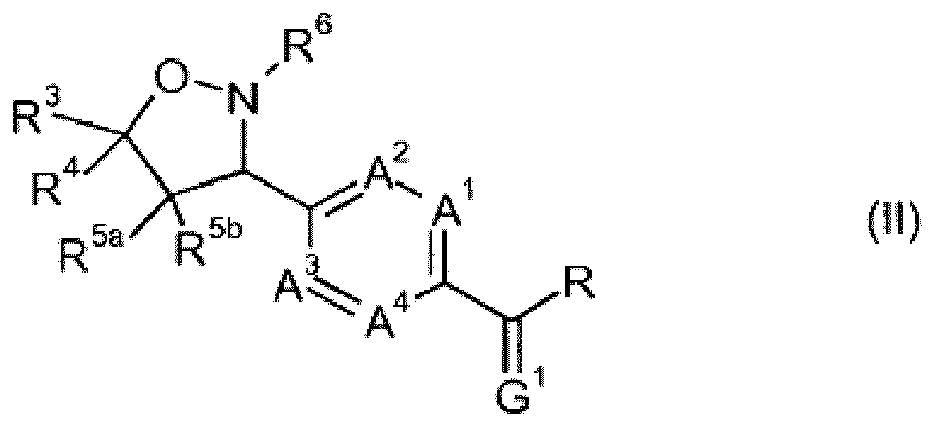
- Verfahren zum Bekämpfen von Insekten, Akarinen, Nematoden oder Mollusken, umfassend das Aufbringen einer insektizid, akarizid, nematizid oder molluskizid wirksamen Menge einer Verbindung der Formel (I) gemäß einem der Ansprüche 1 bis 11 auf einen Schädling, einen Ort eines Schädlings oder auf eine Pflanze, die für den Angriff eines Schädlings anfällig ist, wobei dieses Verfahren kein Verfahren zur Behandlung des menschlichen oder tierischen Körpers ist.
- Insektizide, akarizide, nematizide oder molluskizide Zusammensetzung, umfassend eine insektizid, akarizid, nematizid oder molluskizid wirksame Menge einer Verbindung der Formel (I) gemäß einem der Ansprüche 1 bis 11.
- Insektizide, akarizide, nematizide oder molluskizide Zusammensetzung gemäß Anspruch 14, umfassend eine zusätzliche Verbindung, die biologische Wirksamkeit aufweist.
Priority Applications (1)
| Application Number | Priority Date | Filing Date | Title |
|---|---|---|---|
| EP10704155A EP2411384B1 (de) | 2009-03-26 | 2010-02-18 | Insektizide verbindungen |
Applications Claiming Priority (6)
| Application Number | Priority Date | Filing Date | Title |
|---|---|---|---|
| GB0905239A GB0905239D0 (en) | 2009-03-26 | 2009-03-26 | Insecticidal compounds |
| GB0910767A GB0910767D0 (en) | 2009-06-22 | 2009-06-22 | Insecticidal compounds |
| PCT/EP2009/059563 WO2010020522A1 (en) | 2008-08-22 | 2009-07-24 | Insecticidal compounds |
| EP10153788 | 2010-02-17 | ||
| PCT/EP2010/052056 WO2010108733A1 (en) | 2009-03-26 | 2010-02-18 | Insecticidal compounds |
| EP10704155A EP2411384B1 (de) | 2009-03-26 | 2010-02-18 | Insektizide verbindungen |
Publications (2)
| Publication Number | Publication Date |
|---|---|
| EP2411384A1 EP2411384A1 (de) | 2012-02-01 |
| EP2411384B1 true EP2411384B1 (de) | 2013-01-30 |
Family
ID=42136073
Family Applications (1)
| Application Number | Title | Priority Date | Filing Date |
|---|---|---|---|
| EP10704155A Not-in-force EP2411384B1 (de) | 2009-03-26 | 2010-02-18 | Insektizide verbindungen |
Country Status (9)
| Country | Link |
|---|---|
| US (1) | US8980892B2 (de) |
| EP (1) | EP2411384B1 (de) |
| CN (1) | CN102365278B (de) |
| AR (1) | AR076146A1 (de) |
| BR (1) | BRPI1012247A2 (de) |
| ES (1) | ES2402887T3 (de) |
| TW (1) | TW201100014A (de) |
| UY (1) | UY32527A (de) |
| WO (1) | WO2010108733A1 (de) |
Families Citing this family (42)
| Publication number | Priority date | Publication date | Assignee | Title |
|---|---|---|---|---|
| JP2012500782A (ja) * | 2008-08-22 | 2012-01-12 | シンジェンタ パーティシペーションズ アクチェンゲゼルシャフト | 殺虫化合物類 |
| EP2331536B1 (de) | 2008-08-22 | 2013-08-21 | Syngenta Participations AG | Insektizide verbindungen |
| JP2012501989A (ja) | 2008-09-04 | 2012-01-26 | シンジェンタ パーティシペーションズ アクチェンゲゼルシャフト | 殺虫化合物 |
| KR20120089626A (ko) | 2009-06-22 | 2012-08-13 | 신젠타 리미티드 | 살충제 화합물 |
| TWI487486B (zh) | 2009-12-01 | 2015-06-11 | Syngenta Participations Ag | 以異唑啉衍生物為主之殺蟲化合物 |
| RS54772B1 (sr) | 2009-12-17 | 2016-10-31 | Merial Sas | Antiparazitska jedinjenja dihidroazola i kompozicije koje ih sadrže |
| WO2011101402A1 (en) * | 2010-02-17 | 2011-08-25 | Syngenta Participations Ag | Isoxazoline derivatives as insecticides |
| WO2012049327A2 (en) | 2010-10-15 | 2012-04-19 | Syngenta Participations Ag | Pesticidal mixtures |
| JP2014028758A (ja) * | 2010-11-19 | 2014-02-13 | Nissan Chem Ind Ltd | 寄生虫及び衛生害虫防除剤 |
| UY33887A (es) | 2011-02-03 | 2012-09-28 | Syngenta Ltd | Métodos de control de plagas en la soja |
| WO2012163948A1 (en) * | 2011-05-31 | 2012-12-06 | Syngenta Participations Ag | Pesticidal mixtures including isoxazoline derivatives |
| CN106045962A (zh) * | 2011-08-25 | 2016-10-26 | 先正达参股股份有限公司 | 作为杀虫化合物的异噁唑啉衍生物 |
| WO2013026939A1 (en) | 2011-08-25 | 2013-02-28 | Syngenta Participations Ag | Methods for the control of termites and ants |
| EP3216448B8 (de) | 2012-02-06 | 2019-06-05 | Boehringer Ingelheim Animal Health USA Inc. | Parasitizide orale tiermedizinische zusammensetzungen mit systemisch wirkenden wirkstoffen, verfahren und verwendungen davon |
| JO3626B1 (ar) | 2012-02-23 | 2020-08-27 | Merial Inc | تركيبات موضعية تحتوي على فيبرونيل و بيرميثرين و طرق استخدامها |
| US9867375B2 (en) | 2012-07-31 | 2018-01-16 | Syngenta Participations Ag | Methods of pest control in soybean |
| US20150189883A1 (en) | 2012-08-03 | 2015-07-09 | Syngenta Participations Ag | Methods of controlling insects |
| CN104519739A (zh) | 2012-08-03 | 2015-04-15 | 先正达参股股份有限公司 | 大豆有害生物控制的方法 |
| WO2014019957A2 (en) | 2012-08-03 | 2014-02-06 | Syngenta Participations Ag | Methods of pest control in soybean |
| BR112015003630A2 (pt) | 2012-08-24 | 2017-07-04 | Syngenta Participations Ag | métodos de controle de insetos |
| ES2736314T3 (es) | 2012-08-24 | 2019-12-27 | Syngenta Participations Ag | Métodos para controlar gusanos elatéridos |
| CN104582487B (zh) | 2012-08-24 | 2019-05-31 | 先正达参股股份有限公司 | 控制昆虫的方法 |
| WO2015066277A1 (en) | 2013-11-01 | 2015-05-07 | Merial Limited | Antiparisitic and pesticidal isoxazoline compounds |
| US9611252B2 (en) | 2013-12-30 | 2017-04-04 | Lifesci Pharmaceuticals, Inc. | Therapeutic inhibitory compounds |
| BR112016015449A8 (pt) * | 2013-12-30 | 2020-06-09 | Lifesci Pharmaceuticals Inc | compostos inibidores terapêuticos, composição farmacêutica os compreendendo e uso dos mesmos |
| CN106257976B (zh) | 2014-03-07 | 2021-02-02 | 拜奥克里斯特制药公司 | 人类血浆激肽释放酶抑制剂 |
| EP3131398B1 (de) | 2014-04-17 | 2019-10-23 | Boehringer Ingelheim Animal Health USA Inc. | Verwendung von malonsäuredinitrilverbindungen für den schutz von tieren gegen parasiten |
| UY36570A (es) | 2015-02-26 | 2016-10-31 | Merial Inc | Formulaciones inyectables de acción prolongada que comprenden un agente activo isoxazolina, métodos y usos de las mismas |
| LT3298027T (lt) | 2015-05-20 | 2021-08-10 | Boehringer Ingelheim Animal Health USA Inc. | Antihelmintiniai depsipeptido junginiai |
| CN110022875A (zh) | 2016-07-11 | 2019-07-16 | 莱福斯希医药公司 | 治疗性抑制化合物 |
| WO2018071535A1 (en) | 2016-10-14 | 2018-04-19 | Merial, Inc. | Pesticidal and parasiticidal vinyl isoxazoline compounds |
| CA3044038A1 (en) | 2016-11-16 | 2018-05-24 | Boehringer Ingelheim Animal Health USA Inc. | Anthelmintic depsipeptide compounds |
| BR112020003217A2 (pt) | 2017-08-14 | 2020-10-06 | Boehringer Ingelheim Animal Health USA Inc. | compostos pesticidas e parasiticidas de pirazolisoxazolina |
| DK3904350T3 (da) * | 2018-04-12 | 2023-11-13 | Bayer Ag | N-(cyclopropylmethyl)-5-(methylsulfonyl)-n-{1-[1-(pyrimidin-2-yl)-1h-1,2,4-triazol-5-yl]ethyl}benzamidderivater og de tilsvarende pyridincarboxamidderivater som pesticider |
| AU2019301510B2 (en) | 2018-07-09 | 2024-06-13 | Boehringer Ingelheim Pharma Gmbh & Co. Kg | Anthelminthic heterocyclic compounds |
| CN113260419A (zh) | 2018-11-20 | 2021-08-13 | 勃林格殷格翰动物保健美国公司 | 吲唑基氰基乙基氨基化合物、其组合物、其制备方法和其使用方法 |
| CA3133100A1 (en) | 2019-03-19 | 2020-09-24 | Boehringer Ingelheim Animal Health USA Inc. | Anthelmintic aza-benzothiophene and aza-benzofuran compounds |
| KR20230028268A (ko) | 2020-05-29 | 2023-02-28 | 뵈링거 잉겔하임 애니멀 헬스 유에스에이 인코포레이티드 | 구충성 헤테로시클릭 화합물 |
| US20240116854A1 (en) | 2021-01-27 | 2024-04-11 | Intervet Inc. | Cyclopropylamide compounds against parasites in fish |
| JP7824305B2 (ja) | 2021-01-27 | 2026-03-04 | コルテバ アグリサイエンス エルエルシー | 魚における寄生生物に対するシクロプロピルアミド化合物 |
| JP2025507585A (ja) | 2022-02-17 | 2025-03-21 | ベーリンガー インゲルハイム フェトメディカ ゲーエムベーハー | 流体製品メーラーを提供する方法及びシステム |
| NO20240925A1 (en) | 2023-09-15 | 2025-03-17 | Evah Atlantic Inc | Dihydroisoxazole compound for use in reducing ectoparasite infestations on fish |
Family Cites Families (10)
| Publication number | Priority date | Publication date | Assignee | Title |
|---|---|---|---|---|
| GB1540580A (en) | 1975-09-02 | 1979-02-14 | Shell Int Research | Fungicidal isoxazolidines |
| DE3418395A1 (de) * | 1984-05-17 | 1985-11-21 | Bayer Ag, 5090 Leverkusen | Biologisch aktive mittel enthaltend substituierte isoxazolidine sowie neue isoxazolidine und ihre herstellung |
| AU770077B2 (en) | 1999-03-11 | 2004-02-12 | Dow Agrosciences Llc | Heterocyclic substituted isoxazolidines and their use as fungicides |
| CN101768129B (zh) | 2004-03-05 | 2012-05-23 | 日产化学工业株式会社 | 异*唑啉取代苯甲酰胺化合物的制备中间体 |
| BRPI0617076B1 (pt) * | 2005-09-02 | 2021-07-06 | Nissan Chemical Corporation | Composto benzamida substituída por isoxazolina da fórmula (1) ou sal do mesmo; composto benzamida substituido por 4-hidroxiiminametila da fórmula (2) ou sal do mesmo; pesticida; agente agroquímico; parasiticida interno ou externo para mamíferos ou aves; inseticida ou acaricida |
| JP2009519937A (ja) * | 2005-12-14 | 2009-05-21 | イー・アイ・デュポン・ドウ・ヌムール・アンド・カンパニー | 無脊椎有害生物防除用イソオキサゾリン |
| TWI412322B (zh) * | 2005-12-30 | 2013-10-21 | Du Pont | 控制無脊椎害蟲之異唑啉 |
| MY146638A (en) * | 2007-04-10 | 2012-09-14 | Bayer Cropscience Ag | Insecticidal aryl isoxazoline derivatives |
| US20090270407A1 (en) | 2008-04-25 | 2009-10-29 | E. I. Du Pont De Nemours And Company | Fungicidal isoxazolidines |
| EP2331536B1 (de) | 2008-08-22 | 2013-08-21 | Syngenta Participations AG | Insektizide verbindungen |
-
2010
- 2010-02-18 EP EP10704155A patent/EP2411384B1/de not_active Not-in-force
- 2010-02-18 CN CN201080013496.6A patent/CN102365278B/zh not_active Expired - Fee Related
- 2010-02-18 WO PCT/EP2010/052056 patent/WO2010108733A1/en not_active Ceased
- 2010-02-18 US US13/260,499 patent/US8980892B2/en not_active Expired - Fee Related
- 2010-02-18 BR BRPI1012247A patent/BRPI1012247A2/pt not_active Application Discontinuation
- 2010-02-18 ES ES10704155T patent/ES2402887T3/es active Active
- 2010-03-24 TW TW099108658A patent/TW201100014A/zh unknown
- 2010-03-25 AR ARP100100945A patent/AR076146A1/es unknown
- 2010-03-26 UY UY0001032527A patent/UY32527A/es unknown
Also Published As
| Publication number | Publication date |
|---|---|
| CN102365278B (zh) | 2015-05-06 |
| WO2010108733A1 (en) | 2010-09-30 |
| US8980892B2 (en) | 2015-03-17 |
| EP2411384A1 (de) | 2012-02-01 |
| AR076146A1 (es) | 2011-05-18 |
| CN102365278A (zh) | 2012-02-29 |
| UY32527A (es) | 2010-10-29 |
| ES2402887T3 (es) | 2013-05-10 |
| TW201100014A (en) | 2011-01-01 |
| US20120015946A1 (en) | 2012-01-19 |
| BRPI1012247A2 (pt) | 2015-09-22 |
Similar Documents
| Publication | Publication Date | Title |
|---|---|---|
| EP2411384B1 (de) | Insektizide verbindungen | |
| US10364235B2 (en) | Insecticidal compounds | |
| EP2331535B1 (de) | Insektizide verbindungen | |
| EP2238132B1 (de) | Insektizide verbindungen | |
| EP2331515B1 (de) | Insektizide verbindungen | |
| EP2331536B1 (de) | Insektizide verbindungen | |
| US20110288089A1 (en) | Insecticidal compounds | |
| US20110288131A1 (en) | Insecticidal compounds | |
| US20100222392A1 (en) | Insecticidal compounds | |
| US20100240712A1 (en) | Insecticidal compounds | |
| CA2707612A1 (en) | Insecticidal compounds | |
| EP2427439B1 (de) | N-(4-perfluoroalkyl-phenyl)-4-triazolyl-benzamide als insektizide | |
| US8859592B2 (en) | Insecticidal compounds | |
| HK1163694B (en) | Insecticidal compounds | |
| EP2382208A1 (de) | Insektizidverbindungen | |
| HK1144430B (en) | Insecticidal compounds | |
| EP2379541A2 (de) | Insektizide verbindungen |
Legal Events
| Date | Code | Title | Description |
|---|---|---|---|
| PUAI | Public reference made under article 153(3) epc to a published international application that has entered the european phase |
Free format text: ORIGINAL CODE: 0009012 |
|
| 17P | Request for examination filed |
Effective date: 20110905 |
|
| AK | Designated contracting states |
Kind code of ref document: A1 Designated state(s): AT BE BG CH CY CZ DE DK EE ES FI FR GB GR HR HU IE IS IT LI LT LU LV MC MK MT NL NO PL PT RO SE SI SK SM TR |
|
| DAX | Request for extension of the european patent (deleted) | ||
| GRAP | Despatch of communication of intention to grant a patent |
Free format text: ORIGINAL CODE: EPIDOSNIGR1 |
|
| GRAS | Grant fee paid |
Free format text: ORIGINAL CODE: EPIDOSNIGR3 |
|
| GRAA | (expected) grant |
Free format text: ORIGINAL CODE: 0009210 |
|
| AK | Designated contracting states |
Kind code of ref document: B1 Designated state(s): AT BE BG CH CY CZ DE DK EE ES FI FR GB GR HR HU IE IS IT LI LT LU LV MC MK MT NL NO PL PT RO SE SI SK SM TR |
|
| REG | Reference to a national code |
Ref country code: GB Ref legal event code: FG4D |
|
| REG | Reference to a national code |
Ref country code: CH Ref legal event code: EP |
|
| REG | Reference to a national code |
Ref country code: AT Ref legal event code: REF Ref document number: 595688 Country of ref document: AT Kind code of ref document: T Effective date: 20130215 Ref country code: CH Ref legal event code: EP |
|
| REG | Reference to a national code |
Ref country code: IE Ref legal event code: FG4D |
|
| REG | Reference to a national code |
Ref country code: DE Ref legal event code: R096 Ref document number: 602010004898 Country of ref document: DE Effective date: 20130321 |
|
| REG | Reference to a national code |
Ref country code: ES Ref legal event code: FG2A Ref document number: 2402887 Country of ref document: ES Kind code of ref document: T3 Effective date: 20130510 |
|
| REG | Reference to a national code |
Ref country code: AT Ref legal event code: MK05 Ref document number: 595688 Country of ref document: AT Kind code of ref document: T Effective date: 20130130 |
|
| REG | Reference to a national code |
Ref country code: LT Ref legal event code: MG4D |
|
| REG | Reference to a national code |
Ref country code: NL Ref legal event code: VDEP Effective date: 20130130 |
|
| PG25 | Lapsed in a contracting state [announced via postgrant information from national office to epo] |
Ref country code: AT Free format text: LAPSE BECAUSE OF FAILURE TO SUBMIT A TRANSLATION OF THE DESCRIPTION OR TO PAY THE FEE WITHIN THE PRESCRIBED TIME-LIMIT Effective date: 20130130 Ref country code: BE Free format text: LAPSE BECAUSE OF FAILURE TO SUBMIT A TRANSLATION OF THE DESCRIPTION OR TO PAY THE FEE WITHIN THE PRESCRIBED TIME-LIMIT Effective date: 20130130 Ref country code: IS Free format text: LAPSE BECAUSE OF FAILURE TO SUBMIT A TRANSLATION OF THE DESCRIPTION OR TO PAY THE FEE WITHIN THE PRESCRIBED TIME-LIMIT Effective date: 20130530 Ref country code: BG Free format text: LAPSE BECAUSE OF FAILURE TO SUBMIT A TRANSLATION OF THE DESCRIPTION OR TO PAY THE FEE WITHIN THE PRESCRIBED TIME-LIMIT Effective date: 20130430 Ref country code: SE Free format text: LAPSE BECAUSE OF FAILURE TO SUBMIT A TRANSLATION OF THE DESCRIPTION OR TO PAY THE FEE WITHIN THE PRESCRIBED TIME-LIMIT Effective date: 20130130 Ref country code: LT Free format text: LAPSE BECAUSE OF FAILURE TO SUBMIT A TRANSLATION OF THE DESCRIPTION OR TO PAY THE FEE WITHIN THE PRESCRIBED TIME-LIMIT Effective date: 20130130 Ref country code: NO Free format text: LAPSE BECAUSE OF FAILURE TO SUBMIT A TRANSLATION OF THE DESCRIPTION OR TO PAY THE FEE WITHIN THE PRESCRIBED TIME-LIMIT Effective date: 20130430 |
|
| PG25 | Lapsed in a contracting state [announced via postgrant information from national office to epo] |
Ref country code: FI Free format text: LAPSE BECAUSE OF FAILURE TO SUBMIT A TRANSLATION OF THE DESCRIPTION OR TO PAY THE FEE WITHIN THE PRESCRIBED TIME-LIMIT Effective date: 20130130 Ref country code: PL Free format text: LAPSE BECAUSE OF FAILURE TO SUBMIT A TRANSLATION OF THE DESCRIPTION OR TO PAY THE FEE WITHIN THE PRESCRIBED TIME-LIMIT Effective date: 20130130 Ref country code: GR Free format text: LAPSE BECAUSE OF FAILURE TO SUBMIT A TRANSLATION OF THE DESCRIPTION OR TO PAY THE FEE WITHIN THE PRESCRIBED TIME-LIMIT Effective date: 20130501 Ref country code: PT Free format text: LAPSE BECAUSE OF FAILURE TO SUBMIT A TRANSLATION OF THE DESCRIPTION OR TO PAY THE FEE WITHIN THE PRESCRIBED TIME-LIMIT Effective date: 20130530 Ref country code: SI Free format text: LAPSE BECAUSE OF FAILURE TO SUBMIT A TRANSLATION OF THE DESCRIPTION OR TO PAY THE FEE WITHIN THE PRESCRIBED TIME-LIMIT Effective date: 20130130 Ref country code: NL Free format text: LAPSE BECAUSE OF FAILURE TO SUBMIT A TRANSLATION OF THE DESCRIPTION OR TO PAY THE FEE WITHIN THE PRESCRIBED TIME-LIMIT Effective date: 20130130 Ref country code: LV Free format text: LAPSE BECAUSE OF FAILURE TO SUBMIT A TRANSLATION OF THE DESCRIPTION OR TO PAY THE FEE WITHIN THE PRESCRIBED TIME-LIMIT Effective date: 20130130 |
|
| PG25 | Lapsed in a contracting state [announced via postgrant information from national office to epo] |
Ref country code: HR Free format text: LAPSE BECAUSE OF FAILURE TO SUBMIT A TRANSLATION OF THE DESCRIPTION OR TO PAY THE FEE WITHIN THE PRESCRIBED TIME-LIMIT Effective date: 20130130 Ref country code: MC Free format text: LAPSE BECAUSE OF NON-PAYMENT OF DUE FEES Effective date: 20130228 |
|
| PG25 | Lapsed in a contracting state [announced via postgrant information from national office to epo] |
Ref country code: DK Free format text: LAPSE BECAUSE OF FAILURE TO SUBMIT A TRANSLATION OF THE DESCRIPTION OR TO PAY THE FEE WITHIN THE PRESCRIBED TIME-LIMIT Effective date: 20130130 Ref country code: CZ Free format text: LAPSE BECAUSE OF FAILURE TO SUBMIT A TRANSLATION OF THE DESCRIPTION OR TO PAY THE FEE WITHIN THE PRESCRIBED TIME-LIMIT Effective date: 20130130 Ref country code: RO Free format text: LAPSE BECAUSE OF FAILURE TO SUBMIT A TRANSLATION OF THE DESCRIPTION OR TO PAY THE FEE WITHIN THE PRESCRIBED TIME-LIMIT Effective date: 20130130 Ref country code: EE Free format text: LAPSE BECAUSE OF FAILURE TO SUBMIT A TRANSLATION OF THE DESCRIPTION OR TO PAY THE FEE WITHIN THE PRESCRIBED TIME-LIMIT Effective date: 20130130 Ref country code: SK Free format text: LAPSE BECAUSE OF FAILURE TO SUBMIT A TRANSLATION OF THE DESCRIPTION OR TO PAY THE FEE WITHIN THE PRESCRIBED TIME-LIMIT Effective date: 20130130 |
|
| PG25 | Lapsed in a contracting state [announced via postgrant information from national office to epo] |
Ref country code: CY Free format text: LAPSE BECAUSE OF FAILURE TO SUBMIT A TRANSLATION OF THE DESCRIPTION OR TO PAY THE FEE WITHIN THE PRESCRIBED TIME-LIMIT Effective date: 20130130 |
|
| REG | Reference to a national code |
Ref country code: IE Ref legal event code: MM4A |
|
| PLBE | No opposition filed within time limit |
Free format text: ORIGINAL CODE: 0009261 |
|
| STAA | Information on the status of an ep patent application or granted ep patent |
Free format text: STATUS: NO OPPOSITION FILED WITHIN TIME LIMIT |
|
| 26N | No opposition filed |
Effective date: 20131031 |
|
| PG25 | Lapsed in a contracting state [announced via postgrant information from national office to epo] |
Ref country code: IE Free format text: LAPSE BECAUSE OF NON-PAYMENT OF DUE FEES Effective date: 20130218 |
|
| REG | Reference to a national code |
Ref country code: DE Ref legal event code: R097 Ref document number: 602010004898 Country of ref document: DE Effective date: 20131031 |
|
| PG25 | Lapsed in a contracting state [announced via postgrant information from national office to epo] |
Ref country code: MT Free format text: LAPSE BECAUSE OF FAILURE TO SUBMIT A TRANSLATION OF THE DESCRIPTION OR TO PAY THE FEE WITHIN THE PRESCRIBED TIME-LIMIT Effective date: 20130130 |
|
| REG | Reference to a national code |
Ref country code: CH Ref legal event code: PL |
|
| PG25 | Lapsed in a contracting state [announced via postgrant information from national office to epo] |
Ref country code: CH Free format text: LAPSE BECAUSE OF NON-PAYMENT OF DUE FEES Effective date: 20140228 Ref country code: LI Free format text: LAPSE BECAUSE OF NON-PAYMENT OF DUE FEES Effective date: 20140228 |
|
| PG25 | Lapsed in a contracting state [announced via postgrant information from national office to epo] |
Ref country code: SM Free format text: LAPSE BECAUSE OF FAILURE TO SUBMIT A TRANSLATION OF THE DESCRIPTION OR TO PAY THE FEE WITHIN THE PRESCRIBED TIME-LIMIT Effective date: 20130130 |
|
| PG25 | Lapsed in a contracting state [announced via postgrant information from national office to epo] |
Ref country code: TR Free format text: LAPSE BECAUSE OF FAILURE TO SUBMIT A TRANSLATION OF THE DESCRIPTION OR TO PAY THE FEE WITHIN THE PRESCRIBED TIME-LIMIT Effective date: 20130130 |
|
| PG25 | Lapsed in a contracting state [announced via postgrant information from national office to epo] |
Ref country code: LU Free format text: LAPSE BECAUSE OF NON-PAYMENT OF DUE FEES Effective date: 20130218 Ref country code: HU Free format text: LAPSE BECAUSE OF FAILURE TO SUBMIT A TRANSLATION OF THE DESCRIPTION OR TO PAY THE FEE WITHIN THE PRESCRIBED TIME-LIMIT; INVALID AB INITIO Effective date: 20100218 Ref country code: MK Free format text: LAPSE BECAUSE OF FAILURE TO SUBMIT A TRANSLATION OF THE DESCRIPTION OR TO PAY THE FEE WITHIN THE PRESCRIBED TIME-LIMIT Effective date: 20130130 |
|
| REG | Reference to a national code |
Ref country code: FR Ref legal event code: PLFP Year of fee payment: 7 |
|
| REG | Reference to a national code |
Ref country code: FR Ref legal event code: PLFP Year of fee payment: 8 |
|
| REG | Reference to a national code |
Ref country code: FR Ref legal event code: PLFP Year of fee payment: 9 |
|
| PGFP | Annual fee paid to national office [announced via postgrant information from national office to epo] |
Ref country code: DE Payment date: 20180207 Year of fee payment: 9 Ref country code: ES Payment date: 20180302 Year of fee payment: 9 Ref country code: GB Payment date: 20180125 Year of fee payment: 9 |
|
| PGFP | Annual fee paid to national office [announced via postgrant information from national office to epo] |
Ref country code: IT Payment date: 20180216 Year of fee payment: 9 Ref country code: FR Payment date: 20180118 Year of fee payment: 9 |
|
| REG | Reference to a national code |
Ref country code: DE Ref legal event code: R119 Ref document number: 602010004898 Country of ref document: DE |
|
| GBPC | Gb: european patent ceased through non-payment of renewal fee |
Effective date: 20190218 |
|
| PG25 | Lapsed in a contracting state [announced via postgrant information from national office to epo] |
Ref country code: DE Free format text: LAPSE BECAUSE OF NON-PAYMENT OF DUE FEES Effective date: 20190903 Ref country code: GB Free format text: LAPSE BECAUSE OF NON-PAYMENT OF DUE FEES Effective date: 20190218 |
|
| PG25 | Lapsed in a contracting state [announced via postgrant information from national office to epo] |
Ref country code: IT Free format text: LAPSE BECAUSE OF NON-PAYMENT OF DUE FEES Effective date: 20190218 Ref country code: FR Free format text: LAPSE BECAUSE OF NON-PAYMENT OF DUE FEES Effective date: 20190228 |
|
| REG | Reference to a national code |
Ref country code: ES Ref legal event code: FD2A Effective date: 20200331 |
|
| PG25 | Lapsed in a contracting state [announced via postgrant information from national office to epo] |
Ref country code: ES Free format text: LAPSE BECAUSE OF NON-PAYMENT OF DUE FEES Effective date: 20190219 |