EP2331732B1 - Système et méthode de surveillance d'un revêtement d'électroplacage, et méthode de fabrication d'un produit revêtu par placage - Google Patents
Système et méthode de surveillance d'un revêtement d'électroplacage, et méthode de fabrication d'un produit revêtu par placage Download PDFInfo
- Publication number
- EP2331732B1 EP2331732B1 EP09736662A EP09736662A EP2331732B1 EP 2331732 B1 EP2331732 B1 EP 2331732B1 EP 09736662 A EP09736662 A EP 09736662A EP 09736662 A EP09736662 A EP 09736662A EP 2331732 B1 EP2331732 B1 EP 2331732B1
- Authority
- EP
- European Patent Office
- Prior art keywords
- electrodeposition
- coated
- abnormality
- conveying mechanism
- conveying
- Prior art date
- Legal status (The legal status is an assumption and is not a legal conclusion. Google has not performed a legal analysis and makes no representation as to the accuracy of the status listed.)
- Not-in-force
Links
- 238000004070 electrodeposition Methods 0.000 title claims abstract description 123
- 238000000576 coating method Methods 0.000 title claims abstract description 96
- 239000011248 coating agent Substances 0.000 title claims abstract description 79
- 238000012544 monitoring process Methods 0.000 title claims abstract description 47
- 238000000034 method Methods 0.000 title claims abstract description 31
- 238000004519 manufacturing process Methods 0.000 title claims description 15
- 230000005856 abnormality Effects 0.000 claims abstract description 51
- 230000007246 mechanism Effects 0.000 claims abstract description 44
- 239000003973 paint Substances 0.000 claims abstract description 20
- 238000013480 data collection Methods 0.000 claims description 7
- 238000013500 data storage Methods 0.000 description 8
- 230000008569 process Effects 0.000 description 7
- 230000002159 abnormal effect Effects 0.000 description 6
- 239000007788 liquid Substances 0.000 description 3
- 238000001514 detection method Methods 0.000 description 2
- 238000011144 upstream manufacturing Methods 0.000 description 2
- 230000004075 alteration Effects 0.000 description 1
- 238000010276 construction Methods 0.000 description 1
- 230000007547 defect Effects 0.000 description 1
- 238000010586 diagram Methods 0.000 description 1
- 238000011143 downstream manufacturing Methods 0.000 description 1
- 238000001035 drying Methods 0.000 description 1
- 238000005516 engineering process Methods 0.000 description 1
- 239000000284 extract Substances 0.000 description 1
- 230000002349 favourable effect Effects 0.000 description 1
- 238000012986 modification Methods 0.000 description 1
- 230000004048 modification Effects 0.000 description 1
- 230000003287 optical effect Effects 0.000 description 1
- 230000001360 synchronised effect Effects 0.000 description 1
Images

Classifications
-
- C—CHEMISTRY; METALLURGY
- C25—ELECTROLYTIC OR ELECTROPHORETIC PROCESSES; APPARATUS THEREFOR
- C25D—PROCESSES FOR THE ELECTROLYTIC OR ELECTROPHORETIC PRODUCTION OF COATINGS; ELECTROFORMING; APPARATUS THEREFOR
- C25D13/00—Electrophoretic coating characterised by the process
- C25D13/22—Servicing or operating apparatus or multistep processes
-
- C—CHEMISTRY; METALLURGY
- C25—ELECTROLYTIC OR ELECTROPHORETIC PROCESSES; APPARATUS THEREFOR
- C25D—PROCESSES FOR THE ELECTROLYTIC OR ELECTROPHORETIC PRODUCTION OF COATINGS; ELECTROFORMING; APPARATUS THEREFOR
- C25D21/00—Processes for servicing or operating cells for electrolytic coating
- C25D21/12—Process control or regulation
Definitions
- the invention relates to an electrodeposition-coating monitoring system and method, and a method of manufacturing an electrodeposition-coated article, in which an electrodeposition coating apparatus for performing electrodeposition coating by conveying an object to be coated while the object is immersed in a liquid electrodeposition paint. More specifically, the invention relates to an electrodeposition-coating monitoring system and method, in which an apparatus is monitored in which objects to be coated are continuously conveyed and electrodeposition coating on a plurality of objects to be coated is performed in parallel, and to a method of manufacturing electrodeposition-coated articles in which the electrodeposition-coated articles are manufactured while monitoring is performed.
- electrodeposition coating has been widely performed in which the body is immersed in a liquid electrodeposition paint in an electrodeposition bath.
- the electrodeposition bath many electrodes are disposed on the side surfaces and the bottom surface of the electrodeposition bath.
- objects to be coated are conveyed in the electrodeposition paint while voltage is applied to these electrodes.
- JP-A-2006-97119 describes a method of measuring the amount of coating and the thickness of the coat on each object to be coated in an apparatus in which a plurality of objects to be coated are simultaneously immersed in an electrodeposition paint by continuously conveying a plurality of objects to be coated along the electrodeposition bath.
- the variation with time of the values of the electric currents flowing through a plurality of electrodes is measured, and the component corresponding to the object to be coated concerned is extracted from the variation with time and integrated.
- This document says that, in this way, it is possible to obtain the number of coulombs that flow through the object to be coated concerned, and based on the number of coulombs, it is possible to calculate the amount of coating.
- the data concerning the variation with time of the electric current value is used to differentiate a plurality of objects to be coated from each other that are simultaneously conveyed.
- the system is not designed to determine the electric current value when the object to be coated is at the position at which the object faces an electrode.
- the result can be obtained only after the object to be coated is taken out.
- the portion in which the failure occurs there has been a fear that defects can occur in the objects to be coated that are put into the bath after the occurrence of the failure.
- the invention provides an electrodeposition-coating monitoring system and method, and a method of manufacturing an electrodeposition-coated article, with which it is possible to monitor an electrodeposition coating process, quickly detect the occurrence of a failure in the state of the coating and/or in a coating apparatus, and provide notification about such an occurrence.
- An electrodeposition-coating monitoring system includes: an electrodeposition bath that contains an electrodeposition paint; a conveying mechanism that conveys the object to be coated while the object is immersed in the electrodeposition paint in the electrodeposition bath; a plurality of electrodes arranged along a conveying direction in which the object to be coated is conveyed by the conveying mechanism; a present-position-data acquisition section that acquires present position data of the object to be coated in the conveying direction in which the object to be coated is conveyed by the conveying mechanism; an electric-current-data collection section that collects individual values of electric currents that flow through the plurality of electrodes, respectively; and an abnormality determination section that determines the occurrence of an abnormality in electrodeposition coating based on the electric current value, collected by the electric-current-data collection section, of the electrode positioned at a point corresponding to the present position data acquired by the present-position-data acquisition section.
- an object to be coated is conveyed while the object is immersed in an electrodeposition paint, whereby the object is electrodeposition coated.
- An electrodeposition-coating monitoring system is for monitoring such an electrodeposition coating process.
- data concerning the present position at which the object to be coated is being conveyed is acquired by the present-position-data acquisition section, and electric current values are collected by the electric-current-data collection section on an electrode-by-electrode basis.
- the abnormality determination section determines the occurrence of the abnormality based on the electric current value of the electrode positioned at a point corresponding to the data concerning the present position at which the object to be coated is being conveyed. In this way, it is possible to monitor an electrodeposition coating process, quickly detect the occurrence of a failure in the state of the coating and/or in a coating apparatus, and provide notification about such an occurrence.
- the present-position-data acquisition section may acquire the present position data based on data concerning a carried distance by which the object to be coated is carried along the conveying mechanism.
- the present-position-data acquisition section may acquire the present position data based on information obtained from the conveying mechanism.
- a configuration may be adopted in which, when the present position data acquired by the present-position-data acquisition section has a value corresponding to a predetermined determination position, the abnormality determination section acquires one, corresponding to a predetermined electrode associated with the determination position, of the electric current values collected by the electric-current-data collection section, and based on whether the acquired electric current value is within a predetermined range, the abnormality determination section determines the occurrence of the abnormality for the object to be coated that is positioned at the determination position.
- the electrodeposition-coating monitoring system may further include: a passing sensor that outputs a passing signal when the object to be coated passes by a predetermined point on the conveying mechanism; a conveying signal output section that outputs a conveying signal that periodically varies while the conveying mechanism is conveying the object to be coated; and a counter that is started by the passing signal and counts cycles by which the conveying signal periodically varies, and the present-position-data acquisition section may use the thus-obtained cycle count as the present position data.
- the passing sensor may be a mechanical sensor that is switched on and off when an object to be coated passes by the passing sensor.
- the passing sensor may be an optical sensor or an electromagnetic sensor that detects passing of an object to be coated.
- a conveyor pulse signal that is used to control driving of the conveyor may be used as the conveying signal.
- the conveying signal is not limited as long as the cycle count value of the conveying signal and the carried distance by which an object to be coated is conveyed by the conveying mechanism have a one-to-one correspondence.
- the electrodeposition-coating monitoring system may further include an abnormality notification device that, when the abnormality determination section detects the occurrence of the abnormality, provides notification about the occurrence of the abnormality.
- a second aspect of the invention is an electrodeposition-coating monitoring method in which electrodeposition coating of an object to be coated is monitored that uses an electrodeposition bath that contains an electrodeposition paint, a conveying mechanism that conveys the object to be coated while the object is immersed in the electrodeposition paint in the electrodeposition bath, and a plurality of electrodes arranged along a conveying direction in which the object to be coated is conveyed by the conveying mechanism, the electrodeposition-coating monitoring method including: acquiring present position data of the object to be coated in the conveying direction in which the object to be coated is conveyed by the conveying mechanism; acquiring an electric current value of the electrode positioned at a point corresponding to the acquired present position data; and determining an occurrence of an abnormality in the electrodeposition coating based on the acquired electric current value.
- a third aspect of the invention is a method of manufacturing an electrodeposition-coated article in which an electrodeposition bath that contains an electrodeposition paint, a conveying mechanism that conveys the object to be coated while the object is immersed in the electrodeposition paint in the electrodeposition bath, and a plurality of electrodes arranged along a conveying direction in which .the object to be coated is conveyed by the conveying mechanism are used, the method including: acquiring present position data of the object to be coated in the conveying direction in which the object to be coated is conveyed by the conveying mechanism; acquiring an electric current value of the electrode positioned at a point corresponding to the acquired present position data; and performing electrodeposition coating while repeatedly determining an occurrence of an abnormality in the electrodeposition coating based on the acquired electric current value.
- the present position data may be acquired based on data concerning a carried distance by which the object to be coated is carried along the conveying mechanism.
- the present position data may be acquired based on information obtained from the conveying mechanism.
- the electric current value acquiring step may be such that, when the acquired present position data has a value corresponding to a predetermined determination position, an electric current value corresponding to a predetermined one, associated with the determination position, of the plurality of electrodes is acquired, and, the determining step may be such that the occurrence of the abnormality for the object to be coated that is positioned at the determination position is determined based on whether the acquired electric current value is within a predetermined range.
- each of the methods may further include: outputting a conveying signal that periodically varies while the conveying mechanism is conveying the object to be coated; counting cycles by which the conveying signal periodically varies, from when the object to be coated passes by a predetermined position on the conveying mechanism; and using a thus-obtained cycle count as the present position data of the object to be coated in the conveying direction in which the object to be coated is conveyed by the conveying mechanism.
- Each of the methods according to the second and third aspects of the invention may further include, when the occurrence of the abnormality is detected, causing an abnormality notification device to provide notification about the occurrence of the abnormality.
- any of the electrodeposition-coating monitoring system and method, and the method of manufacturing an electrodeposition-coated article it is possible to monitor an electrodeposition coating process, quickly detect the occurrence of a failure in the state of the coating and/or in a coating apparatus, and provide notification about such an occurrence.
- the invention is applied to an electrodeposition-coating monitoring system that controls an electrodeposition coating apparatus for undercoating a body of a car and monitoring whether a favorable electrodeposition coating is being performed.
- the electrodeposition-coating monitoring system 1 of this embodiment is used in a state where the electrodeposition-coating monitoring system 1 is connected to an electrodeposition coating apparatus 10.
- the electrodeposition coating apparatus 10 will be first briefly described.
- the electrodeposition coating apparatus 10 has an electrodeposition bath 11 filled with a liquid electrodeposition paint 12, and has a plurality of electrodes 13 disposed in the electrodeposition bath 11.
- the electrodeposition bath 11 has a size large enough to accommodate a plurality of bodies in the longitudinal direction of the electrodeposition bath 11 (horizontal direction in FIG. 1 ).
- the plurality of electrodes 13 are simplified in FIG. 1 , the plurality of electrodes 13 are not uniform in actual, that is, the plurality of electrodes 13 include flat electrodes and rod-lilce electrodes, for example. These electrodes are properly arranged so as to be able to favorably coat objects to be coated (bodies of cars in this embodiment).
- the electrodes 13 are disposed not only on the side surfaces of the electrodeposition bath 11 but also on the bottom surface thereof.
- a rail 14 for a conveyor is spanned over the electrodeposition bath 11, shaped so as to extend along the bottom surface of the electrodeposition bath 11.
- bodies of cars are hanged from the rail 14 through hangers 15.
- the bodies can be conveyed along the electrodeposition bath 11 by driving the conveyor as shown by the broken-line arrows in FIG. 1 .
- the conveying speed of the conveyor is set so that the time during which a body is immersed in the paint in the electrodeposition bath 11 is within a proper range.
- the electrodes 13 are grouped, where each group includes one electrode or a plurality of electrodes, and voltage is applied to bodies, which are the coated objects. For this reason, on the body side, bus bars 16 are provided along the rail 14. It should be noted that a single electrode 13 and a set of a plurality of electrodes 13 that belong to a group are both simply referred to as the electrode 13.
- the bus bars 16 that are used include two segments above the electrodeposition bath 11.
- a line sensor (LS) 17 for detecting the passing of the hanger 15 is disposed near the start point of the rail 14. The position at which the LS 17 is attached is before the entrance point at which bodies are put into the electrodeposition bath 11.
- the electrodeposition-coating monitoring system 1 of this embodiment has a conveyor controller 21, a data manager 22, an electric-current-value collection unit 23, a data storage 24, and an abnormality indication unit 25.
- the conveyor controller 21 controls driving of the conveyor to cause the hanger 15 to move at a predetermined conveying speed.
- the conveyor controller 21 sends pulse signals synchronized with the movement of the hanger 15. Specifically, every time the pulse signal is generated, the hanger 15 is moved a predetermined distance.
- the conveying speed of the hanger 15 may vary depending on the types of bodies in some cases.
- the electric-current-value collection unit 23 constantly collects the individual values of the electric currents flowing through the electrodes 13.
- the data manager 22 extracts and acquires the electric current values at proper timings from the result of detection performed by the electric-current-value collection unit 23. With regard to the timings at which the electric current values are extracted, the data manager 22 acquires the electric current values based on the signal indicating the passing of a body sent from the LS 17 and the pulse signals from the conveyor controller 21.
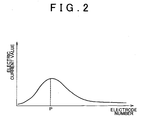
- a relatively large electric current flows between a body and an electrode 13 at the point at which the body is closest to the electrode 13.
- a relatively large electric current flows through the electrode P that is closest to the point at which the body is being conveyed, and the values of the electric currents that flow through the other electrodes 13 are smaller.
- the values of the electric currents flowing through the body at this point have a peak at the electrode P.
- the electrode numbers that the horizontal axis indicates in FIG. 2 are the numbers that are assigned to the electrodes 13 in order from the upstream side in the conveying direction. The body is conveyed from left to right in FIG. 2 , and the peak of the electric current values moves right as the body moves.
- the most part of the electric current value that is obtained at the point at which the body is closest to an electrode 13 is due to the electric current flowing through the body and the electrode 13. Even when there is another body that is also in the electrodeposition bath 11, the influence of such another body is very small. It should be noted that when a plurality of bodies are simultaneously immersed, peaks of the electric current values appear for the electrodes 13 corresponding to the respective positions at which the bodies are being conveyed. That is, the number of peaks of the electric current values is equal to the number of bodies that are in the electrodeposition bath 11.
- the data manager 22 acquires the electric current value for each electrode 13 at the timing at which a body is conveyed to the point closest to the electrode 13 concerned, for example.
- the data manager 22 acquires the electric current value of an electrode 13 at the position corresponding to the position of a body at the timing at which the electric current value is to be acquired.
- the data manager 22 may be configured to acquire the electric current values of some electrodes 13 that are adjacent to the electrode 13 closest to the body concerned.
- the data storage 24 stores the data acquired by the data manager 22.
- the threshold values of the electric current values corresponding to the types of bodies and the electrodes 13 are set and stored in the data storage 24 in advance.
- the data storage 24 compares a stored threshold value and one of the data acquired that corresponds to the body and the electrode(s) concerned. That is, the data manager 22 and the data storage 24 in combination function as the abnormality determination section.
- the abnormality indication unit 25 is such that when the abnormality indication unit 25 receives the signal indicating the occurrence of an abnormality from the data manager 22, the abnormality indication unit 25 notifies an operator of the reception. For example, the abnormality indication unit 25 executes a process that switches on an indication light attached near the electrodeposition-coating monitoring system 1, sets off an alarm, etc.
- the monitoring process performed by the electrodeposition-coating monitoring system 1 of thins embodiment is performed in parallel with the electrodeposition coating process that is performed by the electrodeposition coating apparatus 10.
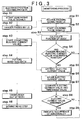
- an electrodeposition coating process and a monitoring process are shown in FIG 3 , presented side by side.
- FIG. 3 a process in which one body is electrodeposition coated is shown.
- the hanger 15 on which the body is set advances, and passes by the LS 17 (step A2). At this point, the passing of the hanger 15 is detected by the LS 17, and a passing signal is transmitted.
- the data manager 22 receives this signal (step B1), which shows that the hanger 15 is near the location of the LS 17 at this time.
- the data manager 22 starts to count the pulse signals from the conveyor controller 21 upon reception of the passing signal from the LS 17 (step B2). In this way, it is possible to correctly determine the current position of the hanger 15 based on the location of the LS 17 and the count value after the start of counting.
- the application of voltage to the electrodes 13 is started before the body is put into the electrodeposition bath 11.
- the collection of the electric current values performed by the electric-current-value collection unit 23 is started (step A3).
- the hanger 15 further advances, and the body is put into the electrodeposition bath 11 (step A4).
- the electrodeposition coating of the body is then started.
- the voltage may be applied to the electrodes 13 without interruption.
- the data manager 22 continues counting the pulse signals from the conveyor controller 21, and calculates the position of the hanger 15 (step B3). In this way, it is monitored whether the hanger 15 has reached the position at which the electric current value is to be detected (step B4).
- the position at which the electric current value is to be detected is set in advance based on the arrangement of the electrodes 13 in the electrodeposition bath 11, the shape of the body, etc. In this embodiment, the positions at which the electric current values are detected while the bodies are conveyed and the number of such positions can be selected according to the circumstances. Specifically, these parameters may be changed depending on the types of bodies, or may be changed according to the hour within a day.
- the electrode 13, of which the electric current value is detected when the hanger 15 reaches a detection position, is also determined in advance.
- the number of electrodes 13 for which the electric current values are detected is not limited to one.
- the electrodeposition-coating monitoring system 1 may be configured such that the electric current values of a plurality of electrodes 13 are simultaneously acquired. In general, it is preferable that the electrode 13 that gives the peak as shown in FIG 2 corresponding to the current position of the body be selected in advance. Thus, when a plurality of bodies are simultaneously immersed, for each body, the electric current value of the corresponding electrode 13 is detected at respective timings.
- the data manager 22 determines that the hanger 15 has reached the position at which the electric current value is to be detected. The description below will be made on the assumption of such a configuration.
- the electric current value of the electrode 13 concerned at this time is extracted from the data collected by the electric-current-value collection unit 23 (step B5). Specifically, of the electric current values that are constantly collected by the electric-current-value collection unit 23, the data manager 22 acquires the electric current value of the concerned electrode 13 corresponding to the proper timing. In addition, the data manager 22 stores the acquired electric current value data along with the present position data in the data storage 24 (step B6).
- the data storage 24 compares the electric current value stored in step B6 and the threshold value that is stored in advance, associated with the present position data (step B7). Then, the data storage 24 determines whether the electric current values are within the suitable range (step B8). In particular, in this embodiment, when the electric current value is lower than the corresponding threshold value, it is determined that the electric current value is abnormal.
- An upper limit threshold value may be set, or otherwise, both upper and lower limit threshold values may be set to determine whether the electric current value is within a proper range.
- the threshold value varies depending not only on the position of the hanger 15 but also on the construction of the electrodeposition coating apparatus 10, the types of bodies, etc., and is therefore selected appropriately according to what is performed in the coating process.
- the electrodeposition coating process is further continued.
- the data manager 22 commands the abnormality indication unit 25 to indicate the occurrence of the abnormality (step B9).
- monitoring may be continued without reaction for a while. It is preferable that the electrodeposition coating process be continued until the system is stopped by an operator even when the electric current value is abnormal.
- step A5 When the hanger 15 reaches the point in the electrodeposition bath 11 at which the body is to be taken out, the body is lifted along the conveyor and taken out of the electrodeposition bath 11 (step A5).
- the electrodeposition coating process for the body is thus completed, and the body is sent to the downstream processes, such as a drying process and an overcoating process (step A6).
- the data manager 22 of the electrodeposition-coating monitoring system 1 preferably acquires the electric current values for each of the bodies that are fed continuously. When the electric current values are accumulated for each body, it is possible to determine the amount of coating on each body. Meanwhile, when the electric current values are monitored for each of the electrodes 13, it is possible to detect the occurrence of an abnormality in the electrode 13. When the position of the electrode 13 of which the electric current value is abnormal is graphically shown, it is possible to detect the occurrence of an abnormality in a plurality of neighboring electrodes 13, or in the electrodes 13 related to each other at an early stage.
- the monitoring system 1 of this embodiment it is possible to automatically acquire the electric current value when the hanger 15 reaches the predetermined position. In addition, it is possible to determine whether there is some failure in the system by comparing the acquired electric current value and the threshold value. Thus, it is possible to monitor the electrodeposition coating process, quickly detect the occurrence of a failure in the system, and provide notification about such an occurrence. In addition, when the electrodeposition-coated articles are manufactured while the coating process is being monitored, it is possible to manufacture electrodeposition-coated articles that are favorably coated.
- the position of the LS 17 is not limited to the position before the entrance point at which bodies are put into the bath, but may be the position immediately after such an entrance point.
- the position of the LS 17 is not limited to the position before the entrance point at which bodies are put into the bath, but may be the position immediately after such an entrance point.
Landscapes
- Chemical & Material Sciences (AREA)
- Engineering & Computer Science (AREA)
- Chemical Kinetics & Catalysis (AREA)
- Electrochemistry (AREA)
- Materials Engineering (AREA)
- Metallurgy (AREA)
- Organic Chemistry (AREA)
- Automation & Control Theory (AREA)
- Investigating Or Analyzing Materials By The Use Of Electric Means (AREA)
- Coating Apparatus (AREA)
- Application Of Or Painting With Fluid Materials (AREA)
Claims (18)
- Système (1) de contrôle d'un revêtement par électrodéposition pour contrôler le revêtement par électrodéposition d'un objet à revêtir, caractérisé par le fait de comprendre :un bain d'électrodéposition (11) qui contient une peinture d'électrodéposition (12) ;un mécanisme de transport (14, 15) qui transporte l'objet à revêtir pendant que ce dernier est immergé dans la peinture d'électrodéposition (12) dans le bain d'électrodéposition (11) ;une pluralité d'électrodes (13) agencées le long d'une direction de transport dans laquelle l'objet à revêtir est transporté par le mécanisme de transport (14, 15) ;une section (22) d'acquisition de données de position actuelle qui obtient les données de la position actuelle de l'objet à revêtir dans la direction de transport dans laquelle l'objet à revêtir est transporté par le mécanisme de transport (14, 15) ;une section (23) de collecte des données du courant électrique qui réunit des valeurs individuelles des courants électriques qui circulent à travers la pluralité d'électrodes (13), respectivement ; etune section (22, 24) de détermination d'anomalie qui détermine l'occurrence d'une anomalie dans un revêtement par électrodéposition sur la base de la valeur du courant électrique, réunie par la section (23) de collecte des données du courant électrique de l'électrode (13) positionnée à un point correspondant aux données obtenues de la position actuelle par la section (22) d'acquisition des données de la position actuelle.
- Système (1) de contrôle d'un revêtement par électrodéposition selon la revendication 1, dans lequel la section (22) d'acquisition des données de la position actuelle obtient les données de la position actuelle sur la base des données relative à une distance parcourue par laquelle l'objet à revêtir est transporté par le mécanisme de transport (14, 15).
- Système (1) de contrôle d'un revêtement par électrodéposition selon la revendication 1 ou 2, dans lequel la section (22) d'acquisition des données de la position actuelle obtient les données de la position actuelle sur la base de données obtenues par le mécanisme de transport (14, 15).
- Système (1) de contrôle d'un revêtement par électrodéposition selon l'une quelconque des revendications 1 à 3, comprenant en outre :un capteur de passage (17) qui délivre en sortie un signal de passage lorsque l'objet à revêtir passe par un point prédéterminé sur le mécanisme de transport (14, 15) ;une section (21) de sortie d'un signal de sortie qui délivre en sortie un signal de transport qui varie périodiquement tandis que le mécanisme de transport (14, 15) transporte l'objet à revêtir ; etun compteur que fait démarrer le signal de passage et qui compte les cycles par lesquels le signal de transport varie périodiquement, etoù la section (22) d'acquisition des données de la position actuelle utilise un décompte de cycles pris par le compteur comme étant les données de la position actuelle.
- Système (1) de contrôle d'un revêtement par électrodéposition selon l'une quelconque des revendications 1 à 4, dans lequel :lorsque les données de position actuelle obtenues par la section (22) d'acquisition des données de la position actuelle ont une valeur correspondant à une position de détermination prédéterminée, la section de détermination d'anomalie (22, 24) obtient une valeur, correspondant à une électrode prédéterminée (13) associée à la position de détermination, parmi les valeurs de courant électrique collectées par la section (23) de collecte des données de courant électrique, et selon que la valeur acquise de courant électrique se trouve dans une plage prédéterminée, la section de détermination d'anomalie (22, 24) détermine l'occurrence de l'anomalie pour l'objet à revêtir qui est positionné à la position de détermination.
- Système (1) de contrôle d'un revêtement par électrodéposition selon l'une quelconque des revendications 1 à 5, comprenant en outre un dispositif de notification d'anomalie (25) qui, lorsque la section de détermination d'anomalie (22, 24) détecte l'occurrence de l'anomalie, fournit une notification concernant l'occurrence de l'anomalie.
- Procédé de contrôle d'un revêtement par électrodéposition dans lequel le revêtement par électrodéposition d'un objet à revêtir est contrôlé lequel utilise un bain d'électrodéposition (11) qui contient une peinture d'électrodéposition (12), un mécanisme de transport (14, 15) qui transporte l'objet à revêtir alors que ce dernier est immergé dans la peinture d'électrodéposition (12) dans le bain d'électrodéposition (11), et une pluralité d'électrodes (13) agencées le long d'une direction de transport dans laquelle l'objet à revêtir est transporté par le mécanisme de transport (14, 15), le procédé de contrôle de revêtement par électrodéposition étant caractérisé en ce qu'il comprend :l'acquisition de données de la position actuelle de l'objet à revêtir dans la direction de transport dans laquelle l'objet à revêtir est transporté par le mécanisme de transport (14, 15) ;l'acquisition d'une valeur du courant électrique de l'électrode (13) positionnée à un point correspondant aux données acquises de la position actuelle ; etla détermination de l'occurrence d'une anomalie dans le revêtement par électrodéposition sur la base de la valeur acquise du courant électrique.
- Procédé de contrôle d'un revêtement par électrodéposition selon la revendication 7, dans lequel les données de la position actuelle sont obtenues sur la base de données concernant une distance parcourue par laquelle l'objet à revêtir est transporté le long du mécanisme de transport (14, 15).
- Procédé de contrôle d'un revêtement par électrodéposition selon la revendication 7 ou 8, dans lequel les données de la position actuelle sont obtenues sur la base de données obtenues du mécanisme de transport (14, 15).
- Procédé de contrôle d'un revêtement par électrodéposition selon l'une quelconque des revendications 7 à 9, comprenant en outre le fait :de délivrer en sortie un signal de transport qui varie périodiquement tandis que le mécanisme de transport (14, 15) transporte l'objet à revêtir ;de compter les cycles par lesquels le signal de transport varie périodiquement, dès lors que l'objet à revêtir passe par un point prédéterminé sur le mécanisme de transport (14, 15) ; etd'utiliser un décompte de cycles ainsi obtenu comme étant les données de la position actuelle de l'objet à revêtir dans la direction de transport dans laquelle l'objet à revêtir est transporté par le mécanisme de transport (14, 15).
- Procédé de contrôle d'un revêtement par électrodéposition selon l'une quelconque des revendications 7 à 10, dans lequel :en obtenant la valeur du courant électrique, lorsque les données acquises de la position ont une valeur correspondant à une position de détermination prédéterminée, une valeur du courant électrique correspondant à une valeur prédéterminée, associée à la position de détermination, de la pluralité d'électrodes (13) est obtenue ; eten déterminant l'occurrence de l'anomalie, l'occurrence de l'anomalie pour l'objet à revêtir qui est positionné à la position de détermination est déterminée selon que la valeur acquise du courant électrique se trouve dans une plage prédéterminée.
- Procédé de contrôle d'un revêtement par électrodéposition selon l'une quelconque des revendications 7 à 11, comprenant en outre le fait d'amener un dispositif de notification d'anomalie (25) à fournir une notification concernant l'occurrence de l'anomalie lorsque l'occurrence de l'anomalie est détectée.
- Procédé de fabrication d'un article revêtu par électrodéposition dans lequel un bain d'électrodéposition (11) qui contient une peinture d'électrodéposition (12), un mécanisme de transport (14, 15) qui transporte un objet à revêtir tandis que l'objet est immergé dans la peinture d'électrodéposition (12) dans le bain d'électrodéposition (11), et une pluralité d'électrodes (13) agencées le long d'une direction de transport dans laquelle l'objet à revêtir est transporté par le mécanisme de transport (14, 15) sont utilisées, le procédé étant caractérisé par le fait de comprendre :l'acquisition des données de la position actuelle de l'objet à revêtir dans la direction de transport dans laquelle l'objet à revêtir est transporté par le mécanisme de transport (14, 15) ;l'acquisition d'une valeur de courant électrique de l'électrode (13) positionnée à un point correspondant aux données acquises de la position actuelle ; etl'exécution d'un revêtement par électrodéposition tout en déterminant de manière répétitive l'occurrence d'une anomalie dans le revêtement par électrodéposition sur la base de la valeur obtenue du courant électrique.
- Procédé de fabrication d'un article revêtu par électrodéposition selon la revendication 13, dans lequel les données de la position actuelle sont obtenues sur la base de données concernant un distance parcourue par laquelle l'objet à revêtir est transporté le long du mécanisme de transport (14, 15).
- Procédé de fabrication d'un article revêtu par électrodéposition selon la revendication 13 ou 14, dans lequel les données de la position actuelle sont obtenues sur la base de données obtenues du mécanisme de transport (14, 15).
- Procédé de fabrication d'un article revêtu par électrodéposition selon l'une quelconque des revendications 13 à 15, comprenant en outre le fait :de délivrer en sortie un signal de transport qui varie périodiquement tandis que le mécanisme de transport (14, 15) transporte l'objet à revêtir ;de compter les cycles par lesquels le signal de transport varie périodiquement, dès lors que l'objet à revêtir passe par un point prédéterminé sur le mécanisme de transport (14, 15) ; etd'utiliser un décompte de cycles ainsi obtenu comme étant les données de la position actuelle de l'objet à revêtir dans la direction de transport dans laquelle l'objet à revêtir est transporté par le mécanisme de transport (14, 15).
- Procédé de fabrication d'un article revêtu par électrodéposition selon l'une quelconque des revendications 13 à 16, dans lequel :en obtenant la valeur du courant électrique, lorsque les données obtenues de la position ont une valeur correspondant à une position de détermination prédéterminée, une valeur du courant électrique correspondant à une valeur prédéterminée, associée à la position prédéterminée, de la pluralité d'électrodes (13) est acquise ; eten déterminant l'occurrence de l'anomalie, l'occurrence de l'anomalie pour l'objet à revêtir qui est positionné à la position de détermination est déterminée selon que la valeur obtenue du courant électrique se trouve dans une plage prédéterminée.
- Procédé de fabrication d'un article revêtu par électrodéposition selon l'une quelconque des revendications 13 à 17, comprenant en outre le fait :d'amener un dispositif de notification d'anomalie (25) à fournir une notification concernant l'occurrence de l'anomalie lorsque l'occurrence de l'anomalie est détectée.
Applications Claiming Priority (2)
| Application Number | Priority Date | Filing Date | Title |
|---|---|---|---|
| JP2008229270A JP2010059527A (ja) | 2008-09-08 | 2008-09-08 | 電着塗装モニタリング装置とその方法および電着塗装物の製造方法 |
| PCT/IB2009/006775 WO2010026480A2 (fr) | 2008-09-08 | 2009-09-08 | Système et procédé de surveillance de revêtement par électrodéposition, et procédé de fabrication d'article revêtu par électrodéposition |
Publications (2)
| Publication Number | Publication Date |
|---|---|
| EP2331732A2 EP2331732A2 (fr) | 2011-06-15 |
| EP2331732B1 true EP2331732B1 (fr) | 2012-02-08 |
Family
ID=41683272
Family Applications (1)
| Application Number | Title | Priority Date | Filing Date |
|---|---|---|---|
| EP09736662A Not-in-force EP2331732B1 (fr) | 2008-09-08 | 2009-09-08 | Système et méthode de surveillance d'un revêtement d'électroplacage, et méthode de fabrication d'un produit revêtu par placage |
Country Status (6)
| Country | Link |
|---|---|
| US (1) | US8431003B2 (fr) |
| EP (1) | EP2331732B1 (fr) |
| JP (1) | JP2010059527A (fr) |
| CN (1) | CN102149856B (fr) |
| AT (1) | ATE544882T1 (fr) |
| WO (1) | WO2010026480A2 (fr) |
Families Citing this family (21)
| Publication number | Priority date | Publication date | Assignee | Title |
|---|---|---|---|---|
| JP5301993B2 (ja) | 2005-08-12 | 2013-09-25 | モジュメタル エルエルシー | 組成変調複合材料及びその形成方法 |
| WO2010144509A2 (fr) | 2009-06-08 | 2010-12-16 | Modumetal Llc | Revêtements nanostratifiés électrodéposés et gaines pour la protection contre la corrosion |
| JP5708471B2 (ja) * | 2011-12-20 | 2015-04-30 | トヨタ自動車株式会社 | 電着塗装システム |
| US10472727B2 (en) | 2013-03-15 | 2019-11-12 | Modumetal, Inc. | Method and apparatus for continuously applying nanolaminate metal coatings |
| EA201500949A1 (ru) | 2013-03-15 | 2016-02-29 | Модьюметл, Инк. | Способ формирования многослойного покрытия, покрытие, сформированное вышеуказанным способом, и многослойное покрытие |
| EA201500948A1 (ru) | 2013-03-15 | 2016-03-31 | Модьюметл, Инк. | Способ изготовления изделия и изделие, изготовленное вышеуказанным способом |
| HK1220742A1 (zh) | 2013-03-15 | 2017-05-12 | Modumetal, Inc. | 用於连续施加纳米层压金属涂层的方法和装置 |
| BR112015022235A2 (pt) | 2013-03-15 | 2017-07-18 | Modumetal Inc | revestimentos nanolaminados |
| EP3030699A4 (fr) * | 2013-08-07 | 2017-07-26 | Xagenic, Inc. | Régulateur de croissance à capteur |
| KR101402983B1 (ko) * | 2013-12-02 | 2014-06-03 | (주)한진에프에이에스 | 차체 도장라인의 전착 통전 모니터링 시스템 및 방법 |
| EP3194642A4 (fr) | 2014-09-18 | 2018-07-04 | Modumetal, Inc. | Procédé et appareil d'application en continu de revêtements métalliques nanostratifiés |
| BR112017005534A2 (pt) | 2014-09-18 | 2017-12-05 | Modumetal Inc | métodos de preparação de artigos por processos de eletrodeposição e fabricação aditiva |
| US11365488B2 (en) | 2016-09-08 | 2022-06-21 | Modumetal, Inc. | Processes for providing laminated coatings on workpieces, and articles made therefrom |
| TW201821649A (zh) | 2016-09-09 | 2018-06-16 | 美商馬杜合金股份有限公司 | 層合物與奈米層合物材料於工具及模製方法之應用 |
| EP3512987A1 (fr) | 2016-09-14 | 2019-07-24 | Modumetal, Inc. | Système de génération de champ électrique complexe, fiable et à haut rendement, et procédé de production de revêtements l'utilisant |
| US12076965B2 (en) | 2016-11-02 | 2024-09-03 | Modumetal, Inc. | Topology optimized high interface packing structures |
| WO2018175975A1 (fr) | 2017-03-24 | 2018-09-27 | Modumetal, Inc. | Plongeurs de levage dotés de revêtements déposés par électrodéposition, et systèmes et procédés de production de ceux-ci |
| EP3612669A1 (fr) | 2017-04-21 | 2020-02-26 | Modumetal, Inc. | Articles tubulaires dotés de revêtements déposés par électrodéposition et systèmes et procédés de production desdits articles |
| CN112272717B (zh) | 2018-04-27 | 2024-01-05 | 莫杜美拓有限公司 | 用于使用旋转生产具有纳米层压物涂层的多个制品的设备、系统和方法 |
| JP7534952B2 (ja) | 2020-12-23 | 2024-08-15 | トリニティ工業株式会社 | 電着塗装設備における通電条件データ取得方法、電着塗装設備 |
| JP7603451B2 (ja) * | 2021-01-12 | 2024-12-20 | トリニティ工業株式会社 | 電着塗装設備における膜厚推定システム |
Family Cites Families (9)
| Publication number | Priority date | Publication date | Assignee | Title |
|---|---|---|---|---|
| DE1577725B2 (de) * | 1963-07-01 | 1972-10-26 | Ford-Werke AG, 5000 Köln | Einrichtung in einer Anlage zum elektrophoretischen Überziehen von Gegenständen mit einem organischen Filmbildner |
| JPH0417568Y2 (fr) * | 1987-11-30 | 1992-04-20 | ||
| JP3087596B2 (ja) | 1995-01-27 | 2000-09-11 | トヨタ車体株式会社 | 電着塗装装置 |
| US5739692A (en) * | 1995-11-08 | 1998-04-14 | E. I. Du Pont De Nemours And Company | Device for monitoring voltage and amperage on an article being passed through an electrocoating bath |
| US5914022A (en) * | 1996-01-05 | 1999-06-22 | Lowry; Patrick Ross | Method and apparatus for monitoring and controlling electrodeposition of paint |
| EP1599620A1 (fr) * | 2003-03-04 | 2005-11-30 | Valspar Sourcing, Inc. | Systeme de gestion d'electrorevetement |
| JP4876383B2 (ja) | 2004-09-30 | 2012-02-15 | 日産自動車株式会社 | 電着膜厚の測定方法 |
| DE102005037174B3 (de) * | 2005-08-06 | 2006-06-14 | Eisenmann Maschinenbau Gmbh & Co. Kg | Elektro-Tauchlackiervorrichtung |
| US8313627B2 (en) * | 2008-01-24 | 2012-11-20 | GM Global Technology Operations LLC | Drag through electro-deposition system |
-
2008
- 2008-09-08 JP JP2008229270A patent/JP2010059527A/ja active Pending
-
2009
- 2009-09-08 CN CN2009801351322A patent/CN102149856B/zh not_active Expired - Fee Related
- 2009-09-08 WO PCT/IB2009/006775 patent/WO2010026480A2/fr not_active Ceased
- 2009-09-08 AT AT09736662T patent/ATE544882T1/de active
- 2009-09-08 EP EP09736662A patent/EP2331732B1/fr not_active Not-in-force
- 2009-09-08 US US13/062,736 patent/US8431003B2/en not_active Expired - Fee Related
Also Published As
| Publication number | Publication date |
|---|---|
| US8431003B2 (en) | 2013-04-30 |
| JP2010059527A (ja) | 2010-03-18 |
| CN102149856B (zh) | 2013-01-16 |
| WO2010026480A3 (fr) | 2010-05-06 |
| WO2010026480A2 (fr) | 2010-03-11 |
| US20110162970A1 (en) | 2011-07-07 |
| CN102149856A (zh) | 2011-08-10 |
| EP2331732A2 (fr) | 2011-06-15 |
| ATE544882T1 (de) | 2012-02-15 |
Similar Documents
| Publication | Publication Date | Title |
|---|---|---|
| EP2331732B1 (fr) | Système et méthode de surveillance d'un revêtement d'électroplacage, et méthode de fabrication d'un produit revêtu par placage | |
| US9335200B2 (en) | Method and apparatus for detecting phase boundaries and correspondingly equipped laboratory device | |
| EP2330426B1 (fr) | Système d analyse automatique | |
| EP2290383A1 (fr) | Dispositif de diagnostic de la durée de vie résiduelle d'un condensateur et dispositif de compensation de l'énergie électrique équipé du dispositif de diagnostic de la durée de vie résiduelle | |
| CN103998923B (zh) | 用于监视宽带Lambda探头的方法 | |
| CN111189645B (zh) | 用于以减少的处理时间执行诊断过程的方法和系统 | |
| JP2014531901A5 (fr) | ||
| EP2505293A1 (fr) | Machine de décharge électrique faisant appel à un fil capable de détecter l'état d'usinage | |
| EP2108972A3 (fr) | Procédé de detection de l'état d'une batterie | |
| EP2584679A2 (fr) | Dispositif de diagnostic d'usure anormale de balais et machine électrique rotative ainsi équipée | |
| KR20170109648A (ko) | 축전 장치의 제조 방법, 구조체의 검사 장치 | |
| US11029364B2 (en) | Method and arrangement for determining the state of charge and the state of health of an electrical energy store | |
| KR101427284B1 (ko) | 전해도금장치용 행거 및 클램프의 불량여부 검사방법 및 검사장치 | |
| EP3444870B1 (fr) | Système équipé d'un testeur de rayures pour produire une électrode pour batterie secondaire | |
| JP2011069634A (ja) | 高電圧印加式不良碍子検出器 | |
| JP3907128B1 (ja) | キャパシタの測定検査方法及び装置 | |
| CN108027405A (zh) | 用于探测内部短路的方法 | |
| EP0050046B1 (fr) | Appareil de revêtement électrolytique | |
| JP7603451B2 (ja) | 電着塗装設備における膜厚推定システム | |
| JP2002228695A (ja) | 抵抗測定装置 | |
| CN107309782B (zh) | 扭矩终点的检测方法及检测装置 | |
| US7340963B2 (en) | Method for magneto-inductive determination of the flow rate of a medium | |
| KR101511289B1 (ko) | 서셉터 온도 균일도 평가 방법, 장치 및 시스템 | |
| JP7534952B2 (ja) | 電着塗装設備における通電条件データ取得方法、電着塗装設備 | |
| US20200191642A1 (en) | Article inspection apparatus |
Legal Events
| Date | Code | Title | Description |
|---|---|---|---|
| PUAI | Public reference made under article 153(3) epc to a published international application that has entered the european phase |
Free format text: ORIGINAL CODE: 0009012 |
|
| 17P | Request for examination filed |
Effective date: 20110307 |
|
| AK | Designated contracting states |
Kind code of ref document: A2 Designated state(s): AT BE BG CH CY CZ DE DK EE ES FI FR GB GR HR HU IE IS IT LI LT LU LV MC MK MT NL NO PL PT RO SE SI SK SM TR |
|
| AX | Request for extension of the european patent |
Extension state: AL BA RS |
|
| GRAP | Despatch of communication of intention to grant a patent |
Free format text: ORIGINAL CODE: EPIDOSNIGR1 |
|
| DAX | Request for extension of the european patent (deleted) | ||
| GRAS | Grant fee paid |
Free format text: ORIGINAL CODE: EPIDOSNIGR3 |
|
| GRAA | (expected) grant |
Free format text: ORIGINAL CODE: 0009210 |
|
| AK | Designated contracting states |
Kind code of ref document: B1 Designated state(s): AT BE BG CH CY CZ DE DK EE ES FI FR GB GR HR HU IE IS IT LI LT LU LV MC MK MT NL NO PL PT RO SE SI SK SM TR |
|
| RAP1 | Party data changed (applicant data changed or rights of an application transferred) |
Owner name: TOYOTA JIDOSHA KABUSHIKI KAISHA |
|
| REG | Reference to a national code |
Ref country code: GB Ref legal event code: FG4D |
|
| RIN1 | Information on inventor provided before grant (corrected) |
Inventor name: SATO, KOZO |
|
| REG | Reference to a national code |
Ref country code: DE Ref legal event code: R082 Ref document number: 602009005251 Country of ref document: DE Representative=s name: WINTER, BRANDL, FUERNISS, HUEBNER, ROESS, KAIS, DE |
|
| REG | Reference to a national code |
Ref country code: AT Ref legal event code: REF Ref document number: 544882 Country of ref document: AT Kind code of ref document: T Effective date: 20120215 Ref country code: CH Ref legal event code: EP |
|
| REG | Reference to a national code |
Ref country code: DE Ref legal event code: R096 Ref document number: 602009005251 Country of ref document: DE Effective date: 20120405 |
|
| REG | Reference to a national code |
Ref country code: NL Ref legal event code: VDEP Effective date: 20120208 |
|
| LTIE | Lt: invalidation of european patent or patent extension |
Effective date: 20120208 |
|
| PG25 | Lapsed in a contracting state [announced via postgrant information from national office to epo] |
Ref country code: HR Free format text: LAPSE BECAUSE OF FAILURE TO SUBMIT A TRANSLATION OF THE DESCRIPTION OR TO PAY THE FEE WITHIN THE PRESCRIBED TIME-LIMIT Effective date: 20120208 Ref country code: IS Free format text: LAPSE BECAUSE OF FAILURE TO SUBMIT A TRANSLATION OF THE DESCRIPTION OR TO PAY THE FEE WITHIN THE PRESCRIBED TIME-LIMIT Effective date: 20120608 Ref country code: NO Free format text: LAPSE BECAUSE OF FAILURE TO SUBMIT A TRANSLATION OF THE DESCRIPTION OR TO PAY THE FEE WITHIN THE PRESCRIBED TIME-LIMIT Effective date: 20120508 Ref country code: NL Free format text: LAPSE BECAUSE OF FAILURE TO SUBMIT A TRANSLATION OF THE DESCRIPTION OR TO PAY THE FEE WITHIN THE PRESCRIBED TIME-LIMIT Effective date: 20120208 Ref country code: LT Free format text: LAPSE BECAUSE OF FAILURE TO SUBMIT A TRANSLATION OF THE DESCRIPTION OR TO PAY THE FEE WITHIN THE PRESCRIBED TIME-LIMIT Effective date: 20120208 |
|
| PG25 | Lapsed in a contracting state [announced via postgrant information from national office to epo] |
Ref country code: FI Free format text: LAPSE BECAUSE OF FAILURE TO SUBMIT A TRANSLATION OF THE DESCRIPTION OR TO PAY THE FEE WITHIN THE PRESCRIBED TIME-LIMIT Effective date: 20120208 Ref country code: BE Free format text: LAPSE BECAUSE OF FAILURE TO SUBMIT A TRANSLATION OF THE DESCRIPTION OR TO PAY THE FEE WITHIN THE PRESCRIBED TIME-LIMIT Effective date: 20120208 Ref country code: PL Free format text: LAPSE BECAUSE OF FAILURE TO SUBMIT A TRANSLATION OF THE DESCRIPTION OR TO PAY THE FEE WITHIN THE PRESCRIBED TIME-LIMIT Effective date: 20120208 Ref country code: PT Free format text: LAPSE BECAUSE OF FAILURE TO SUBMIT A TRANSLATION OF THE DESCRIPTION OR TO PAY THE FEE WITHIN THE PRESCRIBED TIME-LIMIT Effective date: 20120608 Ref country code: GR Free format text: LAPSE BECAUSE OF FAILURE TO SUBMIT A TRANSLATION OF THE DESCRIPTION OR TO PAY THE FEE WITHIN THE PRESCRIBED TIME-LIMIT Effective date: 20120509 Ref country code: LV Free format text: LAPSE BECAUSE OF FAILURE TO SUBMIT A TRANSLATION OF THE DESCRIPTION OR TO PAY THE FEE WITHIN THE PRESCRIBED TIME-LIMIT Effective date: 20120208 |
|
| REG | Reference to a national code |
Ref country code: AT Ref legal event code: MK05 Ref document number: 544882 Country of ref document: AT Kind code of ref document: T Effective date: 20120208 |
|
| PG25 | Lapsed in a contracting state [announced via postgrant information from national office to epo] |
Ref country code: CY Free format text: LAPSE BECAUSE OF FAILURE TO SUBMIT A TRANSLATION OF THE DESCRIPTION OR TO PAY THE FEE WITHIN THE PRESCRIBED TIME-LIMIT Effective date: 20120208 |
|
| PG25 | Lapsed in a contracting state [announced via postgrant information from national office to epo] |
Ref country code: SI Free format text: LAPSE BECAUSE OF FAILURE TO SUBMIT A TRANSLATION OF THE DESCRIPTION OR TO PAY THE FEE WITHIN THE PRESCRIBED TIME-LIMIT Effective date: 20120208 Ref country code: DK Free format text: LAPSE BECAUSE OF FAILURE TO SUBMIT A TRANSLATION OF THE DESCRIPTION OR TO PAY THE FEE WITHIN THE PRESCRIBED TIME-LIMIT Effective date: 20120208 Ref country code: EE Free format text: LAPSE BECAUSE OF FAILURE TO SUBMIT A TRANSLATION OF THE DESCRIPTION OR TO PAY THE FEE WITHIN THE PRESCRIBED TIME-LIMIT Effective date: 20120208 Ref country code: SE Free format text: LAPSE BECAUSE OF FAILURE TO SUBMIT A TRANSLATION OF THE DESCRIPTION OR TO PAY THE FEE WITHIN THE PRESCRIBED TIME-LIMIT Effective date: 20120208 Ref country code: RO Free format text: LAPSE BECAUSE OF FAILURE TO SUBMIT A TRANSLATION OF THE DESCRIPTION OR TO PAY THE FEE WITHIN THE PRESCRIBED TIME-LIMIT Effective date: 20120208 Ref country code: CZ Free format text: LAPSE BECAUSE OF FAILURE TO SUBMIT A TRANSLATION OF THE DESCRIPTION OR TO PAY THE FEE WITHIN THE PRESCRIBED TIME-LIMIT Effective date: 20120208 |
|
| PG25 | Lapsed in a contracting state [announced via postgrant information from national office to epo] |
Ref country code: SK Free format text: LAPSE BECAUSE OF FAILURE TO SUBMIT A TRANSLATION OF THE DESCRIPTION OR TO PAY THE FEE WITHIN THE PRESCRIBED TIME-LIMIT Effective date: 20120208 Ref country code: IT Free format text: LAPSE BECAUSE OF FAILURE TO SUBMIT A TRANSLATION OF THE DESCRIPTION OR TO PAY THE FEE WITHIN THE PRESCRIBED TIME-LIMIT Effective date: 20120208 |
|
| PLBE | No opposition filed within time limit |
Free format text: ORIGINAL CODE: 0009261 |
|
| STAA | Information on the status of an ep patent application or granted ep patent |
Free format text: STATUS: NO OPPOSITION FILED WITHIN TIME LIMIT |
|
| 26N | No opposition filed |
Effective date: 20121109 |
|
| PG25 | Lapsed in a contracting state [announced via postgrant information from national office to epo] |
Ref country code: AT Free format text: LAPSE BECAUSE OF FAILURE TO SUBMIT A TRANSLATION OF THE DESCRIPTION OR TO PAY THE FEE WITHIN THE PRESCRIBED TIME-LIMIT Effective date: 20120208 |
|
| REG | Reference to a national code |
Ref country code: DE Ref legal event code: R097 Ref document number: 602009005251 Country of ref document: DE Effective date: 20121109 |
|
| PG25 | Lapsed in a contracting state [announced via postgrant information from national office to epo] |
Ref country code: ES Free format text: LAPSE BECAUSE OF FAILURE TO SUBMIT A TRANSLATION OF THE DESCRIPTION OR TO PAY THE FEE WITHIN THE PRESCRIBED TIME-LIMIT Effective date: 20120519 Ref country code: MC Free format text: LAPSE BECAUSE OF NON-PAYMENT OF DUE FEES Effective date: 20120930 |
|
| REG | Reference to a national code |
Ref country code: IE Ref legal event code: MM4A |
|
| REG | Reference to a national code |
Ref country code: GB Ref legal event code: 746 Effective date: 20130624 |
|
| PG25 | Lapsed in a contracting state [announced via postgrant information from national office to epo] |
Ref country code: IE Free format text: LAPSE BECAUSE OF NON-PAYMENT OF DUE FEES Effective date: 20120908 Ref country code: BG Free format text: LAPSE BECAUSE OF FAILURE TO SUBMIT A TRANSLATION OF THE DESCRIPTION OR TO PAY THE FEE WITHIN THE PRESCRIBED TIME-LIMIT Effective date: 20120508 |
|
| REG | Reference to a national code |
Ref country code: DE Ref legal event code: R084 Ref document number: 602009005251 Country of ref document: DE Effective date: 20130614 |
|
| PG25 | Lapsed in a contracting state [announced via postgrant information from national office to epo] |
Ref country code: MT Free format text: LAPSE BECAUSE OF FAILURE TO SUBMIT A TRANSLATION OF THE DESCRIPTION OR TO PAY THE FEE WITHIN THE PRESCRIBED TIME-LIMIT Effective date: 20120208 |
|
| PG25 | Lapsed in a contracting state [announced via postgrant information from national office to epo] |
Ref country code: TR Free format text: LAPSE BECAUSE OF FAILURE TO SUBMIT A TRANSLATION OF THE DESCRIPTION OR TO PAY THE FEE WITHIN THE PRESCRIBED TIME-LIMIT Effective date: 20120208 |
|
| REG | Reference to a national code |
Ref country code: CH Ref legal event code: PL |
|
| PG25 | Lapsed in a contracting state [announced via postgrant information from national office to epo] |
Ref country code: LU Free format text: LAPSE BECAUSE OF NON-PAYMENT OF DUE FEES Effective date: 20120908 Ref country code: SM Free format text: LAPSE BECAUSE OF FAILURE TO SUBMIT A TRANSLATION OF THE DESCRIPTION OR TO PAY THE FEE WITHIN THE PRESCRIBED TIME-LIMIT Effective date: 20120208 |
|
| PG25 | Lapsed in a contracting state [announced via postgrant information from national office to epo] |
Ref country code: LI Free format text: LAPSE BECAUSE OF NON-PAYMENT OF DUE FEES Effective date: 20130930 Ref country code: HU Free format text: LAPSE BECAUSE OF FAILURE TO SUBMIT A TRANSLATION OF THE DESCRIPTION OR TO PAY THE FEE WITHIN THE PRESCRIBED TIME-LIMIT Effective date: 20090908 Ref country code: CH Free format text: LAPSE BECAUSE OF NON-PAYMENT OF DUE FEES Effective date: 20130930 |
|
| PG25 | Lapsed in a contracting state [announced via postgrant information from national office to epo] |
Ref country code: MK Free format text: LAPSE BECAUSE OF FAILURE TO SUBMIT A TRANSLATION OF THE DESCRIPTION OR TO PAY THE FEE WITHIN THE PRESCRIBED TIME-LIMIT Effective date: 20120208 |
|
| REG | Reference to a national code |
Ref country code: FR Ref legal event code: PLFP Year of fee payment: 8 |
|
| REG | Reference to a national code |
Ref country code: FR Ref legal event code: PLFP Year of fee payment: 9 |
|
| REG | Reference to a national code |
Ref country code: FR Ref legal event code: PLFP Year of fee payment: 10 |
|
| PGFP | Annual fee paid to national office [announced via postgrant information from national office to epo] |
Ref country code: FR Payment date: 20210812 Year of fee payment: 13 |
|
| PGFP | Annual fee paid to national office [announced via postgrant information from national office to epo] |
Ref country code: DE Payment date: 20210727 Year of fee payment: 13 Ref country code: GB Payment date: 20210728 Year of fee payment: 13 |
|
| REG | Reference to a national code |
Ref country code: DE Ref legal event code: R119 Ref document number: 602009005251 Country of ref document: DE |
|
| GBPC | Gb: european patent ceased through non-payment of renewal fee |
Effective date: 20220908 |
|
| PG25 | Lapsed in a contracting state [announced via postgrant information from national office to epo] |
Ref country code: FR Free format text: LAPSE BECAUSE OF NON-PAYMENT OF DUE FEES Effective date: 20220930 Ref country code: DE Free format text: LAPSE BECAUSE OF NON-PAYMENT OF DUE FEES Effective date: 20230401 |
|
| PG25 | Lapsed in a contracting state [announced via postgrant information from national office to epo] |
Ref country code: GB Free format text: LAPSE BECAUSE OF NON-PAYMENT OF DUE FEES Effective date: 20220908 |