EP2335513A1 - Sac de courses en étoffe non tissée - Google Patents
Sac de courses en étoffe non tissée Download PDFInfo
- Publication number
- EP2335513A1 EP2335513A1 EP11156300A EP11156300A EP2335513A1 EP 2335513 A1 EP2335513 A1 EP 2335513A1 EP 11156300 A EP11156300 A EP 11156300A EP 11156300 A EP11156300 A EP 11156300A EP 2335513 A1 EP2335513 A1 EP 2335513A1
- Authority
- EP
- European Patent Office
- Prior art keywords
- nonwoven fabric
- shopping bag
- bag
- shopping
- present
- Prior art date
- Legal status (The legal status is an assumption and is not a legal conclusion. Google has not performed a legal analysis and makes no representation as to the accuracy of the status listed.)
- Withdrawn
Links
- 239000004745 nonwoven fabric Substances 0.000 title claims abstract description 204
- 229920000098 polyolefin Polymers 0.000 claims abstract description 14
- 239000002356 single layer Substances 0.000 claims abstract description 6
- 239000010410 layer Substances 0.000 description 55
- XLYOFNOQVPJJNP-UHFFFAOYSA-N water Substances O XLYOFNOQVPJJNP-UHFFFAOYSA-N 0.000 description 54
- 238000000034 method Methods 0.000 description 42
- 229920000642 polymer Polymers 0.000 description 41
- 239000004372 Polyvinyl alcohol Substances 0.000 description 39
- 229920002451 polyvinyl alcohol Polymers 0.000 description 39
- -1 polypropylene Polymers 0.000 description 35
- 239000004743 Polypropylene Substances 0.000 description 27
- 229920001155 polypropylene Polymers 0.000 description 27
- 239000010408 film Substances 0.000 description 21
- 238000004064 recycling Methods 0.000 description 19
- 239000000463 material Substances 0.000 description 14
- 229920005989 resin Polymers 0.000 description 13
- 239000011347 resin Substances 0.000 description 13
- 239000004971 Cross linker Substances 0.000 description 11
- 238000004519 manufacturing process Methods 0.000 description 11
- 239000000123 paper Substances 0.000 description 9
- 239000002994 raw material Substances 0.000 description 9
- 150000001875 compounds Chemical class 0.000 description 8
- 238000010586 diagram Methods 0.000 description 8
- 239000012634 fragment Substances 0.000 description 8
- 238000007639 printing Methods 0.000 description 8
- 230000008569 process Effects 0.000 description 7
- XEEYBQQBJWHFJM-UHFFFAOYSA-N Iron Chemical compound [Fe] XEEYBQQBJWHFJM-UHFFFAOYSA-N 0.000 description 6
- 238000009958 sewing Methods 0.000 description 5
- 239000000126 substance Substances 0.000 description 5
- 125000002339 acetoacetyl group Chemical group O=C([*])C([H])([H])C(=O)C([H])([H])[H] 0.000 description 4
- 239000003513 alkali Substances 0.000 description 4
- 239000007864 aqueous solution Substances 0.000 description 4
- WASQWSOJHCZDFK-UHFFFAOYSA-N diketene Chemical compound C=C1CC(=O)O1 WASQWSOJHCZDFK-UHFFFAOYSA-N 0.000 description 4
- 230000003252 repetitive effect Effects 0.000 description 4
- QTBSBXVTEAMEQO-UHFFFAOYSA-N Acetic acid Chemical compound CC(O)=O QTBSBXVTEAMEQO-UHFFFAOYSA-N 0.000 description 3
- CURLTUGMZLYLDI-UHFFFAOYSA-N Carbon dioxide Chemical compound O=C=O CURLTUGMZLYLDI-UHFFFAOYSA-N 0.000 description 3
- HEMHJVSKTPXQMS-UHFFFAOYSA-M Sodium hydroxide Chemical compound [OH-].[Na+] HEMHJVSKTPXQMS-UHFFFAOYSA-M 0.000 description 3
- 238000005520 cutting process Methods 0.000 description 3
- 239000002761 deinking Substances 0.000 description 3
- 238000004090 dissolution Methods 0.000 description 3
- 238000005516 engineering process Methods 0.000 description 3
- 229910052742 iron Inorganic materials 0.000 description 3
- 230000002787 reinforcement Effects 0.000 description 3
- 238000007789 sealing Methods 0.000 description 3
- 238000000926 separation method Methods 0.000 description 3
- CSCPPACGZOOCGX-UHFFFAOYSA-N Acetone Chemical compound CC(C)=O CSCPPACGZOOCGX-UHFFFAOYSA-N 0.000 description 2
- 239000004952 Polyamide Substances 0.000 description 2
- 239000004698 Polyethylene Substances 0.000 description 2
- 125000003172 aldehyde group Chemical class 0.000 description 2
- 239000002585 base Substances 0.000 description 2
- 229910002092 carbon dioxide Inorganic materials 0.000 description 2
- 230000007613 environmental effect Effects 0.000 description 2
- 239000004744 fabric Substances 0.000 description 2
- 239000007789 gas Substances 0.000 description 2
- LEQAOMBKQFMDFZ-UHFFFAOYSA-N glyoxal Chemical compound O=CC=O LEQAOMBKQFMDFZ-UHFFFAOYSA-N 0.000 description 2
- 150000002736 metal compounds Chemical class 0.000 description 2
- 229920002647 polyamide Polymers 0.000 description 2
- 229920000728 polyester Polymers 0.000 description 2
- 229920001225 polyester resin Polymers 0.000 description 2
- 239000004645 polyester resin Substances 0.000 description 2
- 229920000573 polyethylene Polymers 0.000 description 2
- 230000000379 polymerizing effect Effects 0.000 description 2
- 238000004321 preservation Methods 0.000 description 2
- 239000002904 solvent Substances 0.000 description 2
- RYHBNJHYFVUHQT-UHFFFAOYSA-N 1,4-Dioxane Chemical compound C1COCCO1 RYHBNJHYFVUHQT-UHFFFAOYSA-N 0.000 description 1
- 244000025254 Cannabis sativa Species 0.000 description 1
- 235000012766 Cannabis sativa ssp. sativa var. sativa Nutrition 0.000 description 1
- 235000012765 Cannabis sativa ssp. sativa var. spontanea Nutrition 0.000 description 1
- 229920000298 Cellophane Polymers 0.000 description 1
- 229920000742 Cotton Polymers 0.000 description 1
- 239000004593 Epoxy Chemical class 0.000 description 1
- 229920001131 Pulp (paper) Polymers 0.000 description 1
- 229920002472 Starch Polymers 0.000 description 1
- 239000002253 acid Substances 0.000 description 1
- 150000007513 acids Chemical class 0.000 description 1
- 239000000654 additive Substances 0.000 description 1
- 125000003545 alkoxy group Chemical group 0.000 description 1
- 125000002947 alkylene group Chemical group 0.000 description 1
- 150000001639 boron compounds Chemical class 0.000 description 1
- 235000009120 camo Nutrition 0.000 description 1
- 239000001569 carbon dioxide Substances 0.000 description 1
- 229920002678 cellulose Polymers 0.000 description 1
- 239000001913 cellulose Substances 0.000 description 1
- 235000005607 chanvre indien Nutrition 0.000 description 1
- 239000011248 coating agent Substances 0.000 description 1
- 238000000576 coating method Methods 0.000 description 1
- 239000012141 concentrate Substances 0.000 description 1
- 238000004132 cross linking Methods 0.000 description 1
- 238000007598 dipping method Methods 0.000 description 1
- 238000001035 drying Methods 0.000 description 1
- 125000004185 ester group Chemical group 0.000 description 1
- 125000001033 ether group Chemical group 0.000 description 1
- 238000001704 evaporation Methods 0.000 description 1
- 230000002349 favourable effect Effects 0.000 description 1
- 239000011086 glassine Substances 0.000 description 1
- 229940015043 glyoxal Drugs 0.000 description 1
- 239000005431 greenhouse gas Substances 0.000 description 1
- 238000009499 grossing Methods 0.000 description 1
- 230000036541 health Effects 0.000 description 1
- 239000011487 hemp Substances 0.000 description 1
- 150000002429 hydrazines Chemical class 0.000 description 1
- 230000006872 improvement Effects 0.000 description 1
- 238000010348 incorporation Methods 0.000 description 1
- 239000012948 isocyanate Substances 0.000 description 1
- 238000009981 jet dyeing Methods 0.000 description 1
- 239000002655 kraft paper Substances 0.000 description 1
- 238000010030 laminating Methods 0.000 description 1
- 238000003475 lamination Methods 0.000 description 1
- 239000007788 liquid Substances 0.000 description 1
- 229920001684 low density polyethylene Polymers 0.000 description 1
- 239000004702 low-density polyethylene Substances 0.000 description 1
- 239000000203 mixture Substances 0.000 description 1
- 230000004048 modification Effects 0.000 description 1
- 238000012986 modification Methods 0.000 description 1
- 239000003960 organic solvent Substances 0.000 description 1
- 239000010893 paper waste Substances 0.000 description 1
- 239000003208 petroleum Substances 0.000 description 1
- 239000002985 plastic film Substances 0.000 description 1
- 229920006255 plastic film Polymers 0.000 description 1
- 229920000515 polycarbonate Polymers 0.000 description 1
- 239000004417 polycarbonate Substances 0.000 description 1
- 230000001737 promoting effect Effects 0.000 description 1
- 238000009877 rendering Methods 0.000 description 1
- 230000000284 resting effect Effects 0.000 description 1
- 238000007127 saponification reaction Methods 0.000 description 1
- 150000004756 silanes Chemical class 0.000 description 1
- 238000003900 soil pollution Methods 0.000 description 1
- 239000000243 solution Substances 0.000 description 1
- 238000005507 spraying Methods 0.000 description 1
- 239000008107 starch Substances 0.000 description 1
- 235000019698 starch Nutrition 0.000 description 1
- 229920003002 synthetic resin Polymers 0.000 description 1
- 239000000057 synthetic resin Substances 0.000 description 1
- 230000008719 thickening Effects 0.000 description 1
- 239000010409 thin film Substances 0.000 description 1
- 238000010792 warming Methods 0.000 description 1
- 238000009976 warp beam dyeing Methods 0.000 description 1
- 239000002699 waste material Substances 0.000 description 1
- 238000003466 welding Methods 0.000 description 1
Images





Classifications
-
- A—HUMAN NECESSITIES
- A45—HAND OR TRAVELLING ARTICLES
- A45C—PURSES; LUGGAGE; HAND CARRIED BAGS
- A45C3/00—Flexible luggage; Handbags
- A45C3/04—Shopping bags; Shopping nets
-
- B—PERFORMING OPERATIONS; TRANSPORTING
- B65—CONVEYING; PACKING; STORING; HANDLING THIN OR FILAMENTARY MATERIAL
- B65D—CONTAINERS FOR STORAGE OR TRANSPORT OF ARTICLES OR MATERIALS, e.g. BAGS, BARRELS, BOTTLES, BOXES, CANS, CARTONS, CRATES, DRUMS, JARS, TANKS, HOPPERS, FORWARDING CONTAINERS; ACCESSORIES, CLOSURES, OR FITTINGS THEREFOR; PACKAGING ELEMENTS; PACKAGES
- B65D33/00—Details of, or accessories for, sacks or bags
- B65D33/004—Information or decoration elements, e.g. level indicators, detachable tabs or coupons
-
- B—PERFORMING OPERATIONS; TRANSPORTING
- B65—CONVEYING; PACKING; STORING; HANDLING THIN OR FILAMENTARY MATERIAL
- B65D—CONTAINERS FOR STORAGE OR TRANSPORT OF ARTICLES OR MATERIALS, e.g. BAGS, BARRELS, BOTTLES, BOXES, CANS, CARTONS, CRATES, DRUMS, JARS, TANKS, HOPPERS, FORWARDING CONTAINERS; ACCESSORIES, CLOSURES, OR FITTINGS THEREFOR; PACKAGING ELEMENTS; PACKAGES
- B65D33/00—Details of, or accessories for, sacks or bags
- B65D33/06—Handles
- B65D33/065—Integral handles
-
- B—PERFORMING OPERATIONS; TRANSPORTING
- B65—CONVEYING; PACKING; STORING; HANDLING THIN OR FILAMENTARY MATERIAL
- B65D—CONTAINERS FOR STORAGE OR TRANSPORT OF ARTICLES OR MATERIALS, e.g. BAGS, BARRELS, BOTTLES, BOXES, CANS, CARTONS, CRATES, DRUMS, JARS, TANKS, HOPPERS, FORWARDING CONTAINERS; ACCESSORIES, CLOSURES, OR FITTINGS THEREFOR; PACKAGING ELEMENTS; PACKAGES
- B65D65/00—Wrappers or flexible covers; Packaging materials of special type or form
- B65D65/38—Packaging materials of special type or form
- B65D65/46—Applications of disintegrable, dissolvable or edible materials
-
- C—CHEMISTRY; METALLURGY
- C08—ORGANIC MACROMOLECULAR COMPOUNDS; THEIR PREPARATION OR CHEMICAL WORKING-UP; COMPOSITIONS BASED THEREON
- C08L—COMPOSITIONS OF MACROMOLECULAR COMPOUNDS
- C08L71/00—Compositions of polyethers obtained by reactions forming an ether link in the main chain; Compositions of derivatives of such polymers
- C08L71/02—Polyalkylene oxides
-
- G—PHYSICS
- G09—EDUCATION; CRYPTOGRAPHY; DISPLAY; ADVERTISING; SEALS
- G09F—DISPLAYING; ADVERTISING; SIGNS; LABELS OR NAME-PLATES; SEALS
- G09F3/00—Labels, tag tickets, or similar identification or indication means; Seals; Postage or like stamps
- G09F3/08—Fastening or securing by means not forming part of the material of the label itself
- G09F3/10—Fastening or securing by means not forming part of the material of the label itself by an adhesive layer
-
- A—HUMAN NECESSITIES
- A45—HAND OR TRAVELLING ARTICLES
- A45C—PURSES; LUGGAGE; HAND CARRIED BAGS
- A45C13/00—Details; Accessories
- A45C13/08—Decorative devices for handbags or purses
-
- A—HUMAN NECESSITIES
- A45—HAND OR TRAVELLING ARTICLES
- A45C—PURSES; LUGGAGE; HAND CARRIED BAGS
- A45C13/00—Details; Accessories
- A45C13/26—Special adaptations of handles
-
- A—HUMAN NECESSITIES
- A45—HAND OR TRAVELLING ARTICLES
- A45C—PURSES; LUGGAGE; HAND CARRIED BAGS
- A45C3/00—Flexible luggage; Handbags
- A45C3/001—Flexible materials therefor
-
- B—PERFORMING OPERATIONS; TRANSPORTING
- B65—CONVEYING; PACKING; STORING; HANDLING THIN OR FILAMENTARY MATERIAL
- B65D—CONTAINERS FOR STORAGE OR TRANSPORT OF ARTICLES OR MATERIALS, e.g. BAGS, BARRELS, BOTTLES, BOXES, CANS, CARTONS, CRATES, DRUMS, JARS, TANKS, HOPPERS, FORWARDING CONTAINERS; ACCESSORIES, CLOSURES, OR FITTINGS THEREFOR; PACKAGING ELEMENTS; PACKAGES
- B65D2565/00—Wrappers or flexible covers; Packaging materials of special type or form
- B65D2565/38—Packaging materials of special type or form
- B65D2565/381—Details of packaging materials of special type or form
- B65D2565/385—Details of packaging materials of special type or form especially suited for or with means facilitating recycling
Definitions
- the present invention relates to a shopping bag made of nonwoven fabric. More particularly, the present invention relates to a shopping bag made of nonwoven fabric which is easy to recycle, hard to damage even while holding heavy loads, and suitable for carrying around thanks to its light weight and compactness.
- Recycled paper has long been used from the perspective of utilizing resources effectively.
- deinked pulp is first manufactured by deinking printed waste paper such as newspapers and magazine. Then, the deinked paper alone or mixture of it and other pulp is processed as raw material to manufacture recycled paper.
- the deinking process is essential for manufacturing recycled paper, making it more expensive than the paper made only from virgin pulp. Nevertheless, the establishment of the deinking technology realized the recycling of paper, and thus resulted in the promotion of efficient use of resources through the application of such paper.
- the technology for removing their print ink has not necessarily established sufficiently yet.
- JP-A-3876409 was designed for repetitive use of about 5 times instead of a single disposable use under normal conditions. Should the bag be damaged while in use as a shopping bag, consumers are asked to return it to the retailer where they did the shopping. Then the retailer returns it to the manufacturer, where a new bag is reproduced from the retrieved material; recycling is done by reusing this new bag.
- the shopping bag made of resin disclosed in Japanese Patent No. JP-A-3876409 therefore, is easy to recycle, resource saving, and also preferable in terms of environmental preservation. Since it is desirable for shopping bags for repetitive use to have strength to withstand damage even if heavy or bulky merchandise is stored, the shopping bag made of resin disclosed in Japanese Patent No.
- JP-A-3 876409 had more room for improvement from the viewpoint of strength. That is to say, it has been a challenge to provide a shopping bag made of nonwoven fabric with further strength and a method for recycling the same to facilitate the reproduction of new unprinted shopping bags made of nonwoven fabric from printed ones.
- the present inventor has found that, with regard to a shopping bag at least whose surface is made of nonwoven fabric, as a result of setting up a print ink layer on the surface of the nonwoven fabric, and interposing a polymer region with high solubility to hot water between the print ink layer and the nonwoven fabric, just resting the shopping bag made of nonwoven fabric in warm water facilitate the separation of the print ink layer from the nonwoven fabric, hence potentially promoting the recycling of printed shopping bags made of nonwoven fabric. This is how the present invention has come to be completed.
- the present invention relates to a shopping bags made of nonwoven fabric and a method for recycling the same according to first to nineteenth aspects of the present invention as described below.
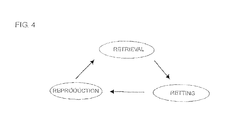
- the present invention provides a shopping bag made of nonwoven fabric whose print ink layer can easily be separated from the nonwoven fabric, by interposing a polymer region with high solubility to hot water between the print ink layer and the nonwoven fabric, as a result of the dissolution of the polymer region into warm water. Since the shopping bag made of nonwoven fabric of the present invention is made of easy-to-recycle nonwoven fabric, retrieving the used bag and separating the print ink layer from the nonwoven fabric enables the reproduction of a new shopping bag made of nonwoven fabric using the used bag from which the print ink layer has been separated. Consequently, the present invention provides a recycling method in which the printed shopping bag made of nonwoven fabric repeats a cycle of retrieval, reproduction, and then reuse.
- the present invention also provides a shopping bag made of nonwoven fabric which has high enough strength compared with related-art shopping bags made of nonwoven fabric without thick parts to be able to adequately withstand repetitive use.
- a shopping bag made of nonwoven fabric which has high enough strength compared with related-art shopping bags made of nonwoven fabric without thick parts to be able to adequately withstand repetitive use.
- two corners are heat-sealed at a tie together point extending in a longitudinal direction, and the top of the each heat-sealed part is equipped with an ear part extending upward from the upper edge of the side of the bag.
- a shopping bag made of nonwoven fabric of the present invention is made of polyolefin nonwoven fabric such as polyethylene nonwoven fabric or polypropylene nonwoven fabric for its ease of recycling, strength, and formability.
- polypropylene nonwoven fabric is especially preferable because of its ease off reproduction.
- the nonwoven fabric used for the shopping bag made of nonwoven fabric of the present invention is not only lightweight but also able to be folded to a compact form and then unfolded to the original form with ease, this shopping bag is fairly suitable for carrying around.
- the fact that the whole bag is optimally made of uniform nonwoven fabric means that no separation is required to send this shopping bag to the reproduction process, thus making the recycling quite easy.
- At least the surface of the shopping bag made of nonwoven fabric of the present invention is made of nonwoven fabric, on which a print ink layer is set up, and between the print ink layer and the nonwoven fabric a polymer region with high solubility to hot water is interposed. If at least the surface of the shopping bag made of nonwoven fabric of the present invention is made of a laminated body of nonwoven fabric, there are no particular restrictions on the base material for the laminated body as long as it renders enough strength to the shopping bag.
- the following can be used for the base material for example: plastic films made from polyester, polyamide, polyvinyl alcohol, polycarbonate, polyethylene, or polypropylene; paper materials such as kraft paper, quality paper, glassine paper, or cellophane; sheets made from starch or cellulose; fabric cloths made from cotton, hemp, polyamide, or polyester.
- plastic films made from polyester, polyamide, polyvinyl alcohol, polycarbonate, polyethylene, or polypropylene
- paper materials such as kraft paper, quality paper, glassine paper, or cellophane
- sheets made from starch or cellulose fabrics made from cotton, hemp, polyamide, or polyester.
- the nonwoven fabric used in the present invention can be either undyed or dyed using common dying methods such as beam dyeing, jet dyeing, and dipping.
- common dying methods such as beam dyeing, jet dyeing, and dipping.
- retrieving shopping bags according to their color and reusing each make it possible to reproduce new shopping bags without decoloring the retrieved bag materials.
- the region should have the property of being dissolved easily at the contact (retting) with hot water of 60 °C or above. It is favorable, hence, for the solubility of the polymers to be less than 20 g per 100-g water at 20 °C and 60 g or more per 100-g water at 60 oC to satisfy these requirements.
- polyvinyl alcohol is the polymer of choice for having the unique water resistance as mentioned above, i.e., dissolving easily in hot water of 60 °C or above but hardly dissolving in cold water such as room-temperature water.
- polyvinyl alcohol there are no particular restrictions on what type of polyvinyl alcohol to be used in the present invention as long as it has the water resistance as mentioned above.
- examples may include modified polyvinyl alcohol which has various modification groups such as alkoxy groups, ester groups, and alkylene ether groups. It is desirable for the saponification rate to be 97.5 mol% or more.
- modified polyvinyl alcohol with cross-linked structures synthesized by polymerizing crosslinker to polyvinyl alcohol is used preferably.
- a modified polyvinyl alcohol obtained by polymerizing an acetoacetylated polyvinyl alcohol containing the structure shown in the following chemical formula (wherein 0 ⁇ 1 ⁇ 1, 0 ⁇ m ⁇ 1, 0 ⁇ n ⁇ 1, and 0.8 ⁇ 1 + m + n ⁇ 1, and 1, m and n is a molar ratio of each component) with a crosslinker.
- the acetoacetylated polyvinyl alcohol may be a random polymer or a polymer having a block polymer moiety.
- Gohsefimer Z-200 and Z-410 (made by Nippon Synthetic Chemical Industry Co. Ltd.) is most suitable.
- crosslinker compound there are no particular restrictions on what type of crosslinker compound to be used in the present invention as long as it can render the water resistance as mentioned above by cross-linking polyvinyl alcohol.
- examples may include polyvalent metal compounds, boron compounds, amine compounds, hydrazine compounds, silane compounds, compounds containing methylol groups, compounds containing aldehyde groups, epoxy compounds, thiol compounds, and isocyanate compounds. These are all applicable either singly or in combination of two or more compounds.
- Glyoxal GX made by Nippon Synthetic Chemical Industry Co., Ltd.
- Smimal M-30W made by Sumitomo Chemical Co., Ltd.
- Highlink DM made by Clariant
- the ratio of crosslinker to be added to polyvinyl alcohol is 0.1 to 2.0 percent by mass, preferably 1.0 to 1.5 percent by mass, or optimally 0.5 to 1.0 percent by mass. If the amount of crosslinker added is less than the aforementioned minimum, the degree of cross linkage gets insufficiently low; thus the expected water resistance to room-temperature water and hot water can not be attained. In contrast, if the amount added is more than the aforementioned maximum, especially more than 2.0 percent by mass, the degree of crosslinkage gets so high that, as the water resistance to room-temperature water gets high, the water resistance to hot water gets too high as well. As a result, it becomes impossible to attain the water resistance peculiar to the polymer region of the present invention, that is to say, dissolving easily in hot water of 60 °C or above but hardly dissolving in cold water such as room-temperature water.
- the desirable acetoacetylated polyvinyl alcohol to be used in the present invention is a compound obtained by acetoacetylating a polyvinyl alcohol.
- acetoacetylation for example: adding diketene to polyvinyl alcohol dispersed in acetic acid solvent, adding diketene to polyvinyl alcohol dissolved in solvent such as dimethyl formaldehyde or dioxane in advance, or contacting diketene gas or liquid diketene directly to polyvinyl alcohol.
- the polyvinyl alcohol with intramolecular acetoacetyl groups, upon reacting with compounds containing methylol groups as crosslinkers forms the cross-linked structures as shown below.
- acetoacetylated polyvinyl alcohol with the above-mentioned cross-linked structures of the present invention has the property of hardly dissolving in acids yet easily dissolving in strong alkalis, apart from hot water of 60oC or above, alkali water such as sodium hydroxide can be used to dissolve it without any difficulty.
- the polymer layer can be formed on the surface of the nonwoven fabric by thermal-bonding film-shaped polymers with high solubility to hot water to the surface of the nonwoven fabric with an iron.
- the layer can be formed by coating or spraying the aqueous solution of the polymers on the surface of the nonwoven fabric; then drying to let the polymers be impregnated into the nonwoven fabric. Laminating the surface of the nonwoven fabric with polymers creates sufficiently thick polymer region between the nonwoven fabric and the print ink layer, rendering it easy to separate the print ink layer from the nonwoven fabric when necessary. Meanwhile, impregnating the nonwoven fabric with the polymers makes the finish look beautiful due to the high adhesiveness of the polymers to the nonwoven fabric.
- the shopping bag made of nonwoven fabric of the present invention will be printed with, for example, a logo unique to each retailer on the surface of the nonwoven fabric in accordance with each intended purpose.
- logos serving as identifiers and promoters of each retailer are printed on the surface of the nonwoven fabric with the polymer region interposed therebetween formed by the aforementioned method.
- a printing method for example: letterpress, photogravure, offset, serigraphy, and transferring printing are all applicable.
- serigraphy is preferable because it can be used to print on any surface regardless of its thickness, size, and shape (e.g., whether it is flat, curved or not).
- the following is all applicable, for example: bonding a preprinted film to the surface of the shopping bag with an iron, printing on the film after it is bonded to the surface of the nonwoven fabric, or printing on the surface of the nonwoven fabric impregnated with polymer solution.
- interposing a polymer region with high solubility to hot water between the nonwoven fabric and the print ink layer enables the print ink layer to separate from the surface of the nonwoven fabric with ease after rotting the shopping bag made of nonwoven fabric in warm water that is above a certain temperature owing to the dissolution of the polymer region in the warm water.
- Adding vibration, especially ultrasonic vibration, to the shopping bag made of nonwoven fabric retted in the warm water at this point further enhances the ease with which the print ink layer is separated from the nonwoven fabric.
- the print ink constituting the separated print ink layer is generally insoluble in water and does not dissolve even in warm water; hence the print ink layer alone can be removed from the warm water without any difficulty.
- separating the print ink layer from the product made of nonwoven fabric of the present invention only uses water instead of organic solvent, or the like, no impact is made on the health of workers as well as on the environment such as soil pollution.
- a recycling method of a shopping bag made of nonwoven fabric of the present invention includes retrieving of the shopping bag made of nonwoven fabric, retting of the nonwoven fabric to remove the print ink layer from the nonwoven fabric, reproducing of a new shopping bag made of nonwoven fabric.
- the retrieving process the shopping bag made of nonwoven fabric of the present invention is retrieved as a used bag after being used for several times.
- the print ink layer is removed from the nonwoven fabric by the aforementioned method.
- the reproducing process a new shopping bag made of nonwoven fabric is reproduced using the used shopping bag made of nonwoven fabric whose print ink layer is removed as raw material.
- the whole or some part at least including the handles of the upper part of the shopping bag of made of nonwoven fabric the present invention has 1.1 times or more thickness compared with the other parts of the shopping bag, granting sufficient tensile as well as tear strength to withstand the weight of a load.
- the thick part of the shopping bag made of nonwoven fabric of the present invention is provided not by increasing the layers of the nonwoven fabric, such as making the fabric double layered, but by a single layer, improving the strength considerably compared with a double-layered structure.
- the length of the thick part along the longitudinal direction of the shopping bag to be one-fifth to one-third of the whole length of the shopping bag.
- the shopping bag made of nonwoven fabric of the present invention includes the right and left side each having two corners which are heat-sealed at a tie together point extending in a longitudinal direction, and at the top of the each heat-sealed part, an ear part extending upward from the upper edge of the side of the bag.
- a tie together point extending in a longitudinal direction
- an ear part extending upward from the upper edge of the side of the bag.
- the shopping bag made of nonwoven fabric of the present invention includes the right and left side each having two corners which are heat-sealed at a tie together point extending in a longitudinal direction, and at the top of the each heat-sealed part, an ear part extending upward from the upper edge of the side of the bag.
- the ear part is formed by cutting off a part of the nonwoven fabric, that is to say, it is arranged along with the shopping bag.
- the upper edge of the ear part is shaped like a bent convex curve, and the part from the side edge of the ear part to the upper edge of the side of the bag is shaped like a bent concave curve, alleviating the stress put on the side of the bag by dispersing it across the wide area of its upper edge.
- the shopping bag made of nonwoven fabric of the present invention is formed by the following method, yet there are other methods to form it.
- a forming method of the shopping bag made of nonwoven fabric of the present invention after preparing a rectangular nonwoven fabric sheet, the nonwoven fabric sheet is folded so that the one short side of the sheet laps over the other; then a part of the fold is cut off to form the handle and the seal fragment.
- sides of the bag are formed by machine-sewing with the thread made of the same material as the bag itself or heat-sealing the lapped right and left long sides together.
- the handle is formed by cutting off a part of the nonwoven fabric sheet as in the aforementioned aspect
- the second aspect differs from it in respect of forming the handle not at the folds but at the sewn or heat-sealed short sides.
- the nonwoven fabric sheet is folded so that the one short side of the sheet laps over the other short side.
- the lapped edges of the short sides are machine-sewed with the thread made of the same material as the bag itself or heat-sealed; then a part of the sewn or heat-sealed short sides is cut off to form the handle and the seal fragment.
- sides of the bag are formed by machine-sewing with the thread made of the same material as the bag itself or heat-sealing the lapped right and left long sides together.
- sewn or heat-sealed right and left sides of the bag are folded inward to make enough space for attaching a gusset to the bag body; then the lower edge of the inward-folded part and the lapped bottom are machine-sewed with the thread or heat-sealed together to form the right and left sides and the lower part of the bag body.
- the obtained bag body is turned inside out to complete the shopping bag made of nonwoven fabric of the present invention.
- the shopping bag made of nonwoven fabric of the present invention includes the whole or some part at least including the handles of the upper part is made of single-layered thick nonwoven fabric which is 1.1 times or more thickness compared with the other part of the shopping bag made of nonwoven fabric, first a nonwoven fabric sheet is prepared whose center in the long side direction is 1.1 times or more thicker than both ends, or a nonwoven fabric sheet whose both ends in the long side direction is 1.1 times or more thicker than the center. Then the aforementioned forming method of the shopping bag made of nonwoven fabric is followed so that the thick part of the nonwoven fabric sheet forms the handle.
- the shopping bag made of nonwoven fabric of the present invention includes ear parts
- a part of the nonwoven fabric sheet is cut off as described in the aforementioned forming method of the shopping bag made of nonwoven fabric to form the ear parts along with the handle and the sealing fragment.
- the shopping bag made of nonwoven fabric of the present invention can also take an aspect in which, at the fringe of the apertural area and the fringe of the handle, a nonwoven fabric tape made of the same material as the bag itself is stitched with thread made of the same material as the bag itself. After cutting off the handle and the seal fragment from the nonwoven fabric sheet, the cut-off end edge is covered with a nonwoven fabric tape made of the same material as the bag itself, and then they arc sewn together with the thread made of the same material.
- the nonwoven fabric can of course cover the end edge as it is for reinforcement, folding the end edge inward more than once before covering it, and further thickening the end edge, resulting in increased reinforcement.
- the nonwoven fabric tape may be stitched across the whole circumference of the end edge from the viewpoint of reinforcement, and the nonwoven fabric tape only has to have enough width and thickness to be able to reinforce the end edge.
- the handle of this reinforced shopping bag made of nonwoven fabric of the present invention is resistant to elongation in a longitudinal direction even when carrying heavy or bulky merchandises, making it more suitable for repetitive use.
- the fact that the resin shopping bag of the present invention is all made of the same material including the bag body, the thread, and the nonwoven fabric tape allows workers to omit the cumbersome task of sorting them during recycle,
- FIG. 1 is a perspective view illustrating a shopping bag made of nonwoven fabric according to Example 1 of the present invention.
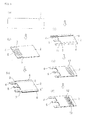
- FIGS. 3 (a) to (f) are schematic diagrams illustrating one example of the forming process of the shopping bag depicted in FIG. 1 .
- a polypropylene nonwoven fabric sheet 2 was heat-sealed to shape a bag form.
- the shopping bag 1 was manufactured, for instance, as depicted in FIGS. 3(a) to (f) .
- a slender and rectangular polypropylene nonwoven fabric sheet 2 had been prepared; then the nonwoven fabric sheet was folded so that the one short side was lapped over the other (see FIG. 3(b) ).
- a part of the nonwoven fabric sheet 2 including the told was cut off to form an ear part 3, a handle 4, and a seal fragment 5.
- the nonwoven fabric sheet 2 was heat-sealed along the side which had used to be the long side of the rectangle (6 in FIG. 3(c) showing the part to be heat-sealed) to form a side 10 of the shopping bag 1 (see FIG. 3(c) ).
- the handle 4 In order for the handle 4 to be made of double nonwoven fabric sheets 2, and to provide a gusset 9 to the completed nonwoven fabric 1, both sides of the heat-sealed nonwoven fabric sheet 2 were folded inward (e.g., following line X or X' of FIG. 3(c) ), and the nonwoven fabric sheet 2 was heat-sealed along the line opposing the handle 4 and the seal fragment 5 (6 in FIG.
- the modified polyvinyl alcohol film 12 was prepared by adding 1.0 percent by mass of High Link DM (made by Clariant) as crosslinker to Gohsefimer Z-200 (made by Nippon Synthetic Chemical Industry Co., Ltd.), and was formed to be a 40 ⁇ m-thick film.
- High Link DM made by Clariant
- Gohsefimer Z-200 made by Nippon Synthetic Chemical Industry Co., Ltd.
- the thus-manufactured shopping bag 1 of the present invention has the upper edge of the ear part 3 shaped like a bent convex curve, and the part from the side edge of the ear part 3 to the upper edge of the side 10 of the bag is shaped like a bent concave curve.
- the shopping bag 1 also includes, as depicted in FIG. 1 , a lower part 8 of the bag which has a bottom 7 that can close and stretch linearly, right and left sides 10 that can be folded inward with the gusset 9, and an upper part 11 of the bag forming a pair of the folded broad handles 4.
- the shopping bag 1 therefore, is immune to splitting or tearing, and, compared with related-art shopping bags made of nonwoven fabric without any ear, has significantly increased load limits as well as permissible volume of contents stuffed inside.
- the shopping bag 1 of the present invention hence, was usually able to be used more than 5 times repeatedly even when used repeatedly with heavy or bulky merchandise stuffed inside.
- the nonwoven fabric sheet 2 made from polyolefin is light and able to be folded compactly as well as unfolded to the original form with ease makes the shopping bag 1 of the present invention fairly suitable for being carried around.
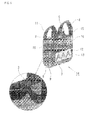
- a shopping bag 14 according to Example 2 of the present invention is formed by a polypropylene nonwoven fabric sheet 16 whose center includes a thick part 15 compared with both sides, the sheet 16 heat-sealed to be shaped like a bag.
- the manufacture of the shopping bag 14 follows the same procedure as Example 1.
- the shopping bag 14 of the present invention manufactured in this way has the upper edge of the ear part 3 shaped like a bent convex curve, and the part from the side edge of the ear part 3 to the upper edge of the side 10 of the bag is shaped like a bent concave curve.
- the shopping bag 14 also include, as depicted in FIG.
- the thick part 15 including the handle 4 of the upper part 11 of the bag is made of a single-layer thick nonwoven fabric with 2.0 times or more thickness compared with the other parts of the shopping bag 14.
- the length of the thick part 15 along the longitudinal direction of the shopping bag 14 is one-third of the whole length of the bag.
- the shopping bag 14, therefore, is immune to splitting or tearing, and has significantly increased load limits as well as permissible volume of contents stuffed inside.
- the shopping bag 14 of the present invention hence, can be used repeatedly even when used repeatedly with heavy or bulky merchandise stuffed inside.
- nonwoven fabric 16 made from polyolefin is light and able to be folded compactly as well as unfolded to the original form with ease makes the shopping bag 14 of the present invention fairly suitable for being carried around.
- the print ink layer 13 was separated from the shopping bag 14 using the same method as in Example 1. This revealed that, similarly to the shopping bag I of Example 1, even if the surface of polyolefin nonwoven fabric 16 had a printed image thereon, by interposing the modified polyvinyl alcohol film 12 as a polymer region between polyolefin nonwoven fabric 16 and the print ink layer 13, separating the print ink layer 13 was easy. Furthermore, remaking a bag after reproducing nonwoven fabric by using the shopping bag from which the print ink layer had been removed as raw material realized the reproduction of a new shopping bag. The shopping bag 14, therefore, was able to be recycled through a recycling method such as the one shown in FIG 4 .
- a shopping bag 17 according to Example 3 of the present invention depicted in FIGS. 6 to 9 is manufactured as described below.
- a rectangular polypropylene nonwoven fabric sheet 18 whose long sides 33 measure approximately 100 cm and short sides 34 measure approximately 40 cm had been prepared.
- One short side 34 was folded to lap over the other short side 34 (see FIG. 7(g) ), forming a fold 19 whose approximate center and its both ends were cut off to form a handle 20 (see FIG. 7(h) ).
- Each end edge 21 of the cut-off center and both ends was entirely covered over with a polypropylene nonwoven fabric tape 22 that was about 1.5-cm wide; then it was attached by sewing with a polypropylene resin thread 23.
- each of the lapped-over right and left long sides 33 was stitched together with the polypropylene resin thread 23 (see FIG. 7(i) ).
- the polypropylene nonwoven fabric tape 22 was stitched after folded inward once to lap over as depicted in FIG. 8 , which is the cross-section diagram of part A of FIG. 6 . This further increased the tensile strength compared with the case in which the polypropylene nonwoven fabric tape 22 was stitched without folding it inward to lap over.
- the polypropylene nonwoven fabric tape 22 was stitched along with a pair of 9-cm-long, 4-cm-wide slender polypropylene resin knot fragments 24 at a fringe 26 of an apertural area 25 (see FIG. 7(i) ).
- Each of the knot fragment 24 was stitched along with the polypropylene nonwoven fabric tape 22 folded inward once to lap over as depicted in FIG. 7(j) , which is the cross-section diagram of part B of FIG. 6 .
- the sewn right and left long sides 33 were folded about 8 cm inward along the X-X lines in FIG. 7(i) as axes so that a completed bag body 29 has gussets.
- the print ink layer 13 was separated from the shopping bag 17 using the same method as in Example 1. This revealed that, similarly to the shopping bag 1 of Example 1, even if the surface of the polypropylene nonwoven fabric sheet 18 had a printed image thereon, by interposing the modified polyvinyl alcohol film 12 as a polymer region between the polypropylene nonwoven fabric sheet 18 and the print ink layer 13, separating the print ink layer 13 was easy. Furthermore, remaking a bag after reproducing nonwoven fabric by using the shopping bag from which the print ink layer had been removed as raw material realized the reproduction of a new shopping bag. The shopping bag 17, therefore, was able to be recycled through a recycling method such as the one shown in FIG. 4 .
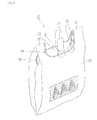
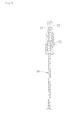
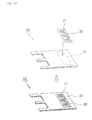
- a shopping bag 35 according to Example 4 of the present invention formed by the same method as in Example I was turned inside out to make the surface of a nonwoven fabric sheet 36 come outside to be the outer surface of the shopping bag 35. Then, a modified polyvinyl alcohol film 38 whose surface possessed with a print ink layer 37 formed by serigraphy beforehand was lapped over, and the nonwoven fabric sheet 36 and the modified polyvinyl alcohol film 38 were bonded together with a smoothing iron by thermal adhesion to manufacture the shopping bag 35 of the present invention (see FIG. 10 ).
- the modified polyvinyl alcohol film was the same one used in Example 1. Besides, the print ink layer 37 was separated from the shopping bag 35 using the same method as in Example 1.
- a shopping bag 39 according to Example 5 of the present invention formed by the same method as in Example 1 was turned inside out to make the surface of a nonwoven fabric sheet 40 come outside to be the outer surface of the shopping bag 39; then, a modified polyvinyl alcohol aqueous solution 41 was applied to the surface. After evaporating the moisture, a print ink layer 42 was formed on the surface by serigraphy to manufacture the shopping bag 39 of the present invention (see FIG. 11 ).
- the modified polyvinyl alcohol aqueous solution 41 was prepared by mixing 1.0 percent by mass of High Link DM (made by Clariant) as crosslinker with Gohsefimer Z-200 (made by Nippon Synthetic Chemical Industry Co., Ltd.).
- the print ink layer 42 was separated from the shopping bag 39 using the same method as in Example 1. This revealed that, similarly to the shopping bag 1 of Example 1, separating the print ink layer 42 from the shopping bag 39 obtained in the aforementioned method was easy by interposing the modified polyvinyl alcohol aqueous solution 41 as a polymer region between the nonwoven fabric sheet 40 and the print ink layer 42. Furthermore, remaking a bag after reproducing nonwoven fabric by using the shopping bag from which the print ink layer had been removed as raw material realized the recycling of a new shopping bag through a recycling method such as the one shown in FIG. 4 .
Landscapes
- Engineering & Computer Science (AREA)
- Mechanical Engineering (AREA)
- Chemical & Material Sciences (AREA)
- Polymers & Plastics (AREA)
- Chemical Kinetics & Catalysis (AREA)
- Medicinal Chemistry (AREA)
- Health & Medical Sciences (AREA)
- Organic Chemistry (AREA)
- Physics & Mathematics (AREA)
- General Physics & Mathematics (AREA)
- Theoretical Computer Science (AREA)
- Purses, Travelling Bags, Baskets, Or Suitcases (AREA)
- Bag Frames (AREA)
Applications Claiming Priority (5)
| Application Number | Priority Date | Filing Date | Title |
|---|---|---|---|
| JP2008016261A JP2009172283A (ja) | 2008-01-28 | 2008-01-28 | 買物袋 |
| JP2008016260A JP2009172282A (ja) | 2008-01-28 | 2008-01-28 | 買物袋 |
| JP2008065893A JP5510625B2 (ja) | 2008-03-14 | 2008-03-14 | ポリプロピレン不織布製の買物袋 |
| JP2008131849A JP5035691B2 (ja) | 2008-05-20 | 2008-05-20 | 不織布製品 |
| EP09250203A EP2082663B1 (fr) | 2008-01-28 | 2009-01-27 | Sac de courses en étoffe non tissée |
Related Parent Applications (1)
| Application Number | Title | Priority Date | Filing Date |
|---|---|---|---|
| EP09250203.8 Division | 2009-01-27 |
Publications (1)
| Publication Number | Publication Date |
|---|---|
| EP2335513A1 true EP2335513A1 (fr) | 2011-06-22 |
Family
ID=40566312
Family Applications (3)
| Application Number | Title | Priority Date | Filing Date |
|---|---|---|---|
| EP09250203A Not-in-force EP2082663B1 (fr) | 2008-01-28 | 2009-01-27 | Sac de courses en étoffe non tissée |
| EP11156301A Withdrawn EP2335512A1 (fr) | 2008-01-28 | 2009-01-27 | Sac de courses en étoffe non tissée |
| EP11156300A Withdrawn EP2335513A1 (fr) | 2008-01-28 | 2009-01-27 | Sac de courses en étoffe non tissée |
Family Applications Before (2)
| Application Number | Title | Priority Date | Filing Date |
|---|---|---|---|
| EP09250203A Not-in-force EP2082663B1 (fr) | 2008-01-28 | 2009-01-27 | Sac de courses en étoffe non tissée |
| EP11156301A Withdrawn EP2335512A1 (fr) | 2008-01-28 | 2009-01-27 | Sac de courses en étoffe non tissée |
Country Status (2)
| Country | Link |
|---|---|
| US (1) | US20090196533A1 (fr) |
| EP (3) | EP2082663B1 (fr) |
Families Citing this family (10)
| Publication number | Priority date | Publication date | Assignee | Title |
|---|---|---|---|---|
| ITRM20070033U1 (it) * | 2007-02-01 | 2008-08-02 | Vittoria Carnevale | Busta dotata di codice a barre |
| WO2011102812A1 (fr) | 2010-02-17 | 2011-08-25 | Duygu Altindas | Sac réutilisable intégrant une puce |
| IT1411297B1 (it) * | 2010-07-01 | 2014-10-20 | Chemical Gut Dei F Lli Protti Snc Di Protti Massimiliano & C | Procedimento di realizzazione di sacchetti colorati e procedimento di realizzazione di sacchetti stampati |
| ITFO20120010A1 (it) * | 2012-05-08 | 2013-11-09 | Chemical Gut Dei F Lli Protti Snc D I Protti Massi | Procedimento di realizzazione di sacchetti stampati |
| CN102963073A (zh) * | 2012-07-03 | 2013-03-13 | 太仓高腾复合材料有限公司 | 一种保温保冷复合材料及其制备方法 |
| CN102717566A (zh) * | 2012-07-03 | 2012-10-10 | 太仓高腾复合材料有限公司 | 一种保温保冷复合材料及其制作方法及其应用 |
| JP6057580B2 (ja) * | 2012-07-18 | 2017-01-11 | 株式会社アクシス | 把手付き不織布袋 |
| CL2016001885A1 (es) * | 2016-07-25 | 2018-04-20 | Solubag Spa | Bolsa hidrodegradable. |
| EP4091960B1 (fr) * | 2021-05-17 | 2023-09-27 | Fameccanica.Data S.p.A. | Récipient refermable |
| SE546476C2 (en) * | 2022-12-06 | 2024-11-12 | Vividye Ab | Process for providing sacrificial printable surface layers to a textile |
Citations (3)
| Publication number | Priority date | Publication date | Assignee | Title |
|---|---|---|---|---|
| GB1529221A (en) * | 1976-04-13 | 1978-10-18 | Coloroll Ltd | Carrier bags |
| EP0423729A2 (fr) * | 1989-10-18 | 1991-04-24 | Stiegler Gmbh Maschinenfabrik | Sac en tant qu'article réutilisable à base de matière thermoplastique soudable |
| GB2264690A (en) * | 1992-03-06 | 1993-09-08 | John Madeley | Gusseted carrier bags |
Family Cites Families (23)
| Publication number | Priority date | Publication date | Assignee | Title |
|---|---|---|---|---|
| DE1486724B1 (de) * | 1964-11-30 | 1971-04-29 | Windmoeller & Hoelscher | Vorratsblock aus kunststoff-warenbeuteln |
| DK123860B (da) * | 1966-11-23 | 1972-08-14 | K Sengewald | Bærepose af termoplastisk formstoffolie og fremgangsmåde til fremstilling af posen. |
| US3567110A (en) * | 1968-06-03 | 1971-03-02 | Lion Fat Oil Co Ltd | Sealed bag having a pair of handles attached to two folded end portions and retained thereafter the contents are dispensed |
| US4218280A (en) * | 1978-12-20 | 1980-08-19 | The United States Of America As Represented By The Administrator Of The National Aeronautics And Space Administration | Method of cross-linking polyvinyl alcohol and other water soluble resins |
| FR2469355A1 (fr) * | 1979-11-12 | 1981-05-22 | Temana | Sac en matiere plastique souple notamment pour la doublure interieure d'un recipient |
| DE3037250A1 (de) * | 1980-10-02 | 1982-04-29 | Joachim 7440 Nürtingen Dudzik | Selbstklebeetikett |
| DE3037640A1 (de) * | 1980-10-04 | 1982-05-19 | Joachim 7440 Nürtingen Dudzik | Verwendung einer polyvinylalkohol-folie zur herstellung von haftmaterial, wie etikettenmaterial |
| US4588392A (en) * | 1984-02-29 | 1986-05-13 | Mobil Oil Corporation | Method of forming a thermoplastic film sack having a stress relieved bottom gusset seal line |
| US4759639A (en) * | 1986-11-24 | 1988-07-26 | Dematteis Robert B | Thermoplastic bag |
| US5507713A (en) * | 1993-09-09 | 1996-04-16 | Tenneco Plastics, Inc. | Easy-open bag pack, method of forming and system |
| NL1002508C2 (nl) * | 1996-03-01 | 1997-06-06 | Wavin Trepak B V | Werkwijze voor het aanbrengen van een verwijderbare bedrukking op een houder en houder voorzien van een verwijderbare bedrukking. |
| PT888602E (pt) * | 1996-03-20 | 2002-11-29 | Heineken Tech Services | Etiqueta recipiente contendo a referida etiqueta e metodo de lavagem desse recipiente |
| US6484879B2 (en) * | 1997-04-07 | 2002-11-26 | Syngenta Crop Protection, Inc. | Water soluble packaging system and method |
| JP3959674B2 (ja) * | 2001-11-02 | 2007-08-15 | 株式会社アクシス | 樹脂不織布買物袋 |
| JP3876409B2 (ja) | 2001-11-02 | 2007-01-31 | 株式会社アクシス | 樹脂製買物袋 |
| US7867584B2 (en) * | 2004-05-26 | 2011-01-11 | Hewlett-Packard Development Company, L.P. | Ink-jet recording medium for dye- or pigment-based ink-jet inks |
| JP2006044793A (ja) * | 2004-07-01 | 2006-02-16 | Nitto Denko Corp | 貼付材包装体 |
| US7687120B2 (en) * | 2004-10-21 | 2010-03-30 | Hewlett-Packard Development Company, L.P. | Print media and methods for making the same |
| JP4839989B2 (ja) | 2006-07-04 | 2011-12-21 | 住友電装株式会社 | コネクタ |
| JP4816290B2 (ja) | 2006-07-04 | 2011-11-16 | 住友電装株式会社 | コネクタ |
| JP2008065893A (ja) | 2006-09-06 | 2008-03-21 | Seiko Epson Corp | 外部記憶媒体処理装置及び外部記憶媒体処理装置の制御方法 |
| JP2008131849A (ja) | 2006-11-27 | 2008-06-05 | Hiwin Mikrosystem Corp | 直動アクチュエータ用コードレス制御システム |
| JP4751312B2 (ja) * | 2006-12-22 | 2011-08-17 | 日東電工株式会社 | 光学フィルム、偏光板、および画像表示装置 |
-
2009
- 2009-01-23 US US12/320,330 patent/US20090196533A1/en not_active Abandoned
- 2009-01-27 EP EP09250203A patent/EP2082663B1/fr not_active Not-in-force
- 2009-01-27 EP EP11156301A patent/EP2335512A1/fr not_active Withdrawn
- 2009-01-27 EP EP11156300A patent/EP2335513A1/fr not_active Withdrawn
Patent Citations (3)
| Publication number | Priority date | Publication date | Assignee | Title |
|---|---|---|---|---|
| GB1529221A (en) * | 1976-04-13 | 1978-10-18 | Coloroll Ltd | Carrier bags |
| EP0423729A2 (fr) * | 1989-10-18 | 1991-04-24 | Stiegler Gmbh Maschinenfabrik | Sac en tant qu'article réutilisable à base de matière thermoplastique soudable |
| GB2264690A (en) * | 1992-03-06 | 1993-09-08 | John Madeley | Gusseted carrier bags |
Also Published As
| Publication number | Publication date |
|---|---|
| US20090196533A1 (en) | 2009-08-06 |
| EP2335512A1 (fr) | 2011-06-22 |
| EP2082663A2 (fr) | 2009-07-29 |
| EP2082663A3 (fr) | 2010-03-31 |
| EP2082663B1 (fr) | 2012-06-20 |
Similar Documents
| Publication | Publication Date | Title |
|---|---|---|
| EP2082663B1 (fr) | Sac de courses en étoffe non tissée | |
| US10220993B2 (en) | Durable, consumable packaging system for hot melt materials and methods of making and using same | |
| CA2686088C (fr) | Contenant souple | |
| JP5717023B2 (ja) | 配送品収納袋並びにその再生・再利用方法 | |
| SK282282B6 (sk) | Vrece z polymérovej, najmä z polyolefínovej tkaniny a spôsob jeho výroby | |
| US20070104905A1 (en) | Reinforced bags | |
| CN101496665A (zh) | 无纺布制购物袋 | |
| US20030094461A1 (en) | Dispensing box provided with an integral handle | |
| US7837388B1 (en) | Multi-material vertical form, fill and seal bag | |
| US6932510B2 (en) | General purpose bag having film and mesh portions | |
| JPH06503537A (ja) | 環境に適合性のある材料でできた、可撓性圧縮物品を収容するパッケージ | |
| US20240067408A1 (en) | Reusable plastic carrier bag | |
| JP5035691B2 (ja) | 不織布製品 | |
| CN211000266U (zh) | 一种无纺布材料的复合袋 | |
| US5143133A (en) | Furniture covering for shipment | |
| CA2686406C (fr) | Contenant souple | |
| CN108438417B (zh) | 一种可循环使用的快递纸箱及其使用方法 | |
| JP5273458B2 (ja) | 不織布製買物袋、並びにこれと同様の材質からなる製品 | |
| US20240365941A1 (en) | Reusable, reconfigurable, and inflatable tote shipper and packaging system | |
| WO2003010055A1 (fr) | Sac en papier | |
| JP5717022B2 (ja) | 持ち帰り袋、及びその再生・再利用方法 | |
| JP4263906B2 (ja) | 容器包装用収縮フィルムの製造方法 | |
| JP4765158B2 (ja) | 廃棄時の分別回収が容易な緩衝封筒とその製造方法 | |
| CN208429339U (zh) | 一种带快递单贴层的纸箱 | |
| WO1993003933A1 (fr) | Classeur extensible renforce |
Legal Events
| Date | Code | Title | Description |
|---|---|---|---|
| PUAI | Public reference made under article 153(3) epc to a published international application that has entered the european phase |
Free format text: ORIGINAL CODE: 0009012 |
|
| AC | Divisional application: reference to earlier application |
Ref document number: 2082663 Country of ref document: EP Kind code of ref document: P |
|
| AK | Designated contracting states |
Kind code of ref document: A1 Designated state(s): AT BE BG CH CY CZ DE DK EE ES FI FR GB GR HR HU IE IS IT LI LT LU LV MC MK MT NL NO PL PT RO SE SI SK TR |
|
| 17P | Request for examination filed |
Effective date: 20111222 |
|
| STAA | Information on the status of an ep patent application or granted ep patent |
Free format text: STATUS: THE APPLICATION IS DEEMED TO BE WITHDRAWN |
|
| 18D | Application deemed to be withdrawn |
Effective date: 20130801 |