EP2336103A2 - HCL-Polymorphe von 3-[2-(Dimethylamino)methyl-(cyclohex-1-yl)]phenol - Google Patents
HCL-Polymorphe von 3-[2-(Dimethylamino)methyl-(cyclohex-1-yl)]phenol Download PDFInfo
- Publication number
- EP2336103A2 EP2336103A2 EP10014791A EP10014791A EP2336103A2 EP 2336103 A2 EP2336103 A2 EP 2336103A2 EP 10014791 A EP10014791 A EP 10014791A EP 10014791 A EP10014791 A EP 10014791A EP 2336103 A2 EP2336103 A2 EP 2336103A2
- Authority
- EP
- European Patent Office
- Prior art keywords
- methyl
- cyclohex
- dimethylamino
- crystalline form
- phenol hydrochloride
- Prior art date
- Legal status (The legal status is an assumption and is not a legal conclusion. Google has not performed a legal analysis and makes no representation as to the accuracy of the status listed.)
- Withdrawn
Links
- JIRYWFYYBBRJAN-UHFFFAOYSA-N 3-[2-[(dimethylamino)methyl]cyclohexyl]phenol Chemical compound CN(C)CC1CCCCC1C1=CC=CC(O)=C1 JIRYWFYYBBRJAN-UHFFFAOYSA-N 0.000 title claims abstract description 19
- VEXZGXHMUGYJMC-UHFFFAOYSA-N Hydrochloric acid Chemical compound Cl VEXZGXHMUGYJMC-UHFFFAOYSA-N 0.000 claims abstract description 123
- 238000000034 method Methods 0.000 claims abstract description 57
- 239000000203 mixture Substances 0.000 claims abstract description 46
- 230000008569 process Effects 0.000 claims abstract description 43
- 238000002360 preparation method Methods 0.000 claims abstract description 35
- 239000008194 pharmaceutical composition Substances 0.000 claims abstract description 24
- 150000003839 salts Chemical class 0.000 claims abstract description 20
- IXCSERBJSXMMFS-UHFFFAOYSA-N hydrogen chloride Substances Cl.Cl IXCSERBJSXMMFS-UHFFFAOYSA-N 0.000 claims abstract description 11
- 229910000041 hydrogen chloride Inorganic materials 0.000 claims abstract description 11
- -1 methyl (cyclohex-1-yl) phenol hydrochloride Chemical compound 0.000 claims description 169
- 239000002904 solvent Substances 0.000 claims description 82
- LFQSCWFLJHTTHZ-UHFFFAOYSA-N Ethanol Chemical class CCO LFQSCWFLJHTTHZ-UHFFFAOYSA-N 0.000 claims description 56
- CSCPPACGZOOCGX-UHFFFAOYSA-N Acetone Chemical class CC(C)=O CSCPPACGZOOCGX-UHFFFAOYSA-N 0.000 claims description 50
- 238000001237 Raman spectrum Methods 0.000 claims description 47
- 150000001875 compounds Chemical class 0.000 claims description 44
- 230000015572 biosynthetic process Effects 0.000 claims description 38
- 238000002441 X-ray diffraction Methods 0.000 claims description 37
- 239000000725 suspension Substances 0.000 claims description 36
- 239000012453 solvate Substances 0.000 claims description 31
- 239000003814 drug Substances 0.000 claims description 25
- 208000002193 Pain Diseases 0.000 claims description 21
- 239000004480 active ingredient Substances 0.000 claims description 16
- 230000036407 pain Effects 0.000 claims description 13
- 238000011282 treatment Methods 0.000 claims description 9
- 229940035676 analgesics Drugs 0.000 claims description 4
- 239000000730 antalgic agent Substances 0.000 claims description 4
- 125000006222 dimethylaminomethyl group Chemical group [H]C([H])([H])N(C([H])([H])[H])C([H])([H])* 0.000 claims description 4
- 125000001997 phenyl group Chemical group [H]C1=C([H])C([H])=C(*)C([H])=C1[H] 0.000 claims description 4
- 239000003937 drug carrier Substances 0.000 claims description 3
- 239000008024 pharmaceutical diluent Substances 0.000 claims description 3
- 239000008186 active pharmaceutical agent Substances 0.000 abstract 1
- XEKOWRVHYACXOJ-UHFFFAOYSA-N Ethyl acetate Chemical compound CCOC(C)=O XEKOWRVHYACXOJ-UHFFFAOYSA-N 0.000 description 81
- XLYOFNOQVPJJNP-UHFFFAOYSA-N water Substances O XLYOFNOQVPJJNP-UHFFFAOYSA-N 0.000 description 70
- 239000007787 solid Substances 0.000 description 41
- RTZKZFJDLAIYFH-UHFFFAOYSA-N Diethyl ether Chemical compound CCOCC RTZKZFJDLAIYFH-UHFFFAOYSA-N 0.000 description 35
- 239000000243 solution Substances 0.000 description 31
- ZPUCINDJVBIVPJ-LJISPDSOSA-N cocaine Chemical compound O([C@H]1C[C@@H]2CC[C@@H](N2C)[C@H]1C(=O)OC)C(=O)C1=CC=CC=C1 ZPUCINDJVBIVPJ-LJISPDSOSA-N 0.000 description 18
- 238000000113 differential scanning calorimetry Methods 0.000 description 18
- 238000010438 heat treatment Methods 0.000 description 18
- 150000004677 hydrates Chemical class 0.000 description 18
- IJGRMHOSHXDMSA-UHFFFAOYSA-N Atomic nitrogen Chemical compound N#N IJGRMHOSHXDMSA-UHFFFAOYSA-N 0.000 description 16
- 229940079593 drug Drugs 0.000 description 16
- 238000009472 formulation Methods 0.000 description 16
- IMNFDUFMRHMDMM-UHFFFAOYSA-N N-Heptane Chemical compound CCCCCCC IMNFDUFMRHMDMM-UHFFFAOYSA-N 0.000 description 14
- VYSLNAXTLKZELH-UHFFFAOYSA-N 3-[2-(dimethylamino)-1-methylcyclohexyl]phenol;hydrochloride Chemical compound Cl.CN(C)C1CCCCC1(C)C1=CC=CC(O)=C1 VYSLNAXTLKZELH-UHFFFAOYSA-N 0.000 description 13
- 239000000843 powder Substances 0.000 description 13
- ZWEHNKRNPOVVGH-UHFFFAOYSA-N 2-Butanone Chemical compound CCC(C)=O ZWEHNKRNPOVVGH-UHFFFAOYSA-N 0.000 description 12
- WEVYAHXRMPXWCK-UHFFFAOYSA-N Acetonitrile Chemical compound CC#N WEVYAHXRMPXWCK-UHFFFAOYSA-N 0.000 description 12
- UHOVQNZJYSORNB-UHFFFAOYSA-N Benzene Chemical compound C1=CC=CC=C1 UHOVQNZJYSORNB-UHFFFAOYSA-N 0.000 description 12
- YMWUJEATGCHHMB-UHFFFAOYSA-N Dichloromethane Chemical compound ClCCl YMWUJEATGCHHMB-UHFFFAOYSA-N 0.000 description 12
- PEDCQBHIVMGVHV-UHFFFAOYSA-N Glycerine Chemical compound OCC(O)CO PEDCQBHIVMGVHV-UHFFFAOYSA-N 0.000 description 12
- YXFVVABEGXRONW-UHFFFAOYSA-N Toluene Chemical compound CC1=CC=CC=C1 YXFVVABEGXRONW-UHFFFAOYSA-N 0.000 description 12
- JFDZBHWFFUWGJE-UHFFFAOYSA-N benzonitrile Chemical compound N#CC1=CC=CC=C1 JFDZBHWFFUWGJE-UHFFFAOYSA-N 0.000 description 12
- KBPLFHHGFOOTCA-UHFFFAOYSA-N caprylic alcohol Natural products CCCCCCCCO KBPLFHHGFOOTCA-UHFFFAOYSA-N 0.000 description 12
- VLKZOEOYAKHREP-UHFFFAOYSA-N n-Hexane Chemical compound CCCCCC VLKZOEOYAKHREP-UHFFFAOYSA-N 0.000 description 12
- 239000007789 gas Substances 0.000 description 11
- 238000003828 vacuum filtration Methods 0.000 description 11
- BZLVMXJERCGZMT-UHFFFAOYSA-N Methyl tert-butyl ether Chemical compound COC(C)(C)C BZLVMXJERCGZMT-UHFFFAOYSA-N 0.000 description 10
- WYURNTSHIVDZCO-UHFFFAOYSA-N Tetrahydrofuran Chemical compound C1CCOC1 WYURNTSHIVDZCO-UHFFFAOYSA-N 0.000 description 10
- 238000002425 crystallisation Methods 0.000 description 10
- 230000008025 crystallization Effects 0.000 description 10
- DLYUQMMRRRQYAE-UHFFFAOYSA-N tetraphosphorus decaoxide Chemical compound O1P(O2)(=O)OP3(=O)OP1(=O)OP2(=O)O3 DLYUQMMRRRQYAE-UHFFFAOYSA-N 0.000 description 10
- SNICXCGAKADSCV-JTQLQIEISA-N (-)-Nicotine Chemical compound CN1CCC[C@H]1C1=CC=CN=C1 SNICXCGAKADSCV-JTQLQIEISA-N 0.000 description 9
- 229960003920 cocaine Drugs 0.000 description 9
- 238000001816 cooling Methods 0.000 description 9
- 238000002844 melting Methods 0.000 description 9
- 230000008018 melting Effects 0.000 description 9
- 229960002715 nicotine Drugs 0.000 description 9
- SNICXCGAKADSCV-UHFFFAOYSA-N nicotine Natural products CN1CCCC1C1=CC=CN=C1 SNICXCGAKADSCV-UHFFFAOYSA-N 0.000 description 9
- 230000002829 reductive effect Effects 0.000 description 9
- 238000003860 storage Methods 0.000 description 9
- QPFMBZIOSGYJDE-UHFFFAOYSA-N 1,1,2,2-tetrachloroethane Chemical compound ClC(Cl)C(Cl)Cl QPFMBZIOSGYJDE-UHFFFAOYSA-N 0.000 description 8
- MOPDEMAOEMHGAS-UHFFFAOYSA-N 2-cyclohexyl-3-methylphenol Chemical compound CC1=CC=CC(O)=C1C1CCCCC1 MOPDEMAOEMHGAS-UHFFFAOYSA-N 0.000 description 8
- OZJPLYNZGCXSJM-UHFFFAOYSA-N 5-valerolactone Chemical compound O=C1CCCCO1 OZJPLYNZGCXSJM-UHFFFAOYSA-N 0.000 description 8
- HEDRZPFGACZZDS-UHFFFAOYSA-N Chloroform Chemical compound ClC(Cl)Cl HEDRZPFGACZZDS-UHFFFAOYSA-N 0.000 description 8
- XTHFKEDIFFGKHM-UHFFFAOYSA-N Dimethoxyethane Chemical compound COCCOC XTHFKEDIFFGKHM-UHFFFAOYSA-N 0.000 description 8
- LRHPLDYGYMQRHN-UHFFFAOYSA-N N-Butanol Chemical compound CCCCO LRHPLDYGYMQRHN-UHFFFAOYSA-N 0.000 description 8
- AMQJEAYHLZJPGS-UHFFFAOYSA-N N-Pentanol Chemical compound CCCCCO AMQJEAYHLZJPGS-UHFFFAOYSA-N 0.000 description 8
- DKGAVHZHDRPRBM-UHFFFAOYSA-N Tert-Butanol Chemical compound CC(C)(C)O DKGAVHZHDRPRBM-UHFFFAOYSA-N 0.000 description 8
- IJOOHPMOJXWVHK-UHFFFAOYSA-N chlorotrimethylsilane Chemical compound C[Si](C)(C)Cl IJOOHPMOJXWVHK-UHFFFAOYSA-N 0.000 description 8
- MWKFXSUHUHTGQN-UHFFFAOYSA-N decan-1-ol Chemical compound CCCCCCCCCCO MWKFXSUHUHTGQN-UHFFFAOYSA-N 0.000 description 8
- UAEPNZWRGJTJPN-UHFFFAOYSA-N methylcyclohexane Chemical compound CC1CCCCC1 UAEPNZWRGJTJPN-UHFFFAOYSA-N 0.000 description 8
- 238000012986 modification Methods 0.000 description 8
- 230000004048 modification Effects 0.000 description 8
- 229910052757 nitrogen Inorganic materials 0.000 description 8
- 208000011117 substance-related disease Diseases 0.000 description 8
- 238000006243 chemical reaction Methods 0.000 description 7
- 239000013078 crystal Substances 0.000 description 7
- 238000005259 measurement Methods 0.000 description 7
- 238000011321 prophylaxis Methods 0.000 description 7
- 239000000126 substance Substances 0.000 description 7
- HBAQYPYDRFILMT-UHFFFAOYSA-N 8-[3-(1-cyclopropylpyrazol-4-yl)-1H-pyrazolo[4,3-d]pyrimidin-5-yl]-3-methyl-3,8-diazabicyclo[3.2.1]octan-2-one Chemical class C1(CC1)N1N=CC(=C1)C1=NNC2=C1N=C(N=C2)N1C2C(N(CC1CC2)C)=O HBAQYPYDRFILMT-UHFFFAOYSA-N 0.000 description 6
- CPELXLSAUQHCOX-UHFFFAOYSA-N Hydrogen bromide Chemical compound Br CPELXLSAUQHCOX-UHFFFAOYSA-N 0.000 description 6
- OKKJLVBELUTLKV-UHFFFAOYSA-N Methanol Chemical compound OC OKKJLVBELUTLKV-UHFFFAOYSA-N 0.000 description 6
- HEMHJVSKTPXQMS-UHFFFAOYSA-M Sodium hydroxide Chemical compound [OH-].[Na+] HEMHJVSKTPXQMS-UHFFFAOYSA-M 0.000 description 6
- 238000010521 absorption reaction Methods 0.000 description 6
- 238000002955 isolation Methods 0.000 description 6
- 239000007788 liquid Substances 0.000 description 6
- 239000003921 oil Substances 0.000 description 6
- 239000004094 surface-active agent Substances 0.000 description 6
- 239000003826 tablet Substances 0.000 description 6
- 238000001069 Raman spectroscopy Methods 0.000 description 5
- FAPWRFPIFSIZLT-UHFFFAOYSA-M Sodium chloride Chemical compound [Na+].[Cl-] FAPWRFPIFSIZLT-UHFFFAOYSA-M 0.000 description 5
- 150000001298 alcohols Chemical class 0.000 description 5
- 206010013663 drug dependence Diseases 0.000 description 5
- 238000001035 drying Methods 0.000 description 5
- 150000002170 ethers Chemical class 0.000 description 5
- 238000002474 experimental method Methods 0.000 description 5
- 239000011261 inert gas Substances 0.000 description 5
- 238000004519 manufacturing process Methods 0.000 description 5
- 238000002156 mixing Methods 0.000 description 5
- 239000002245 particle Substances 0.000 description 5
- 239000000546 pharmaceutical excipient Substances 0.000 description 5
- 239000006188 syrup Substances 0.000 description 5
- 235000020357 syrup Nutrition 0.000 description 5
- YLQBMQCUIZJEEH-UHFFFAOYSA-N tetrahydrofuran Natural products C=1C=COC=1 YLQBMQCUIZJEEH-UHFFFAOYSA-N 0.000 description 5
- LZDKZFUFMNSQCJ-UHFFFAOYSA-N 1,2-diethoxyethane Chemical compound CCOCCOCC LZDKZFUFMNSQCJ-UHFFFAOYSA-N 0.000 description 4
- RYHBNJHYFVUHQT-UHFFFAOYSA-N 1,4-Dioxane Chemical compound C1COCCO1 RYHBNJHYFVUHQT-UHFFFAOYSA-N 0.000 description 4
- DURPTKYDGMDSBL-UHFFFAOYSA-N 1-butoxybutane Chemical compound CCCCOCCCC DURPTKYDGMDSBL-UHFFFAOYSA-N 0.000 description 4
- JWUJQDFVADABEY-UHFFFAOYSA-N 2-methyltetrahydrofuran Chemical compound CC1CCCO1 JWUJQDFVADABEY-UHFFFAOYSA-N 0.000 description 4
- SLOIWIHZXQWWIY-UHFFFAOYSA-N 3-[2-[(dimethylamino)methyl]cyclohexyl]phenol;hydrochloride Chemical compound Cl.CN(C)CC1CCCCC1C1=CC=CC(O)=C1 SLOIWIHZXQWWIY-UHFFFAOYSA-N 0.000 description 4
- 208000000094 Chronic Pain Diseases 0.000 description 4
- XDTMQSROBMDMFD-UHFFFAOYSA-N Cyclohexane Chemical compound C1CCCCC1 XDTMQSROBMDMFD-UHFFFAOYSA-N 0.000 description 4
- KFZMGEQAYNKOFK-UHFFFAOYSA-N Isopropanol Chemical compound CC(C)O KFZMGEQAYNKOFK-UHFFFAOYSA-N 0.000 description 4
- CTQNGGLPUBDAKN-UHFFFAOYSA-N O-Xylene Chemical compound CC1=CC=CC=C1C CTQNGGLPUBDAKN-UHFFFAOYSA-N 0.000 description 4
- ISWSIDIOOBJBQZ-UHFFFAOYSA-N Phenol Chemical compound OC1=CC=CC=C1 ISWSIDIOOBJBQZ-UHFFFAOYSA-N 0.000 description 4
- XBDQKXXYIPTUBI-UHFFFAOYSA-M Propionate Chemical compound CCC([O-])=O XBDQKXXYIPTUBI-UHFFFAOYSA-M 0.000 description 4
- KXKVLQRXCPHEJC-UHFFFAOYSA-N acetic acid trimethyl ester Natural products COC(C)=O KXKVLQRXCPHEJC-UHFFFAOYSA-N 0.000 description 4
- 208000005298 acute pain Diseases 0.000 description 4
- 125000001931 aliphatic group Chemical group 0.000 description 4
- 150000004945 aromatic hydrocarbons Chemical class 0.000 description 4
- 229920002988 biodegradable polymer Polymers 0.000 description 4
- 239000004621 biodegradable polymer Substances 0.000 description 4
- 239000002775 capsule Substances 0.000 description 4
- 150000001733 carboxylic acid esters Chemical class 0.000 description 4
- 235000014113 dietary fatty acids Nutrition 0.000 description 4
- SBZXBUIDTXKZTM-UHFFFAOYSA-N diglyme Chemical compound COCCOCCOC SBZXBUIDTXKZTM-UHFFFAOYSA-N 0.000 description 4
- 239000000194 fatty acid Substances 0.000 description 4
- 229930195729 fatty acid Natural products 0.000 description 4
- 239000000796 flavoring agent Substances 0.000 description 4
- 238000004108 freeze drying Methods 0.000 description 4
- 230000004927 fusion Effects 0.000 description 4
- 150000002596 lactones Chemical class 0.000 description 4
- 239000000314 lubricant Substances 0.000 description 4
- 239000000463 material Substances 0.000 description 4
- 125000002496 methyl group Chemical group [H]C([H])([H])* 0.000 description 4
- GYNNXHKOJHMOHS-UHFFFAOYSA-N methyl-cycloheptane Natural products CC1CCCCCC1 GYNNXHKOJHMOHS-UHFFFAOYSA-N 0.000 description 4
- 239000002808 molecular sieve Substances 0.000 description 4
- 208000004296 neuralgia Diseases 0.000 description 4
- 208000021722 neuropathic pain Diseases 0.000 description 4
- 150000002825 nitriles Chemical class 0.000 description 4
- 229910052756 noble gas Inorganic materials 0.000 description 4
- 150000002835 noble gases Chemical class 0.000 description 4
- 239000003208 petroleum Substances 0.000 description 4
- 229920000642 polymer Polymers 0.000 description 4
- 239000003755 preservative agent Substances 0.000 description 4
- BDERNNFJNOPAEC-UHFFFAOYSA-N propan-1-ol Chemical compound CCCO BDERNNFJNOPAEC-UHFFFAOYSA-N 0.000 description 4
- FVSKHRXBFJPNKK-UHFFFAOYSA-N propionitrile Chemical compound CCC#N FVSKHRXBFJPNKK-UHFFFAOYSA-N 0.000 description 4
- URGAHOPLAPQHLN-UHFFFAOYSA-N sodium aluminosilicate Chemical compound [Na+].[Al+3].[O-][Si]([O-])=O.[O-][Si]([O-])=O URGAHOPLAPQHLN-UHFFFAOYSA-N 0.000 description 4
- 239000011877 solvent mixture Substances 0.000 description 4
- 238000003756 stirring Methods 0.000 description 4
- 208000011580 syndromic disease Diseases 0.000 description 4
- 238000012360 testing method Methods 0.000 description 4
- 238000000003 thermogravimetry coupled to Fourier transform infrared spectroscopy Methods 0.000 description 4
- 239000005051 trimethylchlorosilane Substances 0.000 description 4
- 208000009935 visceral pain Diseases 0.000 description 4
- 239000008096 xylene Substances 0.000 description 4
- AZUYLZMQTIKGSC-UHFFFAOYSA-N 1-[6-[4-(5-chloro-6-methyl-1H-indazol-4-yl)-5-methyl-3-(1-methylindazol-5-yl)pyrazol-1-yl]-2-azaspiro[3.3]heptan-2-yl]prop-2-en-1-one Chemical compound ClC=1C(=C2C=NNC2=CC=1C)C=1C(=NN(C=1C)C1CC2(CN(C2)C(C=C)=O)C1)C=1C=C2C=NN(C2=CC=1)C AZUYLZMQTIKGSC-UHFFFAOYSA-N 0.000 description 3
- QCQCHGYLTSGIGX-GHXANHINSA-N 4-[[(3ar,5ar,5br,7ar,9s,11ar,11br,13as)-5a,5b,8,8,11a-pentamethyl-3a-[(5-methylpyridine-3-carbonyl)amino]-2-oxo-1-propan-2-yl-4,5,6,7,7a,9,10,11,11b,12,13,13a-dodecahydro-3h-cyclopenta[a]chrysen-9-yl]oxy]-2,2-dimethyl-4-oxobutanoic acid Chemical compound N([C@@]12CC[C@@]3(C)[C@]4(C)CC[C@H]5C(C)(C)[C@@H](OC(=O)CC(C)(C)C(O)=O)CC[C@]5(C)[C@H]4CC[C@@H]3C1=C(C(C2)=O)C(C)C)C(=O)C1=CN=CC(C)=C1 QCQCHGYLTSGIGX-GHXANHINSA-N 0.000 description 3
- 206010013654 Drug abuse Diseases 0.000 description 3
- 208000018737 Parkinson disease Diseases 0.000 description 3
- DNIAPMSPPWPWGF-UHFFFAOYSA-N Propylene glycol Chemical compound CC(O)CO DNIAPMSPPWPWGF-UHFFFAOYSA-N 0.000 description 3
- 208000007271 Substance Withdrawal Syndrome Diseases 0.000 description 3
- 239000002671 adjuvant Substances 0.000 description 3
- XAGFODPZIPBFFR-UHFFFAOYSA-N aluminium Chemical compound [Al] XAGFODPZIPBFFR-UHFFFAOYSA-N 0.000 description 3
- 229910052782 aluminium Inorganic materials 0.000 description 3
- 239000007864 aqueous solution Substances 0.000 description 3
- 239000011230 binding agent Substances 0.000 description 3
- 239000000969 carrier Substances 0.000 description 3
- 239000011248 coating agent Substances 0.000 description 3
- 239000012043 crude product Substances 0.000 description 3
- 238000011161 development Methods 0.000 description 3
- 208000037265 diseases, disorders, signs and symptoms Diseases 0.000 description 3
- 239000000975 dye Substances 0.000 description 3
- 206010015037 epilepsy Diseases 0.000 description 3
- 150000002148 esters Chemical class 0.000 description 3
- 238000011156 evaluation Methods 0.000 description 3
- 235000013355 food flavoring agent Nutrition 0.000 description 3
- 235000003599 food sweetener Nutrition 0.000 description 3
- 238000004817 gas chromatography Methods 0.000 description 3
- 239000008187 granular material Substances 0.000 description 3
- 150000003840 hydrochlorides Chemical class 0.000 description 3
- 229910000042 hydrogen bromide Inorganic materials 0.000 description 3
- ZXRCAYWYTOIRQS-UHFFFAOYSA-N hydron;phenol;chloride Chemical compound Cl.OC1=CC=CC=C1 ZXRCAYWYTOIRQS-UHFFFAOYSA-N 0.000 description 3
- 239000004615 ingredient Substances 0.000 description 3
- 239000007937 lozenge Substances 0.000 description 3
- 229940005483 opioid analgesics Drugs 0.000 description 3
- 239000012074 organic phase Substances 0.000 description 3
- LXCFILQKKLGQFO-UHFFFAOYSA-N p-hydroxybenzoic acid methyl ester Natural products COC(=O)C1=CC=C(O)C=C1 LXCFILQKKLGQFO-UHFFFAOYSA-N 0.000 description 3
- 239000006187 pill Substances 0.000 description 3
- 238000000634 powder X-ray diffraction Methods 0.000 description 3
- 239000002243 precursor Substances 0.000 description 3
- 230000001681 protective effect Effects 0.000 description 3
- 230000009467 reduction Effects 0.000 description 3
- 235000000346 sugar Nutrition 0.000 description 3
- 239000003765 sweetening agent Substances 0.000 description 3
- VTXTVLAQPBIPPF-UHFFFAOYSA-N 1-[2-(3-methoxyphenyl)cyclohexyl]-n,n-dimethylmethanamine Chemical compound COC1=CC=CC(C2C(CCCC2)CN(C)C)=C1 VTXTVLAQPBIPPF-UHFFFAOYSA-N 0.000 description 2
- BMYNFMYTOJXKLE-UHFFFAOYSA-N 3-azaniumyl-2-hydroxypropanoate Chemical compound NCC(O)C(O)=O BMYNFMYTOJXKLE-UHFFFAOYSA-N 0.000 description 2
- 208000024827 Alzheimer disease Diseases 0.000 description 2
- 208000032841 Bulimia Diseases 0.000 description 2
- 206010006550 Bulimia nervosa Diseases 0.000 description 2
- 206010006895 Cachexia Diseases 0.000 description 2
- 206010010904 Convulsion Diseases 0.000 description 2
- 206010011224 Cough Diseases 0.000 description 2
- 206010012735 Diarrhoea Diseases 0.000 description 2
- 238000005079 FT-Raman Methods 0.000 description 2
- 229930091371 Fructose Natural products 0.000 description 2
- 239000005715 Fructose Substances 0.000 description 2
- RFSUNEUAIZKAJO-ARQDHWQXSA-N Fructose Chemical compound OC[C@H]1O[C@](O)(CO)[C@@H](O)[C@@H]1O RFSUNEUAIZKAJO-ARQDHWQXSA-N 0.000 description 2
- 108010010803 Gelatin Proteins 0.000 description 2
- AEMRFAOFKBGASW-UHFFFAOYSA-N Glycolic acid Chemical compound OCC(O)=O AEMRFAOFKBGASW-UHFFFAOYSA-N 0.000 description 2
- 208000023105 Huntington disease Diseases 0.000 description 2
- JVTAAEKCZFNVCJ-REOHCLBHSA-N L-Lactic acid Natural products C[C@H](O)C(O)=O JVTAAEKCZFNVCJ-REOHCLBHSA-N 0.000 description 2
- 208000019695 Migraine disease Diseases 0.000 description 2
- 208000007101 Muscle Cramp Diseases 0.000 description 2
- 208000008589 Obesity Diseases 0.000 description 2
- 206010033664 Panic attack Diseases 0.000 description 2
- 208000004880 Polyuria Diseases 0.000 description 2
- 208000003251 Pruritus Diseases 0.000 description 2
- VYPSYNLAJGMNEJ-UHFFFAOYSA-N Silicium dioxide Chemical compound O=[Si]=O VYPSYNLAJGMNEJ-UHFFFAOYSA-N 0.000 description 2
- BCKXLBQYZLBQEK-KVVVOXFISA-M Sodium oleate Chemical compound [Na+].CCCCCCCC\C=C/CCCCCCCC([O-])=O BCKXLBQYZLBQEK-KVVVOXFISA-M 0.000 description 2
- 208000005392 Spasm Diseases 0.000 description 2
- CZMRCDWAGMRECN-UGDNZRGBSA-N Sucrose Chemical compound O[C@H]1[C@H](O)[C@@H](CO)O[C@@]1(CO)O[C@@H]1[C@H](O)[C@@H](O)[C@H](O)[C@@H](CO)O1 CZMRCDWAGMRECN-UGDNZRGBSA-N 0.000 description 2
- 229930006000 Sucrose Natural products 0.000 description 2
- 206010046543 Urinary incontinence Diseases 0.000 description 2
- 150000001408 amides Chemical class 0.000 description 2
- 208000022531 anorexia Diseases 0.000 description 2
- 239000008346 aqueous phase Substances 0.000 description 2
- 230000037396 body weight Effects 0.000 description 2
- 210000000748 cardiovascular system Anatomy 0.000 description 2
- 230000008859 change Effects 0.000 description 2
- OSASVXMJTNOKOY-UHFFFAOYSA-N chlorobutanol Chemical compound CC(C)(O)C(Cl)(Cl)Cl OSASVXMJTNOKOY-UHFFFAOYSA-N 0.000 description 2
- HVYWMOMLDIMFJA-DPAQBDIFSA-N cholesterol Chemical compound C1C=C2C[C@@H](O)CC[C@]2(C)[C@@H]2[C@@H]1[C@@H]1CC[C@H]([C@H](C)CCCC(C)C)[C@@]1(C)CC2 HVYWMOMLDIMFJA-DPAQBDIFSA-N 0.000 description 2
- 208000010877 cognitive disease Diseases 0.000 description 2
- 238000013270 controlled release Methods 0.000 description 2
- 230000036461 convulsion Effects 0.000 description 2
- 206010061428 decreased appetite Diseases 0.000 description 2
- KXGVEGMKQFWNSR-UHFFFAOYSA-N deoxycholic acid Natural products C1CC2CC(O)CCC2(C)C2C1C1CCC(C(CCC(O)=O)C)C1(C)C(O)C2 KXGVEGMKQFWNSR-UHFFFAOYSA-N 0.000 description 2
- 150000001991 dicarboxylic acids Chemical class 0.000 description 2
- 201000010099 disease Diseases 0.000 description 2
- 238000004821 distillation Methods 0.000 description 2
- 230000035619 diuresis Effects 0.000 description 2
- 239000000839 emulsion Substances 0.000 description 2
- 230000007717 exclusion Effects 0.000 description 2
- 150000002191 fatty alcohols Chemical class 0.000 description 2
- 230000037406 food intake Effects 0.000 description 2
- 235000011389 fruit/vegetable juice Nutrition 0.000 description 2
- 239000008273 gelatin Substances 0.000 description 2
- 229920000159 gelatin Polymers 0.000 description 2
- 235000019322 gelatine Nutrition 0.000 description 2
- 235000011852 gelatine desserts Nutrition 0.000 description 2
- 238000010348 incorporation Methods 0.000 description 2
- 238000002347 injection Methods 0.000 description 2
- 239000007924 injection Substances 0.000 description 2
- YIXJRHPUWRPCBB-UHFFFAOYSA-N magnesium nitrate Chemical compound [Mg+2].[O-][N+]([O-])=O.[O-][N+]([O-])=O YIXJRHPUWRPCBB-UHFFFAOYSA-N 0.000 description 2
- HQKMJHAJHXVSDF-UHFFFAOYSA-L magnesium stearate Chemical compound [Mg+2].CCCCCCCCCCCCCCCCCC([O-])=O.CCCCCCCCCCCCCCCCCC([O-])=O HQKMJHAJHXVSDF-UHFFFAOYSA-L 0.000 description 2
- 239000011159 matrix material Substances 0.000 description 2
- 239000004292 methyl p-hydroxybenzoate Substances 0.000 description 2
- 235000010270 methyl p-hydroxybenzoate Nutrition 0.000 description 2
- 229960002216 methylparaben Drugs 0.000 description 2
- 239000011859 microparticle Substances 0.000 description 2
- 206010027599 migraine Diseases 0.000 description 2
- 201000006417 multiple sclerosis Diseases 0.000 description 2
- TVMXDCGIABBOFY-UHFFFAOYSA-N n-Octanol Natural products CCCCCCCC TVMXDCGIABBOFY-UHFFFAOYSA-N 0.000 description 2
- 229920005615 natural polymer Polymers 0.000 description 2
- 230000004770 neurodegeneration Effects 0.000 description 2
- 208000015122 neurodegenerative disease Diseases 0.000 description 2
- 239000012299 nitrogen atmosphere Substances 0.000 description 2
- 235000020824 obesity Nutrition 0.000 description 2
- 208000019906 panic disease Diseases 0.000 description 2
- 239000008188 pellet Substances 0.000 description 2
- 239000008177 pharmaceutical agent Substances 0.000 description 2
- BASFCYQUMIYNBI-UHFFFAOYSA-N platinum Chemical compound [Pt] BASFCYQUMIYNBI-UHFFFAOYSA-N 0.000 description 2
- 229920002401 polyacrylamide Polymers 0.000 description 2
- 238000001556 precipitation Methods 0.000 description 2
- YKYONYBAUNKHLG-UHFFFAOYSA-N propyl acetate Chemical group CCCOC(C)=O YKYONYBAUNKHLG-UHFFFAOYSA-N 0.000 description 2
- QELSKZZBTMNZEB-UHFFFAOYSA-N propylparaben Chemical compound CCCOC(=O)C1=CC=C(O)C=C1 QELSKZZBTMNZEB-UHFFFAOYSA-N 0.000 description 2
- 239000011541 reaction mixture Substances 0.000 description 2
- 238000010992 reflux Methods 0.000 description 2
- 239000013557 residual solvent Substances 0.000 description 2
- 229920006395 saturated elastomer Polymers 0.000 description 2
- 201000000980 schizophrenia Diseases 0.000 description 2
- 239000011780 sodium chloride Substances 0.000 description 2
- FIWQZURFGYXCEO-UHFFFAOYSA-M sodium;decanoate Chemical compound [Na+].CCCCCCCCCC([O-])=O FIWQZURFGYXCEO-UHFFFAOYSA-M 0.000 description 2
- 239000007921 spray Substances 0.000 description 2
- 239000005720 sucrose Substances 0.000 description 2
- 229920001059 synthetic polymer Polymers 0.000 description 2
- 239000002562 thickening agent Substances 0.000 description 2
- 229920003169 water-soluble polymer Polymers 0.000 description 2
- 239000001993 wax Substances 0.000 description 2
- BHQCQFFYRZLCQQ-UHFFFAOYSA-N (3alpha,5alpha,7alpha,12alpha)-3,7,12-trihydroxy-cholan-24-oic acid Natural products OC1CC2CC(O)CCC2(C)C2C1C1CCC(C(CCC(O)=O)C)C1(C)C(O)C2 BHQCQFFYRZLCQQ-UHFFFAOYSA-N 0.000 description 1
- IIZPXYDJLKNOIY-JXPKJXOSSA-N 1-palmitoyl-2-arachidonoyl-sn-glycero-3-phosphocholine Chemical compound CCCCCCCCCCCCCCCC(=O)OC[C@H](COP([O-])(=O)OCC[N+](C)(C)C)OC(=O)CCC\C=C/C\C=C/C\C=C/C\C=C/CCCCC IIZPXYDJLKNOIY-JXPKJXOSSA-N 0.000 description 1
- PPQGKIDZESAVRG-UHFFFAOYSA-N 2-(decanoylamino)ethanesulfonic acid Chemical compound CCCCCCCCCC(=O)NCCS(O)(=O)=O PPQGKIDZESAVRG-UHFFFAOYSA-N 0.000 description 1
- SLOIWIHZXQWWIY-SLHAJLBXSA-N 3-[(1r,2r)-2-[(dimethylamino)methyl]cyclohexyl]phenol;hydrochloride Chemical compound Cl.CN(C)C[C@@H]1CCCC[C@H]1C1=CC=CC(O)=C1 SLOIWIHZXQWWIY-SLHAJLBXSA-N 0.000 description 1
- 244000215068 Acacia senegal Species 0.000 description 1
- GUBGYTABKSRVRQ-XLOQQCSPSA-N Alpha-Lactose Chemical compound O[C@@H]1[C@@H](O)[C@@H](O)[C@@H](CO)O[C@H]1O[C@@H]1[C@@H](CO)O[C@H](O)[C@H](O)[C@H]1O GUBGYTABKSRVRQ-XLOQQCSPSA-N 0.000 description 1
- 108010011485 Aspartame Proteins 0.000 description 1
- 241000416162 Astragalus gummifer Species 0.000 description 1
- 241000167854 Bourreria succulenta Species 0.000 description 1
- 206010008120 Cerebral ischaemia Diseases 0.000 description 1
- 229920001661 Chitosan Polymers 0.000 description 1
- 239000004380 Cholic acid Substances 0.000 description 1
- 229920001634 Copolyester Polymers 0.000 description 1
- 235000019739 Dicalciumphosphate Nutrition 0.000 description 1
- 241000196324 Embryophyta Species 0.000 description 1
- 238000005033 Fourier transform infrared spectroscopy Methods 0.000 description 1
- 229920000084 Gum arabic Polymers 0.000 description 1
- DGAQECJNVWCQMB-PUAWFVPOSA-M Ilexoside XXIX Chemical compound C[C@@H]1CC[C@@]2(CC[C@@]3(C(=CC[C@H]4[C@]3(CC[C@@H]5[C@@]4(CC[C@@H](C5(C)C)OS(=O)(=O)[O-])C)C)[C@@H]2[C@]1(C)O)C)C(=O)O[C@H]6[C@@H]([C@H]([C@@H]([C@H](O6)CO)O)O)O.[Na+] DGAQECJNVWCQMB-PUAWFVPOSA-M 0.000 description 1
- GUBGYTABKSRVRQ-QKKXKWKRSA-N Lactose Natural products OC[C@H]1O[C@@H](O[C@H]2[C@H](O)[C@@H](O)C(O)O[C@@H]2CO)[C@H](O)[C@@H](O)[C@H]1O GUBGYTABKSRVRQ-QKKXKWKRSA-N 0.000 description 1
- 235000010643 Leucaena leucocephala Nutrition 0.000 description 1
- 240000007472 Leucaena leucocephala Species 0.000 description 1
- 244000246386 Mentha pulegium Species 0.000 description 1
- 235000016257 Mentha pulegium Nutrition 0.000 description 1
- 235000004357 Mentha x piperita Nutrition 0.000 description 1
- 229920000168 Microcrystalline cellulose Polymers 0.000 description 1
- KCFRUUYAXCDZNZ-UHFFFAOYSA-N N-dodecanoyltaurine Chemical compound CCCCCCCCCCCC(=O)NCCS(O)(=O)=O KCFRUUYAXCDZNZ-UHFFFAOYSA-N 0.000 description 1
- LPDJCYFKKSLKRO-UHFFFAOYSA-N N-hexadecanoyltaurine Chemical compound CCCCCCCCCCCCCCCC(=O)NCCS(O)(=O)=O LPDJCYFKKSLKRO-UHFFFAOYSA-N 0.000 description 1
- LMIJIHJZVURGQK-UHFFFAOYSA-N N-stearoyltaurine Chemical compound CCCCCCCCCCCCCCCCCC(=O)NCCS(O)(=O)=O LMIJIHJZVURGQK-UHFFFAOYSA-N 0.000 description 1
- XPZFMHCHEWYIGE-UHFFFAOYSA-N N-tetradecanoyltaurine Chemical compound CCCCCCCCCCCCCC(=O)NCCS(O)(=O)=O XPZFMHCHEWYIGE-UHFFFAOYSA-N 0.000 description 1
- 238000005481 NMR spectroscopy Methods 0.000 description 1
- 229910019142 PO4 Inorganic materials 0.000 description 1
- 239000004952 Polyamide Substances 0.000 description 1
- 229920002732 Polyanhydride Polymers 0.000 description 1
- 229920000954 Polyglycolide Polymers 0.000 description 1
- 229920001710 Polyorthoester Polymers 0.000 description 1
- 239000004372 Polyvinyl alcohol Substances 0.000 description 1
- 229920001800 Shellac Polymers 0.000 description 1
- DBMJMQXJHONAFJ-UHFFFAOYSA-M Sodium laurylsulphate Chemical compound [Na+].CCCCCCCCCCCCOS([O-])(=O)=O DBMJMQXJHONAFJ-UHFFFAOYSA-M 0.000 description 1
- 229920002125 Sokalan® Polymers 0.000 description 1
- HVWGGPRWKSHASF-UHFFFAOYSA-N Sulfuric acid, monooctadecyl ester Chemical compound CCCCCCCCCCCCCCCCCCOS(O)(=O)=O HVWGGPRWKSHASF-UHFFFAOYSA-N 0.000 description 1
- WBWWGRHZICKQGZ-UHFFFAOYSA-N Taurocholic acid Natural products OC1CC2CC(O)CCC2(C)C2C1C1CCC(C(CCC(=O)NCCS(O)(=O)=O)C)C1(C)C(O)C2 WBWWGRHZICKQGZ-UHFFFAOYSA-N 0.000 description 1
- 229920001615 Tragacanth Polymers 0.000 description 1
- 239000000205 acacia gum Substances 0.000 description 1
- 235000010489 acacia gum Nutrition 0.000 description 1
- 230000009471 action Effects 0.000 description 1
- 239000000443 aerosol Substances 0.000 description 1
- 238000013019 agitation Methods 0.000 description 1
- 125000005263 alkylenediamine group Chemical group 0.000 description 1
- PNEYBMLMFCGWSK-UHFFFAOYSA-N aluminium oxide Inorganic materials [O-2].[O-2].[O-2].[Al+3].[Al+3] PNEYBMLMFCGWSK-UHFFFAOYSA-N 0.000 description 1
- 230000000202 analgesic effect Effects 0.000 description 1
- 238000004458 analytical method Methods 0.000 description 1
- 125000000129 anionic group Chemical group 0.000 description 1
- 239000004599 antimicrobial Substances 0.000 description 1
- IAOZJIPTCAWIRG-QWRGUYRKSA-N aspartame Chemical compound OC(=O)C[C@H](N)C(=O)N[C@H](C(=O)OC)CC1=CC=CC=C1 IAOZJIPTCAWIRG-QWRGUYRKSA-N 0.000 description 1
- 239000000605 aspartame Substances 0.000 description 1
- 229960003438 aspartame Drugs 0.000 description 1
- 235000010357 aspartame Nutrition 0.000 description 1
- 239000003613 bile acid Substances 0.000 description 1
- 239000003833 bile salt Substances 0.000 description 1
- 210000001124 body fluid Anatomy 0.000 description 1
- 239000010839 body fluid Substances 0.000 description 1
- 239000000872 buffer Substances 0.000 description 1
- 239000001506 calcium phosphate Substances 0.000 description 1
- 239000007894 caplet Substances 0.000 description 1
- 229910052799 carbon Inorganic materials 0.000 description 1
- 150000001721 carbon Chemical group 0.000 description 1
- 239000004359 castor oil Substances 0.000 description 1
- 235000019438 castor oil Nutrition 0.000 description 1
- 125000002091 cationic group Chemical group 0.000 description 1
- 230000002490 cerebral effect Effects 0.000 description 1
- 239000003153 chemical reaction reagent Substances 0.000 description 1
- 239000003795 chemical substances by application Substances 0.000 description 1
- 235000019693 cherries Nutrition 0.000 description 1
- 239000007958 cherry flavor Substances 0.000 description 1
- 229960004926 chlorobutanol Drugs 0.000 description 1
- 235000012000 cholesterol Nutrition 0.000 description 1
- BHQCQFFYRZLCQQ-OELDTZBJSA-N cholic acid Chemical compound C([C@H]1C[C@H]2O)[C@H](O)CC[C@]1(C)[C@@H]1[C@@H]2[C@@H]2CC[C@H]([C@@H](CCC(O)=O)C)[C@@]2(C)[C@@H](O)C1 BHQCQFFYRZLCQQ-OELDTZBJSA-N 0.000 description 1
- 235000019416 cholic acid Nutrition 0.000 description 1
- 229960002471 cholic acid Drugs 0.000 description 1
- 238000000576 coating method Methods 0.000 description 1
- MRUAUOIMASANKQ-UHFFFAOYSA-N cocamidopropyl betaine Chemical compound CCCCCCCCCCCC(=O)NCCC[N+](C)(C)CC([O-])=O MRUAUOIMASANKQ-UHFFFAOYSA-N 0.000 description 1
- 229940073507 cocamidopropyl betaine Drugs 0.000 description 1
- 230000007278 cognition impairment Effects 0.000 description 1
- 230000001149 cognitive effect Effects 0.000 description 1
- 238000002648 combination therapy Methods 0.000 description 1
- 229920001577 copolymer Polymers 0.000 description 1
- 239000006071 cream Substances 0.000 description 1
- 125000000113 cyclohexyl group Chemical group [H]C1([H])C([H])([H])C([H])([H])C([H])(*)C([H])([H])C1([H])[H] 0.000 description 1
- CSMFSDCPJHNZRY-UHFFFAOYSA-M decyl sulfate Chemical compound CCCCCCCCCCOS([O-])(=O)=O CSMFSDCPJHNZRY-UHFFFAOYSA-M 0.000 description 1
- 230000007812 deficiency Effects 0.000 description 1
- 230000006735 deficit Effects 0.000 description 1
- 239000003405 delayed action preparation Substances 0.000 description 1
- 230000003111 delayed effect Effects 0.000 description 1
- KXGVEGMKQFWNSR-LLQZFEROSA-N deoxycholic acid Chemical compound C([C@H]1CC2)[C@H](O)CC[C@]1(C)[C@@H]1[C@@H]2[C@@H]2CC[C@H]([C@@H](CCC(O)=O)C)[C@@]2(C)[C@@H](O)C1 KXGVEGMKQFWNSR-LLQZFEROSA-N 0.000 description 1
- 229960003964 deoxycholic acid Drugs 0.000 description 1
- 230000001419 dependent effect Effects 0.000 description 1
- 238000004807 desolvation Methods 0.000 description 1
- NEFBYIFKOOEVPA-UHFFFAOYSA-K dicalcium phosphate Chemical compound [Ca+2].[Ca+2].[O-]P([O-])([O-])=O NEFBYIFKOOEVPA-UHFFFAOYSA-K 0.000 description 1
- 229940038472 dicalcium phosphate Drugs 0.000 description 1
- 229910000390 dicalcium phosphate Inorganic materials 0.000 description 1
- 239000003085 diluting agent Substances 0.000 description 1
- 125000002147 dimethylamino group Chemical group [H]C([H])([H])N(*)C([H])([H])[H] 0.000 description 1
- 235000019329 dioctyl sodium sulphosuccinate Nutrition 0.000 description 1
- 239000007884 disintegrant Substances 0.000 description 1
- YHAIUSTWZPMYGG-UHFFFAOYSA-L disodium;2,2-dioctyl-3-sulfobutanedioate Chemical compound [Na+].[Na+].CCCCCCCCC(C([O-])=O)(C(C([O-])=O)S(O)(=O)=O)CCCCCCCC YHAIUSTWZPMYGG-UHFFFAOYSA-L 0.000 description 1
- 208000035475 disorder Diseases 0.000 description 1
- 239000006185 dispersion Substances 0.000 description 1
- MOTZDAYCYVMXPC-UHFFFAOYSA-N dodecyl hydrogen sulfate Chemical compound CCCCCCCCCCCCOS(O)(=O)=O MOTZDAYCYVMXPC-UHFFFAOYSA-N 0.000 description 1
- 229940043264 dodecyl sulfate Drugs 0.000 description 1
- 239000008298 dragée Substances 0.000 description 1
- 230000035622 drinking Effects 0.000 description 1
- 239000006196 drop Substances 0.000 description 1
- 230000000694 effects Effects 0.000 description 1
- 239000007911 effervescent powder Substances 0.000 description 1
- 239000007938 effervescent tablet Substances 0.000 description 1
- BEFDCLMNVWHSGT-UHFFFAOYSA-N ethenylcyclopentane Chemical compound C=CC1CCCC1 BEFDCLMNVWHSGT-UHFFFAOYSA-N 0.000 description 1
- 238000001704 evaporation Methods 0.000 description 1
- 230000008020 evaporation Effects 0.000 description 1
- 239000003925 fat Substances 0.000 description 1
- 150000004665 fatty acids Chemical class 0.000 description 1
- 230000002349 favourable effect Effects 0.000 description 1
- JIRYWFYYBBRJAN-ZFWWWQNUSA-N faxeladol Chemical compound CN(C)C[C@@H]1CCCC[C@H]1C1=CC=CC(O)=C1 JIRYWFYYBBRJAN-ZFWWWQNUSA-N 0.000 description 1
- 239000003337 fertilizer Substances 0.000 description 1
- 239000000945 filler Substances 0.000 description 1
- 235000019634 flavors Nutrition 0.000 description 1
- 238000005187 foaming Methods 0.000 description 1
- 235000013305 food Nutrition 0.000 description 1
- 239000003205 fragrance Substances 0.000 description 1
- 239000008369 fruit flavor Substances 0.000 description 1
- 208000021302 gastroesophageal reflux disease Diseases 0.000 description 1
- 210000001035 gastrointestinal tract Anatomy 0.000 description 1
- 239000000499 gel Substances 0.000 description 1
- 229910052732 germanium Inorganic materials 0.000 description 1
- GNPVGFCGXDBREM-UHFFFAOYSA-N germanium atom Chemical compound [Ge] GNPVGFCGXDBREM-UHFFFAOYSA-N 0.000 description 1
- 230000009477 glass transition Effects 0.000 description 1
- ZEMPKEQAKRGZGQ-XOQCFJPHSA-N glycerol triricinoleate Natural products CCCCCC[C@@H](O)CC=CCCCCCCCC(=O)OC[C@@H](COC(=O)CCCCCCCC=CC[C@@H](O)CCCCCC)OC(=O)CCCCCCCC=CC[C@H](O)CCCCCC ZEMPKEQAKRGZGQ-XOQCFJPHSA-N 0.000 description 1
- PCHJSUWPFVWCPO-UHFFFAOYSA-N gold Chemical compound [Au] PCHJSUWPFVWCPO-UHFFFAOYSA-N 0.000 description 1
- 229910052737 gold Inorganic materials 0.000 description 1
- 239000010931 gold Substances 0.000 description 1
- 238000000227 grinding Methods 0.000 description 1
- LPTIRUACFKQDHZ-UHFFFAOYSA-N hexadecyl sulfate;hydron Chemical compound CCCCCCCCCCCCCCCCOS(O)(=O)=O LPTIRUACFKQDHZ-UHFFFAOYSA-N 0.000 description 1
- 235000001050 hortel pimenta Nutrition 0.000 description 1
- 208000015181 infectious disease Diseases 0.000 description 1
- 238000001802 infusion Methods 0.000 description 1
- 238000011081 inoculation Methods 0.000 description 1
- 239000007951 isotonicity adjuster Substances 0.000 description 1
- 239000008101 lactose Substances 0.000 description 1
- 229940094506 lauryl betaine Drugs 0.000 description 1
- 235000010445 lecithin Nutrition 0.000 description 1
- 239000000787 lecithin Substances 0.000 description 1
- 229940067606 lecithin Drugs 0.000 description 1
- 230000000670 limiting effect Effects 0.000 description 1
- XMGQYMWWDOXHJM-UHFFFAOYSA-N limonene Chemical compound CC(=C)C1CCC(C)=CC1 XMGQYMWWDOXHJM-UHFFFAOYSA-N 0.000 description 1
- 239000008297 liquid dosage form Substances 0.000 description 1
- 235000021056 liquid food Nutrition 0.000 description 1
- 239000012669 liquid formulation Substances 0.000 description 1
- 238000002690 local anesthesia Methods 0.000 description 1
- 239000003589 local anesthetic agent Substances 0.000 description 1
- 229960005015 local anesthetics Drugs 0.000 description 1
- 230000006742 locomotor activity Effects 0.000 description 1
- 239000006210 lotion Substances 0.000 description 1
- 239000011777 magnesium Substances 0.000 description 1
- 235000019359 magnesium stearate Nutrition 0.000 description 1
- 239000000155 melt Substances 0.000 description 1
- OSWPMRLSEDHDFF-UHFFFAOYSA-N methyl salicylate Chemical compound COC(=O)C1=CC=CC=C1O OSWPMRLSEDHDFF-UHFFFAOYSA-N 0.000 description 1
- 235000019813 microcrystalline cellulose Nutrition 0.000 description 1
- 239000008108 microcrystalline cellulose Substances 0.000 description 1
- 229940016286 microcrystalline cellulose Drugs 0.000 description 1
- 210000004400 mucous membrane Anatomy 0.000 description 1
- DVEKCXOJTLDBFE-UHFFFAOYSA-N n-dodecyl-n,n-dimethylglycinate Chemical compound CCCCCCCCCCCC[N+](C)(C)CC([O-])=O DVEKCXOJTLDBFE-UHFFFAOYSA-N 0.000 description 1
- UZZYXUGECOQHPU-UHFFFAOYSA-M n-octyl sulfate Chemical compound CCCCCCCCOS([O-])(=O)=O UZZYXUGECOQHPU-UHFFFAOYSA-M 0.000 description 1
- 230000007935 neutral effect Effects 0.000 description 1
- 229940067739 octyl sulfate Drugs 0.000 description 1
- 239000002674 ointment Substances 0.000 description 1
- 239000007968 orange flavor Substances 0.000 description 1
- 239000003960 organic solvent Substances 0.000 description 1
- 230000036961 partial effect Effects 0.000 description 1
- 230000035515 penetration Effects 0.000 description 1
- 229940124531 pharmaceutical excipient Drugs 0.000 description 1
- 239000012071 phase Substances 0.000 description 1
- 229960003742 phenol Drugs 0.000 description 1
- 235000021317 phosphate Nutrition 0.000 description 1
- 229940067631 phospholipid Drugs 0.000 description 1
- 150000003904 phospholipids Chemical class 0.000 description 1
- 150000003013 phosphoric acid derivatives Chemical class 0.000 description 1
- 210000002381 plasma Anatomy 0.000 description 1
- 239000011505 plaster Substances 0.000 description 1
- 229910052697 platinum Inorganic materials 0.000 description 1
- 229920002006 poly(N-vinylimidazole) polymer Polymers 0.000 description 1
- 229920000747 poly(lactic acid) Polymers 0.000 description 1
- 229920002627 poly(phosphazenes) Polymers 0.000 description 1
- 239000004584 polyacrylic acid Substances 0.000 description 1
- 229920001515 polyalkylene glycol Polymers 0.000 description 1
- 229920002647 polyamide Polymers 0.000 description 1
- 239000004417 polycarbonate Substances 0.000 description 1
- 229920000515 polycarbonate Polymers 0.000 description 1
- 229920001223 polyethylene glycol Polymers 0.000 description 1
- 239000004633 polyglycolic acid Substances 0.000 description 1
- 239000004626 polylactic acid Substances 0.000 description 1
- 229920001444 polymaleic acid Polymers 0.000 description 1
- 229920001282 polysaccharide Polymers 0.000 description 1
- 229920002451 polyvinyl alcohol Polymers 0.000 description 1
- 229920001290 polyvinyl ester Polymers 0.000 description 1
- 229920000036 polyvinylpyrrolidone Polymers 0.000 description 1
- 239000001267 polyvinylpyrrolidone Substances 0.000 description 1
- 235000013855 polyvinylpyrrolidone Nutrition 0.000 description 1
- TYJJADVDDVDEDZ-UHFFFAOYSA-M potassium hydrogencarbonate Chemical compound [K+].OC([O-])=O TYJJADVDDVDEDZ-UHFFFAOYSA-M 0.000 description 1
- 230000002335 preservative effect Effects 0.000 description 1
- 238000003825 pressing Methods 0.000 description 1
- 239000000047 product Substances 0.000 description 1
- 230000001737 promoting effect Effects 0.000 description 1
- 239000004405 propyl p-hydroxybenzoate Substances 0.000 description 1
- 235000010232 propyl p-hydroxybenzoate Nutrition 0.000 description 1
- 229960003415 propylparaben Drugs 0.000 description 1
- 238000010791 quenching Methods 0.000 description 1
- 230000000171 quenching effect Effects 0.000 description 1
- 230000005855 radiation Effects 0.000 description 1
- 238000001953 recrystallisation Methods 0.000 description 1
- 239000008299 semisolid dosage form Substances 0.000 description 1
- 239000004208 shellac Substances 0.000 description 1
- ZLGIYFNHBLSMPS-ATJNOEHPSA-N shellac Chemical compound OCCCCCC(O)C(O)CCCCCCCC(O)=O.C1C23[C@H](C(O)=O)CCC2[C@](C)(CO)[C@@H]1C(C(O)=O)=C[C@@H]3O ZLGIYFNHBLSMPS-ATJNOEHPSA-N 0.000 description 1
- 229940113147 shellac Drugs 0.000 description 1
- 235000013874 shellac Nutrition 0.000 description 1
- 239000000377 silicon dioxide Substances 0.000 description 1
- 238000010583 slow cooling Methods 0.000 description 1
- 239000011734 sodium Substances 0.000 description 1
- 229910052708 sodium Inorganic materials 0.000 description 1
- 229940080236 sodium cetyl sulfate Drugs 0.000 description 1
- BTURAGWYSMTVOW-UHFFFAOYSA-M sodium dodecanoate Chemical compound [Na+].CCCCCCCCCCCC([O-])=O BTURAGWYSMTVOW-UHFFFAOYSA-M 0.000 description 1
- 229940082004 sodium laurate Drugs 0.000 description 1
- 235000019333 sodium laurylsulphate Nutrition 0.000 description 1
- URLJMZWTXZTZRR-UHFFFAOYSA-N sodium myristyl sulfate Chemical compound CCCCCCCCCCCCCCOS(O)(=O)=O URLJMZWTXZTZRR-UHFFFAOYSA-N 0.000 description 1
- 229960000776 sodium tetradecyl sulfate Drugs 0.000 description 1
- GGHPAKFFUZUEKL-UHFFFAOYSA-M sodium;hexadecyl sulfate Chemical compound [Na+].CCCCCCCCCCCCCCCCOS([O-])(=O)=O GGHPAKFFUZUEKL-UHFFFAOYSA-M 0.000 description 1
- 239000007909 solid dosage form Substances 0.000 description 1
- 235000021055 solid food Nutrition 0.000 description 1
- 239000004334 sorbic acid Substances 0.000 description 1
- 235000010199 sorbic acid Nutrition 0.000 description 1
- 229940075582 sorbic acid Drugs 0.000 description 1
- 238000001179 sorption measurement Methods 0.000 description 1
- 238000001228 spectrum Methods 0.000 description 1
- 150000008163 sugars Chemical class 0.000 description 1
- CSMFSDCPJHNZRY-UHFFFAOYSA-N sulfuric acid monodecyl ester Natural products CCCCCCCCCCOS(O)(=O)=O CSMFSDCPJHNZRY-UHFFFAOYSA-N 0.000 description 1
- UZZYXUGECOQHPU-UHFFFAOYSA-N sulfuric acid monooctyl ester Natural products CCCCCCCCOS(O)(=O)=O UZZYXUGECOQHPU-UHFFFAOYSA-N 0.000 description 1
- 239000000829 suppository Substances 0.000 description 1
- 238000004441 surface measurement Methods 0.000 description 1
- 238000013268 sustained release Methods 0.000 description 1
- 239000012730 sustained-release form Substances 0.000 description 1
- 238000003786 synthesis reaction Methods 0.000 description 1
- 239000000454 talc Substances 0.000 description 1
- 229910052623 talc Inorganic materials 0.000 description 1
- WBWWGRHZICKQGZ-GIHLXUJPSA-N taurocholic acid Chemical compound C([C@@H]1C[C@H]2O)[C@@H](O)CC[C@]1(C)[C@@H]1[C@@H]2[C@@H]2CC[C@@H]([C@@H](CCC(=O)NCCS(O)(=O)=O)C)[C@@]2(C)[C@H](O)C1 WBWWGRHZICKQGZ-GIHLXUJPSA-N 0.000 description 1
- AWDRATDZQPNJFN-VAYUFCLWSA-N taurodeoxycholic acid Chemical compound C([C@H]1CC2)[C@H](O)CC[C@]1(C)[C@@H]1[C@@H]2[C@@H]2CC[C@H]([C@@H](CCC(=O)NCCS(O)(=O)=O)C)[C@@]2(C)[C@@H](O)C1 AWDRATDZQPNJFN-VAYUFCLWSA-N 0.000 description 1
- 230000000699 topical effect Effects 0.000 description 1
- 239000009637 wintergreen oil Substances 0.000 description 1
Images




Classifications
-
- C—CHEMISTRY; METALLURGY
- C07—ORGANIC CHEMISTRY
- C07C—ACYCLIC OR CARBOCYCLIC COMPOUNDS
- C07C215/00—Compounds containing amino and hydroxy groups bound to the same carbon skeleton
- C07C215/46—Compounds containing amino and hydroxy groups bound to the same carbon skeleton having hydroxy groups bound to carbon atoms of at least one six-membered aromatic ring and amino groups bound to acyclic carbon atoms or to carbon atoms of rings other than six-membered aromatic rings of the same carbon skeleton
- C07C215/64—Compounds containing amino and hydroxy groups bound to the same carbon skeleton having hydroxy groups bound to carbon atoms of at least one six-membered aromatic ring and amino groups bound to acyclic carbon atoms or to carbon atoms of rings other than six-membered aromatic rings of the same carbon skeleton with rings other than six-membered aromatic rings being part of the carbon skeleton
-
- C—CHEMISTRY; METALLURGY
- C07—ORGANIC CHEMISTRY
- C07C—ACYCLIC OR CARBOCYCLIC COMPOUNDS
- C07C215/00—Compounds containing amino and hydroxy groups bound to the same carbon skeleton
- C07C215/46—Compounds containing amino and hydroxy groups bound to the same carbon skeleton having hydroxy groups bound to carbon atoms of at least one six-membered aromatic ring and amino groups bound to acyclic carbon atoms or to carbon atoms of rings other than six-membered aromatic rings of the same carbon skeleton
- C07C215/66—Compounds containing amino and hydroxy groups bound to the same carbon skeleton having hydroxy groups bound to carbon atoms of at least one six-membered aromatic ring and amino groups bound to acyclic carbon atoms or to carbon atoms of rings other than six-membered aromatic rings of the same carbon skeleton with quaternised amino groups bound to the carbon skeleton
-
- A—HUMAN NECESSITIES
- A61—MEDICAL OR VETERINARY SCIENCE; HYGIENE
- A61P—SPECIFIC THERAPEUTIC ACTIVITY OF CHEMICAL COMPOUNDS OR MEDICINAL PREPARATIONS
- A61P25/00—Drugs for disorders of the nervous system
-
- A—HUMAN NECESSITIES
- A61—MEDICAL OR VETERINARY SCIENCE; HYGIENE
- A61P—SPECIFIC THERAPEUTIC ACTIVITY OF CHEMICAL COMPOUNDS OR MEDICINAL PREPARATIONS
- A61P25/00—Drugs for disorders of the nervous system
- A61P25/04—Centrally acting analgesics, e.g. opioids
-
- A—HUMAN NECESSITIES
- A61—MEDICAL OR VETERINARY SCIENCE; HYGIENE
- A61P—SPECIFIC THERAPEUTIC ACTIVITY OF CHEMICAL COMPOUNDS OR MEDICINAL PREPARATIONS
- A61P29/00—Non-central analgesic, antipyretic or antiinflammatory agents, e.g. antirheumatic agents; Non-steroidal antiinflammatory drugs [NSAID]
-
- C—CHEMISTRY; METALLURGY
- C07—ORGANIC CHEMISTRY
- C07C—ACYCLIC OR CARBOCYCLIC COMPOUNDS
- C07C213/00—Preparation of compounds containing amino and hydroxy, amino and etherified hydroxy or amino and esterified hydroxy groups bound to the same carbon skeleton
- C07C213/10—Separation; Purification; Stabilisation; Use of additives
-
- C—CHEMISTRY; METALLURGY
- C07—ORGANIC CHEMISTRY
- C07B—GENERAL METHODS OF ORGANIC CHEMISTRY; APPARATUS THEREFOR
- C07B2200/00—Indexing scheme relating to specific properties of organic compounds
- C07B2200/13—Crystalline forms, e.g. polymorphs
-
- C—CHEMISTRY; METALLURGY
- C07—ORGANIC CHEMISTRY
- C07C—ACYCLIC OR CARBOCYCLIC COMPOUNDS
- C07C2601/00—Systems containing only non-condensed rings
- C07C2601/12—Systems containing only non-condensed rings with a six-membered ring
- C07C2601/14—The ring being saturated
Definitions
- the present invention relates to a crystalline salt of 3- [2- (dimethylamino) methyl- (cyclohex-1-yl)] phenol and hydrogen chloride, preferably in a composition of 1: 1, various crystalline forms of this salt and to processes for their preparation , a pharmaceutical composition and the use of the salt as a pharmaceutical agent in a drug.
- the crystalline form V is suitable as an active ingredient for the formulation of pharmaceutical compositions. Furthermore, it has been found that the hydrochloride salts are characterized by a very good solubility in water.
- a first subject of the invention are therefore crystalline salts of hydrogen chloride with 3- [2- (dimethylamino) methyl (cyclohex-1-yl)) phenol, whereby 3- [2-dimethylamino) methyl (cyclohex-1-yl) Phenol hydrochloride of the following formula (1) is preferred.
- the compounds of the formula (1) each contain a chiral carbon atom in the 1- and 2-positions of the cyclohexane ring.
- the compounds of formula (1) include all stereoisomers and mixtures of stereoisomers. Preferred are diastereomers or mixtures of enantiomeric diastereomers with trans configuration of the phenyl ring and the dimethylaminomethyl group (1R, 2R or 1S, 2S configuration), with the enantiomer of absolute configuration (1R, 2R) being most preferred.
- 3- [2- (dimethylamino) methyl (cyclohex-1-yl)] phenol can be added in solution, as a suspension or in bulk in a solution or gas containing hydrogen chloride.
- the hydrochloric acid in step b) of the abovementioned process can be present in particular as an aqueous solution or as a solution in an organic solvent, preferably in a solvent selected from the group consisting of diethyl ether, tert-butyl methyl ether and tetrahydrofuran.
- the compounds of the formula (1) are also obtained in an amorphous form in the salt formation process according to the invention.
- Amorphous forms of the compounds of the formula (1) are obtainable, for example, simply by freeze-drying or rapid cooling of solutions.
- Amorphous compounds of formula (1) are not very stable and tend to form hydrates in the presence of moisture.
- Also suitable are amorphous forms of the compounds of formula (1) in solvating solvents such as acetone, ethanol, methanol, methyl ethyl ketone, isopropanol, n-propanol and n-octanol to prepare the corresponding solvates.
- the amorphous form of the compounds of formula (1) can also be used for the targeted production of crystalline forms.
- the compounds of the formula (1) form polymorphic forms as crystalline solids, which can be prepared selectively from 3- [2-dimethylamino) methyl (cyclohex-1-yl) -phenol hydrochloride and, owing to their stability, especially as active ingredient suitable for the formulation of pharmaceutical compositions.
- the crystalline form II is preferably suitable as an active ingredient for the formulation of pharmaceutical compositions.
- the crystalline form V is suitable as an active ingredient for the formulation of pharmaceutical compositions due to their stability in the presence of water, for example in the form of atmospheric moisture.
- Form I hereinafter referred to as Form I.
- Another object of the invention is a crystalline form I of 3- [2- (dimethylamino) methyl (cyclohex-1-yl)] - phenol-HCl of the formula I, which has a characteristic X-ray diffraction pattern with the following pronounced reflections.
- the measuring accuracy of the 2Theta values is in the range of ⁇ 0.2. 2 theta Intensity (relative) 9.09 1 10.22 1 11.22 24 12.21 4 13.03 2 13.47 3 14.12 43 14.90 15 16.69 3 17.16 24 18.05 10 18,89 14 19,53 26 19.78 100 20.22 12 20.48 28 21.46 43 22.24 11 22,50 21 22.71 19 24.12 34 26,09 73 26.81 43 27.68 22 28.26 25 28.51 14 29.96 14 31.28 46 32.58 8th 33,03 6 34.52 15 35.44 28 35.67 15 36.38 8th 37.94 8th 38.59 8th 39.66 18 40.13 15 40.88 14 41.72 21 42.44 9 43.15 44 44.35 47 45,70 10 46,55 11 47.13 8th 47.84 15 48.69 10 49.68 14
- the crystalline form I of 3- [2-dimethylamino) methyl- (cyclohex-1-yl) -phenol hydrochloride of the formula (1) has a characteristic Raman spectrum with characteristic bands which are characterized by the following wavenumbers (cm -1 ).
- Another object of the invention is a crystalline form I of 3- [2-dimethylamino) methyl (cyclohex-1-yl) phenol hydrochloride of the formula (1), which has a characteristic X-ray diffraction pattern, as in FIG. 1 has shown.
- Another object of the invention is a crystalline form I of 3- [2-dimethylamino) methyl (cyclohex-1-yl) phenol hydrochloride of the formula (1), which is characterized by a Raman spectrum as in FIG. 2 is characterized represented.
- the crystalline form I is the thermodynamically most stable form at low temperatures up to about 40 ° C.
- the crystalline form I irreversibly forms hydrates of the crystalline form V in the presence of atmospheric moisture at a relative humidity of> 50%. At a relative humidity> 95% hydrates with a proportion of water of crystallization based on the total weight of the hydrate in the range of 8% to 10%.
- the compounds of the crystalline form I can advantageously be stored in a low-moisture environment, for example in a vessel over phosphorus pentoxide or molecular sieve. It is also advisable to store the crystalline form I under dry protective gas (for example nitrogen).
- the melting point is about 150 ° C.
- Polymorph I can be prepared as a solid powder with desired average particle sizes which are typically in the range of 1 ⁇ m to about 500 ⁇ m.
- the compound of formula (1) forms another, thermodynamically stable at higher temperatures crystalline form II, which is also stable under normal conditions in air and to the exclusion of atmospheric moisture.
- the crystalline form II is also so manageable that it can be used for the preparation of pharmaceutical compositions.
- Another object of the invention is a crystalline form II of 3- [2- (dimethylamino) methyl (cyclohex-1-yl)] - phenol-HCl of the formula I, which has a characteristic X-ray diffraction pattern with the following pronounced reflections.
- Another object of the invention is a crystalline form II of 3- [2-dimethylamino) methyl (cyclohex-1-yl) phenol hydrochloride of the formula (1), which has a characteristic Raman spectrum with characteristic bands, which by the following wavenumbers (cm -1 ) is described Wave number [cm -1 ] intensity 90 S 123 VS 171 W 230 VW 248 M 341 W 384 VW 457 VW 475 VW 505 VW 532 W 573 VW 624 VW 638 W 682 VW 706 VW 761 W 795 W 817 VW 844 W 857 VW 894 VW 936 VW 957 VW 971 VW 989 VW 997 S 010 VW 1054 W 1075 W 1085 VW 1124 VW 1168 VW 1212 VW 1250 VW 1276 W 1294 W 1317 VW 1339 VW 1355 VW 1361 W 1391 VW 1414 VW 1441 W 1462 W 1529 VW 1586 W 1614 W 2477 VW 2,519 VW 2665 VW 2734 VW 2768 VW 2814 VW 2850 M 2889 M
- Another object of the invention is a crystalline form II of 3- [2-dimethylamino) methyl (cyclohex-1-yl) phenol hydrochloride of the formula (1), which has a characteristic X-ray diffraction pattern as in FIG. 3 has shown.
- Another object of the invention is a crystalline form II of 3- [2-dimethylamino) methyl (cyclohex-1-yl-phenol hydrochloride of the formula (1), by a Raman spectrum as in FIG. 4 is characterized represented.
- the compounds of the crystalline form II are less hygroscopic than the compounds of the crystalline forms I, III or IV and form only at a relative humidity> 70% hydrates of the crystalline form V.
- a relative humidity> 70% hydrates of the crystalline form V for example, after 5 hours storage of the crystalline form II at a relative humidity of 60%, no appreciable water absorption (proportion of water ⁇ 0.15 wt .-%).
- the crystalline form II is converted by stirring in ethyl acetate at a temperature between 20 ° C and 30 ° C, preferably at a temperature of 23 ° C, only slow to the temperature of this thermodynamically more stable form I, so that only after 32 Days the crystalline form II has completely converted into the crystalline form I.
- a small proportion of the crystalline form I can be detected after three days of stirring.
- the conversion of the crystalline form II into the crystalline form I by means of agitation mixing takes place only slowly in the presence of seed crystals of the crystalline form I.
- the low hygroscopicity and the kinetic stability make the crystalline form II a suitable active ingredient in pharmaceutical formulations.
- the compounds of the crystalline form II have good chemical stability. They form in the presence of atmospheric moisture at a relative humidity> 70 ° C only slowly hydrates of the crystalline form V from. At a relative humidity> 95% hydrates with a proportion of water of crystallization based on the total weight of the hydrate in the range of 8% to 10%.
- the compounds of the crystalline form II are advantageously stored in a low-moisture environment, for example in a vessel over phosphorus pentoxide or molecular sieve. Also, a storage of the crystalline form II under dry inert gas (for example, nitrogen) is recommended.
- the melting point is in the range between 175 ° C and 178 ° C and the enthalpy of fusion is about 93.3 J / g, determined by DSC at a heating rate of 10 ° C / minute.
- Polymorph II can be prepared as a solid powder with desired average particle sizes which are typically in the range of 1 ⁇ m to about 500 ⁇ m.
- the compound of formula (1) forms another stable crystalline form III which is thermodynamically stable at higher temperatures, preferably at a temperature between 70 ° C and 155 ° C, more preferably at a temperature between 75 ° C and 151 ° C and is also stable under normal conditions in air and in the absence of humidity.
- Another object of the invention is a crystalline form of 3- [2-dimethylamino) methyl (cyclohex-1-yl) phenol hydrochloride of the formula (1), which has a characteristic X-ray diffraction pattern in the range of 2 ° to 35 ° 2 ⁇ with distinct characteristic lines expressed in 2Theta values: 6.9 (s), 13.9 (m), 16.3 (m), 17.7 (w), 20.9 (vs), 22.1 (w), 22.5 (w), 27.8 (w ); hereinafter referred to as Form III.
- Another object of the invention is a crystalline form III of 3- [2- (dimethylamino) methyl (cyclohex-1-yl)] - phenol-HCl of the formula I, which Characteristic X-ray diffraction pattern with the following pronounced reflections.
- Another object of the invention is a crystalline form III of 3- [2-dimethylamino) methyl (cyclohex-1-yl) phenol hydrochloride of the formula (1), which has a characteristic Raman spectrum with characteristic bands, which by the following wavenumbers (cm -1 ) is described: Wave number [cm -1 ] intensity 75.65 S 94.93 VS 4.25 VW 244.39 M 286.33 VW 338.40 W 386.13 VW 443.99 VW 456.04 VW 481.59 VW 533.66 W 573.67 VW 624.30 VW 635.87 VW 702.88 VW 755.91 W 784.36 VW 793.52 VW 797.86 VW 819.07 VW 840.29 W 848.00 W 852.34 W 869.21 VW 897.66 VW 936.71 VW 958.89 W 974.31 VW 999.87 VS 1051.45 W 1071.70 W 1103.52 VW 1124.25 VW 1147.88 VW 1159.45 VW 1167.16
- Another object of the invention is a crystalline form III of 3- [2-dimethylamino) methyl (cyclohex-1-yl) phenol hydrochloride of the formula (1) which has a characteristic X-ray diffraction pattern as in FIG. 5 has shown.
- Another object of the invention is a crystalline form III of 3- [2-dimethylamino) methyl (cyclohex-1-yl) phenol hydrochloride of the formula (1), which by a Raman spectrum as in FIG. 6 is characterized represented.
- the crystalline form III irreversibly forms hydrates of the crystalline form V in air humidity at a relative humidity of> 50%. At a relative humidity> 95% hydrates with a proportion of water of crystallization based on the total weight of the hydrate in the range of 8% to 10%.
- the compounds of the crystalline form III can advantageously be stored in a low-moisture environment, for example in a vessel over phosphorus pentoxide or molecular sieve. It is also advisable to store the crystalline form III under dry protective gas (for example nitrogen).
- the melting point is in the range between 155 ° C and 158 ° C and the enthalpy of fusion is about 87 J / g as determined by DSC at a heating rate of 10 ° C / minute.
- Polymorph III can be prepared as a solid powder with desired average particle sizes, typically ranging from 1 ⁇ m to about 500 ⁇ m.
- the compound of the formula (1) forms a further stable crystalline form IV, which at higher temperatures, preferably at a temperature between 70 ° C and 155 ° C, more preferably at a temperature between 75 ° C and 130 ° C, even more preferred at a temperature between 75 ° C and 122 ° C, thermodynamically stable and is also stable under normal conditions in air and to the exclusion of atmospheric moisture.
- Another object of the invention is a crystalline form of 3- [2-dimethylamino) methyl (cyclohex-1-yl) phenol hydrochloride of the formula (1), which has a characteristic X-ray diffraction pattern in the range of 2 ° to 35 ° 2 ⁇ with pronounced has characteristic lines, expressed in 2Theta values: 12.0 (m), 13.0 (m), 17.3 (m), 17.7 (m), 19.2 (s), 19.7 (m), 20.2 (m), 21.3 (m), 23.4 (m), 24.2 (m). 24.6 (m), 43.1 (vs), 44.2 (vs); hereinafter referred to as Form IV.
- Another object of the invention is a crystalline form IV of 3- [2- (dimethylamino) methyl (cyclohex-1-yl)] - phenol-HCl of the formula I, which has a characteristic X-ray diffraction pattern with the following pronounced reflections.
- Another object of the invention is a crystalline form IV of 3- [2-dimethylamino) methyl (cyclohex-1-yl) phenol hydrochloride of the formula (1), which has a characteristic Raman spectrum with characteristic bands, which by the following wavenumbers (cm -1 ) is described: Wave number [cm -1 ] intensity 85 S 115 S 123 S 190 VW 243 M 337 W 386 VW 448 VW 476 VW 502 VW 534 W 574 VW 625 W 637 VW 709 VW 724 VW 748 W 761 W 794 VW 819 VW 833 W 844 W 858 VW 891 VW 913 VW 936 VW 957 VW 970 VW 988 VW 999 VS 1052 W 1071 VW 1083 VW 1104 VW 1123 VW 1160 W 1211 VW 1251 VW 1278 W 1293 W 1321 W 1337 VW 1366 W 1401 VW 1444 W 1463 W 1476 VW 1585 W 1614 W 2665 VW 2684 VW 2697 VW 2701 VW 2817 W 2853 M 2897 M
- Another object of the invention is a crystalline form IV of 3- [2-dimethylamino) methyl (cyclohex-1-yl) phenol hydrochloride of the formula (1), which has a characteristic X-ray diffraction pattern as in FIG. 7 has shown.
- Another object of the invention is a crystalline form IV of 3- [2-dimethylamino) methyl (cyclohex-1-yl) phenol hydrochloride of the formula (1), by a Raman spectrum as in FIG. 8 is characterized.
- the crystalline form IV irreversibly forms hydrates of the crystalline form V in the presence of atmospheric moisture at a relative atmospheric humidity> 50%. At a relative humidity> 95% hydrates with a proportion of water of crystallization based on the total weight of the hydrate in the range of 8% to 10%.
- the compounds of the crystalline form IV can advantageously be stored in a low-moisture environment, for example in a vessel over phosphorus pentoxide or molecular sieve. It is also advisable to store the crystalline form IV under dry protective gas (for example nitrogen).
- Polymorph IV can be prepared as a solid powder having desired average particle sizes which are typically in the range of 1 ⁇ m to about 500 ⁇ m.
- the compound of the formula (1) also forms stable hydrates of the crystalline form V, which are stable in air under normal conditions.
- the hydrates of the crystalline form V have a proportion of water of crystallization in the range of 1% to 10%, more preferably in the range of 5% to 9%, most preferably in the range of 6% to 8.5%, even more preferably in the range of 7% to 8%, based on the weight of the hydrate.
- Another object of the invention is a crystalline form of 3- [2-dimethylamino) methyl (cyclohex-1-yl) phenol hydrochloride of the formula (1), which has a characteristic X-ray diffraction pattern in the range of 2 ° to 35 ° 2 ⁇ with distinct characteristic lines expressed in 2Theta values: 11.4 (m), 12.1 (m), 16.7 (w), 19.2 (m), 19.4 (w), 20.1 (m), 21.1 (m), 22.4 (vs ), 24.0 (m), 31.3 (w); hereinafter referred to as Form V.
- Another object of the invention is a crystalline form V of 3- [2- (dimethylamino) methyl (cyclohex-1-yl)] - phenol-HCl of the formula I, which has a characteristic X-ray diffraction pattern with the following pronounced reflections.
- Another object of the invention is a crystalline form V of 3- [2-dimethylamino) methyl (cyclohex-1-yl) phenol hydrochloride of the formula (1), which has a characteristic Raman spectrum with characteristic bands, which by the following wavenumbers (cm -1 ) is described: Wave number [cm -1 ] intensity 96.38 VS 2:59 W 270.91 W 337.44 W 371.87 VW 448.81 VW 469.06 VW 507.14 VW 535.11 W 572.23 VW 624.30 VW 704.81 VW 51.58 W 94.48 VW 817.14 VW 837.39 W 857.16 VW 86.09 VW 1.15 VW 935.26 VW 952.62 VW 999.38 S 1053.38 W 1100.15 VW 1120.40 VW 1159.45 VW 1211.03 VW 1251.05 VW 1271.78 VW 1294.44 W 1308.42 VW 1336.87 VW 1355.19 VW 1368.69 W 1405.81 VW 1440.
- Another object of the invention is a crystalline form V of 3- [2-dimethylamino) methyl (cyclohex-1-yl) phenol hydrochloride of the formula (1), which has a characteristic X-ray diffraction pattern as in FIG. 9 has shown.
- Another object of the invention is a crystalline form V of 3- [2-dimethylamino) methyl (cyclohex-1-yl) phenol hydrochloride of the formula (1), which by a Raman spectrum as in FIG. 10 is characterized.
- the crystalline form V is stable at room temperature in air and is therefore particularly suitable as an active ingredient in pharmaceutical formulations.
- the crystalline form V is difficult to dehydrate.
- vacuum and / or hygroscopic reagents such as phosphorus pentoxide leads only to incomplete release of water from the crystalline form V.
- water which may be present for example in the form of water vapor or humidity, takes the partially dehydrated compound of crystalline form this up quickly.
- the compounds of the crystalline form V do not change under elevated pressure, for example at a pressure of 8000 bar for a period of 60 minutes, or during grinding, and no conversion is observed in the crystalline forms I, II, III or IV under the action of higher pressure.
- the melting point of the compounds of crystalline form V is in the range of 105 ° C to 115 ° C and the enthalpy of fusion is about 77 J / g, determined by DSC at a heating rate of 10 ° C / minute.
- the compound of formula (1) forms stable solvates in solvating solvents such as, for example, ethanol, methanol, methyl ethyl ketone, isopropanol, n-propanol, n-octanol and acetone.
- solvating solvents such as, for example, ethanol, methanol, methyl ethyl ketone, isopropanol, n-propanol, n-octanol and acetone.
- the solvates are isomorphic to each other and also to the hydrate with the crystalline form V.
- the solvent can not be completely or completely removed by vacuum.
- sodium chloride is obtained by storage at elevated humidity, for example by storage in the presence of a supersaturated aqueous solution of magnesium nitrate or a supersaturated aqueous solution for a period of at least two months, preferably for a period of at least four months.
- the polymorphic forms I, II, III, IV and V can each be converted into other crystalline forms.
- Another object of the invention are therefore mixtures of the crystalline forms I, II, III, IV and V in any desired mixing ratios.
- the form I has a peak of high intensity in the range of 19 ° 2 ⁇
- the form III has peaks of high intensity in the range of 7 °, 14 ° and 21 ° 2 ⁇
- the shape V has peaks of high intensity in the range of 12 ° and 22 ° 2 ⁇ .
- the polymorphic forms I, II, III and IV can be prepared by crystallization processes known per se from the salt of 3- [2- (dimethylamino) methyl (cyclohex-1-yl)] phenol hydrochloride, for example by stirring suspensions ( Adjustment of phase equilibria), precipitation, recrystallization, evaporation of solvents or crystallization from the melt. Dilute, saturated, or supersaturated solutions can be used, with or without inoculation with a crystal germ fertilizer. The temperatures for forming solutions may be up to 100 ° C. The crystallization can be initiated by cooling to about -100 ° C to 30 ° C, and preferably -30 ° C to 20 ° C, wherein cooling can be continuous or stepwise. To prepare solutions or suspensions, amorphous or crystalline star materials can be used to achieve high concentrations in solutions and to obtain other crystalline forms.
- the processes a) and b) can be carried out in the presence of air or in the presence of inert gases such as nitrogen and noble gases. Air as ambient medium is preferred for economic reasons.
- the relative humidity of the gases is preferably ⁇ 50%, particularly preferably ⁇ 20%, very particularly preferably ⁇ 5%.
- the duration of processes a) and b) depends essentially on the size of the crystals and the concentration of 3- [2-dimethylamino) methyl (cyclohex-1-yl) phenol hydrochloride and can preferably 1 to 250 hours, especially preferably 3 to 72 hours, very particularly preferably 5 to 25 hours.
- the concentration of 3- [2-dimethylamino) methyl (cyclohex-1-yl) phenol hydrochloride is preferably 0.5% to 50%, more preferably 2% to 30%, most preferably 5% to 20%, even more preferably 5% to 8%, each based on the weight of the solvent
- the crystalline residue can be dried in a conventional manner, advantageously avoiding temperatures above 40 ° C.
- solvents selected from the group comprising aliphatic, cycloaliphatic and aromatic hydrocarbons (Hexane, heptane, petroleum ether, cyclohexane, methylcyclohexane, benzene, toluene, xylene), aliphatic halogenated hydrocarbons (methylene chloride, chloroform, di- and tetrachloroethane), nitriles (acetonitrile, propionitrile, benzonitrile), ethers (diethyl ether, dibutyl ether, tert-butyl methyl ether, Ethylene glycol dimethyl ether, ethylene glycol diethyl ether, diethylene glycol dimethyl ether, tetrahydrofuran, methyl-tetrahydrofuran, dioxane), long-chain alcohols (butanol,
- the solvents may be used alone or in admixture of at least two solvents. It is advantageous to use physiologically acceptable solvents which are familiar to the person skilled in the art. After isolation, the solvent or solvent mixture used can be removed in a conventional manner by means of known drying methods.
- Another object of the invention is a crystalline form I of 3- [2-dimethylamino) methyl (cyclohex-1-yl) phenol hydrochloride of the formula (1) obtainable by one of the methods described above.
- the processes b), c) and d) can be carried out in the presence of air or in the presence of inert gases such as nitrogen and noble gases. Air as ambient medium is preferred for economic reasons.
- the relative humidity of the gases is preferably ⁇ 50%, particularly preferably ⁇ 20%, very particularly preferably ⁇ 5%.
- the duration of processes b) and d) depends essentially on the size of the crystals and the concentration of 3- [2-dimethylamino) methyl (cyclohex-1-yl) phenol hydrochloride and can preferably 1 to 250 hours, especially preferably 3 to 72 hours, very particularly preferably 5 to 25 hours.
- the duration of process c) is preferably at least 300 hours, more preferably at least 350 hours, most preferably at least 400 hours.
- the concentration of 3- [2-dimethylamino) methyl (cyclohex-1-yl) phenol hydrochloride in processes b), c) and d) is preferably 0.5% to 50%, particularly preferably 2% to 30%, completely particularly preferably 5% to 20%, more preferably 5% to 8%, in each case based on the weight of the solvent.
- the processes b), c) and d) are preferably carried out in non-solvating solvents.
- solvents selected from the group comprising aliphatic, cycloaliphatic and aromatic hydrocarbons (hexane, heptane, petroleum ether, cyclohexane, methylcyclohexane, benzene, toluene, xylene), aliphatic halogenated hydrocarbons (methylene chloride, chloroform, di- and tetrachloroethane), nitriles (acetonitrile, Propionitrile, benzonitrile), ethers (diethyl ether, dibutyl ether, tert-butyl methyl ether, ethylene glycol dimethyl ether, ethylene glycol diethyl ether, diethylene glycol dimethyl ether, tetrahydrofuran, methyl tetrahydrofuran, dioxane), long-chain alcohols (butano
- the solvent is ethyl acetate.
- the solvents may be used alone or in admixture of at least two solvents. It is advantageous to use physiologically acceptable solvents which are familiar to the person skilled in the art. After isolation, the solvent or solvent mixture used can be removed in a conventional manner by means of known drying methods.
- Another object of the invention is a crystalline form II of 3- [2-dimethylamino) methyl (cyclohex-1-yl) phenol hydrochloride of the formula (1) obtainable by one of the methods described above.
- the crystalline forms I, II, IV, the amorphous form of 3- [2- (dimethylamino) methyl (cyclohex-1-yl)] - phenol hydrochloride or corresponding mixtures can be used for the preparation of solutions.
- concentration of 3- [2- (dimethylamino) methyl- (cyclohex-1-yl)] - phenol hydrochloride in the solution depends on the chosen temperature and on the solvent.
- the amount dissolved may preferably be from 0.5% to 50%, more preferably from 2% to 30%, most preferably from 3% to 25% and even more preferably from 5% to 20%, based on the solvent.
- the temperature for dissolving may be up to 70 ° C and preferably up to 60 ° C.
- ethyl acetate is used as a solvent to prepare solutions.
- the precipitation may be by means of cooling, partial or complete removal of the solvent; Addition of a solvent in which 3- [2- (dimethylamino) methyl- (cyclohex-1-yl)] - phenol hydrochloride has only a low solubility such as heptane, tert-butyl methyl ether or ethyl acetate and corresponding mixtures; or a combination of these measures.
- Cooling may mean slow cooling or quenching to temperatures down to -20 ° C and preferably to 0 ° C.
- the solvent can be removed by heating, in the gas stream, applying a vacuum or a combination of these measures. Heating to remove solvent in the process stage a) means a temperature of at most 40 ° C and preferably at most 30 ° C.
- the process b) can be carried out in the presence of air or in the presence of inert gases such as nitrogen and noble gases. Air as ambient medium is preferred for economic reasons.
- the relative humidity of the gases is preferably ⁇ 50%, more preferably ⁇ 40%, most preferably ⁇ 20%.
- the duration of process b) depends essentially on the size of the crystals and the concentration of 3- [2-dimethylamino) methyl (cyclohex-1-yl) -phonol hydrochloride and can preferably 1 to 350 hours, more preferably 10 to 300 hours, most preferably 20 to 300 hours.
- the concentration of 3- [2-dimethylamino) methyl (cyclohex-1-yl) phenol hydrochloride in process b) is preferably 0.5% to 50%, particularly preferably 2% to 30%, very particularly preferably 5% to 20%. , even more preferably 5% to 15%, each based on the weight of the solvent.
- the crystalline residue can be dried in a conventional manner, advantageously avoiding temperatures above 40 ° C.
- Process b) is preferably carried out in non-solvating solvents.
- solvents selected from the group comprising aliphatic, cycloaliphatic and aromatic hydrocarbons (hexane, heptane, petroleum ether, cyclohexane, methylcyclohexane, benzene, toluene, xylene), aliphatic halogenated hydrocarbons (methylene chloride, chloroform, di- and tetrachloroethane), nitriles (acetonitrile, Propionitrile, benzonitrile), ethers (diethyl ether, dibutyl ether, tert-butyl methyl ether, ethylene glycol dimethyl ether, ethylene glycol diethyl ether, diethylene glycol dimethyl ether, tetrahydrofuran, methyl tetrahydrofuran, dioxane), long-chain alcohols (butanol, tert-butan
- the solvents are heptane, tert-butyl methyl ether and ethyl acetate.
- Another object of the invention is a crystalline form III of 3- [2-dimethylamino) methyl (cyclohex-1-yl) phenol hydrochloride of the formula (1) obtainable by one of the methods described above.
- the processes b) and c) can be carried out in the presence of air or in the presence of inert gases such as nitrogen and noble gases. Air as ambient medium is preferred for economic reasons.
- the relative humidity of the gases is preferably ⁇ 50%, more preferably ⁇ 40%, most preferably ⁇ 20%.
- the duration of processes b) and c) depends essentially on the size of the crystals and the concentration of 3- [2-dimethylamino) methyl (cyclohex-1-yl) phenol hydrochloride and can preferably 1 to 250 hours, especially preferably 10 to 200 hours, very particularly preferably 30 to 150 hours.
- the concentration of 3- [2-dimethylamino) methyl (cyclohex-1-yl) phenol hydrochloride is preferably 0.5% to 50%, more preferably 0.5% to 20%, most preferably 0.5% to 10%, even more preferably 1% to 8%, each based on the weight of the solvent.
- the crystalline residue can be dried in a conventional manner, advantageously avoiding temperatures above 40 ° C.
- Processes b) and c) are preferably carried out in non-solvating solvents.
- solvents selected from the group comprising aliphatic, cycloaliphatic and aromatic hydrocarbons (hexane, heptane, petroleum ether, cyclohexane, methylcyclohexane, benzene, toluene, xylene), aliphatic halogenated hydrocarbons (methylene chloride, chloroform, di- and tetrachloroethane).
- Nitriles acetonitrile, propionitrile, benzonitrile
- ethers diethyl ether, dibutyl ether, tert-butyl methyl ether, ethylene glycol dimethyl ether, ethylene glycol diethyl ether, diethylene glycol dimethyl ether, tetrahydrofuran, methyl tetrahydrofuran, dioxane
- long-chain alcohols butanol, tert-butanol, pentanol, octanol, decanol
- Carboxylic acid esters and lactones ethyl acetate, ethyl acetate or methyl acetate, valerolactone.
- the solvent is tert-butyl methyl ether.
- the solvents may be used alone or in admixture of at least two solvents. It is advantageous to use physiologically acceptable solvents which are familiar to the person skilled in the art. After isolation, the solvent or solvent mixture used can be removed in a conventional manner by means of known drying methods.
- Another object of the invention is a crystalline form IV of 3- [2-dimethylamino) methyl (cyclohex-1-yl) phenol hydrochloride of the formula (1) obtainable by one of the methods described above.
- Another object of the invention is a crystalline form V of 3- [2-dimethylamino) methyl (cyclohex-1-yl) phenol hydrochloride of the formula (1) obtainable by one of the methods described above.
- an object of the invention is the use of 3- [2- (dimethylamino) methyl- (cyclohex-1-yl)] - phenol hydrochloride of the formula (1) as an active ingredient in medicaments, preferably as an active ingredient in analgesics.
- Another object of the invention is a pharmaceutical composition
- a pharmaceutical composition comprising an effective amount of 3- [2- (dimethylamino) methyl (cyclohex-1-yl)] phenol hydrochloride of the formula (1) and a pharmaceutical carrier or a pharmaceutical diluent.
- the compound of the formula (1) may be in the crystalline form I, II, III, IV, V or a mixture of the forms I, II, III, IV and V.
- the crystalline form II and / or I and / or V is preferably contained.
- the crystalline form II and / or V is particularly preferably contained.
- Conversion of crystalline form II compounds to crystalline form I can be prevented in pharmaceutical compositions through the use of pharmaceutically acceptable ingredients and components, or through the use of suitable formulation adjuvants known to those skilled in the art.
- the amount of compounds of formula (1) will depend essentially on the type of formulation and the desired dosage during the period of administration.
- the amount of the respective compounds of the formula (1) to be administered to the patient may vary and depends, for example, on the weight or age of the patient as well as on the mode of administration, the indication and the severity of the disease.
- Oral formulations may be solid formulations, for example, tablets, capsules, pills and lozenges. Oral formulations may also be liquid formulations, for example solutions, suspensions, syrups or elixirs. Liquid and solid formulations also include the incorporation of the compounds of formula I into solid or liquid foods. Furthermore, liquids still include solutions for parenteral applications such as infusion or injection.
- the compounds of formula I and the crystalline forms can be used directly as powders (micronised particles), granules, suspensions or solutions, or they can be mixed with other pharmaceutically acceptable ingredients and components and then pulverized to form the powders in hard caplets - Or soft gelatin to compress tablets, pills or lozenges, or to suspend or dissolve the powders in a carrier for the preparation of suspensions, syrups or elixirs. Tablets, pills or lozenges can be coated after pressing.
- compositions are known per se. They may be, for example, binders such as synthetic or natural polymers, excipients, lubricants, surfactants, sweeteners and flavoring agents, coating agents, preservatives, dyes, thickeners, adjuvants, antimicrobials, and carriers for the various types of formulations.
- binders are gum arabic, gum tragacanth, acacia and biodegradable polymers such as homo- or copolyesters of dicarboxylic acids, alkylenediols, polyalkylene glycols and / or aliphatic hydroxycarboxylic acids; Homo- or copolyamides of dicarboxylic acids, alkylenediamines and / or aliphatic aminocarboxylic acids; corresponding polyester-polyamide copolymers, polyanhydrides, polyorthoesters, polyphosphazenes and polycarbonates.
- the biodegradable polymers can be linear, branched or crosslinked.
- polyglycolic acid polylactic acid and poly-d, l-lactic / glycolic acid.
- polymers are water-soluble polymers such as polyoxaalkylenes (polyoxethylene, polyoxapropylene and copolymers thereof), polyacrylamides and hydroxyalkylated polyacrylamides, polymaleic acid and esters or amides thereof, polyacrylic acid and esters or amides thereof, polyvinyl alcohol and esters or ethers thereof, polyvinylimidazole, polyvinylpyrrolidone and natural polymers such as chitosan.
- polyoxaalkylenes polyoxethylene, polyoxapropylene and copolymers thereof
- polyacrylamides and hydroxyalkylated polyacrylamides polymaleic acid and esters or amides thereof
- polyacrylic acid and esters or amides thereof polyvinyl alcohol and esters or ethers thereof
- polyvinylimidazole polyvinylpyrrolidone
- excipients examples include phosphates such as dicalcium phosphate.
- lubricants are natural or synthetic oils, fats, waxes or fatty acid salts such as magnesium stearate.
- Surfactants can be anionic, cationic, amphoteric or neutral.
- Examples of surfactants are lecithin, phospholipids, octylsulfate, decylsulfate, dodecylsulfate, tetradecylsulfate, hexadecylsulfate and octadecylsulfate, sodium oleate or sodium caprate, 1-acylaminoethane-2-sulfonic acids such as 1-octancylaminoethane-2-sulfonic acid, 1-decanoylaminoethane-2-sulfonic acid, 1- Dodecanoylaminoethane-2-sulfonic acid, 1-tetradecanoylaminoethane-2-sulfonic acid, 1-hexadecanoylaminoethane-2-sulfonic acid and 1-octadecanoylaminoethane-2-s
- sweeteners are sucrose, fructose, lactose or aspartame.
- flavorings are peppermint, oil of wintergreen or fruit flavor such as cherry or orange flavor.
- coating agents are gelatin, waxes, shellac, sugar or biodegradable polymers.
- preservatives are methyl or propylparaben, sorbic acid, chlorobutanol and phenol.
- Examples of adjuvants are fragrances.
- thickening agents are synthetic polymers, fatty acids, fatty acid salts, fatty acid esters and fatty alcohols.
- liquid carriers examples include water, alcohols (ethanol, glycerol, propylene glycol, liquid polyethylene glycols, polytriazines and oils.
- solid carriers examples include talc, clays, microcrystalline cellulose, silica, alumina and similar solids.
- composition of the invention may also contain isotonic agents such as sugars, physiological buffers and sodium chloride.
- composition according to the invention may also be formulated as an effervescent tablet or effervescent powder which decomposes in an aqueous environment with the preparation of drinking solutions or suspensions.
- a syrup or elixir may contain the compound of formula I, a sugar such as sucrose or fructose as sweetener, a preservative (such as methylparaben), a dye and a flavoring agent (such as flavoring agents).
- composition of the invention may also be sustained release and controlled release formulations in contact with body fluids of the gastrointestinal tract to achieve a substantially constant and effective level of the drug in the blood plasma.
- the compounds of formula I may for this purpose be embedded in a polymer matrix of a biodegradable polymer, a water-soluble polymer or both polymers, optionally together with a suitable surfactant. Embedding may in this context mean the incorporation of microparticles into the polymer matrix. Delayed and controlled release formulations may also be obtained by encapsulating dispersed microparticles or emulsified microdrops via known coating techniques of dispersions and emulsions.
- the compounds of formula I can also be used together with at least one other pharmaceutical agent for combination therapies.
- at least one further active ingredient can additionally be dispersed or dissolved in the composition according to the invention.
- the invention also provides the use of 3- [2- (dimethylamino) methyl (cyclohex-1-yl)] - phenol hydrochloride of the formula I for the preparation of a pharmaceutical composition, in particular for the treatment of pain.
- Another object of the invention is a method for the treatment of pain, wherein administering to a patient suffering from pain, an effective amount of 3- [2- (dimethylamino) methyl (cyclohex-1-yl)] - phenol hydrochloride of the formula ,
- the medicament according to the invention is preferably suitable for the prophylaxis and / or treatment of pain, preferably selected from the group consisting of acute pain, chronic pain, neuropathic pain and visceral pain; of migraine; Depressions; neurodegenerative diseases, preferably selected from the group consisting of Parkinson's disease, Alzheimer's disease, Huntington's disease and multiple sclerosis; cognitive disorders, preferably cognitive deficits, most preferably attention deficit syndrome (ADD), panic attacks; Epilepsy; To cough; Urinary incontinence, diarrhea; pruritus; Schizophrenia; cerebral Isphinrnien; muscle spasms; convulsions; Food ingestion, preferably selected from the group consisting of bulimia, cachexia, anorexia and obesity; Alcohol and / or drugs (especially nicotine and / or cocaine) and / or drug abuse; Alcohol and / or drugs (especially nicotine and / or cocaine) and / or drug dependence, preferably for the prophylaxis and / or reduction of pain, preferably selected from the group
- the pharmaceutical composition according to the invention is particularly preferably suitable for the prophylaxis and / or treatment of pain, preferably of acute pain, chronic pain, neuropathic pain or visceral pain; Depressions; Epilepsy; Parkinson's disease; Alcohol and / or drugs (especially nicotine and / or cocaine) and / or drug abuse; Alcohol and / or drugs (especially nicotine and / or cocaine) and / or drug dependence; preferably for the prophylaxis and / or reduction of withdrawal symptoms in alcohol and / or drugs (in particular nicotine and / or cocaine) and / or drug dependence; the development of tolerance to drugs, especially against opioids, or to anxiolysis.
- pain preferably of acute pain, chronic pain, neuropathic pain or visceral pain; Depressions; Epilepsy; Parkinson's disease; Alcohol and / or drugs (especially nicotine and / or cocaine) and / or drug abuse; Alcohol and / or drugs (especially nicotine and / or cocaine) and / or drug dependence; preferably for the prophylaxis and
- the medicament according to the invention is suitable for the prophylaxis and / or treatment of pain, preferably of acute pain, chronic pain, neuropathic pain or visceral pain.
- At least one salt according to the invention in each case optionally in the form of one of its pure stereoisomers, in particular enantiomers or diastereomers, its racemates or in the form of a mixture of stereoisomers, in particular the enantiomers and / or diastereomers, in any mixing ratio, and optionally one or more pharmaceutically acceptable excipients for the manufacture of a medicament for the prophylaxis and / or treatment of pain, preferably selected from the group consisting of acute pain, chronic pain, neuropathic pain and visceral pain, migraine, depression, neurodegenerative diseases, preferably selected from the group consisting of Parkinson's disease, Alzheimer's disease, Huntington's disease and multiple sclerosis, cognitive disorders, preferably cognitive deficiencies, most preferably attention-deficit syndrome (ADD), panic attacks, epilepsy, and cough n, urinary incontinence, diarrhea, pruritus, schizophrenia, cerebral ischaemias, muscle spasms, convulsions, disorders
- ADD attention-defic
- the medicament according to the invention can be used as a liquid, semisolid or solid dosage form, for example in the form of injection solutions, drops, juices, syrups, sprays, suspensions, tablets, patches, capsules, patches, suppositories, ointments, creams, lotions, gels, emulsions, aerosols or
- In multiparticulate form for example in the form of pellets or granules, optionally compressed into tablets, in Capsules are filled or suspended in a liquid, be present and as such.
- the pharmaceutical composition according to the invention usually further physiologically acceptable pharmaceutical excipients, which can be preferably selected from the group consisting of support materials, fillers, solvents, diluents, surfactants, dyes, preservatives, disintegrants, lubricants, lubricants, flavors and binders.
- physiologically acceptable excipients and the amounts to be employed depend on whether the drug (the pharmaceutical composition) is administered orally, subcutaneously, parenterally, intravenously, intraperitoneally, intradermally, intramuscularly, intranasally, buccally, rectally or locally, for example for infections the skin, the mucous membranes and the eyes.
- Preparations in the form of tablets, dragees, capsules, granules, pellets, drops, juices and syrups are preferred for oral administration, solutions, suspensions, readily reconstitutable dry preparations and sprays for parenteral, topical and inhalative administration.
- Suitable percutaneous administration preparations are also depot preparations in dissolved form or in a plaster, optionally with the addition of skin penetration promoting agents.
- Orally or percutaneously applicable preparation forms can release the particular salts according to the invention with a delay.
- the amount of the respective salts according to the invention to be administered to the patient can vary and depends, for example, on the weight or age of the patient as well as on the mode of administration, the indication and the severity of the disease. Usually, 0.005 to 5000 mg / kg, preferably 0.05 to 500 mg / kg body weight of the patient of at least one such compound is applied.
- the heating rates are 10 ° C / minute; the temperatures given are peak maxima.
- the base 3- [2-dimethylamino) methyl (cyclohex-1-yl) phenol was liberated from the distillation residue with ethyl acetate and aqueous potassium carbonate solution, the organic phase was dried with MgSO 4 and the base 3- [2-dimethylamino] methyl (cyclohex-1-yl) -phenol isolated as a yellowish oil (crude yield: 42 g, equivalent to 98.6% of theory).
- the base 3- [2-dimethylamino) methyl (cyclohex-1-yl) phenol was treated with 250 ml of ethyl acetate and stored overnight in the refrigerator. Since no solid precipitated, the solution was again concentrated, with vigorous foaming being observed.
- Organic and aqueous phase were separated, the aqueous phase extracted three times with 350 mL each of ethyl acetate.
- the solvent was removed in a rotary evaporator (bath temperature 44 ° C., vacuum ⁇ 20 mbar).
- the yield of crude product 3- [2-dimethylamino) methyl (cyclohex-1-yl) phenol was 101 g.
- the crude product 3- [2-dimethylamino) methyl (cyclohex-1-yl) phenol was treated with 100 ml of acetone and stirred until the light brown substance solidified. The material was then filtered off with suction and washed with a little diethyl ether. The yield was 48% based on the amount of crude product.
- the yield was 53 g. (according to GC analysis 100% of the trans diastereomer).
- the proportion of residual solvent (acetone, diethyl ether) was in each case less than 200 ppm.
- 100 mg of the hydrochloride in the crystalline form II are added to 600 mg of the hydrochloride of the crystalline form II, mixed intimately and suspended in 10 ml of ethyl acetate. The suspension is stirred for six days at room temperature. The white solid is separated by vacuum filtration and dried for 1.5 h in a drying oven at a temperature of 45 ° C and a vacuum ⁇ 150 mbar.
- the solid thus obtained has an endotherm at 177.2 ° C., which is attributable to the crystalline form II.
- the resulting solid has only bands of the crystalline form II.
- 76.9 mg of the amorphous hydrochloride prepared according to Example 2 are suspended in 1 mL of ethyl acetate and for three days at a stirrer speed of about 400 rpm (revolutions per minute) and a temperature of 25 ° C, for one day at 40 ° C, for one day at 60 ° C, for one day at 50 ° C, for one day at 45 ° C, for one day at 70 ° C and for 9 days at 75 ° C stirred, the number of revolutions from the third day each 600 rpm is.
- the white solid is separated by vacuum filtration (about 5 minutes) and dried in air. According to X-ray powder diffractogram only signals of the crystalline form III are measured.
- amorphous hydrochloride prepared according to Example 2 147.8 mg are suspended in 1.5 mL of ethyl acetate and stirred for one day at a speed of the stirrer of about 600 rpm (revolutions per minute) and a temperature of 40 ° C.
- the white solid is separated by vacuum filtration (about 5 minutes) and dried in air. According to the Raman spectrum, only bands of the crystalline form III are measured.
- the resulting solid has an endotherm at 168.8 ° C., which is attributable to the crystalline form IV.
- the water absorption is measured by means of dynamic water vapor absorption (Dynamic Vapor Sorption, DVS) with the device DVS-1 from Surface Measurement Systems Ltd. determined.
- DVS dynamic water vapor absorption
- the sample is placed in a platinum crucible at the tip of a microbalance. Then the sample is first equilibrated at 50% relative humidity and then subjected to a predefined measurement program. The temperature is 25 ° C. The weight change of the sample is determined.
- the crystalline form absorbs water very quickly at a relative humidity> 50%.
- the relative humidity is reduced to 0%, the water content of the sample is reduced to 3.2% by weight.
- the water content at 50% relative humidity at the end of the measurement cycle is 7.2% and the recorded Raman spectrum corresponds to the Raman spectrum of the crystalline form V.
- the crystalline form absorbs water very quickly at a relative humidity of> 75%.
- the relative humidity is reduced to 0%, the water content of the sample is reduced to 3.3% by weight.
- the water content at 50% relative humidity at the end of the measurement cycle is 7.9% and the recorded Raman spectrum corresponds to the Raman spectrum of the crystalline form V.
- the crystalline form absorbs water very quickly at a relative humidity of> 55%.
- the relative humidity is reduced to 0%, the water content of the sample is reduced to 3.1% by weight.
- the water content at 50% relative humidity at the end of the measurement cycle is 7.8% and the recorded Raman spectrum corresponds to the Raman spectrum of the crystalline form V.
- the crystalline form absorbs water very quickly at a relative humidity> 60%.
- the relative humidity is reduced to 0%, the water content of the sample is reduced to 3.1% by weight.
- the water content at 50% relative humidity at the end of the measurement cycle is 7.6% and the recorded Raman spectrum corresponds to the Raman spectrum of the crystalline form V.
- the two crystalline forms II and III show a different water absorption behavior.
- the modification II absorbs water more slowly in both experiments than the modification III.
- modification III already absorbed 6.70% of water in the first test series after 5 hours and 1.92% in the second test series, no appreciable water absorption was observed for modification II (0.04% or 0.12%).
- Modification III After one week's storage at 60% relative humidity, no significant water uptake can be observed in Modification III either in the first series or in the second series (water content: 6.74% and 6.83%, respectively). Modification II results in a water content of 7.03% or 7.04% after one week in both test series.
- Mettler-Toledo DSC 821 perforated 40 ⁇ l aluminum standard crucible, variable temperature range and variable heating rate, nitrogen atmosphere.
- Powder X-ray diffraction patterns (PXRD):
- PXRD is performed with a Philips 1710 Powder X-Radiation Diffractometer or a Phillips X'Pert PW 3040 using CuK 12 radiation. D spacings are calculated from the 2 ⁇ values, based on the 1.54060 ⁇ wavelength. It is generally the case that the 2 ⁇ values have an error rate of ⁇ 0.1-0.2 °. The experimental error in the d-spacing values is therefore dependent on the location of the line (the peak).
- FT-Raman spectra are recorded on a Bruker RFS 100 FT-Raman system operated with a Nd: YAG laser (wavelength 1064 nm) and a liquid nitrogen-cooled germanium detector. For each sample, 64 samples are accumulated at a resolution of 2 cm -1 . Generally, a laser power of 100 mW is used.
- the measurements were carried out in aluminum crucibles (open or with micro hole) under nitrogen atmosphere.
- the heating rate was 10 K / minute in a range of 25-250 ° C.
Landscapes
- Chemical & Material Sciences (AREA)
- Organic Chemistry (AREA)
- Health & Medical Sciences (AREA)
- General Health & Medical Sciences (AREA)
- Pharmacology & Pharmacy (AREA)
- Veterinary Medicine (AREA)
- Public Health (AREA)
- Chemical Kinetics & Catalysis (AREA)
- General Chemical & Material Sciences (AREA)
- Medicinal Chemistry (AREA)
- Nuclear Medicine, Radiotherapy & Molecular Imaging (AREA)
- Animal Behavior & Ethology (AREA)
- Life Sciences & Earth Sciences (AREA)
- Neurology (AREA)
- Bioinformatics & Cheminformatics (AREA)
- Engineering & Computer Science (AREA)
- Biomedical Technology (AREA)
- Neurosurgery (AREA)
- Pain & Pain Management (AREA)
- Rheumatology (AREA)
- Acyclic And Carbocyclic Compounds In Medicinal Compositions (AREA)
- Organic Low-Molecular-Weight Compounds And Preparation Thereof (AREA)
Abstract
Description
- Die vorliegende Erfindung betrifft ein kristallines Salz von 3-[2-(Dimethylamino)methyl-(cyclohex-1-yl)]-phenol und Chlorwasserstoff, bevorzugt in einer Zusammensetzung von 1:1, verschiedene kristalline Formen dieses Salzes sowie Verfahren zu deren Herstellung, eine pharmazeutische Zusammensetzung und die Verwendung des Salzes als pharmazeutischer Wirkstoff in einem Arzneimittel.
- In der
EP-A1-0 753 506 werden 3-[2-(Dimethylamino)methyl-(cyclohex-1-yl)]-phenole mit analgetischer Wirkung beschrieben. In der Beschreibung wird erwähnt, dass man auch Salze aus den freien Basen dieser Verbindungen herstellen kann, wie beispielsweise Hydrochloride. DieEP-A1-0 753 506 enthält aber keinerlei Hinweise darauf, dass diese Hydrochloride als kristalline Festsubstanz erhalten werden können. - Es wurde nun überraschend gefunden, dass 3-[2-(Dimethylamino)methyl-(cyclohex-1-yl)]-phenol mit Chlorwasserstoff ein Additionssalz als kristalline Festsubstanz bildet, bevorzugt in einer Zusammensetzung im Verhältnis 1:1. Es wurde ferner gefunden, dass 3-[2-(Dimethylamino)methyl-(cyclohex-1-yl)]-phenol-HCl als kristalline Festkörper polymorphe Formen bilden, die jeweils gezielt herstellbar sind und zumindest teilweise aufgrund ihrer Stabilität besonders als Wirkstoff zur Formulierung von pharmazeutischen Zusammensetzungen geeignet sind. Beispielsweise ist die kristalline Form II aufgrund ihrer kinetischen Stabilität als Wirkstoff zur Formulierung von pharmazeutischen Zusammensetzungen geeignet. Weiterhin ist die kristalline Form V aufgrund ihrer Stabilität in Gegenwart von Wasser, beispielsweise in Form von Luftfeuchtigkeit, als Wirkstoff zur Formulierung von pharmazeutischen Zusammensetzungen geeignet. Ferner wurden gefunden, dass sich die Wydrochloridsalze durch eine sehr gute Löslichkeit in Wasser auszeichnen.
- Ein erster Gegenstand der Erfindung sind daher kristalline Salze von Chlorwasserstoff mit 3-[2-(Dimethylamino)methyl-(cyclohex-1-yl))-phenol, wobei 3-[2-Dimethylamino)methyl-(cyclohex-1-yl)-phenol Hydrochlorid der nachstehenden Formel (1) bevorzugt ist.

- Die Verbindungen der Formel (1) enthalten in den 1- und 2-Positionen des Cyclohexanringes je ein chirales C-Atom. Die Verbindungen der Formel (1) umfassen alle Stereoisomeren und Gemische von Stereoisomeren. Bevorzugt sind Diastereomere oder Gemische von enantiomeren Diastereomeren mit trans-Konfiguration des Phenylringes und der Dimethylaminomethylgruppe (1 R,2R-beziehungsweise 1 S,2S-Konfiguration), wobei das Enantiomer mit der absoluten Konfiguration (1 R,2R) ganz besonders bevorzugt ist.
- Die Struktur des (1 R,2R)-Enantiomers von 3-[2-(Dimethylamino)methyl-(cyclohex-1-yl)]-phenol ist nachstehend wiedergegeben:

- Ein weiterer Gegenstand der Erfindung ist ein Verfahren zur Herstellung von 3-[2-Dimethylamino)methyl-(cyclohex-1-yl)-phenol Hydrochlorid der Formel (1) umfassend die Schritte
- a) Lösen oder Suspendieren von 3-[2-(Dimethylamino)methyl-(cyclohex-1-yl)]phenol in einem Lösungsmittel, oder Vorlegen von 3-[2-(Dimethylamino)methyl-(cyclohex-1-yl)]phenol in Substanz,
- b) Vermischen der Lösung, des Feststoffs oder der Suspension mit einer Lösung von Chlorwasserstoff, insbesondere Salzsäure, gegebenenfalls Abkühlen oder Erwärmen und Halten bei einer Temperatur zwischen - 80 °C und 150 °C, bevorzugt zwischen -20 °C und 30 °C, besonders bevorzugt zwischen - 5 °C und 5 °C, bis zur vollständigen Bildung eines Feststoffs, und
- c) Isolieren der Verbindung der Formel (1 ).
- Alternativ kann selbstverständlich auch 3-[2-(Dimethylamino)methyl-(cyclohex-1-yl)]phenol in Lösung, als Suspension oder in Substanz in eine Lösung oder Gas enthaltend Hydrogenchlorid eingetragen werden.
- Die Salzsäure in Schritt b) des vorstehen genannten Verfahrens kann insbesondere als eine wässrige Lösung vorliegen oder als eine Lösung in einem organischen Lösungsmittel, bevorzugt in einem Lösungsmittel ausgewählt aus der Gruppe bestehend aus Diethylether, tert-Butylmethylether und Tetrahydrofuran.
- Ebenfalls ein Gegenstand der Erfindung ist ein Verfahren zur Herstellung von 3-[2-Dimethylamino)methyl-(cyclohex-1-yl)-phenol Hydrochlorid der Formel (1) umfassend die Schritte
- a) Lösen von 3-[2-(Dimethylamino)methyl-(cyclohex-1-yl)]phenol in einem Lösungsmittel, oder Voriegen von 3-[2-(Dimethylamino)methyl-(cyclohex-1-yl)]phenol in Substanz, und
- b) Einleiten von Chlorwasserstoffgas in die Lösung oder Suspension bzw. Überleiten von Chlorwasserstoffgas über den Feststoff.
- Die Verbindungen der Formel (1) werden beim erfindungsgemäßen Verfahren der Salzbildung auch in einer amorphen Form erhalten. Amorphe Formen der Verbindungen der Formel (1) sind zum Beispiel einfach mittels Gefriertrocknung beziehungsweise schnellem Abkühlen von Lösungen erhältlich. Amorphe Verbindungen der Formel (1) sind nicht sehr stabil und neigen in Gegenwart von Feuchtigkeit zur Bildung von Hydraten. Ebenfalls eignen sich amorphe Formen der Verbindungen der Formel (1) in solvatisierenden Lösungsmitteln wie beispielsweise Aceton, Ethanol, Methanol, Methylethylketon, Isopropanol, n-Propanol und n-Octanol zur Herstellung der entsprechenden Solvate. Die amorphe Form der Verbindungen der Formel (1) lässt sich ebenfalls zur gezielten Herstellung von kristallinen Formen nutzen.
- Es wurde gefunden, dass die Verbindungen der Formel (1) als kristalline Festkörper polymorphe Formen bilden, die gezielt aus 3-[2-Dimethylamino)methyl-(cyclohex-1-yl)-phenol Hydrochlorid herstellbar sind und aufgrund ihrer Stabilität besonders als Wirkstoff zur Formulierung von pharmazeutischen Zusammensetzungen geeignet sind. Bevorzugt ist die kristalline Form II aufgrund ihrer kinetischen Stabilität als Wirkstoff zur Formulierung von pharmazeutischen Zusammensetzungen geeignet. Ebenfalls bevorzugt ist die kristalline Form V aufgrund ihrer Stabilität in Gegenwart von Wasser, beispielsweise in Form von Luftfeuchtigkeit, als Wirkstoff zur Formulierung von pharmazeutischen Zusammensetzungen geeignet.
- Es ist bekannt, unter anderem aus Z. Jane Li et al. in J. Pharm. Sci., 1999, Vol. 88(3), Seiten 337 bis 346, dass Enantiomere identische Röntgen-Diffraktogramme und Raman-Spektren ergeben und somit gleiche polymorphe Formen bilden. In Rahmen dieser Erfindung werden somit polymorphe Formen von allen Enantiomeren umfaßt.
- Ein weiterer Gegenstand der Erfindung ist eine kristalline Form von 3-[2-Dimethylamino)methyl-(cyclohex-1-yl)-phenol Hydrochlorid der Formel (1), die ein charakteristisches Röntgen-Beugungsbild im Bereich von 2° bis 35° 2θ mit ausgeprägten charakteristischen Signalen (Peaks) aufweist, ausgedrückt in 2 Theta-Werten:
- 11.2 (w), 14.1 (m), 17.1 (w), 19.5 (w), 19.8 (vs), 20.5 (w), 21.5 (m), 24.1 (m), 26.1 (s), 26.8 (w), 31.3 (m);
- Ein weiterer Gegenstand der Erfindung ist eine kristalline Form I von 3-[2-(Dimethylamino)methyl-(cyclohex-1-yl)]-phenol-HCl der Formel I, die ein charakteristisches Röntgen-Beugungsbild mit den nachstehenden ausgeprägten Reflexen aufweist.
- Die Meßgenauigkeit der 2Theta-Werte liegt im Bereich von ± 0,2.
2Theta Intensität (relativ) 9,09 1 10,22 1 11,22 24 12,21 4 13,03 2 13,47 3 14,12 43 14,90 15 16,69 3 17,16 24 18,05 10 18,89 14 19,53 26 19,78 100 20,22 12 20,48 28 21,46 43 22,24 11 22,50 21 22,71 19 24,12 34 26,09 73 26,81 43 27,68 22 28,26 25 28,51 14 29,96 14 31,28 46 32,58 8 33,03 6 34,52 15 35,44 28 35,67 15 36,38 8 37,94 8 38,59 8 39,66 18 40,13 15 40,88 14 41,72 21 42,44 9 43,15 44 44,35 47 45,70 10 46,55 11 47,13 8 47,84 15 48,69 10 49,68 14 - Zuvor und nachfolgend bedeuten die Abkürzungen in Klammern: (vs) = sehr starke Intensität, (s) = starke Intensität, (m) = mittlere Intensität, (w) = schwache Intensität und (vw) = sehr schwache Intensität. Die Abkürzung "sh" in den Tabellen der Raman-Spektren bedeutet Schulter.
- Die kristalline Form I von 3-[2-Dimethylamino)methyl-(cyclohex-1-yl)-phenol Hydrochlorid der Formel (1) weist ein charakteristisches Raman-Spektrum mit charakteristischen Banden auf, das durch die folgenden Wellenzahlen (cm-1) beschrieben wird:
Wellenzahl cm-1 Intensität 82 S 107 VS 177 W 251 M 284 VW 346 W 362 VW Wellenzahl [cm-1] Intensität 423 VW 434 VW 479 VW 533 W 626 \/W 634 VW 754 VW 762 W 787 VW 794 VW 823 W 838 W 861 VW 884 VW 936 VW 954 VW 972 VW 1001 VS 1056 W 1070 W 1080 VW 1102 VW 1122 VW 1154 VW 1162 VW 1184 VW 1208 VW 1227 VW 1274 W 1286 W 1293 W 1306 W 1316 W 1335 VW 1350 VW 1367 VW 1439 W 1449 W 1470 W 1584 W 1611 W 2633 VW 2662 VW 2714 VW 2805 VW 2856 M 2901 M 2922 M 2942 M 2957 M 2983 W 3008 W 3017 W 3025 W 3042 W 3051 M 3074 VW 3196 VW - Die Angabe der Wellenzahlen erfolgt mit einer Genauigkeit von ± 4 cm-1
- Ein weiterer Gegenstand der Erfindung ist eine kristalline Form I von 3-[2-Dimethylamino)methyl-(cyclohex-1-yl)-phenol Hydrochlorid der Formel (1), die ein charakteristisches Röntgen-Beugungsbild, wie in
Figur 1 dargestellt besitzt. - Ein weiterer Gegenstand der Erfindung ist eine kristalline Form I von 3-[2-Dimethylamino)methyl-(cyclohex-1-yl)phenol Hydrochlorid der Formel (1), die durch ein Raman-Spektrum wie in
Figur 2 dargestellt charakterisiert wird. - Die kristalline Form I list die thermodynamisch stabilste Form bei niedrigen Temperaturen bis etwa 40 °C. Die kristalline Form I bildet in Anwesenheit von Luftfeuchtigkeit bei einer relativen Luftfeuchtigkeit > 50% irreversibel Hydrate der kristallinen Form V aus. Bei einer relativen Luftfeuchtigkeit > 95 % ergeben sich Hydrate mit einem Anteil von Kristallwasser bezogen auf das Gesamtgewicht des Hydrates im Bereich von 8 % bis 10%. Um die Bildung von Hydraten zu vermeiden, können die Verbindungen der kristallinen Form I vorteilhafterweise in einer feuchtigkeitsarmen Umgebung beispielsweise in einem Gefäß über Phosphorpentoxid oder Molekularsieb gelagert werden. Ebenfalls ist eine Lagerung der kristallinen Form I unter trockenem Schutzgas (zum Beispiel Stickstoff) empfehlenswert. Der Schmelzpunkt beträgt etwa 150 °C.
- Polymorph I kann als festes Pulver mit gewünschten mittleren Partikelgrößen hergestellt werden, die in der Regel im Bereich von 1 µm bis etwa 500 µm liegen.
- Die Verbindung der Formel (1) bildet eine weitere, bei höheren Temperaturen thermodynamisch stabile kristalline Form II, die bei Normalbedingungen an Luft und unter Ausschluß von Luftfeuchtigkeit ebenfalls stabil ist. Die kristalline Form II ist ebenfalls so handhabbar, dass sie für die Herstellung pharmazeutischer Zusammensetzungen eingesetzt werden kann.
- Ein weiterer Gegenstand der Erfindung ist eine kristalline Form von 3-[2-Dimethylamino)methyl-(cyclohex-1-yl)-phenol Hydrochlorid der Formel (1), die ein charakteristisches Röntgen-Beugungsbild im Bereich von 2° bis 35° 2θ mit ausgeprägten charakteristischen Linien aufweist, ausgedrückt in 2Theta-Werte:
- 11.1 (m), 12.9 (w), 16.1 (m), 17.1 (w), 19.1 (s), 19.6 (w), 19.9 (m), 23.2 (w), 25.8 (W), 26.1 (s), 33.6 (w);
- nachfolgend als Form II bezeichnet.
- Ein weiterer Gegenstand der Erfindung ist eine kristalline Form II von 3-[2-(Dimethylamino)methyl-(cyclohex-1-yl)]-phenol-HCl der Formel I, die ein charakteristisches Röntgen-Beugungsbild mit den nachstehenden ausgeprägten Reflexen aufweist.
2Theta Intensität(relativ) 11,06 56 11,55 12 12,97 27 13,70 18 14,10 6 15,03 9 16,15 55 17,07 25 18.48 4 19,10 100 19,56 25 19,90 36 21,13 11 21,95 9 22,21 4 22,66 15 23,26 26 24,64 15 24,95 4 25,43 7 25,82 22 26,12 82 26,71 4 27,02 19 27,66 8 28,44 6 28,72 5 29,07 3 29,65 7 30,34 6 31,44 5 31,95 6 32,42 14 33,62 15 33,99 7 34,64 7 35,21 5 36,17 10 37,39 2 38,30 3 38,96 3 39,24 4 39,62 10 40,35 2 41,26 4 41,82 3 42,38 3 42,89 5 44,16 3 44,76 4 45,35 11 45,85 4 46,18 2 47,09 3 48,45 3 - Ein weiterer Gegenstand der Erfindung ist eine kristalline Form II von 3-[2-Dimethylamino)methyl-(cyclohex-1-yl)-phenol Hydrochlorid der Formel (1), die ein charakteristisches Raman-Spektrum mit charakteristischen Banden aufweist, das durch die folgenden Wellenzahlen (cm-1) beschrieben wird
Wellenzahl [cm-1] Intensität 90 S 123 VS 171 W 230 VW 248 M 341 W 384 VW 457 VW 475 VW 505 VW 532 W 573 VW 624 VW 638 W 682 VW 706 VW 761 W 795 W 817 VW 844 W 857 VW 894 VW 936 VW 957 VW 971 VW 989 VW 997 S 010 VW 1054 W 1075 W 1085 VW 1124 VW 1168 VW 1212 VW 1250 VW 1276 W 1294 W 1317 VW 1339 VW 1355 VW 1361 W 1391 VW 1414 VW 1441 W 1462 W 1529 VW 1586 W 1614 W 2477 VW 2519 VW 2665 VW 2734 VW 2768 VW 2814 VW 2850 M 2889 M 2920 M 2929 S 2938 S 2968 M 3019 M 3040 W 3067 W 3103 VW 3181 VW 3229 VW 3248 VW - Ein weiterer Gegenstand der Erfindung ist eine kristalline Form II von 3-[2-Dimethylamino)methyl-(cyclohex-1-yl)-phenol Hydrochlorid der Formel (1), die ein charakteristisches Röntgen-Beugungsbild wie in
Figur 3 dargestellt besitzt. - Ein weiterer Gegenstand der Erfindung ist eine kristalline Form II von 3-[2-Dimethylamino)methyl-(cyclohex-1-yl-phenol Hydrochlorid der Formel (1), die durch ein Raman-Spektrum wie in
Figur 4 dargestellt charakterisiert wird. - Die Verbindungen der kristallinen Form II sind weniger hygroskopisch als die Verbindungen der kristallinen Formen I, III bzw. IV und bilden erst bei einer relativen Luftfeuchtigkeit > 70 % Hydrate der kristallinen Form V. So ist beispielsweise nach 5 Stunden Lagerung der kristallinen Form II bei einer relativen Luftfeuchtigkeit von 60 % keine nennenswerte Wasseraufnahme festzustellen (Anteil Wasser < 0.15 Gew.-%). Die kristalline Form II wandelt sich mittels Rührmischen in Ethylacetat bei einer Temperatur zwischen 20 °C und 30 °C, bevorzugt bei einer Temperatur von 23 °C, nur langsam In die bel dieser Temperatur thermodynamisch stabilere Form I um, so dass sich erst nach 32 Tagen die kristalline Form II vollständig in die kristalline Form I umgewandelt hat. Ein geringer Anteil der kristallinen Form I lässt sich nach drei Tagen Rührmischen detektieren. Die Umwandlung der kristallinen Form II in die kristalline Form I mittels Rührmischen erfolgt auch in der Anwesenheit von Impfkristallen der kristallinen Form I nur langsam. Die geringe Hygroskopizität und die kinetische Stabilität machen die kristalline Form II zu einem geeigneten Wirkstoff in pharmazeutischen Formulierungen.
- Die Verbindungen der kristallinen Form II besitzen eine gute chemische Stabilität. Sie bilden in Anwesenheit von Luftfeuchtigkeit bei einer relativen Luftfeuchtigkeit > 70 °C nur langsam Hydrate der kristallinen Form V aus. Bei einer relativen Luftfeuchtigkeit > 95 % ergeben sich Hydrate mit einem Anteil von Kristallwasser bezogen auf das Gesamtgewicht des Hydrates im Bereich von 8 % bis 10%. Um die Bildung von Hydraten zu vermeiden, werden die Verbindungen der kristallinen Form II vorteilhafterweise in einer feuchtigkeitsarmen Umgebung beispielsweise in einem Gefäß über Phosphorpentoxid oder Molekularsieb gelagert. Ebenfalls ist eine Lagerung der kristallinen Form II unter trockenem Schutzgas (zum Beispiel Stickstoff) empfehlenswert.
- Der Schmelzpunkt liegt im Bereich zwischen 175°C und 178 °C und die Schmelzenthalpie beträgt etwa 93.3 J/g, bestimmt mittels DSC bei einer Aufheizrate von 10°C/Minute. Polymorph II kann als festes Pulver mit gewünschten mittleren Partikelgrößen hergestellt werden, die in der Regel im Bereich von 1 µm bis etwa 500 µm liegen.
- Die Verbindung der Formel (1) bildet eine weitere stabile kristalline Form III, die bei höheren Temperaturen, bevorzugt bei einer Temperatur zwischen 70 °C und 155 °C, besonders bevorzugt bei einer Temperatur zwischen 75 °C und 151°C, thermodynamisch stabil ist und ebenfalls bei Normalbedingungen an Luft und unter Ausschluß von Luftfeuchtigkeit stabil ist.
- Ein weiterer Gegenstand der Erfindung ist eine kristalline Form von 3-[2-Dimethylamino)methyl-(cyclohex-1-yl)-phenol Hydrochlorid der Formel (1), die ein charakteristisches Röntgen-Beugungsbild im Bereich von 2° bis 35° 2θ mit ausgeprägten charakteristischen Linien aufweist, ausgedrückt in 2Theta-Werte: 6.9 (s), 13.9 (m), 16.3 (m), 17.7 (w), 20.9 (vs), 22.1 (w), 22.5 (w), 27.8 (w); nachfolgend als Form III bezeichnet.
- Ein weiterer Gegenstand der Erfindung ist eine kristalline Form III von 3-[2-(Dimethylamino)methyl-(cyclohex-1-yl)]-phenol-HCl der Formel I, die ein charakteristisches Röntgen-Beugungsbild mit den nachstehenden ausgeprägten Reflexen aufweist.
2Theta Intensität (relativ) 6,94 71 8,85 3 10.93 5 11,41 8 12,18 4 13,88 44 16,26 42 16,67 2 17,70 24 18,34 10 18,79 9 19,18 5 19,63 6 20,07 5 20,88 100 21,41 10 21,60 8 22,04 21 22,53 24 23,03 6 23,59 8 24,02 4 24,73 4 25,48 2 26,04 6 26,49 9 27,54 8 27,84 16 28,85 3 29,23 7 29,99 7 30,92 2 31,23 4 31,65 6 32,04 2 32,47 5 32,84 6 33,95 3 34,47 2 35,11 5 35,83 3 36,36 2 37,07 3 37,90 4 38,67 6 39,22 3 39,81 3 40,49 3 41,24 3 42,45 3 43,67 2 45,90 2 47,19 2 48,67 3 - Ein weiterer Gegenstand der Erfindung ist eine kristalline Form III von 3-[2-Dimethylamino)methyl-(cyclohex-1-yl)-phenol Hydrochlorid der Formel (1), die ein charakteristisches Raman-Spektrum mit charakteristischen Banden aufweist, das durch die folgenden Wellenzahlen (cm-1) beschrieben wird:
Wellenzahl [cm-1] Intensität 75.65 S 94.93 VS 4.25 VW 244.39 M 286.33 VW 338.40 W 386.13 VW 443.99 VW 456.04 VW 481.59 VW 533.66 W 573.67 VW 624.30 VW 635.87 VW 702.88 VW 755.91 W 784.36 VW 793.52 VW 797.86 VW 819.07 VW 840.29 W 848.00 W 852.34 W 869.21 VW 897.66 VW 936.71 VW 958.89 W 974.31 VW 999.87 VS 1051.45 W 1071.70 W 1103.52 VW 1124.25 VW 1147.88 VW 1159.45 VW 1167.16 W 1213.44 VW 1232.25 VW 1249.60 VW 1264.55 WV 1277.08 VW 1293.48 W 1307.94 W 1311.80 W 1335.42 VW 1367.24 VW 1399.06 VW 1431.84 VW 1444.86 W 1466.07 W 1479.09 W 1529.71 VW 1587.08 W 1605.40 W 1653.62 VW 1661.33 VW 1704.24 VW 2675.22 W 2700.29 VW 2707.04 VW 2722.95 VW 2812.14 W 2852.16 S 2858.91 S 2891.21 M 2912.91 M 2924.48 M 2939.42 S 2949.55 M 2960.63 M 3019.45 M 3048.86 M 3071.04 W 3174.69 VW 3204.10 VW 3236.41 VW - Ein weiterer Gegenstand der Erfindung ist eine kristalline Form III von 3-[2-Dimethylamino)methyl-(cyclohex-1-yl)-phenol Hydrochlorid der Formel (1) die ein charakteristisches Röntgen-Beugungsbild wie in
Figur 5 dargestellt besitzt. - Ein weiterer Gegenstand der Erfindung ist eine kristalline Form III von 3-[2-Dimethylamino)methyl-(cyclohex-1-yl)-phenol Hydrochlorid der Formel (1), die durch ein Raman-Spektrum wie in
Figur 6 dargestellt charakterisiert wird. - Die kristalline Form III bildet in von Luftfeuchtigkeit bei einer relativen Luftfeuchtigkeit > 50% irreversibel Hydrate der kristallinen Form V aus. Bei einer relativen Luftfeuchtigkeit > 95 % ergeben sich Hydrate mit einem Anteil von Kristallwasser bezogen auf das Gesamtgewicht des Hydrates im Bereich von 8 % bis 10%. Um die Bildung von Hydraten zu vermeiden, können die Verbindungen der kristallinen Form III vorteilhafterweise in einer feuchtigkeitsarmen Umgebung beispielsweise in einem Gefäß über Phosphorpentoxid oder Molekularsieb gelagert werden. Ebenfalls ist eine Lagerung der kristallinen Form III unter trockenem Schutzgas (zum Beispiel Stickstoff) empfehlenswert.
- Der Schmelzpunkt liegt im Bereich zwischen 155 °C und 158 °C und die Schmelzenthalpie beträgt etwa 87 J/g, bestimmt mittels DSC bei einer Aufheizrate von 10°C/Minute. Polymorph III kann als festes Pulver mit gewünschten mittleren Partikelgrößen hergestellt werden, die in der Regel im Bereich von 1 µm bis etwa 500 µm liegen.
- Die Verbindung der Formel (1) bildet eine weitere stabile kristalline Form IV, die bei höheren Temperaturen, bevorzugt bei einer Temperatur zwischen 70 °C und 155°C, besonders bevorzugt bei einer Temperatur zwischen 75 °C und 130 °C, noch weiter bevorzugt bei einer Temperatur zwischen 75 °C und 122 °C, thermodynamisch stabil ist und ebenfalls bei Normalbedingungen an Luft und unter Ausschluß von Luftfeuchtigkeit stabil ist.
- Ein weiterer Gegenstand der Erfindung ist eine kristalline Form von 3-[2-Dimethylamino)methyl-(cyclohex-1-yl)-phenol Hydrochlorid der Formel (1), die ein charakteristisches Röntgen-Beugungsbild im Bereich von 2° bis 35° 2θ mit ausgeprägten charakteristischen Linien aufweist, ausgedrückt in 2Theta-Werte: 12.0 (m), 13.0 (m), 17.3 (m), 17.7 (m), 19.2 (s), 19.7 (m), 20.2 (m), 21.3 (m), 23.4 (m), 24.2 (m). 24.6 (m), 43.1 (vs), 44.2 (vs); nachfolgend als Form IV bezeichnet.
- Ein weiterer Gegenstand der Erfindung ist eine kristalline Form IV von 3-[2-(Dimethylamino)methyl-(cyclohex-1-yl)]-phenol-HCl der Formel I, die ein charakteristisches Röntgen-Beugungsbild mit den nachstehenden ausgeprägten Reflexen aufweist.
2Theta Intensität (relativ) 10,73 6 12,04 42 12,38 32 13,02 59 13,78 6 14,71 6 14,96 5 15,62 21 15,91 8 16,65 12 17,28 42 17,73 47 18,78 23 19,22 86 19,67 39 20,16 51 20,59 17 21,30 47 22,07 78 23,40 43 24,25 47 24,56 41 25,04 14 25,44 19 25,72 31 27,22 22 27,82 35 28,53 14 29,13 24 29,62 31 29,99 21 30,58 12 31,33 21 31,57 18 31,91 16 32,45 18 32,85 13 33,33 10 33,75 15 34,48 25 34,92 18 35,46 16 36,44 12 37,36 18 38,15 18 38,58 20 39,67 14 40,56 17 41,05 15 41,63 14 41,85 14 42,57 15 43,14 96 43,25 60 44,24 100 45,99 23 46,81 16 49,06 22 - Ein weiterer Gegenstand der Erfindung ist eine kristalline Form IV von 3-[2-Dimethylamino)methyl-(cyclohex-1-yl)-phenol Hydrochlorid der Formel (1), die ein charakteristisches Raman-Spektrum mit charakteristischen Banden aufweist, das durch die folgenden Wellenzahlen (cm-1) beschrieben wird:
Wellenzahl [cm-1] Intensität 85 S 115 S 123 S 190 VW 243 M 337 W 386 VW 448 VW 476 VW 502 VW 534 W 574 VW 625 W 637 VW 709 VW 724 VW 748 W 761 W 794 VW 819 VW 833 W 844 W 858 VW 891 VW 913 VW 936 VW 957 VW 970 VW 988 VW 999 VS 1052 W 1071 VW 1083 VW 1104 VW 1123 VW 1160 W 1211 VW 1251 VW 1278 W 1293 W 1321 W 1337 VW 1366 W 1401 VW 1444 W 1463 W 1476 VW 1585 W 1614 W 2665 VW 2684 VW 2697 VW 2701 VW 2817 W 2853 M 2897 M 2914 M 2925 M 2938 S 2964 M 3017 W 3028 W 3043 M 3074 VW 3083 VW - Ein weiterer Gegenstand der Erfindung ist eine kristalline Form IV von 3-[2-Dimethylamino)methyl-(cyclohex-1-yl)-phenol Hydrochlorid der Formel (1 ), die ein charakteristisches Röntgen-Beugungsbild wie in
Figur 7 dargestellt besitzt. - Ein weiterer Gegenstand der Erfindung ist eine kristalline Form IV von 3-[2-Dimethylamino)methyl-(cyclohex-1-yl)-phenol Hydrochlorid der Formel (1), die durch ein Raman-Spektrum wie in
Figur 8 dargestellt charakterisiert, wird. - Die kristalline Form IV bildet in Anwesenheit von Luftfeuchtigkeit bei einer relativen Luftfeuchtigkeit > 50% irreversibel Hydrate der kristallinen Form V aus. Bei einer relativen Luftfeuchtigkeit > 95 % ergeben sich Hydrate mit einem Anteil von Kristallwasser bezogen auf das Gesamtgewicht des Hydrates im Bereich von 8 % bis 10%. Um die Bildung von Hydraten zu vermeiden, können die Verbindungen der kristallinen Form IV vorteilhafterweise in einer feuchtigkeitsarmen Umgebung beispielsweise in einem Gefäß über Phosphorpentoxid oder Molekularsieb gelagert werden. Ebenfalls ist eine Lagerung der kristallinen Form IV unter trockenem Schutzgas (zum Beispiel Stickstoff) empfehlenswert.
- Der Schmelzpunkt liegt im Bereich zwischen 166 °C und 172 °C und die Schmelzenthalpie beträgt etwa 78 J/g, bestimmt mittels DSC bei einer Aufheizrate von 10°C/Minute. Polymorph IV kann als festes Pulver mit gewünschten mittleren Partikelgrößen hergestellt werden, die in der Regel im Bereich von 1 µm bis etwa 500 µm liegen.
- Die Verbindung der Formel (1) bildet ferner stabile Hydrate der kristallinen Form V, die an Luft unter Normalbedingungen stabil sind.
- Bevorzugt weisen die Hydrate der kristallinen Form V einen Anteil an Kristallwasser im Bereich von 1 % bis 10 %, besonders bevorzugt im Bereich von 5 % bis 9 %, ganz besonders bevorzugt im Bereich von 6 % bis 8.5 %, noch weiter bevorzugt im Bereich von 7 % bis 8 %, bezogen auf das Gewicht des Hydrates auf.
- Ein weiterer Gegenstand der Erfindung ist eine kristalline Form von 3-[2-Dimethylamino)methyl-(cyclohex-1-yl)-phenol Hydrochlorid der Formel (1), die ein charakteristisches Röntgen-Beugungsbild im Bereich von 2° bis 35° 2θ mit ausgeprägten charakteristischen Linien aufweist, ausgedrückt in 2Theta-Werte: 11.4 (m), 12.1 (m), 16.7 (w), 19.2 (m), 19.4 (w), 20.1 (m), 21.1 (m), 22.4 (vs), 24.0 (m), 31.3 (w); nachfolgend als Form V bezeichnet.
- Ein weiterer Gegenstand der Erfindung ist eine kristalline Form V von 3-[2-(Dimethylamino)methyl-(cyclohex-1-yl)]-phenol-HCl der Formel I, die ein charakteristisches Röntgen-Beugungsbild mit den nachstehenden ausgeprägten Reflexen aufweist.
2Theta Intensität (relativ) 9,06 6 11,47 60 12,15 36 13,43 9 14,32 11 14,89 6 16,72 17 17,42 4 18,12 5 18,82 6 19,23 46 19,44 31 20,07 50 20,68 8 21,09 50 21,88 8 22,42 100 23,00 5 23,53 6 24,04 46 24,37 33 24,54 26 24,58 27 25,05 7 25,89 29 26,52 7 26,99 6 27,32 12 27,91 13 28,65 10 30,11 13 30,93 17 31,29 20 32,43 17 32,96 11 33,74 5 34,11 6 34,46 7 34,84 9 35,89 7 36,31 6 36,88 7 37,38 12 37,71 8 38,06 5 38,99 7 40,01 7 40,72 5 41,70 4 42,35 5 42,94 8 43,86 5 44,15 5 44,70 4 45,07 6 45,65 6 46,24 5 47,31 6 48,23 4 49,12 4 - Ein weiterer Gegenstand der Erfindung ist eine kristalline Form V von 3-[2-Dimethylamino)methyl-(cyclohex-1-yl)-phenol Hydrochlorid der Formel (1), die ein charakteristisches Raman-Spektrum mit charakteristischen Banden aufweist, das durch die folgenden Wellenzahlen (cm-1) beschrieben wird:
Wellenzahl [cm-1] Intensität 96.38 VS 2.59 W 270.91 W 337.44 W 371.87 VW 448.81 VW 469.06 VW 507.14 VW 535.11 W 572.23 VW 624.30 VW 704.81 VW 51.58 W 94.48 VW 817.14 VW 837.39 W 857.16 VW 86.09 VW 15.01 VW 935.26 VW 952.62 VW 999.38 S 1053.38 W 1100.15 VW 1120.40 VW 1159.45 VW 1211.03 VW 1251.05 VW 1271.78 VW 1294.44 W 1308.42 VW 1336.87 VW 1355.19 VW 1368.69 W 1405.81 VW 1440.52 W 1459.81 W 1502.71 VW 1600.58 W 2667.03 VW 2702.70 VW 2728.74 VW 2811.66 VW 2855.05 M 2895.55 M 2934.60 M 2966.42 M 3032.47 W - Ein weiterer Gegenstand der Erfindung ist eine kristalline Form V von 3-[2-Dimethylamino)methyl-(cyclohex-1-yl)-phenol Hydrochlorid der Formel (1), die ein charakteristisches Röntgen-Beugungsbild wie in
Figur 9 dargestellt besitzt. - Ein weiterer Gegenstand der Erfindung ist eine kristalline Form V von 3-[2-Dimethylamino)methyl-(cyclohex-1-yl)phenol Hydrochlorid der Formel (1), die durch ein Raman-Spektrum wie in
Figur 10 dargestellt charakterisiert, wird. - Die kristalline Form V Ist bei Raumtemperatur an Luft stabil und eignet sich daher besonders als Wirkstoff in pharmazeutischen Formulierungen.
- Die kristalline Form V lässt sich nur schwer dehydratisieren. Der Einsatz von Vakuum und/oder hygroskopischen Reagenzien wie beispielsweise Phosphorpentoxid führt nur zu einer unvollständigen Abgabe von Wasser aus der kristallinen Form V. In Anwesenheit von Wasser, das beispielsweise In Form von Wasserdampf oder Luftfeuchtigkeit vorhanden sein kann, nimmt die zum Teil dehydratisierte Verbindung der kristallinen Form dieses schnell wieder auf. Die Verbindungen der kristallinen Form V verändern sich nicht unter erhöhtem Druck, beispielsweise bei einem Druck von 8000 bar für die Dauer von 60 Minuten, oder beim Mahlen, und man beobachtet keine Umwandlung In die kristallinen Formen I, II, III oder IV unter Einwirkung von höherem Druck.
- Der Schmelzpunkt der Verbindungen der kristallinen Form V liegt im Bereich von 105 °C bis 115 °C und die Schmelzenthalpie beträgt etwa 77 J/g, bestimmt mittels DSC bei einer Aufheizrate von 10 °C/Minute.
- Die Verbindung der Formel (1) bildet in solvatisierenden Lösungsmitteln wie beispielsweise Ethanol, Methanol, Methylethylketon, Isopropanol, n-Propanol, n-Octanol und Aceton stabile Solvate. Die Solvate sind zueinander und ebenfalls zum Hydrat mit der kristallinen Form V isomorph. Das Lösungsmittel lässt sich nicht oder nicht vollständig durch Vakuum entfernen.
- Der Ersatz von Ethanol In einem entsprechenden Solvat von Verbindungen der Formel (1) gelingt durch Lagerung bei erhöhter Luftfeuchtigkeit, beispielsweise durch die Lagerung in Anwesenheit einer übersättigten wässrigen Lösung von Magnesiumnitrat oder einer übersättigten wässrigen Lösung Natriumchlorid für einen Zeitraum von wenigstens zwei Monaten, bevorzugt für einen Zeitraum von wenigstens vier Monaten.
- Die polymorphen Formen I, II, III, IV und V können sich jeweils in andere kristalline Formen umwandeln. Beispielsweise können sich die polymorphen.Formen II, III und IV in die polymorphe Form I umwandeln; die polymorphen Formen III und IV können sich In die polymorphe Form II umwandeln; die polymorphe Formen III kann sich in die polymorphe Form IV umwandeln und die polymorphen Formen I und II können sich in die polymorphen Formen III oder IV umwandeln. Ein weiterer Gegenstand der Erfindung sind daher auch Mischungen der kristallinen Formen I, II, III, IV und V in an sich beliebigen Mischungsverhältnissen.
- Die Kristallgitter der Formen I, II, III, IV und V sind deutlich voneinander verschieden, so dass die Raman-Spektren und Röntgenbaugungsbilder starke Unterschiede aufweisen. So weist die Form I einen Peak mit starker Intensität im Bereich von 19° 2θ auf, die Form III weist Peaks mit starker Intensität im Bereich von 7°, 14° und 21 ° 2θ auf und die Form V weist Peaks mit starker Intensität im Bereich von 12° und 22° 2θ auf.
- Die polymorphen Formen I, II, III und IV können nach an sich bekannten Kristallisationsverfahren aus dem Salz 3-[2-(Dimethylamino)methyl-(cyclohex-1-yl)]-phenol Hydrochlorid hergestellt werden, zum Beispiel durch Rühren von Suspensionen (Einstellung von Phasengleichgewichten), Fällung, Umkristallisation, Verdampfung von Lösungsmitteln oder Kristallisation aus der Schmelze. Es können verdünnte, gesättigte oder übersättigte Lösungen verwendet werden, mit oder ohne Animpfen mit einem Kristallkeimbifdner. Die Temperaturen zur Bildung von Lösungen können bis zu 100 °C betragen. Die Kristallisation kann durch Kühlen auf etwa -100 °C bis 30 °C, und bevorzugt -30 °C bis 20 °C, initiert werden, wobei ein Abkühlen kontinuierlich oder stufenweise erfolgen kann. Zur Herstellung von Lösungen oder Suspensionen können amorphe oder kristalline Starimaterialien verwendet werden, um hohe Konzentrationen in Lösungen zu erzielen und andere kristalline Formen zu erhalten.
- Ein weiterer Gegenstand der Erfindung ist daher ein Verfahren zur Herstellung der kristallinen Form I von 3-[2-(Dimethylamino)methyl-cyclohex-1-yl)]-phenol Hydrochlorid, das dadurch gekennzeichnet ist, dass
- a) 3-[2-Dimethylamino)methyl-(cyclohex-1-yl)phenol Hydrochlorid in der kristallinen Form III und 3-[2-Dimethylamino)methy)-(cyclohex-1-yl)-phenol Hydrochlorid in der kristallinen Form IV oder 3-[2-Dimethylamino)methyl-(cyclohex-1-yl)-phenol Hydrochlorid in der kristallinen Form V in einem Lösungsmittel, bevorzugt in einem Mengenverhältnis zwischen 1:100 und 100:1, besonders bevorzugt in einem Mengenverhältnis zwischen 1:10 und 10:1, ganz besonders bevorzugt in einem Mengenverhältnis zwischen 1:5 und 5:1, bis zur vollständigen Bildung der kristallinen Form I gerührt werden, oder
- b) 3-[2-Dimethylamino)methyl-(cyclohex-1-yl)-phenol Hydrochlorid in der kristallinen Form II und 3-[2-Dimethylamino)methyl-(cydohex-1-yl)-phonol Hydrochlorid in der kristallinen Form I in einem Lösungsmittel, bevorzugt in einem Mengenverhältnis zwischen 100:1 und 8:1, besonders bevorzugt in einem Mengenverhältnis zwischen 11:1 und 9:1, bis zur vollständigen Bildung der kristallinen Form I gerührt werden,
- Die Verfahren a) und b) können in Anwesenheit von Luft oder in Anwesenheit von inerten Gasen wie beispielsweise Stickstoff und Edelgasen durchgeführt werden. Luft als Umgebungsmedium ist aus wirtschaftlichen Gründen bevorzugt. Die relative Feuchtigkeit der Gase beträgt bevorzugt < 50 %, besonders bevorzugt < 20 %, ganz besonders bevorzugt < 5 %.
- Die Dauer der Verfahren a) und b) hängt im Wesentlichen von der Größe der Kristalle und der Konzentration von 3-[2-Dimethylamino)methyl-(cyclohex-1-yl)-phenol Hydrochlorid ab und kann bevorzugt 1 bis 250 Stunden, besonders bevorzugt 3 bis 72 Stunden, ganz besonders bevorzugt 5 bis 25 Stunden, betragen. Die Konzentration von 3-[2-Dimethylamino)methyl-(cyclohex-1-yl)-phenol Hydrochlorid beträgt bevorzugt 0.5 % bis 50 %, besonders bevorzugt 2 % bis 30 %, ganz besonders bevorzugt 5 % bis 20 %, noch weiter bevorzugt 5 % bis 8 %, jeweils bezogen auf das Gewicht des Lösungsmittels
- Nach der Isolierung kann der kristalline Rückstand in üblicher Weise getrocknet werden, wobei man zweckmäßig Temperaturen über 40 °C vermeidet.
- Die Verfahren a) und b) werden bevorzugt in nicht-solvatisierenden Lösungsmitteln durchgeführt. Besonders bevorzugt sind Lösungsmittel ausgewählt aus der Gruppe umfassend aliphatische, cycloaliphatische und aromatische Kohlenwasserstoffe (Hexan, Heptan, Petrolether, Cyclohexan, Methylcyclohexan, Benzol, Toluol, Xylol), aliphatische Halogenkohlenwasserstoffe (Methylenchlorid, Chloroform, Di- und Tetrachlorethan), Nitrile (Acetonitril, Propionitril, Benzonitril), Ether (Diethylether, Dibutylether, tert-Butylmethylether, Ethylenglykoldimethylether, Ethylenglykoldiethylether, Diethylenglykoldimethylether, Tetrahydrofuran, Methyl-Tetrahydrofuran, Dioxan), langkettige Alkohole (Butanol, tert-Butanol, Pentanol, Oktanol, Dekanol) und Carbonsäureester und Lactone (Esslgsäurepropyl-, Essigsäureethyl- oder Essigsäuremethylester, Valerolacton). Ganz besonders bevorzugt ist das Lösungsmittel Ethylacetat.
- Die Lösungsmittel können alleine oder in Mischung von wenigstens zwei Lösungsmitteln verwendet werden. Vorteilhaft verwendet man physiologisch unbedenkliche Lösungsmittel, die dem Fachmann geläufig sind. Nach der Isolierung kann das verwendete Lösungsmittel beziehungsweise Lösungsmittelgemisch in üblicher Weise mittels bekannter Trocknungsverfahren entfernt werden.
- Ein weiterer Gegenstand der Erfindung ist eine kristalline Form I von 3-[2-Dimethylamino)methyl-(cyclohex-1-yl)phenol Hydrochlorid der Formel (1) erhältlich nach einem der vorstehend beschriebenen Verfahren.
- Ein weiterer Gegenstand der Erfindung ist ebenfalls ein Verfahren zur Herstellung der kristallinen Form II von 3-[2-(Dimethylamino)methyl-(cyclohex-1-y)]-phenol Hydrochlorid, das dadurch gekennzeichnet ist, dass
- a) 3-[2-Dimethylamino)methyl-(cyclohex-1-yl)-phenol Hydrochlorid in der kristallinen Form IV oder eine Mischung von 3-[2-Dimethylamino)methyl-(cyclohex-1-yl)-phenol Hydrochlorid in der kristallinen Form III und 3-[2-Dimethytamino)methyl-(cyclohex-1-yl)-phenol Hydrochlorid in der kristallinen Form V bei einer Temperatur zwischen 150 °C und 160 °C, bevorzugt bei einer Temperatur zwischen 154 °C und 158 °C, bis zur vollständigen Bildung der kristallinen Form II getempert wird, oder
- b) 3-[2-Dimathylamino)methyl-(cyclohex-1-yl)-phenol Hydrochlorid in der kristallinen Form II und 3-[2-Dimethylamino)methyl-(cyclohex-1-yl)-pheno) Hydrochlorid in der kristallinen Form III oder 3-[2-Dimethylamino)methyl-(cyclohex-1-yl)-phenol Hydrochlorid in der kristallinen Form IV in einem Lösungsmittel, bevorzugt in einem Mengenverhältnis zwischen 1:100 und 1:8, besonders bevorzugt in einem Mengenverhältnis zwischen 1:11 und 1:9, bis zur vollständigen Bildung der kristallinen Form II gerührt wird, oder
- c) eine Suspension der amorphen Form von 3-[2-Dimethylamino)methyl-(cyclohex-1-yl)-phenol Hydrochlorid in einem Lösungsmittel; bevorzugt in einem Lösungsmittel, das keine Solvate bildet; als Träger bei einer Temperatur zwischen 30 °C und 50 °C, bevorzugt bei einer Temperatur zwischen 35 °C und 45 °C, besonders bevorzugt bei einer Temperatur von 40 °C, bis zur vollständigen Bildung der kristallinen Form II gerührt wird; oder
- d) 3-[2-Dimethylamino)methyl-(cydohex-1-yl)-phenol Hydrochlorid in der kristallinen Form III und 3-[2-Dimethylamino)methyl-(cyclohex-1-yl)-phenol Hydrochlorid in der kristallinen Form IV in einem Lösungsmittel, bevorzugt In einem Mengenverhältnis zwischen 1:100 und 100:1, besonders bevorzugt in einem Mengenverhältnis zwischen 1:10 und 10:1, ganz besonders bevorzugt in einem Mengenverhältnis zwischen 1:5 und 5:1, bis zur vollständigen Bildung der kristallinen Form II gerührt wird;
- Die Verfahren b), c) und d) können in Anwesenheit von Luft oder in Anwesenheit von inerten Gasen wie beispielsweise Stickstoff und Edelgasen durchgeführt werden. Luft als Umgebungsmedium ist aus wirtschaftlichen Gründen bevorzugt. Die relative Feuchtigkeit der Gase beträgt bevorzugt < 50 %, besonders bevorzugt < 20 %, ganz besonders bevorzugt < 5 %.
- Die Dauer der Verfahren b) und d) hängt im Wesentlichen von der Größe der Kristalle und der Konzentration von 3-[2-Dimethylamino)methyl-(cyclohex-1-yl)-phenol Hydrochlorid ab und kann bevorzugt 1 bis 250 Stunden, besonders bevorzugt 3 bis 72 Stunden, ganz besonders bevorzugt 5 bis 25 Stunden, betragen. Die Dauer des Verfahrens c) beträgt bevorzugt wenigstens 300 Stunden, besonders bevorzugt wenigstens 350 Stunden, ganz besonders bevorzugt wenigstens 400 Stunden. Die Konzentration von 3-[2-Dimethylamino)methyl-(cyclohex-1-yl)-phenol Hydrochlorid in den Verfahren b), c) und d) beträgt bevorzugt 0.5 % bis 50 %, besonders bevorzugt 2 % bis 30 %, ganz besonders bevorzugt 5 % bis 20 %, noch weiter bevorzugt 5 % bis 8 %, jeweils bezogen auf das Gewicht des Lösungsmittels.
- Die Verfahren b), c) und d) werden bevorzugt in nicht-solvatisierenden Lösungsmitteln durchgeführt. Besonders bevorzugt sind Lösungsmittel ausgewählt aus der Gruppe umfassend aliphatische, cycloaliphatische und aromatische Kohlenwasserstoffe (Hexan, Heptan, Petrolether, Cyclohexan, Methylcyclohexan, Benzol, Toluol, Xylol), aliphatische Halogenkohlenwasserstoffe (Methylenchlorid, Chloroform, Di- und Tetrachlorethan), Nitrile (Acetonitril, Propionitril, Benzonitril), Ether (Diethylether, Dibutylether, tert-Butylmethylether, Ethylenglykoldimethylether, Ethylenglykoldiethylether, Diethylenglykoldimethylether, Tetrahydrofuran, Methyl-Tetrahydrofuran, Dioxan), langkettige Alkohole (Butanol, tert-Butanol, Pentanol, Oktanol, Dekanol) und Carbonsäureester und Lactone (Essigsäurepropyl-, Essigsäureethyl- oder Essigsäuremethylester, Valerolacton).
- Ganz besonders bevorzugt ist das Lösungsmittel Ethylacetat.
- Die Lösungsmittel können alleine oder in Mischung von wenigstens zwei Lösungsmitteln verwendet werden. Vorteilhaft verwendet man physiologisch unbedenkliche Lösungsmittel, die dem Fachmann geläufig sind. Nach der Isolierung kann das verwendete Lösungsmittel beziehungsweise Lösungsmittelgemisch in üblicher Weise mittels bekannter Trocknungsverfahren entfernt werden.
- Ein weiterer Gegenstand der Erfindung ist eine kristalline Form II von 3-[2-Dimethylamino)methyl-(cyclohex-1-yl)-phenol Hydrochlorid der Formel (1) erhältlich nach einem der vorstehend beschriebenen Verfahren.
- Ein weiterer Gegenstand der Erfindung ist ebenfalls ein Verfahren zur Herstellung der kristallinen Form III von 3-[2-(Dimethylamino)methyl-(cyclohex-1-yl)]-phenol Hydrochlorid, das dadurch gekennzeichnet ist, dass
- a) 3-[2-Dimethylamino)methyl-(cyclohex-1-yl)-phenol Hydrochlorid in Form eines Ethanol- oder Aceton-Solvates in einem Lösungsmittel gelöst und gerührt und anschließend ausgefällt wird, oder
- b) eine Suspension der amorphen Form von 3-[2-Dimethylamino)methyl-(cyclohex-1-yl)-phenol Hydrochlorid in einem Lösungsmittel; bevorzugt in einem Lösungsmittel, das keine Solvate bildet; als Träger bei einer Temperatur zwischen 30 °C und 80 °C, bevorzugt bei einer Temperatur zwischen 35 °C und 50 °C, besonders bevorzugt bei einer Temperatur von 40 °C, bis zur vollständigen Bildung der kristallinen Form III gerührt wird.
- Im Verfahrensschritt a) können die kristallinen Formen I, II, IV, die amorphe Form von 3-[2-(Dimethylamino)methyl-(cyclohex-1-yl)]-phenol Hydrochlorid oder entsprechende Mischungen zur Herstellung von Lösungen verwendet werden. Die Konzentration an 3-[2-(Dimethylamino)methyl-(cyclohex-1-yl)]-phenol Hydrochlorid in der Lösung hängt von der gewählten Temperatur und vom Lösungsmittel ab. Die gelöste Menge kann bevorzugt von 0,5 % bis 50 %, besonders bevorzugt von 2 % bis 30 %, ganz besonders bevorzugt 3 % bis 25 % und noch weiter bevorzugt 5 % bis 20 % betragen, bezogen auf das Lösungsmittel. Die Temperatur zum Lösen kann bis zu 70 °C und bevorzugt bis zu 60 °C betragen. Bevorzugt wird Ethylacetat als Lösungsmittel zur Herstellung von Lösungen verwendet.
- Die Fällung kann mittels Abkühlen, teilweiser oder vollständiger Entfernung des Lösungsmittels; Zugabe eines Lösungsmittels, worin 3-[2-(Dimethylamino)methyl-(cyclohex-1-yl)]-phenol Hydrochlorid nur eine geringe Löslichkeit aufweist wie beispielsweise Heptan, tert-Butylmethylether oder Ethylacetat und entsprechenden Mischungen; oder einer Kombination dieser Maßnahmen erfolgen. Abkühlen kann langsames Abkühlen oder auch Abschrecken auf Temperaturen bis -20 °C und bevorzugt bis 0°C bedeuten. Das Lösungsmittel kann durch Erwärmen, im Gasstrom, Anlegen von Vakuum oder einer Kombination dieser Maßnahmen entfernt werden. Erwärmen zum Entfernen von Lösungsmittel bedeutet in der Verfahrensstufe a) eine Temperatur von höchstens 40 °C und vorzugsweise höchstens 30°C.
- Das Verfahren b) kann In Anwesenheit von Luft oder in Anwesenheit von inerten Gasen wie beispielsweise Stickstoff und Edelgasen durchgeführt werden. Luft als Umgebungsmedium ist aus wirtschaftlichen Gründen bevorzugt. Die relative Feuchtigkeit der Gase beträgt bevorzugt < 50 %, besonders bevorzugt < 40 %, ganz besonders bevorzugt < 20 %.
- Die Dauer des Verfahrens b) hängt im Wesentlichen von der Größe der Kristalle und der Konzentration von 3-[2-Dimethylamino)methyl-(cyclohex-1-yl)-phonol Hydrochlorid ab und kann bevorzugt 1 bis 350 Stunden, besonders bevorzugt 10 bis 300 Stunden, ganz besonders bevorzugt 20 bis 300 Stunden, betragen. Die Konzentration von 3-[2-Dimethylamino)methyl-(cyclohex-1-yl)-phenol Hydrochlorid im Verfahren b) beträgt bevorzugt 0.5 % bis 50 %, besonders bevorzugt 2 % bis 30 %, ganz besonders bevorzugt 5 % bis 20 %, noch weiter bevorzugt 5 % bis 15 %, jeweils bezogen auf das Gewicht des Lösungsmittels. Nach der Isolierung kann der kristalline Rückstand in üblicher Weise getrocknet werden, wobei man zweckmäßig Temperaturen über 40 °C vermeidet.
- Das Verfahren b) wird bevorzugt in nicht-solvatisierenden Lösungsmitteln durchgeführt. Besonders bevorzugt sind Lösungsmittel ausgewählt aus der Gruppe umfassend aliphatische, cycloaliphatische und aromatische Kohlenwasserstoffe (Hexan, Heptan, Petrolether, Cyclohexan, Methylcyclohexan, Benzol, Toluol, Xylol), aliphatische Halogenkohlenwasserstoffe (Methylenchlorid, Chloroform, Di- und Tetrachlorethan), Nitrile (Acetonitril, Propionitril, Benzonitril), Ether (Diethylether, Dibutylether, tert-Butylmethylether, Ethylenglykoldimethylether, Ethylenglykoldiethylether, Diethylenglykoldimethylether, Tetrahydrofuran, Methyl-Tetrahydrofuran, Dioxan), langkettige Alkohole (Butanol, tert-Butanol, Pentanol, Oktanol, Dekanol) und Carbonsäureester und Lactone (Essigsäurepropyl-, Essigsäureethyl- oder Essigsäuremethylester, Valerolacton).
- Ganz besonders bevorzugt sind die Lösungsmittel Heptan, tert-Butylmethylether und Ethylacetat.
- Ein weiterer Gegenstand der Erfindung ist eine kristalline Form III von 3-[2-Dimethylamino)methyl-(cyclohex-1-yl)-phenol Hydrochlorid der Formel (1) erhältlich nach einem der vorstehend beschriebenen Verfahren.
- Ein weiterer Gegenstand der Erfindung ist ebenfalls ein Verfahren zur Herstellung der kristallinen Form IV von 3-[2-(Dimethylamino)methyl-(cyclohex-1-yl)]-phenol Hydrochlorid, das dadurch gekennzeichnet ist, dass
- a) 3-[2-Dimethylamino)methyl-(cyclohex-1-yl)-phenol Hydrochlorid in der kristallinen Form III bei einer Temperatur zwischen 150 °C und 160 °C, bevorzugt bei einer Temperatur zwischen 154 °C und 158 °C, bis zur vollständigen Bildung der kristallinen Form IV getempert wird, oder
- b) eine Suspension der amorphen Form von 3-[2-Dimethylamino)methyl-(cyclohex-1-yl)-phenol Hydrochlorid in einem Lösungsmittel; bevorzugt in einem Lösungsmittel, das keine Solvate bildet; als Träger bei einer Temperatur zwischen 40 °C und 120 °C, bevorzugt bei einer Temperatur zwischen 40 °C und 100 °C, besonders bevorzugt bei einer Temperatur zwischen 40 °C und 80 °C, bis zur vollständigen Bildung der kristallinen Form IV gerührt wird; oder
- c) 3-[2-Dimethylamino)methyl-(cyclohex-1-yl)-phenol Hydrochlorid in der kristallinen Form IV und 3-[2-Dimethylamino)methyl-(cyclohex-1-yl)-phenol Hydrochlorid in der kristallinen Form III in einem Lösungsmittel, bevorzugt in einem Mengenverhältnis zwischen 1:100 und 1:8, besonders bevorzugt in einem Mengenverhältnis zwischen 1:11 und 1:9, bis zur vollständigen Bildung der kristallinen Form IV gerührt wird;
- Die Verfahren b) und c) können in Anwesenheit von Luft oder in Anwesenheit von inerten Gasen wie beispielsweise Stickstoff und Edelgasen durchgeführt werden. Luft als Umgebungsmedium ist aus wirtschaftlichen Gründen bevorzugt. Die relative Feuchtigkeit der Gase beträgt bevorzugt < 50 %, besonders bevorzugt < 40 %, ganz besonders bevorzugt < 20 %.
- Die Dauer der Verfahren b) und c) hängt im Wesentlichen von der Größe der Kristalle und der Konzentration von 3-[2-Dimethylamino)methyl-(cyclohex-1-yl)-phenol Hydrochlorid ab und kann bevorzugt 1 bis 250 Stunden, besonders bevorzugt 10 bis 200 Stunden, ganz besonders bevorzugt 30 bis 150 Stunden, betragen. Die Konzentration von 3-[2-Dimethylamino)methyl-(cyclohex-1-yl)-phenol Hydrochlorid beträgt bevorzugt 0.5 % bis 50 %, besonders bevorzugt 0.5 % bis 20 %, ganz besonders bevorzugt 0.5 % bis 10 %, noch weiter bevorzugt 1 % bis 8 %, jeweils bezogen auf das Gewicht des Lösungsmittels. Nach der Isolierung kann der kristalline Rückstand in üblicher Weise getrocknet werden, wobei man zweckmäßig Temperaturen über 40 °C vermeidet.
- Die Verfahren b) und c) werden bevorzugt in nicht-solvatisierenden Lösungsmitteln durchgeführt. Besonders bevorzugt sind Lösungsmittel ausgewählt aus der Gruppe umfassend aliphatische, cycloaliphatische und aromatische Kohlenwasserstoffe (Hexan, Heptan, Petrolether, Cyclohexan, Methylcyclohexan, Benzol, Toluol, Xylol), aliphatische Halogenkohlenwasserstoffe (Methylenchlorid, Chloroform, Di- und Tetrachforethan). Nitrile (Acetonitril, Propionitril, Benzonitril), Ether (Diethylether, Dibutylether, tert-Butylmethylether, Ethylenglykoldimethylether, Ethylenglykoldiethylether, Diethylenglykoldimethylether, Tetrahydrofuran, Methyl-Tetrahydrofuran, Dioxan), langkettige Alkohole (Butanol, tert-Butanol, Pentanol, Oktanol, Dekanol) und Carbonsäureester und Lactone (Essigsäurepropyl-, Essigsäureethyl- oder Essigsäuremethylester, Valerolacton). Ganz besonders bevorzugt ist das Lösungsmittel tert-Butylmethylether.
- Die Lösungsmittel können alleine oder in Mischung von wenigstens zwei Lösungsmitteln verwendet werden. Vorteilhaft verwendet man physiologisch unbedenkliche Lösungsmittel, die dem Fachmann geläufig sind. Nach der Isolierung kann das verwendete Lösungsmittel beziehungsweise Lösungsmittelgemisch in üblicher Weise mittels bekannter Trocknungsverfahren entfernt werden.
- Ein weiterer Gegenstand der Erfindung ist eine kristalline Form IV von 3-[2-Dimethylamino)methy-(cyclohex-1-yl)-phenol Hydrochlorid der Formel (1) erhältlich nach einem der vorstehend beschriebenen Verfahren.
- Ein weiterer Gegenstand der Erfindung ist ebenfalls ein Verfahren zur Herstellung der kristallinen Form V von 3-[2-(Dimethylamino)methyl(cyclohex-1-yl)]-phenol Hydrochlorid, das dadurch gekennzeichnet ist, dass
- a) 3-[2-Dimethylamino)methyl-(cyclohex-1-yl)-phenol Hydrochlorid in der kristallinen Form I, II, III oder IV an Luft stehen gelassen oder mit Wasserdampf behandelt wird, oder
- b) eine Suspension der amorphen Form von 3-[2-Dimethylamino)methyl-(cyclohex-1-yl)-phenol Hydrochlorid in einer Mischung aus Wasser und ggf. wenigstens einem Lösungsmittel als Träger bei einer Temperatur zwischen 20 °C und 60 °C, bevorzugt bei einer Temperatur zwischen 20 °C und 30 °C, gerührt wird und anschließend das verbleibende Wasser bzw. Lösungsmittel entfernt wird.
- Ein weiterer Gegenstand der Erfindung ist eine kristalline Form V von 3-[2-Dimethylamino)methyl-(cyclohex-1-yl)-phenol Hydrochlorid der Formel (1) erhältlich nach einem der vorstehend beschriebenen Verfahren.
- 3-[2-(Dimethylamino)methyl-(cyclohex-1-yl)]-phenol Hydrochlorid, Insbesondere 3-[2-(Dimethylamino)methyl-(cyclahex-1-yl)]-phenol Hydrochlorid in den kristallinen Form II und V, ist auf Grund seines günstigen Gesamteigenschaftsprofils hervorragend als Wirkstoff für pharmazeutische Zusammensetzungen und ganz besonders für schmerzstillende Medikamente geeignet. Demgemäß ist auch ein Erfindungsgegenstand die Verwendung von 3-[2-(Dimethylamino)methyl-(cyclohex-1-yl)]-phenol Hydrochlorid der Formel (1) als Wirkstoff in Arzneimitteln, bevorzugt als Wirkstoff in Schmerzmitteln. Bevorzugt sind auch hier, wie in der ganzen Anmeldung, Diastereomere oder Gemische von enantiomeren Diastereomeren mit trans-Konfiguration des Phenylringes und der Dimethylaminomethylgruppe (1 R,2R-beziehungsweise 1S,2S-Konfiguration), wobei das Enantiomer mit der absoluten Konfiguration (1R,2R) ganz besonders bevorzugt ist.
- Ein weiterer Gegenstand der Erfindung ist eine pharmazeutische Zusammensetzung, enthaltend eine wirksame Menge 3-[2-(Dimethylamino)methyl-(cyclohex-1-yl)]-phenol Hydrochlorid der Formel (1) und einen pharmazeutischen Träger oder ein pharmazeutisches Verdünnungsmittel.
- In der Zusammensetzung kann die Verbindung der Formel (1) als kristalline Form I, II, III, IV, V oder einer Mischung der Formen I, II, III, IV und V vorliegen. Vorzugsweise ist die kristalline Form II und/oder I und/oder V enthalten.
- Besonders bevorzugt ist die kristalline Form II und/oder V enthalten.
- Die Umwandlung der Verbindungen der kristallinen Form II in die kristalline Form I kann in pharmazeutischen Zusammensetzungen durch die Verwendung von pharmazeutisch annehmbare Zutaten und Komponenten oder durch die Verwendung von geeigneten, dem Fachmann bekannten Formulierungshilfsmitteln verhindert werden.
- Die Menge an Verbindungen der Formel (1) hängt im wesentlichen vom Formulierungstyp und von der gewünschten Dosierung während des Zeitraums der Verabreichung ab. Die an den Patienten zu verabreichende Menge der jeweiligen Verbindungen der Formel (1) kann variieren und ist beispielsweise abhängig vom Gewicht oder Alter des Patienten sowie von der Applikationsart, der indikation und dem Schweregrad der Erkrankung. Bevorzugt werden 0,005 bis 5000 mg/kg, besonders bevorzugt 0,05 bis 500 mg/kg, ganz besonders bevorzugt 0.5 bis 140 mg/kg, noch weiter bevorzugt 2 bis 20 mg/kg Körpergewicht des Patienten wenigstens einer solchen Verbindung appliziert.
- Bei oralen Formulierungen kann es sich um feste Formulierungen handeln, zum Beispiel Tabletten, Kapseln, Pillen und Pastillen. Bei oralen Formulierungen kann es sich auch um flüssige Formulierungen handeln, zum Beispiel Lösungen, Suspensionen, Sirupe oder Elexire. Flüssige und feste Formulierungen umfassen auch die Einarbeitung der Verbindungen der Formel I in feste oder flüssige Nahrungsmittel. Ferner umfassen Flüssigkeiten noch Lösungen für parenterale Applikationen wie zum Beispiel infusion oder Injektion.
- Die Verbindungen der Formel I und die kristallinen Formen können direkt als Pulver (mikronisierte Teilchen), Granulate, Suspensionen oder Lösungen verwendet werden, oder sie können mit anderen pharmazeutisch annehmbaren Zutaten und Komponenten vermischt und dann pulverisiert werden, um die Pulver dann in Kapsein aus Hart- oder Weichgelatine zu füllen, Tabletten, Pillen oder Pastillen zu pressen, oder um die Pulver in einem Träger zu suspendieren oder zu lösen zur Herstellung von Suspensionen, Sirupen oder Elexieren. Tabletten, Pillen oder Pastillen können nach dem Pressen mit einem Überzug versehen werden.
- Pharmazeutisch annehmbare Zutaten und Komponenten für die verschiedenen Formulierungstypen sind an sich bekannt. Es kann sich zum Beispiel um Bindemittel wie synthetische oder natürliche Polymere, Arzneiträger, Gleitmittel, Tenside, Süssmittel und Aromastoffe, Beschichtungsmittel, Konservierungsmittel, Farbstoffe, Verdickungsmittel, Hilfsmittel, antimikrobielle Mittel und Trägerfür die verschiedenen Formulierungstypen handeln.
- Beispiele für Bindemittel sind Gummi Arabicum, Gummi Tragakant, Akaziengummi und biologisch abbaubare Polymere wie Homo- oder Copolyester von Dicarbonsäuren, Alkylendiolen, Polyalkylenglykolen und/oder aliphatischen Hydroxycarbonsäuren; Homo- oder Copolyamide von Dicarbonsäuren, Alkylendiaminen und/oder aliphatischen Aminocarbonsäuren; entsprechende Polyester-polyamid-copolymere, Polyanhydride, Polyorthoester, Polyphosphazene und Polycarbonate. Die biologisch abbaubaren Polymere können linear, verzeigt oder vernetzt sein. Spezifische Beispiele sind Polyglykolsäure, Polymilchsäure und Poly-d,l-milch-/ giykolsäure. Andere Beispiele für Polymere sind wasserlösliche Polymere wie zum Beispiel Polyoxaalkylene (Polyoxaethylen, Polyoxapropylen und Mischpolymere davon), Polyacrylamide und hydroxylalkylierte Polyacrylamide, Polymaleinsäure und Ester oder Amide davon, Polyacrylsäure und Ester oder Amide davon, Polyvinylalkohol und Ester oder Ether davon, Polyvinylimidazol, Polyvinylpyrrolidon und natürliche Polymere wie zum Beispiel Chitosan.
- Beispiele für Arzneiträger sind Phosphate wie Dicalciumphosphat.
- Beispiele für Gleitmittel sind natürliche oder synthetische Öle, Fette, Wachse oder Fettsäuresalze wie Magnesiumstearat.
- Tenside (oberflächenaktive Mittel) können anionisch, kationisch, amphoter oder neutral sein. Beispiele für Tenside sind Lecithin, Phospholipide, Octylsulfat, Decylsulfat, Dodecylsulfat, Tetradecylsulfat, Hexadecylsulfat und Octadecylsulfat, Natriumoleat oder Natriumcaprat, 1-Acylaminoethan-2-sulfonsäuren wie 1-Octancylaminoethan-2-sulfonsäure, 1-Decanoylaminoethan-2-sulfonsäure, 1-Dodecanoylaminoethan-2-sulfonsäure, 1-Tetradecanoylaminoethan-2-sulfonsäure, 1-Hexadecanoylaminoethan-2-sulfonsäure und 1-Octadecanoylaminoethan-2-sulfonsäure, Gallensäuren, Salze und Derivate davon, wie zum Beispiel Cholsäure, Deoxycholsäure, Taurocholsäure, Taurodeoxycholsäure und Natriumglycocholate, Natriumcaprat, Natriumlaurat Natriumoleat, Natriumlaurylsulfat, Natriumcetylsulfat, sulfatiertes Castoröl, Natriumdioctylsulfosuccinat, Cocamidopropylbetain und Laurylbetain, Fettalkohole, Cholesterote, Glycerinmono- oder -distearat, Glycerinmono- oder-dioleat, Glycerinmono- oder -dipalmitat und Polyoxyethylenstearat.
- Beispiele für Süssmittel sind Sucrose, Fructose, Lactose oder Aspartam.
- Beispiele für Aromastoffe sind Pfefferminz, Öl von Wintergrün oder Fruchtaroma wie Kirschen- oder Orangenaroma.
- Beispiele für Beschichtungsmittel sind Gelatine, Wachse, Schellack, Zucker oder biologisch abbaubare Polymere.
- Beispiele für Konservierungsmittel sind Methyl- oder Propylparaben, Sorbinsäure, Chlorbutanol und Phenol.
- Beispiele für Hilfsmittel sind Duftstoffe.
- Beispiele für Verdickungsmittel sind synthetische Polymere, Fettsäuren, Fettsäuresalze, Fettsäureester und Fettalkohole.
- Beispiele für flüssige Träger sind Wasser, Alkohole (Ethanol, Glycerol, Propylenglykol, flüssige Polyethylenglykole, Polytriazine und Öle. Beispiele für feste Träger sind Talk, Tonerden, mikrokristalline Cellulose, Siliziumdioxid, Aluminiumoxid und ähnliche Feststoffe.
- Die erfindungsgemässe Zusammensetzung kann auch isotonische Mittel wie zum Beispiel Zucker, physiologische Puffer und Natriumchlorid enthalten.
- Die erfindungsgemässe Zusammensetzung kann auch als Brausetablette oder Brausepulver formuliert sein, die sich in wässriger Umgebung zersetzt unter Zubereitung von Trinklösungen oder -suspensionen.
- Ein Sirup oder Elexier kann die Verbindung der Formel I, einen Zucker wie Sucrose oder Fructose als Süssmittel, ein Konservierungsmittel (wie Methylparaben), einen Farbstoff und ein Geschmacksmittel (wie Aromastoffe) enthalten.
- Bei der erfindungsgemässen Zusammensetzung kann es sich auch um Formulierungen mit verzögerter und kontrollierter Wirkstoffabgabe im Kontakt mit Körperflüssigkeiten des gastrointestinalen Traktes handeln, um einen im wesentlichen konstanten und effektiven Level des Wirkstoffs im Blutplasma zu erzielen. Die Verbindungen der Formel I können für diesen Zweck in eine Polymermatrix eines biologisch abbaubaren Polymers, eines wasserlöslichen Polymers oder beiden Polymeren eingebettet werden, gegebenenfalls zusammen mit einem geeigneten Tensid. Einbetten kann in diesem Zusammenhang die Einarbeitung von Mikropartikeln in die Polymermatrix bedeuten. Formulierungen mit verzögerter und kontrollierter Wirkstoffabgabe können auch mittels Enkapsulierung von dispergierten Mikropartikeln oder emulgierten Mikrotropfen über bekannte Beschithtungstechnclogien von Dispersionen und Emulsionen erhalten werden.
- Die Verbindungen der Formel I können auch zusammen mit wenigstens einem weiteren pharmazeutischen Wirkstoff für Kombinationstherapien verwendet werden. Hierzu kann wenigstens ein weiterer Wirkstoff zusätzlich in der erfindungsgemässen Zusammensetzung dispergiert oder gelöst werden.
- Gegenstand der Erfindung ist auch die Verwendung von 3-[2-(Dimethylamino)methyl-(cyclohex-1-yl)]-phenol-hydrochlorid der Formel I zur Herstellung einer pharmazeutischen Zusammensetzung, insbesondere für die Behandlung von Schmerzzuständen.
- Ein weiterer Gegenstand der Erfindung ist ein Verfahren zur Behandlung von Schmerzzuständen, bei dem man einem unter Schmerzen leidenden Patienten eine wirksame Menge von 3-[2-(Dimethylamino)methyl-(cyclohex-1-yl)]-phenol-hydrochlorid der Formel verabreicht.
- Bevorzugt eignet sich das erfindungsgemäße Arzneimittel (die erfindungsgemäße pharmazeutische Zusammensetzung) zur Prophylaxe und/oder Behandlung von Schmerz, vorzugsweise ausgewählt aus der Gruppe bestehend aus akutem Schmerz, chronischem Schmerz, neuropathischem Schmerz und visceralem Schmerz; von Migräne; Depressionen; neurodegenerativen Erkrankungen, vorzugsweise ausgewählt aus der Gruppe bestehend aus Morbus Parkinson, Morbus Alzheimer, Morbus Huntington und Multipler Sklerose; kognitiven Erkrankungen, vorzugsweise kognitiven Mangelzuständen, besonders bevorzugt des Aufmerksamkeit-Defizit-Syndroms (ADS), Panikattacken; Epilepsie; Husten; Harninkontinenz, Dlarrhöe; Pruritus; Schizophrenie; cerebralen Ischärnien; Muskelspasmen; Krämpfen; Störungen der Nahrungsaufnahme, vorzugsweise ausgewählt aus der Gruppe bestehend aus Bulimie, Kachexie, Anorexie und Fettleibigkeit; Alkohol- und/oder Drogen (insbesondere Nikotin- und/oder Kokain-) und/oder Medikamentenmißbrauch; Alkohol- und/oder Drogen (insbesondere Nikotin-und/oder Kokain-) und/oder Medikamentenabhängigkeit, vorzugsweise zur Prophylaxe und/oder Verminderung von Entzugserscheinungen bei Alkohol-und/oder Drogen (insbesondere Nikotin- und/oder Kokain-) und/oder Medikamentenabhängigkeit; Entwicklung von Toleranzerscheinungen gegenüber Medikamenten; insbesondere gegenüber Opioiden; des Magen-Ösaphagus-Reflux-Syndroms: zur Diurese; zur Antinatriurese; zur Beeinflussung des kardiovaskulären Systems; zur Anxiolyse; zur Vigilanzsteigerung; zur Libidosteigerung, zur Modulation der Bewegungsaktivität und zur Lokalanästhesie.
- Besonders bevorzugt eignet sich das erfindungsgemäße Arzneimittel (die erfindungsgemäße pharmazeutische Zusammensetzung) zur Prophylaxe und/oder Behandlung von Schmerzen, vorzugsweise von akuten Schmerzen, chronischen Schmerzen, neuropathischen Schmerzen oder visceralen Schmerzen; Depressionen; Epilepsie; Morbus Parkinson; Alkohol- und/oder Drogen (insbesondere Nikotin-und/oder Kokain-) und/oder Medikamentenmißbrauch; Alkohol- und/oder Drogen (insbesondere Nikotin- und/oder Kokain-) und/oder Medikamentenabhängigkeit; vorzugsweise zur Prophylaxe und/oder Verminderung von Entzugserscheinungen bei Alkohol- und/oder Drogen (insbesondere Nikotin- und/oder Kokain-) und/oder Medikamentenabhängigkeit; der Entwicklung von Toleranzerscheinungen gegenüber Medikamenten, insbesondere gegenüber Opioiden, oder zur Anxiolyse.
- Ganz besonders bevorzugt eignet sich das erfindungsgemäße Arzneimittel zur Prophylaxe und/oder Behandlung von Schmerzen, vorzugsweise von akuten Schmerzen, chronischen Schmerzen, neuropathischen Schmerzen oder visceralen Schmerzen.
- Besonders bevorzugt ist die Verwendung wenigstens eines erfindungsgemäßen Salzes , jeweils ggf. in Form eines seiner reinen Stereoisomeren, insbesondere Enantiomeren oder Diastereomeren, seiner Racemate oder in Form einer Mischung von Stereoisomeren, insbesondere der Enantiomeren und/oder Diastereomeren, in einem beliebigen Mischungsverhältnis, sowie ggf. eines oder mehrerer pharmazeutisch verträglicher Hilfsstoffe zur Herstellung eines Arzneimittels zur Prophylaxe und/oder Behandlung von Schmerz, vorzugsweise ausgewählt aus der Gruppe bestehend aus akutem Schmerz, chronischem Schmerz, neuropathischem Schmerz und visceralem Schmerz, von Migräne, Depressionen, neurodegenerativen Erkrankungen, vorzugsweise ausgewählt aus der Gruppe bestehend aus Morbus Parkinson, Morbus Alzheimer, Morbus Huntington und Multipler Sklerose, kognitiven Erkrankungen, vorzugsweise kognitiven Mangelzuständen, besonders bevorzugt des Aufmerksamkelt-Defizit-Syndroms (ADS), Panikattacken, Epilepsie, Husten, Haminkontinenz, Diarrhöe, Pruritus, Schizophrenie, cerebralen Ischämien, Muskelspasmen, Krämpfen, Störungen der Nahrungsaufnahme, vorzugsweise ausgewählt aus der Gruppe bestehend aus Bulimie, Kachexie, Anorexie und Fettleibigkeit, Alkohol- und/oder Drogen (insbesondere Nikotin- und/oder Kokain-) und/oder Medikamentenmißbrauch; Alkohol- und/oder Drogen (insbesondere Nikotin-und/oder Kokain-) und/oder Medikamentenabhänglgkelt;vorzugsweise zur Prophylaxe und/oder Verminderung von Entzugserscheinungen bei Alkohol-und/oder Drogen (insbesondere Nikotin- und/oder Kokain-) und/oder Medikamentenabhängigkeit; Entwicklung von Toleranzerscheinungen gegenüber Drogen- und/oder Medikamenten, insbesondere gegenüber Opioiden, des Magen-Ösaphagus-Reflux-Syndroms, zur Diurese, zur Antinatriurese, zur Beeinflussung des kardiovaskulären Systems, zur Anxiolyse, zur Vigilanzsteigerung, zur Libidosteigerung, zur Modulation der Bewegungsaktivität und zur Lokalanästhesie.
- Das erfindungsgemäße Arzneimittel kann als flüssige, halbfeste oder feste Arzneiform, beispielsweise in Form von Injektionslösungen, Tropfen, Säften, Sirupen, Sprays, Suspensionen, Tabletten, Patches, Kapseln, Pflastern, Zäpfchen, Salben, Cremes, Lotionen, Gelen, Emulsionen, Aerosolen oder In multipartikulärer Form, beispielsweise in Form von Pellets oder Granulaten, ggf. zu Tabletten verpreßt, in Kapseln abgefüllt oder in einer Flüssigkeit suspendiert, vorliegen und als solche auch verabreicht werden.
- Neben wenigstens einem erfindungsgemäßen Salz, ggf. in Form seiner reinen Stereoisomeren, insbesondere Enantiomeren oder Diastereomeren, seines Racemates oder in Form von Mischungen der Stereoisomeren, insbesondere der Enantiomeren oder Diastereomeren, in einem beliebigen Mischungsverhältnis, enthält das erfindungsgemäße Arzneimittel (die erfindungsgemäße pharmazeutische Zusammenstzung) üblicherweise weitere physiologisch verträgliche pharmazeutische Hilfsstoffe, die bevorzugt ausgewählt werden können aus der Gruppe bestehend aus Trägermaterialien, Füllstoffen, Lösungsmitteln, Verdünnungsmitteln, oberflächenaktiven Stoffen, Farbstoffen, Konservierungsstoffen, Sprengmitteln, Gleitmitteln, Schmiermitteln, Aromen und Bindemitteln.
- Die Auswahl der physiologisch verträglichen Hilfsstoffe sowie die einzusetzenden Mengen derselben hängt davon ab, ob das Arzneimittel (die pharmazeutische Zusammensetzung) oral, subkutan, parenteral, intravenös, intraperitoneal, intradermal, intramuskulär, intranasal, buccal, rectal oder örtlich, zum Beispiel auf Infektionen an der Haut, der Schleimhäute und an den Augen, appliziert werden soll. Für die orale Applikation eignen sich bevorzugt Zubereitungen in Form von Tabletten, Dragees, Kapseln, Granulaten, Pellets, Tropfen, Säften und Sirupen, für die parenterale, topische und inhalative Applikation Lösungen, Suspensionen, leicht rekonstituierbare Trockenzubereitungen sowie Sprays.
- Geeignete perkutane Applikationszubereitungen sind auch Depotzubereitungen in gelöster Form oder in einem Pflaster, gegebenenfalls unter Zusatz von die Hautpenetration fördernden Mitteln.
- Oral oder perkutan anwendbare Zubereitungsformen können die jeweiligen erfindungsgemäßen Salze verzögert freisetzen.
- Die Herstellung der erfindungsgemäßen Arzneimittel erfolgt mittels üblichen, aus dem Stande der Technik wohl bekannten Mitteln, Vorrichtungen, Methoden und Verfahren, wie sie beispielsweise in "Remington's Pharmaceutical Sciences", Herausgeber A.R. Gennaro, 17. Auflage, Mack Publishing Company, Easton, Pa, 1985, insbesondere in Teil 8, Kapitel 76 bis 93 beschrieben sind Die entsprechende Beschreibung wird hiermit als Referenz eingeführt und gilt als Teil der Offenbarung.
- Die an den Patienten zu verabreichende Menge der Jeweiligen erfindungsgemäßen Salze kann variieren und Ist beispielsweise abhängig vom Gewicht oder Alter des Patienten sowie von der Applikationsart, der indikation und dem Schweregrad der Erkrankung. Üblicherweise werden 0,005 bis 5000 mg/kg, vorzugsweise 0,05 bis 500 mg/kg Körpergewicht des Patienten wenigstens einer solchen Verbindung appliziert.
- Die nachfolgenden Beispiele erläutern die Erfindung näher, ohne sie zu beschränken.
- Bei allen DSC Messungen (wenn nicht anders angegeben) betragen die Aufheizraten 10°C / Minute; die angegebenen Temperaturen sind Peakmaxima.
- In einem 1000 mL Einhalskolben werden 52 g (183 mmol) der Vorstufe 1-(2-(3-methoxyphenyl)cyclohexyl)-N,N-dimethylmethanamin (Reinheit laut GC: 97,5% des trans Diastereomers) und 250 mL Bromwasserstoffsäure (47%, in Waser) zusammengegeben und 2 h unter Rückfluß mittels eines Magnetrührers gerührt. Nach beendeter Reaktion wurde der Bromwasserstoff unter Anlegen eines Vakuums (Wasserstrahlpumpe) abdestilliert. Aus dem Destillationsrückstand wurde mit Ethylacetat und wässriger Kaliumcarbonatlösung die Base 3-[2-Dlmethylamino)methyl-(cyclohex-1-yl)-phenol freigesetzt, dabei wurde die organische Phase mit MgSO4 getrocknet und die Base 3-[2-Dimethylamino)methyl-(cyclohex-1-yl)-phenol als gelbliches Öl isoliert (Rohausbeute: 42 g, entspricht 98,6% der Theorie). Die Base 3-[2-Dimethylamino)methyl-(cyclohex-1-yl)-phenol wurde mit 250 mL Ethylacetat versetzt und über Nacht im Kühlschrank gelagert. Da kein Feststoff ausfiel wurde die Lösung erneut eingeengt, wobei ein starkes Aufschäumen beobachtet wurde.
- In einem Einhalskolben wurden 125 g (440 mmol) der Vorstufe 1-(2-(3-methoxyphenyl)cyclohexyl)-N,N-dimethylmethanamin und 500 mL Bromwasserstoffsäure (47%, in Waser) zusammengegeben und 2 h unter Rückfluß mittels eines Magnetrührers gerührt. Nach beendeter Reaktion wurde der Bromwasserstoff unter Anlegen eines Vakuums (Wasserstrahlpumpe) abdestilliert. Der Destillationsrückstand wurde mit 250 mL Wasser versetzt und die Suspension mit 1000 mL Ethylacetat überschichtet. Mittels wässriger Natriumhydroxidlösung (c = 32% w/w) wurde unter Kühlung des Reaktionsgemisches mit Eis auf pH 8 eingestellt. Organische und wässerige Phase wurden separiert, die wässrige Phase dreimal mit jeweils 350 mL Ethylacetat extrahiert. Dabei wurde der pH-Wert kontrolliert und mittels wässriger Natriumhydroxidlösung (c = 32% w/w) auf einen Wert von mindestens pH 8 gehalten. Es wurde zwei weitere Male mit jeweils 150 mL Ethylacetat extrahiert und die organische Phase mittels MgSO4 getrocknet. In einem Rotationsevaporator (Badtemperatur 44°C, Vakuum < 20 mbar) wurde das Lösungsmittel abgezogen. Die Ausbeute an Rohprodukt 3-[2-Dimethylamino)methyl-(cyclohex-1-yl)-phenol betrug 101 g. Das Rohprodukt 3-[2-Dimethylamino)methyl-(cyclohex-1-yl)-phenol wurde mit 100 mL Aceton versetzt und gerührt bis sich die hellbraune Substanz verfestigte. Im Anschluß wurde das Material abgesaugt und mit wenig Diethylether gewaschen. Die Ausbeute betrug 48% bezogen auf die eingesetze Menge an Rohprodukt.
- Zur Darstellung des Hydrochloridsalzes wurden 42 g der Base 3-[2-Dimethylamino)methyl-(cyclohex-1-yl)-phenol mit 210 ml Methyl-Ethylketon verstetzt Anschliessend wurden 2 ml Wasser und 23 ml Trimethylchlorsilan, gelöst in 45 mL Methyl-Ethyl-Keton, zugegeben. Das Reaktionsgemisch wurde durch Kühlung mit Eis auf 0°C abgekühlt und über Nacht kalt (im Kühlschrank bei ca. 4°C) aufbewahrt. Der ausgefallene Feststoff wurde mittels einer Nutsche unter Anlegen eines Vakuums abgesaugt und mit mit 30 mL Aceton nachgewaschen. Die Ausbeute an 3-[2-Dimethylamino)methyl-(cyclohex-1-yl)-phenol Hydrochlorid betrug 49 g (entspricht 100 % der Theorie). Laut NMR- und GC-Analytik > 95 % trans-Diastereomer Der Schmelzpunk betrug 122 -126 °C
- Zur Darstellung des Hydrochloridsalzes wurden 48,5 g (208 mmol) der Base 3-[2-Dimethylamino)mothyl-(cyclohex-1-yl)-phenol dargestellt wie in Beispiel 0.1 nach Vorschrift b) mit 250 ml Aceton versetzt. Anschliessend wurden 2 ml Wasser und 27 ml Trimethylchlorsilan (TMCS), gelöst in 125 mL Aceton, zugegeben. Der ausgefallene Feststoff wurde mittels einer Nutsche unter Anlegen eines Vakuums abgesaugt und mit Diethylether nachgewaschen.
- Die Ausbeute betrug 53 g. (nach GC Analyse 100% des trans-Diastereomers).
- Weitere Chargen des Hydrochloridsalzes 3-[2-Dimethylemino)methyl-(cyclohex-1-yl)-phenol Hydrochlorid wurden anlog wie beschrieben hergestellt.
Charge Vorstufe /g HBr (47%) /mL Base /g Aceton /mL Wasser /mL TMCS (in Aceton) /mL Ausbeute /g trans Diastereomer /% 1-12 129 520 109 550 4,5 55,7 (275) 124 98,8 1-13 143 600 117 585 5 63,5 (290) 119 98,6 1-14 121 520 101 500 4 55 (250) 119 98,7 1-15 163 650 130 650 6 72 (325) 153 97,4 1-16 148 600 121 610 5,5 65,5 (300) 138 98,8 - Die Feststoffe der Chargen 1-12 bis 1-16 wurden vereinigt und innig vermengt.
- Zur Entfernung von Restlösemittel (Aceton und Diethylether) wurde vorgetrocknet (1 d, Raumtemperatur, Vakuum <150 mmbar) und anschliessend 6 Tage bei 70°C und einem Vakuum von < 20 mbar über Sicacide getrocknet.
- Nach GC Analytik betrug der Anteil an Restlösemittel (Aceton, Diethylether) jeweils weniger als 200 ppm.
- In einer 100L Doppelmantelreaktionsanlage mit elektrischem Impellerrüher, Pt100 Temperaturmeßeinrichtung und ölbasierendem Kühl-/Heizsystem werden 37 kg (137.12 mol) (1R,2R)-3-(2-Dimethylaminomethyl-cyclohexyl)-phenol Hydrochlorid bei einer Rührdrehzahl von 100 U/min in 55 L Wasser gelöst. Die Lösung wird auf 40 °C - 60 °C erwärmt, bis eine klare Lösung entsteht. Bei reduziertem Druck (ca. 30 - 50 mbar) werden 38L - 41 L des Wassers entfernt.
- Die Lösung wird bei 7°C ca. 16h gerührt. Die erhaltene Suspension wird über eine Zentrifuge abgetrennt. Das Produkt wird im Trockenschrank bei 45°C 18h im Vakuum bis zu einem Endruck von 130mbar getrocknet. Man erhält 25,9 kg (70% der Theorie) (1 R,2R)-3-(2-Dimethylaminomethyl-cyclohexyl)-phenol Hydrochlorid mit einem Restwassergehalt von 5,9%.
- 500.4 mg des gemäß Beispiel 1 b hergestellten Hydrochlorids werden in 5 ml Wasser gelöst und danach auf - 74 °C abgeschreckt. Dann wird bei dieser Temperatur und einem Druck von < 0.1 mbar während 20 Stunden gefriergetrocknet. Man erhält quantitativ einen festen, weißen Rückstand, der nach Auswertung des Raman-Spektrums amorph ist.
- 212.5 mg des gemäß Beispiel 1 b hergestellten Hydrochlorids werden in 2 ml Wasser gelöst und danach auf -89 °C abgeschreckt. Dann wird bei dieser Temperatur und einem Druck von < 0.01 mbar während 66 Stunden gefriergetrocknet. Man erhält quantitativ einen festen, weißen Rückstand, der nach Auswertung des Raman-Spektrums amorph ist.
- 651.5 mg des gemäß Beispiel 1b hergestellten Hydrochlorids werden in 6.5 ml Wasser gelöst und danach auf -80 °C abgeschreckt. Dann wird bei dieser Temperatur und einem Druck von 0.6 mbar während 21 Stunden gefriergetrocknet. Man erhält quantitativ einen festen, weißen Rückstand, der nach Auswertung des Raman-Spektrums amorph ist.
- 209.7 mg des gemäß Beispiel 1a hergestellten Hydrochlorids werden in 6 mL Ethylacetat suspendiert und für zehn Tage bei einer Umdrehungszahl des Rührers von etwa 600 Upm (Umdrehungen pro Minute) und einer Temperatur von 23°C bis 28°C gerührt, wobei die Temperatur die ersten zwei Tage 23°C, die nächsten zwei Tage 28°C und für die restliche Dauer 23°C beträgt. Der weiße Feststoff wird abgetrennt und analysiert. Gemäß Raman-Spektrum werden nur Banden der kristallinen Form I gemessen.
- 101.4 mg des gemäß Beispiel 1a hergestellten Hydrochlorids werden in 3 mL Ethylacetat suspendiert, mit 14.5 mg des Hydrochlorids in der kristallinen Form I versetzt und für zehn Tage bei einer Umdrehungszahl des Rührers von etwa 600 Upm (Umdrehungen pro Minute) und einer Temperatur von 23°C gerührt. Der weiße Feststoff wird durch Vakuumfiltration (5 Minuten) abgetrennt und an der Luft getrocknet. Gemäß Röntgen-Pulverdiffraktogramm werden nur Signale der kristallinen Form I gemessen. Mittels Differential Scanning Calorimetrie (DSC, Erwärmungsrate 10°C/Minute) wird ein Schmelzpunkt von etwa 150°C ermittelt. Ein endothermer Peak wird im Bereich von 121°C bis 122°C beobachtet.
- 191.8 mg des gemäß Beispiel 1 b hergestellten Hydrochlorids werden für 23.5 Stunden in einem offenen Gefäß bei 155°C getempert. Gemäß Röntgen-Pulverdiffraktogramm werden nur Signale der kristallinen Form II gemessen. Mittels Differential Scanning Calorimetrie (DSC, Erwärmungsrate 10 °C/Minute) wird ein Schmelzpunkt von etwa 177°C ermittelt.
- 600 mg des Hydrochlorids der kristallinen Form III werden mit 100 mg des Hydrochlorids in der kristallinen Form II versetzt, innig vermengt und in 10 mL Ethylacetat suspendiert. Die Suspension wird für sechs Tage bei Raumtemperatur gerührt. Der weiße Feststoff wird durch Vakuumfiltration abgetrennt und 1,5 h in einem Trockenschrank bei einer Temperatur von 45°C und einem Vakuum <150 mbar getrocknet.
- Der so erhaltene Feststoff weist gemäß DSC Analytik (Heizrate 10 K/Minute) eine Endothermie bei 177.2°C auf, welche der kristallinen Form II zuzuordnen ist.
- 4.0 g Hydrochlorid der kristallinen Form V werden in einem Gefäß ohne Lösungsmittel bei einer Temperatur von 154°C (Temperatur des Ölbads 154°C bis 162 °C) gerührt.
- Der erhaltene Feststoff weist gemäß Raman-Spektrum nur Banden der kristallinen Form II auf.
- 76.9 mg des gemäß Beispiel 2 hergestellten amorphen Hydrochlorids werden in 1 mL Ethylacetat suspendiert und für drei Tage bei einer Umdrehungszahl des Rührers von etwa 400 Upm (Umdrehungen pro Minute) und einer Temperatur von 25°C, für einen Tag bei 40°C, für einen Tag bei 60°C, für einen Tag bei 50°C, für einen Tag bei 45°C, für einen Tag bei 70°C und für 9 Tage bei 75°C gerührt, wobei die Umdrehungszahl ab dem dritten Tag jeweils 600 Upm beträgt. Der weiße Feststoff wird durch Vakuumfiltration (ca. 5 Minuten) abgetrennt und an der Luft getrocknet. Gemäß Röntgen-Pulverdiffraktogramm werden nur Signale der kristallinen Form III gemessen.
- 70.5 mg des gemäß Beispiel 2 hergestellten amorphen Hydrochlorids werden in 1.5 mL tert-Butylmethylether suspendiert und für sieben Tage bei einer Umdrehungszahl des Rührers von etwa 600 Upm (Umdrehungen pro Minute) und einer Temperatur von 40°C gerührt. Der weiße Feststoff wird durch Vakuumfiltration (ca. 5 Minuten) abgetrennt und an der Luft getrocknet. Gemäß Raman-Spektrum werden nur Banden der kristallinen Form III gemessen. Mittels Differential Scanning Calorimetrie (DSC, Erwärmungsrate 10°C/Minute) wird eine Glasumwandlungstemperatur zwischen 66 °C und 67°C und ein Schmelzpunkt von etwa 155°C ermittelt. Ein weiterer endothermer Peak wird bei 88 °C beobachtet.
- 147.8 mg des gemäß Beispiel 2 hergestellten amorphen Hydrochlorids werden in 1.5 mL Ethylacetat suspendiert und für einen Tage bei einer Umdrehungszahl des Rührers von etwa 600 Upm (Umdrehungen pro Minute) und einer Temperatur von 40 °C gerührt. Der weiße Feststoff wird durch Vakuumfiltration (ca. 5 Minuten) abgetrennt und an der Luft getrocknet. Gemäß Raman-Spektrum werden nur Banden der kristallinen Form III gemessen.
- 1 g eines Aceton- oder Ethanolsolvates des Hydrochlorids werden in 18 mL Ethylacetat suspendiert und bei einer Temperatur von 23°C gerührt. Der weiße Feststoff wird durch Vakuumfiltration (5 Minuten) abgetrennt und an der Luft getrocknet. Gemäß Raman-Spektrum werden nur Banden der kristallinen Form III gemessen.
- 178.2 mg des gemäß Beispiel 2 hergestellten amorphen Hydrochlorids werden in 3.6 mL tert-Butylmethylether suspendiert und für einen Tag bei einer Umdrehungszahl des Rührers von etwa 600 Upm (Umdrehungen pro Minute) und einer Temperatur von 40°C gerührt. Der weiße Feststoff wird durch Vakuumfiltration (ca. 5 Minuten) abgetrennt und an der Luft getrocknet. Gemäß Röntgen-Pulverdiffraktogramm werden nur Linien der kristallinen Form IV gemessen. Mittels Differential Scanning Calorimetrie (DSC, Erwärmungsrate 10°C/Minute) wird eine geringe Exothermie bei ca. 122°C beobachtet, die auf eine monotrope Umwandlung in eine andere Form hindeutet. Im weiteren Verlauf des DSC Experimentes wird zunächst ein endothermer Peak bei etwa 162°C und ein weiterer bei etwa 171°C beobachtet.
- 153.2 mg des gemäß Beispiel 2 hergestellten amorphen Hydrochlorids werden in 3.5 mL Heptan suspendiert und für 26 Tage bei einer Umdrehungszahl des Rührers von etwa 600 Upm (Umdrehungen pro Minute) und einer im Bereich von 40 °C bis 90 °C gerührt, wobei die Temperatur die ersten acht Tage 40 °C, die nächsten sechs Tage 50 °C, einen Tag 75°C, drei Tage 80°C und acht Tage 90°C beträgt. Der weiße Feststoff wird durch Zentrifugieren (10 Minuten bei 10000 Umdrehungen) abgetrennt und an der Luft getrocknet. Gemäß Raman-Spektrum werden nur Banden der kristallinen Form IV gemessen.
- 4.0 g Hydrochlorid der kristallinen Form III werden in einem 100 mL Rundkolben ohne Lösungsmittel für fünf Stunden bei einer Temperatur von 154°C (Temperatur des Ölbads 154°C bis 162 °C) gerührt.
- Der erhaltene Feststoff weist gemäß DSC Analytik (Heizrate 10 K/Minute) eine Endothermie bei 168.8 °C auf, welche der kristallinen Form IV zuzuordnen ist.
- 53.7 mg des gemäß Beispiel 1b hergestellten Hydrochlorids werden in 1 mL Ethanol und Wasser (Volumenverhältnis 1:1) bei Raumtemperatur gelöst und bei Raumtemperatur an der Luft stehen gelassen bis das Lösungsmittelgemisch vollständig verdampft ist und ein Feststoff verbleibt. Gemäß Röntgen-Pulverdiffraktogramm werden nur Linien der kristallinen Form V gemessen. Bei dem festen Rückstand handelt es sich daher um die kristalline Form V.
- 51.4 mg des Hydrochlorids in der kristallinen Form I und 49.8 mg des Hydrochlorids In der kristallinen Form II werden in 2 mL Ethylacetat suspendiert und für elf Tage bei einer Temperatur von 25°C gerührt. Der Feststoff wird durch Vakuumfiltration abgetrennt und an der Luft getrocknet. Gemäß Raman-Spektrum enthält die Probe überwiegend die kristalline Form I und geringe Anteile der Form V.
- 33.6 mg des Hydrochlorids in der kristallinen Form III und 31.5 mg des Hydrochlorids in der kristallinen Form IV werden in 2 mL Ethylacetat suspendiert und für zwölf Tage bei einer Temperatur von 23°C gerührt. Der Feststoff wird durch Vakuumfiltration abgetrennt und an der Luft getrocknet. Gemäß Raman-Spektrum werden nur Banden der kristallinen Form I gemessen.
- 30.6 mg des Hydrochlorids in der kristallinen Form III und 30.7 mg des Hydrochlorids in der kristallinen Form II werden in 2 mL Ethylacetat suspendiert und für drei Tage bei einer Temperatur von 23°C gerührt. Der weiße Feststoff wird durch Vakuumfiltration abgetrennt und an der Luft getrocknet. Gemäß Raman-Spektrum werden nur Banden der kristallinen Form II gemessen.
- 31.1 mg des Hydrochlorids In der kristallinen Form IV und 28.9 mg des Hydrochlorids in der kristallinen Form II werden in 2 mL Ethylacetat suspendiert und für 32 Tage bei einer Temperatur von 23°C gerührt. Der weiße Feststoff wird durch Vakuumfiltration abgetrennt und an der Luft getrocknet. Gemäß Raman-Spektrum werden zunächst nur Banden der kristallinen Form II gemessen. Nach Ablauf der ersten drei Versuchstage werden die ersten Spuren der kristallinen Form I und nach 32 Tagen wird fast ausschließlich die kristalline Form I detektiert.
- Aus den Beispielen 8.1 bis 8.4 ergibt sich für die Stabilität der kristallinen Verbindungen I, II, III und IV bei Raumtemperatur unter Bedingungen zur Vermeidung der Bildung von Solvaten diese Reihenfolge: I > II > III=IV.
- Die Wasseraufnahme wird mittels dynamischer Wasserdampfaufnahme (Dynamic Vapor Sorption, DVS) mit dem Gerät DVS-1 der Firma Surface Measurement Systems Ltd. ermittelt. Die Probe wird in einem Platintiegel an der Spitze einer Mikrowaage plaziert. Dann wird die Probe zunächst bei 50% relativer Luftfeuchtigkeit equilibriert und dann einem vordefinierten Meßprogramm unterzogen. Die Temperatur beträgt 25 °C. Bestimmt wird die Gewichtsänderung der Probe.
- Die kristalline Form nimmt bei einer relativen Luftfeuchtigkeit > 50 % sehr schnell Wasser auf. Wenn die relative Luftfeuchtigkeit auf 0 % verringert wird, reduziert sich der Wassergehalt der Probe auf 3.2 Gew.-%. Der Wassergehalt bei 50 % relativer Luftfeuchtigkeit am Ende des Meßzykluses liegt bei 7.2 % und das aufgenommene Raman-Spektrum entspricht dem Raman-Spektrum der kristallinen Form V.
- Die kristalline Form nimmt bei einer relativen Luftfeuchtigkeit > 75 % sehr schnell Wasser auf. Wenn die relative Luftfeuchtigkeit auf 0 % verringert wird, reduziert sich der Wassergehalt der Probe auf 3.3 Gew.-%. Der Wassergehalt bei 50 % relativer Luftfeuchtigkeit am Ende des Meßzykluses liegt bei 7.9 % und das aufgenommene Raman-Spektrum entspricht dem Raman-Spektrum der kristallinen Form V.
- Die kristalline Form nimmt bei einer relativen Luftfeuchtigkeit > 55 % sehr schnell Wasser auf. Wenn die relative Luftfeuchtigkeit auf 0 % verringert wird, reduziert sich der Wassergehalt der Probe auf 3.1 Gew.-%. Der Wassergehalt bei 50 % relativer Luftfeuchtigkeit am Ende des Meßzykluses liegt bei 7.8 % und das aufgenommene Raman-Spektrum entspricht dem Raman-Spektrum der kristallinen Form V.
- Die kristalline Form nimmt bei einer relativen Luftfeuchtigkeit > 60 % sehr schnell Wasser auf. Wenn die relative Luftfeuchtigkeit auf 0 % verringert wird, reduziert sich der Wassergehalt der Probe auf 3.1 Gew.-%. Der Wassergehalt bei 50 % relativer Luftfeuchtigkeit am Ende des Meßzykluses liegt bei 7.6 % und das aufgenommene Raman-Spektrum entspricht dem Raman-Spektrum der kristallinen Form V.
-
- 1.Versuchsreihe:
- Die Substanzen wurden direkt in DSC- bzw TGA-Tiegel eingewogen und diese Tiegel wurden in einer Klimakammer gelagert.
- 2.Versuchsreihe:
- Je 3 mal 50 mg der Substanzen wurden in 1 mL Vials eingewogen und diese Vials wurden dann offen in einer Klimakammer gelagert.
- Die beiden kristallinen Formen II und III zeigen ein unterschiedliches Wasserabsorptionsverhalten. Die Modifikation II nimmt in beiden Versuchen langsamer Wasser auf als die Modifikation III. Während die Modifikation III bereits nach 5 Stunden in der ersten Versuchsreihe 6.70 % bzw. in der zweiten Versuchsreihe 1.92 % Wasser aufgenommen hat, ist bei der Modifikation II keine nennenswerte Wasseraufnahme festzustellen (0.04 % bzw. 0.12 %).
- Nach 24 Stunden hat sich bei der Modifikation III in der ersten Versuchsreihe der Wasserwert nicht weiter erhöht (6.28 %), während sich in der zweiten Versuchsreihe nach 24 Stunden einen Anstieg des Wassergehalts auf 6.08 % eingestellt hat. Die Modifikation II hingegen hat nach 24 Stunden in der ersten Versuchsreihe 3.28 % und in der zweiten Versuchsreihe 6.08 % Wasser aufgenommen.
- Nach einer Woche Lagerung bei 60 % relativer Luftfeuchtigkeit kann man bei der Modifikation III sowohl in der ersten Versuchsreihe, als auch bei der zweiten Versuchsreihe keine signifikante Wasseraufnahme mehr verzeichnen (Wassergehalt: 6.74 % bzw. 6.83 %). Bei der Modifikation II stellt sich nach einer Woche in beiden Versuchsreihen ein Wassergehalt von 7.03 % bzw. 7.04 % ein.
- 67.1 mg des gemäß Beispiel 1 b hergestellten Hydrochlorids werden in 0.25 mL Ethanol bei 25°C einen Tag lang in Suspension gerührt. Nach Raman und TG-FTIR Analytik liegt ein Ethanol Solvat vor.
- Der mittels TG-FTIR bestimmte Masseverlust betrug 8.9 %, wobei Ethanol und wenig Wasser detektiert wurden.
- 99.7 mg des gemäß Beispiel 1 b hergestellten Hydrochlorids werden in 0.2 mL Ethanol bei 25°C einen Tag lang in Suspension gerührt. Nach Raman Analytik liegt ein Ethanol Solvat vor.
- Aufbewahrung des so erhaltenen Solvates bei Raumtemperatur im Vakuum über Nacht führt nicht zu einer Desolvatisierung. Weitere Aufbewahrung der Probe für 2 Monate in Anwesenheit einer gesättigten Mg(NO3)2-Lösung und anschließende Aufbewahrung für 2 Monate in Anwesenheit einer gesättigten NaCl-Lösung führten zum Hydrat Form V.
- 100 mg des gemäß Beispiel 1 b hergestellten Hydrochlorids wurden für 23.5 Stunden bei 155°C getempert. Wie Raman Analytik zeigt entstand Form II.
- 51 mg des so erhaltene Materials wurde in 0.1 mL eines Aceton/Wasser(95:5 vol/vol) Gemisches bei 25°C für 2 Tage suspendiert. Raman Analytik zeigte die Bildung einer solvatisierten Form. Der mittels TG-FTIR bestimmte Masseverlust betrug 9.4 %, wobei Aceton und wenig Wasser detektiert wurden.
- Gerätebezeichnung Perkin Elmer DSC 7 oder Perkin Eimer Pyris 1. Variable Messungen (Heizungsrate) in Gold-oder Aluminiumtiegeln.
- Mettler-Toledo DSC 821, gelochter 40 µl Aluminiumstandardtiegel,variabler Temperaturbereich und variable Heizrate, Stickstoffatmosphäre.
- Sofern nicht anders angegeben wurden Substanzmengen im Bereich von 2 bis 20 mg eingesetzt.
- PXRD wird mit einem Philips 1710 Pulver X-Strahlung Diffraktometer oder einem Phillips X'Pert PW 3040 durchgeführt, wobei CuK12-Strahlung verwendet wird. D-Abstände werden von den 2θ Werten berechnet, wobei die Wellenlänge von 1.54060 Å zu Grunde gelegt ist. Es gilt allgemein, dass die 2θ Werte eine Fehlerrate von ±0.1-0.2° besitzen. Der experimentelle Fehler bei den d-Abstandswerten ist daher abhängig vom Ort der Linie (des Peaks).
- FT-Raman Spektren werden mit einem Bruker RFS 100 FT-Raman System aufgenommen, der mit einem Nd:YAG Laser (Wellenlänge 1064 nm) und einem mit flüssigem Stickstoff gekühltem Germanium Detektor betrieben wird. Für jede Probe werden 64 Abtastungen mit einer Auflösung von 2 cm-1 akkumuliert. Generell wird eine Laserleistung von 100 mW verwendet.
- Netsch Thermo-Microbalance TG209 mit Bruke FT-IR Spektrometer Vektor 22.
- Die messungen wurden in Aluminium Tiegel (offen oder mit Mikroloch) unter Stickstoff Atmosphäre durchgeführt. Die Heizrate betrug 10 K/Minute in einem Bereich von 25 - 250°C.
-
-
Figur 1 zeigt das Röntgen-Beugungsbild der polymorphen Form I -
Figur 2 zeigt das Raman-Spektrum der polymorphen Form I -
Figur 3 zeigt das Röntgen-Beugungsbild der polymorphen Form II -
Figur 4 zeigt das Raman-Spektrum der polymorphen Form II -
Figur 5 zeigt das Röntgen-Beugungsbild der polymorphen Form III -
Figur 6 zeigt das Raman-Spektrum der polymorphen Form III -
Figur 7 zeigt das Röntgen-Beugungsbild der polymorphen Form IV -
Figur 8 zeigt das Raman-Spektrum der polymorphen Form IV -
Figur 9 zeigt das Röntgen-Beugungsbild der polymorphen Form V -
Figur 10 zeigt das Raman-Spektrum der polymorphen Form V - Erfindungsgemäße Ausführungsformen (Ausf) sind auch:
- Ausf 1. Kristalline Salze von Chlorwasserstoff und 3-[2-(Dimethylamino)methyl-(cyclohex-1-yl)]phenol, bevorzugt 3-[2-Dimethylamino)methyl-(cyclohex-1-yl)-phenol Hydrochlorid der Formel (1)

- Ausf 2. Salze gemäß Ausf 1, dadurch gekennzeichnet, dass die Verbindung der Formel (1) als Diastereomer oder Gemisch von enantiomeren Diastereomeren mit trans-Konfiguration des Phenylringes und der Dimethylaminomethylgruppe (1R,2R-beziehungsweise 1 S,2S-Konfiguration) vorliegt, bevorzugt als Enantiomer mit der absoluten Konfiguration (1 R,2R) vorliegt.
- Ausf 3. Kristalline Form I von 3-[2-Dimethylamino)methy)-(cyclohex-1-yl)-phenol Hydrochlorid der Formel (1) gemäß Ausf 1 oder 2, die ein charakteristisches Röntgen-Beugungsbild im Bereich von 2° bis 35° 2θ mit ausgeprägten charakteristischen Linien aufweist, ausgedrückt in 2 Theta-Werten: 11.2 (w), 14.1 (m), 17.1 (w), 19.5 (w), 19.8 (vs), 20.5 (w), 21.5 (m), 24.1 (m), 26.1 (s), 26.8 (w), 31.3 (m).
- Ausf 4. Kristalline Form I von 3-[2-Dimethylamino)methyl-(cyclohex-1-yl)-phenol Hydrochlorid der Formel (1) gemäß Ausf 1 oder 2, die ein Röntgenbeugungsbild wie in
Figur 1 dargestellt aufweist. - Ausf 5. Kristalline Form I von 3-[2-Dimethylamino)methyl-(cyclohex-1-yl)-phenol Hydrochlorid der Formel (1) gemäß Ausf 1 oder 2, die ein Raman-Spektrum wie in
Figur 2 dargestellt aufweist. - Ausf 6. Kristalline Form II von 3-[2-Dimethylamino)methyl-(cyclohex-1-yl)-phenol Hydrochlorid der Formel (1) gemäß Ausf 1 oder 2, die ein charakteristisches Röntgen-Beugungsbild im Bereich von 2° bis 35° 2θ mit ausgeprägten charakteristischen Linien aufweist, ausgedrückt in 2 Theta-Werten: 11.1 (m), 12.9 (w), 16.1 (m), 17.1 (w), 19.1 (s), 19.6 (w), 19.9 (m), 23.2 (w), 25.8 (w), 26.1 (s), 33.6 (w).
- Ausf 7. Kristalline Form II von 3-[2-Dimethylamino)methyl-(cyclohex-1-yl)-phenol Hydrochlorid der Formel (1) gemäß Ausf 1 oder 2, die ein Röntgen-Beugungsbild wie in
Figur 3 dargestellt aufweist. - Ausf 8. Kristalline Form II von 3-[2-Dimethylamino)methyl-(cyclohex-1-yl)-phenol Hydrochlorid der Formel (1) gemäß Ausf 1 oder 2, die ein Raman-Spektrum wie in
Figur 4 dargestellt aufweist. - Ausf 9. Kristalline Form III von 3-[2-Dimethylamino)methyl-(cyclohex-1-yl)-phenol Hydrochlorid der Formel (1) gemäß Ausf 1 oder 2, die ein charakteristisches Röntgen-Beugungsbild im Bereich von 2° bis 35° 2θ mit ausgeprägten charakteristischen Linien aufweist, ausgedrückt in 2 Theta-Werten: 6.9 (s), 13.9 (m), 16.3 (m), 17.7 (w), 20.9 (vs), 22.1 (w), 22.5 (w), 27.8 (w).
- Ausf 10. Kristalline Form III von 3-[2-Dimethylamino)methyl-(cyclohex-1-yl)-phenol Hydrochlorid der Formel (1) gemäß Ausf 1 oder 2, die ein Röntgen-Beugungsbild wie in
Figur 5 dargestellt aufweist. - Ausf 11. Kristalline Form III von 3-[2-Dimethylamino)methyl-(cyclohex-1-yl)-phenol Hydrochlorid der Formel (1) gemäß Ausf 1 oder 2, die ein Raman-Spektrum wie in
Figur 6 dargestellt aufweist. - Ausf 12. Kristalline Form IV von 3-[2-Dimethylamino)methyl-(cyclohex-1-yl)-phenol Hydrochlorid der Formel (1) gemäß Ausf 1 oder 2, die ein charakteristisches Röntgen-Beugungsbild im Bereich von 2° bis 35° 2θ mit ausgeprägten charakteristischen Linien aufweist, ausgedrückt in 2 Theta-Werten: 12.0 (m), 13.0 (m), 17.3 (m), 17.7 (m), 19.2 (s), 19.7 (m), 20.2 (m), 21.3 (m), 23.4 (m), 24.2 (m), 24.6 (m), 43.1 (vs), 44.2 (vs).
- Ausf 13. Kristalline Form IV von 3-[2-Dimethylamino)methyl-(cyclohex-1-yl)-phenol Hydrochlorid der Formel (1) gemäß Ausf 1 oder 2, die ein Röntgen-Beugungsbild wie in
Figur 7 dargestellt aufweist. - Ausf 14. Kristalline Form IV von 3-[2-Dimethylamino)methyl-(cyclohex-1-yl)-phenol Hydrochlorid der Formel (1) gemäß Ausf 1 oder 2, die ein Raman-Spektrum wie in
Figur 8 dargestellt aufweist. - Ausf 15. Hydrate von 3-[2-Dimethylamino)methyl-(cyclohex-1-yl)-phenol Hydrochlorid der Formel (1) gemäß Ausf 1 oder 2, die einen Anteil an Kristallwasser im Bereich von 1 % bis 10 % bezogen auf das Gewicht des Hydrates aufweisen.
- Ausf 16. Hydrate gemäß Ausf 15, dadurch gekennzeichnet, dass der Anteil an Kristallwasser im Bereich von 5 % bis 9 %, bevorzugt von 6 bis 8.5 %, besonders bevorzugt von 7 % bis 8 % liegt.
- Ausf 17. Hydrate von 3-[2-Dimethylamino)methyl-(cyclohex-1-yl)-phenol Hydrochlorid der Formel (1) gemäß Ausf 1 oder 2, die ein charakteristisches Röntgen-Beugungsbild im Bereich von 2° bis 35° 2θ mit ausgeprägten charakteristischen Linien aufweist, ausgedrückt in 2 Theta-Werten:
- 11.4 (m), 12.1 (m), 16.7 (w), 19.2 (m), 19.4 (w), 20.1 (m), 21.1 (m), 22.4 (vs), 24.0 (m), 31.3 (w);
- nachfolgend als Form V bezeichnet.
- Ausf 18. Kristalline Form V von 3-[2-Dimethylamino)methyl-(cyclohex-1-yl)-phenol Hydrochlorid der Formel (1) gemäß Ausf 1 oder 2, die ein Röntgenbeugungsbild wie in
Figur 9 dargestellt aufweist. - Ausf 19. Kristalline Form V von 3-[2-Dimethylamino)methyl-(cyclohex-1-yl)-phenol Hydrochlorid der Formel (1) gemäß Ausf 1 oder 2, die ein Raman-Spektrum wie in
Figur 10 dargestellt aufweist. - Ausf 20. Verfahren zur Herstellung der kristallinen Form I von 3-[2-Dimethylamino)methyl-(cyclohex-1-yl)-phenol Hydrochlorid gemäß einem oder mehreren der Ausf 3 bis 5, dadurch gekennzeichnet, dass
- a) 3-[2-Dimethylamino)methyl-(cyclohex-1-yl)-phenol Hydrochlorid in der kristallinen Form III und 3-[2-Dimethylamino)methyl-(cyclohex-1-yl)-phenol Hydrochlorid in der kristallinen Form IV oder 3-[2-Dimethylamino)methyl-(cyclohex-1-yl)-phenol Hydrochlorid in der kristallinen Form V in einem Lösungsmittel bis zur vollständigen Bildung der kristallinen Form I gerührt werden, oder
- b) 3-[2-Dimethylamino)methyl-(cyclohex-1-yl)-phenol Hydrochlorid in der kristallinen Form II und phenol Hydrochlorid in der kristallinen Form I in einem Lösungsmittel bis zur vollständigen Bildung der kristallinen Form I gerührt werden.
- Ausf 21. Kristalline Form I von 3-[2-Dimethylamino)methyl-(cyclohex-1-yl)-phenol Hydrochlorid der Formel (1) gemäß Ausf 1 oder 2 erhältlich nach einem Verfahren gemäß Ausf 20.
- Ausf 22. Verfahren zur Herstellung der kristallinen Form II von 3-[2-Dimethylamino)methyl-(cyclohex-1-yl)-phenol Hydrochlorid gemäß einem oder mehreren der Ausf 6 bis 8, dadurch gekennzeichnet, dass
- a) 3-[2-Dimethylamino)methyl-(cyclohex-1-yl)-phenol Hydrochlorid in der kristallinen Form IV oder eine Mischung von 3-[2-Dimethylamino)methyl-(cyclohex-1-yl)-phenol Hydrochlorid in der kristallinen Form III und 3-[2-Dimethylamino)methyl-(cyclohex-1-yl)-phenol Hydrochlorid in der kristallinen Form V bei einer Temperatur zwischen 150°C und 160°C, bevorzugt bei einer Temperatur zwischen 154°C und 158 °C, bis zur vollständigen Bildung der kristallinen Form II getempert wird, oder
- b) 3-[2-Dimethylamino)methyl-(cyclohex-1-yl)-phenol Hydrochlorid in der kristallinen Form II und 3-[2-Dimethylamino)methyl-(cyclohex-1-yl)-phenol Hydrochlorid in der kristallinen Form III oder 3-[2-Dimethylamino)methyl-(cyclohex-1-yl)-phenol Hydrochlorid in der kristallinen Form IV in einem Lösungsmittel bis zur vollständigen Bildung der kristallinen Form II gerührt wird, oder
- c) eine Suspension der amorphen Form von 3-[2-Dimethylamino)methyl-(cyclohex-1-yl)-phenol Hydrochlorid in einem Lösungsmittel; bevorzugt in einem Lösungsmittel, das keine Solvate bildet; als Träger bei einer Temperatur zwischen 30°C und 50 °C, bevorzugt bei einer Temperatur zwischen 35°C und 45°C, besonders bevorzugt bei einer Temperatur von 40°C, bis zur vollständigen Bildung der kristallinen Form II gerührt wird; oder
- d) 3-[2-Dimethylamino)methyl-(cyclohex-1-yl)-phenol Hydrochlorid in der kristallinen Form III und 3-[2-Dimethylamino)methyl-(cyclohex-1-yl)-phenol Hydrochlorid in der kristallinen Form IV in einem Lösungsmittel bis zur vollständigen Bildung der kristallinen Form II gerührt wird.
- Ausf 23. Kristalline Form II von 3-[2-Dimethylamino)methyl-(cyclohex-1-yl)-phenol Hydrochlorid der Formel (1) gemäß Ausf 1 oder 2 erhältlich nach einem Verfahren gemäß Ausf 22.
- Ausf 24. Verfahren zur Herstellung der kristallinen Form III von 3-[2-Dimethylamino)methyl-(cyclohex-1-yl)-phenol Hydrochlorid gemäß einem oder mehreren der Ausf 9 bis 11, dadurch gekennzeichnet, dass
- a) 3-[2-Dimethylamino)methyl-(cyclohex-1-yl)-phenol Hydrochlorid in Form eines Ethanol- oder Aceton-Solvates in einem Lösungsmittel gelöst und gerührt und anschließend ausgefällt wird, oder
- b) eine Suspension der amorphen Form von 3-[2-Dimethylamino)methyl-(cyclohex-1-yl)-phenol Hydrochlorid in einem Lösungsmittel; bevorzugt in einem Lösungsmittel, das keine Solvate bildet; als Träger bei einer Temperatur zwischen 30°C und 80°C, bevorzugt bei einer Temperatur zwischen 35°C und 50°C, besonders bevorzugt bei einer Temperatur von 40 °C, bis zur vollständigen Bildung der kristallinen Form III gerührt wird.
- Ausf 25. Kristalline Form III von 3-[2-Dimethylamino)methyl-(cyclohex-1-yl)-phenol Hydrochlorid der Formel (1) gemäß Ausf 1 oder 2 erhältlich nach einem Verfahren gemäß Ausf 24.
- Ausf 26. Verfahren zur Herstellung der kristallinen Form IV von 3-[2-Dimethylamino)methyl-(cyclohex-1-yl)-phenol Hydrochlorid gemäß einem oder mehreren der Ausf 12 bis 14, dadurch gekennzeichnet, dass
- a) 3-[2-Dimethylamino)methyl-(cyclohex-1-yl)-phenol Hydrochlorid in der kristallinen Form III bei einer Temperatur zwischen 150°C und 160°C, bevorzugt bei einer Temperatur zwischen 154°C und 158°C, bis zur vollständigen Bildung der kristallinen Form IV getempert wird, oder
- b) eine Suspension der amorphen Form von 3-[2-Dimethylamino)methyl-(cyclohex-1-yl)-phenol Hydrochlorid in einem Lösungsmittel; bevorzugt in einem Lösungsmittel, das keine Solvate bildet; als Träger bei einer Temperatur zwischen 40°C und 120°C, bevorzugt bei einer Temperatur zwischen 40°C und 100°C, besonders bevorzugt bei einer Temperatur zwischen 40°C und 80°C, bis zur vollständigen Bildung der kristallinen Form IV gerührt wird; oder
- c) 3-[2-Dimethylamino)methyl-(cyclohex-1-yl)-phenol Hydrochlorid in der kristallinen Form IV und 3-[2-Dimethylamino)methyl-(cyclohex-1-yl)-phenol Hydrochlorid in der kristallinen Form III in einem Lösungsmittel bis zur vollständigen Bildung der kristallinen Form IV gerührt wird.
- Ausf 27. Kristalline Form IV von 3-[2-Dimethylamino)methyl-(cyclohex-1-yl)-phenol Hydrochlorid der Formel (1) gemäß Ausf 1 oder 2 erhältlich nach einem Verfahren gemäß Ausf 26.
- Ausf 28. Verfahren zur Herstellung der kristallinen Form V von 3-[2-Dimethylamino)methyl-(cyclohex-1-yl)-phenol Hydrochlorid gemäß einem oder mehreren der Ausf 15 bis 19, dadurch gekennzeichnet, dass
- a) 3-[2-Dimethylamino)methyl-(cyclohex-1-yl)-phenol Hydrochlorid in der kristallinen Form I, II, III oder IV an Luft stehen gelassen oder mit Wasserdampf behandelt wird, oder
- b) eine Suspension der amorphen Form von 3-[2-Dimethylamino)methyl-(cyclohex-1-yl)-phenol Hydrochlorid in einer Mischung aus Wasser und ggf. wenigstens einem Lösungsmittel als Träger bel einer Temperatur zwischen 20°C und 60 °C, bevorzugt bei einer Temperatur zwischen 20°C und 30°C, gerührt wird und anschließend das verbleibende Wasser bzw. Lösungsmittel entfernt wird.
- Ausf 29. Kristalline Form V von 3-[2-Dimethylamino)methyl-(cyclohex-1-yl)-phenol Hydrochlorid der Formel (1) gemäß Ausf 1 oder 2 erhältlich nach einem Verfahren gemäß Ausf 28.
- Ausf 30. Pharmazeutische Zusammensetzung, enthaltend eine wirksame Menge 3-[2-Dimethylamino)methyl-(cyclohex-1-yl)-phenol Hydrochlorid der Formel (1) gemäß einem oder mehreren der Ausf 1 bis 19, 21, 23, 25, 27 und 29 und einen pharmazeutischen Träger oder ein pharmazeutisches Verdünnungsmittel.
- Ausf 31. Zusammensetzung gemäß Ausf 30, worin die Verbindung der Formel (1) als kristalline Form I, kristalline Form II, kristalline Form III, kristalline Form IV, kristalline Form V oder in einer Mischung der Formen I, II, III, IV und V vorliegt.
- Ausf 32. Zusammensetzung gemäß Ausf 31, worin die Verbindung der Formel (1) als kristalline Form II enthalten ist.
- Ausf 33. Zusammensetzung gemäß Ausf 31, worin die Verbindung der Formel (1) als kristalline Form V enthalten ist.
- Ausf 34. Verwendung von 3-[2-Dimethylamino)methyl-(cyclohex-1-yl)-phenol Hydrochlorid der Formel (1) gemäß einem oder mehreren der Ausf 1 bis 19, 21, 23, 25, 27 und 29 zur Herstellung einer pharmazeutischen Zusammensetzung, insbesondere für die Behandlung von Schmerzzuständen.
- Ausf 35. Verwendung von 3-[2-Dimethylamino)methyl-(cyclohex-1-yl)-phenol Hydrochlorid der Formel (1) gemäß einem oder mehreren der Ausf 1 bis 19, 21, 23, 25, 27 und 29 als Wirkstoff in Arzneimitteln, bevorzugt als Wirkstoff in Schmerzmitteln.
- Ausf 36. Verfahren zur Behandlung von Schmerzzuständen, bei dem man einem unter Schmerzen leidenden Patienten eine wirksame Menge von 3-[2-Dimethylamino)methyl-(cyclohex-1-yl)-phenol Hydrochlorid der Formel (1) gemäß einem oder mehreren der Ausf 1 bis 19, 21, 23, 25, 27 und 29 verabreicht.
Claims (22)
- Kristalline Salze von Chlorwasserstoff und 3-[2-(Dimethylamino)methyl-(cyclohex-1-yl)]phenol, bevorzugt 3-[2-Dimethylamino)methyl-(cyclohex-1-yl)-phenol Hydrochlorid der Formel (1)
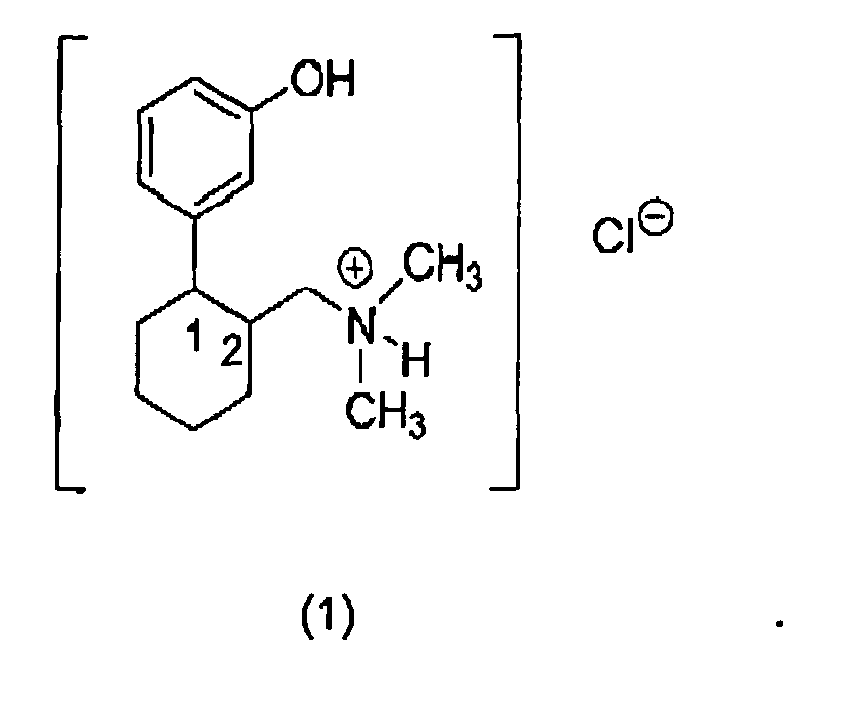
- Salze gemäß Anspruch 1, dadurch gekennzeichnet, dass die Verbindung der Formel (1) als Diastereomer oder Gemisch von enantiomeren Diastereomeren mit trans-Konfiguration des Phenylringes und der Dimethylaminomethylgruppe (1 R,2R- beziehungsweise 1S,2S-Konfiguration) vorliegt, bevorzugt als Enantiomer mit der absoluten Konfiguration (1 R,2R) vorliegt.
- Kristalline Form I von 3-[2-Dimethylamino)methyl-(cyclohex-1-yl)-phenol Hydrochlorid der Formel (1) gemäß Anspruch 1 oder 2, die ein charakteristisches Röntgen-Beugungsbild im Bereich von 2° bis 35° 2θ mit ausgeprägten charakteristischen Linien aufweist, ausgedrückt in 2 Theta-Werten:11.2 (w), 14.1 (m), 17.1 (w), 19.5 (w), 19.8 (vs), 20.5 (w), 21.5 (m), 24.1 (m), 26.1 (s), 26.8 (w), 31.3 (m).
- Kristalline Form I von 3-[2-Dimethylamino)methyl-(cyclohex-1-yl)-phenol Hydrochlorid der Formel (1) gemäß Anspruch 1 oder 2, die ein Röntgenbeugungsbild wie in Figur 1 dargestellt aufweist.
- Kristalline Form I von 3-[2-Dimethylamino)methyl-(cyclohex-1-yl)-phenol Hydrochlorid der Formel (1) gemäß Anspruch 1 oder 2, die ein Raman-Spektrum wie in Figur 2 dargestellt aufweist.
- Kristalline Form III von 3-[2-Dimethylamino)methyl-(cyclohex-1-yl)-phenol Hydrochlorid der Formel (1) gemäß Anspruch 1 oder 2, die ein charakteristisches Röntgen-Beugungsbild im Bereich von 2° bis 35° 2θ mit ausgeprägten charakteristischen Linien aufweist, ausgedrückt in 2 Theta-Werten:6.9 (s), 13.9 (m), 16.3 (m), 17.7 (w), 20.9 (vs), 22.1 (w), 22.5 (w), 27.8 (w).
- Kristalline Form III von 3-[2-Dimethylamino)methyl-(cyclohex-1-yl)-phenol Hydrochlorid der Formel (1) gemäß Anspruch 1 oder 2, die ein Röntgen-Beugungsbild wie in Figur 5 dargestellt aufweist.
- Kristalline Form III von 3-[2-Dimethylamino)methyl-(cyclohex-1-yl)-phenol Hydrochlorid der Formel (1) gemäß Anspruch 1 oder 2, die ein Raman-Spektrum wie in Figur 6 dargestellt aufweist.
- Kristalline Form IV von 3-[2-Dimethylamino)methyl-(cyclohex-1-yl)-phenol Hydrochlorid der Formel (1) gemäß Anspruch 1 oder 2, die ein charakteristisches Röntgen-Beugungsbild im Bereich von 2° bis 35° 2θ mit ausgeprägten charakteristischen Linien aufweist, ausgedrückt in 2 Theta-Werten:12.0 (m), 13.0 (m), 17.3 (m), 17.7 (m), 19.2 (s), 19.7 (m), 20.2 (m), 21.3 (m), 23.4 (m), 24.2 (m), 24.6 (m), 43.1 (vs), 44.2 (vs).
- Kristalline Form IV von 3-[2-Dimethylamino)methyl-(cyclohex-1-yl)-phenol Hydrochlorid der Formel (1) gemäß Anspruch 1 oder 2, die ein Röntgen-Beugungsbild wie in Figur 7 dargestellt aufweist.
- Kristalline Form IV von 3-[2-Dimethylamino)methyl-(cyclohex-1-yl)-phenol Hydrochlorid der Formel (1) gemäß Anspruch 1 oder 2, die ein Raman-Spektrum wie in Figur 8 dargestellt aufweist.
- Verfahren zur Herstellung der kristallinen Form I von 3-[2-Dimethylamino)methyl-(cyclohex-1-yl)-phenol Hydrochlorid gemäß einem oder mehreren der Ansprüche 3 bis 5, dadurch gekennzeichnet, dassa) 3-[2-Dimethylamino)methyl-(cyclohex-1-yl)-phenol Hydrochlorid in der kristallinen Form III und 3-[2-Dimethylamino)methyl-(cyclohex-1-yl)-phenol Hydrochlorid in der kristallinen Form IV oder 3-[2-Dimethylamino)methyl-(cyclohex-1-yl)-phenol Hydrochlorid in der kristallinen Form V in einem Lösungsmittel bis zur vollständigen Bildung der kristallinen Form I gerührt werden, oderb) 3-[2-Dimethylamino)methyl-(cyclohex-1-yl)-phenol Hydrochlorid in der kristallinen Form II und 3-[2-Dimethylamino)methyl-(cyclohex-1-yl)-phenol Hydrochlorid in der kristallinen Form I in einem Lösungsmittel bis zur vollständigen Bildung der kristallinen Form I gerührt werden.
- Kristalline Form I von 3-[2-Dimethylamino)methyl-(cyclohex-1-yl)-phenol Hydrochlorid der Formel (1) gemäß Anspruch 1 oder 2 erhältlich nach einem Verfahren gemäß Anspruch 12.
- Verfahren zur Herstellung der kristallinen Form III von 3-[2-Dimethylamino)methyl-(cyclohex-1-yl)-phenol Hydrochlorid gemäß einem oder mehreren der Ansprüche 6 bis 8, dadurch gekennzeichnet, dassa) 3-[2-Dimethylamino)methyl-(cyclohex-1-yl)-phenol Hydrochlorid in Form eines Ethanol- oder Aceton-Solvates in einem Lösungsmittel gelöst und gerührt und anschließend ausgefällt wird, oderb) eine Suspension der amorphen Form von 3-[2-Dimethylamino)methyl-(cyclohex-1-yl)-phenol Hydrochlorid in einem Lösungsmittel; bevorzugt in einem Lösungsmittel, das keine Solvate bildet; als Träger bei einer Temperatur zwischen 30 °C und 80°C, bevorzugt bei einer Temperatur zwischen 35°C und 50°C, besonders bevorzugt bei einer Temperatur von 40°C, bis zur vollständigen Bildung der kristallinen Form III gerührt wird.
- Kristalline Form III von 3-[2-Dimethylamino)methyl-(cyclohex-1-yl)-phenol Hydrochlorid der Formel (1) gemäß Anspruch 1 oder 2 erhältlich nach einem Verfahren gemäß Anspruch 14.
- Verfahren zur Herstellung der kristallinen Form IV von 3-[2-Dimethylamino)methyl-(cyclohex-1-yl)-phenol Hydrochlorid gemäß einem oder mehreren der Ansprüche 9 bis 11, dadurch gekennzeichnet, dassa) 3-[2-Dimethylamino)methyl-(cyclohex-1-yl)-phenol Hydrochlorid in der kristallinen Form III bei einer Temperatur zwischen 150°C und 160 °C, bevorzugt bei einer Temperatur zwischen 154°C und 158°C, bis zur vollständigen Bildung der kristallinen Form IV getempert wird, oderb) eine Suspension der amorphen Form von 3-[2-Dimethylamino)methyl-(cyclohex-1-yl)-phenol Hydrochlorid in einem Lösungsmittel; bevorzugt in einem Lösungsmittel, das keine Solvate bildet; als Träger bei einer Temperatur zwischen 40°C und 120°C, bevorzugt bei einer Temperatur zwischen 40°C und 100 °C, besonders bevorzugt bei einer Temperatur zwischen 40°C und 80°C, bis zur vollständigen Bildung der kristallinen Form IV gerührt wird; oderc) 3-[2-Dimethylamino)methyl-(cyclohex-1-yl)-phenol Hydrochlorid in der kristallinen Form IV und 3-[2-Dimethylamino)methyl-(cyclohex-1-yl)-phenol Hydrochlorid in der kristallinen Form III in einem Lösungsmittel bis zur vollständigen Bildung der kristallinen Form IV gerührt wird.
- Kristalline Form IV von 3-[2-Dimethylamino)methyl-(cyclohex-1-yl)-phenol Hydrochlorid der Formel (1) gemäß Anspruch 1 oder 2 erhältlich nach einem Verfahren gemäß Anspruch 16.
- Pharmazeutische Zusammensetzung, enthaltend eine wirksame Menge 3-[2-Dimethylamino)methyl-(cyclohex-1-yl)-phenol Hydrochlorid der Formel (1) gemäß einem oder mehreren der Ansprüche 1-5, 6-8, 9-11, 13, 15 und 17 und einen pharmazeutischen Träger oder ein pharmazeutisches Verdünnungsmittel.
- Zusammensetzung gemäß Anspruch 18, worin die Verbindung der Formel (1) als kristalline Form I, kristalline Form III oder kristalline Form IV oder In einer Mischung der Formen I, III und IV vorliegt.
- Verwendung von 3-[2-Dimethylamino)methyl-(cyclohex-1-yl)-phenol Hydrochlorid der Formel (1) gemäß einem oder mehreren der Ansprüche 1-5, 6-8, 9-11, 13, 75 und 17 zur Herstellung einer pharmazeutischen Zusammensetzung, insbesondere für die Behandlung von Schmerzzuständen.
- Verwendung von 3-[2-Dimethylamino)methyl-(cyclohex-1-yl)-phenol Hydrochlorid der Formel (1) gemäß einem oder mehreren der Ansprüche 1-5, 6-8, 9-11, 13, 15 und 17 als Wirkstoff in Arzneimitteln, bevorzugt als Wirkstoff in Schmerzmitteln.
- Verfahren zur Behandlung von Schmerzzuständen, bei dem man einem unter Schmerzen leidenden Patienten eine wirksame Menge von 3-[2-Dimethylamino)methyl-(cyclohex-1-yl)-phenol Hydrochlorid der Formel (1) gemäß einem oder mehreren der Ansprüche 1-5, 6-8, 9-11, 13, 15 und 17 verabreicht.
Applications Claiming Priority (3)
| Application Number | Priority Date | Filing Date | Title |
|---|---|---|---|
| DE102005034974A DE102005034974A1 (de) | 2005-07-22 | 2005-07-22 | Salz von Dimethylaminomethyl-phenyl-cyclohexan und dessen kristalline Formen |
| DE102005034973A DE102005034973A1 (de) | 2005-07-22 | 2005-07-22 | Salz von Dimethylaminomethyl-phenyl-cyclohexan und dessen kristalline Formen |
| EP06776327A EP1907351A1 (de) | 2005-07-22 | 2006-07-20 | Hcl-polymorphe von 3 - ( 2- (dimethylamino) methyl- ( cyclohex-i-yl) ) phenol |
Related Parent Applications (1)
| Application Number | Title | Priority Date | Filing Date |
|---|---|---|---|
| EP06776327.6 Division | 2006-07-20 |
Publications (2)
| Publication Number | Publication Date |
|---|---|
| EP2336103A2 true EP2336103A2 (de) | 2011-06-22 |
| EP2336103A3 EP2336103A3 (de) | 2011-07-20 |
Family
ID=37101337
Family Applications (2)
| Application Number | Title | Priority Date | Filing Date |
|---|---|---|---|
| EP06776327A Withdrawn EP1907351A1 (de) | 2005-07-22 | 2006-07-20 | Hcl-polymorphe von 3 - ( 2- (dimethylamino) methyl- ( cyclohex-i-yl) ) phenol |
| EP10014791A Withdrawn EP2336103A3 (de) | 2005-07-22 | 2006-07-20 | HCL-Polymorphe von 3-[2-(Dimethylamino)methyl-(cyclohex-1-yl)]phenol |
Family Applications Before (1)
| Application Number | Title | Priority Date | Filing Date |
|---|---|---|---|
| EP06776327A Withdrawn EP1907351A1 (de) | 2005-07-22 | 2006-07-20 | Hcl-polymorphe von 3 - ( 2- (dimethylamino) methyl- ( cyclohex-i-yl) ) phenol |
Country Status (5)
| Country | Link |
|---|---|
| US (4) | US8058476B2 (de) |
| EP (2) | EP1907351A1 (de) |
| JP (2) | JP5323480B2 (de) |
| CA (1) | CA2615742A1 (de) |
| WO (1) | WO2007009794A1 (de) |
Families Citing this family (2)
| Publication number | Priority date | Publication date | Assignee | Title |
|---|---|---|---|---|
| EP2085081A1 (de) * | 2008-02-04 | 2009-08-05 | Grünenthal GmbH | 3-(2-Dimethylaminomethyl-cyclohexyl)-phenol gegen polyneuropathischen Schmerz |
| CN110015955A (zh) * | 2010-07-23 | 2019-07-16 | 格吕伦塔尔有限公司 | 3-(3-二甲基氨基-1-乙基-2-甲基-丙基)-苯酚的盐或共晶体 |
Citations (1)
| Publication number | Priority date | Publication date | Assignee | Title |
|---|---|---|---|---|
| EP0753506A1 (de) | 1995-07-11 | 1997-01-15 | Grünenthal GmbH | 6-dimethylaminomethyl-1-phenyl-cyclo-hexanverbindungen als pharmazeutische Wirkstoffe |
Family Cites Families (4)
| Publication number | Priority date | Publication date | Assignee | Title |
|---|---|---|---|---|
| DE10146275A1 (de) * | 2001-09-18 | 2003-04-24 | Gruenenthal Gmbh | Kombination ausgewählter Opioide mit Muscarin-Antagonisten zur Therapie der Harninkontinenz |
| WO2003048113A1 (en) * | 2001-11-30 | 2003-06-12 | Sepracor Inc. | Tramadol analogs and uses thereof |
| DE10218862A1 (de) * | 2002-04-26 | 2003-11-06 | Gruenenthal Gmbh | Verfahren zur Chlorierung tertiärer Alkohole |
| DE10233048A1 (de) * | 2002-07-19 | 2004-01-29 | Grünenthal GmbH | Verwendung von 1-Phenyl-3dimethylamino-propanverbindungen zur Therapie von depressiven Symptomatiken |
-
2006
- 2006-07-20 JP JP2008521896A patent/JP5323480B2/ja not_active Expired - Fee Related
- 2006-07-20 EP EP06776327A patent/EP1907351A1/de not_active Withdrawn
- 2006-07-20 WO PCT/EP2006/007163 patent/WO2007009794A1/de not_active Ceased
- 2006-07-20 CA CA002615742A patent/CA2615742A1/en not_active Abandoned
- 2006-07-20 EP EP10014791A patent/EP2336103A3/de not_active Withdrawn
-
2008
- 2008-01-18 US US12/016,506 patent/US8058476B2/en not_active Expired - Fee Related
-
2009
- 2009-11-30 US US12/627,190 patent/US20100076085A1/en not_active Abandoned
-
2011
- 2011-06-21 US US13/165,331 patent/US20110251287A1/en not_active Abandoned
-
2012
- 2012-09-10 JP JP2012198012A patent/JP2013018776A/ja not_active Withdrawn
-
2013
- 2013-05-01 US US13/874,851 patent/US20130245125A1/en not_active Abandoned
Patent Citations (1)
| Publication number | Priority date | Publication date | Assignee | Title |
|---|---|---|---|---|
| EP0753506A1 (de) | 1995-07-11 | 1997-01-15 | Grünenthal GmbH | 6-dimethylaminomethyl-1-phenyl-cyclo-hexanverbindungen als pharmazeutische Wirkstoffe |
Non-Patent Citations (2)
| Title |
|---|
| "Remington's Pharmaceutical Sciences", 1985, MACK PUBLISHING COMPANY |
| Z. JANE LI ET AL., J. PHARM. SCI., vol. 88, no. 3, 1999, pages 337 - 346 |
Also Published As
| Publication number | Publication date |
|---|---|
| US20110251287A1 (en) | 2011-10-13 |
| US20100076085A1 (en) | 2010-03-25 |
| EP1907351A1 (de) | 2008-04-09 |
| CA2615742A1 (en) | 2007-01-25 |
| US20080255242A1 (en) | 2008-10-16 |
| JP2009502759A (ja) | 2009-01-29 |
| JP5323480B2 (ja) | 2013-10-23 |
| JP2013018776A (ja) | 2013-01-31 |
| WO2007009794A1 (de) | 2007-01-25 |
| EP2336103A3 (de) | 2011-07-20 |
| US8058476B2 (en) | 2011-11-15 |
| US20130245125A1 (en) | 2013-09-19 |
Similar Documents
| Publication | Publication Date | Title |
|---|---|---|
| EP1633697B1 (de) | Verfahren zur herstellung substituierter 3-aryl-butyl-aminverbindungen | |
| DE69822218T2 (de) | Donepezil polykristalle und verfharen zu ihrer herstellung | |
| EP0753506A1 (de) | 6-dimethylaminomethyl-1-phenyl-cyclo-hexanverbindungen als pharmazeutische Wirkstoffe | |
| EP3173400B1 (de) | Arzneimittel enthaltend kristalline modifikationen von (1r,2r)-3-(3-dimethylamino-1-ethyl-2-methyl-propyl)-phenol | |
| DE29724281U1 (de) | 4-Phenylpiperidin-Verbindungen | |
| EP1073631A1 (de) | Neue substituierte amide, deren herstellung und anwendung | |
| EP1322593B1 (de) | O-substituierte 6-methyl-tramadol-derivate | |
| EP1406623B1 (de) | Substituierte 1-phenethylpiperidinverbindungen, die unter anderem als analgetika verwendung finden | |
| EP1881956B1 (de) | 3-(2-(dimethylamino)methyl-(cyclohex-1-yl))phenol-maleat und dessen kristalline formen | |
| EP2336103A2 (de) | HCL-Polymorphe von 3-[2-(Dimethylamino)methyl-(cyclohex-1-yl)]phenol | |
| EP1907350B1 (de) | Salz von fumarsäure und 3- (2-dimethylamino) methyl- ( cyclohex-1-yl) ) phenol un dessen kristalline formen | |
| KR102013157B1 (ko) | 결정형 및 이의 제조방법 | |
| WO2005030698A1 (en) | Process for the preparation of voglibose | |
| EP2213646A1 (de) | Neue kristalline Formen von Atovaquon | |
| US20110046230A1 (en) | Salt of Dimethylaminomethyl-Phenyl-Cyclohexane and Crystalline Forms Thereof | |
| EP1406857B1 (de) | Substituierte 1-aryl-but-3-enylamin- und 1-aryl-but-2-enylaminverbindungen | |
| EP1043306A2 (de) | 3-Amino-3-arylpropan-1-ol-Derivate, deren Herstellung und Verwendung | |
| US20070032551A1 (en) | Salt of dimethylaminomethyl-phenyl-cyclohexane and crystalline forms thereof | |
| KR20110095545A (ko) | (s)-리바스티그민 오로트산염 및 이를 포함하는 약제학적 조성물 | |
| DD149072A5 (de) | Verfahren zur herstellung einer neuen rechtsdrehenden bicyclischen thia-diaza-verbindung | |
| HK1235765B (en) | Medicaments containing crystalline modifications of (1r,2r)-3-(3-dimethylamino-1-ethyl-2-methyl-propyl)-phenol | |
| NZ564902A (en) | 3-[2-(Dimethylamino)methyl-(cyclohex-1-yl)]-phenol maleate and the crystalline forms thereof |
Legal Events
| Date | Code | Title | Description |
|---|---|---|---|
| PUAI | Public reference made under article 153(3) epc to a published international application that has entered the european phase |
Free format text: ORIGINAL CODE: 0009012 |
|
| PUAL | Search report despatched |
Free format text: ORIGINAL CODE: 0009013 |
|
| AC | Divisional application: reference to earlier application |
Ref document number: 1907351 Country of ref document: EP Kind code of ref document: P |
|
| AK | Designated contracting states |
Kind code of ref document: A2 Designated state(s): AT BE BG CH CY CZ DE DK EE ES FI FR GB GR HU IE IS IT LI LT LU LV MC NL PL PT RO SE SI SK TR |
|
| AK | Designated contracting states |
Kind code of ref document: A3 Designated state(s): AT BE BG CH CY CZ DE DK EE ES FI FR GB GR HU IE IS IT LI LT LU LV MC NL PL PT RO SE SI SK TR |
|
| 17P | Request for examination filed |
Effective date: 20120119 |
|
| 17Q | First examination report despatched |
Effective date: 20120306 |
|
| GRAP | Despatch of communication of intention to grant a patent |
Free format text: ORIGINAL CODE: EPIDOSNIGR1 |
|
| INTG | Intention to grant announced |
Effective date: 20140228 |
|
| STAA | Information on the status of an ep patent application or granted ep patent |
Free format text: STATUS: THE APPLICATION IS DEEMED TO BE WITHDRAWN |
|
| 18D | Application deemed to be withdrawn |
Effective date: 20140711 |