EP2339072A2 - Bodenbearbeitungsgerät mit einer angetriebenen Arbeitswellenanordnung - Google Patents
Bodenbearbeitungsgerät mit einer angetriebenen Arbeitswellenanordnung Download PDFInfo
- Publication number
- EP2339072A2 EP2339072A2 EP10195458A EP10195458A EP2339072A2 EP 2339072 A2 EP2339072 A2 EP 2339072A2 EP 10195458 A EP10195458 A EP 10195458A EP 10195458 A EP10195458 A EP 10195458A EP 2339072 A2 EP2339072 A2 EP 2339072A2
- Authority
- EP
- European Patent Office
- Prior art keywords
- housing
- housing shell
- shell portion
- cultivation device
- soil cultivation
- Prior art date
- Legal status (The legal status is an assumption and is not a legal conclusion. Google has not performed a legal analysis and makes no representation as to the accuracy of the status listed.)
- Granted
Links
Images


Classifications
-
- E—FIXED CONSTRUCTIONS
- E01—CONSTRUCTION OF ROADS, RAILWAYS, OR BRIDGES
- E01H—STREET CLEANING; CLEANING OF PERMANENT WAYS; CLEANING BEACHES; DISPERSING OR PREVENTING FOG IN GENERAL CLEANING STREET OR RAILWAY FURNITURE OR TUNNEL WALLS
- E01H4/00—Working on surfaces of snow or ice in order to make them suitable for traffic or sporting purposes, e.g. by compacting snow
- E01H4/02—Working on surfaces of snow or ice in order to make them suitable for traffic or sporting purposes, e.g. by compacting snow for sporting purposes, e.g. preparation of ski trails; Construction of artificial surfacings for snow or ice sports ; Trails specially adapted for on-the-snow vehicles, e.g. devices adapted for ski-trails
-
- A—HUMAN NECESSITIES
- A01—AGRICULTURE; FORESTRY; ANIMAL HUSBANDRY; HUNTING; TRAPPING; FISHING
- A01B—SOIL WORKING IN AGRICULTURE OR FORESTRY; PARTS, DETAILS, OR ACCESSORIES OF AGRICULTURAL MACHINES OR IMPLEMENTS, IN GENERAL
- A01B33/00—Tilling implements with rotary driven tools, e.g. in combination with fertiliser distributors or seeders, with grubbing chains, with sloping axles, with driven discs
- A01B33/02—Tilling implements with rotary driven tools, e.g. in combination with fertiliser distributors or seeders, with grubbing chains, with sloping axles, with driven discs with tools on horizontal shaft transverse to direction of travel
- A01B33/021—Tilling implements with rotary driven tools, e.g. in combination with fertiliser distributors or seeders, with grubbing chains, with sloping axles, with driven discs with tools on horizontal shaft transverse to direction of travel with rigid tools
- A01B33/024—Tilling implements with rotary driven tools, e.g. in combination with fertiliser distributors or seeders, with grubbing chains, with sloping axles, with driven discs with tools on horizontal shaft transverse to direction of travel with rigid tools with disk-like tools
Definitions
- the invention relates to a harrow with a driven working shaft assembly which is rotatably mounted in a processing housing open to the ground.
- Such tillage equipment can be used in the agricultural sector or even in the snowplow design and care.
- Such a soil tillage implement in the form of a rear tiller for a tracked vehicle for snow grooming is well known.
- the rear tiller is attached by means of a mounting frame to the rear of a corresponding snow groomer.
- the rear tiller is driven by one or more hydraulic motors, which are fed and controlled via a vehicle-side hydraulics of the snow groomer.
- the rear tiller has a milling housing, in which several auger shafts are arranged in a side-by-side alignment and are rotatably mounted.
- the milling housing covers the milling shafts hood-like and is after open at the bottom. In the normal direction of travel towards the rear, the milling housing is followed by a smoothing device, also referred to as a finisher, which comprises a flexible smoothing structure.
- the cutting shafts pick up chunks of snow and ice and crush them during rotation between the blades of the milling shaft and an inner wall of the milling housing.
- the inner wall of the milling housing serves as a baffle on which the snow and ice chunks bounce and are thrown back to then be thrown again by the blades of the milling shaft against the inner wall. This results in the desired crushing of snow and ice chunks.
- the processed snow and ice residues fall back onto the slope surface and are compacted and smoothed by the smoothing formation. This creates the machined slope surface.
- the object of the invention is to provide a harrow of the type mentioned, which allows a variable tillage.
- the processing housing has at least two housing shell sections which are mounted in a fan-like manner relative to one another in the circumferential direction relative to a rotation axis of the working shaft arrangement.
- a usable baffle of the processing housing is variable between a first end position in which the processing housing surrounds the working shaft assembly over a first circumferential angle, and a second end position in which complement the at least one first housing shell portion and the at least one second housing shell portion in the circumferential direction and so surround the working shaft arrangement over a larger circumferential angle.
- the housing shell sections are preferably continuously adjustable relative to one another.
- the working shaft arrangement can be made a single or multiple, aligned in parallel juxtaposed working waves. The individual working shafts can be driven together or separately.
- the processing housing can be subdivided over a processing width of the harrow into a plurality of housing sections, which are preferably each assigned a single working shaft and which each have at least one displaceable housing shell section and a stationary housing shell section. It is also possible to provide more than two housing shell sections displaceable relative to each other in the circumferential direction.
- the solution according to the invention can be used in a particularly advantageous manner in a cultivator in the form of a tail mill for a snow groomer, as has already been described in the introduction from its basic function.
- the inventive variability of the housing shell of the milling housing it is possible depending on the type of snow surface to be machined to set the housing shell larger or smaller.
- a housing shell is sufficient over a smaller circumferential angle.
- the housing shell sections are thus fanned out in the circumferential direction or pushed over one another.
- the solution according to the invention is suitable in the same way for tillage equipment in agriculture, especially for arable cultivation.
- At least one stationary housing shell portion and at least one movable housing portion are provided, wherein the movable housing portion relative to the stationary housing shell portion - seen relative to the axis of rotation of the working shaft assembly in the circumferential direction - such is slidably mounted, that in one end position, the housing shell sections are superimposed on each other in the circumferential direction, and that in the other end position, the at least one housing shell portion extends the at least one stationary housing shell portion substantially aligned.
- the closing of the processing housing - on a machining direction - on the back of a smoothing device for compacting the machined soil which has a flexible smoothing structure, which is attached to the movable housing shell portion or to the stationary housing shell portion.
- the stationary housing shell portion remains stationary in a tillage implement in the form of a rear tiller relative to a mounting frame of the snow groomer, as he is pulled through the snow groomer.
- the slidable housing shell portion is movably disposed relative to the stationary housing shell portion.
- the stationary housing shell portion can basically be adjusted together with the entire milling housing in different positions relative to the snow groomer, as is generally known for tail milling of snow groomers.
- the smoothing device compacts and smoothes the soil processed by the working shaft arrangement and the processing housing. This refinement can be used particularly advantageously in a tail mill for a snow groomer, since the smoothing device shapes the runway image of the processed snow runway surface.
- the snow and ice residues which were previously greatly reduced by the rear tiller, are compacted and smoothed to form a snow slope that is easy for skiers or snowboarders to reach.
- drive means are provided to adjust the at least one movable housing shell portion in different positions and in the respectively set Secure positions.
- the drive means comprise at least one hydraulic cylinder which engages the displaceable housing shell portion.
- the movable housing shell portion on an arcuate in cross-section wall which covers the stationary housing shell portion in the circumferential direction on the inside at least substantially.
- a double wall is formed, in which the arcuate wall of the displaceable housing shell portion on the inside conforms to an inner wall of the stationary housing shell portion.
- the arcuate wall of the displaceable housing shell portion and the inner wall of the stationary housing shell portion define - depending on the displacement position - the baffle for soil particles that are thrown by the working shaft assembly against the inside of the processing housing.
- the bottom-shaped wall is designed as a shock-resistant, in particular sound-insulating and at least substantially dimensionally stable sheet, in particular made of plastic.
- the fabric can be implemented in one or more layers.
- a surface of the sheet which is directed toward the working shaft arrangement has a smooth surface in order to at least largely avoid adhesion of soil or dirt particles.
- the wall is held on a support profile from which the wall protrudes freely, and which is guided by means of guide assemblies on the outside of the at least one stationary housing shell portion slidably.
- the carrier profile preferably extends over the working width of the working housing or over a working width of a corresponding housing section.
- the carrier profile is arranged adjacent to a longitudinal side edge of the stationary housing shell section.
- the longitudinal side edge preferably forms a - seen in the normal machining direction - the rear boundary, which extends over the working width of the working housing.
- the guide assemblies arcuate guide runners, which are guided in guide profiles on the outer circumference of the at least one stationary housing shell portion slidably. This allows safe guidance and storage of the displaceable housing shell section.
- the guide skids have sliding surface sections with reduced sliding friction coefficients.
- arcuate guide webs are provided on opposite end-side housing terminations of the processing housing, which lead opposite side edges of the arcuate wall. This configuration ensures that the wall of the displaceable housing shell portion is guided securely on its opposite end faces in order to ensure a slidable against the inner wall of the stationary housing shell portion displaceability.
- the guidance of the arcuate wall over the end guide webs reduces the risk that soil particles, especially snow or ice chunks, press between the arcuate wall and the inner wall of the stationary housing shell portion.
- a surface area of the wall lying on the carrier profile is connected to the guide runners via securing means, wherein the securing means project through longitudinal slots in the stationary housing jacket section.
- the inside, arcuate wall is thus in its freely abragendem surface area - preferably distributed over the working width of the processing housing - connected to the outside running runners by appropriate securing means protrude through longitudinal slots in the stationary housing shell portion.
- These longitudinal slots inevitably define the maximum adjustment angle of the wall.
- the longitudinal slots are circumferentially extending and arranged distributed parallel to each other over the width of the stationary housing shell portion.
- the number of longitudinal slots preferably corresponds to the number of guide runners that hold the carrier profile and thus the wall.
- a rear tiller 1, 1a serving as a tilling device after the Fig. 1 to 12 is provided as a rear attachment to a snow groomer, which is provided in a generally known manner for snow shoe design and - care.
- the rear tiller 1, 1a is releasably attachable to a rear carrier assembly of the snow groomer. All hydraulic drive means of the rear tiller 1, 1a are fed by a vehicle hydraulics of the snowcat and controlled by the vehicle.
- the rear tiller 1, 1a serves to break up, crush and smooth the lumpy surface of the snowpiste caused by a left and a right track drive of the snowcat.
- the rear tiller has a smoothing device 5, 10; 5, 10a, which - seen in the normal processing and direction of travel of the snowcat - at the rear of a milling housing 2, 2a of the rear tiller 1, 1a connects.
- the rear tiller 1, 1a on a milling housing which is formed of two housing sections, each extending over half of the working width of the rear tiller 1, 1a.
- a milling shaft 3, 3a is rotatably mounted and driven by a hydraulic motor.
- the milling shaft 3, 3a extends substantially over a working width of the associated housing portion.
- the two juxtaposed housing sections of the milling housing 2, 2a are rigidly coupled together in the operating state.
- a corresponding hydraulic drive is provided between the two housing sections in order to drive the two milling shafts 3, 3a extending from the center to opposite sides.
- the smoothing device has in both embodiments according to the Fig. 1 and 2 or according to the Fig. 3 to 12 a flexible smoothing structure in the form of a finisher arrangement 5, 5a, which can be pressurized from above with a plurality of carrier arrangements 10, 10a connected to a frame of the milling housing 2, 2a.
- a rear finisher of the finisher assembly 5, 5a extends over one entire working width of the milling housing 2, 2a and thus in one piece and continuously over the mutually coupled housing sections of the milling housing.
- the finisher assembly also has unspecified side finisher, of which a left side finisher in Fig. 5 is recognizable. Only difference between the two embodiments, as based on the Fig. 1 and 2 and on the basis of
- the tail finisher engages a stationary housing shell section 2 of the milling housing.
- the tail finisher of the finisher assembly 5a adjoins a displaceable housing shell section 2'a of the housing section of the milling housing.
- the displaceable housing casing section 2'a has a dovetailed carrier profile 4a, 11, in which a front end face of the rear finisher is held in a form-fitting manner.
- the two housing sections of the milling housing which are arranged side by side over the working width of the milling housing, are designed identical to one another. The following is therefore based on the FIG. 5 to 12 only one of the two housing sections described. For the other, not shown housing section the same applies.
- the housing section according to the Fig. 3 to 6 has a stationary housing shell portion 2a, which is fixedly connected to a milling frame T of the rear tiller.
- the housing shell portion 2a has at its opposite end faces on the front side housing terminations, one of which in Fig. 9 is denoted by S.
- the front-side housing terminations S serve for mounting the milling shaft 3a.
- the front-side housing terminations S are firmly connected to the stationary housing shell portion 2a.
- the stationary housing shell portion 2a is curved in a circular arc in cross section.
- the circular arc-like curvature extends in the circumferential direction of the housing section - based on a housing longitudinal axis, which extends in the vehicle transverse direction and is aligned parallel to a rotational axis of the milling shaft 3a.
- a central axis of the arcuate curvature of the housing shell portion 2a is not identical to the axis of rotation of the milling shaft 3a. In this way, a defined between the milling shaft 3a and an inner wall of the housing shell portion 2a baffle in a clockwise direction in accordance with 3 and 4 gradually rejuvenated.
- stationary housing shell portion 2a extends over an angle of more than 90 °, and preferably less than 130 °.
- a displaceable housing shell portion 2'a is additionally mounted, which in Fig. 4 in an upper end position and in Fig. 3 is shown in a lower end position.
- the displaceable housing shell section 2'a takes place on the back side of the milling housing, ie on the side of the milling housing facing the smoothing device.
- the displaceable and therefore movable housing shell portion 2'a has a dimensionally stable support profile made of metal, preferably made of steel, which extends over an entire working width of the illustrated housing portion of the milling housing.
- the carrier profile 4 has a dovetail-like profile receptacle 11, in which - as already described - a front end edge of the Heckfinishers is held positively.
- the carrier profile 4a extends parallel to a rear longitudinal edge of the stationary housing shell section 2a and is arranged substantially in alignment with the stationary housing jacket section 2a.
- the stationary housing casing section 2a has a rear-side and a front-side stiffening profile 9a, which likewise extends over the entire working width of the stationary casing casing section 2a, as does the carrier profile 4a.
- the stiffening profiles 9a and the stationary housing shell portion 2a are made of metal.
- the carrier profile 4a is held in a fan-like manner on the stationary housing casing section 2a by means of a plurality of guide arrangements 8a.
- the guide arrangements 8a are formed on the one hand by guide profiles 17 fastened on the outer circumference of the housing shell section 2a, which extend in the manner of a rail in the circumferential direction over the housing shell section 2a ( Fig. 6 ).
- These guide profiles 17 form guide grooves for guide runners 16, which protrude from the carrier profile 4a in a circular arc shape parallel to each other in the circumferential direction to the front and upward ( Fig. 11 ).
- the guide runners 16 also belong to the guide arrangements 8a and have core sections 19 and 22 made of metal, the lower core sections 22 being fastened to the support profile 4a.
- Each core section 22, 19 of a guide skid is flanked on both sides by skid sections 23 made of a low-plastic material Coefficient of sliding friction. These serve to facilitate the displacement of the guide rails 16 in the guide profiles 17.
- a cross-sectionally arcuate and therefore bowl-shaped wall 15 obliquely upwards and forwards, which is arranged uniformly at a distance radially within the guide skids 16.
- the wall 15 is in the assembled state within the milling housing on the inside to an inner wall of the stationary housing shell portion 2a nestled ( Fig. 7 to 9 ).
- front-side housing terminations S of the stationary housing shell section arcuate guide webs 20 are attached ( Fig. 7 to 9 ), which are arranged at a small, parallel distance from the inner wall of the stationary housing shell portion 2a.
- the distance of the guide webs 20 to the housing inner wall of the stationary housing shell section 2a is selected such that the shell-shaped wall 15 is guided with its opposite side edge regions in a guide gap defined between the guide webs 20 and the housing inner wall. As a result, a secure guidance of the opposite side edges of the wall 15 is achieved.
- the carrier profile 4a also has a side wall 12, which by means of an arcuate slotted guide 13 on the outside of the front-side housing closure S (FIG. Fig. 6 ) of the stationary housing shell portion is guided. For this purpose, a sliding block-like guide pin 14 is attached to the end-side housing closure S.
- a secure nestling of the wall 15 to the inner wall of the stationary housing shell portion 2a are, as shown in the Fig. 10 can be seen, provided in the baffle of the housing shell portion 2a a total of four longitudinal slots 22 which penetrate the housing shell section from inside to outside.
- the longitudinal slots 22 protrudes a screw-shaped or pin-shaped securing element 21, which penetrates the wall 15 from an inner side and is secured in a receiving bore 18 of the core element 19.
- the securing element 21 is designed as a screw provided with a screw head and the receiving bore 18 is designed as a corresponding threaded bore.
- the length of the longitudinal slot 22 preferably corresponds to the length of the slotted guide 13.
- the longitudinal slots 22 and the slotted guide 13 thus limit the displacement of the movable housing shell portion 2'a including its wall 15, its support profile 4a and its guide skids 16. Securing the wall 15 of a At the same time, the inside of the corresponding guide runners 16 also ensures that the guide runners 16 can not lift off from the guide profiles 17 of the stationary housing jacket section.
- the wall 15 is made of plastic, which may preferably have a sound insulation function. Based on FIGS. 7 and 8 It can be seen that the wall 15 completely overlaps an inner wall of the stationary housing shell section 2a in an upper end position of the movable housing shell section 2'a. In a lower end position ( Fig. 8 ), however, the wall 15 relative to the inner wall of the stationary housing shell portion 2 a fan-like down, which increases the usable for the cutter housing housing wall by the corresponding shifted angular amount instead of a baffle over a circumference of preferably about 110 ° thus becomes a baffle over a circumference generated by about 130 °.
- a displacement of the movable housing shell portion 2'a and thus the wall 15 by means of drive which according to the illustration of the Fig. 3 to 5 a hydraulic cylinder 7a include.
- the control is preferably carried out by the snowcat.
- one or more hydraulic cylinders 7a may be distributed over the working width.
Landscapes
- Engineering & Computer Science (AREA)
- Life Sciences & Earth Sciences (AREA)
- Architecture (AREA)
- Civil Engineering (AREA)
- Structural Engineering (AREA)
- Mechanical Engineering (AREA)
- Soil Sciences (AREA)
- Environmental Sciences (AREA)
- Soil Working Implements (AREA)
Abstract
Description
- Die Erfindung betrifft ein Bodenbearbeitungsgerät mit einer angetriebenen Arbeitswellenanordnung, die in einem zu dem Boden hin offenen Bearbeitungsgehäuse drehbar gelagert ist.
- Derartige Bodenbearbeitungsgeräte können im landwirtschaftlichen Bereich oder auch bei der Schneepistengestaltung und -pflege eingesetzt werden.
- Ein derartiges Bodenbearbeitungsgerät in Form einer Heckfräse für ein Kettenfahrzeug zur Schneepistenbearbeitung ist allgemein bekannt. Die Heckfräse ist mittels eines Anbaurahmens heckseitig an eine entsprechende Pistenraupe angebaut. Die Heckfräse wird angetrieben von einem oder mehreren Hydromotoren, die über eine fahrzeugseitige Hydraulik der Pistenraupe gespeist und gesteuert werden. Die Heckfräse weist ein Fräsengehäuse auf, in dem mehrere Fräswellen in einer Flucht nebeneinander angeordnet und drehbar gelagert sind. Das Fräsengehäuse überdeckt die Fräswellen haubenartig und ist nach unten offen. In normaler Fahrtrichtung nach hinten schließt an das Fräsengehäuse eine auch als Finisher bezeichnete Glätteinrichtung an, die ein flexibles Glättgebilde umfasst. Im Fräsbetrieb der Heckfräse nehmen die Fräswellen Schnee- und Eisbrocken auf und zerkleinern diese bei der Rotation zwischen den Messern der Fräswelle und einer Innenwandung des Fräsengehäuses. Die Innenwandung des Fräsengehäuses dient als Prallwandung, an der die Schnee- und Eisbrocken anprallen und zurückgeschleudert werden, um anschließend durch die Messer der Fräswelle erneut gegen die Innenwandung geschleudert zu werden. Hierdurch ergibt sich die gewünschte Zerkleinerung der Schnee- und Eisbrocken. Hinter der Fräswelle fallen die bearbeiteten Schnee- und Eisreste auf die Pistenoberfläche zurück und werden durch das Glättgebilde verdichtet und geglättet. Hierdurch entsteht die bearbeitete Pistenoberfläche.
- Aufgabe der Erfindung ist es, ein Bodenbearbeitungsgerät der eingangs genannten Art zu schaffen, das eine variable Bodenbearbeitung ermöglicht.
- Diese Aufgabe wird dadurch gelöst, dass das Bearbeitungsgehäuse wenigstens zwei Gehäusemantelabschnitte aufweist, die relativ zueinander in Umfangsrichtung - relativ zu einer Drehachse der Arbeitswellenanordnung ― fächerartig beweglich gelagert sind. Durch die erfindungsgemäße Lösung ist eine nutzbare Prallwandung des Bearbeitungsgehäuses variabel zwischen einer ersten Endposition, in der das Bearbeitungsgehäuse die Arbeitswellenanordnung über einen ersten Umfangswinkel umgibt, und einer zweiten Endposition, in der der wenigstens eine erste Gehäusemantelabschnitt und der wenigstens eine zweite Gehäusemantelabschnitt einander in Umfangsrichtung ergänzen und so über einen größeren Umfangswinkel die Arbeitswellenanordnung umgeben. Die Gehäusemantelabschnitte sind vorzugsweise relativ zueinander stufenlos verstellbar. Die Arbeitswellenanordnung kann aus einer einzelnen oder mehreren, fluchtend nebeneinander angeordneten Arbeitswellen aufgebaut sein. Die einzelnen Arbeitswellen können gemeinsam oder separat angetrieben sein. Das Bearbeitungsgehäuse kann über eine Bearbeitungsbreite des Bodenbearbeitungsgerätes in mehreren Gehäuseabschnitte unterteilt sein, denen vorzugsweise jeweils eine einzelne Arbeitswelle zugeordnet ist und die jeweils wenigstens einen verschiebbaren Gehäusemantelabschnitt und einen stationären Gehäusemantelabschnitt aufweisen. Es ist auch möglich, mehr als zwei Gehäusemantelabschnitte relativ zueinander in Umfangsrichtung verschiebbar vorzusehen. Die erfindungsgemäße Lösung ist in besonders vorteilhafter Weise bei einem Bodenbearbeitungsgerät in Form einer Heckfräse für eine Pistenraupe einsetzbar, wie sie von ihrer grundsätzlichen Funktion her eingangs bereits beschrieben wurde. Durch die erfindungsgemäße Veränderbarkeit des Gehäusemantels des Fräsengehäuses ist es möglich, je nach Art der zu bearbeitenden Schneeoberfläche den Gehäusemantel größer oder kleiner einzustellen. Insbesondere bei harten und eisigen Schnee- und Eisklumpen ist eine über einen größeren Umfangsabschnitt aufgefächerte Prallwand vorteilhaft. Bei eher pulvrigen Schneebedingungen genügt ein Gehäusemantel über einen geringeren Umfangswinkel. Je nach Einsatzzweck werden somit die Gehäusemantelabschnitte in Umfangsrichtung aufgefächert oder übereinander geschoben.
- Die erfindungsgemäße Lösung eignet sich in gleicher Weise für Bodenbearbeitungsgeräte in der Landwirtschaft, insbesondere zur Ackerbearbeitung.
- In Ausgestaltung der Erfindung sind wenigstens ein stationärer Gehäusemantelabschnitt und wenigstens ein beweglicher Gehäuseabschnitt vorgesehen, wobei der bewegliche Gehäuseabschnitt relativ dem stationären Gehäusemantelabschnitt ― relativ zu der Drehachse der Arbeitswellenanordnung in Umfangsrichtung gesehen - derart verschiebbar gelagert ist, dass in einer Endposition die Gehäusemantelabschnitte einander in Umfangsrichtung überlagert sind, und dass in der anderen Endposition der wenigstens eine Gehäusemantelabschnitt den wenigstens einen stationären Gehäusemantelabschnitt im Wesentlichen fluchtend verlängert.
- In weiterer Ausgestaltung der Erfindung schließt an das Bearbeitungsgehäuse - auf eine Bearbeitungsrichtung bezogen - rückseitig eine Glätteinrichtung zum Verdichtung des bearbeiteten Bodens an, die ein flexibles Glättgebilde aufweist, das an den beweglichen Gehäusemantelabschnitt oder an den stationären Gehäusemantelabschnitt angefügt ist. Der stationäre Gehäusemantelabschnitt verbleibt bei einem Bodenbearbeitungsgerät in Form einer Heckfräse relativ zu einem Anbaurahmen der Pistenraupe insoweit ortsfest, als er durch die Pistenraupe gezogen wird. Der verschiebbare Gehäusemantelabschnitt ist relativ zu dem stationären Gehäusemantelabschnitt beweglich angeordnet. Der stationäre Gehäusemantelabschnitt kann grundsätzlich jedoch gemeinsam mit dem gesamten Fräsengehäuse in verschiedene Positionen relativ zur Pistenraupe verstellt werden, wie dies grundsätzlich für Heckfräsen von Pistenraupen bekannt ist. Durch die Glätteinrichtung wird der durch die Arbeitswellenanordnung und das Bearbeitungsgehäuse bearbeitete Boden verdichtet und geglättet. Diese Ausgestaltung ist besonders vorteilhaft bei einer Heckfräse für eine Pistenraupe einsetzbar, da die Glätteinrichtung das Pistenbild der bearbeiteten Schneepistenoberfläche formt. Die zuvor durch die Heckfräse stark verkleinerten Schnee- und Eisreste werden verdichtet und zu einer durch Skifahrer oder Snowboarder gut zu befahrenden Schneepiste geglättet.
- In weiterer Ausgestaltung der Erfindung sind Antriebsmittel vorgesehen, um den wenigstens einen beweglichen Gehäusemantelabschnitt in unterschiedliche Positionen zu verstellen und in den jeweils eingestellten Positionen zu sichern. Vorzugsweise umfassen die Antriebsmittel wenigstens einen Hydraulikzylinder, der an dem verschiebbaren Gehäusemantelabschnitt angreift.
- In weiterer Ausgestaltung der Erfindung weist der bewegliche Gehäusemantelabschnitt eine im Querschnitt bogenförmige Wandung auf, die den stationären Gehäusemantelabschnitt in Umfangsrichtung innenseitig zumindest weitgehend überdeckt. Hierdurch wird eine Doppelwandung gebildet, in die sich die bogenförmige Wandung des verschiebbaren Gehäusemantelabschnittes innenseitig an eine Innenwandung des stationären Gehäusemantelabschnittes anschmiegt. Die bogenförmige Wandung des verschiebbaren Gehäusemantelabschnittes und die Innenwandung des stationären Gehäusemantelabschnittes definieren - je nach Verschiebestellung ― die Prallwandung für Bodenpartikel, die durch die Arbeitswellenanordnung gegen die Innenseite des Bearbeitungsgehäuses geschleudert werden.
- In weiterer Ausgestaltung der Erfindung ist die bodenförmige Wandung als schlagfestes, insbesondere schalldämmendes und zumindest weitgehend formstabiles Flächengebilde, insbesondere aus Kunststoff, gestaltet. Das Flächengebilde kann ein- oder mehrlagig ausgeführt sein. Vorzugsweise ist eine zur Arbeitswellenanordnung gerichtete Oberfläche des Flächengebildes glattflächig, um ein Anhaften von Boden- oder Schmutzpartikeln zumindest weitgehend zu vermeiden.
- In weiterer Ausgestaltung der Erfindung ist die Wandung an einem Trägerprofil gehalten, von dem die Wandung frei abragt, und das mittels Führungsanordnungen außenseitig an dem wenigstens einen stationären Gehäusemantelabschnitt verschiebbar geführt ist. Das Trägerprofil erstreckt sich vorzugsweise über die Arbeitsbreite des Arbeitsgehäuses bzw. über eine Arbeitsbreite eines entsprechenden Gehäuseabschnittes.
- In weiterer Ausgestaltung der Erfindung ist das Trägerprofil benachbart zu einem Längsseitenrand des stationären Gehäusemantelabschnittes angeordnet. Der Längsseitenrand bildet vorzugsweise eine - in normaler Bearbeitungsrichtung gesehen - rückseitige Begrenzung, die sich über die Arbeitsbreite des Arbeitsgehäuses erstreckt.
- In weiterer Ausgestaltung der Erfindung weisen die Führungsanordnungen bogenförmige Führungskufen auf, die in Führungsprofilierungen am Außenumfang des wenigstens einen stationären Gehäusemantelabschnittes verschiebbar geführt sind. Dadurch ist eine sichere Führung und Lagerung des verschiebbaren Gehäusemantelabschnittes ermöglicht.
- In weiterer Ausgestaltung der Erfindung weisen die Führungskufen Gleitflächenabschnitte mit reduziertem Gleitreibungskoeffizienten auf. Dadurch ist eine besonders leichtgängige Verstellung des verschiebbaren Gehäusemantelabschnittes relativ zu dem stationären Gehäusemantelabschnitt erzielbar.
- In weiterer Ausgestaltung der Erfindung sind an gegenüberliegenden stirnseitigen Gehäuseabschlüssen des Bearbeitungsgehäuses bogenförmige Führungsstege vorgesehen, die gegenüberliegende Seitenränder der bogenförmigen Wandung führen. Diese Ausgestaltung gewährleistet, dass die Wandung des verschiebbaren Gehäusemantelabschnittes auch an ihren gegenüberliegenden Stirnseiten sicher geführt ist, um eine an die Innenwandung des stationären Gehäusemantelabschnittes angeschmiegte Verschiebbarkeit zu gewährleisten. Die Führung der bogenförmigen Wandung über die stirnseitigen Führungsstege reduziert die Gefahr, dass Bodenpartikel, insbesondere Schnee-oder Eisbrocken, sich zwischen die bogenförmige Wandung und die Innenwandung des stationären Gehäusemantelabschnittes drücken.
- In weiterer Ausgestaltung der Erfindung ist ein von dem Trägerprofil abliegender Flächenbereich der Wandung über Sicherungsmittel mit den Führungskufen verbunden, wobei die Sicherungsmittel durch Längsschlitze im stationären Gehäusemantelabschnitt hindurchragen. Die innenseitige, bogenförmige Wandung wird somit in ihrem frei abragendem Flächenbereich - vorzugsweise über die Arbeitsbreite des Bearbeitungsgehäuses verteilt - mit den außen laufenden Führungskufen verbunden, indem entsprechende Sicherungsmittel durch Längsschlitze im stationären Gehäusemantelabschnitt hindurchragen. Diese Längsschlitze definieren zwangsläufig auch den maximalen Verstellwinkel der Wandung. Die Längsschlitze sind in Umfangsrichtung erstreckt und parallel zueinander über die Breite des stationären Gehäusemantelabschnittes verteilt angeordnet. Die Anzahl der Längsschlitze entspricht vorzugsweise der Anzahl der Führungskufen, die das Trägerprofil und damit die Wandung halten.
- Weitere Vorteile und Merkmale der Erfindung ergeben sich aus den Ansprüchen sowie aus der nachfolgenden Beschreibung bevorzugter Ausführungsbeispiele der Erfindung, die anhand der Zeichnungen dargestellt sind.
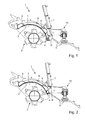
- Figur 1
- zeigt in geschnittener Seitenansicht eine erste Ausführungsform eines erfindungsgemäßen Bodenbearbeitungsgerätes in Form einer Heckfräse für eine Pistenraupe,
- Figur 2
- die Heckfräse nach
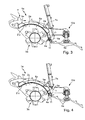
Figur 1 mit verstelltem Gehäusemantel, - Figur 3
- eine weitere Ausführungsform einer erfindungsgemäßen Heckfräse ähnlich
Figur 1 , bei der ein Finisher an einem verstellbaren Gehäusemantelabschnitt angelenkt ist, - Figur 4
- die Heckfräse nach
Figur 3 mit verstelltem Gehäusemantel, - Figur 5
- in perspektivischer Darstellung einen Teil der Heckfräse nach den
Figuren 3 und 4 , - Figur 6
- eine weitere perspektivische Darstellung eines Teils der Heckfräse nach den
Figuren 3 bis 5 , - Figur 7
- schematisch eine Längsschnittdarstellung der Heckfräse nach den
Figuren 3 bis 6 in einer oberen Endposition des verschiebbaren Gehäusemantelabschnittes, - Figur 8
- die Heckfräse nach
Figur 7 , bei der der verschiebbare Gehäusemantelabschnitt in seiner unteren Endposition positioniert ist, - Figur 9
- in verkleinerter Darstellung einen weiteren Schnitt durch die Heckfräse nach den
Figuren 3 bis 6 ähnlich denFiguren 7 und 8 , allerdings unter Weglassen mehrerer Teile der Heckfräse, - Figur 10
- eine Ansicht von unten des stationären Gehäusemantelabschnittes des Fräsengehäuses nach den
Figuren 3 bis 9 , - Figur 11
- in vergrößerter, perspektivischer Darstellung den verschiebbaren Gehäusemantelabschnitt mit seiner bogenförmigen Wandung und mehreren Führungskufen und
- Figur 12
- in vergrößerter Darstellung einen Querschnitt durch einen Teilbereich des verschiebbaren Gehäusemantelabschnittes nach
Figur 11 auf Höhe einer Führungskufe. - Eine als Bodenbearbeitungsgrät dienende Heckfräse 1, 1a nach den
Fig. 1 bis 12 ist als Heckanbaugerät an einer Pistenraupe vorgesehen, die in grundsätzlich bekannter Weise zur Schneepistengestaltung und - pflege vorgesehen ist. Die Heckfräse 1, 1a ist an einer Heckträgeranordnung der Pistenraupe lösbar befestigbar. Alle hydraulischen Antriebsmittel der Heckfräse 1, 1a werden durch eine Fahrzeughydraulik der Pistenraupe gespeist und vom Fahrzeug aus gesteuert. Die Heckfräse 1, 1a dient dazu, die durch ein linkes und ein rechtes Kettenlaufwerk der Pistenraupe aufgewühlte und klumpige Schneepistenoberfläche aufzubrechen, zu zerkleinern und zu glätten. Hierzu weist die Heckfräse eine Glätteinrichtung 5, 10; 5, 10a auf, die - in normaler Bearbeitungs- und Fahrtrichtung der Pistenraupe gesehen - heckseitig an ein Fräsengehäuse 2, 2a der Heckfräse 1, 1a anschließt. Bei den dargestellten Ausführungsformen weist die Heckfräse 1, 1a ein Fräsengehäuse auf, das aus zwei Gehäuseabschnitten gebildet ist, die sich jeweils über eine Hälfte der Arbeitsbreite der Heckfräse 1, 1a erstrecken. In jedem Gehäuseabschnitt ist jeweils eine Fräswelle 3, 3a drehbar gelagert und hydromotorisch angetrieben. Die Fräswelle 3, 3a erstreckt sich im Wesentlichen über eine Arbeitsbreite des zugehörigen Gehäuseabschnittes. Die beiden nebeneinander angeordneten Gehäuseabschnitte des Fräsengehäuses 2, 2a sind im Betriebszustand miteinander starr gekoppelt. Vorzugsweise ist zwischen den beiden Gehäuseabschnitten ein entsprechender Hydroantrieb vorgesehen, um die beiden sich von der Mitte ausgehend zu gegenüberliegenden Seiten erstreckenden Fräswellen 3, 3a anzutreiben. - Die Glätteinrichtung weist bei beiden Ausführungsformen gemäß den
Fig. 1 und 2 bzw. gemäß denFig. 3 bis 12 ein flexibles Glättgebilde in Form einer Finisheranordnung 5, 5a auf, die über mehrere, mit einem Rahmen des Fräsengehäuses 2, 2a verbundene Trägeranordnungen 10, 10a von oben her mit Druck beaufschlagbar sind. Vorzugsweise erstreckt sich ein Heckfinisher der Finisheranordnung 5, 5a über eine gesamte Arbeitsbreite des Fräsengehäuses 2, 2a und damit einteilig und durchgängig auch über die miteinander gekoppelten Gehäuseabschnitte des Fräsengehäuses hinweg. Die Finisheranordnung weist zudem nicht näher bezeichnete Seitenfinisher auf, von denen ein linker Seitenfinisher inFig. 5 erkennbar ist. Einziger Unterschied zwischen den beiden Ausführungsformen, wie sie anhand derFig. 1 und 2 und anhand der -
Fig. 3 und 4 dargestellt sind, ist es, dass bei der Ausführungsform nach denFig. 1 und 2 der Heckfinisher an einem stationären Gehäusemantelabschnitt 2 des Fräsengehäuses angreift. Bei der Ausführungsform nach denFig. 3 und 4 hingegen schließt der Heckfinisher der Finisheranordnung 5a an einen verschiebbaren Gehäusemantelabschnitt 2'a des Gehäuseabschnittes des Fräsengehäuses an. Hierzu weist der verschiebbare Gehäusemantelabschnitt 2'a ein schwalbenschwanzartig gestaltetes Trägerprofil 4a, 11 auf, in dem ein vorderes Stirnende des Heckfinishers formschlüssig gehalten ist. - Im Übrigen sind die beiden Heckfräsen gemäß den beiden Ausführungsformen nach den
Fig. 1 und 2 bzw. 3 und 4 identisch zueinander gestaltet. Nachfolgend wird die Ausführungsform nach denFig. 3 und 4 anhand derFig. 5 bis 12 detailliert erläutert. Soweit die entsprechenden Erläuterungen nicht die Anbindung des Heckfinishers an das Fräsengehäuse betreffen, sind alle Ausführungen zu der Heckfräse nach denFig. 3 bis 12 in gleicher Weise auch auf die Ausführungsform nach denFig. 1 und 2 lesbar. Für beide Ausführungsformen wurden identische Bezugszeichen gewählt. Bei der Ausführungsform nach denFig. 3 und 4 wurde teilweise diesen Bezugszeichen noch der Buchstabe a hinzugefügt. - Die beiden Gehäuseabschnitte des Fräsengehäuses, die über die Arbeitsbreite des Fräsengehäuses nebeneinander angeordnet sind, sind identisch zueinander gestaltet. Nachfolgend wird daher anhand der
Fig. 5 bis 12 lediglich einer der beiden Gehäusabschnitte beschrieben. Für den anderen, nicht dargestellten Gehäusabschnitt gilt das gleiche. Der Gehäusabschnitt gemäß denFig. 3 bis 6 weist einen stationären Gehäusemantelabschnitt 2a auf, der fest mit einem Fräsenrahmen T der Heckfräse verbunden ist. Der Gehäusemantelabschnitt 2a weist an seinen gegenüberliegenden Stirnseiten stirnseitige Gehäuseabschlüsse auf, von denen einer inFig. 9 mit S bezeichnet ist. Die stirnseitigen Gehäuseabschlüsse S dienen zur Lagerung der Fräswelle 3a. Die stirnseitigen Gehäuseabschlüsse S sind fest mit dem stationären Gehäusemantelabschnitt 2a verbunden. Der stationäre Gehäusemantelabschnitt 2a ist im Querschnitt kreisbogenartig gekrümmt. Die kreisbogenartige Krümmung erstreckt sich in Umfangsrichtung des Gehäuseabschnittes - auf eine Gehäuselängsachse bezogen, die in Fahrzeugquerrichtung erstreckt und parallel zu einer Drehachse der Fräswelle 3a ausgerichtet ist. Wie anhand derFig. 3 und 4 erkennbar ist, ist eine Mittelachse der kreisbogenförmigen Krümmung des Gehäusemantelabschnittes 2a nicht identisch mit der Drehachse der Fräswelle 3a. Hierdurch wird ein zwischen der Fräswelle 3a und einer Innenwandung des Gehäusemantelabschnittes 2a definierter Prallraum im Uhrzeigersinn gemäß denFig. 3 und 4 allmählich verjüngt. Bei einer sich ebenfalls im Uhrzeigersinn drehenden Fräswelle 3a wird hierdurch das Einziehen von großen Schnee- und Eisbrocken in das Fräsengehäuse erleichtert. In Umfangsrichtung erstreckt sich der kreisbogenförmige, stationäre Gehäusemantelabschnitt 2a über einen Winkel von mehr als 90° und vorzugsweise weniger als 130°. - An dem stationären Gehäusemantelabschnitt 2a ist zusätzlich ein verschiebbarer Gehäusemantelabschnitt 2'a gelagert, der in
Fig. 4 in einer oberen Endposition und inFig. 3 in einer unteren Endposition dargestellt ist. In der unteren Endposition wird der Gehäusemantel des Fräsengehäuses durch diesen zusätzlichen, verschiebbaren Gehäusemantelabschnitt 2'a um etwa 20° in Umfangsrichtung verlängert. Die Verlängerung durch den verschiebbaren Gehäusemantelabschnitt 2'a erfolgt rückseitig am Fräsengehäuse, d.h. auf der der Glätteinrichtung zugewandten Seite des Fräsengehäuses. Der verschiebbare und demzufolge bewegliche Gehäusemantelabschnitt 2'a weist ein formstabiles Trägerprofil aus Metall, vorzugsweise aus Stahl auf, das sich über eine gesamte Arbeitsbreite des dargestellten Gehäuseabschnittes des Fräsengehäuses erstreckt. Das Trägerprofil 4 weist eine schwalbenschwanzartige Profilaufnahme 11 auf, in der - wie bereits beschrieben - ein vorderer Stirnrand des Heckfinishers formschlüssig gehalten ist. Das Trägerprofil 4a erstreckt sich parallel zu einem rückseitigen Längsrand des stationären Gehäusemantelabschnittes 2a und ist im Wesentlichen in fluchtender Verlängerung zu dem stationären Gehäusemantelabschnitt 2a angeordnet. Der stationäre Gehäusemantelabschnitt 2a weist ein rückseitiges und ein frontseitiges Versteifungsprofil 9a auf, das sich ebenfalls über die gesamte Arbeitsbreite des stationären Gehäusemantelabschnittes 2a erstreckt wie auch das Trägerprofil 4a. Die Versteifungsprofile 9a und der stationäre Gehäusemantelabschnitt 2a sind aus Metall gestaltet. Das Trägerprofil 4a wird mittels mehrerer Führungsanordnungen 8a fächerartig verschiebbar an dem stationären Gehäusemantelabschnitt 2a gehalten. Die Führungsanordnungen 8a werden zum einen gebildet durch am Außenumfang des Gehäusemantelabschnittes 2a befestigte Führungsprofilierungen 17, die sich schienenartig in Umfangsrichtung über den Gehäusemantelabschnitt 2a erstrecken (Fig. 6 ). Diese Führungsprofilierungen 17 bilden Führungsnuten für Führungskufen 16, die von dem Trägerprofil 4a aus kreisbogenförmig parallel zueinander in Umfangsrichtung nach vorne und nach oben abragen (Fig. 11 ). Die Führungskufen 16 gehören ebenfalls zu den Führungsanordnungen 8a und weisen Kernabschnitte 19 und 22 aus Metall auf, wobei die unteren Kernabschnitte 22 an dem Trägerprofil 4a befestigt sind. Jeder Kernabschnitt 22, 19 einer Führungskufe wird beidseitig flankiert von Gleitkufenabschnitten 23 aus einem Kunststoffmaterial mit geringem Gleitreibungskoeffizienten. Diese dienen dazu, die Verschiebbarkeit der Führungskufen 16 in den Führungsprofilierungen 17 zu erleichtern. - Von dem Trägerprofil 4a ragt eine im Querschnitt kreisbogenförmige und demzufolge schalenförmige Wandung 15 schräg nach oben und nach vorne ab, die gleichmäßig im Abstand radial innerhalb der Führungskufen 16 angeordnet ist. Die Wandung 15 ist im montierten Zustand innerhalb des Fräsengehäuses innenseitig an eine Innenwandung des stationären Gehäusemantelabschnittes 2a angeschmiegt (
Fig. 7 bis 9 ). An den gegenüberliegenden, stirnseitigen Gehäuseabschlüssen S des stationären Gehäusemantelabschnittes sind kreisbogenförmige Führungsstege 20 befestigt (Fig. 7 bis 9 ), die in geringem, parallelem Abstand zu der Innenwandung des stationären Gehäusemantelabschnittes 2a angeordnet sind. Der Abstand der Führungsstege 20 zur Gehäuseinnenwandung des stationären Gehäusemantelabschnittes 2a ist so gewählt, dass die schalenförmige Wandung 15 mit ihren gegenüberliegenden Seitenrandbereichen in einem zwischen den Führungsstegen 20 und der Gehäuseinnenwandung definierten Führungsspalt geführt ist. Dadurch ist eine sichere Führung der gegenüberliegenden Seitenränder der Wandung 15 erreicht. Das Trägerprofil 4a weist zudem eine Seitenwange 12 auf, die mittels einer kreisbogenförmigen Kulissenführung 13 außenseitig an dem stirnseitigen Gehäuseabschluss S (Fig. 6 ) des stationären Gehäusemantelabschnittes geführt ist. Hierzu ist am stirnseitigen Gehäuseabschluss S ein kulissensteinartiger Führungszapfen 14 befestigt. - Um über die gesamte Arbeitsbreite des Gehäuseabschnittes ein sicheres Anschmiegen der Wandung 15 an die Innenwandung des stationären Gehäusemantelabschnittes 2a zu ermöglichen, sind, wie anhand der
Fig. 10 erkennbar ist, in der Prallwandung des Gehäusemantelabschnittes 2a insgesamt vier Längsschlitze 22 vorgesehen, die den Gehäusemantelabschnitt von innen nach außen durchdringen. Durch die Längsschlitze 22 ragt jeweils ein schrauben- oder stiftförmiges Sicherungselement 21 hindurch, das die Wandung 15 von einer Innenseite her durchdringt und in einer Aufnahmebohrung 18 des Kernelementes 19 befestigt ist. Vorzugsweise ist das Sicherungselement 21 als mit einem Schraubenkopf versehene Schraube gestaltet und die Aufnahmebohrung 18 ist als korrespondierende Gewindebohrung ausgeführt. Dadurch ist es möglich, die Wandung 15 in ihrem vom Trägerprofil 4a entfernten Flächenbereich gegen die Innenwandung des stationären Gehäusemantelabschnittes anliegend zu halten. Die Länge des Längsschlitzes 22 entspricht vorzugsweise der Länge der Kulissenführung 13. Die Längsschlitze 22 und die Kulissenführung 13 begrenzen somit den Verschiebeweg des beweglichen Gehäusemantelabschnittes 2'a einschließlich seiner Wandung 15, seines Trägerprofiles 4a und seiner Führungskufen 16. Die Sicherung der Wandung 15 von einer Innenseite her an den entsprechenden Führungskufen 16 gewährleistet gleichzeitig auch, dass die Führungskufen 16 nicht von den Führungsprofilierungen 17 des stationären Gehäusemantelabschnittes abheben können. - Die Wandung 15 besteht aus Kunststoff, der vorzugsweise eine Geräuschdämmungsfunktion aufweisen kann. Anhand der
Fig. 7 und 8 ist erkennbar, dass die Wandung 15 in einer oberen Endposition des beweglichen Gehäusemantelabschnittes 2'a eine Innenwandung des stationären Gehäusemantelabschnittes 2a vollständig überlappt. In einer unteren Endposition (Fig. 8 ) hingegen ist die Wandung 15 gegenüber der Innenwandung des stationären Gehäusemantelabschnittes 2a fächerartig nach unten verlagert, wodurch sich die für die Fräsewelle nutzbare Gehäusewandung um den entsprechend verschobenen Winkelbetrag vergrößert statt einer Prallwandung über einen Umfang von vorzugsweise etwa 110° wird somit eine Prallwandung über einen Umfang von etwa 130° erzeugt. - Eine Verlagerung des beweglichen Gehäusemantelabschnittes 2'a und damit der Wandung 15 erfolgt durch Antriebsmittel, die gemäß der Darstellung nach den
Fig. 3 bis 5 einen Hydraulikzylinder 7a umfassen. Die Steuerung erfolgt vorzugsweise von der Pistenraupe aus. Je nach der Arbeitsbreite des Fräsengehäuses bzw. eines entsprechenden Gehäuseabschnittes können ein oder mehrere Hydraulikzylinder 7a über die Arbeitsbreite verteilt angeordnet sein.
Claims (12)
- Bodenbearbeitungsgerät mit einer angetriebenen Arbeitswellenanordnung, die in einem zu dem Boden hin offenen Bearbeitungsgehäuse drehbar gelagert ist, dadurch gekennzeichnet, dass das Bearbeitungsgehäuse wenigstens zwei Gehäusemantelabschnitte (2, 2'; 2a, 2'a) aufweist, die relativ zueinander in Umfangsrichtung - relativ zu einer Drehachse der Arbeitswellenanordnung (3a) - fächerartig beweglich gelagert sind.
- Bodenbearbeitungsgerät nach Anspruch 1, dadurch gekennzeichnet, dass wenigstens ein stationärer Gehäusemantelabschnitt (2, 2a) sowie wenigstens ein beweglicher Gehäusemantelabschnitt (2', 2'a) vorgesehen sind, wobei der bewegliche Gehäusemantelabschnitt (2', 2'a) relativ zu dem stationären Gehäusemantelabschnitt (2, 2a) - relativ zu der Drehachse der Arbeitswellenanordnung (3a) in Umfangsrichtung gesehen - derart verschiebbar gelagert ist, dass in einer Endposition die Gehäusemantelabschnitte (2, 2'; 2a, 2'a) einander in Umfangsrichtung überlagert sind, und dass in der anderen Endposition der wenigstens eine verschiebbare Gehäusemantelabschnitt (2', 2'a) den wenigstens einen stationären Gehäusemantelabschnitt (2, 2a) im Wesentlichen fluchtend verlängert.
- Bodenbearbeitungsgerät nach Anspruch 1 oder 2, dadurch gekennzeichnet, dass an das Bearbeitungsgehäuse - auf eine Bearbeitungsrichtung bezogen - rückseitig eine Glätteinrichtung (5, 10; 5a, 10a) anschließt, die ein flexibles Glättgebilde (5, 5a) aufweist, das an den beweglichen Gehäusemantelabschnitt (2', 2'a) oder an den stationären Gehäusemantelabschnitt (2, 2a) angefügt ist.
- Bodenbearbeitungsgerät nach Anspruch 1, 2 oder 3, dadurch gekennzeichnet, dass Antriebsmittel (7a) vorgesehen sind, um den wenigstens einen beweglichen Gehäusemantelabschnitt (2', 2'a) in unterschiedliche Positionen zu verstellen und in den jeweils eingestellten Positionen zu sichern.
- Bodenbearbeitungsgerät nach wenigstens einem der vorhergehenden Ansprüche, dadurch gekennzeichnet, dass der bewegliche Gehäusemantelabschnitt (2'a) eine im Querschnitt bogenförmige Wandung (15) aufweist, die den stationären Gehäusemantelabschnitt (2a) in Umfangsrichtung innenseitig zumindest weitgehend überdeckt.
- Bodenbearbeitungsgerät nach Anspruch 5, dadurch gekennzeichnet, dass die bogenförmige Wandung (15) als schlagfestes, insbesondere schalldämmendes und zumindest weitgehend formstabiles Flächengebilde, insbesondere aus Kunststoff, gestaltet ist.
- Bodenbearbeitungsgerät nach wenigstens einem der vorhergehenden Ansprüche, dadurch gekennzeichnet, dass die Wandung (15) an einem Trägerprofil (4a) gehalten ist, von dem die Wandung (15) frei abragt, und das mittels Führungsanordnungen (8a) außenseitig an dem wenigstens einem stationären Gehäusemantelabschnitt (2a) verschiebbar geführt ist.
- Bodenbearbeitungsgerät nach Anspruch 7, dadurch gekennzeichnet, dass das Trägerprofil (4a) benachbart zu einem Längsseitenrand des stationären Gehäusemantelabschnitts (2a) angeordnet ist.
- Bodenbearbeitungsgerät nach Anspruch 7, dadurch gekennzeichnet, dass die Führungsanordnungen (8a) bogenförmige Führungskufen (16) aufweisen, die in Führungsprofilierungen (17) am Außenumfang des wenigstens einen stationären Gehäusemantelabschnittes (2a) verschiebbar geführt sind.
- Bodenbearbeitungsgerät nach Anspruch 8, dadurch gekennzeichnet, dass die Führungskufen (16) Gleitflächenabschnitte (23) mit reduziertem Gleitreibungskoeffizienten aufweisen.
- Bodenbearbeitungsgerät nach wenigstens einem der vorhergehenden Ansprüche, dadurch gekennzeichnet, dass an gegenüberliegenden stirnseitigen Gehäuseabschlüssen (S) des Bearbeitungsgehäuses bogenförmige Führungsstege (20) vorgesehen sind, die gegenüberliegende Seitenränder der bogenförmigen Wandung (15) führen.
- Bodenbearbeitungsgerät nach wenigstens einem der vorhergehenden Ansprüche, dadurch gekennzeichnet, dass ein von dem Trägerprofil (4a) abliegender Flächenbereich der Wandung (15) über Sicherungsmittel (21) mit den Führungskufen (16) verbunden ist, wobei die Sicherungsmittel durch Längsschlitze (22) im stationären Gehäusemantelabschnitt (2a) hindurchragen.
Applications Claiming Priority (1)
| Application Number | Priority Date | Filing Date | Title |
|---|---|---|---|
| DE102009060481A DE102009060481B4 (de) | 2009-12-18 | 2009-12-18 | Heckfräse für eine Pistenraupe zur Schneepistengestaltung und -pflege |
Publications (3)
| Publication Number | Publication Date |
|---|---|
| EP2339072A2 true EP2339072A2 (de) | 2011-06-29 |
| EP2339072A3 EP2339072A3 (de) | 2013-07-03 |
| EP2339072B1 EP2339072B1 (de) | 2017-03-15 |
Family
ID=43769108
Family Applications (1)
| Application Number | Title | Priority Date | Filing Date |
|---|---|---|---|
| EP10195458.4A Active EP2339072B1 (de) | 2009-12-18 | 2010-12-16 | Heckfräse für Pistenraupe |
Country Status (4)
| Country | Link |
|---|---|
| US (1) | US8646542B2 (de) |
| EP (1) | EP2339072B1 (de) |
| CA (1) | CA2725892C (de) |
| DE (1) | DE102009060481B4 (de) |
Cited By (2)
| Publication number | Priority date | Publication date | Assignee | Title |
|---|---|---|---|---|
| CN104813763A (zh) * | 2015-05-21 | 2015-08-05 | 寿县茂友农机服务专业合作社 | 一种农业用犁耙 |
| EP4217543B1 (de) | 2020-09-24 | 2025-11-05 | PRINOTH S.p.A. | Schneegroomer und verfahren zur steuerung eines schneegroomers |
Families Citing this family (12)
| Publication number | Priority date | Publication date | Assignee | Title |
|---|---|---|---|---|
| IN2014KN00758A (de) * | 2011-09-05 | 2015-10-02 | Soilkee Pty Ltd | |
| JP6646951B2 (ja) * | 2015-06-08 | 2020-02-14 | 松山株式会社 | 農作業機 |
| US10231371B2 (en) * | 2016-07-18 | 2019-03-19 | Tribine Industries Llc | Soil compaction mitigation assembly and method |
| IT201800003000A1 (it) * | 2018-02-23 | 2019-08-23 | Prinoth Spa | Fresa da neve e relativo metodo di regolazione |
| IT201900024811A1 (it) * | 2019-12-19 | 2021-06-19 | Prinoth Spa | Veicolo cingolato per la rifinitura del terreno con un gruppo di lavoro sollevabile, in particolare un veicolo battipista con un gruppo fresa sollevabile |
| DE102020215732A1 (de) | 2020-12-11 | 2022-06-15 | Kässbohrer Geländefahrzeug Aktiengesellschaft | Heckfräse für eine Pistenraupe |
| US20220279712A1 (en) * | 2021-03-03 | 2022-09-08 | Fecon, Llc | Apparatus for land clearing and preparation having interchangeable chamber inserts |
| IT202100029603A1 (it) * | 2021-11-23 | 2023-05-23 | Prinoth Spa | Dente da neve per una fresa da neve e detta fresa da neve per la preparazione del manto nevoso delle piste da sci |
| IT202200020937A1 (it) * | 2022-10-11 | 2024-04-11 | Valentini Antonio S R L | Macchina agricola per la lavorazione del terreno |
| CN117468310A (zh) * | 2023-12-25 | 2024-01-30 | 德州迈隆公路工程有限公司 | 一种道路伸缩缝施工用切割装置 |
| DE202024102482U1 (de) * | 2024-05-14 | 2025-08-18 | Grimme Landmaschinenfabrik Gmbh & Co. Kg | Landwirtschaftliche Arbeitsmaschine |
| DE102024123330B4 (de) * | 2024-08-15 | 2026-03-26 | Kässbohrer Geländefahrzeug Aktiengesellschaft | Heckfräse zur Schneeflächenbearbeitung |
Family Cites Families (14)
| Publication number | Priority date | Publication date | Assignee | Title |
|---|---|---|---|---|
| US1435766A (en) * | 1918-06-05 | 1922-11-14 | Hiram H Varland | Manure spreader |
| US2805611A (en) * | 1951-05-28 | 1957-09-10 | Cleo L Fletchall | Power driven hand cultivator |
| US3011793A (en) * | 1959-02-19 | 1961-12-05 | Lowell Rudolph L | Material spreading and loading apparatus with flail beater and cover |
| US3768572A (en) * | 1972-01-21 | 1973-10-30 | Hesston Corp | Structure for eliminating mud collections in farm implements |
| NL7702108A (nl) * | 1977-02-28 | 1978-08-30 | Lely Nv C Van Der | Grondbewerkingsmachine. |
| US4204714A (en) * | 1978-04-10 | 1980-05-27 | Crafco, Inc. | Pavement cutting machine with pad to stabilize and brake machine |
| GB8331266D0 (en) * | 1983-11-23 | 1983-12-29 | Bowmer & Kirkland Products Sal | Road milling/cutting machine |
| JPH01171401A (ja) * | 1987-12-25 | 1989-07-06 | Iseki & Co Ltd | 耕耘カバー |
| US5373902A (en) * | 1993-08-30 | 1994-12-20 | Caterpillar Paving Products Inc. | Tiltable hood assembly for an earth working machine |
| JP2934200B2 (ja) * | 1997-02-14 | 1999-08-16 | ヤンマー農機株式会社 | 耕耘機におけるリヤカバー |
| JP2003180107A (ja) | 2001-12-18 | 2003-07-02 | Orec Co Ltd | 耕耘機のディファレンシャルギヤの自動制御装置及びそれを備えた耕耘機及び耕耘機の走行制御方法 |
| DE202004006301U1 (de) * | 2004-04-16 | 2004-07-22 | Kässbohrer Geländefahrzeug AG | Fräsvorrichtung für ein Fahrzeug |
| FR2886205B1 (fr) * | 2005-05-24 | 2009-06-12 | Sidel Sas | Element de rail de convoyage d'objets en position suspendue et dispositif d'alimentation comprenant un tel element |
| ITMI20070565A1 (it) * | 2007-03-21 | 2008-09-22 | Prinoth Spa | Fresa per la preparazione del manto nevoso delle piste da sci |
-
2009
- 2009-12-18 DE DE102009060481A patent/DE102009060481B4/de not_active Expired - Fee Related
-
2010
- 2010-12-15 US US12/928,619 patent/US8646542B2/en active Active
- 2010-12-16 EP EP10195458.4A patent/EP2339072B1/de active Active
- 2010-12-16 CA CA2725892A patent/CA2725892C/en active Active
Non-Patent Citations (1)
| Title |
|---|
| None |
Cited By (2)
| Publication number | Priority date | Publication date | Assignee | Title |
|---|---|---|---|---|
| CN104813763A (zh) * | 2015-05-21 | 2015-08-05 | 寿县茂友农机服务专业合作社 | 一种农业用犁耙 |
| EP4217543B1 (de) | 2020-09-24 | 2025-11-05 | PRINOTH S.p.A. | Schneegroomer und verfahren zur steuerung eines schneegroomers |
Also Published As
| Publication number | Publication date |
|---|---|
| EP2339072B1 (de) | 2017-03-15 |
| US20110147019A1 (en) | 2011-06-23 |
| DE102009060481A1 (de) | 2011-06-22 |
| US8646542B2 (en) | 2014-02-11 |
| CA2725892A1 (en) | 2011-06-18 |
| DE102009060481B4 (de) | 2012-10-04 |
| EP2339072A3 (de) | 2013-07-03 |
| CA2725892C (en) | 2017-11-28 |
Similar Documents
| Publication | Publication Date | Title |
|---|---|---|
| EP2339072B1 (de) | Heckfräse für Pistenraupe | |
| DE4101617C2 (de) | Planiergerät für Schneeflächen und Verfahren zur Aufbereitung und/oder Pflege einer Schneefläche | |
| EP2374937B1 (de) | Baumaschine zum Bearbeiten einer Fahrbahnoberfläche | |
| DE102010050831A1 (de) | Rotorhaube für eine Fräsvorrichtung | |
| WO2018146263A1 (de) | Pflugvorrichtung mit zwei schneideelementen | |
| DE3025312A1 (de) | Spur- oder planiergeraet fuer ski-loipen bzw. pisten | |
| EP3557977B1 (de) | Wurzelballen-unterschneide- und aushebegerät | |
| DE102012018918A1 (de) | Abstreifvorrichtung für Fräswalzen einer Baumaschine und Baumaschine | |
| DE2629284C3 (de) | Fräsmaschine zur Bankett-, Graben- und Böschungsreinigung | |
| EP2842413A1 (de) | Element zum Abstützen und/oder Leiten von Erntegut in einer Erntemaschine | |
| EP2319988B1 (de) | Heckanbaubaugerät für eine Pistenraupe | |
| EP1925746B1 (de) | Pistenpflegevorrichtung für ein Kettenfahrzeug | |
| DE2932695A1 (de) | Bodenbearbeitungsmaschine | |
| EP1197601B1 (de) | Fräsbrecher | |
| DE202007016639U1 (de) | Reitbodenpflegegerät | |
| DE69616091T2 (de) | Zinkenblatt, insbesondere für zinkenträger | |
| DE4431551C2 (de) | Brecher mit einem Gestell, in dem ein angetriebener, steinbrechender Rotor gelagert ist | |
| EP0161621A2 (de) | Bodenbearbeitungsgerät | |
| EP0964961A1 (de) | Pistenpflegevorrichtung | |
| DE102024123330B4 (de) | Heckfräse zur Schneeflächenbearbeitung | |
| EP0718586A1 (de) | Vorrichtung zur Bearbeitung von Böden | |
| AT505831B1 (de) | Loipenspurgerät | |
| DE930715C (de) | Vorrichtung zum Reinigen und Offenhalten von Graeben, insbesondere Entwaesserungsgraeben | |
| DE2803502A1 (de) | Motorisch antreibbare fraestrommel zur boeschungs- und grabenbearbeitung | |
| DE10333423A1 (de) | Pistenpflegevorrichtung |
Legal Events
| Date | Code | Title | Description |
|---|---|---|---|
| PUAI | Public reference made under article 153(3) epc to a published international application that has entered the european phase |
Free format text: ORIGINAL CODE: 0009012 |
|
| AK | Designated contracting states |
Kind code of ref document: A2 Designated state(s): AL AT BE BG CH CY CZ DE DK EE ES FI FR GB GR HR HU IE IS IT LI LT LU LV MC MK MT NL NO PL PT RO RS SE SI SK SM TR |
|
| AX | Request for extension of the european patent |
Extension state: BA ME |
|
| REG | Reference to a national code |
Ref country code: DE Ref legal event code: R079 Ref document number: 502010013303 Country of ref document: DE Free format text: PREVIOUS MAIN CLASS: E01H0005000000 Ipc: E01H0004020000 |
|
| PUAL | Search report despatched |
Free format text: ORIGINAL CODE: 0009013 |
|
| AK | Designated contracting states |
Kind code of ref document: A3 Designated state(s): AL AT BE BG CH CY CZ DE DK EE ES FI FR GB GR HR HU IE IS IT LI LT LU LV MC MK MT NL NO PL PT RO RS SE SI SK SM TR |
|
| AX | Request for extension of the european patent |
Extension state: BA ME |
|
| RIC1 | Information provided on ipc code assigned before grant |
Ipc: E01H 4/02 20060101AFI20130528BHEP Ipc: A01B 33/02 20060101ALI20130528BHEP |
|
| 17P | Request for examination filed |
Effective date: 20131127 |
|
| RBV | Designated contracting states (corrected) |
Designated state(s): AL AT BE BG CH CY CZ DE DK EE ES FI FR GB GR HR HU IE IS IT LI LT LU LV MC MK MT NL NO PL PT RO RS SE SI SK SM TR |
|
| GRAP | Despatch of communication of intention to grant a patent |
Free format text: ORIGINAL CODE: EPIDOSNIGR1 |
|
| INTG | Intention to grant announced |
Effective date: 20161104 |
|
| GRAS | Grant fee paid |
Free format text: ORIGINAL CODE: EPIDOSNIGR3 |
|
| GRAA | (expected) grant |
Free format text: ORIGINAL CODE: 0009210 |
|
| AK | Designated contracting states |
Kind code of ref document: B1 Designated state(s): AL AT BE BG CH CY CZ DE DK EE ES FI FR GB GR HR HU IE IS IT LI LT LU LV MC MK MT NL NO PL PT RO RS SE SI SK SM TR |
|
| REG | Reference to a national code |
Ref country code: CH Ref legal event code: EP Ref country code: GB Ref legal event code: FG4D Free format text: NOT ENGLISH |
|
| REG | Reference to a national code |
Ref country code: IE Ref legal event code: FG4D Free format text: LANGUAGE OF EP DOCUMENT: GERMAN |
|
| REG | Reference to a national code |
Ref country code: CH Ref legal event code: NV Representative=s name: DR. LUSUARDI AG, CH |
|
| REG | Reference to a national code |
Ref country code: AT Ref legal event code: REF Ref document number: 875712 Country of ref document: AT Kind code of ref document: T Effective date: 20170415 |
|
| REG | Reference to a national code |
Ref country code: DE Ref legal event code: R096 Ref document number: 502010013303 Country of ref document: DE |
|
| REG | Reference to a national code |
Ref country code: NL Ref legal event code: MP Effective date: 20170315 |
|
| REG | Reference to a national code |
Ref country code: LT Ref legal event code: MG4D |
|
| PG25 | Lapsed in a contracting state [announced via postgrant information from national office to epo] |
Ref country code: LT Free format text: LAPSE BECAUSE OF FAILURE TO SUBMIT A TRANSLATION OF THE DESCRIPTION OR TO PAY THE FEE WITHIN THE PRESCRIBED TIME-LIMIT Effective date: 20170315 Ref country code: NO Free format text: LAPSE BECAUSE OF FAILURE TO SUBMIT A TRANSLATION OF THE DESCRIPTION OR TO PAY THE FEE WITHIN THE PRESCRIBED TIME-LIMIT Effective date: 20170615 Ref country code: HR Free format text: LAPSE BECAUSE OF FAILURE TO SUBMIT A TRANSLATION OF THE DESCRIPTION OR TO PAY THE FEE WITHIN THE PRESCRIBED TIME-LIMIT Effective date: 20170315 Ref country code: FI Free format text: LAPSE BECAUSE OF FAILURE TO SUBMIT A TRANSLATION OF THE DESCRIPTION OR TO PAY THE FEE WITHIN THE PRESCRIBED TIME-LIMIT Effective date: 20170315 Ref country code: GR Free format text: LAPSE BECAUSE OF FAILURE TO SUBMIT A TRANSLATION OF THE DESCRIPTION OR TO PAY THE FEE WITHIN THE PRESCRIBED TIME-LIMIT Effective date: 20170616 |
|
| PG25 | Lapsed in a contracting state [announced via postgrant information from national office to epo] |
Ref country code: RS Free format text: LAPSE BECAUSE OF FAILURE TO SUBMIT A TRANSLATION OF THE DESCRIPTION OR TO PAY THE FEE WITHIN THE PRESCRIBED TIME-LIMIT Effective date: 20170315 Ref country code: SE Free format text: LAPSE BECAUSE OF FAILURE TO SUBMIT A TRANSLATION OF THE DESCRIPTION OR TO PAY THE FEE WITHIN THE PRESCRIBED TIME-LIMIT Effective date: 20170315 Ref country code: LV Free format text: LAPSE BECAUSE OF FAILURE TO SUBMIT A TRANSLATION OF THE DESCRIPTION OR TO PAY THE FEE WITHIN THE PRESCRIBED TIME-LIMIT Effective date: 20170315 Ref country code: BG Free format text: LAPSE BECAUSE OF FAILURE TO SUBMIT A TRANSLATION OF THE DESCRIPTION OR TO PAY THE FEE WITHIN THE PRESCRIBED TIME-LIMIT Effective date: 20170615 |
|
| PG25 | Lapsed in a contracting state [announced via postgrant information from national office to epo] |
Ref country code: NL Free format text: LAPSE BECAUSE OF FAILURE TO SUBMIT A TRANSLATION OF THE DESCRIPTION OR TO PAY THE FEE WITHIN THE PRESCRIBED TIME-LIMIT Effective date: 20170315 |
|
| PG25 | Lapsed in a contracting state [announced via postgrant information from national office to epo] |
Ref country code: RO Free format text: LAPSE BECAUSE OF FAILURE TO SUBMIT A TRANSLATION OF THE DESCRIPTION OR TO PAY THE FEE WITHIN THE PRESCRIBED TIME-LIMIT Effective date: 20170315 Ref country code: SK Free format text: LAPSE BECAUSE OF FAILURE TO SUBMIT A TRANSLATION OF THE DESCRIPTION OR TO PAY THE FEE WITHIN THE PRESCRIBED TIME-LIMIT Effective date: 20170315 Ref country code: ES Free format text: LAPSE BECAUSE OF FAILURE TO SUBMIT A TRANSLATION OF THE DESCRIPTION OR TO PAY THE FEE WITHIN THE PRESCRIBED TIME-LIMIT Effective date: 20170315 Ref country code: EE Free format text: LAPSE BECAUSE OF FAILURE TO SUBMIT A TRANSLATION OF THE DESCRIPTION OR TO PAY THE FEE WITHIN THE PRESCRIBED TIME-LIMIT Effective date: 20170315 Ref country code: CZ Free format text: LAPSE BECAUSE OF FAILURE TO SUBMIT A TRANSLATION OF THE DESCRIPTION OR TO PAY THE FEE WITHIN THE PRESCRIBED TIME-LIMIT Effective date: 20170315 |
|
| PG25 | Lapsed in a contracting state [announced via postgrant information from national office to epo] |
Ref country code: PT Free format text: LAPSE BECAUSE OF FAILURE TO SUBMIT A TRANSLATION OF THE DESCRIPTION OR TO PAY THE FEE WITHIN THE PRESCRIBED TIME-LIMIT Effective date: 20170717 Ref country code: PL Free format text: LAPSE BECAUSE OF FAILURE TO SUBMIT A TRANSLATION OF THE DESCRIPTION OR TO PAY THE FEE WITHIN THE PRESCRIBED TIME-LIMIT Effective date: 20170315 Ref country code: IS Free format text: LAPSE BECAUSE OF FAILURE TO SUBMIT A TRANSLATION OF THE DESCRIPTION OR TO PAY THE FEE WITHIN THE PRESCRIBED TIME-LIMIT Effective date: 20170715 Ref country code: SM Free format text: LAPSE BECAUSE OF FAILURE TO SUBMIT A TRANSLATION OF THE DESCRIPTION OR TO PAY THE FEE WITHIN THE PRESCRIBED TIME-LIMIT Effective date: 20170315 |
|
| REG | Reference to a national code |
Ref country code: DE Ref legal event code: R097 Ref document number: 502010013303 Country of ref document: DE |
|
| REG | Reference to a national code |
Ref country code: FR Ref legal event code: PLFP Year of fee payment: 8 |
|
| PLBE | No opposition filed within time limit |
Free format text: ORIGINAL CODE: 0009261 |
|
| STAA | Information on the status of an ep patent application or granted ep patent |
Free format text: STATUS: NO OPPOSITION FILED WITHIN TIME LIMIT |
|
| PG25 | Lapsed in a contracting state [announced via postgrant information from national office to epo] |
Ref country code: DK Free format text: LAPSE BECAUSE OF FAILURE TO SUBMIT A TRANSLATION OF THE DESCRIPTION OR TO PAY THE FEE WITHIN THE PRESCRIBED TIME-LIMIT Effective date: 20170315 |
|
| 26N | No opposition filed |
Effective date: 20171218 |
|
| PG25 | Lapsed in a contracting state [announced via postgrant information from national office to epo] |
Ref country code: SI Free format text: LAPSE BECAUSE OF FAILURE TO SUBMIT A TRANSLATION OF THE DESCRIPTION OR TO PAY THE FEE WITHIN THE PRESCRIBED TIME-LIMIT Effective date: 20170315 |
|
| GBPC | Gb: european patent ceased through non-payment of renewal fee |
Effective date: 20171216 |
|
| REG | Reference to a national code |
Ref country code: IE Ref legal event code: MM4A |
|
| PG25 | Lapsed in a contracting state [announced via postgrant information from national office to epo] |
Ref country code: MT Free format text: LAPSE BECAUSE OF FAILURE TO SUBMIT A TRANSLATION OF THE DESCRIPTION OR TO PAY THE FEE WITHIN THE PRESCRIBED TIME-LIMIT Effective date: 20170315 Ref country code: LU Free format text: LAPSE BECAUSE OF NON-PAYMENT OF DUE FEES Effective date: 20171216 |
|
| REG | Reference to a national code |
Ref country code: BE Ref legal event code: MM Effective date: 20171231 |
|
| PG25 | Lapsed in a contracting state [announced via postgrant information from national office to epo] |
Ref country code: IE Free format text: LAPSE BECAUSE OF NON-PAYMENT OF DUE FEES Effective date: 20171216 |
|
| PG25 | Lapsed in a contracting state [announced via postgrant information from national office to epo] |
Ref country code: BE Free format text: LAPSE BECAUSE OF NON-PAYMENT OF DUE FEES Effective date: 20171231 Ref country code: GB Free format text: LAPSE BECAUSE OF NON-PAYMENT OF DUE FEES Effective date: 20171216 |
|
| PG25 | Lapsed in a contracting state [announced via postgrant information from national office to epo] |
Ref country code: HU Free format text: LAPSE BECAUSE OF FAILURE TO SUBMIT A TRANSLATION OF THE DESCRIPTION OR TO PAY THE FEE WITHIN THE PRESCRIBED TIME-LIMIT; INVALID AB INITIO Effective date: 20101216 Ref country code: MC Free format text: LAPSE BECAUSE OF FAILURE TO SUBMIT A TRANSLATION OF THE DESCRIPTION OR TO PAY THE FEE WITHIN THE PRESCRIBED TIME-LIMIT Effective date: 20170315 |
|
| PG25 | Lapsed in a contracting state [announced via postgrant information from national office to epo] |
Ref country code: CY Free format text: LAPSE BECAUSE OF NON-PAYMENT OF DUE FEES Effective date: 20170315 |
|
| PG25 | Lapsed in a contracting state [announced via postgrant information from national office to epo] |
Ref country code: MK Free format text: LAPSE BECAUSE OF FAILURE TO SUBMIT A TRANSLATION OF THE DESCRIPTION OR TO PAY THE FEE WITHIN THE PRESCRIBED TIME-LIMIT Effective date: 20170315 |
|
| PG25 | Lapsed in a contracting state [announced via postgrant information from national office to epo] |
Ref country code: TR Free format text: LAPSE BECAUSE OF FAILURE TO SUBMIT A TRANSLATION OF THE DESCRIPTION OR TO PAY THE FEE WITHIN THE PRESCRIBED TIME-LIMIT Effective date: 20170315 |
|
| PG25 | Lapsed in a contracting state [announced via postgrant information from national office to epo] |
Ref country code: AL Free format text: LAPSE BECAUSE OF FAILURE TO SUBMIT A TRANSLATION OF THE DESCRIPTION OR TO PAY THE FEE WITHIN THE PRESCRIBED TIME-LIMIT Effective date: 20170315 |
|
| REG | Reference to a national code |
Ref country code: CH Ref legal event code: U11 Free format text: ST27 STATUS EVENT CODE: U-0-0-U10-U11 (AS PROVIDED BY THE NATIONAL OFFICE) Effective date: 20260101 |
|
| PGFP | Annual fee paid to national office [announced via postgrant information from national office to epo] |
Ref country code: DE Payment date: 20251217 Year of fee payment: 16 |
|
| PGFP | Annual fee paid to national office [announced via postgrant information from national office to epo] |
Ref country code: AT Payment date: 20251215 Year of fee payment: 16 |
|
| PGFP | Annual fee paid to national office [announced via postgrant information from national office to epo] |
Ref country code: FR Payment date: 20251218 Year of fee payment: 16 |
|
| PGFP | Annual fee paid to national office [announced via postgrant information from national office to epo] |
Ref country code: IT Payment date: 20251231 Year of fee payment: 16 |
|
| PGFP | Annual fee paid to national office [announced via postgrant information from national office to epo] |
Ref country code: CH Payment date: 20260101 Year of fee payment: 16 |