EP2341702A1 - Drahtloses elektronisches Gerät mit automatischer Leistungsregelung - Google Patents
Drahtloses elektronisches Gerät mit automatischer Leistungsregelung Download PDFInfo
- Publication number
- EP2341702A1 EP2341702A1 EP09388019A EP09388019A EP2341702A1 EP 2341702 A1 EP2341702 A1 EP 2341702A1 EP 09388019 A EP09388019 A EP 09388019A EP 09388019 A EP09388019 A EP 09388019A EP 2341702 A1 EP2341702 A1 EP 2341702A1
- Authority
- EP
- European Patent Office
- Prior art keywords
- electronic device
- short
- range wireless
- wireless communication
- communication interface
- Prior art date
- Legal status (The legal status is an assumption and is not a legal conclusion. Google has not performed a legal analysis and makes no representation as to the accuracy of the status listed.)
- Withdrawn
Links
Images




Classifications
-
- H—ELECTRICITY
- H04—ELECTRIC COMMUNICATION TECHNIQUE
- H04M—TELEPHONIC COMMUNICATION
- H04M1/00—Substation equipment, e.g. for use by subscribers
- H04M1/72—Mobile telephones; Cordless telephones, i.e. devices for establishing wireless links to base stations without route selection
- H04M1/725—Cordless telephones
- H04M1/73—Battery saving arrangements
-
- H—ELECTRICITY
- H04—ELECTRIC COMMUNICATION TECHNIQUE
- H04M—TELEPHONIC COMMUNICATION
- H04M1/00—Substation equipment, e.g. for use by subscribers
- H04M1/60—Substation equipment, e.g. for use by subscribers including speech amplifiers
- H04M1/6033—Substation equipment, e.g. for use by subscribers including speech amplifiers for providing handsfree use or a loudspeaker mode in telephone sets
- H04M1/6041—Portable telephones adapted for handsfree use
- H04M1/6058—Portable telephones adapted for handsfree use involving the use of a headset accessory device connected to the portable telephone
- H04M1/6066—Portable telephones adapted for handsfree use involving the use of a headset accessory device connected to the portable telephone including a wireless connection
-
- H—ELECTRICITY
- H04—ELECTRIC COMMUNICATION TECHNIQUE
- H04W—WIRELESS COMMUNICATION NETWORKS
- H04W52/00—Power management, e.g. Transmission Power Control [TPC] or power classes
- H04W52/02—Power saving arrangements
- H04W52/0209—Power saving arrangements in terminal devices
- H04W52/0225—Power saving arrangements in terminal devices using monitoring of external events, e.g. the presence of a signal
-
- H—ELECTRICITY
- H04—ELECTRIC COMMUNICATION TECHNIQUE
- H04M—TELEPHONIC COMMUNICATION
- H04M2250/00—Details of telephonic subscriber devices
- H04M2250/02—Details of telephonic subscriber devices including a Bluetooth® interface
-
- Y—GENERAL TAGGING OF NEW TECHNOLOGICAL DEVELOPMENTS; GENERAL TAGGING OF CROSS-SECTIONAL TECHNOLOGIES SPANNING OVER SEVERAL SECTIONS OF THE IPC; TECHNICAL SUBJECTS COVERED BY FORMER USPC CROSS-REFERENCE ART COLLECTIONS [XRACs] AND DIGESTS
- Y02—TECHNOLOGIES OR APPLICATIONS FOR MITIGATION OR ADAPTATION AGAINST CLIMATE CHANGE
- Y02D—CLIMATE CHANGE MITIGATION TECHNOLOGIES IN INFORMATION AND COMMUNICATION TECHNOLOGIES [ICT], I.E. INFORMATION AND COMMUNICATION TECHNOLOGIES AIMING AT THE REDUCTION OF THEIR OWN ENERGY USE
- Y02D30/00—Reducing energy consumption in communication networks
- Y02D30/70—Reducing energy consumption in communication networks in wireless communication networks
Definitions
- the invention relates to an electronic device adapted for being wirelessly connected to a wireless telecommunication device, said telecommunication device comprising a long-range wireless communication interface and a short-range wireless communication interface, said electronic device comprising a short-range wireless communications interface for establishing a short-range link with the short-range wireless communication interface of the telecommunication device, a power source, a power control circuit for controlling power supplied to the short-range wireless communications interface.
- a Bluetooth TM headset and an example of a telecommunication device is a Bluetooth TM enabled mobile telephone following the GSM standard.
- Electronic devices powered by batteries are often provided with more or less automatic power switching measures and an important reason for this is to save energy.
- Especially communication devices with radio transmitting and receiving means are often provided with power saving circuits which - based on a timer - switches transmitting and receiving circuits to sleeping modes in order to save energy and thereby extend battery life. In the different sleep modes, some circuits, but not all are switched off.
- short-range wireless communication network comprises WPAN's (wireless personal area networks) and WLAN's (wireless local area networks) while “long-range wireless communication network” refers to mobile telephone networks and wireless WAN's (wireless wide area networks).
- short-range wireless communication standards are Bluetooth TM and IEEE 802.11g (a WLAN standard).
- long-range wireless communication standards are the mobile telephony standards GSM and CdmaOne.
- a telecommunication device connected to a wireless network according to these standards uses a high transmitting power during establishment of a call.
- WO 01/63888 discloses a wireless headset with automatic power control, where a sensor detects user interaction, such as picking up the headset or placing it upon the user's body, whereby the headset automatically transitions from an inactive state to an active state.
- US 6,151,663 discloses a so-called repeater comprising a wave detector, and which is powered on when radio waves transmitted from a mobile telephone is detected by the wave detector.
- US 2005/0288067 discloses an incoming call alert adapter for mobile devices comprising an RF receiver which activates a switching relay when radio waves emitted from a mobile telephone are detected.
- the object of the invention is to provide an automatic power control for an electronic device according to the preamble.
- the electronic device according to the invention is characterized in that the electronic device further comprises a wave detector connected to the power control circuit, which wave detector is adapted to detect radio waves emitted from the telecommunication device, when this is placed in proximity of the electronic device, such that the power control circuit activates the short-range wireless communications interface, when the wave detector detects radio waves emitted by the long-range wireless communication interface of the telecommunication device.
- the electronic device is adapted to enter an active mode by searching for paired devices and establishing a short-range link with such, when the short-range wireless communication interface is activated.
- the electronic device is adapted to stay in the active mode, as long as a signal indicating an active, incoming or outgoing call is received via the short-range link.
- active call includes a call, which is placed on hold.
- the electronic device is adapted to enter a sleep mode, where the short-range link is maintained, when no signal indicating an active, incoming or outgoing call is received via the short-range link. In this case there is no need for the user to wait for reconnecting, when a call is established immediately after a previous call.
- the electronic device is adapted to enter an inactive mode, where the short-range link is closed, when no active, incoming or outgoing call signal is present.
- the wave detector is adapted to detect radio waves according to the GSM standard or a 3G standard.
- the short-range wireless communication interface of the electronic device may be adapted to communicate in a PAN network, preferably according to the Bluetooth TM standard.
- the electronic device is a headset.
- the electronic device is a speaker phone, computer, printer, GPS, wrist watch, PDA, camera, car warning system.
- the wave detector is a passive wave detector, which comprises an antenna and a rectifying circuit rectifying the radio waves detected by the antenna into a direct current signal which is used as a control signal for activating the short-range wireless communications interface.
- the headset can automatically power up from a state, where the power consumption is zero, as the wave detector does not consume power.
- the invention also relates to a communication system comprising an electronic device as described above and a telecommunication device comprising a long-range wireless communication interface and a short-range wireless communication interface.
- FIG. 1 is a diagram disclosing how a Bluetooth TM headset 1 according to the invention is wirelessly connected to a Bluetooth TM enabled mobile phone 6 by a Bluetooth TM link 9.
- the Bluetooth TM link 9 is established by a preceding pairing process, where the two devices 1,6 are paired. Once a pairing has been established, it is remembered by the devices, which can then connect to each without user intervention. When desired, the pairing relationship can later be removed by the user.
- the mobile phone 6 is connected to a mobile base station 11 via a long-range link 10.
- the headset 1 makes it possible for the user to make hands free calls via the mobile phone 6.
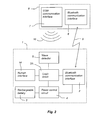
- Figure 2 discloses the - for this invention - most relevant parts of the headset 1 according to the invention and a Bluetooth TM enabled mobile phone 6.
- Standard elements such as microphone, speaker, display etc. are left out for clarity reasons and because they are not relevant for the invention and also because a skilled person knows how to implement them.
- the headset 1 comprises a Bluetooth TM communication interface 2, a rechargeable battery 3, a power control circuit 4, a wave detector 5, a human interface 14 and a logic block 20.
- Thu human interface 14 is for example push buttons, touch buttons, sliding buttons, turnable buttons, a switching movable microphone arm or ear hook.
- the logic block 20 receives input signals from the human interface and sends control signals to the power control circuit 4.
- the power control circuit 4 is connected to the rechargeable battery 3 and controls power input to the Bluetooth TM communication interface.
- the wave detector 5, which will be further explained in figure 4 is also connected to the logic block 20.
- the mobile phone 6 is a standard mobile phone for GSM networks and comprises a GSM interface 7 and a Bluetooth TM interface 8.
- the Bluetooth TM interfaces 2, 8 of the headset 1 and the mobile phone 6 can be wirelessly connected by a link 9 and provide hands free communication for the user.
- the GSM interface 7 is in normal use wirelessly connected to mobile base stations and transmits GSM radio waves 10 at different power levels depending on the circumstances, which will be explained later.
- the GSM transmitter 7 sends radio wave bursts 10 with maximum power which are detected by the wave detector 5 if the phone is within short distance. This distance can vary, but is typically up to about 1 meter.
- the wave detector 5 sends a control signal to the logic block 20, which instructs the power control circuit 4 to power up the Bluetooth TM interface 2.
- the Bluetooth TM interface 2 of the headset 1 is powered up it establishes a link 9 with the Bluetooth TM interface 8 of the mobile phone 6.
- This link 9 includes exchange of different control signals between the headset 1 and the mobile phone 6, inclusive a signal indicating an active, incoming or outgoing call. These control signals are received by the Bluetooth TM interface 2 of the headset 1 and is transmitted to the logic block 20.
- the logic block 20 As long as the logic block 20 is receiving these signals, it instructs the power control circuit 4 to power the Bluetooth TM interface 2, whereby the Bluetooth TM link 9 is maintained. Thus, the Bluetooth TM link 9 is maintained whether the wave detector is still detecting GSM waves or not. This is particularly an advantage, as the GSM transmitting power of the mobile phone 6 is reduced, when the call is established and the wave detector 5 may not longer detect the GSM waves transmitted by the mobile phone.
- FIG. 3 is a diagram disclosing two different modes of a headset 1 according to a first embodiment of the invention.
- the Bluetooth TM interface 2 of the headset 1 In the first, inactive mode, the Bluetooth TM interface 2 of the headset 1 is powered down without transmitting or receiving, and there is no link between the headset 1 and the mobile phone 6.
- the wave detector 5 of the headset 1 detects GSM waves transmitted by the mobile phone 6 during establishment of a call
- the Bluetooth TM interface 2 of the headset 1 is activated and the Bluetooth TM link 9 between the headset 1 and the mobile phone 6 is established whereby the headset enters an active mode.
- the Bluetooth TM link 9 When the Bluetooth TM link 9 is established, the headset 1 continuously receives signals indicating whether the mobile phone 6 is having an active call, an incoming call or an outgoing call. These signals are called "call signal" with a common term here.
- the headset 1 returns from the active mode to the inactive mode, when there is no call signals. Thus, if the user ends a call, the headset returns automatically to the power saving, inactive mode. If the user for example is at a meeting or in a public transport means and the headset's wave detector detects GSM waves transmitted from another person's mobile phone, the headset enters the active mode, but returns soon again to the inactive mode, as there is no call signal received.
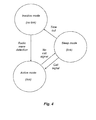
- FIG 4 is a diagram disclosing three different modes of a headset according to a second embodiment of the invention.
- This embodiment has an inactive mode and an active mode as explained in connection with the first embodiment shown in figure 3 .
- the second embodiment also has an intermediate sleep mode.
- the headset 1 when the headset 1 is in the inactive mode and detects GSM waves, it powers up, establishes a link with the mobile phone and enters the active mode.
- the headset When the headset is in the active mode and no longer receives a call signal, it enters the sleep mode, where it stays for a predetermined time before it returns to the power saving inactive mode unless it receives a call signal or wake-up signal from the mobile phone.
- This embodiment can be advantageous, as a user often has to make a call immediately after finishing a call, and in this case the headset does not need to power down, power up again and establishing a link, which takes time.
- the headset In the sleep mode, the headset uses less power than in the active mode but more power as in the inactive mode.
- Figure 5 discloses the wave detector 5 in details. It comprises an antenna 12 which is tuned for GSM frequencies, which is primarily 900 MHZ and 1800 MHz.
- the wave detector 5 further comprises a rectifying circuit comprising two capacitors C1 and C2, two diodes D1 and D2 and a resistor R1.
- the rectifying circuit rectifies the antenna signal to a control signal which is sent via the control signal path 13 to the logic block 20.
- the wave detector 5 according to his embodiment is a passive element which uses no current.
- the control signal is enough to switch on the power for the Bluetooth TM interface and other circuits of the headset, whereby the headset in fact uses no power when in the inactive mode.
- the inactive mode can be such that a little power is needed to maintain certain functions active, but the Bluetooth TM interface, which is relatively power consuming is powered down in the inactive mode.
- Figure 6 discloses the typical relative transmitting power of the GSM interface of a mobile phone before, during and after establishment of a call.
- the mobile When there is no call, the mobile is in a kind of standby mode and is only transmitting now and then on the so-called broadcast channel, e.g. when cell information is updated.
- the first part 15 of the power curve indicates GSM transmitting power before a call is initiated.
- the second part 16 of the power curve represents the establishment of a call, where the mobile phone transmits with full power.
- This second part 16 can be divided into three different periods, namely a pre-ringing handshaking period 18, a ringing period 19 and an answering period 20. The lengths of these periods vary, but could be for example 3, 2 and 1 seconds respectively.
- the third part 17 of the power curve represents the conversation, where power is reduced to a minimum required for a reliable communication.
- the electronic device is not necessarily a headset. It could also be a speakerphone, which could be used in offices, meeting rooms or in a car. Also a desktop or a laptop computer or even a printer with a short-range wireless communication interface could be contemplated. Also, GPS-devices, wrist watches, cameras and other devices with short-range wireless communication interfaces could be provided with a wave detector for activating the wireless interface.
- Bluetooth TM is used in the embodiments disclosed above, but other short-range wireless communication technologies or standards such as WLAN (wireless local area network) are covered by the invention.
- the telecommunication device is not necessarily a GSM phone or even a traditional mobile phone. It could also be a PDA (personal digital assistant) or a smart phone and other devices with a long-range wireless communication interface following GSM or other long-range wireless communication standards, such as those covered by 3G or 4G.
- PDA personal digital assistant
- smart phone and other devices with a long-range wireless communication interface following GSM or other long-range wireless communication standards, such as those covered by 3G or 4G.
Landscapes
- Engineering & Computer Science (AREA)
- Computer Networks & Wireless Communication (AREA)
- Signal Processing (AREA)
- Telephone Function (AREA)
- Mobile Radio Communication Systems (AREA)
Priority Applications (1)
| Application Number | Priority Date | Filing Date | Title |
|---|---|---|---|
| EP09388019A EP2341702A1 (de) | 2009-12-31 | 2009-12-31 | Drahtloses elektronisches Gerät mit automatischer Leistungsregelung |
Applications Claiming Priority (1)
| Application Number | Priority Date | Filing Date | Title |
|---|---|---|---|
| EP09388019A EP2341702A1 (de) | 2009-12-31 | 2009-12-31 | Drahtloses elektronisches Gerät mit automatischer Leistungsregelung |
Publications (1)
| Publication Number | Publication Date |
|---|---|
| EP2341702A1 true EP2341702A1 (de) | 2011-07-06 |
Family
ID=42144933
Family Applications (1)
| Application Number | Title | Priority Date | Filing Date |
|---|---|---|---|
| EP09388019A Withdrawn EP2341702A1 (de) | 2009-12-31 | 2009-12-31 | Drahtloses elektronisches Gerät mit automatischer Leistungsregelung |
Country Status (1)
| Country | Link |
|---|---|
| EP (1) | EP2341702A1 (de) |
Cited By (3)
| Publication number | Priority date | Publication date | Assignee | Title |
|---|---|---|---|---|
| WO2016097884A1 (en) * | 2014-12-16 | 2016-06-23 | Sony Corporation | A method, device and system for setting operation modes of communication devices in a communication network |
| CN112671967A (zh) * | 2020-12-22 | 2021-04-16 | 英华达(上海)科技有限公司 | 蓝牙耳机控制方法、系统、设备及介质 |
| CN113056852A (zh) * | 2018-11-29 | 2021-06-29 | Abb瑞士股份有限公司 | 自供电智能电子装置的通信模块的远程激活 |
Citations (6)
| Publication number | Priority date | Publication date | Assignee | Title |
|---|---|---|---|---|
| US6151663A (en) | 1994-12-28 | 2000-11-21 | Intel Corporation | Cluster controller for memory and data cache in a multiple cluster processing system |
| WO2001063888A1 (en) | 2000-02-21 | 2001-08-30 | Ericsson Inc. | Wireless headset with automatic power control |
| US20030119568A1 (en) * | 2000-06-08 | 2003-06-26 | Menard Raymond J. | Device with passive receiver |
| US20050093702A1 (en) * | 2000-12-22 | 2005-05-05 | Twitchell Robert W.Jr. | Manufacture of LPRF device wake up using wireless tag |
| US20050288067A1 (en) | 2004-06-24 | 2005-12-29 | Wainwright Harry L | Incoming call alert adapter for mobile devices |
| DE102006061775A1 (de) * | 2006-12-21 | 2008-03-20 | Siemens Enterprise Communications Gmbh & Co. Kg | Verfahren und Anordnung zur Inbetriebsetzung eines mobilen Gerätes |
-
2009
- 2009-12-31 EP EP09388019A patent/EP2341702A1/de not_active Withdrawn
Patent Citations (6)
| Publication number | Priority date | Publication date | Assignee | Title |
|---|---|---|---|---|
| US6151663A (en) | 1994-12-28 | 2000-11-21 | Intel Corporation | Cluster controller for memory and data cache in a multiple cluster processing system |
| WO2001063888A1 (en) | 2000-02-21 | 2001-08-30 | Ericsson Inc. | Wireless headset with automatic power control |
| US20030119568A1 (en) * | 2000-06-08 | 2003-06-26 | Menard Raymond J. | Device with passive receiver |
| US20050093702A1 (en) * | 2000-12-22 | 2005-05-05 | Twitchell Robert W.Jr. | Manufacture of LPRF device wake up using wireless tag |
| US20050288067A1 (en) | 2004-06-24 | 2005-12-29 | Wainwright Harry L | Incoming call alert adapter for mobile devices |
| DE102006061775A1 (de) * | 2006-12-21 | 2008-03-20 | Siemens Enterprise Communications Gmbh & Co. Kg | Verfahren und Anordnung zur Inbetriebsetzung eines mobilen Gerätes |
Cited By (4)
| Publication number | Priority date | Publication date | Assignee | Title |
|---|---|---|---|---|
| WO2016097884A1 (en) * | 2014-12-16 | 2016-06-23 | Sony Corporation | A method, device and system for setting operation modes of communication devices in a communication network |
| US9838969B2 (en) | 2014-12-16 | 2017-12-05 | Sony Mobile Communications Inc. | Method, device and system for setting operation modes of communication devices in a communication network |
| CN113056852A (zh) * | 2018-11-29 | 2021-06-29 | Abb瑞士股份有限公司 | 自供电智能电子装置的通信模块的远程激活 |
| CN112671967A (zh) * | 2020-12-22 | 2021-04-16 | 英华达(上海)科技有限公司 | 蓝牙耳机控制方法、系统、设备及介质 |
Similar Documents
| Publication | Publication Date | Title |
|---|---|---|
| US7979097B2 (en) | Power management for multimode wireless communication device | |
| US9344966B2 (en) | Automatic power-off of wireless communication device from linked device | |
| US6807435B2 (en) | Apparatus and method for mobile communications | |
| WO2015068323A1 (en) | Wireless communication apparatus and transmission power control method | |
| KR920009334B1 (ko) | 무선전화장치 | |
| KR20090016976A (ko) | 휴대 단말기와 무선 헤드셋의 무선 연결 방법 | |
| EP2744182B1 (de) | Funkkommunikationssystem und mobiles Informationsendgerät | |
| US20040235537A1 (en) | Radio communications apparatus | |
| JP2670951B2 (ja) | コードレス電話装置 | |
| JP2003333136A (ja) | 携帯電話機 | |
| JP2005012491A (ja) | 移動通信装置 | |
| JP2005260434A (ja) | 移動通信端末装置 | |
| JP3607631B2 (ja) | 携帯通信端末 | |
| JPH06311101A (ja) | 携帯無線電話装置 | |
| JPH08116301A (ja) | パーソナル・ハンディ・フォン・システム | |
| JP2004104343A (ja) | 無線送受信回路付き電子機器 | |
| US20070184873A1 (en) | Dual-mode phone and power management method thereof | |
| KR100996084B1 (ko) | 전류 소비를 최소화하기 위한 블루투스모듈을 구비한휴대용 단말기와 블루투스 액세스 포인트 간의 통신 연결방법 | |
| KR101945928B1 (ko) | 저전력 무전기를 이용한 호출기 제어방법 및 호출 시스템 | |
| CN101355741A (zh) | 无线通讯装置及其操作模式切换方法 | |
| JP3147889B2 (ja) | 移動体通信装置 | |
| JPH0425232A (ja) | 無線電話機 | |
| KR100995999B1 (ko) | 소비 전류를 줄이기 위한 블루투스 모듈이 구비된 휴대용단말기 간의 인터콤 연결 방법 | |
| JPH0795144A (ja) | 携帯端末のバッテリーセーブ制御装置 | |
| JPH11150760A (ja) | 簡易型携帯電話陸上移動局 |
Legal Events
| Date | Code | Title | Description |
|---|---|---|---|
| PUAI | Public reference made under article 153(3) epc to a published international application that has entered the european phase |
Free format text: ORIGINAL CODE: 0009012 |
|
| AK | Designated contracting states |
Kind code of ref document: A1 Designated state(s): AT BE BG CH CY CZ DE DK EE ES FI FR GB GR HR HU IE IS IT LI LT LU LV MC MK MT NL NO PL PT RO SE SI SK SM TR |
|
| AX | Request for extension of the european patent |
Extension state: AL BA RS |
|
| STAA | Information on the status of an ep patent application or granted ep patent |
Free format text: STATUS: THE APPLICATION IS DEEMED TO BE WITHDRAWN |
|
| 18D | Application deemed to be withdrawn |
Effective date: 20120110 |