EP2343005A1 - In-vivo-einführungsvorrichtung und medizinisches system - Google Patents
In-vivo-einführungsvorrichtung und medizinisches system Download PDFInfo
- Publication number
- EP2343005A1 EP2343005A1 EP09823536A EP09823536A EP2343005A1 EP 2343005 A1 EP2343005 A1 EP 2343005A1 EP 09823536 A EP09823536 A EP 09823536A EP 09823536 A EP09823536 A EP 09823536A EP 2343005 A1 EP2343005 A1 EP 2343005A1
- Authority
- EP
- European Patent Office
- Prior art keywords
- light
- unit
- light source
- introducable
- face
- Prior art date
- Legal status (The legal status is an assumption and is not a legal conclusion. Google has not performed a legal analysis and makes no representation as to the accuracy of the status listed.)
- Withdrawn
Links
Images





Classifications
-
- A—HUMAN NECESSITIES
- A61—MEDICAL OR VETERINARY SCIENCE; HYGIENE
- A61B—DIAGNOSIS; SURGERY; IDENTIFICATION
- A61B1/00—Instruments for performing medical examinations of the interior of cavities or tubes of the body by visual or photographical inspection, e.g. endoscopes; Illuminating arrangements therefor
- A61B1/04—Instruments for performing medical examinations of the interior of cavities or tubes of the body by visual or photographical inspection, e.g. endoscopes; Illuminating arrangements therefor combined with photographic or television appliances
- A61B1/041—Capsule endoscopes for imaging
-
- A—HUMAN NECESSITIES
- A61—MEDICAL OR VETERINARY SCIENCE; HYGIENE
- A61B—DIAGNOSIS; SURGERY; IDENTIFICATION
- A61B1/00—Instruments for performing medical examinations of the interior of cavities or tubes of the body by visual or photographical inspection, e.g. endoscopes; Illuminating arrangements therefor
- A61B1/06—Instruments for performing medical examinations of the interior of cavities or tubes of the body by visual or photographical inspection, e.g. endoscopes; Illuminating arrangements therefor with illuminating arrangements
- A61B1/0605—Instruments for performing medical examinations of the interior of cavities or tubes of the body by visual or photographical inspection, e.g. endoscopes; Illuminating arrangements therefor with illuminating arrangements for spatially modulated illumination
-
- A—HUMAN NECESSITIES
- A61—MEDICAL OR VETERINARY SCIENCE; HYGIENE
- A61B—DIAGNOSIS; SURGERY; IDENTIFICATION
- A61B1/00—Instruments for performing medical examinations of the interior of cavities or tubes of the body by visual or photographical inspection, e.g. endoscopes; Illuminating arrangements therefor
- A61B1/06—Instruments for performing medical examinations of the interior of cavities or tubes of the body by visual or photographical inspection, e.g. endoscopes; Illuminating arrangements therefor with illuminating arrangements
- A61B1/0638—Instruments for performing medical examinations of the interior of cavities or tubes of the body by visual or photographical inspection, e.g. endoscopes; Illuminating arrangements therefor with illuminating arrangements providing two or more wavelengths
-
- A—HUMAN NECESSITIES
- A61—MEDICAL OR VETERINARY SCIENCE; HYGIENE
- A61B—DIAGNOSIS; SURGERY; IDENTIFICATION
- A61B1/00—Instruments for performing medical examinations of the interior of cavities or tubes of the body by visual or photographical inspection, e.g. endoscopes; Illuminating arrangements therefor
- A61B1/00002—Operational features of endoscopes
- A61B1/00011—Operational features of endoscopes characterised by signal transmission
- A61B1/00016—Operational features of endoscopes characterised by signal transmission using wireless means
Definitions
- the invention relates to a body-introducable apparatus and, more particularly, to a capsule-shaped body-introducable apparatus which is introduced into a subject such as human, animal, plant, or the like and captures an image of the inside of the subject.
- Patent Literature 2 various types of LEDs which emit RGB and infrared light respectively illuminate inside of the subject by using light sources that are stacked along the optical axis.
- a film in an upper layer refracts light coming from a light source in a lower layer or shadow of a film element such as an electrode in the upper layer appears in the light coming from the light source in the lower layer. This means that there is a problem in that it is difficult to match the distributions of light of the upper layer light source and the lower layer light source.
- the present invention has been made in view of the problems described above, and an object of the invention is to provide a body-introducable apparatus and a medical system capable of illuminating the inside of a subject without causing color unevenness in a captured image.
- a body-introducable apparatus is to be introduced in a subject, and includes a light source unit having a first light source that outputs first light and a second light source that outputs second light in a wavelength band different from that of the first light; a light distribution matching unit that matches distributions of the first light and the second light; an illuminating control unit that drives the light source unit to illuminate the inside of the subject; and an imaging unit that captures an image of the inside of the subject.
- the light distribution matching unit includes a dichroic prism that is obtained by joining a first member for transmitting the first and second light and a second member for reflecting the first light and transmitting the second light, and the first and second light sources emit the first and second light respectively to the dichroic prism so that an optical axis of the first light that has been reflected by a joined face of the first and second members coincides with an optical axis of the second light that has been transmitted through the joined face.
- the light distribution matching unit includes a fiber group formed by bundling a plurality of fibers, the fiber group has a light incident face on which light input ends of the plurality of fibers are aligned and a light outgoing face on which light output ends of the plurality of fibers are aligned, the plurality of fibers are crossed so that the light incident from the light incident face is dispersed and output from the light outgoing face, and the first and second light sources emit the first and second light respectively to the light incident face.
- the light distribution matching unit includes a prism that disperses and outputs the incident light.
- the light distribution matching unit includes a mirror that reflects the first and second light and a half mirror that reflects a part of the first and second light and transmits a part of the light, a reflection region is formed by disposing the mirror and the half mirror apart from each other, and the first and second light sources are disposed in the reflection region.
- the light distribution matching unit has a diffuser for diffusing the first and second light to match light distributions.
- the body-introducable apparatus includes a circuit board on which the light source unit is mounted; and an optical window disposed on the side of a first face of the circuit board and transmitting light output from the light source unit to the outside, wherein the light source unit is mounted on a second face on the side opposite to the first face of the circuit board, and a through hole for passing the light output from the light source unit to the optical window is formed in the circuit board.
- the light distribution matching unit has a diffuser for diffusing the first and second light to match light distributions.
- the body-introducable apparatus includes a plurality of the light source units and the light distribution matching units disposed point-symmetrically or line-symmetrically.
- the body-introducable apparatus includes a circuit board on which the light source unit is mounted; and an optical window disposed on the side of a first face of the circuit board and transmitting light output from the light source unit to the outside, wherein the light source unit is mounted on a second face on the side opposite to the first face of the circuit board, and a through hole for passing the light output from the light source unit to the optical window is formed in the circuit board.
- a body-introducable apparatus is to be introduced in a subject, and includes a light source unit having a light source that outputs first light and second light in a wavelength band different from that of the first light, a first filter that transmits the first light, and a second filter that transmits the second light; a light distribution matching unit that matches distributions of the first light and the second light; an illuminating control unit that drives the light source unit to illuminate the inside of the subject; and an imaging unit that captures an image of the inside of the subject, wherein the first and second filters make the first and second light output from the light source dispersedly pass, respectively.
- the light distribution matching unit has a diffuser for diffusing the first and second light to match light distributions.
- the body-introducable apparatus includes a plurality of the light source units and the light distribution matching units disposed point-symmetrically or line-symmetrically.
- the body-introducable apparatus includes a circuit board on which the light source unit is mounted; and an optical window disposed on the side of a first face of the circuit board and transmitting light output from the light source unit to the outside, wherein the light source unit is mounted on a second face on the side opposite to the first face of the circuit board, and a through hole for passing the light output from the light source unit to the optical window is formed in the circuit board.
- a body-introducable apparatus is to be introduced in a subject, and includes a light source unit having a light source that outputs first light, a white light source that outputs white light and transmits the first light, and a wavelength shifter that converts a part of the first light to second light in a wavelength band different from that of the first light; a light distribution matching unit that matches distributions of the first light, the second light, and the white light; an illuminating control unit that drives the light source unit to illuminate the inside of the subject; and an imaging unit that captures an image of the inside of the subject, wherein the light source and the white light source are disposed such that their optical axes match each other.
- the light distribution matching unit has a diffuser for diffusing the first and second light to match light distributions.
- the body-introducable apparatus includes a plurality of the light sources and the light distribution matching units disposed point-symmetrically or line-symmetrically.
- the body-introducable apparatus includes a circuit board on which the light source unit is mounted; and an optical window disposed on the side of a first face of the circuit board and transmitting light output from the light source unit to the outside, wherein the light source unit is mounted on a second face on the side opposite to the first face of the circuit board, and a through hole for passing the light output from the light source unit to the optical window is formed in the circuit board.
- a medical system includes any one of the above body-introducable apparatuses; a communication device disposed on the outside of the subject; and a display device that displays an image by using image data
- the body-introducable apparatus has a wireless transmitting unit that transmits image data obtained by the imaging unit as a wireless signal
- the communication device includes a wireless receiving unit that receives the image data transmitted from the wireless transmitting unit, an image signal processing unit that processes the image data received by the wireless receiving unit, and a communication device external interface unit that stores the image data processed by the image signal processing unit to a portable recording medium detachably connected to the communication device
- the display device includes a display device external interface unit to which the portable recording medium can be detachably connected, and a display unit that reads the image data from the portable recording medium connected to the display device external interface unit and displays the read image data.
- a medical system includes any one of the above body-introducable apparatuses; a communication device disposed on the outside of the subject; and a display device that displays an image by using image data
- the body-introducable apparatus has a wireless transmitting unit that transmits image data obtained by the imaging unit as a wireless signal
- the communication device includes a wireless receiving unit that receives the image data transmitted from the wireless transmitting unit, an image signal processing unit that processes the image data received by the wireless receiving unit, and a communication device external interface unit that outputs the image data processed by the image signal processing unit to the display device
- the display device includes a display device external interface unit that inputs the image data output from the communication device external interface unit, and a display unit that displays an image of the inside of the subject by using the image data which is input to the display device external interface unit.
- distributions of the first and second light in different wavelength bands can be matched, so that the body-introducable apparatus and the medical system capable of illuminating the inside of a subject without causing color unevenness in a captured image can be realized.
- a capsule medical device 10 according to a first embodiment of the invention will be described in detail with reference to the drawings.
- the case of acquiring an image of the inner wall of a stomach 902 by applying the capsule medical device 10 as a body-introducable apparatus floating in a fluid 904 in the stomach 902 will be described as an example.
- the capsule medical device 10 of the embodiment can be also applied as a body-introducable apparatus for acquiring an image of the inside of a subject 900 during travel from the esophagus to the anus.
- An organ that accumulates the fluid 904 is not limited to the stomach 902 but may be various organs such as small intestine and large intestine.
- the fluid 904 a fluid which does not exert adverse influence on the subject 900 and the capsule medical device 10 such as saline or water.
- the fluid 904 is transparent. Consequently, an image acquired by the capsule medical device 10 can be prevented from becoming unclear due to the fluid 904.
- FIG. 1 is a schematic diagram illustrating a schematic configuration of a medical system 1 using the capsule medical device 10 according to the embodiment.
- the system has: the capsule medical device 10 which is, for example, orally introduced into the subject 900 and floating in the fluid 904 accumulated in the stomach 902, and a communication device 130 for transmitting/receiving image data and a control instruction, and the like to/from the capsule medical device 10 by performing wireless communication with the capsule medical device 10.
- a portable recording medium 140 such as a flash memory (registered trademark) and a smart card (registered trademark) is detachably attached.
- image data of an in-vivo image of the subject acquired by the capsule medical device 10 is recorded.
- the user connects the portable recording medium 140 to an information processing terminal 150 such as a personal computer or a server, reads the image data stored in the portable recording medium 140 by the information processing terminal 150, and displays the in-vivo image on a display unit of the information processing terminal 150.
- the communication device 130 is disposed on the outside of the subject 900.
- an in-vitro antenna 120 is connected via a connection cable 139 such as a coaxial cable.
- the in-vitro antenna 120 is disposed out of the subject 900 and near the capsule medical device 10.
- the communication device 130 transmits/receives data to/from the capsule medical device 10 via the in-vitro antenna 120.
- the capsule medical device 10 introduced in the subject 900 has: the imaging unit 14 for capturing an image of the inside of the subject 900; an imaging control circuit 14A for acquiring image data by driving the imaging unit 14; a plurality of illuminating units 15 for outputting light in a plurality of wavelength bands; an illumination control circuit 15A for illuminating the imaging direction by driving the illuminating units 15 at the time of capturing an image of the inside of the subject 900 by the imaging unit 14; a wireless transmitting circuit 13 for transmitting the image data captured by the imaging control circuit 14A as a wireless signal to the communication device 130; a wireless receiving circuit 12 for receiving a wireless signal transmitted from the communication device 130; a control circuit 11 for controlling the circuits in the capsule medical device 10 on the basis of a control instruction and the like input from the communication device 130 via the wireless receiving circuit 12; and a power supply unit 17 for supplying power
- the control circuit 11 drives the imaging control circuit 14A and the illuminating control circuit 15A to execute imaging operation periodically (for example, two frames per second) on the basis of a control instruction or the like received from the communication device 130 via the wireless receiving circuit 12, and causes the wireless transmitting circuit 13 to transmit image data acquired by the imaging operation to the communication device 130.
- the capsule medical device 10 may have a sensor 16 and a sensor control circuit 16A for controlling the sensor 16.
- the sensor 16 includes a thermometer, a pressure meter, a pH meter, and the like and properly obtains temperature, pressure, pH value, and the like in the subject 900 as subject in-vivo information.
- the sensor control circuit 16A drives the sensor 16 to obtain in-vivo information of the subject and inputs it to the control circuit 11 under control of the control circuit 11.
- the circuits and units in the capsule medical device 10 are, as illustrated in FIG. 2 , housed in a capsule-shaped casing formed of a container 18 and a cap 19.
- the container 18 has one end, which is a hemispherical dome shape, and the other end, which is opened, and has almost-cylindrical or semielliptical shape.
- the cap 19 has a hemispherical shape and is fit in the opening of the container 18, thereby sealing the container 18.
- the capsule container formed of the container 18 and the cap 19 has, for example, a size to a degree that it can be swallowed by the subject 900.
- the cap 19 is formed of a transparent material, and the imaging unit 14 and the illuminating unit 15 are disposed on the side of the cap 19 in the capsule container (18, 19).
- the imaging direction of the imaging unit 14 and the illuminating direction of the illuminating unit 15 correspond to the direction toward the outside of the capsule medical device 10 via the cap 19, as illustrated in FIG. 2 or FIG. 3 .
- an image of the inside of the subject 900 can be captured by the imaging unit 14 while illuminating the inside of the subject 900 by the illuminating unit 15.
- the cap 19 also has the function as a lens for adjusting distribution of light output from the illuminating unit 15 and/or light incident on the imaging element 14a via an objective lens 14c.
- the communication device 130 disposed on the outer surface of the subject 900 has: a control circuit 131 for controlling generation of a transmission signal such as a control instruction, storage of image data received from the capsule medical device 10 to the portable recording medium 140, and the like; a transmission signal processing circuit 132 for generating a transmission signal by executing a predetermine process on the control instruction of the capsule medical device 10 output from the control circuit 131 or the like; a wireless transmitting circuit 133 for transmitting the transmission signal from the in-vitro antenna 120; a wireless receiving circuit 134 for receiving image data or the like transmitted from the capsule medical device 10 via the in-vitro antenna 120; the image signal processing circuit 135 for generating an image signal (also called image data) by executing a predetermined process on the received image data; an interface
- the communication device 130 may be provided with an operation unit for inputting various operations such as an imaging instruction by the operator or can perform communication with another device having the operation unit via a wireless circuit or wired circuit. Further, the communication device 130 may be provided with a display unit for displaying a subject's in-vivo image received from the capsule medical device 10.
- FIG. 4 is a layout diagram illustrating an example of an array of the imaging elements 14a in the imaging unit 14 according to the embodiment.
- FIGS. 5A and 5B are diagrams illustrating a configuration example of the capsule medical device 10 according to the embodiment.
- FIG. 5A is a cross section taken along line A-A in FIG. 5B
- FIG. 5B is a cross section taken along line B-B in FIG. 5A .
- FIG. 6 illustrates a light-emitting characteristic of the illuminating unit 15 and the spectral sensitivity characteristic of the imaging element 14a.
- FIG. 7 illustrates an absorbance characteristic of blood.
- the imaging unit 14 has the imaging element 14a receiving reflection light from the inner wall of the subject 900 and accumulating charges, and the objective lens 14c disposed on the light reception plane side of the imaging element 14a.
- the imaging unit 14 is mounted on a circuit board 14B having the imaging control circuit 14A for controlling the imaging unit 14.
- the circuit board 14B is disposed near to the cap 19 side in a state where the surface on which the imaging unit 14 is mounted is directed toward the cap 19 side.
- the imaging control circuit 14A drives the imaging unit 14 to acquire image data of an image in the subject and inputs it to the wireless transmitting circuit 13 under control of the control circuit 11.
- the imaging control circuit 14A generates, for example, digital image data by executing predetermined processes such as sampling, amplification, and Analog-to-Digital (A/D) conversion on the analog image data input from the imaging unit 14.
- the imaging element 14a is a Charge Coupled Device (CCD) or Complementary Metal Oxide Semiconductor (CMOS) camera in which a plurality of light receiving elements 14b and a plurality of light receiving elements 14g are arranged alternately in row and column directions (x and y directions in the diagram).
- CCD Charge Coupled Device
- CMOS Complementary Metal Oxide Semiconductor
- the light receiving element 14b receives, for example, light in a wavelength band W 14b around 415 nm and accumulates charges.
- the light receiving element 14g receives, for example, light in a wavelength band W 14g around 540 nm.
- image data acquired using the imaging element 14a includes image data generated by the light receiving element 14b which receives light in the wavelength band W 14b around 415 nm and image data generated by the light receiving element 14g which receives light in the wavelength band W 14g around 540 nm.
- Light in the wavelength band W 14b around 415 nm displays blue, and light in the wavelength band W 14g around 540 nm displays green. Therefore, the imaging element 14a generates image data of a green (G) component and image data of a blue (B) component.
- G green
- B blue
- the absorbance of blood has peaks around 415 nm and around 540 nm. Therefore, by generating image data of a positive image by inverting image data of a so-called negative image obtained by receiving reflection light of light around 415 nm and light around 540 nm by the imaging element 14a, an image expressing the structure of blood vessels of the subject 900 can be generated.
- the transmittance of light generally varies according to the wavelengths. Since light in two kinds of wavelength bands of light around 415 nm and light around 540 nm is used in the embodiment, by using image data generated from a reflection component of the light around 415 nm and image data generated from a reflection component of the light around 540 nm, a stereoscopic image expressing a stereoscopic structure of the blood vessels can be generated.
- Each of the illuminating units 15 includes a light source made by one or more Light Emitting Diodes (LEDs) outputting light in different wavelength bands, and is mounted on a circuit board 15B having the illuminating control circuit 15A for controlling the light source.
- the illuminating control circuit 15A drives the illuminating unit 15 to illuminate the inside of the subject 900 synchronously with an image capturing timing under control of the control circuit 11.
- a plurality of illuminating units 15 are disposed on the circuit board 15B on which the illuminating control circuit 15A is mounted so as to be point-symmetrical with respect to one point on the optical axis LX of the objective lens 14c as a center.
- the invention is not limited to the layout.
- the plurality of illuminating units 15 may be disposed, for example, on the circuit board 15B so as to be line-symmetrical with respect to a straight line, as a center line, including one point on the optical axis LX and parallel to the x axis or y axis of image data (refer to FIG. 4 and FIG. 5A ) obtained by the imaging element 14a.
- Each of the illuminating units 15 has, as illustrated in FIGS. 5A and 5B and FIG. 6 , for example, a light source 15x including an LED 15b (first light source) outputting light in the wavelength band W 15b around 415 nm (hereinbelow, called “first special light”) and an LED 15g (second light source) outputting light in the wavelength band W 14g around 540 nm (hereinbelow, called “second special light”).
- first special light an LED 15b (first light source) outputting light in the wavelength band W 15b around 415 nm
- second light source second light source
- Each of the illuminating units 15 has a light distribution matching unit 15y made by a dichroic prism 15p for combining the first and second special light so that the optical axis of the first special light output from the LED 15b and the optical axis of the second special light output from the LED 15g overlap, and a diffuser 15d for diffusing the combined light output from the dichroic prism 15p, thereby matching distributions of the first and second special light.
- Match of light distributions denotes that light distributions in the case of normalizing light in different wavelength bands with maximum illuminance match or almost match regardless of the fact that the maximum illuminance is the same or not.
- the optical axis of the LED denotes that a center line of light distribution output from LED.
- FIG. 8 illustrates a schematic configuration of the light distribution matching unit 15y.
- the dichroic prism 15p has a cubic or rectangular-parallelepiped shape and has, at least, a first member 15m that transmits first special light L15b and second special light L15g, and a second member 15n that reflects the first special light L15b and transmits the second special light L15g.
- Each of the first and second members 15m and 15n has a triangular prism shape whose section has an isosceles right triangle.
- the dichroic prism 15p is obtained by joining the faces, each of which has the hypotenuse of the isosceles right triangles, of the first and second members 15m and 15n.
- the joined face functions as a reflection face 15h for reflecting the first special light L15b.
- the LEDs 15b and 15g of the light source 15x are disposed on faces each having a tilt of 45° with respect to the reflection face 15h, which is the joined face of the first and second members 15m and 15n in the dichroic prism 15p, and emit the first special light L15b and the second special light L15g, respectively, toward the center of the dichroic prism 15p.
- the LED 15g is disposed in an almost center of a side face of the first member 15m of the dichroic prism 15p, and the LED 15b is disposed in an almost center of the bottom face of the second member 15n of the dichroic prism 15p.
- the first special light L15b output from the LED 15b is reflected by the reflection face 15h as the joined face and travels toward a light outgoing face 15s
- the second special light L15g output from the LED 15g passes through the reflection face 15h and travels toward the light outgoing face 15s. Consequently, the first and second special light L15b and L15g can be combined at the reflection face 15h.
- the optical axis of combined light L15 passes through the center of the light outgoing face 15s, which is the top face of the dichroic prism 15p, and is parallel to the optical axis LX of the objective lens 14c.
- each of the first and second special light L15b and L15g included in the combined light L15 can be diffused.
- the distribution of the first special light L15b and that of the second special light L15g included in the combined light L15a output from the light outgoing face of the diffuser 15d can be matched.
- the configuration of matching the distribution of the first special light L15b and that of the second special light L15g included in the combined light L15 output from the dichroic prism 15p is not limited to the diffuser 15d but may be variously modified to, for example, a plate-shaped waveguide having a refractive index different from that of the dichroic prism 15p and that of atmosphere in the capsule medical device 10.
- the plurality of illuminating units 15 are arranged (refer to, for example, FIG. 5A ) point-symmetrically using one point on the optical axis LX of the objective lens 14c as a center or line-symmetrically using a straight line passing through one point on the optical axis LX as a center line. Consequently, in the case of simultaneously driving the plurality of illuminating units 15, the optical axes and distributions of the entire light in the different wavelength bands output from the entire illuminating units 15 to the image capturing direction can be made matched.
- the brightness distributions of image data of color components obtained by the imaging unit 14 can be made coincide.
- image data of an in-vivo image of the subject with reduced color unevenness can be generated.
- the cap 19 as an optical window of the capsule medical device 10 has the optical function of adjusting the distribution of light passing through the cap 19. Therefore, the optical axes and distributions of light in different wavelength bands can be further matched.
- the LED 15b outputting light having the peak around 540 nm is used as the light source of the second special light in the embodiment, the invention is not limited to the case.
- the distance between the illuminating unit 15 as a light source and the inside of the subject 900 as an object to be imaged can be increased.
- the optical distance between the illuminating unit 15 and the inside of the subject 900 can be increased, so that the optical axes and distributions of light in different wavelength bands output from the illuminating unit 15 can be made approximately further match.
- a capsule medical device 20 according to a second embodiment of the invention will be described in detail with reference to the drawings.
- configurations similar to those of the first embodiment are denoted by the same reference numerals and their detailed description will not be repeated.
- the capsule medical device 20 as a body-introducable apparatus floating in the liquid 904 accumulated in the stomach 902 will be described as an example, in a manner similar to the first embodiment of the invention.
- the invention is not limited to the case but the capsule medical device 20 according to the embodiment can be applied to a body-introducable apparatus of acquiring an image of the inside of the subject 900 during travel from the esophagus to the anus.
- FIGS. 10A and 10B are diagrams illustrating a configuration example of the capsule medical device 20 according to the embodiment.
- FIG. 10A is a cross section taken along line C-C in FIG. 10B
- FIG. 10B is a cross section taken along line D-D in FIG. 10A .
- the capsule medical device 20 according to the embodiment has a configuration similar to that of the capsule medical device 10 according to the first embodiment of the invention. Obviously from comparison between FIGS. 10A and 10B and FIGS. 5A and 5B , in the capsule medical device 20 according to the embodiment, the illuminating unit 15 in the capsule medical device 10 is replaced with an illuminating unit 25.
- the light distribution matching unit 15y in the illuminating unit 15 illustrated in FIG. 8 is replaced with a light distribution matching unit 25y.
- the dichroic prism 15p in the light distribution matching unit 15y is replaced with a fiber group 25f formed by bundling a plurality of fibers.
- the two LEDs 15b and 15g outputting the first and second special light L15b and L15g are disposed under the fiber group 25f.
- the first and second special light L15b and L15g output from the LEDs 15b and 15g is dispersed and output almost uniformly from the entire light outgoing face of the fiber group 25f.
- the first special light L15b and the second special light L15g whose optical axes and distributions are matched can be diffused by the diffuser 15d. Consequently, in a manner similar to the first embodiment of the invention, light in different wavelength bands (the first and second special light) whose optical axes and distributions are matched can be output from each of the illuminating units 25.
- the plurality of illuminating units 25 are arranged (refer to, for example, FIG. 10A ) point-symmetrically using one point on the optical axis LX of the objective lens 14c as a center or line-symmetrically using a straight line passing through one point on the optical axis LX as a center line. Consequently, in the case of simultaneously driving the plurality of illuminating units 25, the optical axes and distributions of the entire light in the different wavelength bands output from the entire illuminating units 25 to the image capturing direction can be made matched.
- the brightness distributions of image data of color components obtained by the imaging unit 14 can be made coincide.
- image data of an in-vivo image of the subject with reduced color unevenness can be generated.
- the cap 19 as an optical window of the capsule medical device 20 has the optical function of adjusting the distribution of light passing through the cap 19. Therefore, the optical axes and distributions of light in different wavelength bands can be further matched.
- a capsule medical device 30 according to a third embodiment of the invention will be described in detail with reference to the drawings.
- configurations similar to those of the first or second embodiment are denoted by the same reference numerals and their detailed description will not be repeated.
- the capsule medical device 30 in a manner similar to the first embodiment of the invention, the case of applying the capsule medical device 30 as a body-introducable apparatus floating in the liquid 904 accumulated in the stomach 902 will be described as an example.
- the invention is not limited to the case but the capsule medical device 30 according to the embodiment can be applied to a body-introducable apparatus of acquiring an image of the inside of the subject 900 during travel from the esophagus to the anus.
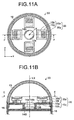
- FIGS. 11A and 11B are diagrams illustrating a configuration example of the capsule medical device 30 according to the embodiment.
- FIG. 11A is a cross section taken along line E-E in FIG. 11B
- FIG. 11B is a cross section taken along line F-F in FIG. 11A .
- the capsule medical device 30 according to the embodiment has a configuration similar to that of the capsule medical device 10 according to the first embodiment of the invention. Obviously from comparison between FIGS. 11A and 11B and FIGS. 5A and 5B , in the capsule medical device 30 according to the embodiment, the illuminating unit 15 in the capsule medical device 10 is replaced with an illuminating unit 35.
- the light distribution matching unit 15y in the illuminating unit 15 illustrated in FIG. 8 is replaced with a light distribution matching unit 35y.
- the dichroic prism 15p in the light distribution matching unit 15y is replaced with a plano-concave lens 351
- the diffuser 15d having a plate shape is replaced with a diffuser 35d curved along the concave face of the plano-concave lens 351.
- the two LEDs 15b and 15g outputting the first and second special light L15b and L15g are disposed under the plano-concave lens 351.
- the light incident face of the plano-concave lens 351 is a flat face on which the LEDs 15b and 15g are disposed.
- the light incident face is set as the under face.
- the light outgoing face of the plano-concave lens 351 is a concave face on which the diffuser 35d is disposed.
- the light outgoing face is set as the top face.
- the optical distance between the LEDs 15b and 15g and the inner wall of the subject 900 as an object to be imaged can be increased.
- the optical axes and distributions of the first and second special light L15b and L15g output from the illuminating units 15 can be approximately matched.
- the first and second special light L15b and L15g whose optical axes and distributions are approximately matched is incident and diffused by the diffuser 35d disposed on the light outgoing face and, after that, output from the light outgoing face as the top face of the diffuser 35d.
- the brightness distributions of image data of color components obtained by the imaging unit 14 can be made coincide.
- image data of an in-vivo image of the subject with reduced color unevenness can be generated.
- the cap 19 as an optical window of the capsule medical device 30 has the optical function of adjusting the distribution of light passing through the cap 19. Therefore, the optical axes and distributions of light in different wavelength bands can be further matched.
- the capsule medical device 30 may have a configuration that the illuminating unit 35 is disposed on the face of the circuit board 15B which is opposite from the cap 19. Since such a specific configuration can be easily reached from FIGS. 9A and 9B , the detailed description will not be given here.
- FIGS. 12A and 12B are diagrams illustrating a configuration example of the capsule medical device 40 according to the fourth embodiment.
- FIG. 12A is a cross section taken along line G-G in FIG. 12B
- FIG. 12B is a cross section taken along line H-H in FIG. 12A .
- the capsule medical device 40 according to the embodiment has a configuration similar to that of the capsule medical device 10 according to the first embodiment of the invention. Obviously from comparison between FIGS. 12A and 12B and FIGS. 5A and 5B , in the capsule medical device 40 according to the embodiment, the illuminating unit 15 in the capsule medical device 10 is replaced with an illuminating unit 45, and the circuit board 15B on which the illuminating control circuit 15A is mounted is replaced with a circuit board 45B.
- the light distribution matching unit 15y in the illuminating unit 15 illustrated in FIG. 8 is replaced with a light distribution matching unit 45y, and the light source 15x including the two LEDs 15b and 15g outputting the first and second special light L15b and L15g is disposed on the face (which will be called a rear face) opposite from the cap 19 of the circuit board 45B.
- the light distribution matching unit 45y is a ring-shaped diffuser covering almost the entire face on the cap 19 side of the circuit board 45B. Specifically, in the embodiment, the common light distribution matching unit 45y is used for the plurality of illuminating units 45.
- the light distribution matching unit 45y has a point-symmetrical shape using one point on the optical axis LX of the objective lens 14c as a center or a line-symmetrical shape using a straight line passing one point on the optical axis LX as a center line.
- a hole formed in the center of the light distribution matching unit 45y is a window for making light entering through the cap 19 directly incident on the imaging element 15a.
- an opening 45a for passing, to the cap 19 side, the first and second special light L15b and L15g output from the light source 15x (the LEDs 15b and 15g) disposed on the face opposite from the cap 19 side is formed. Therefore, the first and second special light L15b and L15g output from the LEDs 15b and 15g is incident on the light distribution matching unit 45y via the opening 45a, diffused by the light distribution matching unit 45y, and output from the light outgoing face as the top face of the light distribution matching unit 45y.
- the first and second special light L15b and L15g output from the LEDs 15b and 15g can be diffused by the ring-shaped light distribution matching unit 45y. Consequently, in a manner similar to the first embodiment of the invention, light in different wavelength bands (the first and second special light) whose optical axes and distributions are matched can be output from each of the illuminating units 45.
- the plurality of illuminating units 45 are arranged point-symmetrically using one point on the optical axis LX of the objective lens 14c as a center or line-symmetrically using a straight line passing through one point on the optical axis LX as a center line (refer to, for example, FIG. 12A ). Therefore, in the case of simultaneously driving the plurality of illuminating units 45, the optical axes and distributions of the entire light in the different wavelength bands emitted from the entire illuminating units 45 to the image capturing direction can be made matched.
- the brightness distributions of image data of color components obtained by the imaging unit 14 can be made coincide.
- image data of an in-vivo image of the subject with reduced color unevenness can be generated.
- the cap 19 as an optical window of the capsule medical device 40 has the optical function of adjusting the distribution of light passing through the cap 19. Therefore, the optical axes and distributions of light in different wavelength bands can be further matched.
- a capsule medical device 50 according to a fifth embodiment of the invention will be described in detail with reference to the drawings.
- configurations similar to those of any of the first to fourth embodiments of the invention are denoted by the same reference numerals and their detailed description will not be repeated.
- the capsule medical device 50 in a manner similar to the first embodiment of the invention, the case of applying the capsule medical device 50 as a body-introducable apparatus floating in the liquid 904 accumulated in the stomach 902 will be described as an example.
- the invention is not limited to the case but the capsule medical device 50 according to the embodiment can be applied to a body-introducable apparatus of acquiring an image of the inside of the subject 900 during travel from the esophagus to the anus.
- FIGS. 13A and 13B are diagrams illustrating a configuration example of the capsule medical device 50 according to the fourth embodiment.
- FIG. 13A is a cross section taken along line I-I in FIG. 13B
- FIG. 13B is a cross section taken along line J-J in FIG. 13A .
- the capsule medical device 50 according to the embodiment has a configuration similar to that of the capsule medical device 10 according to the first embodiment of the invention. Obviously from comparison between FIGS. 13A and 13B and FIGS. 5A and 5B , in the capsule medical device 50 according to the embodiment, the illuminating unit 15 in the capsule medical device 10 is replaced with an illuminating unit 55.
- the light distribution matching unit 15y in the illuminating unit 15 illustrated in FIG. 8 is replaced with a light distribution matching unit 55y.
- the dichroic prism 15p in the light distribution matching unit 15y is replaced with a reflection region, which is formed of a mirror 55r on the lower side and a half mirror 55h on the upper side, and the diffuser 15d is replaced with a ring-shaped diffuser 55d similar to the diffuser 35d in the fourth embodiment of the invention.
- the two LEDs 15b and 15g outputting the first and second special light L15b and L15g are disposed in a region sandwiched between the mirror 55r and the half mirror 55h.
- the side wall of the region sandwiched by the mirror 55r and the half mirror 55h is formed by, for example, a mirror 55b whose inner face is a mirror face.
- Each of the mirror 55r and the half mirror 55h is a ring-shaped member covering almost the entire face on the cap 19 side of the circuit board 15.
- the mirror 55r totally reflects the first and second special light L15b and L15g output from the light source 15x.
- the half mirror 55h reflects, for example, about 50% of the first and second special light L15b and L15g output from the light source 15x and transmits about 50% of the light. Therefore, each of the first and second special light L15b and L15g output from the LEDs 15b and 15g is diffused by being repetitively reflected in the reflection region formed by the mirror 55r and the half mirror 55h disposed apart from each other.
- the light is incident and further diffused in the diffuser 55d disposed on the top face of the half mirror 55h as the light outgoing face of the reflection region. After that, the light goes out from the light outgoing face as the top face of the diffuser 55d.
- the first and second special light L15b and L15g output from the LEDs 15b and 15g can be diffused in the ring-shaped reflection region formed of the mirror 55r and the half mirror 55h, and the first and second special light L15b and L15g whose optical axes and distributions are matched by the diffusion can be further diffused by the diffuser 55d. Consequently, in a manner similar to the first embodiment of the invention, light in different wavelength bands and whose optical axes and distributions are matched can be output from each of the illuminating units 55.
- the plurality of illuminating units 55 are arranged point-symmetrically using one point on the optical axis LX of the objective lens 14c as a center or line-symmetrically using a straight line passing through one point on the optical axis LX as a center line (refer to, for example, FIG. 13A ). Therefore, in the case of simultaneously driving the plurality of illuminating units 55, the optical axes and distributions of the entire light in the different wavelength bands emitted from the entire illuminating units 55 to the image capturing direction can be made matched.
- the brightness distributions of image data of color components obtained by the imaging unit 14 can be made coincide.
- image data of an in-vivo image of the subject with reduced color unevenness can be generated.
- the cap 19 as an optical window of the capsule medical device 50 has the optical function of adjusting the distribution of light passing through the cap 19. Therefore, the optical axes and distributions of light in different wavelength bands can be further matched.
- the capsule medical device 50 may have a configuration that the illuminating unit 55 is disposed on the face opposite from the cap 19 of the circuit board 15B. Since such a specific configuration can be easily reached from FIGS. 9A and 9B , the detailed description will not be given here.
- a capsule medical device 60 according to a sixth embodiment of the invention will be described in detail with reference to the drawings.
- configurations similar to those of any of the first to fifth embodiments of the invention are denoted by the same reference numerals and their detailed description will not be repeated.
- the capsule medical device 60 in a manner similar to the first embodiment of the invention, the case of applying the capsule medical device 60 as a body-introducable apparatus floating in the liquid 904 accumulated in the stomach 902 will be described as an example.
- the invention is not limited to the case but the capsule medical device 60 according to the embodiment can be applied to a body-introducable apparatus of acquiring an image of the inside of the subject 900 during travel from the esophagus to the anus.
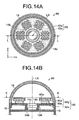
- FIGS. 14A and 14B are diagrams illustrating a configuration example of the capsule medical device 60 according to the sixth embodiment.
- FIG. 14A is a cross section taken along line K-K in FIG. 14B
- FIG. 14B is a cross section taken along line L-L in FIG. 14A .
- the light source 15x in the illuminating unit 15 illustrated in FIG. 8 is replaced with a light source 65x, and the light distribution matching unit 15y is replaced with a light distribution matching unit 65y.
- the light source 65x is made by, for example, an LED that outputs the first special light L15b.
- the light distribution matching unit 65y is disposed on the top face as the light outgoing face of the light source 65x.
- the dichroic prism 15p in the light distribution matching unit 15y is replaced with a wavelength shifter 65s having a ring-plate shape covering almost the entire face on the cap 19 side of the circuit board 15 and converting the first special light L15b in the wavelength band W 15b around 415 nm to the second special light L15g in the wavelength band W 15g around 540 nm.
- the diffuser 15d is replaced with a diffuser 65d similar to the diffuser 35d in the fourth embodiment.
- the wavelength shifter 65s includes a phosphor which absorbs and excites the first special light in the wavelength band W 15b around 415 nm and, after that, at the time of returning to the ground state, releasing the second special light in the wavelength band W 15g around 540 nm.
- a plurality of through holes 65a are formed in a region positioned above the light sources 65x in the wavelength shifter 65s.
- the total opening area of the plurality of through holes 65a occupies about the half of the region above the light sources 65x.
- the through hole 65a is a hole for making the first special light L15b output from the light source 65x directly incident on the diffuser 65d.
- the through holes 65a are formed dispersedly so that the first special light L15b is uniformly output from the entire region above the light source 65x. Therefore, on the diffuser 65d, the first special light L15b output from the light source 65x and the second special light L15g whose wavelength band is converted by passing through the wavelength shifter 65s is dispersedly incident with almost the same light amounts.
- the light incident on the diffuser 65d is diffused by the diffuser 65d and, after that, output from the light outgoing face as the top face of the diffuser 65d.
- the brightness distributions of image data of color components obtained by the imaging unit 14 can be made coincide.
- image data of an in-vivo image of the subject with reduced color unevenness can be generated.
- the cap 19 as an optical window of the capsule medical device 60 has the optical function of adjusting the distribution of light passing through the cap 19. Therefore, the optical axes and distributions of light in different wavelength bands can be further matched.
- the capsule medical device 60 may have a configuration that the illuminating unit 65 is disposed on the face opposite to the cap 19 of the circuit board 15B. Since such a specific configuration can be easily reached from FIGS. 9A and 9B , the detailed description will not be given here.
- the wavelength shifter 65s having the through holes 65a is used as means for converting a part of the first special light L15b output from the light source 65x to the second special light L15g having a wavelength longer than that of the first special light L15b by using, as the light source 65x, the LED that outputs the first special light L15b.
- the invention is not limited to the configuration.
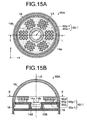
- a white LED that outputs white light may be used as a light source 65x-1, and the first and second special light L15b and L15g may be generated from the light source 65x-1.
- an optical filter obtained by combining a filter 65b (first filter) passing light in the wavelength band around 415 nm (first special light) in the white light and a filter 65g (second filter) passing light in the wavelength band around 540 nm (second special light) can be used.
- an illuminating unit 65-1 of the modification has a configuration that the light source 65x-1 has the white LED (white light source), and a light distribution matching unit 65y-1 has the optical filter made by the filters 65b and 65g and the diffuser 65d.
- the optical filter has a configuration that, for example, the wavelength shifter 65s in the foregoing embodiment is replaced with the filter 65b and the through hole 65a in the wavelength shifter 65s is replaced with the filter 65g.
- FIGS. 15A and 15B correspond to FIGS. 5A and 5B , respectively. Since the other configuration is similar to that of the capsule medical device 60 according to the sixth embodiment, the detailed description will not be repeated.
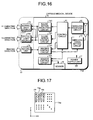
- the capsule medical device 70 has: an imaging unit 74 for capturing an image of the inside of the subject 900; an imaging control circuit 74A for acquiring image data by driving the imaging unit 74; a plurality of illuminating units 75 each for outputting one or more kinds of special light and/or normal light; an illumination control circuit 75A for illuminating the imaging direction by driving the illuminating units 75 at the time of capturing an image of the inside of the subject 900 by the imaging unit 74; and an illumination selecting circuit 75C for selecting at least one of a special light source 75e and a normal light source 75n as an illuminating unit driven at the time of imaging.
- the illuminating unit 75 includes the special light source 75e that outputs special light of one or more kinds, and the normal light source 75n that outputs normal light.
- the other configuration is similar to that of the capsule medical device 10 according to the first embodiment of the invention.
- FIG. 17 is a layout diagram illustrating an example of an array of the imaging elements 74a in the imaging unit 74 according to the embodiment.
- FIGS. 18A and 18B are diagrams illustrating a configuration example of the capsule medical device 70 according to the embodiment.
- FIG. 18A is a cross section taken along line M-M in FIG. 18B
- FIG. 18B is a cross section taken along line N-N in FIG. 18A .
- the imaging element 14a is replaced with an imaging element 74a.
- the imaging element 74a has, as illustrated in FIG. 17 , a CCD or CMOS structure in which a plurality of light receiving elements 74r, a plurality of light receiving elements 74g, and a plurality of light receiving elements 74b are arranged in order in row and column directions (x and y directions in the diagram).
- the light receiving elements 74g and 74g are similar to the light receiving elements 14g and 14b, respectively, in the first embodiment of the invention.
- the light receiving element 74r has, for example, a light reception sensitivity band having a peak around 700 nm. Therefore, the imaging element 74a generates image data of a red component (R), image data of a green component (G), and image data of a blue component (B).
- each of the illuminating units 75 has a light source 75x for properly outputting first and second special light and normal light, and a light distribution matching unit 75y for adjusting distribution of the various light output from the light source 75x.
- the light source 75x includes a special light source 75e outputting the first and second special light and a normal light source 75n (white light source) outputting the normal light.
- the special light source 75e has an LED 75b outputting the first special light and a wavelength shifter 75s provided on the light outgoing face (top face) of the LED 75b.
- a wavelength shifter 75s provided on the light outgoing face (top face) of the LED 75b.
- an opening for exposing a part of the LED 75b is formed.
- the center of the opening coincides with the optical axis of the LED 75b.
- the area of the opening is, for example, almost the half of the area of the light outgoing face of the LED 75b.
- the opening is provided with a normal light source 75n.
- the normal light source 75n includes an LED having a transparent resin and a light emitting electrode, and outputs normal light.
- the optical axis of the normal light source 75n coincides with that of the LED 75b in the special light source 75e.
- the light source 75x outputs first special light which is passed through a transparent part in the normal light source 75n, and second special light generated by converting the wavelength of light incident on the wavelength shifter 75s.
- the normal light is output from the light source 75x.
- a diffuser 75d similar to the diffuser 15d in the first embodiment of the invention is disposed on the light outgoing face (top face) of the light source 75x. Therefore, the first and second special light and/or normal light output from the light source 75x is diffused by the diffuser 75d and is output from the light outgoing face (top face) of the diffuser 75d in a state where distribution is adjusted.
- the plurality of illuminating units 75 are arranged (refer to, for example, FIG. 18A ) point-symmetrically using one point on the optical axis LX of the objective lens 14c as a center or line-symmetrically using a straight line passing through one point on the optical axis LX as a center line. Consequently, in the case of simultaneously driving the illuminating units 75, the optical axes and distributions of the entire light emitted from the entire illuminating units 75 to the image capturing direction can be made matched.
- the brightness distributions of image data of color components obtained by the imaging unit 74 can be made coincide.
- image data of an in-vivo image of the subject with reduced color unevenness can be generated.
- the cap 19 as an optical window of the capsule medical device 20 has the optical function of adjusting the distribution of light passing through the cap 19. Therefore, the optical axes and distributions of light in different wavelength bands can be further matched.
- the capsule medical device 70 may have a configuration that the illuminating unit 75 is disposed on the face opposite to the cap 19 of the circuit board 75B. Since such a specific configuration can be easily reached from FIGS. 9A and 9B , the detailed description will not be given here.
Landscapes
- Health & Medical Sciences (AREA)
- Life Sciences & Earth Sciences (AREA)
- Surgery (AREA)
- Nuclear Medicine, Radiotherapy & Molecular Imaging (AREA)
- Biomedical Technology (AREA)
- Optics & Photonics (AREA)
- Pathology (AREA)
- Radiology & Medical Imaging (AREA)
- Biophysics (AREA)
- Engineering & Computer Science (AREA)
- Physics & Mathematics (AREA)
- Heart & Thoracic Surgery (AREA)
- Medical Informatics (AREA)
- Molecular Biology (AREA)
- Animal Behavior & Ethology (AREA)
- General Health & Medical Sciences (AREA)
- Public Health (AREA)
- Veterinary Medicine (AREA)
- Endoscopes (AREA)
Applications Claiming Priority (2)
| Application Number | Priority Date | Filing Date | Title |
|---|---|---|---|
| JP2008275860 | 2008-10-27 | ||
| PCT/JP2009/068319 WO2010050426A1 (ja) | 2008-10-27 | 2009-10-26 | 被検体内導入装置および医療システム |
Publications (2)
| Publication Number | Publication Date |
|---|---|
| EP2343005A1 true EP2343005A1 (de) | 2011-07-13 |
| EP2343005A4 EP2343005A4 (de) | 2015-04-15 |
Family
ID=42128788
Family Applications (1)
| Application Number | Title | Priority Date | Filing Date |
|---|---|---|---|
| EP09823536.9A Withdrawn EP2343005A4 (de) | 2008-10-27 | 2009-10-26 | In-vivo-einführungsvorrichtung und medizinisches system |
Country Status (5)
| Country | Link |
|---|---|
| US (1) | US9439558B2 (de) |
| EP (1) | EP2343005A4 (de) |
| JP (1) | JP4558104B2 (de) |
| CN (1) | CN102196759B (de) |
| WO (1) | WO2010050426A1 (de) |
Families Citing this family (6)
| Publication number | Priority date | Publication date | Assignee | Title |
|---|---|---|---|---|
| US20160249793A1 (en) * | 2013-12-27 | 2016-09-01 | Kang-Huai Wang | Capsule Camera Device with Multi-Spectral Light Sources |
| CN104665756B (zh) * | 2015-02-13 | 2016-06-15 | 北京麦迪声医疗技术有限公司 | 一种体内微型传感器图像采集处理装置及其处理方法 |
| JP7482150B2 (ja) * | 2019-04-18 | 2024-05-13 | エンテラセンス リミテッド | バイオセンサカプセルおよびシステム |
| DE102020134332A1 (de) * | 2020-12-21 | 2022-06-23 | Hoya Corporation | Beleuchtungseinrichtung für Endoskope |
| EP4574014A1 (de) * | 2023-12-19 | 2025-06-25 | Ambu A/S | Endoskop mit lichtleiter und leds in distaler spitze |
| DE102024132318A1 (de) * | 2024-11-06 | 2026-05-07 | Karl Storz Se & Co. Kg | Medizinische Lichtquellenvorrichtung, medizinisches Bildgebungssystem und Verfahren zum Betrieb einer medizinischen Lichtquellenvorrichtung und/oder eines medizinischen Bildgebungssystems |
Family Cites Families (31)
| Publication number | Priority date | Publication date | Assignee | Title |
|---|---|---|---|---|
| JPS5620428A (en) * | 1979-07-27 | 1981-02-26 | Olympus Optical Co | Lighting optical system for endoscope |
| JPS5810033A (ja) * | 1981-05-26 | 1983-01-20 | オリンパス光学工業株式会社 | 内視鏡用照明光学系 |
| US4379233A (en) * | 1981-05-27 | 1983-04-05 | Trebor Industries, Inc. | Optical arrangement for quantitative analysis instrument utilizing pulsed radiation emitting diodes |
| JPS5887525A (ja) * | 1981-11-19 | 1983-05-25 | Olympus Optical Co Ltd | 内視鏡用照明光学系 |
| DE4415269A1 (de) * | 1994-04-30 | 1995-11-02 | Zeiss Carl Fa | Laseranordnung mit einem axial optisch gepumpten Laser |
| US5835648A (en) * | 1996-03-07 | 1998-11-10 | Miravant Systems, Inc. | Surface illuminator for photodynamic therapy |
| JPH10337271A (ja) * | 1997-06-09 | 1998-12-22 | Fuji Photo Film Co Ltd | 蛍光内視鏡 |
| US6364829B1 (en) * | 1999-01-26 | 2002-04-02 | Newton Laboratories, Inc. | Autofluorescence imaging system for endoscopy |
| JPH11267099A (ja) * | 1998-03-24 | 1999-10-05 | Olympus Optical Co Ltd | 内視鏡 |
| US6487440B2 (en) * | 1998-07-08 | 2002-11-26 | Lifespex, Inc. | Optical probe having and methods for difuse and uniform light irradiation |
| US6373568B1 (en) * | 1999-08-06 | 2002-04-16 | Cambridge Research & Instrumentation, Inc. | Spectral imaging system |
| JP2002065582A (ja) * | 2000-08-25 | 2002-03-05 | Asahi Optical Co Ltd | 電子内視鏡装置 |
| JP2002112961A (ja) | 2000-10-12 | 2002-04-16 | Asahi Optical Co Ltd | 発光ダイオードを光源として用いた電子内視鏡装置 |
| JP2003029654A (ja) * | 2001-07-11 | 2003-01-31 | Sony Corp | 表示装置 |
| US20030117491A1 (en) | 2001-07-26 | 2003-06-26 | Dov Avni | Apparatus and method for controlling illumination in an in-vivo imaging device |
| JP2003260025A (ja) * | 2002-03-08 | 2003-09-16 | Olympus Optical Co Ltd | カプセル型内視鏡 |
| JP2004243034A (ja) | 2003-02-17 | 2004-09-02 | Manabu Sato | 光波断層画像測定用臨床カプセル |
| JP2004275542A (ja) * | 2003-03-17 | 2004-10-07 | Olympus Corp | カプセル型内視鏡 |
| US7274043B2 (en) * | 2003-04-15 | 2007-09-25 | Luminus Devices, Inc. | Light emitting diode systems |
| JP2005134482A (ja) * | 2003-10-28 | 2005-05-26 | Olympus Corp | 画像投影装置 |
| JP4088313B2 (ja) * | 2004-01-23 | 2008-05-21 | オリンパス株式会社 | 画像処理システム、院内処理システム |
| JP2005304599A (ja) | 2004-04-19 | 2005-11-04 | Morita Mfg Co Ltd | 頭部装着診断用光照射装置 |
| JP4610970B2 (ja) * | 2004-09-07 | 2011-01-12 | オリンパス株式会社 | 着脱フィルタ装置および内視鏡装置 |
| JP2006136453A (ja) * | 2004-11-11 | 2006-06-01 | Fujinon Corp | 内視鏡装置 |
| JP4598498B2 (ja) * | 2004-11-29 | 2010-12-15 | オリンパス株式会社 | 被検体内導入装置 |
| US20060232668A1 (en) | 2005-04-18 | 2006-10-19 | Given Imaging Ltd. | Color filter array with blue elements |
| US20070045641A1 (en) | 2005-08-23 | 2007-03-01 | Yin Chua Janet B | Light source with UV LED and UV reflector |
| US20070156051A1 (en) | 2005-12-29 | 2007-07-05 | Amit Pascal | Device and method for in-vivo illumination |
| JP4841391B2 (ja) * | 2006-10-17 | 2011-12-21 | オリンパスメディカルシステムズ株式会社 | 内視鏡 |
| US20080310181A1 (en) * | 2007-06-15 | 2008-12-18 | Microalign Technologies, Inc. | Brightness with reduced optical losses |
| JP2009153712A (ja) * | 2007-12-26 | 2009-07-16 | Olympus Corp | 光源装置およびそれを備えた内視鏡装置 |
-
2009
- 2009-10-26 JP JP2010517630A patent/JP4558104B2/ja not_active Expired - Fee Related
- 2009-10-26 CN CN200980142067.6A patent/CN102196759B/zh not_active Expired - Fee Related
- 2009-10-26 WO PCT/JP2009/068319 patent/WO2010050426A1/ja not_active Ceased
- 2009-10-26 EP EP09823536.9A patent/EP2343005A4/de not_active Withdrawn
-
2010
- 2010-05-07 US US12/775,810 patent/US9439558B2/en active Active
Also Published As
| Publication number | Publication date |
|---|---|
| EP2343005A4 (de) | 2015-04-15 |
| JPWO2010050426A1 (ja) | 2012-03-29 |
| US20100292534A1 (en) | 2010-11-18 |
| US9439558B2 (en) | 2016-09-13 |
| JP4558104B2 (ja) | 2010-10-06 |
| CN102196759B (zh) | 2014-05-28 |
| WO2010050426A1 (ja) | 2010-05-06 |
| CN102196759A (zh) | 2011-09-21 |
Similar Documents
| Publication | Publication Date | Title |
|---|---|---|
| JP4422679B2 (ja) | カプセル内視鏡およびカプセル内視鏡システム | |
| US7347817B2 (en) | Polarized in vivo imaging device, system and method | |
| US7316647B2 (en) | Capsule endoscope and a capsule endoscope system | |
| US6855111B2 (en) | Capsule endoscope | |
| EP2343005A1 (de) | In-vivo-einführungsvorrichtung und medizinisches system | |
| US9801573B2 (en) | Endoscope system, processor device, and method for operating endoscope system | |
| EP2124710B1 (de) | Schmalband-in-vivo-bildgebungsvorrichtung | |
| US20130070071A1 (en) | Single-Use Bispectral Optical Head for Videoendoscope and Associated Videoendoscope | |
| US20110270057A1 (en) | Device and method for detection of an in-vivo pathology | |
| JP2006525494A (ja) | リアルタイムの同時的マルチモードイメージングとその分光学的用途 | |
| JP2005074034A (ja) | カプセル型内視鏡 | |
| EP2351515A1 (de) | Bildverarbeitungsvorrichtung, vorrichtung zur anleitung während der untersuchung, medizinisches system und bildverarbeitungsverfahren | |
| CN109788891A (zh) | 内窥镜镜体、内窥镜处理器和内窥镜用适配器 | |
| US20060206005A1 (en) | Placement multi-band bioassay device | |
| EP1329189B1 (de) | Endoskopische Kapsel | |
| KR20100076186A (ko) | 인체 내 조명 및 이미지 획득 시스템과 그 방법 | |
| JP6214841B1 (ja) | 被検体内導入装置、送信方法及びプログラム | |
| TWM448255U (zh) | 內視鏡膠囊裝置 | |
| KR101630849B1 (ko) | 내시경 | |
| CN212939651U (zh) | 一种病理窄带胶囊内镜 | |
| CN109310272A (zh) | 处理装置、设定方法以及程序 | |
| WO2020217541A1 (ja) | 光源ユニット | |
| WO2021166090A1 (ja) | 内視鏡用光源装置 | |
| KR20090102004A (ko) | 캡슐 내시경 | |
| TWM449571U (zh) | 手持式內視裝置 |
Legal Events
| Date | Code | Title | Description |
|---|---|---|---|
| PUAI | Public reference made under article 153(3) epc to a published international application that has entered the european phase |
Free format text: ORIGINAL CODE: 0009012 |
|
| 17P | Request for examination filed |
Effective date: 20110411 |
|
| AK | Designated contracting states |
Kind code of ref document: A1 Designated state(s): AT BE BG CH CY CZ DE DK EE ES FI FR GB GR HR HU IE IS IT LI LT LU LV MC MK MT NL NO PL PT RO SE SI SK SM TR |
|
| AX | Request for extension of the european patent |
Extension state: AL BA RS |
|
| DAX | Request for extension of the european patent (deleted) | ||
| RA4 | Supplementary search report drawn up and despatched (corrected) |
Effective date: 20150316 |
|
| RIC1 | Information provided on ipc code assigned before grant |
Ipc: A61B 1/04 20060101ALI20150310BHEP Ipc: A61B 1/06 20060101ALI20150310BHEP Ipc: A61B 1/00 20060101AFI20150310BHEP |
|
| RAP1 | Party data changed (applicant data changed or rights of an application transferred) |
Owner name: OLYMPUS CORPORATION |
|
| RAP1 | Party data changed (applicant data changed or rights of an application transferred) |
Owner name: OLYMPUS CORPORATION |
|
| RAP1 | Party data changed (applicant data changed or rights of an application transferred) |
Owner name: OLYMPUS CORPORATION |
|
| RAP1 | Party data changed (applicant data changed or rights of an application transferred) |
Owner name: OLYMPUS CORPORATION |
|
| STAA | Information on the status of an ep patent application or granted ep patent |
Free format text: STATUS: REQUEST FOR EXAMINATION WAS MADE |
|
| STAA | Information on the status of an ep patent application or granted ep patent |
Free format text: STATUS: THE APPLICATION IS DEEMED TO BE WITHDRAWN |
|
| 18D | Application deemed to be withdrawn |
Effective date: 20190501 |