EP2343199A1 - Composite caoutchouc et composition de caoutchouc - Google Patents
Composite caoutchouc et composition de caoutchouc Download PDFInfo
- Publication number
- EP2343199A1 EP2343199A1 EP09846312A EP09846312A EP2343199A1 EP 2343199 A1 EP2343199 A1 EP 2343199A1 EP 09846312 A EP09846312 A EP 09846312A EP 09846312 A EP09846312 A EP 09846312A EP 2343199 A1 EP2343199 A1 EP 2343199A1
- Authority
- EP
- European Patent Office
- Prior art keywords
- rubber
- amine
- boundary surface
- sulfenamide
- bond
- Prior art date
- Legal status (The legal status is an assumption and is not a legal conclusion. Google has not performed a legal analysis and makes no representation as to the accuracy of the status listed.)
- Withdrawn
Links
Images

Classifications
-
- C—CHEMISTRY; METALLURGY
- C08—ORGANIC MACROMOLECULAR COMPOUNDS; THEIR PREPARATION OR CHEMICAL WORKING-UP; COMPOSITIONS BASED THEREON
- C08J—WORKING-UP; GENERAL PROCESSES OF COMPOUNDING; AFTER-TREATMENT NOT COVERED BY SUBCLASSES C08B, C08C, C08F, C08G or C08H
- C08J5/00—Manufacture of articles or shaped materials containing macromolecular substances
- C08J5/04—Reinforcing macromolecular compounds with loose or coherent fibrous material
- C08J5/10—Reinforcing macromolecular compounds with loose or coherent fibrous material characterised by the additives used in the polymer mixture
-
- B—PERFORMING OPERATIONS; TRANSPORTING
- B60—VEHICLES IN GENERAL
- B60C—VEHICLE TYRES; TYRE INFLATION; TYRE CHANGING; CONNECTING VALVES TO INFLATABLE ELASTIC BODIES IN GENERAL; DEVICES OR ARRANGEMENTS RELATED TO TYRES
- B60C1/00—Tyres characterised by the chemical composition or the physical arrangement or mixture of the composition
-
- C—CHEMISTRY; METALLURGY
- C08—ORGANIC MACROMOLECULAR COMPOUNDS; THEIR PREPARATION OR CHEMICAL WORKING-UP; COMPOSITIONS BASED THEREON
- C08K—Use of inorganic or non-macromolecular organic substances as compounding ingredients
- C08K5/00—Use of organic ingredients
- C08K5/36—Sulfur-, selenium-, or tellurium-containing compounds
- C08K5/43—Compounds containing sulfur bound to nitrogen
- C08K5/44—Sulfenamides
-
- C—CHEMISTRY; METALLURGY
- C08—ORGANIC MACROMOLECULAR COMPOUNDS; THEIR PREPARATION OR CHEMICAL WORKING-UP; COMPOSITIONS BASED THEREON
- C08K—Use of inorganic or non-macromolecular organic substances as compounding ingredients
- C08K5/00—Use of organic ingredients
- C08K5/36—Sulfur-, selenium-, or tellurium-containing compounds
- C08K5/45—Heterocyclic compounds having sulfur in the ring
- C08K5/46—Heterocyclic compounds having sulfur in the ring with oxygen or nitrogen in the ring
- C08K5/47—Thiazoles
-
- C—CHEMISTRY; METALLURGY
- C08—ORGANIC MACROMOLECULAR COMPOUNDS; THEIR PREPARATION OR CHEMICAL WORKING-UP; COMPOSITIONS BASED THEREON
- C08J—WORKING-UP; GENERAL PROCESSES OF COMPOUNDING; AFTER-TREATMENT NOT COVERED BY SUBCLASSES C08B, C08C, C08F, C08G or C08H
- C08J2321/00—Characterised by the use of unspecified rubbers
-
- Y—GENERAL TAGGING OF NEW TECHNOLOGICAL DEVELOPMENTS; GENERAL TAGGING OF CROSS-SECTIONAL TECHNOLOGIES SPANNING OVER SEVERAL SECTIONS OF THE IPC; TECHNICAL SUBJECTS COVERED BY FORMER USPC CROSS-REFERENCE ART COLLECTIONS [XRACs] AND DIGESTS
- Y10—TECHNICAL SUBJECTS COVERED BY FORMER USPC
- Y10T—TECHNICAL SUBJECTS COVERED BY FORMER US CLASSIFICATION
- Y10T428/00—Stock material or miscellaneous articles
- Y10T428/31504—Composite [nonstructural laminate]
- Y10T428/31678—Of metal
-
- Y—GENERAL TAGGING OF NEW TECHNOLOGICAL DEVELOPMENTS; GENERAL TAGGING OF CROSS-SECTIONAL TECHNOLOGIES SPANNING OVER SEVERAL SECTIONS OF THE IPC; TECHNICAL SUBJECTS COVERED BY FORMER USPC CROSS-REFERENCE ART COLLECTIONS [XRACs] AND DIGESTS
- Y10—TECHNICAL SUBJECTS COVERED BY FORMER USPC
- Y10T—TECHNICAL SUBJECTS COVERED BY FORMER US CLASSIFICATION
- Y10T428/00—Stock material or miscellaneous articles
- Y10T428/31504—Composite [nonstructural laminate]
- Y10T428/31678—Of metal
- Y10T428/31692—Next to addition polymer from unsaturated monomers
-
- Y—GENERAL TAGGING OF NEW TECHNOLOGICAL DEVELOPMENTS; GENERAL TAGGING OF CROSS-SECTIONAL TECHNOLOGIES SPANNING OVER SEVERAL SECTIONS OF THE IPC; TECHNICAL SUBJECTS COVERED BY FORMER USPC CROSS-REFERENCE ART COLLECTIONS [XRACs] AND DIGESTS
- Y10—TECHNICAL SUBJECTS COVERED BY FORMER USPC
- Y10T—TECHNICAL SUBJECTS COVERED BY FORMER US CLASSIFICATION
- Y10T428/00—Stock material or miscellaneous articles
- Y10T428/31504—Composite [nonstructural laminate]
- Y10T428/31678—Of metal
- Y10T428/31692—Next to addition polymer from unsaturated monomers
- Y10T428/31696—Including polyene monomers [e.g., butadiene, etc.]
-
- Y—GENERAL TAGGING OF NEW TECHNOLOGICAL DEVELOPMENTS; GENERAL TAGGING OF CROSS-SECTIONAL TECHNOLOGIES SPANNING OVER SEVERAL SECTIONS OF THE IPC; TECHNICAL SUBJECTS COVERED BY FORMER USPC CROSS-REFERENCE ART COLLECTIONS [XRACs] AND DIGESTS
- Y10—TECHNICAL SUBJECTS COVERED BY FORMER USPC
- Y10T—TECHNICAL SUBJECTS COVERED BY FORMER US CLASSIFICATION
- Y10T428/00—Stock material or miscellaneous articles
- Y10T428/31504—Composite [nonstructural laminate]
- Y10T428/31678—Of metal
- Y10T428/31707—Next to natural rubber
-
- Y—GENERAL TAGGING OF NEW TECHNOLOGICAL DEVELOPMENTS; GENERAL TAGGING OF CROSS-SECTIONAL TECHNOLOGIES SPANNING OVER SEVERAL SECTIONS OF THE IPC; TECHNICAL SUBJECTS COVERED BY FORMER USPC CROSS-REFERENCE ART COLLECTIONS [XRACs] AND DIGESTS
- Y10—TECHNICAL SUBJECTS COVERED BY FORMER USPC
- Y10T—TECHNICAL SUBJECTS COVERED BY FORMER US CLASSIFICATION
- Y10T428/00—Stock material or miscellaneous articles
- Y10T428/31504—Composite [nonstructural laminate]
- Y10T428/31855—Of addition polymer from unsaturated monomers
-
- Y—GENERAL TAGGING OF NEW TECHNOLOGICAL DEVELOPMENTS; GENERAL TAGGING OF CROSS-SECTIONAL TECHNOLOGIES SPANNING OVER SEVERAL SECTIONS OF THE IPC; TECHNICAL SUBJECTS COVERED BY FORMER USPC CROSS-REFERENCE ART COLLECTIONS [XRACs] AND DIGESTS
- Y10—TECHNICAL SUBJECTS COVERED BY FORMER USPC
- Y10T—TECHNICAL SUBJECTS COVERED BY FORMER US CLASSIFICATION
- Y10T428/00—Stock material or miscellaneous articles
- Y10T428/31504—Composite [nonstructural laminate]
- Y10T428/31855—Of addition polymer from unsaturated monomers
- Y10T428/31931—Polyene monomer-containing
Definitions
- the present invention relates to a composite of a metal material and a rubber composition vulcanized by use of a sulfenamide-based vulcanization accelerator, and also to a rubber composition vulcanized by use of a sulfenamide-based vulcanization accelerator.
- the rubber is reinforced with metal materials such as steel cords.
- a method for manufacturing such composites of rubber with metal materials a method called direct vulcanization adhesion method has been known in which vulcanization of rubber and adhesive bonding between a metal material and the rubber are simultaneously performed.
- kneaded rubber is formed by adding carbon black, a vulcanizing agent, and the like to masticated rubber, and then mixing them with each other. Thereafter, a vulcanization treatment is performed on the kneaded rubber.
- a vulcanization accelerator is used to accelerate the rate of the vulcanization reaction.
- the rate of the vulcanization reaction is adjusted by using a vulcanization retarder having an effect of preventing the scorch (called a retarding property) in combination with the vulcanization accelerator.
- DCBS N,N-dicyclohexyl-2-benzothiazolylsulfenamide
- Examples of known sulfenamide-based vulcanization accelerators other than DCBS include bis (sulfenamide) (see, for example, Patent Document 1), and a benzothiazolylsulfenamide-based vulcanization accelerator (for example, Patent Document 2) for which an amine derived from a natural fat and oil is used as a raw material.
- the conventional direct vulcanization adhesion method in which a vulcanization accelerator and a vulcanization retarder are used has the following problems.
- the vulcanization retarder added to the rubber may deteriorate the physical properties of the rubber after the vulcanization as well as the adhesion between the metal material and the rubber.
- the so-called bleed-out phenomenon may occur in which the vulcanization retarder added to the rubber undergoes change with time, and precipitates on a surface of a rubber product such as an automobile tire, so that the appearance of the product is impaired.
- the use of the vulcanization retarder causes a problem of increasing the manufacturing steps and the manufacturing costs of rubber products.
- an object of the present invention is to provide a rubber composition which is manufactured at an appropriate vulcanization reaction rate without using a vulcanization retarder.
- Another object of the present invention is to provide, by a direct vulcanization adhesion method, a rubber composite which has excellent adhesion properties between a metal material and a rubber composition, and which allows the number of manufacturing man-hours and the manufacturing costs to be reduced.
- the gist thereof is a rubber composite (first belt layer 15A, automobile tire 1) comprising: rubber (rubber layer 152); and a metal material (steel cord 151) which has an adhesion boundary surface adhered to the rubber and which reinforce the rubber, wherein the adhesion boundary surface has a crystal structure of an anti-fluorite structure, the rubber is vulcanized by use of a sulfenamide compound as a vulcanization accelerator, a bond order between an amine of the sulfenamide compound and the adhesion boundary surface is zero, the bond order being calculated by use of a semi-empirical molecular orbital calculation method (MOPAC2006), the bond distance between a sulfur atom and a nitrogen atom in the sulfenamide compound is less than 1.67 ⁇ , the bond distance being determined by use of an ab initio molecular orbital calculation method (Gaussian03), and the electric charge on the nitrogen atom of an a rubber composite (first belt layer 15A, automobile tire 1) comprising: rubber (
- the bond distance between the sulfur atom and the nitrogen atom of the sulfenamide compound is less than 1.67 ⁇ , and the electric charge on the amine radical is -0.295 or less.
- the sulfur atom and the nitrogen atom of the amine in the sulfenamide compound are easily dissociated and hardly bonded to each other again.
- the scorch is influenced by the S-N bond distance of the sulfenamide compound as well as the electric charge on the amine molecules released therefrom.
- the bond distance between the sulfur atom and the nitrogen atom of the sulfenamide compound is less than 1.67 ⁇ , and this bond distance is short. For this reason, the bond between the sulfur atom and the nitrogen atom of the amine is not cleaved easily, so that the vulcanization reaction can be prevented from proceeding before downstream steps. In other words, an effect of preventing the scorch is high. For this reason, for the rubber composite according to the first aspect of the present invention, the scorch can be prevented without adding any vulcanization retarder.
- the electric charge on the amine radical from the sulfenamide compound is -0.295 or less.
- the stability of the dissociated amine radical is high. This makes a once-cleaved S-N bond less likely to be formed again. Accordingly, in the rubber composite according to the first aspect, since a decrease in the reaction sites is not caused by S-N bond reformation, the vulcanization reaction can be caused to proceed smoothly.
- a second aspect of the present invention relates to the first aspect of the present invention, and the gist thereof is that the adhesion boundary surface has an adhesive layer formed therein, the adhesive layer containing copper disulfide.
- a third aspect of the present invention relates to the second aspect of the invention, and the gist thereof is that the metal material contains at least copper and zinc, and that the percentage of zinc atoms in the metal material is 37.5% or lower.
- a fourth aspect of the present invention has the gist that A rubber composition comprising: a sulfenamide compound as a vulcanization accelerator, wherein the bond distance between a sulfur atom and a nitrogen atom in the sulfenamide compound is less than 1.67 ⁇ , the electric charge on nitrogen in an amine radical generated by dissociation between the sulfur atom and the nitrogen atom of the amine is -0.295 or less, and the bond order with an adhesion boundary surface of a metal material having a crystal structure of an anti-fluorite structure is zero.
- a rubber composition of which rate of the vulcanization reaction can be adjusted appropriately without using any vulcanization retarder It is also possible to provide, by a direct vulcanization adhesion method, a rubber composite which has excellent adhesion properties between a metal material and a rubber composition, and which allows the number of manufacturing man-hours and the manufacturing costs to be reduced.
- a rubber composite formed by a novel direct vulcanization adhesion method needs to satisfy the following requirements: (I) having unimpaired adhesion properties to a metal material; and (II) having a better scorch-preventing effect (called a delayed-action properties, or anti-scorch properties) than conventional vulcanization accelerators even when no vulcanization retarder is added.
- the rubber composite is an automobile tire.
- rubber is reinforced with a metal material such as a steel cord.
- the vulcanization of the rubber and the adhesive bonding of a steel cord and the rubber are conducted simultaneously in the direct vulcanization adhesion method.
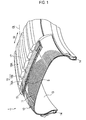
- Fig. 1 is an exploded perspective view showing a part of an automobile tire 1 according to the present invention. As shown in Fig. 1 , the automobile tire 1 has a carcass layer 12 serving as a carcass of the automobile tire 1.
- the carcass layer 12 includes carcass cords 11. On the inside of the carcass layer 12 in the radial direction of the tire, an inner liner 13 is provided which is a highly airtight rubber layer corresponding to a tube. Both ends of the carcass layer 12 are locked to a pair of bead portions 14.
- the carcass cords 11 are formed of steel cords.
- the belt layer 15 On the outside of the carcass layer 12 in the radial direction of the tire, a belt layer 15 is provided.
- the belt layer 15 has a first belt layer 15A and a second belt layer 15B which have steel cords (to be described later) coated with rubber.
- the steel cords constituting the first belt layer 15A and the second belt layer 15B are arranged at predetermined angles (for example, ⁇ 25 degrees) with respect to the tire equatorial plane CL.
- a tread portion 16 configured to come into contact with a road surface is provided.
- the tread portion 16 has a tread rubber layer 16A.
- the carcass cords 11 or the belt layer 15 is a rubber composite in which steel cords are covered with rubber.
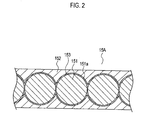
- Fig. 2 is an enlarged view of the region S of the first belt layer 15A in a cross-section in the width direction of the tire and in the radial direction of the tire, the first belt layer 15A being an example of the rubber composite.
- the first belt layer 15A has steel cords 151 and a rubber layer 152.
- Each of the steel cords 151 has a steel cord/rubber adhesion boundary surface 151a bonded to the rubber layer 152.
- an adhesive layer 153 is formed.
- the steel cords 151 reinforce the rubber layer 152.
- the steel cords 151 form the carcass of the automobile tire 1.
- the steel cords 151 constitute the metal material
- the rubber layer 152 constitutes the rubber composition.
- the present inventors have made earnest efforts to elucidate the relationship between the kind of a vulcanization accelerator in the direct vulcanization adhesion method and the thermal degradation of the adhesion boundary surface between a rubber layer and a steel cord. As a result, the present inventors have found that the heat resistance of the steel cord/rubber adhesion boundary surface varies depending on the kind of an amine generated when a sulfenamide-based vulcanization accelerator is decomposed during a vulcanization treatment.
- the amount of Cu dissolved in the rubber was analyzed by use of an ICP (inductively coupled plasma) mass spectrometer, and then the elution of a copper sulfide layer constituting the adhesive layer was determined on the basis of the detected amount.
- ICP inductively coupled plasma
- DCBS N,N-dicyclohexyl-2-benzothiazole sulfenamide
- the present inventors have found that the heat resistance of the steel cord/rubber adhesion boundary surface is associated with the kind of the amine released from the sulfenamide-based vulcanization accelerator. Therefore, the inventors began an attempt to develop a vulcanization accelerator which does not lower the heat resistance of the steel cord/rubber adhesion boundary surface.
- the present inventors predicted that the correlation could be understood by calculating the effect of the amine released from the vulcanization accelerator on copper sulfide constituting the steel cord.
- Fig. 3 shows a flowchart for describing a process for calculating the most stable structure of an amine released from a vulcanization accelerator.
- Step S1 a molecular structure of an amine molecule which can actually exist was formed by use of semi-empirical molecular orbital calculation software Scigress Explorer MOPAC 2006 (available from Fujitsu Limited).
- Step S2 a molecular mechanics calculation of the amine molecule drawn in Step S1 was performed to search a stable structure in terms of molecular mechanics.
- a molecular force field calculation program (MM2) developed by Allinger was used.
- Step S3 rotatable dihedral angles in the molecular structure of the amine were rotated every 10° to search possible conformations of the amine molecule.
- Step S4 semi-empirical molecular orbital calculations were performed for all the conformations found in Step S3.
- the AM1 method was used as an operator.
- Step S5 the spatial configuration in which the heat of formation was minimized was determined as the most stable structure of the amine molecule.
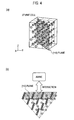
- Fig. 4 is a schematic diagram for describing a structure model of the steel cord/rubber adhesion boundary surface.
- the steel cord is regarded as an adsorbent
- an amine molecule is regarded as an adsorbate
- the adsorbent needs to have a sufficiently large area relative to the size of the amine molecule.
- a crystal structure of the so-called anti-fluorite-type in which 27 unit cells (three in the longitudinal direction ⁇ three in the transverse direction ⁇ three in the height direction) of copper sulfide were stacked as shown in Fig. 4(a).
- the selected crystal is Cu2S of which diffraction pattern detected by nano-beam diffraction using a transmission electron microscope coincided with that described in the JCPDS card.
- a (110) plane on which both Cu and S appeared on a surface in this crystal structure was employed as an adhesion surface layer model.
- the amine having the most stable structure determined as above was brought into contact with the adhesion boundary surface to determine the interaction therebetween.
- a state of the steel cord/rubber adhesion boundary surface i.e., a state of the adsorption of the amine molecule to the (110) plane in the cubic crystal system of copper disulfide can be determined.
- a weak bond is formed between the N atom of the amine and a Cu atom present on the steel cord/rubber adhesion boundary surface.
- an amine molecule does not adsorb to the steel cord/rubber adhesion boundary surface at all, no bond is formed between the N atom of the amine and a Cu atom present on the steel cord/rubber adhesion boundary surface. In other words, the bond order is zero.
- the state of the adsorption of the amine molecule to the (110) plane in the cubic system of copper disulfide has an extremely strong correlation with the heat resistance of the adhesive layer formed in the steel cord/rubber adhesion boundary surface. Specifically, when the amine molecule adsorbs to the (110) plane in the cubic crystal system of copper disulfide (when the bond order is not 0), the heat resistance decreases.
- the cause of the decrease is presumably as follows.
- a N atom of the amine adsorbs to a Cu atom on the (110) plane in the cubic crystal system of copper disulfide
- the HOMO level of molecular orbitals is concentrated on a S atom adjacent to the Cu atom, so that the reactivity thereof is increased.
- the S atom undergoes electrophilic attack by an acid, such as stearic acid, added in a manufacturing step of a rubber product such as the automobile tire 1, so that the Cu2S layer (adhesive layer) collapses.
- a rubber composite manufactured by use of a vulcanization accelerator capable of generating an amine which adsorbs to a Cu atom present in the steel cord/rubber adhesion boundary surface has poor heat resistance.
- a rubber composite manufactured by use of a vulcanization accelerator capable of generating an amine which does not adsorb to a Cu atom present in a steel cord/rubber adhesion boundary surface has good heat resistance.
- a rubber composite having good heat resistance can be developed by designing a sulfenamide-based vulcanization accelerator while taking characteristics of the amine molecule generated form the sulfenamide-based vulcanization accelerator into consideration.
- the presence of the effect of increasing the rate of the vulcanization reaction is advantageous in terms of the original role of the vulcanization accelerator, an excessively fast rate causes adverse effects such as the progress of vulcanization during storage.
- the inventors used an ab initio molecular orbital method to investigate a correlation between scorch and the bond distance between a S atom and a N atom in an amine moiety of a sulfenamide-based vulcanization accelerator. As a result, it has been found that the scorch is influenced by the electric charge on the amine molecule released from the sulfenamide compound.
- the bond distance between the S atom and the N atom is less than 1.67 ⁇ , and the bond between the S atom and the N atom is not easily cleaved (not easily dissociated)
- the stability of an amine radical generated as a result of dissociation is low, there are some cases where the S atom and the N atom are bonded to each other again, so that the vulcanization reaction is not accelerated.
- the electric charge at the N position of the amine radical was determined as an index for achieving the stability of the amine radical.
- a carbon atom bonded to a nitrogen atom in the amine preferably has a branched structure.
- the nitrogen atom in the amine easily takes on a negative charge.
- the bond between the nitrogen atom and the sulfur atom bonded to the nitrogen atom becomes relatively short, so that the bond between the N and S atoms are hardly cleaved.
- an effect of appropriately preventing the scorch can be obtained.
- a tert-butyl group is preferably bonded to the nitrogen atom in the amine.
- a tert-butyl group has a large steric hindrance. For this reason, even a low-molecular-weight amine has a large effect of making it less likely for the amine radical to be bonded to the surface of a Cu atom present in the steel cord/rubber adhesion boundary. In other words, properties against thermal degradation can be improved.
- the reaction rate of the vulcanization reaction can be maintained at an appropriate level. Hence, such a case is more preferable.
- the other one has a linear structure, an effect of making it more difficult to prevent the amine from being bonded to the surface of the metal material and the effect of maintaining the reaction rate of the vulcanization reaction at an appropriate level can be achieved at the same time. Hence, such a case is extremely preferable.
- the adhesion properties of the steel cord/rubber adhesion boundary surface and the anti-scorch properties can be achieved simultaneously, the sulfenamide-based vulcanization accelerator being such that the bond order between an amine generated form the sulfenamide compound and a surface of a metal material is zero, and the distance of the S-N (amine moiety) bond of the sulfenamide compound is less than 1.67 ⁇ , and the electric charge on N of the amine radical generated as a result of dissociation of the S-N bond is -0.295 or less.
- Table 1 shows a list of the structures of various sulfenamide-based vulcanization accelerators newly contrived as a result of calculations based on 3-1 to 3-4, as well as scorch properties and adhesion properties thereof.
- a sample was prepared by adding N-(cyclohexylthio)phthalimide (CTP) as a vulcanization retarder to N,N-dicyclohexyl-2-benzothiazolylsulfenamide (hereinafter referred to as DCBS) represented by the chemical formula (1), so that the scorch properties were adjusted to a favorable value.
- CTP N-(cyclohexylthio)phthalimide
- DCBS N,N-dicyclohexyl-2-benzothiazolylsulfenamide
- Example 1 samples were prepared by use of vulcanization accelerators which were determined from the calculations described in above-described 3-1. Calculation of Most Stable Structure of Amine, 3-2. Building of Structure Model of Steel Cord/Rubber Adhesion Boundary Surface, 3-3. Calculation of Interaction between Surface of Steel Cord and Amine, and 3-4. Analysis, and which are represented by the chemical formulas (2) to (4). Specifically, the vulcanization accelerator used in Example 1 was N-ethyl-N-t-butyl-benzothiazole-2-sulfenamide.
- the vulcanization accelerator used in Example 2 was N-butyl-N-t-butyl-benzothiazole-2-sulfenamide.
- the vulcanization accelerator used in Example 3 was N-cyclohexyl-N-t-butyl-benzothiazole-2-sulfenamide.
- Table 1 shows the S-N (amine moiety) bond distance of each sulfenamide compound, which was a vulcanization accelerator, and the electric charge on N of the amine radical.
- Vulcanization accelerator Structural formula Bond order S-N bond distance Electric charge on N Example 1 0 1.666 -0.301
- Example 2 0 1.658 -0.295
- Example 3 0 1.66 -0.295 Comparative Example 1 0 1.659 -0.282
- Three steel cords (outer diameter 0.5 mm ⁇ length 300 mm) which were brass plated (Cu: 63 wt%, Zu: 37 wt%: the so-called ⁇ -brass) were arranged in parallel to each other at intervals of 10 mm. Then, these steel cords were coated with a rubber composition coating from above and below. Moreover, vulcanization was performed under conditions of 160°C and 20 minutes. Thus, a sample was prepared. The adhesion properties of the obtained sample were evaluated. Specifically, based on a method according to ASTM-D-2229, the steel cords were pulled out from the sample, and the state of the coating of the rubber was visually observed, and rated on a scale from 0 to 100%.
- the samples fabricated by use of the sulfenamide-based vulcanization accelerators newly contrived as a result of calculations based on 3-1 to 3-4 had better scorch properties and adhesion properties than those of the conventional one for which the rate of the vulcanization reaction was adjusted by use of the vulcanization retarder.
- the automobile tire 1 is formed as a rubber composite in a direct vulcanization adhesion method by vulcanization of the rubber layer 152 as well as adhesive bonding of the rubber layer 152 and the steel cords 151 to each other.
- a sulfenamide compound is used as a vulcanization accelerator, and the bond order between the amine of the sulfenamide compound and the adhesion boundary surface 151a is zero.
- the distance of the S-N bond in the sulfenamide compound i.e., the distance of the bond between the sulfur atom and the nitrogen atom bonded to each other is less than 1.67 ⁇ , and the electric charge on the nitrogen in the amine radical generated through dissociation between the sulfur atom and the nitrogen atom of the amine is -0.295 or less.
- the scorch is influenced by the electric charge on the amine molecule released from the sulfenamide compound.
- the bond distance between the sulfur atom and the nitrogen atom of the sulfenamide compound is less than 1.67 ⁇ , and the bond distance is short. For this reason, the bond between the sulfur atom and the nitrogen atom of the amine is not cleaved easily, and therefore the vulcanization reaction can be prevented from proceeding before the vulcanization step.
- the electric charge on the amine radical of the sulfenamide compound is -0.295 or less.
- the stability of the dissociated amine radical is high. This reduces the possibility of reformation of the once-cleaved S-N bonds. Accordingly, in the automobile tire 1, the decrease in the reaction sites due to the S-N bond reformation does not occur, so that the vulcanization reaction can be caused to proceed smoothly.
- the automobile tire 1 does not require any vulcanization retarder, the number of manufacturing man-hours and the manufacturing costs can be reduced. In addition, since the automobile tire 1 does not require any vulcanization retarder, a deterioration in the physical properties of the rubber after the vulcanization can be prevented. Furthermore, since the automobile tire 1 does not require any vulcanization retarder, no bleed-out of additives occurs on a surface of a product. As a result, a deterioration in the appearance of the automobile tire 1 can be prevented.
- the carcass cords 11 or the belt layer 15 of the automobile tire 1 is described as an example of the rubber composite.
- the rubber composite is not limited to the carcass cords 11 or the belt layer 15.
- the rubber composite may be formed of the carcass cords 11 and the inner liner 13.
- the rubber composite and the rubber composition according to the present invention are applicable to rubber products, such as automobile tires, conveyor belts, and hoses, which are reinforced with metal materials such as steel cords.
Landscapes
- Chemical & Material Sciences (AREA)
- Health & Medical Sciences (AREA)
- Chemical Kinetics & Catalysis (AREA)
- Medicinal Chemistry (AREA)
- Polymers & Plastics (AREA)
- Organic Chemistry (AREA)
- Engineering & Computer Science (AREA)
- Materials Engineering (AREA)
- Manufacturing & Machinery (AREA)
- Mechanical Engineering (AREA)
- Tires In General (AREA)
- Compositions Of Macromolecular Compounds (AREA)
- Adhesives Or Adhesive Processes (AREA)
- Laminated Bodies (AREA)
- Manufacture Of Macromolecular Shaped Articles (AREA)
- Ropes Or Cables (AREA)
Applications Claiming Priority (2)
| Application Number | Priority Date | Filing Date | Title |
|---|---|---|---|
| JP2009152722A JP4588100B1 (ja) | 2009-06-26 | 2009-06-26 | ゴム複合体及びゴム組成物 |
| PCT/JP2009/065928 WO2010150419A1 (fr) | 2009-06-26 | 2009-09-11 | Composite caoutchouc et composition de caoutchouc |
Publications (2)
| Publication Number | Publication Date |
|---|---|
| EP2343199A1 true EP2343199A1 (fr) | 2011-07-13 |
| EP2343199A4 EP2343199A4 (fr) | 2011-08-17 |
Family
ID=43365204
Family Applications (1)
| Application Number | Title | Priority Date | Filing Date |
|---|---|---|---|
| EP09846312A Withdrawn EP2343199A4 (fr) | 2009-06-26 | 2009-09-11 | Composite caoutchouc et composition de caoutchouc |
Country Status (6)
| Country | Link |
|---|---|
| US (1) | US8609251B2 (fr) |
| EP (1) | EP2343199A4 (fr) |
| JP (1) | JP4588100B1 (fr) |
| KR (1) | KR101070990B1 (fr) |
| CN (1) | CN102083637A (fr) |
| WO (1) | WO2010150419A1 (fr) |
Families Citing this family (4)
| Publication number | Priority date | Publication date | Assignee | Title |
|---|---|---|---|---|
| JP5336313B2 (ja) * | 2009-09-17 | 2013-11-06 | 株式会社ブリヂストン | 無機化合物表面と有機分子との相互作用解析方法 |
| JP5395113B2 (ja) | 2011-05-13 | 2014-01-22 | 住友ゴム工業株式会社 | ブレーカートッピング用ゴム組成物及び空気入りタイヤ |
| JP2013057638A (ja) * | 2011-09-09 | 2013-03-28 | Sumitomo Rubber Ind Ltd | ゴム材料のシミュレーション方法 |
| CN114085395A (zh) * | 2021-12-30 | 2022-02-25 | 江苏沃荷乳胶科技股份有限公司 | 一种无甲醛残留的天然乳胶制品硫化工艺 |
Family Cites Families (8)
| Publication number | Priority date | Publication date | Assignee | Title |
|---|---|---|---|---|
| US20030079817A1 (en) * | 2001-05-15 | 2003-05-01 | Shinichi Miyazaki | Composite of steel cord and rubber composition and tire using the same |
| JP2005139239A (ja) | 2003-11-04 | 2005-06-02 | Sanshin Chem Ind Co Ltd | 天然油脂由来のアミンを使用した加硫促進剤およびゴム組成物 |
| JP2005139082A (ja) | 2003-11-04 | 2005-06-02 | Sanshin Chem Ind Co Ltd | スルフェンアミド化合物 |
| CN100480316C (zh) * | 2004-03-12 | 2009-04-22 | 株式会社普利司通 | 橡胶组合物及使用该组合物的充气轮胎 |
| FR2869618B1 (fr) * | 2004-04-30 | 2008-10-10 | Michelin Soc Tech | Composition de caoutchouc a adhesion amelioree vis a vis d'un renfort metallique. |
| JP2009007408A (ja) * | 2007-06-26 | 2009-01-15 | Sumitomo Rubber Ind Ltd | スチールコード接着用ゴム組成物およびこれを用いた空気入りタイヤ |
| JP5467869B2 (ja) * | 2007-12-27 | 2014-04-09 | 株式会社ブリヂストン | スチールコード−ゴム複合体 |
| US8420220B2 (en) | 2008-03-05 | 2013-04-16 | Bridgestone Corporation | Rubber composition |
-
2009
- 2009-06-26 JP JP2009152722A patent/JP4588100B1/ja not_active Expired - Fee Related
- 2009-09-11 US US13/001,384 patent/US8609251B2/en not_active Expired - Fee Related
- 2009-09-11 CN CN2009801258037A patent/CN102083637A/zh active Pending
- 2009-09-11 EP EP09846312A patent/EP2343199A4/fr not_active Withdrawn
- 2009-09-11 KR KR1020107027773A patent/KR101070990B1/ko not_active Expired - Fee Related
- 2009-09-11 WO PCT/JP2009/065928 patent/WO2010150419A1/fr not_active Ceased
Also Published As
| Publication number | Publication date |
|---|---|
| WO2010150419A1 (fr) | 2010-12-29 |
| US8609251B2 (en) | 2013-12-17 |
| US20120141810A1 (en) | 2012-06-07 |
| JP4588100B1 (ja) | 2010-11-24 |
| CN102083637A (zh) | 2011-06-01 |
| KR101070990B1 (ko) | 2011-10-06 |
| KR20110007253A (ko) | 2011-01-21 |
| EP2343199A4 (fr) | 2011-08-17 |
| JP2011006000A (ja) | 2011-01-13 |
Similar Documents
| Publication | Publication Date | Title |
|---|---|---|
| JP5395113B2 (ja) | ブレーカートッピング用ゴム組成物及び空気入りタイヤ | |
| JP4493712B2 (ja) | タイヤ用ゴム組成物 | |
| CN105330995B (zh) | 一种环保阻燃发泡橡胶及其制备方法 | |
| CN101415765B (zh) | 橡胶组合物及使用该橡胶组合物的漏气保用轮胎 | |
| EP2343199A1 (fr) | Composite caoutchouc et composition de caoutchouc | |
| JP5869376B2 (ja) | タイヤ用ゴム組成物及び空気入りタイヤ | |
| JP5323408B2 (ja) | ゴム組成物の製造方法 | |
| JP5563233B2 (ja) | スチールコード接着用ゴム組成物及び空気入りタイヤ | |
| JP4342110B2 (ja) | 重荷重タイヤトレッド用ゴム組成物 | |
| JP2007039583A (ja) | タイヤトレッド用ゴム組成物 | |
| US7482401B2 (en) | Carbon black and rubber composition containing same | |
| JP5845102B2 (ja) | ゴム組成物の製造方法 | |
| EP4524191A1 (fr) | Article en caoutchouc et pneu le comprenant | |
| US7470742B2 (en) | Rubber composition for covering carcass cord and tire having carcass using same | |
| JP2000136269A (ja) | ゴム組成物 | |
| JP2014218544A (ja) | タイヤ用ゴム組成物の製造方法 | |
| JP2016041787A (ja) | タイヤおよびタイヤの製造方法 | |
| DE112013005001B4 (de) | Kautschukzusammensetzung, vulkanisiertes Produkt und Verwendung des vulkanisierten Produkts in einem Luftreifen | |
| KR100656260B1 (ko) | 내마모성이 향상된 타이어 트레드용 고무 조성물 | |
| JP2008095073A (ja) | クローラ用ゴム組成物およびそれを用いたクローラトレッドまたはクローラベースを有するゴムクローラ | |
| JP2008163109A (ja) | タイヤトレッド用ゴム組成物およびそれからなる空気入りタイヤ | |
| JP6459201B2 (ja) | ホウ素含有シランカップリング剤、ゴム組成物及びこれを用いる空気入りタイヤ | |
| JP5336313B2 (ja) | 無機化合物表面と有機分子との相互作用解析方法 | |
| JP2005023150A (ja) | ゴム組成物 | |
| JP2011052137A (ja) | ゴム組成物 |
Legal Events
| Date | Code | Title | Description |
|---|---|---|---|
| PUAI | Public reference made under article 153(3) epc to a published international application that has entered the european phase |
Free format text: ORIGINAL CODE: 0009012 |
|
| 17P | Request for examination filed |
Effective date: 20101223 |
|
| AK | Designated contracting states |
Kind code of ref document: A1 Designated state(s): AT BE BG CH CY CZ DE DK EE ES FI FR GB GR HR HU IE IS IT LI LT LU LV MC MK MT NL NO PL PT RO SE SI SK SM TR |
|
| AX | Request for extension of the european patent |
Extension state: AL BA RS |
|
| A4 | Supplementary search report drawn up and despatched |
Effective date: 20110718 |
|
| RIC1 | Information provided on ipc code assigned before grant |
Ipc: C08L 21/00 20060101ALI20110712BHEP Ipc: B32B 15/06 20060101ALI20110712BHEP Ipc: B60C 1/00 20060101AFI20110712BHEP |
|
| RIC1 | Information provided on ipc code assigned before grant |
Ipc: B60C 1/00 20060101ALI20120424BHEP Ipc: C08K 5/47 20060101ALI20120424BHEP Ipc: C08K 5/44 20060101ALI20120424BHEP Ipc: C08J 5/10 20060101AFI20120424BHEP |
|
| 17Q | First examination report despatched |
Effective date: 20120727 |
|
| DAX | Request for extension of the european patent (deleted) | ||
| STAA | Information on the status of an ep patent application or granted ep patent |
Free format text: STATUS: THE APPLICATION IS DEEMED TO BE WITHDRAWN |
|
| 18D | Application deemed to be withdrawn |
Effective date: 20130207 |