EP2344401B1 - Mehrschichtfolie - Google Patents
Mehrschichtfolie Download PDFInfo
- Publication number
- EP2344401B1 EP2344401B1 EP09753028.1A EP09753028A EP2344401B1 EP 2344401 B1 EP2344401 B1 EP 2344401B1 EP 09753028 A EP09753028 A EP 09753028A EP 2344401 B1 EP2344401 B1 EP 2344401B1
- Authority
- EP
- European Patent Office
- Prior art keywords
- layer
- copolymers
- layers
- thickness
- foil
- Prior art date
- Legal status (The legal status is an assumption and is not a legal conclusion. Google has not performed a legal analysis and makes no representation as to the accuracy of the status listed.)
- Active
Links
Images
Classifications
-
- B—PERFORMING OPERATIONS; TRANSPORTING
- B32—LAYERED PRODUCTS
- B32B—LAYERED PRODUCTS, i.e. PRODUCTS BUILT-UP OF STRATA OF FLAT OR NON-FLAT, e.g. CELLULAR OR HONEYCOMB, FORM
- B32B27/00—Layered products comprising a layer of synthetic resin
- B32B27/30—Layered products comprising a layer of synthetic resin comprising vinyl (co)polymers; comprising acrylic (co)polymers
-
- B—PERFORMING OPERATIONS; TRANSPORTING
- B32—LAYERED PRODUCTS
- B32B—LAYERED PRODUCTS, i.e. PRODUCTS BUILT-UP OF STRATA OF FLAT OR NON-FLAT, e.g. CELLULAR OR HONEYCOMB, FORM
- B32B27/00—Layered products comprising a layer of synthetic resin
- B32B27/06—Layered products comprising a layer of synthetic resin as the main or only constituent of a layer, which is next to another layer of the same or of a different material
- B32B27/08—Layered products comprising a layer of synthetic resin as the main or only constituent of a layer, which is next to another layer of the same or of a different material of synthetic resin
-
- B—PERFORMING OPERATIONS; TRANSPORTING
- B32—LAYERED PRODUCTS
- B32B—LAYERED PRODUCTS, i.e. PRODUCTS BUILT-UP OF STRATA OF FLAT OR NON-FLAT, e.g. CELLULAR OR HONEYCOMB, FORM
- B32B27/00—Layered products comprising a layer of synthetic resin
- B32B27/18—Layered products comprising a layer of synthetic resin characterised by the use of special additives
-
- B—PERFORMING OPERATIONS; TRANSPORTING
- B32—LAYERED PRODUCTS
- B32B—LAYERED PRODUCTS, i.e. PRODUCTS BUILT-UP OF STRATA OF FLAT OR NON-FLAT, e.g. CELLULAR OR HONEYCOMB, FORM
- B32B27/00—Layered products comprising a layer of synthetic resin
- B32B27/30—Layered products comprising a layer of synthetic resin comprising vinyl (co)polymers; comprising acrylic (co)polymers
- B32B27/304—Layered products comprising a layer of synthetic resin comprising vinyl (co)polymers; comprising acrylic (co)polymers comprising vinyl halide (co)polymers, e.g. PVC, PVDC, PVF, PVDF
-
- B—PERFORMING OPERATIONS; TRANSPORTING
- B32—LAYERED PRODUCTS
- B32B—LAYERED PRODUCTS, i.e. PRODUCTS BUILT-UP OF STRATA OF FLAT OR NON-FLAT, e.g. CELLULAR OR HONEYCOMB, FORM
- B32B27/00—Layered products comprising a layer of synthetic resin
- B32B27/30—Layered products comprising a layer of synthetic resin comprising vinyl (co)polymers; comprising acrylic (co)polymers
- B32B27/308—Layered products comprising a layer of synthetic resin comprising vinyl (co)polymers; comprising acrylic (co)polymers comprising acrylic (co)polymers
-
- B—PERFORMING OPERATIONS; TRANSPORTING
- B32—LAYERED PRODUCTS
- B32B—LAYERED PRODUCTS, i.e. PRODUCTS BUILT-UP OF STRATA OF FLAT OR NON-FLAT, e.g. CELLULAR OR HONEYCOMB, FORM
- B32B27/00—Layered products comprising a layer of synthetic resin
- B32B27/32—Layered products comprising a layer of synthetic resin comprising polyolefins
-
- B—PERFORMING OPERATIONS; TRANSPORTING
- B32—LAYERED PRODUCTS
- B32B—LAYERED PRODUCTS, i.e. PRODUCTS BUILT-UP OF STRATA OF FLAT OR NON-FLAT, e.g. CELLULAR OR HONEYCOMB, FORM
- B32B27/00—Layered products comprising a layer of synthetic resin
- B32B27/32—Layered products comprising a layer of synthetic resin comprising polyolefins
- B32B27/322—Layered products comprising a layer of synthetic resin comprising polyolefins comprising halogenated polyolefins, e.g. PTFE
-
- B—PERFORMING OPERATIONS; TRANSPORTING
- B32—LAYERED PRODUCTS
- B32B—LAYERED PRODUCTS, i.e. PRODUCTS BUILT-UP OF STRATA OF FLAT OR NON-FLAT, e.g. CELLULAR OR HONEYCOMB, FORM
- B32B27/00—Layered products comprising a layer of synthetic resin
- B32B27/36—Layered products comprising a layer of synthetic resin comprising polyesters
-
- B—PERFORMING OPERATIONS; TRANSPORTING
- B32—LAYERED PRODUCTS
- B32B—LAYERED PRODUCTS, i.e. PRODUCTS BUILT-UP OF STRATA OF FLAT OR NON-FLAT, e.g. CELLULAR OR HONEYCOMB, FORM
- B32B7/00—Layered products characterised by the relation between layers; Layered products characterised by the relative orientation of features between layers, or by the relative values of a measurable parameter between layers, i.e. products comprising layers having different physical, chemical or physicochemical properties; Layered products characterised by the interconnection of layers
- B32B7/04—Interconnection of layers
- B32B7/12—Interconnection of layers using interposed adhesives or interposed materials with bonding properties
-
- B—PERFORMING OPERATIONS; TRANSPORTING
- B65—CONVEYING; PACKING; STORING; HANDLING THIN OR FILAMENTARY MATERIAL
- B65D—CONTAINERS FOR STORAGE OR TRANSPORT OF ARTICLES OR MATERIALS, e.g. BAGS, BARRELS, BOTTLES, BOXES, CANS, CARTONS, CRATES, DRUMS, JARS, TANKS, HOPPERS, FORWARDING CONTAINERS; ACCESSORIES, CLOSURES, OR FITTINGS THEREFOR; PACKAGING ELEMENTS; PACKAGES
- B65D75/00—Packages comprising articles or materials partially or wholly enclosed in strips, sheets, blanks, tubes or webs of flexible sheet material, e.g. in folded wrappers
- B65D75/28—Articles or materials wholly enclosed in composite wrappers, i.e. wrappers formed by associating or interconnecting two or more sheets or blanks
- B65D75/30—Articles or materials enclosed between two opposed sheets or blanks having their margins united, e.g. by pressure-sensitive adhesive, crimping, heat-sealing, or welding
- B65D75/32—Articles or materials enclosed between two opposed sheets or blanks having their margins united, e.g. by pressure-sensitive adhesive, crimping, heat-sealing, or welding one or both sheets or blanks being recessed to accommodate contents
- B65D75/325—Articles or materials enclosed between two opposed sheets or blanks having their margins united, e.g. by pressure-sensitive adhesive, crimping, heat-sealing, or welding one or both sheets or blanks being recessed to accommodate contents one sheet being recessed, and the other being a flat not- rigid sheet, e.g. puncturable or peelable foil
-
- B—PERFORMING OPERATIONS; TRANSPORTING
- B32—LAYERED PRODUCTS
- B32B—LAYERED PRODUCTS, i.e. PRODUCTS BUILT-UP OF STRATA OF FLAT OR NON-FLAT, e.g. CELLULAR OR HONEYCOMB, FORM
- B32B2250/00—Layers arrangement
- B32B2250/03—3 layers
-
- B—PERFORMING OPERATIONS; TRANSPORTING
- B32—LAYERED PRODUCTS
- B32B—LAYERED PRODUCTS, i.e. PRODUCTS BUILT-UP OF STRATA OF FLAT OR NON-FLAT, e.g. CELLULAR OR HONEYCOMB, FORM
- B32B2250/00—Layers arrangement
- B32B2250/04—4 layers
-
- B—PERFORMING OPERATIONS; TRANSPORTING
- B32—LAYERED PRODUCTS
- B32B—LAYERED PRODUCTS, i.e. PRODUCTS BUILT-UP OF STRATA OF FLAT OR NON-FLAT, e.g. CELLULAR OR HONEYCOMB, FORM
- B32B2270/00—Resin or rubber layer containing a blend of at least two different polymers
-
- B—PERFORMING OPERATIONS; TRANSPORTING
- B32—LAYERED PRODUCTS
- B32B—LAYERED PRODUCTS, i.e. PRODUCTS BUILT-UP OF STRATA OF FLAT OR NON-FLAT, e.g. CELLULAR OR HONEYCOMB, FORM
- B32B2307/00—Properties of the layers or laminate
- B32B2307/40—Properties of the layers or laminate having particular optical properties
- B32B2307/402—Coloured
-
- B—PERFORMING OPERATIONS; TRANSPORTING
- B32—LAYERED PRODUCTS
- B32B—LAYERED PRODUCTS, i.e. PRODUCTS BUILT-UP OF STRATA OF FLAT OR NON-FLAT, e.g. CELLULAR OR HONEYCOMB, FORM
- B32B2307/00—Properties of the layers or laminate
- B32B2307/40—Properties of the layers or laminate having particular optical properties
- B32B2307/41—Opaque
-
- B—PERFORMING OPERATIONS; TRANSPORTING
- B32—LAYERED PRODUCTS
- B32B—LAYERED PRODUCTS, i.e. PRODUCTS BUILT-UP OF STRATA OF FLAT OR NON-FLAT, e.g. CELLULAR OR HONEYCOMB, FORM
- B32B2307/00—Properties of the layers or laminate
- B32B2307/40—Properties of the layers or laminate having particular optical properties
- B32B2307/412—Transparent
-
- B—PERFORMING OPERATIONS; TRANSPORTING
- B32—LAYERED PRODUCTS
- B32B—LAYERED PRODUCTS, i.e. PRODUCTS BUILT-UP OF STRATA OF FLAT OR NON-FLAT, e.g. CELLULAR OR HONEYCOMB, FORM
- B32B2307/00—Properties of the layers or laminate
- B32B2307/70—Other properties
- B32B2307/718—Weight, e.g. weight per square meter
-
- B—PERFORMING OPERATIONS; TRANSPORTING
- B32—LAYERED PRODUCTS
- B32B—LAYERED PRODUCTS, i.e. PRODUCTS BUILT-UP OF STRATA OF FLAT OR NON-FLAT, e.g. CELLULAR OR HONEYCOMB, FORM
- B32B2307/00—Properties of the layers or laminate
- B32B2307/70—Other properties
- B32B2307/724—Permeability to gases, adsorption
- B32B2307/7242—Non-permeable
- B32B2307/7244—Oxygen barrier
-
- B—PERFORMING OPERATIONS; TRANSPORTING
- B32—LAYERED PRODUCTS
- B32B—LAYERED PRODUCTS, i.e. PRODUCTS BUILT-UP OF STRATA OF FLAT OR NON-FLAT, e.g. CELLULAR OR HONEYCOMB, FORM
- B32B2307/00—Properties of the layers or laminate
- B32B2307/70—Other properties
- B32B2307/724—Permeability to gases, adsorption
- B32B2307/7242—Non-permeable
- B32B2307/7246—Water vapor barrier
-
- B—PERFORMING OPERATIONS; TRANSPORTING
- B32—LAYERED PRODUCTS
- B32B—LAYERED PRODUCTS, i.e. PRODUCTS BUILT-UP OF STRATA OF FLAT OR NON-FLAT, e.g. CELLULAR OR HONEYCOMB, FORM
- B32B2439/00—Containers; Receptacles
- B32B2439/80—Medical packaging
-
- Y—GENERAL TAGGING OF NEW TECHNOLOGICAL DEVELOPMENTS; GENERAL TAGGING OF CROSS-SECTIONAL TECHNOLOGIES SPANNING OVER SEVERAL SECTIONS OF THE IPC; TECHNICAL SUBJECTS COVERED BY FORMER USPC CROSS-REFERENCE ART COLLECTIONS [XRACs] AND DIGESTS
- Y10—TECHNICAL SUBJECTS COVERED BY FORMER USPC
- Y10T—TECHNICAL SUBJECTS COVERED BY FORMER US CLASSIFICATION
- Y10T428/00—Stock material or miscellaneous articles
- Y10T428/13—Hollow or container type article [e.g., tube, vase, etc.]
- Y10T428/1352—Polymer or resin containing [i.e., natural or synthetic]
- Y10T428/1379—Contains vapor or gas barrier, polymer derived from vinyl chloride or vinylidene chloride, or polymer containing a vinyl alcohol unit
-
- Y—GENERAL TAGGING OF NEW TECHNOLOGICAL DEVELOPMENTS; GENERAL TAGGING OF CROSS-SECTIONAL TECHNOLOGIES SPANNING OVER SEVERAL SECTIONS OF THE IPC; TECHNICAL SUBJECTS COVERED BY FORMER USPC CROSS-REFERENCE ART COLLECTIONS [XRACs] AND DIGESTS
- Y10—TECHNICAL SUBJECTS COVERED BY FORMER USPC
- Y10T—TECHNICAL SUBJECTS COVERED BY FORMER US CLASSIFICATION
- Y10T428/00—Stock material or miscellaneous articles
- Y10T428/13—Hollow or container type article [e.g., tube, vase, etc.]
- Y10T428/1352—Polymer or resin containing [i.e., natural or synthetic]
- Y10T428/1379—Contains vapor or gas barrier, polymer derived from vinyl chloride or vinylidene chloride, or polymer containing a vinyl alcohol unit
- Y10T428/1383—Vapor or gas barrier, polymer derived from vinyl chloride or vinylidene chloride, or polymer containing a vinyl alcohol unit is sandwiched between layers [continuous layer]
-
- Y—GENERAL TAGGING OF NEW TECHNOLOGICAL DEVELOPMENTS; GENERAL TAGGING OF CROSS-SECTIONAL TECHNOLOGIES SPANNING OVER SEVERAL SECTIONS OF THE IPC; TECHNICAL SUBJECTS COVERED BY FORMER USPC CROSS-REFERENCE ART COLLECTIONS [XRACs] AND DIGESTS
- Y10—TECHNICAL SUBJECTS COVERED BY FORMER USPC
- Y10T—TECHNICAL SUBJECTS COVERED BY FORMER US CLASSIFICATION
- Y10T428/00—Stock material or miscellaneous articles
- Y10T428/13—Hollow or container type article [e.g., tube, vase, etc.]
- Y10T428/1352—Polymer or resin containing [i.e., natural or synthetic]
- Y10T428/139—Open-ended, self-supporting conduit, cylinder, or tube-type article
- Y10T428/1393—Multilayer [continuous layer]
-
- Y—GENERAL TAGGING OF NEW TECHNOLOGICAL DEVELOPMENTS; GENERAL TAGGING OF CROSS-SECTIONAL TECHNOLOGIES SPANNING OVER SEVERAL SECTIONS OF THE IPC; TECHNICAL SUBJECTS COVERED BY FORMER USPC CROSS-REFERENCE ART COLLECTIONS [XRACs] AND DIGESTS
- Y10—TECHNICAL SUBJECTS COVERED BY FORMER USPC
- Y10T—TECHNICAL SUBJECTS COVERED BY FORMER US CLASSIFICATION
- Y10T428/00—Stock material or miscellaneous articles
- Y10T428/24—Structurally defined web or sheet [e.g., overall dimension, etc.]
- Y10T428/24942—Structurally defined web or sheet [e.g., overall dimension, etc.] including components having same physical characteristic in differing degree
- Y10T428/2495—Thickness [relative or absolute]
- Y10T428/24967—Absolute thicknesses specified
-
- Y—GENERAL TAGGING OF NEW TECHNOLOGICAL DEVELOPMENTS; GENERAL TAGGING OF CROSS-SECTIONAL TECHNOLOGIES SPANNING OVER SEVERAL SECTIONS OF THE IPC; TECHNICAL SUBJECTS COVERED BY FORMER USPC CROSS-REFERENCE ART COLLECTIONS [XRACs] AND DIGESTS
- Y10—TECHNICAL SUBJECTS COVERED BY FORMER USPC
- Y10T—TECHNICAL SUBJECTS COVERED BY FORMER US CLASSIFICATION
- Y10T428/00—Stock material or miscellaneous articles
- Y10T428/27—Web or sheet containing structurally defined element or component, the element or component having a specified weight per unit area [e.g., gms/sq cm, lbs/sq ft, etc.]
- Y10T428/273—Web or sheet containing structurally defined element or component, the element or component having a specified weight per unit area [e.g., gms/sq cm, lbs/sq ft, etc.] of coating
-
- Y—GENERAL TAGGING OF NEW TECHNOLOGICAL DEVELOPMENTS; GENERAL TAGGING OF CROSS-SECTIONAL TECHNOLOGIES SPANNING OVER SEVERAL SECTIONS OF THE IPC; TECHNICAL SUBJECTS COVERED BY FORMER USPC CROSS-REFERENCE ART COLLECTIONS [XRACs] AND DIGESTS
- Y10—TECHNICAL SUBJECTS COVERED BY FORMER USPC
- Y10T—TECHNICAL SUBJECTS COVERED BY FORMER US CLASSIFICATION
- Y10T428/00—Stock material or miscellaneous articles
- Y10T428/28—Web or sheet containing structurally defined element or component and having an adhesive outermost layer
- Y10T428/2848—Three or more layers
-
- Y—GENERAL TAGGING OF NEW TECHNOLOGICAL DEVELOPMENTS; GENERAL TAGGING OF CROSS-SECTIONAL TECHNOLOGIES SPANNING OVER SEVERAL SECTIONS OF THE IPC; TECHNICAL SUBJECTS COVERED BY FORMER USPC CROSS-REFERENCE ART COLLECTIONS [XRACs] AND DIGESTS
- Y10—TECHNICAL SUBJECTS COVERED BY FORMER USPC
- Y10T—TECHNICAL SUBJECTS COVERED BY FORMER US CLASSIFICATION
- Y10T428/00—Stock material or miscellaneous articles
- Y10T428/31504—Composite [nonstructural laminate]
- Y10T428/3154—Of fluorinated addition polymer from unsaturated monomers
- Y10T428/31544—Addition polymer is perhalogenated
Definitions
- the present invention relates to a multilayer film with low water vapor and oxygen permeability, which is particularly suitable for blister packs for medicines.
- the barrier effect of polymeric materials and films to water vapor is usually independent of the barrier effect to oxygen. Accordingly, materials with good water vapor barrier do not necessarily have a good oxygen and aroma barrier and vice versa.
- PVDC polyvinylidene chloride
- PCTFE polyolefins and other polymers have a good to very good water vapor barrier, but a very low oxygen barrier.
- EVOH Ethylene Vinyl Alcohol Copolymer
- Thermoformable plastic films are used on a large scale for the packaging of goods, foodstuffs and medicines.
- An important role here is the so-called blister packs.
- Blister packs have a form adapted to the product, which is obtained by deep drawing a flat, preferably transparent plastic film.
- the part of the packaging which conforms to the respective product or packaged goods is also referred to as the bottom part and, after being filled with the packaged good, is sealed by welding or sealing with a cover foil, preferably an aluminum foil.
- a packaging needs to meet certain requirements their barrier effect against water vapor, oxygen and possibly other gases, such as carbon dioxide meet.
- a package having a water vapor transmission of less than 0.06 g / (m 2 .24h) and sometimes less than 0.04 g / (m 2 .24 h) is required.
- a water vapor permeability of less than 0.06 g / (m 2 ⁇ 24 h) can only be achieved by using PCTFE as the film material with a thickness of greater than 100 ⁇ m.
- a water vapor permeability below 0.04 g / (m 2 ⁇ 24 h) was previously only by means of aluminum foil, in particular by means of the so-called "Cold Form Foil" feasible.
- Such aluminum foils are not transparent and also have a low deformability, so that smaller blisters can not be produced therefrom and thus a substantially larger foil area is required than with the thermoforming blister.
- thermoformable plastic films In addition to having a high barrier effect, thermoformable plastic films must have further properties such as sealability, freedom from streaks, small thickness, uniform thickness profile and good processability. For the processability are above all a good deformability, so as uniform as possible thickness distribution of the deformed part and a complete molding, low thermal distortion (the so-called curling) and a small coefficient of friction, i. a good lubricity over the coming machine parts and the packaged goods advantage. Curling occurs in bilayer or multilayer composite films when the coefficients of thermal expansion (CTE) of the individual layer materials differ.
- CTE coefficients of thermal expansion
- Thermoformable plastic films for water vapor barrier packaging are known in the art.
- EP 1 655 237 A1 discloses a thermoformed or cold formed blister package having a blister base and a cover sheet.
- the cover film consists of a 10 to 30 .mu.m thick aluminum foil on a first side peelable from the aluminum foil from at least one plastic layer based on thermosetting or thermosetting polymers and on the second, sealed against the Blister foundedteil side with a plastic film on the basis of polyvinyl chloride (PVC) with a film thickness of 10 to 40 microns, or polyvinylidene chloride (PVDC) with a Film thickness of 10 to 40 microns, or polypropylene (PP) with a film thickness of 6 to 35 microns, or polyethylene (PE) with a film thickness of 6 to 35 microns, or polyester with a film thickness of 5 to 10 microns, or polychlorotrifluoroethylene (PCTFE ) having a film thickness of 8 to 30 microns, or cycloolefin copolymers (COC) or
- the blister base part is made of a material whose chemical structure is compatible with that of the plastic foil sealed against the blister bottom part.
- the film peelable from the aluminum foil consists of one or more layers of one or more of the plastics PVC, PVDC, PCTFE, PP, PE, polyester, polyethylene naphthalate (PEN), polyamide (PA), COC, COP, polystyrene (PS) or cellophane ,
- EP 1 468 817 A1 relates to a cover sheet for blister packs with thermoformed or cold formed blister sheet parts.
- the cover sheet comprises a 5 to 30 .mu.m thick aluminum foil, which is provided on a side against a Blister foundedteil intended for sealing with a plastic film based on PVC with a film thickness of 10 to 40 microns, or PVDC with a film thickness of 10 to 40 microns, or PP with a film thickness of 6 to 35 microns, or polyester with a film thickness of 5 to 15 microns, or PCTFE with a film thickness of 8 to 76 microns, or COC is laminated with a thickness of 10 to 40 microns.
- Blisterfoam parts consist for example of films made of PVC, PP, PET, PE and composite films such as PVC / ACLAR® (PCTFE), PVC / PVDC and COC or AI AI blister.
- DE 602 09 812 T2 describes an at least monolayer polymeric film wherein the one layer comprises a vinylidene chloride composition comprising 100 parts by weight of vinylidene chloride copolymer; between 0.1 and 10 parts by weight of stabilizer, between 0.1 and 10 parts by weight of lubricant, and between 0.1 and 10 parts by weight of hydrophilic clay.
- the polymer film has a C / A / B type structure, B / A / D / B or C / A / D / C where A is PVDC.
- WO 2008/014862 A1 relates to a package comprising a resealable container and a blister, wherein at least one inner wall of the package is provided with an absorbent.
- the blister comprises a single or composite film consisting of a combination of several polymers such as PVC / PVDC, PVC / HDPE, PVC / PCTFE, PP / COC or PVC / COC / PVDC.
- the blister is made of simple and inexpensive plastic films of small thickness, which have a high permeability to water vapor.
- Such films are inexpensive and can be processed well on conventional thermoforming equipment.
- WO 2008/033404 A2 US 2007/0284280 A1 and US 2005/0139505 A1 disclose blister packs comprising a blister component having a first barrier and a bottom member having a second barrier, wherein the first barrier consists of a plain or coated polymer film, a metal film or a film-film laminate.
- first and second barrier materials or composite materials such as PVC, PVC / PVDC, PVC / PCTFE, COC, PVC / aluminum / nylon, aluminum, PP, PET and PETG are proposed.
- the first and second barriers have a water vapor permeability of less than 6 g / (m 2 ⁇ 24 h) and an oxygen permeability of less than 28 cm 3 / (m 2 ⁇ 24 h).
- the films for packaging known in the art have an insufficient barrier effect to water vapor and oxygen or require the use of considerable amounts of PCTFE, an aluminum foil or inorganic additives. These measures are associated with increased costs in the case of PCTFE or affect the processability and other properties such as optical transparency.
- PCTFE film has a very good water vapor barrier, but has a low oxygen barrier.
- the water vapor barrier can generally be increased, because of the indirect proportionality between material thickness and water vapor permeability, the necessary PCTFE thickness quickly increases into a technically and economically very unfavorable range and one for demanding packaging applications however, sufficient oxygen barrier is not achievable.
- PVDC has a very good oxygen barrier, but a much lower water vapor barrier than PCTFE.
- the thickness of PVDC must be 165% of the PCTFE thickness. PVDC films or layers are usually produced by applying many thin layers.
- PVDC water vapor barrier
- a basis weight of about 400 g / m 2 PVDC would be required.
- 40 machine passes with an order of 10 g / m 2 or 27 passes of 15 g / m 2 are required on a conventional industrial coating machine.
- Such a high number of machine passes is not feasible for technical or economic reasons.
- PVDC layers are produced up to a maximum weight of 180 g / m 2 .
- the oxygen barrier of PVDC is only slightly affected by the influence of moisture, while eg EVOH, which also has a very good oxygen barrier, loses strongly oxygen barrier under the influence of moisture. The loss of EVOH is over in extreme cases Orders of magnitude. EVOH is commonly used in food packaging, but recently also in pharmaceutical packaging.
- the object of the present invention is to provide a film which offers a high barrier to water vapor in combination with a barrier effect against oxygen with at the same time efficient use of material and good processability and design requirements, e.g. in terms of optical transparency.
- a film is to be created, which is suitable for the production of bottom parts for blister packs.
- PET polyethylene terephthalate
- APET amorphous PET
- copolymers of ethylene terephthalate units and one or more other monomers are preferably used as the polyester.
- PETG is composed of ethylene terephthalate and cyclohexanedimethanol units.
- polypropylene PP
- polyethylene PE
- COC cycloolefin copolymers
- COP cycloolefin polymers
- the order of the layers in the layer structure can be varied.
- the layers can be combined to form PVC / PVDC / PCTFE / PVC, PVC / PCTFE / PVC / PVDC, PVC / PVDC / PVC / PCTFE laminates, as well as equivalent laminates where the first and fourth layers are polyester instead of PVC , Polyolefin, polyacrylonitrile (PAN) or AN copolymer.
- the multilayer film according to the invention has the material composition PVC / PVDC / PCTFE / PVC.
- the multilayer film comprises one or more adhesive layers and one or more primer layers, wherein the individual adhesive layer and / or the individual primer layer are arranged between each two of the layers.
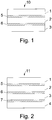
- Fig. 1 an example of a non-inventive multi-layer film 10 with three layers 1, 2 and 3 is shown, wherein the layer 1 to greater than 85 wt .-%, based on the total weight of the layer 1, of PVC; layer 2 is greater than or equal to 95% by weight, based on the total weight of layer 2, of PVDC; and layer 3 is greater than or equal to 95% by weight, based on the total weight of layer 3, of PCTFE.
- the multilayer film 10 comprises one or more primer layers 5 and / or one or more adhesive layers 6, which are arranged between each two of the layers 1, 2 and 3.
- Fig. 2 shows a multilayer film 11 according to the invention, comprising a layer 4, which is greater than or equal to 85 wt .-%, based on the total weight of the layer 4, made of PVC.
- Reference numerals 1, 2 and 3 of Fig. 2 have the same meaning as in Fig. 1 ,
- a primer layer 5 and two adhesive layers 6 and 7 are shown.
- a primer layer 5 and / or an adhesive layer 6, 7 is used depends on the respective method, after which the multilayer film 11 is produced. Primers are used to promote the adhesion of PVDC dispersion coatings and dry laminating adhesives for the bonding of two film webs. If the multilayer film 11 is produced, for example, by means of coextrusion of the layers 1, 2, 3 and 4, eliminates primer and adhesive layers. In the production by means of coextrusion, so-called tie layers are frequently used for the connection of the individual layers.
- the multilayer film 11 may comprise further layers of polymeric materials, aluminum or paper.
- each of the layers 1 and 4 comprises up to 15% by weight and each of the layers 2 and 3 comprises up to 5% by weight of additives, based on the total weight of the respective layer.
- the layers 1, 4 have a thickness of 10 to 400 microns; the layer 2 has a thickness of 9 to 120 ⁇ m; and the layer 3 has a thickness of 15 to 210 ⁇ m.
- the thickness of the layer 2 is in particular 70 to 110 microns and their basis weight is in the range of 120 to 180 g / m 2 .
- WDD M is the water vapor permeability of the multi-layered film
- WDD j is the water vapor permeability of the j-th layer
- N is a natural number greater than or equal to 3 and N indicates the number of layers in the multilayer film.
- the reciprocal of the water vapor permeability of the multilayer film 11 is preferably at least 10%, preferably at least 15%, and in particular at least 20% greater than the sum of the reciprocal values of the water vapor permeabilities of the individual layers.
- the multilayer film 11 has a water vapor permeability of 0.027 to 0.034 g / (m 2 ⁇ 24 h), preferably 0.027 to 0.031 g / (m 2 ⁇ 24 h) at a temperature of 38 ° C and a relative humidity of 90%.
- the water vapor permeability according to DIN ISO 15106-3 is measured.
- the multilayer film 11 has an oxygen permeability of 0.10 to 0.22 cm 3 / (m 2 ⁇ 24h), preferably 0.13 to 0.14 cm 3 / (m 2 x 24 h).
- the oxygen permeability is determined according to DIN ISO 15105-2 Annex A.
- the multilayer film 11 according to the invention is readily deep-drawable and can be sealed on one or both sides.
- the multilayer film 11 is colorless transparent, colored transparent, colored opaque or white opaque.
- the multilayer film 11 according to the invention is additionally distinguished by the fact that, when heated, it has very good thermoforming properties, which far exceed the thermoformability of conventional PVC / PCTFE composite films. Due to the good thermoforming properties of the multilayer film 11 according to the invention, the water vapor barrier is less affected by the deep-drawing process. Thus, the multilayer film 11 according to the invention also has a disproportionately high water vapor barrier ("blister barrier”) even when deep-drawn.
- blister barrier water vapor barrier
- the high oxygen barrier of the multilayer film 11 according to the invention is less affected by the deep-drawing process. Consequently, from the multi-layer film 11 according to the invention by means of thermoforming blister packs can be produced with hitherto unachievable barrier effect against water vapor and oxygen.
- the multilayer film according to the invention is distinguished in particular by the fact that the reciprocal of the water vapor permeability of the multilayer film is at least 10%, preferably at least 15%, and in particular at least 20% greater than the sum of the reciprocal values of the water vapor permeabilities of the individual layers even after the deep-drawing process.
- the thickness or the basis weight of the primer and adhesive layers optionally present in the multilayer film 11 according to the invention has only a small proportion of the total thickness or the basis weight of the multilayer film 11, so that the barrier effect of the primer and adhesive layer is negligible.
- a blister pack is provided with a blister bottom portion of a multilayer film 11 having one or more of the above features.
- the water vapor permeabilities measured on the multilayer films of the invention are at least 8.4% smaller than those due to the combined action of the individual polymer layers, i. the values expected by summation of reciprocals of water vapor permeabilities.
Landscapes
- Chemical & Material Sciences (AREA)
- Composite Materials (AREA)
- Engineering & Computer Science (AREA)
- Mechanical Engineering (AREA)
- Laminated Bodies (AREA)
- Wrappers (AREA)
- Packages (AREA)
Description
- Die vorliegende Erfindung betrifft eine Mehrschichtfolie mit geringer Wasserdampf- und Sauerstoffdurchlässigkeit, die sich insbesondere für Blisterverpackungen für Medikamente eignet.
- Die Barrierewirkung von polymeren Materialien und Folien gegenüber Wasserdampf ist in der Regel unabhängig von der Barrierewirkung gegenüber Sauerstoff. Dementsprechend haben Materialien mit guter Wasserdampfbarriere nicht unbedingt auch eine gute Sauerstoff- und Aromabarriere und umgekehrt. Lediglich Polyvinylidenchlorid (PVDC) weist sowohl gegenüber Sauerstoff wie auch gegenüber Wasserdampf eine Barrierewirkung in einem mittleren bis guten Wertebereich auf. PCTFE, Polyolefine und andere Polymere haben eine gute bis sehr gute Wasserdampfbarriere, aber eine sehr niedrige Sauerstoffbarriere. EVOH (EthylenVinylalkohol-Copolymer) hat eine sehr gute Sauerstoffbarriere, aber eine niedrige Wasserdampfbarriere. Eine marktfähige, d.h. wirtschaftlich herstellbare polymere Verpackungsfolie, die eine hohe Wasserdampfbarriere bei zugleich hoher Sauerstoffbarriere aufweist, ist z.Z. nicht verfügbar. Andererseits erweisen sich moderne Medikamente in zunehmendem Maße als empfindlich gegenüber Wasserdampf und Sauerstoff. Dementsprechend werden an die Barrierewirkung von Verpackungsfolien für Medikamente ständig wachsende Anforderungen gestellt. Während bisher eine hohe Barrierewirkung vor allem gegenüber Wasserdampf benötigt wurde, müssen Verpackungsfolien für moderne Medikamente nun auch eine hohe Barrierewirkung gegenüber Sauerstoff aufweisen.
- Tiefziehbare Kunststofffolien werden in großem Maßstab für die Verpackung von Waren, Lebensmitteln und Medikamenten eingesetzt. Eine wichtige Rolle kommt hierbei den sogenannten Blisterverpackungen zu. Blisterverpackungen weisen eine auf das Produkt abgestimmte Form auf, die durch Tiefziehen einer flachen, vorzugsweise transparenten Kunststofffolie erhalten wird. Der zu dem jeweiligen Produkt bzw. Packgut konforme Teil der Verpackung wird auch als Bodenteil bezeichnet und nach Befüllen mit dem Packgut durch Verschweißen oder Versiegeln mit einer Deckfolie, vorzugsweise einer Aluminiumfolie, verschlossen. Je nach Anwendungszweck muss eine Verpackung bestimmte Anforderungen hinsichtlich ihrer Barrierewirkung gegenüber Wasserdampf, Sauerstoff und ggf. weiteren Gasen, wie Kohlendioxid erfüllen. Beispielsweise wird für eine Vielzahl von Medikamenten eine Verpackung mit einer Wasserdampfdurchlässigkeit von weniger als 0,06 g/(m2·24h) und vereinzelt von weniger als 0,04 g/(m2·24h) gefordert. Bei transparenten Folien ist eine Wasserdampfdurchlässigkeit von weniger als 0,06 g/(m2·24h) lediglich durch die Verwendung von PCTFE als Folienmaterial mit einer Dicke von größer 100 µm erzielbar. Eine Wasserdampfdurchlässigkeit unterhalb von 0,04 g/(m2·24h) war bisher nur mittels Aluminiumfolie, insbesondere mittels der sogenannten "Cold Form Foil" realisierbar. Derartige Aluminiumfolien sind nicht transparent und weisen zudem eine geringe Verformbarkeit auf, so dass kleinere Blister hieraus nicht herstellbar sind und somit eine wesentlich grössere Folienfläche benötigt wird als beim Thermoformblister.
- Neben hoher Barrierewirkung müssen tiefziehbare Kunststofffolien weitere Eigenschaften wie Siegelbarkeit, Schlierenfreiheit, geringe Dicke, gleichmäßiges Dickenprofil und gute Verarbeitbarkeit aufweisen. Für die Verarbeitbarkeit sind vor allem eine gute Verformbarkeit, also eine möglichst gleichmäßige Dickenverteilung des verformten Teils sowie eine vollständige Ausformung, geringe thermische Verwerfung (das sogenannte Curling) und ein kleiner Reibungskoeffizient, d.h. eine gute Gleitfähigkeit gegenüber den in Kontakt kommenden Maschinenteilen und den Packgütern von Vorteil. Curling tritt bei zwei- oder mehrschichtigen Verbundfolien auf, wenn sich die Temperaturausdehnungskoeffizienten (CTE) der einzelnen Schichtmaterialien unterscheiden.
- Thermoformbare Kunststofffolien für Verpackungen mit Barrierewirkung gegenüber Wasserdampf sind im Stand der Technik bekannt.
-
EP 1 655 237 A1 offenbart eine thermo- oder kaltgeformte Blisterverpackung mit einem Blisterbodenteil und einer Deckfolie. Die Deckfolie besteht aus einer 10 bis 30 µm dicken Aluminiumfolie, die auf einer ersten Seite eine von der Aluminiumfolie peelbare Folie aus wenigstens einer Kunststoffschicht auf der Basis von thermo- oder duroplastischen Polymeren und auf der zweiten, gegen das Blisterbodenteil gesiegelten Seite mit einer Kunststofffolie auf der Basis von Polyvinylchlorid (PVC) mit einer Foliendicke von 10 bis 40 µm, oder Polyvinylidenchlorid (PVDC) mit einer Foliendicke von 10 bis 40 µm, oder Polypropylen (PP) mit einer Foliendicke von 6 bis 35 µm, oder Polyethylen (PE) mit einer Foliendicke von 6 bis 35 µm, oder Polyester mit einer Foliendicke von 5 bis 10 µm, oder Polychlortrifluorethylen (PCTFE) mit einer Foliendicke von 8 bis 30 µm, oder Cycloolefin-Copolymeren (COC) oder Cycloolefin-Polymeren (COP) mit einer Dicke von 10 bis 40 µm, beschichtet oder kaschiert ist. Das Blisterbodenteil besteht wenigstens auf der gegen die Deckfolie gesiegelten Seite aus einem Material, dessen chemische Struktur mit derjenigen der gegen das Blisterbodenteil gesiegelten Kunststofffolie kompatibel ist. Die von der Aluminiumfolie peelbare Folie besteht aus einer oder mehreren Schichten aus einem oder mehreren der Kunststoffe PVC, PVDC, PCTFE, PP, PE, Polyester, Polyethylennaphthalat (PEN), Polyamid (PA), COC, COP, Polystyrol (PS) oder Zellglas. -
EP 1 468 817 A1 betrifft eine Deckfolie für Blisterverpackungen mit thermo- oder kaltgeformten Blisterbodenteilen. Die Deckfolie umfasst eine 5 bis 30 µm dicke Aluminiumfolie, die auf einer zur Siegelung gegen ein Blisterbodenteil vorgesehenen Seite mit einer Kunststofffolie auf der Basis von PVC mit einer Foliendicke von 10 bis 40 µm, oder PVDC mit einer Foliendicke von 10 bis 40 µm, oder PP mit einer Foliendicke von 6 bis 35 µm, oder Polyester mit einer Foliendicke von 5 bis 15 µm, oder PCTFE mit einer Foliendicke von 8 bis 76 µm, oder COC mit einer Dicke von 10 bis 40 µm kaschiert ist. Blisterbodenteile bestehen beispielsweise aus Folien aus PVC, PP, PET, PE und aus Verbundfolien wie PVC/ACLAR® (PCTFE), PVC/PVDC und COC oder AI-AI Blister. -
DE 602 09 812 T2 beschreibt eine mindestens einschichtige Polymerfolie, wobei die eine Schicht eine Vinylidenchloridzusammensetzung umfasst, die 100 Gewichtsteile Vinylidenchloridcopolymer; zwischen 0,1 und 10 Gewichtsteile Stabilisator, zwischen 0,1 und 10 Gewichtsteile Schmiermittel, und zwischen 0,1 und 10 Gewichtsteile hydrophilen Ton umfasst. Die Polymerfolie hat beispielsweise eine Struktur vom Typ C/A/B, B/A/D/B oder C/A/D/C wobei A für PVDC steht. -
WO 2008/014862 A1 betrifft eine Packung, umfassend ein wiederverschließbares Behältnis und einen Blister, wobei mindestens eine Innenwandung der Packung mit einem Absorptionsmittel ausgestattet ist. Der Blister umfasst eine Einfach- oder eine Verbundfolie, die aus einer Kombination mehrerer Polymere wie PVC/PVDC, PVC/HDPE, PVC/PCTFE, PP/COC oder PVC/COC/PVDC besteht. Insbesondere wird der Blister aus einfachen und preiswerten Kunststofffolien mit geringer Dicke hergestellt, die eine hohe Durchlässigkeit für Wasserdampf aufweisen. Bevorzugt werden 15 bis 50 µm dicke PVC-, PP- und PET-Folien mit einer Wasserdampfdurchlässigkeit von umgerechnet 17,5 bis 58,3 g/(m2·24h), 4,2 bis 14 g/(m2·24h) bzw. 27 bis 90 g/(m2·24h) eingesetzt. Derartige Folien sind preiswert und lassen sich gut auf herkömmlichen Tiefzieh-Anlagen verarbeiten. -
WO 2008/033404 A2 ;US 2007/0284280 A1 undUS 2005/0139505 A1 offenbaren Blisterpackungen umfassend eine Blisterkomponente mit einer ersten Barriere und ein Bodenteil mit einer zweiten Barriere, wobei die erste Barriere aus einer einfachen oder beschichteten Polymerfolie, aus einem Metallfilm oder aus einem Film-Folien-Laminat besteht. Für die erste und zweite Barriere werden Materialien bzw. Verbundmaterialien wie PVC, PVC/PVDC, PVC/PCTFE, COC, PVC/Aluminium/Nylon, Aluminium, PP, PET und PETG vorgeschlagen. Die erste und zweite Barriere weisen eine Wasserdampfdurchlässigkeit von kleiner 6 g/(m2·24h) und eine Sauerstoffdurchlässigkeit von kleiner 28 cm3/(m2·24h) auf. - Die im Stand der Technik bekannten Folien für Verpackungen weisen eine unzureichende Barrierewirkung gegenüber Wasserdampf und Sauerstoff auf oder erfordern den Einsatz erheblicher Mengen an PCTFE, einer Aluminiumfolie oder anorganischer Additive. Diese Maßnahmen sind im Fall von PCTFE mit erhöhten Kosten verbunden oder beeinträchtigen die Verarbeitbarkeit und sonstige Eigenschaften wie optische Transparenz.
- PCTFE-Folie weist eine sehr gute Wasserdampfbarriere auf, hat aber eine niedrige Sauerstoffbarriere. Durch Erhöhung der Dicke einer PCTFE-Folie kann die Wasserdampfbarriere grundsätzlich gesteigert werden, wegen der indirekten Proportionalität zwischen Materialdicke und Wasserdampfdurchlässigkeit steigt die notwendig PCTFE-Dicke schnell in einen technisch und wirtschaftlich sehr ungünstigen Bereich und eine für anspruchsvolle Verpackungsanwendungen ausreichende Sauerstoffbarriere ist jedoch nicht erzielbar. PVDC andererseits hat zwar eine sehr gute Sauerstoffbarriere, jedoch eine wesentlich geringere Wasserdampfbarriere als PCTFE. Um mit PVDC die gleiche Wasserdampfbarriere wie mit PCTFE zu erreichen, muss die Dicke von PVDC 165 % der Dicke von PCTFE betragen. PVDC-Folien bzw. Schichten werden üblicherweise durch Auftragen von vielen dünnen Lagen hergestellt. Um beispielsweise eine Wasserdampfbarriere von 0.035 g/(m2·24h) (gemessen bei einer Temperatur von 38 °C und einer relativen Luftfeuchtigkeit von 90%) zu erzielen, wäre ein Flächengewicht von etwa 400 g/m2 PVDC erforderlich. Hierfür werden auf einer konventionellen industriellen Beschichtungsanlage 40 Maschinendurchgänge mit einem Auftrag von je 10 g/m2 oder 27 Durchgänge zu 15 g/m2 benötigt. Eine derartig hohe Zahl von Maschinendurchgängen ist weder aus technischen noch wirtschaftlichen Gründen realisierbar. Mit den im Stand der Technik bekannten industriellen Verfahren werden PVDC-Schichten bis zu einem Flächengewicht von maximal 180 g/m2 hergestellt.
- Die Sauerstoffbarriere von PVDC wird nur geringfügig durch den Einfluss von Feuchtigkeit beeinflusst, während z.B. EVOH, welches ebenfalls eine sehr gute Sauerstoffbarriere besitzt, stark unter dem Einfluss von Feuchtigkeit an Sauerstoffbarriere verliert. Der Verlust bei EVOH geht im Extremfall über Zehnerpotenzen. EVOH wird üblicherweise in Lebensmittelverpackungen, neuerdings aber auch in Pharmaverpackungen benutzt.
- Die vorliegende Erfindung hat die Aufgabe, eine Folie bereitzustellen, die eine hohe Barrierewirkung gegenüber Wasserdampf in Kombination mit einer Barrierewirkung gegen Sauerstoff bei zugleich effizientem Materialeinsatz und guter Verarbeitbarkeit bietet und Designanforderungen, z.B. hinsichtlich optischer Transparenz, erfüllt. Insbesondere soll eine Folie geschaffen werden, die sich für die Herstellung von Bodenteilen für Blisterverpackungen eignet.
- Erfindungsgemäß wird die voranstehende Aufgabe durch eine Mehrschichtfolie mit den Merkmalen des Patentanspruchs 1 gelöst. Danach beinhaltet die in Rede stehende Mehrschichtfolie mindestens vier Schichten, umfassend
- eine erste Schicht und eine vierte Schicht mit einer Dicke von 10 bis 400 µm aus einem Polymer ausgewählt aus der Gruppe umfassend Polyvinylchlorid, Copolymere aus Vinylchlorid-Einheiten und einem oder mehreren anderen Monomeren (VC-Copolymere), Gemische aus Polyvinylchlorid und VC-Copolymeren, Polyester, Polyolefine, Polyacrylnitril (PAN), Copolymere aus Acrylnitril-Einheiten und einem oder mehreren anderen Monomeren (AN-Copolymere);
- eine zweite Schicht mit einer Dicke von 9 bis 120 µm aus einem Vinylidenchlorid-Polymer ausgewählt aus der Gruppe umfassend Polyvinylidenchlorid, Copolymere aus Vinylidenchlorid-Einheiten und einem oder mehreren anderen Monomeren (VDC-Copolymere), Gemische aus Polyvinylidenchlorid und VDC-Copolymeren; und
- eine dritte Schicht mit einer Dicke von 15 bis 210 µm aus einem Chlortrifluorethylen-Polymer ausgewählt aus der Gruppe umfassend Polychlortrifluorethylen, Copolymere aus Chlortrifluorethylen-Einheiten und einem oder mehreren anderen Monomeren (CTFE-Copolymere), Gemische aus Polychlortrifluorethylen und CTFE-Copolymeren.
- Für die erste und vierte Schicht werden als Polyester bevorzugt Polyethylenterephthalat (PET), insbesondere amorphes PET (APET) und Copolymere aus Ethylenterephthalat-Einheiten und einem oder mehreren anderen Monomeren verwendet. Ein besonders bevorzugtes Copolymer ist PETG, welches aus Ethylenterephthalat- und Cyclohexandimethanol-Einheiten aufgebaut ist.
- Als Polyolefin für die erste und vierte Schicht sind vor allem Polypropylen (PP), Polyethylen (PE), Cycloolefin-Copolymere (COC) und Cycloolefinpolymere (COP) bevorzugt.
- Im Sinne der Erfindung werden für die Polymere der ersten, zweiten und dritten Schicht die Abkürzungen PVC, PVDC und PCTFE verwendet, wobei
- PVC ein Vinylchlorid-Polymer ausgewählt aus der Gruppe umfassend Polyvinylchlorid, Copolymere aus Vinylchlorid- bzw. Chlorethen-Einheiten und einem oder mehreren anderen Monomeren (VC-Copolymere), Gemische aus Polyvinylchlorid und VC-Copolymeren;
- PVDC ein Vinylidenchlorid-Polymer ausgewählt aus der Gruppe umfassend Polyvinylidenchlorid, Copolymere aus Vinylidenchlorid- bzw. 1,1-Dichlorethen-Einheiten und einem oder mehreren anderen Monomeren (VDC-Copolymere), Gemische aus Polyvinylidenchlorid und VDC-Copolymeren; und
- PCTFE ein Chlortrifluorethylen-Polymer ausgewählt aus der Gruppe umfassend Polychlortrifluorethylen, Copolymere aus Chlortrifluorethylen-Einheiten und einem oder mehreren anderen Monomeren (CTFE-Copolymere), Gemische aus Polychlortrifluorethylen und CTFE-Copolymeren bezeichnet.
- Die Reihenfolge der Schichten im Schichtaufbau ist variierbar. Die Schichten können kombiniert werden, so dass Schichtaufbauten aus PVC/PVDC/PCTFE/PVC, PVC/PCTFE/PVC/PVDC, PVC/PVDC/PVC/PCTFE, sowie äquivalente Schichtaufbauten, bei denen die erste und vierte Schicht anstelle von PVC ein Polyester, Polyolefin, Polyacrylnitril (PAN) oder AN-Copolymer beinhalten, erhalten werden.
- Insbesondere hat die erfindungsgemäße Mehrschichtfolie die Materialzusammensetzung PVC/PVDC/PCTFE/PVC.
- Desweiteren umfasst die Mehrschichtfolie eine oder mehrere Kleberschichten und eine oder mehrere Primerschichten, wobei die einzelne Kleberschicht und/oder die einzelne Primerschicht zwischen je zwei der Schichten angeordnet sind.
- Die Erfindung wird im Folgenden anhand von Figuren näher erläutert; es zeigen:
- Fig. 1
- eine nicht erfindungsgemäße Mehrschichtfolie mit drei Schichten; und
- Fig. 2
- eine Mehrschichtfolie mit vier Schichten.
- In
Fig. 1 ist ein Beispiel einer nicht erfindungsgemäßen Mehrschichtfolie 10 mit drei Schichten 1, 2 und 3 gezeigt, wobei die Schicht 1 zu größer/gleich 85 Gew.-%, bezogen auf das Gesamtgewicht der Schicht 1, aus PVC; die Schicht 2 zu größer/gleich 95 Gew.-%, bezogen auf das Gesamtgewicht der Schicht 2, aus PVDC; und die Schicht 3 zu größer/gleich 95 Gew.-%, bezogen auf das Gesamtgewicht der Schicht 3, aus PCTFE besteht. - Die Mehrschichtfolie 10 umfasst eine oder mehrere Primerschichten 5 und/oder eine oder mehrere Kleberschichten 6, die zwischen je zwei der Schichten 1, 2 und 3 angeordnet sind.
-
Fig. 2 zeigt eine erfindungsgemäße Mehrschichtfolie 11, die eine Schicht 4 umfasst, die zu größer/gleich 85 Gew.-%, bezogen auf das Gesamtgewicht der Schicht 4, aus PVC besteht. Die Bezugszeichen 1, 2 und 3 derFig. 2 haben die gleiche Bedeutung wie inFig. 1 . Zudem sind inFig. 2 eine Primerschicht 5 und zwei Kleberschichten 6 und 7 dargestellt. - Ob eine Primerschicht 5 und/oder eine Kleberschicht 6, 7 verwendet wird, hängt von dem jeweiligen Verfahren ab, nach dem die Mehrschichtfolie 11 hergestellt wird. Primer werden zur Haftvermittlung von PVDC-Dispersionsbeschichtungen und Trockenkaschierklebstoffe zur Verklebung von zwei Folienbahnen eingesetzt. Wird die Mehrschichtfolie 11 z.B. mittels Coextrusion der Schichten 1, 2, 3 und 4 erzeugt, entfallen Primer- und Kleberschichten. Bei der Herstellung mittels Coextrusion werden häufig sogenannte Tie-Layer für die Verbindung der Einzelschichten verwendet.
- Die Schichten 1, 2, 3, 4 der erfindungsgemäßen Mehrschichtfolien 11 können auch in einer anderen Reihenfolge angeordnet sein, beispielsweise in einer der folgenden Konfigurationen:
1/3/4/2 (= PVC/PCTFE/PVC/PVDC); oder 1/2/4/3 (= PVC/PVDC/PVC/PCTFE). - Neben den Schichten 1, 2, 3 und 4 kann die Mehrschichtfolie 11 weitere Schichten aus polymeren Materialien, Aluminium oder Papier umfassen.
- Vorzugsweise umfasst jede der Schichten 1 und 4 bis zu 15 Gew.-% und jede der Schichten 2 und 3 bis zu 5 Gew.-% an Additiven, bezogen auf das Gesamtgewicht der jeweiligen Schicht.
- Die Schichten 1, 4 weisen eine Dicke von 10 bis 400 µm; die Schicht 2 eine Dicke von 9 bis 120 µm; und die Schicht 3 eine Dicke von 15 bis 210 µm auf.
- Die Dicke der Schicht 2 beträgt insbesondere 70 bis 110 µm und ihr Flächengewicht liegt im Bereich von 120 bis 180 g/m2.
- Der Kehrwert der Wasserdampfdurchlässigkeit der Mehrschichtfolie 11 ist um mindestens 5 % größer als die Summe der Kehrwerte der Wasserdampfdurchlässigkeiten der einzelnen Schichten gemäß der Beziehung

- Bevorzugt ist der Kehrwert der Wasserdampfdurchlässigkeit der Mehrschichtfolie 11 um mindestens 10 %, vorzugsweise um mindestens 15 %, und insbesondere um mindestens 20 % größer als die Summe der Kehrwerte der Wasserdampfdurchlässigkeiten der einzelnen Schichten.
- Die Mehrschichtfolie 11 weist bei einer Temperatur von 38 °C und einer relativen Luftfeuchtigkeit von 90 % eine Wasserdampfdurchlässigkeit von 0,027 bis 0,034 g/(m2·24h), vorzugsweise von 0,027 bis 0,031 g/(m2·24h) auf. Im Rahmen der Erfindung wird die Wasserdampfdurchlässigkeit gemäß DIN ISO 15106-3 gemessen.
- Bei einer, im Vergleich zur Messung der Wasserdampfdurchlässigkeit erniedrigten Temperatur von 23 °C und relativen Luftfeuchtigkeit von 50 % weist die Mehrschichtfolie 11 eine Sauerstoffdurchlässigkeit von 0,10 bis 0,22 cm3/(m2·24h), vorzugsweise 0,13 bis 0,14 cm3/(m2·24h) auf. Die Sauerstoffdurchlässigkeit wird gemäß DIN ISO 15105-2 Annex A ermittelt.
- Die erfindungsgemäße Mehrschichtfolie 11 ist gut tiefziehbar und einseitig oder beidseitig siegelbar.
- Bevorzugt ist die Mehrschichtfolie 11 farblos transparent, farbig transparent, farbig opak oder weiß opak ausgestaltet.
- Die erfindungsgemäße Mehrschichtfolie 11 zeichnet sich zudem dadurch aus, dass sie in erwärmtem Zustand sehr gute Tiefzieheigenschaften hat, welche die Tiefziehbarkeit konventioneller PVC/PCTFE-Verbundfolien bei weitem übertreffen. Aufgrund der guten Tiefzieheigenschaften der erfindungsgemäßen Mehrschichtfolie 11 wird die Wasserdampfbarriere durch den Tiefziehvorgang weniger stark beeinträchtigt. Somit weist die erfindungsgemäße Mehrschichtfolie 11 auch in tiefgezogenem Zustand noch eine überproportional hohe Wasserdampfbarriere ("Blisterbarriere") auf.
- Ebenso wie die Wasserdampfbarriere wird auch die hohe Sauerstoffbarriere der erfindungsgemäßen Mehrschichtfolie 11 durch den Tiefziehvorgang weniger stark beeinträchtigt. Folglich können aus der erfindungsgemäßen Mehrschichtfolie 11 mittels Thermoformung Blisterverpackungen mit bislang nicht erzielbarer Barrierewirkung gegenüber Wasserdampf und Sauerstoff hergestellt werden.
- Die erfindungsgemäße Mehrschichtfolie zeichnet sich insbesondere dadurch aus, daß auch nach dem Tiefziehvorgang der Kehrwert der Wasserdampfdurchlässigkeit der Mehrschichtfolie um mindestens 10 %, vorzugsweise um mindestens 15 %, und insbesondere um mindestens 20 % größer ist als die Summe der Kehrwerte der Wasserdampfdurchlässigkeiten der einzelnen Schichten.
- Die Dicke bzw. das Flächengewicht der in der erfindungsgemäßen Mehrschichtfolie 11 optional vorhandenen Primer- und Kleberschichten hat nur einen geringen Anteil an der Gesamtdicke bzw. des Flächengewichtes der Mehrschichtfolie 11, so dass die Barrierewirkung der Primer- und Kleberschicht vernachlässigbar ist.
- Im Rahmen der Erfindung wird eine Blisterverpackung mit einem Blisterbodenteil aus einer Mehrschichtfolie 11 mit einem oder mehreren der voranstehend angeführten Merkmale bereitgestellt.
- Weitere vorteilhafte Ausführungsformen der erfindungsgemäßen Blisterverpackung zeichnen sich dadurch aus, dass:
- das Blisterbodenteil mit einer Folie verschlossen ist, die gegen das Blisterbodenteil gesiegelt ist;
- die gegen das Blisterbodenteil gesiegelte Folie aus Aluminium besteht und vorzugsweise 5 bis 80 µm dick ist;
- die gegen das Blisterbodenteil gesiegelte Folie aus Kunststoff besteht;
- die gegen das Blisterbodenteil gesiegelte Folie eine 5 bis 40 µm dicke Aluminiumfolie ist, die auf der gegen das Blisterbodenteil gesiegelten Seite mit einem Kunststoff beschichtet oder mit einer Kunststofffolie kaschiert ist.
- Auf einer Inline-Anlage mit mehreren Beschichtungs- bzw. Kaschierstationen wurden vier Mehrschichtfolien mit der Materialzusammensetzung PVC/PVDC/PCTFE/PVC gemäß den nachfolgend angegebenen Verfahrensschritten (i) - (iv) hergestellt:
- (i) Beschichten einer ersten PVC-Folie mit Haftvermittler (Primer) zur Vorbereitung für den Auftrag von PVDC-Dispersion;
- (ii) mehrfaches Beschichten mit PVDC-Dispersion bis zu einer kumulativen Flächendichte von 125 bis 160 g/m2 (Trockenauftragsmasse);
- (iii) Aufkaschieren einer PCTFE-Folie auf die PVDC-Schicht unter Verwendung eines ersten Trockenkaschierklebers; und
- (iv) Aufkaschieren einer zweiten PVC-Folie auf die PCTFE-Folie unter Verwendung eines zweiten Trockenkaschierklebers.
-
- a) Messung der Wasserdampfdurchlässigkeit WDDrj von einschichtigen Referenzfolien aus PVC (127 µm dick), aus PCTFE (102 µm dick) und PVDC (75 bzw. 95 µm dick) gemäß DIN ISO 15106-3.
- b) Messung der Wasserdampfdurchlässigkeit WDDMg der Mehrschichtfolie gemäß DIN ISO 15106-3.
- c) Bestimmung der Dicke dj der in der Mehrschichtfolie enthaltenen Polymerschicht durch Vermessung von mikroskopischen Querschnittaufnahmen der Mehrschichtfolie.
- d) Berechnung der Wasserdampfdurchlässigkeit WDDj der in der Mehrschichtfolie enthaltenen Polymerschichten gemäß der Gleichung:

- e) Berechnung der Wasserdampfdurchlässigkeit WDDMb der Mehrschichtfolie in Analogie zu in Reihe geschalteten Widerständen, d.h. als Summe der Kehrwerte der Wasserdampfdurchlässigkeiten WDDj gemäß der Formel:

- Die gemessenen und berechneten Werte für die Wasserdampfdurchlässigkeit der erfindungsgemäß hergestellten Mehrschichtfolien sind in Tabelle 1 gegenübergestellt.
Tabelle 1 # PVC PVDC PCTFE PVC WDDMg WDDMb ΔWDD µm g/m2 µm µm gemessen g/(m2·24h) berechnet g/(m2·24h) = (WDDMb - WDDMg) / WDDMb % 1 127 125,2 102,4 127 0,0333 0,0368 9,5 2 127 125,4 104,2 127 0,0279 0,0363 23,1 3 127 160,7 99,5 127 0,0315 0,0344 8,4 4 127 160,2 101,0 127 0,0279 0,0341 18,2 - Es zeigt sich überraschenderweise, dass die an den erfindungsgemäßen Mehrschichtfolien gemessenen Wasserdampfdurchlässigkeiten um mindestens 8,4 % kleiner sind als die aufgrund der kombinierten Wirkung der einzelnen Polymerschichten, d.h. die durch Summenbildung der Kehrwerte der Wasserdampfdurchlässigkeiten zu erwartenden Werte.
Claims (9)
- Mehrschichtfolie (11) mit mindestens vier Schichten, umfassend- eine erste Schicht (1) und eine vierte Schicht (4) mit einer Dicke von 10 bis 400 µm aus einem Polymer ausgewählt aus der Gruppe umfassend Polyvinylchlorid, Copolymere aus Vinylchlorid-Einheiten und einem oder mehreren anderen Monomeren (VC-Copolymere), Gemische aus Polyvinylchlorid und VC-Copolymeren, Polyethylenterephthalat (PET), Polyacrylnitril (PAN), Copolymere aus Acrylnitril-Einheiten und einem oder mehreren anderen Monomeren (AN-Copolymere);- eine zweite Schicht (2) mit einer Dicke von 9 bis 120 µm aus einem Vinylidenchlorid-Polymer (PVDC) ausgewählt aus der Gruppe umfassend Polyvinylidenchlorid, Copolymere aus Vinylidenchlorid-Einheiten und einem oder mehreren anderen Monomeren (VDC-Copolymere), Gemische aus Polyvinylidenchlorid und VDC-Copolymeren; und- eine dritte Schicht (3) mit einer Dicke von 15 bis 210 µm aus einem Chlortrifluorethylen-Polymer (PCTFE) ausgewählt aus der Gruppe umfassend Polychlortrifluorethylen, Copolymere aus Chlortrifluorethylen-Einheiten und einem oder mehreren anderen Monomeren (CTFE-Copolymere), Gemische aus Polychlortrifluorethylen und CTFE-Copolymeren.
- Mehrschichtfolie (11) nach Anspruch 1, dadurch gekennzeichnet, dass sie eine oder mehrere Kleberschichten (6, 7) und eine oder mehrere Primerschichten (5) umfasst, wobei die Kleberschicht (6, 7) und/oder die Primerschicht (5) zwischen je zwei der Schichten (1, 2, 3, 4) angeordnet sind.
- Mehrschichtfolie (11) nach Anspruch 1, dadurch gekennzeichnet, dass jede der Schichten (1, 4) bis zu 15 Gew.-% und jede der Schichten (2, 3) bis zu 5 Gew.-% an Additiven, bezogen auf das Gesamtgewicht der jeweiligen Schicht, umfasst.
- Mehrschichtfolie (11) nach Anspruch 1, dadurch gekennzeichnet, dass die Dicke der zweiten Schicht (2) 70 bis 110 µm und ihr Flächengewicht 120 bis 180 g/m2 beträgt.
- Mehrschichtfolie (11) nach einem oder mehreren der Ansprüche 1 bis 4, dadurch gekennzeichnet, dass sie einseitig oder beidseitig siegelbar ist und/oder farblos transparent, farbig transparent, farbig opak oder weiß opak ausgestaltet ist.
- Mehrschichtfolie (11) nach Anspruch 2, dadurch gekennzeichnet, dass die Primerschicht (5) ein Flächengewicht von 0,5 bis 20 g/m2 hat und die Kleberschicht (6, 7) ein Flächengewicht von 1 bis 30 g/m2 aufweist.
- Mehrschichtfolie (11) nach einem oder mehreren der Ansprüche 1 bis 6, dadurch gekennzeichnet, dass sie einen Schichtaufbau PVC/PVDC/PCTFE/PVC sowie äquivalente Schichtaufbauten, bei denen die erste und vierte Schicht anstelle von PVC ein Polyester, Polyacrylnitril (PAN) oder AN-Copolymer beinhalten, besitzt.
- Blisterverpackung, dadurch gekennzeichnet, dass sie ein Blisterbodenteil aus einer Mehrschichtfolie gemäß den Ansprüchen 1 bis 7 umfasst.
- Blisterverpackung nach Anspruch 8, dadurch gekennzeichnet, dass das Blisterbodenteil mit einer Folie verschlossen ist, die gegen das Blisterbodenteil gesiegelt ist, wobei die Folie vorzugsweise
aus Aluminium, insbesondere aus Aluminium mit einer Dicke von 5 bis 80 µm; oder aus Kunststoff besteht; oder
eine 5 bis 40 µm dicke Aluminiumfolie ist, die auf der gegen das Blisterbodenteil gesiegelten Seite mit einem Kunststoff beschichtet oder mit einer Kunststofffolie kaschiert ist.
Priority Applications (3)
| Application Number | Priority Date | Filing Date | Title |
|---|---|---|---|
| HRP20181851TT HRP20181851T1 (hr) | 2008-11-06 | 2009-11-03 | Višeslojna folija |
| PL09753028T PL2344401T3 (pl) | 2008-11-06 | 2009-11-03 | Folia wielowarstwowa |
| SI200931890T SI2344401T1 (sl) | 2008-11-06 | 2009-11-03 | Večplastna folija |
Applications Claiming Priority (2)
| Application Number | Priority Date | Filing Date | Title |
|---|---|---|---|
| DE102008056123.1A DE102008056123B4 (de) | 2008-11-06 | 2008-11-06 | Mehrschichtfolie und Blisterverpackung |
| PCT/EP2009/007844 WO2010051960A1 (de) | 2008-11-06 | 2009-11-03 | Mehrschichtfolie |
Publications (2)
| Publication Number | Publication Date |
|---|---|
| EP2344401A1 EP2344401A1 (de) | 2011-07-20 |
| EP2344401B1 true EP2344401B1 (de) | 2018-10-24 |
Family
ID=41572380
Family Applications (1)
| Application Number | Title | Priority Date | Filing Date |
|---|---|---|---|
| EP09753028.1A Active EP2344401B1 (de) | 2008-11-06 | 2009-11-03 | Mehrschichtfolie |
Country Status (15)
| Country | Link |
|---|---|
| US (1) | US8383221B2 (de) |
| EP (1) | EP2344401B1 (de) |
| JP (1) | JP5635003B2 (de) |
| CN (1) | CN102202986B (de) |
| BR (1) | BRPI0921406B1 (de) |
| DE (1) | DE102008056123B4 (de) |
| ES (1) | ES2696541T3 (de) |
| HR (1) | HRP20181851T1 (de) |
| HU (1) | HUE040563T2 (de) |
| MX (1) | MX2011004715A (de) |
| PL (1) | PL2344401T3 (de) |
| PT (1) | PT2344401T (de) |
| RU (1) | RU2516794C2 (de) |
| SI (1) | SI2344401T1 (de) |
| WO (1) | WO2010051960A1 (de) |
Families Citing this family (25)
| Publication number | Priority date | Publication date | Assignee | Title |
|---|---|---|---|---|
| DE102008056123B4 (de) * | 2008-11-06 | 2017-11-16 | Klöckner Pentaplast Gmbh | Mehrschichtfolie und Blisterverpackung |
| CN102615892A (zh) * | 2011-01-27 | 2012-08-01 | 苏州海顺包装材料有限公司 | 一种药用全阻隔透明复合硬片 |
| ITMI20112066A1 (it) * | 2011-11-14 | 2013-05-15 | Altergon Sa | Preparazione farmaceutica orale monodose di ormoni tiroidei t3 e t4 |
| MX358916B (es) * | 2011-11-22 | 2018-09-07 | Danapak Flexibles As | Una hoja, un método para hacer y usar una hoja como tapa para paquetes. |
| WO2014002623A1 (ja) * | 2012-06-26 | 2014-01-03 | 日本合成化学工業株式会社 | 積層体、及びそれを用いた包装体並びにプレススルーパック |
| FR2994851B1 (fr) * | 2012-09-04 | 2015-08-21 | Rexam Healthcare La Verpillier | Dispositif d'injection de liquide pharmaceutique configure pour etre pre-rempli |
| EP2746321B1 (de) | 2012-12-20 | 2016-09-14 | Agfa-Gevaert | Verfahren zur Herstellung einer Sperrfolie für Blisterverpackungen |
| CN102975948B (zh) * | 2012-12-24 | 2015-04-29 | 苏州海顺包装材料有限公司 | 一种聚三氟氯乙烯的泡罩包装膜 |
| US9969899B2 (en) | 2013-02-18 | 2018-05-15 | Honeywell International Inc. | Fluoropolymers containing a copolymerized fluoromonomer and a functional hydrocarbon comonomer and articles made from such fluoropolymers |
| US20160023445A1 (en) * | 2013-03-08 | 2016-01-28 | Bilcare Limited | A multi-layer polymeric film |
| EP2801475A1 (de) | 2013-05-06 | 2014-11-12 | Agfa-Gevaert | Neuartige Blisterpackung für Arzneimittel |
| US20160122100A1 (en) * | 2013-05-17 | 2016-05-05 | Empire Technology Development Llc | Packaging materials and methods for their preparation and use |
| CN105848876B (zh) | 2013-12-23 | 2019-02-12 | 索尔维特殊聚合物意大利有限公司 | 泡罩包装 |
| PL3490799T3 (pl) * | 2016-07-27 | 2022-01-03 | Honeywell International Inc. | Warstwy folii i sposoby ich tworzenia |
| US12162250B2 (en) | 2016-08-15 | 2024-12-10 | Klöckner Pentaplast Of America, Inc. | Hot fill laminate |
| DE102016122818B4 (de) * | 2016-11-25 | 2019-11-28 | Waldemar Schmidt | Co-extrudierte PVC-Lebensmittelverpackungsfolie und Verfahren zu deren Herstellung |
| CN106633288A (zh) * | 2016-11-30 | 2017-05-10 | 四川旭华制药有限公司 | 一种药用包装材料 |
| JP2018154056A (ja) * | 2017-03-17 | 2018-10-04 | 藤森工業株式会社 | 積層体、ブリスター容器、及びプレススルーパッケージ |
| WO2018209331A1 (en) * | 2017-05-12 | 2018-11-15 | Honeywell International Inc. | Copolymers and terpolymers based on chlorotrifluoroethylene and vinyl chloride and uses thereof |
| DE102018112817A1 (de) | 2018-05-29 | 2019-12-05 | Klöckner Pentaplast Gmbh | Transparente Polymerfolie mit Verfärbungskompensation |
| JP7298618B2 (ja) * | 2018-08-24 | 2023-06-27 | Agc株式会社 | フィルムの製造方法、フィルム、積層体及び包装材料 |
| JP2020203482A (ja) * | 2019-06-11 | 2020-12-24 | 株式会社タケトモ | 医薬品用ptp包装体の底材 |
| CN112519359B (zh) * | 2020-11-05 | 2023-02-03 | 江西春光新材料科技股份有限公司 | 一种高阻隔复合硬片及其制备方法 |
| JP2023551656A (ja) | 2020-11-18 | 2023-12-12 | クロックナー、ペンタプラスト、オブ、アメリカ、インコーポレイテッド | 熱成形包装およびその形成方法 |
| EP4321337A1 (de) | 2022-08-10 | 2024-02-14 | SÜDPACK Medica AG | Deckfolie und bodenfolie für eine blisterverpackung sowie blisterverpackung |
Citations (2)
| Publication number | Priority date | Publication date | Assignee | Title |
|---|---|---|---|---|
| JPH01110953A (ja) * | 1987-10-26 | 1989-04-27 | Daicel Chem Ind Ltd | 高防湿積層フイルム |
| US20030203141A1 (en) * | 2002-04-25 | 2003-10-30 | Blum John B. | Blister package |
Family Cites Families (24)
| Publication number | Priority date | Publication date | Assignee | Title |
|---|---|---|---|---|
| KR100235089B1 (en) * | 1992-05-14 | 1999-12-15 | Mitsui Chemicals Inc | Ptp or blister packaging articles and packaging material therefor |
| JPH10193490A (ja) * | 1997-01-06 | 1998-07-28 | Mitsubishi Gas Chem Co Inc | 水性液状物質の包装方法 |
| US6432542B1 (en) * | 1997-11-06 | 2002-08-13 | Alliedsignal Inc. | Multicomponent structures having improved adhesion |
| DE19751817A1 (de) * | 1997-11-21 | 1999-05-27 | Kalle Pentaplast Gmbh | Verfahren zur kontinuierlichen Steuerung des Schrumpfes einer amorphen Folie und eine Anordnung hierfür |
| AR024246A1 (es) * | 1999-03-01 | 2002-09-25 | Johnson & Johnson Vision Care | Contenedor para dispositivo medico. |
| US6218024B1 (en) * | 1999-06-04 | 2001-04-17 | Macro Engineering & Technology Inc. | Multilayer plastic film |
| WO2002084764A1 (en) * | 2001-04-10 | 2002-10-24 | Mitsubishi Materials Corporation | Lithium ion polymer secondary battery, its electrode and method for synthesizing polymer compound in binder used in adhesion layer thereof |
| US6673406B2 (en) | 2001-10-15 | 2004-01-06 | Cryovac, Inc. | High barrier polyvinylidene chloride composition and film |
| DE10309918A1 (de) * | 2003-03-07 | 2004-09-16 | Klöckner Pentaplast B.V., SM Weert | Kunststoff-Folie aus Hartpolyvinylchlorid (HPVC) und Verfahren zu ihrer Herstellung |
| EP1468935A1 (de) * | 2003-04-16 | 2004-10-20 | Alcan Technology & Management Ltd. | Blisterverpackung |
| EP1468817A1 (de) | 2003-04-16 | 2004-10-20 | Alcan Technology & Management Ltd. | Deckfolie für Blisterverpackungen |
| WO2004103255A2 (en) * | 2003-05-20 | 2004-12-02 | Smithkline Beecham Corporation | Child resistant blister packages utilizing walled structures enclosing medicament therein |
| US20050139505A1 (en) * | 2003-12-15 | 2005-06-30 | Miller Mark R. | Child-resistant blister package |
| US20050186372A1 (en) * | 2004-02-20 | 2005-08-25 | Honeywell International Inc. | PCTFE blow molding containers |
| US20050186376A1 (en) * | 2004-02-20 | 2005-08-25 | Honeywell International Inc. | Multilayer sheets and films composed of PCTFE and cyclic olefin copolymer |
| EP1655237A1 (de) | 2004-11-08 | 2006-05-10 | Alcan Technology & Management Ltd. | Deckfolie für Blisterverpackungen |
| DE102005003776B4 (de) * | 2005-01-27 | 2008-11-13 | Klöckner Pentaplast GmbH & Co. KG | Verfahren zur Herstellung einer Folie oder einer Folienbahn, danach hergestellte Folie und deren Verwendung |
| JP2006224588A (ja) * | 2005-02-21 | 2006-08-31 | Sumitomo Bakelite Co Ltd | 包装用多層シート及びプレススルーパック容器 |
| US7939150B2 (en) * | 2005-08-16 | 2011-05-10 | Honeywell International Inc. | Lid stock using oriented fluoropolymers |
| US20070284280A1 (en) * | 2006-06-12 | 2007-12-13 | Patrick Henry Young | Child-resistant blister package |
| WO2008014862A1 (de) * | 2006-08-03 | 2008-02-07 | Merck Patent Gmbh | Packung enthaltend pharmazeutische darreichungsformen |
| US20080067099A1 (en) | 2006-09-14 | 2008-03-20 | Patrick Henry Young | Child resistant blister package |
| EP2033775A1 (de) * | 2007-09-10 | 2009-03-11 | Alcan Technology & Management Ltd. | Thermoformbares Laminat für Blisterbodentelle |
| DE102008056123B4 (de) * | 2008-11-06 | 2017-11-16 | Klöckner Pentaplast Gmbh | Mehrschichtfolie und Blisterverpackung |
-
2008
- 2008-11-06 DE DE102008056123.1A patent/DE102008056123B4/de not_active Expired - Fee Related
-
2009
- 2009-11-03 PL PL09753028T patent/PL2344401T3/pl unknown
- 2009-11-03 HU HUE09753028A patent/HUE040563T2/hu unknown
- 2009-11-03 RU RU2011122666/12A patent/RU2516794C2/ru active
- 2009-11-03 WO PCT/EP2009/007844 patent/WO2010051960A1/de not_active Ceased
- 2009-11-03 BR BRPI0921406-2A patent/BRPI0921406B1/pt not_active IP Right Cessation
- 2009-11-03 HR HRP20181851TT patent/HRP20181851T1/hr unknown
- 2009-11-03 MX MX2011004715A patent/MX2011004715A/es active IP Right Grant
- 2009-11-03 CN CN2009801439988A patent/CN102202986B/zh not_active Expired - Fee Related
- 2009-11-03 SI SI200931890T patent/SI2344401T1/sl unknown
- 2009-11-03 PT PT09753028T patent/PT2344401T/pt unknown
- 2009-11-03 EP EP09753028.1A patent/EP2344401B1/de active Active
- 2009-11-03 ES ES09753028T patent/ES2696541T3/es active Active
- 2009-11-03 JP JP2011533619A patent/JP5635003B2/ja active Active
- 2009-11-03 US US13/127,258 patent/US8383221B2/en active Active
Patent Citations (2)
| Publication number | Priority date | Publication date | Assignee | Title |
|---|---|---|---|---|
| JPH01110953A (ja) * | 1987-10-26 | 1989-04-27 | Daicel Chem Ind Ltd | 高防湿積層フイルム |
| US20030203141A1 (en) * | 2002-04-25 | 2003-10-30 | Blum John B. | Blister package |
Also Published As
| Publication number | Publication date |
|---|---|
| HUE040563T2 (hu) | 2019-03-28 |
| DE102008056123B4 (de) | 2017-11-16 |
| SI2344401T1 (sl) | 2018-12-31 |
| RU2516794C2 (ru) | 2014-05-20 |
| HK1158158A1 (en) | 2012-07-13 |
| EP2344401A1 (de) | 2011-07-20 |
| ES2696541T3 (es) | 2019-01-16 |
| WO2010051960A1 (de) | 2010-05-14 |
| JP5635003B2 (ja) | 2014-12-03 |
| US20110210037A1 (en) | 2011-09-01 |
| PT2344401T (pt) | 2018-11-26 |
| BRPI0921406A2 (pt) | 2015-12-29 |
| RU2011122666A (ru) | 2012-12-20 |
| CN102202986A (zh) | 2011-09-28 |
| HRP20181851T1 (hr) | 2018-12-28 |
| CN102202986B (zh) | 2013-06-26 |
| JP2012507410A (ja) | 2012-03-29 |
| MX2011004715A (es) | 2011-05-30 |
| US8383221B2 (en) | 2013-02-26 |
| BRPI0921406B1 (pt) | 2019-07-02 |
| PL2344401T3 (pl) | 2019-01-31 |
| DE102008056123A1 (de) | 2010-05-12 |
Similar Documents
| Publication | Publication Date | Title |
|---|---|---|
| EP2344401B1 (de) | Mehrschichtfolie | |
| EP1901920B1 (de) | Blisterbodenteil und blisterpackung | |
| EP1682343B1 (de) | Verpackungsmaterial mit einer schicht aus geschäumtem polyolefin | |
| EP3619042A1 (de) | Recyclingfreundliches, einfach reissbares verpackungslaminat mit guter barrierewirkung und verfahren zu dessen herstellung | |
| WO2018202479A1 (de) | Recyclingfreundliches, einfach reissbares verpackungslaminat mit guter barrierewirkung und verfahren zu dessen herstellung | |
| EP3600889B1 (de) | Recycelfreundliches verpackungslaminat mit verbesserter wärmebeständigkeit beim siegeln | |
| WO2000013886A1 (de) | Verpackungsmaterial mit einer schicht aus geschäumtem polyolefin | |
| WO2014194994A1 (de) | Siegelfähige polypropylenfolie | |
| DE102011001929A1 (de) | Verbundfolie zur Herstellung von Formpackungen, Verfahren zum Herstellen einer Verbundfolie und einer Formpackung sowie Formpackung | |
| WO2009000403A1 (de) | Deckfolie für blisterpackungen | |
| EP0858394B1 (de) | Papierähnliche und thermoverformbare mehrschichtenbarrierefolien | |
| WO2009033563A1 (de) | Thermoformbares laminat für blisterbodenteile | |
| EP1167017B1 (de) | Verpackungsfolie mit verbesserter Packungsdichtigkeit, Verfahren zu ihrer Herstellung sowie deren Verwendung als Verpackungsfolie | |
| WO2014144816A1 (en) | Mineral-containing films | |
| EP0755778A1 (de) | Sterilisationsfeste Sperrschichtfolie auf Basis von Polyamiden und Polyolefinen | |
| DE102005051370A1 (de) | Thermoformbare Hochbarrierefolien für Kühlanwendungen | |
| EP0733471B1 (de) | Klebstofffreie, sterilisationsfeste Mehrschichtfolie für Verpackungsanwendungen | |
| EP1833670B1 (de) | Thermoformbare mehrschichtfolien | |
| EP1862299A1 (de) | Deckelverbundfolie, Verfahren zu deren Herstellung und Verwendung bei einer Verpackungseinheit | |
| DE102015100106A1 (de) | Laminat, insbesondere zur Herstellung von Deckelmaterial, Verfahren zu dessen Herstellung sowie Deckelmaterial aus einem solchen Laminat | |
| KR20240019387A (ko) | 고 배리어 코팅된 보드지 | |
| WO2024110323A1 (de) | Retortensterilisierbares lagenmaterial aus überwiegend polypropylen | |
| DE102022005098A1 (de) | Retortensterilisierbares Lagenmaterial aus überwiegend Polypropylen | |
| DE102022005097A1 (de) | Retortensterilisierbares Lagenmaterial aus überwiegend Polypropylen | |
| DE102022005099A1 (de) | Retortensterilisierbares Lagenmaterial aus überwiegend Polypropylen |
Legal Events
| Date | Code | Title | Description |
|---|---|---|---|
| PUAI | Public reference made under article 153(3) epc to a published international application that has entered the european phase |
Free format text: ORIGINAL CODE: 0009012 |
|
| 17P | Request for examination filed |
Effective date: 20110606 |
|
| AK | Designated contracting states |
Kind code of ref document: A1 Designated state(s): AT BE BG CH CY CZ DE DK EE ES FI FR GB GR HR HU IE IS IT LI LT LU LV MC MK MT NL NO PL PT RO SE SI SK SM TR |
|
| AX | Request for extension of the european patent |
Extension state: AL BA RS |
|
| DAX | Request for extension of the european patent (deleted) | ||
| RAP1 | Party data changed (applicant data changed or rights of an application transferred) |
Owner name: KLOECKNER PENTAPLAST GMBH |
|
| 17Q | First examination report despatched |
Effective date: 20160603 |
|
| STAA | Information on the status of an ep patent application or granted ep patent |
Free format text: STATUS: EXAMINATION IS IN PROGRESS |
|
| GRAP | Despatch of communication of intention to grant a patent |
Free format text: ORIGINAL CODE: EPIDOSNIGR1 |
|
| STAA | Information on the status of an ep patent application or granted ep patent |
Free format text: STATUS: GRANT OF PATENT IS INTENDED |
|
| INTG | Intention to grant announced |
Effective date: 20180509 |
|
| GRAS | Grant fee paid |
Free format text: ORIGINAL CODE: EPIDOSNIGR3 |
|
| GRAA | (expected) grant |
Free format text: ORIGINAL CODE: 0009210 |
|
| STAA | Information on the status of an ep patent application or granted ep patent |
Free format text: STATUS: THE PATENT HAS BEEN GRANTED |
|
| AK | Designated contracting states |
Kind code of ref document: B1 Designated state(s): AT BE BG CH CY CZ DE DK EE ES FI FR GB GR HR HU IE IS IT LI LT LU LV MC MK MT NL NO PL PT RO SE SI SK SM TR |
|
| REG | Reference to a national code |
Ref country code: GB Ref legal event code: FG4D Free format text: NOT ENGLISH |
|
| REG | Reference to a national code |
Ref country code: CH Ref legal event code: EP |
|
| REG | Reference to a national code |
Ref country code: HR Ref legal event code: TUEP Ref document number: P20181851 Country of ref document: HR |
|
| REG | Reference to a national code |
Ref country code: IE Ref legal event code: FG4D Free format text: LANGUAGE OF EP DOCUMENT: GERMAN |
|
| REG | Reference to a national code |
Ref country code: AT Ref legal event code: REF Ref document number: 1056409 Country of ref document: AT Kind code of ref document: T Effective date: 20181115 |
|
| REG | Reference to a national code |
Ref country code: DE Ref legal event code: R096 Ref document number: 502009015394 Country of ref document: DE |
|
| REG | Reference to a national code |
Ref country code: PT Ref legal event code: SC4A Ref document number: 2344401 Country of ref document: PT Date of ref document: 20181126 Kind code of ref document: T Free format text: AVAILABILITY OF NATIONAL TRANSLATION Effective date: 20181113 |
|
| REG | Reference to a national code |
Ref country code: HR Ref legal event code: ODRP Ref document number: P20181851 Country of ref document: HR Payment date: 20181126 Year of fee payment: 10 |
|
| REG | Reference to a national code |
Ref country code: HR Ref legal event code: T1PR Ref document number: P20181851 Country of ref document: HR |
|
| REG | Reference to a national code |
Ref country code: ES Ref legal event code: FG2A Ref document number: 2696541 Country of ref document: ES Kind code of ref document: T3 Effective date: 20190116 |
|
| REG | Reference to a national code |
Ref country code: NL Ref legal event code: MP Effective date: 20181024 |
|
| REG | Reference to a national code |
Ref country code: LT Ref legal event code: MG4D |
|
| REG | Reference to a national code |
Ref country code: HU Ref legal event code: AG4A Ref document number: E040563 Country of ref document: HU |
|
| PG25 | Lapsed in a contracting state [announced via postgrant information from national office to epo] |
Ref country code: NL Free format text: LAPSE BECAUSE OF FAILURE TO SUBMIT A TRANSLATION OF THE DESCRIPTION OR TO PAY THE FEE WITHIN THE PRESCRIBED TIME-LIMIT Effective date: 20181024 |
|
| REG | Reference to a national code |
Ref country code: GR Ref legal event code: EP Ref document number: 20180403230 Country of ref document: GR Effective date: 20190320 |
|
| PG25 | Lapsed in a contracting state [announced via postgrant information from national office to epo] |
Ref country code: LT Free format text: LAPSE BECAUSE OF FAILURE TO SUBMIT A TRANSLATION OF THE DESCRIPTION OR TO PAY THE FEE WITHIN THE PRESCRIBED TIME-LIMIT Effective date: 20181024 Ref country code: NO Free format text: LAPSE BECAUSE OF FAILURE TO SUBMIT A TRANSLATION OF THE DESCRIPTION OR TO PAY THE FEE WITHIN THE PRESCRIBED TIME-LIMIT Effective date: 20190124 Ref country code: BG Free format text: LAPSE BECAUSE OF FAILURE TO SUBMIT A TRANSLATION OF THE DESCRIPTION OR TO PAY THE FEE WITHIN THE PRESCRIBED TIME-LIMIT Effective date: 20190124 Ref country code: FI Free format text: LAPSE BECAUSE OF FAILURE TO SUBMIT A TRANSLATION OF THE DESCRIPTION OR TO PAY THE FEE WITHIN THE PRESCRIBED TIME-LIMIT Effective date: 20181024 Ref country code: LV Free format text: LAPSE BECAUSE OF FAILURE TO SUBMIT A TRANSLATION OF THE DESCRIPTION OR TO PAY THE FEE WITHIN THE PRESCRIBED TIME-LIMIT Effective date: 20181024 Ref country code: IS Free format text: LAPSE BECAUSE OF FAILURE TO SUBMIT A TRANSLATION OF THE DESCRIPTION OR TO PAY THE FEE WITHIN THE PRESCRIBED TIME-LIMIT Effective date: 20190224 |
|
| PG25 | Lapsed in a contracting state [announced via postgrant information from national office to epo] |
Ref country code: SE Free format text: LAPSE BECAUSE OF FAILURE TO SUBMIT A TRANSLATION OF THE DESCRIPTION OR TO PAY THE FEE WITHIN THE PRESCRIBED TIME-LIMIT Effective date: 20181024 |
|
| REG | Reference to a national code |
Ref country code: DE Ref legal event code: R097 Ref document number: 502009015394 Country of ref document: DE |
|
| PG25 | Lapsed in a contracting state [announced via postgrant information from national office to epo] |
Ref country code: LU Free format text: LAPSE BECAUSE OF NON-PAYMENT OF DUE FEES Effective date: 20181103 Ref country code: DK Free format text: LAPSE BECAUSE OF FAILURE TO SUBMIT A TRANSLATION OF THE DESCRIPTION OR TO PAY THE FEE WITHIN THE PRESCRIBED TIME-LIMIT Effective date: 20181024 Ref country code: CZ Free format text: LAPSE BECAUSE OF FAILURE TO SUBMIT A TRANSLATION OF THE DESCRIPTION OR TO PAY THE FEE WITHIN THE PRESCRIBED TIME-LIMIT Effective date: 20181024 |
|
| PG25 | Lapsed in a contracting state [announced via postgrant information from national office to epo] |
Ref country code: MC Free format text: LAPSE BECAUSE OF FAILURE TO SUBMIT A TRANSLATION OF THE DESCRIPTION OR TO PAY THE FEE WITHIN THE PRESCRIBED TIME-LIMIT Effective date: 20181024 Ref country code: SK Free format text: LAPSE BECAUSE OF FAILURE TO SUBMIT A TRANSLATION OF THE DESCRIPTION OR TO PAY THE FEE WITHIN THE PRESCRIBED TIME-LIMIT Effective date: 20181024 Ref country code: SM Free format text: LAPSE BECAUSE OF FAILURE TO SUBMIT A TRANSLATION OF THE DESCRIPTION OR TO PAY THE FEE WITHIN THE PRESCRIBED TIME-LIMIT Effective date: 20181024 Ref country code: EE Free format text: LAPSE BECAUSE OF FAILURE TO SUBMIT A TRANSLATION OF THE DESCRIPTION OR TO PAY THE FEE WITHIN THE PRESCRIBED TIME-LIMIT Effective date: 20181024 Ref country code: RO Free format text: LAPSE BECAUSE OF FAILURE TO SUBMIT A TRANSLATION OF THE DESCRIPTION OR TO PAY THE FEE WITHIN THE PRESCRIBED TIME-LIMIT Effective date: 20181024 |
|
| PLBE | No opposition filed within time limit |
Free format text: ORIGINAL CODE: 0009261 |
|
| STAA | Information on the status of an ep patent application or granted ep patent |
Free format text: STATUS: NO OPPOSITION FILED WITHIN TIME LIMIT |
|
| 26N | No opposition filed |
Effective date: 20190725 |
|
| PG25 | Lapsed in a contracting state [announced via postgrant information from national office to epo] |
Ref country code: MT Free format text: LAPSE BECAUSE OF FAILURE TO SUBMIT A TRANSLATION OF THE DESCRIPTION OR TO PAY THE FEE WITHIN THE PRESCRIBED TIME-LIMIT Effective date: 20181024 |
|
| PGFP | Annual fee paid to national office [announced via postgrant information from national office to epo] |
Ref country code: HU Payment date: 20191115 Year of fee payment: 11 |
|
| PGFP | Annual fee paid to national office [announced via postgrant information from national office to epo] |
Ref country code: ES Payment date: 20191204 Year of fee payment: 11 Ref country code: PL Payment date: 20191025 Year of fee payment: 11 |
|
| PGFP | Annual fee paid to national office [announced via postgrant information from national office to epo] |
Ref country code: AT Payment date: 20191119 Year of fee payment: 11 |
|
| REG | Reference to a national code |
Ref country code: HR Ref legal event code: PBON Ref document number: P20181851 Country of ref document: HR Effective date: 20191103 |
|
| PG25 | Lapsed in a contracting state [announced via postgrant information from national office to epo] |
Ref country code: CY Free format text: LAPSE BECAUSE OF FAILURE TO SUBMIT A TRANSLATION OF THE DESCRIPTION OR TO PAY THE FEE WITHIN THE PRESCRIBED TIME-LIMIT Effective date: 20181024 Ref country code: MK Free format text: LAPSE BECAUSE OF NON-PAYMENT OF DUE FEES Effective date: 20181024 |
|
| PG25 | Lapsed in a contracting state [announced via postgrant information from national office to epo] |
Ref country code: GR Free format text: LAPSE BECAUSE OF NON-PAYMENT OF DUE FEES Effective date: 20200609 |
|
| PG25 | Lapsed in a contracting state [announced via postgrant information from national office to epo] |
Ref country code: HR Free format text: LAPSE BECAUSE OF NON-PAYMENT OF DUE FEES Effective date: 20191103 |
|
| PG25 | Lapsed in a contracting state [announced via postgrant information from national office to epo] |
Ref country code: PT Free format text: LAPSE BECAUSE OF NON-PAYMENT OF DUE FEES Effective date: 20200831 |
|
| PG25 | Lapsed in a contracting state [announced via postgrant information from national office to epo] |
Ref country code: SI Free format text: LAPSE BECAUSE OF NON-PAYMENT OF DUE FEES Effective date: 20191104 |
|
| REG | Reference to a national code |
Ref country code: SI Ref legal event code: KO00 Effective date: 20201030 |
|
| REG | Reference to a national code |
Ref country code: AT Ref legal event code: MM01 Ref document number: 1056409 Country of ref document: AT Kind code of ref document: T Effective date: 20201103 |
|
| PG25 | Lapsed in a contracting state [announced via postgrant information from national office to epo] |
Ref country code: AT Free format text: LAPSE BECAUSE OF NON-PAYMENT OF DUE FEES Effective date: 20201103 Ref country code: HU Free format text: LAPSE BECAUSE OF NON-PAYMENT OF DUE FEES Effective date: 20201104 |
|
| REG | Reference to a national code |
Ref country code: ES Ref legal event code: FD2A Effective date: 20220131 |
|
| PG25 | Lapsed in a contracting state [announced via postgrant information from national office to epo] |
Ref country code: ES Free format text: LAPSE BECAUSE OF NON-PAYMENT OF DUE FEES Effective date: 20201104 |
|
| PG25 | Lapsed in a contracting state [announced via postgrant information from national office to epo] |
Ref country code: PL Free format text: LAPSE BECAUSE OF NON-PAYMENT OF DUE FEES Effective date: 20201103 |
|
| REG | Reference to a national code |
Ref country code: DE Ref legal event code: R082 Ref document number: 502009015394 Country of ref document: DE Representative=s name: HOFFMANN - EITLE PATENT- UND RECHTSANWAELTE PA, DE Ref country code: DE Ref legal event code: R082 Ref document number: 502009015394 Country of ref document: DE Representative=s name: HOFFMANN EITLE PATENT- UND RECHTSANWAELTE PART, DE |
|
| PGFP | Annual fee paid to national office [announced via postgrant information from national office to epo] |
Ref country code: TR Payment date: 20221129 Year of fee payment: 14 |
|
| PGFP | Annual fee paid to national office [announced via postgrant information from national office to epo] |
Ref country code: CH Payment date: 20221208 Year of fee payment: 14 Ref country code: BE Payment date: 20221129 Year of fee payment: 14 |
|
| P01 | Opt-out of the competence of the unified patent court (upc) registered |
Effective date: 20230503 |
|
| REG | Reference to a national code |
Ref country code: CH Ref legal event code: PL |
|
| PG25 | Lapsed in a contracting state [announced via postgrant information from national office to epo] |
Ref country code: CH Free format text: LAPSE BECAUSE OF NON-PAYMENT OF DUE FEES Effective date: 20231130 |
|
| PG25 | Lapsed in a contracting state [announced via postgrant information from national office to epo] |
Ref country code: CH Free format text: LAPSE BECAUSE OF NON-PAYMENT OF DUE FEES Effective date: 20231130 |
|
| REG | Reference to a national code |
Ref country code: BE Ref legal event code: MM Effective date: 20231130 |
|
| PG25 | Lapsed in a contracting state [announced via postgrant information from national office to epo] |
Ref country code: BE Free format text: LAPSE BECAUSE OF NON-PAYMENT OF DUE FEES Effective date: 20231130 |
|
| PG25 | Lapsed in a contracting state [announced via postgrant information from national office to epo] |
Ref country code: BE Free format text: LAPSE BECAUSE OF NON-PAYMENT OF DUE FEES Effective date: 20231130 |
|
| PGFP | Annual fee paid to national office [announced via postgrant information from national office to epo] |
Ref country code: DE Payment date: 20251124 Year of fee payment: 17 |
|
| PGFP | Annual fee paid to national office [announced via postgrant information from national office to epo] |
Ref country code: GB Payment date: 20251127 Year of fee payment: 17 |
|
| PGFP | Annual fee paid to national office [announced via postgrant information from national office to epo] |
Ref country code: IT Payment date: 20251124 Year of fee payment: 17 |
|
| PGFP | Annual fee paid to national office [announced via postgrant information from national office to epo] |
Ref country code: FR Payment date: 20251127 Year of fee payment: 17 |
|
| PGFP | Annual fee paid to national office [announced via postgrant information from national office to epo] |
Ref country code: IE Payment date: 20251023 Year of fee payment: 17 |