EP2352331A1 - Procédé, appareil et système pour commutation d appel - Google Patents
Procédé, appareil et système pour commutation d appel Download PDFInfo
- Publication number
- EP2352331A1 EP2352331A1 EP09821533A EP09821533A EP2352331A1 EP 2352331 A1 EP2352331 A1 EP 2352331A1 EP 09821533 A EP09821533 A EP 09821533A EP 09821533 A EP09821533 A EP 09821533A EP 2352331 A1 EP2352331 A1 EP 2352331A1
- Authority
- EP
- European Patent Office
- Prior art keywords
- call
- parameter
- call transfer
- bound
- party service
- Prior art date
- Legal status (The legal status is an assumption and is not a legal conclusion. Google has not performed a legal analysis and makes no representation as to the accuracy of the status listed.)
- Ceased
Links
- 238000000034 method Methods 0.000 title claims abstract description 31
- 230000002457 bidirectional effect Effects 0.000 claims description 38
- 238000004891 communication Methods 0.000 abstract description 3
- 238000005516 engineering process Methods 0.000 abstract description 2
- 230000008569 process Effects 0.000 description 7
- 230000003993 interaction Effects 0.000 description 2
- 238000010295 mobile communication Methods 0.000 description 2
- 230000009977 dual effect Effects 0.000 description 1
- 230000000977 initiatory effect Effects 0.000 description 1
- 238000012986 modification Methods 0.000 description 1
- 230000004048 modification Effects 0.000 description 1
- 230000001960 triggered effect Effects 0.000 description 1
Images


Classifications
-
- H—ELECTRICITY
- H04—ELECTRIC COMMUNICATION TECHNIQUE
- H04M—TELEPHONIC COMMUNICATION
- H04M3/00—Automatic or semi-automatic exchanges
- H04M3/42—Systems providing special services or facilities to subscribers
- H04M3/58—Arrangements for transferring received calls from one subscriber to another; Arrangements affording interim conversations between either the calling or the called party and a third party
-
- H—ELECTRICITY
- H04—ELECTRIC COMMUNICATION TECHNIQUE
- H04M—TELEPHONIC COMMUNICATION
- H04M3/00—Automatic or semi-automatic exchanges
- H04M3/38—Graded-service arrangements, i.e. some subscribers prevented from establishing certain connections
- H04M3/382—Graded-service arrangements, i.e. some subscribers prevented from establishing certain connections using authorisation codes or passwords
-
- H—ELECTRICITY
- H04—ELECTRIC COMMUNICATION TECHNIQUE
- H04W—WIRELESS COMMUNICATION NETWORKS
- H04W4/00—Services specially adapted for wireless communication networks; Facilities therefor
- H04W4/16—Communication-related supplementary services, e.g. call-transfer or call-hold
Definitions
- the present invention relates to communication technologies, and in particular, to a method, an apparatus, and a system for call transfer.
- call transfer service When a call is underway between two users, one of the users transfers the call to a third party, and the third party continues the call with the other user, which is known as call transfer service.
- a call is transferred between different parties through Explicit Call Transfer (ECT).
- ECT Explicit Call Transfer
- one party presses hookflash so that the other party is held and hears a call hold tone, and then the party that presses hookflash dials the number of a third party.
- the party who triggers the call transfer service quits the call, and the call between the other party and the third party is established, namely, the call is transferred.
- UE User Equipment
- UE B When a call is underway between User Equipment (UE) A and UE B, UE A presses hookflash, and UE B is held; UE B hears the hold tone, and UE A calls UE C; after UE C rings or goes off-hook, UE A quits the call, establishing the call between UE C and UE B.
- UE User Equipment
- the embodiments of the present invention provide a method, an apparatus, and a system for call transfer between different parties without interruption.
- the technical solution under the present invention is as follows:
- FIG. 1 is a flow chart of a call transfer method provided in Embodiment 1 of the present invention. As shown in FIG. 1 , the call transfer method in this embodiment includes the following steps:
- the UE which has subscribed to the call transfer service dials an access code (namely, sends dialing information that includes the access code) while being in a call with the other UE, thus establishing the call between the other UE and a third UE. Therefore, the call is transferred to the third party without interruption, and the user experience is not affected.
- an access code namely, sends dialing information that includes the access code
- the call transfer method in this embodiment is applicable to an Internet Protocol Multimedia Subsystem (IMS), a Public Switched Telephone Network (PSTN), or a Public Land Mobile Network (PLMN), and other systems.
- IMS Internet Protocol Multimedia Subsystem
- PSTN Public Switched Telephone Network
- PLMN Public Land Mobile Network
- IMS Internet Protocol Multimedia Subsystem
- PSTN Public Switched Telephone Network
- PLMN Public Land Mobile Network
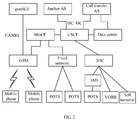
- FIG. 2 shows an IMS-based network architecture for implementing call transfer in Embodiment 1 of the present invention.
- a Global System for Mobile Communications Service Control Function gsmSCF
- an Anchor Application Server anchor AS
- the gsmSCF is connected with the Global System for Mobile Communications (GSM) through a Customized Application for Mobile Network Enhanced Logic (CAMEL) interface.
- GSM Global System for Mobile Communications
- CAMEL Customized Application for Mobile Network Enhanced Logic
- the GSM network serves various mobile terminals such as mobile phones.
- the anchor AS is connected with a Call Session Control Function (CSCF) through an Internal Service Control (ISC) interface.
- CSCF Call Session Control Function
- ISC Internal Service Control
- the CSCF is a core network element in the IMS and is used for triggering the call transfer service.
- the CSCF is connected with a Voice over Broad Band (VOBB) and a soft terminal through a Session Border Controller (SBC).
- VOBB Voice over Broad Band
- SBC Session Border Controller
- POTS Plain Old Telephone Service
- IAD Integrated Access Device
- a Media Gateway Control Function is also a core network element in the IMS, and is used for interworking with the devices in the existing network so that the mobile users and the fixed users in the existing network can access the IMS through the CSCF.
- the MGCF is connected with the terminals such as POTS terminals through the fixed network to provide the call transfer service for the users in the existing network.
- the existing network includes a GSM, Universal Mobile Telecommunications System (UMTS), Code-Division Multiple Access (CDMA) network, or Time Division Code-Division Multiple Access (TD-CDMA) system.
- a call transfer Application Server is a core control network element on the network side, and is used for implement the functions such as registration, authentication, call control, service triggering, and charging.
- the call transfer AS is used for implementing the call transfer service provided herein.
- a data center is used for storing user data and service data of call transfer service.
- the data center may be a Home Subscriber Server (HSS) in the IMS, or an internal database in the call transfer AS.
- HSS Home Subscriber Server
- the call transfer service provided herein is intended for the mobile users in the existing network, fixed users in the existing network, or IMS users; and the terminals involved in the call transfer service may be a mobile phone, a fixed telephone set, or a soft terminal.
- the user when a user needs to subscribe to a call transfer service, the user sends the call transfer service data subscribed to by the UE which is held by the user to the call transfer AS.
- the user may subscribe to the call transfer service of an operator through a portal website of the operator or through short messages.
- a Business Operation Support System (BOSS) of the operator registers the call transfer service data subscribed to by the user onto the call transfer AS through a service distribution gateway, and the call transfer AS stores the call transfer service data.
- the BOSS may also store the call transfer service data in a data center.
- the call transfer service data includes an identifier of a UE, for example, Internet Protocol Multimedia Public User Identifier (IMPU).
- IMPU Internet Protocol Multimedia Public User Identifier
- the call transfer service data may include parameters such as "bound user”, “bidirectional binding?", “enter three-party service?", and “three-party service duration", or any combination thereof.
- the call transfer service data may include:
- the identifiers of the parameters are not limited. For example, the foregoing parameters may be identified as “IMPU”, “BIMPU”, “BOTH”, “3PTY”, and “3PTYT” respectively.
- the names and meanings of the parameters are shown in Table 1.
- Table 1 Parameter identifier Parameter name Description IMPU IMPU This parameter indicates an IMPU of the service subscriber; both SIP URI and TEL URI are supported; this field is mandatory.
- BIMPU Bound user This parameter indicates the number of the bound user; multiple user numbers may be bound, or, no bound user number is input; the default value of this parameter is "null".
- a bound user is not necessarily an IMS user. When a bound user is not an IMS user, only unidirectional binding is practicable.
- BOTH Bidirectional binding When a user registers a service, the user may select bidirectional binding or not; if the user selects "Yes”, the service data of both the user (service subscriber) and the bound user is updated; if the user selects "No", the service data of only the user (service subscriber) is updated; the default value of this parameter is "No”.
- ATS Automatic Transfer Switch
- 3PTYT Three-party service duration This parameter indicates the duration which begins when the call is transferred to the three-party successfully and terminates when the ATS of the transferor releases the call automatically; the default value is "null", indicating that the ATS of the transferor does not release the call.
- This parameter "Bound user” is designed to set a number of the bound user. Multiple user numbers may be bound; or, no bound user number is input. The default value of this parameter is "null", indicating that no bound user exists.
- a bound user is not necessarily an IMS user. When a bound user is not an IMS user, only unidirectional binding is practicable.
- the parameter "Bidirectional binding?" if a user select "Yes”, the service data of both the user and the bound user is updated; if the user selects "No", the service data of only the user is updated.
- the default value of this parameter is "No". Specifically, if the user expects bidirectional binding, the parameter "Bound user” of the user is set to a number of the bound user; the parameter “Bidirectional binding?" is set to "Yes”; the parameter “Bound user” of the bound user is set to a number of the user; the parameter “Bidirectional binding?” of the bound user is set to "Yes”; if the user expects no bidirectional binding, the parameter "Bound user” of the user is set to a number of the bound user (if no bound user exists, this parameter is null), and the parameter "Bidirectional binding?" is set to "No".
- the parameter "Enter three-party service” indicates whether to enter the three-party service after the call is transferred successfully; the default value is "Yes”; if "No” is selected, the network releases the call of the transferor automatically after the destination party answers the call.
- the parameter "Three-party service duration” indicates the duration which begins when the call is transferred to the three-party successfully and terminates when the ATS of the transferor releases the call automatically; the default value is "null", indicating that the ATS of the transferor does not release the call.
- FIG. 3 shows interaction in a call transfer method provided in Embodiment 1 of the present invention. Based on the foregoing scenario, as shown in FIG. 3 , the call transfer process is as follows:
- the dialing information may be an access code of the call transfer service, or may be a combination of the access code of the call transfer service and a third-party number (namely, a number of a UE to which the call is transferred); if any bound user exists in the call service data subscribed to by UE A, the user of UE A may dial the access code to initiate a call to the bound user directly; if no bound user exists in the call service data subscribed to by UE A, the user of UE A may dial "access code + third-party number" to initiate a call to the third party.
- the access code is a service code published by the operator to the user who has subscribed to the call transfer service. That is, the user can dial this access code to trigger the call transfer service.
- the access code is configurable, for example, configured as " *17#".
- the access network element involved in this step may be an MGCF entity or an Access Gateway (AG) entity based on a Session Initiation Protocol (SIP).
- SIP Session Initiation Protocol
- the access network element reports the user's dialing information to the AS after detecting the in-band DTMF mode signal.
- the dialing information may be sent through an INFO message or using other methods.
- the AS After receiving the user's dialing information, the AS analyzes the user's dialing information. If the dialing information includes an access code of the call transfer service, the AS checks whether the user has subscribed to the call transfer service. If the user has not subscribed to the call transfer service, the AS returns a failure message; if the user has subscribed to the call transfer service, the AS checks whether the dialing information includes only the access code. If the dialing information includes only the access code, the AS checks whether any bound user exists in the call transfer service data subscribed to by the user. If no bound user exists, the AS returns a failure message; if any bound user exists, the AS initiates a call to the bound user.
- the AS checks whether the dialing information includes an access code and a third-party number; and, if the dialing information also includes a third-party number, the AS initiates a call to the third party; if the dialing information does not include a third-party number, the AS returns a failure message.
- the AS initiates a call to UE C.
- the details of this step are: 203a) The AS initiates a call to UE C by sending a SIP INVITE message; 203b) UE C returns a 180 (ring) message and a 200 (off-hook) message to the AS after receiving the INVITE message; and 203c) The AS returns an acknowledgement (ACK) message to UE C after receiving the off-hook message, thus finishing the call process.
- ACK acknowledgement
- the call can be transferred between UE A and UE C reciprocally, namely, UE C can transfer the call back to UE A.
- the network checks the setting of the parameter "Enter three-party service" in the call transfer service data subscribed to by UE A. If the parameter is set to "No", the network releases the call of UE A, and puts through the call between UE B and UE C; if the parameter is set to "Yes", the network needs to apply to a Multimedia Resource Function (MRF) for conference resources, add UE A, UE B, and UE C into the call for the three-party service, as detailed below:
- MRF Multimedia Resource Function
- the AS sends the reINVITE messages to UE A, UE B, and UE C respectively through their respective access network elements. If UE A, UE B, and UE C are ordinary terminals such as POTS, the AS sends the reINVITE messages to their respective access network elements.
- UE A, UE B, and UE C return 200 messages to the AS respectively.
- the messages carry SDPa parameter, SDPb parameter, and SDPc parameter respectively.
- the media is renegotiated between the MRF and the UEs, thus realizing the three-party service.
- Any media negotiation mode compliant with the SIP media negotiation principles is appropriate.
- UE A may go on-hook to transfer the call; or, upon expiry of the three-party service duration set in the call transfer service data, the AS releases the call of UE A automatically to transfer the call.
- the call between UE A and UE B is held on without interruption in the whole transferring process.
- the call is transferred from UE A to UE C without interrupting the call between UE A and UE B, which makes it unnecessary for the opposite user to hear the call hold tone and brings good calling experience to the users. Meanwhile, because bound users are set, the vulnerability to errors caused by direct dialing of the third-party number is prevented.
- the network or the UE itself (UE A) releases the call only after the transfer target (UE C) answers the call or enters the three-party service. This ensures success of transferring the call and solves the problem in the prior art that a call cannot be established due to failure of media negotiation when the service subscriber quits the call.
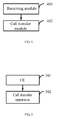
- FIG. 4 shows a structure of a call transfer apparatus provided in Embodiment 2 of the present invention.
- a call transfer apparatus provided in this embodiment includes:
- the receiving module 401 is configured to receive the call transfer service data subscribed to by the UE, where the call transfer service data includes an identifier of the UE, for example, IMPU.
- the call transfer service data received by the receiving module 401 includes:
- the call transfer module 402 is configured to transfer the call to a bound UE corresponding to the number according to the access code received by the receiving module 401; if the call transfer service data received by the receiving module 401 includes a parameter "Bidirectional binding?", the call transfer module 402 is configured to transfer the call between the UE and the bound UE reciprocally if bidirectional binding is applied according to the access code received by the receiving module 401; if the call transfer service data received by the receiving module 401 includes a parameter "Enter three-party service?”, the call transfer module 402 is configured to add a UE corresponding to the dialing information into a call between the UE and the other UE if the call needs to enter a three-party service according to the access code received by the receiving module 401; if the call transfer service data received by the receiving module 401 includes a parameter "Three-party service duration", the call transfer module 40
- the dialing information received by the receiving module 401 further includes a number of a transfer target UE; and the call transfer module 402 is configured to transfer the call to the transfer target UE corresponding to the number.
- the call transfer apparatus provided in this embodiment is based on the same conception as the call transfer AS in the embodiment above for a call transfer method. For the detailed working method of the apparatus, see the embodiment above.
- the call transfer apparatus provided in this embodiment transfers the call without interruption, brings good calling experience to the users, ensures success of call transfer, and avoids errors that tend to occur in dialing. Because the call is transferred without interruption, the opposite user need not hear the call hold tone, and enjoys better calling experience.
- FIG. 5 shows a structure of a call transfer system provided in the Embodiment 3 of the present invention.
- a call transfer system provided in this embodiment includes a UE 501 and a call transfer apparatus 502:
- the UE 501 is configured to send subscribed call transfer service data to the call transfer apparatus 502, where the call transfer service data includes an identifier of the UE 501; and the call transfer apparatus 502 is configured to receive the call transfer service data sent by the UE 501.
- the subscribed call transfer service data sent by the UE 501 to the call transfer apparatus 502 includes:
- the call transfer apparatus 502 is configured to receive the call transfer service data sent by the UE 501, and transfer the call of the UE 501 to the bound UE corresponding to the number; if the subscribed call transfer service data sent by the UE 501 to the call transfer apparatus 502 includes the parameter "Bidirectional binding?", the call transfer apparatus 502 is configured to receive the call transfer service data sent by the UE 501, and transfer the call between the UE 501 and the bound UE reciprocally if bidirectional binding is set; if the subscribed call transfer service data sent by the UE 501 to the call transfer apparatus 502 includes the parameter "Enter three-party service?", the call transfer apparatus 502 is configured to receive the call transfer service data sent by the UE 501, and add a UE corresponding to the dialing information into a call between the UE 501 and the other UE
- the dialing information sent by the UE 501 to the call transfer apparatus 502 includes a number of a transfer target UE; and the call transfer apparatus 502 is configured to transfer the call of the UE 501 to a transfer target UE corresponding to the number according to the access code.
- the UE and the call transfer apparatus in the call transfer system provided in this embodiment are based on the same conception as UE A and the call transfer AS in the embodiment above for a call transfer method. For detailed working processes, see the embodiment above.
- the call transfer system provided in this embodiment transfers the call without interruption, brings good calling experience to the users, ensures success of call transfer, and avoids errors that tend to occur in dialing. Because the call is transferred without interruption, the opposite user need not hear the call hold tone, and enjoys better calling experience.
- All or part of the contents in the technical solution provided in the foregoing embodiments may be implemented through software, and the software is stored in a readable storage medium such as computer hard disk, floppy disk, or CD-ROM.
Landscapes
- Engineering & Computer Science (AREA)
- Signal Processing (AREA)
- Computer Security & Cryptography (AREA)
- Mobile Radio Communication Systems (AREA)
- Telephonic Communication Services (AREA)
Applications Claiming Priority (2)
| Application Number | Priority Date | Filing Date | Title |
|---|---|---|---|
| CNA2008101729526A CN101389077A (zh) | 2008-10-24 | 2008-10-24 | 一种通话切换的方法、装置和系统 |
| PCT/CN2009/073063 WO2010045812A1 (fr) | 2008-10-24 | 2009-08-04 | Procédé, appareil et système pour commutation d’appel |
Publications (2)
| Publication Number | Publication Date |
|---|---|
| EP2352331A1 true EP2352331A1 (fr) | 2011-08-03 |
| EP2352331A4 EP2352331A4 (fr) | 2012-02-22 |
Family
ID=40478194
Family Applications (1)
| Application Number | Title | Priority Date | Filing Date |
|---|---|---|---|
| EP09821533A Ceased EP2352331A4 (fr) | 2008-10-24 | 2009-08-04 | Procédé, appareil et système pour commutation d appel |
Country Status (3)
| Country | Link |
|---|---|
| EP (1) | EP2352331A4 (fr) |
| CN (1) | CN101389077A (fr) |
| WO (1) | WO2010045812A1 (fr) |
Cited By (3)
| Publication number | Priority date | Publication date | Assignee | Title |
|---|---|---|---|---|
| CN102394992A (zh) * | 2011-11-07 | 2012-03-28 | 华为技术有限公司 | 一种终端通话切换方法和装置 |
| CN104427288A (zh) * | 2013-08-26 | 2015-03-18 | 联想(北京)有限公司 | 一种信息处理的方法及服务器 |
| CN104427288B (zh) * | 2013-08-26 | 2018-08-31 | 联想(北京)有限公司 | 一种信息处理的方法及服务器 |
Families Citing this family (14)
| Publication number | Priority date | Publication date | Assignee | Title |
|---|---|---|---|---|
| CN101389077A (zh) * | 2008-10-24 | 2009-03-18 | 华为技术有限公司 | 一种通话切换的方法、装置和系统 |
| CN101888381B (zh) * | 2010-06-29 | 2013-07-03 | 北京邮电大学 | 一种跨网络、跨运营商的实现终端切换的通信系统和方法 |
| CN101895553B (zh) * | 2010-07-21 | 2015-04-01 | 中兴通讯股份有限公司 | 会话启动协议sip终端参加多媒体会议的方法及系统 |
| CN102571718A (zh) * | 2010-12-20 | 2012-07-11 | 中国移动通信集团浙江有限公司 | 基于ims网络的语音通话切换方法和切换应用服务器 |
| CN102123211B (zh) * | 2011-02-22 | 2015-04-01 | 中兴通讯股份有限公司 | 一种多方通话业务的实现方法和系统 |
| WO2012155483A1 (fr) * | 2011-05-16 | 2012-11-22 | 中兴通讯股份有限公司 | Procédé, serveur et système de mise en attente d'appels dans un service de central centralisé sur un domaine de sous-système multimédia sous protocole internet (ims) |
| CN102497627B (zh) * | 2011-11-14 | 2018-03-13 | 中兴通讯股份有限公司 | 自由切通话业务的实现方法和系统 |
| CN103139529B (zh) * | 2013-02-22 | 2015-10-21 | 青岛海信宽带多媒体技术有限公司 | Sip服务器、视频通话设备间的视频通话切换方法 |
| CN104580119B (zh) * | 2013-10-28 | 2018-04-27 | 华为技术有限公司 | 音视频通话方法、设备和系统 |
| CN106506885A (zh) * | 2016-09-24 | 2017-03-15 | 深圳市潮流网络技术有限公司 | 一种无感知电话转接方法 |
| CN107197111B (zh) * | 2017-07-21 | 2019-12-31 | 迈普通信技术股份有限公司 | 呼叫转接方法、系统及ippbx |
| CN108924191A (zh) * | 2018-06-15 | 2018-11-30 | 青岛宇硕云联信息科技有限公司 | 通话方法及系统 |
| CN110267219B (zh) * | 2019-07-02 | 2021-10-01 | 中国联合网络通信集团有限公司 | 呼叫转移上报方法、寄存器、用户终端和区块链网络 |
| CN115883723A (zh) * | 2021-08-11 | 2023-03-31 | 中国移动通信有限公司研究院 | 商业电话实现方法、装置、设备及存储介质 |
Family Cites Families (8)
| Publication number | Priority date | Publication date | Assignee | Title |
|---|---|---|---|---|
| US6853718B1 (en) * | 2002-05-29 | 2005-02-08 | Bellsouth Intellectual Property Corporation | System and method for efficient telephone call transfer |
| US7203299B1 (en) * | 2003-04-30 | 2007-04-10 | Verizon Services Corp. | Methods and apparatus for using AIN techniques to forward answered calls to one of a plurality of voice mailboxes |
| US7164762B2 (en) * | 2003-10-01 | 2007-01-16 | At&T Corp. | Enhanced call feature service |
| FI20041630A0 (fi) * | 2004-12-20 | 2004-12-20 | Nokia Corp | Menetelmä ja laitteisto laitteen vaihtamiseksi aktiivisen yhteyden aikana |
| CN101087241B (zh) * | 2006-06-06 | 2011-04-20 | 华为技术有限公司 | 一种第三方控制业务的实现方法 |
| CN101080083A (zh) * | 2006-05-26 | 2007-11-28 | 华为技术有限公司 | 一种呼叫转向方法及系统 |
| CN101227304B (zh) * | 2007-01-19 | 2010-12-08 | 中兴通讯股份有限公司 | 询问转接业务实现方法和装置 |
| CN101389077A (zh) * | 2008-10-24 | 2009-03-18 | 华为技术有限公司 | 一种通话切换的方法、装置和系统 |
-
2008
- 2008-10-24 CN CNA2008101729526A patent/CN101389077A/zh active Pending
-
2009
- 2009-08-04 WO PCT/CN2009/073063 patent/WO2010045812A1/fr not_active Ceased
- 2009-08-04 EP EP09821533A patent/EP2352331A4/fr not_active Ceased
Cited By (3)
| Publication number | Priority date | Publication date | Assignee | Title |
|---|---|---|---|---|
| CN102394992A (zh) * | 2011-11-07 | 2012-03-28 | 华为技术有限公司 | 一种终端通话切换方法和装置 |
| CN104427288A (zh) * | 2013-08-26 | 2015-03-18 | 联想(北京)有限公司 | 一种信息处理的方法及服务器 |
| CN104427288B (zh) * | 2013-08-26 | 2018-08-31 | 联想(北京)有限公司 | 一种信息处理的方法及服务器 |
Also Published As
| Publication number | Publication date |
|---|---|
| CN101389077A (zh) | 2009-03-18 |
| WO2010045812A1 (fr) | 2010-04-29 |
| EP2352331A4 (fr) | 2012-02-22 |
Similar Documents
| Publication | Publication Date | Title |
|---|---|---|
| EP2352331A1 (fr) | Procédé, appareil et système pour commutation d appel | |
| EP2081359B1 (fr) | Système et procédé de contrôle d'accès de réseau personnel | |
| CN101986737B (zh) | 一种在一号多机多终端间相互切换且不中断通话的方法 | |
| CN102387267B (zh) | 融合呼叫方法及系统 | |
| EP1874016A1 (fr) | Procede pour realiser un signal de rappel dans un systeme de communication | |
| US8705710B2 (en) | Methods and systems for telephony call completion | |
| US20060153353A1 (en) | Intelligent secondary call treatment for advanced calling scenarios | |
| CN102469427B (zh) | 一种一号通业务的实现方法、系统及装置 | |
| CN101764802A (zh) | 在通话期间播放多媒体铃音的方法、服务器及终端设备 | |
| US8320548B2 (en) | Method for processing the busyness of flexible alert group with multi-user type | |
| US20080043720A1 (en) | Telecommunications system and method of session initiation protocol (SIP) based communications between endpoints | |
| WO2009097032A1 (fr) | Gestion de l'acheminement d'appels dans un système de communication utilisant un protocole internet | |
| KR20140047560A (ko) | VoLTE 음성 통화시 음성 및 영상 링백톤 서비스를 제공하는 시스템 및 방법 | |
| US8320362B2 (en) | Telecommunications system and method of initiating file transfers from voice endpoints | |
| US20080070528A1 (en) | Mid-Call Features | |
| EP2342882B1 (fr) | Services de réponse d'appel dans réseaux ims d'entreprises | |
| KR20180135756A (ko) | 회의 통화 호 처리 서버 및 그 방법 | |
| CN102664863B (zh) | 终端实现呼叫等待的方法、装置和系统 | |
| EP2203026B1 (fr) | Procédé, système et dispositif de traitement d'appel de service de numéro unitaire | |
| CN115361362A (zh) | 基于ims的煤矿通话系统和方法 | |
| US11070678B2 (en) | Establishing a telephony session | |
| CN101119527B (zh) | 一号双机业务中用户自主选择接听终端的方法 | |
| CN101742362A (zh) | 一种智能同振方法、装置和系统 | |
| KR101172821B1 (ko) | 화상 전화 서비스의 불완료 호 개선 방법 | |
| KR101102696B1 (ko) | 화상 전화 서비스의 불완료 호 개선 방법 |
Legal Events
| Date | Code | Title | Description |
|---|---|---|---|
| PUAI | Public reference made under article 153(3) epc to a published international application that has entered the european phase |
Free format text: ORIGINAL CODE: 0009012 |
|
| 17P | Request for examination filed |
Effective date: 20110519 |
|
| AK | Designated contracting states |
Kind code of ref document: A1 Designated state(s): AT BE BG CH CY CZ DE DK EE ES FI FR GB GR HR HU IE IS IT LI LT LU LV MC MK MT NL NO PL PT RO SE SI SK SM TR |
|
| DAX | Request for extension of the european patent (deleted) | ||
| A4 | Supplementary search report drawn up and despatched |
Effective date: 20120119 |
|
| RIC1 | Information provided on ipc code assigned before grant |
Ipc: H04W 36/00 20090101AFI20120113BHEP Ipc: H04M 3/38 20060101ALI20120113BHEP Ipc: H04M 3/58 20060101ALI20120113BHEP Ipc: H04M 3/54 20060101ALI20120113BHEP Ipc: H04W 88/18 20090101ALI20120113BHEP |
|
| 17Q | First examination report despatched |
Effective date: 20130829 |
|
| STAA | Information on the status of an ep patent application or granted ep patent |
Free format text: STATUS: EXAMINATION IS IN PROGRESS |
|
| REG | Reference to a national code |
Ref country code: DE Ref legal event code: R003 |
|
| STAA | Information on the status of an ep patent application or granted ep patent |
Free format text: STATUS: THE APPLICATION HAS BEEN REFUSED |
|
| 18R | Application refused |
Effective date: 20190115 |