EP2355314A1 - Moteur linéaire électrique - Google Patents
Moteur linéaire électrique Download PDFInfo
- Publication number
- EP2355314A1 EP2355314A1 EP10001197A EP10001197A EP2355314A1 EP 2355314 A1 EP2355314 A1 EP 2355314A1 EP 10001197 A EP10001197 A EP 10001197A EP 10001197 A EP10001197 A EP 10001197A EP 2355314 A1 EP2355314 A1 EP 2355314A1
- Authority
- EP
- European Patent Office
- Prior art keywords
- stator
- active
- rotor
- linear motor
- linear
- Prior art date
- Legal status (The legal status is an assumption and is not a legal conclusion. Google has not performed a legal analysis and makes no representation as to the accuracy of the status listed.)
- Withdrawn
Links
- 239000011521 glass Substances 0.000 claims abstract description 51
- 238000004804 winding Methods 0.000 claims abstract description 18
- 230000033001 locomotion Effects 0.000 claims description 12
- 230000009471 action Effects 0.000 claims description 2
- 230000000295 complement effect Effects 0.000 claims description 2
- 230000001788 irregular Effects 0.000 claims description 2
- 239000011295 pitch Substances 0.000 description 15
- 238000003825 pressing Methods 0.000 description 10
- 238000007496 glass forming Methods 0.000 description 5
- 238000001816 cooling Methods 0.000 description 3
- 230000004907 flux Effects 0.000 description 3
- 238000000465 moulding Methods 0.000 description 3
- XEEYBQQBJWHFJM-UHFFFAOYSA-N Iron Chemical compound [Fe] XEEYBQQBJWHFJM-UHFFFAOYSA-N 0.000 description 2
- 230000008901 benefit Effects 0.000 description 2
- 230000015572 biosynthetic process Effects 0.000 description 2
- KPLQYGBQNPPQGA-UHFFFAOYSA-N cobalt samarium Chemical compound [Co].[Sm] KPLQYGBQNPPQGA-UHFFFAOYSA-N 0.000 description 2
- 238000010276 construction Methods 0.000 description 2
- 238000010586 diagram Methods 0.000 description 2
- 238000003475 lamination Methods 0.000 description 2
- 239000000696 magnetic material Substances 0.000 description 2
- 239000006060 molten glass Substances 0.000 description 2
- 229910001172 neodymium magnet Inorganic materials 0.000 description 2
- 238000005498 polishing Methods 0.000 description 2
- 229910000938 samarium–cobalt magnet Inorganic materials 0.000 description 2
- QJVKUMXDEUEQLH-UHFFFAOYSA-N [B].[Fe].[Nd] Chemical compound [B].[Fe].[Nd] QJVKUMXDEUEQLH-UHFFFAOYSA-N 0.000 description 1
- 230000005540 biological transmission Effects 0.000 description 1
- 230000000052 comparative effect Effects 0.000 description 1
- 239000004020 conductor Substances 0.000 description 1
- 230000007423 decrease Effects 0.000 description 1
- 230000005520 electrodynamics Effects 0.000 description 1
- 210000004907 gland Anatomy 0.000 description 1
- 229910052742 iron Inorganic materials 0.000 description 1
- 238000010030 laminating Methods 0.000 description 1
- 238000004519 manufacturing process Methods 0.000 description 1
- 239000000463 material Substances 0.000 description 1
- 238000002844 melting Methods 0.000 description 1
- 230000008018 melting Effects 0.000 description 1
- 238000000034 method Methods 0.000 description 1
- 230000009467 reduction Effects 0.000 description 1
- 239000007787 solid Substances 0.000 description 1
- 239000011343 solid material Substances 0.000 description 1
Images
Classifications
-
- H—ELECTRICITY
- H02—GENERATION; CONVERSION OR DISTRIBUTION OF ELECTRIC POWER
- H02K—DYNAMO-ELECTRIC MACHINES
- H02K41/00—Propulsion systems in which a rigid body is moved along a path due to dynamo-electric interaction between the body and a magnetic field travelling along the path
- H02K41/02—Linear motors; Sectional motors
- H02K41/03—Synchronous motors; Motors moving step by step; Reluctance motors
- H02K41/031—Synchronous motors; Motors moving step by step; Reluctance motors of the permanent magnet type
-
- H—ELECTRICITY
- H02—GENERATION; CONVERSION OR DISTRIBUTION OF ELECTRIC POWER
- H02K—DYNAMO-ELECTRIC MACHINES
- H02K5/00—Casings; Enclosures; Supports
- H02K5/04—Casings or enclosures characterised by the shape, form or construction thereof
- H02K5/20—Casings or enclosures characterised by the shape, form or construction thereof with channels or ducts for flow of cooling medium
-
- C—CHEMISTRY; METALLURGY
- C03—GLASS; MINERAL OR SLAG WOOL
- C03B—MANUFACTURE, SHAPING, OR SUPPLEMENTARY PROCESSES
- C03B11/00—Pressing molten glass or performed glass reheated to equivalent low viscosity without blowing
- C03B11/16—Gearing or controlling mechanisms specially adapted for glass presses
-
- C—CHEMISTRY; METALLURGY
- C03—GLASS; MINERAL OR SLAG WOOL
- C03B—MANUFACTURE, SHAPING, OR SUPPLEMENTARY PROCESSES
- C03B9/00—Blowing glass; Production of hollow glass articles
- C03B9/13—Blowing glass; Production of hollow glass articles in gob feeder machines
- C03B9/193—Blowing glass; Production of hollow glass articles in gob feeder machines in "press-and-blow" machines
- C03B9/1932—Details of such machines, e.g. plungers or plunger mechanisms for the press-and-blow machine, cooling of plungers
- C03B9/1938—Electrical means for the displacement of the plunger
-
- C—CHEMISTRY; METALLURGY
- C03—GLASS; MINERAL OR SLAG WOOL
- C03B—MANUFACTURE, SHAPING, OR SUPPLEMENTARY PROCESSES
- C03B9/00—Blowing glass; Production of hollow glass articles
- C03B9/30—Details of blowing glass; Use of materials for the moulds
- C03B9/40—Gearing or controlling mechanisms specially adapted for glass-blowing machines
- C03B9/41—Electric or electronic systems
-
- H—ELECTRICITY
- H02—GENERATION; CONVERSION OR DISTRIBUTION OF ELECTRIC POWER
- H02K—DYNAMO-ELECTRIC MACHINES
- H02K1/00—Details of the magnetic circuit
- H02K1/06—Details of the magnetic circuit characterised by the shape, form or construction
-
- H—ELECTRICITY
- H02—GENERATION; CONVERSION OR DISTRIBUTION OF ELECTRIC POWER
- H02K—DYNAMO-ELECTRIC MACHINES
- H02K2201/00—Specific aspects not provided for in the other groups of this subclass relating to the magnetic circuits
- H02K2201/03—Machines characterised by aspects of the air-gap between rotor and stator
-
- H—ELECTRICITY
- H02—GENERATION; CONVERSION OR DISTRIBUTION OF ELECTRIC POWER
- H02K—DYNAMO-ELECTRIC MACHINES
- H02K2207/00—Specific aspects not provided for in the other groups of this subclass relating to arrangements for handling mechanical energy
- H02K2207/03—Tubular motors, i.e. rotary motors mounted inside a tube, e.g. for blinds
Definitions
- the invention relates to a linear electric motor.
- Linear motors of high performance are increasingly being used instead of hydraulic drives in glass forming machines for direct drive of a press ram.
- the EP 1 330 417 B1 describes a glass forming machine with a turntable on which glass molds are arranged in a circle. Above the turntable, an electric linear motor is arranged, which drives a pressing ram directly.
- an electric linear motor is arranged above the turntable, which drives a pressing ram directly.
- the required space for a sufficiently powerful electric linear motor space limits the use of the linear motor in terms of short cycle times and multiple arrangements of the linear motor limits.
- the US 2006/0181157 A1 describes a linear electrodynamic system for converting mechanical motion into electrical energy or vice versa.
- the stator of this system has a plurality of annularly arranged electrical coils which interact with star-shaped arranged on an axis magnet groups. It is therefore a question of several linear generators or linear motors connected in parallel.
- the object of the present invention is to provide an improved in terms of performance and dimensions electric linear motor.
- an electric linear motor with a stator and a rotor, wherein the stator has electrically loadable stator windings and under the action of the stator windings active stator surface and the rotor permanent magnets and a traversed by magnetic field lines active rotor surface, wherein the rotor relative to the stator linear in a certain linear direction is performed with the formation of an air gap between the active rotor surface and the active stator surface, wherein it is provided that the active rotor surface and / or the active stator surface is uneven and not curved and at least one along the linear direction along extending elevation and / or at least one along the linear direction longitudinally extending recess or has.
- the active rotor surface is the rotor surface, which actively contributes to the rotor movement and over which the forces between the stator and rotor are transmitted. From the transmitted force and the active rotor surface, the surface load occurring in the active rotor surface can be determined.
- the active stator surface is initially a potentially active surface, because as a result of the linear movement of the rotor relative to the stator is always active only the proportion of the active stator, which corresponds to the active rotor surface.
- the active stator area is therefore larger than the active rotor area, but the Surface load of the active stator surface as high as the surface loading of the active rotor surface, because only the active rotor surface corresponding to the active rotor surface is loaded.
- the active rotor surface is formed from the length or the circumferential length of the rotor core and the active height extending along the linear axis.
- the elevations and depressions fold up the active rotor surface or stator surface so that the circumferential length increases and the active area is increased for the same active height.
- the resulting active area can be simplified in preferred embodiments by the attribute "wavy" described.
- the linear motor according to the invention is characterized in that it unfolds due to the preferably wavy folded active outer surface of the rotor over linear motors according to the prior art at the same height a higher force or may have a lower height and the same power delivery and / or may be narrower.
- the linear motor can also have a reduced mass and / or a lower susceptibility to vibration.
- the linear motor according to the invention can thus be operated, for example, with a higher clock frequency, so that when used for example in a glass forming machine, the output of glass moldings can be increased.
- Another advantage may be that several of the linear motors according to the invention can be arranged close to each other, because they can be made narrower at the same or higher performance than linear motors according to the prior art, so that a further increase in the output by parallel processing is possible.
- the linear motor according to the invention can also be used on rotary tables with a small diameter, which can be operated with respect to rotary tables with a larger diameter with a higher clock frequency, whereby the output of glass articles can be increased.
- the active stator surface and the active rotor surface are formed in cross-section perpendicular to the linear direction complementary to each other. Between the inner wall of the stator and the outer wall of the rotor so a constant air gap between the stator and rotor can be formed.
- elevations and depressions are arranged in a regular pattern.
- the pattern of the elevations and depressions is formed symmetrically to a longitudinal plane arranged along the direction of movement.
- the elevations and / or depressions are formed in a wave-like manner with rounded wave crests and / or wave troughs or with pleated wave crests and / or wave troughs in cross section perpendicular to the linear direction of movement.
- the pleated training is a sharp-edged bumps in the manner of a pleated fold, while the rounded versions are comparable to the shape of corrugated iron.
- the rotor is surrounded by the stator in an inner space of the stator or is guided linearly surrounding the stator on an outer side of the stator, forming an annular air gap between the active rotor surface and the active stator surface.
- This design of the linear motor can also be referred to as a coaxial linear motor.
- Coaxial linear motors have the advantage that the attractive forces between stator and rotor are largely compensated, so that the bearing load decreases and further lower demands are placed on the rigidity of the engine design.
- the active rotor surface and / or active stator surface has a cross-section with a substantially round base configuration formed perpendicular to the linear movement direction, the contour of the cross-section being undulating at least in sections.
- the basic configuration of the cross section is circular.
- the Grundkonfguration the cross-section is elliptical.
- the basic configuration of the cross section is a regular polygon.
- it can be a square or a rectangle, whereby narrow linear motors can be formed by the choice of a rectangular basic configuration, which can be arranged in a row next to each other.
- the rotor has a rectangular cross-section, the outer contour of which has a wavy profile in sections.
- it may be provided to form only the longitudinal sides of the rectangular cross-section with a profile.
- mirror-inverted profiles can be for opposite sections of the cross-section.
- the rotor is surrounded by the stator in an inner space of the stator or is guided linearly surrounding the stator on an outer side of the stator to form an annular air gap between the active rotor surface and the active stator surface and that the active rotor surface and / or the active annular surface in the cross-section perpendicular to the linear direction annular, but not circular are formed or is, wherein the annular cross-section has the contour of a regular or irregular polygon, the at least one corner forms the at least one survey or the annular, non-circular cross-section the contour of a Round surface with varied over the course of the contour radius of curvature has at least one maximum curvature of maximum curvature radius which forms at least one elevation and / or at least one curvature minimum with maximum radius of curvature at least forms a depression.
- the polygon may be formed as a square or oblong rectangle.
- the contour of the circular surface is elliptical or egg-shaped.
- the linear motor has the following performance data: nominal force: 5 to 20 kN and / or peak force: 10 to 40 kN and / or stroke: 100 to 1000 mm and / or speed: 0.1 to 5 m / s.
- the linear motor according to the invention can be provided for use in a glass processing machine, wherein the electric linear motor drives a press ram and / or a Dosierplunger.
- the glass processing machine has a turntable with glass molds.
- the turntable may include a stepper that allows the glass molds to be cyclically moved.
- the glass molds are arranged at a constant pitch distance in a circle on the turntable, wherein the center of the pitch circle is located on the axis of rotation of the turntable.
- the glass molds are arranged in groups and the groups are arranged at a constant pitch distance circular on the turntable, wherein the center of the pitch circle is located on the axis of rotation of the turntable.
- the center of the pitch circle is located on the axis of rotation of the turntable.
- three glass molds per group may be provided, so that three glass moldings can be produced at the same time, wherein at least one linear motor with a press ram can be provided for each of the glass molds of the group.
- a linear motor may be provided which drives three rams.
- the glass forms of a group are arranged on a straight line, the straight line forming a tangent or secant to the pitch circle.
- the turntable is switchable into a working phase in which the turntable assumes a position in which the at least one linear motor is arranged above a glass mold, and in that the turntable can be switched to a transport phase in which a step drive Turntable rotates by the pitch.
- a plurality of linear motors are arranged side by side, as stated above.
- the linear motors have runners with a substantially rectangular cross-section.
- linear motors are arranged with their narrow sides next to each other.
- the linear motors can be arranged in alignment next to each other.
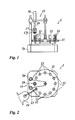
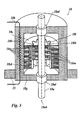
- Fig. 1 and 2 show a glass processing machine 1 for the production of glass moldings from molten glass gobs.
- a turntable 11 On a turntable 11, the one in the Fig. 1 and 2 not shown drive, are arranged on a pitch circle press molds 12 with the same pitch.
- 12 dies are arranged on the pitch circle so that the pitch is 30 °.
- the turntable 11 is consequently switchable in the transport cycle by 30 °.
- the turntable is rotated in the transport cycle by 30 ° clockwise.
- a feeder head 14 is arranged above a gutter system 13, whose outlet section is arranged in the working cycle over a press mold 12.
- a pressing station 15 is arranged above the turntable 11 and has an upper tool holder 16, on whose turntable 11 facing end portion of a ram 17 is arranged.
- a spring cage 17 f is arranged with a cover ring, which isteurgreifbar of the ram 17.
- the pressing station 15 is offset by a pitch spaced downstream of the gutter system 13.
- the pressing die 17 is in alignment with one of the dies 12.
- the tool holder 16 is rigidly connected to the rotor of a coaxial linear motor 18.
- the stator of the linear motor 18 is connected to the frame of the glass processing machine 1.
- a glass gob is formed in the feeder 14 and below the feeder outlet of a in the Fig. 1 and 2 scissors not shown cut off.
- This glass gob has the mass of glassware to be produced.
- the glass drop falls into the gutter system 13 and drops from the outlet of the gutter system 13 into an empty mold 12 provided in the feed position of the turntable 11.
- the transport cycle of the turntable 11 and now starts the glass gland filled mold 12 passes into the pressing position under the pressing station 15th
- the ram 17 moves down, and the glass gob is pressed until the cavity between the inner wall of the mold 12 and the outer wall of the ram 17 is filled with molten glass.
- the press die remains in this position until the glass mass has cooled sufficiently to remain dimensionally stable in order to ensure the further process steps until removal of the glass article,
- the cooled glass article is removed from the die 12 and usually fed to a fire polishing machine.
- press ridges are fused and the surface of the glass articles is optically improved by melting the edge layer.
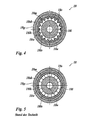
- Fig. 3 and 4 show the schematic structure of a cylinder-shaped linear motor 18th Fig. 3 shows a schematic cross section through the linear motor 18, Fig. 4 a schematic sectional view of the linear motor in Fig. 1 ,
- Fig. 3 shows in a schematic spatial representation of the structure of the linear motor 18.
- the cylinder-shaped linear motor 18 has an outer stator 18s and a run in the stator 18s linearly runner 181 on.
- the linear motor 18 has the following configuration from outside to inside: a stator core 18sk with coil teeth, a stator winding 18w arranged in the stator core 18sk, annularly arranged permanent magnets constituting one of a plurality of rotor magnets 18m, and a rotor core 181k on or in which the rotor magnets 18 m are arranged. Between the rotor 181 and the stator 18s, an air gap 181s is formed.
- the rotor core 181k is penetrated by a motor shaft 18a, which is mounted in two linear bearings 18al.
- the glass forming machine facing end portion of the motor shaft 18a is referred to as output 18ab.
- the linear motor 18 has a housing 18g in which the stator 18s and the linear bearings 18al are arranged.
- the housing 18g is penetrated by a cooling device 18k, which in Fig. 3 symbolically drawn.
- the housing is connected via the pressing station 15 rigidly connected to the frame of the glass forming machine.
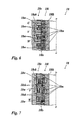
- Fig. 3 shows in a sectional view perpendicular to the motor axis, wherein the section is laid through a stator winding 18w, that the stator windings 18w are formed wave-shaped.
- Fig. 5 shows a comparison formed by a prior art linear motor with annular air gap without elevations and depressions in the air gap surface.
- the rotor core 181k may be formed of soft magnetic solid material.
- the stator core 18sk is formed of stacked pole pieces of soft magnetic material.
- the stator core 18sk has recesses into which the stator windings 18w are inserted and which form coil teeth between adjacent stator windings 18w in the axial direction of the linear movement of the rotor 181, hereinafter referred to as the linear axial direction ( Fig. 3 ).
- the magnetic field lines formed between the current-carrying stator windings 18w and the rotor magnet 18m pass through the soft-magnetic material of the stator or rotor core and pass in the area of the air gap from the stator core into the rotor core and vice versa.
- the rotor magnets 18m are spaced apart in the linear axis direction (see Fig. 3 ).
- the distances of the rotor magnets 18m to each other are referred to as pole pitch.
- the coil teeth arranged between the stator windings 18w have a pole pitch, wherein the two pole pitches do not coincide.
- a traveling field described in more detail below generates the driving force. Simplified, it can be said that in operation, for example, two currently abutting opposing south poles, while a staggered north pole of the stator attracts the next south pole of the rotor.
- the radial air gap 18ls formed between the stator core 18s and the rotor core 18l should be as small as possible. Usual air gaps are between 0.8 and 1.5 mm. In this case - / + 0.1 mm air gap in relation to +/- 3% driving force, d. H. if the air gap 18l is reduced by 0.1 mm, the driving force increases by 3%.
- the rotor magnets 18m formed as permanent magnets are made of high energy product materials such as neodymium-iron-boron (NdFeB) or samarium-cobalt (SmCo). Rotor magnets 18m adjacent in the linear axis direction have opposite magnetic polarity.
- NdFeB neodymium-iron-boron
- SmCo samarium-cobalt
- the Fig. 6 to 8 show in schematic representations three basic versions of coaxial linear motors.
- stator windings 18w are designed for three-phase current (U, V, W) and, when energized, generate the traveling magnetic field which carries along the rotor magnets 18m arranged one above the other in the linear axis direction.
- Fig. 6 shows an embodiment of the linear motor 18, in which the rotor magnets 18m are radially polarized. Successive rotor magnets 18m have a different polarity, that is, N, S, N, etc. The rotor magnets 18m are adhered to the rotor core 18lk.
- the stator core 18s has coil teeth, which are each surrounded by at least one stator winding 18w (U, V, W).
- stator laminations that form the stator core 18sk must also be radially aligned and designed to be comparable to pie wedges with a wedge-shaped cross-section.
- the rotor core 18lk may be formed as a solid magnetically conductive core.
- Fig. 7 shows a second embodiment of the linear motor 18, in which the rotor magnets 18m are radially polarized. Successive rotor magnets 18m have a different polarity, that is, N, S, N, etc. The rotor magnets 18m are adhered to the rotor core 18lk.
- the stator core 18sk is now formed from axially stacked Polschuhin same thickness, which are inserted into a cylindrical shell, so that there is a simple structure, With uneven thickness, a reduction of the latching forces of the linear motor 18 may result.
- the stator windings 18w are disposed between the pole piece discs.
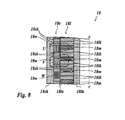
- Fig. 8 shows a third embodiment of the linear motor 18, in which the rotor magnets 18m are axially polarized.
- the rotor magnets 18m are inserted in the rotor core 18lk, with annular pole pieces arranged in stack between the rotor magnets 18m, whereby the core structure of the rotor 18l is analogous to that of the stator 18s.
- This Structure may be preferred, wherein the rotor magnets 18m may be formed of similar segments, which are arranged close to a ring, as described above Fig. 4 shown.
- stator core 18sk and the rotor core 18lk very high attraction forces occur, which can lead to deformations of the rotor and / or stator in linear motors with non-coaxial construction, especially in continuous operation, so that the stator and rotor come into contact, with high wear can occur. Due to the coaxial construction of the linear motor 18, an almost complete force compensation occurs, so that the high attractive forces between stator core 18s and rotor core 18lk cause comparatively small deformations and load the rotor bearings far less.
- the active area is characterized by the product of the circumferential length of the rotor core and the active height extending along the linear axis.
- the active rotor surface is the rotor surface, which actively contributes to the rotor movement and over which the forces between the stator and rotor are transmitted. From the transmitted force and the active rotor surface, the surface load occurring in the active rotor surface can be determined.
- Stator surface is initially a potentially active surface, because due to the linear movement of the rotor relative to the stator is always active only the proportion of the active stator, which corresponds to the active rotor surface.
- the active stator surface is therefore larger than the active rotor surface, however, the surface load of the active stator is as high as the surface load of the active rotor surface, because only the active rotor surface corresponding portion of the active stator is charged.
- the active surface has elevations and depressions. The elevations and depressions fold up the active rotor surface or stator surface so that the circumferential length increases and the active area is increased for the same active height.
- the resulting active surface can be simplified by the attribute "wavy" described, the rotor 18l is formed in cross-section star-shaped, equally the inner contour of the stator 18s is formed in a star-shaped cross-section and consequently also the stator winding 18w is formed star-shaped. But it is also possible that the stator winding 18w is circular and only the inner contour of the stator 18s is star-shaped.
- a trained linear motor with an outer diameter of 200 mm and an active diameter of 140 mm has an active circumferential length of 762 mm.
- a trained according to the prior art linear motor of the same size with the same active diameter only an active circumferential length of 440 mm.
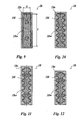
- Fig. 9 to 12 show embodiments of coaxial linear motors with rectangular rotor cross-section.
- Fig. 9 shows a first embodiment of a linear motor according to the invention with a rectangular rotor cross-section, which is used in the following as a comparative scale.
- a linear motor with a rotor width b already has an active area compared to a linear motor with a circular cross-section and a rotor diameter b, which is greater by at least 27% (with a square cross-section) than in the linear motor according to the prior art.
- the peak force of the linear motor in Fig. 9 F s 35 kN, the specific area force density in the air gap is 8 N / cm 2 .
- the rotor 18l has a rectangular cross-section and is guided in the rectangular interior of the stator 18s to form an air gap.
- the height of the active surface is 509 mm.
- Fig. 10 shows a second embodiment of a linear motor according to the invention with a rectangular rotor cross-section.
- the linear motor 18 has a cross-sectionally substantially rectangular rotor 18l, which has a wavy profile on both longitudinal sides, ie the surface of the rotor 18l is corrugated formed with bumps and depressions, whereby the active circumferential length relative to the circumferential length of in Fig. 9 shown linear motor is further increased.
- the circumferential length is in the in Fig. 10 shown Embodiment increased from 860 mm to 1400 mm, so that the active height is reduced to 313 mm with the same performance parameters and the relevant for the rigidity of the height of the stator 18s is lowered from 1009 mm to 813 mm.
- the end faces of the rectangular rotor cross-section are formed for design reasons not wavy and go with an outwardly arched arc section in the wavy longitudinal sides.
- Fig. 11 shows a third embodiment of a linear motor according to the invention with a rectangular rotor cross-section.
- the linear motor 18 in Fig. 11 is like the one in Fig. 10 described linear motor, with the difference that the active circumferential length is increased by extending the longitudinal sides of the rotor 18l to 1450 mm, and that the end sides of the rectangular rotor cross-section with an inwardly curved arc section in the corrugated longitudinal sides.
- the active height is now reduced to 302 mm with the same performance parameters and the height of the stator 18s, which is relevant for the rigidity, is reduced from 1009 mm to 802 mm.
- Fig. 12 shows a fourth embodiment of a linear motor according to the invention with a rectangular rotor cross-section.
- the linear motor 18 in Fig. 12 is like the one in Fig. 10 described linear motor, with the difference that the active circumferential length of 860 mm is increased to 1250 mm, although the longitudinal sides of the rotor 18l over the in Fig. 9 illustrated embodiment are shortened, and that the end faces of the rectangular rotor cross-section with an inwardly arched arc section in the wavy longitudinal sides.
- the active height is now shortened to 350 mm with the same performance parameters and the height of the stator 18s, which is relevant for the rigidity, is reduced from 1009 mm to 850 mm.
- the rotor magnets in the versions in FIGS. 11 and 12 can be composed of similar permanent magnets because of the special design of the rotor circumference, so that an equally simple structure is possible, as described above in Fig. 4 shown.
- the following table contains parameters of the Fig. 9 to 12 compared faced linear motors.
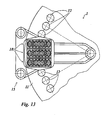
- Fig. 13 shows a second embodiment of the glass processing machine according to the invention.
- illustrated glass processing machine 1 is as in Fig. 1 and 2 illustrated glass processing machine, with the difference that instead of a linear motor, three linear motors are arranged side by side, so that three glass articles can be produced simultaneously in a work cycle.
- the linear motors 18 have a rectangular cross section, so that with the same power and height of the pitch of the shapes of a group can be reduced to each other, whereby a turntable smaller dimensions and thus smaller inertia is made possible with correspondingly higher dynamics and increased number of cycles.
- Each three adjacent glass molds 12 are arranged on the turntable in a line, so that the linear motors 18 form a compact unit.
Landscapes
- Engineering & Computer Science (AREA)
- Chemical & Material Sciences (AREA)
- Manufacturing & Machinery (AREA)
- Materials Engineering (AREA)
- Organic Chemistry (AREA)
- Power Engineering (AREA)
- Physics & Mathematics (AREA)
- Combustion & Propulsion (AREA)
- Electromagnetism (AREA)
- Mechanical Engineering (AREA)
- Linear Motors (AREA)
Priority Applications (1)
| Application Number | Priority Date | Filing Date | Title |
|---|---|---|---|
| EP10001197A EP2355314A1 (fr) | 2010-02-05 | 2010-02-05 | Moteur linéaire électrique |
Applications Claiming Priority (1)
| Application Number | Priority Date | Filing Date | Title |
|---|---|---|---|
| EP10001197A EP2355314A1 (fr) | 2010-02-05 | 2010-02-05 | Moteur linéaire électrique |
Publications (1)
| Publication Number | Publication Date |
|---|---|
| EP2355314A1 true EP2355314A1 (fr) | 2011-08-10 |
Family
ID=42028162
Family Applications (1)
| Application Number | Title | Priority Date | Filing Date |
|---|---|---|---|
| EP10001197A Withdrawn EP2355314A1 (fr) | 2010-02-05 | 2010-02-05 | Moteur linéaire électrique |
Country Status (1)
| Country | Link |
|---|---|
| EP (1) | EP2355314A1 (fr) |
Citations (8)
| Publication number | Priority date | Publication date | Assignee | Title |
|---|---|---|---|---|
| DE19811073A1 (de) * | 1998-03-13 | 1999-09-16 | Blum Gmbh | Zylindrischer, mehrphasiger Transversalflußaktor |
| DE10055080A1 (de) * | 2000-11-07 | 2002-05-16 | Bosch Gmbh Robert | Elektrische Linearmaschine |
| DE10156298A1 (de) * | 2000-11-20 | 2002-08-01 | Lg Electronics Inc | Kolbenmotor |
| US20020144519A1 (en) * | 2001-03-23 | 2002-10-10 | Gianclaudio Borsarelli | Punch assembly for producing hollow glass articles in a mold |
| US6701748B1 (en) * | 2000-10-06 | 2004-03-09 | Libbey Glass Inc. | Glassware machine |
| EP1596402A2 (fr) * | 2004-03-26 | 2005-11-16 | Bose Corporation | Actionneur électromagnétique et commande associé |
| US20060181157A1 (en) | 2005-02-11 | 2006-08-17 | Infinia Corporation | Linear electrodynamic system and method |
| JP2006248869A (ja) * | 2005-03-14 | 2006-09-21 | Hoya Corp | モールドプレス成形装置、そのプレスヘッド、および光学素子の製造方法 |
-
2010
- 2010-02-05 EP EP10001197A patent/EP2355314A1/fr not_active Withdrawn
Patent Citations (10)
| Publication number | Priority date | Publication date | Assignee | Title |
|---|---|---|---|---|
| DE19811073A1 (de) * | 1998-03-13 | 1999-09-16 | Blum Gmbh | Zylindrischer, mehrphasiger Transversalflußaktor |
| US6701748B1 (en) * | 2000-10-06 | 2004-03-09 | Libbey Glass Inc. | Glassware machine |
| EP1330417B1 (fr) | 2000-10-06 | 2008-07-23 | LIBBEY GLASS Inc. | Machine pour articles de verre |
| DE10055080A1 (de) * | 2000-11-07 | 2002-05-16 | Bosch Gmbh Robert | Elektrische Linearmaschine |
| DE10156298A1 (de) * | 2000-11-20 | 2002-08-01 | Lg Electronics Inc | Kolbenmotor |
| US20020144519A1 (en) * | 2001-03-23 | 2002-10-10 | Gianclaudio Borsarelli | Punch assembly for producing hollow glass articles in a mold |
| EP1596402A2 (fr) * | 2004-03-26 | 2005-11-16 | Bose Corporation | Actionneur électromagnétique et commande associé |
| US20060181157A1 (en) | 2005-02-11 | 2006-08-17 | Infinia Corporation | Linear electrodynamic system and method |
| US20080018179A1 (en) * | 2005-02-11 | 2008-01-24 | Infinia Corporation | Linear electrodynamic system and method |
| JP2006248869A (ja) * | 2005-03-14 | 2006-09-21 | Hoya Corp | モールドプレス成形装置、そのプレスヘッド、および光学素子の製造方法 |
Similar Documents
| Publication | Publication Date | Title |
|---|---|---|
| DE60211805T2 (de) | Statorkern für ein Magnetlager und Verfahren zu seiner Herstellung | |
| EP2951909B1 (fr) | Rotor, moteur à réluctance et procédé de fabrication d'un rotor | |
| DE112007000201T5 (de) | Geschlitzte Kerne für einen Motorstator, Motorstator, Synchronmotor des Permanentmagnetentyps, und Stanzverfahren durch Stanzstempel für geschlitzte Kerne | |
| DE102007002782A1 (de) | Drehantrieb mit geraden Primärteilsegmenten | |
| EP2831978B1 (fr) | Élimination des vibrations dans des machines synchrones | |
| EP2157328B1 (fr) | Arrangement de coussinet pour une table de machine dotée d'une décharge magnétique | |
| WO2000001059A1 (fr) | Moteur synchrone lineaire | |
| EP2963774B1 (fr) | Élément multipolaire pour une machine électrique | |
| EP1858142A1 (fr) | Moteur linéaire | |
| WO2016020120A2 (fr) | Élément en tôle ou en métal fritté pour stator ou rotor d'une machine électrique et un procédé de fabrication de celui-ci | |
| DE102012100332A1 (de) | Stator für eine rotierende elektrische Maschine und Verfahren zu seiner Herstellung | |
| EP2432722B1 (fr) | Dispositif de va-et-vient | |
| EP2523321A1 (fr) | Moteur linéaire cylindrique doté d'un pied en tôle | |
| EP3934067A1 (fr) | Système de bobinage pour machine électrique | |
| EP2122025B1 (fr) | Galette | |
| EP3284157B1 (fr) | Éolienne et empilage de tôles polaires pour un générateur synchrone d'une éolienne ainsi que générateur synchrone | |
| EP3043456A1 (fr) | Procédé de fabrication d'un élément de stator ou de rotor pour une machine électrique | |
| EP2355314A1 (fr) | Moteur linéaire électrique | |
| DE102019107136A1 (de) | Klauenpol-Stator für eine Transversalflussmaschine | |
| DE10150520B4 (de) | Elektrische Maschine | |
| EP3841659B1 (fr) | Station de fabrication compacte pour assembler un stator pour moteur électrique à partir de segments de stator | |
| EP2337195A2 (fr) | Entraînement linéaire avec une réduction des courants de Foucault | |
| AT509183B1 (de) | Elektrischer motor mit rollendem läufer | |
| EP3679641B1 (fr) | Machine électrique rotative | |
| EP3054562A1 (fr) | Machine d'entraînement électrique |
Legal Events
| Date | Code | Title | Description |
|---|---|---|---|
| PUAI | Public reference made under article 153(3) epc to a published international application that has entered the european phase |
Free format text: ORIGINAL CODE: 0009012 |
|
| AK | Designated contracting states |
Kind code of ref document: A1 Designated state(s): AT BE BG CH CY CZ DE DK EE ES FI FR GB GR HR HU IE IS IT LI LT LU LV MC MK MT NL NO PL PT RO SE SI SK SM TR |
|
| AX | Request for extension of the european patent |
Extension state: AL BA RS |
|
| 17P | Request for examination filed |
Effective date: 20120206 |
|
| 17Q | First examination report despatched |
Effective date: 20150825 |
|
| RIC1 | Information provided on ipc code assigned before grant |
Ipc: C03B 11/16 20060101ALI20170111BHEP Ipc: C03B 11/02 20060101ALI20170111BHEP Ipc: H02K 9/19 20060101ALN20170111BHEP Ipc: H02K 1/06 20060101ALN20170111BHEP Ipc: H02K 41/03 20060101AFI20170111BHEP Ipc: C03B 11/06 20060101ALI20170111BHEP Ipc: C03B 9/41 20060101ALI20170111BHEP Ipc: C03B 9/193 20060101ALI20170111BHEP Ipc: C03B 11/00 20060101ALI20170111BHEP |
|
| GRAP | Despatch of communication of intention to grant a patent |
Free format text: ORIGINAL CODE: EPIDOSNIGR1 |
|
| GRAJ | Information related to disapproval of communication of intention to grant by the applicant or resumption of examination proceedings by the epo deleted |
Free format text: ORIGINAL CODE: EPIDOSDIGR1 |
|
| INTG | Intention to grant announced |
Effective date: 20170223 |
|
| GRAP | Despatch of communication of intention to grant a patent |
Free format text: ORIGINAL CODE: EPIDOSNIGR1 |
|
| INTC | Intention to grant announced (deleted) | ||
| RIC1 | Information provided on ipc code assigned before grant |
Ipc: C03B 11/02 20060101ALI20170320BHEP Ipc: H02K 9/19 20060101ALN20170320BHEP Ipc: H02K 1/06 20060101ALN20170320BHEP Ipc: C03B 11/16 20060101ALI20170320BHEP Ipc: H02K 41/03 20060101AFI20170320BHEP Ipc: C03B 11/06 20060101ALI20170320BHEP Ipc: C03B 11/00 20060101ALI20170320BHEP Ipc: C03B 9/41 20060101ALI20170320BHEP Ipc: C03B 9/193 20060101ALI20170320BHEP |
|
| INTG | Intention to grant announced |
Effective date: 20170405 |
|
| STAA | Information on the status of an ep patent application or granted ep patent |
Free format text: STATUS: THE APPLICATION IS DEEMED TO BE WITHDRAWN |
|
| 18D | Application deemed to be withdrawn |
Effective date: 20170817 |